IPhO 1968 · Theory problem 1
Solid cylinder and block joined by a cord on an inclined plane
On an inclined plane of \(30^\circ\) a block, mass \(m_2 = 4\) kg, is joined by a light cord to a solid cylinder, mass \(m_1 = 8\) kg, radius \(r = 5\) cm (Fig. 1). Find the acceleration if the bodies are released. The coefficient of friction between the block and the inclined plane \(\mu = 0.2\). Friction at the bearing and rolling friction are negligible.
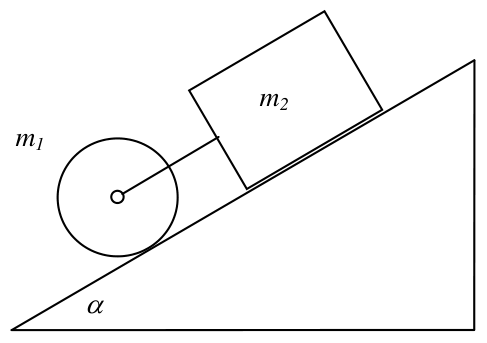
Figure 1
Official English text of the problem.
Answers
- Problem 1: Both bodies accelerate down the inclined plane with \[ \boxed{a=\frac{(m_1+m_2)g\sin30^\circ-\mu m_2g\cos30^\circ} {\frac32m_1+m_2} =0.3317g\approx3.25\,\mathrm{m\,s^{-2}}.} \] The numerical value uses \(g=9.81\,\mathrm{m\,s^{-2}}\).
Solution
Problem 1
Treat the cord as massless and inextensible, and assume the cylinder rolls without slipping. With the cord taut, both bodies have the same acceleration \(a\). Take the direction down the plane as positive and write \(\theta=30^\circ\).
The cord acts through the cylinder’s central bearing, so its tension produces no torque about the cylinder’s axis. Negligible rolling friction means that there is no rolling-resistance torque; static friction at the contact still supplies the torque needed for rotation.
Let \(T\) be the tension and \(f\) the static friction on the cylinder, directed up the plane.
For the block, the cord pulls down the plane. Its normal reaction and sliding friction are \[ N_2=m_2g\cos\theta, \qquad F_2=\mu m_2g\cos\theta. \] Newton’s second law along the plane therefore gives \[ m_2a=m_2g\sin\theta+T-\mu m_2g\cos\theta. \tag{1} \]
For the cylinder, both tension and static friction act up the plane: \[ m_1a=m_1g\sin\theta-T-f. \tag{2} \]
The moment of inertia of a solid cylinder about its axis is \[ I=\frac12m_1r^2. \] If its angular acceleration has magnitude \(\beta\), rolling without slipping requires \(a=r\beta\). The rotational equation about its centre is consequently \[ fr=I\beta =\frac12m_1r^2\frac{a}{r}, \] and hence \[ f=\frac12m_1a. \tag{3} \]
Adding (1) and (2), then substituting (3), eliminates the tension: \[ (m_1+m_2)a =(m_1+m_2)g\sin\theta-\mu m_2g\cos\theta-\frac12m_1a. \] Thus \[ \boxed{ a=\frac{(m_1+m_2)g\sin\theta-\mu m_2g\cos\theta} {\frac32m_1+m_2}. } \] The radius cancels because \(I/r^2=m_1/2\).
Substitution gives \[ a =g\frac{(8+4)(1/2)-(0.2)(4)(\sqrt3/2)} {(3/2)(8)+4} =g\frac{5.30718}{16} =0.331699g, \] so \[ \boxed{a\approx3.25\,\mathrm{m\,s^{-2}}\quad\text{down the plane}.} \]
Finally, the assumed taut cord must require a positive tension. From (1), \[ T=m_2a-m_2g\sin\theta+\mu m_2g\cos\theta \approx0.192\,\mathrm N>0. \] Thus the common-acceleration solution is consistent with a cord that can pull but cannot push.
The solution was checked against the official solution.
IPhO 1968 · Theorieaufgabe 1
Durch eine Schnur verbundener Vollzylinder und Klotz auf einer schiefen Ebene
Auf einer um \(30^\circ\) geneigten Ebene ist ein Klotz der Masse \(m_2 = 4\) kg durch eine leichte Schnur mit einem Vollzylinder der Masse \(m_1 = 8\) kg und des Radius \(r = 5\) cm verbunden (Abb. 1). Bestimmen Sie die Beschleunigung, wenn die Körper losgelassen werden. Der Reibungskoeffizient zwischen dem Klotz und der schiefen Ebene beträgt \(\mu = 0.2\). Die Lagerreibung und die Rollreibung sind vernachlässigbar.
Abbildung 1
Aufgabentext aus dem offiziellen englischen Text übersetzt.
Antworten
- Aufgabe 1: Beide Körper beschleunigen die schiefe Ebene hinab mit \[ \boxed{a=\frac{(m_1+m_2)g\sin30^\circ-\mu m_2g\cos30^\circ} {\frac32m_1+m_2} =0.3317g\approx3.25\,\mathrm{m\,s^{-2}}.} \] Für den Zahlenwert wird \(g=9.81\,\mathrm{m\,s^{-2}}\) verwendet.
Lösung
Aufgabe 1
Wir betrachten die Schnur als masselos und undehnbar und nehmen an, dass der Zylinder ohne Gleiten rollt. Bei gespannter Schnur haben beide Körper dieselbe Beschleunigung \(a\). Wir wählen die Richtung die Ebene hinab als positiv und setzen \(\theta=30^\circ\).
Die Schnur greift am zentralen Lager des Zylinders an, sodass ihre Zugkraft kein Drehmoment um die Zylinderachse erzeugt. Vernachlässigbare Rollreibung bedeutet, dass kein Rollwiderstandsmoment auftritt; die Haftreibung an der Kontaktstelle liefert dennoch das für die Drehung erforderliche Drehmoment.
Es seien \(T\) die Seilzugkraft und \(f\) die auf den Zylinder wirkende Haftreibungskraft, die die Ebene hinauf gerichtet ist.
Am Klotz zieht die Schnur die Ebene hinab. Seine Normalkraft und seine Gleitreibungskraft sind \[ N_2=m_2g\cos\theta, \qquad F_2=\mu m_2g\cos\theta. \] Das zweite Newtonsche Gesetz entlang der Ebene ergibt daher \[ m_2a=m_2g\sin\theta+T-\mu m_2g\cos\theta. \tag{1} \]
Auf den Zylinder wirken sowohl die Seilzugkraft als auch die Haftreibungskraft die Ebene hinauf: \[ m_1a=m_1g\sin\theta-T-f. \tag{2} \]
Das Trägheitsmoment eines Vollzylinders bezüglich seiner Achse beträgt \[ I=\frac12m_1r^2. \] Hat seine Winkelbeschleunigung den Betrag \(\beta\), so erfordert Rollen ohne Gleiten \(a=r\beta\). Die Bewegungsgleichung für die Drehung um seinen Mittelpunkt lautet folglich \[ fr=I\beta =\frac12m_1r^2\frac{a}{r}, \] und damit \[ f=\frac12m_1a. \tag{3} \]
Durch Addition von (1) und (2) und anschließendes Einsetzen von (3) wird die Seilzugkraft eliminiert: \[ (m_1+m_2)a =(m_1+m_2)g\sin\theta-\mu m_2g\cos\theta-\frac12m_1a. \] Somit gilt \[ \boxed{ a=\frac{(m_1+m_2)g\sin\theta-\mu m_2g\cos\theta} {\frac32m_1+m_2}. } \] Der Radius kürzt sich heraus, weil \(I/r^2=m_1/2\).
Einsetzen ergibt \[ a =g\frac{(8+4)(1/2)-(0.2)(4)(\sqrt3/2)} {(3/2)(8)+4} =g\frac{5.30718}{16} =0.331699g, \] also \[ \boxed{a\approx3.25\,\mathrm{m\,s^{-2}}\quad\text{die Ebene hinab}.} \]
Schließlich muss sich für die als gespannt angenommene Schnur eine positive Seilzugkraft ergeben. Aus (1) folgt \[ T=m_2a-m_2g\sin\theta+\mu m_2g\cos\theta \approx0.192\,\mathrm N>0. \] Damit ist die Lösung mit gemeinsamer Beschleunigung mit einer Schnur vereinbar, die ziehen, aber nicht drücken kann.
Die Lösung wurde mit der offiziellen Lösung abgeglichen.
IPhO 1968 · Teori sorusu 1
Eğik düzlem üzerinde bir iple birbirine bağlanmış dolu silindir ve blok
Eğim açısı \(30^\circ\) olan bir eğik düzlem üzerinde, kütlesi \(m_2 = 4\) kg olan bir blok, hafif bir iple kütlesi \(m_1 = 8\) kg, yarıçapı \(r = 5\) cm olan dolu bir silindire bağlanmıştır (Şekil 1). Cisimler serbest bırakıldığında ivmelerini bulunuz. Blok ile eğik düzlem arasındaki sürtünme katsayısı \(\mu = 0.2\)'dir. Yataktaki sürtünme ve yuvarlanma sürtünmesi ihmal edilebilir.
Şekil 1
Soru metni resmi İngilizce metinden çevrilmiştir.
Cevaplar
- Soru 1: Her iki cisim de eğik düzlem boyunca aşağı yönde, şu ivmeyle hareket eder: \[ \boxed{a=\frac{(m_1+m_2)g\sin30^\circ-\mu m_2g\cos30^\circ} {\frac32m_1+m_2} =0.3317g\approx3.25\,\mathrm{m\,s^{-2}}.} \] Sayısal değerin hesaplanmasında \(g=9.81\,\mathrm{m\,s^{-2}}\) kullanılmıştır.
Çözüm
Soru 1
İpi kütlesiz ve uzamaz kabul edelim ve silindirin kaymadan yuvarlandığını varsayalım. İp gergin olduğunda her iki cisim de aynı \(a\) ivmesine sahiptir. Düzlem boyunca aşağı yönü pozitif alalım ve \(\theta=30^\circ\) yazalım.
İp, silindirin merkezindeki yatağa kuvvet uygular; dolayısıyla ipin gerilme kuvveti silindirin eksenine göre tork oluşturmaz. Yuvarlanma sürtünmesinin ihmal edilebilir olması, yuvarlanmaya karşı koyan bir direnç torkunun bulunmadığı anlamına gelir; temas noktasındaki statik sürtünme ise dönme için gerekli torku sağlamaya devam eder.
Gerilme kuvveti \(T\), silindire etki eden ve düzlem boyunca yukarı yönelen statik sürtünme kuvveti ise \(f\) olsun.
İp, bloğu düzlem boyunca aşağı yönde çeker. Bloğa etki eden normal tepki kuvveti ve kinetik sürtünme kuvveti şöyledir: \[ N_2=m_2g\cos\theta, \qquad F_2=\mu m_2g\cos\theta. \] Dolayısıyla Newton'un ikinci yasası düzlem doğrultusunda şu sonucu verir: \[ m_2a=m_2g\sin\theta+T-\mu m_2g\cos\theta. \tag{1} \]
Silindir için hem gerilme kuvveti hem de statik sürtünme kuvveti düzlem boyunca yukarı yönde etki eder: \[ m_1a=m_1g\sin\theta-T-f. \tag{2} \]
Dolu bir silindirin kendi eksenine göre eylemsizlik momenti şöyledir: \[ I=\frac12m_1r^2. \] Açısal ivmesinin büyüklüğü \(\beta\) ise kaymadan yuvarlanma koşulu \(a=r\beta\) olmasını gerektirir. Buna göre, merkezine göre dönme denklemi şöyledir: \[ fr=I\beta =\frac12m_1r^2\frac{a}{r}, \] ve buradan \[ f=\frac12m_1a. \tag{3} \]
(1) ve (2) toplanıp ardından (3) yerine konulduğunda gerilme kuvveti elenir: \[ (m_1+m_2)a =(m_1+m_2)g\sin\theta-\mu m_2g\cos\theta-\frac12m_1a. \] Böylece \[ \boxed{ a=\frac{(m_1+m_2)g\sin\theta-\mu m_2g\cos\theta} {\frac32m_1+m_2}. } \] \(I/r^2=m_1/2\) olduğundan yarıçap sadeleşir.
Değerler yerine konulduğunda \[ a =g\frac{(8+4)(1/2)-(0.2)(4)(\sqrt3/2)} {(3/2)(8)+4} =g\frac{5.30718}{16} =0.331699g, \] elde edilir; dolayısıyla \[ \boxed{a\approx3.25\,\mathrm{m\,s^{-2}}\quad\text{düzlem boyunca aşağı yönde}.} \]
Son olarak, ipin gergin olduğu varsayımının geçerli olması için gerilme kuvvetinin pozitif olması gerekir. (1)'den, \[ T=m_2a-m_2g\sin\theta+\mu m_2g\cos\theta \approx0.192\,\mathrm N>0. \] Dolayısıyla ortak ivme çözümü, çekebilen ancak itemeyen bir iple tutarlıdır.
Çözüm, resmi çözümle karşılaştırılarak kontrol edildi.
IPhO 1968 · Problema teórico 1
Cilindro macizo y bloque unidos por una cuerda sobre un plano inclinado
Sobre un plano inclinado de \(30^\circ\), un bloque de masa \(m_2 = 4\) kg está unido mediante una cuerda ligera a un cilindro macizo de masa \(m_1 = 8\) kg y radio \(r = 5\) cm (Fig. 1). Halle la aceleración de los cuerpos al soltarlos. El coeficiente de rozamiento entre el bloque y el plano inclinado es \(\mu = 0.2\). El rozamiento en el cojinete y la resistencia a la rodadura son despreciables.
Figura 1
Enunciado traducido del texto oficial en inglés.
Respuestas
- Problema 1: Ambos cuerpos aceleran hacia abajo por el plano inclinado con \[ \boxed{a=\frac{(m_1+m_2)g\sin30^\circ-\mu m_2g\cos30^\circ} {\frac32m_1+m_2} =0.3317g\approx3.25\,\mathrm{m\,s^{-2}}.} \] El valor numérico se obtiene usando \(g=9.81\,\mathrm{m\,s^{-2}}\).
Solución
Problema 1
Considere la cuerda sin masa e inextensible y suponga que el cilindro rueda sin deslizar. Con la cuerda tensa, ambos cuerpos tienen la misma aceleración \(a\). Tome como positivo el sentido descendente a lo largo del plano y escriba \(\theta=30^\circ\).
La cuerda actúa a través del cojinete central del cilindro, por lo que su tensión no produce ningún momento respecto al eje del cilindro. Que la resistencia a la rodadura sea despreciable significa que no hay ningún momento de resistencia a la rodadura; el rozamiento estático en el contacto sigue proporcionando el momento necesario para la rotación.
Sean \(T\) la tensión y \(f\) la fuerza de rozamiento estático sobre el cilindro, dirigida hacia arriba por el plano.
Sobre el bloque, la cuerda tira hacia abajo por el plano. Su reacción normal y su fuerza de rozamiento por deslizamiento son \[ N_2=m_2g\cos\theta, \qquad F_2=\mu m_2g\cos\theta. \] Por tanto, la segunda ley de Newton a lo largo del plano da \[ m_2a=m_2g\sin\theta+T-\mu m_2g\cos\theta. \tag{1} \]
Sobre el cilindro, tanto la tensión como el rozamiento estático actúan hacia arriba por el plano: \[ m_1a=m_1g\sin\theta-T-f. \tag{2} \]
El momento de inercia de un cilindro macizo respecto a su eje es \[ I=\frac12m_1r^2. \] Si el módulo de su aceleración angular es \(\beta\), la rodadura sin deslizamiento exige \(a=r\beta\). Por consiguiente, la ecuación de rotación respecto a su centro es \[ fr=I\beta =\frac12m_1r^2\frac{a}{r}, \] y, por tanto, \[ f=\frac12m_1a. \tag{3} \]
Al sumar (1) y (2) y sustituir después (3), se elimina la tensión: \[ (m_1+m_2)a =(m_1+m_2)g\sin\theta-\mu m_2g\cos\theta-\frac12m_1a. \] Así, \[ \boxed{ a=\frac{(m_1+m_2)g\sin\theta-\mu m_2g\cos\theta} {\frac32m_1+m_2}. } \] El radio se cancela porque \(I/r^2=m_1/2\).
La sustitución da \[ a =g\frac{(8+4)(1/2)-(0.2)(4)(\sqrt3/2)} {(3/2)(8)+4} =g\frac{5.30718}{16} =0.331699g, \] por lo que \[ \boxed{a\approx3.25\,\mathrm{m\,s^{-2}}\quad\text{hacia abajo por el plano}.} \]
Finalmente, la hipótesis de que la cuerda permanece tensa debe exigir una tensión positiva. De (1), \[ T=m_2a-m_2g\sin\theta+\mu m_2g\cos\theta \approx0.192\,\mathrm N>0. \] Por tanto, la solución con aceleración común es compatible con una cuerda que puede tirar, pero no empujar.
La solución se comprobó con la solución oficial.
IPhO 1968 · 理论题 1
斜面上用细绳连接的实心圆柱体和物块
在倾角为 \(30^\circ\) 的斜面上,质量为 \(m_2 = 4\) kg 的物块通过一根轻绳与质量为 \(m_1 = 8\) kg、半径为 \(r = 5\) cm 的实心圆柱体相连(图 1)。求释放两物体后它们的加速度。物块与斜面之间的摩擦系数为 \(\mu = 0.2\)。轴承处的摩擦和滚动摩擦均可忽略。
图 1
题目译自官方英文原文。
答案
- 题目 1: 两物体均沿斜面向下加速运动,加速度为 \[ \boxed{a=\frac{(m_1+m_2)g\sin30^\circ-\mu m_2g\cos30^\circ} {\frac32m_1+m_2} =0.3317g\approx3.25\,\mathrm{m\,s^{-2}}.} \] 此数值采用 \(g=9.81\,\mathrm{m\,s^{-2}}\)。
解答
题目 1
将细绳视为质量可忽略且不可伸长,并假设圆柱体做无滑动滚动。在细绳绷紧的情况下,两物体具有相同的加速度 \(a\)。取沿斜面向下为正方向,并记 \(\theta=30^\circ\)。
细绳通过圆柱体中心的轴承施力,因此绳的张力对圆柱体的轴线不产生力矩。滚动摩擦可忽略意味着不存在滚动阻力矩;接触处的静摩擦力仍提供转动所需的力矩。
设 \(T\) 为绳的张力,\(f\) 为圆柱体受到的静摩擦力,其方向沿斜面向上。
对于物块,细绳沿斜面向下拉它。物块受到的支持力和滑动摩擦力分别为 \[ N_2=m_2g\cos\theta, \qquad F_2=\mu m_2g\cos\theta. \] 因此,沿斜面方向应用牛顿第二定律,得到 \[ m_2a=m_2g\sin\theta+T-\mu m_2g\cos\theta. \tag{1} \]
对于圆柱体,张力和静摩擦力均沿斜面向上: \[ m_1a=m_1g\sin\theta-T-f. \tag{2} \]
实心圆柱体绕其轴线的转动惯量为 \[ I=\frac12m_1r^2. \] 若其角加速度的大小为 \(\beta\),则无滑动滚动要求 \(a=r\beta\)。因此,绕其中心的转动方程为 \[ fr=I\beta =\frac12m_1r^2\frac{a}{r}, \] 从而 \[ f=\frac12m_1a. \tag{3} \]
将 (1) 和 (2) 相加,再代入 (3),消去张力,得到 \[ (m_1+m_2)a =(m_1+m_2)g\sin\theta-\mu m_2g\cos\theta-\frac12m_1a. \] 因此 \[ \boxed{ a=\frac{(m_1+m_2)g\sin\theta-\mu m_2g\cos\theta} {\frac32m_1+m_2}. } \] 由于 \(I/r^2=m_1/2\),半径被约去。
代入数值得 \[ a =g\frac{(8+4)(1/2)-(0.2)(4)(\sqrt3/2)} {(3/2)(8)+4} =g\frac{5.30718}{16} =0.331699g, \] 所以 \[ \boxed{a\approx3.25\,\mathrm{m\,s^{-2}}\quad\text{沿斜面向下}.} \]
最后,假设细绳绷紧,就必须要求张力为正。由 (1), \[ T=m_2a-m_2g\sin\theta+\mu m_2g\cos\theta \approx0.192\,\mathrm N>0. \] 因此,这一两物体具有相同加速度的解与细绳只能拉、不能推的性质相符。
解答已与官方解答核对。
IPhO 1968 · Теоретическая задача 1
Сплошной цилиндр и брусок, соединённые нитью на наклонной плоскости
На плоскости с углом наклона \(30^\circ\) брусок массой \(m_2 = 4\) кг соединён лёгкой нитью со сплошным цилиндром массой \(m_1 = 8\) кг и радиусом \(r = 5\) см (рис. 1). Найдите ускорение тел после того, как их отпустят. Коэффициент трения между бруском и наклонной плоскостью \(\mu = 0.2\). Трением в подшипнике и трением качения можно пренебречь.
Рисунок 1
Условие переведено с официального английского текста.
Ответы
- Задача 1: Оба тела движутся с ускорением, направленным вниз по наклонной плоскости и равным \[ \boxed{a=\frac{(m_1+m_2)g\sin30^\circ-\mu m_2g\cos30^\circ} {\frac32m_1+m_2} =0.3317g\approx3.25\,\mathrm{m\,s^{-2}}.} \] Численное значение получено при \(g=9.81\,\mathrm{m\,s^{-2}}\).
Решение
Задача 1
Считаем нить невесомой и нерастяжимой и предполагаем, что цилиндр катится без проскальзывания. При натянутой нити оба тела имеют одинаковое ускорение \(a\). Выберем направление вниз по плоскости положительным и обозначим \(\theta=30^\circ\).
Сила натяжения нити приложена через центральный подшипник цилиндра, поэтому она не создаёт момента относительно его оси. Пренебрежимо малое трение качения означает отсутствие момента сопротивления качению; при этом сила трения покоя в точке контакта создаёт момент, необходимый для вращения.
Обозначим через \(T\) силу натяжения нити, а через \(f\) — силу трения покоя, действующую на цилиндр и направленную вверх по плоскости.
Нить тянет брусок вниз по плоскости. Действующие на него нормальная реакция опоры и сила трения скольжения равны \[ N_2=m_2g\cos\theta, \qquad F_2=\mu m_2g\cos\theta. \] Поэтому второй закон Ньютона в проекции на направление вдоль плоскости даёт \[ m_2a=m_2g\sin\theta+T-\mu m_2g\cos\theta. \tag{1} \]
На цилиндр и сила натяжения нити, и сила трения покоя действуют вверх по плоскости: \[ m_1a=m_1g\sin\theta-T-f. \tag{2} \]
Момент инерции сплошного цилиндра относительно его оси равен \[ I=\frac12m_1r^2. \] Если модуль его углового ускорения равен \(\beta\), то условие качения без проскальзывания имеет вид \(a=r\beta\). Следовательно, уравнение вращательного движения относительно центра цилиндра записывается как \[ fr=I\beta =\frac12m_1r^2\frac{a}{r}, \] откуда \[ f=\frac12m_1a. \tag{3} \]
Складывая (1) и (2), а затем подставляя (3), исключаем силу натяжения нити: \[ (m_1+m_2)a =(m_1+m_2)g\sin\theta-\mu m_2g\cos\theta-\frac12m_1a. \] Таким образом, \[ \boxed{ a=\frac{(m_1+m_2)g\sin\theta-\mu m_2g\cos\theta} {\frac32m_1+m_2}. } \] Радиус сокращается, поскольку \(I/r^2=m_1/2\).
Подстановка численных значений даёт \[ a =g\frac{(8+4)(1/2)-(0.2)(4)(\sqrt3/2)} {(3/2)(8)+4} =g\frac{5.30718}{16} =0.331699g, \] поэтому \[ \boxed{a\approx3.25\,\mathrm{m\,s^{-2}}\quad\text{вниз по плоскости}.} \]
Наконец, предположение о натянутой нити требует положительной силы натяжения. Из (1), \[ T=m_2a-m_2g\sin\theta+\mu m_2g\cos\theta \approx0.192\,\mathrm N>0. \] Следовательно, решение с одинаковым ускорением обоих тел согласуется с тем, что нить может тянуть, но не может толкать.
Решение проверено по официальному решению.
IPhO 1968 · مسألة نظرية 1
أسطوانة مصمتة وكتلة موصولتان بحبل على مستوى مائل
على مستوى مائل بزاوية \(30^\circ\)، توجد كتلة مقدارها \(m_2 = 4\) كغ، موصولة بحبل خفيف بأسطوانة مصمتة كتلتها \(m_1 = 8\) كغ ونصف قطرها \(r = 5\) سم (الشكل 1). أوجد تسارع الجسمين إذا أُطلقا من السكون. معامل الاحتكاك بين الكتلة والمستوى المائل هو \(\mu = 0.2\). يُهمل الاحتكاك في المحمل واحتكاك التدحرج.
الشكل 1
نص المسألة مترجم عن النص الإنجليزي الرسمي.
الإجابات
- المسألة 1: يتسارع الجسمان إلى أسفل المستوى المائل بتسارع \[ \boxed{a=\frac{(m_1+m_2)g\sin30^\circ-\mu m_2g\cos30^\circ} {\frac32m_1+m_2} =0.3317g\approx3.25\,\mathrm{m\,s^{-2}}.} \] تُحسب القيمة العددية باستخدام \(g=9.81\,\mathrm{m\,s^{-2}}\).
الحل
المسألة 1
اعتبر الحبل عديم الكتلة وغير قابل للاستطالة، وافترض أن الأسطوانة تتدحرج دون انزلاق. ما دام الحبل مشدودًا، فإن للجسمين التسارع نفسه \(a\). اعتبر الاتجاه إلى أسفل المستوى موجبًا، واكتب \(\theta=30^\circ\).
يؤثر الحبل عبر المحمل المركزي للأسطوانة، ولذلك لا يولّد شده عزمًا حول محور الأسطوانة. وإهمال احتكاك التدحرج يعني عدم وجود عزم مقاوم للتدحرج؛ أما الاحتكاك السكوني عند التلامس فيظل مصدر العزم اللازم للدوران.
ليكن \(T\) قوة الشد و\(f\) قوة الاحتكاك السكوني المؤثرة في الأسطوانة، واتجاهها إلى أعلى المستوى.
بالنسبة إلى الكتلة، يسحبها الحبل إلى أسفل المستوى. وتكون قوة رد الفعل العمودية عليها وقوة الاحتكاك الانزلاقي \[ N_2=m_2g\cos\theta, \qquad F_2=\mu m_2g\cos\theta. \] ومن ثم يعطي قانون نيوتن الثاني على امتداد المستوى \[ m_2a=m_2g\sin\theta+T-\mu m_2g\cos\theta. \tag{1} \]
بالنسبة إلى الأسطوانة، تؤثر كل من قوة الشد وقوة الاحتكاك السكوني إلى أعلى المستوى: \[ m_1a=m_1g\sin\theta-T-f. \tag{2} \]
عزم القصور الذاتي لأسطوانة مصمتة حول محورها هو \[ I=\frac12m_1r^2. \] إذا كان مقدار تسارعها الزاوي \(\beta\)، فإن التدحرج دون انزلاق يقتضي أن يكون \(a=r\beta\). وبالتالي تكون معادلة الحركة الدورانية حول مركزها \[ fr=I\beta =\frac12m_1r^2\frac{a}{r}, \] ومن ثم \[ f=\frac12m_1a. \tag{3} \]
بجمع (1) و(2)، ثم التعويض من (3)، تُحذف قوة الشد: \[ (m_1+m_2)a =(m_1+m_2)g\sin\theta-\mu m_2g\cos\theta-\frac12m_1a. \] إذن \[ \boxed{ a=\frac{(m_1+m_2)g\sin\theta-\mu m_2g\cos\theta} {\frac32m_1+m_2}. } \] يُختزل نصف القطر لأن \(I/r^2=m_1/2\).
بالتعويض نحصل على \[ a =g\frac{(8+4)(1/2)-(0.2)(4)(\sqrt3/2)} {(3/2)(8)+4} =g\frac{5.30718}{16} =0.331699g, \] وعليه \[ \boxed{a\approx3.25\,\mathrm{m\,s^{-2}}\quad\text{إلى أسفل المستوى}.} \]
أخيرًا، يجب أن يستلزم افتراض بقاء الحبل مشدودًا قوة شد موجبة. من (1)، \[ T=m_2a-m_2g\sin\theta+\mu m_2g\cos\theta \approx0.192\,\mathrm N>0. \] إذن، يتسق الحل الذي يعطي تسارعًا مشتركًا للجسمين مع كون الحبل قادرًا على السحب ولكنه غير قادر على الدفع.
تمت مراجعة الحل بمقارنته بالحل الرسمي.