IPhO 1969 · Theory problem 4
Interference in an air layer between a glass plate and a cube
A glass plate is placed above a glass cube of \(2\ \mathrm{cm}\) edges in such a way that there remains a thin air layer between them, see Figure 5.
Electromagnetic radiation of wavelength between \(400\ \mathrm{nm}\) and \(1150\ \mathrm{nm}\) (for which the plate is penetrable) incident perpendicular to the plate from above is reflected from both air surfaces and interferes. In this range only two wavelengths give maximum reinforcements, one of them is \(\lambda = 400\ \mathrm{nm}\). Find the second wavelength. Determine how it is necessary to warm up the cube so as it would touch the plate. The coefficient of linear thermal expansion is \(\alpha = 8.0 \cdot 10^{-6}\ {}^\circ\mathrm{C}^{-1}\), the refractive index of the air \(n = 1\). The distance of the bottom of the cube from the plate does not change during warming up.
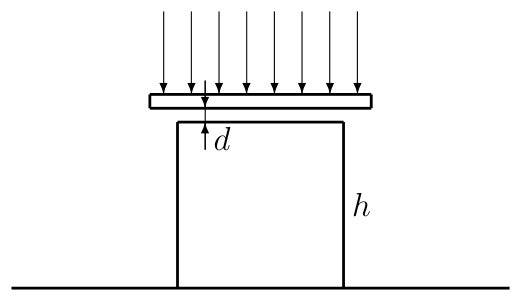
Figure 5:
Official English text of the problem.
Answers
- Second wavelength: \(\boxed{\lambda_2 \approx 667\ \mathrm{nm}}\).
- Required warming: increase the cube’s temperature by \(\boxed{\Delta T \approx 3.1\ {}^\circ\mathrm{C}}\). The initial air gap is \(d=500\ \mathrm{nm}\).
Solution
Second wavelength. Let \(d\) be the thickness of the air layer. At its upper boundary, reflection occurs from glass towards air and introduces no phase reversal. At its lower boundary, reflection occurs from air towards glass and introduces a phase reversal of \(\pi\).
At normal incidence, the additional optical path travelled by the second reflected ray is \(2nd\). Thus the phase difference is \[ \Delta\phi=\frac{4\pi nd}{\lambda}+\pi. \] Constructive interference requires an integer multiple of \(2\pi\), giving \[ 2nd=\left(m+\frac12\right)\lambda, \qquad m=0,1,2,\ldots. \] With \(n=1\), the wavelengths of reflection maxima are therefore \[ \lambda_m=\frac{4d}{2m+1}. \]
Let the maximum at \(400\ \mathrm{nm}\) have order \(m\). Then \[ 4d=(2m+1)(400\ \mathrm{nm}). \] Larger orders give wavelengths below \(400\ \mathrm{nm}\), so the second maximum in the specified interval must have order \(m-1\). Consequently \(m\ge1\), and \[ \lambda_{m-1} =400\frac{2m+1}{2m-1}\ \mathrm{nm} \le1150\ \mathrm{nm}. \] Rearrangement gives \[ m\ge\frac{31}{30}, \] so \(m\ge2\).
There must be no third maximum in the interval. The next longer wavelength, corresponding to order \(m-2\), must therefore satisfy \[ \lambda_{m-2} =400\frac{2m+1}{2m-3}\ \mathrm{nm} >1150\ \mathrm{nm}. \] This gives \[ m<\frac{77}{30}. \] The only integer satisfying both bounds is \(m=2\). Hence \[ d=\frac{5(400\ \mathrm{nm})}{4} =\boxed{500\ \mathrm{nm}}, \] and the second wavelength is \[ \boxed{\lambda_2=\frac{4d}{3} =\frac{2000}{3}\ \mathrm{nm} \approx667\ \mathrm{nm}}. \] As a check, the next longer maximum is at \(2000\ \mathrm{nm}\), while the next shorter one is at \(2000/7\approx286\ \mathrm{nm}\); both lie outside the given interval.
Required warming. The cube initially has height \[ h=2\ \mathrm{cm}=2.0\times10^{-2}\ \mathrm{m}. \] Because the distance from its bottom to the plate remains fixed, contact occurs when its height increases by \(d\).
Using linear thermal expansion with the given constant coefficient, \[ \Delta h=\alpha h\,\Delta T=d, \] so \[ \Delta T =\frac{d}{\alpha h} =\frac{5.0\times10^{-7}} {(8.0\times10^{-6})(2.0\times10^{-2})} \ {}^\circ\mathrm{C} =3.125\ {}^\circ\mathrm{C}. \] Thus the required temperature increase is \[ \boxed{\Delta T\approx3.1\ {}^\circ\mathrm{C} \quad\text{(equivalently, }3.1\ \mathrm{K}\text{)}}. \] The relative expansion is only \(d/h=2.5\times10^{-5}\), consistent with the linear approximation.
The solution was checked against the official solution.
IPhO 1969 · Theorieaufgabe 4
Interferenz in einer Luftschicht zwischen einer Glasplatte und einem Würfel
Eine Glasplatte wird so über einen Glaswürfel mit einer Kantenlänge von \(2\ \mathrm{cm}\) gelegt, dass zwischen ihnen eine dünne Luftschicht verbleibt, siehe Abbildung 5.
Elektromagnetische Strahlung mit einer Wellenlänge zwischen \(400\ \mathrm{nm}\) und \(1150\ \mathrm{nm}\) (für die die Platte durchlässig ist), die von oben senkrecht auf die Platte einfällt, wird an beiden Grenzflächen der Luftschicht reflektiert und interferiert. In diesem Bereich tritt nur bei zwei Wellenlängen maximale Verstärkung auf; eine davon ist \(\lambda = 400\ \mathrm{nm}\). Bestimmen Sie die zweite Wellenlänge. Bestimmen Sie, um wie viel der Würfel erwärmt werden muss, damit er die Platte berührt. Der lineare Wärmeausdehnungskoeffizient beträgt \(\alpha = 8.0 \cdot 10^{-6}\ {}^\circ\mathrm{C}^{-1}\), der Brechungsindex der Luft ist \(n = 1\). Der Abstand der Unterseite des Würfels von der Platte ändert sich während der Erwärmung nicht.
Abbildung 5:
Aufgabentext aus dem offiziellen englischen Text übersetzt.
Antworten
- Zweite Wellenlänge: \(\boxed{\lambda_2 \approx 667\ \mathrm{nm}}\).
- Erforderliche Erwärmung: Die Temperatur des Würfels muss um \(\boxed{\Delta T \approx 3.1\ {}^\circ\mathrm{C}}\) erhöht werden. Die anfängliche Breite des Luftspalts beträgt \(d=500\ \mathrm{nm}\).
Lösung
Zweite Wellenlänge. Es sei \(d\) die Dicke der Luftschicht. An ihrer oberen Grenzfläche erfolgt die Reflexion beim Übergang von Glas zu Luft und verursacht keinen Phasensprung. An ihrer unteren Grenzfläche erfolgt die Reflexion beim Übergang von Luft zu Glas und verursacht einen Phasensprung von \(\pi\).
Bei senkrechtem Einfall beträgt der zusätzliche optische Weg, den der zweite reflektierte Strahl zurücklegt, \(2nd\). Die Phasendifferenz ist somit \[ \Delta\phi=\frac{4\pi nd}{\lambda}+\pi. \] Konstruktive Interferenz erfordert ein ganzzahliges Vielfaches von \(2\pi\), woraus folgt: \[ 2nd=\left(m+\frac12\right)\lambda, \qquad m=0,1,2,\ldots. \] Mit \(n=1\) ergeben sich daher für die Wellenlängen der Reflexionsmaxima \[ \lambda_m=\frac{4d}{2m+1}. \]
Das Maximum bei \(400\ \mathrm{nm}\) habe die Ordnung \(m\). Dann gilt \[ 4d=(2m+1)(400\ \mathrm{nm}). \] Höhere Ordnungen ergeben Wellenlängen unterhalb von \(400\ \mathrm{nm}\), sodass das zweite Maximum im angegebenen Intervall die Ordnung \(m-1\) haben muss. Folglich ist \(m\ge1\), und es gilt \[ \lambda_{m-1} =400\frac{2m+1}{2m-1}\ \mathrm{nm} \le1150\ \mathrm{nm}. \] Durch Umformen erhält man \[ m\ge\frac{31}{30}, \] also \(m\ge2\).
Im Intervall darf kein drittes Maximum liegen. Die nächstgrößere Wellenlänge, die der Ordnung \(m-2\) entspricht, muss daher die Bedingung \[ \lambda_{m-2} =400\frac{2m+1}{2m-3}\ \mathrm{nm} >1150\ \mathrm{nm} \] erfüllen. Daraus ergibt sich \[ m<\frac{77}{30}. \] Die einzige ganze Zahl, die beide Schranken erfüllt, ist \(m=2\). Somit ist \[ d=\frac{5(400\ \mathrm{nm})}{4} =\boxed{500\ \mathrm{nm}}, \] und die zweite Wellenlänge ist \[ \boxed{\lambda_2=\frac{4d}{3} =\frac{2000}{3}\ \mathrm{nm} \approx667\ \mathrm{nm}}. \] Zur Kontrolle: Das Maximum bei der nächstgrößeren Wellenlänge liegt bei \(2000\ \mathrm{nm}\), das bei der nächstkleineren bei \(2000/7\approx286\ \mathrm{nm}\); beide liegen außerhalb des angegebenen Intervalls.
Erforderliche Erwärmung. Der Würfel hat anfangs die Höhe \[ h=2\ \mathrm{cm}=2.0\times10^{-2}\ \mathrm{m}. \] Da der Abstand seiner Unterseite von der Platte unverändert bleibt, tritt die Berührung ein, wenn seine Höhe um \(d\) zunimmt.
Mit der linearen Wärmeausdehnung und dem gegebenen konstanten Koeffizienten gilt \[ \Delta h=\alpha h\,\Delta T=d, \] also \[ \Delta T =\frac{d}{\alpha h} =\frac{5.0\times10^{-7}} {(8.0\times10^{-6})(2.0\times10^{-2})} \ {}^\circ\mathrm{C} =3.125\ {}^\circ\mathrm{C}. \] Die erforderliche Temperaturerhöhung beträgt somit \[ \boxed{\Delta T\approx3.1\ {}^\circ\mathrm{C} \quad\text{(entsprechend }3.1\ \mathrm{K}\text{)}}. \] Die relative Ausdehnung beträgt nur \(d/h=2.5\times10^{-5}\), was mit der linearen Näherung vereinbar ist.
Die Lösung wurde mit der offiziellen Lösung abgeglichen.
IPhO 1969 · Teori sorusu 4
Bir cam levha ile bir küp arasındaki hava tabakasında girişim
Bir cam levha, ayrıtları \(2\ \mathrm{cm}\) olan bir cam küpün üzerine, aralarında ince bir hava tabakası kalacak şekilde yerleştirilmiştir; bkz. Şekil 5.
Dalga boyu \(400\ \mathrm{nm}\) ile \(1150\ \mathrm{nm}\) arasında olan (levhanın geçirgen olduğu) elektromanyetik ışınım, levhaya yukarıdan dik olarak gelir, hava tabakasının her iki yüzeyinden yansır ve girişim yapar. Bu aralıkta yalnızca iki dalga boyunda maksimum güçlenme görülür; bunlardan biri \(\lambda = 400\ \mathrm{nm}\)'dir. İkinci dalga boyunu bulunuz. Küpün levhaya temas etmesi için sıcaklığının ne kadar artırılması gerektiğini belirleyiniz. Doğrusal ısıl genleşme katsayısı \(\alpha = 8.0 \cdot 10^{-6}\ {}^\circ\mathrm{C}^{-1}\), havanın kırılma indisi \(n = 1\)'dir. Küpün tabanının levhaya olan uzaklığı ısıtma sırasında değişmez.
Şekil 5:
Soru metni resmi İngilizce metinden çevrilmiştir.
Cevaplar
- İkinci dalga boyu: \(\boxed{\lambda_2 \approx 667\ \mathrm{nm}}\).
- Gerekli ısıtma: küpün sıcaklığı \(\boxed{\Delta T \approx 3.1\ {}^\circ\mathrm{C}}\) artırılmalıdır. Başlangıçtaki hava aralığı \(d=500\ \mathrm{nm}\)'dir.
Çözüm
İkinci dalga boyu. Hava tabakasının kalınlığı \(d\) olsun. Üst sınırında yansıma camdan havaya doğru gerçekleşir ve faz terslenmesi olmaz. Alt sınırında ise yansıma havadan cama doğru gerçekleşir ve \(\pi\) kadar faz terslenmesi olur.
Dik gelme durumunda, yansıyan ikinci ışının katettiği ek optik yol \(2nd\)'dir. Dolayısıyla faz farkı \[ \Delta\phi=\frac{4\pi nd}{\lambda}+\pi. \] Yapıcı girişim için faz farkının \(2\pi\)'nin bir tam sayı katı olması gerekir; buradan \[ 2nd=\left(m+\frac12\right)\lambda, \qquad m=0,1,2,\ldots. \] \(n=1\) olduğundan, yansıma maksimumlarının dalga boyları \[ \lambda_m=\frac{4d}{2m+1}. \]
\(400\ \mathrm{nm}\)'deki maksimumun mertebesi \(m\) olsun. O hâlde \[ 4d=(2m+1)(400\ \mathrm{nm}). \] Daha büyük mertebeler \(400\ \mathrm{nm}\)'nin altında dalga boyları verdiğinden, belirtilen aralıktaki ikinci maksimumun mertebesi \(m-1\) olmalıdır. Dolayısıyla \(m\ge1\) olur ve \[ \lambda_{m-1} =400\frac{2m+1}{2m-1}\ \mathrm{nm} \le1150\ \mathrm{nm}. \] Yeniden düzenlendiğinde \[ m\ge\frac{31}{30}, \] dolayısıyla \(m\ge2\) elde edilir.
Aralıkta üçüncü bir maksimum bulunmamalıdır. Bu nedenle, \(m-2\) mertebesine karşılık gelen bir sonraki daha uzun dalga boyu \[ \lambda_{m-2} =400\frac{2m+1}{2m-3}\ \mathrm{nm} >1150\ \mathrm{nm}. \] koşulunu sağlamalıdır. Buradan \[ m<\frac{77}{30}. \] Her iki sınırı da sağlayan tek tam sayı \(m=2\)'dir. Böylece \[ d=\frac{5(400\ \mathrm{nm})}{4} =\boxed{500\ \mathrm{nm}}, \] ve ikinci dalga boyu \[ \boxed{\lambda_2=\frac{4d}{3} =\frac{2000}{3}\ \mathrm{nm} \approx667\ \mathrm{nm}}. \] Kontrol olarak, daha uzun dalga boyu tarafındaki bir sonraki maksimum \(2000\ \mathrm{nm}\)'de, daha kısa dalga boyu tarafındaki bir sonraki maksimum ise \(2000/7\approx286\ \mathrm{nm}\)'dedir; her ikisi de verilen aralığın dışındadır.
Gerekli ısıtma. Küpün başlangıçtaki yüksekliği \[ h=2\ \mathrm{cm}=2.0\times10^{-2}\ \mathrm{m}. \] Tabanından levhaya olan uzaklık sabit kaldığından, yüksekliği \(d\) kadar arttığında temas gerçekleşir.
Verilen sabit katsayı ile doğrusal ısıl genleşme bağıntısı kullanıldığında, \[ \Delta h=\alpha h\,\Delta T=d, \] dolayısıyla \[ \Delta T =\frac{d}{\alpha h} =\frac{5.0\times10^{-7}} {(8.0\times10^{-6})(2.0\times10^{-2})} \ {}^\circ\mathrm{C} =3.125\ {}^\circ\mathrm{C}. \] Böylece gerekli sıcaklık artışı \[ \boxed{\Delta T\approx3.1\ {}^\circ\mathrm{C} \quad\text{(eşdeğer olarak, }3.1\ \mathrm{K}\text{)}}. \] Bağıl genleşme yalnızca \(d/h=2.5\times10^{-5}\) olup doğrusal yaklaşımla tutarlıdır.
Çözüm, resmi çözümle karşılaştırılarak kontrol edildi.
IPhO 1969 · Problema teórico 4
Interferencia en una capa de aire entre una placa de vidrio y un cubo
Se coloca una placa de vidrio sobre un cubo de vidrio de \(2\ \mathrm{cm}\) de arista de tal manera que entre ambos queda una fina capa de aire, véase la Figura 5.
Una radiación electromagnética de longitud de onda comprendida entre \(400\ \mathrm{nm}\) y \(1150\ \mathrm{nm}\) (para la cual la placa es transparente), que incide perpendicularmente sobre la placa desde arriba, se refleja en ambas superficies de la capa de aire y produce interferencia. En este intervalo, solo dos longitudes de onda producen máximos de interferencia constructiva; una de ellas es \(\lambda = 400\ \mathrm{nm}\). Halle la segunda longitud de onda. Determine cuánto es necesario calentar el cubo para que llegue a tocar la placa. El coeficiente de dilatación térmica lineal es \(\alpha = 8.0 \cdot 10^{-6}\ {}^\circ\mathrm{C}^{-1}\), y el índice de refracción del aire es \(n = 1\). La distancia entre la base del cubo y la placa no cambia durante el calentamiento.
Figura 5:
Enunciado traducido del texto oficial en inglés.
Respuestas
- Segunda longitud de onda: \(\boxed{\lambda_2 \approx 667\ \mathrm{nm}}\).
- Calentamiento necesario: aumentar la temperatura del cubo en \(\boxed{\Delta T \approx 3.1\ {}^\circ\mathrm{C}}\). El espesor inicial de la capa de aire es \(d=500\ \mathrm{nm}\).
Solución
Segunda longitud de onda. Sea \(d\) el espesor de la capa de aire. En su superficie superior, la reflexión se produce del vidrio hacia el aire y no introduce ninguna inversión de fase. En su superficie inferior, la reflexión se produce del aire hacia el vidrio e introduce una inversión de fase de \(\pi\).
Con incidencia normal, el camino óptico adicional recorrido por el segundo rayo reflejado es \(2nd\). Por tanto, la diferencia de fase es \[ \Delta\phi=\frac{4\pi nd}{\lambda}+\pi. \] La interferencia constructiva requiere un múltiplo entero de \(2\pi\), lo que da \[ 2nd=\left(m+\frac12\right)\lambda, \qquad m=0,1,2,\ldots. \] Con \(n=1\), las longitudes de onda de los máximos de reflexión son, por tanto, \[ \lambda_m=\frac{4d}{2m+1}. \]
Sea \(m\) el orden del máximo correspondiente a \(400\ \mathrm{nm}\). Entonces \[ 4d=(2m+1)(400\ \mathrm{nm}). \] Los órdenes mayores dan longitudes de onda inferiores a \(400\ \mathrm{nm}\), por lo que el segundo máximo del intervalo especificado debe tener orden \(m-1\). En consecuencia, \(m\ge1\), y \[ \lambda_{m-1} =400\frac{2m+1}{2m-1}\ \mathrm{nm} \le1150\ \mathrm{nm}. \] Al reordenar se obtiene \[ m\ge\frac{31}{30}, \] por lo que \(m\ge2\).
No debe haber un tercer máximo en el intervalo. Por tanto, la siguiente longitud de onda mayor, correspondiente al orden \(m-2\), debe satisfacer \[ \lambda_{m-2} =400\frac{2m+1}{2m-3}\ \mathrm{nm} >1150\ \mathrm{nm}. \] Esto da \[ m<\frac{77}{30}. \] El único entero que satisface ambas cotas es \(m=2\). Por tanto, \[ d=\frac{5(400\ \mathrm{nm})}{4} =\boxed{500\ \mathrm{nm}}, \] y la segunda longitud de onda es \[ \boxed{\lambda_2=\frac{4d}{3} =\frac{2000}{3}\ \mathrm{nm} \approx667\ \mathrm{nm}}. \] Como comprobación, el siguiente máximo de longitud de onda mayor se encuentra en \(2000\ \mathrm{nm}\), mientras que el siguiente de longitud de onda menor se encuentra en \(2000/7\approx286\ \mathrm{nm}\); ambos quedan fuera del intervalo dado.
Calentamiento necesario. El cubo tiene inicialmente una altura \[ h=2\ \mathrm{cm}=2.0\times10^{-2}\ \mathrm{m}. \] Como la distancia entre su base y la placa permanece fija, el contacto se produce cuando su altura aumenta en \(d\).
Aplicando la dilatación térmica lineal con el coeficiente constante dado, \[ \Delta h=\alpha h\,\Delta T=d, \] por lo que \[ \Delta T =\frac{d}{\alpha h} =\frac{5.0\times10^{-7}} {(8.0\times10^{-6})(2.0\times10^{-2})} \ {}^\circ\mathrm{C} =3.125\ {}^\circ\mathrm{C}. \] Por tanto, el aumento de temperatura necesario es \[ \boxed{\Delta T\approx3.1\ {}^\circ\mathrm{C} \quad\text{(equivalentemente, }3.1\ \mathrm{K}\text{)}}. \] La dilatación relativa es de solo \(d/h=2.5\times10^{-5}\), lo que es coherente con la aproximación lineal.
La solución se comprobó con la solución oficial.
IPhO 1969 · 理论题 4
玻璃板与玻璃立方体之间空气层中的干涉
将一块玻璃板置于一个棱长为 \(2\ \mathrm{cm}\) 的玻璃立方体上方,使两者之间留有一层薄空气层,如图 5 所示。
波长介于 \(400\ \mathrm{nm}\) 和 \(1150\ \mathrm{nm}\) 之间的电磁辐射(玻璃板可透过此波段的辐射)从上方垂直入射到玻璃板上,在空气层的上下两个界面发生反射并产生干涉。在此波段内,只有两个波长的辐射出现干涉极大,其中一个为 \(\lambda = 400\ \mathrm{nm}\)。求另一个波长。确定需要使立方体升温多少才能使其接触玻璃板。线膨胀系数为 \(\alpha = 8.0 \cdot 10^{-6}\ {}^\circ\mathrm{C}^{-1}\),空气的折射率为 \(n = 1\)。在升温过程中,立方体底面与玻璃板之间的距离保持不变。
图 5:
题目译自官方英文原文。
答案
- 另一个波长: \(\boxed{\lambda_2 \approx 667\ \mathrm{nm}}\)。
- 所需的温升: 使立方体的温度升高 \(\boxed{\Delta T \approx 3.1\ {}^\circ\mathrm{C}}\)。初始空气间隙的厚度为 \(d=500\ \mathrm{nm}\)。
解答
另一个波长。 设空气层的厚度为 \(d\)。在其上界面,光从玻璃射向空气时发生反射,不产生相位突变。在其下界面,光从空气射向玻璃时发生反射,产生 \(\pi\) 的相位突变。
垂直入射时,第二束反射光多走的光程为 \(2nd\)。因此,相位差为 \[ \Delta\phi=\frac{4\pi nd}{\lambda}+\pi. \] 相长干涉要求相位差为 \(2\pi\) 的整数倍,由此得到 \[ 2nd=\left(m+\frac12\right)\lambda, \qquad m=0,1,2,\ldots. \] 代入 \(n=1\),反射光出现干涉极大的波长为 \[ \lambda_m=\frac{4d}{2m+1}. \]
设 \(400\ \mathrm{nm}\) 处的干涉极大对应的级次为 \(m\)。则 \[ 4d=(2m+1)(400\ \mathrm{nm}). \] 更高级次对应的波长小于 \(400\ \mathrm{nm}\),因此指定区间内的第二个干涉极大必定对应级次 \(m-1\)。所以 \(m\ge1\),且 \[ \lambda_{m-1} =400\frac{2m+1}{2m-1}\ \mathrm{nm} \le1150\ \mathrm{nm}. \] 整理得 \[ m\ge\frac{31}{30}, \] 因此 \(m\ge2\)。
该区间内不能存在第三个干涉极大。因此,下一个更长的波长,即级次 \(m-2\) 所对应的波长,必须满足 \[ \lambda_{m-2} =400\frac{2m+1}{2m-3}\ \mathrm{nm} >1150\ \mathrm{nm}. \] 由此得到 \[ m<\frac{77}{30}. \] 同时满足这两个界限的唯一整数为 \(m=2\)。因此 \[ d=\frac{5(400\ \mathrm{nm})}{4} =\boxed{500\ \mathrm{nm}}, \] 另一个波长为 \[ \boxed{\lambda_2=\frac{4d}{3} =\frac{2000}{3}\ \mathrm{nm} \approx667\ \mathrm{nm}}. \] 作为检验,下一个波长更长的干涉极大位于 \(2000\ \mathrm{nm}\),而下一个波长更短的干涉极大位于 \(2000/7\approx286\ \mathrm{nm}\);两者都在给定区间之外。
所需的温升。 立方体的初始高度为 \[ h=2\ \mathrm{cm}=2.0\times10^{-2}\ \mathrm{m}. \] 由于其底面到玻璃板的距离保持不变,当其高度增加 \(d\) 时,便会与玻璃板接触。
利用线膨胀关系,并采用给定的恒定膨胀系数,得到 \[ \Delta h=\alpha h\,\Delta T=d, \] 因此 \[ \Delta T =\frac{d}{\alpha h} =\frac{5.0\times10^{-7}} {(8.0\times10^{-6})(2.0\times10^{-2})} \ {}^\circ\mathrm{C} =3.125\ {}^\circ\mathrm{C}. \] 因此,所需的温升为 \[ \boxed{\Delta T\approx3.1\ {}^\circ\mathrm{C} \quad\text{(等价于 }3.1\ \mathrm{K}\text{)}}. \] 相对伸长量仅为 \(d/h=2.5\times10^{-5}\),与线性近似相符。
解答已与官方解答核对。
IPhO 1969 · Теоретическая задача 4
Интерференция в воздушном слое между стеклянной пластинкой и кубом
Над стеклянным кубом с длиной ребра \(2\ \mathrm{cm}\) расположена стеклянная пластинка так, что между ними остаётся тонкий воздушный слой, см. рисунок 5.
Электромагнитное излучение с длиной волны от \(400\ \mathrm{nm}\) до \(1150\ \mathrm{nm}\) (для которого пластинка прозрачна), падающее сверху перпендикулярно пластинке, отражается от обеих границ воздушного слоя и интерферирует. В этом диапазоне максимальное усиление наблюдается только для двух длин волн, одна из которых равна \(\lambda = 400\ \mathrm{nm}\). Найдите вторую длину волны. Определите, на сколько необходимо нагреть куб, чтобы он коснулся пластинки. Коэффициент линейного теплового расширения равен \(\alpha = 8.0 \cdot 10^{-6}\ {}^\circ\mathrm{C}^{-1}\), показатель преломления воздуха \(n = 1\). Расстояние от нижней грани куба до пластинки при нагревании не изменяется.
Рисунок 5:
Условие переведено с официального английского текста.
Ответы
- Вторая длина волны: \(\boxed{\lambda_2 \approx 667\ \mathrm{nm}}\).
- Необходимый нагрев: повысить температуру куба на \(\boxed{\Delta T \approx 3.1\ {}^\circ\mathrm{C}}\). Начальная толщина воздушного зазора равна \(d=500\ \mathrm{nm}\).
Решение
Вторая длина волны. Пусть \(d\) — толщина воздушного слоя. На его верхней границе отражение происходит при падении света из стекла на границу с воздухом и не сопровождается скачком фазы. На нижней границе отражение происходит при падении света из воздуха на границу со стеклом и сопровождается скачком фазы на \(\pi\).
При нормальном падении дополнительный оптический путь, пройденный вторым отражённым лучом, равен \(2nd\). Таким образом, разность фаз равна \[ \Delta\phi=\frac{4\pi nd}{\lambda}+\pi. \] Для интерференционного усиления разность фаз должна быть кратна \(2\pi\), откуда \[ 2nd=\left(m+\frac12\right)\lambda, \qquad m=0,1,2,\ldots. \] При \(n=1\) длины волн, соответствующие максимумам отражения, поэтому равны \[ \lambda_m=\frac{4d}{2m+1}. \]
Пусть максимум при \(400\ \mathrm{nm}\) имеет порядок \(m\). Тогда \[ 4d=(2m+1)(400\ \mathrm{nm}). \] Большим порядкам соответствуют длины волн меньше \(400\ \mathrm{nm}\), поэтому второй максимум в указанном интервале должен иметь порядок \(m-1\). Следовательно, \(m\ge1\), и \[ \lambda_{m-1} =400\frac{2m+1}{2m-1}\ \mathrm{nm} \le1150\ \mathrm{nm}. \] После преобразований получаем \[ m\ge\frac{31}{30}, \] так что \(m\ge2\).
Третьего максимума в этом интервале быть не должно. Поэтому следующая бо́льшая длина волны, соответствующая порядку \(m-2\), должна удовлетворять условию \[ \lambda_{m-2} =400\frac{2m+1}{2m-3}\ \mathrm{nm} >1150\ \mathrm{nm}. \] Отсюда получаем \[ m<\frac{77}{30}. \] Единственное целое число, удовлетворяющее обоим ограничениям, — \(m=2\). Следовательно, \[ d=\frac{5(400\ \mathrm{nm})}{4} =\boxed{500\ \mathrm{nm}}, \] а вторая длина волны равна \[ \boxed{\lambda_2=\frac{4d}{3} =\frac{2000}{3}\ \mathrm{nm} \approx667\ \mathrm{nm}}. \] Для проверки отметим, что следующий максимум со стороны больших длин волн находится при \(2000\ \mathrm{nm}\), а со стороны меньших — при \(2000/7\approx286\ \mathrm{nm}\); оба лежат вне заданного интервала.
Необходимый нагрев. Начальная высота куба равна \[ h=2\ \mathrm{cm}=2.0\times10^{-2}\ \mathrm{m}. \] Поскольку расстояние от его нижней грани до пластинки остаётся постоянным, соприкосновение происходит, когда его высота увеличивается на \(d\).
Используя закон линейного теплового расширения с заданным постоянным коэффициентом, \[ \Delta h=\alpha h\,\Delta T=d, \] получаем \[ \Delta T =\frac{d}{\alpha h} =\frac{5.0\times10^{-7}} {(8.0\times10^{-6})(2.0\times10^{-2})} \ {}^\circ\mathrm{C} =3.125\ {}^\circ\mathrm{C}. \] Таким образом, необходимое повышение температуры равно \[ \boxed{\Delta T\approx3.1\ {}^\circ\mathrm{C} \quad\text{(что эквивалентно }3.1\ \mathrm{K}\text{)}}. \] Относительное удлинение составляет всего \(d/h=2.5\times10^{-5}\), что согласуется с линейным приближением.
Решение проверено по официальному решению.
IPhO 1969 · مسألة نظرية 4
التداخل في طبقة هوائية بين لوح زجاجي ومكعب
يوضع لوح زجاجي فوق مكعب زجاجي طول حرفه \(2\ \mathrm{cm}\) بحيث تبقى بينهما طبقة رقيقة من الهواء، انظر الشكل 5.
يسقط إشعاع كهرومغناطيسي يتراوح طوله الموجي بين \(400\ \mathrm{nm}\) و\(1150\ \mathrm{nm}\) (وهو نطاق يسمح اللوح بنفاذ الإشعاع فيه) عموديًا على اللوح من الأعلى، وينعكس عن السطحين الحدّيين للطبقة الهوائية ويحدث تداخل. في هذا النطاق، لا يتحقق التعزيز الأقصى إلا عند طولين موجيين، أحدهما \(\lambda = 400\ \mathrm{nm}\). أوجد الطول الموجي الثاني. حدّد مقدار الزيادة اللازمة في درجة حرارة المكعب حتى يلامس اللوح. معامل التمدد الحراري الخطي هو \(\alpha = 8.0 \cdot 10^{-6}\ {}^\circ\mathrm{C}^{-1}\)، ومعامل انكسار الهواء \(n = 1\). لا تتغير المسافة بين قاعدة المكعب واللوح أثناء التسخين.
الشكل 5:
نص المسألة مترجم عن النص الإنجليزي الرسمي.
الإجابات
- الطول الموجي الثاني: \(\boxed{\lambda_2 \approx 667\ \mathrm{nm}}\).
- التسخين المطلوب: زيادة درجة حرارة المكعب بمقدار \(\boxed{\Delta T \approx 3.1\ {}^\circ\mathrm{C}}\). سُمك الفجوة الهوائية الابتدائي هو \(d=500\ \mathrm{nm}\).
الحل
الطول الموجي الثاني. ليكن \(d\) سُمك الطبقة الهوائية. عند حدّها العلوي، يحدث الانعكاس من الزجاج نحو الهواء ولا ينتج عنه انقلاب في الطور. وعند حدّها السفلي، يحدث الانعكاس من الهواء نحو الزجاج وينتج عنه انقلاب في الطور بمقدار \(\pi\).
عند السقوط العمودي، يكون المسار البصري الإضافي الذي يقطعه الشعاع المنعكس الثاني هو \(2nd\). ومن ثم يكون فرق الطور \[ \Delta\phi=\frac{4\pi nd}{\lambda}+\pi. \] يتطلب التداخل البنّاء أن يكون فرق الطور مضاعفًا صحيحًا لـ\(2\pi\)، مما يعطي \[ 2nd=\left(m+\frac12\right)\lambda, \qquad m=0,1,2,\ldots. \] وبما أن \(n=1\)، فإن الأطوال الموجية للقيم العظمى للانعكاس هي \[ \lambda_m=\frac{4d}{2m+1}. \]
لتكن رتبة القيمة العظمى عند \(400\ \mathrm{nm}\) هي \(m\). إذن \[ 4d=(2m+1)(400\ \mathrm{nm}). \] تعطي الرتب الأعلى أطوالًا موجية أقل من \(400\ \mathrm{nm}\)، لذا يجب أن تكون رتبة القيمة العظمى الثانية في المجال المحدد هي \(m-1\). وبالتالي \(m\ge1\)، و \[ \lambda_{m-1} =400\frac{2m+1}{2m-1}\ \mathrm{nm} \le1150\ \mathrm{nm}. \] بإعادة الترتيب نحصل على \[ m\ge\frac{31}{30}, \] ومن ثم \(m\ge2\).
يجب ألّا توجد قيمة عظمى ثالثة في المجال. لذلك يجب أن يحقق الطول الموجي الأطول التالي، الموافق للرتبة \(m-2\)، الشرط \[ \lambda_{m-2} =400\frac{2m+1}{2m-3}\ \mathrm{nm} >1150\ \mathrm{nm}. \] وهذا يعطي \[ m<\frac{77}{30}. \] العدد الصحيح الوحيد الذي يحقق كلا الحدّين هو \(m=2\). ومن ثم \[ d=\frac{5(400\ \mathrm{nm})}{4} =\boxed{500\ \mathrm{nm}}, \] والطول الموجي الثاني هو \[ \boxed{\lambda_2=\frac{4d}{3} =\frac{2000}{3}\ \mathrm{nm} \approx667\ \mathrm{nm}}. \] للتحقق، تقع القيمة العظمى التالية ذات الطول الموجي الأطول عند \(2000\ \mathrm{nm}\)، بينما تقع القيمة العظمى التالية ذات الطول الموجي الأقصر عند \(2000/7\approx286\ \mathrm{nm}\)؛ وكلتاهما تقعان خارج المجال المعطى.
التسخين المطلوب. ارتفاع المكعب في البداية هو \[ h=2\ \mathrm{cm}=2.0\times10^{-2}\ \mathrm{m}. \] بما أن المسافة بين قاعدته واللوح تظل ثابتة، يحدث التلامس عندما يزداد ارتفاعه بمقدار \(d\).
باستخدام التمدد الحراري الخطي مع المعامل الثابت المعطى، \[ \Delta h=\alpha h\,\Delta T=d, \] ومن ثم \[ \Delta T =\frac{d}{\alpha h} =\frac{5.0\times10^{-7}} {(8.0\times10^{-6})(2.0\times10^{-2})} \ {}^\circ\mathrm{C} =3.125\ {}^\circ\mathrm{C}. \] إذن الزيادة المطلوبة في درجة الحرارة هي \[ \boxed{\Delta T\approx3.1\ {}^\circ\mathrm{C} \quad\text{(أي ما يعادل }3.1\ \mathrm{K}\text{)}}. \] التمدد النسبي لا يتجاوز \(d/h=2.5\times10^{-5}\)، وهو ما يتفق مع التقريب الخطي.
تمت مراجعة الحل بمقارنته بالحل الرسمي.