IPhO 1969 · Theory problem 1
Three carts connected by a string over a pulley
Figure 1 shows a mechanical system consisting of three carts \(A\), \(B\) and \(C\) of masses \(m_1 = 0.3\ \mathrm{kg}\), \(m_2 = 0.2\ \mathrm{kg}\) and \(m_3 = 1.5\ \mathrm{kg}\) respectively. Carts \(B\) and \(A\) are connected by a light taut inelastic string which passes over a light smooth pulley attaches to the cart \(C\) as shown. For this problem, all resistive and frictional forces may be ignored as may the moments of inertia of the pulley and of the wheels of all three carts. Take the acceleration due to gravity \(g\) to be \(9.81\ \mathrm{m\,s^{-2}}\).
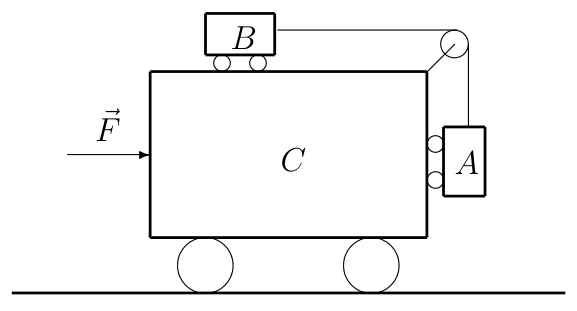
Figure 1:
- A horizontal force \(\vec{F}\) is now applied to cart \(C\) as shown. The size of \(\vec{F}\) is such that carts \(A\) and \(B\) remain at rest relative to cart \(C\).
a) Find the tension in the string connecting carts \(A\) and \(B\).
b) Determine the magnitude of \(\vec{F}\).
- Later cart \(C\) is held stationary, while carts \(A\) and \(B\) are released from rest.
a) Determine the accelerations of carts \(A\) and \(B\).
b) Calculate also the tension in the string.
Official English text of the problem.
Answers
- 1(a): \(T = 2.94\ \mathrm{N}\).
- 1(b): \(F = 29.4\ \mathrm{N}\).
- 2(a): Cart \(A\) accelerates downwards at \(5.89\ \mathrm{m\,s^{-2}}\); cart \(B\) accelerates to the right, towards the pulley, at \(5.89\ \mathrm{m\,s^{-2}}\).
- 2(b): \(T = 1.18\ \mathrm{N}\).
Solution
The light string and ideal pulley give the same tension \(T\) throughout the string. With friction neglected, each contact force is normal to its supporting surface. We apply Newton’s second law in the ground frame.
1(a)
Since \(A\) remains at rest relative to \(C\), and \(C\) moves horizontally, \(A\) has no vertical acceleration. Its vertical forces are its weight \(m_1g\) downwards and the tension \(T\) upwards. Thus \[ T-m_1g=0, \] giving \[ \boxed{T=m_1g=0.3(9.81)=2.943\ \mathrm{N} \simeq 2.94\ \mathrm{N}.} \]
The horizontal normal force from \(C\) supplies \(A\)’s horizontal acceleration.
1(b)
Let \(a_C\) be the common horizontal acceleration of all three carts. The only horizontal force on \(B\) is the string tension, so \[ T=m_2a_C. \] Consequently, \[ a_C=\frac{m_1g}{m_2} =\frac{0.3(9.81)}{0.2} =14.715\ \mathrm{m\,s^{-2}}. \]
For the complete system of carts, string and pulley, the contact forces and string forces are internal. The only external horizontal force is \(F\). Therefore, \[ F=(m_1+m_2+m_3)a_C =\frac{m_1(m_1+m_2+m_3)}{m_2}g. \] Numerically, \[ \boxed{F=(0.3+0.2+1.5)(14.715) =29.43\ \mathrm{N}\simeq29.4\ \mathrm{N}.} \]
2(a)
With \(C\) held stationary, the pulley is fixed. If \(A\) moves downwards by a distance \(s\), the vertical string segment lengthens by \(s\). Since the string is taut and inelastic, the horizontal segment must shorten by the same amount: \(B\) moves towards the pulley by \(s\). Their accelerations therefore have equal magnitudes.
Let this magnitude be \(a\), taking downwards as positive for \(A\) and rightwards as positive for \(B\). Newton’s second law gives \[ m_1g-T=m_1a \] for \(A\), and \[ T=m_2a \] for \(B\). Adding eliminates the tension: \[ m_1g=(m_1+m_2)a. \] Hence \[ \boxed{a=\frac{m_1g}{m_1+m_2} =\frac{0.3(9.81)}{0.3+0.2} =5.886\ \mathrm{m\,s^{-2}} \simeq5.89\ \mathrm{m\,s^{-2}}.} \]
Thus \(A\) accelerates downwards and \(B\) accelerates horizontally to the right, towards the pulley.
2(b)
Using the horizontal equation for \(B\), \[ T=m_2a=\frac{m_1m_2g}{m_1+m_2}. \] Therefore, \[ \boxed{T=0.2(5.886)=1.1772\ \mathrm{N} \simeq1.18\ \mathrm{N}.} \]
The solution was checked against the official solution.
IPhO 1969 · Theorieaufgabe 1
Drei Wagen, die durch ein über eine Rolle geführtes Seil verbunden sind
Abbildung 1 zeigt ein mechanisches System aus drei Wagen \(A\), \(B\) und \(C\) mit den Massen \(m_1 = 0.3\ \mathrm{kg}\), \(m_2 = 0.2\ \mathrm{kg}\) beziehungsweise \(m_3 = 1.5\ \mathrm{kg}\). Die Wagen \(B\) und \(A\) sind durch ein leichtes, gespanntes, undehnbares Seil verbunden, das wie dargestellt über eine leichte, reibungsfreie Rolle läuft, die am Wagen \(C\) befestigt ist. In dieser Aufgabe können sämtliche Widerstands- und Reibungskräfte sowie die Trägheitsmomente der Rolle und der Räder aller drei Wagen vernachlässigt werden. Verwenden Sie für die Erdbeschleunigung \(g\) den Wert \(9.81\ \mathrm{m\,s^{-2}}\).
Abbildung 1:
- Nun wird wie dargestellt eine horizontale Kraft \(\vec{F}\) auf den Wagen \(C\) ausgeübt. Der Betrag von \(\vec{F}\) ist so gewählt, dass die Wagen \(A\) und \(B\) relativ zum Wagen \(C\) in Ruhe bleiben.
a) Bestimmen Sie die Seilspannung im Seil, das die Wagen \(A\) und \(B\) verbindet.
b) Bestimmen Sie den Betrag von \(\vec{F}\).
- Später wird der Wagen \(C\) festgehalten, während die Wagen \(A\) und \(B\) aus der Ruhe losgelassen werden.
a) Bestimmen Sie die Beschleunigungen der Wagen \(A\) und \(B\).
b) Berechnen Sie auch die Seilspannung.
Aufgabentext aus dem offiziellen englischen Text übersetzt.
Antworten
- 1(a): \(T = 2.94\ \mathrm{N}\).
- 1(b): \(F = 29.4\ \mathrm{N}\).
- 2(a): Wagen \(A\) wird mit \(5.89\ \mathrm{m\,s^{-2}}\) nach unten beschleunigt; Wagen \(B\) wird mit \(5.89\ \mathrm{m\,s^{-2}}\) nach rechts, zur Rolle hin, beschleunigt.
- 2(b): \(T = 1.18\ \mathrm{N}\).
Lösung
Aufgrund des leichten Seils und der idealen Rolle ist die Seilspannung \(T\) im gesamten Seil gleich. Da die Reibung vernachlässigt wird, steht jede Kontaktkraft senkrecht auf der jeweiligen Auflagefläche. Wir wenden das zweite Newtonsche Gesetz im Bezugssystem des Bodens an.
1(a)
Da \(A\) relativ zu \(C\) in Ruhe bleibt und sich \(C\) horizontal bewegt, hat \(A\) keine vertikale Beschleunigung. In vertikaler Richtung wirken auf \(A\) die Gewichtskraft \(m_1g\) nach unten und die Seilspannung \(T\) nach oben. Somit gilt \[ T-m_1g=0, \] woraus folgt: \[ \boxed{T=m_1g=0.3(9.81)=2.943\ \mathrm{N} \simeq 2.94\ \mathrm{N}.} \]
Die von \(C\) ausgeübte horizontale Normalkraft bewirkt die horizontale Beschleunigung von \(A\).
1(b)
Sei \(a_C\) die gemeinsame horizontale Beschleunigung aller drei Wagen. Die einzige horizontale Kraft auf \(B\) ist die Seilspannung, also gilt \[ T=m_2a_C. \] Folglich ist \[ a_C=\frac{m_1g}{m_2} =\frac{0.3(9.81)}{0.2} =14.715\ \mathrm{m\,s^{-2}}. \]
Für das Gesamtsystem aus Wagen, Seil und Rolle sind die Kontaktkräfte und die Seilkräfte innere Kräfte. Die einzige äußere horizontale Kraft ist \(F\). Daher gilt \[ F=(m_1+m_2+m_3)a_C =\frac{m_1(m_1+m_2+m_3)}{m_2}g. \] Mit den Zahlenwerten ergibt sich \[ \boxed{F=(0.3+0.2+1.5)(14.715) =29.43\ \mathrm{N}\simeq29.4\ \mathrm{N}.} \]
2(a)
Da \(C\) festgehalten wird, ist die Rolle ortsfest. Bewegt sich \(A\) um eine Strecke \(s\) nach unten, verlängert sich der vertikale Seilabschnitt um \(s\). Da das Seil gespannt und undehnbar ist, muss sich der horizontale Abschnitt um denselben Betrag verkürzen: \(B\) bewegt sich um \(s\) zur Rolle hin. Die Beschleunigungen der beiden Wagen haben daher denselben Betrag.
Dieser Betrag sei \(a\), wobei für \(A\) die Richtung nach unten und für \(B\) die Richtung nach rechts als positiv gewählt wird. Das zweite Newtonsche Gesetz liefert \[ m_1g-T=m_1a \] für \(A\) und \[ T=m_2a \] für \(B\). Durch Addition wird die Seilspannung eliminiert: \[ m_1g=(m_1+m_2)a. \] Daraus folgt \[ \boxed{a=\frac{m_1g}{m_1+m_2} =\frac{0.3(9.81)}{0.3+0.2} =5.886\ \mathrm{m\,s^{-2}} \simeq5.89\ \mathrm{m\,s^{-2}}.} \]
Somit wird \(A\) nach unten und \(B\) horizontal nach rechts, zur Rolle hin, beschleunigt.
2(b)
Aus der Gleichung für die horizontale Bewegung von \(B\) ergibt sich \[ T=m_2a=\frac{m_1m_2g}{m_1+m_2}. \] Daher gilt \[ \boxed{T=0.2(5.886)=1.1772\ \mathrm{N} \simeq1.18\ \mathrm{N}.} \]
Die Lösung wurde mit der offiziellen Lösung abgeglichen.
IPhO 1969 · Teori sorusu 1
Bir makara üzerinden geçen iple birbirine bağlı üç araba
Şekil 1'de, kütleleri sırasıyla \(m_1 = 0.3\ \mathrm{kg}\), \(m_2 = 0.2\ \mathrm{kg}\) ve \(m_3 = 1.5\ \mathrm{kg}\) olan \(A\), \(B\) ve \(C\) arabalarından oluşan bir mekanik sistem gösterilmektedir. \(B\) ve \(A\) arabaları, şekilde gösterildiği gibi \(C\) arabasına bağlı, kütlesi ihmal edilebilir, sürtünmesiz bir makara üzerinden geçen, kütlesi ihmal edilebilir, gergin ve uzamayan bir iple birbirine bağlanmıştır. Bu soruda tüm direnç ve sürtünme kuvvetleri ile makaranın ve üç arabanın tüm tekerleklerinin eylemsizlik momentleri ihmal edilebilir. Yer çekimi ivmesi \(g\)'yi \(9.81\ \mathrm{m\,s^{-2}}\) alınız.
Şekil 1:
- Şimdi \(C\) arabasına şekilde gösterildiği gibi yatay bir \(\vec{F}\) kuvveti uygulanıyor. \(\vec{F}\)'nin büyüklüğü, \(A\) ve \(B\) arabalarının \(C\) arabasına göre hareketsiz kalmasını sağlayacak değerdedir.
a) \(A\) ve \(B\) arabalarını birbirine bağlayan ipteki gerilme kuvvetini bulunuz.
b) \(\vec{F}\)'nin büyüklüğünü belirleyiniz.
- Daha sonra \(C\) arabası sabit tutulurken \(A\) ve \(B\) arabaları durgun hâlden serbest bırakılıyor.
a) \(A\) ve \(B\) arabalarının ivmelerini belirleyiniz.
b) İpteki gerilme kuvvetini de hesaplayınız.
Soru metni resmi İngilizce metinden çevrilmiştir.
Cevaplar
- 1(a): \(T = 2.94\ \mathrm{N}\).
- 1(b): \(F = 29.4\ \mathrm{N}\).
- 2(a): \(A\) arabası aşağı doğru \(5.89\ \mathrm{m\,s^{-2}}\) ivmeyle; \(B\) arabası sağa, makaraya doğru \(5.89\ \mathrm{m\,s^{-2}}\) ivmeyle hareket eder.
- 2(b): \(T = 1.18\ \mathrm{N}\).
Çözüm
İpin kütlesinin ihmal edilebilir olması ve makaranın ideal olması nedeniyle gerilme kuvveti \(T\) ipin her yerinde aynıdır. Sürtünme ihmal edildiğinde her temas kuvveti, temasın gerçekleştiği destek yüzeyine diktir. Newton'un ikinci yasasını yere bağlı referans sisteminde uygularız.
1(a)
\(A\), \(C\)'ye göre hareketsiz kaldığından ve \(C\) yatay doğrultuda hareket ettiğinden, \(A\)'nın düşey ivmesi yoktur. Üzerine etki eden düşey kuvvetler, aşağı yönlü ağırlığı \(m_1g\) ve yukarı yönlü gerilme kuvveti \(T\)'dir. Dolayısıyla \[ T-m_1g=0, \] olur; buradan \[ \boxed{T=m_1g=0.3(9.81)=2.943\ \mathrm{N} \simeq 2.94\ \mathrm{N}.} \] bulunur.
\(C\)'nin uyguladığı yatay normal kuvvet, \(A\)'nın yatay ivmesini sağlar.
1(b)
Üç arabanın ortak yatay ivmesi \(a_C\) olsun. \(B\)'ye etki eden tek yatay kuvvet ipteki gerilme kuvveti olduğundan \[ T=m_2a_C. \] Buna göre, \[ a_C=\frac{m_1g}{m_2} =\frac{0.3(9.81)}{0.2} =14.715\ \mathrm{m\,s^{-2}}. \]
Arabalar, ip ve makaradan oluşan sistemin bütünü için temas kuvvetleri ve ip kuvvetleri iç kuvvetlerdir. Yatay doğrultudaki tek dış kuvvet \(F\)'dir. Bu nedenle, \[ F=(m_1+m_2+m_3)a_C =\frac{m_1(m_1+m_2+m_3)}{m_2}g. \] Sayısal olarak, \[ \boxed{F=(0.3+0.2+1.5)(14.715) =29.43\ \mathrm{N}\simeq29.4\ \mathrm{N}.} \]
2(a)
\(C\) sabit tutulduğunda makara da sabittir. \(A\) aşağı doğru \(s\) kadar yol alırsa ipin düşey parçası \(s\) kadar uzar. İp gergin ve uzamayan bir ip olduğundan yatay parçası da aynı miktarda kısalmalıdır: \(B\), makaraya doğru \(s\) kadar yol alır. Dolayısıyla ivmelerinin büyüklükleri eşittir.
\(A\) için aşağı yönü, \(B\) için ise sağ yönü pozitif alarak bu büyüklüğü \(a\) ile gösterelim. Newton'un ikinci yasası \(A\) için \[ m_1g-T=m_1a \] ve \(B\) için \[ T=m_2a \] denklemlerini verir. Denklemler toplandığında gerilme kuvveti elenir: \[ m_1g=(m_1+m_2)a. \] Buradan \[ \boxed{a=\frac{m_1g}{m_1+m_2} =\frac{0.3(9.81)}{0.3+0.2} =5.886\ \mathrm{m\,s^{-2}} \simeq5.89\ \mathrm{m\,s^{-2}}.} \]
Böylece \(A\) aşağı doğru, \(B\) ise yatay doğrultuda sağa, makaraya doğru ivmelenir.
2(b)
\(B\) için yatay doğrultudaki denklemi kullanırsak, \[ T=m_2a=\frac{m_1m_2g}{m_1+m_2}. \] Dolayısıyla, \[ \boxed{T=0.2(5.886)=1.1772\ \mathrm{N} \simeq1.18\ \mathrm{N}.} \]
Çözüm, resmi çözümle karşılaştırılarak kontrol edildi.
IPhO 1969 · Problema teórico 1
Tres carritos conectados por una cuerda que pasa por una polea
La figura 1 muestra un sistema mecánico formado por tres carritos \(A\), \(B\) y \(C\) de masas \(m_1 = 0.3\ \mathrm{kg}\), \(m_2 = 0.2\ \mathrm{kg}\) y \(m_3 = 1.5\ \mathrm{kg}\), respectivamente. Los carritos \(B\) y \(A\) están conectados por una cuerda ligera, tensa e inextensible que pasa por una polea ligera y sin rozamiento, fijada al carrito \(C\), como se muestra en la figura. En este problema pueden despreciarse todas las fuerzas de resistencia y de rozamiento, así como los momentos de inercia de la polea y de las ruedas de los tres carritos. Tome la aceleración de la gravedad \(g\) igual a \(9.81\ \mathrm{m\,s^{-2}}\).
Figura 1:
- Se aplica ahora una fuerza horizontal \(\vec{F}\) al carrito \(C\), como se muestra en la figura. El módulo de \(\vec{F}\) es tal que los carritos \(A\) y \(B\) permanecen en reposo respecto al carrito \(C\).
a) Halle la tensión de la cuerda que conecta los carritos \(A\) y \(B\).
b) Determine el módulo de \(\vec{F}\).
- Más tarde, se mantiene inmóvil el carrito \(C\), mientras que los carritos \(A\) y \(B\) se sueltan desde el reposo.
a) Determine las aceleraciones de los carritos \(A\) y \(B\).
b) Calcule también la tensión de la cuerda.
Enunciado traducido del texto oficial en inglés.
Respuestas
- 1(a): \(T = 2.94\ \mathrm{N}\).
- 1(b): \(F = 29.4\ \mathrm{N}\).
- 2(a): El carrito \(A\) acelera hacia abajo a \(5.89\ \mathrm{m\,s^{-2}}\); el carrito \(B\) acelera hacia la derecha, hacia la polea, a \(5.89\ \mathrm{m\,s^{-2}}\).
- 2(b): \(T = 1.18\ \mathrm{N}\).
Solución
La cuerda ligera y la polea ideal hacen que la tensión \(T\) sea la misma en toda la cuerda. Al despreciar el rozamiento, cada fuerza de contacto es perpendicular a la superficie de apoyo correspondiente. Aplicamos la segunda ley de Newton en el sistema de referencia del suelo.
1(a)
Como \(A\) permanece en reposo respecto a \(C\), y \(C\) se mueve horizontalmente, \(A\) no tiene aceleración vertical. Las fuerzas verticales que actúan sobre él son su peso \(m_1g\), hacia abajo, y la tensión \(T\), hacia arriba. Por tanto, \[ T-m_1g=0, \] de donde \[ \boxed{T=m_1g=0.3(9.81)=2.943\ \mathrm{N} \simeq 2.94\ \mathrm{N}.} \]
La fuerza normal horizontal ejercida por \(C\) produce la aceleración horizontal de \(A\).
1(b)
Sea \(a_C\) la aceleración horizontal común a los tres carritos. La única fuerza horizontal que actúa sobre \(B\) es la tensión de la cuerda, por lo que \[ T=m_2a_C. \] En consecuencia, \[ a_C=\frac{m_1g}{m_2} =\frac{0.3(9.81)}{0.2} =14.715\ \mathrm{m\,s^{-2}}. \]
Para el sistema completo formado por los carritos, la cuerda y la polea, las fuerzas de contacto y las fuerzas ejercidas por la cuerda son internas. La única fuerza horizontal externa es \(F\). Por tanto, \[ F=(m_1+m_2+m_3)a_C =\frac{m_1(m_1+m_2+m_3)}{m_2}g. \] Numéricamente, \[ \boxed{F=(0.3+0.2+1.5)(14.715) =29.43\ \mathrm{N}\simeq29.4\ \mathrm{N}.} \]
2(a)
Al mantener \(C\) inmóvil, la polea queda fija. Si \(A\) se desplaza hacia abajo una distancia \(s\), el tramo vertical de la cuerda se alarga en \(s\). Como la cuerda está tensa y es inextensible, el tramo horizontal debe acortarse en la misma cantidad: \(B\) se desplaza hacia la polea una distancia \(s\). Por tanto, sus aceleraciones tienen el mismo módulo.
Sea \(a\) este módulo, tomando como sentido positivo el sentido hacia abajo para \(A\) y hacia la derecha para \(B\). La segunda ley de Newton da \[ m_1g-T=m_1a \] para \(A\), y \[ T=m_2a \] para \(B\). Al sumar se elimina la tensión: \[ m_1g=(m_1+m_2)a. \] De aquí, \[ \boxed{a=\frac{m_1g}{m_1+m_2} =\frac{0.3(9.81)}{0.3+0.2} =5.886\ \mathrm{m\,s^{-2}} \simeq5.89\ \mathrm{m\,s^{-2}}.} \]
Así, \(A\) acelera hacia abajo y \(B\) acelera horizontalmente hacia la derecha, hacia la polea.
2(b)
Usando la ecuación horizontal para \(B\), \[ T=m_2a=\frac{m_1m_2g}{m_1+m_2}. \] Por tanto, \[ \boxed{T=0.2(5.886)=1.1772\ \mathrm{N} \simeq1.18\ \mathrm{N}.} \]
La solución se comprobó con la solución oficial.
IPhO 1969 · 理论题 1
由绕过滑轮的绳子连接的三辆小车
图 1 所示的力学系统由三辆小车 \(A\)、\(B\) 和 \(C\) 组成,其质量分别为 \(m_1 = 0.3\ \mathrm{kg}\)、\(m_2 = 0.2\ \mathrm{kg}\) 和 \(m_3 = 1.5\ \mathrm{kg}\)。小车 \(B\) 和 \(A\) 由一根绷紧且不可伸长的轻绳连接,绳子绕过一个安装在小车 \(C\) 上的光滑轻滑轮,如图所示。在本题中,所有阻力和摩擦力均可忽略,滑轮以及三辆小车所有车轮的转动惯量也均可忽略。取重力加速度 \(g\) 为 \(9.81\ \mathrm{m\,s^{-2}}\)。
图 1:
- 现对小车 \(C\) 施加一个如图所示的水平力 \(\vec{F}\)。\(\vec{F}\) 的大小使小车 \(A\) 和 \(B\) 相对于小车 \(C\) 保持静止。
a) 求连接小车 \(A\) 和 \(B\) 的绳子的张力。
b) 求 \(\vec{F}\) 的大小。
- 随后将小车 \(C\) 固定不动,并将小车 \(A\) 和 \(B\) 从静止状态释放。
a) 求小车 \(A\) 和 \(B\) 的加速度。
b) 再计算绳子的张力。
题目译自官方英文原文。
答案
- 1(a): \(T = 2.94\ \mathrm{N}\)。
- 1(b): \(F = 29.4\ \mathrm{N}\)。
- 2(a): 小车 \(A\) 以 \(5.89\ \mathrm{m\,s^{-2}}\) 的加速度向下运动;小车 \(B\) 以 \(5.89\ \mathrm{m\,s^{-2}}\) 的加速度向右,即朝向滑轮运动。
- 2(b): \(T = 1.18\ \mathrm{N}\)。
解答
由于绳子为轻绳且滑轮为理想滑轮,整根绳子的张力 \(T\) 处处相同。忽略摩擦时,各接触力均垂直于相应的支承面。我们在地面参考系中应用牛顿第二定律。
1(a)
由于 \(A\) 相对于 \(C\) 保持静止,且 \(C\) 沿水平方向运动,\(A\) 在竖直方向上没有加速度。它在竖直方向上受到的力为向下的重力 \(m_1g\) 和向上的张力 \(T\)。因此 \[ T-m_1g=0, \] 得到 \[ \boxed{T=m_1g=0.3(9.81)=2.943\ \mathrm{N} \simeq 2.94\ \mathrm{N}.} \]
\(C\) 对 \(A\) 的水平法向力使 \(A\) 产生水平加速度。
1(b)
设三辆小车共同的水平加速度为 \(a_C\)。\(B\) 所受的唯一水平力是绳子的张力,因此 \[ T=m_2a_C. \] 于是, \[ a_C=\frac{m_1g}{m_2} =\frac{0.3(9.81)}{0.2} =14.715\ \mathrm{m\,s^{-2}}. \]
对于由小车、绳子和滑轮组成的整个系统,接触力和绳子的作用力都是内力。唯一的水平外力是 \(F\)。因此, \[ F=(m_1+m_2+m_3)a_C =\frac{m_1(m_1+m_2+m_3)}{m_2}g. \] 代入数值得, \[ \boxed{F=(0.3+0.2+1.5)(14.715) =29.43\ \mathrm{N}\simeq29.4\ \mathrm{N}.} \]
2(a)
当 \(C\) 被固定不动时,滑轮的位置也固定。若 \(A\) 向下移动距离 \(s\),则竖直绳段的长度增加 \(s\)。由于绳子绷紧且不可伸长,水平绳段必须缩短相同的长度:\(B\) 朝滑轮移动距离 \(s\)。因此,两者的加速度大小相等。
设这一大小为 \(a\),对 \(A\) 取向下为正方向,对 \(B\) 取向右为正方向。由牛顿第二定律,对 \(A\) 有 \[ m_1g-T=m_1a \] 而对 \(B\) 有 \[ T=m_2a \] 将两式相加,消去张力: \[ m_1g=(m_1+m_2)a. \] 因此 \[ \boxed{a=\frac{m_1g}{m_1+m_2} =\frac{0.3(9.81)}{0.3+0.2} =5.886\ \mathrm{m\,s^{-2}} \simeq5.89\ \mathrm{m\,s^{-2}}.} \]
因此,\(A\) 向下加速运动,\(B\) 沿水平方向向右、朝滑轮加速运动。
2(b)
利用 \(B\) 在水平方向上的运动方程, \[ T=m_2a=\frac{m_1m_2g}{m_1+m_2}. \] 因此, \[ \boxed{T=0.2(5.886)=1.1772\ \mathrm{N} \simeq1.18\ \mathrm{N}.} \]
解答已与官方解答核对。
IPhO 1969 · Теоретическая задача 1
Три тележки, соединённые нитью, перекинутой через блок
На рисунке 1 показана механическая система, состоящая из трёх тележек \(A\), \(B\) и \(C\) массами \(m_1 = 0.3\ \mathrm{kg}\), \(m_2 = 0.2\ \mathrm{kg}\) и \(m_3 = 1.5\ \mathrm{kg}\) соответственно. Тележки \(B\) и \(A\) соединены лёгкой натянутой нерастяжимой нитью, перекинутой через лёгкий блок без трения, закреплённый на тележке \(C\), как показано на рисунке. В этой задаче можно пренебречь всеми силами сопротивления и трения, а также моментами инерции блока и колёс всех трёх тележек. Примите ускорение свободного падения \(g\) равным \(9.81\ \mathrm{m\,s^{-2}}\).
Рисунок 1:
- Теперь к тележке \(C\) прикладывают горизонтальную силу \(\vec{F}\), как показано на рисунке. Модуль \(\vec{F}\) таков, что тележки \(A\) и \(B\) остаются неподвижными относительно тележки \(C\).
a) Найдите силу натяжения нити, соединяющей тележки \(A\) и \(B\).
b) Определите модуль \(\vec{F}\).
- Затем тележку \(C\) удерживают неподвижной, а тележки \(A\) и \(B\) отпускают без начальной скорости.
a) Определите ускорения тележек \(A\) и \(B\).
b) Вычислите также силу натяжения нити.
Условие переведено с официального английского текста.
Ответы
- 1(a): \(T = 2.94\ \mathrm{N}\).
- 1(b): \(F = 29.4\ \mathrm{N}\).
- 2(a): Тележка \(A\) движется с ускорением \(5.89\ \mathrm{m\,s^{-2}}\), направленным вниз; тележка \(B\) движется с ускорением \(5.89\ \mathrm{m\,s^{-2}}\), направленным вправо, к блоку.
- 2(b): \(T = 1.18\ \mathrm{N}\).
Решение
Лёгкая нить и идеальный блок обеспечивают одинаковую силу натяжения \(T\) по всей длине нити. При отсутствии трения каждая сила контактного взаимодействия направлена перпендикулярно соответствующей опорной поверхности. Применим второй закон Ньютона в системе отсчёта, связанной с землёй.
1(a)
Поскольку \(A\) остаётся неподвижной относительно \(C\), а \(C\) движется горизонтально, вертикальное ускорение \(A\) равно нулю. В вертикальном направлении на неё действуют сила тяжести \(m_1g\), направленная вниз, и сила натяжения \(T\), направленная вверх. Поэтому \[ T-m_1g=0, \] откуда \[ \boxed{T=m_1g=0.3(9.81)=2.943\ \mathrm{N} \simeq 2.94\ \mathrm{N}.} \]
Горизонтальная сила нормальной реакции со стороны \(C\) сообщает тележке \(A\) горизонтальное ускорение.
1(b)
Пусть \(a_C\) — общее горизонтальное ускорение всех трёх тележек. Единственная горизонтальная сила, действующая на \(B\), — сила натяжения нити, поэтому \[ T=m_2a_C. \] Следовательно, \[ a_C=\frac{m_1g}{m_2} =\frac{0.3(9.81)}{0.2} =14.715\ \mathrm{m\,s^{-2}}. \]
Для всей системы, состоящей из тележек, нити и блока, силы контактного взаимодействия и силы натяжения нити являются внутренними. Единственная внешняя горизонтальная сила — \(F\). Поэтому \[ F=(m_1+m_2+m_3)a_C =\frac{m_1(m_1+m_2+m_3)}{m_2}g. \] Подставляя численные значения, получаем \[ \boxed{F=(0.3+0.2+1.5)(14.715) =29.43\ \mathrm{N}\simeq29.4\ \mathrm{N}.} \]
2(a)
Когда \(C\) удерживают неподвижной, блок также неподвижен. Если \(A\) перемещается вниз на расстояние \(s\), вертикальный участок нити удлиняется на \(s\). Поскольку нить натянута и нерастяжима, горизонтальный участок должен укоротиться на ту же величину: \(B\) перемещается к блоку на расстояние \(s\). Следовательно, модули их ускорений равны.
Обозначим этот модуль через \(a\), выбрав положительное направление вниз для \(A\) и вправо для \(B\). Второй закон Ньютона даёт \[ m_1g-T=m_1a \] для \(A\) и \[ T=m_2a \] для \(B\). Складывая уравнения, исключаем силу натяжения: \[ m_1g=(m_1+m_2)a. \] Отсюда \[ \boxed{a=\frac{m_1g}{m_1+m_2} =\frac{0.3(9.81)}{0.3+0.2} =5.886\ \mathrm{m\,s^{-2}} \simeq5.89\ \mathrm{m\,s^{-2}}.} \]
Таким образом, ускорение \(A\) направлено вниз, а ускорение \(B\) — горизонтально вправо, к блоку.
2(b)
Используя уравнение движения \(B\) в горизонтальном направлении, получаем \[ T=m_2a=\frac{m_1m_2g}{m_1+m_2}. \] Следовательно, \[ \boxed{T=0.2(5.886)=1.1772\ \mathrm{N} \simeq1.18\ \mathrm{N}.} \]
Решение проверено по официальному решению.
IPhO 1969 · مسألة نظرية 1
ثلاث عربات متصلة بخيط يمر فوق بكرة
يوضح الشكل 1 نظامًا ميكانيكيًا يتكون من ثلاث عربات \(A\) و\(B\) و\(C\)، كتلها \(m_1 = 0.3\ \mathrm{kg}\) و\(m_2 = 0.2\ \mathrm{kg}\) و\(m_3 = 1.5\ \mathrm{kg}\) على الترتيب. تتصل العربتان \(B\) و\(A\) بخيط خفيف مشدود غير قابل للتمدد، يمر فوق بكرة خفيفة ملساء مثبتة بالعربة \(C\) كما هو موضح. في هذه المسألة، يمكن إهمال جميع قوى المقاومة والاحتكاك، وكذلك عزوم القصور الذاتي للبكرة ولعجلات العربات الثلاث جميعها. اعتبر تسارع الجاذبية \(g\) مساويًا لـ \(9.81\ \mathrm{m\,s^{-2}}\).
الشكل 1:
- تؤثر الآن قوة أفقية \(\vec{F}\) في العربة \(C\) كما هو موضح. ويكون مقدار \(\vec{F}\) بحيث تبقى العربتان \(A\) و\(B\) ساكنتين بالنسبة إلى العربة \(C\).
a) أوجد قوة الشد في الخيط الذي يصل بين العربتين \(A\) و\(B\).
b) حدد مقدار \(\vec{F}\).
- لاحقًا، تُثبَّت العربة \(C\) بحيث تبقى ساكنة، بينما تُترك العربتان \(A\) و\(B\) لتتحركا من السكون.
a) حدد تسارعي العربتين \(A\) و\(B\).
b) احسب أيضًا قوة الشد في الخيط.
نص المسألة مترجم عن النص الإنجليزي الرسمي.
الإجابات
- 1(a): \(T = 2.94\ \mathrm{N}\).
- 1(b): \(F = 29.4\ \mathrm{N}\).
- 2(a): تتسارع العربة \(A\) نحو الأسفل بمقدار \(5.89\ \mathrm{m\,s^{-2}}\)؛ وتتسارع العربة \(B\) نحو اليمين، باتجاه البكرة، بمقدار \(5.89\ \mathrm{m\,s^{-2}}\).
- 2(b): \(T = 1.18\ \mathrm{N}\).
الحل
بفضل خفة الخيط ومثالية البكرة، تكون قوة الشد \(T\) متساوية على امتداد الخيط. ومع إهمال الاحتكاك، تكون كل قوة تماس عمودية على السطح الداعم لها. نطبق قانون نيوتن الثاني في الإطار المرجعي الأرضي.
1(a)
بما أن \(A\) تبقى ساكنة بالنسبة إلى \(C\)، وبما أن \(C\) تتحرك أفقيًا، فإن \(A\) ليس لها تسارع رأسي. والقوتان الرأسيتان المؤثرتان فيها هما وزنها \(m_1g\) نحو الأسفل وقوة الشد \(T\) نحو الأعلى. ومن ثم \[ T-m_1g=0, \] فنحصل على \[ \boxed{T=m_1g=0.3(9.81)=2.943\ \mathrm{N} \simeq 2.94\ \mathrm{N}.} \]
تُكسِب قوة رد الفعل العمودية الأفقية التي تؤثر بها \(C\) العربةَ \(A\) تسارعها الأفقي.
1(b)
ليكن \(a_C\) التسارع الأفقي المشترك للعربات الثلاث جميعها. القوة الأفقية الوحيدة المؤثرة في \(B\) هي قوة شد الخيط، لذا \[ T=m_2a_C. \] وبالتالي، \[ a_C=\frac{m_1g}{m_2} =\frac{0.3(9.81)}{0.2} =14.715\ \mathrm{m\,s^{-2}}. \]
بالنسبة إلى النظام الكامل المكوَّن من العربات والخيط والبكرة، تكون قوى التماس وقوى شد الخيط قوى داخلية. والقوة الأفقية الخارجية الوحيدة هي \(F\). ولذلك، \[ F=(m_1+m_2+m_3)a_C =\frac{m_1(m_1+m_2+m_3)}{m_2}g. \] وبالتعويض بالقيم العددية، \[ \boxed{F=(0.3+0.2+1.5)(14.715) =29.43\ \mathrm{N}\simeq29.4\ \mathrm{N}.} \]
2(a)
عند تثبيت \(C\) بحيث تبقى ساكنة، تكون البكرة ثابتة. إذا تحركت \(A\) نحو الأسفل مسافة \(s\)، ازداد طول الجزء الرأسي من الخيط بمقدار \(s\). وبما أن الخيط مشدود وغير قابل للتمدد، فلا بد أن يقصر الجزء الأفقي بالمقدار نفسه: فتتحرك \(B\) نحو البكرة مسافة \(s\). ولذلك يتساوى مقدارا تسارعيهما.
ليكن هذا المقدار \(a\)، مع اتخاذ الاتجاه نحو الأسفل موجبًا للعربة \(A\)، والاتجاه نحو اليمين موجبًا للعربة \(B\). يعطي قانون نيوتن الثاني \[ m_1g-T=m_1a \] للعربة \(A\)، و \[ T=m_2a \] للعربة \(B\). وبجمع المعادلتين تُحذف قوة الشد: \[ m_1g=(m_1+m_2)a. \] ومن ثم \[ \boxed{a=\frac{m_1g}{m_1+m_2} =\frac{0.3(9.81)}{0.3+0.2} =5.886\ \mathrm{m\,s^{-2}} \simeq5.89\ \mathrm{m\,s^{-2}}.} \]
إذن تتسارع \(A\) نحو الأسفل، وتتسارع \(B\) أفقيًا نحو اليمين، باتجاه البكرة.
2(b)
باستخدام معادلة الحركة الأفقية للعربة \(B\)، \[ T=m_2a=\frac{m_1m_2g}{m_1+m_2}. \] ولذلك، \[ \boxed{T=0.2(5.886)=1.1772\ \mathrm{N} \simeq1.18\ \mathrm{N}.} \]
تمت مراجعة الحل بمقارنته بالحل الرسمي.