International Physics Olympiad
IPhO 2017
Yogyakarta, Indonesia · 3 theory problems with complete solutions
Problem 1: Dark Matter
The first formal inference for the existence of dark matter was provided by Fritz Zwicky based on his observation on the dynamics of the Coma galaxy cluster, a cluster of galaxies that consist of about a thousand of galaxies. Zwicky used the Virial theorem to estimate the mass of the galaxy cluster. In a simple sun-planet system, where the planet revolves around the sun in a circular orbit, the Virial theorem states that the kinetic energy of the planet is exactly related to its gravitational potential energy. While in a general case for a system of many particles bounded by some interaction, the Virial theorem, relates the time average total kinetic energy with its time average total potential energy.
In 1933, based on his observation on the velocity of the galaxies near the edge of the Coma galaxy cluster, Zwicky estimated that the cluster has more mass than what was visually observed (i.e. the galaxies). The gravitational attraction from the observable matter (the galaxies) was too small to account for the velocities of the galaxies. Thus there must be some hidden masses that account for such a large velocity. That hidden mass is the dark matter mass. In what follows, assume that the mass of each galaxy is the sum of its visible mass and the mass of the dark matter which moves together with that galaxy, and dark matter interacts with visible matter only gravitationally.
A. Cluster of Galaxies
Consider a cluster of galaxies consist of a large number \(N\) of galaxies and dark matter that distributed homogeneously in a sphere of radius \(R\) with the total mass (galaxies and dark matters) of the cluster \(M\). Assume that the average total mass (visible and dark matter) of a galaxy is \(m\).
A.1 Assuming a continuous distribution of matter in the cluster, find the total gravitational potential energy of the cluster, in terms of \(M\) and \(R\). 1.0 pt. Due to cosmological expansion, any distance object will be moving away from an observer on Earth with a speed that depends on the distance from the observer to the object. A certain Lyman (a hydrogen emission spectral line) frequency from a type IA supernova on the \(i\)-th galaxy in the galaxy cluster is observed to be \(f_i\), with \(i=1,\ldots,N\), while the same corresponding Lyman frequency on Earth is \(f_0\).
A.2 Determine the average speed \(V_{cr}\) of the whole galaxy cluster moving away from the Earth in terms of \(f_i\) (with \(i=1,\ldots,N.\)), \(f_0\) and \(N\). Note that a galaxy's speed is very small compared to the speed of light \(c\). 0.5 pt. A.3 By assuming that the galaxies velocities with respect to the center of the cluster are isotropic (the same in all direction), determine the root-mean square speed \(v_{rms}\) of the galaxies with respect to the center of the cluster in terms of \(N\), \(f_i\) (with \(i=1,\ldots,N\)), and \(f_0\). From this result determine the mean kinetic energy of a galaxy with respect to the center of the cluster in terms of \(v_{rms}\) and \(m\). 1.5 pt. To find the total mass of the cluster, one can use Virial theorem. The theorem stated that for a system of particles bounded by their conservative force,
\[ \langle K\rangle_t=-\gamma\langle U\rangle_t, \]
where \(\langle K\rangle_t\) is the time average total kinetic energy, \(\langle U\rangle_t\) is the time average total potential energy, and \(\gamma\) is a constant. This theorem can be derived by assuming that for a system of particles bounded by its own interaction, the magnitudes of the position and momentum of each particle are finite, and thus the following quantity
\[ \Gamma=\sum_i\vec p_i\cdot\vec r_i \]
is finite.
A.4 Using the fact that the time average over a long period of time of \(d\Gamma/dt\) vanishes, \(\left\langle d\Gamma/dt\right\rangle_t=0\), determine \(\gamma\) in the Virial theorem above for the case of gravitational interaction. (Hint: Try to do the problem with the summation in \(\Gamma\) for a small finite number of galaxies). 1.7 pt. A.5 From the previous results determine the total dark matter mass of the cluster in terms of \(N\), \(m_g\), \(R\), and \(v_{rms}\), where \(m_g\) is the average total visible mass of a galaxy. Note that the root-mean-square speed of the dark matter is the same as that of the galaxies. 0.5 pt. B. Dark Matter in a Galaxy
Dark matter also exists inside and around a galaxy. Consider a spherical galaxy with a visible edge radius \(R_g\) (an approximate outermost distance where a large number of stars still visible, but note that a very small number of stars may still be distributed in the region beyond \(R_g\)). Assume that the stars in the galaxy are point particles with an average mass \(m_s\). The stars in the galaxy, distributed homogeneously with a number density \(n\), are assumed to move in circular orbits.
B.1 If the galaxy consists only of stars, find the speed \(v(r)\) of a star as a function of its distance to the center of the galaxy and sketch \(v(r)\) for \(r<R_g\) and \(r\ge R_g\). 0.8 pt. The existence of dark matter can be inferred from the galaxy rotation curve, which is a plot of \(v(r)\) obtained from observations. The figure below shows a common pattern of the galaxy rotation curve. You may assume simplifyingly that \(v(r)\) is a linear function for \(r\le R_g\) and a constant \(v_0\) for \(r>R_g\).
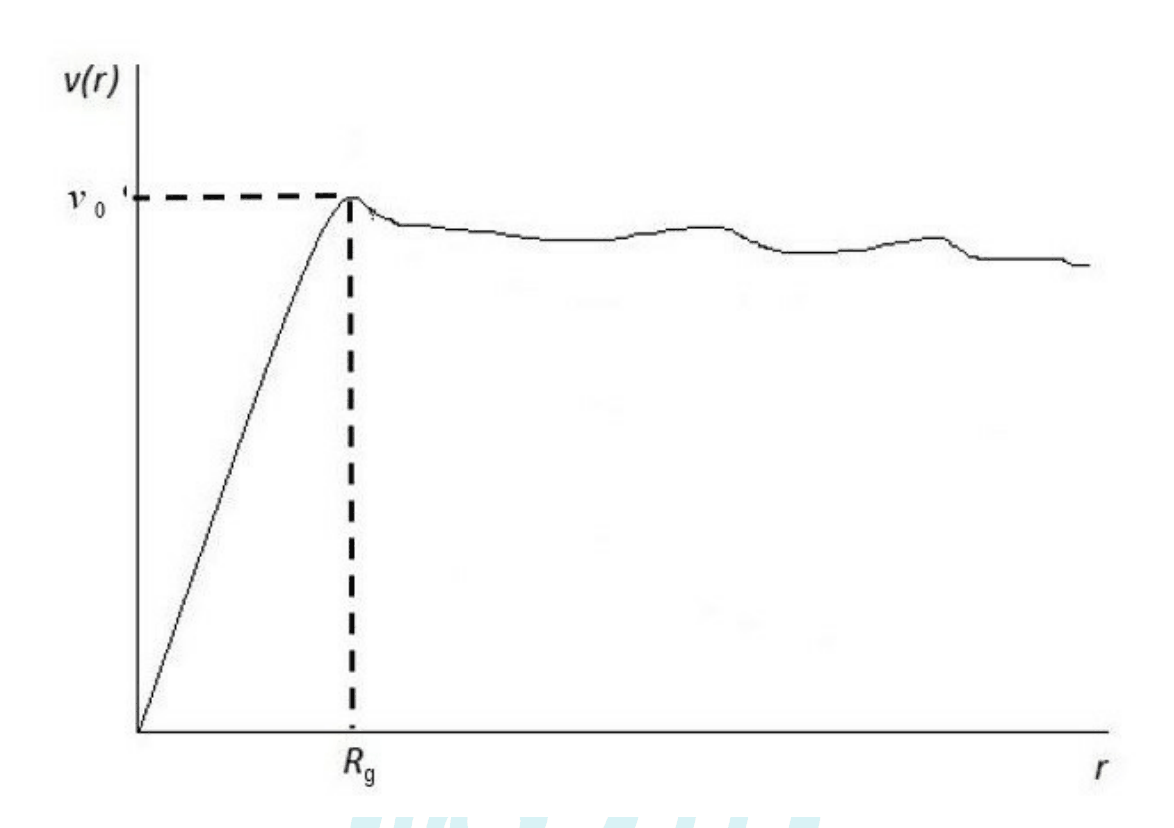
Fig. 1 Plot of galaxy rotation curve in a galaxy.
B.2 Find the total mass \(m_R\) of that part of the galaxy which lies within the sphere of radius \(R_g\) in terms of \(v_0\) and \(R_g\). 0.5 pt. The discrepancy between the figure in B.2. and the plot obtained in B.1 indicates the existence of dark matter.
B.3 Determine the dark matter mass density as a function of \(r\), \(R_g\), \(v_0\), \(n\), and \(m_s\) for \(r<R_g\) and \(r\ge R_g\). 1.5 pt. C. Interstellar Gas and Dark Matter
Now consider a young galaxy whose mass is dominated by interstellar gas and dark matters (neglect the mass of the stars). The interstellar gas is assumed to consist of identical particles of mass \(m_p\). The number density \(n(r)\) and temperature \(T(r)\) of the gas depend on the distance from the center of the galaxy \(r\). Although many physical processes happen in the gas, we can assume the gas is in a hydrostatic equilibrium due to its pressure and the galaxy gravitational attraction.
C.1 Find the pressure gradient of the gas \(dP/dr\), in terms of \(m'(r)\), \(r\) and \(n(r)\). Here, \(m'(r)\) is the total mass of gas and dark matters within a sphere of radius \(r\) from the galaxy center. 0.5 pt. C.2 Assuming the interstellar gas as an ideal gas, find \(m'(r)\) in terms of \(n(r)\), \(T(r)\) and their derivatives with respect to \(r\). 0.5 pt. Next for simplicity assume that the gas is in isothermal distribution at temperature \(T_0\) and the interstellar gas number density is given by
\[ n(r)=\frac{\alpha}{r(\beta+r)^2}, \]
where \(\alpha\) and \(\beta\) are some constants.
C.3 Find the dark matter mass density as a function of \(r\) inside the galaxy. 1.0 pt. Official English text of the problem.
Problem 2: Earthquake, Volcano and Tsunami
Indonesia is the supermarket of natural hazards. Almost all of the natural hazards have occurred in Indonesia, such as volcano eruptions, earthquakes and tsunami.
A. Merapi Volcano Eruption
Merapi volcano in Yogyakarta is one of the most active volcano in Java. Pyroclastic flows are well-known eruption characteristics of the volcano. The pyroclastic flow is a hot mixture of gas and rock which travels away from a volcano. In October 26th, 2010, Merapi showed his explosive character by producing an ash plume that reached 12 km altitude (Fig. 1) and pyroclastic currents displacing more than 20,000 people around the volcano.
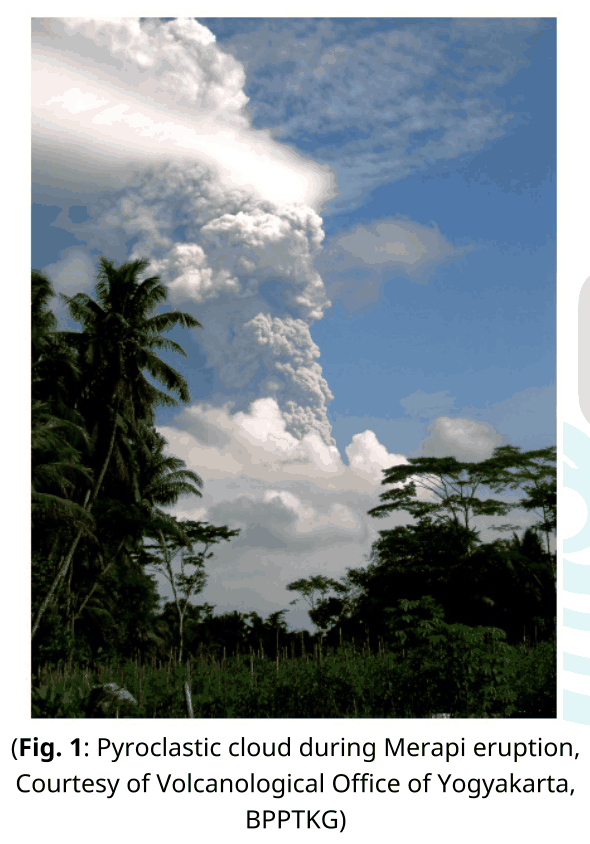
(Fig. 1: Pyroclastic cloud during Merapi eruption, Courtesy of Volcanological Office of Yogyakarta, BPPTKG)
Let us look at the causes of the largest eruption of Merapi in 2010. It is known by geophysicists that the influence of the external water into the magma plays an important role to the explosive behavior of volcanic eruptions (hydro magmatic eruptions). Let’s assume that we dealt with a volcano as a system that consists of mixture of magmatic particles and water. The volcano vents structures and atmosphere are being boundary of the system. The explosive eruption is considered to be happening in two stages, (1) an instantaneous magma-water interaction, and (2) a system expansion. In the first stage, a mass of magma (\(m_m\)) at an absolute temperature (\(T_m\)) mixes with a mass of external water (\(m_w\)) at an absolute temperature (\(T_w\)). The thermal equilibrium is reached almost instantaneously. This interaction can be perceived as a nearly-constant volume process. Latent heat of evaporation of water and latent heat of melting of magma can be neglected.
A.1 Find the equilibrium temperature at the first stage in terms of the masses and heat capacity per unit mass of water \(c_{Vw}\) and magma \(c_{Vm}\). 0.5 pt. A.2 Determine its equilibrium pressure at the first stage by assuming that the mixture can be modeled as ideal gas. Assume that the volume per unit mole of the mixture is \(v_e\). 0.3 pt. The system expansion (the second stage) can occur through several possibilities, one of which is thermal detonation. Although such process is quite complicated, we can empirically measure the relative velocity of the erupted mixture. The velocity of gas during the eruption depend on the pressure \(p\), the total mass \(m\) and the volume \(V\) of the mixture in the conduit of a volcano.
A.3 Express the velocity of gas during the eruption in terms of \(p\), \(m\), and \(V\) up to a proportional constant \(\kappa\). 0.5 pt. The observed pressure is around the order of 100 MPa. This makes the eruption (relative) velocity can be as large as ballistic velocity.
B. The Yogyakarta Earthquake
The 2006 Yogyakarta earthquake of magnitude \(M_w=6.4\), which destroyed many buildings in the Bantul and Yogyakarta area, occurred at 05:54:00.00 local time or 22:54:00.00 UTC. The earthquake was caused by a sudden displacement of the Opak fault segment (see Fig. 2). The hypocenter was located 15 km below the surface.
The seismic wave that propagates on the earth crust can be recorded using seismometer. The diagram from seismometer is called seismogram (Fig. 2 and 3, Lower graph). These seismograms represent the vertical ground velocity as a function of time recorded by the seismic station at Gamping Station Yogyakarta (YOGI) (Fig. 2) and Denpasar, Bali (DNP) (Fig. 3). In general, seismic wave consists of three wave types: the longitudinal or primary (\(P\)-wave), the transversal or secondary (\(S\)-wave), and the surface wave. The \(P\)-wave and \(S\)-wave travel in the subsurface while the surface wave travels along the Earth surface. Seismic waves traveling through subsurfaces to the stations can be divided into those that propagate in a straight line, those that are reflected by a layer’s boundary, and those that are refracted into the next layer. The longitudinal wave or the primary wave has the highest velocity, while the surface wave has the lowest velocity, around 60% of the \(P\)-wave.
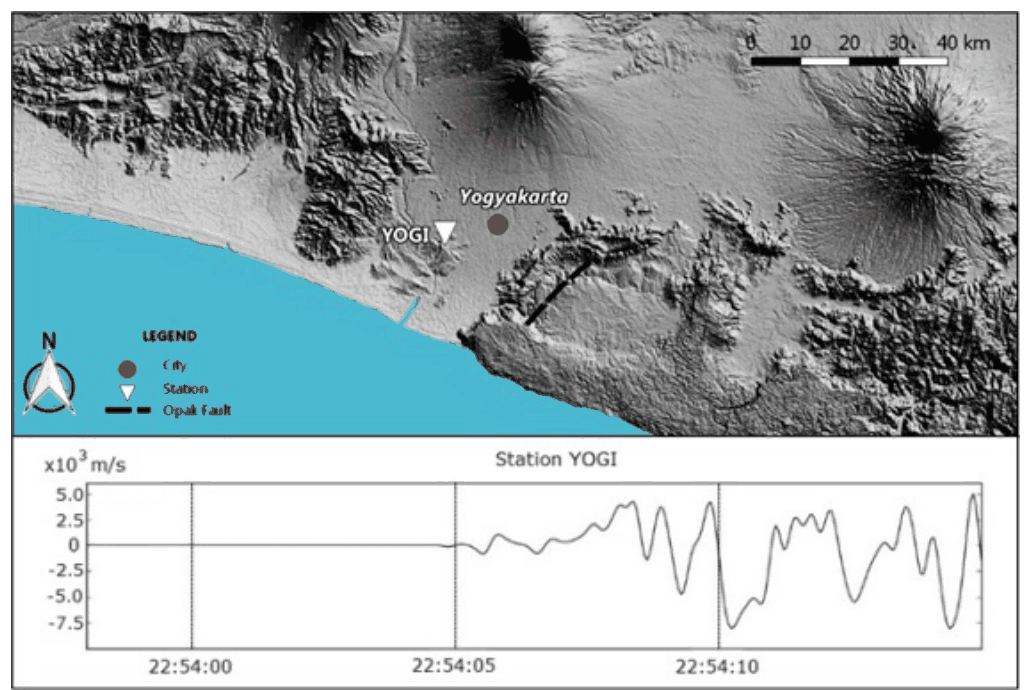
(Fig. 2: The maps location of YOGI)
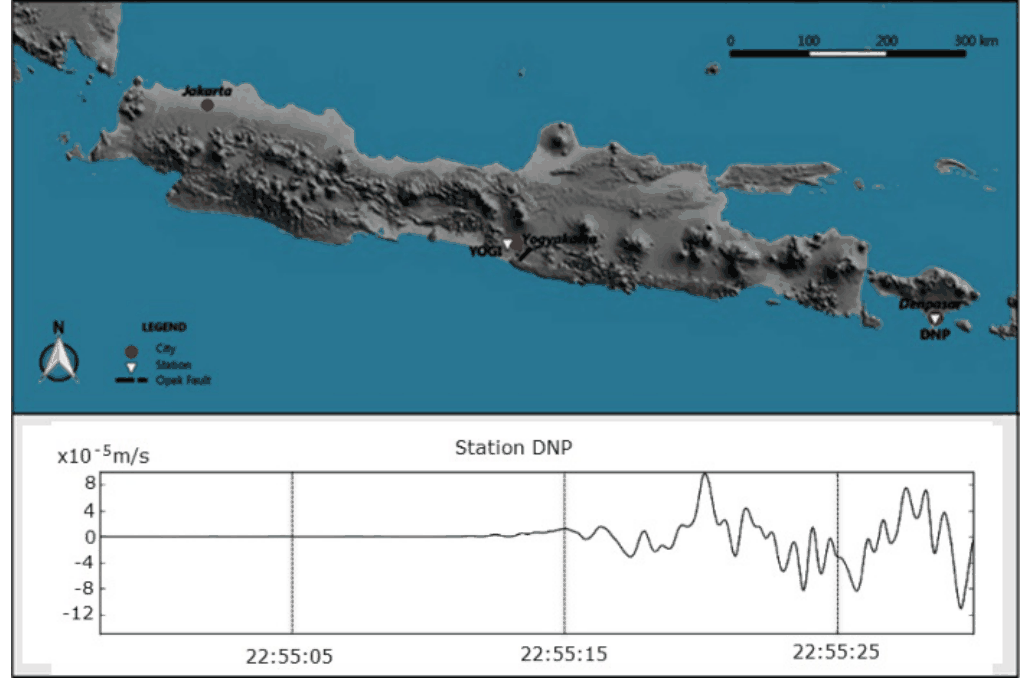
(Fig. 3: The maps location of DNP (Denpasar))
The distance between the epicenter (the projection of hypocenter on the Earth surface) and the YOGI and DNP stations respectively are 22.5 km and 500 km. The depth of the Earth crust layer in Java, Indonesia, is 30 km. Beneath the Earth’s crust is the Earth’s mantle layer. Just like other wave phenomena, seismic wave also satisfies the Snell’s law. The seismic wave can also be reflected by the mantle layer. In this problem we assume that the earth curvature is neglected.
B.1 Fig. 2 shows the seismogram at the YOGI station. Use the data to find the velocity of the \(P\)-wave in the Earth crust. 0.5 pt. B.2 Find the travel time of the direct \(P\) wave and reflected wave due to the Yogyakarta earthquake that arrived at the DNP station in Denpasar. 0.6 pt. By assuming that the Earth is composed of only two layers: the crust and the mantle, the primary wave propagates in the crust and in the mantle with different constant velocities. The velocity in the mantle is faster than in the crust. Note that \(P\)-wave refracted into the mantle at the right angle (\(90^\circ\)) is being partly refracted back into the crust along its entire path of propagation along the crust-mantle boundary.
B.3 Find the velocity of the \(P\)-wave in the mantle. 1.2 pt. For a more realistic Earth structure, the crust can be divided into a number of thin layers so that the velocity of seismic wave is a function of the depth \(z\) according to \(v(z)=v_0+az\) where \(a\) is a constant and the hypocenter is approximated on the surface. In this model, the wave ray is curving.
B.4 Let us define the ray parameter \(p=\sin\theta(z)/v(z)\), where \(\theta(z)\) is the angle between the ray and the normal. Suppose a seismic wave arrives to the station with ray parameter \(p\); express the distance to the hypocenter in terms of \(p\), \(v_0\), and \(a\). Assume that the hypocenter is very close to the ground surface. 1.4 pt. B.5 Find the travel time \(T\) from hypocenter to any station, in form of integral over \(z\). 1.0 pt. The earth consists of a stack of homogeneous layers with the velocity of each layer is \(v_i\) and the thickness of \(\delta z_i\).
B.6 From the result of the previous problem, approximate the travel time (\(T\)) from the hypocenter to DNP station by assuming that the crust consists of only three discretized layers, \((i=1,2,3)\), characterized by \(v_1=6.65\) km/sec, \(v_2=6.97\) km/sec, \(v_3=6.99\) km/sec, \(p=0.143\) sec/km, \(\delta z_1=6.0\) km, \(\delta z_2=9.0\) km, \(\delta z_3=15\) km. 1.0 pt. 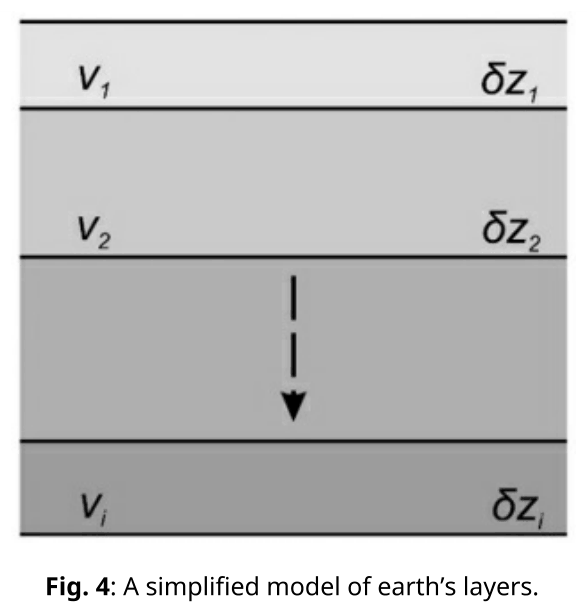
Fig. 4: A simplified model of earth’s layers.
C. Java Tsunami
The 2006 Pangandaran earthquake and tsunami occurred on July 17 at 15:19:27 local time off the coast of west and central Java. During the earthquake where the epicenter fault is on the ocean floor, the fault may be displaced producing a remarkably large water wave called tsunami. In other words, a tsunami is a shallow-water wave which is initiated by a tiny amplitude, but with an extremely large wavelength. Consider a sudden fault causing a lifting of some ocean floor as shown in Fig. 5. Assume that the energy of the earthquake is transformed to the potential energy of this raised ocean water. For simple model we approximate that the raised water has a geometry of a box with its area of \(\lambda L/2\) (where \(L\gg\lambda\)) and height of \(h\).
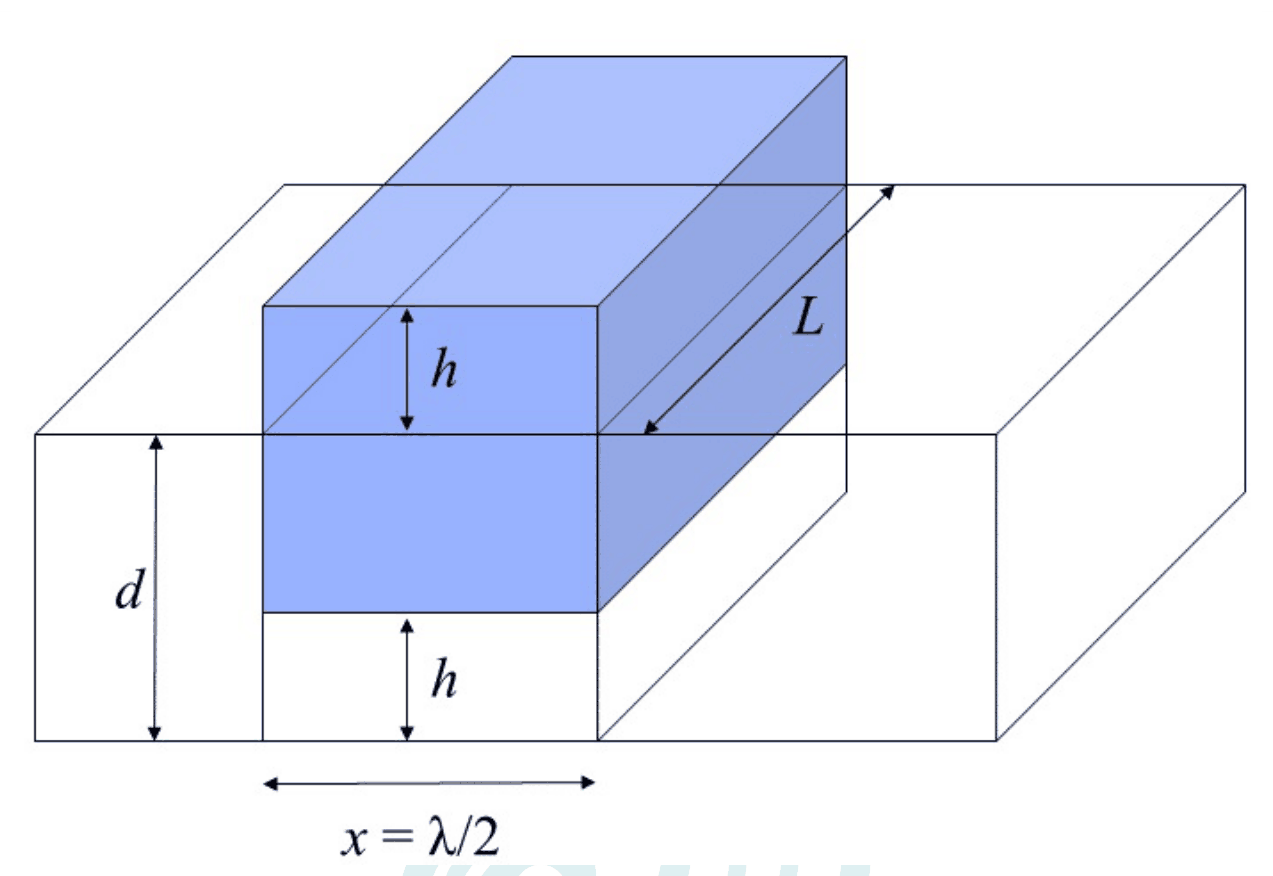
Fig. 5: Illustration for the tsunami wave \(d\) is the depth of the ocean.
C.1 Find the potential energy stored in the raised ocean water due to the earthquake with respect to ocean surface. Assume that the density of sea water is \(\rho\). 0.5 pt. C.2 Find the speed of tsunami wave up to dimensionless factor. 1.2 pt. C.3 Using energy argument, determine the amplitude of the tsunami wave as a function of the depth, assuming that the depth varies slowly and also knowing that at a depth of \(d_0\) the amplitude is \(A_0\). 1.3 pt. Official English text of the problem.
Problem 3: Cosmic Inflation
Due to the relative movement of galaxies observed from the earth, the wavelength of visible spectrum of a particular galaxy differs from its original wavelength, which is known as the electromagnetic Doppler effect. One expects, for a collection of galaxies, to a random distributions of wavelength shifts: some positive (red shift) and some negative (blue shift). However, observations show that all, except for a nearby group of galaxies, are red shifted. This must be true even if the observation take place on different point in the universe. As a conclusion, our universe must be expanding. On the other hand local irregularity of the universe can be neglected on scales of more than 100 Mpc, in which 1 pc = 3.26 light-years. Averaged over large scales, the clumpy distribution of galaxies becomes more and more isotropic (independent of direction) and homogeneous (independent of position). Therefore we can assume the universe as a matter having a uniform mass density \(\rho\) and is expanding.
A. Expansion of Universe
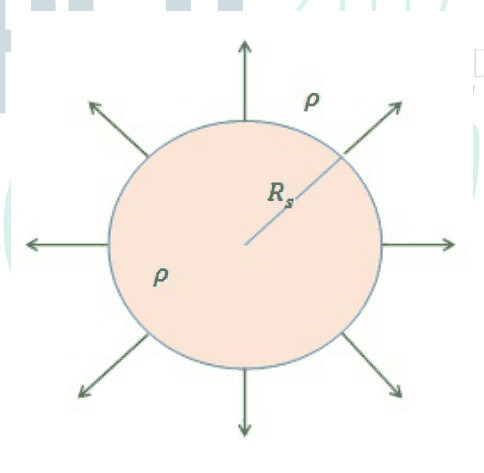
For a simple model of our universe, let us consider an expanding uniform-density sphere embedded in a medium of a much larger sphere with the same density. Let say at some time, the radius of the smaller sphere is \(R_s\). To express the expansion of the sphere, the time dependency of the radius \(R(t)\) can be expressed by scale factor \(a(t)\), that is \(R(t)=a(t)R_s\).
Using Newton’s law of gravity to evaluate velocity of a mass element on the sphere boundary according the model of our universe, one can obtain a set of Friedmann equations:
\[ \left(\frac{\dot a}{a}\right)^2 =A_1\rho(t)-\frac{kc^2}{R_s^2a^2(t)} \tag{1} \]
where \(k\) a dimensionless constant, and \(c\) is velocity of light.
Part Question Points A.1 Determine the constant \(A_1\) in the equation (1) 1.3 pt. The discussion so far is non-relativistic. But in fact, it can be extended to a relativistic system by reinterpreting \(\rho(t)c^2\) as total energy density (excluding the gravitational potential energy). In this relativistic system derives the 2nd Friedmann equation:
\[ \dot\rho+A_2\left(\rho+\left(\frac{p}{c^2}\right)\right)\frac{\dot a}{a}=0 \tag{2} \]
using the 1st law thermodynamics of an adiabatic system, where \(p\) denotes the pressure on the sphere.
Part Question Points A.2 Determine the constants \(A_2\) in the equation (2) 0.9 pt. To solve Eqs. (1) and (2), one should assume a relation \(p=p(\rho)\), such as \(p(t)/c^2=w\rho(t)\), where \(w\) is a constant. There is also a factor \(H=\dot a/a\) being called Hubble parameter. The present values of parameters are usually symbolized by subscript 0 such as \(t_0,\rho_0,H_0,a_0\) and so on. For simplicity, we take \(a_0=1\).
Universe is believed to start from a big explosion called Big-Bang that produces radiation of relativistic particles. During its expansion, the universe is cooling down and the particles in it become non-relativistic. However, the recent observations clarify that the present universe is dominated by cosmological constant energy density. For the case of photon, as the universe is expanding, the photon’s wavelength expands proportionally to the scale factor.
Part Question Points A.3 For each of the following three cases determine the resulting value of \(w\): (i) a universe filled only with radiation (i.e. photon energy), (ii) a universe filled only with non-relativistic matter and (iii) a universe with constant energy density. 1.2 pt. A.4 In the case of \(k=0\), find \(a(t)\) for each case of (i) to (iii) being mentioned in A.3. Use the initial condition \(a(t=0)=0\) for case (i) and (ii), and use the condition \(a_0=1\) for case (iii). 1.2 pt. Constant \(k\) in Eq. (1) refers to classification of spatial geometry of the universe. Its value can be \(k=+1\) for positive-curvature universe (closed), \(k=0\) for flat universe (infinite), and \(k=-1\) for negative-curvature universe (open, infinite). Let define a density ratio \(\Omega=\rho/\rho_c\), where \(\rho_cc^2=H^2/A_1\) is critical energy density. Note that \(A_1\) is obtained from problem A.1.
Part Question Points A.5 Express \(k\) in Eq.(1) in terms of \(\Omega\), \(H\), \(a\) and \(R_0\). 0.1 pt. A.6 Find a range for \(\Omega\) that corresponds to each value of \(k=+1\), \(k=0\) and \(k=-1\). 0.3 pt. B. Motivation To Introduce Inflation Phase and Its General Conditions
The observation of cosmic microwave background radiation (CMB) suggests that our present universe is approximately flat. The problem is that if this is true the present universe should start from exactly flat early universe, otherwise any deviation from the flatness will eventually grow over time and spoil the present flatness.
Part Question Points B.1 Find \((\Omega(t)-1)\) as a function of time for the universe when it is dominated by radiation or non-relativistic matter (see problem A.3). 0.5 pt. To solve the problem, at some early time in its history, the universe should undergo a constant energy density domination period which leads to an exponential expansion so called inflation period.
Part Question Points B.2 For this constant energy density domination period, find \((\Omega(t)-1)\) as a function of time. Assume that \((\Omega(t)-1)\ll1\). 0.3 pt. B.3 Show that condition for inflation implies several following conditions: negative pressure, accelerated expansion \((\ddot a>0)\), and decreasing Hubble radius \((d(aH)^{-1}/dt<0)\). 0.9 pt. B.4 Show that the condition of decreasing Hubble radius can be expressed in terms of parameter \(\epsilon=-\dot H/H^2\) as \(\epsilon<1\). 0.2 pt. Inflation occurs as long as \(\epsilon<1\) and then ends when \(\epsilon=1\). We can define e-folding number \(N\), such that \(dN=d\ln a=Hdt\) and \(N=0\) at the end of inflation.
C. Inflation Generated by Homogenously Distributed Matter
As an example of simple physical system that can generate period of inflation is a universe dominated by homogenously distributed matter. This kind of matter is called inflaton and can be characterized by a function \(\phi(t)\).
The dynamical equation of the matter can be expressed as
\[ \ddot\phi+3H\dot\phi=-V', \tag{3} \]
where \(V=V(\phi)\) is a potential function and \(V'=\frac{\partial V}{\partial\phi}\). The Hubble parameter satisfies
\[ H^2=\frac{1}{3M_{pl}^2}\left[\frac12\dot\phi^2+V\right]. \tag{4} \]
with \(M_{pl}\) is a constant called the reduced Planck mass. Inflation phase occurs during domination of potential energy \(V\) over kinetic energy \(\dot\phi^2/2\) for sufficient time such that \(\ddot\phi\) term in equation (3) can be neglected. This condition is called slow-roll approximation.
The quantities \(\epsilon\) and \(\eta_V=\delta+\epsilon\), where \(\delta=-\ddot\phi/(H\dot\phi)\), are called ‘slow-roll’ parameters.
Part Question Points C.1 Estimate parameter \(\epsilon\), parameter \(\eta_V\), \(dN/d\phi\) in terms of potential \(V(\phi)\) and its first and second derivative (\(V'\) and \(V''\)). 1.7 pt. D. Inflation with A Simple Potential
Predictions of any inflation model should be compared to observational constraints from CMB as follow \(n_s=0.968\pm0.006\) and \(r<0.12\), where \(r=16\epsilon\) and \(n_s=1+2\eta_V-6\epsilon\) are evaluated at \(\phi=\phi_{start}\) for inflation model being generated by a dominant matter. Assume that potential of matter takes a simple form \(V(\phi)=\Lambda^4\left(\frac{\phi}{M_{pl}}\right)^n\) where \(n\) is any integer and \(\Lambda\) is a constant.
Part Question Points D.1 Calculate \(\phi_{end}\) at the end of inflation. 0.5 pt. D.2 Express \(r\) and \(n_s\) in terms of e-folding number \(N\) and integer \(n\). Estimate the value of \(n\) that is closest to observational values \(r\) and \(n_s\). Take \(N=60\) in your calculation. 0.9 pt. Official English text of the problem.
Internationale Physik-Olympiade
IPhO 2017
Yogyakarta, Indonesien · 3 Theorieaufgaben mit vollständigen Lösungen
Aufgabe 1: Dunkle Materie
Den ersten formalen Schluss auf die Existenz Dunkler Materie zog Fritz Zwicky auf Grundlage seiner Beobachtungen zur Dynamik des Coma-Galaxienhaufens, eines Haufens aus etwa tausend Galaxien. Zwicky verwendete den Virialsatz, um die Masse des Galaxienhaufens abzuschätzen. In einem einfachen System aus Sonne und Planet, in dem der Planet die Sonne auf einer Kreisbahn umkreist, stellt der Virialsatz einen exakten Zusammenhang zwischen der kinetischen Energie des Planeten und seiner gravitativen potenziellen Energie her. Im allgemeinen Fall eines Systems aus vielen Teilchen, die durch eine Wechselwirkung gebunden sind, verknüpft der Virialsatz den zeitlichen Mittelwert der gesamten kinetischen Energie mit dem zeitlichen Mittelwert der gesamten potenziellen Energie.
Auf Grundlage seiner Beobachtungen der Geschwindigkeiten der Galaxien nahe dem Rand des Coma-Galaxienhaufens schätzte Zwicky im Jahr 1933 ab, dass der Haufen mehr Masse besitzt, als durch die sichtbaren Objekte (d. h. die Galaxien) erfasst wurde. Die Gravitationsanziehung der beobachtbaren Materie (der Galaxien) war zu gering, um die Geschwindigkeiten der Galaxien zu erklären. Daher musste es verborgene Massen geben, die diese hohen Geschwindigkeiten erklären. Diese verborgene Masse ist die Masse der Dunklen Materie. Nehmen Sie im Folgenden an, dass die Masse jeder Galaxie die Summe aus ihrer sichtbaren Masse und der Masse der Dunklen Materie ist, die sich gemeinsam mit dieser Galaxie bewegt, und dass Dunkle Materie mit sichtbarer Materie ausschließlich gravitativ wechselwirkt.
A. Galaxienhaufen
Betrachten Sie einen Galaxienhaufen, der aus einer großen Anzahl \(N\) von Galaxien und Dunkler Materie besteht, die homogen in einer Kugel mit Radius \(R\) verteilt sind. Die Gesamtmasse des Haufens (Galaxien und Dunkle Materie) sei \(M\). Nehmen Sie an, dass die mittlere Gesamtmasse (sichtbare und Dunkle Materie) einer Galaxie \(m\) beträgt.
A.1 Nehmen Sie eine kontinuierliche Materieverteilung im Haufen an und bestimmen Sie die gesamte gravitative potenzielle Energie des Haufens in Abhängigkeit von \(M\) und \(R\). 1.0 Pkt. Aufgrund der kosmologischen Expansion entfernt sich jedes weit entfernte Objekt von einem Beobachter auf der Erde mit einer Geschwindigkeit, die vom Abstand zwischen dem Beobachter und dem Objekt abhängt. Eine bestimmte Lyman-Frequenz (eine Emissionsspektrallinie des Wasserstoffs) einer Supernova vom Typ IA in der \(i\)-ten Galaxie des Galaxienhaufens wird als \(f_i\) beobachtet, mit \(i=1,\ldots,N\), während die entsprechende Lyman-Frequenz auf der Erde \(f_0\) beträgt.
A.2 Bestimmen Sie die mittlere Geschwindigkeit \(V_{cr}\), mit der sich der gesamte Galaxienhaufen von der Erde entfernt, in Abhängigkeit von \(f_i\) (mit \(i=1,\ldots,N.\)), \(f_0\) und \(N\). Beachten Sie, dass die Geschwindigkeit einer Galaxie im Vergleich zur Lichtgeschwindigkeit \(c\) sehr klein ist. 0.5 Pkt. A.3 Nehmen Sie an, dass die Geschwindigkeiten der Galaxien relativ zum Zentrum des Haufens isotrop sind (in allen Richtungen gleich verteilt), und bestimmen Sie die quadratisch gemittelte Geschwindigkeit \(v_{rms}\) der Galaxien relativ zum Zentrum des Haufens in Abhängigkeit von \(N\), \(f_i\) (mit \(i=1,\ldots,N\)) und \(f_0\). Bestimmen Sie aus diesem Ergebnis die mittlere kinetische Energie einer Galaxie relativ zum Zentrum des Haufens in Abhängigkeit von \(v_{rms}\) und \(m\). 1.5 Pkt. Zur Bestimmung der Gesamtmasse des Haufens kann der Virialsatz verwendet werden. Er besagt, dass für ein System von Teilchen, die durch ihre konservative Kraft gebunden sind, gilt:
\[ \langle K\rangle_t=-\gamma\langle U\rangle_t, \]
wobei \(\langle K\rangle_t\) der zeitliche Mittelwert der gesamten kinetischen Energie, \(\langle U\rangle_t\) der zeitliche Mittelwert der gesamten potenziellen Energie und \(\gamma\) eine Konstante ist. Dieser Satz lässt sich unter der Annahme herleiten, dass in einem durch seine eigene Wechselwirkung gebundenen Teilchensystem die Beträge des Ortsvektors und des Impulses jedes Teilchens endlich sind und somit auch die folgende Größe endlich ist:
\[ \Gamma=\sum_i\vec p_i\cdot\vec r_i \]
A.4 Nutzen Sie die Tatsache, dass der zeitliche Mittelwert von \(d\Gamma/dt\) über einen langen Zeitraum verschwindet, \(\left\langle d\Gamma/dt\right\rangle_t=0\), und bestimmen Sie \(\gamma\) im obigen Virialsatz für den Fall der Gravitationswechselwirkung. (Hinweis: Versuchen Sie, die Aufgabe mit der Summe in \(\Gamma\) für eine kleine endliche Anzahl von Galaxien zu lösen.) 1.7 Pkt. A.5 Bestimmen Sie aus den bisherigen Ergebnissen die gesamte Masse der Dunklen Materie im Haufen in Abhängigkeit von \(N\), \(m_g\), \(R\) und \(v_{rms}\), wobei \(m_g\) die mittlere gesamte sichtbare Masse einer Galaxie ist. Beachten Sie, dass die quadratisch gemittelte Geschwindigkeit der Dunklen Materie mit derjenigen der Galaxien übereinstimmt. 0.5 Pkt. B. Dunkle Materie in einer Galaxie
Dunkle Materie befindet sich auch innerhalb und in der Umgebung einer Galaxie. Betrachten Sie eine kugelförmige Galaxie mit dem Radius \(R_g\) ihres sichtbaren Randes (ungefähr der äußerste Abstand, in dem noch eine große Anzahl von Sternen sichtbar ist; beachten Sie jedoch, dass eine sehr kleine Anzahl von Sternen auch im Bereich jenseits von \(R_g\) verteilt sein kann). Nehmen Sie an, dass die Sterne in der Galaxie punktförmige Teilchen mit einer mittleren Masse \(m_s\) sind. Die Sterne in der Galaxie sind homogen mit einer Anzahldichte \(n\) verteilt und bewegen sich annahmegemäß auf Kreisbahnen.
B.1 Falls die Galaxie ausschließlich aus Sternen besteht, bestimmen Sie die Geschwindigkeit \(v(r)\) eines Sterns als Funktion seines Abstands vom Zentrum der Galaxie und skizzieren Sie \(v(r)\) für \(r<R_g\) und \(r\ge R_g\). 0.8 Pkt. Auf die Existenz Dunkler Materie lässt sich aus der Rotationskurve einer Galaxie schließen, also aus einer aus Beobachtungen gewonnenen Darstellung von \(v(r)\). Die folgende Abbildung zeigt einen typischen Verlauf einer galaktischen Rotationskurve. Sie dürfen vereinfachend annehmen, dass \(v(r)\) für \(r\le R_g\) eine lineare Funktion ist und für \(r>R_g\) den konstanten Wert \(v_0\) hat.
Abb. 1 Darstellung der Rotationskurve einer Galaxie.
B.2 Bestimmen Sie die Gesamtmasse \(m_R\) desjenigen Teils der Galaxie, der innerhalb der Kugel mit Radius \(R_g\) liegt, in Abhängigkeit von \(v_0\) und \(R_g\). 0.5 Pkt. Die Abweichung zwischen der Abbildung in B.2. und dem in B.1 erhaltenen Graphen weist auf die Existenz Dunkler Materie hin.
B.3 Bestimmen Sie die Massendichte der Dunklen Materie als Funktion von \(r\), \(R_g\), \(v_0\), \(n\) und \(m_s\) für \(r<R_g\) und \(r\ge R_g\). 1.5 Pkt. C. Interstellares Gas und Dunkle Materie
Betrachten Sie nun eine junge Galaxie, deren Masse überwiegend aus interstellarem Gas und Dunkler Materie besteht (vernachlässigen Sie die Masse der Sterne). Das interstellare Gas bestehe aus identischen Teilchen der Masse \(m_p\). Die Anzahldichte \(n(r)\) und die Temperatur \(T(r)\) des Gases hängen vom Abstand \(r\) vom Zentrum der Galaxie ab. Obwohl im Gas viele physikalische Prozesse ablaufen, können wir annehmen, dass es sich aufgrund seines Drucks und der Gravitationsanziehung der Galaxie im hydrostatischen Gleichgewicht befindet.
C.1 Bestimmen Sie den Druckgradienten des Gases \(dP/dr\) in Abhängigkeit von \(m'(r)\), \(r\) und \(n(r)\). Dabei ist \(m'(r)\) die Gesamtmasse aus Gas und Dunkler Materie innerhalb einer Kugel mit Radius \(r\) um das Zentrum der Galaxie. 0.5 Pkt. C.2 Nehmen Sie an, dass das interstellare Gas ein ideales Gas ist, und bestimmen Sie \(m'(r)\) in Abhängigkeit von \(n(r)\), \(T(r)\) und deren Ableitungen nach \(r\). 0.5 Pkt. Nehmen Sie im Folgenden der Einfachheit halber an, dass das Gas eine isotherme Verteilung mit der Temperatur \(T_0\) aufweist und die Anzahldichte des interstellaren Gases gegeben ist durch
\[ n(r)=\frac{\alpha}{r(\beta+r)^2}, \]
wobei \(\alpha\) und \(\beta\) Konstanten sind.
C.3 Bestimmen Sie die Massendichte der Dunklen Materie als Funktion von \(r\) innerhalb der Galaxie. 1.0 Pkt. Aufgabentext aus dem offiziellen englischen Text übersetzt.
Aufgabe 2: Erdbeben, Vulkan und Tsunami
Indonesien ist der Supermarkt der Naturgefahren. Fast alle Arten von Naturereignissen mit Gefahrenpotenzial sind in Indonesien bereits aufgetreten, darunter Vulkanausbrüche, Erdbeben und Tsunamis.
A. Ausbruch des Vulkans Merapi
Der Vulkan Merapi in Yogyakarta ist einer der aktivsten Vulkane auf Java. Pyroklastische Ströme sind ein bekanntes Merkmal seiner Ausbrüche. Ein pyroklastischer Strom ist ein heißes Gemisch aus Gas und Gestein, das sich von einem Vulkan wegbewegt. Am 26. Oktober 2010 zeigte der Merapi seinen explosiven Charakter: Er erzeugte eine Aschewolke, die eine Höhe von 12 km erreichte (Abb. 1), sowie pyroklastische Ströme, die mehr als 20.000 Menschen in der Umgebung des Vulkans zur Flucht zwangen.
(Abb. 1: Pyroklastische Wolke während des Merapi-Ausbruchs, mit freundlicher Genehmigung des Vulkanologischen Amtes von Yogyakarta, BPPTKG)
Betrachten wir die Ursachen des größten Ausbruchs des Merapi im Jahr 2010. Geophysikern ist bekannt, dass das Eindringen von Wasser von außen in das Magma eine wichtige Rolle für das explosive Verhalten von Vulkanausbrüchen spielt (hydromagmatische Eruptionen). Wir nehmen an, dass wir den Vulkan als ein System behandeln, das aus einem Gemisch aus Magmapartikeln und Wasser besteht. Die Strukturen der Vulkanschlote und die Atmosphäre bilden die Grenze des Systems. Der explosive Ausbruch wird als Vorgang in zwei Phasen betrachtet: (1) eine augenblickliche Wechselwirkung zwischen Magma und Wasser und (2) eine Expansion des Systems. In der ersten Phase vermischt sich eine Magmamasse (\(m_m\)) bei einer absoluten Temperatur (\(T_m\)) mit einer Masse von außen zugeführten Wassers (\(m_w\)) bei einer absoluten Temperatur (\(T_w\)). Das thermische Gleichgewicht wird nahezu augenblicklich erreicht. Diese Wechselwirkung kann als Prozess bei nahezu konstantem Volumen betrachtet werden. Die latente Verdampfungswärme des Wassers und die latente Schmelzwärme des Magmas können vernachlässigt werden.
A.1 Bestimmen Sie die Gleichgewichtstemperatur in der ersten Phase in Abhängigkeit von den Massen und den spezifischen Wärmekapazitäten des Wassers \(c_{Vw}\) und des Magmas \(c_{Vm}\). 0.5 Pkt. A.2 Bestimmen Sie den Gleichgewichtsdruck in der ersten Phase unter der Annahme, dass das Gemisch als ideales Gas modelliert werden kann. Nehmen Sie an, dass das molare Volumen des Gemischs \(v_e\) beträgt. 0.3 Pkt. Die Expansion des Systems (die zweite Phase) kann auf verschiedene Arten erfolgen, darunter durch thermische Detonation. Obwohl ein solcher Prozess recht kompliziert ist, können wir die Relativgeschwindigkeit des ausgestoßenen Gemischs empirisch messen. Die Geschwindigkeit des Gases während des Ausbruchs hängt vom Druck \(p\), der Gesamtmasse \(m\) und dem Volumen \(V\) des Gemischs im Förderschlot eines Vulkans ab.
A.3 Drücken Sie die Geschwindigkeit des Gases während des Ausbruchs bis auf eine Proportionalitätskonstante \(\kappa\) durch \(p\), \(m\) und \(V\) aus. 0.5 Pkt. Der beobachtete Druck liegt in der Größenordnung von 100 MPa. Dadurch kann die (relative) Eruptionsgeschwindigkeit die Größenordnung ballistischer Geschwindigkeiten erreichen.
B. Das Erdbeben von Yogyakarta
Das Erdbeben von Yogyakarta im Jahr 2006 mit der Magnitude \(M_w=6.4\), das viele Gebäude in der Region Bantul und Yogyakarta zerstörte, ereignete sich um 05:54:00.00 Uhr Ortszeit bzw. um 22:54:00.00 Uhr UTC. Es wurde durch eine plötzliche Verschiebung des Opak-Verwerfungssegments verursacht (siehe Abb. 2). Das Hypozentrum lag 15 km unter der Oberfläche.
Die sich in der Erdkruste ausbreitenden seismischen Wellen können mit einem Seismometer aufgezeichnet werden. Die Aufzeichnung eines Seismometers wird als Seismogramm bezeichnet (Abb. 2 und 3, jeweils unteres Diagramm). Diese Seismogramme zeigen die vertikale Bodengeschwindigkeit als Funktion der Zeit, aufgezeichnet an der seismischen Station Gamping in Yogyakarta (YOGI) (Abb. 2) und in Denpasar auf Bali (DNP) (Abb. 3). Im Allgemeinen bestehen seismische Wellen aus drei Wellentypen: der Longitudinal- oder Primärwelle (\(P\)-Welle), der Transversal- oder Sekundärwelle (\(S\)-Welle) und der Oberflächenwelle. Die \(P\)-Welle und die \(S\)-Welle breiten sich im Untergrund aus, während sich die Oberflächenwelle entlang der Erdoberfläche ausbreitet. Seismische Wellen, die durch den Untergrund zu den Stationen gelangen, lassen sich in solche unterteilen, die sich geradlinig ausbreiten, solche, die an einer Schichtgrenze reflektiert werden, und solche, die in die nächste Schicht gebrochen werden. Die Longitudinal- oder Primärwelle besitzt die höchste Geschwindigkeit, während die Oberflächenwelle die niedrigste Geschwindigkeit besitzt, etwa 60% der Geschwindigkeit der \(P\)-Welle.
(Abb. 2: Karten mit der Lage von YOGI)
(Abb. 3: Karten mit der Lage von DNP (Denpasar))
Die Entfernungen zwischen dem Epizentrum (der Projektion des Hypozentrums auf die Erdoberfläche) und den Stationen YOGI bzw. DNP betragen 22.5 km bzw. 500 km. Die Mächtigkeit der Erdkruste auf Java in Indonesien beträgt 30 km. Unter der Erdkruste liegt der Erdmantel. Wie andere Wellenphänomene gehorchen auch seismische Wellen dem Snelliusschen Brechungsgesetz. Seismische Wellen können auch an der Mantelschicht reflektiert werden. In dieser Aufgabe wird die Erdkrümmung vernachlässigt.
B.1 Abb. 2 zeigt das Seismogramm an der Station YOGI. Bestimmen Sie mithilfe dieser Daten die Geschwindigkeit der \(P\)-Welle in der Erdkruste. 0.5 Pkt. B.2 Bestimmen Sie die Laufzeit der direkten \(P\)-Welle und der reflektierten Welle des Erdbebens von Yogyakarta zur Station DNP in Denpasar. 0.6 Pkt. Unter der Annahme, dass die Erde nur aus zwei Schichten besteht, der Kruste und dem Mantel, breitet sich die Primärwelle in der Kruste und im Mantel mit unterschiedlichen konstanten Geschwindigkeiten aus. Die Geschwindigkeit im Mantel ist größer als diejenige in der Kruste. Beachten Sie, dass eine unter einem rechten Winkel (\(90^\circ\)) in den Mantel gebrochene \(P\)-Welle entlang ihres gesamten Ausbreitungsweges an der Kruste-Mantel-Grenze teilweise zurück in die Kruste gebrochen wird.
B.3 Bestimmen Sie die Geschwindigkeit der \(P\)-Welle im Mantel. 1.2 Pkt. Für einen realistischeren Aufbau der Erde kann die Kruste in eine Reihe dünner Schichten unterteilt werden, sodass die Geschwindigkeit der seismischen Welle gemäß \(v(z)=v_0+az\) von der Tiefe \(z\) abhängt, wobei \(a\) eine Konstante ist und das Hypozentrum näherungsweise an der Oberfläche liegt. In diesem Modell verläuft der Wellenstrahl gekrümmt.
B.4 Wir definieren den Strahlparameter \(p=\sin\theta(z)/v(z)\), wobei \(\theta(z)\) der Winkel zwischen dem Strahl und der Normalen ist. Eine seismische Welle erreiche die Station mit dem Strahlparameter \(p\); drücken Sie die Entfernung zum Hypozentrum durch \(p\), \(v_0\) und \(a\) aus. Nehmen Sie an, dass das Hypozentrum sehr nahe an der Erdoberfläche liegt. 1.4 Pkt. B.5 Bestimmen Sie die Laufzeit \(T\) vom Hypozentrum zu einer beliebigen Station in Form eines Integrals über \(z\). 1.0 Pkt. Die Erde besteht aus einem Stapel homogener Schichten, wobei jede Schicht die Geschwindigkeit \(v_i\) und die Dicke \(\delta z_i\) besitzt.
B.6 Nähern Sie mithilfe des Ergebnisses der vorherigen Teilaufgabe die Laufzeit (\(T\)) vom Hypozentrum zur Station DNP an. Nehmen Sie dazu an, dass die Kruste nur aus drei diskretisierten Schichten \((i=1,2,3)\) besteht, die durch \(v_1=6.65\) km/sec, \(v_2=6.97\) km/sec, \(v_3=6.99\) km/sec, \(p=0.143\) sec/km, \(\delta z_1=6.0\) km, \(\delta z_2=9.0\) km, \(\delta z_3=15\) km charakterisiert sind. 1.0 Pkt. Abb. 4: Ein vereinfachtes Modell der Erdschichten.
C. Tsunami auf Java
Das Erdbeben und der Tsunami von Pangandaran im Jahr 2006 ereigneten sich am 17. Juli um 15:19:27 Uhr Ortszeit vor der Küste von West- und Zentraljava. Bei einem Erdbeben, dessen epizentrale Verwerfung am Meeresboden liegt, kann eine Verschiebung an der Verwerfung eine außergewöhnlich große Wasserwelle erzeugen, die als Tsunami bezeichnet wird. Mit anderen Worten: Ein Tsunami ist eine Flachwasserwelle, die mit einer winzigen Amplitude, aber einer extrem großen Wellenlänge beginnt. Betrachten Sie eine plötzliche Verwerfungsbewegung, durch die ein Teil des Meeresbodens angehoben wird, wie in Abb. 5 gezeigt. Nehmen Sie an, dass die Energie des Erdbebens in die potenzielle Energie dieses angehobenen Meerwassers umgewandelt wird. In einem einfachen Modell nähern wir das angehobene Wasser durch einen Quader mit der Grundfläche \(\lambda L/2\) (wobei \(L\gg\lambda\)) und der Höhe \(h\) an.
Abb. 5: Veranschaulichung der Tsunamiwelle; \(d\) ist die Meerestiefe.
C.1 Bestimmen Sie die potenzielle Energie, die im durch das Erdbeben angehobenen Meerwasser gespeichert ist, bezogen auf die Meeresoberfläche. Nehmen Sie an, dass die Dichte des Meerwassers \(\rho\) beträgt. 0.5 Pkt. C.2 Bestimmen Sie die Geschwindigkeit der Tsunamiwelle bis auf einen dimensionslosen Faktor. 1.2 Pkt. C.3 Bestimmen Sie mithilfe einer Energiebetrachtung die Amplitude der Tsunamiwelle als Funktion der Tiefe. Nehmen Sie an, dass sich die Tiefe langsam ändert und dass die Amplitude bei einer Tiefe von \(d_0\) den Wert \(A_0\) hat. 1.3 Pkt. Aufgabentext aus dem offiziellen englischen Text übersetzt.
Aufgabe 3: Kosmische Inflation
Aufgrund der von der Erde aus beobachteten Relativbewegung der Galaxien weichen die Wellenlängen im sichtbaren Spektrum einer bestimmten Galaxie von ihren ursprünglichen Wellenlängen ab; dies ist als elektromagnetischer Dopplereffekt bekannt. Für eine Ansammlung von Galaxien würde man eine zufällige Verteilung der Wellenlängenverschiebungen erwarten: einige positiv (Rotverschiebung) und einige negativ (Blauverschiebung). Beobachtungen zeigen jedoch, dass alle Galaxien mit Ausnahme einer nahe gelegenen Gruppe rotverschoben sind. Dies muss auch dann gelten, wenn die Beobachtung von einem anderen Punkt im Universum aus erfolgt. Daraus folgt, dass sich unser Universum ausdehnen muss. Andererseits können lokale Unregelmäßigkeiten des Universums auf Skalen von mehr als 100 Mpc vernachlässigt werden, wobei 1 pc = 3.26 Lichtjahre ist. Über große Skalen gemittelt wird die klumpige Verteilung der Galaxien zunehmend isotrop (richtungsunabhängig) und homogen (ortsunabhängig). Daher können wir das Universum als sich ausdehnende Materie mit einer einheitlichen Massendichte \(\rho\) auffassen.
A. Expansion des Universums
Als einfaches Modell unseres Universums betrachten wir eine expandierende Kugel mit homogener Dichte, die in das Medium einer viel größeren Kugel gleicher Dichte eingebettet ist. Zu einem bestimmten Zeitpunkt sei der Radius der kleineren Kugel \(R_s\). Zur Beschreibung der Expansion der Kugel kann die Zeitabhängigkeit des Radius \(R(t)\) durch den Skalenfaktor \(a(t)\) ausgedrückt werden, also \(R(t)=a(t)R_s\).
Wendet man das Newtonsche Gravitationsgesetz an, um gemäß unserem Modell des Universums die Geschwindigkeit eines Massenelements auf der Kugeloberfläche zu bestimmen, erhält man einen Satz von Friedmann-Gleichungen:
\[ \left(\frac{\dot a}{a}\right)^2 =A_1\rho(t)-\frac{kc^2}{R_s^2a^2(t)} \tag{1} \]
wobei \(k\) eine dimensionslose Konstante und \(c\) die Lichtgeschwindigkeit ist.
Teil Frage Punkte A.1 Bestimmen Sie die Konstante \(A_1\) in Gleichung (1). 1.3 Pkt. Die bisherige Betrachtung ist nichtrelativistisch. Sie lässt sich jedoch auf ein relativistisches System erweitern, indem \(\rho(t)c^2\) als gesamte Energiedichte (ohne die potenzielle Gravitationsenergie) interpretiert wird. In diesem relativistischen System ergibt sich die zweite Friedmann-Gleichung:
\[ \dot\rho+A_2\left(\rho+\left(\frac{p}{c^2}\right)\right)\frac{\dot a}{a}=0 \tag{2} \]
unter Verwendung des ersten Hauptsatzes der Thermodynamik für ein adiabatisches System, wobei \(p\) den auf die Kugel wirkenden Druck bezeichnet.
Teil Frage Punkte A.2 Bestimmen Sie die Konstante \(A_2\) in Gleichung (2). 0.9 Pkt. Um die Gleichungen (1) und (2) zu lösen, muss man eine Beziehung \(p=p(\rho)\) annehmen, beispielsweise \(p(t)/c^2=w\rho(t)\), wobei \(w\) eine Konstante ist. Außerdem gibt es die Größe \(H=\dot a/a\), die als Hubble-Parameter bezeichnet wird. Die heutigen Werte der Parameter werden üblicherweise mit dem Index 0 gekennzeichnet, etwa \(t_0,\rho_0,H_0,a_0\) und so weiter. Der Einfachheit halber setzen wir \(a_0=1\).
Man geht davon aus, dass das Universum mit einer gewaltigen Explosion, dem Urknall, begann, bei der Strahlung aus relativistischen Teilchen entstand. Während seiner Expansion kühlt das Universum ab, und die darin enthaltenen Teilchen werden nichtrelativistisch. Neuere Beobachtungen zeigen jedoch, dass das heutige Universum von der Energiedichte der kosmologischen Konstante dominiert wird. Bei Photonen wächst die Wellenlänge während der Expansion des Universums proportional zum Skalenfaktor.
Teil Frage Punkte A.3 Bestimmen Sie für jeden der folgenden drei Fälle den resultierenden Wert von \(w\): (i) ein Universum, das ausschließlich mit Strahlung (d. h. Photonenenergie) gefüllt ist, (ii) ein Universum, das ausschließlich mit nichtrelativistischer Materie gefüllt ist, und (iii) ein Universum mit konstanter Energiedichte. 1.2 Pkt. A.4 Bestimmen Sie für \(k=0\) die Funktion \(a(t)\) für jeden der in A.3 genannten Fälle (i) bis (iii). Verwenden Sie für die Fälle (i) und (ii) die Anfangsbedingung \(a(t=0)=0\) und für Fall (iii) die Bedingung \(a_0=1\). 1.2 Pkt. Die Konstante \(k\) in Gl. (1) dient der Klassifizierung der räumlichen Geometrie des Universums. Ihr Wert kann \(k=+1\) für ein Universum mit positiver Krümmung (geschlossen), \(k=0\) für ein flaches Universum (unendlich) und \(k=-1\) für ein Universum mit negativer Krümmung (offen, unendlich) sein. Wir definieren das Dichteverhältnis \(\Omega=\rho/\rho_c\), wobei \(\rho_cc^2=H^2/A_1\) die kritische Energiedichte ist. Beachten Sie, dass \(A_1\) aus Aufgabe A.1 bekannt ist.
Teil Frage Punkte A.5 Drücken Sie \(k\) in Gl. (1) durch \(\Omega\), \(H\), \(a\) und \(R_0\) aus. 0.1 Pkt. A.6 Bestimmen Sie jeweils den Wertebereich von \(\Omega\), der den Werten \(k=+1\), \(k=0\) und \(k=-1\) entspricht. 0.3 Pkt. B. Motivation für die Einführung einer Inflationsphase und ihre allgemeinen Bedingungen
Die Beobachtung der kosmischen Mikrowellenhintergrundstrahlung (CMB) legt nahe, dass unser heutiges Universum annähernd flach ist. Das Problem besteht darin, dass in diesem Fall das heutige Universum aus einem exakt flachen frühen Universum hervorgegangen sein müsste; andernfalls würde jede Abweichung von der Flachheit im Laufe der Zeit anwachsen und die heutige Flachheit zunichtemachen.
Teil Frage Punkte B.1 Bestimmen Sie \((\Omega(t)-1)\) als Funktion der Zeit für ein Universum, das von Strahlung oder nichtrelativistischer Materie dominiert wird (siehe Aufgabe A.3). 0.5 Pkt. Zur Lösung dieses Problems sollte das Universum zu einem frühen Zeitpunkt seiner Geschichte eine Phase durchlaufen haben, in der eine konstante Energiedichte dominiert. Diese führt zu einer exponentiellen Expansion, der sogenannten Inflationsphase.
Teil Frage Punkte B.2 Bestimmen Sie für diese Phase, in der eine konstante Energiedichte dominiert, \((\Omega(t)-1)\) als Funktion der Zeit. Nehmen Sie an, dass \((\Omega(t)-1)\ll1\). 0.3 Pkt. B.3 Zeigen Sie, dass die Inflationsbedingung die folgenden Bedingungen nach sich zieht: negativer Druck, beschleunigte Expansion \((\ddot a>0)\) und abnehmender Hubble-Radius \((d(aH)^{-1}/dt<0)\). 0.9 Pkt. B.4 Zeigen Sie, dass sich die Bedingung eines abnehmenden Hubble-Radius mithilfe des Parameters \(\epsilon=-\dot H/H^2\) als \(\epsilon<1\) ausdrücken lässt. 0.2 Pkt. Inflation findet statt, solange \(\epsilon<1\), und endet, wenn \(\epsilon=1\). Wir können die Anzahl der e-Faltungen \(N\) definieren, sodass \(dN=d\ln a=Hdt\) gilt und \(N=0\) am Ende der Inflation ist.
C. Durch homogen verteilte Materie erzeugte Inflation
Ein Beispiel für ein einfaches physikalisches System, das eine Inflationsphase erzeugen kann, ist ein Universum, das von homogen verteilter Materie dominiert wird. Diese Art von Materie wird Inflaton genannt und lässt sich durch eine Funktion \(\phi(t)\) charakterisieren.
Die Bewegungsgleichung der Materie lässt sich schreiben als
\[ \ddot\phi+3H\dot\phi=-V', \tag{3} \]
wobei \(V=V(\phi)\) eine Potenzialfunktion und \(V'=\frac{\partial V}{\partial\phi}\) ist. Der Hubble-Parameter erfüllt
\[ H^2=\frac{1}{3M_{pl}^2}\left[\frac12\dot\phi^2+V\right]. \tag{4} \]
Dabei ist \(M_{pl}\) eine Konstante, die als reduzierte Planck-Masse bezeichnet wird. Die Inflationsphase tritt auf, wenn die potenzielle Energie \(V\) hinreichend lange gegenüber der kinetischen Energie \(\dot\phi^2/2\) dominiert, sodass der Term \(\ddot\phi\) in Gleichung (3) vernachlässigt werden kann. Diese Bedingung wird als Slow-Roll-Näherung bezeichnet.
Die Größen \(\epsilon\) und \(\eta_V=\delta+\epsilon\), wobei \(\delta=-\ddot\phi/(H\dot\phi)\), heißen „Slow-Roll-Parameter“.
Teil Frage Punkte C.1 Schätzen Sie den Parameter \(\epsilon\), den Parameter \(\eta_V\) und \(dN/d\phi\) in Abhängigkeit vom Potenzial \(V(\phi)\) und dessen erster und zweiter Ableitung (\(V'\) und \(V''\)) ab. 1.7 Pkt. D. Inflation mit einem einfachen Potenzial
Die Vorhersagen jedes Inflationsmodells sollten mit den folgenden, aus CMB-Beobachtungen abgeleiteten Einschränkungen verglichen werden: \(n_s=0.968\pm0.006\) und \(r<0.12\). Dabei werden \(r=16\epsilon\) und \(n_s=1+2\eta_V-6\epsilon\) für ein durch eine dominierende Materiekomponente erzeugtes Inflationsmodell bei \(\phi=\phi_{start}\) ausgewertet. Nehmen Sie an, dass das Potenzial der Materie die einfache Form \(V(\phi)=\Lambda^4\left(\frac{\phi}{M_{pl}}\right)^n\) hat, wobei \(n\) eine beliebige ganze Zahl und \(\Lambda\) eine Konstante ist.
Teil Frage Punkte D.1 Berechnen Sie \(\phi_{end}\) am Ende der Inflation. 0.5 Pkt. D.2 Drücken Sie \(r\) und \(n_s\) durch die Anzahl der e-Faltungen \(N\) und die ganze Zahl \(n\) aus. Schätzen Sie den Wert von \(n\) ab, der den beobachteten Werten von \(r\) und \(n_s\) am nächsten kommt. Verwenden Sie in Ihrer Rechnung \(N=60\). 0.9 Pkt. Aufgabentext aus dem offiziellen englischen Text übersetzt.
Uluslararası Fizik Olimpiyatı
IPhO 2017
Yogyakarta, Endonezya · 3 teori sorusu, tam çözümleriyle
Soru 1: Karanlık Madde
Karanlık maddenin varlığına ilişkin ilk bilimsel çıkarım, Fritz Zwicky tarafından, yaklaşık bin galaksiden oluşan Coma galaksi kümesinin dinamiğine ilişkin gözlemlerine dayanılarak yapılmıştır. Zwicky, galaksi kümesinin kütlesini tahmin etmek için virial teoremini kullanmıştır. Gezegenin Güneş'in çevresinde dairesel bir yörüngede dolandığı basit bir Güneş-gezegen sisteminde virial teoremi, gezegenin kinetik enerjisi ile kütleçekimsel potansiyel enerjisi arasında kesin bir bağıntı olduğunu belirtir. Daha genel olarak, bir etkileşimle birbirine bağlı çok sayıda parçacıktan oluşan bir sistem için virial teoremi, toplam kinetik enerjinin zaman ortalaması ile toplam potansiyel enerjinin zaman ortalamasını ilişkilendirir.
Zwicky, 1933 yılında Coma galaksi kümesinin kenarına yakın galaksilerin hızlarına ilişkin gözlemlerine dayanarak, kümenin görsel olarak gözlemlenenden (yani galaksilerden) daha fazla kütleye sahip olduğunu tahmin etmiştir. Gözlemlenebilir maddenin (galaksilerin) kütleçekimsel çekimi, galaksilerin hızlarını açıklamak için çok küçüktü. Dolayısıyla, bu kadar büyük hızları açıklayan gizli bir kütlenin bulunması gerekiyordu. Bu gizli kütle, karanlık madde kütlesidir. Aşağıda, her bir galaksinin kütlesinin, görünür kütlesi ile o galaksiyle birlikte hareket eden karanlık maddenin kütlesinin toplamı olduğunu ve karanlık maddenin görünür maddeyle yalnızca kütleçekimsel olarak etkileştiğini varsayın.
A. Galaksi Kümesi
Çok sayıda, \(N\) adet galaksiden ve karanlık maddeden oluşan, bunların \(R\) yarıçaplı bir küre içinde homojen olarak dağıldığı ve toplam kütlesi (galaksiler ve karanlık madde) \(M\) olan bir galaksi kümesini ele alın. Bir galaksinin ortalama toplam kütlesinin (görünür madde ve karanlık madde) \(m\) olduğunu varsayın.
A.1 Kümedeki maddenin sürekli bir dağılıma sahip olduğunu varsayarak, kümenin toplam kütleçekimsel potansiyel enerjisini \(M\) ve \(R\) cinsinden bulun. 1.0 puan Kozmolojik genişleme nedeniyle, uzaktaki her cisim Dünya'daki bir gözlemciden, gözlemci ile cisim arasındaki uzaklığa bağlı bir süratle uzaklaşır. Galaksi kümesindeki \(i\). galakside bulunan IA tipi bir süpernovanın belirli bir Lyman (hidrojenin bir salma tayf çizgisi) frekansı, \(i=1,\ldots,N\) olmak üzere \(f_i\) olarak gözlemlenirken, buna karşılık gelen aynı Lyman frekansı Dünya'da \(f_0\)'dır.
A.2 Galaksi kümesinin bir bütün olarak Dünya'dan uzaklaşmasının ortalama sürati \(V_{cr}\)'yi, \(f_i\) (\(i=1,\ldots,N.\) olmak üzere), \(f_0\) ve \(N\) cinsinden belirleyin. Bir galaksinin süratinin ışık hızı \(c\)'ye göre çok küçük olduğunu dikkate alın. 0.5 puan A.3 Galaksilerin küme merkezine göre hızlarının izotropik (her yönde aynı) olduğunu varsayarak, galaksilerin küme merkezine göre karekök ortalama kare sürati \(v_{rms}\)'yi, \(N\), \(f_i\) (\(i=1,\ldots,N\) olmak üzere) ve \(f_0\) cinsinden belirleyin. Bu sonuçtan yararlanarak bir galaksinin küme merkezine göre ortalama kinetik enerjisini \(v_{rms}\) ve \(m\) cinsinden belirleyin. 1.5 puan Kümenin toplam kütlesini bulmak için virial teoremi kullanılabilir. Bu teorem, korunumlu kuvvetleriyle birbirine bağlı parçacıklardan oluşan bir sistem için
\[ \langle K\rangle_t=-\gamma\langle U\rangle_t, \]
bağıntısının geçerli olduğunu belirtir. Burada \(\langle K\rangle_t\) toplam kinetik enerjinin zaman ortalaması, \(\langle U\rangle_t\) toplam potansiyel enerjinin zaman ortalaması ve \(\gamma\) bir sabittir. Bu teorem, kendi etkileşimiyle bağlı parçacıklardan oluşan bir sistemde her parçacığın konum ve momentum büyüklüklerinin sonlu olduğu, dolayısıyla aşağıdaki niceliğin de sonlu olduğu varsayılarak türetilebilir:
\[ \Gamma=\sum_i\vec p_i\cdot\vec r_i \]
A.4 \(d\Gamma/dt\)'nin uzun bir zaman aralığı üzerinden alınan zaman ortalamasının sıfır olduğu, \(\left\langle d\Gamma/dt\right\rangle_t=0\), bilgisini kullanarak, kütleçekimsel etkileşim durumu için yukarıdaki virial teoremindeki \(\gamma\)'yı belirleyin. (İpucu: \(\Gamma\)'daki toplamı küçük ve sonlu sayıda galaksi için ele alarak soruyu çözmeyi deneyin.) 1.7 puan A.5 Önceki sonuçlardan yararlanarak kümenin toplam karanlık madde kütlesini \(N\), \(m_g\), \(R\) ve \(v_{rms}\) cinsinden belirleyin; burada \(m_g\), bir galaksinin ortalama toplam görünür kütlesidir. Karanlık maddenin karekök ortalama kare süratinin galaksilerinkiyle aynı olduğunu dikkate alın. 0.5 puan B. Bir Galaksideki Karanlık Madde
Karanlık madde, bir galaksinin içinde ve çevresinde de bulunur. Görünür sınırının yarıçapı \(R_g\) olan küresel bir galaksiyi ele alın (bu, çok sayıda yıldızın hâlâ görülebildiği yaklaşık en dış uzaklıktır; ancak çok az sayıda yıldızın \(R_g\)'nin ötesindeki bölgede de dağılmış olabileceğini dikkate alın). Galaksideki yıldızların ortalama kütlesi \(m_s\) olan noktasal parçacıklar olduğunu varsayın. Galakside \(n\) sayı yoğunluğuyla homojen olarak dağılmış yıldızların dairesel yörüngelerde hareket ettiği varsayılmaktadır.
B.1 Galaksi yalnızca yıldızlardan oluşuyorsa, bir yıldızın sürati \(v(r)\)'yi galaksi merkezine olan uzaklığının fonksiyonu olarak bulun ve \(r<R_g\) ile \(r\ge R_g\) için \(v(r)\)'nin grafiğini kabaca çizin. 0.8 puan Karanlık maddenin varlığı, gözlemlerden elde edilen \(v(r)\)'nin grafiği olan galaksi dönme eğrisinden çıkarılabilir. Aşağıdaki şekil, galaksi dönme eğrisinin yaygın bir biçimini göstermektedir. Basitleştirmek için \(v(r)\)'nin \(r\le R_g\) için doğrusal bir fonksiyon ve \(r>R_g\) için \(v_0\) sabiti olduğunu varsayabilirsiniz.
Şek. 1 Bir galaksideki galaksi dönme eğrisinin grafiği.
B.2 Galaksinin \(R_g\) yarıçaplı küre içinde kalan kısmının toplam kütlesi \(m_R\)'yi \(v_0\) ve \(R_g\) cinsinden bulun. 0.5 puan B.2.'deki şekil ile B.1'de elde edilen grafik arasındaki uyuşmazlık, karanlık maddenin varlığına işaret eder.
B.3 \(r<R_g\) ve \(r\ge R_g\) için karanlık maddenin kütle yoğunluğunu \(r\), \(R_g\), \(v_0\), \(n\) ve \(m_s\)'nin fonksiyonu olarak belirleyin. 1.5 puan C. Yıldızlararası Gaz ve Karanlık Madde
Şimdi kütlesinin büyük bölümünü yıldızlararası gaz ve karanlık maddenin oluşturduğu genç bir galaksiyi ele alın (yıldızların kütlesini ihmal edin). Yıldızlararası gazın, kütlesi \(m_p\) olan özdeş parçacıklardan oluştuğu varsayılmaktadır. Gazın sayı yoğunluğu \(n(r)\) ve sıcaklığı \(T(r)\), galaksinin merkezinden olan uzaklık \(r\)'ye bağlıdır. Gazda birçok fiziksel süreç gerçekleşmesine rağmen, gazın kendi basıncı ve galaksinin kütleçekimsel çekimi nedeniyle hidrostatik dengede olduğunu varsayabiliriz.
C.1 Gazın basınç gradyanı \(dP/dr\)'yi \(m'(r)\), \(r\) ve \(n(r)\) cinsinden bulun. Burada \(m'(r)\), galaksi merkezini merkez alan \(r\) yarıçaplı bir küre içindeki gazın ve karanlık maddenin toplam kütlesidir. 0.5 puan C.2 Yıldızlararası gazın ideal gaz olduğunu varsayarak \(m'(r)\)'yi \(n(r)\), \(T(r)\) ve bunların \(r\)'ye göre türevleri cinsinden bulun. 0.5 puan Şimdi basitlik açısından gazın \(T_0\) sıcaklığında izotermal bir dağılıma sahip olduğunu ve yıldızlararası gazın sayı yoğunluğunun
\[ n(r)=\frac{\alpha}{r(\beta+r)^2}, \]
ile verildiğini varsayın; burada \(\alpha\) ve \(\beta\) birer sabittir.
C.3 Galaksinin içindeki karanlık maddenin kütle yoğunluğunu \(r\)'nin fonksiyonu olarak bulun. 1.0 puan Soru metni resmi İngilizce metinden çevrilmiştir.
Soru 2: Deprem, Yanardağ ve Tsunami
Endonezya, doğal tehlikelerin süpermarketidir. Yanardağ patlamaları, depremler ve tsunamiler gibi doğal tehlikelerin hemen hemen tümü Endonezya'da meydana gelmiştir.
A. Merapi Yanardağı'nın Patlaması
Yogyakarta'daki Merapi Yanardağı, Java'nın en etkin yanardağlarından biridir. Piroklastik akıntılar, bu yanardağın iyi bilinen püskürme özelliklerindendir. Piroklastik akıntı, bir yanardağdan uzaklaşarak ilerleyen sıcak bir gaz ve kaya karışımıdır. 26 Ekim 2010'da Merapi, 12 km yüksekliğe ulaşan bir kül sütunu (Şek. 1) ve yanardağın çevresindeki 20,000'den fazla insanı yerinden eden piroklastik akıntılar oluşturarak patlayıcı karakterini göstermiştir.
(Şek. 1: Merapi patlaması sırasında piroklastik bulut; Yogyakarta Volkanoloji Ofisi, BPPTKG'nin izniyle)
Merapi'nin 2010'daki en büyük patlamasının nedenlerine bakalım. Dışarıdan gelen suyun magmaya etkisinin, volkanik püskürmelerin patlayıcı davranışında (hidromagmatik püskürmeler) önemli bir rol oynadığı jeofizikçilerce bilinmektedir. Yanardağı, magmatik parçacıklar ve su karışımından oluşan bir sistem olarak ele aldığımızı varsayalım. Yanardağın püskürme ağzını oluşturan yapılar ve atmosfer, sistemin sınırını oluşturmaktadır. Patlayıcı püskürmenin iki aşamada gerçekleştiği kabul edilir: (1) ani bir magma-su etkileşimi ve (2) sistemin genleşmesi. İlk aşamada, mutlak sıcaklığı (\(T_m\)) olan bir magma kütlesi (\(m_m\)), mutlak sıcaklığı (\(T_w\)) olan dış kaynaklı bir su kütlesiyle (\(m_w\)) karışır. Isıl dengeye neredeyse anında ulaşılır. Bu etkileşim, hacmin yaklaşık olarak sabit kaldığı bir süreç olarak düşünülebilir. Suyun buharlaşma gizli ısısı ve magmanın erime gizli ısısı ihmal edilebilir.
A.1 İlk aşamadaki denge sıcaklığını, kütleler ile suyun \(c_{Vw}\) ve magmanın \(c_{Vm}\) birim kütle başına ısı kapasiteleri cinsinden bulunuz. 0.5 puan A.2 Karışımın ideal gaz olarak modellenebildiğini varsayarak ilk aşamadaki denge basıncını belirleyiniz. Karışımın mol başına hacminin \(v_e\) olduğunu varsayınız. 0.3 puan Sistemin genleşmesi (ikinci aşama) çeşitli yollarla gerçekleşebilir; bunlardan biri ısıl detonasyondur. Böyle bir süreç oldukça karmaşık olsa da püsküren karışımın bağıl hızını deneysel olarak ölçebiliriz. Püskürme sırasındaki gaz hızı, yanardağ bacasındaki karışımın basıncına \(p\), toplam kütlesine \(m\) ve hacmine \(V\) bağlıdır.
A.3 Püskürme sırasındaki gaz hızını, bir \(\kappa\) orantı sabitine kadar, \(p\), \(m\) ve \(V\) cinsinden ifade ediniz. 0.5 puan Gözlenen basınç 100 MPa mertebesindedir. Bu nedenle püskürmenin (bağıl) hızı, balistik hız kadar büyük olabilir.
B. Yogyakarta Depremi
Bantul ve Yogyakarta bölgesindeki birçok binayı yıkan, \(M_w=6.4\) büyüklüğündeki 2006 Yogyakarta depremi, yerel saatle 05:54:00.00'da, yani UTC ile 22:54:00.00'da meydana gelmiştir. Depreme, Opak fay segmentinin ani bir yer değiştirmesi neden olmuştur (bkz. Şek. 2). İç merkez, yüzeyin 15 km altında bulunuyordu.
Yer kabuğunda yayılan sismik dalga, sismometre kullanılarak kaydedilebilir. Sismometreden elde edilen grafiğe sismogram denir (Şek. 2 ve 3, alttaki grafik). Bu sismogramlar, Yogyakarta'daki Gamping İstasyonu (YOGI) (Şek. 2) ve Bali'deki Denpasar (DNP) (Şek. 3) sismik istasyonlarınca kaydedilen düşey yer hızını zamanın fonksiyonu olarak göstermektedir. Genel olarak sismik dalgalar üç dalga türünden oluşur: boyuna veya birincil dalga (\(P\) dalgası), enine veya ikincil dalga (\(S\) dalgası) ve yüzey dalgası. \(P\) ve \(S\) dalgaları yer altında ilerlerken yüzey dalgası Yer yüzeyi boyunca ilerler. Yer altından istasyonlara ulaşan sismik dalgalar; doğrusal olarak yayılanlar, bir katman sınırından yansıyanlar ve bir sonraki katmana kırılarak geçenler olarak ayrılabilir. Boyuna dalga veya birincil dalga en yüksek hıza sahipken yüzey dalgası, \(P\) dalgasının hızının yaklaşık %60'ı kadar olan en düşük hıza sahiptir.
(Şek. 2: YOGI'nin haritadaki konumu)
(Şek. 3: DNP'nin (Denpasar) haritadaki konumu)
Dış merkez (iç merkezin Yer yüzeyindeki izdüşümü) ile YOGI ve DNP istasyonları arasındaki uzaklıklar sırasıyla 22.5 km ve 500 km'dir. Endonezya'nın Java bölgesinde yer kabuğu katmanının derinliği 30 km'dir. Yer kabuğunun altında Yer'in manto katmanı bulunur. Diğer dalga olaylarında olduğu gibi sismik dalgalar da Snell yasasına uyar. Sismik dalga, manto katmanından da yansıyabilir. Bu soruda Yer'in eğriliğinin ihmal edildiğini varsayıyoruz.
B.1 Şek. 2, YOGI istasyonundaki sismogramı göstermektedir. Verileri kullanarak \(P\) dalgasının yer kabuğundaki hızını bulunuz. 0.5 puan B.2 Yogyakarta depremi nedeniyle Denpasar'daki DNP istasyonuna ulaşan doğrudan \(P\) dalgasının ve yansıyan dalganın yayılma sürelerini bulunuz. 0.6 puan Yer'in yalnızca iki katmandan, kabuk ve mantodan oluştuğu varsayıldığında birincil dalga, kabukta ve mantoda birbirinden farklı sabit hızlarla yayılır. Mantodaki hız, kabuktakinden büyüktür. Mantoya dik açıyla (\(90^\circ\)) kırılarak geçen \(P\) dalgasının, kabuk-manto sınırı boyunca ilerlediği yolun tamamında kısmen tekrar kabuğa kırılarak geçtiğine dikkat ediniz.
B.3 \(P\) dalgasının mantodaki hızını bulunuz. 1.2 puan Daha gerçekçi bir Yer yapısı için kabuk, sismik dalganın hızı \(v(z)=v_0+az\) bağıntısına göre derinliğin \(z\) bir fonksiyonu olacak biçimde çok sayıda ince katmana ayrılabilir; burada \(a\) bir sabittir ve iç merkezin yaklaşık olarak yüzeyde bulunduğu kabul edilir. Bu modelde dalga ışını eğrilir.
B.4 Işın parametresini \(p=\sin\theta(z)/v(z)\) olarak tanımlayalım; burada \(\theta(z)\), ışın ile normal arasındaki açıdır. Bir sismik dalganın istasyona \(p\) ışın parametresiyle ulaştığını varsayınız; iç merkeze olan uzaklığı \(p\), \(v_0\) ve \(a\) cinsinden ifade ediniz. İç merkezin yer yüzeyine çok yakın olduğunu varsayınız. 1.4 puan B.5 İç merkezden herhangi bir istasyona yayılma süresini \(T\), \(z\) üzerinden bir integral biçiminde bulunuz. 1.0 puan Yer, her bir katmanın hızının \(v_i\), kalınlığının ise \(\delta z_i\) olduğu, üst üste dizilmiş homojen katmanlardan oluşmaktadır.
B.6 Önceki sorunun sonucundan yararlanarak, iç merkezden DNP istasyonuna yayılma süresini (\(T\)) yaklaşık olarak hesaplayınız; kabuğun yalnızca üç ayrık katmandan, \((i=1,2,3)\), oluştuğunu ve bu katmanların \(v_1=6.65\) km/sec, \(v_2=6.97\) km/sec, \(v_3=6.99\) km/sec, \(p=0.143\) sec/km, \(\delta z_1=6.0\) km, \(\delta z_2=9.0\) km, \(\delta z_3=15\) km ile tanımlandığını varsayınız. 1.0 puan Şek. 4: Yer'in katmanlarının basitleştirilmiş bir modeli.
C. Java Tsunamisi
2006 Pangandaran depremi ve tsunamisi, 17 Temmuz'da yerel saatle 15:19:27'de, Java'nın batı ve orta kesimlerinin açıklarında meydana gelmiştir. Dış merkezdeki fayın okyanus tabanında bulunduğu bir deprem sırasında fay yer değiştirerek tsunami adı verilen, son derece büyük bir su dalgası oluşturabilir. Başka bir deyişle tsunami, çok küçük bir genlikle ancak son derece büyük bir dalga boyuyla başlayan bir sığ su dalgasıdır. Şek. 5'te gösterildiği gibi, okyanus tabanının bir kısmının yükselmesine neden olan ani bir fay hareketini ele alınız. Depremin enerjisinin, yükselen bu okyanus suyunun potansiyel enerjisine dönüştüğünü varsayınız. Basit bir model için yükselen suyun, taban alanı \(\lambda L/2\) (burada \(L\gg\lambda\)) ve yüksekliği \(h\) olan bir dikdörtgenler prizması geometrisine sahip olduğunu yaklaşık olarak kabul ediyoruz.
Şek. 5: Tsunami dalgasının gösterimi; \(d\), okyanusun derinliğidir.
C.1 Deprem nedeniyle yükselen okyanus suyunda, okyanus yüzeyine göre depolanan potansiyel enerjiyi bulunuz. Deniz suyunun yoğunluğunun \(\rho\) olduğunu varsayınız. 0.5 puan C.2 Tsunami dalgasının hızını boyutsuz bir çarpana kadar bulunuz. 1.2 puan C.3 Derinliğin yavaş değiştiğini varsayarak ve \(d_0\) derinliğindeki genliğin \(A_0\) olduğunu bilerek, enerjiye dayalı bir akıl yürütmeyle tsunami dalgasının genliğini derinliğin fonksiyonu olarak belirleyiniz. 1.3 puan Soru metni resmi İngilizce metinden çevrilmiştir.
Soru 3: Kozmik Enflasyon
Dünya'dan gözlenen gökadaların göreli hareketi nedeniyle, belirli bir gökadanın görünür tayfındaki dalga boyları özgün dalga boylarından farklıdır; buna elektromanyetik Doppler etkisi denir. Bir gökada topluluğu için dalga boyu kaymalarının rastgele dağılması beklenir: bazıları pozitif (kırmızıya kayma), bazıları ise negatif (maviye kayma) olur. Ancak gözlemler, yakındaki bir gökada grubu dışında tüm gökadaların kırmızıya kaydığını göstermektedir. Gözlemler evrenin farklı bir noktasından yapılsa da bunun geçerli olması gerekir. Buradan, evrenimizin genişliyor olması gerektiği sonucuna varılır. Öte yandan evrenin yerel düzensizlikleri, 100 Mpc'den büyük ölçeklerde ihmal edilebilir; burada 1 pc = 3.26 ışık yılıdır. Büyük ölçeklerde ortalaması alındığında, gökadaların kümeli dağılımı giderek daha izotropik (yönden bağımsız) ve homojen (konumdan bağımsız) hâle gelir. Dolayısıyla evreni, düzgün bir \(\rho\) kütle yoğunluğuna sahip, genişleyen bir madde dağılımı olarak kabul edebiliriz.
A. Evrenin Genişlemesi
Evrenimizin basit bir modeli olarak, aynı yoğunluğa sahip çok daha büyük bir kürenin oluşturduğu ortamın içinde bulunan, düzgün yoğunluklu ve genişleyen bir küreyi ele alalım. Belirli bir anda küçük kürenin yarıçapı \(R_s\) olsun. Kürenin genişlemesini ifade etmek için, yarıçapın zamana bağımlılığı \(R(t)\), \(a(t)\) ölçek çarpanı ile, yani \(R(t)=a(t)R_s\) biçiminde ifade edilebilir.
Evren modelimize göre küre sınırındaki bir kütle elemanının hızını hesaplamak için Newton'un kütle çekim yasası kullanılarak bir dizi Friedmann denklemi elde edilebilir:
\[ \left(\frac{\dot a}{a}\right)^2 =A_1\rho(t)-\frac{kc^2}{R_s^2a^2(t)} \tag{1} \]
Burada \(k\) boyutsuz bir sabit, \(c\) ise ışık hızıdır.
Kısım Soru Puan A.1 (1) denklemindeki \(A_1\) sabitini belirleyiniz. 1.3 puan Buraya kadarki inceleme göreli değildir. Ancak gerçekte, \(\rho(t)c^2\) toplam enerji yoğunluğu (kütle çekim potansiyel enerjisi hariç) olarak yeniden yorumlanarak göreli bir sisteme genişletilebilir. Bu göreli sistemde ikinci Friedmann denklemi
\[ \dot\rho+A_2\left(\rho+\left(\frac{p}{c^2}\right)\right)\frac{\dot a}{a}=0 \tag{2} \]
adyabatik bir sistem için termodinamiğin birinci yasası kullanılarak türetilir; burada \(p\), küre üzerindeki basıncı gösterir.
Kısım Soru Puan A.2 (2) denklemindeki \(A_2\) sabitini belirleyiniz. 0.9 puan (1) ve (2) denklemlerini çözmek için, \(w\) bir sabit olmak üzere \(p(t)/c^2=w\rho(t)\) gibi bir \(p=p(\rho)\) bağıntısı varsayılmalıdır. Ayrıca Hubble parametresi olarak adlandırılan \(H=\dot a/a\) çarpanı vardır. Parametrelerin günümüzdeki değerleri genellikle \(t_0,\rho_0,H_0,a_0\) vb. biçiminde 0 alt indisiyle gösterilir. Basitlik için \(a_0=1\) alıyoruz.
Evrenin, göreli parçacıklardan oluşan ışınımı üreten ve Büyük Patlama adı verilen büyük bir patlamayla başladığı düşünülmektedir. Genişlerken evren soğur ve içindeki parçacıklar göreli olmayan hâle gelir. Bununla birlikte, yakın tarihli gözlemler günümüzdeki evrende kozmolojik sabitin enerji yoğunluğunun baskın olduğunu ortaya koymaktadır. Fotonlar söz konusu olduğunda, evren genişledikçe fotonun dalga boyu ölçek çarpanıyla orantılı olarak artar.
Kısım Soru Puan A.3 Aşağıdaki üç durumun her biri için ortaya çıkan \(w\) değerini belirleyiniz: (i) yalnızca ışınımla (yani foton enerjisiyle) dolu bir evren, (ii) yalnızca göreli olmayan maddeyle dolu bir evren ve (iii) enerji yoğunluğu sabit olan bir evren. 1.2 puan A.4 \(k=0\) durumunda, A.3'te belirtilen (i) ile (iii) arasındaki durumların her biri için \(a(t)\)'yi bulunuz. (i) ve (ii) durumları için \(a(t=0)=0\) başlangıç koşulunu, (iii) durumu için ise \(a_0=1\) koşulunu kullanınız. 1.2 puan (1) denklemindeki \(k\) sabiti, evrenin uzaysal geometrisinin sınıflandırılmasıyla ilgilidir. Değeri, pozitif eğrilikli bir evren (kapalı) için \(k=+1\), düz bir evren (sonsuz) için \(k=0\) ve negatif eğrilikli bir evren (açık, sonsuz) için \(k=-1\) olabilir. \(\Omega=\rho/\rho_c\) yoğunluk oranını tanımlayalım; burada \(\rho_cc^2=H^2/A_1\) kritik enerji yoğunluğudur. \(A_1\)'in A.1 sorusundan elde edildiğine dikkat ediniz.
Kısım Soru Puan A.5 (1) denklemindeki \(k\)'yi \(\Omega\), \(H\), \(a\) ve \(R_0\) cinsinden ifade ediniz. 0.1 puan A.6 \(k=+1\), \(k=0\) ve \(k=-1\) değerlerinin her birine karşılık gelen \(\Omega\) aralığını bulunuz. 0.3 puan B. Enflasyon Evresinin Öne Sürülme Gerekçesi ve Genel Koşulları
Kozmik mikrodalga arka plan ışınımı (CMB) gözlemleri, günümüzdeki evrenimizin yaklaşık olarak düz olduğunu düşündürmektedir. Sorun şudur: Bu doğruysa, günümüzdeki evrenin başlangıçtaki erken evreni tam olarak düz olmalıdır; aksi hâlde düzlükten herhangi bir sapma zamanla büyüyerek günümüzdeki düzlüğü bozacaktır.
Kısım Soru Puan B.1 Işınımın veya göreli olmayan maddenin baskın olduğu evren için \((\Omega(t)-1)\)'i zamanın bir fonksiyonu olarak bulunuz (A.3 sorusuna bakınız). 0.5 puan Bu sorunu çözmek için evren, tarihinin erken bir döneminde, enflasyon dönemi adı verilen üstel bir genişlemeye yol açan, sabit enerji yoğunluğunun baskın olduğu bir dönemden geçmelidir.
Kısım Soru Puan B.2 Sabit enerji yoğunluğunun baskın olduğu bu dönem için \((\Omega(t)-1)\)'i zamanın bir fonksiyonu olarak bulunuz. \((\Omega(t)-1)\ll1\) olduğunu varsayınız. 0.3 puan B.3 Enflasyon koşulunun şu koşulları gerektirdiğini gösteriniz: negatif basınç, ivmeli genişleme \((\ddot a>0)\) ve azalan Hubble yarıçapı \((d(aH)^{-1}/dt<0)\). 0.9 puan B.4 Azalan Hubble yarıçapı koşulunun, \(\epsilon=-\dot H/H^2\) parametresi cinsinden \(\epsilon<1\) olarak ifade edilebileceğini gösteriniz. 0.2 puan Enflasyon, \(\epsilon<1\) olduğu sürece gerçekleşir ve \(\epsilon=1\) olduğunda sona erer. \(dN=d\ln a=Hdt\) olacak ve enflasyonun sonunda \(N=0\) olacak şekilde \(N\) e-katlanma sayısını tanımlayabiliriz.
C. Homojen Dağılmış Maddenin Oluşturduğu Enflasyon
Bir enflasyon dönemi oluşturabilen basit bir fiziksel sisteme örnek, homojen dağılmış maddenin baskın olduğu bir evrendir. Bu tür maddeye inflaton denir ve bu madde bir \(\phi(t)\) fonksiyonuyla betimlenebilir.
Maddenin dinamik denklemi şöyle ifade edilebilir:
\[ \ddot\phi+3H\dot\phi=-V', \tag{3} \]
Burada \(V=V(\phi)\) bir potansiyel fonksiyonu ve \(V'=\frac{\partial V}{\partial\phi}\)'dir. Hubble parametresi şu bağıntıyı sağlar:
\[ H^2=\frac{1}{3M_{pl}^2}\left[\frac12\dot\phi^2+V\right]. \tag{4} \]
Burada \(M_{pl}\), indirgenmiş Planck kütlesi adı verilen bir sabittir. Enflasyon evresi, \(V\) potansiyel enerjisinin \(\dot\phi^2/2\) kinetik enerjisine, (3) denklemindeki \(\ddot\phi\) teriminin ihmal edilebilmesini sağlayacak kadar uzun süre baskın olması sırasında gerçekleşir. Bu koşula yavaş yuvarlanma yaklaşımı denir.
\(\delta=-\ddot\phi/(H\dot\phi)\) olmak üzere, \(\epsilon\) ve \(\eta_V=\delta+\epsilon\) niceliklerine ‘yavaş yuvarlanma’ parametreleri denir.
Kısım Soru Puan C.1 \(\epsilon\) parametresini, \(\eta_V\) parametresini ve \(dN/d\phi\)'yi \(V(\phi)\) potansiyeli ile onun birinci ve ikinci türevleri (\(V'\) ve \(V''\)) cinsinden yaklaşık olarak hesaplayınız. 1.7 puan D. Basit Bir Potansiyelle Enflasyon
Herhangi bir enflasyon modelinin öngörüleri, CMB'den elde edilen şu gözlemsel kısıtlarla karşılaştırılmalıdır: \(n_s=0.968\pm0.006\) ve \(r<0.12\). Burada, baskın bir maddenin oluşturduğu enflasyon modeli için \(r=16\epsilon\) ve \(n_s=1+2\eta_V-6\epsilon\), \(\phi=\phi_{start}\) değerinde hesaplanır. Maddenin potansiyelinin \(V(\phi)=\Lambda^4\left(\frac{\phi}{M_{pl}}\right)^n\) basit biçiminde olduğunu varsayınız; burada \(n\) herhangi bir tam sayı, \(\Lambda\) ise bir sabittir.
Kısım Soru Puan D.1 Enflasyonun sonundaki \(\phi_{end}\)'i hesaplayınız. 0.5 puan D.2 \(r\) ve \(n_s\)'yi \(N\) e-katlanma sayısı ve \(n\) tam sayısı cinsinden ifade ediniz. Gözlemsel \(r\) ve \(n_s\) değerlerine en yakın sonucu veren \(n\) değerini tahmin ediniz. Hesabınızda \(N=60\) alınız. 0.9 puan Soru metni resmi İngilizce metinden çevrilmiştir.
Olimpiada Internacional de Física
IPhO 2017
Yogyakarta, Indonesia · 3 problemas teóricos con soluciones completas
Problema 1: Materia oscura
Fritz Zwicky formuló la primera inferencia formal de la existencia de materia oscura a partir de sus observaciones de la dinámica del cúmulo de galaxias de Coma, un cúmulo formado por unas mil galaxias. Zwicky utilizó el teorema del virial para estimar la masa del cúmulo de galaxias. En un sistema sencillo formado por el Sol y un planeta, en el que el planeta gira alrededor del Sol en una órbita circular, el teorema del virial establece una relación exacta entre la energía cinética del planeta y su energía potencial gravitatoria. En el caso general de un sistema de muchas partículas ligadas por alguna interacción, el teorema del virial relaciona el promedio temporal de la energía cinética total con el promedio temporal de la energía potencial total.
En 1933, basándose en sus observaciones de la velocidad de las galaxias cercanas al borde del cúmulo de galaxias de Coma, Zwicky estimó que el cúmulo tenía más masa que la observada visualmente (es decir, las galaxias). La atracción gravitatoria de la materia observable (las galaxias) era demasiado pequeña para explicar las velocidades de las galaxias. Por tanto, debía haber alguna masa oculta que explicara velocidades tan elevadas. Esa masa oculta es la masa de materia oscura. En lo que sigue, suponga que la masa de cada galaxia es la suma de su masa visible y de la masa de la materia oscura que se mueve junto con ella, y que la materia oscura solo interactúa gravitatoriamente con la materia visible.
A. Cúmulo de galaxias
Considere un cúmulo de galaxias formado por un gran número \(N\) de galaxias y materia oscura distribuidas homogéneamente en una esfera de radio \(R\), cuya masa total (galaxias y materia oscura) es \(M\). Suponga que la masa total media (materia visible y oscura) de una galaxia es \(m\).
A.1 Suponiendo una distribución continua de materia en el cúmulo, halle la energía potencial gravitatoria total del cúmulo en función de \(M\) y \(R\). 1.0 pt. Debido a la expansión cosmológica, cualquier objeto lejano se aleja de un observador en la Tierra con una rapidez que depende de la distancia entre el observador y el objeto. Se observa que cierta frecuencia de Lyman (una línea espectral de emisión del hidrógeno) procedente de una supernova de tipo IA en la \(i\)-ésima galaxia del cúmulo de galaxias es \(f_i\), con \(i=1,\ldots,N\), mientras que la frecuencia de Lyman correspondiente en la Tierra es \(f_0\).
A.2 Determine la rapidez media \(V_{cr}\) con la que el cúmulo de galaxias en su conjunto se aleja de la Tierra en función de \(f_i\) (con \(i=1,\ldots,N.\)), \(f_0\) y \(N\). Tenga en cuenta que la rapidez de una galaxia es muy pequeña comparada con la velocidad de la luz \(c\). 0.5 pt. A.3 Suponiendo que las velocidades de las galaxias respecto al centro del cúmulo son isótropas (iguales en todas las direcciones), determine la rapidez cuadrática media \(v_{rms}\) de las galaxias respecto al centro del cúmulo en función de \(N\), \(f_i\) (con \(i=1,\ldots,N\)) y \(f_0\). A partir de este resultado, determine la energía cinética media de una galaxia respecto al centro del cúmulo en función de \(v_{rms}\) y \(m\). 1.5 pt. Para hallar la masa total del cúmulo, se puede utilizar el teorema del virial. Este teorema establece que, para un sistema de partículas ligadas por fuerzas conservativas,
\[ \langle K\rangle_t=-\gamma\langle U\rangle_t, \]
donde \(\langle K\rangle_t\) es el promedio temporal de la energía cinética total, \(\langle U\rangle_t\) es el promedio temporal de la energía potencial total y \(\gamma\) es una constante. Este teorema puede deducirse suponiendo que, para un sistema de partículas ligadas por su propia interacción, los módulos de la posición y del momento lineal de cada partícula son finitos y, por tanto, la siguiente magnitud
\[ \Gamma=\sum_i\vec p_i\cdot\vec r_i \]
es finita.
A.4 Utilizando el hecho de que el promedio temporal de \(d\Gamma/dt\) durante un intervalo de tiempo largo se anula, \(\left\langle d\Gamma/dt\right\rangle_t=0\), determine \(\gamma\) en el teorema del virial anterior para el caso de la interacción gravitatoria. (Sugerencia: intente resolver el problema con la suma de \(\Gamma\) para un número finito pequeño de galaxias). 1.7 pt. A.5 A partir de los resultados anteriores, determine la masa total de materia oscura del cúmulo en función de \(N\), \(m_g\), \(R\) y \(v_{rms}\), donde \(m_g\) es la masa visible total media de una galaxia. Tenga en cuenta que la rapidez cuadrática media de la materia oscura es la misma que la de las galaxias. 0.5 pt. B. Materia oscura en una galaxia
La materia oscura también existe en el interior y alrededor de una galaxia. Considere una galaxia esférica cuyo borde visible tiene un radio \(R_g\) (aproximadamente, la distancia más alejada a la que todavía es visible un gran número de estrellas, aunque un número muy pequeño de estrellas puede estar distribuido en la región más allá de \(R_g\)). Suponga que las estrellas de la galaxia son partículas puntuales con una masa media \(m_s\). Se supone que las estrellas de la galaxia, distribuidas homogéneamente con una densidad numérica \(n\), se mueven en órbitas circulares.
B.1 Si la galaxia está formada únicamente por estrellas, halle la rapidez \(v(r)\) de una estrella en función de su distancia al centro de la galaxia y esboce \(v(r)\) para \(r<R_g\) y \(r\ge R_g\). 0.8 pt. La existencia de materia oscura puede inferirse a partir de la curva de rotación de la galaxia, que es una gráfica de \(v(r)\) obtenida mediante observaciones. La figura siguiente muestra una forma habitual de la curva de rotación de una galaxia. Como simplificación, puede suponer que \(v(r)\) es una función lineal para \(r\le R_g\) y una constante \(v_0\) para \(r>R_g\).
Fig. 1 Gráfica de la curva de rotación de una galaxia.
B.2 Halle la masa total \(m_R\) de la parte de la galaxia que se encuentra dentro de la esfera de radio \(R_g\) en función de \(v_0\) y \(R_g\). 0.5 pt. La discrepancia entre la figura de B.2. y la gráfica obtenida en B.1 indica la existencia de materia oscura.
B.3 Determine la densidad de masa de materia oscura en función de \(r\), \(R_g\), \(v_0\), \(n\) y \(m_s\) para \(r<R_g\) y \(r\ge R_g\). 1.5 pt. C. Gas interestelar y materia oscura
Considere ahora una galaxia joven cuya masa está dominada por el gas interestelar y la materia oscura (desprecie la masa de las estrellas). Se supone que el gas interestelar está formado por partículas idénticas de masa \(m_p\). La densidad numérica \(n(r)\) y la temperatura \(T(r)\) del gas dependen de la distancia al centro de la galaxia \(r\). Aunque en el gas tienen lugar muchos procesos físicos, podemos suponer que se encuentra en equilibrio hidrostático debido a su presión y a la atracción gravitatoria de la galaxia.
C.1 Halle el gradiente de presión del gas \(dP/dr\) en función de \(m'(r)\), \(r\) y \(n(r)\). Aquí, \(m'(r)\) es la masa total de gas y materia oscura dentro de una esfera de radio \(r\) centrada en el centro de la galaxia. 0.5 pt. C.2 Suponiendo que el gas interestelar es un gas ideal, halle \(m'(r)\) en función de \(n(r)\), \(T(r)\) y sus derivadas respecto a \(r\). 0.5 pt. A continuación, para simplificar, suponga que el gas tiene una distribución isotérmica a temperatura \(T_0\) y que la densidad numérica del gas interestelar viene dada por
\[ n(r)=\frac{\alpha}{r(\beta+r)^2}, \]
donde \(\alpha\) y \(\beta\) son ciertas constantes.
C.3 Halle la densidad de masa de materia oscura en función de \(r\) en el interior de la galaxia. 1.0 pt. Enunciado traducido del texto oficial en inglés.
Problema 2: Terremoto, volcán y tsunami
Indonesia es el supermercado de los peligros naturales. En Indonesia se han producido casi todos los tipos de peligros naturales, como erupciones volcánicas, terremotos y tsunamis.
A. Erupción del volcán Merapi
El volcán Merapi, en Yogyakarta, es uno de los volcanes más activos de Java. Los flujos piroclásticos son una característica bien conocida de sus erupciones. Un flujo piroclástico es una mezcla caliente de gas y roca que se desplaza alejándose de un volcán. El 26 de octubre de 2010, el Merapi mostró su carácter explosivo al producir una columna de ceniza que alcanzó los 12 km de altitud (Fig. 1) y corrientes piroclásticas que obligaron a desplazarse a más de 20,000 personas de los alrededores del volcán.
(Fig. 1: Nube piroclástica durante la erupción del Merapi, cortesía de la Oficina Vulcanológica de Yogyakarta, BPPTKG)
Examinemos las causas de la mayor erupción del Merapi en 2010. Los geofísicos saben que la entrada de agua externa en el magma desempeña un papel importante en el comportamiento explosivo de las erupciones volcánicas (erupciones hidromagmáticas). Supongamos que tratamos el volcán como un sistema que consiste en una mezcla de partículas magmáticas y agua. Las estructuras de los conductos volcánicos y la atmósfera constituyen los límites del sistema. Se considera que la erupción explosiva ocurre en dos etapas: (1) una interacción instantánea entre magma y agua, y (2) una expansión del sistema. En la primera etapa, una masa de magma (\(m_m\)) a una temperatura absoluta (\(T_m\)) se mezcla con una masa de agua externa (\(m_w\)) a una temperatura absoluta (\(T_w\)). El equilibrio térmico se alcanza casi instantáneamente. Esta interacción puede considerarse un proceso a volumen casi constante. Pueden despreciarse el calor latente de vaporización del agua y el calor latente de fusión del magma.
A.1 Halle la temperatura de equilibrio en la primera etapa en función de las masas y de las capacidades caloríficas por unidad de masa del agua \(c_{Vw}\) y del magma \(c_{Vm}\). 0.5 pt. A.2 Determine la presión de equilibrio en la primera etapa suponiendo que la mezcla puede modelarse como un gas ideal. Suponga que el volumen por mol de la mezcla es \(v_e\). 0.3 pt. La expansión del sistema (la segunda etapa) puede producirse mediante varios mecanismos, uno de los cuales es la detonación térmica. Aunque este proceso es bastante complicado, podemos medir empíricamente la velocidad relativa de la mezcla expulsada. La velocidad del gas durante la erupción depende de la presión \(p\), la masa total \(m\) y el volumen \(V\) de la mezcla en el conducto de un volcán.
A.3 Exprese la velocidad del gas durante la erupción en función de \(p\), \(m\) y \(V\), salvo una constante de proporcionalidad \(\kappa\). 0.5 pt. La presión observada es del orden de 100 MPa. Esto permite que la velocidad (relativa) de la erupción llegue a ser tan grande como una velocidad balística.
B. El terremoto de Yogyakarta
El terremoto de Yogyakarta de 2006, de magnitud \(M_w=6.4\), que destruyó numerosos edificios en las zonas de Bantul y Yogyakarta, ocurrió a las 05:54:00.00 hora local, o 22:54:00.00 UTC. El terremoto fue causado por un desplazamiento repentino del segmento de la falla de Opak (véase la Fig. 2). El hipocentro se encontraba a 15 km bajo la superficie.
La onda sísmica que se propaga por la corteza terrestre puede registrarse mediante un sismómetro. El diagrama obtenido con un sismómetro se denomina sismograma (Fig. 2 y 3, gráfico inferior). Estos sismogramas representan la velocidad vertical del suelo en función del tiempo, registrada por las estaciones sísmicas de Gamping, Yogyakarta (YOGI) (Fig. 2), y de Denpasar, Bali (DNP) (Fig. 3). En general, las ondas sísmicas comprenden tres tipos: las longitudinales o primarias (ondas \(P\)), las transversales o secundarias (ondas \(S\)) y las superficiales. Las ondas \(P\) y \(S\) se propagan por el subsuelo, mientras que las ondas superficiales se propagan a lo largo de la superficie terrestre. Las ondas sísmicas que viajan por el subsuelo hasta las estaciones pueden dividirse en las que se propagan en línea recta, las que se reflejan en el límite de una capa y las que se refractan hacia la capa siguiente. La onda longitudinal o primaria tiene la mayor velocidad, mientras que la onda superficial tiene la menor, alrededor del 60% de la de la onda \(P\).
(Fig. 2: Mapas de ubicación de YOGI)
(Fig. 3: Mapas de ubicación de DNP (Denpasar))
Las distancias entre el epicentro (la proyección del hipocentro sobre la superficie terrestre) y las estaciones YOGI y DNP son, respectivamente, 22.5 km y 500 km. El espesor de la corteza terrestre en Java, Indonesia, es de 30 km. Debajo de la corteza terrestre se encuentra el manto terrestre. Al igual que otros fenómenos ondulatorios, las ondas sísmicas también satisfacen la ley de Snell. Las ondas sísmicas también pueden reflejarse en la capa del manto. En este problema se desprecia la curvatura terrestre.
B.1 La Fig. 2 muestra el sismograma de la estación YOGI. Utilice los datos para hallar la velocidad de la onda \(P\) en la corteza terrestre. 0.5 pt. B.2 Halle los tiempos de recorrido de la onda \(P\) directa y de la onda reflejada debidas al terremoto de Yogyakarta que llegaron a la estación DNP en Denpasar. 0.6 pt. Suponiendo que la Tierra está compuesta únicamente por dos capas, la corteza y el manto, la onda primaria se propaga en ellas con velocidades constantes diferentes. La velocidad en el manto es mayor que en la corteza. Observe que la onda \(P\) que se refracta hacia el manto formando un ángulo recto (\(90^\circ\)) se refracta parcialmente de nuevo hacia la corteza a lo largo de toda su trayectoria de propagación por el límite entre la corteza y el manto.
B.3 Halle la velocidad de la onda \(P\) en el manto. 1.2 pt. Para representar una estructura terrestre más realista, la corteza puede dividirse en varias capas delgadas, de modo que la velocidad de la onda sísmica sea una función de la profundidad \(z\), según \(v(z)=v_0+az\), donde \(a\) es una constante, y se aproxima la posición del hipocentro situándolo en la superficie. En este modelo, el rayo de la onda se curva.
B.4 Definamos el parámetro del rayo \(p=\sin\theta(z)/v(z)\), donde \(\theta(z)\) es el ángulo entre el rayo y la normal. Suponga que una onda sísmica llega a la estación con un parámetro del rayo \(p\); exprese la distancia al hipocentro en función de \(p\), \(v_0\) y \(a\). Suponga que el hipocentro se encuentra muy cerca de la superficie del suelo. 1.4 pt. B.5 Halle el tiempo de recorrido \(T\) desde el hipocentro hasta cualquier estación, en forma de una integral respecto de \(z\). 1.0 pt. La Tierra consiste en un conjunto de capas homogéneas superpuestas, cada una con una velocidad \(v_i\) y un espesor \(\delta z_i\).
B.6 A partir del resultado del apartado anterior, aproxime el tiempo de recorrido (\(T\)) desde el hipocentro hasta la estación DNP suponiendo que la corteza consta de solo tres capas discretas, \((i=1,2,3)\), caracterizadas por \(v_1=6.65\) km/sec, \(v_2=6.97\) km/sec, \(v_3=6.99\) km/sec, \(p=0.143\) sec/km, \(\delta z_1=6.0\) km, \(\delta z_2=9.0\) km, \(\delta z_3=15\) km. 1.0 pt. Fig. 4: Modelo simplificado de las capas de la Tierra.
C. Tsunami de Java
El terremoto y tsunami de Pangandaran de 2006 ocurrieron el 17 de julio a las 15:19:27 hora local, frente a las costas occidental y central de Java. Durante un terremoto cuya falla epicentral se encuentra en el fondo oceánico, la falla puede desplazarse y producir una ola extraordinariamente grande llamada tsunami. En otras palabras, un tsunami es una onda de aguas someras que se inicia con una amplitud diminuta, pero con una longitud de onda extremadamente grande. Considere un movimiento repentino de una falla que provoca la elevación de una parte del fondo oceánico, como se muestra en la Fig. 5. Suponga que la energía del terremoto se transforma en la energía potencial de esta agua oceánica elevada. Para un modelo sencillo, aproximamos el agua elevada mediante un bloque rectangular cuya área es \(\lambda L/2\) (donde \(L\gg\lambda\)) y cuya altura es \(h\).
Fig. 5: Ilustración de la onda del tsunami; \(d\) es la profundidad del océano.
C.1 Halle la energía potencial almacenada en el agua oceánica elevada debido al terremoto, con respecto a la superficie del océano. Suponga que la densidad del agua de mar es \(\rho\). 0.5 pt. C.2 Halle la velocidad de la onda del tsunami salvo un factor adimensional. 1.2 pt. C.3 Mediante un argumento energético, determine la amplitud de la onda del tsunami en función de la profundidad, suponiendo que esta varía lentamente y sabiendo que, a una profundidad \(d_0\), la amplitud es \(A_0\). 1.3 pt. Enunciado traducido del texto oficial en inglés.
Problema 3: Inflación cósmica
Debido al movimiento relativo de las galaxias observado desde la Tierra, la longitud de onda del espectro visible de una galaxia determinada difiere de su longitud de onda original, fenómeno conocido como efecto Doppler electromagnético. Para un conjunto de galaxias, cabría esperar una distribución aleatoria de los desplazamientos de longitud de onda: algunos positivos (corrimiento al rojo) y otros negativos (corrimiento al azul). Sin embargo, las observaciones muestran que todas, salvo un grupo de galaxias cercanas, presentan corrimiento al rojo. Esto debe cumplirse incluso si la observación se realiza desde un punto distinto del universo. Se concluye, por tanto, que nuestro universo debe estar expandiéndose. Por otra parte, las irregularidades locales del universo pueden despreciarse a escalas superiores a 100 Mpc, donde 1 pc = 3.26 años luz. Al promediar sobre grandes escalas, la distribución de galaxias en agrupaciones se vuelve cada vez más isótropa (independiente de la dirección) y homogénea (independiente de la posición). Por tanto, podemos considerar el universo como materia con una densidad de masa uniforme \(\rho\) que se está expandiendo.
A. Expansión del universo
Como modelo sencillo de nuestro universo, consideremos una esfera en expansión de densidad uniforme, inmersa en el medio de una esfera mucho mayor con la misma densidad. Supongamos que, en cierto instante, el radio de la esfera menor es \(R_s\). Para describir la expansión de la esfera, la dependencia temporal del radio \(R(t)\) puede expresarse mediante el factor de escala \(a(t)\), es decir, \(R(t)=a(t)R_s\).
Utilizando la ley de gravitación de Newton para calcular la velocidad de un elemento de masa situado en la superficie de la esfera según este modelo de nuestro universo, se puede obtener un conjunto de ecuaciones de Friedmann:
\[ \left(\frac{\dot a}{a}\right)^2 =A_1\rho(t)-\frac{kc^2}{R_s^2a^2(t)} \tag{1} \]
donde \(k\) es una constante adimensional y \(c\) es la velocidad de la luz.
Parte Pregunta Puntos A.1 Determine la constante \(A_1\) en la ecuación (1) 1.3 pt. Hasta aquí, el tratamiento es no relativista. Sin embargo, puede extenderse a un sistema relativista reinterpretando \(\rho(t)c^2\) como la densidad total de energía (excluida la energía potencial gravitatoria). En este sistema relativista se obtiene la segunda ecuación de Friedmann:
\[ \dot\rho+A_2\left(\rho+\left(\frac{p}{c^2}\right)\right)\frac{\dot a}{a}=0 \tag{2} \]
utilizando el primer principio de la termodinámica para un sistema adiabático, donde \(p\) representa la presión sobre la esfera.
Parte Pregunta Puntos A.2 Determine la constante \(A_2\) en la ecuación (2) 0.9 pt. Para resolver las ecs. (1) y (2), debe suponerse una relación \(p=p(\rho)\), como \(p(t)/c^2=w\rho(t)\), donde \(w\) es una constante. También se define el factor \(H=\dot a/a\), denominado parámetro de Hubble. Los valores actuales de los parámetros suelen indicarse mediante el subíndice 0, como \(t_0,\rho_0,H_0,a_0\), etc. Por simplicidad, tomamos \(a_0=1\).
Se cree que el universo comenzó con una gran explosión, denominada Big Bang, que produjo radiación de partículas relativistas. Durante su expansión, el universo se enfría y las partículas que contiene se vuelven no relativistas. Sin embargo, las observaciones recientes ponen de manifiesto que el universo actual está dominado por la densidad de energía de la constante cosmológica. En el caso de los fotones, a medida que el universo se expande, su longitud de onda aumenta proporcionalmente al factor de escala.
Parte Pregunta Puntos A.3 Para cada uno de los tres casos siguientes, determine el valor resultante de \(w\): (i) un universo que contiene únicamente radiación (es decir, energía de fotones), (ii) un universo que contiene únicamente materia no relativista y (iii) un universo con densidad de energía constante. 1.2 pt. A.4 En el caso de \(k=0\), halle \(a(t)\) para cada uno de los casos (i) a (iii) mencionados en A.3. Utilice la condición inicial \(a(t=0)=0\) para los casos (i) y (ii), y la condición \(a_0=1\) para el caso (iii). 1.2 pt. La constante \(k\) de la ec. (1) corresponde a la clasificación de la geometría espacial del universo. Su valor puede ser \(k=+1\) para un universo de curvatura positiva (cerrado), \(k=0\) para un universo plano (infinito) y \(k=-1\) para un universo de curvatura negativa (abierto, infinito). Definamos el cociente de densidades \(\Omega=\rho/\rho_c\), donde \(\rho_cc^2=H^2/A_1\) es la densidad crítica de energía. Obsérvese que \(A_1\) se obtiene en el apartado A.1.
Parte Pregunta Puntos A.5 Exprese \(k\) en la ec. (1) en función de \(\Omega\), \(H\), \(a\) y \(R_0\). 0.1 pt. A.6 Halle el intervalo de \(\Omega\) que corresponde a cada valor de \(k=+1\), \(k=0\) y \(k=-1\). 0.3 pt. B. Motivación para introducir una fase de inflación y sus condiciones generales
La observación de la radiación cósmica de fondo de microondas (CMB) sugiere que nuestro universo actual es aproximadamente plano. El problema es que, si esto es cierto, el universo actual debería haber partido de un universo temprano exactamente plano; de lo contrario, cualquier desviación de la planitud acabaría creciendo con el tiempo y destruiría la planitud actual.
Parte Pregunta Puntos B.1 Halle \((\Omega(t)-1)\) en función del tiempo para un universo dominado por radiación o por materia no relativista (véase el apartado A.3). 0.5 pt. Para resolver este problema, en algún momento temprano de su historia el universo debería atravesar un período dominado por una densidad de energía constante, que da lugar a una expansión exponencial denominada período de inflación.
Parte Pregunta Puntos B.2 Para este período dominado por una densidad de energía constante, halle \((\Omega(t)-1)\) en función del tiempo. Suponga que \((\Omega(t)-1)\ll1\). 0.3 pt. B.3 Demuestre que la condición de inflación implica las siguientes condiciones: presión negativa, expansión acelerada \((\ddot a>0)\) y disminución del radio de Hubble \((d(aH)^{-1}/dt<0)\). 0.9 pt. B.4 Demuestre que la condición de disminución del radio de Hubble puede expresarse en función del parámetro \(\epsilon=-\dot H/H^2\) como \(\epsilon<1\). 0.2 pt. La inflación tiene lugar mientras \(\epsilon<1\) y termina cuando \(\epsilon=1\). Podemos definir el número de e-folds \(N\), de modo que \(dN=d\ln a=Hdt\) y \(N=0\) al final de la inflación.
C. Inflación generada por materia distribuida homogéneamente
Un ejemplo de sistema físico sencillo capaz de generar un período de inflación es un universo dominado por materia distribuida homogéneamente. Este tipo de materia se denomina inflatón y puede caracterizarse mediante una función \(\phi(t)\).
La ecuación dinámica de esta materia puede expresarse como
\[ \ddot\phi+3H\dot\phi=-V', \tag{3} \]
donde \(V=V(\phi)\) es una función potencial y \(V'=\frac{\partial V}{\partial\phi}\). El parámetro de Hubble satisface
\[ H^2=\frac{1}{3M_{pl}^2}\left[\frac12\dot\phi^2+V\right]. \tag{4} \]
donde \(M_{pl}\) es una constante denominada masa de Planck reducida. La fase de inflación tiene lugar cuando la energía potencial \(V\) domina sobre la energía cinética \(\dot\phi^2/2\) durante un tiempo suficiente para que el término \(\ddot\phi\) de la ecuación (3) pueda despreciarse. Esta condición se denomina aproximación de rodadura lenta.
Las magnitudes \(\epsilon\) y \(\eta_V=\delta+\epsilon\), donde \(\delta=-\ddot\phi/(H\dot\phi)\), se denominan parámetros de «rodadura lenta».
Parte Pregunta Puntos C.1 Estime el parámetro \(\epsilon\), el parámetro \(\eta_V\) y \(dN/d\phi\) en función del potencial \(V(\phi)\) y de sus derivadas primera y segunda (\(V'\) y \(V''\)). 1.7 pt. D. Inflación con un potencial sencillo
Las predicciones de cualquier modelo de inflación deben compararse con las siguientes restricciones observacionales del CMB: \(n_s=0.968\pm0.006\) y \(r<0.12\), donde \(r=16\epsilon\) y \(n_s=1+2\eta_V-6\epsilon\) se evalúan en \(\phi=\phi_{start}\) para un modelo de inflación generado por una materia dominante. Suponga que el potencial de la materia tiene la forma sencilla \(V(\phi)=\Lambda^4\left(\frac{\phi}{M_{pl}}\right)^n\), donde \(n\) es un entero cualquiera y \(\Lambda\) es una constante.
Parte Pregunta Puntos D.1 Calcule \(\phi_{end}\) al final de la inflación. 0.5 pt. D.2 Exprese \(r\) y \(n_s\) en función del número de e-folds \(N\) y del entero \(n\). Estime el valor de \(n\) que más se aproxima a los valores observacionales de \(r\) y \(n_s\). Tome \(N=60\) en sus cálculos. 0.9 pt. Enunciado traducido del texto oficial en inglés.
国际物理奥林匹克
IPhO 2017
印度尼西亚日惹 · 3 道理论题及完整解答
题目 1:暗物质
弗里茨·兹威基根据对后发座星系团动力学的观测,首次正式推断出暗物质的存在。后发座星系团由大约一千个星系组成。兹威基利用维里定理估算了该星系团的质量。在一个简单的太阳—行星系统中,若行星沿圆轨道绕太阳运动,维里定理给出了行星动能与其引力势能之间的精确关系。而在一般情况下,对于由某种相互作用束缚在一起的多粒子系统,维里定理给出了总动能的时间平均值与总势能的时间平均值之间的关系。
1933 年,兹威基根据对后发座星系团边缘附近星系速度的观测,估算出该星系团的质量大于通过可见物质(即星系)所推算的质量。可观测物质(星系)产生的引力太小,无法解释这些星系的速度。因此,必然存在某种隐藏的质量,才能解释如此大的速度。这部分隐藏的质量就是暗物质的质量。在下文中,假设每个星系的质量是其可见质量与随该星系一起运动的暗物质质量之和,且暗物质与可见物质之间仅通过引力相互作用。
A. 星系团
考虑一个由大量星系(数目为 \(N\))和暗物质组成的星系团,它们均匀分布在半径为 \(R\) 的球内,星系团的总质量(星系与暗物质)为 \(M\)。假设每个星系的平均总质量(可见物质与暗物质)为 \(m\)。
A.1 假设星系团中的物质连续分布,求星系团的总引力势能,用 \(M\) 和 \(R\) 表示。 1.0 分 由于宇宙膨胀,任何遥远天体都会以一定的速度远离地球上的观测者,该速度取决于观测者到天体的距离。观测到星系团中第 \(i\) 个星系内一颗 IA 型超新星的某条莱曼谱线(氢的一条发射谱线)的频率为 \(f_i\),其中 \(i=1,\ldots,N\),而地球上对应的同一条莱曼谱线的频率为 \(f_0\)。
A.2 求整个星系团远离地球的平均速率 \(V_{cr}\),用 \(f_i\)(其中 \(i=1,\ldots,N.\))、\(f_0\) 和 \(N\) 表示。注意,星系的速率远小于光速 \(c\)。 0.5 分 A.3 假设星系相对于星系团中心的速度分布是各向同性的(各个方向上相同),求星系相对于星系团中心的方均根速率 \(v_{rms}\),用 \(N\)、\(f_i\)(其中 \(i=1,\ldots,N\))和 \(f_0\) 表示。根据这一结果,求星系相对于星系团中心的平均动能,用 \(v_{rms}\) 和 \(m\) 表示。 1.5 分 可以利用维里定理求星系团的总质量。该定理指出,对于由保守力束缚在一起的粒子系统,
\[ \langle K\rangle_t=-\gamma\langle U\rangle_t, \]
其中,\(\langle K\rangle_t\) 是总动能的时间平均值,\(\langle U\rangle_t\) 是总势能的时间平均值,\(\gamma\) 是常数。推导该定理时,可假设对于由自身相互作用束缚的粒子系统,每个粒子的位置矢量和动量的大小都是有限的,因此下列量
\[ \Gamma=\sum_i\vec p_i\cdot\vec r_i \]
是有限的。
A.4 利用 \(d\Gamma/dt\) 在足够长时间内的时间平均值为零这一事实,即 \(\left\langle d\Gamma/dt\right\rangle_t=0\),求引力相互作用情形下上述维里定理中的 \(\gamma\)。(提示:尝试先对少量有限个星系计算 \(\Gamma\) 中的求和来解决此问题。) 1.7 分 A.5 根据前面的结果,求星系团中暗物质的总质量,用 \(N\)、\(m_g\)、\(R\) 和 \(v_{rms}\) 表示,其中 \(m_g\) 为每个星系的平均可见总质量。注意,暗物质的方均根速率与星系的方均根速率相同。 0.5 分 B. 星系中的暗物质
暗物质也存在于星系内部及其周围。考虑一个可见边缘半径为 \(R_g\) 的球形星系(这一半径近似表示仍可看见大量恒星的最外侧距离,但注意,在 \(R_g\) 之外的区域仍可能分布着极少量恒星)。假设星系中的恒星为质点,其平均质量为 \(m_s\)。星系中的恒星以数密度 \(n\) 均匀分布,并假设它们沿圆轨道运动。
B.1 如果该星系仅由恒星组成,求恒星的速率 \(v(r)\) 与其到星系中心距离的函数关系,并画出 \(r<R_g\) 和 \(r\ge R_g\) 时 \(v(r)\) 的示意图。 0.8 分 可以根据星系旋转曲线推断暗物质的存在,星系旋转曲线是通过观测得到的 \(v(r)\) 图像。下图显示了星系旋转曲线的一种常见形态。为简化起见,可以假设 \(v(r)\) 在 \(r\le R_g\) 时为线性函数,在 \(r>R_g\) 时为常数 \(v_0\)。
图 1 一个星系的旋转曲线图。
B.2 求该星系位于半径为 \(R_g\) 的球内部分的总质量 \(m_R\),用 \(v_0\) 和 \(R_g\) 表示。 0.5 分 B.2. 中的图与 B.1 中所得图像之间的差异表明暗物质的存在。
B.3 求 \(r<R_g\) 和 \(r\ge R_g\) 时暗物质的质量密度,用 \(r\)、\(R_g\)、\(v_0\)、\(n\) 和 \(m_s\) 表示。 1.5 分 C. 星际气体与暗物质
现在考虑一个年轻星系,其质量主要由星际气体和暗物质贡献(忽略恒星的质量)。假设星际气体由质量为 \(m_p\) 的相同粒子组成。气体的数密度 \(n(r)\) 和温度 \(T(r)\) 取决于到星系中心的距离 \(r\)。虽然气体中发生着许多物理过程,但可以假设气体在自身压强与星系引力的作用下处于流体静力学平衡。
C.1 求气体的压强梯度 \(dP/dr\),用 \(m'(r)\)、\(r\) 和 \(n(r)\) 表示。这里,\(m'(r)\) 是以星系中心为球心、半径为 \(r\) 的球内气体与暗物质的总质量。 0.5 分 C.2 假设星际气体为理想气体,求 \(m'(r)\),用 \(n(r)\)、\(T(r)\) 及其对 \(r\) 的导数表示。 0.5 分 接下来,为简化起见,假设气体呈温度为 \(T_0\) 的等温分布,且星际气体的数密度为
\[ n(r)=\frac{\alpha}{r(\beta+r)^2}, \]
其中,\(\alpha\) 和 \(\beta\) 为常数。
C.3 求星系内部暗物质的质量密度与 \(r\) 的函数关系。 1.0 分 题目译自官方英文原文。
题目 2:地震、火山与海啸
印度尼西亚堪称自然灾害的“超市”。几乎所有类型的自然灾害都曾在印度尼西亚发生,例如火山喷发、地震和海啸。
A. 默拉皮火山喷发
位于日惹的默拉皮火山是爪哇岛最活跃的火山之一。火山碎屑流是这座火山广为人知的喷发特征。火山碎屑流是从火山向外流动的高温气体与岩石混合物。2010 年 10 月 26 日,默拉皮火山展现了其爆炸性喷发的特性,喷出的火山灰柱高达 12 km(图 1),产生的火山碎屑流迫使火山周围超过 20,000 人撤离家园。
(图 1:默拉皮火山喷发时的火山碎屑云,图片由日惹火山观测机构 BPPTKG 提供)
下面考察默拉皮火山 2010 年最大规模喷发的成因。地球物理学家知道,外部水进入岩浆所产生的影响对火山喷发的爆炸性行为(水汽岩浆喷发)起着重要作用。假设我们将火山视为由岩浆颗粒和水的混合物组成的系统。火山喷口结构和大气构成该系统的边界。将爆炸性喷发视为分两个阶段发生:(1) 瞬时的岩浆与水相互作用,以及 (2) 系统膨胀。在第一阶段,质量为(\(m_m\))、绝对温度为(\(T_m\))的岩浆与质量为(\(m_w\))、绝对温度为(\(T_w\))的外部水混合。热平衡几乎瞬间建立。这一相互作用可视为近似等容过程。水的汽化潜热和岩浆的熔化潜热均可忽略。
A.1 用水和岩浆的质量以及它们的单位质量热容 \(c_{Vw}\) 和 \(c_{Vm}\) 表示第一阶段的平衡温度。 0.5 分 A.2 假设可将混合物视为理想气体,求第一阶段的平衡压强。设混合物的摩尔体积为 \(v_e\)。 0.3 分 系统膨胀(第二阶段)可能通过多种方式发生,其中一种是热爆轰。虽然这一过程相当复杂,但我们可以通过实验测量喷出混合物的相对速度。喷发过程中气体的速度取决于火山通道内混合物的压强 \(p\)、总质量 \(m\) 和体积 \(V\)。
A.3 用 \(p\)、\(m\) 和 \(V\) 表示喷发过程中气体的速度,允许含有一个比例常数 \(\kappa\)。 0.5 分 观测到的压强约为 100 MPa 量级。这使得喷发的(相对)速度可达到弹道速度的大小。
B. 日惹地震
2006 年日惹地震的震级为 \(M_w=6.4\),摧毁了班图尔和日惹地区的许多建筑物,发生时间为当地时间 05:54:00.00,即 UTC 时间 22:54:00.00。这次地震由奥帕克断层段的突然错动引起(见图 2)。震源位于地表以下 15 km 处。
在地壳中传播的地震波可用地震仪记录。地震仪记录的图形称为地震图(图 2 和图 3 的下图)。这些地震图表示日惹的甘平地震台(YOGI)(图 2)和巴厘岛登巴萨地震台(DNP)(图 3)记录的地面竖直速度随时间的变化。一般而言,地震波包括三种波:纵波或初至波(\(P\) 波)、横波或次至波(\(S\) 波),以及面波。\(P\) 波和 \(S\) 波在地下传播,而面波沿地球表面传播。在地下传播并到达台站的地震波可分为沿直线传播的波、在层间界面上反射的波,以及折射进入下一层的波。纵波或初至波的速度最高,而面波的速度最低,约为 \(P\) 波速度的 60%。
(图 2:YOGI 的位置图)
(图 3:DNP(登巴萨)的位置图)
震中(震源在地球表面的投影)到 YOGI 和 DNP 台站的距离分别为 22.5 km 和 500 km。印度尼西亚爪哇岛的地壳厚度为 30 km。地壳之下是地幔。与其他波动现象一样,地震波也遵循斯涅尔定律。地震波也可被地幔层反射。本题中忽略地球曲率。
B.1 图 2 给出了 YOGI 台站的地震图。利用这些数据求 \(P\) 波在地壳中的速度。 0.5 分 B.2 求日惹地震产生的直达 \(P\) 波和反射波到达登巴萨 DNP 台站的传播时间。 0.6 分 假设地球仅由地壳和地幔两层组成,初至波在地壳和地幔中以不同的恒定速度传播。地幔中的速度比地壳中的速度大。注意,以直角(\(90^\circ\))折射进入地幔的 \(P\) 波,在沿地壳与地幔界面传播的整个路径上,均有一部分折射回地壳。
B.3 求 \(P\) 波在地幔中的速度。 1.2 分 在更接近实际的地球结构模型中,可将地壳分成许多薄层,使地震波速度成为深度 \(z\) 的函数,即 \(v(z)=v_0+az\),其中 \(a\) 为常数,并将震源近似视为位于地表。在这一模型中,波射线是弯曲的。
B.4 定义射线参数 \(p=\sin\theta(z)/v(z)\),其中 \(\theta(z)\) 为射线与法线之间的夹角。设某地震波以射线参数 \(p\) 到达台站;用 \(p\)、\(v_0\) 和 \(a\) 表示台站到震源的距离。假设震源非常靠近地表。 1.4 分 B.5 以对 \(z\) 积分的形式,求从震源到任意台站的传播时间 \(T\)。 1.0 分 地球由一系列均匀层叠加而成,各层的波速为 \(v_i\),厚度为 \(\delta z_i\)。
B.6 利用上一问的结果,近似计算从震源到 DNP 台站的传播时间(\(T\))。假设地壳仅由三个离散层 \((i=1,2,3)\) 组成,其参数为 \(v_1=6.65\) km/sec、\(v_2=6.97\) km/sec、\(v_3=6.99\) km/sec、\(p=0.143\) sec/km、\(\delta z_1=6.0\) km、\(\delta z_2=9.0\) km、\(\delta z_3=15\) km。 1.0 分 图 4:地球分层结构的简化模型。
C. 爪哇海啸
2006 年庞岸达兰地震和海啸发生于 7 月 17 日当地时间 15:19:27,地点位于爪哇岛西部和中部沿岸外海。当地震的震中断层位于海底时,断层可能发生错动,产生称为海啸的巨大水波。换言之,海啸是一种起初振幅很小、但波长极大的浅水波。考虑图 5 所示的断层突然错动,导致部分海底抬升的情形。假设地震能量转化为被抬升海水的势能。在简化模型中,将抬升的水体近似视为底面积为 \(\lambda L/2\)(其中 \(L\gg\lambda\))、高度为 \(h\) 的长方体。
图 5:海啸波示意图,\(d\) 为海洋深度。
C.1 求因地震而抬升的海水相对于海面的势能。设海水密度为 \(\rho\)。 0.5 分 C.2 求海啸波的速度,允许含有一个无量纲因子。 1.2 分 C.3 利用能量分析,确定海啸波振幅随水深变化的函数关系。假设水深缓慢变化,并已知水深为 \(d_0\) 时振幅为 \(A_0\)。 1.3 分 题目译自官方英文原文。
题目 3:宇宙暴胀
由于从地球上观测到的星系相对运动,某个星系的可见光谱波长会偏离其原始波长,这称为电磁多普勒效应。对于一群星系,人们预期波长偏移应呈随机分布:有些为正(红移),有些为负(蓝移)。然而,观测表明,除附近的一群星系外,所有星系都发生了红移。即使在宇宙中的其他位置进行观测,这一结论也应成立。因此,我们的宇宙必定正在膨胀。另一方面,在超过 100 Mpc 的尺度上,可以忽略宇宙的局部不规则性,其中 1 pc = 3.26 光年。在大尺度上取平均后,星系的成团分布变得越来越各向同性(与方向无关)且均匀(与位置无关)。因此,我们可以将宇宙视为质量密度为 \(\rho\) 的均匀物质,并认为它正在膨胀。
A. 宇宙的膨胀
作为宇宙的一个简单模型,我们考虑一个正在膨胀的均匀密度球体,它嵌在一个密度相同、体积大得多的球体介质中。设在某一时刻,较小球体的半径为 \(R_s\)。为了描述球体的膨胀,可以用尺度因子 \(a(t)\) 表示半径 \(R(t)\) 随时间的变化,即 \(R(t)=a(t)R_s\)。
根据这一宇宙模型,利用牛顿万有引力定律求球体边界上一个质量元的速度,可以得到一组弗里德曼方程:
\[ \left(\frac{\dot a}{a}\right)^2 =A_1\rho(t)-\frac{kc^2}{R_s^2a^2(t)} \tag{1} \]
其中,\(k\) 是一个无量纲常数,\(c\) 是光速。
部分 问题 分值 A.1 求方程 (1) 中的常数 \(A_1\)。 1.3 分 以上讨论是非相对论性的。但实际上,只要将 \(\rho(t)c^2\) 重新解释为总能量密度(不包括引力势能),就可以将其推广到相对论性系统。对于这一相对论性系统,利用绝热系统的热力学第一定律可导出第二个弗里德曼方程:
\[ \dot\rho+A_2\left(\rho+\left(\frac{p}{c^2}\right)\right)\frac{\dot a}{a}=0 \tag{2} \]
其中,\(p\) 表示球体所受的压强。
部分 问题 分值 A.2 求方程 (2) 中的常数 \(A_2\)。 0.9 分 要求解方程 (1) 和 (2),应假设一个关系 \(p=p(\rho)\),例如 \(p(t)/c^2=w\rho(t)\),其中 \(w\) 是常数。另外,\(H=\dot a/a\) 称为哈勃参数。各参数的当前值通常用下标 0 表示,例如 \(t_0,\rho_0,H_0,a_0\) 等。为简单起见,取 \(a_0=1\)。
人们认为,宇宙始于一次称为“大爆炸”的剧烈爆炸,它产生了由相对论性粒子组成的辐射。在膨胀过程中,宇宙逐渐冷却,其中的粒子变为非相对论性粒子。然而,近期观测表明,当前宇宙由宇宙学常数的能量密度主导。对于光子,随着宇宙膨胀,其波长按与尺度因子成正比的方式增大。
部分 问题 分值 A.3 分别求以下三种情况中 \(w\) 的值:(i) 仅充满辐射(即光子能量)的宇宙,(ii) 仅充满非相对论性物质的宇宙,以及 (iii) 能量密度恒定的宇宙。 1.2 分 A.4 在 \(k=0\) 的情况下,分别求 A.3 中 (i) 至 (iii) 各种情况的 \(a(t)\)。对情况 (i) 和 (ii),使用初始条件 \(a(t=0)=0\);对情况 (iii),使用条件 \(a_0=1\)。 1.2 分 方程 (1) 中的常数 \(k\) 对应于宇宙空间几何的分类。对于正曲率宇宙(闭合),其值为 \(k=+1\);对于平直宇宙(无限),其值为 \(k=0\);对于负曲率宇宙(开放、无限),其值为 \(k=-1\)。定义密度比 \(\Omega=\rho/\rho_c\),其中 \(\rho_cc^2=H^2/A_1\) 是临界能量密度。注意,\(A_1\) 由问题 A.1 求得。
部分 问题 分值 A.5 用 \(\Omega\)、\(H\)、\(a\) 和 \(R_0\) 表示方程 (1) 中的 \(k\)。 0.1 分 A.6 分别求与 \(k=+1\)、\(k=0\) 和 \(k=-1\) 对应的 \(\Omega\) 的取值范围。 0.3 分 B. 引入暴胀阶段的动机及其一般条件
宇宙微波背景辐射(CMB)的观测表明,当前宇宙近似平直。问题在于,如果确实如此,当前宇宙就应起源于一个完全平直的早期宇宙,否则任何对平直性的偏离最终都会随时间增长,破坏当前的平直性。
部分 问题 分值 B.1 对于由辐射或非相对论性物质主导的宇宙(见问题 A.3),求 \((\Omega(t)-1)\) 随时间的变化关系。 0.5 分 为解决这一问题,宇宙应在其历史的某个早期时刻经历一个由恒定能量密度主导的时期,从而产生指数膨胀,这一时期称为暴胀期。
部分 问题 分值 B.2 对于这一恒定能量密度主导的时期,求 \((\Omega(t)-1)\) 随时间的变化关系。假设 \((\Omega(t)-1)\ll1\)。 0.3 分 B.3 证明,暴胀条件意味着以下几个条件成立:负压强、加速膨胀 \((\ddot a>0)\),以及哈勃半径减小 \((d(aH)^{-1}/dt<0)\)。 0.9 分 B.4 证明,哈勃半径减小的条件可以用参数 \(\epsilon=-\dot H/H^2\) 表示为 \(\epsilon<1\)。 0.2 分 只要 \(\epsilon<1\),暴胀就会持续;当 \(\epsilon=1\) 时,暴胀结束。可以定义 e 折叠数 \(N\),使得 \(dN=d\ln a=Hdt\),并在暴胀结束时取 \(N=0\)。
C. 由均匀分布的物质产生的暴胀
能够产生暴胀期的一个简单物理系统的例子,是由均匀分布的物质主导的宇宙。这种物质称为暴胀子,可用函数 \(\phi(t)\) 描述。
这种物质的动力学方程可表示为
\[ \ddot\phi+3H\dot\phi=-V', \tag{3} \]
其中,\(V=V(\phi)\) 是势函数,\(V'=\frac{\partial V}{\partial\phi}\)。哈勃参数满足
\[ H^2=\frac{1}{3M_{pl}^2}\left[\frac12\dot\phi^2+V\right]. \tag{4} \]
其中,\(M_{pl}\) 是一个常数,称为约化普朗克质量。当势能 \(V\) 相对于动能 \(\dot\phi^2/2\) 占主导地位并持续足够长的时间,使方程 (3) 中的 \(\ddot\phi\) 项可以忽略时,就会出现暴胀阶段。这一条件称为慢滚近似。
\(\epsilon\) 和 \(\eta_V=\delta+\epsilon\) 称为“慢滚”参数,其中 \(\delta=-\ddot\phi/(H\dot\phi)\)。
部分 问题 分值 C.1 用势 \(V(\phi)\) 及其一阶、二阶导数(\(V'\) 和 \(V''\))估算参数 \(\epsilon\)、参数 \(\eta_V\) 以及 \(dN/d\phi\)。 1.7 分 D. 简单势下的暴胀
任何暴胀模型的预言都应与以下来自 CMB 的观测约束进行比较:\(n_s=0.968\pm0.006\) 和 \(r<0.12\)。对于由一种占主导地位的物质产生的暴胀模型,其中的 \(r=16\epsilon\) 和 \(n_s=1+2\eta_V-6\epsilon\) 均在 \(\phi=\phi_{start}\) 处取值。假设物质的势具有简单形式 \(V(\phi)=\Lambda^4\left(\frac{\phi}{M_{pl}}\right)^n\),其中 \(n\) 为任意整数,\(\Lambda\) 为常数。
部分 问题 分值 D.1 计算暴胀结束时的 \(\phi_{end}\)。 0.5 分 D.2 用 e 折叠数 \(N\) 和整数 \(n\) 表示 \(r\) 和 \(n_s\)。估算使结果最接近 \(r\) 和 \(n_s\) 观测值的 \(n\) 值。计算时取 \(N=60\)。 0.9 分 题目译自官方英文原文。
Международная физическая олимпиада
IPhO 2017
Джокьякарта, Индонезия · 3 теоретические задачи с полными решениями
Задача 1: Тёмная материя
Первое количественное обоснование существования тёмной материи было дано Фрицем Цвикки на основе его наблюдений за динамикой скопления галактик Волосы Вероники, состоящего примерно из тысячи галактик. Цвикки использовал теорему вириала для оценки массы скопления галактик. В простой системе «Солнце — планета», в которой планета обращается вокруг Солнца по круговой орбите, теорема вириала устанавливает точное соотношение между кинетической энергией планеты и её гравитационной потенциальной энергией. В общем случае системы многих частиц, связанных некоторым взаимодействием, теорема вириала связывает среднюю по времени полную кинетическую энергию со средней по времени полной потенциальной энергией.
В 1933 году, основываясь на наблюдениях скоростей галактик вблизи края скопления Волосы Вероники, Цвикки установил, что масса скопления превышает массу его видимого вещества (то есть галактик). Гравитационное притяжение наблюдаемого вещества (галактик) было слишком слабым, чтобы объяснить скорости галактик. Следовательно, должна существовать некоторая скрытая масса, объясняющая столь большие скорости. Эта скрытая масса и есть масса тёмной материи. Далее считайте, что масса каждой галактики равна сумме её видимой массы и массы тёмной материи, движущейся вместе с этой галактикой, а тёмная материя взаимодействует с видимым веществом только гравитационно.
A. Скопление галактик
Рассмотрим скопление, состоящее из большого числа \(N\) галактик и тёмной материи, равномерно распределённых в шаре радиуса \(R\); полная масса скопления (галактик и тёмной материи) равна \(M\). Считайте, что средняя полная масса галактики (видимого вещества и тёмной материи) равна \(m\).
A.1 Считая распределение вещества в скоплении непрерывным, найдите полную гравитационную потенциальную энергию скопления через \(M\) и \(R\). 1.0 балла Вследствие космологического расширения любой удалённый объект удаляется от наблюдателя на Земле со скоростью, зависящей от расстояния между наблюдателем и объектом. Наблюдаемая частота некоторой линии серии Лаймана (спектральной линии излучения водорода) в спектре сверхновой типа IA в \(i\)-й галактике скопления равна \(f_i\), где \(i=1,\ldots,N\), а частота той же линии серии Лаймана на Земле равна \(f_0\).
A.2 Определите среднюю скорость \(V_{cr}\) удаления всего скопления галактик от Земли через \(f_i\) (где \(i=1,\ldots,N.\)), \(f_0\) и \(N\). Учтите, что скорость галактики очень мала по сравнению со скоростью света \(c\). 0.5 балла A.3 Считая распределение скоростей галактик относительно центра скопления изотропным (одинаковым во всех направлениях), определите среднеквадратичную скорость \(v_{rms}\) галактик относительно центра скопления через \(N\), \(f_i\) (где \(i=1,\ldots,N\)) и \(f_0\). Используя этот результат, определите среднюю кинетическую энергию галактики относительно центра скопления через \(v_{rms}\) и \(m\). 1.5 балла Для нахождения полной массы скопления можно использовать теорему вириала. Эта теорема утверждает, что для системы частиц, связанных консервативными силами,
\[ \langle K\rangle_t=-\gamma\langle U\rangle_t, \]
где \(\langle K\rangle_t\) — средняя по времени полная кинетическая энергия, \(\langle U\rangle_t\) — средняя по времени полная потенциальная энергия, а \(\gamma\) — постоянная. Эту теорему можно вывести, предполагая, что для системы частиц, связанных собственным взаимодействием, модули радиус-вектора и импульса каждой частицы ограничены, а следовательно, величина
\[ \Gamma=\sum_i\vec p_i\cdot\vec r_i \]
также ограничена.
A.4 Используя тот факт, что среднее по времени за длительный промежуток времени значение \(d\Gamma/dt\) равно нулю, \(\left\langle d\Gamma/dt\right\rangle_t=0\), определите \(\gamma\) в приведённой выше теореме вириала для случая гравитационного взаимодействия. (Подсказка: попробуйте решить задачу, выполнив суммирование в \(\Gamma\) для небольшого конечного числа галактик.) 1.7 балла A.5 Используя предыдущие результаты, определите полную массу тёмной материи в скоплении через \(N\), \(m_g\), \(R\) и \(v_{rms}\), где \(m_g\) — средняя полная видимая масса галактики. Учтите, что среднеквадратичная скорость тёмной материи такая же, как у галактик. 0.5 балла B. Тёмная материя в галактике
Тёмная материя также существует внутри галактики и вокруг неё. Рассмотрим сферическую галактику с радиусом видимой границы \(R_g\) (приблизительным максимальным расстоянием, на котором ещё видно большое число звёзд; однако учтите, что очень небольшое число звёзд может находиться и за пределами \(R_g\)). Считайте звёзды в галактике точечными частицами со средней массой \(m_s\). Предполагается, что звёзды в галактике, равномерно распределённые с концентрацией \(n\), движутся по круговым орбитам.
B.1 Если галактика состоит только из звёзд, найдите скорость \(v(r)\) звезды как функцию её расстояния до центра галактики и схематически изобразите график \(v(r)\) для \(r<R_g\) и \(r\ge R_g\). 0.8 балла О существовании тёмной материи можно судить по кривой вращения галактики — графику \(v(r)\), полученному из наблюдений. На рисунке ниже показан типичный вид кривой вращения галактики. Для упрощения можно считать, что \(v(r)\) — линейная функция при \(r\le R_g\) и постоянная величина \(v_0\) при \(r>R_g\).
Рис. 1 График кривой вращения галактики.
B.2 Найдите полную массу \(m_R\) той части галактики, которая находится внутри сферы радиуса \(R_g\), через \(v_0\) и \(R_g\). 0.5 балла Несоответствие между рисунком в B.2. и графиком, полученным в B.1, указывает на существование тёмной материи.
B.3 Определите плотность массы тёмной материи как функцию \(r\), \(R_g\), \(v_0\), \(n\) и \(m_s\) для \(r<R_g\) и \(r\ge R_g\). 1.5 балла C. Межзвёздный газ и тёмная материя
Теперь рассмотрим молодую галактику, основную часть массы которой составляют межзвёздный газ и тёмная материя (массой звёзд пренебрегите). Предполагается, что межзвёздный газ состоит из одинаковых частиц массы \(m_p\). Концентрация \(n(r)\) и температура \(T(r)\) газа зависят от расстояния до центра галактики \(r\). Хотя в газе протекает множество физических процессов, можно считать, что газ находится в гидростатическом равновесии под действием сил давления и гравитационного притяжения галактики.
C.1 Найдите градиент давления газа \(dP/dr\) через \(m'(r)\), \(r\) и \(n(r)\). Здесь \(m'(r)\) — полная масса газа и тёмной материи внутри сферы радиуса \(r\) с центром в центре галактики. 0.5 балла C.2 Считая межзвёздный газ идеальным, найдите \(m'(r)\) через \(n(r)\), \(T(r)\) и их производные по \(r\). 0.5 балла Далее для простоты предположим, что распределение газа изотермическое с температурой \(T_0\), а концентрация межзвёздного газа задаётся выражением
\[ n(r)=\frac{\alpha}{r(\beta+r)^2}, \]
где \(\alpha\) и \(\beta\) — некоторые постоянные.
C.3 Найдите плотность массы тёмной материи как функцию \(r\) внутри галактики. 1.0 балла Условие переведено с официального английского текста.
Задача 2: Землетрясение, вулкан и цунами
Индонезия — настоящий супермаркет природных катастроф. В Индонезии происходили почти все виды природных катастроф, в том числе извержения вулканов, землетрясения и цунами.
A. Извержение вулкана Мерапи
Вулкан Мерапи в Джокьякарте — один из самых активных вулканов Явы. Характерной особенностью его извержений являются пирокластические потоки. Пирокластический поток представляет собой горячую смесь газа и обломков горных пород, движущуюся от вулкана. 26 октября 2010 года Мерапи проявил свой взрывной характер, выбросив столб пепла, достигший высоты 12 км (рис. 1), и породив пирокластические потоки, из-за которых более 20 000 жителей окрестностей вулкана были вынуждены покинуть свои дома.
(Рис. 1: Пирокластическое облако во время извержения Мерапи. Предоставлено Вулканологической службой Джокьякарты, BPPTKG)
Рассмотрим причины крупнейшего извержения Мерапи в 2010 году. Геофизикам известно, что поступление внешней воды в магму играет важную роль во взрывном характере вулканических извержений (гидромагматических извержений). Будем рассматривать вулкан как систему, состоящую из смеси частиц магмы и воды. Стенки вулканических каналов и атмосфера образуют границу системы. Считается, что взрывное извержение происходит в две стадии: (1) мгновенное взаимодействие магмы и воды и (2) расширение системы. На первой стадии масса магмы (\(m_m\)) при абсолютной температуре (\(T_m\)) смешивается с массой внешней воды (\(m_w\)) при абсолютной температуре (\(T_w\)). Тепловое равновесие устанавливается практически мгновенно. Это взаимодействие можно рассматривать как процесс при почти постоянном объёме. Удельной теплотой испарения воды и удельной теплотой плавления магмы можно пренебречь.
A.1 Найдите равновесную температуру на первой стадии через массы и удельные теплоёмкости воды \(c_{Vw}\) и магмы \(c_{Vm}\). 0.5 балла A.2 Определите равновесное давление на первой стадии, предполагая, что смесь можно описать моделью идеального газа. Считайте, что молярный объём смеси равен \(v_e\). 0.3 балла Расширение системы (вторая стадия) может происходить по нескольким сценариям, один из которых — тепловая детонация. Хотя этот процесс довольно сложен, относительную скорость извергаемой смеси можно измерить экспериментально. Скорость газа при извержении зависит от давления \(p\), полной массы \(m\) и объёма \(V\) смеси в канале вулкана.
A.3 Выразите скорость газа при извержении через \(p\), \(m\) и \(V\) с точностью до коэффициента пропорциональности \(\kappa\). 0.5 балла Наблюдаемое давление составляет величину порядка 100 МПа. Поэтому (относительная) скорость извержения может достигать баллистической скорости.
B. Землетрясение в Джокьякарте
Землетрясение 2006 года в Джокьякарте магнитудой \(M_w=6.4\), разрушившее множество зданий в районах Бантул и Джокьякарта, произошло в 05:54:00.00 по местному времени, или в 22:54:00.00 UTC. Землетрясение было вызвано внезапным смещением участка разлома Опак (см. рис. 2). Гипоцентр находился на глубине 15 км под поверхностью.
Сейсмическую волну, распространяющуюся в земной коре, можно зарегистрировать с помощью сейсмометра. Запись сейсмометра называется сейсмограммой (нижние графики на рис. 2 и 3). Эти сейсмограммы показывают зависимость вертикальной скорости грунта от времени, зарегистрированную сейсмическими станциями Гампинг в Джокьякарте (YOGI) (рис. 2) и Денпасар на Бали (DNP) (рис. 3). В общем случае различают три типа сейсмических волн: продольные, или первичные (\(P\)-волны), поперечные, или вторичные (\(S\)-волны), и поверхностные волны. \(P\)-волны и \(S\)-волны распространяются в недрах Земли, а поверхностные волны — вдоль её поверхности. Сейсмические волны, проходящие через недра к станциям, можно разделить на распространяющиеся по прямой, отражающиеся от границы слоя и преломляющиеся в следующий слой. Продольная, или первичная, волна имеет наибольшую скорость, а поверхностная — наименьшую, составляющую около 60% скорости \(P\)-волны.
(Рис. 2: Карта расположения YOGI)
(Рис. 3: Карта расположения DNP (Денпасар))
Расстояния от эпицентра (проекции гипоцентра на поверхность Земли) до станций YOGI и DNP равны соответственно 22.5 км и 500 км. Толщина земной коры на Яве, Индонезия, составляет 30 км. Под земной корой находится слой мантии Земли. Как и другие волны, сейсмические волны подчиняются закону Снеллиуса. Сейсмическая волна также может отражаться от слоя мантии. В этой задаче кривизной Земли пренебрегаем.
B.1 На рис. 2 приведена сейсмограмма станции YOGI. Используя эти данные, найдите скорость \(P\)-волны в земной коре. 0.5 балла B.2 Найдите время распространения прямой \(P\)-волны и отражённой волны, возникших при землетрясении в Джокьякарте и достигших станции DNP в Денпасаре. 0.6 балла Предположим, что Земля состоит только из двух слоёв: коры и мантии; первичная волна распространяется в коре и мантии с различными постоянными скоростями. Скорость в мантии больше скорости в коре. Обратите внимание, что \(P\)-волна, преломившаяся в мантию под прямым углом (\(90^\circ\)), частично преломляется обратно в кору на всём пути своего распространения вдоль границы коры и мантии.
B.3 Найдите скорость \(P\)-волны в мантии. 1.2 балла Для более реалистичного описания строения Земли кору можно разделить на множество тонких слоёв так, чтобы скорость сейсмической волны зависела от глубины \(z\) по закону \(v(z)=v_0+az\), где \(a\) — постоянная, а гипоцентр приближённо считался расположенным на поверхности. В этой модели волновой луч искривляется.
B.4 Определим лучевой параметр \(p=\sin\theta(z)/v(z)\), где \(\theta(z)\) — угол между лучом и нормалью. Пусть на станцию приходит сейсмическая волна с лучевым параметром \(p\); выразите расстояние до гипоцентра через \(p\), \(v_0\) и \(a\). Считайте, что гипоцентр расположен очень близко к поверхности Земли. 1.4 балла B.5 Найдите время распространения \(T\) от гипоцентра до произвольной станции в виде интеграла по \(z\). 1.0 балла Земля состоит из последовательности однородных слоёв, скорость в каждом из которых равна \(v_i\), а толщина — \(\delta z_i\).
B.6 Используя результат предыдущего пункта, приближённо вычислите время распространения (\(T\)) от гипоцентра до станции DNP, считая, что кора состоит только из трёх дискретных слоёв, \((i=1,2,3)\), с параметрами \(v_1=6.65\) км/с, \(v_2=6.97\) км/с, \(v_3=6.99\) км/с, \(p=0.143\) с/км, \(\delta z_1=6.0\) км, \(\delta z_2=9.0\) км, \(\delta z_3=15\) км. 1.0 балла Рис. 4: Упрощённая модель слоёв Земли.
C. Цунами на Яве
Землетрясение и цунами 2006 года в Пангандаране произошли 17 июля в 15:19:27 по местному времени у побережья западной и центральной Явы. При землетрясении, у которого разлом в области эпицентра находится на океанском дне, смещение по разлому может породить чрезвычайно большую водяную волну, называемую цунами. Иными словами, цунами — это волна на мелкой воде, которая первоначально имеет малую амплитуду, но чрезвычайно большую длину волны. Рассмотрим внезапное смещение по разлому, вызывающее поднятие части океанского дна, как показано на рис. 5. Предположим, что энергия землетрясения превращается в потенциальную энергию поднятой океанской воды. В простой модели приближённо считаем, что поднятая вода имеет форму прямоугольного параллелепипеда с площадью основания \(\lambda L/2\) (где \(L\gg\lambda\)) и высотой \(h\).
Рис. 5: Иллюстрация волны цунами; \(d\) — глубина океана.
C.1 Найдите потенциальную энергию океанской воды, поднятой в результате землетрясения, относительно поверхности океана. Считайте, что плотность морской воды равна \(\rho\). 0.5 балла C.2 Найдите скорость волны цунами с точностью до безразмерного множителя. 1.2 балла C.3 Используя энергетические соображения, определите амплитуду волны цунами как функцию глубины, предполагая, что глубина изменяется медленно, и зная, что на глубине \(d_0\) амплитуда равна \(A_0\). 1.3 балла Условие переведено с официального английского текста.
Задача 3: Космологическая инфляция
Из-за относительного движения галактик, наблюдаемого с Земли, длина волны видимого излучения отдельной галактики отличается от исходной длины волны; это явление известно как электромагнитный эффект Доплера. Для совокупности галактик можно было бы ожидать случайного распределения сдвигов длины волны: часть из них была бы положительной (красное смещение), а часть — отрицательной (синее смещение). Однако наблюдения показывают, что все галактики, за исключением одной близкой группы, имеют красное смещение. Это должно оставаться верным и при наблюдении из других точек Вселенной. Следовательно, наша Вселенная должна расширяться. С другой стороны, локальными неоднородностями Вселенной можно пренебречь на масштабах более 100 Мпк, где 1 пк = 3.26 светового года. При усреднении по большим масштабам неоднородное распределение галактик становится всё более изотропным (не зависящим от направления) и однородным (не зависящим от положения). Поэтому можно считать, что Вселенная заполнена веществом с однородной плотностью массы \(\rho\) и расширяется.
A. Расширение Вселенной
В качестве простой модели нашей Вселенной рассмотрим расширяющийся шар однородной плотности, находящийся внутри гораздо большего шара с той же плотностью. Пусть в некоторый момент времени радиус меньшего шара равен \(R_s\). Для описания расширения шара зависимость радиуса \(R(t)\) от времени можно выразить через масштабный фактор \(a(t)\), то есть \(R(t)=a(t)R_s\).
Используя закон всемирного тяготения Ньютона для определения скорости элемента массы на границе шара в этой модели Вселенной, можно получить систему уравнений Фридмана:
\[ \left(\frac{\dot a}{a}\right)^2 =A_1\rho(t)-\frac{kc^2}{R_s^2a^2(t)} \tag{1} \]
где \(k\) — безразмерная постоянная, а \(c\) — скорость света.
Часть Вопрос Баллы A.1 Определите постоянную \(A_1\) в уравнении (1). 1.3 балла До сих пор рассмотрение было нерелятивистским. Однако его можно распространить и на релятивистскую систему, понимая под \(\rho(t)c^2\) полную плотность энергии (без учёта гравитационной потенциальной энергии). Для такой релятивистской системы второе уравнение Фридмана
\[ \dot\rho+A_2\left(\rho+\left(\frac{p}{c^2}\right)\right)\frac{\dot a}{a}=0 \tag{2} \]
выводится с помощью первого начала термодинамики для адиабатической системы, где \(p\) обозначает давление на шар.
Часть Вопрос Баллы A.2 Определите постоянную \(A_2\) в уравнении (2). 0.9 балла Для решения уравнений (1) и (2) необходимо задать зависимость \(p=p(\rho)\), например \(p(t)/c^2=w\rho(t)\), где \(w\) — постоянная. Вводится также величина \(H=\dot a/a\), называемая параметром Хаббла. Современные значения параметров обычно обозначают нижним индексом 0, например \(t_0,\rho_0,H_0,a_0\) и так далее. Для простоты примем \(a_0=1\).
Считается, что Вселенная возникла в результате мощного взрыва, называемого Большим взрывом, породившего излучение релятивистских частиц. По мере расширения Вселенная охлаждается, и находящиеся в ней частицы становятся нерелятивистскими. Однако недавние наблюдения показывают, что в современной Вселенной преобладает плотность энергии, связанная с космологической постоянной. При расширении Вселенной длина волны фотона увеличивается пропорционально масштабному фактору.
Часть Вопрос Баллы A.3 Для каждого из следующих трёх случаев определите значение \(w\): (i) Вселенная, заполненная только излучением (то есть энергией фотонов), (ii) Вселенная, заполненная только нерелятивистским веществом, и (iii) Вселенная с постоянной плотностью энергии. 1.2 балла A.4 При \(k=0\) найдите \(a(t)\) для каждого из случаев (i)–(iii), указанных в A.3. Для случаев (i) и (ii) используйте начальное условие \(a(t=0)=0\), а для случая (iii) — условие \(a_0=1\). 1.2 балла Постоянная \(k\) в уравнении (1) определяет тип пространственной геометрии Вселенной. Она может принимать значения \(k=+1\) для Вселенной с положительной кривизной (замкнутой), \(k=0\) для плоской Вселенной (бесконечной) и \(k=-1\) для Вселенной с отрицательной кривизной (открытой, бесконечной). Введём отношение плотностей \(\Omega=\rho/\rho_c\), где \(\rho_cc^2=H^2/A_1\) — критическая плотность энергии. Обратите внимание, что \(A_1\) определяется в задании A.1.
Часть Вопрос Баллы A.5 Выразите \(k\) в уравнении (1) через \(\Omega\), \(H\), \(a\) и \(R_0\). 0.1 балла A.6 Найдите диапазон значений \(\Omega\), соответствующий каждому из значений \(k=+1\), \(k=0\) и \(k=-1\). 0.3 балла B. Причины введения стадии инфляции и её общие условия
Наблюдения космического микроволнового фонового излучения (CMB) свидетельствуют о том, что современная Вселенная приблизительно плоская. Проблема состоит в том, что в таком случае ранняя Вселенная должна была быть в точности плоской: иначе любое отклонение от плоской геометрии со временем увеличивалось бы и нарушило бы наблюдаемую сегодня плоскостность.
Часть Вопрос Баллы B.1 Найдите \((\Omega(t)-1)\) как функцию времени для Вселенной, в которой преобладает излучение или нерелятивистское вещество (см. задание A.3). 0.5 балла Для решения этой проблемы Вселенная на некотором раннем этапе своей истории должна была пройти период преобладания постоянной плотности энергии, приводящий к экспоненциальному расширению, — так называемый период инфляции.
Часть Вопрос Баллы B.2 Для этого периода преобладания постоянной плотности энергии найдите \((\Omega(t)-1)\) как функцию времени. Считайте, что \((\Omega(t)-1)\ll1\). 0.3 балла B.3 Покажите, что условие инфляции влечёт следующие условия: отрицательное давление, ускоренное расширение \((\ddot a>0)\) и уменьшение радиуса Хаббла \((d(aH)^{-1}/dt<0)\). 0.9 балла B.4 Покажите, что условие уменьшения радиуса Хаббла можно выразить через параметр \(\epsilon=-\dot H/H^2\) в виде \(\epsilon<1\). 0.2 балла Инфляция продолжается, пока \(\epsilon<1\), и заканчивается при \(\epsilon=1\). Можно определить число e-кратных увеличений масштабного фактора \(N\) так, что \(dN=d\ln a=Hdt\), причём \(N=0\) в конце инфляции.
C. Инфляция, порождаемая однородно распределённым веществом
Примером простой физической системы, способной породить период инфляции, служит Вселенная, в которой преобладает однородно распределённое вещество. Такое вещество называют инфлатоном и описывают функцией \(\phi(t)\).
Уравнение динамики этого вещества можно записать в виде
\[ \ddot\phi+3H\dot\phi=-V', \tag{3} \]
где \(V=V(\phi)\) — потенциальная функция и \(V'=\frac{\partial V}{\partial\phi}\). Параметр Хаббла удовлетворяет уравнению
\[ H^2=\frac{1}{3M_{pl}^2}\left[\frac12\dot\phi^2+V\right]. \tag{4} \]
Здесь \(M_{pl}\) — постоянная, называемая приведённой планковской массой. Стадия инфляции возникает, когда потенциальная энергия \(V\) преобладает над кинетической энергией \(\dot\phi^2/2\) достаточно долго, чтобы членом \(\ddot\phi\) в уравнении (3) можно было пренебречь. Это условие называют приближением медленного скатывания.
Величины \(\epsilon\) и \(\eta_V=\delta+\epsilon\), где \(\delta=-\ddot\phi/(H\dot\phi)\), называются параметрами медленного скатывания.
Часть Вопрос Баллы C.1 Оцените параметр \(\epsilon\), параметр \(\eta_V\) и \(dN/d\phi\) через потенциал \(V(\phi)\) и его первую и вторую производные (\(V'\) и \(V''\)). 1.7 балла D. Инфляция с простым потенциалом
Предсказания любой инфляционной модели следует сравнивать со следующими наблюдательными ограничениями, полученными по CMB: \(n_s=0.968\pm0.006\) и \(r<0.12\), где \(r=16\epsilon\) и \(n_s=1+2\eta_V-6\epsilon\) вычисляются при \(\phi=\phi_{start}\) для инфляционной модели, порождаемой преобладающим веществом. Предположим, что потенциал вещества имеет простой вид \(V(\phi)=\Lambda^4\left(\frac{\phi}{M_{pl}}\right)^n\), где \(n\) — любое целое число, а \(\Lambda\) — постоянная.
Часть Вопрос Баллы D.1 Вычислите \(\phi_{end}\) в конце инфляции. 0.5 балла D.2 Выразите \(r\) и \(n_s\) через число e-кратных увеличений \(N\) и целое число \(n\). Оцените значение \(n\), при котором значения \(r\) и \(n_s\) наиболее близки к наблюдаемым. В расчёте примите \(N=60\). 0.9 балла Условие переведено с официального английского текста.
الأولمبياد الدولي للفيزياء
IPhO 2017
يوغياكارتا، إندونيسيا · 3 مسائل نظرية مع حلول كاملة
المسألة 1: المادة المظلمة
قدّم فريتز زويكي أول استدلال منهجي على وجود المادة المظلمة، استنادًا إلى رصده لديناميكا عنقود مجرات الهلبة، وهو عنقود يضم نحو ألف مجرة. استخدم زويكي مبرهنة الفيريال لتقدير كتلة العنقود المجري. في نظام بسيط يتألف من شمس وكوكب، حيث يدور الكوكب حول الشمس في مدار دائري، تنص مبرهنة الفيريال على وجود علاقة دقيقة بين الطاقة الحركية للكوكب وطاقة وضعه الثقالية. أما في الحالة العامة لنظام من جسيمات عديدة مترابطة بفعل تآثر ما، فتربط مبرهنة الفيريال المتوسط الزمني للطاقة الحركية الكلية بالمتوسط الزمني لطاقة الوضع الكلية.
في عام 1933، قدّر زويكي، استنادًا إلى رصده لسرعات المجرات القريبة من حافة عنقود مجرات الهلبة، أن كتلة العنقود أكبر مما رُصد بصريًا (أي المجرات). فقد كان التجاذب الثقالي الناتج عن المادة القابلة للرصد (المجرات) أضعف من أن يفسّر سرعات المجرات. ولذلك لا بد من وجود كتل خفية تفسّر هذه السرعات الكبيرة. وهذه الكتلة الخفية هي كتلة المادة المظلمة. فيما يلي، افترض أن كتلة كل مجرة هي مجموع كتلتها المرئية وكتلة المادة المظلمة التي تتحرك معها، وأن المادة المظلمة لا تتآثر مع المادة المرئية إلا ثقاليًا.
A. عنقود المجرات
اعتبر عنقودًا مجريًا يتألف من عدد كبير \(N\) من المجرات ومن مادة مظلمة موزعة بانتظام داخل كرة نصف قطرها \(R\)، وتبلغ الكتلة الكلية للعنقود (المجرات والمادة المظلمة) \(M\). افترض أن متوسط الكتلة الكلية للمجرة (المادة المرئية والمادة المظلمة) هو \(m\).
A.1 بافتراض أن توزيع المادة في العنقود متصل، أوجد طاقة الوضع الثقالية الكلية للعنقود بدلالة \(M\) و\(R\). 1.0 نقطة. بسبب التمدد الكوني، يبتعد أي جرم بعيد عن راصد على الأرض بسرعة تعتمد على المسافة بين الراصد والجرم. يُرصد تردد معين من سلسلة ليمان (خط طيفي لانبعاث الهيدروجين)، صادر عن مستعر أعظم من النوع IA في المجرة ذات الترتيب \(i\) ضمن العنقود المجري، وتكون قيمته \(f_i\)، حيث \(i=1,\ldots,N\)، بينما يكون تردد ليمان المناظر نفسه على الأرض هو \(f_0\).
A.2 حدّد متوسط سرعة ابتعاد العنقود المجري بأكمله عن الأرض \(V_{cr}\) بدلالة \(f_i\) (حيث \(i=1,\ldots,N.\)) و\(f_0\) و\(N\). لاحظ أن سرعة المجرة صغيرة جدًا مقارنة بسرعة الضوء \(c\). 0.5 نقطة. A.3 بافتراض أن سرعات المجرات بالنسبة إلى مركز العنقود متساوية الخواص (متماثلة في جميع الاتجاهات)، حدّد الجذر التربيعي لمتوسط مربعات سرعات المجرات \(v_{rms}\) بالنسبة إلى مركز العنقود بدلالة \(N\) و\(f_i\) (حيث \(i=1,\ldots,N\)) و\(f_0\). انطلاقًا من هذه النتيجة، حدّد متوسط الطاقة الحركية لمجرة بالنسبة إلى مركز العنقود بدلالة \(v_{rms}\) و\(m\). 1.5 نقطة. لإيجاد الكتلة الكلية للعنقود، يمكن استخدام مبرهنة الفيريال. تنص هذه المبرهنة على أنه، لنظام من الجسيمات المترابطة بفعل قواها المحافظة،
\[ \langle K\rangle_t=-\gamma\langle U\rangle_t, \]
حيث \(\langle K\rangle_t\) هو المتوسط الزمني للطاقة الحركية الكلية، و\(\langle U\rangle_t\) هو المتوسط الزمني لطاقة الوضع الكلية، و\(\gamma\) ثابت. يمكن اشتقاق هذه المبرهنة بافتراض أنه، في نظام من الجسيمات المترابطة بفعل تآثراتها الذاتية، تكون مقادير متجهات موضع كل جسيم وكمية حركته محدودة، ومن ثم تكون الكمية التالية
\[ \Gamma=\sum_i\vec p_i\cdot\vec r_i \]
محدودة.
A.4 باستخدام حقيقة أن المتوسط الزمني لـ\(d\Gamma/dt\) على فترة زمنية طويلة يساوي صفرًا، \(\left\langle d\Gamma/dt\right\rangle_t=0\)، حدّد \(\gamma\) في مبرهنة الفيريال أعلاه في حالة التآثر الثقالي. (تلميح: حاول حل المسألة بإجراء الجمع في \(\Gamma\) لعدد صغير ومنتهٍ من المجرات). 1.7 نقطة. A.5 انطلاقًا من النتائج السابقة، حدّد الكتلة الكلية للمادة المظلمة في العنقود بدلالة \(N\) و\(m_g\) و\(R\) و\(v_{rms}\)، حيث \(m_g\) هو متوسط الكتلة المرئية الكلية للمجرة. لاحظ أن الجذر التربيعي لمتوسط مربع سرعة المادة المظلمة يساوي نظيره للمجرات. 0.5 نقطة. B. المادة المظلمة في مجرة
توجد المادة المظلمة أيضًا داخل المجرة وحولها. اعتبر مجرة كروية نصف قطر حافتها المرئية \(R_g\) (وهو تقريب لأبعد مسافة يظل عندها عدد كبير من النجوم مرئيًا، لكن لاحظ أن عددًا قليلًا جدًا من النجوم قد يظل موزعًا في المنطقة الواقعة وراء \(R_g\)). افترض أن النجوم في المجرة جسيمات نقطية متوسط كتلتها \(m_s\). وافترض أن نجوم المجرة، الموزعة بانتظام بكثافة عددية \(n\)، تتحرك في مدارات دائرية.
B.1 إذا كانت المجرة تتألف من النجوم فقط، فأوجد سرعة نجم \(v(r)\) بدلالة بُعده عن مركز المجرة، وارسم رسمًا تخطيطيًا لـ\(v(r)\) عند \(r<R_g\) وعند \(r\ge R_g\). 0.8 نقطة. يمكن الاستدلال على وجود المادة المظلمة من منحنى دوران المجرة، وهو تمثيل بياني لـ\(v(r)\) مستمد من الأرصاد. يبيّن الشكل أدناه نمطًا شائعًا لمنحنى دوران المجرات. يمكنك، للتبسيط، افتراض أن \(v(r)\) دالة خطية عند \(r\le R_g\)، وأنها ثابتة وتساوي \(v_0\) عند \(r>R_g\).
الشكل 1 تمثيل بياني لمنحنى الدوران في مجرة.
B.2 أوجد الكتلة الكلية \(m_R\) للجزء من المجرة الواقع داخل الكرة ذات نصف القطر \(R_g\)، بدلالة \(v_0\) و\(R_g\). 0.5 نقطة. يشير الاختلاف بين الشكل في B.2. والرسم البياني الذي حصلت عليه في B.1 إلى وجود المادة المظلمة.
B.3 حدّد الكثافة الكتلية للمادة المظلمة بدلالة \(r\) و\(R_g\) و\(v_0\) و\(n\) و\(m_s\)، عند \(r<R_g\) وعند \(r\ge R_g\). 1.5 نقطة. C. الغاز بين النجمي والمادة المظلمة
اعتبر الآن مجرة فتية يشكّل الغاز بين النجمي والمادة المظلمة معظم كتلتها (أهمل كتلة النجوم). يُفترض أن الغاز بين النجمي يتألف من جسيمات متماثلة كتلة كل منها \(m_p\). وتعتمد الكثافة العددية للغاز \(n(r)\) ودرجة حرارته \(T(r)\) على البُعد عن مركز المجرة \(r\). وعلى الرغم من حدوث عمليات فيزيائية عديدة في الغاز، يمكننا افتراض أنه في حالة اتزان هيدروستاتيكي بفعل ضغطه والتجاذب الثقالي للمجرة.
C.1 أوجد تدرج ضغط الغاز \(dP/dr\) بدلالة \(m'(r)\) و\(r\) و\(n(r)\). هنا، \(m'(r)\) هي الكتلة الكلية للغاز والمادة المظلمة داخل كرة نصف قطرها \(r\) ومركزها مركز المجرة. 0.5 نقطة. C.2 بافتراض أن الغاز بين النجمي غاز مثالي، أوجد \(m'(r)\) بدلالة \(n(r)\) و\(T(r)\) ومشتقاتهما بالنسبة إلى \(r\). 0.5 نقطة. بعد ذلك، وللتبسيط، افترض أن الغاز موزع توزيعًا متساوي الحرارة عند درجة الحرارة \(T_0\)، وأن الكثافة العددية للغاز بين النجمي تُعطى بالعلاقة
\[ n(r)=\frac{\alpha}{r(\beta+r)^2}, \]
حيث \(\alpha\) و\(\beta\) ثابتان.
C.3 أوجد الكثافة الكتلية للمادة المظلمة بدلالة \(r\) داخل المجرة. 1.0 نقطة. نص المسألة مترجم عن النص الإنجليزي الرسمي.
المسألة 2: الزلزال والبركان والتسونامي
إندونيسيا سوق شاملة للأخطار الطبيعية. فقد شهدت تقريبًا جميع أنواع الأخطار الطبيعية، مثل الثورانات البركانية والزلازل والتسونامي.
A. ثوران بركان ميرابي
يُعد بركان ميرابي في يوغياكارتا أحد أكثر البراكين نشاطًا في جاوة. وتُعد تدفقات الفتات البركاني من السمات المعروفة لثورانه. وتدفق الفتات البركاني هو مزيج ساخن من الغاز والصخور يتحرك مبتعدًا عن البركان. في 26 أكتوبر 2010، أظهر ميرابي طابعه الانفجاري بإنتاج عمود من الرماد بلغ ارتفاعه 12 km (الشكل 1)، وتيارات من الفتات البركاني أدت إلى نزوح أكثر من 20,000 شخص من محيط البركان.
(الشكل 1: سحابة من الفتات البركاني أثناء ثوران ميرابي، بإذن من مكتب علم البراكين في يوغياكارتا، BPPTKG)
لننظر في أسباب أكبر ثوران لميرابي في عام 2010. يعرف علماء الجيوفيزياء أن تأثير دخول المياه الخارجية إلى الصهارة يؤدي دورًا مهمًا في السلوك الانفجاري للثورانات البركانية (الثورانات المائية الصهارية). لنفترض أننا نتعامل مع بركان بوصفه نظامًا يتكون من مزيج من جسيمات الصهارة والماء. وتشكل بُنى فوهات البركان والغلاف الجوي حدود النظام. نعتبر أن الثوران الانفجاري يحدث على مرحلتين: (1) تفاعل لحظي بين الصهارة والماء، و(2) تمدد النظام. في المرحلة الأولى، تمتزج كتلة من الصهارة (\(m_m\)) عند درجة حرارة مطلقة (\(T_m\)) بكتلة من المياه الخارجية (\(m_w\)) عند درجة حرارة مطلقة (\(T_w\)). ويُبلَغ الاتزان الحراري بصورة شبه لحظية. ويمكن اعتبار هذا التفاعل عملية تجري عند حجم شبه ثابت. ويمكن إهمال الحرارة الكامنة لتبخر الماء والحرارة الكامنة لانصهار الصهارة.
A.1 أوجد درجة حرارة الاتزان في المرحلة الأولى بدلالة الكتل والسعة الحرارية لكل وحدة كتلة للماء \(c_{Vw}\) وللصهارة \(c_{Vm}\). 0.5 نقطة A.2 حدد ضغط الاتزان في المرحلة الأولى بافتراض إمكان نمذجة المزيج بوصفه غازًا مثاليًا. افترض أن الحجم لكل مول من المزيج هو \(v_e\). 0.3 نقطة يمكن أن يحدث تمدد النظام (المرحلة الثانية) بطرائق عدة، إحداها التفجير الحراري. وعلى الرغم من أن هذه العملية معقدة إلى حد كبير، فإننا نستطيع قياس السرعة النسبية للمزيج المقذوف تجريبيًا. تعتمد سرعة الغاز أثناء الثوران على الضغط \(p\)، والكتلة الكلية \(m\)، والحجم \(V\) للمزيج في قناة البركان.
A.3 عبّر عن سرعة الغاز أثناء الثوران بدلالة \(p\)، و\(m\)، و\(V\)، إلى حد ثابت تناسب \(\kappa\). 0.5 نقطة الضغط المرصود من رتبة 100 MPa تقريبًا. وهذا يتيح لسرعة الثوران (النسبية) أن تبلغ مقدار السرعة الباليستية.
B. زلزال يوغياكارتا
وقع زلزال يوغياكارتا عام 2006، الذي بلغت قوته \(M_w=6.4\) ودمر مباني كثيرة في منطقتي بانتول ويوغياكارتا، عند الساعة 05:54:00.00 بالتوقيت المحلي، أو 22:54:00.00 بالتوقيت العالمي المنسق UTC. ونجم الزلزال عن إزاحة مفاجئة لقطاع من صدع أوباك (انظر الشكل 2). وكانت بؤرة الزلزال على عمق 15 km تحت السطح.
يمكن تسجيل الموجة الزلزالية التي تنتشر في القشرة الأرضية باستخدام مقياس الزلازل. ويُسمى المخطط الناتج عن مقياس الزلازل سجلًا زلزاليًا (الشكلان 2 و3، الرسم السفلي). تمثل هذه السجلات الزلزالية السرعة الرأسية للأرض بدلالة الزمن، كما سجلتها محطة الرصد الزلزالي في غامبينغ، يوغياكارتا (YOGI) (الشكل 2)، ومحطة دينباسار، بالي (DNP) (الشكل 3). وبوجه عام، تتكون الموجات الزلزالية من ثلاثة أنواع: الموجة الطولية أو الأولية (موجة \(P\))، والموجة المستعرضة أو الثانوية (موجة \(S\))، والموجة السطحية. تنتقل موجتا \(P\) و\(S\) تحت السطح، بينما تنتقل الموجة السطحية على امتداد سطح الأرض. ويمكن تقسيم الموجات الزلزالية التي تنتقل تحت السطح إلى المحطات إلى موجات تنتشر في خط مستقيم، وموجات تنعكس عند الحد الفاصل لطبقة، وموجات تنكسر إلى الطبقة التالية. وللموجة الطولية أو الأولية أعلى سرعة، بينما للموجة السطحية أدنى سرعة، وتبلغ نحو 60% من سرعة موجة \(P\).
(الشكل 2: خرائط موقع YOGI)
(الشكل 3: خرائط موقع DNP (دينباسار))
المسافتان بين المركز السطحي للزلزال (إسقاط البؤرة على سطح الأرض) ومحطتي YOGI وDNP هما، على الترتيب، 22.5 km و500 km. ويبلغ عمق طبقة القشرة الأرضية في جاوة، إندونيسيا، 30 km. وتقع طبقة الوشاح الأرضي تحت القشرة الأرضية. وكغيرها من الظواهر الموجية، تخضع الموجة الزلزالية أيضًا لقانون سنيل. ويمكن كذلك أن تنعكس الموجة الزلزالية عن طبقة الوشاح. في هذه المسألة نفترض إهمال انحناء الأرض.
B.1 يبين الشكل 2 السجل الزلزالي في محطة YOGI. استخدم البيانات لإيجاد سرعة موجة \(P\) في القشرة الأرضية. 0.5 نقطة B.2 أوجد زمن انتقال موجة \(P\) المباشرة والموجة المنعكسة الناجمتين عن زلزال يوغياكارتا والواصلتين إلى محطة DNP في دينباسار. 0.6 نقطة بافتراض أن الأرض تتكون من طبقتين فقط، هما القشرة والوشاح، تنتشر الموجة الأولية في القشرة وفي الوشاح بسرعتين ثابتتين مختلفتين. وتكون السرعة في الوشاح أكبر منها في القشرة. لاحظ أن موجة \(P\) التي تنكسر إلى الوشاح بزاوية قائمة (\(90^\circ\)) ينكسر جزء منها عائدًا إلى القشرة على امتداد مسار انتشارها كله على الحد الفاصل بين القشرة والوشاح.
B.3 أوجد سرعة موجة \(P\) في الوشاح. 1.2 نقطة لتمثيل بنية الأرض بصورة أكثر واقعية، يمكن تقسيم القشرة إلى عدد من الطبقات الرقيقة، بحيث تكون سرعة الموجة الزلزالية دالة في العمق \(z\) وفق العلاقة \(v(z)=v_0+az\)، حيث \(a\) ثابت، ونقرب موضع بؤرة الزلزال باعتباره على السطح. في هذا النموذج يكون الشعاع الموجي منحنيًا.
B.4 لنعرّف معامل الشعاع \(p=\sin\theta(z)/v(z)\)، حيث \(\theta(z)\) هي الزاوية بين الشعاع والعمود على السطح. افترض أن موجة زلزالية تصل إلى المحطة بمعامل شعاع \(p\)؛ عبّر عن المسافة إلى بؤرة الزلزال بدلالة \(p\)، و\(v_0\)، و\(a\). افترض أن البؤرة قريبة جدًا من سطح الأرض. 1.4 نقطة B.5 أوجد زمن الانتقال \(T\) من بؤرة الزلزال إلى أي محطة، على صورة تكامل بالنسبة إلى \(z\). 1.0 نقطة تتكون الأرض من طبقات متجانسة متراكبة، سرعة الموجة في كل منها هي \(v_i\)، وسماكتها \(\delta z_i\).
B.6 انطلاقًا من نتيجة المسألة السابقة، قرّب زمن الانتقال (\(T\)) من بؤرة الزلزال إلى محطة DNP بافتراض أن القشرة تتكون من ثلاث طبقات متقطعة فقط، \((i=1,2,3)\)، تتصف بالقيم \(v_1=6.65\ \mathrm{km/sec}\)، و\(v_2=6.97\ \mathrm{km/sec}\)، و\(v_3=6.99\ \mathrm{km/sec}\)، و\(p=0.143\ \mathrm{sec/km}\)، و\(\delta z_1=6.0\ \mathrm{km}\)، و\(\delta z_2=9.0\ \mathrm{km}\)، و\(\delta z_3=15\ \mathrm{km}\). 1.0 نقطة الشكل 4: نموذج مبسط لطبقات الأرض.
C. تسونامي جاوة
وقع زلزال بانغانداران والتسونامي المصاحب له عام 2006 في 17 يوليو عند الساعة 15:19:27 بالتوقيت المحلي، قبالة ساحل غرب جاوة ووسطها. أثناء الزلزال الذي يقع فيه الصدع عند المركز السطحي على قاع المحيط، قد تحدث إزاحة على الصدع فتنتج موجة مائية ضخمة جدًا تسمى تسونامي. وبعبارة أخرى، فإن التسونامي موجة مياه ضحلة تبدأ بسعة ضئيلة، ولكن بطول موجي هائل. تأمل حركة مفاجئة لصدع تسبب ارتفاع جزء من قاع المحيط كما في الشكل 5. افترض أن طاقة الزلزال تتحول إلى طاقة وضع مياه المحيط المرتفعة هذه. وفي نموذج مبسط، نقرب شكل المياه المرتفعة بمتوازي مستطيلات مساحة قاعدته \(\lambda L/2\) (حيث \(L\gg\lambda\)) وارتفاعه \(h\).
الشكل 5: رسم توضيحي لموجة التسونامي؛ \(d\) هو عمق المحيط.
C.1 أوجد طاقة الوضع المختزنة في مياه المحيط التي ارتفعت بفعل الزلزال، بالنسبة إلى سطح المحيط. افترض أن كثافة مياه البحر هي \(\rho\). 0.5 نقطة C.2 أوجد سرعة موجة التسونامي إلى حد عامل عديم الأبعاد. 1.2 نقطة C.3 باستخدام حجة قائمة على الطاقة، حدد سعة موجة التسونامي بدلالة العمق، بافتراض أن العمق يتغير ببطء، ومع العلم بأن السعة عند العمق \(d_0\) هي \(A_0\). 1.3 نقطة نص المسألة مترجم عن النص الإنجليزي الرسمي.
المسألة 3: التضخم الكوني
بسبب الحركة النسبية للمجرات التي تُرصد من الأرض، يختلف الطول الموجي للطيف المرئي لمجرة معينة عن طوله الموجي الأصلي، وهو ما يُعرف بتأثير دوبلر الكهرومغناطيسي. ومن المتوقع، بالنسبة إلى مجموعة من المجرات، أن تتوزع إزاحات الأطوال الموجية عشوائيًا: بعضها موجب (انزياح نحو الأحمر) وبعضها سالب (انزياح نحو الأزرق). غير أن الأرصاد تُظهر أن جميع المجرات، باستثناء مجموعة قريبة منها، منزاحة نحو الأحمر. ولا بد أن يكون هذا صحيحًا حتى لو أُجريت الأرصاد من نقطة أخرى في الكون. ونستنتج من ذلك أن كوننا لا بد أن يكون متمددًا. ومن ناحية أخرى، يمكن إهمال عدم انتظام الكون محليًا على مقاييس تتجاوز 100 Mpc، حيث 1 pc = 3.26 سنة ضوئية. وعند أخذ المتوسط على مقاييس كبيرة، يصبح التوزيع المتكتل للمجرات أكثر فأكثر تماثلًا في جميع الاتجاهات (مستقلًا عن الاتجاه) وتجانسًا (مستقلًا عن الموضع). ولذلك يمكننا افتراض أن الكون مادة ذات كثافة كتلية منتظمة \(\rho\) وأنه يتمدد.
A. تمدد الكون
لبناء نموذج بسيط لكوننا، لننظر في كرة متمددة ذات كثافة منتظمة، تقع داخل وسط تشكله كرة أكبر منها بكثير ولها الكثافة نفسها. لنفترض أن نصف قطر الكرة الأصغر عند لحظة ما هو \(R_s\). وللتعبير عن تمدد الكرة، يمكن التعبير عن اعتماد نصف القطر \(R(t)\) على الزمن بواسطة عامل المقياس \(a(t)\)، أي إن \(R(t)=a(t)R_s\).
باستخدام قانون نيوتن للجاذبية لحساب سرعة عنصر كتلي على سطح الكرة وفقًا لنموذج كوننا، يمكن الحصول على مجموعة من معادلات فريدمان:
\[ \left(\frac{\dot a}{a}\right)^2 =A_1\rho(t)-\frac{kc^2}{R_s^2a^2(t)} \tag{1} \]
حيث \(k\) ثابت عديم الأبعاد، و\(c\) سرعة الضوء.
الجزء السؤال الدرجات A.1 أوجد الثابت \(A_1\) في المعادلة (1) 1.3 درجة المناقشة حتى الآن غير نسبية. لكنها في الواقع قابلة للتعميم إلى نظام نسبي بإعادة تفسير \(\rho(t)c^2\) على أنها كثافة الطاقة الكلية (باستثناء طاقة الوضع الثقالية). وفي هذا النظام النسبي تُشتق معادلة فريدمان الثانية:
\[ \dot\rho+A_2\left(\rho+\left(\frac{p}{c^2}\right)\right)\frac{\dot a}{a}=0 \tag{2} \]
باستخدام القانون الأول للديناميكا الحرارية لنظام كظومي، حيث يرمز \(p\) إلى الضغط على الكرة.
الجزء السؤال الدرجات A.2 أوجد الثابت \(A_2\) في المعادلة (2) 0.9 درجة لحل المعادلتين (1) و(2)، ينبغي افتراض علاقة \(p=p(\rho)\)، مثل \(p(t)/c^2=w\rho(t)\)، حيث \(w\) ثابت. ويوجد أيضًا عامل \(H=\dot a/a\) يُسمى معامل هابل. ويُرمز عادةً إلى القيم الحالية للمعاملات بدليل سفلي 0، مثل \(t_0,\rho_0,H_0,a_0\) وهكذا. وللتبسيط، نأخذ \(a_0=1\).
يُعتقد أن الكون بدأ بانفجار عظيم يُسمى الانفجار العظيم، نتج عنه إشعاع من جسيمات نسبية. وفي أثناء تمدده، يبرد الكون وتصبح الجسيمات فيه غير نسبية. غير أن الأرصاد الحديثة توضح أن كثافة طاقة الثابت الكوني تهيمن على الكون الحالي. وفي حالة الفوتون، يتمدد طوله الموجي تناسبًا مع عامل المقياس مع تمدد الكون.
الجزء السؤال الدرجات A.3 أوجد قيمة \(w\) الناتجة في كل من الحالات الثلاث الآتية: (i) كون لا يحتوي إلا على الإشعاع (أي طاقة الفوتونات)، و(ii) كون لا يحتوي إلا على مادة غير نسبية، و(iii) كون ذو كثافة طاقة ثابتة. 1.2 درجة A.4 في حالة \(k=0\)، أوجد \(a(t)\) لكل حالة من الحالات (i) إلى (iii) المذكورة في A.3. استخدم الشرط الابتدائي \(a(t=0)=0\) للحالتين (i) و(ii)، واستخدم الشرط \(a_0=1\) للحالة (iii). 1.2 درجة يشير الثابت \(k\) في المعادلة (1) إلى تصنيف الهندسة المكانية للكون. ويمكن أن تكون قيمته \(k=+1\) لكون ذي انحناء موجب (مغلق)، أو \(k=0\) لكون مسطح (لانهائي)، أو \(k=-1\) لكون ذي انحناء سالب (مفتوح، لانهائي). لنعرّف نسبة الكثافة \(\Omega=\rho/\rho_c\)، حيث \(\rho_cc^2=H^2/A_1\) هي كثافة الطاقة الحرجة. لاحظ أن \(A_1\) يُستخرج من المسألة A.1.
الجزء السؤال الدرجات A.5 عبّر عن \(k\) في المعادلة (1) بدلالة \(\Omega\) و\(H\) و\(a\) و\(R_0\). 0.1 درجة A.6 أوجد مجال \(\Omega\) الموافق لكل قيمة من القيم \(k=+1\) و\(k=0\) و\(k=-1\). 0.3 درجة B. الدافع إلى إدخال مرحلة التضخم وشروطها العامة
تشير أرصاد إشعاع الخلفية الكونية الميكروي (CMB) إلى أن كوننا الحالي مسطح تقريبًا. وتكمن المشكلة في أنه، إذا صح ذلك، فلا بد أن يكون الكون الحالي قد بدأ من كون مبكر مسطح تمامًا، وإلا فإن أي انحراف عن التسطيح سينمو في نهاية المطاف بمرور الزمن ويُفسد التسطيح الحالي.
الجزء السؤال الدرجات B.1 أوجد \((\Omega(t)-1)\) بدلالة الزمن للكون حين يهيمن عليه الإشعاع أو المادة غير النسبية (انظر المسألة A.3). 0.5 درجة لحل المشكلة، ينبغي أن يمر الكون، في وقت مبكر من تاريخه، بفترة تهيمن فيها كثافة طاقة ثابتة، مما يؤدي إلى تمدد أُسّي يُسمى فترة التضخم.
الجزء السؤال الدرجات B.2 لهذه الفترة التي تهيمن فيها كثافة طاقة ثابتة، أوجد \((\Omega(t)-1)\) بدلالة الزمن. افترض أن \((\Omega(t)-1)\ll1\). 0.3 درجة B.3 بيّن أن شرط التضخم يستلزم الشروط الآتية: ضغطًا سالبًا، وتمددًا متسارعًا \((\ddot a>0)\)، وتناقص نصف قطر هابل \((d(aH)^{-1}/dt<0)\). 0.9 درجة B.4 بيّن أن شرط تناقص نصف قطر هابل يمكن التعبير عنه بدلالة المعامل \(\epsilon=-\dot H/H^2\) على الصورة \(\epsilon<1\). 0.2 درجة يحدث التضخم ما دام \(\epsilon<1\)، ثم ينتهي عندما \(\epsilon=1\). ويمكننا تعريف عدد الطيات الأُسّية \(N\)، بحيث \(dN=d\ln a=Hdt\) و\(N=0\) عند نهاية التضخم.
C. التضخم الناشئ عن مادة موزعة توزيعًا متجانسًا
من أمثلة الأنظمة الفيزيائية البسيطة القادرة على توليد فترة تضخم كونٌ تهيمن عليه مادة موزعة توزيعًا متجانسًا. ويُسمى هذا النوع من المادة الإنفلاتون، ويمكن وصفه بدالة \(\phi(t)\).
يمكن التعبير عن المعادلة الديناميكية للمادة على الصورة
\[ \ddot\phi+3H\dot\phi=-V', \tag{3} \]
حيث \(V=V(\phi)\) دالة طاقة وضع، و\(V'=\frac{\partial V}{\partial\phi}\). ويحقق معامل هابل
\[ H^2=\frac{1}{3M_{pl}^2}\left[\frac12\dot\phi^2+V\right]. \tag{4} \]
حيث \(M_{pl}\) ثابت يُسمى كتلة بلانك المختزلة. تحدث مرحلة التضخم عندما تهيمن طاقة الوضع \(V\) على الطاقة الحركية \(\dot\phi^2/2\) مدة كافية بحيث يمكن إهمال الحد \(\ddot\phi\) في المعادلة (3). ويُسمى هذا الشرط تقريب التدحرج البطيء.
تُسمى الكميتان \(\epsilon\) و\(\eta_V=\delta+\epsilon\)، حيث \(\delta=-\ddot\phi/(H\dot\phi)\)، معاملي «التدحرج البطيء».
الجزء السؤال الدرجات C.1 قدّر المعامل \(\epsilon\)، والمعامل \(\eta_V\)، و\(dN/d\phi\) بدلالة طاقة الوضع \(V(\phi)\) ومشتقتيها الأولى والثانية (\(V'\) و\(V''\)). 1.7 درجة D. التضخم مع طاقة وضع بسيطة
ينبغي مقارنة تنبؤات أي نموذج للتضخم بالقيود الرصدية المستمدة من CMB، وهي \(n_s=0.968\pm0.006\) و\(r<0.12\)، حيث تُحسب \(r=16\epsilon\) و\(n_s=1+2\eta_V-6\epsilon\) عند \(\phi=\phi_{start}\) لنموذج تضخم تولّده مادة مهيمنة. افترض أن طاقة وضع المادة تتخذ الصورة البسيطة \(V(\phi)=\Lambda^4\left(\frac{\phi}{M_{pl}}\right)^n\)، حيث \(n\) عدد صحيح كيفي و\(\Lambda\) ثابت.
الجزء السؤال الدرجات D.1 احسب \(\phi_{end}\) عند نهاية التضخم. 0.5 درجة D.2 عبّر عن \(r\) و\(n_s\) بدلالة عدد الطيات الأُسّية \(N\) والعدد الصحيح \(n\). قدّر قيمة \(n\) التي تعطي أقرب توافق مع القيم الرصدية لـ\(r\) و\(n_s\). خذ \(N=60\) في حسابك. 0.9 درجة نص المسألة مترجم عن النص الإنجليزي الرسمي.