IPhO 2017 · Theory problem 1
Dark Matter
The first formal inference for the existence of dark matter was provided by Fritz Zwicky based on his observation on the dynamics of the Coma galaxy cluster, a cluster of galaxies that consist of about a thousand of galaxies. Zwicky used the Virial theorem to estimate the mass of the galaxy cluster. In a simple sun-planet system, where the planet revolves around the sun in a circular orbit, the Virial theorem states that the kinetic energy of the planet is exactly related to its gravitational potential energy. While in a general case for a system of many particles bounded by some interaction, the Virial theorem, relates the time average total kinetic energy with its time average total potential energy.
In 1933, based on his observation on the velocity of the galaxies near the edge of the Coma galaxy cluster, Zwicky estimated that the cluster has more mass than what was visually observed (i.e. the galaxies). The gravitational attraction from the observable matter (the galaxies) was too small to account for the velocities of the galaxies. Thus there must be some hidden masses that account for such a large velocity. That hidden mass is the dark matter mass. In what follows, assume that the mass of each galaxy is the sum of its visible mass and the mass of the dark matter which moves together with that galaxy, and dark matter interacts with visible matter only gravitationally.
A. Cluster of Galaxies
Consider a cluster of galaxies consist of a large number \(N\) of galaxies and dark matter that distributed homogeneously in a sphere of radius \(R\) with the total mass (galaxies and dark matters) of the cluster \(M\). Assume that the average total mass (visible and dark matter) of a galaxy is \(m\).
| A.1 | Assuming a continuous distribution of matter in the cluster, find the total gravitational potential energy of the cluster, in terms of \(M\) and \(R\). | 1.0 pt. |
Due to cosmological expansion, any distance object will be moving away from an observer on Earth with a speed that depends on the distance from the observer to the object. A certain Lyman (a hydrogen emission spectral line) frequency from a type IA supernova on the \(i\)-th galaxy in the galaxy cluster is observed to be \(f_i\), with \(i=1,\ldots,N\), while the same corresponding Lyman frequency on Earth is \(f_0\).
| A.2 | Determine the average speed \(V_{cr}\) of the whole galaxy cluster moving away from the Earth in terms of \(f_i\) (with \(i=1,\ldots,N.\)), \(f_0\) and \(N\). Note that a galaxy's speed is very small compared to the speed of light \(c\). | 0.5 pt. |
| A.3 | By assuming that the galaxies velocities with respect to the center of the cluster are isotropic (the same in all direction), determine the root-mean square speed \(v_{rms}\) of the galaxies with respect to the center of the cluster in terms of \(N\), \(f_i\) (with \(i=1,\ldots,N\)), and \(f_0\). From this result determine the mean kinetic energy of a galaxy with respect to the center of the cluster in terms of \(v_{rms}\) and \(m\). | 1.5 pt. |
To find the total mass of the cluster, one can use Virial theorem. The theorem stated that for a system of particles bounded by their conservative force,
\[ \langle K\rangle_t=-\gamma\langle U\rangle_t, \]
where \(\langle K\rangle_t\) is the time average total kinetic energy, \(\langle U\rangle_t\) is the time average total potential energy, and \(\gamma\) is a constant. This theorem can be derived by assuming that for a system of particles bounded by its own interaction, the magnitudes of the position and momentum of each particle are finite, and thus the following quantity
\[ \Gamma=\sum_i\vec p_i\cdot\vec r_i \]
is finite.
| A.4 | Using the fact that the time average over a long period of time of \(d\Gamma/dt\) vanishes, \(\left\langle d\Gamma/dt\right\rangle_t=0\), determine \(\gamma\) in the Virial theorem above for the case of gravitational interaction. (Hint: Try to do the problem with the summation in \(\Gamma\) for a small finite number of galaxies). | 1.7 pt. |
| A.5 | From the previous results determine the total dark matter mass of the cluster in terms of \(N\), \(m_g\), \(R\), and \(v_{rms}\), where \(m_g\) is the average total visible mass of a galaxy. Note that the root-mean-square speed of the dark matter is the same as that of the galaxies. | 0.5 pt. |
B. Dark Matter in a Galaxy
Dark matter also exists inside and around a galaxy. Consider a spherical galaxy with a visible edge radius \(R_g\) (an approximate outermost distance where a large number of stars still visible, but note that a very small number of stars may still be distributed in the region beyond \(R_g\)). Assume that the stars in the galaxy are point particles with an average mass \(m_s\). The stars in the galaxy, distributed homogeneously with a number density \(n\), are assumed to move in circular orbits.
| B.1 | If the galaxy consists only of stars, find the speed \(v(r)\) of a star as a function of its distance to the center of the galaxy and sketch \(v(r)\) for \(r<R_g\) and \(r\ge R_g\). | 0.8 pt. |
The existence of dark matter can be inferred from the galaxy rotation curve, which is a plot of \(v(r)\) obtained from observations. The figure below shows a common pattern of the galaxy rotation curve. You may assume simplifyingly that \(v(r)\) is a linear function for \(r\le R_g\) and a constant \(v_0\) for \(r>R_g\).
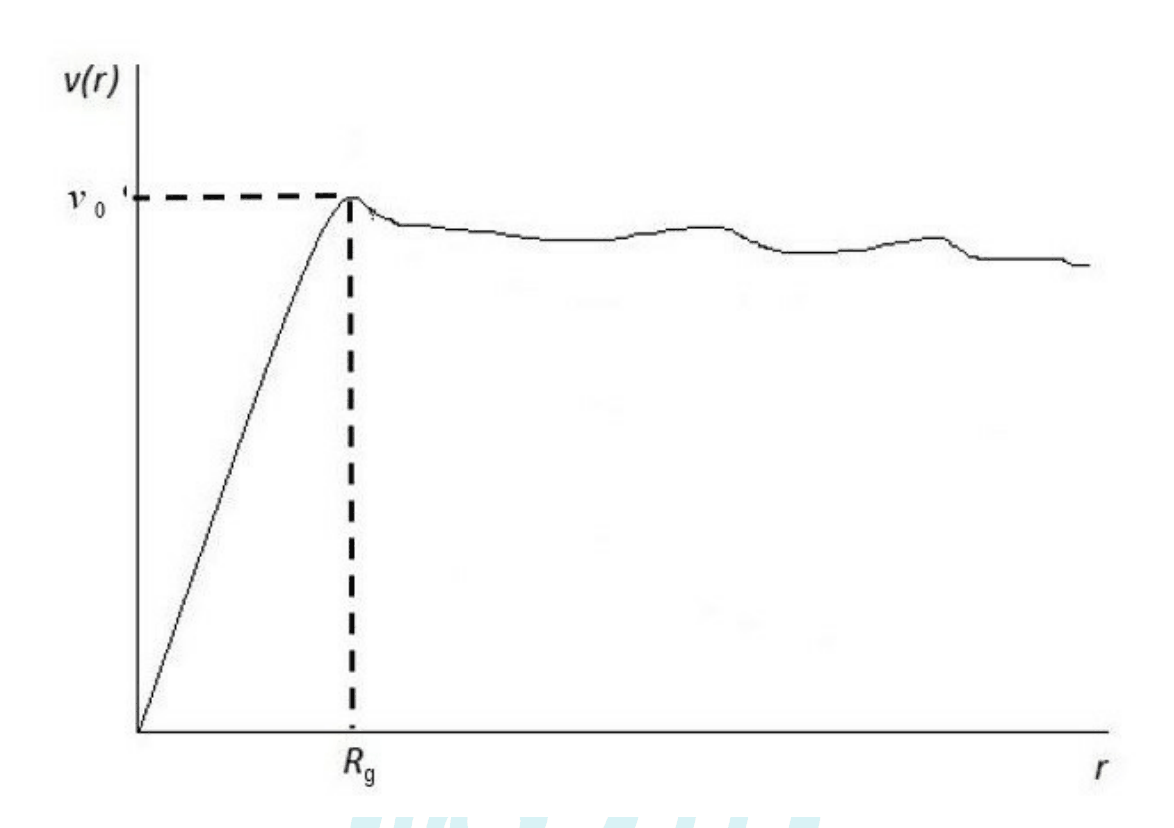
Fig. 1 Plot of galaxy rotation curve in a galaxy.
| B.2 | Find the total mass \(m_R\) of that part of the galaxy which lies within the sphere of radius \(R_g\) in terms of \(v_0\) and \(R_g\). | 0.5 pt. |
The discrepancy between the figure in B.2. and the plot obtained in B.1 indicates the existence of dark matter.
| B.3 | Determine the dark matter mass density as a function of \(r\), \(R_g\), \(v_0\), \(n\), and \(m_s\) for \(r<R_g\) and \(r\ge R_g\). | 1.5 pt. |
C. Interstellar Gas and Dark Matter
Now consider a young galaxy whose mass is dominated by interstellar gas and dark matters (neglect the mass of the stars). The interstellar gas is assumed to consist of identical particles of mass \(m_p\). The number density \(n(r)\) and temperature \(T(r)\) of the gas depend on the distance from the center of the galaxy \(r\). Although many physical processes happen in the gas, we can assume the gas is in a hydrostatic equilibrium due to its pressure and the galaxy gravitational attraction.
| C.1 | Find the pressure gradient of the gas \(dP/dr\), in terms of \(m'(r)\), \(r\) and \(n(r)\). Here, \(m'(r)\) is the total mass of gas and dark matters within a sphere of radius \(r\) from the galaxy center. | 0.5 pt. |
| C.2 | Assuming the interstellar gas as an ideal gas, find \(m'(r)\) in terms of \(n(r)\), \(T(r)\) and their derivatives with respect to \(r\). | 0.5 pt. |
Next for simplicity assume that the gas is in isothermal distribution at temperature \(T_0\) and the interstellar gas number density is given by
\[ n(r)=\frac{\alpha}{r(\beta+r)^2}, \]
where \(\alpha\) and \(\beta\) are some constants.
| C.3 | Find the dark matter mass density as a function of \(r\) inside the galaxy. | 1.0 pt. |
Official English text of the problem.
Answers
Let \[ \bar f=\frac1N\sum_{i=1}^N f_i. \] Here \(G\) is the gravitational constant and \(k_B\) is Boltzmann’s constant. The Doppler results retain first order in speed divided by \(c\).
-
A.1 \[ \boxed{U=-\frac{3GM^2}{5R}}. \]
-
A.2 \[ \boxed{V_{cr}\simeq c\left(1-\frac{\bar f}{f_0}\right)}. \]
-
A.3 \[ \boxed{v_{rms}\simeq \frac{c}{f_0}\sqrt{\frac3N\sum_{i=1}^N(f_i-\bar f)^2}}, \qquad \boxed{\langle K_{\mathrm{gal}}\rangle=\frac12m v_{rms}^2}. \]
-
A.4 \[ \boxed{\gamma=\frac12}. \]
-
A.5 \[ \boxed{M_{\mathrm{DM}}=\frac{5Rv_{rms}^2}{3G}-Nm_g}. \]
-
B.1 \[ \boxed{ v(r)= \begin{cases} \displaystyle r\sqrt{\frac{4\pi Gnm_s}{3}},&0\le r<R_g,\\[6pt] \displaystyle \sqrt{\frac{4\pi Gnm_sR_g^3}{3r}},&r\ge R_g. \end{cases}} \] The graph rises linearly from the origin to its maximum at \(R_g\), then decreases as \(r^{-1/2}\), approaching zero.
-
B.2 \[ \boxed{m_R=\frac{v_0^2R_g}{G}}. \]
-
B.3 \[ \boxed{ \rho_{\mathrm{DM}}(r)= \begin{cases} \displaystyle \frac{3v_0^2}{4\pi GR_g^2}-nm_s,&r<R_g,\\[7pt] \displaystyle \frac{v_0^2}{4\pi Gr^2},&r\ge R_g. \end{cases}} \]
-
C.1 \[ \boxed{\frac{dP}{dr}=-\frac{Gm'(r)m_p n(r)}{r^2}}. \]
-
C.2 \[ \boxed{ m'(r)=-\frac{k_Br^2}{Gm_p} \left[\frac{dT}{dr}+\frac{T(r)}{n(r)}\frac{dn}{dr}\right]}. \]
-
C.3 \[ \boxed{ \rho_{\mathrm{DM}}(r)= \frac{k_BT_0(\beta^2+6\beta r+3r^2)} {4\pi Gm_p r^2(\beta+r)^2} -\frac{\alpha m_p}{r(\beta+r)^2} }\qquad(r>0). \]
Solution
A.1
Choose zero gravitational potential energy when all the mass is dispersed at infinity. The uniform mass density and the mass inside radius \(r\) are
\[ \rho=\frac{3M}{4\pi R^3}, \qquad M(r)=\frac{4\pi}{3}\rho r^3 =M\frac{r^3}{R^3}. \]
Assemble the sphere by bringing successive thin shells from infinity. A shell of mass
\[ dM=4\pi r^2\rho\,dr=\frac{3Mr^2}{R^3}\,dr \]
has interaction energy with the previously assembled interior mass
\[ dU=-\frac{GM(r)}r\,dM. \]
This construction counts every pair interaction once. Therefore,
\[ U=-\int_0^R \frac{G}{r}\left(\frac{Mr^3}{R^3}\right) \left(\frac{3Mr^2}{R^3}\right)dr =-\frac{3GM^2}{R^6}\frac{R^5}{5}. \]
Thus,
\[ \boxed{U=-\frac{3GM^2}{5R}}. \]
A.2
Let \(u_i\) be the line-of-sight velocity of galaxy \(i\) relative to Earth, positive for recession. For \(u_i\ll c\), the Doppler relation to first order is
\[ f_i\simeq f_0\left(1-\frac{u_i}{c}\right), \]
so
\[ u_i\simeq c\frac{f_0-f_i}{f_0}. \]
The internal velocities average to zero in the cluster rest frame. Hence the cluster recession speed is the mean of these measured line-of-sight velocities:
\[ V_{cr}=\frac1N\sum_{i=1}^N u_i \simeq \frac{c}{Nf_0}\sum_{i=1}^N(f_0-f_i). \]
Consequently,
\[ \boxed{ V_{cr}\simeq c\left(1-\frac{1}{Nf_0}\sum_{i=1}^Nf_i\right) =c\left(1-\frac{\bar f}{f_0}\right)}. \]
A.3
The line-of-sight component of galaxy \(i\)'s velocity relative to the cluster centre is
\[ w_i=u_i-V_{cr} \simeq-\frac{c}{f_0}(f_i-\bar f). \]
For an isotropic velocity distribution, the mean squared velocity is shared equally among three mutually perpendicular directions:
\[ \langle v_x^2\rangle =\langle v_y^2\rangle =\langle v_z^2\rangle. \]
Taking the \(z\)-direction along the line of sight gives
\[ v_{rms}^2 =\langle v_x^2+v_y^2+v_z^2\rangle =3\langle w^2\rangle =\frac3N\sum_{i=1}^Nw_i^2. \]
Thus,
\[ \boxed{ v_{rms}\simeq\frac{c}{f_0} \sqrt{\frac3N\sum_{i=1}^N(f_i-\bar f)^2}}. \]
Equivalently,
\[ v_{rms}^2\simeq \frac{3c^2}{f_0^2} \left[ \frac1N\sum_{i=1}^N f_i^2 -\left(\frac1N\sum_{i=1}^Nf_i\right)^2 \right]. \]
Using the representative total galaxy mass \(m\), the mean kinetic energy in the cluster rest frame is
\[ \boxed{\langle K_{\mathrm{gal}}\rangle =\frac12m\langle v^2\rangle =\frac12m v_{rms}^2}. \]
A.4
Work in the centre-of-mass frame. Differentiating the given quantity gives
\[ \frac{d\Gamma}{dt} =\sum_i\left( \frac{d\vec p_i}{dt}\cdot\vec r_i +\vec p_i\cdot\frac{d\vec r_i}{dt} \right) =\sum_i\vec F_i\cdot\vec r_i+2K. \]
Let \(\vec F_{ij}\) be the force on particle \(i\) due to particle \(j\). Newton’s third law allows the force term to be grouped into unordered pairs:
\[ \sum_i\vec r_i\cdot\vec F_i =\sum_{i<j} \left(\vec r_i\cdot\vec F_{ij} +\vec r_j\cdot\vec F_{ji}\right) =\sum_{i<j}(\vec r_i-\vec r_j)\cdot\vec F_{ij}. \]
For Newtonian gravity,
\[ \vec F_{ij} =-Gm_i m_j\frac{\vec r_i-\vec r_j}{r_{ij}^3}, \qquad r_{ij}=|\vec r_i-\vec r_j|. \]
Therefore,
\[ \sum_i\vec r_i\cdot\vec F_i =-\sum_{i<j}\frac{Gm_i m_j}{r_{ij}} =U, \]
where \(U\) is the total pairwise gravitational potential energy. It follows that
\[ \frac{d\Gamma}{dt}=2K+U. \]
Since \(\Gamma\) remains bounded,
\[ \left\langle\frac{d\Gamma}{dt}\right\rangle_t =\lim_{\tau\to\infty} \frac{\Gamma(t+\tau)-\Gamma(t)}{\tau}=0. \]
Taking the time average consequently yields
\[ 2\langle K\rangle_t+\langle U\rangle_t=0, \qquad \langle K\rangle_t=-\frac12\langle U\rangle_t. \]
Comparison with the stated theorem gives
\[ \boxed{\gamma=\frac12}. \]
A.5
Treat the cluster as being in stationary virial equilibrium, so its observed bulk properties represent the time averages. Because the dark matter and galaxies have the same rms speed, the total kinetic energy is
\[ K=\frac12 Mv_{rms}^2. \]
Combining the virial theorem with A.1,
\[ 2K=-U \quad\Longrightarrow\quad Mv_{rms}^2=\frac{3GM^2}{5R}. \]
For \(M>0\),
\[ M=\frac{5Rv_{rms}^2}{3G}. \]
The total visible mass is \(Nm_g\). Subtracting it from the total mass gives
\[ \boxed{M_{\mathrm{DM}} =\frac{5Rv_{rms}^2}{3G}-Nm_g}. \]
B.1
The stellar mass density is
\[ \rho_\star=nm_s. \]
Neglect the total mass of the sparse stars beyond \(R_g\), while retaining them as test particles whose orbits can trace the outer gravitational field. The enclosed stellar mass is then
\[ M_\star(r)= \begin{cases} \displaystyle \frac{4\pi}{3}nm_s r^3,&r<R_g,\\[5pt] \displaystyle \frac{4\pi}{3}nm_s R_g^3,&r\ge R_g. \end{cases} \]
By the shell theorem, only enclosed mass contributes to the gravitational acceleration at \(r\). Equating this acceleration to the centripetal acceleration gives
\[ \frac{v(r)^2}{r}=\frac{GM_\star(r)}{r^2}, \qquad v(r)^2=\frac{GM_\star(r)}r. \]
Thus,
\[ \boxed{ v(r)= \begin{cases} \displaystyle r\sqrt{\frac{4\pi Gnm_s}{3}},&0\le r<R_g,\\[7pt] \displaystyle \sqrt{\frac{4\pi Gnm_sR_g^3}{3r}},&r\ge R_g. \end{cases}} \]
For the sketch, define
\[ v_g=R_g\sqrt{\frac{4\pi Gnm_s}{3}}. \]
The curve is a straight line from \((0,0)\) to \((R_g,v_g)\). It is continuous and has its maximum at that point. Beyond \(R_g\), it follows
\[ v(r)=v_g\sqrt{\frac{R_g}{r}}, \]
decreasing toward the horizontal asymptote \(v=0\).
B.2
At \(r=R_g\), the observed circular speed is \(v_0\). The circular-orbit condition gives
\[ \frac{v_0^2}{R_g}=\frac{Gm_R}{R_g^2}. \]
Therefore, the total enclosed mass, including dark matter, is
\[ \boxed{m_R=\frac{v_0^2R_g}{G}}. \]
B.3
For any spherically symmetric mass distribution traced by circular orbits,
\[ M_{\mathrm{enc}}(r)=\frac{rv(r)^2}{G}. \]
The stated approximation to the observed rotation curve is
\[ v(r)= \begin{cases} v_0r/R_g,&r<R_g,\\ v_0,&r\ge R_g. \end{cases} \]
Hence,
\[ M_{\mathrm{enc}}(r)= \begin{cases} \displaystyle \frac{v_0^2r^3}{GR_g^2},&r<R_g,\\[6pt] \displaystyle \frac{v_0^2r}{G},&r\ge R_g. \end{cases} \]
A spherical shell has mass \(dM_{\mathrm{enc}}=4\pi r^2\rho_{\mathrm{tot}}\,dr\), so
\[ \rho_{\mathrm{tot}}(r) =\frac{1}{4\pi r^2}\frac{dM_{\mathrm{enc}}}{dr} = \begin{cases} \displaystyle \frac{3v_0^2}{4\pi GR_g^2},&r<R_g,\\[7pt] \displaystyle \frac{v_0^2}{4\pi Gr^2},&r\ge R_g. \end{cases} \]
Subtracting the stellar density \(nm_s\) inside the visible edge, and neglecting the stellar density outside it, gives
\[ \boxed{ \rho_{\mathrm{DM}}(r)= \begin{cases} \displaystyle \frac{3v_0^2}{4\pi GR_g^2}-nm_s,&r<R_g,\\[7pt] \displaystyle \frac{v_0^2}{4\pi Gr^2},&r\ge R_g. \end{cases}} \]
The enclosed mass is continuous at \(R_g\), although the density can jump there in this idealized model.
C.1
Here \(m'(r)\) denotes the enclosed mass specified in the problem; the prime is part of its notation, not a derivative.
Consider a small gas element of radial thickness \(dr\) and cross-sectional area \(dA\). Its mass is
\[ dm=m_p n(r)\,dA\,dr. \]
The net outward pressure force is
\[ dF_P=-\frac{dP}{dr}\,dA\,dr. \]
The inward gravitational force has magnitude
\[ dF_G=\frac{Gm'(r)}{r^2}\,m_p n(r)\,dA\,dr. \]
Hydrostatic equilibrium requires these forces to balance. Therefore,
\[ \boxed{\frac{dP}{dr} =-\frac{Gm'(r)m_p n(r)}{r^2}}. \]
The negative sign expresses the outward decrease of pressure needed to support the gas against inward gravity.
C.2
For an ideal gas,
\[ P(r)=n(r)k_BT(r). \]
Differentiating,
\[ \frac{dP}{dr} =k_B\left[T(r)\frac{dn}{dr} +n(r)\frac{dT}{dr}\right]. \]
Substituting into the hydrostatic equilibrium equation and solving for the enclosed mass gives
\[ m'(r) =-\frac{k_Br^2}{Gm_p n(r)} \left[T(r)\frac{dn}{dr} +n(r)\frac{dT}{dr}\right]. \]
Thus,
\[ \boxed{ m'(r)=-\frac{k_Br^2}{Gm_p} \left[\frac{dT}{dr}+\frac{T(r)}{n(r)}\frac{dn}{dr}\right]}. \]
An equivalent form is
\[ m'(r) =-\frac{k_BT(r)r}{Gm_p} \left[ \frac{d\ln n}{d\ln r} +\frac{d\ln T}{d\ln r} \right]. \]
C.3
For the isothermal gas, \(T(r)=T_0\), so C.2 becomes
\[ m'(r) =-\frac{k_BT_0r^2}{Gm_p}\frac{d\ln n}{dr}. \]
The prescribed number density satisfies
\[ \ln n=\ln\alpha-\ln r-2\ln(\beta+r), \]
and therefore
\[ \frac{d\ln n}{dr} =-\frac1r-\frac{2}{\beta+r}. \]
The total enclosed mass is consequently
\[ m'(r) =\frac{k_BT_0}{Gm_p} \left(r+\frac{2r^2}{\beta+r}\right) =\frac{k_BT_0}{Gm_p} \frac{r(\beta+3r)}{\beta+r}. \]
Differentiate this enclosed mass:
\[ \frac{d\,m'(r)}{dr} =\frac{k_BT_0}{Gm_p} \frac{\beta^2+6\beta r+3r^2}{(\beta+r)^2}. \]
Thus the total mass density is
\[ \rho_{\mathrm{tot}}(r) =\frac{1}{4\pi r^2}\frac{d\,m'(r)}{dr} =\frac{k_BT_0(\beta^2+6\beta r+3r^2)} {4\pi Gm_p r^2(\beta+r)^2}. \]
The gas mass density is
\[ \rho_{\mathrm{gas}}(r)=m_p n(r) =\frac{\alpha m_p}{r(\beta+r)^2}. \]
Subtracting it from the total density yields
\[ \boxed{ \rho_{\mathrm{DM}}(r) = \frac{k_BT_0(\beta^2+6\beta r+3r^2)} {4\pi Gm_p r^2(\beta+r)^2} -\frac{\alpha m_p}{r(\beta+r)^2} }\qquad(r>0). \]
The solution was checked against the official solution.
IPhO 2017 · Theorieaufgabe 1
Dunkle Materie
Den ersten formalen Schluss auf die Existenz Dunkler Materie zog Fritz Zwicky auf Grundlage seiner Beobachtungen zur Dynamik des Coma-Galaxienhaufens, eines Haufens aus etwa tausend Galaxien. Zwicky verwendete den Virialsatz, um die Masse des Galaxienhaufens abzuschätzen. In einem einfachen System aus Sonne und Planet, in dem der Planet die Sonne auf einer Kreisbahn umkreist, stellt der Virialsatz einen exakten Zusammenhang zwischen der kinetischen Energie des Planeten und seiner gravitativen potenziellen Energie her. Im allgemeinen Fall eines Systems aus vielen Teilchen, die durch eine Wechselwirkung gebunden sind, verknüpft der Virialsatz den zeitlichen Mittelwert der gesamten kinetischen Energie mit dem zeitlichen Mittelwert der gesamten potenziellen Energie.
Auf Grundlage seiner Beobachtungen der Geschwindigkeiten der Galaxien nahe dem Rand des Coma-Galaxienhaufens schätzte Zwicky im Jahr 1933 ab, dass der Haufen mehr Masse besitzt, als durch die sichtbaren Objekte (d. h. die Galaxien) erfasst wurde. Die Gravitationsanziehung der beobachtbaren Materie (der Galaxien) war zu gering, um die Geschwindigkeiten der Galaxien zu erklären. Daher musste es verborgene Massen geben, die diese hohen Geschwindigkeiten erklären. Diese verborgene Masse ist die Masse der Dunklen Materie. Nehmen Sie im Folgenden an, dass die Masse jeder Galaxie die Summe aus ihrer sichtbaren Masse und der Masse der Dunklen Materie ist, die sich gemeinsam mit dieser Galaxie bewegt, und dass Dunkle Materie mit sichtbarer Materie ausschließlich gravitativ wechselwirkt.
A. Galaxienhaufen
Betrachten Sie einen Galaxienhaufen, der aus einer großen Anzahl \(N\) von Galaxien und Dunkler Materie besteht, die homogen in einer Kugel mit Radius \(R\) verteilt sind. Die Gesamtmasse des Haufens (Galaxien und Dunkle Materie) sei \(M\). Nehmen Sie an, dass die mittlere Gesamtmasse (sichtbare und Dunkle Materie) einer Galaxie \(m\) beträgt.
| A.1 | Nehmen Sie eine kontinuierliche Materieverteilung im Haufen an und bestimmen Sie die gesamte gravitative potenzielle Energie des Haufens in Abhängigkeit von \(M\) und \(R\). | 1.0 Pkt. |
Aufgrund der kosmologischen Expansion entfernt sich jedes weit entfernte Objekt von einem Beobachter auf der Erde mit einer Geschwindigkeit, die vom Abstand zwischen dem Beobachter und dem Objekt abhängt. Eine bestimmte Lyman-Frequenz (eine Emissionsspektrallinie des Wasserstoffs) einer Supernova vom Typ IA in der \(i\)-ten Galaxie des Galaxienhaufens wird als \(f_i\) beobachtet, mit \(i=1,\ldots,N\), während die entsprechende Lyman-Frequenz auf der Erde \(f_0\) beträgt.
| A.2 | Bestimmen Sie die mittlere Geschwindigkeit \(V_{cr}\), mit der sich der gesamte Galaxienhaufen von der Erde entfernt, in Abhängigkeit von \(f_i\) (mit \(i=1,\ldots,N.\)), \(f_0\) und \(N\). Beachten Sie, dass die Geschwindigkeit einer Galaxie im Vergleich zur Lichtgeschwindigkeit \(c\) sehr klein ist. | 0.5 Pkt. |
| A.3 | Nehmen Sie an, dass die Geschwindigkeiten der Galaxien relativ zum Zentrum des Haufens isotrop sind (in allen Richtungen gleich verteilt), und bestimmen Sie die quadratisch gemittelte Geschwindigkeit \(v_{rms}\) der Galaxien relativ zum Zentrum des Haufens in Abhängigkeit von \(N\), \(f_i\) (mit \(i=1,\ldots,N\)) und \(f_0\). Bestimmen Sie aus diesem Ergebnis die mittlere kinetische Energie einer Galaxie relativ zum Zentrum des Haufens in Abhängigkeit von \(v_{rms}\) und \(m\). | 1.5 Pkt. |
Zur Bestimmung der Gesamtmasse des Haufens kann der Virialsatz verwendet werden. Er besagt, dass für ein System von Teilchen, die durch ihre konservative Kraft gebunden sind, gilt:
\[ \langle K\rangle_t=-\gamma\langle U\rangle_t, \]
wobei \(\langle K\rangle_t\) der zeitliche Mittelwert der gesamten kinetischen Energie, \(\langle U\rangle_t\) der zeitliche Mittelwert der gesamten potenziellen Energie und \(\gamma\) eine Konstante ist. Dieser Satz lässt sich unter der Annahme herleiten, dass in einem durch seine eigene Wechselwirkung gebundenen Teilchensystem die Beträge des Ortsvektors und des Impulses jedes Teilchens endlich sind und somit auch die folgende Größe endlich ist:
\[ \Gamma=\sum_i\vec p_i\cdot\vec r_i \]
| A.4 | Nutzen Sie die Tatsache, dass der zeitliche Mittelwert von \(d\Gamma/dt\) über einen langen Zeitraum verschwindet, \(\left\langle d\Gamma/dt\right\rangle_t=0\), und bestimmen Sie \(\gamma\) im obigen Virialsatz für den Fall der Gravitationswechselwirkung. (Hinweis: Versuchen Sie, die Aufgabe mit der Summe in \(\Gamma\) für eine kleine endliche Anzahl von Galaxien zu lösen.) | 1.7 Pkt. |
| A.5 | Bestimmen Sie aus den bisherigen Ergebnissen die gesamte Masse der Dunklen Materie im Haufen in Abhängigkeit von \(N\), \(m_g\), \(R\) und \(v_{rms}\), wobei \(m_g\) die mittlere gesamte sichtbare Masse einer Galaxie ist. Beachten Sie, dass die quadratisch gemittelte Geschwindigkeit der Dunklen Materie mit derjenigen der Galaxien übereinstimmt. | 0.5 Pkt. |
B. Dunkle Materie in einer Galaxie
Dunkle Materie befindet sich auch innerhalb und in der Umgebung einer Galaxie. Betrachten Sie eine kugelförmige Galaxie mit dem Radius \(R_g\) ihres sichtbaren Randes (ungefähr der äußerste Abstand, in dem noch eine große Anzahl von Sternen sichtbar ist; beachten Sie jedoch, dass eine sehr kleine Anzahl von Sternen auch im Bereich jenseits von \(R_g\) verteilt sein kann). Nehmen Sie an, dass die Sterne in der Galaxie punktförmige Teilchen mit einer mittleren Masse \(m_s\) sind. Die Sterne in der Galaxie sind homogen mit einer Anzahldichte \(n\) verteilt und bewegen sich annahmegemäß auf Kreisbahnen.
| B.1 | Falls die Galaxie ausschließlich aus Sternen besteht, bestimmen Sie die Geschwindigkeit \(v(r)\) eines Sterns als Funktion seines Abstands vom Zentrum der Galaxie und skizzieren Sie \(v(r)\) für \(r<R_g\) und \(r\ge R_g\). | 0.8 Pkt. |
Auf die Existenz Dunkler Materie lässt sich aus der Rotationskurve einer Galaxie schließen, also aus einer aus Beobachtungen gewonnenen Darstellung von \(v(r)\). Die folgende Abbildung zeigt einen typischen Verlauf einer galaktischen Rotationskurve. Sie dürfen vereinfachend annehmen, dass \(v(r)\) für \(r\le R_g\) eine lineare Funktion ist und für \(r>R_g\) den konstanten Wert \(v_0\) hat.
Abb. 1 Darstellung der Rotationskurve einer Galaxie.
| B.2 | Bestimmen Sie die Gesamtmasse \(m_R\) desjenigen Teils der Galaxie, der innerhalb der Kugel mit Radius \(R_g\) liegt, in Abhängigkeit von \(v_0\) und \(R_g\). | 0.5 Pkt. |
Die Abweichung zwischen der Abbildung in B.2. und dem in B.1 erhaltenen Graphen weist auf die Existenz Dunkler Materie hin.
| B.3 | Bestimmen Sie die Massendichte der Dunklen Materie als Funktion von \(r\), \(R_g\), \(v_0\), \(n\) und \(m_s\) für \(r<R_g\) und \(r\ge R_g\). | 1.5 Pkt. |
C. Interstellares Gas und Dunkle Materie
Betrachten Sie nun eine junge Galaxie, deren Masse überwiegend aus interstellarem Gas und Dunkler Materie besteht (vernachlässigen Sie die Masse der Sterne). Das interstellare Gas bestehe aus identischen Teilchen der Masse \(m_p\). Die Anzahldichte \(n(r)\) und die Temperatur \(T(r)\) des Gases hängen vom Abstand \(r\) vom Zentrum der Galaxie ab. Obwohl im Gas viele physikalische Prozesse ablaufen, können wir annehmen, dass es sich aufgrund seines Drucks und der Gravitationsanziehung der Galaxie im hydrostatischen Gleichgewicht befindet.
| C.1 | Bestimmen Sie den Druckgradienten des Gases \(dP/dr\) in Abhängigkeit von \(m'(r)\), \(r\) und \(n(r)\). Dabei ist \(m'(r)\) die Gesamtmasse aus Gas und Dunkler Materie innerhalb einer Kugel mit Radius \(r\) um das Zentrum der Galaxie. | 0.5 Pkt. |
| C.2 | Nehmen Sie an, dass das interstellare Gas ein ideales Gas ist, und bestimmen Sie \(m'(r)\) in Abhängigkeit von \(n(r)\), \(T(r)\) und deren Ableitungen nach \(r\). | 0.5 Pkt. |
Nehmen Sie im Folgenden der Einfachheit halber an, dass das Gas eine isotherme Verteilung mit der Temperatur \(T_0\) aufweist und die Anzahldichte des interstellaren Gases gegeben ist durch
\[ n(r)=\frac{\alpha}{r(\beta+r)^2}, \]
wobei \(\alpha\) und \(\beta\) Konstanten sind.
| C.3 | Bestimmen Sie die Massendichte der Dunklen Materie als Funktion von \(r\) innerhalb der Galaxie. | 1.0 Pkt. |
Aufgabentext aus dem offiziellen englischen Text übersetzt.
Antworten
Es sei \[ \bar f=\frac1N\sum_{i=1}^N f_i. \] Dabei ist \(G\) die Gravitationskonstante und \(k_B\) die Boltzmann-Konstante. Die Ergebnisse zum Dopplereffekt berücksichtigen Terme bis zur ersten Ordnung in der durch \(c\) geteilten Geschwindigkeit.
-
A.1 \[ \boxed{U=-\frac{3GM^2}{5R}}. \]
-
A.2 \[ \boxed{V_{cr}\simeq c\left(1-\frac{\bar f}{f_0}\right)}. \]
-
A.3 \[ \boxed{v_{rms}\simeq \frac{c}{f_0}\sqrt{\frac3N\sum_{i=1}^N(f_i-\bar f)^2}}, \qquad \boxed{\langle K_{\mathrm{gal}}\rangle=\frac12m v_{rms}^2}. \]
-
A.4 \[ \boxed{\gamma=\frac12}. \]
-
A.5 \[ \boxed{M_{\mathrm{DM}}=\frac{5Rv_{rms}^2}{3G}-Nm_g}. \]
-
B.1 \[ \boxed{ v(r)= \begin{cases} \displaystyle r\sqrt{\frac{4\pi Gnm_s}{3}},&0\le r<R_g,\\[6pt] \displaystyle \sqrt{\frac{4\pi Gnm_sR_g^3}{3r}},&r\ge R_g. \end{cases}} \] Der Graph steigt vom Ursprung aus linear bis zu seinem Maximum bei \(R_g\) an, fällt anschließend wie \(r^{-1/2}\) ab und nähert sich null.
-
B.2 \[ \boxed{m_R=\frac{v_0^2R_g}{G}}. \]
-
B.3 \[ \boxed{ \rho_{\mathrm{DM}}(r)= \begin{cases} \displaystyle \frac{3v_0^2}{4\pi GR_g^2}-nm_s,&r<R_g,\\[7pt] \displaystyle \frac{v_0^2}{4\pi Gr^2},&r\ge R_g. \end{cases}} \]
-
C.1 \[ \boxed{\frac{dP}{dr}=-\frac{Gm'(r)m_p n(r)}{r^2}}. \]
-
C.2 \[ \boxed{ m'(r)=-\frac{k_Br^2}{Gm_p} \left[\frac{dT}{dr}+\frac{T(r)}{n(r)}\frac{dn}{dr}\right]}. \]
-
C.3 \[ \boxed{ \rho_{\mathrm{DM}}(r)= \frac{k_BT_0(\beta^2+6\beta r+3r^2)} {4\pi Gm_p r^2(\beta+r)^2} -\frac{\alpha m_p}{r(\beta+r)^2} }\qquad(r>0). \]
Lösung
A.1
Wählen wir die gravitative potenzielle Energie gleich null, wenn die gesamte Masse im Unendlichen verteilt ist. Die konstante Massendichte und die innerhalb des Radius \(r\) liegende Masse sind
\[ \rho=\frac{3M}{4\pi R^3}, \qquad M(r)=\frac{4\pi}{3}\rho r^3 =M\frac{r^3}{R^3}. \]
Wir bauen die Kugel auf, indem wir nacheinander dünne Schalen aus dem Unendlichen heranbringen. Eine Schale mit der Masse
\[ dM=4\pi r^2\rho\,dr=\frac{3Mr^2}{R^3}\,dr \]
hat mit der bereits zusammengefügten inneren Masse die Wechselwirkungsenergie
\[ dU=-\frac{GM(r)}r\,dM. \]
Bei diesem Aufbau wird jede Paarwechselwirkung genau einmal gezählt. Daher gilt
\[ U=-\int_0^R \frac{G}{r}\left(\frac{Mr^3}{R^3}\right) \left(\frac{3Mr^2}{R^3}\right)dr =-\frac{3GM^2}{R^6}\frac{R^5}{5}. \]
Somit ist
\[ \boxed{U=-\frac{3GM^2}{5R}}. \]
A.2
Sei \(u_i\) die Geschwindigkeitskomponente der Galaxie \(i\) relativ zur Erde entlang der Sichtlinie, mit positivem Vorzeichen bei einer Entfernung von der Erde. Für \(u_i\ll c\) lautet die Dopplerbeziehung in erster Ordnung
\[ f_i\simeq f_0\left(1-\frac{u_i}{c}\right), \]
also
\[ u_i\simeq c\frac{f_0-f_i}{f_0}. \]
Die internen Geschwindigkeiten mitteln sich im Ruhesystem des Haufens zu null. Daher ist die Geschwindigkeit, mit der sich der Haufen von der Erde entfernt, der Mittelwert dieser gemessenen Geschwindigkeitskomponenten entlang der Sichtlinie:
\[ V_{cr}=\frac1N\sum_{i=1}^N u_i \simeq \frac{c}{Nf_0}\sum_{i=1}^N(f_0-f_i). \]
Folglich gilt
\[ \boxed{ V_{cr}\simeq c\left(1-\frac{1}{Nf_0}\sum_{i=1}^Nf_i\right) =c\left(1-\frac{\bar f}{f_0}\right)}. \]
A.3
Die Komponente der Geschwindigkeit der Galaxie \(i\) relativ zum Zentrum des Haufens entlang der Sichtlinie ist
\[ w_i=u_i-V_{cr} \simeq-\frac{c}{f_0}(f_i-\bar f). \]
Bei einer isotropen Geschwindigkeitsverteilung verteilt sich das mittlere Geschwindigkeitsquadrat gleichmäßig auf drei zueinander senkrechte Richtungen:
\[ \langle v_x^2\rangle =\langle v_y^2\rangle =\langle v_z^2\rangle. \]
Wählen wir die \(z\)-Richtung entlang der Sichtlinie, so folgt
\[ v_{rms}^2 =\langle v_x^2+v_y^2+v_z^2\rangle =3\langle w^2\rangle =\frac3N\sum_{i=1}^Nw_i^2. \]
Somit gilt
\[ \boxed{ v_{rms}\simeq\frac{c}{f_0} \sqrt{\frac3N\sum_{i=1}^N(f_i-\bar f)^2}}. \]
Äquivalent dazu ist
\[ v_{rms}^2\simeq \frac{3c^2}{f_0^2} \left[ \frac1N\sum_{i=1}^N f_i^2 -\left(\frac1N\sum_{i=1}^Nf_i\right)^2 \right]. \]
Mit der repräsentativen Gesamtmasse \(m\) einer Galaxie ist die mittlere kinetische Energie im Ruhesystem des Haufens
\[ \boxed{\langle K_{\mathrm{gal}}\rangle =\frac12m\langle v^2\rangle =\frac12m v_{rms}^2}. \]
A.4
Wir arbeiten im Schwerpunktsystem. Die Ableitung der gegebenen Größe ergibt
\[ \frac{d\Gamma}{dt} =\sum_i\left( \frac{d\vec p_i}{dt}\cdot\vec r_i +\vec p_i\cdot\frac{d\vec r_i}{dt} \right) =\sum_i\vec F_i\cdot\vec r_i+2K. \]
Sei \(\vec F_{ij}\) die Kraft, die Teilchen \(j\) auf Teilchen \(i\) ausübt. Nach dem dritten Newtonschen Gesetz lässt sich der Kraftterm zu ungeordneten Paaren zusammenfassen:
\[ \sum_i\vec r_i\cdot\vec F_i =\sum_{i<j} \left(\vec r_i\cdot\vec F_{ij} +\vec r_j\cdot\vec F_{ji}\right) =\sum_{i<j}(\vec r_i-\vec r_j)\cdot\vec F_{ij}. \]
Für die Newtonsche Gravitation gilt
\[ \vec F_{ij} =-Gm_i m_j\frac{\vec r_i-\vec r_j}{r_{ij}^3}, \qquad r_{ij}=|\vec r_i-\vec r_j|. \]
Daher ist
\[ \sum_i\vec r_i\cdot\vec F_i =-\sum_{i<j}\frac{Gm_i m_j}{r_{ij}} =U, \]
wobei \(U\) die gesamte gravitative potenzielle Energie aller Paare ist. Daraus folgt
\[ \frac{d\Gamma}{dt}=2K+U. \]
Da \(\Gamma\) beschränkt bleibt, gilt
\[ \left\langle\frac{d\Gamma}{dt}\right\rangle_t =\lim_{\tau\to\infty} \frac{\Gamma(t+\tau)-\Gamma(t)}{\tau}=0. \]
Die zeitliche Mittelung liefert folglich
\[ 2\langle K\rangle_t+\langle U\rangle_t=0, \qquad \langle K\rangle_t=-\frac12\langle U\rangle_t. \]
Der Vergleich mit dem angegebenen Satz ergibt
\[ \boxed{\gamma=\frac12}. \]
A.5
Wir betrachten den Haufen als im stationären Virialgleichgewicht befindlich, sodass seine beobachteten makroskopischen Eigenschaften die zeitlichen Mittelwerte repräsentieren. Da die Dunkle Materie und die Galaxien dieselbe quadratisch gemittelte Geschwindigkeit haben, ist die gesamte kinetische Energie
\[ K=\frac12 Mv_{rms}^2. \]
Die Kombination des Virialsatzes mit A.1 ergibt
\[ 2K=-U \quad\Longrightarrow\quad Mv_{rms}^2=\frac{3GM^2}{5R}. \]
Für \(M>0\) gilt
\[ M=\frac{5Rv_{rms}^2}{3G}. \]
Die gesamte sichtbare Masse beträgt \(Nm_g\). Subtraktion von der Gesamtmasse liefert
\[ \boxed{M_{\mathrm{DM}} =\frac{5Rv_{rms}^2}{3G}-Nm_g}. \]
B.1
Die Massendichte der Sterne ist
\[ \rho_\star=nm_s. \]
Wir vernachlässigen die Gesamtmasse der wenigen Sterne jenseits von \(R_g\), behalten sie jedoch als Testteilchen bei, deren Bahnen das äußere Gravitationsfeld abbilden können. Die eingeschlossene Sternmasse ist dann
\[ M_\star(r)= \begin{cases} \displaystyle \frac{4\pi}{3}nm_s r^3,&r<R_g,\\[5pt] \displaystyle \frac{4\pi}{3}nm_s R_g^3,&r\ge R_g. \end{cases} \]
Nach dem Schalentheorem trägt nur die eingeschlossene Masse zur Gravitationsbeschleunigung bei \(r\) bei. Setzen wir diese Beschleunigung gleich der Zentripetalbeschleunigung, so ergibt sich
\[ \frac{v(r)^2}{r}=\frac{GM_\star(r)}{r^2}, \qquad v(r)^2=\frac{GM_\star(r)}r. \]
Somit gilt
\[ \boxed{ v(r)= \begin{cases} \displaystyle r\sqrt{\frac{4\pi Gnm_s}{3}},&0\le r<R_g,\\[7pt] \displaystyle \sqrt{\frac{4\pi Gnm_sR_g^3}{3r}},&r\ge R_g. \end{cases}} \]
Für die Skizze definieren wir
\[ v_g=R_g\sqrt{\frac{4\pi Gnm_s}{3}}. \]
Die Kurve verläuft als Gerade von \((0,0)\) bis \((R_g,v_g)\). Sie ist stetig und hat an diesem Punkt ihr Maximum. Jenseits von \(R_g\) folgt sie dem Verlauf
\[ v(r)=v_g\sqrt{\frac{R_g}{r}}, \]
und fällt gegen die horizontale Asymptote \(v=0\) ab.
B.2
Bei \(r=R_g\) beträgt die beobachtete Kreisbahngeschwindigkeit \(v_0\). Die Bedingung für eine Kreisbahn ergibt
\[ \frac{v_0^2}{R_g}=\frac{Gm_R}{R_g^2}. \]
Die gesamte eingeschlossene Masse einschließlich der Dunklen Materie ist daher
\[ \boxed{m_R=\frac{v_0^2R_g}{G}}. \]
B.3
Für jede kugelsymmetrische Massenverteilung, die durch Kreisbahnen erfasst wird, gilt
\[ M_{\mathrm{enc}}(r)=\frac{rv(r)^2}{G}. \]
Die angegebene Näherung für die beobachtete Rotationskurve lautet
\[ v(r)= \begin{cases} v_0r/R_g,&r<R_g,\\ v_0,&r\ge R_g. \end{cases} \]
Daher gilt
\[ M_{\mathrm{enc}}(r)= \begin{cases} \displaystyle \frac{v_0^2r^3}{GR_g^2},&r<R_g,\\[6pt] \displaystyle \frac{v_0^2r}{G},&r\ge R_g. \end{cases} \]
Eine Kugelschale hat die Masse \(dM_{\mathrm{enc}}=4\pi r^2\rho_{\mathrm{tot}}\,dr\), also
\[ \rho_{\mathrm{tot}}(r) =\frac{1}{4\pi r^2}\frac{dM_{\mathrm{enc}}}{dr} = \begin{cases} \displaystyle \frac{3v_0^2}{4\pi GR_g^2},&r<R_g,\\[7pt] \displaystyle \frac{v_0^2}{4\pi Gr^2},&r\ge R_g. \end{cases} \]
Subtrahieren wir die Massendichte der Sterne \(nm_s\) innerhalb des sichtbaren Randes und vernachlässigen wir die Massendichte der Sterne außerhalb davon, so erhalten wir
\[ \boxed{ \rho_{\mathrm{DM}}(r)= \begin{cases} \displaystyle \frac{3v_0^2}{4\pi GR_g^2}-nm_s,&r<R_g,\\[7pt] \displaystyle \frac{v_0^2}{4\pi Gr^2},&r\ge R_g. \end{cases}} \]
Die eingeschlossene Masse ist bei \(R_g\) stetig, obwohl die Dichte dort in diesem idealisierten Modell einen Sprung aufweisen kann.
C.1
Hier bezeichnet \(m'(r)\) die in der Aufgabenstellung angegebene eingeschlossene Masse; der Strich ist Teil ihrer Bezeichnung und kennzeichnet keine Ableitung.
Betrachten wir ein kleines Gaselement mit radialer Dicke \(dr\) und Querschnittsfläche \(dA\). Seine Masse ist
\[ dm=m_p n(r)\,dA\,dr. \]
Die resultierende, nach außen gerichtete Druckkraft ist
\[ dF_P=-\frac{dP}{dr}\,dA\,dr. \]
Die nach innen gerichtete Gravitationskraft hat den Betrag
\[ dF_G=\frac{Gm'(r)}{r^2}\,m_p n(r)\,dA\,dr. \]
Im hydrostatischen Gleichgewicht müssen sich diese Kräfte ausgleichen. Daher gilt
\[ \boxed{\frac{dP}{dr} =-\frac{Gm'(r)m_p n(r)}{r^2}}. \]
Das negative Vorzeichen beschreibt die nach außen gerichtete Druckabnahme, die erforderlich ist, um das Gas gegen die nach innen gerichtete Gravitation zu stützen.
C.2
Für ein ideales Gas gilt
\[ P(r)=n(r)k_BT(r). \]
Durch Ableiten erhalten wir
\[ \frac{dP}{dr} =k_B\left[T(r)\frac{dn}{dr} +n(r)\frac{dT}{dr}\right]. \]
Einsetzen in die Gleichung des hydrostatischen Gleichgewichts und Auflösen nach der eingeschlossenen Masse ergibt
\[ m'(r) =-\frac{k_Br^2}{Gm_p n(r)} \left[T(r)\frac{dn}{dr} +n(r)\frac{dT}{dr}\right]. \]
Somit gilt
\[ \boxed{ m'(r)=-\frac{k_Br^2}{Gm_p} \left[\frac{dT}{dr}+\frac{T(r)}{n(r)}\frac{dn}{dr}\right]}. \]
Eine äquivalente Form ist
\[ m'(r) =-\frac{k_BT(r)r}{Gm_p} \left[ \frac{d\ln n}{d\ln r} +\frac{d\ln T}{d\ln r} \right]. \]
C.3
Für das isotherme Gas gilt \(T(r)=T_0\), sodass sich C.2 wie folgt vereinfacht:
\[ m'(r) =-\frac{k_BT_0r^2}{Gm_p}\frac{d\ln n}{dr}. \]
Die vorgegebene Anzahldichte erfüllt
\[ \ln n=\ln\alpha-\ln r-2\ln(\beta+r), \]
und daher gilt
\[ \frac{d\ln n}{dr} =-\frac1r-\frac{2}{\beta+r}. \]
Die gesamte eingeschlossene Masse ist folglich
\[ m'(r) =\frac{k_BT_0}{Gm_p} \left(r+\frac{2r^2}{\beta+r}\right) =\frac{k_BT_0}{Gm_p} \frac{r(\beta+3r)}{\beta+r}. \]
Wir leiten diese eingeschlossene Masse ab:
\[ \frac{d\,m'(r)}{dr} =\frac{k_BT_0}{Gm_p} \frac{\beta^2+6\beta r+3r^2}{(\beta+r)^2}. \]
Damit ist die gesamte Massendichte
\[ \rho_{\mathrm{tot}}(r) =\frac{1}{4\pi r^2}\frac{d\,m'(r)}{dr} =\frac{k_BT_0(\beta^2+6\beta r+3r^2)} {4\pi Gm_p r^2(\beta+r)^2}. \]
Die Massendichte des Gases ist
\[ \rho_{\mathrm{gas}}(r)=m_p n(r) =\frac{\alpha m_p}{r(\beta+r)^2}. \]
Subtraktion von der Gesamtdichte liefert
\[ \boxed{ \rho_{\mathrm{DM}}(r) = \frac{k_BT_0(\beta^2+6\beta r+3r^2)} {4\pi Gm_p r^2(\beta+r)^2} -\frac{\alpha m_p}{r(\beta+r)^2} }\qquad(r>0). \]
Die Lösung wurde mit der offiziellen Lösung abgeglichen.
IPhO 2017 · Teori sorusu 1
Karanlık Madde
Karanlık maddenin varlığına ilişkin ilk bilimsel çıkarım, Fritz Zwicky tarafından, yaklaşık bin galaksiden oluşan Coma galaksi kümesinin dinamiğine ilişkin gözlemlerine dayanılarak yapılmıştır. Zwicky, galaksi kümesinin kütlesini tahmin etmek için virial teoremini kullanmıştır. Gezegenin Güneş'in çevresinde dairesel bir yörüngede dolandığı basit bir Güneş-gezegen sisteminde virial teoremi, gezegenin kinetik enerjisi ile kütleçekimsel potansiyel enerjisi arasında kesin bir bağıntı olduğunu belirtir. Daha genel olarak, bir etkileşimle birbirine bağlı çok sayıda parçacıktan oluşan bir sistem için virial teoremi, toplam kinetik enerjinin zaman ortalaması ile toplam potansiyel enerjinin zaman ortalamasını ilişkilendirir.
Zwicky, 1933 yılında Coma galaksi kümesinin kenarına yakın galaksilerin hızlarına ilişkin gözlemlerine dayanarak, kümenin görsel olarak gözlemlenenden (yani galaksilerden) daha fazla kütleye sahip olduğunu tahmin etmiştir. Gözlemlenebilir maddenin (galaksilerin) kütleçekimsel çekimi, galaksilerin hızlarını açıklamak için çok küçüktü. Dolayısıyla, bu kadar büyük hızları açıklayan gizli bir kütlenin bulunması gerekiyordu. Bu gizli kütle, karanlık madde kütlesidir. Aşağıda, her bir galaksinin kütlesinin, görünür kütlesi ile o galaksiyle birlikte hareket eden karanlık maddenin kütlesinin toplamı olduğunu ve karanlık maddenin görünür maddeyle yalnızca kütleçekimsel olarak etkileştiğini varsayın.
A. Galaksi Kümesi
Çok sayıda, \(N\) adet galaksiden ve karanlık maddeden oluşan, bunların \(R\) yarıçaplı bir küre içinde homojen olarak dağıldığı ve toplam kütlesi (galaksiler ve karanlık madde) \(M\) olan bir galaksi kümesini ele alın. Bir galaksinin ortalama toplam kütlesinin (görünür madde ve karanlık madde) \(m\) olduğunu varsayın.
| A.1 | Kümedeki maddenin sürekli bir dağılıma sahip olduğunu varsayarak, kümenin toplam kütleçekimsel potansiyel enerjisini \(M\) ve \(R\) cinsinden bulun. | 1.0 puan |
Kozmolojik genişleme nedeniyle, uzaktaki her cisim Dünya'daki bir gözlemciden, gözlemci ile cisim arasındaki uzaklığa bağlı bir süratle uzaklaşır. Galaksi kümesindeki \(i\). galakside bulunan IA tipi bir süpernovanın belirli bir Lyman (hidrojenin bir salma tayf çizgisi) frekansı, \(i=1,\ldots,N\) olmak üzere \(f_i\) olarak gözlemlenirken, buna karşılık gelen aynı Lyman frekansı Dünya'da \(f_0\)'dır.
| A.2 | Galaksi kümesinin bir bütün olarak Dünya'dan uzaklaşmasının ortalama sürati \(V_{cr}\)'yi, \(f_i\) (\(i=1,\ldots,N.\) olmak üzere), \(f_0\) ve \(N\) cinsinden belirleyin. Bir galaksinin süratinin ışık hızı \(c\)'ye göre çok küçük olduğunu dikkate alın. | 0.5 puan |
| A.3 | Galaksilerin küme merkezine göre hızlarının izotropik (her yönde aynı) olduğunu varsayarak, galaksilerin küme merkezine göre karekök ortalama kare sürati \(v_{rms}\)'yi, \(N\), \(f_i\) (\(i=1,\ldots,N\) olmak üzere) ve \(f_0\) cinsinden belirleyin. Bu sonuçtan yararlanarak bir galaksinin küme merkezine göre ortalama kinetik enerjisini \(v_{rms}\) ve \(m\) cinsinden belirleyin. | 1.5 puan |
Kümenin toplam kütlesini bulmak için virial teoremi kullanılabilir. Bu teorem, korunumlu kuvvetleriyle birbirine bağlı parçacıklardan oluşan bir sistem için
\[ \langle K\rangle_t=-\gamma\langle U\rangle_t, \]
bağıntısının geçerli olduğunu belirtir. Burada \(\langle K\rangle_t\) toplam kinetik enerjinin zaman ortalaması, \(\langle U\rangle_t\) toplam potansiyel enerjinin zaman ortalaması ve \(\gamma\) bir sabittir. Bu teorem, kendi etkileşimiyle bağlı parçacıklardan oluşan bir sistemde her parçacığın konum ve momentum büyüklüklerinin sonlu olduğu, dolayısıyla aşağıdaki niceliğin de sonlu olduğu varsayılarak türetilebilir:
\[ \Gamma=\sum_i\vec p_i\cdot\vec r_i \]
| A.4 | \(d\Gamma/dt\)'nin uzun bir zaman aralığı üzerinden alınan zaman ortalamasının sıfır olduğu, \(\left\langle d\Gamma/dt\right\rangle_t=0\), bilgisini kullanarak, kütleçekimsel etkileşim durumu için yukarıdaki virial teoremindeki \(\gamma\)'yı belirleyin. (İpucu: \(\Gamma\)'daki toplamı küçük ve sonlu sayıda galaksi için ele alarak soruyu çözmeyi deneyin.) | 1.7 puan |
| A.5 | Önceki sonuçlardan yararlanarak kümenin toplam karanlık madde kütlesini \(N\), \(m_g\), \(R\) ve \(v_{rms}\) cinsinden belirleyin; burada \(m_g\), bir galaksinin ortalama toplam görünür kütlesidir. Karanlık maddenin karekök ortalama kare süratinin galaksilerinkiyle aynı olduğunu dikkate alın. | 0.5 puan |
B. Bir Galaksideki Karanlık Madde
Karanlık madde, bir galaksinin içinde ve çevresinde de bulunur. Görünür sınırının yarıçapı \(R_g\) olan küresel bir galaksiyi ele alın (bu, çok sayıda yıldızın hâlâ görülebildiği yaklaşık en dış uzaklıktır; ancak çok az sayıda yıldızın \(R_g\)'nin ötesindeki bölgede de dağılmış olabileceğini dikkate alın). Galaksideki yıldızların ortalama kütlesi \(m_s\) olan noktasal parçacıklar olduğunu varsayın. Galakside \(n\) sayı yoğunluğuyla homojen olarak dağılmış yıldızların dairesel yörüngelerde hareket ettiği varsayılmaktadır.
| B.1 | Galaksi yalnızca yıldızlardan oluşuyorsa, bir yıldızın sürati \(v(r)\)'yi galaksi merkezine olan uzaklığının fonksiyonu olarak bulun ve \(r<R_g\) ile \(r\ge R_g\) için \(v(r)\)'nin grafiğini kabaca çizin. | 0.8 puan |
Karanlık maddenin varlığı, gözlemlerden elde edilen \(v(r)\)'nin grafiği olan galaksi dönme eğrisinden çıkarılabilir. Aşağıdaki şekil, galaksi dönme eğrisinin yaygın bir biçimini göstermektedir. Basitleştirmek için \(v(r)\)'nin \(r\le R_g\) için doğrusal bir fonksiyon ve \(r>R_g\) için \(v_0\) sabiti olduğunu varsayabilirsiniz.
Şek. 1 Bir galaksideki galaksi dönme eğrisinin grafiği.
| B.2 | Galaksinin \(R_g\) yarıçaplı küre içinde kalan kısmının toplam kütlesi \(m_R\)'yi \(v_0\) ve \(R_g\) cinsinden bulun. | 0.5 puan |
B.2.'deki şekil ile B.1'de elde edilen grafik arasındaki uyuşmazlık, karanlık maddenin varlığına işaret eder.
| B.3 | \(r<R_g\) ve \(r\ge R_g\) için karanlık maddenin kütle yoğunluğunu \(r\), \(R_g\), \(v_0\), \(n\) ve \(m_s\)'nin fonksiyonu olarak belirleyin. | 1.5 puan |
C. Yıldızlararası Gaz ve Karanlık Madde
Şimdi kütlesinin büyük bölümünü yıldızlararası gaz ve karanlık maddenin oluşturduğu genç bir galaksiyi ele alın (yıldızların kütlesini ihmal edin). Yıldızlararası gazın, kütlesi \(m_p\) olan özdeş parçacıklardan oluştuğu varsayılmaktadır. Gazın sayı yoğunluğu \(n(r)\) ve sıcaklığı \(T(r)\), galaksinin merkezinden olan uzaklık \(r\)'ye bağlıdır. Gazda birçok fiziksel süreç gerçekleşmesine rağmen, gazın kendi basıncı ve galaksinin kütleçekimsel çekimi nedeniyle hidrostatik dengede olduğunu varsayabiliriz.
| C.1 | Gazın basınç gradyanı \(dP/dr\)'yi \(m'(r)\), \(r\) ve \(n(r)\) cinsinden bulun. Burada \(m'(r)\), galaksi merkezini merkez alan \(r\) yarıçaplı bir küre içindeki gazın ve karanlık maddenin toplam kütlesidir. | 0.5 puan |
| C.2 | Yıldızlararası gazın ideal gaz olduğunu varsayarak \(m'(r)\)'yi \(n(r)\), \(T(r)\) ve bunların \(r\)'ye göre türevleri cinsinden bulun. | 0.5 puan |
Şimdi basitlik açısından gazın \(T_0\) sıcaklığında izotermal bir dağılıma sahip olduğunu ve yıldızlararası gazın sayı yoğunluğunun
\[ n(r)=\frac{\alpha}{r(\beta+r)^2}, \]
ile verildiğini varsayın; burada \(\alpha\) ve \(\beta\) birer sabittir.
| C.3 | Galaksinin içindeki karanlık maddenin kütle yoğunluğunu \(r\)'nin fonksiyonu olarak bulun. | 1.0 puan |
Soru metni resmi İngilizce metinden çevrilmiştir.
Cevaplar
Şu tanımı yapalım: \[ \bar f=\frac1N\sum_{i=1}^N f_i. \] Burada \(G\) kütleçekim sabiti, \(k_B\) ise Boltzmann sabitidir. Doppler sonuçlarında süratin \(c\)'ye oranının birinci mertebesine kadar olan terimler tutulmuştur.
-
A.1 \[ \boxed{U=-\frac{3GM^2}{5R}}. \]
-
A.2 \[ \boxed{V_{cr}\simeq c\left(1-\frac{\bar f}{f_0}\right)}. \]
-
A.3 \[ \boxed{v_{rms}\simeq \frac{c}{f_0}\sqrt{\frac3N\sum_{i=1}^N(f_i-\bar f)^2}}, \qquad \boxed{\langle K_{\mathrm{gal}}\rangle=\frac12m v_{rms}^2}. \]
-
A.4 \[ \boxed{\gamma=\frac12}. \]
-
A.5 \[ \boxed{M_{\mathrm{DM}}=\frac{5Rv_{rms}^2}{3G}-Nm_g}. \]
-
B.1 \[ \boxed{ v(r)= \begin{cases} \displaystyle r\sqrt{\frac{4\pi Gnm_s}{3}},&0\le r<R_g,\\[6pt] \displaystyle \sqrt{\frac{4\pi Gnm_sR_g^3}{3r}},&r\ge R_g. \end{cases}} \] Grafik, başlangıç noktasından \(R_g\)'deki maksimumuna kadar doğrusal olarak yükselir, ardından \(r^{-1/2}\) ile orantılı olarak azalarak sıfıra yaklaşır.
-
B.2 \[ \boxed{m_R=\frac{v_0^2R_g}{G}}. \]
-
B.3 \[ \boxed{ \rho_{\mathrm{DM}}(r)= \begin{cases} \displaystyle \frac{3v_0^2}{4\pi GR_g^2}-nm_s,&r<R_g,\\[7pt] \displaystyle \frac{v_0^2}{4\pi Gr^2},&r\ge R_g. \end{cases}} \]
-
C.1 \[ \boxed{\frac{dP}{dr}=-\frac{Gm'(r)m_p n(r)}{r^2}}. \]
-
C.2 \[ \boxed{ m'(r)=-\frac{k_Br^2}{Gm_p} \left[\frac{dT}{dr}+\frac{T(r)}{n(r)}\frac{dn}{dr}\right]}. \]
-
C.3 \[ \boxed{ \rho_{\mathrm{DM}}(r)= \frac{k_BT_0(\beta^2+6\beta r+3r^2)} {4\pi Gm_p r^2(\beta+r)^2} -\frac{\alpha m_p}{r(\beta+r)^2} }\qquad(r>0). \]
Çözüm
A.1
Kütlenin tamamı sonsuzda dağılmış durumdayken kütleçekimsel potansiyel enerjiyi sıfır seçelim. Homojen kütle yoğunluğu ve \(r\) yarıçapı içinde kalan kütle şöyledir:
\[ \rho=\frac{3M}{4\pi R^3}, \qquad M(r)=\frac{4\pi}{3}\rho r^3 =M\frac{r^3}{R^3}. \]
Sonsuzdan art arda ince küresel kabuklar getirerek küreyi oluşturalım. Kütlesi
\[ dM=4\pi r^2\rho\,dr=\frac{3Mr^2}{R^3}\,dr \]
olan bir kabuğun, daha önce bir araya getirilmiş iç kütleyle etkileşim enerjisi şöyledir:
\[ dU=-\frac{GM(r)}r\,dM. \]
Bu oluşturma yöntemi, her ikili etkileşimi bir kez sayar. Dolayısıyla,
\[ U=-\int_0^R \frac{G}{r}\left(\frac{Mr^3}{R^3}\right) \left(\frac{3Mr^2}{R^3}\right)dr =-\frac{3GM^2}{R^6}\frac{R^5}{5}. \]
Böylece,
\[ \boxed{U=-\frac{3GM^2}{5R}}. \]
A.2
\(u_i\), \(i\) galaksisinin Dünya'ya göre görüş doğrultusundaki hızı olsun; uzaklaşma yönünü pozitif alalım. \(u_i\ll c\) için birinci mertebeden Doppler bağıntısı
\[ f_i\simeq f_0\left(1-\frac{u_i}{c}\right), \]
olduğundan,
\[ u_i\simeq c\frac{f_0-f_i}{f_0}. \]
Kümenin durgun olduğu referans sisteminde iç hızların ortalaması sıfırdır. Bu nedenle kümenin uzaklaşma sürati, ölçülen bu görüş doğrultusundaki hızların ortalamasıdır:
\[ V_{cr}=\frac1N\sum_{i=1}^N u_i \simeq \frac{c}{Nf_0}\sum_{i=1}^N(f_0-f_i). \]
Sonuç olarak,
\[ \boxed{ V_{cr}\simeq c\left(1-\frac{1}{Nf_0}\sum_{i=1}^Nf_i\right) =c\left(1-\frac{\bar f}{f_0}\right)}. \]
A.3
\(i\) galaksisinin küme merkezine göre hızının görüş doğrultusundaki bileşeni şöyledir:
\[ w_i=u_i-V_{cr} \simeq-\frac{c}{f_0}(f_i-\bar f). \]
İzotropik bir hız dağılımında, hızın karesinin ortalaması birbirine dik üç doğrultu arasında eşit olarak paylaşılır:
\[ \langle v_x^2\rangle =\langle v_y^2\rangle =\langle v_z^2\rangle. \]
\(z\) doğrultusu görüş doğrultusu boyunca alındığında,
\[ v_{rms}^2 =\langle v_x^2+v_y^2+v_z^2\rangle =3\langle w^2\rangle =\frac3N\sum_{i=1}^Nw_i^2. \]
Böylece,
\[ \boxed{ v_{rms}\simeq\frac{c}{f_0} \sqrt{\frac3N\sum_{i=1}^N(f_i-\bar f)^2}}. \]
Eşdeğer olarak,
\[ v_{rms}^2\simeq \frac{3c^2}{f_0^2} \left[ \frac1N\sum_{i=1}^N f_i^2 -\left(\frac1N\sum_{i=1}^Nf_i\right)^2 \right]. \]
Temsilî toplam galaksi kütlesi \(m\) kullanıldığında, kümenin durgun olduğu referans sistemindeki ortalama kinetik enerji şöyledir:
\[ \boxed{\langle K_{\mathrm{gal}}\rangle =\frac12m\langle v^2\rangle =\frac12m v_{rms}^2}. \]
A.4
Kütle merkezi referans sisteminde çalışalım. Verilen niceliğin türevi alınırsa,
\[ \frac{d\Gamma}{dt} =\sum_i\left( \frac{d\vec p_i}{dt}\cdot\vec r_i +\vec p_i\cdot\frac{d\vec r_i}{dt} \right) =\sum_i\vec F_i\cdot\vec r_i+2K. \]
\(\vec F_{ij}\), \(j\) parçacığının \(i\) parçacığına uyguladığı kuvvet olsun. Newton'un üçüncü yasası, kuvvet teriminin sırasız çiftler hâlinde gruplanmasına olanak verir:
\[ \sum_i\vec r_i\cdot\vec F_i =\sum_{i<j} \left(\vec r_i\cdot\vec F_{ij} +\vec r_j\cdot\vec F_{ji}\right) =\sum_{i<j}(\vec r_i-\vec r_j)\cdot\vec F_{ij}. \]
Newton kütleçekimi için,
\[ \vec F_{ij} =-Gm_i m_j\frac{\vec r_i-\vec r_j}{r_{ij}^3}, \qquad r_{ij}=|\vec r_i-\vec r_j|. \]
Dolayısıyla,
\[ \sum_i\vec r_i\cdot\vec F_i =-\sum_{i<j}\frac{Gm_i m_j}{r_{ij}} =U, \]
burada \(U\), tüm ikili etkileşimlerin toplam kütleçekimsel potansiyel enerjisidir. Buradan,
\[ \frac{d\Gamma}{dt}=2K+U. \]
\(\Gamma\) sınırlı kaldığından,
\[ \left\langle\frac{d\Gamma}{dt}\right\rangle_t =\lim_{\tau\to\infty} \frac{\Gamma(t+\tau)-\Gamma(t)}{\tau}=0. \]
Böylece zaman ortalaması alındığında,
\[ 2\langle K\rangle_t+\langle U\rangle_t=0, \qquad \langle K\rangle_t=-\frac12\langle U\rangle_t. \]
Verilen teoremle karşılaştırıldığında,
\[ \boxed{\gamma=\frac12}. \]
A.5
Kümeyi durağan virial dengesinde kabul edelim; böylece gözlemlenen makroskopik özellikleri zaman ortalamalarını temsil eder. Karanlık madde ve galaksiler aynı karekök ortalama kare sürate sahip olduğundan, toplam kinetik enerji şöyledir:
\[ K=\frac12 Mv_{rms}^2. \]
Virial teoremini A.1 ile birleştirirsek,
\[ 2K=-U \quad\Longrightarrow\quad Mv_{rms}^2=\frac{3GM^2}{5R}. \]
\(M>0\) için,
\[ M=\frac{5Rv_{rms}^2}{3G}. \]
Toplam görünür kütle \(Nm_g\)'dir. Bunu toplam kütleden çıkarırsak,
\[ \boxed{M_{\mathrm{DM}} =\frac{5Rv_{rms}^2}{3G}-Nm_g}. \]
B.1
Yıldızların kütle yoğunluğu şöyledir:
\[ \rho_\star=nm_s. \]
\(R_g\)'nin ötesindeki seyrek yıldızların toplam kütlesini ihmal edelim, ancak onları yörüngeleri dış kütleçekim alanını belirlemeye yarayan test parçacıkları olarak ele almaya devam edelim. Bu durumda içeride kalan yıldız kütlesi şöyledir:
\[ M_\star(r)= \begin{cases} \displaystyle \frac{4\pi}{3}nm_s r^3,&r<R_g,\\[5pt] \displaystyle \frac{4\pi}{3}nm_s R_g^3,&r\ge R_g. \end{cases} \]
Küresel kabuk teoremine göre, \(r\)'deki kütleçekim ivmesine yalnızca içeride kalan kütle katkıda bulunur. Bu ivmeyi merkezcil ivmeye eşitlersek,
\[ \frac{v(r)^2}{r}=\frac{GM_\star(r)}{r^2}, \qquad v(r)^2=\frac{GM_\star(r)}r. \]
Böylece,
\[ \boxed{ v(r)= \begin{cases} \displaystyle r\sqrt{\frac{4\pi Gnm_s}{3}},&0\le r<R_g,\\[7pt] \displaystyle \sqrt{\frac{4\pi Gnm_sR_g^3}{3r}},&r\ge R_g. \end{cases}} \]
Grafiği kabaca çizmek için şu tanımı yapalım:
\[ v_g=R_g\sqrt{\frac{4\pi Gnm_s}{3}}. \]
Eğri, \((0,0)\) noktasından \((R_g,v_g)\) noktasına uzanan bir doğru parçasıdır. Süreklidir ve maksimumunu bu noktada alır. \(R_g\)'nin ötesinde,
\[ v(r)=v_g\sqrt{\frac{R_g}{r}}, \]
bağıntısını izleyerek \(v=0\) yatay asimptotuna doğru azalır.
B.2
\(r=R_g\)'de gözlemlenen dairesel yörünge sürati \(v_0\)'dır. Dairesel yörünge koşulundan,
\[ \frac{v_0^2}{R_g}=\frac{Gm_R}{R_g^2}. \]
Dolayısıyla, karanlık madde dâhil içeride kalan toplam kütle şöyledir:
\[ \boxed{m_R=\frac{v_0^2R_g}{G}}. \]
B.3
Dairesel yörüngeler aracılığıyla belirlenen herhangi bir küresel simetrik kütle dağılımı için,
\[ M_{\mathrm{enc}}(r)=\frac{rv(r)^2}{G}. \]
Gözlemlenen dönme eğrisi için belirtilen yaklaşım şöyledir:
\[ v(r)= \begin{cases} v_0r/R_g,&r<R_g,\\ v_0,&r\ge R_g. \end{cases} \]
Bu nedenle,
\[ M_{\mathrm{enc}}(r)= \begin{cases} \displaystyle \frac{v_0^2r^3}{GR_g^2},&r<R_g,\\[6pt] \displaystyle \frac{v_0^2r}{G},&r\ge R_g. \end{cases} \]
Bir küresel kabuğun kütlesi \(dM_{\mathrm{enc}}=4\pi r^2\rho_{\mathrm{tot}}\,dr\) olduğundan,
\[ \rho_{\mathrm{tot}}(r) =\frac{1}{4\pi r^2}\frac{dM_{\mathrm{enc}}}{dr} = \begin{cases} \displaystyle \frac{3v_0^2}{4\pi GR_g^2},&r<R_g,\\[7pt] \displaystyle \frac{v_0^2}{4\pi Gr^2},&r\ge R_g. \end{cases} \]
Görünür sınırın içinde yıldız yoğunluğu \(nm_s\)'yi çıkarıp dışındaki yıldız yoğunluğunu ihmal edersek,
\[ \boxed{ \rho_{\mathrm{DM}}(r)= \begin{cases} \displaystyle \frac{3v_0^2}{4\pi GR_g^2}-nm_s,&r<R_g,\\[7pt] \displaystyle \frac{v_0^2}{4\pi Gr^2},&r\ge R_g. \end{cases}} \]
İçeride kalan kütle \(R_g\)'de süreklidir; ancak bu idealleştirilmiş modelde yoğunluk bu noktada sıçrama gösterebilir.
C.1
Burada \(m'(r)\), soruda belirtilen içeride kalan kütleyi gösterir; üstteki çizgi bir türev değil, gösterimin bir parçasıdır.
Radyal kalınlığı \(dr\) ve kesit alanı \(dA\) olan küçük bir gaz elemanını ele alalım. Kütlesi şöyledir:
\[ dm=m_p n(r)\,dA\,dr. \]
Dışarıya doğru net basınç kuvveti şöyledir:
\[ dF_P=-\frac{dP}{dr}\,dA\,dr. \]
İçeriye doğru kütleçekim kuvvetinin büyüklüğü şöyledir:
\[ dF_G=\frac{Gm'(r)}{r^2}\,m_p n(r)\,dA\,dr. \]
Hidrostatik denge, bu kuvvetlerin birbirini dengelemesini gerektirir. Dolayısıyla,
\[ \boxed{\frac{dP}{dr} =-\frac{Gm'(r)m_p n(r)}{r^2}}. \]
Eksi işareti, gazı içeriye doğru kütleçekimine karşı dengede tutmak için basıncın dışarıya doğru azalması gerektiğini ifade eder.
C.2
İdeal bir gaz için,
\[ P(r)=n(r)k_BT(r). \]
Türev alırsak,
\[ \frac{dP}{dr} =k_B\left[T(r)\frac{dn}{dr} +n(r)\frac{dT}{dr}\right]. \]
Hidrostatik denge denkleminde yerine koyup içeride kalan kütle için çözersek,
\[ m'(r) =-\frac{k_Br^2}{Gm_p n(r)} \left[T(r)\frac{dn}{dr} +n(r)\frac{dT}{dr}\right]. \]
Böylece,
\[ \boxed{ m'(r)=-\frac{k_Br^2}{Gm_p} \left[\frac{dT}{dr}+\frac{T(r)}{n(r)}\frac{dn}{dr}\right]}. \]
Eşdeğer bir biçim şöyledir:
\[ m'(r) =-\frac{k_BT(r)r}{Gm_p} \left[ \frac{d\ln n}{d\ln r} +\frac{d\ln T}{d\ln r} \right]. \]
C.3
İzotermal gaz için \(T(r)=T_0\) olduğundan, C.2 şu hâli alır:
\[ m'(r) =-\frac{k_BT_0r^2}{Gm_p}\frac{d\ln n}{dr}. \]
Verilen sayı yoğunluğu
\[ \ln n=\ln\alpha-\ln r-2\ln(\beta+r), \]
bağıntısını sağlar ve dolayısıyla,
\[ \frac{d\ln n}{dr} =-\frac1r-\frac{2}{\beta+r}. \]
Bunun sonucunda, içeride kalan toplam kütle şöyledir:
\[ m'(r) =\frac{k_BT_0}{Gm_p} \left(r+\frac{2r^2}{\beta+r}\right) =\frac{k_BT_0}{Gm_p} \frac{r(\beta+3r)}{\beta+r}. \]
İçeride kalan bu kütlenin türevini alalım:
\[ \frac{d\,m'(r)}{dr} =\frac{k_BT_0}{Gm_p} \frac{\beta^2+6\beta r+3r^2}{(\beta+r)^2}. \]
Böylece toplam kütle yoğunluğu şöyledir:
\[ \rho_{\mathrm{tot}}(r) =\frac{1}{4\pi r^2}\frac{d\,m'(r)}{dr} =\frac{k_BT_0(\beta^2+6\beta r+3r^2)} {4\pi Gm_p r^2(\beta+r)^2}. \]
Gazın kütle yoğunluğu şöyledir:
\[ \rho_{\mathrm{gas}}(r)=m_p n(r) =\frac{\alpha m_p}{r(\beta+r)^2}. \]
Bunu toplam yoğunluktan çıkarırsak,
\[ \boxed{ \rho_{\mathrm{DM}}(r) = \frac{k_BT_0(\beta^2+6\beta r+3r^2)} {4\pi Gm_p r^2(\beta+r)^2} -\frac{\alpha m_p}{r(\beta+r)^2} }\qquad(r>0). \]
Çözüm, resmi çözümle karşılaştırılarak kontrol edildi.
IPhO 2017 · Problema teórico 1
Materia oscura
Fritz Zwicky formuló la primera inferencia formal de la existencia de materia oscura a partir de sus observaciones de la dinámica del cúmulo de galaxias de Coma, un cúmulo formado por unas mil galaxias. Zwicky utilizó el teorema del virial para estimar la masa del cúmulo de galaxias. En un sistema sencillo formado por el Sol y un planeta, en el que el planeta gira alrededor del Sol en una órbita circular, el teorema del virial establece una relación exacta entre la energía cinética del planeta y su energía potencial gravitatoria. En el caso general de un sistema de muchas partículas ligadas por alguna interacción, el teorema del virial relaciona el promedio temporal de la energía cinética total con el promedio temporal de la energía potencial total.
En 1933, basándose en sus observaciones de la velocidad de las galaxias cercanas al borde del cúmulo de galaxias de Coma, Zwicky estimó que el cúmulo tenía más masa que la observada visualmente (es decir, las galaxias). La atracción gravitatoria de la materia observable (las galaxias) era demasiado pequeña para explicar las velocidades de las galaxias. Por tanto, debía haber alguna masa oculta que explicara velocidades tan elevadas. Esa masa oculta es la masa de materia oscura. En lo que sigue, suponga que la masa de cada galaxia es la suma de su masa visible y de la masa de la materia oscura que se mueve junto con ella, y que la materia oscura solo interactúa gravitatoriamente con la materia visible.
A. Cúmulo de galaxias
Considere un cúmulo de galaxias formado por un gran número \(N\) de galaxias y materia oscura distribuidas homogéneamente en una esfera de radio \(R\), cuya masa total (galaxias y materia oscura) es \(M\). Suponga que la masa total media (materia visible y oscura) de una galaxia es \(m\).
| A.1 | Suponiendo una distribución continua de materia en el cúmulo, halle la energía potencial gravitatoria total del cúmulo en función de \(M\) y \(R\). | 1.0 pt. |
Debido a la expansión cosmológica, cualquier objeto lejano se aleja de un observador en la Tierra con una rapidez que depende de la distancia entre el observador y el objeto. Se observa que cierta frecuencia de Lyman (una línea espectral de emisión del hidrógeno) procedente de una supernova de tipo IA en la \(i\)-ésima galaxia del cúmulo de galaxias es \(f_i\), con \(i=1,\ldots,N\), mientras que la frecuencia de Lyman correspondiente en la Tierra es \(f_0\).
| A.2 | Determine la rapidez media \(V_{cr}\) con la que el cúmulo de galaxias en su conjunto se aleja de la Tierra en función de \(f_i\) (con \(i=1,\ldots,N.\)), \(f_0\) y \(N\). Tenga en cuenta que la rapidez de una galaxia es muy pequeña comparada con la velocidad de la luz \(c\). | 0.5 pt. |
| A.3 | Suponiendo que las velocidades de las galaxias respecto al centro del cúmulo son isótropas (iguales en todas las direcciones), determine la rapidez cuadrática media \(v_{rms}\) de las galaxias respecto al centro del cúmulo en función de \(N\), \(f_i\) (con \(i=1,\ldots,N\)) y \(f_0\). A partir de este resultado, determine la energía cinética media de una galaxia respecto al centro del cúmulo en función de \(v_{rms}\) y \(m\). | 1.5 pt. |
Para hallar la masa total del cúmulo, se puede utilizar el teorema del virial. Este teorema establece que, para un sistema de partículas ligadas por fuerzas conservativas,
\[ \langle K\rangle_t=-\gamma\langle U\rangle_t, \]
donde \(\langle K\rangle_t\) es el promedio temporal de la energía cinética total, \(\langle U\rangle_t\) es el promedio temporal de la energía potencial total y \(\gamma\) es una constante. Este teorema puede deducirse suponiendo que, para un sistema de partículas ligadas por su propia interacción, los módulos de la posición y del momento lineal de cada partícula son finitos y, por tanto, la siguiente magnitud
\[ \Gamma=\sum_i\vec p_i\cdot\vec r_i \]
es finita.
| A.4 | Utilizando el hecho de que el promedio temporal de \(d\Gamma/dt\) durante un intervalo de tiempo largo se anula, \(\left\langle d\Gamma/dt\right\rangle_t=0\), determine \(\gamma\) en el teorema del virial anterior para el caso de la interacción gravitatoria. (Sugerencia: intente resolver el problema con la suma de \(\Gamma\) para un número finito pequeño de galaxias). | 1.7 pt. |
| A.5 | A partir de los resultados anteriores, determine la masa total de materia oscura del cúmulo en función de \(N\), \(m_g\), \(R\) y \(v_{rms}\), donde \(m_g\) es la masa visible total media de una galaxia. Tenga en cuenta que la rapidez cuadrática media de la materia oscura es la misma que la de las galaxias. | 0.5 pt. |
B. Materia oscura en una galaxia
La materia oscura también existe en el interior y alrededor de una galaxia. Considere una galaxia esférica cuyo borde visible tiene un radio \(R_g\) (aproximadamente, la distancia más alejada a la que todavía es visible un gran número de estrellas, aunque un número muy pequeño de estrellas puede estar distribuido en la región más allá de \(R_g\)). Suponga que las estrellas de la galaxia son partículas puntuales con una masa media \(m_s\). Se supone que las estrellas de la galaxia, distribuidas homogéneamente con una densidad numérica \(n\), se mueven en órbitas circulares.
| B.1 | Si la galaxia está formada únicamente por estrellas, halle la rapidez \(v(r)\) de una estrella en función de su distancia al centro de la galaxia y esboce \(v(r)\) para \(r<R_g\) y \(r\ge R_g\). | 0.8 pt. |
La existencia de materia oscura puede inferirse a partir de la curva de rotación de la galaxia, que es una gráfica de \(v(r)\) obtenida mediante observaciones. La figura siguiente muestra una forma habitual de la curva de rotación de una galaxia. Como simplificación, puede suponer que \(v(r)\) es una función lineal para \(r\le R_g\) y una constante \(v_0\) para \(r>R_g\).
Fig. 1 Gráfica de la curva de rotación de una galaxia.
| B.2 | Halle la masa total \(m_R\) de la parte de la galaxia que se encuentra dentro de la esfera de radio \(R_g\) en función de \(v_0\) y \(R_g\). | 0.5 pt. |
La discrepancia entre la figura de B.2. y la gráfica obtenida en B.1 indica la existencia de materia oscura.
| B.3 | Determine la densidad de masa de materia oscura en función de \(r\), \(R_g\), \(v_0\), \(n\) y \(m_s\) para \(r<R_g\) y \(r\ge R_g\). | 1.5 pt. |
C. Gas interestelar y materia oscura
Considere ahora una galaxia joven cuya masa está dominada por el gas interestelar y la materia oscura (desprecie la masa de las estrellas). Se supone que el gas interestelar está formado por partículas idénticas de masa \(m_p\). La densidad numérica \(n(r)\) y la temperatura \(T(r)\) del gas dependen de la distancia al centro de la galaxia \(r\). Aunque en el gas tienen lugar muchos procesos físicos, podemos suponer que se encuentra en equilibrio hidrostático debido a su presión y a la atracción gravitatoria de la galaxia.
| C.1 | Halle el gradiente de presión del gas \(dP/dr\) en función de \(m'(r)\), \(r\) y \(n(r)\). Aquí, \(m'(r)\) es la masa total de gas y materia oscura dentro de una esfera de radio \(r\) centrada en el centro de la galaxia. | 0.5 pt. |
| C.2 | Suponiendo que el gas interestelar es un gas ideal, halle \(m'(r)\) en función de \(n(r)\), \(T(r)\) y sus derivadas respecto a \(r\). | 0.5 pt. |
A continuación, para simplificar, suponga que el gas tiene una distribución isotérmica a temperatura \(T_0\) y que la densidad numérica del gas interestelar viene dada por
\[ n(r)=\frac{\alpha}{r(\beta+r)^2}, \]
donde \(\alpha\) y \(\beta\) son ciertas constantes.
| C.3 | Halle la densidad de masa de materia oscura en función de \(r\) en el interior de la galaxia. | 1.0 pt. |
Enunciado traducido del texto oficial en inglés.
Respuestas
Sea \[ \bar f=\frac1N\sum_{i=1}^N f_i. \] Aquí, \(G\) es la constante de gravitación universal y \(k_B\) es la constante de Boltzmann. Los resultados del efecto Doppler conservan los términos de primer orden en la rapidez dividida por \(c\).
-
A.1 \[ \boxed{U=-\frac{3GM^2}{5R}}. \]
-
A.2 \[ \boxed{V_{cr}\simeq c\left(1-\frac{\bar f}{f_0}\right)}. \]
-
A.3 \[ \boxed{v_{rms}\simeq \frac{c}{f_0}\sqrt{\frac3N\sum_{i=1}^N(f_i-\bar f)^2}}, \qquad \boxed{\langle K_{\mathrm{gal}}\rangle=\frac12m v_{rms}^2}. \]
-
A.4 \[ \boxed{\gamma=\frac12}. \]
-
A.5 \[ \boxed{M_{\mathrm{DM}}=\frac{5Rv_{rms}^2}{3G}-Nm_g}. \]
-
B.1 \[ \boxed{ v(r)= \begin{cases} \displaystyle r\sqrt{\frac{4\pi Gnm_s}{3}},&0\le r<R_g,\\[6pt] \displaystyle \sqrt{\frac{4\pi Gnm_sR_g^3}{3r}},&r\ge R_g. \end{cases}} \] La gráfica crece linealmente desde el origen hasta su máximo en \(R_g\), y después decrece como \(r^{-1/2}\), aproximándose a cero.
-
B.2 \[ \boxed{m_R=\frac{v_0^2R_g}{G}}. \]
-
B.3 \[ \boxed{ \rho_{\mathrm{DM}}(r)= \begin{cases} \displaystyle \frac{3v_0^2}{4\pi GR_g^2}-nm_s,&r<R_g,\\[7pt] \displaystyle \frac{v_0^2}{4\pi Gr^2},&r\ge R_g. \end{cases}} \]
-
C.1 \[ \boxed{\frac{dP}{dr}=-\frac{Gm'(r)m_p n(r)}{r^2}}. \]
-
C.2 \[ \boxed{ m'(r)=-\frac{k_Br^2}{Gm_p} \left[\frac{dT}{dr}+\frac{T(r)}{n(r)}\frac{dn}{dr}\right]}. \]
-
C.3 \[ \boxed{ \rho_{\mathrm{DM}}(r)= \frac{k_BT_0(\beta^2+6\beta r+3r^2)} {4\pi Gm_p r^2(\beta+r)^2} -\frac{\alpha m_p}{r(\beta+r)^2} }\qquad(r>0). \]
Solución
A.1
Tomamos como cero de la energía potencial gravitatoria el estado en el que toda la masa está dispersa en el infinito. La densidad de masa uniforme y la masa contenida dentro del radio \(r\) son
\[ \rho=\frac{3M}{4\pi R^3}, \qquad M(r)=\frac{4\pi}{3}\rho r^3 =M\frac{r^3}{R^3}. \]
Construimos la esfera trayendo sucesivas capas esféricas delgadas desde el infinito. Una capa de masa
\[ dM=4\pi r^2\rho\,dr=\frac{3Mr^2}{R^3}\,dr \]
tiene una energía de interacción con la masa interior previamente reunida
\[ dU=-\frac{GM(r)}r\,dM. \]
Esta construcción cuenta una sola vez cada interacción entre pares. Por tanto,
\[ U=-\int_0^R \frac{G}{r}\left(\frac{Mr^3}{R^3}\right) \left(\frac{3Mr^2}{R^3}\right)dr =-\frac{3GM^2}{R^6}\frac{R^5}{5}. \]
Así,
\[ \boxed{U=-\frac{3GM^2}{5R}}. \]
A.2
Sea \(u_i\) la componente de la velocidad de la galaxia \(i\) respecto a la Tierra a lo largo de la línea de visión, positiva cuando se aleja. Para \(u_i\ll c\), la relación Doppler a primer orden es
\[ f_i\simeq f_0\left(1-\frac{u_i}{c}\right), \]
de modo que
\[ u_i\simeq c\frac{f_0-f_i}{f_0}. \]
El promedio de las velocidades internas es cero en el sistema de referencia en reposo con el cúmulo. Por ello, la rapidez de alejamiento del cúmulo es la media de estas componentes medidas de la velocidad a lo largo de la línea de visión:
\[ V_{cr}=\frac1N\sum_{i=1}^N u_i \simeq \frac{c}{Nf_0}\sum_{i=1}^N(f_0-f_i). \]
En consecuencia,
\[ \boxed{ V_{cr}\simeq c\left(1-\frac{1}{Nf_0}\sum_{i=1}^Nf_i\right) =c\left(1-\frac{\bar f}{f_0}\right)}. \]
A.3
La componente a lo largo de la línea de visión de la velocidad de la galaxia \(i\) respecto al centro del cúmulo es
\[ w_i=u_i-V_{cr} \simeq-\frac{c}{f_0}(f_i-\bar f). \]
Para una distribución isótropa de velocidades, el promedio del cuadrado de la velocidad se reparte por igual entre tres direcciones mutuamente perpendiculares:
\[ \langle v_x^2\rangle =\langle v_y^2\rangle =\langle v_z^2\rangle. \]
Tomando la dirección \(z\) a lo largo de la línea de visión, se obtiene
\[ v_{rms}^2 =\langle v_x^2+v_y^2+v_z^2\rangle =3\langle w^2\rangle =\frac3N\sum_{i=1}^Nw_i^2. \]
Así,
\[ \boxed{ v_{rms}\simeq\frac{c}{f_0} \sqrt{\frac3N\sum_{i=1}^N(f_i-\bar f)^2}}. \]
De forma equivalente,
\[ v_{rms}^2\simeq \frac{3c^2}{f_0^2} \left[ \frac1N\sum_{i=1}^N f_i^2 -\left(\frac1N\sum_{i=1}^Nf_i\right)^2 \right]. \]
Utilizando la masa total representativa de una galaxia \(m\), la energía cinética media en el sistema de referencia en reposo con el cúmulo es
\[ \boxed{\langle K_{\mathrm{gal}}\rangle =\frac12m\langle v^2\rangle =\frac12m v_{rms}^2}. \]
A.4
Trabajamos en el sistema de referencia del centro de masas. Al derivar la magnitud dada, se obtiene
\[ \frac{d\Gamma}{dt} =\sum_i\left( \frac{d\vec p_i}{dt}\cdot\vec r_i +\vec p_i\cdot\frac{d\vec r_i}{dt} \right) =\sum_i\vec F_i\cdot\vec r_i+2K. \]
Sea \(\vec F_{ij}\) la fuerza que la partícula \(j\) ejerce sobre la partícula \(i\). La tercera ley de Newton permite agrupar el término de las fuerzas en pares no ordenados:
\[ \sum_i\vec r_i\cdot\vec F_i =\sum_{i<j} \left(\vec r_i\cdot\vec F_{ij} +\vec r_j\cdot\vec F_{ji}\right) =\sum_{i<j}(\vec r_i-\vec r_j)\cdot\vec F_{ij}. \]
Para la gravitación newtoniana,
\[ \vec F_{ij} =-Gm_i m_j\frac{\vec r_i-\vec r_j}{r_{ij}^3}, \qquad r_{ij}=|\vec r_i-\vec r_j|. \]
Por tanto,
\[ \sum_i\vec r_i\cdot\vec F_i =-\sum_{i<j}\frac{Gm_i m_j}{r_{ij}} =U, \]
donde \(U\) es la energía potencial gravitatoria total de las interacciones entre pares. Se sigue que
\[ \frac{d\Gamma}{dt}=2K+U. \]
Como \(\Gamma\) permanece acotada,
\[ \left\langle\frac{d\Gamma}{dt}\right\rangle_t =\lim_{\tau\to\infty} \frac{\Gamma(t+\tau)-\Gamma(t)}{\tau}=0. \]
Por consiguiente, al tomar el promedio temporal se obtiene
\[ 2\langle K\rangle_t+\langle U\rangle_t=0, \qquad \langle K\rangle_t=-\frac12\langle U\rangle_t. \]
La comparación con el teorema enunciado da
\[ \boxed{\gamma=\frac12}. \]
A.5
Consideramos que el cúmulo se encuentra en equilibrio virial estacionario, de modo que sus propiedades globales observadas representan los promedios temporales. Como la materia oscura y las galaxias tienen la misma rapidez cuadrática media, la energía cinética total es
\[ K=\frac12 Mv_{rms}^2. \]
Combinando el teorema del virial con A.1,
\[ 2K=-U \quad\Longrightarrow\quad Mv_{rms}^2=\frac{3GM^2}{5R}. \]
Para \(M>0\),
\[ M=\frac{5Rv_{rms}^2}{3G}. \]
La masa visible total es \(Nm_g\). Al restarla de la masa total se obtiene
\[ \boxed{M_{\mathrm{DM}} =\frac{5Rv_{rms}^2}{3G}-Nm_g}. \]
B.1
La densidad de masa estelar es
\[ \rho_\star=nm_s. \]
Despreciamos la masa total de las escasas estrellas situadas más allá de \(R_g\), pero las conservamos como partículas de prueba cuyas órbitas permiten determinar el campo gravitatorio exterior. La masa estelar encerrada es entonces
\[ M_\star(r)= \begin{cases} \displaystyle \frac{4\pi}{3}nm_s r^3,&r<R_g,\\[5pt] \displaystyle \frac{4\pi}{3}nm_s R_g^3,&r\ge R_g. \end{cases} \]
Según el teorema de las capas esféricas, solo la masa encerrada contribuye a la aceleración gravitatoria en \(r\). Al igualar esta aceleración a la aceleración centrípeta se obtiene
\[ \frac{v(r)^2}{r}=\frac{GM_\star(r)}{r^2}, \qquad v(r)^2=\frac{GM_\star(r)}r. \]
Así,
\[ \boxed{ v(r)= \begin{cases} \displaystyle r\sqrt{\frac{4\pi Gnm_s}{3}},&0\le r<R_g,\\[7pt] \displaystyle \sqrt{\frac{4\pi Gnm_sR_g^3}{3r}},&r\ge R_g. \end{cases}} \]
Para el esbozo, definimos
\[ v_g=R_g\sqrt{\frac{4\pi Gnm_s}{3}}. \]
La curva es una línea recta desde \((0,0)\) hasta \((R_g,v_g)\). Es continua y tiene su máximo en ese punto. Más allá de \(R_g\), sigue la expresión
\[ v(r)=v_g\sqrt{\frac{R_g}{r}}, \]
y decrece hacia la asíntota horizontal \(v=0\).
B.2
En \(r=R_g\), la rapidez circular observada es \(v_0\). La condición de órbita circular da
\[ \frac{v_0^2}{R_g}=\frac{Gm_R}{R_g^2}. \]
Por tanto, la masa total encerrada, incluida la materia oscura, es
\[ \boxed{m_R=\frac{v_0^2R_g}{G}}. \]
B.3
Para cualquier distribución de masa con simetría esférica que se estudie mediante órbitas circulares,
\[ M_{\mathrm{enc}}(r)=\frac{rv(r)^2}{G}. \]
La aproximación indicada para la curva de rotación observada es
\[ v(r)= \begin{cases} v_0r/R_g,&r<R_g,\\ v_0,&r\ge R_g. \end{cases} \]
Por ello,
\[ M_{\mathrm{enc}}(r)= \begin{cases} \displaystyle \frac{v_0^2r^3}{GR_g^2},&r<R_g,\\[6pt] \displaystyle \frac{v_0^2r}{G},&r\ge R_g. \end{cases} \]
Una capa esférica tiene una masa \(dM_{\mathrm{enc}}=4\pi r^2\rho_{\mathrm{tot}}\,dr\), de modo que
\[ \rho_{\mathrm{tot}}(r) =\frac{1}{4\pi r^2}\frac{dM_{\mathrm{enc}}}{dr} = \begin{cases} \displaystyle \frac{3v_0^2}{4\pi GR_g^2},&r<R_g,\\[7pt] \displaystyle \frac{v_0^2}{4\pi Gr^2},&r\ge R_g. \end{cases} \]
Al restar la densidad estelar \(nm_s\) dentro del borde visible y despreciar la densidad estelar fuera de él, se obtiene
\[ \boxed{ \rho_{\mathrm{DM}}(r)= \begin{cases} \displaystyle \frac{3v_0^2}{4\pi GR_g^2}-nm_s,&r<R_g,\\[7pt] \displaystyle \frac{v_0^2}{4\pi Gr^2},&r\ge R_g. \end{cases}} \]
La masa encerrada es continua en \(R_g\), aunque la densidad puede presentar allí un salto en este modelo idealizado.
C.1
Aquí, \(m'(r)\) denota la masa encerrada especificada en el enunciado; la prima forma parte de su notación y no indica una derivada.
Consideramos un pequeño elemento de gas de espesor radial \(dr\) y área de sección transversal \(dA\). Su masa es
\[ dm=m_p n(r)\,dA\,dr. \]
La fuerza neta de presión hacia fuera es
\[ dF_P=-\frac{dP}{dr}\,dA\,dr. \]
La fuerza gravitatoria hacia dentro tiene un módulo
\[ dF_G=\frac{Gm'(r)}{r^2}\,m_p n(r)\,dA\,dr. \]
El equilibrio hidrostático exige que estas fuerzas se compensen. Por tanto,
\[ \boxed{\frac{dP}{dr} =-\frac{Gm'(r)m_p n(r)}{r^2}}. \]
El signo negativo expresa la disminución de la presión hacia fuera necesaria para sostener el gas frente a la gravedad dirigida hacia dentro.
C.2
Para un gas ideal,
\[ P(r)=n(r)k_BT(r). \]
Al derivar,
\[ \frac{dP}{dr} =k_B\left[T(r)\frac{dn}{dr} +n(r)\frac{dT}{dr}\right]. \]
Al sustituir en la ecuación de equilibrio hidrostático y despejar la masa encerrada se obtiene
\[ m'(r) =-\frac{k_Br^2}{Gm_p n(r)} \left[T(r)\frac{dn}{dr} +n(r)\frac{dT}{dr}\right]. \]
Así,
\[ \boxed{ m'(r)=-\frac{k_Br^2}{Gm_p} \left[\frac{dT}{dr}+\frac{T(r)}{n(r)}\frac{dn}{dr}\right]}. \]
Una forma equivalente es
\[ m'(r) =-\frac{k_BT(r)r}{Gm_p} \left[ \frac{d\ln n}{d\ln r} +\frac{d\ln T}{d\ln r} \right]. \]
C.3
Para el gas isotérmico, \(T(r)=T_0\), de modo que C.2 se convierte en
\[ m'(r) =-\frac{k_BT_0r^2}{Gm_p}\frac{d\ln n}{dr}. \]
La densidad numérica dada satisface
\[ \ln n=\ln\alpha-\ln r-2\ln(\beta+r), \]
y, por tanto,
\[ \frac{d\ln n}{dr} =-\frac1r-\frac{2}{\beta+r}. \]
En consecuencia, la masa total encerrada es
\[ m'(r) =\frac{k_BT_0}{Gm_p} \left(r+\frac{2r^2}{\beta+r}\right) =\frac{k_BT_0}{Gm_p} \frac{r(\beta+3r)}{\beta+r}. \]
Derivamos esta masa encerrada:
\[ \frac{d\,m'(r)}{dr} =\frac{k_BT_0}{Gm_p} \frac{\beta^2+6\beta r+3r^2}{(\beta+r)^2}. \]
Así, la densidad de masa total es
\[ \rho_{\mathrm{tot}}(r) =\frac{1}{4\pi r^2}\frac{d\,m'(r)}{dr} =\frac{k_BT_0(\beta^2+6\beta r+3r^2)} {4\pi Gm_p r^2(\beta+r)^2}. \]
La densidad de masa del gas es
\[ \rho_{\mathrm{gas}}(r)=m_p n(r) =\frac{\alpha m_p}{r(\beta+r)^2}. \]
Al restarla de la densidad total se obtiene
\[ \boxed{ \rho_{\mathrm{DM}}(r) = \frac{k_BT_0(\beta^2+6\beta r+3r^2)} {4\pi Gm_p r^2(\beta+r)^2} -\frac{\alpha m_p}{r(\beta+r)^2} }\qquad(r>0). \]
La solución se comprobó con la solución oficial.
IPhO 2017 · 理论题 1
暗物质
弗里茨·兹威基根据对后发座星系团动力学的观测,首次正式推断出暗物质的存在。后发座星系团由大约一千个星系组成。兹威基利用维里定理估算了该星系团的质量。在一个简单的太阳—行星系统中,若行星沿圆轨道绕太阳运动,维里定理给出了行星动能与其引力势能之间的精确关系。而在一般情况下,对于由某种相互作用束缚在一起的多粒子系统,维里定理给出了总动能的时间平均值与总势能的时间平均值之间的关系。
1933 年,兹威基根据对后发座星系团边缘附近星系速度的观测,估算出该星系团的质量大于通过可见物质(即星系)所推算的质量。可观测物质(星系)产生的引力太小,无法解释这些星系的速度。因此,必然存在某种隐藏的质量,才能解释如此大的速度。这部分隐藏的质量就是暗物质的质量。在下文中,假设每个星系的质量是其可见质量与随该星系一起运动的暗物质质量之和,且暗物质与可见物质之间仅通过引力相互作用。
A. 星系团
考虑一个由大量星系(数目为 \(N\))和暗物质组成的星系团,它们均匀分布在半径为 \(R\) 的球内,星系团的总质量(星系与暗物质)为 \(M\)。假设每个星系的平均总质量(可见物质与暗物质)为 \(m\)。
| A.1 | 假设星系团中的物质连续分布,求星系团的总引力势能,用 \(M\) 和 \(R\) 表示。 | 1.0 分 |
由于宇宙膨胀,任何遥远天体都会以一定的速度远离地球上的观测者,该速度取决于观测者到天体的距离。观测到星系团中第 \(i\) 个星系内一颗 IA 型超新星的某条莱曼谱线(氢的一条发射谱线)的频率为 \(f_i\),其中 \(i=1,\ldots,N\),而地球上对应的同一条莱曼谱线的频率为 \(f_0\)。
| A.2 | 求整个星系团远离地球的平均速率 \(V_{cr}\),用 \(f_i\)(其中 \(i=1,\ldots,N.\))、\(f_0\) 和 \(N\) 表示。注意,星系的速率远小于光速 \(c\)。 | 0.5 分 |
| A.3 | 假设星系相对于星系团中心的速度分布是各向同性的(各个方向上相同),求星系相对于星系团中心的方均根速率 \(v_{rms}\),用 \(N\)、\(f_i\)(其中 \(i=1,\ldots,N\))和 \(f_0\) 表示。根据这一结果,求星系相对于星系团中心的平均动能,用 \(v_{rms}\) 和 \(m\) 表示。 | 1.5 分 |
可以利用维里定理求星系团的总质量。该定理指出,对于由保守力束缚在一起的粒子系统,
\[ \langle K\rangle_t=-\gamma\langle U\rangle_t, \]
其中,\(\langle K\rangle_t\) 是总动能的时间平均值,\(\langle U\rangle_t\) 是总势能的时间平均值,\(\gamma\) 是常数。推导该定理时,可假设对于由自身相互作用束缚的粒子系统,每个粒子的位置矢量和动量的大小都是有限的,因此下列量
\[ \Gamma=\sum_i\vec p_i\cdot\vec r_i \]
是有限的。
| A.4 | 利用 \(d\Gamma/dt\) 在足够长时间内的时间平均值为零这一事实,即 \(\left\langle d\Gamma/dt\right\rangle_t=0\),求引力相互作用情形下上述维里定理中的 \(\gamma\)。(提示:尝试先对少量有限个星系计算 \(\Gamma\) 中的求和来解决此问题。) | 1.7 分 |
| A.5 | 根据前面的结果,求星系团中暗物质的总质量,用 \(N\)、\(m_g\)、\(R\) 和 \(v_{rms}\) 表示,其中 \(m_g\) 为每个星系的平均可见总质量。注意,暗物质的方均根速率与星系的方均根速率相同。 | 0.5 分 |
B. 星系中的暗物质
暗物质也存在于星系内部及其周围。考虑一个可见边缘半径为 \(R_g\) 的球形星系(这一半径近似表示仍可看见大量恒星的最外侧距离,但注意,在 \(R_g\) 之外的区域仍可能分布着极少量恒星)。假设星系中的恒星为质点,其平均质量为 \(m_s\)。星系中的恒星以数密度 \(n\) 均匀分布,并假设它们沿圆轨道运动。
| B.1 | 如果该星系仅由恒星组成,求恒星的速率 \(v(r)\) 与其到星系中心距离的函数关系,并画出 \(r<R_g\) 和 \(r\ge R_g\) 时 \(v(r)\) 的示意图。 | 0.8 分 |
可以根据星系旋转曲线推断暗物质的存在,星系旋转曲线是通过观测得到的 \(v(r)\) 图像。下图显示了星系旋转曲线的一种常见形态。为简化起见,可以假设 \(v(r)\) 在 \(r\le R_g\) 时为线性函数,在 \(r>R_g\) 时为常数 \(v_0\)。
图 1 一个星系的旋转曲线图。
| B.2 | 求该星系位于半径为 \(R_g\) 的球内部分的总质量 \(m_R\),用 \(v_0\) 和 \(R_g\) 表示。 | 0.5 分 |
B.2. 中的图与 B.1 中所得图像之间的差异表明暗物质的存在。
| B.3 | 求 \(r<R_g\) 和 \(r\ge R_g\) 时暗物质的质量密度,用 \(r\)、\(R_g\)、\(v_0\)、\(n\) 和 \(m_s\) 表示。 | 1.5 分 |
C. 星际气体与暗物质
现在考虑一个年轻星系,其质量主要由星际气体和暗物质贡献(忽略恒星的质量)。假设星际气体由质量为 \(m_p\) 的相同粒子组成。气体的数密度 \(n(r)\) 和温度 \(T(r)\) 取决于到星系中心的距离 \(r\)。虽然气体中发生着许多物理过程,但可以假设气体在自身压强与星系引力的作用下处于流体静力学平衡。
| C.1 | 求气体的压强梯度 \(dP/dr\),用 \(m'(r)\)、\(r\) 和 \(n(r)\) 表示。这里,\(m'(r)\) 是以星系中心为球心、半径为 \(r\) 的球内气体与暗物质的总质量。 | 0.5 分 |
| C.2 | 假设星际气体为理想气体,求 \(m'(r)\),用 \(n(r)\)、\(T(r)\) 及其对 \(r\) 的导数表示。 | 0.5 分 |
接下来,为简化起见,假设气体呈温度为 \(T_0\) 的等温分布,且星际气体的数密度为
\[ n(r)=\frac{\alpha}{r(\beta+r)^2}, \]
其中,\(\alpha\) 和 \(\beta\) 为常数。
| C.3 | 求星系内部暗物质的质量密度与 \(r\) 的函数关系。 | 1.0 分 |
题目译自官方英文原文。
答案
令 \[ \bar f=\frac1N\sum_{i=1}^N f_i. \] 这里,\(G\) 是引力常量,\(k_B\) 是玻尔兹曼常量。多普勒效应的结果保留到速率与 \(c\) 之比的一阶。
-
A.1 \[ \boxed{U=-\frac{3GM^2}{5R}}. \]
-
A.2 \[ \boxed{V_{cr}\simeq c\left(1-\frac{\bar f}{f_0}\right)}. \]
-
A.3 \[ \boxed{v_{rms}\simeq \frac{c}{f_0}\sqrt{\frac3N\sum_{i=1}^N(f_i-\bar f)^2}}, \qquad \boxed{\langle K_{\mathrm{gal}}\rangle=\frac12m v_{rms}^2}. \]
-
A.4 \[ \boxed{\gamma=\frac12}. \]
-
A.5 \[ \boxed{M_{\mathrm{DM}}=\frac{5Rv_{rms}^2}{3G}-Nm_g}. \]
-
B.1 \[ \boxed{ v(r)= \begin{cases} \displaystyle r\sqrt{\frac{4\pi Gnm_s}{3}},&0\le r<R_g,\\[6pt] \displaystyle \sqrt{\frac{4\pi Gnm_sR_g^3}{3r}},&r\ge R_g. \end{cases}} \] 图像从原点开始线性上升,在 \(R_g\) 处达到最大值,随后按 \(r^{-1/2}\) 下降并趋近于零。
-
B.2 \[ \boxed{m_R=\frac{v_0^2R_g}{G}}. \]
-
B.3 \[ \boxed{ \rho_{\mathrm{DM}}(r)= \begin{cases} \displaystyle \frac{3v_0^2}{4\pi GR_g^2}-nm_s,&r<R_g,\\[7pt] \displaystyle \frac{v_0^2}{4\pi Gr^2},&r\ge R_g. \end{cases}} \]
-
C.1 \[ \boxed{\frac{dP}{dr}=-\frac{Gm'(r)m_p n(r)}{r^2}}. \]
-
C.2 \[ \boxed{ m'(r)=-\frac{k_Br^2}{Gm_p} \left[\frac{dT}{dr}+\frac{T(r)}{n(r)}\frac{dn}{dr}\right]}. \]
-
C.3 \[ \boxed{ \rho_{\mathrm{DM}}(r)= \frac{k_BT_0(\beta^2+6\beta r+3r^2)} {4\pi Gm_p r^2(\beta+r)^2} -\frac{\alpha m_p}{r(\beta+r)^2} }\qquad(r>0). \]
解答
A.1
取全部质量分散在无穷远处时的引力势能为零。均匀的质量密度及半径 \(r\) 内的质量分别为
\[ \rho=\frac{3M}{4\pi R^3}, \qquad M(r)=\frac{4\pi}{3}\rho r^3 =M\frac{r^3}{R^3}. \]
从无穷远处依次移来薄球壳,逐层组装成球体。质量为
\[ dM=4\pi r^2\rho\,dr=\frac{3Mr^2}{R^3}\,dr \]
的球壳与此前已组装好的内部质量之间的相互作用能为
\[ dU=-\frac{GM(r)}r\,dM. \]
这一构造过程将每一对质量之间的相互作用恰好计算一次。因此,
\[ U=-\int_0^R \frac{G}{r}\left(\frac{Mr^3}{R^3}\right) \left(\frac{3Mr^2}{R^3}\right)dr =-\frac{3GM^2}{R^6}\frac{R^5}{5}. \]
于是,
\[ \boxed{U=-\frac{3GM^2}{5R}}. \]
A.2
令 \(u_i\) 为星系 \(i\) 相对于地球的视向速度,以远离地球为正方向。当 \(u_i\ll c\) 时,多普勒关系的一阶近似为
\[ f_i\simeq f_0\left(1-\frac{u_i}{c}\right), \]
因此
\[ u_i\simeq c\frac{f_0-f_i}{f_0}. \]
在星系团静止参考系中,内部速度的平均值为零。因此,星系团的退行速率就是这些实测视向速度的平均值:
\[ V_{cr}=\frac1N\sum_{i=1}^N u_i \simeq \frac{c}{Nf_0}\sum_{i=1}^N(f_0-f_i). \]
由此得到,
\[ \boxed{ V_{cr}\simeq c\left(1-\frac{1}{Nf_0}\sum_{i=1}^Nf_i\right) =c\left(1-\frac{\bar f}{f_0}\right)}. \]
A.3
星系 \(i\) 相对于星系团中心的速度的视向分量为
\[ w_i=u_i-V_{cr} \simeq-\frac{c}{f_0}(f_i-\bar f). \]
对于各向同性的速度分布,速度平方的平均值在三个相互垂直的方向上均等分配:
\[ \langle v_x^2\rangle =\langle v_y^2\rangle =\langle v_z^2\rangle. \]
取 \(z\) 方向沿视线方向,得到
\[ v_{rms}^2 =\langle v_x^2+v_y^2+v_z^2\rangle =3\langle w^2\rangle =\frac3N\sum_{i=1}^Nw_i^2. \]
于是,
\[ \boxed{ v_{rms}\simeq\frac{c}{f_0} \sqrt{\frac3N\sum_{i=1}^N(f_i-\bar f)^2}}. \]
等价地,
\[ v_{rms}^2\simeq \frac{3c^2}{f_0^2} \left[ \frac1N\sum_{i=1}^N f_i^2 -\left(\frac1N\sum_{i=1}^Nf_i\right)^2 \right]. \]
以 \(m\) 作为代表性的星系总质量,在星系团静止参考系中的平均动能为
\[ \boxed{\langle K_{\mathrm{gal}}\rangle =\frac12m\langle v^2\rangle =\frac12m v_{rms}^2}. \]
A.4
在质心参考系中进行计算。对题给的量求导,得到
\[ \frac{d\Gamma}{dt} =\sum_i\left( \frac{d\vec p_i}{dt}\cdot\vec r_i +\vec p_i\cdot\frac{d\vec r_i}{dt} \right) =\sum_i\vec F_i\cdot\vec r_i+2K. \]
令 \(\vec F_{ij}\) 为粒子 \(j\) 对粒子 \(i\) 的作用力。利用牛顿第三定律,可以将力的求和项按无序粒子对分组:
\[ \sum_i\vec r_i\cdot\vec F_i =\sum_{i<j} \left(\vec r_i\cdot\vec F_{ij} +\vec r_j\cdot\vec F_{ji}\right) =\sum_{i<j}(\vec r_i-\vec r_j)\cdot\vec F_{ij}. \]
对于牛顿引力,
\[ \vec F_{ij} =-Gm_i m_j\frac{\vec r_i-\vec r_j}{r_{ij}^3}, \qquad r_{ij}=|\vec r_i-\vec r_j|. \]
因此,
\[ \sum_i\vec r_i\cdot\vec F_i =-\sum_{i<j}\frac{Gm_i m_j}{r_{ij}} =U, \]
其中,\(U\) 为所有粒子对的总引力势能。由此可得
\[ \frac{d\Gamma}{dt}=2K+U. \]
由于 \(\Gamma\) 始终有界,
\[ \left\langle\frac{d\Gamma}{dt}\right\rangle_t =\lim_{\tau\to\infty} \frac{\Gamma(t+\tau)-\Gamma(t)}{\tau}=0. \]
因此,取时间平均值得到
\[ 2\langle K\rangle_t+\langle U\rangle_t=0, \qquad \langle K\rangle_t=-\frac12\langle U\rangle_t. \]
与题述定理比较,得到
\[ \boxed{\gamma=\frac12}. \]
A.5
将星系团视为处于稳态维里平衡,因此观测到的宏观性质可代表时间平均值。由于暗物质与星系具有相同的方均根速率,总动能为
\[ K=\frac12 Mv_{rms}^2. \]
将维里定理与 A.1 的结果结合,
\[ 2K=-U \quad\Longrightarrow\quad Mv_{rms}^2=\frac{3GM^2}{5R}. \]
对于 \(M>0\),
\[ M=\frac{5Rv_{rms}^2}{3G}. \]
可见物质的总质量为 \(Nm_g\)。从总质量中减去它,得到
\[ \boxed{M_{\mathrm{DM}} =\frac{5Rv_{rms}^2}{3G}-Nm_g}. \]
B.1
恒星的质量密度为
\[ \rho_\star=nm_s. \]
忽略 \(R_g\) 之外稀疏恒星的总质量,但仍将它们作为试验粒子,其轨道可用于探测外部引力场。于是,所包围的恒星质量为
\[ M_\star(r)= \begin{cases} \displaystyle \frac{4\pi}{3}nm_s r^3,&r<R_g,\\[5pt] \displaystyle \frac{4\pi}{3}nm_s R_g^3,&r\ge R_g. \end{cases} \]
根据球壳定理,只有半径 \(r\) 内所包围的质量对该处的引力加速度有贡献。令该加速度等于向心加速度,得到
\[ \frac{v(r)^2}{r}=\frac{GM_\star(r)}{r^2}, \qquad v(r)^2=\frac{GM_\star(r)}r. \]
于是,
\[ \boxed{ v(r)= \begin{cases} \displaystyle r\sqrt{\frac{4\pi Gnm_s}{3}},&0\le r<R_g,\\[7pt] \displaystyle \sqrt{\frac{4\pi Gnm_sR_g^3}{3r}},&r\ge R_g. \end{cases}} \]
为绘制示意图,定义
\[ v_g=R_g\sqrt{\frac{4\pi Gnm_s}{3}}. \]
曲线从 \((0,0)\) 到 \((R_g,v_g)\) 为一条直线。它是连续的,并在该点取得最大值。在 \(R_g\) 之外,它满足
\[ v(r)=v_g\sqrt{\frac{R_g}{r}}, \]
逐渐下降,趋近于水平渐近线 \(v=0\)。
B.2
在 \(r=R_g\) 处,观测到的圆周运动速率为 \(v_0\)。圆轨道条件给出
\[ \frac{v_0^2}{R_g}=\frac{Gm_R}{R_g^2}. \]
因此,所包围的总质量(包括暗物质)为
\[ \boxed{m_R=\frac{v_0^2R_g}{G}}. \]
B.3
对于任何可通过圆轨道运动探测的球对称质量分布,
\[ M_{\mathrm{enc}}(r)=\frac{rv(r)^2}{G}. \]
题目给出的观测旋转曲线的近似为
\[ v(r)= \begin{cases} v_0r/R_g,&r<R_g,\\ v_0,&r\ge R_g. \end{cases} \]
因此,
\[ M_{\mathrm{enc}}(r)= \begin{cases} \displaystyle \frac{v_0^2r^3}{GR_g^2},&r<R_g,\\[6pt] \displaystyle \frac{v_0^2r}{G},&r\ge R_g. \end{cases} \]
球壳的质量为 \(dM_{\mathrm{enc}}=4\pi r^2\rho_{\mathrm{tot}}\,dr\),因此
\[ \rho_{\mathrm{tot}}(r) =\frac{1}{4\pi r^2}\frac{dM_{\mathrm{enc}}}{dr} = \begin{cases} \displaystyle \frac{3v_0^2}{4\pi GR_g^2},&r<R_g,\\[7pt] \displaystyle \frac{v_0^2}{4\pi Gr^2},&r\ge R_g. \end{cases} \]
在可见边缘以内减去恒星密度 \(nm_s\),并忽略可见边缘以外的恒星密度,得到
\[ \boxed{ \rho_{\mathrm{DM}}(r)= \begin{cases} \displaystyle \frac{3v_0^2}{4\pi GR_g^2}-nm_s,&r<R_g,\\[7pt] \displaystyle \frac{v_0^2}{4\pi Gr^2},&r\ge R_g. \end{cases}} \]
所包围的质量在 \(R_g\) 处连续,尽管在这一理想化模型中,密度可以在该处发生跃变。
C.1
这里,\(m'(r)\) 表示题目中指定的所包围质量;撇号是其记号的一部分,并不表示导数。
考虑一个径向厚度为 \(dr\)、横截面积为 \(dA\) 的气体微元。其质量为
\[ dm=m_p n(r)\,dA\,dr. \]
向外的净压力为
\[ dF_P=-\frac{dP}{dr}\,dA\,dr. \]
向内的引力大小为
\[ dF_G=\frac{Gm'(r)}{r^2}\,m_p n(r)\,dA\,dr. \]
流体静力学平衡要求这两个力相互平衡。因此,
\[ \boxed{\frac{dP}{dr} =-\frac{Gm'(r)m_p n(r)}{r^2}}. \]
负号表示压强沿向外方向减小,这是支撑气体、抵抗向内引力所必需的。
C.2
对于理想气体,
\[ P(r)=n(r)k_BT(r). \]
求导得到,
\[ \frac{dP}{dr} =k_B\left[T(r)\frac{dn}{dr} +n(r)\frac{dT}{dr}\right]. \]
代入流体静力学平衡方程,解出所包围的质量,得到
\[ m'(r) =-\frac{k_Br^2}{Gm_p n(r)} \left[T(r)\frac{dn}{dr} +n(r)\frac{dT}{dr}\right]. \]
于是,
\[ \boxed{ m'(r)=-\frac{k_Br^2}{Gm_p} \left[\frac{dT}{dr}+\frac{T(r)}{n(r)}\frac{dn}{dr}\right]}. \]
一个等价形式为
\[ m'(r) =-\frac{k_BT(r)r}{Gm_p} \left[ \frac{d\ln n}{d\ln r} +\frac{d\ln T}{d\ln r} \right]. \]
C.3
对于等温气体,\(T(r)=T_0\),因此 C.2 化为
\[ m'(r) =-\frac{k_BT_0r^2}{Gm_p}\frac{d\ln n}{dr}. \]
给定的数密度满足
\[ \ln n=\ln\alpha-\ln r-2\ln(\beta+r), \]
因此
\[ \frac{d\ln n}{dr} =-\frac1r-\frac{2}{\beta+r}. \]
由此可得所包围的总质量为
\[ m'(r) =\frac{k_BT_0}{Gm_p} \left(r+\frac{2r^2}{\beta+r}\right) =\frac{k_BT_0}{Gm_p} \frac{r(\beta+3r)}{\beta+r}. \]
对这一所包围质量求导:
\[ \frac{d\,m'(r)}{dr} =\frac{k_BT_0}{Gm_p} \frac{\beta^2+6\beta r+3r^2}{(\beta+r)^2}. \]
于是总质量密度为
\[ \rho_{\mathrm{tot}}(r) =\frac{1}{4\pi r^2}\frac{d\,m'(r)}{dr} =\frac{k_BT_0(\beta^2+6\beta r+3r^2)} {4\pi Gm_p r^2(\beta+r)^2}. \]
气体的质量密度为
\[ \rho_{\mathrm{gas}}(r)=m_p n(r) =\frac{\alpha m_p}{r(\beta+r)^2}. \]
从总密度中减去它,得到
\[ \boxed{ \rho_{\mathrm{DM}}(r) = \frac{k_BT_0(\beta^2+6\beta r+3r^2)} {4\pi Gm_p r^2(\beta+r)^2} -\frac{\alpha m_p}{r(\beta+r)^2} }\qquad(r>0). \]
解答已与官方解答核对。
IPhO 2017 · Теоретическая задача 1
Тёмная материя
Первое количественное обоснование существования тёмной материи было дано Фрицем Цвикки на основе его наблюдений за динамикой скопления галактик Волосы Вероники, состоящего примерно из тысячи галактик. Цвикки использовал теорему вириала для оценки массы скопления галактик. В простой системе «Солнце — планета», в которой планета обращается вокруг Солнца по круговой орбите, теорема вириала устанавливает точное соотношение между кинетической энергией планеты и её гравитационной потенциальной энергией. В общем случае системы многих частиц, связанных некоторым взаимодействием, теорема вириала связывает среднюю по времени полную кинетическую энергию со средней по времени полной потенциальной энергией.
В 1933 году, основываясь на наблюдениях скоростей галактик вблизи края скопления Волосы Вероники, Цвикки установил, что масса скопления превышает массу его видимого вещества (то есть галактик). Гравитационное притяжение наблюдаемого вещества (галактик) было слишком слабым, чтобы объяснить скорости галактик. Следовательно, должна существовать некоторая скрытая масса, объясняющая столь большие скорости. Эта скрытая масса и есть масса тёмной материи. Далее считайте, что масса каждой галактики равна сумме её видимой массы и массы тёмной материи, движущейся вместе с этой галактикой, а тёмная материя взаимодействует с видимым веществом только гравитационно.
A. Скопление галактик
Рассмотрим скопление, состоящее из большого числа \(N\) галактик и тёмной материи, равномерно распределённых в шаре радиуса \(R\); полная масса скопления (галактик и тёмной материи) равна \(M\). Считайте, что средняя полная масса галактики (видимого вещества и тёмной материи) равна \(m\).
| A.1 | Считая распределение вещества в скоплении непрерывным, найдите полную гравитационную потенциальную энергию скопления через \(M\) и \(R\). | 1.0 балла |
Вследствие космологического расширения любой удалённый объект удаляется от наблюдателя на Земле со скоростью, зависящей от расстояния между наблюдателем и объектом. Наблюдаемая частота некоторой линии серии Лаймана (спектральной линии излучения водорода) в спектре сверхновой типа IA в \(i\)-й галактике скопления равна \(f_i\), где \(i=1,\ldots,N\), а частота той же линии серии Лаймана на Земле равна \(f_0\).
| A.2 | Определите среднюю скорость \(V_{cr}\) удаления всего скопления галактик от Земли через \(f_i\) (где \(i=1,\ldots,N.\)), \(f_0\) и \(N\). Учтите, что скорость галактики очень мала по сравнению со скоростью света \(c\). | 0.5 балла |
| A.3 | Считая распределение скоростей галактик относительно центра скопления изотропным (одинаковым во всех направлениях), определите среднеквадратичную скорость \(v_{rms}\) галактик относительно центра скопления через \(N\), \(f_i\) (где \(i=1,\ldots,N\)) и \(f_0\). Используя этот результат, определите среднюю кинетическую энергию галактики относительно центра скопления через \(v_{rms}\) и \(m\). | 1.5 балла |
Для нахождения полной массы скопления можно использовать теорему вириала. Эта теорема утверждает, что для системы частиц, связанных консервативными силами,
\[ \langle K\rangle_t=-\gamma\langle U\rangle_t, \]
где \(\langle K\rangle_t\) — средняя по времени полная кинетическая энергия, \(\langle U\rangle_t\) — средняя по времени полная потенциальная энергия, а \(\gamma\) — постоянная. Эту теорему можно вывести, предполагая, что для системы частиц, связанных собственным взаимодействием, модули радиус-вектора и импульса каждой частицы ограничены, а следовательно, величина
\[ \Gamma=\sum_i\vec p_i\cdot\vec r_i \]
также ограничена.
| A.4 | Используя тот факт, что среднее по времени за длительный промежуток времени значение \(d\Gamma/dt\) равно нулю, \(\left\langle d\Gamma/dt\right\rangle_t=0\), определите \(\gamma\) в приведённой выше теореме вириала для случая гравитационного взаимодействия. (Подсказка: попробуйте решить задачу, выполнив суммирование в \(\Gamma\) для небольшого конечного числа галактик.) | 1.7 балла |
| A.5 | Используя предыдущие результаты, определите полную массу тёмной материи в скоплении через \(N\), \(m_g\), \(R\) и \(v_{rms}\), где \(m_g\) — средняя полная видимая масса галактики. Учтите, что среднеквадратичная скорость тёмной материи такая же, как у галактик. | 0.5 балла |
B. Тёмная материя в галактике
Тёмная материя также существует внутри галактики и вокруг неё. Рассмотрим сферическую галактику с радиусом видимой границы \(R_g\) (приблизительным максимальным расстоянием, на котором ещё видно большое число звёзд; однако учтите, что очень небольшое число звёзд может находиться и за пределами \(R_g\)). Считайте звёзды в галактике точечными частицами со средней массой \(m_s\). Предполагается, что звёзды в галактике, равномерно распределённые с концентрацией \(n\), движутся по круговым орбитам.
| B.1 | Если галактика состоит только из звёзд, найдите скорость \(v(r)\) звезды как функцию её расстояния до центра галактики и схематически изобразите график \(v(r)\) для \(r<R_g\) и \(r\ge R_g\). | 0.8 балла |
О существовании тёмной материи можно судить по кривой вращения галактики — графику \(v(r)\), полученному из наблюдений. На рисунке ниже показан типичный вид кривой вращения галактики. Для упрощения можно считать, что \(v(r)\) — линейная функция при \(r\le R_g\) и постоянная величина \(v_0\) при \(r>R_g\).
Рис. 1 График кривой вращения галактики.
| B.2 | Найдите полную массу \(m_R\) той части галактики, которая находится внутри сферы радиуса \(R_g\), через \(v_0\) и \(R_g\). | 0.5 балла |
Несоответствие между рисунком в B.2. и графиком, полученным в B.1, указывает на существование тёмной материи.
| B.3 | Определите плотность массы тёмной материи как функцию \(r\), \(R_g\), \(v_0\), \(n\) и \(m_s\) для \(r<R_g\) и \(r\ge R_g\). | 1.5 балла |
C. Межзвёздный газ и тёмная материя
Теперь рассмотрим молодую галактику, основную часть массы которой составляют межзвёздный газ и тёмная материя (массой звёзд пренебрегите). Предполагается, что межзвёздный газ состоит из одинаковых частиц массы \(m_p\). Концентрация \(n(r)\) и температура \(T(r)\) газа зависят от расстояния до центра галактики \(r\). Хотя в газе протекает множество физических процессов, можно считать, что газ находится в гидростатическом равновесии под действием сил давления и гравитационного притяжения галактики.
| C.1 | Найдите градиент давления газа \(dP/dr\) через \(m'(r)\), \(r\) и \(n(r)\). Здесь \(m'(r)\) — полная масса газа и тёмной материи внутри сферы радиуса \(r\) с центром в центре галактики. | 0.5 балла |
| C.2 | Считая межзвёздный газ идеальным, найдите \(m'(r)\) через \(n(r)\), \(T(r)\) и их производные по \(r\). | 0.5 балла |
Далее для простоты предположим, что распределение газа изотермическое с температурой \(T_0\), а концентрация межзвёздного газа задаётся выражением
\[ n(r)=\frac{\alpha}{r(\beta+r)^2}, \]
где \(\alpha\) и \(\beta\) — некоторые постоянные.
| C.3 | Найдите плотность массы тёмной материи как функцию \(r\) внутри галактики. | 1.0 балла |
Условие переведено с официального английского текста.
Ответы
Пусть \[ \bar f=\frac1N\sum_{i=1}^N f_i. \] Здесь \(G\) — гравитационная постоянная, а \(k_B\) — постоянная Больцмана. В результатах, полученных из эффекта Доплера, сохранены члены первого порядка по отношению скорости к \(c\).
-
A.1 \[ \boxed{U=-\frac{3GM^2}{5R}}. \]
-
A.2 \[ \boxed{V_{cr}\simeq c\left(1-\frac{\bar f}{f_0}\right)}. \]
-
A.3 \[ \boxed{v_{rms}\simeq \frac{c}{f_0}\sqrt{\frac3N\sum_{i=1}^N(f_i-\bar f)^2}}, \qquad \boxed{\langle K_{\mathrm{gal}}\rangle=\frac12m v_{rms}^2}. \]
-
A.4 \[ \boxed{\gamma=\frac12}. \]
-
A.5 \[ \boxed{M_{\mathrm{DM}}=\frac{5Rv_{rms}^2}{3G}-Nm_g}. \]
-
B.1 \[ \boxed{ v(r)= \begin{cases} \displaystyle r\sqrt{\frac{4\pi Gnm_s}{3}},&0\le r<R_g,\\[6pt] \displaystyle \sqrt{\frac{4\pi Gnm_sR_g^3}{3r}},&r\ge R_g. \end{cases}} \] График линейно возрастает от начала координат до максимума при \(R_g\), затем убывает как \(r^{-1/2}\), стремясь к нулю.
-
B.2 \[ \boxed{m_R=\frac{v_0^2R_g}{G}}. \]
-
B.3 \[ \boxed{ \rho_{\mathrm{DM}}(r)= \begin{cases} \displaystyle \frac{3v_0^2}{4\pi GR_g^2}-nm_s,&r<R_g,\\[7pt] \displaystyle \frac{v_0^2}{4\pi Gr^2},&r\ge R_g. \end{cases}} \]
-
C.1 \[ \boxed{\frac{dP}{dr}=-\frac{Gm'(r)m_p n(r)}{r^2}}. \]
-
C.2 \[ \boxed{ m'(r)=-\frac{k_Br^2}{Gm_p} \left[\frac{dT}{dr}+\frac{T(r)}{n(r)}\frac{dn}{dr}\right]}. \]
-
C.3 \[ \boxed{ \rho_{\mathrm{DM}}(r)= \frac{k_BT_0(\beta^2+6\beta r+3r^2)} {4\pi Gm_p r^2(\beta+r)^2} -\frac{\alpha m_p}{r(\beta+r)^2} }\qquad(r>0). \]
Решение
A.1
Выберем нуль гравитационной потенциальной энергии так, чтобы она была равна нулю, когда вся масса рассеяна на бесконечности. Постоянная плотность массы и масса внутри сферы радиуса \(r\) равны
\[ \rho=\frac{3M}{4\pi R^3}, \qquad M(r)=\frac{4\pi}{3}\rho r^3 =M\frac{r^3}{R^3}. \]
Соберём шар, последовательно принося из бесконечности тонкие сферические слои. Слой массы
\[ dM=4\pi r^2\rho\,dr=\frac{3Mr^2}{R^3}\,dr \]
имеет энергию взаимодействия с уже собранной внутренней массой
\[ dU=-\frac{GM(r)}r\,dM. \]
При таком построении каждое парное взаимодействие учитывается один раз. Поэтому
\[ U=-\int_0^R \frac{G}{r}\left(\frac{Mr^3}{R^3}\right) \left(\frac{3Mr^2}{R^3}\right)dr =-\frac{3GM^2}{R^6}\frac{R^5}{5}. \]
Таким образом,
\[ \boxed{U=-\frac{3GM^2}{5R}}. \]
A.2
Пусть \(u_i\) — лучевая скорость галактики \(i\) относительно Земли, положительная при удалении. При \(u_i\ll c\) формула Доплера в первом порядке имеет вид
\[ f_i\simeq f_0\left(1-\frac{u_i}{c}\right), \]
откуда
\[ u_i\simeq c\frac{f_0-f_i}{f_0}. \]
В системе отсчёта покоя скопления среднее значение внутренних скоростей равно нулю. Поэтому скорость удаления скопления равна среднему этих измеренных лучевых скоростей:
\[ V_{cr}=\frac1N\sum_{i=1}^N u_i \simeq \frac{c}{Nf_0}\sum_{i=1}^N(f_0-f_i). \]
Следовательно,
\[ \boxed{ V_{cr}\simeq c\left(1-\frac{1}{Nf_0}\sum_{i=1}^Nf_i\right) =c\left(1-\frac{\bar f}{f_0}\right)}. \]
A.3
Проекция скорости галактики \(i\) относительно центра скопления на луч зрения равна
\[ w_i=u_i-V_{cr} \simeq-\frac{c}{f_0}(f_i-\bar f). \]
При изотропном распределении скоростей средний квадрат скорости поровну распределён между тремя взаимно перпендикулярными направлениями:
\[ \langle v_x^2\rangle =\langle v_y^2\rangle =\langle v_z^2\rangle. \]
Направив ось \(z\) вдоль луча зрения, получаем
\[ v_{rms}^2 =\langle v_x^2+v_y^2+v_z^2\rangle =3\langle w^2\rangle =\frac3N\sum_{i=1}^Nw_i^2. \]
Таким образом,
\[ \boxed{ v_{rms}\simeq\frac{c}{f_0} \sqrt{\frac3N\sum_{i=1}^N(f_i-\bar f)^2}}. \]
Эквивалентная запись:
\[ v_{rms}^2\simeq \frac{3c^2}{f_0^2} \left[ \frac1N\sum_{i=1}^N f_i^2 -\left(\frac1N\sum_{i=1}^Nf_i\right)^2 \right]. \]
Используя среднюю полную массу галактики \(m\), получаем среднюю кинетическую энергию в системе отсчёта покоя скопления:
\[ \boxed{\langle K_{\mathrm{gal}}\rangle =\frac12m\langle v^2\rangle =\frac12m v_{rms}^2}. \]
A.4
Будем работать в системе отсчёта центра масс. Дифференцируя заданную величину, получаем
\[ \frac{d\Gamma}{dt} =\sum_i\left( \frac{d\vec p_i}{dt}\cdot\vec r_i +\vec p_i\cdot\frac{d\vec r_i}{dt} \right) =\sum_i\vec F_i\cdot\vec r_i+2K. \]
Пусть \(\vec F_{ij}\) — сила, действующая на частицу \(i\) со стороны частицы \(j\). Третий закон Ньютона позволяет сгруппировать слагаемые с силами по неупорядоченным парам:
\[ \sum_i\vec r_i\cdot\vec F_i =\sum_{i<j} \left(\vec r_i\cdot\vec F_{ij} +\vec r_j\cdot\vec F_{ji}\right) =\sum_{i<j}(\vec r_i-\vec r_j)\cdot\vec F_{ij}. \]
Для ньютоновского гравитационного взаимодействия
\[ \vec F_{ij} =-Gm_i m_j\frac{\vec r_i-\vec r_j}{r_{ij}^3}, \qquad r_{ij}=|\vec r_i-\vec r_j|. \]
Поэтому
\[ \sum_i\vec r_i\cdot\vec F_i =-\sum_{i<j}\frac{Gm_i m_j}{r_{ij}} =U, \]
где \(U\) — полная потенциальная энергия попарных гравитационных взаимодействий. Отсюда следует, что
\[ \frac{d\Gamma}{dt}=2K+U. \]
Поскольку \(\Gamma\) остаётся ограниченной,
\[ \left\langle\frac{d\Gamma}{dt}\right\rangle_t =\lim_{\tau\to\infty} \frac{\Gamma(t+\tau)-\Gamma(t)}{\tau}=0. \]
Следовательно, усреднение по времени даёт
\[ 2\langle K\rangle_t+\langle U\rangle_t=0, \qquad \langle K\rangle_t=-\frac12\langle U\rangle_t. \]
Сравнивая с приведённой формулировкой теоремы, получаем
\[ \boxed{\gamma=\frac12}. \]
A.5
Будем считать, что скопление находится в стационарном вириальном равновесии, так что его наблюдаемые макроскопические характеристики соответствуют средним по времени значениям. Поскольку тёмная материя и галактики имеют одинаковую среднеквадратичную скорость, полная кинетическая энергия равна
\[ K=\frac12 Mv_{rms}^2. \]
Объединяя теорему вириала с результатом A.1, получаем
\[ 2K=-U \quad\Longrightarrow\quad Mv_{rms}^2=\frac{3GM^2}{5R}. \]
При \(M>0\)
\[ M=\frac{5Rv_{rms}^2}{3G}. \]
Полная видимая масса равна \(Nm_g\). Вычитая её из полной массы, получаем
\[ \boxed{M_{\mathrm{DM}} =\frac{5Rv_{rms}^2}{3G}-Nm_g}. \]
B.1
Плотность массы звёзд равна
\[ \rho_\star=nm_s. \]
Пренебрежём суммарной массой редких звёзд за пределами \(R_g\), сохранив их в качестве пробных частиц, по орбитам которых можно исследовать внешнее гравитационное поле. Тогда масса звёзд внутри сферы равна
\[ M_\star(r)= \begin{cases} \displaystyle \frac{4\pi}{3}nm_s r^3,&r<R_g,\\[5pt] \displaystyle \frac{4\pi}{3}nm_s R_g^3,&r\ge R_g. \end{cases} \]
По теореме о сферическом слое вклад в гравитационное ускорение на расстоянии \(r\) даёт только масса внутри сферы этого радиуса. Приравнивая это ускорение центростремительному, получаем
\[ \frac{v(r)^2}{r}=\frac{GM_\star(r)}{r^2}, \qquad v(r)^2=\frac{GM_\star(r)}r. \]
Таким образом,
\[ \boxed{ v(r)= \begin{cases} \displaystyle r\sqrt{\frac{4\pi Gnm_s}{3}},&0\le r<R_g,\\[7pt] \displaystyle \sqrt{\frac{4\pi Gnm_sR_g^3}{3r}},&r\ge R_g. \end{cases}} \]
Для схематического построения графика введём
\[ v_g=R_g\sqrt{\frac{4\pi Gnm_s}{3}}. \]
Кривая представляет собой отрезок прямой от \((0,0)\) до \((R_g,v_g)\). Она непрерывна и достигает максимума в этой точке. За пределами \(R_g\) она задаётся выражением
\[ v(r)=v_g\sqrt{\frac{R_g}{r}}, \]
убывая и приближаясь к горизонтальной асимптоте \(v=0\).
B.2
При \(r=R_g\) наблюдаемая скорость движения по круговой орбите равна \(v_0\). Условие движения по круговой орбите даёт
\[ \frac{v_0^2}{R_g}=\frac{Gm_R}{R_g^2}. \]
Следовательно, полная масса внутри сферы, включая тёмную материю, равна
\[ \boxed{m_R=\frac{v_0^2R_g}{G}}. \]
B.3
Для любого сферически симметричного распределения массы, исследуемого по круговым орбитам,
\[ M_{\mathrm{enc}}(r)=\frac{rv(r)^2}{G}. \]
Заданное приближение наблюдаемой кривой вращения имеет вид
\[ v(r)= \begin{cases} v_0r/R_g,&r<R_g,\\ v_0,&r\ge R_g. \end{cases} \]
Отсюда
\[ M_{\mathrm{enc}}(r)= \begin{cases} \displaystyle \frac{v_0^2r^3}{GR_g^2},&r<R_g,\\[6pt] \displaystyle \frac{v_0^2r}{G},&r\ge R_g. \end{cases} \]
Масса сферического слоя равна \(dM_{\mathrm{enc}}=4\pi r^2\rho_{\mathrm{tot}}\,dr\), поэтому
\[ \rho_{\mathrm{tot}}(r) =\frac{1}{4\pi r^2}\frac{dM_{\mathrm{enc}}}{dr} = \begin{cases} \displaystyle \frac{3v_0^2}{4\pi GR_g^2},&r<R_g,\\[7pt] \displaystyle \frac{v_0^2}{4\pi Gr^2},&r\ge R_g. \end{cases} \]
Вычитая плотность массы звёзд \(nm_s\) внутри видимой границы и пренебрегая плотностью массы звёзд за её пределами, получаем
\[ \boxed{ \rho_{\mathrm{DM}}(r)= \begin{cases} \displaystyle \frac{3v_0^2}{4\pi GR_g^2}-nm_s,&r<R_g,\\[7pt] \displaystyle \frac{v_0^2}{4\pi Gr^2},&r\ge R_g. \end{cases}} \]
Масса внутри сферы непрерывна при \(R_g\), хотя в этой идеализированной модели плотность в данной точке может изменяться скачком.
C.1
Здесь \(m'(r)\) обозначает массу внутри сферы, указанную в условии; штрих является частью обозначения, а не знаком производной.
Рассмотрим малый элемент газа радиальной толщины \(dr\) с площадью поперечного сечения \(dA\). Его масса равна
\[ dm=m_p n(r)\,dA\,dr. \]
Результирующая сила давления, направленная наружу, равна
\[ dF_P=-\frac{dP}{dr}\,dA\,dr. \]
Модуль направленной внутрь силы тяжести равен
\[ dF_G=\frac{Gm'(r)}{r^2}\,m_p n(r)\,dA\,dr. \]
Для гидростатического равновесия необходимо, чтобы эти силы уравновешивали друг друга. Поэтому
\[ \boxed{\frac{dP}{dr} =-\frac{Gm'(r)m_p n(r)}{r^2}}. \]
Знак минус выражает уменьшение давления при удалении от центра, необходимое для противодействия направленной внутрь силе тяжести, действующей на газ.
C.2
Для идеального газа
\[ P(r)=n(r)k_BT(r). \]
Дифференцируя, получаем
\[ \frac{dP}{dr} =k_B\left[T(r)\frac{dn}{dr} +n(r)\frac{dT}{dr}\right]. \]
Подставляя в уравнение гидростатического равновесия и выражая массу внутри сферы, получаем
\[ m'(r) =-\frac{k_Br^2}{Gm_p n(r)} \left[T(r)\frac{dn}{dr} +n(r)\frac{dT}{dr}\right]. \]
Таким образом,
\[ \boxed{ m'(r)=-\frac{k_Br^2}{Gm_p} \left[\frac{dT}{dr}+\frac{T(r)}{n(r)}\frac{dn}{dr}\right]}. \]
Эквивалентная форма записи:
\[ m'(r) =-\frac{k_BT(r)r}{Gm_p} \left[ \frac{d\ln n}{d\ln r} +\frac{d\ln T}{d\ln r} \right]. \]
C.3
Для изотермического газа \(T(r)=T_0\), поэтому результат C.2 принимает вид
\[ m'(r) =-\frac{k_BT_0r^2}{Gm_p}\frac{d\ln n}{dr}. \]
Заданная концентрация удовлетворяет соотношению
\[ \ln n=\ln\alpha-\ln r-2\ln(\beta+r), \]
и, следовательно,
\[ \frac{d\ln n}{dr} =-\frac1r-\frac{2}{\beta+r}. \]
Таким образом, полная масса внутри сферы равна
\[ m'(r) =\frac{k_BT_0}{Gm_p} \left(r+\frac{2r^2}{\beta+r}\right) =\frac{k_BT_0}{Gm_p} \frac{r(\beta+3r)}{\beta+r}. \]
Продифференцируем эту массу внутри сферы:
\[ \frac{d\,m'(r)}{dr} =\frac{k_BT_0}{Gm_p} \frac{\beta^2+6\beta r+3r^2}{(\beta+r)^2}. \]
Тогда полная плотность массы равна
\[ \rho_{\mathrm{tot}}(r) =\frac{1}{4\pi r^2}\frac{d\,m'(r)}{dr} =\frac{k_BT_0(\beta^2+6\beta r+3r^2)} {4\pi Gm_p r^2(\beta+r)^2}. \]
Плотность массы газа равна
\[ \rho_{\mathrm{gas}}(r)=m_p n(r) =\frac{\alpha m_p}{r(\beta+r)^2}. \]
Вычитая её из полной плотности, получаем
\[ \boxed{ \rho_{\mathrm{DM}}(r) = \frac{k_BT_0(\beta^2+6\beta r+3r^2)} {4\pi Gm_p r^2(\beta+r)^2} -\frac{\alpha m_p}{r(\beta+r)^2} }\qquad(r>0). \]
Решение проверено по официальному решению.
IPhO 2017 · مسألة نظرية 1
المادة المظلمة
قدّم فريتز زويكي أول استدلال منهجي على وجود المادة المظلمة، استنادًا إلى رصده لديناميكا عنقود مجرات الهلبة، وهو عنقود يضم نحو ألف مجرة. استخدم زويكي مبرهنة الفيريال لتقدير كتلة العنقود المجري. في نظام بسيط يتألف من شمس وكوكب، حيث يدور الكوكب حول الشمس في مدار دائري، تنص مبرهنة الفيريال على وجود علاقة دقيقة بين الطاقة الحركية للكوكب وطاقة وضعه الثقالية. أما في الحالة العامة لنظام من جسيمات عديدة مترابطة بفعل تآثر ما، فتربط مبرهنة الفيريال المتوسط الزمني للطاقة الحركية الكلية بالمتوسط الزمني لطاقة الوضع الكلية.
في عام 1933، قدّر زويكي، استنادًا إلى رصده لسرعات المجرات القريبة من حافة عنقود مجرات الهلبة، أن كتلة العنقود أكبر مما رُصد بصريًا (أي المجرات). فقد كان التجاذب الثقالي الناتج عن المادة القابلة للرصد (المجرات) أضعف من أن يفسّر سرعات المجرات. ولذلك لا بد من وجود كتل خفية تفسّر هذه السرعات الكبيرة. وهذه الكتلة الخفية هي كتلة المادة المظلمة. فيما يلي، افترض أن كتلة كل مجرة هي مجموع كتلتها المرئية وكتلة المادة المظلمة التي تتحرك معها، وأن المادة المظلمة لا تتآثر مع المادة المرئية إلا ثقاليًا.
A. عنقود المجرات
اعتبر عنقودًا مجريًا يتألف من عدد كبير \(N\) من المجرات ومن مادة مظلمة موزعة بانتظام داخل كرة نصف قطرها \(R\)، وتبلغ الكتلة الكلية للعنقود (المجرات والمادة المظلمة) \(M\). افترض أن متوسط الكتلة الكلية للمجرة (المادة المرئية والمادة المظلمة) هو \(m\).
| A.1 | بافتراض أن توزيع المادة في العنقود متصل، أوجد طاقة الوضع الثقالية الكلية للعنقود بدلالة \(M\) و\(R\). | 1.0 نقطة. |
بسبب التمدد الكوني، يبتعد أي جرم بعيد عن راصد على الأرض بسرعة تعتمد على المسافة بين الراصد والجرم. يُرصد تردد معين من سلسلة ليمان (خط طيفي لانبعاث الهيدروجين)، صادر عن مستعر أعظم من النوع IA في المجرة ذات الترتيب \(i\) ضمن العنقود المجري، وتكون قيمته \(f_i\)، حيث \(i=1,\ldots,N\)، بينما يكون تردد ليمان المناظر نفسه على الأرض هو \(f_0\).
| A.2 | حدّد متوسط سرعة ابتعاد العنقود المجري بأكمله عن الأرض \(V_{cr}\) بدلالة \(f_i\) (حيث \(i=1,\ldots,N.\)) و\(f_0\) و\(N\). لاحظ أن سرعة المجرة صغيرة جدًا مقارنة بسرعة الضوء \(c\). | 0.5 نقطة. |
| A.3 | بافتراض أن سرعات المجرات بالنسبة إلى مركز العنقود متساوية الخواص (متماثلة في جميع الاتجاهات)، حدّد الجذر التربيعي لمتوسط مربعات سرعات المجرات \(v_{rms}\) بالنسبة إلى مركز العنقود بدلالة \(N\) و\(f_i\) (حيث \(i=1,\ldots,N\)) و\(f_0\). انطلاقًا من هذه النتيجة، حدّد متوسط الطاقة الحركية لمجرة بالنسبة إلى مركز العنقود بدلالة \(v_{rms}\) و\(m\). | 1.5 نقطة. |
لإيجاد الكتلة الكلية للعنقود، يمكن استخدام مبرهنة الفيريال. تنص هذه المبرهنة على أنه، لنظام من الجسيمات المترابطة بفعل قواها المحافظة،
\[ \langle K\rangle_t=-\gamma\langle U\rangle_t, \]
حيث \(\langle K\rangle_t\) هو المتوسط الزمني للطاقة الحركية الكلية، و\(\langle U\rangle_t\) هو المتوسط الزمني لطاقة الوضع الكلية، و\(\gamma\) ثابت. يمكن اشتقاق هذه المبرهنة بافتراض أنه، في نظام من الجسيمات المترابطة بفعل تآثراتها الذاتية، تكون مقادير متجهات موضع كل جسيم وكمية حركته محدودة، ومن ثم تكون الكمية التالية
\[ \Gamma=\sum_i\vec p_i\cdot\vec r_i \]
محدودة.
| A.4 | باستخدام حقيقة أن المتوسط الزمني لـ\(d\Gamma/dt\) على فترة زمنية طويلة يساوي صفرًا، \(\left\langle d\Gamma/dt\right\rangle_t=0\)، حدّد \(\gamma\) في مبرهنة الفيريال أعلاه في حالة التآثر الثقالي. (تلميح: حاول حل المسألة بإجراء الجمع في \(\Gamma\) لعدد صغير ومنتهٍ من المجرات). | 1.7 نقطة. |
| A.5 | انطلاقًا من النتائج السابقة، حدّد الكتلة الكلية للمادة المظلمة في العنقود بدلالة \(N\) و\(m_g\) و\(R\) و\(v_{rms}\)، حيث \(m_g\) هو متوسط الكتلة المرئية الكلية للمجرة. لاحظ أن الجذر التربيعي لمتوسط مربع سرعة المادة المظلمة يساوي نظيره للمجرات. | 0.5 نقطة. |
B. المادة المظلمة في مجرة
توجد المادة المظلمة أيضًا داخل المجرة وحولها. اعتبر مجرة كروية نصف قطر حافتها المرئية \(R_g\) (وهو تقريب لأبعد مسافة يظل عندها عدد كبير من النجوم مرئيًا، لكن لاحظ أن عددًا قليلًا جدًا من النجوم قد يظل موزعًا في المنطقة الواقعة وراء \(R_g\)). افترض أن النجوم في المجرة جسيمات نقطية متوسط كتلتها \(m_s\). وافترض أن نجوم المجرة، الموزعة بانتظام بكثافة عددية \(n\)، تتحرك في مدارات دائرية.
| B.1 | إذا كانت المجرة تتألف من النجوم فقط، فأوجد سرعة نجم \(v(r)\) بدلالة بُعده عن مركز المجرة، وارسم رسمًا تخطيطيًا لـ\(v(r)\) عند \(r<R_g\) وعند \(r\ge R_g\). | 0.8 نقطة. |
يمكن الاستدلال على وجود المادة المظلمة من منحنى دوران المجرة، وهو تمثيل بياني لـ\(v(r)\) مستمد من الأرصاد. يبيّن الشكل أدناه نمطًا شائعًا لمنحنى دوران المجرات. يمكنك، للتبسيط، افتراض أن \(v(r)\) دالة خطية عند \(r\le R_g\)، وأنها ثابتة وتساوي \(v_0\) عند \(r>R_g\).
الشكل 1 تمثيل بياني لمنحنى الدوران في مجرة.
| B.2 | أوجد الكتلة الكلية \(m_R\) للجزء من المجرة الواقع داخل الكرة ذات نصف القطر \(R_g\)، بدلالة \(v_0\) و\(R_g\). | 0.5 نقطة. |
يشير الاختلاف بين الشكل في B.2. والرسم البياني الذي حصلت عليه في B.1 إلى وجود المادة المظلمة.
| B.3 | حدّد الكثافة الكتلية للمادة المظلمة بدلالة \(r\) و\(R_g\) و\(v_0\) و\(n\) و\(m_s\)، عند \(r<R_g\) وعند \(r\ge R_g\). | 1.5 نقطة. |
C. الغاز بين النجمي والمادة المظلمة
اعتبر الآن مجرة فتية يشكّل الغاز بين النجمي والمادة المظلمة معظم كتلتها (أهمل كتلة النجوم). يُفترض أن الغاز بين النجمي يتألف من جسيمات متماثلة كتلة كل منها \(m_p\). وتعتمد الكثافة العددية للغاز \(n(r)\) ودرجة حرارته \(T(r)\) على البُعد عن مركز المجرة \(r\). وعلى الرغم من حدوث عمليات فيزيائية عديدة في الغاز، يمكننا افتراض أنه في حالة اتزان هيدروستاتيكي بفعل ضغطه والتجاذب الثقالي للمجرة.
| C.1 | أوجد تدرج ضغط الغاز \(dP/dr\) بدلالة \(m'(r)\) و\(r\) و\(n(r)\). هنا، \(m'(r)\) هي الكتلة الكلية للغاز والمادة المظلمة داخل كرة نصف قطرها \(r\) ومركزها مركز المجرة. | 0.5 نقطة. |
| C.2 | بافتراض أن الغاز بين النجمي غاز مثالي، أوجد \(m'(r)\) بدلالة \(n(r)\) و\(T(r)\) ومشتقاتهما بالنسبة إلى \(r\). | 0.5 نقطة. |
بعد ذلك، وللتبسيط، افترض أن الغاز موزع توزيعًا متساوي الحرارة عند درجة الحرارة \(T_0\)، وأن الكثافة العددية للغاز بين النجمي تُعطى بالعلاقة
\[ n(r)=\frac{\alpha}{r(\beta+r)^2}, \]
حيث \(\alpha\) و\(\beta\) ثابتان.
| C.3 | أوجد الكثافة الكتلية للمادة المظلمة بدلالة \(r\) داخل المجرة. | 1.0 نقطة. |
نص المسألة مترجم عن النص الإنجليزي الرسمي.
الإجابات
لتكن \[ \bar f=\frac1N\sum_{i=1}^N f_i. \] هنا \(G\) هو ثابت الجذب العام، و\(k_B\) هو ثابت بولتزمان. تقتصر نتائج دوبلر على الرتبة الأولى في نسبة السرعة إلى \(c\).
-
A.1 \[ \boxed{U=-\frac{3GM^2}{5R}}. \]
-
A.2 \[ \boxed{V_{cr}\simeq c\left(1-\frac{\bar f}{f_0}\right)}. \]
-
A.3 \[ \boxed{v_{rms}\simeq \frac{c}{f_0}\sqrt{\frac3N\sum_{i=1}^N(f_i-\bar f)^2}}, \qquad \boxed{\langle K_{\mathrm{gal}}\rangle=\frac12m v_{rms}^2}. \]
-
A.4 \[ \boxed{\gamma=\frac12}. \]
-
A.5 \[ \boxed{M_{\mathrm{DM}}=\frac{5Rv_{rms}^2}{3G}-Nm_g}. \]
-
B.1 \[ \boxed{ v(r)= \begin{cases} \displaystyle r\sqrt{\frac{4\pi Gnm_s}{3}},&0\le r<R_g,\\[6pt] \displaystyle \sqrt{\frac{4\pi Gnm_sR_g^3}{3r}},&r\ge R_g. \end{cases}} \] يرتفع المنحنى خطيًا من نقطة الأصل إلى قيمته العظمى عند \(R_g\)، ثم يتناقص وفق \(r^{-1/2}\)، مقتربًا من الصفر.
-
B.2 \[ \boxed{m_R=\frac{v_0^2R_g}{G}}. \]
-
B.3 \[ \boxed{ \rho_{\mathrm{DM}}(r)= \begin{cases} \displaystyle \frac{3v_0^2}{4\pi GR_g^2}-nm_s,&r<R_g,\\[7pt] \displaystyle \frac{v_0^2}{4\pi Gr^2},&r\ge R_g. \end{cases}} \]
-
C.1 \[ \boxed{\frac{dP}{dr}=-\frac{Gm'(r)m_p n(r)}{r^2}}. \]
-
C.2 \[ \boxed{ m'(r)=-\frac{k_Br^2}{Gm_p} \left[\frac{dT}{dr}+\frac{T(r)}{n(r)}\frac{dn}{dr}\right]}. \]
-
C.3 \[ \boxed{ \rho_{\mathrm{DM}}(r)= \frac{k_BT_0(\beta^2+6\beta r+3r^2)} {4\pi Gm_p r^2(\beta+r)^2} -\frac{\alpha m_p}{r(\beta+r)^2} }\qquad(r>0). \]
الحل
A.1
نختار أن تكون طاقة الوضع الثقالية صفرًا عندما تكون الكتلة كلها مشتتة عند اللانهاية. الكثافة الكتلية المنتظمة والكتلة الواقعة داخل نصف القطر \(r\) هما
\[ \rho=\frac{3M}{4\pi R^3}, \qquad M(r)=\frac{4\pi}{3}\rho r^3 =M\frac{r^3}{R^3}. \]
نكوّن الكرة بجلب قشور رقيقة متتالية من اللانهاية. قشرة كتلتها
\[ dM=4\pi r^2\rho\,dr=\frac{3Mr^2}{R^3}\,dr \]
تكون طاقة تآثرها مع الكتلة الداخلية التي جُمعت سابقًا
\[ dU=-\frac{GM(r)}r\,dM. \]
تحسب طريقة البناء هذه كل تآثر بين زوج من عناصر الكتلة مرة واحدة. ولذلك،
\[ U=-\int_0^R \frac{G}{r}\left(\frac{Mr^3}{R^3}\right) \left(\frac{3Mr^2}{R^3}\right)dr =-\frac{3GM^2}{R^6}\frac{R^5}{5}. \]
إذن،
\[ \boxed{U=-\frac{3GM^2}{5R}}. \]
A.2
لتكن \(u_i\) مركبة سرعة المجرة \(i\) على خط النظر بالنسبة إلى الأرض، وتُعدّ موجبة عند الابتعاد. عند \(u_i\ll c\)، تكون علاقة دوبلر إلى الرتبة الأولى
\[ f_i\simeq f_0\left(1-\frac{u_i}{c}\right), \]
ومن ثم
\[ u_i\simeq c\frac{f_0-f_i}{f_0}. \]
متوسط السرعات الداخلية يساوي صفرًا في إطار سكون العنقود. ولذلك فإن سرعة ابتعاد العنقود هي متوسط مركبات السرعة المقيسة هذه على خط النظر:
\[ V_{cr}=\frac1N\sum_{i=1}^N u_i \simeq \frac{c}{Nf_0}\sum_{i=1}^N(f_0-f_i). \]
وبالتالي،
\[ \boxed{ V_{cr}\simeq c\left(1-\frac{1}{Nf_0}\sum_{i=1}^Nf_i\right) =c\left(1-\frac{\bar f}{f_0}\right)}. \]
A.3
مركبة سرعة المجرة \(i\) على خط النظر بالنسبة إلى مركز العنقود هي
\[ w_i=u_i-V_{cr} \simeq-\frac{c}{f_0}(f_i-\bar f). \]
عندما يكون توزيع السرعات متساوي الخواص، يتوزع متوسط مربع السرعة بالتساوي بين ثلاثة اتجاهات متعامدة فيما بينها:
\[ \langle v_x^2\rangle =\langle v_y^2\rangle =\langle v_z^2\rangle. \]
وباختيار الاتجاه \(z\) على امتداد خط النظر، نحصل على
\[ v_{rms}^2 =\langle v_x^2+v_y^2+v_z^2\rangle =3\langle w^2\rangle =\frac3N\sum_{i=1}^Nw_i^2. \]
إذن،
\[ \boxed{ v_{rms}\simeq\frac{c}{f_0} \sqrt{\frac3N\sum_{i=1}^N(f_i-\bar f)^2}}. \]
وبصورة مكافئة،
\[ v_{rms}^2\simeq \frac{3c^2}{f_0^2} \left[ \frac1N\sum_{i=1}^N f_i^2 -\left(\frac1N\sum_{i=1}^Nf_i\right)^2 \right]. \]
باستخدام الكتلة الكلية الممثلة للمجرة \(m\)، يكون متوسط الطاقة الحركية في إطار سكون العنقود
\[ \boxed{\langle K_{\mathrm{gal}}\rangle =\frac12m\langle v^2\rangle =\frac12m v_{rms}^2}. \]
A.4
نعمل في إطار مركز الكتلة. باشتقاق الكمية المعطاة، نحصل على
\[ \frac{d\Gamma}{dt} =\sum_i\left( \frac{d\vec p_i}{dt}\cdot\vec r_i +\vec p_i\cdot\frac{d\vec r_i}{dt} \right) =\sum_i\vec F_i\cdot\vec r_i+2K. \]
لتكن \(\vec F_{ij}\) القوة المؤثرة في الجسيم \(i\) بفعل الجسيم \(j\). يتيح قانون نيوتن الثالث تجميع حد القوى في أزواج غير مرتبة:
\[ \sum_i\vec r_i\cdot\vec F_i =\sum_{i<j} \left(\vec r_i\cdot\vec F_{ij} +\vec r_j\cdot\vec F_{ji}\right) =\sum_{i<j}(\vec r_i-\vec r_j)\cdot\vec F_{ij}. \]
في حالة الجاذبية النيوتنية،
\[ \vec F_{ij} =-Gm_i m_j\frac{\vec r_i-\vec r_j}{r_{ij}^3}, \qquad r_{ij}=|\vec r_i-\vec r_j|. \]
ولذلك،
\[ \sum_i\vec r_i\cdot\vec F_i =-\sum_{i<j}\frac{Gm_i m_j}{r_{ij}} =U, \]
حيث \(U\) هي طاقة الوضع الثقالية الكلية الناتجة عن التآثرات بين أزواج الجسيمات. ويترتب على ذلك أن
\[ \frac{d\Gamma}{dt}=2K+U. \]
بما أن \(\Gamma\) تظل محدودة،
\[ \left\langle\frac{d\Gamma}{dt}\right\rangle_t =\lim_{\tau\to\infty} \frac{\Gamma(t+\tau)-\Gamma(t)}{\tau}=0. \]
وعليه، فإن أخذ المتوسط الزمني يعطي
\[ 2\langle K\rangle_t+\langle U\rangle_t=0, \qquad \langle K\rangle_t=-\frac12\langle U\rangle_t. \]
بالمقارنة مع المبرهنة المذكورة، نحصل على
\[ \boxed{\gamma=\frac12}. \]
A.5
نعتبر العنقود في حالة اتزان فيريالي مستقر، بحيث تمثل خواصه الإجمالية المرصودة المتوسطات الزمنية. وبما أن الجذر التربيعي لمتوسط مربع السرعة متساوٍ للمادة المظلمة والمجرات، فإن الطاقة الحركية الكلية هي
\[ K=\frac12 Mv_{rms}^2. \]
بدمج مبرهنة الفيريال مع A.1،
\[ 2K=-U \quad\Longrightarrow\quad Mv_{rms}^2=\frac{3GM^2}{5R}. \]
عند \(M>0\)،
\[ M=\frac{5Rv_{rms}^2}{3G}. \]
الكتلة المرئية الكلية هي \(Nm_g\). وبطرحها من الكتلة الكلية، نحصل على
\[ \boxed{M_{\mathrm{DM}} =\frac{5Rv_{rms}^2}{3G}-Nm_g}. \]
B.1
الكثافة الكتلية النجمية هي
\[ \rho_\star=nm_s. \]
نهمل الكتلة الكلية للنجوم القليلة الواقعة وراء \(R_g\)، مع الإبقاء عليها بوصفها جسيمات اختبار يمكن لمداراتها أن تكشف المجال الثقالي الخارجي. وتكون الكتلة النجمية المحصورة عندئذٍ
\[ M_\star(r)= \begin{cases} \displaystyle \frac{4\pi}{3}nm_s r^3,&r<R_g,\\[5pt] \displaystyle \frac{4\pi}{3}nm_s R_g^3,&r\ge R_g. \end{cases} \]
وفقًا لمبرهنة القشرة الكروية، لا تسهم في التسارع الثقالي عند \(r\) إلا الكتلة المحصورة داخله. وبمساواة هذا التسارع بالتسارع المركزي، نحصل على
\[ \frac{v(r)^2}{r}=\frac{GM_\star(r)}{r^2}, \qquad v(r)^2=\frac{GM_\star(r)}r. \]
إذن،
\[ \boxed{ v(r)= \begin{cases} \displaystyle r\sqrt{\frac{4\pi Gnm_s}{3}},&0\le r<R_g,\\[7pt] \displaystyle \sqrt{\frac{4\pi Gnm_sR_g^3}{3r}},&r\ge R_g. \end{cases}} \]
لرسم المنحنى تخطيطيًا، نعرّف
\[ v_g=R_g\sqrt{\frac{4\pi Gnm_s}{3}}. \]
المنحنى خط مستقيم من \((0,0)\) إلى \((R_g,v_g)\). وهو متصل ويبلغ قيمته العظمى عند تلك النقطة. وبعد \(R_g\)، يتبع العلاقة
\[ v(r)=v_g\sqrt{\frac{R_g}{r}}, \]
متناقصًا نحو خط التقارب الأفقي \(v=0\).
B.2
عند \(r=R_g\)، تكون السرعة المدارية الدائرية المرصودة \(v_0\). ويعطي شرط المدار الدائري
\[ \frac{v_0^2}{R_g}=\frac{Gm_R}{R_g^2}. \]
ولذلك فإن الكتلة الكلية المحصورة، بما فيها المادة المظلمة، هي
\[ \boxed{m_R=\frac{v_0^2R_g}{G}}. \]
B.3
لأي توزيع كتلي ذي تناظر كروي تكشف عنه المدارات الدائرية،
\[ M_{\mathrm{enc}}(r)=\frac{rv(r)^2}{G}. \]
التقريب المذكور لمنحنى الدوران المرصود هو
\[ v(r)= \begin{cases} v_0r/R_g,&r<R_g,\\ v_0,&r\ge R_g. \end{cases} \]
ومن ثم،
\[ M_{\mathrm{enc}}(r)= \begin{cases} \displaystyle \frac{v_0^2r^3}{GR_g^2},&r<R_g,\\[6pt] \displaystyle \frac{v_0^2r}{G},&r\ge R_g. \end{cases} \]
كتلة القشرة الكروية هي \(dM_{\mathrm{enc}}=4\pi r^2\rho_{\mathrm{tot}}\,dr\)، ولذلك
\[ \rho_{\mathrm{tot}}(r) =\frac{1}{4\pi r^2}\frac{dM_{\mathrm{enc}}}{dr} = \begin{cases} \displaystyle \frac{3v_0^2}{4\pi GR_g^2},&r<R_g,\\[7pt] \displaystyle \frac{v_0^2}{4\pi Gr^2},&r\ge R_g. \end{cases} \]
بطرح الكثافة النجمية \(nm_s\) داخل الحافة المرئية، وإهمال الكثافة النجمية خارجها، نحصل على
\[ \boxed{ \rho_{\mathrm{DM}}(r)= \begin{cases} \displaystyle \frac{3v_0^2}{4\pi GR_g^2}-nm_s,&r<R_g,\\[7pt] \displaystyle \frac{v_0^2}{4\pi Gr^2},&r\ge R_g. \end{cases}} \]
الكتلة المحصورة متصلة عند \(R_g\)، وإن كانت الكثافة قد تتغير قفزيًا عنده في هذا النموذج المثالي.
C.1
هنا يرمز \(m'(r)\) إلى الكتلة المحصورة المحددة في المسألة؛ فالشرطة جزء من الرمز وليست علامة اشتقاق.
نعتبر عنصرًا صغيرًا من الغاز سُمكه الشعاعي \(dr\) ومساحة مقطعه \(dA\). كتلته هي
\[ dm=m_p n(r)\,dA\,dr. \]
محصلة قوة الضغط المتجهة إلى الخارج هي
\[ dF_P=-\frac{dP}{dr}\,dA\,dr. \]
ومقدار قوة الجاذبية المتجهة إلى الداخل هو
\[ dF_G=\frac{Gm'(r)}{r^2}\,m_p n(r)\,dA\,dr. \]
يتطلب الاتزان الهيدروستاتيكي توازن هاتين القوتين. ولذلك،
\[ \boxed{\frac{dP}{dr} =-\frac{Gm'(r)m_p n(r)}{r^2}}. \]
تعبّر الإشارة السالبة عن تناقص الضغط نحو الخارج اللازم لإسناد الغاز في مواجهة الجاذبية المتجهة إلى الداخل.
C.2
للغاز المثالي،
\[ P(r)=n(r)k_BT(r). \]
بالاشتقاق،
\[ \frac{dP}{dr} =k_B\left[T(r)\frac{dn}{dr} +n(r)\frac{dT}{dr}\right]. \]
بالتعويض في معادلة الاتزان الهيدروستاتيكي وحلها لإيجاد الكتلة المحصورة، نحصل على
\[ m'(r) =-\frac{k_Br^2}{Gm_p n(r)} \left[T(r)\frac{dn}{dr} +n(r)\frac{dT}{dr}\right]. \]
إذن،
\[ \boxed{ m'(r)=-\frac{k_Br^2}{Gm_p} \left[\frac{dT}{dr}+\frac{T(r)}{n(r)}\frac{dn}{dr}\right]}. \]
وصيغة مكافئة لذلك هي
\[ m'(r) =-\frac{k_BT(r)r}{Gm_p} \left[ \frac{d\ln n}{d\ln r} +\frac{d\ln T}{d\ln r} \right]. \]
C.3
للغاز المتساوي الحرارة، \(T(r)=T_0\)، ومن ثم تصبح C.2
\[ m'(r) =-\frac{k_BT_0r^2}{Gm_p}\frac{d\ln n}{dr}. \]
تحقق الكثافة العددية المعطاة العلاقة
\[ \ln n=\ln\alpha-\ln r-2\ln(\beta+r), \]
ولذلك
\[ \frac{d\ln n}{dr} =-\frac1r-\frac{2}{\beta+r}. \]
وعليه، فإن الكتلة الكلية المحصورة هي
\[ m'(r) =\frac{k_BT_0}{Gm_p} \left(r+\frac{2r^2}{\beta+r}\right) =\frac{k_BT_0}{Gm_p} \frac{r(\beta+3r)}{\beta+r}. \]
نشتق هذه الكتلة المحصورة:
\[ \frac{d\,m'(r)}{dr} =\frac{k_BT_0}{Gm_p} \frac{\beta^2+6\beta r+3r^2}{(\beta+r)^2}. \]
إذن، الكثافة الكتلية الكلية هي
\[ \rho_{\mathrm{tot}}(r) =\frac{1}{4\pi r^2}\frac{d\,m'(r)}{dr} =\frac{k_BT_0(\beta^2+6\beta r+3r^2)} {4\pi Gm_p r^2(\beta+r)^2}. \]
الكثافة الكتلية للغاز هي
\[ \rho_{\mathrm{gas}}(r)=m_p n(r) =\frac{\alpha m_p}{r(\beta+r)^2}. \]
بطرحها من الكثافة الكلية، نحصل على
\[ \boxed{ \rho_{\mathrm{DM}}(r) = \frac{k_BT_0(\beta^2+6\beta r+3r^2)} {4\pi Gm_p r^2(\beta+r)^2} -\frac{\alpha m_p}{r(\beta+r)^2} }\qquad(r>0). \]
تمت مراجعة الحل بمقارنته بالحل الرسمي.