International Physics Olympiad
IPhO 2015
Mumbai, India · 3 theory problems with complete solutions
Problem 1: Particles from the Sun
Photons from the surface of the Sun and neutrinos from its core can tell us about solar temperatures and also confirm that the Sun shines because of nuclear reactions.
Throughout this problem, take the mass of the Sun to be \(M_\odot=2.00\times10^{30}\ \mathrm{kg}\), its radius, \(R_\odot=7.00\times10^8\ \mathrm{m}\), its luminosity (radiation energy emitted per unit time), \(L_\odot=3.85\times10^{26}\ \mathrm{W}\), and the Earth-Sun distance, \(d_\odot=1.50\times10^{11}\ \mathrm{m}\).
Note:
\[ \text{(i)}\quad \int xe^{ax}\,dx =\left(\frac{x}{a}-\frac{1}{a^2}\right)e^{ax} +\text{constant} \]
\[ \text{(ii)}\quad \int x^2e^{ax}\,dx =\left(\frac{x^2}{a}-\frac{2x}{a^2}+\frac{2}{a^3}\right)e^{ax} +\text{constant} \]
\[ \text{(iii)}\quad \int x^3e^{ax}\,dx =\left(\frac{x^3}{a}-\frac{3x^2}{a^2} +\frac{6x}{a^3}-\frac{6}{a^4}\right)e^{ax} +\text{constant} \]
A Radiation from the sun :
Part Question Marks A1 Assume that the Sun radiates like a perfect blackbody. Use this fact to calculate the temperature, \(T_s\), of the solar surface. 0.3 The spectrum of solar radiation can be approximated well by the Wien distribution law. Accordingly, the solar energy incident on any surface on the Earth per unit time per unit frequency interval, \(u(\nu)\), is given by
\[ u(\nu)=A\frac{R_\odot^2}{d_\odot^2}\frac{2\pi h}{c^2} \nu^3\exp(-h\nu/k_BT_s), \]
where \(\nu\) is the frequency and \(A\) is the area of the surface normal to the direction of the incident radiation.
Now, consider a solar cell which consists of a thin disc of semiconducting material of area, \(A\), placed perpendicular to the direction of the Sun’s rays.
Part Question Marks A2 Using the Wien approximation, express the total radiated solar power, \(P_{\mathrm{in}}\), incident on the surface of the solar cell, in terms of \(A\), \(R_\odot\), \(d_\odot\), \(T_s\) and the fundamental constants \(c\), \(h\), \(k_B\). 0.3 A3 Express the number of photons, \(n_\gamma(\nu)\), per unit time per unit frequency interval incident on the surface of the solar cell in terms of \(A\), \(R_\odot\), \(d_\odot\), \(T_s\), \(\nu\) and the fundamental constants \(c\), \(h\), \(k_B\). 0.2 The semiconducting material of the solar cell has a “band gap” of energy, \(E_g\). We assume the following model. Every photon of energy \(E\geq E_g\) excites an electron across the band gap. This electron contributes an energy, \(E_g\), as the useful output energy, and any extra energy is dissipated as heat (not converted to useful energy).
Part Question Marks A4 Define \(x_g=h\nu_g/k_BT_s\) where \(E_g=h\nu_g\). Express the useful output power of the cell, \(P_{\mathrm{out}}\), in terms of \(x_g\), \(A\), \(R_\odot\), \(d_\odot\), \(T_s\) and the fundamental constants \(c\), \(h\), \(k_B\). 1.0 A5 Express the efficiency, \(\eta\), of this solar cell in terms of \(x_g\). 0.2 A6 Make a qualitative sketch of \(\eta\) versus \(x_g\). The values at \(x_g=0\) and \(x_g\to\infty\) should be clearly shown. What is the slope of \(\eta(x_g)\) at \(x_g=0\) and \(x_g\to\infty\)? 1.0 A7 Let \(x_0\) be the value of \(x_g\) for which \(\eta\) is maximum. Obtain the cubic equation that gives \(x_0\). Estimate the value of \(x_0\) within an accuracy of \(\pm0.25\). Hence calculate \(\eta(x_0)\). 1.0 A8 The band gap of pure silicon is \(E_g=1.11\ \mathrm{eV}\). Calculate the efficiency, \(\eta_{\mathrm{Si}}\), of a silicon solar cell using this value. 0.2 \(^{1}\) Amol Dighe (TIFR), Anwesh Mazumdar (HBCSE-TIFR) and Vijay A. Singh (ex-National Coordinator, Science Olympiads) were the principal authors of this problem. The contributions of the Academic Committee, Academic Development Group and the International Board are gratefully acknowledged.
In the late nineteenth century, Kelvin and Helmholtz (KH) proposed a hypothesis to explain how the Sun shines. They postulated that starting as a very large cloud of matter of mass, \(M_\odot\), and negligible density, the Sun has been shrinking continuously. The shining of the Sun would then be due to the release of gravitational potential energy through this slow contraction.
Part Question Marks A9 Let us assume that the density of matter is uniform inside the Sun. Find the total gravitational potential energy, \(\Omega\), of the Sun at present, in terms of \(G\), \(M_\odot\) and \(R_\odot\). 0.3 A10 Estimate the maximum possible time, \(\tau_{\mathrm{KH}}\) (in years), for which the Sun could have been shining, according to the KH hypothesis. Assume that the luminosity of the Sun has been constant throughout this period. 0.5 The \(\tau_{\mathrm{KH}}\) calculated above does not match the age of the solar system estimated from studies of meteorites. This shows that the energy source of the Sun cannot be purely gravitational.
B Neutrinos from the Sun :
In 1938, Hans Bethe proposed that nuclear fusion of hydrogen into helium in the core of the Sun is the source of its energy. The net nuclear reaction is:
\[ 4\,{}^{1}\mathrm{H}\longrightarrow{}^{4}\mathrm{He} +2e^++2\nu_e \]
The “electron neutrinos”, \(\nu_e\), produced in this reaction may be taken to be massless. They escape the Sun and their detection on the Earth confirms the occurrence of nuclear reactions inside the Sun. Energy carried away by the neutrinos can be neglected in this problem.
Part Question Marks B1 Calculate the flux density, \(\Phi_\nu\), of the number of neutrinos arriving at the Earth, in units of \(\mathrm{m^{-2}\,s^{-1}}\). The energy released in the above reaction is \(\Delta E=4.0\times10^{-12}\ \mathrm{J}\). Assume that the energy radiated by the Sun is entirely due to this reaction. 0.6 Travelling from the core of the Sun to the Earth, some of the electron neutrinos, \(\nu_e\), are converted to other types of neutrinos, \(\nu_x\). The efficiency of the detector for detecting \(\nu_x\) is 1/6 of its efficiency for detecting \(\nu_e\). If there is no neutrino conversion, we expect to detect an average of \(N_1\) neutrinos in a year. However, due to the conversion, an average of \(N_2\) neutrinos (\(\nu_e\) and \(\nu_x\) combined) are actually detected per year.
Part Question Marks B2 In terms of \(N_1\) and \(N_2\), calculate what fraction, \(f\), of \(\nu_e\) is converted to \(\nu_x\). 0.4 In order to detect neutrinos, large detectors filled with water are constructed. Although the interactions of neutrinos with matter are very rare, occasionally they knock out electrons from water molecules in the detector. These energetic electrons move through water at high speeds, emitting electromagnetic radiation in the process. As long as the speed of such an electron is greater than the speed of light in water (refractive index, \(n\)), this radiation, called Cherenkov radiation, is emitted in the shape of a cone.
Part Question Marks B3 Assume that an electron knocked out by a neutrino loses energy at a constant rate of \(\alpha\) per unit time, while it travels through water. If this electron emits Cherenkov radiation for a time, \(\Delta t\), determine the energy imparted to this electron (\(E_{\mathrm{imparted}}\)) by the neutrino, in terms of \(\alpha\), \(\Delta t\), \(n\), \(m_e\) and \(c\). (Assume the electron to be at rest before its interaction with the neutrino.) 2.0 The fusion of H into He inside the Sun takes place in several steps. Nucleus of \({}^{7}\mathrm{Be}\) (rest mass, \(m_{\mathrm{Be}}\)) is produced in one of these intermediate steps. Subsequently, it can absorb an electron, producing a \({}^{7}\mathrm{Li}\) nucleus (rest mass, \(m_{\mathrm{Li}}<m_{\mathrm{Be}}\)) and emitting a \(\nu_e\). The corresponding nuclear reaction is:
\[ {}^{7}\mathrm{Be}+e^-\longrightarrow{}^{7}\mathrm{Li}+\nu_e \]
When a Be nucleus (\(m_{\mathrm{Be}}=11.65\times10^{-27}\ \mathrm{kg}\)) is at rest and absorbs an electron also at rest, the emitted neutrino has energy \(E_\nu=1.44\times10^{-13}\ \mathrm{J}\). However, the Be nuclei are in random thermal motion due to the temperature \(T_c\) at the core of the Sun, and act as moving neutrino sources. As a result, the energy of emitted neutrinos fluctuates with a root mean square (rms) value \(\Delta E_{\mathrm{rms}}\).
Part Question Marks B4 If \(\Delta E_{\mathrm{rms}}=5.54\times10^{-17}\ \mathrm{J}\), calculate the rms speed of the Be nuclei, \(V_{\mathrm{Be}}\), and hence estimate \(T_c\). (Hint: \(\Delta E_{\mathrm{rms}}\) depends on the rms value of the component of velocity along the line of sight). 2.0 Official English text of the problem.
Problem 2: The Extremum Principle
A The Extremum Principle in Mechanics
Consider a horizontal frictionless \(x-y\) plane shown in Fig. 1. It is divided into two regions, I and II, by a line AB satisfying the equation \(x=x_1\). The potential energy of a point particle of mass \(m\) in region I is \(V=0\) while it is \(V=V_0\) in region II. The particle is sent from the origin O with speed \(v_1\) along a line making an angle \(\theta_1\) with the \(x\)-axis. It reaches point P in region II traveling with speed \(v_2\) along a line that makes an angle \(\theta_2\) with the \(x\)-axis. Ignore gravity and relativistic effects in this entire task T-2 (all parts).
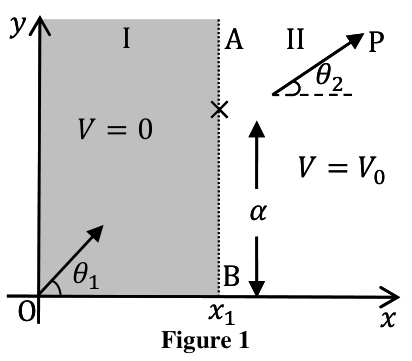
Figure 1
A1 Obtain an expression for \(v_2\) in terms of \(m\), \(v_1\) and \(V_0\). 0.2 A2 Express \(v_2\) in terms of \(v_1\), \(\theta_1\) and \(\theta_2\). 0.3 We define a quantity called action \(A=m\int v(s)ds\), where \(ds\) is the infinitesimal length along the trajectory of a particle of mass \(m\) moving with speed \(v(s)\). The integral is taken over the path. As an example, for a particle moving with constant speed \(v\) on a circular path of radius \(R\), the action \(A\) for one revolution will be \(2\pi mRv\). For a particle with constant energy \(E\), it can be shown that of all the possible trajectories between two fixed points, the actual trajectory is the one on which \(A\) defined above is an extremum (minimum or maximum). Historically this is known as the Principle of Least Action (PLA).
A3 PLA implies that the trajectory of a particle moving between two fixed points in a region of constant potential will be a straight line. Let the two fixed points O and P in Fig. 1 have coordinates \((0,0)\) and \((x_0,y_0)\) respectively and the boundary point where the particle transits from region I to region II have coordinates \((x_1,\alpha)\). Note that \(x_1\) is fixed and the action depends on the coordinate \(\alpha\) only. State the expression for the action \(A(\alpha)\). Use PLA to obtain the relationship between \(v_1/v_2\) and these coordinates. 1.0 B The Extremum Principle in Optics
A light ray travels from medium I to medium II with refractive indices \(n_1\) and \(n_2\) respectively. The two media are separated by a line parallel to the \(x\)-axis. The light ray makes an angle \(i_1\) with the \(y\)-axis in medium I and \(i_2\) in medium II (see Fig. 2). To obtain the trajectory of the ray, we make use of another extremum (minimum or maximum) principle known as Fermat’s principle of least time.
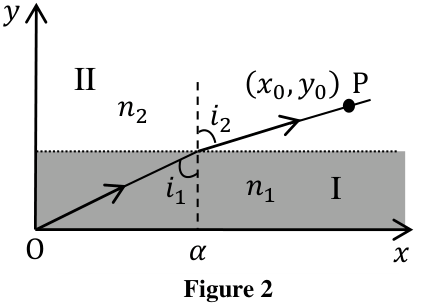
Figure 2
B1 The principle states that between two fixed points, a light ray moves along a path such that time taken between the two points is an extremum. Derive the relation between \(\sin i_1\) and \(\sin i_2\) on the basis of Fermat’s principle. 0.5 Shown in Fig. 3 is a schematic sketch of the path of a laser beam incident horizontally on a solution of sugar in which the concentration of sugar decreases with height. As a consequence, the refractive index of the solution also decreases with height.
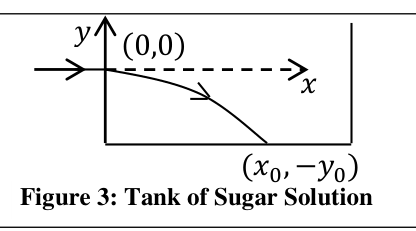
Figure 3: Tank of Sugar Solution
B2 Assume that the refractive index \(n(y)\) depends only on \(y\). Use the equation obtained in B1 to obtain the expression for the slope \(dy/dx\) of the beam’s path in terms of refractive index \(n_0\) at \(y=0\) and \(n(y)\). 1.5 B3 The laser beam is directed horizontally from the origin \((0,0)\) into the sugar solution at a height \(y_0\) from the bottom of the tank as shown in figure 3. Take \(n(y)=n_0-ky\) where \(n_0\) and \(k\) are positive constants. Obtain an expression for \(x\) in terms of \(y\) and related quantities for the actual trajectory of the laser beam. 1.2 \(^{1}\) Manoj Harbola (IIT-Kanpur) and Vijay A. Singh (ex-National Coordinator, Science Olympiads) were the principal authors of this problem. The contributions of the Academic Committee, Academic Development Group and the International Board are gratefully acknowledged.
You may use: \(\int\sec\theta\,d\theta=\ln(\sec\theta+\tan\theta)+\text{constant}\), where \(\sec\theta=1/\cos\theta\) or
\(\displaystyle\int\frac{dx}{\sqrt{x^2-1}}=\ln\!\left(x+\sqrt{x^2-1}\right)+\text{constant}\)B4 Obtain the value of \(x_0\), the point where the beam meets the bottom of the tank. Take \(y_0=10.0\ \mathrm{cm}\), \(n_0=1.50\), \(k=0.050\ \mathrm{cm^{-1}}\) (\(1\ \mathrm{cm}=10^{-2}\ \mathrm{m}\)). 0.8 C The Extremum Principle and the Wave Nature of Matter
We now explore the connection between the PLA and the wave nature of a moving particle. For this we assume that a particle moving from O to P can take all possible trajectories and we will seek a trajectory that depends on the constructive interference of de Broglie waves.
C1 As the particle moves along its trajectory by an infinitesimal distance \(\Delta s\), relate the change \(\Delta\varphi\) in the phase of its de Broglie wave to the change \(\Delta A\) in the action and the Planck constant. 0.6 C2 Recall the problem from part A where the particle traverses from O to P (see Fig. 4). Let an opaque partition be placed at the boundary AB between the two regions. There is a small opening CD of width \(d\) in AB such that \(d\ll(x_0-x_1)\) and \(d\ll x_1\).
Consider two extreme paths OCP and ODP such that OCP lies on the classical trajectory discussed in part A. Obtain the phase difference \(\Delta\varphi_{CD}\) between the two paths to first order.1.2 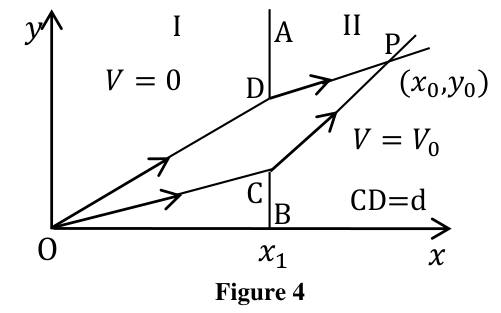
Figure 4
D Matter Wave Interference
Consider an electron gun at O which directs a collimated beam of electrons to a narrow slit at F in the opaque partition \(\mathrm{A_1B_1}\) at \(x=x_1\) such that OFP is a straight line. P is a point on the screen at \(x=x_0\) (see Fig. 5). The speed in I is \(v_1=2.0000\times10^7\ \mathrm{m\,s^{-1}}\) and \(\theta=10.0000^\circ\). The potential in II is such that speed \(v_2=1.9900\times10^7\ \mathrm{m\,s^{-1}}\). The distance \(x_0-x_1\) is \(250.00\ \mathrm{mm}\) (\(1\mathrm{mm}=10^{-3}\mathrm{m}\)). Ignore electron-electron interaction.
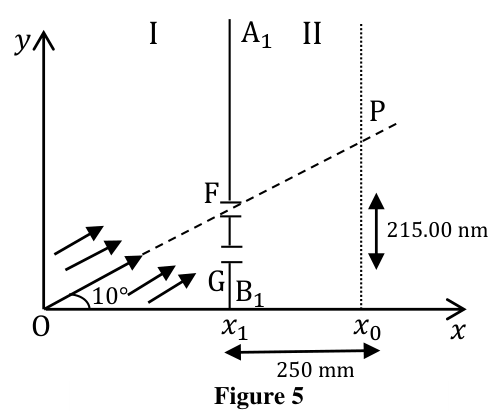
Figure 5
D1 If the electrons at O have been accelerated from rest, calculate the accelerating potential \(U_1\). 0.3 D2 Another identical slit G is made in the partition \(\mathrm{A_1B_1}\) at a distance of \(215.00\ \mathrm{nm}\) (\(1\mathrm{nm}=10^{-9}\mathrm{m}\)) below slit F (Fig. 5). If the phase difference between de Broglie waves arriving at P through the slits F and G is \(2\pi\beta\), calculate \(\beta\). 0.8 D3 What is the smallest distance \(\Delta y\) from P at which null (zero) electron detection maybe expected on the screen? [Note: you may find the approximation \(\sin(\theta+\Delta\theta)\approx\sin\theta+\Delta\theta\cos\theta\) useful] 1.2 D4 The beam has a square cross section of \(500\mathrm{nm}\times500\mathrm{nm}\) and the setup is \(2\ \mathrm{m}\) long. What should be the minimum flux density \(I_{\min}\) (number of electrons per unit normal area per unit time) if, on an average, there is at least one electron in the setup at a given time? 0.4 Official English text of the problem.
Problem 3: The Design of a Nuclear Reactor
Uranium occurs in nature as \(\mathrm{UO}_2\) with only 0.720% of the uranium atoms being \({}^{235}\mathrm{U}\). Neutron induced fission occurs readily in \({}^{235}\mathrm{U}\) with the emission of 2-3 fission neutrons having high kinetic energy. This fission probability will increase if the neutrons inducing fission have low kinetic energy. So by reducing the kinetic energy of the fission neutrons, one can induce a chain of fissions in other \({}^{235}\mathrm{U}\) nuclei. This forms the basis of the power generating nuclear reactor (NR).
A typical NR consists of a cylindrical tank of height \(H\) and radius \(R\) filled with a material called moderator. Cylindrical tubes, called fuel channels, each containing a cluster of cylindrical fuel pins of natural \(\mathrm{UO}_2\) in solid form of height \(H\), are kept axially in a square array. Fission neutrons, coming outward from a fuel channel, collide with the moderator, losing energy and reach the surrounding fuel channels with low enough energy to cause fission (Figs I-III). Heat generated from fission in the pin is transmitted to a coolant fluid flowing along its length. In the current problem we shall study some of the physics behind the (A) Fuel Pin, (B) Moderator and (C) NR of cylindrical geometry.
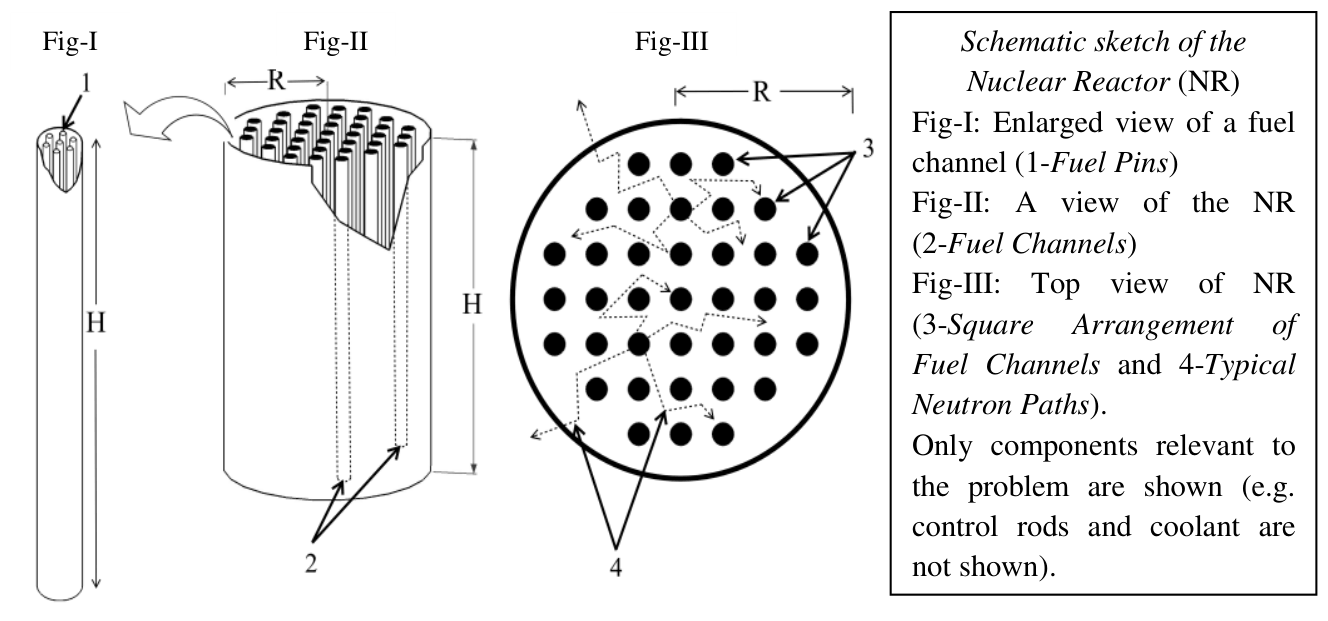
A Fuel Pin
Data for \(\mathrm{UO}_2\) 1. Molecular weight \(M_w=0.270\ \mathrm{kg\,mol^{-1}}\) 2. Density \(\rho=1.060\times10^4\ \mathrm{kg\,m^{-3}}\) 3. Melting point \(T_m=3.138\times10^3\ \mathrm{K}\) 4. Thermal conductivity \(\lambda=3.280\ \mathrm{W\,m^{-1}K^{-1}}\) A1 Consider the following fission reaction of a stationary \({}^{235}\mathrm{U}\) after it absorbs a neutron of negligible kinetic energy.
\({}^{235}\mathrm{U}+{}^{1}\mathrm{n}\ \longrightarrow\ {}^{94}\mathrm{Zr}+{}^{140}\mathrm{Ce}+2\,{}^{1}\mathrm{n}+\Delta E\)
Estimate \(\Delta E\) (in MeV) the total fission energy released. The nuclear masses are: \(m({}^{235}\mathrm{U})=235.044\ \mathrm{u}\); \(m({}^{94}\mathrm{Zr})=93.9063\ \mathrm{u}\); \(m({}^{140}\mathrm{Ce})=139.905\ \mathrm{u}\); \(m({}^{1}\mathrm{n})=1.00867\ \mathrm{u}\) and \(1\ \mathrm{u}=931.502\ \mathrm{MeV}\,c^{-2}\). Ignore charge imbalance.0.8 A2 Estimate \(N\) the number of \({}^{235}\mathrm{U}\) atoms per unit volume in natural \(\mathrm{UO}_2\). 0.5 A3 Assume that the neutron flux density, \(\varphi=2.000\times10^{18}\ \mathrm{m^{-2}s^{-1}}\) on the fuel is uniform. The fission cross-section (effective area of the target nucleus) of a \({}^{235}\mathrm{U}\) nucleus is \(\sigma_f=5.400\times10^{-26}\ \mathrm{m^2}\). If 80.00% of the fission energy is available as heat, estimate \(Q\) (in \(\mathrm{W\,m^{-3}}\)), the rate of heat production in the pin per unit volume. \(1\mathrm{MeV}=1.602\times10^{-13}\ \mathrm{J}\) 1.2 A4 The steady-state temperature difference between the center (\(T_c\)) and the surface (\(T_s\)) of the pin can be expressed as \(T_c-T_s=k\,F(Q,a,\lambda)\), where \(k=1/4\) is a dimensionless constant and \(a\) is the radius of the pin. Obtain \(F(Q,a,\lambda)\) by dimensional analysis. Note that \(\lambda\) is the thermal conductivity of \(\mathrm{UO}_2\). 0.5 A5 The desired temperature of the coolant is \(5.770\times10^2\ \mathrm{K}\). Estimate the upper limit \(a_u\) on the radius \(a\) of the pin. 1.0 B The Moderator
Consider the two dimensional elastic collision between a neutron of mass \(1\ \mathrm{u}\) and a moderator atom of mass \(A\ \mathrm{u}\). Before collision all the moderator atoms are considered at rest in the laboratory frame (LF). Let \(\vec v_b\) and \(\vec v_a\) be the velocities of the neutron before and after collision respectively in the LF. Let \(\vec v_m\) be the velocity of the center of mass (CM) frame relative to LF and \(\theta\) be the neutron scattering angle in the CM frame. All the particles involved in collisions are moving at nonrelativistic speeds.
B1 The collision in LF is shown schematically, where \(\theta_L\) is the scattering angle (Fig-IV). Sketch the collision schematically in CM frame. Label the particle velocities for 1, 2 and 3 in terms of \(\vec v_b\), \(\vec v_a\) and \(\vec v_m\). Indicate the scattering angle \(\theta\). 1.0 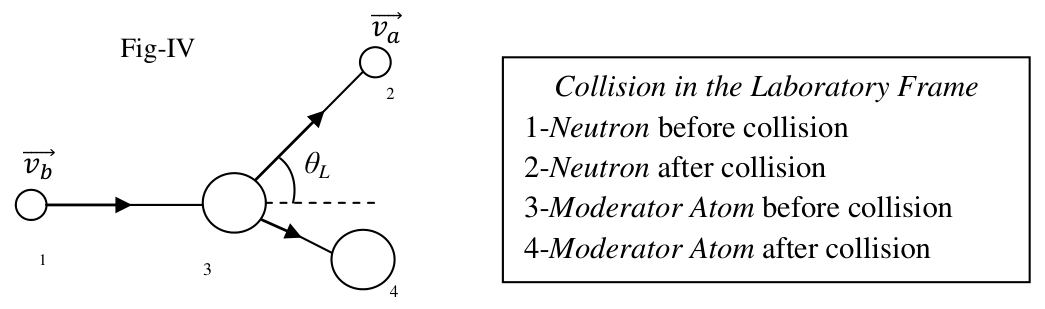
B2 Obtain \(v\) and \(V\), the speeds of the neutron and moderator atom in the CM frame after collision, in terms of \(A\) and \(v_b\). 1.0 B3 Derive an expression for \(G(\alpha,\theta)=E_a/E_b\), where \(E_b\) and \(E_a\) are the kinetic energies of the neutron, in the LF, before and after the collision respectively and \(\alpha\equiv[(A-1)/(A+1)]^2\). 1.0 B4 Assume that the above expression holds for \(\mathrm{D}_2\mathrm{O}\) molecule. Calculate the maximum possible fractional energy loss \(f_l\equiv(E_b-E_a)/E_b\) of the neutron for the \(\mathrm{D}_2\mathrm{O}\) (\(20\ \mathrm{u}\)) moderator. 0.5 C The Nuclear Reactor
To operate the NR at any constant neutron flux \(\psi\) (steady state), the leakage of neutrons has to be compensated by an excess production of neutrons in the reactor. For a reactor in cylindrical geometry the leakage rate is \(k_1[(2.405/R)^2+(\pi/H)^2]\psi\) and the excess production rate is \(k_2\psi\). The constants \(k_1\) and \(k_2\) depend on the material properties of the NR.
C1 Consider a NR with \(k_1=1.021\times10^{-2}\ \mathrm{m}\) and \(k_2=8.787\times10^{-3}\ \mathrm{m^{-1}}\). Noting that for a fixed volume the leakage rate is to be minimized for efficient fuel utilization, obtain the dimensions of the NR in the steady state. 1.5 C2 The fuel channels are in a square arrangement (Fig-III) with the nearest neighbour distance \(0.286\ \mathrm{m}\). The effective radius of a fuel channel (if it were solid) is \(3.617\times10^{-2}\ \mathrm{m}\). Estimate the number of fuel channels \(F_n\) in the reactor and the mass \(M\) of \(\mathrm{UO}_2\) required to operate the NR in steady state. 1.0 \(^{1}\) Joseph Amal Nathan (BARC) and Vijay A. Singh (ex-National Coordinator, Science Olympiads) were the principal authors of this problem. The contributions of the Academic Committee, Academic Development Group and the International Board are gratefully acknowledged.
Official English text of the problem.
Internationale Physik-Olympiade
IPhO 2015
Mumbai, Indien · 3 Theorieaufgaben mit vollständigen Lösungen
Aufgabe 1: Teilchen von der Sonne
Photonen von der Sonnenoberfläche und Neutrinos aus ihrem Kern können uns Aufschluss über die Temperaturen der Sonne geben und auch bestätigen, dass die Sonne aufgrund von Kernreaktionen leuchtet.
Nehmen Sie in dieser gesamten Aufgabe für die Masse der Sonne \(M_\odot=2.00\times10^{30}\ \mathrm{kg}\), für ihren Radius \(R_\odot=7.00\times10^8\ \mathrm{m}\), für ihre Leuchtkraft (pro Zeiteinheit abgestrahlte Energie) \(L_\odot=3.85\times10^{26}\ \mathrm{W}\) und für den Abstand zwischen Erde und Sonne \(d_\odot=1.50\times10^{11}\ \mathrm{m}\) an.
Hinweis:
\[ \text{(i)}\quad \int xe^{ax}\,dx =\left(\frac{x}{a}-\frac{1}{a^2}\right)e^{ax} +\text{Konstante} \]
\[ \text{(ii)}\quad \int x^2e^{ax}\,dx =\left(\frac{x^2}{a}-\frac{2x}{a^2}+\frac{2}{a^3}\right)e^{ax} +\text{Konstante} \]
\[ \text{(iii)}\quad \int x^3e^{ax}\,dx =\left(\frac{x^3}{a}-\frac{3x^2}{a^2} +\frac{6x}{a^3}-\frac{6}{a^4}\right)e^{ax} +\text{Konstante} \]
A Strahlung von der Sonne :
Teil Frage Punkte A1 Nehmen Sie an, dass die Sonne wie ein idealer schwarzer Körper strahlt. Berechnen Sie damit die Temperatur \(T_s\) der Sonnenoberfläche. 0.3 Das Spektrum der Sonnenstrahlung lässt sich gut durch das Wiensche Strahlungsgesetz annähern. Demnach ist die pro Zeiteinheit und pro Frequenzintervall auf eine beliebige Fläche auf der Erde einfallende Sonnenenergie \(u(\nu)\) gegeben durch
\[ u(\nu)=A\frac{R_\odot^2}{d_\odot^2}\frac{2\pi h}{c^2} \nu^3\exp(-h\nu/k_BT_s), \]
wobei \(\nu\) die Frequenz und \(A\) der Flächeninhalt der zur Richtung der einfallenden Strahlung senkrechten Fläche ist.
Betrachten Sie nun eine Solarzelle, die aus einer dünnen Scheibe aus Halbleitermaterial mit dem Flächeninhalt \(A\) besteht und senkrecht zur Richtung der Sonnenstrahlen angeordnet ist.
Teil Frage Punkte A2 Drücken Sie unter Verwendung der Wien-Näherung die gesamte auf die Oberfläche der Solarzelle einfallende Sonnenstrahlungsleistung \(P_{\mathrm{in}}\) durch \(A\), \(R_\odot\), \(d_\odot\), \(T_s\) und die Naturkonstanten \(c\), \(h\), \(k_B\) aus. 0.3 A3 Drücken Sie die Anzahl der pro Zeiteinheit und pro Frequenzintervall auf die Oberfläche der Solarzelle einfallenden Photonen \(n_\gamma(\nu)\) durch \(A\), \(R_\odot\), \(d_\odot\), \(T_s\), \(\nu\) und die Naturkonstanten \(c\), \(h\), \(k_B\) aus. 0.2 Das Halbleitermaterial der Solarzelle hat eine „Bandlücke“ mit der Energie \(E_g\). Wir nehmen folgendes Modell an. Jedes Photon mit der Energie \(E\geq E_g\) regt ein Elektron über die Bandlücke hinweg an. Dieses Elektron liefert die Energie \(E_g\) als nutzbare Ausgangsenergie; jede darüber hinausgehende Energie wird als Wärme abgegeben (und nicht in nutzbare Energie umgewandelt).
Teil Frage Punkte A4 Definieren Sie \(x_g=h\nu_g/k_BT_s\), wobei \(E_g=h\nu_g\). Drücken Sie die nutzbare Ausgangsleistung der Zelle \(P_{\mathrm{out}}\) durch \(x_g\), \(A\), \(R_\odot\), \(d_\odot\), \(T_s\) und die Naturkonstanten \(c\), \(h\), \(k_B\) aus. 1.0 A5 Drücken Sie den Wirkungsgrad \(\eta\) dieser Solarzelle durch \(x_g\) aus. 0.2 A6 Skizzieren Sie qualitativ \(\eta\) in Abhängigkeit von \(x_g\). Die Werte bei \(x_g=0\) und für \(x_g\to\infty\) sollen deutlich erkennbar sein. Wie groß ist die Steigung von \(\eta(x_g)\) bei \(x_g=0\) und für \(x_g\to\infty\)? 1.0 A7 Es sei \(x_0\) der Wert von \(x_g\), für den \(\eta\) maximal ist. Leiten Sie die kubische Gleichung her, die \(x_0\) bestimmt. Schätzen Sie den Wert von \(x_0\) mit einer Genauigkeit von \(\pm0.25\) ab. Berechnen Sie daraus \(\eta(x_0)\). 1.0 A8 Die Bandlücke von reinem Silizium beträgt \(E_g=1.11\ \mathrm{eV}\). Berechnen Sie mit diesem Wert den Wirkungsgrad \(\eta_{\mathrm{Si}}\) einer Siliziumsolarzelle. 0.2 \(^{1}\) Amol Dighe (TIFR), Anwesh Mazumdar (HBCSE-TIFR) und Vijay A. Singh (ehemaliger nationaler Koordinator der Wissenschaftsolympiaden) waren die Hauptautoren dieser Aufgabe. Für die Beiträge des Akademischen Komitees, der Akademischen Entwicklungsgruppe und des Internationalen Gremiums wird herzlich gedankt.
Im späten neunzehnten Jahrhundert stellten Kelvin und Helmholtz (KH) eine Hypothese auf, um zu erklären, wie die Sonne leuchtet. Sie nahmen an, dass die Sonne ursprünglich eine sehr große Materiewolke mit der Masse \(M_\odot\) und vernachlässigbarer Dichte war und seither kontinuierlich schrumpft. Das Leuchten der Sonne wäre dann auf die Freisetzung potenzieller Gravitationsenergie durch diese langsame Kontraktion zurückzuführen.
Teil Frage Punkte A9 Nehmen wir an, dass die Materiedichte im Inneren der Sonne gleichmäßig ist. Bestimmen Sie die gesamte gegenwärtige potenzielle Gravitationsenergie \(\Omega\) der Sonne in Abhängigkeit von \(G\), \(M_\odot\) und \(R_\odot\). 0.3 A10 Schätzen Sie die maximal mögliche Zeit \(\tau_{\mathrm{KH}}\) (in Jahren) ab, während der die Sonne gemäß der KH-Hypothese geleuchtet haben könnte. Nehmen Sie an, dass die Leuchtkraft der Sonne während dieses gesamten Zeitraums konstant war. 0.5 Die oben berechnete Zeit \(\tau_{\mathrm{KH}}\) stimmt nicht mit dem aus Meteoritenuntersuchungen abgeschätzten Alter des Sonnensystems überein. Dies zeigt, dass die Energiequelle der Sonne nicht rein gravitativer Natur sein kann.
B Neutrinos von der Sonne :
Im Jahr 1938 schlug Hans Bethe vor, dass die Kernfusion von Wasserstoff zu Helium im Kern der Sonne ihre Energiequelle ist. Die Nettokernreaktion lautet:
\[ 4\,{}^{1}\mathrm{H}\longrightarrow{}^{4}\mathrm{He} +2e^++2\nu_e \]
Die bei dieser Reaktion erzeugten „Elektron-Neutrinos“ \(\nu_e\) können als masselos betrachtet werden. Sie entweichen aus der Sonne, und ihr Nachweis auf der Erde bestätigt, dass im Inneren der Sonne Kernreaktionen stattfinden. Die von den Neutrinos abgeführte Energie kann in dieser Aufgabe vernachlässigt werden.
Teil Frage Punkte B1 Berechnen Sie die Teilchenflussdichte \(\Phi_\nu\) der auf der Erde eintreffenden Neutrinos in Einheiten von \(\mathrm{m^{-2}\,s^{-1}}\). Die bei der obigen Reaktion freigesetzte Energie beträgt \(\Delta E=4.0\times10^{-12}\ \mathrm{J}\). Nehmen Sie an, dass die von der Sonne abgestrahlte Energie vollständig aus dieser Reaktion stammt. 0.6 Auf dem Weg vom Sonnenkern zur Erde wandelt sich ein Teil der Elektron-Neutrinos \(\nu_e\) in andere Neutrinoarten \(\nu_x\) um. Die Nachweiseffizienz des Detektors für \(\nu_x\) beträgt 1/6 seiner Nachweiseffizienz für \(\nu_e\). Ohne Neutrinoumwandlung erwarten wir, im Mittel \(N_1\) Neutrinos pro Jahr nachzuweisen. Aufgrund der Umwandlung werden jedoch tatsächlich im Mittel \(N_2\) Neutrinos (\(\nu_e\) und \(\nu_x\) zusammen) pro Jahr nachgewiesen.
Teil Frage Punkte B2 Berechnen Sie in Abhängigkeit von \(N_1\) und \(N_2\), welcher Anteil \(f\) der \(\nu_e\) in \(\nu_x\) umgewandelt wird. 0.4 Zum Nachweis von Neutrinos werden große, mit Wasser gefüllte Detektoren gebaut. Obwohl Wechselwirkungen von Neutrinos mit Materie sehr selten sind, schlagen sie gelegentlich Elektronen aus Wassermolekülen im Detektor heraus. Diese energiereichen Elektronen bewegen sich mit hohen Geschwindigkeiten durch das Wasser und senden dabei elektromagnetische Strahlung aus. Solange die Geschwindigkeit eines solchen Elektrons größer als die Lichtgeschwindigkeit im Wasser (Brechungsindex \(n\)) ist, wird diese als Tscherenkow-Strahlung bezeichnete Strahlung kegelförmig ausgesandt.
Teil Frage Punkte B3 Nehmen Sie an, dass ein von einem Neutrino herausgeschlagenes Elektron beim Durchgang durch Wasser mit einer konstanten Rate von \(\alpha\) pro Zeiteinheit Energie verliert. Wenn dieses Elektron während einer Zeit \(\Delta t\) Tscherenkow-Strahlung aussendet, bestimmen Sie die vom Neutrino auf dieses Elektron übertragene Energie (\(E_{\mathrm{imparted}}\)) in Abhängigkeit von \(\alpha\), \(\Delta t\), \(n\), \(m_e\) und \(c\). (Nehmen Sie an, dass das Elektron vor seiner Wechselwirkung mit dem Neutrino ruht.) 2.0 Die Fusion von H zu He im Inneren der Sonne erfolgt in mehreren Schritten. In einem dieser Zwischenschritte entsteht ein \({}^{7}\mathrm{Be}\)-Kern (Ruhemasse \(m_{\mathrm{Be}}\)). Anschließend kann er ein Elektron einfangen, wobei ein \({}^{7}\mathrm{Li}\)-Kern (Ruhemasse \(m_{\mathrm{Li}}<m_{\mathrm{Be}}\)) entsteht und ein \(\nu_e\) ausgesandt wird. Die entsprechende Kernreaktion lautet:
\[ {}^{7}\mathrm{Be}+e^-\longrightarrow{}^{7}\mathrm{Li}+\nu_e \]
Wenn ein Be-Kern (\(m_{\mathrm{Be}}=11.65\times10^{-27}\ \mathrm{kg}\)) ruht und ein ebenfalls ruhendes Elektron einfängt, hat das ausgesandte Neutrino die Energie \(E_\nu=1.44\times10^{-13}\ \mathrm{J}\). Aufgrund der Temperatur \(T_c\) im Sonnenkern führen die Be-Kerne jedoch eine ungeordnete thermische Bewegung aus und wirken als bewegte Neutrinoquellen. Daher schwankt die Energie der ausgesandten Neutrinos mit einem Effektivwert (rms) der Abweichung von \(\Delta E_{\mathrm{rms}}\).
Teil Frage Punkte B4 Berechnen Sie für \(\Delta E_{\mathrm{rms}}=5.54\times10^{-17}\ \mathrm{J}\) die mittlere quadratische Geschwindigkeit \(V_{\mathrm{Be}}\) der Be-Kerne und schätzen Sie daraus \(T_c\) ab. (Hinweis: \(\Delta E_{\mathrm{rms}}\) hängt vom Effektivwert der Geschwindigkeitskomponente entlang der Sichtlinie ab.) 2.0 Aufgabentext aus dem offiziellen englischen Text übersetzt.
Aufgabe 2: Das Extremalprinzip
A Das Extremalprinzip in der Mechanik
Betrachten Sie die in Abb. 1 dargestellte horizontale, reibungsfreie \(x-y\)-Ebene. Sie wird durch eine Gerade AB mit der Gleichung \(x=x_1\) in zwei Bereiche I und II unterteilt. Die potenzielle Energie eines punktförmigen Teilchens der Masse \(m\) beträgt im Bereich I \(V=0\) und im Bereich II \(V=V_0\). Das Teilchen wird vom Ursprung O mit der Geschwindigkeit \(v_1\) entlang einer Geraden ausgesandt, die mit der \(x\)-Achse den Winkel \(\theta_1\) bildet. Es erreicht den Punkt P im Bereich II mit der Geschwindigkeit \(v_2\) entlang einer Geraden, die mit der \(x\)-Achse den Winkel \(\theta_2\) bildet. Vernachlässigen Sie in der gesamten Aufgabe T-2 (in allen Teilen) die Gravitation und relativistische Effekte.
Abbildung 1
A1 Bestimmen Sie einen Ausdruck für \(v_2\) in Abhängigkeit von \(m\), \(v_1\) und \(V_0\). 0.2 A2 Drücken Sie \(v_2\) durch \(v_1\), \(\theta_1\) und \(\theta_2\) aus. 0.3 Wir definieren eine Größe namens Wirkung \(A=m\int v(s)ds\), wobei \(ds\) die infinitesimale Länge entlang der Bahn eines Teilchens der Masse \(m\) ist, das sich mit der Geschwindigkeit \(v(s)\) bewegt. Das Integral wird entlang der Bahn gebildet. Beispielsweise beträgt für ein Teilchen, das sich mit konstanter Geschwindigkeit \(v\) auf einer Kreisbahn mit dem Radius \(R\) bewegt, die Wirkung \(A\) für einen Umlauf \(2\pi mRv\). Für ein Teilchen mit konstanter Energie \(E\) lässt sich zeigen, dass von allen möglichen Bahnen zwischen zwei festen Punkten die tatsächliche Bahn diejenige ist, auf der das oben definierte \(A\) ein Extremum (Minimum oder Maximum) annimmt. Historisch ist dies als Prinzip der kleinsten Wirkung (PLA) bekannt.
A3 Aus dem PLA folgt, dass die Bahn eines Teilchens, das sich zwischen zwei festen Punkten in einem Bereich mit konstantem Potenzial bewegt, eine Gerade ist. Die beiden festen Punkte O und P in Abb. 1 sollen die Koordinaten \((0,0)\) bzw. \((x_0,y_0)\) haben, und der Grenzpunkt, an dem das Teilchen von Bereich I in Bereich II übertritt, soll die Koordinaten \((x_1,\alpha)\) haben. Beachten Sie, dass \(x_1\) fest ist und die Wirkung nur von der Koordinate \(\alpha\) abhängt. Geben Sie den Ausdruck für die Wirkung \(A(\alpha)\) an. Leiten Sie mithilfe des PLA den Zusammenhang zwischen \(v_1/v_2\) und diesen Koordinaten her. 1.0 B Das Extremalprinzip in der Optik
Ein Lichtstrahl läuft von Medium I in Medium II mit den jeweiligen Brechungsindizes \(n_1\) und \(n_2\). Die beiden Medien sind durch eine zur \(x\)-Achse parallele Gerade getrennt. Der Lichtstrahl bildet mit der \(y\)-Achse im Medium I den Winkel \(i_1\) und im Medium II den Winkel \(i_2\) (siehe Abb. 2). Um die Bahn des Strahls zu bestimmen, verwenden wir ein weiteres Extremalprinzip (Minimum oder Maximum), das als Fermatsches Prinzip der kürzesten Zeit bekannt ist.
Abbildung 2
B1 Das Prinzip besagt, dass sich ein Lichtstrahl zwischen zwei festen Punkten auf einem Weg bewegt, für den die zwischen den beiden Punkten benötigte Zeit ein Extremum annimmt. Leiten Sie auf Grundlage des Fermatschen Prinzips den Zusammenhang zwischen \(\sin i_1\) und \(\sin i_2\) her. 0.5 Abb. 3 zeigt eine schematische Skizze der Bahn eines Laserstrahls, der horizontal in eine Zuckerlösung einfällt, deren Zuckerkonzentration mit der Höhe abnimmt. Infolgedessen nimmt auch der Brechungsindex der Lösung mit der Höhe ab.
Abbildung 3: Behälter mit Zuckerlösung
B2 Nehmen Sie an, dass der Brechungsindex \(n(y)\) nur von \(y\) abhängt. Leiten Sie mithilfe der in B1 erhaltenen Gleichung einen Ausdruck für die Steigung \(dy/dx\) der Strahlbahn in Abhängigkeit vom Brechungsindex \(n_0\) bei \(y=0\) und von \(n(y)\) her. 1.5 B3 Der Laserstrahl wird vom Ursprung \((0,0)\) aus horizontal in die Zuckerlösung gerichtet, und zwar in einer Höhe \(y_0\) über dem Boden des Behälters, wie in Abbildung 3 dargestellt. Setzen Sie \(n(y)=n_0-ky\), wobei \(n_0\) und \(k\) positive Konstanten sind. Bestimmen Sie für die tatsächliche Bahn des Laserstrahls einen Ausdruck für \(x\) in Abhängigkeit von \(y\) und den zugehörigen Größen. 1.2 \(^{1}\) Manoj Harbola (IIT-Kanpur) und Vijay A. Singh (ehemaliger nationaler Koordinator der Wissenschaftsolympiaden) waren die Hauptautoren dieser Aufgabe. Den Beiträgen des Akademischen Komitees, der Akademischen Entwicklungsgruppe und des Internationalen Gremiums gilt unser Dank.
Sie dürfen verwenden: \(\int\sec\theta\,d\theta=\ln(\sec\theta+\tan\theta)+\text{Konstante}\), wobei \(\sec\theta=1/\cos\theta\), oder
\(\displaystyle\int\frac{dx}{\sqrt{x^2-1}}=\ln\!\left(x+\sqrt{x^2-1}\right)+\text{Konstante}\)B4 Bestimmen Sie den Wert von \(x_0\), der Stelle, an der der Strahl auf den Boden des Behälters trifft. Verwenden Sie \(y_0=10.0\ \mathrm{cm}\), \(n_0=1.50\), \(k=0.050\ \mathrm{cm^{-1}}\) (\(1\ \mathrm{cm}=10^{-2}\ \mathrm{m}\)). 0.8 C Das Extremalprinzip und die Wellennatur der Materie
Wir untersuchen nun den Zusammenhang zwischen dem PLA und der Wellennatur eines bewegten Teilchens. Dazu nehmen wir an, dass ein Teilchen, das sich von O nach P bewegt, alle möglichen Bahnen nehmen kann, und suchen eine Bahn, die sich aus der konstruktiven Interferenz von De-Broglie-Wellen ergibt.
C1 Während sich das Teilchen entlang seiner Bahn um eine infinitesimale Strecke \(\Delta s\) bewegt, stellen Sie den Zusammenhang zwischen der Änderung \(\Delta\varphi\) der Phase seiner De-Broglie-Welle, der Änderung \(\Delta A\) der Wirkung und der Planck-Konstanten her. 0.6 C2 Betrachten Sie erneut die Aufgabe aus Teil A, in der sich das Teilchen von O nach P bewegt (siehe Abb. 4). An der Grenze AB zwischen den beiden Bereichen werde eine undurchlässige Trennwand angebracht. In AB befindet sich eine kleine Öffnung CD der Breite \(d\), wobei \(d\ll(x_0-x_1)\) und \(d\ll x_1\) gelten.
Betrachten Sie die beiden äußersten Wege OCP und ODP, wobei OCP auf der in Teil A behandelten klassischen Bahn liegt. Bestimmen Sie die Phasendifferenz \(\Delta\varphi_{CD}\) zwischen den beiden Wegen in erster Ordnung.1.2 Abbildung 4
D Interferenz von Materiewellen
Betrachten Sie eine Elektronenkanone bei O, die einen kollimierten Elektronenstrahl auf einen schmalen Spalt bei F in der undurchlässigen Trennwand \(\mathrm{A_1B_1}\) bei \(x=x_1\) richtet, sodass OFP eine Gerade ist. P ist ein Punkt auf dem Schirm bei \(x=x_0\) (siehe Abb. 5). Die Geschwindigkeit in I beträgt \(v_1=2.0000\times10^7\ \mathrm{m\,s^{-1}}\), und es gilt \(\theta=10.0000^\circ\). Das Potenzial in II ist so gewählt, dass die Geschwindigkeit \(v_2=1.9900\times10^7\ \mathrm{m\,s^{-1}}\) beträgt. Der Abstand \(x_0-x_1\) beträgt \(250.00\ \mathrm{mm}\) (\(1\mathrm{mm}=10^{-3}\mathrm{m}\)). Vernachlässigen Sie die Wechselwirkung zwischen den Elektronen.
Abbildung 5
D1 Wenn die Elektronen bei O aus der Ruhe beschleunigt wurden, berechnen Sie die Beschleunigungsspannung \(U_1\). 0.3 D2 In der Trennwand \(\mathrm{A_1B_1}\) wird ein weiterer identischer Spalt G im Abstand von \(215.00\ \mathrm{nm}\) (\(1\mathrm{nm}=10^{-9}\mathrm{m}\)) unterhalb des Spalts F angebracht (Abb. 5). Wenn die Phasendifferenz zwischen den durch die Spalte F und G bei P eintreffenden De-Broglie-Wellen \(2\pi\beta\) beträgt, berechnen Sie \(\beta\). 0.8 D3 In welchem kleinsten Abstand \(\Delta y\) von P ist auf dem Schirm zu erwarten, dass keine Elektronen nachgewiesen werden (Nachweisrate null)? [Hinweis: Die Näherung \(\sin(\theta+\Delta\theta)\approx\sin\theta+\Delta\theta\cos\theta\) kann hilfreich sein.] 1.2 D4 Der Strahl hat einen quadratischen Querschnitt von \(500\mathrm{nm}\times500\mathrm{nm}\), und die Anordnung ist \(2\ \mathrm{m}\) lang. Wie groß muss die minimale Flussdichte \(I_{\min}\) (Anzahl der Elektronen pro Flächeneinheit senkrecht zur Strahlrichtung und pro Zeiteinheit) sein, damit sich zu einem gegebenen Zeitpunkt im Mittel mindestens ein Elektron in der Anordnung befindet? 0.4 Aufgabentext aus dem offiziellen englischen Text übersetzt.
Aufgabe 3: Der Entwurf eines Kernreaktors
Uran kommt in der Natur als \(\mathrm{UO}_2\) vor, wobei nur 0.720% der Uranatome \({}^{235}\mathrm{U}\) sind. In \({}^{235}\mathrm{U}\) lässt sich durch Neutronen leicht eine Kernspaltung auslösen, bei der 2-3 Spaltneutronen mit hoher kinetischer Energie emittiert werden. Diese Spaltwahrscheinlichkeit steigt, wenn die spaltauslösenden Neutronen eine niedrige kinetische Energie haben. Durch Verringerung der kinetischen Energie der Spaltneutronen kann man daher eine Kette von Spaltungen in weiteren \({}^{235}\mathrm{U}\)-Kernen auslösen. Dies bildet die Grundlage des zur Stromerzeugung dienenden Kernreaktors (NR).
Ein typischer NR besteht aus einem zylindrischen Behälter der Höhe \(H\) und des Radius \(R\), der mit einem als Moderator bezeichneten Material gefüllt ist. Zylindrische Rohre, sogenannte Brennstoffkanäle, sind parallel zur Achse in einem quadratischen Gitter angeordnet. Jeder Kanal enthält ein Bündel zylindrischer Brennstoffstäbe der Höhe \(H\) aus natürlichem \(\mathrm{UO}_2\) in fester Form. Spaltneutronen, die aus einem Brennstoffkanal austreten, stoßen mit dem Moderator zusammen, verlieren dabei Energie und erreichen die umliegenden Brennstoffkanäle mit einer hinreichend niedrigen Energie, um eine Spaltung auszulösen (Abb. I-III). Die durch Spaltung im Stab erzeugte Wärme wird an ein Kühlmittel übertragen, das entlang des Stabes strömt. In dieser Aufgabe untersuchen wir einige physikalische Grundlagen von (A) Brennstoffstab, (B) Moderator und (C) NR mit zylindrischer Geometrie.
A Brennstoffstab
Daten für \(\mathrm{UO}_2\) 1. Molare Masse \(M_w=0.270\ \mathrm{kg\,mol^{-1}}\) 2. Dichte \(\rho=1.060\times10^4\ \mathrm{kg\,m^{-3}}\) 3. Schmelztemperatur \(T_m=3.138\times10^3\ \mathrm{K}\) 4. Wärmeleitfähigkeit \(\lambda=3.280\ \mathrm{W\,m^{-1}K^{-1}}\) A1 Betrachten Sie die folgende Spaltreaktion eines ruhenden \({}^{235}\mathrm{U}\)-Kerns, nachdem er ein Neutron mit vernachlässigbarer kinetischer Energie absorbiert hat.
\({}^{235}\mathrm{U}+{}^{1}\mathrm{n}\ \longrightarrow\ {}^{94}\mathrm{Zr}+{}^{140}\mathrm{Ce}+2\,{}^{1}\mathrm{n}+\Delta E\)
Schätzen Sie die insgesamt freigesetzte Spaltenergie \(\Delta E\) (in MeV) ab. Die Kernmassen sind: \(m({}^{235}\mathrm{U})=235.044\ \mathrm{u}\); \(m({}^{94}\mathrm{Zr})=93.9063\ \mathrm{u}\); \(m({}^{140}\mathrm{Ce})=139.905\ \mathrm{u}\); \(m({}^{1}\mathrm{n})=1.00867\ \mathrm{u}\) und \(1\ \mathrm{u}=931.502\ \mathrm{MeV}\,c^{-2}\). Ignorieren Sie die unausgeglichene Ladungsbilanz.0.8 A2 Schätzen Sie die Anzahl \(N\) der \({}^{235}\mathrm{U}\)-Atome pro Volumeneinheit in natürlichem \(\mathrm{UO}_2\) ab. 0.5 A3 Nehmen Sie an, dass die Neutronenflussdichte \(\varphi=2.000\times10^{18}\ \mathrm{m^{-2}s^{-1}}\) am Brennstoff gleichförmig ist. Der Spaltquerschnitt (die effektive Fläche des Targetkerns) eines \({}^{235}\mathrm{U}\)-Kerns beträgt \(\sigma_f=5.400\times10^{-26}\ \mathrm{m^2}\). Wenn 80.00% der Spaltenergie als Wärme verfügbar sind, schätzen Sie die Wärmeleistung pro Volumeneinheit im Stab \(Q\) (in \(\mathrm{W\,m^{-3}}\)) ab. \(1\mathrm{MeV}=1.602\times10^{-13}\ \mathrm{J}\) 1.2 A4 Die stationäre Temperaturdifferenz zwischen dem Zentrum (\(T_c\)) und der Oberfläche (\(T_s\)) des Stabes lässt sich als \(T_c-T_s=k\,F(Q,a,\lambda)\) ausdrücken, wobei \(k=1/4\) eine dimensionslose Konstante und \(a\) der Radius des Stabes ist. Bestimmen Sie \(F(Q,a,\lambda)\) mithilfe einer Dimensionsanalyse. Beachten Sie, dass \(\lambda\) die Wärmeleitfähigkeit von \(\mathrm{UO}_2\) ist. 0.5 A5 Die gewünschte Temperatur des Kühlmittels beträgt \(5.770\times10^2\ \mathrm{K}\). Schätzen Sie die Obergrenze \(a_u\) für den Radius \(a\) des Stabes ab. 1.0 B Der Moderator
Betrachten Sie den zweidimensionalen elastischen Stoß zwischen einem Neutron der Masse \(1\ \mathrm{u}\) und einem Moderatoratom der Masse \(A\ \mathrm{u}\). Vor dem Stoß werden alle Moderatoratome als im Laborsystem (LF) ruhend angenommen. Es seien \(\vec v_b\) und \(\vec v_a\) die Geschwindigkeiten des Neutrons vor beziehungsweise nach dem Stoß im LF. Es sei \(\vec v_m\) die Geschwindigkeit des Schwerpunktsystems (CM) relativ zum LF und \(\theta\) der Streuwinkel des Neutrons im CM-System. Alle an den Stößen beteiligten Teilchen bewegen sich mit nichtrelativistischen Geschwindigkeiten.
B1 Der Stoß im LF ist schematisch dargestellt, wobei \(\theta_L\) der Streuwinkel ist (Abb. IV). Skizzieren Sie den Stoß schematisch im CM-System. Beschriften Sie die Teilchengeschwindigkeiten für 1, 2 und 3 durch Ausdrücke mit \(\vec v_b\), \(\vec v_a\) und \(\vec v_m\). Zeichnen Sie den Streuwinkel \(\theta\) ein. 1.0 B2 Bestimmen Sie \(v\) und \(V\), die Geschwindigkeitsbeträge des Neutrons und des Moderatoratoms im CM-System nach dem Stoß, in Abhängigkeit von \(A\) und \(v_b\). 1.0 B3 Leiten Sie einen Ausdruck für \(G(\alpha,\theta)=E_a/E_b\) her, wobei \(E_b\) und \(E_a\) die kinetischen Energien des Neutrons im LF vor beziehungsweise nach dem Stoß sind und \(\alpha\equiv[(A-1)/(A+1)]^2\) ist. 1.0 B4 Nehmen Sie an, dass der obige Ausdruck für ein \(\mathrm{D}_2\mathrm{O}\)-Molekül gilt. Berechnen Sie den maximal möglichen relativen Energieverlust \(f_l\equiv(E_b-E_a)/E_b\) des Neutrons für den Moderator \(\mathrm{D}_2\mathrm{O}\) (\(20\ \mathrm{u}\)). 0.5 C Der Kernreaktor
Um den NR bei einem beliebigen konstanten Neutronenfluss \(\psi\) (stationärer Zustand) zu betreiben, müssen die Neutronenverluste durch Entweichen durch eine Überschussproduktion von Neutronen im Reaktor ausgeglichen werden. Für einen Reaktor mit zylindrischer Geometrie beträgt die Leckagerate \(k_1[(2.405/R)^2+(\pi/H)^2]\psi\) und die Überschussproduktionsrate \(k_2\psi\). Die Konstanten \(k_1\) und \(k_2\) hängen von den Materialeigenschaften des NR ab.
C1 Betrachten Sie einen NR mit \(k_1=1.021\times10^{-2}\ \mathrm{m}\) und \(k_2=8.787\times10^{-3}\ \mathrm{m^{-1}}\). Bestimmen Sie die Abmessungen des NR im stationären Zustand unter Berücksichtigung dessen, dass bei festem Volumen die Leckagerate für eine effiziente Brennstoffnutzung minimiert werden soll. 1.5 C2 Die Brennstoffkanäle sind in einem quadratischen Gitter angeordnet (Abb. III), wobei der Abstand nächster Nachbarn \(0.286\ \mathrm{m}\) beträgt. Der effektive Radius eines Brennstoffkanals (wenn er vollständig mit festem Brennstoff gefüllt wäre) beträgt \(3.617\times10^{-2}\ \mathrm{m}\). Schätzen Sie die Anzahl der Brennstoffkanäle \(F_n\) im Reaktor und die Masse \(M\) an \(\mathrm{UO}_2\) ab, die zum Betrieb des NR im stationären Zustand erforderlich ist. 1.0 \(^{1}\) Joseph Amal Nathan (BARC) und Vijay A. Singh (ehemaliger nationaler Koordinator der Wissenschaftsolympiaden) waren die Hauptautoren dieser Aufgabe. Den Beiträgen des Akademischen Komitees, der Akademischen Entwicklungsgruppe und des Internationalen Gremiums gilt unser herzlicher Dank.
Aufgabentext aus dem offiziellen englischen Text übersetzt.
Uluslararası Fizik Olimpiyatı
IPhO 2015
Mumbai, Hindistan · 3 teori sorusu, tam çözümleriyle
Soru 1: Güneş'ten Gelen Parçacıklar
Güneş'in yüzeyinden gelen fotonlar ve çekirdeğinden gelen nötrinolar, Güneş'in sıcaklıkları hakkında bilgi verebilir ve Güneş'in nükleer tepkimeler sayesinde parladığını da doğrulayabilir.
Bu soru boyunca Güneş'in kütlesini \(M_\odot=2.00\times10^{30}\ \mathrm{kg}\), yarıçapını \(R_\odot=7.00\times10^8\ \mathrm{m}\), ışınım gücünü (birim zamanda yayılan ışınım enerjisini) \(L_\odot=3.85\times10^{26}\ \mathrm{W}\) ve Dünya–Güneş uzaklığını \(d_\odot=1.50\times10^{11}\ \mathrm{m}\) alınız.
Not:
\[ \text{(i)}\quad \int xe^{ax}\,dx =\left(\frac{x}{a}-\frac{1}{a^2}\right)e^{ax} +\text{sabit} \]
\[ \text{(ii)}\quad \int x^2e^{ax}\,dx =\left(\frac{x^2}{a}-\frac{2x}{a^2}+\frac{2}{a^3}\right)e^{ax} +\text{sabit} \]
\[ \text{(iii)}\quad \int x^3e^{ax}\,dx =\left(\frac{x^3}{a}-\frac{3x^2}{a^2} +\frac{6x}{a^3}-\frac{6}{a^4}\right)e^{ax} +\text{sabit} \]
A Güneş'ten gelen ışınım :
Bölüm Soru Puan A1 Güneş'in ideal bir kara cisim gibi ışınım yaptığını varsayınız. Bu bilgiyi kullanarak Güneş yüzeyinin sıcaklığını, \(T_s\), hesaplayınız. 0.3 Güneş ışınımının spektrumu, Wien dağılım yasasıyla iyi bir yaklaşıklıkla ifade edilebilir. Buna göre, Dünya üzerindeki herhangi bir yüzeye birim zamanda ve birim frekans aralığında gelen Güneş enerjisi, \(u(\nu)\),
\[ u(\nu)=A\frac{R_\odot^2}{d_\odot^2}\frac{2\pi h}{c^2} \nu^3\exp(-h\nu/k_BT_s), \]
ile verilir; burada \(\nu\) frekans, \(A\) ise gelen ışınımın doğrultusuna dik yüzeyin alanıdır.
Şimdi, Güneş ışınlarının doğrultusuna dik yerleştirilmiş, alanı \(A\) olan ince bir yarı iletken malzeme diskinden oluşan bir güneş pili ele alınız.
Bölüm Soru Puan A2 Wien yaklaşımını kullanarak güneş pilinin yüzeyine gelen toplam Güneş ışınım gücünü, \(P_{\mathrm{in}}\), \(A\), \(R_\odot\), \(d_\odot\), \(T_s\) ve temel sabitler \(c\), \(h\), \(k_B\) cinsinden ifade ediniz. 0.3 A3 Güneş pilinin yüzeyine birim zamanda ve birim frekans aralığında gelen foton sayısını, \(n_\gamma(\nu)\), \(A\), \(R_\odot\), \(d_\odot\), \(T_s\), \(\nu\) ve temel sabitler \(c\), \(h\), \(k_B\) cinsinden ifade ediniz. 0.2 Güneş pilinin yarı iletken malzemesinin “bant aralığı” enerjisi \(E_g\)'dir. Aşağıdaki modeli varsayıyoruz. Enerjisi \(E\geq E_g\) olan her foton, bir elektronu bant aralığını aşacak şekilde uyarır. Bu elektron, yararlı çıkış enerjisine \(E_g\) kadar enerji katkısında bulunur ve fazla enerji ısı olarak dağılır (yararlı enerjiye dönüşmez).
Bölüm Soru Puan A4 \(E_g=h\nu_g\) olmak üzere \(x_g=h\nu_g/k_BT_s\) tanımını yapınız. Pilin yararlı çıkış gücünü, \(P_{\mathrm{out}}\), \(x_g\), \(A\), \(R_\odot\), \(d_\odot\), \(T_s\) ve temel sabitler \(c\), \(h\), \(k_B\) cinsinden ifade ediniz. 1.0 A5 Bu güneş pilinin verimini, \(\eta\), \(x_g\) cinsinden ifade ediniz. 0.2 A6 \(\eta\)'nın \(x_g\)'ye bağlı değişimini gösteren nitel bir grafik çiziniz. \(x_g=0\) ve \(x_g\to\infty\) için değerler açıkça gösterilmelidir. \(x_g=0\) ve \(x_g\to\infty\) için \(\eta(x_g)\)'nin eğimi nedir? 1.0 A7 \(\eta\)'nın maksimum olduğu \(x_g\) değeri \(x_0\) olsun. \(x_0\)'ı veren üçüncü dereceden denklemi elde ediniz. \(x_0\)'ın değerini \(\pm0.25\) doğrulukla tahmin ediniz. Buradan \(\eta(x_0)\)'ı hesaplayınız. 1.0 A8 Saf silisyumun bant aralığı \(E_g=1.11\ \mathrm{eV}\)'tur. Bu değeri kullanarak silisyumdan yapılmış bir güneş pilinin verimini, \(\eta_{\mathrm{Si}}\), hesaplayınız. 0.2 \(^{1}\) Bu sorunun başlıca yazarları Amol Dighe (TIFR), Anwesh Mazumdar (HBCSE-TIFR) ve Vijay A. Singh'dir (Bilim Olimpiyatları eski Ulusal Koordinatörü). Akademik Komite, Akademik Geliştirme Grubu ve Uluslararası Kurulun katkıları için teşekkür ederiz.
On dokuzuncu yüzyılın sonlarında Kelvin ve Helmholtz (KH), Güneş'in nasıl parladığını açıklamak için bir hipotez öne sürdüler. Güneş'in, kütlesi \(M_\odot\) olan ve yoğunluğu ihmal edilebilen çok büyük bir madde bulutu olarak başlayıp sürekli büzüldüğünü varsaydılar. Bu durumda Güneş'in parlaması, bu yavaş büzülme sırasında kütleçekimsel potansiyel enerjinin açığa çıkmasından kaynaklanacaktı.
Bölüm Soru Puan A9 Güneş'in içindeki madde yoğunluğunun düzgün olduğunu varsayalım. Güneş'in bugünkü toplam kütleçekimsel potansiyel enerjisini, \(\Omega\), \(G\), \(M_\odot\) ve \(R_\odot\) cinsinden bulunuz. 0.3 A10 KH hipotezine göre Güneş'in parlıyor olabileceği mümkün olan en uzun süreyi, \(\tau_{\mathrm{KH}}\), (yıl cinsinden) tahmin ediniz. Güneş'in ışınım gücünün bu süre boyunca sabit kaldığını varsayınız. 0.5 Yukarıda hesaplanan \(\tau_{\mathrm{KH}}\), göktaşları üzerindeki çalışmalardan tahmin edilen Güneş Sistemi'nin yaşıyla uyuşmaz. Bu, Güneş'in enerji kaynağının yalnızca kütleçekimi olamayacağını gösterir.
B Güneş'ten gelen nötrinolar :
1938'de Hans Bethe, Güneş'in enerji kaynağının, çekirdeğinde hidrojenin nükleer füzyonla helyuma dönüşmesi olduğunu öne sürdü. Net nükleer tepkime şöyledir:
\[ 4\,{}^{1}\mathrm{H}\longrightarrow{}^{4}\mathrm{He} +2e^++2\nu_e \]
Bu tepkimede üretilen “elektron nötrinoları”, \(\nu_e\), kütlesiz kabul edilebilir. Güneş'ten kaçarlar ve Dünya'da algılanmaları, Güneş'in içinde nükleer tepkimeler gerçekleştiğini doğrular. Bu soruda nötrinoların taşıyıp götürdüğü enerji ihmal edilebilir.
Bölüm Soru Puan B1 Dünya'ya ulaşan nötrinoların sayı akısı yoğunluğunu, \(\Phi_\nu\), \(\mathrm{m^{-2}\,s^{-1}}\) biriminde hesaplayınız. Yukarıdaki tepkimede açığa çıkan enerji \(\Delta E=4.0\times10^{-12}\ \mathrm{J}\)'dür. Güneş'in yaydığı enerjinin tamamen bu tepkimeden kaynaklandığını varsayınız. 0.6 Güneş'in çekirdeğinden Dünya'ya yol alırken elektron nötrinolarının, \(\nu_e\), bir kısmı başka tür nötrinolara, \(\nu_x\), dönüşür. Dedektörün \(\nu_x\)'i algılama verimi, \(\nu_e\)'yi algılama veriminin 1/6'sıdır. Nötrino dönüşümü olmasaydı, bir yılda ortalama \(N_1\) nötrino algılamayı beklerdik. Ancak dönüşüm nedeniyle gerçekte yılda ortalama \(N_2\) nötrino (\(\nu_e\) ve \(\nu_x\) birlikte) algılanır.
Bölüm Soru Puan B2 \(\nu_e\)'lerin ne kadarının \(\nu_x\)'e dönüştüğünü gösteren \(f\) oranını \(N_1\) ve \(N_2\) cinsinden hesaplayınız. 0.4 Nötrinoları algılamak için suyla dolu büyük dedektörler inşa edilir. Nötrinoların maddeyle etkileşimleri çok seyrek olsa da zaman zaman dedektördeki su moleküllerinden elektron koparırlar. Bu yüksek enerjili elektronlar su içinde yüksek süratlerle hareket eder ve bu sırada elektromanyetik ışınım yayarlar. Böyle bir elektronun sürati, ışığın sudaki (kırılma indisi \(n\)) süratinden büyük olduğu sürece, Çerenkov ışınımı adı verilen bu ışınım bir koni biçiminde yayılır.
Bölüm Soru Puan B3 Bir nötrinonun kopardığı bir elektronun su içinde ilerlerken birim zamanda sabit \(\alpha\) miktarında enerji kaybettiğini varsayınız. Bu elektron \(\Delta t\) süresince Çerenkov ışınımı yayıyorsa, nötrinonun bu elektrona aktardığı enerjiyi (\(E_{\mathrm{imparted}}\)) \(\alpha\), \(\Delta t\), \(n\), \(m_e\) ve \(c\) cinsinden belirleyiniz. (Elektronun nötrinoyla etkileşmeden önce durgun olduğunu varsayınız.) 2.0 Güneş'in içinde H'nin füzyonla He'ye dönüşmesi birkaç adımda gerçekleşir. Bu ara adımlardan birinde bir \({}^{7}\mathrm{Be}\) çekirdeği (durgun kütlesi \(m_{\mathrm{Be}}\)) üretilir. Ardından bu çekirdek bir elektron soğurarak bir \({}^{7}\mathrm{Li}\) çekirdeği (durgun kütlesi \(m_{\mathrm{Li}}<m_{\mathrm{Be}}\)) üretebilir ve bir \(\nu_e\) yayabilir. İlgili nükleer tepkime şöyledir:
\[ {}^{7}\mathrm{Be}+e^-\longrightarrow{}^{7}\mathrm{Li}+\nu_e \]
Bir Be çekirdeği (\(m_{\mathrm{Be}}=11.65\times10^{-27}\ \mathrm{kg}\)) durgunken yine durgun olan bir elektronu soğurduğunda, yayılan nötrinonun enerjisi \(E_\nu=1.44\times10^{-13}\ \mathrm{J}\) olur. Ancak Be çekirdekleri, Güneş'in çekirdeğindeki \(T_c\) sıcaklığı nedeniyle rastgele ısıl hareket yapar ve hareketli nötrino kaynakları gibi davranır. Bunun sonucunda yayılan nötrinoların enerjisi, karekök ortalama kare (rms) değeri \(\Delta E_{\mathrm{rms}}\) olan dalgalanmalar gösterir.
Bölüm Soru Puan B4 \(\Delta E_{\mathrm{rms}}=5.54\times10^{-17}\ \mathrm{J}\) ise Be çekirdeklerinin rms süratini, \(V_{\mathrm{Be}}\), hesaplayınız ve buradan \(T_c\)'yi tahmin ediniz. (İpucu: \(\Delta E_{\mathrm{rms}}\), hızın görüş doğrultusundaki bileşeninin rms değerine bağlıdır.) 2.0 Soru metni resmi İngilizce metinden çevrilmiştir.
Soru 2: Ekstremum İlkesi
A Mekanikte Ekstremum İlkesi
Şekil 1'de gösterilen yatay, sürtünmesiz bir \(x-y\) düzlemini ele alın. Bu düzlem, \(x=x_1\) denklemini sağlayan AB doğrusu ile I ve II olmak üzere iki bölgeye ayrılmıştır. Kütlesi \(m\) olan noktasal bir parçacığın potansiyel enerjisi I bölgesinde \(V=0\), II bölgesinde ise \(V=V_0\)'dır. Parçacık, O başlangıç noktasından \(x\) ekseniyle \(\theta_1\) açısı yapan bir doğru boyunca \(v_1\) süratiyle gönderilir. II bölgesindeki P noktasına, \(x\) ekseniyle \(\theta_2\) açısı yapan bir doğru boyunca \(v_2\) süratiyle hareket ederek ulaşır. Bu T-2 sorusunun tamamında (tüm kısımlarında) kütleçekimini ve görelilik etkilerini ihmal edin.
Şekil 1
A1 \(v_2\) için \(m\), \(v_1\) ve \(V_0\) cinsinden bir ifade elde edin. 0.2 A2 \(v_2\)'yi \(v_1\), \(\theta_1\) ve \(\theta_2\) cinsinden ifade edin. 0.3 Eylem adı verilen bir niceliği \(A=m\int v(s)ds\) olarak tanımlıyoruz; burada \(ds\), \(v(s)\) süratiyle hareket eden \(m\) kütleli bir parçacığın yörüngesi boyunca sonsuz küçük uzunluk elemanıdır. İntegral, izlenen yol boyunca alınır. Örneğin, yarıçapı \(R\) olan çembersel bir yörüngede sabit \(v\) süratiyle hareket eden bir parçacığın bir tam turdaki eylemi \(A\), \(2\pi mRv\) olur. Enerjisi sabit ve \(E\) olan bir parçacık için, iki sabit nokta arasındaki tüm olası yörüngeler arasında gerçek yörüngenin, yukarıda tanımlanan \(A\)'nın bir ekstremum (minimum veya maksimum) olduğu yörünge olduğu gösterilebilir. Bu, tarihsel olarak En Küçük Eylem İlkesi (PLA) adıyla bilinir.
A3 PLA, potansiyelin sabit olduğu bir bölgede iki sabit nokta arasında hareket eden bir parçacığın yörüngesinin düz bir doğru olacağını ifade eder. Şekil 1'deki iki sabit nokta O ve P'nin koordinatları sırasıyla \((0,0)\) ve \((x_0,y_0)\), parçacığın I bölgesinden II bölgesine geçtiği sınır noktasının koordinatları ise \((x_1,\alpha)\) olsun. \(x_1\)'in sabit olduğuna ve eylemin yalnızca \(\alpha\) koordinatına bağlı olduğuna dikkat edin. Eylem \(A(\alpha)\) için ifadeyi yazın. PLA'yı kullanarak \(v_1/v_2\) ile bu koordinatlar arasındaki bağıntıyı elde edin. 1.0 B Optikte Ekstremum İlkesi
Bir ışık ışını, kırılma indisleri sırasıyla \(n_1\) ve \(n_2\) olan I ortamından II ortamına geçer. İki ortam, \(x\) eksenine paralel bir doğru ile ayrılmıştır. Işık ışını, \(y\) ekseniyle I ortamında \(i_1\), II ortamında ise \(i_2\) açısı yapar (bkz. Şekil 2). Işının yörüngesini elde etmek için, Fermat'nın en kısa süre ilkesi olarak bilinen başka bir ekstremum (minimum veya maksimum) ilkesinden yararlanırız.
Şekil 2
B1 Bu ilkeye göre bir ışık ışını, iki sabit nokta arasında, bu iki nokta arasındaki yolculuk süresinin bir ekstremum olduğu yolu izler. Fermat ilkesinden hareketle \(\sin i_1\) ile \(\sin i_2\) arasındaki bağıntıyı türetin. 0.5 Şekil 3'te, şeker derişiminin yükseklikle azaldığı bir şeker çözeltisine yatay olarak giren lazer demetinin izlediği yol şematik olarak gösterilmiştir. Bunun sonucunda çözeltinin kırılma indisi de yükseklikle azalır.
Şekil 3: Şeker Çözeltisi Tankı
B2 Kırılma indisi \(n(y)\)'nin yalnızca \(y\)'ye bağlı olduğunu varsayın. B1'de elde edilen denklemi kullanarak demetin izlediği yolun eğimi \(dy/dx\) için, \(y=0\)'daki kırılma indisi \(n_0\) ve \(n(y)\) cinsinden bir ifade elde edin. 1.5 B3 Lazer demeti, Şekil 3'te gösterildiği gibi tankın tabanından \(y_0\) yüksekliğindeki \((0,0)\) başlangıç noktasından şeker çözeltisine yatay olarak yönlendirilir. \(n_0\) ve \(k\) pozitif sabitler olmak üzere \(n(y)=n_0-ky\) alın. Lazer demetinin gerçek yörüngesi için \(x\)'in \(y\) ve ilgili nicelikler cinsinden bir ifadesini elde edin. 1.2 \(^{1}\) Bu sorunun başlıca yazarları Manoj Harbola (IIT-Kanpur) ve Vijay A. Singh'dir (eski Bilim Olimpiyatları Ulusal Koordinatörü). Akademik Komite, Akademik Geliştirme Grubu ve Uluslararası Kurulun katkılarına teşekkür ederiz.
Şu integralleri kullanabilirsiniz: \(\int\sec\theta\,d\theta=\ln(\sec\theta+\tan\theta)+\text{sabit}\), burada \(\sec\theta=1/\cos\theta\), veya
\(\displaystyle\int\frac{dx}{\sqrt{x^2-1}}=\ln\!\left(x+\sqrt{x^2-1}\right)+\text{sabit}\)B4 Demetin tankın tabanına ulaştığı noktanın \(x_0\) değerini bulun. \(y_0=10.0\ \mathrm{cm}\), \(n_0=1.50\), \(k=0.050\ \mathrm{cm^{-1}}\) (\(1\ \mathrm{cm}=10^{-2}\ \mathrm{m}\)) alın. 0.8 C Ekstremum İlkesi ve Maddenin Dalga Doğası
Şimdi PLA ile hareket eden bir parçacığın dalga doğası arasındaki bağlantıyı inceleyeceğiz. Bunun için O'dan P'ye hareket eden bir parçacığın olası tüm yörüngeleri izleyebileceğini varsayacak ve de Broglie dalgalarının yapıcı girişimine dayanan bir yörünge arayacağız.
C1 Parçacık yörüngesi boyunca sonsuz küçük bir \(\Delta s\) mesafesi kadar ilerlerken, de Broglie dalgasının fazındaki \(\Delta\varphi\) değişimini, eylemdeki \(\Delta A\) değişimi ve Planck sabiti ile ilişkilendirin. 0.6 C2 Parçacığın O'dan P'ye ilerlediği A kısmındaki soruyu hatırlayın (bkz. Şekil 4). İki bölge arasındaki AB sınırına geçirimsiz bir bölme yerleştirilsin. AB üzerinde, \(d\ll(x_0-x_1)\) ve \(d\ll x_1\) koşullarını sağlayan \(d\) genişliğinde küçük bir CD açıklığı vardır.
OCP, A kısmında ele alınan klasik yörünge üzerinde olacak şekilde, iki uç yol olan OCP ve ODP'yi ele alın. İki yol arasındaki \(\Delta\varphi_{CD}\) faz farkını birinci mertebede elde edin.1.2 Şekil 4
D Madde Dalgalarının Girişimi
O noktasında bulunan ve kolime edilmiş bir elektron demetini, \(x=x_1\)'deki geçirimsiz \(\mathrm{A_1B_1}\) bölmesinde F noktasında bulunan dar bir yarığa, OFP düz bir doğru oluşturacak şekilde yönlendiren bir elektron tabancasını ele alın. P, \(x=x_0\)'daki ekran üzerinde bir noktadır (bkz. Şekil 5). I bölgesindeki sürat \(v_1=2.0000\times10^7\ \mathrm{m\,s^{-1}}\) ve \(\theta=10.0000^\circ\)'dir. II bölgesindeki potansiyel, sürat \(v_2=1.9900\times10^7\ \mathrm{m\,s^{-1}}\) olacak şekildedir. \(x_0-x_1\) uzaklığı \(250.00\ \mathrm{mm}\)'dir (\(1\mathrm{mm}=10^{-3}\mathrm{m}\)). Elektron-elektron etkileşimini ihmal edin.
Şekil 5
D1 O'daki elektronlar durgun hâlden hızlandırılmışsa, hızlandırıcı potansiyel \(U_1\)'i hesaplayın. 0.3 D2 \(\mathrm{A_1B_1}\) bölmesinde, F yarığının \(215.00\ \mathrm{nm}\) (\(1\mathrm{nm}=10^{-9}\mathrm{m}\)) aşağısında özdeş bir G yarığı daha açılır (Şekil 5). F ve G yarıklarından geçerek P'ye ulaşan de Broglie dalgaları arasındaki faz farkı \(2\pi\beta\) ise \(\beta\)'yı hesaplayın. 0.8 D3 Ekranda elektron algılanma olasılığının sıfır olması beklenen noktanın P'ye olan en küçük \(\Delta y\) uzaklığı nedir? [Not: \(\sin(\theta+\Delta\theta)\approx\sin\theta+\Delta\theta\cos\theta\) yaklaşımını yararlı bulabilirsiniz.] 1.2 D4 Demet, \(500\mathrm{nm}\times500\mathrm{nm}\) boyutlarında kare bir kesite sahiptir ve düzenek \(2\ \mathrm{m}\) uzunluğundadır. Herhangi bir anda düzenekte ortalama olarak en az bir elektron bulunması için gereken en küçük akı yoğunluğu \(I_{\min}\) (birim dik kesit alanından birim zamanda geçen elektron sayısı) ne olmalıdır? 0.4 Soru metni resmi İngilizce metinden çevrilmiştir.
Soru 3: Bir Nükleer Reaktörün Tasarımı
Uranyum doğada \(\mathrm{UO}_2\) biçiminde bulunur ve uranyum atomlarının yalnızca %0.720'si \({}^{235}\mathrm{U}\) izotopudur. \({}^{235}\mathrm{U}\) çekirdeğinde nötronla indüklenen fisyon kolaylıkla gerçekleşir ve yüksek kinetik enerjili 2-3 fisyon nötronu yayılır. Fisyonu indükleyen nötronların kinetik enerjisi düşükse bu fisyon olasılığı artar. Dolayısıyla fisyon nötronlarının kinetik enerjisi azaltılarak diğer \({}^{235}\mathrm{U}\) çekirdeklerinde zincirleme fisyonlar indüklenebilir. Bu, güç üreten nükleer reaktörün (NR) temelini oluşturur.
Tipik bir NR, moderatör adı verilen bir malzemeyle doldurulmuş, yüksekliği \(H\) ve yarıçapı \(R\) olan silindirik bir tanktan oluşur. Yakıt kanalları adı verilen silindirik tüpler, eksen doğrultusunda kare bir örgü oluşturacak şekilde yerleştirilir; her tüp, katı doğal \(\mathrm{UO}_2\)'den yapılmış, yüksekliği \(H\) olan silindirik yakıt çubuklarından oluşan bir demet içerir. Bir yakıt kanalından dışarı çıkan fisyon nötronları moderatörle çarpışarak enerji kaybeder ve çevredeki yakıt kanallarına fisyona yol açacak kadar düşük enerjiyle ulaşır (Şekiller I-III). Çubukta fisyon sonucu üretilen ısı, çubuk boyunca akan bir soğutucu akışkana aktarılır. Bu soruda (A) Yakıt Çubuğu, (B) Moderatör ve (C) Silindirik Geometrili NR'nin işleyişinin temelindeki bazı fiziksel ilkeleri inceleyeceğiz.
A Yakıt Çubuğu
\(\mathrm{UO}_2\) için veriler 1. Molekül ağırlığı \(M_w=0.270\ \mathrm{kg\,mol^{-1}}\) 2. Yoğunluk \(\rho=1.060\times10^4\ \mathrm{kg\,m^{-3}}\) 3. Erime noktası \(T_m=3.138\times10^3\ \mathrm{K}\) 4. Isıl iletkenlik \(\lambda=3.280\ \mathrm{W\,m^{-1}K^{-1}}\) A1 Durgun bir \({}^{235}\mathrm{U}\) çekirdeğinin, kinetik enerjisi ihmal edilebilir bir nötronu soğurduktan sonra geçirdiği aşağıdaki fisyon tepkimesini ele alın.
\({}^{235}\mathrm{U}+{}^{1}\mathrm{n}\ \longrightarrow\ {}^{94}\mathrm{Zr}+{}^{140}\mathrm{Ce}+2\,{}^{1}\mathrm{n}+\Delta E\)
Açığa çıkan toplam fisyon enerjisi \(\Delta E\)'yi (MeV cinsinden) tahmin edin. Çekirdek kütleleri şöyledir: \(m({}^{235}\mathrm{U})=235.044\ \mathrm{u}\); \(m({}^{94}\mathrm{Zr})=93.9063\ \mathrm{u}\); \(m({}^{140}\mathrm{Ce})=139.905\ \mathrm{u}\); \(m({}^{1}\mathrm{n})=1.00867\ \mathrm{u}\) ve \(1\ \mathrm{u}=931.502\ \mathrm{MeV}\,c^{-2}\). Yük dengesizliğini göz ardı edin.0.8 A2 Doğal \(\mathrm{UO}_2\)'de birim hacim başına düşen \({}^{235}\mathrm{U}\) atomu sayısı \(N\)'yi tahmin edin. 0.5 A3 Yakıt üzerindeki nötron akı yoğunluğunun, \(\varphi=2.000\times10^{18}\ \mathrm{m^{-2}s^{-1}}\), düzgün olduğunu varsayın. Bir \({}^{235}\mathrm{U}\) çekirdeğinin fisyon tesir kesiti (hedef çekirdeğin etkin alanı) \(\sigma_f=5.400\times10^{-26}\ \mathrm{m^2}\)'dir. Fisyon enerjisinin %80.00'i ısı olarak kullanılabiliyorsa çubukta birim hacim başına ısı üretim hızı \(Q\)'yu (\(\mathrm{W\,m^{-3}}\) cinsinden) tahmin edin. \(1\mathrm{MeV}=1.602\times10^{-13}\ \mathrm{J}\) 1.2 A4 Çubuğun merkezi (\(T_c\)) ile yüzeyi (\(T_s\)) arasındaki kararlı durum sıcaklık farkı \(T_c-T_s=k\,F(Q,a,\lambda)\) olarak ifade edilebilir; burada \(k=1/4\) boyutsuz bir sabit, \(a\) ise çubuğun yarıçapıdır. Boyut analizi yoluyla \(F(Q,a,\lambda)\)'yı elde edin. \(\lambda\)'nın \(\mathrm{UO}_2\)'nin ısıl iletkenliği olduğunu dikkate alın. 0.5 A5 Soğutucunun istenen sıcaklığı \(5.770\times10^2\ \mathrm{K}\)'dir. Çubuğun \(a\) yarıçapı için üst sınır \(a_u\)'yu tahmin edin. 1.0 B Moderatör
Kütlesi \(1\ \mathrm{u}\) olan bir nötron ile kütlesi \(A\ \mathrm{u}\) olan bir moderatör atomu arasındaki iki boyutlu esnek çarpışmayı ele alın. Çarpışmadan önce tüm moderatör atomlarının laboratuvar referans sisteminde (LF) durgun olduğu kabul edilmektedir. \(\vec v_b\) ve \(\vec v_a\), sırasıyla nötronun çarpışmadan önceki ve sonraki LF hızları olsun. \(\vec v_m\), kütle merkezi (CM) referans sisteminin LF'ye göre hızı, \(\theta\) ise nötronun CM sistemindeki saçılma açısı olsun. Çarpışmalara katılan tüm parçacıklar göreli olmayan süratlerle hareket etmektedir.
B1 LF'deki çarpışma şematik olarak gösterilmiştir; burada \(\theta_L\) saçılma açısıdır (Şekil-IV). Çarpışmayı CM sisteminde şematik olarak çizin. 1, 2 ve 3 için parçacık hızlarını \(\vec v_b\), \(\vec v_a\) ve \(\vec v_m\) cinsinden etiketleyin. Saçılma açısı \(\theta\)'yı belirtin. 1.0 B2 Çarpışmadan sonra nötronun ve moderatör atomunun CM sistemindeki süratleri olan \(v\) ve \(V\)'yi \(A\) ve \(v_b\) cinsinden elde edin. 1.0 B3 \(G(\alpha,\theta)=E_a/E_b\) için bir ifade türetin; burada \(E_b\) ve \(E_a\), sırasıyla nötronun çarpışmadan önceki ve sonraki LF kinetik enerjileridir ve \(\alpha\equiv[(A-1)/(A+1)]^2\)'dir. 1.0 B4 Yukarıdaki ifadenin \(\mathrm{D}_2\mathrm{O}\) molekülü için geçerli olduğunu varsayın. \(\mathrm{D}_2\mathrm{O}\) (\(20\ \mathrm{u}\)) moderatörü için nötronun mümkün olan en büyük kesirsel enerji kaybı \(f_l\equiv(E_b-E_a)/E_b\)'yi hesaplayın. 0.5 C Nükleer Reaktör
NR'yi herhangi bir sabit nötron akısı \(\psi\) ile (kararlı durumda) çalıştırabilmek için nötron kaçağının reaktördeki fazla nötron üretimiyle karşılanması gerekir. Silindirik geometrili bir reaktör için kaçak hızı \(k_1[(2.405/R)^2+(\pi/H)^2]\psi\), fazla üretim hızı ise \(k_2\psi\)'dir. \(k_1\) ve \(k_2\) sabitleri NR'nin malzeme özelliklerine bağlıdır.
C1 \(k_1=1.021\times10^{-2}\ \mathrm{m}\) ve \(k_2=8.787\times10^{-3}\ \mathrm{m^{-1}}\) olan bir NR'yi ele alın. Yakıtın verimli kullanılması için sabit bir hacimde kaçak hızının en aza indirilmesi gerektiğini dikkate alarak NR'nin kararlı durumdaki boyutlarını elde edin. 1.5 C2 Yakıt kanalları, en yakın komşu uzaklığı \(0.286\ \mathrm{m}\) olan kare bir düzende yerleştirilmiştir (Şekil-III). Bir yakıt kanalının (içi tamamen katı yakıtla dolu olsaydı) etkin yarıçapı \(3.617\times10^{-2}\ \mathrm{m}\)'dir. Reaktördeki yakıt kanalı sayısı \(F_n\)'yi ve NR'yi kararlı durumda çalıştırmak için gereken \(\mathrm{UO}_2\) kütlesi \(M\)'yi tahmin edin. 1.0 \(^{1}\) Bu sorunun başlıca yazarları Joseph Amal Nathan (BARC) ve Vijay A. Singh (Bilim Olimpiyatları eski Ulusal Koordinatörü) olmuştur. Akademik Komite, Akademik Gelişim Grubu ve Uluslararası Kurulun katkılarına teşekkür ederiz.
Soru metni resmi İngilizce metinden çevrilmiştir.
Olimpiada Internacional de Física
IPhO 2015
Bombay, India · 3 problemas teóricos con soluciones completas
Problema 1: Partículas procedentes del Sol
Los fotones procedentes de la superficie del Sol y los neutrinos procedentes de su núcleo pueden proporcionarnos información sobre las temperaturas solares y también confirmar que el Sol brilla gracias a las reacciones nucleares.
En todo este problema, tome la masa del Sol como \(M_\odot=2.00\times10^{30}\ \mathrm{kg}\), su radio como \(R_\odot=7.00\times10^8\ \mathrm{m}\), su luminosidad (energía emitida en forma de radiación por unidad de tiempo) como \(L_\odot=3.85\times10^{26}\ \mathrm{W}\) y la distancia Tierra-Sol como \(d_\odot=1.50\times10^{11}\ \mathrm{m}\).
Nota:
\[ \text{(i)}\quad \int xe^{ax}\,dx =\left(\frac{x}{a}-\frac{1}{a^2}\right)e^{ax} +\text{constante} \]
\[ \text{(ii)}\quad \int x^2e^{ax}\,dx =\left(\frac{x^2}{a}-\frac{2x}{a^2}+\frac{2}{a^3}\right)e^{ax} +\text{constante} \]
\[ \text{(iii)}\quad \int x^3e^{ax}\,dx =\left(\frac{x^3}{a}-\frac{3x^2}{a^2} +\frac{6x}{a^3}-\frac{6}{a^4}\right)e^{ax} +\text{constante} \]
A Radiación procedente del Sol :
Parte Pregunta Puntos A1 Suponga que el Sol emite radiación como un cuerpo negro perfecto. Utilice este hecho para calcular la temperatura, \(T_s\), de la superficie solar. 0.3 El espectro de la radiación solar puede aproximarse bien mediante la ley de distribución de Wien. Según esta ley, la energía solar que incide sobre cualquier superficie de la Tierra por unidad de tiempo y por unidad de intervalo de frecuencia, \(u(\nu)\), viene dada por
\[ u(\nu)=A\frac{R_\odot^2}{d_\odot^2}\frac{2\pi h}{c^2} \nu^3\exp(-h\nu/k_BT_s), \]
donde \(\nu\) es la frecuencia y \(A\) es el área de la superficie perpendicular a la dirección de la radiación incidente.
Considere ahora una célula solar que consiste en un disco delgado de material semiconductor de área \(A\), colocado perpendicularmente a la dirección de los rayos solares.
Parte Pregunta Puntos A2 Utilizando la aproximación de Wien, exprese la potencia total de la radiación solar, \(P_{\mathrm{in}}\), que incide sobre la superficie de la célula solar, en función de \(A\), \(R_\odot\), \(d_\odot\), \(T_s\) y las constantes fundamentales \(c\), \(h\), \(k_B\). 0.3 A3 Exprese el número de fotones, \(n_\gamma(\nu)\), que inciden sobre la superficie de la célula solar por unidad de tiempo y por unidad de intervalo de frecuencia, en función de \(A\), \(R_\odot\), \(d_\odot\), \(T_s\), \(\nu\) y las constantes fundamentales \(c\), \(h\), \(k_B\). 0.2 El material semiconductor de la célula solar tiene una «banda prohibida» de energía \(E_g\). Suponemos el siguiente modelo. Cada fotón de energía \(E\geq E_g\) excita un electrón, haciéndolo atravesar la banda prohibida. Este electrón aporta una energía \(E_g\) como energía útil de salida, y cualquier energía adicional se disipa en forma de calor (no se convierte en energía útil).
Parte Pregunta Puntos A4 Defina \(x_g=h\nu_g/k_BT_s\), donde \(E_g=h\nu_g\). Exprese la potencia útil de salida de la célula, \(P_{\mathrm{out}}\), en función de \(x_g\), \(A\), \(R_\odot\), \(d_\odot\), \(T_s\) y las constantes fundamentales \(c\), \(h\), \(k_B\). 1.0 A5 Exprese la eficiencia, \(\eta\), de esta célula solar en función de \(x_g\). 0.2 A6 Dibuje una gráfica cualitativa de \(\eta\) en función de \(x_g\). Deben mostrarse claramente los valores en \(x_g=0\) y cuando \(x_g\to\infty\). ¿Cuál es la pendiente de \(\eta(x_g)\) en \(x_g=0\) y cuando \(x_g\to\infty\)? 1.0 A7 Sea \(x_0\) el valor de \(x_g\) para el cual \(\eta\) es máxima. Obtenga la ecuación cúbica que determina \(x_0\). Estime el valor de \(x_0\) con una precisión de \(\pm0.25\). A partir de él, calcule \(\eta(x_0)\). 1.0 A8 La energía de la banda prohibida del silicio puro es \(E_g=1.11\ \mathrm{eV}\). Calcule la eficiencia, \(\eta_{\mathrm{Si}}\), de una célula solar de silicio utilizando este valor. 0.2 \(^{1}\) Amol Dighe (TIFR), Anwesh Mazumdar (HBCSE-TIFR) y Vijay A. Singh (excoordinador nacional de las Olimpiadas de Ciencias) fueron los autores principales de este problema. Se agradecen las contribuciones del Comité Académico, el Grupo de Desarrollo Académico y la Junta Internacional.
A finales del siglo XIX, Kelvin y Helmholtz (KH) propusieron una hipótesis para explicar por qué brilla el Sol. Postularon que el Sol, que inicialmente era una nube de materia muy extensa de masa \(M_\odot\) y densidad despreciable, se ha ido contrayendo continuamente. El brillo del Sol se debería entonces a la liberación de energía potencial gravitatoria mediante esta lenta contracción.
Parte Pregunta Puntos A9 Supongamos que la densidad de materia es uniforme en el interior del Sol. Halle la energía potencial gravitatoria total, \(\Omega\), del Sol en la actualidad, en función de \(G\), \(M_\odot\) y \(R_\odot\). 0.3 A10 Estime el tiempo máximo posible, \(\tau_{\mathrm{KH}}\) (en años), durante el cual el Sol podría haber estado brillando, según la hipótesis KH. Suponga que la luminosidad del Sol ha sido constante durante todo este periodo. 0.5 El valor de \(\tau_{\mathrm{KH}}\) calculado anteriormente no coincide con la edad del sistema solar estimada a partir de estudios de meteoritos. Esto demuestra que la fuente de energía del Sol no puede ser puramente gravitatoria.
B Neutrinos procedentes del Sol :
En 1938, Hans Bethe propuso que la fusión nuclear del hidrógeno en helio en el núcleo del Sol es la fuente de su energía. La reacción nuclear neta es:
\[ 4\,{}^{1}\mathrm{H}\longrightarrow{}^{4}\mathrm{He} +2e^++2\nu_e \]
Los «neutrinos electrónicos», \(\nu_e\), producidos en esta reacción pueden considerarse de masa nula. Escapan del Sol y su detección en la Tierra confirma que se producen reacciones nucleares en el interior del Sol. En este problema puede despreciarse la energía que se llevan los neutrinos.
Parte Pregunta Puntos B1 Calcule la densidad de flujo del número de neutrinos que llegan a la Tierra, \(\Phi_\nu\), en unidades de \(\mathrm{m^{-2}\,s^{-1}}\). La energía liberada en la reacción anterior es \(\Delta E=4.0\times10^{-12}\ \mathrm{J}\). Suponga que la energía radiada por el Sol se debe íntegramente a esta reacción. 0.6 Durante su viaje desde el núcleo del Sol hasta la Tierra, algunos de los neutrinos electrónicos, \(\nu_e\), se convierten en otros tipos de neutrinos, \(\nu_x\). La eficiencia del detector para detectar \(\nu_x\) es 1/6 de su eficiencia para detectar \(\nu_e\). Si no hubiera conversión de neutrinos, esperaríamos detectar una media de \(N_1\) neutrinos en un año. Sin embargo, debido a la conversión, se detecta realmente una media de \(N_2\) neutrinos (\(\nu_e\) y \(\nu_x\) conjuntamente) al año.
Parte Pregunta Puntos B2 En función de \(N_1\) y \(N_2\), calcule qué fracción, \(f\), de los \(\nu_e\) se convierte en \(\nu_x\). 0.4 Para detectar neutrinos, se construyen grandes detectores llenos de agua. Aunque las interacciones de los neutrinos con la materia son muy poco frecuentes, en ocasiones arrancan electrones de las moléculas de agua del detector. Estos electrones energéticos se desplazan por el agua a gran velocidad y emiten radiación electromagnética durante el proceso. Mientras la rapidez de uno de estos electrones sea mayor que la velocidad de la luz en el agua (índice de refracción \(n\)), esta radiación, llamada radiación de Cherenkov, se emite en forma de cono.
Parte Pregunta Puntos B3 Suponga que un electrón arrancado por un neutrino pierde energía a un ritmo constante de \(\alpha\) por unidad de tiempo mientras se desplaza por el agua. Si este electrón emite radiación de Cherenkov durante un tiempo \(\Delta t\), determine la energía transferida a este electrón (\(E_{\mathrm{imparted}}\)) por el neutrino, en función de \(\alpha\), \(\Delta t\), \(n\), \(m_e\) y \(c\). (Suponga que el electrón estaba en reposo antes de su interacción con el neutrino.) 2.0 La fusión de H en He en el interior del Sol tiene lugar en varias etapas. En una de estas etapas intermedias se produce un núcleo de \({}^{7}\mathrm{Be}\) (masa en reposo \(m_{\mathrm{Be}}\)). Posteriormente, este puede absorber un electrón, produciendo un núcleo de \({}^{7}\mathrm{Li}\) (masa en reposo \(m_{\mathrm{Li}}<m_{\mathrm{Be}}\)) y emitiendo un \(\nu_e\). La reacción nuclear correspondiente es:
\[ {}^{7}\mathrm{Be}+e^-\longrightarrow{}^{7}\mathrm{Li}+\nu_e \]
Cuando un núcleo de Be (\(m_{\mathrm{Be}}=11.65\times10^{-27}\ \mathrm{kg}\)) está en reposo y absorbe un electrón que también está en reposo, el neutrino emitido tiene una energía \(E_\nu=1.44\times10^{-13}\ \mathrm{J}\). Sin embargo, los núcleos de Be presentan un movimiento térmico aleatorio debido a la temperatura \(T_c\) en el núcleo del Sol, y actúan como fuentes de neutrinos en movimiento. Como resultado, la energía de los neutrinos emitidos fluctúa con un valor cuadrático medio (rms) \(\Delta E_{\mathrm{rms}}\).
Parte Pregunta Puntos B4 Si \(\Delta E_{\mathrm{rms}}=5.54\times10^{-17}\ \mathrm{J}\), calcule la rapidez cuadrática media de los núcleos de Be, \(V_{\mathrm{Be}}\), y, a partir de ella, estime \(T_c\). (Sugerencia: \(\Delta E_{\mathrm{rms}}\) depende del valor cuadrático medio de la componente de la velocidad a lo largo de la línea de visión). 2.0 Enunciado traducido del texto oficial en inglés.
Problema 2: El principio de extremo
A El principio de extremo en mecánica
Considere el plano horizontal \(x-y\) sin rozamiento que se muestra en la Fig. 1. Una recta AB de ecuación \(x=x_1\) lo divide en dos regiones, I y II. La energía potencial de una partícula puntual de masa \(m\) en la región I es \(V=0\), mientras que en la región II es \(V=V_0\). La partícula se lanza desde el origen O con rapidez \(v_1\) siguiendo una recta que forma un ángulo \(\theta_1\) con el eje \(x\). Llega al punto P de la región II con rapidez \(v_2\), siguiendo una recta que forma un ángulo \(\theta_2\) con el eje \(x\). Desprecie la gravedad y los efectos relativistas en todo este problema T-2 (en todos sus apartados).
Figura 1
A1 Obtenga una expresión para \(v_2\) en función de \(m\), \(v_1\) y \(V_0\). 0.2 A2 Exprese \(v_2\) en función de \(v_1\), \(\theta_1\) y \(\theta_2\). 0.3 Definimos una magnitud denominada acción \(A=m\int v(s)ds\), donde \(ds\) es la longitud infinitesimal a lo largo de la trayectoria de una partícula de masa \(m\) que se mueve con rapidez \(v(s)\). La integral se calcula a lo largo de la trayectoria. Por ejemplo, para una partícula que se mueve con rapidez constante \(v\) en una trayectoria circular de radio \(R\), la acción \(A\) correspondiente a una vuelta será \(2\pi mRv\). Para una partícula con energía constante \(E\), puede demostrarse que, de todas las trayectorias posibles entre dos puntos fijos, la trayectoria real es aquella para la cual la \(A\) definida anteriormente es un extremo (mínimo o máximo). Históricamente, esto se conoce como el principio de mínima acción (PLA).
A3 El PLA implica que la trayectoria de una partícula que se mueve entre dos puntos fijos en una región de potencial constante será una línea recta. Sean \((0,0)\) y \((x_0,y_0)\) las coordenadas de los dos puntos fijos O y P de la Fig. 1, respectivamente, y \((x_1,\alpha)\) las coordenadas del punto de la frontera por el que la partícula pasa de la región I a la región II. Observe que \(x_1\) es fijo y que la acción depende únicamente de la coordenada \(\alpha\). Escriba la expresión de la acción \(A(\alpha)\). Utilice el PLA para obtener la relación entre \(v_1/v_2\) y estas coordenadas. 1.0 B El principio de extremo en óptica
Un rayo de luz pasa del medio I al medio II, cuyos índices de refracción son \(n_1\) y \(n_2\), respectivamente. Los dos medios están separados por una recta paralela al eje \(x\). El rayo de luz forma un ángulo \(i_1\) con el eje \(y\) en el medio I y un ángulo \(i_2\) en el medio II (véase la Fig. 2). Para obtener la trayectoria del rayo, utilizamos otro principio de extremo (mínimo o máximo), conocido como el principio de tiempo mínimo de Fermat.
Figura 2
B1 El principio establece que, entre dos puntos fijos, un rayo de luz sigue una trayectoria tal que el tiempo empleado en recorrerla entre ambos puntos es un extremo. Deduzca la relación entre \(\sin i_1\) y \(\sin i_2\) a partir del principio de Fermat. 0.5 La Fig. 3 muestra un esquema de la trayectoria de un haz láser que incide horizontalmente sobre una disolución de azúcar cuya concentración disminuye con la altura. En consecuencia, el índice de refracción de la disolución también disminuye con la altura.
Figura 3: Depósito de disolución de azúcar
B2 Suponga que el índice de refracción \(n(y)\) depende únicamente de \(y\). Utilice la ecuación obtenida en B1 para obtener la expresión de la pendiente \(dy/dx\) de la trayectoria del haz en función del índice de refracción \(n_0\) en \(y=0\) y de \(n(y)\). 1.5 B3 El haz láser se dirige horizontalmente desde el origen \((0,0)\) hacia el interior de la disolución de azúcar, a una altura \(y_0\) sobre el fondo del depósito, como se muestra en la figura 3. Tome \(n(y)=n_0-ky\), donde \(n_0\) y \(k\) son constantes positivas. Obtenga una expresión de \(x\) en función de \(y\) y de las magnitudes pertinentes para la trayectoria real del haz láser. 1.2 \(^{1}\) Manoj Harbola (IIT-Kanpur) y Vijay A. Singh (excoordinador nacional de las Olimpiadas de Ciencias) fueron los autores principales de este problema. Se agradecen las contribuciones del Comité Académico, del Grupo de Desarrollo Académico y del Consejo Internacional.
Puede utilizar: \(\int\sec\theta\,d\theta=\ln(\sec\theta+\tan\theta)+\text{constante}\), donde \(\sec\theta=1/\cos\theta\) o
\(\displaystyle\int\frac{dx}{\sqrt{x^2-1}}=\ln\!\left(x+\sqrt{x^2-1}\right)+\text{constante}\)B4 Obtenga el valor de \(x_0\), el punto en el que el haz alcanza el fondo del depósito. Tome \(y_0=10.0\ \mathrm{cm}\), \(n_0=1.50\), \(k=0.050\ \mathrm{cm^{-1}}\) (\(1\ \mathrm{cm}=10^{-2}\ \mathrm{m}\)). 0.8 C El principio de extremo y la naturaleza ondulatoria de la materia
A continuación exploramos la conexión entre el PLA y la naturaleza ondulatoria de una partícula en movimiento. Para ello suponemos que una partícula que se mueve de O a P puede seguir todas las trayectorias posibles y buscaremos una trayectoria que dependa de la interferencia constructiva de las ondas de de Broglie.
C1 Cuando la partícula recorre una distancia infinitesimal \(\Delta s\) a lo largo de su trayectoria, relacione el cambio \(\Delta\varphi\) de la fase de su onda de de Broglie con el cambio \(\Delta A\) de la acción y con la constante de Planck. 0.6 C2 Recuerde el problema de la parte A, en el que la partícula se desplaza de O a P (véase la Fig. 4). Se coloca una barrera opaca en la frontera AB entre las dos regiones. En AB hay una pequeña abertura CD de anchura \(d\), tal que \(d\ll(x_0-x_1)\) y \(d\ll x_1\).
Considere las dos trayectorias extremas OCP y ODP, de modo que OCP coincida con la trayectoria clásica estudiada en la parte A. Obtenga la diferencia de fase \(\Delta\varphi_{CD}\) entre ambas trayectorias a primer orden.1.2 Figura 4
D Interferencia de ondas de materia
Considere un cañón de electrones situado en O que dirige un haz colimado de electrones hacia una rendija estrecha situada en F, en la barrera opaca \(\mathrm{A_1B_1}\), en \(x=x_1\), de modo que OFP sea una línea recta. P es un punto de la pantalla situada en \(x=x_0\) (véase la Fig. 5). La rapidez en I es \(v_1=2.0000\times10^7\ \mathrm{m\,s^{-1}}\) y \(\theta=10.0000^\circ\). El potencial en II es tal que la rapidez es \(v_2=1.9900\times10^7\ \mathrm{m\,s^{-1}}\). La distancia \(x_0-x_1\) es \(250.00\ \mathrm{mm}\) (\(1\mathrm{mm}=10^{-3}\mathrm{m}\)). Desprecie la interacción entre electrones.
Figura 5
D1 Si los electrones en O se han acelerado desde el reposo, calcule el potencial acelerador \(U_1\). 0.3 D2 Se practica otra rendija idéntica G en la barrera \(\mathrm{A_1B_1}\), a una distancia de \(215.00\ \mathrm{nm}\) (\(1\mathrm{nm}=10^{-9}\mathrm{m}\)) por debajo de la rendija F (Fig. 5). Si la diferencia de fase entre las ondas de de Broglie que llegan a P a través de las rendijas F y G es \(2\pi\beta\), calcule \(\beta\). 0.8 D3 ¿Cuál es la distancia mínima \(\Delta y\) desde P a la que cabe esperar una detección nula (cero) de electrones en la pantalla? [Nota: puede resultar útil la aproximación \(\sin(\theta+\Delta\theta)\approx\sin\theta+\Delta\theta\cos\theta\)] 1.2 D4 El haz tiene una sección transversal cuadrada de \(500\mathrm{nm}\times500\mathrm{nm}\) y el montaje tiene una longitud de \(2\ \mathrm{m}\). ¿Cuál debe ser la densidad de flujo mínima \(I_{\min}\) (número de electrones por unidad de área normal y por unidad de tiempo) para que, en promedio, haya al menos un electrón en el montaje en un instante dado? 0.4 Enunciado traducido del texto oficial en inglés.
Problema 3: El diseño de un reactor nuclear
El uranio se encuentra en la naturaleza en forma de \(\mathrm{UO}_2\), y solo el 0.720% de los átomos de uranio son \({}^{235}\mathrm{U}\). La fisión inducida por neutrones se produce fácilmente en el \({}^{235}\mathrm{U}\), con la emisión de 2-3 neutrones de fisión de elevada energía cinética. Esta probabilidad de fisión aumenta si los neutrones que inducen la fisión tienen una energía cinética baja. Por tanto, al reducir la energía cinética de los neutrones de fisión, se puede inducir una cadena de fisiones en otros núcleos de \({}^{235}\mathrm{U}\). Este es el fundamento del reactor nuclear (NR) generador de energía eléctrica.
Un NR típico consta de un depósito cilíndrico de altura \(H\) y radio \(R\), lleno de un material llamado moderador. Unos tubos cilíndricos, llamados canales de combustible, cada uno de los cuales contiene un haz de varillas cilíndricas de combustible de \(\mathrm{UO}_2\) natural sólido de altura \(H\), se disponen axialmente en una retícula cuadrada. Los neutrones de fisión que salen de un canal de combustible chocan con el moderador, pierden energía y llegan a los canales de combustible circundantes con una energía suficientemente baja como para provocar fisión (Figs. I-III). El calor generado por la fisión en la varilla se transmite a un fluido refrigerante que circula a lo largo de ella. En este problema estudiaremos algunos de los fundamentos físicos de (A) la varilla de combustible, (B) el moderador y (C) el NR de geometría cilíndrica.
A Varilla de combustible
Datos del \(\mathrm{UO}_2\) 1. Masa molar \(M_w=0.270\ \mathrm{kg\,mol^{-1}}\) 2. Densidad \(\rho=1.060\times10^4\ \mathrm{kg\,m^{-3}}\) 3. Punto de fusión \(T_m=3.138\times10^3\ \mathrm{K}\) 4. Conductividad térmica \(\lambda=3.280\ \mathrm{W\,m^{-1}K^{-1}}\) A1 Considere la siguiente reacción de fisión de un núcleo de \({}^{235}\mathrm{U}\) en reposo después de absorber un neutrón de energía cinética despreciable.
\({}^{235}\mathrm{U}+{}^{1}\mathrm{n}\ \longrightarrow\ {}^{94}\mathrm{Zr}+{}^{140}\mathrm{Ce}+2\,{}^{1}\mathrm{n}+\Delta E\)
Estime \(\Delta E\) (en MeV), la energía total liberada en la fisión. Las masas nucleares son: \(m({}^{235}\mathrm{U})=235.044\ \mathrm{u}\); \(m({}^{94}\mathrm{Zr})=93.9063\ \mathrm{u}\); \(m({}^{140}\mathrm{Ce})=139.905\ \mathrm{u}\); \(m({}^{1}\mathrm{n})=1.00867\ \mathrm{u}\) y \(1\ \mathrm{u}=931.502\ \mathrm{MeV}\,c^{-2}\). Ignore el desequilibrio de carga.0.8 A2 Estime \(N\), el número de átomos de \({}^{235}\mathrm{U}\) por unidad de volumen en el \(\mathrm{UO}_2\) natural. 0.5 A3 Suponga que la densidad de flujo de neutrones, \(\varphi=2.000\times10^{18}\ \mathrm{m^{-2}s^{-1}}\), sobre el combustible es uniforme. La sección eficaz de fisión (área efectiva del núcleo blanco) de un núcleo de \({}^{235}\mathrm{U}\) es \(\sigma_f=5.400\times10^{-26}\ \mathrm{m^2}\). Si el 80.00% de la energía de fisión está disponible en forma de calor, estime \(Q\) (en \(\mathrm{W\,m^{-3}}\)), la tasa de producción de calor en la varilla por unidad de volumen. \(1\mathrm{MeV}=1.602\times10^{-13}\ \mathrm{J}\) 1.2 A4 La diferencia de temperatura en régimen estacionario entre el centro (\(T_c\)) y la superficie (\(T_s\)) de la varilla puede expresarse como \(T_c-T_s=k\,F(Q,a,\lambda)\), donde \(k=1/4\) es una constante adimensional y \(a\) es el radio de la varilla. Obtenga \(F(Q,a,\lambda)\) mediante análisis dimensional. Tenga en cuenta que \(\lambda\) es la conductividad térmica del \(\mathrm{UO}_2\). 0.5 A5 La temperatura deseada del refrigerante es \(5.770\times10^2\ \mathrm{K}\). Estime el límite superior \(a_u\) del radio \(a\) de la varilla. 1.0 B El moderador
Considere la colisión elástica bidimensional entre un neutrón de masa \(1\ \mathrm{u}\) y un átomo del moderador de masa \(A\ \mathrm{u}\). Antes de la colisión se considera que todos los átomos del moderador están en reposo en el sistema de referencia del laboratorio (LF). Sean \(\vec v_b\) y \(\vec v_a\) las velocidades del neutrón antes y después de la colisión, respectivamente, en el LF. Sea \(\vec v_m\) la velocidad del sistema de referencia del centro de masas (CM) respecto al LF, y sea \(\theta\) el ángulo de dispersión del neutrón en el sistema CM. Todas las partículas que intervienen en las colisiones se mueven a velocidades no relativistas.
B1 La colisión en el LF se muestra esquemáticamente, donde \(\theta_L\) es el ángulo de dispersión (Fig. IV). Dibuje un esquema de la colisión en el sistema CM. Indique las velocidades de las partículas 1, 2 y 3 en función de \(\vec v_b\), \(\vec v_a\) y \(\vec v_m\). Indique el ángulo de dispersión \(\theta\). 1.0 B2 Obtenga \(v\) y \(V\), los módulos de las velocidades del neutrón y del átomo del moderador en el sistema CM después de la colisión, en función de \(A\) y \(v_b\). 1.0 B3 Deduzca una expresión para \(G(\alpha,\theta)=E_a/E_b\), donde \(E_b\) y \(E_a\) son las energías cinéticas del neutrón, en el LF, antes y después de la colisión, respectivamente, y \(\alpha\equiv[(A-1)/(A+1)]^2\). 1.0 B4 Suponga que la expresión anterior es válida para la molécula de \(\mathrm{D}_2\mathrm{O}\). Calcule la máxima pérdida fraccionaria posible de energía \(f_l\equiv(E_b-E_a)/E_b\) del neutrón para el moderador de \(\mathrm{D}_2\mathrm{O}\) (\(20\ \mathrm{u}\)). 0.5 C El reactor nuclear
Para que el NR funcione con cualquier flujo de neutrones constante \(\psi\) (régimen estacionario), la fuga de neutrones debe compensarse con una producción excedente de neutrones en el reactor. Para un reactor de geometría cilíndrica, la tasa de fuga es \(k_1[(2.405/R)^2+(\pi/H)^2]\psi\) y la tasa de producción excedente es \(k_2\psi\). Las constantes \(k_1\) y \(k_2\) dependen de las propiedades de los materiales del NR.
C1 Considere un NR con \(k_1=1.021\times10^{-2}\ \mathrm{m}\) y \(k_2=8.787\times10^{-3}\ \mathrm{m^{-1}}\). Teniendo en cuenta que, para un volumen fijo, la tasa de fuga debe minimizarse para utilizar eficientemente el combustible, obtenga las dimensiones del NR en régimen estacionario. 1.5 C2 Los canales de combustible se disponen en una retícula cuadrada (Fig. III) con una distancia entre vecinos más próximos de \(0.286\ \mathrm{m}\). El radio efectivo de un canal de combustible (si fuera macizo) es \(3.617\times10^{-2}\ \mathrm{m}\). Estime el número de canales de combustible \(F_n\) del reactor y la masa \(M\) de \(\mathrm{UO}_2\) necesaria para que el NR funcione en régimen estacionario. 1.0 \(^{1}\) Joseph Amal Nathan (BARC) y Vijay A. Singh (excoordinador nacional de las Olimpiadas de Ciencias) fueron los autores principales de este problema. Se agradecen las contribuciones del Comité Académico, del Grupo de Desarrollo Académico y de la Junta Internacional.
Enunciado traducido del texto oficial en inglés.
国际物理奥林匹克
IPhO 2015
印度孟买 · 3 道理论题及完整解答
题目 1:来自太阳的粒子
来自太阳表面的光子和来自太阳核心的中微子能够告诉我们太阳的温度,还能证实太阳发光是核反应的结果。
在本题中,取太阳质量为 \(M_\odot=2.00\times10^{30}\ \mathrm{kg}\),半径为 \(R_\odot=7.00\times10^8\ \mathrm{m}\),光度(单位时间内辐射的能量)为 \(L_\odot=3.85\times10^{26}\ \mathrm{W}\),日地距离为 \(d_\odot=1.50\times10^{11}\ \mathrm{m}\)。
提示:
\[ \text{(i)}\quad \int xe^{ax}\,dx =\left(\frac{x}{a}-\frac{1}{a^2}\right)e^{ax} +\text{常数} \]
\[ \text{(ii)}\quad \int x^2e^{ax}\,dx =\left(\frac{x^2}{a}-\frac{2x}{a^2}+\frac{2}{a^3}\right)e^{ax} +\text{常数} \]
\[ \text{(iii)}\quad \int x^3e^{ax}\,dx =\left(\frac{x^3}{a}-\frac{3x^2}{a^2} +\frac{6x}{a^3}-\frac{6}{a^4}\right)e^{ax} +\text{常数} \]
A 太阳辐射:
部分 问题 分值 A1 假设太阳像理想黑体一样辐射。利用这一点计算太阳表面的温度 \(T_s\)。 0.3 太阳辐射的光谱可以用维恩分布定律很好地近似。因此,单位时间、单位频率间隔内入射到地球上任意表面的太阳能 \(u(\nu)\) 为
\[ u(\nu)=A\frac{R_\odot^2}{d_\odot^2}\frac{2\pi h}{c^2} \nu^3\exp(-h\nu/k_BT_s), \]
其中,\(\nu\) 为频率,\(A\) 为垂直于入射辐射方向的表面面积。
现在考虑一个太阳能电池,它由面积为 \(A\) 的半导体薄圆片构成,放置方向垂直于太阳光线。
部分 问题 分值 A2 利用维恩近似,用 \(A\)、\(R_\odot\)、\(d_\odot\)、\(T_s\) 以及基本常数 \(c\)、\(h\)、\(k_B\) 表示入射到太阳能电池表面的太阳辐射总功率 \(P_{\mathrm{in}}\)。 0.3 A3 用 \(A\)、\(R_\odot\)、\(d_\odot\)、\(T_s\)、\(\nu\) 以及基本常数 \(c\)、\(h\)、\(k_B\) 表示单位时间、单位频率间隔内入射到太阳能电池表面的光子数 \(n_\gamma(\nu)\)。 0.2 太阳能电池的半导体材料具有能量宽度为 \(E_g\) 的“禁带”。我们采用以下模型:每个能量为 \(E\geq E_g\) 的光子都会激发一个电子,使其跨越禁带。这个电子贡献的有用输出能量为 \(E_g\),多余的能量则以热的形式耗散(不转化为有用能量)。
部分 问题 分值 A4 定义 \(x_g=h\nu_g/k_BT_s\),其中 \(E_g=h\nu_g\)。用 \(x_g\)、\(A\)、\(R_\odot\)、\(d_\odot\)、\(T_s\) 以及基本常数 \(c\)、\(h\)、\(k_B\) 表示电池的有用输出功率 \(P_{\mathrm{out}}\)。 1.0 A5 用 \(x_g\) 表示该太阳能电池的效率 \(\eta\)。 0.2 A6 定性画出 \(\eta\) 随 \(x_g\) 变化的示意图。应清楚标出 \(x_g=0\) 和 \(x_g\to\infty\) 时的值。\(\eta(x_g)\) 在 \(x_g=0\) 和 \(x_g\to\infty\) 时的斜率是多少? 1.0 A7 设 \(x_0\) 为使 \(\eta\) 达到最大值的 \(x_g\) 值。求出确定 \(x_0\) 的三次方程。估算 \(x_0\) 的值,精度要求为 \(\pm0.25\)。由此计算 \(\eta(x_0)\)。 1.0 A8 纯硅的禁带宽度为 \(E_g=1.11\ \mathrm{eV}\)。利用此值计算硅太阳能电池的效率 \(\eta_{\mathrm{Si}}\)。 0.2 \(^{1}\) 本题的主要命题人为 Amol Dighe(TIFR)、Anwesh Mazumdar(HBCSE-TIFR)和 Vijay A. Singh(前科学奥林匹克竞赛全国协调员)。谨向学术委员会、学术发展小组和国际委员会的贡献致谢。
十九世纪末,开尔文和亥姆霍兹(KH)提出了一个解释太阳如何发光的假说。他们假定,太阳最初是一个质量为 \(M_\odot\)、密度可忽略不计的巨大物质云,此后一直不断收缩。于是,太阳发光便可归因于这种缓慢收缩所释放的引力势能。
部分 问题 分值 A9 假设太阳内部的物质密度均匀。用 \(G\)、\(M_\odot\) 和 \(R_\odot\) 求出太阳目前的总引力势能 \(\Omega\)。 0.3 A10 根据 KH 假说,估算太阳可能已经发光的最长时间 \(\tau_{\mathrm{KH}}\)(以年为单位)。假设在此期间太阳的光度始终不变。 0.5 上面算出的 \(\tau_{\mathrm{KH}}\) 与通过陨石研究估算的太阳系年龄不符。这表明太阳的能量来源不可能仅仅是引力。
B 来自太阳的中微子:
1938 年,汉斯·贝特提出,太阳核心中氢聚变为氦的核反应是太阳的能量来源。净核反应为:
\[ 4\,{}^{1}\mathrm{H}\longrightarrow{}^{4}\mathrm{He} +2e^++2\nu_e \]
此反应产生的“电子中微子”\(\nu_e\) 可视为无质量粒子。它们逃离太阳,在地球上探测到它们便证实了太阳内部发生核反应。本题中可忽略中微子带走的能量。
部分 问题 分值 B1 计算到达地球的中微子数通量密度 \(\Phi_\nu\),单位为 \(\mathrm{m^{-2}\,s^{-1}}\)。上述反应释放的能量为 \(\Delta E=4.0\times10^{-12}\ \mathrm{J}\)。假设太阳辐射的能量完全来自这一反应。 0.6 从太阳核心传播到地球的过程中,一部分电子中微子 \(\nu_e\) 转化为其他类型的中微子 \(\nu_x\)。探测器对 \(\nu_x\) 的探测效率是对 \(\nu_e\) 的探测效率的 1/6。如果没有中微子转化,我们预期每年平均探测到 \(N_1\) 个中微子。然而,由于发生转化,实际每年平均探测到的中微子数为 \(N_2\)(包括 \(\nu_e\) 和 \(\nu_x\))。
部分 问题 分值 B2 用 \(N_1\) 和 \(N_2\) 计算 \(\nu_e\) 转化为 \(\nu_x\) 的比例 \(f\)。 0.4 为了探测中微子,人们建造了装满水的大型探测器。虽然中微子与物质的相互作用极为罕见,但它们偶尔会从探测器内的水分子中击出电子。这些高能电子在水中高速运动,并在此过程中发射电磁辐射。只要这种电子的速度大于水中光速(水的折射率为 \(n\)),就会以锥形发射这种称为切伦科夫辐射的辐射。
部分 问题 分值 B3 假设被中微子击出的电子在水中运动时,以每单位时间 \(\alpha\) 的恒定速率损失能量。如果该电子发射切伦科夫辐射的时间为 \(\Delta t\),用 \(\alpha\)、\(\Delta t\)、\(n\)、\(m_e\) 和 \(c\) 确定中微子传递给该电子的能量(\(E_{\mathrm{imparted}}\))。(假设电子在与中微子相互作用之前处于静止状态。) 2.0 太阳内部 H 聚变为 He 的过程分为若干步骤。其中一个中间步骤会产生 \({}^{7}\mathrm{Be}\) 原子核(静质量为 \(m_{\mathrm{Be}}\))。随后,它可以吸收一个电子,生成一个 \({}^{7}\mathrm{Li}\) 原子核(静质量为 \(m_{\mathrm{Li}}<m_{\mathrm{Be}}\)),并发射一个 \(\nu_e\)。相应的核反应为:
\[ {}^{7}\mathrm{Be}+e^-\longrightarrow{}^{7}\mathrm{Li}+\nu_e \]
当一个 Be 原子核(\(m_{\mathrm{Be}}=11.65\times10^{-27}\ \mathrm{kg}\))处于静止状态,并吸收一个同样处于静止状态的电子时,所发射中微子的能量为 \(E_\nu=1.44\times10^{-13}\ \mathrm{J}\)。然而,由于太阳核心的温度为 \(T_c\),Be 原子核处于无规则热运动中,因而成为运动的中微子源。由此,发射出的中微子能量会发生涨落,其涨落的均方根(rms)值为 \(\Delta E_{\mathrm{rms}}\)。
部分 问题 分值 B4 若 \(\Delta E_{\mathrm{rms}}=5.54\times10^{-17}\ \mathrm{J}\),计算 Be 原子核的方均根速率 \(V_{\mathrm{Be}}\),并由此估算 \(T_c\)。(提示:\(\Delta E_{\mathrm{rms}}\) 取决于沿视线方向的速度分量的均方根值。) 2.0 题目译自官方英文原文。
题目 2:极值原理
A 力学中的极值原理
考虑图 1 所示的水平无摩擦 \(x-y\) 平面。满足方程 \(x=x_1\) 的直线 AB 将其分为 I 和 II 两个区域。质量为 \(m\) 的质点在区域 I 中的势能为 \(V=0\),在区域 II 中的势能为 \(V=V_0\)。质点从原点 O 出发,以速率 \(v_1\) 沿与 \(x\) 轴成 \(\theta_1\) 角的直线运动。它到达区域 II 中的 P 点时,以速率 \(v_2\) 沿与 \(x\) 轴成 \(\theta_2\) 角的直线运动。在整个 T-2 题(所有部分)中,忽略重力和相对论效应。
图 1
A1 用 \(m\)、\(v_1\) 和 \(V_0\) 表示 \(v_2\)。 0.2 A2 用 \(v_1\)、\(\theta_1\) 和 \(\theta_2\) 表示 \(v_2\)。 0.3 我们定义一个称为作用量的物理量 \(A=m\int v(s)ds\),其中,\(ds\) 是沿质量为 \(m\)、以速率 \(v(s)\) 运动的质点轨迹的无穷小长度。积分沿路径进行。例如,对于以恒定速率 \(v\) 沿半径为 \(R\) 的圆周运动的质点,转动一周的作用量 \(A\) 为 \(2\pi mRv\)。对于能量 \(E\) 保持不变的质点,可以证明,在连接两个固定点的所有可能轨迹中,实际轨迹使上述定义的 \(A\) 取极值(极小值或极大值)。这一原理在历史上被称为最小作用量原理(PLA)。
A3 根据 PLA,在势能恒定的区域中,质点在两个固定点之间运动的轨迹是一条直线。设图 1 中两个固定点 O 和 P 的坐标分别为 \((0,0)\) 和 \((x_0,y_0)\),质点从区域 I 进入区域 II 时经过的边界点坐标为 \((x_1,\alpha)\)。注意,\(x_1\) 固定,作用量仅取决于坐标 \(\alpha\)。写出作用量 \(A(\alpha)\) 的表达式。利用 PLA 求出 \(v_1/v_2\) 与这些坐标之间的关系。 1.0 B 光学中的极值原理
一条光线从介质 I 进入介质 II,两种介质的折射率分别为 \(n_1\) 和 \(n_2\)。两种介质由一条平行于 \(x\) 轴的直线分隔。光线在介质 I 中与 \(y\) 轴成 \(i_1\) 角,在介质 II 中与 \(y\) 轴成 \(i_2\) 角(见图 2)。为求出光线的轨迹,我们采用另一种极值(极小值或极大值)原理,即费马最短时间原理。
图 2
B1 该原理指出,光线在两个固定点之间沿着使传播时间取极值的路径传播。根据费马原理,推导 \(\sin i_1\) 与 \(\sin i_2\) 之间的关系。 0.5 图 3 示意了一束水平入射到糖溶液中的激光的传播路径,其中糖的浓度随高度增加而减小。因此,溶液的折射率也随高度增加而减小。
图 3:糖溶液槽
B2 假设折射率 \(n(y)\) 仅取决于 \(y\)。利用 B1 中得到的方程,用 \(y=0\) 处的折射率 \(n_0\) 和 \(n(y)\) 表示光束路径的斜率 \(dy/dx\)。 1.5 B3 如图 3 所示,激光束从原点 \((0,0)\) 沿水平方向射入糖溶液,入射点距槽底的高度为 \(y_0\)。取 \(n(y)=n_0-ky\),其中 \(n_0\) 和 \(k\) 为正常量。对于激光束的实际轨迹,求出用 \(y\) 和相关物理量表示 \(x\) 的表达式。 1.2 \(^{1}\) Manoj Harbola(IIT-Kanpur)和 Vijay A. Singh(前科学奥林匹克竞赛全国协调员)是本题的主要命题人。谨向学术委员会、学术发展小组和国际委员会所作的贡献表示感谢。
可以使用:\(\int\sec\theta\,d\theta=\ln(\sec\theta+\tan\theta)+\text{常数}\),其中 \(\sec\theta=1/\cos\theta\),或
\(\displaystyle\int\frac{dx}{\sqrt{x^2-1}}=\ln\!\left(x+\sqrt{x^2-1}\right)+\text{常数}\)B4 求光束与槽底相交处的 \(x_0\) 值。取 \(y_0=10.0\ \mathrm{cm}\)、\(n_0=1.50\)、\(k=0.050\ \mathrm{cm^{-1}}\)(\(1\ \mathrm{cm}=10^{-2}\ \mathrm{m}\))。 0.8 C 极值原理与物质的波动性
现在,我们探究 PLA 与运动粒子的波动性之间的联系。为此,假设粒子从 O 到 P 可以经过所有可能的轨迹,并依据德布罗意波的相长干涉来寻找一条轨迹。
C1 当粒子沿轨迹移动无穷小距离 \(\Delta s\) 时,写出其德布罗意波的相位变化 \(\Delta\varphi\) 与作用量变化 \(\Delta A\) 及普朗克常量之间的关系。 0.6 C2 回顾 A 部分中粒子从 O 运动到 P 的问题(见图 4)。在两个区域的边界 AB 处放置一块不透明隔板。AB 上有一个宽度为 \(d\) 的小孔 CD,满足 \(d\ll(x_0-x_1)\) 且 \(d\ll x_1\)。
考虑两条位于小孔两端的路径 OCP 和 ODP,其中 OCP 位于 A 部分讨论的经典轨迹上。求两条路径之间的相位差 \(\Delta\varphi_{CD}\),保留至一阶。1.2 图 4
D 物质波干涉
考虑位于 O 点的电子枪,它将一束准直电子束射向位于 \(x=x_1\) 处的不透明隔板 \(\mathrm{A_1B_1}\) 上 F 点处的窄缝,且 OFP 为一条直线。P 是位于 \(x=x_0\) 处的屏幕上的一点(见图 5)。区域 I 中的速率为 \(v_1=2.0000\times10^7\ \mathrm{m\,s^{-1}}\),且 \(\theta=10.0000^\circ\)。区域 II 中的电势使电子的速率为 \(v_2=1.9900\times10^7\ \mathrm{m\,s^{-1}}\)。距离 \(x_0-x_1\) 为 \(250.00\ \mathrm{mm}\)(\(1\mathrm{mm}=10^{-3}\mathrm{m}\))。忽略电子之间的相互作用。
图 5
D1 若 O 点处的电子是从静止开始加速的,计算加速电压 \(U_1\)。 0.3 D2 在隔板 \(\mathrm{A_1B_1}\) 上,在窄缝 F 下方 \(215.00\ \mathrm{nm}\)(\(1\mathrm{nm}=10^{-9}\mathrm{m}\))处开出另一条相同的窄缝 G(图 5)。若通过窄缝 F 和 G 到达 P 点的德布罗意波之间的相位差为 \(2\pi\beta\),计算 \(\beta\)。 0.8 D3 屏幕上预计探测不到电子(探测概率为零)的位置与 P 点之间的最小距离 \(\Delta y\) 是多少?[注意:近似式 \(\sin(\theta+\Delta\theta)\approx\sin\theta+\Delta\theta\cos\theta\) 可能有用。] 1.2 D4 电子束具有 \(500\mathrm{nm}\times500\mathrm{nm}\) 的正方形横截面,装置长 \(2\ \mathrm{m}\)。若要使装置内在任意时刻平均至少有一个电子,最小通量密度 \(I_{\min}\)(单位时间内通过垂直于束流方向的单位面积的电子数)应为多少? 0.4 题目译自官方英文原文。
题目 3:核反应堆的设计
铀在自然界中以 \(\mathrm{UO}_2\) 的形式存在,其中只有 0.720% 的铀原子是 \({}^{235}\mathrm{U}\)。\({}^{235}\mathrm{U}\) 很容易发生中子诱发的裂变,并释放出 2-3 个具有高动能的裂变中子。如果诱发裂变的中子动能较低,裂变概率就会增大。因此,降低裂变中子的动能,就可以在其他 \({}^{235}\mathrm{U}\) 原子核中引发链式裂变反应。这构成了发电用核反应堆(NR)的基础。
典型的 NR 由一个高为 \(H\)、半径为 \(R\) 的圆柱形容器组成,容器内充满称为慢化剂的材料。称为燃料通道的圆柱形管沿轴向放置,并排列成正方形点阵;每根管内都装有一束由天然固态 \(\mathrm{UO}_2\) 制成、高为 \(H\) 的圆柱形燃料棒。从一个燃料通道向外运动的裂变中子与慢化剂碰撞,损失能量,到达周围的燃料通道时,其能量已足够低,能够引发裂变(图 I-III)。燃料棒中裂变产生的热量传递给沿棒长方向流动的冷却剂。本题将研究以下各部分所涉及的一些物理原理:(A)燃料棒、(B)慢化剂和(C)圆柱形 NR。
A 燃料棒
\(\mathrm{UO}_2\) 的数据 1. 摩尔质量 \(M_w=0.270\ \mathrm{kg\,mol^{-1}}\) 2. 密度 \(\rho=1.060\times10^4\ \mathrm{kg\,m^{-3}}\) 3. 熔点 \(T_m=3.138\times10^3\ \mathrm{K}\) 4. 热导率 \(\lambda=3.280\ \mathrm{W\,m^{-1}K^{-1}}\) A1 考虑一个静止的 \({}^{235}\mathrm{U}\) 原子核吸收一个动能可忽略的中子后发生的下列裂变反应。
\({}^{235}\mathrm{U}+{}^{1}\mathrm{n}\ \longrightarrow\ {}^{94}\mathrm{Zr}+{}^{140}\mathrm{Ce}+2\,{}^{1}\mathrm{n}+\Delta E\)
估算裂变释放的总能量 \(\Delta E\)(以 MeV 为单位)。各原子核的质量为:\(m({}^{235}\mathrm{U})=235.044\ \mathrm{u}\);\(m({}^{94}\mathrm{Zr})=93.9063\ \mathrm{u}\);\(m({}^{140}\mathrm{Ce})=139.905\ \mathrm{u}\);\(m({}^{1}\mathrm{n})=1.00867\ \mathrm{u}\),且 \(1\ \mathrm{u}=931.502\ \mathrm{MeV}\,c^{-2}\)。忽略电荷不平衡。0.8 A2 估算天然 \(\mathrm{UO}_2\) 中单位体积内 \({}^{235}\mathrm{U}\) 原子的数目 \(N\)。 0.5 A3 假设燃料上的中子通量密度均匀,为 \(\varphi=2.000\times10^{18}\ \mathrm{m^{-2}s^{-1}}\)。\({}^{235}\mathrm{U}\) 原子核的裂变截面(靶核的有效面积)为 \(\sigma_f=5.400\times10^{-26}\ \mathrm{m^2}\)。若裂变能的 80.00% 转化为热量,估算燃料棒单位体积的产热功率 \(Q\)(以 \(\mathrm{W\,m^{-3}}\) 为单位)。\(1\mathrm{MeV}=1.602\times10^{-13}\ \mathrm{J}\) 1.2 A4 稳态下,燃料棒中心(\(T_c\))与表面(\(T_s\))之间的温差可表示为 \(T_c-T_s=k\,F(Q,a,\lambda)\),其中 \(k=1/4\) 是无量纲常数,\(a\) 是燃料棒的半径。利用量纲分析求出 \(F(Q,a,\lambda)\)。注意,\(\lambda\) 是 \(\mathrm{UO}_2\) 的热导率。 0.5 A5 冷却剂的预期温度为 \(5.770\times10^2\ \mathrm{K}\)。估算燃料棒半径 \(a\) 的上限 \(a_u\)。 1.0 B 慢化剂
考虑质量为 \(1\ \mathrm{u}\) 的中子与质量为 \(A\ \mathrm{u}\) 的慢化剂原子之间的二维弹性碰撞。碰撞前,所有慢化剂原子在实验室参考系(LF)中均视为静止。设 \(\vec v_b\) 和 \(\vec v_a\) 分别为中子在 LF 中碰撞前、后的速度。设 \(\vec v_m\) 为质心参考系(CM)相对于 LF 的速度,\(\theta\) 为中子在 CM 系中的散射角。所有参与碰撞的粒子均以非相对论速率运动。
B1 图中示意了 LF 中的碰撞,其中 \(\theta_L\) 为散射角(图 IV)。画出 CM 系中的碰撞示意图。用 \(\vec v_b\)、\(\vec v_a\) 和 \(\vec v_m\) 标出粒子 1、2 和 3 的速度,并标出散射角 \(\theta\)。 1.0 B2 用 \(A\) 和 \(v_b\) 表示碰撞后中子和慢化剂原子在 CM 系中的速率 \(v\) 和 \(V\)。 1.0 B3 推导 \(G(\alpha,\theta)=E_a/E_b\) 的表达式,其中 \(E_b\) 和 \(E_a\) 分别为中子在 LF 中碰撞前、后的动能,且 \(\alpha\equiv[(A-1)/(A+1)]^2\)。 1.0 B4 假设上述表达式适用于 \(\mathrm{D}_2\mathrm{O}\) 分子。对于 \(\mathrm{D}_2\mathrm{O}\)(\(20\ \mathrm{u}\))慢化剂,计算中子可能损失的最大能量比例 \(f_l\equiv(E_b-E_a)/E_b\)。 0.5 C 核反应堆
要使 NR 在任意恒定的中子通量 \(\psi\) 下运行(稳态),就必须用反应堆中超额产生的中子来补偿中子的泄漏。对于圆柱形反应堆,泄漏率为 \(k_1[(2.405/R)^2+(\pi/H)^2]\psi\),超额产生率为 \(k_2\psi\)。常数 \(k_1\) 和 \(k_2\) 取决于 NR 的材料性质。
C1 考虑一个 \(k_1=1.021\times10^{-2}\ \mathrm{m}\)、\(k_2=8.787\times10^{-3}\ \mathrm{m^{-1}}\) 的 NR。注意,为了高效利用燃料,在体积固定时应使泄漏率最小,求该 NR 在稳态下的尺寸。 1.5 C2 燃料通道排列成正方形点阵(图 III),最近邻间距为 \(0.286\ \mathrm{m}\)。燃料通道的等效半径(假设其为实心)为 \(3.617\times10^{-2}\ \mathrm{m}\)。估算反应堆中的燃料通道数 \(F_n\),以及使 NR 在稳态下运行所需的 \(\mathrm{UO}_2\) 质量 \(M\)。 1.0 \(^{1}\) Joseph Amal Nathan(BARC)和 Vijay A. Singh(前科学奥林匹克竞赛国家协调员)是本题的主要命题人。谨此感谢学术委员会、学术发展组和国际委员会的贡献。
题目译自官方英文原文。
Международная физическая олимпиада
IPhO 2015
Мумбаи, Индия · 3 теоретические задачи с полными решениями
Задача 1: Частицы от Солнца
Фотоны с поверхности Солнца и нейтрино из его ядра могут рассказать нам о температурах Солнца, а также подтвердить, что Солнце светит благодаря ядерным реакциям.
Во всей задаче считайте массу Солнца равной \(M_\odot=2.00\times10^{30}\ \mathrm{kg}\), его радиус — \(R_\odot=7.00\times10^8\ \mathrm{m}\), его светимость (энергию излучения, испускаемую за единицу времени) — \(L_\odot=3.85\times10^{26}\ \mathrm{W}\), а расстояние от Земли до Солнца — \(d_\odot=1.50\times10^{11}\ \mathrm{m}\).
Примечание:
\[ \text{(i)}\quad \int xe^{ax}\,dx =\left(\frac{x}{a}-\frac{1}{a^2}\right)e^{ax} +\text{постоянная} \]
\[ \text{(ii)}\quad \int x^2e^{ax}\,dx =\left(\frac{x^2}{a}-\frac{2x}{a^2}+\frac{2}{a^3}\right)e^{ax} +\text{постоянная} \]
\[ \text{(iii)}\quad \int x^3e^{ax}\,dx =\left(\frac{x^3}{a}-\frac{3x^2}{a^2} +\frac{6x}{a^3}-\frac{6}{a^4}\right)e^{ax} +\text{постоянная} \]
A Излучение Солнца :
Часть Вопрос Баллы A1 Предположите, что Солнце излучает как абсолютно чёрное тело. Используя это предположение, вычислите температуру \(T_s\) поверхности Солнца. 0.3 Спектр солнечного излучения хорошо описывается законом распределения Вина. Согласно этому закону, энергия солнечного излучения, падающая на некоторую поверхность на Земле за единицу времени в единичном интервале частот, \(u(\nu)\), задаётся выражением
\[ u(\nu)=A\frac{R_\odot^2}{d_\odot^2}\frac{2\pi h}{c^2} \nu^3\exp(-h\nu/k_BT_s), \]
где \(\nu\) — частота, а \(A\) — площадь поверхности, перпендикулярной направлению падающего излучения.
Теперь рассмотрим солнечный элемент, представляющий собой тонкий диск из полупроводникового материала площадью \(A\), расположенный перпендикулярно направлению солнечных лучей.
Часть Вопрос Баллы A2 Используя приближение Вина, выразите полную мощность солнечного излучения \(P_{\mathrm{in}}\), падающего на поверхность солнечного элемента, через \(A\), \(R_\odot\), \(d_\odot\), \(T_s\) и фундаментальные постоянные \(c\), \(h\), \(k_B\). 0.3 A3 Выразите число фотонов \(n_\gamma(\nu)\), падающих на поверхность солнечного элемента за единицу времени в единичном интервале частот, через \(A\), \(R_\odot\), \(d_\odot\), \(T_s\), \(\nu\) и фундаментальные постоянные \(c\), \(h\), \(k_B\). 0.2 Полупроводниковый материал солнечного элемента имеет запрещённую зону шириной \(E_g\). Примем следующую модель. Каждый фотон с энергией \(E\geq E_g\) возбуждает электрон, переводя его через запрещённую зону. Этот электрон даёт полезную выходную энергию \(E_g\), а вся избыточная энергия рассеивается в виде тепла (не преобразуется в полезную энергию).
Часть Вопрос Баллы A4 Введём \(x_g=h\nu_g/k_BT_s\), где \(E_g=h\nu_g\). Выразите полезную выходную мощность элемента \(P_{\mathrm{out}}\) через \(x_g\), \(A\), \(R_\odot\), \(d_\odot\), \(T_s\) и фундаментальные постоянные \(c\), \(h\), \(k_B\). 1.0 A5 Выразите КПД \(\eta\) этого солнечного элемента через \(x_g\). 0.2 A6 Изобразите качественный график зависимости \(\eta\) от \(x_g\). Значения при \(x_g=0\) и \(x_g\to\infty\) должны быть ясно указаны. Каков наклон графика \(\eta(x_g)\) при \(x_g=0\) и \(x_g\to\infty\)? 1.0 A7 Пусть \(x_0\) — значение \(x_g\), при котором \(\eta\) максимален. Получите кубическое уравнение, определяющее \(x_0\). Оцените значение \(x_0\) с точностью \(\pm0.25\). Затем вычислите \(\eta(x_0)\). 1.0 A8 Ширина запрещённой зоны чистого кремния равна \(E_g=1.11\ \mathrm{eV}\). Используя это значение, вычислите КПД \(\eta_{\mathrm{Si}}\) кремниевого солнечного элемента. 0.2 \(^{1}\) Основными авторами этой задачи были Амол Диге (TIFR), Анвеш Мазумдар (HBCSE-TIFR) и Виджай А. Сингх (бывший национальный координатор научных олимпиад). Авторы с благодарностью отмечают вклад академического комитета, группы академического развития и международного совета.
В конце XIX века Кельвин и Гельмгольц (KH) предложили гипотезу, объясняющую, почему Солнце светит. Они предположили, что Солнце, первоначально представлявшее собой очень большое облако вещества массой \(M_\odot\) и пренебрежимо малой плотности, непрерывно сжималось. Тогда свечение Солнца было бы обусловлено высвобождением гравитационной потенциальной энергии при этом медленном сжатии.
Часть Вопрос Баллы A9 Предположим, что плотность вещества внутри Солнца однородна. Найдите полную гравитационную потенциальную энергию \(\Omega\) Солнца в настоящее время через \(G\), \(M_\odot\) и \(R_\odot\). 0.3 A10 Оцените максимально возможное время \(\tau_{\mathrm{KH}}\) (в годах), в течение которого Солнце могло светить согласно гипотезе KH. Считайте, что светимость Солнца оставалась постоянной на протяжении всего этого времени. 0.5 Вычисленное выше значение \(\tau_{\mathrm{KH}}\) не соответствует возрасту Солнечной системы, оценённому по исследованиям метеоритов. Это показывает, что источник энергии Солнца не может быть исключительно гравитационным.
B Нейтрино от Солнца :
В 1938 году Ганс Бете предположил, что источником энергии Солнца является ядерный синтез гелия из водорода в его ядре. Суммарная ядерная реакция имеет вид:
\[ 4\,{}^{1}\mathrm{H}\longrightarrow{}^{4}\mathrm{He} +2e^++2\nu_e \]
«Электронные нейтрино» \(\nu_e\), образующиеся в этой реакции, можно считать безмассовыми. Они покидают Солнце, и их регистрация на Земле подтверждает протекание ядерных реакций внутри Солнца. В этой задаче энергией, уносимой нейтрино, можно пренебречь.
Часть Вопрос Баллы B1 Вычислите плотность потока числа нейтрино \(\Phi_\nu\), достигающих Земли, в единицах \(\mathrm{m^{-2}\,s^{-1}}\). Энергия, выделяющаяся в приведённой выше реакции, равна \(\Delta E=4.0\times10^{-12}\ \mathrm{J}\). Считайте, что вся энергия, излучаемая Солнцем, обусловлена этой реакцией. 0.6 На пути от ядра Солнца к Земле часть электронных нейтрино \(\nu_e\) превращается в нейтрино других типов \(\nu_x\). Эффективность регистрации \(\nu_x\) детектором составляет 1/6 от его эффективности регистрации \(\nu_e\). При отсутствии превращений нейтрино мы ожидали бы регистрировать в среднем \(N_1\) нейтрино за год. Однако из-за превращений фактически за год регистрируется в среднем \(N_2\) нейтрино (суммарно \(\nu_e\) и \(\nu_x\)).
Часть Вопрос Баллы B2 Вычислите через \(N_1\) и \(N_2\), какая доля \(f\) нейтрино \(\nu_e\) превращается в \(\nu_x\). 0.4 Для регистрации нейтрино сооружают большие детекторы, заполненные водой. Хотя взаимодействия нейтрино с веществом происходят крайне редко, иногда они выбивают электроны из молекул воды в детекторе. Эти электроны с высокой энергией движутся в воде с большими скоростями, испуская при этом электромагнитное излучение. Пока скорость такого электрона превышает скорость света в воде (показатель преломления \(n\)), это излучение, называемое излучением Черенкова, испускается в виде конуса.
Часть Вопрос Баллы B3 Предположите, что электрон, выбитый нейтрино, при движении в воде теряет энергию с постоянной скоростью \(\alpha\) за единицу времени. Если этот электрон испускает излучение Черенкова в течение времени \(\Delta t\), определите энергию (\(E_{\mathrm{imparted}}\)), переданную ему нейтрино, через \(\alpha\), \(\Delta t\), \(n\), \(m_e\) и \(c\). (Считайте, что до взаимодействия с нейтрино электрон покоился.) 2.0 Синтез He из H внутри Солнца происходит в несколько этапов. На одном из этих промежуточных этапов образуется ядро \({}^{7}\mathrm{Be}\) (масса покоя \(m_{\mathrm{Be}}\)). Впоследствии оно может захватить электрон, образуя ядро \({}^{7}\mathrm{Li}\) (масса покоя \(m_{\mathrm{Li}}<m_{\mathrm{Be}}\)) и испуская \(\nu_e\). Соответствующая ядерная реакция имеет вид:
\[ {}^{7}\mathrm{Be}+e^-\longrightarrow{}^{7}\mathrm{Li}+\nu_e \]
Когда покоящееся ядро Be (\(m_{\mathrm{Be}}=11.65\times10^{-27}\ \mathrm{kg}\)) захватывает также покоящийся электрон, испущенное нейтрино имеет энергию \(E_\nu=1.44\times10^{-13}\ \mathrm{J}\). Однако из-за температуры \(T_c\) в ядре Солнца ядра Be совершают хаотическое тепловое движение и служат движущимися источниками нейтрино. В результате энергия испускаемых нейтрино флуктуирует со среднеквадратичным отклонением \(\Delta E_{\mathrm{rms}}\).
Часть Вопрос Баллы B4 Если \(\Delta E_{\mathrm{rms}}=5.54\times10^{-17}\ \mathrm{J}\), вычислите среднеквадратичную скорость ядер Be \(V_{\mathrm{Be}}\) и затем оцените \(T_c\). (Подсказка: \(\Delta E_{\mathrm{rms}}\) зависит от среднеквадратичного значения компоненты скорости вдоль луча зрения.) 2.0 Условие переведено с официального английского текста.
Задача 2: Принцип экстремума
A Принцип экстремума в механике
Рассмотрим горизонтальную плоскость \(x-y\) без трения, показанную на рис. 1. Прямая AB, заданная уравнением \(x=x_1\), делит её на две области: I и II. Потенциальная энергия материальной точки массой \(m\) в области I равна \(V=0\), а в области II — \(V=V_0\). Частица вылетает из начала координат O со скоростью \(v_1\) вдоль прямой, составляющей угол \(\theta_1\) с осью \(x\). Она достигает точки P в области II, двигаясь со скоростью \(v_2\) вдоль прямой, составляющей угол \(\theta_2\) с осью \(x\). Во всей задаче T-2 (во всех частях) пренебрегайте силой тяжести и релятивистскими эффектами.
Рисунок 1
A1 Получите выражение для \(v_2\) через \(m\), \(v_1\) и \(V_0\). 0.2 A2 Выразите \(v_2\) через \(v_1\), \(\theta_1\) и \(\theta_2\). 0.3 Определим величину, называемую действием, \(A=m\int v(s)ds\), где \(ds\) — бесконечно малый элемент длины траектории частицы массой \(m\), движущейся со скоростью \(v(s)\). Интеграл берётся вдоль траектории. Например, для частицы, движущейся с постоянной скоростью \(v\) по окружности радиуса \(R\), действие \(A\) за один оборот равно \(2\pi mRv\). Можно показать, что для частицы с постоянной энергией \(E\) из всех возможных траекторий между двумя фиксированными точками действительной является та, на которой определённое выше действие \(A\) имеет экстремум (минимум или максимум). Исторически это утверждение известно как принцип наименьшего действия (PLA).
A3 Из PLA следует, что траектория частицы, движущейся между двумя фиксированными точками в области постоянной потенциальной энергии, является прямой линией. Пусть две фиксированные точки O и P на рис. 1 имеют координаты \((0,0)\) и \((x_0,y_0)\) соответственно, а точка на границе, в которой частица переходит из области I в область II, имеет координаты \((x_1,\alpha)\). Обратите внимание, что \(x_1\) фиксировано и действие зависит только от координаты \(\alpha\). Запишите выражение для действия \(A(\alpha)\). Используя PLA, получите связь между \(v_1/v_2\) и этими координатами. 1.0 B Принцип экстремума в оптике
Световой луч переходит из среды I в среду II с показателями преломления \(n_1\) и \(n_2\) соответственно. Эти две среды разделены прямой, параллельной оси \(x\). Световой луч составляет угол \(i_1\) с осью \(y\) в среде I и угол \(i_2\) в среде II (см. рис. 2). Чтобы найти траекторию луча, воспользуемся другим принципом экстремума (минимума или максимума), известным как принцип наименьшего времени Ферма.
Рисунок 2
B1 Этот принцип гласит, что между двумя фиксированными точками световой луч распространяется по такому пути, для которого время прохождения между этими точками имеет экстремум. На основе принципа Ферма выведите соотношение между \(\sin i_1\) и \(\sin i_2\). 0.5 На рис. 3 схематически показана траектория лазерного луча, горизонтально падающего на раствор сахара, в котором концентрация сахара уменьшается с высотой. Вследствие этого показатель преломления раствора также уменьшается с высотой.
Рисунок 3: Сосуд с раствором сахара
B2 Предположим, что показатель преломления \(n(y)\) зависит только от \(y\). Используя уравнение, полученное в B1, найдите выражение для наклона \(dy/dx\) траектории луча через показатель преломления \(n_0\) при \(y=0\) и \(n(y)\). 1.5 B3 Лазерный луч направлен горизонтально из начала координат \((0,0)\) в раствор сахара на высоте \(y_0\) от дна сосуда, как показано на рисунке 3. Примите \(n(y)=n_0-ky\), где \(n_0\) и \(k\) — положительные постоянные. Получите выражение для \(x\) через \(y\) и соответствующие величины для действительной траектории лазерного луча. 1.2 \(^{1}\) Основными авторами этой задачи были Манодж Харбола (Индийский технологический институт в Канпуре) и Виджай А. Сингх (бывший национальный координатор научных олимпиад). Авторы с благодарностью отмечают вклад Академического комитета, Группы академического развития и Международного совета.
Вы можете использовать: \(\int\sec\theta\,d\theta=\ln(\sec\theta+\tan\theta)+\text{постоянная}\), где \(\sec\theta=1/\cos\theta\), или
\(\displaystyle\int\frac{dx}{\sqrt{x^2-1}}=\ln\!\left(x+\sqrt{x^2-1}\right)+\text{постоянная}\)B4 Найдите значение \(x_0\) — координаты точки, в которой луч достигает дна сосуда. Примите \(y_0=10.0\ \mathrm{cm}\), \(n_0=1.50\), \(k=0.050\ \mathrm{cm^{-1}}\) (\(1\ \mathrm{cm}=10^{-2}\ \mathrm{m}\)). 0.8 C Принцип экстремума и волновая природа материи
Теперь исследуем связь между PLA и волновой природой движущейся частицы. Для этого предположим, что частица, движущаяся из O в P, может проходить по всем возможным траекториям, и будем искать траекторию, определяемую конструктивной интерференцией волн де Бройля.
C1 При перемещении частицы вдоль её траектории на бесконечно малое расстояние \(\Delta s\) установите связь между изменением \(\Delta\varphi\) фазы её волны де Бройля, изменением \(\Delta A\) действия и постоянной Планка. 0.6 C2 Вернёмся к задаче из части A, в которой частица движется из O в P (см. рис. 4). Пусть на границе AB между двумя областями установлена непрозрачная перегородка. В AB имеется небольшое отверстие CD шириной \(d\), причём \(d\ll(x_0-x_1)\) и \(d\ll x_1\).
Рассмотрим два крайних пути OCP и ODP, причём OCP совпадает с классической траекторией, рассмотренной в части A. Найдите разность фаз \(\Delta\varphi_{CD}\) между этими двумя путями в первом порядке.1.2 Рисунок 4
D Интерференция волн материи
Рассмотрим электронную пушку в точке O, направляющую коллимированный пучок электронов на узкую щель в точке F непрозрачной перегородки \(\mathrm{A_1B_1}\), расположенной при \(x=x_1\), так что OFP — прямая линия. P — точка на экране, расположенном при \(x=x_0\) (см. рис. 5). Скорость в области I равна \(v_1=2.0000\times10^7\ \mathrm{m\,s^{-1}}\), а \(\theta=10.0000^\circ\). Потенциал в области II таков, что скорость равна \(v_2=1.9900\times10^7\ \mathrm{m\,s^{-1}}\). Расстояние \(x_0-x_1\) равно \(250.00\ \mathrm{mm}\) (\(1\mathrm{mm}=10^{-3}\mathrm{m}\)). Пренебрегайте взаимодействием электронов друг с другом.
Рисунок 5
D1 Если электроны в точке O были ускорены из состояния покоя, вычислите ускоряющее напряжение \(U_1\). 0.3 D2 В перегородке \(\mathrm{A_1B_1}\) сделана ещё одна такая же щель G на расстоянии \(215.00\ \mathrm{nm}\) (\(1\mathrm{nm}=10^{-9}\mathrm{m}\)) ниже щели F (рис. 5). Если разность фаз волн де Бройля, приходящих в точку P через щели F и G, равна \(2\pi\beta\), вычислите \(\beta\). 0.8 D3 На каком наименьшем расстоянии \(\Delta y\) от P на экране можно ожидать нулевую вероятность регистрации электронов? [Примечание: вам может пригодиться приближение \(\sin(\theta+\Delta\theta)\approx\sin\theta+\Delta\theta\cos\theta\)] 1.2 D4 Пучок имеет квадратное поперечное сечение \(500\mathrm{nm}\times500\mathrm{nm}\), а длина установки равна \(2\ \mathrm{m}\). Какова должна быть минимальная плотность потока \(I_{\min}\) (число электронов на единицу площади, перпендикулярной пучку, в единицу времени), чтобы в данный момент времени в установке находился в среднем хотя бы один электрон? 0.4 Условие переведено с официального английского текста.
Задача 3: Проектирование ядерного реактора
Уран встречается в природе в виде \(\mathrm{UO}_2\), причём лишь 0.720% атомов урана составляют атомы \({}^{235}\mathrm{U}\). Под действием нейтронов ядра \({}^{235}\mathrm{U}\) легко делятся с испусканием 2–3 нейтронов деления, обладающих высокой кинетической энергией. Вероятность такого деления возрастает, если вызывающие его нейтроны имеют низкую кинетическую энергию. Поэтому, уменьшая кинетическую энергию нейтронов деления, можно вызвать цепную реакцию деления других ядер \({}^{235}\mathrm{U}\). На этом основана работа энергетического ядерного реактора (ЯР).
Типичный ЯР состоит из цилиндрического бака высотой \(H\) и радиусом \(R\), заполненного веществом, называемым замедлителем. Цилиндрические трубы, называемые топливными каналами, расположены параллельно оси бака в узлах квадратной решётки; каждая из них содержит пучок цилиндрических топливных стержней высотой \(H\), изготовленных из твёрдого природного \(\mathrm{UO}_2\). Нейтроны деления, выходящие из топливного канала, сталкиваются с частицами замедлителя, теряют энергию и достигают окружающих топливных каналов с достаточно низкой энергией, чтобы вызвать деление (рис. I–III). Теплота, выделяющаяся при делении в стержне, передаётся жидкому теплоносителю, протекающему вдоль него. В этой задаче мы рассмотрим некоторые физические аспекты работы (A) топливного стержня, (B) замедлителя и (C) ЯР цилиндрической формы.
A Топливный стержень
Данные для \(\mathrm{UO}_2\) 1. Молярная масса \(M_w=0.270\ \mathrm{kg\,mol^{-1}}\) 2. Плотность \(\rho=1.060\times10^4\ \mathrm{kg\,m^{-3}}\) 3. Температура плавления \(T_m=3.138\times10^3\ \mathrm{K}\) 4. Коэффициент теплопроводности \(\lambda=3.280\ \mathrm{W\,m^{-1}K^{-1}}\) A1 Рассмотрите следующую реакцию деления неподвижного ядра \({}^{235}\mathrm{U}\) после поглощения нейтрона с пренебрежимо малой кинетической энергией.
\({}^{235}\mathrm{U}+{}^{1}\mathrm{n}\ \longrightarrow\ {}^{94}\mathrm{Zr}+{}^{140}\mathrm{Ce}+2\,{}^{1}\mathrm{n}+\Delta E\)
Оцените \(\Delta E\) (в МэВ) — полную энергию, выделяющуюся при делении. Массы ядер: \(m({}^{235}\mathrm{U})=235.044\ \mathrm{u}\); \(m({}^{94}\mathrm{Zr})=93.9063\ \mathrm{u}\); \(m({}^{140}\mathrm{Ce})=139.905\ \mathrm{u}\); \(m({}^{1}\mathrm{n})=1.00867\ \mathrm{u}\), причём \(1\ \mathrm{u}=931.502\ \mathrm{MeV}\,c^{-2}\). Несбалансированностью зарядов пренебрегите.0.8 A2 Оцените \(N\) — число атомов \({}^{235}\mathrm{U}\) в единице объёма природного \(\mathrm{UO}_2\). 0.5 A3 Предположим, что плотность потока нейтронов, падающих на топливо, \(\varphi=2.000\times10^{18}\ \mathrm{m^{-2}s^{-1}}\), однородна. Сечение деления (эффективная площадь ядра-мишени) ядра \({}^{235}\mathrm{U}\) равно \(\sigma_f=5.400\times10^{-26}\ \mathrm{m^2}\). Если 80.00% энергии деления превращается в теплоту, оцените \(Q\) (в \(\mathrm{W\,m^{-3}}\)) — мощность тепловыделения в единице объёма стержня. \(1\mathrm{MeV}=1.602\times10^{-13}\ \mathrm{J}\) 1.2 A4 В стационарном состоянии разность температур между центром (\(T_c\)) и поверхностью (\(T_s\)) стержня можно выразить как \(T_c-T_s=k\,F(Q,a,\lambda)\), где \(k=1/4\) — безразмерная постоянная, а \(a\) — радиус стержня. Найдите \(F(Q,a,\lambda)\) методом анализа размерностей. Напомним, что \(\lambda\) — коэффициент теплопроводности \(\mathrm{UO}_2\). 0.5 A5 Требуемая температура теплоносителя равна \(5.770\times10^2\ \mathrm{K}\). Оцените верхний предел \(a_u\) радиуса \(a\) стержня. 1.0 B Замедлитель
Рассмотрим упругое столкновение в плоскости между нейтроном массой \(1\ \mathrm{u}\) и атомом замедлителя массой \(A\ \mathrm{u}\). До столкновения все атомы замедлителя считаются покоящимися в лабораторной системе отсчёта (ЛС). Пусть \(\vec v_b\) и \(\vec v_a\) — скорости нейтрона до и после столкновения соответственно в ЛС. Пусть \(\vec v_m\) — скорость системы центра масс (СЦМ) относительно ЛС, а \(\theta\) — угол рассеяния нейтрона в СЦМ. Все частицы, участвующие в столкновениях, движутся с нерелятивистскими скоростями.
B1 Столкновение в ЛС показано схематически, где \(\theta_L\) — угол рассеяния (рис. IV). Изобразите схематически столкновение в СЦМ. Обозначьте скорости частиц 1, 2 и 3 через \(\vec v_b\), \(\vec v_a\) и \(\vec v_m\). Укажите угол рассеяния \(\theta\). 1.0 B2 Найдите \(v\) и \(V\) — модули скоростей нейтрона и атома замедлителя в СЦМ после столкновения — через \(A\) и \(v_b\). 1.0 B3 Выведите выражение для \(G(\alpha,\theta)=E_a/E_b\), где \(E_b\) и \(E_a\) — кинетические энергии нейтрона в ЛС до и после столкновения соответственно, а \(\alpha\equiv[(A-1)/(A+1)]^2\). 1.0 B4 Предположим, что полученное выше выражение справедливо для молекулы \(\mathrm{D}_2\mathrm{O}\). Вычислите максимально возможную относительную потерю энергии \(f_l\equiv(E_b-E_a)/E_b\) нейтрона для замедлителя \(\mathrm{D}_2\mathrm{O}\) (\(20\ \mathrm{u}\)). 0.5 C Ядерный реактор
Чтобы ЯР работал при любом постоянном потоке нейтронов \(\psi\) (в стационарном режиме), утечка нейтронов должна компенсироваться их избыточным образованием в реакторе. Для реактора цилиндрической формы скорость утечки равна \(k_1[(2.405/R)^2+(\pi/H)^2]\psi\), а скорость избыточного образования — \(k_2\psi\). Постоянные \(k_1\) и \(k_2\) зависят от свойств материалов ЯР.
C1 Рассмотрите ЯР с \(k_1=1.021\times10^{-2}\ \mathrm{m}\) и \(k_2=8.787\times10^{-3}\ \mathrm{m^{-1}}\). Учитывая, что для эффективного использования топлива при фиксированном объёме скорость утечки должна быть минимальной, найдите размеры ЯР, работающего в стационарном режиме. 1.5 C2 Топливные каналы расположены в узлах квадратной решётки (рис. III), расстояние между ближайшими соседями равно \(0.286\ \mathrm{m}\). Эффективный радиус топливного канала (если бы он был сплошным) равен \(3.617\times10^{-2}\ \mathrm{m}\). Оцените число топливных каналов \(F_n\) в реакторе и массу \(M\) вещества \(\mathrm{UO}_2\), необходимую для работы ЯР в стационарном режиме. 1.0 \(^{1}\) Основными авторами этой задачи были Джозеф Амал Натан (BARC) и Виджай А. Сингх (бывший национальный координатор научных олимпиад). Авторы с благодарностью отмечают вклад Академического комитета, Группы академического развития и Международного совета.
Условие переведено с официального английского текста.
الأولمبياد الدولي للفيزياء
IPhO 2015
مومباي، الهند · 3 مسائل نظرية مع حلول كاملة
المسألة 1: جسيمات من الشمس
يمكن للفوتونات القادمة من سطح الشمس والنيوترينوات القادمة من لبّها أن تخبرنا عن درجات الحرارة الشمسية، وأن تؤكد أيضًا أن الشمس تشعّ بفعل التفاعلات النووية.
في جميع أجزاء هذه المسألة، اعتبر كتلة الشمس \(M_\odot=2.00\times10^{30}\ \mathrm{kg}\)، ونصف قطرها \(R_\odot=7.00\times10^8\ \mathrm{m}\)، وقدرتها الإشعاعية (الطاقة الإشعاعية المنبعثة في وحدة الزمن) \(L_\odot=3.85\times10^{26}\ \mathrm{W}\)، والمسافة بين الأرض والشمس \(d_\odot=1.50\times10^{11}\ \mathrm{m}\).
ملاحظة:
\[ \text{(i)}\quad \int xe^{ax}\,dx =\left(\frac{x}{a}-\frac{1}{a^2}\right)e^{ax} +\text{ثابت} \]
\[ \text{(ii)}\quad \int x^2e^{ax}\,dx =\left(\frac{x^2}{a}-\frac{2x}{a^2}+\frac{2}{a^3}\right)e^{ax} +\text{ثابت} \]
\[ \text{(iii)}\quad \int x^3e^{ax}\,dx =\left(\frac{x^3}{a}-\frac{3x^2}{a^2} +\frac{6x}{a^3}-\frac{6}{a^4}\right)e^{ax} +\text{ثابت} \]
A الإشعاع القادم من الشمس :
الجزء السؤال الدرجات A1 افترض أن الشمس تشعّ كجسم أسود مثالي. استخدم هذه الحقيقة لحساب درجة حرارة سطح الشمس \(T_s\). 0.3 يمكن تقريب طيف الإشعاع الشمسي تقريبًا جيدًا بقانون توزيع فين. ووفقًا لذلك، تُعطى الطاقة الشمسية الساقطة على أي سطح على الأرض في وحدة الزمن ولكل وحدة من مجال التردد، \(u(\nu)\)، بالعلاقة
\[ u(\nu)=A\frac{R_\odot^2}{d_\odot^2}\frac{2\pi h}{c^2} \nu^3\exp(-h\nu/k_BT_s), \]
حيث \(\nu\) هو التردد، و\(A\) هي مساحة السطح العمودي على اتجاه الإشعاع الساقط.
لننظر الآن في خلية شمسية تتكون من قرص رقيق من مادة شبه موصلة، مساحته \(A\)، موضوع عموديًا على اتجاه أشعة الشمس.
الجزء السؤال الدرجات A2 باستخدام تقريب فين، عبّر عن القدرة الإشعاعية الشمسية الكلية \(P_{\mathrm{in}}\) الساقطة على سطح الخلية الشمسية بدلالة \(A\)، و\(R_\odot\)، و\(d_\odot\)، و\(T_s\)، والثوابت الأساسية \(c\)، و\(h\)، و\(k_B\). 0.3 A3 عبّر عن عدد الفوتونات \(n_\gamma(\nu)\) الساقطة على سطح الخلية الشمسية في وحدة الزمن ولكل وحدة من مجال التردد، بدلالة \(A\)، و\(R_\odot\)، و\(d_\odot\)، و\(T_s\)، و\(\nu\)، والثوابت الأساسية \(c\)، و\(h\)، و\(k_B\). 0.2 للمادة شبه الموصلة في الخلية الشمسية «فجوة نطاق» طاقتها \(E_g\). نفترض النموذج الآتي: كل فوتون طاقته \(E\geq E_g\) يثير إلكترونًا عبر فجوة النطاق. ويسهم هذا الإلكترون بطاقة \(E_g\) بوصفها طاقة خرج مفيدة، وتتبدد أي طاقة زائدة على هيئة حرارة (ولا تتحول إلى طاقة مفيدة).
الجزء السؤال الدرجات A4 عرّف \(x_g=h\nu_g/k_BT_s\)، حيث \(E_g=h\nu_g\). عبّر عن قدرة الخرج المفيدة للخلية \(P_{\mathrm{out}}\) بدلالة \(x_g\)، و\(A\)، و\(R_\odot\)، و\(d_\odot\)، و\(T_s\)، والثوابت الأساسية \(c\)، و\(h\)، و\(k_B\). 1.0 A5 عبّر عن كفاءة هذه الخلية الشمسية \(\eta\) بدلالة \(x_g\). 0.2 A6 ارسم رسمًا نوعيًا لـ\(\eta\) بدلالة \(x_g\). ينبغي إظهار القيمتين عند \(x_g=0\) وعندما \(x_g\to\infty\) بوضوح. ما ميل \(\eta(x_g)\) عند \(x_g=0\) وعندما \(x_g\to\infty\)؟ 1.0 A7 لتكن \(x_0\) قيمة \(x_g\) التي تكون عندها \(\eta\) عظمى. أوجد المعادلة التكعيبية التي تحدد \(x_0\). قدّر قيمة \(x_0\) بدقة في حدود \(\pm0.25\). ومن ثم احسب \(\eta(x_0)\). 1.0 A8 فجوة النطاق للسيليكون النقي هي \(E_g=1.11\ \mathrm{eV}\). احسب كفاءة خلية شمسية من السيليكون \(\eta_{\mathrm{Si}}\) باستخدام هذه القيمة. 0.2 \(^{1}\) كان أمول ديغي (TIFR)، وأنويش مازومدار (HBCSE-TIFR)، وفيجاي أ. سينغ (المنسق الوطني السابق للأولمبيادات العلمية) المؤلفين الرئيسيين لهذه المسألة. ونتقدم بالشكر والتقدير على مساهمات اللجنة الأكاديمية، ومجموعة التطوير الأكاديمي، والمجلس الدولي.
في أواخر القرن التاسع عشر، اقترح كلفن وهلمهولتز (KH) فرضية لتفسير كيفية إشعاع الشمس. فقد افترضا أن الشمس بدأت كسحابة هائلة من المادة، كتلتها \(M_\odot\) وكثافتها مهملة، ثم أخذت تنكمش باستمرار. وعندئذ يكون إشعاع الشمس ناتجًا عن تحرر طاقة الوضع الثقالية خلال هذا الانكماش البطيء.
الجزء السؤال الدرجات A9 لنفترض أن كثافة المادة منتظمة داخل الشمس. أوجد طاقة الوضع الثقالية الكلية للشمس في الوقت الحاضر \(\Omega\)، بدلالة \(G\)، و\(M_\odot\)، و\(R_\odot\). 0.3 A10 قدّر أقصى مدة ممكنة \(\tau_{\mathrm{KH}}\) (بالسنوات) يمكن أن تكون الشمس قد ظلت تشعّ خلالها وفقًا لفرضية KH. افترض أن القدرة الإشعاعية للشمس كانت ثابتة طوال هذه المدة. 0.5 لا تتوافق \(\tau_{\mathrm{KH}}\) المحسوبة أعلاه مع عمر النظام الشمسي المقدّر من دراسات النيازك. وهذا يبيّن أن مصدر طاقة الشمس لا يمكن أن يكون ثقاليًا بحتًا.
B النيوترينوات القادمة من الشمس :
في عام 1938، اقترح هانس بيته أن الاندماج النووي للهيدروجين إلى الهيليوم في لبّ الشمس هو مصدر طاقتها. والتفاعل النووي الصافي هو:
\[ 4\,{}^{1}\mathrm{H}\longrightarrow{}^{4}\mathrm{He} +2e^++2\nu_e \]
يمكن اعتبار «النيوترينوات الإلكترونية» \(\nu_e\) الناتجة في هذا التفاعل عديمة الكتلة. وهي تفلت من الشمس، ويؤكد الكشف عنها على الأرض حدوث تفاعلات نووية داخل الشمس. يمكن إهمال الطاقة التي تحملها النيوترينوات بعيدًا في هذه المسألة.
الجزء السؤال الدرجات B1 احسب كثافة فيض عدد النيوترينوات الواصلة إلى الأرض \(\Phi_\nu\)، بوحدات \(\mathrm{m^{-2}\,s^{-1}}\). الطاقة المتحررة في التفاعل أعلاه هي \(\Delta E=4.0\times10^{-12}\ \mathrm{J}\). افترض أن الطاقة التي تشعّها الشمس ناتجة بالكامل عن هذا التفاعل. 0.6 أثناء انتقال بعض النيوترينوات الإلكترونية \(\nu_e\) من لبّ الشمس إلى الأرض، تتحول إلى أنواع أخرى من النيوترينوات \(\nu_x\). كفاءة الكاشف في الكشف عن \(\nu_x\) تساوي 1/6 من كفاءته في الكشف عن \(\nu_e\). إذا لم يحدث تحول للنيوترينوات، نتوقع الكشف عن متوسط قدره \(N_1\) نيوترينو في السنة. ولكن بسبب التحول، يُكشف فعليًا عن متوسط قدره \(N_2\) نيوترينو (من \(\nu_e\) و\(\nu_x\) معًا) في السنة.
الجزء السؤال الدرجات B2 بدلالة \(N_1\) و\(N_2\)، احسب النسبة \(f\) من \(\nu_e\) التي تتحول إلى \(\nu_x\). 0.4 للكشف عن النيوترينوات، تُنشأ كواشف كبيرة مملوءة بالماء. وعلى الرغم من ندرة تفاعلات النيوترينوات مع المادة، فإنها تقتلع أحيانًا إلكترونات من جزيئات الماء في الكاشف. تتحرك هذه الإلكترونات عالية الطاقة عبر الماء بسرعات عالية، وتصدر أثناء ذلك إشعاعًا كهرومغناطيسيًا. ما دامت سرعة أحد هذه الإلكترونات أكبر من سرعة الضوء في الماء (معامل انكساره \(n\))، ينبعث هذا الإشعاع، المسمى إشعاع تشيرينكوف، على شكل مخروط.
الجزء السؤال الدرجات B3 افترض أن إلكترونًا اقتلعه نيوترينو يفقد الطاقة بمعدل ثابت مقداره \(\alpha\) في وحدة الزمن أثناء انتقاله عبر الماء. إذا أصدر هذا الإلكترون إشعاع تشيرينكوف لمدة \(\Delta t\)، فحدد الطاقة التي منحها النيوترينو لهذا الإلكترون (\(E_{\mathrm{imparted}}\)) بدلالة \(\alpha\)، و\(\Delta t\)، و\(n\)، و\(m_e\)، و\(c\). (افترض أن الإلكترون كان ساكنًا قبل تفاعله مع النيوترينو.) 2.0 يحدث اندماج H إلى He داخل الشمس عبر عدة خطوات. وتنتج نواة \({}^{7}\mathrm{Be}\) (كتلتها السكونية \(m_{\mathrm{Be}}\)) في إحدى هذه الخطوات الوسيطة. ويمكنها بعد ذلك أن تمتص إلكترونًا، فتنتج نواة \({}^{7}\mathrm{Li}\) (كتلتها السكونية \(m_{\mathrm{Li}}<m_{\mathrm{Be}}\)) وتصدر \(\nu_e\). والتفاعل النووي الموافق هو:
\[ {}^{7}\mathrm{Be}+e^-\longrightarrow{}^{7}\mathrm{Li}+\nu_e \]
عندما تكون نواة Be (\(m_{\mathrm{Be}}=11.65\times10^{-27}\ \mathrm{kg}\)) ساكنة وتمتص إلكترونًا ساكنًا أيضًا، تكون طاقة النيوترينو المنبعث \(E_\nu=1.44\times10^{-13}\ \mathrm{J}\). إلا أن نوى Be تتحرك حركة حرارية عشوائية بفعل درجة الحرارة \(T_c\) في لبّ الشمس، وتعمل كمصادر نيوترينوات متحركة. ونتيجة لذلك، تتذبذب طاقة النيوترينوات المنبعثة، ويكون الجذر التربيعي لمتوسط مربع هذه التذبذبات (rms) هو \(\Delta E_{\mathrm{rms}}\).
الجزء السؤال الدرجات B4 إذا كان \(\Delta E_{\mathrm{rms}}=5.54\times10^{-17}\ \mathrm{J}\)، فاحسب السرعة الجذرية المتوسطة لنوى Be، أي \(V_{\mathrm{Be}}\)، ومن ثم قدّر \(T_c\). (تلميح: تعتمد \(\Delta E_{\mathrm{rms}}\) على الجذر التربيعي لمتوسط مربع مركّبة السرعة على امتداد خط النظر). 2.0 نص المسألة مترجم عن النص الإنجليزي الرسمي.
المسألة 2: مبدأ القيمة القصوى أو الدنيا
A مبدأ القيمة القصوى أو الدنيا في الميكانيكا
اعتبر المستوى الأفقي العديم الاحتكاك \(x-y\) المبين في الشكل 1. يقسمه المستقيم AB، الذي يحقق المعادلة \(x=x_1\)، إلى منطقتين، I وII. طاقة الوضع لجسيم نقطي كتلته \(m\) في المنطقة I هي \(V=0\)، بينما هي \(V=V_0\) في المنطقة II. يُطلق الجسيم من نقطة الأصل O بسرعة \(v_1\) على امتداد مستقيم يصنع زاوية \(\theta_1\) مع المحور \(x\). ويصل إلى النقطة P في المنطقة II متحركًا بسرعة \(v_2\) على امتداد مستقيم يصنع زاوية \(\theta_2\) مع المحور \(x\). أهمل الجاذبية والتأثيرات النسبية في هذه المهمة T-2 بأكملها (بجميع أجزائها).
الشكل 1
A1 أوجد تعبيرًا عن \(v_2\) بدلالة \(m\) و\(v_1\) و\(V_0\). 0.2 A2 عبّر عن \(v_2\) بدلالة \(v_1\) و\(\theta_1\) و\(\theta_2\). 0.3 نعرّف كمية تسمى الفعل، \(A=m\int v(s)ds\)، حيث \(ds\) طول متناهٍ في الصغر على امتداد مسار جسيم كتلته \(m\) يتحرك بسرعة \(v(s)\). ويُجرى التكامل على المسار. فعلى سبيل المثال، لجسيم يتحرك بسرعة ثابتة \(v\) على مسار دائري نصف قطره \(R\)، يكون الفعل \(A\) لدورة واحدة مساويًا لـ \(2\pi mRv\). ويمكن إثبات أنه، لجسيم طاقته ثابتة \(E\)، يكون المسار الفعلي من بين جميع المسارات الممكنة بين نقطتين ثابتتين هو المسار الذي يأخذ عليه \(A\)، المعرّف أعلاه، قيمة قصوى أو دنيا. ويُعرف هذا تاريخيًا باسم مبدأ الفعل الأقل (PLA).
A3 يقتضي مبدأ PLA أن يكون مسار جسيم يتحرك بين نقطتين ثابتتين في منطقة ذات طاقة وضع ثابتة خطًا مستقيمًا. لتكن إحداثيات النقطتين الثابتتين O وP في الشكل 1 هي \((0,0)\) و\((x_0,y_0)\) على الترتيب، ولتكن إحداثيات نقطة الحد الفاصل التي ينتقل عندها الجسيم من المنطقة I إلى المنطقة II هي \((x_1,\alpha)\). لاحظ أن \(x_1\) ثابت، وأن الفعل يعتمد على الإحداثي \(\alpha\) فقط. اكتب التعبير عن الفعل \(A(\alpha)\). واستخدم مبدأ PLA لإيجاد العلاقة بين \(v_1/v_2\) وهذه الإحداثيات. 1.0 B مبدأ القيمة القصوى أو الدنيا في البصريات
ينتقل شعاع ضوئي من الوسط I إلى الوسط II، ومعاملا انكسارهما هما \(n_1\) و\(n_2\) على الترتيب. يفصل بين الوسطين مستقيم موازٍ للمحور \(x\). يصنع الشعاع الضوئي زاوية \(i_1\) مع المحور \(y\) في الوسط I وزاوية \(i_2\) في الوسط II (انظر الشكل 2). ولإيجاد مسار الشعاع، نستخدم مبدأ آخر للقيمة القصوى أو الدنيا يُعرف بمبدأ فيرما للزمن الأقل.
الشكل 2
B1 ينص المبدأ على أن الشعاع الضوئي يتحرك بين نقطتين ثابتتين على مسار يكون الزمن المستغرق لقطع المسافة بينهما عليه ذا قيمة قصوى أو دنيا. اشتق العلاقة بين \(\sin i_1\) و\(\sin i_2\) استنادًا إلى مبدأ فيرما. 0.5 يبين الشكل 3 رسمًا تخطيطيًا لمسار حزمة ليزر تسقط أفقيًا على محلول سكري يتناقص فيه تركيز السكر مع الارتفاع. ونتيجة لذلك، يتناقص معامل انكسار المحلول أيضًا مع الارتفاع.
الشكل 3: حوض المحلول السكري
B2 افترض أن معامل الانكسار \(n(y)\) يعتمد على \(y\) فقط. استخدم المعادلة التي حصلت عليها في B1 لإيجاد التعبير عن ميل مسار الحزمة \(dy/dx\) بدلالة معامل الانكسار \(n_0\) عند \(y=0\) و\(n(y)\). 1.5 B3 تُوجَّه حزمة الليزر أفقيًا من نقطة الأصل \((0,0)\) إلى داخل المحلول السكري على ارتفاع \(y_0\) من قاع الحوض، كما هو مبين في الشكل 3. خذ \(n(y)=n_0-ky\)، حيث \(n_0\) و\(k\) ثابتان موجبان. أوجد تعبيرًا عن \(x\) بدلالة \(y\) والكميات ذات الصلة للمسار الفعلي لحزمة الليزر. 1.2 \(^{1}\) كان مانوج هاربولا (IIT-Kanpur) وفيجاي أ. سينغ (المنسق الوطني السابق للأولمبيادات العلمية) المؤلفين الرئيسيين لهذه المسألة. ونتقدم بالشكر والتقدير إلى اللجنة الأكاديمية ومجموعة التطوير الأكاديمي والمجلس الدولي على إسهاماتهم.
يمكنك استخدام: \(\int\sec\theta\,d\theta=\ln(\sec\theta+\tan\theta)+\text{ثابت}\)، حيث \(\sec\theta=1/\cos\theta\)، أو
\(\displaystyle\int\frac{dx}{\sqrt{x^2-1}}=\ln\!\left(x+\sqrt{x^2-1}\right)+\text{ثابت}\)B4 أوجد قيمة \(x_0\)، وهي النقطة التي تلتقي عندها الحزمة بقاع الحوض. خذ \(y_0=10.0\ \mathrm{cm}\)، و\(n_0=1.50\)، و\(k=0.050\ \mathrm{cm^{-1}}\) (\(1\ \mathrm{cm}=10^{-2}\ \mathrm{m}\)). 0.8 C مبدأ القيمة القصوى أو الدنيا والطبيعة الموجية للمادة
نستكشف الآن الصلة بين مبدأ PLA والطبيعة الموجية لجسيم متحرك. ولهذا نفترض أن الجسيم المتحرك من O إلى P يمكنه سلوك جميع المسارات الممكنة، وسنبحث عن مسار يعتمد على التداخل البنّاء لموجات دي برولي.
C1 عندما يتحرك الجسيم على امتداد مساره مسافة متناهية في الصغر \(\Delta s\)، اربط التغير \(\Delta\varphi\) في طور موجة دي برولي الخاصة به بالتغير \(\Delta A\) في الفعل وثابت بلانك. 0.6 C2 تذكّر المسألة الواردة في الجزء A، التي ينتقل فيها الجسيم من O إلى P (انظر الشكل 4). ليُوضع حاجز معتم عند الحد الفاصل AB بين المنطقتين. توجد في AB فتحة صغيرة CD عرضها \(d\)، بحيث \(d\ll(x_0-x_1)\) و\(d\ll x_1\).
اعتبر المسارين الطرفيين OCP وODP، بحيث يقع OCP على المسار الكلاسيكي الذي نوقش في الجزء A. أوجد فرق الطور \(\Delta\varphi_{CD}\) بين المسارين حتى الرتبة الأولى.1.2 الشكل 4
D تداخل موجات المادة
اعتبر مدفع إلكترونات عند O يوجّه حزمة متوازية من الإلكترونات نحو شق ضيق عند F في الحاجز المعتم \(\mathrm{A_1B_1}\) عند \(x=x_1\)، بحيث يكون OFP خطًا مستقيمًا. تقع النقطة P على الشاشة عند \(x=x_0\) (انظر الشكل 5). السرعة في I هي \(v_1=2.0000\times10^7\ \mathrm{m\,s^{-1}}\)، و\(\theta=10.0000^\circ\). والجهد في II بحيث تكون السرعة \(v_2=1.9900\times10^7\ \mathrm{m\,s^{-1}}\). المسافة \(x_0-x_1\) هي \(250.00\ \mathrm{mm}\) (\(1\mathrm{mm}=10^{-3}\mathrm{m}\)). أهمل التآثر بين الإلكترونات.
الشكل 5
D1 إذا كانت الإلكترونات عند O قد سُرّعت انطلاقًا من السكون، فاحسب جهد التسريع \(U_1\). 0.3 D2 يُفتح شق آخر مماثل G في الحاجز \(\mathrm{A_1B_1}\) على مسافة \(215.00\ \mathrm{nm}\) (\(1\mathrm{nm}=10^{-9}\mathrm{m}\)) أسفل الشق F (الشكل 5). إذا كان فرق الطور بين موجات دي برولي الواصلة إلى P عبر الشقين F وG هو \(2\pi\beta\)، فاحسب \(\beta\). 0.8 D3 ما أصغر مسافة \(\Delta y\) من P يمكن عندها توقع انعدام كشف الإلكترونات (أي أن يكون الكشف صفرًا) على الشاشة؟ [ملاحظة: قد تجد التقريب \(\sin(\theta+\Delta\theta)\approx\sin\theta+\Delta\theta\cos\theta\) مفيدًا] 1.2 D4 للحزمة مقطع عرضي مربع أبعاده \(500\mathrm{nm}\times500\mathrm{nm}\)، ويبلغ طول المنظومة \(2\ \mathrm{m}\). ما الحد الأدنى لكثافة الفيض \(I_{\min}\) (عدد الإلكترونات لكل وحدة مساحة عمودية على الحزمة في وحدة الزمن)، إذا كان يوجد، في المتوسط، إلكترون واحد على الأقل في المنظومة في أي لحظة؟ 0.4 نص المسألة مترجم عن النص الإنجليزي الرسمي.
المسألة 3: تصميم مفاعل نووي
يوجد اليورانيوم في الطبيعة على هيئة \(\mathrm{UO}_2\)، ولا تتجاوز نسبة ذرات \({}^{235}\mathrm{U}\) فيه 0.720% من ذرات اليورانيوم. يحدث الانشطار المستحث بالنيوترونات بسهولة في \({}^{235}\mathrm{U}\)، مع انبعاث 2-3 نيوترونات انشطار ذات طاقة حركية عالية. ويزداد احتمال هذا الانشطار إذا كانت النيوترونات التي تستحثه ذات طاقة حركية منخفضة. لذا يمكن، بخفض الطاقة الحركية لنيوترونات الانشطار، استحثاث سلسلة من الانشطارات في نوى أخرى من \({}^{235}\mathrm{U}\). وهذا هو أساس عمل المفاعل النووي المولّد للطاقة (NR).
يتكون المفاعل النووي النموذجي من خزان أسطواني ارتفاعه \(H\) ونصف قطره \(R\)، مملوء بمادة تُسمّى المهدّئ. وتُرتّب فيه أنابيب أسطوانية تُسمّى قنوات الوقود، في اتجاه المحور ضمن مصفوفة مربعة، وتحتوي كل قناة على حزمة من قضبان وقود أسطوانية من \(\mathrm{UO}_2\) الطبيعي في الحالة الصلبة، ارتفاعها \(H\). تصطدم نيوترونات الانشطار الخارجة من إحدى قنوات الوقود بالمهدّئ، فتفقد طاقة وتصل إلى قنوات الوقود المحيطة بطاقة منخفضة بما يكفي لإحداث الانشطار (الأشكال I-III). وتنتقل الحرارة المتولدة من الانشطار داخل القضيب إلى مائع تبريد يجري على امتداد طوله. سندرس في هذه المسألة بعض الأسس الفيزيائية لكل من (A) قضيب الوقود، و(B) المهدّئ، و(C) المفاعل النووي ذي الشكل الأسطواني.
A قضيب الوقود
بيانات \(\mathrm{UO}_2\) 1. الكتلة المولية \(M_w=0.270\ \mathrm{kg\,mol^{-1}}\) 2. الكثافة \(\rho=1.060\times10^4\ \mathrm{kg\,m^{-3}}\) 3. درجة الانصهار \(T_m=3.138\times10^3\ \mathrm{K}\) 4. الموصلية الحرارية \(\lambda=3.280\ \mathrm{W\,m^{-1}K^{-1}}\) A1 تأمل تفاعل الانشطار الآتي لنواة \({}^{235}\mathrm{U}\) ساكنة بعد امتصاصها نيوترونًا طاقته الحركية مهملة.
\({}^{235}\mathrm{U}+{}^{1}\mathrm{n}\ \longrightarrow\ {}^{94}\mathrm{Zr}+{}^{140}\mathrm{Ce}+2\,{}^{1}\mathrm{n}+\Delta E\)
قدّر \(\Delta E\) (بوحدة MeV)، وهي طاقة الانشطار الكلية المنطلقة. الكتل النووية هي: \(m({}^{235}\mathrm{U})=235.044\ \mathrm{u}\)؛ \(m({}^{94}\mathrm{Zr})=93.9063\ \mathrm{u}\)؛ \(m({}^{140}\mathrm{Ce})=139.905\ \mathrm{u}\)؛ \(m({}^{1}\mathrm{n})=1.00867\ \mathrm{u}\)، و\(1\ \mathrm{u}=931.502\ \mathrm{MeV}\,c^{-2}\). أهمل عدم توازن الشحنة.0.8 A2 قدّر \(N\)، وهو عدد ذرات \({}^{235}\mathrm{U}\) في وحدة الحجم من \(\mathrm{UO}_2\) الطبيعي. 0.5 A3 افترض أن كثافة فيض النيوترونات على الوقود، \(\varphi=2.000\times10^{18}\ \mathrm{m^{-2}s^{-1}}\)، منتظمة. المقطع العرضي للانشطار (المساحة الفعالة للنواة المستهدفة) لنواة \({}^{235}\mathrm{U}\) هو \(\sigma_f=5.400\times10^{-26}\ \mathrm{m^2}\). إذا كانت نسبة 80.00% من طاقة الانشطار متاحة على هيئة حرارة، فقدّر \(Q\) (بوحدة \(\mathrm{W\,m^{-3}}\))، وهو معدل توليد الحرارة في القضيب لكل وحدة حجم. \(1\mathrm{MeV}=1.602\times10^{-13}\ \mathrm{J}\) 1.2 A4 يمكن التعبير عن فرق درجة الحرارة في الحالة المستقرة بين مركز القضيب (\(T_c\)) وسطحه (\(T_s\)) بالعلاقة \(T_c-T_s=k\,F(Q,a,\lambda)\)، حيث \(k=1/4\) ثابت عديم الأبعاد، و\(a\) نصف قطر القضيب. أوجد \(F(Q,a,\lambda)\) باستخدام التحليل البُعدي. لاحظ أن \(\lambda\) هي الموصلية الحرارية لـ\(\mathrm{UO}_2\). 0.5 A5 درجة الحرارة المطلوبة لمائع التبريد هي \(5.770\times10^2\ \mathrm{K}\). قدّر الحد الأعلى \(a_u\) لنصف قطر القضيب \(a\). 1.0 B المهدّئ
تأمل تصادمًا مرنًا في بُعدين بين نيوترون كتلته \(1\ \mathrm{u}\) وذرة من المهدّئ كتلتها \(A\ \mathrm{u}\). تُعدّ جميع ذرات المهدّئ قبل التصادم ساكنة في الإطار المرجعي للمختبر (LF). لتكن \(\vec v_b\) و\(\vec v_a\) سرعتَي النيوترون المتجهتين قبل التصادم وبعده، على الترتيب، في إطار المختبر. ولتكن \(\vec v_m\) سرعة إطار مركز الكتلة (CM) بالنسبة إلى إطار المختبر، و\(\theta\) زاوية تشتت النيوترون في إطار مركز الكتلة. تتحرك جميع الجسيمات المشاركة في التصادمات بسرعات غير نسبية.
B1 يُمثَّل التصادم في إطار المختبر برسم تخطيطي، حيث \(\theta_L\) هي زاوية التشتت (الشكل IV). ارسم التصادم تخطيطيًا في إطار مركز الكتلة. بيّن سرعات الجسيمات 1 و2 و3 بدلالة \(\vec v_b\) و\(\vec v_a\) و\(\vec v_m\). وحدّد زاوية التشتت \(\theta\). 1.0 B2 أوجد \(v\) و\(V\)، وهما مقدارَا سرعة النيوترون وذرة المهدّئ في إطار مركز الكتلة بعد التصادم، بدلالة \(A\) و\(v_b\). 1.0 B3 اشتق تعبيرًا لـ\(G(\alpha,\theta)=E_a/E_b\)، حيث \(E_b\) و\(E_a\) هما طاقتا حركة النيوترون في إطار المختبر قبل التصادم وبعده، على الترتيب، و\(\alpha\equiv[(A-1)/(A+1)]^2\). 1.0 B4 افترض أن التعبير السابق ينطبق على جزيء \(\mathrm{D}_2\mathrm{O}\). احسب أكبر فقد نسبي ممكن لطاقة النيوترون \(f_l\equiv(E_b-E_a)/E_b\) عند استخدام المهدّئ \(\mathrm{D}_2\mathrm{O}\) (\(20\ \mathrm{u}\)). 0.5 C المفاعل النووي
لتشغيل المفاعل النووي عند أي فيض نيوتروني ثابت \(\psi\) (حالة مستقرة)، يجب تعويض تسرّب النيوترونات بإنتاج فائض من النيوترونات داخل المفاعل. في المفاعل ذي الشكل الأسطواني، يكون معدل التسرّب \(k_1[(2.405/R)^2+(\pi/H)^2]\psi\)، ومعدل الإنتاج الفائض \(k_2\psi\). ويعتمد الثابتان \(k_1\) و\(k_2\) على خصائص مواد المفاعل النووي.
C1 تأمل مفاعلًا نوويًا له \(k_1=1.021\times10^{-2}\ \mathrm{m}\) و\(k_2=8.787\times10^{-3}\ \mathrm{m^{-1}}\). مع ملاحظة أنه ينبغي، عند حجم ثابت، تقليل معدل التسرّب إلى أدنى قيمة لتحقيق كفاءة في استخدام الوقود، أوجد أبعاد المفاعل النووي في الحالة المستقرة. 1.5 C2 تُرتّب قنوات الوقود في شبكة مربعة (الشكل III)، وتبلغ المسافة بين أقرب قناتين متجاورتين \(0.286\ \mathrm{m}\). نصف القطر الفعّال لقناة الوقود (لو كانت مصمتة) هو \(3.617\times10^{-2}\ \mathrm{m}\). قدّر عدد قنوات الوقود \(F_n\) في المفاعل، وكتلة \(\mathrm{UO}_2\)، \(M\)، اللازمة لتشغيل المفاعل النووي في الحالة المستقرة. 1.0 \(^{1}\) كان جوزيف أمل ناثان (BARC) وفيجاي أ. سينغ (المنسق الوطني السابق للأولمبيادات العلمية) المؤلفَين الرئيسيين لهذه المسألة. ونتوجّه بالشكر والتقدير إلى اللجنة الأكاديمية ومجموعة التطوير الأكاديمي والمجلس الدولي على مساهماتهم.
نص المسألة مترجم عن النص الإنجليزي الرسمي.