IPhO 2015 · Theory problem 3
The Design of a Nuclear Reactor
Uranium occurs in nature as \(\mathrm{UO}_2\) with only 0.720% of the uranium atoms being \({}^{235}\mathrm{U}\). Neutron induced fission occurs readily in \({}^{235}\mathrm{U}\) with the emission of 2-3 fission neutrons having high kinetic energy. This fission probability will increase if the neutrons inducing fission have low kinetic energy. So by reducing the kinetic energy of the fission neutrons, one can induce a chain of fissions in other \({}^{235}\mathrm{U}\) nuclei. This forms the basis of the power generating nuclear reactor (NR).
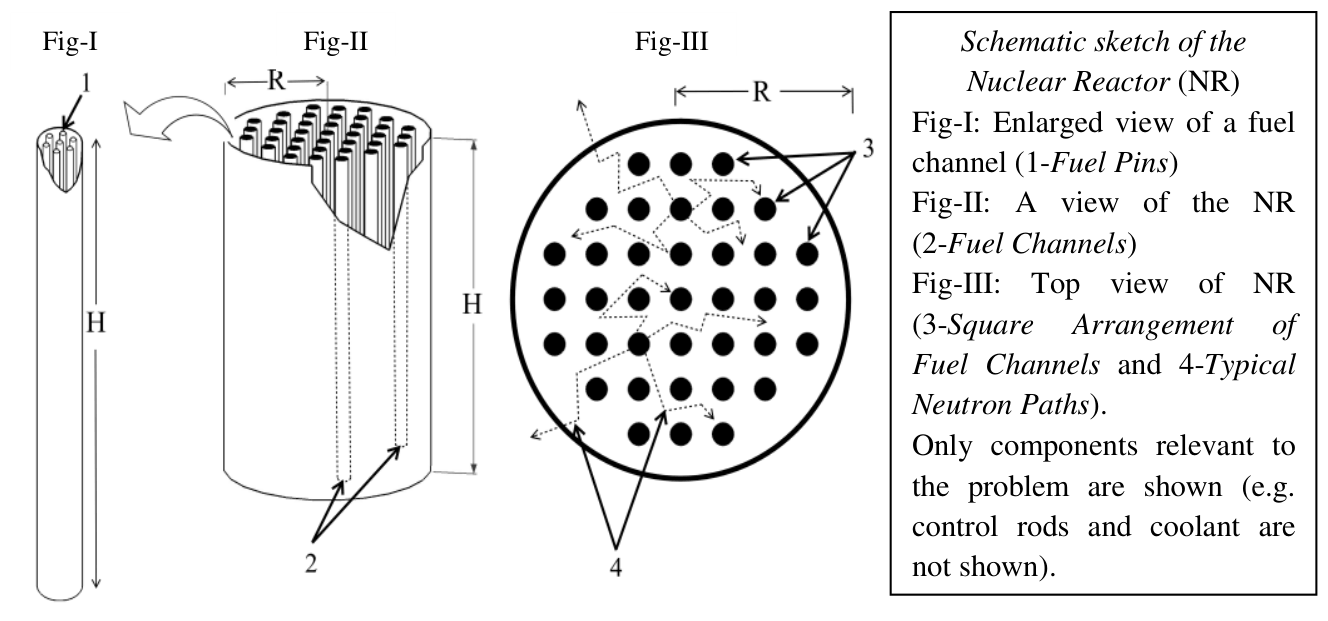
A typical NR consists of a cylindrical tank of height \(H\) and radius \(R\) filled with a material called moderator. Cylindrical tubes, called fuel channels, each containing a cluster of cylindrical fuel pins of natural \(\mathrm{UO}_2\) in solid form of height \(H\), are kept axially in a square array. Fission neutrons, coming outward from a fuel channel, collide with the moderator, losing energy and reach the surrounding fuel channels with low enough energy to cause fission (Figs I-III). Heat generated from fission in the pin is transmitted to a coolant fluid flowing along its length. In the current problem we shall study some of the physics behind the (A) Fuel Pin, (B) Moderator and (C) NR of cylindrical geometry.
A Fuel Pin
| Data for \(\mathrm{UO}_2\) | 1. Molecular weight \(M_w=0.270\ \mathrm{kg\,mol^{-1}}\) | 2. Density \(\rho=1.060\times10^4\ \mathrm{kg\,m^{-3}}\) |
| 3. Melting point \(T_m=3.138\times10^3\ \mathrm{K}\) | 4. Thermal conductivity \(\lambda=3.280\ \mathrm{W\,m^{-1}K^{-1}}\) |
| A1 | Consider the following fission reaction of a stationary \({}^{235}\mathrm{U}\) after it absorbs a neutron of negligible kinetic energy. \({}^{235}\mathrm{U}+{}^{1}\mathrm{n}\ \longrightarrow\ {}^{94}\mathrm{Zr}+{}^{140}\mathrm{Ce}+2\,{}^{1}\mathrm{n}+\Delta E\) Estimate \(\Delta E\) (in MeV) the total fission energy released. The nuclear masses are: \(m({}^{235}\mathrm{U})=235.044\ \mathrm{u}\); \(m({}^{94}\mathrm{Zr})=93.9063\ \mathrm{u}\); \(m({}^{140}\mathrm{Ce})=139.905\ \mathrm{u}\); \(m({}^{1}\mathrm{n})=1.00867\ \mathrm{u}\) and \(1\ \mathrm{u}=931.502\ \mathrm{MeV}\,c^{-2}\). Ignore charge imbalance. |
0.8 |
| A2 | Estimate \(N\) the number of \({}^{235}\mathrm{U}\) atoms per unit volume in natural \(\mathrm{UO}_2\). | 0.5 |
| A3 | Assume that the neutron flux density, \(\varphi=2.000\times10^{18}\ \mathrm{m^{-2}s^{-1}}\) on the fuel is uniform. The fission cross-section (effective area of the target nucleus) of a \({}^{235}\mathrm{U}\) nucleus is \(\sigma_f=5.400\times10^{-26}\ \mathrm{m^2}\). If 80.00% of the fission energy is available as heat, estimate \(Q\) (in \(\mathrm{W\,m^{-3}}\)), the rate of heat production in the pin per unit volume. \(1\mathrm{MeV}=1.602\times10^{-13}\ \mathrm{J}\) | 1.2 |
| A4 | The steady-state temperature difference between the center (\(T_c\)) and the surface (\(T_s\)) of the pin can be expressed as \(T_c-T_s=k\,F(Q,a,\lambda)\), where \(k=1/4\) is a dimensionless constant and \(a\) is the radius of the pin. Obtain \(F(Q,a,\lambda)\) by dimensional analysis. Note that \(\lambda\) is the thermal conductivity of \(\mathrm{UO}_2\). | 0.5 |
| A5 | The desired temperature of the coolant is \(5.770\times10^2\ \mathrm{K}\). Estimate the upper limit \(a_u\) on the radius \(a\) of the pin. | 1.0 |
B The Moderator
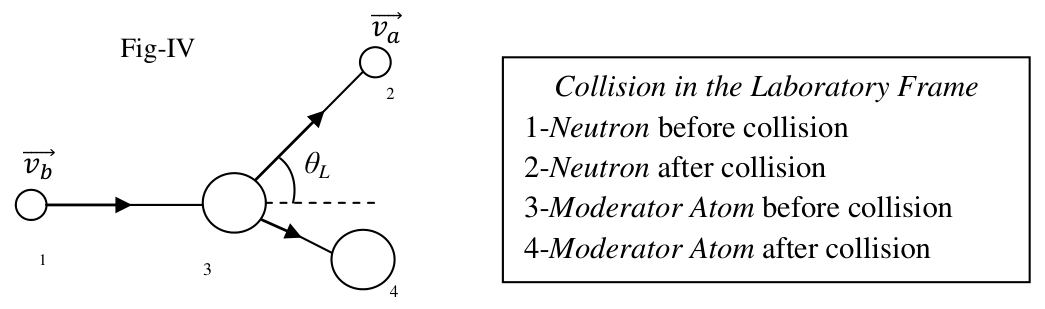
Consider the two dimensional elastic collision between a neutron of mass \(1\ \mathrm{u}\) and a moderator atom of mass \(A\ \mathrm{u}\). Before collision all the moderator atoms are considered at rest in the laboratory frame (LF). Let \(\vec v_b\) and \(\vec v_a\) be the velocities of the neutron before and after collision respectively in the LF. Let \(\vec v_m\) be the velocity of the center of mass (CM) frame relative to LF and \(\theta\) be the neutron scattering angle in the CM frame. All the particles involved in collisions are moving at nonrelativistic speeds.
| B1 | The collision in LF is shown schematically, where \(\theta_L\) is the scattering angle (Fig-IV). Sketch the collision schematically in CM frame. Label the particle velocities for 1, 2 and 3 in terms of \(\vec v_b\), \(\vec v_a\) and \(\vec v_m\). Indicate the scattering angle \(\theta\). | 1.0 |
| B2 | Obtain \(v\) and \(V\), the speeds of the neutron and moderator atom in the CM frame after collision, in terms of \(A\) and \(v_b\). | 1.0 |
| B3 | Derive an expression for \(G(\alpha,\theta)=E_a/E_b\), where \(E_b\) and \(E_a\) are the kinetic energies of the neutron, in the LF, before and after the collision respectively and \(\alpha\equiv[(A-1)/(A+1)]^2\). | 1.0 |
| B4 | Assume that the above expression holds for \(\mathrm{D}_2\mathrm{O}\) molecule. Calculate the maximum possible fractional energy loss \(f_l\equiv(E_b-E_a)/E_b\) of the neutron for the \(\mathrm{D}_2\mathrm{O}\) (\(20\ \mathrm{u}\)) moderator. | 0.5 |
C The Nuclear Reactor
To operate the NR at any constant neutron flux \(\psi\) (steady state), the leakage of neutrons has to be compensated by an excess production of neutrons in the reactor. For a reactor in cylindrical geometry the leakage rate is \(k_1[(2.405/R)^2+(\pi/H)^2]\psi\) and the excess production rate is \(k_2\psi\). The constants \(k_1\) and \(k_2\) depend on the material properties of the NR.
| C1 | Consider a NR with \(k_1=1.021\times10^{-2}\ \mathrm{m}\) and \(k_2=8.787\times10^{-3}\ \mathrm{m^{-1}}\). Noting that for a fixed volume the leakage rate is to be minimized for efficient fuel utilization, obtain the dimensions of the NR in the steady state. | 1.5 |
| C2 | The fuel channels are in a square arrangement (Fig-III) with the nearest neighbour distance \(0.286\ \mathrm{m}\). The effective radius of a fuel channel (if it were solid) is \(3.617\times10^{-2}\ \mathrm{m}\). Estimate the number of fuel channels \(F_n\) in the reactor and the mass \(M\) of \(\mathrm{UO}_2\) required to operate the NR in steady state. | 1.0 |
\(^{1}\) Joseph Amal Nathan (BARC) and Vijay A. Singh (ex-National Coordinator, Science Olympiads) were the principal authors of this problem. The contributions of the Academic Committee, Academic Development Group and the International Board are gratefully acknowledged.
Official English text of the problem.
Answers
- A1: \(\Delta E\simeq208.7\ \mathrm{MeV}\).
- A2: \(N\simeq1.70\times10^{26}\ \mathrm{m^{-3}}\).
- A3: \(Q\simeq4.92\times10^8\ \mathrm{W\,m^{-3}}\).
- A4: \(\displaystyle F(Q,a,\lambda)=\frac{Qa^2}{\lambda}\), so \(\displaystyle T_c-T_s=\frac{Qa^2}{4\lambda}\).
- A5: \(a_u\simeq8.27\times10^{-3}\ \mathrm{m}=8.27\ \mathrm{mm}\).
- B1: CM velocity labels: \(1:\vec v_b-\vec v_m\), \(2:\vec v_a-\vec v_m\), \(3:-\vec v_m\). The angle between the initial and final neutron velocities is \(\theta\); the two outgoing particles move in opposite directions.
- B2: \(\displaystyle v=\frac{A}{A+1}v_b,\qquad V=\frac{1}{A+1}v_b\).
- B3: \(\displaystyle G(\alpha,\theta)=\frac{1+\alpha+(1-\alpha)\cos\theta}{2}\).
- B4: \(\displaystyle f_{l,\max}=\frac{80}{441}\simeq0.1814=18.14\%\).
- C1: \(\displaystyle R=2.405\sqrt{\frac{3k_1}{2k_2}}\simeq3.175\ \mathrm{m}\), \(\displaystyle H=\pi\sqrt{\frac{3k_1}{k_2}}\simeq5.865\ \mathrm{m}\).
- C2: \(F_n\simeq387\) fuel channels; \(M\simeq9.89\times10^4\ \mathrm{kg}\), or \(98.9\) tonnes of \(\mathrm{UO}_2\).
Solution
A1
Since the initial kinetic energy is negligible, conservation of energy gives the released energy as the decrease in total rest energy:
\[ \Delta E= \left[ m({}^{235}\mathrm U)+m({}^{1}\mathrm n) -m({}^{94}\mathrm{Zr})-m({}^{140}\mathrm{Ce}) -2m({}^{1}\mathrm n) \right]c^2. \]
Using the supplied masses without any charge correction,
\[ \begin{aligned} \Delta m &=\left[235.044+1.00867 -\left(93.9063+139.905+2(1.00867)\right)\right]\mathrm u\\ &=0.22403\ \mathrm u. \end{aligned} \]
Therefore,
\[ \Delta E=0.22403(931.502)\ \mathrm{MeV} =208.684\ldots\ \mathrm{MeV}, \]
or
\[ \boxed{\Delta E\simeq208.7\ \mathrm{MeV}}. \]
A2
Each formula unit of \(\mathrm{UO}_2\) contains one uranium atom. The number of formula units per unit volume is
\[ n_{\mathrm{UO}_2}=\frac{\rho}{M_w}N_A, \]
where the standard Avogadro constant is \(N_A\simeq6.022\times10^{23}\ \mathrm{mol^{-1}}\).
The fraction of uranium atoms that are \({}^{235}\mathrm U\) is \(0.00720\). Hence
\[ \begin{aligned} N &=0.00720\,\frac{\rho N_A}{M_w}\\ &=0.00720\, \frac{1.060\times10^4}{0.270} (6.022\times10^{23})\ \mathrm{m^{-3}}\\ &=1.7022\ldots\times10^{26}\ \mathrm{m^{-3}}. \end{aligned} \]
Thus
\[ \boxed{N\simeq1.70\times10^{26}\ \mathrm{m^{-3}}}. \]
A3
The fission rate of one target nucleus in the prescribed uniform neutron flux is \(\varphi\sigma_f\). Therefore the fission rate per unit volume is
\[ r_f=N\varphi\sigma_f. \]
Numerically,
\[ \varphi\sigma_f =(2.000\times10^{18})(5.400\times10^{-26}) =1.080\times10^{-7}\ \mathrm{s^{-1}}, \]
and
\[ r_f=1.8384\ldots\times10^{19}\ \mathrm{m^{-3}s^{-1}}. \]
The heat deposited per fission is
\[ E_h=0.8000\,\Delta E =0.8000(208.684\ldots)(1.602\times10^{-13})\ \mathrm J. \]
Consequently,
\[ \begin{aligned} Q &=N\varphi\sigma_f E_h\\ &=4.9168\ldots\times10^8\ \mathrm{W\,m^{-3}}, \end{aligned} \]
giving
\[ \boxed{Q\simeq4.92\times10^8\ \mathrm{W\,m^{-3}}}. \]
A4
Let \(F\) have the dimensional form \(Q^x a^y\lambda^z\). Denoting dimensions of power, length and temperature by \(P,L,\Theta\),
\[ [Q]=PL^{-3},\qquad [a]=L,\qquad [\lambda]=PL^{-1}\Theta^{-1}. \]
Thus
\[ [F]=P^{x+z}L^{-3x+y-z}\Theta^{-z}. \]
For \(F\) to have the dimensions of temperature,
\[ x+z=0,\qquad -3x+y-z=0,\qquad -z=1. \]
These equations give
\[ x=1,\qquad y=2,\qquad z=-1. \]
The dimensionless numerical factor is already supplied as \(k\), so
\[ \boxed{F(Q,a,\lambda)=\frac{Qa^2}{\lambda}}, \qquad \boxed{T_c-T_s=\frac{Qa^2}{4\lambda}}. \]
A5
With uniform internal heat production, the center is the hottest part of the pin. Avoiding melting requires
\[ T_c\leq T_m. \]
Heat must flow from the pin surface to the coolant, so the surface temperature cannot be below the coolant temperature:
\[ T_s\geq T_{\mathrm{cool}}. \]
It follows that
\[ \frac{Qa^2}{4\lambda}=T_c-T_s \leq T_m-T_{\mathrm{cool}}. \]
The limiting radius is therefore
\[ a_u=\sqrt{\frac{4\lambda(T_m-T_{\mathrm{cool}})}{Q}}. \]
Using
\[ T_m-T_{\mathrm{cool}}=3138-577.0=2561\ \mathrm K, \]
we obtain
\[ a_u= \sqrt{\frac{4(3.280)(2561)}{4.9168\ldots\times10^8}} =8.2667\ldots\times10^{-3}\ \mathrm m. \]
Thus
\[ \boxed{a_u\simeq8.27\ \mathrm{mm}}. \]
This upper limit corresponds to the ideal limiting case \(T_s=T_{\mathrm{cool}}\). A finite temperature drop between the surface and coolant would reduce the permissible radius.
B1
Let the neutron mass be \(m\), so the moderator mass is \(Am\). Before collision the moderator is stationary in the LF. The CM velocity is therefore
\[ \vec v_m =\frac{m\vec v_b+Am\vec0}{(A+1)m} =\frac{\vec v_b}{A+1}. \]
A Galilean transformation to the CM frame subtracts \(\vec v_m\) from every LF velocity. Thus the required labels are
\[ \boxed{ \vec u_1=\vec v_b-\vec v_m,\qquad \vec u_2=\vec v_a-\vec v_m,\qquad \vec u_3=-\vec v_m }. \]
The sketch should have these features:
- Before collision, neutron 1 approaches from the left, moving horizontally right with velocity \(\vec v_b-\vec v_m\).
- Moderator 3 approaches from the right, moving horizontally left with velocity \(-\vec v_m\).
- After collision, neutron 2 leaves the collision point with velocity \(\vec v_a-\vec v_m\). Mark \(\theta\) between this arrow and the original rightward neutron direction.
- Moderator 4 leaves in the direction exactly opposite to neutron 2, because the total CM momentum is zero. Its velocity is \[ \vec u_4=-\frac{\vec u_2}{A}. \]
For example, if the outgoing neutron arrow points upward and right, the outgoing moderator arrow points downward and left.
B2
The initial CM speeds are
\[ u_{n,b}=v_b-v_m=\frac{A}{A+1}v_b, \qquad u_{M,b}=v_m=\frac{1}{A+1}v_b. \]
Conservation of momentum in the CM frame requires the final momenta to be equal and opposite. Their magnitudes therefore satisfy
\[ mv=AmV, \qquad\text{so}\qquad v=AV. \]
Because the collision is elastic, kinetic energy is conserved:
\[ \frac12 m u_{n,b}^2+\frac12 Am u_{M,b}^2 =\frac12 mv^2+\frac12 AmV^2. \]
After cancelling \(m/2\),
\[ \frac{A}{A+1}v_b^2=v^2+AV^2. \]
Substituting \(v=AV\) gives
\[ A(A+1)V^2=\frac{A}{A+1}v_b^2. \]
Hence
\[ \boxed{V=\frac{v_b}{A+1}}, \qquad \boxed{v=\frac{A}{A+1}v_b}. \]
The collision changes the velocity directions, but each particle’s speed in the CM frame remains unchanged.
B3
The neutron’s final LF velocity is
\[ \vec v_a=\vec v_m+\vec u_2. \]
The vector \(\vec v_m\) points along the initial neutron direction, while \(\vec u_2\) makes angle \(\theta\) with that direction. Consequently,
\[ v_a^2=v_m^2+v^2+2v_mv\cos\theta. \]
Using the results above,
\[ \frac{v_a^2}{v_b^2} =\frac{1+A^2+2A\cos\theta}{(A+1)^2}. \]
Since both energies refer to the same neutron in the LF,
\[ G(\alpha,\theta)=\frac{E_a}{E_b} =\frac{v_a^2}{v_b^2}. \]
Now
\[ \alpha=\frac{(A-1)^2}{(A+1)^2} \]
implies
\[ \frac{1+\alpha}{2} =\frac{A^2+1}{(A+1)^2}, \qquad \frac{1-\alpha}{2} =\frac{2A}{(A+1)^2}. \]
Therefore,
\[ \boxed{ G(\alpha,\theta) =\frac{1+\alpha+(1-\alpha)\cos\theta}{2} }. \]
An equivalent form is
\[ G(\alpha,\theta) =1-(1-\alpha)\sin^2\frac{\theta}{2}. \]
In particular, forward scattering gives \(G=1\), while backward scattering in the CM frame gives \(G=\alpha\).
B4
The fractional energy loss is
\[ f_l=1-G =(1-\alpha)\sin^2\frac{\theta}{2}. \]
It is largest for CM backscattering, \(\theta=\pi\). Thus
\[ f_{l,\max}=1-\alpha =1-\left(\frac{A-1}{A+1}\right)^2 =\frac{4A}{(A+1)^2}. \]
Following the problem’s approximation that the whole \(\mathrm D_2\mathrm O\) molecule is a target of mass \(20\ \mathrm u\), set \(A=20\):
\[ \boxed{ f_{l,\max}=\frac{4(20)}{21^2} =\frac{80}{441} \simeq0.1814=18.14\% }. \]
C1
For a nonzero steady neutron flux, production and leakage must balance:
\[ k_1\left[\frac{2.405^2}{R^2}+\frac{\pi^2}{H^2}\right]\psi =k_2\psi. \]
Cancelling \(\psi\),
\[ \frac{2.405^2}{R^2}+\frac{\pi^2}{H^2} =\frac{k_2}{k_1}. \tag{1} \]
We first determine the shape that minimizes leakage at fixed volume. Write
\[ \mathcal V=\pi R^2H,\qquad b=2.405, \]
so that
\[ H=\frac{\mathcal V}{\pi R^2}. \]
The geometric factor in the leakage rate becomes
\[ S(R)=\frac{b^2}{R^2}+\frac{\pi^4R^4}{\mathcal V^2}. \]
Its derivative vanishes when
\[ -\frac{2b^2}{R^3} +\frac{4\pi^4R^3}{\mathcal V^2}=0. \]
Rearranging and using \(\mathcal V=\pi R^2H\),
\[ \boxed{\frac{b^2}{R^2}=2\frac{\pi^2}{H^2}}. \tag{2} \]
This stationary point is a minimum, since
\[ S''(R)=\frac{6b^2}{R^4} +\frac{12\pi^4R^2}{\mathcal V^2}>0. \]
The optimum aspect ratio is therefore
\[ \frac{H}{R}=\frac{\sqrt2\,\pi}{b} =1.84735\ldots. \]
Combining (1) and (2),
\[ 3\frac{\pi^2}{H^2}=\frac{k_2}{k_1}, \]
which gives
\[ \boxed{H=\pi\sqrt{\frac{3k_1}{k_2}}}, \qquad \boxed{R=b\sqrt{\frac{3k_1}{2k_2}}}. \]
Numerically,
\[ H=\pi\sqrt{\frac{3(1.021\times10^{-2})} {8.787\times10^{-3}}} \simeq\boxed{5.865\ \mathrm m}, \]
\[ R=2.405\sqrt{\frac{3(1.021\times10^{-2})} {2(8.787\times10^{-3})}} \simeq\boxed{3.175\ \mathrm m}. \]
C2
Let the square-lattice spacing be \(d=0.286\ \mathrm m\). Neglecting boundary corrections, each fuel channel occupies one square cell of cross-sectional area \(d^2\). Therefore,
\[ F_n\simeq\frac{\pi R^2}{d^2}. \]
Substitution gives
\[ F_n\simeq \frac{\pi(3.17507\ldots)^2}{(0.286)^2} =387.19\ldots. \]
Hence the estimated number is
\[ \boxed{F_n\simeq387\text{ fuel channels}}. \]
With effective solid-fuel radius \(r_f=3.617\times10^{-2}\ \mathrm m\), the volume of \(\mathrm{UO}_2\) in one channel is \(\pi r_f^2H\). Its mass is therefore \(\rho\pi r_f^2H\), and the total fuel mass is
\[ M=F_n\rho\pi r_f^2H. \]
Using the unrounded area estimate,
\[ \begin{aligned} M &\simeq(387.19\ldots)(1.060\times10^4) \pi(3.617\times10^{-2})^2(5.86547\ldots)\ \mathrm{kg}\\ &=9.8942\ldots\times10^4\ \mathrm{kg}. \end{aligned} \]
Thus
\[ \boxed{M\simeq9.89\times10^4\ \mathrm{kg} =98.9\text{ tonnes of }\mathrm{UO}_2}. \]
The solution was checked against the official solution.
IPhO 2015 · Theorieaufgabe 3
Der Entwurf eines Kernreaktors
Uran kommt in der Natur als \(\mathrm{UO}_2\) vor, wobei nur 0.720% der Uranatome \({}^{235}\mathrm{U}\) sind. In \({}^{235}\mathrm{U}\) lässt sich durch Neutronen leicht eine Kernspaltung auslösen, bei der 2-3 Spaltneutronen mit hoher kinetischer Energie emittiert werden. Diese Spaltwahrscheinlichkeit steigt, wenn die spaltauslösenden Neutronen eine niedrige kinetische Energie haben. Durch Verringerung der kinetischen Energie der Spaltneutronen kann man daher eine Kette von Spaltungen in weiteren \({}^{235}\mathrm{U}\)-Kernen auslösen. Dies bildet die Grundlage des zur Stromerzeugung dienenden Kernreaktors (NR).
Ein typischer NR besteht aus einem zylindrischen Behälter der Höhe \(H\) und des Radius \(R\), der mit einem als Moderator bezeichneten Material gefüllt ist. Zylindrische Rohre, sogenannte Brennstoffkanäle, sind parallel zur Achse in einem quadratischen Gitter angeordnet. Jeder Kanal enthält ein Bündel zylindrischer Brennstoffstäbe der Höhe \(H\) aus natürlichem \(\mathrm{UO}_2\) in fester Form. Spaltneutronen, die aus einem Brennstoffkanal austreten, stoßen mit dem Moderator zusammen, verlieren dabei Energie und erreichen die umliegenden Brennstoffkanäle mit einer hinreichend niedrigen Energie, um eine Spaltung auszulösen (Abb. I-III). Die durch Spaltung im Stab erzeugte Wärme wird an ein Kühlmittel übertragen, das entlang des Stabes strömt. In dieser Aufgabe untersuchen wir einige physikalische Grundlagen von (A) Brennstoffstab, (B) Moderator und (C) NR mit zylindrischer Geometrie.
A Brennstoffstab
| Daten für \(\mathrm{UO}_2\) | 1. Molare Masse \(M_w=0.270\ \mathrm{kg\,mol^{-1}}\) | 2. Dichte \(\rho=1.060\times10^4\ \mathrm{kg\,m^{-3}}\) |
| 3. Schmelztemperatur \(T_m=3.138\times10^3\ \mathrm{K}\) | 4. Wärmeleitfähigkeit \(\lambda=3.280\ \mathrm{W\,m^{-1}K^{-1}}\) |
| A1 | Betrachten Sie die folgende Spaltreaktion eines ruhenden \({}^{235}\mathrm{U}\)-Kerns, nachdem er ein Neutron mit vernachlässigbarer kinetischer Energie absorbiert hat. \({}^{235}\mathrm{U}+{}^{1}\mathrm{n}\ \longrightarrow\ {}^{94}\mathrm{Zr}+{}^{140}\mathrm{Ce}+2\,{}^{1}\mathrm{n}+\Delta E\) Schätzen Sie die insgesamt freigesetzte Spaltenergie \(\Delta E\) (in MeV) ab. Die Kernmassen sind: \(m({}^{235}\mathrm{U})=235.044\ \mathrm{u}\); \(m({}^{94}\mathrm{Zr})=93.9063\ \mathrm{u}\); \(m({}^{140}\mathrm{Ce})=139.905\ \mathrm{u}\); \(m({}^{1}\mathrm{n})=1.00867\ \mathrm{u}\) und \(1\ \mathrm{u}=931.502\ \mathrm{MeV}\,c^{-2}\). Ignorieren Sie die unausgeglichene Ladungsbilanz. |
0.8 |
| A2 | Schätzen Sie die Anzahl \(N\) der \({}^{235}\mathrm{U}\)-Atome pro Volumeneinheit in natürlichem \(\mathrm{UO}_2\) ab. | 0.5 |
| A3 | Nehmen Sie an, dass die Neutronenflussdichte \(\varphi=2.000\times10^{18}\ \mathrm{m^{-2}s^{-1}}\) am Brennstoff gleichförmig ist. Der Spaltquerschnitt (die effektive Fläche des Targetkerns) eines \({}^{235}\mathrm{U}\)-Kerns beträgt \(\sigma_f=5.400\times10^{-26}\ \mathrm{m^2}\). Wenn 80.00% der Spaltenergie als Wärme verfügbar sind, schätzen Sie die Wärmeleistung pro Volumeneinheit im Stab \(Q\) (in \(\mathrm{W\,m^{-3}}\)) ab. \(1\mathrm{MeV}=1.602\times10^{-13}\ \mathrm{J}\) | 1.2 |
| A4 | Die stationäre Temperaturdifferenz zwischen dem Zentrum (\(T_c\)) und der Oberfläche (\(T_s\)) des Stabes lässt sich als \(T_c-T_s=k\,F(Q,a,\lambda)\) ausdrücken, wobei \(k=1/4\) eine dimensionslose Konstante und \(a\) der Radius des Stabes ist. Bestimmen Sie \(F(Q,a,\lambda)\) mithilfe einer Dimensionsanalyse. Beachten Sie, dass \(\lambda\) die Wärmeleitfähigkeit von \(\mathrm{UO}_2\) ist. | 0.5 |
| A5 | Die gewünschte Temperatur des Kühlmittels beträgt \(5.770\times10^2\ \mathrm{K}\). Schätzen Sie die Obergrenze \(a_u\) für den Radius \(a\) des Stabes ab. | 1.0 |
B Der Moderator
Betrachten Sie den zweidimensionalen elastischen Stoß zwischen einem Neutron der Masse \(1\ \mathrm{u}\) und einem Moderatoratom der Masse \(A\ \mathrm{u}\). Vor dem Stoß werden alle Moderatoratome als im Laborsystem (LF) ruhend angenommen. Es seien \(\vec v_b\) und \(\vec v_a\) die Geschwindigkeiten des Neutrons vor beziehungsweise nach dem Stoß im LF. Es sei \(\vec v_m\) die Geschwindigkeit des Schwerpunktsystems (CM) relativ zum LF und \(\theta\) der Streuwinkel des Neutrons im CM-System. Alle an den Stößen beteiligten Teilchen bewegen sich mit nichtrelativistischen Geschwindigkeiten.
| B1 | Der Stoß im LF ist schematisch dargestellt, wobei \(\theta_L\) der Streuwinkel ist (Abb. IV). Skizzieren Sie den Stoß schematisch im CM-System. Beschriften Sie die Teilchengeschwindigkeiten für 1, 2 und 3 durch Ausdrücke mit \(\vec v_b\), \(\vec v_a\) und \(\vec v_m\). Zeichnen Sie den Streuwinkel \(\theta\) ein. | 1.0 |
| B2 | Bestimmen Sie \(v\) und \(V\), die Geschwindigkeitsbeträge des Neutrons und des Moderatoratoms im CM-System nach dem Stoß, in Abhängigkeit von \(A\) und \(v_b\). | 1.0 |
| B3 | Leiten Sie einen Ausdruck für \(G(\alpha,\theta)=E_a/E_b\) her, wobei \(E_b\) und \(E_a\) die kinetischen Energien des Neutrons im LF vor beziehungsweise nach dem Stoß sind und \(\alpha\equiv[(A-1)/(A+1)]^2\) ist. | 1.0 |
| B4 | Nehmen Sie an, dass der obige Ausdruck für ein \(\mathrm{D}_2\mathrm{O}\)-Molekül gilt. Berechnen Sie den maximal möglichen relativen Energieverlust \(f_l\equiv(E_b-E_a)/E_b\) des Neutrons für den Moderator \(\mathrm{D}_2\mathrm{O}\) (\(20\ \mathrm{u}\)). | 0.5 |
C Der Kernreaktor
Um den NR bei einem beliebigen konstanten Neutronenfluss \(\psi\) (stationärer Zustand) zu betreiben, müssen die Neutronenverluste durch Entweichen durch eine Überschussproduktion von Neutronen im Reaktor ausgeglichen werden. Für einen Reaktor mit zylindrischer Geometrie beträgt die Leckagerate \(k_1[(2.405/R)^2+(\pi/H)^2]\psi\) und die Überschussproduktionsrate \(k_2\psi\). Die Konstanten \(k_1\) und \(k_2\) hängen von den Materialeigenschaften des NR ab.
| C1 | Betrachten Sie einen NR mit \(k_1=1.021\times10^{-2}\ \mathrm{m}\) und \(k_2=8.787\times10^{-3}\ \mathrm{m^{-1}}\). Bestimmen Sie die Abmessungen des NR im stationären Zustand unter Berücksichtigung dessen, dass bei festem Volumen die Leckagerate für eine effiziente Brennstoffnutzung minimiert werden soll. | 1.5 |
| C2 | Die Brennstoffkanäle sind in einem quadratischen Gitter angeordnet (Abb. III), wobei der Abstand nächster Nachbarn \(0.286\ \mathrm{m}\) beträgt. Der effektive Radius eines Brennstoffkanals (wenn er vollständig mit festem Brennstoff gefüllt wäre) beträgt \(3.617\times10^{-2}\ \mathrm{m}\). Schätzen Sie die Anzahl der Brennstoffkanäle \(F_n\) im Reaktor und die Masse \(M\) an \(\mathrm{UO}_2\) ab, die zum Betrieb des NR im stationären Zustand erforderlich ist. | 1.0 |
\(^{1}\) Joseph Amal Nathan (BARC) und Vijay A. Singh (ehemaliger nationaler Koordinator der Wissenschaftsolympiaden) waren die Hauptautoren dieser Aufgabe. Den Beiträgen des Akademischen Komitees, der Akademischen Entwicklungsgruppe und des Internationalen Gremiums gilt unser herzlicher Dank.
Aufgabentext aus dem offiziellen englischen Text übersetzt.
Antworten
- A1: \(\Delta E\simeq208.7\ \mathrm{MeV}\).
- A2: \(N\simeq1.70\times10^{26}\ \mathrm{m^{-3}}\).
- A3: \(Q\simeq4.92\times10^8\ \mathrm{W\,m^{-3}}\).
- A4: \(\displaystyle F(Q,a,\lambda)=\frac{Qa^2}{\lambda}\), also \(\displaystyle T_c-T_s=\frac{Qa^2}{4\lambda}\).
- A5: \(a_u\simeq8.27\times10^{-3}\ \mathrm{m}=8.27\ \mathrm{mm}\).
- B1: Geschwindigkeitsbeschriftungen im CM-System: \(1:\vec v_b-\vec v_m\), \(2:\vec v_a-\vec v_m\), \(3:-\vec v_m\). Der Winkel zwischen der anfänglichen und der endgültigen Neutronengeschwindigkeit ist \(\theta\); die beiden auslaufenden Teilchen bewegen sich in entgegengesetzte Richtungen.
- B2: \(\displaystyle v=\frac{A}{A+1}v_b,\qquad V=\frac{1}{A+1}v_b\).
- B3: \(\displaystyle G(\alpha,\theta)=\frac{1+\alpha+(1-\alpha)\cos\theta}{2}\).
- B4: \(\displaystyle f_{l,\max}=\frac{80}{441}\simeq0.1814=18.14\%\).
- C1: \(\displaystyle R=2.405\sqrt{\frac{3k_1}{2k_2}}\simeq3.175\ \mathrm{m}\), \(\displaystyle H=\pi\sqrt{\frac{3k_1}{k_2}}\simeq5.865\ \mathrm{m}\).
- C2: \(F_n\simeq387\) Brennstoffkanäle; \(M\simeq9.89\times10^4\ \mathrm{kg}\), also \(98.9\) Tonnen \(\mathrm{UO}_2\).
Lösung
A1
Da die anfängliche kinetische Energie vernachlässigbar ist, ergibt sich die freigesetzte Energie aus der Energieerhaltung als Abnahme der gesamten Ruheenergie:
\[ \Delta E= \left[ m({}^{235}\mathrm U)+m({}^{1}\mathrm n) -m({}^{94}\mathrm{Zr})-m({}^{140}\mathrm{Ce}) -2m({}^{1}\mathrm n) \right]c^2. \]
Mit den angegebenen Massen und ohne Ladungskorrektur gilt
\[ \begin{aligned} \Delta m &=\left[235.044+1.00867 -\left(93.9063+139.905+2(1.00867)\right)\right]\mathrm u\\ &=0.22403\ \mathrm u. \end{aligned} \]
Daher ist
\[ \Delta E=0.22403(931.502)\ \mathrm{MeV} =208.684\ldots\ \mathrm{MeV}, \]
also
\[ \boxed{\Delta E\simeq208.7\ \mathrm{MeV}}. \]
A2
Jede Formeleinheit von \(\mathrm{UO}_2\) enthält ein Uranatom. Die Anzahl der Formeleinheiten pro Volumeneinheit beträgt
\[ n_{\mathrm{UO}_2}=\frac{\rho}{M_w}N_A, \]
wobei die übliche Avogadro-Konstante \(N_A\simeq6.022\times10^{23}\ \mathrm{mol^{-1}}\) ist.
Der Anteil der Uranatome, die \({}^{235}\mathrm U\) sind, beträgt \(0.00720\). Daher gilt
\[ \begin{aligned} N &=0.00720\,\frac{\rho N_A}{M_w}\\ &=0.00720\, \frac{1.060\times10^4}{0.270} (6.022\times10^{23})\ \mathrm{m^{-3}}\\ &=1.7022\ldots\times10^{26}\ \mathrm{m^{-3}}. \end{aligned} \]
Somit ist
\[ \boxed{N\simeq1.70\times10^{26}\ \mathrm{m^{-3}}}. \]
A3
Die Spaltrate eines einzelnen Targetkerns im vorgegebenen gleichförmigen Neutronenfluss beträgt \(\varphi\sigma_f\). Die Spaltrate pro Volumeneinheit ist daher
\[ r_f=N\varphi\sigma_f. \]
Numerisch ergibt sich
\[ \varphi\sigma_f =(2.000\times10^{18})(5.400\times10^{-26}) =1.080\times10^{-7}\ \mathrm{s^{-1}}, \]
und
\[ r_f=1.8384\ldots\times10^{19}\ \mathrm{m^{-3}s^{-1}}. \]
Die pro Spaltung abgegebene Wärme beträgt
\[ E_h=0.8000\,\Delta E =0.8000(208.684\ldots)(1.602\times10^{-13})\ \mathrm J. \]
Folglich gilt
\[ \begin{aligned} Q &=N\varphi\sigma_f E_h\\ &=4.9168\ldots\times10^8\ \mathrm{W\,m^{-3}}, \end{aligned} \]
woraus sich ergibt:
\[ \boxed{Q\simeq4.92\times10^8\ \mathrm{W\,m^{-3}}}. \]
A4
Für \(F\) setzen wir die dimensionale Form \(Q^x a^y\lambda^z\) an. Bezeichnen wir die Dimensionen von Leistung, Länge und Temperatur mit \(P,L,\Theta\), so gilt
\[ [Q]=PL^{-3},\qquad [a]=L,\qquad [\lambda]=PL^{-1}\Theta^{-1}. \]
Somit ist
\[ [F]=P^{x+z}L^{-3x+y-z}\Theta^{-z}. \]
Damit \(F\) die Dimension einer Temperatur hat, muss gelten:
\[ x+z=0,\qquad -3x+y-z=0,\qquad -z=1. \]
Diese Gleichungen ergeben
\[ x=1,\qquad y=2,\qquad z=-1. \]
Der dimensionslose Zahlenfaktor ist bereits als \(k\) vorgegeben, daher gilt
\[ \boxed{F(Q,a,\lambda)=\frac{Qa^2}{\lambda}}, \qquad \boxed{T_c-T_s=\frac{Qa^2}{4\lambda}}. \]
A5
Bei gleichförmiger Wärmeerzeugung im Inneren ist das Zentrum der heißeste Bereich des Stabes. Um ein Schmelzen zu vermeiden, muss gelten:
\[ T_c\leq T_m. \]
Wärme muss von der Staboberfläche zum Kühlmittel fließen, daher kann die Oberflächentemperatur nicht unter der Kühlmitteltemperatur liegen:
\[ T_s\geq T_{\mathrm{cool}}. \]
Daraus folgt
\[ \frac{Qa^2}{4\lambda}=T_c-T_s \leq T_m-T_{\mathrm{cool}}. \]
Der Grenzradius ist somit
\[ a_u=\sqrt{\frac{4\lambda(T_m-T_{\mathrm{cool}})}{Q}}. \]
Mit
\[ T_m-T_{\mathrm{cool}}=3138-577.0=2561\ \mathrm K, \]
erhalten wir
\[ a_u= \sqrt{\frac{4(3.280)(2561)}{4.9168\ldots\times10^8}} =8.2667\ldots\times10^{-3}\ \mathrm m. \]
Somit ist
\[ \boxed{a_u\simeq8.27\ \mathrm{mm}}. \]
Diese Obergrenze entspricht dem idealen Grenzfall \(T_s=T_{\mathrm{cool}}\). Ein endlicher Temperaturabfall zwischen der Oberfläche und dem Kühlmittel würde den zulässigen Radius verringern.
B1
Die Neutronenmasse sei \(m\), sodass die Moderatormasse \(Am\) beträgt. Vor dem Stoß ruht der Moderator im LF. Die Schwerpunktsgeschwindigkeit ist daher
\[ \vec v_m =\frac{m\vec v_b+Am\vec0}{(A+1)m} =\frac{\vec v_b}{A+1}. \]
Bei einer Galilei-Transformation in das CM-System wird von jeder Geschwindigkeit im LF \(\vec v_m\) subtrahiert. Somit lauten die gesuchten Beschriftungen
\[ \boxed{ \vec u_1=\vec v_b-\vec v_m,\qquad \vec u_2=\vec v_a-\vec v_m,\qquad \vec u_3=-\vec v_m }. \]
Die Skizze sollte folgende Merkmale aufweisen:
- Vor dem Stoß nähert sich Neutron 1 von links und bewegt sich mit der Geschwindigkeit \(\vec v_b-\vec v_m\) horizontal nach rechts.
- Moderatorteilchen 3 nähert sich von rechts und bewegt sich mit der Geschwindigkeit \(-\vec v_m\) horizontal nach links.
- Nach dem Stoß verlässt Neutron 2 den Stoßpunkt mit der Geschwindigkeit \(\vec v_a-\vec v_m\). Markieren Sie \(\theta\) zwischen diesem Pfeil und der ursprünglichen, nach rechts gerichteten Bewegungsrichtung des Neutrons.
- Moderatorteilchen 4 bewegt sich in genau entgegengesetzter Richtung zu Neutron 2 fort, da der Gesamtimpuls im CM-System null ist. Seine Geschwindigkeit ist \[ \vec u_4=-\frac{\vec u_2}{A}. \]
Zeigt beispielsweise der Pfeil des auslaufenden Neutrons nach rechts oben, so zeigt der Pfeil des auslaufenden Moderatorteilchens nach links unten.
B2
Die anfänglichen Geschwindigkeitsbeträge im CM-System sind
\[ u_{n,b}=v_b-v_m=\frac{A}{A+1}v_b, \qquad u_{M,b}=v_m=\frac{1}{A+1}v_b. \]
Die Impulserhaltung im CM-System verlangt, dass die Impulse nach dem Stoß gleich groß und entgegengesetzt gerichtet sind. Ihre Beträge erfüllen daher
\[ mv=AmV, \qquad\text{also}\qquad v=AV. \]
Da der Stoß elastisch ist, bleibt die kinetische Energie erhalten:
\[ \frac12 m u_{n,b}^2+\frac12 Am u_{M,b}^2 =\frac12 mv^2+\frac12 AmV^2. \]
Nach Kürzen von \(m/2\) folgt
\[ \frac{A}{A+1}v_b^2=v^2+AV^2. \]
Einsetzen von \(v=AV\) ergibt
\[ A(A+1)V^2=\frac{A}{A+1}v_b^2. \]
Daher gilt
\[ \boxed{V=\frac{v_b}{A+1}}, \qquad \boxed{v=\frac{A}{A+1}v_b}. \]
Der Stoß ändert die Geschwindigkeitsrichtungen, doch der Geschwindigkeitsbetrag jedes Teilchens im CM-System bleibt unverändert.
B3
Die Geschwindigkeit des Neutrons im LF nach dem Stoß ist
\[ \vec v_a=\vec v_m+\vec u_2. \]
Der Vektor \(\vec v_m\) zeigt entlang der ursprünglichen Neutronenrichtung, während \(\vec u_2\) mit dieser Richtung den Winkel \(\theta\) einschließt. Folglich gilt
\[ v_a^2=v_m^2+v^2+2v_mv\cos\theta. \]
Mit den obigen Ergebnissen folgt
\[ \frac{v_a^2}{v_b^2} =\frac{1+A^2+2A\cos\theta}{(A+1)^2}. \]
Da sich beide Energien auf dasselbe Neutron im LF beziehen, gilt
\[ G(\alpha,\theta)=\frac{E_a}{E_b} =\frac{v_a^2}{v_b^2}. \]
Nun folgt aus
\[ \alpha=\frac{(A-1)^2}{(A+1)^2} \]
die Beziehung
\[ \frac{1+\alpha}{2} =\frac{A^2+1}{(A+1)^2}, \qquad \frac{1-\alpha}{2} =\frac{2A}{(A+1)^2}. \]
Daher ist
\[ \boxed{ G(\alpha,\theta) =\frac{1+\alpha+(1-\alpha)\cos\theta}{2} }. \]
Eine äquivalente Form ist
\[ G(\alpha,\theta) =1-(1-\alpha)\sin^2\frac{\theta}{2}. \]
Insbesondere ergibt Vorwärtsstreuung \(G=1\), während Rückwärtsstreuung im CM-System \(G=\alpha\) ergibt.
B4
Der relative Energieverlust ist
\[ f_l=1-G =(1-\alpha)\sin^2\frac{\theta}{2}. \]
Er ist bei Rückwärtsstreuung im CM-System, \(\theta=\pi\), am größten. Somit gilt
\[ f_{l,\max}=1-\alpha =1-\left(\frac{A-1}{A+1}\right)^2 =\frac{4A}{(A+1)^2}. \]
Entsprechend der Näherung der Aufgabe, dass das gesamte \(\mathrm D_2\mathrm O\)-Molekül ein Target der Masse \(20\ \mathrm u\) ist, setzen wir \(A=20\):
\[ \boxed{ f_{l,\max}=\frac{4(20)}{21^2} =\frac{80}{441} \simeq0.1814=18.14\% }. \]
C1
Für einen von null verschiedenen stationären Neutronenfluss müssen sich Produktion und Leckage ausgleichen:
\[ k_1\left[\frac{2.405^2}{R^2}+\frac{\pi^2}{H^2}\right]\psi =k_2\psi. \]
Nach Kürzen von \(\psi\) ergibt sich
\[ \frac{2.405^2}{R^2}+\frac{\pi^2}{H^2} =\frac{k_2}{k_1}. \tag{1} \]
Wir bestimmen zunächst die Form, die bei festem Volumen die Leckage minimiert. Wir schreiben
\[ \mathcal V=\pi R^2H,\qquad b=2.405, \]
sodass
\[ H=\frac{\mathcal V}{\pi R^2}. \]
Der geometrische Faktor in der Leckagerate wird damit zu
\[ S(R)=\frac{b^2}{R^2}+\frac{\pi^4R^4}{\mathcal V^2}. \]
Seine Ableitung verschwindet, wenn
\[ -\frac{2b^2}{R^3} +\frac{4\pi^4R^3}{\mathcal V^2}=0. \]
Durch Umstellen und Verwendung von \(\mathcal V=\pi R^2H\) folgt
\[ \boxed{\frac{b^2}{R^2}=2\frac{\pi^2}{H^2}}. \tag{2} \]
Diese stationäre Stelle ist ein Minimum, da
\[ S''(R)=\frac{6b^2}{R^4} +\frac{12\pi^4R^2}{\mathcal V^2}>0. \]
Das optimale Verhältnis von Höhe zu Radius ist daher
\[ \frac{H}{R}=\frac{\sqrt2\,\pi}{b} =1.84735\ldots. \]
Aus (1) und (2) folgt
\[ 3\frac{\pi^2}{H^2}=\frac{k_2}{k_1}, \]
woraus sich ergibt:
\[ \boxed{H=\pi\sqrt{\frac{3k_1}{k_2}}}, \qquad \boxed{R=b\sqrt{\frac{3k_1}{2k_2}}}. \]
Numerisch ergibt sich
\[ H=\pi\sqrt{\frac{3(1.021\times10^{-2})} {8.787\times10^{-3}}} \simeq\boxed{5.865\ \mathrm m}, \]
\[ R=2.405\sqrt{\frac{3(1.021\times10^{-2})} {2(8.787\times10^{-3})}} \simeq\boxed{3.175\ \mathrm m}. \]
C2
Der Abstand im quadratischen Gitter sei \(d=0.286\ \mathrm m\). Unter Vernachlässigung von Randkorrekturen nimmt jeder Brennstoffkanal eine quadratische Zelle mit der Querschnittsfläche \(d^2\) ein. Daher gilt
\[ F_n\simeq\frac{\pi R^2}{d^2}. \]
Einsetzen ergibt
\[ F_n\simeq \frac{\pi(3.17507\ldots)^2}{(0.286)^2} =387.19\ldots. \]
Die geschätzte Anzahl beträgt somit
\[ \boxed{F_n\simeq387\text{ Brennstoffkanäle}}. \]
Mit dem effektiven Radius des festen Brennstoffs \(r_f=3.617\times10^{-2}\ \mathrm m\) beträgt das Volumen von \(\mathrm{UO}_2\) in einem Kanal \(\pi r_f^2H\). Seine Masse ist daher \(\rho\pi r_f^2H\), und die gesamte Brennstoffmasse beträgt
\[ M=F_n\rho\pi r_f^2H. \]
Mit der ungerundeten Schätzung aus dem Flächenverhältnis ergibt sich
\[ \begin{aligned} M &\simeq(387.19\ldots)(1.060\times10^4) \pi(3.617\times10^{-2})^2(5.86547\ldots)\ \mathrm{kg}\\ &=9.8942\ldots\times10^4\ \mathrm{kg}. \end{aligned} \]
Somit ist
\[ \boxed{M\simeq9.89\times10^4\ \mathrm{kg} =98.9\text{ Tonnen }\mathrm{UO}_2}. \]
Die Lösung wurde mit der offiziellen Lösung abgeglichen.
IPhO 2015 · Teori sorusu 3
Bir Nükleer Reaktörün Tasarımı
Uranyum doğada \(\mathrm{UO}_2\) biçiminde bulunur ve uranyum atomlarının yalnızca %0.720'si \({}^{235}\mathrm{U}\) izotopudur. \({}^{235}\mathrm{U}\) çekirdeğinde nötronla indüklenen fisyon kolaylıkla gerçekleşir ve yüksek kinetik enerjili 2-3 fisyon nötronu yayılır. Fisyonu indükleyen nötronların kinetik enerjisi düşükse bu fisyon olasılığı artar. Dolayısıyla fisyon nötronlarının kinetik enerjisi azaltılarak diğer \({}^{235}\mathrm{U}\) çekirdeklerinde zincirleme fisyonlar indüklenebilir. Bu, güç üreten nükleer reaktörün (NR) temelini oluşturur.
Tipik bir NR, moderatör adı verilen bir malzemeyle doldurulmuş, yüksekliği \(H\) ve yarıçapı \(R\) olan silindirik bir tanktan oluşur. Yakıt kanalları adı verilen silindirik tüpler, eksen doğrultusunda kare bir örgü oluşturacak şekilde yerleştirilir; her tüp, katı doğal \(\mathrm{UO}_2\)'den yapılmış, yüksekliği \(H\) olan silindirik yakıt çubuklarından oluşan bir demet içerir. Bir yakıt kanalından dışarı çıkan fisyon nötronları moderatörle çarpışarak enerji kaybeder ve çevredeki yakıt kanallarına fisyona yol açacak kadar düşük enerjiyle ulaşır (Şekiller I-III). Çubukta fisyon sonucu üretilen ısı, çubuk boyunca akan bir soğutucu akışkana aktarılır. Bu soruda (A) Yakıt Çubuğu, (B) Moderatör ve (C) Silindirik Geometrili NR'nin işleyişinin temelindeki bazı fiziksel ilkeleri inceleyeceğiz.
A Yakıt Çubuğu
| \(\mathrm{UO}_2\) için veriler | 1. Molekül ağırlığı \(M_w=0.270\ \mathrm{kg\,mol^{-1}}\) | 2. Yoğunluk \(\rho=1.060\times10^4\ \mathrm{kg\,m^{-3}}\) |
| 3. Erime noktası \(T_m=3.138\times10^3\ \mathrm{K}\) | 4. Isıl iletkenlik \(\lambda=3.280\ \mathrm{W\,m^{-1}K^{-1}}\) |
| A1 | Durgun bir \({}^{235}\mathrm{U}\) çekirdeğinin, kinetik enerjisi ihmal edilebilir bir nötronu soğurduktan sonra geçirdiği aşağıdaki fisyon tepkimesini ele alın. \({}^{235}\mathrm{U}+{}^{1}\mathrm{n}\ \longrightarrow\ {}^{94}\mathrm{Zr}+{}^{140}\mathrm{Ce}+2\,{}^{1}\mathrm{n}+\Delta E\) Açığa çıkan toplam fisyon enerjisi \(\Delta E\)'yi (MeV cinsinden) tahmin edin. Çekirdek kütleleri şöyledir: \(m({}^{235}\mathrm{U})=235.044\ \mathrm{u}\); \(m({}^{94}\mathrm{Zr})=93.9063\ \mathrm{u}\); \(m({}^{140}\mathrm{Ce})=139.905\ \mathrm{u}\); \(m({}^{1}\mathrm{n})=1.00867\ \mathrm{u}\) ve \(1\ \mathrm{u}=931.502\ \mathrm{MeV}\,c^{-2}\). Yük dengesizliğini göz ardı edin. |
0.8 |
| A2 | Doğal \(\mathrm{UO}_2\)'de birim hacim başına düşen \({}^{235}\mathrm{U}\) atomu sayısı \(N\)'yi tahmin edin. | 0.5 |
| A3 | Yakıt üzerindeki nötron akı yoğunluğunun, \(\varphi=2.000\times10^{18}\ \mathrm{m^{-2}s^{-1}}\), düzgün olduğunu varsayın. Bir \({}^{235}\mathrm{U}\) çekirdeğinin fisyon tesir kesiti (hedef çekirdeğin etkin alanı) \(\sigma_f=5.400\times10^{-26}\ \mathrm{m^2}\)'dir. Fisyon enerjisinin %80.00'i ısı olarak kullanılabiliyorsa çubukta birim hacim başına ısı üretim hızı \(Q\)'yu (\(\mathrm{W\,m^{-3}}\) cinsinden) tahmin edin. \(1\mathrm{MeV}=1.602\times10^{-13}\ \mathrm{J}\) | 1.2 |
| A4 | Çubuğun merkezi (\(T_c\)) ile yüzeyi (\(T_s\)) arasındaki kararlı durum sıcaklık farkı \(T_c-T_s=k\,F(Q,a,\lambda)\) olarak ifade edilebilir; burada \(k=1/4\) boyutsuz bir sabit, \(a\) ise çubuğun yarıçapıdır. Boyut analizi yoluyla \(F(Q,a,\lambda)\)'yı elde edin. \(\lambda\)'nın \(\mathrm{UO}_2\)'nin ısıl iletkenliği olduğunu dikkate alın. | 0.5 |
| A5 | Soğutucunun istenen sıcaklığı \(5.770\times10^2\ \mathrm{K}\)'dir. Çubuğun \(a\) yarıçapı için üst sınır \(a_u\)'yu tahmin edin. | 1.0 |
B Moderatör
Kütlesi \(1\ \mathrm{u}\) olan bir nötron ile kütlesi \(A\ \mathrm{u}\) olan bir moderatör atomu arasındaki iki boyutlu esnek çarpışmayı ele alın. Çarpışmadan önce tüm moderatör atomlarının laboratuvar referans sisteminde (LF) durgun olduğu kabul edilmektedir. \(\vec v_b\) ve \(\vec v_a\), sırasıyla nötronun çarpışmadan önceki ve sonraki LF hızları olsun. \(\vec v_m\), kütle merkezi (CM) referans sisteminin LF'ye göre hızı, \(\theta\) ise nötronun CM sistemindeki saçılma açısı olsun. Çarpışmalara katılan tüm parçacıklar göreli olmayan süratlerle hareket etmektedir.
| B1 | LF'deki çarpışma şematik olarak gösterilmiştir; burada \(\theta_L\) saçılma açısıdır (Şekil-IV). Çarpışmayı CM sisteminde şematik olarak çizin. 1, 2 ve 3 için parçacık hızlarını \(\vec v_b\), \(\vec v_a\) ve \(\vec v_m\) cinsinden etiketleyin. Saçılma açısı \(\theta\)'yı belirtin. | 1.0 |
| B2 | Çarpışmadan sonra nötronun ve moderatör atomunun CM sistemindeki süratleri olan \(v\) ve \(V\)'yi \(A\) ve \(v_b\) cinsinden elde edin. | 1.0 |
| B3 | \(G(\alpha,\theta)=E_a/E_b\) için bir ifade türetin; burada \(E_b\) ve \(E_a\), sırasıyla nötronun çarpışmadan önceki ve sonraki LF kinetik enerjileridir ve \(\alpha\equiv[(A-1)/(A+1)]^2\)'dir. | 1.0 |
| B4 | Yukarıdaki ifadenin \(\mathrm{D}_2\mathrm{O}\) molekülü için geçerli olduğunu varsayın. \(\mathrm{D}_2\mathrm{O}\) (\(20\ \mathrm{u}\)) moderatörü için nötronun mümkün olan en büyük kesirsel enerji kaybı \(f_l\equiv(E_b-E_a)/E_b\)'yi hesaplayın. | 0.5 |
C Nükleer Reaktör
NR'yi herhangi bir sabit nötron akısı \(\psi\) ile (kararlı durumda) çalıştırabilmek için nötron kaçağının reaktördeki fazla nötron üretimiyle karşılanması gerekir. Silindirik geometrili bir reaktör için kaçak hızı \(k_1[(2.405/R)^2+(\pi/H)^2]\psi\), fazla üretim hızı ise \(k_2\psi\)'dir. \(k_1\) ve \(k_2\) sabitleri NR'nin malzeme özelliklerine bağlıdır.
| C1 | \(k_1=1.021\times10^{-2}\ \mathrm{m}\) ve \(k_2=8.787\times10^{-3}\ \mathrm{m^{-1}}\) olan bir NR'yi ele alın. Yakıtın verimli kullanılması için sabit bir hacimde kaçak hızının en aza indirilmesi gerektiğini dikkate alarak NR'nin kararlı durumdaki boyutlarını elde edin. | 1.5 |
| C2 | Yakıt kanalları, en yakın komşu uzaklığı \(0.286\ \mathrm{m}\) olan kare bir düzende yerleştirilmiştir (Şekil-III). Bir yakıt kanalının (içi tamamen katı yakıtla dolu olsaydı) etkin yarıçapı \(3.617\times10^{-2}\ \mathrm{m}\)'dir. Reaktördeki yakıt kanalı sayısı \(F_n\)'yi ve NR'yi kararlı durumda çalıştırmak için gereken \(\mathrm{UO}_2\) kütlesi \(M\)'yi tahmin edin. | 1.0 |
\(^{1}\) Bu sorunun başlıca yazarları Joseph Amal Nathan (BARC) ve Vijay A. Singh (Bilim Olimpiyatları eski Ulusal Koordinatörü) olmuştur. Akademik Komite, Akademik Gelişim Grubu ve Uluslararası Kurulun katkılarına teşekkür ederiz.
Soru metni resmi İngilizce metinden çevrilmiştir.
Cevaplar
- A1: \(\Delta E\simeq208.7\ \mathrm{MeV}\).
- A2: \(N\simeq1.70\times10^{26}\ \mathrm{m^{-3}}\).
- A3: \(Q\simeq4.92\times10^8\ \mathrm{W\,m^{-3}}\).
- A4: \(\displaystyle F(Q,a,\lambda)=\frac{Qa^2}{\lambda}\), dolayısıyla \(\displaystyle T_c-T_s=\frac{Qa^2}{4\lambda}\).
- A5: \(a_u\simeq8.27\times10^{-3}\ \mathrm{m}=8.27\ \mathrm{mm}\).
- B1: CM hız etiketleri: \(1:\vec v_b-\vec v_m\), \(2:\vec v_a-\vec v_m\), \(3:-\vec v_m\). Nötronun ilk ve son hızları arasındaki açı \(\theta\)'dır; çarpışmadan çıkan iki parçacık zıt yönlerde hareket eder.
- B2: \(\displaystyle v=\frac{A}{A+1}v_b,\qquad V=\frac{1}{A+1}v_b\).
- B3: \(\displaystyle G(\alpha,\theta)=\frac{1+\alpha+(1-\alpha)\cos\theta}{2}\).
- B4: \(\displaystyle f_{l,\max}=\frac{80}{441}\simeq0.1814=18.14\%\).
- C1: \(\displaystyle R=2.405\sqrt{\frac{3k_1}{2k_2}}\simeq3.175\ \mathrm{m}\), \(\displaystyle H=\pi\sqrt{\frac{3k_1}{k_2}}\simeq5.865\ \mathrm{m}\).
- C2: \(F_n\simeq387\) yakıt kanalı; \(M\simeq9.89\times10^4\ \mathrm{kg}\), yani \(98.9\) ton \(\mathrm{UO}_2\).
Çözüm
A1
İlk kinetik enerji ihmal edilebilir olduğundan, enerjinin korunumu açığa çıkan enerjiyi toplam durgunluk enerjisindeki azalma olarak verir:
\[ \Delta E= \left[ m({}^{235}\mathrm U)+m({}^{1}\mathrm n) -m({}^{94}\mathrm{Zr})-m({}^{140}\mathrm{Ce}) -2m({}^{1}\mathrm n) \right]c^2. \]
Verilen kütleler herhangi bir yük düzeltmesi yapılmadan kullanıldığında,
\[ \begin{aligned} \Delta m &=\left[235.044+1.00867 -\left(93.9063+139.905+2(1.00867)\right)\right]\mathrm u\\ &=0.22403\ \mathrm u. \end{aligned} \]
Dolayısıyla,
\[ \Delta E=0.22403(931.502)\ \mathrm{MeV} =208.684\ldots\ \mathrm{MeV}, \]
yani
\[ \boxed{\Delta E\simeq208.7\ \mathrm{MeV}}. \]
A2
\(\mathrm{UO}_2\)'nin her formül birimi bir uranyum atomu içerir. Birim hacim başına formül birimi sayısı
\[ n_{\mathrm{UO}_2}=\frac{\rho}{M_w}N_A, \]
olup burada standart Avogadro sabiti \(N_A\simeq6.022\times10^{23}\ \mathrm{mol^{-1}}\)'dir.
Uranyum atomlarının \({}^{235}\mathrm U\) olanlarının oranı \(0.00720\)'dir. Buradan
\[ \begin{aligned} N &=0.00720\,\frac{\rho N_A}{M_w}\\ &=0.00720\, \frac{1.060\times10^4}{0.270} (6.022\times10^{23})\ \mathrm{m^{-3}}\\ &=1.7022\ldots\times10^{26}\ \mathrm{m^{-3}}. \end{aligned} \]
Böylece
\[ \boxed{N\simeq1.70\times10^{26}\ \mathrm{m^{-3}}}. \]
A3
Verilen düzgün nötron akısında bir hedef çekirdeğin fisyon hızı \(\varphi\sigma_f\)'dir. Dolayısıyla birim hacim başına fisyon hızı
\[ r_f=N\varphi\sigma_f. \]
Sayısal olarak,
\[ \varphi\sigma_f =(2.000\times10^{18})(5.400\times10^{-26}) =1.080\times10^{-7}\ \mathrm{s^{-1}}, \]
ve
\[ r_f=1.8384\ldots\times10^{19}\ \mathrm{m^{-3}s^{-1}}. \]
Fisyon başına ısı olarak aktarılan enerji
\[ E_h=0.8000\,\Delta E =0.8000(208.684\ldots)(1.602\times10^{-13})\ \mathrm J. \]
Bunun sonucunda,
\[ \begin{aligned} Q &=N\varphi\sigma_f E_h\\ &=4.9168\ldots\times10^8\ \mathrm{W\,m^{-3}}, \end{aligned} \]
ve buradan
\[ \boxed{Q\simeq4.92\times10^8\ \mathrm{W\,m^{-3}}}. \]
A4
\(F\)'nin boyutsal biçimi \(Q^x a^y\lambda^z\) olsun. Güç, uzunluk ve sıcaklık boyutlarını \(P,L,\Theta\) ile gösterirsek,
\[ [Q]=PL^{-3},\qquad [a]=L,\qquad [\lambda]=PL^{-1}\Theta^{-1}. \]
Böylece
\[ [F]=P^{x+z}L^{-3x+y-z}\Theta^{-z}. \]
\(F\)'nin sıcaklık boyutuna sahip olması için,
\[ x+z=0,\qquad -3x+y-z=0,\qquad -z=1. \]
Bu denklemlerden
\[ x=1,\qquad y=2,\qquad z=-1. \]
Boyutsuz sayısal çarpan zaten \(k\) olarak verildiğinden,
\[ \boxed{F(Q,a,\lambda)=\frac{Qa^2}{\lambda}}, \qquad \boxed{T_c-T_s=\frac{Qa^2}{4\lambda}}. \]
A5
İçeride düzgün ısı üretimi olduğunda çubuğun en sıcak kısmı merkezidir. Erimenin önlenmesi için
\[ T_c\leq T_m. \]
Isının çubuk yüzeyinden soğutucuya akması gerektiğinden, yüzey sıcaklığı soğutucu sıcaklığının altında olamaz:
\[ T_s\geq T_{\mathrm{cool}}. \]
Buradan
\[ \frac{Qa^2}{4\lambda}=T_c-T_s \leq T_m-T_{\mathrm{cool}}. \]
Dolayısıyla sınır yarıçapı
\[ a_u=\sqrt{\frac{4\lambda(T_m-T_{\mathrm{cool}})}{Q}}. \]
Şu değeri kullanarak
\[ T_m-T_{\mathrm{cool}}=3138-577.0=2561\ \mathrm K, \]
şunu elde ederiz:
\[ a_u= \sqrt{\frac{4(3.280)(2561)}{4.9168\ldots\times10^8}} =8.2667\ldots\times10^{-3}\ \mathrm m. \]
Böylece
\[ \boxed{a_u\simeq8.27\ \mathrm{mm}}. \]
Bu üst sınır, ideal sınır durumu olan \(T_s=T_{\mathrm{cool}}\)'a karşılık gelir. Yüzey ile soğutucu arasında sonlu bir sıcaklık düşüşü olması, izin verilebilir yarıçapı azaltır.
B1
Nötronun kütlesi \(m\) olsun; bu durumda moderatörün kütlesi \(Am\)'dir. Çarpışmadan önce moderatör LF'de durgundur. Dolayısıyla CM hızı
\[ \vec v_m =\frac{m\vec v_b+Am\vec0}{(A+1)m} =\frac{\vec v_b}{A+1}. \]
CM sistemine yapılan bir Galile dönüşümü, her LF hızından \(\vec v_m\)'yi çıkarır. Böylece istenen etiketler
\[ \boxed{ \vec u_1=\vec v_b-\vec v_m,\qquad \vec u_2=\vec v_a-\vec v_m,\qquad \vec u_3=-\vec v_m }. \]
Çizim şu özellikleri taşımalıdır:
- Çarpışmadan önce nötron 1, \(\vec v_b-\vec v_m\) hızıyla yatay olarak sağa hareket ederek soldan yaklaşır.
- Moderatör 3, \(-\vec v_m\) hızıyla yatay olarak sola hareket ederek sağdan yaklaşır.
- Çarpışmadan sonra nötron 2, çarpışma noktasından \(\vec v_a-\vec v_m\) hızıyla ayrılır. Bu ok ile nötronun başlangıçtaki sağa doğru yönü arasına \(\theta\)'yı işaretleyin.
- Moderatör 4, CM sistemindeki toplam momentum sıfır olduğundan, nötron 2'nin tam zıt yönünde ayrılır. Hızı \[ \vec u_4=-\frac{\vec u_2}{A}. \]
Örneğin, çıkan nötronun oku yukarı ve sağa yönelmişse, çıkan moderatörün oku aşağı ve sola yönelir.
B2
Başlangıçtaki CM süratleri
\[ u_{n,b}=v_b-v_m=\frac{A}{A+1}v_b, \qquad u_{M,b}=v_m=\frac{1}{A+1}v_b. \]
CM sisteminde momentumun korunumu, son momentumların eşit büyüklükte ve zıt yönde olmasını gerektirir. Bu nedenle büyüklükleri şu bağıntıyı sağlar:
\[ mv=AmV, \qquad\text{dolayısıyla}\qquad v=AV. \]
Çarpışma esnek olduğundan kinetik enerji korunur:
\[ \frac12 m u_{n,b}^2+\frac12 Am u_{M,b}^2 =\frac12 mv^2+\frac12 AmV^2. \]
\(m/2\) sadeleştirildikten sonra,
\[ \frac{A}{A+1}v_b^2=v^2+AV^2. \]
\(v=AV\) yerine konulduğunda
\[ A(A+1)V^2=\frac{A}{A+1}v_b^2. \]
Buradan
\[ \boxed{V=\frac{v_b}{A+1}}, \qquad \boxed{v=\frac{A}{A+1}v_b}. \]
Çarpışma hızların yönlerini değiştirir, ancak her parçacığın CM sistemindeki sürati değişmeden kalır.
B3
Nötronun son LF hızı
\[ \vec v_a=\vec v_m+\vec u_2. \]
\(\vec v_m\) vektörü nötronun başlangıçtaki yönü boyunca uzanırken, \(\vec u_2\) bu yönle \(\theta\) açısı yapar. Dolayısıyla,
\[ v_a^2=v_m^2+v^2+2v_mv\cos\theta. \]
Yukarıdaki sonuçlar kullanılarak,
\[ \frac{v_a^2}{v_b^2} =\frac{1+A^2+2A\cos\theta}{(A+1)^2}. \]
Her iki enerji de LF'deki aynı nötrona ait olduğundan,
\[ G(\alpha,\theta)=\frac{E_a}{E_b} =\frac{v_a^2}{v_b^2}. \]
Şimdi
\[ \alpha=\frac{(A-1)^2}{(A+1)^2} \]
bağıntısından
\[ \frac{1+\alpha}{2} =\frac{A^2+1}{(A+1)^2}, \qquad \frac{1-\alpha}{2} =\frac{2A}{(A+1)^2}. \]
Dolayısıyla,
\[ \boxed{ G(\alpha,\theta) =\frac{1+\alpha+(1-\alpha)\cos\theta}{2} }. \]
Eşdeğer bir biçim
\[ G(\alpha,\theta) =1-(1-\alpha)\sin^2\frac{\theta}{2}. \]
Özellikle, ileri saçılma \(G=1\) verirken, CM sistemindeki geri saçılma \(G=\alpha\) verir.
B4
Kesirsel enerji kaybı
\[ f_l=1-G =(1-\alpha)\sin^2\frac{\theta}{2}. \]
Bu kayıp, CM sisteminde geri saçılma, yani \(\theta=\pi\) için en büyüktür. Böylece
\[ f_{l,\max}=1-\alpha =1-\left(\frac{A-1}{A+1}\right)^2 =\frac{4A}{(A+1)^2}. \]
Soruda kullanılan, \(\mathrm D_2\mathrm O\) molekülünün tamamının \(20\ \mathrm u\) kütleli bir hedef olduğu yaklaşımına uyarak \(A=20\) alalım:
\[ \boxed{ f_{l,\max}=\frac{4(20)}{21^2} =\frac{80}{441} \simeq0.1814=18.14\% }. \]
C1
Sıfırdan farklı bir kararlı nötron akısı için üretim ve kaçak dengelenmelidir:
\[ k_1\left[\frac{2.405^2}{R^2}+\frac{\pi^2}{H^2}\right]\psi =k_2\psi. \]
\(\psi\) sadeleştirildiğinde,
\[ \frac{2.405^2}{R^2}+\frac{\pi^2}{H^2} =\frac{k_2}{k_1}. \tag{1} \]
Önce sabit hacimde kaçağı en aza indiren şekli belirleyelim. Şöyle yazalım:
\[ \mathcal V=\pi R^2H,\qquad b=2.405, \]
böylece
\[ H=\frac{\mathcal V}{\pi R^2}. \]
Kaçak hızındaki geometrik çarpan şu hâli alır:
\[ S(R)=\frac{b^2}{R^2}+\frac{\pi^4R^4}{\mathcal V^2}. \]
Türevi şu koşul sağlandığında sıfır olur:
\[ -\frac{2b^2}{R^3} +\frac{4\pi^4R^3}{\mathcal V^2}=0. \]
Yeniden düzenleyip \(\mathcal V=\pi R^2H\) bağıntısını kullanarak,
\[ \boxed{\frac{b^2}{R^2}=2\frac{\pi^2}{H^2}}. \tag{2} \]
Bu durağan nokta bir minimumdur, çünkü
\[ S''(R)=\frac{6b^2}{R^4} +\frac{12\pi^4R^2}{\mathcal V^2}>0. \]
Dolayısıyla en uygun boyut oranı
\[ \frac{H}{R}=\frac{\sqrt2\,\pi}{b} =1.84735\ldots. \]
(1) ve (2) birleştirildiğinde,
\[ 3\frac{\pi^2}{H^2}=\frac{k_2}{k_1}, \]
buradan
\[ \boxed{H=\pi\sqrt{\frac{3k_1}{k_2}}}, \qquad \boxed{R=b\sqrt{\frac{3k_1}{2k_2}}}. \]
Sayısal olarak,
\[ H=\pi\sqrt{\frac{3(1.021\times10^{-2})} {8.787\times10^{-3}}} \simeq\boxed{5.865\ \mathrm m}, \]
\[ R=2.405\sqrt{\frac{3(1.021\times10^{-2})} {2(8.787\times10^{-3})}} \simeq\boxed{3.175\ \mathrm m}. \]
C2
Kare örgünün aralığı \(d=0.286\ \mathrm m\) olsun. Sınır düzeltmeleri ihmal edildiğinde, her yakıt kanalı kesit alanı \(d^2\) olan bir kare hücre kaplar. Dolayısıyla,
\[ F_n\simeq\frac{\pi R^2}{d^2}. \]
Değerler yerine konulduğunda
\[ F_n\simeq \frac{\pi(3.17507\ldots)^2}{(0.286)^2} =387.19\ldots. \]
Buradan tahmini sayı
\[ \boxed{F_n\simeq387\text{ yakıt kanalı}}. \]
Etkin katı yakıt yarıçapı \(r_f=3.617\times10^{-2}\ \mathrm m\) olduğunda, bir kanaldaki \(\mathrm{UO}_2\) hacmi \(\pi r_f^2H\)'dir. Dolayısıyla kütlesi \(\rho\pi r_f^2H\), toplam yakıt kütlesi ise
\[ M=F_n\rho\pi r_f^2H. \]
Yuvarlanmamış alan tahmini kullanılarak,
\[ \begin{aligned} M &\simeq(387.19\ldots)(1.060\times10^4) \pi(3.617\times10^{-2})^2(5.86547\ldots)\ \mathrm{kg}\\ &=9.8942\ldots\times10^4\ \mathrm{kg}. \end{aligned} \]
Böylece
\[ \boxed{M\simeq9.89\times10^4\ \mathrm{kg} =98.9\text{ ton }\mathrm{UO}_2}. \]
Çözüm, resmi çözümle karşılaştırılarak kontrol edildi.
IPhO 2015 · Problema teórico 3
El diseño de un reactor nuclear
El uranio se encuentra en la naturaleza en forma de \(\mathrm{UO}_2\), y solo el 0.720% de los átomos de uranio son \({}^{235}\mathrm{U}\). La fisión inducida por neutrones se produce fácilmente en el \({}^{235}\mathrm{U}\), con la emisión de 2-3 neutrones de fisión de elevada energía cinética. Esta probabilidad de fisión aumenta si los neutrones que inducen la fisión tienen una energía cinética baja. Por tanto, al reducir la energía cinética de los neutrones de fisión, se puede inducir una cadena de fisiones en otros núcleos de \({}^{235}\mathrm{U}\). Este es el fundamento del reactor nuclear (NR) generador de energía eléctrica.
Un NR típico consta de un depósito cilíndrico de altura \(H\) y radio \(R\), lleno de un material llamado moderador. Unos tubos cilíndricos, llamados canales de combustible, cada uno de los cuales contiene un haz de varillas cilíndricas de combustible de \(\mathrm{UO}_2\) natural sólido de altura \(H\), se disponen axialmente en una retícula cuadrada. Los neutrones de fisión que salen de un canal de combustible chocan con el moderador, pierden energía y llegan a los canales de combustible circundantes con una energía suficientemente baja como para provocar fisión (Figs. I-III). El calor generado por la fisión en la varilla se transmite a un fluido refrigerante que circula a lo largo de ella. En este problema estudiaremos algunos de los fundamentos físicos de (A) la varilla de combustible, (B) el moderador y (C) el NR de geometría cilíndrica.
A Varilla de combustible
| Datos del \(\mathrm{UO}_2\) | 1. Masa molar \(M_w=0.270\ \mathrm{kg\,mol^{-1}}\) | 2. Densidad \(\rho=1.060\times10^4\ \mathrm{kg\,m^{-3}}\) |
| 3. Punto de fusión \(T_m=3.138\times10^3\ \mathrm{K}\) | 4. Conductividad térmica \(\lambda=3.280\ \mathrm{W\,m^{-1}K^{-1}}\) |
| A1 | Considere la siguiente reacción de fisión de un núcleo de \({}^{235}\mathrm{U}\) en reposo después de absorber un neutrón de energía cinética despreciable. \({}^{235}\mathrm{U}+{}^{1}\mathrm{n}\ \longrightarrow\ {}^{94}\mathrm{Zr}+{}^{140}\mathrm{Ce}+2\,{}^{1}\mathrm{n}+\Delta E\) Estime \(\Delta E\) (en MeV), la energía total liberada en la fisión. Las masas nucleares son: \(m({}^{235}\mathrm{U})=235.044\ \mathrm{u}\); \(m({}^{94}\mathrm{Zr})=93.9063\ \mathrm{u}\); \(m({}^{140}\mathrm{Ce})=139.905\ \mathrm{u}\); \(m({}^{1}\mathrm{n})=1.00867\ \mathrm{u}\) y \(1\ \mathrm{u}=931.502\ \mathrm{MeV}\,c^{-2}\). Ignore el desequilibrio de carga. |
0.8 |
| A2 | Estime \(N\), el número de átomos de \({}^{235}\mathrm{U}\) por unidad de volumen en el \(\mathrm{UO}_2\) natural. | 0.5 |
| A3 | Suponga que la densidad de flujo de neutrones, \(\varphi=2.000\times10^{18}\ \mathrm{m^{-2}s^{-1}}\), sobre el combustible es uniforme. La sección eficaz de fisión (área efectiva del núcleo blanco) de un núcleo de \({}^{235}\mathrm{U}\) es \(\sigma_f=5.400\times10^{-26}\ \mathrm{m^2}\). Si el 80.00% de la energía de fisión está disponible en forma de calor, estime \(Q\) (en \(\mathrm{W\,m^{-3}}\)), la tasa de producción de calor en la varilla por unidad de volumen. \(1\mathrm{MeV}=1.602\times10^{-13}\ \mathrm{J}\) | 1.2 |
| A4 | La diferencia de temperatura en régimen estacionario entre el centro (\(T_c\)) y la superficie (\(T_s\)) de la varilla puede expresarse como \(T_c-T_s=k\,F(Q,a,\lambda)\), donde \(k=1/4\) es una constante adimensional y \(a\) es el radio de la varilla. Obtenga \(F(Q,a,\lambda)\) mediante análisis dimensional. Tenga en cuenta que \(\lambda\) es la conductividad térmica del \(\mathrm{UO}_2\). | 0.5 |
| A5 | La temperatura deseada del refrigerante es \(5.770\times10^2\ \mathrm{K}\). Estime el límite superior \(a_u\) del radio \(a\) de la varilla. | 1.0 |
B El moderador
Considere la colisión elástica bidimensional entre un neutrón de masa \(1\ \mathrm{u}\) y un átomo del moderador de masa \(A\ \mathrm{u}\). Antes de la colisión se considera que todos los átomos del moderador están en reposo en el sistema de referencia del laboratorio (LF). Sean \(\vec v_b\) y \(\vec v_a\) las velocidades del neutrón antes y después de la colisión, respectivamente, en el LF. Sea \(\vec v_m\) la velocidad del sistema de referencia del centro de masas (CM) respecto al LF, y sea \(\theta\) el ángulo de dispersión del neutrón en el sistema CM. Todas las partículas que intervienen en las colisiones se mueven a velocidades no relativistas.
| B1 | La colisión en el LF se muestra esquemáticamente, donde \(\theta_L\) es el ángulo de dispersión (Fig. IV). Dibuje un esquema de la colisión en el sistema CM. Indique las velocidades de las partículas 1, 2 y 3 en función de \(\vec v_b\), \(\vec v_a\) y \(\vec v_m\). Indique el ángulo de dispersión \(\theta\). | 1.0 |
| B2 | Obtenga \(v\) y \(V\), los módulos de las velocidades del neutrón y del átomo del moderador en el sistema CM después de la colisión, en función de \(A\) y \(v_b\). | 1.0 |
| B3 | Deduzca una expresión para \(G(\alpha,\theta)=E_a/E_b\), donde \(E_b\) y \(E_a\) son las energías cinéticas del neutrón, en el LF, antes y después de la colisión, respectivamente, y \(\alpha\equiv[(A-1)/(A+1)]^2\). | 1.0 |
| B4 | Suponga que la expresión anterior es válida para la molécula de \(\mathrm{D}_2\mathrm{O}\). Calcule la máxima pérdida fraccionaria posible de energía \(f_l\equiv(E_b-E_a)/E_b\) del neutrón para el moderador de \(\mathrm{D}_2\mathrm{O}\) (\(20\ \mathrm{u}\)). | 0.5 |
C El reactor nuclear
Para que el NR funcione con cualquier flujo de neutrones constante \(\psi\) (régimen estacionario), la fuga de neutrones debe compensarse con una producción excedente de neutrones en el reactor. Para un reactor de geometría cilíndrica, la tasa de fuga es \(k_1[(2.405/R)^2+(\pi/H)^2]\psi\) y la tasa de producción excedente es \(k_2\psi\). Las constantes \(k_1\) y \(k_2\) dependen de las propiedades de los materiales del NR.
| C1 | Considere un NR con \(k_1=1.021\times10^{-2}\ \mathrm{m}\) y \(k_2=8.787\times10^{-3}\ \mathrm{m^{-1}}\). Teniendo en cuenta que, para un volumen fijo, la tasa de fuga debe minimizarse para utilizar eficientemente el combustible, obtenga las dimensiones del NR en régimen estacionario. | 1.5 |
| C2 | Los canales de combustible se disponen en una retícula cuadrada (Fig. III) con una distancia entre vecinos más próximos de \(0.286\ \mathrm{m}\). El radio efectivo de un canal de combustible (si fuera macizo) es \(3.617\times10^{-2}\ \mathrm{m}\). Estime el número de canales de combustible \(F_n\) del reactor y la masa \(M\) de \(\mathrm{UO}_2\) necesaria para que el NR funcione en régimen estacionario. | 1.0 |
\(^{1}\) Joseph Amal Nathan (BARC) y Vijay A. Singh (excoordinador nacional de las Olimpiadas de Ciencias) fueron los autores principales de este problema. Se agradecen las contribuciones del Comité Académico, del Grupo de Desarrollo Académico y de la Junta Internacional.
Enunciado traducido del texto oficial en inglés.
Respuestas
- A1: \(\Delta E\simeq208.7\ \mathrm{MeV}\).
- A2: \(N\simeq1.70\times10^{26}\ \mathrm{m^{-3}}\).
- A3: \(Q\simeq4.92\times10^8\ \mathrm{W\,m^{-3}}\).
- A4: \(\displaystyle F(Q,a,\lambda)=\frac{Qa^2}{\lambda}\), por lo que \(\displaystyle T_c-T_s=\frac{Qa^2}{4\lambda}\).
- A5: \(a_u\simeq8.27\times10^{-3}\ \mathrm{m}=8.27\ \mathrm{mm}\).
- B1: Indicaciones de las velocidades en el CM: \(1:\vec v_b-\vec v_m\), \(2:\vec v_a-\vec v_m\), \(3:-\vec v_m\). El ángulo entre las velocidades inicial y final del neutrón es \(\theta\); las dos partículas salientes se mueven en sentidos opuestos.
- B2: \(\displaystyle v=\frac{A}{A+1}v_b,\qquad V=\frac{1}{A+1}v_b\).
- B3: \(\displaystyle G(\alpha,\theta)=\frac{1+\alpha+(1-\alpha)\cos\theta}{2}\).
- B4: \(\displaystyle f_{l,\max}=\frac{80}{441}\simeq0.1814=18.14\%\).
- C1: \(\displaystyle R=2.405\sqrt{\frac{3k_1}{2k_2}}\simeq3.175\ \mathrm{m}\), \(\displaystyle H=\pi\sqrt{\frac{3k_1}{k_2}}\simeq5.865\ \mathrm{m}\).
- C2: \(F_n\simeq387\) canales de combustible; \(M\simeq9.89\times10^4\ \mathrm{kg}\), o \(98.9\) toneladas de \(\mathrm{UO}_2\).
Solución
A1
Como la energía cinética inicial es despreciable, la conservación de la energía permite expresar la energía liberada como la disminución de la energía total en reposo:
\[ \Delta E= \left[ m({}^{235}\mathrm U)+m({}^{1}\mathrm n) -m({}^{94}\mathrm{Zr})-m({}^{140}\mathrm{Ce}) -2m({}^{1}\mathrm n) \right]c^2. \]
Utilizando las masas proporcionadas sin ninguna corrección de carga,
\[ \begin{aligned} \Delta m &=\left[235.044+1.00867 -\left(93.9063+139.905+2(1.00867)\right)\right]\mathrm u\\ &=0.22403\ \mathrm u. \end{aligned} \]
Por tanto,
\[ \Delta E=0.22403(931.502)\ \mathrm{MeV} =208.684\ldots\ \mathrm{MeV}, \]
o bien
\[ \boxed{\Delta E\simeq208.7\ \mathrm{MeV}}. \]
A2
Cada unidad fórmula de \(\mathrm{UO}_2\) contiene un átomo de uranio. El número de unidades fórmula por unidad de volumen es
\[ n_{\mathrm{UO}_2}=\frac{\rho}{M_w}N_A, \]
donde la constante de Avogadro estándar es \(N_A\simeq6.022\times10^{23}\ \mathrm{mol^{-1}}\).
La fracción de átomos de uranio que son \({}^{235}\mathrm U\) es \(0.00720\). Por consiguiente,
\[ \begin{aligned} N &=0.00720\,\frac{\rho N_A}{M_w}\\ &=0.00720\, \frac{1.060\times10^4}{0.270} (6.022\times10^{23})\ \mathrm{m^{-3}}\\ &=1.7022\ldots\times10^{26}\ \mathrm{m^{-3}}. \end{aligned} \]
Así,
\[ \boxed{N\simeq1.70\times10^{26}\ \mathrm{m^{-3}}}. \]
A3
La tasa de fisión de un núcleo blanco en el flujo uniforme de neutrones especificado es \(\varphi\sigma_f\). Por tanto, la tasa de fisión por unidad de volumen es
\[ r_f=N\varphi\sigma_f. \]
Numéricamente,
\[ \varphi\sigma_f =(2.000\times10^{18})(5.400\times10^{-26}) =1.080\times10^{-7}\ \mathrm{s^{-1}}, \]
y
\[ r_f=1.8384\ldots\times10^{19}\ \mathrm{m^{-3}s^{-1}}. \]
El calor depositado por fisión es
\[ E_h=0.8000\,\Delta E =0.8000(208.684\ldots)(1.602\times10^{-13})\ \mathrm J. \]
En consecuencia,
\[ \begin{aligned} Q &=N\varphi\sigma_f E_h\\ &=4.9168\ldots\times10^8\ \mathrm{W\,m^{-3}}, \end{aligned} \]
de donde se obtiene
\[ \boxed{Q\simeq4.92\times10^8\ \mathrm{W\,m^{-3}}}. \]
A4
Supongamos que \(F\) tiene la forma dimensional \(Q^x a^y\lambda^z\). Denotando las dimensiones de potencia, longitud y temperatura por \(P,L,\Theta\),
\[ [Q]=PL^{-3},\qquad [a]=L,\qquad [\lambda]=PL^{-1}\Theta^{-1}. \]
Así,
\[ [F]=P^{x+z}L^{-3x+y-z}\Theta^{-z}. \]
Para que \(F\) tenga dimensiones de temperatura,
\[ x+z=0,\qquad -3x+y-z=0,\qquad -z=1. \]
Estas ecuaciones dan
\[ x=1,\qquad y=2,\qquad z=-1. \]
El factor numérico adimensional ya se proporciona como \(k\), por lo que
\[ \boxed{F(Q,a,\lambda)=\frac{Qa^2}{\lambda}}, \qquad \boxed{T_c-T_s=\frac{Qa^2}{4\lambda}}. \]
A5
Con una producción interna de calor uniforme, el centro es la parte más caliente de la varilla. Para evitar la fusión se requiere
\[ T_c\leq T_m. \]
El calor debe fluir desde la superficie de la varilla hacia el refrigerante, por lo que la temperatura superficial no puede ser inferior a la del refrigerante:
\[ T_s\geq T_{\mathrm{cool}}. \]
Se deduce que
\[ \frac{Qa^2}{4\lambda}=T_c-T_s \leq T_m-T_{\mathrm{cool}}. \]
Por tanto, el radio límite es
\[ a_u=\sqrt{\frac{4\lambda(T_m-T_{\mathrm{cool}})}{Q}}. \]
Utilizando
\[ T_m-T_{\mathrm{cool}}=3138-577.0=2561\ \mathrm K, \]
obtenemos
\[ a_u= \sqrt{\frac{4(3.280)(2561)}{4.9168\ldots\times10^8}} =8.2667\ldots\times10^{-3}\ \mathrm m. \]
Así,
\[ \boxed{a_u\simeq8.27\ \mathrm{mm}}. \]
Este límite superior corresponde al caso límite ideal \(T_s=T_{\mathrm{cool}}\). Una caída de temperatura finita entre la superficie y el refrigerante reduciría el radio admisible.
B1
Sea \(m\) la masa del neutrón, de modo que la masa del moderador es \(Am\). Antes de la colisión, el moderador está en reposo en el LF. Por tanto, la velocidad del CM es
\[ \vec v_m =\frac{m\vec v_b+Am\vec0}{(A+1)m} =\frac{\vec v_b}{A+1}. \]
Una transformación de Galileo al sistema CM resta \(\vec v_m\) a cada velocidad del LF. Así, las indicaciones requeridas son
\[ \boxed{ \vec u_1=\vec v_b-\vec v_m,\qquad \vec u_2=\vec v_a-\vec v_m,\qquad \vec u_3=-\vec v_m }. \]
El esquema debe presentar las siguientes características:
- Antes de la colisión, el neutrón 1 se aproxima desde la izquierda y se mueve horizontalmente hacia la derecha con velocidad \(\vec v_b-\vec v_m\).
- El moderador 3 se aproxima desde la derecha y se mueve horizontalmente hacia la izquierda con velocidad \(-\vec v_m\).
- Después de la colisión, el neutrón 2 sale del punto de colisión con velocidad \(\vec v_a-\vec v_m\). Marque \(\theta\) entre esta flecha y la dirección original del neutrón hacia la derecha.
- El moderador 4 sale en sentido exactamente opuesto al del neutrón 2, porque la cantidad de movimiento total en el CM es cero. Su velocidad es \[ \vec u_4=-\frac{\vec u_2}{A}. \]
Por ejemplo, si la flecha del neutrón saliente apunta hacia arriba y hacia la derecha, la flecha del moderador saliente apunta hacia abajo y hacia la izquierda.
B2
Los módulos de las velocidades iniciales en el CM son
\[ u_{n,b}=v_b-v_m=\frac{A}{A+1}v_b, \qquad u_{M,b}=v_m=\frac{1}{A+1}v_b. \]
La conservación de la cantidad de movimiento en el sistema CM exige que las cantidades de movimiento finales sean iguales en módulo y opuestas en sentido. Por tanto, sus módulos satisfacen
\[ mv=AmV, \qquad\text{por lo que}\qquad v=AV. \]
Como la colisión es elástica, la energía cinética se conserva:
\[ \frac12 m u_{n,b}^2+\frac12 Am u_{M,b}^2 =\frac12 mv^2+\frac12 AmV^2. \]
Tras cancelar \(m/2\),
\[ \frac{A}{A+1}v_b^2=v^2+AV^2. \]
Sustituyendo \(v=AV\) se obtiene
\[ A(A+1)V^2=\frac{A}{A+1}v_b^2. \]
Por consiguiente,
\[ \boxed{V=\frac{v_b}{A+1}}, \qquad \boxed{v=\frac{A}{A+1}v_b}. \]
La colisión cambia las direcciones de las velocidades, pero el módulo de la velocidad de cada partícula en el sistema CM permanece inalterado.
B3
La velocidad final del neutrón en el LF es
\[ \vec v_a=\vec v_m+\vec u_2. \]
El vector \(\vec v_m\) apunta en la dirección inicial del neutrón, mientras que \(\vec u_2\) forma un ángulo \(\theta\) con dicha dirección. En consecuencia,
\[ v_a^2=v_m^2+v^2+2v_mv\cos\theta. \]
Utilizando los resultados anteriores,
\[ \frac{v_a^2}{v_b^2} =\frac{1+A^2+2A\cos\theta}{(A+1)^2}. \]
Como ambas energías corresponden al mismo neutrón en el LF,
\[ G(\alpha,\theta)=\frac{E_a}{E_b} =\frac{v_a^2}{v_b^2}. \]
Ahora bien,
\[ \alpha=\frac{(A-1)^2}{(A+1)^2} \]
implica
\[ \frac{1+\alpha}{2} =\frac{A^2+1}{(A+1)^2}, \qquad \frac{1-\alpha}{2} =\frac{2A}{(A+1)^2}. \]
Por tanto,
\[ \boxed{ G(\alpha,\theta) =\frac{1+\alpha+(1-\alpha)\cos\theta}{2} }. \]
Una forma equivalente es
\[ G(\alpha,\theta) =1-(1-\alpha)\sin^2\frac{\theta}{2}. \]
En particular, la dispersión hacia delante da \(G=1\), mientras que la dispersión hacia atrás en el sistema CM da \(G=\alpha\).
B4
La pérdida fraccionaria de energía es
\[ f_l=1-G =(1-\alpha)\sin^2\frac{\theta}{2}. \]
Es máxima para la retrodispersión en el CM, \(\theta=\pi\). Así,
\[ f_{l,\max}=1-\alpha =1-\left(\frac{A-1}{A+1}\right)^2 =\frac{4A}{(A+1)^2}. \]
Siguiendo la aproximación del problema de que la molécula completa de \(\mathrm D_2\mathrm O\) es un blanco de masa \(20\ \mathrm u\), tomamos \(A=20\):
\[ \boxed{ f_{l,\max}=\frac{4(20)}{21^2} =\frac{80}{441} \simeq0.1814=18.14\% }. \]
C1
Para un flujo estacionario de neutrones no nulo, la producción y la fuga deben equilibrarse:
\[ k_1\left[\frac{2.405^2}{R^2}+\frac{\pi^2}{H^2}\right]\psi =k_2\psi. \]
Cancelando \(\psi\),
\[ \frac{2.405^2}{R^2}+\frac{\pi^2}{H^2} =\frac{k_2}{k_1}. \tag{1} \]
Primero determinamos la forma que minimiza la fuga para un volumen fijo. Escribimos
\[ \mathcal V=\pi R^2H,\qquad b=2.405, \]
de modo que
\[ H=\frac{\mathcal V}{\pi R^2}. \]
El factor geométrico de la tasa de fuga se convierte en
\[ S(R)=\frac{b^2}{R^2}+\frac{\pi^4R^4}{\mathcal V^2}. \]
Su derivada se anula cuando
\[ -\frac{2b^2}{R^3} +\frac{4\pi^4R^3}{\mathcal V^2}=0. \]
Reordenando y utilizando \(\mathcal V=\pi R^2H\),
\[ \boxed{\frac{b^2}{R^2}=2\frac{\pi^2}{H^2}}. \tag{2} \]
Este punto estacionario es un mínimo, ya que
\[ S''(R)=\frac{6b^2}{R^4} +\frac{12\pi^4R^2}{\mathcal V^2}>0. \]
Por tanto, la relación de aspecto óptima es
\[ \frac{H}{R}=\frac{\sqrt2\,\pi}{b} =1.84735\ldots. \]
Combinando (1) y (2),
\[ 3\frac{\pi^2}{H^2}=\frac{k_2}{k_1}, \]
lo que da
\[ \boxed{H=\pi\sqrt{\frac{3k_1}{k_2}}}, \qquad \boxed{R=b\sqrt{\frac{3k_1}{2k_2}}}. \]
Numéricamente,
\[ H=\pi\sqrt{\frac{3(1.021\times10^{-2})} {8.787\times10^{-3}}} \simeq\boxed{5.865\ \mathrm m}, \]
\[ R=2.405\sqrt{\frac{3(1.021\times10^{-2})} {2(8.787\times10^{-3})}} \simeq\boxed{3.175\ \mathrm m}. \]
C2
Sea \(d=0.286\ \mathrm m\) la separación de la retícula cuadrada. Despreciando las correcciones de borde, cada canal de combustible ocupa una celda cuadrada de área transversal \(d^2\). Por tanto,
\[ F_n\simeq\frac{\pi R^2}{d^2}. \]
La sustitución da
\[ F_n\simeq \frac{\pi(3.17507\ldots)^2}{(0.286)^2} =387.19\ldots. \]
Por consiguiente, el número estimado es
\[ \boxed{F_n\simeq387\text{ canales de combustible}}. \]
Con un radio efectivo de combustible macizo \(r_f=3.617\times10^{-2}\ \mathrm m\), el volumen de \(\mathrm{UO}_2\) en un canal es \(\pi r_f^2H\). Su masa es, por tanto, \(\rho\pi r_f^2H\), y la masa total de combustible es
\[ M=F_n\rho\pi r_f^2H. \]
Utilizando la estimación basada en el área sin redondear,
\[ \begin{aligned} M &\simeq(387.19\ldots)(1.060\times10^4) \pi(3.617\times10^{-2})^2(5.86547\ldots)\ \mathrm{kg}\\ &=9.8942\ldots\times10^4\ \mathrm{kg}. \end{aligned} \]
Así,
\[ \boxed{M\simeq9.89\times10^4\ \mathrm{kg} =98.9\text{ toneladas de }\mathrm{UO}_2}. \]
La solución se comprobó con la solución oficial.
IPhO 2015 · 理论题 3
核反应堆的设计
铀在自然界中以 \(\mathrm{UO}_2\) 的形式存在,其中只有 0.720% 的铀原子是 \({}^{235}\mathrm{U}\)。\({}^{235}\mathrm{U}\) 很容易发生中子诱发的裂变,并释放出 2-3 个具有高动能的裂变中子。如果诱发裂变的中子动能较低,裂变概率就会增大。因此,降低裂变中子的动能,就可以在其他 \({}^{235}\mathrm{U}\) 原子核中引发链式裂变反应。这构成了发电用核反应堆(NR)的基础。
典型的 NR 由一个高为 \(H\)、半径为 \(R\) 的圆柱形容器组成,容器内充满称为慢化剂的材料。称为燃料通道的圆柱形管沿轴向放置,并排列成正方形点阵;每根管内都装有一束由天然固态 \(\mathrm{UO}_2\) 制成、高为 \(H\) 的圆柱形燃料棒。从一个燃料通道向外运动的裂变中子与慢化剂碰撞,损失能量,到达周围的燃料通道时,其能量已足够低,能够引发裂变(图 I-III)。燃料棒中裂变产生的热量传递给沿棒长方向流动的冷却剂。本题将研究以下各部分所涉及的一些物理原理:(A)燃料棒、(B)慢化剂和(C)圆柱形 NR。
A 燃料棒
| \(\mathrm{UO}_2\) 的数据 | 1. 摩尔质量 \(M_w=0.270\ \mathrm{kg\,mol^{-1}}\) | 2. 密度 \(\rho=1.060\times10^4\ \mathrm{kg\,m^{-3}}\) |
| 3. 熔点 \(T_m=3.138\times10^3\ \mathrm{K}\) | 4. 热导率 \(\lambda=3.280\ \mathrm{W\,m^{-1}K^{-1}}\) |
| A1 | 考虑一个静止的 \({}^{235}\mathrm{U}\) 原子核吸收一个动能可忽略的中子后发生的下列裂变反应。 \({}^{235}\mathrm{U}+{}^{1}\mathrm{n}\ \longrightarrow\ {}^{94}\mathrm{Zr}+{}^{140}\mathrm{Ce}+2\,{}^{1}\mathrm{n}+\Delta E\) 估算裂变释放的总能量 \(\Delta E\)(以 MeV 为单位)。各原子核的质量为:\(m({}^{235}\mathrm{U})=235.044\ \mathrm{u}\);\(m({}^{94}\mathrm{Zr})=93.9063\ \mathrm{u}\);\(m({}^{140}\mathrm{Ce})=139.905\ \mathrm{u}\);\(m({}^{1}\mathrm{n})=1.00867\ \mathrm{u}\),且 \(1\ \mathrm{u}=931.502\ \mathrm{MeV}\,c^{-2}\)。忽略电荷不平衡。 |
0.8 |
| A2 | 估算天然 \(\mathrm{UO}_2\) 中单位体积内 \({}^{235}\mathrm{U}\) 原子的数目 \(N\)。 | 0.5 |
| A3 | 假设燃料上的中子通量密度均匀,为 \(\varphi=2.000\times10^{18}\ \mathrm{m^{-2}s^{-1}}\)。\({}^{235}\mathrm{U}\) 原子核的裂变截面(靶核的有效面积)为 \(\sigma_f=5.400\times10^{-26}\ \mathrm{m^2}\)。若裂变能的 80.00% 转化为热量,估算燃料棒单位体积的产热功率 \(Q\)(以 \(\mathrm{W\,m^{-3}}\) 为单位)。\(1\mathrm{MeV}=1.602\times10^{-13}\ \mathrm{J}\) | 1.2 |
| A4 | 稳态下,燃料棒中心(\(T_c\))与表面(\(T_s\))之间的温差可表示为 \(T_c-T_s=k\,F(Q,a,\lambda)\),其中 \(k=1/4\) 是无量纲常数,\(a\) 是燃料棒的半径。利用量纲分析求出 \(F(Q,a,\lambda)\)。注意,\(\lambda\) 是 \(\mathrm{UO}_2\) 的热导率。 | 0.5 |
| A5 | 冷却剂的预期温度为 \(5.770\times10^2\ \mathrm{K}\)。估算燃料棒半径 \(a\) 的上限 \(a_u\)。 | 1.0 |
B 慢化剂
考虑质量为 \(1\ \mathrm{u}\) 的中子与质量为 \(A\ \mathrm{u}\) 的慢化剂原子之间的二维弹性碰撞。碰撞前,所有慢化剂原子在实验室参考系(LF)中均视为静止。设 \(\vec v_b\) 和 \(\vec v_a\) 分别为中子在 LF 中碰撞前、后的速度。设 \(\vec v_m\) 为质心参考系(CM)相对于 LF 的速度,\(\theta\) 为中子在 CM 系中的散射角。所有参与碰撞的粒子均以非相对论速率运动。
| B1 | 图中示意了 LF 中的碰撞,其中 \(\theta_L\) 为散射角(图 IV)。画出 CM 系中的碰撞示意图。用 \(\vec v_b\)、\(\vec v_a\) 和 \(\vec v_m\) 标出粒子 1、2 和 3 的速度,并标出散射角 \(\theta\)。 | 1.0 |
| B2 | 用 \(A\) 和 \(v_b\) 表示碰撞后中子和慢化剂原子在 CM 系中的速率 \(v\) 和 \(V\)。 | 1.0 |
| B3 | 推导 \(G(\alpha,\theta)=E_a/E_b\) 的表达式,其中 \(E_b\) 和 \(E_a\) 分别为中子在 LF 中碰撞前、后的动能,且 \(\alpha\equiv[(A-1)/(A+1)]^2\)。 | 1.0 |
| B4 | 假设上述表达式适用于 \(\mathrm{D}_2\mathrm{O}\) 分子。对于 \(\mathrm{D}_2\mathrm{O}\)(\(20\ \mathrm{u}\))慢化剂,计算中子可能损失的最大能量比例 \(f_l\equiv(E_b-E_a)/E_b\)。 | 0.5 |
C 核反应堆
要使 NR 在任意恒定的中子通量 \(\psi\) 下运行(稳态),就必须用反应堆中超额产生的中子来补偿中子的泄漏。对于圆柱形反应堆,泄漏率为 \(k_1[(2.405/R)^2+(\pi/H)^2]\psi\),超额产生率为 \(k_2\psi\)。常数 \(k_1\) 和 \(k_2\) 取决于 NR 的材料性质。
| C1 | 考虑一个 \(k_1=1.021\times10^{-2}\ \mathrm{m}\)、\(k_2=8.787\times10^{-3}\ \mathrm{m^{-1}}\) 的 NR。注意,为了高效利用燃料,在体积固定时应使泄漏率最小,求该 NR 在稳态下的尺寸。 | 1.5 |
| C2 | 燃料通道排列成正方形点阵(图 III),最近邻间距为 \(0.286\ \mathrm{m}\)。燃料通道的等效半径(假设其为实心)为 \(3.617\times10^{-2}\ \mathrm{m}\)。估算反应堆中的燃料通道数 \(F_n\),以及使 NR 在稳态下运行所需的 \(\mathrm{UO}_2\) 质量 \(M\)。 | 1.0 |
\(^{1}\) Joseph Amal Nathan(BARC)和 Vijay A. Singh(前科学奥林匹克竞赛国家协调员)是本题的主要命题人。谨此感谢学术委员会、学术发展组和国际委员会的贡献。
题目译自官方英文原文。
答案
- A1: \(\Delta E\simeq208.7\ \mathrm{MeV}\)。
- A2: \(N\simeq1.70\times10^{26}\ \mathrm{m^{-3}}\)。
- A3: \(Q\simeq4.92\times10^8\ \mathrm{W\,m^{-3}}\)。
- A4: \(\displaystyle F(Q,a,\lambda)=\frac{Qa^2}{\lambda}\),因此 \(\displaystyle T_c-T_s=\frac{Qa^2}{4\lambda}\)。
- A5: \(a_u\simeq8.27\times10^{-3}\ \mathrm{m}=8.27\ \mathrm{mm}\)。
- B1: CM 系中的速度标注:\(1:\vec v_b-\vec v_m\),\(2:\vec v_a-\vec v_m\),\(3:-\vec v_m\)。中子初速度与末速度之间的夹角为 \(\theta\);两个出射粒子的运动方向相反。
- B2: \(\displaystyle v=\frac{A}{A+1}v_b,\qquad V=\frac{1}{A+1}v_b\)。
- B3: \(\displaystyle G(\alpha,\theta)=\frac{1+\alpha+(1-\alpha)\cos\theta}{2}\)。
- B4: \(\displaystyle f_{l,\max}=\frac{80}{441}\simeq0.1814=18.14\%\)。
- C1: \(\displaystyle R=2.405\sqrt{\frac{3k_1}{2k_2}}\simeq3.175\ \mathrm{m}\),\(\displaystyle H=\pi\sqrt{\frac{3k_1}{k_2}}\simeq5.865\ \mathrm{m}\)。
- C2: \(F_n\simeq387\) 个燃料通道;\(M\simeq9.89\times10^4\ \mathrm{kg}\),即 \(98.9\) 吨 \(\mathrm{UO}_2\)。
解答
A1
由于初始动能可忽略,根据能量守恒,释放的能量等于总静能的减少量:
\[ \Delta E= \left[ m({}^{235}\mathrm U)+m({}^{1}\mathrm n) -m({}^{94}\mathrm{Zr})-m({}^{140}\mathrm{Ce}) -2m({}^{1}\mathrm n) \right]c^2. \]
使用给定的质量,不作任何电荷修正,
\[ \begin{aligned} \Delta m &=\left[235.044+1.00867 -\left(93.9063+139.905+2(1.00867)\right)\right]\mathrm u\\ &=0.22403\ \mathrm u. \end{aligned} \]
因此,
\[ \Delta E=0.22403(931.502)\ \mathrm{MeV} =208.684\ldots\ \mathrm{MeV}, \]
即
\[ \boxed{\Delta E\simeq208.7\ \mathrm{MeV}}. \]
A2
每个 \(\mathrm{UO}_2\) 化学式单位都含有一个铀原子。单位体积内的化学式单位数为
\[ n_{\mathrm{UO}_2}=\frac{\rho}{M_w}N_A, \]
其中,标准阿伏伽德罗常数为 \(N_A\simeq6.022\times10^{23}\ \mathrm{mol^{-1}}\)。
铀原子中 \({}^{235}\mathrm U\) 所占的比例为 \(0.00720\)。因此
\[ \begin{aligned} N &=0.00720\,\frac{\rho N_A}{M_w}\\ &=0.00720\, \frac{1.060\times10^4}{0.270} (6.022\times10^{23})\ \mathrm{m^{-3}}\\ &=1.7022\ldots\times10^{26}\ \mathrm{m^{-3}}. \end{aligned} \]
于是
\[ \boxed{N\simeq1.70\times10^{26}\ \mathrm{m^{-3}}}. \]
A3
在给定的均匀中子通量下,一个靶核的裂变率为 \(\varphi\sigma_f\)。因此,单位体积内的裂变率为
\[ r_f=N\varphi\sigma_f. \]
代入数值得
\[ \varphi\sigma_f =(2.000\times10^{18})(5.400\times10^{-26}) =1.080\times10^{-7}\ \mathrm{s^{-1}}, \]
且
\[ r_f=1.8384\ldots\times10^{19}\ \mathrm{m^{-3}s^{-1}}. \]
每次裂变沉积的热量为
\[ E_h=0.8000\,\Delta E =0.8000(208.684\ldots)(1.602\times10^{-13})\ \mathrm J. \]
因此,
\[ \begin{aligned} Q &=N\varphi\sigma_f E_h\\ &=4.9168\ldots\times10^8\ \mathrm{W\,m^{-3}}, \end{aligned} \]
得到
\[ \boxed{Q\simeq4.92\times10^8\ \mathrm{W\,m^{-3}}}. \]
A4
设 \(F\) 的量纲形式为 \(Q^x a^y\lambda^z\)。用 \(P,L,\Theta\) 分别表示功率、长度和温度的量纲,
\[ [Q]=PL^{-3},\qquad [a]=L,\qquad [\lambda]=PL^{-1}\Theta^{-1}. \]
于是
\[ [F]=P^{x+z}L^{-3x+y-z}\Theta^{-z}. \]
要使 \(F\) 具有温度的量纲,必须有
\[ x+z=0,\qquad -3x+y-z=0,\qquad -z=1. \]
由这些方程可得
\[ x=1,\qquad y=2,\qquad z=-1. \]
无量纲数值因子已给定为 \(k\),因此
\[ \boxed{F(Q,a,\lambda)=\frac{Qa^2}{\lambda}}, \qquad \boxed{T_c-T_s=\frac{Qa^2}{4\lambda}}. \]
A5
内部均匀产热时,燃料棒中心的温度最高。为避免熔化,必须满足
\[ T_c\leq T_m. \]
热量必须从燃料棒表面传向冷却剂,因此表面温度不能低于冷却剂温度:
\[ T_s\geq T_{\mathrm{cool}}. \]
由此可得
\[ \frac{Qa^2}{4\lambda}=T_c-T_s \leq T_m-T_{\mathrm{cool}}. \]
因此,极限半径为
\[ a_u=\sqrt{\frac{4\lambda(T_m-T_{\mathrm{cool}})}{Q}}. \]
利用
\[ T_m-T_{\mathrm{cool}}=3138-577.0=2561\ \mathrm K, \]
得到
\[ a_u= \sqrt{\frac{4(3.280)(2561)}{4.9168\ldots\times10^8}} =8.2667\ldots\times10^{-3}\ \mathrm m. \]
于是
\[ \boxed{a_u\simeq8.27\ \mathrm{mm}}. \]
这一上限对应于 \(T_s=T_{\mathrm{cool}}\) 的理想极限情况。若表面与冷却剂之间存在有限的温降,允许的半径就会减小。
B1
设中子质量为 \(m\),则慢化剂原子质量为 \(Am\)。碰撞前,慢化剂原子在 LF 中静止。因此,质心速度为
\[ \vec v_m =\frac{m\vec v_b+Am\vec0}{(A+1)m} =\frac{\vec v_b}{A+1}. \]
通过伽利略变换转到 CM 系时,需要从每个 LF 速度中减去 \(\vec v_m\)。因此,所需的标注为
\[ \boxed{ \vec u_1=\vec v_b-\vec v_m,\qquad \vec u_2=\vec v_a-\vec v_m,\qquad \vec u_3=-\vec v_m }. \]
示意图应具有以下特征:
- 碰撞前,中子 1 从左侧接近碰撞点,以速度 \(\vec v_b-\vec v_m\) 水平向右运动。
- 慢化剂原子 3 从右侧接近碰撞点,以速度 \(-\vec v_m\) 水平向左运动。
- 碰撞后,中子 2 以速度 \(\vec v_a-\vec v_m\) 离开碰撞点。在这个箭头与中子原先向右的运动方向之间标出 \(\theta\)。
- 慢化剂原子 4 沿与中子 2 完全相反的方向离开,因为 CM 系中的总动量为零。其速度为 \[ \vec u_4=-\frac{\vec u_2}{A}. \]
例如,若出射中子的箭头指向右上方,则出射慢化剂原子的箭头指向左下方。
B2
CM 系中的初始速率为
\[ u_{n,b}=v_b-v_m=\frac{A}{A+1}v_b, \qquad u_{M,b}=v_m=\frac{1}{A+1}v_b. \]
CM 系中的动量守恒要求末态动量大小相等、方向相反。因此,其大小满足
\[ mv=AmV, \qquad\text{因此}\qquad v=AV. \]
由于碰撞是弹性碰撞,动能守恒:
\[ \frac12 m u_{n,b}^2+\frac12 Am u_{M,b}^2 =\frac12 mv^2+\frac12 AmV^2. \]
约去 \(m/2\) 后,
\[ \frac{A}{A+1}v_b^2=v^2+AV^2. \]
代入 \(v=AV\),得到
\[ A(A+1)V^2=\frac{A}{A+1}v_b^2. \]
因此
\[ \boxed{V=\frac{v_b}{A+1}}, \qquad \boxed{v=\frac{A}{A+1}v_b}. \]
碰撞改变了速度的方向,但每个粒子在 CM 系中的速率保持不变。
B3
中子在 LF 中的末速度为
\[ \vec v_a=\vec v_m+\vec u_2. \]
矢量 \(\vec v_m\) 沿中子的初始运动方向,而 \(\vec u_2\) 与该方向的夹角为 \(\theta\)。因此,
\[ v_a^2=v_m^2+v^2+2v_mv\cos\theta. \]
利用上述结果,
\[ \frac{v_a^2}{v_b^2} =\frac{1+A^2+2A\cos\theta}{(A+1)^2}. \]
由于这两个能量都指同一个中子在 LF 中的动能,
\[ G(\alpha,\theta)=\frac{E_a}{E_b} =\frac{v_a^2}{v_b^2}. \]
由
\[ \alpha=\frac{(A-1)^2}{(A+1)^2} \]
可得
\[ \frac{1+\alpha}{2} =\frac{A^2+1}{(A+1)^2}, \qquad \frac{1-\alpha}{2} =\frac{2A}{(A+1)^2}. \]
因此,
\[ \boxed{ G(\alpha,\theta) =\frac{1+\alpha+(1-\alpha)\cos\theta}{2} }. \]
一种等价形式为
\[ G(\alpha,\theta) =1-(1-\alpha)\sin^2\frac{\theta}{2}. \]
特别地,前向散射时 \(G=1\),而在 CM 系中发生后向散射时 \(G=\alpha\)。
B4
能量损失比例为
\[ f_l=1-G =(1-\alpha)\sin^2\frac{\theta}{2}. \]
在 CM 系中发生后向散射,即 \(\theta=\pi\) 时,该比例最大。因此
\[ f_{l,\max}=1-\alpha =1-\left(\frac{A-1}{A+1}\right)^2 =\frac{4A}{(A+1)^2}. \]
按照题目的近似,将整个 \(\mathrm D_2\mathrm O\) 分子视为质量为 \(20\ \mathrm u\) 的靶粒子,取 \(A=20\):
\[ \boxed{ f_{l,\max}=\frac{4(20)}{21^2} =\frac{80}{441} \simeq0.1814=18.14\% }. \]
C1
对于非零的稳态中子通量,产生率与泄漏率必须平衡:
\[ k_1\left[\frac{2.405^2}{R^2}+\frac{\pi^2}{H^2}\right]\psi =k_2\psi. \]
约去 \(\psi\),
\[ \frac{2.405^2}{R^2}+\frac{\pi^2}{H^2} =\frac{k_2}{k_1}. \tag{1} \]
先确定在体积固定时使泄漏率最小的形状。记
\[ \mathcal V=\pi R^2H,\qquad b=2.405, \]
则
\[ H=\frac{\mathcal V}{\pi R^2}. \]
泄漏率中的几何因子变为
\[ S(R)=\frac{b^2}{R^2}+\frac{\pi^4R^4}{\mathcal V^2}. \]
其导数为零的条件是
\[ -\frac{2b^2}{R^3} +\frac{4\pi^4R^3}{\mathcal V^2}=0. \]
整理并利用 \(\mathcal V=\pi R^2H\),
\[ \boxed{\frac{b^2}{R^2}=2\frac{\pi^2}{H^2}}. \tag{2} \]
这个驻点是极小值点,因为
\[ S''(R)=\frac{6b^2}{R^4} +\frac{12\pi^4R^2}{\mathcal V^2}>0. \]
因此,高度与半径的最佳比值为
\[ \frac{H}{R}=\frac{\sqrt2\,\pi}{b} =1.84735\ldots. \]
联立 (1) 和 (2),
\[ 3\frac{\pi^2}{H^2}=\frac{k_2}{k_1}, \]
得到
\[ \boxed{H=\pi\sqrt{\frac{3k_1}{k_2}}}, \qquad \boxed{R=b\sqrt{\frac{3k_1}{2k_2}}}. \]
代入数值得
\[ H=\pi\sqrt{\frac{3(1.021\times10^{-2})} {8.787\times10^{-3}}} \simeq\boxed{5.865\ \mathrm m}, \]
\[ R=2.405\sqrt{\frac{3(1.021\times10^{-2})} {2(8.787\times10^{-3})}} \simeq\boxed{3.175\ \mathrm m}. \]
C2
设正方形点阵的间距为 \(d=0.286\ \mathrm m\)。忽略边界修正,每个燃料通道占据一个横截面积为 \(d^2\) 的正方形单元。因此,
\[ F_n\simeq\frac{\pi R^2}{d^2}. \]
代入可得
\[ F_n\simeq \frac{\pi(3.17507\ldots)^2}{(0.286)^2} =387.19\ldots. \]
因此,估算的数量为
\[ \boxed{F_n\simeq387\text{ 个燃料通道}}. \]
实心燃料的等效半径为 \(r_f=3.617\times10^{-2}\ \mathrm m\),一个通道内 \(\mathrm{UO}_2\) 的体积为 \(\pi r_f^2H\)。因此,其质量为 \(\rho\pi r_f^2H\),燃料总质量为
\[ M=F_n\rho\pi r_f^2H. \]
使用未经舍入的面积估算结果,
\[ \begin{aligned} M &\simeq(387.19\ldots)(1.060\times10^4) \pi(3.617\times10^{-2})^2(5.86547\ldots)\ \mathrm{kg}\\ &=9.8942\ldots\times10^4\ \mathrm{kg}. \end{aligned} \]
于是
\[ \boxed{M\simeq9.89\times10^4\ \mathrm{kg} =98.9\text{ 吨 }\mathrm{UO}_2}. \]
解答已与官方解答核对。
IPhO 2015 · Теоретическая задача 3
Проектирование ядерного реактора
Уран встречается в природе в виде \(\mathrm{UO}_2\), причём лишь 0.720% атомов урана составляют атомы \({}^{235}\mathrm{U}\). Под действием нейтронов ядра \({}^{235}\mathrm{U}\) легко делятся с испусканием 2–3 нейтронов деления, обладающих высокой кинетической энергией. Вероятность такого деления возрастает, если вызывающие его нейтроны имеют низкую кинетическую энергию. Поэтому, уменьшая кинетическую энергию нейтронов деления, можно вызвать цепную реакцию деления других ядер \({}^{235}\mathrm{U}\). На этом основана работа энергетического ядерного реактора (ЯР).
Типичный ЯР состоит из цилиндрического бака высотой \(H\) и радиусом \(R\), заполненного веществом, называемым замедлителем. Цилиндрические трубы, называемые топливными каналами, расположены параллельно оси бака в узлах квадратной решётки; каждая из них содержит пучок цилиндрических топливных стержней высотой \(H\), изготовленных из твёрдого природного \(\mathrm{UO}_2\). Нейтроны деления, выходящие из топливного канала, сталкиваются с частицами замедлителя, теряют энергию и достигают окружающих топливных каналов с достаточно низкой энергией, чтобы вызвать деление (рис. I–III). Теплота, выделяющаяся при делении в стержне, передаётся жидкому теплоносителю, протекающему вдоль него. В этой задаче мы рассмотрим некоторые физические аспекты работы (A) топливного стержня, (B) замедлителя и (C) ЯР цилиндрической формы.
A Топливный стержень
| Данные для \(\mathrm{UO}_2\) | 1. Молярная масса \(M_w=0.270\ \mathrm{kg\,mol^{-1}}\) | 2. Плотность \(\rho=1.060\times10^4\ \mathrm{kg\,m^{-3}}\) |
| 3. Температура плавления \(T_m=3.138\times10^3\ \mathrm{K}\) | 4. Коэффициент теплопроводности \(\lambda=3.280\ \mathrm{W\,m^{-1}K^{-1}}\) |
| A1 | Рассмотрите следующую реакцию деления неподвижного ядра \({}^{235}\mathrm{U}\) после поглощения нейтрона с пренебрежимо малой кинетической энергией. \({}^{235}\mathrm{U}+{}^{1}\mathrm{n}\ \longrightarrow\ {}^{94}\mathrm{Zr}+{}^{140}\mathrm{Ce}+2\,{}^{1}\mathrm{n}+\Delta E\) Оцените \(\Delta E\) (в МэВ) — полную энергию, выделяющуюся при делении. Массы ядер: \(m({}^{235}\mathrm{U})=235.044\ \mathrm{u}\); \(m({}^{94}\mathrm{Zr})=93.9063\ \mathrm{u}\); \(m({}^{140}\mathrm{Ce})=139.905\ \mathrm{u}\); \(m({}^{1}\mathrm{n})=1.00867\ \mathrm{u}\), причём \(1\ \mathrm{u}=931.502\ \mathrm{MeV}\,c^{-2}\). Несбалансированностью зарядов пренебрегите. |
0.8 |
| A2 | Оцените \(N\) — число атомов \({}^{235}\mathrm{U}\) в единице объёма природного \(\mathrm{UO}_2\). | 0.5 |
| A3 | Предположим, что плотность потока нейтронов, падающих на топливо, \(\varphi=2.000\times10^{18}\ \mathrm{m^{-2}s^{-1}}\), однородна. Сечение деления (эффективная площадь ядра-мишени) ядра \({}^{235}\mathrm{U}\) равно \(\sigma_f=5.400\times10^{-26}\ \mathrm{m^2}\). Если 80.00% энергии деления превращается в теплоту, оцените \(Q\) (в \(\mathrm{W\,m^{-3}}\)) — мощность тепловыделения в единице объёма стержня. \(1\mathrm{MeV}=1.602\times10^{-13}\ \mathrm{J}\) | 1.2 |
| A4 | В стационарном состоянии разность температур между центром (\(T_c\)) и поверхностью (\(T_s\)) стержня можно выразить как \(T_c-T_s=k\,F(Q,a,\lambda)\), где \(k=1/4\) — безразмерная постоянная, а \(a\) — радиус стержня. Найдите \(F(Q,a,\lambda)\) методом анализа размерностей. Напомним, что \(\lambda\) — коэффициент теплопроводности \(\mathrm{UO}_2\). | 0.5 |
| A5 | Требуемая температура теплоносителя равна \(5.770\times10^2\ \mathrm{K}\). Оцените верхний предел \(a_u\) радиуса \(a\) стержня. | 1.0 |
B Замедлитель
Рассмотрим упругое столкновение в плоскости между нейтроном массой \(1\ \mathrm{u}\) и атомом замедлителя массой \(A\ \mathrm{u}\). До столкновения все атомы замедлителя считаются покоящимися в лабораторной системе отсчёта (ЛС). Пусть \(\vec v_b\) и \(\vec v_a\) — скорости нейтрона до и после столкновения соответственно в ЛС. Пусть \(\vec v_m\) — скорость системы центра масс (СЦМ) относительно ЛС, а \(\theta\) — угол рассеяния нейтрона в СЦМ. Все частицы, участвующие в столкновениях, движутся с нерелятивистскими скоростями.
| B1 | Столкновение в ЛС показано схематически, где \(\theta_L\) — угол рассеяния (рис. IV). Изобразите схематически столкновение в СЦМ. Обозначьте скорости частиц 1, 2 и 3 через \(\vec v_b\), \(\vec v_a\) и \(\vec v_m\). Укажите угол рассеяния \(\theta\). | 1.0 |
| B2 | Найдите \(v\) и \(V\) — модули скоростей нейтрона и атома замедлителя в СЦМ после столкновения — через \(A\) и \(v_b\). | 1.0 |
| B3 | Выведите выражение для \(G(\alpha,\theta)=E_a/E_b\), где \(E_b\) и \(E_a\) — кинетические энергии нейтрона в ЛС до и после столкновения соответственно, а \(\alpha\equiv[(A-1)/(A+1)]^2\). | 1.0 |
| B4 | Предположим, что полученное выше выражение справедливо для молекулы \(\mathrm{D}_2\mathrm{O}\). Вычислите максимально возможную относительную потерю энергии \(f_l\equiv(E_b-E_a)/E_b\) нейтрона для замедлителя \(\mathrm{D}_2\mathrm{O}\) (\(20\ \mathrm{u}\)). | 0.5 |
C Ядерный реактор
Чтобы ЯР работал при любом постоянном потоке нейтронов \(\psi\) (в стационарном режиме), утечка нейтронов должна компенсироваться их избыточным образованием в реакторе. Для реактора цилиндрической формы скорость утечки равна \(k_1[(2.405/R)^2+(\pi/H)^2]\psi\), а скорость избыточного образования — \(k_2\psi\). Постоянные \(k_1\) и \(k_2\) зависят от свойств материалов ЯР.
| C1 | Рассмотрите ЯР с \(k_1=1.021\times10^{-2}\ \mathrm{m}\) и \(k_2=8.787\times10^{-3}\ \mathrm{m^{-1}}\). Учитывая, что для эффективного использования топлива при фиксированном объёме скорость утечки должна быть минимальной, найдите размеры ЯР, работающего в стационарном режиме. | 1.5 |
| C2 | Топливные каналы расположены в узлах квадратной решётки (рис. III), расстояние между ближайшими соседями равно \(0.286\ \mathrm{m}\). Эффективный радиус топливного канала (если бы он был сплошным) равен \(3.617\times10^{-2}\ \mathrm{m}\). Оцените число топливных каналов \(F_n\) в реакторе и массу \(M\) вещества \(\mathrm{UO}_2\), необходимую для работы ЯР в стационарном режиме. | 1.0 |
\(^{1}\) Основными авторами этой задачи были Джозеф Амал Натан (BARC) и Виджай А. Сингх (бывший национальный координатор научных олимпиад). Авторы с благодарностью отмечают вклад Академического комитета, Группы академического развития и Международного совета.
Условие переведено с официального английского текста.
Ответы
- A1: \(\Delta E\simeq208.7\ \mathrm{MeV}\).
- A2: \(N\simeq1.70\times10^{26}\ \mathrm{m^{-3}}\).
- A3: \(Q\simeq4.92\times10^8\ \mathrm{W\,m^{-3}}\).
- A4: \(\displaystyle F(Q,a,\lambda)=\frac{Qa^2}{\lambda}\), поэтому \(\displaystyle T_c-T_s=\frac{Qa^2}{4\lambda}\).
- A5: \(a_u\simeq8.27\times10^{-3}\ \mathrm{m}=8.27\ \mathrm{mm}\).
- B1: Обозначения скоростей в СЦМ: \(1:\vec v_b-\vec v_m\), \(2:\vec v_a-\vec v_m\), \(3:-\vec v_m\). Угол между начальной и конечной скоростями нейтрона равен \(\theta\); две частицы после столкновения движутся в противоположных направлениях.
- B2: \(\displaystyle v=\frac{A}{A+1}v_b,\qquad V=\frac{1}{A+1}v_b\).
- B3: \(\displaystyle G(\alpha,\theta)=\frac{1+\alpha+(1-\alpha)\cos\theta}{2}\).
- B4: \(\displaystyle f_{l,\max}=\frac{80}{441}\simeq0.1814=18.14\%\).
- C1: \(\displaystyle R=2.405\sqrt{\frac{3k_1}{2k_2}}\simeq3.175\ \mathrm{m}\), \(\displaystyle H=\pi\sqrt{\frac{3k_1}{k_2}}\simeq5.865\ \mathrm{m}\).
- C2: \(F_n\simeq387\) топливных каналов; \(M\simeq9.89\times10^4\ \mathrm{kg}\), или \(98.9\) тонны \(\mathrm{UO}_2\).
Решение
A1
Поскольку начальная кинетическая энергия пренебрежимо мала, по закону сохранения энергии выделившаяся энергия равна уменьшению полной энергии покоя:
\[ \Delta E= \left[ m({}^{235}\mathrm U)+m({}^{1}\mathrm n) -m({}^{94}\mathrm{Zr})-m({}^{140}\mathrm{Ce}) -2m({}^{1}\mathrm n) \right]c^2. \]
Используя заданные массы без каких-либо поправок на заряд, получаем
\[ \begin{aligned} \Delta m &=\left[235.044+1.00867 -\left(93.9063+139.905+2(1.00867)\right)\right]\mathrm u\\ &=0.22403\ \mathrm u. \end{aligned} \]
Следовательно,
\[ \Delta E=0.22403(931.502)\ \mathrm{MeV} =208.684\ldots\ \mathrm{MeV}, \]
или
\[ \boxed{\Delta E\simeq208.7\ \mathrm{MeV}}. \]
A2
Каждая формульная единица \(\mathrm{UO}_2\) содержит один атом урана. Число формульных единиц в единице объёма равно
\[ n_{\mathrm{UO}_2}=\frac{\rho}{M_w}N_A, \]
где стандартное значение постоянной Авогадро равно \(N_A\simeq6.022\times10^{23}\ \mathrm{mol^{-1}}\).
Доля атомов урана, являющихся атомами \({}^{235}\mathrm U\), равна \(0.00720\). Поэтому
\[ \begin{aligned} N &=0.00720\,\frac{\rho N_A}{M_w}\\ &=0.00720\, \frac{1.060\times10^4}{0.270} (6.022\times10^{23})\ \mathrm{m^{-3}}\\ &=1.7022\ldots\times10^{26}\ \mathrm{m^{-3}}. \end{aligned} \]
Таким образом,
\[ \boxed{N\simeq1.70\times10^{26}\ \mathrm{m^{-3}}}. \]
A3
Частота деления одного ядра-мишени в заданном однородном потоке нейтронов равна \(\varphi\sigma_f\). Следовательно, число делений в единицу времени в единице объёма равно
\[ r_f=N\varphi\sigma_f. \]
Численно получаем
\[ \varphi\sigma_f =(2.000\times10^{18})(5.400\times10^{-26}) =1.080\times10^{-7}\ \mathrm{s^{-1}}, \]
и
\[ r_f=1.8384\ldots\times10^{19}\ \mathrm{m^{-3}s^{-1}}. \]
Количество теплоты, выделяющееся при одном делении, равно
\[ E_h=0.8000\,\Delta E =0.8000(208.684\ldots)(1.602\times10^{-13})\ \mathrm J. \]
Следовательно,
\[ \begin{aligned} Q &=N\varphi\sigma_f E_h\\ &=4.9168\ldots\times10^8\ \mathrm{W\,m^{-3}}, \end{aligned} \]
откуда
\[ \boxed{Q\simeq4.92\times10^8\ \mathrm{W\,m^{-3}}}. \]
A4
Пусть зависимость \(F\) имеет вид \(Q^x a^y\lambda^z\). Обозначая размерности мощности, длины и температуры через \(P,L,\Theta\), получаем
\[ [Q]=PL^{-3},\qquad [a]=L,\qquad [\lambda]=PL^{-1}\Theta^{-1}. \]
Тогда
\[ [F]=P^{x+z}L^{-3x+y-z}\Theta^{-z}. \]
Чтобы \(F\) имела размерность температуры, необходимо
\[ x+z=0,\qquad -3x+y-z=0,\qquad -z=1. \]
Из этих уравнений следует
\[ x=1,\qquad y=2,\qquad z=-1. \]
Безразмерный числовой множитель уже задан как \(k\), поэтому
\[ \boxed{F(Q,a,\lambda)=\frac{Qa^2}{\lambda}}, \qquad \boxed{T_c-T_s=\frac{Qa^2}{4\lambda}}. \]
A5
При равномерном объёмном тепловыделении центр стержня имеет наибольшую температуру. Чтобы избежать плавления, необходимо
\[ T_c\leq T_m. \]
Теплота должна передаваться от поверхности стержня к теплоносителю, поэтому температура поверхности не может быть ниже температуры теплоносителя:
\[ T_s\geq T_{\mathrm{cool}}. \]
Отсюда следует
\[ \frac{Qa^2}{4\lambda}=T_c-T_s \leq T_m-T_{\mathrm{cool}}. \]
Следовательно, предельный радиус равен
\[ a_u=\sqrt{\frac{4\lambda(T_m-T_{\mathrm{cool}})}{Q}}. \]
Используя
\[ T_m-T_{\mathrm{cool}}=3138-577.0=2561\ \mathrm K, \]
получаем
\[ a_u= \sqrt{\frac{4(3.280)(2561)}{4.9168\ldots\times10^8}} =8.2667\ldots\times10^{-3}\ \mathrm m. \]
Таким образом,
\[ \boxed{a_u\simeq8.27\ \mathrm{mm}}. \]
Этот верхний предел соответствует идеальному предельному случаю \(T_s=T_{\mathrm{cool}}\). Ненулевой перепад температуры между поверхностью и теплоносителем уменьшил бы допустимый радиус.
B1
Пусть масса нейтрона равна \(m\), тогда масса атома замедлителя равна \(Am\). До столкновения атом замедлителя покоится в ЛС. Поэтому скорость центра масс равна
\[ \vec v_m =\frac{m\vec v_b+Am\vec0}{(A+1)m} =\frac{\vec v_b}{A+1}. \]
При преобразовании Галилея из каждой скорости в ЛС вычитается \(\vec v_m\), что даёт скорость в СЦМ. Таким образом, требуемые обозначения имеют вид
\[ \boxed{ \vec u_1=\vec v_b-\vec v_m,\qquad \vec u_2=\vec v_a-\vec v_m,\qquad \vec u_3=-\vec v_m }. \]
Схема должна отражать следующее:
- До столкновения нейтрон 1 приближается слева, двигаясь горизонтально вправо со скоростью \(\vec v_b-\vec v_m\).
- Атом замедлителя 3 приближается справа, двигаясь горизонтально влево со скоростью \(-\vec v_m\).
- После столкновения нейтрон 2 удаляется от точки столкновения со скоростью \(\vec v_a-\vec v_m\). Отметьте угол \(\theta\) между этой стрелкой и исходным направлением движения нейтрона вправо.
- Атом замедлителя 4 удаляется в направлении, строго противоположном направлению движения нейтрона 2, поскольку полный импульс в СЦМ равен нулю. Его скорость равна \[ \vec u_4=-\frac{\vec u_2}{A}. \]
Например, если стрелка скорости нейтрона после столкновения направлена вверх и вправо, то стрелка скорости атома замедлителя после столкновения направлена вниз и влево.
B2
Начальные модули скоростей в СЦМ равны
\[ u_{n,b}=v_b-v_m=\frac{A}{A+1}v_b, \qquad u_{M,b}=v_m=\frac{1}{A+1}v_b. \]
Согласно закону сохранения импульса в СЦМ, конечные импульсы должны быть равны по модулю и противоположны по направлению. Поэтому их модули удовлетворяют соотношению
\[ mv=AmV, \qquad\text{откуда}\qquad v=AV. \]
Поскольку столкновение упругое, кинетическая энергия сохраняется:
\[ \frac12 m u_{n,b}^2+\frac12 Am u_{M,b}^2 =\frac12 mv^2+\frac12 AmV^2. \]
После сокращения на \(m/2\) получаем
\[ \frac{A}{A+1}v_b^2=v^2+AV^2. \]
Подстановка \(v=AV\) даёт
\[ A(A+1)V^2=\frac{A}{A+1}v_b^2. \]
Следовательно,
\[ \boxed{V=\frac{v_b}{A+1}}, \qquad \boxed{v=\frac{A}{A+1}v_b}. \]
Столкновение изменяет направления скоростей, но модуль скорости каждой частицы в СЦМ остаётся неизменным.
B3
Конечная скорость нейтрона в ЛС равна
\[ \vec v_a=\vec v_m+\vec u_2. \]
Вектор \(\vec v_m\) направлен вдоль начального направления движения нейтрона, а \(\vec u_2\) образует с этим направлением угол \(\theta\). Следовательно,
\[ v_a^2=v_m^2+v^2+2v_mv\cos\theta. \]
Используя полученные выше результаты, находим
\[ \frac{v_a^2}{v_b^2} =\frac{1+A^2+2A\cos\theta}{(A+1)^2}. \]
Поскольку обе энергии относятся к одному и тому же нейтрону в ЛС,
\[ G(\alpha,\theta)=\frac{E_a}{E_b} =\frac{v_a^2}{v_b^2}. \]
Из равенства
\[ \alpha=\frac{(A-1)^2}{(A+1)^2} \]
следует
\[ \frac{1+\alpha}{2} =\frac{A^2+1}{(A+1)^2}, \qquad \frac{1-\alpha}{2} =\frac{2A}{(A+1)^2}. \]
Поэтому
\[ \boxed{ G(\alpha,\theta) =\frac{1+\alpha+(1-\alpha)\cos\theta}{2} }. \]
Эквивалентная форма записи:
\[ G(\alpha,\theta) =1-(1-\alpha)\sin^2\frac{\theta}{2}. \]
В частности, при рассеянии вперёд \(G=1\), а при рассеянии назад в СЦМ \(G=\alpha\).
B4
Относительная потеря энергии равна
\[ f_l=1-G =(1-\alpha)\sin^2\frac{\theta}{2}. \]
Она максимальна при рассеянии назад в СЦМ, \(\theta=\pi\). Таким образом,
\[ f_{l,\max}=1-\alpha =1-\left(\frac{A-1}{A+1}\right)^2 =\frac{4A}{(A+1)^2}. \]
Следуя принятому в условии приближению, согласно которому вся молекула \(\mathrm D_2\mathrm O\) является мишенью массой \(20\ \mathrm u\), положим \(A=20\):
\[ \boxed{ f_{l,\max}=\frac{4(20)}{21^2} =\frac{80}{441} \simeq0.1814=18.14\% }. \]
C1
При ненулевом стационарном потоке нейтронов их образование и утечка должны уравновешивать друг друга:
\[ k_1\left[\frac{2.405^2}{R^2}+\frac{\pi^2}{H^2}\right]\psi =k_2\psi. \]
Сокращая на \(\psi\), получаем
\[ \frac{2.405^2}{R^2}+\frac{\pi^2}{H^2} =\frac{k_2}{k_1}. \tag{1} \]
Сначала определим форму, при которой утечка минимальна при фиксированном объёме. Запишем
\[ \mathcal V=\pi R^2H,\qquad b=2.405, \]
так что
\[ H=\frac{\mathcal V}{\pi R^2}. \]
Геометрический множитель в выражении для скорости утечки принимает вид
\[ S(R)=\frac{b^2}{R^2}+\frac{\pi^4R^4}{\mathcal V^2}. \]
Его производная обращается в нуль при
\[ -\frac{2b^2}{R^3} +\frac{4\pi^4R^3}{\mathcal V^2}=0. \]
Преобразуя это равенство и используя \(\mathcal V=\pi R^2H\), получаем
\[ \boxed{\frac{b^2}{R^2}=2\frac{\pi^2}{H^2}}. \tag{2} \]
Эта стационарная точка является минимумом, поскольку
\[ S''(R)=\frac{6b^2}{R^4} +\frac{12\pi^4R^2}{\mathcal V^2}>0. \]
Следовательно, оптимальное отношение высоты к радиусу равно
\[ \frac{H}{R}=\frac{\sqrt2\,\pi}{b} =1.84735\ldots. \]
Объединяя (1) и (2), получаем
\[ 3\frac{\pi^2}{H^2}=\frac{k_2}{k_1}, \]
откуда
\[ \boxed{H=\pi\sqrt{\frac{3k_1}{k_2}}}, \qquad \boxed{R=b\sqrt{\frac{3k_1}{2k_2}}}. \]
Численно получаем
\[ H=\pi\sqrt{\frac{3(1.021\times10^{-2})} {8.787\times10^{-3}}} \simeq\boxed{5.865\ \mathrm m}, \]
\[ R=2.405\sqrt{\frac{3(1.021\times10^{-2})} {2(8.787\times10^{-3})}} \simeq\boxed{3.175\ \mathrm m}. \]
C2
Пусть шаг квадратной решётки равен \(d=0.286\ \mathrm m\). Если пренебречь краевыми поправками, каждому топливному каналу соответствует одна квадратная ячейка с площадью поперечного сечения \(d^2\). Поэтому
\[ F_n\simeq\frac{\pi R^2}{d^2}. \]
Подстановка даёт
\[ F_n\simeq \frac{\pi(3.17507\ldots)^2}{(0.286)^2} =387.19\ldots. \]
Следовательно, оценка числа каналов равна
\[ \boxed{F_n\simeq387\text{ топливных каналов}}. \]
При эффективном радиусе сплошного топлива \(r_f=3.617\times10^{-2}\ \mathrm m\) объём \(\mathrm{UO}_2\) в одном канале равен \(\pi r_f^2H\). Поэтому его масса равна \(\rho\pi r_f^2H\), а полная масса топлива составляет
\[ M=F_n\rho\pi r_f^2H. \]
Используя неокруглённую оценку числа каналов по площади, получаем
\[ \begin{aligned} M &\simeq(387.19\ldots)(1.060\times10^4) \pi(3.617\times10^{-2})^2(5.86547\ldots)\ \mathrm{kg}\\ &=9.8942\ldots\times10^4\ \mathrm{kg}. \end{aligned} \]
Таким образом,
\[ \boxed{M\simeq9.89\times10^4\ \mathrm{kg} =98.9\text{ тонны }\mathrm{UO}_2}. \]
Решение проверено по официальному решению.
IPhO 2015 · مسألة نظرية 3
تصميم مفاعل نووي
يوجد اليورانيوم في الطبيعة على هيئة \(\mathrm{UO}_2\)، ولا تتجاوز نسبة ذرات \({}^{235}\mathrm{U}\) فيه 0.720% من ذرات اليورانيوم. يحدث الانشطار المستحث بالنيوترونات بسهولة في \({}^{235}\mathrm{U}\)، مع انبعاث 2-3 نيوترونات انشطار ذات طاقة حركية عالية. ويزداد احتمال هذا الانشطار إذا كانت النيوترونات التي تستحثه ذات طاقة حركية منخفضة. لذا يمكن، بخفض الطاقة الحركية لنيوترونات الانشطار، استحثاث سلسلة من الانشطارات في نوى أخرى من \({}^{235}\mathrm{U}\). وهذا هو أساس عمل المفاعل النووي المولّد للطاقة (NR).
يتكون المفاعل النووي النموذجي من خزان أسطواني ارتفاعه \(H\) ونصف قطره \(R\)، مملوء بمادة تُسمّى المهدّئ. وتُرتّب فيه أنابيب أسطوانية تُسمّى قنوات الوقود، في اتجاه المحور ضمن مصفوفة مربعة، وتحتوي كل قناة على حزمة من قضبان وقود أسطوانية من \(\mathrm{UO}_2\) الطبيعي في الحالة الصلبة، ارتفاعها \(H\). تصطدم نيوترونات الانشطار الخارجة من إحدى قنوات الوقود بالمهدّئ، فتفقد طاقة وتصل إلى قنوات الوقود المحيطة بطاقة منخفضة بما يكفي لإحداث الانشطار (الأشكال I-III). وتنتقل الحرارة المتولدة من الانشطار داخل القضيب إلى مائع تبريد يجري على امتداد طوله. سندرس في هذه المسألة بعض الأسس الفيزيائية لكل من (A) قضيب الوقود، و(B) المهدّئ، و(C) المفاعل النووي ذي الشكل الأسطواني.
A قضيب الوقود
| بيانات \(\mathrm{UO}_2\) | 1. الكتلة المولية \(M_w=0.270\ \mathrm{kg\,mol^{-1}}\) | 2. الكثافة \(\rho=1.060\times10^4\ \mathrm{kg\,m^{-3}}\) |
| 3. درجة الانصهار \(T_m=3.138\times10^3\ \mathrm{K}\) | 4. الموصلية الحرارية \(\lambda=3.280\ \mathrm{W\,m^{-1}K^{-1}}\) |
| A1 | تأمل تفاعل الانشطار الآتي لنواة \({}^{235}\mathrm{U}\) ساكنة بعد امتصاصها نيوترونًا طاقته الحركية مهملة. \({}^{235}\mathrm{U}+{}^{1}\mathrm{n}\ \longrightarrow\ {}^{94}\mathrm{Zr}+{}^{140}\mathrm{Ce}+2\,{}^{1}\mathrm{n}+\Delta E\) قدّر \(\Delta E\) (بوحدة MeV)، وهي طاقة الانشطار الكلية المنطلقة. الكتل النووية هي: \(m({}^{235}\mathrm{U})=235.044\ \mathrm{u}\)؛ \(m({}^{94}\mathrm{Zr})=93.9063\ \mathrm{u}\)؛ \(m({}^{140}\mathrm{Ce})=139.905\ \mathrm{u}\)؛ \(m({}^{1}\mathrm{n})=1.00867\ \mathrm{u}\)، و\(1\ \mathrm{u}=931.502\ \mathrm{MeV}\,c^{-2}\). أهمل عدم توازن الشحنة. |
0.8 |
| A2 | قدّر \(N\)، وهو عدد ذرات \({}^{235}\mathrm{U}\) في وحدة الحجم من \(\mathrm{UO}_2\) الطبيعي. | 0.5 |
| A3 | افترض أن كثافة فيض النيوترونات على الوقود، \(\varphi=2.000\times10^{18}\ \mathrm{m^{-2}s^{-1}}\)، منتظمة. المقطع العرضي للانشطار (المساحة الفعالة للنواة المستهدفة) لنواة \({}^{235}\mathrm{U}\) هو \(\sigma_f=5.400\times10^{-26}\ \mathrm{m^2}\). إذا كانت نسبة 80.00% من طاقة الانشطار متاحة على هيئة حرارة، فقدّر \(Q\) (بوحدة \(\mathrm{W\,m^{-3}}\))، وهو معدل توليد الحرارة في القضيب لكل وحدة حجم. \(1\mathrm{MeV}=1.602\times10^{-13}\ \mathrm{J}\) | 1.2 |
| A4 | يمكن التعبير عن فرق درجة الحرارة في الحالة المستقرة بين مركز القضيب (\(T_c\)) وسطحه (\(T_s\)) بالعلاقة \(T_c-T_s=k\,F(Q,a,\lambda)\)، حيث \(k=1/4\) ثابت عديم الأبعاد، و\(a\) نصف قطر القضيب. أوجد \(F(Q,a,\lambda)\) باستخدام التحليل البُعدي. لاحظ أن \(\lambda\) هي الموصلية الحرارية لـ\(\mathrm{UO}_2\). | 0.5 |
| A5 | درجة الحرارة المطلوبة لمائع التبريد هي \(5.770\times10^2\ \mathrm{K}\). قدّر الحد الأعلى \(a_u\) لنصف قطر القضيب \(a\). | 1.0 |
B المهدّئ
تأمل تصادمًا مرنًا في بُعدين بين نيوترون كتلته \(1\ \mathrm{u}\) وذرة من المهدّئ كتلتها \(A\ \mathrm{u}\). تُعدّ جميع ذرات المهدّئ قبل التصادم ساكنة في الإطار المرجعي للمختبر (LF). لتكن \(\vec v_b\) و\(\vec v_a\) سرعتَي النيوترون المتجهتين قبل التصادم وبعده، على الترتيب، في إطار المختبر. ولتكن \(\vec v_m\) سرعة إطار مركز الكتلة (CM) بالنسبة إلى إطار المختبر، و\(\theta\) زاوية تشتت النيوترون في إطار مركز الكتلة. تتحرك جميع الجسيمات المشاركة في التصادمات بسرعات غير نسبية.
| B1 | يُمثَّل التصادم في إطار المختبر برسم تخطيطي، حيث \(\theta_L\) هي زاوية التشتت (الشكل IV). ارسم التصادم تخطيطيًا في إطار مركز الكتلة. بيّن سرعات الجسيمات 1 و2 و3 بدلالة \(\vec v_b\) و\(\vec v_a\) و\(\vec v_m\). وحدّد زاوية التشتت \(\theta\). | 1.0 |
| B2 | أوجد \(v\) و\(V\)، وهما مقدارَا سرعة النيوترون وذرة المهدّئ في إطار مركز الكتلة بعد التصادم، بدلالة \(A\) و\(v_b\). | 1.0 |
| B3 | اشتق تعبيرًا لـ\(G(\alpha,\theta)=E_a/E_b\)، حيث \(E_b\) و\(E_a\) هما طاقتا حركة النيوترون في إطار المختبر قبل التصادم وبعده، على الترتيب، و\(\alpha\equiv[(A-1)/(A+1)]^2\). | 1.0 |
| B4 | افترض أن التعبير السابق ينطبق على جزيء \(\mathrm{D}_2\mathrm{O}\). احسب أكبر فقد نسبي ممكن لطاقة النيوترون \(f_l\equiv(E_b-E_a)/E_b\) عند استخدام المهدّئ \(\mathrm{D}_2\mathrm{O}\) (\(20\ \mathrm{u}\)). | 0.5 |
C المفاعل النووي
لتشغيل المفاعل النووي عند أي فيض نيوتروني ثابت \(\psi\) (حالة مستقرة)، يجب تعويض تسرّب النيوترونات بإنتاج فائض من النيوترونات داخل المفاعل. في المفاعل ذي الشكل الأسطواني، يكون معدل التسرّب \(k_1[(2.405/R)^2+(\pi/H)^2]\psi\)، ومعدل الإنتاج الفائض \(k_2\psi\). ويعتمد الثابتان \(k_1\) و\(k_2\) على خصائص مواد المفاعل النووي.
| C1 | تأمل مفاعلًا نوويًا له \(k_1=1.021\times10^{-2}\ \mathrm{m}\) و\(k_2=8.787\times10^{-3}\ \mathrm{m^{-1}}\). مع ملاحظة أنه ينبغي، عند حجم ثابت، تقليل معدل التسرّب إلى أدنى قيمة لتحقيق كفاءة في استخدام الوقود، أوجد أبعاد المفاعل النووي في الحالة المستقرة. | 1.5 |
| C2 | تُرتّب قنوات الوقود في شبكة مربعة (الشكل III)، وتبلغ المسافة بين أقرب قناتين متجاورتين \(0.286\ \mathrm{m}\). نصف القطر الفعّال لقناة الوقود (لو كانت مصمتة) هو \(3.617\times10^{-2}\ \mathrm{m}\). قدّر عدد قنوات الوقود \(F_n\) في المفاعل، وكتلة \(\mathrm{UO}_2\)، \(M\)، اللازمة لتشغيل المفاعل النووي في الحالة المستقرة. | 1.0 |
\(^{1}\) كان جوزيف أمل ناثان (BARC) وفيجاي أ. سينغ (المنسق الوطني السابق للأولمبيادات العلمية) المؤلفَين الرئيسيين لهذه المسألة. ونتوجّه بالشكر والتقدير إلى اللجنة الأكاديمية ومجموعة التطوير الأكاديمي والمجلس الدولي على مساهماتهم.
نص المسألة مترجم عن النص الإنجليزي الرسمي.
الإجابات
- A1: \(\Delta E\simeq208.7\ \mathrm{MeV}\).
- A2: \(N\simeq1.70\times10^{26}\ \mathrm{m^{-3}}\).
- A3: \(Q\simeq4.92\times10^8\ \mathrm{W\,m^{-3}}\).
- A4: \(\displaystyle F(Q,a,\lambda)=\frac{Qa^2}{\lambda}\)، ومن ثم \(\displaystyle T_c-T_s=\frac{Qa^2}{4\lambda}\).
- A5: \(a_u\simeq8.27\times10^{-3}\ \mathrm{m}=8.27\ \mathrm{mm}\).
- B1: تسميات السرعات في إطار مركز الكتلة: \(1:\vec v_b-\vec v_m\)، \(2:\vec v_a-\vec v_m\)، \(3:-\vec v_m\). الزاوية بين سرعتَي النيوترون الابتدائية والنهائية هي \(\theta\)؛ ويتحرك الجسيمان الخارجان في اتجاهين متعاكسين.
- B2: \(\displaystyle v=\frac{A}{A+1}v_b,\qquad V=\frac{1}{A+1}v_b\).
- B3: \(\displaystyle G(\alpha,\theta)=\frac{1+\alpha+(1-\alpha)\cos\theta}{2}\).
- B4: \(\displaystyle f_{l,\max}=\frac{80}{441}\simeq0.1814=18.14\%\).
- C1: \(\displaystyle R=2.405\sqrt{\frac{3k_1}{2k_2}}\simeq3.175\ \mathrm{m}\)، \(\displaystyle H=\pi\sqrt{\frac{3k_1}{k_2}}\simeq5.865\ \mathrm{m}\).
- C2: \(F_n\simeq387\) قناة وقود؛ \(M\simeq9.89\times10^4\ \mathrm{kg}\)، أي \(98.9\) طنًا من \(\mathrm{UO}_2\).
الحل
A1
بما أن الطاقة الحركية الابتدائية مهملة، فإن حفظ الطاقة يعطي الطاقة المنطلقة بوصفها النقص في طاقة السكون الكلية:
\[ \Delta E= \left[ m({}^{235}\mathrm U)+m({}^{1}\mathrm n) -m({}^{94}\mathrm{Zr})-m({}^{140}\mathrm{Ce}) -2m({}^{1}\mathrm n) \right]c^2. \]
باستخدام الكتل المعطاة من دون أي تصحيح للشحنة،
\[ \begin{aligned} \Delta m &=\left[235.044+1.00867 -\left(93.9063+139.905+2(1.00867)\right)\right]\mathrm u\\ &=0.22403\ \mathrm u. \end{aligned} \]
إذن،
\[ \Delta E=0.22403(931.502)\ \mathrm{MeV} =208.684\ldots\ \mathrm{MeV}, \]
أي
\[ \boxed{\Delta E\simeq208.7\ \mathrm{MeV}}. \]
A2
تحتوي كل وحدة صيغة من \(\mathrm{UO}_2\) على ذرة يورانيوم واحدة. وعدد وحدات الصيغة في وحدة الحجم هو
\[ n_{\mathrm{UO}_2}=\frac{\rho}{M_w}N_A, \]
حيث ثابت أفوغادرو القياسي هو \(N_A\simeq6.022\times10^{23}\ \mathrm{mol^{-1}}\).
نسبة ذرات اليورانيوم التي تكون من النظير \({}^{235}\mathrm U\) هي \(0.00720\). ومن ثم
\[ \begin{aligned} N &=0.00720\,\frac{\rho N_A}{M_w}\\ &=0.00720\, \frac{1.060\times10^4}{0.270} (6.022\times10^{23})\ \mathrm{m^{-3}}\\ &=1.7022\ldots\times10^{26}\ \mathrm{m^{-3}}. \end{aligned} \]
وبذلك
\[ \boxed{N\simeq1.70\times10^{26}\ \mathrm{m^{-3}}}. \]
A3
معدل انشطار نواة مستهدفة واحدة في فيض النيوترونات المنتظم المعطى هو \(\varphi\sigma_f\). لذا فإن معدل الانشطار لكل وحدة حجم هو
\[ r_f=N\varphi\sigma_f. \]
عدديًا،
\[ \varphi\sigma_f =(2.000\times10^{18})(5.400\times10^{-26}) =1.080\times10^{-7}\ \mathrm{s^{-1}}, \]
و
\[ r_f=1.8384\ldots\times10^{19}\ \mathrm{m^{-3}s^{-1}}. \]
الحرارة المودعة في كل انشطار هي
\[ E_h=0.8000\,\Delta E =0.8000(208.684\ldots)(1.602\times10^{-13})\ \mathrm J. \]
وبالتالي،
\[ \begin{aligned} Q &=N\varphi\sigma_f E_h\\ &=4.9168\ldots\times10^8\ \mathrm{W\,m^{-3}}, \end{aligned} \]
فنحصل على
\[ \boxed{Q\simeq4.92\times10^8\ \mathrm{W\,m^{-3}}}. \]
A4
لتكن الصيغة البُعدية لـ\(F\) هي \(Q^x a^y\lambda^z\). وبالرمز إلى أبعاد القدرة والطول ودرجة الحرارة بـ\(P,L,\Theta\)،
\[ [Q]=PL^{-3},\qquad [a]=L,\qquad [\lambda]=PL^{-1}\Theta^{-1}. \]
إذن
\[ [F]=P^{x+z}L^{-3x+y-z}\Theta^{-z}. \]
لكي تكون أبعاد \(F\) هي أبعاد درجة الحرارة،
\[ x+z=0,\qquad -3x+y-z=0,\qquad -z=1. \]
تعطي هذه المعادلات
\[ x=1,\qquad y=2,\qquad z=-1. \]
العامل العددي العديم الأبعاد معطى بالفعل على هيئة \(k\)، لذا
\[ \boxed{F(Q,a,\lambda)=\frac{Qa^2}{\lambda}}, \qquad \boxed{T_c-T_s=\frac{Qa^2}{4\lambda}}. \]
A5
عند توليد الحرارة داخليًا بانتظام، يكون المركز أشد أجزاء القضيب سخونة. ولتجنّب الانصهار يجب أن يتحقق
\[ T_c\leq T_m. \]
يجب أن تتدفق الحرارة من سطح القضيب إلى مائع التبريد، ولذلك لا يمكن أن تقل درجة حرارة السطح عن درجة حرارة مائع التبريد:
\[ T_s\geq T_{\mathrm{cool}}. \]
ويترتب على ذلك أن
\[ \frac{Qa^2}{4\lambda}=T_c-T_s \leq T_m-T_{\mathrm{cool}}. \]
إذن نصف القطر الحدي هو
\[ a_u=\sqrt{\frac{4\lambda(T_m-T_{\mathrm{cool}})}{Q}}. \]
وباستخدام
\[ T_m-T_{\mathrm{cool}}=3138-577.0=2561\ \mathrm K, \]
نحصل على
\[ a_u= \sqrt{\frac{4(3.280)(2561)}{4.9168\ldots\times10^8}} =8.2667\ldots\times10^{-3}\ \mathrm m. \]
وعليه
\[ \boxed{a_u\simeq8.27\ \mathrm{mm}}. \]
يقابل هذا الحد الأعلى الحالة الحدية المثالية \(T_s=T_{\mathrm{cool}}\). وأي هبوط غير صفري في درجة الحرارة بين السطح ومائع التبريد من شأنه أن يقلّل نصف القطر المسموح به.
B1
لتكن كتلة النيوترون \(m\)، فتكون كتلة ذرة المهدّئ \(Am\). قبل التصادم، تكون ذرة المهدّئ ساكنة في إطار المختبر. لذا تكون سرعة مركز الكتلة
\[ \vec v_m =\frac{m\vec v_b+Am\vec0}{(A+1)m} =\frac{\vec v_b}{A+1}. \]
يطرح تحويل غاليلي إلى إطار مركز الكتلة \(\vec v_m\) من كل سرعة في إطار المختبر. ومن ثم تكون التسميات المطلوبة
\[ \boxed{ \vec u_1=\vec v_b-\vec v_m,\qquad \vec u_2=\vec v_a-\vec v_m,\qquad \vec u_3=-\vec v_m }. \]
ينبغي أن يتضمن الرسم التخطيطي السمات الآتية:
- قبل التصادم، يقترب النيوترون 1 من اليسار، متحركًا أفقيًا نحو اليمين بسرعة \(\vec v_b-\vec v_m\).
- تقترب ذرة المهدّئ 3 من اليمين، متحركة أفقيًا نحو اليسار بسرعة \(-\vec v_m\).
- بعد التصادم، يغادر النيوترون 2 نقطة التصادم بسرعة \(\vec v_a-\vec v_m\). حدّد \(\theta\) بين هذا السهم واتجاه النيوترون الأصلي نحو اليمين.
- تغادر ذرة المهدّئ 4 في الاتجاه المعاكس تمامًا لاتجاه النيوترون 2، لأن الزخم الكلي في إطار مركز الكتلة يساوي صفرًا. وتكون سرعتها \[ \vec u_4=-\frac{\vec u_2}{A}. \]
على سبيل المثال، إذا كان سهم النيوترون الخارج يشير إلى الأعلى واليمين، فإن سهم ذرة المهدّئ الخارجة يشير إلى الأسفل واليسار.
B2
مقدارا السرعتين الابتدائيتين في إطار مركز الكتلة هما
\[ u_{n,b}=v_b-v_m=\frac{A}{A+1}v_b, \qquad u_{M,b}=v_m=\frac{1}{A+1}v_b. \]
يقتضي حفظ الزخم في إطار مركز الكتلة أن يكون الزخمان النهائيان متساويين في المقدار ومتعاكسين في الاتجاه. لذا يحقق مقداراهما
\[ mv=AmV, \qquad\text{ومن ثم}\qquad v=AV. \]
بما أن التصادم مرن، فإن الطاقة الحركية محفوظة:
\[ \frac12 m u_{n,b}^2+\frac12 Am u_{M,b}^2 =\frac12 mv^2+\frac12 AmV^2. \]
بعد اختزال \(m/2\)،
\[ \frac{A}{A+1}v_b^2=v^2+AV^2. \]
بالتعويض بـ\(v=AV\) نحصل على
\[ A(A+1)V^2=\frac{A}{A+1}v_b^2. \]
ومن ثم
\[ \boxed{V=\frac{v_b}{A+1}}, \qquad \boxed{v=\frac{A}{A+1}v_b}. \]
يغيّر التصادم اتجاهَي السرعتين، لكن مقدار سرعة كل جسيم في إطار مركز الكتلة يبقى دون تغيير.
B3
السرعة النهائية للنيوترون في إطار المختبر هي
\[ \vec v_a=\vec v_m+\vec u_2. \]
يتجه المتجه \(\vec v_m\) على امتداد الاتجاه الابتدائي للنيوترون، بينما يصنع \(\vec u_2\) زاوية \(\theta\) مع ذلك الاتجاه. وبالتالي،
\[ v_a^2=v_m^2+v^2+2v_mv\cos\theta. \]
باستخدام النتائج السابقة،
\[ \frac{v_a^2}{v_b^2} =\frac{1+A^2+2A\cos\theta}{(A+1)^2}. \]
بما أن الطاقتين تخصّان النيوترون نفسه في إطار المختبر،
\[ G(\alpha,\theta)=\frac{E_a}{E_b} =\frac{v_a^2}{v_b^2}. \]
والآن، فإن
\[ \alpha=\frac{(A-1)^2}{(A+1)^2} \]
تستلزم
\[ \frac{1+\alpha}{2} =\frac{A^2+1}{(A+1)^2}, \qquad \frac{1-\alpha}{2} =\frac{2A}{(A+1)^2}. \]
إذن،
\[ \boxed{ G(\alpha,\theta) =\frac{1+\alpha+(1-\alpha)\cos\theta}{2} }. \]
وصيغة مكافئة لذلك هي
\[ G(\alpha,\theta) =1-(1-\alpha)\sin^2\frac{\theta}{2}. \]
على وجه الخصوص، يعطي التشتت الأمامي \(G=1\)، بينما يعطي التشتت الخلفي في إطار مركز الكتلة \(G=\alpha\).
B4
الفقد النسبي للطاقة هو
\[ f_l=1-G =(1-\alpha)\sin^2\frac{\theta}{2}. \]
يبلغ أكبر قيمة له عند التشتت الخلفي في إطار مركز الكتلة، أي \(\theta=\pi\). لذا
\[ f_{l,\max}=1-\alpha =1-\left(\frac{A-1}{A+1}\right)^2 =\frac{4A}{(A+1)^2}. \]
وفقًا للتقريب الوارد في المسألة، الذي يعدّ جزيء \(\mathrm D_2\mathrm O\) بأكمله هدفًا كتلته \(20\ \mathrm u\)، نضع \(A=20\):
\[ \boxed{ f_{l,\max}=\frac{4(20)}{21^2} =\frac{80}{441} \simeq0.1814=18.14\% }. \]
C1
عند فيض نيوتروني مستقر غير صفري، يجب أن يتوازن الإنتاج والتسرّب:
\[ k_1\left[\frac{2.405^2}{R^2}+\frac{\pi^2}{H^2}\right]\psi =k_2\psi. \]
باختزال \(\psi\)،
\[ \frac{2.405^2}{R^2}+\frac{\pi^2}{H^2} =\frac{k_2}{k_1}. \tag{1} \]
نحدّد أولًا الشكل الذي يجعل التسرّب أصغر ما يمكن عند حجم ثابت. نكتب
\[ \mathcal V=\pi R^2H,\qquad b=2.405, \]
بحيث
\[ H=\frac{\mathcal V}{\pi R^2}. \]
يصبح العامل الهندسي في معدل التسرّب
\[ S(R)=\frac{b^2}{R^2}+\frac{\pi^4R^4}{\mathcal V^2}. \]
تنعدم مشتقته عندما
\[ -\frac{2b^2}{R^3} +\frac{4\pi^4R^3}{\mathcal V^2}=0. \]
بإعادة الترتيب واستخدام \(\mathcal V=\pi R^2H\)،
\[ \boxed{\frac{b^2}{R^2}=2\frac{\pi^2}{H^2}}. \tag{2} \]
تمثّل هذه النقطة الساكنة قيمة صغرى، لأن
\[ S''(R)=\frac{6b^2}{R^4} +\frac{12\pi^4R^2}{\mathcal V^2}>0. \]
إذن النسبة المثلى بين الارتفاع ونصف القطر هي
\[ \frac{H}{R}=\frac{\sqrt2\,\pi}{b} =1.84735\ldots. \]
بجمع نتيجتَي (1) و(2)،
\[ 3\frac{\pi^2}{H^2}=\frac{k_2}{k_1}, \]
فنحصل على
\[ \boxed{H=\pi\sqrt{\frac{3k_1}{k_2}}}, \qquad \boxed{R=b\sqrt{\frac{3k_1}{2k_2}}}. \]
عدديًا،
\[ H=\pi\sqrt{\frac{3(1.021\times10^{-2})} {8.787\times10^{-3}}} \simeq\boxed{5.865\ \mathrm m}, \]
\[ R=2.405\sqrt{\frac{3(1.021\times10^{-2})} {2(8.787\times10^{-3})}} \simeq\boxed{3.175\ \mathrm m}. \]
C2
لتكن المسافة بين نقاط الشبكة المربعة \(d=0.286\ \mathrm m\). بإهمال تصحيحات الحدود، تشغل كل قناة وقود خلية مربعة مساحة مقطعها العرضي \(d^2\). إذن،
\[ F_n\simeq\frac{\pi R^2}{d^2}. \]
بالتعويض نحصل على
\[ F_n\simeq \frac{\pi(3.17507\ldots)^2}{(0.286)^2} =387.19\ldots. \]
ومن ثم يكون العدد المقدّر
\[ \boxed{F_n\simeq387\text{ قناة وقود}}. \]
عند نصف قطر فعّال للوقود المصمت \(r_f=3.617\times10^{-2}\ \mathrm m\)، يكون حجم \(\mathrm{UO}_2\) في قناة واحدة \(\pi r_f^2H\). لذا تكون كتلته \(\rho\pi r_f^2H\)، وتكون كتلة الوقود الكلية
\[ M=F_n\rho\pi r_f^2H. \]
باستخدام التقدير المستند إلى المساحة دون تقريب،
\[ \begin{aligned} M &\simeq(387.19\ldots)(1.060\times10^4) \pi(3.617\times10^{-2})^2(5.86547\ldots)\ \mathrm{kg}\\ &=9.8942\ldots\times10^4\ \mathrm{kg}. \end{aligned} \]
إذن
\[ \boxed{M\simeq9.89\times10^4\ \mathrm{kg} =98.9\text{ طنًا من }\mathrm{UO}_2}. \]
تمت مراجعة الحل بمقارنته بالحل الرسمي.