International Physics Olympiad
IPhO 2014
Astana, Kazakhstan · 3 theory problems with complete solutions
Problem 1: Three independent parts: puck in a rolling cylinder, soap bubble with gas, LC circuit with a switch
This problem consists of three independent parts.
Part A (3 points)
A small puck of mass \(m\) is carefully placed onto the inner surface of the thin hollow thin cylinder of mass \(M\) and of radius \(R\). Initially, the cylinder rests on the horizontal plane and the puck is located at the height \(R\) above the plane as shown in the figure on the left. Find the interaction force \(F\) between the puck and the cylinder at the moment when the puck passes the lowest point of its trajectory. Assume that the friction between the puck and the inner surface of the cylinder is absent, and the cylinder moves on the plane without slipping. The free fall acceleration is \(g\).
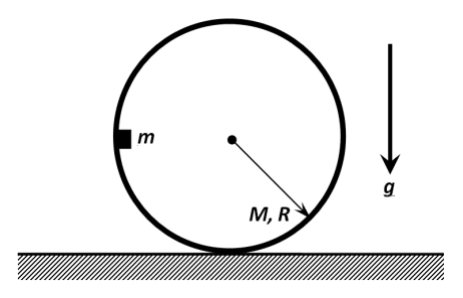
Part B (3 points)
A bubble of radius \(r=5.00\ \mathrm{cm}\), containing a diatomic ideal gas, has the soap film of thickness \(h=10.0\ \mu\mathrm{m}\) and is placed in vacuum. The soap film has the surface tension \(\sigma=4.00\cdot10^{-2}\ \frac{\mathrm{N}}{\mathrm{m}}\) and the density \(\rho=1.10\ \frac{\mathrm{g}}{\mathrm{cm}^{3}}\). 1) Find formula for the molar heat capacity of the gas in the bubble for such a process when the gas is heated so slowly that the bubble remains in a mechanical equilibrium and evaluate it; 2) Find formula for the frequency \(\omega\) of the small radial oscillations of the bubble and evaluate it under the assumption that the heat capacity of the soap film is much greater than the heat capacity of the gas in the bubble. Assume that the thermal equilibrium inside the bubble is reached much faster than the period of oscillations.
Hint: Laplace showed that there is pressure difference between inside and outside of a curved surface, caused by surface tension of the interface between liquid and gas, so that \(\Delta p=\frac{2\sigma}{r}\).
Part C (3 points)
Initially, a switch \(S\) is unshorted in the circuit shown in the figure on the right, a capacitor of capacitance \(2C\) carries the electric charge \(q_0\), a capacitor of capacitance \(C\) is uncharged, and there are no electric currents in both coils of inductance \(L\) and \(2L\), respectively. The capacitor starts to discharge and at the moment when the current in the coils reaches its maximum value, the switch \(S\) is instantly shorted. Find the maximum current \(I_{\max}\) through the switch \(S\) thereafter.
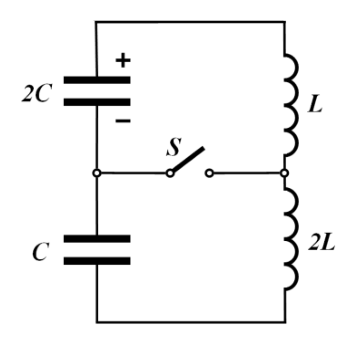
Official English text of the problem.
Problem 2: Van der Waals equation of state
In a well-known model of an ideal gas, whose equation of state obeys the Clapeyron-Mendeleev law, the following important physical effects are neglected. First, molecules of a real gas have a finite size and, secondly, they interact with one another. In all parts of this problem one mole of water is considered.
Part A. Non-ideal gas equation of state (2 points)
Taking into account the finite size of the molecules, the gaseous equation of state takes the form
\[ P(V-b)=RT, \tag{1} \]
where \(P,V,T\) stands for the gas pressure, its volume per mole and temperature, respectively, \(R\) denotes the universal gas constant, and \(b\) is a specific constant extracting some volume.
A1 Estimate \(b\) and express it in terms of the diameter of the molecules \(d\). (0.3 points) With account of intermolecular attraction forces, van der Waals proposed the following equation of state that neatly describes both the gaseous and liquid states of matter
\[ \left(P+\frac{a}{V^2}\right)(V-b)=RT. \tag{2} \]
where \(a\) is another specific constant.
At temperatures \(T\) below a certain critical value \(T_c\) the isotherm of equation (2) is well represented by a non-monotonic curve 1 shown in Figure 1 which is then called van der Waals isotherm. In the same figure curve 2 shows the isotherm of an ideal gas at the same temperature. A real isotherm differs from the van der Waals isotherm by a straight segment \(AB\) drawn at some constant pressure \(P_{LG}\). This straight segment is located between the volumes \(V_L\) and \(V_G\), and corresponds to the equilibrium of the liquid phase (indicated by \(L\)) and the gaseous phase (referred to by \(G\)). From the second law of thermodynamics J. Maxwell showed that the pressure \(P_{LG}\) must be chosen such that the areas \(I\) and \(II\) shown in Figure 1 must be equal.
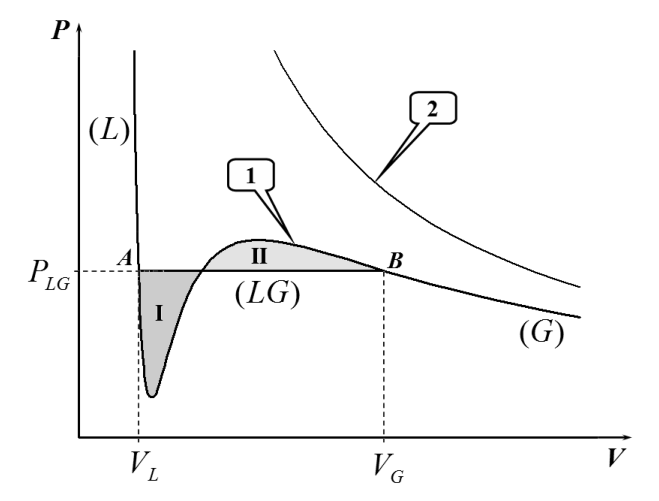
Figure 1. Van der Waals isotherm of gas/liquid (curve 1) and the isotherm of an ideal gas (curve 2).
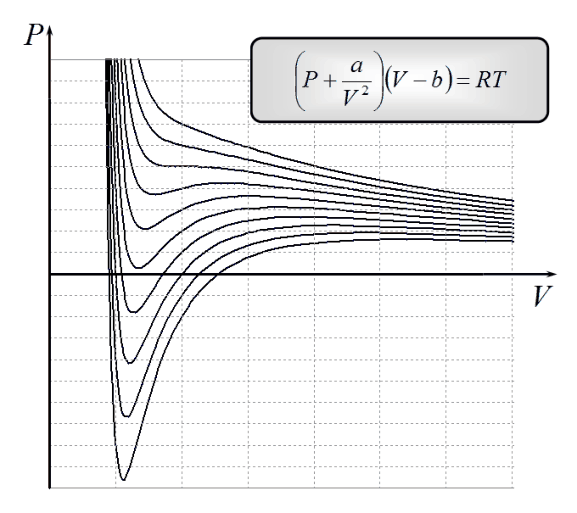
Figure 2. Several isotherms for van der Waals equation of state.
With increasing temperature the straight segment \(AB\) on the isotherm shrinks to a single point when the temperature and the pressure reaches some values \(T_c\) and \(P_{LG}=P_c\), respectively. The parameters \(P_c\) and \(T_c\) are called critical and can be measured experimentally with high degree of accuracy.
A2 Express the van der Waals constants \(a\) and \(b\) in terms of \(T_c\) and \(P_c\). (1.3 points) A3 For water \(T_c=647\ \mathrm{K}\) and \(P_c=2.2\cdot10^7\ \mathrm{Pa}\). Calculate \(a_w\) and \(b_w\) for water. (0.2 points) A4 Estimate the diameter of water molecules \(d_w\). (0.2 points) Part B. Properties of gas and liquid (6 points)
This part of the problem deals with the properties of water in the gaseous and liquid states at temperature \(T=100\,^\circ\mathrm{C}\). The saturated vapor pressure at this temperature is known to be \(p_{LG}=p_0=1.0\cdot10^5\ \mathrm{Pa}\), and the molar mass of water is \(\mu=1.8\cdot10^{-2}\ \frac{\mathrm{kg}}{\mathrm{mole}}\).
Gaseous state
It is reasonable to assume that the inequality \(V_G\gg b\) is valid for the description of water properties in a gaseous state.
B1 Derive the formula for the volume \(V_G\) and express it in terms of \(R,T,p_0,\) and \(a\). (0.8 points) Almost the same volume \(V_{G0}\) can be approximately evaluated using the ideal gas law.
B2 Evaluate in percentage the relative decrease in the gas volume due to intermolecular forces, \(\frac{\Delta V_G}{V_{G0}}=\frac{V_{G0}-V_G}{V_{G0}}\). (0.3 points) If the system volume is reduced below \(V_G\), the gas starts to condense. However, thoroughly purified gas can remain in a mechanically metastable state (called supercooled vapor) until its volume reaches a certain value \(V_{G\min}\).
The condition of mechanical stability of supercooled gas at constant temperature is written as: \(\frac{dP}{dV}<0\).
B3 Find and evaluate how many times the volume of water vapor can be reduced and still remains in a metastable state. In other words, what is \(V_G/V_{G\min}\)? (0.7 points) Liquid state
For the van der Waals’ description of water in a liquid state it is reasonable to assume that the following inequality holds \(P\ll a/V^2\).
B4 Express the volume of liquid water \(V_L\) in terms of \(a,b,R,\) and \(T\). (1.0 points) Assuming that \(bRT\ll a\), find the following characteristics of water. Do not be surprised if some of the data evaluated do not coincide with the well-known tabulated values!
B5 Express the liquid water density \(\rho_L\) in some of the terms of \(\mu,a,b,R\) and evaluate it. (0.5 points) B6 Express the volume thermal expansion coefficient \(\alpha=\frac{1}{V_L}\frac{\Delta V_L}{\Delta T}\) in terms of \(a,b,R\), and evaluate it. (0.6 points) B7 Express the specific heat of water vaporization \(L\) in terms of \(\mu,a,b,R\) and evaluate it. (1.1 points) B8 Considering the monomolecular layer of water, estimate the surface tension \(\sigma\) of water. (1.2 points) Part C. Liquid-gas system (3 points)
From Maxwell’s rule (equalities of areas, by applying trivial integration) and the van der Waals’ equation of state together with the approximations made in Part B, it can be shown that the saturated vapor pressure \(p_{LG}\) depends on temperature \(T\) as follows
\[ \ln p_{LG}=A+\frac{B}{T}, \tag{3} \]
where \(A\) and \(B\) are some constants, that can be expressed in terms of \(a\) and \(b\) as \(A=\ln\left(\frac{a}{b^2}\right)-1\); \(B=-\frac{a}{bR}\)
W. Thomson showed that the pressure of saturated vapor depends on the curvature of the liquid surface. Consider a liquid that does not wet the material of a capillary (contact angle \(180^\circ\)). When the capillary is immersed into the liquid, the liquid in the capillary drops to a certain level because of the surface tension (see Figure 3).
C1 Find a small change in pressure \(\Delta p_T\) of the saturated vapor over the curved surface of liquid and express it in terms of the vapor density \(\rho_s\), the liquid density \(\rho_L\), the surface tension \(\sigma\) and the radius of surface curvature \(r\). (1.3 points) 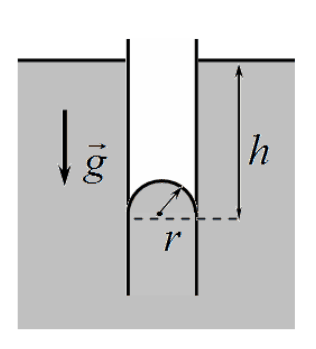
Figure 3. Capillary immersed in a liquid that does not wet its material
Metastable states, considered in part B3, are widely used in real experimental setups, such as the cloud chamber designed for registration of elementary particles. They also occur in natural phenomena such as the formation of morning dew. Supercooled vapor is subject to condensation by forming liquid droplets. Very small droplets evaporate quickly but large enough ones can still grow.
C2 Suppose that at the evening temperature of \(t_e=20\,^\circ\mathrm{C}\) the water vapor in the air was saturated, but in the morning the ambient temperature has fallen by a small amount of \(\Delta t=5.0\,^\circ\mathrm{C}\). Assuming that the vapor pressure has remained unchanged, estimate the minimum radius of droplets that can grow. Use the tabulated value of water surface tension \(\sigma=7.3\cdot10^{-2}\ \mathrm{N/m}\). (1.7 points) Official English text of the problem.
Problem 3: Simplest model of gas discharge
An electric current flowing through a gas is called a gas discharge. There are many types of gas discharges including glow discharge in lighting lamps, arc discharge in welding and the well known spark discharge that occurs between the clouds and the earth in the form of lightning.
Part A. Non-self-sustained gas discharge (4.8points)
In this part of the problem the so-called non-self-sustained gas discharge is studied. To maintain it a permanent operationan external ionizer is needed, which creates \(Z_{\mathrm{ext}}\) pairs of singly ionized ions and free electrons per unit volume and per unit time uniformly in the volume.
When an external ionizer is switched on, the number of electrons and ions starts to grow. Unlimited increase in the number densities of electrons and ions in the gas is prevented by the recombination process in which a free electron recombineswith an ion to form a neutral atom. The number of recombining events \(Z_{\mathrm{rec}}\) that occurs in the gas per unit volume and per unit time is given by
\[ Z_{\mathrm{rec}}=rn_en_i, \]
where \(r\) is a constant called the recombination coefficient, and \(n_e,n_i\) denotethe electron and ion number densities, respectively.
Suppose that at time \(t=0\) the external ionizer is switched on and the initial number densities of electrons and ions in the gas are both equal to zero. Then, the electron number density \(n_e(t)\) depends on time \(t\) as follows:
\[ n_e(t)=n_0+a\tanh bt, \]
where \(n_0,a\) and \(b\) are some constants, and \(\tanh x\) stands for the hyperbolic tangent.
A1 Find \(n_0,a,b\) and express them in terms of \(Z_{\mathrm{ext}}\) and \(r\). (1.8points) Assume that there are two external ionizers available. When the first one is switched on, the electron number density in the gas reaches its equilibrium value of be \(n_{e1}=12\cdot10^{10}\,\mathrm{cm}^{-3}\). When the second external ionizer is switched on, the electron number density reaches its equilibrium value of \(n_{e2}=16\cdot10^{10}\,\mathrm{cm}^{-3}\).
A2 Find the electron number density \(n_e\) at equilibriumwhen both external ionizers are switched on simultaneously. (0.6 points) Attention! In what follows it is assumed that the external ionizer is switched on for quite long period of time such that all processes have become stationary and do not depend on time. Completely neglect the electric field due the charge carriers.
Assume that the gas fills in the tube between the two parallel conductive plates of area \(S\) separated by the distance \(L\ll\sqrt S\) from each other. The voltage \(U\) is applied across the plates to create an electric field between them. Assume that the number densities of both kinds of charge carriers remain almost constant along the tube.
Assumethat both the electrons (denoted by thesubscript \(e\)) and the ions (denoted by the subscript \(i\)) acquire the same ordered speed \(v\) due to the electric field strength \(E\) found as
\[ v=\beta E, \]
where \(b\) isa constant called charge mobility.
A3 Express the electric current \(I\) in the tube in terms of \(U,\beta,L,S,Z_{\mathrm{ext}},r\) and \(e\) whichis the elementary charge. (1.7 points) A4 Find the resistivity \(\rho_{\mathrm{gas}}\) of the gas at sufficiently small values of the voltage applied and express it in terms of \(\beta,L,Z_{\mathrm{ext}},r\) and \(e\). (0.7 points) PartB. Self-sustained gas discharge (5.2 points)
In this part of the problem the ignition of the self-sustained gas discharge is consideredto show how the electric current in the tube becomes self-maintaining.
Attention! In the sequel assume that the external ionizer continues to operatewith the same \(Z_{\mathrm{ext}}\) rate, neglect the electric field due to the charge carriers such that the electric field is uniform along the tube, and the recombination can be completely ignored.
For the self-sustained gas discharge there are two important processes not considered above. The first process isasecondary electron emission, and the second one isa formation of electron avalanche. The secondary electron emission occurs when ions hit on the negative electrode, called a cathode, and the electrons are knocked out of it to move towards the positive electrode, called an anode. The ratio of the number of the knocked electrons \(\dot N_e\) per unit timeto the number of ions \(\dot N_i\) hitting the cathode per unit time is called the coefficient of the secondary electron emission, \(\gamma=\dot N_e/\dot N_i\). The formation of the electron avalanche isexplained as follows. The electric field accelerates free electrons which acquire enough kinetic energy to ionize the atoms in the gas by hitting them. As a result the number of free electrons moving towards the anodesignificantly increases. This process is described by the Townsend coefficient \(\alpha\), which characterizes an increase in the number of electrons \(dN_e\) due to moving \(N_e\) electrons that have passed the distance \(dl\), i.e.
\[ \frac{dN_e}{dl}=\alpha N_e. \]
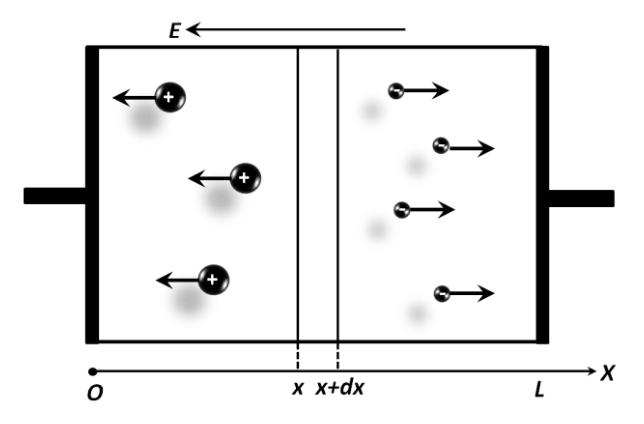
The total current \(I\) in any cross section of the gas tube consists of the ion \(I_i(x)\) and the electron \(I_e(x)\) currents which, in the steady state, depend on the coordinate \(x\), shown in the figureabove. The electron current \(I_e(x)\) varies along the \(x\)-axis according to the formula
\[ I_e(x)=C_1e^{A_1x}+A_2, \]
where \(A_1,A_2,C_1\) are some constants.
B1 Find \(A_1,A_2\) and express them in terms of \(Z_{\mathrm{ext}},\alpha,e,L,S\). (2 points) The ion current \(I_i(x)\) varies along the \(x\)-axis according to the formula
\[ I_i(x)=C_2+B_1e^{B_2x}, \]
where \(B_1,B_2,C_2\) are some constants.
B2 Find \(B_1,B_2\) and express them in terms of \(Z_{\mathrm{ext}},\alpha,e,L,S,C_1\). (0.6 points) B3 Write down the condition for \(I_i(x)\) at \(x=L\). (0.3 points) B4 Write down the condition for \(I_i(x)\) and \(I_e(x)\) at \(x=0\). (0.6 points) B5 Find the total current \(I\) and express it in terms of \(Z_{\mathrm{ext}},\alpha,\gamma,e,L,S\). Assume that it remains finite. (1.2 points) Let the Townsend coefficient \(\alpha\) be constant. When the length of the tube turns out greater than some critical value, i.e. \(L>L_{\mathrm{cr}}\), the external ionizer can be turned off and the discharge becomes self-sustained.
B6 Find \(L_{\mathrm{cr}}\) and express it in terms of \(Z_{\mathrm{ext}},\alpha,\gamma,e,L,S\). (0.5 points) Official English text of the problem.
Internationale Physik-Olympiade
IPhO 2014
Astana, Kasachstan · 3 Theorieaufgaben mit vollständigen Lösungen
Aufgabe 1: Drei unabhängige Teile: Puck in einem rollenden Zylinder, Seifenblase mit Gas, LC-Schaltung mit einem Schalter
Diese Aufgabe besteht aus drei unabhängigen Teilen.
Teil A (3 Punkte)
Ein kleiner Puck der Masse \(m\) wird vorsichtig auf die Innenfläche eines dünnwandigen Hohlzylinders der Masse \(M\) und des Radius \(R\) gesetzt. Anfangs ruht der Zylinder auf einer horizontalen Ebene, und der Puck befindet sich in der Höhe \(R\) über der Ebene, wie in der linken Abbildung dargestellt. Bestimmen Sie die Wechselwirkungskraft \(F\) zwischen dem Puck und dem Zylinder in dem Moment, in dem der Puck den tiefsten Punkt seiner Bahn durchläuft. Nehmen Sie an, dass zwischen dem Puck und der Innenfläche des Zylinders keine Reibung wirkt und dass sich der Zylinder auf der Ebene ohne Gleiten bewegt. Die Fallbeschleunigung beträgt \(g\).
Teil B (3 Punkte)
Eine Blase mit dem Radius \(r=5.00\ \mathrm{cm}\), die ein zweiatomiges ideales Gas enthält, besitzt einen Seifenfilm der Dicke \(h=10.0\ \mu\mathrm{m}\) und befindet sich im Vakuum. Der Seifenfilm hat die Oberflächenspannung \(\sigma=4.00\cdot10^{-2}\ \frac{\mathrm{N}}{\mathrm{m}}\) und die Dichte \(\rho=1.10\ \frac{\mathrm{g}}{\mathrm{cm}^{3}}\). 1) Bestimmen Sie eine Formel für die molare Wärmekapazität des Gases in der Blase für einen Prozess, bei dem das Gas so langsam erwärmt wird, dass die Blase im mechanischen Gleichgewicht bleibt, und berechnen Sie ihren Zahlenwert; 2) Bestimmen Sie eine Formel für die Kreisfrequenz \(\omega\) kleiner radialer Schwingungen der Blase und berechnen Sie ihren Zahlenwert unter der Annahme, dass die Wärmekapazität des Seifenfilms wesentlich größer ist als die Wärmekapazität des Gases in der Blase. Nehmen Sie an, dass sich das thermische Gleichgewicht innerhalb der Blase in einer Zeit einstellt, die wesentlich kürzer als die Schwingungsdauer ist.
Hinweis: Laplace zeigte, dass zwischen der Innen- und Außenseite einer gekrümmten Oberfläche eine Druckdifferenz besteht, die durch die Oberflächenspannung der Grenzfläche zwischen Flüssigkeit und Gas verursacht wird, sodass \(\Delta p=\frac{2\sigma}{r}\).
Teil C (3 Punkte)
Anfangs ist der Schalter \(S\) in der rechts abgebildeten Schaltung geöffnet, ein Kondensator der Kapazität \(2C\) trägt die elektrische Ladung \(q_0\), ein Kondensator der Kapazität \(C\) ist ungeladen, und in den beiden Spulen mit den Induktivitäten \(L\) beziehungsweise \(2L\) fließen keine elektrischen Ströme. Der Kondensator beginnt sich zu entladen, und in dem Moment, in dem der Strom in den Spulen seinen Maximalwert erreicht, wird der Schalter \(S\) augenblicklich geschlossen. Bestimmen Sie den maximalen Strom \(I_{\max}\), der danach durch den Schalter \(S\) fließt.
Aufgabentext aus dem offiziellen englischen Text übersetzt.
Aufgabe 2: Van-der-Waals-Zustandsgleichung
In einem bekannten Modell eines idealen Gases, dessen Zustandsgleichung dem Clapeyron-Mendelejew-Gesetz folgt, werden die folgenden wichtigen physikalischen Effekte vernachlässigt. Erstens haben die Moleküle eines realen Gases eine endliche Größe, und zweitens wechselwirken sie miteinander. In allen Teilen dieser Aufgabe wird ein Mol Wasser betrachtet.
Teil A. Zustandsgleichung eines nichtidealen Gases (2 Punkte)
Berücksichtigt man die endliche Größe der Moleküle, so nimmt die Zustandsgleichung des Gases die folgende Form an:
\[ P(V-b)=RT, \tag{1} \]
wobei \(P,V,T\) den Gasdruck, das Volumen pro Mol beziehungsweise die Temperatur bezeichnen, \(R\) die universelle Gaskonstante ist und \(b\) eine stoffabhängige Konstante ist, die ein bestimmtes Volumen abzieht.
A1 Schätzen Sie \(b\) ab und drücken Sie es durch den Moleküldurchmesser \(d\) aus. (0.3 Punkte) Unter Berücksichtigung der zwischenmolekularen Anziehungskräfte schlug van der Waals die folgende Zustandsgleichung vor, die sowohl den gasförmigen als auch den flüssigen Aggregatzustand gut beschreibt:
\[ \left(P+\frac{a}{V^2}\right)(V-b)=RT. \tag{2} \]
Dabei ist \(a\) eine weitere stoffabhängige Konstante.
Bei Temperaturen \(T\) unterhalb eines bestimmten kritischen Wertes \(T_c\) wird die Isotherme der Gleichung (2) durch die in Abbildung 1 gezeigte nichtmonotone Kurve 1 gut wiedergegeben; diese wird als Van-der-Waals-Isotherme bezeichnet. In derselben Abbildung zeigt Kurve 2 die Isotherme eines idealen Gases bei derselben Temperatur. Eine reale Isotherme unterscheidet sich von der Van-der-Waals-Isotherme durch einen geraden Abschnitt \(AB\), der bei einem bestimmten konstanten Druck \(P_{LG}\) verläuft. Dieser gerade Abschnitt liegt zwischen den Volumina \(V_L\) und \(V_G\) und entspricht dem Gleichgewicht zwischen der flüssigen Phase (mit \(L\) bezeichnet) und der gasförmigen Phase (mit \(G\) bezeichnet). Aus dem zweiten Hauptsatz der Thermodynamik zeigte J. Maxwell, dass der Druck \(P_{LG}\) so gewählt werden muss, dass die in Abbildung 1 dargestellten Flächen \(I\) und \(II\) gleich groß sind.
Abbildung 1. Van-der-Waals-Isotherme von Gas/Flüssigkeit (Kurve 1) und Isotherme eines idealen Gases (Kurve 2).
Abbildung 2. Mehrere Isothermen der Van-der-Waals-Zustandsgleichung.
Mit steigender Temperatur schrumpft der gerade Abschnitt \(AB\) auf der Isotherme zu einem einzigen Punkt, wenn Temperatur und Druck bestimmte Werte \(T_c\) beziehungsweise \(P_{LG}=P_c\) erreichen. Die Parameter \(P_c\) und \(T_c\) heißen kritisch und lassen sich experimentell mit hoher Genauigkeit messen.
A2 Drücken Sie die Van-der-Waals-Konstanten \(a\) und \(b\) durch \(T_c\) und \(P_c\) aus. (1.3 Punkte) A3 Für Wasser gilt \(T_c=647\ \mathrm{K}\) und \(P_c=2.2\cdot10^7\ \mathrm{Pa}\). Berechnen Sie \(a_w\) und \(b_w\) für Wasser. (0.2 Punkte) A4 Schätzen Sie den Durchmesser der Wassermoleküle \(d_w\) ab. (0.2 Punkte) Teil B. Eigenschaften von Gas und Flüssigkeit (6 Punkte)
Dieser Teil der Aufgabe behandelt die Eigenschaften von Wasser im gasförmigen und flüssigen Zustand bei der Temperatur \(T=100\,^\circ\mathrm{C}\). Der Sättigungsdampfdruck bei dieser Temperatur ist bekanntermaßen \(p_{LG}=p_0=1.0\cdot10^5\ \mathrm{Pa}\), und die molare Masse von Wasser beträgt \(\mu=1.8\cdot10^{-2}\ \frac{\mathrm{kg}}{\mathrm{mole}}\).
Gasförmiger Zustand
Zur Beschreibung der Eigenschaften von Wasser im gasförmigen Zustand ist es sinnvoll anzunehmen, dass die Ungleichung \(V_G\gg b\) gilt.
B1 Leiten Sie die Formel für das Volumen \(V_G\) her und drücken Sie es durch \(R,T,p_0,\) und \(a\) aus. (0.8 Punkte) Mit dem idealen Gasgesetz lässt sich näherungsweise ein nahezu gleiches Volumen \(V_{G0}\) bestimmen.
B2 Berechnen Sie die relative Abnahme des Gasvolumens aufgrund zwischenmolekularer Kräfte, \(\frac{\Delta V_G}{V_{G0}}=\frac{V_{G0}-V_G}{V_{G0}}\), in Prozent. (0.3 Punkte) Wird das Volumen des Systems unter \(V_G\) verringert, beginnt das Gas zu kondensieren. Ein sorgfältig gereinigtes Gas kann jedoch in einem mechanisch metastabilen Zustand (als unterkühlter Dampf bezeichnet) verbleiben, bis sein Volumen einen bestimmten Wert \(V_{G\min}\) erreicht.
Die Bedingung für die mechanische Stabilität eines unterkühlten Gases bei konstanter Temperatur lautet: \(\frac{dP}{dV}<0\).
B3 Bestimmen und berechnen Sie, um welchen Faktor das Volumen von Wasserdampf verringert werden kann, während dieser noch in einem metastabilen Zustand verbleibt. Mit anderen Worten: Wie groß ist \(V_G/V_{G\min}\)? (0.7 Punkte) Flüssiger Zustand
Für die Beschreibung von Wasser im flüssigen Zustand nach van der Waals ist es sinnvoll anzunehmen, dass die folgende Ungleichung gilt: \(P\ll a/V^2\).
B4 Drücken Sie das Volumen des flüssigen Wassers \(V_L\) durch \(a,b,R,\) und \(T\) aus. (1.0 Punkte) Bestimmen Sie unter der Annahme \(bRT\ll a\) die folgenden Eigenschaften von Wasser. Wundern Sie sich nicht, wenn einige der berechneten Werte nicht mit den bekannten Tabellenwerten übereinstimmen!
B5 Drücken Sie die Dichte des flüssigen Wassers \(\rho_L\) durch geeignete Größen aus \(\mu,a,b,R\) aus und berechnen Sie sie. (0.5 Punkte) B6 Drücken Sie den thermischen Volumenausdehnungskoeffizienten \(\alpha=\frac{1}{V_L}\frac{\Delta V_L}{\Delta T}\) durch \(a,b,R\) aus und berechnen Sie ihn. (0.6 Punkte) B7 Drücken Sie die spezifische Verdampfungswärme von Wasser \(L\) durch \(\mu,a,b,R\) aus und berechnen Sie sie. (1.1 Punkte) B8 Schätzen Sie die Oberflächenspannung \(\sigma\) von Wasser ab, indem Sie eine monomolekulare Wasserschicht betrachten. (1.2 Punkte) Teil C. Flüssigkeit-Gas-System (3 Punkte)
Aus der Maxwell-Regel (Flächengleichheit, durch einfache Integration) und der Van-der-Waals-Zustandsgleichung lässt sich zusammen mit den in Teil B vorgenommenen Näherungen zeigen, dass der Sättigungsdampfdruck \(p_{LG}\) wie folgt von der Temperatur \(T\) abhängt:
\[ \ln p_{LG}=A+\frac{B}{T}, \tag{3} \]
wobei \(A\) und \(B\) Konstanten sind, die durch \(a\) und \(b\) ausgedrückt werden können als \(A=\ln\left(\frac{a}{b^2}\right)-1\); \(B=-\frac{a}{bR}\)
W. Thomson zeigte, dass der Sättigungsdampfdruck von der Krümmung der Flüssigkeitsoberfläche abhängt. Betrachten Sie eine Flüssigkeit, die das Material einer Kapillare nicht benetzt (Kontaktwinkel \(180^\circ\)). Wird die Kapillare in die Flüssigkeit eingetaucht, sinkt die Flüssigkeit in der Kapillare aufgrund der Oberflächenspannung auf ein bestimmtes Niveau ab (siehe Abbildung 3).
C1 Bestimmen Sie eine kleine Änderung \(\Delta p_T\) des Sättigungsdampfdrucks über der gekrümmten Flüssigkeitsoberfläche und drücken Sie sie durch die Dampfdichte \(\rho_s\), die Flüssigkeitsdichte \(\rho_L\), die Oberflächenspannung \(\sigma\) und den Krümmungsradius der Oberfläche \(r\) aus. (1.3 Punkte) Abbildung 3. Eine Kapillare, die in eine Flüssigkeit eingetaucht ist, welche ihr Material nicht benetzt
Die in Teil B3 betrachteten metastabilen Zustände werden in realen Versuchsanordnungen vielfach genutzt, etwa in der Nebelkammer zum Nachweis von Elementarteilchen. Sie treten auch bei Naturerscheinungen wie der Bildung von Morgentau auf. Unterkühlter Dampf kann unter Bildung von Flüssigkeitströpfchen kondensieren. Sehr kleine Tröpfchen verdampfen schnell, hinreichend große hingegen können weiter wachsen.
C2 Nehmen Sie an, dass der Wasserdampf in der Luft bei der Abendtemperatur \(t_e=20\,^\circ\mathrm{C}\) gesättigt war, die Umgebungstemperatur am Morgen jedoch um einen kleinen Betrag von \(\Delta t=5.0\,^\circ\mathrm{C}\) gesunken ist. Schätzen Sie unter der Annahme, dass der Dampfdruck unverändert geblieben ist, den kleinsten Radius von Tröpfchen ab, die wachsen können. Verwenden Sie den Tabellenwert der Oberflächenspannung von Wasser \(\sigma=7.3\cdot10^{-2}\ \mathrm{N/m}\). (1.7 Punkte) Aufgabentext aus dem offiziellen englischen Text übersetzt.
Aufgabe 3: Einfachstes Modell einer Gasentladung
Ein elektrischer Strom, der durch ein Gas fließt, wird als Gasentladung bezeichnet. Es gibt viele Arten von Gasentladungen, darunter die Glimmentladung in Beleuchtungslampen, die Bogenentladung beim Schweißen und die bekannte Funkenentladung, die zwischen den Wolken und der Erde in Form von Blitzen auftritt.
Teil A. Unselbstständige Gasentladung (4.8 Punkte)
In diesem Teil der Aufgabe wird die sogenannte unselbstständige Gasentladung untersucht. Zu ihrer Aufrechterhaltung muss ständig ein externer Ionisator betrieben werden, der gleichmäßig im gesamten Volumen pro Volumeneinheit und Zeiteinheit \(Z_{\mathrm{ext}}\) Paare aus einfach ionisierten Ionen und freien Elektronen erzeugt.
Wird ein externer Ionisator eingeschaltet, beginnt die Anzahl der Elektronen und Ionen zu wachsen. Ein unbegrenzter Anstieg der Anzahldichten der Elektronen und Ionen im Gas wird durch den Rekombinationsprozess verhindert, bei dem sich ein freies Elektron mit einem Ion zu einem neutralen Atom vereinigt. Die Anzahl der Rekombinationsereignisse \(Z_{\mathrm{rec}}\), die im Gas pro Volumeneinheit und Zeiteinheit auftreten, ist gegeben durch
\[ Z_{\mathrm{rec}}=rn_en_i, \]
wobei \(r\) eine Konstante ist, die als Rekombinationskoeffizient bezeichnet wird, und \(n_e,n_i\) die Anzahldichten der Elektronen beziehungsweise der Ionen bezeichnen.
Es sei angenommen, dass der externe Ionisator zum Zeitpunkt \(t=0\) eingeschaltet wird und die anfänglichen Anzahldichten der Elektronen und Ionen im Gas beide gleich null sind. Dann hängt die Elektronenanzahldichte \(n_e(t)\) wie folgt von der Zeit \(t\) ab:
\[ n_e(t)=n_0+a\tanh bt, \]
wobei \(n_0,a\) und \(b\) Konstanten sind und \(\tanh x\) für den Tangens hyperbolicus steht.
A1 Bestimmen Sie \(n_0,a,b\) und drücken Sie diese durch \(Z_{\mathrm{ext}}\) und \(r\) aus. (1.8 Punkte) Es seien zwei externe Ionisatoren verfügbar. Wird der erste eingeschaltet, erreicht die Elektronenanzahldichte im Gas ihren Gleichgewichtswert \(n_{e1}=12\cdot10^{10}\,\mathrm{cm}^{-3}\). Wird der zweite externe Ionisator eingeschaltet, erreicht die Elektronenanzahldichte ihren Gleichgewichtswert \(n_{e2}=16\cdot10^{10}\,\mathrm{cm}^{-3}\).
A2 Bestimmen Sie die Elektronenanzahldichte \(n_e\) im Gleichgewicht, wenn beide externen Ionisatoren gleichzeitig eingeschaltet sind. (0.6 Punkte) Achtung! Im Folgenden wird angenommen, dass der externe Ionisator bereits so lange eingeschaltet ist, dass alle Vorgänge stationär geworden sind und nicht mehr von der Zeit abhängen. Vernachlässigen Sie das elektrische Feld der Ladungsträger vollständig.
Es sei angenommen, dass das Gas die Röhre zwischen zwei parallelen leitenden Platten mit der Fläche \(S\) ausfüllt, die sich im Abstand \(L\ll\sqrt S\) voneinander befinden. An die Platten wird die Spannung \(U\) angelegt, um zwischen ihnen ein elektrisches Feld zu erzeugen. Nehmen Sie an, dass die Anzahldichten beider Arten von Ladungsträgern entlang der Röhre nahezu konstant bleiben.
Nehmen Sie an, dass sowohl die Elektronen (gekennzeichnet durch den Index \(e\)) als auch die Ionen (gekennzeichnet durch den Index \(i\)) aufgrund der elektrischen Feldstärke \(E\) denselben Betrag der Driftgeschwindigkeit \(v\) annehmen, der sich ergibt zu
\[ v=\beta E, \]
wobei \(b\) eine Konstante ist, die als Ladungsträgerbeweglichkeit bezeichnet wird.
A3 Drücken Sie die elektrische Stromstärke \(I\) in der Röhre durch \(U,\beta,L,S,Z_{\mathrm{ext}},r\) und die Elementarladung \(e\) aus. (1.7 Punkte) A4 Bestimmen Sie den spezifischen Widerstand \(\rho_{\mathrm{gas}}\) des Gases bei hinreichend kleinen Werten der angelegten Spannung und drücken Sie ihn durch \(\beta,L,Z_{\mathrm{ext}},r\) und \(e\) aus. (0.7 Punkte) Teil B. Selbstständige Gasentladung (5.2 Punkte)
In diesem Teil der Aufgabe wird die Zündung einer selbstständigen Gasentladung betrachtet, um zu zeigen, wie sich der elektrische Strom in der Röhre selbst aufrechterhält.
Achtung! Nehmen Sie im Folgenden an, dass der externe Ionisator weiterhin mit derselben Rate \(Z_{\mathrm{ext}}\) arbeitet. Vernachlässigen Sie das elektrische Feld der Ladungsträger, sodass das elektrische Feld entlang der Röhre homogen ist, und vernachlässigen Sie die Rekombination vollständig.
Für die selbstständige Gasentladung sind zwei wichtige Prozesse von Bedeutung, die oben nicht berücksichtigt wurden. Der erste Prozess ist die Sekundärelektronenemission, der zweite die Bildung einer Elektronenlawine. Sekundärelektronenemission tritt auf, wenn Ionen auf die negative Elektrode, die Kathode, treffen und dabei Elektronen aus ihr herausschlagen, die sich zur positiven Elektrode, der Anode, bewegen. Das Verhältnis der Anzahl der pro Zeiteinheit herausgeschlagenen Elektronen \(\dot N_e\) zur Anzahl der pro Zeiteinheit auf die Kathode treffenden Ionen \(\dot N_i\) wird als Sekundärelektronenemissionskoeffizient bezeichnet, \(\gamma=\dot N_e/\dot N_i\). Die Bildung einer Elektronenlawine lässt sich wie folgt erklären. Das elektrische Feld beschleunigt freie Elektronen, die genügend kinetische Energie gewinnen, um durch Stöße die Atome im Gas zu ionisieren. Dadurch nimmt die Anzahl der freien Elektronen, die sich zur Anode bewegen, erheblich zu. Dieser Prozess wird durch den Townsend-Koeffizienten \(\alpha\) beschrieben, der den Zuwachs der Elektronenanzahl \(dN_e\) charakterisiert, wenn \(N_e\) bewegte Elektronen die Strecke \(dl\) zurückgelegt haben, d. h.
\[ \frac{dN_e}{dl}=\alpha N_e. \]
Der Gesamtstrom \(I\) in einem beliebigen Querschnitt der Gasröhre setzt sich aus dem Ionenstrom \(I_i(x)\) und dem Elektronenstrom \(I_e(x)\) zusammen, die im stationären Zustand von der in der obigen Abbildung dargestellten Koordinate \(x\) abhängen. Der Elektronenstrom \(I_e(x)\) ändert sich entlang der \(x\)-Achse gemäß der Formel
\[ I_e(x)=C_1e^{A_1x}+A_2, \]
wobei \(A_1,A_2,C_1\) Konstanten sind.
B1 Bestimmen Sie \(A_1,A_2\) und drücken Sie diese durch \(Z_{\mathrm{ext}},\alpha,e,L,S\) aus. (2 Punkte) Der Ionenstrom \(I_i(x)\) ändert sich entlang der \(x\)-Achse gemäß der Formel
\[ I_i(x)=C_2+B_1e^{B_2x}, \]
wobei \(B_1,B_2,C_2\) Konstanten sind.
B2 Bestimmen Sie \(B_1,B_2\) und drücken Sie diese durch \(Z_{\mathrm{ext}},\alpha,e,L,S,C_1\) aus. (0.6 Punkte) B3 Geben Sie die Bedingung für \(I_i(x)\) bei \(x=L\) an. (0.3 Punkte) B4 Geben Sie die Bedingung für \(I_i(x)\) und \(I_e(x)\) bei \(x=0\) an. (0.6 Punkte) B5 Bestimmen Sie den Gesamtstrom \(I\) und drücken Sie ihn durch \(Z_{\mathrm{ext}},\alpha,\gamma,e,L,S\) aus. Nehmen Sie an, dass er endlich bleibt. (1.2 Punkte) Der Townsend-Koeffizient \(\alpha\) sei konstant. Wenn die Länge der Röhre einen bestimmten kritischen Wert überschreitet, d. h. \(L>L_{\mathrm{cr}}\), kann der externe Ionisator abgeschaltet werden, und die Entladung wird selbstständig.
B6 Bestimmen Sie \(L_{\mathrm{cr}}\) und drücken Sie diese Größe durch \(Z_{\mathrm{ext}},\alpha,\gamma,e,L,S\) aus. (0.5 Punkte) Aufgabentext aus dem offiziellen englischen Text übersetzt.
Uluslararası Fizik Olimpiyatı
IPhO 2014
Astana, Kazakistan · 3 teori sorusu, tam çözümleriyle
Soru 1: Üç bağımsız bölüm: yuvarlanan bir silindirin içindeki disk, gaz içeren sabun köpüğü, anahtarlı LC devresi
Bu soru birbirinden bağımsız üç bölümden oluşmaktadır.
Bölüm A (3 puan)
Kütlesi \(m\) olan küçük bir disk, kütlesi \(M\) ve yarıçapı \(R\) olan ince cidarlı, içi boş bir silindirin iç yüzeyine dikkatlice yerleştirilir. Başlangıçta silindir yatay düzlem üzerinde durmaktadır ve disk, soldaki şekilde gösterildiği gibi düzlemden \(R\) yüksekliğindedir. Diskin yörüngesinin en alt noktasından geçtiği anda disk ile silindir arasındaki etkileşim kuvveti \(F\)'yi bulunuz. Disk ile silindirin iç yüzeyi arasında sürtünme olmadığını ve silindirin düzlem üzerinde kaymadan hareket ettiğini varsayınız. Serbest düşme ivmesi \(g\)'dir.
Bölüm B (3 puan)
İki atomlu bir ideal gaz içeren, yarıçapı \(r=5.00\ \mathrm{cm}\) olan bir sabun köpüğünün sabun zarının kalınlığı \(h=10.0\ \mu\mathrm{m}\)'dir ve köpük vakumda bulunmaktadır. Sabun zarının yüzey gerilimi \(\sigma=4.00\cdot10^{-2}\ \frac{\mathrm{N}}{\mathrm{m}}\), yoğunluğu ise \(\rho=1.10\ \frac{\mathrm{g}}{\mathrm{cm}^{3}}\)'tür. 1) Gazın, köpük mekanik dengede kalacak kadar yavaş ısıtıldığı bir süreçte, köpüğün içindeki gazın molar ısı kapasitesinin formülünü bulunuz ve sayısal değerini hesaplayınız; 2) Sabun zarının ısı kapasitesinin köpüğün içindeki gazın ısı kapasitesinden çok daha büyük olduğunu varsayarak, köpüğün küçük radyal salınımlarının frekansı \(\omega\)'nın formülünü bulunuz ve sayısal değerini hesaplayınız. Köpüğün içinde ısıl dengeye ulaşılma süresinin salınım periyodundan çok daha kısa olduğunu varsayınız.
İpucu: Laplace, eğri bir yüzeyin içi ile dışı arasında, sıvı ile gaz arasındaki arayüzün yüzey geriliminden kaynaklanan bir basınç farkı bulunduğunu ve bu farkın \(\Delta p=\frac{2\sigma}{r}\) olduğunu göstermiştir.
Bölüm C (3 puan)
Sağdaki şekilde gösterilen devrede başlangıçta \(S\) anahtarı açıktır; sığası \(2C\) olan kondansatör \(q_0\) elektrik yükünü taşımakta, sığası \(C\) olan kondansatör yüksüz bulunmakta ve indüktansları sırasıyla \(L\) ve \(2L\) olan iki bobinden de elektrik akımı geçmemektedir. Kondansatör boşalmaya başlar ve bobinlerdeki akımın en büyük değerine ulaştığı anda \(S\) anahtarı aniden kapatılır. Bundan sonra \(S\) anahtarından geçen en büyük akım \(I_{\max}\)'ı bulunuz.
Soru metni resmi İngilizce metinden çevrilmiştir.
Soru 2: Van der Waals hâl denklemi
Hâl denklemi Clapeyron-Mendeleev yasasına uyan, iyi bilinen ideal gaz modelinde aşağıdaki önemli fiziksel etkiler ihmal edilir. Birincisi, gerçek bir gazın molekülleri sonlu büyüklüktedir; ikincisi, birbirleriyle etkileşirler. Bu sorunun tüm bölümlerinde bir mol su ele alınmaktadır.
Bölüm A. İdeal olmayan gazın hâl denklemi (2 puan)
Moleküllerin sonlu büyüklüğü hesaba katıldığında, gazın hâl denklemi şu biçimi alır:
\[ P(V-b)=RT, \tag{1} \]
burada \(P,V,T\) sırasıyla gazın basıncını, mol başına hacmini ve sıcaklığını, \(R\) evrensel gaz sabitini, \(b\) ise hacimden belirli bir miktarın çıkarılmasını sağlayan, maddeye özgü bir sabiti gösterir.
A1 \(b\)'yi tahmin edin ve moleküllerin çapı \(d\) cinsinden ifade edin. (0.3 puan) Moleküller arası çekim kuvvetlerini hesaba katan van der Waals, maddenin hem gaz hem de sıvı hâllerini başarılı biçimde betimleyen aşağıdaki hâl denklemini önermiştir:
\[ \left(P+\frac{a}{V^2}\right)(V-b)=RT. \tag{2} \]
Burada \(a\), maddeye özgü başka bir sabittir.
Belirli bir kritik değer \(T_c\)'nin altındaki \(T\) sıcaklıklarında, (2) denkleminin izotermi, Şekil 1'de gösterilen ve van der Waals izotermi olarak adlandırılan monoton olmayan 1 eğrisiyle iyi biçimde temsil edilir. Aynı şekildeki 2 eğrisi, aynı sıcaklıktaki bir ideal gazın izotermini gösterir. Gerçek izoterm, van der Waals izoterminden, belirli bir sabit \(P_{LG}\) basıncında çizilen \(AB\) doğru parçasıyla ayrılır. Bu doğru parçası \(V_L\) ve \(V_G\) hacimleri arasında yer alır ve sıvı faz (\(L\) ile gösterilen) ile gaz fazının (\(G\) ile gösterilen) dengesine karşılık gelir. J. Maxwell, termodinamiğin ikinci yasasından hareketle, \(P_{LG}\) basıncının Şekil 1'de gösterilen \(I\) ve \(II\) alanları eşit olacak şekilde seçilmesi gerektiğini göstermiştir.
Şekil 1. Gaz/sıvının van der Waals izotermi (1 eğrisi) ve bir ideal gazın izotermi (2 eğrisi).
Şekil 2. Van der Waals hâl denkleminin çeşitli izotermleri.
Sıcaklık arttıkça izoterm üzerindeki \(AB\) doğru parçası küçülür; sıcaklık ve basınç sırasıyla belirli \(T_c\) ve \(P_{LG}=P_c\) değerlerine ulaştığında tek bir noktaya dönüşür. \(P_c\) ve \(T_c\) parametrelerine kritik parametreler denir ve bunlar deneysel olarak yüksek doğrulukla ölçülebilir.
A2 Van der Waals sabitleri \(a\) ve \(b\)'yi \(T_c\) ve \(P_c\) cinsinden ifade edin. (1.3 puan) A3 Su için \(T_c=647\ \mathrm{K}\) ve \(P_c=2.2\cdot10^7\ \mathrm{Pa}\)'dır. Su için \(a_w\) ve \(b_w\)'yi hesaplayın. (0.2 puan) A4 Su moleküllerinin çapı \(d_w\)'yi tahmin edin. (0.2 puan) Bölüm B. Gaz ve sıvının özellikleri (6 puan)
Sorunun bu bölümü, \(T=100\,^\circ\mathrm{C}\) sıcaklığında gaz ve sıvı hâllerindeki suyun özelliklerini ele almaktadır. Bu sıcaklıktaki doymuş buhar basıncının \(p_{LG}=p_0=1.0\cdot10^5\ \mathrm{Pa}\) olduğu bilinmektedir ve suyun mol kütlesi \(\mu=1.8\cdot10^{-2}\ \frac{\mathrm{kg}}{\mathrm{mole}}\)'dür.
Gaz hâli
Gaz hâlindeki suyun özelliklerini betimlemek için \(V_G\gg b\) eşitsizliğinin geçerli olduğunu varsaymak makuldür.
B1 \(V_G\) hacminin formülünü türetin ve bunu \(R,T,p_0,\) ve \(a\) cinsinden ifade edin. (0.8 puan) Neredeyse aynı hacim olan \(V_{G0}\), ideal gaz yasası kullanılarak yaklaşık olarak hesaplanabilir.
B2 Moleküller arası kuvvetlerden kaynaklanan gaz hacmindeki bağıl azalmayı, \(\frac{\Delta V_G}{V_{G0}}=\frac{V_{G0}-V_G}{V_{G0}}\), yüzde olarak hesaplayın. (0.3 puan) Sistemin hacmi \(V_G\)'nin altına düşürülürse gaz yoğuşmaya başlar. Ancak iyice saflaştırılmış bir gaz, hacmi belirli bir \(V_{G\min}\) değerine ulaşıncaya kadar mekanik olarak yarı kararlı bir durumda (aşırı soğutulmuş buhar olarak adlandırılır) kalabilir.
Aşırı soğutulmuş gazın sabit sıcaklıkta mekanik kararlılık koşulu şöyle yazılır: \(\frac{dP}{dV}<0\).
B3 Su buharının hacminin, yarı kararlı durumda kalmaya devam ederken kaç kat küçültülebileceğini bulun ve hesaplayın. Başka bir deyişle, \(V_G/V_{G\min}\) nedir? (0.7 puan) Sıvı hâli
Sıvı hâlindeki suyun van der Waals betimlemesi için \(P\ll a/V^2\) eşitsizliğinin geçerli olduğunu varsaymak makuldür.
B4 Sıvı suyun hacmi \(V_L\)'yi \(a,b,R,\) ve \(T\) cinsinden ifade edin. (1.0 puan) \(bRT\ll a\) olduğunu varsayarak suyun aşağıdaki özelliklerini bulun. Hesaplanan bazı değerler, tablolarda verilen iyi bilinen değerlerle uyuşmazsa şaşırmayın!
B5 Sıvı suyun yoğunluğu \(\rho_L\)'yi \(\mu,a,b,R\) büyüklüklerinden bazıları cinsinden ifade edin ve hesaplayın. (0.5 puan) B6 Hacimsel ısıl genleşme katsayısı \(\alpha=\frac{1}{V_L}\frac{\Delta V_L}{\Delta T}\)'yı \(a,b,R\) cinsinden ifade edin ve hesaplayın. (0.6 puan) B7 Suyun özgül buharlaşma ısısı \(L\)'yi \(\mu,a,b,R\) cinsinden ifade edin ve hesaplayın. (1.1 puan) B8 Suyun tek molekül kalınlığındaki tabakasını ele alarak suyun yüzey gerilimi \(\sigma\)'yı tahmin edin. (1.2 puan) Bölüm C. Sıvı-gaz sistemi (3 puan)
Maxwell kuralı (basit bir integral alınarak alanların eşitliği) ve van der Waals hâl denklemi, Bölüm B'de yapılan yaklaşımlarla birlikte kullanılarak doymuş buhar basıncı \(p_{LG}\)'nin \(T\) sıcaklığına aşağıdaki gibi bağlı olduğu gösterilebilir:
\[ \ln p_{LG}=A+\frac{B}{T}, \tag{3} \]
burada \(A\) ve \(B\), \(a\) ve \(b\) cinsinden \(A=\ln\left(\frac{a}{b^2}\right)-1\); \(B=-\frac{a}{bR}\) olarak ifade edilebilen sabitlerdir.
W. Thomson, doymuş buhar basıncının sıvı yüzeyinin eğriliğine bağlı olduğunu göstermiştir. Bir kılcal borunun malzemesini ıslatmayan bir sıvıyı ele alın (temas açısı \(180^\circ\)). Kılcal boru sıvıya daldırıldığında, borudaki sıvı yüzey gerilimi nedeniyle belirli bir seviyeye kadar alçalır (bkz. Şekil 3).
C1 Sıvının eğri yüzeyi üzerindeki doymuş buharın basıncındaki küçük \(\Delta p_T\) değişimini bulun ve bunu buhar yoğunluğu \(\rho_s\), sıvı yoğunluğu \(\rho_L\), yüzey gerilimi \(\sigma\) ve yüzeyin eğrilik yarıçapı \(r\) cinsinden ifade edin. (1.3 puan) Şekil 3. Malzemesini ıslatmayan bir sıvıya daldırılmış kılcal boru
B3 bölümünde ele alınan yarı kararlı durumlar, temel parçacıkların kaydedilmesi için tasarlanmış sis odası gibi gerçek deney düzeneklerinde yaygın olarak kullanılır. Bu durumlar, sabah çiyinin oluşması gibi doğa olaylarında da ortaya çıkar. Aşırı soğutulmuş buhar, sıvı damlacıkları oluşturarak yoğuşabilir. Çok küçük damlacıklar hızla buharlaşır, ancak yeterince büyük olanlar büyümeye devam edebilir.
C2 Akşam \(t_e=20\,^\circ\mathrm{C}\) sıcaklığında havadaki su buharının doymuş olduğunu, ancak sabah ortam sıcaklığının küçük bir miktar olan \(\Delta t=5.0\,^\circ\mathrm{C}\) kadar düştüğünü varsayın. Buhar basıncının değişmeden kaldığını varsayarak büyüyebilen damlacıkların minimum yarıçapını tahmin edin. Suyun yüzey geriliminin tablodaki değeri olan \(\sigma=7.3\cdot10^{-2}\ \mathrm{N/m}\)'yi kullanın. (1.7 puan) Soru metni resmi İngilizce metinden çevrilmiştir.
Soru 3: Gaz deşarjının en basit modeli
Bir gazın içinden geçen elektrik akımına gaz deşarjı denir. Aydınlatma lambalarındaki ışıma deşarjı, kaynak işlemlerindeki ark deşarjı ve bulutlarla yer arasında yıldırım biçiminde oluşan, iyi bilinen kıvılcım deşarjı da dahil olmak üzere birçok gaz deşarjı türü vardır.
Bölüm A. Kendiliğinden sürmeyen gaz deşarjı (4.8 puan)
Sorunun bu bölümünde, kendiliğinden sürmeyen gaz deşarjı olarak adlandırılan olay incelenmektedir. Bu deşarjın sürmesi için, hacmin her yerinde düzgün olarak birim hacim ve birim zamanda \(Z_{\mathrm{ext}}\) adet tek yüklü iyon ve serbest elektron çifti oluşturan bir dış iyonlaştırıcının sürekli çalışması gerekir.
Dış iyonlaştırıcı açıldığında elektron ve iyon sayısı artmaya başlar. Gazdaki elektron ve iyonların sayı yoğunluklarının sınırsız biçimde artması, serbest bir elektronun bir iyonla birleşerek nötr bir atom oluşturduğu yeniden birleşme süreciyle engellenir. Gazda birim hacim ve birim zamanda gerçekleşen yeniden birleşme olaylarının sayısı \(Z_{\mathrm{rec}}\),
\[ Z_{\mathrm{rec}}=rn_en_i, \]
ile verilir; burada \(r\), yeniden birleşme katsayısı adı verilen bir sabittir ve \(n_e,n_i\) sırasıyla elektron ve iyon sayı yoğunluklarını gösterir.
Dış iyonlaştırıcının \(t=0\) anında açıldığını ve gazdaki elektron ve iyonların başlangıçtaki sayı yoğunluklarının her ikisinin de sıfır olduğunu varsayın. Bu durumda elektron sayı yoğunluğu \(n_e(t)\), \(t\) zamanına aşağıdaki gibi bağlıdır:
\[ n_e(t)=n_0+a\tanh bt, \]
burada \(n_0,a\) ve \(b\) bazı sabitlerdir ve \(\tanh x\) hiperbolik tanjantı gösterir.
A1 \(n_0,a,b\) sabitlerini bulun ve bunları \(Z_{\mathrm{ext}}\) ve \(r\) cinsinden ifade edin. (1.8 puan) İki dış iyonlaştırıcının mevcut olduğunu varsayın. Birincisi açıldığında gazdaki elektron sayı yoğunluğu, \(n_{e1}=12\cdot10^{10}\,\mathrm{cm}^{-3}\) denge değerine ulaşmaktadır. İkinci dış iyonlaştırıcı açıldığında elektron sayı yoğunluğu, \(n_{e2}=16\cdot10^{10}\,\mathrm{cm}^{-3}\) denge değerine ulaşmaktadır.
A2 Her iki dış iyonlaştırıcı aynı anda açıldığında dengedeki elektron sayı yoğunluğunu \(n_e\) bulun. (0.6 puan) Dikkat! Bundan sonra, dış iyonlaştırıcının tüm süreçlerin kararlı hâle gelmesine ve zamandan bağımsız olmasına yetecek kadar uzun bir süredir açık olduğu varsayılmaktadır. Yük taşıyıcılarından kaynaklanan elektrik alanını tamamen ihmal edin.
Gazın, alanları \(S\) olan ve aralarında \(L\ll\sqrt S\) uzaklığı bulunan iki paralel iletken levha arasındaki tüpü doldurduğunu varsayın. Levhalar arasında bir elektrik alanı oluşturmak için levhalara \(U\) gerilimi uygulanmaktadır. Her iki tür yük taşıyıcısının sayı yoğunluklarının tüp boyunca hemen hemen sabit kaldığını varsayın.
Hem elektronların (\(e\) alt indisiyle gösterilen) hem de iyonların (\(i\) alt indisiyle gösterilen), \(E\) elektrik alan şiddeti nedeniyle aynı \(v\) sürüklenme süratini kazandığını varsayın. Bu sürat,
\[ v=\beta E, \]
ile verilir; burada \(b\), yük hareketliliği adı verilen bir sabittir.
A3 Tüpteki elektrik akımını \(I\), \(U,\beta,L,S,Z_{\mathrm{ext}},r\) ve temel yük olan \(e\) cinsinden ifade edin. (1.7 puan) A4 Uygulanan gerilimin yeterince küçük değerleri için gazın özdirencini \(\rho_{\mathrm{gas}}\) bulun ve bunu \(\beta,L,Z_{\mathrm{ext}},r\) ve \(e\) cinsinden ifade edin. (0.7 puan) Bölüm B. Kendiliğinden süren gaz deşarjı (5.2 puan)
Sorunun bu bölümünde, tüpteki elektrik akımının nasıl kendi kendini sürdürür hâle geldiğini göstermek amacıyla kendiliğinden süren gaz deşarjının başlaması ele alınmaktadır.
Dikkat! Bundan sonra, dış iyonlaştırıcının aynı \(Z_{\mathrm{ext}}\) hızıyla çalışmaya devam ettiğini varsayın; elektrik alanının tüp boyunca düzgün olması için yük taşıyıcılarından kaynaklanan elektrik alanını ihmal edin ve yeniden birleşmeyi tamamen göz ardı edin.
Kendiliğinden süren gaz deşarjında, yukarıda ele alınmayan iki önemli süreç vardır. İlk süreç ikincil elektron yayımı, ikincisi ise elektron çığı oluşumudur. İkincil elektron yayımı, iyonların katot adı verilen negatif elektroda çarpması ve buradan kopan elektronların anot adı verilen pozitif elektroda doğru hareket etmesiyle gerçekleşir. Birim zamanda koparılan elektron sayısının \(\dot N_e\), birim zamanda katoda çarpan iyon sayısına \(\dot N_i\) oranına ikincil elektron yayım katsayısı denir: \(\gamma=\dot N_e/\dot N_i\). Elektron çığının oluşumu şu şekilde açıklanır. Elektrik alanı serbest elektronları hızlandırır; bu elektronlar, gazdaki atomlara çarparak onları iyonlaştırmaya yetecek kinetik enerjiyi kazanır. Sonuç olarak anoda doğru hareket eden serbest elektronların sayısı önemli ölçüde artar. Bu süreç, \(dl\) uzaklığını kateden \(N_e\) hareketli elektron nedeniyle elektron sayısında meydana gelen \(dN_e\) artışını niteleyen Townsend katsayısı \(\alpha\) ile tanımlanır; yani
\[ \frac{dN_e}{dl}=\alpha N_e. \]
Gaz tüpünün herhangi bir kesitindeki toplam akım \(I\), kararlı durumda yukarıdaki şekilde gösterilen \(x\) koordinatına bağlı olan iyon akımı \(I_i(x)\) ile elektron akımı \(I_e(x)\)'ten oluşur. Elektron akımı \(I_e(x)\), \(x\) ekseni boyunca aşağıdaki bağıntıya göre değişir:
\[ I_e(x)=C_1e^{A_1x}+A_2, \]
burada \(A_1,A_2,C_1\) bazı sabitlerdir.
B1 \(A_1,A_2\) sabitlerini bulun ve bunları \(Z_{\mathrm{ext}},\alpha,e,L,S\) cinsinden ifade edin. (2 puan) İyon akımı \(I_i(x)\), \(x\) ekseni boyunca aşağıdaki bağıntıya göre değişir:
\[ I_i(x)=C_2+B_1e^{B_2x}, \]
burada \(B_1,B_2,C_2\) bazı sabitlerdir.
B2 \(B_1,B_2\) sabitlerini bulun ve bunları \(Z_{\mathrm{ext}},\alpha,e,L,S,C_1\) cinsinden ifade edin. (0.6 puan) B3 \(x=L\) noktasında \(I_i(x)\) için geçerli koşulu yazın. (0.3 puan) B4 \(x=0\) noktasında \(I_i(x)\) ve \(I_e(x)\) için geçerli koşulu yazın. (0.6 puan) B5 Toplam akımı \(I\) bulun ve bunu \(Z_{\mathrm{ext}},\alpha,\gamma,e,L,S\) cinsinden ifade edin. Akımın sonlu kaldığını varsayın. (1.2 puan) Townsend katsayısı \(\alpha\) sabit olsun. Tüpün uzunluğu belirli bir kritik değerden büyük olduğunda, yani \(L>L_{\mathrm{cr}}\) olduğunda, dış iyonlaştırıcı kapatılabilir ve deşarj kendiliğinden sürer hâle gelir.
B6 \(L_{\mathrm{cr}}\) değerini bulun ve bunu \(Z_{\mathrm{ext}},\alpha,\gamma,e,L,S\) cinsinden ifade edin. (0.5 puan) Soru metni resmi İngilizce metinden çevrilmiştir.
Olimpiada Internacional de Física
IPhO 2014
Astaná, Kazajistán · 3 problemas teóricos con soluciones completas
Problema 1: Tres partes independientes: disco en un cilindro que rueda, burbuja de jabón con gas, circuito LC con un interruptor
Este problema consta de tres partes independientes.
Parte A (3 puntos)
Se coloca cuidadosamente un pequeño disco de masa \(m\) sobre la superficie interior de un cilindro hueco de pared delgada, de masa \(M\) y radio \(R\). Inicialmente, el cilindro está en reposo sobre el plano horizontal y el disco se encuentra a una altura \(R\) sobre el plano, como se muestra en la figura de la izquierda. Halle la fuerza de interacción \(F\) entre el disco y el cilindro en el instante en que el disco pasa por el punto más bajo de su trayectoria. Suponga que no hay rozamiento entre el disco y la superficie interior del cilindro, y que el cilindro se mueve sobre el plano sin deslizar. La aceleración de caída libre es \(g\).
Parte B (3 puntos)
Una burbuja de radio \(r=5.00\ \mathrm{cm}\), que contiene un gas ideal diatómico, tiene una película de jabón de espesor \(h=10.0\ \mu\mathrm{m}\) y se encuentra en el vacío. La película de jabón tiene una tensión superficial \(\sigma=4.00\cdot10^{-2}\ \frac{\mathrm{N}}{\mathrm{m}}\) y una densidad \(\rho=1.10\ \frac{\mathrm{g}}{\mathrm{cm}^{3}}\). 1) Halle una fórmula para la capacidad calorífica molar del gas de la burbuja en un proceso en el que el gas se calienta tan lentamente que la burbuja permanece en equilibrio mecánico, y calcule su valor; 2) Halle una fórmula para la frecuencia \(\omega\) de las pequeñas oscilaciones radiales de la burbuja y calcule su valor suponiendo que la capacidad calorífica de la película de jabón es mucho mayor que la capacidad calorífica del gas de la burbuja. Suponga que el equilibrio térmico en el interior de la burbuja se alcanza en un tiempo mucho menor que el período de las oscilaciones.
Indicación: Laplace demostró que existe una diferencia de presión entre el interior y el exterior de una superficie curva, causada por la tensión superficial de la interfaz entre el líquido y el gas, de modo que \(\Delta p=\frac{2\sigma}{r}\).
Parte C (3 puntos)
Inicialmente, un interruptor \(S\) está abierto en el circuito que se muestra en la figura de la derecha, un condensador de capacidad \(2C\) tiene una carga eléctrica \(q_0\), un condensador de capacidad \(C\) está descargado y no circula corriente eléctrica por ninguna de las dos bobinas, de inductancias \(L\) y \(2L\), respectivamente. El condensador comienza a descargarse y, en el instante en que la corriente en las bobinas alcanza su valor máximo, el interruptor \(S\) se cierra instantáneamente. Halle la corriente máxima \(I_{\max}\) que circula por el interruptor \(S\) a partir de ese momento.
Enunciado traducido del texto oficial en inglés.
Problema 2: Ecuación de estado de Van der Waals
En un conocido modelo de gas ideal, cuya ecuación de estado obedece la ley de Clapeyron-Mendeleev, se desprecian los siguientes efectos físicos importantes. En primer lugar, las moléculas de un gas real tienen un tamaño finito y, en segundo lugar, interactúan entre sí. En todas las partes de este problema se considera un mol de agua.
Parte A. Ecuación de estado de un gas no ideal (2 puntos)
Al tener en cuenta el tamaño finito de las moléculas, la ecuación de estado del gas adopta la forma
\[ P(V-b)=RT, \tag{1} \]
donde \(P,V,T\) representan la presión del gas, su volumen por mol y su temperatura, respectivamente, \(R\) denota la constante universal de los gases y \(b\) es una constante específica que resta cierto volumen.
A1 Estime \(b\) y exprésela en función del diámetro de las moléculas \(d\). (0.3 puntos) Teniendo en cuenta las fuerzas de atracción intermoleculares, van der Waals propuso la siguiente ecuación de estado, que describe adecuadamente tanto el estado gaseoso como el líquido de la materia
\[ \left(P+\frac{a}{V^2}\right)(V-b)=RT. \tag{2} \]
donde \(a\) es otra constante específica.
A temperaturas \(T\) inferiores a cierto valor crítico \(T_c\), la isoterma de la ecuación (2) está bien representada por la curva no monótona 1 que se muestra en la Figura 1, denominada isoterma de van der Waals. En la misma figura, la curva 2 muestra la isoterma de un gas ideal a la misma temperatura. Una isoterma real difiere de la isoterma de van der Waals por un segmento recto \(AB\) trazado a cierta presión constante \(P_{LG}\). Este segmento recto se encuentra entre los volúmenes \(V_L\) y \(V_G\), y corresponde al equilibrio entre la fase líquida (indicada por \(L\)) y la fase gaseosa (indicada por \(G\)). A partir del segundo principio de la termodinámica, J. Maxwell demostró que la presión \(P_{LG}\) debe elegirse de modo que las áreas \(I\) y \(II\) que se muestran en la Figura 1 sean iguales.
Figura 1. Isoterma de van der Waals del gas/líquido (curva 1) e isoterma de un gas ideal (curva 2).
Figura 2. Varias isotermas de la ecuación de estado de van der Waals.
Al aumentar la temperatura, el segmento recto \(AB\) de la isoterma se reduce a un solo punto cuando la temperatura y la presión alcanzan ciertos valores \(T_c\) y \(P_{LG}=P_c\), respectivamente. Los parámetros \(P_c\) y \(T_c\) se denominan críticos y pueden medirse experimentalmente con un alto grado de precisión.
A2 Exprese las constantes de van der Waals \(a\) y \(b\) en función de \(T_c\) y \(P_c\). (1.3 puntos) A3 Para el agua, \(T_c=647\ \mathrm{K}\) y \(P_c=2.2\cdot10^7\ \mathrm{Pa}\). Calcule \(a_w\) y \(b_w\) para el agua. (0.2 puntos) A4 Estime el diámetro de las moléculas de agua \(d_w\). (0.2 puntos) Parte B. Propiedades del gas y del líquido (6 puntos)
Esta parte del problema trata de las propiedades del agua en los estados gaseoso y líquido a la temperatura \(T=100\,^\circ\mathrm{C}\). Se sabe que la presión de vapor saturado a esta temperatura es \(p_{LG}=p_0=1.0\cdot10^5\ \mathrm{Pa}\), y la masa molar del agua es \(\mu=1.8\cdot10^{-2}\ \frac{\mathrm{kg}}{\mathrm{mole}}\).
Estado gaseoso
Es razonable suponer que la desigualdad \(V_G\gg b\) es válida para describir las propiedades del agua en estado gaseoso.
B1 Deduzca la fórmula del volumen \(V_G\) y expréselo en función de \(R,T,p_0,\) y \(a\). (0.8 puntos) Mediante la ley de los gases ideales puede calcularse aproximadamente un volumen \(V_{G0}\) casi igual.
B2 Calcule, en porcentaje, la disminución relativa del volumen del gas debida a las fuerzas intermoleculares, \(\frac{\Delta V_G}{V_{G0}}=\frac{V_{G0}-V_G}{V_{G0}}\). (0.3 puntos) Si el volumen del sistema se reduce por debajo de \(V_G\), el gas empieza a condensarse. Sin embargo, un gas cuidadosamente purificado puede permanecer en un estado mecánicamente metaestable (denominado vapor subenfriado) hasta que su volumen alcanza cierto valor \(V_{G\min}\).
La condición de estabilidad mecánica del gas subenfriado a temperatura constante se escribe como: \(\frac{dP}{dV}<0\).
B3 Determine y calcule cuántas veces puede reducirse el volumen del vapor de agua sin que deje de estar en un estado metaestable. En otras palabras, ¿cuánto vale \(V_G/V_{G\min}\)? (0.7 puntos) Estado líquido
Para describir el agua en estado líquido mediante el modelo de van der Waals, es razonable suponer que se cumple la siguiente desigualdad: \(P\ll a/V^2\).
B4 Exprese el volumen del agua líquida \(V_L\) en función de \(a,b,R,\) y \(T\). (1.0 puntos) Suponiendo que \(bRT\ll a\), determine las siguientes características del agua. ¡No se sorprenda si algunos de los datos calculados no coinciden con los valores tabulados bien conocidos!
B5 Exprese la densidad del agua líquida \(\rho_L\) en función de algunos de los parámetros \(\mu,a,b,R\) y calcule su valor. (0.5 puntos) B6 Exprese el coeficiente de dilatación térmica volumétrica \(\alpha=\frac{1}{V_L}\frac{\Delta V_L}{\Delta T}\) en función de \(a,b,R\), y calcule su valor. (0.6 puntos) B7 Exprese el calor específico de vaporización del agua \(L\) en función de \(\mu,a,b,R\) y calcule su valor. (1.1 puntos) B8 Considerando una capa monomolecular de agua, estime la tensión superficial \(\sigma\) del agua. (1.2 puntos) Parte C. Sistema líquido-gas (3 puntos)
A partir de la regla de Maxwell (igualdad de áreas, mediante una integración sencilla) y de la ecuación de estado de van der Waals, junto con las aproximaciones realizadas en la Parte B, puede demostrarse que la presión de vapor saturado \(p_{LG}\) depende de la temperatura \(T\) de la siguiente manera
\[ \ln p_{LG}=A+\frac{B}{T}, \tag{3} \]
donde \(A\) y \(B\) son ciertas constantes que pueden expresarse en función de \(a\) y \(b\) como \(A=\ln\left(\frac{a}{b^2}\right)-1\); \(B=-\frac{a}{bR}\)
W. Thomson demostró que la presión de vapor saturado depende de la curvatura de la superficie del líquido. Considere un líquido que no moja el material de un capilar (ángulo de contacto de \(180^\circ\)). Cuando el capilar se sumerge en el líquido, el líquido en el capilar desciende hasta cierto nivel debido a la tensión superficial (véase la Figura 3).
C1 Determine una pequeña variación de presión \(\Delta p_T\) del vapor saturado sobre la superficie curva del líquido y exprésela en función de la densidad del vapor \(\rho_s\), la densidad del líquido \(\rho_L\), la tensión superficial \(\sigma\) y el radio de curvatura de la superficie \(r\). (1.3 puntos) Figura 3. Capilar sumergido en un líquido que no moja su material
Los estados metaestables, considerados en el apartado B3, se utilizan ampliamente en dispositivos experimentales reales, como la cámara de niebla diseñada para registrar partículas elementales. También aparecen en fenómenos naturales como la formación del rocío matutino. El vapor subenfriado puede condensarse formando gotas de líquido. Las gotas muy pequeñas se evaporan rápidamente, pero las suficientemente grandes pueden seguir creciendo.
C2 Suponga que, a la temperatura vespertina de \(t_e=20\,^\circ\mathrm{C}\), el vapor de agua del aire estaba saturado, pero que por la mañana la temperatura ambiente ha descendido una pequeña cantidad de \(\Delta t=5.0\,^\circ\mathrm{C}\). Suponiendo que la presión del vapor ha permanecido constante, estime el radio mínimo de las gotas que pueden crecer. Utilice el valor tabulado de la tensión superficial del agua \(\sigma=7.3\cdot10^{-2}\ \mathrm{N/m}\). (1.7 puntos) Enunciado traducido del texto oficial en inglés.
Problema 3: El modelo más sencillo de descarga en gases
Una corriente eléctrica que circula a través de un gas se denomina descarga en gases. Existen muchos tipos de descargas en gases, entre ellas la descarga luminiscente de las lámparas de iluminación, la descarga de arco de la soldadura y la conocida descarga de chispa que se produce entre las nubes y la Tierra en forma de rayo.
Parte A. Descarga en gases no autosostenida (4.8 puntos)
En esta parte del problema se estudia la denominada descarga en gases no autosostenida. Para mantenerla se necesita el funcionamiento continuo de un ionizador externo, que crea uniformemente en el volumen \(Z_{\mathrm{ext}}\) pares de iones con una sola carga positiva y electrones libres por unidad de volumen y por unidad de tiempo.
Cuando se conecta un ionizador externo, el número de electrones e iones comienza a aumentar. El aumento ilimitado de las densidades numéricas de electrones e iones en el gas se ve impedido por el proceso de recombinación, en el que un electrón libre se recombina con un ion para formar un átomo neutro. El número de procesos de recombinación \(Z_{\mathrm{rec}}\) que se producen en el gas por unidad de volumen y por unidad de tiempo viene dado por
\[ Z_{\mathrm{rec}}=rn_en_i, \]
donde \(r\) es una constante llamada coeficiente de recombinación, y \(n_e,n_i\) representan las densidades numéricas de electrones e iones, respectivamente.
Suponga que en el instante \(t=0\) se conecta el ionizador externo y que las densidades numéricas iniciales de electrones e iones en el gas son ambas iguales a cero. Entonces, la densidad numérica de electrones \(n_e(t)\) depende del tiempo \(t\) de la siguiente manera:
\[ n_e(t)=n_0+a\tanh bt, \]
donde \(n_0,a\) y \(b\) son ciertas constantes, y \(\tanh x\) representa la tangente hiperbólica.
A1 Halle \(n_0,a,b\) y expréselas en función de \(Z_{\mathrm{ext}}\) y \(r\). (1.8 puntos) Suponga que se dispone de dos ionizadores externos. Cuando se conecta el primero, la densidad numérica de electrones en el gas alcanza su valor de equilibrio \(n_{e1}=12\cdot10^{10}\,\mathrm{cm}^{-3}\). Cuando se conecta el segundo ionizador externo, la densidad numérica de electrones alcanza su valor de equilibrio \(n_{e2}=16\cdot10^{10}\,\mathrm{cm}^{-3}\).
A2 Halle la densidad numérica de electrones \(n_e\) en equilibrio cuando ambos ionizadores externos se conectan simultáneamente. (0.6 puntos) ¡Atención! En lo que sigue se supone que el ionizador externo lleva conectado un tiempo suficientemente largo como para que todos los procesos se hayan vuelto estacionarios y no dependan del tiempo. Desprecie por completo el campo eléctrico debido a los portadores de carga.
Suponga que el gas llena el tubo situado entre dos placas conductoras paralelas de área \(S\), separadas entre sí una distancia \(L\ll\sqrt S\). Se aplica una tensión \(U\) entre las placas para crear un campo eléctrico entre ellas. Suponga que las densidades numéricas de ambos tipos de portadores de carga permanecen casi constantes a lo largo del tubo.
Suponga que tanto los electrones (indicados mediante el subíndice \(e\)) como los iones (indicados mediante el subíndice \(i\)) adquieren la misma rapidez de deriva \(v\) debido al campo eléctrico de intensidad \(E\), dada por
\[ v=\beta E, \]
donde \(b\) es una constante llamada movilidad de los portadores de carga.
A3 Exprese la corriente eléctrica \(I\) en el tubo en función de \(U,\beta,L,S,Z_{\mathrm{ext}},r\) y \(e\), que es la carga elemental. (1.7 puntos) A4 Halle la resistividad \(\rho_{\mathrm{gas}}\) del gas para valores suficientemente pequeños de la tensión aplicada y exprésela en función de \(\beta,L,Z_{\mathrm{ext}},r\) y \(e\). (0.7 puntos) Parte B. Descarga en gases autosostenida (5.2 puntos)
En esta parte del problema se considera el inicio de la descarga en gases autosostenida para mostrar cómo la corriente eléctrica en el tubo llega a mantenerse por sí misma.
¡Atención! En lo que sigue, suponga que el ionizador externo continúa funcionando con la misma tasa \(Z_{\mathrm{ext}}\), desprecie el campo eléctrico debido a los portadores de carga, de modo que el campo eléctrico sea uniforme a lo largo del tubo, y suponga que la recombinación puede despreciarse por completo.
En la descarga en gases autosostenida hay dos procesos importantes que no se han considerado anteriormente. El primero es la emisión secundaria de electrones, y el segundo es la formación de una avalancha de electrones. La emisión secundaria de electrones se produce cuando los iones chocan contra el electrodo negativo, llamado cátodo, y arrancan de él electrones que se desplazan hacia el electrodo positivo, llamado ánodo. El cociente entre el número de electrones arrancados \(\dot N_e\) por unidad de tiempo y el número de iones \(\dot N_i\) que chocan contra el cátodo por unidad de tiempo se denomina coeficiente de emisión secundaria de electrones, \(\gamma=\dot N_e/\dot N_i\). La formación de la avalancha de electrones se explica de la siguiente manera. El campo eléctrico acelera los electrones libres, que adquieren suficiente energía cinética para ionizar los átomos del gas al chocar con ellos. Como resultado, el número de electrones libres que se desplazan hacia el ánodo aumenta considerablemente. Este proceso se describe mediante el coeficiente de Townsend \(\alpha\), que caracteriza el aumento del número de electrones \(dN_e\) debido a \(N_e\) electrones en movimiento que han recorrido una distancia \(dl\), es decir,
\[ \frac{dN_e}{dl}=\alpha N_e. \]
La corriente total \(I\) en cualquier sección transversal del tubo de gas está compuesta por la corriente iónica \(I_i(x)\) y la corriente electrónica \(I_e(x)\), que, en el estado estacionario, dependen de la coordenada \(x\), indicada en la figura anterior. La corriente electrónica \(I_e(x)\) varía a lo largo del eje \(x\) según la fórmula
\[ I_e(x)=C_1e^{A_1x}+A_2, \]
donde \(A_1,A_2,C_1\) son ciertas constantes.
B1 Halle \(A_1,A_2\) y expréselas en función de \(Z_{\mathrm{ext}},\alpha,e,L,S\). (2 puntos) La corriente iónica \(I_i(x)\) varía a lo largo del eje \(x\) según la fórmula
\[ I_i(x)=C_2+B_1e^{B_2x}, \]
donde \(B_1,B_2,C_2\) son ciertas constantes.
B2 Halle \(B_1,B_2\) y expréselas en función de \(Z_{\mathrm{ext}},\alpha,e,L,S,C_1\). (0.6 puntos) B3 Escriba la condición para \(I_i(x)\) en \(x=L\). (0.3 puntos) B4 Escriba la condición para \(I_i(x)\) e \(I_e(x)\) en \(x=0\). (0.6 puntos) B5 Halle la corriente total \(I\) y exprésela en función de \(Z_{\mathrm{ext}},\alpha,\gamma,e,L,S\). Suponga que permanece finita. (1.2 puntos) Sea constante el coeficiente de Townsend \(\alpha\). Cuando la longitud del tubo supera cierto valor crítico, es decir, \(L>L_{\mathrm{cr}}\), el ionizador externo puede desconectarse y la descarga se vuelve autosostenida.
B6 Halle \(L_{\mathrm{cr}}\) y exprésela en función de \(Z_{\mathrm{ext}},\alpha,\gamma,e,L,S\). (0.5 puntos) Enunciado traducido del texto oficial en inglés.
国际物理奥林匹克
IPhO 2014
哈萨克斯坦阿斯塔纳 · 3 道理论题及完整解答
题目 1:三个独立部分:滚动圆筒内的小滑块、充有气体的肥皂泡、带开关的 LC 电路
本题由三个相互独立的部分组成。
部分 A(3 分)
将一个质量为 \(m\) 的小滑块小心地放在质量为 \(M\)、半径为 \(R\) 的薄壁空心圆筒的内表面上。初始时,圆筒静止在水平面上,小滑块位于距平面高度为 \(R\) 的位置,如左图所示。求小滑块经过其轨迹最低点时,小滑块与圆筒之间的相互作用力 \(F\)。假设小滑块与圆筒内表面之间没有摩擦,圆筒在平面上做无滑动滚动。重力加速度为 \(g\)。
部分 B(3 分)
一个半径为 \(r=5.00\ \mathrm{cm}\) 的肥皂泡内充有双原子理想气体,泡膜厚度为 \(h=10.0\ \mu\mathrm{m}\),置于真空中。肥皂膜的表面张力系数为 \(\sigma=4.00\cdot10^{-2}\ \frac{\mathrm{N}}{\mathrm{m}}\),密度为 \(\rho=1.10\ \frac{\mathrm{g}}{\mathrm{cm}^{3}}\)。1) 缓慢加热气体,使肥皂泡始终保持力学平衡,求此过程中泡内气体的摩尔热容公式,并计算其数值;2) 假设肥皂膜的热容远大于泡内气体的热容,求肥皂泡径向小振动的频率 \(\omega\) 的公式,并计算其数值。假设泡内达到热平衡所需的时间远小于振动周期。
提示:拉普拉斯指出,液气界面的表面张力会使曲面内外产生压强差,其大小为 \(\Delta p=\frac{2\sigma}{r}\)。
部分 C(3 分)
在右图所示的电路中,开关 \(S\) 最初处于断开状态,电容为 \(2C\) 的电容器带有电荷量 \(q_0\),电容为 \(C\) 的电容器不带电,电感分别为 \(L\) 和 \(2L\) 的两个线圈中均没有电流。电容器开始放电,在线圈中的电流达到最大值的瞬间,将开关 \(S\) 立即闭合。求此后流经开关 \(S\) 的最大电流 \(I_{\max}\)。
题目译自官方英文原文。
题目 2:范德瓦耳斯状态方程
在熟知的理想气体模型中,状态方程遵循克拉珀龙–门捷列夫定律,但忽略了以下重要的物理效应。首先,实际气体的分子具有有限的大小;其次,分子之间存在相互作用。本题各部分均考虑一摩尔水。
部分 A. 非理想气体状态方程(2 分)
考虑分子的有限大小后,气体状态方程具有如下形式
\[ P(V-b)=RT, \tag{1} \]
其中,\(P,V,T\) 分别表示气体的压强、摩尔体积和温度,\(R\) 表示普适气体常量,\(b\) 是表示扣除一定体积的特征常量。
A1 估算 \(b\),并用分子直径 \(d\) 表示。(0.3 分) 考虑分子间的吸引力后,范德瓦耳斯提出了以下状态方程,它能很好地描述物质的气态和液态
\[ \left(P+\frac{a}{V^2}\right)(V-b)=RT. \tag{2} \]
其中,\(a\) 是另一个特征常量。
当温度 \(T\) 低于某一临界值 \(T_c\) 时,方程 (2) 的等温线可由图 1 中的非单调曲线 1 很好地表示,称为范德瓦耳斯等温线。同图中的曲线 2 表示相同温度下理想气体的等温线。实际等温线与范德瓦耳斯等温线的区别在于,它含有一段压强恒为 \(P_{LG}\) 的直线段 \(AB\)。这段直线位于体积 \(V_L\) 和 \(V_G\) 之间,对应于液相(用 \(L\) 表示)与气相(用 \(G\) 表示)之间的平衡。麦克斯韦根据热力学第二定律证明,压强 \(P_{LG}\) 的选取必须使图 1 中的面积 \(I\) 和 \(II\) 相等。
图 1. 气体/液体的范德瓦耳斯等温线(曲线 1)与理想气体的等温线(曲线 2)。
图 2. 范德瓦耳斯状态方程的若干条等温线。
随着温度升高,当温度和压强分别达到某些值 \(T_c\) 和 \(P_{LG}=P_c\) 时,等温线上的直线段 \(AB\) 缩为一个点。参数 \(P_c\) 和 \(T_c\) 称为临界参数,可通过实验高精度地测量。
A2 用 \(T_c\) 和 \(P_c\) 表示范德瓦耳斯常量 \(a\) 和 \(b\)。(1.3 分) A3 对于水,\(T_c=647\ \mathrm{K}\),\(P_c=2.2\cdot10^7\ \mathrm{Pa}\)。计算水的 \(a_w\) 和 \(b_w\)。(0.2 分) A4 估算水分子的直径 \(d_w\)。(0.2 分) 部分 B. 气体和液体的性质(6 分)
本部分讨论温度为 \(T=100\,^\circ\mathrm{C}\) 时水的气态和液态性质。已知此温度下的饱和蒸气压为 \(p_{LG}=p_0=1.0\cdot10^5\ \mathrm{Pa}\),水的摩尔质量为 \(\mu=1.8\cdot10^{-2}\ \frac{\mathrm{kg}}{\mathrm{mole}}\)。
气态
在描述气态水的性质时,可以合理地假设不等式 \(V_G\gg b\) 成立。
B1 推导体积 \(V_G\) 的公式,并用 \(R,T,p_0,\) 和 \(a\) 表示。(0.8 分) 利用理想气体定律,可以近似估算出几乎相同的体积 \(V_{G0}\)。
B2 计算分子间作用力引起的气体体积相对减小量 \(\frac{\Delta V_G}{V_{G0}}=\frac{V_{G0}-V_G}{V_{G0}}\),并以百分数表示。(0.3 分) 如果将系统体积减小到 \(V_G\) 以下,气体就开始凝结。然而,经过充分净化的气体可以保持力学亚稳态(称为过冷蒸气),直到其体积达到某个值 \(V_{G\min}\)。
恒温下过冷气体的力学稳定性条件写为:\(\frac{dP}{dV}<0\)。
B3 求出并计算水蒸气在仍保持亚稳态的情况下,体积最多可压缩为原来的几分之一。换言之,\(V_G/V_{G\min}\) 为多少?(0.7 分) 液态
用范德瓦耳斯方程描述液态水时,可以合理地假设以下不等式成立:\(P\ll a/V^2\)。
B4 用 \(a,b,R,\) 和 \(T\) 表示液态水的体积 \(V_L\)。(1.0 分) 假设 \(bRT\ll a\),求水的以下特性。如果计算出的某些数据与熟知的表列值不一致,不必惊讶!
B5 用 \(\mu,a,b,R\) 中的某些量表示液态水的密度 \(\rho_L\),并计算其值。(0.5 分) B6 用 \(a,b,R\) 表示体膨胀系数 \(\alpha=\frac{1}{V_L}\frac{\Delta V_L}{\Delta T}\),并计算其值。(0.6 分) B7 用 \(\mu,a,b,R\) 表示水的比汽化潜热 \(L\),并计算其值。(1.1 分) B8 考虑水的单分子层,估算水的表面张力系数 \(\sigma\)。(1.2 分) 部分 C. 液–气系统(3 分)
根据麦克斯韦规则(面积相等,作简单积分即可)和范德瓦耳斯状态方程,并采用部分 B 中的近似,可以证明饱和蒸气压 \(p_{LG}\) 随温度 \(T\) 的变化关系为
\[ \ln p_{LG}=A+\frac{B}{T}, \tag{3} \]
其中,\(A\) 和 \(B\) 是常量,可用 \(a\) 和 \(b\) 表示为 \(A=\ln\left(\frac{a}{b^2}\right)-1\);\(B=-\frac{a}{bR}\)
威廉·汤姆孙证明,饱和蒸气压取决于液面的曲率。考虑一种不润湿毛细管材料的液体(接触角为 \(180^\circ\))。将毛细管浸入液体时,由于表面张力的作用,管内液面会下降到某一高度(见图 3)。
C1 求弯曲液面上方饱和蒸气压的微小变化 \(\Delta p_T\),并用蒸气密度 \(\rho_s\)、液体密度 \(\rho_L\)、表面张力系数 \(\sigma\) 和液面曲率半径 \(r\) 表示。(1.3 分) 图 3. 浸入不润湿其材料的液体中的毛细管
B3 中讨论的亚稳态广泛用于实际实验装置,例如用于记录基本粒子的云室。它们也出现在自然现象中,例如晨露的形成。过冷蒸气会通过形成液滴而凝结。很小的液滴会迅速蒸发,而足够大的液滴则能够继续生长。
C2 假设傍晚温度为 \(t_e=20\,^\circ\mathrm{C}\) 时,空气中的水蒸气处于饱和状态,但到清晨环境温度降低了一个较小的量 \(\Delta t=5.0\,^\circ\mathrm{C}\)。假设蒸气压保持不变,估算能够生长的液滴的最小半径。使用水的表面张力系数的表列值 \(\sigma=7.3\cdot10^{-2}\ \mathrm{N/m}\)。(1.7 分) 题目译自官方英文原文。
题目 3:气体放电的最简单模型
电流通过气体的现象称为气体放电。气体放电有许多类型,包括照明灯中的辉光放电、焊接中的电弧放电,以及众所周知的以闪电形式发生在云层与大地之间的火花放电。
部分 A. 非自持气体放电(4.8分)
本题这一部分研究所谓的非自持气体放电。要维持这种放电,需要外部电离源持续工作,在整个气体体积内均匀地产生单电离离子与自由电子,每单位体积、单位时间产生的离子—电子对数为 \(Z_{\mathrm{ext}}\)。
当开启外部电离源时,电子和离子的数目开始增加。复合过程阻止了气体中电子和离子数密度的无限增大:在这一过程中,自由电子与离子复合,形成中性原子。气体中每单位体积、单位时间发生的复合次数 \(Z_{\mathrm{rec}}\) 为
\[ Z_{\mathrm{rec}}=rn_en_i, \]
其中,\(r\) 是称为复合系数的常量,\(n_e,n_i\) 分别表示电子和离子的数密度。
假设在 \(t=0\) 时开启外部电离源,且气体中电子和离子的初始数密度均为零。此时,电子数密度 \(n_e(t)\) 随时间 \(t\) 的变化如下:
\[ n_e(t)=n_0+a\tanh bt, \]
其中,\(n_0,a\) 和 \(b\) 为常量,\(\tanh x\) 表示双曲正切函数。
A1 求 \(n_0,a,b\),并用 \(Z_{\mathrm{ext}}\) 和 \(r\) 表示。(1.8分) 假设有两个可用的外部电离源。仅开启第一个时,气体中的电子数密度达到平衡值 \(n_{e1}=12\cdot10^{10}\,\mathrm{cm}^{-3}\)。仅开启第二个外部电离源时,电子数密度达到平衡值 \(n_{e2}=16\cdot10^{10}\,\mathrm{cm}^{-3}\)。
A2 求两个外部电离源同时开启时,平衡状态下的电子数密度 \(n_e\)。(0.6 分) 注意! 以下假设外部电离源已开启足够长的时间,使所有过程均已达到稳态,不再随时间变化。完全忽略载流子产生的电场。
假设气体充满两块平行导电极板之间的管内,两极板的面积均为 \(S\),间距为 \(L\ll\sqrt S\)。在两极板之间施加电压 \(U\),从而在其间产生电场。假设两种载流子的数密度沿管长方向均保持近似不变。
假设电子(以下标 \(e\) 表示)和离子(以下标 \(i\) 表示)在电场强度 \(E\) 的作用下获得大小相同的定向运动速率 \(v\),其表达式为
\[ v=\beta E, \]
其中,\(b\) 是称为电荷迁移率的常量。
A3 用 \(U,\beta,L,S,Z_{\mathrm{ext}},r\) 和元电荷 \(e\) 表示管内的电流 \(I\)。(1.7 分) A4 求所加电压足够小时气体的电阻率 \(\rho_{\mathrm{gas}}\),并用 \(\beta,L,Z_{\mathrm{ext}},r\) 和 \(e\) 表示。(0.7 分) 部分 B. 自持气体放电(5.2 分)
本题这一部分考虑自持气体放电的起始,以说明管内电流如何能够自行维持。
注意! 以下假设外部电离源继续以相同的 \(Z_{\mathrm{ext}}\) 速率工作,忽略载流子产生的电场,从而管内电场沿管长方向均匀,并且完全忽略复合过程。
对于自持气体放电,有两个重要过程在前面尚未考虑。第一个过程是二次电子发射,第二个过程是电子雪崩的形成。当离子撞击称为阴极的负电极时,会从中击出电子,使其向称为阳极的正电极运动,这就发生了二次电子发射。单位时间内被击出的电子数 \(\dot N_e\) 与单位时间内撞击阴极的离子数 \(\dot N_i\) 之比称为二次电子发射系数,\(\gamma=\dot N_e/\dot N_i\)。电子雪崩的形成可解释如下。电场加速自由电子,使其获得足够的动能,在碰撞气体原子时将其电离。结果,向阳极运动的自由电子数显著增加。这一过程用汤森系数 \(\alpha\) 描述,它表征 \(N_e\) 个运动电子通过距离 \(dl\) 后电子数的增加量 \(dN_e\),即
\[ \frac{dN_e}{dl}=\alpha N_e. \]
气体管任意横截面上的总电流 \(I\) 由离子电流 \(I_i(x)\) 和电子电流 \(I_e(x)\) 组成。在稳态下,这两种电流均取决于上图所示的坐标 \(x\)。电子电流 \(I_e(x)\) 沿 \(x\) 轴按下式变化:
\[ I_e(x)=C_1e^{A_1x}+A_2, \]
其中,\(A_1,A_2,C_1\) 为常量。
B1 求 \(A_1,A_2\),并用 \(Z_{\mathrm{ext}},\alpha,e,L,S\) 表示。(2 分) 离子电流 \(I_i(x)\) 沿 \(x\) 轴按下式变化:
\[ I_i(x)=C_2+B_1e^{B_2x}, \]
其中,\(B_1,B_2,C_2\) 为常量。
B2 求 \(B_1,B_2\),并用 \(Z_{\mathrm{ext}},\alpha,e,L,S,C_1\) 表示。(0.6 分) B3 写出 \(I_i(x)\) 在 \(x=L\) 处满足的条件。(0.3 分) B4 写出 \(I_i(x)\) 和 \(I_e(x)\) 在 \(x=0\) 处满足的条件。(0.6 分) B5 求总电流 \(I\),并用 \(Z_{\mathrm{ext}},\alpha,\gamma,e,L,S\) 表示。假设总电流保持有限。(1.2 分) 设汤森系数 \(\alpha\) 为常量。当管长大于某个临界值,即 \(L>L_{\mathrm{cr}}\) 时,可以关闭外部电离源,而放电成为自持放电。
B6 求 \(L_{\mathrm{cr}}\),并用 \(Z_{\mathrm{ext}},\alpha,\gamma,e,L,S\) 表示。(0.5 分) 题目译自官方英文原文。
Международная физическая олимпиада
IPhO 2014
Астана, Казахстан · 3 теоретические задачи с полными решениями
Задача 1: Три независимые части: шайба в катящемся цилиндре, мыльный пузырь с газом, LC-контур с ключом
Эта задача состоит из трёх независимых частей.
Часть A (3 балла)
Маленькую шайбу массой \(m\) осторожно помещают на внутреннюю поверхность тонкостенного полого цилиндра массой \(M\) и радиусом \(R\). Первоначально цилиндр покоится на горизонтальной плоскости, а шайба находится на высоте \(R\) над плоскостью, как показано на рисунке слева. Найдите силу взаимодействия \(F\) между шайбой и цилиндром в момент, когда шайба проходит через низшую точку своей траектории. Считайте, что трение между шайбой и внутренней поверхностью цилиндра отсутствует, а цилиндр движется по плоскости без проскальзывания. Ускорение свободного падения равно \(g\).
Часть B (3 балла)
Пузырь радиусом \(r=5.00\ \mathrm{cm}\), содержащий двухатомный идеальный газ, имеет мыльную плёнку толщиной \(h=10.0\ \mu\mathrm{m}\) и находится в вакууме. Поверхностное натяжение мыльной плёнки равно \(\sigma=4.00\cdot10^{-2}\ \frac{\mathrm{N}}{\mathrm{m}}\), а её плотность — \(\rho=1.10\ \frac{\mathrm{g}}{\mathrm{cm}^{3}}\). 1) Найдите формулу для молярной теплоёмкости газа в пузыре в процессе, при котором газ нагревают настолько медленно, что пузырь остаётся в механическом равновесии, и вычислите её значение; 2) Найдите формулу для частоты \(\omega\) малых радиальных колебаний пузыря и вычислите её значение, предполагая, что теплоёмкость мыльной плёнки намного больше теплоёмкости газа в пузыре. Считайте, что тепловое равновесие внутри пузыря устанавливается за время, намного меньшее периода колебаний.
Указание: Лаплас показал, что между внутренней и внешней сторонами искривлённой поверхности существует разность давлений, обусловленная поверхностным натяжением на границе раздела жидкости и газа, причём \(\Delta p=\frac{2\sigma}{r}\).
Часть C (3 балла)
Первоначально ключ \(S\) в цепи, изображённой на рисунке справа, разомкнут, конденсатор ёмкостью \(2C\) несёт электрический заряд \(q_0\), конденсатор ёмкостью \(C\) не заряжен, а в обеих катушках с индуктивностями \(L\) и \(2L\) соответственно электрические токи отсутствуют. Конденсатор начинает разряжаться, и в момент, когда ток в катушках достигает максимального значения, ключ \(S\) мгновенно замыкают. Найдите максимальный ток \(I_{\max}\) через ключ \(S\) после его замыкания.
Условие переведено с официального английского текста.
Задача 2: Уравнение состояния Ван-дер-Ваальса
В хорошо известной модели идеального газа, уравнение состояния которого подчиняется закону Клапейрона — Менделеева, не учитываются следующие важные физические эффекты. Во-первых, молекулы реального газа имеют конечные размеры, а во-вторых, они взаимодействуют друг с другом. Во всех частях этой задачи рассматривается один моль воды.
Часть A. Уравнение состояния неидеального газа (2 балла)
С учётом конечных размеров молекул уравнение состояния газа принимает вид
\[ P(V-b)=RT, \tag{1} \]
где \(P,V,T\) — соответственно давление газа, его молярный объём и температура, \(R\) — универсальная газовая постоянная, а \(b\) — некоторая постоянная, учитывающая исключённый объём.
A1 Оцените \(b\) и выразите её через диаметр молекул \(d\). (0.3 балла) Учитывая силы межмолекулярного притяжения, Ван-дер-Ваальс предложил следующее уравнение состояния, которое хорошо описывает как газообразное, так и жидкое состояние вещества:
\[ \left(P+\frac{a}{V^2}\right)(V-b)=RT. \tag{2} \]
Здесь \(a\) — ещё одна постоянная, характеризующая вещество.
При температурах \(T\) ниже некоторого критического значения \(T_c\) изотерма уравнения (2) имеет вид немонотонной кривой 1, показанной на рисунке 1; её называют изотермой Ван-дер-Ваальса. На том же рисунке кривая 2 показывает изотерму идеального газа при той же температуре. Реальная изотерма отличается от изотермы Ван-дер-Ваальса наличием прямолинейного участка \(AB\), проведённого при некотором постоянном давлении \(P_{LG}\). Этот участок расположен между объёмами \(V_L\) и \(V_G\) и соответствует равновесию жидкой фазы (обозначенной \(L\)) и газообразной фазы (обозначенной \(G\)). Исходя из второго начала термодинамики, Дж. Максвелл показал, что давление \(P_{LG}\) следует выбирать так, чтобы площади \(I\) и \(II\), показанные на рисунке 1, были равны.
Рисунок 1. Изотерма Ван-дер-Ваальса для газа/жидкости (кривая 1) и изотерма идеального газа (кривая 2).
Рисунок 2. Несколько изотерм уравнения состояния Ван-дер-Ваальса.
С повышением температуры прямолинейный участок \(AB\) изотермы стягивается в одну точку, когда температура и давление достигают некоторых значений \(T_c\) и \(P_{LG}=P_c\) соответственно. Параметры \(P_c\) и \(T_c\) называются критическими и могут быть измерены экспериментально с высокой точностью.
A2 Выразите постоянные Ван-дер-Ваальса \(a\) и \(b\) через \(T_c\) и \(P_c\). (1.3 балла) A3 Для воды \(T_c=647\ \mathrm{K}\) и \(P_c=2.2\cdot10^7\ \mathrm{Pa}\). Вычислите \(a_w\) и \(b_w\) для воды. (0.2 балла) A4 Оцените диаметр молекул воды \(d_w\). (0.2 балла) Часть B. Свойства газа и жидкости (6 баллов)
В этой части задачи рассматриваются свойства воды в газообразном и жидком состояниях при температуре \(T=100\,^\circ\mathrm{C}\). Известно, что давление насыщенного пара при этой температуре равно \(p_{LG}=p_0=1.0\cdot10^5\ \mathrm{Pa}\), а молярная масса воды составляет \(\mu=1.8\cdot10^{-2}\ \frac{\mathrm{kg}}{\mathrm{mole}}\).
Газообразное состояние
При описании свойств воды в газообразном состоянии разумно считать, что выполняется неравенство \(V_G\gg b\).
B1 Выведите формулу для объёма \(V_G\) и выразите его через \(R,T,p_0,\) и \(a\). (0.8 балла) Практически такой же объём \(V_{G0}\) можно приближённо оценить с помощью уравнения состояния идеального газа.
B2 Оцените в процентах относительное уменьшение объёма газа, обусловленное межмолекулярными силами, \(\frac{\Delta V_G}{V_{G0}}=\frac{V_{G0}-V_G}{V_{G0}}\). (0.3 балла) Если объём системы становится меньше \(V_G\), газ начинает конденсироваться. Однако тщательно очищенный газ может оставаться в механически метастабильном состоянии (называемом переохлаждённым паром), пока его объём не достигнет некоторого значения \(V_{G\min}\).
Условие механической устойчивости переохлаждённого газа при постоянной температуре записывается в виде: \(\frac{dP}{dV}<0\).
B3 Найдите и оцените, во сколько раз можно уменьшить объём водяного пара, сохранив его метастабильное состояние. Другими словами, чему равно \(V_G/V_{G\min}\)? (0.7 балла) Жидкое состояние
При описании воды в жидком состоянии с помощью уравнения Ван-дер-Ваальса разумно считать, что выполняется неравенство \(P\ll a/V^2\).
B4 Выразите объём жидкой воды \(V_L\) через \(a,b,R,\) и \(T\). (1.0 балла) Полагая \(bRT\ll a\), найдите следующие характеристики воды. Не удивляйтесь, если некоторые вычисленные значения не совпадут с хорошо известными табличными значениями!
B5 Выразите плотность жидкой воды \(\rho_L\) через необходимые величины из набора \(\mu,a,b,R\) и оцените её. (0.5 балла) B6 Выразите коэффициент объёмного теплового расширения \(\alpha=\frac{1}{V_L}\frac{\Delta V_L}{\Delta T}\) через \(a,b,R\) и оцените его. (0.6 балла) B7 Выразите удельную теплоту парообразования воды \(L\) через \(\mu,a,b,R\) и оцените её. (1.1 балла) B8 Рассматривая мономолекулярный слой воды, оцените коэффициент поверхностного натяжения воды \(\sigma\). (1.2 балла) Часть C. Система жидкость–газ (3 балла)
Из правила Максвелла (равенства площадей, с помощью простого интегрирования) и уравнения состояния Ван-дер-Ваальса с учётом приближений, принятых в части B, можно показать, что давление насыщенного пара \(p_{LG}\) зависит от температуры \(T\) следующим образом:
\[ \ln p_{LG}=A+\frac{B}{T}, \tag{3} \]
где \(A\) и \(B\) — некоторые постоянные, которые можно выразить через \(a\) и \(b\) как \(A=\ln\left(\frac{a}{b^2}\right)-1\); \(B=-\frac{a}{bR}\).
У. Томсон показал, что давление насыщенного пара зависит от кривизны поверхности жидкости. Рассмотрим жидкость, которая не смачивает материал капилляра (краевой угол \(180^\circ\)). При погружении капилляра в жидкость её уровень в капилляре понижается до некоторого значения вследствие поверхностного натяжения (см. рисунок 3).
C1 Найдите малое изменение давления \(\Delta p_T\) насыщенного пара над искривлённой поверхностью жидкости и выразите его через плотность пара \(\rho_s\), плотность жидкости \(\rho_L\), коэффициент поверхностного натяжения \(\sigma\) и радиус кривизны поверхности \(r\). (1.3 балла) Рисунок 3. Капилляр, погружённый в жидкость, которая не смачивает его материал
Метастабильные состояния, рассмотренные в пункте B3, широко используются в реальных экспериментальных установках, например в камере Вильсона, предназначенной для регистрации элементарных частиц. Они также встречаются в природных явлениях, таких как образование утренней росы. Переохлаждённый пар конденсируется с образованием капель жидкости. Очень маленькие капли быстро испаряются, а достаточно крупные могут продолжать расти.
C2 Предположим, что при вечерней температуре \(t_e=20\,^\circ\mathrm{C}\) водяной пар в воздухе был насыщенным, а к утру температура окружающей среды понизилась на небольшую величину \(\Delta t=5.0\,^\circ\mathrm{C}\). Считая, что давление пара осталось неизменным, оцените минимальный радиус капель, которые могут расти. Используйте табличное значение коэффициента поверхностного натяжения воды \(\sigma=7.3\cdot10^{-2}\ \mathrm{N/m}\). (1.7 балла) Условие переведено с официального английского текста.
Задача 3: Простейшая модель газового разряда
Электрический ток, протекающий через газ, называется газовым разрядом. Существует множество видов газовых разрядов, в том числе тлеющий разряд в осветительных лампах, дуговой разряд при сварке и хорошо известный искровой разряд, возникающий между облаками и землёй в виде молнии.
Часть A. Несамостоятельный газовый разряд (4.8 балла)
В этой части задачи изучается так называемый несамостоятельный газовый разряд. Для его поддержания необходима непрерывная работа внешнего ионизатора, который равномерно по всему объёму создаёт \(Z_{\mathrm{ext}}\) пар однократно ионизованных ионов и свободных электронов в единицу времени в единице объёма.
При включении внешнего ионизатора число электронов и ионов начинает расти. Неограниченному росту концентраций электронов и ионов в газе препятствует процесс рекомбинации, при котором свободный электрон соединяется с ионом, образуя нейтральный атом. Число актов рекомбинации \(Z_{\mathrm{rec}}\), происходящих в газе в единице объёма за единицу времени, определяется выражением
\[ Z_{\mathrm{rec}}=rn_en_i, \]
где \(r\) — постоянная, называемая коэффициентом рекомбинации, а \(n_e,n_i\) обозначают концентрации электронов и ионов соответственно.
Пусть в момент времени \(t=0\) включается внешний ионизатор, а начальные концентрации электронов и ионов в газе равны нулю. Тогда концентрация электронов \(n_e(t)\) зависит от времени \(t\) следующим образом:
\[ n_e(t)=n_0+a\tanh bt, \]
где \(n_0,a\) и \(b\) — некоторые постоянные, а \(\tanh x\) обозначает гиперболический тангенс.
A1 Найдите \(n_0,a,b\) и выразите их через \(Z_{\mathrm{ext}}\) и \(r\). (1.8 балла) Предположим, что имеются два внешних ионизатора. При включении первого из них концентрация электронов в газе достигает равновесного значения \(n_{e1}=12\cdot10^{10}\,\mathrm{cm}^{-3}\). При включении второго внешнего ионизатора концентрация электронов достигает равновесного значения \(n_{e2}=16\cdot10^{10}\,\mathrm{cm}^{-3}\).
A2 Найдите равновесную концентрацию электронов \(n_e\), когда оба внешних ионизатора включены одновременно. (0.6 балла) Внимание! Далее предполагается, что внешний ионизатор работает достаточно долго, так что все процессы стали стационарными и не зависят от времени. Полностью пренебрегайте электрическим полем носителей заряда.
Предположим, что газ заполняет трубку между двумя параллельными проводящими пластинами площадью \(S\), расположенными на расстоянии \(L\ll\sqrt S\) друг от друга. К пластинам приложено напряжение \(U\), создающее между ними электрическое поле. Считайте, что концентрации обоих видов носителей заряда остаются практически постоянными вдоль трубки.
Предположим, что и электроны (обозначаемые индексом \(e\)), и ионы (обозначаемые индексом \(i\)) под действием электрического поля напряжённостью \(E\) приобретают одинаковую по модулю скорость упорядоченного движения \(v\), определяемую выражением
\[ v=\beta E, \]
где \(b\) — постоянная, называемая подвижностью носителей заряда.
A3 Выразите силу электрического тока \(I\) в трубке через \(U,\beta,L,S,Z_{\mathrm{ext}},r\) и элементарный заряд \(e\). (1.7 балла) A4 Найдите удельное сопротивление \(\rho_{\mathrm{gas}}\) газа при достаточно малых значениях приложенного напряжения и выразите его через \(\beta,L,Z_{\mathrm{ext}},r\) и \(e\). (0.7 балла) Часть B. Самостоятельный газовый разряд (5.2 балла)
В этой части задачи рассматривается зажигание самостоятельного газового разряда, чтобы показать, каким образом электрический ток в трубке становится самоподдерживающимся.
Внимание! Далее считайте, что внешний ионизатор продолжает работать с той же интенсивностью \(Z_{\mathrm{ext}}\); пренебрегайте электрическим полем носителей заряда, так что электрическое поле однородно вдоль трубки, и полностью пренебрегайте рекомбинацией.
Для самостоятельного газового разряда существенны два процесса, не рассмотренных выше. Первый процесс — вторичная электронная эмиссия, а второй — образование электронной лавины. Вторичная электронная эмиссия возникает, когда ионы ударяются об отрицательный электрод, называемый катодом, и выбивают из него электроны, которые движутся к положительному электроду, называемому анодом. Отношение числа выбитых электронов \(\dot N_e\) в единицу времени к числу ионов \(\dot N_i\), попадающих на катод в единицу времени, называется коэффициентом вторичной электронной эмиссии: \(\gamma=\dot N_e/\dot N_i\). Образование электронной лавины объясняется следующим образом. Электрическое поле ускоряет свободные электроны, которые приобретают кинетическую энергию, достаточную для ионизации атомов газа при столкновениях с ними. В результате число свободных электронов, движущихся к аноду, значительно возрастает. Этот процесс описывается коэффициентом Таунсенда \(\alpha\), который характеризует увеличение числа электронов \(dN_e\) при прохождении \(N_e\) движущимися электронами расстояния \(dl\), то есть
\[ \frac{dN_e}{dl}=\alpha N_e. \]
Полный ток \(I\) в любом поперечном сечении газовой трубки складывается из ионного \(I_i(x)\) и электронного \(I_e(x)\) токов, которые в стационарном состоянии зависят от координаты \(x\), показанной на рисунке выше. Электронный ток \(I_e(x)\) изменяется вдоль оси \(x\) согласно формуле
\[ I_e(x)=C_1e^{A_1x}+A_2, \]
где \(A_1,A_2,C_1\) — некоторые постоянные.
B1 Найдите \(A_1,A_2\) и выразите их через \(Z_{\mathrm{ext}},\alpha,e,L,S\). (2 балла) Ионный ток \(I_i(x)\) изменяется вдоль оси \(x\) согласно формуле
\[ I_i(x)=C_2+B_1e^{B_2x}, \]
где \(B_1,B_2,C_2\) — некоторые постоянные.
B2 Найдите \(B_1,B_2\) и выразите их через \(Z_{\mathrm{ext}},\alpha,e,L,S,C_1\). (0.6 балла) B3 Запишите условие для \(I_i(x)\) при \(x=L\). (0.3 балла) B4 Запишите условие для \(I_i(x)\) и \(I_e(x)\) при \(x=0\). (0.6 балла) B5 Найдите полный ток \(I\) и выразите его через \(Z_{\mathrm{ext}},\alpha,\gamma,e,L,S\). Считайте, что он остаётся конечным. (1.2 балла) Пусть коэффициент Таунсенда \(\alpha\) постоянен. Когда длина трубки превышает некоторое критическое значение, то есть \(L>L_{\mathrm{cr}}\), внешний ионизатор можно выключить, и разряд становится самостоятельным.
B6 Найдите \(L_{\mathrm{cr}}\) и выразите его через \(Z_{\mathrm{ext}},\alpha,\gamma,e,L,S\). (0.5 балла) Условие переведено с официального английского текста.
الأولمبياد الدولي للفيزياء
IPhO 2014
أستانا، كازاخستان · 3 مسائل نظرية مع حلول كاملة
المسألة 1: ثلاثة أجزاء مستقلة: قرص في أسطوانة متدحرجة، وفقاعة صابون تحتوي على غاز، ودائرة LC مزودة بمفتاح
تتكون هذه المسألة من ثلاثة أجزاء مستقلة.
الجزء A (3 نقاط)
يوضع قرص صغير كتلته \(m\) برفق على السطح الداخلي لأسطوانة مجوفة رقيقة الجدار كتلتها \(M\) ونصف قطرها \(R\). في البداية، تكون الأسطوانة ساكنة على مستوى أفقي، ويقع القرص على ارتفاع \(R\) فوق المستوى كما هو موضح في الشكل على اليسار. أوجد قوة التفاعل \(F\) بين القرص والأسطوانة لحظة مرور القرص بأدنى نقطة في مساره. افترض انعدام الاحتكاك بين القرص والسطح الداخلي للأسطوانة، وأن الأسطوانة تتحرك على المستوى دون انزلاق. تسارع السقوط الحر هو \(g\).
الجزء B (3 نقاط)
توجد في الفراغ فقاعة نصف قطرها \(r=5.00\ \mathrm{cm}\)، تحتوي على غاز مثالي ثنائي الذرة، ولها غشاء صابوني سمكه \(h=10.0\ \mu\mathrm{m}\). التوتر السطحي للغشاء الصابوني هو \(\sigma=4.00\cdot10^{-2}\ \frac{\mathrm{N}}{\mathrm{m}}\)، وكثافته \(\rho=1.10\ \frac{\mathrm{g}}{\mathrm{cm}^{3}}\). 1) أوجد صيغة السعة الحرارية المولية للغاز داخل الفقاعة في عملية يُسخَّن فيها الغاز ببطء كافٍ لبقاء الفقاعة في حالة اتزان ميكانيكي، واحسب قيمتها؛ 2) أوجد صيغة التردد الزاوي \(\omega\) للاهتزازات الشعاعية الصغيرة للفقاعة، واحسب قيمته بافتراض أن السعة الحرارية للغشاء الصابوني أكبر بكثير من السعة الحرارية للغاز داخل الفقاعة. افترض أن الاتزان الحراري داخل الفقاعة يتحقق في زمن أقصر بكثير من زمن دورة الاهتزاز.
تلميح: بيّن لابلاس وجود فرق ضغط بين داخل سطح منحنٍ وخارجه، ينشأ عن التوتر السطحي للسطح الفاصل بين السائل والغاز، بحيث \(\Delta p=\frac{2\sigma}{r}\).
الجزء C (3 نقاط)
في البداية، يكون المفتاح \(S\) مفتوحًا في الدائرة المبينة في الشكل على اليمين، ويحمل مكثف سعته \(2C\) شحنة كهربائية \(q_0\)، ويكون مكثف سعته \(C\) غير مشحون، ولا تسري تيارات كهربائية في أيٍّ من الملفين اللذين حثهما الذاتي \(L\) و\(2L\)، على الترتيب. يبدأ المكثف بتفريغ شحنته، وفي اللحظة التي يبلغ فيها التيار في الملفين قيمته العظمى، يُغلق المفتاح \(S\) لحظيًا. أوجد أقصى تيار \(I_{\max}\) يمر عبر المفتاح \(S\) بعد ذلك.
نص المسألة مترجم عن النص الإنجليزي الرسمي.
المسألة 2: معادلة فان دير فالس للحالة
في نموذج معروف للغاز المثالي الذي تخضع معادلة حالته لقانون كلابيرون–مندلييف، تُهمَل التأثيرات الفيزيائية المهمة الآتية. أولًا، لجزيئات الغاز الحقيقي حجم محدود، وثانيًا، تتفاعل هذه الجزيئات بعضها مع بعض. في جميع أجزاء هذه المسألة، نتناول مولًا واحدًا من الماء.
الجزء A. معادلة حالة الغاز غير المثالي (2 درجة)
عند أخذ الحجم المحدود للجزيئات في الحسبان، تصبح معادلة حالة الغاز على الصورة
\[ P(V-b)=RT, \tag{1} \]
حيث ترمز \(P,V,T\) إلى ضغط الغاز وحجمه لكل مول ودرجة حرارته، على الترتيب، ويرمز \(R\) إلى ثابت الغازات العام، ويمثل \(b\) ثابتًا خاصًا يُطرح بمقداره جزء من الحجم.
A1 قدّر \(b\) وعبّر عنه بدلالة قطر الجزيئات \(d\). (0.3 درجة) مع أخذ قوى التجاذب بين الجزيئات في الحسبان، اقترح فان دير فالس معادلة الحالة الآتية، التي تصف بصورة جيدة كلًّا من الحالتين الغازية والسائلة للمادة
\[ \left(P+\frac{a}{V^2}\right)(V-b)=RT. \tag{2} \]
حيث \(a\) ثابت خاص آخر.
عند درجات حرارة \(T\) أقل من قيمة حرجة معينة \(T_c\)، يُمثَّل منحنى تساوي درجة الحرارة للمعادلة (2) تمثيلًا جيدًا بالمنحنى غير الرتيب 1 الموضح في الشكل 1، ويُسمّى حينئذ منحنى فان دير فالس متساوي الحرارة. وفي الشكل نفسه، يبيّن المنحنى 2 منحنى تساوي درجة الحرارة لغاز مثالي عند درجة الحرارة نفسها. يختلف منحنى تساوي درجة الحرارة الحقيقي عن منحنى فان دير فالس بقطعة مستقيمة \(AB\) مرسومة عند ضغط ثابت معين \(P_{LG}\). تقع هذه القطعة المستقيمة بين الحجمين \(V_L\) و\(V_G\)، وتقابل اتزان الطور السائل (المشار إليه بالرمز \(L\)) والطور الغازي (المشار إليه بالرمز \(G\)). انطلاقًا من القانون الثاني للديناميكا الحرارية، بيّن ج. ماكسويل أنه يجب اختيار الضغط \(P_{LG}\) بحيث تتساوى المساحتان \(I\) و\(II\) الموضحتان في الشكل 1.
الشكل 1. منحنى فان دير فالس متساوي الحرارة للغاز/السائل (المنحنى 1) ومنحنى تساوي درجة الحرارة لغاز مثالي (المنحنى 2).
الشكل 2. عدة منحنيات متساوية الحرارة لمعادلة فان دير فالس للحالة.
مع ارتفاع درجة الحرارة، تتقلص القطعة المستقيمة \(AB\) على منحنى تساوي درجة الحرارة إلى نقطة واحدة عندما تبلغ درجة الحرارة والضغط قيمتين معينتين \(T_c\) و\(P_{LG}=P_c\)، على الترتيب. يُسمّى المعاملان \(P_c\) و\(T_c\) بالمعاملين الحرجين، ويمكن قياسهما تجريبيًا بدرجة عالية من الدقة.
A2 عبّر عن ثابتي فان دير فالس \(a\) و\(b\) بدلالة \(T_c\) و\(P_c\). (1.3 درجة) A3 بالنسبة إلى الماء، \(T_c=647\ \mathrm{K}\) و\(P_c=2.2\cdot10^7\ \mathrm{Pa}\). احسب \(a_w\) و\(b_w\) للماء. (0.2 درجة) A4 قدّر قطر جزيئات الماء \(d_w\). (0.2 درجة) الجزء B. خواص الغاز والسائل (6 درجات)
يتناول هذا الجزء من المسألة خواص الماء في الحالتين الغازية والسائلة عند درجة الحرارة \(T=100\,^\circ\mathrm{C}\). من المعلوم أن ضغط البخار المشبع عند هذه الدرجة هو \(p_{LG}=p_0=1.0\cdot10^5\ \mathrm{Pa}\)، وأن الكتلة المولية للماء هي \(\mu=1.8\cdot10^{-2}\ \frac{\mathrm{kg}}{\mathrm{mole}}\).
الحالة الغازية
من المعقول افتراض تحقق المتباينة \(V_G\gg b\) عند وصف خواص الماء في الحالة الغازية.
B1 اشتق صيغة الحجم \(V_G\) وعبّر عنه بدلالة \(R,T,p_0,\) و\(a\). (0.8 درجة) يمكن حساب حجم مقارب جدًا \(V_{G0}\) بصورة تقريبية باستخدام قانون الغاز المثالي.
B2 احسب، بالنسبة المئوية، النقص النسبي في حجم الغاز الناتج عن القوى بين الجزيئات، \(\frac{\Delta V_G}{V_{G0}}=\frac{V_{G0}-V_G}{V_{G0}}\). (0.3 درجة) إذا خُفّض حجم النظام إلى ما دون \(V_G\)، يبدأ الغاز بالتكاثف. غير أن الغاز المنقّى بعناية يمكن أن يبقى في حالة شبه مستقرة ميكانيكيًا (تُسمّى البخار فائق التبريد) حتى يبلغ حجمه قيمة معينة \(V_{G\min}\).
يُكتب شرط الاستقرار الميكانيكي للغاز فائق التبريد عند درجة حرارة ثابتة على النحو الآتي: \(\frac{dP}{dV}<0\).
B3 أوجد واحسب عامل التخفيض الذي يمكن أن يخضع له حجم بخار الماء مع بقائه في حالة شبه مستقرة. وبعبارة أخرى، ما قيمة \(V_G/V_{G\min}\)؟ (0.7 درجة) الحالة السائلة
عند وصف الماء في الحالة السائلة وفق نموذج فان دير فالس، من المعقول افتراض تحقق المتباينة الآتية \(P\ll a/V^2\).
B4 عبّر عن حجم الماء السائل \(V_L\) بدلالة \(a,b,R,\) و\(T\). (1.0 درجة) بافتراض أن \(bRT\ll a\)، أوجد الخصائص الآتية للماء. لا تستغرب إذا لم تتطابق بعض القيم المحسوبة مع القيم المعروفة الواردة في الجداول!
B5 عبّر عن كثافة الماء السائل \(\rho_L\) بدلالة بعض الكميات \(\mu,a,b,R\)، واحسب قيمتها. (0.5 درجة) B6 عبّر عن معامل التمدد الحراري الحجمي \(\alpha=\frac{1}{V_L}\frac{\Delta V_L}{\Delta T}\) بدلالة \(a,b,R\)، واحسب قيمته. (0.6 درجة) B7 عبّر عن الحرارة النوعية لتبخر الماء \(L\) بدلالة \(\mu,a,b,R\)، واحسب قيمتها. (1.1 درجة) B8 بالنظر إلى طبقة من الماء بسُمك جزيء واحد، قدّر التوتر السطحي للماء \(\sigma\). (1.2 درجة) الجزء C. نظام السائل والغاز (3 درجات)
انطلاقًا من قاعدة ماكسويل (تساوي المساحات، بتطبيق تكامل بسيط) ومعادلة فان دير فالس للحالة، وباستخدام التقريبات التي أُجريت في الجزء B، يمكن إثبات أن ضغط البخار المشبع \(p_{LG}\) يعتمد على درجة الحرارة \(T\) على النحو الآتي
\[ \ln p_{LG}=A+\frac{B}{T}, \tag{3} \]
حيث \(A\) و\(B\) ثابتان يمكن التعبير عنهما بدلالة \(a\) و\(b\) كما يأتي: \(A=\ln\left(\frac{a}{b^2}\right)-1\)؛ \(B=-\frac{a}{bR}\)
بيّن و. طومسون أن ضغط البخار المشبع يعتمد على تقوّس سطح السائل. لننظر في سائل لا يبلّل المادة المصنوع منها أنبوب شعري (زاوية التماس \(180^\circ\)). عندما يُغمر الأنبوب الشعري في السائل، ينخفض السائل داخله إلى مستوى معين بسبب التوتر السطحي (انظر الشكل 3).
C1 أوجد التغير الصغير \(\Delta p_T\) في ضغط البخار المشبع فوق سطح السائل المنحني، وعبّر عنه بدلالة كثافة البخار \(\rho_s\)، وكثافة السائل \(\rho_L\)، والتوتر السطحي \(\sigma\)، ونصف قطر تقوّس السطح \(r\). (1.3 درجة) الشكل 3. أنبوب شعري مغمور في سائل لا يبلّل مادته
تُستخدم الحالات شبه المستقرة، التي تناولناها في الجزء B3، على نطاق واسع في الأجهزة التجريبية الفعلية، مثل غرفة السحاب المصممة لرصد الجسيمات الأولية. كما تظهر في ظواهر طبيعية مثل تكوّن ندى الصباح. يتكاثف البخار فائق التبريد بتكوين قطيرات سائلة. تتبخر القطيرات الصغيرة جدًا بسرعة، لكن القطيرات الكبيرة بما يكفي يمكن أن تستمر في النمو.
C2 افترض أن بخار الماء في الهواء كان مشبعًا عند درجة حرارة المساء \(t_e=20\,^\circ\mathrm{C}\)، لكن درجة حرارة الوسط المحيط انخفضت بحلول الصباح بمقدار صغير \(\Delta t=5.0\,^\circ\mathrm{C}\). بافتراض أن ضغط البخار بقي دون تغير، قدّر أصغر نصف قطر للقطيرات التي يمكنها النمو. استخدم القيمة الجدولية للتوتر السطحي للماء \(\sigma=7.3\cdot10^{-2}\ \mathrm{N/m}\). (1.7 درجة) نص المسألة مترجم عن النص الإنجليزي الرسمي.
المسألة 3: أبسط نموذج للتفريغ الغازي
يُسمّى مرور تيار كهربائي عبر غاز تفريغًا غازيًا. وهناك أنواع عديدة من التفريغ الغازي، منها التفريغ التوهجي في مصابيح الإضاءة، والتفريغ القوسي في اللحام، والتفريغ الشراري المعروف الذي يحدث بين السحب والأرض على هيئة برق.
الجزء A. التفريغ الغازي غير المستدام ذاتيًا (4.8 نقاط)
يُدرَس في هذا الجزء من المسألة ما يُسمّى بالتفريغ الغازي غير المستدام ذاتيًا. وللحفاظ عليه، يلزم تشغيل مؤيِّن خارجي باستمرار، يولّد \(Z_{\mathrm{ext}}\) زوجًا من الأيونات أحادية التأين والإلكترونات الحرة لكل وحدة حجم ولكل وحدة زمن، بانتظام في الحجم كله.
عند تشغيل مؤيِّن خارجي، يبدأ عدد الإلكترونات والأيونات بالازدياد. وتمنع عملية إعادة الاتحاد الزيادة غير المحدودة في الكثافتين العدديتين للإلكترونات والأيونات في الغاز؛ ففي هذه العملية يتحد إلكترون حر من جديد مع أيون ليشكّل ذرة متعادلة. ويُعطى عدد أحداث إعادة الاتحاد \(Z_{\mathrm{rec}}\) التي تحدث في الغاز لكل وحدة حجم ولكل وحدة زمن بالعلاقة
\[ Z_{\mathrm{rec}}=rn_en_i, \]
حيث \(r\) ثابت يُسمّى معامل إعادة الاتحاد، ويدلّ \(n_e,n_i\) على الكثافتين العدديتين للإلكترونات والأيونات، على الترتيب.
لنفترض أن المؤيِّن الخارجي يُشغَّل عند الزمن \(t=0\)، وأن الكثافتين العدديتين الابتدائيتين للإلكترونات والأيونات في الغاز تساويان صفرًا. عندئذ تعتمد الكثافة العددية للإلكترونات \(n_e(t)\) على الزمن \(t\) وفقًا للعلاقة الآتية:
\[ n_e(t)=n_0+a\tanh bt, \]
حيث \(n_0,a\) و\(b\) ثوابت، وترمز \(\tanh x\) إلى الظل الزائدي.
A1 أوجد \(n_0,a,b\) وعبّر عنها بدلالة \(Z_{\mathrm{ext}}\) و\(r\). (1.8 نقاط) افترض توافر مؤيِّنَين خارجيين. عند تشغيل الأول، تصل الكثافة العددية للإلكترونات في الغاز إلى قيمتها عند الاتزان، وهي \(n_{e1}=12\cdot10^{10}\,\mathrm{cm}^{-3}\). وعند تشغيل المؤيِّن الخارجي الثاني، تصل الكثافة العددية للإلكترونات إلى قيمتها عند الاتزان، وهي \(n_{e2}=16\cdot10^{10}\,\mathrm{cm}^{-3}\).
A2 أوجد الكثافة العددية للإلكترونات \(n_e\) عند الاتزان عندما يُشغَّل المؤيِّنان الخارجيان معًا. (0.6 نقطة) تنبيه! يُفترض فيما يأتي أن المؤيِّن الخارجي قد ظلّ قيد التشغيل مدة طويلة بما يكفي لتصبح جميع العمليات مستقرة وغير معتمدة على الزمن. أهمل تمامًا المجال الكهربائي الناشئ عن حاملات الشحنة.
افترض أن الغاز يملأ الأنبوب بين لوحين موصلين متوازيين مساحة كل منهما \(S\)، تفصل بينهما مسافة \(L\ll\sqrt S\). يُطبَّق فرق الجهد \(U\) بين اللوحين لتوليد مجال كهربائي بينهما. وافترض أن الكثافتين العدديتين لكلا نوعَي حاملات الشحنة تبقيان ثابتتين تقريبًا على طول الأنبوب.
افترض أن الإلكترونات (التي يُشار إليها بالدليل السفلي \(e\)) والأيونات (التي يُشار إليها بالدليل السفلي \(i\)) تكتسب جميعها مقدار سرعة الانجراف نفسه \(v\) بفعل شدة المجال الكهربائي \(E\)، ويُعطى بالعلاقة
\[ v=\beta E, \]
حيث \(b\) ثابت يُسمّى حركية الشحنة.
A3 عبّر عن التيار الكهربائي \(I\) في الأنبوب بدلالة \(U,\beta,L,S,Z_{\mathrm{ext}},r\) و\(e\)، حيث تمثّل الأخيرة الشحنة الأولية. (1.7 نقاط) A4 أوجد المقاومية \(\rho_{\mathrm{gas}}\) للغاز عند قيم صغيرة بما يكفي لفرق الجهد المطبَّق، وعبّر عنها بدلالة \(\beta,L,Z_{\mathrm{ext}},r\) و\(e\). (0.7 نقطة) الجزء B. التفريغ الغازي المستدام ذاتيًا (5.2 نقاط)
نتناول في هذا الجزء من المسألة بدء التفريغ الغازي المستدام ذاتيًا لتوضيح كيف يصبح التيار الكهربائي في الأنبوب قادرًا على الاستمرار ذاتيًا.
تنبيه! افترض فيما يأتي أن المؤيِّن الخارجي يستمر في العمل بالمعدل نفسه \(Z_{\mathrm{ext}}\)، وأهمل المجال الكهربائي الناشئ عن حاملات الشحنة بحيث يكون المجال الكهربائي منتظمًا على طول الأنبوب، وأنه يمكن إهمال إعادة الاتحاد تمامًا.
هناك عمليتان مهمتان في التفريغ الغازي المستدام ذاتيًا لم تُؤخذا في الحسبان أعلاه. العملية الأولى هي الانبعاث الإلكتروني الثانوي، والثانية هي تشكّل انهيال إلكتروني. يحدث الانبعاث الإلكتروني الثانوي عندما تصطدم الأيونات بالقطب السالب، الذي يُسمّى المهبط، فتقتلع منه إلكترونات تتحرك نحو القطب الموجب، الذي يُسمّى المصعد. وتُسمّى نسبة عدد الإلكترونات المقتلعة \(\dot N_e\) في وحدة الزمن إلى عدد الأيونات \(\dot N_i\) التي تصطدم بالمهبط في وحدة الزمن معامل الانبعاث الإلكتروني الثانوي، \(\gamma=\dot N_e/\dot N_i\). ويمكن تفسير تشكّل الانهيال الإلكتروني كما يأتي. يُسرِّع المجال الكهربائي الإلكترونات الحرة، فتكتسب طاقة حركية كافية لتأيين ذرات الغاز بالتصادم معها. ونتيجة لذلك، يزداد عدد الإلكترونات الحرة المتحركة نحو المصعد ازديادًا كبيرًا. وتُوصَف هذه العملية بمعامل تاونسند \(\alpha\)، الذي يحدّد الزيادة في عدد الإلكترونات \(dN_e\) الناجمة عن حركة \(N_e\) إلكترونًا اجتازت المسافة \(dl\)، أي
\[ \frac{dN_e}{dl}=\alpha N_e. \]
يتكوّن التيار الكلي \(I\) في أي مقطع عرضي للأنبوب الغازي من تيار الأيونات \(I_i(x)\) وتيار الإلكترونات \(I_e(x)\)، اللذين يعتمدان، في الحالة المستقرة، على الإحداثي \(x\) المبيّن في الشكل أعلاه. ويتغيّر تيار الإلكترونات \(I_e(x)\) على طول المحور \(x\) وفقًا للعلاقة
\[ I_e(x)=C_1e^{A_1x}+A_2, \]
حيث \(A_1,A_2,C_1\) ثوابت.
B1 أوجد \(A_1,A_2\) وعبّر عنهما بدلالة \(Z_{\mathrm{ext}},\alpha,e,L,S\). (2 نقطة) يتغيّر تيار الأيونات \(I_i(x)\) على طول المحور \(x\) وفقًا للعلاقة
\[ I_i(x)=C_2+B_1e^{B_2x}, \]
حيث \(B_1,B_2,C_2\) ثوابت.
B2 أوجد \(B_1,B_2\) وعبّر عنهما بدلالة \(Z_{\mathrm{ext}},\alpha,e,L,S,C_1\). (0.6 نقطة) B3 اكتب الشرط الذي يحققه \(I_i(x)\) عند \(x=L\). (0.3 نقطة) B4 اكتب الشرط الذي يحققه \(I_i(x)\) و\(I_e(x)\) عند \(x=0\). (0.6 نقطة) B5 أوجد التيار الكلي \(I\) وعبّر عنه بدلالة \(Z_{\mathrm{ext}},\alpha,\gamma,e,L,S\). افترض أنه يبقى محدودًا. (1.2 نقاط) ليكن معامل تاونسند \(\alpha\) ثابتًا. عندما يصبح طول الأنبوب أكبر من قيمة حرجة معيّنة، أي \(L>L_{\mathrm{cr}}\)، يمكن إيقاف المؤيِّن الخارجي ويصبح التفريغ مستدامًا ذاتيًا.
B6 أوجد \(L_{\mathrm{cr}}\) وعبّر عنه بدلالة \(Z_{\mathrm{ext}},\alpha,\gamma,e,L,S\). (0.5 نقطة) نص المسألة مترجم عن النص الإنجليزي الرسمي.