IPhO 2014 · Theory problem 3
Simplest model of gas discharge
An electric current flowing through a gas is called a gas discharge. There are many types of gas discharges including glow discharge in lighting lamps, arc discharge in welding and the well known spark discharge that occurs between the clouds and the earth in the form of lightning.
Part A. Non-self-sustained gas discharge (4.8points)
In this part of the problem the so-called non-self-sustained gas discharge is studied. To maintain it a permanent operationan external ionizer is needed, which creates \(Z_{\mathrm{ext}}\) pairs of singly ionized ions and free electrons per unit volume and per unit time uniformly in the volume.
When an external ionizer is switched on, the number of electrons and ions starts to grow. Unlimited increase in the number densities of electrons and ions in the gas is prevented by the recombination process in which a free electron recombineswith an ion to form a neutral atom. The number of recombining events \(Z_{\mathrm{rec}}\) that occurs in the gas per unit volume and per unit time is given by
\[ Z_{\mathrm{rec}}=rn_en_i, \]
where \(r\) is a constant called the recombination coefficient, and \(n_e,n_i\) denotethe electron and ion number densities, respectively.
Suppose that at time \(t=0\) the external ionizer is switched on and the initial number densities of electrons and ions in the gas are both equal to zero. Then, the electron number density \(n_e(t)\) depends on time \(t\) as follows:
\[ n_e(t)=n_0+a\tanh bt, \]
where \(n_0,a\) and \(b\) are some constants, and \(\tanh x\) stands for the hyperbolic tangent.
| A1 | Find \(n_0,a,b\) and express them in terms of \(Z_{\mathrm{ext}}\) and \(r\). (1.8points) |
Assume that there are two external ionizers available. When the first one is switched on, the electron number density in the gas reaches its equilibrium value of be \(n_{e1}=12\cdot10^{10}\,\mathrm{cm}^{-3}\). When the second external ionizer is switched on, the electron number density reaches its equilibrium value of \(n_{e2}=16\cdot10^{10}\,\mathrm{cm}^{-3}\).
| A2 | Find the electron number density \(n_e\) at equilibriumwhen both external ionizers are switched on simultaneously. (0.6 points) |
Attention! In what follows it is assumed that the external ionizer is switched on for quite long period of time such that all processes have become stationary and do not depend on time. Completely neglect the electric field due the charge carriers.
Assume that the gas fills in the tube between the two parallel conductive plates of area \(S\) separated by the distance \(L\ll\sqrt S\) from each other. The voltage \(U\) is applied across the plates to create an electric field between them. Assume that the number densities of both kinds of charge carriers remain almost constant along the tube.
Assumethat both the electrons (denoted by thesubscript \(e\)) and the ions (denoted by the subscript \(i\)) acquire the same ordered speed \(v\) due to the electric field strength \(E\) found as
\[ v=\beta E, \]
where \(b\) isa constant called charge mobility.
| A3 | Express the electric current \(I\) in the tube in terms of \(U,\beta,L,S,Z_{\mathrm{ext}},r\) and \(e\) whichis the elementary charge. (1.7 points) |
| A4 | Find the resistivity \(\rho_{\mathrm{gas}}\) of the gas at sufficiently small values of the voltage applied and express it in terms of \(\beta,L,Z_{\mathrm{ext}},r\) and \(e\). (0.7 points) |
PartB. Self-sustained gas discharge (5.2 points)
In this part of the problem the ignition of the self-sustained gas discharge is consideredto show how the electric current in the tube becomes self-maintaining.
Attention! In the sequel assume that the external ionizer continues to operatewith the same \(Z_{\mathrm{ext}}\) rate, neglect the electric field due to the charge carriers such that the electric field is uniform along the tube, and the recombination can be completely ignored.
For the self-sustained gas discharge there are two important processes not considered above. The first process isasecondary electron emission, and the second one isa formation of electron avalanche. The secondary electron emission occurs when ions hit on the negative electrode, called a cathode, and the electrons are knocked out of it to move towards the positive electrode, called an anode. The ratio of the number of the knocked electrons \(\dot N_e\) per unit timeto the number of ions \(\dot N_i\) hitting the cathode per unit time is called the coefficient of the secondary electron emission, \(\gamma=\dot N_e/\dot N_i\). The formation of the electron avalanche isexplained as follows. The electric field accelerates free electrons which acquire enough kinetic energy to ionize the atoms in the gas by hitting them. As a result the number of free electrons moving towards the anodesignificantly increases. This process is described by the Townsend coefficient \(\alpha\), which characterizes an increase in the number of electrons \(dN_e\) due to moving \(N_e\) electrons that have passed the distance \(dl\), i.e.
\[ \frac{dN_e}{dl}=\alpha N_e. \]
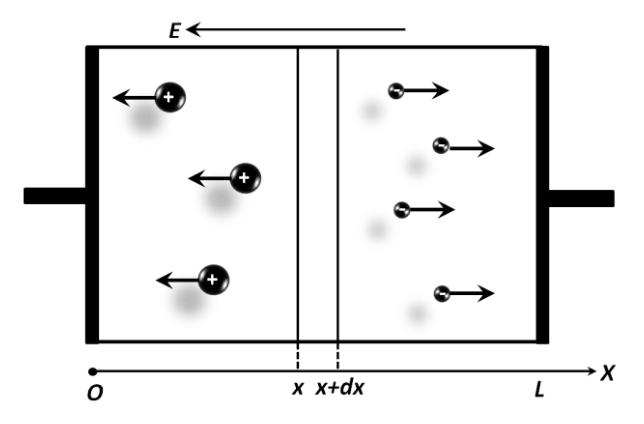
The total current \(I\) in any cross section of the gas tube consists of the ion \(I_i(x)\) and the electron \(I_e(x)\) currents which, in the steady state, depend on the coordinate \(x\), shown in the figureabove. The electron current \(I_e(x)\) varies along the \(x\)-axis according to the formula
\[ I_e(x)=C_1e^{A_1x}+A_2, \]
where \(A_1,A_2,C_1\) are some constants.
| B1 | Find \(A_1,A_2\) and express them in terms of \(Z_{\mathrm{ext}},\alpha,e,L,S\). (2 points) |
The ion current \(I_i(x)\) varies along the \(x\)-axis according to the formula
\[ I_i(x)=C_2+B_1e^{B_2x}, \]
where \(B_1,B_2,C_2\) are some constants.
| B2 | Find \(B_1,B_2\) and express them in terms of \(Z_{\mathrm{ext}},\alpha,e,L,S,C_1\). (0.6 points) |
| B3 | Write down the condition for \(I_i(x)\) at \(x=L\). (0.3 points) |
| B4 | Write down the condition for \(I_i(x)\) and \(I_e(x)\) at \(x=0\). (0.6 points) |
| B5 | Find the total current \(I\) and express it in terms of \(Z_{\mathrm{ext}},\alpha,\gamma,e,L,S\). Assume that it remains finite. (1.2 points) |
Let the Townsend coefficient \(\alpha\) be constant. When the length of the tube turns out greater than some critical value, i.e. \(L>L_{\mathrm{cr}}\), the external ionizer can be turned off and the discharge becomes self-sustained.
| B6 | Find \(L_{\mathrm{cr}}\) and express it in terms of \(Z_{\mathrm{ext}},\alpha,\gamma,e,L,S\). (0.5 points) |
Official English text of the problem.
Answers
Currents below denote magnitudes, and \(U\geq0\).
-
A1 \[ \boxed{n_0=0,\qquad a=\sqrt{\frac{Z_{\mathrm{ext}}}{r}}, \qquad b=\sqrt{rZ_{\mathrm{ext}}}.} \]
-
A2 \[ \boxed{n_e=2.0\times10^{11}\,\mathrm{cm}^{-3} =2.0\times10^{17}\,\mathrm{m}^{-3}.} \]
-
A3, using the stated uniform-density collection approximation: \[ \boxed{ I=\frac{e\beta SU}{rL} \left[ \sqrt{\frac{\beta^2U^2}{L^4}+4rZ_{\mathrm{ext}}} -\frac{\beta U}{L^2} \right].} \]
-
A4 \[ \boxed{\rho_{\mathrm{gas}} =\frac{1}{2e\beta}\sqrt{\frac{r}{Z_{\mathrm{ext}}}}.} \]
-
B1 \[ \boxed{A_1=\alpha,\qquad A_2=-\frac{eSZ_{\mathrm{ext}}}{\alpha}.} \]
-
B2 \[ \boxed{B_1=-C_1,\qquad B_2=\alpha.} \]
-
B3 \[ \boxed{I_i(L)=0.} \]
-
B4 \[ \boxed{I_e(0)=\gamma I_i(0).} \]
-
B5 \[ \boxed{ I=\frac{eSZ_{\mathrm{ext}}}{\alpha} \frac{(1+\gamma)(e^{\alpha L}-1)} {1-\gamma(e^{\alpha L}-1)}.} \] A physical finite stationary solution with \(Z_{\mathrm{ext}}>0\) requires \[ \boxed{\gamma(e^{\alpha L}-1)<1.} \]
-
B6, for \(\alpha>0,\gamma>0\): \[ \boxed{L_{\mathrm{cr}}=\frac{1}{\alpha} \ln\!\left(1+\frac{1}{\gamma}\right).} \]
Solution
A1. Growth of the carrier density
Ionization creates one electron and one ion per event, while recombination removes one of each. Since their initial densities are equal, they remain equal:
\[ n_e(t)=n_i(t)=n(t). \]
The particle balance per unit volume is therefore
\[ \frac{dn}{dt}=Z_{\mathrm{ext}}-rn^2, \qquad n(0)=0. \]
The prescribed expression gives \(n(0)=n_0\), so
\[ n_0=0. \]
Substituting \(n=a\tanh(bt)\) into the balance equation,
\[ ab\left[1-\tanh^2(bt)\right] =Z_{\mathrm{ext}}-ra^2\tanh^2(bt). \]
Matching the constant terms and the coefficients of \(\tanh^2(bt)\) yields
\[ ab=Z_{\mathrm{ext}}, \qquad ab=ra^2. \]
Taking \(a,b\) positive,
\[ \boxed{a=\sqrt{\frac{Z_{\mathrm{ext}}}{r}}, \qquad b=\sqrt{rZ_{\mathrm{ext}}}.} \]
Thus
\[ n_e(t)=\sqrt{\frac{Z_{\mathrm{ext}}}{r}}\, \tanh\!\left(\sqrt{rZ_{\mathrm{ext}}}\,t\right). \]
Its initial slope is \(Z_{\mathrm{ext}}\), and its limiting density is \(\sqrt{Z_{\mathrm{ext}}/r}\), as required by generation–recombination balance. Simultaneously reversing the signs of \(a\) and \(b\) describes the same function.
A2. Two ionizers
Let the individual production rates be \(Z_1\) and \(Z_2\). At equilibrium,
\[ Z_1=rn_{e1}^2,\qquad Z_2=rn_{e2}^2. \]
The independent production rates add when both ionizers operate:
\[ rn_e^2=Z_1+Z_2=r(n_{e1}^2+n_{e2}^2). \]
Consequently,
\[ n_e=\sqrt{n_{e1}^2+n_{e2}^2} =\sqrt{12^2+16^2}\times10^{10}\,\mathrm{cm}^{-3}. \]
Therefore,
\[ \boxed{n_e=2.0\times10^{11}\,\mathrm{cm}^{-3} =2.0\times10^{17}\,\mathrm{m}^{-3}.} \]
The densities themselves do not add because the recombination rate is quadratic in density.
A3. Stationary current with recombination and collection
Neglecting edge effects and the field of the carriers,
\[ E=\frac UL,\qquad v=\frac{\beta U}{L}. \]
Apply the stipulated uniform-density approximation to the volume \(SL\). In a time \(dt\), a collecting electrode removes \(n_eSv\,dt\) electrons; the opposite electrode removes \(n_iSv\,dt\) ions. The stationary particle balances are
\[ Z_{\mathrm{ext}}SL-rn_en_iSL-n_eSv=0, \]
\[ Z_{\mathrm{ext}}SL-rn_en_iSL-n_iSv=0. \]
For \(v>0\), subtraction gives \(n_e=n_i=n\). Hence
\[ rn^2+\frac vL n-Z_{\mathrm{ext}}=0. \]
Only the nonnegative root is physical:
\[ n=\frac{1}{2r} \left[ \sqrt{\left(\frac vL\right)^2+4rZ_{\mathrm{ext}}} -\frac vL \right]. \]
Although the electrons and ions move in opposite directions, their charges also have opposite signs. Their conventional currents therefore add:
\[ I=eSn_ev+eSn_iv=2eSnv. \]
Substitution gives
\[ I=\frac{eSv}{r} \left[ \sqrt{\left(\frac vL\right)^2+4rZ_{\mathrm{ext}}} -\frac vL \right]. \]
Using \(v=\beta U/L\),
\[ \boxed{ I=\frac{e\beta SU}{rL} \left[ \sqrt{\frac{\beta^2U^2}{L^4}+4rZ_{\mathrm{ext}}} -\frac{\beta U}{L^2} \right]. } \]
This is the result of applying the spatially uniform collection model literally. Strictly, the densities cannot stay uniform up to the plates: the electron density must vanish at the cathode and the ion density at the anode. The formula is therefore reliable while these depleted layers are thin compared with \(L\), as in the small-voltage regime of A4; at high voltage it tends to \(2eZ_{\mathrm{ext}}SL\), twice the true saturation current \(eZ_{\mathrm{ext}}SL\).
A4. Small-voltage resistivity
For sufficiently small voltage,
\[ \frac{\beta U}{L^2}\ll\sqrt{rZ_{\mathrm{ext}}}, \]
collection perturbs the generation–recombination equilibrium only slightly. To leading order,
\[ n\simeq\sqrt{\frac{Z_{\mathrm{ext}}}{r}}. \]
Thus the current becomes proportional to voltage:
\[ I\simeq 2e\beta\sqrt{\frac{Z_{\mathrm{ext}}}{r}}\, \frac SL\,U. \]
Comparing this with
\[ I=\frac{S}{\rho_{\mathrm{gas}}L}\,U \]
gives
\[ \boxed{\rho_{\mathrm{gas}} =\frac{1}{2e\beta}\sqrt{\frac{r}{Z_{\mathrm{ext}}}}.} \]
The length \(L\) cancels. With SI quantities, the result is in \(\Omega\,\mathrm m\).
B1. Electron-current equation
In Part B, recombination is neglected. Take \(I_e\) and \(I_i\) as nonnegative current magnitudes, so that
\[ I=I_e(x)+I_i(x). \]
Consider a thin slice of thickness \(dx\). The external ionizer creates
\[ Z_{\mathrm{ext}}S\,dx \]
electrons per unit time in the slice. Avalanche multiplication creates an additional
\[ \alpha\frac{I_e(x)}e\,dx \]
electrons per unit time. Each new electron adds \(e\) times its production rate to the electron current leaving the slice. Therefore,
\[ I_e(x+dx)-I_e(x) =\left[eSZ_{\mathrm{ext}}+\alpha I_e(x)\right]dx. \]
In differential form,
\[ \frac{dI_e}{dx}=\alpha I_e+eSZ_{\mathrm{ext}}. \]
For constant \(\alpha>0\), its general solution is
\[ I_e(x)=C_1e^{\alpha x}-\frac{eSZ_{\mathrm{ext}}}{\alpha}. \]
Comparison with the prescribed expression gives
\[ \boxed{A_1=\alpha,\qquad A_2=-\frac{eSZ_{\mathrm{ext}}}{\alpha}.} \]
B2. Ion-current equation
Every ionization event also produces one ion. Ions move toward decreasing \(x\), so the ion current leaving the slice through its left face exceeds that entering through its right face:
\[ I_i(x)-I_i(x+dx) =\left[eSZ_{\mathrm{ext}}+\alpha I_e(x)\right]dx. \]
Thus
\[ \frac{dI_i}{dx} =-eSZ_{\mathrm{ext}}-\alpha I_e(x). \]
Using the electron-current solution,
\[ \frac{dI_i}{dx}=-\alpha C_1e^{\alpha x}, \]
and integration gives
\[ I_i(x)=C_2-C_1e^{\alpha x}. \]
Consequently,
\[ \boxed{B_1=-C_1,\qquad B_2=\alpha.} \]
The two differential equations also show that
\[ \frac{d}{dx}(I_e+I_i)=0, \]
which expresses stationary charge conservation.
B3. Boundary condition at the anode
The anode is at \(x=L\). No ions enter the gas from this electrode, and ions created inside the gas drift away from it. Therefore,
\[ \boxed{I_i(L)=0.} \]
Equivalently,
\[ C_2=C_1e^{\alpha L}. \]
B4. Boundary condition at the cathode
At \(x=0\), the ion arrival rate is \(I_i(0)/e\). Each arriving ion releases, on average, \(\gamma\) electrons. Hence
\[ \frac{I_e(0)}e=\gamma\frac{I_i(0)}e, \]
or
\[ \boxed{I_e(0)=\gamma I_i(0).} \]
B5. Total stationary current
For brevity, define
\[ K=\frac{eSZ_{\mathrm{ext}}}{\alpha}, \qquad T=e^{\alpha L}. \]
Then
\[ I_e(x)=C_1e^{\alpha x}-K, \qquad I_i(x)=C_2-C_1e^{\alpha x}. \]
The anode condition gives
\[ C_2=C_1T. \]
The cathode condition becomes
\[ C_1-K=\gamma(C_2-C_1) =\gamma C_1(T-1). \]
Therefore,
\[ C_1=\frac{K}{1-\gamma(T-1)}. \]
Adding the electron and ion currents,
\[ I=C_2-K=C_1T-K. \]
Substituting \(C_1\) and simplifying,
\[ I =K\frac{T-1+\gamma(T-1)} {1-\gamma(T-1)}. \]
Thus
\[ \boxed{ I=\frac{eSZ_{\mathrm{ext}}}{\alpha} \frac{(1+\gamma)(e^{\alpha L}-1)} {1-\gamma(e^{\alpha L}-1)}. } \]
With positive external ionization, a physical finite stationary current requires
\[ \boxed{1-\gamma(e^{\alpha L}-1)>0.} \]
At zero denominator, the linear stationary model predicts divergence; a negative denominator would give an unphysical negative current magnitude.
B6. Critical length for self-sustained discharge
One electron emitted from the cathode grows into
\[ e^{\alpha L} \]
electrons by the time the avalanche reaches the anode. Since the original electron was already present, the avalanche creates
\[ e^{\alpha L}-1 \]
new electron–ion pairs.
With recombination neglected, all these ions reach the cathode. They release, on average,
\[ \mathcal R=\gamma(e^{\alpha L}-1) \]
secondary electrons. This is the number of cathode electrons produced by one preceding cathode electron.
If \(\mathcal R<1\), successive generations decrease and external ionization is necessary. The threshold occurs when each generation exactly replaces itself:
\[ \gamma(e^{\alpha L_{\mathrm{cr}}}-1)=1. \]
Solving,
\[ \boxed{ L_{\mathrm{cr}} =\frac{1}{\alpha} \ln\!\left(1+\frac{1}{\gamma}\right). } \]
For \(L>L_{\mathrm{cr}}\), the feedback amplifies a seed discharge even after the external ionizer is removed. The present linear model determines the ignition threshold; additional physical effects are needed to determine a finite operating current above threshold.
Neither \(Z_{\mathrm{ext}}\), \(e\), nor \(S\) enters the threshold. If \(\alpha=0\) or \(\gamma=0\), this mechanism cannot sustain a discharge at any finite length.
The solution was checked against the official solution.
IPhO 2014 · Theorieaufgabe 3
Einfachstes Modell einer Gasentladung
Ein elektrischer Strom, der durch ein Gas fließt, wird als Gasentladung bezeichnet. Es gibt viele Arten von Gasentladungen, darunter die Glimmentladung in Beleuchtungslampen, die Bogenentladung beim Schweißen und die bekannte Funkenentladung, die zwischen den Wolken und der Erde in Form von Blitzen auftritt.
Teil A. Unselbstständige Gasentladung (4.8 Punkte)
In diesem Teil der Aufgabe wird die sogenannte unselbstständige Gasentladung untersucht. Zu ihrer Aufrechterhaltung muss ständig ein externer Ionisator betrieben werden, der gleichmäßig im gesamten Volumen pro Volumeneinheit und Zeiteinheit \(Z_{\mathrm{ext}}\) Paare aus einfach ionisierten Ionen und freien Elektronen erzeugt.
Wird ein externer Ionisator eingeschaltet, beginnt die Anzahl der Elektronen und Ionen zu wachsen. Ein unbegrenzter Anstieg der Anzahldichten der Elektronen und Ionen im Gas wird durch den Rekombinationsprozess verhindert, bei dem sich ein freies Elektron mit einem Ion zu einem neutralen Atom vereinigt. Die Anzahl der Rekombinationsereignisse \(Z_{\mathrm{rec}}\), die im Gas pro Volumeneinheit und Zeiteinheit auftreten, ist gegeben durch
\[ Z_{\mathrm{rec}}=rn_en_i, \]
wobei \(r\) eine Konstante ist, die als Rekombinationskoeffizient bezeichnet wird, und \(n_e,n_i\) die Anzahldichten der Elektronen beziehungsweise der Ionen bezeichnen.
Es sei angenommen, dass der externe Ionisator zum Zeitpunkt \(t=0\) eingeschaltet wird und die anfänglichen Anzahldichten der Elektronen und Ionen im Gas beide gleich null sind. Dann hängt die Elektronenanzahldichte \(n_e(t)\) wie folgt von der Zeit \(t\) ab:
\[ n_e(t)=n_0+a\tanh bt, \]
wobei \(n_0,a\) und \(b\) Konstanten sind und \(\tanh x\) für den Tangens hyperbolicus steht.
| A1 | Bestimmen Sie \(n_0,a,b\) und drücken Sie diese durch \(Z_{\mathrm{ext}}\) und \(r\) aus. (1.8 Punkte) |
Es seien zwei externe Ionisatoren verfügbar. Wird der erste eingeschaltet, erreicht die Elektronenanzahldichte im Gas ihren Gleichgewichtswert \(n_{e1}=12\cdot10^{10}\,\mathrm{cm}^{-3}\). Wird der zweite externe Ionisator eingeschaltet, erreicht die Elektronenanzahldichte ihren Gleichgewichtswert \(n_{e2}=16\cdot10^{10}\,\mathrm{cm}^{-3}\).
| A2 | Bestimmen Sie die Elektronenanzahldichte \(n_e\) im Gleichgewicht, wenn beide externen Ionisatoren gleichzeitig eingeschaltet sind. (0.6 Punkte) |
Achtung! Im Folgenden wird angenommen, dass der externe Ionisator bereits so lange eingeschaltet ist, dass alle Vorgänge stationär geworden sind und nicht mehr von der Zeit abhängen. Vernachlässigen Sie das elektrische Feld der Ladungsträger vollständig.
Es sei angenommen, dass das Gas die Röhre zwischen zwei parallelen leitenden Platten mit der Fläche \(S\) ausfüllt, die sich im Abstand \(L\ll\sqrt S\) voneinander befinden. An die Platten wird die Spannung \(U\) angelegt, um zwischen ihnen ein elektrisches Feld zu erzeugen. Nehmen Sie an, dass die Anzahldichten beider Arten von Ladungsträgern entlang der Röhre nahezu konstant bleiben.
Nehmen Sie an, dass sowohl die Elektronen (gekennzeichnet durch den Index \(e\)) als auch die Ionen (gekennzeichnet durch den Index \(i\)) aufgrund der elektrischen Feldstärke \(E\) denselben Betrag der Driftgeschwindigkeit \(v\) annehmen, der sich ergibt zu
\[ v=\beta E, \]
wobei \(b\) eine Konstante ist, die als Ladungsträgerbeweglichkeit bezeichnet wird.
| A3 | Drücken Sie die elektrische Stromstärke \(I\) in der Röhre durch \(U,\beta,L,S,Z_{\mathrm{ext}},r\) und die Elementarladung \(e\) aus. (1.7 Punkte) |
| A4 | Bestimmen Sie den spezifischen Widerstand \(\rho_{\mathrm{gas}}\) des Gases bei hinreichend kleinen Werten der angelegten Spannung und drücken Sie ihn durch \(\beta,L,Z_{\mathrm{ext}},r\) und \(e\) aus. (0.7 Punkte) |
Teil B. Selbstständige Gasentladung (5.2 Punkte)
In diesem Teil der Aufgabe wird die Zündung einer selbstständigen Gasentladung betrachtet, um zu zeigen, wie sich der elektrische Strom in der Röhre selbst aufrechterhält.
Achtung! Nehmen Sie im Folgenden an, dass der externe Ionisator weiterhin mit derselben Rate \(Z_{\mathrm{ext}}\) arbeitet. Vernachlässigen Sie das elektrische Feld der Ladungsträger, sodass das elektrische Feld entlang der Röhre homogen ist, und vernachlässigen Sie die Rekombination vollständig.
Für die selbstständige Gasentladung sind zwei wichtige Prozesse von Bedeutung, die oben nicht berücksichtigt wurden. Der erste Prozess ist die Sekundärelektronenemission, der zweite die Bildung einer Elektronenlawine. Sekundärelektronenemission tritt auf, wenn Ionen auf die negative Elektrode, die Kathode, treffen und dabei Elektronen aus ihr herausschlagen, die sich zur positiven Elektrode, der Anode, bewegen. Das Verhältnis der Anzahl der pro Zeiteinheit herausgeschlagenen Elektronen \(\dot N_e\) zur Anzahl der pro Zeiteinheit auf die Kathode treffenden Ionen \(\dot N_i\) wird als Sekundärelektronenemissionskoeffizient bezeichnet, \(\gamma=\dot N_e/\dot N_i\). Die Bildung einer Elektronenlawine lässt sich wie folgt erklären. Das elektrische Feld beschleunigt freie Elektronen, die genügend kinetische Energie gewinnen, um durch Stöße die Atome im Gas zu ionisieren. Dadurch nimmt die Anzahl der freien Elektronen, die sich zur Anode bewegen, erheblich zu. Dieser Prozess wird durch den Townsend-Koeffizienten \(\alpha\) beschrieben, der den Zuwachs der Elektronenanzahl \(dN_e\) charakterisiert, wenn \(N_e\) bewegte Elektronen die Strecke \(dl\) zurückgelegt haben, d. h.
\[ \frac{dN_e}{dl}=\alpha N_e. \]
Der Gesamtstrom \(I\) in einem beliebigen Querschnitt der Gasröhre setzt sich aus dem Ionenstrom \(I_i(x)\) und dem Elektronenstrom \(I_e(x)\) zusammen, die im stationären Zustand von der in der obigen Abbildung dargestellten Koordinate \(x\) abhängen. Der Elektronenstrom \(I_e(x)\) ändert sich entlang der \(x\)-Achse gemäß der Formel
\[ I_e(x)=C_1e^{A_1x}+A_2, \]
wobei \(A_1,A_2,C_1\) Konstanten sind.
| B1 | Bestimmen Sie \(A_1,A_2\) und drücken Sie diese durch \(Z_{\mathrm{ext}},\alpha,e,L,S\) aus. (2 Punkte) |
Der Ionenstrom \(I_i(x)\) ändert sich entlang der \(x\)-Achse gemäß der Formel
\[ I_i(x)=C_2+B_1e^{B_2x}, \]
wobei \(B_1,B_2,C_2\) Konstanten sind.
| B2 | Bestimmen Sie \(B_1,B_2\) und drücken Sie diese durch \(Z_{\mathrm{ext}},\alpha,e,L,S,C_1\) aus. (0.6 Punkte) |
| B3 | Geben Sie die Bedingung für \(I_i(x)\) bei \(x=L\) an. (0.3 Punkte) |
| B4 | Geben Sie die Bedingung für \(I_i(x)\) und \(I_e(x)\) bei \(x=0\) an. (0.6 Punkte) |
| B5 | Bestimmen Sie den Gesamtstrom \(I\) und drücken Sie ihn durch \(Z_{\mathrm{ext}},\alpha,\gamma,e,L,S\) aus. Nehmen Sie an, dass er endlich bleibt. (1.2 Punkte) |
Der Townsend-Koeffizient \(\alpha\) sei konstant. Wenn die Länge der Röhre einen bestimmten kritischen Wert überschreitet, d. h. \(L>L_{\mathrm{cr}}\), kann der externe Ionisator abgeschaltet werden, und die Entladung wird selbstständig.
| B6 | Bestimmen Sie \(L_{\mathrm{cr}}\) und drücken Sie diese Größe durch \(Z_{\mathrm{ext}},\alpha,\gamma,e,L,S\) aus. (0.5 Punkte) |
Aufgabentext aus dem offiziellen englischen Text übersetzt.
Antworten
Die folgenden Stromstärken bezeichnen Beträge, und es gilt \(U\geq0\).
-
A1 \[ \boxed{n_0=0,\qquad a=\sqrt{\frac{Z_{\mathrm{ext}}}{r}}, \qquad b=\sqrt{rZ_{\mathrm{ext}}}.} \]
-
A2 \[ \boxed{n_e=2.0\times10^{11}\,\mathrm{cm}^{-3} =2.0\times10^{17}\,\mathrm{m}^{-3}.} \]
-
A3, unter Verwendung der angegebenen Näherung für die Sammlung der Ladungsträger bei gleichmäßiger Dichte: \[ \boxed{ I=\frac{e\beta SU}{rL} \left[ \sqrt{\frac{\beta^2U^2}{L^4}+4rZ_{\mathrm{ext}}} -\frac{\beta U}{L^2} \right].} \]
-
A4 \[ \boxed{\rho_{\mathrm{gas}} =\frac{1}{2e\beta}\sqrt{\frac{r}{Z_{\mathrm{ext}}}}.} \]
-
B1 \[ \boxed{A_1=\alpha,\qquad A_2=-\frac{eSZ_{\mathrm{ext}}}{\alpha}.} \]
-
B2 \[ \boxed{B_1=-C_1,\qquad B_2=\alpha.} \]
-
B3 \[ \boxed{I_i(L)=0.} \]
-
B4 \[ \boxed{I_e(0)=\gamma I_i(0).} \]
-
B5 \[ \boxed{ I=\frac{eSZ_{\mathrm{ext}}}{\alpha} \frac{(1+\gamma)(e^{\alpha L}-1)} {1-\gamma(e^{\alpha L}-1)}.} \] Eine physikalisch sinnvolle endliche stationäre Lösung mit \(Z_{\mathrm{ext}}>0\) erfordert \[ \boxed{\gamma(e^{\alpha L}-1)<1.} \]
-
B6, für \(\alpha>0,\gamma>0\): \[ \boxed{L_{\mathrm{cr}}=\frac{1}{\alpha} \ln\!\left(1+\frac{1}{\gamma}\right).} \]
Lösung
A1. Anwachsen der Ladungsträgerdichte
Bei jedem Ionisationsereignis entstehen ein Elektron und ein Ion, während bei jeder Rekombination je eines von beiden verschwindet. Da ihre Anfangsdichten gleich sind, bleiben ihre Dichten gleich:
\[ n_e(t)=n_i(t)=n(t). \]
Die Teilchenbilanz pro Volumeneinheit lautet daher
\[ \frac{dn}{dt}=Z_{\mathrm{ext}}-rn^2, \qquad n(0)=0. \]
Der vorgegebene Ausdruck ergibt \(n(0)=n_0\), also
\[ n_0=0. \]
Einsetzen von \(n=a\tanh(bt)\) in die Bilanzgleichung liefert
\[ ab\left[1-\tanh^2(bt)\right] =Z_{\mathrm{ext}}-ra^2\tanh^2(bt). \]
Der Vergleich der konstanten Terme und der Koeffizienten von \(\tanh^2(bt)\) ergibt
\[ ab=Z_{\mathrm{ext}}, \qquad ab=ra^2. \]
Wählt man \(a,b\) positiv, so folgt
\[ \boxed{a=\sqrt{\frac{Z_{\mathrm{ext}}}{r}}, \qquad b=\sqrt{rZ_{\mathrm{ext}}}.} \]
Damit gilt
\[ n_e(t)=\sqrt{\frac{Z_{\mathrm{ext}}}{r}}\, \tanh\!\left(\sqrt{rZ_{\mathrm{ext}}}\,t\right). \]
Die Anfangssteigung beträgt \(Z_{\mathrm{ext}}\), und der Grenzwert der Dichte ist \(\sqrt{Z_{\mathrm{ext}}/r}\), wie es das Gleichgewicht zwischen Erzeugung und Rekombination verlangt. Ein gleichzeitiger Vorzeichenwechsel von \(a\) und \(b\) beschreibt dieselbe Funktion.
A2. Zwei Ionisatoren
Die einzelnen Erzeugungsraten seien \(Z_1\) und \(Z_2\). Im Gleichgewicht gilt
\[ Z_1=rn_{e1}^2,\qquad Z_2=rn_{e2}^2. \]
Die unabhängigen Erzeugungsraten addieren sich, wenn beide Ionisatoren in Betrieb sind:
\[ rn_e^2=Z_1+Z_2=r(n_{e1}^2+n_{e2}^2). \]
Folglich gilt
\[ n_e=\sqrt{n_{e1}^2+n_{e2}^2} =\sqrt{12^2+16^2}\times10^{10}\,\mathrm{cm}^{-3}. \]
Daraus folgt
\[ \boxed{n_e=2.0\times10^{11}\,\mathrm{cm}^{-3} =2.0\times10^{17}\,\mathrm{m}^{-3}.} \]
Die Dichten selbst addieren sich nicht, da die Rekombinationsrate quadratisch von der Dichte abhängt.
A3. Stationärer Strom mit Rekombination und Sammlung der Ladungsträger
Unter Vernachlässigung von Randeffekten und des Feldes der Ladungsträger gilt
\[ E=\frac UL,\qquad v=\frac{\beta U}{L}. \]
Wir wenden die vorgegebene Näherung einer gleichmäßigen Dichte auf das Volumen \(SL\) an. In einer Zeit \(dt\) nimmt eine Sammelelektrode \(n_eSv\,dt\) Elektronen auf; die gegenüberliegende Elektrode nimmt \(n_iSv\,dt\) Ionen auf. Die stationären Teilchenbilanzen lauten
\[ Z_{\mathrm{ext}}SL-rn_en_iSL-n_eSv=0, \]
\[ Z_{\mathrm{ext}}SL-rn_en_iSL-n_iSv=0. \]
Für \(v>0\) ergibt die Subtraktion \(n_e=n_i=n\). Somit gilt
\[ rn^2+\frac vL n-Z_{\mathrm{ext}}=0. \]
Nur die nichtnegative Lösung ist physikalisch sinnvoll:
\[ n=\frac{1}{2r} \left[ \sqrt{\left(\frac vL\right)^2+4rZ_{\mathrm{ext}}} -\frac vL \right]. \]
Obwohl sich Elektronen und Ionen in entgegengesetzte Richtungen bewegen, haben auch ihre Ladungen entgegengesetzte Vorzeichen. Ihre Beiträge zum Strom in technischer Stromrichtung addieren sich daher:
\[ I=eSn_ev+eSn_iv=2eSnv. \]
Einsetzen ergibt
\[ I=\frac{eSv}{r} \left[ \sqrt{\left(\frac vL\right)^2+4rZ_{\mathrm{ext}}} -\frac vL \right]. \]
Mit \(v=\beta U/L\) folgt
\[ \boxed{ I=\frac{e\beta SU}{rL} \left[ \sqrt{\frac{\beta^2U^2}{L^4}+4rZ_{\mathrm{ext}}} -\frac{\beta U}{L^2} \right]. } \]
Dies ist das Ergebnis der wörtlichen Anwendung des Modells der Ladungsträgersammlung bei räumlich gleichmäßiger Dichte. Streng genommen können die Dichten nicht bis an die Platten gleichmäßig bleiben: Die Elektronendichte muss an der Kathode und die Ionendichte an der Anode verschwinden. Die Formel ist daher zuverlässig, solange diese verarmten Schichten dünn gegenüber \(L\) sind, wie im Bereich kleiner Spannungen von A4; bei hoher Spannung strebt sie gegen \(2eZ_{\mathrm{ext}}SL\), das Doppelte des tatsächlichen Sättigungsstroms \(eZ_{\mathrm{ext}}SL\).
A4. Spezifischer Widerstand bei kleiner Spannung
Bei hinreichend kleiner Spannung,
\[ \frac{\beta U}{L^2}\ll\sqrt{rZ_{\mathrm{ext}}}, \]
stört die Sammlung der Ladungsträger das Gleichgewicht zwischen Erzeugung und Rekombination nur geringfügig. In führender Ordnung gilt
\[ n\simeq\sqrt{\frac{Z_{\mathrm{ext}}}{r}}. \]
Damit wird der Strom proportional zur Spannung:
\[ I\simeq 2e\beta\sqrt{\frac{Z_{\mathrm{ext}}}{r}}\, \frac SL\,U. \]
Der Vergleich mit
\[ I=\frac{S}{\rho_{\mathrm{gas}}L}\,U \]
ergibt
\[ \boxed{\rho_{\mathrm{gas}} =\frac{1}{2e\beta}\sqrt{\frac{r}{Z_{\mathrm{ext}}}}.} \]
Die Länge \(L\) kürzt sich heraus. Werden die Größen in SI-Einheiten eingesetzt, ergibt sich das Ergebnis in \(\Omega\,\mathrm m\).
B1. Gleichung für den Elektronenstrom
In Teil B wird die Rekombination vernachlässigt. Wir betrachten \(I_e\) und \(I_i\) als nichtnegative Strombeträge, sodass
\[ I=I_e(x)+I_i(x). \]
Betrachten wir eine dünne Schicht der Dicke \(dx\). Der externe Ionisator erzeugt in dieser Schicht pro Zeiteinheit
\[ Z_{\mathrm{ext}}S\,dx \]
Elektronen. Durch die Lawinenvervielfachung entstehen zusätzlich
\[ \alpha\frac{I_e(x)}e\,dx \]
Elektronen pro Zeiteinheit. Jedes neu erzeugte Elektron trägt zum aus der Schicht austretenden Elektronenstrom bei; der zusätzliche Strom ist gleich \(e\) mal der Erzeugungsrate. Daher gilt
\[ I_e(x+dx)-I_e(x) =\left[eSZ_{\mathrm{ext}}+\alpha I_e(x)\right]dx. \]
In differentieller Form lautet dies
\[ \frac{dI_e}{dx}=\alpha I_e+eSZ_{\mathrm{ext}}. \]
Für konstantes \(\alpha>0\) lautet die allgemeine Lösung
\[ I_e(x)=C_1e^{\alpha x}-\frac{eSZ_{\mathrm{ext}}}{\alpha}. \]
Der Vergleich mit dem vorgegebenen Ausdruck ergibt
\[ \boxed{A_1=\alpha,\qquad A_2=-\frac{eSZ_{\mathrm{ext}}}{\alpha}.} \]
B2. Gleichung für den Ionenstrom
Jedes Ionisationsereignis erzeugt auch ein Ion. Ionen bewegen sich in Richtung abnehmender \(x\)-Werte, sodass der durch die linke Grenzfläche aus der Schicht austretende Ionenstrom größer ist als der durch die rechte Grenzfläche eintretende:
\[ I_i(x)-I_i(x+dx) =\left[eSZ_{\mathrm{ext}}+\alpha I_e(x)\right]dx. \]
Somit gilt
\[ \frac{dI_i}{dx} =-eSZ_{\mathrm{ext}}-\alpha I_e(x). \]
Mit der Lösung für den Elektronenstrom folgt
\[ \frac{dI_i}{dx}=-\alpha C_1e^{\alpha x}, \]
und die Integration ergibt
\[ I_i(x)=C_2-C_1e^{\alpha x}. \]
Folglich gilt
\[ \boxed{B_1=-C_1,\qquad B_2=\alpha.} \]
Die beiden Differentialgleichungen zeigen außerdem, dass
\[ \frac{d}{dx}(I_e+I_i)=0, \]
was die Ladungserhaltung im stationären Zustand ausdrückt.
B3. Randbedingung an der Anode
Die Anode befindet sich bei \(x=L\). Von dieser Elektrode gelangen keine Ionen in das Gas, und die im Gas erzeugten Ionen driften von ihr weg. Daher gilt
\[ \boxed{I_i(L)=0.} \]
Äquivalent dazu ist
\[ C_2=C_1e^{\alpha L}. \]
B4. Randbedingung an der Kathode
Bei \(x=0\) beträgt die Auftreffrate der Ionen \(I_i(0)/e\). Jedes auftreffende Ion setzt im Mittel \(\gamma\) Elektronen frei. Somit gilt
\[ \frac{I_e(0)}e=\gamma\frac{I_i(0)}e, \]
oder
\[ \boxed{I_e(0)=\gamma I_i(0).} \]
B5. Stationärer Gesamtstrom
Zur Abkürzung definieren wir
\[ K=\frac{eSZ_{\mathrm{ext}}}{\alpha}, \qquad T=e^{\alpha L}. \]
Dann gilt
\[ I_e(x)=C_1e^{\alpha x}-K, \qquad I_i(x)=C_2-C_1e^{\alpha x}. \]
Die Randbedingung an der Anode ergibt
\[ C_2=C_1T. \]
Die Randbedingung an der Kathode wird zu
\[ C_1-K=\gamma(C_2-C_1) =\gamma C_1(T-1). \]
Daraus folgt
\[ C_1=\frac{K}{1-\gamma(T-1)}. \]
Die Addition von Elektronen- und Ionenstrom liefert
\[ I=C_2-K=C_1T-K. \]
Einsetzen von \(C_1\) und Vereinfachen ergibt
\[ I =K\frac{T-1+\gamma(T-1)} {1-\gamma(T-1)}. \]
Somit gilt
\[ \boxed{ I=\frac{eSZ_{\mathrm{ext}}}{\alpha} \frac{(1+\gamma)(e^{\alpha L}-1)} {1-\gamma(e^{\alpha L}-1)}. } \]
Bei positiver externer Ionisationsrate erfordert ein physikalisch sinnvoller endlicher stationärer Strom
\[ \boxed{1-\gamma(e^{\alpha L}-1)>0.} \]
Bei verschwindendem Nenner sagt das lineare stationäre Modell eine Divergenz voraus; ein negativer Nenner würde einen unphysikalischen negativen Strombetrag ergeben.
B6. Kritische Länge für eine selbstständige Entladung
Aus einem von der Kathode emittierten Elektron werden bis zum Erreichen der Anode durch die Lawine
\[ e^{\alpha L} \]
Elektronen. Da das ursprüngliche Elektron bereits vorhanden war, erzeugt die Lawine
\[ e^{\alpha L}-1 \]
neue Elektron-Ion-Paare.
Bei vernachlässigter Rekombination erreichen alle diese Ionen die Kathode. Sie setzen im Mittel
\[ \mathcal R=\gamma(e^{\alpha L}-1) \]
Sekundärelektronen frei. Dies ist die Anzahl der Kathodenelektronen, die durch ein vorhergehendes Kathodenelektron erzeugt werden.
Für \(\mathcal R<1\) nimmt die Anzahl der Elektronen von Generation zu Generation ab, und eine externe Ionisation ist erforderlich. Die Schwelle ist erreicht, wenn jede Generation sich selbst genau ersetzt:
\[ \gamma(e^{\alpha L_{\mathrm{cr}}}-1)=1. \]
Auflösen ergibt
\[ \boxed{ L_{\mathrm{cr}} =\frac{1}{\alpha} \ln\!\left(1+\frac{1}{\gamma}\right). } \]
Für \(L>L_{\mathrm{cr}}\) verstärkt die Rückkopplung eine anfängliche Entladung auch nach dem Entfernen des externen Ionisators. Das vorliegende lineare Modell bestimmt die Zündschwelle; zur Bestimmung eines endlichen Betriebsstroms oberhalb dieser Schwelle müssen zusätzliche physikalische Effekte berücksichtigt werden.
Weder \(Z_{\mathrm{ext}}\) noch \(e\) noch \(S\) gehen in die Schwelle ein. Für \(\alpha=0\) oder \(\gamma=0\) kann dieser Mechanismus bei keiner endlichen Länge eine Entladung aufrechterhalten.
Die Lösung wurde mit der offiziellen Lösung abgeglichen.
IPhO 2014 · Teori sorusu 3
Gaz deşarjının en basit modeli
Bir gazın içinden geçen elektrik akımına gaz deşarjı denir. Aydınlatma lambalarındaki ışıma deşarjı, kaynak işlemlerindeki ark deşarjı ve bulutlarla yer arasında yıldırım biçiminde oluşan, iyi bilinen kıvılcım deşarjı da dahil olmak üzere birçok gaz deşarjı türü vardır.
Bölüm A. Kendiliğinden sürmeyen gaz deşarjı (4.8 puan)
Sorunun bu bölümünde, kendiliğinden sürmeyen gaz deşarjı olarak adlandırılan olay incelenmektedir. Bu deşarjın sürmesi için, hacmin her yerinde düzgün olarak birim hacim ve birim zamanda \(Z_{\mathrm{ext}}\) adet tek yüklü iyon ve serbest elektron çifti oluşturan bir dış iyonlaştırıcının sürekli çalışması gerekir.
Dış iyonlaştırıcı açıldığında elektron ve iyon sayısı artmaya başlar. Gazdaki elektron ve iyonların sayı yoğunluklarının sınırsız biçimde artması, serbest bir elektronun bir iyonla birleşerek nötr bir atom oluşturduğu yeniden birleşme süreciyle engellenir. Gazda birim hacim ve birim zamanda gerçekleşen yeniden birleşme olaylarının sayısı \(Z_{\mathrm{rec}}\),
\[ Z_{\mathrm{rec}}=rn_en_i, \]
ile verilir; burada \(r\), yeniden birleşme katsayısı adı verilen bir sabittir ve \(n_e,n_i\) sırasıyla elektron ve iyon sayı yoğunluklarını gösterir.
Dış iyonlaştırıcının \(t=0\) anında açıldığını ve gazdaki elektron ve iyonların başlangıçtaki sayı yoğunluklarının her ikisinin de sıfır olduğunu varsayın. Bu durumda elektron sayı yoğunluğu \(n_e(t)\), \(t\) zamanına aşağıdaki gibi bağlıdır:
\[ n_e(t)=n_0+a\tanh bt, \]
burada \(n_0,a\) ve \(b\) bazı sabitlerdir ve \(\tanh x\) hiperbolik tanjantı gösterir.
| A1 | \(n_0,a,b\) sabitlerini bulun ve bunları \(Z_{\mathrm{ext}}\) ve \(r\) cinsinden ifade edin. (1.8 puan) |
İki dış iyonlaştırıcının mevcut olduğunu varsayın. Birincisi açıldığında gazdaki elektron sayı yoğunluğu, \(n_{e1}=12\cdot10^{10}\,\mathrm{cm}^{-3}\) denge değerine ulaşmaktadır. İkinci dış iyonlaştırıcı açıldığında elektron sayı yoğunluğu, \(n_{e2}=16\cdot10^{10}\,\mathrm{cm}^{-3}\) denge değerine ulaşmaktadır.
| A2 | Her iki dış iyonlaştırıcı aynı anda açıldığında dengedeki elektron sayı yoğunluğunu \(n_e\) bulun. (0.6 puan) |
Dikkat! Bundan sonra, dış iyonlaştırıcının tüm süreçlerin kararlı hâle gelmesine ve zamandan bağımsız olmasına yetecek kadar uzun bir süredir açık olduğu varsayılmaktadır. Yük taşıyıcılarından kaynaklanan elektrik alanını tamamen ihmal edin.
Gazın, alanları \(S\) olan ve aralarında \(L\ll\sqrt S\) uzaklığı bulunan iki paralel iletken levha arasındaki tüpü doldurduğunu varsayın. Levhalar arasında bir elektrik alanı oluşturmak için levhalara \(U\) gerilimi uygulanmaktadır. Her iki tür yük taşıyıcısının sayı yoğunluklarının tüp boyunca hemen hemen sabit kaldığını varsayın.
Hem elektronların (\(e\) alt indisiyle gösterilen) hem de iyonların (\(i\) alt indisiyle gösterilen), \(E\) elektrik alan şiddeti nedeniyle aynı \(v\) sürüklenme süratini kazandığını varsayın. Bu sürat,
\[ v=\beta E, \]
ile verilir; burada \(b\), yük hareketliliği adı verilen bir sabittir.
| A3 | Tüpteki elektrik akımını \(I\), \(U,\beta,L,S,Z_{\mathrm{ext}},r\) ve temel yük olan \(e\) cinsinden ifade edin. (1.7 puan) |
| A4 | Uygulanan gerilimin yeterince küçük değerleri için gazın özdirencini \(\rho_{\mathrm{gas}}\) bulun ve bunu \(\beta,L,Z_{\mathrm{ext}},r\) ve \(e\) cinsinden ifade edin. (0.7 puan) |
Bölüm B. Kendiliğinden süren gaz deşarjı (5.2 puan)
Sorunun bu bölümünde, tüpteki elektrik akımının nasıl kendi kendini sürdürür hâle geldiğini göstermek amacıyla kendiliğinden süren gaz deşarjının başlaması ele alınmaktadır.
Dikkat! Bundan sonra, dış iyonlaştırıcının aynı \(Z_{\mathrm{ext}}\) hızıyla çalışmaya devam ettiğini varsayın; elektrik alanının tüp boyunca düzgün olması için yük taşıyıcılarından kaynaklanan elektrik alanını ihmal edin ve yeniden birleşmeyi tamamen göz ardı edin.
Kendiliğinden süren gaz deşarjında, yukarıda ele alınmayan iki önemli süreç vardır. İlk süreç ikincil elektron yayımı, ikincisi ise elektron çığı oluşumudur. İkincil elektron yayımı, iyonların katot adı verilen negatif elektroda çarpması ve buradan kopan elektronların anot adı verilen pozitif elektroda doğru hareket etmesiyle gerçekleşir. Birim zamanda koparılan elektron sayısının \(\dot N_e\), birim zamanda katoda çarpan iyon sayısına \(\dot N_i\) oranına ikincil elektron yayım katsayısı denir: \(\gamma=\dot N_e/\dot N_i\). Elektron çığının oluşumu şu şekilde açıklanır. Elektrik alanı serbest elektronları hızlandırır; bu elektronlar, gazdaki atomlara çarparak onları iyonlaştırmaya yetecek kinetik enerjiyi kazanır. Sonuç olarak anoda doğru hareket eden serbest elektronların sayısı önemli ölçüde artar. Bu süreç, \(dl\) uzaklığını kateden \(N_e\) hareketli elektron nedeniyle elektron sayısında meydana gelen \(dN_e\) artışını niteleyen Townsend katsayısı \(\alpha\) ile tanımlanır; yani
\[ \frac{dN_e}{dl}=\alpha N_e. \]
Gaz tüpünün herhangi bir kesitindeki toplam akım \(I\), kararlı durumda yukarıdaki şekilde gösterilen \(x\) koordinatına bağlı olan iyon akımı \(I_i(x)\) ile elektron akımı \(I_e(x)\)'ten oluşur. Elektron akımı \(I_e(x)\), \(x\) ekseni boyunca aşağıdaki bağıntıya göre değişir:
\[ I_e(x)=C_1e^{A_1x}+A_2, \]
burada \(A_1,A_2,C_1\) bazı sabitlerdir.
| B1 | \(A_1,A_2\) sabitlerini bulun ve bunları \(Z_{\mathrm{ext}},\alpha,e,L,S\) cinsinden ifade edin. (2 puan) |
İyon akımı \(I_i(x)\), \(x\) ekseni boyunca aşağıdaki bağıntıya göre değişir:
\[ I_i(x)=C_2+B_1e^{B_2x}, \]
burada \(B_1,B_2,C_2\) bazı sabitlerdir.
| B2 | \(B_1,B_2\) sabitlerini bulun ve bunları \(Z_{\mathrm{ext}},\alpha,e,L,S,C_1\) cinsinden ifade edin. (0.6 puan) |
| B3 | \(x=L\) noktasında \(I_i(x)\) için geçerli koşulu yazın. (0.3 puan) |
| B4 | \(x=0\) noktasında \(I_i(x)\) ve \(I_e(x)\) için geçerli koşulu yazın. (0.6 puan) |
| B5 | Toplam akımı \(I\) bulun ve bunu \(Z_{\mathrm{ext}},\alpha,\gamma,e,L,S\) cinsinden ifade edin. Akımın sonlu kaldığını varsayın. (1.2 puan) |
Townsend katsayısı \(\alpha\) sabit olsun. Tüpün uzunluğu belirli bir kritik değerden büyük olduğunda, yani \(L>L_{\mathrm{cr}}\) olduğunda, dış iyonlaştırıcı kapatılabilir ve deşarj kendiliğinden sürer hâle gelir.
| B6 | \(L_{\mathrm{cr}}\) değerini bulun ve bunu \(Z_{\mathrm{ext}},\alpha,\gamma,e,L,S\) cinsinden ifade edin. (0.5 puan) |
Soru metni resmi İngilizce metinden çevrilmiştir.
Cevaplar
Aşağıdaki akımlar büyüklükleri belirtir ve \(U\geq0\)'dır.
-
A1 \[ \boxed{n_0=0,\qquad a=\sqrt{\frac{Z_{\mathrm{ext}}}{r}}, \qquad b=\sqrt{rZ_{\mathrm{ext}}}.} \]
-
A2 \[ \boxed{n_e=2.0\times10^{11}\,\mathrm{cm}^{-3} =2.0\times10^{17}\,\mathrm{m}^{-3}.} \]
-
A3, belirtilen düzgün yoğunluklu toplama yaklaşımı kullanıldığında: \[ \boxed{ I=\frac{e\beta SU}{rL} \left[ \sqrt{\frac{\beta^2U^2}{L^4}+4rZ_{\mathrm{ext}}} -\frac{\beta U}{L^2} \right].} \]
-
A4 \[ \boxed{\rho_{\mathrm{gas}} =\frac{1}{2e\beta}\sqrt{\frac{r}{Z_{\mathrm{ext}}}}.} \]
-
B1 \[ \boxed{A_1=\alpha,\qquad A_2=-\frac{eSZ_{\mathrm{ext}}}{\alpha}.} \]
-
B2 \[ \boxed{B_1=-C_1,\qquad B_2=\alpha.} \]
-
B3 \[ \boxed{I_i(L)=0.} \]
-
B4 \[ \boxed{I_e(0)=\gamma I_i(0).} \]
-
B5 \[ \boxed{ I=\frac{eSZ_{\mathrm{ext}}}{\alpha} \frac{(1+\gamma)(e^{\alpha L}-1)} {1-\gamma(e^{\alpha L}-1)}.} \] \(Z_{\mathrm{ext}}>0\) için fiziksel olarak anlamlı, sonlu bir kararlı durum çözümü, \[ \boxed{\gamma(e^{\alpha L}-1)<1.} \] koşulunu gerektirir.
-
B6, \(\alpha>0,\gamma>0\) için: \[ \boxed{L_{\mathrm{cr}}=\frac{1}{\alpha} \ln\!\left(1+\frac{1}{\gamma}\right).} \]
Çözüm
A1. Taşıyıcı yoğunluğunun artışı
İyonlaşma her olayda bir elektron ve bir iyon oluştururken, yeniden birleşme her birinden bir tane ortadan kaldırır. Başlangıç yoğunlukları eşit olduğundan, yoğunlukları eşit kalır:
\[ n_e(t)=n_i(t)=n(t). \]
Dolayısıyla birim hacimdeki parçacık dengesi,
\[ \frac{dn}{dt}=Z_{\mathrm{ext}}-rn^2, \qquad n(0)=0. \]
şeklindedir. Verilen ifade \(n(0)=n_0\) sonucunu verir; dolayısıyla
\[ n_0=0. \]
Denge denkleminde \(n=a\tanh(bt)\) yerine konulursa,
\[ ab\left[1-\tanh^2(bt)\right] =Z_{\mathrm{ext}}-ra^2\tanh^2(bt). \]
Sabit terimler ve \(\tanh^2(bt)\) katsayıları eşleştirildiğinde,
\[ ab=Z_{\mathrm{ext}}, \qquad ab=ra^2. \]
\(a,b\) pozitif alınırsa,
\[ \boxed{a=\sqrt{\frac{Z_{\mathrm{ext}}}{r}}, \qquad b=\sqrt{rZ_{\mathrm{ext}}}.} \]
Böylece
\[ n_e(t)=\sqrt{\frac{Z_{\mathrm{ext}}}{r}}\, \tanh\!\left(\sqrt{rZ_{\mathrm{ext}}}\,t\right). \]
Başlangıçtaki eğimi \(Z_{\mathrm{ext}}\), limit yoğunluğu ise üretim–yeniden birleşme dengesinin gerektirdiği gibi \(\sqrt{Z_{\mathrm{ext}}/r}\)'dir. \(a\) ve \(b\)'nin işaretlerinin aynı anda ters çevrilmesi aynı fonksiyonu tanımlar.
A2. İki iyonlaştırıcı
İyonlaştırıcıların ayrı ayrı üretim hızları \(Z_1\) ve \(Z_2\) olsun. Dengede,
\[ Z_1=rn_{e1}^2,\qquad Z_2=rn_{e2}^2. \]
Her iki iyonlaştırıcı çalıştığında bağımsız üretim hızları toplanır:
\[ rn_e^2=Z_1+Z_2=r(n_{e1}^2+n_{e2}^2). \]
Bunun sonucunda,
\[ n_e=\sqrt{n_{e1}^2+n_{e2}^2} =\sqrt{12^2+16^2}\times10^{10}\,\mathrm{cm}^{-3}. \]
Dolayısıyla,
\[ \boxed{n_e=2.0\times10^{11}\,\mathrm{cm}^{-3} =2.0\times10^{17}\,\mathrm{m}^{-3}.} \]
Yeniden birleşme hızı yoğunluğun karesiyle orantılı olduğundan yoğunlukların kendileri toplanmaz.
A3. Yeniden birleşme ve toplama varlığında kararlı durum akımı
Kenar etkileri ve taşıyıcıların alanı ihmal edildiğinde,
\[ E=\frac UL,\qquad v=\frac{\beta U}{L}. \]
Belirtilen düzgün yoğunluk yaklaşımını \(SL\) hacmine uygulayalım. \(dt\) süresinde, toplayıcı elektrot \(n_eSv\,dt\) elektron uzaklaştırır; karşı elektrot ise \(n_iSv\,dt\) iyon uzaklaştırır. Kararlı durumdaki parçacık denge denklemleri şöyledir:
\[ Z_{\mathrm{ext}}SL-rn_en_iSL-n_eSv=0, \]
\[ Z_{\mathrm{ext}}SL-rn_en_iSL-n_iSv=0. \]
\(v>0\) için denklemler birbirinden çıkarıldığında \(n_e=n_i=n\) elde edilir. Dolayısıyla
\[ rn^2+\frac vL n-Z_{\mathrm{ext}}=0. \]
Yalnızca negatif olmayan kök fiziksel olarak anlamlıdır:
\[ n=\frac{1}{2r} \left[ \sqrt{\left(\frac vL\right)^2+4rZ_{\mathrm{ext}}} -\frac vL \right]. \]
Elektronlar ve iyonlar zıt yönlerde hareket etse de yükleri de zıt işaretlidir. Bu nedenle oluşturdukları konvansiyonel akımlar toplanır:
\[ I=eSn_ev+eSn_iv=2eSnv. \]
Yerine koyma işlemiyle,
\[ I=\frac{eSv}{r} \left[ \sqrt{\left(\frac vL\right)^2+4rZ_{\mathrm{ext}}} -\frac vL \right]. \]
\(v=\beta U/L\) kullanılırsa,
\[ \boxed{ I=\frac{e\beta SU}{rL} \left[ \sqrt{\frac{\beta^2U^2}{L^4}+4rZ_{\mathrm{ext}}} -\frac{\beta U}{L^2} \right]. } \]
Bu, uzaysal olarak düzgün toplama modelinin doğrudan uygulanmasının sonucudur. Kesin konuşmak gerekirse, yoğunluklar levhalara kadar düzgün kalamaz: elektron yoğunluğu katotta, iyon yoğunluğu ise anotta sıfır olmalıdır. Bu nedenle formül, bu seyrelmiş katmanlar \(L\)'ye göre ince kaldığı sürece güvenilirdir (A4'teki küçük gerilim durumunda olduğu gibi); yüksek gerilimde ise \(2eZ_{\mathrm{ext}}SL\) değerine yaklaşır, bu da gerçek doyma akımı \(eZ_{\mathrm{ext}}SL\)'nin iki katıdır.
A4. Küçük gerilimlerde özdirenç
Yeterince küçük gerilimlerde,
\[ \frac{\beta U}{L^2}\ll\sqrt{rZ_{\mathrm{ext}}}, \]
toplama, üretim–yeniden birleşme dengesini yalnızca az miktarda bozar. En düşük mertebede,
\[ n\simeq\sqrt{\frac{Z_{\mathrm{ext}}}{r}}. \]
Böylece akım gerilimle orantılı hâle gelir:
\[ I\simeq 2e\beta\sqrt{\frac{Z_{\mathrm{ext}}}{r}}\, \frac SL\,U. \]
Bu ifade,
\[ I=\frac{S}{\rho_{\mathrm{gas}}L}\,U \]
ile karşılaştırıldığında,
\[ \boxed{\rho_{\mathrm{gas}} =\frac{1}{2e\beta}\sqrt{\frac{r}{Z_{\mathrm{ext}}}}.} \]
Uzunluk \(L\) sadeleşir. Büyüklükler SI birimleriyle alındığında sonuç \(\Omega\,\mathrm m\) birimindedir.
B1. Elektron akımı denklemi
Bölüm B'de yeniden birleşme ihmal edilir. \(I_e\) ve \(I_i\)'yi negatif olmayan akım büyüklükleri olarak alalım; böylece
\[ I=I_e(x)+I_i(x). \]
Kalınlığı \(dx\) olan ince bir dilim ele alalım. Dış iyonlaştırıcı, dilim içinde birim zamanda
\[ Z_{\mathrm{ext}}S\,dx \]
elektron oluşturur. Çığ çoğalması ise birim zamanda ek olarak
\[ \alpha\frac{I_e(x)}e\,dx \]
elektron oluşturur. Yeni oluşan elektronlar, dilimden çıkan elektron akımına üretim hızlarının \(e\) katı kadar katkıda bulunur. Dolayısıyla,
\[ I_e(x+dx)-I_e(x) =\left[eSZ_{\mathrm{ext}}+\alpha I_e(x)\right]dx. \]
Diferansiyel biçimde,
\[ \frac{dI_e}{dx}=\alpha I_e+eSZ_{\mathrm{ext}}. \]
Sabit \(\alpha>0\) için genel çözüm şöyledir:
\[ I_e(x)=C_1e^{\alpha x}-\frac{eSZ_{\mathrm{ext}}}{\alpha}. \]
Verilen ifadeyle karşılaştırıldığında,
\[ \boxed{A_1=\alpha,\qquad A_2=-\frac{eSZ_{\mathrm{ext}}}{\alpha}.} \]
B2. İyon akımı denklemi
Her iyonlaşma olayı aynı zamanda bir iyon üretir. İyonlar \(x\)'in azaldığı yönde hareket ettiğinden, dilimin sol yüzünden çıkan iyon akımı sağ yüzünden giren iyon akımından büyüktür:
\[ I_i(x)-I_i(x+dx) =\left[eSZ_{\mathrm{ext}}+\alpha I_e(x)\right]dx. \]
Böylece
\[ \frac{dI_i}{dx} =-eSZ_{\mathrm{ext}}-\alpha I_e(x). \]
Elektron akımı için bulunan çözüm kullanıldığında,
\[ \frac{dI_i}{dx}=-\alpha C_1e^{\alpha x}, \]
ve integral alındığında,
\[ I_i(x)=C_2-C_1e^{\alpha x}. \]
Bunun sonucunda,
\[ \boxed{B_1=-C_1,\qquad B_2=\alpha.} \]
İki diferansiyel denklem ayrıca,
\[ \frac{d}{dx}(I_e+I_i)=0, \]
olduğunu gösterir; bu, kararlı durumda yükün korunumunu ifade eder.
B3. Anottaki sınır koşulu
Anot \(x=L\) konumundadır. Bu elektrottan gaza iyon girmez ve gazın içinde oluşan iyonlar anottan uzaklaşacak yönde sürüklenir. Dolayısıyla,
\[ \boxed{I_i(L)=0.} \]
Eşdeğer olarak,
\[ C_2=C_1e^{\alpha L}. \]
B4. Katottaki sınır koşulu
\(x=0\) konumunda iyonların varış hızı \(I_i(0)/e\)'dir. Gelen her iyon ortalama \(\gamma\) elektron serbest bırakır. Dolayısıyla
\[ \frac{I_e(0)}e=\gamma\frac{I_i(0)}e, \]
ya da
\[ \boxed{I_e(0)=\gamma I_i(0).} \]
B5. Toplam kararlı durum akımı
Kısalık için şu tanımları yapalım:
\[ K=\frac{eSZ_{\mathrm{ext}}}{\alpha}, \qquad T=e^{\alpha L}. \]
Bu durumda
\[ I_e(x)=C_1e^{\alpha x}-K, \qquad I_i(x)=C_2-C_1e^{\alpha x}. \]
Anottaki koşuldan,
\[ C_2=C_1T. \]
Katottaki koşul şu hâle gelir:
\[ C_1-K=\gamma(C_2-C_1) =\gamma C_1(T-1). \]
Dolayısıyla,
\[ C_1=\frac{K}{1-\gamma(T-1)}. \]
Elektron ve iyon akımları toplandığında,
\[ I=C_2-K=C_1T-K. \]
\(C_1\) yerine konulup sadeleştirildiğinde,
\[ I =K\frac{T-1+\gamma(T-1)} {1-\gamma(T-1)}. \]
Böylece
\[ \boxed{ I=\frac{eSZ_{\mathrm{ext}}}{\alpha} \frac{(1+\gamma)(e^{\alpha L}-1)} {1-\gamma(e^{\alpha L}-1)}. } \]
Dış iyonlaşma hızı pozitifken, fiziksel olarak anlamlı, sonlu bir kararlı durum akımı için
\[ \boxed{1-\gamma(e^{\alpha L}-1)>0.} \]
koşulu gerekir. Payda sıfır olduğunda doğrusal kararlı durum modeli akımın ıraksadığını öngörür; negatif bir payda ise fiziksel olarak anlamlı olmayan negatif bir akım büyüklüğü verir.
B6. Kendiliğinden süren deşarj için kritik uzunluk
Katottan yayılan bir elektron, çığ anoda ulaşana kadar çoğalarak
\[ e^{\alpha L} \]
elektrona dönüşür. Başlangıçtaki elektron zaten mevcut olduğundan, çığ
\[ e^{\alpha L}-1 \]
yeni elektron–iyon çifti oluşturur.
Yeniden birleşme ihmal edildiğinde bu iyonların tamamı katoda ulaşır. Ortalama olarak
\[ \mathcal R=\gamma(e^{\alpha L}-1) \]
ikincil elektron serbest bırakırlar. Bu, bir önceki nesildeki tek bir katot elektronunun ürettiği katot elektronu sayısıdır.
\(\mathcal R<1\) ise ardışık nesillerde elektron sayısı azalır ve dış iyonlaşma gereklidir. Her nesil kendisinin yerini tam olarak doldurduğunda eşik değerine ulaşılır:
\[ \gamma(e^{\alpha L_{\mathrm{cr}}}-1)=1. \]
Çözüldüğünde,
\[ \boxed{ L_{\mathrm{cr}} =\frac{1}{\alpha} \ln\!\left(1+\frac{1}{\gamma}\right). } \]
\(L>L_{\mathrm{cr}}\) için geri besleme, dış iyonlaştırıcı kaldırıldıktan sonra bile başlangıç deşarjını büyütür. Buradaki doğrusal model deşarjın başlama eşiğini belirler; eşik üzerinde sonlu bir çalışma akımını belirlemek için ek fiziksel etkiler gerekir.
Eşik değerine ne \(Z_{\mathrm{ext}}\), ne \(e\), ne de \(S\) girer. \(\alpha=0\) veya \(\gamma=0\) ise bu mekanizma herhangi bir sonlu uzunlukta deşarjı sürdüremez.
Çözüm, resmi çözümle karşılaştırılarak kontrol edildi.
IPhO 2014 · Problema teórico 3
El modelo más sencillo de descarga en gases
Una corriente eléctrica que circula a través de un gas se denomina descarga en gases. Existen muchos tipos de descargas en gases, entre ellas la descarga luminiscente de las lámparas de iluminación, la descarga de arco de la soldadura y la conocida descarga de chispa que se produce entre las nubes y la Tierra en forma de rayo.
Parte A. Descarga en gases no autosostenida (4.8 puntos)
En esta parte del problema se estudia la denominada descarga en gases no autosostenida. Para mantenerla se necesita el funcionamiento continuo de un ionizador externo, que crea uniformemente en el volumen \(Z_{\mathrm{ext}}\) pares de iones con una sola carga positiva y electrones libres por unidad de volumen y por unidad de tiempo.
Cuando se conecta un ionizador externo, el número de electrones e iones comienza a aumentar. El aumento ilimitado de las densidades numéricas de electrones e iones en el gas se ve impedido por el proceso de recombinación, en el que un electrón libre se recombina con un ion para formar un átomo neutro. El número de procesos de recombinación \(Z_{\mathrm{rec}}\) que se producen en el gas por unidad de volumen y por unidad de tiempo viene dado por
\[ Z_{\mathrm{rec}}=rn_en_i, \]
donde \(r\) es una constante llamada coeficiente de recombinación, y \(n_e,n_i\) representan las densidades numéricas de electrones e iones, respectivamente.
Suponga que en el instante \(t=0\) se conecta el ionizador externo y que las densidades numéricas iniciales de electrones e iones en el gas son ambas iguales a cero. Entonces, la densidad numérica de electrones \(n_e(t)\) depende del tiempo \(t\) de la siguiente manera:
\[ n_e(t)=n_0+a\tanh bt, \]
donde \(n_0,a\) y \(b\) son ciertas constantes, y \(\tanh x\) representa la tangente hiperbólica.
| A1 | Halle \(n_0,a,b\) y expréselas en función de \(Z_{\mathrm{ext}}\) y \(r\). (1.8 puntos) |
Suponga que se dispone de dos ionizadores externos. Cuando se conecta el primero, la densidad numérica de electrones en el gas alcanza su valor de equilibrio \(n_{e1}=12\cdot10^{10}\,\mathrm{cm}^{-3}\). Cuando se conecta el segundo ionizador externo, la densidad numérica de electrones alcanza su valor de equilibrio \(n_{e2}=16\cdot10^{10}\,\mathrm{cm}^{-3}\).
| A2 | Halle la densidad numérica de electrones \(n_e\) en equilibrio cuando ambos ionizadores externos se conectan simultáneamente. (0.6 puntos) |
¡Atención! En lo que sigue se supone que el ionizador externo lleva conectado un tiempo suficientemente largo como para que todos los procesos se hayan vuelto estacionarios y no dependan del tiempo. Desprecie por completo el campo eléctrico debido a los portadores de carga.
Suponga que el gas llena el tubo situado entre dos placas conductoras paralelas de área \(S\), separadas entre sí una distancia \(L\ll\sqrt S\). Se aplica una tensión \(U\) entre las placas para crear un campo eléctrico entre ellas. Suponga que las densidades numéricas de ambos tipos de portadores de carga permanecen casi constantes a lo largo del tubo.
Suponga que tanto los electrones (indicados mediante el subíndice \(e\)) como los iones (indicados mediante el subíndice \(i\)) adquieren la misma rapidez de deriva \(v\) debido al campo eléctrico de intensidad \(E\), dada por
\[ v=\beta E, \]
donde \(b\) es una constante llamada movilidad de los portadores de carga.
| A3 | Exprese la corriente eléctrica \(I\) en el tubo en función de \(U,\beta,L,S,Z_{\mathrm{ext}},r\) y \(e\), que es la carga elemental. (1.7 puntos) |
| A4 | Halle la resistividad \(\rho_{\mathrm{gas}}\) del gas para valores suficientemente pequeños de la tensión aplicada y exprésela en función de \(\beta,L,Z_{\mathrm{ext}},r\) y \(e\). (0.7 puntos) |
Parte B. Descarga en gases autosostenida (5.2 puntos)
En esta parte del problema se considera el inicio de la descarga en gases autosostenida para mostrar cómo la corriente eléctrica en el tubo llega a mantenerse por sí misma.
¡Atención! En lo que sigue, suponga que el ionizador externo continúa funcionando con la misma tasa \(Z_{\mathrm{ext}}\), desprecie el campo eléctrico debido a los portadores de carga, de modo que el campo eléctrico sea uniforme a lo largo del tubo, y suponga que la recombinación puede despreciarse por completo.
En la descarga en gases autosostenida hay dos procesos importantes que no se han considerado anteriormente. El primero es la emisión secundaria de electrones, y el segundo es la formación de una avalancha de electrones. La emisión secundaria de electrones se produce cuando los iones chocan contra el electrodo negativo, llamado cátodo, y arrancan de él electrones que se desplazan hacia el electrodo positivo, llamado ánodo. El cociente entre el número de electrones arrancados \(\dot N_e\) por unidad de tiempo y el número de iones \(\dot N_i\) que chocan contra el cátodo por unidad de tiempo se denomina coeficiente de emisión secundaria de electrones, \(\gamma=\dot N_e/\dot N_i\). La formación de la avalancha de electrones se explica de la siguiente manera. El campo eléctrico acelera los electrones libres, que adquieren suficiente energía cinética para ionizar los átomos del gas al chocar con ellos. Como resultado, el número de electrones libres que se desplazan hacia el ánodo aumenta considerablemente. Este proceso se describe mediante el coeficiente de Townsend \(\alpha\), que caracteriza el aumento del número de electrones \(dN_e\) debido a \(N_e\) electrones en movimiento que han recorrido una distancia \(dl\), es decir,
\[ \frac{dN_e}{dl}=\alpha N_e. \]
La corriente total \(I\) en cualquier sección transversal del tubo de gas está compuesta por la corriente iónica \(I_i(x)\) y la corriente electrónica \(I_e(x)\), que, en el estado estacionario, dependen de la coordenada \(x\), indicada en la figura anterior. La corriente electrónica \(I_e(x)\) varía a lo largo del eje \(x\) según la fórmula
\[ I_e(x)=C_1e^{A_1x}+A_2, \]
donde \(A_1,A_2,C_1\) son ciertas constantes.
| B1 | Halle \(A_1,A_2\) y expréselas en función de \(Z_{\mathrm{ext}},\alpha,e,L,S\). (2 puntos) |
La corriente iónica \(I_i(x)\) varía a lo largo del eje \(x\) según la fórmula
\[ I_i(x)=C_2+B_1e^{B_2x}, \]
donde \(B_1,B_2,C_2\) son ciertas constantes.
| B2 | Halle \(B_1,B_2\) y expréselas en función de \(Z_{\mathrm{ext}},\alpha,e,L,S,C_1\). (0.6 puntos) |
| B3 | Escriba la condición para \(I_i(x)\) en \(x=L\). (0.3 puntos) |
| B4 | Escriba la condición para \(I_i(x)\) e \(I_e(x)\) en \(x=0\). (0.6 puntos) |
| B5 | Halle la corriente total \(I\) y exprésela en función de \(Z_{\mathrm{ext}},\alpha,\gamma,e,L,S\). Suponga que permanece finita. (1.2 puntos) |
Sea constante el coeficiente de Townsend \(\alpha\). Cuando la longitud del tubo supera cierto valor crítico, es decir, \(L>L_{\mathrm{cr}}\), el ionizador externo puede desconectarse y la descarga se vuelve autosostenida.
| B6 | Halle \(L_{\mathrm{cr}}\) y exprésela en función de \(Z_{\mathrm{ext}},\alpha,\gamma,e,L,S\). (0.5 puntos) |
Enunciado traducido del texto oficial en inglés.
Respuestas
Las corrientes que se indican a continuación representan magnitudes, y \(U\geq0\).
-
A1 \[ \boxed{n_0=0,\qquad a=\sqrt{\frac{Z_{\mathrm{ext}}}{r}}, \qquad b=\sqrt{rZ_{\mathrm{ext}}}.} \]
-
A2 \[ \boxed{n_e=2.0\times10^{11}\,\mathrm{cm}^{-3} =2.0\times10^{17}\,\mathrm{m}^{-3}.} \]
-
A3, utilizando la aproximación indicada de recogida con densidad uniforme: \[ \boxed{ I=\frac{e\beta SU}{rL} \left[ \sqrt{\frac{\beta^2U^2}{L^4}+4rZ_{\mathrm{ext}}} -\frac{\beta U}{L^2} \right].} \]
-
A4 \[ \boxed{\rho_{\mathrm{gas}} =\frac{1}{2e\beta}\sqrt{\frac{r}{Z_{\mathrm{ext}}}}.} \]
-
B1 \[ \boxed{A_1=\alpha,\qquad A_2=-\frac{eSZ_{\mathrm{ext}}}{\alpha}.} \]
-
B2 \[ \boxed{B_1=-C_1,\qquad B_2=\alpha.} \]
-
B3 \[ \boxed{I_i(L)=0.} \]
-
B4 \[ \boxed{I_e(0)=\gamma I_i(0).} \]
-
B5 \[ \boxed{ I=\frac{eSZ_{\mathrm{ext}}}{\alpha} \frac{(1+\gamma)(e^{\alpha L}-1)} {1-\gamma(e^{\alpha L}-1)}.} \] Una solución estacionaria finita y físicamente admisible con \(Z_{\mathrm{ext}}>0\) requiere \[ \boxed{\gamma(e^{\alpha L}-1)<1.} \]
-
B6, para \(\alpha>0,\gamma>0\): \[ \boxed{L_{\mathrm{cr}}=\frac{1}{\alpha} \ln\!\left(1+\frac{1}{\gamma}\right).} \]
Solución
A1. Crecimiento de la densidad de portadores
La ionización crea un electrón y un ion en cada proceso, mientras que la recombinación elimina uno de cada tipo. Como sus densidades iniciales son iguales, permanecen iguales:
\[ n_e(t)=n_i(t)=n(t). \]
Por tanto, el balance de partículas por unidad de volumen es
\[ \frac{dn}{dt}=Z_{\mathrm{ext}}-rn^2, \qquad n(0)=0. \]
La expresión dada proporciona \(n(0)=n_0\), de modo que
\[ n_0=0. \]
Sustituyendo \(n=a\tanh(bt)\) en la ecuación de balance,
\[ ab\left[1-\tanh^2(bt)\right] =Z_{\mathrm{ext}}-ra^2\tanh^2(bt). \]
Al igualar los términos constantes y los coeficientes de \(\tanh^2(bt)\), se obtiene
\[ ab=Z_{\mathrm{ext}}, \qquad ab=ra^2. \]
Tomando \(a,b\) positivos,
\[ \boxed{a=\sqrt{\frac{Z_{\mathrm{ext}}}{r}}, \qquad b=\sqrt{rZ_{\mathrm{ext}}}.} \]
Así,
\[ n_e(t)=\sqrt{\frac{Z_{\mathrm{ext}}}{r}}\, \tanh\!\left(\sqrt{rZ_{\mathrm{ext}}}\,t\right). \]
Su pendiente inicial es \(Z_{\mathrm{ext}}\), y su densidad límite es \(\sqrt{Z_{\mathrm{ext}}/r}\), como exige el balance entre generación y recombinación. Invertir simultáneamente los signos de \(a\) y \(b\) describe la misma función.
A2. Dos ionizadores
Sean \(Z_1\) y \(Z_2\) las tasas de producción individuales. En equilibrio,
\[ Z_1=rn_{e1}^2,\qquad Z_2=rn_{e2}^2. \]
Las tasas de producción independientes se suman cuando funcionan ambos ionizadores:
\[ rn_e^2=Z_1+Z_2=r(n_{e1}^2+n_{e2}^2). \]
En consecuencia,
\[ n_e=\sqrt{n_{e1}^2+n_{e2}^2} =\sqrt{12^2+16^2}\times10^{10}\,\mathrm{cm}^{-3}. \]
Por tanto,
\[ \boxed{n_e=2.0\times10^{11}\,\mathrm{cm}^{-3} =2.0\times10^{17}\,\mathrm{m}^{-3}.} \]
Las propias densidades no se suman porque la tasa de recombinación depende cuadráticamente de la densidad.
A3. Corriente estacionaria con recombinación y recogida
Despreciando los efectos de borde y el campo de los portadores,
\[ E=\frac UL,\qquad v=\frac{\beta U}{L}. \]
Aplicamos la aproximación estipulada de densidad uniforme al volumen \(SL\). En un tiempo \(dt\), un electrodo colector retira \(n_eSv\,dt\) electrones; el electrodo opuesto retira \(n_iSv\,dt\) iones. Los balances estacionarios de partículas son
\[ Z_{\mathrm{ext}}SL-rn_en_iSL-n_eSv=0, \]
\[ Z_{\mathrm{ext}}SL-rn_en_iSL-n_iSv=0. \]
Para \(v>0\), al restar se obtiene \(n_e=n_i=n\). Por consiguiente,
\[ rn^2+\frac vL n-Z_{\mathrm{ext}}=0. \]
Solo la raíz no negativa es físicamente admisible:
\[ n=\frac{1}{2r} \left[ \sqrt{\left(\frac vL\right)^2+4rZ_{\mathrm{ext}}} -\frac vL \right]. \]
Aunque los electrones y los iones se mueven en sentidos opuestos, sus cargas también tienen signos opuestos. Por tanto, sus corrientes convencionales se suman:
\[ I=eSn_ev+eSn_iv=2eSnv. \]
Al sustituir se obtiene
\[ I=\frac{eSv}{r} \left[ \sqrt{\left(\frac vL\right)^2+4rZ_{\mathrm{ext}}} -\frac vL \right]. \]
Utilizando \(v=\beta U/L\),
\[ \boxed{ I=\frac{e\beta SU}{rL} \left[ \sqrt{\frac{\beta^2U^2}{L^4}+4rZ_{\mathrm{ext}}} -\frac{\beta U}{L^2} \right]. } \]
Este es el resultado de aplicar literalmente el modelo de recogida espacialmente uniforme. En rigor, las densidades no pueden mantenerse uniformes hasta las placas: la densidad de electrones debe anularse en el cátodo y la de iones en el ánodo. Por ello, la fórmula es fiable mientras estas capas empobrecidas sean delgadas frente a \(L\), como en el régimen de tensiones pequeñas de A4; a tensión alta tiende a \(2eZ_{\mathrm{ext}}SL\), el doble de la corriente de saturación real \(eZ_{\mathrm{ext}}SL\).
A4. Resistividad a tensiones pequeñas
Para una tensión suficientemente pequeña,
\[ \frac{\beta U}{L^2}\ll\sqrt{rZ_{\mathrm{ext}}}, \]
la recogida solo perturba ligeramente el equilibrio entre generación y recombinación. En la aproximación dominante,
\[ n\simeq\sqrt{\frac{Z_{\mathrm{ext}}}{r}}. \]
Así, la corriente se vuelve proporcional a la tensión:
\[ I\simeq 2e\beta\sqrt{\frac{Z_{\mathrm{ext}}}{r}}\, \frac SL\,U. \]
Comparando esta expresión con
\[ I=\frac{S}{\rho_{\mathrm{gas}}L}\,U \]
se obtiene
\[ \boxed{\rho_{\mathrm{gas}} =\frac{1}{2e\beta}\sqrt{\frac{r}{Z_{\mathrm{ext}}}}.} \]
La longitud \(L\) se cancela. Con magnitudes expresadas en unidades del SI, el resultado se obtiene en \(\Omega\,\mathrm m\).
B1. Ecuación de la corriente electrónica
En la Parte B se desprecia la recombinación. Tomamos \(I_e\) e \(I_i\) como magnitudes no negativas de las corrientes, de modo que
\[ I=I_e(x)+I_i(x). \]
Consideremos una lámina delgada de espesor \(dx\). El ionizador externo crea
\[ Z_{\mathrm{ext}}S\,dx \]
electrones por unidad de tiempo en la lámina. La multiplicación por avalancha crea, además,
\[ \alpha\frac{I_e(x)}e\,dx \]
electrones por unidad de tiempo. Cada nuevo electrón añade a la corriente electrónica que sale de la lámina una contribución igual a \(e\) por su tasa de producción. Por tanto,
\[ I_e(x+dx)-I_e(x) =\left[eSZ_{\mathrm{ext}}+\alpha I_e(x)\right]dx. \]
En forma diferencial,
\[ \frac{dI_e}{dx}=\alpha I_e+eSZ_{\mathrm{ext}}. \]
Para \(\alpha>0\) constante, su solución general es
\[ I_e(x)=C_1e^{\alpha x}-\frac{eSZ_{\mathrm{ext}}}{\alpha}. \]
La comparación con la expresión dada proporciona
\[ \boxed{A_1=\alpha,\qquad A_2=-\frac{eSZ_{\mathrm{ext}}}{\alpha}.} \]
B2. Ecuación de la corriente iónica
Cada proceso de ionización también produce un ion. Los iones se mueven hacia valores decrecientes de \(x\), de modo que la corriente iónica que sale de la lámina por su cara izquierda supera a la que entra por su cara derecha:
\[ I_i(x)-I_i(x+dx) =\left[eSZ_{\mathrm{ext}}+\alpha I_e(x)\right]dx. \]
Así,
\[ \frac{dI_i}{dx} =-eSZ_{\mathrm{ext}}-\alpha I_e(x). \]
Utilizando la solución para la corriente electrónica,
\[ \frac{dI_i}{dx}=-\alpha C_1e^{\alpha x}, \]
y al integrar se obtiene
\[ I_i(x)=C_2-C_1e^{\alpha x}. \]
En consecuencia,
\[ \boxed{B_1=-C_1,\qquad B_2=\alpha.} \]
Las dos ecuaciones diferenciales también muestran que
\[ \frac{d}{dx}(I_e+I_i)=0, \]
lo que expresa la conservación de la carga en régimen estacionario.
B3. Condición de contorno en el ánodo
El ánodo se encuentra en \(x=L\). No entran iones en el gas desde este electrodo, y los iones creados en el interior del gas se alejan de él por deriva. Por tanto,
\[ \boxed{I_i(L)=0.} \]
De forma equivalente,
\[ C_2=C_1e^{\alpha L}. \]
B4. Condición de contorno en el cátodo
En \(x=0\), la tasa de llegada de iones es \(I_i(0)/e\). Cada ion que llega libera, en promedio, \(\gamma\) electrones. Por consiguiente,
\[ \frac{I_e(0)}e=\gamma\frac{I_i(0)}e, \]
o bien
\[ \boxed{I_e(0)=\gamma I_i(0).} \]
B5. Corriente estacionaria total
Para abreviar, definimos
\[ K=\frac{eSZ_{\mathrm{ext}}}{\alpha}, \qquad T=e^{\alpha L}. \]
Entonces,
\[ I_e(x)=C_1e^{\alpha x}-K, \qquad I_i(x)=C_2-C_1e^{\alpha x}. \]
La condición en el ánodo proporciona
\[ C_2=C_1T. \]
La condición en el cátodo se convierte en
\[ C_1-K=\gamma(C_2-C_1) =\gamma C_1(T-1). \]
Por tanto,
\[ C_1=\frac{K}{1-\gamma(T-1)}. \]
Sumando las corrientes electrónica e iónica,
\[ I=C_2-K=C_1T-K. \]
Sustituyendo \(C_1\) y simplificando,
\[ I =K\frac{T-1+\gamma(T-1)} {1-\gamma(T-1)}. \]
Así,
\[ \boxed{ I=\frac{eSZ_{\mathrm{ext}}}{\alpha} \frac{(1+\gamma)(e^{\alpha L}-1)} {1-\gamma(e^{\alpha L}-1)}. } \]
Con una tasa de ionización externa positiva, una corriente estacionaria finita y físicamente admisible requiere
\[ \boxed{1-\gamma(e^{\alpha L}-1)>0.} \]
Cuando el denominador es cero, el modelo estacionario lineal predice una divergencia; un denominador negativo daría una magnitud de corriente negativa, que carece de sentido físico.
B6. Longitud crítica para la descarga autosostenida
Un electrón emitido por el cátodo se multiplica hasta dar
\[ e^{\alpha L} \]
electrones cuando la avalancha llega al ánodo. Como el electrón original ya estaba presente, la avalancha crea
\[ e^{\alpha L}-1 \]
nuevos pares electrón–ion.
Al despreciar la recombinación, todos estos iones llegan al cátodo. Liberan, en promedio,
\[ \mathcal R=\gamma(e^{\alpha L}-1) \]
electrones secundarios. Este es el número de electrones del cátodo producidos por un electrón previo del cátodo.
Si \(\mathcal R<1\), las generaciones sucesivas disminuyen y es necesaria la ionización externa. El umbral se alcanza cuando cada generación se reemplaza exactamente a sí misma:
\[ \gamma(e^{\alpha L_{\mathrm{cr}}}-1)=1. \]
Despejando,
\[ \boxed{ L_{\mathrm{cr}} =\frac{1}{\alpha} \ln\!\left(1+\frac{1}{\gamma}\right). } \]
Para \(L>L_{\mathrm{cr}}\), la realimentación amplifica una descarga inicial incluso después de retirar el ionizador externo. El presente modelo lineal determina el umbral de inicio; se necesitan efectos físicos adicionales para determinar una corriente de funcionamiento finita por encima del umbral.
Ni \(Z_{\mathrm{ext}}\), ni \(e\), ni \(S\) intervienen en el umbral. Si \(\alpha=0\) o \(\gamma=0\), este mecanismo no puede mantener una descarga para ninguna longitud finita.
La solución se comprobó con la solución oficial.
IPhO 2014 · 理论题 3
气体放电的最简单模型
电流通过气体的现象称为气体放电。气体放电有许多类型,包括照明灯中的辉光放电、焊接中的电弧放电,以及众所周知的以闪电形式发生在云层与大地之间的火花放电。
部分 A. 非自持气体放电(4.8分)
本题这一部分研究所谓的非自持气体放电。要维持这种放电,需要外部电离源持续工作,在整个气体体积内均匀地产生单电离离子与自由电子,每单位体积、单位时间产生的离子—电子对数为 \(Z_{\mathrm{ext}}\)。
当开启外部电离源时,电子和离子的数目开始增加。复合过程阻止了气体中电子和离子数密度的无限增大:在这一过程中,自由电子与离子复合,形成中性原子。气体中每单位体积、单位时间发生的复合次数 \(Z_{\mathrm{rec}}\) 为
\[ Z_{\mathrm{rec}}=rn_en_i, \]
其中,\(r\) 是称为复合系数的常量,\(n_e,n_i\) 分别表示电子和离子的数密度。
假设在 \(t=0\) 时开启外部电离源,且气体中电子和离子的初始数密度均为零。此时,电子数密度 \(n_e(t)\) 随时间 \(t\) 的变化如下:
\[ n_e(t)=n_0+a\tanh bt, \]
其中,\(n_0,a\) 和 \(b\) 为常量,\(\tanh x\) 表示双曲正切函数。
| A1 | 求 \(n_0,a,b\),并用 \(Z_{\mathrm{ext}}\) 和 \(r\) 表示。(1.8分) |
假设有两个可用的外部电离源。仅开启第一个时,气体中的电子数密度达到平衡值 \(n_{e1}=12\cdot10^{10}\,\mathrm{cm}^{-3}\)。仅开启第二个外部电离源时,电子数密度达到平衡值 \(n_{e2}=16\cdot10^{10}\,\mathrm{cm}^{-3}\)。
| A2 | 求两个外部电离源同时开启时,平衡状态下的电子数密度 \(n_e\)。(0.6 分) |
注意! 以下假设外部电离源已开启足够长的时间,使所有过程均已达到稳态,不再随时间变化。完全忽略载流子产生的电场。
假设气体充满两块平行导电极板之间的管内,两极板的面积均为 \(S\),间距为 \(L\ll\sqrt S\)。在两极板之间施加电压 \(U\),从而在其间产生电场。假设两种载流子的数密度沿管长方向均保持近似不变。
假设电子(以下标 \(e\) 表示)和离子(以下标 \(i\) 表示)在电场强度 \(E\) 的作用下获得大小相同的定向运动速率 \(v\),其表达式为
\[ v=\beta E, \]
其中,\(b\) 是称为电荷迁移率的常量。
| A3 | 用 \(U,\beta,L,S,Z_{\mathrm{ext}},r\) 和元电荷 \(e\) 表示管内的电流 \(I\)。(1.7 分) |
| A4 | 求所加电压足够小时气体的电阻率 \(\rho_{\mathrm{gas}}\),并用 \(\beta,L,Z_{\mathrm{ext}},r\) 和 \(e\) 表示。(0.7 分) |
部分 B. 自持气体放电(5.2 分)
本题这一部分考虑自持气体放电的起始,以说明管内电流如何能够自行维持。
注意! 以下假设外部电离源继续以相同的 \(Z_{\mathrm{ext}}\) 速率工作,忽略载流子产生的电场,从而管内电场沿管长方向均匀,并且完全忽略复合过程。
对于自持气体放电,有两个重要过程在前面尚未考虑。第一个过程是二次电子发射,第二个过程是电子雪崩的形成。当离子撞击称为阴极的负电极时,会从中击出电子,使其向称为阳极的正电极运动,这就发生了二次电子发射。单位时间内被击出的电子数 \(\dot N_e\) 与单位时间内撞击阴极的离子数 \(\dot N_i\) 之比称为二次电子发射系数,\(\gamma=\dot N_e/\dot N_i\)。电子雪崩的形成可解释如下。电场加速自由电子,使其获得足够的动能,在碰撞气体原子时将其电离。结果,向阳极运动的自由电子数显著增加。这一过程用汤森系数 \(\alpha\) 描述,它表征 \(N_e\) 个运动电子通过距离 \(dl\) 后电子数的增加量 \(dN_e\),即
\[ \frac{dN_e}{dl}=\alpha N_e. \]
气体管任意横截面上的总电流 \(I\) 由离子电流 \(I_i(x)\) 和电子电流 \(I_e(x)\) 组成。在稳态下,这两种电流均取决于上图所示的坐标 \(x\)。电子电流 \(I_e(x)\) 沿 \(x\) 轴按下式变化:
\[ I_e(x)=C_1e^{A_1x}+A_2, \]
其中,\(A_1,A_2,C_1\) 为常量。
| B1 | 求 \(A_1,A_2\),并用 \(Z_{\mathrm{ext}},\alpha,e,L,S\) 表示。(2 分) |
离子电流 \(I_i(x)\) 沿 \(x\) 轴按下式变化:
\[ I_i(x)=C_2+B_1e^{B_2x}, \]
其中,\(B_1,B_2,C_2\) 为常量。
| B2 | 求 \(B_1,B_2\),并用 \(Z_{\mathrm{ext}},\alpha,e,L,S,C_1\) 表示。(0.6 分) |
| B3 | 写出 \(I_i(x)\) 在 \(x=L\) 处满足的条件。(0.3 分) |
| B4 | 写出 \(I_i(x)\) 和 \(I_e(x)\) 在 \(x=0\) 处满足的条件。(0.6 分) |
| B5 | 求总电流 \(I\),并用 \(Z_{\mathrm{ext}},\alpha,\gamma,e,L,S\) 表示。假设总电流保持有限。(1.2 分) |
设汤森系数 \(\alpha\) 为常量。当管长大于某个临界值,即 \(L>L_{\mathrm{cr}}\) 时,可以关闭外部电离源,而放电成为自持放电。
| B6 | 求 \(L_{\mathrm{cr}}\),并用 \(Z_{\mathrm{ext}},\alpha,\gamma,e,L,S\) 表示。(0.5 分) |
题目译自官方英文原文。
答案
下文中的电流均表示大小,且 \(U\geq0\)。
-
A1 \[ \boxed{n_0=0,\qquad a=\sqrt{\frac{Z_{\mathrm{ext}}}{r}}, \qquad b=\sqrt{rZ_{\mathrm{ext}}}.} \]
-
A2 \[ \boxed{n_e=2.0\times10^{11}\,\mathrm{cm}^{-3} =2.0\times10^{17}\,\mathrm{m}^{-3}.} \]
-
A3,采用题设的均匀数密度收集近似: \[ \boxed{ I=\frac{e\beta SU}{rL} \left[ \sqrt{\frac{\beta^2U^2}{L^4}+4rZ_{\mathrm{ext}}} -\frac{\beta U}{L^2} \right].} \]
-
A4 \[ \boxed{\rho_{\mathrm{gas}} =\frac{1}{2e\beta}\sqrt{\frac{r}{Z_{\mathrm{ext}}}}.} \]
-
B1 \[ \boxed{A_1=\alpha,\qquad A_2=-\frac{eSZ_{\mathrm{ext}}}{\alpha}.} \]
-
B2 \[ \boxed{B_1=-C_1,\qquad B_2=\alpha.} \]
-
B3 \[ \boxed{I_i(L)=0.} \]
-
B4 \[ \boxed{I_e(0)=\gamma I_i(0).} \]
-
B5 \[ \boxed{ I=\frac{eSZ_{\mathrm{ext}}}{\alpha} \frac{(1+\gamma)(e^{\alpha L}-1)} {1-\gamma(e^{\alpha L}-1)}.} \] 当 \(Z_{\mathrm{ext}}>0\) 时,物理上有意义的有限稳态解要求 \[ \boxed{\gamma(e^{\alpha L}-1)<1.} \]
-
B6,对于 \(\alpha>0,\gamma>0\): \[ \boxed{L_{\mathrm{cr}}=\frac{1}{\alpha} \ln\!\left(1+\frac{1}{\gamma}\right).} \]
解答
A1. 载流子数密度的增长
每次电离产生一个电子和一个离子,而每次复合各消耗一个。由于它们的初始数密度相等,之后也始终相等:
\[ n_e(t)=n_i(t)=n(t). \]
因此,单位体积内的粒子数平衡方程为
\[ \frac{dn}{dt}=Z_{\mathrm{ext}}-rn^2, \qquad n(0)=0. \]
题给表达式给出 \(n(0)=n_0\),所以
\[ n_0=0. \]
将 \(n=a\tanh(bt)\) 代入平衡方程,得
\[ ab\left[1-\tanh^2(bt)\right] =Z_{\mathrm{ext}}-ra^2\tanh^2(bt). \]
比较常数项和 \(\tanh^2(bt)\) 的系数,得到
\[ ab=Z_{\mathrm{ext}}, \qquad ab=ra^2. \]
取 \(a,b\) 为正值,得
\[ \boxed{a=\sqrt{\frac{Z_{\mathrm{ext}}}{r}}, \qquad b=\sqrt{rZ_{\mathrm{ext}}}.} \]
于是
\[ n_e(t)=\sqrt{\frac{Z_{\mathrm{ext}}}{r}}\, \tanh\!\left(\sqrt{rZ_{\mathrm{ext}}}\,t\right). \]
其初始斜率为 \(Z_{\mathrm{ext}}\),极限数密度为 \(\sqrt{Z_{\mathrm{ext}}/r}\),符合产生与复合相平衡的要求。同时改变 \(a\) 和 \(b\) 的符号,描述的仍是同一个函数。
A2. 两个电离源
设两个电离源各自的产生率为 \(Z_1\) 和 \(Z_2\)。在平衡状态下,
\[ Z_1=rn_{e1}^2,\qquad Z_2=rn_{e2}^2. \]
两个电离源同时工作时,各自独立的产生率相加:
\[ rn_e^2=Z_1+Z_2=r(n_{e1}^2+n_{e2}^2). \]
因此,
\[ n_e=\sqrt{n_{e1}^2+n_{e2}^2} =\sqrt{12^2+16^2}\times10^{10}\,\mathrm{cm}^{-3}. \]
所以,
\[ \boxed{n_e=2.0\times10^{11}\,\mathrm{cm}^{-3} =2.0\times10^{17}\,\mathrm{m}^{-3}.} \]
数密度本身不能直接相加,因为复合率与数密度的平方成正比。
A3. 考虑复合与收集时的稳态电流
忽略边缘效应和载流子产生的电场,得
\[ E=\frac UL,\qquad v=\frac{\beta U}{L}. \]
对体积 \(SL\) 内的气体采用题设的均匀数密度近似。在时间 \(dt\) 内,一个收集电极收走 \(n_eSv\,dt\) 个电子;另一电极收走 \(n_iSv\,dt\) 个离子。稳态下的粒子数平衡方程为
\[ Z_{\mathrm{ext}}SL-rn_en_iSL-n_eSv=0, \]
\[ Z_{\mathrm{ext}}SL-rn_en_iSL-n_iSv=0. \]
当 \(v>0\) 时,两式相减得到 \(n_e=n_i=n\)。因此
\[ rn^2+\frac vL n-Z_{\mathrm{ext}}=0. \]
只有非负根具有物理意义:
\[ n=\frac{1}{2r} \left[ \sqrt{\left(\frac vL\right)^2+4rZ_{\mathrm{ext}}} -\frac vL \right]. \]
虽然电子和离子的运动方向相反,但它们的电荷符号也相反。因此,按规定的电流方向计算,两者的电流相加:
\[ I=eSn_ev+eSn_iv=2eSnv. \]
代入可得
\[ I=\frac{eSv}{r} \left[ \sqrt{\left(\frac vL\right)^2+4rZ_{\mathrm{ext}}} -\frac vL \right]. \]
利用 \(v=\beta U/L\),得
\[ \boxed{ I=\frac{e\beta SU}{rL} \left[ \sqrt{\frac{\beta^2U^2}{L^4}+4rZ_{\mathrm{ext}}} -\frac{\beta U}{L^2} \right]. } \]
这是严格按空间均匀的收集模型计算得到的结果。确切地说,密度不可能直到极板处都保持均匀:电子密度在阴极处必须为零,离子密度在阳极处必须为零。因此,只有当这些载流子耗尽层的厚度远小于 \(L\) 时(例如 A4 的小电压情形),该公式才可靠;在高电压下,它趋于 \(2eZ_{\mathrm{ext}}SL\),是实际饱和电流 \(eZ_{\mathrm{ext}}SL\) 的两倍。
A4. 小电压下的电阻率
当电压足够小,即
\[ \frac{\beta U}{L^2}\ll\sqrt{rZ_{\mathrm{ext}}}, \]
收集过程对产生与复合平衡的扰动很小。取最低阶近似,得
\[ n\simeq\sqrt{\frac{Z_{\mathrm{ext}}}{r}}. \]
因此,电流与电压成正比:
\[ I\simeq 2e\beta\sqrt{\frac{Z_{\mathrm{ext}}}{r}}\, \frac SL\,U. \]
将其与
\[ I=\frac{S}{\rho_{\mathrm{gas}}L}\,U \]
比较,得到
\[ \boxed{\rho_{\mathrm{gas}} =\frac{1}{2e\beta}\sqrt{\frac{r}{Z_{\mathrm{ext}}}}.} \]
长度 \(L\) 被约去。各物理量采用国际单位制单位时,结果的单位为 \(\Omega\,\mathrm m\)。
B1. 电子电流方程
在部分 B 中,忽略复合过程。取 \(I_e\) 和 \(I_i\) 为非负的电流大小,因此
\[ I=I_e(x)+I_i(x). \]
考虑厚度为 \(dx\) 的薄层。外部电离源在该薄层内单位时间产生的电子数为
\[ Z_{\mathrm{ext}}S\,dx \]
个。雪崩倍增在单位时间额外产生的电子数为
\[ \alpha\frac{I_e(x)}e\,dx \]
个。新产生的电子对流出薄层的电子电流的贡献,等于其产生率乘以 \(e\)。因此,
\[ I_e(x+dx)-I_e(x) =\left[eSZ_{\mathrm{ext}}+\alpha I_e(x)\right]dx. \]
写成微分形式,得
\[ \frac{dI_e}{dx}=\alpha I_e+eSZ_{\mathrm{ext}}. \]
当 \(\alpha>0\) 为常量时,其通解为
\[ I_e(x)=C_1e^{\alpha x}-\frac{eSZ_{\mathrm{ext}}}{\alpha}. \]
与题给表达式比较,得到
\[ \boxed{A_1=\alpha,\qquad A_2=-\frac{eSZ_{\mathrm{ext}}}{\alpha}.} \]
B2. 离子电流方程
每次电离也产生一个离子。离子向 \(x\) 减小的方向运动,因此从薄层左侧面流出的离子电流大于从右侧面流入的离子电流:
\[ I_i(x)-I_i(x+dx) =\left[eSZ_{\mathrm{ext}}+\alpha I_e(x)\right]dx. \]
于是
\[ \frac{dI_i}{dx} =-eSZ_{\mathrm{ext}}-\alpha I_e(x). \]
利用电子电流的解,得
\[ \frac{dI_i}{dx}=-\alpha C_1e^{\alpha x}, \]
积分得到
\[ I_i(x)=C_2-C_1e^{\alpha x}. \]
因此,
\[ \boxed{B_1=-C_1,\qquad B_2=\alpha.} \]
这两个微分方程还表明
\[ \frac{d}{dx}(I_e+I_i)=0, \]
这体现了稳态下的电荷守恒。
B3. 阳极处的边界条件
阳极位于 \(x=L\) 处。没有离子从该电极进入气体,而气体内部产生的离子则漂移离开阳极。因此,
\[ \boxed{I_i(L)=0.} \]
等价地,
\[ C_2=C_1e^{\alpha L}. \]
B4. 阴极处的边界条件
在 \(x=0\) 处,离子的到达率为 \(I_i(0)/e\)。每个到达的离子平均释放 \(\gamma\) 个电子。因此
\[ \frac{I_e(0)}e=\gamma\frac{I_i(0)}e, \]
即
\[ \boxed{I_e(0)=\gamma I_i(0).} \]
B5. 稳态总电流
为简便起见,定义
\[ K=\frac{eSZ_{\mathrm{ext}}}{\alpha}, \qquad T=e^{\alpha L}. \]
则
\[ I_e(x)=C_1e^{\alpha x}-K, \qquad I_i(x)=C_2-C_1e^{\alpha x}. \]
阳极处的条件给出
\[ C_2=C_1T. \]
阴极处的条件变为
\[ C_1-K=\gamma(C_2-C_1) =\gamma C_1(T-1). \]
因此,
\[ C_1=\frac{K}{1-\gamma(T-1)}. \]
将电子电流和离子电流相加,得
\[ I=C_2-K=C_1T-K. \]
代入 \(C_1\) 并化简,得
\[ I =K\frac{T-1+\gamma(T-1)} {1-\gamma(T-1)}. \]
于是
\[ \boxed{ I=\frac{eSZ_{\mathrm{ext}}}{\alpha} \frac{(1+\gamma)(e^{\alpha L}-1)} {1-\gamma(e^{\alpha L}-1)}. } \]
当外部电离率为正时,物理上有意义的有限稳态电流要求
\[ \boxed{1-\gamma(e^{\alpha L}-1)>0.} \]
当分母为零时,线性稳态模型预言电流发散;分母为负则会给出负的电流大小,不具有物理意义。
B6. 自持放电的临界长度
阴极发射的一个电子,在雪崩到达阳极时倍增为
\[ e^{\alpha L} \]
个电子。由于最初的电子已经存在,因此雪崩新产生了
\[ e^{\alpha L}-1 \]
对电子—离子对。
忽略复合时,这些离子全部到达阴极。它们平均释放的二次电子数为
\[ \mathcal R=\gamma(e^{\alpha L}-1) \]
个。这就是前一代的一个阴极电子所产生的下一代阴极电子数。
若 \(\mathcal R<1\),电子数逐代减少,因而必须依靠外部电离。临界条件是每一代恰好补足自身:
\[ \gamma(e^{\alpha L_{\mathrm{cr}}}-1)=1. \]
解得
\[ \boxed{ L_{\mathrm{cr}} =\frac{1}{\alpha} \ln\!\left(1+\frac{1}{\gamma}\right). } \]
当 \(L>L_{\mathrm{cr}}\) 时,即使移去外部电离源,反馈仍会使初始放电增强。本线性模型确定了放电起始的阈值;要确定超过阈值时有限的工作电流,还需要考虑其他物理效应。
阈值与 \(Z_{\mathrm{ext}}\)、\(e\) 及 \(S\) 均无关。若 \(\alpha=0\) 或 \(\gamma=0\),则无论管长取何有限值,这一机制都无法维持放电。
解答已与官方解答核对。
IPhO 2014 · Теоретическая задача 3
Простейшая модель газового разряда
Электрический ток, протекающий через газ, называется газовым разрядом. Существует множество видов газовых разрядов, в том числе тлеющий разряд в осветительных лампах, дуговой разряд при сварке и хорошо известный искровой разряд, возникающий между облаками и землёй в виде молнии.
Часть A. Несамостоятельный газовый разряд (4.8 балла)
В этой части задачи изучается так называемый несамостоятельный газовый разряд. Для его поддержания необходима непрерывная работа внешнего ионизатора, который равномерно по всему объёму создаёт \(Z_{\mathrm{ext}}\) пар однократно ионизованных ионов и свободных электронов в единицу времени в единице объёма.
При включении внешнего ионизатора число электронов и ионов начинает расти. Неограниченному росту концентраций электронов и ионов в газе препятствует процесс рекомбинации, при котором свободный электрон соединяется с ионом, образуя нейтральный атом. Число актов рекомбинации \(Z_{\mathrm{rec}}\), происходящих в газе в единице объёма за единицу времени, определяется выражением
\[ Z_{\mathrm{rec}}=rn_en_i, \]
где \(r\) — постоянная, называемая коэффициентом рекомбинации, а \(n_e,n_i\) обозначают концентрации электронов и ионов соответственно.
Пусть в момент времени \(t=0\) включается внешний ионизатор, а начальные концентрации электронов и ионов в газе равны нулю. Тогда концентрация электронов \(n_e(t)\) зависит от времени \(t\) следующим образом:
\[ n_e(t)=n_0+a\tanh bt, \]
где \(n_0,a\) и \(b\) — некоторые постоянные, а \(\tanh x\) обозначает гиперболический тангенс.
| A1 | Найдите \(n_0,a,b\) и выразите их через \(Z_{\mathrm{ext}}\) и \(r\). (1.8 балла) |
Предположим, что имеются два внешних ионизатора. При включении первого из них концентрация электронов в газе достигает равновесного значения \(n_{e1}=12\cdot10^{10}\,\mathrm{cm}^{-3}\). При включении второго внешнего ионизатора концентрация электронов достигает равновесного значения \(n_{e2}=16\cdot10^{10}\,\mathrm{cm}^{-3}\).
| A2 | Найдите равновесную концентрацию электронов \(n_e\), когда оба внешних ионизатора включены одновременно. (0.6 балла) |
Внимание! Далее предполагается, что внешний ионизатор работает достаточно долго, так что все процессы стали стационарными и не зависят от времени. Полностью пренебрегайте электрическим полем носителей заряда.
Предположим, что газ заполняет трубку между двумя параллельными проводящими пластинами площадью \(S\), расположенными на расстоянии \(L\ll\sqrt S\) друг от друга. К пластинам приложено напряжение \(U\), создающее между ними электрическое поле. Считайте, что концентрации обоих видов носителей заряда остаются практически постоянными вдоль трубки.
Предположим, что и электроны (обозначаемые индексом \(e\)), и ионы (обозначаемые индексом \(i\)) под действием электрического поля напряжённостью \(E\) приобретают одинаковую по модулю скорость упорядоченного движения \(v\), определяемую выражением
\[ v=\beta E, \]
где \(b\) — постоянная, называемая подвижностью носителей заряда.
| A3 | Выразите силу электрического тока \(I\) в трубке через \(U,\beta,L,S,Z_{\mathrm{ext}},r\) и элементарный заряд \(e\). (1.7 балла) |
| A4 | Найдите удельное сопротивление \(\rho_{\mathrm{gas}}\) газа при достаточно малых значениях приложенного напряжения и выразите его через \(\beta,L,Z_{\mathrm{ext}},r\) и \(e\). (0.7 балла) |
Часть B. Самостоятельный газовый разряд (5.2 балла)
В этой части задачи рассматривается зажигание самостоятельного газового разряда, чтобы показать, каким образом электрический ток в трубке становится самоподдерживающимся.
Внимание! Далее считайте, что внешний ионизатор продолжает работать с той же интенсивностью \(Z_{\mathrm{ext}}\); пренебрегайте электрическим полем носителей заряда, так что электрическое поле однородно вдоль трубки, и полностью пренебрегайте рекомбинацией.
Для самостоятельного газового разряда существенны два процесса, не рассмотренных выше. Первый процесс — вторичная электронная эмиссия, а второй — образование электронной лавины. Вторичная электронная эмиссия возникает, когда ионы ударяются об отрицательный электрод, называемый катодом, и выбивают из него электроны, которые движутся к положительному электроду, называемому анодом. Отношение числа выбитых электронов \(\dot N_e\) в единицу времени к числу ионов \(\dot N_i\), попадающих на катод в единицу времени, называется коэффициентом вторичной электронной эмиссии: \(\gamma=\dot N_e/\dot N_i\). Образование электронной лавины объясняется следующим образом. Электрическое поле ускоряет свободные электроны, которые приобретают кинетическую энергию, достаточную для ионизации атомов газа при столкновениях с ними. В результате число свободных электронов, движущихся к аноду, значительно возрастает. Этот процесс описывается коэффициентом Таунсенда \(\alpha\), который характеризует увеличение числа электронов \(dN_e\) при прохождении \(N_e\) движущимися электронами расстояния \(dl\), то есть
\[ \frac{dN_e}{dl}=\alpha N_e. \]
Полный ток \(I\) в любом поперечном сечении газовой трубки складывается из ионного \(I_i(x)\) и электронного \(I_e(x)\) токов, которые в стационарном состоянии зависят от координаты \(x\), показанной на рисунке выше. Электронный ток \(I_e(x)\) изменяется вдоль оси \(x\) согласно формуле
\[ I_e(x)=C_1e^{A_1x}+A_2, \]
где \(A_1,A_2,C_1\) — некоторые постоянные.
| B1 | Найдите \(A_1,A_2\) и выразите их через \(Z_{\mathrm{ext}},\alpha,e,L,S\). (2 балла) |
Ионный ток \(I_i(x)\) изменяется вдоль оси \(x\) согласно формуле
\[ I_i(x)=C_2+B_1e^{B_2x}, \]
где \(B_1,B_2,C_2\) — некоторые постоянные.
| B2 | Найдите \(B_1,B_2\) и выразите их через \(Z_{\mathrm{ext}},\alpha,e,L,S,C_1\). (0.6 балла) |
| B3 | Запишите условие для \(I_i(x)\) при \(x=L\). (0.3 балла) |
| B4 | Запишите условие для \(I_i(x)\) и \(I_e(x)\) при \(x=0\). (0.6 балла) |
| B5 | Найдите полный ток \(I\) и выразите его через \(Z_{\mathrm{ext}},\alpha,\gamma,e,L,S\). Считайте, что он остаётся конечным. (1.2 балла) |
Пусть коэффициент Таунсенда \(\alpha\) постоянен. Когда длина трубки превышает некоторое критическое значение, то есть \(L>L_{\mathrm{cr}}\), внешний ионизатор можно выключить, и разряд становится самостоятельным.
| B6 | Найдите \(L_{\mathrm{cr}}\) и выразите его через \(Z_{\mathrm{ext}},\alpha,\gamma,e,L,S\). (0.5 балла) |
Условие переведено с официального английского текста.
Ответы
Ниже токи обозначают модули силы тока, и \(U\geq0\).
-
A1 \[ \boxed{n_0=0,\qquad a=\sqrt{\frac{Z_{\mathrm{ext}}}{r}}, \qquad b=\sqrt{rZ_{\mathrm{ext}}}.} \]
-
A2 \[ \boxed{n_e=2.0\times10^{11}\,\mathrm{cm}^{-3} =2.0\times10^{17}\,\mathrm{m}^{-3}.} \]
-
A3, в заданном приближении сбора носителей электродами при однородной концентрации: \[ \boxed{ I=\frac{e\beta SU}{rL} \left[ \sqrt{\frac{\beta^2U^2}{L^4}+4rZ_{\mathrm{ext}}} -\frac{\beta U}{L^2} \right].} \]
-
A4 \[ \boxed{\rho_{\mathrm{gas}} =\frac{1}{2e\beta}\sqrt{\frac{r}{Z_{\mathrm{ext}}}}.} \]
-
B1 \[ \boxed{A_1=\alpha,\qquad A_2=-\frac{eSZ_{\mathrm{ext}}}{\alpha}.} \]
-
B2 \[ \boxed{B_1=-C_1,\qquad B_2=\alpha.} \]
-
B3 \[ \boxed{I_i(L)=0.} \]
-
B4 \[ \boxed{I_e(0)=\gamma I_i(0).} \]
-
B5 \[ \boxed{ I=\frac{eSZ_{\mathrm{ext}}}{\alpha} \frac{(1+\gamma)(e^{\alpha L}-1)} {1-\gamma(e^{\alpha L}-1)}.} \] Для физически допустимого конечного стационарного решения при \(Z_{\mathrm{ext}}>0\) необходимо \[ \boxed{\gamma(e^{\alpha L}-1)<1.} \]
-
B6, при \(\alpha>0,\gamma>0\): \[ \boxed{L_{\mathrm{cr}}=\frac{1}{\alpha} \ln\!\left(1+\frac{1}{\gamma}\right).} \]
Решение
A1. Рост концентрации носителей заряда
При каждом акте ионизации образуются один электрон и один ион, а при рекомбинации исчезает по одной частице каждого вида. Поскольку их начальные концентрации равны, они остаются равными:
\[ n_e(t)=n_i(t)=n(t). \]
Поэтому баланс частиц в единице объёма имеет вид
\[ \frac{dn}{dt}=Z_{\mathrm{ext}}-rn^2, \qquad n(0)=0. \]
Из заданного выражения следует \(n(0)=n_0\), поэтому
\[ n_0=0. \]
Подставляя \(n=a\tanh(bt)\) в уравнение баланса, получаем
\[ ab\left[1-\tanh^2(bt)\right] =Z_{\mathrm{ext}}-ra^2\tanh^2(bt). \]
Приравнивая постоянные члены и коэффициенты при \(\tanh^2(bt)\), находим
\[ ab=Z_{\mathrm{ext}}, \qquad ab=ra^2. \]
Выбирая \(a,b\) положительными, получаем
\[ \boxed{a=\sqrt{\frac{Z_{\mathrm{ext}}}{r}}, \qquad b=\sqrt{rZ_{\mathrm{ext}}}.} \]
Таким образом,
\[ n_e(t)=\sqrt{\frac{Z_{\mathrm{ext}}}{r}}\, \tanh\!\left(\sqrt{rZ_{\mathrm{ext}}}\,t\right). \]
Начальная скорость роста концентрации равна \(Z_{\mathrm{ext}}\), а её предельное значение равно \(\sqrt{Z_{\mathrm{ext}}/r}\), как и требуется из условия баланса образования и рекомбинации носителей. Одновременная смена знаков \(a\) и \(b\) описывает ту же функцию.
A2. Два ионизатора
Обозначим интенсивности образования пар каждым из ионизаторов через \(Z_1\) и \(Z_2\). В равновесии
\[ Z_1=rn_{e1}^2,\qquad Z_2=rn_{e2}^2. \]
При работе обоих ионизаторов независимые интенсивности образования пар складываются:
\[ rn_e^2=Z_1+Z_2=r(n_{e1}^2+n_{e2}^2). \]
Следовательно,
\[ n_e=\sqrt{n_{e1}^2+n_{e2}^2} =\sqrt{12^2+16^2}\times10^{10}\,\mathrm{cm}^{-3}. \]
Отсюда
\[ \boxed{n_e=2.0\times10^{11}\,\mathrm{cm}^{-3} =2.0\times10^{17}\,\mathrm{m}^{-3}.} \]
Сами концентрации не складываются, поскольку интенсивность рекомбинации квадратично зависит от концентрации.
A3. Стационарный ток с учётом рекомбинации и сбора носителей электродами
Пренебрегая краевыми эффектами и полем носителей заряда, получаем
\[ E=\frac UL,\qquad v=\frac{\beta U}{L}. \]
Применим заданное приближение однородной концентрации к объёму \(SL\). За время \(dt\) собирающий электрод удаляет из газа \(n_eSv\,dt\) электронов, а противоположный электрод — \(n_iSv\,dt\) ионов. Стационарные уравнения баланса частиц имеют вид
\[ Z_{\mathrm{ext}}SL-rn_en_iSL-n_eSv=0, \]
\[ Z_{\mathrm{ext}}SL-rn_en_iSL-n_iSv=0. \]
При \(v>0\) вычитание даёт \(n_e=n_i=n\). Следовательно,
\[ rn^2+\frac vL n-Z_{\mathrm{ext}}=0. \]
Физический смысл имеет только неотрицательный корень:
\[ n=\frac{1}{2r} \left[ \sqrt{\left(\frac vL\right)^2+4rZ_{\mathrm{ext}}} -\frac vL \right]. \]
Хотя электроны и ионы движутся в противоположных направлениях, их заряды также имеют противоположные знаки. Поэтому создаваемые ими токи, определяемые по принятому направлению тока, складываются:
\[ I=eSn_ev+eSn_iv=2eSnv. \]
Подстановка даёт
\[ I=\frac{eSv}{r} \left[ \sqrt{\left(\frac vL\right)^2+4rZ_{\mathrm{ext}}} -\frac vL \right]. \]
Используя \(v=\beta U/L\), получаем
\[ \boxed{ I=\frac{e\beta SU}{rL} \left[ \sqrt{\frac{\beta^2U^2}{L^4}+4rZ_{\mathrm{ext}}} -\frac{\beta U}{L^2} \right]. } \]
Это результат буквального применения модели сбора носителей электродами при пространственно однородной концентрации. Строго говоря, концентрации не могут оставаться однородными вплоть до пластин: концентрация электронов должна обращаться в нуль у катода, а концентрация ионов — у анода. Поэтому формула надёжна, пока эти обеднённые слои тонки по сравнению с \(L\), как в режиме малых напряжений из A4; при большом напряжении она стремится к \(2eZ_{\mathrm{ext}}SL\), что вдвое больше истинного тока насыщения \(eZ_{\mathrm{ext}}SL\).
A4. Удельное сопротивление при малом напряжении
При достаточно малом напряжении,
\[ \frac{\beta U}{L^2}\ll\sqrt{rZ_{\mathrm{ext}}}, \]
сбор носителей электродами лишь слабо нарушает равновесие между их образованием и рекомбинацией. В главном приближении
\[ n\simeq\sqrt{\frac{Z_{\mathrm{ext}}}{r}}. \]
Таким образом, ток становится пропорциональным напряжению:
\[ I\simeq 2e\beta\sqrt{\frac{Z_{\mathrm{ext}}}{r}}\, \frac SL\,U. \]
Сравнивая это выражение с
\[ I=\frac{S}{\rho_{\mathrm{gas}}L}\,U \]
получаем
\[ \boxed{\rho_{\mathrm{gas}} =\frac{1}{2e\beta}\sqrt{\frac{r}{Z_{\mathrm{ext}}}}.} \]
Длина \(L\) сокращается. Если величины выражены в единицах СИ, результат получается в \(\Omega\,\mathrm m\).
B1. Уравнение для электронного тока
В части B рекомбинацией пренебрегают. Будем считать \(I_e\) и \(I_i\) неотрицательными модулями силы тока, так что
\[ I=I_e(x)+I_i(x). \]
Рассмотрим тонкий слой толщиной \(dx\). Внешний ионизатор создаёт в этом слое
\[ Z_{\mathrm{ext}}S\,dx \]
электронов в единицу времени. Лавинное размножение создаёт дополнительно
\[ \alpha\frac{I_e(x)}e\,dx \]
электронов в единицу времени. Каждый вновь образующийся электрон даёт вклад в электронный ток, выходящий из слоя, равный \(e\), умноженному на скорость его образования. Поэтому
\[ I_e(x+dx)-I_e(x) =\left[eSZ_{\mathrm{ext}}+\alpha I_e(x)\right]dx. \]
В дифференциальной форме
\[ \frac{dI_e}{dx}=\alpha I_e+eSZ_{\mathrm{ext}}. \]
При постоянном \(\alpha>0\) общее решение этого уравнения имеет вид
\[ I_e(x)=C_1e^{\alpha x}-\frac{eSZ_{\mathrm{ext}}}{\alpha}. \]
Сравнение с заданным выражением даёт
\[ \boxed{A_1=\alpha,\qquad A_2=-\frac{eSZ_{\mathrm{ext}}}{\alpha}.} \]
B2. Уравнение для ионного тока
При каждом акте ионизации также образуется один ион. Ионы движутся в сторону уменьшения \(x\), поэтому ионный ток, выходящий из слоя через его левую грань, превышает ток, входящий через правую грань:
\[ I_i(x)-I_i(x+dx) =\left[eSZ_{\mathrm{ext}}+\alpha I_e(x)\right]dx. \]
Таким образом,
\[ \frac{dI_i}{dx} =-eSZ_{\mathrm{ext}}-\alpha I_e(x). \]
Используя найденное выражение для электронного тока, получаем
\[ \frac{dI_i}{dx}=-\alpha C_1e^{\alpha x}, \]
а интегрирование даёт
\[ I_i(x)=C_2-C_1e^{\alpha x}. \]
Следовательно,
\[ \boxed{B_1=-C_1,\qquad B_2=\alpha.} \]
Из двух дифференциальных уравнений также следует, что
\[ \frac{d}{dx}(I_e+I_i)=0, \]
что выражает закон сохранения заряда в стационарном режиме.
B3. Граничное условие на аноде
Анод находится при \(x=L\). Из этого электрода ионы в газ не поступают, а ионы, образующиеся внутри газа, дрейфуют от него. Поэтому
\[ \boxed{I_i(L)=0.} \]
Эквивалентно,
\[ C_2=C_1e^{\alpha L}. \]
B4. Граничное условие на катоде
При \(x=0\) число ионов, прибывающих в единицу времени, равно \(I_i(0)/e\). Каждый прибывающий ион выбивает в среднем \(\gamma\) электронов. Следовательно,
\[ \frac{I_e(0)}e=\gamma\frac{I_i(0)}e, \]
или
\[ \boxed{I_e(0)=\gamma I_i(0).} \]
B5. Полный стационарный ток
Для краткости введём обозначения
\[ K=\frac{eSZ_{\mathrm{ext}}}{\alpha}, \qquad T=e^{\alpha L}. \]
Тогда
\[ I_e(x)=C_1e^{\alpha x}-K, \qquad I_i(x)=C_2-C_1e^{\alpha x}. \]
Условие на аноде даёт
\[ C_2=C_1T. \]
Условие на катоде принимает вид
\[ C_1-K=\gamma(C_2-C_1) =\gamma C_1(T-1). \]
Следовательно,
\[ C_1=\frac{K}{1-\gamma(T-1)}. \]
Складывая электронный и ионный токи, получаем
\[ I=C_2-K=C_1T-K. \]
Подставляя \(C_1\) и упрощая, находим
\[ I =K\frac{T-1+\gamma(T-1)} {1-\gamma(T-1)}. \]
Таким образом,
\[ \boxed{ I=\frac{eSZ_{\mathrm{ext}}}{\alpha} \frac{(1+\gamma)(e^{\alpha L}-1)} {1-\gamma(e^{\alpha L}-1)}. } \]
При положительной интенсивности внешней ионизации для физически допустимого конечного стационарного тока необходимо
\[ \boxed{1-\gamma(e^{\alpha L}-1)>0.} \]
При нулевом знаменателе линейная стационарная модель предсказывает неограниченный рост тока; отрицательный знаменатель дал бы физически невозможное отрицательное значение модуля силы тока.
B6. Критическая длина для самостоятельного разряда
Один электрон, испущенный катодом, в результате лавинного размножения даёт
\[ e^{\alpha L} \]
электронов к моменту достижения лавиной анода. Поскольку исходный электрон уже существовал, в лавине образуется
\[ e^{\alpha L}-1 \]
новых электрон-ионных пар.
Если пренебречь рекомбинацией, все эти ионы достигают катода. Они выбивают в среднем
\[ \mathcal R=\gamma(e^{\alpha L}-1) \]
вторичных электронов. Это число электронов, испущенных катодом благодаря одному предшествующему электрону, испущенному катодом.
Если \(\mathcal R<1\), численность последовательных поколений уменьшается и необходима внешняя ионизация. Порог достигается, когда каждое поколение в точности воспроизводит себя:
\[ \gamma(e^{\alpha L_{\mathrm{cr}}}-1)=1. \]
Решая это уравнение, получаем
\[ \boxed{ L_{\mathrm{cr}} =\frac{1}{\alpha} \ln\!\left(1+\frac{1}{\gamma}\right). } \]
При \(L>L_{\mathrm{cr}}\) обратная связь усиливает начальный разряд даже после отключения внешнего ионизатора. Данная линейная модель определяет порог зажигания; для определения конечного рабочего тока выше порога необходимо учитывать дополнительные физические эффекты.
Ни \(Z_{\mathrm{ext}}\), ни \(e\), ни \(S\) не входят в выражение для порога. Если \(\alpha=0\) или \(\gamma=0\), этот механизм не может поддерживать разряд ни при какой конечной длине.
Решение проверено по официальному решению.
IPhO 2014 · مسألة نظرية 3
أبسط نموذج للتفريغ الغازي
يُسمّى مرور تيار كهربائي عبر غاز تفريغًا غازيًا. وهناك أنواع عديدة من التفريغ الغازي، منها التفريغ التوهجي في مصابيح الإضاءة، والتفريغ القوسي في اللحام، والتفريغ الشراري المعروف الذي يحدث بين السحب والأرض على هيئة برق.
الجزء A. التفريغ الغازي غير المستدام ذاتيًا (4.8 نقاط)
يُدرَس في هذا الجزء من المسألة ما يُسمّى بالتفريغ الغازي غير المستدام ذاتيًا. وللحفاظ عليه، يلزم تشغيل مؤيِّن خارجي باستمرار، يولّد \(Z_{\mathrm{ext}}\) زوجًا من الأيونات أحادية التأين والإلكترونات الحرة لكل وحدة حجم ولكل وحدة زمن، بانتظام في الحجم كله.
عند تشغيل مؤيِّن خارجي، يبدأ عدد الإلكترونات والأيونات بالازدياد. وتمنع عملية إعادة الاتحاد الزيادة غير المحدودة في الكثافتين العدديتين للإلكترونات والأيونات في الغاز؛ ففي هذه العملية يتحد إلكترون حر من جديد مع أيون ليشكّل ذرة متعادلة. ويُعطى عدد أحداث إعادة الاتحاد \(Z_{\mathrm{rec}}\) التي تحدث في الغاز لكل وحدة حجم ولكل وحدة زمن بالعلاقة
\[ Z_{\mathrm{rec}}=rn_en_i, \]
حيث \(r\) ثابت يُسمّى معامل إعادة الاتحاد، ويدلّ \(n_e,n_i\) على الكثافتين العدديتين للإلكترونات والأيونات، على الترتيب.
لنفترض أن المؤيِّن الخارجي يُشغَّل عند الزمن \(t=0\)، وأن الكثافتين العدديتين الابتدائيتين للإلكترونات والأيونات في الغاز تساويان صفرًا. عندئذ تعتمد الكثافة العددية للإلكترونات \(n_e(t)\) على الزمن \(t\) وفقًا للعلاقة الآتية:
\[ n_e(t)=n_0+a\tanh bt, \]
حيث \(n_0,a\) و\(b\) ثوابت، وترمز \(\tanh x\) إلى الظل الزائدي.
| A1 | أوجد \(n_0,a,b\) وعبّر عنها بدلالة \(Z_{\mathrm{ext}}\) و\(r\). (1.8 نقاط) |
افترض توافر مؤيِّنَين خارجيين. عند تشغيل الأول، تصل الكثافة العددية للإلكترونات في الغاز إلى قيمتها عند الاتزان، وهي \(n_{e1}=12\cdot10^{10}\,\mathrm{cm}^{-3}\). وعند تشغيل المؤيِّن الخارجي الثاني، تصل الكثافة العددية للإلكترونات إلى قيمتها عند الاتزان، وهي \(n_{e2}=16\cdot10^{10}\,\mathrm{cm}^{-3}\).
| A2 | أوجد الكثافة العددية للإلكترونات \(n_e\) عند الاتزان عندما يُشغَّل المؤيِّنان الخارجيان معًا. (0.6 نقطة) |
تنبيه! يُفترض فيما يأتي أن المؤيِّن الخارجي قد ظلّ قيد التشغيل مدة طويلة بما يكفي لتصبح جميع العمليات مستقرة وغير معتمدة على الزمن. أهمل تمامًا المجال الكهربائي الناشئ عن حاملات الشحنة.
افترض أن الغاز يملأ الأنبوب بين لوحين موصلين متوازيين مساحة كل منهما \(S\)، تفصل بينهما مسافة \(L\ll\sqrt S\). يُطبَّق فرق الجهد \(U\) بين اللوحين لتوليد مجال كهربائي بينهما. وافترض أن الكثافتين العدديتين لكلا نوعَي حاملات الشحنة تبقيان ثابتتين تقريبًا على طول الأنبوب.
افترض أن الإلكترونات (التي يُشار إليها بالدليل السفلي \(e\)) والأيونات (التي يُشار إليها بالدليل السفلي \(i\)) تكتسب جميعها مقدار سرعة الانجراف نفسه \(v\) بفعل شدة المجال الكهربائي \(E\)، ويُعطى بالعلاقة
\[ v=\beta E, \]
حيث \(b\) ثابت يُسمّى حركية الشحنة.
| A3 | عبّر عن التيار الكهربائي \(I\) في الأنبوب بدلالة \(U,\beta,L,S,Z_{\mathrm{ext}},r\) و\(e\)، حيث تمثّل الأخيرة الشحنة الأولية. (1.7 نقاط) |
| A4 | أوجد المقاومية \(\rho_{\mathrm{gas}}\) للغاز عند قيم صغيرة بما يكفي لفرق الجهد المطبَّق، وعبّر عنها بدلالة \(\beta,L,Z_{\mathrm{ext}},r\) و\(e\). (0.7 نقطة) |
الجزء B. التفريغ الغازي المستدام ذاتيًا (5.2 نقاط)
نتناول في هذا الجزء من المسألة بدء التفريغ الغازي المستدام ذاتيًا لتوضيح كيف يصبح التيار الكهربائي في الأنبوب قادرًا على الاستمرار ذاتيًا.
تنبيه! افترض فيما يأتي أن المؤيِّن الخارجي يستمر في العمل بالمعدل نفسه \(Z_{\mathrm{ext}}\)، وأهمل المجال الكهربائي الناشئ عن حاملات الشحنة بحيث يكون المجال الكهربائي منتظمًا على طول الأنبوب، وأنه يمكن إهمال إعادة الاتحاد تمامًا.
هناك عمليتان مهمتان في التفريغ الغازي المستدام ذاتيًا لم تُؤخذا في الحسبان أعلاه. العملية الأولى هي الانبعاث الإلكتروني الثانوي، والثانية هي تشكّل انهيال إلكتروني. يحدث الانبعاث الإلكتروني الثانوي عندما تصطدم الأيونات بالقطب السالب، الذي يُسمّى المهبط، فتقتلع منه إلكترونات تتحرك نحو القطب الموجب، الذي يُسمّى المصعد. وتُسمّى نسبة عدد الإلكترونات المقتلعة \(\dot N_e\) في وحدة الزمن إلى عدد الأيونات \(\dot N_i\) التي تصطدم بالمهبط في وحدة الزمن معامل الانبعاث الإلكتروني الثانوي، \(\gamma=\dot N_e/\dot N_i\). ويمكن تفسير تشكّل الانهيال الإلكتروني كما يأتي. يُسرِّع المجال الكهربائي الإلكترونات الحرة، فتكتسب طاقة حركية كافية لتأيين ذرات الغاز بالتصادم معها. ونتيجة لذلك، يزداد عدد الإلكترونات الحرة المتحركة نحو المصعد ازديادًا كبيرًا. وتُوصَف هذه العملية بمعامل تاونسند \(\alpha\)، الذي يحدّد الزيادة في عدد الإلكترونات \(dN_e\) الناجمة عن حركة \(N_e\) إلكترونًا اجتازت المسافة \(dl\)، أي
\[ \frac{dN_e}{dl}=\alpha N_e. \]
يتكوّن التيار الكلي \(I\) في أي مقطع عرضي للأنبوب الغازي من تيار الأيونات \(I_i(x)\) وتيار الإلكترونات \(I_e(x)\)، اللذين يعتمدان، في الحالة المستقرة، على الإحداثي \(x\) المبيّن في الشكل أعلاه. ويتغيّر تيار الإلكترونات \(I_e(x)\) على طول المحور \(x\) وفقًا للعلاقة
\[ I_e(x)=C_1e^{A_1x}+A_2, \]
حيث \(A_1,A_2,C_1\) ثوابت.
| B1 | أوجد \(A_1,A_2\) وعبّر عنهما بدلالة \(Z_{\mathrm{ext}},\alpha,e,L,S\). (2 نقطة) |
يتغيّر تيار الأيونات \(I_i(x)\) على طول المحور \(x\) وفقًا للعلاقة
\[ I_i(x)=C_2+B_1e^{B_2x}, \]
حيث \(B_1,B_2,C_2\) ثوابت.
| B2 | أوجد \(B_1,B_2\) وعبّر عنهما بدلالة \(Z_{\mathrm{ext}},\alpha,e,L,S,C_1\). (0.6 نقطة) |
| B3 | اكتب الشرط الذي يحققه \(I_i(x)\) عند \(x=L\). (0.3 نقطة) |
| B4 | اكتب الشرط الذي يحققه \(I_i(x)\) و\(I_e(x)\) عند \(x=0\). (0.6 نقطة) |
| B5 | أوجد التيار الكلي \(I\) وعبّر عنه بدلالة \(Z_{\mathrm{ext}},\alpha,\gamma,e,L,S\). افترض أنه يبقى محدودًا. (1.2 نقاط) |
ليكن معامل تاونسند \(\alpha\) ثابتًا. عندما يصبح طول الأنبوب أكبر من قيمة حرجة معيّنة، أي \(L>L_{\mathrm{cr}}\)، يمكن إيقاف المؤيِّن الخارجي ويصبح التفريغ مستدامًا ذاتيًا.
| B6 | أوجد \(L_{\mathrm{cr}}\) وعبّر عنه بدلالة \(Z_{\mathrm{ext}},\alpha,\gamma,e,L,S\). (0.5 نقطة) |
نص المسألة مترجم عن النص الإنجليزي الرسمي.
الإجابات
تمثّل التيارات أدناه مقادير التيارات، و\(U\geq0\).
-
A1 \[ \boxed{n_0=0,\qquad a=\sqrt{\frac{Z_{\mathrm{ext}}}{r}}, \qquad b=\sqrt{rZ_{\mathrm{ext}}}.} \]
-
A2 \[ \boxed{n_e=2.0\times10^{11}\,\mathrm{cm}^{-3} =2.0\times10^{17}\,\mathrm{m}^{-3}.} \]
-
A3، باستخدام تقريب الجمع عند الأقطاب ذي الكثافة المنتظمة المذكور: \[ \boxed{ I=\frac{e\beta SU}{rL} \left[ \sqrt{\frac{\beta^2U^2}{L^4}+4rZ_{\mathrm{ext}}} -\frac{\beta U}{L^2} \right].} \]
-
A4 \[ \boxed{\rho_{\mathrm{gas}} =\frac{1}{2e\beta}\sqrt{\frac{r}{Z_{\mathrm{ext}}}}.} \]
-
B1 \[ \boxed{A_1=\alpha,\qquad A_2=-\frac{eSZ_{\mathrm{ext}}}{\alpha}.} \]
-
B2 \[ \boxed{B_1=-C_1,\qquad B_2=\alpha.} \]
-
B3 \[ \boxed{I_i(L)=0.} \]
-
B4 \[ \boxed{I_e(0)=\gamma I_i(0).} \]
-
B5 \[ \boxed{ I=\frac{eSZ_{\mathrm{ext}}}{\alpha} \frac{(1+\gamma)(e^{\alpha L}-1)} {1-\gamma(e^{\alpha L}-1)}.} \] يتطلب وجود حل مستقر محدود ومقبول فيزيائيًا، مع \(Z_{\mathrm{ext}}>0\)، أن يتحقق \[ \boxed{\gamma(e^{\alpha L}-1)<1.} \]
-
B6، من أجل \(\alpha>0,\gamma>0\): \[ \boxed{L_{\mathrm{cr}}=\frac{1}{\alpha} \ln\!\left(1+\frac{1}{\gamma}\right).} \]
الحل
A1. نمو كثافة حاملات الشحنة
يولّد التأين إلكترونًا واحدًا وأيونًا واحدًا في كل حدث، بينما تزيل إعادة الاتحاد واحدًا من كل منهما. وبما أن كثافتيهما الابتدائيتين متساويتان، فإنهما تبقيان متساويتين:
\[ n_e(t)=n_i(t)=n(t). \]
لذلك تكون معادلة موازنة الجسيمات لكل وحدة حجم
\[ \frac{dn}{dt}=Z_{\mathrm{ext}}-rn^2, \qquad n(0)=0. \]
يعطي التعبير المعطى \(n(0)=n_0\)، ومن ثم
\[ n_0=0. \]
بالتعويض بـ\(n=a\tanh(bt)\) في معادلة الموازنة،
\[ ab\left[1-\tanh^2(bt)\right] =Z_{\mathrm{ext}}-ra^2\tanh^2(bt). \]
بمطابقة الحدود الثابتة ومعاملات \(\tanh^2(bt)\)، نحصل على
\[ ab=Z_{\mathrm{ext}}, \qquad ab=ra^2. \]
باختيار \(a,b\) موجبين،
\[ \boxed{a=\sqrt{\frac{Z_{\mathrm{ext}}}{r}}, \qquad b=\sqrt{rZ_{\mathrm{ext}}}.} \]
إذن
\[ n_e(t)=\sqrt{\frac{Z_{\mathrm{ext}}}{r}}\, \tanh\!\left(\sqrt{rZ_{\mathrm{ext}}}\,t\right). \]
ميلها الابتدائي هو \(Z_{\mathrm{ext}}\)، وكثافتها الحدّية هي \(\sqrt{Z_{\mathrm{ext}}/r}\)، كما تقتضي موازنة التوليد وإعادة الاتحاد. ويؤدي عكس إشارتي \(a\) و\(b\) معًا إلى وصف الدالة نفسها.
A2. مؤيِّنان
ليكن معدلا التوليد المنفردان \(Z_1\) و\(Z_2\). عند الاتزان،
\[ Z_1=rn_{e1}^2,\qquad Z_2=rn_{e2}^2. \]
تُجمع معدلات التوليد المستقلة عندما يعمل المؤيِّنان معًا:
\[ rn_e^2=Z_1+Z_2=r(n_{e1}^2+n_{e2}^2). \]
وعليه،
\[ n_e=\sqrt{n_{e1}^2+n_{e2}^2} =\sqrt{12^2+16^2}\times10^{10}\,\mathrm{cm}^{-3}. \]
ومن ثم،
\[ \boxed{n_e=2.0\times10^{11}\,\mathrm{cm}^{-3} =2.0\times10^{17}\,\mathrm{m}^{-3}.} \]
لا تُجمع الكثافات نفسها لأن معدل إعادة الاتحاد يتناسب مع مربع الكثافة.
A3. التيار المستقر مع إعادة الاتحاد والجمع عند الأقطاب
بإهمال تأثيرات الحواف ومجال حاملات الشحنة،
\[ E=\frac UL,\qquad v=\frac{\beta U}{L}. \]
نطبّق تقريب الكثافة المنتظمة المفروض على الحجم \(SL\). خلال زمن \(dt\)، يزيل أحد القطبين الجامعين \(n_eSv\,dt\) إلكترونًا؛ ويزيل القطب المقابل \(n_iSv\,dt\) أيونًا. وتكون معادلتَا موازنة الجسيمات في الحالة المستقرة
\[ Z_{\mathrm{ext}}SL-rn_en_iSL-n_eSv=0, \]
\[ Z_{\mathrm{ext}}SL-rn_en_iSL-n_iSv=0. \]
من أجل \(v>0\)، يعطي الطرح \(n_e=n_i=n\). ومن ثم
\[ rn^2+\frac vL n-Z_{\mathrm{ext}}=0. \]
الجذر غير السالب وحده مقبول فيزيائيًا:
\[ n=\frac{1}{2r} \left[ \sqrt{\left(\frac vL\right)^2+4rZ_{\mathrm{ext}}} -\frac vL \right]. \]
على الرغم من أن الإلكترونات والأيونات تتحرك في اتجاهين متعاكسين، فإن شحناتها أيضًا ذات إشارتين متعاكستين. ولذلك يُجمع تياراهما الاصطلاحيان:
\[ I=eSn_ev+eSn_iv=2eSnv. \]
يعطي التعويض
\[ I=\frac{eSv}{r} \left[ \sqrt{\left(\frac vL\right)^2+4rZ_{\mathrm{ext}}} -\frac vL \right]. \]
باستخدام \(v=\beta U/L\)،
\[ \boxed{ I=\frac{e\beta SU}{rL} \left[ \sqrt{\frac{\beta^2U^2}{L^4}+4rZ_{\mathrm{ext}}} -\frac{\beta U}{L^2} \right]. } \]
هذه هي نتيجة التطبيق الحرفي لنموذج الجمع عند الأقطاب ذي الكثافة المنتظمة مكانيًا. وعلى وجه الدقة، لا يمكن أن تبقى الكثافتان منتظمتين حتى اللوحين: إذ يجب أن تنعدم كثافة الإلكترونات عند المهبط وكثافة الأيونات عند المصعد. لذلك تكون الصيغة موثوقة ما دامت طبقتا الاستنزاف هاتان رقيقتين مقارنةً بـ\(L\)، كما في حالة فرق الجهد الصغير في A4؛ أما عند فرق جهد كبير فتؤول إلى \(2eZ_{\mathrm{ext}}SL\)، أي ضعف تيار الإشباع الفعلي \(eZ_{\mathrm{ext}}SL\).
A4. المقاومية عند فرق جهد صغير
عند فرق جهد صغير بما يكفي،
\[ \frac{\beta U}{L^2}\ll\sqrt{rZ_{\mathrm{ext}}}, \]
لا يُحدث الجمع عند الأقطاب إلا اضطرابًا طفيفًا في اتزان التوليد وإعادة الاتحاد. وفي الرتبة الرئيسية من التقريب،
\[ n\simeq\sqrt{\frac{Z_{\mathrm{ext}}}{r}}. \]
لذلك يصبح التيار متناسبًا مع فرق الجهد:
\[ I\simeq 2e\beta\sqrt{\frac{Z_{\mathrm{ext}}}{r}}\, \frac SL\,U. \]
بمقارنة ذلك بالعلاقة
\[ I=\frac{S}{\rho_{\mathrm{gas}}L}\,U \]
نحصل على
\[ \boxed{\rho_{\mathrm{gas}} =\frac{1}{2e\beta}\sqrt{\frac{r}{Z_{\mathrm{ext}}}}.} \]
يُختزل الطول \(L\). وعند استخدام كميات بوحدات النظام الدولي، تكون النتيجة بوحدة \(\Omega\,\mathrm m\).
B1. معادلة تيار الإلكترونات
في الجزء B، تُهمَل إعادة الاتحاد. نأخذ \(I_e\) و\(I_i\) مقدارَين غير سالبين للتيار، بحيث
\[ I=I_e(x)+I_i(x). \]
لننظر في شريحة رقيقة سمكها \(dx\). يولّد المؤيِّن الخارجي
\[ Z_{\mathrm{ext}}S\,dx \]
إلكترونًا في وحدة الزمن داخل الشريحة. ويولّد التكاثر بالانهيال عددًا إضافيًا قدره
\[ \alpha\frac{I_e(x)}e\,dx \]
من الإلكترونات في وحدة الزمن. ويضيف كل إلكترون جديد إلى تيار الإلكترونات الخارج من الشريحة مقدارًا يساوي \(e\) مضروبًا في معدل توليده. لذلك،
\[ I_e(x+dx)-I_e(x) =\left[eSZ_{\mathrm{ext}}+\alpha I_e(x)\right]dx. \]
بالصيغة التفاضلية،
\[ \frac{dI_e}{dx}=\alpha I_e+eSZ_{\mathrm{ext}}. \]
عندما يكون \(\alpha>0\) ثابتًا، يكون حلها العام
\[ I_e(x)=C_1e^{\alpha x}-\frac{eSZ_{\mathrm{ext}}}{\alpha}. \]
بالمقارنة مع التعبير المعطى، نحصل على
\[ \boxed{A_1=\alpha,\qquad A_2=-\frac{eSZ_{\mathrm{ext}}}{\alpha}.} \]
B2. معادلة تيار الأيونات
يولّد كل حدث تأين أيضًا أيونًا واحدًا. وتتحرك الأيونات نحو تناقص \(x\)، لذا يكون تيار الأيونات الخارج من الشريحة عبر وجهها الأيسر أكبر من التيار الداخل عبر وجهها الأيمن:
\[ I_i(x)-I_i(x+dx) =\left[eSZ_{\mathrm{ext}}+\alpha I_e(x)\right]dx. \]
إذن
\[ \frac{dI_i}{dx} =-eSZ_{\mathrm{ext}}-\alpha I_e(x). \]
باستخدام حل تيار الإلكترونات،
\[ \frac{dI_i}{dx}=-\alpha C_1e^{\alpha x}, \]
ويعطي التكامل
\[ I_i(x)=C_2-C_1e^{\alpha x}. \]
وعليه،
\[ \boxed{B_1=-C_1,\qquad B_2=\alpha.} \]
وتبيّن المعادلتان التفاضليتان أيضًا أن
\[ \frac{d}{dx}(I_e+I_i)=0, \]
وهو ما يعبّر عن انحفاظ الشحنة في الحالة المستقرة.
B3. الشرط الحدّي عند المصعد
يقع المصعد عند \(x=L\). لا تدخل أيونات إلى الغاز من هذا القطب، وتنجرف الأيونات المتولّدة داخل الغاز مبتعدة عنه. لذلك،
\[ \boxed{I_i(L)=0.} \]
وبصورة مكافئة،
\[ C_2=C_1e^{\alpha L}. \]
B4. الشرط الحدّي عند المهبط
عند \(x=0\)، يكون معدل وصول الأيونات \(I_i(0)/e\). ويحرّر كل أيون يصل، في المتوسط، \(\gamma\) إلكترونًا. ومن ثم
\[ \frac{I_e(0)}e=\gamma\frac{I_i(0)}e, \]
أو
\[ \boxed{I_e(0)=\gamma I_i(0).} \]
B5. التيار الكلي المستقر
للاختصار، نعرّف
\[ K=\frac{eSZ_{\mathrm{ext}}}{\alpha}, \qquad T=e^{\alpha L}. \]
عندئذ
\[ I_e(x)=C_1e^{\alpha x}-K, \qquad I_i(x)=C_2-C_1e^{\alpha x}. \]
يعطي الشرط عند المصعد
\[ C_2=C_1T. \]
ويصبح الشرط عند المهبط
\[ C_1-K=\gamma(C_2-C_1) =\gamma C_1(T-1). \]
لذلك،
\[ C_1=\frac{K}{1-\gamma(T-1)}. \]
بجمع تيارَي الإلكترونات والأيونات،
\[ I=C_2-K=C_1T-K. \]
بالتعويض عن \(C_1\) والتبسيط،
\[ I =K\frac{T-1+\gamma(T-1)} {1-\gamma(T-1)}. \]
إذن
\[ \boxed{ I=\frac{eSZ_{\mathrm{ext}}}{\alpha} \frac{(1+\gamma)(e^{\alpha L}-1)} {1-\gamma(e^{\alpha L}-1)}. } \]
مع وجود معدل تأين خارجي موجب، يتطلب وجود تيار مستقر محدود ومقبول فيزيائيًا أن يتحقق
\[ \boxed{1-\gamma(e^{\alpha L}-1)>0.} \]
عندما يكون المقام صفرًا، يتنبأ النموذج الخطي المستقر بتباعد التيار؛ أما المقام السالب فيعطي مقدار تيار سالبًا غير مقبول فيزيائيًا.
B6. الطول الحرج للتفريغ المستدام ذاتيًا
يتكاثر إلكترون واحد منبعث من المهبط ليصبح عدد الإلكترونات
\[ e^{\alpha L} \]
بحلول وصول الانهيال إلى المصعد. وبما أن الإلكترون الأصلي كان موجودًا بالفعل، فإن الانهيال يولّد
\[ e^{\alpha L}-1 \]
زوجًا جديدًا من الإلكترونات والأيونات.
بإهمال إعادة الاتحاد، تصل جميع هذه الأيونات إلى المهبط. وتحرّر، في المتوسط،
\[ \mathcal R=\gamma(e^{\alpha L}-1) \]
إلكترونًا ثانويًا. وهذا هو عدد إلكترونات المهبط التي يولّدها إلكترون مهبط واحد من الجيل السابق.
إذا كان \(\mathcal R<1\)، تتناقص الأجيال المتعاقبة ويكون التأين الخارجي ضروريًا. وتُبلَغ العتبة عندما يعوّض كل جيل نفسه تمامًا:
\[ \gamma(e^{\alpha L_{\mathrm{cr}}}-1)=1. \]
بحل المعادلة،
\[ \boxed{ L_{\mathrm{cr}} =\frac{1}{\alpha} \ln\!\left(1+\frac{1}{\gamma}\right). } \]
من أجل \(L>L_{\mathrm{cr}}\)، تضخّم التغذية الراجعة تفريغًا أوليًا حتى بعد إزالة المؤيِّن الخارجي. ويحدّد النموذج الخطي الحالي عتبة بدء التفريغ؛ ويلزم أخذ تأثيرات فيزيائية إضافية في الحسبان لتحديد تيار تشغيل محدود فوق العتبة.
لا يدخل أيّ من \(Z_{\mathrm{ext}}\) أو \(e\) أو \(S\) في العتبة. وإذا كان \(\alpha=0\) أو \(\gamma=0\)، فلا تستطيع هذه الآلية الحفاظ على تفريغ عند أي طول محدود.
تمت مراجعة الحل بمقارنته بالحل الرسمي.