IPhO 2014 · Theory problem 2
Van der Waals equation of state
In a well-known model of an ideal gas, whose equation of state obeys the Clapeyron-Mendeleev law, the following important physical effects are neglected. First, molecules of a real gas have a finite size and, secondly, they interact with one another. In all parts of this problem one mole of water is considered.
Part A. Non-ideal gas equation of state (2 points)
Taking into account the finite size of the molecules, the gaseous equation of state takes the form
\[ P(V-b)=RT, \tag{1} \]
where \(P,V,T\) stands for the gas pressure, its volume per mole and temperature, respectively, \(R\) denotes the universal gas constant, and \(b\) is a specific constant extracting some volume.
| A1 | Estimate \(b\) and express it in terms of the diameter of the molecules \(d\). (0.3 points) |
With account of intermolecular attraction forces, van der Waals proposed the following equation of state that neatly describes both the gaseous and liquid states of matter
\[ \left(P+\frac{a}{V^2}\right)(V-b)=RT. \tag{2} \]
where \(a\) is another specific constant.
At temperatures \(T\) below a certain critical value \(T_c\) the isotherm of equation (2) is well represented by a non-monotonic curve 1 shown in Figure 1 which is then called van der Waals isotherm. In the same figure curve 2 shows the isotherm of an ideal gas at the same temperature. A real isotherm differs from the van der Waals isotherm by a straight segment \(AB\) drawn at some constant pressure \(P_{LG}\). This straight segment is located between the volumes \(V_L\) and \(V_G\), and corresponds to the equilibrium of the liquid phase (indicated by \(L\)) and the gaseous phase (referred to by \(G\)). From the second law of thermodynamics J. Maxwell showed that the pressure \(P_{LG}\) must be chosen such that the areas \(I\) and \(II\) shown in Figure 1 must be equal.
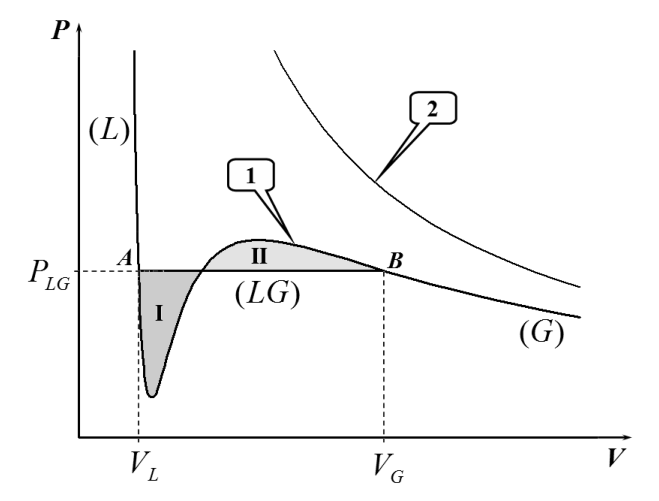
Figure 1. Van der Waals isotherm of gas/liquid (curve 1) and the isotherm of an ideal gas (curve 2).
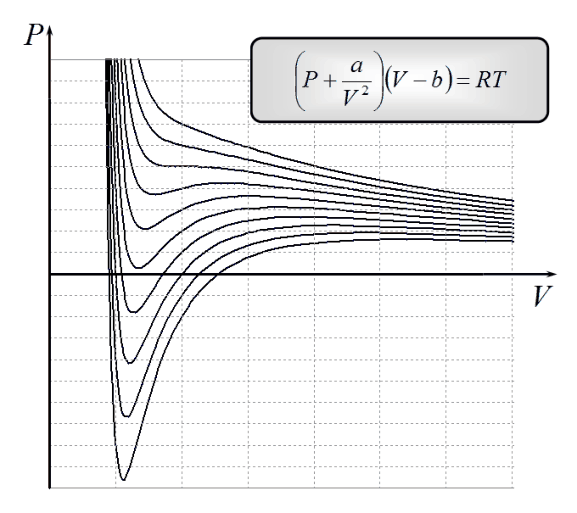
Figure 2. Several isotherms for van der Waals equation of state.
With increasing temperature the straight segment \(AB\) on the isotherm shrinks to a single point when the temperature and the pressure reaches some values \(T_c\) and \(P_{LG}=P_c\), respectively. The parameters \(P_c\) and \(T_c\) are called critical and can be measured experimentally with high degree of accuracy.
| A2 | Express the van der Waals constants \(a\) and \(b\) in terms of \(T_c\) and \(P_c\). (1.3 points) |
| A3 | For water \(T_c=647\ \mathrm{K}\) and \(P_c=2.2\cdot10^7\ \mathrm{Pa}\). Calculate \(a_w\) and \(b_w\) for water. (0.2 points) |
| A4 | Estimate the diameter of water molecules \(d_w\). (0.2 points) |
Part B. Properties of gas and liquid (6 points)
This part of the problem deals with the properties of water in the gaseous and liquid states at temperature \(T=100\,^\circ\mathrm{C}\). The saturated vapor pressure at this temperature is known to be \(p_{LG}=p_0=1.0\cdot10^5\ \mathrm{Pa}\), and the molar mass of water is \(\mu=1.8\cdot10^{-2}\ \frac{\mathrm{kg}}{\mathrm{mole}}\).
Gaseous state
It is reasonable to assume that the inequality \(V_G\gg b\) is valid for the description of water properties in a gaseous state.
| B1 | Derive the formula for the volume \(V_G\) and express it in terms of \(R,T,p_0,\) and \(a\). (0.8 points) |
Almost the same volume \(V_{G0}\) can be approximately evaluated using the ideal gas law.
| B2 | Evaluate in percentage the relative decrease in the gas volume due to intermolecular forces, \(\frac{\Delta V_G}{V_{G0}}=\frac{V_{G0}-V_G}{V_{G0}}\). (0.3 points) |
If the system volume is reduced below \(V_G\), the gas starts to condense. However, thoroughly purified gas can remain in a mechanically metastable state (called supercooled vapor) until its volume reaches a certain value \(V_{G\min}\).
The condition of mechanical stability of supercooled gas at constant temperature is written as: \(\frac{dP}{dV}<0\).
| B3 | Find and evaluate how many times the volume of water vapor can be reduced and still remains in a metastable state. In other words, what is \(V_G/V_{G\min}\)? (0.7 points) |
Liquid state
For the van der Waals’ description of water in a liquid state it is reasonable to assume that the following inequality holds \(P\ll a/V^2\).
| B4 | Express the volume of liquid water \(V_L\) in terms of \(a,b,R,\) and \(T\). (1.0 points) |
Assuming that \(bRT\ll a\), find the following characteristics of water. Do not be surprised if some of the data evaluated do not coincide with the well-known tabulated values!
| B5 | Express the liquid water density \(\rho_L\) in some of the terms of \(\mu,a,b,R\) and evaluate it. (0.5 points) |
| B6 | Express the volume thermal expansion coefficient \(\alpha=\frac{1}{V_L}\frac{\Delta V_L}{\Delta T}\) in terms of \(a,b,R\), and evaluate it. (0.6 points) |
| B7 | Express the specific heat of water vaporization \(L\) in terms of \(\mu,a,b,R\) and evaluate it. (1.1 points) |
| B8 | Considering the monomolecular layer of water, estimate the surface tension \(\sigma\) of water. (1.2 points) |
Part C. Liquid-gas system (3 points)
From Maxwell’s rule (equalities of areas, by applying trivial integration) and the van der Waals’ equation of state together with the approximations made in Part B, it can be shown that the saturated vapor pressure \(p_{LG}\) depends on temperature \(T\) as follows
\[ \ln p_{LG}=A+\frac{B}{T}, \tag{3} \]
where \(A\) and \(B\) are some constants, that can be expressed in terms of \(a\) and \(b\) as \(A=\ln\left(\frac{a}{b^2}\right)-1\); \(B=-\frac{a}{bR}\)
W. Thomson showed that the pressure of saturated vapor depends on the curvature of the liquid surface. Consider a liquid that does not wet the material of a capillary (contact angle \(180^\circ\)). When the capillary is immersed into the liquid, the liquid in the capillary drops to a certain level because of the surface tension (see Figure 3).
| C1 | Find a small change in pressure \(\Delta p_T\) of the saturated vapor over the curved surface of liquid and express it in terms of the vapor density \(\rho_s\), the liquid density \(\rho_L\), the surface tension \(\sigma\) and the radius of surface curvature \(r\). (1.3 points) |
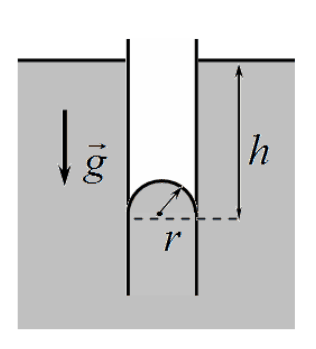
Figure 3. Capillary immersed in a liquid that does not wet its material
Metastable states, considered in part B3, are widely used in real experimental setups, such as the cloud chamber designed for registration of elementary particles. They also occur in natural phenomena such as the formation of morning dew. Supercooled vapor is subject to condensation by forming liquid droplets. Very small droplets evaporate quickly but large enough ones can still grow.
| C2 | Suppose that at the evening temperature of \(t_e=20\,^\circ\mathrm{C}\) the water vapor in the air was saturated, but in the morning the ambient temperature has fallen by a small amount of \(\Delta t=5.0\,^\circ\mathrm{C}\). Assuming that the vapor pressure has remained unchanged, estimate the minimum radius of droplets that can grow. Use the tabulated value of water surface tension \(\sigma=7.3\cdot10^{-2}\ \mathrm{N/m}\). (1.7 points) |
Official English text of the problem.
Answers
Numerical calculations use \(R=8.31\ \mathrm{J\,mol^{-1}K^{-1}}\), \(N_A=6.02\times10^{23}\ \mathrm{mol^{-1}}\), and \(T=373\ \mathrm K\) in Part B. Volumes are molar volumes. The molecular estimates below use the standard hard-sphere excluded-volume convention; their model dependence is discussed in the solutions of A1, A4 and B8.
-
A1: \(b\sim N_A d^3\); the hard-sphere estimate is \[ \boxed{b=\frac{2\pi}{3}N_A d^3.} \]
-
A2: \[ \boxed{a=\frac{27R^2T_c^2}{64P_c},\qquad b=\frac{RT_c}{8P_c}.} \]
-
A3: \[ \boxed{a_w\simeq0.55\ \mathrm{Pa\,m^6\,mol^{-2}},\qquad b_w\simeq3.1\times10^{-5}\ \mathrm{m^3\,mol^{-1}}.} \]
-
A4: \[ \boxed{d_w=\left(\frac{3b_w}{2\pi N_A}\right)^{1/3} \simeq2.9\times10^{-10}\ \mathrm m.} \]
-
B1: \[ \boxed{V_G=\frac{RT+\sqrt{R^2T^2-4ap_0}}{2p_0} \simeq3.08\times10^{-2}\ \mathrm{m^3\,mol^{-1}}.} \]
-
B2: \[ \boxed{\frac{\Delta V_G}{V_{G0}} =\frac{1-\sqrt{1-\frac{4ap_0}{R^2T^2}}}{2} \simeq0.58\%.} \]
-
B3: \[ \boxed{V_{G\min}=\frac{2a}{RT}\simeq3.6\times10^{-4}\ \mathrm{m^3\,mol^{-1}}, \qquad \frac{V_G}{V_{G\min}}\simeq86.} \]
-
B4: \[ \boxed{V_L=\frac{a-\sqrt{a^2-4abRT}}{2RT} =\frac{2b}{1+\sqrt{1-\frac{4bRT}{a}}}.} \]
-
B5: \[ \boxed{\rho_L\simeq\frac{\mu}{b}\simeq5.9\times10^2\ \mathrm{kg\,m^{-3}}.} \]
-
B6: \[ \boxed{\alpha\simeq\frac{bR}{a}\simeq4.6\times10^{-4}\ \mathrm{K^{-1}}.} \]
-
B7: \[ \boxed{L\simeq\frac{a}{\mu b}\simeq1.0\times10^6\ \mathrm{J\,kg^{-1}}.} \]
-
B8: A monolayer estimate with half the bulk cohesive contribution missing gives \[ \boxed{\sigma\sim\frac12\rho_L Ld_w =\frac{ad_w}{2b^2}\simeq8.6\times10^{-2}\ \mathrm{N\,m^{-1}}.} \] Its reliable precision is an order-of-magnitude estimate, \(\sigma\sim10^{-1}\ \mathrm{N\,m^{-1}}\).
-
C1: For the convex liquid surface shown, \[ \boxed{\Delta p_T=\frac{2\sigma\rho_s}{r(\rho_L-\rho_s)} \simeq\frac{2\sigma\rho_s}{r\rho_L}>0.} \]
-
C2: With \(T_e=293\ \mathrm K\) and \(\Delta T=5.0\ \mathrm K\), \[ \boxed{r_{\min}\simeq\frac{2\sigma T_e}{\rho_L L\Delta T} =\frac{2\sigma b^2T_e}{a\Delta T} \simeq1.4\times10^{-8}\ \mathrm m=14\ \mathrm{nm}.} \] Droplets larger than this critical radius can grow.
Solution
A1. Molecular size and excluded volume
Model the molecules as hard spheres of diameter \(d\). The center of one molecule cannot enter a sphere of radius \(d\) around the center of another. The excluded volume associated with a pair is therefore
\[ v_{\mathrm{ex}}=\frac{4\pi d^3}{3}. \]
In the standard dilute hard-sphere excluded-volume calculation, each pair is counted once, giving an excluded-volume parameter per molecule of \(v_{\mathrm{ex}}/2\). For one mole,
\[ \boxed{b=\frac12N_Av_{\mathrm{ex}} =\frac{2\pi}{3}N_A d^3.} \]
Thus the usual van der Waals \(b\) is four times the total geometrical volume of the spherical molecules. Independently of this geometric prefactor, the requested scale is \(b\sim N_A d^3\).
A2. Critical-point conditions
Write the equation of state as
\[ P(V,T)=\frac{RT}{V-b}-\frac{a}{V^2}. \]
At the critical point, the two extrema of the subcritical isotherm merge into a horizontal inflection point. Hence
\[ \left(\frac{\partial P}{\partial V}\right)_{T_c,V_c}=0, \qquad \left(\frac{\partial^2P}{\partial V^2}\right)_{T_c,V_c}=0. \]
These conditions give
\[ \frac{RT_c}{(V_c-b)^2}=\frac{2a}{V_c^3}, \qquad \frac{RT_c}{(V_c-b)^3}=\frac{3a}{V_c^4}. \]
Dividing the second equation by the first,
\[ \frac{1}{V_c-b}=\frac{3}{2V_c}, \]
so
\[ V_c=3b. \]
Substitution into the first derivative condition and the equation of state yields
\[ RT_c=\frac{8a}{27b}, \qquad P_c=\frac{a}{27b^2}. \]
Solving for the constants,
\[ \boxed{b=\frac{RT_c}{8P_c},\qquad a=\frac{27R^2T_c^2}{64P_c}.} \]
A3. Constants for water
Using the given critical data,
\[ b_w=\frac{8.31(647)}{8(2.2\times10^7)} =3.055\times10^{-5}\ \mathrm{m^3\,mol^{-1}}, \]
and
\[ a_w=\frac{27(8.31)^2(647)^2}{64(2.2\times10^7)} =0.5543\ \mathrm{Pa\,m^6\,mol^{-2}}. \]
To two significant figures,
\[ \boxed{a_w\simeq0.55\ \mathrm{Pa\,m^6\,mol^{-2}},\qquad b_w\simeq3.1\times10^{-5}\ \mathrm{m^3\,mol^{-1}}.} \]
The unrounded values are retained in subsequent calculations.
A4. Molecular diameter
From A1,
\[ d_w=\left(\frac{3b_w}{2\pi N_A}\right)^{1/3}. \]
Consequently,
\[ \boxed{d_w\simeq2.9\times10^{-10}\ \mathrm m=0.29\ \mathrm{nm}.} \]
This is an effective diameter within the hard-sphere model.
B1. Saturated vapor volume
Apply the prescribed approximation \(V_G\gg b\):
\[ \left(p_0+\frac{a}{V_G^2}\right)V_G=RT. \]
Multiplication by \(V_G\) gives
\[ p_0V_G^2-RTV_G+a=0. \]
The gaseous state corresponds to the larger root, which approaches \(RT/p_0\) as \(a\to0\):
\[ \boxed{V_G=\frac{RT+\sqrt{R^2T^2-4ap_0}}{2p_0}.} \]
At \(T=373\ \mathrm K\),
\[ V_G=0.0308164\ \mathrm{m^3\,mol^{-1}} \simeq3.08\times10^{-2}\ \mathrm{m^3\,mol^{-1}}. \]
For weak attraction, expansion of the square root also gives
\[ V_G\simeq\frac{RT}{p_0}-\frac{a}{RT}. \]
B2. Relative volume decrease
The ideal-gas volume is
\[ V_{G0}=\frac{RT}{p_0} =0.0309963\ \mathrm{m^3\,mol^{-1}}. \]
Using B1,
\[ \frac{V_{G0}-V_G}{V_{G0}} =\frac12\left(1-\sqrt{1-\frac{4ap_0}{R^2T^2}}\right). \]
Numerically,
\[ \frac{\Delta V_G}{V_{G0}} =5.803\times10^{-3}, \]
so
\[ \boxed{\frac{\Delta V_G}{V_{G0}}\simeq0.58\%.} \]
To first order, this fraction is \(ap_0/(R^2T^2)\).
B3. Limit of metastable compression
Within the same gas approximation,
\[ P(V)=\frac{RT}{V}-\frac{a}{V^2}. \]
Mechanical stability requires
\[ \frac{dP}{dV} =-\frac{RT}{V^2}+\frac{2a}{V^3} =\frac{2a-RTV}{V^3}<0. \]
Thus the gas remains mechanically stable against small volume perturbations when
\[ V>\frac{2a}{RT}. \]
The limiting, marginally stable volume is therefore
\[ \boxed{V_{G\min}=\frac{2a}{RT} =3.58\times10^{-4}\ \mathrm{m^3\,mol^{-1}}.} \]
The compression factor is
\[ \frac{V_G}{V_{G\min}} =\frac{RT}{2a} \frac{RT+\sqrt{R^2T^2-4ap_0}}{2p_0} \simeq86.2. \]
Hence
\[ \boxed{\frac{V_G}{V_{G\min}}\simeq86.} \]
At the limiting volume, \(V_{G\min}/b\simeq12\), so the result is an estimate within the prescribed approximation that neglects \(b\).
B4. Liquid volume
For the liquid, neglect \(P\) relative to \(a/V_L^2\):
\[ \frac{a}{V_L^2}(V_L-b)=RT. \]
Therefore
\[ RTV_L^2-aV_L+ab=0. \]
The liquid is the smaller-volume root, which approaches \(b\) as \(T\to0\):
\[ \boxed{ V_L=\frac{a-\sqrt{a^2-4abRT}}{2RT} =\frac{2b}{1+\sqrt{1-4bRT/a}}. } \]
At \(373\ \mathrm K\), this expression gives approximately
\[ V_L=3.91\times10^{-5}\ \mathrm{m^3\,mol^{-1}}. \]
For the remaining questions, introduce the stipulated small parameter
\[ \varepsilon=\frac{bRT}{a}\ll1. \]
Expanding the liquid root,
\[ \boxed{V_L=b\left(1+\frac{bRT}{a} +O(\varepsilon^2)\right).} \]
For the supplied water parameters, \(\varepsilon\simeq0.17\), so the following leading-order results are approximate.
B5. Liquid density
To leading order, \(V_L\simeq b\). Since one mole has mass \(\mu\),
\[ \boxed{\rho_L=\frac{\mu}{V_L}\simeq\frac{\mu}{b}.} \]
Numerically,
\[ \rho_L\simeq \frac{1.8\times10^{-2}}{3.055\times10^{-5}} =\boxed{5.9\times10^2\ \mathrm{kg\,m^{-3}}.} \]
This is the density predicted by the specified approximation.
B6. Thermal expansion coefficient
Retaining the first temperature-dependent term from B4,
\[ V_L\simeq b+\frac{b^2RT}{a}. \]
Thus, at fixed external pressure within the approximation used,
\[ \frac{\partial V_L}{\partial T}\simeq\frac{b^2R}{a}. \]
Using \(V_L\simeq b\) in the denominator,
\[ \boxed{\alpha=\frac{1}{V_L} \left(\frac{\partial V_L}{\partial T}\right)_P \simeq\frac{bR}{a}.} \]
Numerically,
\[ \boxed{\alpha\simeq4.6\times10^{-4}\ \mathrm{K^{-1}}.} \]
B7. Specific latent heat of vaporization
The thermodynamic identity
\[ \left(\frac{\partial U}{\partial V}\right)_T =T\left(\frac{\partial P}{\partial T}\right)_V-P \]
relates the internal energy to the equation of state. For the van der Waals fluid,
\[ T\left(\frac{\partial P}{\partial T}\right)_V-P =\frac{RT}{V-b} -\left(\frac{RT}{V-b}-\frac{a}{V^2}\right) =\frac{a}{V^2}. \]
Hence the molar internal energy has the form
\[ U(T,V)=U_0(T)-\frac{a}{V}. \]
At the same temperature, the internal-energy increase upon vaporization is
\[ U_G-U_L=a\left(\frac1{V_L}-\frac1{V_G}\right). \]
Vaporization at constant pressure also requires expansion work, so the heat supplied per mole is
\[ \mu L =a\left(\frac1{V_L}-\frac1{V_G}\right) +p_0(V_G-V_L). \]
Since \(V_G\gg V_L\simeq b\), and \(RT\ll a/b\), the leading contribution is \(a/b\). Therefore
\[ \boxed{L\simeq\frac{a}{\mu b}.} \]
Numerically,
\[ \boxed{L\simeq1.0\times10^6\ \mathrm{J\,kg^{-1}}.} \]
The omission of thermal corrections is consistent: retaining \(V_L\simeq b(1+bRT/a)\) gives \(a/V_L\simeq a/b-RT\), whose \(-RT\) correction cancels the leading expansion-work term \(p_0V_G\simeq RT\).
B8. Surface tension from a monomolecular layer
Surface tension is the surface free energy per unit area. For an energetic estimate, neglect the surface entropy contribution and use the cohesive energy found in B7.
The bulk cohesive energy per molecule is approximately
\[ E_{\mathrm{coh}}\simeq\frac{\mu L}{N_A} \simeq\frac{a}{bN_A}. \]
A molecule near a free surface lacks neighbors on the vapor side. In a simple estimate, its assigned cohesive binding is reduced by about one half, giving a surface excess energy of order \(E_{\mathrm{coh}}/2\).
A surface layer of area \(S\) and thickness \(d_w\) contains approximately
\[ N_{\mathrm{layer}}\simeq \frac{\rho_L S d_w}{\mu}N_A \]
molecules. Its excess energy is therefore
\[ E_{\mathrm{surface}} \sim \frac12E_{\mathrm{coh}}N_{\mathrm{layer}} =\frac12\rho_L Ld_wS. \]
Identifying this with \(\sigma S\),
\[ \boxed{\sigma\sim\frac12\rho_L Ld_w =\frac{ad_w}{2b^2}.} \]
Using the estimates above,
\[ \boxed{\sigma\sim8.6\times10^{-2}\ \mathrm{N\,m^{-1}}.} \]
The monolayer construction fixes the scale, \(\sigma\sim10^{-1}\ \mathrm{N\,m^{-1}}\); its numerical prefactor depends on the assumed molecular arrangement and missing interactions.
C1. Saturation pressure above a curved surface
Let \(p_s\) be the saturated vapor pressure above the flat liquid surface. The nonwetting meniscus is convex toward the vapor and lies a depth \(h\) below that surface.
For a small height difference, hydrostatic equilibrium gives the pressures at the meniscus level:
\[ p_{\ell}=p_s+\rho_Lgh, \qquad p_v=p_s+\rho_sgh. \]
The spherical meniscus obeys the Laplace pressure relation
\[ p_{\ell}-p_v=\frac{2\sigma}{r}. \]
Consequently,
\[ (\rho_L-\rho_s)gh=\frac{2\sigma}{r}. \]
The change in the equilibrium vapor pressure is
\[ \Delta p_T=p_v-p_s=\rho_sgh. \]
Eliminating \(h\),
\[ \boxed{\Delta p_T =\frac{2\sigma\rho_s}{r(\rho_L-\rho_s)} \simeq\frac{2\sigma\rho_s}{r\rho_L}.} \]
The last step uses \(\rho_s\ll\rho_L\). The change is positive: a convex liquid surface requires a higher equilibrium vapor pressure than a flat surface.
C2. Minimum radius of a growing droplet
Let \(p_s(T)\) denote the saturation pressure over a flat surface. Initially the actual vapor pressure is
\[ p=p_s(T_e),\qquad T_e=293\ \mathrm K. \]
After cooling by \(\Delta T=5.0\ \mathrm K\), the actual pressure stays fixed while the flat-surface saturation pressure falls. To first order,
\[ \Delta p_{\mathrm{cool}} =p_s(T_e)-p_s(T_e-\Delta T) \simeq\left.\frac{dp_s}{dT}\right|_{T_e}\Delta T. \]
From equation (3),
\[ \frac1{p_s}\frac{dp_s}{dT} =-\frac{B}{T^2} =\frac{a}{bRT^2}. \]
Thus
\[ \Delta p_{\mathrm{cool}} \simeq p_s\frac{a\Delta T}{bRT_e^2}. \]
A droplet can grow if the ambient vapor pressure exceeds its curvature-dependent equilibrium pressure. At the critical radius, the two pressure changes are equal:
\[ p_s\frac{a\Delta T}{bRT_e^2} =\frac{2\sigma\rho_s}{\rho_Lr_{\min}}. \]
Treating the dilute vapor as ideal,
\[ \rho_s\simeq\frac{\mu p_s}{RT_e}. \]
Substituting and cancelling \(p_s\),
\[ r_{\min} \simeq\frac{2\sigma\mu bT_e}{\rho_La\Delta T}. \]
Using the Part B results \(\rho_L\simeq\mu/b\) and \(L\simeq a/(\mu b)\),
\[ \boxed{ r_{\min}\simeq \frac{2\sigma b^2T_e}{a\Delta T} =\frac{2\sigma T_e}{\rho_LL\Delta T}. } \]
With the supplied tabulated surface tension,
\[ r_{\min}\simeq \frac{2(7.3\times10^{-2})(3.055\times10^{-5})^2(293)} {(0.5543)(5.0)} =\boxed{1.4\times10^{-8}\ \mathrm m\approx14\ \mathrm{nm}.} \]
At this radius a droplet is in unstable equilibrium. Larger droplets can grow; smaller droplets tend to evaporate.
The solution was checked against the official solution.
IPhO 2014 · Theorieaufgabe 2
Van-der-Waals-Zustandsgleichung
In einem bekannten Modell eines idealen Gases, dessen Zustandsgleichung dem Clapeyron-Mendelejew-Gesetz folgt, werden die folgenden wichtigen physikalischen Effekte vernachlässigt. Erstens haben die Moleküle eines realen Gases eine endliche Größe, und zweitens wechselwirken sie miteinander. In allen Teilen dieser Aufgabe wird ein Mol Wasser betrachtet.
Teil A. Zustandsgleichung eines nichtidealen Gases (2 Punkte)
Berücksichtigt man die endliche Größe der Moleküle, so nimmt die Zustandsgleichung des Gases die folgende Form an:
\[ P(V-b)=RT, \tag{1} \]
wobei \(P,V,T\) den Gasdruck, das Volumen pro Mol beziehungsweise die Temperatur bezeichnen, \(R\) die universelle Gaskonstante ist und \(b\) eine stoffabhängige Konstante ist, die ein bestimmtes Volumen abzieht.
| A1 | Schätzen Sie \(b\) ab und drücken Sie es durch den Moleküldurchmesser \(d\) aus. (0.3 Punkte) |
Unter Berücksichtigung der zwischenmolekularen Anziehungskräfte schlug van der Waals die folgende Zustandsgleichung vor, die sowohl den gasförmigen als auch den flüssigen Aggregatzustand gut beschreibt:
\[ \left(P+\frac{a}{V^2}\right)(V-b)=RT. \tag{2} \]
Dabei ist \(a\) eine weitere stoffabhängige Konstante.
Bei Temperaturen \(T\) unterhalb eines bestimmten kritischen Wertes \(T_c\) wird die Isotherme der Gleichung (2) durch die in Abbildung 1 gezeigte nichtmonotone Kurve 1 gut wiedergegeben; diese wird als Van-der-Waals-Isotherme bezeichnet. In derselben Abbildung zeigt Kurve 2 die Isotherme eines idealen Gases bei derselben Temperatur. Eine reale Isotherme unterscheidet sich von der Van-der-Waals-Isotherme durch einen geraden Abschnitt \(AB\), der bei einem bestimmten konstanten Druck \(P_{LG}\) verläuft. Dieser gerade Abschnitt liegt zwischen den Volumina \(V_L\) und \(V_G\) und entspricht dem Gleichgewicht zwischen der flüssigen Phase (mit \(L\) bezeichnet) und der gasförmigen Phase (mit \(G\) bezeichnet). Aus dem zweiten Hauptsatz der Thermodynamik zeigte J. Maxwell, dass der Druck \(P_{LG}\) so gewählt werden muss, dass die in Abbildung 1 dargestellten Flächen \(I\) und \(II\) gleich groß sind.
Abbildung 1. Van-der-Waals-Isotherme von Gas/Flüssigkeit (Kurve 1) und Isotherme eines idealen Gases (Kurve 2).
Abbildung 2. Mehrere Isothermen der Van-der-Waals-Zustandsgleichung.
Mit steigender Temperatur schrumpft der gerade Abschnitt \(AB\) auf der Isotherme zu einem einzigen Punkt, wenn Temperatur und Druck bestimmte Werte \(T_c\) beziehungsweise \(P_{LG}=P_c\) erreichen. Die Parameter \(P_c\) und \(T_c\) heißen kritisch und lassen sich experimentell mit hoher Genauigkeit messen.
| A2 | Drücken Sie die Van-der-Waals-Konstanten \(a\) und \(b\) durch \(T_c\) und \(P_c\) aus. (1.3 Punkte) |
| A3 | Für Wasser gilt \(T_c=647\ \mathrm{K}\) und \(P_c=2.2\cdot10^7\ \mathrm{Pa}\). Berechnen Sie \(a_w\) und \(b_w\) für Wasser. (0.2 Punkte) |
| A4 | Schätzen Sie den Durchmesser der Wassermoleküle \(d_w\) ab. (0.2 Punkte) |
Teil B. Eigenschaften von Gas und Flüssigkeit (6 Punkte)
Dieser Teil der Aufgabe behandelt die Eigenschaften von Wasser im gasförmigen und flüssigen Zustand bei der Temperatur \(T=100\,^\circ\mathrm{C}\). Der Sättigungsdampfdruck bei dieser Temperatur ist bekanntermaßen \(p_{LG}=p_0=1.0\cdot10^5\ \mathrm{Pa}\), und die molare Masse von Wasser beträgt \(\mu=1.8\cdot10^{-2}\ \frac{\mathrm{kg}}{\mathrm{mole}}\).
Gasförmiger Zustand
Zur Beschreibung der Eigenschaften von Wasser im gasförmigen Zustand ist es sinnvoll anzunehmen, dass die Ungleichung \(V_G\gg b\) gilt.
| B1 | Leiten Sie die Formel für das Volumen \(V_G\) her und drücken Sie es durch \(R,T,p_0,\) und \(a\) aus. (0.8 Punkte) |
Mit dem idealen Gasgesetz lässt sich näherungsweise ein nahezu gleiches Volumen \(V_{G0}\) bestimmen.
| B2 | Berechnen Sie die relative Abnahme des Gasvolumens aufgrund zwischenmolekularer Kräfte, \(\frac{\Delta V_G}{V_{G0}}=\frac{V_{G0}-V_G}{V_{G0}}\), in Prozent. (0.3 Punkte) |
Wird das Volumen des Systems unter \(V_G\) verringert, beginnt das Gas zu kondensieren. Ein sorgfältig gereinigtes Gas kann jedoch in einem mechanisch metastabilen Zustand (als unterkühlter Dampf bezeichnet) verbleiben, bis sein Volumen einen bestimmten Wert \(V_{G\min}\) erreicht.
Die Bedingung für die mechanische Stabilität eines unterkühlten Gases bei konstanter Temperatur lautet: \(\frac{dP}{dV}<0\).
| B3 | Bestimmen und berechnen Sie, um welchen Faktor das Volumen von Wasserdampf verringert werden kann, während dieser noch in einem metastabilen Zustand verbleibt. Mit anderen Worten: Wie groß ist \(V_G/V_{G\min}\)? (0.7 Punkte) |
Flüssiger Zustand
Für die Beschreibung von Wasser im flüssigen Zustand nach van der Waals ist es sinnvoll anzunehmen, dass die folgende Ungleichung gilt: \(P\ll a/V^2\).
| B4 | Drücken Sie das Volumen des flüssigen Wassers \(V_L\) durch \(a,b,R,\) und \(T\) aus. (1.0 Punkte) |
Bestimmen Sie unter der Annahme \(bRT\ll a\) die folgenden Eigenschaften von Wasser. Wundern Sie sich nicht, wenn einige der berechneten Werte nicht mit den bekannten Tabellenwerten übereinstimmen!
| B5 | Drücken Sie die Dichte des flüssigen Wassers \(\rho_L\) durch geeignete Größen aus \(\mu,a,b,R\) aus und berechnen Sie sie. (0.5 Punkte) |
| B6 | Drücken Sie den thermischen Volumenausdehnungskoeffizienten \(\alpha=\frac{1}{V_L}\frac{\Delta V_L}{\Delta T}\) durch \(a,b,R\) aus und berechnen Sie ihn. (0.6 Punkte) |
| B7 | Drücken Sie die spezifische Verdampfungswärme von Wasser \(L\) durch \(\mu,a,b,R\) aus und berechnen Sie sie. (1.1 Punkte) |
| B8 | Schätzen Sie die Oberflächenspannung \(\sigma\) von Wasser ab, indem Sie eine monomolekulare Wasserschicht betrachten. (1.2 Punkte) |
Teil C. Flüssigkeit-Gas-System (3 Punkte)
Aus der Maxwell-Regel (Flächengleichheit, durch einfache Integration) und der Van-der-Waals-Zustandsgleichung lässt sich zusammen mit den in Teil B vorgenommenen Näherungen zeigen, dass der Sättigungsdampfdruck \(p_{LG}\) wie folgt von der Temperatur \(T\) abhängt:
\[ \ln p_{LG}=A+\frac{B}{T}, \tag{3} \]
wobei \(A\) und \(B\) Konstanten sind, die durch \(a\) und \(b\) ausgedrückt werden können als \(A=\ln\left(\frac{a}{b^2}\right)-1\); \(B=-\frac{a}{bR}\)
W. Thomson zeigte, dass der Sättigungsdampfdruck von der Krümmung der Flüssigkeitsoberfläche abhängt. Betrachten Sie eine Flüssigkeit, die das Material einer Kapillare nicht benetzt (Kontaktwinkel \(180^\circ\)). Wird die Kapillare in die Flüssigkeit eingetaucht, sinkt die Flüssigkeit in der Kapillare aufgrund der Oberflächenspannung auf ein bestimmtes Niveau ab (siehe Abbildung 3).
| C1 | Bestimmen Sie eine kleine Änderung \(\Delta p_T\) des Sättigungsdampfdrucks über der gekrümmten Flüssigkeitsoberfläche und drücken Sie sie durch die Dampfdichte \(\rho_s\), die Flüssigkeitsdichte \(\rho_L\), die Oberflächenspannung \(\sigma\) und den Krümmungsradius der Oberfläche \(r\) aus. (1.3 Punkte) |
Abbildung 3. Eine Kapillare, die in eine Flüssigkeit eingetaucht ist, welche ihr Material nicht benetzt
Die in Teil B3 betrachteten metastabilen Zustände werden in realen Versuchsanordnungen vielfach genutzt, etwa in der Nebelkammer zum Nachweis von Elementarteilchen. Sie treten auch bei Naturerscheinungen wie der Bildung von Morgentau auf. Unterkühlter Dampf kann unter Bildung von Flüssigkeitströpfchen kondensieren. Sehr kleine Tröpfchen verdampfen schnell, hinreichend große hingegen können weiter wachsen.
| C2 | Nehmen Sie an, dass der Wasserdampf in der Luft bei der Abendtemperatur \(t_e=20\,^\circ\mathrm{C}\) gesättigt war, die Umgebungstemperatur am Morgen jedoch um einen kleinen Betrag von \(\Delta t=5.0\,^\circ\mathrm{C}\) gesunken ist. Schätzen Sie unter der Annahme, dass der Dampfdruck unverändert geblieben ist, den kleinsten Radius von Tröpfchen ab, die wachsen können. Verwenden Sie den Tabellenwert der Oberflächenspannung von Wasser \(\sigma=7.3\cdot10^{-2}\ \mathrm{N/m}\). (1.7 Punkte) |
Aufgabentext aus dem offiziellen englischen Text übersetzt.
Antworten
Für die numerischen Berechnungen werden \(R=8.31\ \mathrm{J\,mol^{-1}K^{-1}}\), \(N_A=6.02\times10^{23}\ \mathrm{mol^{-1}}\) und in Teil B \(T=373\ \mathrm K\) verwendet. Die Volumina sind molare Volumina. Die folgenden molekularen Abschätzungen verwenden die übliche Konvention für das ausgeschlossene Volumen harter Kugeln; ihre Modellabhängigkeit wird in den Lösungen zu A1, A4 und B8 erörtert.
-
A1: \(b\sim N_A d^3\); die Abschätzung für harte Kugeln lautet \[ \boxed{b=\frac{2\pi}{3}N_A d^3.} \]
-
A2: \[ \boxed{a=\frac{27R^2T_c^2}{64P_c},\qquad b=\frac{RT_c}{8P_c}.} \]
-
A3: \[ \boxed{a_w\simeq0.55\ \mathrm{Pa\,m^6\,mol^{-2}},\qquad b_w\simeq3.1\times10^{-5}\ \mathrm{m^3\,mol^{-1}}.} \]
-
A4: \[ \boxed{d_w=\left(\frac{3b_w}{2\pi N_A}\right)^{1/3} \simeq2.9\times10^{-10}\ \mathrm m.} \]
-
B1: \[ \boxed{V_G=\frac{RT+\sqrt{R^2T^2-4ap_0}}{2p_0} \simeq3.08\times10^{-2}\ \mathrm{m^3\,mol^{-1}}.} \]
-
B2: \[ \boxed{\frac{\Delta V_G}{V_{G0}} =\frac{1-\sqrt{1-\frac{4ap_0}{R^2T^2}}}{2} \simeq0.58\%.} \]
-
B3: \[ \boxed{V_{G\min}=\frac{2a}{RT}\simeq3.6\times10^{-4}\ \mathrm{m^3\,mol^{-1}}, \qquad \frac{V_G}{V_{G\min}}\simeq86.} \]
-
B4: \[ \boxed{V_L=\frac{a-\sqrt{a^2-4abRT}}{2RT} =\frac{2b}{1+\sqrt{1-\frac{4bRT}{a}}}.} \]
-
B5: \[ \boxed{\rho_L\simeq\frac{\mu}{b}\simeq5.9\times10^2\ \mathrm{kg\,m^{-3}}.} \]
-
B6: \[ \boxed{\alpha\simeq\frac{bR}{a}\simeq4.6\times10^{-4}\ \mathrm{K^{-1}}.} \]
-
B7: \[ \boxed{L\simeq\frac{a}{\mu b}\simeq1.0\times10^6\ \mathrm{J\,kg^{-1}}.} \]
-
B8: Eine Abschätzung anhand einer Monoschicht, der die Hälfte des Kohäsionsbeitrags aus dem Flüssigkeitsinneren fehlt, ergibt \[ \boxed{\sigma\sim\frac12\rho_L Ld_w =\frac{ad_w}{2b^2}\simeq8.6\times10^{-2}\ \mathrm{N\,m^{-1}}.} \] Verlässlich ist dabei nur die Größenordnung, \(\sigma\sim10^{-1}\ \mathrm{N\,m^{-1}}\).
-
C1: Für die dargestellte konvexe Flüssigkeitsoberfläche gilt \[ \boxed{\Delta p_T=\frac{2\sigma\rho_s}{r(\rho_L-\rho_s)} \simeq\frac{2\sigma\rho_s}{r\rho_L}>0.} \]
-
C2: Mit \(T_e=293\ \mathrm K\) und \(\Delta T=5.0\ \mathrm K\) gilt \[ \boxed{r_{\min}\simeq\frac{2\sigma T_e}{\rho_L L\Delta T} =\frac{2\sigma b^2T_e}{a\Delta T} \simeq1.4\times10^{-8}\ \mathrm m=14\ \mathrm{nm}.} \] Tröpfchen, die größer als dieser kritische Radius sind, können wachsen.
Lösung
A1. Molekülgröße und ausgeschlossenes Volumen
Wir modellieren die Moleküle als harte Kugeln mit dem Durchmesser \(d\). Der Mittelpunkt eines Moleküls kann nicht in eine Kugel mit dem Radius \(d\) um den Mittelpunkt eines anderen Moleküls eindringen. Das einem Paar zugeordnete ausgeschlossene Volumen ist daher
\[ v_{\mathrm{ex}}=\frac{4\pi d^3}{3}. \]
Bei der üblichen Berechnung des ausgeschlossenen Volumens für ein verdünntes System harter Kugeln wird jedes Paar einmal gezählt; daraus ergibt sich ein Parameter des ausgeschlossenen Volumens pro Molekül von \(v_{\mathrm{ex}}/2\). Für ein Mol gilt
\[ \boxed{b=\frac12N_Av_{\mathrm{ex}} =\frac{2\pi}{3}N_A d^3.} \]
Damit ist die übliche Van-der-Waals-Konstante \(b\) viermal so groß wie das gesamte geometrische Volumen der kugelförmigen Moleküle. Unabhängig von diesem geometrischen Vorfaktor ist die gesuchte Größenordnung \(b\sim N_A d^3\).
A2. Bedingungen am kritischen Punkt
Wir schreiben die Zustandsgleichung in der Form
\[ P(V,T)=\frac{RT}{V-b}-\frac{a}{V^2}. \]
Am kritischen Punkt verschmelzen die beiden Extrema der unterkritischen Isotherme zu einem Wendepunkt mit waagerechter Tangente. Daher gilt
\[ \left(\frac{\partial P}{\partial V}\right)_{T_c,V_c}=0, \qquad \left(\frac{\partial^2P}{\partial V^2}\right)_{T_c,V_c}=0. \]
Diese Bedingungen ergeben
\[ \frac{RT_c}{(V_c-b)^2}=\frac{2a}{V_c^3}, \qquad \frac{RT_c}{(V_c-b)^3}=\frac{3a}{V_c^4}. \]
Division der zweiten Gleichung durch die erste liefert
\[ \frac{1}{V_c-b}=\frac{3}{2V_c}, \]
also
\[ V_c=3b. \]
Einsetzen in die Bedingung für die erste Ableitung und in die Zustandsgleichung ergibt
\[ RT_c=\frac{8a}{27b}, \qquad P_c=\frac{a}{27b^2}. \]
Auflösen nach den Konstanten liefert
\[ \boxed{b=\frac{RT_c}{8P_c},\qquad a=\frac{27R^2T_c^2}{64P_c}.} \]
A3. Konstanten für Wasser
Mit den gegebenen kritischen Daten erhalten wir
\[ b_w=\frac{8.31(647)}{8(2.2\times10^7)} =3.055\times10^{-5}\ \mathrm{m^3\,mol^{-1}}, \]
und
\[ a_w=\frac{27(8.31)^2(647)^2}{64(2.2\times10^7)} =0.5543\ \mathrm{Pa\,m^6\,mol^{-2}}. \]
Auf zwei signifikante Stellen gerundet ergibt sich
\[ \boxed{a_w\simeq0.55\ \mathrm{Pa\,m^6\,mol^{-2}},\qquad b_w\simeq3.1\times10^{-5}\ \mathrm{m^3\,mol^{-1}}.} \]
In den folgenden Berechnungen werden die ungerundeten Werte beibehalten.
A4. Moleküldurchmesser
Aus A1 folgt
\[ d_w=\left(\frac{3b_w}{2\pi N_A}\right)^{1/3}. \]
Somit gilt
\[ \boxed{d_w\simeq2.9\times10^{-10}\ \mathrm m=0.29\ \mathrm{nm}.} \]
Dies ist ein effektiver Durchmesser im Modell harter Kugeln.
B1. Volumen des gesättigten Dampfes
Wir wenden die vorgegebene Näherung \(V_G\gg b\) an:
\[ \left(p_0+\frac{a}{V_G^2}\right)V_G=RT. \]
Multiplikation mit \(V_G\) ergibt
\[ p_0V_G^2-RTV_G+a=0. \]
Der gasförmige Zustand entspricht der größeren Lösung, die für \(a\to0\) gegen \(RT/p_0\) strebt:
\[ \boxed{V_G=\frac{RT+\sqrt{R^2T^2-4ap_0}}{2p_0}.} \]
Bei \(T=373\ \mathrm K\) gilt
\[ V_G=0.0308164\ \mathrm{m^3\,mol^{-1}} \simeq3.08\times10^{-2}\ \mathrm{m^3\,mol^{-1}}. \]
Bei schwacher Anziehung ergibt eine Entwicklung der Quadratwurzel außerdem
\[ V_G\simeq\frac{RT}{p_0}-\frac{a}{RT}. \]
B2. Relative Volumenabnahme
Das Volumen des idealen Gases beträgt
\[ V_{G0}=\frac{RT}{p_0} =0.0309963\ \mathrm{m^3\,mol^{-1}}. \]
Mit B1 erhalten wir
\[ \frac{V_{G0}-V_G}{V_{G0}} =\frac12\left(1-\sqrt{1-\frac{4ap_0}{R^2T^2}}\right). \]
Numerisch ergibt sich
\[ \frac{\Delta V_G}{V_{G0}} =5.803\times10^{-3}, \]
also
\[ \boxed{\frac{\Delta V_G}{V_{G0}}\simeq0.58\%.} \]
In erster Ordnung ist dieser Anteil gleich \(ap_0/(R^2T^2)\).
B3. Grenze der metastabilen Kompression
In derselben Näherung für das Gas gilt
\[ P(V)=\frac{RT}{V}-\frac{a}{V^2}. \]
Mechanische Stabilität erfordert
\[ \frac{dP}{dV} =-\frac{RT}{V^2}+\frac{2a}{V^3} =\frac{2a-RTV}{V^3}<0. \]
Das Gas bleibt somit gegenüber kleinen Volumenstörungen mechanisch stabil, wenn
\[ V>\frac{2a}{RT}. \]
Das Grenzvolumen am Rand der Stabilität ist daher
\[ \boxed{V_{G\min}=\frac{2a}{RT} =3.58\times10^{-4}\ \mathrm{m^3\,mol^{-1}}.} \]
Der Kompressionsfaktor beträgt
\[ \frac{V_G}{V_{G\min}} =\frac{RT}{2a} \frac{RT+\sqrt{R^2T^2-4ap_0}}{2p_0} \simeq86.2. \]
Damit gilt
\[ \boxed{\frac{V_G}{V_{G\min}}\simeq86.} \]
Am Grenzvolumen gilt \(V_{G\min}/b\simeq12\); das Ergebnis ist daher eine Abschätzung innerhalb der vorgegebenen Näherung, in der \(b\) vernachlässigt wird.
B4. Flüssigkeitsvolumen
Für die Flüssigkeit vernachlässigen wir \(P\) gegenüber \(a/V_L^2\):
\[ \frac{a}{V_L^2}(V_L-b)=RT. \]
Daher gilt
\[ RTV_L^2-aV_L+ab=0. \]
Die Flüssigkeit entspricht der Lösung mit dem kleineren Volumen, die für \(T\to0\) gegen \(b\) strebt:
\[ \boxed{ V_L=\frac{a-\sqrt{a^2-4abRT}}{2RT} =\frac{2b}{1+\sqrt{1-4bRT/a}}. } \]
Bei \(373\ \mathrm K\) ergibt dieser Ausdruck näherungsweise
\[ V_L=3.91\times10^{-5}\ \mathrm{m^3\,mol^{-1}}. \]
Für die verbleibenden Fragen führen wir den vorausgesetzten kleinen Parameter ein:
\[ \varepsilon=\frac{bRT}{a}\ll1. \]
Die Entwicklung der Lösung für die Flüssigkeit ergibt
\[ \boxed{V_L=b\left(1+\frac{bRT}{a} +O(\varepsilon^2)\right).} \]
Für die angegebenen Wasserparameter ist \(\varepsilon\simeq0.17\), sodass die folgenden Ergebnisse in führender Ordnung Näherungswerte sind.
B5. Flüssigkeitsdichte
In führender Ordnung gilt \(V_L\simeq b\). Da ein Mol die Masse \(\mu\) hat, gilt
\[ \boxed{\rho_L=\frac{\mu}{V_L}\simeq\frac{\mu}{b}.} \]
Numerisch ergibt sich
\[ \rho_L\simeq \frac{1.8\times10^{-2}}{3.055\times10^{-5}} =\boxed{5.9\times10^2\ \mathrm{kg\,m^{-3}}.} \]
Dies ist die von der vorgegebenen Näherung vorhergesagte Dichte.
B6. Thermischer Ausdehnungskoeffizient
Behalten wir den ersten temperaturabhängigen Term aus B4 bei, so erhalten wir
\[ V_L\simeq b+\frac{b^2RT}{a}. \]
Damit gilt bei konstantem äußeren Druck innerhalb der verwendeten Näherung
\[ \frac{\partial V_L}{\partial T}\simeq\frac{b^2R}{a}. \]
Mit \(V_L\simeq b\) im Nenner folgt
\[ \boxed{\alpha=\frac{1}{V_L} \left(\frac{\partial V_L}{\partial T}\right)_P \simeq\frac{bR}{a}.} \]
Numerisch ergibt sich
\[ \boxed{\alpha\simeq4.6\times10^{-4}\ \mathrm{K^{-1}}.} \]
B7. Spezifische Verdampfungswärme
Die thermodynamische Identität
\[ \left(\frac{\partial U}{\partial V}\right)_T =T\left(\frac{\partial P}{\partial T}\right)_V-P \]
verknüpft die innere Energie mit der Zustandsgleichung. Für das Van-der-Waals-Fluid gilt
\[ T\left(\frac{\partial P}{\partial T}\right)_V-P =\frac{RT}{V-b} -\left(\frac{RT}{V-b}-\frac{a}{V^2}\right) =\frac{a}{V^2}. \]
Die molare innere Energie hat daher die Form
\[ U(T,V)=U_0(T)-\frac{a}{V}. \]
Bei gleicher Temperatur beträgt die Zunahme der inneren Energie beim Verdampfen
\[ U_G-U_L=a\left(\frac1{V_L}-\frac1{V_G}\right). \]
Das Verdampfen bei konstantem Druck erfordert außerdem Expansionsarbeit, sodass die pro Mol zugeführte Wärme beträgt:
\[ \mu L =a\left(\frac1{V_L}-\frac1{V_G}\right) +p_0(V_G-V_L). \]
Da \(V_G\gg V_L\simeq b\) und \(RT\ll a/b\) gelten, ist der führende Beitrag \(a/b\). Daher folgt
\[ \boxed{L\simeq\frac{a}{\mu b}.} \]
Numerisch ergibt sich
\[ \boxed{L\simeq1.0\times10^6\ \mathrm{J\,kg^{-1}}.} \]
Das Weglassen thermischer Korrekturen ist konsistent: Behält man \(V_L\simeq b(1+bRT/a)\) bei, so ergibt sich \(a/V_L\simeq a/b-RT\), wobei die Korrektur \(-RT\) den führenden Term der Expansionsarbeit \(p_0V_G\simeq RT\) aufhebt.
B8. Oberflächenspannung aus einer monomolekularen Schicht
Die Oberflächenspannung ist die freie Oberflächenenergie pro Flächeneinheit. Für eine energetische Abschätzung vernachlässigen wir den Beitrag der Oberflächenentropie und verwenden die in B7 ermittelte Kohäsionsenergie.
Die Kohäsionsenergie pro Molekül im Flüssigkeitsinneren beträgt näherungsweise
\[ E_{\mathrm{coh}}\simeq\frac{\mu L}{N_A} \simeq\frac{a}{bN_A}. \]
Einem Molekül nahe einer freien Oberfläche fehlen Nachbarn auf der Dampfseite. In einer einfachen Abschätzung ist die ihm zugeordnete kohäsive Bindungsenergie um etwa die Hälfte verringert, was eine zusätzliche Oberflächenenergie von der Größenordnung \(E_{\mathrm{coh}}/2\) ergibt.
Eine Oberflächenschicht mit der Fläche \(S\) und der Dicke \(d_w\) enthält ungefähr
\[ N_{\mathrm{layer}}\simeq \frac{\rho_L S d_w}{\mu}N_A \]
Moleküle. Ihre zusätzliche Energie ist daher
\[ E_{\mathrm{surface}} \sim \frac12E_{\mathrm{coh}}N_{\mathrm{layer}} =\frac12\rho_L Ld_wS. \]
Setzen wir dies mit \(\sigma S\) gleich, so folgt
\[ \boxed{\sigma\sim\frac12\rho_L Ld_w =\frac{ad_w}{2b^2}.} \]
Mit den obigen Abschätzungen ergibt sich
\[ \boxed{\sigma\sim8.6\times10^{-2}\ \mathrm{N\,m^{-1}}.} \]
Die Betrachtung einer Monoschicht legt die Größenordnung \(\sigma\sim10^{-1}\ \mathrm{N\,m^{-1}}\) fest; ihr numerischer Vorfaktor hängt von der angenommenen Molekülanordnung und den fehlenden Wechselwirkungen ab.
C1. Sättigungsdampfdruck über einer gekrümmten Oberfläche
Es sei \(p_s\) der Sättigungsdampfdruck über der ebenen Flüssigkeitsoberfläche. Der nichtbenetzende Meniskus ist zum Dampf hin konvex und liegt in der Tiefe \(h\) unterhalb dieser Oberfläche.
Für einen kleinen Höhenunterschied liefert das hydrostatische Gleichgewicht die Drücke auf Höhe des Meniskus:
\[ p_{\ell}=p_s+\rho_Lgh, \qquad p_v=p_s+\rho_sgh. \]
Der kugelförmige Meniskus erfüllt die Laplace-Gleichung für den Druckunterschied
\[ p_{\ell}-p_v=\frac{2\sigma}{r}. \]
Folglich gilt
\[ (\rho_L-\rho_s)gh=\frac{2\sigma}{r}. \]
Die Änderung des Gleichgewichtsdampfdrucks beträgt
\[ \Delta p_T=p_v-p_s=\rho_sgh. \]
Eliminieren von \(h\) ergibt
\[ \boxed{\Delta p_T =\frac{2\sigma\rho_s}{r(\rho_L-\rho_s)} \simeq\frac{2\sigma\rho_s}{r\rho_L}.} \]
Im letzten Schritt wurde \(\rho_s\ll\rho_L\) verwendet. Die Änderung ist positiv: Eine konvexe Flüssigkeitsoberfläche erfordert einen höheren Gleichgewichtsdampfdruck als eine ebene Oberfläche.
C2. Kleinster Radius eines wachsenden Tröpfchens
Es bezeichne \(p_s(T)\) den Sättigungsdampfdruck über einer ebenen Oberfläche. Anfangs beträgt der tatsächliche Dampfdruck
\[ p=p_s(T_e),\qquad T_e=293\ \mathrm K. \]
Nach einer Abkühlung um \(\Delta T=5.0\ \mathrm K\) bleibt der tatsächliche Druck konstant, während der Sättigungsdampfdruck über der ebenen Oberfläche sinkt. In erster Ordnung gilt
\[ \Delta p_{\mathrm{cool}} =p_s(T_e)-p_s(T_e-\Delta T) \simeq\left.\frac{dp_s}{dT}\right|_{T_e}\Delta T. \]
Aus Gleichung (3) folgt
\[ \frac1{p_s}\frac{dp_s}{dT} =-\frac{B}{T^2} =\frac{a}{bRT^2}. \]
Somit gilt
\[ \Delta p_{\mathrm{cool}} \simeq p_s\frac{a\Delta T}{bRT_e^2}. \]
Ein Tröpfchen kann wachsen, wenn der Dampfdruck der Umgebung seinen krümmungsabhängigen Gleichgewichtsdampfdruck übersteigt. Beim kritischen Radius sind die beiden Druckänderungen gleich:
\[ p_s\frac{a\Delta T}{bRT_e^2} =\frac{2\sigma\rho_s}{\rho_Lr_{\min}}. \]
Behandeln wir den verdünnten Dampf als ideales Gas, so gilt
\[ \rho_s\simeq\frac{\mu p_s}{RT_e}. \]
Einsetzen und Kürzen von \(p_s\) ergibt
\[ r_{\min} \simeq\frac{2\sigma\mu bT_e}{\rho_La\Delta T}. \]
Mit den Ergebnissen \(\rho_L\simeq\mu/b\) und \(L\simeq a/(\mu b)\) aus Teil B folgt
\[ \boxed{ r_{\min}\simeq \frac{2\sigma b^2T_e}{a\Delta T} =\frac{2\sigma T_e}{\rho_LL\Delta T}. } \]
Mit dem angegebenen Tabellenwert der Oberflächenspannung ergibt sich
\[ r_{\min}\simeq \frac{2(7.3\times10^{-2})(3.055\times10^{-5})^2(293)} {(0.5543)(5.0)} =\boxed{1.4\times10^{-8}\ \mathrm m\approx14\ \mathrm{nm}.} \]
Bei diesem Radius befindet sich ein Tröpfchen im instabilen Gleichgewicht. Größere Tröpfchen können wachsen; kleinere Tröpfchen neigen zum Verdampfen.
Die Lösung wurde mit der offiziellen Lösung abgeglichen.
IPhO 2014 · Teori sorusu 2
Van der Waals hâl denklemi
Hâl denklemi Clapeyron-Mendeleev yasasına uyan, iyi bilinen ideal gaz modelinde aşağıdaki önemli fiziksel etkiler ihmal edilir. Birincisi, gerçek bir gazın molekülleri sonlu büyüklüktedir; ikincisi, birbirleriyle etkileşirler. Bu sorunun tüm bölümlerinde bir mol su ele alınmaktadır.
Bölüm A. İdeal olmayan gazın hâl denklemi (2 puan)
Moleküllerin sonlu büyüklüğü hesaba katıldığında, gazın hâl denklemi şu biçimi alır:
\[ P(V-b)=RT, \tag{1} \]
burada \(P,V,T\) sırasıyla gazın basıncını, mol başına hacmini ve sıcaklığını, \(R\) evrensel gaz sabitini, \(b\) ise hacimden belirli bir miktarın çıkarılmasını sağlayan, maddeye özgü bir sabiti gösterir.
| A1 | \(b\)'yi tahmin edin ve moleküllerin çapı \(d\) cinsinden ifade edin. (0.3 puan) |
Moleküller arası çekim kuvvetlerini hesaba katan van der Waals, maddenin hem gaz hem de sıvı hâllerini başarılı biçimde betimleyen aşağıdaki hâl denklemini önermiştir:
\[ \left(P+\frac{a}{V^2}\right)(V-b)=RT. \tag{2} \]
Burada \(a\), maddeye özgü başka bir sabittir.
Belirli bir kritik değer \(T_c\)'nin altındaki \(T\) sıcaklıklarında, (2) denkleminin izotermi, Şekil 1'de gösterilen ve van der Waals izotermi olarak adlandırılan monoton olmayan 1 eğrisiyle iyi biçimde temsil edilir. Aynı şekildeki 2 eğrisi, aynı sıcaklıktaki bir ideal gazın izotermini gösterir. Gerçek izoterm, van der Waals izoterminden, belirli bir sabit \(P_{LG}\) basıncında çizilen \(AB\) doğru parçasıyla ayrılır. Bu doğru parçası \(V_L\) ve \(V_G\) hacimleri arasında yer alır ve sıvı faz (\(L\) ile gösterilen) ile gaz fazının (\(G\) ile gösterilen) dengesine karşılık gelir. J. Maxwell, termodinamiğin ikinci yasasından hareketle, \(P_{LG}\) basıncının Şekil 1'de gösterilen \(I\) ve \(II\) alanları eşit olacak şekilde seçilmesi gerektiğini göstermiştir.
Şekil 1. Gaz/sıvının van der Waals izotermi (1 eğrisi) ve bir ideal gazın izotermi (2 eğrisi).
Şekil 2. Van der Waals hâl denkleminin çeşitli izotermleri.
Sıcaklık arttıkça izoterm üzerindeki \(AB\) doğru parçası küçülür; sıcaklık ve basınç sırasıyla belirli \(T_c\) ve \(P_{LG}=P_c\) değerlerine ulaştığında tek bir noktaya dönüşür. \(P_c\) ve \(T_c\) parametrelerine kritik parametreler denir ve bunlar deneysel olarak yüksek doğrulukla ölçülebilir.
| A2 | Van der Waals sabitleri \(a\) ve \(b\)'yi \(T_c\) ve \(P_c\) cinsinden ifade edin. (1.3 puan) |
| A3 | Su için \(T_c=647\ \mathrm{K}\) ve \(P_c=2.2\cdot10^7\ \mathrm{Pa}\)'dır. Su için \(a_w\) ve \(b_w\)'yi hesaplayın. (0.2 puan) |
| A4 | Su moleküllerinin çapı \(d_w\)'yi tahmin edin. (0.2 puan) |
Bölüm B. Gaz ve sıvının özellikleri (6 puan)
Sorunun bu bölümü, \(T=100\,^\circ\mathrm{C}\) sıcaklığında gaz ve sıvı hâllerindeki suyun özelliklerini ele almaktadır. Bu sıcaklıktaki doymuş buhar basıncının \(p_{LG}=p_0=1.0\cdot10^5\ \mathrm{Pa}\) olduğu bilinmektedir ve suyun mol kütlesi \(\mu=1.8\cdot10^{-2}\ \frac{\mathrm{kg}}{\mathrm{mole}}\)'dür.
Gaz hâli
Gaz hâlindeki suyun özelliklerini betimlemek için \(V_G\gg b\) eşitsizliğinin geçerli olduğunu varsaymak makuldür.
| B1 | \(V_G\) hacminin formülünü türetin ve bunu \(R,T,p_0,\) ve \(a\) cinsinden ifade edin. (0.8 puan) |
Neredeyse aynı hacim olan \(V_{G0}\), ideal gaz yasası kullanılarak yaklaşık olarak hesaplanabilir.
| B2 | Moleküller arası kuvvetlerden kaynaklanan gaz hacmindeki bağıl azalmayı, \(\frac{\Delta V_G}{V_{G0}}=\frac{V_{G0}-V_G}{V_{G0}}\), yüzde olarak hesaplayın. (0.3 puan) |
Sistemin hacmi \(V_G\)'nin altına düşürülürse gaz yoğuşmaya başlar. Ancak iyice saflaştırılmış bir gaz, hacmi belirli bir \(V_{G\min}\) değerine ulaşıncaya kadar mekanik olarak yarı kararlı bir durumda (aşırı soğutulmuş buhar olarak adlandırılır) kalabilir.
Aşırı soğutulmuş gazın sabit sıcaklıkta mekanik kararlılık koşulu şöyle yazılır: \(\frac{dP}{dV}<0\).
| B3 | Su buharının hacminin, yarı kararlı durumda kalmaya devam ederken kaç kat küçültülebileceğini bulun ve hesaplayın. Başka bir deyişle, \(V_G/V_{G\min}\) nedir? (0.7 puan) |
Sıvı hâli
Sıvı hâlindeki suyun van der Waals betimlemesi için \(P\ll a/V^2\) eşitsizliğinin geçerli olduğunu varsaymak makuldür.
| B4 | Sıvı suyun hacmi \(V_L\)'yi \(a,b,R,\) ve \(T\) cinsinden ifade edin. (1.0 puan) |
\(bRT\ll a\) olduğunu varsayarak suyun aşağıdaki özelliklerini bulun. Hesaplanan bazı değerler, tablolarda verilen iyi bilinen değerlerle uyuşmazsa şaşırmayın!
| B5 | Sıvı suyun yoğunluğu \(\rho_L\)'yi \(\mu,a,b,R\) büyüklüklerinden bazıları cinsinden ifade edin ve hesaplayın. (0.5 puan) |
| B6 | Hacimsel ısıl genleşme katsayısı \(\alpha=\frac{1}{V_L}\frac{\Delta V_L}{\Delta T}\)'yı \(a,b,R\) cinsinden ifade edin ve hesaplayın. (0.6 puan) |
| B7 | Suyun özgül buharlaşma ısısı \(L\)'yi \(\mu,a,b,R\) cinsinden ifade edin ve hesaplayın. (1.1 puan) |
| B8 | Suyun tek molekül kalınlığındaki tabakasını ele alarak suyun yüzey gerilimi \(\sigma\)'yı tahmin edin. (1.2 puan) |
Bölüm C. Sıvı-gaz sistemi (3 puan)
Maxwell kuralı (basit bir integral alınarak alanların eşitliği) ve van der Waals hâl denklemi, Bölüm B'de yapılan yaklaşımlarla birlikte kullanılarak doymuş buhar basıncı \(p_{LG}\)'nin \(T\) sıcaklığına aşağıdaki gibi bağlı olduğu gösterilebilir:
\[ \ln p_{LG}=A+\frac{B}{T}, \tag{3} \]
burada \(A\) ve \(B\), \(a\) ve \(b\) cinsinden \(A=\ln\left(\frac{a}{b^2}\right)-1\); \(B=-\frac{a}{bR}\) olarak ifade edilebilen sabitlerdir.
W. Thomson, doymuş buhar basıncının sıvı yüzeyinin eğriliğine bağlı olduğunu göstermiştir. Bir kılcal borunun malzemesini ıslatmayan bir sıvıyı ele alın (temas açısı \(180^\circ\)). Kılcal boru sıvıya daldırıldığında, borudaki sıvı yüzey gerilimi nedeniyle belirli bir seviyeye kadar alçalır (bkz. Şekil 3).
| C1 | Sıvının eğri yüzeyi üzerindeki doymuş buharın basıncındaki küçük \(\Delta p_T\) değişimini bulun ve bunu buhar yoğunluğu \(\rho_s\), sıvı yoğunluğu \(\rho_L\), yüzey gerilimi \(\sigma\) ve yüzeyin eğrilik yarıçapı \(r\) cinsinden ifade edin. (1.3 puan) |
Şekil 3. Malzemesini ıslatmayan bir sıvıya daldırılmış kılcal boru
B3 bölümünde ele alınan yarı kararlı durumlar, temel parçacıkların kaydedilmesi için tasarlanmış sis odası gibi gerçek deney düzeneklerinde yaygın olarak kullanılır. Bu durumlar, sabah çiyinin oluşması gibi doğa olaylarında da ortaya çıkar. Aşırı soğutulmuş buhar, sıvı damlacıkları oluşturarak yoğuşabilir. Çok küçük damlacıklar hızla buharlaşır, ancak yeterince büyük olanlar büyümeye devam edebilir.
| C2 | Akşam \(t_e=20\,^\circ\mathrm{C}\) sıcaklığında havadaki su buharının doymuş olduğunu, ancak sabah ortam sıcaklığının küçük bir miktar olan \(\Delta t=5.0\,^\circ\mathrm{C}\) kadar düştüğünü varsayın. Buhar basıncının değişmeden kaldığını varsayarak büyüyebilen damlacıkların minimum yarıçapını tahmin edin. Suyun yüzey geriliminin tablodaki değeri olan \(\sigma=7.3\cdot10^{-2}\ \mathrm{N/m}\)'yi kullanın. (1.7 puan) |
Soru metni resmi İngilizce metinden çevrilmiştir.
Cevaplar
Sayısal hesaplamalarda \(R=8.31\ \mathrm{J\,mol^{-1}K^{-1}}\), \(N_A=6.02\times10^{23}\ \mathrm{mol^{-1}}\) ve Bölüm B'de \(T=373\ \mathrm K\) kullanılmıştır. Hacimler molar hacimlerdir. Aşağıdaki moleküler tahminlerde, sert küreler için standart dışlanmış hacim kabulü kullanılmıştır; bunların modele bağımlılığı A1, A4 ve B8 çözümlerinde tartışılmaktadır.
-
A1: \(b\sim N_A d^3\); sert küre tahmini şöyledir: \[ \boxed{b=\frac{2\pi}{3}N_A d^3.} \]
-
A2: \[ \boxed{a=\frac{27R^2T_c^2}{64P_c},\qquad b=\frac{RT_c}{8P_c}.} \]
-
A3: \[ \boxed{a_w\simeq0.55\ \mathrm{Pa\,m^6\,mol^{-2}},\qquad b_w\simeq3.1\times10^{-5}\ \mathrm{m^3\,mol^{-1}}.} \]
-
A4: \[ \boxed{d_w=\left(\frac{3b_w}{2\pi N_A}\right)^{1/3} \simeq2.9\times10^{-10}\ \mathrm m.} \]
-
B1: \[ \boxed{V_G=\frac{RT+\sqrt{R^2T^2-4ap_0}}{2p_0} \simeq3.08\times10^{-2}\ \mathrm{m^3\,mol^{-1}}.} \]
-
B2: \[ \boxed{\frac{\Delta V_G}{V_{G0}} =\frac{1-\sqrt{1-\frac{4ap_0}{R^2T^2}}}{2} \simeq0.58\%.} \]
-
B3: \[ \boxed{V_{G\min}=\frac{2a}{RT}\simeq3.6\times10^{-4}\ \mathrm{m^3\,mol^{-1}}, \qquad \frac{V_G}{V_{G\min}}\simeq86.} \]
-
B4: \[ \boxed{V_L=\frac{a-\sqrt{a^2-4abRT}}{2RT} =\frac{2b}{1+\sqrt{1-\frac{4bRT}{a}}}.} \]
-
B5: \[ \boxed{\rho_L\simeq\frac{\mu}{b}\simeq5.9\times10^2\ \mathrm{kg\,m^{-3}}.} \]
-
B6: \[ \boxed{\alpha\simeq\frac{bR}{a}\simeq4.6\times10^{-4}\ \mathrm{K^{-1}}.} \]
-
B7: \[ \boxed{L\simeq\frac{a}{\mu b}\simeq1.0\times10^6\ \mathrm{J\,kg^{-1}}.} \]
-
B8: Sıvının iç kesimindeki kohezyon katkısının yarısının eksik olduğu tek tabakalı bir tahmin şunu verir: \[ \boxed{\sigma\sim\frac12\rho_L Ld_w =\frac{ad_w}{2b^2}\simeq8.6\times10^{-2}\ \mathrm{N\,m^{-1}}.} \] Güvenilir hassasiyeti, \(\sigma\sim10^{-1}\ \mathrm{N\,m^{-1}}\) şeklinde bir büyüklük mertebesi tahmini düzeyindedir.
-
C1: Gösterilen dışbükey sıvı yüzeyi için, \[ \boxed{\Delta p_T=\frac{2\sigma\rho_s}{r(\rho_L-\rho_s)} \simeq\frac{2\sigma\rho_s}{r\rho_L}>0.} \]
-
C2: \(T_e=293\ \mathrm K\) ve \(\Delta T=5.0\ \mathrm K\) ile, \[ \boxed{r_{\min}\simeq\frac{2\sigma T_e}{\rho_L L\Delta T} =\frac{2\sigma b^2T_e}{a\Delta T} \simeq1.4\times10^{-8}\ \mathrm m=14\ \mathrm{nm}.} \] Bu kritik yarıçaptan daha büyük damlacıklar büyüyebilir.
Çözüm
A1. Moleküler büyüklük ve dışlanmış hacim
Molekülleri \(d\) çaplı sert küreler olarak modelleyelim. Bir molekülün merkezi, başka bir molekülün merkezi etrafındaki \(d\) yarıçaplı kürenin içine giremez. Dolayısıyla bir çiftle ilişkili dışlanmış hacim şöyledir:
\[ v_{\mathrm{ex}}=\frac{4\pi d^3}{3}. \]
Seyreltik sert küreler için standart dışlanmış hacim hesabında her çift bir kez sayılır ve molekül başına dışlanmış hacim parametresi \(v_{\mathrm{ex}}/2\) olur. Bir mol için,
\[ \boxed{b=\frac12N_Av_{\mathrm{ex}} =\frac{2\pi}{3}N_A d^3.} \]
Böylece alışılmış van der Waals \(b\) parametresi, küresel moleküllerin toplam geometrik hacminin dört katıdır. Bu geometrik ön çarpandan bağımsız olarak, istenen ölçek \(b\sim N_A d^3\)'tür.
A2. Kritik nokta koşulları
Hâl denklemini şu şekilde yazalım:
\[ P(V,T)=\frac{RT}{V-b}-\frac{a}{V^2}. \]
Kritik noktada, kritik sıcaklığın altındaki izotermin iki ekstremumu birleşerek yatay teğetli bir büküm noktası oluşturur. Dolayısıyla,
\[ \left(\frac{\partial P}{\partial V}\right)_{T_c,V_c}=0, \qquad \left(\frac{\partial^2P}{\partial V^2}\right)_{T_c,V_c}=0. \]
Bu koşullar şunları verir:
\[ \frac{RT_c}{(V_c-b)^2}=\frac{2a}{V_c^3}, \qquad \frac{RT_c}{(V_c-b)^3}=\frac{3a}{V_c^4}. \]
İkinci denklemi birinciye bölersek,
\[ \frac{1}{V_c-b}=\frac{3}{2V_c}, \]
buradan,
\[ V_c=3b. \]
Birinci türev koşulunda ve hâl denkleminde yerine koyarsak,
\[ RT_c=\frac{8a}{27b}, \qquad P_c=\frac{a}{27b^2}. \]
Sabitler için çözersek,
\[ \boxed{b=\frac{RT_c}{8P_c},\qquad a=\frac{27R^2T_c^2}{64P_c}.} \]
A3. Su için sabitler
Verilen kritik değerleri kullanarak,
\[ b_w=\frac{8.31(647)}{8(2.2\times10^7)} =3.055\times10^{-5}\ \mathrm{m^3\,mol^{-1}}, \]
ve
\[ a_w=\frac{27(8.31)^2(647)^2}{64(2.2\times10^7)} =0.5543\ \mathrm{Pa\,m^6\,mol^{-2}}. \]
İki anlamlı basamakla,
\[ \boxed{a_w\simeq0.55\ \mathrm{Pa\,m^6\,mol^{-2}},\qquad b_w\simeq3.1\times10^{-5}\ \mathrm{m^3\,mol^{-1}}.} \]
Sonraki hesaplamalarda yuvarlanmamış değerler kullanılmıştır.
A4. Molekül çapı
A1'den,
\[ d_w=\left(\frac{3b_w}{2\pi N_A}\right)^{1/3}. \]
Bunun sonucunda,
\[ \boxed{d_w\simeq2.9\times10^{-10}\ \mathrm m=0.29\ \mathrm{nm}.} \]
Bu, sert küre modeli çerçevesinde etkin bir çaptır.
B1. Doymuş buhar hacmi
Verilen \(V_G\gg b\) yaklaşımını uygulayalım:
\[ \left(p_0+\frac{a}{V_G^2}\right)V_G=RT. \]
\(V_G\) ile çarparsak,
\[ p_0V_G^2-RTV_G+a=0. \]
Gaz hâli, \(a\to0\) iken \(RT/p_0\)'a yaklaşan büyük köke karşılık gelir:
\[ \boxed{V_G=\frac{RT+\sqrt{R^2T^2-4ap_0}}{2p_0}.} \]
\(T=373\ \mathrm K\) sıcaklığında,
\[ V_G=0.0308164\ \mathrm{m^3\,mol^{-1}} \simeq3.08\times10^{-2}\ \mathrm{m^3\,mol^{-1}}. \]
Zayıf çekim için karekökün açılımı ayrıca şunu verir:
\[ V_G\simeq\frac{RT}{p_0}-\frac{a}{RT}. \]
B2. Bağıl hacim azalması
İdeal gaz hacmi şöyledir:
\[ V_{G0}=\frac{RT}{p_0} =0.0309963\ \mathrm{m^3\,mol^{-1}}. \]
B1'i kullanarak,
\[ \frac{V_{G0}-V_G}{V_{G0}} =\frac12\left(1-\sqrt{1-\frac{4ap_0}{R^2T^2}}\right). \]
Sayısal olarak,
\[ \frac{\Delta V_G}{V_{G0}} =5.803\times10^{-3}, \]
dolayısıyla,
\[ \boxed{\frac{\Delta V_G}{V_{G0}}\simeq0.58\%.} \]
Birinci mertebede bu oran \(ap_0/(R^2T^2)\)'dir.
B3. Yarı kararlı sıkıştırmanın sınırı
Aynı gaz yaklaşımı çerçevesinde,
\[ P(V)=\frac{RT}{V}-\frac{a}{V^2}. \]
Mekanik kararlılık şu koşulu gerektirir:
\[ \frac{dP}{dV} =-\frac{RT}{V^2}+\frac{2a}{V^3} =\frac{2a-RTV}{V^3}<0. \]
Böylece gaz, küçük hacim pertürbasyonlarına karşı şu koşulda mekanik olarak kararlı kalır:
\[ V>\frac{2a}{RT}. \]
Dolayısıyla kararlılık sınırındaki hacim şöyledir:
\[ \boxed{V_{G\min}=\frac{2a}{RT} =3.58\times10^{-4}\ \mathrm{m^3\,mol^{-1}}.} \]
Sıkıştırma oranı şöyledir:
\[ \frac{V_G}{V_{G\min}} =\frac{RT}{2a} \frac{RT+\sqrt{R^2T^2-4ap_0}}{2p_0} \simeq86.2. \]
Dolayısıyla,
\[ \boxed{\frac{V_G}{V_{G\min}}\simeq86.} \]
Sınır hacminde \(V_{G\min}/b\simeq12\) olduğundan, sonuç \(b\)'yi ihmal eden, verilen yaklaşım çerçevesinde bir tahmindir.
B4. Sıvı hacmi
Sıvı için \(P\)'yi \(a/V_L^2\)'ye göre ihmal edelim:
\[ \frac{a}{V_L^2}(V_L-b)=RT. \]
Dolayısıyla,
\[ RTV_L^2-aV_L+ab=0. \]
Sıvı, \(T\to0\) iken \(b\)'ye yaklaşan küçük hacimli köke karşılık gelir:
\[ \boxed{ V_L=\frac{a-\sqrt{a^2-4abRT}}{2RT} =\frac{2b}{1+\sqrt{1-4bRT/a}}. } \]
\(373\ \mathrm K\) sıcaklığında bu ifade yaklaşık olarak şunu verir:
\[ V_L=3.91\times10^{-5}\ \mathrm{m^3\,mol^{-1}}. \]
Kalan sorular için öngörülen küçük parametreyi tanımlayalım:
\[ \varepsilon=\frac{bRT}{a}\ll1. \]
Sıvı kökünün açılımını yaparsak,
\[ \boxed{V_L=b\left(1+\frac{bRT}{a} +O(\varepsilon^2)\right).} \]
Verilen su parametreleri için \(\varepsilon\simeq0.17\) olduğundan, aşağıdaki en düşük mertebeden sonuçlar yaklaşıktır.
B5. Sıvı yoğunluğu
En düşük mertebede \(V_L\simeq b\)'dir. Bir molün kütlesi \(\mu\) olduğundan,
\[ \boxed{\rho_L=\frac{\mu}{V_L}\simeq\frac{\mu}{b}.} \]
Sayısal olarak,
\[ \rho_L\simeq \frac{1.8\times10^{-2}}{3.055\times10^{-5}} =\boxed{5.9\times10^2\ \mathrm{kg\,m^{-3}}.} \]
Bu, belirtilen yaklaşımın öngördüğü yoğunluktur.
B6. Isıl genleşme katsayısı
B4'teki sıcaklığa bağlı ilk terimi koruyarak,
\[ V_L\simeq b+\frac{b^2RT}{a}. \]
Böylece, kullanılan yaklaşım çerçevesinde sabit dış basınçta,
\[ \frac{\partial V_L}{\partial T}\simeq\frac{b^2R}{a}. \]
Paydada \(V_L\simeq b\) kullanarak,
\[ \boxed{\alpha=\frac{1}{V_L} \left(\frac{\partial V_L}{\partial T}\right)_P \simeq\frac{bR}{a}.} \]
Sayısal olarak,
\[ \boxed{\alpha\simeq4.6\times10^{-4}\ \mathrm{K^{-1}}.} \]
B7. Özgül gizli buharlaşma ısısı
Termodinamik özdeşlik
\[ \left(\frac{\partial U}{\partial V}\right)_T =T\left(\frac{\partial P}{\partial T}\right)_V-P \]
iç enerjiyi hâl denklemiyle ilişkilendirir. Van der Waals akışkanı için,
\[ T\left(\frac{\partial P}{\partial T}\right)_V-P =\frac{RT}{V-b} -\left(\frac{RT}{V-b}-\frac{a}{V^2}\right) =\frac{a}{V^2}. \]
Dolayısıyla molar iç enerji şu biçimdedir:
\[ U(T,V)=U_0(T)-\frac{a}{V}. \]
Aynı sıcaklıkta, buharlaşma sırasında iç enerji artışı şöyledir:
\[ U_G-U_L=a\left(\frac1{V_L}-\frac1{V_G}\right). \]
Sabit basınçta buharlaşma, genleşme işi de gerektirdiğinden mol başına sağlanan ısı şöyledir:
\[ \mu L =a\left(\frac1{V_L}-\frac1{V_G}\right) +p_0(V_G-V_L). \]
\(V_G\gg V_L\simeq b\) ve \(RT\ll a/b\) olduğundan, baskın katkı \(a/b\)'dir. Dolayısıyla,
\[ \boxed{L\simeq\frac{a}{\mu b}.} \]
Sayısal olarak,
\[ \boxed{L\simeq1.0\times10^6\ \mathrm{J\,kg^{-1}}.} \]
Isıl düzeltmelerin ihmal edilmesi tutarlıdır: \(V_L\simeq b(1+bRT/a)\) ifadesinin korunması \(a/V_L\simeq a/b-RT\) sonucunu verir; buradaki \(-RT\) düzeltmesi, genleşme işinin başlıca terimi olan \(p_0V_G\simeq RT\)'yi götürür.
B8. Tek moleküllü tabakadan yüzey gerilimi
Yüzey gerilimi, birim alan başına yüzey serbest enerjisidir. Enerjiye dayalı bir tahmin için yüzey entropisinin katkısını ihmal edelim ve B7'de bulunan kohezyon enerjisini kullanalım.
Sıvının iç kesiminde molekül başına kohezyon enerjisi yaklaşık olarak şöyledir:
\[ E_{\mathrm{coh}}\simeq\frac{\mu L}{N_A} \simeq\frac{a}{bN_A}. \]
Serbest yüzeye yakın bir molekülün buhar tarafında komşuları eksiktir. Basit bir tahminde, bu moleküle atanan kohezyon bağlanması yaklaşık yarıya iner; bu da \(E_{\mathrm{coh}}/2\) mertebesinde bir yüzey fazla enerjisi verir.
Alanı \(S\) ve kalınlığı \(d_w\) olan bir yüzey tabakası yaklaşık olarak
\[ N_{\mathrm{layer}}\simeq \frac{\rho_L S d_w}{\mu}N_A \]
molekül içerir. Dolayısıyla fazla enerjisi şöyledir:
\[ E_{\mathrm{surface}} \sim \frac12E_{\mathrm{coh}}N_{\mathrm{layer}} =\frac12\rho_L Ld_wS. \]
Bunu \(\sigma S\) ile özdeşleştirerek,
\[ \boxed{\sigma\sim\frac12\rho_L Ld_w =\frac{ad_w}{2b^2}.} \]
Yukarıdaki tahminleri kullanarak,
\[ \boxed{\sigma\sim8.6\times10^{-2}\ \mathrm{N\,m^{-1}}.} \]
Tek tabakalı model, \(\sigma\sim10^{-1}\ \mathrm{N\,m^{-1}}\) ölçeğini belirler; sayısal ön çarpanı, varsayılan moleküler düzenlenişe ve eksik etkileşimlere bağlıdır.
C1. Eğri bir yüzey üzerindeki doyma basıncı
Düz sıvı yüzeyi üzerindeki doymuş buhar basıncı \(p_s\) olsun. Islatmayan menisküs buhara doğru dışbükeydir ve bu yüzeyin \(h\) kadar altında bulunur.
Küçük bir yükseklik farkı için hidrostatik denge, menisküs seviyesindeki basınçları verir:
\[ p_{\ell}=p_s+\rho_Lgh, \qquad p_v=p_s+\rho_sgh. \]
Küresel menisküs, Laplace basınç bağıntısına uyar:
\[ p_{\ell}-p_v=\frac{2\sigma}{r}. \]
Bunun sonucunda,
\[ (\rho_L-\rho_s)gh=\frac{2\sigma}{r}. \]
Denge buhar basıncındaki değişim şöyledir:
\[ \Delta p_T=p_v-p_s=\rho_sgh. \]
\(h\)'yi yok ederek,
\[ \boxed{\Delta p_T =\frac{2\sigma\rho_s}{r(\rho_L-\rho_s)} \simeq\frac{2\sigma\rho_s}{r\rho_L}.} \]
Son adımda \(\rho_s\ll\rho_L\) kullanılmıştır. Değişim pozitiftir: dışbükey bir sıvı yüzeyi, düz bir yüzeyden daha yüksek bir denge buhar basıncı gerektirir.
C2. Büyüyen bir damlacığın minimum yarıçapı
\(p_s(T)\), düz bir yüzey üzerindeki doyma basıncını göstersin. Başlangıçta gerçek buhar basıncı şöyledir:
\[ p=p_s(T_e),\qquad T_e=293\ \mathrm K. \]
\(\Delta T=5.0\ \mathrm K\) kadar soğumadan sonra gerçek basınç sabit kalırken düz yüzey üzerindeki doyma basıncı düşer. Birinci mertebede,
\[ \Delta p_{\mathrm{cool}} =p_s(T_e)-p_s(T_e-\Delta T) \simeq\left.\frac{dp_s}{dT}\right|_{T_e}\Delta T. \]
(3) denkleminden,
\[ \frac1{p_s}\frac{dp_s}{dT} =-\frac{B}{T^2} =\frac{a}{bRT^2}. \]
Böylece,
\[ \Delta p_{\mathrm{cool}} \simeq p_s\frac{a\Delta T}{bRT_e^2}. \]
Ortamın buhar basıncı, damlacığın eğriliğe bağlı denge basıncını aşarsa damlacık büyüyebilir. Kritik yarıçapta iki basınç değişimi eşittir:
\[ p_s\frac{a\Delta T}{bRT_e^2} =\frac{2\sigma\rho_s}{\rho_Lr_{\min}}. \]
Seyreltik buharı ideal kabul ederek,
\[ \rho_s\simeq\frac{\mu p_s}{RT_e}. \]
Yerine koyup \(p_s\)'yi sadeleştirerek,
\[ r_{\min} \simeq\frac{2\sigma\mu bT_e}{\rho_La\Delta T}. \]
Bölüm B'deki \(\rho_L\simeq\mu/b\) ve \(L\simeq a/(\mu b)\) sonuçlarını kullanarak,
\[ \boxed{ r_{\min}\simeq \frac{2\sigma b^2T_e}{a\Delta T} =\frac{2\sigma T_e}{\rho_LL\Delta T}. } \]
Verilen tablodaki yüzey gerilimi değeriyle,
\[ r_{\min}\simeq \frac{2(7.3\times10^{-2})(3.055\times10^{-5})^2(293)} {(0.5543)(5.0)} =\boxed{1.4\times10^{-8}\ \mathrm m\approx14\ \mathrm{nm}.} \]
Bu yarıçapta bir damlacık kararsız dengededir. Daha büyük damlacıklar büyüyebilir; daha küçük damlacıklar buharlaşma eğilimindedir.
Çözüm, resmi çözümle karşılaştırılarak kontrol edildi.
IPhO 2014 · Problema teórico 2
Ecuación de estado de Van der Waals
En un conocido modelo de gas ideal, cuya ecuación de estado obedece la ley de Clapeyron-Mendeleev, se desprecian los siguientes efectos físicos importantes. En primer lugar, las moléculas de un gas real tienen un tamaño finito y, en segundo lugar, interactúan entre sí. En todas las partes de este problema se considera un mol de agua.
Parte A. Ecuación de estado de un gas no ideal (2 puntos)
Al tener en cuenta el tamaño finito de las moléculas, la ecuación de estado del gas adopta la forma
\[ P(V-b)=RT, \tag{1} \]
donde \(P,V,T\) representan la presión del gas, su volumen por mol y su temperatura, respectivamente, \(R\) denota la constante universal de los gases y \(b\) es una constante específica que resta cierto volumen.
| A1 | Estime \(b\) y exprésela en función del diámetro de las moléculas \(d\). (0.3 puntos) |
Teniendo en cuenta las fuerzas de atracción intermoleculares, van der Waals propuso la siguiente ecuación de estado, que describe adecuadamente tanto el estado gaseoso como el líquido de la materia
\[ \left(P+\frac{a}{V^2}\right)(V-b)=RT. \tag{2} \]
donde \(a\) es otra constante específica.
A temperaturas \(T\) inferiores a cierto valor crítico \(T_c\), la isoterma de la ecuación (2) está bien representada por la curva no monótona 1 que se muestra en la Figura 1, denominada isoterma de van der Waals. En la misma figura, la curva 2 muestra la isoterma de un gas ideal a la misma temperatura. Una isoterma real difiere de la isoterma de van der Waals por un segmento recto \(AB\) trazado a cierta presión constante \(P_{LG}\). Este segmento recto se encuentra entre los volúmenes \(V_L\) y \(V_G\), y corresponde al equilibrio entre la fase líquida (indicada por \(L\)) y la fase gaseosa (indicada por \(G\)). A partir del segundo principio de la termodinámica, J. Maxwell demostró que la presión \(P_{LG}\) debe elegirse de modo que las áreas \(I\) y \(II\) que se muestran en la Figura 1 sean iguales.
Figura 1. Isoterma de van der Waals del gas/líquido (curva 1) e isoterma de un gas ideal (curva 2).
Figura 2. Varias isotermas de la ecuación de estado de van der Waals.
Al aumentar la temperatura, el segmento recto \(AB\) de la isoterma se reduce a un solo punto cuando la temperatura y la presión alcanzan ciertos valores \(T_c\) y \(P_{LG}=P_c\), respectivamente. Los parámetros \(P_c\) y \(T_c\) se denominan críticos y pueden medirse experimentalmente con un alto grado de precisión.
| A2 | Exprese las constantes de van der Waals \(a\) y \(b\) en función de \(T_c\) y \(P_c\). (1.3 puntos) |
| A3 | Para el agua, \(T_c=647\ \mathrm{K}\) y \(P_c=2.2\cdot10^7\ \mathrm{Pa}\). Calcule \(a_w\) y \(b_w\) para el agua. (0.2 puntos) |
| A4 | Estime el diámetro de las moléculas de agua \(d_w\). (0.2 puntos) |
Parte B. Propiedades del gas y del líquido (6 puntos)
Esta parte del problema trata de las propiedades del agua en los estados gaseoso y líquido a la temperatura \(T=100\,^\circ\mathrm{C}\). Se sabe que la presión de vapor saturado a esta temperatura es \(p_{LG}=p_0=1.0\cdot10^5\ \mathrm{Pa}\), y la masa molar del agua es \(\mu=1.8\cdot10^{-2}\ \frac{\mathrm{kg}}{\mathrm{mole}}\).
Estado gaseoso
Es razonable suponer que la desigualdad \(V_G\gg b\) es válida para describir las propiedades del agua en estado gaseoso.
| B1 | Deduzca la fórmula del volumen \(V_G\) y expréselo en función de \(R,T,p_0,\) y \(a\). (0.8 puntos) |
Mediante la ley de los gases ideales puede calcularse aproximadamente un volumen \(V_{G0}\) casi igual.
| B2 | Calcule, en porcentaje, la disminución relativa del volumen del gas debida a las fuerzas intermoleculares, \(\frac{\Delta V_G}{V_{G0}}=\frac{V_{G0}-V_G}{V_{G0}}\). (0.3 puntos) |
Si el volumen del sistema se reduce por debajo de \(V_G\), el gas empieza a condensarse. Sin embargo, un gas cuidadosamente purificado puede permanecer en un estado mecánicamente metaestable (denominado vapor subenfriado) hasta que su volumen alcanza cierto valor \(V_{G\min}\).
La condición de estabilidad mecánica del gas subenfriado a temperatura constante se escribe como: \(\frac{dP}{dV}<0\).
| B3 | Determine y calcule cuántas veces puede reducirse el volumen del vapor de agua sin que deje de estar en un estado metaestable. En otras palabras, ¿cuánto vale \(V_G/V_{G\min}\)? (0.7 puntos) |
Estado líquido
Para describir el agua en estado líquido mediante el modelo de van der Waals, es razonable suponer que se cumple la siguiente desigualdad: \(P\ll a/V^2\).
| B4 | Exprese el volumen del agua líquida \(V_L\) en función de \(a,b,R,\) y \(T\). (1.0 puntos) |
Suponiendo que \(bRT\ll a\), determine las siguientes características del agua. ¡No se sorprenda si algunos de los datos calculados no coinciden con los valores tabulados bien conocidos!
| B5 | Exprese la densidad del agua líquida \(\rho_L\) en función de algunos de los parámetros \(\mu,a,b,R\) y calcule su valor. (0.5 puntos) |
| B6 | Exprese el coeficiente de dilatación térmica volumétrica \(\alpha=\frac{1}{V_L}\frac{\Delta V_L}{\Delta T}\) en función de \(a,b,R\), y calcule su valor. (0.6 puntos) |
| B7 | Exprese el calor específico de vaporización del agua \(L\) en función de \(\mu,a,b,R\) y calcule su valor. (1.1 puntos) |
| B8 | Considerando una capa monomolecular de agua, estime la tensión superficial \(\sigma\) del agua. (1.2 puntos) |
Parte C. Sistema líquido-gas (3 puntos)
A partir de la regla de Maxwell (igualdad de áreas, mediante una integración sencilla) y de la ecuación de estado de van der Waals, junto con las aproximaciones realizadas en la Parte B, puede demostrarse que la presión de vapor saturado \(p_{LG}\) depende de la temperatura \(T\) de la siguiente manera
\[ \ln p_{LG}=A+\frac{B}{T}, \tag{3} \]
donde \(A\) y \(B\) son ciertas constantes que pueden expresarse en función de \(a\) y \(b\) como \(A=\ln\left(\frac{a}{b^2}\right)-1\); \(B=-\frac{a}{bR}\)
W. Thomson demostró que la presión de vapor saturado depende de la curvatura de la superficie del líquido. Considere un líquido que no moja el material de un capilar (ángulo de contacto de \(180^\circ\)). Cuando el capilar se sumerge en el líquido, el líquido en el capilar desciende hasta cierto nivel debido a la tensión superficial (véase la Figura 3).
| C1 | Determine una pequeña variación de presión \(\Delta p_T\) del vapor saturado sobre la superficie curva del líquido y exprésela en función de la densidad del vapor \(\rho_s\), la densidad del líquido \(\rho_L\), la tensión superficial \(\sigma\) y el radio de curvatura de la superficie \(r\). (1.3 puntos) |
Figura 3. Capilar sumergido en un líquido que no moja su material
Los estados metaestables, considerados en el apartado B3, se utilizan ampliamente en dispositivos experimentales reales, como la cámara de niebla diseñada para registrar partículas elementales. También aparecen en fenómenos naturales como la formación del rocío matutino. El vapor subenfriado puede condensarse formando gotas de líquido. Las gotas muy pequeñas se evaporan rápidamente, pero las suficientemente grandes pueden seguir creciendo.
| C2 | Suponga que, a la temperatura vespertina de \(t_e=20\,^\circ\mathrm{C}\), el vapor de agua del aire estaba saturado, pero que por la mañana la temperatura ambiente ha descendido una pequeña cantidad de \(\Delta t=5.0\,^\circ\mathrm{C}\). Suponiendo que la presión del vapor ha permanecido constante, estime el radio mínimo de las gotas que pueden crecer. Utilice el valor tabulado de la tensión superficial del agua \(\sigma=7.3\cdot10^{-2}\ \mathrm{N/m}\). (1.7 puntos) |
Enunciado traducido del texto oficial en inglés.
Respuestas
En los cálculos numéricos se utilizan \(R=8.31\ \mathrm{J\,mol^{-1}K^{-1}}\), \(N_A=6.02\times10^{23}\ \mathrm{mol^{-1}}\) y \(T=373\ \mathrm K\) en la Parte B. Los volúmenes son volúmenes molares. Las estimaciones moleculares siguientes utilizan la convención estándar del volumen excluido para esferas duras; su dependencia del modelo se analiza en las soluciones de A1, A4 y B8.
-
A1: \(b\sim N_A d^3\); la estimación para esferas duras es \[ \boxed{b=\frac{2\pi}{3}N_A d^3.} \]
-
A2: \[ \boxed{a=\frac{27R^2T_c^2}{64P_c},\qquad b=\frac{RT_c}{8P_c}.} \]
-
A3: \[ \boxed{a_w\simeq0.55\ \mathrm{Pa\,m^6\,mol^{-2}},\qquad b_w\simeq3.1\times10^{-5}\ \mathrm{m^3\,mol^{-1}}.} \]
-
A4: \[ \boxed{d_w=\left(\frac{3b_w}{2\pi N_A}\right)^{1/3} \simeq2.9\times10^{-10}\ \mathrm m.} \]
-
B1: \[ \boxed{V_G=\frac{RT+\sqrt{R^2T^2-4ap_0}}{2p_0} \simeq3.08\times10^{-2}\ \mathrm{m^3\,mol^{-1}}.} \]
-
B2: \[ \boxed{\frac{\Delta V_G}{V_{G0}} =\frac{1-\sqrt{1-\frac{4ap_0}{R^2T^2}}}{2} \simeq0.58\%.} \]
-
B3: \[ \boxed{V_{G\min}=\frac{2a}{RT}\simeq3.6\times10^{-4}\ \mathrm{m^3\,mol^{-1}}, \qquad \frac{V_G}{V_{G\min}}\simeq86.} \]
-
B4: \[ \boxed{V_L=\frac{a-\sqrt{a^2-4abRT}}{2RT} =\frac{2b}{1+\sqrt{1-\frac{4bRT}{a}}}.} \]
-
B5: \[ \boxed{\rho_L\simeq\frac{\mu}{b}\simeq5.9\times10^2\ \mathrm{kg\,m^{-3}}.} \]
-
B6: \[ \boxed{\alpha\simeq\frac{bR}{a}\simeq4.6\times10^{-4}\ \mathrm{K^{-1}}.} \]
-
B7: \[ \boxed{L\simeq\frac{a}{\mu b}\simeq1.0\times10^6\ \mathrm{J\,kg^{-1}}.} \]
-
B8: Una estimación basada en una monocapa, en la que falta la mitad de la contribución cohesiva del interior del líquido, da \[ \boxed{\sigma\sim\frac12\rho_L Ld_w =\frac{ad_w}{2b^2}\simeq8.6\times10^{-2}\ \mathrm{N\,m^{-1}}.} \] Su precisión fiable corresponde a una estimación del orden de magnitud, \(\sigma\sim10^{-1}\ \mathrm{N\,m^{-1}}\).
-
C1: Para la superficie convexa del líquido que se muestra, \[ \boxed{\Delta p_T=\frac{2\sigma\rho_s}{r(\rho_L-\rho_s)} \simeq\frac{2\sigma\rho_s}{r\rho_L}>0.} \]
-
C2: Con \(T_e=293\ \mathrm K\) y \(\Delta T=5.0\ \mathrm K\), \[ \boxed{r_{\min}\simeq\frac{2\sigma T_e}{\rho_L L\Delta T} =\frac{2\sigma b^2T_e}{a\Delta T} \simeq1.4\times10^{-8}\ \mathrm m=14\ \mathrm{nm}.} \] Las gotas mayores que este radio crítico pueden crecer.
Solución
A1. Tamaño molecular y volumen excluido
Modelamos las moléculas como esferas duras de diámetro \(d\). El centro de una molécula no puede entrar en una esfera de radio \(d\) alrededor del centro de otra. Por tanto, el volumen excluido asociado a un par es
\[ v_{\mathrm{ex}}=\frac{4\pi d^3}{3}. \]
En el cálculo estándar del volumen excluido para un gas diluido de esferas duras, cada par se cuenta una sola vez, lo que da un parámetro de volumen excluido por molécula de \(v_{\mathrm{ex}}/2\). Para un mol,
\[ \boxed{b=\frac12N_Av_{\mathrm{ex}} =\frac{2\pi}{3}N_A d^3.} \]
Así, el parámetro habitual \(b\) de van der Waals es cuatro veces el volumen geométrico total de las moléculas esféricas. Independientemente de este prefactor geométrico, la escala solicitada es \(b\sim N_A d^3\).
A2. Condiciones del punto crítico
Escribimos la ecuación de estado como
\[ P(V,T)=\frac{RT}{V-b}-\frac{a}{V^2}. \]
En el punto crítico, los dos extremos de la isoterma subcrítica se fusionan en un punto de inflexión con tangente horizontal. Por tanto,
\[ \left(\frac{\partial P}{\partial V}\right)_{T_c,V_c}=0, \qquad \left(\frac{\partial^2P}{\partial V^2}\right)_{T_c,V_c}=0. \]
Estas condiciones dan
\[ \frac{RT_c}{(V_c-b)^2}=\frac{2a}{V_c^3}, \qquad \frac{RT_c}{(V_c-b)^3}=\frac{3a}{V_c^4}. \]
Dividiendo la segunda ecuación entre la primera,
\[ \frac{1}{V_c-b}=\frac{3}{2V_c}, \]
de modo que
\[ V_c=3b. \]
La sustitución en la condición de la primera derivada y en la ecuación de estado da
\[ RT_c=\frac{8a}{27b}, \qquad P_c=\frac{a}{27b^2}. \]
Despejando las constantes,
\[ \boxed{b=\frac{RT_c}{8P_c},\qquad a=\frac{27R^2T_c^2}{64P_c}.} \]
A3. Constantes del agua
Utilizando los datos críticos proporcionados,
\[ b_w=\frac{8.31(647)}{8(2.2\times10^7)} =3.055\times10^{-5}\ \mathrm{m^3\,mol^{-1}}, \]
y
\[ a_w=\frac{27(8.31)^2(647)^2}{64(2.2\times10^7)} =0.5543\ \mathrm{Pa\,m^6\,mol^{-2}}. \]
Con dos cifras significativas,
\[ \boxed{a_w\simeq0.55\ \mathrm{Pa\,m^6\,mol^{-2}},\qquad b_w\simeq3.1\times10^{-5}\ \mathrm{m^3\,mol^{-1}}.} \]
En los cálculos posteriores se conservan los valores sin redondear.
A4. Diámetro molecular
A partir de A1,
\[ d_w=\left(\frac{3b_w}{2\pi N_A}\right)^{1/3}. \]
Por consiguiente,
\[ \boxed{d_w\simeq2.9\times10^{-10}\ \mathrm m=0.29\ \mathrm{nm}.} \]
Este es un diámetro efectivo dentro del modelo de esferas duras.
B1. Volumen del vapor saturado
Aplicamos la aproximación indicada \(V_G\gg b\):
\[ \left(p_0+\frac{a}{V_G^2}\right)V_G=RT. \]
Multiplicando por \(V_G\), obtenemos
\[ p_0V_G^2-RTV_G+a=0. \]
El estado gaseoso corresponde a la raíz mayor, que tiende a \(RT/p_0\) cuando \(a\to0\):
\[ \boxed{V_G=\frac{RT+\sqrt{R^2T^2-4ap_0}}{2p_0}.} \]
A \(T=373\ \mathrm K\),
\[ V_G=0.0308164\ \mathrm{m^3\,mol^{-1}} \simeq3.08\times10^{-2}\ \mathrm{m^3\,mol^{-1}}. \]
Para una atracción débil, el desarrollo de la raíz cuadrada también da
\[ V_G\simeq\frac{RT}{p_0}-\frac{a}{RT}. \]
B2. Disminución relativa del volumen
El volumen del gas ideal es
\[ V_{G0}=\frac{RT}{p_0} =0.0309963\ \mathrm{m^3\,mol^{-1}}. \]
Utilizando B1,
\[ \frac{V_{G0}-V_G}{V_{G0}} =\frac12\left(1-\sqrt{1-\frac{4ap_0}{R^2T^2}}\right). \]
Numéricamente,
\[ \frac{\Delta V_G}{V_{G0}} =5.803\times10^{-3}, \]
de modo que
\[ \boxed{\frac{\Delta V_G}{V_{G0}}\simeq0.58\%.} \]
A primer orden, esta fracción es \(ap_0/(R^2T^2)\).
B3. Límite de compresión metaestable
Dentro de la misma aproximación para el gas,
\[ P(V)=\frac{RT}{V}-\frac{a}{V^2}. \]
La estabilidad mecánica requiere
\[ \frac{dP}{dV} =-\frac{RT}{V^2}+\frac{2a}{V^3} =\frac{2a-RTV}{V^3}<0. \]
Por tanto, el gas permanece mecánicamente estable frente a pequeñas perturbaciones del volumen cuando
\[ V>\frac{2a}{RT}. \]
El volumen límite, de estabilidad marginal, es por tanto
\[ \boxed{V_{G\min}=\frac{2a}{RT} =3.58\times10^{-4}\ \mathrm{m^3\,mol^{-1}}.} \]
El factor de compresión es
\[ \frac{V_G}{V_{G\min}} =\frac{RT}{2a} \frac{RT+\sqrt{R^2T^2-4ap_0}}{2p_0} \simeq86.2. \]
Por tanto,
\[ \boxed{\frac{V_G}{V_{G\min}}\simeq86.} \]
En el volumen límite, \(V_{G\min}/b\simeq12\), de modo que el resultado es una estimación dentro de la aproximación indicada, que desprecia \(b\).
B4. Volumen del líquido
Para el líquido, despreciamos \(P\) frente a \(a/V_L^2\):
\[ \frac{a}{V_L^2}(V_L-b)=RT. \]
Por tanto,
\[ RTV_L^2-aV_L+ab=0. \]
El líquido corresponde a la raíz de menor volumen, que tiende a \(b\) cuando \(T\to0\):
\[ \boxed{ V_L=\frac{a-\sqrt{a^2-4abRT}}{2RT} =\frac{2b}{1+\sqrt{1-4bRT/a}}. } \]
A \(373\ \mathrm K\), esta expresión da aproximadamente
\[ V_L=3.91\times10^{-5}\ \mathrm{m^3\,mol^{-1}}. \]
Para las preguntas restantes, introducimos el pequeño parámetro estipulado
\[ \varepsilon=\frac{bRT}{a}\ll1. \]
Desarrollando la raíz correspondiente al líquido,
\[ \boxed{V_L=b\left(1+\frac{bRT}{a} +O(\varepsilon^2)\right).} \]
Para los parámetros del agua proporcionados, \(\varepsilon\simeq0.17\), de modo que los siguientes resultados al orden dominante son aproximados.
B5. Densidad del líquido
Al orden dominante, \(V_L\simeq b\). Como un mol tiene masa \(\mu\),
\[ \boxed{\rho_L=\frac{\mu}{V_L}\simeq\frac{\mu}{b}.} \]
Numéricamente,
\[ \rho_L\simeq \frac{1.8\times10^{-2}}{3.055\times10^{-5}} =\boxed{5.9\times10^2\ \mathrm{kg\,m^{-3}}.} \]
Esta es la densidad predicha por la aproximación especificada.
B6. Coeficiente de dilatación térmica
Conservando el primer término dependiente de la temperatura de B4,
\[ V_L\simeq b+\frac{b^2RT}{a}. \]
Así, a presión externa constante dentro de la aproximación utilizada,
\[ \frac{\partial V_L}{\partial T}\simeq\frac{b^2R}{a}. \]
Utilizando \(V_L\simeq b\) en el denominador,
\[ \boxed{\alpha=\frac{1}{V_L} \left(\frac{\partial V_L}{\partial T}\right)_P \simeq\frac{bR}{a}.} \]
Numéricamente,
\[ \boxed{\alpha\simeq4.6\times10^{-4}\ \mathrm{K^{-1}}.} \]
B7. Calor latente específico de vaporización
La identidad termodinámica
\[ \left(\frac{\partial U}{\partial V}\right)_T =T\left(\frac{\partial P}{\partial T}\right)_V-P \]
relaciona la energía interna con la ecuación de estado. Para el fluido de van der Waals,
\[ T\left(\frac{\partial P}{\partial T}\right)_V-P =\frac{RT}{V-b} -\left(\frac{RT}{V-b}-\frac{a}{V^2}\right) =\frac{a}{V^2}. \]
Por tanto, la energía interna molar tiene la forma
\[ U(T,V)=U_0(T)-\frac{a}{V}. \]
A la misma temperatura, el aumento de energía interna durante la vaporización es
\[ U_G-U_L=a\left(\frac1{V_L}-\frac1{V_G}\right). \]
La vaporización a presión constante también requiere trabajo de expansión, por lo que el calor suministrado por mol es
\[ \mu L =a\left(\frac1{V_L}-\frac1{V_G}\right) +p_0(V_G-V_L). \]
Como \(V_G\gg V_L\simeq b\), y \(RT\ll a/b\), la contribución dominante es \(a/b\). Por tanto,
\[ \boxed{L\simeq\frac{a}{\mu b}.} \]
Numéricamente,
\[ \boxed{L\simeq1.0\times10^6\ \mathrm{J\,kg^{-1}}.} \]
La omisión de las correcciones térmicas es coherente: conservar \(V_L\simeq b(1+bRT/a)\) da \(a/V_L\simeq a/b-RT\), cuya corrección \(-RT\) cancela el término dominante del trabajo de expansión \(p_0V_G\simeq RT\).
B8. Tensión superficial a partir de una capa monomolecular
La tensión superficial es la energía libre superficial por unidad de área. Para una estimación energética, despreciamos la contribución de la entropía superficial y utilizamos la energía de cohesión obtenida en B7.
La energía de cohesión por molécula en el interior del líquido es aproximadamente
\[ E_{\mathrm{coh}}\simeq\frac{\mu L}{N_A} \simeq\frac{a}{bN_A}. \]
Una molécula próxima a una superficie libre carece de vecinas del lado del vapor. En una estimación sencilla, la energía de enlace cohesivo que se le asigna se reduce aproximadamente a la mitad, lo que da una energía superficial en exceso del orden de \(E_{\mathrm{coh}}/2\).
Una capa superficial de área \(S\) y espesor \(d_w\) contiene aproximadamente
\[ N_{\mathrm{layer}}\simeq \frac{\rho_L S d_w}{\mu}N_A \]
moléculas. Por tanto, su energía en exceso es
\[ E_{\mathrm{surface}} \sim \frac12E_{\mathrm{coh}}N_{\mathrm{layer}} =\frac12\rho_L Ld_wS. \]
Identificándola con \(\sigma S\),
\[ \boxed{\sigma\sim\frac12\rho_L Ld_w =\frac{ad_w}{2b^2}.} \]
Utilizando las estimaciones anteriores,
\[ \boxed{\sigma\sim8.6\times10^{-2}\ \mathrm{N\,m^{-1}}.} \]
La construcción de la monocapa fija la escala, \(\sigma\sim10^{-1}\ \mathrm{N\,m^{-1}}\); su prefactor numérico depende de la disposición molecular supuesta y de las interacciones que faltan.
C1. Presión de saturación sobre una superficie curva
Sea \(p_s\) la presión de vapor saturado sobre la superficie plana del líquido. El menisco no mojante es convexo hacia el vapor y se encuentra a una profundidad \(h\) por debajo de dicha superficie.
Para una pequeña diferencia de altura, el equilibrio hidrostático da las presiones al nivel del menisco:
\[ p_{\ell}=p_s+\rho_Lgh, \qquad p_v=p_s+\rho_sgh. \]
El menisco esférico obedece la relación de presión de Laplace
\[ p_{\ell}-p_v=\frac{2\sigma}{r}. \]
Por consiguiente,
\[ (\rho_L-\rho_s)gh=\frac{2\sigma}{r}. \]
La variación de la presión de vapor de equilibrio es
\[ \Delta p_T=p_v-p_s=\rho_sgh. \]
Eliminando \(h\),
\[ \boxed{\Delta p_T =\frac{2\sigma\rho_s}{r(\rho_L-\rho_s)} \simeq\frac{2\sigma\rho_s}{r\rho_L}.} \]
En el último paso se utiliza \(\rho_s\ll\rho_L\). La variación es positiva: una superficie convexa del líquido requiere una presión de vapor de equilibrio mayor que una superficie plana.
C2. Radio mínimo de una gota que crece
Sea \(p_s(T)\) la presión de saturación sobre una superficie plana. Inicialmente, la presión real del vapor es
\[ p=p_s(T_e),\qquad T_e=293\ \mathrm K. \]
Tras un enfriamiento de \(\Delta T=5.0\ \mathrm K\), la presión real permanece constante mientras que la presión de saturación sobre la superficie plana disminuye. A primer orden,
\[ \Delta p_{\mathrm{cool}} =p_s(T_e)-p_s(T_e-\Delta T) \simeq\left.\frac{dp_s}{dT}\right|_{T_e}\Delta T. \]
A partir de la ecuación (3),
\[ \frac1{p_s}\frac{dp_s}{dT} =-\frac{B}{T^2} =\frac{a}{bRT^2}. \]
Por tanto,
\[ \Delta p_{\mathrm{cool}} \simeq p_s\frac{a\Delta T}{bRT_e^2}. \]
Una gota puede crecer si la presión del vapor ambiente supera su presión de equilibrio, que depende de la curvatura. En el radio crítico, las dos variaciones de presión son iguales:
\[ p_s\frac{a\Delta T}{bRT_e^2} =\frac{2\sigma\rho_s}{\rho_Lr_{\min}}. \]
Tratando el vapor diluido como ideal,
\[ \rho_s\simeq\frac{\mu p_s}{RT_e}. \]
Sustituyendo y cancelando \(p_s\),
\[ r_{\min} \simeq\frac{2\sigma\mu bT_e}{\rho_La\Delta T}. \]
Utilizando los resultados de la Parte B, \(\rho_L\simeq\mu/b\) y \(L\simeq a/(\mu b)\),
\[ \boxed{ r_{\min}\simeq \frac{2\sigma b^2T_e}{a\Delta T} =\frac{2\sigma T_e}{\rho_LL\Delta T}. } \]
Con la tensión superficial tabulada proporcionada,
\[ r_{\min}\simeq \frac{2(7.3\times10^{-2})(3.055\times10^{-5})^2(293)} {(0.5543)(5.0)} =\boxed{1.4\times10^{-8}\ \mathrm m\approx14\ \mathrm{nm}.} \]
Con este radio, una gota se encuentra en equilibrio inestable. Las gotas mayores pueden crecer; las menores tienden a evaporarse.
La solución se comprobó con la solución oficial.
IPhO 2014 · 理论题 2
范德瓦耳斯状态方程
在熟知的理想气体模型中,状态方程遵循克拉珀龙–门捷列夫定律,但忽略了以下重要的物理效应。首先,实际气体的分子具有有限的大小;其次,分子之间存在相互作用。本题各部分均考虑一摩尔水。
部分 A. 非理想气体状态方程(2 分)
考虑分子的有限大小后,气体状态方程具有如下形式
\[ P(V-b)=RT, \tag{1} \]
其中,\(P,V,T\) 分别表示气体的压强、摩尔体积和温度,\(R\) 表示普适气体常量,\(b\) 是表示扣除一定体积的特征常量。
| A1 | 估算 \(b\),并用分子直径 \(d\) 表示。(0.3 分) |
考虑分子间的吸引力后,范德瓦耳斯提出了以下状态方程,它能很好地描述物质的气态和液态
\[ \left(P+\frac{a}{V^2}\right)(V-b)=RT. \tag{2} \]
其中,\(a\) 是另一个特征常量。
当温度 \(T\) 低于某一临界值 \(T_c\) 时,方程 (2) 的等温线可由图 1 中的非单调曲线 1 很好地表示,称为范德瓦耳斯等温线。同图中的曲线 2 表示相同温度下理想气体的等温线。实际等温线与范德瓦耳斯等温线的区别在于,它含有一段压强恒为 \(P_{LG}\) 的直线段 \(AB\)。这段直线位于体积 \(V_L\) 和 \(V_G\) 之间,对应于液相(用 \(L\) 表示)与气相(用 \(G\) 表示)之间的平衡。麦克斯韦根据热力学第二定律证明,压强 \(P_{LG}\) 的选取必须使图 1 中的面积 \(I\) 和 \(II\) 相等。
图 1. 气体/液体的范德瓦耳斯等温线(曲线 1)与理想气体的等温线(曲线 2)。
图 2. 范德瓦耳斯状态方程的若干条等温线。
随着温度升高,当温度和压强分别达到某些值 \(T_c\) 和 \(P_{LG}=P_c\) 时,等温线上的直线段 \(AB\) 缩为一个点。参数 \(P_c\) 和 \(T_c\) 称为临界参数,可通过实验高精度地测量。
| A2 | 用 \(T_c\) 和 \(P_c\) 表示范德瓦耳斯常量 \(a\) 和 \(b\)。(1.3 分) |
| A3 | 对于水,\(T_c=647\ \mathrm{K}\),\(P_c=2.2\cdot10^7\ \mathrm{Pa}\)。计算水的 \(a_w\) 和 \(b_w\)。(0.2 分) |
| A4 | 估算水分子的直径 \(d_w\)。(0.2 分) |
部分 B. 气体和液体的性质(6 分)
本部分讨论温度为 \(T=100\,^\circ\mathrm{C}\) 时水的气态和液态性质。已知此温度下的饱和蒸气压为 \(p_{LG}=p_0=1.0\cdot10^5\ \mathrm{Pa}\),水的摩尔质量为 \(\mu=1.8\cdot10^{-2}\ \frac{\mathrm{kg}}{\mathrm{mole}}\)。
气态
在描述气态水的性质时,可以合理地假设不等式 \(V_G\gg b\) 成立。
| B1 | 推导体积 \(V_G\) 的公式,并用 \(R,T,p_0,\) 和 \(a\) 表示。(0.8 分) |
利用理想气体定律,可以近似估算出几乎相同的体积 \(V_{G0}\)。
| B2 | 计算分子间作用力引起的气体体积相对减小量 \(\frac{\Delta V_G}{V_{G0}}=\frac{V_{G0}-V_G}{V_{G0}}\),并以百分数表示。(0.3 分) |
如果将系统体积减小到 \(V_G\) 以下,气体就开始凝结。然而,经过充分净化的气体可以保持力学亚稳态(称为过冷蒸气),直到其体积达到某个值 \(V_{G\min}\)。
恒温下过冷气体的力学稳定性条件写为:\(\frac{dP}{dV}<0\)。
| B3 | 求出并计算水蒸气在仍保持亚稳态的情况下,体积最多可压缩为原来的几分之一。换言之,\(V_G/V_{G\min}\) 为多少?(0.7 分) |
液态
用范德瓦耳斯方程描述液态水时,可以合理地假设以下不等式成立:\(P\ll a/V^2\)。
| B4 | 用 \(a,b,R,\) 和 \(T\) 表示液态水的体积 \(V_L\)。(1.0 分) |
假设 \(bRT\ll a\),求水的以下特性。如果计算出的某些数据与熟知的表列值不一致,不必惊讶!
| B5 | 用 \(\mu,a,b,R\) 中的某些量表示液态水的密度 \(\rho_L\),并计算其值。(0.5 分) |
| B6 | 用 \(a,b,R\) 表示体膨胀系数 \(\alpha=\frac{1}{V_L}\frac{\Delta V_L}{\Delta T}\),并计算其值。(0.6 分) |
| B7 | 用 \(\mu,a,b,R\) 表示水的比汽化潜热 \(L\),并计算其值。(1.1 分) |
| B8 | 考虑水的单分子层,估算水的表面张力系数 \(\sigma\)。(1.2 分) |
部分 C. 液–气系统(3 分)
根据麦克斯韦规则(面积相等,作简单积分即可)和范德瓦耳斯状态方程,并采用部分 B 中的近似,可以证明饱和蒸气压 \(p_{LG}\) 随温度 \(T\) 的变化关系为
\[ \ln p_{LG}=A+\frac{B}{T}, \tag{3} \]
其中,\(A\) 和 \(B\) 是常量,可用 \(a\) 和 \(b\) 表示为 \(A=\ln\left(\frac{a}{b^2}\right)-1\);\(B=-\frac{a}{bR}\)
威廉·汤姆孙证明,饱和蒸气压取决于液面的曲率。考虑一种不润湿毛细管材料的液体(接触角为 \(180^\circ\))。将毛细管浸入液体时,由于表面张力的作用,管内液面会下降到某一高度(见图 3)。
| C1 | 求弯曲液面上方饱和蒸气压的微小变化 \(\Delta p_T\),并用蒸气密度 \(\rho_s\)、液体密度 \(\rho_L\)、表面张力系数 \(\sigma\) 和液面曲率半径 \(r\) 表示。(1.3 分) |
图 3. 浸入不润湿其材料的液体中的毛细管
B3 中讨论的亚稳态广泛用于实际实验装置,例如用于记录基本粒子的云室。它们也出现在自然现象中,例如晨露的形成。过冷蒸气会通过形成液滴而凝结。很小的液滴会迅速蒸发,而足够大的液滴则能够继续生长。
| C2 | 假设傍晚温度为 \(t_e=20\,^\circ\mathrm{C}\) 时,空气中的水蒸气处于饱和状态,但到清晨环境温度降低了一个较小的量 \(\Delta t=5.0\,^\circ\mathrm{C}\)。假设蒸气压保持不变,估算能够生长的液滴的最小半径。使用水的表面张力系数的表列值 \(\sigma=7.3\cdot10^{-2}\ \mathrm{N/m}\)。(1.7 分) |
题目译自官方英文原文。
答案
数值计算采用 \(R=8.31\ \mathrm{J\,mol^{-1}K^{-1}}\)、\(N_A=6.02\times10^{23}\ \mathrm{mol^{-1}}\),部分 B 中取 \(T=373\ \mathrm K\)。各体积均为摩尔体积。以下分子尺度的估算采用标准硬球排除体积约定;其对模型的依赖性在 A1、A4 和 B8 的解答中讨论。
-
A1: \(b\sim N_A d^3\);硬球估算给出 \[ \boxed{b=\frac{2\pi}{3}N_A d^3.} \]
-
A2: \[ \boxed{a=\frac{27R^2T_c^2}{64P_c},\qquad b=\frac{RT_c}{8P_c}.} \]
-
A3: \[ \boxed{a_w\simeq0.55\ \mathrm{Pa\,m^6\,mol^{-2}},\qquad b_w\simeq3.1\times10^{-5}\ \mathrm{m^3\,mol^{-1}}.} \]
-
A4: \[ \boxed{d_w=\left(\frac{3b_w}{2\pi N_A}\right)^{1/3} \simeq2.9\times10^{-10}\ \mathrm m.} \]
-
B1: \[ \boxed{V_G=\frac{RT+\sqrt{R^2T^2-4ap_0}}{2p_0} \simeq3.08\times10^{-2}\ \mathrm{m^3\,mol^{-1}}.} \]
-
B2: \[ \boxed{\frac{\Delta V_G}{V_{G0}} =\frac{1-\sqrt{1-\frac{4ap_0}{R^2T^2}}}{2} \simeq0.58\%.} \]
-
B3: \[ \boxed{V_{G\min}=\frac{2a}{RT}\simeq3.6\times10^{-4}\ \mathrm{m^3\,mol^{-1}}, \qquad \frac{V_G}{V_{G\min}}\simeq86.} \]
-
B4: \[ \boxed{V_L=\frac{a-\sqrt{a^2-4abRT}}{2RT} =\frac{2b}{1+\sqrt{1-\frac{4bRT}{a}}}.} \]
-
B5: \[ \boxed{\rho_L\simeq\frac{\mu}{b}\simeq5.9\times10^2\ \mathrm{kg\,m^{-3}}.} \]
-
B6: \[ \boxed{\alpha\simeq\frac{bR}{a}\simeq4.6\times10^{-4}\ \mathrm{K^{-1}}.} \]
-
B7: \[ \boxed{L\simeq\frac{a}{\mu b}\simeq1.0\times10^6\ \mathrm{J\,kg^{-1}}.} \]
-
B8: 在单分子层估算中,假设相对于体相缺少一半的内聚能贡献,可得 \[ \boxed{\sigma\sim\frac12\rho_L Ld_w =\frac{ad_w}{2b^2}\simeq8.6\times10^{-2}\ \mathrm{N\,m^{-1}}.} \] 其可靠精度仅为数量级估算,即 \(\sigma\sim10^{-1}\ \mathrm{N\,m^{-1}}\)。
-
C1: 对于图示的凸液面, \[ \boxed{\Delta p_T=\frac{2\sigma\rho_s}{r(\rho_L-\rho_s)} \simeq\frac{2\sigma\rho_s}{r\rho_L}>0.} \]
-
C2: 取 \(T_e=293\ \mathrm K\) 和 \(\Delta T=5.0\ \mathrm K\), \[ \boxed{r_{\min}\simeq\frac{2\sigma T_e}{\rho_L L\Delta T} =\frac{2\sigma b^2T_e}{a\Delta T} \simeq1.4\times10^{-8}\ \mathrm m=14\ \mathrm{nm}.} \] 半径大于此临界半径的液滴能够生长。
解答
A1. 分子大小与排除体积
将分子视为直径为 \(d\) 的硬球。一个分子的中心不能进入以另一个分子的中心为球心、半径为 \(d\) 的球内。因此,一对分子对应的排除体积为
\[ v_{\mathrm{ex}}=\frac{4\pi d^3}{3}. \]
在标准的稀薄硬球体系排除体积计算中,每对分子只计数一次,因此每个分子的排除体积参数为 \(v_{\mathrm{ex}}/2\)。对于一摩尔,
\[ \boxed{b=\frac12N_Av_{\mathrm{ex}} =\frac{2\pi}{3}N_A d^3.} \]
因此,通常的范德瓦耳斯参数 \(b\) 是球形分子几何体积总和的四倍。不论这一几何系数具体为何,所求的尺度关系都是 \(b\sim N_A d^3\)。
A2. 临界点条件
将状态方程写成
\[ P(V,T)=\frac{RT}{V-b}-\frac{a}{V^2}. \]
在临界点,低于临界温度的等温线上的两个极值点合并为一个具有水平切线的拐点。因此
\[ \left(\frac{\partial P}{\partial V}\right)_{T_c,V_c}=0, \qquad \left(\frac{\partial^2P}{\partial V^2}\right)_{T_c,V_c}=0. \]
由这些条件得到
\[ \frac{RT_c}{(V_c-b)^2}=\frac{2a}{V_c^3}, \qquad \frac{RT_c}{(V_c-b)^3}=\frac{3a}{V_c^4}. \]
将第二个方程除以第一个方程,
\[ \frac{1}{V_c-b}=\frac{3}{2V_c}, \]
所以
\[ V_c=3b. \]
代入一阶导数条件和状态方程,得到
\[ RT_c=\frac{8a}{27b}, \qquad P_c=\frac{a}{27b^2}. \]
解出这两个常量,
\[ \boxed{b=\frac{RT_c}{8P_c},\qquad a=\frac{27R^2T_c^2}{64P_c}.} \]
A3. 水的常量
利用给定的临界参数,
\[ b_w=\frac{8.31(647)}{8(2.2\times10^7)} =3.055\times10^{-5}\ \mathrm{m^3\,mol^{-1}}, \]
以及
\[ a_w=\frac{27(8.31)^2(647)^2}{64(2.2\times10^7)} =0.5543\ \mathrm{Pa\,m^6\,mol^{-2}}. \]
保留两位有效数字,
\[ \boxed{a_w\simeq0.55\ \mathrm{Pa\,m^6\,mol^{-2}},\qquad b_w\simeq3.1\times10^{-5}\ \mathrm{m^3\,mol^{-1}}.} \]
后续计算保留未舍入的数值。
A4. 分子直径
由 A1,
\[ d_w=\left(\frac{3b_w}{2\pi N_A}\right)^{1/3}. \]
因此,
\[ \boxed{d_w\simeq2.9\times10^{-10}\ \mathrm m=0.29\ \mathrm{nm}.} \]
这是硬球模型中的有效直径。
B1. 饱和蒸气的体积
采用题目指定的近似 \(V_G\gg b\):
\[ \left(p_0+\frac{a}{V_G^2}\right)V_G=RT. \]
两边乘以 \(V_G\),得到
\[ p_0V_G^2-RTV_G+a=0. \]
气态对应于较大的根;当 \(a\to0\) 时,该根趋于 \(RT/p_0\):
\[ \boxed{V_G=\frac{RT+\sqrt{R^2T^2-4ap_0}}{2p_0}.} \]
在 \(T=373\ \mathrm K\) 时,
\[ V_G=0.0308164\ \mathrm{m^3\,mol^{-1}} \simeq3.08\times10^{-2}\ \mathrm{m^3\,mol^{-1}}. \]
对于较弱的吸引作用,将平方根展开还可得到
\[ V_G\simeq\frac{RT}{p_0}-\frac{a}{RT}. \]
B2. 体积的相对减小量
理想气体的体积为
\[ V_{G0}=\frac{RT}{p_0} =0.0309963\ \mathrm{m^3\,mol^{-1}}. \]
利用 B1,
\[ \frac{V_{G0}-V_G}{V_{G0}} =\frac12\left(1-\sqrt{1-\frac{4ap_0}{R^2T^2}}\right). \]
数值上,
\[ \frac{\Delta V_G}{V_{G0}} =5.803\times10^{-3}, \]
所以
\[ \boxed{\frac{\Delta V_G}{V_{G0}}\simeq0.58\%.} \]
在一阶近似下,该比值为 \(ap_0/(R^2T^2)\)。
B3. 亚稳态压缩的极限
在相同的气体近似下,
\[ P(V)=\frac{RT}{V}-\frac{a}{V^2}. \]
力学稳定性要求
\[ \frac{dP}{dV} =-\frac{RT}{V^2}+\frac{2a}{V^3} =\frac{2a-RTV}{V^3}<0. \]
因此,当满足以下条件时,气体对于微小体积扰动保持力学稳定:
\[ V>\frac{2a}{RT}. \]
故处于临界稳定状态的极限体积为
\[ \boxed{V_{G\min}=\frac{2a}{RT} =3.58\times10^{-4}\ \mathrm{m^3\,mol^{-1}}.} \]
压缩倍数为
\[ \frac{V_G}{V_{G\min}} =\frac{RT}{2a} \frac{RT+\sqrt{R^2T^2-4ap_0}}{2p_0} \simeq86.2. \]
因此
\[ \boxed{\frac{V_G}{V_{G\min}}\simeq86.} \]
在此极限体积处,\(V_{G\min}/b\simeq12\),所以该结果是在题目指定的忽略 \(b\) 的近似下得到的估算。
B4. 液体体积
对于液体,相对于 \(a/V_L^2\) 忽略 \(P\):
\[ \frac{a}{V_L^2}(V_L-b)=RT. \]
因此
\[ RTV_L^2-aV_L+ab=0. \]
液态对应于体积较小的根;当 \(T\to0\) 时,该根趋于 \(b\):
\[ \boxed{ V_L=\frac{a-\sqrt{a^2-4abRT}}{2RT} =\frac{2b}{1+\sqrt{1-4bRT/a}}. } \]
在 \(373\ \mathrm K\) 时,此式给出的近似值为
\[ V_L=3.91\times10^{-5}\ \mathrm{m^3\,mol^{-1}}. \]
对于其余各问,引入题目规定的小参数
\[ \varepsilon=\frac{bRT}{a}\ll1. \]
将液态对应的根展开,
\[ \boxed{V_L=b\left(1+\frac{bRT}{a} +O(\varepsilon^2)\right).} \]
对于给定的水的参数,\(\varepsilon\simeq0.17\),所以下面的最低阶结果都是近似值。
B5. 液体密度
在最低阶近似下,\(V_L\simeq b\)。由于一摩尔的质量为 \(\mu\),
\[ \boxed{\rho_L=\frac{\mu}{V_L}\simeq\frac{\mu}{b}.} \]
数值上,
\[ \rho_L\simeq \frac{1.8\times10^{-2}}{3.055\times10^{-5}} =\boxed{5.9\times10^2\ \mathrm{kg\,m^{-3}}.} \]
这是指定近似所预测的密度。
B6. 热膨胀系数
保留 B4 中第一个与温度有关的项,
\[ V_L\simeq b+\frac{b^2RT}{a}. \]
因此,在所采用的近似下,固定外压时有
\[ \frac{\partial V_L}{\partial T}\simeq\frac{b^2R}{a}. \]
在分母中采用 \(V_L\simeq b\),
\[ \boxed{\alpha=\frac{1}{V_L} \left(\frac{\partial V_L}{\partial T}\right)_P \simeq\frac{bR}{a}.} \]
数值上,
\[ \boxed{\alpha\simeq4.6\times10^{-4}\ \mathrm{K^{-1}}.} \]
B7. 比汽化潜热
热力学恒等式
\[ \left(\frac{\partial U}{\partial V}\right)_T =T\left(\frac{\partial P}{\partial T}\right)_V-P \]
将内能与状态方程联系起来。对于范德瓦耳斯流体,
\[ T\left(\frac{\partial P}{\partial T}\right)_V-P =\frac{RT}{V-b} -\left(\frac{RT}{V-b}-\frac{a}{V^2}\right) =\frac{a}{V^2}. \]
因此,摩尔内能具有如下形式
\[ U(T,V)=U_0(T)-\frac{a}{V}. \]
在相同温度下,汽化引起的内能增加量为
\[ U_G-U_L=a\left(\frac1{V_L}-\frac1{V_G}\right). \]
恒压汽化还需要做膨胀功,因此每摩尔所吸收的热量为
\[ \mu L =a\left(\frac1{V_L}-\frac1{V_G}\right) +p_0(V_G-V_L). \]
由于 \(V_G\gg V_L\simeq b\),且 \(RT\ll a/b\),主导贡献为 \(a/b\)。因此
\[ \boxed{L\simeq\frac{a}{\mu b}.} \]
数值上,
\[ \boxed{L\simeq1.0\times10^6\ \mathrm{J\,kg^{-1}}.} \]
忽略热修正是自洽的:保留 \(V_L\simeq b(1+bRT/a)\) 得到 \(a/V_L\simeq a/b-RT\),其中的 \(-RT\) 修正与膨胀功的主导项 \(p_0V_G\simeq RT\) 相互抵消。
B8. 由单分子层估算表面张力系数
表面张力系数等于单位面积的表面自由能。为从能量角度进行估算,忽略表面熵的贡献,并使用 B7 中求出的内聚能。
体相中每个分子的内聚能近似为
\[ E_{\mathrm{coh}}\simeq\frac{\mu L}{N_A} \simeq\frac{a}{bN_A}. \]
靠近自由表面的分子在蒸气一侧缺少相邻分子。在一个简单估算中,分配给它的内聚结合能约减少一半,因此表面过剩能的量级为 \(E_{\mathrm{coh}}/2\)。
面积为 \(S\)、厚度为 \(d_w\) 的表面层大约含有
\[ N_{\mathrm{layer}}\simeq \frac{\rho_L S d_w}{\mu}N_A \]
个分子。因此,其过剩能为
\[ E_{\mathrm{surface}} \sim \frac12E_{\mathrm{coh}}N_{\mathrm{layer}} =\frac12\rho_L Ld_wS. \]
令其等于 \(\sigma S\),
\[ \boxed{\sigma\sim\frac12\rho_L Ld_w =\frac{ad_w}{2b^2}.} \]
利用上述估算,
\[ \boxed{\sigma\sim8.6\times10^{-2}\ \mathrm{N\,m^{-1}}.} \]
单分子层模型确定了量级 \(\sigma\sim10^{-1}\ \mathrm{N\,m^{-1}}\);其数值系数取决于假设的分子排列方式和缺失的相互作用。
C1. 弯曲液面上方的饱和蒸气压
设 \(p_s\) 为平坦液面上方的饱和蒸气压。不润湿的弯月面向蒸气一侧凸起,位于该平坦液面下方深度 \(h\) 处。
对于较小的高度差,流体静力平衡给出弯月面所在高度处的压强:
\[ p_{\ell}=p_s+\rho_Lgh, \qquad p_v=p_s+\rho_sgh. \]
球形弯月面满足拉普拉斯压强关系
\[ p_{\ell}-p_v=\frac{2\sigma}{r}. \]
因此,
\[ (\rho_L-\rho_s)gh=\frac{2\sigma}{r}. \]
平衡蒸气压的变化为
\[ \Delta p_T=p_v-p_s=\rho_sgh. \]
消去 \(h\),
\[ \boxed{\Delta p_T =\frac{2\sigma\rho_s}{r(\rho_L-\rho_s)} \simeq\frac{2\sigma\rho_s}{r\rho_L}.} \]
最后一步使用了 \(\rho_s\ll\rho_L\)。变化量为正:凸液面所需的平衡蒸气压高于平坦液面的平衡蒸气压。
C2. 能够生长的液滴的最小半径
设 \(p_s(T)\) 表示平坦液面上方的饱和蒸气压。最初,实际蒸气压为
\[ p=p_s(T_e),\qquad T_e=293\ \mathrm K. \]
温度降低 \(\Delta T=5.0\ \mathrm K\) 后,实际压强保持不变,而平坦液面的饱和蒸气压下降。在一阶近似下,
\[ \Delta p_{\mathrm{cool}} =p_s(T_e)-p_s(T_e-\Delta T) \simeq\left.\frac{dp_s}{dT}\right|_{T_e}\Delta T. \]
由方程 (3),
\[ \frac1{p_s}\frac{dp_s}{dT} =-\frac{B}{T^2} =\frac{a}{bRT^2}. \]
因此
\[ \Delta p_{\mathrm{cool}} \simeq p_s\frac{a\Delta T}{bRT_e^2}. \]
如果环境蒸气压超过液滴由其曲率决定的平衡蒸气压,液滴便能够生长。在临界半径处,这两个压强变化量相等:
\[ p_s\frac{a\Delta T}{bRT_e^2} =\frac{2\sigma\rho_s}{\rho_Lr_{\min}}. \]
将稀薄蒸气视为理想气体,
\[ \rho_s\simeq\frac{\mu p_s}{RT_e}. \]
代入并约去 \(p_s\),
\[ r_{\min} \simeq\frac{2\sigma\mu bT_e}{\rho_La\Delta T}. \]
利用部分 B 的结果 \(\rho_L\simeq\mu/b\) 和 \(L\simeq a/(\mu b)\),
\[ \boxed{ r_{\min}\simeq \frac{2\sigma b^2T_e}{a\Delta T} =\frac{2\sigma T_e}{\rho_LL\Delta T}. } \]
使用给定的表面张力系数表列值,
\[ r_{\min}\simeq \frac{2(7.3\times10^{-2})(3.055\times10^{-5})^2(293)} {(0.5543)(5.0)} =\boxed{1.4\times10^{-8}\ \mathrm m\approx14\ \mathrm{nm}.} \]
在此半径处,液滴处于不稳定平衡。较大的液滴能够生长;较小的液滴则倾向于蒸发。
解答已与官方解答核对。
IPhO 2014 · Теоретическая задача 2
Уравнение состояния Ван-дер-Ваальса
В хорошо известной модели идеального газа, уравнение состояния которого подчиняется закону Клапейрона — Менделеева, не учитываются следующие важные физические эффекты. Во-первых, молекулы реального газа имеют конечные размеры, а во-вторых, они взаимодействуют друг с другом. Во всех частях этой задачи рассматривается один моль воды.
Часть A. Уравнение состояния неидеального газа (2 балла)
С учётом конечных размеров молекул уравнение состояния газа принимает вид
\[ P(V-b)=RT, \tag{1} \]
где \(P,V,T\) — соответственно давление газа, его молярный объём и температура, \(R\) — универсальная газовая постоянная, а \(b\) — некоторая постоянная, учитывающая исключённый объём.
| A1 | Оцените \(b\) и выразите её через диаметр молекул \(d\). (0.3 балла) |
Учитывая силы межмолекулярного притяжения, Ван-дер-Ваальс предложил следующее уравнение состояния, которое хорошо описывает как газообразное, так и жидкое состояние вещества:
\[ \left(P+\frac{a}{V^2}\right)(V-b)=RT. \tag{2} \]
Здесь \(a\) — ещё одна постоянная, характеризующая вещество.
При температурах \(T\) ниже некоторого критического значения \(T_c\) изотерма уравнения (2) имеет вид немонотонной кривой 1, показанной на рисунке 1; её называют изотермой Ван-дер-Ваальса. На том же рисунке кривая 2 показывает изотерму идеального газа при той же температуре. Реальная изотерма отличается от изотермы Ван-дер-Ваальса наличием прямолинейного участка \(AB\), проведённого при некотором постоянном давлении \(P_{LG}\). Этот участок расположен между объёмами \(V_L\) и \(V_G\) и соответствует равновесию жидкой фазы (обозначенной \(L\)) и газообразной фазы (обозначенной \(G\)). Исходя из второго начала термодинамики, Дж. Максвелл показал, что давление \(P_{LG}\) следует выбирать так, чтобы площади \(I\) и \(II\), показанные на рисунке 1, были равны.
Рисунок 1. Изотерма Ван-дер-Ваальса для газа/жидкости (кривая 1) и изотерма идеального газа (кривая 2).
Рисунок 2. Несколько изотерм уравнения состояния Ван-дер-Ваальса.
С повышением температуры прямолинейный участок \(AB\) изотермы стягивается в одну точку, когда температура и давление достигают некоторых значений \(T_c\) и \(P_{LG}=P_c\) соответственно. Параметры \(P_c\) и \(T_c\) называются критическими и могут быть измерены экспериментально с высокой точностью.
| A2 | Выразите постоянные Ван-дер-Ваальса \(a\) и \(b\) через \(T_c\) и \(P_c\). (1.3 балла) |
| A3 | Для воды \(T_c=647\ \mathrm{K}\) и \(P_c=2.2\cdot10^7\ \mathrm{Pa}\). Вычислите \(a_w\) и \(b_w\) для воды. (0.2 балла) |
| A4 | Оцените диаметр молекул воды \(d_w\). (0.2 балла) |
Часть B. Свойства газа и жидкости (6 баллов)
В этой части задачи рассматриваются свойства воды в газообразном и жидком состояниях при температуре \(T=100\,^\circ\mathrm{C}\). Известно, что давление насыщенного пара при этой температуре равно \(p_{LG}=p_0=1.0\cdot10^5\ \mathrm{Pa}\), а молярная масса воды составляет \(\mu=1.8\cdot10^{-2}\ \frac{\mathrm{kg}}{\mathrm{mole}}\).
Газообразное состояние
При описании свойств воды в газообразном состоянии разумно считать, что выполняется неравенство \(V_G\gg b\).
| B1 | Выведите формулу для объёма \(V_G\) и выразите его через \(R,T,p_0,\) и \(a\). (0.8 балла) |
Практически такой же объём \(V_{G0}\) можно приближённо оценить с помощью уравнения состояния идеального газа.
| B2 | Оцените в процентах относительное уменьшение объёма газа, обусловленное межмолекулярными силами, \(\frac{\Delta V_G}{V_{G0}}=\frac{V_{G0}-V_G}{V_{G0}}\). (0.3 балла) |
Если объём системы становится меньше \(V_G\), газ начинает конденсироваться. Однако тщательно очищенный газ может оставаться в механически метастабильном состоянии (называемом переохлаждённым паром), пока его объём не достигнет некоторого значения \(V_{G\min}\).
Условие механической устойчивости переохлаждённого газа при постоянной температуре записывается в виде: \(\frac{dP}{dV}<0\).
| B3 | Найдите и оцените, во сколько раз можно уменьшить объём водяного пара, сохранив его метастабильное состояние. Другими словами, чему равно \(V_G/V_{G\min}\)? (0.7 балла) |
Жидкое состояние
При описании воды в жидком состоянии с помощью уравнения Ван-дер-Ваальса разумно считать, что выполняется неравенство \(P\ll a/V^2\).
| B4 | Выразите объём жидкой воды \(V_L\) через \(a,b,R,\) и \(T\). (1.0 балла) |
Полагая \(bRT\ll a\), найдите следующие характеристики воды. Не удивляйтесь, если некоторые вычисленные значения не совпадут с хорошо известными табличными значениями!
| B5 | Выразите плотность жидкой воды \(\rho_L\) через необходимые величины из набора \(\mu,a,b,R\) и оцените её. (0.5 балла) |
| B6 | Выразите коэффициент объёмного теплового расширения \(\alpha=\frac{1}{V_L}\frac{\Delta V_L}{\Delta T}\) через \(a,b,R\) и оцените его. (0.6 балла) |
| B7 | Выразите удельную теплоту парообразования воды \(L\) через \(\mu,a,b,R\) и оцените её. (1.1 балла) |
| B8 | Рассматривая мономолекулярный слой воды, оцените коэффициент поверхностного натяжения воды \(\sigma\). (1.2 балла) |
Часть C. Система жидкость–газ (3 балла)
Из правила Максвелла (равенства площадей, с помощью простого интегрирования) и уравнения состояния Ван-дер-Ваальса с учётом приближений, принятых в части B, можно показать, что давление насыщенного пара \(p_{LG}\) зависит от температуры \(T\) следующим образом:
\[ \ln p_{LG}=A+\frac{B}{T}, \tag{3} \]
где \(A\) и \(B\) — некоторые постоянные, которые можно выразить через \(a\) и \(b\) как \(A=\ln\left(\frac{a}{b^2}\right)-1\); \(B=-\frac{a}{bR}\).
У. Томсон показал, что давление насыщенного пара зависит от кривизны поверхности жидкости. Рассмотрим жидкость, которая не смачивает материал капилляра (краевой угол \(180^\circ\)). При погружении капилляра в жидкость её уровень в капилляре понижается до некоторого значения вследствие поверхностного натяжения (см. рисунок 3).
| C1 | Найдите малое изменение давления \(\Delta p_T\) насыщенного пара над искривлённой поверхностью жидкости и выразите его через плотность пара \(\rho_s\), плотность жидкости \(\rho_L\), коэффициент поверхностного натяжения \(\sigma\) и радиус кривизны поверхности \(r\). (1.3 балла) |
Рисунок 3. Капилляр, погружённый в жидкость, которая не смачивает его материал
Метастабильные состояния, рассмотренные в пункте B3, широко используются в реальных экспериментальных установках, например в камере Вильсона, предназначенной для регистрации элементарных частиц. Они также встречаются в природных явлениях, таких как образование утренней росы. Переохлаждённый пар конденсируется с образованием капель жидкости. Очень маленькие капли быстро испаряются, а достаточно крупные могут продолжать расти.
| C2 | Предположим, что при вечерней температуре \(t_e=20\,^\circ\mathrm{C}\) водяной пар в воздухе был насыщенным, а к утру температура окружающей среды понизилась на небольшую величину \(\Delta t=5.0\,^\circ\mathrm{C}\). Считая, что давление пара осталось неизменным, оцените минимальный радиус капель, которые могут расти. Используйте табличное значение коэффициента поверхностного натяжения воды \(\sigma=7.3\cdot10^{-2}\ \mathrm{N/m}\). (1.7 балла) |
Условие переведено с официального английского текста.
Ответы
В численных расчётах используются \(R=8.31\ \mathrm{J\,mol^{-1}K^{-1}}\), \(N_A=6.02\times10^{23}\ \mathrm{mol^{-1}}\), а в части B — \(T=373\ \mathrm K\). Все объёмы являются молярными. Приведённые ниже молекулярные оценки используют стандартное определение исключённого объёма в модели твёрдых сфер; их зависимость от модели обсуждается в решениях пунктов A1, A4 и B8.
-
A1: \(b\sim N_A d^3\); оценка в модели твёрдых сфер имеет вид \[ \boxed{b=\frac{2\pi}{3}N_A d^3.} \]
-
A2: \[ \boxed{a=\frac{27R^2T_c^2}{64P_c},\qquad b=\frac{RT_c}{8P_c}.} \]
-
A3: \[ \boxed{a_w\simeq0.55\ \mathrm{Pa\,m^6\,mol^{-2}},\qquad b_w\simeq3.1\times10^{-5}\ \mathrm{m^3\,mol^{-1}}.} \]
-
A4: \[ \boxed{d_w=\left(\frac{3b_w}{2\pi N_A}\right)^{1/3} \simeq2.9\times10^{-10}\ \mathrm m.} \]
-
B1: \[ \boxed{V_G=\frac{RT+\sqrt{R^2T^2-4ap_0}}{2p_0} \simeq3.08\times10^{-2}\ \mathrm{m^3\,mol^{-1}}.} \]
-
B2: \[ \boxed{\frac{\Delta V_G}{V_{G0}} =\frac{1-\sqrt{1-\frac{4ap_0}{R^2T^2}}}{2} \simeq0.58\%.} \]
-
B3: \[ \boxed{V_{G\min}=\frac{2a}{RT}\simeq3.6\times10^{-4}\ \mathrm{m^3\,mol^{-1}}, \qquad \frac{V_G}{V_{G\min}}\simeq86.} \]
-
B4: \[ \boxed{V_L=\frac{a-\sqrt{a^2-4abRT}}{2RT} =\frac{2b}{1+\sqrt{1-\frac{4bRT}{a}}}.} \]
-
B5: \[ \boxed{\rho_L\simeq\frac{\mu}{b}\simeq5.9\times10^2\ \mathrm{kg\,m^{-3}}.} \]
-
B6: \[ \boxed{\alpha\simeq\frac{bR}{a}\simeq4.6\times10^{-4}\ \mathrm{K^{-1}}.} \]
-
B7: \[ \boxed{L\simeq\frac{a}{\mu b}\simeq1.0\times10^6\ \mathrm{J\,kg^{-1}}.} \]
-
B8: Оценка по мономолекулярному слою, в котором отсутствует половина вклада энергии сцепления, характерного для объёма жидкости, даёт \[ \boxed{\sigma\sim\frac12\rho_L Ld_w =\frac{ad_w}{2b^2}\simeq8.6\times10^{-2}\ \mathrm{N\,m^{-1}}.} \] Надёжность этого результата ограничивается оценкой порядка величины: \(\sigma\sim10^{-1}\ \mathrm{N\,m^{-1}}\).
-
C1: Для показанной выпуклой поверхности жидкости \[ \boxed{\Delta p_T=\frac{2\sigma\rho_s}{r(\rho_L-\rho_s)} \simeq\frac{2\sigma\rho_s}{r\rho_L}>0.} \]
-
C2: При \(T_e=293\ \mathrm K\) и \(\Delta T=5.0\ \mathrm K\) \[ \boxed{r_{\min}\simeq\frac{2\sigma T_e}{\rho_L L\Delta T} =\frac{2\sigma b^2T_e}{a\Delta T} \simeq1.4\times10^{-8}\ \mathrm m=14\ \mathrm{nm}.} \] Капли с радиусом больше этого критического значения могут расти.
Решение
A1. Размер молекул и исключённый объём
Представим молекулы в виде твёрдых сфер диаметра \(d\). Центр одной молекулы не может находиться внутри сферы радиуса \(d\) с центром в другой молекуле. Поэтому исключённый объём, связанный с парой молекул, равен
\[ v_{\mathrm{ex}}=\frac{4\pi d^3}{3}. \]
В стандартном расчёте исключённого объёма для разреженного газа твёрдых сфер каждая пара учитывается один раз, так что параметр исключённого объёма в расчёте на одну молекулу равен \(v_{\mathrm{ex}}/2\). Для одного моля
\[ \boxed{b=\frac12N_Av_{\mathrm{ex}} =\frac{2\pi}{3}N_A d^3.} \]
Таким образом, обычный параметр Ван-дер-Ваальса \(b\) в четыре раза больше суммарного геометрического объёма сферических молекул. Независимо от этого геометрического множителя, искомая оценка порядка величины имеет вид \(b\sim N_A d^3\).
A2. Условия в критической точке
Запишем уравнение состояния в виде
\[ P(V,T)=\frac{RT}{V-b}-\frac{a}{V^2}. \]
В критической точке два экстремума докритической изотермы сливаются в точку перегиба с горизонтальной касательной. Поэтому
\[ \left(\frac{\partial P}{\partial V}\right)_{T_c,V_c}=0, \qquad \left(\frac{\partial^2P}{\partial V^2}\right)_{T_c,V_c}=0. \]
Эти условия дают
\[ \frac{RT_c}{(V_c-b)^2}=\frac{2a}{V_c^3}, \qquad \frac{RT_c}{(V_c-b)^3}=\frac{3a}{V_c^4}. \]
Разделив второе уравнение на первое, получаем
\[ \frac{1}{V_c-b}=\frac{3}{2V_c}, \]
откуда
\[ V_c=3b. \]
Подстановка в условие обращения первой производной в нуль и в уравнение состояния даёт
\[ RT_c=\frac{8a}{27b}, \qquad P_c=\frac{a}{27b^2}. \]
Выражая постоянные, получаем
\[ \boxed{b=\frac{RT_c}{8P_c},\qquad a=\frac{27R^2T_c^2}{64P_c}.} \]
A3. Постоянные для воды
Используя заданные критические параметры, получаем
\[ b_w=\frac{8.31(647)}{8(2.2\times10^7)} =3.055\times10^{-5}\ \mathrm{m^3\,mol^{-1}}, \]
и
\[ a_w=\frac{27(8.31)^2(647)^2}{64(2.2\times10^7)} =0.5543\ \mathrm{Pa\,m^6\,mol^{-2}}. \]
С двумя значащими цифрами
\[ \boxed{a_w\simeq0.55\ \mathrm{Pa\,m^6\,mol^{-2}},\qquad b_w\simeq3.1\times10^{-5}\ \mathrm{m^3\,mol^{-1}}.} \]
В дальнейших расчётах сохраняются неокруглённые значения.
A4. Диаметр молекулы
Из A1
\[ d_w=\left(\frac{3b_w}{2\pi N_A}\right)^{1/3}. \]
Следовательно,
\[ \boxed{d_w\simeq2.9\times10^{-10}\ \mathrm m=0.29\ \mathrm{nm}.} \]
Это эффективный диаметр в рамках модели твёрдых сфер.
B1. Объём насыщенного пара
Применим предписанное приближение \(V_G\gg b\):
\[ \left(p_0+\frac{a}{V_G^2}\right)V_G=RT. \]
Умножение на \(V_G\) даёт
\[ p_0V_G^2-RTV_G+a=0. \]
Газообразному состоянию соответствует больший корень, который стремится к \(RT/p_0\) при \(a\to0\):
\[ \boxed{V_G=\frac{RT+\sqrt{R^2T^2-4ap_0}}{2p_0}.} \]
При \(T=373\ \mathrm K\)
\[ V_G=0.0308164\ \mathrm{m^3\,mol^{-1}} \simeq3.08\times10^{-2}\ \mathrm{m^3\,mol^{-1}}. \]
При слабом притяжении разложение квадратного корня также даёт
\[ V_G\simeq\frac{RT}{p_0}-\frac{a}{RT}. \]
B2. Относительное уменьшение объёма
Объём идеального газа равен
\[ V_{G0}=\frac{RT}{p_0} =0.0309963\ \mathrm{m^3\,mol^{-1}}. \]
Используя B1, получаем
\[ \frac{V_{G0}-V_G}{V_{G0}} =\frac12\left(1-\sqrt{1-\frac{4ap_0}{R^2T^2}}\right). \]
Численно
\[ \frac{\Delta V_G}{V_{G0}} =5.803\times10^{-3}, \]
так что
\[ \boxed{\frac{\Delta V_G}{V_{G0}}\simeq0.58\%.} \]
В первом порядке эта доля равна \(ap_0/(R^2T^2)\).
B3. Предел метастабильного сжатия
В рамках того же приближения для газа
\[ P(V)=\frac{RT}{V}-\frac{a}{V^2}. \]
Для механической устойчивости необходимо
\[ \frac{dP}{dV} =-\frac{RT}{V^2}+\frac{2a}{V^3} =\frac{2a-RTV}{V^3}<0. \]
Таким образом, газ остаётся механически устойчивым по отношению к малым возмущениям объёма при
\[ V>\frac{2a}{RT}. \]
Следовательно, предельный объём, соответствующий границе устойчивости, равен
\[ \boxed{V_{G\min}=\frac{2a}{RT} =3.58\times10^{-4}\ \mathrm{m^3\,mol^{-1}}.} \]
Степень сжатия равна
\[ \frac{V_G}{V_{G\min}} =\frac{RT}{2a} \frac{RT+\sqrt{R^2T^2-4ap_0}}{2p_0} \simeq86.2. \]
Поэтому
\[ \boxed{\frac{V_G}{V_{G\min}}\simeq86.} \]
При предельном объёме \(V_{G\min}/b\simeq12\), так что результат представляет собой оценку в рамках предписанного приближения, в котором пренебрегают \(b\).
B4. Объём жидкости
Для жидкости пренебрежём \(P\) по сравнению с \(a/V_L^2\):
\[ \frac{a}{V_L^2}(V_L-b)=RT. \]
Следовательно,
\[ RTV_L^2-aV_L+ab=0. \]
Жидкости соответствует корень с меньшим объёмом, который стремится к \(b\) при \(T\to0\):
\[ \boxed{ V_L=\frac{a-\sqrt{a^2-4abRT}}{2RT} =\frac{2b}{1+\sqrt{1-4bRT/a}}. } \]
При \(373\ \mathrm K\) это выражение даёт приближённо
\[ V_L=3.91\times10^{-5}\ \mathrm{m^3\,mol^{-1}}. \]
Для остальных вопросов введём предусмотренный условием малый параметр
\[ \varepsilon=\frac{bRT}{a}\ll1. \]
Разлагая корень, соответствующий жидкости, получаем
\[ \boxed{V_L=b\left(1+\frac{bRT}{a} +O(\varepsilon^2)\right).} \]
Для заданных параметров воды \(\varepsilon\simeq0.17\), поэтому следующие результаты в ведущем порядке являются приближёнными.
B5. Плотность жидкости
В ведущем порядке \(V_L\simeq b\). Поскольку масса одного моля равна \(\mu\),
\[ \boxed{\rho_L=\frac{\mu}{V_L}\simeq\frac{\mu}{b}.} \]
Численно
\[ \rho_L\simeq \frac{1.8\times10^{-2}}{3.055\times10^{-5}} =\boxed{5.9\times10^2\ \mathrm{kg\,m^{-3}}.} \]
Это плотность, предсказываемая указанным приближением.
B6. Коэффициент теплового расширения
Сохраняя первый зависящий от температуры член из B4, получаем
\[ V_L\simeq b+\frac{b^2RT}{a}. \]
Таким образом, при постоянном внешнем давлении в рамках используемого приближения
\[ \frac{\partial V_L}{\partial T}\simeq\frac{b^2R}{a}. \]
Используя в знаменателе \(V_L\simeq b\), получаем
\[ \boxed{\alpha=\frac{1}{V_L} \left(\frac{\partial V_L}{\partial T}\right)_P \simeq\frac{bR}{a}.} \]
Численно
\[ \boxed{\alpha\simeq4.6\times10^{-4}\ \mathrm{K^{-1}}.} \]
B7. Удельная теплота парообразования
Термодинамическое тождество
\[ \left(\frac{\partial U}{\partial V}\right)_T =T\left(\frac{\partial P}{\partial T}\right)_V-P \]
связывает внутреннюю энергию с уравнением состояния. Для вещества, подчиняющегося уравнению Ван-дер-Ваальса,
\[ T\left(\frac{\partial P}{\partial T}\right)_V-P =\frac{RT}{V-b} -\left(\frac{RT}{V-b}-\frac{a}{V^2}\right) =\frac{a}{V^2}. \]
Следовательно, молярная внутренняя энергия имеет вид
\[ U(T,V)=U_0(T)-\frac{a}{V}. \]
При одной и той же температуре увеличение внутренней энергии при парообразовании равно
\[ U_G-U_L=a\left(\frac1{V_L}-\frac1{V_G}\right). \]
Парообразование при постоянном давлении также требует совершения работы расширения, поэтому подведённая теплота в расчёте на один моль равна
\[ \mu L =a\left(\frac1{V_L}-\frac1{V_G}\right) +p_0(V_G-V_L). \]
Поскольку \(V_G\gg V_L\simeq b\) и \(RT\ll a/b\), ведущий вклад равен \(a/b\). Поэтому
\[ \boxed{L\simeq\frac{a}{\mu b}.} \]
Численно
\[ \boxed{L\simeq1.0\times10^6\ \mathrm{J\,kg^{-1}}.} \]
Пренебрежение температурными поправками согласованно: сохранение \(V_L\simeq b(1+bRT/a)\) даёт \(a/V_L\simeq a/b-RT\), причём поправка \(-RT\) компенсирует ведущий член работы расширения \(p_0V_G\simeq RT\).
B8. Поверхностное натяжение по модели мономолекулярного слоя
Коэффициент поверхностного натяжения равен поверхностной свободной энергии на единицу площади. Для энергетической оценки пренебрежём вкладом поверхностной энтропии и используем энергию сцепления, найденную в B7.
Энергия сцепления в объёме жидкости в расчёте на одну молекулу приближённо равна
\[ E_{\mathrm{coh}}\simeq\frac{\mu L}{N_A} \simeq\frac{a}{bN_A}. \]
У молекулы вблизи свободной поверхности отсутствуют соседи со стороны пара. В простой оценке приходящаяся на неё энергия сцепления уменьшается примерно наполовину, что даёт избыточную поверхностную энергию порядка \(E_{\mathrm{coh}}/2\).
Поверхностный слой площадью \(S\) и толщиной \(d_w\) содержит приблизительно
\[ N_{\mathrm{layer}}\simeq \frac{\rho_L S d_w}{\mu}N_A \]
молекул. Поэтому его избыточная энергия равна
\[ E_{\mathrm{surface}} \sim \frac12E_{\mathrm{coh}}N_{\mathrm{layer}} =\frac12\rho_L Ld_wS. \]
Приравнивая её к \(\sigma S\), получаем
\[ \boxed{\sigma\sim\frac12\rho_L Ld_w =\frac{ad_w}{2b^2}.} \]
Используя полученные выше оценки, находим
\[ \boxed{\sigma\sim8.6\times10^{-2}\ \mathrm{N\,m^{-1}}.} \]
Модель мономолекулярного слоя определяет порядок величины, \(\sigma\sim10^{-1}\ \mathrm{N\,m^{-1}}\); численный множитель зависит от предполагаемого расположения молекул и отсутствующих взаимодействий.
C1. Давление насыщенного пара над искривлённой поверхностью
Пусть \(p_s\) — давление насыщенного пара над плоской поверхностью жидкости. Мениск несмачивающей жидкости выпуклый в сторону пара и расположен на глубине \(h\) ниже этой поверхности.
При малой разности высот из условия гидростатического равновесия получаем давления на уровне мениска:
\[ p_{\ell}=p_s+\rho_Lgh, \qquad p_v=p_s+\rho_sgh. \]
Для сферического мениска выполняется формула Лапласа для разности давлений
\[ p_{\ell}-p_v=\frac{2\sigma}{r}. \]
Следовательно,
\[ (\rho_L-\rho_s)gh=\frac{2\sigma}{r}. \]
Изменение равновесного давления пара равно
\[ \Delta p_T=p_v-p_s=\rho_sgh. \]
Исключая \(h\), получаем
\[ \boxed{\Delta p_T =\frac{2\sigma\rho_s}{r(\rho_L-\rho_s)} \simeq\frac{2\sigma\rho_s}{r\rho_L}.} \]
В последнем переходе использовано \(\rho_s\ll\rho_L\). Изменение положительно: над выпуклой поверхностью жидкости равновесное давление пара должно быть выше, чем над плоской.
C2. Минимальный радиус растущей капли
Обозначим через \(p_s(T)\) давление насыщенного пара над плоской поверхностью. Первоначально фактическое давление пара равно
\[ p=p_s(T_e),\qquad T_e=293\ \mathrm K. \]
После охлаждения на \(\Delta T=5.0\ \mathrm K\) фактическое давление остаётся неизменным, а давление насыщенного пара над плоской поверхностью понижается. В первом порядке
\[ \Delta p_{\mathrm{cool}} =p_s(T_e)-p_s(T_e-\Delta T) \simeq\left.\frac{dp_s}{dT}\right|_{T_e}\Delta T. \]
Из уравнения (3)
\[ \frac1{p_s}\frac{dp_s}{dT} =-\frac{B}{T^2} =\frac{a}{bRT^2}. \]
Таким образом,
\[ \Delta p_{\mathrm{cool}} \simeq p_s\frac{a\Delta T}{bRT_e^2}. \]
Капля может расти, если давление окружающего пара превышает её равновесное давление, зависящее от кривизны. При критическом радиусе два изменения давления равны:
\[ p_s\frac{a\Delta T}{bRT_e^2} =\frac{2\sigma\rho_s}{\rho_Lr_{\min}}. \]
Считая разреженный пар идеальным, получаем
\[ \rho_s\simeq\frac{\mu p_s}{RT_e}. \]
Подставляя и сокращая \(p_s\), находим
\[ r_{\min} \simeq\frac{2\sigma\mu bT_e}{\rho_La\Delta T}. \]
Используя результаты части B, \(\rho_L\simeq\mu/b\) и \(L\simeq a/(\mu b)\), получаем
\[ \boxed{ r_{\min}\simeq \frac{2\sigma b^2T_e}{a\Delta T} =\frac{2\sigma T_e}{\rho_LL\Delta T}. } \]
С заданным табличным значением коэффициента поверхностного натяжения
\[ r_{\min}\simeq \frac{2(7.3\times10^{-2})(3.055\times10^{-5})^2(293)} {(0.5543)(5.0)} =\boxed{1.4\times10^{-8}\ \mathrm m\approx14\ \mathrm{nm}.} \]
При этом радиусе капля находится в неустойчивом равновесии. Более крупные капли могут расти, а более мелкие склонны испаряться.
Решение проверено по официальному решению.
IPhO 2014 · مسألة نظرية 2
معادلة فان دير فالس للحالة
في نموذج معروف للغاز المثالي الذي تخضع معادلة حالته لقانون كلابيرون–مندلييف، تُهمَل التأثيرات الفيزيائية المهمة الآتية. أولًا، لجزيئات الغاز الحقيقي حجم محدود، وثانيًا، تتفاعل هذه الجزيئات بعضها مع بعض. في جميع أجزاء هذه المسألة، نتناول مولًا واحدًا من الماء.
الجزء A. معادلة حالة الغاز غير المثالي (2 درجة)
عند أخذ الحجم المحدود للجزيئات في الحسبان، تصبح معادلة حالة الغاز على الصورة
\[ P(V-b)=RT, \tag{1} \]
حيث ترمز \(P,V,T\) إلى ضغط الغاز وحجمه لكل مول ودرجة حرارته، على الترتيب، ويرمز \(R\) إلى ثابت الغازات العام، ويمثل \(b\) ثابتًا خاصًا يُطرح بمقداره جزء من الحجم.
| A1 | قدّر \(b\) وعبّر عنه بدلالة قطر الجزيئات \(d\). (0.3 درجة) |
مع أخذ قوى التجاذب بين الجزيئات في الحسبان، اقترح فان دير فالس معادلة الحالة الآتية، التي تصف بصورة جيدة كلًّا من الحالتين الغازية والسائلة للمادة
\[ \left(P+\frac{a}{V^2}\right)(V-b)=RT. \tag{2} \]
حيث \(a\) ثابت خاص آخر.
عند درجات حرارة \(T\) أقل من قيمة حرجة معينة \(T_c\)، يُمثَّل منحنى تساوي درجة الحرارة للمعادلة (2) تمثيلًا جيدًا بالمنحنى غير الرتيب 1 الموضح في الشكل 1، ويُسمّى حينئذ منحنى فان دير فالس متساوي الحرارة. وفي الشكل نفسه، يبيّن المنحنى 2 منحنى تساوي درجة الحرارة لغاز مثالي عند درجة الحرارة نفسها. يختلف منحنى تساوي درجة الحرارة الحقيقي عن منحنى فان دير فالس بقطعة مستقيمة \(AB\) مرسومة عند ضغط ثابت معين \(P_{LG}\). تقع هذه القطعة المستقيمة بين الحجمين \(V_L\) و\(V_G\)، وتقابل اتزان الطور السائل (المشار إليه بالرمز \(L\)) والطور الغازي (المشار إليه بالرمز \(G\)). انطلاقًا من القانون الثاني للديناميكا الحرارية، بيّن ج. ماكسويل أنه يجب اختيار الضغط \(P_{LG}\) بحيث تتساوى المساحتان \(I\) و\(II\) الموضحتان في الشكل 1.
الشكل 1. منحنى فان دير فالس متساوي الحرارة للغاز/السائل (المنحنى 1) ومنحنى تساوي درجة الحرارة لغاز مثالي (المنحنى 2).
الشكل 2. عدة منحنيات متساوية الحرارة لمعادلة فان دير فالس للحالة.
مع ارتفاع درجة الحرارة، تتقلص القطعة المستقيمة \(AB\) على منحنى تساوي درجة الحرارة إلى نقطة واحدة عندما تبلغ درجة الحرارة والضغط قيمتين معينتين \(T_c\) و\(P_{LG}=P_c\)، على الترتيب. يُسمّى المعاملان \(P_c\) و\(T_c\) بالمعاملين الحرجين، ويمكن قياسهما تجريبيًا بدرجة عالية من الدقة.
| A2 | عبّر عن ثابتي فان دير فالس \(a\) و\(b\) بدلالة \(T_c\) و\(P_c\). (1.3 درجة) |
| A3 | بالنسبة إلى الماء، \(T_c=647\ \mathrm{K}\) و\(P_c=2.2\cdot10^7\ \mathrm{Pa}\). احسب \(a_w\) و\(b_w\) للماء. (0.2 درجة) |
| A4 | قدّر قطر جزيئات الماء \(d_w\). (0.2 درجة) |
الجزء B. خواص الغاز والسائل (6 درجات)
يتناول هذا الجزء من المسألة خواص الماء في الحالتين الغازية والسائلة عند درجة الحرارة \(T=100\,^\circ\mathrm{C}\). من المعلوم أن ضغط البخار المشبع عند هذه الدرجة هو \(p_{LG}=p_0=1.0\cdot10^5\ \mathrm{Pa}\)، وأن الكتلة المولية للماء هي \(\mu=1.8\cdot10^{-2}\ \frac{\mathrm{kg}}{\mathrm{mole}}\).
الحالة الغازية
من المعقول افتراض تحقق المتباينة \(V_G\gg b\) عند وصف خواص الماء في الحالة الغازية.
| B1 | اشتق صيغة الحجم \(V_G\) وعبّر عنه بدلالة \(R,T,p_0,\) و\(a\). (0.8 درجة) |
يمكن حساب حجم مقارب جدًا \(V_{G0}\) بصورة تقريبية باستخدام قانون الغاز المثالي.
| B2 | احسب، بالنسبة المئوية، النقص النسبي في حجم الغاز الناتج عن القوى بين الجزيئات، \(\frac{\Delta V_G}{V_{G0}}=\frac{V_{G0}-V_G}{V_{G0}}\). (0.3 درجة) |
إذا خُفّض حجم النظام إلى ما دون \(V_G\)، يبدأ الغاز بالتكاثف. غير أن الغاز المنقّى بعناية يمكن أن يبقى في حالة شبه مستقرة ميكانيكيًا (تُسمّى البخار فائق التبريد) حتى يبلغ حجمه قيمة معينة \(V_{G\min}\).
يُكتب شرط الاستقرار الميكانيكي للغاز فائق التبريد عند درجة حرارة ثابتة على النحو الآتي: \(\frac{dP}{dV}<0\).
| B3 | أوجد واحسب عامل التخفيض الذي يمكن أن يخضع له حجم بخار الماء مع بقائه في حالة شبه مستقرة. وبعبارة أخرى، ما قيمة \(V_G/V_{G\min}\)؟ (0.7 درجة) |
الحالة السائلة
عند وصف الماء في الحالة السائلة وفق نموذج فان دير فالس، من المعقول افتراض تحقق المتباينة الآتية \(P\ll a/V^2\).
| B4 | عبّر عن حجم الماء السائل \(V_L\) بدلالة \(a,b,R,\) و\(T\). (1.0 درجة) |
بافتراض أن \(bRT\ll a\)، أوجد الخصائص الآتية للماء. لا تستغرب إذا لم تتطابق بعض القيم المحسوبة مع القيم المعروفة الواردة في الجداول!
| B5 | عبّر عن كثافة الماء السائل \(\rho_L\) بدلالة بعض الكميات \(\mu,a,b,R\)، واحسب قيمتها. (0.5 درجة) |
| B6 | عبّر عن معامل التمدد الحراري الحجمي \(\alpha=\frac{1}{V_L}\frac{\Delta V_L}{\Delta T}\) بدلالة \(a,b,R\)، واحسب قيمته. (0.6 درجة) |
| B7 | عبّر عن الحرارة النوعية لتبخر الماء \(L\) بدلالة \(\mu,a,b,R\)، واحسب قيمتها. (1.1 درجة) |
| B8 | بالنظر إلى طبقة من الماء بسُمك جزيء واحد، قدّر التوتر السطحي للماء \(\sigma\). (1.2 درجة) |
الجزء C. نظام السائل والغاز (3 درجات)
انطلاقًا من قاعدة ماكسويل (تساوي المساحات، بتطبيق تكامل بسيط) ومعادلة فان دير فالس للحالة، وباستخدام التقريبات التي أُجريت في الجزء B، يمكن إثبات أن ضغط البخار المشبع \(p_{LG}\) يعتمد على درجة الحرارة \(T\) على النحو الآتي
\[ \ln p_{LG}=A+\frac{B}{T}, \tag{3} \]
حيث \(A\) و\(B\) ثابتان يمكن التعبير عنهما بدلالة \(a\) و\(b\) كما يأتي: \(A=\ln\left(\frac{a}{b^2}\right)-1\)؛ \(B=-\frac{a}{bR}\)
بيّن و. طومسون أن ضغط البخار المشبع يعتمد على تقوّس سطح السائل. لننظر في سائل لا يبلّل المادة المصنوع منها أنبوب شعري (زاوية التماس \(180^\circ\)). عندما يُغمر الأنبوب الشعري في السائل، ينخفض السائل داخله إلى مستوى معين بسبب التوتر السطحي (انظر الشكل 3).
| C1 | أوجد التغير الصغير \(\Delta p_T\) في ضغط البخار المشبع فوق سطح السائل المنحني، وعبّر عنه بدلالة كثافة البخار \(\rho_s\)، وكثافة السائل \(\rho_L\)، والتوتر السطحي \(\sigma\)، ونصف قطر تقوّس السطح \(r\). (1.3 درجة) |
الشكل 3. أنبوب شعري مغمور في سائل لا يبلّل مادته
تُستخدم الحالات شبه المستقرة، التي تناولناها في الجزء B3، على نطاق واسع في الأجهزة التجريبية الفعلية، مثل غرفة السحاب المصممة لرصد الجسيمات الأولية. كما تظهر في ظواهر طبيعية مثل تكوّن ندى الصباح. يتكاثف البخار فائق التبريد بتكوين قطيرات سائلة. تتبخر القطيرات الصغيرة جدًا بسرعة، لكن القطيرات الكبيرة بما يكفي يمكن أن تستمر في النمو.
| C2 | افترض أن بخار الماء في الهواء كان مشبعًا عند درجة حرارة المساء \(t_e=20\,^\circ\mathrm{C}\)، لكن درجة حرارة الوسط المحيط انخفضت بحلول الصباح بمقدار صغير \(\Delta t=5.0\,^\circ\mathrm{C}\). بافتراض أن ضغط البخار بقي دون تغير، قدّر أصغر نصف قطر للقطيرات التي يمكنها النمو. استخدم القيمة الجدولية للتوتر السطحي للماء \(\sigma=7.3\cdot10^{-2}\ \mathrm{N/m}\). (1.7 درجة) |
نص المسألة مترجم عن النص الإنجليزي الرسمي.
الإجابات
تستخدم الحسابات العددية \(R=8.31\ \mathrm{J\,mol^{-1}K^{-1}}\)، و\(N_A=6.02\times10^{23}\ \mathrm{mol^{-1}}\)، و\(T=373\ \mathrm K\) في الجزء B. الحجوم هي حجوم مولية. تستخدم التقديرات الجزيئية أدناه الاصطلاح القياسي للحجم المستبعد للكرات الصلبة؛ وتُناقَش تبعيتها للنموذج في حلول A1 وA4 وB8.
-
A1: \(b\sim N_A d^3\)؛ والتقدير وفق نموذج الكرات الصلبة هو \[ \boxed{b=\frac{2\pi}{3}N_A d^3.} \]
-
A2: \[ \boxed{a=\frac{27R^2T_c^2}{64P_c},\qquad b=\frac{RT_c}{8P_c}.} \]
-
A3: \[ \boxed{a_w\simeq0.55\ \mathrm{Pa\,m^6\,mol^{-2}},\qquad b_w\simeq3.1\times10^{-5}\ \mathrm{m^3\,mol^{-1}}.} \]
-
A4: \[ \boxed{d_w=\left(\frac{3b_w}{2\pi N_A}\right)^{1/3} \simeq2.9\times10^{-10}\ \mathrm m.} \]
-
B1: \[ \boxed{V_G=\frac{RT+\sqrt{R^2T^2-4ap_0}}{2p_0} \simeq3.08\times10^{-2}\ \mathrm{m^3\,mol^{-1}}.} \]
-
B2: \[ \boxed{\frac{\Delta V_G}{V_{G0}} =\frac{1-\sqrt{1-\frac{4ap_0}{R^2T^2}}}{2} \simeq0.58\%.} \]
-
B3: \[ \boxed{V_{G\min}=\frac{2a}{RT}\simeq3.6\times10^{-4}\ \mathrm{m^3\,mol^{-1}}, \qquad \frac{V_G}{V_{G\min}}\simeq86.} \]
-
B4: \[ \boxed{V_L=\frac{a-\sqrt{a^2-4abRT}}{2RT} =\frac{2b}{1+\sqrt{1-\frac{4bRT}{a}}}.} \]
-
B5: \[ \boxed{\rho_L\simeq\frac{\mu}{b}\simeq5.9\times10^2\ \mathrm{kg\,m^{-3}}.} \]
-
B6: \[ \boxed{\alpha\simeq\frac{bR}{a}\simeq4.6\times10^{-4}\ \mathrm{K^{-1}}.} \]
-
B7: \[ \boxed{L\simeq\frac{a}{\mu b}\simeq1.0\times10^6\ \mathrm{J\,kg^{-1}}.} \]
-
B8: يعطي تقدير قائم على طبقة أحادية الجزيئات، مع فقدان نصف مساهمة التماسك في باطن السائل، \[ \boxed{\sigma\sim\frac12\rho_L Ld_w =\frac{ad_w}{2b^2}\simeq8.6\times10^{-2}\ \mathrm{N\,m^{-1}}.} \] وتقتصر دقته الموثوقة على تقدير رتبة المقدار، \(\sigma\sim10^{-1}\ \mathrm{N\,m^{-1}}\).
-
C1: لسطح السائل المحدب الموضح، \[ \boxed{\Delta p_T=\frac{2\sigma\rho_s}{r(\rho_L-\rho_s)} \simeq\frac{2\sigma\rho_s}{r\rho_L}>0.} \]
-
C2: عند \(T_e=293\ \mathrm K\) و\(\Delta T=5.0\ \mathrm K\)، \[ \boxed{r_{\min}\simeq\frac{2\sigma T_e}{\rho_L L\Delta T} =\frac{2\sigma b^2T_e}{a\Delta T} \simeq1.4\times10^{-8}\ \mathrm m=14\ \mathrm{nm}.} \] يمكن للقطيرات الأكبر من نصف القطر الحرج هذا أن تنمو.
الحل
A1. حجم الجزيئات والحجم المستبعد
نمثل الجزيئات بكرات صلبة قطرها \(d\). لا يستطيع مركز أحد الجزيئات دخول كرة نصف قطرها \(d\) حول مركز جزيء آخر. ومن ثم يكون الحجم المستبعد المرتبط بزوج من الجزيئات
\[ v_{\mathrm{ex}}=\frac{4\pi d^3}{3}. \]
في الحساب القياسي للحجم المستبعد لغاز مخفف من الكرات الصلبة، يُعدّ كل زوج مرة واحدة، مما يعطي معامل حجم مستبعد لكل جزيء مقداره \(v_{\mathrm{ex}}/2\). ولمول واحد،
\[ \boxed{b=\frac12N_Av_{\mathrm{ex}} =\frac{2\pi}{3}N_A d^3.} \]
إذن، يساوي ثابت فان دير فالس المعتاد \(b\) أربعة أمثال الحجم الهندسي الكلي للجزيئات الكروية. وبصرف النظر عن هذا المعامل الهندسي، فإن رتبة المقدار المطلوبة هي \(b\sim N_A d^3\).
A2. شروط النقطة الحرجة
نكتب معادلة الحالة على الصورة
\[ P(V,T)=\frac{RT}{V-b}-\frac{a}{V^2}. \]
عند النقطة الحرجة، تندمج نقطتا القيمتين القصويين لمنحنى تساوي درجة الحرارة دون الحرجة في نقطة انعطاف ذات مماس أفقي. ومن ثم
\[ \left(\frac{\partial P}{\partial V}\right)_{T_c,V_c}=0, \qquad \left(\frac{\partial^2P}{\partial V^2}\right)_{T_c,V_c}=0. \]
تعطي هذه الشروط
\[ \frac{RT_c}{(V_c-b)^2}=\frac{2a}{V_c^3}, \qquad \frac{RT_c}{(V_c-b)^3}=\frac{3a}{V_c^4}. \]
بقسمة المعادلة الثانية على الأولى،
\[ \frac{1}{V_c-b}=\frac{3}{2V_c}, \]
فنحصل على
\[ V_c=3b. \]
بالتعويض في شرط المشتقة الأولى ومعادلة الحالة، نحصل على
\[ RT_c=\frac{8a}{27b}, \qquad P_c=\frac{a}{27b^2}. \]
وبحل المعادلتين لإيجاد الثابتين،
\[ \boxed{b=\frac{RT_c}{8P_c},\qquad a=\frac{27R^2T_c^2}{64P_c}.} \]
A3. ثابتا الماء
باستخدام القيم الحرجة المعطاة،
\[ b_w=\frac{8.31(647)}{8(2.2\times10^7)} =3.055\times10^{-5}\ \mathrm{m^3\,mol^{-1}}, \]
و
\[ a_w=\frac{27(8.31)^2(647)^2}{64(2.2\times10^7)} =0.5543\ \mathrm{Pa\,m^6\,mol^{-2}}. \]
إلى رقمين معنويين،
\[ \boxed{a_w\simeq0.55\ \mathrm{Pa\,m^6\,mol^{-2}},\qquad b_w\simeq3.1\times10^{-5}\ \mathrm{m^3\,mol^{-1}}.} \]
نحتفظ بالقيم غير المقربة في الحسابات اللاحقة.
A4. القطر الجزيئي
من A1،
\[ d_w=\left(\frac{3b_w}{2\pi N_A}\right)^{1/3}. \]
وبالتالي،
\[ \boxed{d_w\simeq2.9\times10^{-10}\ \mathrm m=0.29\ \mathrm{nm}.} \]
هذا قطر فعّال في إطار نموذج الكرات الصلبة.
B1. حجم البخار المشبع
نطبق التقريب المحدد \(V_G\gg b\):
\[ \left(p_0+\frac{a}{V_G^2}\right)V_G=RT. \]
بالضرب في \(V_G\) نحصل على
\[ p_0V_G^2-RTV_G+a=0. \]
تقابل الحالة الغازية الجذر الأكبر، الذي يقترب من \(RT/p_0\) عندما \(a\to0\):
\[ \boxed{V_G=\frac{RT+\sqrt{R^2T^2-4ap_0}}{2p_0}.} \]
عند \(T=373\ \mathrm K\)،
\[ V_G=0.0308164\ \mathrm{m^3\,mol^{-1}} \simeq3.08\times10^{-2}\ \mathrm{m^3\,mol^{-1}}. \]
عندما يكون التجاذب ضعيفًا، يعطي توسيع الجذر التربيعي أيضًا
\[ V_G\simeq\frac{RT}{p_0}-\frac{a}{RT}. \]
B2. النقص النسبي في الحجم
حجم الغاز المثالي هو
\[ V_{G0}=\frac{RT}{p_0} =0.0309963\ \mathrm{m^3\,mol^{-1}}. \]
باستخدام B1،
\[ \frac{V_{G0}-V_G}{V_{G0}} =\frac12\left(1-\sqrt{1-\frac{4ap_0}{R^2T^2}}\right). \]
عدديًا،
\[ \frac{\Delta V_G}{V_{G0}} =5.803\times10^{-3}, \]
ومن ثم
\[ \boxed{\frac{\Delta V_G}{V_{G0}}\simeq0.58\%.} \]
إلى الرتبة الأولى، تساوي هذه النسبة \(ap_0/(R^2T^2)\).
B3. حد الانضغاط في الحالة شبه المستقرة
ضمن التقريب نفسه للغاز،
\[ P(V)=\frac{RT}{V}-\frac{a}{V^2}. \]
يتطلب الاستقرار الميكانيكي
\[ \frac{dP}{dV} =-\frac{RT}{V^2}+\frac{2a}{V^3} =\frac{2a-RTV}{V^3}<0. \]
إذن يبقى الغاز مستقرًا ميكانيكيًا تجاه الاضطرابات الصغيرة في الحجم عندما
\[ V>\frac{2a}{RT}. \]
وعليه، فإن الحجم الحدي، الذي يكون عنده الاستقرار هامشيًا، هو
\[ \boxed{V_{G\min}=\frac{2a}{RT} =3.58\times10^{-4}\ \mathrm{m^3\,mol^{-1}}.} \]
عامل الانضغاط هو
\[ \frac{V_G}{V_{G\min}} =\frac{RT}{2a} \frac{RT+\sqrt{R^2T^2-4ap_0}}{2p_0} \simeq86.2. \]
ومن ثم
\[ \boxed{\frac{V_G}{V_{G\min}}\simeq86.} \]
عند الحجم الحدي، \(V_{G\min}/b\simeq12\)، لذا فالنتيجة تقدير ضمن التقريب المحدد الذي يهمل \(b\).
B4. حجم السائل
بالنسبة إلى السائل، نهمل \(P\) بالمقارنة مع \(a/V_L^2\):
\[ \frac{a}{V_L^2}(V_L-b)=RT. \]
وعليه
\[ RTV_L^2-aV_L+ab=0. \]
يقابل السائل الجذر ذا الحجم الأصغر، الذي يقترب من \(b\) عندما \(T\to0\):
\[ \boxed{ V_L=\frac{a-\sqrt{a^2-4abRT}}{2RT} =\frac{2b}{1+\sqrt{1-4bRT/a}}. } \]
عند \(373\ \mathrm K\)، يعطي هذا التعبير تقريبًا
\[ V_L=3.91\times10^{-5}\ \mathrm{m^3\,mol^{-1}}. \]
للأسئلة المتبقية، نعرّف المعامل الصغير المفترض
\[ \varepsilon=\frac{bRT}{a}\ll1. \]
بتوسيع الجذر المقابل للسائل،
\[ \boxed{V_L=b\left(1+\frac{bRT}{a} +O(\varepsilon^2)\right).} \]
بالنسبة إلى معاملات الماء المعطاة، \(\varepsilon\simeq0.17\)، لذا فالنتائج الآتية، التي نقتصر فيها على الرتبة الرئيسية، تقريبية.
B5. كثافة السائل
إلى الرتبة الرئيسية، \(V_L\simeq b\). وبما أن كتلة مول واحد هي \(\mu\)،
\[ \boxed{\rho_L=\frac{\mu}{V_L}\simeq\frac{\mu}{b}.} \]
عدديًا،
\[ \rho_L\simeq \frac{1.8\times10^{-2}}{3.055\times10^{-5}} =\boxed{5.9\times10^2\ \mathrm{kg\,m^{-3}}.} \]
هذه هي الكثافة التي يتنبأ بها التقريب المحدد.
B6. معامل التمدد الحراري
بالاحتفاظ بأول حد يعتمد على درجة الحرارة من B4،
\[ V_L\simeq b+\frac{b^2RT}{a}. \]
إذن، عند ضغط خارجي ثابت ضمن التقريب المستخدم،
\[ \frac{\partial V_L}{\partial T}\simeq\frac{b^2R}{a}. \]
باستخدام \(V_L\simeq b\) في المقام،
\[ \boxed{\alpha=\frac{1}{V_L} \left(\frac{\partial V_L}{\partial T}\right)_P \simeq\frac{bR}{a}.} \]
عدديًا،
\[ \boxed{\alpha\simeq4.6\times10^{-4}\ \mathrm{K^{-1}}.} \]
B7. الحرارة الكامنة النوعية للتبخر
تربط المتطابقة الديناميكية الحرارية
\[ \left(\frac{\partial U}{\partial V}\right)_T =T\left(\frac{\partial P}{\partial T}\right)_V-P \]
الطاقة الداخلية بمعادلة الحالة. بالنسبة إلى مائع فان دير فالس،
\[ T\left(\frac{\partial P}{\partial T}\right)_V-P =\frac{RT}{V-b} -\left(\frac{RT}{V-b}-\frac{a}{V^2}\right) =\frac{a}{V^2}. \]
ومن ثم تكون الطاقة الداخلية المولية على الصورة
\[ U(T,V)=U_0(T)-\frac{a}{V}. \]
عند درجة الحرارة نفسها، تكون الزيادة في الطاقة الداخلية عند التبخر
\[ U_G-U_L=a\left(\frac1{V_L}-\frac1{V_G}\right). \]
يتطلب التبخر عند ضغط ثابت أيضًا شغل تمدد، لذا تكون الحرارة المقدمة لكل مول
\[ \mu L =a\left(\frac1{V_L}-\frac1{V_G}\right) +p_0(V_G-V_L). \]
بما أن \(V_G\gg V_L\simeq b\)، وأن \(RT\ll a/b\)، فإن المساهمة الرئيسية هي \(a/b\). وعليه
\[ \boxed{L\simeq\frac{a}{\mu b}.} \]
عدديًا،
\[ \boxed{L\simeq1.0\times10^6\ \mathrm{J\,kg^{-1}}.} \]
إن إهمال التصحيحات الحرارية متسق: فالاحتفاظ بـ \(V_L\simeq b(1+bRT/a)\) يعطي \(a/V_L\simeq a/b-RT\)، حيث يلغي التصحيح \(-RT\) الحد الرئيسي لشغل التمدد \(p_0V_G\simeq RT\).
B8. التوتر السطحي انطلاقًا من طبقة أحادية الجزيئات
التوتر السطحي هو الطاقة الحرة السطحية لكل وحدة مساحة. للحصول على تقدير طاقي، نهمل مساهمة إنتروبيا السطح ونستخدم طاقة التماسك التي أوجدناها في B7.
طاقة التماسك لكل جزيء في باطن السائل تساوي تقريبًا
\[ E_{\mathrm{coh}}\simeq\frac{\mu L}{N_A} \simeq\frac{a}{bN_A}. \]
يفتقر الجزيء القريب من سطح حر إلى جيران من جهة البخار. وفي تقدير بسيط، تنخفض طاقة ارتباط التماسك المنسوبة إليه بمقدار النصف تقريبًا، مما يعطي طاقة سطحية زائدة من رتبة \(E_{\mathrm{coh}}/2\).
تحتوي طبقة سطحية مساحتها \(S\) وسُمكها \(d_w\) على عدد تقريبي من الجزيئات مقداره
\[ N_{\mathrm{layer}}\simeq \frac{\rho_L S d_w}{\mu}N_A \]
ومن ثم تكون طاقتها الزائدة
\[ E_{\mathrm{surface}} \sim \frac12E_{\mathrm{coh}}N_{\mathrm{layer}} =\frac12\rho_L Ld_wS. \]
بمساواة هذه الطاقة مع \(\sigma S\)،
\[ \boxed{\sigma\sim\frac12\rho_L Ld_w =\frac{ad_w}{2b^2}.} \]
باستخدام التقديرات السابقة،
\[ \boxed{\sigma\sim8.6\times10^{-2}\ \mathrm{N\,m^{-1}}.} \]
يحدد نموذج الطبقة أحادية الجزيئات رتبة المقدار، \(\sigma\sim10^{-1}\ \mathrm{N\,m^{-1}}\)؛ أما المعامل العددي فيعتمد على الترتيب الجزيئي المفترض والتفاعلات المفقودة.
C1. ضغط الإشباع فوق سطح منحنٍ
ليكن \(p_s\) ضغط البخار المشبع فوق سطح السائل المستوي. يكون السطح الهلالي للسائل غير المبلّل محدبًا نحو البخار، ويقع على عمق \(h\) أسفل ذلك السطح.
عندما يكون فرق الارتفاع صغيرًا، يعطي الاتزان الهيدروستاتيكي الضغطين عند مستوى السطح الهلالي:
\[ p_{\ell}=p_s+\rho_Lgh, \qquad p_v=p_s+\rho_sgh. \]
يخضع السطح الهلالي الكروي لعلاقة لابلاس للضغط
\[ p_{\ell}-p_v=\frac{2\sigma}{r}. \]
وبالتالي،
\[ (\rho_L-\rho_s)gh=\frac{2\sigma}{r}. \]
التغير في ضغط بخار الاتزان هو
\[ \Delta p_T=p_v-p_s=\rho_sgh. \]
بحذف \(h\)،
\[ \boxed{\Delta p_T =\frac{2\sigma\rho_s}{r(\rho_L-\rho_s)} \simeq\frac{2\sigma\rho_s}{r\rho_L}.} \]
تستخدم الخطوة الأخيرة \(\rho_s\ll\rho_L\). التغير موجب: يتطلب سطح السائل المحدب ضغط بخار اتزان أعلى مما يتطلبه السطح المستوي.
C2. أصغر نصف قطر لقطيرة نامية
ليكن \(p_s(T)\) ضغط الإشباع فوق سطح مستوٍ. في البداية، يكون ضغط البخار الفعلي
\[ p=p_s(T_e),\qquad T_e=293\ \mathrm K. \]
بعد التبريد بمقدار \(\Delta T=5.0\ \mathrm K\)، يبقى الضغط الفعلي ثابتًا، بينما ينخفض ضغط الإشباع فوق السطح المستوي. إلى الرتبة الأولى،
\[ \Delta p_{\mathrm{cool}} =p_s(T_e)-p_s(T_e-\Delta T) \simeq\left.\frac{dp_s}{dT}\right|_{T_e}\Delta T. \]
من المعادلة (3)،
\[ \frac1{p_s}\frac{dp_s}{dT} =-\frac{B}{T^2} =\frac{a}{bRT^2}. \]
إذن
\[ \Delta p_{\mathrm{cool}} \simeq p_s\frac{a\Delta T}{bRT_e^2}. \]
يمكن للقطيرة أن تنمو إذا تجاوز ضغط البخار المحيط ضغط اتزانها المعتمد على التقوّس. عند نصف القطر الحرج، يتساوى التغيران في الضغط:
\[ p_s\frac{a\Delta T}{bRT_e^2} =\frac{2\sigma\rho_s}{\rho_Lr_{\min}}. \]
بمعاملة البخار المخفف على أنه مثالي،
\[ \rho_s\simeq\frac{\mu p_s}{RT_e}. \]
بالتعويض واختزال \(p_s\)،
\[ r_{\min} \simeq\frac{2\sigma\mu bT_e}{\rho_La\Delta T}. \]
باستخدام نتيجتي الجزء B، \(\rho_L\simeq\mu/b\) و\(L\simeq a/(\mu b)\)،
\[ \boxed{ r_{\min}\simeq \frac{2\sigma b^2T_e}{a\Delta T} =\frac{2\sigma T_e}{\rho_LL\Delta T}. } \]
باستخدام القيمة الجدولية المعطاة للتوتر السطحي،
\[ r_{\min}\simeq \frac{2(7.3\times10^{-2})(3.055\times10^{-5})^2(293)} {(0.5543)(5.0)} =\boxed{1.4\times10^{-8}\ \mathrm m\approx14\ \mathrm{nm}.} \]
عند نصف القطر هذا تكون القطيرة في اتزان غير مستقر. ويمكن للقطيرات الأكبر أن تنمو؛ أما القطيرات الأصغر فتميل إلى التبخر.
تمت مراجعة الحل بمقارنته بالحل الرسمي.