IPhO 2014 · Theory problem 1
Three independent parts: puck in a rolling cylinder, soap bubble with gas, LC circuit with a switch
This problem consists of three independent parts.
Part A (3 points)
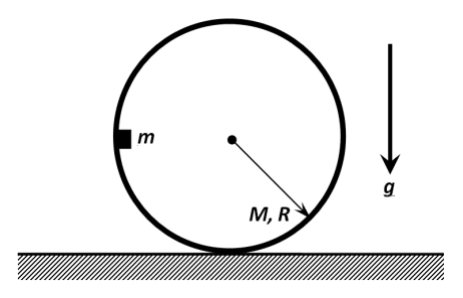
A small puck of mass \(m\) is carefully placed onto the inner surface of the thin hollow thin cylinder of mass \(M\) and of radius \(R\). Initially, the cylinder rests on the horizontal plane and the puck is located at the height \(R\) above the plane as shown in the figure on the left. Find the interaction force \(F\) between the puck and the cylinder at the moment when the puck passes the lowest point of its trajectory. Assume that the friction between the puck and the inner surface of the cylinder is absent, and the cylinder moves on the plane without slipping. The free fall acceleration is \(g\).
Part B (3 points)
A bubble of radius \(r=5.00\ \mathrm{cm}\), containing a diatomic ideal gas, has the soap film of thickness \(h=10.0\ \mu\mathrm{m}\) and is placed in vacuum. The soap film has the surface tension \(\sigma=4.00\cdot10^{-2}\ \frac{\mathrm{N}}{\mathrm{m}}\) and the density \(\rho=1.10\ \frac{\mathrm{g}}{\mathrm{cm}^{3}}\). 1) Find formula for the molar heat capacity of the gas in the bubble for such a process when the gas is heated so slowly that the bubble remains in a mechanical equilibrium and evaluate it; 2) Find formula for the frequency \(\omega\) of the small radial oscillations of the bubble and evaluate it under the assumption that the heat capacity of the soap film is much greater than the heat capacity of the gas in the bubble. Assume that the thermal equilibrium inside the bubble is reached much faster than the period of oscillations.
Hint: Laplace showed that there is pressure difference between inside and outside of a curved surface, caused by surface tension of the interface between liquid and gas, so that \(\Delta p=\frac{2\sigma}{r}\).
Part C (3 points)
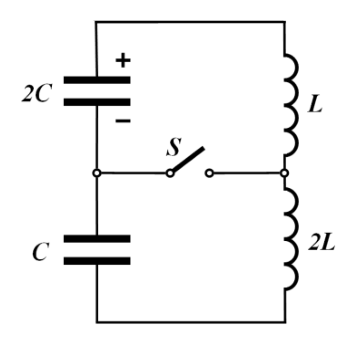
Initially, a switch \(S\) is unshorted in the circuit shown in the figure on the right, a capacitor of capacitance \(2C\) carries the electric charge \(q_0\), a capacitor of capacitance \(C\) is uncharged, and there are no electric currents in both coils of inductance \(L\) and \(2L\), respectively. The capacitor starts to discharge and at the moment when the current in the coils reaches its maximum value, the switch \(S\) is instantly shorted. Find the maximum current \(I_{\max}\) through the switch \(S\) thereafter.
Official English text of the problem.
Answers
-
Part A: \[ \boxed{F=mg\left(3+\frac{m}{M}\right)}. \]
-
Part B, 1): With \(\mathcal R\) denoting the universal gas constant, \[ \boxed{C_{\mathrm{mol}}=4\mathcal R=33.3\ \mathrm{J\,mol^{-1}\,K^{-1}}}. \]
-
Part B, 2): \[ \boxed{\omega=\sqrt{\frac{8\sigma}{\rho h r^{2}}} =1.08\times10^{2}\ \mathrm{rad\,s^{-1}}}. \] The corresponding ordinary frequency is \(f=\omega/(2\pi)=17.2\ \mathrm{Hz}\).
-
Part C: \[ \boxed{I_{\max}=\frac{q_0}{\sqrt{2LC}}}. \]
Solution
Part A
Let \(V\) be the horizontal velocity of the cylinder’s centre and \(v_x\) the horizontal velocity of the puck, both positive to the right. The cylinder’s moment of inertia is \[ I_{\mathrm{cyl}}=MR^{2}. \]
First we obtain a relation between these velocities. Let \(f\) be the signed horizontal friction force exerted by the plane on the cylinder. The puck’s normal force passes through the cylinder’s centre, so only \(f\) produces a torque about that centre.
Taking counterclockwise angular velocity as positive, rolling without slipping gives \[ \Omega_{\mathrm{cyl}}=-\frac{V}{R}. \] Consequently, \[ I_{\mathrm{cyl}}\dot\Omega_{\mathrm{cyl}}=Rf \quad\Longrightarrow\quad f=-M\dot V. \]
For the combined puck–cylinder system, the horizontal equation of motion is \[ m\dot v_x+M\dot V=f. \] Combining these equations and using the initial state of rest, \[ \boxed{mv_x+2MV=0}. \]
At the lowest point, the puck’s velocity is horizontal; denote it by \(v\). Its speed relative to the cylinder’s centre is \[ u=v-V. \] Thus \[ V=-\frac{m}{2M}v, \qquad u=\frac{2M+m}{2M}v. \]
Mechanical energy is conserved: the puck–cylinder contact is frictionless, and static friction at the stationary point of contact with the plane does no work. The puck descends through height \(R\), giving \[ mgR =\frac12mv^{2}+\frac12MV^{2} +\frac12MR^{2}\left(\frac{V}{R}\right)^{2} =\frac12mv^{2}+MV^{2}. \] Substituting the velocity relation, \[ v^{2}=\frac{4M}{2M+m}gR, \qquad u^{2}=\frac{2M+m}{M}gR. \]
To find the vertical acceleration, let \(\theta\) be the puck’s angular displacement from the downward vertical. Its height is \[ y=R-R\cos\theta. \] At the bottom, \(\theta=0\) and \(u=R\dot\theta\), so \[ \ddot y=R\dot\theta^{2}=\frac{u^{2}}{R}. \] The cylinder’s force on the puck is upward there. Newton’s second law therefore gives \[ F-mg=m\frac{u^{2}}{R}. \] Hence \[ \boxed{F=mg\left(3+\frac{m}{M}\right)}. \]
Part B, 1)
Treat the soap film as thin compared with the bubble radius and take its surface tension as constant. A soap film has two liquid–gas interfaces. Their Laplace pressure jumps add, so equilibrium in vacuum requires \[ p=\frac{4\sigma}{r}. \]
Let \(n\) be the number of moles and \(\mathcal R\) the universal gas constant. Using the ideal-gas law, \[ pV=n\mathcal RT, \qquad V=\frac{4\pi r^{3}}{3}, \] we obtain \[ n\mathcal RT=\frac{16\pi\sigma}{3}r^{2}. \] Thus, during the specified slow equilibrium process, \[ T\propto r^{2}, \qquad \frac{dV}{V}=3\frac{dr}{r} =\frac32\frac{dT}{T}. \] The gas therefore performs work \[ p\,dV =\frac32\frac{pV}{T}\,dT =\frac32n\mathcal R\,dT. \]
For a diatomic ideal gas with rotational degrees of freedom active and vibrational degrees of freedom unexcited, \[ dU=\frac52n\mathcal R\,dT. \] The first law applied to the gas gives \[ \delta Q=dU+p\,dV =\left(\frac52+\frac32\right)n\mathcal R\,dT. \] Therefore its molar heat capacity for this process is \[ \boxed{C_{\mathrm{mol}}=\frac{\delta Q}{n\,dT}=4\mathcal R}. \] Using \(\mathcal R=8.31446\ \mathrm{J\,mol^{-1}\,K^{-1}}\), \[ \boxed{C_{\mathrm{mol}}=33.3\ \mathrm{J\,mol^{-1}\,K^{-1}}}. \]
Part B, 2)
The film has much greater heat capacity than the gas, and thermal equilibrium is established rapidly. The film therefore acts as a thermal reservoir during an oscillation, making the gas compression and expansion approximately isothermal.
Let the equilibrium radius be \(r\), and write the instantaneous radius as \[ s=r+\xi,\qquad |\xi|\ll r. \] With equilibrium pressure \(p_0=4\sigma/r\), the isothermal gas law gives \[ p(s)=p_0\left(\frac{r}{s}\right)^{3}. \] The net outward pressure on the film is \[ p(s)-\frac{4\sigma}{s}. \] Expanding to first order in \(\xi\), \[ p(s)\simeq p_0\left(1-\frac{3\xi}{r}\right), \qquad \frac{4\sigma}{s}\simeq\frac{4\sigma}{r} \left(1-\frac{\xi}{r}\right), \] so \[ p(s)-\frac{4\sigma}{s} \simeq-\frac{8\sigma}{r^{2}}\xi. \]
The film’s constant mass, expressed using its equilibrium dimensions, is \[ m_f=4\pi r^{2}\rho h. \] Neglecting gas inertia and dissipative effects, the equation for radial motion is, to first order, \[ m_f\ddot\xi =4\pi r^{2}\left(-\frac{8\sigma}{r^{2}}\xi\right) =-32\pi\sigma\xi. \] Thus \[ \ddot\xi+\omega^{2}\xi=0, \qquad \boxed{\omega^{2}=\frac{32\pi\sigma}{m_f} =\frac{8\sigma}{\rho h r^{2}}}. \]
Converting the given quantities to SI units, \[ r=5.00\times10^{-2}\ \mathrm m,\qquad h=1.00\times10^{-5}\ \mathrm m,\qquad \rho=1.10\times10^{3}\ \mathrm{kg\,m^{-3}}, \] we find \[ \omega =\sqrt{\frac{8(4.00\times10^{-2})} {(1.10\times10^{3})(1.00\times10^{-5})(5.00\times10^{-2})^{2}}}. \] Therefore \[ \boxed{\omega=1.08\times10^{2}\ \mathrm{rad\,s^{-1}}}, \qquad \boxed{f=17.2\ \mathrm{Hz}}. \]
Part C
Before the switch closes, both inductors carry the same current \(i\). Let \(q\) be the charge that has passed downward through the inductors since the discharge began, so \(i=\dot q\).
The charge on the upper plate of the \(2C\) capacitor is then \(q_0-q\), while the charge on the upper plate of the \(C\) capacitor is \(-q\). Defining both capacitor voltages from top to bottom, \[ U_1=\frac{q_0-q}{2C}, \qquad U_2=-\frac{q}{C}. \] Kirchhoff’s voltage law gives \[ 3L\dot i=U_1+U_2 =\frac{q_0-3q}{2C}. \]
At the maximum current, \(\dot i=0\). Hence, at the switching instant, \[ q=\frac{q_0}{3}, \qquad \boxed{U_1=\frac{q_0}{3C},\quad U_2=-\frac{q_0}{3C}}. \]
Now set \(t=0\) when the switch closes. The upper capacitor and upper inductor form one LC loop, while the lower pair form another. Their angular frequencies are equal: \[ \Omega_1=\frac{1}{\sqrt{L(2C)}}, \qquad \Omega_2=\frac{1}{\sqrt{(2L)C}}, \] so \[ \Omega_1=\Omega_2=\Omega=\frac{1}{\sqrt{2LC}}. \]
Let \(i_1\) and \(i_2\) be the upper and lower inductor currents, both positive downward. Their equations are \[ L\dot i_1=U_1,\qquad 2C\dot U_1=-i_1, \] \[ 2L\dot i_2=U_2,\qquad C\dot U_2=-i_2. \] Consequently, \[ \ddot i_1+\Omega^{2}i_1=0, \qquad \ddot i_2+\Omega^{2}i_2=0. \]
Take the switch current as positive from the inductor junction toward the capacitor junction. Kirchhoff’s current law gives \[ i_S=i_1-i_2, \] and therefore \[ \ddot i_S+\Omega^{2}i_S=0. \]
Inductor currents are continuous at switching and were equal beforehand, so \[ i_S(0)=0. \] Capacitor voltages are also continuous, giving \[ \dot i_S(0) =\frac{U_1(0)}{L}-\frac{U_2(0)}{2L} =\frac{q_0}{3LC}+\frac{q_0}{6LC} =\frac{q_0}{2LC}. \] The resulting switch current is \[ i_S(t)=\frac{\dot i_S(0)}{\Omega}\sin(\Omega t) =\frac{q_0}{\sqrt{2LC}} \sin\left(\frac{t}{\sqrt{2LC}}\right). \] Its maximum magnitude is thus \[ \boxed{I_{\max}=\frac{q_0}{\sqrt{2LC}}}. \]
The solution was checked against the official solution.
IPhO 2014 · Theorieaufgabe 1
Drei unabhängige Teile: Puck in einem rollenden Zylinder, Seifenblase mit Gas, LC-Schaltung mit einem Schalter
Diese Aufgabe besteht aus drei unabhängigen Teilen.
Teil A (3 Punkte)
Ein kleiner Puck der Masse \(m\) wird vorsichtig auf die Innenfläche eines dünnwandigen Hohlzylinders der Masse \(M\) und des Radius \(R\) gesetzt. Anfangs ruht der Zylinder auf einer horizontalen Ebene, und der Puck befindet sich in der Höhe \(R\) über der Ebene, wie in der linken Abbildung dargestellt. Bestimmen Sie die Wechselwirkungskraft \(F\) zwischen dem Puck und dem Zylinder in dem Moment, in dem der Puck den tiefsten Punkt seiner Bahn durchläuft. Nehmen Sie an, dass zwischen dem Puck und der Innenfläche des Zylinders keine Reibung wirkt und dass sich der Zylinder auf der Ebene ohne Gleiten bewegt. Die Fallbeschleunigung beträgt \(g\).
Teil B (3 Punkte)
Eine Blase mit dem Radius \(r=5.00\ \mathrm{cm}\), die ein zweiatomiges ideales Gas enthält, besitzt einen Seifenfilm der Dicke \(h=10.0\ \mu\mathrm{m}\) und befindet sich im Vakuum. Der Seifenfilm hat die Oberflächenspannung \(\sigma=4.00\cdot10^{-2}\ \frac{\mathrm{N}}{\mathrm{m}}\) und die Dichte \(\rho=1.10\ \frac{\mathrm{g}}{\mathrm{cm}^{3}}\). 1) Bestimmen Sie eine Formel für die molare Wärmekapazität des Gases in der Blase für einen Prozess, bei dem das Gas so langsam erwärmt wird, dass die Blase im mechanischen Gleichgewicht bleibt, und berechnen Sie ihren Zahlenwert; 2) Bestimmen Sie eine Formel für die Kreisfrequenz \(\omega\) kleiner radialer Schwingungen der Blase und berechnen Sie ihren Zahlenwert unter der Annahme, dass die Wärmekapazität des Seifenfilms wesentlich größer ist als die Wärmekapazität des Gases in der Blase. Nehmen Sie an, dass sich das thermische Gleichgewicht innerhalb der Blase in einer Zeit einstellt, die wesentlich kürzer als die Schwingungsdauer ist.
Hinweis: Laplace zeigte, dass zwischen der Innen- und Außenseite einer gekrümmten Oberfläche eine Druckdifferenz besteht, die durch die Oberflächenspannung der Grenzfläche zwischen Flüssigkeit und Gas verursacht wird, sodass \(\Delta p=\frac{2\sigma}{r}\).
Teil C (3 Punkte)
Anfangs ist der Schalter \(S\) in der rechts abgebildeten Schaltung geöffnet, ein Kondensator der Kapazität \(2C\) trägt die elektrische Ladung \(q_0\), ein Kondensator der Kapazität \(C\) ist ungeladen, und in den beiden Spulen mit den Induktivitäten \(L\) beziehungsweise \(2L\) fließen keine elektrischen Ströme. Der Kondensator beginnt sich zu entladen, und in dem Moment, in dem der Strom in den Spulen seinen Maximalwert erreicht, wird der Schalter \(S\) augenblicklich geschlossen. Bestimmen Sie den maximalen Strom \(I_{\max}\), der danach durch den Schalter \(S\) fließt.
Aufgabentext aus dem offiziellen englischen Text übersetzt.
Antworten
-
Teil A: \[ \boxed{F=mg\left(3+\frac{m}{M}\right)}. \]
-
Teil B, 1): Mit \(\mathcal R\) als universeller Gaskonstante gilt \[ \boxed{C_{\mathrm{mol}}=4\mathcal R=33.3\ \mathrm{J\,mol^{-1}\,K^{-1}}}. \]
-
Teil B, 2): \[ \boxed{\omega=\sqrt{\frac{8\sigma}{\rho h r^{2}}} =1.08\times10^{2}\ \mathrm{rad\,s^{-1}}}. \] Die zugehörige gewöhnliche Frequenz beträgt \(f=\omega/(2\pi)=17.2\ \mathrm{Hz}\).
-
Teil C: \[ \boxed{I_{\max}=\frac{q_0}{\sqrt{2LC}}}. \]
Lösung
Teil A
Sei \(V\) die horizontale Geschwindigkeit des Zylindermittelpunkts und \(v_x\) die horizontale Geschwindigkeit des Pucks, jeweils nach rechts positiv gezählt. Das Trägheitsmoment des Zylinders beträgt \[ I_{\mathrm{cyl}}=MR^{2}. \]
Zunächst bestimmen wir eine Beziehung zwischen diesen Geschwindigkeiten. Sei \(f\) die vorzeichenbehaftete horizontale Reibungskraft, die die Ebene auf den Zylinder ausübt. Die Wirkungslinie der Normalkraft des Pucks verläuft durch den Zylindermittelpunkt, sodass nur \(f\) ein Drehmoment um diesen Mittelpunkt erzeugt.
Wird die Winkelgeschwindigkeit gegen den Uhrzeigersinn positiv gezählt, so ergibt das Rollen ohne Gleiten \[ \Omega_{\mathrm{cyl}}=-\frac{V}{R}. \] Folglich gilt \[ I_{\mathrm{cyl}}\dot\Omega_{\mathrm{cyl}}=Rf \quad\Longrightarrow\quad f=-M\dot V. \]
Für das Gesamtsystem aus Puck und Zylinder lautet die horizontale Bewegungsgleichung \[ m\dot v_x+M\dot V=f. \] Durch Kombination dieser Gleichungen und unter Verwendung des anfänglichen Ruhezustands erhalten wir \[ \boxed{mv_x+2MV=0}. \]
Am tiefsten Punkt ist die Geschwindigkeit des Pucks horizontal; wir bezeichnen sie mit \(v\). Seine Geschwindigkeit relativ zum Zylindermittelpunkt beträgt \[ u=v-V. \] Somit gilt \[ V=-\frac{m}{2M}v, \qquad u=\frac{2M+m}{2M}v. \]
Die mechanische Energie bleibt erhalten: Der Kontakt zwischen Puck und Zylinder ist reibungsfrei, und die Haftreibung am ruhenden Berührungspunkt mit der Ebene verrichtet keine Arbeit. Der Puck sinkt um die Höhe \(R\) ab, sodass \[ mgR =\frac12mv^{2}+\frac12MV^{2} +\frac12MR^{2}\left(\frac{V}{R}\right)^{2} =\frac12mv^{2}+MV^{2}. \] Einsetzen der Geschwindigkeitsbeziehung liefert \[ v^{2}=\frac{4M}{2M+m}gR, \qquad u^{2}=\frac{2M+m}{M}gR. \]
Um die vertikale Beschleunigung zu bestimmen, sei \(\theta\) der Winkel zwischen der Position des Pucks relativ zum Zylindermittelpunkt und der nach unten gerichteten Vertikalen. Seine Höhe beträgt \[ y=R-R\cos\theta. \] Am tiefsten Punkt gelten \(\theta=0\) und \(u=R\dot\theta\), sodass \[ \ddot y=R\dot\theta^{2}=\frac{u^{2}}{R}. \] Die Kraft des Zylinders auf den Puck ist dort nach oben gerichtet. Das zweite Newtonsche Gesetz ergibt daher \[ F-mg=m\frac{u^{2}}{R}. \] Daraus folgt \[ \boxed{F=mg\left(3+\frac{m}{M}\right)}. \]
Teil B, 1)
Wir betrachten den Seifenfilm als dünn im Vergleich zum Blasenradius und nehmen seine Oberflächenspannung als konstant an. Ein Seifenfilm besitzt zwei Grenzflächen zwischen Flüssigkeit und Gas. Ihre Laplace-Drucksprünge addieren sich, sodass das Gleichgewicht im Vakuum erfordert, dass \[ p=\frac{4\sigma}{r}. \]
Seien \(n\) die Stoffmenge und \(\mathcal R\) die universelle Gaskonstante. Mit der idealen Gasgleichung \[ pV=n\mathcal RT, \qquad V=\frac{4\pi r^{3}}{3}, \] erhalten wir \[ n\mathcal RT=\frac{16\pi\sigma}{3}r^{2}. \] Während des vorgegebenen langsamen Gleichgewichtsprozesses gilt somit \[ T\propto r^{2}, \qquad \frac{dV}{V}=3\frac{dr}{r} =\frac32\frac{dT}{T}. \] Das Gas verrichtet daher die Arbeit \[ p\,dV =\frac32\frac{pV}{T}\,dT =\frac32n\mathcal R\,dT. \]
Für ein zweiatomiges ideales Gas, dessen Rotationsfreiheitsgrade angeregt und dessen Schwingungsfreiheitsgrade nicht angeregt sind, gilt \[ dU=\frac52n\mathcal R\,dT. \] Der auf das Gas angewandte erste Hauptsatz liefert \[ \delta Q=dU+p\,dV =\left(\frac52+\frac32\right)n\mathcal R\,dT. \] Seine molare Wärmekapazität für diesen Prozess beträgt daher \[ \boxed{C_{\mathrm{mol}}=\frac{\delta Q}{n\,dT}=4\mathcal R}. \] Mit \(\mathcal R=8.31446\ \mathrm{J\,mol^{-1}\,K^{-1}}\) ergibt sich \[ \boxed{C_{\mathrm{mol}}=33.3\ \mathrm{J\,mol^{-1}\,K^{-1}}}. \]
Teil B, 2)
Der Film hat eine wesentlich größere Wärmekapazität als das Gas, und das thermische Gleichgewicht stellt sich rasch ein. Der Film wirkt daher während einer Schwingung als Wärmereservoir, sodass Kompression und Expansion des Gases näherungsweise isotherm verlaufen.
Der Gleichgewichtsradius sei \(r\), und wir schreiben den momentanen Radius als \[ s=r+\xi,\qquad |\xi|\ll r. \] Mit dem Gleichgewichtsdruck \(p_0=4\sigma/r\) ergibt das isotherme Gasgesetz \[ p(s)=p_0\left(\frac{r}{s}\right)^{3}. \] Die resultierende, nach außen wirkende Druckdifferenz am Film beträgt \[ p(s)-\frac{4\sigma}{s}. \] Die Entwicklung bis zur ersten Ordnung in \(\xi\) liefert \[ p(s)\simeq p_0\left(1-\frac{3\xi}{r}\right), \qquad \frac{4\sigma}{s}\simeq\frac{4\sigma}{r} \left(1-\frac{\xi}{r}\right), \] sodass \[ p(s)-\frac{4\sigma}{s} \simeq-\frac{8\sigma}{r^{2}}\xi. \]
Die konstante Masse des Films, ausgedrückt durch seine Abmessungen im Gleichgewicht, beträgt \[ m_f=4\pi r^{2}\rho h. \] Unter Vernachlässigung der Trägheit des Gases und dissipativer Effekte lautet die Gleichung für die radiale Bewegung bis zur ersten Ordnung \[ m_f\ddot\xi =4\pi r^{2}\left(-\frac{8\sigma}{r^{2}}\xi\right) =-32\pi\sigma\xi. \] Somit gilt \[ \ddot\xi+\omega^{2}\xi=0, \qquad \boxed{\omega^{2}=\frac{32\pi\sigma}{m_f} =\frac{8\sigma}{\rho h r^{2}}}. \]
Wir rechnen die gegebenen Größen in SI-Einheiten um: \[ r=5.00\times10^{-2}\ \mathrm m,\qquad h=1.00\times10^{-5}\ \mathrm m,\qquad \rho=1.10\times10^{3}\ \mathrm{kg\,m^{-3}}, \] und erhalten \[ \omega =\sqrt{\frac{8(4.00\times10^{-2})} {(1.10\times10^{3})(1.00\times10^{-5})(5.00\times10^{-2})^{2}}}. \] Daher gilt \[ \boxed{\omega=1.08\times10^{2}\ \mathrm{rad\,s^{-1}}}, \qquad \boxed{f=17.2\ \mathrm{Hz}}. \]
Teil C
Bevor der Schalter geschlossen wird, fließt durch beide Spulen derselbe Strom \(i\). Sei \(q\) die Ladung, die seit Beginn der Entladung nach unten durch die Spulen geflossen ist, sodass \(i=\dot q\).
Die Ladung auf der oberen Platte des Kondensators mit der Kapazität \(2C\) beträgt dann \(q_0-q\), während die Ladung auf der oberen Platte des Kondensators mit der Kapazität \(C\) gleich \(-q\) ist. Definieren wir beide Kondensatorspannungen von oben nach unten, so gilt \[ U_1=\frac{q_0-q}{2C}, \qquad U_2=-\frac{q}{C}. \] Die Kirchhoffsche Maschenregel ergibt \[ 3L\dot i=U_1+U_2 =\frac{q_0-3q}{2C}. \]
Beim maximalen Strom gilt \(\dot i=0\). Daher gilt zum Schaltzeitpunkt \[ q=\frac{q_0}{3}, \qquad \boxed{U_1=\frac{q_0}{3C},\quad U_2=-\frac{q_0}{3C}}. \]
Wir setzen nun \(t=0\) auf den Zeitpunkt, zu dem der Schalter geschlossen wird. Der obere Kondensator und die obere Spule bilden einen LC-Schwingkreis, während das untere Paar einen weiteren bildet. Ihre Kreisfrequenzen sind gleich: \[ \Omega_1=\frac{1}{\sqrt{L(2C)}}, \qquad \Omega_2=\frac{1}{\sqrt{(2L)C}}, \] sodass \[ \Omega_1=\Omega_2=\Omega=\frac{1}{\sqrt{2LC}}. \]
Seien \(i_1\) und \(i_2\) die Ströme durch die obere beziehungsweise untere Spule, jeweils nach unten positiv gezählt. Ihre Gleichungen lauten \[ L\dot i_1=U_1,\qquad 2C\dot U_1=-i_1, \] \[ 2L\dot i_2=U_2,\qquad C\dot U_2=-i_2. \] Folglich gilt \[ \ddot i_1+\Omega^{2}i_1=0, \qquad \ddot i_2+\Omega^{2}i_2=0. \]
Der Schalterstrom werde vom Verbindungspunkt der Spulen zum Verbindungspunkt der Kondensatoren positiv gezählt. Die Kirchhoffsche Knotenregel liefert \[ i_S=i_1-i_2, \] und daher \[ \ddot i_S+\Omega^{2}i_S=0. \]
Die Spulenströme sind beim Schalten stetig und waren zuvor gleich, sodass \[ i_S(0)=0. \] Auch die Kondensatorspannungen sind stetig, woraus folgt, dass \[ \dot i_S(0) =\frac{U_1(0)}{L}-\frac{U_2(0)}{2L} =\frac{q_0}{3LC}+\frac{q_0}{6LC} =\frac{q_0}{2LC}. \] Der resultierende Schalterstrom lautet \[ i_S(t)=\frac{\dot i_S(0)}{\Omega}\sin(\Omega t) =\frac{q_0}{\sqrt{2LC}} \sin\left(\frac{t}{\sqrt{2LC}}\right). \] Sein maximaler Betrag ist somit \[ \boxed{I_{\max}=\frac{q_0}{\sqrt{2LC}}}. \]
Die Lösung wurde mit der offiziellen Lösung abgeglichen.
IPhO 2014 · Teori sorusu 1
Üç bağımsız bölüm: yuvarlanan bir silindirin içindeki disk, gaz içeren sabun köpüğü, anahtarlı LC devresi
Bu soru birbirinden bağımsız üç bölümden oluşmaktadır.
Bölüm A (3 puan)
Kütlesi \(m\) olan küçük bir disk, kütlesi \(M\) ve yarıçapı \(R\) olan ince cidarlı, içi boş bir silindirin iç yüzeyine dikkatlice yerleştirilir. Başlangıçta silindir yatay düzlem üzerinde durmaktadır ve disk, soldaki şekilde gösterildiği gibi düzlemden \(R\) yüksekliğindedir. Diskin yörüngesinin en alt noktasından geçtiği anda disk ile silindir arasındaki etkileşim kuvveti \(F\)'yi bulunuz. Disk ile silindirin iç yüzeyi arasında sürtünme olmadığını ve silindirin düzlem üzerinde kaymadan hareket ettiğini varsayınız. Serbest düşme ivmesi \(g\)'dir.
Bölüm B (3 puan)
İki atomlu bir ideal gaz içeren, yarıçapı \(r=5.00\ \mathrm{cm}\) olan bir sabun köpüğünün sabun zarının kalınlığı \(h=10.0\ \mu\mathrm{m}\)'dir ve köpük vakumda bulunmaktadır. Sabun zarının yüzey gerilimi \(\sigma=4.00\cdot10^{-2}\ \frac{\mathrm{N}}{\mathrm{m}}\), yoğunluğu ise \(\rho=1.10\ \frac{\mathrm{g}}{\mathrm{cm}^{3}}\)'tür. 1) Gazın, köpük mekanik dengede kalacak kadar yavaş ısıtıldığı bir süreçte, köpüğün içindeki gazın molar ısı kapasitesinin formülünü bulunuz ve sayısal değerini hesaplayınız; 2) Sabun zarının ısı kapasitesinin köpüğün içindeki gazın ısı kapasitesinden çok daha büyük olduğunu varsayarak, köpüğün küçük radyal salınımlarının frekansı \(\omega\)'nın formülünü bulunuz ve sayısal değerini hesaplayınız. Köpüğün içinde ısıl dengeye ulaşılma süresinin salınım periyodundan çok daha kısa olduğunu varsayınız.
İpucu: Laplace, eğri bir yüzeyin içi ile dışı arasında, sıvı ile gaz arasındaki arayüzün yüzey geriliminden kaynaklanan bir basınç farkı bulunduğunu ve bu farkın \(\Delta p=\frac{2\sigma}{r}\) olduğunu göstermiştir.
Bölüm C (3 puan)
Sağdaki şekilde gösterilen devrede başlangıçta \(S\) anahtarı açıktır; sığası \(2C\) olan kondansatör \(q_0\) elektrik yükünü taşımakta, sığası \(C\) olan kondansatör yüksüz bulunmakta ve indüktansları sırasıyla \(L\) ve \(2L\) olan iki bobinden de elektrik akımı geçmemektedir. Kondansatör boşalmaya başlar ve bobinlerdeki akımın en büyük değerine ulaştığı anda \(S\) anahtarı aniden kapatılır. Bundan sonra \(S\) anahtarından geçen en büyük akım \(I_{\max}\)'ı bulunuz.
Soru metni resmi İngilizce metinden çevrilmiştir.
Cevaplar
-
Bölüm A: \[ \boxed{F=mg\left(3+\frac{m}{M}\right)}. \]
-
Bölüm B, 1): \(\mathcal R\) evrensel gaz sabitini göstermek üzere, \[ \boxed{C_{\mathrm{mol}}=4\mathcal R=33.3\ \mathrm{J\,mol^{-1}\,K^{-1}}}. \]
-
Bölüm B, 2): \[ \boxed{\omega=\sqrt{\frac{8\sigma}{\rho h r^{2}}} =1.08\times10^{2}\ \mathrm{rad\,s^{-1}}}. \] Buna karşılık gelen normal frekans \(f=\omega/(2\pi)=17.2\ \mathrm{Hz}\)'dir.
-
Bölüm C: \[ \boxed{I_{\max}=\frac{q_0}{\sqrt{2LC}}}. \]
Çözüm
Bölüm A
Silindirin merkezinin yatay hızı \(V\), diskin yatay hızı ise \(v_x\) olsun; her ikisi için de sağ yönü pozitif alalım. Silindirin eylemsizlik momenti \[ I_{\mathrm{cyl}}=MR^{2}. \]
Önce bu hızlar arasında bir bağıntı elde edelim. Düzlemin silindire uyguladığı yatay sürtünme kuvvetinin işaretli değeri \(f\) olsun. Diskin uyguladığı normal kuvvetin etki doğrusu silindirin merkezinden geçtiğinden, bu merkeze göre yalnızca \(f\) tork oluşturur.
Saat yönünün tersindeki açısal hızı pozitif aldığımızda, kaymadan yuvarlanma koşulu \[ \Omega_{\mathrm{cyl}}=-\frac{V}{R}. \] olur. Dolayısıyla, \[ I_{\mathrm{cyl}}\dot\Omega_{\mathrm{cyl}}=Rf \quad\Longrightarrow\quad f=-M\dot V. \]
Disk ve silindirden oluşan birleşik sistem için yatay hareket denklemi \[ m\dot v_x+M\dot V=f. \] şeklindedir. Bu denklemleri birleştirip başlangıçta sistemin durgun olduğunu kullanırsak, \[ \boxed{mv_x+2MV=0}. \]
En alt noktada diskin hızı yataydır; bu hızı \(v\) ile gösterelim. Silindirin merkezine göre sürati \[ u=v-V. \] olur. Böylece \[ V=-\frac{m}{2M}v, \qquad u=\frac{2M+m}{2M}v. \]
Mekanik enerji korunur: disk ile silindir arasındaki temas sürtünmesizdir ve düzlemle olan durgun temas noktasındaki statik sürtünme iş yapmaz. Disk \(R\) kadar alçaldığından, \[ mgR =\frac12mv^{2}+\frac12MV^{2} +\frac12MR^{2}\left(\frac{V}{R}\right)^{2} =\frac12mv^{2}+MV^{2}. \] Hızlar arasındaki bağıntıyı yerine koyarsak, \[ v^{2}=\frac{4M}{2M+m}gR, \qquad u^{2}=\frac{2M+m}{M}gR. \]
Düşey ivmeyi bulmak için, diskin aşağı yönlü düşey doğrultudan ölçülen açısal yer değiştirmesi \(\theta\) olsun. Diskin yüksekliği \[ y=R-R\cos\theta. \] şeklindedir. En alt noktada \(\theta=0\) ve \(u=R\dot\theta\) olduğundan, \[ \ddot y=R\dot\theta^{2}=\frac{u^{2}}{R}. \] Silindirin diske uyguladığı kuvvet bu noktada yukarı yönlüdür. Dolayısıyla Newton'un ikinci yasası \[ F-mg=m\frac{u^{2}}{R}. \] sonucunu verir. Buradan \[ \boxed{F=mg\left(3+\frac{m}{M}\right)}. \]
Bölüm B, 1)
Sabun zarını köpüğün yarıçapına göre ince kabul edelim ve yüzey gerilimini sabit alalım. Bir sabun zarının iki sıvı–gaz arayüzü vardır. Bu arayüzlerdeki Laplace basınç farkları toplandığından, vakumda denge koşulu \[ p=\frac{4\sigma}{r}. \] olur.
Mol sayısı \(n\), evrensel gaz sabiti ise \(\mathcal R\) olsun. İdeal gaz yasasını kullanarak, \[ pV=n\mathcal RT, \qquad V=\frac{4\pi r^{3}}{3}, \] şunu elde ederiz: \[ n\mathcal RT=\frac{16\pi\sigma}{3}r^{2}. \] Böylece, belirtilen yavaş denge süreci boyunca, \[ T\propto r^{2}, \qquad \frac{dV}{V}=3\frac{dr}{r} =\frac32\frac{dT}{T}. \] Dolayısıyla gazın yaptığı iş \[ p\,dV =\frac32\frac{pV}{T}\,dT =\frac32n\mathcal R\,dT. \] olur.
Dönme serbestlik dereceleri etkin, titreşim serbestlik dereceleri ise uyarılmamış olan iki atomlu bir ideal gaz için, \[ dU=\frac52n\mathcal R\,dT. \] Termodinamiğin birinci yasasını gaza uyguladığımızda, \[ \delta Q=dU+p\,dV =\left(\frac52+\frac32\right)n\mathcal R\,dT. \] elde edilir. Dolayısıyla bu süreçte gazın molar ısı kapasitesi \[ \boxed{C_{\mathrm{mol}}=\frac{\delta Q}{n\,dT}=4\mathcal R}. \] olur. \(\mathcal R=8.31446\ \mathrm{J\,mol^{-1}\,K^{-1}}\) kullanıldığında, \[ \boxed{C_{\mathrm{mol}}=33.3\ \mathrm{J\,mol^{-1}\,K^{-1}}}. \]
Bölüm B, 2)
Zarın ısı kapasitesi gazınkinden çok daha büyüktür ve ısıl denge hızla kurulur. Bu nedenle zar, bir salınım sırasında ısı deposu gibi davranır; böylece gazın sıkışması ve genleşmesi yaklaşık olarak izotermal olur.
Denge yarıçapı \(r\) olsun ve anlık yarıçapı şöyle yazalım: \[ s=r+\xi,\qquad |\xi|\ll r. \] Denge basıncı \(p_0=4\sigma/r\) olmak üzere, izotermal gaz yasası \[ p(s)=p_0\left(\frac{r}{s}\right)^{3}. \] sonucunu verir. Zara etkiyen dışa doğru net basınç \[ p(s)-\frac{4\sigma}{s}. \] olur. \(\xi\)'ye göre birinci mertebeye kadar açarsak, \[ p(s)\simeq p_0\left(1-\frac{3\xi}{r}\right), \qquad \frac{4\sigma}{s}\simeq\frac{4\sigma}{r} \left(1-\frac{\xi}{r}\right), \] dolayısıyla \[ p(s)-\frac{4\sigma}{s} \simeq-\frac{8\sigma}{r^{2}}\xi. \]
Zarın sabit kütlesi, denge durumundaki boyutları cinsinden, \[ m_f=4\pi r^{2}\rho h. \] şeklindedir. Gazın eylemsizliğini ve enerji kaybına yol açan etkileri ihmal edersek, radyal hareket denklemi birinci mertebede \[ m_f\ddot\xi =4\pi r^{2}\left(-\frac{8\sigma}{r^{2}}\xi\right) =-32\pi\sigma\xi. \] olur. Böylece \[ \ddot\xi+\omega^{2}\xi=0, \qquad \boxed{\omega^{2}=\frac{32\pi\sigma}{m_f} =\frac{8\sigma}{\rho h r^{2}}}. \]
Verilen nicelikleri SI birimlerine dönüştürerek, \[ r=5.00\times10^{-2}\ \mathrm m,\qquad h=1.00\times10^{-5}\ \mathrm m,\qquad \rho=1.10\times10^{3}\ \mathrm{kg\,m^{-3}}, \] şunu buluruz: \[ \omega =\sqrt{\frac{8(4.00\times10^{-2})} {(1.10\times10^{3})(1.00\times10^{-5})(5.00\times10^{-2})^{2}}}. \] Dolayısıyla \[ \boxed{\omega=1.08\times10^{2}\ \mathrm{rad\,s^{-1}}}, \qquad \boxed{f=17.2\ \mathrm{Hz}}. \]
Bölüm C
Anahtar kapanmadan önce her iki bobinden de aynı \(i\) akımı geçer. Boşalma başladığından beri bobinlerden aşağı yönde geçen yük \(q\) olsun; böylece \(i=\dot q\) olur.
Bu durumda \(2C\) kondansatörünün üst levhasındaki yük \(q_0-q\), \(C\) kondansatörünün üst levhasındaki yük ise \(-q\)'dur. Her iki kondansatörün gerilimini üstten alta doğru tanımlarsak, \[ U_1=\frac{q_0-q}{2C}, \qquad U_2=-\frac{q}{C}. \] Kirchhoff'un gerilim yasası \[ 3L\dot i=U_1+U_2 =\frac{q_0-3q}{2C}. \] sonucunu verir.
Akım en büyük değerindeyken \(\dot i=0\)'dır. Dolayısıyla anahtarın kapatıldığı anda, \[ q=\frac{q_0}{3}, \qquad \boxed{U_1=\frac{q_0}{3C},\quad U_2=-\frac{q_0}{3C}}. \]
Şimdi anahtarın kapandığı anı \(t=0\) alalım. Üstteki kondansatör ile üstteki bobin bir LC çevrimi, alttaki çift ise başka bir LC çevrimi oluşturur. Bunların açısal frekansları eşittir: \[ \Omega_1=\frac{1}{\sqrt{L(2C)}}, \qquad \Omega_2=\frac{1}{\sqrt{(2L)C}}, \] dolayısıyla \[ \Omega_1=\Omega_2=\Omega=\frac{1}{\sqrt{2LC}}. \]
Üstteki ve alttaki bobinlerin akımları sırasıyla \(i_1\) ve \(i_2\) olsun; her ikisi için de aşağı yönü pozitif alalım. Bu akımların denklemleri \[ L\dot i_1=U_1,\qquad 2C\dot U_1=-i_1, \] \[ 2L\dot i_2=U_2,\qquad C\dot U_2=-i_2. \] şeklindedir. Dolayısıyla, \[ \ddot i_1+\Omega^{2}i_1=0, \qquad \ddot i_2+\Omega^{2}i_2=0. \]
Anahtardan geçen akımın pozitif yönünü bobinlerin birleşim noktasından kondansatörlerin birleşim noktasına doğru alalım. Kirchhoff'un akım yasası \[ i_S=i_1-i_2, \] ve dolayısıyla \[ \ddot i_S+\Omega^{2}i_S=0. \] sonucunu verir.
Bobin akımları anahtarlama anında süreklidir ve öncesinde birbirine eşittir; bu nedenle \[ i_S(0)=0. \] Kondansatör gerilimleri de süreklidir; dolayısıyla \[ \dot i_S(0) =\frac{U_1(0)}{L}-\frac{U_2(0)}{2L} =\frac{q_0}{3LC}+\frac{q_0}{6LC} =\frac{q_0}{2LC}. \] Bunun sonucunda anahtardan geçen akım \[ i_S(t)=\frac{\dot i_S(0)}{\Omega}\sin(\Omega t) =\frac{q_0}{\sqrt{2LC}} \sin\left(\frac{t}{\sqrt{2LC}}\right). \] olur. Böylece akımın en büyük büyüklüğü \[ \boxed{I_{\max}=\frac{q_0}{\sqrt{2LC}}}. \]
Çözüm, resmi çözümle karşılaştırılarak kontrol edildi.
IPhO 2014 · Problema teórico 1
Tres partes independientes: disco en un cilindro que rueda, burbuja de jabón con gas, circuito LC con un interruptor
Este problema consta de tres partes independientes.
Parte A (3 puntos)
Se coloca cuidadosamente un pequeño disco de masa \(m\) sobre la superficie interior de un cilindro hueco de pared delgada, de masa \(M\) y radio \(R\). Inicialmente, el cilindro está en reposo sobre el plano horizontal y el disco se encuentra a una altura \(R\) sobre el plano, como se muestra en la figura de la izquierda. Halle la fuerza de interacción \(F\) entre el disco y el cilindro en el instante en que el disco pasa por el punto más bajo de su trayectoria. Suponga que no hay rozamiento entre el disco y la superficie interior del cilindro, y que el cilindro se mueve sobre el plano sin deslizar. La aceleración de caída libre es \(g\).
Parte B (3 puntos)
Una burbuja de radio \(r=5.00\ \mathrm{cm}\), que contiene un gas ideal diatómico, tiene una película de jabón de espesor \(h=10.0\ \mu\mathrm{m}\) y se encuentra en el vacío. La película de jabón tiene una tensión superficial \(\sigma=4.00\cdot10^{-2}\ \frac{\mathrm{N}}{\mathrm{m}}\) y una densidad \(\rho=1.10\ \frac{\mathrm{g}}{\mathrm{cm}^{3}}\). 1) Halle una fórmula para la capacidad calorífica molar del gas de la burbuja en un proceso en el que el gas se calienta tan lentamente que la burbuja permanece en equilibrio mecánico, y calcule su valor; 2) Halle una fórmula para la frecuencia \(\omega\) de las pequeñas oscilaciones radiales de la burbuja y calcule su valor suponiendo que la capacidad calorífica de la película de jabón es mucho mayor que la capacidad calorífica del gas de la burbuja. Suponga que el equilibrio térmico en el interior de la burbuja se alcanza en un tiempo mucho menor que el período de las oscilaciones.
Indicación: Laplace demostró que existe una diferencia de presión entre el interior y el exterior de una superficie curva, causada por la tensión superficial de la interfaz entre el líquido y el gas, de modo que \(\Delta p=\frac{2\sigma}{r}\).
Parte C (3 puntos)
Inicialmente, un interruptor \(S\) está abierto en el circuito que se muestra en la figura de la derecha, un condensador de capacidad \(2C\) tiene una carga eléctrica \(q_0\), un condensador de capacidad \(C\) está descargado y no circula corriente eléctrica por ninguna de las dos bobinas, de inductancias \(L\) y \(2L\), respectivamente. El condensador comienza a descargarse y, en el instante en que la corriente en las bobinas alcanza su valor máximo, el interruptor \(S\) se cierra instantáneamente. Halle la corriente máxima \(I_{\max}\) que circula por el interruptor \(S\) a partir de ese momento.
Enunciado traducido del texto oficial en inglés.
Respuestas
-
Parte A: \[ \boxed{F=mg\left(3+\frac{m}{M}\right)}. \]
-
Parte B, 1): Si \(\mathcal R\) denota la constante universal de los gases, \[ \boxed{C_{\mathrm{mol}}=4\mathcal R=33.3\ \mathrm{J\,mol^{-1}\,K^{-1}}}. \]
-
Parte B, 2): \[ \boxed{\omega=\sqrt{\frac{8\sigma}{\rho h r^{2}}} =1.08\times10^{2}\ \mathrm{rad\,s^{-1}}}. \] La frecuencia ordinaria correspondiente es \(f=\omega/(2\pi)=17.2\ \mathrm{Hz}\).
-
Parte C: \[ \boxed{I_{\max}=\frac{q_0}{\sqrt{2LC}}}. \]
Solución
Parte A
Sean \(V\) la velocidad horizontal del centro del cilindro y \(v_x\) la velocidad horizontal del disco, ambas positivas hacia la derecha. El momento de inercia del cilindro es \[ I_{\mathrm{cyl}}=MR^{2}. \]
Primero obtenemos una relación entre estas velocidades. Sea \(f\) la fuerza horizontal de rozamiento, con su signo, que el plano ejerce sobre el cilindro. La fuerza normal ejercida por el disco pasa por el centro del cilindro, de modo que solo \(f\) produce un momento respecto a ese centro.
Tomando como positiva la velocidad angular en sentido antihorario, la rodadura sin deslizamiento implica \[ \Omega_{\mathrm{cyl}}=-\frac{V}{R}. \] Por consiguiente, \[ I_{\mathrm{cyl}}\dot\Omega_{\mathrm{cyl}}=Rf \quad\Longrightarrow\quad f=-M\dot V. \]
Para el sistema formado por el disco y el cilindro, la ecuación del movimiento horizontal es \[ m\dot v_x+M\dot V=f. \] Combinando estas ecuaciones y utilizando el estado inicial de reposo, \[ \boxed{mv_x+2MV=0}. \]
En el punto más bajo, la velocidad del disco es horizontal; la denotamos por \(v\). Su rapidez respecto al centro del cilindro es \[ u=v-V. \] Por tanto, \[ V=-\frac{m}{2M}v, \qquad u=\frac{2M+m}{2M}v. \]
La energía mecánica se conserva: el contacto entre el disco y el cilindro no presenta rozamiento, y el rozamiento estático en el punto de contacto con el plano, que está instantáneamente en reposo, no realiza trabajo. El disco desciende una altura \(R\), lo que da \[ mgR =\frac12mv^{2}+\frac12MV^{2} +\frac12MR^{2}\left(\frac{V}{R}\right)^{2} =\frac12mv^{2}+MV^{2}. \] Sustituyendo la relación entre las velocidades, \[ v^{2}=\frac{4M}{2M+m}gR, \qquad u^{2}=\frac{2M+m}{M}gR. \]
Para hallar la aceleración vertical, sea \(\theta\) el desplazamiento angular del disco respecto a la vertical dirigida hacia abajo. Su altura es \[ y=R-R\cos\theta. \] En el punto más bajo, \(\theta=0\) y \(u=R\dot\theta\), de modo que \[ \ddot y=R\dot\theta^{2}=\frac{u^{2}}{R}. \] Allí, la fuerza que el cilindro ejerce sobre el disco está dirigida hacia arriba. Por tanto, la segunda ley de Newton da \[ F-mg=m\frac{u^{2}}{R}. \] Así pues, \[ \boxed{F=mg\left(3+\frac{m}{M}\right)}. \]
Parte B, 1)
Consideramos que la película de jabón es delgada en comparación con el radio de la burbuja y que su tensión superficial es constante. Una película de jabón tiene dos interfaces líquido–gas. Sus saltos de presión de Laplace se suman, de modo que el equilibrio en el vacío exige \[ p=\frac{4\sigma}{r}. \]
Sean \(n\) el número de moles y \(\mathcal R\) la constante universal de los gases. Utilizando la ecuación de estado del gas ideal, \[ pV=n\mathcal RT, \qquad V=\frac{4\pi r^{3}}{3}, \] obtenemos \[ n\mathcal RT=\frac{16\pi\sigma}{3}r^{2}. \] Por tanto, durante el proceso lento de equilibrio especificado, \[ T\propto r^{2}, \qquad \frac{dV}{V}=3\frac{dr}{r} =\frac32\frac{dT}{T}. \] En consecuencia, el gas realiza un trabajo \[ p\,dV =\frac32\frac{pV}{T}\,dT =\frac32n\mathcal R\,dT. \]
Para un gas ideal diatómico con los grados de libertad de rotación activos y los grados de libertad de vibración sin excitar, \[ dU=\frac52n\mathcal R\,dT. \] El primer principio de la termodinámica aplicado al gas da \[ \delta Q=dU+p\,dV =\left(\frac52+\frac32\right)n\mathcal R\,dT. \] Por tanto, su capacidad calorífica molar para este proceso es \[ \boxed{C_{\mathrm{mol}}=\frac{\delta Q}{n\,dT}=4\mathcal R}. \] Utilizando \(\mathcal R=8.31446\ \mathrm{J\,mol^{-1}\,K^{-1}}\), \[ \boxed{C_{\mathrm{mol}}=33.3\ \mathrm{J\,mol^{-1}\,K^{-1}}}. \]
Parte B, 2)
La película tiene una capacidad calorífica mucho mayor que la del gas, y el equilibrio térmico se establece rápidamente. Por tanto, la película actúa como un depósito térmico durante una oscilación, haciendo que la compresión y la expansión del gas sean aproximadamente isotérmicas.
Sea \(r\) el radio de equilibrio y escribamos el radio instantáneo como \[ s=r+\xi,\qquad |\xi|\ll r. \] Con la presión de equilibrio \(p_0=4\sigma/r\), la ley del gas en un proceso isotérmico da \[ p(s)=p_0\left(\frac{r}{s}\right)^{3}. \] La presión neta hacia fuera sobre la película es \[ p(s)-\frac{4\sigma}{s}. \] Desarrollando hasta primer orden en \(\xi\), \[ p(s)\simeq p_0\left(1-\frac{3\xi}{r}\right), \qquad \frac{4\sigma}{s}\simeq\frac{4\sigma}{r} \left(1-\frac{\xi}{r}\right), \] de modo que \[ p(s)-\frac{4\sigma}{s} \simeq-\frac{8\sigma}{r^{2}}\xi. \]
La masa constante de la película, expresada mediante sus dimensiones de equilibrio, es \[ m_f=4\pi r^{2}\rho h. \] Despreciando la inercia del gas y los efectos disipativos, la ecuación del movimiento radial es, a primer orden, \[ m_f\ddot\xi =4\pi r^{2}\left(-\frac{8\sigma}{r^{2}}\xi\right) =-32\pi\sigma\xi. \] Por tanto, \[ \ddot\xi+\omega^{2}\xi=0, \qquad \boxed{\omega^{2}=\frac{32\pi\sigma}{m_f} =\frac{8\sigma}{\rho h r^{2}}}. \]
Convirtiendo las magnitudes dadas a unidades del SI, \[ r=5.00\times10^{-2}\ \mathrm m,\qquad h=1.00\times10^{-5}\ \mathrm m,\qquad \rho=1.10\times10^{3}\ \mathrm{kg\,m^{-3}}, \] hallamos \[ \omega =\sqrt{\frac{8(4.00\times10^{-2})} {(1.10\times10^{3})(1.00\times10^{-5})(5.00\times10^{-2})^{2}}}. \] Por tanto, \[ \boxed{\omega=1.08\times10^{2}\ \mathrm{rad\,s^{-1}}}, \qquad \boxed{f=17.2\ \mathrm{Hz}}. \]
Parte C
Antes de que se cierre el interruptor, por ambas bobinas circula la misma corriente \(i\). Sea \(q\) la carga que ha pasado hacia abajo a través de las bobinas desde que comenzó la descarga, de modo que \(i=\dot q\).
La carga de la placa superior del condensador de capacidad \(2C\) es entonces \(q_0-q\), mientras que la carga de la placa superior del condensador de capacidad \(C\) es \(-q\). Definiendo las tensiones de ambos condensadores de arriba hacia abajo, \[ U_1=\frac{q_0-q}{2C}, \qquad U_2=-\frac{q}{C}. \] La ley de tensiones de Kirchhoff da \[ 3L\dot i=U_1+U_2 =\frac{q_0-3q}{2C}. \]
Cuando la corriente es máxima, \(\dot i=0\). Así pues, en el instante de cierre del interruptor, \[ q=\frac{q_0}{3}, \qquad \boxed{U_1=\frac{q_0}{3C},\quad U_2=-\frac{q_0}{3C}}. \]
Fijemos ahora \(t=0\) en el instante en que se cierra el interruptor. El condensador superior y la bobina superior forman una malla LC, mientras que el par inferior forma otra. Sus frecuencias angulares son iguales: \[ \Omega_1=\frac{1}{\sqrt{L(2C)}}, \qquad \Omega_2=\frac{1}{\sqrt{(2L)C}}, \] de modo que \[ \Omega_1=\Omega_2=\Omega=\frac{1}{\sqrt{2LC}}. \]
Sean \(i_1\) e \(i_2\) las corrientes de las bobinas superior e inferior, ambas positivas hacia abajo. Sus ecuaciones son \[ L\dot i_1=U_1,\qquad 2C\dot U_1=-i_1, \] \[ 2L\dot i_2=U_2,\qquad C\dot U_2=-i_2. \] Por consiguiente, \[ \ddot i_1+\Omega^{2}i_1=0, \qquad \ddot i_2+\Omega^{2}i_2=0. \]
Tomemos como positiva la corriente del interruptor desde la unión de las bobinas hacia la unión de los condensadores. La ley de corrientes de Kirchhoff da \[ i_S=i_1-i_2, \] y, por tanto, \[ \ddot i_S+\Omega^{2}i_S=0. \]
Las corrientes de las bobinas son continuas en el instante de cierre del interruptor y eran iguales antes de él, de modo que \[ i_S(0)=0. \] Las tensiones de los condensadores también son continuas, lo que da \[ \dot i_S(0) =\frac{U_1(0)}{L}-\frac{U_2(0)}{2L} =\frac{q_0}{3LC}+\frac{q_0}{6LC} =\frac{q_0}{2LC}. \] La corriente resultante en el interruptor es \[ i_S(t)=\frac{\dot i_S(0)}{\Omega}\sin(\Omega t) =\frac{q_0}{\sqrt{2LC}} \sin\left(\frac{t}{\sqrt{2LC}}\right). \] Por tanto, su valor máximo en magnitud es \[ \boxed{I_{\max}=\frac{q_0}{\sqrt{2LC}}}. \]
La solución se comprobó con la solución oficial.
IPhO 2014 · 理论题 1
三个独立部分:滚动圆筒内的小滑块、充有气体的肥皂泡、带开关的 LC 电路
本题由三个相互独立的部分组成。
部分 A(3 分)
将一个质量为 \(m\) 的小滑块小心地放在质量为 \(M\)、半径为 \(R\) 的薄壁空心圆筒的内表面上。初始时,圆筒静止在水平面上,小滑块位于距平面高度为 \(R\) 的位置,如左图所示。求小滑块经过其轨迹最低点时,小滑块与圆筒之间的相互作用力 \(F\)。假设小滑块与圆筒内表面之间没有摩擦,圆筒在平面上做无滑动滚动。重力加速度为 \(g\)。
部分 B(3 分)
一个半径为 \(r=5.00\ \mathrm{cm}\) 的肥皂泡内充有双原子理想气体,泡膜厚度为 \(h=10.0\ \mu\mathrm{m}\),置于真空中。肥皂膜的表面张力系数为 \(\sigma=4.00\cdot10^{-2}\ \frac{\mathrm{N}}{\mathrm{m}}\),密度为 \(\rho=1.10\ \frac{\mathrm{g}}{\mathrm{cm}^{3}}\)。1) 缓慢加热气体,使肥皂泡始终保持力学平衡,求此过程中泡内气体的摩尔热容公式,并计算其数值;2) 假设肥皂膜的热容远大于泡内气体的热容,求肥皂泡径向小振动的频率 \(\omega\) 的公式,并计算其数值。假设泡内达到热平衡所需的时间远小于振动周期。
提示:拉普拉斯指出,液气界面的表面张力会使曲面内外产生压强差,其大小为 \(\Delta p=\frac{2\sigma}{r}\)。
部分 C(3 分)
在右图所示的电路中,开关 \(S\) 最初处于断开状态,电容为 \(2C\) 的电容器带有电荷量 \(q_0\),电容为 \(C\) 的电容器不带电,电感分别为 \(L\) 和 \(2L\) 的两个线圈中均没有电流。电容器开始放电,在线圈中的电流达到最大值的瞬间,将开关 \(S\) 立即闭合。求此后流经开关 \(S\) 的最大电流 \(I_{\max}\)。
题目译自官方英文原文。
答案
-
部分 A: \[ \boxed{F=mg\left(3+\frac{m}{M}\right)}. \]
-
部分 B,1): 用 \(\mathcal R\) 表示普适气体常量, \[ \boxed{C_{\mathrm{mol}}=4\mathcal R=33.3\ \mathrm{J\,mol^{-1}\,K^{-1}}}. \]
-
部分 B,2): \[ \boxed{\omega=\sqrt{\frac{8\sigma}{\rho h r^{2}}} =1.08\times10^{2}\ \mathrm{rad\,s^{-1}}}. \] 对应的普通频率为 \(f=\omega/(2\pi)=17.2\ \mathrm{Hz}\)。
-
部分 C: \[ \boxed{I_{\max}=\frac{q_0}{\sqrt{2LC}}}. \]
解答
部分 A
设圆筒中心的水平速度为 \(V\),小滑块的水平速度为 \(v_x\),两者均以向右为正方向。圆筒的转动惯量为 \[ I_{\mathrm{cyl}}=MR^{2}. \]
首先求出这两个速度之间的关系。设平面对圆筒施加的水平摩擦力为 \(f\),其正负表示方向。小滑块施加的法向力通过圆筒中心,因此只有 \(f\) 对该中心产生力矩。
取逆时针角速度为正,无滑动滚动条件给出 \[ \Omega_{\mathrm{cyl}}=-\frac{V}{R}. \] 因此, \[ I_{\mathrm{cyl}}\dot\Omega_{\mathrm{cyl}}=Rf \quad\Longrightarrow\quad f=-M\dot V. \]
对于小滑块与圆筒组成的系统,水平方向的运动方程为 \[ m\dot v_x+M\dot V=f. \] 联立这些方程,并利用初始静止条件,得到 \[ \boxed{mv_x+2MV=0}. \]
在最低点,小滑块的速度沿水平方向,记为 \(v\)。它相对于圆筒中心的速率为 \[ u=v-V. \] 于是 \[ V=-\frac{m}{2M}v, \qquad u=\frac{2M+m}{2M}v. \]
机械能守恒:小滑块与圆筒之间的接触无摩擦,而圆筒与平面之间瞬时静止的接触点处的静摩擦力不做功。小滑块下降的高度为 \(R\),因此 \[ mgR =\frac12mv^{2}+\frac12MV^{2} +\frac12MR^{2}\left(\frac{V}{R}\right)^{2} =\frac12mv^{2}+MV^{2}. \] 代入速度关系,得到 \[ v^{2}=\frac{4M}{2M+m}gR, \qquad u^{2}=\frac{2M+m}{M}gR. \]
为求竖直加速度,设 \(\theta\) 为小滑块相对于竖直向下方向的角位移。其高度为 \[ y=R-R\cos\theta. \] 在最低点,\(\theta=0\) 且 \(u=R\dot\theta\),所以 \[ \ddot y=R\dot\theta^{2}=\frac{u^{2}}{R}. \] 此时圆筒对小滑块的作用力竖直向上。因此,由牛顿第二定律可得 \[ F-mg=m\frac{u^{2}}{R}. \] 故 \[ \boxed{F=mg\left(3+\frac{m}{M}\right)}. \]
部分 B,1)
将肥皂膜视为相对于气泡半径很薄的膜,并认为其表面张力系数恒定。肥皂膜具有两个液气界面。两个界面处的拉普拉斯压强跃变相加,因此在真空中达到平衡要求 \[ p=\frac{4\sigma}{r}. \]
设 \(n\) 为物质的量,\(\mathcal R\) 为普适气体常量。利用理想气体状态方程, \[ pV=n\mathcal RT, \qquad V=\frac{4\pi r^{3}}{3}, \] 得到 \[ n\mathcal RT=\frac{16\pi\sigma}{3}r^{2}. \] 因此,在题目指定的缓慢平衡过程中, \[ T\propto r^{2}, \qquad \frac{dV}{V}=3\frac{dr}{r} =\frac32\frac{dT}{T}. \] 所以气体对外做功为 \[ p\,dV =\frac32\frac{pV}{T}\,dT =\frac32n\mathcal R\,dT. \]
对于转动自由度已被激发而振动自由度尚未被激发的双原子理想气体, \[ dU=\frac52n\mathcal R\,dT. \] 对气体应用热力学第一定律,得到 \[ \delta Q=dU+p\,dV =\left(\frac52+\frac32\right)n\mathcal R\,dT. \] 因此,气体在此过程中的摩尔热容为 \[ \boxed{C_{\mathrm{mol}}=\frac{\delta Q}{n\,dT}=4\mathcal R}. \] 取 \(\mathcal R=8.31446\ \mathrm{J\,mol^{-1}\,K^{-1}}\),得 \[ \boxed{C_{\mathrm{mol}}=33.3\ \mathrm{J\,mol^{-1}\,K^{-1}}}. \]
部分 B,2)
膜的热容远大于气体的热容,且热平衡能迅速建立。因此,膜在振动过程中起到热库的作用,使气体的压缩与膨胀近似为等温过程。
设平衡半径为 \(r\),将瞬时半径写为 \[ s=r+\xi,\qquad |\xi|\ll r. \] 平衡压强为 \(p_0=4\sigma/r\),由气体的等温定律可得 \[ p(s)=p_0\left(\frac{r}{s}\right)^{3}. \] 作用于膜上、方向向外的净压强为 \[ p(s)-\frac{4\sigma}{s}. \] 展开至 \(\xi\) 的一阶, \[ p(s)\simeq p_0\left(1-\frac{3\xi}{r}\right), \qquad \frac{4\sigma}{s}\simeq\frac{4\sigma}{r} \left(1-\frac{\xi}{r}\right), \] 所以 \[ p(s)-\frac{4\sigma}{s} \simeq-\frac{8\sigma}{r^{2}}\xi. \]
膜的质量保持不变,用平衡时的尺寸表示为 \[ m_f=4\pi r^{2}\rho h. \] 忽略气体的惯性及耗散效应,保留至一阶的径向运动方程为 \[ m_f\ddot\xi =4\pi r^{2}\left(-\frac{8\sigma}{r^{2}}\xi\right) =-32\pi\sigma\xi. \] 于是 \[ \ddot\xi+\omega^{2}\xi=0, \qquad \boxed{\omega^{2}=\frac{32\pi\sigma}{m_f} =\frac{8\sigma}{\rho h r^{2}}}. \]
将给定量换算为国际单位制单位, \[ r=5.00\times10^{-2}\ \mathrm m,\qquad h=1.00\times10^{-5}\ \mathrm m,\qquad \rho=1.10\times10^{3}\ \mathrm{kg\,m^{-3}}, \] 可得 \[ \omega =\sqrt{\frac{8(4.00\times10^{-2})} {(1.10\times10^{3})(1.00\times10^{-5})(5.00\times10^{-2})^{2}}}. \] 因此 \[ \boxed{\omega=1.08\times10^{2}\ \mathrm{rad\,s^{-1}}}, \qquad \boxed{f=17.2\ \mathrm{Hz}}. \]
部分 C
开关闭合前,两个电感器中流过相同的电流 \(i\)。设从放电开始至此时,向下通过电感器的电荷量为 \(q\),则 \(i=\dot q\)。
此时,\(2C\) 电容器上极板的电荷量为 \(q_0-q\),而 \(C\) 电容器上极板的电荷量为 \(-q\)。将两个电容器的电压均定义为上极板相对于下极板的电势差, \[ U_1=\frac{q_0-q}{2C}, \qquad U_2=-\frac{q}{C}. \] 由基尔霍夫电压定律可得 \[ 3L\dot i=U_1+U_2 =\frac{q_0-3q}{2C}. \]
电流达到最大值时,\(\dot i=0\)。因此,在开关闭合的瞬间, \[ q=\frac{q_0}{3}, \qquad \boxed{U_1=\frac{q_0}{3C},\quad U_2=-\frac{q_0}{3C}}. \]
现取开关闭合的时刻为 \(t=0\)。上方的电容器与电感器构成一个 LC 回路,下方的一对元件构成另一个 LC 回路。两者的角频率相同: \[ \Omega_1=\frac{1}{\sqrt{L(2C)}}, \qquad \Omega_2=\frac{1}{\sqrt{(2L)C}}, \] 所以 \[ \Omega_1=\Omega_2=\Omega=\frac{1}{\sqrt{2LC}}. \]
设上、下两个电感器中的电流分别为 \(i_1\) 和 \(i_2\),均以向下为正方向。它们满足的方程为 \[ L\dot i_1=U_1,\qquad 2C\dot U_1=-i_1, \] \[ 2L\dot i_2=U_2,\qquad C\dot U_2=-i_2. \] 因此, \[ \ddot i_1+\Omega^{2}i_1=0, \qquad \ddot i_2+\Omega^{2}i_2=0. \]
取开关电流的正方向为从电感器连接点指向电容器连接点。由基尔霍夫电流定律可得 \[ i_S=i_1-i_2, \] 因此 \[ \ddot i_S+\Omega^{2}i_S=0. \]
开关闭合时电感器中的电流连续,且闭合前两者相等,所以 \[ i_S(0)=0. \] 电容器两端的电压也连续,因此 \[ \dot i_S(0) =\frac{U_1(0)}{L}-\frac{U_2(0)}{2L} =\frac{q_0}{3LC}+\frac{q_0}{6LC} =\frac{q_0}{2LC}. \] 由此得到开关中的电流为 \[ i_S(t)=\frac{\dot i_S(0)}{\Omega}\sin(\Omega t) =\frac{q_0}{\sqrt{2LC}} \sin\left(\frac{t}{\sqrt{2LC}}\right). \] 因此,电流大小的最大值为 \[ \boxed{I_{\max}=\frac{q_0}{\sqrt{2LC}}}. \]
解答已与官方解答核对。
IPhO 2014 · Теоретическая задача 1
Три независимые части: шайба в катящемся цилиндре, мыльный пузырь с газом, LC-контур с ключом
Эта задача состоит из трёх независимых частей.
Часть A (3 балла)
Маленькую шайбу массой \(m\) осторожно помещают на внутреннюю поверхность тонкостенного полого цилиндра массой \(M\) и радиусом \(R\). Первоначально цилиндр покоится на горизонтальной плоскости, а шайба находится на высоте \(R\) над плоскостью, как показано на рисунке слева. Найдите силу взаимодействия \(F\) между шайбой и цилиндром в момент, когда шайба проходит через низшую точку своей траектории. Считайте, что трение между шайбой и внутренней поверхностью цилиндра отсутствует, а цилиндр движется по плоскости без проскальзывания. Ускорение свободного падения равно \(g\).
Часть B (3 балла)
Пузырь радиусом \(r=5.00\ \mathrm{cm}\), содержащий двухатомный идеальный газ, имеет мыльную плёнку толщиной \(h=10.0\ \mu\mathrm{m}\) и находится в вакууме. Поверхностное натяжение мыльной плёнки равно \(\sigma=4.00\cdot10^{-2}\ \frac{\mathrm{N}}{\mathrm{m}}\), а её плотность — \(\rho=1.10\ \frac{\mathrm{g}}{\mathrm{cm}^{3}}\). 1) Найдите формулу для молярной теплоёмкости газа в пузыре в процессе, при котором газ нагревают настолько медленно, что пузырь остаётся в механическом равновесии, и вычислите её значение; 2) Найдите формулу для частоты \(\omega\) малых радиальных колебаний пузыря и вычислите её значение, предполагая, что теплоёмкость мыльной плёнки намного больше теплоёмкости газа в пузыре. Считайте, что тепловое равновесие внутри пузыря устанавливается за время, намного меньшее периода колебаний.
Указание: Лаплас показал, что между внутренней и внешней сторонами искривлённой поверхности существует разность давлений, обусловленная поверхностным натяжением на границе раздела жидкости и газа, причём \(\Delta p=\frac{2\sigma}{r}\).
Часть C (3 балла)
Первоначально ключ \(S\) в цепи, изображённой на рисунке справа, разомкнут, конденсатор ёмкостью \(2C\) несёт электрический заряд \(q_0\), конденсатор ёмкостью \(C\) не заряжен, а в обеих катушках с индуктивностями \(L\) и \(2L\) соответственно электрические токи отсутствуют. Конденсатор начинает разряжаться, и в момент, когда ток в катушках достигает максимального значения, ключ \(S\) мгновенно замыкают. Найдите максимальный ток \(I_{\max}\) через ключ \(S\) после его замыкания.
Условие переведено с официального английского текста.
Ответы
-
Часть A: \[ \boxed{F=mg\left(3+\frac{m}{M}\right)}. \]
-
Часть B, 1): Обозначая универсальную газовую постоянную через \(\mathcal R\), получаем \[ \boxed{C_{\mathrm{mol}}=4\mathcal R=33.3\ \mathrm{J\,mol^{-1}\,K^{-1}}}. \]
-
Часть B, 2): \[ \boxed{\omega=\sqrt{\frac{8\sigma}{\rho h r^{2}}} =1.08\times10^{2}\ \mathrm{rad\,s^{-1}}}. \] Соответствующая обычная частота равна \(f=\omega/(2\pi)=17.2\ \mathrm{Hz}\).
-
Часть C: \[ \boxed{I_{\max}=\frac{q_0}{\sqrt{2LC}}}. \]
Решение
Часть A
Пусть \(V\) — горизонтальная скорость центра цилиндра, а \(v_x\) — горизонтальная скорость шайбы; для обеих скоростей положительным считаем направление вправо. Момент инерции цилиндра равен \[ I_{\mathrm{cyl}}=MR^{2}. \]
Сначала получим соотношение между этими скоростями. Обозначим через \(f\) проекцию горизонтальной силы трения, действующей на цилиндр со стороны плоскости, с учётом её знака. Нормальная сила, действующая со стороны шайбы, проходит через центр цилиндра, поэтому только сила \(f\) создаёт момент относительно этого центра.
Считая положительным направление угловой скорости против часовой стрелки, из условия качения без проскальзывания получаем \[ \Omega_{\mathrm{cyl}}=-\frac{V}{R}. \] Следовательно, \[ I_{\mathrm{cyl}}\dot\Omega_{\mathrm{cyl}}=Rf \quad\Longrightarrow\quad f=-M\dot V. \]
Для системы, состоящей из шайбы и цилиндра, уравнение движения в горизонтальном направлении имеет вид \[ m\dot v_x+M\dot V=f. \] Объединяя эти уравнения и учитывая, что первоначально система покоилась, получаем \[ \boxed{mv_x+2MV=0}. \]
В низшей точке скорость шайбы горизонтальна; обозначим её через \(v\). Её скорость относительно центра цилиндра равна \[ u=v-V. \] Таким образом, \[ V=-\frac{m}{2M}v, \qquad u=\frac{2M+m}{2M}v. \]
Механическая энергия сохраняется: трение в месте контакта шайбы с цилиндром отсутствует, а сила трения покоя в неподвижной точке контакта с плоскостью работы не совершает. Шайба опускается на высоту \(R\), поэтому \[ mgR =\frac12mv^{2}+\frac12MV^{2} +\frac12MR^{2}\left(\frac{V}{R}\right)^{2} =\frac12mv^{2}+MV^{2}. \] Подставляя соотношение между скоростями, получаем \[ v^{2}=\frac{4M}{2M+m}gR, \qquad u^{2}=\frac{2M+m}{M}gR. \]
Чтобы найти вертикальное ускорение, обозначим через \(\theta\) угловое отклонение шайбы от вертикали, направленной вниз. Её высота равна \[ y=R-R\cos\theta. \] В нижней точке \(\theta=0\) и \(u=R\dot\theta\), поэтому \[ \ddot y=R\dot\theta^{2}=\frac{u^{2}}{R}. \] В этой точке сила, действующая на шайбу со стороны цилиндра, направлена вверх. Поэтому второй закон Ньютона даёт \[ F-mg=m\frac{u^{2}}{R}. \] Отсюда \[ \boxed{F=mg\left(3+\frac{m}{M}\right)}. \]
Часть B, 1)
Будем считать толщину мыльной плёнки малой по сравнению с радиусом пузыря, а её поверхностное натяжение — постоянным. У мыльной плёнки две границы раздела жидкости и газа. Лапласовские скачки давления на них складываются, поэтому условие равновесия в вакууме имеет вид \[ p=\frac{4\sigma}{r}. \]
Пусть \(n\) — количество вещества в молях, а \(\mathcal R\) — универсальная газовая постоянная. Используя уравнение состояния идеального газа, \[ pV=n\mathcal RT, \qquad V=\frac{4\pi r^{3}}{3}, \] получаем \[ n\mathcal RT=\frac{16\pi\sigma}{3}r^{2}. \] Таким образом, в заданном медленном равновесном процессе \[ T\propto r^{2}, \qquad \frac{dV}{V}=3\frac{dr}{r} =\frac32\frac{dT}{T}. \] Следовательно, газ совершает работу \[ p\,dV =\frac32\frac{pV}{T}\,dT =\frac32n\mathcal R\,dT. \]
Для двухатомного идеального газа с возбуждёнными вращательными и невозбуждёнными колебательными степенями свободы \[ dU=\frac52n\mathcal R\,dT. \] Первое начало термодинамики, применённое к газу, даёт \[ \delta Q=dU+p\,dV =\left(\frac52+\frac32\right)n\mathcal R\,dT. \] Поэтому его молярная теплоёмкость в данном процессе равна \[ \boxed{C_{\mathrm{mol}}=\frac{\delta Q}{n\,dT}=4\mathcal R}. \] Используя \(\mathcal R=8.31446\ \mathrm{J\,mol^{-1}\,K^{-1}}\), получаем \[ \boxed{C_{\mathrm{mol}}=33.3\ \mathrm{J\,mol^{-1}\,K^{-1}}}. \]
Часть B, 2)
Теплоёмкость плёнки намного больше теплоёмкости газа, а тепловое равновесие устанавливается быстро. Поэтому во время колебания плёнка играет роль термостата, так что сжатие и расширение газа происходят приближённо изотермически.
Пусть равновесный радиус равен \(r\), а мгновенный радиус запишем в виде \[ s=r+\xi,\qquad |\xi|\ll r. \] При равновесном давлении \(p_0=4\sigma/r\) закон изотермического процесса для газа даёт \[ p(s)=p_0\left(\frac{r}{s}\right)^{3}. \] Результирующее давление на плёнку, направленное наружу, равно \[ p(s)-\frac{4\sigma}{s}. \] Разлагая до первого порядка по \(\xi\), получаем \[ p(s)\simeq p_0\left(1-\frac{3\xi}{r}\right), \qquad \frac{4\sigma}{s}\simeq\frac{4\sigma}{r} \left(1-\frac{\xi}{r}\right), \] поэтому \[ p(s)-\frac{4\sigma}{s} \simeq-\frac{8\sigma}{r^{2}}\xi. \]
Постоянная масса плёнки, выраженная через её размеры в равновесном состоянии, равна \[ m_f=4\pi r^{2}\rho h. \] Пренебрегая инерцией газа и диссипативными эффектами, в первом порядке получаем уравнение радиального движения \[ m_f\ddot\xi =4\pi r^{2}\left(-\frac{8\sigma}{r^{2}}\xi\right) =-32\pi\sigma\xi. \] Таким образом, \[ \ddot\xi+\omega^{2}\xi=0, \qquad \boxed{\omega^{2}=\frac{32\pi\sigma}{m_f} =\frac{8\sigma}{\rho h r^{2}}}. \]
Переводя заданные величины в единицы СИ, \[ r=5.00\times10^{-2}\ \mathrm m,\qquad h=1.00\times10^{-5}\ \mathrm m,\qquad \rho=1.10\times10^{3}\ \mathrm{kg\,m^{-3}}, \] находим \[ \omega =\sqrt{\frac{8(4.00\times10^{-2})} {(1.10\times10^{3})(1.00\times10^{-5})(5.00\times10^{-2})^{2}}}. \] Следовательно, \[ \boxed{\omega=1.08\times10^{2}\ \mathrm{rad\,s^{-1}}}, \qquad \boxed{f=17.2\ \mathrm{Hz}}. \]
Часть C
До замыкания ключа через обе катушки течёт один и тот же ток \(i\). Пусть \(q\) — заряд, прошедший вниз через катушки с начала разряда, так что \(i=\dot q\).
Тогда заряд верхней обкладки конденсатора ёмкостью \(2C\) равен \(q_0-q\), а заряд верхней обкладки конденсатора ёмкостью \(C\) равен \(-q\). Определяя напряжение на каждом конденсаторе как разность потенциалов верхней и нижней обкладок, получаем \[ U_1=\frac{q_0-q}{2C}, \qquad U_2=-\frac{q}{C}. \] Второе правило Кирхгофа даёт \[ 3L\dot i=U_1+U_2 =\frac{q_0-3q}{2C}. \]
При максимальном токе \(\dot i=0\). Следовательно, в момент замыкания ключа \[ q=\frac{q_0}{3}, \qquad \boxed{U_1=\frac{q_0}{3C},\quad U_2=-\frac{q_0}{3C}}. \]
Теперь примем момент замыкания ключа за \(t=0\). Верхние конденсатор и катушка образуют один LC-контур, а нижняя пара — другой. Их угловые частоты равны: \[ \Omega_1=\frac{1}{\sqrt{L(2C)}}, \qquad \Omega_2=\frac{1}{\sqrt{(2L)C}}, \] так что \[ \Omega_1=\Omega_2=\Omega=\frac{1}{\sqrt{2LC}}. \]
Пусть \(i_1\) и \(i_2\) — токи в верхней и нижней катушках; для обоих токов положительным считаем направление вниз. Для них справедливы уравнения \[ L\dot i_1=U_1,\qquad 2C\dot U_1=-i_1, \] \[ 2L\dot i_2=U_2,\qquad C\dot U_2=-i_2. \] Следовательно, \[ \ddot i_1+\Omega^{2}i_1=0, \qquad \ddot i_2+\Omega^{2}i_2=0. \]
Будем считать ток через ключ положительным в направлении от точки соединения катушек к точке соединения конденсаторов. Первое правило Кирхгофа даёт \[ i_S=i_1-i_2, \] и поэтому \[ \ddot i_S+\Omega^{2}i_S=0. \]
Токи в катушках непрерывны в момент замыкания ключа и до него были равны, поэтому \[ i_S(0)=0. \] Напряжения на конденсаторах также непрерывны, откуда \[ \dot i_S(0) =\frac{U_1(0)}{L}-\frac{U_2(0)}{2L} =\frac{q_0}{3LC}+\frac{q_0}{6LC} =\frac{q_0}{2LC}. \] В результате ток через ключ имеет вид \[ i_S(t)=\frac{\dot i_S(0)}{\Omega}\sin(\Omega t) =\frac{q_0}{\sqrt{2LC}} \sin\left(\frac{t}{\sqrt{2LC}}\right). \] Таким образом, его максимальное значение по модулю равно \[ \boxed{I_{\max}=\frac{q_0}{\sqrt{2LC}}}. \]
Решение проверено по официальному решению.
IPhO 2014 · مسألة نظرية 1
ثلاثة أجزاء مستقلة: قرص في أسطوانة متدحرجة، وفقاعة صابون تحتوي على غاز، ودائرة LC مزودة بمفتاح
تتكون هذه المسألة من ثلاثة أجزاء مستقلة.
الجزء A (3 نقاط)
يوضع قرص صغير كتلته \(m\) برفق على السطح الداخلي لأسطوانة مجوفة رقيقة الجدار كتلتها \(M\) ونصف قطرها \(R\). في البداية، تكون الأسطوانة ساكنة على مستوى أفقي، ويقع القرص على ارتفاع \(R\) فوق المستوى كما هو موضح في الشكل على اليسار. أوجد قوة التفاعل \(F\) بين القرص والأسطوانة لحظة مرور القرص بأدنى نقطة في مساره. افترض انعدام الاحتكاك بين القرص والسطح الداخلي للأسطوانة، وأن الأسطوانة تتحرك على المستوى دون انزلاق. تسارع السقوط الحر هو \(g\).
الجزء B (3 نقاط)
توجد في الفراغ فقاعة نصف قطرها \(r=5.00\ \mathrm{cm}\)، تحتوي على غاز مثالي ثنائي الذرة، ولها غشاء صابوني سمكه \(h=10.0\ \mu\mathrm{m}\). التوتر السطحي للغشاء الصابوني هو \(\sigma=4.00\cdot10^{-2}\ \frac{\mathrm{N}}{\mathrm{m}}\)، وكثافته \(\rho=1.10\ \frac{\mathrm{g}}{\mathrm{cm}^{3}}\). 1) أوجد صيغة السعة الحرارية المولية للغاز داخل الفقاعة في عملية يُسخَّن فيها الغاز ببطء كافٍ لبقاء الفقاعة في حالة اتزان ميكانيكي، واحسب قيمتها؛ 2) أوجد صيغة التردد الزاوي \(\omega\) للاهتزازات الشعاعية الصغيرة للفقاعة، واحسب قيمته بافتراض أن السعة الحرارية للغشاء الصابوني أكبر بكثير من السعة الحرارية للغاز داخل الفقاعة. افترض أن الاتزان الحراري داخل الفقاعة يتحقق في زمن أقصر بكثير من زمن دورة الاهتزاز.
تلميح: بيّن لابلاس وجود فرق ضغط بين داخل سطح منحنٍ وخارجه، ينشأ عن التوتر السطحي للسطح الفاصل بين السائل والغاز، بحيث \(\Delta p=\frac{2\sigma}{r}\).
الجزء C (3 نقاط)
في البداية، يكون المفتاح \(S\) مفتوحًا في الدائرة المبينة في الشكل على اليمين، ويحمل مكثف سعته \(2C\) شحنة كهربائية \(q_0\)، ويكون مكثف سعته \(C\) غير مشحون، ولا تسري تيارات كهربائية في أيٍّ من الملفين اللذين حثهما الذاتي \(L\) و\(2L\)، على الترتيب. يبدأ المكثف بتفريغ شحنته، وفي اللحظة التي يبلغ فيها التيار في الملفين قيمته العظمى، يُغلق المفتاح \(S\) لحظيًا. أوجد أقصى تيار \(I_{\max}\) يمر عبر المفتاح \(S\) بعد ذلك.
نص المسألة مترجم عن النص الإنجليزي الرسمي.
الإجابات
-
الجزء A: \[ \boxed{F=mg\left(3+\frac{m}{M}\right)}. \]
-
الجزء B، 1): حيث يرمز \(\mathcal R\) إلى ثابت الغاز العام، \[ \boxed{C_{\mathrm{mol}}=4\mathcal R=33.3\ \mathrm{J\,mol^{-1}\,K^{-1}}}. \]
-
الجزء B، 2): \[ \boxed{\omega=\sqrt{\frac{8\sigma}{\rho h r^{2}}} =1.08\times10^{2}\ \mathrm{rad\,s^{-1}}}. \] التردد العادي الموافق هو \(f=\omega/(2\pi)=17.2\ \mathrm{Hz}\).
-
الجزء C: \[ \boxed{I_{\max}=\frac{q_0}{\sqrt{2LC}}}. \]
الحل
الجزء A
لتكن \(V\) السرعة الأفقية لمركز الأسطوانة، و\(v_x\) السرعة الأفقية للقرص، مع اعتبار الاتجاه نحو اليمين موجبًا لكلتيهما. عزم القصور الذاتي للأسطوانة هو \[ I_{\mathrm{cyl}}=MR^{2}. \]
نستخرج أولًا علاقة بين هاتين السرعتين. لتكن \(f\) القيمة الجبرية لقوة الاحتكاك الأفقية التي يؤثر بها المستوى في الأسطوانة. يمر خط عمل القوة العمودية التي يؤثر بها القرص بمركز الأسطوانة، لذا فإن \(f\) وحدها تولّد عزمًا حول ذلك المركز.
باعتبار السرعة الزاوية عكس اتجاه عقارب الساعة موجبة، يعطي شرط التدحرج دون انزلاق \[ \Omega_{\mathrm{cyl}}=-\frac{V}{R}. \] وبالتالي، \[ I_{\mathrm{cyl}}\dot\Omega_{\mathrm{cyl}}=Rf \quad\Longrightarrow\quad f=-M\dot V. \]
بالنسبة إلى المنظومة المؤلفة من القرص والأسطوانة معًا، تكون معادلة الحركة الأفقية \[ m\dot v_x+M\dot V=f. \] بدمج هاتين المعادلتين واستخدام حالة السكون الابتدائية، \[ \boxed{mv_x+2MV=0}. \]
عند أدنى نقطة، تكون سرعة القرص أفقية؛ ولنرمز إليها بـ \(v\). مقدار سرعته بالنسبة إلى مركز الأسطوانة هو \[ u=v-V. \] ومن ثم \[ V=-\frac{m}{2M}v, \qquad u=\frac{2M+m}{2M}v. \]
الطاقة الميكانيكية محفوظة: فالتلامس بين القرص والأسطوانة عديم الاحتكاك، ولا يبذل الاحتكاك السكوني عند نقطة التلامس الساكنة مع المستوى أي شغل. يهبط القرص مسافة رأسية مقدارها \(R\)، فنحصل على \[ mgR =\frac12mv^{2}+\frac12MV^{2} +\frac12MR^{2}\left(\frac{V}{R}\right)^{2} =\frac12mv^{2}+MV^{2}. \] بالتعويض بعلاقة السرعتين، \[ v^{2}=\frac{4M}{2M+m}gR, \qquad u^{2}=\frac{2M+m}{M}gR. \]
لإيجاد التسارع الرأسي، لتكن \(\theta\) الإزاحة الزاوية للقرص مقيسة من الاتجاه الرأسي نحو الأسفل. ارتفاعه هو \[ y=R-R\cos\theta. \] عند أدنى نقطة، يكون \(\theta=0\) و\(u=R\dot\theta\)، لذا \[ \ddot y=R\dot\theta^{2}=\frac{u^{2}}{R}. \] تتجه قوة الأسطوانة المؤثرة في القرص نحو الأعلى عند تلك النقطة. لذلك يعطي قانون نيوتن الثاني \[ F-mg=m\frac{u^{2}}{R}. \] وعليه \[ \boxed{F=mg\left(3+\frac{m}{M}\right)}. \]
الجزء B، 1)
نعتبر الغشاء الصابوني رقيقًا مقارنة بنصف قطر الفقاعة، ونأخذ توتره السطحي ثابتًا. للغشاء الصابوني سطحان فاصلان بين السائل والغاز. يتجمع فرقا ضغط لابلاس عبرهما، لذا يتطلب الاتزان في الفراغ \[ p=\frac{4\sigma}{r}. \]
لتكن \(n\) عدد المولات و\(\mathcal R\) ثابت الغاز العام. باستخدام قانون الغاز المثالي، \[ pV=n\mathcal RT, \qquad V=\frac{4\pi r^{3}}{3}, \] نحصل على \[ n\mathcal RT=\frac{16\pi\sigma}{3}r^{2}. \] إذن، خلال العملية البطيئة المحددة التي يبقى فيها النظام في اتزان، \[ T\propto r^{2}, \qquad \frac{dV}{V}=3\frac{dr}{r} =\frac32\frac{dT}{T}. \] وعليه يبذل الغاز شغلًا مقداره \[ p\,dV =\frac32\frac{pV}{T}\,dT =\frac32n\mathcal R\,dT. \]
لغاز مثالي ثنائي الذرة تكون درجات حريته الدورانية فعّالة ودرجات حريته الاهتزازية غير مثارة، \[ dU=\frac52n\mathcal R\,dT. \] بتطبيق القانون الأول للديناميكا الحرارية على الغاز نحصل على \[ \delta Q=dU+p\,dV =\left(\frac52+\frac32\right)n\mathcal R\,dT. \] لذلك تكون سعته الحرارية المولية في هذه العملية \[ \boxed{C_{\mathrm{mol}}=\frac{\delta Q}{n\,dT}=4\mathcal R}. \] باستخدام \(\mathcal R=8.31446\ \mathrm{J\,mol^{-1}\,K^{-1}}\)، \[ \boxed{C_{\mathrm{mol}}=33.3\ \mathrm{J\,mol^{-1}\,K^{-1}}}. \]
الجزء B، 2)
السعة الحرارية للغشاء أكبر بكثير من السعة الحرارية للغاز، ويتحقق الاتزان الحراري سريعًا. لذلك يعمل الغشاء بوصفه مستودعًا حراريًا أثناء الاهتزاز، مما يجعل انضغاط الغاز وتمدده متساويي درجة الحرارة تقريبًا.
ليكن نصف قطر الاتزان \(r\)، ولنكتب نصف القطر اللحظي على الصورة \[ s=r+\xi,\qquad |\xi|\ll r. \] عند ضغط اتزان \(p_0=4\sigma/r\)، يعطي قانون الغاز عند ثبوت درجة الحرارة \[ p(s)=p_0\left(\frac{r}{s}\right)^{3}. \] فرق الضغط الصافي المؤثر في الغشاء نحو الخارج هو \[ p(s)-\frac{4\sigma}{s}. \] بالتوسع حتى الرتبة الأولى في \(\xi\)، \[ p(s)\simeq p_0\left(1-\frac{3\xi}{r}\right), \qquad \frac{4\sigma}{s}\simeq\frac{4\sigma}{r} \left(1-\frac{\xi}{r}\right), \] فنحصل على \[ p(s)-\frac{4\sigma}{s} \simeq-\frac{8\sigma}{r^{2}}\xi. \]
كتلة الغشاء الثابتة، معبّرًا عنها باستخدام أبعاده عند الاتزان، هي \[ m_f=4\pi r^{2}\rho h. \] بإهمال القصور الذاتي للغاز والتأثيرات المبددة للطاقة، تكون معادلة الحركة الشعاعية، حتى الرتبة الأولى، \[ m_f\ddot\xi =4\pi r^{2}\left(-\frac{8\sigma}{r^{2}}\xi\right) =-32\pi\sigma\xi. \] ومن ثم \[ \ddot\xi+\omega^{2}\xi=0, \qquad \boxed{\omega^{2}=\frac{32\pi\sigma}{m_f} =\frac{8\sigma}{\rho h r^{2}}}. \]
بتحويل المقادير المعطاة إلى وحدات النظام الدولي، \[ r=5.00\times10^{-2}\ \mathrm m,\qquad h=1.00\times10^{-5}\ \mathrm m,\qquad \rho=1.10\times10^{3}\ \mathrm{kg\,m^{-3}}, \] نجد \[ \omega =\sqrt{\frac{8(4.00\times10^{-2})} {(1.10\times10^{3})(1.00\times10^{-5})(5.00\times10^{-2})^{2}}}. \] ولذلك \[ \boxed{\omega=1.08\times10^{2}\ \mathrm{rad\,s^{-1}}}, \qquad \boxed{f=17.2\ \mathrm{Hz}}. \]
الجزء C
قبل إغلاق المفتاح، يمر في كلا الملفين التيار نفسه \(i\). لتكن \(q\) الشحنة التي مرت نحو الأسفل عبر الملفين منذ بدء التفريغ، بحيث \(i=\dot q\).
تكون الشحنة على اللوح العلوي للمكثف ذي السعة \(2C\) عندئذٍ \(q_0-q\)، بينما تكون الشحنة على اللوح العلوي للمكثف ذي السعة \(C\) هي \(-q\). بتعريف جهدي المكثفين من الأعلى إلى الأسفل، \[ U_1=\frac{q_0-q}{2C}, \qquad U_2=-\frac{q}{C}. \] يعطي قانون كيرشوف للجهد \[ 3L\dot i=U_1+U_2 =\frac{q_0-3q}{2C}. \]
عند بلوغ التيار قيمته العظمى، يكون \(\dot i=0\). ومن ثم، في لحظة إغلاق المفتاح، \[ q=\frac{q_0}{3}, \qquad \boxed{U_1=\frac{q_0}{3C},\quad U_2=-\frac{q_0}{3C}}. \]
نضع الآن \(t=0\) عند إغلاق المفتاح. يشكل المكثف العلوي والملف العلوي حلقة LC واحدة، بينما يشكل الزوج السفلي حلقة أخرى. تردداهما الزاويان متساويان: \[ \Omega_1=\frac{1}{\sqrt{L(2C)}}, \qquad \Omega_2=\frac{1}{\sqrt{(2L)C}}, \] وبالتالي \[ \Omega_1=\Omega_2=\Omega=\frac{1}{\sqrt{2LC}}. \]
ليكن \(i_1\) و\(i_2\) تياري الملفين العلوي والسفلي، مع اعتبار الاتجاه نحو الأسفل موجبًا لكليهما. معادلاتهما هي \[ L\dot i_1=U_1,\qquad 2C\dot U_1=-i_1, \] \[ 2L\dot i_2=U_2,\qquad C\dot U_2=-i_2. \] وبالتالي، \[ \ddot i_1+\Omega^{2}i_1=0, \qquad \ddot i_2+\Omega^{2}i_2=0. \]
نعتبر تيار المفتاح موجبًا من نقطة التقاء الملفين نحو نقطة التقاء المكثفين. يعطي قانون كيرشوف للتيار \[ i_S=i_1-i_2, \] ومن ثم \[ \ddot i_S+\Omega^{2}i_S=0. \]
تيارا الملفين مستمران عند إغلاق المفتاح، وكانا متساويين قبله، لذا \[ i_S(0)=0. \] جهدا المكثفين مستمران أيضًا، مما يعطي \[ \dot i_S(0) =\frac{U_1(0)}{L}-\frac{U_2(0)}{2L} =\frac{q_0}{3LC}+\frac{q_0}{6LC} =\frac{q_0}{2LC}. \] تيار المفتاح الناتج هو \[ i_S(t)=\frac{\dot i_S(0)}{\Omega}\sin(\Omega t) =\frac{q_0}{\sqrt{2LC}} \sin\left(\frac{t}{\sqrt{2LC}}\right). \] وعليه فإن قيمته العظمى من حيث المقدار هي \[ \boxed{I_{\max}=\frac{q_0}{\sqrt{2LC}}}. \]
تمت مراجعة الحل بمقارنته بالحل الرسمي.