International Physics Olympiad
IPhO 2012
Tartu, Estonia · 3 theory problems with complete solutions
Problem 1: Focus on sketches
Problem T1. Focus on sketches (13 points)
Part A. Ballistics (4.5 points)
A ball, thrown with an initial speed \(v_0\), moves in a homogeneous gravitational field in the \(x\)-\(z\) plane, where the \(x\)-axis is horizontal, and the \(z\)-axis is vertical and antiparallel to the free fall acceleration \(g\). Neglect the effect of air drag.
i. (0.8 pts) By adjusting the launching angle for a ball thrown with a fixed initial speed \(v_0\) from the origin, targets can be hit within the region given by
\[ z\leq z_0-kx^2. \]
You can use this fact without proving it. Find the constants \(z_0\) and \(k\).
ii. (1.2 pts) The launching point can now be freely selected on the ground level \(z=0\), and the launching angle can be adjusted as needed. The aim is to hit the topmost point of a spherical building of radius \(R\) (see fig.) with the minimal initial speed \(v_0\). Bouncing off the roof prior to hitting the target is not allowed. Sketch qualitatively the shape of the optimal trajectory of the ball (use the designated box on the answer sheet). Note that the marks are given only for the sketch.
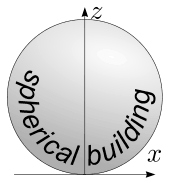
iii. (2.5 pts) What is the minimal launching speed \(v_{\min}\) needed to hit the topmost point of a spherical building of radius \(R\)?
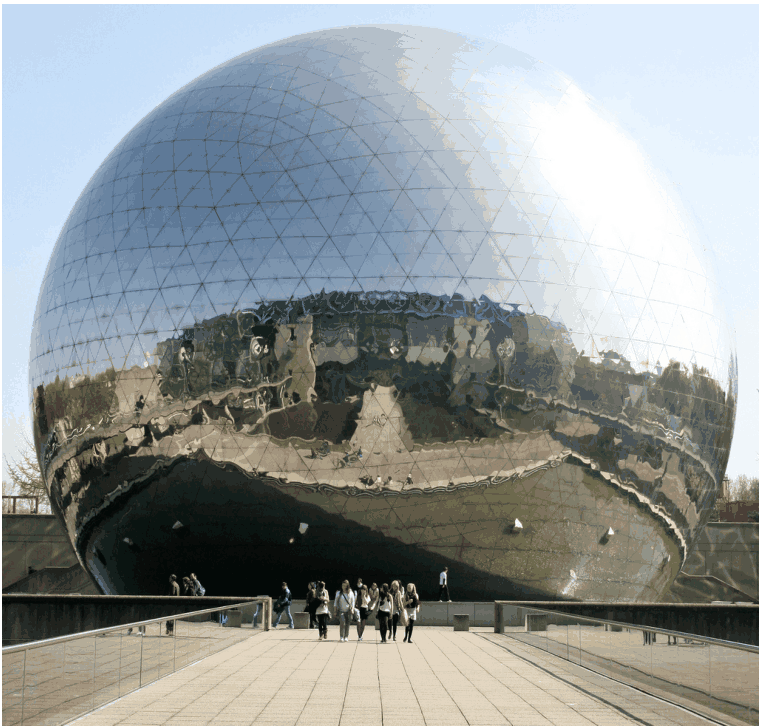
La Géode, Parc de la Villette, Paris. Photo: katchooo/flickr.com
Part B. Air flow around a wing (4 points)
For this part of the problem, the following information may be useful. For a flow of liquid or gas in a tube along a streamline, \(p+\rho gh+\frac12\rho v^2=\text{const.}\), assuming that the velocity \(v\) is much less than the speed of sound. Here \(\rho\) is the density, \(h\) is the height, \(g\) is free fall acceleration and \(p\) is hydrostatic pressure. Streamlines are defined as the trajectories of fluid particles (assuming that the flow pattern is stationary). Note that the term \(\frac12\rho v^2\) is called the dynamic pressure.
In the fig. shown below, a cross-section of an aircraft wing is depicted together with streamlines of the air flow around the wing, as seen in the wing’s reference frame. Assume that (a) the air flow is purely two-dimensional (i.e. that the velocity vectors of air lie in the plane of the figure); (b) the streamline pattern is independent of the aircraft speed; (c) there is no wind; (d) the dynamic pressure is much smaller than the atmospheric pressure, \(p_0=1.0\times10^5\,\mathrm{Pa}\).
You can use a ruler to take measurements from the fig. on the answer sheet.
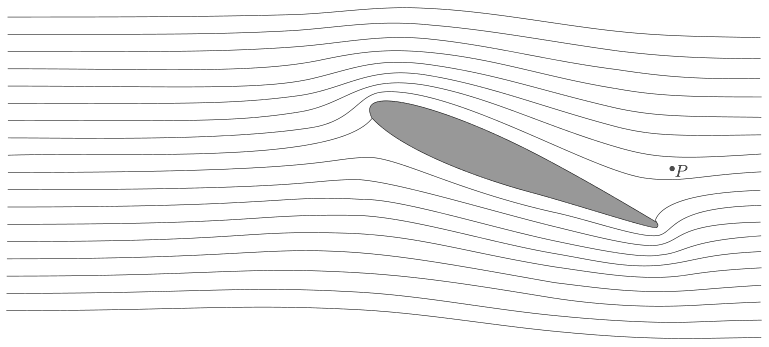
i. (0.8 pts) If the aircraft’s ground speed is \(v_0=100\,\mathrm{m/s}\), what is the speed of the air, \(v_P\), at the point \(P\) (marked in the fig.) with respect to the ground?
ii. (1.2 pts) In the case of high relative humidity, as the ground speed of the aircraft increases over a critical value \(v_{\mathrm{crit}}\), a stream of water droplets is created behind the wing. The droplets emerge at a certain point \(Q\). Mark the point \(Q\) in the fig. on the answer sheet. Explain qualitatively (using formulae and as little text as possible) how you determined the position of \(Q\).
iii. (2.0 pts) Estimate the critical speed \(v_{\mathrm{crit}}\) using the following data: relative humidity of the air is \(r=90\%\), specific heat capacity of air at constant pressure \(c_p=1.00\times10^3\,\mathrm{J/kg\cdot K}\), pressure of saturated water vapour: \(p_{sa}=2.31\,\mathrm{kPa}\) at the temperature of the unperturbed air \(T_a=293\,\mathrm K\) and \(p_{sb}=2.46\,\mathrm{kPa}\) at \(T_b=294\,\mathrm K\). Depending on your approximations, you may also need the specific heat capacity of air at constant volume \(c_V=0.717\times10^3\,\mathrm{J/kg\cdot K}\). Note that the relative humidity is defined as the ratio of the vapour pressure to the saturated vapour pressure at the given temperature. Saturated vapour pressure is defined as the vapour pressure by which vapour is in equilibrium with the liquid.
Part C. Magnetic straws (4.5 points)
Consider a cylindrical tube made of a superconducting material. The length of the tube is \(l\) and the inner radius is \(r\) with \(l\gg r\). The centre of the tube coincides with the origin, and its axis coincides with the \(z\)-axis.
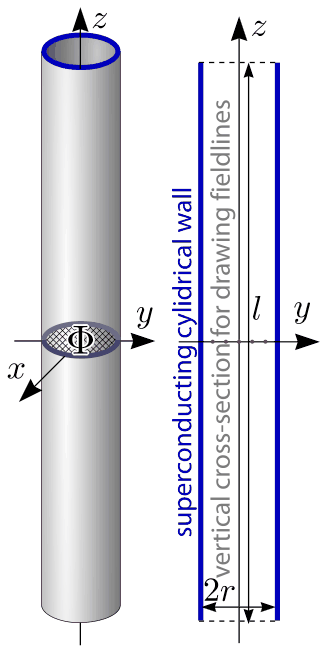
There is a magnetic flux \(\Phi\) through the central cross-section of the tube, \(z=0\), \(x^2+y^2<r^2\). A superconductor is a material which expels any magnetic field (the field is zero inside the material).
i. (0.8 pts) Sketch five such magnetic field lines, which pass through the five red dots marked on the axial cross-section of the tube, on the designated diagram on the answer sheet.
ii. (1.2 pts) Find the tension force \(T\) along the \(z\)-axis in the middle of the tube (i.e. the force by which two halves of the tube, \(z>0\) and \(z<0\), interact with each other).
iii. (2.5 pts) Consider another tube, identical and parallel to the first one.
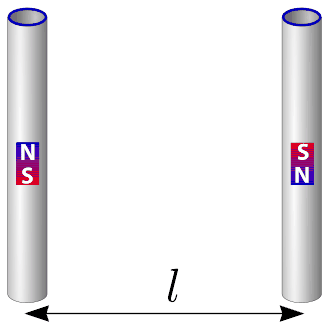
The second tube has the same magnetic field but in the opposite direction and its centre is placed at \(y=l\), \(x=z=0\) (so that the tubes form opposite sides of a square). Determine the magnetic interaction force \(F\) between the two tubes.
Official English text of the problem.
Problem 2: Kelvin water dropper
Problem T2. Kelvin water dropper (8 points)
The following facts about the surface tension may turn out to be useful for this problem. For the molecules of a liquid, the positions at the liquid-air interface are less favourable as compared with the positions in the bulk of the liquid. This interface is described by the so-called surface energy, \(U=\sigma S\), where \(S\) is the surface area of the interface and \(\sigma\) is the surface tension coefficient of the liquid. Moreover, two fragments of the liquid surface pull each other with a force \(F=\sigma l\), where \(l\) is the length of a straight line separating the fragments.
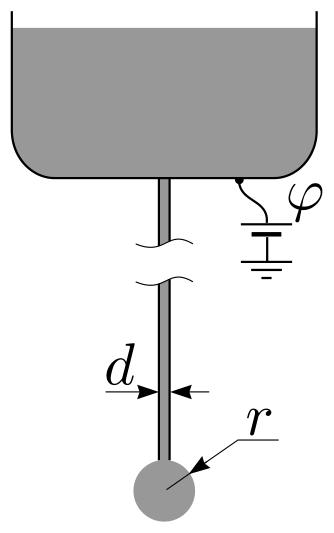
A long metallic pipe with internal diameter \(d\) is pointing directly downwards. Water is slowly dripping from a nozzle at its lower end, see fig. Water can be considered to be electrically conducting; its surface tension is \(\sigma\) and its density is \(\rho\). A droplet of radius \(r\) hangs below the nozzle. The radius grows slowly in time until the droplet separates from the nozzle due to the free fall acceleration \(g\). Always assume that \(d\ll r\).
Part A. Single pipe (4 points)
i. (1.2 pts) Find the radius \(r_{\max}\) of a drop just before it separates from the nozzle.
ii. (1.2 pts) Relative to the far-away surroundings, the pipe’s electrostatic potential is \(\varphi\). Find the charge \(Q\) of a drop when its radius is \(r\).
iii. (1.6 pts) Consider the situation in which \(r\) is kept constant and \(\varphi\) is slowly increased. The droplet becomes unstable and breaks into pieces if the hydrostatic pressure inside the droplet becomes smaller than the atmospheric pressure. Find the critical potential \(\varphi_{\max}\) at which this will happen.
Part B. Two pipes (4 points)
An apparatus called the “Kelvin water dropper” consists of two pipes, each identical to the one described in Part A, connected via a T-junction, see fig. The ends of both pipes are at the centres of two cylindrical electrodes (with height \(L\) and diameter \(D\) with \(L\gg D\gg r\)). For both tubes, the dripping rate is \(n\) droplets per unit time. Droplets fall from height \(H\) into conductive bowls underneath the nozzles, cross-connected to the electrodes as shown in the diagram. The electrodes are connected via a capacitance \(C\). There is no net charge on the system of bowls and electrodes. Note that the top water container is earthed as shown. The first droplet to fall will have some microscopic charge which will cause an imbalance between the two sides and a small charge separation across the capacitor.
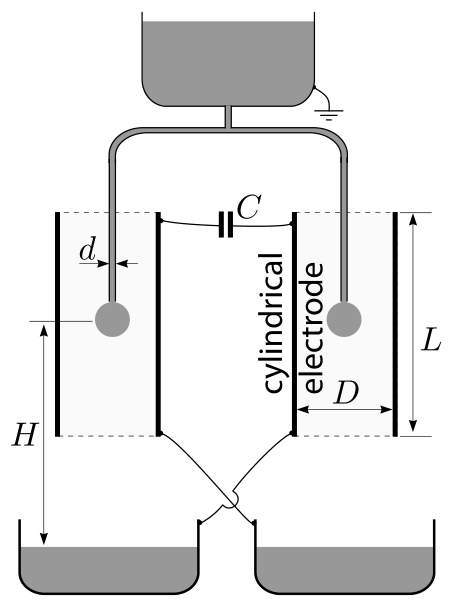
i. (1.2 pts) Express the absolute value of the charge \(Q_0\) of the drops as they separate from the tubes, and at the instant when the capacitor’s charge is \(q\). Express \(Q_0\) in terms of \(r_{\max}\) (from Part A-i) and neglect the effect described in Part A-iii.
ii. (1.5 pts) Find the dependence of \(q\) on time \(t\) by approximating it with a continuous function \(q(t)\) and assuming that \(q(0)=q_0\).
iii. (1.3 pts) The dropper’s functioning can be hindered by the effect shown in Part A-iii. In addition, a limit \(U_{\max}\) to the achievable potential between the electrodes is set by the electrostatic push between a droplet and the bowl beneath it. Find \(U_{\max}\).
Official English text of the problem.
Problem 3: Protostar formation
Problem T3. Protostar formation (9 points)
Let us model the formation of a star as follows. A spherical cloud of sparse interstellar gas, initially at rest, starts to collapse due to its own gravity. The initial radius of the ball is \(r_0\) and the mass is \(m\). The temperature of the surroundings (much sparser than the gas) and the initial temperature of the gas is uniformly \(T_0\). The gas may be assumed to be ideal. The average molar mass of the gas is \(\mu\) and its adiabatic index is \(\gamma>\frac{4}{3}\). Assume that \(G\frac{m\mu}{r_0}\gg RT_0\), where \(R\) is the gas constant and \(G\) is the gravitational constant.
i. (0.8 pts) During much of the collapse, the gas is so transparent that any heat generated is immediately radiated away, i.e. the ball stays in thermodynamic equilibrium with its surroundings. What is the number of times, \(n\), by which the pressure increases when the radius is halved to \(r_1=0.5r_0\)? Assume that the gas density remains uniform.
ii. (1 pt) Estimate the time \(t_2\) needed for the radius to shrink from \(r_0\) to \(r_2=0.95r_0\). Neglect the change of the gravity field at the position of a falling gas particle.
iii. (2.5 pts) Assuming that the pressure remains negligible, find the time \(t_{r\to0}\) needed for the ball to collapse from \(r_0\) down to a much smaller radius, using Kepler’s Laws.
iv. (1.7 pts) At some radius \(r_3\ll r_0\), the gas becomes dense enough to be opaque to the heat radiation. Calculate the amount of heat \(Q\) radiated away during the collapse from the radius \(r_0\) down to \(r_3\).
v. (1 pt) For radii smaller than \(r_3\) you may neglect heat loss due to radiation. Determine how the temperature \(T\) of the ball depends on its radius for \(r<r_3\).
vi. (2 pts) Eventually we cannot neglect the effect of the pressure on the dynamics of the gas and the collapse stops at \(r=r_4\) (with \(r_4\ll r_3\)). However, the radiation loss can still be neglected and the temperature is not yet high enough to ignite nuclear fusion. The pressure of such a protostar is not uniform anymore, but rough estimates with inaccurate numerical prefactors can still be done. Estimate the final radius \(r_4\) and the respective temperature \(T_4\).
Official English text of the problem.
Internationale Physik-Olympiade
IPhO 2012
Tartu, Estland · 3 Theorieaufgaben mit vollständigen Lösungen
Aufgabe 1: Skizzen im Mittelpunkt
Aufgabe T1. Skizzen im Mittelpunkt (13 Punkte)
Teil A. Ballistik (4.5 Punkte)
Ein Ball, der mit einer Anfangsgeschwindigkeit \(v_0\) geworfen wird, bewegt sich in einem homogenen Gravitationsfeld in der \(x\)-\(z\)-Ebene. Dabei verläuft die \(x\)-Achse horizontal und die \(z\)-Achse vertikal und antiparallel zur Fallbeschleunigung \(g\). Vernachlässigen Sie den Luftwiderstand.
i. (0.8 Punkte) Durch Wahl des Abwurfwinkels eines Balls, der mit einer festen Anfangsgeschwindigkeit \(v_0\) vom Ursprung aus geworfen wird, lassen sich Ziele innerhalb des durch
\[ z\leq z_0-kx^2 \]
gegebenen Bereichs treffen. Sie dürfen diese Tatsache ohne Beweis verwenden. Bestimmen Sie die Konstanten \(z_0\) und \(k\).
ii. (1.2 Punkte) Der Abwurfpunkt kann nun auf Bodenhöhe \(z=0\) frei gewählt und der Abwurfwinkel nach Bedarf eingestellt werden. Ziel ist es, den höchsten Punkt eines kugelförmigen Gebäudes mit dem Radius \(R\) (siehe Abb.) mit der kleinstmöglichen Anfangsgeschwindigkeit \(v_0\) zu treffen. Ein Abprallen vom Dach vor dem Treffen des Ziels ist nicht zulässig. Skizzieren Sie qualitativ die Form der optimalen Flugbahn des Balls (verwenden Sie das dafür vorgesehene Feld auf dem Antwortbogen). Beachten Sie, dass nur die Skizze bewertet wird.
iii. (2.5 Punkte) Welche minimale Abwurfgeschwindigkeit \(v_{\min}\) ist erforderlich, um den höchsten Punkt eines kugelförmigen Gebäudes mit dem Radius \(R\) zu treffen?
La Géode, Parc de la Villette, Paris. Foto: katchooo/flickr.com
Teil B. Luftströmung um einen Tragflügel (4 Punkte)
Für diesen Teil der Aufgabe können die folgenden Informationen hilfreich sein. Für die Strömung einer Flüssigkeit oder eines Gases in einem Rohr gilt entlang einer Stromlinie \(p+\rho gh+\frac12\rho v^2=\text{konst.}\), sofern die Geschwindigkeit \(v\) viel kleiner als die Schallgeschwindigkeit ist. Hierbei sind \(\rho\) die Dichte, \(h\) die Höhe, \(g\) die Fallbeschleunigung und \(p\) der hydrostatische Druck. Stromlinien sind als die Bahnen der Fluidteilchen definiert (unter der Annahme, dass das Strömungsbild stationär ist). Beachten Sie, dass der Term \(\frac12\rho v^2\) als dynamischer Druck bezeichnet wird.
Die folgende Abbildung zeigt einen Querschnitt durch einen Flugzeugtragflügel zusammen mit den Stromlinien der Luftströmung um den Tragflügel, betrachtet im Bezugssystem des Tragflügels. Nehmen Sie an, dass (a) die Luftströmung rein zweidimensional ist (d. h., dass die Geschwindigkeitsvektoren der Luft in der Zeichenebene liegen); (b) das Stromlinienbild unabhängig von der Flugzeuggeschwindigkeit ist; (c) kein Wind herrscht; (d) der dynamische Druck viel kleiner als der atmosphärische Druck \(p_0=1.0\times10^5\,\mathrm{Pa}\) ist.
Sie dürfen mit einem Lineal Messungen an der Abbildung auf dem Antwortbogen vornehmen.
i. (0.8 Punkte) Wenn die Geschwindigkeit des Flugzeugs relativ zum Boden \(v_0=100\,\mathrm{m/s}\) beträgt, wie groß ist dann die Geschwindigkeit der Luft \(v_P\) am Punkt \(P\) (in der Abb. markiert) relativ zum Boden?
ii. (1.2 Punkte) Bei hoher relativer Luftfeuchtigkeit entsteht hinter dem Tragflügel ein Strom von Wassertröpfchen, sobald die Geschwindigkeit des Flugzeugs relativ zum Boden einen kritischen Wert \(v_{\mathrm{crit}}\) überschreitet. Die Tröpfchen entstehen an einem bestimmten Punkt \(Q\). Markieren Sie den Punkt \(Q\) in der Abbildung auf dem Antwortbogen. Erläutern Sie qualitativ (mit Formeln und möglichst wenig Text), wie Sie die Lage von \(Q\) bestimmt haben.
iii. (2.0 Punkte) Schätzen Sie die kritische Geschwindigkeit \(v_{\mathrm{crit}}\) anhand folgender Daten ab: relative Luftfeuchtigkeit \(r=90\%\), spezifische Wärmekapazität der Luft bei konstantem Druck \(c_p=1.00\times10^3\,\mathrm{J/kg\cdot K}\), Sättigungsdampfdruck von Wasser: \(p_{sa}=2.31\,\mathrm{kPa}\) bei der Temperatur der ungestörten Luft \(T_a=293\,\mathrm K\) und \(p_{sb}=2.46\,\mathrm{kPa}\) bei \(T_b=294\,\mathrm K\). Je nach Ihren Näherungen benötigen Sie möglicherweise auch die spezifische Wärmekapazität der Luft bei konstantem Volumen \(c_V=0.717\times10^3\,\mathrm{J/kg\cdot K}\). Beachten Sie, dass die relative Luftfeuchtigkeit als Verhältnis des Dampfdrucks zum Sättigungsdampfdruck bei der jeweiligen Temperatur definiert ist. Der Sättigungsdampfdruck ist der Dampfdruck, bei dem der Dampf mit der Flüssigkeit im Gleichgewicht steht.
Teil C. Magnetische Strohhalme (4.5 Punkte)
Betrachten Sie ein zylindrisches Rohr aus einem supraleitenden Material. Die Länge des Rohrs beträgt \(l\), sein Innenradius \(r\), wobei \(l\gg r\) gilt. Der Mittelpunkt des Rohrs liegt im Ursprung, und seine Achse fällt mit der \(z\)-Achse zusammen.
Durch den mittleren Querschnitt des Rohrs, \(z=0\), \(x^2+y^2<r^2\), tritt ein magnetischer Fluss \(\Phi\). Ein Supraleiter ist ein Material, das jedes Magnetfeld aus seinem Inneren verdrängt (im Material ist das Feld null).
i. (0.8 Punkte) Skizzieren Sie im dafür vorgesehenen Diagramm auf dem Antwortbogen fünf magnetische Feldlinien, die durch die fünf roten Punkte im Längsschnitt durch die Rohrachse verlaufen.
ii. (1.2 Punkte) Bestimmen Sie die Zugkraft \(T\) entlang der \(z\)-Achse in der Mitte des Rohrs (d. h. die Kraft, mit der die beiden Rohrhälften \(z>0\) und \(z<0\) aufeinander wirken).
iii. (2.5 Punkte) Betrachten Sie ein weiteres Rohr, das mit dem ersten identisch und parallel zu ihm ist.
Das zweite Rohr hat dasselbe Magnetfeld, jedoch in entgegengesetzter Richtung, und sein Mittelpunkt befindet sich bei \(y=l\), \(x=z=0\) (die Rohre bilden also gegenüberliegende Seiten eines Quadrats). Bestimmen Sie die magnetische Wechselwirkungskraft \(F\) zwischen den beiden Rohren.
Aufgabentext aus dem offiziellen englischen Text übersetzt.
Aufgabe 2: Kelvin-Wassertropfengenerator
Aufgabe T2. Kelvin-Wassertropfengenerator (8 Punkte)
Die folgenden Tatsachen zur Oberflächenspannung können für diese Aufgabe hilfreich sein. Für die Moleküle einer Flüssigkeit sind die Positionen an der Grenzfläche zwischen Flüssigkeit und Luft energetisch ungünstiger als die Positionen im Inneren der Flüssigkeit. Diese Grenzfläche wird durch die sogenannte Oberflächenenergie beschrieben, \(U=\sigma S\), wobei \(S\) der Flächeninhalt der Grenzfläche und \(\sigma\) der Oberflächenspannungskoeffizient der Flüssigkeit ist. Außerdem ziehen sich zwei Teilflächen der Flüssigkeitsoberfläche mit einer Kraft \(F=\sigma l\) gegenseitig an, wobei \(l\) die Länge einer geraden Trennlinie zwischen den Teilflächen ist.
Ein langes Metallrohr mit dem Innendurchmesser \(d\) ist senkrecht nach unten gerichtet. Aus einer Düse an seinem unteren Ende tropft langsam Wasser, siehe Abbildung. Wasser kann als elektrisch leitend betrachtet werden; seine Oberflächenspannung ist \(\sigma\) und seine Dichte \(\rho\). Unterhalb der Düse hängt ein Tropfen mit dem Radius \(r\). Der Radius wächst langsam mit der Zeit, bis sich der Tropfen aufgrund der Fallbeschleunigung \(g\) von der Düse löst. Nehmen Sie stets an, dass \(d\ll r\).
Teil A. Einzelnes Rohr (4 Punkte)
i. (1.2 Punkte) Bestimmen Sie den Radius \(r_{\max}\) eines Tropfens unmittelbar bevor er sich von der Düse löst.
ii. (1.2 Punkte) Gegenüber der weit entfernten Umgebung hat das Rohr das elektrostatische Potential \(\varphi\). Bestimmen Sie die Ladung \(Q\) eines Tropfens, wenn sein Radius \(r\) beträgt.
iii. (1.6 Punkte) Betrachten Sie die Situation, in der \(r\) konstant gehalten und \(\varphi\) langsam erhöht wird. Der Tropfen wird instabil und zerfällt, wenn der hydrostatische Druck im Tropfen kleiner als der Atmosphärendruck wird. Bestimmen Sie das kritische Potential \(\varphi_{\max}\), bei dem dies geschieht.
Teil B. Zwei Rohre (4 Punkte)
Eine als „Kelvin-Wassertropfengenerator“ bezeichnete Vorrichtung besteht aus zwei Rohren, die jeweils mit dem in Teil A beschriebenen Rohr identisch und über ein T-Stück miteinander verbunden sind, siehe Abbildung. Die Enden beider Rohre befinden sich in den Mittelpunkten zweier zylindrischer Elektroden (mit der Höhe \(L\) und dem Durchmesser \(D\), wobei \(L\gg D\gg r\)). Bei beiden Rohren beträgt die Tropfrate \(n\) Tropfen pro Zeiteinheit. Die Tropfen fallen aus der Höhe \(H\) in leitende Schalen unterhalb der Düsen, die wie in der Zeichnung dargestellt über Kreuz mit den Elektroden verbunden sind. Die Elektroden sind über einen Kondensator mit der Kapazität \(C\) verbunden. Die Gesamtladung des Systems aus Schalen und Elektroden ist null. Beachten Sie, dass der obere Wasserbehälter wie dargestellt geerdet ist. Der erste fallende Tropfen trägt eine mikroskopisch kleine Ladung, die ein Ungleichgewicht zwischen den beiden Seiten und eine geringe Ladungstrennung am Kondensator verursacht.
i. (1.2 Punkte) Geben Sie den Betrag der Ladung \(Q_0\) der Tropfen beim Ablösen von den Rohren zu dem Zeitpunkt an, an dem die Ladung des Kondensators \(q\) beträgt. Drücken Sie \(Q_0\) durch \(r_{\max}\) (aus Teil A-i) aus und vernachlässigen Sie den in Teil A-iii beschriebenen Effekt.
ii. (1.5 Punkte) Bestimmen Sie die Abhängigkeit von \(q\) von der Zeit \(t\), indem Sie sie durch eine stetige Funktion \(q(t)\) annähern und \(q(0)=q_0\) annehmen.
iii. (1.3 Punkte) Die Funktion des Wassertropfengenerators kann durch den in Teil A-iii beschriebenen Effekt beeinträchtigt werden. Darüber hinaus setzt die elektrostatische Abstoßung zwischen einem Tropfen und der darunterliegenden Schale der erreichbaren Potentialdifferenz zwischen den Elektroden eine Grenze \(U_{\max}\). Bestimmen Sie \(U_{\max}\).
Aufgabentext aus dem offiziellen englischen Text übersetzt.
Aufgabe 3: Entstehung eines Protosterns
Aufgabe T3. Entstehung eines Protosterns (9 Punkte)
Wir modellieren die Entstehung eines Sterns wie folgt. Eine kugelförmige Wolke aus dünnem interstellarem Gas, die sich zunächst in Ruhe befindet, beginnt unter ihrer eigenen Gravitation zu kollabieren. Der Anfangsradius der Kugel ist \(r_0\), ihre Masse ist \(m\). Die Temperatur der Umgebung (die eine wesentlich geringere Dichte als das Gas hat) und die Anfangstemperatur des Gases betragen überall \(T_0\). Das Gas kann als ideal angenommen werden. Die mittlere molare Masse des Gases ist \(\mu\), und sein Adiabatenexponent ist \(\gamma>\frac{4}{3}\). Es gelte \(G\frac{m\mu}{r_0}\gg RT_0\), wobei \(R\) die Gaskonstante und \(G\) die Gravitationskonstante ist.
i. (0.8 Punkte) Während eines Großteils des Kollapses ist das Gas so transparent, dass jegliche erzeugte Wärme sofort abgestrahlt wird, d. h., die Kugel bleibt im thermodynamischen Gleichgewicht mit ihrer Umgebung. Um welchen Faktor \(n\) steigt der Druck, wenn der Radius auf \(r_1=0.5r_0\) halbiert wird? Nehmen Sie an, dass die Gasdichte räumlich gleichmäßig bleibt.
ii. (1 Punkt) Schätzen Sie die Zeit \(t_2\) ab, die benötigt wird, damit der Radius von \(r_0\) auf \(r_2=0.95r_0\) schrumpft. Vernachlässigen Sie die Änderung des Gravitationsfeldes am Ort eines fallenden Gasteilchens.
iii. (2.5 Punkte) Bestimmen Sie unter der Annahme, dass der Druck vernachlässigbar bleibt, mithilfe der Keplerschen Gesetze die Zeit \(t_{r\to0}\), die die Kugel benötigt, um von \(r_0\) auf einen wesentlich kleineren Radius zu kollabieren.
iv. (1.7 Punkte) Bei einem Radius \(r_3\ll r_0\) wird das Gas so dicht, dass es für Wärmestrahlung undurchlässig wird. Berechnen Sie die Wärmemenge \(Q\), die während des Kollapses vom Radius \(r_0\) auf \(r_3\) abgestrahlt wird.
v. (1 Punkt) Für Radien kleiner als \(r_3\) dürfen Sie den Wärmeverlust durch Strahlung vernachlässigen. Bestimmen Sie, wie die Temperatur \(T\) der Kugel für \(r<r_3\) von ihrem Radius abhängt.
vi. (2 Punkte) Schließlich können wir den Einfluss des Drucks auf die Dynamik des Gases nicht mehr vernachlässigen, und der Kollaps kommt bei \(r=r_4\) (mit \(r_4\ll r_3\)) zum Stillstand. Die Strahlungsverluste können jedoch weiterhin vernachlässigt werden, und die Temperatur ist noch nicht hoch genug, um die Kernfusion zu zünden. Der Druck eines solchen Protosterns ist nicht mehr räumlich gleichmäßig, doch grobe Abschätzungen mit ungenauen numerischen Vorfaktoren sind weiterhin möglich. Schätzen Sie den Endradius \(r_4\) und die zugehörige Temperatur \(T_4\) ab.
Aufgabentext aus dem offiziellen englischen Text übersetzt.
Uluslararası Fizik Olimpiyatı
IPhO 2012
Tartu, Estonya · 3 teori sorusu, tam çözümleriyle
Soru 1: Çizimlere odaklanın
Soru T1. Çizimlere odaklanın (13 puan)
Bölüm A. Balistik (4.5 puan)
İlk hızı \(v_0\) olan bir top, homojen bir kütleçekim alanında, \(x\)-ekseni yatay ve \(z\)-ekseni düşey olup serbest düşme ivmesi \(g\) ile zıt yönde olacak şekilde, \(x\)-\(z\) düzleminde hareket etmektedir. Hava direncinin etkisini ihmal edin.
i. (0.8 puan) Orijinden sabit bir \(v_0\) ilk hızıyla atılan topun atış açısı ayarlanarak,
\[ z\leq z_0-kx^2. \]
ile verilen bölge içindeki hedefler vurulabilir. Bu bilgiyi kanıtlamadan kullanabilirsiniz. \(z_0\) ve \(k\) sabitlerini bulun.
ii. (1.2 puan) Artık atış noktası \(z=0\) yer seviyesinde serbestçe seçilebilmekte ve atış açısı gerektiği gibi ayarlanabilmektedir. Amaç, \(R\) yarıçaplı küresel bir binanın (şekle bakınız) en üst noktasını en küçük \(v_0\) ilk hızıyla vurmaktır. Hedefi vurmadan önce çatıdan sekmeye izin verilmemektedir. Topun en uygun yörüngesinin biçimini nitel olarak çizin (cevap kâğıdında ayrılan kutuyu kullanın). Puanların yalnızca çizime verileceğine dikkat edin.
iii. (2.5 puan) \(R\) yarıçaplı küresel bir binanın en üst noktasını vurmak için gereken en küçük atış hızı \(v_{\min}\) nedir?
La Géode, Parc de la Villette, Paris. Fotoğraf: katchooo/flickr.com
Bölüm B. Bir kanat çevresindeki hava akışı (4 puan)
Sorunun bu bölümünde aşağıdaki bilgiler yararlı olabilir. Bir boruda bir akım çizgisi boyunca akan sıvı veya gaz için, \(v\) hızının ses hızından çok daha küçük olduğu varsayımıyla, \(p+\rho gh+\frac12\rho v^2=\text{sabit}\) bağıntısı geçerlidir. Burada \(\rho\) yoğunluk, \(h\) yükseklik, \(g\) serbest düşme ivmesi ve \(p\) hidrostatik basınçtır. Akım çizgileri, akış deseninin zamana göre değişmediği varsayımı altında, akışkan parçacıklarının yörüngeleri olarak tanımlanır. \(\frac12\rho v^2\) teriminin dinamik basınç olarak adlandırıldığına dikkat edin.
Aşağıdaki şekilde, bir uçak kanadının kesiti, kanadın referans sisteminden görüldüğü hâliyle kanadın çevresindeki hava akışının akım çizgileriyle birlikte gösterilmiştir. Şunları varsayın: (a) hava akışı tamamen iki boyutludur (yani havanın hız vektörleri şeklin düzleminde yer alır); (b) akım çizgilerinin deseni uçağın hızından bağımsızdır; (c) rüzgâr yoktur; (d) dinamik basınç, atmosfer basıncı \(p_0=1.0\times10^5\,\mathrm{Pa}\) değerinden çok daha küçüktür.
Cevap kâğıdındaki şekilden ölçüm yapmak için cetvel kullanabilirsiniz.
i. (0.8 puan) Uçağın yere göre hızı \(v_0=100\,\mathrm{m/s}\) ise, şekilde işaretlenmiş \(P\) noktasındaki havanın yere göre hızı \(v_P\) nedir?
ii. (1.2 puan) Bağıl nemin yüksek olduğu durumda, uçağın yere göre hızı bir \(v_{\mathrm{crit}}\) kritik değerini aştığında, kanadın arkasında su damlacıklarından oluşan bir akım meydana gelir. Damlacıklar belirli bir \(Q\) noktasında ortaya çıkar. Cevap kâğıdındaki şekilde \(Q\) noktasını işaretleyin. \(Q\) noktasının yerini nasıl belirlediğinizi nitel olarak açıklayın (formüller ve mümkün olduğunca az metin kullanın).
iii. (2.0 puan) Aşağıdaki verileri kullanarak \(v_{\mathrm{crit}}\) kritik hızını tahmin edin: havanın bağıl nemi \(r=90\%\), havanın sabit basınçtaki özgül ısı kapasitesi \(c_p=1.00\times10^3\,\mathrm{J/kg\cdot K}\), doymuş su buharı basıncı, bozulmamış havanın sıcaklığı olan \(T_a=293\,\mathrm K\) sıcaklığında \(p_{sa}=2.31\,\mathrm{kPa}\) ve \(T_b=294\,\mathrm K\) sıcaklığında \(p_{sb}=2.46\,\mathrm{kPa}\). Yaptığınız yaklaşıklıklara bağlı olarak, havanın sabit hacimdeki özgül ısı kapasitesi \(c_V=0.717\times10^3\,\mathrm{J/kg\cdot K}\) değerine de ihtiyaç duyabilirsiniz. Bağıl nemin, verilen sıcaklıkta buhar basıncının doymuş buhar basıncına oranı olarak tanımlandığına dikkat edin. Doymuş buhar basıncı, buharın sıvıyla dengede olduğu buhar basıncı olarak tanımlanır.
Bölüm C. Manyetik pipetler (4.5 puan)
Süperiletken bir malzemeden yapılmış silindirik bir boruyu ele alın. Borunun uzunluğu \(l\), iç yarıçapı \(r\) olup \(l\gg r\) koşulu sağlanmaktadır. Borunun merkezi orijinle, ekseni ise \(z\)-ekseniyle çakışmaktadır.
Borunun \(z=0\), \(x^2+y^2<r^2\) ile tanımlanan orta kesitinden geçen bir \(\Phi\) manyetik akısı vardır. Süperiletken, her türlü manyetik alanı dışlayan bir malzemedir (malzemenin içinde alan sıfırdır).
i. (0.8 puan) Cevap kâğıdında ayrılan diyagram üzerinde, borunun eksenel kesitinde işaretlenmiş beş kırmızı noktadan geçen beş manyetik alan çizgisi çizin.
ii. (1.2 puan) Borunun ortasında, \(z\)-ekseni doğrultusundaki \(T\) gerilme kuvvetini (yani borunun \(z>0\) ve \(z<0\) yarılarının birbirlerine uyguladığı kuvveti) bulun.
iii. (2.5 puan) Birinci boruyla özdeş ve ona paralel başka bir boruyu ele alın.
İkinci boru aynı manyetik alana, ancak zıt yönde sahiptir ve merkezi \(y=l\), \(x=z=0\) konumundadır (böylece borular bir karenin karşılıklı kenarlarını oluşturur). İki boru arasındaki manyetik etkileşim kuvveti \(F\)'yi belirleyin.
Soru metni resmi İngilizce metinden çevrilmiştir.
Soru 2: Kelvin su damlatıcısı
Soru T2. Kelvin su damlatıcısı (8 puan)
Yüzey gerilimine ilişkin aşağıdaki bilgiler bu soruda yararlı olabilir. Bir sıvının molekülleri açısından, sıvı-hava arayüzündeki konumlar sıvının içindeki konumlara göre daha az elverişlidir. Bu arayüz, yüzey enerjisi adı verilen \(U=\sigma S\) ile tanımlanır; burada \(S\) arayüzün yüzey alanı, \(\sigma\) ise sıvının yüzey gerilimi katsayısıdır. Ayrıca, sıvı yüzeyinin iki parçası birbirini \(F=\sigma l\) kuvvetiyle çeker; burada \(l\), parçaları birbirinden ayıran düz çizginin uzunluğudur.
İç çapı \(d\) olan uzun bir metal boru düşey olarak aşağıya yönelmiştir. Alt ucundaki bir ağızdan yavaşça su damlamaktadır; şekle bakınız. Su elektriksel olarak iletken kabul edilebilir; yüzey gerilimi \(\sigma\), yoğunluğu ise \(\rho\)'dur. Ağzın altında yarıçapı \(r\) olan bir damla asılı durmaktadır. Damla, serbest düşme ivmesi \(g\) nedeniyle ağızdan kopana kadar yarıçapı zamanla yavaşça büyür. Her zaman \(d\ll r\) olduğunu varsayınız.
Bölüm A. Tek boru (4 puan)
i. (1.2 puan) Bir damlanın ağızdan kopmadan hemen önceki yarıçapını, \(r_{\max}\), bulunuz.
ii. (1.2 puan) Borunun uzaktaki çevreye göre elektrostatik potansiyeli \(\varphi\)'dir. Yarıçapı \(r\) olduğunda bir damlanın \(Q\) yükünü bulunuz.
iii. (1.6 puan) \(r\)'nin sabit tutulduğu ve \(\varphi\)'nin yavaşça artırıldığı durumu ele alınız. Damlanın içindeki hidrostatik basınç atmosfer basıncının altına düşerse damla kararsız hâle gelir ve parçalara ayrılır. Bunun gerçekleşeceği kritik potansiyeli, \(\varphi_{\max}\), bulunuz.
Bölüm B. İki boru (4 puan)
“Kelvin su damlatıcısı” adı verilen düzenek, her biri Bölüm A'da açıklanan boruyla özdeş olan ve bir T-bağlantısıyla birleştirilmiş iki borudan oluşur; şekle bakınız. Her iki borunun uçları, iki silindirik elektrodun merkezlerinde bulunur (elektrotların yüksekliği \(L\), çapı \(D\) olup \(L\gg D\gg r\)'dir). Her iki boru için de damlama hızı birim zamanda \(n\) damladır. Damlalar, \(H\) yüksekliğinden ağızların altındaki iletken kaplara düşer; bu kaplar, şekilde gösterildiği gibi elektrotlara çapraz bağlanmıştır. Elektrotlar, sığası \(C\) olan bir kondansatör aracılığıyla birbirine bağlıdır. Kaplar ve elektrotlardan oluşan sistemin net yükü sıfırdır. Üstteki su haznesinin şekilde gösterildiği gibi topraklandığına dikkat ediniz. İlk düşen damla, iki taraf arasında bir dengesizliğe ve kondansatörün plakaları arasında küçük bir yük ayrışmasına neden olacak mikroskobik bir yük taşıyacaktır.
i. (1.2 puan) Kondansatörün yükünün \(q\) olduğu anda borulardan kopan damlaların yükünün mutlak değerini, \(Q_0\), ifade ediniz. \(Q_0\)'ı (Bölüm A-i'deki) \(r_{\max}\) cinsinden ifade ediniz ve Bölüm A-iii'te açıklanan etkiyi ihmal ediniz.
ii. (1.5 puan) \(q\)'yu sürekli bir \(q(t)\) fonksiyonuyla yaklaşık olarak temsil ederek ve \(q(0)=q_0\) olduğunu varsayarak \(q\)'nun \(t\) zamanına bağlılığını bulunuz.
iii. (1.3 puan) Bölüm A-iii'te gösterilen etki damlatıcının çalışmasını engelleyebilir. Ayrıca, bir damla ile altındaki kap arasındaki elektrostatik itme, elektrotlar arasında ulaşılabilecek potansiyel farkına bir \(U_{\max}\) sınırı getirir. \(U_{\max}\)'ı bulunuz.
Soru metni resmi İngilizce metinden çevrilmiştir.
Soru 3: Önyıldız oluşumu
Soru T3. Önyıldız oluşumu (9 puan)
Bir yıldızın oluşumunu aşağıdaki gibi modelleyelim. Başlangıçta durgun olan, seyrek yıldızlararası gazdan oluşan küresel bir bulut, kendi kütleçekiminin etkisiyle çökmeye başlar. Kürenin başlangıç yarıçapı \(r_0\), kütlesi ise \(m\)'dir. Çevrenin (gazdan çok daha seyrek olan ortamın) sıcaklığı ve gazın başlangıç sıcaklığı her yerde \(T_0\)'dır. Gazın ideal olduğu kabul edilebilir. Gazın ortalama molar kütlesi \(\mu\), adyabatik indisi ise \(\gamma>\frac{4}{3}\)'tür. \(G\frac{m\mu}{r_0}\gg RT_0\) olduğunu varsayın; burada \(R\) gaz sabiti, \(G\) ise kütleçekim sabitidir.
i. (0.8 puan) Çökmenin büyük bir bölümünde gaz o kadar saydamdır ki üretilen her türlü ısı hemen ışınımla dışarı verilir; yani küre, çevresiyle termodinamik dengede kalır. Yarıçap yarıya inerek \(r_1=0.5r_0\) olduğunda basınç kaç katına çıkar? Bu kat sayısını \(n\) ile gösterin. Gaz yoğunluğunun her yerde aynı kaldığını varsayın.
ii. (1 puan) Yarıçapın \(r_0\)'dan \(r_2=0.95r_0\)'a küçülmesi için gereken \(t_2\) süresini tahmin edin. Düşen bir gaz parçacığının bulunduğu konumdaki kütleçekim alanının değişimini ihmal edin.
iii. (2.5 puan) Basıncın ihmal edilebilir düzeyde kaldığını varsayarak, Kepler yasalarını kullanıp kürenin \(r_0\)'dan çok daha küçük bir yarıçapa kadar çökmesi için gereken \(t_{r\to0}\) süresini bulun.
iv. (1.7 puan) \(r_3\ll r_0\) olan bir yarıçapta gaz, ısıl ışınıma karşı opak hâle gelecek kadar yoğunlaşır. Yarıçap \(r_0\)'dan \(r_3\)'e inerken gerçekleşen çökme sırasında ışınımla dışarı verilen \(Q\) ısı miktarını hesaplayın.
v. (1 puan) \(r_3\)'ten küçük yarıçaplarda ışınımla ısı kaybını ihmal edebilirsiniz. \(r<r_3\) için kürenin \(T\) sıcaklığının yarıçapına nasıl bağlı olduğunu belirleyin.
vi. (2 puan) Sonunda basıncın gazın dinamiği üzerindeki etkisi ihmal edilemez hâle gelir ve çökme \(r=r_4\)'te durur (\(r_4\ll r_3\) olmak üzere). Ancak ışınım kaybı hâlâ ihmal edilebilir ve sıcaklık henüz nükleer füzyonu başlatacak kadar yüksek değildir. Böyle bir önyıldızın basıncı artık her yerde aynı değildir, fakat sayısal ön çarpanları kesin olmayan kaba tahminler yine de yapılabilir. Son yarıçap \(r_4\)'ü ve buna karşılık gelen \(T_4\) sıcaklığını tahmin edin.
Soru metni resmi İngilizce metinden çevrilmiştir.
Olimpiada Internacional de Física
IPhO 2012
Tartu, Estonia · 3 problemas teóricos con soluciones completas
Problema 1: Énfasis en los esquemas
Problema T1. Énfasis en los esquemas (13 puntos)
Parte A. Balística (4.5 puntos)
Una pelota, lanzada con una rapidez inicial \(v_0\), se mueve en un campo gravitatorio homogéneo en el plano \(x\)-\(z\), donde el eje \(x\) es horizontal y el eje \(z\) es vertical y antiparalelo a la aceleración de caída libre \(g\). Desprecie el efecto de la resistencia del aire.
i. (0.8 puntos) Ajustando el ángulo de lanzamiento de una pelota lanzada desde el origen con una rapidez inicial fija \(v_0\), se pueden alcanzar blancos dentro de la región dada por
\[ z\leq z_0-kx^2. \]
Puede utilizar este hecho sin demostrarlo. Halle las constantes \(z_0\) y \(k\).
ii. (1.2 puntos) Ahora se puede elegir libremente el punto de lanzamiento al nivel del suelo \(z=0\), y el ángulo de lanzamiento se puede ajustar según sea necesario. El objetivo es alcanzar el punto más alto de un edificio esférico de radio \(R\) (véase la figura) con la mínima rapidez inicial \(v_0\). No se permite rebotar en el tejado antes de alcanzar el blanco. Esboce cualitativamente la forma de la trayectoria óptima de la pelota (utilice el recuadro destinado a ello en la hoja de respuestas). Tenga en cuenta que solo se puntuará el esquema.
iii. (2.5 puntos) ¿Cuál es la rapidez mínima de lanzamiento \(v_{\min}\) necesaria para alcanzar el punto más alto de un edificio esférico de radio \(R\)?
La Géode, Parc de la Villette, París. Foto: katchooo/flickr.com
Parte B. Flujo de aire alrededor de un ala (4 puntos)
Para esta parte del problema, la siguiente información puede resultar útil. Para un flujo de líquido o gas en un tubo a lo largo de una línea de corriente, \(p+\rho gh+\frac12\rho v^2=\text{const.}\), suponiendo que la velocidad \(v\) es mucho menor que la velocidad del sonido. Aquí \(\rho\) es la densidad, \(h\) es la altura, \(g\) es la aceleración de caída libre y \(p\) es la presión hidrostática. Las líneas de corriente se definen como las trayectorias de las partículas del fluido (suponiendo que el flujo es estacionario). Tenga en cuenta que el término \(\frac12\rho v^2\) se denomina presión dinámica.
En la figura que se muestra a continuación se representa una sección transversal del ala de un avión junto con las líneas de corriente del flujo de aire alrededor del ala, vistas en el sistema de referencia del ala. Suponga que (a) el flujo de aire es puramente bidimensional (es decir, que los vectores velocidad del aire están en el plano de la figura); (b) el patrón de líneas de corriente es independiente de la rapidez del avión; (c) no hay viento; (d) la presión dinámica es mucho menor que la presión atmosférica, \(p_0=1.0\times10^5\,\mathrm{Pa}\).
Puede utilizar una regla para tomar medidas en la figura de la hoja de respuestas.
i. (0.8 puntos) Si la rapidez del avión respecto al suelo es \(v_0=100\,\mathrm{m/s}\), ¿cuál es la rapidez del aire, \(v_P\), en el punto \(P\) (marcado en la figura) respecto al suelo?
ii. (1.2 puntos) En condiciones de humedad relativa elevada, cuando la rapidez del avión respecto al suelo supera un valor crítico \(v_{\mathrm{crit}}\), se forma una corriente de gotas de agua detrás del ala. Las gotas aparecen en un cierto punto \(Q\). Marque el punto \(Q\) en la figura de la hoja de respuestas. Explique cualitativamente (utilizando fórmulas y la menor cantidad de texto posible) cómo ha determinado la posición de \(Q\).
iii. (2.0 puntos) Estime la rapidez crítica \(v_{\mathrm{crit}}\) utilizando los siguientes datos: la humedad relativa del aire es \(r=90\%\), la capacidad calorífica específica del aire a presión constante es \(c_p=1.00\times10^3\,\mathrm{J/kg\cdot K}\), la presión de vapor de agua saturado es \(p_{sa}=2.31\,\mathrm{kPa}\) a la temperatura del aire no perturbado \(T_a=293\,\mathrm K\) y \(p_{sb}=2.46\,\mathrm{kPa}\) a \(T_b=294\,\mathrm K\). Según las aproximaciones que utilice, también puede necesitar la capacidad calorífica específica del aire a volumen constante \(c_V=0.717\times10^3\,\mathrm{J/kg\cdot K}\). Tenga en cuenta que la humedad relativa se define como el cociente entre la presión de vapor y la presión de vapor saturado a la temperatura dada. La presión de vapor saturado se define como la presión de vapor a la que el vapor está en equilibrio con el líquido.
Parte C. Pajitas magnéticas (4.5 puntos)
Considere un tubo cilíndrico hecho de un material superconductor. La longitud del tubo es \(l\) y su radio interior es \(r\), con \(l\gg r\). El centro del tubo coincide con el origen y su eje coincide con el eje \(z\).
Hay un flujo magnético \(\Phi\) a través de la sección transversal central del tubo, \(z=0\), \(x^2+y^2<r^2\). Un superconductor es un material que expulsa cualquier campo magnético (el campo es nulo dentro del material).
i. (0.8 puntos) En el diagrama destinado a ello en la hoja de respuestas, dibuje cinco líneas de campo magnético que pasen por los cinco puntos rojos marcados en la sección axial del tubo.
ii. (1.2 puntos) Halle la fuerza de tensión \(T\) a lo largo del eje \(z\) en la mitad del tubo (es decir, la fuerza con la que las dos mitades del tubo, \(z>0\) y \(z<0\), interactúan entre sí).
iii. (2.5 puntos) Considere otro tubo, idéntico al primero y paralelo a él.
El segundo tubo tiene el mismo campo magnético, pero en sentido opuesto, y su centro está situado en \(y=l\), \(x=z=0\) (de modo que los tubos forman lados opuestos de un cuadrado). Determine la fuerza de interacción magnética \(F\) entre los dos tubos.
Enunciado traducido del texto oficial en inglés.
Problema 2: Gotero de Kelvin
Problema T2. Gotero de Kelvin (8 puntos)
Los siguientes hechos sobre la tensión superficial pueden resultar útiles para este problema. Para las moléculas de un líquido, las posiciones en la interfaz líquido-aire son menos favorables que las posiciones en el seno del líquido. Esta interfaz se describe mediante la denominada energía superficial, \(U=\sigma S\), donde \(S\) es el área de la interfaz y \(\sigma\) es el coeficiente de tensión superficial del líquido. Además, dos porciones de la superficie del líquido se atraen entre sí con una fuerza \(F=\sigma l\), donde \(l\) es la longitud de una línea recta que separa ambas porciones.
Un tubo metálico largo de diámetro interior \(d\) apunta verticalmente hacia abajo. De una boquilla situada en su extremo inferior gotea agua lentamente; véase la figura. El agua puede considerarse conductora de la electricidad; su tensión superficial es \(\sigma\) y su densidad es \(\rho\). Una gota de radio \(r\) cuelga de la boquilla. El radio aumenta lentamente con el tiempo hasta que la gota se desprende de la boquilla debido a la aceleración de caída libre \(g\). Supóngase siempre que \(d\ll r\).
Parte A. Un solo tubo (4 puntos)
i. (1.2 puntos) Halle el radio \(r_{\max}\) de una gota justo antes de que se desprenda de la boquilla.
ii. (1.2 puntos) El potencial electrostático del tubo con respecto al entorno lejano es \(\varphi\). Halle la carga \(Q\) de una gota cuando su radio es \(r\).
iii. (1.6 puntos) Considere la situación en la que \(r\) se mantiene constante y \(\varphi\) aumenta lentamente. La gota se vuelve inestable y se fragmenta si la presión hidrostática en su interior se hace menor que la presión atmosférica. Halle el potencial crítico \(\varphi_{\max}\) al que esto sucede.
Parte B. Dos tubos (4 puntos)
Un aparato denominado «gotero de Kelvin» consta de dos tubos, cada uno idéntico al descrito en la Parte A, conectados mediante una unión en T; véase la figura. Los extremos de ambos tubos se encuentran en los centros de dos electrodos cilíndricos (de altura \(L\) y diámetro \(D\), con \(L\gg D\gg r\)). En ambos tubos, la frecuencia de goteo es de \(n\) gotas por unidad de tiempo. Las gotas caen desde una altura \(H\) a unos recipientes conductores situados debajo de las boquillas y conectados de forma cruzada a los electrodos, como se muestra en el esquema. Los electrodos están conectados mediante una capacidad \(C\). La carga neta del sistema de recipientes y electrodos es nula. Obsérvese que el depósito de agua superior está conectado a tierra, como se muestra. La primera gota que caiga tendrá una pequeña carga microscópica que causará un desequilibrio entre los dos lados y una pequeña separación de cargas entre las placas del condensador.
i. (1.2 puntos) Exprese el valor absoluto de la carga \(Q_0\) de las gotas al desprenderse de los tubos, en el instante en que la carga del condensador es \(q\). Exprese \(Q_0\) en función de \(r_{\max}\) (de la Parte A-i) y desprecie el efecto descrito en la Parte A-iii.
ii. (1.5 puntos) Halle la dependencia de \(q\) con el tiempo \(t\), aproximándola mediante una función continua \(q(t)\) y suponiendo que \(q(0)=q_0\).
iii. (1.3 puntos) El funcionamiento del gotero puede verse dificultado por el efecto descrito en la Parte A-iii. Además, la repulsión electrostática entre una gota y el recipiente situado debajo de ella establece un límite \(U_{\max}\) para la diferencia de potencial que puede alcanzarse entre los electrodos. Halle \(U_{\max}\).
Enunciado traducido del texto oficial en inglés.
Problema 3: Formación de una protoestrella
Problema T3. Formación de una protoestrella (9 puntos)
Modelemos la formación de una estrella del siguiente modo. Una nube esférica de gas interestelar tenue, inicialmente en reposo, comienza a colapsar debido a su propia gravedad. El radio inicial de la esfera es \(r_0\) y su masa es \(m\). La temperatura del entorno (mucho más tenue que el gas) y la temperatura inicial del gas son uniformemente iguales a \(T_0\). Puede suponerse que el gas es ideal. La masa molar media del gas es \(\mu\) y su índice adiabático es \(\gamma>\frac{4}{3}\). Suponga que \(G\frac{m\mu}{r_0}\gg RT_0\), donde \(R\) es la constante de los gases y \(G\) es la constante de gravitación universal.
i. (0.8 puntos) Durante gran parte del colapso, el gas es tan transparente que cualquier calor generado se emite inmediatamente por radiación, es decir, la esfera permanece en equilibrio termodinámico con su entorno. ¿Por qué factor \(n\) aumenta la presión cuando el radio se reduce a la mitad, hasta \(r_1=0.5r_0\)? Suponga que la densidad del gas permanece uniforme.
ii. (1 punto) Estime el tiempo \(t_2\) necesario para que el radio disminuya de \(r_0\) a \(r_2=0.95r_0\). Desprecie la variación del campo gravitatorio en la posición de una partícula de gas en caída.
iii. (2.5 puntos) Suponiendo que la presión sigue siendo despreciable, halle el tiempo \(t_{r\to0}\) necesario para que la esfera colapse desde \(r_0\) hasta un radio mucho menor, utilizando las leyes de Kepler.
iv. (1.7 puntos) Al alcanzar cierto radio \(r_3\ll r_0\), el gas se vuelve lo suficientemente denso como para ser opaco a la radiación térmica. Calcule la cantidad de calor \(Q\) emitida por radiación durante el colapso desde el radio \(r_0\) hasta \(r_3\).
v. (1 punto) Para radios menores que \(r_3\), puede despreciar la pérdida de calor por radiación. Determine cómo depende la temperatura \(T\) de la esfera de su radio para \(r<r_3\).
vi. (2 puntos) Finalmente, ya no podemos despreciar el efecto de la presión sobre la dinámica del gas y el colapso se detiene en \(r=r_4\) (con \(r_4\ll r_3\)). Sin embargo, la pérdida por radiación sigue siendo despreciable y la temperatura aún no es lo suficientemente alta como para iniciar la fusión nuclear. La presión de esta protoestrella ya no es uniforme, pero todavía pueden hacerse estimaciones aproximadas con prefactores numéricos poco precisos. Estime el radio final \(r_4\) y la temperatura correspondiente \(T_4\).
Enunciado traducido del texto oficial en inglés.
国际物理奥林匹克
IPhO 2012
爱沙尼亚塔尔图 · 3 道理论题及完整解答
题目 1:聚焦示意图
题目 T1. 聚焦示意图(13 分)
部分 A. 弹道运动(4.5 分)
一个以初速度 \(v_0\) 抛出的小球在均匀重力场中的 \(x\)-\(z\) 平面内运动,其中 \(x\) 轴水平,\(z\) 轴竖直,方向与自由落体加速度 \(g\) 相反。忽略空气阻力的影响。
i.(0.8 分) 从原点以固定初速度 \(v_0\) 抛出小球,通过调节抛射角,可以击中下列区域内的目标:
\[ z\leq z_0-kx^2. \]
你可以直接使用这一结论,无须证明。求常数 \(z_0\) 和 \(k\)。
ii.(1.2 分) 现在可以在地面 \(z=0\) 上自由选择抛射点,并根据需要调节抛射角。目标是以最小的初速度 \(v_0\) 击中半径为 \(R\) 的球形建筑物的最高点(见图)。在击中目标之前,不允许小球在屋顶上发生反弹。定性画出小球最优轨迹的形状(画在答题纸上指定的方框内)。注意,本问仅根据示意图评分。
iii.(2.5 分) 要击中半径为 \(R\) 的球形建筑物的最高点,所需的最小抛射速度 \(v_{\min}\) 是多少?
巴黎拉维莱特公园的 La Géode 球幕影院。摄影:katchooo/flickr.com
部分 B. 机翼周围的气流(4 分)
以下信息可能对解答本部分有所帮助。对于管道内沿一条流线流动的液体或气体,若流速 \(v\) 远小于声速,则有 \(p+\rho gh+\frac12\rho v^2=\text{常数}\)。其中,\(\rho\) 为密度,\(h\) 为高度,\(g\) 为自由落体加速度,\(p\) 为流体静压。流线定义为流体质点的运动轨迹(假定流动形态不随时间变化)。注意,\(\frac12\rho v^2\) 这一项称为动压。
下图是在机翼参考系中观察到的飞机机翼截面及其周围气流的流线。假设 (a) 气流是纯二维的(即空气的速度矢量均位于图示平面内);(b) 流线形态与飞机速度无关;(c) 无风;(d) 动压远小于大气压 \(p_0=1.0\times10^5\,\mathrm{Pa}\)。
你可以使用直尺在答题纸的图中进行测量。
i.(0.8 分) 若飞机相对于地面的速度为 \(v_0=100\,\mathrm{m/s}\),则 \(P\) 点(图中已标出)处空气相对于地面的速率 \(v_P\) 是多少?
ii.(1.2 分) 在相对湿度较高时,当飞机的对地速度增大到超过某个临界值 \(v_{\mathrm{crit}}\) 后,机翼后方会形成一股水滴流。水滴在某一点 \(Q\) 开始出现。在答题纸的图中标出 \(Q\) 点。定性说明你如何确定 \(Q\) 的位置(使用公式,并尽量少用文字)。
iii.(2.0 分) 利用以下数据估算临界速度 \(v_{\mathrm{crit}}\):空气的相对湿度为 \(r=90\%\),空气的定压比热容为 \(c_p=1.00\times10^3\,\mathrm{J/kg\cdot K}\);在未受扰动空气的温度 \(T_a=293\,\mathrm K\) 下,水的饱和蒸气压为 \(p_{sa}=2.31\,\mathrm{kPa}\),在 \(T_b=294\,\mathrm K\) 下为 \(p_{sb}=2.46\,\mathrm{kPa}\)。根据所采用的近似,你可能还需要空气的定容比热容 \(c_V=0.717\times10^3\,\mathrm{J/kg\cdot K}\)。注意,相对湿度定义为蒸气压与给定温度下饱和蒸气压的比值。饱和蒸气压定义为蒸气与液体处于平衡时的蒸气压。
部分 C. 磁性吸管(4.5 分)
考虑一根由超导材料制成的圆柱形管。管长为 \(l\),内半径为 \(r\),且 \(l\gg r\)。管的中心与原点重合,轴线与 \(z\) 轴重合。
穿过管中央横截面 \(z=0\)、\(x^2+y^2<r^2\) 的磁通量为 \(\Phi\)。超导体是一种排斥任何磁场的材料(材料内部的磁场为零)。
i.(0.8 分) 在答题纸指定的图中,画出通过管的轴截面上所标五个红点的五条磁感线。
ii.(1.2 分) 求管中部沿 \(z\) 轴方向的张力 \(T\)(即管的两半部分 \(z>0\) 和 \(z<0\) 之间的相互作用力)。
iii.(2.5 分) 考虑另一根与第一根相同且平行的管。
第二根管中的磁场与第一根管中的磁场大小相同、方向相反,其中心位于 \(y=l\)、\(x=z=0\) 处(使两根管构成一个正方形的两条对边)。求两根管之间的磁相互作用力 \(F\)。
题目译自官方英文原文。
题目 2:开尔文滴水起电机
题目 T2. 开尔文滴水起电机(8 分)
以下有关表面张力的知识可能有助于解答本题。对于液体分子而言,与处于液体内部相比,处于液体与空气的界面上在能量上更不利。这个界面可用所谓的表面能来描述:\(U=\sigma S\),其中 \(S\) 是界面的表面积,\(\sigma\) 是液体的表面张力系数。此外,液体表面的两个部分以大小为 \(F=\sigma l\) 的力相互拉引,其中 \(l\) 是分隔这两个部分的直线的长度。
一根内径为 \(d\) 的长金属管竖直朝下。水从其下端的喷嘴缓慢滴落,如图所示。可以认为水是导电的;其表面张力系数为 \(\sigma\),密度为 \(\rho\)。一个半径为 \(r\) 的水滴悬挂在喷嘴下方。水滴的半径随时间缓慢增大,直到水滴在重力加速度 \(g\) 的作用下脱离喷嘴。始终假设 \(d\ll r\)。
部分 A. 单管(4 分)
i.(1.2 分) 求水滴即将脱离喷嘴时的半径 \(r_{\max}\)。
ii.(1.2 分) 相对于远处的周围环境,金属管的静电势为 \(\varphi\)。求水滴半径为 \(r\) 时所带的电荷量 \(Q\)。
iii.(1.6 分) 考虑保持 \(r\) 不变而缓慢增大 \(\varphi\) 的情形。如果水滴内部的流体静压小于大气压,水滴就会失稳并破碎。求发生这一现象时的临界电势 \(\varphi_{\max}\)。
部分 B. 双管(4 分)
一种称为“开尔文滴水起电机”的装置由两根管子组成,每根都与部分 A 中描述的管子相同,两根管子通过一个 T 形接头连接,如图所示。两根管子的末端分别位于两个圆柱形电极的中心(电极的高度为 \(L\),直径为 \(D\),且 \(L\gg D\gg r\))。两根管子的滴水速率均为每单位时间 \(n\) 滴。水滴从高度 \(H\) 处落入喷嘴下方的导电碗中,导电碗与电极按图示交叉连接。两个电极通过一个电容为 \(C\) 的电容器连接。由导电碗和电极组成的系统的净电荷为零。注意,顶部的储水容器如图所示接地。最先落下的水滴会带有微量电荷,使两侧出现不平衡,并使电容器两端产生少量电荷分离。
i.(1.2 分) 当电容器的电荷量为 \(q\) 时,写出刚脱离管子的水滴所带电荷量的绝对值 \(Q_0\) 的表达式。用 \(r_{\max}\)(由部分 A-i 求得)表示 \(Q_0\),并忽略部分 A-iii 中描述的效应。
ii.(1.5 分) 将 \(q\) 近似为连续函数 \(q(t)\),并假设 \(q(0)=q_0\),求 \(q\) 随时间 \(t\) 的变化关系。
iii.(1.3 分) 部分 A-iii 中所述的效应会妨碍滴水起电机的工作。此外,水滴与其下方导电碗之间的静电斥力也会使电极间可达到的电势差存在上限 \(U_{\max}\)。求 \(U_{\max}\)。
题目译自官方英文原文。
题目 3:原恒星的形成
题目 T3. 原恒星的形成(9 分)
我们用如下模型描述恒星的形成。一个起初静止的稀薄星际气体球形云团,在自身引力作用下开始坍缩。气体球的初始半径为 \(r_0\),质量为 \(m\)。周围环境(比云团中的气体稀薄得多)的温度和气体的初始温度均为 \(T_0\),且处处均匀。可将气体视为理想气体。气体的平均摩尔质量为 \(\mu\),绝热指数为 \(\gamma>\frac{4}{3}\)。假设 \(G\frac{m\mu}{r_0}\gg RT_0\),其中 \(R\) 为气体常量,\(G\) 为引力常量。
i.(0.8 分) 在坍缩过程的大部分时间内,气体的透明度很高,产生的任何热量都会立即辐射出去,即气体球始终与周围环境保持热力学平衡。当半径减小到原来的一半,即 \(r_1=0.5r_0\) 时,压强变为原来的多少倍 \(n\)?假设气体密度始终均匀。
ii.(1 分) 估算半径从 \(r_0\) 缩小到 \(r_2=0.95r_0\) 所需的时间 \(t_2\)。忽略下落气体粒子所在位置处引力场的变化。
iii.(2.5 分) 假设压强始终可以忽略,利用开普勒定律求气体球从 \(r_0\) 坍缩到远小于该值的半径所需的时间 \(t_{r\to0}\)。
iv.(1.7 分) 当半径达到某个值 \(r_3\ll r_0\) 时,气体变得足够致密,以致热辐射无法透过。计算从半径 \(r_0\) 坍缩到 \(r_3\) 的过程中辐射出去的热量 \(Q\)。
v.(1 分) 当半径小于 \(r_3\) 时,可以忽略辐射造成的热量损失。确定在 \(r<r_3\) 时气体球的温度 \(T\) 与半径的关系。
vi.(2 分) 最终,压强对气体运动的影响不能再忽略,坍缩在 \(r=r_4\) 处停止(其中 \(r_4\ll r_3\))。不过,辐射损失仍可忽略,温度也尚未高到足以引发核聚变。这样的原恒星内部压强已不再均匀,但仍可进行数值前因子不甚精确的粗略估算。估算最终半径 \(r_4\) 及相应的温度 \(T_4\)。
题目译自官方英文原文。
Международная физическая олимпиада
IPhO 2012
Тарту, Эстония · 3 теоретические задачи с полными решениями
Задача 1: Внимание — эскизам
Задача T1. Внимание — эскизам (13 баллов)
Часть A. Баллистика (4.5 балла)
Мяч, брошенный с начальной скоростью \(v_0\), движется в однородном поле тяжести в плоскости \(x\)-\(z\), где ось \(x\) горизонтальна, а ось \(z\) вертикальна и направлена противоположно ускорению свободного падения \(g\). Сопротивлением воздуха пренебречь.
i. (0.8 балла) Изменяя угол броска мяча из начала координат при фиксированной начальной скорости \(v_0\), можно попасть в цели, расположенные в области
\[ z\leq z_0-kx^2. \]
Этим фактом можно пользоваться без доказательства. Найдите постоянные \(z_0\) и \(k\).
ii. (1.2 балла) Теперь точку броска можно свободно выбирать на уровне земли \(z=0\), а угол броска — изменять по мере необходимости. Требуется попасть в самую верхнюю точку сферического здания радиуса \(R\) (см. рис.) с минимальной начальной скоростью \(v_0\). Отскок от крыши до попадания в цель не допускается. Качественно изобразите оптимальную траекторию мяча (в специально отведённой рамке на листе ответов). Обратите внимание, что баллы начисляются только за эскиз.
iii. (2.5 балла) Какова минимальная начальная скорость \(v_{\min}\), необходимая для попадания в самую верхнюю точку сферического здания радиуса \(R\)?
«Жеода», парк Ла-Виллет, Париж. Фото: katchooo/flickr.com
Часть B. Обтекание крыла воздухом (4 балла)
В этой части задачи могут пригодиться следующие сведения. При течении жидкости или газа в трубе вдоль линии тока выполняется соотношение \(p+\rho gh+\frac12\rho v^2=\text{const.}\), если скорость \(v\) значительно меньше скорости звука. Здесь \(\rho\) — плотность, \(h\) — высота, \(g\) — ускорение свободного падения, а \(p\) — гидростатическое давление. Линии тока определяются как траектории частиц жидкости или газа (при условии стационарности картины течения). Обратите внимание, что слагаемое \(\frac12\rho v^2\) называется динамическим давлением.
На приведённом ниже рисунке изображены поперечное сечение крыла самолёта и линии тока воздуха, обтекающего крыло, в системе отсчёта крыла. Считайте, что (a) течение воздуха строго двумерно (то есть векторы скорости воздуха лежат в плоскости рисунка); (b) картина линий тока не зависит от скорости самолёта; (c) ветра нет; (d) динамическое давление значительно меньше атмосферного давления \(p_0=1.0\times10^5\,\mathrm{Pa}\).
Для измерений по рисунку на листе ответов можно пользоваться линейкой.
i. (0.8 балла) Если скорость самолёта относительно земли равна \(v_0=100\,\mathrm{m/s}\), какова скорость воздуха \(v_P\) в точке \(P\) (отмеченной на рисунке) относительно земли?
ii. (1.2 балла) При высокой относительной влажности, когда скорость самолёта относительно земли превышает критическое значение \(v_{\mathrm{crit}}\), за крылом возникает поток капель воды. Капли появляются в некоторой точке \(Q\). Отметьте точку \(Q\) на рисунке на листе ответов. Качественно объясните (используя формулы и как можно меньше текста), как вы определили положение \(Q\).
iii. (2.0 балла) Оцените критическую скорость \(v_{\mathrm{crit}}\), используя следующие данные: относительная влажность воздуха \(r=90\%\), удельная теплоёмкость воздуха при постоянном давлении \(c_p=1.00\times10^3\,\mathrm{J/kg\cdot K}\), давление насыщенного водяного пара \(p_{sa}=2.31\,\mathrm{kPa}\) при температуре невозмущённого воздуха \(T_a=293\,\mathrm K\) и \(p_{sb}=2.46\,\mathrm{kPa}\) при \(T_b=294\,\mathrm K\). В зависимости от используемых приближений вам может также понадобиться удельная теплоёмкость воздуха при постоянном объёме \(c_V=0.717\times10^3\,\mathrm{J/kg\cdot K}\). Напомним, что относительная влажность определяется как отношение давления пара к давлению насыщенного пара при данной температуре. Давление насыщенного пара — это давление, при котором пар находится в равновесии с жидкостью.
Часть C. Магнитные соломинки (4.5 балла)
Рассмотрим цилиндрическую трубку из сверхпроводящего материала. Длина трубки равна \(l\), внутренний радиус равен \(r\), причём \(l\gg r\). Центр трубки совпадает с началом координат, а её ось — с осью \(z\).
Через центральное поперечное сечение трубки, \(z=0\), \(x^2+y^2<r^2\), проходит магнитный поток \(\Phi\). Сверхпроводник — это материал, вытесняющий любое магнитное поле (внутри материала поле равно нулю).
i. (0.8 балла) На специально отведённом рисунке на листе ответов изобразите пять линий магнитного поля, проходящих через пять красных точек, отмеченных на осевом сечении трубки.
ii. (1.2 балла) Найдите силу натяжения \(T\) вдоль оси \(z\) в середине трубки (то есть силу, с которой две половины трубки, \(z>0\) и \(z<0\), взаимодействуют друг с другом).
iii. (2.5 балла) Рассмотрим вторую трубку, идентичную первой и параллельную ей.
Во второй трубке магнитное поле имеет ту же величину, но противоположное направление, а её центр расположен в точке \(y=l\), \(x=z=0\) (так что трубки образуют противоположные стороны квадрата). Определите силу магнитного взаимодействия \(F\) между трубками.
Условие переведено с официального английского текста.
Задача 2: Капельница Кельвина
Задача T2. Капельница Кельвина (8 баллов)
При решении этой задачи могут оказаться полезными следующие сведения о поверхностном натяжении. Для молекул жидкости положения на границе раздела жидкости и воздуха менее выгодны, чем положения в объёме жидкости. Эта граница раздела характеризуется так называемой поверхностной энергией \(U=\sigma S\), где \(S\) — площадь поверхности раздела, а \(\sigma\) — коэффициент поверхностного натяжения жидкости. Кроме того, два участка поверхности жидкости притягивают друг друга с силой \(F=\sigma l\), где \(l\) — длина прямой линии, разделяющей эти участки.
Длинная металлическая трубка с внутренним диаметром \(d\) направлена вертикально вниз. Из сопла на её нижнем конце медленно капает вода, см. рисунок. Воду можно считать электропроводящей; её коэффициент поверхностного натяжения равен \(\sigma\), а плотность — \(\rho\). Под соплом висит капля радиуса \(r\). Радиус медленно увеличивается со временем, пока капля не отрывается от сопла под действием силы тяжести при ускорении свободного падения \(g\). Во всех случаях считайте, что \(d\ll r\).
Часть A. Одна трубка (4 балла)
i. (1.2 балла) Найдите радиус \(r_{\max}\) капли непосредственно перед её отрывом от сопла.
ii. (1.2 балла) Электростатический потенциал трубки относительно удалённых окружающих тел равен \(\varphi\). Найдите заряд \(Q\) капли, когда её радиус равен \(r\).
iii. (1.6 балла) Рассмотрите ситуацию, в которой \(r\) поддерживается постоянным, а \(\varphi\) медленно увеличивается. Капля становится неустойчивой и распадается на части, если гидростатическое давление внутри неё становится меньше атмосферного. Найдите критический потенциал \(\varphi_{\max}\), при котором это произойдёт.
Часть B. Две трубки (4 балла)
Устройство, называемое «капельницей Кельвина», состоит из двух трубок, каждая из которых идентична описанной в части A; трубки соединены через тройник, см. рисунок. Концы обеих трубок находятся в центрах двух цилиндрических электродов (высотой \(L\) и диаметром \(D\), причём \(L\gg D\gg r\)). Из каждой трубки вытекает \(n\) капель в единицу времени. Капли падают с высоты \(H\) в проводящие чаши, расположенные под соплами и соединённые с электродами крест-накрест, как показано на схеме. Между электродами подключён конденсатор ёмкостью \(C\). Суммарный заряд системы чаш и электродов равен нулю. Обратите внимание, что верхний резервуар с водой заземлён, как показано на рисунке. Первая упавшая капля будет иметь некоторый микроскопически малый заряд, который нарушит равновесие между двумя сторонами и приведёт к небольшому разделению зарядов на обкладках конденсатора.
i. (1.2 балла) Выразите модуль заряда \(Q_0\) капель при их отрыве от трубок в тот момент, когда заряд конденсатора равен \(q\). Выразите \(Q_0\) через \(r_{\max}\) (из части A-i) и пренебрегите эффектом, описанным в части A-iii.
ii. (1.5 балла) Найдите зависимость \(q\) от времени \(t\), приближённо описывая её непрерывной функцией \(q(t)\) и полагая, что \(q(0)=q_0\).
iii. (1.3 балла) Работе капельницы может препятствовать эффект, рассмотренный в части A-iii. Кроме того, электростатическое отталкивание между каплей и расположенной под ней чашей устанавливает предел \(U_{\max}\) достижимой разности потенциалов между электродами. Найдите \(U_{\max}\).
Условие переведено с официального английского текста.
Задача 3: Образование протозвезды
Задача T3. Образование протозвезды (9 баллов)
Рассмотрим следующую модель образования звезды. Сферическое облако разреженного межзвёздного газа, первоначально находящееся в покое, начинает сжиматься под действием собственной гравитации. Начальный радиус шара равен \(r_0\), а его масса — \(m\). Температура окружающей среды (гораздо более разреженной, чем газ) и начальная температура газа всюду равны \(T_0\). Газ можно считать идеальным. Средняя молярная масса газа равна \(\mu\), а его показатель адиабаты — \(\gamma>\frac{4}{3}\). Считайте, что \(G\frac{m\mu}{r_0}\gg RT_0\), где \(R\) — универсальная газовая постоянная, а \(G\) — гравитационная постоянная.
i. (0.8 балла) На протяжении большей части сжатия газ настолько прозрачен, что всё выделяющееся тепло немедленно излучается, то есть шар остаётся в термодинамическом равновесии с окружающей средой. Во сколько раз, \(n\), увеличивается давление, когда радиус уменьшается вдвое до \(r_1=0.5r_0\)? Считайте, что плотность газа остаётся однородной.
ii. (1 балл) Оцените время \(t_2\), необходимое для уменьшения радиуса от \(r_0\) до \(r_2=0.95r_0\). Пренебрегите изменением гравитационного поля в точке нахождения падающей частицы газа.
iii. (2.5 балла) Считая, что давлением по-прежнему можно пренебречь, найдите с помощью законов Кеплера время \(t_{r\to0}\), необходимое для сжатия шара от \(r_0\) до гораздо меньшего радиуса.
iv. (1.7 балла) При некотором радиусе \(r_3\ll r_0\) газ становится достаточно плотным, чтобы быть непрозрачным для теплового излучения. Вычислите количество теплоты \(Q\), излучённое при сжатии от радиуса \(r_0\) до \(r_3\).
v. (1 балл) При радиусах меньше \(r_3\) можно пренебречь потерями тепла за счёт излучения. Определите зависимость температуры \(T\) шара от его радиуса при \(r<r_3\).
vi. (2 балла) В конце концов влиянием давления на динамику газа уже нельзя пренебрегать, и сжатие останавливается при \(r=r_4\) (причём \(r_4\ll r_3\)). Однако потерями энергии на излучение по-прежнему можно пренебречь, а температура ещё недостаточно высока для начала термоядерного синтеза. Давление в такой протозвезде уже не является однородным, но всё ещё можно получить грубые оценки с неточными численными коэффициентами. Оцените конечный радиус \(r_4\) и соответствующую температуру \(T_4\).
Условие переведено с официального английского текста.
الأولمبياد الدولي للفيزياء
IPhO 2012
تارتو، إستونيا · 3 مسائل نظرية مع حلول كاملة
المسألة 1: التركيز على الرسوم التخطيطية
المسألة T1. التركيز على الرسوم التخطيطية (13 نقطة)
الجزء A. حركة المقذوفات (4.5 نقاط)
تتحرك كرة، قُذفت بسرعة ابتدائية \(v_0\)، في مجال جاذبية منتظم في المستوى \(x\)-\(z\)، حيث يكون المحور \(x\) أفقيًا، والمحور \(z\) رأسيًا ومعاكسًا لاتجاه تسارع السقوط الحر \(g\). أهمل تأثير مقاومة الهواء.
i. (0.8 نقطة) بتعديل زاوية قذف كرة من نقطة الأصل بسرعة ابتدائية ثابتة \(v_0\)، يمكن إصابة أهداف داخل المنطقة المعطاة بالعلاقة
\[ z\leq z_0-kx^2. \]
يمكنك استخدام هذه الحقيقة دون إثباتها. أوجد الثابتين \(z_0\) و\(k\).
ii. (1.2 نقطة) يمكن الآن اختيار نقطة القذف بحرية على مستوى الأرض \(z=0\)، وتعديل زاوية القذف حسب الحاجة. الهدف هو إصابة أعلى نقطة في مبنى كروي نصف قطره \(R\) (انظر الشكل) بأقل سرعة ابتدائية \(v_0\). لا يُسمح بالارتداد عن السطح قبل إصابة الهدف. ارسم رسمًا تخطيطيًا نوعيًا لشكل المسار الأمثل للكرة (استخدم المربع المخصص في ورقة الإجابة). لاحظ أن الدرجات تُمنح للرسم التخطيطي وحده.
iii. (2.5 نقطة) ما أقل سرعة قذف \(v_{\min}\) لازمة لإصابة أعلى نقطة في مبنى كروي نصف قطره \(R\)؟
لا جيود، حديقة لا فيليت، باريس. تصوير: katchooo/flickr.com
الجزء B. تدفق الهواء حول جناح (4 نقاط)
قد تكون المعلومات التالية مفيدة لهذا الجزء من المسألة. بالنسبة إلى تدفق سائل أو غاز في أنبوب على طول خط انسياب، فإن \(p+\rho gh+\frac12\rho v^2=\text{ثابت}\)، بافتراض أن السرعة \(v\) أصغر بكثير من سرعة الصوت. هنا \(\rho\) هي الكثافة، و\(h\) هو الارتفاع، و\(g\) هو تسارع السقوط الحر، و\(p\) هو الضغط الهيدروستاتيكي. تُعرَّف خطوط الانسياب بأنها مسارات جسيمات المائع (بافتراض أن نمط التدفق ثابت مع الزمن). لاحظ أن الحد \(\frac12\rho v^2\) يُسمى الضغط الديناميكي.
يُبيّن الشكل أدناه مقطعًا عرضيًا لجناح طائرة مع خطوط انسياب تدفق الهواء حول الجناح، كما تُرى في الإطار المرجعي للجناح. افترض أن (a) تدفق الهواء ثنائي الأبعاد تمامًا (أي إن متجهات سرعة الهواء تقع في مستوى الشكل)؛ و(b) نمط خطوط الانسياب مستقل عن سرعة الطائرة؛ و(c) لا توجد رياح؛ و(d) الضغط الديناميكي أصغر بكثير من الضغط الجوي، \(p_0=1.0\times10^5\,\mathrm{Pa}\).
يمكنك استخدام مسطرة لأخذ قياسات من الشكل الموجود في ورقة الإجابة.
i. (0.8 نقطة) إذا كانت سرعة الطائرة بالنسبة إلى الأرض \(v_0=100\,\mathrm{m/s}\)، فما سرعة الهواء \(v_P\) عند النقطة \(P\) (المحددة في الشكل) بالنسبة إلى الأرض؟
ii. (1.2 نقطة) في حالة الرطوبة النسبية العالية، عندما تزداد سرعة الطائرة بالنسبة إلى الأرض متجاوزةً قيمة حرجة \(v_{\mathrm{crit}}\)، يتكوّن تيار من قطرات الماء خلف الجناح. تظهر القطرات عند نقطة معينة \(Q\). حدّد النقطة \(Q\) في الشكل الموجود في ورقة الإجابة. اشرح نوعيًا (باستخدام الصيغ وأقل قدر ممكن من النص) كيف حددت موضع \(Q\).
iii. (2.0 نقطة) قدّر السرعة الحرجة \(v_{\mathrm{crit}}\) باستخدام البيانات التالية: الرطوبة النسبية للهواء \(r=90\%\)، والسعة الحرارية النوعية للهواء عند ضغط ثابت \(c_p=1.00\times10^3\,\mathrm{J/kg\cdot K}\)، وضغط بخار الماء المشبع: \(p_{sa}=2.31\,\mathrm{kPa}\) عند درجة حرارة الهواء غير المضطرب \(T_a=293\,\mathrm K\)، و\(p_{sb}=2.46\,\mathrm{kPa}\) عند \(T_b=294\,\mathrm K\). بحسب التقريبات التي تستخدمها، قد تحتاج أيضًا إلى السعة الحرارية النوعية للهواء عند حجم ثابت \(c_V=0.717\times10^3\,\mathrm{J/kg\cdot K}\). لاحظ أن الرطوبة النسبية تُعرَّف بأنها نسبة ضغط البخار إلى ضغط البخار المشبع عند درجة الحرارة المعطاة. ويُعرَّف ضغط البخار المشبع بأنه ضغط البخار الذي يكون عنده البخار في حالة اتزان مع السائل.
الجزء C. ماصّات مغناطيسية (4.5 نقاط)
اعتبر أنبوبًا أسطوانيًا مصنوعًا من مادة فائقة التوصيل. طول الأنبوب \(l\)، ونصف قطره الداخلي \(r\)، حيث \(l\gg r\). ينطبق مركز الأنبوب على نقطة الأصل، وينطبق محوره على المحور \(z\).
يوجد تدفق مغناطيسي \(\Phi\) عبر المقطع العرضي الأوسط للأنبوب، \(z=0\)، \(x^2+y^2<r^2\). الموصل الفائق مادة تطرد أي مجال مغناطيسي (المجال يساوي صفرًا داخل المادة).
i. (0.8 نقطة) ارسم خمسة خطوط مجال مغناطيسي تمر بالنقاط الحمراء الخمس المحددة على المقطع المحوري للأنبوب، وذلك على الرسم المخصص في ورقة الإجابة.
ii. (1.2 نقطة) أوجد قوة الشد \(T\) على طول المحور \(z\) في منتصف الأنبوب (أي القوة التي يتفاعل بها نصفا الأنبوب، \(z>0\) و\(z<0\)، أحدهما مع الآخر).
iii. (2.5 نقطة) اعتبر أنبوبًا آخر مطابقًا للأول وموازيًا له.
للأنبوب الثاني المجال المغناطيسي نفسه، ولكن في الاتجاه المعاكس، ويقع مركزه عند \(y=l\)، \(x=z=0\) (بحيث يشكّل الأنبوبان ضلعين متقابلين في مربع). حدّد قوة التفاعل المغناطيسي \(F\) بين الأنبوبين.
نص المسألة مترجم عن النص الإنجليزي الرسمي.
المسألة 2: قطّارة الماء لكلفن
المسألة T2. قطّارة الماء لكلفن (8 نقاط)
قد تكون الحقائق الآتية عن التوتر السطحي مفيدة في هذه المسألة. بالنسبة إلى جزيئات السائل، تكون المواضع عند السطح الفاصل بين السائل والهواء أقل ملاءمة من المواضع داخل السائل. ويُوصف هذا السطح الفاصل بما يُسمّى الطاقة السطحية، \(U=\sigma S\)، حيث \(S\) مساحة السطح الفاصل و\(\sigma\) معامل التوتر السطحي للسائل. كذلك، يشدّ كل جزء من جزأين من سطح السائل الجزء الآخر بقوة \(F=\sigma l\)، حيث \(l\) طول خط مستقيم يفصل بين الجزأين.
يتجه أنبوب معدني طويل، قطره الداخلي \(d\)، رأسيًا إلى الأسفل. يقطر الماء ببطء من فوهة عند طرفه السفلي، انظر الشكل. يمكن اعتبار الماء موصلًا للكهرباء؛ وتوتره السطحي \(\sigma\) وكثافته \(\rho\). تتدلّى أسفل الفوهة قطرة نصف قطرها \(r\). يزداد نصف القطر ببطء مع الزمن إلى أن تنفصل القطرة عن الفوهة بفعل تسارع السقوط الحر \(g\). افترض دائمًا أن \(d\ll r\).
الجزء A. أنبوب واحد (4 نقاط)
i. (1.2 نقطة) أوجد نصف قطر القطرة \(r_{\max}\) قبيل انفصالها عن الفوهة.
ii. (1.2 نقطة) الجهد الكهروستاتيكي للأنبوب بالنسبة إلى الوسط المحيط البعيد هو \(\varphi\). أوجد شحنة القطرة \(Q\) عندما يكون نصف قطرها \(r\).
iii. (1.6 نقطة) انظر في الحالة التي يُثبَّت فيها \(r\) ويُزاد \(\varphi\) ببطء. تصبح القطرة غير مستقرة وتتفتّت إذا أصبح الضغط الهيدروستاتيكي داخلها أقل من الضغط الجوي. أوجد الجهد الحرج \(\varphi_{\max}\) الذي يحدث عنده ذلك.
الجزء B. أنبوبان (4 نقاط)
يتكوّن جهاز يُسمّى «قطّارة الماء لكلفن» من أنبوبين، كل منهما مماثل للأنبوب الموصوف في الجزء A، موصولين بوصلة على شكل T، انظر الشكل. يقع طرفا الأنبوبين في مركزي قطبين أسطوانيين (ارتفاعهما \(L\) وقطرهما \(D\)، حيث \(L\gg D\gg r\)). معدل التقطير في كل من الأنبوبين هو \(n\) قطرة في وحدة الزمن. تسقط القطرات من ارتفاع \(H\) في وعاءين موصلين أسفل الفوهتين، موصولين بالقطبين توصيلًا متقاطعًا كما هو مبيّن في الرسم. يتصل القطبان عبر مكثّف سعته \(C\). الشحنة الصافية لمنظومة الوعاءين والقطبين تساوي صفرًا. لاحظ أن خزان الماء العلوي مؤرَّض كما هو مبيّن. تحمل أول قطرة تسقط شحنة متناهية الصغر تُحدث اختلالًا في التوازن بين الجانبين وفصلًا طفيفًا للشحنات بين لوحي المكثّف.
i. (1.2 نقطة) عبّر عن القيمة المطلقة لشحنة القطرات \(Q_0\) عند انفصالها عن الأنبوبين، في اللحظة التي تكون فيها شحنة المكثّف \(q\). عبّر عن \(Q_0\) بدلالة \(r_{\max}\) (من الجزء A-i)، وأهمل الأثر الموصوف في الجزء A-iii.
ii. (1.5 نقطة) أوجد اعتماد \(q\) على الزمن \(t\) بتقريبه بدالة متصلة \(q(t)\)، مع افتراض أن \(q(0)=q_0\).
iii. (1.3 نقطة) قد يعيق الأثر المبيّن في الجزء A-iii عمل القطّارة. وإضافةً إلى ذلك، يفرض التنافر الكهروستاتيكي بين القطرة والوعاء أسفلها حدًا أقصى \(U_{\max}\) لفرق الجهد الممكن بلوغه بين القطبين. أوجد \(U_{\max}\).
نص المسألة مترجم عن النص الإنجليزي الرسمي.
المسألة 3: تشكّل نجم أولي
المسألة T3. تشكّل نجم أولي (9 نقاط)
لننمذج تشكّل نجم على النحو الآتي. تبدأ سحابة كروية من الغاز بين النجمي المتخلخل، ساكنة في البداية، بالانهيار تحت تأثير جاذبيتها الذاتية. نصف قطر الكرة الابتدائي هو \(r_0\) وكتلتها \(m\). درجة حرارة الوسط المحيط (وهو أشد تخلخلًا بكثير من الغاز) ودرجة حرارة الغاز الابتدائية متساويتان ومنتظمتان، وقيمتهما \(T_0\). يمكن افتراض أن الغاز مثالي. متوسط الكتلة المولية للغاز هو \(\mu\)، ومعامله الأديباتي هو \(\gamma>\frac{4}{3}\). افترض أن \(G\frac{m\mu}{r_0}\gg RT_0\)، حيث \(R\) ثابت الغازات و\(G\) ثابت الجذب العام.
i. (0.8 نقطة) خلال معظم الانهيار، يكون الغاز شفافًا إلى حد أن أي حرارة تتولد تُشعّ فورًا، أي إن الكرة تبقى في اتزان ديناميكي حراري مع الوسط المحيط بها. ما عدد المرات، \(n\)، التي يزداد بها الضغط عندما ينخفض نصف القطر إلى النصف، أي إلى \(r_1=0.5r_0\)؟ افترض أن كثافة الغاز تبقى منتظمة.
ii. (1 نقطة) قدّر الزمن \(t_2\) اللازم لتقلّص نصف القطر من \(r_0\) إلى \(r_2=0.95r_0\). أهمل تغيّر مجال الجاذبية عند موضع جسيم غاز ساقط.
iii. (2.5 نقطة) بافتراض أن الضغط يبقى مهملًا، أوجد الزمن \(t_{r\to0}\) اللازم لانهيار الكرة من \(r_0\) إلى نصف قطر أصغر بكثير، باستخدام قوانين كبلر.
iv. (1.7 نقطة) عند نصف قطر معيّن \(r_3\ll r_0\)، يصبح الغاز كثيفًا بما يكفي ليكون معتمًا للإشعاع الحراري. احسب كمية الحرارة \(Q\) المنبعثة بالإشعاع أثناء الانهيار من نصف القطر \(r_0\) إلى \(r_3\).
v. (1 نقطة) عند أنصاف أقطار أصغر من \(r_3\)، يمكنك إهمال فقدان الحرارة بالإشعاع. حدّد كيف تعتمد درجة حرارة الكرة \(T\) على نصف قطرها عندما \(r<r_3\).
vi. (2 نقطة) في نهاية المطاف، لا يعود بإمكاننا إهمال تأثير الضغط في ديناميكا الغاز، ويتوقف الانهيار عند \(r=r_4\) (حيث \(r_4\ll r_3\)). ومع ذلك، يظل بالإمكان إهمال الفقد بالإشعاع، ولا تكون درجة الحرارة قد بلغت بعد حدًا يكفي لبدء الاندماج النووي. لم يعد ضغط هذا النجم الأولي منتظمًا، لكن لا يزال بالإمكان إجراء تقديرات تقريبية بمعاملات عددية غير دقيقة. قدّر نصف القطر النهائي \(r_4\) ودرجة الحرارة المقابلة \(T_4\).
نص المسألة مترجم عن النص الإنجليزي الرسمي.