International Physics Olympiad
IPhO 2011
Bangkok, Thailand · 3 theory problems with complete solutions
Problem 1: A Three-body Problem and LISA
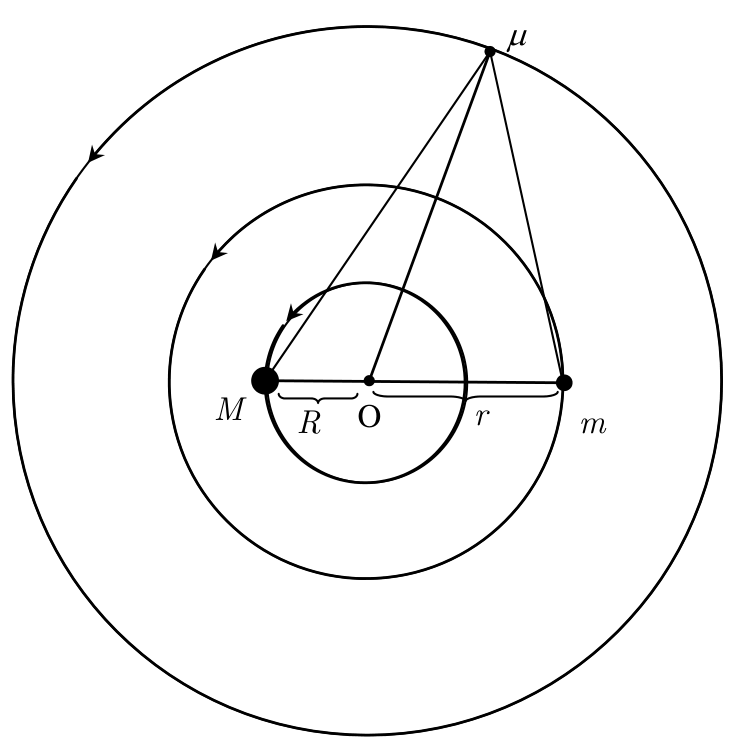
FIGURE 1 Coplanar orbits of three bodies.
1.1 Two gravitating masses \(M\) and \(m\) are moving in circular orbits of radii \(R\) and \(r\), respectively, about their common centre of mass. Find the angular velocity \(\omega_0\) of the line joining \(M\) and \(m\) in terms of \(R,r,M,m\) and the universal gravitational constant \(G\).
[1.5 points]
1.2 A third body of infinitesimal mass \(\mu\) is placed in a coplanar circular orbit about the same centre of mass so that \(\mu\) remains stationary relative to both \(M\) and \(m\) as shown in Figure 1. Assume that the infinitesimal mass is not collinear with \(M\) and \(m\). Find the values of the following parameters in terms of \(R\) and \(r\):
[3.5 points]
1.2.1 distance from \(\mu\) to \(M\).
1.2.2 distance from \(\mu\) to \(m\).
1.2.3 distance from \(\mu\) to the centre of mass.
1.3 Consider the case \(M=m\). If \(\mu\) is now given a small radial perturbation (along \(O\mu\)), what is the angular frequency of oscillation of \(\mu\) about the unperturbed position in terms of \(\omega_0\)? Assume that the angular momentum of \(\mu\) is conserved.
[3.2 points]
The Laser Interferometry Space Antenna (LISA) is a group of three identical spacecrafts for detecting low frequency gravitational waves. Each of the spacecrafts is placed at the corners of an equilateral triangle as shown in Figure 2 and Figure 3. The sides (or ‘arms’) are about 5.0 million kilometres long. The LISA constellation is in an earth-like orbit around the Sun trailing the Earth by \(20^\circ\). Each of them moves on a slightly inclined individual orbit around the Sun. Effectively, the three spacecrafts appear to roll about their common centre one revolution per year.
They are continuously transmitting and receiving laser signals between each other. Overall, they detect the gravitational waves by measuring tiny changes in the arm lengths using interferometric means. A collision of massive objects, such as blackholes, in nearby galaxies is an example of the sources of gravitational waves.
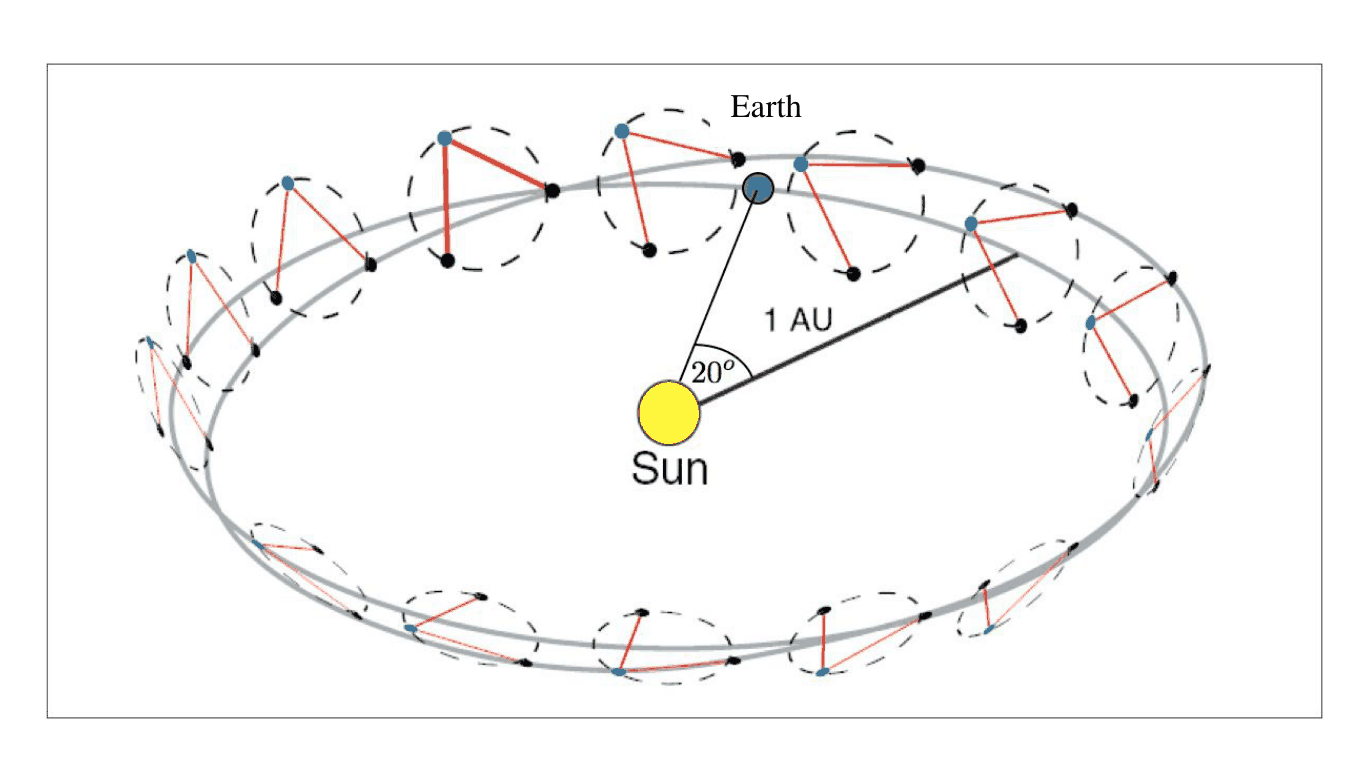
FIGURE 2 Illustration of the LISA orbit. The three spacecrafts roll about their centre of mass with a period of 1 year. Initially, they trail the Earth by \(20^\circ\) (Picture from D.A. Shaddock, “An Overview of the Laser Interferometer Space Antenna”, Publications of the Astronomical Society of Australia, 2009, 26, pp.128-132.).
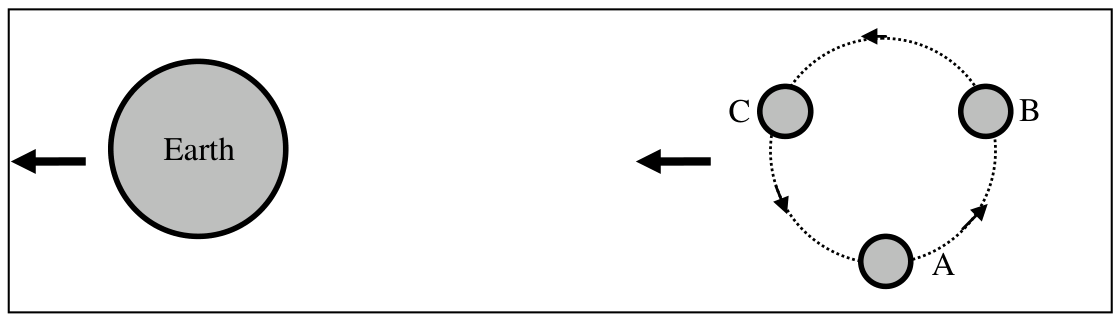
FIGURE 3 Enlarged view of the three spacecrafts trailing the Earth. A, B and C are the three spacecrafts at the corners of the equilateral triangle.
1.4 In the plane containing the three spacecrafts, what is the relative speed of one spacecraft with respect to another?
[1.8 point]
Official English text of the problem.
Problem 2: An Electrified Soap Bubble
A spherical soap bubble with internal air density \(\rho_i\), temperature \(T_i\) and radius \(R_0\) is surrounded by air with density \(\rho_a\), atmospheric pressure \(P_a\) and temperature \(T_a\). The soap film has surface tension \(\gamma\), density \(\rho_s\) and thickness \(t\). The mass and the surface tension of the soap do not change with the temperature. Assume that \(R_0\gg t\).
The increase in energy, \(dE\), that is needed to increase the surface area of a soap-air interface by \(dA\), is given by \(dE=\gamma\,dA\) where \(\gamma\) is the surface tension of the film.
2.1 Find the ratio \(\dfrac{\rho_iT_i}{\rho_aT_a}\) in terms of \(\gamma\), \(P_a\) and \(R_0\). [1.7 point]
2.2 Find the numerical value of \(\dfrac{\rho_iT_i}{\rho_aT_a}-1\) using \(\gamma=0.0250\ \mathrm{N\,m^{-1}}\), \(R_0=1.00\ \mathrm{cm}\), and \(P_a=1.013\times10^5\ \mathrm{N\,m^{-2}}\). [0.4 point]
2.3 The bubble is initially formed with warmer air inside. Find the minimum numerical value of \(T_i\) such that the bubble can float in still air. Use \(T_a=300\ \mathrm K\), \(\rho_s=1000\ \mathrm{kg\,m^{-3}}\), \(\rho_a=1.30\ \mathrm{kg\,m^{-3}}\), \(t=100\ \mathrm{nm}\) and \(g=9.80\ \mathrm{m\,s^{-2}}\). [2.0 points]
After the bubble is formed for a while, it will be in thermal equilibrium with the surroundings. This bubble in still air will naturally fall towards the ground.
2.4 Find the minimum velocity \(u\) of an updraught (air flowing upwards) that will keep the bubble from falling at thermal equilibrium. Give your answer in terms of \(\rho_s\), \(R_0\), \(g\), \(t\) and the air’s coefficient of viscosity \(\eta\). You may assume that the velocity is small such that Stokes’s law applies, and ignore the change in the radius when the temperature lowers to the equilibrium. The drag force from Stokes’s Law is \(F=6\pi\eta R_0u\). [1.6points]
2.5 Calculate the numerical value for \(u\) using \(\eta=1.8\times10^{-5}\ \mathrm{kg\,m^{-1}\,s^{-1}}\). [0.4 point]
The above calculations suggest that the terms involving the surface tension \(\gamma\) add very little to the accuracy of the result. In all of the questions below, you can neglect the surface tension terms.
2.6 If this spherical bubble is now electrified uniformly with a total charge \(q\), find an equation describing the new radius \(R_1\) in terms of \(R_0,P_a,q\) and the permittivity of free space \(\varepsilon_0\). [2.0points]
2.7 Assume that the total charge is not too large (i.e. \(\dfrac{q^2}{\varepsilon_0R_0^4}\ll P_a\)) and the bubble only experiences a small increase in its radius, find \(\Delta R\) where \(R_1=R_0+\Delta R\).
Given that \((1+x)^n\approx1+nx\) where \(x\ll1\). [0.7 point]
2.8 What must be the magnitude of this charge \(q\) in terms of \(t,\rho_a,\rho_s,\varepsilon_0,R_0,P_a\) in order that the bubble will float motionlessly in still air? Calculate also the numerical value of \(q\). The permittivity of free space \(\varepsilon_0=8.85\times10^{-12}\ \mathrm{farad/m}\). [1.2 points]
Official English text of the problem.
Problem 3: To Commemorate the Centenary of Rutherford's Atomic Nucleus: the Scattering of an Ion by a Neutral Atom
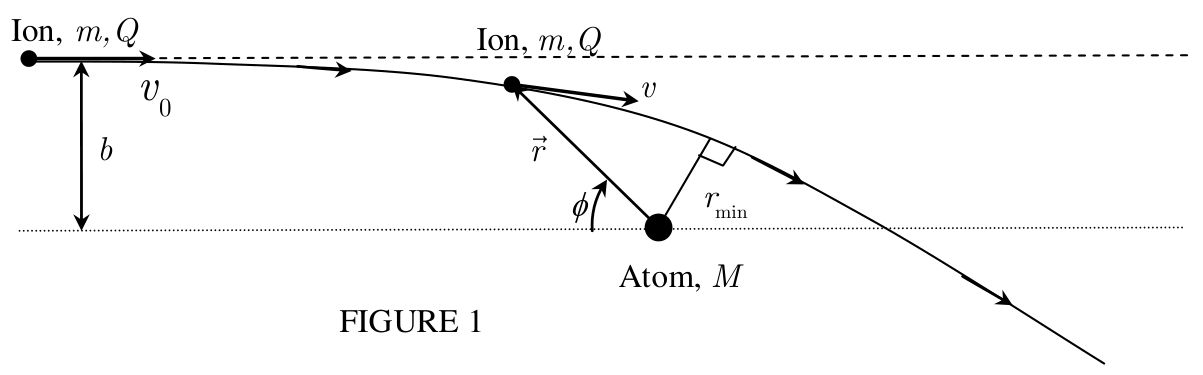
FIGURE 1
An ion of mass \(m\), charge \(Q\), is moving with an initial non-relativistic speed \(v_0\) from a great distance towards the vicinity of a neutral atom of mass \(M\gg m\) and of electrical polarisability \(\alpha\). The impact parameter is \(b\) as shown in Figure 1.
The atom is instantaneously polarised by the electric field \(\vec E\) of the in-coming (approaching) ion. The resulting electric dipole moment of the atom is \(\vec p=\alpha\vec E\). Ignore any radiative losses in this problem.
3.1 Calculate the electric field intensity \(\vec E_p\) at a distance \(r\) from an ideal electric dipole \(\vec p\) at the origin O along the direction of \(\vec p\) in Figure 2. [1.2 points]
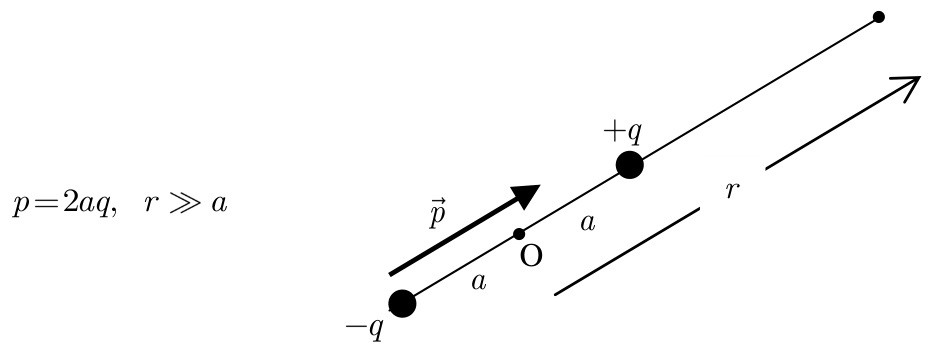
FIGURE 2
3.2 Find the expression for the force \(\vec f\) acting on the ion due to the polarised atom. Show that this force is attractive regardless of the sign of the charge of the ion. [3.0 points]
3.3 What is the electric potential energy of the ion-atom interaction in terms of \(\alpha\), \(Q\) and \(r\)? [0.9 points]
3.4 Find the expression for \(r_{\min}\), the distance of the closest approach, as shown in Figure 1. [2.4 points]
3.5 If the impact parameter \(b\) is less than a critical value \(b_0\), the ion will descend along a spiral to the atom. In such a case, the ion will be neutralized and the atom is, in turn, charged. This process is known as the “charge exchange” interaction. What is the cross sectional area \(A=\pi b_0^2\) of this “charge exchange” collision of the atom as seen by the ion? [2.5 points]
Official English text of the problem.
Internationale Physik-Olympiade
IPhO 2011
Bangkok, Thailand · 3 Theorieaufgaben mit vollständigen Lösungen
Aufgabe 1: Ein Dreikörperproblem und LISA
ABBILDUNG 1 Koplanare Umlaufbahnen dreier Körper.
1.1 Zwei gravitativ wechselwirkende Massen \(M\) und \(m\) bewegen sich auf Kreisbahnen mit den Radien \(R\) bzw. \(r\) um ihren gemeinsamen Schwerpunkt. Bestimmen Sie die Winkelgeschwindigkeit \(\omega_0\) der Verbindungslinie zwischen \(M\) und \(m\) in Abhängigkeit von \(R,r,M,m\) und der universellen Gravitationskonstanten \(G\).
[1.5 Punkte]
1.2 Ein dritter Körper mit infinitesimal kleiner Masse \(\mu\) wird auf eine koplanare Kreisbahn um denselben Schwerpunkt gebracht, sodass \(\mu\) relativ zu sowohl \(M\) als auch \(m\) in Ruhe bleibt, wie in Abbildung 1 dargestellt. Nehmen Sie an, dass die infinitesimal kleine Masse nicht auf der Verbindungslinie von \(M\) und \(m\) liegt. Bestimmen Sie die Werte der folgenden Größen in Abhängigkeit von \(R\) und \(r\):
[3.5 Punkte]
1.2.1 Abstand von \(\mu\) zu \(M\).
1.2.2 Abstand von \(\mu\) zu \(m\).
1.2.3 Abstand von \(\mu\) zum Schwerpunkt.
1.3 Betrachten Sie den Fall \(M=m\). Wenn \(\mu\) nun eine kleine radiale Störung (entlang \(O\mu\)) erfährt, wie groß ist dann die Kreisfrequenz der Schwingung von \(\mu\) um die ungestörte Position in Abhängigkeit von \(\omega_0\)? Nehmen Sie an, dass der Drehimpuls von \(\mu\) erhalten bleibt.
[3.2 Punkte]
Die Laser Interferometry Space Antenna (LISA) ist eine Gruppe von drei identischen Raumsonden zum Nachweis niederfrequenter Gravitationswellen. Die Raumsonden befinden sich jeweils an den Eckpunkten eines gleichseitigen Dreiecks, wie in Abbildung 2 und Abbildung 3 dargestellt. Die Seiten (oder „Arme“) sind etwa 5.0 Millionen Kilometer lang. Die LISA-Konstellation bewegt sich auf einer erdähnlichen Umlaufbahn um die Sonne und folgt der Erde mit einem Winkelabstand von \(20^\circ\). Jede der Raumsonden bewegt sich auf einer eigenen, leicht geneigten Umlaufbahn um die Sonne. Insgesamt scheinen die drei Raumsonden dabei einmal pro Jahr um ihr gemeinsames Zentrum zu rotieren.
Sie senden und empfangen fortlaufend Lasersignale untereinander. Gravitationswellen weisen sie insgesamt nach, indem sie winzige Änderungen der Armlängen mit interferometrischen Methoden messen. Ein Zusammenstoß massereicher Objekte, etwa Schwarzer Löcher, in benachbarten Galaxien ist ein Beispiel für eine Quelle von Gravitationswellen.
ABBILDUNG 2 Darstellung der LISA-Umlaufbahn. Die drei Raumsonden rotieren mit einer Periode von 1 Jahr um ihren Schwerpunkt. Zu Beginn folgen sie der Erde mit einem Winkelabstand von \(20^\circ\) (Bild aus D.A. Shaddock, „Ein Überblick über die Laser Interferometer Space Antenna“, Publications of the Astronomical Society of Australia, 2009, 26, S.128-132.).
ABBILDUNG 3 Vergrößerte Ansicht der drei Raumsonden, die der Erde folgen. A, B und C sind die drei Raumsonden an den Eckpunkten des gleichseitigen Dreiecks.
1.4 Wie groß ist in der Ebene, in der die drei Raumsonden liegen, der Betrag der Relativgeschwindigkeit einer Raumsonde gegenüber einer anderen?
[1.8 Punkte]
Aufgabentext aus dem offiziellen englischen Text übersetzt.
Aufgabe 2: Eine elektrisch geladene Seifenblase
Eine kugelförmige Seifenblase mit der Luftdichte \(\rho_i\) im Inneren, der Temperatur \(T_i\) und dem Radius \(R_0\) ist von Luft mit der Dichte \(\rho_a\), dem atmosphärischen Druck \(P_a\) und der Temperatur \(T_a\) umgeben. Der Seifenfilm hat die Oberflächenspannung \(\gamma\), die Dichte \(\rho_s\) und die Dicke \(t\). Die Masse und die Oberflächenspannung der Seife ändern sich nicht mit der Temperatur. Nehmen Sie an, dass \(R_0\gg t\).
Die Energiezunahme \(dE\), die erforderlich ist, um die Fläche einer Seife-Luft-Grenzfläche um \(dA\) zu vergrößern, ist durch \(dE=\gamma\,dA\) gegeben, wobei \(\gamma\) die Oberflächenspannung des Films ist.
2.1 Bestimmen Sie das Verhältnis \(\dfrac{\rho_iT_i}{\rho_aT_a}\) in Abhängigkeit von \(\gamma\), \(P_a\) und \(R_0\). [1.7 Punkte]
2.2 Bestimmen Sie den Zahlenwert von \(\dfrac{\rho_iT_i}{\rho_aT_a}-1\) mit \(\gamma=0.0250\ \mathrm{N\,m^{-1}}\), \(R_0=1.00\ \mathrm{cm}\) und \(P_a=1.013\times10^5\ \mathrm{N\,m^{-2}}\). [0.4 Punkte]
2.3 Die Blase wird zunächst mit wärmerer Luft im Inneren erzeugt. Bestimmen Sie den kleinsten Zahlenwert von \(T_i\), bei dem die Blase in ruhender Luft schweben kann. Verwenden Sie \(T_a=300\ \mathrm K\), \(\rho_s=1000\ \mathrm{kg\,m^{-3}}\), \(\rho_a=1.30\ \mathrm{kg\,m^{-3}}\), \(t=100\ \mathrm{nm}\) und \(g=9.80\ \mathrm{m\,s^{-2}}\). [2.0 Punkte]
Einige Zeit nach ihrer Entstehung befindet sich die Blase im thermischen Gleichgewicht mit ihrer Umgebung. In ruhender Luft fällt diese Blase dann von selbst zu Boden.
2.4 Bestimmen Sie die Mindestgeschwindigkeit \(u\) eines Aufwinds (einer nach oben gerichteten Luftströmung), der verhindert, dass die Blase im thermischen Gleichgewicht fällt. Geben Sie Ihr Ergebnis in Abhängigkeit von \(\rho_s\), \(R_0\), \(g\), \(t\) und der dynamischen Viskosität \(\eta\) der Luft an. Sie dürfen annehmen, dass die Geschwindigkeit so klein ist, dass das Stokes'sche Gesetz gilt, und die Änderung des Radius beim Absinken der Temperatur auf die Gleichgewichtstemperatur vernachlässigen. Die Widerstandskraft nach dem Stokes'schen Gesetz beträgt \(F=6\pi\eta R_0u\). [1.6 Punkte]
2.5 Berechnen Sie den Zahlenwert von \(u\) mit \(\eta=1.8\times10^{-5}\ \mathrm{kg\,m^{-1}\,s^{-1}}\). [0.4 Punkte]
Die obigen Berechnungen legen nahe, dass die Terme mit der Oberflächenspannung \(\gamma\) nur sehr wenig zur Genauigkeit des Ergebnisses beitragen. In allen folgenden Teilaufgaben dürfen Sie die Oberflächenspannungsterme vernachlässigen.
2.6 Wenn diese kugelförmige Blase nun gleichmäßig mit einer Gesamtladung \(q\) elektrisch aufgeladen wird, bestimmen Sie eine Gleichung, die den neuen Radius \(R_1\) in Abhängigkeit von \(R_0,P_a,q\) und der elektrischen Feldkonstanten \(\varepsilon_0\) beschreibt. [2.0 Punkte]
2.7 Nehmen Sie an, dass die Gesamtladung nicht zu groß ist (d. h. \(\dfrac{q^2}{\varepsilon_0R_0^4}\ll P_a\)) und der Radius der Blase nur geringfügig zunimmt. Bestimmen Sie \(\Delta R\), wobei \(R_1=R_0+\Delta R\).
Es gilt \((1+x)^n\approx1+nx\) für \(x\ll1\). [0.7 Punkte]
2.8 Welchen Betrag muss diese Ladung \(q\) in Abhängigkeit von \(t,\rho_a,\rho_s,\varepsilon_0,R_0,P_a\) haben, damit die Blase in ruhender Luft bewegungslos schwebt? Berechnen Sie auch den Zahlenwert von \(q\). Die elektrische Feldkonstante beträgt \(\varepsilon_0=8.85\times10^{-12}\ \mathrm{farad/m}\). [1.2 Punkte]
Aufgabentext aus dem offiziellen englischen Text übersetzt.
Aufgabe 3: Zum hundertjährigen Jubiläum von Rutherfords Atomkern: die Streuung eines Ions an einem neutralen Atom
ABBILDUNG 1
Ein Ion der Masse \(m\) und der Ladung \(Q\) bewegt sich aus großer Entfernung mit einer anfänglichen nichtrelativistischen Geschwindigkeit \(v_0\) auf die Umgebung eines neutralen Atoms der Masse \(M\gg m\) und der elektrischen Polarisierbarkeit \(\alpha\) zu. Der Stoßparameter beträgt \(b\), wie in Abbildung 1 dargestellt.
Das Atom wird durch das elektrische Feld \(\vec E\) des einlaufenden (sich nähernden) Ions augenblicklich polarisiert. Das dadurch entstehende elektrische Dipolmoment des Atoms ist \(\vec p=\alpha\vec E\). Vernachlässigen Sie in dieser Aufgabe sämtliche Strahlungsverluste.
3.1 Berechnen Sie die elektrische Feldstärke \(\vec E_p\) im Abstand \(r\) von einem idealen elektrischen Dipol \(\vec p\), der sich im Ursprung O befindet, in Richtung von \(\vec p\) in Abbildung 2. [1.2 Punkte]
ABBILDUNG 2
3.2 Bestimmen Sie den Ausdruck für die Kraft \(\vec f\), die das polarisierte Atom auf das Ion ausübt. Zeigen Sie, dass diese Kraft unabhängig vom Vorzeichen der Ladung des Ions anziehend ist. [3.0 Punkte]
3.3 Wie lautet die elektrische potenzielle Energie der Ion-Atom-Wechselwirkung in Abhängigkeit von \(\alpha\), \(Q\) und \(r\)? [0.9 Punkte]
3.4 Bestimmen Sie den Ausdruck für \(r_{\min}\), den in Abbildung 1 dargestellten Abstand bei der größten Annäherung. [2.4 Punkte]
3.5 Ist der Stoßparameter \(b\) kleiner als ein kritischer Wert \(b_0\), so nähert sich das Ion dem Atom auf einer Spiralbahn. In diesem Fall wird das Ion neutralisiert, während das Atom seinerseits geladen wird. Dieser Vorgang ist als „Ladungsaustausch“-Wechselwirkung bekannt. Wie groß ist der Wirkungsquerschnitt \(A=\pi b_0^2\) des Atoms für diesen „Ladungsaustausch“-Stoß aus Sicht des Ions? [2.5 Punkte]
Aufgabentext aus dem offiziellen englischen Text übersetzt.
Uluslararası Fizik Olimpiyatı
IPhO 2011
Bangkok, Tayland · 3 teori sorusu, tam çözümleriyle
Soru 1: Bir Üç Cisim Problemi ve LISA
ŞEKİL 1 Üç cismin aynı düzlemdeki yörüngeleri.
1.1 Birbirlerini kütleçekim kuvvetiyle çeken \(M\) ve \(m\) kütleleri, ortak kütle merkezleri etrafında sırasıyla \(R\) ve \(r\) yarıçaplı dairesel yörüngelerde hareket etmektedir. \(M\) ile \(m\)'yi birleştiren doğrunun \(\omega_0\) açısal hızını \(R,r,M,m\) ve evrensel kütleçekim sabiti \(G\) cinsinden bulunuz.
[1.5 puan]
1.2 Sonsuz küçük \(\mu\) kütleli üçüncü bir cisim, Şekil 1'de gösterildiği gibi hem \(M\)'ye hem de \(m\)'ye göre durgun kalacak biçimde, aynı kütle merkezi etrafında ve diğer yörüngelerle aynı düzlemde bulunan dairesel bir yörüngeye yerleştirilmektedir. Sonsuz küçük kütlenin \(M\) ve \(m\) ile aynı doğru üzerinde olmadığını varsayınız. Aşağıdaki büyüklüklerin değerlerini \(R\) ve \(r\) cinsinden bulunuz:
[3.5 puan]
1.2.1 \(\mu\)'nün \(M\)'ye uzaklığı.
1.2.2 \(\mu\)'nün \(m\)'ye uzaklığı.
1.2.3 \(\mu\)'nün kütle merkezine uzaklığı.
1.3 \(M=m\) durumunu ele alınız. Şimdi \(\mu\)'ye küçük bir radyal pertürbasyon (\(O\mu\) doğrultusunda) uygulanırsa, \(\mu\)'nün pertürbasyon uygulanmamış konumu etrafındaki salınımının açısal frekansı \(\omega_0\) cinsinden nedir? \(\mu\)'nün açısal momentumunun korunduğunu varsayınız.
[3.2 puan]
Lazer İnterferometrisi Uzay Anteni (LISA), düşük frekanslı kütleçekim dalgalarını algılamak için kullanılan üç özdeş uzay aracından oluşan bir gruptur. Uzay araçlarının her biri, Şekil 2 ve Şekil 3'te gösterildiği gibi bir eşkenar üçgenin köşelerine yerleştirilmiştir. Kenarlar (ya da ‘kollar’) yaklaşık 5.0 milyon kilometre uzunluğundadır. LISA takımyıldızı, Güneş etrafında Dünya'nınkine benzer bir yörüngede, Dünya'yı \(20^\circ\) geriden takip eder. Araçların her biri, Güneş etrafında hafifçe eğik ayrı bir yörüngede hareket eder. Sonuç olarak üç uzay aracı, ortak merkezleri etrafında yılda bir tur dönüyormuş gibi görünür.
Birbirlerine sürekli olarak lazer sinyalleri gönderir ve birbirlerinden gelen sinyalleri alırlar. Genel olarak, girişimölçüm yöntemleriyle kol uzunluklarındaki çok küçük değişimleri ölçerek kütleçekim dalgalarını algılarlar. Yakın galaksilerde karadelikler gibi büyük kütleli cisimlerin çarpışması, kütleçekim dalgası kaynaklarına bir örnektir.
ŞEKİL 2 LISA yörüngesinin gösterimi. Üç uzay aracı, kütle merkezleri etrafında 1 yıllık periyotla döner. Başlangıçta Dünya'yı \(20^\circ\) geriden takip ederler (Görsel: D.A. Shaddock, “Lazer İnterferometresi Uzay Antenine Genel Bir Bakış”, Publications of the Astronomical Society of Australia, 2009, 26, ss.128-132.).
ŞEKİL 3 Dünya'yı geriden takip eden üç uzay aracının büyütülmüş görünümü. A, B ve C, eşkenar üçgenin köşelerindeki üç uzay aracıdır.
1.4 Üç uzay aracını içeren düzlemde, bir uzay aracının diğerine göre bağıl sürati nedir?
[1.8 puan]
Soru metni resmi İngilizce metinden çevrilmiştir.
Soru 2: Elektrikle Yüklenmiş Bir Sabun Köpüğü
İçindeki havanın yoğunluğu \(\rho_i\), sıcaklığı \(T_i\) ve yarıçapı \(R_0\) olan küresel bir sabun köpüğü, yoğunluğu \(\rho_a\), atmosfer basıncı \(P_a\) ve sıcaklığı \(T_a\) olan havayla çevrilidir. Sabun zarının yüzey gerilimi \(\gamma\), yoğunluğu \(\rho_s\) ve kalınlığı \(t\)'dir. Sabunun kütlesi ve yüzey gerilimi sıcaklıkla değişmez. \(R_0\gg t\) olduğunu varsayın.
Bir sabun-hava ara yüzeyinin alanını \(dA\) kadar artırmak için gereken enerji artışı \(dE\), \(dE=\gamma\,dA\) bağıntısıyla verilir; burada \(\gamma\), zarın yüzey gerilimidir.
2.1 \(\dfrac{\rho_iT_i}{\rho_aT_a}\) oranını \(\gamma\), \(P_a\) ve \(R_0\) cinsinden bulun. [1.7 puan]
2.2 \(\gamma=0.0250\ \mathrm{N\,m^{-1}}\), \(R_0=1.00\ \mathrm{cm}\) ve \(P_a=1.013\times10^5\ \mathrm{N\,m^{-2}}\) değerlerini kullanarak \(\dfrac{\rho_iT_i}{\rho_aT_a}-1\) ifadesinin sayısal değerini bulun. [0.4 puan]
2.3 Köpük başlangıçta, içinde daha sıcak hava olacak şekilde oluşturulmuştur. Köpüğün durgun havada asılı kalabilmesi için \(T_i\)'nin alması gereken en küçük sayısal değeri bulun. \(T_a=300\ \mathrm K\), \(\rho_s=1000\ \mathrm{kg\,m^{-3}}\), \(\rho_a=1.30\ \mathrm{kg\,m^{-3}}\), \(t=100\ \mathrm{nm}\) ve \(g=9.80\ \mathrm{m\,s^{-2}}\) değerlerini kullanın. [2.0 puan]
Köpük, oluşumundan bir süre sonra çevresiyle ısıl dengeye ulaşacaktır. Durgun havadaki bu köpük doğal olarak yere doğru düşecektir.
2.4 Isıl dengedeki köpüğün düşmesini önleyecek yukarı yönlü bir hava akımının (yukarı doğru akan havanın) en küçük \(u\) hızını bulun. Yanıtınızı \(\rho_s\), \(R_0\), \(g\), \(t\) ve havanın viskozite katsayısı \(\eta\) cinsinden verin. Hızın, Stokes yasasının geçerli olacağı kadar küçük olduğunu varsayabilir ve sıcaklık denge değerine düşerken yarıçapta meydana gelen değişimi ihmal edebilirsiniz. Stokes yasasına göre sürükleme kuvveti \(F=6\pi\eta R_0u\)'dur. [1.6 puan]
2.5 \(\eta=1.8\times10^{-5}\ \mathrm{kg\,m^{-1}\,s^{-1}}\) değerini kullanarak \(u\)'nun sayısal değerini hesaplayın. [0.4 puan]
Yukarıdaki hesaplamalar, yüzey gerilimi \(\gamma\)'yı içeren terimlerin sonucun doğruluğuna çok az katkı sağladığını göstermektedir. Aşağıdaki soruların tümünde yüzey gerilimi terimlerini ihmal edebilirsiniz.
2.6 Bu küresel köpük şimdi, toplam yükü \(q\) olacak şekilde düzgün olarak elektrikle yüklenirse, yeni yarıçap \(R_1\)'i \(R_0,P_a,q\) ve boşluğun elektriksel geçirgenliği \(\varepsilon_0\) cinsinden tanımlayan bir denklem bulun. [2.0 puan]
2.7 Toplam yükün çok büyük olmadığını (yani \(\dfrac{q^2}{\varepsilon_0R_0^4}\ll P_a\) olduğunu) ve köpüğün yarıçapında yalnızca küçük bir artış meydana geldiğini varsayarak, \(R_1=R_0+\Delta R\) eşitliğindeki \(\Delta R\)'yi bulun.
\(x\ll1\) için \((1+x)^n\approx1+nx\) olduğu verilmiştir. [0.7 puan]
2.8 Köpüğün durgun havada hareketsiz olarak asılı kalabilmesi için bu \(q\) yükünün büyüklüğü \(t,\rho_a,\rho_s,\varepsilon_0,R_0,P_a\) cinsinden ne olmalıdır? \(q\)'nun sayısal değerini de hesaplayın. Boşluğun elektriksel geçirgenliği \(\varepsilon_0=8.85\times10^{-12}\ \mathrm{farad/m}\)'dir. [1.2 puan]
Soru metni resmi İngilizce metinden çevrilmiştir.
Soru 3: Rutherford'un Atom Çekirdeğinin Yüzüncü Yılı Anısına: Bir İyonun Nötr Bir Atom Tarafından Saçılması
ŞEKİL 1
Kütlesi \(m\), yükü \(Q\) olan bir iyon, çok uzak bir noktadan, kütlesi \(M\gg m\) ve elektriksel kutuplanabilirliği \(\alpha\) olan nötr bir atomun yakınına doğru, göreli olmayan bir \(v_0\) ilk süratiyle hareket etmektedir. Çarpma parametresi, Şekil 1'de gösterildiği gibi \(b\)'dir.
Atom, gelen (yaklaşan) iyonun \(\vec E\) elektrik alanı tarafından anında kutuplanır. Atomda oluşan elektrik dipol momenti \(\vec p=\alpha\vec E\)'dir. Bu soruda ışınım yoluyla oluşan tüm enerji kayıplarını ihmal ediniz.
3.1 Şekil 2'de, O başlangıç noktasında bulunan ideal bir \(\vec p\) elektrik dipolünden \(\vec p\) yönünde \(r\) uzaklıktaki \(\vec E_p\) elektrik alan şiddetini hesaplayınız. [1.2 puan]
ŞEKİL 2
3.2 Kutuplanmış atomun iyona uyguladığı \(\vec f\) kuvvetinin ifadesini bulunuz. İyonun yükünün işaretinden bağımsız olarak bu kuvvetin çekici olduğunu gösteriniz. [3.0 puan]
3.3 İyon-atom etkileşiminin elektriksel potansiyel enerjisi \(\alpha\), \(Q\) ve \(r\) cinsinden nedir? [0.9 puan]
3.4 Şekil 1'de gösterilen en yakın yaklaşma uzaklığı \(r_{\min}\)'in ifadesini bulunuz. [2.4 puan]
3.5 Çarpma parametresi \(b\), kritik bir \(b_0\) değerinden küçükse iyon, bir sarmal boyunca atoma doğru ilerleyecektir. Böyle bir durumda iyon nötrleşirken atom da yüklenecektir. Bu süreç, “yük değişimi” etkileşimi olarak bilinir. İyonun gördüğü şekliyle atomun bu “yük değişimi” çarpışmasına ait \(A=\pi b_0^2\) tesir kesiti nedir? [2.5 puan]
Soru metni resmi İngilizce metinden çevrilmiştir.
Olimpiada Internacional de Física
IPhO 2011
Bangkok, Tailandia · 3 problemas teóricos con soluciones completas
Problema 1: Un problema de tres cuerpos y LISA
FIGURA 1 Órbitas coplanarias de tres cuerpos.
1.1 Dos masas \(M\) y \(m\) que interactúan gravitatoriamente se mueven en órbitas circulares de radios \(R\) y \(r\), respectivamente, alrededor de su centro de masas común. Halle la velocidad angular \(\omega_0\) de la recta que une \(M\) y \(m\) en función de \(R,r,M,m\) y de la constante de gravitación universal \(G\).
[1.5 puntos]
1.2 Se coloca un tercer cuerpo de masa infinitesimal \(\mu\) en una órbita circular coplanaria alrededor del mismo centro de masas, de modo que \(\mu\) permanece en reposo con respecto tanto a \(M\) como a \(m\), como se muestra en la Figura 1. Suponga que la masa infinitesimal no está alineada con \(M\) y \(m\). Halle los valores de los siguientes parámetros en función de \(R\) y \(r\):
[3.5 puntos]
1.2.1 distancia de \(\mu\) a \(M\).
1.2.2 distancia de \(\mu\) a \(m\).
1.2.3 distancia de \(\mu\) al centro de masas.
1.3 Considere el caso \(M=m\). Si ahora se aplica a \(\mu\) una pequeña perturbación radial (a lo largo de \(O\mu\)), ¿cuál es la frecuencia angular de oscilación de \(\mu\) alrededor de la posición no perturbada en función de \(\omega_0\)? Suponga que el momento angular de \(\mu\) se conserva.
[3.2 puntos]
La Antena Espacial de Interferometría Láser (LISA) es un conjunto de tres naves espaciales idénticas destinado a detectar ondas gravitacionales de baja frecuencia. Las naves espaciales están situadas en los vértices de un triángulo equilátero, como se muestra en la Figura 2 y la Figura 3. Los lados (o «brazos») tienen una longitud de unos 5.0 millones de kilómetros. La constelación LISA se encuentra en una órbita alrededor del Sol similar a la terrestre, siguiendo a la Tierra con un retraso de \(20^\circ\). Cada una de las naves se mueve en una órbita individual ligeramente inclinada alrededor del Sol. En conjunto, las tres naves espaciales parecen girar alrededor de su centro común, completando una vuelta por año.
Las naves transmiten y reciben continuamente señales láser entre sí. En conjunto, detectan las ondas gravitacionales midiendo cambios diminutos en las longitudes de los brazos mediante técnicas interferométricas. Una colisión de objetos masivos, como agujeros negros, en galaxias cercanas es un ejemplo de fuente de ondas gravitacionales.
FIGURA 2 Ilustración de la órbita de LISA. Las tres naves espaciales giran alrededor de su centro de masas con un período de 1 año. Inicialmente, siguen a la Tierra con un retraso de \(20^\circ\) (Imagen de D.A. Shaddock, «Una visión general de la Antena Espacial de Interferometría Láser», Publications of the Astronomical Society of Australia, 2009, 26, pp.128-132.).
FIGURA 3 Vista ampliada de las tres naves espaciales que siguen a la Tierra. A, B y C son las tres naves espaciales situadas en los vértices del triángulo equilátero.
1.4 En el plano que contiene las tres naves espaciales, ¿cuál es la rapidez relativa de una nave espacial con respecto a otra?
[1.8 puntos]
Enunciado traducido del texto oficial en inglés.
Problema 2: Una burbuja de jabón electrizada
Una burbuja esférica de jabón que contiene aire de densidad \(\rho_i\) y temperatura \(T_i\), y cuyo radio es \(R_0\), está rodeada de aire de densidad \(\rho_a\), presión atmosférica \(P_a\) y temperatura \(T_a\). La película de jabón tiene tensión superficial \(\gamma\), densidad \(\rho_s\) y espesor \(t\). La masa y la tensión superficial del jabón no varían con la temperatura. Suponga que \(R_0\gg t\).
El incremento de energía, \(dE\), necesario para aumentar en \(dA\) el área de una interfaz jabón-aire viene dado por \(dE=\gamma\,dA\), donde \(\gamma\) es la tensión superficial de la película.
2.1 Halle el cociente \(\dfrac{\rho_iT_i}{\rho_aT_a}\) en función de \(\gamma\), \(P_a\) y \(R_0\). [1.7 puntos]
2.2 Halle el valor numérico de \(\dfrac{\rho_iT_i}{\rho_aT_a}-1\) utilizando \(\gamma=0.0250\ \mathrm{N\,m^{-1}}\), \(R_0=1.00\ \mathrm{cm}\) y \(P_a=1.013\times10^5\ \mathrm{N\,m^{-2}}\). [0.4 puntos]
2.3 La burbuja se forma inicialmente con aire más caliente en su interior. Halle el valor numérico mínimo de \(T_i\) para que la burbuja pueda flotar en aire en reposo. Utilice \(T_a=300\ \mathrm K\), \(\rho_s=1000\ \mathrm{kg\,m^{-3}}\), \(\rho_a=1.30\ \mathrm{kg\,m^{-3}}\), \(t=100\ \mathrm{nm}\) y \(g=9.80\ \mathrm{m\,s^{-2}}\). [2.0 puntos]
Transcurrido cierto tiempo desde su formación, la burbuja estará en equilibrio térmico con el entorno. En aire en reposo, esta burbuja caerá de forma natural hacia el suelo.
2.4 Halle la velocidad mínima \(u\) de una corriente ascendente (aire que fluye hacia arriba) que impida que la burbuja caiga cuando se encuentre en equilibrio térmico. Exprese su respuesta en función de \(\rho_s\), \(R_0\), \(g\), \(t\) y el coeficiente de viscosidad del aire \(\eta\). Puede suponer que la velocidad es lo suficientemente pequeña como para que se cumpla la ley de Stokes, y despreciar la variación del radio cuando la temperatura desciende hasta alcanzar el equilibrio. La fuerza de arrastre según la ley de Stokes es \(F=6\pi\eta R_0u\). [1.6 puntos]
2.5 Calcule el valor numérico de \(u\) utilizando \(\eta=1.8\times10^{-5}\ \mathrm{kg\,m^{-1}\,s^{-1}}\). [0.4 puntos]
Los cálculos anteriores sugieren que los términos que contienen la tensión superficial \(\gamma\) contribuyen muy poco a la precisión del resultado. En todas las preguntas siguientes, puede despreciar los términos de tensión superficial.
2.6 Si ahora esta burbuja esférica se electriza uniformemente con una carga total \(q\), halle una ecuación que describa el nuevo radio \(R_1\) en función de \(R_0,P_a,q\) y la permitividad del vacío \(\varepsilon_0\). [2.0 puntos]
2.7 Suponga que la carga total no es demasiado grande (es decir, \(\dfrac{q^2}{\varepsilon_0R_0^4}\ll P_a\)) y que el radio de la burbuja solo experimenta un pequeño aumento; halle \(\Delta R\), donde \(R_1=R_0+\Delta R\).
Se da que \((1+x)^n\approx1+nx\), donde \(x\ll1\). [0.7 puntos]
2.8 ¿Cuál debe ser el módulo de esta carga \(q\), en función de \(t,\rho_a,\rho_s,\varepsilon_0,R_0,P_a\), para que la burbuja flote inmóvil en aire en reposo? Calcule también el valor numérico de \(q\). La permitividad del vacío es \(\varepsilon_0=8.85\times10^{-12}\ \mathrm{farad/m}\). [1.2 puntos]
Enunciado traducido del texto oficial en inglés.
Problema 3: Conmemoración del centenario del núcleo atómico de Rutherford: la dispersión de un ion por un átomo neutro
FIGURA 1
Un ion de masa \(m\) y carga \(Q\) se mueve con una rapidez inicial no relativista \(v_0\) desde una gran distancia hacia las proximidades de un átomo neutro de masa \(M\gg m\) y polarizabilidad eléctrica \(\alpha\). El parámetro de impacto es \(b\), como se muestra en la Figura 1.
El átomo se polariza instantáneamente por efecto del campo eléctrico \(\vec E\) del ion incidente (que se aproxima). El momento dipolar eléctrico resultante del átomo es \(\vec p=\alpha\vec E\). Desprecie cualquier pérdida por radiación en este problema.
3.1 Calcule la intensidad del campo eléctrico \(\vec E_p\) a una distancia \(r\) de un dipolo eléctrico ideal \(\vec p\) situado en el origen O, en la dirección y el sentido de \(\vec p\) en la Figura 2. [1.2 puntos]
FIGURA 2
3.2 Halle la expresión de la fuerza \(\vec f\) que actúa sobre el ion debido al átomo polarizado. Demuestre que esta fuerza es atractiva independientemente del signo de la carga del ion. [3.0 puntos]
3.3 ¿Cuál es la energía potencial eléctrica de la interacción ion-átomo en función de \(\alpha\), \(Q\) y \(r\)? [0.9 puntos]
3.4 Halle la expresión de \(r_{\min}\), la distancia de máxima aproximación, que se muestra en la Figura 1. [2.4 puntos]
3.5 Si el parámetro de impacto \(b\) es menor que un valor crítico \(b_0\), el ion descenderá en espiral hacia el átomo. En tal caso, el ion se neutralizará y el átomo, a su vez, quedará cargado. Este proceso se conoce como interacción de «intercambio de carga». ¿Cuál es la sección eficaz \(A=\pi b_0^2\) del átomo para esta colisión de «intercambio de carga», vista por el ion? [2.5 puntos]
Enunciado traducido del texto oficial en inglés.
国际物理奥林匹克
IPhO 2011
泰国曼谷 · 3 道理论题及完整解答
题目 1:三体问题与 LISA
图 1 三个物体的共面轨道。
1.1 两个质量分别为 \(M\) 和 \(m\) 的物体在引力作用下,绕其共同质心分别沿半径为 \(R\) 和 \(r\) 的圆轨道运动。用 \(R,r,M,m\) 和万有引力常量 \(G\) 表示连接 \(M\) 与 \(m\) 的连线的角速度 \(\omega_0\)。
[1.5 分]
1.2 将质量为无穷小量 \(\mu\) 的第三个物体置于绕同一质心的共面圆轨道上,使 \(\mu\) 相对于 \(M\) 和 \(m\) 均保持静止,如图 1 所示。假设这一无穷小质量的物体与 \(M\) 和 \(m\) 不共线。用 \(R\) 和 \(r\) 表示下列各量:
[3.5 分]
1.2.1 \(\mu\) 到 \(M\) 的距离。
1.2.2 \(\mu\) 到 \(m\) 的距离。
1.2.3 \(\mu\) 到质心的距离。
1.3 考虑 \(M=m\) 的情形。如果现在给 \(\mu\) 一个小的径向扰动(沿 \(O\mu\) 方向),那么 \(\mu\) 在未受扰动位置附近振荡的角频率是多少?用 \(\omega_0\) 表示。假设 \(\mu\) 的角动量守恒。
[3.2 分]
激光干涉空间天线(LISA)由三艘相同的航天器组成,用于探测低频引力波。三艘航天器分别位于一个等边三角形的三个顶点,如图 2 和图 3 所示。三角形的边(或称“臂”)长约为 5.0 百万千米。LISA 星座沿类似地球轨道的轨道绕太阳运行,落后地球 \(20^\circ\)。每艘航天器各自沿略有倾斜的轨道绕太阳运动。整体看来,三艘航天器似乎绕其共同中心每年转动一周。
它们不断地相互发射和接收激光信号。总体而言,它们利用干涉测量方法测量臂长的微小变化,从而探测引力波。邻近星系中黑洞等大质量天体的碰撞就是引力波源的一个例子。
图 2 LISA 轨道示意图。三艘航天器绕其质心转动,周期为 1 年。初始时,它们落后地球 \(20^\circ\)(图片引自 D.A. Shaddock,《激光干涉空间天线概述》,澳大利亚天文学会出版物,2009 年,26 卷,第 128–132 页。)。
图 3 落后于地球的三艘航天器的放大图。A、B 和 C 是位于等边三角形三个顶点的三艘航天器。
1.4 在包含这三艘航天器的平面内,一艘航天器相对于另一艘的速率是多少?
[1.8 分]
题目译自官方英文原文。
题目 2:带电肥皂泡
一个球形肥皂泡的内部空气密度为 \(\rho_i\),温度为 \(T_i\),半径为 \(R_0\),其周围空气的密度为 \(\rho_a\),大气压强为 \(P_a\),温度为 \(T_a\)。肥皂膜的表面张力系数为 \(\gamma\),密度为 \(\rho_s\),厚度为 \(t\)。肥皂膜的质量和表面张力系数不随温度变化。假设 \(R_0\gg t\)。
使肥皂液与空气之间的界面面积增加 \(dA\) 所需的能量增量 \(dE\) 为 \(dE=\gamma\,dA\),其中 \(\gamma\) 为膜的表面张力系数。
2.1 求比值 \(\dfrac{\rho_iT_i}{\rho_aT_a}\),用 \(\gamma\)、\(P_a\) 和 \(R_0\) 表示。[1.7 分]
2.2 利用 \(\gamma=0.0250\ \mathrm{N\,m^{-1}}\)、\(R_0=1.00\ \mathrm{cm}\) 和 \(P_a=1.013\times10^5\ \mathrm{N\,m^{-2}}\),求 \(\dfrac{\rho_iT_i}{\rho_aT_a}-1\) 的数值。[0.4 分]
2.3 肥皂泡刚形成时,内部空气较暖。求使肥皂泡能够悬浮在静止空气中的 \(T_i\) 的最小数值。取 \(T_a=300\ \mathrm K\)、\(\rho_s=1000\ \mathrm{kg\,m^{-3}}\)、\(\rho_a=1.30\ \mathrm{kg\,m^{-3}}\)、\(t=100\ \mathrm{nm}\) 和 \(g=9.80\ \mathrm{m\,s^{-2}}\)。[2.0 分]
肥皂泡形成一段时间后,将与周围环境达到热平衡。此时,静止空气中的肥皂泡自然会向地面下落。
2.4 求使达到热平衡的肥皂泡不下落所需的上升气流(向上流动的空气)的最小速度 \(u\)。用 \(\rho_s\)、\(R_0\)、\(g\)、\(t\) 和空气的黏度系数 \(\eta\) 表示答案。可以假设速度足够小,因而斯托克斯定律适用,并忽略温度降至热平衡温度时半径的变化。斯托克斯定律给出的阻力为 \(F=6\pi\eta R_0u\)。[1.6 分]
2.5 取 \(\eta=1.8\times10^{-5}\ \mathrm{kg\,m^{-1}\,s^{-1}}\),计算 \(u\) 的数值。[0.4 分]
上述计算表明,含表面张力系数 \(\gamma\) 的项对结果精度的提高很小。在以下所有问题中,均可忽略表面张力项。
2.6 若现在使这个球形肥皂泡均匀带电,总电荷量为 \(q\),求描述其新半径 \(R_1\) 的方程,用 \(R_0,P_a,q\) 和真空介电常数 \(\varepsilon_0\) 表示。[2.0 分]
2.7 假设总电荷量不太大(即 \(\dfrac{q^2}{\varepsilon_0R_0^4}\ll P_a\)),且肥皂泡的半径仅有微小增加,求 \(\Delta R\),其中 \(R_1=R_0+\Delta R\)。
已知当 \(x\ll1\) 时,\((1+x)^n\approx1+nx\)。[0.7 分]
2.8 为使肥皂泡在静止空气中静止悬浮,电荷量 \(q\) 的大小应为多少?用 \(t,\rho_a,\rho_s,\varepsilon_0,R_0,P_a\) 表示。并计算 \(q\) 的数值。真空介电常数 \(\varepsilon_0=8.85\times10^{-12}\ \mathrm{farad/m}\)。[1.2 分]
题目译自官方英文原文。
题目 3:纪念卢瑟福发现原子核一百周年:中性原子对离子的散射
图 1
一个质量为 \(m\)、电荷量为 \(Q\) 的离子,以非相对论性的初速度 \(v_0\) 从很远处向一个中性原子附近运动。该原子的质量为 \(M\gg m\),电极化率为 \(\alpha\)。碰撞参数为 \(b\),如图 1 所示。
原子在入射(正在接近的)离子产生的电场 \(\vec E\) 中瞬时发生极化。由此产生的原子电偶极矩为 \(\vec p=\alpha\vec E\)。本题忽略任何辐射损失。
3.1 一个理想电偶极子 \(\vec p\) 位于原点 O,求图 2 中沿 \(\vec p\) 方向、距原点为 \(r\) 处的电场强度 \(\vec E_p\)。[1.2 分]
图 2
3.2 求极化后的原子作用在离子上的力 \(\vec f\) 的表达式。证明无论离子的电荷为正还是为负,该力均为吸引力。[3.0 分]
3.3 用 \(\alpha\)、\(Q\) 和 \(r\) 表示离子与原子相互作用的电势能。[0.9 分]
3.4 求图 1 所示的最近接近距离 \(r_{\min}\) 的表达式。[2.4 分]
3.5 如果碰撞参数 \(b\) 小于某一临界值 \(b_0\),离子将沿螺旋轨道向原子靠近。在这种情况下,离子将被中和,而原子则变为带电状态。这一过程称为“电荷交换”相互作用。从离子的角度看,原子发生这种“电荷交换”碰撞的截面积 \(A=\pi b_0^2\) 是多少?[2.5 分]
题目译自官方英文原文。
Международная физическая олимпиада
IPhO 2011
Бангкок, Таиланд · 3 теоретические задачи с полными решениями
Задача 1: Задача трёх тел и LISA
РИСУНОК 1 Орбиты трёх тел, лежащие в одной плоскости.
1.1 Два тела с массами \(M\) и \(m\), взаимодействующие гравитационно, движутся по круговым орбитам радиусами \(R\) и \(r\) соответственно вокруг общего центра масс. Найдите угловую скорость \(\omega_0\) вращения прямой, соединяющей \(M\) и \(m\), через \(R,r,M,m\) и гравитационную постоянную \(G\).
[1.5 балла]
1.2 Третье тело с бесконечно малой массой \(\mu\) помещают на круговую орбиту вокруг того же центра масс, лежащую в той же плоскости, так, что \(\mu\) остаётся неподвижным относительно как \(M\), так и \(m\), как показано на рисунке 1. Предположите, что тело с бесконечно малой массой не лежит на одной прямой с \(M\) и \(m\). Найдите значения следующих величин через \(R\) и \(r\):
[3.5 балла]
1.2.1 расстояние от \(\mu\) до \(M\).
1.2.2 расстояние от \(\mu\) до \(m\).
1.2.3 расстояние от \(\mu\) до центра масс.
1.3 Рассмотрите случай \(M=m\). Если теперь сообщить телу \(\mu\) малое радиальное возмущение (вдоль \(O\mu\)), какова будет угловая частота колебаний \(\mu\) около невозмущённого положения, выраженная через \(\omega_0\)? Предположите, что момент импульса \(\mu\) сохраняется.
[3.2 балла]
Космическая антенна для лазерной интерферометрии (LISA) представляет собой группу из трёх одинаковых космических аппаратов, предназначенную для регистрации низкочастотных гравитационных волн. Космические аппараты расположены в вершинах равностороннего треугольника, как показано на рисунках 2 и 3. Длина сторон (или «плеч») составляет около 5.0 миллионов километров. Группировка LISA движется вокруг Солнца по орбите, подобной земной, отставая от Земли на \(20^\circ\). Каждый аппарат движется вокруг Солнца по собственной слегка наклонённой орбите. В результате три космических аппарата выглядят вращающимися вокруг общего центра, совершая один оборот в год.
Они непрерывно передают друг другу и принимают лазерные сигналы. В целом они регистрируют гравитационные волны, измеряя интерферометрическими методами крошечные изменения длин плеч. Примером источника гравитационных волн служит столкновение массивных объектов, таких как чёрные дыры, в близлежащих галактиках.
РИСУНОК 2 Схема орбиты LISA. Три космических аппарата вращаются вокруг своего центра масс с периодом 1 год. В начальный момент они отстают от Земли на \(20^\circ\) (Изображение из статьи D.A. Shaddock, «Обзор космической антенны лазерного интерферометра», Публикации Астрономического общества Австралии, 2009, 26, с.128-132.).
РИСУНОК 3 Увеличенное изображение трёх космических аппаратов, отстающих от Земли. A, B и C — три космических аппарата в вершинах равностороннего треугольника.
1.4 Какова скорость одного космического аппарата относительно другого в плоскости, содержащей три аппарата?
[1.8 балла]
Условие переведено с официального английского текста.
Задача 2: Электрически заряженный мыльный пузырь
Сферический мыльный пузырь с плотностью воздуха внутри \(\rho_i\), температурой \(T_i\) и радиусом \(R_0\) окружён воздухом с плотностью \(\rho_a\), атмосферным давлением \(P_a\) и температурой \(T_a\). Мыльная плёнка имеет поверхностное натяжение \(\gamma\), плотность \(\rho_s\) и толщину \(t\). Масса и поверхностное натяжение мыльной плёнки не зависят от температуры. Считайте, что \(R_0\gg t\).
Приращение энергии \(dE\), необходимое для увеличения площади поверхности раздела мыльная плёнка–воздух на \(dA\), определяется выражением \(dE=\gamma\,dA\), где \(\gamma\) — поверхностное натяжение плёнки.
2.1 Найдите отношение \(\dfrac{\rho_iT_i}{\rho_aT_a}\), выразив его через \(\gamma\), \(P_a\) и \(R_0\). [1.7 балла]
2.2 Найдите численное значение \(\dfrac{\rho_iT_i}{\rho_aT_a}-1\), используя \(\gamma=0.0250\ \mathrm{N\,m^{-1}}\), \(R_0=1.00\ \mathrm{cm}\) и \(P_a=1.013\times10^5\ \mathrm{N\,m^{-2}}\). [0.4 балла]
2.3 Изначально пузырь образуется с более тёплым воздухом внутри. Найдите минимальное численное значение \(T_i\), при котором пузырь может находиться во взвешенном состоянии в неподвижном воздухе. Используйте \(T_a=300\ \mathrm K\), \(\rho_s=1000\ \mathrm{kg\,m^{-3}}\), \(\rho_a=1.30\ \mathrm{kg\,m^{-3}}\), \(t=100\ \mathrm{nm}\) и \(g=9.80\ \mathrm{m\,s^{-2}}\). [2.0 балла]
Через некоторое время после образования пузырь придёт в тепловое равновесие с окружающей средой. В неподвижном воздухе такой пузырь будет естественным образом опускаться к земле.
2.4 Найдите минимальную скорость \(u\) восходящего потока воздуха, которая удержит пузырь от падения при тепловом равновесии. Выразите ответ через \(\rho_s\), \(R_0\), \(g\), \(t\) и коэффициент вязкости воздуха \(\eta\). Можно считать, что скорость достаточно мала для применимости закона Стокса, и пренебречь изменением радиуса при понижении температуры до равновесной. Сила сопротивления по закону Стокса равна \(F=6\pi\eta R_0u\). [1.6 балла]
2.5 Вычислите численное значение \(u\), используя \(\eta=1.8\times10^{-5}\ \mathrm{kg\,m^{-1}\,s^{-1}}\). [0.4 балла]
Приведённые выше расчёты показывают, что учёт слагаемых, содержащих поверхностное натяжение \(\gamma\), лишь незначительно повышает точность результата. Во всех последующих вопросах слагаемыми, связанными с поверхностным натяжением, можно пренебречь.
2.6 Если теперь этому сферическому пузырю сообщить равномерно распределённый по его поверхности суммарный заряд \(q\), найдите уравнение, определяющее новый радиус \(R_1\) через \(R_0,P_a,q\) и электрическую постоянную \(\varepsilon_0\). [2.0 балла]
2.7 Считая, что суммарный заряд не слишком велик (то есть \(\dfrac{q^2}{\varepsilon_0R_0^4}\ll P_a\)) и радиус пузыря увеличивается лишь незначительно, найдите \(\Delta R\), где \(R_1=R_0+\Delta R\).
Дано: \((1+x)^n\approx1+nx\) при \(x\ll1\). [0.7 балла]
2.8 Каким должен быть модуль заряда \(q\), выраженный через \(t,\rho_a,\rho_s,\varepsilon_0,R_0,P_a\), чтобы пузырь неподвижно висел в неподвижном воздухе? Вычислите также численное значение \(q\). Электрическая постоянная \(\varepsilon_0=8.85\times10^{-12}\ \mathrm{farad/m}\). [1.2 балла]
Условие переведено с официального английского текста.
Задача 3: К столетию открытия атомного ядра Резерфордом: рассеяние иона на нейтральном атоме
РИСУНОК 1
Ион массой \(m\) с зарядом \(Q\) движется издалека с начальной нерелятивистской скоростью \(v_0\) к нейтральному атому массой \(M\gg m\) с электрической поляризуемостью \(\alpha\). Прицельный параметр равен \(b\), как показано на рисунке 1.
Атом мгновенно поляризуется электрическим полем \(\vec E\) налетающего (приближающегося) иона. Возникающий электрический дипольный момент атома равен \(\vec p=\alpha\vec E\). В этой задаче пренебрегайте любыми потерями энергии на излучение.
3.1 Вычислите напряжённость электрического поля \(\vec E_p\) на расстоянии \(r\) от идеального электрического диполя \(\vec p\), находящегося в начале координат O, в направлении \(\vec p\), показанном на рисунке 2. [1.2 балла]
РИСУНОК 2
3.2 Найдите выражение для силы \(\vec f\), действующей на ион со стороны поляризованного атома. Покажите, что эта сила является силой притяжения независимо от знака заряда иона. [3.0 балла]
3.3 Чему равна электрическая потенциальная энергия взаимодействия иона с атомом, выраженная через \(\alpha\), \(Q\) и \(r\)? [0.9 балла]
3.4 Найдите выражение для \(r_{\min}\) — расстояния наибольшего сближения, показанного на рисунке 1. [2.4 балла]
3.5 Если прицельный параметр \(b\) меньше некоторого критического значения \(b_0\), ион будет приближаться к атому по спирали. В этом случае ион нейтрализуется, а атом, в свою очередь, приобретёт заряд. Этот процесс называется «перезарядкой». Чему равно сечение \(A=\pi b_0^2\) столкновения с «перезарядкой», которое атом представляет для налетающего иона? [2.5 балла]
Условие переведено с официального английского текста.
الأولمبياد الدولي للفيزياء
IPhO 2011
بانكوك، تايلاند · 3 مسائل نظرية مع حلول كاملة
المسألة 1: مسألة الأجسام الثلاثة وLISA
الشكل 1 مدارات ثلاثة أجسام تقع في مستوى واحد.
1.1 تتحرك كتلتان متجاذبتان تثاقليًا \(M\) و\(m\) في مدارين دائريين نصفا قطريهما \(R\) و\(r\)، على الترتيب، حول مركز كتلتهما المشترك. أوجد السرعة الزاوية \(\omega_0\) للخط الواصل بين \(M\) و\(m\) بدلالة \(R,r,M,m\) وثابت الجذب العام \(G\).
[1.5 درجة]
1.2 يوضع جسم ثالث ذو كتلة متناهية الصغر \(\mu\) في مدار دائري يقع في المستوى نفسه حول مركز الكتلة نفسه، بحيث تبقى \(\mu\) ساكنة بالنسبة إلى كل من \(M\) و\(m\)، كما هو موضح في الشكل 1. افترض أن الكتلة المتناهية الصغر لا تقع على استقامة واحدة مع \(M\) و\(m\). أوجد قيم المقادير الآتية بدلالة \(R\) و\(r\):
[3.5 درجة]
1.2.1 المسافة من \(\mu\) إلى \(M\).
1.2.2 المسافة من \(\mu\) إلى \(m\).
1.2.3 المسافة من \(\mu\) إلى مركز الكتلة.
1.3 انظر في الحالة \(M=m\). إذا أُحدث الآن اضطراب شعاعي صغير في \(\mu\) (على امتداد \(O\mu\))، فما التردد الزاوي لاهتزاز \(\mu\) حول موضعها غير المضطرب بدلالة \(\omega_0\)؟ افترض أن الزخم الزاوي للكتلة \(\mu\) محفوظ.
[3.2 درجة]
الهوائي الفضائي لقياس التداخل بالليزر (LISA) هو مجموعة من ثلاث مركبات فضائية متماثلة للكشف عن موجات الجاذبية منخفضة التردد. توضع كل مركبة فضائية عند أحد رؤوس مثلث متساوي الأضلاع كما هو موضح في الشكلين 2 و3. يبلغ طول الأضلاع (أو «الأذرع») نحو 5.0 ملايين كيلومتر. تقع كوكبة LISA في مدار حول الشمس شبيه بمدار الأرض، وتتأخر عن الأرض بزاوية \(20^\circ\). وتتحرك كل مركبة منها في مدار منفرد مائل قليلًا حول الشمس. وفي المحصلة، تبدو المركبات الفضائية الثلاث وكأنها تدور حول مركزها المشترك دورة واحدة في السنة.
تتبادل هذه المركبات إرسال إشارات الليزر واستقبالها باستمرار. وهي تكشف، في مجمل عملها، عن موجات الجاذبية بقياس تغيرات ضئيلة في أطوال الأذرع باستخدام وسائل قياس التداخل. ويُعد تصادم أجسام ضخمة، مثل الثقوب السوداء، في مجرات قريبة مثالًا على مصادر موجات الجاذبية.
الشكل 2 رسم توضيحي لمدار LISA. تدور المركبات الفضائية الثلاث حول مركز كتلتها بزمن دوري مقداره سنة واحدة. وهي تتأخر في البداية عن الأرض بزاوية \(20^\circ\) (الصورة من D.A. Shaddock، «نظرة عامة على الهوائي الفضائي لمقياس التداخل بالليزر»، منشورات الجمعية الفلكية الأسترالية، 2009، 26، ص.128-132.).
الشكل 3 منظر مكبّر للمركبات الفضائية الثلاث المتأخرة عن الأرض. تمثل A وB وC المركبات الفضائية الثلاث عند رؤوس المثلث المتساوي الأضلاع.
1.4 في المستوى الذي يضم المركبات الفضائية الثلاث، ما مقدار السرعة النسبية لإحدى المركبات الفضائية بالنسبة إلى أخرى؟
[1.8 درجة]
نص المسألة مترجم عن النص الإنجليزي الرسمي.
المسألة 2: فقاعة صابون مشحونة كهربائيًا
فقاعة صابون كروية كثافة الهواء داخلها \(\rho_i\)، ودرجة حرارته \(T_i\)، ونصف قطرها \(R_0\)، يحيط بها هواء كثافته \(\rho_a\)، وضغطه الجوي \(P_a\)، ودرجة حرارته \(T_a\). لغشاء الصابون توتر سطحي \(\gamma\)، وكثافة \(\rho_s\)، وسمك \(t\). لا تتغير كتلة الصابون ولا توتره السطحي مع درجة الحرارة. افترض أن \(R_0\gg t\).
تُعطى الزيادة في الطاقة، \(dE\)، اللازمة لزيادة مساحة سطح فاصل بين الصابون والهواء بمقدار \(dA\)، بالعلاقة \(dE=\gamma\,dA\)، حيث \(\gamma\) هو التوتر السطحي للغشاء.
2.1 أوجد النسبة \(\dfrac{\rho_iT_i}{\rho_aT_a}\) بدلالة \(\gamma\)، و\(P_a\)، و\(R_0\). [1.7 درجة]
2.2 أوجد القيمة العددية للمقدار \(\dfrac{\rho_iT_i}{\rho_aT_a}-1\) باستخدام \(\gamma=0.0250\ \mathrm{N\,m^{-1}}\)، و\(R_0=1.00\ \mathrm{cm}\)، و\(P_a=1.013\times10^5\ \mathrm{N\,m^{-2}}\). [0.4 درجة]
2.3 تتشكل الفقاعة في البداية بحيث يكون الهواء داخلها أدفأ من الهواء المحيط. أوجد أصغر قيمة عددية لـ \(T_i\) تُمكّن الفقاعة من الطفو في هواء ساكن. استخدم \(T_a=300\ \mathrm K\)، و\(\rho_s=1000\ \mathrm{kg\,m^{-3}}\)، و\(\rho_a=1.30\ \mathrm{kg\,m^{-3}}\)، و\(t=100\ \mathrm{nm}\)، و\(g=9.80\ \mathrm{m\,s^{-2}}\). [2.0 درجة]
بعد مرور بعض الوقت على تشكّل الفقاعة، ستصبح في اتزان حراري مع الوسط المحيط. وستسقط هذه الفقاعة في الهواء الساكن نحو الأرض بصورة طبيعية.
2.4 أوجد أصغر سرعة \(u\) لتيار هوائي صاعد (هواء يتدفق إلى أعلى) تمنع الفقاعة من السقوط عند الاتزان الحراري. أعط إجابتك بدلالة \(\rho_s\)، و\(R_0\)، و\(g\)، و\(t\)، ومعامل لزوجة الهواء \(\eta\). يمكنك افتراض أن السرعة صغيرة بحيث ينطبق قانون ستوكس، وإهمال التغير في نصف القطر عندما تنخفض درجة الحرارة إلى درجة حرارة الاتزان. تُعطى قوة المقاومة وفقًا لقانون ستوكس بالعلاقة \(F=6\pi\eta R_0u\). [1.6 درجة]
2.5 احسب القيمة العددية لـ \(u\) باستخدام \(\eta=1.8\times10^{-5}\ \mathrm{kg\,m^{-1}\,s^{-1}}\). [0.4 درجة]
تشير الحسابات السابقة إلى أن الحدود التي تتضمن التوتر السطحي \(\gamma\) لا تزيد دقة النتيجة إلا بمقدار ضئيل جدًا. في جميع الأسئلة التالية، يمكنك إهمال حدود التوتر السطحي.
2.6 إذا شُحنت هذه الفقاعة الكروية الآن بانتظام بشحنة كلية \(q\)، فأوجد معادلة تصف نصف القطر الجديد \(R_1\) بدلالة \(R_0,P_a,q\) وسماحية الفراغ \(\varepsilon_0\). [2.0 درجة]
2.7 افترض أن الشحنة الكلية ليست كبيرة جدًا (أي إن \(\dfrac{q^2}{\varepsilon_0R_0^4}\ll P_a\))، وأن نصف قطر الفقاعة لا يزداد إلا زيادة صغيرة، وأوجد \(\Delta R\) حيث \(R_1=R_0+\Delta R\).
علمًا بأن \((1+x)^n\approx1+nx\) حيث \(x\ll1\). [0.7 درجة]
2.8 ما مقدار هذه الشحنة \(q\) بدلالة \(t,\rho_a,\rho_s,\varepsilon_0,R_0,P_a\) اللازم لكي تطفو الفقاعة دون حركة في هواء ساكن؟ احسب أيضًا القيمة العددية لـ \(q\). سماحية الفراغ هي \(\varepsilon_0=8.85\times10^{-12}\ \mathrm{farad/m}\). [1.2 درجة]
نص المسألة مترجم عن النص الإنجليزي الرسمي.
المسألة 3: إحياءً للذكرى المئوية لنواة رذرفورد الذرية: تشتت أيون بواسطة ذرة متعادلة
الشكل 1
يتحرك أيون كتلته \(m\) وشحنته \(Q\)، بسرعة ابتدائية غير نسبية \(v_0\)، من مسافة بعيدة جدًا نحو جوار ذرة متعادلة كتلتها \(M\gg m\) وقابليتها للاستقطاب الكهربائي \(\alpha\). معامل التصادم هو \(b\)، كما هو موضح في الشكل 1.
تستقطب الذرة لحظيًا بفعل المجال الكهربائي \(\vec E\) للأيون الوارد (المقترب). ويكون عزم ثنائي القطب الكهربائي الناتج للذرة هو \(\vec p=\alpha\vec E\). أهمل أي فقد للطاقة بالإشعاع في هذه المسألة.
3.1 احسب شدة المجال الكهربائي \(\vec E_p\) على مسافة \(r\) من ثنائي قطب كهربائي مثالي \(\vec p\) يقع عند نقطة الأصل O، وذلك على امتداد اتجاه \(\vec p\) في الشكل 2. [1.2 درجة]
الشكل 2
3.2 أوجد تعبير القوة \(\vec f\) المؤثرة في الأيون بفعل الذرة المستقطبة. بيّن أن هذه القوة تجاذبية بغض النظر عن إشارة شحنة الأيون. [3.0 درجات]
3.3 ما طاقة الوضع الكهربائية لتفاعل الأيون مع الذرة بدلالة \(\alpha\) و\(Q\) و\(r\)؟ [0.9 درجة]
3.4 أوجد تعبير \(r_{\min}\)، وهي مسافة أقرب اقتراب، كما هو موضح في الشكل 1. [2.4 درجة]
3.5 إذا كان معامل التصادم \(b\) أصغر من قيمة حرجة \(b_0\)، فسيتجه الأيون نحو الذرة على طول مسار حلزوني. في هذه الحالة، يتعادل الأيون وتصبح الذرة، بدورها، مشحونة. تُعرف هذه العملية بتفاعل «تبادل الشحنة». ما مساحة المقطع العرضي \(A=\pi b_0^2\) للذرة في تصادم «تبادل الشحنة» هذا كما يراها الأيون؟ [2.5 درجة]
نص المسألة مترجم عن النص الإنجليزي الرسمي.