IPhO 2011 · Theory problem 1
A Three-body Problem and LISA
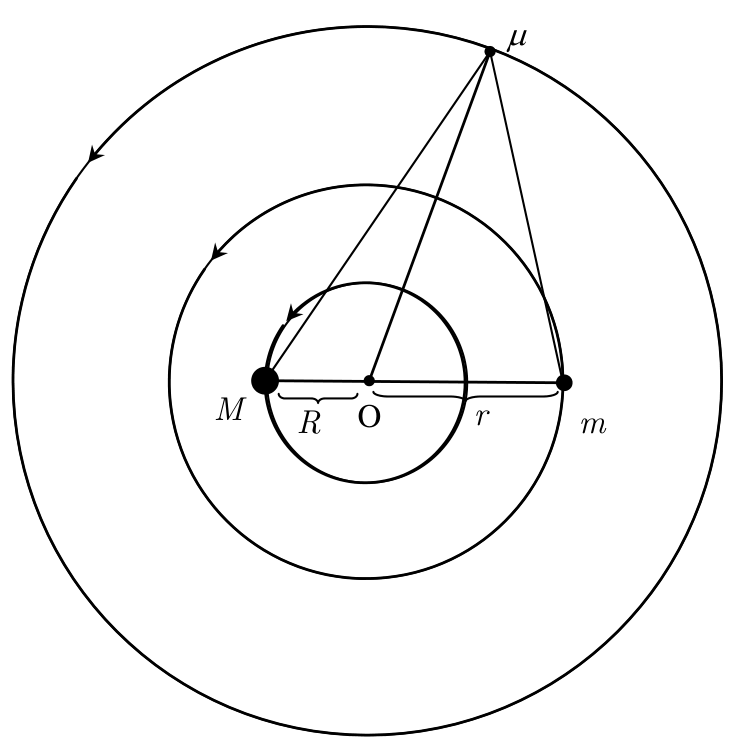
FIGURE 1 Coplanar orbits of three bodies.
1.1 Two gravitating masses \(M\) and \(m\) are moving in circular orbits of radii \(R\) and \(r\), respectively, about their common centre of mass. Find the angular velocity \(\omega_0\) of the line joining \(M\) and \(m\) in terms of \(R,r,M,m\) and the universal gravitational constant \(G\).
[1.5 points]
1.2 A third body of infinitesimal mass \(\mu\) is placed in a coplanar circular orbit about the same centre of mass so that \(\mu\) remains stationary relative to both \(M\) and \(m\) as shown in Figure 1. Assume that the infinitesimal mass is not collinear with \(M\) and \(m\). Find the values of the following parameters in terms of \(R\) and \(r\):
[3.5 points]
1.2.1 distance from \(\mu\) to \(M\).
1.2.2 distance from \(\mu\) to \(m\).
1.2.3 distance from \(\mu\) to the centre of mass.
1.3 Consider the case \(M=m\). If \(\mu\) is now given a small radial perturbation (along \(O\mu\)), what is the angular frequency of oscillation of \(\mu\) about the unperturbed position in terms of \(\omega_0\)? Assume that the angular momentum of \(\mu\) is conserved.
[3.2 points]
The Laser Interferometry Space Antenna (LISA) is a group of three identical spacecrafts for detecting low frequency gravitational waves. Each of the spacecrafts is placed at the corners of an equilateral triangle as shown in Figure 2 and Figure 3. The sides (or ‘arms’) are about 5.0 million kilometres long. The LISA constellation is in an earth-like orbit around the Sun trailing the Earth by \(20^\circ\). Each of them moves on a slightly inclined individual orbit around the Sun. Effectively, the three spacecrafts appear to roll about their common centre one revolution per year.
They are continuously transmitting and receiving laser signals between each other. Overall, they detect the gravitational waves by measuring tiny changes in the arm lengths using interferometric means. A collision of massive objects, such as blackholes, in nearby galaxies is an example of the sources of gravitational waves.
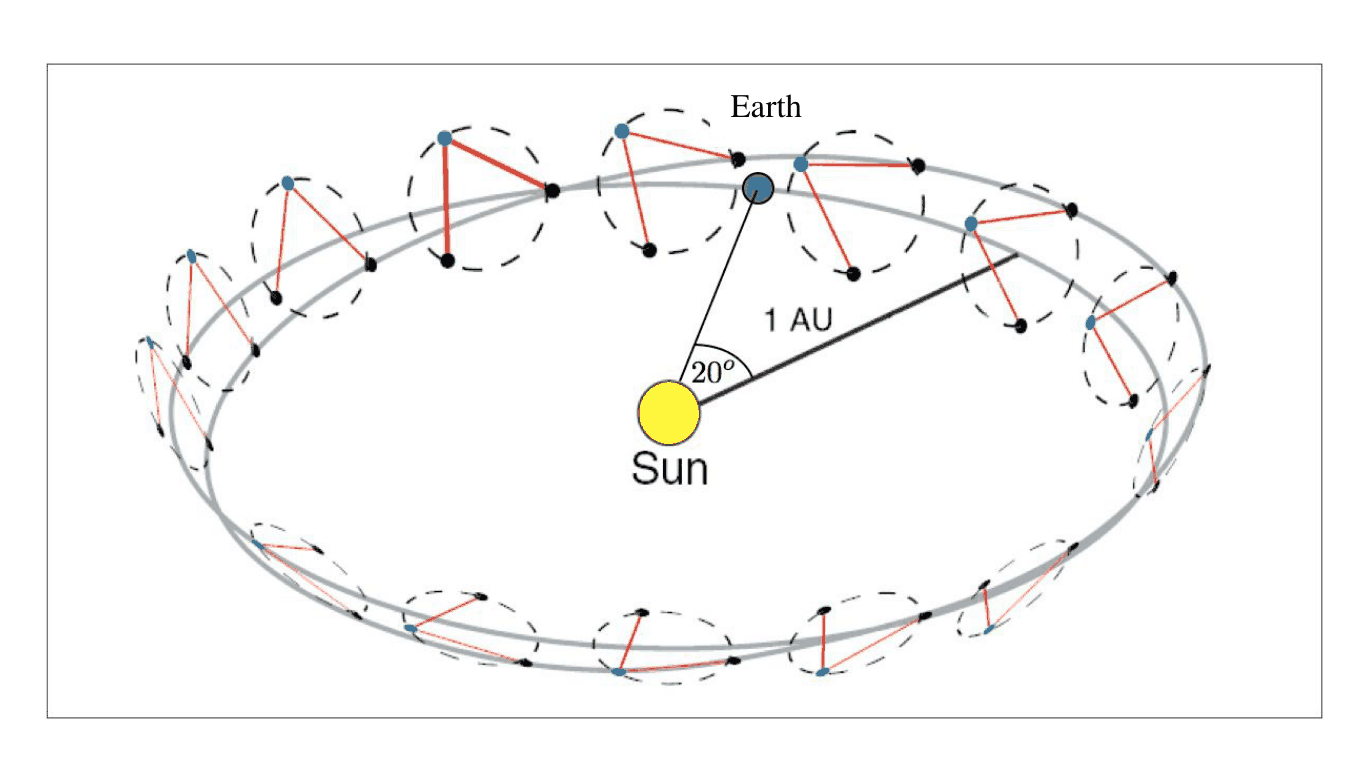
FIGURE 2 Illustration of the LISA orbit. The three spacecrafts roll about their centre of mass with a period of 1 year. Initially, they trail the Earth by \(20^\circ\) (Picture from D.A. Shaddock, “An Overview of the Laser Interferometer Space Antenna”, Publications of the Astronomical Society of Australia, 2009, 26, pp.128-132.).
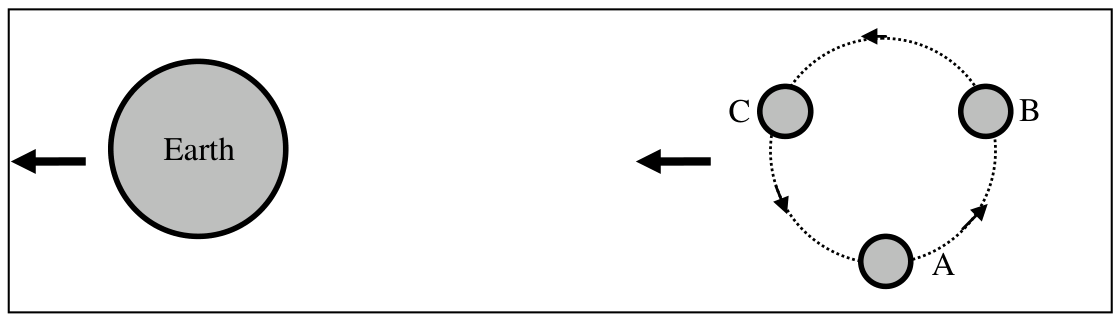
FIGURE 3 Enlarged view of the three spacecrafts trailing the Earth. A, B and C are the three spacecrafts at the corners of the equilateral triangle.
1.4 In the plane containing the three spacecrafts, what is the relative speed of one spacecraft with respect to another?
[1.8 point]
Official English text of the problem.
Answers
-
1.1 \[ \boxed{\omega_0=\sqrt{\frac{G(M+m)}{(R+r)^3}}} \]
-
1.2.1 \[ \boxed{d_{\mu M}=R+r} \]
-
1.2.2 \[ \boxed{d_{\mu m}=R+r} \]
-
1.2.3 \[ \boxed{d_{\mu O}=\sqrt{R^2+Rr+r^2}} \]
-
1.3, using the stipulated conservation of angular momentum: \[ \boxed{\omega_{\mathrm{osc}}=\frac{\sqrt7}{2}\,\omega_0} \]
-
1.4, with arm length \(L=5.0\times10^9\,\mathrm{m}\) and rotation period \(T=1\,\mathrm{year}\): \[ \boxed{v_{\mathrm{rel}}=\frac{2\pi L}{T} \simeq1.0\times10^3\,\mathrm{m\,s^{-1}} =1.0\,\mathrm{km\,s^{-1}}} \]
Solution
1.1
The distance between the masses is \(d=R+r\). Since \(O\) is their centre of mass, \[ MR=mr. \]
Gravity supplies the centripetal acceleration of each mass: \[ M\omega_0^2R=\frac{GMm}{d^2}, \qquad m\omega_0^2r=\frac{GMm}{d^2}. \] Dividing by the respective masses and adding gives \[ \omega_0^2(R+r)=\frac{G(M+m)}{d^2}. \] Therefore, \[ \boxed{\omega_0=\sqrt{\frac{G(M+m)}{(R+r)^3}}}. \]
1.2.1 and 1.2.2
Because \(\mu\) is infinitesimal, it does not affect the motion of \(M\) and \(m\). To remain stationary relative to them, it must revolve about \(O\) with angular velocity \(\omega_0\).
At a chosen instant, take \[ O=(0,0),\qquad M=(-R,0),\qquad m=(r,0),\qquad \mu=(x,y), \] where \(y\ne0\). Write its distances from the two masses as \[ a=\sqrt{(x+R)^2+y^2}, \qquad b=\sqrt{(x-r)^2+y^2}. \]
Its acceleration is \(-\omega_0^2(x,y)\). Newton’s law, after cancelling the test mass \(\mu\), therefore gives \[ \omega_0^2x=\frac{GM(x+R)}{a^3}+\frac{Gm(x-r)}{b^3}, \] \[ \omega_0^2y=\frac{GMy}{a^3}+\frac{Gmy}{b^3}. \] Since \(y\ne0\), the second equation implies \[ \omega_0^2=\frac{GM}{a^3}+\frac{Gm}{b^3}. \] Subtracting \(x\) times this equation from the first yields \[ 0=\frac{GMR}{a^3}-\frac{Gmr}{b^3}. \] Using \(MR=mr\), we obtain \(a=b\). Consequently, \[ \omega_0^2=\frac{G(M+m)}{a^3}. \] Comparison with part 1.1 gives \(a=R+r\), and hence \[ \boxed{\text{1.2.1: }d_{\mu M}=R+r}, \qquad \boxed{\text{1.2.2: }d_{\mu m}=R+r}. \]
Thus the three bodies occupy the vertices of an equilateral triangle.
1.2.3
The midpoint of the segment joining the two finite masses has coordinate \[ x_{\mathrm{mid}}=\frac{r-R}{2}. \] The third vertex of an equilateral triangle of side \(R+r\) lies a perpendicular distance \(\sqrt3(R+r)/2\) from this midpoint. Therefore the two possible positions of \(\mu\) are \[ x=\frac{r-R}{2}, \qquad y=\pm\frac{\sqrt3}{2}(R+r). \] Its distance from \(O\) satisfies \[ d_{\mu O}^2=x^2+y^2 =\frac{(r-R)^2+3(R+r)^2}{4} =R^2+Rr+r^2. \] Thus, \[ \boxed{d_{\mu O}=\sqrt{R^2+Rr+r^2}}. \]
1.3
When \(M=m\), the centre-of-mass condition gives \(R=r\). The unperturbed orbital radius of \(\mu\) is therefore \[ \rho_0=\sqrt3R, \] and part 1.1 gives \[ \omega_0^2=\frac{GM}{4R^3}. \]
On the perpendicular bisector of the line joining the equal masses, a point at distance \(\rho\) from \(O\) is at distance \(\sqrt{R^2+\rho^2}\) from each mass. Their transverse gravitational components cancel, so the inward radial acceleration is \[ g(\rho)=\frac{2GM\rho}{(R^2+\rho^2)^{3/2}}. \] This determines the linear radial force: by reflection symmetry, a small angular departure from the perpendicular bisector changes the radial component only at second order.
Use the angular-momentum conservation prescribed in the question. The angular momentum per unit mass is \[ h=\rho^2\dot\theta=\rho_0^2\omega_0. \] The radial equation of motion, \[ \ddot\rho-\rho\dot\theta^2=-g(\rho), \] becomes \[ \ddot\rho=\frac{h^2}{\rho^3} -\frac{2GM\rho}{(R^2+\rho^2)^{3/2}}. \]
Put \[ \rho=\rho_0+\xi,\qquad |\xi|\ll\rho_0, \] and keep only terms linear in \(\xi\). The first term expands as \[ \frac{h^2}{\rho^3} =\rho_0\omega_0^2-3\omega_0^2\xi+O(\xi^2). \] For the inward gravitational acceleration, \[ g'(\rho) =\frac{2GM}{(R^2+\rho^2)^{3/2}} \left(1-\frac{3\rho^2}{R^2+\rho^2}\right). \] Since \(\rho_0^2=3R^2\), \[ g'(\rho_0) =\omega_0^2\left(1-\frac94\right) =-\frac54\omega_0^2. \] Thus \[ g(\rho)=\rho_0\omega_0^2-\frac54\omega_0^2\xi+O(\xi^2). \]
The equilibrium terms cancel, leaving \[ \ddot\xi =\left(-3+\frac54\right)\omega_0^2\xi =-\frac74\omega_0^2\xi. \] This is the simple harmonic oscillator equation, so \[ \boxed{\omega_{\mathrm{osc}}=\frac{\sqrt7}{2}\,\omega_0}. \]
This result uses the imposed angular-momentum-conserving radial approximation. Angular momentum about \(O\) is not generally conserved for unrestricted motion in the rotating two-mass gravitational field.
1.4
Treat the constellation as an equilateral triangle of constant side length \(L\), rotating in its plane with angular velocity \[ \Omega=\frac{2\pi}{T}. \] Let \(\mathbf r_A\) and \(\mathbf r_B\) be the positions of two spacecraft relative to the triangle’s centre. Their velocities are \[ \mathbf v_A=\mathbf V+\boldsymbol\Omega\times\mathbf r_A, \qquad \mathbf v_B=\mathbf V+\boldsymbol\Omega\times\mathbf r_B, \] where \(\mathbf V\) is the common translational velocity of the centre.
Subtracting eliminates this common motion: \[ \mathbf v_B-\mathbf v_A =\boldsymbol\Omega\times(\mathbf r_B-\mathbf r_A). \] The separation vector lies in the triangle’s plane and has magnitude \(L\), so it is perpendicular to \(\boldsymbol\Omega\). Hence \[ v_{\mathrm{rel}}=\Omega L=\frac{2\pi L}{T}. \]
With \[ L=5.0\times10^6\,\mathrm{km}=5.0\times10^9\,\mathrm m, \qquad T\simeq365\times24\times3600\,\mathrm s, \] we obtain \[ v_{\mathrm{rel}}\simeq996\,\mathrm{m\,s^{-1}}. \] To two significant figures, \[ \boxed{v_{\mathrm{rel}}\simeq1.0\times10^3\,\mathrm{m\,s^{-1}} =1.0\,\mathrm{km\,s^{-1}}}. \]
The relative velocity is perpendicular to the arm joining the spacecraft, consistent with the arm’s constant length in this idealized motion.
The solution was checked against the official solution.
IPhO 2011 · Theorieaufgabe 1
Ein Dreikörperproblem und LISA
ABBILDUNG 1 Koplanare Umlaufbahnen dreier Körper.
1.1 Zwei gravitativ wechselwirkende Massen \(M\) und \(m\) bewegen sich auf Kreisbahnen mit den Radien \(R\) bzw. \(r\) um ihren gemeinsamen Schwerpunkt. Bestimmen Sie die Winkelgeschwindigkeit \(\omega_0\) der Verbindungslinie zwischen \(M\) und \(m\) in Abhängigkeit von \(R,r,M,m\) und der universellen Gravitationskonstanten \(G\).
[1.5 Punkte]
1.2 Ein dritter Körper mit infinitesimal kleiner Masse \(\mu\) wird auf eine koplanare Kreisbahn um denselben Schwerpunkt gebracht, sodass \(\mu\) relativ zu sowohl \(M\) als auch \(m\) in Ruhe bleibt, wie in Abbildung 1 dargestellt. Nehmen Sie an, dass die infinitesimal kleine Masse nicht auf der Verbindungslinie von \(M\) und \(m\) liegt. Bestimmen Sie die Werte der folgenden Größen in Abhängigkeit von \(R\) und \(r\):
[3.5 Punkte]
1.2.1 Abstand von \(\mu\) zu \(M\).
1.2.2 Abstand von \(\mu\) zu \(m\).
1.2.3 Abstand von \(\mu\) zum Schwerpunkt.
1.3 Betrachten Sie den Fall \(M=m\). Wenn \(\mu\) nun eine kleine radiale Störung (entlang \(O\mu\)) erfährt, wie groß ist dann die Kreisfrequenz der Schwingung von \(\mu\) um die ungestörte Position in Abhängigkeit von \(\omega_0\)? Nehmen Sie an, dass der Drehimpuls von \(\mu\) erhalten bleibt.
[3.2 Punkte]
Die Laser Interferometry Space Antenna (LISA) ist eine Gruppe von drei identischen Raumsonden zum Nachweis niederfrequenter Gravitationswellen. Die Raumsonden befinden sich jeweils an den Eckpunkten eines gleichseitigen Dreiecks, wie in Abbildung 2 und Abbildung 3 dargestellt. Die Seiten (oder „Arme“) sind etwa 5.0 Millionen Kilometer lang. Die LISA-Konstellation bewegt sich auf einer erdähnlichen Umlaufbahn um die Sonne und folgt der Erde mit einem Winkelabstand von \(20^\circ\). Jede der Raumsonden bewegt sich auf einer eigenen, leicht geneigten Umlaufbahn um die Sonne. Insgesamt scheinen die drei Raumsonden dabei einmal pro Jahr um ihr gemeinsames Zentrum zu rotieren.
Sie senden und empfangen fortlaufend Lasersignale untereinander. Gravitationswellen weisen sie insgesamt nach, indem sie winzige Änderungen der Armlängen mit interferometrischen Methoden messen. Ein Zusammenstoß massereicher Objekte, etwa Schwarzer Löcher, in benachbarten Galaxien ist ein Beispiel für eine Quelle von Gravitationswellen.
ABBILDUNG 2 Darstellung der LISA-Umlaufbahn. Die drei Raumsonden rotieren mit einer Periode von 1 Jahr um ihren Schwerpunkt. Zu Beginn folgen sie der Erde mit einem Winkelabstand von \(20^\circ\) (Bild aus D.A. Shaddock, „Ein Überblick über die Laser Interferometer Space Antenna“, Publications of the Astronomical Society of Australia, 2009, 26, S.128-132.).
ABBILDUNG 3 Vergrößerte Ansicht der drei Raumsonden, die der Erde folgen. A, B und C sind die drei Raumsonden an den Eckpunkten des gleichseitigen Dreiecks.
1.4 Wie groß ist in der Ebene, in der die drei Raumsonden liegen, der Betrag der Relativgeschwindigkeit einer Raumsonde gegenüber einer anderen?
[1.8 Punkte]
Aufgabentext aus dem offiziellen englischen Text übersetzt.
Antworten
-
1.1 \[ \boxed{\omega_0=\sqrt{\frac{G(M+m)}{(R+r)^3}}} \]
-
1.2.1 \[ \boxed{d_{\mu M}=R+r} \]
-
1.2.2 \[ \boxed{d_{\mu m}=R+r} \]
-
1.2.3 \[ \boxed{d_{\mu O}=\sqrt{R^2+Rr+r^2}} \]
-
1.3, unter Verwendung der vorgegebenen Drehimpulserhaltung: \[ \boxed{\omega_{\mathrm{osc}}=\frac{\sqrt7}{2}\,\omega_0} \]
-
1.4, mit der Armlänge \(L=5.0\times10^9\,\mathrm{m}\) und der Rotationsperiode \(T=1\,\mathrm{year}\): \[ \boxed{v_{\mathrm{rel}}=\frac{2\pi L}{T} \simeq1.0\times10^3\,\mathrm{m\,s^{-1}} =1.0\,\mathrm{km\,s^{-1}}} \]
Lösung
1.1
Der Abstand zwischen den Massen beträgt \(d=R+r\). Da \(O\) ihr Schwerpunkt ist, gilt \[ MR=mr. \]
Die Gravitation bewirkt die Zentripetalbeschleunigung jeder Masse: \[ M\omega_0^2R=\frac{GMm}{d^2}, \qquad m\omega_0^2r=\frac{GMm}{d^2}. \] Division durch die jeweilige Masse und anschließende Addition ergibt \[ \omega_0^2(R+r)=\frac{G(M+m)}{d^2}. \] Damit folgt \[ \boxed{\omega_0=\sqrt{\frac{G(M+m)}{(R+r)^3}}}. \]
1.2.1 und 1.2.2
Da \(\mu\) infinitesimal klein ist, beeinflusst es die Bewegung von \(M\) und \(m\) nicht. Um relativ zu ihnen in Ruhe zu bleiben, muss es mit der Winkelgeschwindigkeit \(\omega_0\) um \(O\) kreisen.
Für einen gewählten Zeitpunkt setzen wir \[ O=(0,0),\qquad M=(-R,0),\qquad m=(r,0),\qquad \mu=(x,y), \] wobei \(y\ne0\). Seine Abstände von den beiden Massen schreiben wir als \[ a=\sqrt{(x+R)^2+y^2}, \qquad b=\sqrt{(x-r)^2+y^2}. \]
Seine Beschleunigung ist \(-\omega_0^2(x,y)\). Nach Kürzen der Testmasse \(\mu\) ergibt das zweite Newtonsche Gesetz daher \[ \omega_0^2x=\frac{GM(x+R)}{a^3}+\frac{Gm(x-r)}{b^3}, \] \[ \omega_0^2y=\frac{GMy}{a^3}+\frac{Gmy}{b^3}. \] Da \(y\ne0\), folgt aus der zweiten Gleichung \[ \omega_0^2=\frac{GM}{a^3}+\frac{Gm}{b^3}. \] Subtrahiert man das \(x\)-Fache dieser Gleichung von der ersten, erhält man \[ 0=\frac{GMR}{a^3}-\frac{Gmr}{b^3}. \] Mit \(MR=mr\) erhalten wir \(a=b\). Folglich gilt \[ \omega_0^2=\frac{G(M+m)}{a^3}. \] Der Vergleich mit Teil 1.1 liefert \(a=R+r\) und somit \[ \boxed{\text{1.2.1: }d_{\mu M}=R+r}, \qquad \boxed{\text{1.2.2: }d_{\mu m}=R+r}. \]
Die drei Körper befinden sich somit an den Eckpunkten eines gleichseitigen Dreiecks.
1.2.3
Der Mittelpunkt der Verbindungsstrecke zwischen den beiden endlichen Massen hat die Koordinate \[ x_{\mathrm{mid}}=\frac{r-R}{2}. \] Der dritte Eckpunkt eines gleichseitigen Dreiecks mit der Seitenlänge \(R+r\) liegt im senkrechten Abstand \(\sqrt3(R+r)/2\) von diesem Mittelpunkt. Die beiden möglichen Positionen von \(\mu\) sind daher \[ x=\frac{r-R}{2}, \qquad y=\pm\frac{\sqrt3}{2}(R+r). \] Für seinen Abstand von \(O\) gilt \[ d_{\mu O}^2=x^2+y^2 =\frac{(r-R)^2+3(R+r)^2}{4} =R^2+Rr+r^2. \] Somit folgt \[ \boxed{d_{\mu O}=\sqrt{R^2+Rr+r^2}}. \]
1.3
Für \(M=m\) ergibt die Schwerpunktbedingung \(R=r\). Der ungestörte Bahnradius von \(\mu\) beträgt daher \[ \rho_0=\sqrt3R, \] und Teil 1.1 liefert \[ \omega_0^2=\frac{GM}{4R^3}. \]
Auf der Mittelsenkrechten der Verbindungsstrecke zwischen den gleichen Massen liegt ein Punkt im Abstand \(\rho\) von \(O\) im Abstand \(\sqrt{R^2+\rho^2}\) von jeder Masse. Die transversalen Komponenten ihrer Gravitationsbeschleunigungen heben sich auf, sodass die nach innen gerichtete Radialbeschleunigung \[ g(\rho)=\frac{2GM\rho}{(R^2+\rho^2)^{3/2}} \] beträgt. Damit ist die radiale Kraft in linearer Näherung bestimmt: Aufgrund der Spiegelsymmetrie verändert eine kleine Winkelabweichung von der Mittelsenkrechten die radiale Komponente erst in zweiter Ordnung.
Wir verwenden die in der Aufgabe vorgegebene Drehimpulserhaltung. Der Drehimpuls pro Masseneinheit ist \[ h=\rho^2\dot\theta=\rho_0^2\omega_0. \] Die radiale Bewegungsgleichung \[ \ddot\rho-\rho\dot\theta^2=-g(\rho), \] wird damit zu \[ \ddot\rho=\frac{h^2}{\rho^3} -\frac{2GM\rho}{(R^2+\rho^2)^{3/2}}. \]
Wir setzen \[ \rho=\rho_0+\xi,\qquad |\xi|\ll\rho_0, \] und behalten nur die in \(\xi\) linearen Terme bei. Die Entwicklung des ersten Terms ergibt \[ \frac{h^2}{\rho^3} =\rho_0\omega_0^2-3\omega_0^2\xi+O(\xi^2). \] Für die nach innen gerichtete Gravitationsbeschleunigung gilt \[ g'(\rho) =\frac{2GM}{(R^2+\rho^2)^{3/2}} \left(1-\frac{3\rho^2}{R^2+\rho^2}\right). \] Da \(\rho_0^2=3R^2\), gilt \[ g'(\rho_0) =\omega_0^2\left(1-\frac94\right) =-\frac54\omega_0^2. \] Somit ist \[ g(\rho)=\rho_0\omega_0^2-\frac54\omega_0^2\xi+O(\xi^2). \]
Die Gleichgewichtsterme heben sich auf, und es bleibt \[ \ddot\xi =\left(-3+\frac54\right)\omega_0^2\xi =-\frac74\omega_0^2\xi. \] Dies ist die Gleichung eines harmonischen Oszillators, sodass \[ \boxed{\omega_{\mathrm{osc}}=\frac{\sqrt7}{2}\,\omega_0}. \]
Dieses Ergebnis beruht auf der vorgegebenen radialen Näherung mit Drehimpulserhaltung. Bei uneingeschränkter Bewegung im rotierenden Gravitationsfeld der beiden Massen ist der Drehimpuls um \(O\) im Allgemeinen nicht erhalten.
1.4
Wir behandeln die Konstellation als gleichseitiges Dreieck mit konstanter Seitenlänge \(L\), das in seiner Ebene mit der Winkelgeschwindigkeit \[ \Omega=\frac{2\pi}{T} \] rotiert. Es seien \(\mathbf r_A\) und \(\mathbf r_B\) die Ortsvektoren zweier Raumsonden relativ zum Zentrum des Dreiecks. Ihre Geschwindigkeiten sind \[ \mathbf v_A=\mathbf V+\boldsymbol\Omega\times\mathbf r_A, \qquad \mathbf v_B=\mathbf V+\boldsymbol\Omega\times\mathbf r_B, \] wobei \(\mathbf V\) die gemeinsame Translationsgeschwindigkeit des Zentrums ist.
Durch Subtraktion entfällt diese gemeinsame Bewegung: \[ \mathbf v_B-\mathbf v_A =\boldsymbol\Omega\times(\mathbf r_B-\mathbf r_A). \] Der Verbindungsvektor liegt in der Ebene des Dreiecks und hat den Betrag \(L\); er steht also senkrecht auf \(\boldsymbol\Omega\). Daher gilt \[ v_{\mathrm{rel}}=\Omega L=\frac{2\pi L}{T}. \]
Mit \[ L=5.0\times10^6\,\mathrm{km}=5.0\times10^9\,\mathrm m, \qquad T\simeq365\times24\times3600\,\mathrm s, \] erhalten wir \[ v_{\mathrm{rel}}\simeq996\,\mathrm{m\,s^{-1}}. \] Auf zwei signifikante Stellen gerundet ergibt sich \[ \boxed{v_{\mathrm{rel}}\simeq1.0\times10^3\,\mathrm{m\,s^{-1}} =1.0\,\mathrm{km\,s^{-1}}}. \]
Die Relativgeschwindigkeit steht senkrecht auf dem Arm, der die Raumsonden verbindet, im Einklang mit der konstanten Armlänge bei dieser idealisierten Bewegung.
Die Lösung wurde mit der offiziellen Lösung abgeglichen.
IPhO 2011 · Teori sorusu 1
Bir Üç Cisim Problemi ve LISA
ŞEKİL 1 Üç cismin aynı düzlemdeki yörüngeleri.
1.1 Birbirlerini kütleçekim kuvvetiyle çeken \(M\) ve \(m\) kütleleri, ortak kütle merkezleri etrafında sırasıyla \(R\) ve \(r\) yarıçaplı dairesel yörüngelerde hareket etmektedir. \(M\) ile \(m\)'yi birleştiren doğrunun \(\omega_0\) açısal hızını \(R,r,M,m\) ve evrensel kütleçekim sabiti \(G\) cinsinden bulunuz.
[1.5 puan]
1.2 Sonsuz küçük \(\mu\) kütleli üçüncü bir cisim, Şekil 1'de gösterildiği gibi hem \(M\)'ye hem de \(m\)'ye göre durgun kalacak biçimde, aynı kütle merkezi etrafında ve diğer yörüngelerle aynı düzlemde bulunan dairesel bir yörüngeye yerleştirilmektedir. Sonsuz küçük kütlenin \(M\) ve \(m\) ile aynı doğru üzerinde olmadığını varsayınız. Aşağıdaki büyüklüklerin değerlerini \(R\) ve \(r\) cinsinden bulunuz:
[3.5 puan]
1.2.1 \(\mu\)'nün \(M\)'ye uzaklığı.
1.2.2 \(\mu\)'nün \(m\)'ye uzaklığı.
1.2.3 \(\mu\)'nün kütle merkezine uzaklığı.
1.3 \(M=m\) durumunu ele alınız. Şimdi \(\mu\)'ye küçük bir radyal pertürbasyon (\(O\mu\) doğrultusunda) uygulanırsa, \(\mu\)'nün pertürbasyon uygulanmamış konumu etrafındaki salınımının açısal frekansı \(\omega_0\) cinsinden nedir? \(\mu\)'nün açısal momentumunun korunduğunu varsayınız.
[3.2 puan]
Lazer İnterferometrisi Uzay Anteni (LISA), düşük frekanslı kütleçekim dalgalarını algılamak için kullanılan üç özdeş uzay aracından oluşan bir gruptur. Uzay araçlarının her biri, Şekil 2 ve Şekil 3'te gösterildiği gibi bir eşkenar üçgenin köşelerine yerleştirilmiştir. Kenarlar (ya da ‘kollar’) yaklaşık 5.0 milyon kilometre uzunluğundadır. LISA takımyıldızı, Güneş etrafında Dünya'nınkine benzer bir yörüngede, Dünya'yı \(20^\circ\) geriden takip eder. Araçların her biri, Güneş etrafında hafifçe eğik ayrı bir yörüngede hareket eder. Sonuç olarak üç uzay aracı, ortak merkezleri etrafında yılda bir tur dönüyormuş gibi görünür.
Birbirlerine sürekli olarak lazer sinyalleri gönderir ve birbirlerinden gelen sinyalleri alırlar. Genel olarak, girişimölçüm yöntemleriyle kol uzunluklarındaki çok küçük değişimleri ölçerek kütleçekim dalgalarını algılarlar. Yakın galaksilerde karadelikler gibi büyük kütleli cisimlerin çarpışması, kütleçekim dalgası kaynaklarına bir örnektir.
ŞEKİL 2 LISA yörüngesinin gösterimi. Üç uzay aracı, kütle merkezleri etrafında 1 yıllık periyotla döner. Başlangıçta Dünya'yı \(20^\circ\) geriden takip ederler (Görsel: D.A. Shaddock, “Lazer İnterferometresi Uzay Antenine Genel Bir Bakış”, Publications of the Astronomical Society of Australia, 2009, 26, ss.128-132.).
ŞEKİL 3 Dünya'yı geriden takip eden üç uzay aracının büyütülmüş görünümü. A, B ve C, eşkenar üçgenin köşelerindeki üç uzay aracıdır.
1.4 Üç uzay aracını içeren düzlemde, bir uzay aracının diğerine göre bağıl sürati nedir?
[1.8 puan]
Soru metni resmi İngilizce metinden çevrilmiştir.
Cevaplar
-
1.1 \[ \boxed{\omega_0=\sqrt{\frac{G(M+m)}{(R+r)^3}}} \]
-
1.2.1 \[ \boxed{d_{\mu M}=R+r} \]
-
1.2.2 \[ \boxed{d_{\mu m}=R+r} \]
-
1.2.3 \[ \boxed{d_{\mu O}=\sqrt{R^2+Rr+r^2}} \]
-
1.3, belirtilen açısal momentumun korunumu varsayımı kullanılarak: \[ \boxed{\omega_{\mathrm{osc}}=\frac{\sqrt7}{2}\,\omega_0} \]
-
1.4, kol uzunluğu \(L=5.0\times10^9\,\mathrm{m}\) ve dönme periyodu \(T=1\,\mathrm{year}\) için: \[ \boxed{v_{\mathrm{rel}}=\frac{2\pi L}{T} \simeq1.0\times10^3\,\mathrm{m\,s^{-1}} =1.0\,\mathrm{km\,s^{-1}}} \]
Çözüm
1.1
Kütleler arasındaki uzaklık \(d=R+r\)'dir. \(O\) bu kütlelerin kütle merkezi olduğundan, \[ MR=mr. \]
Her kütlenin merkezcil ivmesini kütleçekim kuvveti sağlar: \[ M\omega_0^2R=\frac{GMm}{d^2}, \qquad m\omega_0^2r=\frac{GMm}{d^2}. \] Denklemler karşılık gelen kütlelere bölünüp toplandığında \[ \omega_0^2(R+r)=\frac{G(M+m)}{d^2} \] elde edilir. Dolayısıyla, \[ \boxed{\omega_0=\sqrt{\frac{G(M+m)}{(R+r)^3}}}. \]
1.2.1 ve 1.2.2
\(\mu\) sonsuz küçük olduğundan, \(M\) ve \(m\)'nin hareketini etkilemez. Onlara göre durgun kalabilmesi için \(O\) etrafında \(\omega_0\) açısal hızıyla dolanması gerekir.
Seçilen bir anda, \[ O=(0,0),\qquad M=(-R,0),\qquad m=(r,0),\qquad \mu=(x,y), \] alalım; burada \(y\ne0\)'dır. İki kütleye olan uzaklıklarını \[ a=\sqrt{(x+R)^2+y^2}, \qquad b=\sqrt{(x-r)^2+y^2} \] olarak yazalım.
İvmesi \(-\omega_0^2(x,y)\)'dir. Dolayısıyla Newton yasası, deneme kütlesi \(\mu\) sadeleştirildikten sonra, \[ \omega_0^2x=\frac{GM(x+R)}{a^3}+\frac{Gm(x-r)}{b^3}, \] \[ \omega_0^2y=\frac{GMy}{a^3}+\frac{Gmy}{b^3} \] sonucunu verir. \(y\ne0\) olduğundan, ikinci denklemden \[ \omega_0^2=\frac{GM}{a^3}+\frac{Gm}{b^3} \] elde edilir. Bu denklemin \(x\) katı birinci denklemden çıkarıldığında \[ 0=\frac{GMR}{a^3}-\frac{Gmr}{b^3} \] bulunur. \(MR=mr\) kullanılarak \(a=b\) elde edilir. Bunun sonucunda, \[ \omega_0^2=\frac{G(M+m)}{a^3}. \] 1.1 kısmıyla karşılaştırıldığında \(a=R+r\) bulunur ve dolayısıyla \[ \boxed{\text{1.2.1: }d_{\mu M}=R+r}, \qquad \boxed{\text{1.2.2: }d_{\mu m}=R+r}. \]
Böylece üç cisim bir eşkenar üçgenin köşelerinde bulunur.
1.2.3
Sonlu kütleli iki cismi birleştiren doğru parçasının orta noktasının koordinatı \[ x_{\mathrm{mid}}=\frac{r-R}{2} \] şeklindedir. Kenar uzunluğu \(R+r\) olan bir eşkenar üçgenin üçüncü köşesinin bu orta noktaya dik doğrultudaki uzaklığı \(\sqrt3(R+r)/2\)'dir. Dolayısıyla \(\mu\)'nün olası iki konumu \[ x=\frac{r-R}{2}, \qquad y=\pm\frac{\sqrt3}{2}(R+r) \] şeklindedir. \(O\)'ya uzaklığı \[ d_{\mu O}^2=x^2+y^2 =\frac{(r-R)^2+3(R+r)^2}{4} =R^2+Rr+r^2 \] bağıntısını sağlar. Böylece, \[ \boxed{d_{\mu O}=\sqrt{R^2+Rr+r^2}}. \]
1.3
\(M=m\) olduğunda, kütle merkezi koşulu \(R=r\) verir. Dolayısıyla \(\mu\)'nün pertürbasyon uygulanmamış yörüngesinin yarıçapı \[ \rho_0=\sqrt3R, \] olur ve 1.1 kısmından \[ \omega_0^2=\frac{GM}{4R^3} \] elde edilir.
Eşit kütleleri birleştiren doğru parçasının orta dikmesi üzerinde, \(O\)'ya uzaklığı \(\rho\) olan bir noktanın her bir kütleye uzaklığı \(\sqrt{R^2+\rho^2}\)'dir. Kütleçekim ivmelerinin enine bileşenleri birbirini götürür; dolayısıyla içeriye doğru radyal ivme \[ g(\rho)=\frac{2GM\rho}{(R^2+\rho^2)^{3/2}} \] olur. Bu, radyal kuvveti doğrusal mertebede belirler: yansıma simetrisi nedeniyle, orta dikmeden küçük bir açısal sapma radyal bileşeni ancak ikinci mertebede değiştirir.
Soruda belirtilen açısal momentumun korunumu varsayımını kullanalım. Birim kütle başına açısal momentum \[ h=\rho^2\dot\theta=\rho_0^2\omega_0 \] şeklindedir. Radyal hareket denklemi olan \[ \ddot\rho-\rho\dot\theta^2=-g(\rho), \] şu hâle gelir: \[ \ddot\rho=\frac{h^2}{\rho^3} -\frac{2GM\rho}{(R^2+\rho^2)^{3/2}}. \]
\[ \rho=\rho_0+\xi,\qquad |\xi|\ll\rho_0, \] koyalım ve yalnızca \(\xi\)'ye göre doğrusal terimleri tutalım. İlk terimin açılımı \[ \frac{h^2}{\rho^3} =\rho_0\omega_0^2-3\omega_0^2\xi+O(\xi^2) \] şeklindedir. İçeriye doğru kütleçekim ivmesi için, \[ g'(\rho) =\frac{2GM}{(R^2+\rho^2)^{3/2}} \left(1-\frac{3\rho^2}{R^2+\rho^2}\right). \] \(\rho_0^2=3R^2\) olduğundan, \[ g'(\rho_0) =\omega_0^2\left(1-\frac94\right) =-\frac54\omega_0^2. \] Böylece \[ g(\rho)=\rho_0\omega_0^2-\frac54\omega_0^2\xi+O(\xi^2). \]
Denge terimleri birbirini götürür ve geriye \[ \ddot\xi =\left(-3+\frac54\right)\omega_0^2\xi =-\frac74\omega_0^2\xi \] kalır. Bu, basit harmonik salınıcı denklemidir; dolayısıyla \[ \boxed{\omega_{\mathrm{osc}}=\frac{\sqrt7}{2}\,\omega_0}. \]
Bu sonuç, açısal momentumun korunduğunun kabul edildiği radyal yaklaşıma dayanır. Dönen iki kütlenin kütleçekim alanında kısıtlanmamış hareket için \(O\)'ya göre açısal momentum genel olarak korunmaz.
1.4
Takımyıldızı, kenar uzunluğu sabit \(L\) olan ve kendi düzleminde \[ \Omega=\frac{2\pi}{T} \] açısal hızıyla dönen bir eşkenar üçgen olarak ele alalım. \(\mathbf r_A\) ve \(\mathbf r_B\), iki uzay aracının üçgenin merkezine göre konumları olsun. Hızları \[ \mathbf v_A=\mathbf V+\boldsymbol\Omega\times\mathbf r_A, \qquad \mathbf v_B=\mathbf V+\boldsymbol\Omega\times\mathbf r_B, \] şeklindedir; burada \(\mathbf V\), merkezin ortak öteleme hızıdır.
Çıkarma işlemi bu ortak hareketi ortadan kaldırır: \[ \mathbf v_B-\mathbf v_A =\boldsymbol\Omega\times(\mathbf r_B-\mathbf r_A). \] İki araç arasındaki konum farkı vektörü üçgenin düzleminde yer alır ve büyüklüğü \(L\)'dir; dolayısıyla \(\boldsymbol\Omega\)'ya diktir. Bu nedenle \[ v_{\mathrm{rel}}=\Omega L=\frac{2\pi L}{T}. \]
\[ L=5.0\times10^6\,\mathrm{km}=5.0\times10^9\,\mathrm m, \qquad T\simeq365\times24\times3600\,\mathrm s, \] değerleriyle \[ v_{\mathrm{rel}}\simeq996\,\mathrm{m\,s^{-1}} \] elde edilir. İki anlamlı basamakla, \[ \boxed{v_{\mathrm{rel}}\simeq1.0\times10^3\,\mathrm{m\,s^{-1}} =1.0\,\mathrm{km\,s^{-1}}}. \]
Bağıl hız, uzay araçlarını birleştiren kola diktir; bu da idealize edilmiş bu harekette kol uzunluğunun sabit olmasıyla tutarlıdır.
Çözüm, resmi çözümle karşılaştırılarak kontrol edildi.
IPhO 2011 · Problema teórico 1
Un problema de tres cuerpos y LISA
FIGURA 1 Órbitas coplanarias de tres cuerpos.
1.1 Dos masas \(M\) y \(m\) que interactúan gravitatoriamente se mueven en órbitas circulares de radios \(R\) y \(r\), respectivamente, alrededor de su centro de masas común. Halle la velocidad angular \(\omega_0\) de la recta que une \(M\) y \(m\) en función de \(R,r,M,m\) y de la constante de gravitación universal \(G\).
[1.5 puntos]
1.2 Se coloca un tercer cuerpo de masa infinitesimal \(\mu\) en una órbita circular coplanaria alrededor del mismo centro de masas, de modo que \(\mu\) permanece en reposo con respecto tanto a \(M\) como a \(m\), como se muestra en la Figura 1. Suponga que la masa infinitesimal no está alineada con \(M\) y \(m\). Halle los valores de los siguientes parámetros en función de \(R\) y \(r\):
[3.5 puntos]
1.2.1 distancia de \(\mu\) a \(M\).
1.2.2 distancia de \(\mu\) a \(m\).
1.2.3 distancia de \(\mu\) al centro de masas.
1.3 Considere el caso \(M=m\). Si ahora se aplica a \(\mu\) una pequeña perturbación radial (a lo largo de \(O\mu\)), ¿cuál es la frecuencia angular de oscilación de \(\mu\) alrededor de la posición no perturbada en función de \(\omega_0\)? Suponga que el momento angular de \(\mu\) se conserva.
[3.2 puntos]
La Antena Espacial de Interferometría Láser (LISA) es un conjunto de tres naves espaciales idénticas destinado a detectar ondas gravitacionales de baja frecuencia. Las naves espaciales están situadas en los vértices de un triángulo equilátero, como se muestra en la Figura 2 y la Figura 3. Los lados (o «brazos») tienen una longitud de unos 5.0 millones de kilómetros. La constelación LISA se encuentra en una órbita alrededor del Sol similar a la terrestre, siguiendo a la Tierra con un retraso de \(20^\circ\). Cada una de las naves se mueve en una órbita individual ligeramente inclinada alrededor del Sol. En conjunto, las tres naves espaciales parecen girar alrededor de su centro común, completando una vuelta por año.
Las naves transmiten y reciben continuamente señales láser entre sí. En conjunto, detectan las ondas gravitacionales midiendo cambios diminutos en las longitudes de los brazos mediante técnicas interferométricas. Una colisión de objetos masivos, como agujeros negros, en galaxias cercanas es un ejemplo de fuente de ondas gravitacionales.
FIGURA 2 Ilustración de la órbita de LISA. Las tres naves espaciales giran alrededor de su centro de masas con un período de 1 año. Inicialmente, siguen a la Tierra con un retraso de \(20^\circ\) (Imagen de D.A. Shaddock, «Una visión general de la Antena Espacial de Interferometría Láser», Publications of the Astronomical Society of Australia, 2009, 26, pp.128-132.).
FIGURA 3 Vista ampliada de las tres naves espaciales que siguen a la Tierra. A, B y C son las tres naves espaciales situadas en los vértices del triángulo equilátero.
1.4 En el plano que contiene las tres naves espaciales, ¿cuál es la rapidez relativa de una nave espacial con respecto a otra?
[1.8 puntos]
Enunciado traducido del texto oficial en inglés.
Respuestas
-
1.1 \[ \boxed{\omega_0=\sqrt{\frac{G(M+m)}{(R+r)^3}}} \]
-
1.2.1 \[ \boxed{d_{\mu M}=R+r} \]
-
1.2.2 \[ \boxed{d_{\mu m}=R+r} \]
-
1.2.3 \[ \boxed{d_{\mu O}=\sqrt{R^2+Rr+r^2}} \]
-
1.3, usando la conservación del momento angular estipulada: \[ \boxed{\omega_{\mathrm{osc}}=\frac{\sqrt7}{2}\,\omega_0} \]
-
1.4, con una longitud de brazo \(L=5.0\times10^9\,\mathrm{m}\) y un período de rotación \(T=1\,\mathrm{year}\): \[ \boxed{v_{\mathrm{rel}}=\frac{2\pi L}{T} \simeq1.0\times10^3\,\mathrm{m\,s^{-1}} =1.0\,\mathrm{km\,s^{-1}}} \]
Solución
1.1
La distancia entre las masas es \(d=R+r\). Puesto que \(O\) es su centro de masas, \[ MR=mr. \]
La gravedad proporciona la aceleración centrípeta de cada masa: \[ M\omega_0^2R=\frac{GMm}{d^2}, \qquad m\omega_0^2r=\frac{GMm}{d^2}. \] Al dividir por las respectivas masas y sumar, se obtiene \[ \omega_0^2(R+r)=\frac{G(M+m)}{d^2}. \] Por tanto, \[ \boxed{\omega_0=\sqrt{\frac{G(M+m)}{(R+r)^3}}}. \]
1.2.1 y 1.2.2
Como \(\mu\) es infinitesimal, no afecta al movimiento de \(M\) y \(m\). Para permanecer en reposo con respecto a ellas, debe girar alrededor de \(O\) con velocidad angular \(\omega_0\).
En un instante elegido, tomemos \[ O=(0,0),\qquad M=(-R,0),\qquad m=(r,0),\qquad \mu=(x,y), \] donde \(y\ne0\). Escribamos sus distancias a las dos masas como \[ a=\sqrt{(x+R)^2+y^2}, \qquad b=\sqrt{(x-r)^2+y^2}. \]
Su aceleración es \(-\omega_0^2(x,y)\). Por tanto, la ley de Newton, tras cancelar la masa de prueba \(\mu\), da \[ \omega_0^2x=\frac{GM(x+R)}{a^3}+\frac{Gm(x-r)}{b^3}, \] \[ \omega_0^2y=\frac{GMy}{a^3}+\frac{Gmy}{b^3}. \] Como \(y\ne0\), la segunda ecuación implica \[ \omega_0^2=\frac{GM}{a^3}+\frac{Gm}{b^3}. \] Al restar de la primera ecuación esta última multiplicada por \(x\), resulta \[ 0=\frac{GMR}{a^3}-\frac{Gmr}{b^3}. \] Usando \(MR=mr\), obtenemos \(a=b\). En consecuencia, \[ \omega_0^2=\frac{G(M+m)}{a^3}. \] La comparación con el apartado 1.1 da \(a=R+r\), y, por tanto, \[ \boxed{\text{1.2.1: }d_{\mu M}=R+r}, \qquad \boxed{\text{1.2.2: }d_{\mu m}=R+r}. \]
Así pues, los tres cuerpos ocupan los vértices de un triángulo equilátero.
1.2.3
El punto medio del segmento que une las dos masas finitas tiene la coordenada \[ x_{\mathrm{mid}}=\frac{r-R}{2}. \] El tercer vértice de un triángulo equilátero de lado \(R+r\) se encuentra a una distancia perpendicular \(\sqrt3(R+r)/2\) de este punto medio. Por tanto, las dos posiciones posibles de \(\mu\) son \[ x=\frac{r-R}{2}, \qquad y=\pm\frac{\sqrt3}{2}(R+r). \] Su distancia a \(O\) satisface \[ d_{\mu O}^2=x^2+y^2 =\frac{(r-R)^2+3(R+r)^2}{4} =R^2+Rr+r^2. \] Así, \[ \boxed{d_{\mu O}=\sqrt{R^2+Rr+r^2}}. \]
1.3
Cuando \(M=m\), la condición del centro de masas da \(R=r\). El radio orbital no perturbado de \(\mu\) es, por tanto, \[ \rho_0=\sqrt3R, \] y el apartado 1.1 da \[ \omega_0^2=\frac{GM}{4R^3}. \]
En la mediatriz del segmento que une las masas iguales, un punto situado a una distancia \(\rho\) de \(O\) se encuentra a una distancia \(\sqrt{R^2+\rho^2}\) de cada masa. Las componentes transversales de las aceleraciones gravitatorias se cancelan, de modo que la aceleración radial hacia el centro es \[ g(\rho)=\frac{2GM\rho}{(R^2+\rho^2)^{3/2}}. \] Esto determina la fuerza radial linealizada: por simetría de reflexión, una pequeña desviación angular respecto de la mediatriz solo modifica la componente radial a segundo orden.
Utilicemos la conservación del momento angular prescrita en el enunciado. El momento angular por unidad de masa es \[ h=\rho^2\dot\theta=\rho_0^2\omega_0. \] La ecuación radial del movimiento, \[ \ddot\rho-\rho\dot\theta^2=-g(\rho), \] se convierte en \[ \ddot\rho=\frac{h^2}{\rho^3} -\frac{2GM\rho}{(R^2+\rho^2)^{3/2}}. \]
Hagamos \[ \rho=\rho_0+\xi,\qquad |\xi|\ll\rho_0, \] y conservemos únicamente los términos lineales en \(\xi\). El desarrollo del primer término es \[ \frac{h^2}{\rho^3} =\rho_0\omega_0^2-3\omega_0^2\xi+O(\xi^2). \] Para la aceleración gravitatoria hacia el centro, \[ g'(\rho) =\frac{2GM}{(R^2+\rho^2)^{3/2}} \left(1-\frac{3\rho^2}{R^2+\rho^2}\right). \] Como \(\rho_0^2=3R^2\), \[ g'(\rho_0) =\omega_0^2\left(1-\frac94\right) =-\frac54\omega_0^2. \] Así, \[ g(\rho)=\rho_0\omega_0^2-\frac54\omega_0^2\xi+O(\xi^2). \]
Los términos de equilibrio se cancelan, y queda \[ \ddot\xi =\left(-3+\frac54\right)\omega_0^2\xi =-\frac74\omega_0^2\xi. \] Esta es la ecuación del oscilador armónico simple, por lo que \[ \boxed{\omega_{\mathrm{osc}}=\frac{\sqrt7}{2}\,\omega_0}. \]
Este resultado utiliza la aproximación radial impuesta que conserva el momento angular. El momento angular respecto de \(O\) no se conserva en general para un movimiento sin restricciones en el campo gravitatorio rotatorio de las dos masas.
1.4
Consideremos la constelación como un triángulo equilátero de longitud de lado constante \(L\), que gira en su plano con velocidad angular \[ \Omega=\frac{2\pi}{T}. \] Sean \(\mathbf r_A\) y \(\mathbf r_B\) las posiciones de dos naves espaciales respecto del centro del triángulo. Sus velocidades son \[ \mathbf v_A=\mathbf V+\boldsymbol\Omega\times\mathbf r_A, \qquad \mathbf v_B=\mathbf V+\boldsymbol\Omega\times\mathbf r_B, \] donde \(\mathbf V\) es la velocidad de traslación común del centro.
Al restar se elimina este movimiento común: \[ \mathbf v_B-\mathbf v_A =\boldsymbol\Omega\times(\mathbf r_B-\mathbf r_A). \] El vector de separación está en el plano del triángulo y tiene módulo \(L\), por lo que es perpendicular a \(\boldsymbol\Omega\). Por tanto, \[ v_{\mathrm{rel}}=\Omega L=\frac{2\pi L}{T}. \]
Con \[ L=5.0\times10^6\,\mathrm{km}=5.0\times10^9\,\mathrm m, \qquad T\simeq365\times24\times3600\,\mathrm s, \] obtenemos \[ v_{\mathrm{rel}}\simeq996\,\mathrm{m\,s^{-1}}. \] Con dos cifras significativas, \[ \boxed{v_{\mathrm{rel}}\simeq1.0\times10^3\,\mathrm{m\,s^{-1}} =1.0\,\mathrm{km\,s^{-1}}}. \]
La velocidad relativa es perpendicular al brazo que une las naves espaciales, en consonancia con la longitud constante del brazo en este movimiento idealizado.
La solución se comprobó con la solución oficial.
IPhO 2011 · 理论题 1
三体问题与 LISA
图 1 三个物体的共面轨道。
1.1 两个质量分别为 \(M\) 和 \(m\) 的物体在引力作用下,绕其共同质心分别沿半径为 \(R\) 和 \(r\) 的圆轨道运动。用 \(R,r,M,m\) 和万有引力常量 \(G\) 表示连接 \(M\) 与 \(m\) 的连线的角速度 \(\omega_0\)。
[1.5 分]
1.2 将质量为无穷小量 \(\mu\) 的第三个物体置于绕同一质心的共面圆轨道上,使 \(\mu\) 相对于 \(M\) 和 \(m\) 均保持静止,如图 1 所示。假设这一无穷小质量的物体与 \(M\) 和 \(m\) 不共线。用 \(R\) 和 \(r\) 表示下列各量:
[3.5 分]
1.2.1 \(\mu\) 到 \(M\) 的距离。
1.2.2 \(\mu\) 到 \(m\) 的距离。
1.2.3 \(\mu\) 到质心的距离。
1.3 考虑 \(M=m\) 的情形。如果现在给 \(\mu\) 一个小的径向扰动(沿 \(O\mu\) 方向),那么 \(\mu\) 在未受扰动位置附近振荡的角频率是多少?用 \(\omega_0\) 表示。假设 \(\mu\) 的角动量守恒。
[3.2 分]
激光干涉空间天线(LISA)由三艘相同的航天器组成,用于探测低频引力波。三艘航天器分别位于一个等边三角形的三个顶点,如图 2 和图 3 所示。三角形的边(或称“臂”)长约为 5.0 百万千米。LISA 星座沿类似地球轨道的轨道绕太阳运行,落后地球 \(20^\circ\)。每艘航天器各自沿略有倾斜的轨道绕太阳运动。整体看来,三艘航天器似乎绕其共同中心每年转动一周。
它们不断地相互发射和接收激光信号。总体而言,它们利用干涉测量方法测量臂长的微小变化,从而探测引力波。邻近星系中黑洞等大质量天体的碰撞就是引力波源的一个例子。
图 2 LISA 轨道示意图。三艘航天器绕其质心转动,周期为 1 年。初始时,它们落后地球 \(20^\circ\)(图片引自 D.A. Shaddock,《激光干涉空间天线概述》,澳大利亚天文学会出版物,2009 年,26 卷,第 128–132 页。)。
图 3 落后于地球的三艘航天器的放大图。A、B 和 C 是位于等边三角形三个顶点的三艘航天器。
1.4 在包含这三艘航天器的平面内,一艘航天器相对于另一艘的速率是多少?
[1.8 分]
题目译自官方英文原文。
答案
-
1.1 \[ \boxed{\omega_0=\sqrt{\frac{G(M+m)}{(R+r)^3}}} \]
-
1.2.1 \[ \boxed{d_{\mu M}=R+r} \]
-
1.2.2 \[ \boxed{d_{\mu m}=R+r} \]
-
1.2.3 \[ \boxed{d_{\mu O}=\sqrt{R^2+Rr+r^2}} \]
-
1.3,利用题目规定的角动量守恒条件: \[ \boxed{\omega_{\mathrm{osc}}=\frac{\sqrt7}{2}\,\omega_0} \]
-
1.4,取臂长 \(L=5.0\times10^9\,\mathrm{m}\) 和转动周期 \(T=1\,\mathrm{year}\): \[ \boxed{v_{\mathrm{rel}}=\frac{2\pi L}{T} \simeq1.0\times10^3\,\mathrm{m\,s^{-1}} =1.0\,\mathrm{km\,s^{-1}}} \]
解答
1.1
两个物体之间的距离为 \(d=R+r\)。由于 \(O\) 是它们的质心, \[ MR=mr. \]
引力为每个物体提供向心加速度: \[ M\omega_0^2R=\frac{GMm}{d^2}, \qquad m\omega_0^2r=\frac{GMm}{d^2}. \] 分别除以各自的质量,再将两式相加,得到 \[ \omega_0^2(R+r)=\frac{G(M+m)}{d^2}. \] 因此, \[ \boxed{\omega_0=\sqrt{\frac{G(M+m)}{(R+r)^3}}}. \]
1.2.1 和 1.2.2
由于 \(\mu\) 是无穷小量,它不影响 \(M\) 和 \(m\) 的运动。为了相对于它们保持静止,它必须以角速度 \(\omega_0\) 绕 \(O\) 转动。
在某一选定时刻,取 \[ O=(0,0),\qquad M=(-R,0),\qquad m=(r,0),\qquad \mu=(x,y), \] 其中 \(y\ne0\)。将它到两个物体的距离记为 \[ a=\sqrt{(x+R)^2+y^2}, \qquad b=\sqrt{(x-r)^2+y^2}. \]
它的加速度为 \(-\omega_0^2(x,y)\)。因此,根据牛顿运动定律,约去试验物体的质量 \(\mu\) 后,有 \[ \omega_0^2x=\frac{GM(x+R)}{a^3}+\frac{Gm(x-r)}{b^3}, \] \[ \omega_0^2y=\frac{GMy}{a^3}+\frac{Gmy}{b^3}. \] 由于 \(y\ne0\),第二个方程给出 \[ \omega_0^2=\frac{GM}{a^3}+\frac{Gm}{b^3}. \] 从第一个方程中减去此式的 \(x\) 倍,得到 \[ 0=\frac{GMR}{a^3}-\frac{Gmr}{b^3}. \] 利用 \(MR=mr\),可得 \(a=b\)。因此, \[ \omega_0^2=\frac{G(M+m)}{a^3}. \] 与第 1.1 问比较,可得 \(a=R+r\),从而 \[ \boxed{\text{1.2.1: }d_{\mu M}=R+r}, \qquad \boxed{\text{1.2.2: }d_{\mu m}=R+r}. \]
因此,三个物体位于一个等边三角形的三个顶点。
1.2.3
连接两个有限质量物体的线段,其中点的坐标为 \[ x_{\mathrm{mid}}=\frac{r-R}{2}. \] 边长为 \(R+r\) 的等边三角形,其第三个顶点到该中点的垂直距离为 \(\sqrt3(R+r)/2\)。因此,\(\mu\) 的两个可能位置为 \[ x=\frac{r-R}{2}, \qquad y=\pm\frac{\sqrt3}{2}(R+r). \] 它到 \(O\) 的距离满足 \[ d_{\mu O}^2=x^2+y^2 =\frac{(r-R)^2+3(R+r)^2}{4} =R^2+Rr+r^2. \] 于是, \[ \boxed{d_{\mu O}=\sqrt{R^2+Rr+r^2}}. \]
1.3
当 \(M=m\) 时,由质心条件可得 \(R=r\)。因此,\(\mu\) 未受扰动时的轨道半径为 \[ \rho_0=\sqrt3R, \] 而第 1.1 问给出 \[ \omega_0^2=\frac{GM}{4R^3}. \]
在连接这两个等质量物体的线段的垂直平分线上,距 \(O\) 为 \(\rho\) 的点到每个物体的距离均为 \(\sqrt{R^2+\rho^2}\)。两个物体产生的引力的横向分量相互抵消,因此径向向内的加速度为 \[ g(\rho)=\frac{2GM\rho}{(R^2+\rho^2)^{3/2}}. \] 这就确定了径向力的线性近似:由镜像对称性可知,相对于垂直平分线的小角度偏离只会在二阶引起径向分量的变化。
利用题目规定的角动量守恒条件。单位质量的角动量为 \[ h=\rho^2\dot\theta=\rho_0^2\omega_0. \] 径向运动方程 \[ \ddot\rho-\rho\dot\theta^2=-g(\rho), \] 变为 \[ \ddot\rho=\frac{h^2}{\rho^3} -\frac{2GM\rho}{(R^2+\rho^2)^{3/2}}. \]
令 \[ \rho=\rho_0+\xi,\qquad |\xi|\ll\rho_0, \] 并仅保留关于 \(\xi\) 的线性项。第一项展开为 \[ \frac{h^2}{\rho^3} =\rho_0\omega_0^2-3\omega_0^2\xi+O(\xi^2). \] 对于向内的引力加速度, \[ g'(\rho) =\frac{2GM}{(R^2+\rho^2)^{3/2}} \left(1-\frac{3\rho^2}{R^2+\rho^2}\right). \] 由于 \(\rho_0^2=3R^2\), \[ g'(\rho_0) =\omega_0^2\left(1-\frac94\right) =-\frac54\omega_0^2. \] 因此 \[ g(\rho)=\rho_0\omega_0^2-\frac54\omega_0^2\xi+O(\xi^2). \]
平衡态对应的各项相互抵消,剩下 \[ \ddot\xi =\left(-3+\frac54\right)\omega_0^2\xi =-\frac74\omega_0^2\xi. \] 这就是简谐振子的运动方程,因此 \[ \boxed{\omega_{\mathrm{osc}}=\frac{\sqrt7}{2}\,\omega_0}. \]
这一结果使用了题目所规定的角动量守恒的径向近似。对于在两个转动物体产生的引力场中的不受限制的运动,关于 \(O\) 的角动量一般并不守恒。
1.4
将该星座视为边长恒为 \(L\) 的等边三角形,在其平面内转动,角速度为 \[ \Omega=\frac{2\pi}{T}. \] 设 \(\mathbf r_A\) 和 \(\mathbf r_B\) 为两艘航天器相对于三角形中心的位置矢量。它们的速度为 \[ \mathbf v_A=\mathbf V+\boldsymbol\Omega\times\mathbf r_A, \qquad \mathbf v_B=\mathbf V+\boldsymbol\Omega\times\mathbf r_B, \] 其中 \(\mathbf V\) 为中心的共同平移速度。
两式相减,消去这一共同运动: \[ \mathbf v_B-\mathbf v_A =\boldsymbol\Omega\times(\mathbf r_B-\mathbf r_A). \] 两艘航天器之间的位移矢量位于三角形平面内,大小为 \(L\),因此它垂直于 \(\boldsymbol\Omega\)。于是 \[ v_{\mathrm{rel}}=\Omega L=\frac{2\pi L}{T}. \]
取 \[ L=5.0\times10^6\,\mathrm{km}=5.0\times10^9\,\mathrm m, \qquad T\simeq365\times24\times3600\,\mathrm s, \] 可得 \[ v_{\mathrm{rel}}\simeq996\,\mathrm{m\,s^{-1}}. \] 保留两位有效数字, \[ \boxed{v_{\mathrm{rel}}\simeq1.0\times10^3\,\mathrm{m\,s^{-1}} =1.0\,\mathrm{km\,s^{-1}}}. \]
相对速度垂直于连接两艘航天器的臂,这与该理想化运动中臂长保持不变相一致。
解答已与官方解答核对。
IPhO 2011 · Теоретическая задача 1
Задача трёх тел и LISA
РИСУНОК 1 Орбиты трёх тел, лежащие в одной плоскости.
1.1 Два тела с массами \(M\) и \(m\), взаимодействующие гравитационно, движутся по круговым орбитам радиусами \(R\) и \(r\) соответственно вокруг общего центра масс. Найдите угловую скорость \(\omega_0\) вращения прямой, соединяющей \(M\) и \(m\), через \(R,r,M,m\) и гравитационную постоянную \(G\).
[1.5 балла]
1.2 Третье тело с бесконечно малой массой \(\mu\) помещают на круговую орбиту вокруг того же центра масс, лежащую в той же плоскости, так, что \(\mu\) остаётся неподвижным относительно как \(M\), так и \(m\), как показано на рисунке 1. Предположите, что тело с бесконечно малой массой не лежит на одной прямой с \(M\) и \(m\). Найдите значения следующих величин через \(R\) и \(r\):
[3.5 балла]
1.2.1 расстояние от \(\mu\) до \(M\).
1.2.2 расстояние от \(\mu\) до \(m\).
1.2.3 расстояние от \(\mu\) до центра масс.
1.3 Рассмотрите случай \(M=m\). Если теперь сообщить телу \(\mu\) малое радиальное возмущение (вдоль \(O\mu\)), какова будет угловая частота колебаний \(\mu\) около невозмущённого положения, выраженная через \(\omega_0\)? Предположите, что момент импульса \(\mu\) сохраняется.
[3.2 балла]
Космическая антенна для лазерной интерферометрии (LISA) представляет собой группу из трёх одинаковых космических аппаратов, предназначенную для регистрации низкочастотных гравитационных волн. Космические аппараты расположены в вершинах равностороннего треугольника, как показано на рисунках 2 и 3. Длина сторон (или «плеч») составляет около 5.0 миллионов километров. Группировка LISA движется вокруг Солнца по орбите, подобной земной, отставая от Земли на \(20^\circ\). Каждый аппарат движется вокруг Солнца по собственной слегка наклонённой орбите. В результате три космических аппарата выглядят вращающимися вокруг общего центра, совершая один оборот в год.
Они непрерывно передают друг другу и принимают лазерные сигналы. В целом они регистрируют гравитационные волны, измеряя интерферометрическими методами крошечные изменения длин плеч. Примером источника гравитационных волн служит столкновение массивных объектов, таких как чёрные дыры, в близлежащих галактиках.
РИСУНОК 2 Схема орбиты LISA. Три космических аппарата вращаются вокруг своего центра масс с периодом 1 год. В начальный момент они отстают от Земли на \(20^\circ\) (Изображение из статьи D.A. Shaddock, «Обзор космической антенны лазерного интерферометра», Публикации Астрономического общества Австралии, 2009, 26, с.128-132.).
РИСУНОК 3 Увеличенное изображение трёх космических аппаратов, отстающих от Земли. A, B и C — три космических аппарата в вершинах равностороннего треугольника.
1.4 Какова скорость одного космического аппарата относительно другого в плоскости, содержащей три аппарата?
[1.8 балла]
Условие переведено с официального английского текста.
Ответы
-
1.1 \[ \boxed{\omega_0=\sqrt{\frac{G(M+m)}{(R+r)^3}}} \]
-
1.2.1 \[ \boxed{d_{\mu M}=R+r} \]
-
1.2.2 \[ \boxed{d_{\mu m}=R+r} \]
-
1.2.3 \[ \boxed{d_{\mu O}=\sqrt{R^2+Rr+r^2}} \]
-
1.3, с использованием оговорённого в условии сохранения момента импульса: \[ \boxed{\omega_{\mathrm{osc}}=\frac{\sqrt7}{2}\,\omega_0} \]
-
1.4, при длине плеча \(L=5.0\times10^9\,\mathrm{m}\) и периоде вращения \(T=1\,\mathrm{year}\): \[ \boxed{v_{\mathrm{rel}}=\frac{2\pi L}{T} \simeq1.0\times10^3\,\mathrm{m\,s^{-1}} =1.0\,\mathrm{km\,s^{-1}}} \]
Решение
1.1
Расстояние между телами равно \(d=R+r\). Поскольку \(O\) — их центр масс, \[ MR=mr. \]
Сила тяготения сообщает каждому телу центростремительное ускорение: \[ M\omega_0^2R=\frac{GMm}{d^2}, \qquad m\omega_0^2r=\frac{GMm}{d^2}. \] Деля уравнения на соответствующие массы и складывая их, получаем \[ \omega_0^2(R+r)=\frac{G(M+m)}{d^2}. \] Следовательно, \[ \boxed{\omega_0=\sqrt{\frac{G(M+m)}{(R+r)^3}}}. \]
1.2.1 и 1.2.2
Поскольку масса \(\mu\) бесконечно мала, она не влияет на движение \(M\) и \(m\). Чтобы оставаться неподвижным относительно них, тело должно обращаться вокруг \(O\) с угловой скоростью \(\omega_0\).
В выбранный момент времени положим \[ O=(0,0),\qquad M=(-R,0),\qquad m=(r,0),\qquad \mu=(x,y), \] где \(y\ne0\). Обозначим расстояния от него до двух тел через \[ a=\sqrt{(x+R)^2+y^2}, \qquad b=\sqrt{(x-r)^2+y^2}. \]
Его ускорение равно \(-\omega_0^2(x,y)\). Поэтому закон Ньютона после сокращения на пробную массу \(\mu\) даёт \[ \omega_0^2x=\frac{GM(x+R)}{a^3}+\frac{Gm(x-r)}{b^3}, \] \[ \omega_0^2y=\frac{GMy}{a^3}+\frac{Gmy}{b^3}. \] Поскольку \(y\ne0\), из второго уравнения следует \[ \omega_0^2=\frac{GM}{a^3}+\frac{Gm}{b^3}. \] Вычитая это уравнение, умноженное на \(x\), из первого, получаем \[ 0=\frac{GMR}{a^3}-\frac{Gmr}{b^3}. \] Используя \(MR=mr\), получаем \(a=b\). Следовательно, \[ \omega_0^2=\frac{G(M+m)}{a^3}. \] Сравнение с пунктом 1.1 даёт \(a=R+r\), откуда \[ \boxed{\text{1.2.1: }d_{\mu M}=R+r}, \qquad \boxed{\text{1.2.2: }d_{\mu m}=R+r}. \]
Таким образом, три тела находятся в вершинах равностороннего треугольника.
1.2.3
Середина отрезка, соединяющего два тела с конечными массами, имеет координату \[ x_{\mathrm{mid}}=\frac{r-R}{2}. \] Третья вершина равностороннего треугольника со стороной \(R+r\) находится на перпендикуляре к этому отрезку на расстоянии \(\sqrt3(R+r)/2\) от его середины. Поэтому два возможных положения \(\mu\) задаются координатами \[ x=\frac{r-R}{2}, \qquad y=\pm\frac{\sqrt3}{2}(R+r). \] Расстояние от него до \(O\) удовлетворяет соотношению \[ d_{\mu O}^2=x^2+y^2 =\frac{(r-R)^2+3(R+r)^2}{4} =R^2+Rr+r^2. \] Таким образом, \[ \boxed{d_{\mu O}=\sqrt{R^2+Rr+r^2}}. \]
1.3
При \(M=m\) условие для центра масс даёт \(R=r\). Поэтому радиус невозмущённой орбиты \(\mu\) равен \[ \rho_0=\sqrt3R, \] а из пункта 1.1 следует \[ \omega_0^2=\frac{GM}{4R^3}. \]
На серединном перпендикуляре к отрезку, соединяющему равные массы, точка на расстоянии \(\rho\) от \(O\) находится на расстоянии \(\sqrt{R^2+\rho^2}\) от каждой массы. Поперечные составляющие создаваемых ими гравитационных ускорений взаимно компенсируются, поэтому направленное к центру радиальное ускорение равно \[ g(\rho)=\frac{2GM\rho}{(R^2+\rho^2)^{3/2}}. \] Это определяет радиальную силу в линейном приближении: в силу зеркальной симметрии малое угловое отклонение от серединного перпендикуляра изменяет радиальную составляющую лишь во втором порядке.
Воспользуемся сохранением момента импульса, предписанным в условии. Момент импульса на единицу массы равен \[ h=\rho^2\dot\theta=\rho_0^2\omega_0. \] Радиальное уравнение движения \[ \ddot\rho-\rho\dot\theta^2=-g(\rho), \] принимает вид \[ \ddot\rho=\frac{h^2}{\rho^3} -\frac{2GM\rho}{(R^2+\rho^2)^{3/2}}. \]
Положим \[ \rho=\rho_0+\xi,\qquad |\xi|\ll\rho_0, \] и сохраним только члены, линейные по \(\xi\). Первый член раскладывается следующим образом: \[ \frac{h^2}{\rho^3} =\rho_0\omega_0^2-3\omega_0^2\xi+O(\xi^2). \] Для направленного к центру гравитационного ускорения \[ g'(\rho) =\frac{2GM}{(R^2+\rho^2)^{3/2}} \left(1-\frac{3\rho^2}{R^2+\rho^2}\right). \] Поскольку \(\rho_0^2=3R^2\), \[ g'(\rho_0) =\omega_0^2\left(1-\frac94\right) =-\frac54\omega_0^2. \] Таким образом, \[ g(\rho)=\rho_0\omega_0^2-\frac54\omega_0^2\xi+O(\xi^2). \]
Члены, соответствующие равновесию, сокращаются, и остаётся \[ \ddot\xi =\left(-3+\frac54\right)\omega_0^2\xi =-\frac74\omega_0^2\xi. \] Это уравнение гармонического осциллятора, поэтому \[ \boxed{\omega_{\mathrm{osc}}=\frac{\sqrt7}{2}\,\omega_0}. \]
Этот результат получен в рамках заданного радиального приближения с сохранением момента импульса. При движении без ограничений во вращающемся гравитационном поле двух масс момент импульса относительно \(O\) в общем случае не сохраняется.
1.4
Рассмотрим группировку как равносторонний треугольник с постоянной длиной стороны \(L\), вращающийся в своей плоскости с угловой скоростью \[ \Omega=\frac{2\pi}{T}. \] Пусть \(\mathbf r_A\) и \(\mathbf r_B\) — радиус-векторы двух космических аппаратов относительно центра треугольника. Их скорости равны \[ \mathbf v_A=\mathbf V+\boldsymbol\Omega\times\mathbf r_A, \qquad \mathbf v_B=\mathbf V+\boldsymbol\Omega\times\mathbf r_B, \] где \(\mathbf V\) — общая скорость поступательного движения центра.
При вычитании это общее движение исключается: \[ \mathbf v_B-\mathbf v_A =\boldsymbol\Omega\times(\mathbf r_B-\mathbf r_A). \] Вектор, соединяющий аппараты, лежит в плоскости треугольника и имеет модуль \(L\), поэтому он перпендикулярен \(\boldsymbol\Omega\). Следовательно, \[ v_{\mathrm{rel}}=\Omega L=\frac{2\pi L}{T}. \]
При \[ L=5.0\times10^6\,\mathrm{km}=5.0\times10^9\,\mathrm m, \qquad T\simeq365\times24\times3600\,\mathrm s, \] получаем \[ v_{\mathrm{rel}}\simeq996\,\mathrm{m\,s^{-1}}. \] С двумя значащими цифрами \[ \boxed{v_{\mathrm{rel}}\simeq1.0\times10^3\,\mathrm{m\,s^{-1}} =1.0\,\mathrm{km\,s^{-1}}}. \]
Относительная скорость перпендикулярна плечу, соединяющему космические аппараты, что согласуется с постоянством длины плеча при таком идеализированном движении.
Решение проверено по официальному решению.
IPhO 2011 · مسألة نظرية 1
مسألة الأجسام الثلاثة وLISA
الشكل 1 مدارات ثلاثة أجسام تقع في مستوى واحد.
1.1 تتحرك كتلتان متجاذبتان تثاقليًا \(M\) و\(m\) في مدارين دائريين نصفا قطريهما \(R\) و\(r\)، على الترتيب، حول مركز كتلتهما المشترك. أوجد السرعة الزاوية \(\omega_0\) للخط الواصل بين \(M\) و\(m\) بدلالة \(R,r,M,m\) وثابت الجذب العام \(G\).
[1.5 درجة]
1.2 يوضع جسم ثالث ذو كتلة متناهية الصغر \(\mu\) في مدار دائري يقع في المستوى نفسه حول مركز الكتلة نفسه، بحيث تبقى \(\mu\) ساكنة بالنسبة إلى كل من \(M\) و\(m\)، كما هو موضح في الشكل 1. افترض أن الكتلة المتناهية الصغر لا تقع على استقامة واحدة مع \(M\) و\(m\). أوجد قيم المقادير الآتية بدلالة \(R\) و\(r\):
[3.5 درجة]
1.2.1 المسافة من \(\mu\) إلى \(M\).
1.2.2 المسافة من \(\mu\) إلى \(m\).
1.2.3 المسافة من \(\mu\) إلى مركز الكتلة.
1.3 انظر في الحالة \(M=m\). إذا أُحدث الآن اضطراب شعاعي صغير في \(\mu\) (على امتداد \(O\mu\))، فما التردد الزاوي لاهتزاز \(\mu\) حول موضعها غير المضطرب بدلالة \(\omega_0\)؟ افترض أن الزخم الزاوي للكتلة \(\mu\) محفوظ.
[3.2 درجة]
الهوائي الفضائي لقياس التداخل بالليزر (LISA) هو مجموعة من ثلاث مركبات فضائية متماثلة للكشف عن موجات الجاذبية منخفضة التردد. توضع كل مركبة فضائية عند أحد رؤوس مثلث متساوي الأضلاع كما هو موضح في الشكلين 2 و3. يبلغ طول الأضلاع (أو «الأذرع») نحو 5.0 ملايين كيلومتر. تقع كوكبة LISA في مدار حول الشمس شبيه بمدار الأرض، وتتأخر عن الأرض بزاوية \(20^\circ\). وتتحرك كل مركبة منها في مدار منفرد مائل قليلًا حول الشمس. وفي المحصلة، تبدو المركبات الفضائية الثلاث وكأنها تدور حول مركزها المشترك دورة واحدة في السنة.
تتبادل هذه المركبات إرسال إشارات الليزر واستقبالها باستمرار. وهي تكشف، في مجمل عملها، عن موجات الجاذبية بقياس تغيرات ضئيلة في أطوال الأذرع باستخدام وسائل قياس التداخل. ويُعد تصادم أجسام ضخمة، مثل الثقوب السوداء، في مجرات قريبة مثالًا على مصادر موجات الجاذبية.
الشكل 2 رسم توضيحي لمدار LISA. تدور المركبات الفضائية الثلاث حول مركز كتلتها بزمن دوري مقداره سنة واحدة. وهي تتأخر في البداية عن الأرض بزاوية \(20^\circ\) (الصورة من D.A. Shaddock، «نظرة عامة على الهوائي الفضائي لمقياس التداخل بالليزر»، منشورات الجمعية الفلكية الأسترالية، 2009، 26، ص.128-132.).
الشكل 3 منظر مكبّر للمركبات الفضائية الثلاث المتأخرة عن الأرض. تمثل A وB وC المركبات الفضائية الثلاث عند رؤوس المثلث المتساوي الأضلاع.
1.4 في المستوى الذي يضم المركبات الفضائية الثلاث، ما مقدار السرعة النسبية لإحدى المركبات الفضائية بالنسبة إلى أخرى؟
[1.8 درجة]
نص المسألة مترجم عن النص الإنجليزي الرسمي.
الإجابات
-
1.1 \[ \boxed{\omega_0=\sqrt{\frac{G(M+m)}{(R+r)^3}}} \]
-
1.2.1 \[ \boxed{d_{\mu M}=R+r} \]
-
1.2.2 \[ \boxed{d_{\mu m}=R+r} \]
-
1.2.3 \[ \boxed{d_{\mu O}=\sqrt{R^2+Rr+r^2}} \]
-
1.3، باستخدام شرط انحفاظ الزخم الزاوي المفروض: \[ \boxed{\omega_{\mathrm{osc}}=\frac{\sqrt7}{2}\,\omega_0} \]
-
1.4، لطول ذراع \(L=5.0\times10^9\,\mathrm{m}\) وزمن دوري للدوران \(T=1\,\mathrm{year}\): \[ \boxed{v_{\mathrm{rel}}=\frac{2\pi L}{T} \simeq1.0\times10^3\,\mathrm{m\,s^{-1}} =1.0\,\mathrm{km\,s^{-1}}} \]
الحل
1.1
المسافة بين الكتلتين هي \(d=R+r\). وبما أن \(O\) هو مركز كتلتهما، فإن \[ MR=mr. \]
توفر الجاذبية التسارع المركزي لكل كتلة: \[ M\omega_0^2R=\frac{GMm}{d^2}, \qquad m\omega_0^2r=\frac{GMm}{d^2}. \] بقسمة كل معادلة على الكتلة المقابلة لها ثم جمع المعادلتين، نحصل على \[ \omega_0^2(R+r)=\frac{G(M+m)}{d^2}. \] إذن، \[ \boxed{\omega_0=\sqrt{\frac{G(M+m)}{(R+r)^3}}}. \]
1.2.1 و1.2.2
بما أن \(\mu\) متناهية الصغر، فإنها لا تؤثر في حركة \(M\) و\(m\). ولكي تبقى ساكنة بالنسبة إليهما، يجب أن تدور حول \(O\) بسرعة زاوية \(\omega_0\).
عند لحظة مختارة، نأخذ \[ O=(0,0),\qquad M=(-R,0),\qquad m=(r,0),\qquad \mu=(x,y), \] حيث \(y\ne0\). ونكتب مسافتيها عن الكتلتين على الصورة \[ a=\sqrt{(x+R)^2+y^2}, \qquad b=\sqrt{(x-r)^2+y^2}. \]
تسارعها هو \(-\omega_0^2(x,y)\). ومن ثم يعطي قانون نيوتن، بعد اختزال كتلة الاختبار \(\mu\)، \[ \omega_0^2x=\frac{GM(x+R)}{a^3}+\frac{Gm(x-r)}{b^3}, \] \[ \omega_0^2y=\frac{GMy}{a^3}+\frac{Gmy}{b^3}. \] وبما أن \(y\ne0\)، فإن المعادلة الثانية تقتضي أن \[ \omega_0^2=\frac{GM}{a^3}+\frac{Gm}{b^3}. \] بطرح حاصل ضرب هذه المعادلة في \(x\) من المعادلة الأولى، نحصل على \[ 0=\frac{GMR}{a^3}-\frac{Gmr}{b^3}. \] وباستخدام \(MR=mr\)، نحصل على \(a=b\). وبالتالي، \[ \omega_0^2=\frac{G(M+m)}{a^3}. \] تعطي المقارنة مع الجزء 1.1 العلاقة \(a=R+r\)، ومن ثم \[ \boxed{\text{1.2.1: }d_{\mu M}=R+r}, \qquad \boxed{\text{1.2.2: }d_{\mu m}=R+r}. \]
إذن تشغل الأجسام الثلاثة رؤوس مثلث متساوي الأضلاع.
1.2.3
إحداثي منتصف القطعة المستقيمة الواصلة بين الكتلتين المحدودتين هو \[ x_{\mathrm{mid}}=\frac{r-R}{2}. \] يقع الرأس الثالث لمثلث متساوي الأضلاع طول ضلعه \(R+r\) على مسافة عمودية \(\sqrt3(R+r)/2\) من نقطة المنتصف هذه. لذلك فإن الموضعين الممكنين للكتلة \(\mu\) هما \[ x=\frac{r-R}{2}, \qquad y=\pm\frac{\sqrt3}{2}(R+r). \] وتحقق مسافتها عن \(O\) العلاقة \[ d_{\mu O}^2=x^2+y^2 =\frac{(r-R)^2+3(R+r)^2}{4} =R^2+Rr+r^2. \] إذن، \[ \boxed{d_{\mu O}=\sqrt{R^2+Rr+r^2}}. \]
1.3
عندما \(M=m\)، يعطي شرط مركز الكتلة \(R=r\). ومن ثم يكون نصف قطر المدار غير المضطرب للكتلة \(\mu\) هو \[ \rho_0=\sqrt3R, \] ويعطي الجزء 1.1 \[ \omega_0^2=\frac{GM}{4R^3}. \]
على العمود المنصف للقطعة المستقيمة الواصلة بين الكتلتين المتساويتين، تقع نقطة تبعد مسافة \(\rho\) عن \(O\) على مسافة \(\sqrt{R^2+\rho^2}\) من كل كتلة. وتتلاشى مركبتا تسارع الجاذبية العرضيتان الناتجتان عنهما، ولذلك يكون التسارع الشعاعي نحو الداخل \[ g(\rho)=\frac{2GM\rho}{(R^2+\rho^2)^{3/2}}. \] يحدد هذا القوة الشعاعية في التقريب الخطي: فبفعل تناظر الانعكاس، لا يغيّر انحراف زاوي صغير عن العمود المنصف المركبة الشعاعية إلا في الرتبة الثانية.
نستخدم انحفاظ الزخم الزاوي المفروض في السؤال. الزخم الزاوي لكل وحدة كتلة هو \[ h=\rho^2\dot\theta=\rho_0^2\omega_0. \] وتصبح معادلة الحركة الشعاعية، \[ \ddot\rho-\rho\dot\theta^2=-g(\rho), \] على الصورة \[ \ddot\rho=\frac{h^2}{\rho^3} -\frac{2GM\rho}{(R^2+\rho^2)^{3/2}}. \]
نضع \[ \rho=\rho_0+\xi,\qquad |\xi|\ll\rho_0, \] ونحتفظ فقط بالحدود الخطية في \(\xi\). ويكون توسع الحد الأول \[ \frac{h^2}{\rho^3} =\rho_0\omega_0^2-3\omega_0^2\xi+O(\xi^2). \] أما تسارع الجاذبية نحو الداخل، فإن \[ g'(\rho) =\frac{2GM}{(R^2+\rho^2)^{3/2}} \left(1-\frac{3\rho^2}{R^2+\rho^2}\right). \] وبما أن \(\rho_0^2=3R^2\)، فإن \[ g'(\rho_0) =\omega_0^2\left(1-\frac94\right) =-\frac54\omega_0^2. \] ومن ثم \[ g(\rho)=\rho_0\omega_0^2-\frac54\omega_0^2\xi+O(\xi^2). \]
تتلاشى حدود الاتزان، ويتبقى \[ \ddot\xi =\left(-3+\frac54\right)\omega_0^2\xi =-\frac74\omega_0^2\xi. \] هذه هي معادلة المهتز التوافقي البسيط، ولذلك \[ \boxed{\omega_{\mathrm{osc}}=\frac{\sqrt7}{2}\,\omega_0}. \]
تستخدم هذه النتيجة التقريب الشعاعي المفروض الذي يحفظ الزخم الزاوي. ولا ينحفظ الزخم الزاوي حول \(O\) بوجه عام في الحركة غير المقيدة في مجال الجاذبية الدوّار الناشئ عن الكتلتين.
1.4
نمثل الكوكبة بمثلث متساوي الأضلاع ذي طول ضلع ثابت \(L\)، يدور في مستواه بسرعة زاوية \[ \Omega=\frac{2\pi}{T}. \] لتكن \(\mathbf r_A\) و\(\mathbf r_B\) متجهي موضعي مركبتين فضائيتين بالنسبة إلى مركز المثلث. سرعتاهما هما \[ \mathbf v_A=\mathbf V+\boldsymbol\Omega\times\mathbf r_A, \qquad \mathbf v_B=\mathbf V+\boldsymbol\Omega\times\mathbf r_B, \] حيث \(\mathbf V\) هي السرعة الانتقالية المشتركة للمركز.
يزيل الطرح هذه الحركة المشتركة: \[ \mathbf v_B-\mathbf v_A =\boldsymbol\Omega\times(\mathbf r_B-\mathbf r_A). \] يقع متجه الفصل في مستوى المثلث ومقداره \(L\)، ولذلك فهو عمودي على \(\boldsymbol\Omega\). ومن ثم \[ v_{\mathrm{rel}}=\Omega L=\frac{2\pi L}{T}. \]
باستخدام \[ L=5.0\times10^6\,\mathrm{km}=5.0\times10^9\,\mathrm m, \qquad T\simeq365\times24\times3600\,\mathrm s, \] نحصل على \[ v_{\mathrm{rel}}\simeq996\,\mathrm{m\,s^{-1}}. \] وبالتقريب إلى رقمين معنويين، \[ \boxed{v_{\mathrm{rel}}\simeq1.0\times10^3\,\mathrm{m\,s^{-1}} =1.0\,\mathrm{km\,s^{-1}}}. \]
تكون السرعة النسبية عمودية على الذراع الواصل بين المركبتين الفضائيتين، بما يتسق مع ثبات طول الذراع في هذه الحركة المثالية.
تمت مراجعة الحل بمقارنته بالحل الرسمي.