IPhO 2011 · Theory problem 3
To Commemorate the Centenary of Rutherford's Atomic Nucleus: the Scattering of an Ion by a Neutral Atom
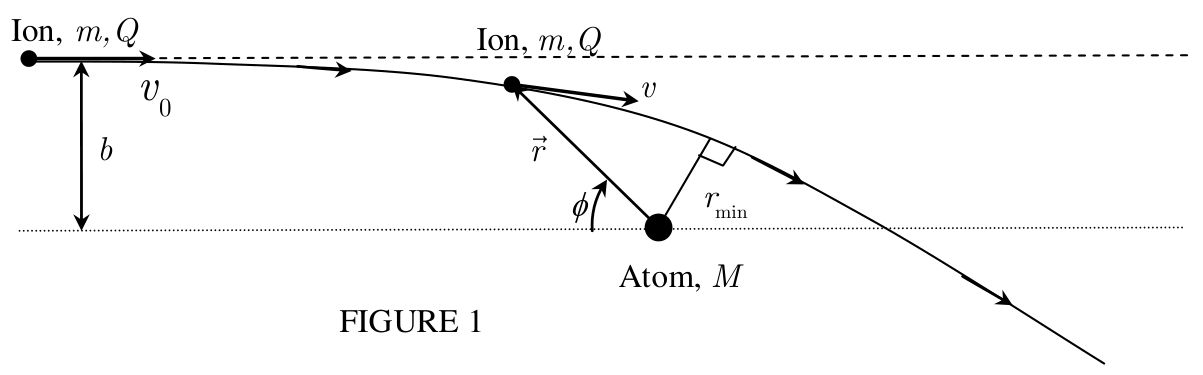
FIGURE 1
An ion of mass \(m\), charge \(Q\), is moving with an initial non-relativistic speed \(v_0\) from a great distance towards the vicinity of a neutral atom of mass \(M\gg m\) and of electrical polarisability \(\alpha\). The impact parameter is \(b\) as shown in Figure 1.
The atom is instantaneously polarised by the electric field \(\vec E\) of the in-coming (approaching) ion. The resulting electric dipole moment of the atom is \(\vec p=\alpha\vec E\). Ignore any radiative losses in this problem.
3.1 Calculate the electric field intensity \(\vec E_p\) at a distance \(r\) from an ideal electric dipole \(\vec p\) at the origin O along the direction of \(\vec p\) in Figure 2. [1.2 points]
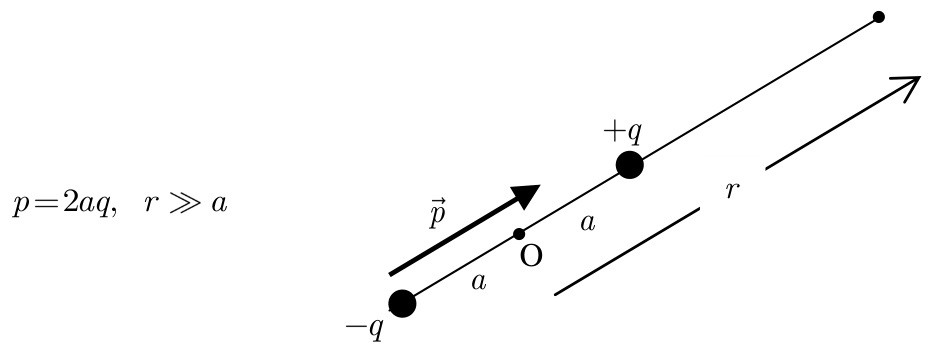
FIGURE 2
3.2 Find the expression for the force \(\vec f\) acting on the ion due to the polarised atom. Show that this force is attractive regardless of the sign of the charge of the ion. [3.0 points]
3.3 What is the electric potential energy of the ion-atom interaction in terms of \(\alpha\), \(Q\) and \(r\)? [0.9 points]
3.4 Find the expression for \(r_{\min}\), the distance of the closest approach, as shown in Figure 1. [2.4 points]
3.5 If the impact parameter \(b\) is less than a critical value \(b_0\), the ion will descend along a spiral to the atom. In such a case, the ion will be neutralized and the atom is, in turn, charged. This process is known as the “charge exchange” interaction. What is the cross sectional area \(A=\pi b_0^2\) of this “charge exchange” collision of the atom as seen by the ion? [2.5 points]
Official English text of the problem.
Answers
Let \(k=1/(4\pi\varepsilon_0)\), and let \(\hat{\mathbf r}\) point from the atom towards the ion. Set \(U(\infty)=0\).
-
3.1 \[ \boxed{\vec E_p=\frac{2k}{r^3}\vec p.} \]
-
3.2 \[ \boxed{\vec f=-\frac{2\alpha k^2Q^2}{r^5}\hat{\mathbf r}.} \] The force is attractive for either sign of \(Q\).
-
3.3 \[ \boxed{U(r)=-\frac{\alpha k^2Q^2}{2r^4} =-\frac{\alpha Q^2}{32\pi^2\varepsilon_0^2r^4}.} \]
-
3.4 For a scattered trajectory, \(b>b_0\), \[ \boxed{ r_{\min}= \left[ \frac{b^2+\sqrt{b^4-\dfrac{4\alpha k^2Q^2}{mv_0^2}}}{2} \right]^{1/2}.} \] At \(b=b_0\), the ion asymptotically approaches \(r=b_0/\sqrt2\). For \(b<b_0\), there is no positive radial turning point.
-
3.5 \[ \boxed{b_0=\left(\frac{4\alpha k^2Q^2}{mv_0^2}\right)^{1/4},} \qquad \boxed{ A=\frac{2\pi k|Q|}{v_0}\sqrt{\frac{\alpha}{m}} =\frac{|Q|}{2\varepsilon_0v_0}\sqrt{\frac{\alpha}{m}}.} \]
Solution
Since \(M\gg m\), we neglect the recoil of the atom and treat its position as fixed. We use the ideal induced-dipole model specified in the question, with \(\alpha>0\).
3.1
Represent the dipole by charges \(+q\) and \(-q\), separated by \(2a\), so that \(p=2aq\). At a point on the axis in the direction of \(\vec p\), the distances from the two charges are \(r-a\) and \(r+a\).
The fields of the two charges point in opposite directions, giving \[ \vec E_p =kq\left[\frac{1}{(r-a)^2}-\frac{1}{(r+a)^2}\right]\hat{\mathbf p}, \] where \(\hat{\mathbf p}\) is the unit vector along the dipole moment.
Combining the fractions, \[ \vec E_p =\frac{4kqar}{(r^2-a^2)^2}\hat{\mathbf p}. \] In the ideal-dipole limit \(a/r\to0\), with \(p=2aq\) fixed, \[ \boxed{\vec E_p=\frac{2kp}{r^3}\hat{\mathbf p} =\frac{2k}{r^3}\vec p.} \]
The field on the opposite side of the dipole axis also points along \(\vec p\) and has the same magnitude at the same distance.
3.2
Let the ion be at \(\vec r=r\hat{\mathbf r}\) relative to the atom. The electric field produced by the ion at the atom is \[ \vec E_{\mathrm{ion}} =-\frac{kQ}{r^2}\hat{\mathbf r}. \] Consequently, the induced dipole moment is \[ \vec p=\alpha\vec E_{\mathrm{ion}} =-\frac{\alpha kQ}{r^2}\hat{\mathbf r}. \]
The ion lies on the axis of this dipole. Using the result of 3.1, \[ \vec E_p =\frac{2k}{r^3}\vec p =-\frac{2\alpha k^2Q}{r^5}\hat{\mathbf r}. \] Thus the force on the ion is \[ \boxed{ \vec f=Q\vec E_p =-\frac{2\alpha k^2Q^2}{r^5}\hat{\mathbf r} =-\frac{\alpha Q^2}{8\pi^2\varepsilon_0^2r^5}\hat{\mathbf r}.} \]
Because \(\alpha>0\) and the charge enters as \(Q^2\), the force always points towards the atom, regardless of the sign of \(Q\).
3.3
For a central conservative force, \[ f_r=-\frac{dU}{dr}. \] Choosing zero potential energy at infinity, \[ U(r) =-\int_\infty^r f_r(s)\,ds =-\int_\infty^r\left(-\frac{2\alpha k^2Q^2}{s^5}\right)ds. \] Therefore, \[ \boxed{U(r)=-\frac{\alpha k^2Q^2}{2r^4}.} \]
Equivalently, \[ U=-\frac12\alpha E_{\mathrm{ion}}^2. \] The factor \(1/2\) accounts for the energy required to induce the dipole. Indeed, the polarization energy \(p^2/(2\alpha)\), together with the coupling energy \(-pE_{\mathrm{ion}}\), gives \(-\alpha E_{\mathrm{ion}}^2/2\) when \(p=\alpha E_{\mathrm{ion}}\).
3.4
The force is central, so angular momentum about the atom is conserved. Its magnitude is determined by the incoming trajectory: \[ L=mv_0b. \]
Mechanical energy is also conserved. At infinity, the potential energy vanishes, so \[ \mathcal E=\frac12mv_0^2. \] Separating the kinetic energy into radial and transverse contributions gives \[ \frac12m\dot r^2+\frac{L^2}{2mr^2} -\frac{\alpha k^2Q^2}{2r^4} =\frac12mv_0^2. \]
At the closest approach of a scattered trajectory, \(\dot r=0\). Substituting \(L=mv_0b\), \[ \frac{mv_0^2b^2}{2r_{\min}^2} -\frac{\alpha k^2Q^2}{2r_{\min}^4} =\frac12mv_0^2. \] Multiplication by \(2r_{\min}^4/(mv_0^2)\) gives \[ r_{\min}^4-b^2r_{\min}^2 +\frac{\alpha k^2Q^2}{mv_0^2}=0. \]
This is a quadratic equation in \(r_{\min}^2\), whose roots are \[ r_\pm^2 =\frac{b^2\pm\sqrt{b^4-\dfrac{4\alpha k^2Q^2}{mv_0^2}}}{2}. \] An ion arriving from infinity encounters the larger root first. Hence \[ \boxed{ r_{\min}= \left[ \frac{b^2+\sqrt{b^4-\dfrac{4\alpha k^2Q^2}{mv_0^2}}}{2} \right]^{1/2}.} \]
The two roots are distinct for \(b>b_0\), with \(b_0\) determined below. As a check, when the interaction tends to zero, this expression gives \(r_{\min}\to b\), as expected for straight-line motion.
3.5
The radial motion is governed by the effective potential \[ U_{\mathrm{eff}}(r) =\frac{L^2}{2mr^2}-\frac{\alpha k^2Q^2}{2r^4}. \] For nonzero angular momentum, the positive centrifugal term dominates at large distances, while the attractive term dominates at short distances. The resulting potential barrier can prevent the ion from reaching the atom.
The critical trajectory occurs when the two radial turning points merge. Thus the discriminant found in 3.4 must vanish: \[ b_0^4-\frac{4\alpha k^2Q^2}{mv_0^2}=0. \] It follows that \[ \boxed{b_0=\left(\frac{4\alpha k^2Q^2}{mv_0^2}\right)^{1/4}.} \]
For \(b<b_0\), the radial-energy equation \[ \dot r^2 =v_0^2\left( 1-\frac{b^2}{r^2} +\frac{\alpha k^2Q^2}{mv_0^2r^4} \right) \] has no positive zero. The incoming ion therefore continues inward and, under the assumption in the question, undergoes charge exchange.
At exactly \(b=b_0\), \[ \dot r^2 =v_0^2\left(1-\frac{b_0^2}{2r^2}\right)^2. \] The incoming ion approaches the unstable circular-orbit radius \[ r_c=\frac{b_0}{\sqrt2} \] asymptotically. This boundary has zero area in the impact-parameter plane and does not affect the cross section.
The captured trajectories occupy a disk of radius \(b_0\) in that plane. Therefore, \[ A=\pi b_0^2 =\pi\sqrt{\frac{4\alpha k^2Q^2}{mv_0^2}}, \] or \[ \boxed{ A=\frac{2\pi k|Q|}{v_0}\sqrt{\frac{\alpha}{m}} =\frac{|Q|}{2\varepsilon_0v_0}\sqrt{\frac{\alpha}{m}}.} \] With SI inputs, \(A\) is in \(\mathrm{m^2}\). No numerical parameter values are supplied.
The solution was checked against the official solution.
IPhO 2011 · Theorieaufgabe 3
Zum hundertjährigen Jubiläum von Rutherfords Atomkern: die Streuung eines Ions an einem neutralen Atom
ABBILDUNG 1
Ein Ion der Masse \(m\) und der Ladung \(Q\) bewegt sich aus großer Entfernung mit einer anfänglichen nichtrelativistischen Geschwindigkeit \(v_0\) auf die Umgebung eines neutralen Atoms der Masse \(M\gg m\) und der elektrischen Polarisierbarkeit \(\alpha\) zu. Der Stoßparameter beträgt \(b\), wie in Abbildung 1 dargestellt.
Das Atom wird durch das elektrische Feld \(\vec E\) des einlaufenden (sich nähernden) Ions augenblicklich polarisiert. Das dadurch entstehende elektrische Dipolmoment des Atoms ist \(\vec p=\alpha\vec E\). Vernachlässigen Sie in dieser Aufgabe sämtliche Strahlungsverluste.
3.1 Berechnen Sie die elektrische Feldstärke \(\vec E_p\) im Abstand \(r\) von einem idealen elektrischen Dipol \(\vec p\), der sich im Ursprung O befindet, in Richtung von \(\vec p\) in Abbildung 2. [1.2 Punkte]
ABBILDUNG 2
3.2 Bestimmen Sie den Ausdruck für die Kraft \(\vec f\), die das polarisierte Atom auf das Ion ausübt. Zeigen Sie, dass diese Kraft unabhängig vom Vorzeichen der Ladung des Ions anziehend ist. [3.0 Punkte]
3.3 Wie lautet die elektrische potenzielle Energie der Ion-Atom-Wechselwirkung in Abhängigkeit von \(\alpha\), \(Q\) und \(r\)? [0.9 Punkte]
3.4 Bestimmen Sie den Ausdruck für \(r_{\min}\), den in Abbildung 1 dargestellten Abstand bei der größten Annäherung. [2.4 Punkte]
3.5 Ist der Stoßparameter \(b\) kleiner als ein kritischer Wert \(b_0\), so nähert sich das Ion dem Atom auf einer Spiralbahn. In diesem Fall wird das Ion neutralisiert, während das Atom seinerseits geladen wird. Dieser Vorgang ist als „Ladungsaustausch“-Wechselwirkung bekannt. Wie groß ist der Wirkungsquerschnitt \(A=\pi b_0^2\) des Atoms für diesen „Ladungsaustausch“-Stoß aus Sicht des Ions? [2.5 Punkte]
Aufgabentext aus dem offiziellen englischen Text übersetzt.
Antworten
Es sei \(k=1/(4\pi\varepsilon_0)\), und \(\hat{\mathbf r}\) zeige vom Atom zum Ion. Wir setzen \(U(\infty)=0\).
-
3.1 \[ \boxed{\vec E_p=\frac{2k}{r^3}\vec p.} \]
-
3.2 \[ \boxed{\vec f=-\frac{2\alpha k^2Q^2}{r^5}\hat{\mathbf r}.} \] Die Kraft ist bei beiden Vorzeichen von \(Q\) anziehend.
-
3.3 \[ \boxed{U(r)=-\frac{\alpha k^2Q^2}{2r^4} =-\frac{\alpha Q^2}{32\pi^2\varepsilon_0^2r^4}.} \]
-
3.4 Für eine Streubahn mit \(b>b_0\) gilt \[ \boxed{ r_{\min}= \left[ \frac{b^2+\sqrt{b^4-\dfrac{4\alpha k^2Q^2}{mv_0^2}}}{2} \right]^{1/2}.} \] Bei \(b=b_0\) nähert sich das Ion asymptotisch \(r=b_0/\sqrt2\). Für \(b<b_0\) gibt es keinen positiven radialen Umkehrpunkt.
-
3.5 \[ \boxed{b_0=\left(\frac{4\alpha k^2Q^2}{mv_0^2}\right)^{1/4},} \qquad \boxed{ A=\frac{2\pi k|Q|}{v_0}\sqrt{\frac{\alpha}{m}} =\frac{|Q|}{2\varepsilon_0v_0}\sqrt{\frac{\alpha}{m}}.} \]
Lösung
Da \(M\gg m\) gilt, vernachlässigen wir den Rückstoß des Atoms und behandeln seine Position als fest. Wir verwenden das in der Aufgabenstellung vorgegebene Modell eines idealen induzierten Dipols mit \(\alpha>0\).
3.1
Wir stellen den Dipol durch die Ladungen \(+q\) und \(-q\) im Abstand \(2a\) voneinander dar, sodass \(p=2aq\) gilt. An einem Punkt auf der Achse in Richtung von \(\vec p\) betragen die Abstände von den beiden Ladungen \(r-a\) und \(r+a\).
Die Felder der beiden Ladungen zeigen in entgegengesetzte Richtungen, sodass \[ \vec E_p =kq\left[\frac{1}{(r-a)^2}-\frac{1}{(r+a)^2}\right]\hat{\mathbf p}, \] wobei \(\hat{\mathbf p}\) der Einheitsvektor in Richtung des Dipolmoments ist.
Durch Zusammenfassen der Brüche erhalten wir \[ \vec E_p =\frac{4kqar}{(r^2-a^2)^2}\hat{\mathbf p}. \] Im Grenzfall des idealen Dipols \(a/r\to0\) bei festem \(p=2aq\) gilt \[ \boxed{\vec E_p=\frac{2kp}{r^3}\hat{\mathbf p} =\frac{2k}{r^3}\vec p.} \]
Das Feld auf der gegenüberliegenden Seite der Dipolachse zeigt ebenfalls in Richtung von \(\vec p\) und hat bei gleichem Abstand denselben Betrag.
3.2
Das Ion befinde sich relativ zum Atom am Ort \(\vec r=r\hat{\mathbf r}\). Das vom Ion am Ort des Atoms erzeugte elektrische Feld ist \[ \vec E_{\mathrm{ion}} =-\frac{kQ}{r^2}\hat{\mathbf r}. \] Folglich ist das induzierte Dipolmoment \[ \vec p=\alpha\vec E_{\mathrm{ion}} =-\frac{\alpha kQ}{r^2}\hat{\mathbf r}. \]
Das Ion liegt auf der Achse dieses Dipols. Mit dem Ergebnis aus 3.1 folgt \[ \vec E_p =\frac{2k}{r^3}\vec p =-\frac{2\alpha k^2Q}{r^5}\hat{\mathbf r}. \] Damit ist die Kraft auf das Ion \[ \boxed{ \vec f=Q\vec E_p =-\frac{2\alpha k^2Q^2}{r^5}\hat{\mathbf r} =-\frac{\alpha Q^2}{8\pi^2\varepsilon_0^2r^5}\hat{\mathbf r}.} \]
Da \(\alpha>0\) gilt und die Ladung als \(Q^2\) eingeht, zeigt die Kraft unabhängig vom Vorzeichen von \(Q\) stets zum Atom hin.
3.3
Für eine konservative Zentralkraft gilt \[ f_r=-\frac{dU}{dr}. \] Wählen wir die potenzielle Energie im Unendlichen gleich null, so erhalten wir \[ U(r) =-\int_\infty^r f_r(s)\,ds =-\int_\infty^r\left(-\frac{2\alpha k^2Q^2}{s^5}\right)ds. \] Daher gilt \[ \boxed{U(r)=-\frac{\alpha k^2Q^2}{2r^4}.} \]
Gleichwertig dazu ist \[ U=-\frac12\alpha E_{\mathrm{ion}}^2. \] Der Faktor \(1/2\) berücksichtigt die Energie, die zur Induktion des Dipols benötigt wird. Tatsächlich ergibt die Polarisationsenergie \(p^2/(2\alpha)\) zusammen mit der Kopplungsenergie \(-pE_{\mathrm{ion}}\) den Wert \(-\alpha E_{\mathrm{ion}}^2/2\), wenn \(p=\alpha E_{\mathrm{ion}}\) gilt.
3.4
Die Kraft ist eine Zentralkraft, daher bleibt der Drehimpuls bezüglich des Atoms erhalten. Sein Betrag wird durch die einlaufende Bahn bestimmt: \[ L=mv_0b. \]
Auch die mechanische Energie bleibt erhalten. Im Unendlichen verschwindet die potenzielle Energie, sodass \[ \mathcal E=\frac12mv_0^2. \] Die Zerlegung der kinetischen Energie in einen radialen und einen transversalen Anteil ergibt \[ \frac12m\dot r^2+\frac{L^2}{2mr^2} -\frac{\alpha k^2Q^2}{2r^4} =\frac12mv_0^2. \]
Am Punkt der größten Annäherung auf einer Streubahn gilt \(\dot r=0\). Durch Einsetzen von \(L=mv_0b\) erhalten wir \[ \frac{mv_0^2b^2}{2r_{\min}^2} -\frac{\alpha k^2Q^2}{2r_{\min}^4} =\frac12mv_0^2. \] Multiplikation mit \(2r_{\min}^4/(mv_0^2)\) ergibt \[ r_{\min}^4-b^2r_{\min}^2 +\frac{\alpha k^2Q^2}{mv_0^2}=0. \]
Dies ist eine quadratische Gleichung in \(r_{\min}^2\) mit den Lösungen \[ r_\pm^2 =\frac{b^2\pm\sqrt{b^4-\dfrac{4\alpha k^2Q^2}{mv_0^2}}}{2}. \] Ein aus dem Unendlichen kommendes Ion erreicht zuerst die größere Lösung. Somit gilt \[ \boxed{ r_{\min}= \left[ \frac{b^2+\sqrt{b^4-\dfrac{4\alpha k^2Q^2}{mv_0^2}}}{2} \right]^{1/2}.} \]
Für \(b>b_0\) sind die beiden Lösungen verschieden, wobei \(b_0\) im Folgenden bestimmt wird. Zur Kontrolle: Wenn die Wechselwirkung gegen null geht, liefert dieser Ausdruck \(r_{\min}\to b\), wie es für eine geradlinige Bewegung zu erwarten ist.
3.5
Die radiale Bewegung wird durch das folgende effektive Potenzial bestimmt: \[ U_{\mathrm{eff}}(r) =\frac{L^2}{2mr^2}-\frac{\alpha k^2Q^2}{2r^4}. \] Bei einem von null verschiedenen Drehimpuls dominiert für große Abstände der positive Zentrifugalterm, während für kleine Abstände der anziehende Term dominiert. Die daraus entstehende Potenzialbarriere kann verhindern, dass das Ion das Atom erreicht.
Die kritische Bahn liegt vor, wenn die beiden radialen Umkehrpunkte zusammenfallen. Daher muss die in 3.4 gefundene Diskriminante verschwinden: \[ b_0^4-\frac{4\alpha k^2Q^2}{mv_0^2}=0. \] Daraus folgt \[ \boxed{b_0=\left(\frac{4\alpha k^2Q^2}{mv_0^2}\right)^{1/4}.} \]
Für \(b<b_0\) hat die radiale Energiegleichung \[ \dot r^2 =v_0^2\left( 1-\frac{b^2}{r^2} +\frac{\alpha k^2Q^2}{mv_0^2r^4} \right) \] keine positive Nullstelle. Das einlaufende Ion bewegt sich daher weiter nach innen und erfährt unter der in der Aufgabenstellung getroffenen Annahme einen Ladungsaustausch.
Für genau \(b=b_0\) gilt \[ \dot r^2 =v_0^2\left(1-\frac{b_0^2}{2r^2}\right)^2. \] Das einlaufende Ion nähert sich dem Radius der instabilen Kreisbahn \[ r_c=\frac{b_0}{\sqrt2} \] asymptotisch. Diese Grenze hat in der Stoßparameterebene den Flächeninhalt null und beeinflusst den Wirkungsquerschnitt nicht.
Die eingefangenen Bahnen nehmen in dieser Ebene eine Kreisscheibe mit dem Radius \(b_0\) ein. Daher gilt \[ A=\pi b_0^2 =\pi\sqrt{\frac{4\alpha k^2Q^2}{mv_0^2}}, \] oder \[ \boxed{ A=\frac{2\pi k|Q|}{v_0}\sqrt{\frac{\alpha}{m}} =\frac{|Q|}{2\varepsilon_0v_0}\sqrt{\frac{\alpha}{m}}.} \] Werden die Eingangsgrößen in SI-Einheiten eingesetzt, so ergibt sich \(A\) in \(\mathrm{m^2}\). Es sind keine numerischen Parameterwerte angegeben.
Die Lösung wurde mit der offiziellen Lösung abgeglichen.
IPhO 2011 · Teori sorusu 3
Rutherford'un Atom Çekirdeğinin Yüzüncü Yılı Anısına: Bir İyonun Nötr Bir Atom Tarafından Saçılması
ŞEKİL 1
Kütlesi \(m\), yükü \(Q\) olan bir iyon, çok uzak bir noktadan, kütlesi \(M\gg m\) ve elektriksel kutuplanabilirliği \(\alpha\) olan nötr bir atomun yakınına doğru, göreli olmayan bir \(v_0\) ilk süratiyle hareket etmektedir. Çarpma parametresi, Şekil 1'de gösterildiği gibi \(b\)'dir.
Atom, gelen (yaklaşan) iyonun \(\vec E\) elektrik alanı tarafından anında kutuplanır. Atomda oluşan elektrik dipol momenti \(\vec p=\alpha\vec E\)'dir. Bu soruda ışınım yoluyla oluşan tüm enerji kayıplarını ihmal ediniz.
3.1 Şekil 2'de, O başlangıç noktasında bulunan ideal bir \(\vec p\) elektrik dipolünden \(\vec p\) yönünde \(r\) uzaklıktaki \(\vec E_p\) elektrik alan şiddetini hesaplayınız. [1.2 puan]
ŞEKİL 2
3.2 Kutuplanmış atomun iyona uyguladığı \(\vec f\) kuvvetinin ifadesini bulunuz. İyonun yükünün işaretinden bağımsız olarak bu kuvvetin çekici olduğunu gösteriniz. [3.0 puan]
3.3 İyon-atom etkileşiminin elektriksel potansiyel enerjisi \(\alpha\), \(Q\) ve \(r\) cinsinden nedir? [0.9 puan]
3.4 Şekil 1'de gösterilen en yakın yaklaşma uzaklığı \(r_{\min}\)'in ifadesini bulunuz. [2.4 puan]
3.5 Çarpma parametresi \(b\), kritik bir \(b_0\) değerinden küçükse iyon, bir sarmal boyunca atoma doğru ilerleyecektir. Böyle bir durumda iyon nötrleşirken atom da yüklenecektir. Bu süreç, “yük değişimi” etkileşimi olarak bilinir. İyonun gördüğü şekliyle atomun bu “yük değişimi” çarpışmasına ait \(A=\pi b_0^2\) tesir kesiti nedir? [2.5 puan]
Soru metni resmi İngilizce metinden çevrilmiştir.
Cevaplar
\(k=1/(4\pi\varepsilon_0)\) olsun ve \(\hat{\mathbf r}\) atomdan iyona doğru yönelsin. \(U(\infty)=0\) seçilsin.
-
3.1 \[ \boxed{\vec E_p=\frac{2k}{r^3}\vec p.} \]
-
3.2 \[ \boxed{\vec f=-\frac{2\alpha k^2Q^2}{r^5}\hat{\mathbf r}.} \] Kuvvet, \(Q\)'nun her iki işareti için de çekicidir.
-
3.3 \[ \boxed{U(r)=-\frac{\alpha k^2Q^2}{2r^4} =-\frac{\alpha Q^2}{32\pi^2\varepsilon_0^2r^4}.} \]
-
3.4 Saçılmayla sonuçlanan bir yörünge için, \(b>b_0\), \[ \boxed{ r_{\min}= \left[ \frac{b^2+\sqrt{b^4-\dfrac{4\alpha k^2Q^2}{mv_0^2}}}{2} \right]^{1/2}.} \] \(b=b_0\) olduğunda iyon, \(r=b_0/\sqrt2\) uzaklığına asimptotik olarak yaklaşır. \(b<b_0\) için pozitif bir radyal dönüm noktası yoktur.
-
3.5 \[ \boxed{b_0=\left(\frac{4\alpha k^2Q^2}{mv_0^2}\right)^{1/4},} \qquad \boxed{ A=\frac{2\pi k|Q|}{v_0}\sqrt{\frac{\alpha}{m}} =\frac{|Q|}{2\varepsilon_0v_0}\sqrt{\frac{\alpha}{m}}.} \]
Çözüm
\(M\gg m\) olduğundan atomun geri tepmesini ihmal eder ve konumunu sabit kabul ederiz. Soruda belirtilen ideal indüklenmiş dipol modelini, \(\alpha>0\) olmak üzere kullanırız.
3.1
Dipolü, aralarındaki uzaklık \(2a\) olan \(+q\) ve \(-q\) yükleriyle temsil edelim; böylece \(p=2aq\) olur. Eksen üzerinde, \(\vec p\) yönündeki bir noktanın iki yüke olan uzaklıkları \(r-a\) ve \(r+a\)'dır.
İki yükün alanları zıt yönlüdür; dolayısıyla \[ \vec E_p =kq\left[\frac{1}{(r-a)^2}-\frac{1}{(r+a)^2}\right]\hat{\mathbf p}, \] burada \(\hat{\mathbf p}\), dipol momenti yönündeki birim vektördür.
Kesirler birleştirildiğinde, \[ \vec E_p =\frac{4kqar}{(r^2-a^2)^2}\hat{\mathbf p}. \] \(p=2aq\) sabit tutularak alınan \(a/r\to0\) ideal dipol limitinde, \[ \boxed{\vec E_p=\frac{2kp}{r^3}\hat{\mathbf p} =\frac{2k}{r^3}\vec p.} \]
Dipol ekseninin karşı tarafındaki alan da \(\vec p\) yönündedir ve aynı uzaklıkta aynı büyüklüğe sahiptir.
3.2
İyonun atoma göre konumu \(\vec r=r\hat{\mathbf r}\) olsun. İyonun atomun bulunduğu noktada oluşturduğu elektrik alan \[ \vec E_{\mathrm{ion}} =-\frac{kQ}{r^2}\hat{\mathbf r}. \] Buna göre, indüklenen dipol momenti \[ \vec p=\alpha\vec E_{\mathrm{ion}} =-\frac{\alpha kQ}{r^2}\hat{\mathbf r}. \]
İyon, bu dipolün ekseni üzerinde bulunur. 3.1'deki sonuç kullanılırsa, \[ \vec E_p =\frac{2k}{r^3}\vec p =-\frac{2\alpha k^2Q}{r^5}\hat{\mathbf r}. \] Böylece iyona etki eden kuvvet \[ \boxed{ \vec f=Q\vec E_p =-\frac{2\alpha k^2Q^2}{r^5}\hat{\mathbf r} =-\frac{\alpha Q^2}{8\pi^2\varepsilon_0^2r^5}\hat{\mathbf r}.} \]
\(\alpha>0\) olduğundan ve yük ifadeye \(Q^2\) olarak girdiğinden, kuvvet \(Q\)'nun işaretinden bağımsız olarak her zaman atoma doğru yönelir.
3.3
Merkezî ve korunumlu bir kuvvet için, \[ f_r=-\frac{dU}{dr}. \] Sonsuzdaki potansiyel enerji sıfır seçildiğinde, \[ U(r) =-\int_\infty^r f_r(s)\,ds =-\int_\infty^r\left(-\frac{2\alpha k^2Q^2}{s^5}\right)ds. \] Dolayısıyla, \[ \boxed{U(r)=-\frac{\alpha k^2Q^2}{2r^4}.} \]
Eşdeğer olarak, \[ U=-\frac12\alpha E_{\mathrm{ion}}^2. \] \(1/2\) çarpanı, dipolü indüklemek için gereken enerjiyi hesaba katar. Nitekim \(p^2/(2\alpha)\) kutuplanma enerjisi ile \(-pE_{\mathrm{ion}}\) etkileşim enerjisinin toplamı, \(p=\alpha E_{\mathrm{ion}}\) olduğunda \(-\alpha E_{\mathrm{ion}}^2/2\) verir.
3.4
Kuvvet merkezî olduğundan, atoma göre açısal momentum korunur. Büyüklüğü, iyonun geliş yörüngesi tarafından belirlenir: \[ L=mv_0b. \]
Mekanik enerji de korunur. Sonsuzda potansiyel enerji sıfır olduğundan, \[ \mathcal E=\frac12mv_0^2. \] Kinetik enerji radyal ve enine katkılara ayrıldığında, \[ \frac12m\dot r^2+\frac{L^2}{2mr^2} -\frac{\alpha k^2Q^2}{2r^4} =\frac12mv_0^2. \]
Saçılmayla sonuçlanan bir yörüngenin en yakın yaklaşma noktasında \(\dot r=0\) olur. \(L=mv_0b\) yerine yazılırsa, \[ \frac{mv_0^2b^2}{2r_{\min}^2} -\frac{\alpha k^2Q^2}{2r_{\min}^4} =\frac12mv_0^2. \] \(2r_{\min}^4/(mv_0^2)\) ile çarpıldığında, \[ r_{\min}^4-b^2r_{\min}^2 +\frac{\alpha k^2Q^2}{mv_0^2}=0. \]
Bu, \(r_{\min}^2\) değişkenine göre ikinci dereceden bir denklemdir ve kökleri \[ r_\pm^2 =\frac{b^2\pm\sqrt{b^4-\dfrac{4\alpha k^2Q^2}{mv_0^2}}}{2}. \] Sonsuzdan gelen bir iyon önce büyük kökle karşılaşır. Bu nedenle \[ \boxed{ r_{\min}= \left[ \frac{b^2+\sqrt{b^4-\dfrac{4\alpha k^2Q^2}{mv_0^2}}}{2} \right]^{1/2}.} \]
Aşağıda belirlenecek \(b_0\) değeri için, \(b>b_0\) olduğunda iki kök birbirinden farklıdır. Bir kontrol olarak, etkileşim sıfıra yaklaşırken bu ifade, doğrusal hareket için beklendiği gibi \(r_{\min}\to b\) sonucunu verir.
3.5
Radyal hareketi belirleyen etkin potansiyel \[ U_{\mathrm{eff}}(r) =\frac{L^2}{2mr^2}-\frac{\alpha k^2Q^2}{2r^4}. \] Açısal momentum sıfırdan farklı olduğunda, büyük uzaklıklarda pozitif merkezkaç terimi baskınken, küçük uzaklıklarda çekici terim baskındır. Ortaya çıkan potansiyel engeli, iyonun atoma ulaşmasını önleyebilir.
Kritik yörünge, iki radyal dönüm noktası birleştiğinde ortaya çıkar. Bu nedenle 3.4'te bulunan diskriminant sıfır olmalıdır: \[ b_0^4-\frac{4\alpha k^2Q^2}{mv_0^2}=0. \] Buradan \[ \boxed{b_0=\left(\frac{4\alpha k^2Q^2}{mv_0^2}\right)^{1/4}.} \]
\(b<b_0\) için radyal enerji denkleminin \[ \dot r^2 =v_0^2\left( 1-\frac{b^2}{r^2} +\frac{\alpha k^2Q^2}{mv_0^2r^4} \right) \] pozitif bir kökü yoktur. Dolayısıyla gelen iyon içeriye doğru ilerlemeyi sürdürür ve sorudaki varsayım uyarınca yük değişimine uğrar.
Tam olarak \(b=b_0\) olduğunda, \[ \dot r^2 =v_0^2\left(1-\frac{b_0^2}{2r^2}\right)^2. \] Gelen iyon, kararsız dairesel yörüngenin \[ r_c=\frac{b_0}{\sqrt2} \] yarıçapına asimptotik olarak yaklaşır. Bu sınırın çarpma parametresi düzlemindeki alanı sıfırdır ve tesir kesitini etkilemez.
Yakalanmayla sonuçlanan yörüngeler, bu düzlemde \(b_0\) yarıçaplı bir disk kaplar. Dolayısıyla, \[ A=\pi b_0^2 =\pi\sqrt{\frac{4\alpha k^2Q^2}{mv_0^2}}, \] ya da \[ \boxed{ A=\frac{2\pi k|Q|}{v_0}\sqrt{\frac{\alpha}{m}} =\frac{|Q|}{2\varepsilon_0v_0}\sqrt{\frac{\alpha}{m}}.} \] Girdiler SI birimlerinde verildiğinde, \(A\)'nın birimi \(\mathrm{m^2}\) olur. Parametreler için sayısal değerler verilmemiştir.
Çözüm, resmi çözümle karşılaştırılarak kontrol edildi.
IPhO 2011 · Problema teórico 3
Conmemoración del centenario del núcleo atómico de Rutherford: la dispersión de un ion por un átomo neutro
FIGURA 1
Un ion de masa \(m\) y carga \(Q\) se mueve con una rapidez inicial no relativista \(v_0\) desde una gran distancia hacia las proximidades de un átomo neutro de masa \(M\gg m\) y polarizabilidad eléctrica \(\alpha\). El parámetro de impacto es \(b\), como se muestra en la Figura 1.
El átomo se polariza instantáneamente por efecto del campo eléctrico \(\vec E\) del ion incidente (que se aproxima). El momento dipolar eléctrico resultante del átomo es \(\vec p=\alpha\vec E\). Desprecie cualquier pérdida por radiación en este problema.
3.1 Calcule la intensidad del campo eléctrico \(\vec E_p\) a una distancia \(r\) de un dipolo eléctrico ideal \(\vec p\) situado en el origen O, en la dirección y el sentido de \(\vec p\) en la Figura 2. [1.2 puntos]
FIGURA 2
3.2 Halle la expresión de la fuerza \(\vec f\) que actúa sobre el ion debido al átomo polarizado. Demuestre que esta fuerza es atractiva independientemente del signo de la carga del ion. [3.0 puntos]
3.3 ¿Cuál es la energía potencial eléctrica de la interacción ion-átomo en función de \(\alpha\), \(Q\) y \(r\)? [0.9 puntos]
3.4 Halle la expresión de \(r_{\min}\), la distancia de máxima aproximación, que se muestra en la Figura 1. [2.4 puntos]
3.5 Si el parámetro de impacto \(b\) es menor que un valor crítico \(b_0\), el ion descenderá en espiral hacia el átomo. En tal caso, el ion se neutralizará y el átomo, a su vez, quedará cargado. Este proceso se conoce como interacción de «intercambio de carga». ¿Cuál es la sección eficaz \(A=\pi b_0^2\) del átomo para esta colisión de «intercambio de carga», vista por el ion? [2.5 puntos]
Enunciado traducido del texto oficial en inglés.
Respuestas
Sea \(k=1/(4\pi\varepsilon_0)\), y sea \(\hat{\mathbf r}\) el vector unitario que apunta desde el átomo hacia el ion. Tomamos \(U(\infty)=0\).
-
3.1 \[ \boxed{\vec E_p=\frac{2k}{r^3}\vec p.} \]
-
3.2 \[ \boxed{\vec f=-\frac{2\alpha k^2Q^2}{r^5}\hat{\mathbf r}.} \] La fuerza es atractiva para ambos signos de \(Q\).
-
3.3 \[ \boxed{U(r)=-\frac{\alpha k^2Q^2}{2r^4} =-\frac{\alpha Q^2}{32\pi^2\varepsilon_0^2r^4}.} \]
-
3.4 Para una trayectoria de dispersión, \(b>b_0\), \[ \boxed{ r_{\min}= \left[ \frac{b^2+\sqrt{b^4-\dfrac{4\alpha k^2Q^2}{mv_0^2}}}{2} \right]^{1/2}.} \] Cuando \(b=b_0\), el ion se aproxima asintóticamente a \(r=b_0/\sqrt2\). Para \(b<b_0\), no existe ningún punto de retorno radial a una distancia positiva.
-
3.5 \[ \boxed{b_0=\left(\frac{4\alpha k^2Q^2}{mv_0^2}\right)^{1/4},} \qquad \boxed{ A=\frac{2\pi k|Q|}{v_0}\sqrt{\frac{\alpha}{m}} =\frac{|Q|}{2\varepsilon_0v_0}\sqrt{\frac{\alpha}{m}}.} \]
Solución
Dado que \(M\gg m\), despreciamos el retroceso del átomo y consideramos que su posición es fija. Utilizamos el modelo de dipolo inducido ideal especificado en el enunciado, con \(\alpha>0\).
3.1
Representamos el dipolo mediante las cargas \(+q\) y \(-q\), separadas por \(2a\), de modo que \(p=2aq\). En un punto del eje situado en la dirección y el sentido de \(\vec p\), las distancias a las dos cargas son \(r-a\) y \(r+a\).
Los campos de las dos cargas apuntan en sentidos opuestos, lo que da \[ \vec E_p =kq\left[\frac{1}{(r-a)^2}-\frac{1}{(r+a)^2}\right]\hat{\mathbf p}, \] donde \(\hat{\mathbf p}\) es el vector unitario en la dirección y el sentido del momento dipolar.
Al reducir las fracciones a un denominador común, \[ \vec E_p =\frac{4kqar}{(r^2-a^2)^2}\hat{\mathbf p}. \] En el límite de dipolo ideal \(a/r\to0\), manteniendo fijo \(p=2aq\), \[ \boxed{\vec E_p=\frac{2kp}{r^3}\hat{\mathbf p} =\frac{2k}{r^3}\vec p.} \]
El campo en el lado opuesto del eje del dipolo también apunta en la dirección y el sentido de \(\vec p\) y tiene el mismo módulo a la misma distancia.
3.2
Sea \(\vec r=r\hat{\mathbf r}\) la posición del ion respecto al átomo. El campo eléctrico producido por el ion en el átomo es \[ \vec E_{\mathrm{ion}} =-\frac{kQ}{r^2}\hat{\mathbf r}. \] Por consiguiente, el momento dipolar inducido es \[ \vec p=\alpha\vec E_{\mathrm{ion}} =-\frac{\alpha kQ}{r^2}\hat{\mathbf r}. \]
El ion se encuentra sobre el eje de este dipolo. Utilizando el resultado de 3.1, \[ \vec E_p =\frac{2k}{r^3}\vec p =-\frac{2\alpha k^2Q}{r^5}\hat{\mathbf r}. \] Por tanto, la fuerza sobre el ion es \[ \boxed{ \vec f=Q\vec E_p =-\frac{2\alpha k^2Q^2}{r^5}\hat{\mathbf r} =-\frac{\alpha Q^2}{8\pi^2\varepsilon_0^2r^5}\hat{\mathbf r}.} \]
Como \(\alpha>0\) y la carga aparece como \(Q^2\), la fuerza siempre apunta hacia el átomo, independientemente del signo de \(Q\).
3.3
Para una fuerza central conservativa, \[ f_r=-\frac{dU}{dr}. \] Tomando la energía potencial nula en el infinito, \[ U(r) =-\int_\infty^r f_r(s)\,ds =-\int_\infty^r\left(-\frac{2\alpha k^2Q^2}{s^5}\right)ds. \] Por lo tanto, \[ \boxed{U(r)=-\frac{\alpha k^2Q^2}{2r^4}.} \]
De forma equivalente, \[ U=-\frac12\alpha E_{\mathrm{ion}}^2. \] El factor \(1/2\) tiene en cuenta la energía necesaria para inducir el dipolo. En efecto, la energía de polarización \(p^2/(2\alpha)\), junto con la energía de acoplamiento \(-pE_{\mathrm{ion}}\), da \(-\alpha E_{\mathrm{ion}}^2/2\) cuando \(p=\alpha E_{\mathrm{ion}}\).
3.4
La fuerza es central, por lo que se conserva el momento angular respecto al átomo. Su módulo viene determinado por la trayectoria incidente: \[ L=mv_0b. \]
La energía mecánica también se conserva. En el infinito, la energía potencial es nula, por lo que \[ \mathcal E=\frac12mv_0^2. \] Al separar la energía cinética en las contribuciones radial y transversal, se obtiene \[ \frac12m\dot r^2+\frac{L^2}{2mr^2} -\frac{\alpha k^2Q^2}{2r^4} =\frac12mv_0^2. \]
En el punto de máxima aproximación de una trayectoria de dispersión, \(\dot r=0\). Sustituyendo \(L=mv_0b\), \[ \frac{mv_0^2b^2}{2r_{\min}^2} -\frac{\alpha k^2Q^2}{2r_{\min}^4} =\frac12mv_0^2. \] Al multiplicar por \(2r_{\min}^4/(mv_0^2)\), se obtiene \[ r_{\min}^4-b^2r_{\min}^2 +\frac{\alpha k^2Q^2}{mv_0^2}=0. \]
Esta es una ecuación de segundo grado en \(r_{\min}^2\), cuyas raíces son \[ r_\pm^2 =\frac{b^2\pm\sqrt{b^4-\dfrac{4\alpha k^2Q^2}{mv_0^2}}}{2}. \] Un ion que llega desde el infinito alcanza primero la raíz mayor. Por tanto, \[ \boxed{ r_{\min}= \left[ \frac{b^2+\sqrt{b^4-\dfrac{4\alpha k^2Q^2}{mv_0^2}}}{2} \right]^{1/2}.} \]
Las dos raíces son distintas para \(b>b_0\), donde \(b_0\) se determina a continuación. Como comprobación, cuando la interacción tiende a cero, esta expresión da \(r_{\min}\to b\), como cabe esperar para un movimiento rectilíneo.
3.5
El movimiento radial está regido por el potencial efectivo \[ U_{\mathrm{eff}}(r) =\frac{L^2}{2mr^2}-\frac{\alpha k^2Q^2}{2r^4}. \] Para un momento angular no nulo, el término centrífugo positivo domina a grandes distancias, mientras que el término atractivo domina a distancias cortas. La barrera de potencial resultante puede impedir que el ion alcance el átomo.
La trayectoria crítica se produce cuando los dos puntos de retorno radial coinciden. Por tanto, el discriminante hallado en 3.4 debe anularse: \[ b_0^4-\frac{4\alpha k^2Q^2}{mv_0^2}=0. \] De ello se deduce que \[ \boxed{b_0=\left(\frac{4\alpha k^2Q^2}{mv_0^2}\right)^{1/4}.} \]
Para \(b<b_0\), la ecuación de la energía radial \[ \dot r^2 =v_0^2\left( 1-\frac{b^2}{r^2} +\frac{\alpha k^2Q^2}{mv_0^2r^4} \right) \] no tiene ningún cero positivo. Por consiguiente, el ion incidente continúa acercándose al átomo y, bajo la hipótesis del enunciado, experimenta un intercambio de carga.
Exactamente cuando \(b=b_0\), \[ \dot r^2 =v_0^2\left(1-\frac{b_0^2}{2r^2}\right)^2. \] El ion incidente se aproxima al radio de la órbita circular inestable \[ r_c=\frac{b_0}{\sqrt2} \] asintóticamente. Esta frontera tiene área nula en el plano de los parámetros de impacto y no afecta a la sección eficaz.
Las trayectorias capturadas ocupan un disco de radio \(b_0\) en ese plano. Por lo tanto, \[ A=\pi b_0^2 =\pi\sqrt{\frac{4\alpha k^2Q^2}{mv_0^2}}, \] o bien \[ \boxed{ A=\frac{2\pi k|Q|}{v_0}\sqrt{\frac{\alpha}{m}} =\frac{|Q|}{2\varepsilon_0v_0}\sqrt{\frac{\alpha}{m}}.} \] Si los datos se expresan en unidades del SI, \(A\) se obtiene en \(\mathrm{m^2}\). No se proporcionan valores numéricos de los parámetros.
La solución se comprobó con la solución oficial.
IPhO 2011 · 理论题 3
纪念卢瑟福发现原子核一百周年:中性原子对离子的散射
图 1
一个质量为 \(m\)、电荷量为 \(Q\) 的离子,以非相对论性的初速度 \(v_0\) 从很远处向一个中性原子附近运动。该原子的质量为 \(M\gg m\),电极化率为 \(\alpha\)。碰撞参数为 \(b\),如图 1 所示。
原子在入射(正在接近的)离子产生的电场 \(\vec E\) 中瞬时发生极化。由此产生的原子电偶极矩为 \(\vec p=\alpha\vec E\)。本题忽略任何辐射损失。
3.1 一个理想电偶极子 \(\vec p\) 位于原点 O,求图 2 中沿 \(\vec p\) 方向、距原点为 \(r\) 处的电场强度 \(\vec E_p\)。[1.2 分]
图 2
3.2 求极化后的原子作用在离子上的力 \(\vec f\) 的表达式。证明无论离子的电荷为正还是为负,该力均为吸引力。[3.0 分]
3.3 用 \(\alpha\)、\(Q\) 和 \(r\) 表示离子与原子相互作用的电势能。[0.9 分]
3.4 求图 1 所示的最近接近距离 \(r_{\min}\) 的表达式。[2.4 分]
3.5 如果碰撞参数 \(b\) 小于某一临界值 \(b_0\),离子将沿螺旋轨道向原子靠近。在这种情况下,离子将被中和,而原子则变为带电状态。这一过程称为“电荷交换”相互作用。从离子的角度看,原子发生这种“电荷交换”碰撞的截面积 \(A=\pi b_0^2\) 是多少?[2.5 分]
题目译自官方英文原文。
答案
令 \(k=1/(4\pi\varepsilon_0)\),并令 \(\hat{\mathbf r}\) 从原子指向离子。取 \(U(\infty)=0\)。
-
3.1 \[ \boxed{\vec E_p=\frac{2k}{r^3}\vec p.} \]
-
3.2 \[ \boxed{\vec f=-\frac{2\alpha k^2Q^2}{r^5}\hat{\mathbf r}.} \] 无论 \(Q\) 为正还是为负,该力均为吸引力。
-
3.3 \[ \boxed{U(r)=-\frac{\alpha k^2Q^2}{2r^4} =-\frac{\alpha Q^2}{32\pi^2\varepsilon_0^2r^4}.} \]
-
3.4 对于散射轨道,\(b>b_0\), \[ \boxed{ r_{\min}= \left[ \frac{b^2+\sqrt{b^4-\dfrac{4\alpha k^2Q^2}{mv_0^2}}}{2} \right]^{1/2}.} \] 当 \(b=b_0\) 时,离子渐近地接近 \(r=b_0/\sqrt2\)。当 \(b<b_0\) 时,不存在正的径向转折点。
-
3.5 \[ \boxed{b_0=\left(\frac{4\alpha k^2Q^2}{mv_0^2}\right)^{1/4},} \qquad \boxed{ A=\frac{2\pi k|Q|}{v_0}\sqrt{\frac{\alpha}{m}} =\frac{|Q|}{2\varepsilon_0v_0}\sqrt{\frac{\alpha}{m}}.} \]
解答
由于 \(M\gg m\),我们忽略原子的反冲,将其位置视为固定。采用题目指定的理想感应电偶极子模型,其中 \(\alpha>0\)。
3.1
用相距 \(2a\) 的电荷 \(+q\) 和 \(-q\) 表示电偶极子,于是 \(p=2aq\)。在轴线上沿 \(\vec p\) 方向的一点,该点到两个电荷的距离分别为 \(r-a\) 和 \(r+a\)。
两个电荷产生的电场方向相反,因此 \[ \vec E_p =kq\left[\frac{1}{(r-a)^2}-\frac{1}{(r+a)^2}\right]\hat{\mathbf p}, \] 其中 \(\hat{\mathbf p}\) 为沿电偶极矩方向的单位矢量。
将分式通分合并,得 \[ \vec E_p =\frac{4kqar}{(r^2-a^2)^2}\hat{\mathbf p}. \] 在理想电偶极子极限 \(a/r\to0\) 下,保持 \(p=2aq\) 不变,得 \[ \boxed{\vec E_p=\frac{2kp}{r^3}\hat{\mathbf p} =\frac{2k}{r^3}\vec p.} \]
电偶极子轴线另一侧的电场也沿 \(\vec p\) 方向,且在相同距离处具有相同的大小。
3.2
设离子相对于原子的位置为 \(\vec r=r\hat{\mathbf r}\)。离子在原子处产生的电场为 \[ \vec E_{\mathrm{ion}} =-\frac{kQ}{r^2}\hat{\mathbf r}. \] 因此,感应电偶极矩为 \[ \vec p=\alpha\vec E_{\mathrm{ion}} =-\frac{\alpha kQ}{r^2}\hat{\mathbf r}. \]
离子位于该电偶极子的轴线上。利用 3.1 的结果,得 \[ \vec E_p =\frac{2k}{r^3}\vec p =-\frac{2\alpha k^2Q}{r^5}\hat{\mathbf r}. \] 因此,离子所受的力为 \[ \boxed{ \vec f=Q\vec E_p =-\frac{2\alpha k^2Q^2}{r^5}\hat{\mathbf r} =-\frac{\alpha Q^2}{8\pi^2\varepsilon_0^2r^5}\hat{\mathbf r}.} \]
由于 \(\alpha>0\),且电荷量以 \(Q^2\) 的形式出现,无论 \(Q\) 为正还是为负,力总是指向原子。
3.3
对于保守有心力, \[ f_r=-\frac{dU}{dr}. \] 选取无穷远处为势能零点, \[ U(r) =-\int_\infty^r f_r(s)\,ds =-\int_\infty^r\left(-\frac{2\alpha k^2Q^2}{s^5}\right)ds. \] 因此, \[ \boxed{U(r)=-\frac{\alpha k^2Q^2}{2r^4}.} \]
等价地, \[ U=-\frac12\alpha E_{\mathrm{ion}}^2. \] 因子 \(1/2\) 体现了诱导产生电偶极子所需的能量。事实上,将极化能 \(p^2/(2\alpha)\) 与耦合能 \(-pE_{\mathrm{ion}}\) 相加,在 \(p=\alpha E_{\mathrm{ion}}\) 时便得到 \(-\alpha E_{\mathrm{ion}}^2/2\)。
3.4
该力为有心力,因此离子相对于原子的角动量守恒。角动量的大小由入射轨道确定: \[ L=mv_0b. \]
机械能也守恒。在无穷远处,势能为零,因此 \[ \mathcal E=\frac12mv_0^2. \] 将动能分为径向和横向两部分,得 \[ \frac12m\dot r^2+\frac{L^2}{2mr^2} -\frac{\alpha k^2Q^2}{2r^4} =\frac12mv_0^2. \]
在散射轨道的最近接近点,\(\dot r=0\)。代入 \(L=mv_0b\),得 \[ \frac{mv_0^2b^2}{2r_{\min}^2} -\frac{\alpha k^2Q^2}{2r_{\min}^4} =\frac12mv_0^2. \] 两边乘以 \(2r_{\min}^4/(mv_0^2)\),得 \[ r_{\min}^4-b^2r_{\min}^2 +\frac{\alpha k^2Q^2}{mv_0^2}=0. \]
这是关于 \(r_{\min}^2\) 的一元二次方程,其根为 \[ r_\pm^2 =\frac{b^2\pm\sqrt{b^4-\dfrac{4\alpha k^2Q^2}{mv_0^2}}}{2}. \] 从无穷远处入射的离子首先到达较大根所对应的位置。因此 \[ \boxed{ r_{\min}= \left[ \frac{b^2+\sqrt{b^4-\dfrac{4\alpha k^2Q^2}{mv_0^2}}}{2} \right]^{1/2}.} \]
当 \(b>b_0\) 时,两根互不相同,其中 \(b_0\) 将在下文确定。作为检验,当相互作用趋于零时,该表达式给出 \(r_{\min}\to b\),与直线运动的预期相符。
3.5
径向运动由有效势能决定: \[ U_{\mathrm{eff}}(r) =\frac{L^2}{2mr^2}-\frac{\alpha k^2Q^2}{2r^4}. \] 当角动量非零时,在远距离处,正的离心项占主导;在近距离处,吸引项占主导。由此形成的势垒可以阻止离子到达原子。
当两个径向转折点合并时,便出现临界轨道。因此,3.4 中得到的判别式必须为零: \[ b_0^4-\frac{4\alpha k^2Q^2}{mv_0^2}=0. \] 由此可得 \[ \boxed{b_0=\left(\frac{4\alpha k^2Q^2}{mv_0^2}\right)^{1/4}.} \]
当 \(b<b_0\) 时,径向能量方程 \[ \dot r^2 =v_0^2\left( 1-\frac{b^2}{r^2} +\frac{\alpha k^2Q^2}{mv_0^2r^4} \right) \] 不存在正的零点。因此,入射离子会继续向内运动,并在题目的假设下发生电荷交换。
当恰好满足 \(b=b_0\) 时, \[ \dot r^2 =v_0^2\left(1-\frac{b_0^2}{2r^2}\right)^2. \] 入射离子渐近地接近不稳定圆轨道的半径 \[ r_c=\frac{b_0}{\sqrt2} \] 所对应的位置。这一边界在碰撞参数平面内的面积为零,因此不影响截面。
被俘获的轨道在该平面内占据一个半径为 \(b_0\) 的圆盘。因此, \[ A=\pi b_0^2 =\pi\sqrt{\frac{4\alpha k^2Q^2}{mv_0^2}}, \] 或者 \[ \boxed{ A=\frac{2\pi k|Q|}{v_0}\sqrt{\frac{\alpha}{m}} =\frac{|Q|}{2\varepsilon_0v_0}\sqrt{\frac{\alpha}{m}}.} \] 当输入量采用国际单位制时,\(A\) 的单位为 \(\mathrm{m^2}\)。题目未给出任何参数的具体数值。
解答已与官方解答核对。
IPhO 2011 · Теоретическая задача 3
К столетию открытия атомного ядра Резерфордом: рассеяние иона на нейтральном атоме
РИСУНОК 1
Ион массой \(m\) с зарядом \(Q\) движется издалека с начальной нерелятивистской скоростью \(v_0\) к нейтральному атому массой \(M\gg m\) с электрической поляризуемостью \(\alpha\). Прицельный параметр равен \(b\), как показано на рисунке 1.
Атом мгновенно поляризуется электрическим полем \(\vec E\) налетающего (приближающегося) иона. Возникающий электрический дипольный момент атома равен \(\vec p=\alpha\vec E\). В этой задаче пренебрегайте любыми потерями энергии на излучение.
3.1 Вычислите напряжённость электрического поля \(\vec E_p\) на расстоянии \(r\) от идеального электрического диполя \(\vec p\), находящегося в начале координат O, в направлении \(\vec p\), показанном на рисунке 2. [1.2 балла]
РИСУНОК 2
3.2 Найдите выражение для силы \(\vec f\), действующей на ион со стороны поляризованного атома. Покажите, что эта сила является силой притяжения независимо от знака заряда иона. [3.0 балла]
3.3 Чему равна электрическая потенциальная энергия взаимодействия иона с атомом, выраженная через \(\alpha\), \(Q\) и \(r\)? [0.9 балла]
3.4 Найдите выражение для \(r_{\min}\) — расстояния наибольшего сближения, показанного на рисунке 1. [2.4 балла]
3.5 Если прицельный параметр \(b\) меньше некоторого критического значения \(b_0\), ион будет приближаться к атому по спирали. В этом случае ион нейтрализуется, а атом, в свою очередь, приобретёт заряд. Этот процесс называется «перезарядкой». Чему равно сечение \(A=\pi b_0^2\) столкновения с «перезарядкой», которое атом представляет для налетающего иона? [2.5 балла]
Условие переведено с официального английского текста.
Ответы
Пусть \(k=1/(4\pi\varepsilon_0)\), а \(\hat{\mathbf r}\) направлен от атома к иону. Положим \(U(\infty)=0\).
-
3.1 \[ \boxed{\vec E_p=\frac{2k}{r^3}\vec p.} \]
-
3.2 \[ \boxed{\vec f=-\frac{2\alpha k^2Q^2}{r^5}\hat{\mathbf r}.} \] Сила является силой притяжения при любом знаке \(Q\).
-
3.3 \[ \boxed{U(r)=-\frac{\alpha k^2Q^2}{2r^4} =-\frac{\alpha Q^2}{32\pi^2\varepsilon_0^2r^4}.} \]
-
3.4 Для траектории рассеяния, \(b>b_0\), \[ \boxed{ r_{\min}= \left[ \frac{b^2+\sqrt{b^4-\dfrac{4\alpha k^2Q^2}{mv_0^2}}}{2} \right]^{1/2}.} \] При \(b=b_0\) ион асимптотически приближается к \(r=b_0/\sqrt2\). При \(b<b_0\) положительной радиальной точки поворота нет.
-
3.5 \[ \boxed{b_0=\left(\frac{4\alpha k^2Q^2}{mv_0^2}\right)^{1/4},} \qquad \boxed{ A=\frac{2\pi k|Q|}{v_0}\sqrt{\frac{\alpha}{m}} =\frac{|Q|}{2\varepsilon_0v_0}\sqrt{\frac{\alpha}{m}}.} \]
Решение
Поскольку \(M\gg m\), пренебрежём отдачей атома и будем считать его неподвижным. Используем заданную в условии модель идеального индуцированного диполя с \(\alpha>0\).
3.1
Представим диполь в виде зарядов \(+q\) и \(-q\), разделённых расстоянием \(2a\), так что \(p=2aq\). В точке на оси, расположенной в направлении \(\vec p\), расстояния до этих двух зарядов равны \(r-a\) и \(r+a\).
Поля двух зарядов направлены противоположно, поэтому \[ \vec E_p =kq\left[\frac{1}{(r-a)^2}-\frac{1}{(r+a)^2}\right]\hat{\mathbf p}, \] где \(\hat{\mathbf p}\) — единичный вектор, направленный вдоль дипольного момента.
Приводя дроби к общему знаменателю, получаем \[ \vec E_p =\frac{4kqar}{(r^2-a^2)^2}\hat{\mathbf p}. \] В пределе идеального диполя \(a/r\to0\), при фиксированном \(p=2aq\), \[ \boxed{\vec E_p=\frac{2kp}{r^3}\hat{\mathbf p} =\frac{2k}{r^3}\vec p.} \]
Поле на противоположной стороне оси диполя также направлено вдоль \(\vec p\) и на том же расстоянии имеет такой же модуль.
3.2
Пусть положение иона относительно атома задаётся радиус-вектором \(\vec r=r\hat{\mathbf r}\). Электрическое поле, создаваемое ионом в месте нахождения атома, равно \[ \vec E_{\mathrm{ion}} =-\frac{kQ}{r^2}\hat{\mathbf r}. \] Следовательно, индуцированный дипольный момент равен \[ \vec p=\alpha\vec E_{\mathrm{ion}} =-\frac{\alpha kQ}{r^2}\hat{\mathbf r}. \]
Ион находится на оси этого диполя. Используя результат пункта 3.1, получаем \[ \vec E_p =\frac{2k}{r^3}\vec p =-\frac{2\alpha k^2Q}{r^5}\hat{\mathbf r}. \] Таким образом, сила, действующая на ион, равна \[ \boxed{ \vec f=Q\vec E_p =-\frac{2\alpha k^2Q^2}{r^5}\hat{\mathbf r} =-\frac{\alpha Q^2}{8\pi^2\varepsilon_0^2r^5}\hat{\mathbf r}.} \]
Поскольку \(\alpha>0\), а заряд входит в выражение в виде \(Q^2\), сила всегда направлена к атому независимо от знака \(Q\).
3.3
Для центральной консервативной силы \[ f_r=-\frac{dU}{dr}. \] Выбирая нулевую потенциальную энергию на бесконечности, получаем \[ U(r) =-\int_\infty^r f_r(s)\,ds =-\int_\infty^r\left(-\frac{2\alpha k^2Q^2}{s^5}\right)ds. \] Следовательно, \[ \boxed{U(r)=-\frac{\alpha k^2Q^2}{2r^4}.} \]
Эквивалентная запись: \[ U=-\frac12\alpha E_{\mathrm{ion}}^2. \] Множитель \(1/2\) учитывает энергию, необходимую для индуцирования диполя. Действительно, энергия поляризации \(p^2/(2\alpha)\) вместе с энергией взаимодействия \(-pE_{\mathrm{ion}}\) даёт \(-\alpha E_{\mathrm{ion}}^2/2\) при \(p=\alpha E_{\mathrm{ion}}\).
3.4
Сила является центральной, поэтому момент импульса относительно атома сохраняется. Его модуль определяется траекторией налетающего иона: \[ L=mv_0b. \]
Механическая энергия также сохраняется. На бесконечности потенциальная энергия обращается в нуль, поэтому \[ \mathcal E=\frac12mv_0^2. \] Разделяя кинетическую энергию на радиальную и поперечную составляющие, получаем \[ \frac12m\dot r^2+\frac{L^2}{2mr^2} -\frac{\alpha k^2Q^2}{2r^4} =\frac12mv_0^2. \]
В точке наибольшего сближения на траектории рассеяния \(\dot r=0\). Подставляя \(L=mv_0b\), получаем \[ \frac{mv_0^2b^2}{2r_{\min}^2} -\frac{\alpha k^2Q^2}{2r_{\min}^4} =\frac12mv_0^2. \] Умножение на \(2r_{\min}^4/(mv_0^2)\) даёт \[ r_{\min}^4-b^2r_{\min}^2 +\frac{\alpha k^2Q^2}{mv_0^2}=0. \]
Это квадратное уравнение относительно \(r_{\min}^2\), корни которого равны \[ r_\pm^2 =\frac{b^2\pm\sqrt{b^4-\dfrac{4\alpha k^2Q^2}{mv_0^2}}}{2}. \] Ион, прилетающий из бесконечности, сначала достигает расстояния, соответствующего большему корню. Следовательно, \[ \boxed{ r_{\min}= \left[ \frac{b^2+\sqrt{b^4-\dfrac{4\alpha k^2Q^2}{mv_0^2}}}{2} \right]^{1/2}.} \]
Два корня различны при \(b>b_0\), где \(b_0\) определяется ниже. Для проверки заметим, что при стремлении взаимодействия к нулю это выражение даёт \(r_{\min}\to b\), как и должно быть при прямолинейном движении.
3.5
Радиальное движение определяется эффективным потенциалом \[ U_{\mathrm{eff}}(r) =\frac{L^2}{2mr^2}-\frac{\alpha k^2Q^2}{2r^4}. \] При ненулевом моменте импульса на больших расстояниях преобладает положительный центробежный член, а на малых — член, описывающий притяжение. Возникающий потенциальный барьер может помешать иону достичь атома.
Критической траектории соответствует слияние двух радиальных точек поворота. Поэтому дискриминант, найденный в пункте 3.4, должен обращаться в нуль: \[ b_0^4-\frac{4\alpha k^2Q^2}{mv_0^2}=0. \] Отсюда следует, что \[ \boxed{b_0=\left(\frac{4\alpha k^2Q^2}{mv_0^2}\right)^{1/4}.} \]
При \(b<b_0\) уравнение энергии радиального движения \[ \dot r^2 =v_0^2\left( 1-\frac{b^2}{r^2} +\frac{\alpha k^2Q^2}{mv_0^2r^4} \right) \] не имеет положительного значения радиуса, при котором правая часть обращается в нуль. Поэтому налетающий ион продолжает приближаться к атому и, согласно предположению в условии, испытывает перезарядку.
При точном равенстве \(b=b_0\) \[ \dot r^2 =v_0^2\left(1-\frac{b_0^2}{2r^2}\right)^2. \] Налетающий ион приближается к радиусу неустойчивой круговой орбиты \[ r_c=\frac{b_0}{\sqrt2} \] асимптотически. Эта граница имеет нулевую площадь в плоскости прицельных параметров и не влияет на сечение.
Траектории захвата занимают в этой плоскости круг радиусом \(b_0\). Поэтому \[ A=\pi b_0^2 =\pi\sqrt{\frac{4\alpha k^2Q^2}{mv_0^2}}, \] или \[ \boxed{ A=\frac{2\pi k|Q|}{v_0}\sqrt{\frac{\alpha}{m}} =\frac{|Q|}{2\varepsilon_0v_0}\sqrt{\frac{\alpha}{m}}.} \] Если исходные величины выражены в единицах СИ, то \(A\) выражается в \(\mathrm{m^2}\). Численные значения параметров не заданы.
Решение проверено по официальному решению.
IPhO 2011 · مسألة نظرية 3
إحياءً للذكرى المئوية لنواة رذرفورد الذرية: تشتت أيون بواسطة ذرة متعادلة
الشكل 1
يتحرك أيون كتلته \(m\) وشحنته \(Q\)، بسرعة ابتدائية غير نسبية \(v_0\)، من مسافة بعيدة جدًا نحو جوار ذرة متعادلة كتلتها \(M\gg m\) وقابليتها للاستقطاب الكهربائي \(\alpha\). معامل التصادم هو \(b\)، كما هو موضح في الشكل 1.
تستقطب الذرة لحظيًا بفعل المجال الكهربائي \(\vec E\) للأيون الوارد (المقترب). ويكون عزم ثنائي القطب الكهربائي الناتج للذرة هو \(\vec p=\alpha\vec E\). أهمل أي فقد للطاقة بالإشعاع في هذه المسألة.
3.1 احسب شدة المجال الكهربائي \(\vec E_p\) على مسافة \(r\) من ثنائي قطب كهربائي مثالي \(\vec p\) يقع عند نقطة الأصل O، وذلك على امتداد اتجاه \(\vec p\) في الشكل 2. [1.2 درجة]
الشكل 2
3.2 أوجد تعبير القوة \(\vec f\) المؤثرة في الأيون بفعل الذرة المستقطبة. بيّن أن هذه القوة تجاذبية بغض النظر عن إشارة شحنة الأيون. [3.0 درجات]
3.3 ما طاقة الوضع الكهربائية لتفاعل الأيون مع الذرة بدلالة \(\alpha\) و\(Q\) و\(r\)؟ [0.9 درجة]
3.4 أوجد تعبير \(r_{\min}\)، وهي مسافة أقرب اقتراب، كما هو موضح في الشكل 1. [2.4 درجة]
3.5 إذا كان معامل التصادم \(b\) أصغر من قيمة حرجة \(b_0\)، فسيتجه الأيون نحو الذرة على طول مسار حلزوني. في هذه الحالة، يتعادل الأيون وتصبح الذرة، بدورها، مشحونة. تُعرف هذه العملية بتفاعل «تبادل الشحنة». ما مساحة المقطع العرضي \(A=\pi b_0^2\) للذرة في تصادم «تبادل الشحنة» هذا كما يراها الأيون؟ [2.5 درجة]
نص المسألة مترجم عن النص الإنجليزي الرسمي.
الإجابات
ليكن \(k=1/(4\pi\varepsilon_0)\)، وليكن اتجاه \(\hat{\mathbf r}\) من الذرة نحو الأيون. نختار \(U(\infty)=0\).
-
3.1 \[ \boxed{\vec E_p=\frac{2k}{r^3}\vec p.} \]
-
3.2 \[ \boxed{\vec f=-\frac{2\alpha k^2Q^2}{r^5}\hat{\mathbf r}.} \] القوة تجاذبية لكلتا إشارتي \(Q\).
-
3.3 \[ \boxed{U(r)=-\frac{\alpha k^2Q^2}{2r^4} =-\frac{\alpha Q^2}{32\pi^2\varepsilon_0^2r^4}.} \]
-
3.4 لمسار تشتت، حيث \(b>b_0\)، \[ \boxed{ r_{\min}= \left[ \frac{b^2+\sqrt{b^4-\dfrac{4\alpha k^2Q^2}{mv_0^2}}}{2} \right]^{1/2}.} \] عند \(b=b_0\)، يقترب الأيون تقاربيًا من \(r=b_0/\sqrt2\). وعندما \(b<b_0\)، لا توجد نقطة انقلاب شعاعية عند مسافة موجبة.
-
3.5 \[ \boxed{b_0=\left(\frac{4\alpha k^2Q^2}{mv_0^2}\right)^{1/4},} \qquad \boxed{ A=\frac{2\pi k|Q|}{v_0}\sqrt{\frac{\alpha}{m}} =\frac{|Q|}{2\varepsilon_0v_0}\sqrt{\frac{\alpha}{m}}.} \]
الحل
بما أن \(M\gg m\)، فإننا نهمل ارتداد الذرة ونعدّ موضعها ثابتًا. نستخدم نموذج ثنائي القطب المستحث المثالي المحدد في السؤال، مع \(\alpha>0\).
3.1
نمثل ثنائي القطب بشحنتين \(+q\) و\(-q\)، تفصل بينهما مسافة \(2a\)، بحيث يكون \(p=2aq\). عند نقطة على المحور في اتجاه \(\vec p\)، تكون المسافتان من الشحنتين \(r-a\) و\(r+a\).
يتجه مجالا الشحنتين في اتجاهين متعاكسين، فنحصل على \[ \vec E_p =kq\left[\frac{1}{(r-a)^2}-\frac{1}{(r+a)^2}\right]\hat{\mathbf p}, \] حيث \(\hat{\mathbf p}\) متجه الوحدة في اتجاه عزم ثنائي القطب.
بتوحيد مقامي الكسرين، \[ \vec E_p =\frac{4kqar}{(r^2-a^2)^2}\hat{\mathbf p}. \] في حد ثنائي القطب المثالي \(a/r\to0\)، مع ثبات \(p=2aq\)، \[ \boxed{\vec E_p=\frac{2kp}{r^3}\hat{\mathbf p} =\frac{2k}{r^3}\vec p.} \]
يتجه المجال على الجانب المقابل من محور ثنائي القطب أيضًا في اتجاه \(\vec p\)، ويكون له المقدار نفسه عند المسافة نفسها.
3.2
ليكن الأيون عند الموضع \(\vec r=r\hat{\mathbf r}\) بالنسبة إلى الذرة. المجال الكهربائي الذي يولده الأيون عند الذرة هو \[ \vec E_{\mathrm{ion}} =-\frac{kQ}{r^2}\hat{\mathbf r}. \] ومن ثم، فإن عزم ثنائي القطب المستحث هو \[ \vec p=\alpha\vec E_{\mathrm{ion}} =-\frac{\alpha kQ}{r^2}\hat{\mathbf r}. \]
يقع الأيون على محور ثنائي القطب هذا. باستخدام نتيجة 3.1، \[ \vec E_p =\frac{2k}{r^3}\vec p =-\frac{2\alpha k^2Q}{r^5}\hat{\mathbf r}. \] إذن القوة المؤثرة في الأيون هي \[ \boxed{ \vec f=Q\vec E_p =-\frac{2\alpha k^2Q^2}{r^5}\hat{\mathbf r} =-\frac{\alpha Q^2}{8\pi^2\varepsilon_0^2r^5}\hat{\mathbf r}.} \]
لأن \(\alpha>0\) ولأن الشحنة تدخل في التعبير على صورة \(Q^2\)، فإن القوة تتجه دائمًا نحو الذرة، بغض النظر عن إشارة \(Q\).
3.3
لقوة مركزية محافظة، \[ f_r=-\frac{dU}{dr}. \] باختيار طاقة الوضع صفرًا عند اللانهاية، \[ U(r) =-\int_\infty^r f_r(s)\,ds =-\int_\infty^r\left(-\frac{2\alpha k^2Q^2}{s^5}\right)ds. \] وبالتالي، \[ \boxed{U(r)=-\frac{\alpha k^2Q^2}{2r^4}.} \]
وبصورة مكافئة، \[ U=-\frac12\alpha E_{\mathrm{ion}}^2. \] يأخذ العامل \(1/2\) في الحسبان الطاقة اللازمة لاستحثاث ثنائي القطب. بالفعل، فإن طاقة الاستقطاب \(p^2/(2\alpha)\)، مع طاقة الاقتران \(-pE_{\mathrm{ion}}\)، تعطي \(-\alpha E_{\mathrm{ion}}^2/2\) عندما \(p=\alpha E_{\mathrm{ion}}\).
3.4
القوة مركزية، لذا يُحفظ الزخم الزاوي حول الذرة. ويتحدد مقداره من المسار الوارد: \[ L=mv_0b. \]
تُحفظ الطاقة الميكانيكية أيضًا. عند اللانهاية، تنعدم طاقة الوضع، لذا \[ \mathcal E=\frac12mv_0^2. \] بفصل طاقة الحركة إلى مساهمتين شعاعية ومستعرضة، نحصل على \[ \frac12m\dot r^2+\frac{L^2}{2mr^2} -\frac{\alpha k^2Q^2}{2r^4} =\frac12mv_0^2. \]
عند أقرب اقتراب على مسار تشتت، يكون \(\dot r=0\). بالتعويض عن \(L=mv_0b\)، \[ \frac{mv_0^2b^2}{2r_{\min}^2} -\frac{\alpha k^2Q^2}{2r_{\min}^4} =\frac12mv_0^2. \] بالضرب في \(2r_{\min}^4/(mv_0^2)\)، نحصل على \[ r_{\min}^4-b^2r_{\min}^2 +\frac{\alpha k^2Q^2}{mv_0^2}=0. \]
هذه معادلة تربيعية في \(r_{\min}^2\)، وجذراها هما \[ r_\pm^2 =\frac{b^2\pm\sqrt{b^4-\dfrac{4\alpha k^2Q^2}{mv_0^2}}}{2}. \] يصل الأيون القادم من اللانهاية إلى الجذر الأكبر أولًا. ومن ثم \[ \boxed{ r_{\min}= \left[ \frac{b^2+\sqrt{b^4-\dfrac{4\alpha k^2Q^2}{mv_0^2}}}{2} \right]^{1/2}.} \]
يكون الجذران مختلفين عندما \(b>b_0\)، حيث تُحدد \(b_0\) أدناه. وللتحقق، عندما يؤول التفاعل إلى الصفر، يعطي هذا التعبير \(r_{\min}\to b\)، كما هو متوقع للحركة في خط مستقيم.
3.5
تخضع الحركة الشعاعية لطاقة الوضع الفعالة \[ U_{\mathrm{eff}}(r) =\frac{L^2}{2mr^2}-\frac{\alpha k^2Q^2}{2r^4}. \] عندما يكون الزخم الزاوي غير صفري، يسود حد الطرد المركزي الموجب عند المسافات الكبيرة، بينما يسود حد التجاذب عند المسافات الصغيرة. ويمكن لحاجز طاقة الوضع الناتج أن يمنع الأيون من الوصول إلى الذرة.
ينشأ المسار الحرج عندما تندمج نقطتا الانقلاب الشعاعيتان. لذا يجب أن ينعدم المميّز الذي وجدناه في 3.4: \[ b_0^4-\frac{4\alpha k^2Q^2}{mv_0^2}=0. \] ويترتب على ذلك أن \[ \boxed{b_0=\left(\frac{4\alpha k^2Q^2}{mv_0^2}\right)^{1/4}.} \]
عندما \(b<b_0\)، فإن معادلة الطاقة الشعاعية \[ \dot r^2 =v_0^2\left( 1-\frac{b^2}{r^2} +\frac{\alpha k^2Q^2}{mv_0^2r^4} \right) \] ليس لها جذر موجب. ولذلك يواصل الأيون الوارد حركته نحو الداخل، ويخضع لتبادل الشحنة وفقًا للافتراض الوارد في السؤال.
عند \(b=b_0\) تمامًا، \[ \dot r^2 =v_0^2\left(1-\frac{b_0^2}{2r^2}\right)^2. \] يقترب الأيون الوارد تقاربيًا من نصف قطر المدار الدائري غير المستقر \[ r_c=\frac{b_0}{\sqrt2} \] وتكون مساحة هذا الحد الفاصل صفرًا في مستوى معاملات التصادم، فلا يؤثر في المقطع العرضي.
تشغل المسارات التي تؤدي إلى أسر الأيون قرصًا نصف قطره \(b_0\) في ذلك المستوى. وبالتالي، \[ A=\pi b_0^2 =\pi\sqrt{\frac{4\alpha k^2Q^2}{mv_0^2}}, \] أو \[ \boxed{ A=\frac{2\pi k|Q|}{v_0}\sqrt{\frac{\alpha}{m}} =\frac{|Q|}{2\varepsilon_0v_0}\sqrt{\frac{\alpha}{m}}.} \] عند إدخال القيم بوحدات النظام الدولي للوحدات، تكون \(A\) بوحدة \(\mathrm{m^2}\). لم تُعطَ أي قيم عددية للمعلمات.
تمت مراجعة الحل بمقارنته بالحل الرسمي.