International Physics Olympiad
IPhO 2010
Zagreb, Croatia · 3 theory problems with complete solutions
Problem 1: Image of a charge in a metallic object
Introduction – Method of images
A point charge \(q\) is placed in the vicinity of a grounded metallic sphere of radius \(R\) [see Fig. 1(a)], and consequently a surface charge distribution is induced on the sphere. To calculate the electric field and potential from the distribution of the surface charge is a formidable task. However, the calculation can be considerably simplified by using the so called method of images. In this method, the electric field and potential produced by the charge distributed on the sphere can be represented as an electric field and potential of a single point charge \(q'\) placed inside the sphere (you do not have to prove it). Note: The electric field of this image charge \(q'\) reproduces the electric field and the potential only outside the sphere (including its surface).
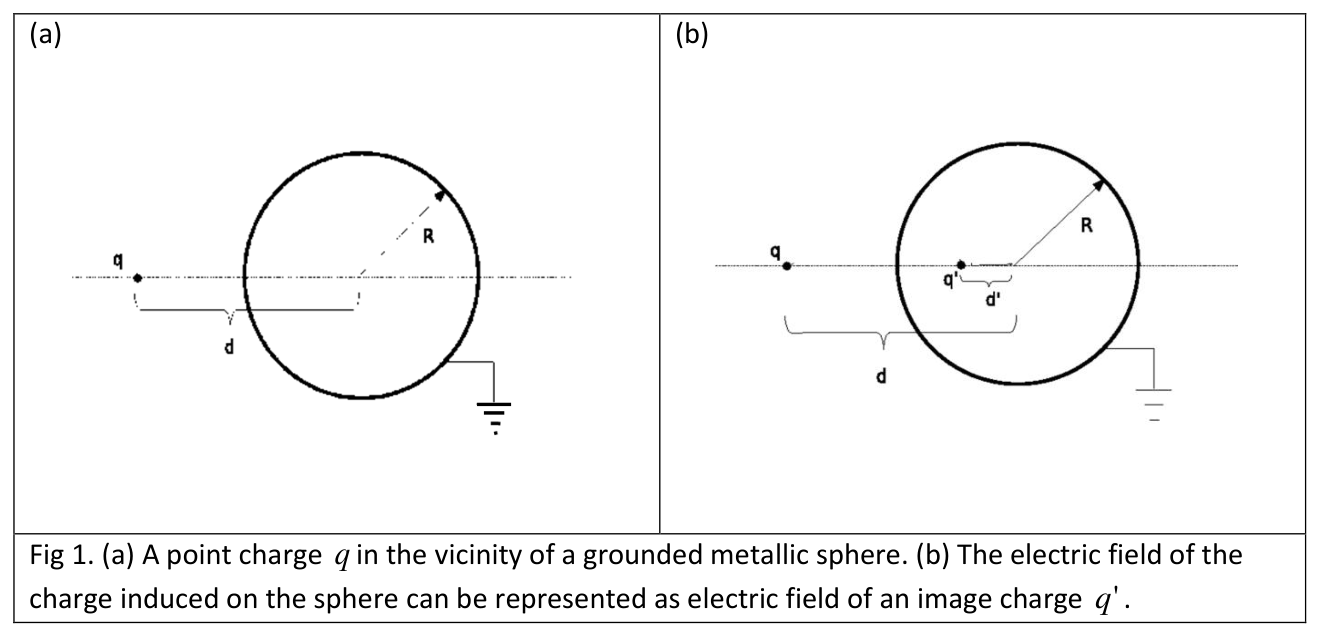
Fig 1. (a) A point charge \(q\) in the vicinity of a grounded metallic sphere. (b) The electric field of the charge induced on the sphere can be represented as electric field of an image charge \(q'\).
Task 1 – The image charge
The symmetry of the problem dictates that the charge \(q'\) should be placed on the line connecting the point charge \(q\) and the center of the sphere [see Fig. 1(b)].
a) What is the value of the potential on the sphere? (0.3 points)
b) Express \(q'\) and the distance \(d'\) of the charge \(q'\) from the center of the sphere, in terms of \(q\), \(d\), and \(R\). (1.9 points)
c) Find the magnitude of force acting on charge \(q\). Is the force repulsive? (0.5 points)
Task 2 – Shielding of an electrostatic field
Consider a point charge \(q\) placed at a distance \(d\) from the center of a grounded metallic sphere of radius \(R\). We are interested in how the grounded metallic sphere affects the electric field at point \(A\) on the opposite side of the sphere (see Fig. 2). Point \(A\) is on the line connecting charge \(q\) and the center of the sphere; its distance from the point charge \(q\) is \(r\).
a) Find the vector of the electric field at point \(A\). (0.6 points)
b) For a very large distance \(r\gg d\), find the expression for the electric field by using the approximation \((1+a)^{-2}\approx 1-2a\), where \(a\ll 1\). (0.6 points)
c) In which limit of \(d\) does the grounded metallic sphere screen the field of the charge \(q\) completely, such that the electric field at point \(A\) is exactly zero? (0.3 points)
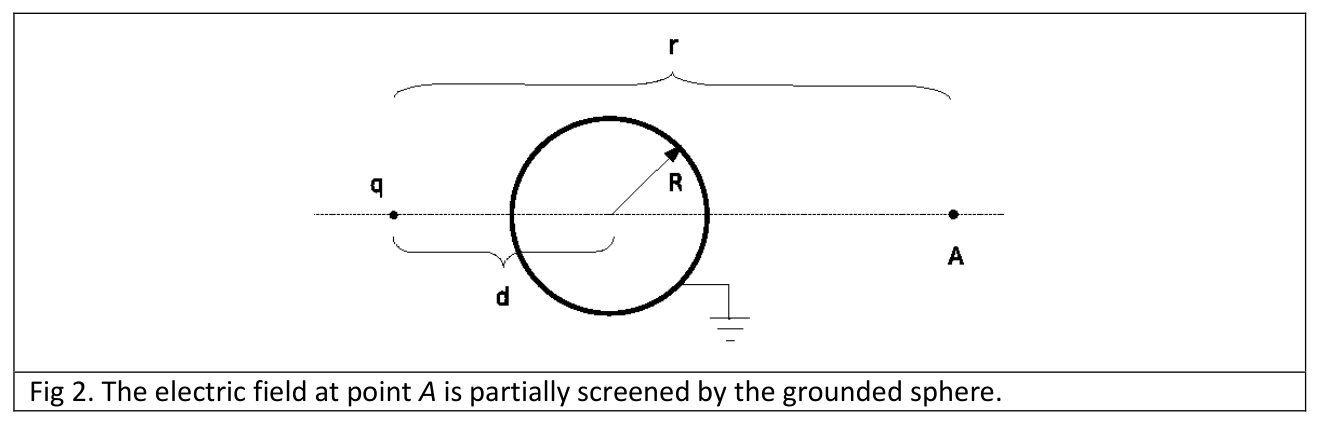
Fig 2. The electric field at point \(A\) is partially screened by the grounded sphere.
Task 3 – Small oscillations in the electric field of the grounded metallic sphere
A point charge \(q\) with mass \(m\) is suspended on a thread of length \(L\) which is attached to a wall, in the vicinity of the grounded metallic sphere. In your considerations, ignore all electrostatic effects of the wall. The point charge makes a mathematical pendulum (see Fig. 3). The point at which the thread is attached to the wall is at a distance \(l\) from the center of the sphere. Assume that the effects of gravity are negligible.
a) Find the magnitude of the electric force acting on the point charge \(q\) for a given angle \(\alpha\) and indicate the direction in a clear diagram (0.8 points)
b) Determine the component of this force acting in the direction perpendicular to the thread in terms of \(l\), \(L\), \(R\), \(q\) and \(\alpha\). (0.8 points)
c) Find the frequency for small oscillations of the pendulum. (1.0 points)
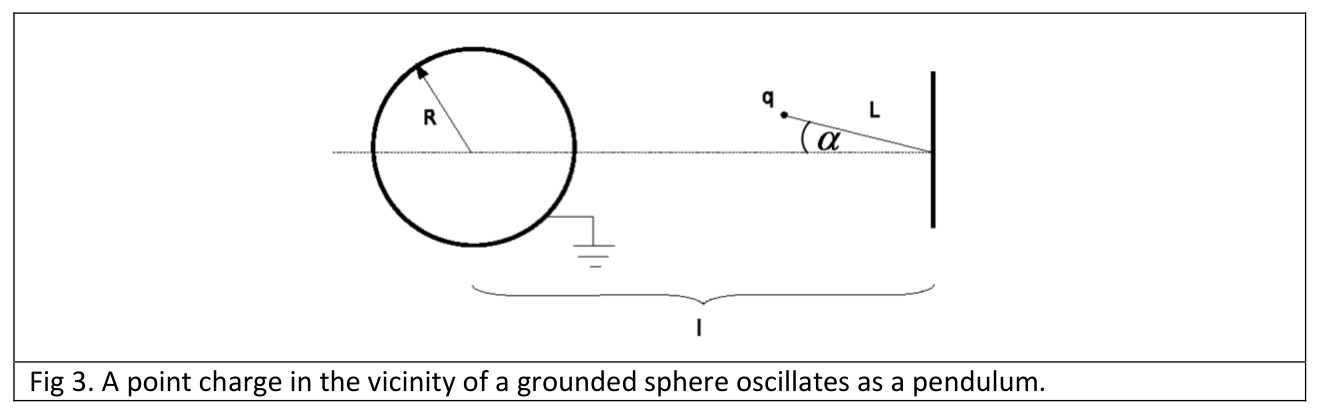
Fig 3. A point charge in the vicinity of a grounded sphere oscillates as a pendulum.
Task 4 – The electrostatic energy of the system
For a distribution of electric charges it is important to know the electrostatic energy of the system. In our problem (see Fig. 1a), there is an electrostatic interaction between the external charge \(q\) and the induced charges on the sphere, and there is an electrostatic interaction among the induced charges on the sphere themselves. In terms of the charge \(q\), radius of the sphere \(R\) and the distance \(d\) determine the following electrostatic energies:
a) the electrostatic energy of the interaction between charge \(q\) and the induced charges on the sphere; (1.0 points)
b) the electrostatic energy of the interaction among the induced charges on the sphere; (1.2 points)
c) the total electrostatic energy of the interaction in the system. (1.0 points)
Hint: There are several ways of solving this problem:
(1) In one of them, you can use the following integral,
\[ \int_d^\infty \frac{x\,dx}{(x^2-R^2)^2} =\frac{1}{2}\frac{1}{d^2-R^2}. \]
(2) In another one, you can use the fact that for a collection of \(N\) charges \(q_i\) located at points \(\vec r_i,i=1,\ldots,N\), the electrostatic energy is a sum over all pairs of charges:
\[ V=\frac{1}{2}\sum_{i=1}^{N} \sum_{\substack{j=1\\i\ne j}}^{N} \frac{1}{4\pi\varepsilon_0} \frac{q_iq_j}{|\vec r_i-\vec r_j|}. \]
Official English text of the problem.
Problem 2: Chimney physics
Introduction
Gaseous products of burning are released into the atmosphere of temperature \(T_{Air}\) through a high chimney of cross-section \(A\) and height \(h\) (see Fig. 1). The solid matter is burned in the furnace which is at temperature \(T_{Smoke}\). The volume of gases produced per unit time in the furnace is \(B\).
Assume that:
- the velocity of the gases in the furnace is negligibly small
- the density of the gases (smoke) does not differ from that of the air at the same temperature and pressure; while in furnace, the gases can be treated as ideal
- the pressure of the air changes with height in accordance with the hydrostatic law; the change of the density of the air with height is negligible
- the flow of gases fulfills the Bernoulli equation which states that the following quantity is conserved in all points of the flow:
\[ \frac{1}{2}\rho v^2(z)+\rho gz+p(z)=const, \]
where \(\rho\) is the density of the gas, \(v(z)\) is its velocity, \(p(z)\) is pressure, and \(z\) is the height - the change of the density of the gas is negligible throughout the chimney
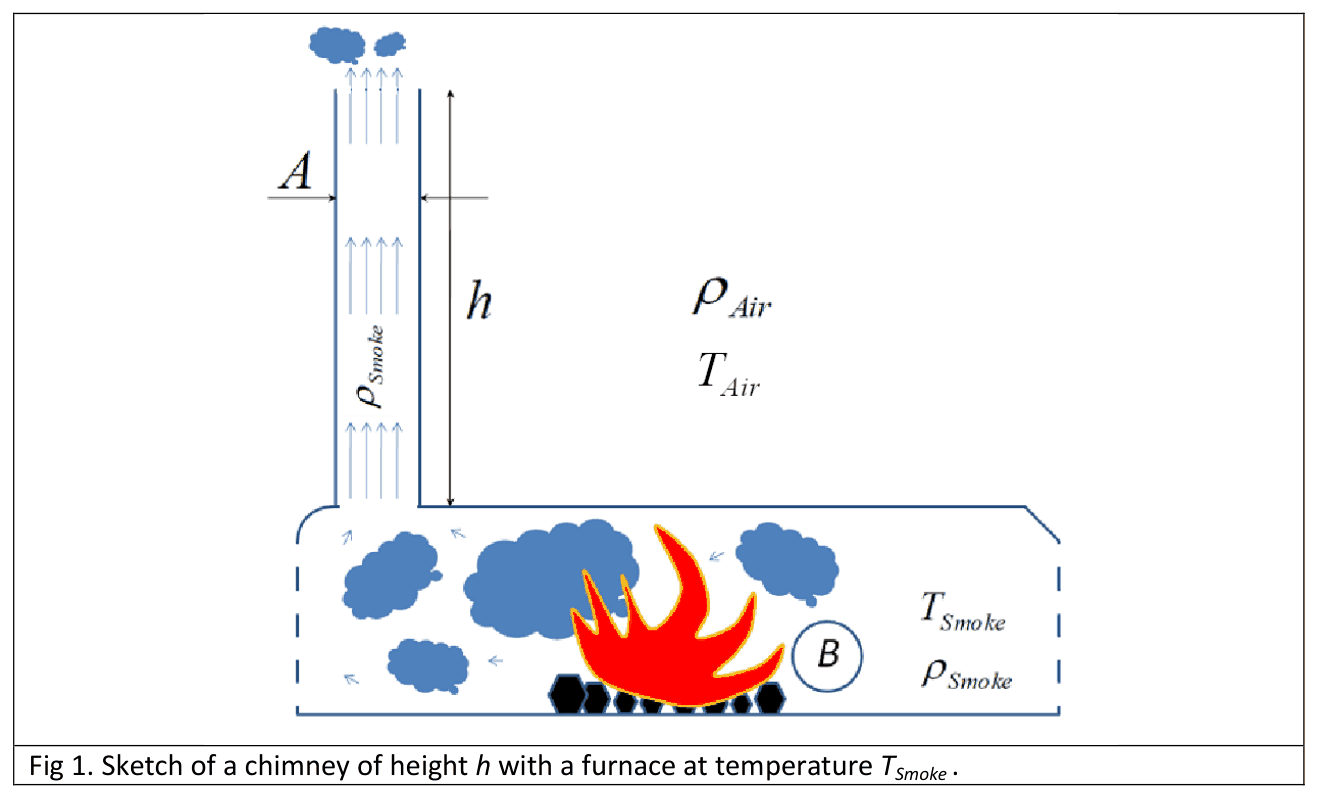
Fig 1. Sketch of a chimney of height \(h\) with a furnace at temperature \(T_{Smoke}\).
Task 1
a) What is the minimal height of the chimney needed in order that the chimney functions efficiently, so that it can release all of the produced gas into the atmosphere? Express your result in terms of \(B\), \(A\), \(T_{Air}\), \(g=9.81\,\mathrm{m/s^2}\), \(\Delta T=T_{Smoke}-T_{Air}\). Important: in all subsequent tasks assume that this minimal height is the height of the chimney. (3.5 points)
b) Assume that two chimneys are built to serve exactly the same purpose. Their cross sections are identical, but are designed to work in different parts of the world: one in cold regions, designed to work at an average atmospheric temperature of \(-30\,^\circ\mathrm{C}\) and the other in warm regions, designed to work at an average atmospheric temperature of \(30\,^\circ\mathrm{C}\). The temperature of the furnace is \(400\,^\circ\mathrm{C}\). It was calculated that the height of the chimney designed to work in cold regions is \(100\,\mathrm{m}\). How high is the other chimney? (0.5 points)
c) How does the velocity of the gases vary along the height of the chimney? Make a sketch/diagram assuming that the chimney cross-section does not change along the height. Indicate the point where the gases enter the chimney. (0.6 points)
d) How does the pressure of the gases vary along the height of the chimney? (0.5 points)
Solar power plant
The flow of gases in a chimney can be used to construct a particular kind of solar power plant (solar chimney). The idea is illustrated in Fig. 2. The Sun heats the air underneath the collector of area \(S\) with an open periphery to allow the undisturbed inflow of air (see Fig. 2). As the heated air rises through the chimney (thin solid arrows), new cold air enters the collector from its surrounding (thick dotted arrows) enabling a continuous flow of air through the power plant. The flow of air through the chimney powers a turbine, resulting in the production of electrical energy. The energy of solar radiation per unit time per unit of horizontal area of the collector is \(G\). Assume that all that energy can be used to heat the air in the collector (the mass heat capacity of the air is \(c\), and one can neglect its dependence on the air temperature). We define the efficiency of the solar chimney as the ratio of the kinetic energy of the gas flow and the solar energy absorbed in heating of the air prior to its entry into the chimney.
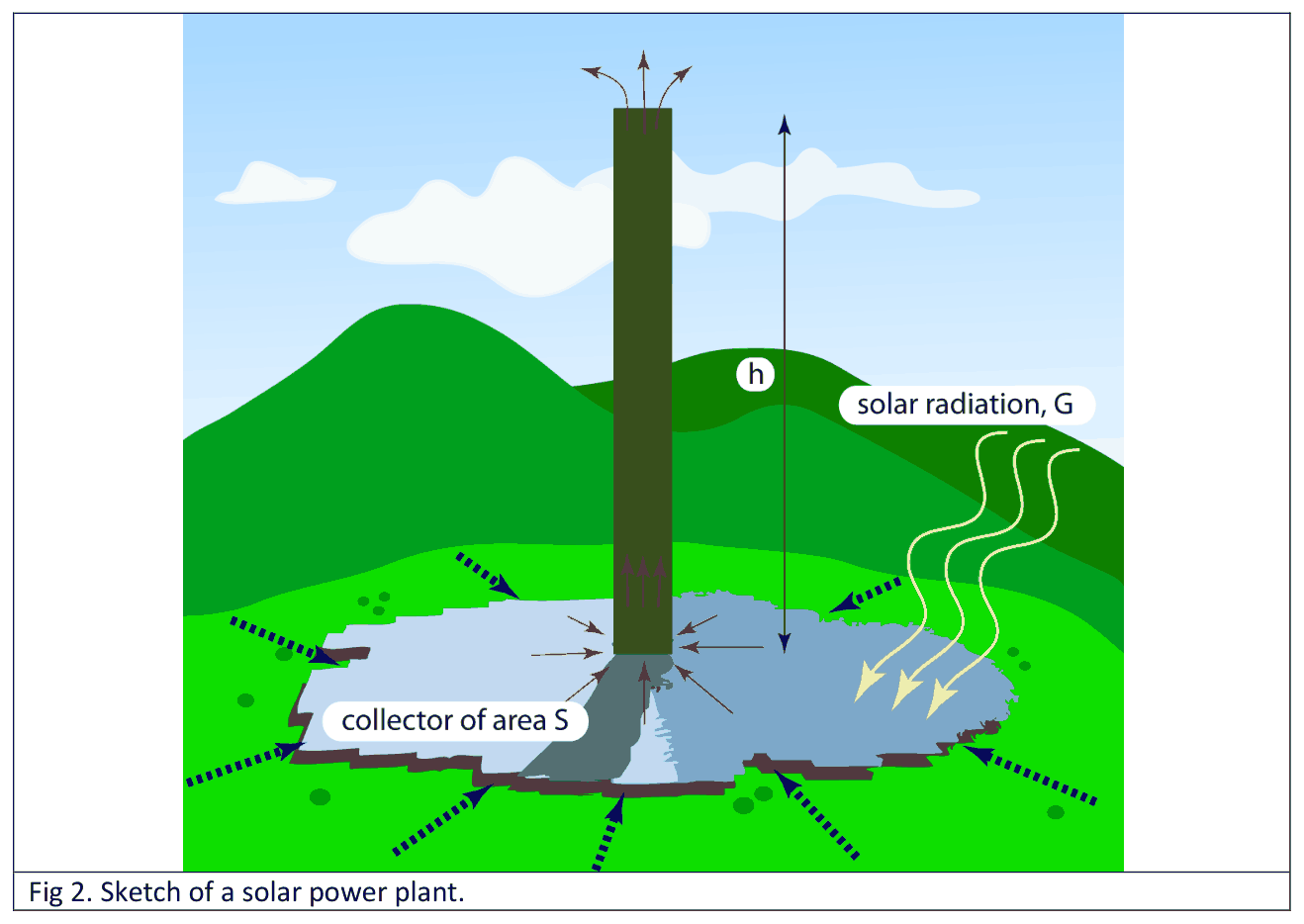
Fig 2. Sketch of a solar power plant.
Task 2
a) What is the efficiency of the solar chimney power plant? (2.0 points)
b) Make a diagram showing how the efficiency of the chimney changes with its height. (0.4 points)
Manzanares prototype
The prototype chimney built in Manzanares, Spain, had a height of \(195\,\mathrm{m}\), and a radius \(5\,\mathrm{m}\). The collector is circular with diameter of \(244\,\mathrm{m}\). The specific heat of the air under typical operational conditions of the prototype solar chimney is \(1012\,\mathrm{J/kg\,K}\), the density of the hot air is about \(0.9\,\mathrm{kg/m^3}\), and the typical temperature of the atmosphere \(T_{Air}=295\,\mathrm{K}\). In Manzanares, the solar power per unit of horizontal surface is typically \(150\,\mathrm{W/m^2}\) during a sunny day.
Task 3
a) What is the efficiency of the prototype power plant? Write down the numerical estimate. (0.3 points)
b) How much power could be produced in the prototype power plant? (0.4 points)
c) How much energy could the power plant produce during a typical sunny day? (0.3 points)
Task 4
a) How large is the rise in the air temperature as it enters the chimney (warm air) from the surrounding (cold air)? Write the general formula and evaluate it for the prototype chimney. (1.0 points)
b) What is the mass flow rate of air through the system? (0.5 points)
Official English text of the problem.
Problem 3: Simple model of an atomic nucleus
Introduction
Although atomic nuclei are quantum objects, a number of phenomenological laws for their basic properties (like radius or binding energy) can be deduced from simple assumptions: (i) nuclei are built from nucleons (i.e. protons and neutrons); (ii) strong nuclear interaction holding these nucleons together has a very short range (it acts only between neighboring nucleons); (iii) the number of protons (\(Z\)) in a given nucleus is approximately equal to the number of neutrons (\(N\)), i.e. \(Z\approx N\approx A/2\), where \(A\) is the total number of nucleons (\(A\gg1\)). Important: Use these assumptions in Tasks 1-4 below.
Task 1 - Atomic nucleus as closely packed system of nucleons
In a simple model, an atomic nucleus can be thought of as a ball consisting of closely packed nucleons [see Fig. 1(a)], where the nucleons are hard balls of radius \(r_N=0.85\ \mathrm{fm}\) (\(1\ \mathrm{fm}=10^{-15}\ \mathrm{m}\)). The nuclear force is present only for two nucleons in contact. The volume of the nucleus \(V\) is larger than the volume of all nucleons \(AV_N\), where \(V_N=\frac43r_N^3\pi\). The ratio \(f=AV_N/V\) is called the packing factor and gives the percentage of space filled by the nuclear matter.
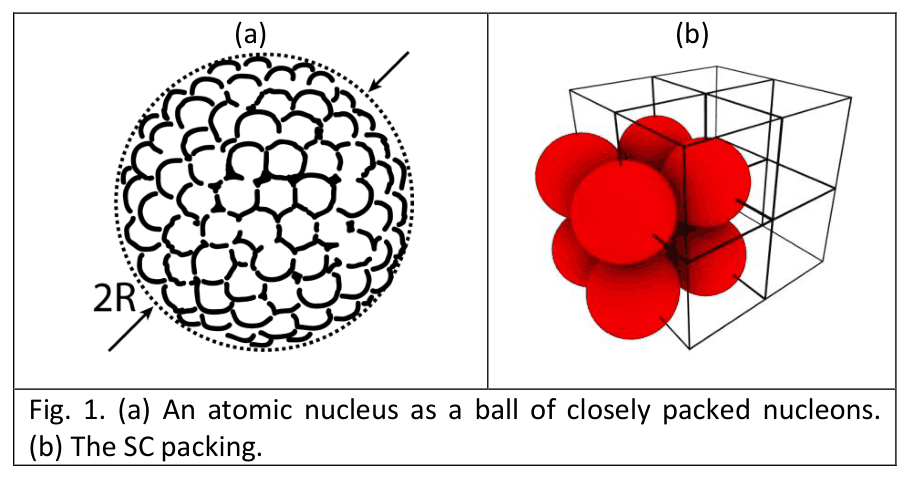
Fig. 1. (a) An atomic nucleus as a ball of closely packed nucleons. (b) The SC packing.
a) Calculate what would be the packing factor \(f\) if nucleons were arranged in a “simple cubic” (SC) crystal system, where each nucleon is centered on a lattice point of an infinite cubic lattice [see Fig. 1(b)]. (0.3 points)
Important: In all subsequent tasks, assume that the actual packing factor for nuclei is equal to the one from Task 1a. If you are not able to calculate it, in subsequent tasks use \(f=1/2\).
b) Estimate the average mass density \(\rho_m\), charge density \(\rho_c\), and the radius \(R\) for a nucleus having \(A\) nucleons. The average mass of a nucleon is \(1.67\cdot10^{-27}\ \mathrm{kg}\). (1.0 points)
Task 2 - Binding energy of atomic nuclei – volume and surface terms
Binding energy of a nucleus is the energy required to disassemble it into separate nucleons and it essentially comes from the attractive nuclear force of each nucleon with its neighbors. If a given nucleon is not on the surface of the nucleus, it contributes to the total binding energy with \(a_V=15.8\ \mathrm{MeV}\) (\(1\ \mathrm{MeV}=1.602\cdot10^{-13}\ \mathrm{J}\)). The contribution of one surface nucleon to the binding energy is approximately \(a_V/2\). Express the binding energy \(E_b\) of a nucleus with \(A\) nucleons in terms of \(A\), \(a_V\), and \(f\), and by including the surface correction. (1.9 points)
Task 3 - Electrostatic (Coulomb) effects on the binding energy
The electrostatic energy of a homogeneously charged ball (with radius \(R\) and total charge \(Q_0\)) is \[ U_c=\frac{3Q_0^2}{20\pi\varepsilon_0R}, \] where \(\varepsilon_0=8.85\cdot10^{-12}\ \mathrm{C^2N^{-1}m^{-2}}\).
a) Apply this formula to get the electrostatic energy of a nucleus. In a nucleus, each proton is not acting upon itself (by Coulomb force), but only upon the rest of the protons. One can take this into account by replacing \(Z^2\rightarrow Z(Z-1)\) in the obtained formula. Use this correction in subsequent tasks. (0.4 points)
b) Write down the complete formula for binding energy, including the main (volume) term, the surface correction term and the obtained electrostatic correction. (0.3 points)
Task 4 - Fission of heavy nuclei
Fission is a nuclear process in which a nucleus splits into smaller parts (lighter nuclei). Suppose that a nucleus with \(A\) nucleons splits into only two equal parts as depicted in Fig. 2.
a) Calculate the total kinetic energy of the fission products \(E_{\mathrm{kin}}\) when the center of two lighter nuclei are separated by the distance \(d\geq2R(A/2)\), where \(R(A/2)\) is their radius. The large nucleus was initially at rest. (1.3 points)
b) Assume that \(d=2R(A/2)\) and evaluate the expression for \(E_{\mathrm{kin}}\) obtained in part a) for \(A=100,\ 150,\ 200\) and \(250\) (express the results in units of MeV). Estimate the values of \(A\) for which fission is possible in the model described above? (1.0 points)
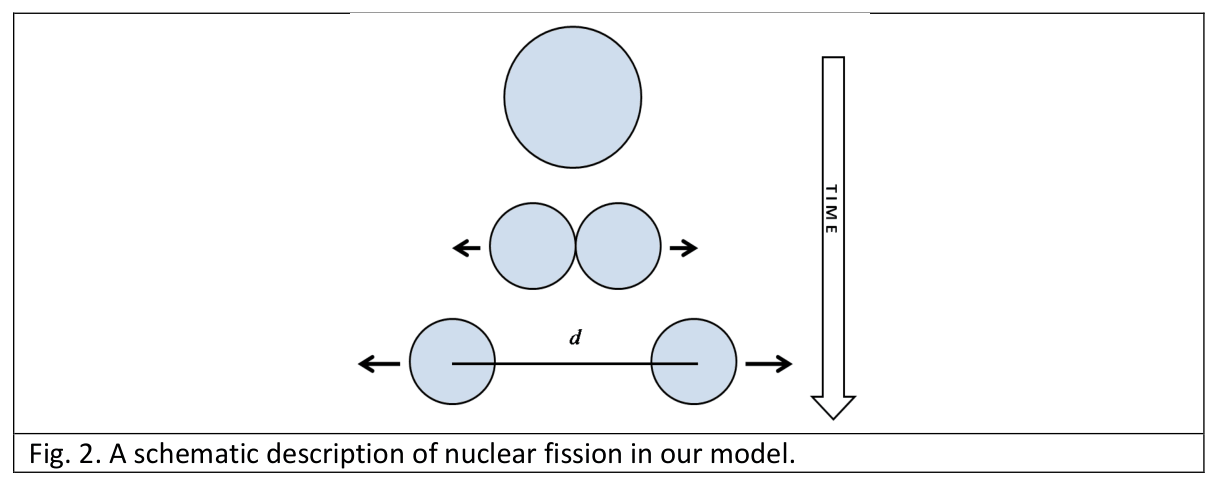
Fig. 2. A schematic description of nuclear fission in our model.
Task 5 – Transfer reactions
a) In modern physics, the energetics of nuclei and their reactions is described in terms of masses. For example, if a nucleus (with zero velocity) is in an excited state with energy \(E_{\mathrm{exc}}\) above the ground state, its mass is \(m=m_0+E_{\mathrm{exc}}/c^2\), where \(m_0\) is its mass in the ground state at rest. The nuclear reaction \({}^{16}\mathrm{O}+{}^{54}\mathrm{Fe}\rightarrow{}^{12}\mathrm{C}+{}^{58}\mathrm{Ni}\) is an example of the so-called “transfer reactions”, in which a part of one nucleus (“cluster”) is transferred to the other (see Fig. 3). In our example the transferred part is a \({}^{4}\mathrm{He}\)-cluster (\(\alpha\)-particle). The transfer reactions occur with maximum probability if the velocity of the projectile-like reaction product (in our case: \({}^{12}\mathrm{C}\)) is equal both in magnitude and direction to the velocity of projectile (in our case: \({}^{16}\mathrm{O}\)). The target \({}^{54}\mathrm{Fe}\) is initially at rest. In the reaction, \({}^{58}\mathrm{Ni}\) is excited into one of its higher-lying states. Find the excitation energy of that state (and express it units of MeV) if the kinetic energy of the projectile \({}^{16}\mathrm{O}\) is \(50\ \mathrm{MeV}\). The speed of light is \(c=3\cdot10^8\ \mathrm{m/s}\). (2.2 points)
1. \(M({}^{16}\mathrm{O})\) 15.99491 a.m.u. 2. \(M({}^{54}\mathrm{Fe})\) 53.93962 a.m.u. 3. \(M({}^{12}\mathrm{C})\) 12.00000 a.m.u. 4. \(M({}^{58}\mathrm{Ni})\) 57.93535 a.m.u. Table 1. The rest masses of the reactants in their ground states. \(1\ \mathrm{a.m.u.}=1.6605\cdot10^{-27}\ \mathrm{kg}\).
b) The \({}^{58}\mathrm{Ni}\) nucleus produced in the excited state discussed in the part a), deexcites into its ground state by emitting a gamma-photon in the direction of its motion. Consider this decay in the frame of reference in which \({}^{58}\mathrm{Ni}\) is at rest to find the recoil energy of \({}^{58}\mathrm{Ni}\) (i.e. kinetic energy which \({}^{58}\mathrm{Ni}\) acquires after the emission of the photon). What is the photon energy in that system? What is the photon energy in the lab system of reference (i.e. what would be the energy of the photon measured in the detector which is positioned in the direction in which the \({}^{58}\mathrm{Ni}\) nucleus moves)? (1.6 points)
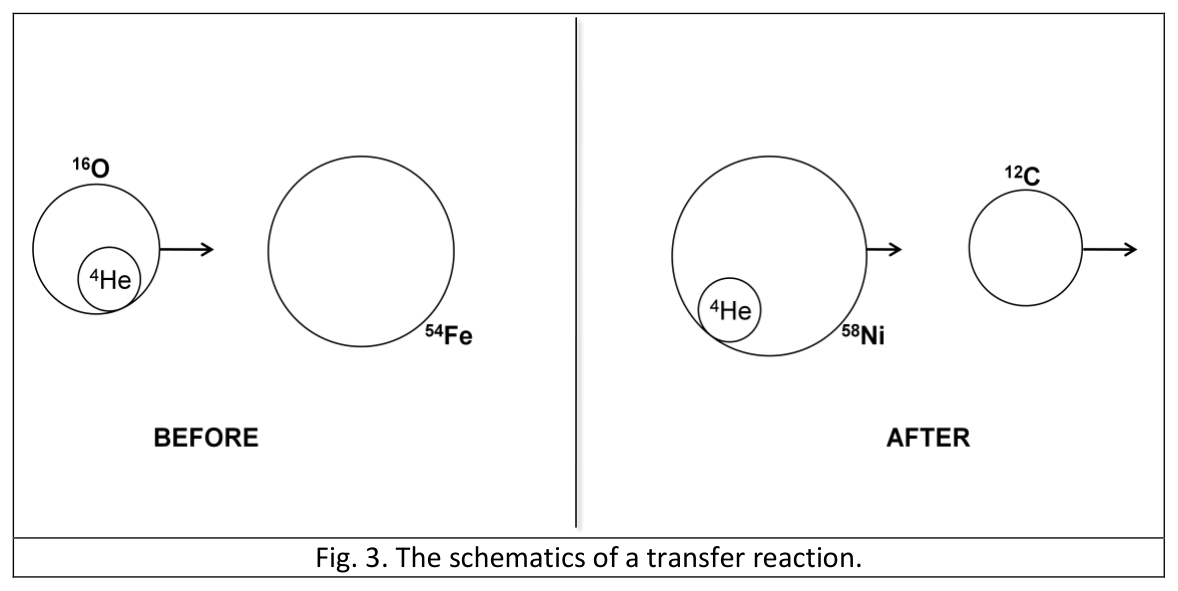
Fig. 3. The schematics of a transfer reaction.
Official English text of the problem.
Internationale Physik-Olympiade
IPhO 2010
Zagreb, Kroatien · 3 Theorieaufgaben mit vollständigen Lösungen
Aufgabe 1: Spiegelbild einer Ladung in einem metallischen Körper
Einleitung – Methode der Spiegelladungen
Eine Punktladung \(q\) wird in die Nähe einer geerdeten Metallkugel mit dem Radius \(R\) gebracht [siehe Abb. 1(a)], wodurch auf der Kugel eine Oberflächenladungsverteilung induziert wird. Das elektrische Feld und das Potential dieser Oberflächenladungsverteilung zu berechnen, ist eine anspruchsvolle Aufgabe. Die Berechnung lässt sich jedoch mithilfe der sogenannten Methode der Spiegelladungen erheblich vereinfachen. Bei dieser Methode können das elektrische Feld und das Potential der auf der Kugel verteilten Ladung durch das elektrische Feld und das Potential einer einzelnen Punktladung \(q'\) im Inneren der Kugel dargestellt werden (dies müssen Sie nicht beweisen). Hinweis: Das elektrische Feld dieser Spiegelladung \(q'\) gibt das elektrische Feld und das Potential nur außerhalb der Kugel (einschließlich ihrer Oberfläche) wieder.
Abb. 1. (a) Eine Punktladung \(q\) in der Nähe einer geerdeten Metallkugel. (b) Das elektrische Feld der auf der Kugel induzierten Ladung kann als elektrisches Feld einer Spiegelladung \(q'\) dargestellt werden.
Aufgabe 1 – Die Spiegelladung
Aus der Symmetrie des Problems folgt, dass die Ladung \(q'\) auf der Verbindungslinie zwischen der Punktladung \(q\) und dem Kugelmittelpunkt liegen muss [siehe Abb. 1(b)].
a) Welchen Wert hat das Potential auf der Kugel? (0.3 Punkte)
b) Drücken Sie \(q'\) und den Abstand \(d'\) der Ladung \(q'\) vom Kugelmittelpunkt durch \(q\), \(d\) und \(R\) aus. (1.9 Punkte)
c) Bestimmen Sie den Betrag der auf die Ladung \(q\) wirkenden Kraft. Ist die Kraft abstoßend? (0.5 Punkte)
Aufgabe 2 – Abschirmung eines elektrostatischen Feldes
Betrachten Sie eine Punktladung \(q\), die sich im Abstand \(d\) vom Mittelpunkt einer geerdeten Metallkugel mit dem Radius \(R\) befindet. Uns interessiert, wie die geerdete Metallkugel das elektrische Feld am Punkt \(A\) auf der gegenüberliegenden Seite der Kugel beeinflusst (siehe Abb. 2). Der Punkt \(A\) liegt auf der Verbindungslinie zwischen der Ladung \(q\) und dem Kugelmittelpunkt; sein Abstand von der Punktladung \(q\) beträgt \(r\).
a) Bestimmen Sie den Vektor des elektrischen Feldes am Punkt \(A\). (0.6 Punkte)
b) Bestimmen Sie für einen sehr großen Abstand \(r\gg d\) den Ausdruck für das elektrische Feld mithilfe der Näherung \((1+a)^{-2}\approx 1-2a\), wobei \(a\ll 1\) gilt. (0.6 Punkte)
c) In welchem Grenzfall für \(d\) schirmt die geerdete Metallkugel das Feld der Ladung \(q\) vollständig ab, sodass das elektrische Feld am Punkt \(A\) exakt null ist? (0.3 Punkte)
Abb. 2. Das elektrische Feld am Punkt \(A\) wird durch die geerdete Kugel teilweise abgeschirmt.
Aufgabe 3 – Kleine Schwingungen im elektrischen Feld der geerdeten Metallkugel
Eine Punktladung \(q\) mit der Masse \(m\) hängt in der Nähe der geerdeten Metallkugel an einem Faden der Länge \(L\), der an einer Wand befestigt ist. Vernachlässigen Sie bei Ihren Überlegungen alle elektrostatischen Einflüsse der Wand. Die Punktladung bildet ein mathematisches Pendel (siehe Abb. 3). Der Befestigungspunkt des Fadens an der Wand befindet sich im Abstand \(l\) vom Kugelmittelpunkt. Nehmen Sie an, dass die Schwerkraft vernachlässigbar ist.
a) Bestimmen Sie den Betrag der elektrischen Kraft, die bei einem gegebenen Winkel \(\alpha\) auf die Punktladung \(q\) wirkt, und geben Sie ihre Richtung in einer übersichtlichen Skizze an (0.8 Punkte)
b) Bestimmen Sie die Komponente dieser Kraft senkrecht zum Faden in Abhängigkeit von \(l\), \(L\), \(R\), \(q\) und \(\alpha\). (0.8 Punkte)
c) Bestimmen Sie die Frequenz kleiner Schwingungen des Pendels. (1.0 Punkte)
Abb. 3. Eine Punktladung in der Nähe einer geerdeten Kugel schwingt als Pendel.
Aufgabe 4 – Die elektrostatische Energie des Systems
Für eine Verteilung elektrischer Ladungen ist es wichtig, die elektrostatische Energie des Systems zu kennen. In unserem Problem (siehe Abb. 1a) besteht eine elektrostatische Wechselwirkung zwischen der äußeren Ladung \(q\) und den auf der Kugel induzierten Ladungen sowie eine elektrostatische Wechselwirkung der auf der Kugel induzierten Ladungen untereinander. Bestimmen Sie in Abhängigkeit von der Ladung \(q\), dem Kugelradius \(R\) und dem Abstand \(d\) die folgenden elektrostatischen Energien:
a) die elektrostatische Energie der Wechselwirkung zwischen der Ladung \(q\) und den auf der Kugel induzierten Ladungen; (1.0 Punkte)
b) die elektrostatische Energie der Wechselwirkung der auf der Kugel induzierten Ladungen untereinander; (1.2 Punkte)
c) die gesamte elektrostatische Wechselwirkungsenergie des Systems. (1.0 Punkte)
Hinweis: Es gibt mehrere Möglichkeiten, dieses Problem zu lösen:
(1) Bei einer davon können Sie das folgende Integral verwenden,
\[ \int_d^\infty \frac{x\,dx}{(x^2-R^2)^2} =\frac{1}{2}\frac{1}{d^2-R^2}. \]
(2) Bei einer anderen können Sie nutzen, dass für eine Anordnung von \(N\) Ladungen \(q_i\) an den Punkten \(\vec r_i,i=1,\ldots,N\) die elektrostatische Energie durch eine Summe über alle Ladungspaare gegeben ist:
\[ V=\frac{1}{2}\sum_{i=1}^{N} \sum_{\substack{j=1\\i\ne j}}^{N} \frac{1}{4\pi\varepsilon_0} \frac{q_iq_j}{|\vec r_i-\vec r_j|}. \]
Aufgabentext aus dem offiziellen englischen Text übersetzt.
Aufgabe 2: Physik des Schornsteins
Einleitung
Gasförmige Verbrennungsprodukte werden durch einen hohen Schornstein mit der Querschnittsfläche \(A\) und der Höhe \(h\) in die Atmosphäre mit der Temperatur \(T_{Air}\) abgeführt (siehe Abb. 1). Der Feststoff wird in einer Feuerung verbrannt, deren Temperatur \(T_{Smoke}\) beträgt. Das pro Zeiteinheit in der Feuerung erzeugte Gasvolumen ist \(B\).
Nehmen Sie an, dass:
- die Geschwindigkeit der Gase in der Feuerung vernachlässigbar klein ist
- die Dichte der Gase (Rauchgase) sich nicht von derjenigen der Luft bei gleicher Temperatur und gleichem Druck unterscheidet; in der Feuerung können die Gase als ideal betrachtet werden
- sich der Luftdruck mit der Höhe gemäß dem hydrostatischen Gesetz ändert; die Änderung der Luftdichte mit der Höhe ist vernachlässigbar
- die Gasströmung die Bernoulli-Gleichung erfüllt, die besagt, dass die folgende Größe an allen Punkten der Strömung erhalten bleibt:
\[ \frac{1}{2}\rho v^2(z)+\rho gz+p(z)=const, \]
wobei \(\rho\) die Dichte des Gases, \(v(z)\) seine Geschwindigkeit, \(p(z)\) der Druck und \(z\) die Höhe ist - die Änderung der Gasdichte im gesamten Schornstein vernachlässigbar ist
Abb. 1. Skizze eines Schornsteins der Höhe \(h\) mit einer Feuerung bei der Temperatur \(T_{Smoke}\).
Aufgabe 1
a) Welche Mindesthöhe muss der Schornstein haben, damit er wirksam funktioniert und das gesamte erzeugte Gas in die Atmosphäre abführen kann? Drücken Sie Ihr Ergebnis durch \(B\), \(A\), \(T_{Air}\), \(g=9.81\,\mathrm{m/s^2}\), \(\Delta T=T_{Smoke}-T_{Air}\) aus. Wichtig: Nehmen Sie in allen folgenden Aufgaben an, dass diese Mindesthöhe die Höhe des Schornsteins ist. (3.5 Punkte)
b) Nehmen Sie an, dass zwei Schornsteine gebaut werden, die genau denselben Zweck erfüllen sollen. Ihre Querschnittsflächen sind identisch, sie sind jedoch für den Betrieb in verschiedenen Teilen der Welt ausgelegt: einer in kalten Regionen für eine mittlere atmosphärische Temperatur von \(-30\,^\circ\mathrm{C}\) und der andere in warmen Regionen für eine mittlere atmosphärische Temperatur von \(30\,^\circ\mathrm{C}\). Die Temperatur der Feuerung beträgt \(400\,^\circ\mathrm{C}\). Für den Schornstein, der für kalte Regionen ausgelegt ist, wurde eine Höhe von \(100\,\mathrm{m}\) berechnet. Wie hoch ist der andere Schornstein? (0.5 Punkte)
c) Wie ändert sich die Geschwindigkeit der Gase mit der Höhe im Schornstein? Erstellen Sie eine Skizze/ein Diagramm unter der Annahme, dass sich die Querschnittsfläche des Schornsteins mit der Höhe nicht ändert. Kennzeichnen Sie die Stelle, an der die Gase in den Schornstein eintreten. (0.6 Punkte)
d) Wie ändert sich der Druck der Gase mit der Höhe im Schornstein? (0.5 Punkte)
Solarkraftwerk
Die Gasströmung in einem Schornstein kann zum Bau einer besonderen Art von Solarkraftwerk genutzt werden (Aufwindkraftwerk). Die Idee ist in Abb. 2 dargestellt. Die Sonne erwärmt die Luft unter einem Kollektor der Fläche \(S\), dessen Rand offen ist, um ein ungehindertes Einströmen der Luft zu ermöglichen (siehe Abb. 2). Während die erwärmte Luft durch den Schornstein aufsteigt (dünne durchgezogene Pfeile), strömt neue kalte Luft aus der Umgebung in den Kollektor ein (dicke gepunktete Pfeile), wodurch eine kontinuierliche Luftströmung durch das Kraftwerk ermöglicht wird. Die Luftströmung durch den Schornstein treibt eine Turbine an, wodurch elektrische Energie erzeugt wird. Die Energie der Sonnenstrahlung pro Zeiteinheit und pro Einheit der horizontalen Kollektorfläche ist \(G\). Nehmen Sie an, dass diese gesamte Energie zur Erwärmung der Luft im Kollektor genutzt werden kann (die spezifische Wärmekapazität der Luft ist \(c\), und ihre Abhängigkeit von der Lufttemperatur kann vernachlässigt werden). Wir definieren den Wirkungsgrad des Aufwindkraftwerks als das Verhältnis der kinetischen Energie der Gasströmung zur Sonnenenergie, die bei der Erwärmung der Luft vor ihrem Eintritt in den Schornstein absorbiert wird.
Abb. 2. Skizze eines Solarkraftwerks.
Aufgabe 2
a) Wie groß ist der Wirkungsgrad des Aufwindkraftwerks? (2.0 Punkte)
b) Erstellen Sie ein Diagramm, das zeigt, wie sich der Wirkungsgrad des Schornsteins mit seiner Höhe ändert. (0.4 Punkte)
Prototyp in Manzanares
Der in Manzanares, Spanien, errichtete Prototyp eines Schornsteins hatte eine Höhe von \(195\,\mathrm{m}\) und einen Radius von \(5\,\mathrm{m}\). Der Kollektor ist kreisförmig und hat einen Durchmesser von \(244\,\mathrm{m}\). Die spezifische Wärmekapazität der Luft unter typischen Betriebsbedingungen des Prototyps beträgt \(1012\,\mathrm{J/kg\,K}\), die Dichte der warmen Luft beträgt etwa \(0.9\,\mathrm{kg/m^3}\), und die typische Temperatur der Atmosphäre ist \(T_{Air}=295\,\mathrm{K}\). In Manzanares beträgt die Sonnenstrahlungsleistung pro Einheit der horizontalen Fläche an einem sonnigen Tag typischerweise \(150\,\mathrm{W/m^2}\).
Aufgabe 3
a) Wie groß ist der Wirkungsgrad des Prototyp-Kraftwerks? Geben Sie eine numerische Abschätzung an. (0.3 Punkte)
b) Welche Leistung könnte das Prototyp-Kraftwerk erzeugen? (0.4 Punkte)
c) Wie viel Energie könnte das Kraftwerk an einem typischen sonnigen Tag erzeugen? (0.3 Punkte)
Aufgabe 4
a) Wie groß ist die Temperaturerhöhung der Luft beim Eintritt aus der Umgebung (kalte Luft) in den Schornstein (warme Luft)? Geben Sie die allgemeine Formel an und werten Sie sie für den Prototyp-Schornstein aus. (1.0 Punkte)
b) Wie groß ist der Luftmassenstrom durch das System? (0.5 Punkte)
Aufgabentext aus dem offiziellen englischen Text übersetzt.
Aufgabe 3: Einfaches Modell eines Atomkerns
Einleitung
Obwohl Atomkerne Quantenobjekte sind, lassen sich zahlreiche phänomenologische Gesetze für ihre grundlegenden Eigenschaften (wie Radius oder Bindungsenergie) aus einfachen Annahmen ableiten: (i) Kerne bestehen aus Nukleonen (d. h. Protonen und Neutronen); (ii) die starke Kernwechselwirkung, die diese Nukleonen zusammenhält, hat eine sehr kurze Reichweite (sie wirkt nur zwischen benachbarten Nukleonen); (iii) die Anzahl der Protonen (\(Z\)) in einem gegebenen Kern ist näherungsweise gleich der Anzahl der Neutronen (\(N\)), d. h. \(Z\approx N\approx A/2\), wobei \(A\) die Gesamtzahl der Nukleonen ist (\(A\gg1\)). Wichtig: Verwenden Sie diese Annahmen in den folgenden Aufgaben 1–4.
Aufgabe 1 - Der Atomkern als dicht gepacktes System von Nukleonen
In einem einfachen Modell kann man sich einen Atomkern als eine Kugel aus dicht gepackten Nukleonen vorstellen [siehe Abb. 1(a)], wobei die Nukleonen harte Kugeln mit dem Radius \(r_N=0.85\ \mathrm{fm}\) sind (\(1\ \mathrm{fm}=10^{-15}\ \mathrm{m}\)). Die Kernkraft wirkt nur zwischen zwei Nukleonen, die sich berühren. Das Volumen des Kerns \(V\) ist größer als das Volumen aller Nukleonen \(AV_N\), wobei \(V_N=\frac43r_N^3\pi\). Das Verhältnis \(f=AV_N/V\) heißt Packungsfaktor und gibt den prozentualen Anteil des Raums an, der von Kernmaterie ausgefüllt wird.
Abb. 1. (a) Ein Atomkern als Kugel aus dicht gepackten Nukleonen. (b) Die SC-Packung.
a) Berechnen Sie den Packungsfaktor \(f\), wenn die Nukleonen in einer „einfach kubischen“ (SC) Kristallstruktur angeordnet wären, in der der Mittelpunkt jedes Nukleons auf einem Gitterpunkt eines unendlichen kubischen Gitters liegt [siehe Abb. 1(b)]. (0.3 Punkte)
Wichtig: Nehmen Sie in allen folgenden Aufgaben an, dass der tatsächliche Packungsfaktor für Kerne dem aus Aufgabe 1a entspricht. Falls Sie ihn nicht berechnen können, verwenden Sie in den folgenden Aufgaben \(f=1/2\).
b) Schätzen Sie die mittlere Massendichte \(\rho_m\), die Ladungsdichte \(\rho_c\) und den Radius \(R\) für einen Kern mit \(A\) Nukleonen ab. Die mittlere Masse eines Nukleons beträgt \(1.67\cdot10^{-27}\ \mathrm{kg}\). (1.0 Punkte)
Aufgabe 2 - Bindungsenergie von Atomkernen – Volumen- und Oberflächenterm
Die Bindungsenergie eines Kerns ist die Energie, die benötigt wird, um ihn in einzelne Nukleonen zu zerlegen. Sie beruht im Wesentlichen auf der anziehenden Kernkraft zwischen jedem Nukleon und seinen Nachbarn. Befindet sich ein Nukleon nicht an der Oberfläche des Kerns, trägt es mit \(a_V=15.8\ \mathrm{MeV}\) (\(1\ \mathrm{MeV}=1.602\cdot10^{-13}\ \mathrm{J}\)) zur gesamten Bindungsenergie bei. Der Beitrag eines Oberflächennukleons zur Bindungsenergie beträgt näherungsweise \(a_V/2\). Drücken Sie die Bindungsenergie \(E_b\) eines Kerns mit \(A\) Nukleonen durch \(A\), \(a_V\) und \(f\) aus und berücksichtigen Sie dabei die Oberflächenkorrektur. (1.9 Punkte)
Aufgabe 3 - Elektrostatische (Coulomb-)Effekte auf die Bindungsenergie
Die elektrostatische Energie einer homogen geladenen Kugel (mit Radius \(R\) und Gesamtladung \(Q_0\)) beträgt \[ U_c=\frac{3Q_0^2}{20\pi\varepsilon_0R}, \] wobei \(\varepsilon_0=8.85\cdot10^{-12}\ \mathrm{C^2N^{-1}m^{-2}}\).
a) Wenden Sie diese Formel an, um die elektrostatische Energie eines Kerns zu bestimmen. In einem Kern wirkt jedes Proton (durch die Coulombkraft) nicht auf sich selbst, sondern nur auf die übrigen Protonen. Dies lässt sich berücksichtigen, indem man in der erhaltenen Formel \(Z^2\rightarrow Z(Z-1)\) ersetzt. Verwenden Sie diese Korrektur in den folgenden Aufgaben. (0.4 Punkte)
b) Geben Sie die vollständige Formel für die Bindungsenergie an, einschließlich des Hauptterms (Volumenterms), des Oberflächenkorrekturterms und der erhaltenen elektrostatischen Korrektur. (0.3 Punkte)
Aufgabe 4 - Spaltung schwerer Kerne
Die Kernspaltung ist ein Kernprozess, bei dem sich ein Kern in kleinere Teile (leichtere Kerne) aufspaltet. Nehmen Sie an, dass sich ein Kern mit \(A\) Nukleonen in nur zwei gleich große Teile aufspaltet, wie in Abb. 2 dargestellt.
a) Berechnen Sie die gesamte kinetische Energie der Spaltprodukte \(E_{\mathrm{kin}}\), wenn die Mittelpunkte der beiden leichteren Kerne den Abstand \(d\geq2R(A/2)\) voneinander haben, wobei \(R(A/2)\) ihr Radius ist. Der große Kern befand sich anfangs in Ruhe. (1.3 Punkte)
b) Nehmen Sie \(d=2R(A/2)\) an und werten Sie den in Teil a) erhaltenen Ausdruck für \(E_{\mathrm{kin}}\) für \(A=100,\ 150,\ 200\) und \(250\) aus (geben Sie die Ergebnisse in MeV an). Schätzen Sie ab, für welche Werte von \(A\) eine Spaltung in dem oben beschriebenen Modell möglich ist. (1.0 Punkte)
Abb. 2. Schematische Darstellung der Kernspaltung in unserem Modell.
Aufgabe 5 – Transferreaktionen
a) In der modernen Physik wird die Energiebilanz von Kernen und ihren Reaktionen mithilfe von Massen beschrieben. Befindet sich beispielsweise ein Kern (mit der Geschwindigkeit null) in einem angeregten Zustand mit der Energie \(E_{\mathrm{exc}}\) oberhalb des Grundzustands, so beträgt seine Masse \(m=m_0+E_{\mathrm{exc}}/c^2\), wobei \(m_0\) seine Masse im ruhenden Grundzustand ist. Die Kernreaktion \({}^{16}\mathrm{O}+{}^{54}\mathrm{Fe}\rightarrow{}^{12}\mathrm{C}+{}^{58}\mathrm{Ni}\) ist ein Beispiel für die sogenannten „Transferreaktionen“, bei denen ein Teil eines Kerns („Cluster“) auf den anderen übertragen wird (siehe Abb. 3). In unserem Beispiel ist der übertragene Teil ein \({}^{4}\mathrm{He}\)-Cluster (\(\alpha\)-Teilchen). Transferreaktionen treten mit maximaler Wahrscheinlichkeit auf, wenn die Geschwindigkeit des projektilähnlichen Reaktionsprodukts (in unserem Fall: \({}^{12}\mathrm{C}\)) sowohl im Betrag als auch in der Richtung mit der Geschwindigkeit des Projektils (in unserem Fall: \({}^{16}\mathrm{O}\)) übereinstimmt. Das Target \({}^{54}\mathrm{Fe}\) befindet sich anfangs in Ruhe. Bei der Reaktion wird \({}^{58}\mathrm{Ni}\) in einen seiner höher liegenden Zustände angeregt. Bestimmen Sie die Anregungsenergie dieses Zustands (und geben Sie sie in MeV an), wenn die kinetische Energie des Projektils \({}^{16}\mathrm{O}\) gleich \(50\ \mathrm{MeV}\) ist. Die Lichtgeschwindigkeit beträgt \(c=3\cdot10^8\ \mathrm{m/s}\). (2.2 Punkte)
1. \(M({}^{16}\mathrm{O})\) 15.99491 a.m.u. 2. \(M({}^{54}\mathrm{Fe})\) 53.93962 a.m.u. 3. \(M({}^{12}\mathrm{C})\) 12.00000 a.m.u. 4. \(M({}^{58}\mathrm{Ni})\) 57.93535 a.m.u. Tabelle 1. Die Ruhemassen der Reaktionsteilnehmer in ihren Grundzuständen. \(1\ \mathrm{a.m.u.}=1.6605\cdot10^{-27}\ \mathrm{kg}\).
b) Der im angeregten Zustand aus Teil a) erzeugte \({}^{58}\mathrm{Ni}\)-Kern geht durch Emission eines Gammaphotons in seiner Bewegungsrichtung in den Grundzustand über. Betrachten Sie diesen Zerfall in dem Bezugssystem, in dem \({}^{58}\mathrm{Ni}\) ruht, und bestimmen Sie die Rückstoßenergie von \({}^{58}\mathrm{Ni}\) (d. h. die kinetische Energie, die \({}^{58}\mathrm{Ni}\) nach der Emission des Photons erhält). Wie groß ist die Photonenenergie in diesem System? Wie groß ist die Photonenenergie im Laborsystem (d. h. welche Photonenenergie würde ein Detektor messen, der in der Bewegungsrichtung des \({}^{58}\mathrm{Ni}\)-Kerns aufgestellt ist)? (1.6 Punkte)
Abb. 3. Schematische Darstellung einer Transferreaktion.
Aufgabentext aus dem offiziellen englischen Text übersetzt.
Uluslararası Fizik Olimpiyatı
IPhO 2010
Zagreb, Hırvatistan · 3 teori sorusu, tam çözümleriyle
Soru 1: Metal bir cisimdeki yükün görüntüsü
Giriş – Görüntü yük yöntemi
Yarıçapı \(R\) olan topraklanmış metal bir kürenin yakınına bir \(q\) noktasal yükü yerleştirilir [bkz. Şekil 1(a)] ve bunun sonucunda küre üzerinde bir yüzey yük dağılımı indüklenir. Yüzey yük dağılımının oluşturduğu elektrik alanı ve potansiyeli hesaplamak oldukça güçtür. Ancak görüntü yük yöntemi adı verilen yöntem kullanılarak hesaplama önemli ölçüde basitleştirilebilir. Bu yöntemde, küre üzerinde dağılmış yükün oluşturduğu elektrik alan ve potansiyel, kürenin içine yerleştirilmiş tek bir \(q'\) noktasal yükünün elektrik alanı ve potansiyeli ile temsil edilebilir (bunu kanıtlamanız gerekmiyor). Not: Bu \(q'\) görüntü yükünün elektrik alanı, elektrik alanı ve potansiyeli yalnızca kürenin dışında (yüzeyi de dâhil olmak üzere) doğru olarak verir.
Şekil 1. (a) Topraklanmış metal bir kürenin yakınındaki bir \(q\) noktasal yükü. (b) Küre üzerinde indüklenen yükün elektrik alanı, bir \(q'\) görüntü yükünün elektrik alanı ile temsil edilebilir.
Görev 1 – Görüntü yük
Problemin simetrisi, \(q'\) yükünün \(q\) noktasal yükü ile kürenin merkezini birleştiren doğru üzerine yerleştirilmesini gerektirir [bkz. Şekil 1(b)].
a) Kürenin üzerindeki potansiyelin değeri nedir? (0.3 puan)
b) \(q'\) yükünü ve \(q'\) yükünün kürenin merkezine olan \(d'\) uzaklığını \(q\), \(d\) ve \(R\) cinsinden ifade ediniz. (1.9 puan)
c) \(q\) yüküne etki eden kuvvetin büyüklüğünü bulunuz. Kuvvet itici midir? (0.5 puan)
Görev 2 – Elektrostatik alanın perdelenmesi
Yarıçapı \(R\) olan topraklanmış metal bir kürenin merkezinden \(d\) uzaklığa yerleştirilmiş bir \(q\) noktasal yükünü ele alınız. Topraklanmış metal kürenin, kürenin karşı tarafındaki \(A\) noktasında elektrik alanı nasıl etkilediğini incelemek istiyoruz (bkz. Şekil 2). \(A\) noktası, \(q\) yükü ile kürenin merkezini birleştiren doğru üzerindedir; \(q\) noktasal yüküne olan uzaklığı \(r\)'dir.
a) \(A\) noktasındaki elektrik alan vektörünü bulunuz. (0.6 puan)
b) Çok büyük bir \(r\gg d\) uzaklığı için, \(a\ll 1\) olmak üzere \((1+a)^{-2}\approx 1-2a\) yaklaşımını kullanarak elektrik alanın ifadesini bulunuz. (0.6 puan)
c) \(d\)'nin hangi limitinde topraklanmış metal küre, \(q\) yükünün alanını tamamen perdeler ve böylece \(A\) noktasındaki elektrik alan tam olarak sıfır olur? (0.3 puan)
Şekil 2. \(A\) noktasındaki elektrik alan, topraklanmış küre tarafından kısmen perdelenir.
Görev 3 – Topraklanmış metal kürenin elektrik alanında küçük salınımlar
Kütlesi \(m\) olan bir \(q\) noktasal yükü, topraklanmış metal kürenin yakınında, bir duvara tutturulmuş \(L\) uzunluğundaki bir ipe asılmıştır. İncelemenizde duvarın tüm elektrostatik etkilerini ihmal ediniz. Noktasal yük bir basit sarkaç oluşturur (bkz. Şekil 3). İpin duvara tutturulduğu nokta, kürenin merkezinden \(l\) uzaklıktadır. Yerçekimi etkilerinin ihmal edilebilir olduğunu varsayınız.
a) Verilen bir \(\alpha\) açısı için \(q\) noktasal yüküne etki eden elektriksel kuvvetin büyüklüğünü bulunuz ve yönünü açık bir çizimde gösteriniz (0.8 puan)
b) Bu kuvvetin ipe dik doğrultudaki bileşenini \(l\), \(L\), \(R\), \(q\) ve \(\alpha\) cinsinden belirleyiniz. (0.8 puan)
c) Sarkacın küçük salınımlarının frekansını bulunuz. (1.0 puan)
Şekil 3. Topraklanmış bir kürenin yakınındaki noktasal yük, bir sarkaç gibi salınır.
Görev 4 – Sistemin elektrostatik enerjisi
Bir elektrik yük dağılımı için sistemin elektrostatik enerjisini bilmek önemlidir. Problemimizde (bkz. Şekil 1a), dışarıdaki \(q\) yükü ile küre üzerinde indüklenen yükler arasında bir elektrostatik etkileşim ve küre üzerinde indüklenen yüklerin kendi aralarında da bir elektrostatik etkileşim vardır. \(q\) yükü, kürenin \(R\) yarıçapı ve \(d\) uzaklığı cinsinden aşağıdaki elektrostatik enerjileri belirleyiniz:
a) \(q\) yükü ile küre üzerinde indüklenen yükler arasındaki etkileşimin elektrostatik enerjisi; (1.0 puan)
b) küre üzerinde indüklenen yüklerin kendi aralarındaki etkileşimin elektrostatik enerjisi; (1.2 puan)
c) sistemdeki etkileşimin toplam elektrostatik enerjisi. (1.0 puan)
İpucu: Bu problemi çözmenin birkaç yolu vardır:
(1) Bunlardan birinde aşağıdaki integrali kullanabilirsiniz,
\[ \int_d^\infty \frac{x\,dx}{(x^2-R^2)^2} =\frac{1}{2}\frac{1}{d^2-R^2}. \]
(2) Bir diğerinde, \(\vec r_i,i=1,\ldots,N\) noktalarında bulunan \(N\) adet \(q_i\) yükünden oluşan bir topluluğun elektrostatik enerjisinin, tüm yük çiftleri üzerinden alınan bir toplam olduğu gerçeğini kullanabilirsiniz:
\[ V=\frac{1}{2}\sum_{i=1}^{N} \sum_{\substack{j=1\\i\ne j}}^{N} \frac{1}{4\pi\varepsilon_0} \frac{q_iq_j}{|\vec r_i-\vec r_j|}. \]
Soru metni resmi İngilizce metinden çevrilmiştir.
Soru 2: Baca fiziği
Giriş
Yanma sonucu oluşan gazlar, kesit alanı \(A\) ve yüksekliği \(h\) olan yüksek bir bacadan, sıcaklığı \(T_{Air}\) olan atmosfere salınmaktadır (bkz. Şekil 1). Katı madde, sıcaklığı \(T_{Smoke}\) olan ocakta yakılmaktadır. Ocakta birim zamanda üretilen gazların hacmi \(B\)'dir.
Şunları varsayın:
- ocaktaki gazların hızı ihmal edilebilecek kadar küçüktür
- gazların (dumanın) yoğunluğu, aynı sıcaklık ve basınçtaki havanın yoğunluğundan farklı değildir; gazlar ocaktayken ideal gaz olarak ele alınabilir
- havanın basıncı, hidrostatik yasasına uygun olarak yükseklikle değişir; havanın yoğunluğunun yükseklikle değişimi ihmal edilebilir
- gaz akışı, aşağıdaki büyüklüğün akışın tüm noktalarında korunduğunu ifade eden Bernoulli denklemini sağlar:
\[ \frac{1}{2}\rho v^2(z)+\rho gz+p(z)=const, \]
burada \(\rho\) gazın yoğunluğu, \(v(z)\) hızı, \(p(z)\) basıncı ve \(z\) yüksekliğidir - gazın yoğunluğundaki değişim baca boyunca ihmal edilebilir
Şekil 1. Sıcaklığı \(T_{Smoke}\) olan bir ocağa bağlı, yüksekliği \(h\) olan bacanın şeması.
Görev 1
a) Bacanın etkin biçimde çalışarak üretilen gazın tamamını atmosfere salabilmesi için gereken en küçük baca yüksekliği nedir? Sonucunuzu \(B\), \(A\), \(T_{Air}\), \(g=9.81\,\mathrm{m/s^2}\), \(\Delta T=T_{Smoke}-T_{Air}\) cinsinden ifade edin. Önemli: sonraki tüm görevlerde baca yüksekliğinin bu en küçük yükseklik olduğunu varsayın. (3.5 puan)
b) Tam olarak aynı amaca hizmet etmek üzere iki baca inşa edildiğini varsayın. Kesit alanları aynıdır, ancak dünyanın farklı bölgelerinde çalışacak biçimde tasarlanmışlardır: biri soğuk bölgelerde, ortalama atmosfer sıcaklığı \(-30\,^\circ\mathrm{C}\) iken çalışacak şekilde; diğeri ise sıcak bölgelerde, ortalama atmosfer sıcaklığı \(30\,^\circ\mathrm{C}\) iken çalışacak şekilde tasarlanmıştır. Ocağın sıcaklığı \(400\,^\circ\mathrm{C}\)'dir. Soğuk bölgelerde çalışmak üzere tasarlanan bacanın yüksekliği \(100\,\mathrm{m}\) olarak hesaplanmıştır. Diğer bacanın yüksekliği ne kadardır? (0.5 puan)
c) Gazların hızı baca yüksekliği boyunca nasıl değişir? Baca kesitinin yükseklik boyunca değişmediğini varsayarak bir çizim/grafik hazırlayın. Gazların bacaya girdiği noktayı belirtin. (0.6 puan)
d) Gazların basıncı baca yüksekliği boyunca nasıl değişir? (0.5 puan)
Güneş enerjisi santrali
Bir bacadaki gaz akışı, özel bir tür güneş enerjisi santrali (güneş bacası) yapmak için kullanılabilir. Bu fikir Şekil 2'de gösterilmiştir. Güneş, havanın engellenmeden içeri akmasına olanak vermek için çevresi açık bırakılmış, alanı \(S\) olan kolektörün altındaki havayı ısıtır (bkz. Şekil 2). Isınan hava bacadan yükselirken (ince düz çizgili oklar), çevreden kolektöre yeni soğuk hava girer (kalın noktalı oklar) ve böylece santral boyunca sürekli bir hava akışı sağlanır. Bacadan geçen hava akışı bir türbini çalıştırarak elektrik enerjisi üretilmesini sağlar. Kolektörün birim yatay alanına birim zamanda gelen güneş ışınımı enerjisi \(G\)'dir. Bu enerjinin tamamının kolektördeki havayı ısıtmak için kullanılabildiğini varsayın (havanın özgül ısı kapasitesi \(c\)'dir ve bunun hava sıcaklığına bağımlılığı ihmal edilebilir). Güneş bacasının verimini, gaz akışının kinetik enerjisinin, hava bacaya girmeden önce onu ısıtmak için soğurulan güneş enerjisine oranı olarak tanımlıyoruz.
Şekil 2. Bir güneş enerjisi santralinin şeması.
Görev 2
a) Güneş bacası santralinin verimi nedir? (2.0 puan)
b) Bacanın veriminin yüksekliğiyle nasıl değiştiğini gösteren bir grafik çizin. (0.4 puan)
Manzanares prototipi
İspanya'nın Manzanares kentinde inşa edilen prototip bacanın yüksekliği \(195\,\mathrm{m}\), yarıçapı ise \(5\,\mathrm{m}\) idi. Kolektör, çapı \(244\,\mathrm{m}\) olan dairesel bir yapıdır. Prototip güneş bacasının tipik çalışma koşullarında havanın özgül ısısı \(1012\,\mathrm{J/kg\,K}\), sıcak havanın yoğunluğu yaklaşık \(0.9\,\mathrm{kg/m^3}\) ve atmosferin tipik sıcaklığı \(T_{Air}=295\,\mathrm{K}\)'dir. Manzanares'te güneşli bir günde birim yatay yüzeye gelen güneş enerjisi gücü tipik olarak \(150\,\mathrm{W/m^2}\)'dir.
Görev 3
a) Prototip santralin verimi nedir? Sayısal tahmini yazın. (0.3 puan)
b) Prototip santralde ne kadar güç üretilebilir? (0.4 puan)
c) Santral, tipik bir güneşli gün boyunca ne kadar enerji üretebilir? (0.3 puan)
Görev 4
a) Hava çevreden (soğuk hava) bacaya (sıcak hava) girerken sıcaklığı ne kadar artar? Genel formülü yazın ve prototip baca için değerini hesaplayın. (1.0 puan)
b) Sistemden geçen havanın kütlesel debisi nedir? (0.5 puan)
Soru metni resmi İngilizce metinden çevrilmiştir.
Soru 3: Atom çekirdeğinin basit bir modeli
Giriş
Atom çekirdekleri kuantum nesneleri olmasına rağmen, temel özelliklerine (yarıçap veya bağlanma enerjisi gibi) ilişkin bir dizi fenomenolojik yasa basit varsayımlardan türetilebilir: (i) çekirdekler nükleonlardan (yani proton ve nötronlardan) oluşur; (ii) bu nükleonları bir arada tutan güçlü nükleer etkileşimin menzili çok kısadır (yalnızca komşu nükleonlar arasında etkir); (iii) belirli bir çekirdekteki proton sayısı (\(Z\)), nötron sayısına (\(N\)) yaklaşık olarak eşittir; yani \(Z\approx N\approx A/2\); burada \(A\), toplam nükleon sayısıdır (\(A\gg1\)). Önemli: Aşağıdaki Görev 1-4'te bu varsayımları kullanın.
Görev 1 - Sıkı paketlenmiş bir nükleon sistemi olarak atom çekirdeği
Basit bir modelde atom çekirdeği, sıkı paketlenmiş nükleonlardan oluşan bir küre olarak düşünülebilir [bkz. Şekil 1(a)]; burada nükleonlar, yarıçapı \(r_N=0.85\ \mathrm{fm}\) olan sert kürelerdir (\(1\ \mathrm{fm}=10^{-15}\ \mathrm{m}\)). Nükleer kuvvet yalnızca birbirine temas eden iki nükleon arasında bulunur. Çekirdeğin hacmi \(V\), tüm nükleonların toplam hacmi \(AV_N\)'den büyüktür; burada \(V_N=\frac43r_N^3\pi\). \(f=AV_N/V\) oranına paketleme faktörü denir ve bu oran, uzayın nükleer maddeyle dolu olan yüzdesini verir.
Şekil 1. (a) Sıkı paketlenmiş nükleonlardan oluşan bir küre olarak atom çekirdeği. (b) SC paketleme.
a) Nükleonlar, her bir nükleonun merkezi sonsuz bir kübik örgünün bir örgü noktasında olacak şekilde “basit kübik” (SC) kristal sisteminde dizilseydi, paketleme faktörünün \(f\) ne olacağını hesaplayın [bkz. Şekil 1(b)]. (0.3 puan)
Önemli: Sonraki tüm görevlerde, çekirdeklerin gerçek paketleme faktörünün Görev 1a'da bulunan değere eşit olduğunu varsayın. Bu değeri hesaplayamazsanız, sonraki görevlerde \(f=1/2\) kullanın.
b) \(A\) nükleon içeren bir çekirdeğin ortalama kütle yoğunluğunu \(\rho_m\), yük yoğunluğunu \(\rho_c\) ve yarıçapını \(R\) tahmin edin. Bir nükleonun ortalama kütlesi \(1.67\cdot10^{-27}\ \mathrm{kg}\)'dır. (1.0 puan)
Görev 2 - Atom çekirdeklerinin bağlanma enerjisi – hacim ve yüzey terimleri
Bir çekirdeğin bağlanma enerjisi, onu ayrı nükleonlara ayırmak için gereken enerjidir ve esas olarak her bir nükleon ile komşuları arasındaki çekici nükleer kuvvetten kaynaklanır. Bir nükleon çekirdeğin yüzeyinde değilse, toplam bağlanma enerjisine \(a_V=15.8\ \mathrm{MeV}\) katkıda bulunur (\(1\ \mathrm{MeV}=1.602\cdot10^{-13}\ \mathrm{J}\)). Bir yüzey nükleonunun bağlanma enerjisine katkısı yaklaşık \(a_V/2\)'dir. \(A\) nükleon içeren bir çekirdeğin bağlanma enerjisini \(E_b\), yüzey düzeltmesini de dahil ederek \(A\), \(a_V\) ve \(f\) cinsinden ifade edin. (1.9 puan)
Görev 3 - Bağlanma enerjisi üzerindeki elektrostatik (Coulomb) etkiler
Homojen yüklü bir kürenin (yarıçapı \(R\) ve toplam yükü \(Q_0\)) elektrostatik enerjisi \[ U_c=\frac{3Q_0^2}{20\pi\varepsilon_0R}, \] ile verilir; burada \(\varepsilon_0=8.85\cdot10^{-12}\ \mathrm{C^2N^{-1}m^{-2}}\).
a) Bir çekirdeğin elektrostatik enerjisini elde etmek için bu formülü uygulayın. Bir çekirdekte her proton, (Coulomb kuvvetiyle) kendisine değil, yalnızca diğer protonlara etkir. Elde edilen formülde \(Z^2\rightarrow Z(Z-1)\) değişimi yapılarak bu durum hesaba katılabilir. Sonraki görevlerde bu düzeltmeyi kullanın. (0.4 puan)
b) Ana (hacim) terimi, yüzey düzeltmesi terimini ve elde edilen elektrostatik düzeltmeyi içeren tam bağlanma enerjisi formülünü yazın. (0.3 puan)
Görev 4 - Ağır çekirdeklerin fisyonu
Fisyon, bir çekirdeğin daha küçük parçalara (daha hafif çekirdeklere) bölündüğü nükleer bir süreçtir. \(A\) nükleon içeren bir çekirdeğin, Şekil 2'de gösterildiği gibi yalnızca iki eşit parçaya bölündüğünü varsayın.
a) İki hafif çekirdeğin merkezleri arasındaki uzaklık \(d\geq2R(A/2)\) olduğunda fisyon ürünlerinin toplam kinetik enerjisini \(E_{\mathrm{kin}}\) hesaplayın; burada \(R(A/2)\), bu çekirdeklerin yarıçapıdır. Büyük çekirdek başlangıçta durgundur. (1.3 puan)
b) \(d=2R(A/2)\) olduğunu varsayın ve a) kısmında elde edilen \(E_{\mathrm{kin}}\) ifadesini \(A=100,\ 150,\ 200\) ve \(250\) için hesaplayın (sonuçları MeV biriminde ifade edin). Yukarıda açıklanan modelde fisyonun mümkün olduğu \(A\) değerlerini tahmin edin. (1.0 puan)
Şekil 2. Modelimizdeki nükleer fisyonun şematik gösterimi.
Görev 5 – Transfer tepkimeleri
a) Modern fizikte çekirdeklerin ve tepkimelerinin enerji özellikleri kütleler cinsinden betimlenir. Örneğin, bir çekirdek (hızı sıfırken) temel durumun \(E_{\mathrm{exc}}\) kadar üzerinde bir enerjiye sahip uyarılmış bir durumdaysa, kütlesi \(m=m_0+E_{\mathrm{exc}}/c^2\) olur; burada \(m_0\), çekirdeğin durgunken temel durumdaki kütlesidir. \({}^{16}\mathrm{O}+{}^{54}\mathrm{Fe}\rightarrow{}^{12}\mathrm{C}+{}^{58}\mathrm{Ni}\) nükleer tepkimesi, bir çekirdeğin bir bölümünün (“küme”) diğerine aktarıldığı, “transfer tepkimeleri” olarak adlandırılan tepkimelere bir örnektir (bkz. Şekil 3). Örneğimizde aktarılan bölüm bir \({}^{4}\mathrm{He}\) kümesidir (\(\alpha\) parçacığı). Gelen çekirdeğe benzer tepkime ürününün (bizim durumumuzda: \({}^{12}\mathrm{C}\)) hızı, gelen çekirdeğin (bizim durumumuzda: \({}^{16}\mathrm{O}\)) hızına hem büyüklük hem de yön bakımından eşit olduğunda, transfer tepkimeleri en yüksek olasılıkla gerçekleşir. Hedef \({}^{54}\mathrm{Fe}\) başlangıçta durgundur. Tepkimede \({}^{58}\mathrm{Ni}\), daha yüksek enerjili durumlarından birine uyarılır. Gelen \({}^{16}\mathrm{O}\) çekirdeğinin kinetik enerjisi \(50\ \mathrm{MeV}\) ise, bu durumun uyarılma enerjisini bulun (ve MeV biriminde ifade edin). Işık hızı \(c=3\cdot10^8\ \mathrm{m/s}\)'dir. (2.2 puan)
1. \(M({}^{16}\mathrm{O})\) 15.99491 a.m.u. 2. \(M({}^{54}\mathrm{Fe})\) 53.93962 a.m.u. 3. \(M({}^{12}\mathrm{C})\) 12.00000 a.m.u. 4. \(M({}^{58}\mathrm{Ni})\) 57.93535 a.m.u. Tablo 1. Tepkimede yer alan çekirdeklerin temel durumlarındaki durgun kütleleri. \(1\ \mathrm{a.m.u.}=1.6605\cdot10^{-27}\ \mathrm{kg}\).
b) a) kısmında ele alınan uyarılmış durumda üretilen \({}^{58}\mathrm{Ni}\) çekirdeği, hareketi yönünde bir gama fotonu yayarak temel durumuna geçer. \({}^{58}\mathrm{Ni}\)'nin geri tepme enerjisini (yani fotonun yayılmasından sonra \({}^{58}\mathrm{Ni}\)'nin kazandığı kinetik enerjiyi) bulmak için bu bozunmayı \({}^{58}\mathrm{Ni}\)'nin durgun olduğu referans sisteminde ele alın. Bu sistemde fotonun enerjisi nedir? Laboratuvar referans sisteminde fotonun enerjisi nedir (yani \({}^{58}\mathrm{Ni}\) çekirdeğinin hareket ettiği yönde konumlandırılmış bir dedektörde ölçülen foton enerjisi ne olur)? (1.6 puan)
Şekil 3. Bir transfer tepkimesinin şematik gösterimi.
Soru metni resmi İngilizce metinden çevrilmiştir.
Olimpiada Internacional de Física
IPhO 2010
Zagreb, Croacia · 3 problemas teóricos con soluciones completas
Problema 1: Imagen de una carga en un objeto metálico
Introducción – Método de las imágenes
Una carga puntual \(q\) se sitúa en las proximidades de una esfera metálica conectada a tierra de radio \(R\) [véase la Fig. 1(a)] y, como consecuencia, se induce una distribución de carga superficial sobre la esfera. Calcular el campo eléctrico y el potencial debidos a la distribución de carga superficial es una tarea sumamente difícil. Sin embargo, el cálculo puede simplificarse considerablemente utilizando el denominado método de las imágenes. En este método, el campo eléctrico y el potencial producidos por la carga distribuida sobre la esfera pueden representarse como el campo eléctrico y el potencial de una única carga puntual \(q'\) situada en el interior de la esfera (no es necesario demostrarlo). Nota: El campo eléctrico de esta carga imagen \(q'\) reproduce el campo eléctrico y el potencial únicamente en el exterior de la esfera (incluida su superficie).
Fig. 1. (a) Una carga puntual \(q\) en las proximidades de una esfera metálica conectada a tierra. (b) El campo eléctrico de la carga inducida sobre la esfera puede representarse como el campo eléctrico de una carga imagen \(q'\).
Tarea 1 – La carga imagen
La simetría del problema exige que la carga \(q'\) se sitúe sobre la recta que une la carga puntual \(q\) y el centro de la esfera [véase la Fig. 1(b)].
a) ¿Cuál es el valor del potencial en la esfera? (0.3 puntos)
b) Exprese \(q'\) y la distancia \(d'\) de la carga \(q'\) al centro de la esfera en función de \(q\), \(d\) y \(R\). (1.9 puntos)
c) Halle el módulo de la fuerza que actúa sobre la carga \(q\). ¿Es repulsiva la fuerza? (0.5 puntos)
Tarea 2 – Apantallamiento de un campo electrostático
Considere una carga puntual \(q\) situada a una distancia \(d\) del centro de una esfera metálica conectada a tierra de radio \(R\). Nos interesa determinar cómo afecta la esfera metálica conectada a tierra al campo eléctrico en el punto \(A\), situado al otro lado de la esfera (véase la Fig. 2). El punto \(A\) se encuentra sobre la recta que une la carga \(q\) y el centro de la esfera; su distancia a la carga puntual \(q\) es \(r\).
a) Halle el vector campo eléctrico en el punto \(A\). (0.6 puntos)
b) Para una distancia muy grande \(r\gg d\), halle la expresión del campo eléctrico utilizando la aproximación \((1+a)^{-2}\approx 1-2a\), donde \(a\ll 1\). (0.6 puntos)
c) ¿En qué límite de \(d\) apantalla por completo la esfera metálica conectada a tierra el campo de la carga \(q\), de modo que el campo eléctrico en el punto \(A\) sea exactamente cero? (0.3 puntos)
Fig. 2. El campo eléctrico en el punto \(A\) está parcialmente apantallado por la esfera conectada a tierra.
Tarea 3 – Pequeñas oscilaciones en el campo eléctrico de la esfera metálica conectada a tierra
Una carga puntual \(q\) de masa \(m\) está suspendida de un hilo de longitud \(L\) sujeto a una pared, en las proximidades de la esfera metálica conectada a tierra. En su análisis, ignore todos los efectos electrostáticos de la pared. La carga puntual constituye un péndulo simple (véase la Fig. 3). El punto en el que el hilo está sujeto a la pared se encuentra a una distancia \(l\) del centro de la esfera. Suponga que los efectos de la gravedad son despreciables.
a) Halle el módulo de la fuerza eléctrica que actúa sobre la carga puntual \(q\) para un ángulo \(\alpha\) dado e indique su dirección y sentido en un diagrama claro (0.8 puntos)
b) Determine la componente de esta fuerza que actúa en la dirección perpendicular al hilo en función de \(l\), \(L\), \(R\), \(q\) y \(\alpha\). (0.8 puntos)
c) Halle la frecuencia de las pequeñas oscilaciones del péndulo. (1.0 puntos)
Fig. 3. Una carga puntual en las proximidades de una esfera conectada a tierra oscila como un péndulo.
Tarea 4 – La energía electrostática del sistema
Para una distribución de cargas eléctricas es importante conocer la energía electrostática del sistema. En nuestro problema (véase la Fig. 1a), existe una interacción electrostática entre la carga externa \(q\) y las cargas inducidas sobre la esfera, y existe una interacción electrostática entre las propias cargas inducidas sobre la esfera. En función de la carga \(q\), el radio de la esfera \(R\) y la distancia \(d\), determine las siguientes energías electrostáticas:
a) la energía electrostática de interacción entre la carga \(q\) y las cargas inducidas sobre la esfera; (1.0 puntos)
b) la energía electrostática de interacción entre las cargas inducidas sobre la esfera; (1.2 puntos)
c) la energía electrostática total de interacción del sistema. (1.0 puntos)
Indicación: Hay varias formas de resolver este problema:
(1) En una de ellas, puede utilizar la siguiente integral,
\[ \int_d^\infty \frac{x\,dx}{(x^2-R^2)^2} =\frac{1}{2}\frac{1}{d^2-R^2}. \]
(2) En otra, puede utilizar el hecho de que, para un conjunto de \(N\) cargas \(q_i\) situadas en los puntos \(\vec r_i,i=1,\ldots,N\), la energía electrostática es una suma sobre todos los pares de cargas:
\[ V=\frac{1}{2}\sum_{i=1}^{N} \sum_{\substack{j=1\\i\ne j}}^{N} \frac{1}{4\pi\varepsilon_0} \frac{q_iq_j}{|\vec r_i-\vec r_j|}. \]
Enunciado traducido del texto oficial en inglés.
Problema 2: Física de las chimeneas
Introducción
Los productos gaseosos de la combustión se liberan a la atmósfera, cuya temperatura es \(T_{Air}\), a través de una chimenea alta de sección transversal \(A\) y altura \(h\) (véase la Fig. 1). La materia sólida se quema en el horno, que se encuentra a una temperatura \(T_{Smoke}\). El volumen de gases producido por unidad de tiempo en el horno es \(B\).
Suponga que:
- la velocidad de los gases en el horno es despreciable
- la densidad de los gases (humo) no difiere de la del aire a la misma temperatura y presión; mientras están en el horno, los gases pueden tratarse como ideales
- la presión del aire varía con la altura de acuerdo con la ley de la hidrostática; la variación de la densidad del aire con la altura es despreciable
- el flujo de gases satisface la ecuación de Bernoulli, que establece que la siguiente magnitud se conserva en todos los puntos del flujo:
\[ \frac{1}{2}\rho v^2(z)+\rho gz+p(z)=const, \]
donde \(\rho\) es la densidad del gas, \(v(z)\) es su velocidad, \(p(z)\) es la presión y \(z\) es la altura - la variación de la densidad del gas es despreciable a lo largo de toda la chimenea
Fig. 1. Esquema de una chimenea de altura \(h\) con un horno a temperatura \(T_{Smoke}\).
Tarea 1
a) ¿Cuál es la altura mínima necesaria para que la chimenea funcione eficazmente y pueda liberar a la atmósfera todo el gas producido? Exprese el resultado en función de \(B\), \(A\), \(T_{Air}\), \(g=9.81\,\mathrm{m/s^2}\), \(\Delta T=T_{Smoke}-T_{Air}\). Importante: en todas las tareas siguientes, suponga que esta altura mínima es la altura de la chimenea. (3.5 puntos)
b) Suponga que se construyen dos chimeneas para cumplir exactamente la misma función. Sus secciones transversales son idénticas, pero están diseñadas para funcionar en distintas partes del mundo: una en regiones frías, diseñada para funcionar a una temperatura atmosférica media de \(-30\,^\circ\mathrm{C}\), y la otra en regiones cálidas, diseñada para funcionar a una temperatura atmosférica media de \(30\,^\circ\mathrm{C}\). La temperatura del horno es \(400\,^\circ\mathrm{C}\). Se calculó que la altura de la chimenea diseñada para funcionar en regiones frías es \(100\,\mathrm{m}\). ¿Qué altura tiene la otra chimenea? (0.5 puntos)
c) ¿Cómo varía la velocidad de los gases con la altura en la chimenea? Haga un esquema o diagrama suponiendo que la sección transversal de la chimenea no cambia con la altura. Indique el punto por el que los gases entran en la chimenea. (0.6 puntos)
d) ¿Cómo varía la presión de los gases con la altura en la chimenea? (0.5 puntos)
Central de energía solar
El flujo de gases en una chimenea puede utilizarse para construir un tipo particular de central de energía solar (chimenea solar). La idea se ilustra en la Fig. 2. El Sol calienta el aire bajo el colector de área \(S\), cuya periferia está abierta para permitir la entrada de aire sin obstáculos (véase la Fig. 2). A medida que el aire calentado asciende por la chimenea (flechas finas de trazo continuo), entra aire frío nuevo en el colector desde el entorno (flechas gruesas de puntos), lo que permite un flujo continuo de aire a través de la central. El flujo de aire por la chimenea acciona una turbina y produce energía eléctrica. La energía de la radiación solar por unidad de tiempo y por unidad de área horizontal del colector es \(G\). Suponga que toda esa energía puede utilizarse para calentar el aire del colector (la capacidad calorífica específica del aire es \(c\), y puede despreciarse su dependencia de la temperatura del aire). Definimos el rendimiento de la chimenea solar como el cociente entre la energía cinética del flujo de gas y la energía solar absorbida al calentar el aire antes de su entrada en la chimenea.
Fig. 2. Esquema de una central de energía solar.
Tarea 2
a) ¿Cuál es el rendimiento de la central de chimenea solar? (2.0 puntos)
b) Haga un diagrama que muestre cómo varía el rendimiento de la chimenea con su altura. (0.4 puntos)
Prototipo de Manzanares
La chimenea prototipo construida en Manzanares, España, tenía una altura de \(195\,\mathrm{m}\) y un radio de \(5\,\mathrm{m}\). El colector es circular, con un diámetro de \(244\,\mathrm{m}\). El calor específico del aire en las condiciones de funcionamiento habituales de la chimenea solar prototipo es \(1012\,\mathrm{J/kg\,K}\), la densidad del aire caliente es aproximadamente \(0.9\,\mathrm{kg/m^3}\) y la temperatura habitual de la atmósfera es \(T_{Air}=295\,\mathrm{K}\). En Manzanares, la potencia solar por unidad de superficie horizontal suele ser de \(150\,\mathrm{W/m^2}\) durante un día soleado.
Tarea 3
a) ¿Cuál es el rendimiento de la central prototipo? Escriba la estimación numérica. (0.3 puntos)
b) ¿Qué potencia podría producir la central prototipo? (0.4 puntos)
c) ¿Cuánta energía podría producir la central durante un día soleado típico? (0.3 puntos)
Tarea 4
a) ¿Cuál es el aumento de temperatura del aire al entrar en la chimenea (aire caliente) desde el entorno (aire frío)? Escriba la fórmula general y evalúela para la chimenea prototipo. (1.0 puntos)
b) ¿Cuál es el caudal másico de aire a través del sistema? (0.5 puntos)
Enunciado traducido del texto oficial en inglés.
Problema 3: Modelo sencillo de un núcleo atómico
Introducción
Aunque los núcleos atómicos son objetos cuánticos, varias leyes fenomenológicas que describen sus propiedades básicas (como el radio o la energía de enlace) pueden deducirse a partir de hipótesis sencillas: (i) los núcleos están constituidos por nucleones (es decir, protones y neutrones); (ii) la interacción nuclear fuerte que mantiene unidos estos nucleones tiene un alcance muy corto (solo actúa entre nucleones vecinos); (iii) el número de protones (\(Z\)) de un núcleo dado es aproximadamente igual al número de neutrones (\(N\)), es decir, \(Z\approx N\approx A/2\), donde \(A\) es el número total de nucleones (\(A\gg1\)). Importante: Utilice estas hipótesis en las tareas 1-4 que siguen.
Tarea 1 - El núcleo atómico como sistema de nucleones compactamente empaquetados
En un modelo sencillo, un núcleo atómico puede concebirse como una esfera formada por nucleones compactamente empaquetados [véase la Fig. 1(a)], donde los nucleones son esferas rígidas de radio \(r_N=0.85\ \mathrm{fm}\) (\(1\ \mathrm{fm}=10^{-15}\ \mathrm{m}\)). La fuerza nuclear solo está presente entre dos nucleones en contacto. El volumen del núcleo \(V\) es mayor que el volumen de todos los nucleones \(AV_N\), donde \(V_N=\frac43r_N^3\pi\). La razón \(f=AV_N/V\) se denomina factor de empaquetamiento e indica el porcentaje del espacio ocupado por la materia nuclear.
Fig. 1. (a) Un núcleo atómico como una esfera de nucleones compactamente empaquetados. (b) El empaquetamiento SC.
a) Calcule cuál sería el factor de empaquetamiento \(f\) si los nucleones estuvieran dispuestos en un sistema cristalino «cúbico simple» (SC), en el que cada nucleón está centrado en un punto de una red cúbica infinita [véase la Fig. 1(b)]. (0.3 puntos)
Importante: En todas las tareas posteriores, suponga que el factor de empaquetamiento real de los núcleos es igual al de la tarea 1a. Si no logra calcularlo, utilice \(f=1/2\) en las tareas posteriores.
b) Estime la densidad media de masa \(\rho_m\), la densidad de carga \(\rho_c\) y el radio \(R\) de un núcleo que contiene \(A\) nucleones. La masa media de un nucleón es \(1.67\cdot10^{-27}\ \mathrm{kg}\). (1.0 puntos)
Tarea 2 - Energía de enlace de los núcleos atómicos – términos de volumen y de superficie
La energía de enlace de un núcleo es la energía necesaria para descomponerlo en nucleones separados y procede esencialmente de la fuerza nuclear atractiva de cada nucleón con sus vecinos. Si un nucleón dado no se encuentra en la superficie del núcleo, contribuye a la energía de enlace total con \(a_V=15.8\ \mathrm{MeV}\) (\(1\ \mathrm{MeV}=1.602\cdot10^{-13}\ \mathrm{J}\)). La contribución de un nucleón superficial a la energía de enlace es aproximadamente \(a_V/2\). Exprese la energía de enlace \(E_b\) de un núcleo con \(A\) nucleones en función de \(A\), \(a_V\) y \(f\), incluyendo la corrección de superficie. (1.9 puntos)
Tarea 3 - Efectos electrostáticos (de Coulomb) sobre la energía de enlace
La energía electrostática de una esfera con carga distribuida homogéneamente (de radio \(R\) y carga total \(Q_0\)) es \[ U_c=\frac{3Q_0^2}{20\pi\varepsilon_0R}, \] donde \(\varepsilon_0=8.85\cdot10^{-12}\ \mathrm{C^2N^{-1}m^{-2}}\).
a) Aplique esta fórmula para obtener la energía electrostática de un núcleo. En un núcleo, cada protón no actúa sobre sí mismo (mediante la fuerza de Coulomb), sino únicamente sobre los demás protones. Esto puede tenerse en cuenta sustituyendo \(Z^2\rightarrow Z(Z-1)\) en la fórmula obtenida. Utilice esta corrección en las tareas posteriores. (0.4 puntos)
b) Escriba la fórmula completa de la energía de enlace, incluyendo el término principal (de volumen), el término de corrección de superficie y la corrección electrostática obtenida. (0.3 puntos)
Tarea 4 - Fisión de núcleos pesados
La fisión es un proceso nuclear en el que un núcleo se divide en partes más pequeñas (núcleos más ligeros). Suponga que un núcleo con \(A\) nucleones se divide únicamente en dos partes iguales, como se representa en la Fig. 2.
a) Calcule la energía cinética total de los productos de fisión \(E_{\mathrm{kin}}\) cuando los centros de los dos núcleos más ligeros están separados por una distancia \(d\geq2R(A/2)\), donde \(R(A/2)\) es su radio. El núcleo grande se encontraba inicialmente en reposo. (1.3 puntos)
b) Suponga que \(d=2R(A/2)\) y evalúe la expresión de \(E_{\mathrm{kin}}\) obtenida en el apartado a) para \(A=100,\ 150,\ 200\) y \(250\) (exprese los resultados en unidades de MeV). Estime los valores de \(A\) para los que es posible la fisión en el modelo descrito anteriormente. (1.0 puntos)
Fig. 2. Descripción esquemática de la fisión nuclear en nuestro modelo.
Tarea 5 – Reacciones de transferencia
a) En la física moderna, la energética de los núcleos y de sus reacciones se describe en términos de masas. Por ejemplo, si un núcleo (con velocidad nula) se encuentra en un estado excitado con una energía \(E_{\mathrm{exc}}\) por encima del estado fundamental, su masa es \(m=m_0+E_{\mathrm{exc}}/c^2\), donde \(m_0\) es su masa en el estado fundamental en reposo. La reacción nuclear \({}^{16}\mathrm{O}+{}^{54}\mathrm{Fe}\rightarrow{}^{12}\mathrm{C}+{}^{58}\mathrm{Ni}\) es un ejemplo de las denominadas «reacciones de transferencia», en las que una parte de un núcleo («cúmulo») se transfiere al otro (véase la Fig. 3). En nuestro ejemplo, la parte transferida es un cúmulo de \({}^{4}\mathrm{He}\) (partícula \(\alpha\)). Las reacciones de transferencia ocurren con máxima probabilidad si la velocidad del producto de reacción semejante al proyectil (en nuestro caso: \({}^{12}\mathrm{C}\)) es igual, tanto en módulo como en dirección, a la velocidad del proyectil (en nuestro caso: \({}^{16}\mathrm{O}\)). El blanco de \({}^{54}\mathrm{Fe}\) se encuentra inicialmente en reposo. En la reacción, el \({}^{58}\mathrm{Ni}\) se excita a uno de sus estados de mayor energía. Halle la energía de excitación de ese estado (y exprésela en unidades de MeV) si la energía cinética del proyectil de \({}^{16}\mathrm{O}\) es \(50\ \mathrm{MeV}\). La velocidad de la luz es \(c=3\cdot10^8\ \mathrm{m/s}\). (2.2 puntos)
1. \(M({}^{16}\mathrm{O})\) 15.99491 u.m.a. 2. \(M({}^{54}\mathrm{Fe})\) 53.93962 u.m.a. 3. \(M({}^{12}\mathrm{C})\) 12.00000 u.m.a. 4. \(M({}^{58}\mathrm{Ni})\) 57.93535 u.m.a. Tabla 1. Las masas en reposo de los participantes en la reacción en sus estados fundamentales. \(1\ \mathrm{a.m.u.}=1.6605\cdot10^{-27}\ \mathrm{kg}\).
b) El núcleo de \({}^{58}\mathrm{Ni}\) producido en el estado excitado considerado en el apartado a) se desexcita hasta su estado fundamental emitiendo un fotón gamma en la dirección de su movimiento. Considere esta desintegración en el sistema de referencia en el que el \({}^{58}\mathrm{Ni}\) está en reposo para hallar la energía de retroceso del \({}^{58}\mathrm{Ni}\) (es decir, la energía cinética que adquiere el \({}^{58}\mathrm{Ni}\) tras la emisión del fotón). ¿Cuál es la energía del fotón en ese sistema? ¿Cuál es la energía del fotón en el sistema de referencia del laboratorio (es decir, cuál sería la energía del fotón medida en el detector situado en la dirección en la que se mueve el núcleo de \({}^{58}\mathrm{Ni}\))? (1.6 puntos)
Fig. 3. Esquema de una reacción de transferencia.
Enunciado traducido del texto oficial en inglés.
国际物理奥林匹克
IPhO 2010
克罗地亚萨格勒布 · 3 道理论题及完整解答
题目 1:金属物体中的电荷镜像
引言——镜像法
将一个点电荷 \(q\) 放在半径为 \(R\) 的接地金属球附近[见图 1(a)],球面上因而产生感应电荷分布。根据表面电荷分布计算电场和电势是一项十分繁难的任务。然而,采用所谓的镜像法,可以大大简化计算。在这种方法中,球面上分布的电荷所产生的电场和电势,可以用置于球内的单个点电荷 \(q'\) 所产生的电场和电势来表示(你不必证明这一点)。注意:这个镜像电荷 \(q'\) 的电场仅在球外(包括球面)再现感应电荷的电场和电势。
图 1. (a) 接地金属球附近的点电荷 \(q\)。(b) 球面上感应电荷的电场可以用镜像电荷 \(q'\) 的电场来表示。
任务 1——镜像电荷
由问题的对称性可知,电荷 \(q'\) 应置于点电荷 \(q\) 与球心的连线上[见图 1(b)]。
a) 球面上的电势是多少?(0.3 分)
b) 用 \(q\)、\(d\) 和 \(R\) 表示 \(q'\) 以及电荷 \(q'\) 到球心的距离 \(d'\)。(1.9 分)
c) 求电荷 \(q\) 所受力的大小。这个力是斥力吗?(0.5 分)
任务 2——静电场的屏蔽
考虑一个点电荷 \(q\),它与半径为 \(R\) 的接地金属球球心的距离为 \(d\)。我们关心的是,接地金属球如何影响球另一侧的 \(A\) 点处的电场(见图 2)。\(A\) 点位于电荷 \(q\) 与球心的连线上;它与点电荷 \(q\) 的距离为 \(r\)。
a) 求 \(A\) 点处的电场矢量。(0.6 分)
b) 对于很大的距离 \(r\gg d\),利用近似式 \((1+a)^{-2}\approx 1-2a\) 求电场的表达式,其中 \(a\ll 1\)。(0.6 分)
c) 在 \(d\) 趋于什么值的极限下,接地金属球能够完全屏蔽电荷 \(q\) 的电场,使 \(A\) 点处的电场恰好为零?(0.3 分)
图 2. 接地球对 \(A\) 点处的电场起到部分屏蔽作用。
任务 3——接地金属球电场中的小振动
一个质量为 \(m\) 的点电荷 \(q\) 用长为 \(L\) 的细线悬挂在接地金属球附近,细线的另一端固定在墙上。在分析中,忽略墙壁的一切静电效应。该点电荷构成一个单摆(见图 3)。细线在墙上的固定点与球心的距离为 \(l\)。假设重力的影响可以忽略。
a) 对于给定的角度 \(\alpha\),求点电荷 \(q\) 所受电场力的大小,并用清晰的示意图标出其方向(0.8 分)
b) 用 \(l\)、\(L\)、\(R\)、\(q\) 和 \(\alpha\) 表示该力在垂直于细线方向上的分量。(0.8 分)
c) 求单摆作小振动时的频率。(1.0 分)
图 3. 接地球附近的点电荷像单摆一样振动。
任务 4——系统的静电能
对于一个电荷分布,了解系统的静电能很重要。在本题中(见图 1a),外部电荷 \(q\) 与球面上的感应电荷之间存在静电相互作用,球面上的感应电荷彼此之间也存在静电相互作用。用电荷 \(q\)、球的半径 \(R\) 和距离 \(d\) 求出下列静电能:
a) 电荷 \(q\) 与球面上感应电荷之间相互作用的静电能;(1.0 分)
b) 球面上感应电荷彼此之间相互作用的静电能;(1.2 分)
c) 系统中相互作用的总静电能。(1.0 分)
提示:本题有多种解法:
(1) 在其中一种解法中,可以使用下列积分,
\[ \int_d^\infty \frac{x\,dx}{(x^2-R^2)^2} =\frac{1}{2}\frac{1}{d^2-R^2}. \]
(2) 在另一种解法中,可以利用以下事实:对于位于 \(\vec r_i,i=1,\ldots,N\) 各点的 \(N\) 个电荷 \(q_i\),静电能是对所有电荷对求和:
\[ V=\frac{1}{2}\sum_{i=1}^{N} \sum_{\substack{j=1\\i\ne j}}^{N} \frac{1}{4\pi\varepsilon_0} \frac{q_iq_j}{|\vec r_i-\vec r_j|}. \]
题目译自官方英文原文。
题目 2:烟囱的物理学
引言
燃烧产生的气体通过横截面积为 \(A\)、高度为 \(h\) 的高烟囱排入温度为 \(T_{Air}\) 的大气中(见图 1)。固体物质在温度为 \(T_{Smoke}\) 的炉膛内燃烧。炉膛内单位时间产生的气体体积为 \(B\)。
假设:
- 炉膛内气体的速度小到可以忽略不计
- 气体(烟气)的密度与相同温度和压强下空气的密度相同;在炉膛内,气体可视为理想气体
- 空气压强随高度的变化遵循流体静力学规律;空气密度随高度的变化可以忽略不计
- 气体流动满足伯努利方程,即流动中各点的下列量保持不变:
\[ \frac{1}{2}\rho v^2(z)+\rho gz+p(z)=const, \]
其中,\(\rho\) 为气体密度,\(v(z)\) 为气体速度,\(p(z)\) 为压强,\(z\) 为高度 - 整个烟囱内气体密度的变化可以忽略不计
图 1. 高度为 \(h\)、炉膛温度为 \(T_{Smoke}\) 的烟囱示意图。
任务 1
a) 为使烟囱有效工作,将产生的全部气体排入大气,烟囱所需的最小高度是多少?用 \(B\)、\(A\)、\(T_{Air}\)、\(g=9.81\,\mathrm{m/s^2}\)、\(\Delta T=T_{Smoke}-T_{Air}\) 表示结果。重要提示:在以下所有任务中,均假设烟囱的高度等于这一最小高度。 (3.5 分)
b) 假设建造两座用途完全相同的烟囱。它们的横截面积相同,但设计用于世界上不同的地区:一座用于寒冷地区,设计工作环境的平均大气温度为 \(-30\,^\circ\mathrm{C}\);另一座用于温暖地区,设计工作环境的平均大气温度为 \(30\,^\circ\mathrm{C}\)。炉膛温度为 \(400\,^\circ\mathrm{C}\)。经计算,用于寒冷地区的烟囱高度为 \(100\,\mathrm{m}\)。另一座烟囱的高度是多少? (0.5 分)
c) 气体速度沿烟囱高度如何变化?假设烟囱横截面积不随高度变化,画出示意图或曲线图。标出气体进入烟囱的位置。(0.6 分)
d) 气体压强沿烟囱高度如何变化? (0.5 分)
太阳能发电站
烟囱内的气流可用于建造一种特殊的太阳能发电站(太阳能烟囱)。其原理如图 2 所示。太阳加热面积为 \(S\) 的集热器下方的空气,集热器周边敞开,使空气能够不受阻碍地流入(见图 2)。受热空气沿烟囱上升(细实线箭头),周围的新鲜冷空气便进入集热器(粗虚线箭头),从而使空气持续流过发电站。流经烟囱的气流驱动涡轮机,进而产生电能。集热器单位水平面积上单位时间接收的太阳辐射能为 \(G\)。假设这些能量全部用于加热集热器内的空气(空气的比热容为 \(c\),其随空气温度的变化可以忽略)。我们将太阳能烟囱的效率定义为气流动能与空气进入烟囱前受热所吸收的太阳能之比。
图 2. 太阳能发电站示意图。
任务 2
a) 太阳能烟囱发电站的效率是多少? (2.0 分)
b) 画图表示烟囱效率随其高度的变化。(0.4 分)
曼萨纳雷斯原型装置
在西班牙曼萨纳雷斯建造的原型烟囱高 \(195\,\mathrm{m}\),半径为 \(5\,\mathrm{m}\)。集热器为圆形,直径为 \(244\,\mathrm{m}\)。在该太阳能烟囱原型装置的典型运行条件下,空气的比热容为 \(1012\,\mathrm{J/kg\,K}\),热空气密度约为 \(0.9\,\mathrm{kg/m^3}\),典型大气温度为 \(T_{Air}=295\,\mathrm{K}\)。在曼萨纳雷斯,晴天单位水平面积上的太阳辐射功率通常为 \(150\,\mathrm{W/m^2}\)。
任务 3
a) 原型发电站的效率是多少?写出数值估计。(0.3 分)
b) 原型发电站能够产生多大的功率? (0.4 分)
c) 在一个典型的晴天,发电站能够产生多少能量? (0.3 分)
任务 4
a) 空气从周围环境(冷空气)进入烟囱(暖空气)时,温度升高多少?写出一般公式,并计算原型烟囱的数值。(1.0 分)
b) 流经该系统的空气质量流量是多少? (0.5 分)
题目译自官方英文原文。
题目 3:原子核的简单模型
引言
虽然原子核是量子体系,但根据一些简单的假设,就能推导出描述其基本性质(如半径或结合能)的若干唯象规律:(i) 原子核由核子(即质子和中子)构成;(ii) 将这些核子束缚在一起的强核相互作用的作用距离很短(只作用于相邻核子之间);(iii) 一个给定原子核中的质子数(\(Z\))近似等于中子数(\(N\)),即 \(Z\approx N\approx A/2\),其中 \(A\) 是核子总数(\(A\gg1\))。重要提示:在下面的任务 1–4 中使用这些假设。
任务 1 - 原子核作为核子紧密堆积的体系
在一个简单模型中,可以将原子核看作由紧密堆积的核子组成的球体[见图 1(a)],其中核子是半径为 \(r_N=0.85\ \mathrm{fm}\)(\(1\ \mathrm{fm}=10^{-15}\ \mathrm{m}\))的硬球。只有两个核子相接触时,它们之间才存在核力。原子核的体积 \(V\) 大于所有核子的体积之和 \(AV_N\),其中 \(V_N=\frac43r_N^3\pi\)。比值 \(f=AV_N/V\) 称为堆积因子,表示核物质所占空间的百分比。
图 1. (a) 由紧密堆积的核子组成的球形原子核。(b) SC 堆积。
a) 如果核子按“简单立方”(SC)晶体结构排列,即每个核子的中心都位于无限立方晶格的一个格点上[见图 1(b)],计算其堆积因子 \(f\)。(0.3 分)
重要提示:在后续所有任务中,假设原子核的实际堆积因子等于任务 1a 中求得的值。如果你未能算出该值,请在后续任务中使用 \(f=1/2\)。
b) 估算具有 \(A\) 个核子的原子核的平均质量密度 \(\rho_m\)、电荷密度 \(\rho_c\) 和半径 \(R\)。核子的平均质量为 \(1.67\cdot10^{-27}\ \mathrm{kg}\)。(1.0 分)
任务 2 - 原子核的结合能——体积项和表面项
原子核的结合能是将其拆分为各个独立核子所需的能量,它主要来源于每个核子与其相邻核子之间的吸引核力。如果某个核子不在原子核表面,它对总结合能的贡献为 \(a_V=15.8\ \mathrm{MeV}\)(\(1\ \mathrm{MeV}=1.602\cdot10^{-13}\ \mathrm{J}\))。一个表面核子对结合能的贡献约为 \(a_V/2\)。用 \(A\)、\(a_V\) 和 \(f\) 表示具有 \(A\) 个核子的原子核的结合能 \(E_b\),并计入表面修正。(1.9 分)
任务 3 - 静电(库仑)作用对结合能的影响
均匀带电球体(半径为 \(R\),总电荷为 \(Q_0\))的静电能为 \[ U_c=\frac{3Q_0^2}{20\pi\varepsilon_0R}, \] 其中 \(\varepsilon_0=8.85\cdot10^{-12}\ \mathrm{C^2N^{-1}m^{-2}}\)。
a) 应用此公式求出原子核的静电能。在原子核中,每个质子不会通过库仑力作用于自身,而只作用于其余质子。在所得公式中作替换 \(Z^2\rightarrow Z(Z-1)\),即可将这一点考虑在内。在后续任务中使用这一修正。(0.4 分)
b) 写出完整的结合能公式,包括主要的体积项、表面修正项以及所求得的静电修正项。(0.3 分)
任务 4 - 重核的裂变
裂变是一个原子核分裂为较小部分(较轻原子核)的核过程。假设一个含有 \(A\) 个核子的原子核仅分裂成两个相等的部分,如图 2 所示。
a) 当两个较轻原子核的中心距离为 \(d\geq2R(A/2)\) 时,计算裂变产物的总动能 \(E_{\mathrm{kin}}\),其中 \(R(A/2)\) 是它们的半径。大原子核最初静止。(1.3 分)
b) 假设 \(d=2R(A/2)\),将 \(A=100,\ 150,\ 200\) 和 \(250\) 分别代入 a) 中所得的 \(E_{\mathrm{kin}}\) 表达式求值(结果以 MeV 为单位)。估算在上述模型中,\(A\) 取哪些值时可能发生裂变?(1.0 分)
图 2. 本模型中核裂变的示意图。
任务 5 – 转移反应
a) 在现代物理学中,原子核及其反应的能量关系用质量来描述。例如,如果一个原子核(速度为零)处于比基态高出 \(E_{\mathrm{exc}}\) 能量的激发态,其质量为 \(m=m_0+E_{\mathrm{exc}}/c^2\),其中 \(m_0\) 是它处于基态且静止时的质量。核反应 \({}^{16}\mathrm{O}+{}^{54}\mathrm{Fe}\rightarrow{}^{12}\mathrm{C}+{}^{58}\mathrm{Ni}\) 是所谓“转移反应”的一个例子;在这种反应中,一个原子核的一部分(“团簇”)转移到另一个原子核上(见图 3)。在本例中,转移的部分是一个 \({}^{4}\mathrm{He}\) 团簇(\(\alpha\) 粒子)。当类弹核反应产物(本例中为 \({}^{12}\mathrm{C}\))的速度大小和方向都与入射核(本例中为 \({}^{16}\mathrm{O}\))相同时,转移反应发生的概率最大。靶核 \({}^{54}\mathrm{Fe}\) 最初静止。在反应中,\({}^{58}\mathrm{Ni}\) 被激发到某个较高能态。若入射核 \({}^{16}\mathrm{O}\) 的动能为 \(50\ \mathrm{MeV}\),求该能态的激发能(以 MeV 为单位)。光速为 \(c=3\cdot10^8\ \mathrm{m/s}\)。(2.2 分)
1. \(M({}^{16}\mathrm{O})\) 15.99491 a.m.u. 2. \(M({}^{54}\mathrm{Fe})\) 53.93962 a.m.u. 3. \(M({}^{12}\mathrm{C})\) 12.00000 a.m.u. 4. \(M({}^{58}\mathrm{Ni})\) 57.93535 a.m.u. 表 1. 参与反应的各原子核处于基态时的静止质量。\(1\ \mathrm{a.m.u.}=1.6605\cdot10^{-27}\ \mathrm{kg}\)。
b) 在 a) 中所讨论的激发态中产生的 \({}^{58}\mathrm{Ni}\) 原子核,沿其运动方向发射一个伽马光子,退激至基态。在 \({}^{58}\mathrm{Ni}\) 静止的参考系中考察这一衰变,求 \({}^{58}\mathrm{Ni}\) 的反冲能(即 \({}^{58}\mathrm{Ni}\) 发射光子后获得的动能)。在该参考系中,光子的能量是多少?在实验室参考系中,光子的能量是多少(即放置在 \({}^{58}\mathrm{Ni}\) 原子核运动方向上的探测器测得的光子能量是多少)?(1.6 分)
图 3. 转移反应示意图。
题目译自官方英文原文。
Международная физическая олимпиада
IPhO 2010
Загреб, Хорватия · 3 теоретические задачи с полными решениями
Задача 1: Изображение заряда в металлическом теле
Введение – Метод изображений
Точечный заряд \(q\) расположен вблизи заземлённой металлической сферы радиуса \(R\) [см. рис. 1(a)], вследствие чего на сфере индуцируется поверхностный заряд. Вычисление электрического поля и потенциала, создаваемых этим распределением поверхностного заряда, представляет собой весьма сложную задачу. Однако расчёт можно значительно упростить, воспользовавшись так называемым методом изображений. В этом методе электрическое поле и потенциал, создаваемые распределённым по сфере зарядом, можно представить как электрическое поле и потенциал единственного точечного заряда \(q'\), помещённого внутрь сферы (доказывать это не требуется). Примечание: Электрическое поле этого заряда-изображения \(q'\) воспроизводит электрическое поле и потенциал только вне сферы (включая её поверхность).
Рис. 1. (a) Точечный заряд \(q\) вблизи заземлённой металлической сферы. (b) Электрическое поле заряда, индуцированного на сфере, можно представить как электрическое поле заряда-изображения \(q'\).
Задание 1 – Заряд-изображение
Из симметрии задачи следует, что заряд \(q'\) должен находиться на прямой, соединяющей точечный заряд \(q\) и центр сферы [см. рис. 1(b)].
a) Чему равен потенциал сферы? (0.3 балла)
b) Выразите \(q'\) и расстояние \(d'\) от заряда \(q'\) до центра сферы через \(q\), \(d\) и \(R\). (1.9 балла)
c) Найдите модуль силы, действующей на заряд \(q\). Является ли эта сила силой отталкивания? (0.5 балла)
Задание 2 – Экранирование электростатического поля
Рассмотрим точечный заряд \(q\), расположенный на расстоянии \(d\) от центра заземлённой металлической сферы радиуса \(R\). Нас интересует, как заземлённая металлическая сфера влияет на электрическое поле в точке \(A\), находящейся по другую сторону сферы (см. рис. 2). Точка \(A\) лежит на прямой, соединяющей заряд \(q\) и центр сферы; её расстояние от точечного заряда \(q\) равно \(r\).
a) Найдите вектор напряжённости электрического поля в точке \(A\). (0.6 балла)
b) Для очень большого расстояния \(r\gg d\) найдите выражение для напряжённости электрического поля, используя приближение \((1+a)^{-2}\approx 1-2a\), где \(a\ll 1\). (0.6 балла)
c) В каком пределе по \(d\) заземлённая металлическая сфера полностью экранирует поле заряда \(q\), так что напряжённость электрического поля в точке \(A\) становится в точности равной нулю? (0.3 балла)
Рис. 2. Электрическое поле в точке \(A\) частично экранируется заземлённой сферой.
Задание 3 – Малые колебания в электрическом поле заземлённой металлической сферы
Точечный заряд \(q\) массой \(m\) подвешен на нити длиной \(L\), прикреплённой к стене, вблизи заземлённой металлической сферы. При рассмотрении задачи пренебрегайте всеми электростатическими эффектами, связанными со стеной. Точечный заряд образует математический маятник (см. рис. 3). Точка крепления нити к стене находится на расстоянии \(l\) от центра сферы. Считайте, что влиянием силы тяжести можно пренебречь.
a) Найдите модуль электрической силы, действующей на точечный заряд \(q\) при заданном угле \(\alpha\), и укажите её направление на понятном рисунке (0.8 балла)
b) Определите составляющую этой силы в направлении, перпендикулярном нити, через \(l\), \(L\), \(R\), \(q\) и \(\alpha\). (0.8 балла)
c) Найдите частоту малых колебаний маятника. (1.0 балла)
Рис. 3. Точечный заряд вблизи заземлённой сферы совершает колебания как маятник.
Задание 4 – Электростатическая энергия системы
Для распределения электрических зарядов важно знать электростатическую энергию системы. В нашей задаче (см. рис. 1a) существует электростатическое взаимодействие между внешним зарядом \(q\) и индуцированными на сфере зарядами, а также электростатическое взаимодействие индуцированных на сфере зарядов между собой. Выразите через заряд \(q\), радиус сферы \(R\) и расстояние \(d\) следующие электростатические энергии:
a) электростатическую энергию взаимодействия заряда \(q\) с индуцированными на сфере зарядами; (1.0 балла)
b) электростатическую энергию взаимодействия индуцированных на сфере зарядов между собой; (1.2 балла)
c) полную электростатическую энергию взаимодействия в системе. (1.0 балла)
Указание: Существует несколько способов решения этой задачи:
(1) В одном из них можно воспользоваться следующим интегралом,
\[ \int_d^\infty \frac{x\,dx}{(x^2-R^2)^2} =\frac{1}{2}\frac{1}{d^2-R^2}. \]
(2) В другом можно воспользоваться тем, что для совокупности \(N\) зарядов \(q_i\), расположенных в точках \(\vec r_i,i=1,\ldots,N\), электростатическая энергия представляет собой сумму по всем парам зарядов:
\[ V=\frac{1}{2}\sum_{i=1}^{N} \sum_{\substack{j=1\\i\ne j}}^{N} \frac{1}{4\pi\varepsilon_0} \frac{q_iq_j}{|\vec r_i-\vec r_j|}. \]
Условие переведено с официального английского текста.
Задача 2: Физика дымовой трубы
Введение
Газообразные продукты сгорания выбрасываются в атмосферу с температурой \(T_{Air}\) через высокую дымовую трубу с площадью поперечного сечения \(A\) и высотой \(h\) (см. рис. 1). Твёрдое вещество сжигается в топке, температура которой равна \(T_{Smoke}\). Объём газов, образующихся в топке за единицу времени, равен \(B\).
Предположите, что:
- скорость газов в топке пренебрежимо мала
- плотность газов (дыма) не отличается от плотности воздуха при тех же температуре и давлении; в топке газы можно считать идеальными
- давление воздуха изменяется с высотой в соответствии с законом гидростатики; изменением плотности воздуха с высотой можно пренебречь
- течение газов подчиняется уравнению Бернулли, согласно которому следующая величина одинакова во всех точках потока:
\[ \frac{1}{2}\rho v^2(z)+\rho gz+p(z)=const, \]
где \(\rho\) — плотность газа, \(v(z)\) — его скорость, \(p(z)\) — давление, а \(z\) — высота - изменением плотности газа по всей длине трубы можно пренебречь
Рис. 1. Схема дымовой трубы высотой \(h\) с топкой, температура которой равна \(T_{Smoke}\).
Задание 1
a) Какова минимальная высота трубы, необходимая для её эффективной работы, то есть для отвода в атмосферу всего образующегося газа? Выразите результат через \(B\), \(A\), \(T_{Air}\), \(g=9.81\,\mathrm{m/s^2}\), \(\Delta T=T_{Smoke}-T_{Air}\). Важно: во всех последующих заданиях считайте, что высота трубы равна этой минимальной высоте. (3.5 балла)
b) Предположим, что построены две трубы совершенно одинакового назначения. Площади их поперечных сечений одинаковы, но трубы предназначены для работы в разных частях света: одна — в холодных регионах при средней температуре атмосферы \(-30\,^\circ\mathrm{C}\), а другая — в тёплых регионах при средней температуре атмосферы \(30\,^\circ\mathrm{C}\). Температура топки равна \(400\,^\circ\mathrm{C}\). Согласно расчётам, высота трубы, предназначенной для работы в холодных регионах, составляет \(100\,\mathrm{m}\). Какова высота другой трубы? (0.5 балла)
c) Как изменяется скорость газов по высоте трубы? Постройте схематический график, считая, что площадь поперечного сечения трубы не изменяется с высотой. Отметьте точку, в которой газы входят в трубу. (0.6 балла)
d) Как изменяется давление газов по высоте трубы? (0.5 балла)
Солнечная электростанция
Поток газов в трубе можно использовать для создания особого типа солнечной электростанции (солнечной трубы). Идея показана на рис. 2. Солнце нагревает воздух под коллектором площадью \(S\), открытым по периметру для беспрепятственного притока воздуха (см. рис. 2). По мере того как нагретый воздух поднимается по трубе (тонкие сплошные стрелки), в коллектор из окружающей среды поступает новый холодный воздух (толстые пунктирные стрелки), обеспечивая непрерывный поток воздуха через электростанцию. Поток воздуха в трубе приводит в движение турбину, в результате чего вырабатывается электрическая энергия. Энергия солнечного излучения, поступающая за единицу времени на единицу горизонтальной площади коллектора, равна \(G\). Предположите, что вся эта энергия может быть использована для нагрева воздуха в коллекторе (удельная теплоёмкость воздуха равна \(c\), а её зависимостью от температуры воздуха можно пренебречь). Определим КПД солнечной трубы как отношение кинетической энергии потока газа к солнечной энергии, поглощённой при нагреве воздуха перед его поступлением в трубу.
Рис. 2. Схема солнечной электростанции.
Задание 2
a) Каков КПД солнечной электростанции с вытяжной трубой? (2.0 балла)
b) Постройте график зависимости КПД трубы от её высоты. (0.4 балла)
Прототип в Мансанаресе
Прототип трубы, построенный в Мансанаресе, Испания, имел высоту \(195\,\mathrm{m}\) и радиус \(5\,\mathrm{m}\). Коллектор имеет форму круга диаметром \(244\,\mathrm{m}\). Удельная теплоёмкость воздуха при типичных условиях работы прототипа солнечной трубы составляет \(1012\,\mathrm{J/kg\,K}\), плотность горячего воздуха — около \(0.9\,\mathrm{kg/m^3}\), а типичная температура атмосферы — \(T_{Air}=295\,\mathrm{K}\). В Мансанаресе мощность солнечного излучения на единицу горизонтальной поверхности в солнечный день обычно составляет \(150\,\mathrm{W/m^2}\).
Задание 3
a) Каков КПД прототипа электростанции? Приведите численную оценку. (0.3 балла)
b) Какую мощность мог бы вырабатывать прототип электростанции? (0.4 балла)
c) Сколько энергии могла бы выработать электростанция за типичный солнечный день? (0.3 балла)
Задание 4
a) На сколько повышается температура воздуха, поступающего из окружающей среды (холодный воздух) в трубу (тёплый воздух)? Запишите общую формулу и вычислите результат для прототипа трубы. (1.0 балла)
b) Каков массовый расход воздуха через систему? (0.5 балла)
Условие переведено с официального английского текста.
Задача 3: Простая модель атомного ядра
Введение
Хотя атомные ядра являются квантовыми объектами, ряд феноменологических законов, описывающих их основные свойства (например, радиус или энергию связи), можно вывести из простых предположений: (i) ядра состоят из нуклонов (то есть протонов и нейтронов); (ii) сильное ядерное взаимодействие, удерживающее эти нуклоны вместе, имеет очень малый радиус действия (оно действует только между соседними нуклонами); (iii) число протонов (\(Z\)) в данном ядре приблизительно равно числу нейтронов (\(N\)), то есть \(Z\approx N\approx A/2\), где \(A\) — полное число нуклонов (\(A\gg1\)). Важно: используйте эти предположения в заданиях 1–4 ниже.
Задание 1 — Атомное ядро как плотно упакованная система нуклонов
В простой модели атомное ядро можно представить как шар, состоящий из плотно упакованных нуклонов [см. рис. 1(a)], причём нуклоны представляют собой твёрдые шарики радиуса \(r_N=0.85\ \mathrm{fm}\) (\(1\ \mathrm{fm}=10^{-15}\ \mathrm{m}\)). Ядерная сила действует только между двумя соприкасающимися нуклонами. Объём ядра \(V\) больше суммарного объёма всех нуклонов \(AV_N\), где \(V_N=\frac43r_N^3\pi\). Отношение \(f=AV_N/V\) называется коэффициентом упаковки и определяет долю пространства, заполненную ядерным веществом, которую можно выразить в процентах.
Рис. 1. (a) Атомное ядро как шар из плотно упакованных нуклонов. (b) Простая кубическая (SC) упаковка.
a) Вычислите, каким был бы коэффициент упаковки \(f\), если бы нуклоны располагались в «простой кубической» (SC) кристаллической решётке, в которой центр каждого нуклона находится в узле бесконечной кубической решётки [см. рис. 1(b)]. (0.3 балла)
Важно: во всех последующих заданиях считайте, что фактический коэффициент упаковки ядер равен значению, полученному в задании 1a. Если вам не удалось его вычислить, в последующих заданиях используйте \(f=1/2\).
b) Оцените среднюю плотность массы \(\rho_m\), плотность заряда \(\rho_c\) и радиус \(R\) ядра, содержащего \(A\) нуклонов. Средняя масса нуклона равна \(1.67\cdot10^{-27}\ \mathrm{kg}\). (1.0 балла)
Задание 2 — Энергия связи атомных ядер — объёмный и поверхностный члены
Энергия связи ядра — это энергия, необходимая для разделения его на отдельные нуклоны; она обусловлена главным образом ядерными силами притяжения между каждым нуклоном и его соседями. Если данный нуклон не находится на поверхности ядра, его вклад в полную энергию связи составляет \(a_V=15.8\ \mathrm{MeV}\) (\(1\ \mathrm{MeV}=1.602\cdot10^{-13}\ \mathrm{J}\)). Вклад одного поверхностного нуклона в энергию связи приблизительно равен \(a_V/2\). Выразите энергию связи \(E_b\) ядра, содержащего \(A\) нуклонов, через \(A\), \(a_V\) и \(f\), включив поверхностную поправку. (1.9 балла)
Задание 3 — Электростатическое (кулоновское) влияние на энергию связи
Электростатическая энергия однородно заряженного шара (радиуса \(R\) с полным зарядом \(Q_0\)) равна \[ U_c=\frac{3Q_0^2}{20\pi\varepsilon_0R}, \] где \(\varepsilon_0=8.85\cdot10^{-12}\ \mathrm{C^2N^{-1}m^{-2}}\).
a) Примените эту формулу, чтобы найти электростатическую энергию ядра. В ядре каждый протон действует кулоновской силой только на остальные протоны, но не на самого себя. Это можно учесть, заменив в полученной формуле \(Z^2\rightarrow Z(Z-1)\). Используйте эту поправку в последующих заданиях. (0.4 балла)
b) Запишите полную формулу для энергии связи, включающую основной (объёмный) член, поверхностную поправку и полученную электростатическую поправку. (0.3 балла)
Задание 4 — Деление тяжёлых ядер
Деление — это ядерный процесс, при котором ядро распадается на меньшие части (более лёгкие ядра). Предположим, что ядро, содержащее \(A\) нуклонов, делится только на две равные части, как показано на рис. 2.
a) Вычислите полную кинетическую энергию продуктов деления \(E_{\mathrm{kin}}\), когда центры двух более лёгких ядер находятся на расстоянии \(d\geq2R(A/2)\), где \(R(A/2)\) — их радиус. Исходное большое ядро первоначально покоилось. (1.3 балла)
b) Положите \(d=2R(A/2)\) и вычислите значение выражения для \(E_{\mathrm{kin}}\), полученного в пункте a), при \(A=100,\ 150,\ 200\) и \(250\) (выразите результаты в МэВ). Оцените значения \(A\), при которых деление возможно в описанной выше модели. (1.0 балла)
Рис. 2. Схематическое изображение деления ядра в нашей модели.
Задание 5 — Реакции передачи
a) В современной физике энергетические характеристики ядер и ядерных реакций описываются через массы. Например, если ядро (с нулевой скоростью) находится в возбуждённом состоянии с энергией \(E_{\mathrm{exc}}\) относительно основного состояния, его масса равна \(m=m_0+E_{\mathrm{exc}}/c^2\), где \(m_0\) — его масса в основном состоянии в покое. Ядерная реакция \({}^{16}\mathrm{O}+{}^{54}\mathrm{Fe}\rightarrow{}^{12}\mathrm{C}+{}^{58}\mathrm{Ni}\) является примером так называемых «реакций передачи», в которых часть одного ядра («кластер») передаётся другому (см. рис. 3). В нашем примере передаваемая часть — это \({}^{4}\mathrm{He}\)-кластер (\(\alpha\)-частица). Реакции передачи происходят с максимальной вероятностью, если скорость продукта реакции, образовавшегося из налетающего ядра (в нашем случае \({}^{12}\mathrm{C}\)), совпадает как по величине, так и по направлению со скоростью налетающего ядра (в нашем случае \({}^{16}\mathrm{O}\)). Ядро-мишень \({}^{54}\mathrm{Fe}\) первоначально покоится. В ходе реакции \({}^{58}\mathrm{Ni}\) переходит в одно из своих возбуждённых состояний. Найдите энергию возбуждения этого состояния (и выразите её в МэВ), если кинетическая энергия налетающего ядра \({}^{16}\mathrm{O}\) равна \(50\ \mathrm{MeV}\). Скорость света равна \(c=3\cdot10^8\ \mathrm{m/s}\). (2.2 балла)
1. \(M({}^{16}\mathrm{O})\) 15.99491 а.е.м. 2. \(M({}^{54}\mathrm{Fe})\) 53.93962 а.е.м. 3. \(M({}^{12}\mathrm{C})\) 12.00000 а.е.м. 4. \(M({}^{58}\mathrm{Ni})\) 57.93535 а.е.м. Таблица 1. Массы покоя участников реакции в основных состояниях. \(1\ \mathrm{a.m.u.}=1.6605\cdot10^{-27}\ \mathrm{kg}\).
b) Ядро \({}^{58}\mathrm{Ni}\), образовавшееся в возбуждённом состоянии, рассмотренном в пункте a), переходит в основное состояние, испуская гамма-фотон в направлении своего движения. Рассмотрите этот переход в системе отсчёта, в которой \({}^{58}\mathrm{Ni}\) покоится, и найдите энергию отдачи \({}^{58}\mathrm{Ni}\) (то есть кинетическую энергию, которую \({}^{58}\mathrm{Ni}\) приобретает после испускания фотона). Какова энергия фотона в этой системе? Какова энергия фотона в лабораторной системе отсчёта (то есть какую энергию фотона измерит детектор, расположенный в направлении движения ядра \({}^{58}\mathrm{Ni}\))? (1.6 балла)
Рис. 3. Схема реакции передачи.
Условие переведено с официального английского текста.
الأولمبياد الدولي للفيزياء
IPhO 2010
زغرب، كرواتيا · 3 مسائل نظرية مع حلول كاملة
المسألة 1: صورة شحنة في جسم معدني
مقدمة – طريقة الصور
تُوضَع شحنة نقطية \(q\) بالقرب من كرة معدنية مؤرَّضة نصف قطرها \(R\) [انظر الشكل 1(a)]، فيُستحث نتيجة لذلك توزيع للشحنة السطحية على الكرة. ويُعد حساب المجال الكهربائي والجهد الناتجين عن توزيع الشحنة السطحية مهمة شاقة. إلا أنه يمكن تبسيط الحساب بدرجة كبيرة باستخدام ما يُسمّى طريقة الصور. في هذه الطريقة، يمكن تمثيل المجال الكهربائي والجهد الناتجين عن الشحنة الموزعة على الكرة بالمجال الكهربائي والجهد لشحنة نقطية واحدة \(q'\) موضوعة داخل الكرة (لا يُطلب منك إثبات ذلك). ملاحظة: يُعيد المجال الكهربائي لشحنة الصورة هذه \(q'\) إنتاج المجال الكهربائي والجهد خارج الكرة فقط (بما في ذلك سطحها).
الشكل 1. (a) شحنة نقطية \(q\) بالقرب من كرة معدنية مؤرَّضة. (b) يمكن تمثيل المجال الكهربائي للشحنة المستحثة على الكرة بالمجال الكهربائي لشحنة صورة \(q'\).
المهمة 1 – شحنة الصورة
يقتضي تناظر المسألة وضع الشحنة \(q'\) على المستقيم الواصل بين الشحنة النقطية \(q\) ومركز الكرة [انظر الشكل 1(b)].
a) ما قيمة الجهد على الكرة؟ (0.3 نقطة)
b) عبّر عن \(q'\) وعن بُعد الشحنة \(q'\) عن مركز الكرة، \(d'\)، بدلالة \(q\) و\(d\) و\(R\). (1.9 نقطة)
c) أوجد مقدار القوة المؤثرة في الشحنة \(q\). هل القوة تنافرية؟ (0.5 نقطة)
المهمة 2 – حجب مجال كهروستاتيكي
اعتبر شحنة نقطية \(q\) موضوعة على بُعد \(d\) من مركز كرة معدنية مؤرَّضة نصف قطرها \(R\). نريد معرفة كيفية تأثير الكرة المعدنية المؤرَّضة في المجال الكهربائي عند النقطة \(A\) الواقعة على الجانب المقابل من الكرة (انظر الشكل 2). تقع النقطة \(A\) على المستقيم الواصل بين الشحنة \(q\) ومركز الكرة؛ ويبلغ بُعدها عن الشحنة النقطية \(q\) مقدارًا \(r\).
a) أوجد متجه المجال الكهربائي عند النقطة \(A\). (0.6 نقطة)
b) لمسافة كبيرة جدًا \(r\gg d\)، أوجد تعبير المجال الكهربائي باستخدام التقريب \((1+a)^{-2}\approx 1-2a\)، حيث \(a\ll 1\). (0.6 نقطة)
c) في أي نهاية لـ \(d\) تحجب الكرة المعدنية المؤرَّضة مجال الشحنة \(q\) حجبًا تامًا، بحيث يكون المجال الكهربائي عند النقطة \(A\) صفرًا تمامًا؟ (0.3 نقطة)
الشكل 2. تحجب الكرة المؤرَّضة المجال الكهربائي عند النقطة \(A\) حجبًا جزئيًا.
المهمة 3 – اهتزازات صغيرة في المجال الكهربائي للكرة المعدنية المؤرَّضة
تُعلَّق شحنة نقطية \(q\) كتلتها \(m\) بخيط طوله \(L\) مثبت في جدار، بالقرب من الكرة المعدنية المؤرَّضة. أهمل في معالجتك جميع التأثيرات الكهروستاتيكية للجدار. تشكّل الشحنة النقطية بندولًا رياضيًا (انظر الشكل 3). تقع نقطة تثبيت الخيط في الجدار على بُعد \(l\) من مركز الكرة. افترض أن تأثيرات الجاذبية مهملة.
a) أوجد مقدار القوة الكهربائية المؤثرة في الشحنة النقطية \(q\) عند زاوية معطاة \(\alpha\)، وبيّن اتجاهها في رسم واضح (0.8 نقطة)
b) حدّد مركبة هذه القوة في الاتجاه العمودي على الخيط بدلالة \(l\) و\(L\) و\(R\) و\(q\) و\(\alpha\). (0.8 نقطة)
c) أوجد تردد الاهتزازات الصغيرة للبندول. (1.0 نقطة)
الشكل 3. تهتز شحنة نقطية بالقرب من كرة مؤرَّضة كبندول.
المهمة 4 – الطاقة الكهروستاتيكية للنظام
من المهم معرفة الطاقة الكهروستاتيكية لنظام يتألف من توزيع للشحنات الكهربائية. في مسألتنا (انظر الشكل 1a)، يوجد تآثر كهروستاتيكي بين الشحنة الخارجية \(q\) والشحنات المستحثة على الكرة، كما يوجد تآثر كهروستاتيكي بين الشحنات المستحثة على الكرة نفسها. بدلالة الشحنة \(q\) ونصف قطر الكرة \(R\) والمسافة \(d\)، حدّد الطاقات الكهروستاتيكية الآتية:
a) الطاقة الكهروستاتيكية للتآثر بين الشحنة \(q\) والشحنات المستحثة على الكرة؛ (1.0 نقطة)
b) الطاقة الكهروستاتيكية للتآثر بين الشحنات المستحثة على الكرة؛ (1.2 نقطة)
c) الطاقة الكهروستاتيكية الكلية للتآثر في النظام. (1.0 نقطة)
تلميح: توجد عدة طرق لحل هذه المسألة:
(1) في إحدى هذه الطرق، يمكنك استخدام التكامل الآتي،
\[ \int_d^\infty \frac{x\,dx}{(x^2-R^2)^2} =\frac{1}{2}\frac{1}{d^2-R^2}. \]
(2) في طريقة أخرى، يمكنك استخدام حقيقة أنه لمجموعة من \(N\) شحنة \(q_i\) تقع عند النقاط \(\vec r_i,i=1,\ldots,N\)، تكون الطاقة الكهروستاتيكية مجموعًا على جميع أزواج الشحنات:
\[ V=\frac{1}{2}\sum_{i=1}^{N} \sum_{\substack{j=1\\i\ne j}}^{N} \frac{1}{4\pi\varepsilon_0} \frac{q_iq_j}{|\vec r_i-\vec r_j|}. \]
نص المسألة مترجم عن النص الإنجليزي الرسمي.
المسألة 2: فيزياء المداخن
مقدمة
تُطلَق نواتج الاحتراق الغازية إلى الغلاف الجوي ذي درجة الحرارة \(T_{Air}\) عبر مدخنة عالية مساحة مقطعها العرضي \(A\) وارتفاعها \(h\) (انظر الشكل 1). تُحرَق المادة الصلبة في الفرن الذي تبلغ درجة حرارته \(T_{Smoke}\). وحجم الغازات المتولدة في الفرن في وحدة الزمن هو \(B\).
افترض ما يلي:
- سرعة الغازات في الفرن صغيرة إلى حد يمكن إهمالها
- لا تختلف كثافة الغازات (الدخان) عن كثافة الهواء عند درجة الحرارة والضغط نفسيهما؛ ويمكن معاملة الغازات في الفرن على أنها غازات مثالية
- يتغير ضغط الهواء مع الارتفاع وفقًا لقانون التوازن الهيدروستاتيكي؛ ويمكن إهمال تغير كثافة الهواء مع الارتفاع
- يحقق جريان الغازات معادلة برنولي، التي تنص على أن الكمية التالية ثابتة في جميع نقاط الجريان:
\[ \frac{1}{2}\rho v^2(z)+\rho gz+p(z)=const, \]
حيث \(\rho\) هي كثافة الغاز، و\(v(z)\) سرعته، و\(p(z)\) ضغطه، و\(z\) الارتفاع - يمكن إهمال تغير كثافة الغاز على امتداد المدخنة
الشكل 1. رسم تخطيطي لمدخنة ارتفاعها \(h\) مزودة بفرن درجة حرارته \(T_{Smoke}\).
المهمة 1
a) ما الارتفاع الأدنى اللازم للمدخنة كي تعمل بكفاءة، بحيث تتمكن من إطلاق جميع الغازات المتولدة إلى الغلاف الجوي؟ عبّر عن نتيجتك بدلالة \(B\)، و\(A\)، و\(T_{Air}\)، و\(g=9.81\,\mathrm{m/s^2}\) و\(\Delta T=T_{Smoke}-T_{Air}\). مهم: افترض في جميع المهام اللاحقة أن ارتفاع المدخنة يساوي هذا الارتفاع الأدنى. (3.5 درجات)
b) افترض بناء مدخنتين تؤديان الغرض نفسه تمامًا. مساحتا مقطعيهما العرضيين متساويتان، ولكنهما مصممتان للعمل في منطقتين مختلفتين من العالم: إحداهما في المناطق الباردة، ومصممة للعمل عند متوسط درجة حرارة للغلاف الجوي مقداره \(-30\,^\circ\mathrm{C}\)، والأخرى في المناطق الدافئة، ومصممة للعمل عند متوسط درجة حرارة للغلاف الجوي مقداره \(30\,^\circ\mathrm{C}\). درجة حرارة الفرن هي \(400\,^\circ\mathrm{C}\). وقد حُسب أن ارتفاع المدخنة المصممة للعمل في المناطق الباردة هو \(100\,\mathrm{m}\). فما ارتفاع المدخنة الأخرى؟ (0.5 درجة)
c) كيف تتغير سرعة الغازات على امتداد ارتفاع المدخنة؟ ارسم رسمًا تخطيطيًا/بيانيًا بافتراض أن مساحة المقطع العرضي للمدخنة لا تتغير مع الارتفاع. حدّد النقطة التي تدخل عندها الغازات إلى المدخنة. (0.6 درجة)
d) كيف يتغير ضغط الغازات على امتداد ارتفاع المدخنة؟ (0.5 درجة)
محطة لتوليد الطاقة الشمسية
يمكن استخدام جريان الغازات في المدخنة لإنشاء نوع خاص من محطات توليد الطاقة الشمسية (المدخنة الشمسية). يوضح الشكل 2 الفكرة. تسخّن الشمس الهواء أسفل المجمّع ذي المساحة \(S\)، الذي تكون حوافه مفتوحة للسماح بدخول الهواء دون عوائق (انظر الشكل 2). ومع صعود الهواء المسخّن عبر المدخنة (الأسهم الرفيعة المتصلة)، يدخل هواء بارد جديد إلى المجمّع من محيطه (الأسهم السميكة المنقّطة)، مما يتيح جريانًا مستمرًا للهواء عبر محطة توليد الطاقة. يدير جريان الهواء عبر المدخنة توربينًا، فتُنتَج الطاقة الكهربائية. طاقة الإشعاع الشمسي في وحدة الزمن لكل وحدة مساحة أفقية من المجمّع هي \(G\). افترض أن هذه الطاقة كلها يمكن استخدامها لتسخين الهواء في المجمّع (السعة الحرارية النوعية للهواء هي \(c\)، ويمكن إهمال اعتمادها على درجة حرارة الهواء). نعرّف كفاءة المدخنة الشمسية بأنها نسبة الطاقة الحركية لجريان الغاز إلى الطاقة الشمسية الممتصة في تسخين الهواء قبل دخوله إلى المدخنة.
الشكل 2. رسم تخطيطي لمحطة لتوليد الطاقة الشمسية.
المهمة 2
a) ما كفاءة محطة توليد الطاقة بالمدخنة الشمسية؟ (2.0 درجتان)
b) ارسم مخططًا يوضح كيف تتغير كفاءة المدخنة مع ارتفاعها. (0.4 درجة)
النموذج الأولي في مانثاناريس
بلغ ارتفاع المدخنة النموذجية التي بُنيت في مانثاناريس بإسبانيا \(195\,\mathrm{m}\)، ونصف قطرها \(5\,\mathrm{m}\). المجمّع دائري وقطره \(244\,\mathrm{m}\). تبلغ السعة الحرارية النوعية للهواء في ظروف التشغيل المعتادة للمدخنة الشمسية النموذجية \(1012\,\mathrm{J/kg\,K}\)، وتبلغ كثافة الهواء الساخن نحو \(0.9\,\mathrm{kg/m^3}\)، ودرجة الحرارة المعتادة للغلاف الجوي هي \(T_{Air}=295\,\mathrm{K}\). في مانثاناريس، تبلغ القدرة الشمسية لكل وحدة مساحة أفقية عادةً \(150\,\mathrm{W/m^2}\) خلال يوم مشمس.
المهمة 3
a) ما كفاءة محطة توليد الطاقة النموذجية؟ اكتب التقدير العددي. (0.3 درجة)
b) ما مقدار القدرة التي يمكن إنتاجها في محطة توليد الطاقة النموذجية؟ (0.4 درجة)
c) ما مقدار الطاقة التي يمكن أن تنتجها المحطة خلال يوم مشمس معتاد؟ (0.3 درجة)
المهمة 4
a) ما مقدار ارتفاع درجة حرارة الهواء عند دخوله المدخنة (هواء دافئ) من الوسط المحيط (هواء بارد)؟ اكتب الصيغة العامة واحسب قيمتها للمدخنة النموذجية. (1.0 درجة)
b) ما معدل التدفق الكتلي للهواء عبر المنظومة؟ (0.5 درجة)
نص المسألة مترجم عن النص الإنجليزي الرسمي.
المسألة 3: نموذج بسيط للنواة الذرية
مقدمة
على الرغم من أن النوى الذرية أجسام كمومية، يمكن استنتاج عدد من القوانين الظواهرية لخصائصها الأساسية (مثل نصف القطر أو طاقة الربط) انطلاقًا من افتراضات بسيطة: (i) تتكون النوى من نوكليونات (أي بروتونات ونيوترونات)؛ (ii) التآثر النووي القوي الذي يربط هذه النوكليونات بعضها ببعض قصير المدى جدًا (فهو يؤثر بين النوكليونات المتجاورة فقط)؛ (iii) عدد البروتونات (\(Z\)) في نواة معينة يساوي تقريبًا عدد النيوترونات (\(N\))، أي إن \(Z\approx N\approx A/2\)، حيث \(A\) هو العدد الكلي للنوكليونات (\(A\gg1\)). مهم: استخدم هذه الافتراضات في المهام 1-4 أدناه.
المهمة 1 - النواة الذرية بوصفها منظومة من النوكليونات المتراصة
في نموذج بسيط، يمكن تصور النواة الذرية على أنها كرة تتكون من نوكليونات متراصة [انظر الشكل 1(a)]، حيث تكون النوكليونات كرات صلبة نصف قطرها \(r_N=0.85\ \mathrm{fm}\) (\(1\ \mathrm{fm}=10^{-15}\ \mathrm{m}\)). ولا توجد القوة النووية إلا بين نوكليونين متلامسين. حجم النواة \(V\) أكبر من حجم جميع النوكليونات \(AV_N\)، حيث \(V_N=\frac43r_N^3\pi\). وتسمى النسبة \(f=AV_N/V\) معامل التراص، وهي تحدد النسبة المئوية من الحيز الذي تشغله المادة النووية.
الشكل 1. (a) النواة الذرية بوصفها كرة من النوكليونات المتراصة. (b) التراص المكعب البسيط SC.
a) احسب معامل التراص \(f\) إذا رُتبت النوكليونات في نظام بلوري «مكعب بسيط» (SC)، بحيث يقع مركز كل نوكليون عند نقطة شبكية في شبكة مكعبة لا نهائية [انظر الشكل 1(b)]. (0.3 نقاط)
مهم: افترض في جميع المهام اللاحقة أن معامل التراص الفعلي للنوى يساوي المعامل المحسوب في المهمة 1a. وإذا لم تتمكن من حسابه، فاستخدم \(f=1/2\) في المهام اللاحقة.
b) قدّر متوسط كثافة الكتلة \(\rho_m\)، وكثافة الشحنة \(\rho_c\)، ونصف القطر \(R\) لنواة تحتوي على \(A\) نوكليونًا. متوسط كتلة النوكليون هو \(1.67\cdot10^{-27}\ \mathrm{kg}\). (1.0 نقاط)
المهمة 2 - طاقة ربط النوى الذرية – الحد الحجمي والحد السطحي
طاقة ربط النواة هي الطاقة اللازمة لتفكيكها إلى نوكليونات منفصلة، وتنشأ أساسًا من قوة التجاذب النووي بين كل نوكليون وجيرانه. إذا لم يكن نوكليون معين على سطح النواة، فإنه يسهم في طاقة الربط الكلية بمقدار \(a_V=15.8\ \mathrm{MeV}\) (\(1\ \mathrm{MeV}=1.602\cdot10^{-13}\ \mathrm{J}\)). أما مساهمة نوكليون سطحي واحد في طاقة الربط فتساوي تقريبًا \(a_V/2\). عبّر عن طاقة الربط \(E_b\) لنواة تحتوي على \(A\) نوكليونًا بدلالة \(A\) و\(a_V\) و\(f\)، مع تضمين التصحيح السطحي. (1.9 نقاط)
المهمة 3 - التأثيرات الكهروستاتيكية (الكولومية) في طاقة الربط
الطاقة الكهروستاتيكية لكرة مشحونة بشحنة موزعة بانتظام (نصف قطرها \(R\) وشحنتها الكلية \(Q_0\)) هي \[ U_c=\frac{3Q_0^2}{20\pi\varepsilon_0R}, \] حيث \(\varepsilon_0=8.85\cdot10^{-12}\ \mathrm{C^2N^{-1}m^{-2}}\).
a) طبّق هذه الصيغة للحصول على الطاقة الكهروستاتيكية للنواة. في النواة، لا يؤثر كل بروتون في نفسه (بقوة كولوم)، بل يؤثر في بقية البروتونات فقط. ويمكن أخذ ذلك في الحسبان بإجراء الاستبدال \(Z^2\rightarrow Z(Z-1)\) في الصيغة الناتجة. استخدم هذا التصحيح في المهام اللاحقة. (0.4 نقاط)
b) اكتب الصيغة الكاملة لطاقة الربط، متضمنة الحد الرئيسي (الحجمي)، وحد التصحيح السطحي، والتصحيح الكهروستاتيكي الذي حصلت عليه. (0.3 نقاط)
المهمة 4 - انشطار النوى الثقيلة
الانشطار عملية نووية تنقسم فيها النواة إلى أجزاء أصغر (نوى أخف). افترض أن نواة تحتوي على \(A\) نوكليونًا تنقسم إلى جزأين متساويين فقط كما هو مبين في الشكل 2.
a) احسب الطاقة الحركية الكلية لنواتج الانشطار \(E_{\mathrm{kin}}\) عندما تفصل بين مركزي النواتين الأخف مسافة \(d\geq2R(A/2)\)، حيث \(R(A/2)\) هو نصف قطرهما. كانت النواة الكبيرة ساكنة في البداية. (1.3 نقاط)
b) افترض أن \(d=2R(A/2)\)، واحسب قيمة التعبير الذي حصلت عليه للطاقة \(E_{\mathrm{kin}}\) في الجزء a) عند \(A=100,\ 150,\ 200\) و\(250\) (عبّر عن النتائج بوحدات MeV). قدّر قيم \(A\) التي يكون عندها الانشطار ممكنًا في النموذج الموصوف أعلاه؟ (1.0 نقاط)
الشكل 2. وصف تخطيطي للانشطار النووي في نموذجنا.
المهمة 5 – تفاعلات النقل
a) في الفيزياء الحديثة، توصف طاقات النوى وتفاعلاتها بدلالة الكتل. فعلى سبيل المثال، إذا كانت نواة (سرعتها صفر) في حالة مثارة طاقتها أعلى من الحالة القاعية بمقدار \(E_{\mathrm{exc}}\)، فإن كتلتها هي \(m=m_0+E_{\mathrm{exc}}/c^2\)، حيث \(m_0\) كتلتها في الحالة القاعية وهي ساكنة. والتفاعل النووي \({}^{16}\mathrm{O}+{}^{54}\mathrm{Fe}\rightarrow{}^{12}\mathrm{C}+{}^{58}\mathrm{Ni}\) مثال على ما يسمى «تفاعلات النقل»، التي ينتقل فيها جزء من إحدى النواتين («عنقود») إلى الأخرى (انظر الشكل 3). في مثالنا، الجزء المنقول هو عنقود \({}^{4}\mathrm{He}\) (جسيم \(\alpha\)). تحدث تفاعلات النقل بأكبر احتمال إذا كانت سرعة ناتج التفاعل الشبيه بالمقذوف (في حالتنا: \({}^{12}\mathrm{C}\)) مساوية لسرعة المقذوف (في حالتنا: \({}^{16}\mathrm{O}\)) في المقدار والاتجاه معًا. تكون نواة الهدف \({}^{54}\mathrm{Fe}\) ساكنة في البداية. وفي التفاعل، تُثار نواة \({}^{58}\mathrm{Ni}\) إلى إحدى حالاتها الأعلى طاقة. أوجد طاقة إثارة تلك الحالة (وعبّر عنها بوحدات MeV) إذا كانت الطاقة الحركية للمقذوف \({}^{16}\mathrm{O}\) تساوي \(50\ \mathrm{MeV}\). سرعة الضوء هي \(c=3\cdot10^8\ \mathrm{m/s}\). (2.2 نقاط)
1. \(M({}^{16}\mathrm{O})\) 15.99491 a.m.u. 2. \(M({}^{54}\mathrm{Fe})\) 53.93962 a.m.u. 3. \(M({}^{12}\mathrm{C})\) 12.00000 a.m.u. 4. \(M({}^{58}\mathrm{Ni})\) 57.93535 a.m.u. الجدول 1. كتل السكون لأطراف التفاعل في حالاتها القاعية. \(1\ \mathrm{a.m.u.}=1.6605\cdot10^{-27}\ \mathrm{kg}\).
b) تنتقل نواة \({}^{58}\mathrm{Ni}\) المتولدة في الحالة المثارة التي نوقشت في الجزء a) إلى حالتها القاعية بإصدار فوتون غاما في اتجاه حركتها. ادرس هذا الاضمحلال في الإطار المرجعي الذي تكون فيه نواة \({}^{58}\mathrm{Ni}\) ساكنة، لإيجاد طاقة ارتداد \({}^{58}\mathrm{Ni}\) (أي الطاقة الحركية التي تكتسبها نواة \({}^{58}\mathrm{Ni}\) بعد إصدار الفوتون). ما طاقة الفوتون في ذلك الإطار؟ وما طاقة الفوتون في الإطار المرجعي للمختبر (أي ما طاقة الفوتون التي يقيسها كاشف موضوع في الاتجاه الذي تتحرك فيه نواة \({}^{58}\mathrm{Ni}\))؟ (1.6 نقاط)
الشكل 3. رسم تخطيطي لتفاعل نقل.
نص المسألة مترجم عن النص الإنجليزي الرسمي.