IPhO 2010 · Theory problem 2
Chimney physics
Introduction
Gaseous products of burning are released into the atmosphere of temperature \(T_{Air}\) through a high chimney of cross-section \(A\) and height \(h\) (see Fig. 1). The solid matter is burned in the furnace which is at temperature \(T_{Smoke}\). The volume of gases produced per unit time in the furnace is \(B\).
Assume that:
- the velocity of the gases in the furnace is negligibly small
- the density of the gases (smoke) does not differ from that of the air at the same temperature and pressure; while in furnace, the gases can be treated as ideal
- the pressure of the air changes with height in accordance with the hydrostatic law; the change of the density of the air with height is negligible
- the flow of gases fulfills the Bernoulli equation which states that the following quantity is conserved in all points of the flow:
\[ \frac{1}{2}\rho v^2(z)+\rho gz+p(z)=const, \]
where \(\rho\) is the density of the gas, \(v(z)\) is its velocity, \(p(z)\) is pressure, and \(z\) is the height - the change of the density of the gas is negligible throughout the chimney
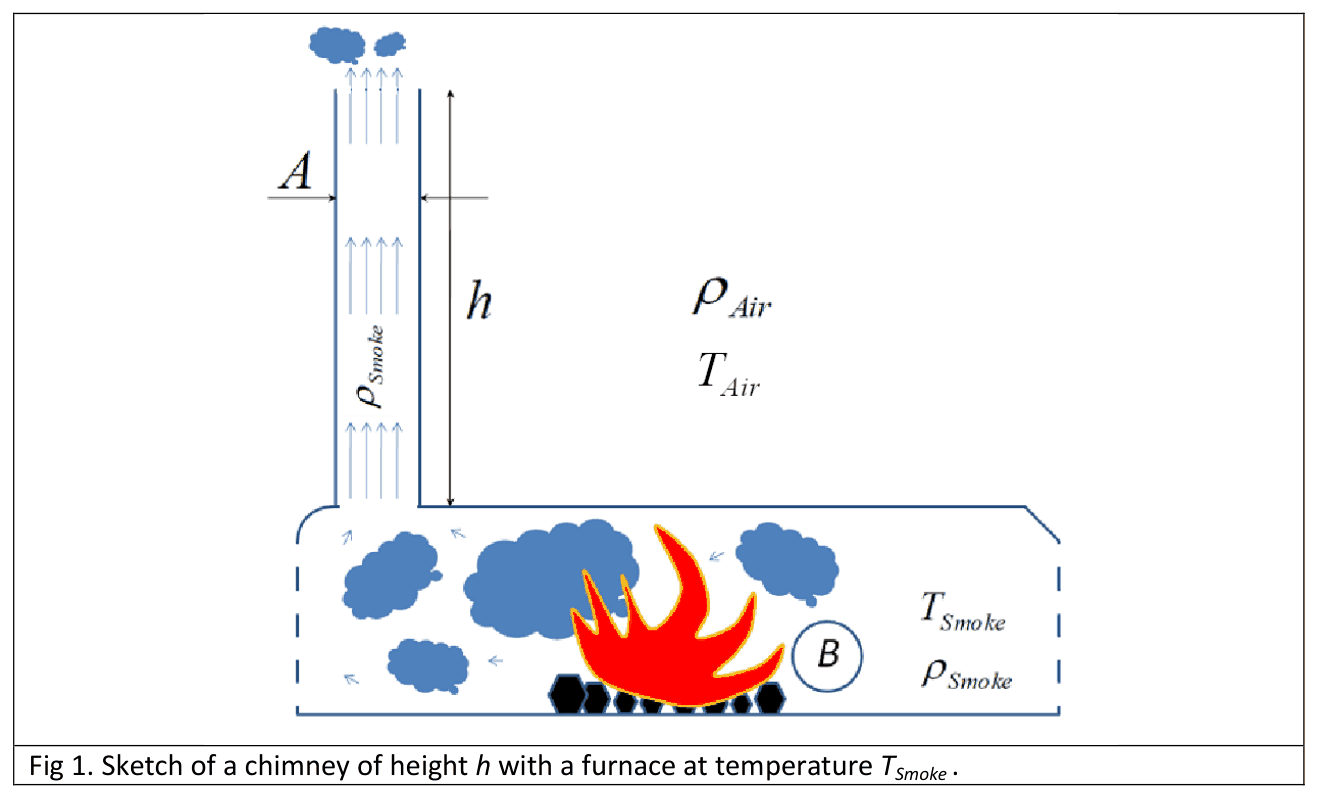
Fig 1. Sketch of a chimney of height \(h\) with a furnace at temperature \(T_{Smoke}\).
Task 1
a) What is the minimal height of the chimney needed in order that the chimney functions efficiently, so that it can release all of the produced gas into the atmosphere? Express your result in terms of \(B\), \(A\), \(T_{Air}\), \(g=9.81\,\mathrm{m/s^2}\), \(\Delta T=T_{Smoke}-T_{Air}\). Important: in all subsequent tasks assume that this minimal height is the height of the chimney. (3.5 points)
b) Assume that two chimneys are built to serve exactly the same purpose. Their cross sections are identical, but are designed to work in different parts of the world: one in cold regions, designed to work at an average atmospheric temperature of \(-30\,^\circ\mathrm{C}\) and the other in warm regions, designed to work at an average atmospheric temperature of \(30\,^\circ\mathrm{C}\). The temperature of the furnace is \(400\,^\circ\mathrm{C}\). It was calculated that the height of the chimney designed to work in cold regions is \(100\,\mathrm{m}\). How high is the other chimney? (0.5 points)
c) How does the velocity of the gases vary along the height of the chimney? Make a sketch/diagram assuming that the chimney cross-section does not change along the height. Indicate the point where the gases enter the chimney. (0.6 points)
d) How does the pressure of the gases vary along the height of the chimney? (0.5 points)
Solar power plant
The flow of gases in a chimney can be used to construct a particular kind of solar power plant (solar chimney). The idea is illustrated in Fig. 2. The Sun heats the air underneath the collector of area \(S\) with an open periphery to allow the undisturbed inflow of air (see Fig. 2). As the heated air rises through the chimney (thin solid arrows), new cold air enters the collector from its surrounding (thick dotted arrows) enabling a continuous flow of air through the power plant. The flow of air through the chimney powers a turbine, resulting in the production of electrical energy. The energy of solar radiation per unit time per unit of horizontal area of the collector is \(G\). Assume that all that energy can be used to heat the air in the collector (the mass heat capacity of the air is \(c\), and one can neglect its dependence on the air temperature). We define the efficiency of the solar chimney as the ratio of the kinetic energy of the gas flow and the solar energy absorbed in heating of the air prior to its entry into the chimney.
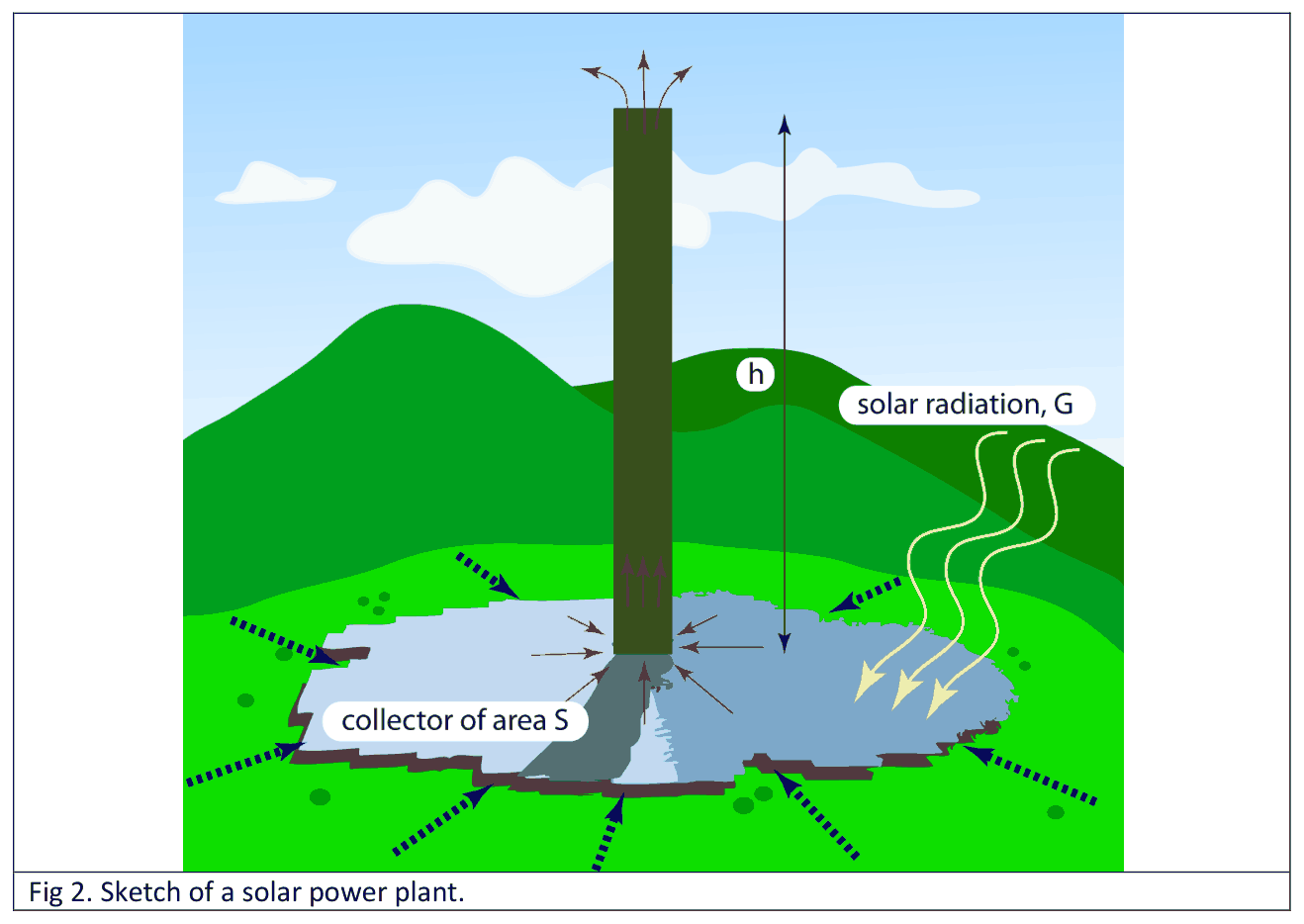
Fig 2. Sketch of a solar power plant.
Task 2
a) What is the efficiency of the solar chimney power plant? (2.0 points)
b) Make a diagram showing how the efficiency of the chimney changes with its height. (0.4 points)
Manzanares prototype
The prototype chimney built in Manzanares, Spain, had a height of \(195\,\mathrm{m}\), and a radius \(5\,\mathrm{m}\). The collector is circular with diameter of \(244\,\mathrm{m}\). The specific heat of the air under typical operational conditions of the prototype solar chimney is \(1012\,\mathrm{J/kg\,K}\), the density of the hot air is about \(0.9\,\mathrm{kg/m^3}\), and the typical temperature of the atmosphere \(T_{Air}=295\,\mathrm{K}\). In Manzanares, the solar power per unit of horizontal surface is typically \(150\,\mathrm{W/m^2}\) during a sunny day.
Task 3
a) What is the efficiency of the prototype power plant? Write down the numerical estimate. (0.3 points)
b) How much power could be produced in the prototype power plant? (0.4 points)
c) How much energy could the power plant produce during a typical sunny day? (0.3 points)
Task 4
a) How large is the rise in the air temperature as it enters the chimney (warm air) from the surrounding (cold air)? Write the general formula and evaluate it for the prototype chimney. (1.0 points)
b) What is the mass flow rate of air through the system? (0.5 points)
Official English text of the problem.
Answers
Take \(z=0\) at the chimney entrance and \(z=h\) at its outlet. Below, \(\rho_h\) denotes the density of the smoke or heated air.
-
1(a) For \(\Delta T>0\), \[ \boxed{h_{\min}=\frac{B^2T_{Air}}{2gA^2\Delta T}}. \]
-
1(b) \[ \boxed{h_{\mathrm{warm}}\simeq145\,\mathrm{m}}. \]
-
1(c) \[ \boxed{v(z)=\frac BA\qquad(0<z<h)}. \] The velocity rises from nearly zero in the furnace to \(B/A\) in the entrance region, then remains constant throughout the chimney.
-
1(d) \[ \boxed{p(z)=p_{Air}(h)+\rho_hg(h-z)}. \] The pressure decreases linearly with height, with slope \(-\rho_hg\), reaching the external atmospheric pressure at the outlet.
-
2(a) \[ \boxed{\eta=\frac{gh}{cT_{Air}}}. \]
-
2(b) The graph of \(\eta\) against \(h\) is a straight line through the origin, with slope \(g/(cT_{Air})\).
-
3(a) \[ \boxed{\eta=0.00641\simeq0.64\%}. \]
-
3(b) The ideal available power is \[ \boxed{P\simeq4.49\times10^4\,\mathrm{W}\simeq45\,\mathrm{kW}}. \]
-
3(c) For an effective illumination time \(\tau\), \[ \boxed{E=P\tau}. \] For \(12\,\mathrm{h}\) at the stated irradiance, \(E\simeq0.54\,\mathrm{MWh}=1.9\,\mathrm{GJ}\). If the stated irradiance is a full-day average, the \(24\,\mathrm{h}\) result is \(1.08\,\mathrm{MWh}=3.88\,\mathrm{GJ}\).
-
4(a) \[ \boxed{\Delta T= \left[\frac{(GS)^2T_{Air}}{2gh\,\rho_h^2A^2c^2}\right]^{1/3} \simeq9.1\,\mathrm{K}}. \]
-
4(b) \[ \boxed{\dot m=\frac{GS}{c\Delta T} =\left[\frac{2gh(\rho_hA)^2GS}{cT_{Air}}\right]^{1/3} \simeq7.7\times10^2\,\mathrm{kg\,s^{-1}}}. \]
Solution
Write \(\rho_a=\rho_{Air}\), \(\rho_h=\rho_{Smoke}\), and \(p_0=p_{Air}(0)\). For the solar chimney, \(\rho_h\) instead denotes the heated-air density. Absolute temperatures in all formulas are in kelvin.
1(a)
The chimney operates by natural draft: the external air is denser than the hot gas, so its pressure falls more rapidly with height. At the limiting operating condition, the nearly stationary gas in the furnace is at the atmospheric pressure \(p_0\). This is the boundary condition for discharging the gas without requiring furnace overpressure.
By the hydrostatic law outside the chimney,
\[ p_{Air}(h)=p_0-\rho_a gh. \]
At the open outlet, the gas pressure equals the local atmospheric pressure. Bernoulli’s equation between the furnace, where the velocity is negligible, and the outlet gives
\[ p_0=p_{Air}(h)+\rho_hgh+\frac12\rho_hv^2. \]
Consequently,
\[ \frac12\rho_hv^2=(\rho_a-\rho_h)gh. \]
The smoke and air have the same density at equal temperature and pressure. Applying the ideal-gas law at the common base pressure therefore gives
\[ \frac{\rho_a}{\rho_h} =\frac{T_{Smoke}}{T_{Air}} =1+\frac{\Delta T}{T_{Air}}. \]
Thus
\[ \boxed{v^2=2gh\frac{\Delta T}{T_{Air}}}. \]
Because the density change between the furnace and chimney is neglected, the volumetric discharge capacity is \(Av\). Releasing all the gas requires
\[ Av\geq B. \]
At the minimum height, equality holds:
\[ \left(\frac BA\right)^2 =2gh_{\min}\frac{\Delta T}{T_{Air}}. \]
Hence
\[ \boxed{h_{\min}=\frac{B^2T_{Air}}{2gA^2\Delta T}}. \]
This result requires \(\Delta T>0\). For \(B>0\) and \(\Delta T=0\), no finite height produces the required natural draft under these assumptions.
1(b)
Both chimneys have the same \(B\), \(A\), and furnace temperature, so
\[ h\propto\frac{T_{Air}}{T_{Smoke}-T_{Air}}. \]
The relevant temperatures and temperature differences are
\[ T_c=243.15\,\mathrm{K},\qquad T_w=303.15\,\mathrm{K}, \]
\[ \Delta T_c=430\,\mathrm{K},\qquad \Delta T_w=370\,\mathrm{K}. \]
Therefore,
\[ h_w =h_c\frac{T_w}{T_c}\frac{\Delta T_c}{\Delta T_w} =(100\,\mathrm{m}) \frac{303.15}{243.15}\frac{430}{370}. \]
This gives
\[ \boxed{h_w=144.9\,\mathrm{m}\simeq145\,\mathrm{m}}. \]
The warmer surroundings provide a smaller relative density difference, requiring a taller chimney.
1(c)
Conservation of mass in steady flow gives
\[ \dot m=\rho_hAv(z). \]
Since both \(\rho_h\) and \(A\) are constant throughout the chimney, \(v(z)\) must also be constant. With the stipulated minimum height, the volume flow is exactly \(B\), so
\[ \boxed{v(z)=\frac BA =\sqrt{\frac{2gh\Delta T}{T_{Air}}}}. \]
For the requested sketch, put \(z\) on the horizontal axis and \(v\) on the vertical axis. Mark the chimney entrance at \(z=0\). Show a rapid rise from the negligible furnace velocity to \(B/A\) in the entrance region, followed by a horizontal line at \(v=B/A\) from the entrance to \(z=h\). If the entrance region is idealized as having negligible extent, its acceleration can be represented by a step at \(z=0\).
1(d)
Within the chimney, Bernoulli’s equation is
\[ \frac12\rho_hv^2+\rho_hgz+p(z)=\text{constant}. \]
Since \(v\) is constant,
\[ \frac{dp}{dz}=-\rho_hg. \]
Using the outlet boundary condition \(p(h)=p_{Air}(h)\),
\[ \boxed{p(z)=p_{Air}(h)+\rho_hg(h-z)}. \]
Equivalently,
\[ p(z)=p_0-\rho_agh+\rho_hg(h-z). \]
The exterior pressure at height \(z\) is \(p_{Air}(z)=p_0-\rho_agz\). Subtracting,
\[ \boxed{p(z)-p_{Air}(z)=-(\rho_a-\rho_h)g(h-z)}. \]
Thus the gas pressure is below the surrounding atmospheric pressure everywhere inside the chimney below its outlet, and the two pressures become equal at the outlet.
Immediately after the entrance,
\[ p(0^+) =p_0-(\rho_a-\rho_h)gh =p_0-\frac12\rho_hv^2. \]
This entrance pressure reduction accompanies the acceleration from the furnace into the chimney. Thereafter, the pressure decreases linearly with height.
2(a)
Consider a mass \(m\) of air heated by \(\Delta T\) in the collector. The absorbed heat is
\[ Q=mc\Delta T. \]
Its kinetic energy in the chimney is
\[ K=\frac12mv^2. \]
According to the definition in the question,
\[ \eta=\frac KQ=\frac{v^2}{2c\Delta T}. \]
Applying the result of 1(a),
\[ v^2=\frac{2gh\Delta T}{T_{Air}}, \]
gives
\[ \boxed{\eta=\frac{gh}{cT_{Air}}}. \]
Within the stated model, the efficiency is independent of the temperature rise, collector area, and chimney cross-section. It measures the kinetic power available relative to the absorbed solar power.
2(b)
At fixed \(T_{Air}\) and \(c\),
\[ \eta(h)=\frac{g}{cT_{Air}}h. \]
The requested diagram has \(h\) on the horizontal axis and \(\eta\) on the vertical axis. It is a straight line through \((0,0)\), with positive slope
\[ \boxed{\frac{d\eta}{dh}=\frac{g}{cT_{Air}}}. \]
Doubling the height doubles the efficiency. This linear relation applies only within the approximations of the problem; it should not be extrapolated to heights where changes of density become significant.
3(a)
Substituting the prototype data,
\[ \eta =\frac{(9.81\,\mathrm{m\,s^{-2}})(195\,\mathrm{m})} {(1012\,\mathrm{J\,kg^{-1}K^{-1}})(295\,\mathrm{K})} =0.0064077. \]
Therefore,
\[ \boxed{\eta\simeq0.64\%}. \]
3(b)
The collector radius is \(244/2=122\,\mathrm{m}\), so its area is
\[ S=\pi(122\,\mathrm{m})^2 =4.67595\times10^4\,\mathrm{m^2}. \]
All incident solar power is assumed to heat the air:
\[ P_{\mathrm{solar}}=GS =(150\,\mathrm{W\,m^{-2}}) (4.67595\times10^4\,\mathrm{m^2}) =7.01392\times10^6\,\mathrm{W}. \]
The available kinetic power is
\[ P=\eta GS =(0.0064077)(7.01392\times10^6\,\mathrm{W}), \]
hence
\[ \boxed{P=4.4943\times10^4\,\mathrm{W}\simeq45\,\mathrm{kW}}. \]
This is the ideal power available for conversion under the problem’s definition; no additional turbine or generator efficiency is specified.
3(c)
For an effective illumination time \(\tau\) at the stated irradiance,
\[ \boxed{E=P\tau=\frac{ghGS}{cT_{Air}}\tau}. \]
Thus each hour at the stated conditions supplies approximately \(44.9\,\mathrm{kWh}\).
If a typical sunny day is estimated as \(12\,\mathrm{h}\) at the stated irradiance,
\[ E=(44.943\,\mathrm{kW})(12\,\mathrm{h}) =539.3\,\mathrm{kWh}, \]
or
\[ \boxed{E\simeq0.54\,\mathrm{MWh} \simeq1.9\times10^9\,\mathrm{J}}. \]
If \(150\,\mathrm{W\,m^{-2}}\) is instead interpreted as an average over the entire \(24\,\mathrm{h}\) day,
\[ \boxed{E=(44.943\,\mathrm{kW})(24\,\mathrm{h}) \simeq1.08\,\mathrm{MWh} =3.88\times10^9\,\mathrm{J}}. \]
The statement does not specify the effective illumination time or averaging convention.
4(a)
In steady operation, the solar heating power equals the rate at which heat is carried away by the air:
\[ GS=\dot m\,c\Delta T. \]
Mass conservation gives
\[ \dot m=\rho_hAv. \]
Combining these with the chimney speed,
\[ v=\sqrt{\frac{2gh\Delta T}{T_{Air}}}, \]
we obtain
\[ GS =\rho_hAc\Delta T \sqrt{\frac{2gh\Delta T}{T_{Air}}} =\rho_hAc\sqrt{\frac{2gh}{T_{Air}}}\, (\Delta T)^{3/2}. \]
Solving for \(\Delta T\),
\[ \boxed{\Delta T =\left[ \frac{(GS)^2T_{Air}} {2gh\,\rho_h^2A^2c^2} \right]^{1/3}}. \]
For the prototype,
\[ A=\pi(5\,\mathrm{m})^2=78.5398\,\mathrm{m^2}. \]
Using the given hot-air density,
\[ \Delta T= \left[ \frac{(7.01392\times10^6)^2(295)} {2(9.81)(195)(0.9)^2(78.5398)^2(1012)^2} \right]^{1/3}\mathrm{K}. \]
Therefore,
\[ \boxed{\Delta T=9.05\,\mathrm{K}\simeq9.1\,\mathrm{K}}. \]
The air enters the chimney at approximately \(304\,\mathrm{K}\).
4(b)
From the heating balance,
\[ \dot m=\frac{GS}{c\Delta T}. \]
Numerically,
\[ \dot m =\frac{7.01392\times10^6\,\mathrm{W}} {(1012\,\mathrm{J\,kg^{-1}K^{-1}})(9.0503\,\mathrm{K})} =765.8\,\mathrm{kg\,s^{-1}}. \]
Thus
\[ \boxed{\dot m\simeq7.7\times10^2\,\mathrm{kg\,s^{-1}}}. \]
Eliminating \(\Delta T\) also gives the general expression
\[ \boxed{\dot m= \left[ \frac{2gh(\rho_hA)^2GS}{cT_{Air}} \right]^{1/3}}. \]
As a numerical check, the corresponding speed is
\[ v=\sqrt{\frac{2(9.81)(195)(9.0503)}{295}} =10.83\,\mathrm{m\,s^{-1}}, \]
which gives \(\rho_hAv=765.8\,\mathrm{kg\,s^{-1}}\) and kinetic power \(\tfrac12\dot m v^2=44.94\,\mathrm{kW}\), consistent with 3(b).
The solution was checked against the official solution.
IPhO 2010 · Theorieaufgabe 2
Physik des Schornsteins
Einleitung
Gasförmige Verbrennungsprodukte werden durch einen hohen Schornstein mit der Querschnittsfläche \(A\) und der Höhe \(h\) in die Atmosphäre mit der Temperatur \(T_{Air}\) abgeführt (siehe Abb. 1). Der Feststoff wird in einer Feuerung verbrannt, deren Temperatur \(T_{Smoke}\) beträgt. Das pro Zeiteinheit in der Feuerung erzeugte Gasvolumen ist \(B\).
Nehmen Sie an, dass:
- die Geschwindigkeit der Gase in der Feuerung vernachlässigbar klein ist
- die Dichte der Gase (Rauchgase) sich nicht von derjenigen der Luft bei gleicher Temperatur und gleichem Druck unterscheidet; in der Feuerung können die Gase als ideal betrachtet werden
- sich der Luftdruck mit der Höhe gemäß dem hydrostatischen Gesetz ändert; die Änderung der Luftdichte mit der Höhe ist vernachlässigbar
- die Gasströmung die Bernoulli-Gleichung erfüllt, die besagt, dass die folgende Größe an allen Punkten der Strömung erhalten bleibt:
\[ \frac{1}{2}\rho v^2(z)+\rho gz+p(z)=const, \]
wobei \(\rho\) die Dichte des Gases, \(v(z)\) seine Geschwindigkeit, \(p(z)\) der Druck und \(z\) die Höhe ist - die Änderung der Gasdichte im gesamten Schornstein vernachlässigbar ist
Abb. 1. Skizze eines Schornsteins der Höhe \(h\) mit einer Feuerung bei der Temperatur \(T_{Smoke}\).
Aufgabe 1
a) Welche Mindesthöhe muss der Schornstein haben, damit er wirksam funktioniert und das gesamte erzeugte Gas in die Atmosphäre abführen kann? Drücken Sie Ihr Ergebnis durch \(B\), \(A\), \(T_{Air}\), \(g=9.81\,\mathrm{m/s^2}\), \(\Delta T=T_{Smoke}-T_{Air}\) aus. Wichtig: Nehmen Sie in allen folgenden Aufgaben an, dass diese Mindesthöhe die Höhe des Schornsteins ist. (3.5 Punkte)
b) Nehmen Sie an, dass zwei Schornsteine gebaut werden, die genau denselben Zweck erfüllen sollen. Ihre Querschnittsflächen sind identisch, sie sind jedoch für den Betrieb in verschiedenen Teilen der Welt ausgelegt: einer in kalten Regionen für eine mittlere atmosphärische Temperatur von \(-30\,^\circ\mathrm{C}\) und der andere in warmen Regionen für eine mittlere atmosphärische Temperatur von \(30\,^\circ\mathrm{C}\). Die Temperatur der Feuerung beträgt \(400\,^\circ\mathrm{C}\). Für den Schornstein, der für kalte Regionen ausgelegt ist, wurde eine Höhe von \(100\,\mathrm{m}\) berechnet. Wie hoch ist der andere Schornstein? (0.5 Punkte)
c) Wie ändert sich die Geschwindigkeit der Gase mit der Höhe im Schornstein? Erstellen Sie eine Skizze/ein Diagramm unter der Annahme, dass sich die Querschnittsfläche des Schornsteins mit der Höhe nicht ändert. Kennzeichnen Sie die Stelle, an der die Gase in den Schornstein eintreten. (0.6 Punkte)
d) Wie ändert sich der Druck der Gase mit der Höhe im Schornstein? (0.5 Punkte)
Solarkraftwerk
Die Gasströmung in einem Schornstein kann zum Bau einer besonderen Art von Solarkraftwerk genutzt werden (Aufwindkraftwerk). Die Idee ist in Abb. 2 dargestellt. Die Sonne erwärmt die Luft unter einem Kollektor der Fläche \(S\), dessen Rand offen ist, um ein ungehindertes Einströmen der Luft zu ermöglichen (siehe Abb. 2). Während die erwärmte Luft durch den Schornstein aufsteigt (dünne durchgezogene Pfeile), strömt neue kalte Luft aus der Umgebung in den Kollektor ein (dicke gepunktete Pfeile), wodurch eine kontinuierliche Luftströmung durch das Kraftwerk ermöglicht wird. Die Luftströmung durch den Schornstein treibt eine Turbine an, wodurch elektrische Energie erzeugt wird. Die Energie der Sonnenstrahlung pro Zeiteinheit und pro Einheit der horizontalen Kollektorfläche ist \(G\). Nehmen Sie an, dass diese gesamte Energie zur Erwärmung der Luft im Kollektor genutzt werden kann (die spezifische Wärmekapazität der Luft ist \(c\), und ihre Abhängigkeit von der Lufttemperatur kann vernachlässigt werden). Wir definieren den Wirkungsgrad des Aufwindkraftwerks als das Verhältnis der kinetischen Energie der Gasströmung zur Sonnenenergie, die bei der Erwärmung der Luft vor ihrem Eintritt in den Schornstein absorbiert wird.
Abb. 2. Skizze eines Solarkraftwerks.
Aufgabe 2
a) Wie groß ist der Wirkungsgrad des Aufwindkraftwerks? (2.0 Punkte)
b) Erstellen Sie ein Diagramm, das zeigt, wie sich der Wirkungsgrad des Schornsteins mit seiner Höhe ändert. (0.4 Punkte)
Prototyp in Manzanares
Der in Manzanares, Spanien, errichtete Prototyp eines Schornsteins hatte eine Höhe von \(195\,\mathrm{m}\) und einen Radius von \(5\,\mathrm{m}\). Der Kollektor ist kreisförmig und hat einen Durchmesser von \(244\,\mathrm{m}\). Die spezifische Wärmekapazität der Luft unter typischen Betriebsbedingungen des Prototyps beträgt \(1012\,\mathrm{J/kg\,K}\), die Dichte der warmen Luft beträgt etwa \(0.9\,\mathrm{kg/m^3}\), und die typische Temperatur der Atmosphäre ist \(T_{Air}=295\,\mathrm{K}\). In Manzanares beträgt die Sonnenstrahlungsleistung pro Einheit der horizontalen Fläche an einem sonnigen Tag typischerweise \(150\,\mathrm{W/m^2}\).
Aufgabe 3
a) Wie groß ist der Wirkungsgrad des Prototyp-Kraftwerks? Geben Sie eine numerische Abschätzung an. (0.3 Punkte)
b) Welche Leistung könnte das Prototyp-Kraftwerk erzeugen? (0.4 Punkte)
c) Wie viel Energie könnte das Kraftwerk an einem typischen sonnigen Tag erzeugen? (0.3 Punkte)
Aufgabe 4
a) Wie groß ist die Temperaturerhöhung der Luft beim Eintritt aus der Umgebung (kalte Luft) in den Schornstein (warme Luft)? Geben Sie die allgemeine Formel an und werten Sie sie für den Prototyp-Schornstein aus. (1.0 Punkte)
b) Wie groß ist der Luftmassenstrom durch das System? (0.5 Punkte)
Aufgabentext aus dem offiziellen englischen Text übersetzt.
Antworten
Setzen Sie \(z=0\) am Eintritt in den Schornstein und \(z=h\) an seiner Austrittsöffnung. Im Folgenden bezeichnet \(\rho_h\) die Dichte der Rauchgase oder der erwärmten Luft.
-
1(a) Für \(\Delta T>0\) gilt \[ \boxed{h_{\min}=\frac{B^2T_{Air}}{2gA^2\Delta T}}. \]
-
1(b) \[ \boxed{h_{\mathrm{warm}}\simeq145\,\mathrm{m}}. \]
-
1(c) \[ \boxed{v(z)=\frac BA\qquad(0<z<h)}. \] Die Geschwindigkeit steigt von nahezu null in der Feuerung auf \(B/A\) im Eintrittsbereich und bleibt anschließend im gesamten Schornstein konstant.
-
1(d) \[ \boxed{p(z)=p_{Air}(h)+\rho_hg(h-z)}. \] Der Druck nimmt mit der Höhe linear ab, mit der Steigung \(-\rho_hg\), und erreicht an der Austrittsöffnung den äußeren Atmosphärendruck.
-
2(a) \[ \boxed{\eta=\frac{gh}{cT_{Air}}}. \]
-
2(b) Der Graph von \(\eta\) in Abhängigkeit von \(h\) ist eine Ursprungsgerade mit der Steigung \(g/(cT_{Air})\).
-
3(a) \[ \boxed{\eta=0.00641\simeq0.64\%}. \]
-
3(b) Die ideal verfügbare Leistung beträgt \[ \boxed{P\simeq4.49\times10^4\,\mathrm{W}\simeq45\,\mathrm{kW}}. \]
-
3(c) Für eine effektive Bestrahlungsdauer \(\tau\) gilt \[ \boxed{E=P\tau}. \] Für \(12\,\mathrm{h}\) bei der angegebenen Bestrahlungsstärke gilt \(E\simeq0.54\,\mathrm{MWh}=1.9\,\mathrm{GJ}\). Falls die angegebene Bestrahlungsstärke ein Mittelwert über den ganzen Tag ist, ergibt sich für \(24\,\mathrm{h}\) der Wert \(1.08\,\mathrm{MWh}=3.88\,\mathrm{GJ}\).
-
4(a) \[ \boxed{\Delta T= \left[\frac{(GS)^2T_{Air}}{2gh\,\rho_h^2A^2c^2}\right]^{1/3} \simeq9.1\,\mathrm{K}}. \]
-
4(b) \[ \boxed{\dot m=\frac{GS}{c\Delta T} =\left[\frac{2gh(\rho_hA)^2GS}{cT_{Air}}\right]^{1/3} \simeq7.7\times10^2\,\mathrm{kg\,s^{-1}}}. \]
Lösung
Wir schreiben \(\rho_a=\rho_{Air}\), \(\rho_h=\rho_{Smoke}\) und \(p_0=p_{Air}(0)\). Beim Aufwindkraftwerk bezeichnet \(\rho_h\) stattdessen die Dichte der erwärmten Luft. Die absoluten Temperaturen in allen Formeln sind in Kelvin angegeben.
1(a)
Der Schornstein arbeitet mit natürlichem Zug: Die Außenluft ist dichter als das heiße Gas, sodass ihr Druck mit der Höhe schneller abnimmt. Im Grenzfall des Betriebs steht das nahezu ruhende Gas in der Feuerung unter dem Atmosphärendruck \(p_0\). Dies ist die Randbedingung dafür, dass das Gas abgeführt werden kann, ohne dass in der Feuerung ein Überdruck erforderlich ist.
Nach dem hydrostatischen Gesetz gilt außerhalb des Schornsteins
\[ p_{Air}(h)=p_0-\rho_a gh. \]
An der offenen Austrittsöffnung ist der Gasdruck gleich dem örtlichen Atmosphärendruck. Die Bernoulli-Gleichung zwischen der Feuerung, in der die Geschwindigkeit vernachlässigbar ist, und der Austrittsöffnung liefert
\[ p_0=p_{Air}(h)+\rho_hgh+\frac12\rho_hv^2. \]
Daraus folgt
\[ \frac12\rho_hv^2=(\rho_a-\rho_h)gh. \]
Die Rauchgase und die Luft haben bei gleicher Temperatur und gleichem Druck dieselbe Dichte. Die Anwendung der idealen Gasgleichung bei dem gemeinsamen Druck am Fuß des Schornsteins ergibt daher
\[ \frac{\rho_a}{\rho_h} =\frac{T_{Smoke}}{T_{Air}} =1+\frac{\Delta T}{T_{Air}}. \]
Somit gilt
\[ \boxed{v^2=2gh\frac{\Delta T}{T_{Air}}}. \]
Da die Dichteänderung zwischen Feuerung und Schornstein vernachlässigt wird, beträgt der abführbare Volumenstrom \(Av\). Damit das gesamte Gas abgeführt wird, muss gelten
\[ Av\geq B. \]
Bei der Mindesthöhe gilt Gleichheit:
\[ \left(\frac BA\right)^2 =2gh_{\min}\frac{\Delta T}{T_{Air}}. \]
Daher ist
\[ \boxed{h_{\min}=\frac{B^2T_{Air}}{2gA^2\Delta T}}. \]
Dieses Ergebnis setzt \(\Delta T>0\) voraus. Für \(B>0\) und \(\Delta T=0\) erzeugt unter diesen Annahmen keine endliche Höhe den erforderlichen natürlichen Zug.
1(b)
Beide Schornsteine haben dieselben Werte für \(B\) und \(A\) sowie dieselbe Feuerungstemperatur, sodass
\[ h\propto\frac{T_{Air}}{T_{Smoke}-T_{Air}}. \]
Die maßgeblichen Temperaturen und Temperaturdifferenzen sind
\[ T_c=243.15\,\mathrm{K},\qquad T_w=303.15\,\mathrm{K}, \]
\[ \Delta T_c=430\,\mathrm{K},\qquad \Delta T_w=370\,\mathrm{K}. \]
Daher gilt
\[ h_w =h_c\frac{T_w}{T_c}\frac{\Delta T_c}{\Delta T_w} =(100\,\mathrm{m}) \frac{303.15}{243.15}\frac{430}{370}. \]
Dies ergibt
\[ \boxed{h_w=144.9\,\mathrm{m}\simeq145\,\mathrm{m}}. \]
Die wärmere Umgebung führt zu einem kleineren relativen Dichteunterschied, sodass ein höherer Schornstein erforderlich ist.
1(c)
Die Massenerhaltung bei stationärer Strömung liefert
\[ \dot m=\rho_hAv(z). \]
Da sowohl \(\rho_h\) als auch \(A\) im gesamten Schornstein konstant sind, muss auch \(v(z)\) konstant sein. Bei der vorausgesetzten Mindesthöhe ist der Volumenstrom genau \(B\), sodass
\[ \boxed{v(z)=\frac BA =\sqrt{\frac{2gh\Delta T}{T_{Air}}}}. \]
Tragen Sie für die verlangte Skizze \(z\) auf der horizontalen Achse und \(v\) auf der vertikalen Achse auf. Markieren Sie den Schornsteineintritt bei \(z=0\). Zeichnen Sie im Eintrittsbereich einen raschen Anstieg von der vernachlässigbaren Geschwindigkeit in der Feuerung auf \(B/A\), gefolgt von einer horizontalen Linie bei \(v=B/A\) vom Eintritt bis \(z=h\). Wird der Eintrittsbereich idealisiert als räumlich vernachlässigbar klein angenommen, kann die dortige Beschleunigung durch einen Sprung bei \(z=0\) dargestellt werden.
1(d)
Innerhalb des Schornsteins lautet die Bernoulli-Gleichung
\[ \frac12\rho_hv^2+\rho_hgz+p(z)=\text{konstant}. \]
Da \(v\) konstant ist, gilt
\[ \frac{dp}{dz}=-\rho_hg. \]
Mit der Randbedingung an der Austrittsöffnung \(p(h)=p_{Air}(h)\) folgt
\[ \boxed{p(z)=p_{Air}(h)+\rho_hg(h-z)}. \]
Gleichwertig dazu ist
\[ p(z)=p_0-\rho_agh+\rho_hg(h-z). \]
Der Außendruck in der Höhe \(z\) ist \(p_{Air}(z)=p_0-\rho_agz\). Subtraktion ergibt
\[ \boxed{p(z)-p_{Air}(z)=-(\rho_a-\rho_h)g(h-z)}. \]
Somit liegt der Gasdruck überall im Schornstein unterhalb seiner Austrittsöffnung unter dem umgebenden Atmosphärendruck; an der Austrittsöffnung werden die beiden Drücke gleich.
Unmittelbar nach dem Eintritt gilt
\[ p(0^+) =p_0-(\rho_a-\rho_h)gh =p_0-\frac12\rho_hv^2. \]
Diese Druckabsenkung am Eintritt geht mit der Beschleunigung aus der Feuerung in den Schornstein einher. Danach nimmt der Druck mit der Höhe linear ab.
2(a)
Betrachten wir eine Luftmasse \(m\), die im Kollektor um \(\Delta T\) erwärmt wird. Die aufgenommene Wärme ist
\[ Q=mc\Delta T. \]
Ihre kinetische Energie im Schornstein ist
\[ K=\frac12mv^2. \]
Gemäß der Definition in der Aufgabenstellung gilt
\[ \eta=\frac KQ=\frac{v^2}{2c\Delta T}. \]
Die Anwendung des Ergebnisses aus 1(a),
\[ v^2=\frac{2gh\Delta T}{T_{Air}}, \]
liefert
\[ \boxed{\eta=\frac{gh}{cT_{Air}}}. \]
Innerhalb des angegebenen Modells ist der Wirkungsgrad unabhängig von der Temperaturerhöhung, der Kollektorfläche und der Querschnittsfläche des Schornsteins. Er gibt die verfügbare kinetische Leistung im Verhältnis zur absorbierten Sonnenstrahlungsleistung an.
2(b)
Bei festem \(T_{Air}\) und \(c\) gilt
\[ \eta(h)=\frac{g}{cT_{Air}}h. \]
Im verlangten Diagramm wird \(h\) auf der horizontalen Achse und \(\eta\) auf der vertikalen Achse aufgetragen. Es ist eine Gerade durch \((0,0)\) mit der positiven Steigung
\[ \boxed{\frac{d\eta}{dh}=\frac{g}{cT_{Air}}}. \]
Eine Verdopplung der Höhe verdoppelt den Wirkungsgrad. Dieser lineare Zusammenhang gilt nur im Rahmen der Näherungen der Aufgabe; er sollte nicht auf Höhen extrapoliert werden, bei denen Dichteänderungen wesentlich werden.
3(a)
Einsetzen der Daten des Prototyps ergibt
\[ \eta =\frac{(9.81\,\mathrm{m\,s^{-2}})(195\,\mathrm{m})} {(1012\,\mathrm{J\,kg^{-1}K^{-1}})(295\,\mathrm{K})} =0.0064077. \]
Daher gilt
\[ \boxed{\eta\simeq0.64\%}. \]
3(b)
Der Kollektorradius beträgt \(244/2=122\,\mathrm{m}\), sodass für seine Fläche gilt
\[ S=\pi(122\,\mathrm{m})^2 =4.67595\times10^4\,\mathrm{m^2}. \]
Es wird angenommen, dass die gesamte einfallende Sonnenstrahlungsleistung die Luft erwärmt:
\[ P_{\mathrm{solar}}=GS =(150\,\mathrm{W\,m^{-2}}) (4.67595\times10^4\,\mathrm{m^2}) =7.01392\times10^6\,\mathrm{W}. \]
Die verfügbare kinetische Leistung ist
\[ P=\eta GS =(0.0064077)(7.01392\times10^6\,\mathrm{W}), \]
also
\[ \boxed{P=4.4943\times10^4\,\mathrm{W}\simeq45\,\mathrm{kW}}. \]
Dies ist die gemäß der Definition der Aufgabe ideal zur Umwandlung verfügbare Leistung; ein zusätzlicher Turbinen- oder Generatorwirkungsgrad ist nicht angegeben.
3(c)
Für eine effektive Bestrahlungsdauer \(\tau\) bei der angegebenen Bestrahlungsstärke gilt
\[ \boxed{E=P\tau=\frac{ghGS}{cT_{Air}}\tau}. \]
Somit liefert jede Stunde unter den angegebenen Bedingungen etwa \(44.9\,\mathrm{kWh}\).
Wird ein typischer sonniger Tag als \(12\,\mathrm{h}\) bei der angegebenen Bestrahlungsstärke abgeschätzt, gilt
\[ E=(44.943\,\mathrm{kW})(12\,\mathrm{h}) =539.3\,\mathrm{kWh}, \]
oder
\[ \boxed{E\simeq0.54\,\mathrm{MWh} \simeq1.9\times10^9\,\mathrm{J}}. \]
Wird \(150\,\mathrm{W\,m^{-2}}\) stattdessen als Mittelwert über den gesamten \(24\,\mathrm{h}\)-Tag interpretiert, gilt
\[ \boxed{E=(44.943\,\mathrm{kW})(24\,\mathrm{h}) \simeq1.08\,\mathrm{MWh} =3.88\times10^9\,\mathrm{J}}. \]
Die Aufgabenstellung gibt weder die effektive Bestrahlungsdauer noch die Konvention für die Mittelwertbildung an.
4(a)
Im stationären Betrieb ist die solare Heizleistung gleich dem von der Luft abgeführten Wärmestrom:
\[ GS=\dot m\,c\Delta T. \]
Die Massenerhaltung liefert
\[ \dot m=\rho_hAv. \]
Durch Kombination dieser Beziehungen mit der Strömungsgeschwindigkeit im Schornstein,
\[ v=\sqrt{\frac{2gh\Delta T}{T_{Air}}}, \]
erhalten wir
\[ GS =\rho_hAc\Delta T \sqrt{\frac{2gh\Delta T}{T_{Air}}} =\rho_hAc\sqrt{\frac{2gh}{T_{Air}}}\, (\Delta T)^{3/2}. \]
Auflösen nach \(\Delta T\) ergibt
\[ \boxed{\Delta T =\left[ \frac{(GS)^2T_{Air}} {2gh\,\rho_h^2A^2c^2} \right]^{1/3}}. \]
Für den Prototyp gilt
\[ A=\pi(5\,\mathrm{m})^2=78.5398\,\mathrm{m^2}. \]
Mit der angegebenen Dichte der warmen Luft folgt
\[ \Delta T= \left[ \frac{(7.01392\times10^6)^2(295)} {2(9.81)(195)(0.9)^2(78.5398)^2(1012)^2} \right]^{1/3}\mathrm{K}. \]
Daher gilt
\[ \boxed{\Delta T=9.05\,\mathrm{K}\simeq9.1\,\mathrm{K}}. \]
Die Luft tritt mit etwa \(304\,\mathrm{K}\) in den Schornstein ein.
4(b)
Aus der Wärmebilanz folgt
\[ \dot m=\frac{GS}{c\Delta T}. \]
Numerisch ergibt sich
\[ \dot m =\frac{7.01392\times10^6\,\mathrm{W}} {(1012\,\mathrm{J\,kg^{-1}K^{-1}})(9.0503\,\mathrm{K})} =765.8\,\mathrm{kg\,s^{-1}}. \]
Somit gilt
\[ \boxed{\dot m\simeq7.7\times10^2\,\mathrm{kg\,s^{-1}}}. \]
Durch Eliminieren von \(\Delta T\) erhält man außerdem den allgemeinen Ausdruck
\[ \boxed{\dot m= \left[ \frac{2gh(\rho_hA)^2GS}{cT_{Air}} \right]^{1/3}}. \]
Zur numerischen Kontrolle beträgt die zugehörige Geschwindigkeit
\[ v=\sqrt{\frac{2(9.81)(195)(9.0503)}{295}} =10.83\,\mathrm{m\,s^{-1}}, \]
woraus sich \(\rho_hAv=765.8\,\mathrm{kg\,s^{-1}}\) und die kinetische Leistung \(\tfrac12\dot m v^2=44.94\,\mathrm{kW}\) ergeben, in Übereinstimmung mit 3(b).
Die Lösung wurde mit der offiziellen Lösung abgeglichen.
IPhO 2010 · Teori sorusu 2
Baca fiziği
Giriş
Yanma sonucu oluşan gazlar, kesit alanı \(A\) ve yüksekliği \(h\) olan yüksek bir bacadan, sıcaklığı \(T_{Air}\) olan atmosfere salınmaktadır (bkz. Şekil 1). Katı madde, sıcaklığı \(T_{Smoke}\) olan ocakta yakılmaktadır. Ocakta birim zamanda üretilen gazların hacmi \(B\)'dir.
Şunları varsayın:
- ocaktaki gazların hızı ihmal edilebilecek kadar küçüktür
- gazların (dumanın) yoğunluğu, aynı sıcaklık ve basınçtaki havanın yoğunluğundan farklı değildir; gazlar ocaktayken ideal gaz olarak ele alınabilir
- havanın basıncı, hidrostatik yasasına uygun olarak yükseklikle değişir; havanın yoğunluğunun yükseklikle değişimi ihmal edilebilir
- gaz akışı, aşağıdaki büyüklüğün akışın tüm noktalarında korunduğunu ifade eden Bernoulli denklemini sağlar:
\[ \frac{1}{2}\rho v^2(z)+\rho gz+p(z)=const, \]
burada \(\rho\) gazın yoğunluğu, \(v(z)\) hızı, \(p(z)\) basıncı ve \(z\) yüksekliğidir - gazın yoğunluğundaki değişim baca boyunca ihmal edilebilir
Şekil 1. Sıcaklığı \(T_{Smoke}\) olan bir ocağa bağlı, yüksekliği \(h\) olan bacanın şeması.
Görev 1
a) Bacanın etkin biçimde çalışarak üretilen gazın tamamını atmosfere salabilmesi için gereken en küçük baca yüksekliği nedir? Sonucunuzu \(B\), \(A\), \(T_{Air}\), \(g=9.81\,\mathrm{m/s^2}\), \(\Delta T=T_{Smoke}-T_{Air}\) cinsinden ifade edin. Önemli: sonraki tüm görevlerde baca yüksekliğinin bu en küçük yükseklik olduğunu varsayın. (3.5 puan)
b) Tam olarak aynı amaca hizmet etmek üzere iki baca inşa edildiğini varsayın. Kesit alanları aynıdır, ancak dünyanın farklı bölgelerinde çalışacak biçimde tasarlanmışlardır: biri soğuk bölgelerde, ortalama atmosfer sıcaklığı \(-30\,^\circ\mathrm{C}\) iken çalışacak şekilde; diğeri ise sıcak bölgelerde, ortalama atmosfer sıcaklığı \(30\,^\circ\mathrm{C}\) iken çalışacak şekilde tasarlanmıştır. Ocağın sıcaklığı \(400\,^\circ\mathrm{C}\)'dir. Soğuk bölgelerde çalışmak üzere tasarlanan bacanın yüksekliği \(100\,\mathrm{m}\) olarak hesaplanmıştır. Diğer bacanın yüksekliği ne kadardır? (0.5 puan)
c) Gazların hızı baca yüksekliği boyunca nasıl değişir? Baca kesitinin yükseklik boyunca değişmediğini varsayarak bir çizim/grafik hazırlayın. Gazların bacaya girdiği noktayı belirtin. (0.6 puan)
d) Gazların basıncı baca yüksekliği boyunca nasıl değişir? (0.5 puan)
Güneş enerjisi santrali
Bir bacadaki gaz akışı, özel bir tür güneş enerjisi santrali (güneş bacası) yapmak için kullanılabilir. Bu fikir Şekil 2'de gösterilmiştir. Güneş, havanın engellenmeden içeri akmasına olanak vermek için çevresi açık bırakılmış, alanı \(S\) olan kolektörün altındaki havayı ısıtır (bkz. Şekil 2). Isınan hava bacadan yükselirken (ince düz çizgili oklar), çevreden kolektöre yeni soğuk hava girer (kalın noktalı oklar) ve böylece santral boyunca sürekli bir hava akışı sağlanır. Bacadan geçen hava akışı bir türbini çalıştırarak elektrik enerjisi üretilmesini sağlar. Kolektörün birim yatay alanına birim zamanda gelen güneş ışınımı enerjisi \(G\)'dir. Bu enerjinin tamamının kolektördeki havayı ısıtmak için kullanılabildiğini varsayın (havanın özgül ısı kapasitesi \(c\)'dir ve bunun hava sıcaklığına bağımlılığı ihmal edilebilir). Güneş bacasının verimini, gaz akışının kinetik enerjisinin, hava bacaya girmeden önce onu ısıtmak için soğurulan güneş enerjisine oranı olarak tanımlıyoruz.
Şekil 2. Bir güneş enerjisi santralinin şeması.
Görev 2
a) Güneş bacası santralinin verimi nedir? (2.0 puan)
b) Bacanın veriminin yüksekliğiyle nasıl değiştiğini gösteren bir grafik çizin. (0.4 puan)
Manzanares prototipi
İspanya'nın Manzanares kentinde inşa edilen prototip bacanın yüksekliği \(195\,\mathrm{m}\), yarıçapı ise \(5\,\mathrm{m}\) idi. Kolektör, çapı \(244\,\mathrm{m}\) olan dairesel bir yapıdır. Prototip güneş bacasının tipik çalışma koşullarında havanın özgül ısısı \(1012\,\mathrm{J/kg\,K}\), sıcak havanın yoğunluğu yaklaşık \(0.9\,\mathrm{kg/m^3}\) ve atmosferin tipik sıcaklığı \(T_{Air}=295\,\mathrm{K}\)'dir. Manzanares'te güneşli bir günde birim yatay yüzeye gelen güneş enerjisi gücü tipik olarak \(150\,\mathrm{W/m^2}\)'dir.
Görev 3
a) Prototip santralin verimi nedir? Sayısal tahmini yazın. (0.3 puan)
b) Prototip santralde ne kadar güç üretilebilir? (0.4 puan)
c) Santral, tipik bir güneşli gün boyunca ne kadar enerji üretebilir? (0.3 puan)
Görev 4
a) Hava çevreden (soğuk hava) bacaya (sıcak hava) girerken sıcaklığı ne kadar artar? Genel formülü yazın ve prototip baca için değerini hesaplayın. (1.0 puan)
b) Sistemden geçen havanın kütlesel debisi nedir? (0.5 puan)
Soru metni resmi İngilizce metinden çevrilmiştir.
Cevaplar
Baca girişinde \(z=0\), çıkışında ise \(z=h\) alın. Aşağıda \(\rho_h\), dumanın veya ısıtılmış havanın yoğunluğunu göstermektedir.
-
1(a) \(\Delta T>0\) için, \[ \boxed{h_{\min}=\frac{B^2T_{Air}}{2gA^2\Delta T}}. \]
-
1(b) \[ \boxed{h_{\mathrm{warm}}\simeq145\,\mathrm{m}}. \]
-
1(c) \[ \boxed{v(z)=\frac BA\qquad(0<z<h)}. \] Hız, ocaktaki yaklaşık sıfır değerinden giriş bölgesinde \(B/A\)'ya yükselir, ardından baca boyunca sabit kalır.
-
1(d) \[ \boxed{p(z)=p_{Air}(h)+\rho_hg(h-z)}. \] Basınç, \(-\rho_hg\) eğimiyle yükseklikle doğrusal olarak azalır ve çıkışta dış atmosfer basıncına ulaşır.
-
2(a) \[ \boxed{\eta=\frac{gh}{cT_{Air}}}. \]
-
2(b) \(\eta\)'nın \(h\)'ye göre grafiği, orijinden geçen ve eğimi \(g/(cT_{Air})\) olan bir doğrudur.
-
3(a) \[ \boxed{\eta=0.00641\simeq0.64\%}. \]
-
3(b) İdeal olarak kullanılabilir güç \[ \boxed{P\simeq4.49\times10^4\,\mathrm{W}\simeq45\,\mathrm{kW}}. \]
-
3(c) Etkin güneşlenme süresi \(\tau\) için, \[ \boxed{E=P\tau}. \] Belirtilen ışınım şiddetinde \(12\,\mathrm{h}\) için \(E\simeq0.54\,\mathrm{MWh}=1.9\,\mathrm{GJ}\) olur. Belirtilen ışınım şiddeti tam günlük bir ortalama ise \(24\,\mathrm{h}\) için sonuç \(1.08\,\mathrm{MWh}=3.88\,\mathrm{GJ}\)'dür.
-
4(a) \[ \boxed{\Delta T= \left[\frac{(GS)^2T_{Air}}{2gh\,\rho_h^2A^2c^2}\right]^{1/3} \simeq9.1\,\mathrm{K}}. \]
-
4(b) \[ \boxed{\dot m=\frac{GS}{c\Delta T} =\left[\frac{2gh(\rho_hA)^2GS}{cT_{Air}}\right]^{1/3} \simeq7.7\times10^2\,\mathrm{kg\,s^{-1}}}. \]
Çözüm
\(\rho_a=\rho_{Air}\), \(\rho_h=\rho_{Smoke}\) ve \(p_0=p_{Air}(0)\) yazalım. Güneş bacası için \(\rho_h\), bunun yerine ısıtılmış havanın yoğunluğunu gösterir. Tüm formüllerde mutlak sıcaklıklar kelvin cinsindendir.
1(a)
Baca doğal çekişle çalışır: dışarıdaki hava sıcak gazdan daha yoğundur, dolayısıyla basıncı yükseklikle daha hızlı azalır. Sınır çalışma koşulunda, ocaktaki neredeyse durgun gazın basıncı atmosfer basıncı \(p_0\)'dır. Bu, ocakta atmosfer basıncının üzerinde bir basınç gerektirmeden gazın dışarı atılması için sınır koşuludur.
Baca dışındaki hidrostatik yasasına göre,
\[ p_{Air}(h)=p_0-\rho_a gh. \]
Açık çıkışta gaz basıncı yerel atmosfer basıncına eşittir. Hızın ihmal edilebilir olduğu ocak ile çıkış arasında Bernoulli denklemi
\[ p_0=p_{Air}(h)+\rho_hgh+\frac12\rho_hv^2. \]
sonucunu verir. Dolayısıyla,
\[ \frac12\rho_hv^2=(\rho_a-\rho_h)gh. \]
Duman ve hava, eşit sıcaklık ve basınçta aynı yoğunluğa sahiptir. Bu nedenle ortak taban basıncında ideal gaz yasası uygulandığında
\[ \frac{\rho_a}{\rho_h} =\frac{T_{Smoke}}{T_{Air}} =1+\frac{\Delta T}{T_{Air}}. \]
elde edilir. Böylece
\[ \boxed{v^2=2gh\frac{\Delta T}{T_{Air}}}. \]
Ocak ile baca arasındaki yoğunluk değişimi ihmal edildiğinden, hacimsel tahliye kapasitesi \(Av\)'dir. Gazın tamamının dışarı atılması için
\[ Av\geq B. \]
olmalıdır. En küçük yükseklikte eşitlik sağlanır:
\[ \left(\frac BA\right)^2 =2gh_{\min}\frac{\Delta T}{T_{Air}}. \]
Buradan
\[ \boxed{h_{\min}=\frac{B^2T_{Air}}{2gA^2\Delta T}}. \]
Bu sonuç \(\Delta T>0\) olmasını gerektirir. \(B>0\) ve \(\Delta T=0\) için, bu varsayımlar altında hiçbir sonlu yükseklik gerekli doğal çekişi sağlayamaz.
1(b)
Her iki bacanın \(B\), \(A\) değerleri ve ocak sıcaklığı aynıdır; dolayısıyla
\[ h\propto\frac{T_{Air}}{T_{Smoke}-T_{Air}}. \]
İlgili sıcaklıklar ve sıcaklık farkları
\[ T_c=243.15\,\mathrm{K},\qquad T_w=303.15\,\mathrm{K}, \]
\[ \Delta T_c=430\,\mathrm{K},\qquad \Delta T_w=370\,\mathrm{K}. \]
şeklindedir. Bu nedenle,
\[ h_w =h_c\frac{T_w}{T_c}\frac{\Delta T_c}{\Delta T_w} =(100\,\mathrm{m}) \frac{303.15}{243.15}\frac{430}{370}. \]
Buradan
\[ \boxed{h_w=144.9\,\mathrm{m}\simeq145\,\mathrm{m}}. \]
elde edilir. Çevrenin daha sıcak olması, bağıl yoğunluk farkının daha küçük olmasına yol açar ve daha yüksek bir baca gerektirir.
1(c)
Kararlı akışta kütlenin korunumu
\[ \dot m=\rho_hAv(z). \]
bağıntısını verir. Hem \(\rho_h\) hem de \(A\) baca boyunca sabit olduğundan, \(v(z)\) de sabit olmalıdır. Öngörülen en küçük yükseklikte hacimsel debi tam olarak \(B\)'dir; dolayısıyla
\[ \boxed{v(z)=\frac BA =\sqrt{\frac{2gh\Delta T}{T_{Air}}}}. \]
İstenen çizimde yatay eksene \(z\)'yi, düşey eksene \(v\)'yi yerleştirin. Baca girişini \(z=0\)'da işaretleyin. Giriş bölgesinde, ihmal edilebilir ocak hızından \(B/A\)'ya hızlı bir yükseliş, ardından girişten \(z=h\)'ye kadar \(v=B/A\) düzeyinde yatay bir çizgi gösterin. Giriş bölgesinin uzunluğu ihmal edilebilir kabul edilerek idealize edilirse, bu bölgedeki hızlanma \(z=0\)'da bir basamakla gösterilebilir.
1(d)
Baca içinde Bernoulli denklemi
\[ \frac12\rho_hv^2+\rho_hgz+p(z)=\text{sabit}. \]
şeklindedir. \(v\) sabit olduğundan,
\[ \frac{dp}{dz}=-\rho_hg. \]
Çıkıştaki \(p(h)=p_{Air}(h)\) sınır koşulu kullanılırsa,
\[ \boxed{p(z)=p_{Air}(h)+\rho_hg(h-z)}. \]
Eşdeğer olarak,
\[ p(z)=p_0-\rho_agh+\rho_hg(h-z). \]
\(z\) yüksekliğindeki dış basınç \(p_{Air}(z)=p_0-\rho_agz\)'dir. Çıkarma yapıldığında,
\[ \boxed{p(z)-p_{Air}(z)=-(\rho_a-\rho_h)g(h-z)}. \]
Böylece gaz basıncı, baca içinde çıkışın altında kalan her noktada çevredeki atmosfer basıncından küçüktür ve iki basınç çıkışta eşitlenir.
Girişin hemen sonrasında,
\[ p(0^+) =p_0-(\rho_a-\rho_h)gh =p_0-\frac12\rho_hv^2. \]
Girişteki bu basınç düşüşü, gazın ocaktan bacaya geçerken hızlanmasına eşlik eder. Bundan sonra basınç yükseklikle doğrusal olarak azalır.
2(a)
Kolektörde sıcaklığı \(\Delta T\) kadar artırılan \(m\) kütleli havayı ele alalım. Soğurulan ısı
\[ Q=mc\Delta T. \]
şeklindedir. Havanın bacadaki kinetik enerjisi
\[ K=\frac12mv^2. \]
olur. Sorudaki tanıma göre,
\[ \eta=\frac KQ=\frac{v^2}{2c\Delta T}. \]
1(a)'daki
\[ v^2=\frac{2gh\Delta T}{T_{Air}}, \]
sonucu uygulandığında
\[ \boxed{\eta=\frac{gh}{cT_{Air}}}. \]
elde edilir. Verilen model çerçevesinde verim; sıcaklık artışından, kolektör alanından ve baca kesit alanından bağımsızdır. Kullanılabilir kinetik gücün soğurulan güneş enerjisi gücüne oranını ölçer.
2(b)
\(T_{Air}\) ve \(c\) sabitken,
\[ \eta(h)=\frac{g}{cT_{Air}}h. \]
İstenen grafikte yatay eksende \(h\), düşey eksende \(\eta\) bulunur. Grafik, \((0,0)\)'dan geçen ve pozitif eğimi
\[ \boxed{\frac{d\eta}{dh}=\frac{g}{cT_{Air}}}. \]
olan bir doğrudur. Yüksekliğin iki katına çıkarılması verimi iki katına çıkarır. Bu doğrusal ilişki yalnızca sorudaki yaklaşımlar çerçevesinde geçerlidir; yoğunluk değişimlerinin önemli hâle geldiği yüksekliklere kadar uzatılmamalıdır.
3(a)
Prototip verileri yerine konulduğunda,
\[ \eta =\frac{(9.81\,\mathrm{m\,s^{-2}})(195\,\mathrm{m})} {(1012\,\mathrm{J\,kg^{-1}K^{-1}})(295\,\mathrm{K})} =0.0064077. \]
Dolayısıyla,
\[ \boxed{\eta\simeq0.64\%}. \]
3(b)
Kolektörün yarıçapı \(244/2=122\,\mathrm{m}\) olduğundan, alanı
\[ S=\pi(122\,\mathrm{m})^2 =4.67595\times10^4\,\mathrm{m^2}. \]
olur. Gelen güneş enerjisi gücünün tamamının havayı ısıttığı varsayılır:
\[ P_{\mathrm{solar}}=GS =(150\,\mathrm{W\,m^{-2}}) (4.67595\times10^4\,\mathrm{m^2}) =7.01392\times10^6\,\mathrm{W}. \]
Kullanılabilir kinetik güç
\[ P=\eta GS =(0.0064077)(7.01392\times10^6\,\mathrm{W}), \]
olduğundan
\[ \boxed{P=4.4943\times10^4\,\mathrm{W}\simeq45\,\mathrm{kW}}. \]
Bu, sorunun tanımı kapsamında dönüşüm için kullanılabilir ideal güçtür; ayrıca bir türbin veya jeneratör verimi belirtilmemiştir.
3(c)
Belirtilen ışınım şiddetinde etkin güneşlenme süresi \(\tau\) için,
\[ \boxed{E=P\tau=\frac{ghGS}{cT_{Air}}\tau}. \]
Böylece belirtilen koşullarda her saat yaklaşık \(44.9\,\mathrm{kWh}\) enerji sağlar.
Tipik bir güneşli günün, belirtilen ışınım şiddetinde \(12\,\mathrm{h}\) sürdüğü tahmin edilirse,
\[ E=(44.943\,\mathrm{kW})(12\,\mathrm{h}) =539.3\,\mathrm{kWh}, \]
ya da
\[ \boxed{E\simeq0.54\,\mathrm{MWh} \simeq1.9\times10^9\,\mathrm{J}}. \]
Eğer \(150\,\mathrm{W\,m^{-2}}\), bunun yerine \(24\,\mathrm{h}\)'lik günün tamamının ortalaması olarak yorumlanırsa,
\[ \boxed{E=(44.943\,\mathrm{kW})(24\,\mathrm{h}) \simeq1.08\,\mathrm{MWh} =3.88\times10^9\,\mathrm{J}}. \]
Soru metni, etkin güneşlenme süresini veya ortalamanın hangi zaman aralığı üzerinden alındığını belirtmemektedir.
4(a)
Kararlı çalışma durumunda, güneş enerjisinin ısıtma gücü havanın ısıyı taşıyıp uzaklaştırma hızına eşittir:
\[ GS=\dot m\,c\Delta T. \]
Kütlenin korunumu
\[ \dot m=\rho_hAv. \]
bağıntısını verir. Bunlar, bacadaki hız için elde edilen
\[ v=\sqrt{\frac{2gh\Delta T}{T_{Air}}}, \]
bağıntısıyla birleştirildiğinde
\[ GS =\rho_hAc\Delta T \sqrt{\frac{2gh\Delta T}{T_{Air}}} =\rho_hAc\sqrt{\frac{2gh}{T_{Air}}}\, (\Delta T)^{3/2}. \]
elde edilir. \(\Delta T\) için çözülürse,
\[ \boxed{\Delta T =\left[ \frac{(GS)^2T_{Air}} {2gh\,\rho_h^2A^2c^2} \right]^{1/3}}. \]
Prototip için,
\[ A=\pi(5\,\mathrm{m})^2=78.5398\,\mathrm{m^2}. \]
Verilen sıcak hava yoğunluğu kullanılarak,
\[ \Delta T= \left[ \frac{(7.01392\times10^6)^2(295)} {2(9.81)(195)(0.9)^2(78.5398)^2(1012)^2} \right]^{1/3}\mathrm{K}. \]
Dolayısıyla,
\[ \boxed{\Delta T=9.05\,\mathrm{K}\simeq9.1\,\mathrm{K}}. \]
Hava bacaya yaklaşık \(304\,\mathrm{K}\) sıcaklıkta girer.
4(b)
Isıtma dengesinden,
\[ \dot m=\frac{GS}{c\Delta T}. \]
Sayısal olarak,
\[ \dot m =\frac{7.01392\times10^6\,\mathrm{W}} {(1012\,\mathrm{J\,kg^{-1}K^{-1}})(9.0503\,\mathrm{K})} =765.8\,\mathrm{kg\,s^{-1}}. \]
Böylece
\[ \boxed{\dot m\simeq7.7\times10^2\,\mathrm{kg\,s^{-1}}}. \]
\(\Delta T\)'nin elenmesiyle ayrıca şu genel ifade elde edilir:
\[ \boxed{\dot m= \left[ \frac{2gh(\rho_hA)^2GS}{cT_{Air}} \right]^{1/3}}. \]
Sayısal bir kontrol olarak, buna karşılık gelen hız
\[ v=\sqrt{\frac{2(9.81)(195)(9.0503)}{295}} =10.83\,\mathrm{m\,s^{-1}}, \]
olur; bu da \(\rho_hAv=765.8\,\mathrm{kg\,s^{-1}}\) ve \(\tfrac12\dot m v^2=44.94\,\mathrm{kW}\) kinetik gücünü verir ve 3(b) ile tutarlıdır.
Çözüm, resmi çözümle karşılaştırılarak kontrol edildi.
IPhO 2010 · Problema teórico 2
Física de las chimeneas
Introducción
Los productos gaseosos de la combustión se liberan a la atmósfera, cuya temperatura es \(T_{Air}\), a través de una chimenea alta de sección transversal \(A\) y altura \(h\) (véase la Fig. 1). La materia sólida se quema en el horno, que se encuentra a una temperatura \(T_{Smoke}\). El volumen de gases producido por unidad de tiempo en el horno es \(B\).
Suponga que:
- la velocidad de los gases en el horno es despreciable
- la densidad de los gases (humo) no difiere de la del aire a la misma temperatura y presión; mientras están en el horno, los gases pueden tratarse como ideales
- la presión del aire varía con la altura de acuerdo con la ley de la hidrostática; la variación de la densidad del aire con la altura es despreciable
- el flujo de gases satisface la ecuación de Bernoulli, que establece que la siguiente magnitud se conserva en todos los puntos del flujo:
\[ \frac{1}{2}\rho v^2(z)+\rho gz+p(z)=const, \]
donde \(\rho\) es la densidad del gas, \(v(z)\) es su velocidad, \(p(z)\) es la presión y \(z\) es la altura - la variación de la densidad del gas es despreciable a lo largo de toda la chimenea
Fig. 1. Esquema de una chimenea de altura \(h\) con un horno a temperatura \(T_{Smoke}\).
Tarea 1
a) ¿Cuál es la altura mínima necesaria para que la chimenea funcione eficazmente y pueda liberar a la atmósfera todo el gas producido? Exprese el resultado en función de \(B\), \(A\), \(T_{Air}\), \(g=9.81\,\mathrm{m/s^2}\), \(\Delta T=T_{Smoke}-T_{Air}\). Importante: en todas las tareas siguientes, suponga que esta altura mínima es la altura de la chimenea. (3.5 puntos)
b) Suponga que se construyen dos chimeneas para cumplir exactamente la misma función. Sus secciones transversales son idénticas, pero están diseñadas para funcionar en distintas partes del mundo: una en regiones frías, diseñada para funcionar a una temperatura atmosférica media de \(-30\,^\circ\mathrm{C}\), y la otra en regiones cálidas, diseñada para funcionar a una temperatura atmosférica media de \(30\,^\circ\mathrm{C}\). La temperatura del horno es \(400\,^\circ\mathrm{C}\). Se calculó que la altura de la chimenea diseñada para funcionar en regiones frías es \(100\,\mathrm{m}\). ¿Qué altura tiene la otra chimenea? (0.5 puntos)
c) ¿Cómo varía la velocidad de los gases con la altura en la chimenea? Haga un esquema o diagrama suponiendo que la sección transversal de la chimenea no cambia con la altura. Indique el punto por el que los gases entran en la chimenea. (0.6 puntos)
d) ¿Cómo varía la presión de los gases con la altura en la chimenea? (0.5 puntos)
Central de energía solar
El flujo de gases en una chimenea puede utilizarse para construir un tipo particular de central de energía solar (chimenea solar). La idea se ilustra en la Fig. 2. El Sol calienta el aire bajo el colector de área \(S\), cuya periferia está abierta para permitir la entrada de aire sin obstáculos (véase la Fig. 2). A medida que el aire calentado asciende por la chimenea (flechas finas de trazo continuo), entra aire frío nuevo en el colector desde el entorno (flechas gruesas de puntos), lo que permite un flujo continuo de aire a través de la central. El flujo de aire por la chimenea acciona una turbina y produce energía eléctrica. La energía de la radiación solar por unidad de tiempo y por unidad de área horizontal del colector es \(G\). Suponga que toda esa energía puede utilizarse para calentar el aire del colector (la capacidad calorífica específica del aire es \(c\), y puede despreciarse su dependencia de la temperatura del aire). Definimos el rendimiento de la chimenea solar como el cociente entre la energía cinética del flujo de gas y la energía solar absorbida al calentar el aire antes de su entrada en la chimenea.
Fig. 2. Esquema de una central de energía solar.
Tarea 2
a) ¿Cuál es el rendimiento de la central de chimenea solar? (2.0 puntos)
b) Haga un diagrama que muestre cómo varía el rendimiento de la chimenea con su altura. (0.4 puntos)
Prototipo de Manzanares
La chimenea prototipo construida en Manzanares, España, tenía una altura de \(195\,\mathrm{m}\) y un radio de \(5\,\mathrm{m}\). El colector es circular, con un diámetro de \(244\,\mathrm{m}\). El calor específico del aire en las condiciones de funcionamiento habituales de la chimenea solar prototipo es \(1012\,\mathrm{J/kg\,K}\), la densidad del aire caliente es aproximadamente \(0.9\,\mathrm{kg/m^3}\) y la temperatura habitual de la atmósfera es \(T_{Air}=295\,\mathrm{K}\). En Manzanares, la potencia solar por unidad de superficie horizontal suele ser de \(150\,\mathrm{W/m^2}\) durante un día soleado.
Tarea 3
a) ¿Cuál es el rendimiento de la central prototipo? Escriba la estimación numérica. (0.3 puntos)
b) ¿Qué potencia podría producir la central prototipo? (0.4 puntos)
c) ¿Cuánta energía podría producir la central durante un día soleado típico? (0.3 puntos)
Tarea 4
a) ¿Cuál es el aumento de temperatura del aire al entrar en la chimenea (aire caliente) desde el entorno (aire frío)? Escriba la fórmula general y evalúela para la chimenea prototipo. (1.0 puntos)
b) ¿Cuál es el caudal másico de aire a través del sistema? (0.5 puntos)
Enunciado traducido del texto oficial en inglés.
Respuestas
Tome \(z=0\) en la entrada de la chimenea y \(z=h\) en su salida. A continuación, \(\rho_h\) denota la densidad del humo o del aire calentado.
-
1(a) Para \(\Delta T>0\), \[ \boxed{h_{\min}=\frac{B^2T_{Air}}{2gA^2\Delta T}}. \]
-
1(b) \[ \boxed{h_{\mathrm{warm}}\simeq145\,\mathrm{m}}. \]
-
1(c) \[ \boxed{v(z)=\frac BA\qquad(0<z<h)}. \] La velocidad aumenta desde un valor casi nulo en el horno hasta \(B/A\) en la región de entrada y, después, permanece constante a lo largo de toda la chimenea.
-
1(d) \[ \boxed{p(z)=p_{Air}(h)+\rho_hg(h-z)}. \] La presión disminuye linealmente con la altura, con pendiente \(-\rho_hg\), hasta alcanzar la presión atmosférica exterior en la salida.
-
2(a) \[ \boxed{\eta=\frac{gh}{cT_{Air}}}. \]
-
2(b) La gráfica de \(\eta\) frente a \(h\) es una recta que pasa por el origen, con pendiente \(g/(cT_{Air})\).
-
3(a) \[ \boxed{\eta=0.00641\simeq0.64\%}. \]
-
3(b) La potencia ideal disponible es \[ \boxed{P\simeq4.49\times10^4\,\mathrm{W}\simeq45\,\mathrm{kW}}. \]
-
3(c) Para un tiempo efectivo de iluminación \(\tau\), \[ \boxed{E=P\tau}. \] Para \(12\,\mathrm{h}\) con la irradiancia indicada, \(E\simeq0.54\,\mathrm{MWh}=1.9\,\mathrm{GJ}\). Si la irradiancia indicada es un promedio de todo el día, el resultado para \(24\,\mathrm{h}\) es \(1.08\,\mathrm{MWh}=3.88\,\mathrm{GJ}\).
-
4(a) \[ \boxed{\Delta T= \left[\frac{(GS)^2T_{Air}}{2gh\,\rho_h^2A^2c^2}\right]^{1/3} \simeq9.1\,\mathrm{K}}. \]
-
4(b) \[ \boxed{\dot m=\frac{GS}{c\Delta T} =\left[\frac{2gh(\rho_hA)^2GS}{cT_{Air}}\right]^{1/3} \simeq7.7\times10^2\,\mathrm{kg\,s^{-1}}}. \]
Solución
Escribimos \(\rho_a=\rho_{Air}\), \(\rho_h=\rho_{Smoke}\) y \(p_0=p_{Air}(0)\). Para la chimenea solar, \(\rho_h\) denota, en cambio, la densidad del aire calentado. Las temperaturas absolutas de todas las fórmulas se expresan en kelvin.
1(a)
La chimenea funciona por tiro natural: el aire exterior es más denso que el gas caliente, por lo que su presión disminuye más rápidamente con la altura. En la condición límite de funcionamiento, el gas casi en reposo en el horno se encuentra a la presión atmosférica \(p_0\). Esta es la condición de contorno para evacuar el gas sin que sea necesaria una sobrepresión en el horno.
Por la ley de la hidrostática en el exterior de la chimenea,
\[ p_{Air}(h)=p_0-\rho_a gh. \]
En la salida abierta, la presión del gas es igual a la presión atmosférica local. La ecuación de Bernoulli entre el horno, donde la velocidad es despreciable, y la salida da
\[ p_0=p_{Air}(h)+\rho_hgh+\frac12\rho_hv^2. \]
Por consiguiente,
\[ \frac12\rho_hv^2=(\rho_a-\rho_h)gh. \]
El humo y el aire tienen la misma densidad a igual temperatura y presión. Por tanto, al aplicar la ley de los gases ideales a la presión común en la base se obtiene
\[ \frac{\rho_a}{\rho_h} =\frac{T_{Smoke}}{T_{Air}} =1+\frac{\Delta T}{T_{Air}}. \]
Así,
\[ \boxed{v^2=2gh\frac{\Delta T}{T_{Air}}}. \]
Como se desprecia la variación de densidad entre el horno y la chimenea, la capacidad de evacuación volumétrica es \(Av\). Para liberar todo el gas se requiere
\[ Av\geq B. \]
Para la altura mínima se cumple la igualdad:
\[ \left(\frac BA\right)^2 =2gh_{\min}\frac{\Delta T}{T_{Air}}. \]
Por tanto,
\[ \boxed{h_{\min}=\frac{B^2T_{Air}}{2gA^2\Delta T}}. \]
Este resultado requiere que \(\Delta T>0\). Para \(B>0\) y \(\Delta T=0\), ninguna altura finita produce el tiro natural necesario bajo estas hipótesis.
1(b)
Ambas chimeneas tienen los mismos valores de \(B\), \(A\) y de la temperatura del horno, por lo que
\[ h\propto\frac{T_{Air}}{T_{Smoke}-T_{Air}}. \]
Las temperaturas y diferencias de temperatura pertinentes son
\[ T_c=243.15\,\mathrm{K},\qquad T_w=303.15\,\mathrm{K}, \]
\[ \Delta T_c=430\,\mathrm{K},\qquad \Delta T_w=370\,\mathrm{K}. \]
Por lo tanto,
\[ h_w =h_c\frac{T_w}{T_c}\frac{\Delta T_c}{\Delta T_w} =(100\,\mathrm{m}) \frac{303.15}{243.15}\frac{430}{370}. \]
Esto da
\[ \boxed{h_w=144.9\,\mathrm{m}\simeq145\,\mathrm{m}}. \]
El entorno más cálido proporciona una menor diferencia relativa de densidad, lo que requiere una chimenea más alta.
1(c)
La conservación de la masa en un flujo estacionario da
\[ \dot m=\rho_hAv(z). \]
Como tanto \(\rho_h\) como \(A\) son constantes a lo largo de toda la chimenea, \(v(z)\) también debe ser constante. Con la altura mínima estipulada, el caudal volumétrico es exactamente \(B\), de modo que
\[ \boxed{v(z)=\frac BA =\sqrt{\frac{2gh\Delta T}{T_{Air}}}}. \]
Para el esquema solicitado, sitúe \(z\) en el eje horizontal y \(v\) en el eje vertical. Marque la entrada de la chimenea en \(z=0\). Represente un aumento rápido desde la velocidad despreciable del horno hasta \(B/A\) en la región de entrada, seguido de una línea horizontal en \(v=B/A\) desde la entrada hasta \(z=h\). Si se idealiza la región de entrada como una región de extensión despreciable, la aceleración en ella puede representarse mediante un escalón en \(z=0\).
1(d)
Dentro de la chimenea, la ecuación de Bernoulli es
\[ \frac12\rho_hv^2+\rho_hgz+p(z)=\text{constante}. \]
Como \(v\) es constante,
\[ \frac{dp}{dz}=-\rho_hg. \]
Utilizando la condición de contorno en la salida \(p(h)=p_{Air}(h)\),
\[ \boxed{p(z)=p_{Air}(h)+\rho_hg(h-z)}. \]
De forma equivalente,
\[ p(z)=p_0-\rho_agh+\rho_hg(h-z). \]
La presión exterior a la altura \(z\) es \(p_{Air}(z)=p_0-\rho_agz\). Restando,
\[ \boxed{p(z)-p_{Air}(z)=-(\rho_a-\rho_h)g(h-z)}. \]
Por tanto, la presión del gas es inferior a la presión atmosférica del entorno en todos los puntos del interior de la chimenea situados por debajo de la salida, y ambas presiones se igualan en la salida.
Inmediatamente después de la entrada,
\[ p(0^+) =p_0-(\rho_a-\rho_h)gh =p_0-\frac12\rho_hv^2. \]
Esta reducción de presión en la entrada acompaña a la aceleración desde el horno hacia la chimenea. A partir de ahí, la presión disminuye linealmente con la altura.
2(a)
Consideremos una masa \(m\) de aire que se calienta en \(\Delta T\) en el colector. El calor absorbido es
\[ Q=mc\Delta T. \]
Su energía cinética en la chimenea es
\[ K=\frac12mv^2. \]
Según la definición del enunciado,
\[ \eta=\frac KQ=\frac{v^2}{2c\Delta T}. \]
Aplicando el resultado de 1(a),
\[ v^2=\frac{2gh\Delta T}{T_{Air}}, \]
se obtiene
\[ \boxed{\eta=\frac{gh}{cT_{Air}}}. \]
Dentro del modelo planteado, el rendimiento es independiente del aumento de temperatura, del área del colector y de la sección transversal de la chimenea. Mide la potencia cinética disponible en relación con la potencia solar absorbida.
2(b)
Para valores fijos de \(T_{Air}\) y \(c\),
\[ \eta(h)=\frac{g}{cT_{Air}}h. \]
El diagrama solicitado tiene \(h\) en el eje horizontal y \(\eta\) en el eje vertical. Es una recta que pasa por \((0,0)\), con pendiente positiva
\[ \boxed{\frac{d\eta}{dh}=\frac{g}{cT_{Air}}}. \]
Al duplicar la altura se duplica el rendimiento. Esta relación lineal solo es válida dentro de las aproximaciones del problema; no debe extrapolarse a alturas en las que las variaciones de densidad sean significativas.
3(a)
Sustituyendo los datos del prototipo,
\[ \eta =\frac{(9.81\,\mathrm{m\,s^{-2}})(195\,\mathrm{m})} {(1012\,\mathrm{J\,kg^{-1}K^{-1}})(295\,\mathrm{K})} =0.0064077. \]
Por lo tanto,
\[ \boxed{\eta\simeq0.64\%}. \]
3(b)
El radio del colector es \(244/2=122\,\mathrm{m}\), por lo que su área es
\[ S=\pi(122\,\mathrm{m})^2 =4.67595\times10^4\,\mathrm{m^2}. \]
Se supone que toda la potencia solar incidente calienta el aire:
\[ P_{\mathrm{solar}}=GS =(150\,\mathrm{W\,m^{-2}}) (4.67595\times10^4\,\mathrm{m^2}) =7.01392\times10^6\,\mathrm{W}. \]
La potencia cinética disponible es
\[ P=\eta GS =(0.0064077)(7.01392\times10^6\,\mathrm{W}), \]
por tanto,
\[ \boxed{P=4.4943\times10^4\,\mathrm{W}\simeq45\,\mathrm{kW}}. \]
Esta es la potencia ideal disponible para su conversión según la definición del problema; no se especifica ningún rendimiento adicional de la turbina o del generador.
3(c)
Para un tiempo efectivo de iluminación \(\tau\) con la irradiancia indicada,
\[ \boxed{E=P\tau=\frac{ghGS}{cT_{Air}}\tau}. \]
Así, cada hora en las condiciones indicadas proporciona aproximadamente \(44.9\,\mathrm{kWh}\).
Si se estima que un día soleado típico equivale a \(12\,\mathrm{h}\) con la irradiancia indicada,
\[ E=(44.943\,\mathrm{kW})(12\,\mathrm{h}) =539.3\,\mathrm{kWh}, \]
o bien
\[ \boxed{E\simeq0.54\,\mathrm{MWh} \simeq1.9\times10^9\,\mathrm{J}}. \]
Si, en cambio, \(150\,\mathrm{W\,m^{-2}}\) se interpreta como un promedio de las \(24\,\mathrm{h}\) del día completo,
\[ \boxed{E=(44.943\,\mathrm{kW})(24\,\mathrm{h}) \simeq1.08\,\mathrm{MWh} =3.88\times10^9\,\mathrm{J}}. \]
El enunciado no especifica el tiempo efectivo de iluminación ni el criterio utilizado para calcular el promedio.
4(a)
En funcionamiento estacionario, la potencia de calentamiento solar es igual al ritmo al que el aire evacua calor:
\[ GS=\dot m\,c\Delta T. \]
La conservación de la masa da
\[ \dot m=\rho_hAv. \]
Combinando estas expresiones con la velocidad en la chimenea,
\[ v=\sqrt{\frac{2gh\Delta T}{T_{Air}}}, \]
obtenemos
\[ GS =\rho_hAc\Delta T \sqrt{\frac{2gh\Delta T}{T_{Air}}} =\rho_hAc\sqrt{\frac{2gh}{T_{Air}}}\, (\Delta T)^{3/2}. \]
Despejando \(\Delta T\),
\[ \boxed{\Delta T =\left[ \frac{(GS)^2T_{Air}} {2gh\,\rho_h^2A^2c^2} \right]^{1/3}}. \]
Para el prototipo,
\[ A=\pi(5\,\mathrm{m})^2=78.5398\,\mathrm{m^2}. \]
Utilizando la densidad del aire caliente proporcionada,
\[ \Delta T= \left[ \frac{(7.01392\times10^6)^2(295)} {2(9.81)(195)(0.9)^2(78.5398)^2(1012)^2} \right]^{1/3}\mathrm{K}. \]
Por lo tanto,
\[ \boxed{\Delta T=9.05\,\mathrm{K}\simeq9.1\,\mathrm{K}}. \]
El aire entra en la chimenea a aproximadamente \(304\,\mathrm{K}\).
4(b)
Del balance de calentamiento,
\[ \dot m=\frac{GS}{c\Delta T}. \]
Numéricamente,
\[ \dot m =\frac{7.01392\times10^6\,\mathrm{W}} {(1012\,\mathrm{J\,kg^{-1}K^{-1}})(9.0503\,\mathrm{K})} =765.8\,\mathrm{kg\,s^{-1}}. \]
Así,
\[ \boxed{\dot m\simeq7.7\times10^2\,\mathrm{kg\,s^{-1}}}. \]
Al eliminar \(\Delta T\) también se obtiene la expresión general
\[ \boxed{\dot m= \left[ \frac{2gh(\rho_hA)^2GS}{cT_{Air}} \right]^{1/3}}. \]
Como comprobación numérica, la velocidad correspondiente es
\[ v=\sqrt{\frac{2(9.81)(195)(9.0503)}{295}} =10.83\,\mathrm{m\,s^{-1}}, \]
lo que da \(\rho_hAv=765.8\,\mathrm{kg\,s^{-1}}\) y una potencia cinética \(\tfrac12\dot m v^2=44.94\,\mathrm{kW}\), en concordancia con 3(b).
La solución se comprobó con la solución oficial.
IPhO 2010 · 理论题 2
烟囱的物理学
引言
燃烧产生的气体通过横截面积为 \(A\)、高度为 \(h\) 的高烟囱排入温度为 \(T_{Air}\) 的大气中(见图 1)。固体物质在温度为 \(T_{Smoke}\) 的炉膛内燃烧。炉膛内单位时间产生的气体体积为 \(B\)。
假设:
- 炉膛内气体的速度小到可以忽略不计
- 气体(烟气)的密度与相同温度和压强下空气的密度相同;在炉膛内,气体可视为理想气体
- 空气压强随高度的变化遵循流体静力学规律;空气密度随高度的变化可以忽略不计
- 气体流动满足伯努利方程,即流动中各点的下列量保持不变:
\[ \frac{1}{2}\rho v^2(z)+\rho gz+p(z)=const, \]
其中,\(\rho\) 为气体密度,\(v(z)\) 为气体速度,\(p(z)\) 为压强,\(z\) 为高度 - 整个烟囱内气体密度的变化可以忽略不计
图 1. 高度为 \(h\)、炉膛温度为 \(T_{Smoke}\) 的烟囱示意图。
任务 1
a) 为使烟囱有效工作,将产生的全部气体排入大气,烟囱所需的最小高度是多少?用 \(B\)、\(A\)、\(T_{Air}\)、\(g=9.81\,\mathrm{m/s^2}\)、\(\Delta T=T_{Smoke}-T_{Air}\) 表示结果。重要提示:在以下所有任务中,均假设烟囱的高度等于这一最小高度。 (3.5 分)
b) 假设建造两座用途完全相同的烟囱。它们的横截面积相同,但设计用于世界上不同的地区:一座用于寒冷地区,设计工作环境的平均大气温度为 \(-30\,^\circ\mathrm{C}\);另一座用于温暖地区,设计工作环境的平均大气温度为 \(30\,^\circ\mathrm{C}\)。炉膛温度为 \(400\,^\circ\mathrm{C}\)。经计算,用于寒冷地区的烟囱高度为 \(100\,\mathrm{m}\)。另一座烟囱的高度是多少? (0.5 分)
c) 气体速度沿烟囱高度如何变化?假设烟囱横截面积不随高度变化,画出示意图或曲线图。标出气体进入烟囱的位置。(0.6 分)
d) 气体压强沿烟囱高度如何变化? (0.5 分)
太阳能发电站
烟囱内的气流可用于建造一种特殊的太阳能发电站(太阳能烟囱)。其原理如图 2 所示。太阳加热面积为 \(S\) 的集热器下方的空气,集热器周边敞开,使空气能够不受阻碍地流入(见图 2)。受热空气沿烟囱上升(细实线箭头),周围的新鲜冷空气便进入集热器(粗虚线箭头),从而使空气持续流过发电站。流经烟囱的气流驱动涡轮机,进而产生电能。集热器单位水平面积上单位时间接收的太阳辐射能为 \(G\)。假设这些能量全部用于加热集热器内的空气(空气的比热容为 \(c\),其随空气温度的变化可以忽略)。我们将太阳能烟囱的效率定义为气流动能与空气进入烟囱前受热所吸收的太阳能之比。
图 2. 太阳能发电站示意图。
任务 2
a) 太阳能烟囱发电站的效率是多少? (2.0 分)
b) 画图表示烟囱效率随其高度的变化。(0.4 分)
曼萨纳雷斯原型装置
在西班牙曼萨纳雷斯建造的原型烟囱高 \(195\,\mathrm{m}\),半径为 \(5\,\mathrm{m}\)。集热器为圆形,直径为 \(244\,\mathrm{m}\)。在该太阳能烟囱原型装置的典型运行条件下,空气的比热容为 \(1012\,\mathrm{J/kg\,K}\),热空气密度约为 \(0.9\,\mathrm{kg/m^3}\),典型大气温度为 \(T_{Air}=295\,\mathrm{K}\)。在曼萨纳雷斯,晴天单位水平面积上的太阳辐射功率通常为 \(150\,\mathrm{W/m^2}\)。
任务 3
a) 原型发电站的效率是多少?写出数值估计。(0.3 分)
b) 原型发电站能够产生多大的功率? (0.4 分)
c) 在一个典型的晴天,发电站能够产生多少能量? (0.3 分)
任务 4
a) 空气从周围环境(冷空气)进入烟囱(暖空气)时,温度升高多少?写出一般公式,并计算原型烟囱的数值。(1.0 分)
b) 流经该系统的空气质量流量是多少? (0.5 分)
题目译自官方英文原文。
答案
取烟囱入口处为 \(z=0\),出口处为 \(z=h\)。下文中,\(\rho_h\) 表示烟气或受热空气的密度。
-
1(a) 当 \(\Delta T>0\) 时, \[ \boxed{h_{\min}=\frac{B^2T_{Air}}{2gA^2\Delta T}}. \]
-
1(b) \[ \boxed{h_{\mathrm{warm}}\simeq145\,\mathrm{m}}. \]
-
1(c) \[ \boxed{v(z)=\frac BA\qquad(0<z<h)}. \] 速度从炉膛内的近乎为零,在入口区域增大至 \(B/A\),随后在整个烟囱内保持不变。
-
1(d) \[ \boxed{p(z)=p_{Air}(h)+\rho_hg(h-z)}. \] 压强随高度线性减小,斜率为 \(-\rho_hg\),在出口处降至外界大气压强。
-
2(a) \[ \boxed{\eta=\frac{gh}{cT_{Air}}}. \]
-
2(b) \(\eta\) 随 \(h\) 变化的图线是经过原点的直线,斜率为 \(g/(cT_{Air})\)。
-
3(a) \[ \boxed{\eta=0.00641\simeq0.64\%}. \]
-
3(b) 理想可用功率为 \[ \boxed{P\simeq4.49\times10^4\,\mathrm{W}\simeq45\,\mathrm{kW}}. \]
-
3(c) 若有效日照时间为 \(\tau\),则 \[ \boxed{E=P\tau}. \] 若在给定辐照度下持续 \(12\,\mathrm{h}\),则 \(E\simeq0.54\,\mathrm{MWh}=1.9\,\mathrm{GJ}\)。若给定辐照度为全天平均值,则按 \(24\,\mathrm{h}\) 计算的结果为 \(1.08\,\mathrm{MWh}=3.88\,\mathrm{GJ}\)。
-
4(a) \[ \boxed{\Delta T= \left[\frac{(GS)^2T_{Air}}{2gh\,\rho_h^2A^2c^2}\right]^{1/3} \simeq9.1\,\mathrm{K}}. \]
-
4(b) \[ \boxed{\dot m=\frac{GS}{c\Delta T} =\left[\frac{2gh(\rho_hA)^2GS}{cT_{Air}}\right]^{1/3} \simeq7.7\times10^2\,\mathrm{kg\,s^{-1}}}. \]
解答
记 \(\rho_a=\rho_{Air}\)、\(\rho_h=\rho_{Smoke}\),以及 \(p_0=p_{Air}(0)\)。对于太阳能烟囱,\(\rho_h\) 则表示受热空气的密度。所有公式中的绝对温度均以开尔文为单位。
1(a)
烟囱依靠自然抽力工作:外界空气的密度大于热气体的密度,因此外界空气压强随高度下降得更快。在极限工作条件下,炉膛内近乎静止的气体压强等于大气压强 \(p_0\)。这是无需炉膛内产生超压便能排出气体的边界条件。
由烟囱外部的流体静力学规律,
\[ p_{Air}(h)=p_0-\rho_a gh. \]
在敞开的出口处,气体压强等于当地大气压强。在速度可忽略的炉膛与出口之间应用伯努利方程,得
\[ p_0=p_{Air}(h)+\rho_hgh+\frac12\rho_hv^2. \]
因此,
\[ \frac12\rho_hv^2=(\rho_a-\rho_h)gh. \]
烟气与空气在相同温度和压强下具有相同的密度。因此,在共同的底部压强下应用理想气体状态方程,得
\[ \frac{\rho_a}{\rho_h} =\frac{T_{Smoke}}{T_{Air}} =1+\frac{\Delta T}{T_{Air}}. \]
于是
\[ \boxed{v^2=2gh\frac{\Delta T}{T_{Air}}}. \]
由于忽略炉膛与烟囱之间的密度变化,烟囱的体积排放能力为 \(Av\)。要排出全部气体,必须满足
\[ Av\geq B. \]
在最小高度下,等号成立:
\[ \left(\frac BA\right)^2 =2gh_{\min}\frac{\Delta T}{T_{Air}}. \]
故
\[ \boxed{h_{\min}=\frac{B^2T_{Air}}{2gA^2\Delta T}}. \]
这一结果要求 \(\Delta T>0\)。当 \(B>0\) 且 \(\Delta T=0\) 时,在这些假设下,任何有限高度都无法产生所需的自然抽力。
1(b)
两座烟囱的 \(B\)、\(A\) 和炉膛温度相同,因此
\[ h\propto\frac{T_{Air}}{T_{Smoke}-T_{Air}}. \]
相应的温度和温差为
\[ T_c=243.15\,\mathrm{K},\qquad T_w=303.15\,\mathrm{K}, \]
\[ \Delta T_c=430\,\mathrm{K},\qquad \Delta T_w=370\,\mathrm{K}. \]
因此,
\[ h_w =h_c\frac{T_w}{T_c}\frac{\Delta T_c}{\Delta T_w} =(100\,\mathrm{m}) \frac{303.15}{243.15}\frac{430}{370}. \]
由此得到
\[ \boxed{h_w=144.9\,\mathrm{m}\simeq145\,\mathrm{m}}. \]
较暖的环境使相对密度差较小,因此需要更高的烟囱。
1(c)
定常流动中的质量守恒给出
\[ \dot m=\rho_hAv(z). \]
由于 \(\rho_h\) 和 \(A\) 在整个烟囱内均为常量,\(v(z)\) 也必须为常量。在规定的最小高度下,体积流量恰好为 \(B\),因此
\[ \boxed{v(z)=\frac BA =\sqrt{\frac{2gh\Delta T}{T_{Air}}}}. \]
所要求的示意图以 \(z\) 为横轴,以 \(v\) 为纵轴。在 \(z=0\) 处标出烟囱入口。画出速度在入口区域从炉膛内可忽略的值迅速增大至 \(B/A\),随后从入口到 \(z=h\) 画一条位于 \(v=B/A\) 的水平线。若将入口区域理想化为其尺度可忽略,则其中的加速过程可用 \(z=0\) 处的阶跃表示。
1(d)
在烟囱内,伯努利方程为
\[ \frac12\rho_hv^2+\rho_hgz+p(z)=\text{常量}. \]
由于 \(v\) 为常量,
\[ \frac{dp}{dz}=-\rho_hg. \]
利用出口边界条件 \(p(h)=p_{Air}(h)\),得
\[ \boxed{p(z)=p_{Air}(h)+\rho_hg(h-z)}. \]
等价地,
\[ p(z)=p_0-\rho_agh+\rho_hg(h-z). \]
高度 \(z\) 处的外界压强为 \(p_{Air}(z)=p_0-\rho_agz\)。相减得
\[ \boxed{p(z)-p_{Air}(z)=-(\rho_a-\rho_h)g(h-z)}. \]
因此,在烟囱内部低于出口的所有位置,气体压强均低于周围大气压强,两者在出口处相等。
在刚进入入口的位置,
\[ p(0^+) =p_0-(\rho_a-\rho_h)gh =p_0-\frac12\rho_hv^2. \]
入口处的这一压强降低伴随着气体从炉膛进入烟囱时的加速。此后,压强随高度线性减小。
2(a)
考虑质量为 \(m\) 的空气在集热器内升温 \(\Delta T\)。吸收的热量为
\[ Q=mc\Delta T. \]
它在烟囱内的动能为
\[ K=\frac12mv^2. \]
根据题目中的定义,
\[ \eta=\frac KQ=\frac{v^2}{2c\Delta T}. \]
应用 1(a) 的结果,
\[ v^2=\frac{2gh\Delta T}{T_{Air}}, \]
得到
\[ \boxed{\eta=\frac{gh}{cT_{Air}}}. \]
在给定模型内,效率与温升、集热器面积及烟囱横截面积无关。它衡量可用的气流动能功率与吸收的太阳辐射功率之比。
2(b)
当 \(T_{Air}\) 和 \(c\) 固定时,
\[ \eta(h)=\frac{g}{cT_{Air}}h. \]
所要求的图以 \(h\) 为横轴,以 \(\eta\) 为纵轴。图线是一条经过 \((0,0)\) 的直线,其斜率为正:
\[ \boxed{\frac{d\eta}{dh}=\frac{g}{cT_{Air}}}. \]
高度加倍,效率也加倍。这一线性关系仅在题目的近似条件下成立;不应将其外推至密度变化已不可忽略的高度。
3(a)
代入原型装置的数据,
\[ \eta =\frac{(9.81\,\mathrm{m\,s^{-2}})(195\,\mathrm{m})} {(1012\,\mathrm{J\,kg^{-1}K^{-1}})(295\,\mathrm{K})} =0.0064077. \]
因此,
\[ \boxed{\eta\simeq0.64\%}. \]
3(b)
集热器半径为 \(244/2=122\,\mathrm{m}\),因此其面积为
\[ S=\pi(122\,\mathrm{m})^2 =4.67595\times10^4\,\mathrm{m^2}. \]
假设全部入射太阳辐射功率均用于加热空气:
\[ P_{\mathrm{solar}}=GS =(150\,\mathrm{W\,m^{-2}}) (4.67595\times10^4\,\mathrm{m^2}) =7.01392\times10^6\,\mathrm{W}. \]
可用的气流动能功率为
\[ P=\eta GS =(0.0064077)(7.01392\times10^6\,\mathrm{W}), \]
故
\[ \boxed{P=4.4943\times10^4\,\mathrm{W}\simeq45\,\mathrm{kW}}. \]
这是按题目定义可供转换的理想功率;题目未另行给出涡轮机或发电机的效率。
3(c)
若在给定辐照度下的有效日照时间为 \(\tau\),则
\[ \boxed{E=P\tau=\frac{ghGS}{cT_{Air}}\tau}. \]
因此,在给定条件下,每小时可提供约 \(44.9\,\mathrm{kWh}\) 的能量。
若将一个典型晴天估计为在给定辐照度下持续 \(12\,\mathrm{h}\),则
\[ E=(44.943\,\mathrm{kW})(12\,\mathrm{h}) =539.3\,\mathrm{kWh}, \]
即
\[ \boxed{E\simeq0.54\,\mathrm{MWh} \simeq1.9\times10^9\,\mathrm{J}}. \]
若将 \(150\,\mathrm{W\,m^{-2}}\) 理解为整个 \(24\,\mathrm{h}\) 全天的平均值,则
\[ \boxed{E=(44.943\,\mathrm{kW})(24\,\mathrm{h}) \simeq1.08\,\mathrm{MWh} =3.88\times10^9\,\mathrm{J}}. \]
题目没有说明有效日照时间或采用何种平均方式。
4(a)
在稳定运行时,太阳能加热功率等于空气带走热量的速率:
\[ GS=\dot m\,c\Delta T. \]
质量守恒给出
\[ \dot m=\rho_hAv. \]
将这些关系与烟囱内的气流速度
\[ v=\sqrt{\frac{2gh\Delta T}{T_{Air}}}, \]
结合,得到
\[ GS =\rho_hAc\Delta T \sqrt{\frac{2gh\Delta T}{T_{Air}}} =\rho_hAc\sqrt{\frac{2gh}{T_{Air}}}\, (\Delta T)^{3/2}. \]
解出 \(\Delta T\),得
\[ \boxed{\Delta T =\left[ \frac{(GS)^2T_{Air}} {2gh\,\rho_h^2A^2c^2} \right]^{1/3}}. \]
对于原型装置,
\[ A=\pi(5\,\mathrm{m})^2=78.5398\,\mathrm{m^2}. \]
采用给定的热空气密度,
\[ \Delta T= \left[ \frac{(7.01392\times10^6)^2(295)} {2(9.81)(195)(0.9)^2(78.5398)^2(1012)^2} \right]^{1/3}\mathrm{K}. \]
因此,
\[ \boxed{\Delta T=9.05\,\mathrm{K}\simeq9.1\,\mathrm{K}}. \]
空气进入烟囱时的温度约为 \(304\,\mathrm{K}\)。
4(b)
由加热过程的热量平衡,
\[ \dot m=\frac{GS}{c\Delta T}. \]
代入数值,
\[ \dot m =\frac{7.01392\times10^6\,\mathrm{W}} {(1012\,\mathrm{J\,kg^{-1}K^{-1}})(9.0503\,\mathrm{K})} =765.8\,\mathrm{kg\,s^{-1}}. \]
于是
\[ \boxed{\dot m\simeq7.7\times10^2\,\mathrm{kg\,s^{-1}}}. \]
消去 \(\Delta T\),还可得到一般表达式
\[ \boxed{\dot m= \left[ \frac{2gh(\rho_hA)^2GS}{cT_{Air}} \right]^{1/3}}. \]
作为数值检验,相应的速度为
\[ v=\sqrt{\frac{2(9.81)(195)(9.0503)}{295}} =10.83\,\mathrm{m\,s^{-1}}, \]
由此得到 \(\rho_hAv=765.8\,\mathrm{kg\,s^{-1}}\),气流动能功率为 \(\tfrac12\dot m v^2=44.94\,\mathrm{kW}\),与 3(b) 一致。
解答已与官方解答核对。
IPhO 2010 · Теоретическая задача 2
Физика дымовой трубы
Введение
Газообразные продукты сгорания выбрасываются в атмосферу с температурой \(T_{Air}\) через высокую дымовую трубу с площадью поперечного сечения \(A\) и высотой \(h\) (см. рис. 1). Твёрдое вещество сжигается в топке, температура которой равна \(T_{Smoke}\). Объём газов, образующихся в топке за единицу времени, равен \(B\).
Предположите, что:
- скорость газов в топке пренебрежимо мала
- плотность газов (дыма) не отличается от плотности воздуха при тех же температуре и давлении; в топке газы можно считать идеальными
- давление воздуха изменяется с высотой в соответствии с законом гидростатики; изменением плотности воздуха с высотой можно пренебречь
- течение газов подчиняется уравнению Бернулли, согласно которому следующая величина одинакова во всех точках потока:
\[ \frac{1}{2}\rho v^2(z)+\rho gz+p(z)=const, \]
где \(\rho\) — плотность газа, \(v(z)\) — его скорость, \(p(z)\) — давление, а \(z\) — высота - изменением плотности газа по всей длине трубы можно пренебречь
Рис. 1. Схема дымовой трубы высотой \(h\) с топкой, температура которой равна \(T_{Smoke}\).
Задание 1
a) Какова минимальная высота трубы, необходимая для её эффективной работы, то есть для отвода в атмосферу всего образующегося газа? Выразите результат через \(B\), \(A\), \(T_{Air}\), \(g=9.81\,\mathrm{m/s^2}\), \(\Delta T=T_{Smoke}-T_{Air}\). Важно: во всех последующих заданиях считайте, что высота трубы равна этой минимальной высоте. (3.5 балла)
b) Предположим, что построены две трубы совершенно одинакового назначения. Площади их поперечных сечений одинаковы, но трубы предназначены для работы в разных частях света: одна — в холодных регионах при средней температуре атмосферы \(-30\,^\circ\mathrm{C}\), а другая — в тёплых регионах при средней температуре атмосферы \(30\,^\circ\mathrm{C}\). Температура топки равна \(400\,^\circ\mathrm{C}\). Согласно расчётам, высота трубы, предназначенной для работы в холодных регионах, составляет \(100\,\mathrm{m}\). Какова высота другой трубы? (0.5 балла)
c) Как изменяется скорость газов по высоте трубы? Постройте схематический график, считая, что площадь поперечного сечения трубы не изменяется с высотой. Отметьте точку, в которой газы входят в трубу. (0.6 балла)
d) Как изменяется давление газов по высоте трубы? (0.5 балла)
Солнечная электростанция
Поток газов в трубе можно использовать для создания особого типа солнечной электростанции (солнечной трубы). Идея показана на рис. 2. Солнце нагревает воздух под коллектором площадью \(S\), открытым по периметру для беспрепятственного притока воздуха (см. рис. 2). По мере того как нагретый воздух поднимается по трубе (тонкие сплошные стрелки), в коллектор из окружающей среды поступает новый холодный воздух (толстые пунктирные стрелки), обеспечивая непрерывный поток воздуха через электростанцию. Поток воздуха в трубе приводит в движение турбину, в результате чего вырабатывается электрическая энергия. Энергия солнечного излучения, поступающая за единицу времени на единицу горизонтальной площади коллектора, равна \(G\). Предположите, что вся эта энергия может быть использована для нагрева воздуха в коллекторе (удельная теплоёмкость воздуха равна \(c\), а её зависимостью от температуры воздуха можно пренебречь). Определим КПД солнечной трубы как отношение кинетической энергии потока газа к солнечной энергии, поглощённой при нагреве воздуха перед его поступлением в трубу.
Рис. 2. Схема солнечной электростанции.
Задание 2
a) Каков КПД солнечной электростанции с вытяжной трубой? (2.0 балла)
b) Постройте график зависимости КПД трубы от её высоты. (0.4 балла)
Прототип в Мансанаресе
Прототип трубы, построенный в Мансанаресе, Испания, имел высоту \(195\,\mathrm{m}\) и радиус \(5\,\mathrm{m}\). Коллектор имеет форму круга диаметром \(244\,\mathrm{m}\). Удельная теплоёмкость воздуха при типичных условиях работы прототипа солнечной трубы составляет \(1012\,\mathrm{J/kg\,K}\), плотность горячего воздуха — около \(0.9\,\mathrm{kg/m^3}\), а типичная температура атмосферы — \(T_{Air}=295\,\mathrm{K}\). В Мансанаресе мощность солнечного излучения на единицу горизонтальной поверхности в солнечный день обычно составляет \(150\,\mathrm{W/m^2}\).
Задание 3
a) Каков КПД прототипа электростанции? Приведите численную оценку. (0.3 балла)
b) Какую мощность мог бы вырабатывать прототип электростанции? (0.4 балла)
c) Сколько энергии могла бы выработать электростанция за типичный солнечный день? (0.3 балла)
Задание 4
a) На сколько повышается температура воздуха, поступающего из окружающей среды (холодный воздух) в трубу (тёплый воздух)? Запишите общую формулу и вычислите результат для прототипа трубы. (1.0 балла)
b) Каков массовый расход воздуха через систему? (0.5 балла)
Условие переведено с официального английского текста.
Ответы
Примем \(z=0\) на входе в трубу и \(z=h\) на её выходе. Ниже \(\rho_h\) обозначает плотность дыма или нагретого воздуха.
-
1(a) При \(\Delta T>0\), \[ \boxed{h_{\min}=\frac{B^2T_{Air}}{2gA^2\Delta T}}. \]
-
1(b) \[ \boxed{h_{\mathrm{warm}}\simeq145\,\mathrm{m}}. \]
-
1(c) \[ \boxed{v(z)=\frac BA\qquad(0<z<h)}. \] Скорость возрастает от практически нулевой в топке до \(B/A\) во входной области, а затем остаётся постоянной по всей длине трубы.
-
1(d) \[ \boxed{p(z)=p_{Air}(h)+\rho_hg(h-z)}. \] Давление линейно убывает с высотой с угловым коэффициентом \(-\rho_hg\), достигая на выходе внешнего атмосферного давления.
-
2(a) \[ \boxed{\eta=\frac{gh}{cT_{Air}}}. \]
-
2(b) График зависимости \(\eta\) от \(h\) — прямая, проходящая через начало координат, с угловым коэффициентом \(g/(cT_{Air})\).
-
3(a) \[ \boxed{\eta=0.00641\simeq0.64\%}. \]
-
3(b) Идеальная доступная мощность равна \[ \boxed{P\simeq4.49\times10^4\,\mathrm{W}\simeq45\,\mathrm{kW}}. \]
-
3(c) При эффективной продолжительности освещения \(\tau\), \[ \boxed{E=P\tau}. \] За \(12\,\mathrm{h}\) при указанной облучённости \(E\simeq0.54\,\mathrm{MWh}=1.9\,\mathrm{GJ}\). Если указанная облучённость является средним значением за полные сутки, то результат за \(24\,\mathrm{h}\) составляет \(1.08\,\mathrm{MWh}=3.88\,\mathrm{GJ}\).
-
4(a) \[ \boxed{\Delta T= \left[\frac{(GS)^2T_{Air}}{2gh\,\rho_h^2A^2c^2}\right]^{1/3} \simeq9.1\,\mathrm{K}}. \]
-
4(b) \[ \boxed{\dot m=\frac{GS}{c\Delta T} =\left[\frac{2gh(\rho_hA)^2GS}{cT_{Air}}\right]^{1/3} \simeq7.7\times10^2\,\mathrm{kg\,s^{-1}}}. \]
Решение
Обозначим \(\rho_a=\rho_{Air}\), \(\rho_h=\rho_{Smoke}\) и \(p_0=p_{Air}(0)\). Для солнечной трубы \(\rho_h\) обозначает плотность нагретого воздуха. Абсолютные температуры во всех формулах выражены в кельвинах.
1(a)
Труба работает за счёт естественной тяги: наружный воздух плотнее горячего газа, поэтому его давление убывает с высотой быстрее. В предельном режиме работы практически неподвижный газ в топке находится под атмосферным давлением \(p_0\). Это граничное условие для отвода газа без необходимости создавать избыточное давление в топке.
Согласно закону гидростатики, снаружи трубы
\[ p_{Air}(h)=p_0-\rho_a gh. \]
На открытом выходе давление газа равно местному атмосферному давлению. Уравнение Бернулли для топки, где скорость пренебрежимо мала, и выхода даёт
\[ p_0=p_{Air}(h)+\rho_hgh+\frac12\rho_hv^2. \]
Следовательно,
\[ \frac12\rho_hv^2=(\rho_a-\rho_h)gh. \]
Дым и воздух имеют одинаковую плотность при одинаковых температуре и давлении. Поэтому применение уравнения состояния идеального газа при общем давлении у основания даёт
\[ \frac{\rho_a}{\rho_h} =\frac{T_{Smoke}}{T_{Air}} =1+\frac{\Delta T}{T_{Air}}. \]
Таким образом,
\[ \boxed{v^2=2gh\frac{\Delta T}{T_{Air}}}. \]
Поскольку изменением плотности между топкой и трубой пренебрегают, объёмная пропускная способность трубы равна \(Av\). Для отвода всего газа необходимо
\[ Av\geq B. \]
При минимальной высоте выполняется равенство:
\[ \left(\frac BA\right)^2 =2gh_{\min}\frac{\Delta T}{T_{Air}}. \]
Отсюда
\[ \boxed{h_{\min}=\frac{B^2T_{Air}}{2gA^2\Delta T}}. \]
Этот результат требует \(\Delta T>0\). При \(B>0\) и \(\Delta T=0\) никакая конечная высота не создаёт необходимой естественной тяги в рамках принятых предположений.
1(b)
Обе трубы имеют одинаковые \(B\), \(A\) и температуру топки, поэтому
\[ h\propto\frac{T_{Air}}{T_{Smoke}-T_{Air}}. \]
Соответствующие температуры и разности температур равны
\[ T_c=243.15\,\mathrm{K},\qquad T_w=303.15\,\mathrm{K}, \]
\[ \Delta T_c=430\,\mathrm{K},\qquad \Delta T_w=370\,\mathrm{K}. \]
Следовательно,
\[ h_w =h_c\frac{T_w}{T_c}\frac{\Delta T_c}{\Delta T_w} =(100\,\mathrm{m}) \frac{303.15}{243.15}\frac{430}{370}. \]
Получаем
\[ \boxed{h_w=144.9\,\mathrm{m}\simeq145\,\mathrm{m}}. \]
При более тёплом окружающем воздухе относительная разность плотностей меньше, поэтому требуется более высокая труба.
1(c)
Закон сохранения массы при установившемся течении даёт
\[ \dot m=\rho_hAv(z). \]
Поскольку и \(\rho_h\), и \(A\) постоянны по всей длине трубы, \(v(z)\) также должна быть постоянной. При заданной минимальной высоте объёмный расход в точности равен \(B\), поэтому
\[ \boxed{v(z)=\frac BA =\sqrt{\frac{2gh\Delta T}{T_{Air}}}}. \]
Для построения требуемого схематического графика отложите \(z\) по горизонтальной оси, а \(v\) — по вертикальной. Отметьте вход в трубу при \(z=0\). Покажите быстрое возрастание скорости от пренебрежимо малой скорости в топке до \(B/A\) во входной области, за которым следует горизонтальная линия на уровне \(v=B/A\) от входа до \(z=h\). Если в идеализированной модели протяжённостью входной области пренебречь, ускорение в ней можно изобразить скачком при \(z=0\).
1(d)
Внутри трубы уравнение Бернулли имеет вид
\[ \frac12\rho_hv^2+\rho_hgz+p(z)=\text{постоянная}. \]
Поскольку \(v\) постоянна,
\[ \frac{dp}{dz}=-\rho_hg. \]
Используя граничное условие на выходе \(p(h)=p_{Air}(h)\), получаем
\[ \boxed{p(z)=p_{Air}(h)+\rho_hg(h-z)}. \]
Эквивалентная запись:
\[ p(z)=p_0-\rho_agh+\rho_hg(h-z). \]
Внешнее давление на высоте \(z\) равно \(p_{Air}(z)=p_0-\rho_agz\). Вычитая, получаем
\[ \boxed{p(z)-p_{Air}(z)=-(\rho_a-\rho_h)g(h-z)}. \]
Таким образом, давление газа всюду внутри трубы ниже её выхода меньше давления окружающей атмосферы, а на выходе эти давления становятся равными.
Сразу после входа
\[ p(0^+) =p_0-(\rho_a-\rho_h)gh =p_0-\frac12\rho_hv^2. \]
Это понижение давления на входе сопровождает ускорение газа при переходе из топки в трубу. Далее давление линейно убывает с высотой.
2(a)
Рассмотрим массу \(m\) воздуха, нагретую в коллекторе на \(\Delta T\). Поглощённое количество теплоты равно
\[ Q=mc\Delta T. \]
Кинетическая энергия этой массы воздуха в трубе равна
\[ K=\frac12mv^2. \]
Согласно определению в условии,
\[ \eta=\frac KQ=\frac{v^2}{2c\Delta T}. \]
Применяя результат пункта 1(a),
\[ v^2=\frac{2gh\Delta T}{T_{Air}}, \]
получаем
\[ \boxed{\eta=\frac{gh}{cT_{Air}}}. \]
В рамках заданной модели КПД не зависит от повышения температуры, площади коллектора и площади поперечного сечения трубы. Он характеризует отношение доступной мощности потока кинетической энергии к поглощённой мощности солнечного излучения.
2(b)
При фиксированных \(T_{Air}\) и \(c\),
\[ \eta(h)=\frac{g}{cT_{Air}}h. \]
На требуемом графике по горизонтальной оси откладывается \(h\), а по вертикальной — \(\eta\). Это прямая, проходящая через \((0,0)\), с положительным угловым коэффициентом
\[ \boxed{\frac{d\eta}{dh}=\frac{g}{cT_{Air}}}. \]
При удвоении высоты КПД удваивается. Эта линейная зависимость справедлива лишь в рамках приближений задачи; её не следует экстраполировать на высоты, при которых изменения плотности становятся существенными.
3(a)
Подставляя данные прототипа, получаем
\[ \eta =\frac{(9.81\,\mathrm{m\,s^{-2}})(195\,\mathrm{m})} {(1012\,\mathrm{J\,kg^{-1}K^{-1}})(295\,\mathrm{K})} =0.0064077. \]
Следовательно,
\[ \boxed{\eta\simeq0.64\%}. \]
3(b)
Радиус коллектора равен \(244/2=122\,\mathrm{m}\), поэтому его площадь составляет
\[ S=\pi(122\,\mathrm{m})^2 =4.67595\times10^4\,\mathrm{m^2}. \]
Предполагается, что вся мощность падающего солнечного излучения расходуется на нагрев воздуха:
\[ P_{\mathrm{solar}}=GS =(150\,\mathrm{W\,m^{-2}}) (4.67595\times10^4\,\mathrm{m^2}) =7.01392\times10^6\,\mathrm{W}. \]
Доступная мощность потока кинетической энергии равна
\[ P=\eta GS =(0.0064077)(7.01392\times10^6\,\mathrm{W}), \]
откуда
\[ \boxed{P=4.4943\times10^4\,\mathrm{W}\simeq45\,\mathrm{kW}}. \]
Это идеальная мощность, доступная для преобразования согласно определению в задаче; дополнительные значения КПД турбины или генератора не заданы.
3(c)
При эффективной продолжительности освещения \(\tau\) с указанной облучённостью
\[ \boxed{E=P\tau=\frac{ghGS}{cT_{Air}}\tau}. \]
Таким образом, каждый час при указанных условиях даёт приблизительно \(44.9\,\mathrm{kWh}\).
Если принять продолжительность типичного солнечного дня равной \(12\,\mathrm{h}\) при указанной облучённости,
\[ E=(44.943\,\mathrm{kW})(12\,\mathrm{h}) =539.3\,\mathrm{kWh}, \]
или
\[ \boxed{E\simeq0.54\,\mathrm{MWh} \simeq1.9\times10^9\,\mathrm{J}}. \]
Если же \(150\,\mathrm{W\,m^{-2}}\) понимать как среднее значение за полные сутки продолжительностью \(24\,\mathrm{h}\),
\[ \boxed{E=(44.943\,\mathrm{kW})(24\,\mathrm{h}) \simeq1.08\,\mathrm{MWh} =3.88\times10^9\,\mathrm{J}}. \]
В условии не указаны ни эффективная продолжительность освещения, ни способ усреднения.
4(a)
В установившемся режиме мощность солнечного нагрева равна количеству теплоты, уносимому воздухом за единицу времени:
\[ GS=\dot m\,c\Delta T. \]
Закон сохранения массы даёт
\[ \dot m=\rho_hAv. \]
Объединяя эти соотношения с выражением для скорости в трубе,
\[ v=\sqrt{\frac{2gh\Delta T}{T_{Air}}}, \]
получаем
\[ GS =\rho_hAc\Delta T \sqrt{\frac{2gh\Delta T}{T_{Air}}} =\rho_hAc\sqrt{\frac{2gh}{T_{Air}}}\, (\Delta T)^{3/2}. \]
Выражая \(\Delta T\), получаем
\[ \boxed{\Delta T =\left[ \frac{(GS)^2T_{Air}} {2gh\,\rho_h^2A^2c^2} \right]^{1/3}}. \]
Для прототипа
\[ A=\pi(5\,\mathrm{m})^2=78.5398\,\mathrm{m^2}. \]
Используя заданную плотность горячего воздуха, получаем
\[ \Delta T= \left[ \frac{(7.01392\times10^6)^2(295)} {2(9.81)(195)(0.9)^2(78.5398)^2(1012)^2} \right]^{1/3}\mathrm{K}. \]
Следовательно,
\[ \boxed{\Delta T=9.05\,\mathrm{K}\simeq9.1\,\mathrm{K}}. \]
Воздух поступает в трубу при температуре приблизительно \(304\,\mathrm{K}\).
4(b)
Из теплового баланса
\[ \dot m=\frac{GS}{c\Delta T}. \]
Численно
\[ \dot m =\frac{7.01392\times10^6\,\mathrm{W}} {(1012\,\mathrm{J\,kg^{-1}K^{-1}})(9.0503\,\mathrm{K})} =765.8\,\mathrm{kg\,s^{-1}}. \]
Таким образом,
\[ \boxed{\dot m\simeq7.7\times10^2\,\mathrm{kg\,s^{-1}}}. \]
Исключая \(\Delta T\), также получаем общее выражение
\[ \boxed{\dot m= \left[ \frac{2gh(\rho_hA)^2GS}{cT_{Air}} \right]^{1/3}}. \]
Для численной проверки найдём соответствующую скорость:
\[ v=\sqrt{\frac{2(9.81)(195)(9.0503)}{295}} =10.83\,\mathrm{m\,s^{-1}}, \]
что даёт \(\rho_hAv=765.8\,\mathrm{kg\,s^{-1}}\) и мощность потока кинетической энергии \(\tfrac12\dot m v^2=44.94\,\mathrm{kW}\), в согласии с пунктом 3(b).
Решение проверено по официальному решению.
IPhO 2010 · مسألة نظرية 2
فيزياء المداخن
مقدمة
تُطلَق نواتج الاحتراق الغازية إلى الغلاف الجوي ذي درجة الحرارة \(T_{Air}\) عبر مدخنة عالية مساحة مقطعها العرضي \(A\) وارتفاعها \(h\) (انظر الشكل 1). تُحرَق المادة الصلبة في الفرن الذي تبلغ درجة حرارته \(T_{Smoke}\). وحجم الغازات المتولدة في الفرن في وحدة الزمن هو \(B\).
افترض ما يلي:
- سرعة الغازات في الفرن صغيرة إلى حد يمكن إهمالها
- لا تختلف كثافة الغازات (الدخان) عن كثافة الهواء عند درجة الحرارة والضغط نفسيهما؛ ويمكن معاملة الغازات في الفرن على أنها غازات مثالية
- يتغير ضغط الهواء مع الارتفاع وفقًا لقانون التوازن الهيدروستاتيكي؛ ويمكن إهمال تغير كثافة الهواء مع الارتفاع
- يحقق جريان الغازات معادلة برنولي، التي تنص على أن الكمية التالية ثابتة في جميع نقاط الجريان:
\[ \frac{1}{2}\rho v^2(z)+\rho gz+p(z)=const, \]
حيث \(\rho\) هي كثافة الغاز، و\(v(z)\) سرعته، و\(p(z)\) ضغطه، و\(z\) الارتفاع - يمكن إهمال تغير كثافة الغاز على امتداد المدخنة
الشكل 1. رسم تخطيطي لمدخنة ارتفاعها \(h\) مزودة بفرن درجة حرارته \(T_{Smoke}\).
المهمة 1
a) ما الارتفاع الأدنى اللازم للمدخنة كي تعمل بكفاءة، بحيث تتمكن من إطلاق جميع الغازات المتولدة إلى الغلاف الجوي؟ عبّر عن نتيجتك بدلالة \(B\)، و\(A\)، و\(T_{Air}\)، و\(g=9.81\,\mathrm{m/s^2}\) و\(\Delta T=T_{Smoke}-T_{Air}\). مهم: افترض في جميع المهام اللاحقة أن ارتفاع المدخنة يساوي هذا الارتفاع الأدنى. (3.5 درجات)
b) افترض بناء مدخنتين تؤديان الغرض نفسه تمامًا. مساحتا مقطعيهما العرضيين متساويتان، ولكنهما مصممتان للعمل في منطقتين مختلفتين من العالم: إحداهما في المناطق الباردة، ومصممة للعمل عند متوسط درجة حرارة للغلاف الجوي مقداره \(-30\,^\circ\mathrm{C}\)، والأخرى في المناطق الدافئة، ومصممة للعمل عند متوسط درجة حرارة للغلاف الجوي مقداره \(30\,^\circ\mathrm{C}\). درجة حرارة الفرن هي \(400\,^\circ\mathrm{C}\). وقد حُسب أن ارتفاع المدخنة المصممة للعمل في المناطق الباردة هو \(100\,\mathrm{m}\). فما ارتفاع المدخنة الأخرى؟ (0.5 درجة)
c) كيف تتغير سرعة الغازات على امتداد ارتفاع المدخنة؟ ارسم رسمًا تخطيطيًا/بيانيًا بافتراض أن مساحة المقطع العرضي للمدخنة لا تتغير مع الارتفاع. حدّد النقطة التي تدخل عندها الغازات إلى المدخنة. (0.6 درجة)
d) كيف يتغير ضغط الغازات على امتداد ارتفاع المدخنة؟ (0.5 درجة)
محطة لتوليد الطاقة الشمسية
يمكن استخدام جريان الغازات في المدخنة لإنشاء نوع خاص من محطات توليد الطاقة الشمسية (المدخنة الشمسية). يوضح الشكل 2 الفكرة. تسخّن الشمس الهواء أسفل المجمّع ذي المساحة \(S\)، الذي تكون حوافه مفتوحة للسماح بدخول الهواء دون عوائق (انظر الشكل 2). ومع صعود الهواء المسخّن عبر المدخنة (الأسهم الرفيعة المتصلة)، يدخل هواء بارد جديد إلى المجمّع من محيطه (الأسهم السميكة المنقّطة)، مما يتيح جريانًا مستمرًا للهواء عبر محطة توليد الطاقة. يدير جريان الهواء عبر المدخنة توربينًا، فتُنتَج الطاقة الكهربائية. طاقة الإشعاع الشمسي في وحدة الزمن لكل وحدة مساحة أفقية من المجمّع هي \(G\). افترض أن هذه الطاقة كلها يمكن استخدامها لتسخين الهواء في المجمّع (السعة الحرارية النوعية للهواء هي \(c\)، ويمكن إهمال اعتمادها على درجة حرارة الهواء). نعرّف كفاءة المدخنة الشمسية بأنها نسبة الطاقة الحركية لجريان الغاز إلى الطاقة الشمسية الممتصة في تسخين الهواء قبل دخوله إلى المدخنة.
الشكل 2. رسم تخطيطي لمحطة لتوليد الطاقة الشمسية.
المهمة 2
a) ما كفاءة محطة توليد الطاقة بالمدخنة الشمسية؟ (2.0 درجتان)
b) ارسم مخططًا يوضح كيف تتغير كفاءة المدخنة مع ارتفاعها. (0.4 درجة)
النموذج الأولي في مانثاناريس
بلغ ارتفاع المدخنة النموذجية التي بُنيت في مانثاناريس بإسبانيا \(195\,\mathrm{m}\)، ونصف قطرها \(5\,\mathrm{m}\). المجمّع دائري وقطره \(244\,\mathrm{m}\). تبلغ السعة الحرارية النوعية للهواء في ظروف التشغيل المعتادة للمدخنة الشمسية النموذجية \(1012\,\mathrm{J/kg\,K}\)، وتبلغ كثافة الهواء الساخن نحو \(0.9\,\mathrm{kg/m^3}\)، ودرجة الحرارة المعتادة للغلاف الجوي هي \(T_{Air}=295\,\mathrm{K}\). في مانثاناريس، تبلغ القدرة الشمسية لكل وحدة مساحة أفقية عادةً \(150\,\mathrm{W/m^2}\) خلال يوم مشمس.
المهمة 3
a) ما كفاءة محطة توليد الطاقة النموذجية؟ اكتب التقدير العددي. (0.3 درجة)
b) ما مقدار القدرة التي يمكن إنتاجها في محطة توليد الطاقة النموذجية؟ (0.4 درجة)
c) ما مقدار الطاقة التي يمكن أن تنتجها المحطة خلال يوم مشمس معتاد؟ (0.3 درجة)
المهمة 4
a) ما مقدار ارتفاع درجة حرارة الهواء عند دخوله المدخنة (هواء دافئ) من الوسط المحيط (هواء بارد)؟ اكتب الصيغة العامة واحسب قيمتها للمدخنة النموذجية. (1.0 درجة)
b) ما معدل التدفق الكتلي للهواء عبر المنظومة؟ (0.5 درجة)
نص المسألة مترجم عن النص الإنجليزي الرسمي.
الإجابات
اعتبر \(z=0\) عند مدخل المدخنة و\(z=h\) عند مخرجها. فيما يلي، ترمز \(\rho_h\) إلى كثافة الدخان أو الهواء المسخّن.
-
1(a) عندما يكون \(\Delta T>0\)، \[ \boxed{h_{\min}=\frac{B^2T_{Air}}{2gA^2\Delta T}}. \]
-
1(b) \[ \boxed{h_{\mathrm{warm}}\simeq145\,\mathrm{m}}. \]
-
1(c) \[ \boxed{v(z)=\frac BA\qquad(0<z<h)}. \] تزداد السرعة من قيمة تكاد تساوي صفرًا في الفرن إلى \(B/A\) في منطقة المدخل، ثم تظل ثابتة على امتداد المدخنة.
-
1(d) \[ \boxed{p(z)=p_{Air}(h)+\rho_hg(h-z)}. \] ينخفض الضغط خطيًا مع الارتفاع، بميل مقداره \(-\rho_hg\)، حتى يبلغ الضغط الجوي الخارجي عند المخرج.
-
2(a) \[ \boxed{\eta=\frac{gh}{cT_{Air}}}. \]
-
2(b) منحنى \(\eta\) بدلالة \(h\) خط مستقيم يمر بنقطة الأصل، وميله \(g/(cT_{Air})\).
-
3(a) \[ \boxed{\eta=0.00641\simeq0.64\%}. \]
-
3(b) القدرة المثالية المتاحة هي \[ \boxed{P\simeq4.49\times10^4\,\mathrm{W}\simeq45\,\mathrm{kW}}. \]
-
3(c) لمدة إضاءة فعّالة \(\tau\)، \[ \boxed{E=P\tau}. \] لمدة \(12\,\mathrm{h}\) عند شدة الإشعاع المذكورة، تكون \(E\simeq0.54\,\mathrm{MWh}=1.9\,\mathrm{GJ}\). وإذا كانت شدة الإشعاع المذكورة متوسطًا ليوم كامل، فإن النتيجة لمدة \(24\,\mathrm{h}\) هي \(1.08\,\mathrm{MWh}=3.88\,\mathrm{GJ}\).
-
4(a) \[ \boxed{\Delta T= \left[\frac{(GS)^2T_{Air}}{2gh\,\rho_h^2A^2c^2}\right]^{1/3} \simeq9.1\,\mathrm{K}}. \]
-
4(b) \[ \boxed{\dot m=\frac{GS}{c\Delta T} =\left[\frac{2gh(\rho_hA)^2GS}{cT_{Air}}\right]^{1/3} \simeq7.7\times10^2\,\mathrm{kg\,s^{-1}}}. \]
الحل
لنكتب \(\rho_a=\rho_{Air}\)، و\(\rho_h=\rho_{Smoke}\)، و\(p_0=p_{Air}(0)\). أما في حالة المدخنة الشمسية، فترمز \(\rho_h\) بدلًا من ذلك إلى كثافة الهواء المسخّن. درجات الحرارة المطلقة في جميع الصيغ مقيسة بالكلفن.
1(a)
تعمل المدخنة بالسحب الطبيعي: فالهواء الخارجي أكثر كثافة من الغاز الساخن، ولذلك ينخفض ضغطه مع الارتفاع بمعدل أكبر. عند حالة التشغيل الحدّية، يكون الغاز شبه الساكن في الفرن عند الضغط الجوي \(p_0\). وهذا هو الشرط الحدّي لتصريف الغاز دون الحاجة إلى ضغط زائد في الفرن.
وفقًا لقانون التوازن الهيدروستاتيكي خارج المدخنة،
\[ p_{Air}(h)=p_0-\rho_a gh. \]
عند المخرج المفتوح، يساوي ضغط الغاز الضغط الجوي المحلي. وتعطي معادلة برنولي بين الفرن، حيث يمكن إهمال السرعة، والمخرج
\[ p_0=p_{Air}(h)+\rho_hgh+\frac12\rho_hv^2. \]
ومن ثم،
\[ \frac12\rho_hv^2=(\rho_a-\rho_h)gh. \]
للدخان والهواء الكثافة نفسها عند تساوي درجة الحرارة والضغط. ولذلك فإن تطبيق قانون الغاز المثالي عند الضغط المشترك عند القاعدة يعطي
\[ \frac{\rho_a}{\rho_h} =\frac{T_{Smoke}}{T_{Air}} =1+\frac{\Delta T}{T_{Air}}. \]
إذن
\[ \boxed{v^2=2gh\frac{\Delta T}{T_{Air}}}. \]
بما أننا نهمل تغير الكثافة بين الفرن والمدخنة، فإن سعة التصريف الحجمي هي \(Av\). ويتطلب إطلاق جميع الغازات أن يكون
\[ Av\geq B. \]
عند الارتفاع الأدنى، تتحقق المساواة:
\[ \left(\frac BA\right)^2 =2gh_{\min}\frac{\Delta T}{T_{Air}}. \]
وعليه
\[ \boxed{h_{\min}=\frac{B^2T_{Air}}{2gA^2\Delta T}}. \]
تتطلب هذه النتيجة أن يكون \(\Delta T>0\). عندما يكون \(B>0\) و\(\Delta T=0\)، لا يوجد ارتفاع محدود يولّد السحب الطبيعي المطلوب في ظل هذه الافتراضات.
1(b)
للمدخنتين القيم نفسها لكل من \(B\) و\(A\) ودرجة حرارة الفرن، ولذلك
\[ h\propto\frac{T_{Air}}{T_{Smoke}-T_{Air}}. \]
درجات الحرارة وفروق درجات الحرارة المعنية هي
\[ T_c=243.15\,\mathrm{K},\qquad T_w=303.15\,\mathrm{K}, \]
\[ \Delta T_c=430\,\mathrm{K},\qquad \Delta T_w=370\,\mathrm{K}. \]
وبالتالي،
\[ h_w =h_c\frac{T_w}{T_c}\frac{\Delta T_c}{\Delta T_w} =(100\,\mathrm{m}) \frac{303.15}{243.15}\frac{430}{370}. \]
وهذا يعطي
\[ \boxed{h_w=144.9\,\mathrm{m}\simeq145\,\mathrm{m}}. \]
يكون فرق الكثافة النسبي أصغر في الوسط المحيط الأكثر دفئًا، مما يستلزم مدخنة أعلى.
1(c)
يعطي انحفاظ الكتلة في الجريان المستقر
\[ \dot m=\rho_hAv(z). \]
بما أن كلًا من \(\rho_h\) و\(A\) ثابت على امتداد المدخنة، فلا بد أن تكون \(v(z)\) ثابتة أيضًا. وعند الارتفاع الأدنى المفترض، يكون معدل التدفق الحجمي مساويًا تمامًا لـ \(B\)، ولذلك
\[ \boxed{v(z)=\frac BA =\sqrt{\frac{2gh\Delta T}{T_{Air}}}}. \]
لرسم المخطط المطلوب، ضع \(z\) على المحور الأفقي و\(v\) على المحور الرأسي. حدّد مدخل المدخنة عند \(z=0\). أظهر ازديادًا سريعًا من سرعة الفرن المهملة إلى \(B/A\) في منطقة المدخل، يتبعه خط أفقي عند \(v=B/A\) من المدخل حتى \(z=h\). وإذا مُثّلت منطقة المدخل تمثيلًا مثاليًا باعتبار امتدادها مهملًا، فيمكن تمثيل التسارع فيها بقفزة عند \(z=0\).
1(d)
داخل المدخنة، تكون معادلة برنولي
\[ \frac12\rho_hv^2+\rho_hgz+p(z)=\text{ثابت}. \]
بما أن \(v\) ثابتة،
\[ \frac{dp}{dz}=-\rho_hg. \]
وباستخدام الشرط الحدّي عند المخرج \(p(h)=p_{Air}(h)\)،
\[ \boxed{p(z)=p_{Air}(h)+\rho_hg(h-z)}. \]
وبصورة مكافئة،
\[ p(z)=p_0-\rho_agh+\rho_hg(h-z). \]
الضغط الخارجي عند الارتفاع \(z\) هو \(p_{Air}(z)=p_0-\rho_agz\). وبالطرح،
\[ \boxed{p(z)-p_{Air}(z)=-(\rho_a-\rho_h)g(h-z)}. \]
إذن يكون ضغط الغاز أقل من الضغط الجوي المحيط في كل موضع داخل المدخنة أدنى من مخرجها، ويتساوى الضغطان عند المخرج.
مباشرة بعد المدخل،
\[ p(0^+) =p_0-(\rho_a-\rho_h)gh =p_0-\frac12\rho_hv^2. \]
يصاحب هذا الانخفاض في الضغط عند المدخل تسارع الغاز من الفرن إلى داخل المدخنة. وبعد ذلك، ينخفض الضغط خطيًا مع الارتفاع.
2(a)
لنعتبر كتلة \(m\) من الهواء سُخّنت بمقدار \(\Delta T\) في المجمّع. الحرارة الممتصة هي
\[ Q=mc\Delta T. \]
وطاقتها الحركية في المدخنة هي
\[ K=\frac12mv^2. \]
وفقًا للتعريف الوارد في السؤال،
\[ \eta=\frac KQ=\frac{v^2}{2c\Delta T}. \]
بتطبيق نتيجة 1(a)،
\[ v^2=\frac{2gh\Delta T}{T_{Air}}, \]
نحصل على
\[ \boxed{\eta=\frac{gh}{cT_{Air}}}. \]
في إطار النموذج المذكور، لا تعتمد الكفاءة على الزيادة في درجة الحرارة، أو مساحة المجمّع، أو مساحة المقطع العرضي للمدخنة. وهي تقيس القدرة الحركية المتاحة بالنسبة إلى القدرة الشمسية الممتصة.
2(b)
عند ثبات \(T_{Air}\) و\(c\)،
\[ \eta(h)=\frac{g}{cT_{Air}}h. \]
يُوضَع \(h\) على المحور الأفقي و\(\eta\) على المحور الرأسي في المخطط المطلوب. وهو خط مستقيم يمر بالنقطة \((0,0)\)، وميله موجب ويساوي
\[ \boxed{\frac{d\eta}{dh}=\frac{g}{cT_{Air}}}. \]
تؤدي مضاعفة الارتفاع إلى مضاعفة الكفاءة. تنطبق هذه العلاقة الخطية فقط ضمن تقريبات المسألة؛ ولا ينبغي استقراؤها إلى ارتفاعات تصبح عندها تغيرات الكثافة ذات شأن.
3(a)
بالتعويض ببيانات النموذج الأولي،
\[ \eta =\frac{(9.81\,\mathrm{m\,s^{-2}})(195\,\mathrm{m})} {(1012\,\mathrm{J\,kg^{-1}K^{-1}})(295\,\mathrm{K})} =0.0064077. \]
ولذلك،
\[ \boxed{\eta\simeq0.64\%}. \]
3(b)
نصف قطر المجمّع هو \(244/2=122\,\mathrm{m}\)، ولذلك فإن مساحته هي
\[ S=\pi(122\,\mathrm{m})^2 =4.67595\times10^4\,\mathrm{m^2}. \]
يُفترض أن القدرة الشمسية الساقطة كلها تسخّن الهواء:
\[ P_{\mathrm{solar}}=GS =(150\,\mathrm{W\,m^{-2}}) (4.67595\times10^4\,\mathrm{m^2}) =7.01392\times10^6\,\mathrm{W}. \]
القدرة الحركية المتاحة هي
\[ P=\eta GS =(0.0064077)(7.01392\times10^6\,\mathrm{W}), \]
ومن ثم
\[ \boxed{P=4.4943\times10^4\,\mathrm{W}\simeq45\,\mathrm{kW}}. \]
هذه هي القدرة المثالية المتاحة للتحويل وفقًا لتعريف المسألة؛ ولم تُحدّد أي كفاءة إضافية للتوربين أو المولّد.
3(c)
لمدة إضاءة فعّالة \(\tau\) عند شدة الإشعاع المذكورة،
\[ \boxed{E=P\tau=\frac{ghGS}{cT_{Air}}\tau}. \]
إذن توفر كل ساعة في الظروف المذكورة نحو \(44.9\,\mathrm{kWh}\).
إذا قُدّرت مدة اليوم المشمس المعتاد بـ \(12\,\mathrm{h}\) عند شدة الإشعاع المذكورة،
\[ E=(44.943\,\mathrm{kW})(12\,\mathrm{h}) =539.3\,\mathrm{kWh}, \]
أو
\[ \boxed{E\simeq0.54\,\mathrm{MWh} \simeq1.9\times10^9\,\mathrm{J}}. \]
وإذا فُسّرت القيمة \(150\,\mathrm{W\,m^{-2}}\) بدلًا من ذلك على أنها متوسط على مدى اليوم الكامل البالغ \(24\,\mathrm{h}\)،
\[ \boxed{E=(44.943\,\mathrm{kW})(24\,\mathrm{h}) \simeq1.08\,\mathrm{MWh} =3.88\times10^9\,\mathrm{J}}. \]
لا يحدّد نص المسألة مدة الإضاءة الفعّالة أو الأساس المعتمد لحساب المتوسط.
4(a)
في التشغيل المستقر، تساوي قدرة التسخين الشمسي معدل نقل الحرارة إلى الخارج بواسطة الهواء:
\[ GS=\dot m\,c\Delta T. \]
يعطي انحفاظ الكتلة
\[ \dot m=\rho_hAv. \]
بدمج هاتين العلاقتين مع سرعة الهواء في المدخنة،
\[ v=\sqrt{\frac{2gh\Delta T}{T_{Air}}}, \]
نحصل على
\[ GS =\rho_hAc\Delta T \sqrt{\frac{2gh\Delta T}{T_{Air}}} =\rho_hAc\sqrt{\frac{2gh}{T_{Air}}}\, (\Delta T)^{3/2}. \]
بحل المعادلة لإيجاد \(\Delta T\)،
\[ \boxed{\Delta T =\left[ \frac{(GS)^2T_{Air}} {2gh\,\rho_h^2A^2c^2} \right]^{1/3}}. \]
بالنسبة إلى النموذج الأولي،
\[ A=\pi(5\,\mathrm{m})^2=78.5398\,\mathrm{m^2}. \]
باستخدام كثافة الهواء الساخن المعطاة،
\[ \Delta T= \left[ \frac{(7.01392\times10^6)^2(295)} {2(9.81)(195)(0.9)^2(78.5398)^2(1012)^2} \right]^{1/3}\mathrm{K}. \]
ولذلك،
\[ \boxed{\Delta T=9.05\,\mathrm{K}\simeq9.1\,\mathrm{K}}. \]
يدخل الهواء إلى المدخنة عند درجة حرارة تقارب \(304\,\mathrm{K}\).
4(b)
من موازنة التسخين،
\[ \dot m=\frac{GS}{c\Delta T}. \]
عدديًا،
\[ \dot m =\frac{7.01392\times10^6\,\mathrm{W}} {(1012\,\mathrm{J\,kg^{-1}K^{-1}})(9.0503\,\mathrm{K})} =765.8\,\mathrm{kg\,s^{-1}}. \]
إذن
\[ \boxed{\dot m\simeq7.7\times10^2\,\mathrm{kg\,s^{-1}}}. \]
وبحذف \(\Delta T\) نحصل أيضًا على التعبير العام
\[ \boxed{\dot m= \left[ \frac{2gh(\rho_hA)^2GS}{cT_{Air}} \right]^{1/3}}. \]
للتحقق عدديًا، فإن السرعة المقابلة هي
\[ v=\sqrt{\frac{2(9.81)(195)(9.0503)}{295}} =10.83\,\mathrm{m\,s^{-1}}, \]
وهذا يعطي \(\rho_hAv=765.8\,\mathrm{kg\,s^{-1}}\) وقدرة حركية \(\tfrac12\dot m v^2=44.94\,\mathrm{kW}\)، بما يتفق مع 3(b).
تمت مراجعة الحل بمقارنته بالحل الرسمي.