IPhO 2010 · Theory problem 3
Simple model of an atomic nucleus
Introduction
Although atomic nuclei are quantum objects, a number of phenomenological laws for their basic properties (like radius or binding energy) can be deduced from simple assumptions: (i) nuclei are built from nucleons (i.e. protons and neutrons); (ii) strong nuclear interaction holding these nucleons together has a very short range (it acts only between neighboring nucleons); (iii) the number of protons (\(Z\)) in a given nucleus is approximately equal to the number of neutrons (\(N\)), i.e. \(Z\approx N\approx A/2\), where \(A\) is the total number of nucleons (\(A\gg1\)). Important: Use these assumptions in Tasks 1-4 below.
Task 1 - Atomic nucleus as closely packed system of nucleons
In a simple model, an atomic nucleus can be thought of as a ball consisting of closely packed nucleons [see Fig. 1(a)], where the nucleons are hard balls of radius \(r_N=0.85\ \mathrm{fm}\) (\(1\ \mathrm{fm}=10^{-15}\ \mathrm{m}\)). The nuclear force is present only for two nucleons in contact. The volume of the nucleus \(V\) is larger than the volume of all nucleons \(AV_N\), where \(V_N=\frac43r_N^3\pi\). The ratio \(f=AV_N/V\) is called the packing factor and gives the percentage of space filled by the nuclear matter.
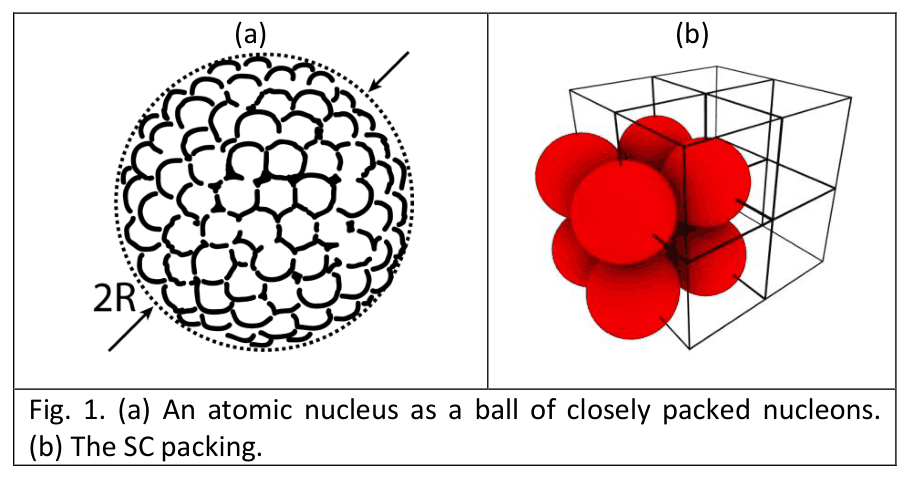
Fig. 1. (a) An atomic nucleus as a ball of closely packed nucleons. (b) The SC packing.
a) Calculate what would be the packing factor \(f\) if nucleons were arranged in a “simple cubic” (SC) crystal system, where each nucleon is centered on a lattice point of an infinite cubic lattice [see Fig. 1(b)]. (0.3 points)
Important: In all subsequent tasks, assume that the actual packing factor for nuclei is equal to the one from Task 1a. If you are not able to calculate it, in subsequent tasks use \(f=1/2\).
b) Estimate the average mass density \(\rho_m\), charge density \(\rho_c\), and the radius \(R\) for a nucleus having \(A\) nucleons. The average mass of a nucleon is \(1.67\cdot10^{-27}\ \mathrm{kg}\). (1.0 points)
Task 2 - Binding energy of atomic nuclei – volume and surface terms
Binding energy of a nucleus is the energy required to disassemble it into separate nucleons and it essentially comes from the attractive nuclear force of each nucleon with its neighbors. If a given nucleon is not on the surface of the nucleus, it contributes to the total binding energy with \(a_V=15.8\ \mathrm{MeV}\) (\(1\ \mathrm{MeV}=1.602\cdot10^{-13}\ \mathrm{J}\)). The contribution of one surface nucleon to the binding energy is approximately \(a_V/2\). Express the binding energy \(E_b\) of a nucleus with \(A\) nucleons in terms of \(A\), \(a_V\), and \(f\), and by including the surface correction. (1.9 points)
Task 3 - Electrostatic (Coulomb) effects on the binding energy
The electrostatic energy of a homogeneously charged ball (with radius \(R\) and total charge \(Q_0\)) is \[ U_c=\frac{3Q_0^2}{20\pi\varepsilon_0R}, \] where \(\varepsilon_0=8.85\cdot10^{-12}\ \mathrm{C^2N^{-1}m^{-2}}\).
a) Apply this formula to get the electrostatic energy of a nucleus. In a nucleus, each proton is not acting upon itself (by Coulomb force), but only upon the rest of the protons. One can take this into account by replacing \(Z^2\rightarrow Z(Z-1)\) in the obtained formula. Use this correction in subsequent tasks. (0.4 points)
b) Write down the complete formula for binding energy, including the main (volume) term, the surface correction term and the obtained electrostatic correction. (0.3 points)
Task 4 - Fission of heavy nuclei
Fission is a nuclear process in which a nucleus splits into smaller parts (lighter nuclei). Suppose that a nucleus with \(A\) nucleons splits into only two equal parts as depicted in Fig. 2.
a) Calculate the total kinetic energy of the fission products \(E_{\mathrm{kin}}\) when the center of two lighter nuclei are separated by the distance \(d\geq2R(A/2)\), where \(R(A/2)\) is their radius. The large nucleus was initially at rest. (1.3 points)
b) Assume that \(d=2R(A/2)\) and evaluate the expression for \(E_{\mathrm{kin}}\) obtained in part a) for \(A=100,\ 150,\ 200\) and \(250\) (express the results in units of MeV). Estimate the values of \(A\) for which fission is possible in the model described above? (1.0 points)
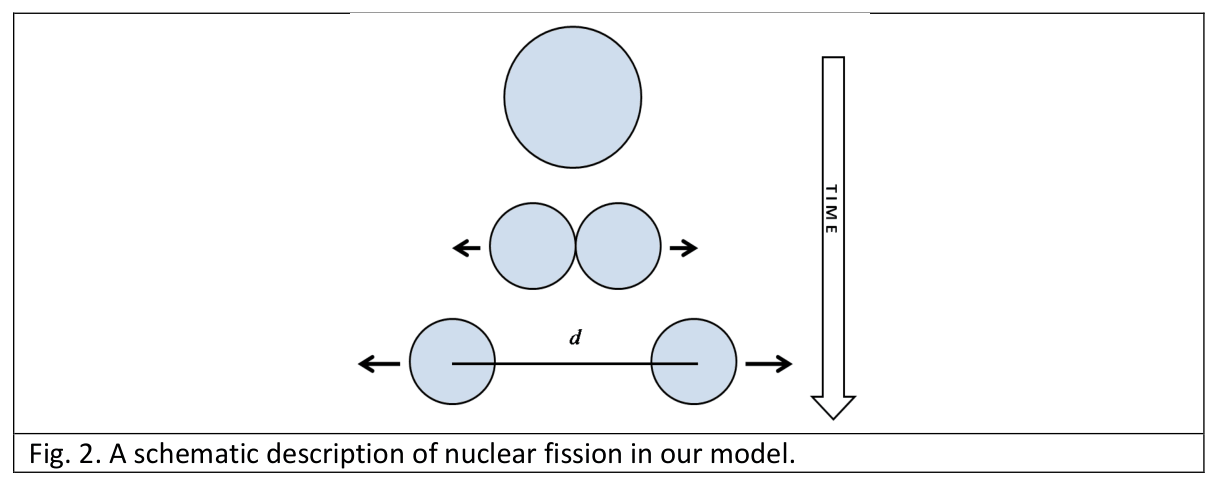
Fig. 2. A schematic description of nuclear fission in our model.
Task 5 – Transfer reactions
a) In modern physics, the energetics of nuclei and their reactions is described in terms of masses. For example, if a nucleus (with zero velocity) is in an excited state with energy \(E_{\mathrm{exc}}\) above the ground state, its mass is \(m=m_0+E_{\mathrm{exc}}/c^2\), where \(m_0\) is its mass in the ground state at rest. The nuclear reaction \({}^{16}\mathrm{O}+{}^{54}\mathrm{Fe}\rightarrow{}^{12}\mathrm{C}+{}^{58}\mathrm{Ni}\) is an example of the so-called “transfer reactions”, in which a part of one nucleus (“cluster”) is transferred to the other (see Fig. 3). In our example the transferred part is a \({}^{4}\mathrm{He}\)-cluster (\(\alpha\)-particle). The transfer reactions occur with maximum probability if the velocity of the projectile-like reaction product (in our case: \({}^{12}\mathrm{C}\)) is equal both in magnitude and direction to the velocity of projectile (in our case: \({}^{16}\mathrm{O}\)). The target \({}^{54}\mathrm{Fe}\) is initially at rest. In the reaction, \({}^{58}\mathrm{Ni}\) is excited into one of its higher-lying states. Find the excitation energy of that state (and express it units of MeV) if the kinetic energy of the projectile \({}^{16}\mathrm{O}\) is \(50\ \mathrm{MeV}\). The speed of light is \(c=3\cdot10^8\ \mathrm{m/s}\). (2.2 points)
| 1. | \(M({}^{16}\mathrm{O})\) | 15.99491 a.m.u. |
| 2. | \(M({}^{54}\mathrm{Fe})\) | 53.93962 a.m.u. |
| 3. | \(M({}^{12}\mathrm{C})\) | 12.00000 a.m.u. |
| 4. | \(M({}^{58}\mathrm{Ni})\) | 57.93535 a.m.u. |
Table 1. The rest masses of the reactants in their ground states. \(1\ \mathrm{a.m.u.}=1.6605\cdot10^{-27}\ \mathrm{kg}\).
b) The \({}^{58}\mathrm{Ni}\) nucleus produced in the excited state discussed in the part a), deexcites into its ground state by emitting a gamma-photon in the direction of its motion. Consider this decay in the frame of reference in which \({}^{58}\mathrm{Ni}\) is at rest to find the recoil energy of \({}^{58}\mathrm{Ni}\) (i.e. kinetic energy which \({}^{58}\mathrm{Ni}\) acquires after the emission of the photon). What is the photon energy in that system? What is the photon energy in the lab system of reference (i.e. what would be the energy of the photon measured in the detector which is positioned in the direction in which the \({}^{58}\mathrm{Ni}\) nucleus moves)? (1.6 points)
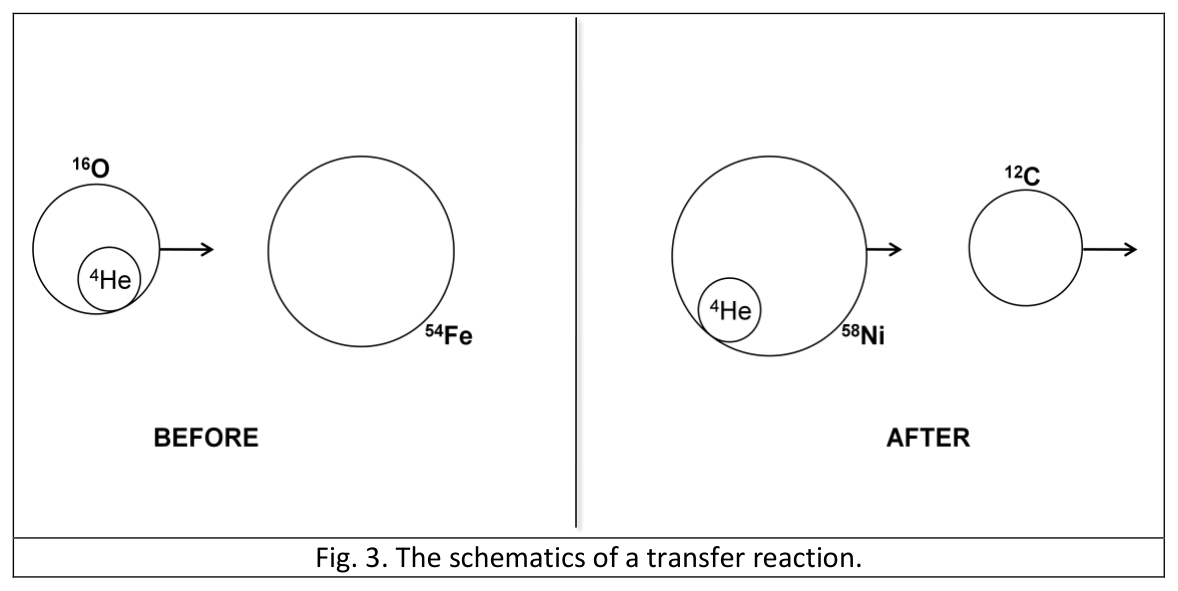
Fig. 3. The schematics of a transfer reaction.
Official English text of the problem.
Answers
For compactness, define \[ S(A)=A-\left(A^{1/3}-2f^{1/3}\right)^3,\qquad r_0=r_Nf^{-1/3}=1.0546\ \mathrm{fm}, \] and \[ a_C=\frac{3e^2}{20\pi\varepsilon_0r_0} =0.81955\ \mathrm{MeV}. \]
-
1(a). \[ \boxed{f=\frac{\pi}{6}\approx0.5236=52.36\%.} \]
-
1(b). \[ \boxed{\rho_m\approx3.40\times10^{17}\ \mathrm{kg\,m^{-3}},\qquad \rho_c\approx1.63\times10^{25}\ \mathrm{C\,m^{-3}}} \] \[ \boxed{R=r_N(A/f)^{1/3}\approx1.05A^{1/3}\ \mathrm{fm}.} \]
-
2. \[ \boxed{ E_b^{(\mathrm{nuc})} =a_V\left[A-\frac{S(A)}2\right] =a_V\left[A-3f^{1/3}A^{2/3} +6f^{2/3}A^{1/3}-4f\right]. } \]
-
3(a). \[ \boxed{ U_c=\frac{a_CZ(Z-1)}{A^{1/3}} \simeq\frac{a_C}{4}\left(A^{5/3}-2A^{2/3}\right). } \]
-
3(b). Writing the complete binding energy as \(B(A)\), \[ \boxed{ B(A)=a_V\left[A-3f^{1/3}A^{2/3} +6f^{2/3}A^{1/3}-4f\right] -\frac{a_C}{4}\left(A^{5/3}-2A^{2/3}\right). } \]
-
4(a). \[ \boxed{ E_{\mathrm{kin}}(d)=2B(A/2)-B(A) -\frac{e^2A^2}{64\pi\varepsilon_0d}. } \]
-
4(b). At contact, the calculated energies for \(A=100,150,200,250\) are, respectively, \[ \boxed{-29.3,\quad-24.9,\quad-6.77,\quad+23.6\ \mathrm{MeV}.} \] The heavy-nucleus threshold is approximately \(\boxed{A_{\mathrm{crit}}\simeq213}\). Of the four examples, only \(A=250\) permits fission from rest through the contact configuration.
-
5(a). \[ \boxed{E_{\mathrm{exc}}\approx10.86\ \mathrm{MeV}.} \]
-
5(b). \[ \boxed{T_{\mathrm{recoil}}\approx1.09\ \mathrm{keV},\qquad E_\gamma^{*}\approx10.86\ \mathrm{MeV},\qquad E_{\gamma,\mathrm{lab}}\approx10.92\ \mathrm{MeV}.} \] Here the star denotes the rest frame of the excited nickel nucleus before emission.
Solution
1(a). Packing factor
In simple cubic packing, neighboring spheres touch along a cube edge, so the lattice spacing is \(2r_N\). A cubic cell contains eight corner nucleons, each shared by eight cells: one complete nucleon per cell.
Consequently, \[ f=\frac{\text{nucleon volume per cell}}{\text{cell volume}} =\frac{\frac43\pi r_N^3}{(2r_N)^3} =\boxed{\frac{\pi}{6}}. \]
1(b). Densities and nuclear radius
The packing-factor definition gives \[ V=\frac{AV_N}{f} =\frac{4\pi r_N^3A}{3f}. \] Equating this to \(4\pi R^3/3\), \[ \boxed{R=r_N\left(\frac Af\right)^{1/3}=r_0A^{1/3}}, \qquad r_0=1.0546\ \mathrm{fm}. \]
At the accuracy of this model, the nuclear mass is \(Am_N\), where \(m_N=1.67\times10^{-27}\ \mathrm{kg}\). Thus \[ \rho_m=\frac{Am_N}{V} =\frac{3fm_N}{4\pi r_N^3}. \] With \(f=\pi/6\), \[ \boxed{ \rho_m=\frac{m_N}{8r_N^3} =3.40\times10^{17}\ \mathrm{kg\,m^{-3}}. } \]
Using \(Z\simeq A/2\), the nuclear charge is approximately \(Ae/2\). The elementary charge consistent with the given electron-volt conversion is \(e=1.602\times10^{-19}\ \mathrm C\). Therefore, \[ \rho_c=\frac{Ae/2}{V} =\frac{3fe}{8\pi r_N^3} =\frac{e}{16r_N^3}, \] so \[ \boxed{\rho_c=1.63\times10^{25}\ \mathrm{C\,m^{-3}}.} \] Both average densities are independent of \(A\).
2. Volume and full surface-layer contributions
The nucleon number density is \[ n=\frac{A}{V}=\frac{f}{V_N}. \] Using the specified surface layer of thickness \(2r_N\), its volume is \[ V_{\mathrm{surface}} =\frac{4\pi}{3}\left[R^3-(R-2r_N)^3\right]. \]
Within the continuum packing model, the number of surface nucleons is therefore \[ \begin{aligned} S(A) &=\frac{f}{r_N^3}\left[R^3-(R-2r_N)^3\right]\\ &=A-f\left[\left(\frac Af\right)^{1/3}-2\right]^3\\ &=\boxed{A-\left(A^{1/3}-2f^{1/3}\right)^3}. \end{aligned} \] This expression applies when \(R\geq2r_N\), as is appropriate to the large nuclei considered here. Expanding without discarding any term, \[ \boxed{ S(A)=6f^{1/3}A^{2/3}-12f^{2/3}A^{1/3}+8f. } \]
There are \(A-S(A)\) interior nucleons contributing \(a_V\) each, and \(S(A)\) surface nucleons contributing \(a_V/2\) each. Hence \[ E_b^{(\mathrm{nuc})} =a_V[A-S(A)]+\frac{a_V}{2}S(A), \] or \[ \boxed{ E_b^{(\mathrm{nuc})} =a_V\left[A-3f^{1/3}A^{2/3} +6f^{2/3}A^{1/3}-4f\right]. } \]
Numerically, \[ \frac{E_b^{(\mathrm{nuc})}}{\mathrm{MeV}} =15.8A-38.2042A^{2/3}+61.5849A^{1/3}-33.0914. \] The \(A^{1/3}\) and constant terms are retained in all subsequent calculations.
3(a). Coulomb self-energy
Substituting \(Q_0=Ze\) into the supplied formula, and then applying the prescribed self-interaction correction, gives \[ U_c=\frac{3e^2Z(Z-1)}{20\pi\varepsilon_0R}. \] Since \(R=r_0A^{1/3}\), define \[ a_C=\frac{3e^2}{20\pi\varepsilon_0r_0}. \] The supplied constants give \[ \frac{e^2}{4\pi\varepsilon_0} =1.44049\ \mathrm{MeV\,fm}, \qquad a_C=0.81955\ \mathrm{MeV}. \] Thus \[ \boxed{U_c=\frac{a_CZ(Z-1)}{A^{1/3}}.} \]
Applying \(Z\simeq A/2\) while retaining the subtraction of one, \[ Z(Z-1)\simeq\frac{A(A-2)}4, \] and therefore \[ \boxed{ U_c(A)=\frac{a_C}{4}\left(A^{5/3}-2A^{2/3}\right). } \]
3(b). Complete binding energy
The positive electrostatic energy reduces the energy required to disassemble the nucleus. Therefore, \[ B(A)=E_b^{(\mathrm{nuc})}(A)-U_c(A), \] which gives \[ \boxed{ B(A)= a_V\left[A-3f^{1/3}A^{2/3} +6f^{2/3}A^{1/3}-4f\right] -\frac{a_C}{4}\left(A^{5/3}-2A^{2/3}\right). } \]
4(a). Kinetic energy at separation \(d\)
Each fragment has \(A/2\) nucleons and charge approximately \(Ae/4\). For two nonoverlapping, spherically symmetric charge distributions, their mutual electrostatic energy equals that of point charges at their centers: \[ U_{12}(d) =\frac{1}{4\pi\varepsilon_0}\frac{(Ae/4)^2}{d} =\frac{e^2A^2}{64\pi\varepsilon_0d}. \] The \(Z(Z-1)\) correction has already been included in each nucleus’s self-energy. It does not apply to this interaction between two distinct sets of protons.
Take the separated free nucleons as the common internal-energy reference. The initial nucleus has energy \(-B(A)\), while the two separated fragments have total energy \[ -2B(A/2)+U_{12}(d)+E_{\mathrm{kin}}(d). \] Energy conservation consequently gives \[ \boxed{ E_{\mathrm{kin}}(d)=2B(A/2)-B(A)-U_{12}(d). } \]
Expanding the binding energies, \[ \boxed{ \begin{aligned} E_{\mathrm{kin}}(d)={}& -3a_Vf^{1/3}(2^{1/3}-1)A^{2/3}\\ &+6a_Vf^{2/3}(2^{2/3}-1)A^{1/3} -4a_Vf\\ &+\frac{a_C}{4} \left[(1-2^{-2/3})A^{5/3} +2(2^{1/3}-1)A^{2/3}\right]\\ &-\frac{e^2A^2}{64\pi\varepsilon_0d}. \end{aligned} } \] The volume contributions cancel because the total number of nucleons is conserved. As the fragments separate, their mutual electrostatic energy decreases and their total kinetic energy increases.
4(b). Contact energies and fission threshold
At contact, \[ d_0=2R(A/2)=2^{2/3}r_0A^{1/3}. \] Using \(e^2/(4\pi\varepsilon_0r_0)=5a_C/3\), \[ U_{12}(d_0)=\frac{5a_C}{48\,2^{2/3}}A^{5/3}. \] Combining this with the expression above, \[ \begin{aligned} E_{\mathrm{kin}}(d_0)={}& \frac{a_C}{4}\left(1-\frac{17}{12}2^{-2/3}\right)A^{5/3}\\ &+(2^{1/3}-1) \left(\frac{a_C}{2}-3a_Vf^{1/3}\right)A^{2/3}\\ &+6a_Vf^{2/3}(2^{2/3}-1)A^{1/3} -4a_Vf. \end{aligned} \] Numerically, \[ \boxed{ \frac{E_{\mathrm{kin}}(d_0)}{\mathrm{MeV}} =0.0220368A^{5/3} -9.82357A^{2/3} +36.1750A^{1/3} -33.0914. } \]
| \(A\) | Contact separation \(d_0\) (fm) | \(E_{\mathrm{kin}}(d_0)\) (MeV) |
|---|---|---|
| 100 | 7.77 | \(-29.3\) |
| 150 | 8.89 | \(-24.9\) |
| 200 | 9.79 | \(-6.77\) |
| 250 | 10.55 | \(+23.6\) |
A negative calculated kinetic energy means that the contact configuration cannot be reached from the initially unexcited nucleus under the assumed energy balance.
For heavy nuclei, solving \(E_{\mathrm{kin}}(d_0)=0\) gives \[ A_{\mathrm{crit}}\simeq213.0. \] Thus the model permits fission through the contact configuration for approximately \[ \boxed{A\gtrsim213.} \] Among the four specified nuclei, only \(A=250\) satisfies this condition. Once contact is accessible, further separation releases additional Coulomb energy.
5(a). Excitation energy in the transfer reaction
Let \(m_1,m_2,m_3,m_4\) denote the tabulated ground-state masses of oxygen, iron, carbon and nickel, respectively. Let \[ m_4^*=m_4+\frac{E_{\mathrm{exc}}}{c^2} \] be the excited nickel mass.
Using the given constants, \[ 1\ \mathrm{a.m.u.}\,c^2 =\frac{(1.6605\times10^{-27})(3\times10^8)^2} {1.602\times10^{-13}}\ \mathrm{MeV} =932.865\ \mathrm{MeV}. \] The ground-state reaction energy is \[ \begin{aligned} Q&=(m_1+m_2-m_3-m_4)c^2\\ &=(15.99491+53.93962-12.00000-57.93535) (932.865)\ \mathrm{MeV}\\ &=-0.764949\ \mathrm{MeV}. \end{aligned} \]
We can retain exact relativistic kinematics. Oxygen and carbon have the same velocity \(v\), hence the same Lorentz factor \[ \gamma=1+\frac{50\ \mathrm{MeV}}{m_1c^2}, \qquad \beta=\frac vc=\sqrt{1-\gamma^{-2}}. \]
Conservation of energy and momentum gives the excited nickel energy and momentum: \[ E_4^{\mathrm{lab}} =\gamma(m_1-m_3)c^2+m_2c^2, \qquad p_4=\gamma(m_1-m_3)v. \] Its invariant rest energy therefore satisfies \[ (m_4^*c^2)^2=(E_4^{\mathrm{lab}})^2-(p_4c)^2. \] Writing \(\Delta m=m_1-m_3\) and using \(\gamma^2(1-\beta^2)=1\), \[ m_4^*=\sqrt{m_2^2+\Delta m^2+2\gamma m_2\Delta m}. \] Consequently, \[ \boxed{ E_{\mathrm{exc}} =c^2\left[ \sqrt{m_2^2+(m_1-m_3)^2+2\gamma m_2(m_1-m_3)} -m_4 \right]. } \]
Numerically, \[ \boxed{E_{\mathrm{exc}}=10.86074\ldots\ \mathrm{MeV} \approx10.86\ \mathrm{MeV}.} \]
For an energy-balance check, the outgoing kinetic energies are \[ T_C=\frac{m_3}{m_1}(50\ \mathrm{MeV}) =37.51193\ \mathrm{MeV}, \] \[ T_{\mathrm{Ni}}=0.86237\ \mathrm{MeV}. \] They satisfy \[ E_{\mathrm{exc}}=50+Q-T_C-T_{\mathrm{Ni}}. \]
The usual nonrelativistic approximation, \[ T_{\mathrm{Ni}}\simeq \frac{(m_1-m_3)^2}{m_1m_4}(50\ \mathrm{MeV}), \] would give \(E_{\mathrm{exc}}\simeq10.862\ \mathrm{MeV}\), the same result at the quoted precision.
For use in part (b), the excited nickel speed is \[ \beta_4=\frac{V}{c} =\frac{p_4c}{E_4^{\mathrm{lab}}} =\frac{\gamma(m_1-m_3)\beta} {m_2+\gamma(m_1-m_3)} =0.00564849, \] so \(V\approx1.69\times10^6\ \mathrm{m\,s^{-1}}\).
5(b). Recoil and photon energies
First work in the rest frame of the excited nickel nucleus. Momentum conservation requires the final nickel nucleus to recoil opposite to the photon, with momentum magnitude \[ p_{\mathrm{recoil}}=\frac{E_\gamma^*}{c}. \]
Set \[ W=m_4c^2,\qquad E=E_{\mathrm{exc}}. \] Energy conservation then gives \[ W+E=E_\gamma^*+\sqrt{W^2+(E_\gamma^*)^2}. \] Solving, \[ \boxed{ E_\gamma^* =\frac{(W+E)^2-W^2}{2(W+E)} =E-\frac{E^2}{2(W+E)}. } \] Thus the recoil kinetic energy is \[ \boxed{ T_{\mathrm{recoil}} =E-E_\gamma^* =\frac{E^2}{2(W+E)} \simeq\frac{E^2}{2W}. } \] The last approximation is valid because \(E\ll W\); it is equivalent to the nonrelativistic recoil expression \(p_{\mathrm{recoil}}^2/(2m_4)\).
Here \[ W=54045.8700\ \mathrm{MeV}. \] Using the excitation energy from part (a), \[ \boxed{ T_{\mathrm{recoil}} =0.00109104\ \mathrm{MeV} \approx1.09\ \mathrm{keV}, } \] and \[ \boxed{ E_\gamma^*=10.85965\ldots\ \mathrm{MeV} \approx10.86\ \mathrm{MeV}. } \] The extra digits display the small recoil subtraction.
For forward emission, Lorentz transformation of the photon energy to the laboratory gives \[ E_{\gamma,\mathrm{lab}} =\Gamma_4\left(E_\gamma^*+Vp_\gamma^*\right) =\Gamma_4E_\gamma^*(1+\beta_4), \] where \(\Gamma_4=(1-\beta_4^2)^{-1/2}\). Hence \[ \boxed{ E_{\gamma,\mathrm{lab}} =E_\gamma^*\sqrt{\frac{1+\beta_4}{1-\beta_4}}. } \] The forward Doppler factor is \(1.00566453\), so \[ \boxed{ E_{\gamma,\mathrm{lab}} =10.92117\ldots\ \mathrm{MeV} \approx10.92\ \mathrm{MeV}. } \]
The solution was checked against the official solution. Where this solution differs from the official solution, the official solution contains an error or a misprint.
IPhO 2010 · Theorieaufgabe 3
Einfaches Modell eines Atomkerns
Einleitung
Obwohl Atomkerne Quantenobjekte sind, lassen sich zahlreiche phänomenologische Gesetze für ihre grundlegenden Eigenschaften (wie Radius oder Bindungsenergie) aus einfachen Annahmen ableiten: (i) Kerne bestehen aus Nukleonen (d. h. Protonen und Neutronen); (ii) die starke Kernwechselwirkung, die diese Nukleonen zusammenhält, hat eine sehr kurze Reichweite (sie wirkt nur zwischen benachbarten Nukleonen); (iii) die Anzahl der Protonen (\(Z\)) in einem gegebenen Kern ist näherungsweise gleich der Anzahl der Neutronen (\(N\)), d. h. \(Z\approx N\approx A/2\), wobei \(A\) die Gesamtzahl der Nukleonen ist (\(A\gg1\)). Wichtig: Verwenden Sie diese Annahmen in den folgenden Aufgaben 1–4.
Aufgabe 1 - Der Atomkern als dicht gepacktes System von Nukleonen
In einem einfachen Modell kann man sich einen Atomkern als eine Kugel aus dicht gepackten Nukleonen vorstellen [siehe Abb. 1(a)], wobei die Nukleonen harte Kugeln mit dem Radius \(r_N=0.85\ \mathrm{fm}\) sind (\(1\ \mathrm{fm}=10^{-15}\ \mathrm{m}\)). Die Kernkraft wirkt nur zwischen zwei Nukleonen, die sich berühren. Das Volumen des Kerns \(V\) ist größer als das Volumen aller Nukleonen \(AV_N\), wobei \(V_N=\frac43r_N^3\pi\). Das Verhältnis \(f=AV_N/V\) heißt Packungsfaktor und gibt den prozentualen Anteil des Raums an, der von Kernmaterie ausgefüllt wird.
Abb. 1. (a) Ein Atomkern als Kugel aus dicht gepackten Nukleonen. (b) Die SC-Packung.
a) Berechnen Sie den Packungsfaktor \(f\), wenn die Nukleonen in einer „einfach kubischen“ (SC) Kristallstruktur angeordnet wären, in der der Mittelpunkt jedes Nukleons auf einem Gitterpunkt eines unendlichen kubischen Gitters liegt [siehe Abb. 1(b)]. (0.3 Punkte)
Wichtig: Nehmen Sie in allen folgenden Aufgaben an, dass der tatsächliche Packungsfaktor für Kerne dem aus Aufgabe 1a entspricht. Falls Sie ihn nicht berechnen können, verwenden Sie in den folgenden Aufgaben \(f=1/2\).
b) Schätzen Sie die mittlere Massendichte \(\rho_m\), die Ladungsdichte \(\rho_c\) und den Radius \(R\) für einen Kern mit \(A\) Nukleonen ab. Die mittlere Masse eines Nukleons beträgt \(1.67\cdot10^{-27}\ \mathrm{kg}\). (1.0 Punkte)
Aufgabe 2 - Bindungsenergie von Atomkernen – Volumen- und Oberflächenterm
Die Bindungsenergie eines Kerns ist die Energie, die benötigt wird, um ihn in einzelne Nukleonen zu zerlegen. Sie beruht im Wesentlichen auf der anziehenden Kernkraft zwischen jedem Nukleon und seinen Nachbarn. Befindet sich ein Nukleon nicht an der Oberfläche des Kerns, trägt es mit \(a_V=15.8\ \mathrm{MeV}\) (\(1\ \mathrm{MeV}=1.602\cdot10^{-13}\ \mathrm{J}\)) zur gesamten Bindungsenergie bei. Der Beitrag eines Oberflächennukleons zur Bindungsenergie beträgt näherungsweise \(a_V/2\). Drücken Sie die Bindungsenergie \(E_b\) eines Kerns mit \(A\) Nukleonen durch \(A\), \(a_V\) und \(f\) aus und berücksichtigen Sie dabei die Oberflächenkorrektur. (1.9 Punkte)
Aufgabe 3 - Elektrostatische (Coulomb-)Effekte auf die Bindungsenergie
Die elektrostatische Energie einer homogen geladenen Kugel (mit Radius \(R\) und Gesamtladung \(Q_0\)) beträgt \[ U_c=\frac{3Q_0^2}{20\pi\varepsilon_0R}, \] wobei \(\varepsilon_0=8.85\cdot10^{-12}\ \mathrm{C^2N^{-1}m^{-2}}\).
a) Wenden Sie diese Formel an, um die elektrostatische Energie eines Kerns zu bestimmen. In einem Kern wirkt jedes Proton (durch die Coulombkraft) nicht auf sich selbst, sondern nur auf die übrigen Protonen. Dies lässt sich berücksichtigen, indem man in der erhaltenen Formel \(Z^2\rightarrow Z(Z-1)\) ersetzt. Verwenden Sie diese Korrektur in den folgenden Aufgaben. (0.4 Punkte)
b) Geben Sie die vollständige Formel für die Bindungsenergie an, einschließlich des Hauptterms (Volumenterms), des Oberflächenkorrekturterms und der erhaltenen elektrostatischen Korrektur. (0.3 Punkte)
Aufgabe 4 - Spaltung schwerer Kerne
Die Kernspaltung ist ein Kernprozess, bei dem sich ein Kern in kleinere Teile (leichtere Kerne) aufspaltet. Nehmen Sie an, dass sich ein Kern mit \(A\) Nukleonen in nur zwei gleich große Teile aufspaltet, wie in Abb. 2 dargestellt.
a) Berechnen Sie die gesamte kinetische Energie der Spaltprodukte \(E_{\mathrm{kin}}\), wenn die Mittelpunkte der beiden leichteren Kerne den Abstand \(d\geq2R(A/2)\) voneinander haben, wobei \(R(A/2)\) ihr Radius ist. Der große Kern befand sich anfangs in Ruhe. (1.3 Punkte)
b) Nehmen Sie \(d=2R(A/2)\) an und werten Sie den in Teil a) erhaltenen Ausdruck für \(E_{\mathrm{kin}}\) für \(A=100,\ 150,\ 200\) und \(250\) aus (geben Sie die Ergebnisse in MeV an). Schätzen Sie ab, für welche Werte von \(A\) eine Spaltung in dem oben beschriebenen Modell möglich ist. (1.0 Punkte)
Abb. 2. Schematische Darstellung der Kernspaltung in unserem Modell.
Aufgabe 5 – Transferreaktionen
a) In der modernen Physik wird die Energiebilanz von Kernen und ihren Reaktionen mithilfe von Massen beschrieben. Befindet sich beispielsweise ein Kern (mit der Geschwindigkeit null) in einem angeregten Zustand mit der Energie \(E_{\mathrm{exc}}\) oberhalb des Grundzustands, so beträgt seine Masse \(m=m_0+E_{\mathrm{exc}}/c^2\), wobei \(m_0\) seine Masse im ruhenden Grundzustand ist. Die Kernreaktion \({}^{16}\mathrm{O}+{}^{54}\mathrm{Fe}\rightarrow{}^{12}\mathrm{C}+{}^{58}\mathrm{Ni}\) ist ein Beispiel für die sogenannten „Transferreaktionen“, bei denen ein Teil eines Kerns („Cluster“) auf den anderen übertragen wird (siehe Abb. 3). In unserem Beispiel ist der übertragene Teil ein \({}^{4}\mathrm{He}\)-Cluster (\(\alpha\)-Teilchen). Transferreaktionen treten mit maximaler Wahrscheinlichkeit auf, wenn die Geschwindigkeit des projektilähnlichen Reaktionsprodukts (in unserem Fall: \({}^{12}\mathrm{C}\)) sowohl im Betrag als auch in der Richtung mit der Geschwindigkeit des Projektils (in unserem Fall: \({}^{16}\mathrm{O}\)) übereinstimmt. Das Target \({}^{54}\mathrm{Fe}\) befindet sich anfangs in Ruhe. Bei der Reaktion wird \({}^{58}\mathrm{Ni}\) in einen seiner höher liegenden Zustände angeregt. Bestimmen Sie die Anregungsenergie dieses Zustands (und geben Sie sie in MeV an), wenn die kinetische Energie des Projektils \({}^{16}\mathrm{O}\) gleich \(50\ \mathrm{MeV}\) ist. Die Lichtgeschwindigkeit beträgt \(c=3\cdot10^8\ \mathrm{m/s}\). (2.2 Punkte)
| 1. | \(M({}^{16}\mathrm{O})\) | 15.99491 a.m.u. |
| 2. | \(M({}^{54}\mathrm{Fe})\) | 53.93962 a.m.u. |
| 3. | \(M({}^{12}\mathrm{C})\) | 12.00000 a.m.u. |
| 4. | \(M({}^{58}\mathrm{Ni})\) | 57.93535 a.m.u. |
Tabelle 1. Die Ruhemassen der Reaktionsteilnehmer in ihren Grundzuständen. \(1\ \mathrm{a.m.u.}=1.6605\cdot10^{-27}\ \mathrm{kg}\).
b) Der im angeregten Zustand aus Teil a) erzeugte \({}^{58}\mathrm{Ni}\)-Kern geht durch Emission eines Gammaphotons in seiner Bewegungsrichtung in den Grundzustand über. Betrachten Sie diesen Zerfall in dem Bezugssystem, in dem \({}^{58}\mathrm{Ni}\) ruht, und bestimmen Sie die Rückstoßenergie von \({}^{58}\mathrm{Ni}\) (d. h. die kinetische Energie, die \({}^{58}\mathrm{Ni}\) nach der Emission des Photons erhält). Wie groß ist die Photonenenergie in diesem System? Wie groß ist die Photonenenergie im Laborsystem (d. h. welche Photonenenergie würde ein Detektor messen, der in der Bewegungsrichtung des \({}^{58}\mathrm{Ni}\)-Kerns aufgestellt ist)? (1.6 Punkte)
Abb. 3. Schematische Darstellung einer Transferreaktion.
Aufgabentext aus dem offiziellen englischen Text übersetzt.
Antworten
Zur Abkürzung definieren wir \[ S(A)=A-\left(A^{1/3}-2f^{1/3}\right)^3,\qquad r_0=r_Nf^{-1/3}=1.0546\ \mathrm{fm}, \] und \[ a_C=\frac{3e^2}{20\pi\varepsilon_0r_0} =0.81955\ \mathrm{MeV}. \]
-
1(a). \[ \boxed{f=\frac{\pi}{6}\approx0.5236=52.36\%.} \]
-
1(b). \[ \boxed{\rho_m\approx3.40\times10^{17}\ \mathrm{kg\,m^{-3}},\qquad \rho_c\approx1.63\times10^{25}\ \mathrm{C\,m^{-3}}} \] \[ \boxed{R=r_N(A/f)^{1/3}\approx1.05A^{1/3}\ \mathrm{fm}.} \]
-
2. \[ \boxed{ E_b^{(\mathrm{nuc})} =a_V\left[A-\frac{S(A)}2\right] =a_V\left[A-3f^{1/3}A^{2/3} +6f^{2/3}A^{1/3}-4f\right]. } \]
-
3(a). \[ \boxed{ U_c=\frac{a_CZ(Z-1)}{A^{1/3}} \simeq\frac{a_C}{4}\left(A^{5/3}-2A^{2/3}\right). } \]
-
3(b). Bezeichnen wir die vollständige Bindungsenergie mit \(B(A)\), so gilt \[ \boxed{ B(A)=a_V\left[A-3f^{1/3}A^{2/3} +6f^{2/3}A^{1/3}-4f\right] -\frac{a_C}{4}\left(A^{5/3}-2A^{2/3}\right). } \]
-
4(a). \[ \boxed{ E_{\mathrm{kin}}(d)=2B(A/2)-B(A) -\frac{e^2A^2}{64\pi\varepsilon_0d}. } \]
-
4(b). Bei Berührung ergeben sich für \(A=100,150,200,250\) der Reihe nach die Energien \[ \boxed{-29.3,\quad-24.9,\quad-6.77,\quad+23.6\ \mathrm{MeV}.} \] Der Schwellenwert für schwere Kerne liegt näherungsweise bei \(\boxed{A_{\mathrm{crit}}\simeq213}\). Von den vier Beispielen erlaubt nur \(A=250\) eine Spaltung aus der Ruhe über die Berührungskonfiguration.
-
5(a). \[ \boxed{E_{\mathrm{exc}}\approx10.86\ \mathrm{MeV}.} \]
-
5(b). \[ \boxed{T_{\mathrm{recoil}}\approx1.09\ \mathrm{keV},\qquad E_\gamma^{*}\approx10.86\ \mathrm{MeV},\qquad E_{\gamma,\mathrm{lab}}\approx10.92\ \mathrm{MeV}.} \] Der Stern bezeichnet hier das Ruhesystem des angeregten Nickelkerns vor der Emission.
Lösung
1(a). Packungsfaktor
Bei einer einfach kubischen Packung berühren sich benachbarte Kugeln entlang einer Würfelkante, sodass der Gitterabstand \(2r_N\) beträgt. Eine kubische Elementarzelle enthält acht Nukleonen an den Ecken, von denen jedes zu acht Zellen gehört: insgesamt ein vollständiges Nukleon pro Zelle.
Folglich gilt \[ f=\frac{\text{Nukleonenvolumen pro Zelle}}{\text{Zellvolumen}} =\frac{\frac43\pi r_N^3}{(2r_N)^3} =\boxed{\frac{\pi}{6}}. \]
1(b). Dichten und Kernradius
Aus der Definition des Packungsfaktors folgt \[ V=\frac{AV_N}{f} =\frac{4\pi r_N^3A}{3f}. \] Durch Gleichsetzen mit \(4\pi R^3/3\) ergibt sich \[ \boxed{R=r_N\left(\frac Af\right)^{1/3}=r_0A^{1/3}}, \qquad r_0=1.0546\ \mathrm{fm}. \]
Im Rahmen der Genauigkeit dieses Modells beträgt die Kernmasse \(Am_N\), wobei \(m_N=1.67\times10^{-27}\ \mathrm{kg}\). Somit gilt \[ \rho_m=\frac{Am_N}{V} =\frac{3fm_N}{4\pi r_N^3}. \] Mit \(f=\pi/6\) erhält man \[ \boxed{ \rho_m=\frac{m_N}{8r_N^3} =3.40\times10^{17}\ \mathrm{kg\,m^{-3}}. } \]
Mit \(Z\simeq A/2\) beträgt die Kernladung näherungsweise \(Ae/2\). Die mit der angegebenen Umrechnung des Elektronenvolts konsistente Elementarladung ist \(e=1.602\times10^{-19}\ \mathrm C\). Daher gilt \[ \rho_c=\frac{Ae/2}{V} =\frac{3fe}{8\pi r_N^3} =\frac{e}{16r_N^3}, \] also \[ \boxed{\rho_c=1.63\times10^{25}\ \mathrm{C\,m^{-3}}.} \] Beide mittleren Dichten sind unabhängig von \(A\).
2. Volumenbeitrag und vollständiger Beitrag der Oberflächenschicht
Die Anzahldichte der Nukleonen beträgt \[ n=\frac{A}{V}=\frac{f}{V_N}. \] Für die vorgegebene Oberflächenschicht der Dicke \(2r_N\) beträgt das Volumen \[ V_{\mathrm{surface}} =\frac{4\pi}{3}\left[R^3-(R-2r_N)^3\right]. \]
Im kontinuierlichen Packungsmodell ist die Anzahl der Oberflächennukleonen daher \[ \begin{aligned} S(A) &=\frac{f}{r_N^3}\left[R^3-(R-2r_N)^3\right]\\ &=A-f\left[\left(\frac Af\right)^{1/3}-2\right]^3\\ &=\boxed{A-\left(A^{1/3}-2f^{1/3}\right)^3}. \end{aligned} \] Dieser Ausdruck gilt für \(R\geq2r_N\), wie es für die hier betrachteten großen Kerne zutrifft. Ausmultiplizieren ohne Vernachlässigung eines Terms ergibt \[ \boxed{ S(A)=6f^{1/3}A^{2/3}-12f^{2/3}A^{1/3}+8f. } \]
Es gibt \(A-S(A)\) Nukleonen im Inneren, die jeweils \(a_V\) beitragen, und \(S(A)\) Oberflächennukleonen, die jeweils \(a_V/2\) beitragen. Somit gilt \[ E_b^{(\mathrm{nuc})} =a_V[A-S(A)]+\frac{a_V}{2}S(A), \] oder \[ \boxed{ E_b^{(\mathrm{nuc})} =a_V\left[A-3f^{1/3}A^{2/3} +6f^{2/3}A^{1/3}-4f\right]. } \]
Numerisch ergibt sich \[ \frac{E_b^{(\mathrm{nuc})}}{\mathrm{MeV}} =15.8A-38.2042A^{2/3}+61.5849A^{1/3}-33.0914. \] Der \(A^{1/3}\)-Term und der konstante Term werden in allen folgenden Berechnungen beibehalten.
3(a). Coulomb-Selbstenergie
Einsetzen von \(Q_0=Ze\) in die angegebene Formel und anschließende Anwendung der vorgeschriebenen Selbstwechselwirkungskorrektur ergibt \[ U_c=\frac{3e^2Z(Z-1)}{20\pi\varepsilon_0R}. \] Da \(R=r_0A^{1/3}\), definieren wir \[ a_C=\frac{3e^2}{20\pi\varepsilon_0r_0}. \] Mit den angegebenen Konstanten erhält man \[ \frac{e^2}{4\pi\varepsilon_0} =1.44049\ \mathrm{MeV\,fm}, \qquad a_C=0.81955\ \mathrm{MeV}. \] Somit gilt \[ \boxed{U_c=\frac{a_CZ(Z-1)}{A^{1/3}}.} \]
Mit \(Z\simeq A/2\) und unter Beibehaltung der Subtraktion von eins gilt \[ Z(Z-1)\simeq\frac{A(A-2)}4, \] und daher \[ \boxed{ U_c(A)=\frac{a_C}{4}\left(A^{5/3}-2A^{2/3}\right). } \]
3(b). Vollständige Bindungsenergie
Die positive elektrostatische Energie verringert die Energie, die zur Zerlegung des Kerns erforderlich ist. Daher gilt \[ B(A)=E_b^{(\mathrm{nuc})}(A)-U_c(A), \] woraus folgt \[ \boxed{ B(A)= a_V\left[A-3f^{1/3}A^{2/3} +6f^{2/3}A^{1/3}-4f\right] -\frac{a_C}{4}\left(A^{5/3}-2A^{2/3}\right). } \]
4(a). Kinetische Energie beim Abstand \(d\)
Jedes Fragment enthält \(A/2\) Nukleonen und trägt näherungsweise die Ladung \(Ae/4\). Für zwei nicht überlappende, kugelsymmetrische Ladungsverteilungen ist die elektrostatische Wechselwirkungsenergie gleich derjenigen von Punktladungen in ihren Mittelpunkten: \[ U_{12}(d) =\frac{1}{4\pi\varepsilon_0}\frac{(Ae/4)^2}{d} =\frac{e^2A^2}{64\pi\varepsilon_0d}. \] Die Korrektur \(Z(Z-1)\) ist bereits in der Selbstenergie jedes Kerns enthalten. Sie gilt nicht für diese Wechselwirkung zwischen zwei verschiedenen Gruppen von Protonen.
Wir wählen die voneinander getrennten freien Nukleonen als gemeinsamen Bezugspunkt für die innere Energie. Der ursprüngliche Kern besitzt die Energie \(-B(A)\), während die beiden getrennten Fragmente die Gesamtenergie \[ -2B(A/2)+U_{12}(d)+E_{\mathrm{kin}}(d) \] besitzen. Aus der Energieerhaltung folgt somit \[ \boxed{ E_{\mathrm{kin}}(d)=2B(A/2)-B(A)-U_{12}(d). } \]
Einsetzen und Zusammenfassen der Bindungsenergien ergibt \[ \boxed{ \begin{aligned} E_{\mathrm{kin}}(d)={}& -3a_Vf^{1/3}(2^{1/3}-1)A^{2/3}\\ &+6a_Vf^{2/3}(2^{2/3}-1)A^{1/3} -4a_Vf\\ &+\frac{a_C}{4} \left[(1-2^{-2/3})A^{5/3} +2(2^{1/3}-1)A^{2/3}\right]\\ &-\frac{e^2A^2}{64\pi\varepsilon_0d}. \end{aligned} } \] Die Volumenbeiträge heben sich auf, da die Gesamtzahl der Nukleonen erhalten bleibt. Wenn sich die Fragmente voneinander entfernen, nimmt ihre elektrostatische Wechselwirkungsenergie ab und ihre gesamte kinetische Energie zu.
4(b). Energien bei Berührung und Spaltschwelle
Bei Berührung gilt \[ d_0=2R(A/2)=2^{2/3}r_0A^{1/3}. \] Mit \(e^2/(4\pi\varepsilon_0r_0)=5a_C/3\) erhält man \[ U_{12}(d_0)=\frac{5a_C}{48\,2^{2/3}}A^{5/3}. \] Zusammen mit dem obigen Ausdruck ergibt dies \[ \begin{aligned} E_{\mathrm{kin}}(d_0)={}& \frac{a_C}{4}\left(1-\frac{17}{12}2^{-2/3}\right)A^{5/3}\\ &+(2^{1/3}-1) \left(\frac{a_C}{2}-3a_Vf^{1/3}\right)A^{2/3}\\ &+6a_Vf^{2/3}(2^{2/3}-1)A^{1/3} -4a_Vf. \end{aligned} \] Numerisch ergibt sich \[ \boxed{ \frac{E_{\mathrm{kin}}(d_0)}{\mathrm{MeV}} =0.0220368A^{5/3} -9.82357A^{2/3} +36.1750A^{1/3} -33.0914. } \]
| \(A\) | Abstand bei Berührung \(d_0\) (fm) | \(E_{\mathrm{kin}}(d_0)\) (MeV) |
|---|---|---|
| 100 | 7.77 | \(-29.3\) |
| 150 | 8.89 | \(-24.9\) |
| 200 | 9.79 | \(-6.77\) |
| 250 | 10.55 | \(+23.6\) |
Eine negative berechnete kinetische Energie bedeutet, dass die Berührungskonfiguration ausgehend vom anfangs unangeregten Kern unter der angenommenen Energiebilanz nicht erreicht werden kann.
Für schwere Kerne ergibt die Lösung von \(E_{\mathrm{kin}}(d_0)=0\) \[ A_{\mathrm{crit}}\simeq213.0. \] Somit erlaubt das Modell eine Spaltung über die Berührungskonfiguration näherungsweise für \[ \boxed{A\gtrsim213.} \] Von den vier angegebenen Kernen erfüllt nur \(A=250\) diese Bedingung. Sobald die Berührungskonfiguration erreichbar ist, wird bei weiterer Trennung zusätzliche Coulombenergie frei.
5(a). Anregungsenergie bei der Transferreaktion
Mit \(m_1,m_2,m_3,m_4\) bezeichnen wir die tabellierten Grundzustandsmassen von Sauerstoff, Eisen, Kohlenstoff bzw. Nickel. Es sei \[ m_4^*=m_4+\frac{E_{\mathrm{exc}}}{c^2} \] die Masse des angeregten Nickelkerns.
Mit den angegebenen Konstanten gilt \[ 1\ \mathrm{a.m.u.}\,c^2 =\frac{(1.6605\times10^{-27})(3\times10^8)^2} {1.602\times10^{-13}}\ \mathrm{MeV} =932.865\ \mathrm{MeV}. \] Die Reaktionsenergie für die Grundzustände beträgt \[ \begin{aligned} Q&=(m_1+m_2-m_3-m_4)c^2\\ &=(15.99491+53.93962-12.00000-57.93535) (932.865)\ \mathrm{MeV}\\ &=-0.764949\ \mathrm{MeV}. \end{aligned} \]
Wir können die exakte relativistische Kinematik beibehalten. Sauerstoff und Kohlenstoff haben dieselbe Geschwindigkeit \(v\) und daher denselben Lorentzfaktor \[ \gamma=1+\frac{50\ \mathrm{MeV}}{m_1c^2}, \qquad \beta=\frac vc=\sqrt{1-\gamma^{-2}}. \]
Aus der Energie- und Impulserhaltung ergeben sich Energie und Impuls des angeregten Nickelkerns: \[ E_4^{\mathrm{lab}} =\gamma(m_1-m_3)c^2+m_2c^2, \qquad p_4=\gamma(m_1-m_3)v. \] Seine invariante Ruheenergie erfüllt daher \[ (m_4^*c^2)^2=(E_4^{\mathrm{lab}})^2-(p_4c)^2. \] Mit \(\Delta m=m_1-m_3\) und unter Verwendung von \(\gamma^2(1-\beta^2)=1\) folgt \[ m_4^*=\sqrt{m_2^2+\Delta m^2+2\gamma m_2\Delta m}. \] Folglich gilt \[ \boxed{ E_{\mathrm{exc}} =c^2\left[ \sqrt{m_2^2+(m_1-m_3)^2+2\gamma m_2(m_1-m_3)} -m_4 \right]. } \]
Numerisch ergibt sich \[ \boxed{E_{\mathrm{exc}}=10.86074\ldots\ \mathrm{MeV} \approx10.86\ \mathrm{MeV}.} \]
Zur Überprüfung der Energiebilanz lauten die kinetischen Energien der auslaufenden Kerne \[ T_C=\frac{m_3}{m_1}(50\ \mathrm{MeV}) =37.51193\ \mathrm{MeV}, \] \[ T_{\mathrm{Ni}}=0.86237\ \mathrm{MeV}. \] Sie erfüllen \[ E_{\mathrm{exc}}=50+Q-T_C-T_{\mathrm{Ni}}. \]
Die übliche nichtrelativistische Näherung, \[ T_{\mathrm{Ni}}\simeq \frac{(m_1-m_3)^2}{m_1m_4}(50\ \mathrm{MeV}), \] würde \(E_{\mathrm{exc}}\simeq10.862\ \mathrm{MeV}\) ergeben, also bei der angegebenen Genauigkeit dasselbe Ergebnis.
Zur Verwendung in Teil (b) bestimmen wir die Geschwindigkeit des angeregten Nickelkerns: \[ \beta_4=\frac{V}{c} =\frac{p_4c}{E_4^{\mathrm{lab}}} =\frac{\gamma(m_1-m_3)\beta} {m_2+\gamma(m_1-m_3)} =0.00564849, \] also \(V\approx1.69\times10^6\ \mathrm{m\,s^{-1}}\).
5(b). Rückstoß- und Photonenenergien
Wir betrachten zunächst das Ruhesystem des angeregten Nickelkerns. Aufgrund der Impulserhaltung muss der verbleibende Nickelkern einen Rückstoß entgegen der Richtung des Photons erfahren, mit dem Impulsbetrag \[ p_{\mathrm{recoil}}=\frac{E_\gamma^*}{c}. \]
Wir setzen \[ W=m_4c^2,\qquad E=E_{\mathrm{exc}}. \] Aus der Energieerhaltung folgt dann \[ W+E=E_\gamma^*+\sqrt{W^2+(E_\gamma^*)^2}. \] Auflösen ergibt \[ \boxed{ E_\gamma^* =\frac{(W+E)^2-W^2}{2(W+E)} =E-\frac{E^2}{2(W+E)}. } \] Die kinetische Rückstoßenergie beträgt somit \[ \boxed{ T_{\mathrm{recoil}} =E-E_\gamma^* =\frac{E^2}{2(W+E)} \simeq\frac{E^2}{2W}. } \] Die letzte Näherung ist gültig, weil \(E\ll W\); sie ist äquivalent zum nichtrelativistischen Ausdruck für die Rückstoßenergie \(p_{\mathrm{recoil}}^2/(2m_4)\).
Hier gilt \[ W=54045.8700\ \mathrm{MeV}. \] Mit der Anregungsenergie aus Teil (a) erhält man \[ \boxed{ T_{\mathrm{recoil}} =0.00109104\ \mathrm{MeV} \approx1.09\ \mathrm{keV}, } \] und \[ \boxed{ E_\gamma^*=10.85965\ldots\ \mathrm{MeV} \approx10.86\ \mathrm{MeV}. } \] Die zusätzlichen Stellen machen den kleinen Abzug durch den Rückstoß sichtbar.
Bei Emission in Vorwärtsrichtung ergibt die Lorentztransformation der Photonenenergie ins Laborsystem \[ E_{\gamma,\mathrm{lab}} =\Gamma_4\left(E_\gamma^*+Vp_\gamma^*\right) =\Gamma_4E_\gamma^*(1+\beta_4), \] wobei \(\Gamma_4=(1-\beta_4^2)^{-1/2}\). Somit gilt \[ \boxed{ E_{\gamma,\mathrm{lab}} =E_\gamma^*\sqrt{\frac{1+\beta_4}{1-\beta_4}}. } \] Der Dopplerfaktor in Vorwärtsrichtung beträgt \(1.00566453\), sodass \[ \boxed{ E_{\gamma,\mathrm{lab}} =10.92117\ldots\ \mathrm{MeV} \approx10.92\ \mathrm{MeV}. } \]
Die Lösung wurde mit der offiziellen Lösung abgeglichen. Wo diese Lösung von der offiziellen Lösung abweicht, enthält die offizielle Lösung einen Fehler oder Druckfehler.
IPhO 2010 · Teori sorusu 3
Atom çekirdeğinin basit bir modeli
Giriş
Atom çekirdekleri kuantum nesneleri olmasına rağmen, temel özelliklerine (yarıçap veya bağlanma enerjisi gibi) ilişkin bir dizi fenomenolojik yasa basit varsayımlardan türetilebilir: (i) çekirdekler nükleonlardan (yani proton ve nötronlardan) oluşur; (ii) bu nükleonları bir arada tutan güçlü nükleer etkileşimin menzili çok kısadır (yalnızca komşu nükleonlar arasında etkir); (iii) belirli bir çekirdekteki proton sayısı (\(Z\)), nötron sayısına (\(N\)) yaklaşık olarak eşittir; yani \(Z\approx N\approx A/2\); burada \(A\), toplam nükleon sayısıdır (\(A\gg1\)). Önemli: Aşağıdaki Görev 1-4'te bu varsayımları kullanın.
Görev 1 - Sıkı paketlenmiş bir nükleon sistemi olarak atom çekirdeği
Basit bir modelde atom çekirdeği, sıkı paketlenmiş nükleonlardan oluşan bir küre olarak düşünülebilir [bkz. Şekil 1(a)]; burada nükleonlar, yarıçapı \(r_N=0.85\ \mathrm{fm}\) olan sert kürelerdir (\(1\ \mathrm{fm}=10^{-15}\ \mathrm{m}\)). Nükleer kuvvet yalnızca birbirine temas eden iki nükleon arasında bulunur. Çekirdeğin hacmi \(V\), tüm nükleonların toplam hacmi \(AV_N\)'den büyüktür; burada \(V_N=\frac43r_N^3\pi\). \(f=AV_N/V\) oranına paketleme faktörü denir ve bu oran, uzayın nükleer maddeyle dolu olan yüzdesini verir.
Şekil 1. (a) Sıkı paketlenmiş nükleonlardan oluşan bir küre olarak atom çekirdeği. (b) SC paketleme.
a) Nükleonlar, her bir nükleonun merkezi sonsuz bir kübik örgünün bir örgü noktasında olacak şekilde “basit kübik” (SC) kristal sisteminde dizilseydi, paketleme faktörünün \(f\) ne olacağını hesaplayın [bkz. Şekil 1(b)]. (0.3 puan)
Önemli: Sonraki tüm görevlerde, çekirdeklerin gerçek paketleme faktörünün Görev 1a'da bulunan değere eşit olduğunu varsayın. Bu değeri hesaplayamazsanız, sonraki görevlerde \(f=1/2\) kullanın.
b) \(A\) nükleon içeren bir çekirdeğin ortalama kütle yoğunluğunu \(\rho_m\), yük yoğunluğunu \(\rho_c\) ve yarıçapını \(R\) tahmin edin. Bir nükleonun ortalama kütlesi \(1.67\cdot10^{-27}\ \mathrm{kg}\)'dır. (1.0 puan)
Görev 2 - Atom çekirdeklerinin bağlanma enerjisi – hacim ve yüzey terimleri
Bir çekirdeğin bağlanma enerjisi, onu ayrı nükleonlara ayırmak için gereken enerjidir ve esas olarak her bir nükleon ile komşuları arasındaki çekici nükleer kuvvetten kaynaklanır. Bir nükleon çekirdeğin yüzeyinde değilse, toplam bağlanma enerjisine \(a_V=15.8\ \mathrm{MeV}\) katkıda bulunur (\(1\ \mathrm{MeV}=1.602\cdot10^{-13}\ \mathrm{J}\)). Bir yüzey nükleonunun bağlanma enerjisine katkısı yaklaşık \(a_V/2\)'dir. \(A\) nükleon içeren bir çekirdeğin bağlanma enerjisini \(E_b\), yüzey düzeltmesini de dahil ederek \(A\), \(a_V\) ve \(f\) cinsinden ifade edin. (1.9 puan)
Görev 3 - Bağlanma enerjisi üzerindeki elektrostatik (Coulomb) etkiler
Homojen yüklü bir kürenin (yarıçapı \(R\) ve toplam yükü \(Q_0\)) elektrostatik enerjisi \[ U_c=\frac{3Q_0^2}{20\pi\varepsilon_0R}, \] ile verilir; burada \(\varepsilon_0=8.85\cdot10^{-12}\ \mathrm{C^2N^{-1}m^{-2}}\).
a) Bir çekirdeğin elektrostatik enerjisini elde etmek için bu formülü uygulayın. Bir çekirdekte her proton, (Coulomb kuvvetiyle) kendisine değil, yalnızca diğer protonlara etkir. Elde edilen formülde \(Z^2\rightarrow Z(Z-1)\) değişimi yapılarak bu durum hesaba katılabilir. Sonraki görevlerde bu düzeltmeyi kullanın. (0.4 puan)
b) Ana (hacim) terimi, yüzey düzeltmesi terimini ve elde edilen elektrostatik düzeltmeyi içeren tam bağlanma enerjisi formülünü yazın. (0.3 puan)
Görev 4 - Ağır çekirdeklerin fisyonu
Fisyon, bir çekirdeğin daha küçük parçalara (daha hafif çekirdeklere) bölündüğü nükleer bir süreçtir. \(A\) nükleon içeren bir çekirdeğin, Şekil 2'de gösterildiği gibi yalnızca iki eşit parçaya bölündüğünü varsayın.
a) İki hafif çekirdeğin merkezleri arasındaki uzaklık \(d\geq2R(A/2)\) olduğunda fisyon ürünlerinin toplam kinetik enerjisini \(E_{\mathrm{kin}}\) hesaplayın; burada \(R(A/2)\), bu çekirdeklerin yarıçapıdır. Büyük çekirdek başlangıçta durgundur. (1.3 puan)
b) \(d=2R(A/2)\) olduğunu varsayın ve a) kısmında elde edilen \(E_{\mathrm{kin}}\) ifadesini \(A=100,\ 150,\ 200\) ve \(250\) için hesaplayın (sonuçları MeV biriminde ifade edin). Yukarıda açıklanan modelde fisyonun mümkün olduğu \(A\) değerlerini tahmin edin. (1.0 puan)
Şekil 2. Modelimizdeki nükleer fisyonun şematik gösterimi.
Görev 5 – Transfer tepkimeleri
a) Modern fizikte çekirdeklerin ve tepkimelerinin enerji özellikleri kütleler cinsinden betimlenir. Örneğin, bir çekirdek (hızı sıfırken) temel durumun \(E_{\mathrm{exc}}\) kadar üzerinde bir enerjiye sahip uyarılmış bir durumdaysa, kütlesi \(m=m_0+E_{\mathrm{exc}}/c^2\) olur; burada \(m_0\), çekirdeğin durgunken temel durumdaki kütlesidir. \({}^{16}\mathrm{O}+{}^{54}\mathrm{Fe}\rightarrow{}^{12}\mathrm{C}+{}^{58}\mathrm{Ni}\) nükleer tepkimesi, bir çekirdeğin bir bölümünün (“küme”) diğerine aktarıldığı, “transfer tepkimeleri” olarak adlandırılan tepkimelere bir örnektir (bkz. Şekil 3). Örneğimizde aktarılan bölüm bir \({}^{4}\mathrm{He}\) kümesidir (\(\alpha\) parçacığı). Gelen çekirdeğe benzer tepkime ürününün (bizim durumumuzda: \({}^{12}\mathrm{C}\)) hızı, gelen çekirdeğin (bizim durumumuzda: \({}^{16}\mathrm{O}\)) hızına hem büyüklük hem de yön bakımından eşit olduğunda, transfer tepkimeleri en yüksek olasılıkla gerçekleşir. Hedef \({}^{54}\mathrm{Fe}\) başlangıçta durgundur. Tepkimede \({}^{58}\mathrm{Ni}\), daha yüksek enerjili durumlarından birine uyarılır. Gelen \({}^{16}\mathrm{O}\) çekirdeğinin kinetik enerjisi \(50\ \mathrm{MeV}\) ise, bu durumun uyarılma enerjisini bulun (ve MeV biriminde ifade edin). Işık hızı \(c=3\cdot10^8\ \mathrm{m/s}\)'dir. (2.2 puan)
| 1. | \(M({}^{16}\mathrm{O})\) | 15.99491 a.m.u. |
| 2. | \(M({}^{54}\mathrm{Fe})\) | 53.93962 a.m.u. |
| 3. | \(M({}^{12}\mathrm{C})\) | 12.00000 a.m.u. |
| 4. | \(M({}^{58}\mathrm{Ni})\) | 57.93535 a.m.u. |
Tablo 1. Tepkimede yer alan çekirdeklerin temel durumlarındaki durgun kütleleri. \(1\ \mathrm{a.m.u.}=1.6605\cdot10^{-27}\ \mathrm{kg}\).
b) a) kısmında ele alınan uyarılmış durumda üretilen \({}^{58}\mathrm{Ni}\) çekirdeği, hareketi yönünde bir gama fotonu yayarak temel durumuna geçer. \({}^{58}\mathrm{Ni}\)'nin geri tepme enerjisini (yani fotonun yayılmasından sonra \({}^{58}\mathrm{Ni}\)'nin kazandığı kinetik enerjiyi) bulmak için bu bozunmayı \({}^{58}\mathrm{Ni}\)'nin durgun olduğu referans sisteminde ele alın. Bu sistemde fotonun enerjisi nedir? Laboratuvar referans sisteminde fotonun enerjisi nedir (yani \({}^{58}\mathrm{Ni}\) çekirdeğinin hareket ettiği yönde konumlandırılmış bir dedektörde ölçülen foton enerjisi ne olur)? (1.6 puan)
Şekil 3. Bir transfer tepkimesinin şematik gösterimi.
Soru metni resmi İngilizce metinden çevrilmiştir.
Cevaplar
İfadeleri kısa tutmak için \[ S(A)=A-\left(A^{1/3}-2f^{1/3}\right)^3,\qquad r_0=r_Nf^{-1/3}=1.0546\ \mathrm{fm}, \] ve \[ a_C=\frac{3e^2}{20\pi\varepsilon_0r_0} =0.81955\ \mathrm{MeV}. \] tanımlarını yapalım.
-
1(a). \[ \boxed{f=\frac{\pi}{6}\approx0.5236=52.36\%.} \]
-
1(b). \[ \boxed{\rho_m\approx3.40\times10^{17}\ \mathrm{kg\,m^{-3}},\qquad \rho_c\approx1.63\times10^{25}\ \mathrm{C\,m^{-3}}} \] \[ \boxed{R=r_N(A/f)^{1/3}\approx1.05A^{1/3}\ \mathrm{fm}.} \]
-
2. \[ \boxed{ E_b^{(\mathrm{nuc})} =a_V\left[A-\frac{S(A)}2\right] =a_V\left[A-3f^{1/3}A^{2/3} +6f^{2/3}A^{1/3}-4f\right]. } \]
-
3(a). \[ \boxed{ U_c=\frac{a_CZ(Z-1)}{A^{1/3}} \simeq\frac{a_C}{4}\left(A^{5/3}-2A^{2/3}\right). } \]
-
3(b). Tam bağlanma enerjisini \(B(A)\) ile gösterirsek, \[ \boxed{ B(A)=a_V\left[A-3f^{1/3}A^{2/3} +6f^{2/3}A^{1/3}-4f\right] -\frac{a_C}{4}\left(A^{5/3}-2A^{2/3}\right). } \]
-
4(a). \[ \boxed{ E_{\mathrm{kin}}(d)=2B(A/2)-B(A) -\frac{e^2A^2}{64\pi\varepsilon_0d}. } \]
-
4(b). Temas durumunda \(A=100,150,200,250\) için hesaplanan enerjiler sırasıyla \[ \boxed{-29.3,\quad-24.9,\quad-6.77,\quad+23.6\ \mathrm{MeV}.} \] Ağır çekirdekler için eşik yaklaşık olarak \(\boxed{A_{\mathrm{crit}}\simeq213}\)'tür. Dört örnek arasında yalnızca \(A=250\), durgun başlangıç durumundan temas konfigürasyonu üzerinden fisyona izin verir.
-
5(a). \[ \boxed{E_{\mathrm{exc}}\approx10.86\ \mathrm{MeV}.} \]
-
5(b). \[ \boxed{T_{\mathrm{recoil}}\approx1.09\ \mathrm{keV},\qquad E_\gamma^{*}\approx10.86\ \mathrm{MeV},\qquad E_{\gamma,\mathrm{lab}}\approx10.92\ \mathrm{MeV}.} \] Burada yıldız, uyarılmış nikel çekirdeğinin yayım öncesindeki durgunluk sistemini gösterir.
Çözüm
1(a). Paketleme faktörü
Basit kübik paketlemede komşu küreler bir küpün kenarı boyunca birbirine temas eder; dolayısıyla örgü aralığı \(2r_N\)'dir. Bir kübik hücre, her biri sekiz hücre tarafından paylaşılan sekiz köşe nükleonu içerir: hücre başına bir tam nükleon düşer.
Buna göre, \[ f=\frac{\text{hücre başına nükleon hacmi}}{\text{hücre hacmi}} =\frac{\frac43\pi r_N^3}{(2r_N)^3} =\boxed{\frac{\pi}{6}}. \]
1(b). Yoğunluklar ve çekirdek yarıçapı
Paketleme faktörünün tanımı \[ V=\frac{AV_N}{f} =\frac{4\pi r_N^3A}{3f}. \] sonucunu verir. Bunu \(4\pi R^3/3\)'e eşitlersek, \[ \boxed{R=r_N\left(\frac Af\right)^{1/3}=r_0A^{1/3}}, \qquad r_0=1.0546\ \mathrm{fm}. \]
Bu modelin doğruluk düzeyinde çekirdeğin kütlesi \(Am_N\)'dir; burada \(m_N=1.67\times10^{-27}\ \mathrm{kg}\). Dolayısıyla \[ \rho_m=\frac{Am_N}{V} =\frac{3fm_N}{4\pi r_N^3}. \] \(f=\pi/6\) ile, \[ \boxed{ \rho_m=\frac{m_N}{8r_N^3} =3.40\times10^{17}\ \mathrm{kg\,m^{-3}}. } \]
\(Z\simeq A/2\) kullanıldığında, çekirdeğin yükü yaklaşık \(Ae/2\)'dir. Verilen elektronvolt dönüşümüyle tutarlı temel yük \(e=1.602\times10^{-19}\ \mathrm C\)'dur. Bu nedenle, \[ \rho_c=\frac{Ae/2}{V} =\frac{3fe}{8\pi r_N^3} =\frac{e}{16r_N^3}, \] dolayısıyla \[ \boxed{\rho_c=1.63\times10^{25}\ \mathrm{C\,m^{-3}}.} \] Her iki ortalama yoğunluk da \(A\)'dan bağımsızdır.
2. Hacim ve yüzey tabakasının tüm katkıları
Nükleonların sayı yoğunluğu \[ n=\frac{A}{V}=\frac{f}{V_N}. \] ile verilir. Belirtilen \(2r_N\) kalınlığındaki yüzey tabakası kullanıldığında, bu tabakanın hacmi \[ V_{\mathrm{surface}} =\frac{4\pi}{3}\left[R^3-(R-2r_N)^3\right]. \] olur.
Bu nedenle, sürekli ortam paketleme modeli çerçevesinde yüzey nükleonlarının sayısı \[ \begin{aligned} S(A) &=\frac{f}{r_N^3}\left[R^3-(R-2r_N)^3\right]\\ &=A-f\left[\left(\frac Af\right)^{1/3}-2\right]^3\\ &=\boxed{A-\left(A^{1/3}-2f^{1/3}\right)^3}. \end{aligned} \] olur. Bu ifade, burada ele alınan büyük çekirdeklerde olduğu gibi \(R\geq2r_N\) olduğunda geçerlidir. Hiçbir terimi atmadan açarsak, \[ \boxed{ S(A)=6f^{1/3}A^{2/3}-12f^{2/3}A^{1/3}+8f. } \]
Her biri \(a_V\) katkıda bulunan \(A-S(A)\) iç nükleon ve her biri \(a_V/2\) katkıda bulunan \(S(A)\) yüzey nükleonu vardır. Dolayısıyla \[ E_b^{(\mathrm{nuc})} =a_V[A-S(A)]+\frac{a_V}{2}S(A), \] ya da \[ \boxed{ E_b^{(\mathrm{nuc})} =a_V\left[A-3f^{1/3}A^{2/3} +6f^{2/3}A^{1/3}-4f\right]. } \]
Sayısal olarak, \[ \frac{E_b^{(\mathrm{nuc})}}{\mathrm{MeV}} =15.8A-38.2042A^{2/3}+61.5849A^{1/3}-33.0914. \] Sonraki tüm hesaplamalarda \(A^{1/3}\) terimi ve sabit terim korunur.
3(a). Coulomb öz enerjisi
Verilen formülde \(Q_0=Ze\) yerine konup ardından belirtilen öz etkileşim düzeltmesi uygulandığında, \[ U_c=\frac{3e^2Z(Z-1)}{20\pi\varepsilon_0R}. \] elde edilir. \(R=r_0A^{1/3}\) olduğundan, \[ a_C=\frac{3e^2}{20\pi\varepsilon_0r_0}. \] tanımını yapalım. Verilen sabitler \[ \frac{e^2}{4\pi\varepsilon_0} =1.44049\ \mathrm{MeV\,fm}, \qquad a_C=0.81955\ \mathrm{MeV}. \] değerlerini verir. Böylece \[ \boxed{U_c=\frac{a_CZ(Z-1)}{A^{1/3}}.} \]
Bir çıkarılmasını koruyarak \(Z\simeq A/2\) uygularsak, \[ Z(Z-1)\simeq\frac{A(A-2)}4, \] ve dolayısıyla \[ \boxed{ U_c(A)=\frac{a_C}{4}\left(A^{5/3}-2A^{2/3}\right). } \]
3(b). Tam bağlanma enerjisi
Pozitif elektrostatik enerji, çekirdeği parçalarına ayırmak için gereken enerjiyi azaltır. Bu nedenle, \[ B(A)=E_b^{(\mathrm{nuc})}(A)-U_c(A), \] buradan \[ \boxed{ B(A)= a_V\left[A-3f^{1/3}A^{2/3} +6f^{2/3}A^{1/3}-4f\right] -\frac{a_C}{4}\left(A^{5/3}-2A^{2/3}\right). } \] elde edilir.
4(a). \(d\) uzaklığındaki kinetik enerji
Her parça \(A/2\) nükleona ve yaklaşık \(Ae/4\) yüke sahiptir. Birbiriyle örtüşmeyen, küresel simetrili iki yük dağılımının karşılıklı elektrostatik enerjisi, merkezlerinde bulunan noktasal yüklerin enerjisine eşittir: \[ U_{12}(d) =\frac{1}{4\pi\varepsilon_0}\frac{(Ae/4)^2}{d} =\frac{e^2A^2}{64\pi\varepsilon_0d}. \] \(Z(Z-1)\) düzeltmesi her çekirdeğin öz enerjisine zaten dahil edilmiştir. Bu düzeltme, iki ayrı proton topluluğu arasındaki bu etkileşime uygulanmaz.
Birbirinden ayrılmış serbest nükleonları ortak iç enerji referansı olarak alalım. Başlangıçtaki çekirdeğin enerjisi \(-B(A)\) iken, birbirinden ayrılmış iki parçanın toplam enerjisi \[ -2B(A/2)+U_{12}(d)+E_{\mathrm{kin}}(d). \] olur. Dolayısıyla enerjinin korunumu \[ \boxed{ E_{\mathrm{kin}}(d)=2B(A/2)-B(A)-U_{12}(d). } \] sonucunu verir.
Bağlanma enerjilerini açarsak, \[ \boxed{ \begin{aligned} E_{\mathrm{kin}}(d)={}& -3a_Vf^{1/3}(2^{1/3}-1)A^{2/3}\\ &+6a_Vf^{2/3}(2^{2/3}-1)A^{1/3} -4a_Vf\\ &+\frac{a_C}{4} \left[(1-2^{-2/3})A^{5/3} +2(2^{1/3}-1)A^{2/3}\right]\\ &-\frac{e^2A^2}{64\pi\varepsilon_0d}. \end{aligned} } \] Toplam nükleon sayısı korunduğu için hacim katkıları birbirini götürür. Parçalar birbirinden uzaklaştıkça karşılıklı elektrostatik enerjileri azalır ve toplam kinetik enerjileri artar.
4(b). Temas enerjileri ve fisyon eşiği
Temas durumunda, \[ d_0=2R(A/2)=2^{2/3}r_0A^{1/3}. \] \(e^2/(4\pi\varepsilon_0r_0)=5a_C/3\) kullanılarak, \[ U_{12}(d_0)=\frac{5a_C}{48\,2^{2/3}}A^{5/3}. \] Bu sonuç yukarıdaki ifadeyle birleştirildiğinde, \[ \begin{aligned} E_{\mathrm{kin}}(d_0)={}& \frac{a_C}{4}\left(1-\frac{17}{12}2^{-2/3}\right)A^{5/3}\\ &+(2^{1/3}-1) \left(\frac{a_C}{2}-3a_Vf^{1/3}\right)A^{2/3}\\ &+6a_Vf^{2/3}(2^{2/3}-1)A^{1/3} -4a_Vf. \end{aligned} \] Sayısal olarak, \[ \boxed{ \frac{E_{\mathrm{kin}}(d_0)}{\mathrm{MeV}} =0.0220368A^{5/3} -9.82357A^{2/3} +36.1750A^{1/3} -33.0914. } \]
| \(A\) | Temas uzaklığı \(d_0\) (fm) | \(E_{\mathrm{kin}}(d_0)\) (MeV) |
|---|---|---|
| 100 | 7.77 | \(-29.3\) |
| 150 | 8.89 | \(-24.9\) |
| 200 | 9.79 | \(-6.77\) |
| 250 | 10.55 | \(+23.6\) |
Hesaplanan kinetik enerjinin negatif olması, varsayılan enerji dengesi altında başlangıçta uyarılmamış çekirdekten temas konfigürasyonuna ulaşılamayacağı anlamına gelir.
Ağır çekirdekler için \(E_{\mathrm{kin}}(d_0)=0\) denkleminin çözümü \[ A_{\mathrm{crit}}\simeq213.0. \] sonucunu verir. Dolayısıyla model, yaklaşık olarak \[ \boxed{A\gtrsim213.} \] için temas konfigürasyonu üzerinden fisyona izin verir. Belirtilen dört çekirdek arasında yalnızca \(A=250\) bu koşulu sağlar. Temas durumuna ulaşılabildiğinde, daha fazla ayrılma ek Coulomb enerjisi açığa çıkarır.
5(a). Transfer tepkimesindeki uyarılma enerjisi
\(m_1,m_2,m_3,m_4\), sırasıyla oksijen, demir, karbon ve nikelin tabloda verilen temel durum kütlelerini göstersin. \[ m_4^*=m_4+\frac{E_{\mathrm{exc}}}{c^2} \] uyarılmış nikelin kütlesi olsun.
Verilen sabitleri kullanarak, \[ 1\ \mathrm{a.m.u.}\,c^2 =\frac{(1.6605\times10^{-27})(3\times10^8)^2} {1.602\times10^{-13}}\ \mathrm{MeV} =932.865\ \mathrm{MeV}. \] Temel durumlar arasındaki tepkime enerjisi \[ \begin{aligned} Q&=(m_1+m_2-m_3-m_4)c^2\\ &=(15.99491+53.93962-12.00000-57.93535) (932.865)\ \mathrm{MeV}\\ &=-0.764949\ \mathrm{MeV}. \end{aligned} \] olur.
Tam göreli kinematiği koruyabiliriz. Oksijen ve karbon aynı \(v\) hızına, dolayısıyla aynı Lorentz çarpanına sahiptir: \[ \gamma=1+\frac{50\ \mathrm{MeV}}{m_1c^2}, \qquad \beta=\frac vc=\sqrt{1-\gamma^{-2}}. \]
Enerji ve momentumun korunumu, uyarılmış nikelin enerjisini ve momentumunu verir: \[ E_4^{\mathrm{lab}} =\gamma(m_1-m_3)c^2+m_2c^2, \qquad p_4=\gamma(m_1-m_3)v. \] Dolayısıyla değişmez durgunluk enerjisi \[ (m_4^*c^2)^2=(E_4^{\mathrm{lab}})^2-(p_4c)^2. \] bağıntısını sağlar. \(\Delta m=m_1-m_3\) yazıp \(\gamma^2(1-\beta^2)=1\) kullanırsak, \[ m_4^*=\sqrt{m_2^2+\Delta m^2+2\gamma m_2\Delta m}. \] Buna göre, \[ \boxed{ E_{\mathrm{exc}} =c^2\left[ \sqrt{m_2^2+(m_1-m_3)^2+2\gamma m_2(m_1-m_3)} -m_4 \right]. } \]
Sayısal olarak, \[ \boxed{E_{\mathrm{exc}}=10.86074\ldots\ \mathrm{MeV} \approx10.86\ \mathrm{MeV}.} \]
Enerji dengesini kontrol etmek için, çıkan çekirdeklerin kinetik enerjileri \[ T_C=\frac{m_3}{m_1}(50\ \mathrm{MeV}) =37.51193\ \mathrm{MeV}, \] \[ T_{\mathrm{Ni}}=0.86237\ \mathrm{MeV}. \] olarak bulunur. Bunlar \[ E_{\mathrm{exc}}=50+Q-T_C-T_{\mathrm{Ni}}. \] bağıntısını sağlar.
Alışılmış göreli olmayan yaklaşım, \[ T_{\mathrm{Ni}}\simeq \frac{(m_1-m_3)^2}{m_1m_4}(50\ \mathrm{MeV}), \] \(E_{\mathrm{exc}}\simeq10.862\ \mathrm{MeV}\) değerini verir; bu, belirtilen hassasiyette aynı sonuçtur.
(b) kısmında kullanmak üzere, uyarılmış nikelin sürati \[ \beta_4=\frac{V}{c} =\frac{p_4c}{E_4^{\mathrm{lab}}} =\frac{\gamma(m_1-m_3)\beta} {m_2+\gamma(m_1-m_3)} =0.00564849, \] dolayısıyla \(V\approx1.69\times10^6\ \mathrm{m\,s^{-1}}\)'dir.
5(b). Geri tepme ve foton enerjileri
Önce uyarılmış nikel çekirdeğinin durgunluk sisteminde çalışalım. Momentumun korunumu, son durumdaki nikel çekirdeğinin fotona zıt yönde, momentum büyüklüğü \[ p_{\mathrm{recoil}}=\frac{E_\gamma^*}{c}. \] olacak şekilde geri tepmesini gerektirir.
Şu tanımları yapalım: \[ W=m_4c^2,\qquad E=E_{\mathrm{exc}}. \] Bu durumda enerjinin korunumu \[ W+E=E_\gamma^*+\sqrt{W^2+(E_\gamma^*)^2}. \] bağıntısını verir. Çözersek, \[ \boxed{ E_\gamma^* =\frac{(W+E)^2-W^2}{2(W+E)} =E-\frac{E^2}{2(W+E)}. } \] Dolayısıyla geri tepme kinetik enerjisi \[ \boxed{ T_{\mathrm{recoil}} =E-E_\gamma^* =\frac{E^2}{2(W+E)} \simeq\frac{E^2}{2W}. } \] olur. Son yaklaşım \(E\ll W\) olduğu için geçerlidir; göreli olmayan geri tepme ifadesi \(p_{\mathrm{recoil}}^2/(2m_4)\) ile eşdeğerdir.
Burada \[ W=54045.8700\ \mathrm{MeV}. \] (a) kısmındaki uyarılma enerjisini kullanarak, \[ \boxed{ T_{\mathrm{recoil}} =0.00109104\ \mathrm{MeV} \approx1.09\ \mathrm{keV}, } \] ve \[ \boxed{ E_\gamma^*=10.85965\ldots\ \mathrm{MeV} \approx10.86\ \mathrm{MeV}. } \] Ek basamaklar, geri tepme nedeniyle çıkarılan küçük miktarı gösterir.
İleri yönde yayım için foton enerjisinin laboratuvar sistemine Lorentz dönüşümü \[ E_{\gamma,\mathrm{lab}} =\Gamma_4\left(E_\gamma^*+Vp_\gamma^*\right) =\Gamma_4E_\gamma^*(1+\beta_4), \] sonucunu verir; burada \(\Gamma_4=(1-\beta_4^2)^{-1/2}\). Dolayısıyla \[ \boxed{ E_{\gamma,\mathrm{lab}} =E_\gamma^*\sqrt{\frac{1+\beta_4}{1-\beta_4}}. } \] İleri yöndeki Doppler çarpanı \(1.00566453\) olduğundan, \[ \boxed{ E_{\gamma,\mathrm{lab}} =10.92117\ldots\ \mathrm{MeV} \approx10.92\ \mathrm{MeV}. } \]
Çözüm, resmi çözümle karşılaştırılarak kontrol edildi. Bu çözümün resmi çözümden ayrıldığı yerlerde resmi çözümde bir hata ya da baskı hatası vardır.
IPhO 2010 · Problema teórico 3
Modelo sencillo de un núcleo atómico
Introducción
Aunque los núcleos atómicos son objetos cuánticos, varias leyes fenomenológicas que describen sus propiedades básicas (como el radio o la energía de enlace) pueden deducirse a partir de hipótesis sencillas: (i) los núcleos están constituidos por nucleones (es decir, protones y neutrones); (ii) la interacción nuclear fuerte que mantiene unidos estos nucleones tiene un alcance muy corto (solo actúa entre nucleones vecinos); (iii) el número de protones (\(Z\)) de un núcleo dado es aproximadamente igual al número de neutrones (\(N\)), es decir, \(Z\approx N\approx A/2\), donde \(A\) es el número total de nucleones (\(A\gg1\)). Importante: Utilice estas hipótesis en las tareas 1-4 que siguen.
Tarea 1 - El núcleo atómico como sistema de nucleones compactamente empaquetados
En un modelo sencillo, un núcleo atómico puede concebirse como una esfera formada por nucleones compactamente empaquetados [véase la Fig. 1(a)], donde los nucleones son esferas rígidas de radio \(r_N=0.85\ \mathrm{fm}\) (\(1\ \mathrm{fm}=10^{-15}\ \mathrm{m}\)). La fuerza nuclear solo está presente entre dos nucleones en contacto. El volumen del núcleo \(V\) es mayor que el volumen de todos los nucleones \(AV_N\), donde \(V_N=\frac43r_N^3\pi\). La razón \(f=AV_N/V\) se denomina factor de empaquetamiento e indica el porcentaje del espacio ocupado por la materia nuclear.
Fig. 1. (a) Un núcleo atómico como una esfera de nucleones compactamente empaquetados. (b) El empaquetamiento SC.
a) Calcule cuál sería el factor de empaquetamiento \(f\) si los nucleones estuvieran dispuestos en un sistema cristalino «cúbico simple» (SC), en el que cada nucleón está centrado en un punto de una red cúbica infinita [véase la Fig. 1(b)]. (0.3 puntos)
Importante: En todas las tareas posteriores, suponga que el factor de empaquetamiento real de los núcleos es igual al de la tarea 1a. Si no logra calcularlo, utilice \(f=1/2\) en las tareas posteriores.
b) Estime la densidad media de masa \(\rho_m\), la densidad de carga \(\rho_c\) y el radio \(R\) de un núcleo que contiene \(A\) nucleones. La masa media de un nucleón es \(1.67\cdot10^{-27}\ \mathrm{kg}\). (1.0 puntos)
Tarea 2 - Energía de enlace de los núcleos atómicos – términos de volumen y de superficie
La energía de enlace de un núcleo es la energía necesaria para descomponerlo en nucleones separados y procede esencialmente de la fuerza nuclear atractiva de cada nucleón con sus vecinos. Si un nucleón dado no se encuentra en la superficie del núcleo, contribuye a la energía de enlace total con \(a_V=15.8\ \mathrm{MeV}\) (\(1\ \mathrm{MeV}=1.602\cdot10^{-13}\ \mathrm{J}\)). La contribución de un nucleón superficial a la energía de enlace es aproximadamente \(a_V/2\). Exprese la energía de enlace \(E_b\) de un núcleo con \(A\) nucleones en función de \(A\), \(a_V\) y \(f\), incluyendo la corrección de superficie. (1.9 puntos)
Tarea 3 - Efectos electrostáticos (de Coulomb) sobre la energía de enlace
La energía electrostática de una esfera con carga distribuida homogéneamente (de radio \(R\) y carga total \(Q_0\)) es \[ U_c=\frac{3Q_0^2}{20\pi\varepsilon_0R}, \] donde \(\varepsilon_0=8.85\cdot10^{-12}\ \mathrm{C^2N^{-1}m^{-2}}\).
a) Aplique esta fórmula para obtener la energía electrostática de un núcleo. En un núcleo, cada protón no actúa sobre sí mismo (mediante la fuerza de Coulomb), sino únicamente sobre los demás protones. Esto puede tenerse en cuenta sustituyendo \(Z^2\rightarrow Z(Z-1)\) en la fórmula obtenida. Utilice esta corrección en las tareas posteriores. (0.4 puntos)
b) Escriba la fórmula completa de la energía de enlace, incluyendo el término principal (de volumen), el término de corrección de superficie y la corrección electrostática obtenida. (0.3 puntos)
Tarea 4 - Fisión de núcleos pesados
La fisión es un proceso nuclear en el que un núcleo se divide en partes más pequeñas (núcleos más ligeros). Suponga que un núcleo con \(A\) nucleones se divide únicamente en dos partes iguales, como se representa en la Fig. 2.
a) Calcule la energía cinética total de los productos de fisión \(E_{\mathrm{kin}}\) cuando los centros de los dos núcleos más ligeros están separados por una distancia \(d\geq2R(A/2)\), donde \(R(A/2)\) es su radio. El núcleo grande se encontraba inicialmente en reposo. (1.3 puntos)
b) Suponga que \(d=2R(A/2)\) y evalúe la expresión de \(E_{\mathrm{kin}}\) obtenida en el apartado a) para \(A=100,\ 150,\ 200\) y \(250\) (exprese los resultados en unidades de MeV). Estime los valores de \(A\) para los que es posible la fisión en el modelo descrito anteriormente. (1.0 puntos)
Fig. 2. Descripción esquemática de la fisión nuclear en nuestro modelo.
Tarea 5 – Reacciones de transferencia
a) En la física moderna, la energética de los núcleos y de sus reacciones se describe en términos de masas. Por ejemplo, si un núcleo (con velocidad nula) se encuentra en un estado excitado con una energía \(E_{\mathrm{exc}}\) por encima del estado fundamental, su masa es \(m=m_0+E_{\mathrm{exc}}/c^2\), donde \(m_0\) es su masa en el estado fundamental en reposo. La reacción nuclear \({}^{16}\mathrm{O}+{}^{54}\mathrm{Fe}\rightarrow{}^{12}\mathrm{C}+{}^{58}\mathrm{Ni}\) es un ejemplo de las denominadas «reacciones de transferencia», en las que una parte de un núcleo («cúmulo») se transfiere al otro (véase la Fig. 3). En nuestro ejemplo, la parte transferida es un cúmulo de \({}^{4}\mathrm{He}\) (partícula \(\alpha\)). Las reacciones de transferencia ocurren con máxima probabilidad si la velocidad del producto de reacción semejante al proyectil (en nuestro caso: \({}^{12}\mathrm{C}\)) es igual, tanto en módulo como en dirección, a la velocidad del proyectil (en nuestro caso: \({}^{16}\mathrm{O}\)). El blanco de \({}^{54}\mathrm{Fe}\) se encuentra inicialmente en reposo. En la reacción, el \({}^{58}\mathrm{Ni}\) se excita a uno de sus estados de mayor energía. Halle la energía de excitación de ese estado (y exprésela en unidades de MeV) si la energía cinética del proyectil de \({}^{16}\mathrm{O}\) es \(50\ \mathrm{MeV}\). La velocidad de la luz es \(c=3\cdot10^8\ \mathrm{m/s}\). (2.2 puntos)
| 1. | \(M({}^{16}\mathrm{O})\) | 15.99491 u.m.a. |
| 2. | \(M({}^{54}\mathrm{Fe})\) | 53.93962 u.m.a. |
| 3. | \(M({}^{12}\mathrm{C})\) | 12.00000 u.m.a. |
| 4. | \(M({}^{58}\mathrm{Ni})\) | 57.93535 u.m.a. |
Tabla 1. Las masas en reposo de los participantes en la reacción en sus estados fundamentales. \(1\ \mathrm{a.m.u.}=1.6605\cdot10^{-27}\ \mathrm{kg}\).
b) El núcleo de \({}^{58}\mathrm{Ni}\) producido en el estado excitado considerado en el apartado a) se desexcita hasta su estado fundamental emitiendo un fotón gamma en la dirección de su movimiento. Considere esta desintegración en el sistema de referencia en el que el \({}^{58}\mathrm{Ni}\) está en reposo para hallar la energía de retroceso del \({}^{58}\mathrm{Ni}\) (es decir, la energía cinética que adquiere el \({}^{58}\mathrm{Ni}\) tras la emisión del fotón). ¿Cuál es la energía del fotón en ese sistema? ¿Cuál es la energía del fotón en el sistema de referencia del laboratorio (es decir, cuál sería la energía del fotón medida en el detector situado en la dirección en la que se mueve el núcleo de \({}^{58}\mathrm{Ni}\))? (1.6 puntos)
Fig. 3. Esquema de una reacción de transferencia.
Enunciado traducido del texto oficial en inglés.
Respuestas
Para abreviar, definimos \[ S(A)=A-\left(A^{1/3}-2f^{1/3}\right)^3,\qquad r_0=r_Nf^{-1/3}=1.0546\ \mathrm{fm}, \] y \[ a_C=\frac{3e^2}{20\pi\varepsilon_0r_0} =0.81955\ \mathrm{MeV}. \]
-
1(a). \[ \boxed{f=\frac{\pi}{6}\approx0.5236=52.36\%.} \]
-
1(b). \[ \boxed{\rho_m\approx3.40\times10^{17}\ \mathrm{kg\,m^{-3}},\qquad \rho_c\approx1.63\times10^{25}\ \mathrm{C\,m^{-3}}} \] \[ \boxed{R=r_N(A/f)^{1/3}\approx1.05A^{1/3}\ \mathrm{fm}.} \]
-
2. \[ \boxed{ E_b^{(\mathrm{nuc})} =a_V\left[A-\frac{S(A)}2\right] =a_V\left[A-3f^{1/3}A^{2/3} +6f^{2/3}A^{1/3}-4f\right]. } \]
-
3(a). \[ \boxed{ U_c=\frac{a_CZ(Z-1)}{A^{1/3}} \simeq\frac{a_C}{4}\left(A^{5/3}-2A^{2/3}\right). } \]
-
3(b). Escribiendo la energía de enlace completa como \(B(A)\), \[ \boxed{ B(A)=a_V\left[A-3f^{1/3}A^{2/3} +6f^{2/3}A^{1/3}-4f\right] -\frac{a_C}{4}\left(A^{5/3}-2A^{2/3}\right). } \]
-
4(a). \[ \boxed{ E_{\mathrm{kin}}(d)=2B(A/2)-B(A) -\frac{e^2A^2}{64\pi\varepsilon_0d}. } \]
-
4(b). En contacto, las energías calculadas para \(A=100,150,200,250\) son, respectivamente, \[ \boxed{-29.3,\quad-24.9,\quad-6.77,\quad+23.6\ \mathrm{MeV}.} \] El umbral para núcleos pesados es aproximadamente \(\boxed{A_{\mathrm{crit}}\simeq213}\). De los cuatro ejemplos, solo \(A=250\) permite la fisión desde el reposo pasando por la configuración de contacto.
-
5(a). \[ \boxed{E_{\mathrm{exc}}\approx10.86\ \mathrm{MeV}.} \]
-
5(b). \[ \boxed{T_{\mathrm{recoil}}\approx1.09\ \mathrm{keV},\qquad E_\gamma^{*}\approx10.86\ \mathrm{MeV},\qquad E_{\gamma,\mathrm{lab}}\approx10.92\ \mathrm{MeV}.} \] Aquí el asterisco denota el sistema de reposo del núcleo de níquel excitado antes de la emisión.
Solución
1(a). Factor de empaquetamiento
En el empaquetamiento cúbico simple, las esferas vecinas se tocan a lo largo de una arista del cubo, por lo que la distancia entre puntos de la red es \(2r_N\). Una celda cúbica contiene ocho nucleones en sus vértices, cada uno compartido por ocho celdas: un nucleón completo por celda.
Por consiguiente, \[ f=\frac{\text{volumen de nucleones por celda}}{\text{volumen de la celda}} =\frac{\frac43\pi r_N^3}{(2r_N)^3} =\boxed{\frac{\pi}{6}}. \]
1(b). Densidades y radio nuclear
La definición del factor de empaquetamiento da \[ V=\frac{AV_N}{f} =\frac{4\pi r_N^3A}{3f}. \] Igualando esta expresión a \(4\pi R^3/3\), \[ \boxed{R=r_N\left(\frac Af\right)^{1/3}=r_0A^{1/3}}, \qquad r_0=1.0546\ \mathrm{fm}. \]
Con la precisión de este modelo, la masa nuclear es \(Am_N\), donde \(m_N=1.67\times10^{-27}\ \mathrm{kg}\). Así, \[ \rho_m=\frac{Am_N}{V} =\frac{3fm_N}{4\pi r_N^3}. \] Con \(f=\pi/6\), \[ \boxed{ \rho_m=\frac{m_N}{8r_N^3} =3.40\times10^{17}\ \mathrm{kg\,m^{-3}}. } \]
Utilizando \(Z\simeq A/2\), la carga nuclear es aproximadamente \(Ae/2\). La carga elemental coherente con la conversión del electronvoltio dada es \(e=1.602\times10^{-19}\ \mathrm C\). Por tanto, \[ \rho_c=\frac{Ae/2}{V} =\frac{3fe}{8\pi r_N^3} =\frac{e}{16r_N^3}, \] de modo que \[ \boxed{\rho_c=1.63\times10^{25}\ \mathrm{C\,m^{-3}}.} \] Ambas densidades medias son independientes de \(A\).
2. Contribuciones de volumen y de la capa superficial completa
La densidad numérica de nucleones es \[ n=\frac{A}{V}=\frac{f}{V_N}. \] Utilizando la capa superficial especificada de espesor \(2r_N\), su volumen es \[ V_{\mathrm{surface}} =\frac{4\pi}{3}\left[R^3-(R-2r_N)^3\right]. \]
Dentro del modelo continuo de empaquetamiento, el número de nucleones superficiales es, por tanto, \[ \begin{aligned} S(A) &=\frac{f}{r_N^3}\left[R^3-(R-2r_N)^3\right]\\ &=A-f\left[\left(\frac Af\right)^{1/3}-2\right]^3\\ &=\boxed{A-\left(A^{1/3}-2f^{1/3}\right)^3}. \end{aligned} \] Esta expresión se aplica cuando \(R\geq2r_N\), como corresponde a los núcleos grandes considerados aquí. Desarrollando sin descartar ningún término, \[ \boxed{ S(A)=6f^{1/3}A^{2/3}-12f^{2/3}A^{1/3}+8f. } \]
Hay \(A-S(A)\) nucleones interiores que contribuyen con \(a_V\) cada uno, y \(S(A)\) nucleones superficiales que contribuyen con \(a_V/2\) cada uno. Por ello, \[ E_b^{(\mathrm{nuc})} =a_V[A-S(A)]+\frac{a_V}{2}S(A), \] o bien \[ \boxed{ E_b^{(\mathrm{nuc})} =a_V\left[A-3f^{1/3}A^{2/3} +6f^{2/3}A^{1/3}-4f\right]. } \]
Numéricamente, \[ \frac{E_b^{(\mathrm{nuc})}}{\mathrm{MeV}} =15.8A-38.2042A^{2/3}+61.5849A^{1/3}-33.0914. \] Los términos en \(A^{1/3}\) y constante se conservan en todos los cálculos posteriores.
3(a). Autoenergía de Coulomb
Sustituyendo \(Q_0=Ze\) en la fórmula proporcionada y aplicando después la corrección de autointeracción prescrita, se obtiene \[ U_c=\frac{3e^2Z(Z-1)}{20\pi\varepsilon_0R}. \] Como \(R=r_0A^{1/3}\), definimos \[ a_C=\frac{3e^2}{20\pi\varepsilon_0r_0}. \] Las constantes proporcionadas dan \[ \frac{e^2}{4\pi\varepsilon_0} =1.44049\ \mathrm{MeV\,fm}, \qquad a_C=0.81955\ \mathrm{MeV}. \] Así, \[ \boxed{U_c=\frac{a_CZ(Z-1)}{A^{1/3}}.} \]
Aplicando \(Z\simeq A/2\) y conservando la resta de la unidad, \[ Z(Z-1)\simeq\frac{A(A-2)}4, \] y, por tanto, \[ \boxed{ U_c(A)=\frac{a_C}{4}\left(A^{5/3}-2A^{2/3}\right). } \]
3(b). Energía de enlace completa
La energía electrostática positiva reduce la energía necesaria para descomponer el núcleo. Por tanto, \[ B(A)=E_b^{(\mathrm{nuc})}(A)-U_c(A), \] lo que da \[ \boxed{ B(A)= a_V\left[A-3f^{1/3}A^{2/3} +6f^{2/3}A^{1/3}-4f\right] -\frac{a_C}{4}\left(A^{5/3}-2A^{2/3}\right). } \]
4(a). Energía cinética a una separación \(d\)
Cada fragmento tiene \(A/2\) nucleones y una carga aproximada de \(Ae/4\). Para dos distribuciones de carga con simetría esférica que no se solapan, su energía electrostática mutua es igual a la de cargas puntuales situadas en sus centros: \[ U_{12}(d) =\frac{1}{4\pi\varepsilon_0}\frac{(Ae/4)^2}{d} =\frac{e^2A^2}{64\pi\varepsilon_0d}. \] La corrección \(Z(Z-1)\) ya se ha incluido en la autoenergía de cada núcleo. No se aplica a esta interacción entre dos conjuntos distintos de protones.
Tomamos los nucleones libres separados como referencia común de energía interna. El núcleo inicial tiene una energía \(-B(A)\), mientras que los dos fragmentos separados tienen una energía total \[ -2B(A/2)+U_{12}(d)+E_{\mathrm{kin}}(d). \] La conservación de la energía da, por consiguiente, \[ \boxed{ E_{\mathrm{kin}}(d)=2B(A/2)-B(A)-U_{12}(d). } \]
Desarrollando las energías de enlace, \[ \boxed{ \begin{aligned} E_{\mathrm{kin}}(d)={}& -3a_Vf^{1/3}(2^{1/3}-1)A^{2/3}\\ &+6a_Vf^{2/3}(2^{2/3}-1)A^{1/3} -4a_Vf\\ &+\frac{a_C}{4} \left[(1-2^{-2/3})A^{5/3} +2(2^{1/3}-1)A^{2/3}\right]\\ &-\frac{e^2A^2}{64\pi\varepsilon_0d}. \end{aligned} } \] Las contribuciones de volumen se cancelan porque se conserva el número total de nucleones. A medida que los fragmentos se separan, su energía electrostática mutua disminuye y su energía cinética total aumenta.
4(b). Energías en contacto y umbral de fisión
En contacto, \[ d_0=2R(A/2)=2^{2/3}r_0A^{1/3}. \] Utilizando \(e^2/(4\pi\varepsilon_0r_0)=5a_C/3\), \[ U_{12}(d_0)=\frac{5a_C}{48\,2^{2/3}}A^{5/3}. \] Combinando esto con la expresión anterior, \[ \begin{aligned} E_{\mathrm{kin}}(d_0)={}& \frac{a_C}{4}\left(1-\frac{17}{12}2^{-2/3}\right)A^{5/3}\\ &+(2^{1/3}-1) \left(\frac{a_C}{2}-3a_Vf^{1/3}\right)A^{2/3}\\ &+6a_Vf^{2/3}(2^{2/3}-1)A^{1/3} -4a_Vf. \end{aligned} \] Numéricamente, \[ \boxed{ \frac{E_{\mathrm{kin}}(d_0)}{\mathrm{MeV}} =0.0220368A^{5/3} -9.82357A^{2/3} +36.1750A^{1/3} -33.0914. } \]
| \(A\) | Separación de contacto \(d_0\) (fm) | \(E_{\mathrm{kin}}(d_0)\) (MeV) |
|---|---|---|
| 100 | 7.77 | \(-29.3\) |
| 150 | 8.89 | \(-24.9\) |
| 200 | 9.79 | \(-6.77\) |
| 250 | 10.55 | \(+23.6\) |
Una energía cinética calculada negativa significa que la configuración de contacto no puede alcanzarse desde el núcleo inicialmente no excitado según el balance energético supuesto.
Para núcleos pesados, al resolver \(E_{\mathrm{kin}}(d_0)=0\) se obtiene \[ A_{\mathrm{crit}}\simeq213.0. \] Así, el modelo permite la fisión pasando por la configuración de contacto aproximadamente para \[ \boxed{A\gtrsim213.} \] De los cuatro núcleos especificados, solo \(A=250\) satisface esta condición. Una vez que el contacto es accesible, una separación mayor libera energía de Coulomb adicional.
5(a). Energía de excitación en la reacción de transferencia
Sean \(m_1,m_2,m_3,m_4\) las masas tabuladas en el estado fundamental del oxígeno, hierro, carbono y níquel, respectivamente. Sea \[ m_4^*=m_4+\frac{E_{\mathrm{exc}}}{c^2} \] la masa del níquel excitado.
Utilizando las constantes dadas, \[ 1\ \mathrm{a.m.u.}\,c^2 =\frac{(1.6605\times10^{-27})(3\times10^8)^2} {1.602\times10^{-13}}\ \mathrm{MeV} =932.865\ \mathrm{MeV}. \] La energía de reacción entre estados fundamentales es \[ \begin{aligned} Q&=(m_1+m_2-m_3-m_4)c^2\\ &=(15.99491+53.93962-12.00000-57.93535) (932.865)\ \mathrm{MeV}\\ &=-0.764949\ \mathrm{MeV}. \end{aligned} \]
Podemos conservar la cinemática relativista exacta. El oxígeno y el carbono tienen la misma velocidad \(v\) y, por tanto, el mismo factor de Lorentz \[ \gamma=1+\frac{50\ \mathrm{MeV}}{m_1c^2}, \qquad \beta=\frac vc=\sqrt{1-\gamma^{-2}}. \]
La conservación de la energía y de la cantidad de movimiento da la energía y la cantidad de movimiento del níquel excitado: \[ E_4^{\mathrm{lab}} =\gamma(m_1-m_3)c^2+m_2c^2, \qquad p_4=\gamma(m_1-m_3)v. \] Su energía invariante en reposo satisface, por tanto, \[ (m_4^*c^2)^2=(E_4^{\mathrm{lab}})^2-(p_4c)^2. \] Escribiendo \(\Delta m=m_1-m_3\) y utilizando \(\gamma^2(1-\beta^2)=1\), \[ m_4^*=\sqrt{m_2^2+\Delta m^2+2\gamma m_2\Delta m}. \] Por consiguiente, \[ \boxed{ E_{\mathrm{exc}} =c^2\left[ \sqrt{m_2^2+(m_1-m_3)^2+2\gamma m_2(m_1-m_3)} -m_4 \right]. } \]
Numéricamente, \[ \boxed{E_{\mathrm{exc}}=10.86074\ldots\ \mathrm{MeV} \approx10.86\ \mathrm{MeV}.} \]
Para comprobar el balance energético, las energías cinéticas de salida son \[ T_C=\frac{m_3}{m_1}(50\ \mathrm{MeV}) =37.51193\ \mathrm{MeV}, \] \[ T_{\mathrm{Ni}}=0.86237\ \mathrm{MeV}. \] Estas satisfacen \[ E_{\mathrm{exc}}=50+Q-T_C-T_{\mathrm{Ni}}. \]
La aproximación no relativista habitual, \[ T_{\mathrm{Ni}}\simeq \frac{(m_1-m_3)^2}{m_1m_4}(50\ \mathrm{MeV}), \] daría \(E_{\mathrm{exc}}\simeq10.862\ \mathrm{MeV}\), el mismo resultado con la precisión indicada.
Para utilizarla en el apartado (b), la rapidez del níquel excitado es \[ \beta_4=\frac{V}{c} =\frac{p_4c}{E_4^{\mathrm{lab}}} =\frac{\gamma(m_1-m_3)\beta} {m_2+\gamma(m_1-m_3)} =0.00564849, \] de modo que \(V\approx1.69\times10^6\ \mathrm{m\,s^{-1}}\).
5(b). Energías de retroceso y del fotón
Trabajamos primero en el sistema de reposo del núcleo de níquel excitado. La conservación de la cantidad de movimiento exige que el núcleo de níquel final retroceda en sentido opuesto al fotón, con una cantidad de movimiento de módulo \[ p_{\mathrm{recoil}}=\frac{E_\gamma^*}{c}. \]
Definimos \[ W=m_4c^2,\qquad E=E_{\mathrm{exc}}. \] La conservación de la energía da entonces \[ W+E=E_\gamma^*+\sqrt{W^2+(E_\gamma^*)^2}. \] Resolviendo, \[ \boxed{ E_\gamma^* =\frac{(W+E)^2-W^2}{2(W+E)} =E-\frac{E^2}{2(W+E)}. } \] Así, la energía cinética de retroceso es \[ \boxed{ T_{\mathrm{recoil}} =E-E_\gamma^* =\frac{E^2}{2(W+E)} \simeq\frac{E^2}{2W}. } \] La última aproximación es válida porque \(E\ll W\); equivale a la expresión no relativista del retroceso \(p_{\mathrm{recoil}}^2/(2m_4)\).
Aquí, \[ W=54045.8700\ \mathrm{MeV}. \] Utilizando la energía de excitación del apartado (a), \[ \boxed{ T_{\mathrm{recoil}} =0.00109104\ \mathrm{MeV} \approx1.09\ \mathrm{keV}, } \] y \[ \boxed{ E_\gamma^*=10.85965\ldots\ \mathrm{MeV} \approx10.86\ \mathrm{MeV}. } \] Las cifras adicionales muestran la pequeña resta debida al retroceso.
Para la emisión hacia delante, la transformación de Lorentz de la energía del fotón al sistema del laboratorio da \[ E_{\gamma,\mathrm{lab}} =\Gamma_4\left(E_\gamma^*+Vp_\gamma^*\right) =\Gamma_4E_\gamma^*(1+\beta_4), \] donde \(\Gamma_4=(1-\beta_4^2)^{-1/2}\). Por ello, \[ \boxed{ E_{\gamma,\mathrm{lab}} =E_\gamma^*\sqrt{\frac{1+\beta_4}{1-\beta_4}}. } \] El factor Doppler hacia delante es \(1.00566453\), de modo que \[ \boxed{ E_{\gamma,\mathrm{lab}} =10.92117\ldots\ \mathrm{MeV} \approx10.92\ \mathrm{MeV}. } \]
La solución se comprobó con la solución oficial. Donde esta solución difiere de la solución oficial, la solución oficial contiene un error o una errata.
IPhO 2010 · 理论题 3
原子核的简单模型
引言
虽然原子核是量子体系,但根据一些简单的假设,就能推导出描述其基本性质(如半径或结合能)的若干唯象规律:(i) 原子核由核子(即质子和中子)构成;(ii) 将这些核子束缚在一起的强核相互作用的作用距离很短(只作用于相邻核子之间);(iii) 一个给定原子核中的质子数(\(Z\))近似等于中子数(\(N\)),即 \(Z\approx N\approx A/2\),其中 \(A\) 是核子总数(\(A\gg1\))。重要提示:在下面的任务 1–4 中使用这些假设。
任务 1 - 原子核作为核子紧密堆积的体系
在一个简单模型中,可以将原子核看作由紧密堆积的核子组成的球体[见图 1(a)],其中核子是半径为 \(r_N=0.85\ \mathrm{fm}\)(\(1\ \mathrm{fm}=10^{-15}\ \mathrm{m}\))的硬球。只有两个核子相接触时,它们之间才存在核力。原子核的体积 \(V\) 大于所有核子的体积之和 \(AV_N\),其中 \(V_N=\frac43r_N^3\pi\)。比值 \(f=AV_N/V\) 称为堆积因子,表示核物质所占空间的百分比。
图 1. (a) 由紧密堆积的核子组成的球形原子核。(b) SC 堆积。
a) 如果核子按“简单立方”(SC)晶体结构排列,即每个核子的中心都位于无限立方晶格的一个格点上[见图 1(b)],计算其堆积因子 \(f\)。(0.3 分)
重要提示:在后续所有任务中,假设原子核的实际堆积因子等于任务 1a 中求得的值。如果你未能算出该值,请在后续任务中使用 \(f=1/2\)。
b) 估算具有 \(A\) 个核子的原子核的平均质量密度 \(\rho_m\)、电荷密度 \(\rho_c\) 和半径 \(R\)。核子的平均质量为 \(1.67\cdot10^{-27}\ \mathrm{kg}\)。(1.0 分)
任务 2 - 原子核的结合能——体积项和表面项
原子核的结合能是将其拆分为各个独立核子所需的能量,它主要来源于每个核子与其相邻核子之间的吸引核力。如果某个核子不在原子核表面,它对总结合能的贡献为 \(a_V=15.8\ \mathrm{MeV}\)(\(1\ \mathrm{MeV}=1.602\cdot10^{-13}\ \mathrm{J}\))。一个表面核子对结合能的贡献约为 \(a_V/2\)。用 \(A\)、\(a_V\) 和 \(f\) 表示具有 \(A\) 个核子的原子核的结合能 \(E_b\),并计入表面修正。(1.9 分)
任务 3 - 静电(库仑)作用对结合能的影响
均匀带电球体(半径为 \(R\),总电荷为 \(Q_0\))的静电能为 \[ U_c=\frac{3Q_0^2}{20\pi\varepsilon_0R}, \] 其中 \(\varepsilon_0=8.85\cdot10^{-12}\ \mathrm{C^2N^{-1}m^{-2}}\)。
a) 应用此公式求出原子核的静电能。在原子核中,每个质子不会通过库仑力作用于自身,而只作用于其余质子。在所得公式中作替换 \(Z^2\rightarrow Z(Z-1)\),即可将这一点考虑在内。在后续任务中使用这一修正。(0.4 分)
b) 写出完整的结合能公式,包括主要的体积项、表面修正项以及所求得的静电修正项。(0.3 分)
任务 4 - 重核的裂变
裂变是一个原子核分裂为较小部分(较轻原子核)的核过程。假设一个含有 \(A\) 个核子的原子核仅分裂成两个相等的部分,如图 2 所示。
a) 当两个较轻原子核的中心距离为 \(d\geq2R(A/2)\) 时,计算裂变产物的总动能 \(E_{\mathrm{kin}}\),其中 \(R(A/2)\) 是它们的半径。大原子核最初静止。(1.3 分)
b) 假设 \(d=2R(A/2)\),将 \(A=100,\ 150,\ 200\) 和 \(250\) 分别代入 a) 中所得的 \(E_{\mathrm{kin}}\) 表达式求值(结果以 MeV 为单位)。估算在上述模型中,\(A\) 取哪些值时可能发生裂变?(1.0 分)
图 2. 本模型中核裂变的示意图。
任务 5 – 转移反应
a) 在现代物理学中,原子核及其反应的能量关系用质量来描述。例如,如果一个原子核(速度为零)处于比基态高出 \(E_{\mathrm{exc}}\) 能量的激发态,其质量为 \(m=m_0+E_{\mathrm{exc}}/c^2\),其中 \(m_0\) 是它处于基态且静止时的质量。核反应 \({}^{16}\mathrm{O}+{}^{54}\mathrm{Fe}\rightarrow{}^{12}\mathrm{C}+{}^{58}\mathrm{Ni}\) 是所谓“转移反应”的一个例子;在这种反应中,一个原子核的一部分(“团簇”)转移到另一个原子核上(见图 3)。在本例中,转移的部分是一个 \({}^{4}\mathrm{He}\) 团簇(\(\alpha\) 粒子)。当类弹核反应产物(本例中为 \({}^{12}\mathrm{C}\))的速度大小和方向都与入射核(本例中为 \({}^{16}\mathrm{O}\))相同时,转移反应发生的概率最大。靶核 \({}^{54}\mathrm{Fe}\) 最初静止。在反应中,\({}^{58}\mathrm{Ni}\) 被激发到某个较高能态。若入射核 \({}^{16}\mathrm{O}\) 的动能为 \(50\ \mathrm{MeV}\),求该能态的激发能(以 MeV 为单位)。光速为 \(c=3\cdot10^8\ \mathrm{m/s}\)。(2.2 分)
| 1. | \(M({}^{16}\mathrm{O})\) | 15.99491 a.m.u. |
| 2. | \(M({}^{54}\mathrm{Fe})\) | 53.93962 a.m.u. |
| 3. | \(M({}^{12}\mathrm{C})\) | 12.00000 a.m.u. |
| 4. | \(M({}^{58}\mathrm{Ni})\) | 57.93535 a.m.u. |
表 1. 参与反应的各原子核处于基态时的静止质量。\(1\ \mathrm{a.m.u.}=1.6605\cdot10^{-27}\ \mathrm{kg}\)。
b) 在 a) 中所讨论的激发态中产生的 \({}^{58}\mathrm{Ni}\) 原子核,沿其运动方向发射一个伽马光子,退激至基态。在 \({}^{58}\mathrm{Ni}\) 静止的参考系中考察这一衰变,求 \({}^{58}\mathrm{Ni}\) 的反冲能(即 \({}^{58}\mathrm{Ni}\) 发射光子后获得的动能)。在该参考系中,光子的能量是多少?在实验室参考系中,光子的能量是多少(即放置在 \({}^{58}\mathrm{Ni}\) 原子核运动方向上的探测器测得的光子能量是多少)?(1.6 分)
图 3. 转移反应示意图。
题目译自官方英文原文。
答案
为简洁起见,定义 \[ S(A)=A-\left(A^{1/3}-2f^{1/3}\right)^3,\qquad r_0=r_Nf^{-1/3}=1.0546\ \mathrm{fm}, \] 以及 \[ a_C=\frac{3e^2}{20\pi\varepsilon_0r_0} =0.81955\ \mathrm{MeV}. \]
-
1(a). \[ \boxed{f=\frac{\pi}{6}\approx0.5236=52.36\%.} \]
-
1(b). \[ \boxed{\rho_m\approx3.40\times10^{17}\ \mathrm{kg\,m^{-3}},\qquad \rho_c\approx1.63\times10^{25}\ \mathrm{C\,m^{-3}}} \] \[ \boxed{R=r_N(A/f)^{1/3}\approx1.05A^{1/3}\ \mathrm{fm}.} \]
-
2. \[ \boxed{ E_b^{(\mathrm{nuc})} =a_V\left[A-\frac{S(A)}2\right] =a_V\left[A-3f^{1/3}A^{2/3} +6f^{2/3}A^{1/3}-4f\right]. } \]
-
3(a). \[ \boxed{ U_c=\frac{a_CZ(Z-1)}{A^{1/3}} \simeq\frac{a_C}{4}\left(A^{5/3}-2A^{2/3}\right). } \]
-
3(b). 将完整的结合能记为 \(B(A)\), \[ \boxed{ B(A)=a_V\left[A-3f^{1/3}A^{2/3} +6f^{2/3}A^{1/3}-4f\right] -\frac{a_C}{4}\left(A^{5/3}-2A^{2/3}\right). } \]
-
4(a). \[ \boxed{ E_{\mathrm{kin}}(d)=2B(A/2)-B(A) -\frac{e^2A^2}{64\pi\varepsilon_0d}. } \]
-
4(b). 在相接触时,\(A=100,150,200,250\) 对应的计算能量分别为 \[ \boxed{-29.3,\quad-24.9,\quad-6.77,\quad+23.6\ \mathrm{MeV}.} \] 重核的阈值约为 \(\boxed{A_{\mathrm{crit}}\simeq213}\)。四个例子中,只有 \(A=250\) 允许原子核从静止状态经由接触构型发生裂变。
-
5(a). \[ \boxed{E_{\mathrm{exc}}\approx10.86\ \mathrm{MeV}.} \]
-
5(b). \[ \boxed{T_{\mathrm{recoil}}\approx1.09\ \mathrm{keV},\qquad E_\gamma^{*}\approx10.86\ \mathrm{MeV},\qquad E_{\gamma,\mathrm{lab}}\approx10.92\ \mathrm{MeV}.} \] 这里的星号表示发射前激发态镍核的静止参考系。
解答
1(a). 堆积因子
在简单立方堆积中,相邻球体沿立方体的棱相接触,因此晶格间距为 \(2r_N\)。一个立方晶胞包含八个顶点处的核子,每个核子由八个晶胞共有,因此每个晶胞内相当于有一个完整的核子。
因此, \[ f=\frac{\text{每个晶胞内的核子体积}}{\text{晶胞体积}} =\frac{\frac43\pi r_N^3}{(2r_N)^3} =\boxed{\frac{\pi}{6}}. \]
1(b). 密度和原子核半径
由堆积因子的定义得 \[ V=\frac{AV_N}{f} =\frac{4\pi r_N^3A}{3f}. \] 令其等于 \(4\pi R^3/3\),得到 \[ \boxed{R=r_N\left(\frac Af\right)^{1/3}=r_0A^{1/3}}, \qquad r_0=1.0546\ \mathrm{fm}. \]
在本模型的精度范围内,原子核的质量为 \(Am_N\),其中 \(m_N=1.67\times10^{-27}\ \mathrm{kg}\)。因此 \[ \rho_m=\frac{Am_N}{V} =\frac{3fm_N}{4\pi r_N^3}. \] 代入 \(f=\pi/6\),得到 \[ \boxed{ \rho_m=\frac{m_N}{8r_N^3} =3.40\times10^{17}\ \mathrm{kg\,m^{-3}}. } \]
利用 \(Z\simeq A/2\),原子核的电荷约为 \(Ae/2\)。与给定的电子伏特换算关系一致的元电荷为 \(e=1.602\times10^{-19}\ \mathrm C\)。因此, \[ \rho_c=\frac{Ae/2}{V} =\frac{3fe}{8\pi r_N^3} =\frac{e}{16r_N^3}, \] 所以 \[ \boxed{\rho_c=1.63\times10^{25}\ \mathrm{C\,m^{-3}}.} \] 这两个平均密度都与 \(A\) 无关。
2. 体积贡献和完整的表面层贡献
核子数密度为 \[ n=\frac{A}{V}=\frac{f}{V_N}. \] 采用所指定的厚度为 \(2r_N\) 的表面层,其体积为 \[ V_{\mathrm{surface}} =\frac{4\pi}{3}\left[R^3-(R-2r_N)^3\right]. \]
因此,在连续介质堆积模型中,表面核子的数目为 \[ \begin{aligned} S(A) &=\frac{f}{r_N^3}\left[R^3-(R-2r_N)^3\right]\\ &=A-f\left[\left(\frac Af\right)^{1/3}-2\right]^3\\ &=\boxed{A-\left(A^{1/3}-2f^{1/3}\right)^3}. \end{aligned} \] 这一表达式适用于 \(R\geq2r_N\) 的情形,这里所考虑的大原子核满足这一条件。展开并保留所有项,得到 \[ \boxed{ S(A)=6f^{1/3}A^{2/3}-12f^{2/3}A^{1/3}+8f. } \]
内部有 \(A-S(A)\) 个核子,每个贡献 \(a_V\);表面有 \(S(A)\) 个核子,每个贡献 \(a_V/2\)。因此 \[ E_b^{(\mathrm{nuc})} =a_V[A-S(A)]+\frac{a_V}{2}S(A), \] 即 \[ \boxed{ E_b^{(\mathrm{nuc})} =a_V\left[A-3f^{1/3}A^{2/3} +6f^{2/3}A^{1/3}-4f\right]. } \]
代入数值得 \[ \frac{E_b^{(\mathrm{nuc})}}{\mathrm{MeV}} =15.8A-38.2042A^{2/3}+61.5849A^{1/3}-33.0914. \] 在后续所有计算中,都保留 \(A^{1/3}\) 项和常数项。
3(a). 库仑自能
将 \(Q_0=Ze\) 代入给定公式,再作规定的自相互作用修正,得到 \[ U_c=\frac{3e^2Z(Z-1)}{20\pi\varepsilon_0R}. \] 由于 \(R=r_0A^{1/3}\),定义 \[ a_C=\frac{3e^2}{20\pi\varepsilon_0r_0}. \] 由给定常数得到 \[ \frac{e^2}{4\pi\varepsilon_0} =1.44049\ \mathrm{MeV\,fm}, \qquad a_C=0.81955\ \mathrm{MeV}. \] 因此 \[ \boxed{U_c=\frac{a_CZ(Z-1)}{A^{1/3}}.} \]
采用 \(Z\simeq A/2\),同时保留减去一的修正,得到 \[ Z(Z-1)\simeq\frac{A(A-2)}4, \] 所以 \[ \boxed{ U_c(A)=\frac{a_C}{4}\left(A^{5/3}-2A^{2/3}\right). } \]
3(b). 完整的结合能
正的静电能会降低拆分原子核所需的能量。因此, \[ B(A)=E_b^{(\mathrm{nuc})}(A)-U_c(A), \] 由此得到 \[ \boxed{ B(A)= a_V\left[A-3f^{1/3}A^{2/3} +6f^{2/3}A^{1/3}-4f\right] -\frac{a_C}{4}\left(A^{5/3}-2A^{2/3}\right). } \]
4(a). 间距为 \(d\) 时的动能
每个碎片含有 \(A/2\) 个核子,电荷约为 \(Ae/4\)。对于两个互不重叠、具有球对称电荷分布的物体,它们之间的静电相互作用能等于将其电荷集中于各自中心的点电荷之间的相互作用能: \[ U_{12}(d) =\frac{1}{4\pi\varepsilon_0}\frac{(Ae/4)^2}{d} =\frac{e^2A^2}{64\pi\varepsilon_0d}. \] \(Z(Z-1)\) 修正已经计入各原子核的自能。它不适用于这两组不同质子之间的相互作用。
以彼此分离的自由核子作为共同的内能参考态。初始原子核的能量为 \(-B(A)\),而两个分离碎片的总能量为 \[ -2B(A/2)+U_{12}(d)+E_{\mathrm{kin}}(d). \] 因此,由能量守恒得到 \[ \boxed{ E_{\mathrm{kin}}(d)=2B(A/2)-B(A)-U_{12}(d). } \]
将结合能展开,得到 \[ \boxed{ \begin{aligned} E_{\mathrm{kin}}(d)={}& -3a_Vf^{1/3}(2^{1/3}-1)A^{2/3}\\ &+6a_Vf^{2/3}(2^{2/3}-1)A^{1/3} -4a_Vf\\ &+\frac{a_C}{4} \left[(1-2^{-2/3})A^{5/3} +2(2^{1/3}-1)A^{2/3}\right]\\ &-\frac{e^2A^2}{64\pi\varepsilon_0d}. \end{aligned} } \] 由于核子总数守恒,体积项的贡献相互抵消。随着碎片相互远离,它们之间的静电相互作用能减小,总动能增大。
4(b). 接触时的能量和裂变阈值
在相接触时, \[ d_0=2R(A/2)=2^{2/3}r_0A^{1/3}. \] 利用 \(e^2/(4\pi\varepsilon_0r_0)=5a_C/3\),得到 \[ U_{12}(d_0)=\frac{5a_C}{48\,2^{2/3}}A^{5/3}. \] 将其与上面的表达式合并,得到 \[ \begin{aligned} E_{\mathrm{kin}}(d_0)={}& \frac{a_C}{4}\left(1-\frac{17}{12}2^{-2/3}\right)A^{5/3}\\ &+(2^{1/3}-1) \left(\frac{a_C}{2}-3a_Vf^{1/3}\right)A^{2/3}\\ &+6a_Vf^{2/3}(2^{2/3}-1)A^{1/3} -4a_Vf. \end{aligned} \] 代入数值得 \[ \boxed{ \frac{E_{\mathrm{kin}}(d_0)}{\mathrm{MeV}} =0.0220368A^{5/3} -9.82357A^{2/3} +36.1750A^{1/3} -33.0914. } \]
| \(A\) | 接触时的间距 \(d_0\) (fm) | \(E_{\mathrm{kin}}(d_0)\) (MeV) |
|---|---|---|
| 100 | 7.77 | \(-29.3\) |
| 150 | 8.89 | \(-24.9\) |
| 200 | 9.79 | \(-6.77\) |
| 250 | 10.55 | \(+23.6\) |
计算得到的动能为负,意味着在所假设的能量平衡关系下,初始未被激发的原子核无法达到接触构型。
对于重核,求解 \(E_{\mathrm{kin}}(d_0)=0\) 得到 \[ A_{\mathrm{crit}}\simeq213.0. \] 因此,该模型允许经由接触构型发生裂变的条件约为 \[ \boxed{A\gtrsim213.} \] 在指定的四种原子核中,只有 \(A=250\) 满足此条件。一旦能够达到接触构型,进一步分离就会释放更多的库仑能。
5(a). 转移反应中的激发能
令 \(m_1,m_2,m_3,m_4\) 分别表示表中氧、铁、碳和镍的基态质量。令 \[ m_4^*=m_4+\frac{E_{\mathrm{exc}}}{c^2} \] 为激发态镍核的质量。
利用给定常数, \[ 1\ \mathrm{a.m.u.}\,c^2 =\frac{(1.6605\times10^{-27})(3\times10^8)^2} {1.602\times10^{-13}}\ \mathrm{MeV} =932.865\ \mathrm{MeV}. \] 基态反应能为 \[ \begin{aligned} Q&=(m_1+m_2-m_3-m_4)c^2\\ &=(15.99491+53.93962-12.00000-57.93535) (932.865)\ \mathrm{MeV}\\ &=-0.764949\ \mathrm{MeV}. \end{aligned} \]
我们可以采用精确的相对论运动学。氧核和碳核具有相同的速度 \(v\),因此也具有相同的洛伦兹因子 \[ \gamma=1+\frac{50\ \mathrm{MeV}}{m_1c^2}, \qquad \beta=\frac vc=\sqrt{1-\gamma^{-2}}. \]
由能量和动量守恒得到激发态镍核的能量和动量: \[ E_4^{\mathrm{lab}} =\gamma(m_1-m_3)c^2+m_2c^2, \qquad p_4=\gamma(m_1-m_3)v. \] 因此,其不变静止能量满足 \[ (m_4^*c^2)^2=(E_4^{\mathrm{lab}})^2-(p_4c)^2. \] 记 \(\Delta m=m_1-m_3\),并利用 \(\gamma^2(1-\beta^2)=1\),得到 \[ m_4^*=\sqrt{m_2^2+\Delta m^2+2\gamma m_2\Delta m}. \] 因此, \[ \boxed{ E_{\mathrm{exc}} =c^2\left[ \sqrt{m_2^2+(m_1-m_3)^2+2\gamma m_2(m_1-m_3)} -m_4 \right]. } \]
代入数值得 \[ \boxed{E_{\mathrm{exc}}=10.86074\ldots\ \mathrm{MeV} \approx10.86\ \mathrm{MeV}.} \]
为检验能量平衡,反应后各产物的动能为 \[ T_C=\frac{m_3}{m_1}(50\ \mathrm{MeV}) =37.51193\ \mathrm{MeV}, \] \[ T_{\mathrm{Ni}}=0.86237\ \mathrm{MeV}. \] 它们满足 \[ E_{\mathrm{exc}}=50+Q-T_C-T_{\mathrm{Ni}}. \]
通常的非相对论近似为 \[ T_{\mathrm{Ni}}\simeq \frac{(m_1-m_3)^2}{m_1m_4}(50\ \mathrm{MeV}), \] 由此得到 \(E_{\mathrm{exc}}\simeq10.862\ \mathrm{MeV}\),在所给出的精度下,结果相同。
为供 (b) 部分使用,激发态镍核的速率为 \[ \beta_4=\frac{V}{c} =\frac{p_4c}{E_4^{\mathrm{lab}}} =\frac{\gamma(m_1-m_3)\beta} {m_2+\gamma(m_1-m_3)} =0.00564849, \] 因此 \(V\approx1.69\times10^6\ \mathrm{m\,s^{-1}}\)。
5(b). 反冲能和光子能量
首先在激发态镍核的静止参考系中分析。动量守恒要求末态镍核沿光子运动的反方向反冲,其动量大小为 \[ p_{\mathrm{recoil}}=\frac{E_\gamma^*}{c}. \]
令 \[ W=m_4c^2,\qquad E=E_{\mathrm{exc}}. \] 由能量守恒得 \[ W+E=E_\gamma^*+\sqrt{W^2+(E_\gamma^*)^2}. \] 解得 \[ \boxed{ E_\gamma^* =\frac{(W+E)^2-W^2}{2(W+E)} =E-\frac{E^2}{2(W+E)}. } \] 因此,反冲动能为 \[ \boxed{ T_{\mathrm{recoil}} =E-E_\gamma^* =\frac{E^2}{2(W+E)} \simeq\frac{E^2}{2W}. } \] 最后一个近似成立是因为 \(E\ll W\);它等价于非相对论反冲表达式 \(p_{\mathrm{recoil}}^2/(2m_4)\)。
这里 \[ W=54045.8700\ \mathrm{MeV}. \] 使用 (a) 部分求得的激发能,得到 \[ \boxed{ T_{\mathrm{recoil}} =0.00109104\ \mathrm{MeV} \approx1.09\ \mathrm{keV}, } \] 以及 \[ \boxed{ E_\gamma^*=10.85965\ldots\ \mathrm{MeV} \approx10.86\ \mathrm{MeV}. } \] 多列出的几位数字显示了反冲所导致的微小能量扣减。
对于向前发射的光子,将其能量通过洛伦兹变换变换到实验室参考系,得到 \[ E_{\gamma,\mathrm{lab}} =\Gamma_4\left(E_\gamma^*+Vp_\gamma^*\right) =\Gamma_4E_\gamma^*(1+\beta_4), \] 其中 \(\Gamma_4=(1-\beta_4^2)^{-1/2}\)。因此 \[ \boxed{ E_{\gamma,\mathrm{lab}} =E_\gamma^*\sqrt{\frac{1+\beta_4}{1-\beta_4}}. } \] 向前发射时的多普勒因子为 \(1.00566453\),所以 \[ \boxed{ E_{\gamma,\mathrm{lab}} =10.92117\ldots\ \mathrm{MeV} \approx10.92\ \mathrm{MeV}. } \]
解答已与官方解答核对。本解答与官方解答不同之处,均为官方解答中的错误或印刷错误。
IPhO 2010 · Теоретическая задача 3
Простая модель атомного ядра
Введение
Хотя атомные ядра являются квантовыми объектами, ряд феноменологических законов, описывающих их основные свойства (например, радиус или энергию связи), можно вывести из простых предположений: (i) ядра состоят из нуклонов (то есть протонов и нейтронов); (ii) сильное ядерное взаимодействие, удерживающее эти нуклоны вместе, имеет очень малый радиус действия (оно действует только между соседними нуклонами); (iii) число протонов (\(Z\)) в данном ядре приблизительно равно числу нейтронов (\(N\)), то есть \(Z\approx N\approx A/2\), где \(A\) — полное число нуклонов (\(A\gg1\)). Важно: используйте эти предположения в заданиях 1–4 ниже.
Задание 1 — Атомное ядро как плотно упакованная система нуклонов
В простой модели атомное ядро можно представить как шар, состоящий из плотно упакованных нуклонов [см. рис. 1(a)], причём нуклоны представляют собой твёрдые шарики радиуса \(r_N=0.85\ \mathrm{fm}\) (\(1\ \mathrm{fm}=10^{-15}\ \mathrm{m}\)). Ядерная сила действует только между двумя соприкасающимися нуклонами. Объём ядра \(V\) больше суммарного объёма всех нуклонов \(AV_N\), где \(V_N=\frac43r_N^3\pi\). Отношение \(f=AV_N/V\) называется коэффициентом упаковки и определяет долю пространства, заполненную ядерным веществом, которую можно выразить в процентах.
Рис. 1. (a) Атомное ядро как шар из плотно упакованных нуклонов. (b) Простая кубическая (SC) упаковка.
a) Вычислите, каким был бы коэффициент упаковки \(f\), если бы нуклоны располагались в «простой кубической» (SC) кристаллической решётке, в которой центр каждого нуклона находится в узле бесконечной кубической решётки [см. рис. 1(b)]. (0.3 балла)
Важно: во всех последующих заданиях считайте, что фактический коэффициент упаковки ядер равен значению, полученному в задании 1a. Если вам не удалось его вычислить, в последующих заданиях используйте \(f=1/2\).
b) Оцените среднюю плотность массы \(\rho_m\), плотность заряда \(\rho_c\) и радиус \(R\) ядра, содержащего \(A\) нуклонов. Средняя масса нуклона равна \(1.67\cdot10^{-27}\ \mathrm{kg}\). (1.0 балла)
Задание 2 — Энергия связи атомных ядер — объёмный и поверхностный члены
Энергия связи ядра — это энергия, необходимая для разделения его на отдельные нуклоны; она обусловлена главным образом ядерными силами притяжения между каждым нуклоном и его соседями. Если данный нуклон не находится на поверхности ядра, его вклад в полную энергию связи составляет \(a_V=15.8\ \mathrm{MeV}\) (\(1\ \mathrm{MeV}=1.602\cdot10^{-13}\ \mathrm{J}\)). Вклад одного поверхностного нуклона в энергию связи приблизительно равен \(a_V/2\). Выразите энергию связи \(E_b\) ядра, содержащего \(A\) нуклонов, через \(A\), \(a_V\) и \(f\), включив поверхностную поправку. (1.9 балла)
Задание 3 — Электростатическое (кулоновское) влияние на энергию связи
Электростатическая энергия однородно заряженного шара (радиуса \(R\) с полным зарядом \(Q_0\)) равна \[ U_c=\frac{3Q_0^2}{20\pi\varepsilon_0R}, \] где \(\varepsilon_0=8.85\cdot10^{-12}\ \mathrm{C^2N^{-1}m^{-2}}\).
a) Примените эту формулу, чтобы найти электростатическую энергию ядра. В ядре каждый протон действует кулоновской силой только на остальные протоны, но не на самого себя. Это можно учесть, заменив в полученной формуле \(Z^2\rightarrow Z(Z-1)\). Используйте эту поправку в последующих заданиях. (0.4 балла)
b) Запишите полную формулу для энергии связи, включающую основной (объёмный) член, поверхностную поправку и полученную электростатическую поправку. (0.3 балла)
Задание 4 — Деление тяжёлых ядер
Деление — это ядерный процесс, при котором ядро распадается на меньшие части (более лёгкие ядра). Предположим, что ядро, содержащее \(A\) нуклонов, делится только на две равные части, как показано на рис. 2.
a) Вычислите полную кинетическую энергию продуктов деления \(E_{\mathrm{kin}}\), когда центры двух более лёгких ядер находятся на расстоянии \(d\geq2R(A/2)\), где \(R(A/2)\) — их радиус. Исходное большое ядро первоначально покоилось. (1.3 балла)
b) Положите \(d=2R(A/2)\) и вычислите значение выражения для \(E_{\mathrm{kin}}\), полученного в пункте a), при \(A=100,\ 150,\ 200\) и \(250\) (выразите результаты в МэВ). Оцените значения \(A\), при которых деление возможно в описанной выше модели. (1.0 балла)
Рис. 2. Схематическое изображение деления ядра в нашей модели.
Задание 5 — Реакции передачи
a) В современной физике энергетические характеристики ядер и ядерных реакций описываются через массы. Например, если ядро (с нулевой скоростью) находится в возбуждённом состоянии с энергией \(E_{\mathrm{exc}}\) относительно основного состояния, его масса равна \(m=m_0+E_{\mathrm{exc}}/c^2\), где \(m_0\) — его масса в основном состоянии в покое. Ядерная реакция \({}^{16}\mathrm{O}+{}^{54}\mathrm{Fe}\rightarrow{}^{12}\mathrm{C}+{}^{58}\mathrm{Ni}\) является примером так называемых «реакций передачи», в которых часть одного ядра («кластер») передаётся другому (см. рис. 3). В нашем примере передаваемая часть — это \({}^{4}\mathrm{He}\)-кластер (\(\alpha\)-частица). Реакции передачи происходят с максимальной вероятностью, если скорость продукта реакции, образовавшегося из налетающего ядра (в нашем случае \({}^{12}\mathrm{C}\)), совпадает как по величине, так и по направлению со скоростью налетающего ядра (в нашем случае \({}^{16}\mathrm{O}\)). Ядро-мишень \({}^{54}\mathrm{Fe}\) первоначально покоится. В ходе реакции \({}^{58}\mathrm{Ni}\) переходит в одно из своих возбуждённых состояний. Найдите энергию возбуждения этого состояния (и выразите её в МэВ), если кинетическая энергия налетающего ядра \({}^{16}\mathrm{O}\) равна \(50\ \mathrm{MeV}\). Скорость света равна \(c=3\cdot10^8\ \mathrm{m/s}\). (2.2 балла)
| 1. | \(M({}^{16}\mathrm{O})\) | 15.99491 а.е.м. |
| 2. | \(M({}^{54}\mathrm{Fe})\) | 53.93962 а.е.м. |
| 3. | \(M({}^{12}\mathrm{C})\) | 12.00000 а.е.м. |
| 4. | \(M({}^{58}\mathrm{Ni})\) | 57.93535 а.е.м. |
Таблица 1. Массы покоя участников реакции в основных состояниях. \(1\ \mathrm{a.m.u.}=1.6605\cdot10^{-27}\ \mathrm{kg}\).
b) Ядро \({}^{58}\mathrm{Ni}\), образовавшееся в возбуждённом состоянии, рассмотренном в пункте a), переходит в основное состояние, испуская гамма-фотон в направлении своего движения. Рассмотрите этот переход в системе отсчёта, в которой \({}^{58}\mathrm{Ni}\) покоится, и найдите энергию отдачи \({}^{58}\mathrm{Ni}\) (то есть кинетическую энергию, которую \({}^{58}\mathrm{Ni}\) приобретает после испускания фотона). Какова энергия фотона в этой системе? Какова энергия фотона в лабораторной системе отсчёта (то есть какую энергию фотона измерит детектор, расположенный в направлении движения ядра \({}^{58}\mathrm{Ni}\))? (1.6 балла)
Рис. 3. Схема реакции передачи.
Условие переведено с официального английского текста.
Ответы
Для краткости введём обозначения \[ S(A)=A-\left(A^{1/3}-2f^{1/3}\right)^3,\qquad r_0=r_Nf^{-1/3}=1.0546\ \mathrm{fm}, \] и \[ a_C=\frac{3e^2}{20\pi\varepsilon_0r_0} =0.81955\ \mathrm{MeV}. \]
-
1(a). \[ \boxed{f=\frac{\pi}{6}\approx0.5236=52.36\%.} \]
-
1(b). \[ \boxed{\rho_m\approx3.40\times10^{17}\ \mathrm{kg\,m^{-3}},\qquad \rho_c\approx1.63\times10^{25}\ \mathrm{C\,m^{-3}}} \] \[ \boxed{R=r_N(A/f)^{1/3}\approx1.05A^{1/3}\ \mathrm{fm}.} \]
-
2. \[ \boxed{ E_b^{(\mathrm{nuc})} =a_V\left[A-\frac{S(A)}2\right] =a_V\left[A-3f^{1/3}A^{2/3} +6f^{2/3}A^{1/3}-4f\right]. } \]
-
3(a). \[ \boxed{ U_c=\frac{a_CZ(Z-1)}{A^{1/3}} \simeq\frac{a_C}{4}\left(A^{5/3}-2A^{2/3}\right). } \]
-
3(b). Обозначая полную энергию связи через \(B(A)\), получаем \[ \boxed{ B(A)=a_V\left[A-3f^{1/3}A^{2/3} +6f^{2/3}A^{1/3}-4f\right] -\frac{a_C}{4}\left(A^{5/3}-2A^{2/3}\right). } \]
-
4(a). \[ \boxed{ E_{\mathrm{kin}}(d)=2B(A/2)-B(A) -\frac{e^2A^2}{64\pi\varepsilon_0d}. } \]
-
4(b). При соприкосновении вычисленные энергии для \(A=100,150,200,250\) равны соответственно \[ \boxed{-29.3,\quad-24.9,\quad-6.77,\quad+23.6\ \mathrm{MeV}.} \] Порог для тяжёлых ядер составляет приблизительно \(\boxed{A_{\mathrm{crit}}\simeq213}\). Из четырёх примеров только при \(A=250\) возможно деление первоначально покоящегося ядра с прохождением через конфигурацию соприкасающихся фрагментов.
-
5(a). \[ \boxed{E_{\mathrm{exc}}\approx10.86\ \mathrm{MeV}.} \]
-
5(b). \[ \boxed{T_{\mathrm{recoil}}\approx1.09\ \mathrm{keV},\qquad E_\gamma^{*}\approx10.86\ \mathrm{MeV},\qquad E_{\gamma,\mathrm{lab}}\approx10.92\ \mathrm{MeV}.} \] Здесь звёздочка обозначает систему покоя возбуждённого ядра никеля до испускания фотона.
Решение
1(a). Коэффициент упаковки
При простой кубической упаковке соседние шары соприкасаются вдоль ребра куба, поэтому период решётки равен \(2r_N\). Кубическая ячейка содержит восемь нуклонов в вершинах, каждый из которых принадлежит восьми ячейкам: на одну ячейку приходится один целый нуклон.
Следовательно, \[ f=\frac{\text{объём нуклонов в одной ячейке}}{\text{объём ячейки}} =\frac{\frac43\pi r_N^3}{(2r_N)^3} =\boxed{\frac{\pi}{6}}. \]
1(b). Плотности и радиус ядра
Из определения коэффициента упаковки получаем \[ V=\frac{AV_N}{f} =\frac{4\pi r_N^3A}{3f}. \] Приравнивая это выражение к \(4\pi R^3/3\), находим \[ \boxed{R=r_N\left(\frac Af\right)^{1/3}=r_0A^{1/3}}, \qquad r_0=1.0546\ \mathrm{fm}. \]
С точностью данной модели масса ядра равна \(Am_N\), где \(m_N=1.67\times10^{-27}\ \mathrm{kg}\). Таким образом, \[ \rho_m=\frac{Am_N}{V} =\frac{3fm_N}{4\pi r_N^3}. \] При \(f=\pi/6\) \[ \boxed{ \rho_m=\frac{m_N}{8r_N^3} =3.40\times10^{17}\ \mathrm{kg\,m^{-3}}. } \]
С учётом \(Z\simeq A/2\) заряд ядра приблизительно равен \(Ae/2\). Элементарный заряд, соответствующий заданному коэффициенту перевода электронвольт в джоули, равен \(e=1.602\times10^{-19}\ \mathrm C\). Поэтому \[ \rho_c=\frac{Ae/2}{V} =\frac{3fe}{8\pi r_N^3} =\frac{e}{16r_N^3}, \] откуда \[ \boxed{\rho_c=1.63\times10^{25}\ \mathrm{C\,m^{-3}}.} \] Обе средние плотности не зависят от \(A\).
2. Объёмный вклад и полный вклад поверхностного слоя
Концентрация нуклонов равна \[ n=\frac{A}{V}=\frac{f}{V_N}. \] Для указанного поверхностного слоя толщиной \(2r_N\) объём равен \[ V_{\mathrm{surface}} =\frac{4\pi}{3}\left[R^3-(R-2r_N)^3\right]. \]
Следовательно, в рамках непрерывной модели упаковки число поверхностных нуклонов равно \[ \begin{aligned} S(A) &=\frac{f}{r_N^3}\left[R^3-(R-2r_N)^3\right]\\ &=A-f\left[\left(\frac Af\right)^{1/3}-2\right]^3\\ &=\boxed{A-\left(A^{1/3}-2f^{1/3}\right)^3}. \end{aligned} \] Это выражение применимо при \(R\geq2r_N\), что выполняется для рассматриваемых здесь больших ядер. Раскрывая скобки без отбрасывания каких-либо членов, получаем \[ \boxed{ S(A)=6f^{1/3}A^{2/3}-12f^{2/3}A^{1/3}+8f. } \]
Внутри ядра находятся \(A-S(A)\) нуклонов, каждый из которых даёт вклад \(a_V\), а на поверхности — \(S(A)\) нуклонов, каждый из которых даёт вклад \(a_V/2\). Поэтому \[ E_b^{(\mathrm{nuc})} =a_V[A-S(A)]+\frac{a_V}{2}S(A), \] или \[ \boxed{ E_b^{(\mathrm{nuc})} =a_V\left[A-3f^{1/3}A^{2/3} +6f^{2/3}A^{1/3}-4f\right]. } \]
Численно \[ \frac{E_b^{(\mathrm{nuc})}}{\mathrm{MeV}} =15.8A-38.2042A^{2/3}+61.5849A^{1/3}-33.0914. \] Член с \(A^{1/3}\) и постоянный член сохраняются во всех последующих вычислениях.
3(a). Собственная кулоновская энергия
Подставляя \(Q_0=Ze\) в данную формулу и затем вводя предписанную поправку на самодействие, получаем \[ U_c=\frac{3e^2Z(Z-1)}{20\pi\varepsilon_0R}. \] Поскольку \(R=r_0A^{1/3}\), введём обозначение \[ a_C=\frac{3e^2}{20\pi\varepsilon_0r_0}. \] Из заданных постоянных получаем \[ \frac{e^2}{4\pi\varepsilon_0} =1.44049\ \mathrm{MeV\,fm}, \qquad a_C=0.81955\ \mathrm{MeV}. \] Таким образом, \[ \boxed{U_c=\frac{a_CZ(Z-1)}{A^{1/3}}.} \]
Используя \(Z\simeq A/2\) и сохраняя вычитание единицы, имеем \[ Z(Z-1)\simeq\frac{A(A-2)}4, \] и поэтому \[ \boxed{ U_c(A)=\frac{a_C}{4}\left(A^{5/3}-2A^{2/3}\right). } \]
3(b). Полная энергия связи
Положительная электростатическая энергия уменьшает энергию, необходимую для разделения ядра на нуклоны. Поэтому \[ B(A)=E_b^{(\mathrm{nuc})}(A)-U_c(A), \] откуда \[ \boxed{ B(A)= a_V\left[A-3f^{1/3}A^{2/3} +6f^{2/3}A^{1/3}-4f\right] -\frac{a_C}{4}\left(A^{5/3}-2A^{2/3}\right). } \]
4(a). Кинетическая энергия при расстоянии \(d\)
Каждый фрагмент содержит \(A/2\) нуклонов и имеет заряд, приблизительно равный \(Ae/4\). Для двух неперекрывающихся сферически симметричных распределений заряда энергия их электростатического взаимодействия равна энергии взаимодействия точечных зарядов, расположенных в их центрах: \[ U_{12}(d) =\frac{1}{4\pi\varepsilon_0}\frac{(Ae/4)^2}{d} =\frac{e^2A^2}{64\pi\varepsilon_0d}. \] Поправка \(Z(Z-1)\) уже учтена в собственной энергии каждого ядра. Она не применяется к этому взаимодействию между двумя различными совокупностями протонов.
Примем разделённые свободные нуклоны за общий нулевой уровень внутренней энергии. Энергия исходного ядра равна \(-B(A)\), а полная энергия двух разделённых фрагментов равна \[ -2B(A/2)+U_{12}(d)+E_{\mathrm{kin}}(d). \] Следовательно, из закона сохранения энергии получаем \[ \boxed{ E_{\mathrm{kin}}(d)=2B(A/2)-B(A)-U_{12}(d). } \]
Раскрывая выражения для энергий связи, находим \[ \boxed{ \begin{aligned} E_{\mathrm{kin}}(d)={}& -3a_Vf^{1/3}(2^{1/3}-1)A^{2/3}\\ &+6a_Vf^{2/3}(2^{2/3}-1)A^{1/3} -4a_Vf\\ &+\frac{a_C}{4} \left[(1-2^{-2/3})A^{5/3} +2(2^{1/3}-1)A^{2/3}\right]\\ &-\frac{e^2A^2}{64\pi\varepsilon_0d}. \end{aligned} } \] Объёмные вклады сокращаются, поскольку полное число нуклонов сохраняется. По мере удаления фрагментов друг от друга энергия их электростатического взаимодействия уменьшается, а их полная кинетическая энергия увеличивается.
4(b). Энергии при соприкосновении и порог деления
При соприкосновении \[ d_0=2R(A/2)=2^{2/3}r_0A^{1/3}. \] Используя \(e^2/(4\pi\varepsilon_0r_0)=5a_C/3\), получаем \[ U_{12}(d_0)=\frac{5a_C}{48\,2^{2/3}}A^{5/3}. \] Объединяя это с выражением выше, находим \[ \begin{aligned} E_{\mathrm{kin}}(d_0)={}& \frac{a_C}{4}\left(1-\frac{17}{12}2^{-2/3}\right)A^{5/3}\\ &+(2^{1/3}-1) \left(\frac{a_C}{2}-3a_Vf^{1/3}\right)A^{2/3}\\ &+6a_Vf^{2/3}(2^{2/3}-1)A^{1/3} -4a_Vf. \end{aligned} \] Численно \[ \boxed{ \frac{E_{\mathrm{kin}}(d_0)}{\mathrm{MeV}} =0.0220368A^{5/3} -9.82357A^{2/3} +36.1750A^{1/3} -33.0914. } \]
| \(A\) | Расстояние при соприкосновении \(d_0\) (фм) | \(E_{\mathrm{kin}}(d_0)\) (МэВ) |
|---|---|---|
| 100 | 7.77 | \(-29.3\) |
| 150 | 8.89 | \(-24.9\) |
| 200 | 9.79 | \(-6.77\) |
| 250 | 10.55 | \(+23.6\) |
Отрицательная вычисленная кинетическая энергия означает, что при принятом энергетическом балансе конфигурация соприкасающихся фрагментов недостижима из первоначально невозбуждённого ядра.
Для тяжёлых ядер решение уравнения \(E_{\mathrm{kin}}(d_0)=0\) даёт \[ A_{\mathrm{crit}}\simeq213.0. \] Таким образом, модель допускает деление с прохождением через конфигурацию соприкасающихся фрагментов приблизительно при \[ \boxed{A\gtrsim213.} \] Среди четырёх указанных ядер только \(A=250\) удовлетворяет этому условию. Если конфигурация соприкасающихся фрагментов достижима, дальнейшее их удаление друг от друга высвобождает дополнительную кулоновскую энергию.
5(a). Энергия возбуждения в реакции передачи
Пусть \(m_1,m_2,m_3,m_4\) обозначают приведённые в таблице массы кислорода, железа, углерода и никеля в основных состояниях соответственно. Пусть \[ m_4^*=m_4+\frac{E_{\mathrm{exc}}}{c^2} \] — масса возбуждённого ядра никеля.
Используя заданные постоянные, получаем \[ 1\ \mathrm{a.m.u.}\,c^2 =\frac{(1.6605\times10^{-27})(3\times10^8)^2} {1.602\times10^{-13}}\ \mathrm{MeV} =932.865\ \mathrm{MeV}. \] Энергия реакции для основных состояний равна \[ \begin{aligned} Q&=(m_1+m_2-m_3-m_4)c^2\\ &=(15.99491+53.93962-12.00000-57.93535) (932.865)\ \mathrm{MeV}\\ &=-0.764949\ \mathrm{MeV}. \end{aligned} \]
Можно использовать точную релятивистскую кинематику. Кислород и углерод имеют одинаковую скорость \(v\), а значит, одинаковый лоренц-фактор \[ \gamma=1+\frac{50\ \mathrm{MeV}}{m_1c^2}, \qquad \beta=\frac vc=\sqrt{1-\gamma^{-2}}. \]
Законы сохранения энергии и импульса дают энергию и импульс возбуждённого ядра никеля: \[ E_4^{\mathrm{lab}} =\gamma(m_1-m_3)c^2+m_2c^2, \qquad p_4=\gamma(m_1-m_3)v. \] Следовательно, его инвариантная энергия покоя удовлетворяет соотношению \[ (m_4^*c^2)^2=(E_4^{\mathrm{lab}})^2-(p_4c)^2. \] Обозначая \(\Delta m=m_1-m_3\) и используя \(\gamma^2(1-\beta^2)=1\), получаем \[ m_4^*=\sqrt{m_2^2+\Delta m^2+2\gamma m_2\Delta m}. \] Следовательно, \[ \boxed{ E_{\mathrm{exc}} =c^2\left[ \sqrt{m_2^2+(m_1-m_3)^2+2\gamma m_2(m_1-m_3)} -m_4 \right]. } \]
Численно \[ \boxed{E_{\mathrm{exc}}=10.86074\ldots\ \mathrm{MeV} \approx10.86\ \mathrm{MeV}.} \]
Для проверки энергетического баланса приведём кинетические энергии продуктов реакции: \[ T_C=\frac{m_3}{m_1}(50\ \mathrm{MeV}) =37.51193\ \mathrm{MeV}, \] \[ T_{\mathrm{Ni}}=0.86237\ \mathrm{MeV}. \] Они удовлетворяют соотношению \[ E_{\mathrm{exc}}=50+Q-T_C-T_{\mathrm{Ni}}. \]
Обычное нерелятивистское приближение \[ T_{\mathrm{Ni}}\simeq \frac{(m_1-m_3)^2}{m_1m_4}(50\ \mathrm{MeV}), \] дало бы \(E_{\mathrm{exc}}\simeq10.862\ \mathrm{MeV}\), то есть тот же результат с указанной точностью.
Для использования в пункте (b) найдём скорость возбуждённого ядра никеля: \[ \beta_4=\frac{V}{c} =\frac{p_4c}{E_4^{\mathrm{lab}}} =\frac{\gamma(m_1-m_3)\beta} {m_2+\gamma(m_1-m_3)} =0.00564849, \] так что \(V\approx1.69\times10^6\ \mathrm{m\,s^{-1}}\).
5(b). Энергия отдачи и энергия фотона
Сначала рассмотрим систему покоя возбуждённого ядра никеля. Закон сохранения импульса требует, чтобы после испускания фотона ядро никеля приобрело импульс, направленный противоположно импульсу фотона, с модулем \[ p_{\mathrm{recoil}}=\frac{E_\gamma^*}{c}. \]
Положим \[ W=m_4c^2,\qquad E=E_{\mathrm{exc}}. \] Тогда закон сохранения энергии даёт \[ W+E=E_\gamma^*+\sqrt{W^2+(E_\gamma^*)^2}. \] Решая это уравнение, получаем \[ \boxed{ E_\gamma^* =\frac{(W+E)^2-W^2}{2(W+E)} =E-\frac{E^2}{2(W+E)}. } \] Таким образом, кинетическая энергия отдачи равна \[ \boxed{ T_{\mathrm{recoil}} =E-E_\gamma^* =\frac{E^2}{2(W+E)} \simeq\frac{E^2}{2W}. } \] Последнее приближение справедливо, поскольку \(E\ll W\); оно эквивалентно нерелятивистскому выражению для энергии отдачи \(p_{\mathrm{recoil}}^2/(2m_4)\).
Здесь \[ W=54045.8700\ \mathrm{MeV}. \] Используя энергию возбуждения из пункта (a), получаем \[ \boxed{ T_{\mathrm{recoil}} =0.00109104\ \mathrm{MeV} \approx1.09\ \mathrm{keV}, } \] и \[ \boxed{ E_\gamma^*=10.85965\ldots\ \mathrm{MeV} \approx10.86\ \mathrm{MeV}. } \] Дополнительные цифры показывают малое уменьшение энергии из-за отдачи.
При испускании вперёд преобразование Лоренца для энергии фотона при переходе в лабораторную систему даёт \[ E_{\gamma,\mathrm{lab}} =\Gamma_4\left(E_\gamma^*+Vp_\gamma^*\right) =\Gamma_4E_\gamma^*(1+\beta_4), \] где \(\Gamma_4=(1-\beta_4^2)^{-1/2}\). Следовательно, \[ \boxed{ E_{\gamma,\mathrm{lab}} =E_\gamma^*\sqrt{\frac{1+\beta_4}{1-\beta_4}}. } \] Доплеровский множитель для испускания вперёд равен \(1.00566453\), поэтому \[ \boxed{ E_{\gamma,\mathrm{lab}} =10.92117\ldots\ \mathrm{MeV} \approx10.92\ \mathrm{MeV}. } \]
Решение проверено по официальному решению. Там, где это решение расходится с официальным, в официальном решении есть ошибка или опечатка.
IPhO 2010 · مسألة نظرية 3
نموذج بسيط للنواة الذرية
مقدمة
على الرغم من أن النوى الذرية أجسام كمومية، يمكن استنتاج عدد من القوانين الظواهرية لخصائصها الأساسية (مثل نصف القطر أو طاقة الربط) انطلاقًا من افتراضات بسيطة: (i) تتكون النوى من نوكليونات (أي بروتونات ونيوترونات)؛ (ii) التآثر النووي القوي الذي يربط هذه النوكليونات بعضها ببعض قصير المدى جدًا (فهو يؤثر بين النوكليونات المتجاورة فقط)؛ (iii) عدد البروتونات (\(Z\)) في نواة معينة يساوي تقريبًا عدد النيوترونات (\(N\))، أي إن \(Z\approx N\approx A/2\)، حيث \(A\) هو العدد الكلي للنوكليونات (\(A\gg1\)). مهم: استخدم هذه الافتراضات في المهام 1-4 أدناه.
المهمة 1 - النواة الذرية بوصفها منظومة من النوكليونات المتراصة
في نموذج بسيط، يمكن تصور النواة الذرية على أنها كرة تتكون من نوكليونات متراصة [انظر الشكل 1(a)]، حيث تكون النوكليونات كرات صلبة نصف قطرها \(r_N=0.85\ \mathrm{fm}\) (\(1\ \mathrm{fm}=10^{-15}\ \mathrm{m}\)). ولا توجد القوة النووية إلا بين نوكليونين متلامسين. حجم النواة \(V\) أكبر من حجم جميع النوكليونات \(AV_N\)، حيث \(V_N=\frac43r_N^3\pi\). وتسمى النسبة \(f=AV_N/V\) معامل التراص، وهي تحدد النسبة المئوية من الحيز الذي تشغله المادة النووية.
الشكل 1. (a) النواة الذرية بوصفها كرة من النوكليونات المتراصة. (b) التراص المكعب البسيط SC.
a) احسب معامل التراص \(f\) إذا رُتبت النوكليونات في نظام بلوري «مكعب بسيط» (SC)، بحيث يقع مركز كل نوكليون عند نقطة شبكية في شبكة مكعبة لا نهائية [انظر الشكل 1(b)]. (0.3 نقاط)
مهم: افترض في جميع المهام اللاحقة أن معامل التراص الفعلي للنوى يساوي المعامل المحسوب في المهمة 1a. وإذا لم تتمكن من حسابه، فاستخدم \(f=1/2\) في المهام اللاحقة.
b) قدّر متوسط كثافة الكتلة \(\rho_m\)، وكثافة الشحنة \(\rho_c\)، ونصف القطر \(R\) لنواة تحتوي على \(A\) نوكليونًا. متوسط كتلة النوكليون هو \(1.67\cdot10^{-27}\ \mathrm{kg}\). (1.0 نقاط)
المهمة 2 - طاقة ربط النوى الذرية – الحد الحجمي والحد السطحي
طاقة ربط النواة هي الطاقة اللازمة لتفكيكها إلى نوكليونات منفصلة، وتنشأ أساسًا من قوة التجاذب النووي بين كل نوكليون وجيرانه. إذا لم يكن نوكليون معين على سطح النواة، فإنه يسهم في طاقة الربط الكلية بمقدار \(a_V=15.8\ \mathrm{MeV}\) (\(1\ \mathrm{MeV}=1.602\cdot10^{-13}\ \mathrm{J}\)). أما مساهمة نوكليون سطحي واحد في طاقة الربط فتساوي تقريبًا \(a_V/2\). عبّر عن طاقة الربط \(E_b\) لنواة تحتوي على \(A\) نوكليونًا بدلالة \(A\) و\(a_V\) و\(f\)، مع تضمين التصحيح السطحي. (1.9 نقاط)
المهمة 3 - التأثيرات الكهروستاتيكية (الكولومية) في طاقة الربط
الطاقة الكهروستاتيكية لكرة مشحونة بشحنة موزعة بانتظام (نصف قطرها \(R\) وشحنتها الكلية \(Q_0\)) هي \[ U_c=\frac{3Q_0^2}{20\pi\varepsilon_0R}, \] حيث \(\varepsilon_0=8.85\cdot10^{-12}\ \mathrm{C^2N^{-1}m^{-2}}\).
a) طبّق هذه الصيغة للحصول على الطاقة الكهروستاتيكية للنواة. في النواة، لا يؤثر كل بروتون في نفسه (بقوة كولوم)، بل يؤثر في بقية البروتونات فقط. ويمكن أخذ ذلك في الحسبان بإجراء الاستبدال \(Z^2\rightarrow Z(Z-1)\) في الصيغة الناتجة. استخدم هذا التصحيح في المهام اللاحقة. (0.4 نقاط)
b) اكتب الصيغة الكاملة لطاقة الربط، متضمنة الحد الرئيسي (الحجمي)، وحد التصحيح السطحي، والتصحيح الكهروستاتيكي الذي حصلت عليه. (0.3 نقاط)
المهمة 4 - انشطار النوى الثقيلة
الانشطار عملية نووية تنقسم فيها النواة إلى أجزاء أصغر (نوى أخف). افترض أن نواة تحتوي على \(A\) نوكليونًا تنقسم إلى جزأين متساويين فقط كما هو مبين في الشكل 2.
a) احسب الطاقة الحركية الكلية لنواتج الانشطار \(E_{\mathrm{kin}}\) عندما تفصل بين مركزي النواتين الأخف مسافة \(d\geq2R(A/2)\)، حيث \(R(A/2)\) هو نصف قطرهما. كانت النواة الكبيرة ساكنة في البداية. (1.3 نقاط)
b) افترض أن \(d=2R(A/2)\)، واحسب قيمة التعبير الذي حصلت عليه للطاقة \(E_{\mathrm{kin}}\) في الجزء a) عند \(A=100,\ 150,\ 200\) و\(250\) (عبّر عن النتائج بوحدات MeV). قدّر قيم \(A\) التي يكون عندها الانشطار ممكنًا في النموذج الموصوف أعلاه؟ (1.0 نقاط)
الشكل 2. وصف تخطيطي للانشطار النووي في نموذجنا.
المهمة 5 – تفاعلات النقل
a) في الفيزياء الحديثة، توصف طاقات النوى وتفاعلاتها بدلالة الكتل. فعلى سبيل المثال، إذا كانت نواة (سرعتها صفر) في حالة مثارة طاقتها أعلى من الحالة القاعية بمقدار \(E_{\mathrm{exc}}\)، فإن كتلتها هي \(m=m_0+E_{\mathrm{exc}}/c^2\)، حيث \(m_0\) كتلتها في الحالة القاعية وهي ساكنة. والتفاعل النووي \({}^{16}\mathrm{O}+{}^{54}\mathrm{Fe}\rightarrow{}^{12}\mathrm{C}+{}^{58}\mathrm{Ni}\) مثال على ما يسمى «تفاعلات النقل»، التي ينتقل فيها جزء من إحدى النواتين («عنقود») إلى الأخرى (انظر الشكل 3). في مثالنا، الجزء المنقول هو عنقود \({}^{4}\mathrm{He}\) (جسيم \(\alpha\)). تحدث تفاعلات النقل بأكبر احتمال إذا كانت سرعة ناتج التفاعل الشبيه بالمقذوف (في حالتنا: \({}^{12}\mathrm{C}\)) مساوية لسرعة المقذوف (في حالتنا: \({}^{16}\mathrm{O}\)) في المقدار والاتجاه معًا. تكون نواة الهدف \({}^{54}\mathrm{Fe}\) ساكنة في البداية. وفي التفاعل، تُثار نواة \({}^{58}\mathrm{Ni}\) إلى إحدى حالاتها الأعلى طاقة. أوجد طاقة إثارة تلك الحالة (وعبّر عنها بوحدات MeV) إذا كانت الطاقة الحركية للمقذوف \({}^{16}\mathrm{O}\) تساوي \(50\ \mathrm{MeV}\). سرعة الضوء هي \(c=3\cdot10^8\ \mathrm{m/s}\). (2.2 نقاط)
| 1. | \(M({}^{16}\mathrm{O})\) | 15.99491 a.m.u. |
| 2. | \(M({}^{54}\mathrm{Fe})\) | 53.93962 a.m.u. |
| 3. | \(M({}^{12}\mathrm{C})\) | 12.00000 a.m.u. |
| 4. | \(M({}^{58}\mathrm{Ni})\) | 57.93535 a.m.u. |
الجدول 1. كتل السكون لأطراف التفاعل في حالاتها القاعية. \(1\ \mathrm{a.m.u.}=1.6605\cdot10^{-27}\ \mathrm{kg}\).
b) تنتقل نواة \({}^{58}\mathrm{Ni}\) المتولدة في الحالة المثارة التي نوقشت في الجزء a) إلى حالتها القاعية بإصدار فوتون غاما في اتجاه حركتها. ادرس هذا الاضمحلال في الإطار المرجعي الذي تكون فيه نواة \({}^{58}\mathrm{Ni}\) ساكنة، لإيجاد طاقة ارتداد \({}^{58}\mathrm{Ni}\) (أي الطاقة الحركية التي تكتسبها نواة \({}^{58}\mathrm{Ni}\) بعد إصدار الفوتون). ما طاقة الفوتون في ذلك الإطار؟ وما طاقة الفوتون في الإطار المرجعي للمختبر (أي ما طاقة الفوتون التي يقيسها كاشف موضوع في الاتجاه الذي تتحرك فيه نواة \({}^{58}\mathrm{Ni}\))؟ (1.6 نقاط)
الشكل 3. رسم تخطيطي لتفاعل نقل.
نص المسألة مترجم عن النص الإنجليزي الرسمي.
الإجابات
للاختصار، نعرّف \[ S(A)=A-\left(A^{1/3}-2f^{1/3}\right)^3,\qquad r_0=r_Nf^{-1/3}=1.0546\ \mathrm{fm}, \] و \[ a_C=\frac{3e^2}{20\pi\varepsilon_0r_0} =0.81955\ \mathrm{MeV}. \]
-
1(a). \[ \boxed{f=\frac{\pi}{6}\approx0.5236=52.36\%.} \]
-
1(b). \[ \boxed{\rho_m\approx3.40\times10^{17}\ \mathrm{kg\,m^{-3}},\qquad \rho_c\approx1.63\times10^{25}\ \mathrm{C\,m^{-3}}} \] \[ \boxed{R=r_N(A/f)^{1/3}\approx1.05A^{1/3}\ \mathrm{fm}.} \]
-
2. \[ \boxed{ E_b^{(\mathrm{nuc})} =a_V\left[A-\frac{S(A)}2\right] =a_V\left[A-3f^{1/3}A^{2/3} +6f^{2/3}A^{1/3}-4f\right]. } \]
-
3(a). \[ \boxed{ U_c=\frac{a_CZ(Z-1)}{A^{1/3}} \simeq\frac{a_C}{4}\left(A^{5/3}-2A^{2/3}\right). } \]
-
3(b). بكتابة طاقة الربط الكاملة على الصورة \(B(A)\)، \[ \boxed{ B(A)=a_V\left[A-3f^{1/3}A^{2/3} +6f^{2/3}A^{1/3}-4f\right] -\frac{a_C}{4}\left(A^{5/3}-2A^{2/3}\right). } \]
-
4(a). \[ \boxed{ E_{\mathrm{kin}}(d)=2B(A/2)-B(A) -\frac{e^2A^2}{64\pi\varepsilon_0d}. } \]
-
4(b). عند التلامس، تكون الطاقات المحسوبة عند \(A=100,150,200,250\)، على الترتيب، \[ \boxed{-29.3,\quad-24.9,\quad-6.77,\quad+23.6\ \mathrm{MeV}.} \] تبلغ عتبة النوى الثقيلة تقريبًا \(\boxed{A_{\mathrm{crit}}\simeq213}\). ومن بين الأمثلة الأربعة، تتيح الحالة \(A=250\) وحدها حدوث الانشطار انطلاقًا من السكون مرورًا بوضع التلامس.
-
5(a). \[ \boxed{E_{\mathrm{exc}}\approx10.86\ \mathrm{MeV}.} \]
-
5(b). \[ \boxed{T_{\mathrm{recoil}}\approx1.09\ \mathrm{keV},\qquad E_\gamma^{*}\approx10.86\ \mathrm{MeV},\qquad E_{\gamma,\mathrm{lab}}\approx10.92\ \mathrm{MeV}.} \] تشير النجمة هنا إلى إطار سكون نواة النيكل المثارة قبل الإصدار.
الحل
1(a). معامل التراص
في التراص المكعب البسيط، تتلامس الكرات المتجاورة على امتداد حرف المكعب، لذا يكون التباعد الشبكي \(2r_N\). وتحتوي الخلية المكعبة على ثمانية نوكليونات عند رؤوسها، يشترك في كل منها ثماني خلايا: أي نوكليون كامل واحد لكل خلية.
وعليه، \[ f=\frac{\text{حجم النوكليونات في كل خلية}}{\text{حجم الخلية}} =\frac{\frac43\pi r_N^3}{(2r_N)^3} =\boxed{\frac{\pi}{6}}. \]
1(b). الكثافات ونصف قطر النواة
يعطي تعريف معامل التراص \[ V=\frac{AV_N}{f} =\frac{4\pi r_N^3A}{3f}. \] بمساواة ذلك بـ \(4\pi R^3/3\)، \[ \boxed{R=r_N\left(\frac Af\right)^{1/3}=r_0A^{1/3}}, \qquad r_0=1.0546\ \mathrm{fm}. \]
ضمن دقة هذا النموذج، تكون كتلة النواة \(Am_N\)، حيث \(m_N=1.67\times10^{-27}\ \mathrm{kg}\). ومن ثم \[ \rho_m=\frac{Am_N}{V} =\frac{3fm_N}{4\pi r_N^3}. \] وباستخدام \(f=\pi/6\)، \[ \boxed{ \rho_m=\frac{m_N}{8r_N^3} =3.40\times10^{17}\ \mathrm{kg\,m^{-3}}. } \]
باستخدام \(Z\simeq A/2\)، تكون شحنة النواة تقريبًا \(Ae/2\). والشحنة الأولية المتوافقة مع التحويل المعطى لوحدة الإلكترون فولت هي \(e=1.602\times10^{-19}\ \mathrm C\). لذلك، \[ \rho_c=\frac{Ae/2}{V} =\frac{3fe}{8\pi r_N^3} =\frac{e}{16r_N^3}, \] ومن ثم \[ \boxed{\rho_c=1.63\times10^{25}\ \mathrm{C\,m^{-3}}.} \] كلتا الكثافتين المتوسطتين مستقلتان عن \(A\).
2. مساهمتا الحجم والطبقة السطحية الكاملة
الكثافة العددية للنوكليونات هي \[ n=\frac{A}{V}=\frac{f}{V_N}. \] باستخدام الطبقة السطحية المحددة ذات السماكة \(2r_N\)، يكون حجمها \[ V_{\mathrm{surface}} =\frac{4\pi}{3}\left[R^3-(R-2r_N)^3\right]. \]
إذن، ضمن نموذج التراص المستمر، يكون عدد النوكليونات السطحية \[ \begin{aligned} S(A) &=\frac{f}{r_N^3}\left[R^3-(R-2r_N)^3\right]\\ &=A-f\left[\left(\frac Af\right)^{1/3}-2\right]^3\\ &=\boxed{A-\left(A^{1/3}-2f^{1/3}\right)^3}. \end{aligned} \] ينطبق هذا التعبير عندما \(R\geq2r_N\)، وهو ما يلائم النوى الكبيرة المدروسة هنا. وبنشر التعبير دون إهمال أي حد، \[ \boxed{ S(A)=6f^{1/3}A^{2/3}-12f^{2/3}A^{1/3}+8f. } \]
يوجد \(A-S(A)\) نوكليونًا داخليًا يسهم كل منها بمقدار \(a_V\)، و\(S(A)\) نوكليونًا سطحيًا يسهم كل منها بمقدار \(a_V/2\). ومن ثم \[ E_b^{(\mathrm{nuc})} =a_V[A-S(A)]+\frac{a_V}{2}S(A), \] أو \[ \boxed{ E_b^{(\mathrm{nuc})} =a_V\left[A-3f^{1/3}A^{2/3} +6f^{2/3}A^{1/3}-4f\right]. } \]
عدديًا، \[ \frac{E_b^{(\mathrm{nuc})}}{\mathrm{MeV}} =15.8A-38.2042A^{2/3}+61.5849A^{1/3}-33.0914. \] نحتفظ بالحد المتناسب مع \(A^{1/3}\) وبالحد الثابت في جميع الحسابات اللاحقة.
3(a). طاقة كولوم الذاتية
بالتعويض بـ \(Q_0=Ze\) في الصيغة المعطاة، ثم تطبيق تصحيح التآثر الذاتي المحدد، نحصل على \[ U_c=\frac{3e^2Z(Z-1)}{20\pi\varepsilon_0R}. \] بما أن \(R=r_0A^{1/3}\)، نعرّف \[ a_C=\frac{3e^2}{20\pi\varepsilon_0r_0}. \] تعطي الثوابت المعطاة \[ \frac{e^2}{4\pi\varepsilon_0} =1.44049\ \mathrm{MeV\,fm}, \qquad a_C=0.81955\ \mathrm{MeV}. \] إذن \[ \boxed{U_c=\frac{a_CZ(Z-1)}{A^{1/3}}.} \]
بتطبيق \(Z\simeq A/2\) مع الإبقاء على طرح الواحد، \[ Z(Z-1)\simeq\frac{A(A-2)}4, \] وبالتالي \[ \boxed{ U_c(A)=\frac{a_C}{4}\left(A^{5/3}-2A^{2/3}\right). } \]
3(b). طاقة الربط الكاملة
تقلل الطاقة الكهروستاتيكية الموجبة الطاقة اللازمة لتفكيك النواة. لذلك، \[ B(A)=E_b^{(\mathrm{nuc})}(A)-U_c(A), \] وهو ما يعطي \[ \boxed{ B(A)= a_V\left[A-3f^{1/3}A^{2/3} +6f^{2/3}A^{1/3}-4f\right] -\frac{a_C}{4}\left(A^{5/3}-2A^{2/3}\right). } \]
4(a). الطاقة الحركية عند مسافة الفصل \(d\)
تحتوي كل شظية على \(A/2\) نوكليونًا، وتبلغ شحنتها تقريبًا \(Ae/4\). ولتوزيعين للشحنة غير متداخلين ومتناظرين كرويًا، تساوي طاقة التآثر الكهروستاتيكي المتبادل بينهما طاقة شحنتين نقطيتين عند مركزيهما: \[ U_{12}(d) =\frac{1}{4\pi\varepsilon_0}\frac{(Ae/4)^2}{d} =\frac{e^2A^2}{64\pi\varepsilon_0d}. \] لقد أُدرج تصحيح \(Z(Z-1)\) بالفعل في الطاقة الذاتية لكل نواة. ولا ينطبق على هذا التآثر بين مجموعتين منفصلتين من البروتونات.
نتخذ النوكليونات الحرة المنفصلة مرجعًا مشتركًا للطاقة الداخلية. تبلغ طاقة النواة الابتدائية \(-B(A)\)، بينما تكون الطاقة الكلية للشظيتين المنفصلتين \[ -2B(A/2)+U_{12}(d)+E_{\mathrm{kin}}(d). \] وعليه، يعطي انحفاظ الطاقة \[ \boxed{ E_{\mathrm{kin}}(d)=2B(A/2)-B(A)-U_{12}(d). } \]
بنشر طاقات الربط، \[ \boxed{ \begin{aligned} E_{\mathrm{kin}}(d)={}& -3a_Vf^{1/3}(2^{1/3}-1)A^{2/3}\\ &+6a_Vf^{2/3}(2^{2/3}-1)A^{1/3} -4a_Vf\\ &+\frac{a_C}{4} \left[(1-2^{-2/3})A^{5/3} +2(2^{1/3}-1)A^{2/3}\right]\\ &-\frac{e^2A^2}{64\pi\varepsilon_0d}. \end{aligned} } \] تتلاشى المساهمات الحجمية لأن العدد الكلي للنوكليونات محفوظ. ومع تباعد الشظيتين، تنخفض طاقة التآثر الكهروستاتيكي المتبادل بينهما وتزداد طاقتهما الحركية الكلية.
4(b). الطاقات عند التلامس وعتبة الانشطار
عند التلامس، \[ d_0=2R(A/2)=2^{2/3}r_0A^{1/3}. \] باستخدام \(e^2/(4\pi\varepsilon_0r_0)=5a_C/3\)، \[ U_{12}(d_0)=\frac{5a_C}{48\,2^{2/3}}A^{5/3}. \] بجمع ذلك مع التعبير أعلاه، \[ \begin{aligned} E_{\mathrm{kin}}(d_0)={}& \frac{a_C}{4}\left(1-\frac{17}{12}2^{-2/3}\right)A^{5/3}\\ &+(2^{1/3}-1) \left(\frac{a_C}{2}-3a_Vf^{1/3}\right)A^{2/3}\\ &+6a_Vf^{2/3}(2^{2/3}-1)A^{1/3} -4a_Vf. \end{aligned} \] عدديًا، \[ \boxed{ \frac{E_{\mathrm{kin}}(d_0)}{\mathrm{MeV}} =0.0220368A^{5/3} -9.82357A^{2/3} +36.1750A^{1/3} -33.0914. } \]
| \(A\) | مسافة الفصل عند التلامس \(d_0\) (fm) | \(E_{\mathrm{kin}}(d_0)\) (MeV) |
|---|---|---|
| 100 | 7.77 | \(-29.3\) |
| 150 | 8.89 | \(-24.9\) |
| 200 | 9.79 | \(-6.77\) |
| 250 | 10.55 | \(+23.6\) |
تعني القيمة السالبة للطاقة الحركية المحسوبة أن وضع التلامس لا يمكن بلوغه انطلاقًا من النواة غير المثارة في البداية، وفق ميزان الطاقة المفترض.
بالنسبة إلى النوى الثقيلة، يعطي حل \(E_{\mathrm{kin}}(d_0)=0\) \[ A_{\mathrm{crit}}\simeq213.0. \] وعليه، يسمح النموذج بالانشطار مرورًا بوضع التلامس تقريبًا عندما \[ \boxed{A\gtrsim213.} \] من بين النوى الأربع المحددة، تحقق \(A=250\) وحدها هذا الشرط. وبمجرد أن يصبح التلامس ممكنًا، يؤدي المزيد من التباعد إلى تحرير طاقة كولومية إضافية.
5(a). طاقة الإثارة في تفاعل النقل
لتكن \(m_1,m_2,m_3,m_4\) كتل الحالة القاعية المدرجة في الجدول للأكسجين والحديد والكربون والنيكل، على الترتيب. ولتكن \[ m_4^*=m_4+\frac{E_{\mathrm{exc}}}{c^2} \] كتلة النيكل المثار.
باستخدام الثوابت المعطاة، \[ 1\ \mathrm{a.m.u.}\,c^2 =\frac{(1.6605\times10^{-27})(3\times10^8)^2} {1.602\times10^{-13}}\ \mathrm{MeV} =932.865\ \mathrm{MeV}. \] طاقة التفاعل للحالات القاعية هي \[ \begin{aligned} Q&=(m_1+m_2-m_3-m_4)c^2\\ &=(15.99491+53.93962-12.00000-57.93535) (932.865)\ \mathrm{MeV}\\ &=-0.764949\ \mathrm{MeV}. \end{aligned} \]
يمكننا الإبقاء على العلاقات الحركية النسبية الدقيقة. للأكسجين والكربون السرعة نفسها \(v\)، ومن ثم عامل لورنتز نفسه \[ \gamma=1+\frac{50\ \mathrm{MeV}}{m_1c^2}, \qquad \beta=\frac vc=\sqrt{1-\gamma^{-2}}. \]
يعطي انحفاظ الطاقة وكمية الحركة طاقة النيكل المثار وكمية حركته: \[ E_4^{\mathrm{lab}} =\gamma(m_1-m_3)c^2+m_2c^2, \qquad p_4=\gamma(m_1-m_3)v. \] وعليه، تحقق طاقة سكونه غير المتغيرة العلاقة \[ (m_4^*c^2)^2=(E_4^{\mathrm{lab}})^2-(p_4c)^2. \] بكتابة \(\Delta m=m_1-m_3\) واستخدام \(\gamma^2(1-\beta^2)=1\)، \[ m_4^*=\sqrt{m_2^2+\Delta m^2+2\gamma m_2\Delta m}. \] وبالتالي، \[ \boxed{ E_{\mathrm{exc}} =c^2\left[ \sqrt{m_2^2+(m_1-m_3)^2+2\gamma m_2(m_1-m_3)} -m_4 \right]. } \]
عدديًا، \[ \boxed{E_{\mathrm{exc}}=10.86074\ldots\ \mathrm{MeV} \approx10.86\ \mathrm{MeV}.} \]
للتحقق من ميزان الطاقة، تكون الطاقات الحركية للنواتج \[ T_C=\frac{m_3}{m_1}(50\ \mathrm{MeV}) =37.51193\ \mathrm{MeV}, \] \[ T_{\mathrm{Ni}}=0.86237\ \mathrm{MeV}. \] وهي تحقق \[ E_{\mathrm{exc}}=50+Q-T_C-T_{\mathrm{Ni}}. \]
أما التقريب غير النسبي المعتاد، \[ T_{\mathrm{Ni}}\simeq \frac{(m_1-m_3)^2}{m_1m_4}(50\ \mathrm{MeV}), \] فيعطي \(E_{\mathrm{exc}}\simeq10.862\ \mathrm{MeV}\)، وهي النتيجة نفسها عند الدقة المذكورة.
للاستخدام في الجزء (b)، تكون سرعة النيكل المثار \[ \beta_4=\frac{V}{c} =\frac{p_4c}{E_4^{\mathrm{lab}}} =\frac{\gamma(m_1-m_3)\beta} {m_2+\gamma(m_1-m_3)} =0.00564849, \] ومن ثم \(V\approx1.69\times10^6\ \mathrm{m\,s^{-1}}\).
5(b). طاقة الارتداد وطاقات الفوتون
نعمل أولًا في إطار سكون نواة النيكل المثارة. يقتضي انحفاظ كمية الحركة أن ترتد نواة النيكل النهائية في الاتجاه المعاكس للفوتون، بمقدار كمية حركة \[ p_{\mathrm{recoil}}=\frac{E_\gamma^*}{c}. \]
نضع \[ W=m_4c^2,\qquad E=E_{\mathrm{exc}}. \] فيعطي انحفاظ الطاقة \[ W+E=E_\gamma^*+\sqrt{W^2+(E_\gamma^*)^2}. \] وبالحل، \[ \boxed{ E_\gamma^* =\frac{(W+E)^2-W^2}{2(W+E)} =E-\frac{E^2}{2(W+E)}. } \] إذن تكون الطاقة الحركية للارتداد \[ \boxed{ T_{\mathrm{recoil}} =E-E_\gamma^* =\frac{E^2}{2(W+E)} \simeq\frac{E^2}{2W}. } \] التقريب الأخير صالح لأن \(E\ll W\)؛ وهو مكافئ لتعبير طاقة الارتداد غير النسبي \(p_{\mathrm{recoil}}^2/(2m_4)\).
هنا \[ W=54045.8700\ \mathrm{MeV}. \] باستخدام طاقة الإثارة من الجزء (a)، \[ \boxed{ T_{\mathrm{recoil}} =0.00109104\ \mathrm{MeV} \approx1.09\ \mathrm{keV}, } \] و \[ \boxed{ E_\gamma^*=10.85965\ldots\ \mathrm{MeV} \approx10.86\ \mathrm{MeV}. } \] تُظهر الأرقام الإضافية المقدار الصغير المطروح بسبب الارتداد.
بالنسبة إلى الإصدار في الاتجاه الأمامي، يعطي تحويل لورنتز لطاقة الفوتون إلى إطار المختبر \[ E_{\gamma,\mathrm{lab}} =\Gamma_4\left(E_\gamma^*+Vp_\gamma^*\right) =\Gamma_4E_\gamma^*(1+\beta_4), \] حيث \(\Gamma_4=(1-\beta_4^2)^{-1/2}\). ومن ثم \[ \boxed{ E_{\gamma,\mathrm{lab}} =E_\gamma^*\sqrt{\frac{1+\beta_4}{1-\beta_4}}. } \] عامل دوبلر في الاتجاه الأمامي هو \(1.00566453\)، لذا \[ \boxed{ E_{\gamma,\mathrm{lab}} =10.92117\ldots\ \mathrm{MeV} \approx10.92\ \mathrm{MeV}. } \]
تمت مراجعة الحل بمقارنته بالحل الرسمي. حيثما يختلف هذا الحل عن الحل الرسمي، يحتوي الحل الرسمي على خطأ أو خطأ مطبعي.