International Physics Olympiad
IPhO 2009
Mérida, Mexico · 3 theory problems with complete solutions
Problem 1: Evolution of the Earth-Moon System
Scientists can determine the distance Earth-Moon with great precision. They achieve this by bouncing a laser beam on special mirrors deposited on the Moon´s surface by astronauts in 1969, and measuring the round travel time of the light (see Figure 1).
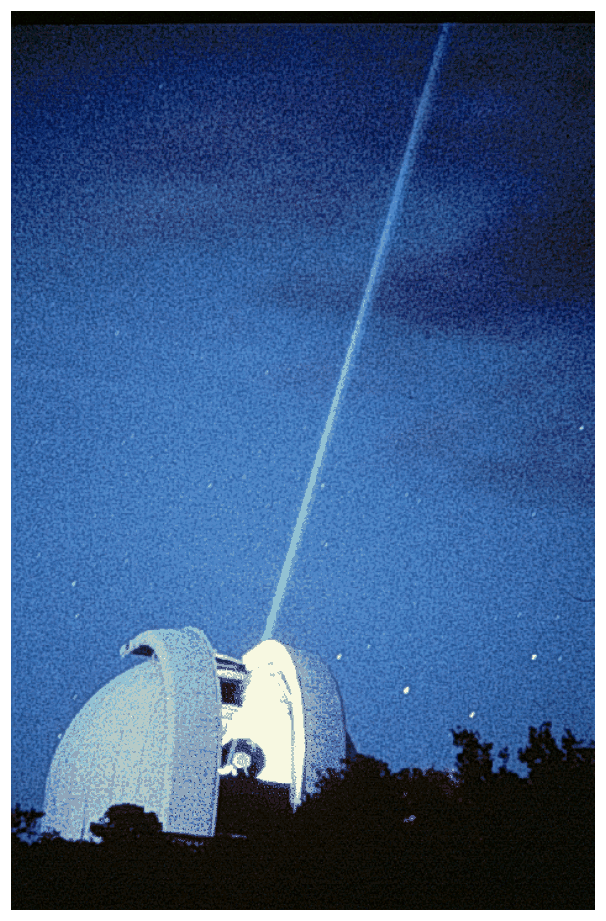
Figure 1. A laser beam sent from an observatory is used to measure accurately the distance between the Earth and the Moon.
With this observations, they have directly measured that the Moon is slowly receding from the Earth. That is, the Earth-Moon distance is increasing with time. This is happening because due to tidal torques the Earth is transferring angular momentum to the Moon, see Figure 2. In this problem you will derive the basic parameters of the phenomenon.
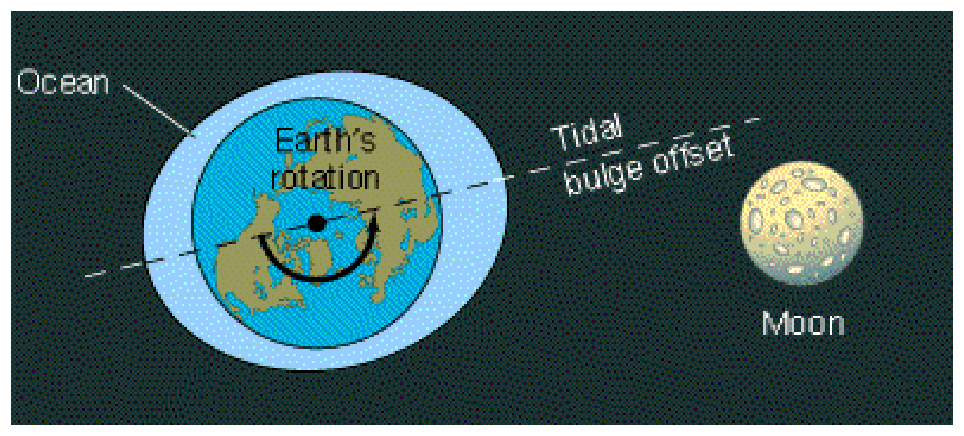
Figure 2. The Moon’s gravity produces tidal deformations or “bulges” in the Earth. Because of the Earth’s rotation, the line that goes through the bulges is not aligned with the line between the Earth and the Moon. This misalignment produces a torque that transfers angular momentum from the Earth’s rotation to the Moon’s translation. The drawing is not to scale.
1. Conservation of Angular Momentum.
Let \(L_1\) be the present total angular momentum of the Earth-Moon system. Now, make the following assumptions: i) \(L_1\) is the sum of the rotation of the Earth around its axis and the translation of the Moon in its orbit around the Earth only. ii) The Moon’s orbit is circular and the Moon can be taken as a point. iii) The Earth’s axis of rotation and the Moon’s axis of revolution are parallel. iv) To simplify the calculations, we take the motion to be around the center of the Earth and not the center of mass. Throughout the problem, all moments of inertia, torques and angular momenta are defined around the axis of the Earth. v) Ignore the influence of the Sun.
Part Question Points 1a Write down the equation for the present total angular momentum of the Earth-Moon system. Set this equation in terms of \(I_E\), the moment of inertia of the Earth; \(\omega_{E1}\), the present angular frequency of the Earth’s rotation; \(I_{M1}\), the present moment of inertia of the Moon with respect to the Earth’s axis; and \(\omega_{M1}\), the present angular frequency of the Moon’s orbit. 0.2 This process of transfer of angular momentum will end when the period of rotation of the Earth and the period of revolution of the Moon around the Earth have the same duration. At this point the tidal bulges produced by the Moon on the Earth will be aligned with the line between the Moon and the Earth and the torque will disappear.
Part Question Points 1b Write down the equation for the final total angular momentum \(L_2\) of the Earth-Moon system. Make the same assumptions as in Question 1a. Set this equation in terms of \(I_E\), the moment of inertia of the Earth; \(\omega_2\), the final angular frequency of the Earth’s rotation and Moon’s translation; and \(I_{M2}\), the final moment of inertia of the Moon. 0.2 Part Question Points 1c Neglecting the contribution of the Earth’s rotation to the final total angular momentum, write down the equation that expresses the angular momentum conservation for this problem. 0.3 2. Final Separation and Final Angular Frequency of the Earth-Moon System.
Assume that the gravitational equation for a circular orbit (of the Moon around the Earth) is always valid. Neglect the contribution of the Earth’s rotation to the final total angular momentum.
Part Question Points 2a Write down the gravitational equation for the circular orbit of the Moon around the Earth, at the final state, in terms of \(M_E\), \(\omega_2\), \(G\) and the final separation \(D_2\) between the Earth and the Moon. \(M_E\) is the mass of the Earth and \(G\) is the gravitational constant. 0.2 Part Question Points 2b Write down the equation for the final separation \(D_2\) between the Earth and the Moon in terms of the known parameters, \(L_1\), the total angular momentum of the system, \(M_E\) and \(M_M\), the masses of the Earth and Moon, respectively, and \(G\). 0.5 Part Question Points 2c Write down the equation for the final angular frequency \(\omega_2\) of the Earth-Moon system in terms of the known parameters \(L_1\), \(M_E\), \(M_M\) and \(G\). 0.5 Below you will be asked to find the numerical values of \(D_2\) and \(\omega_2\). For this you need to know the moment of inertia of the Earth.
Part Question Points 2d Write down the equation for the moment of inertia of the Earth \(I_E\) assuming it is a sphere with inner density \(\rho_i\) from the center to a radius \(r_i\), and with outer density \(\rho_o\) from the radius \(r_i\) to the surface at a radius \(r_o\) (see Figure 3). 0.5 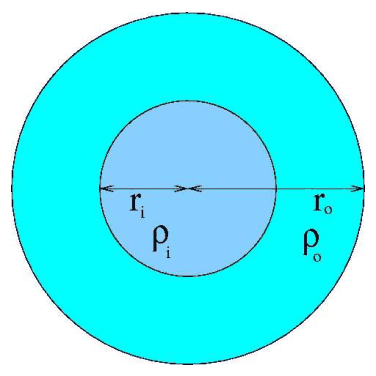
Figure 3. The Earth as a sphere with two densities, \(\rho_i\) and \(\rho_o\).
Determine the numerical values requested in this problem always to two significant digits.
Part Question Points 2e Evaluate the moment of inertia of the Earth \(I_E\), using \(\rho_i=1.3\times10^4\ \mathrm{kg\,m^{-3}}\), \(r_i=3.5\times10^6\ \mathrm{m}\), \(\rho_o=4.0\times10^3\ \mathrm{kg\,m^{-3}}\), and \(r_o=6.4\times10^6\ \mathrm{m}\). 0.2 The masses of the Earth and Moon are \(M_E=6.0\times10^{24}\ \mathrm{kg}\) and \(M_M=7.3\times10^{22}\ \mathrm{kg}\), respectively. The present separation between the Earth and the Moon is \(D_1=3.8\times10^8\ \mathrm{m}\). The present angular frequency of the Earth’s rotation is \(\omega_{E1}=7.3\times10^{-5}\ \mathrm{s^{-1}}\). The present angular frequency of the Moon’s translation around the Earth is \(\omega_{M1}=2.7\times10^{-6}\ \mathrm{s^{-1}}\), and the gravitational constant is \(G=6.7\times10^{-11}\ \mathrm{m^3\,kg^{-1}\,s^{-2}}\).
Part Question Points 2f Evaluate the numerical value of the total angular momentum of the system, \(L_1\). 0.2 Part Question Points 2g Find the final separation \(D_2\) in meters and in units of the present separation \(D_1\). 0.3 Part Question Points 2h Find the final angular frequency \(\omega_2\) in \(\mathrm{s^{-1}}\), as well as the final duration of the day in units of present days. 0.3 Verify that the assumption of neglecting the contribution of the Earth’s rotation to the final total angular momentum is justified by finding the ratio of the final angular momentum of the Earth to that of the Moon. This should be a small quantity.
Part Question Points 2i Find the ratio of the final angular momentum of the Earth to that of the Moon. 0.2 3. How much is the Moon receding per year?
Now, you will find how much the Moon is receding from the Earth each year. For this, you will need to know the equation for the torque acting at present on the Moon. Assume that the tidal bulges can be approximated by two point masses, each of mass \(m\), located on the surface of the Earth, see Fig. 4. Let \(\theta\) be the angle between the line that goes through the bulges and the line that joins the centers of the Earth and the Moon.
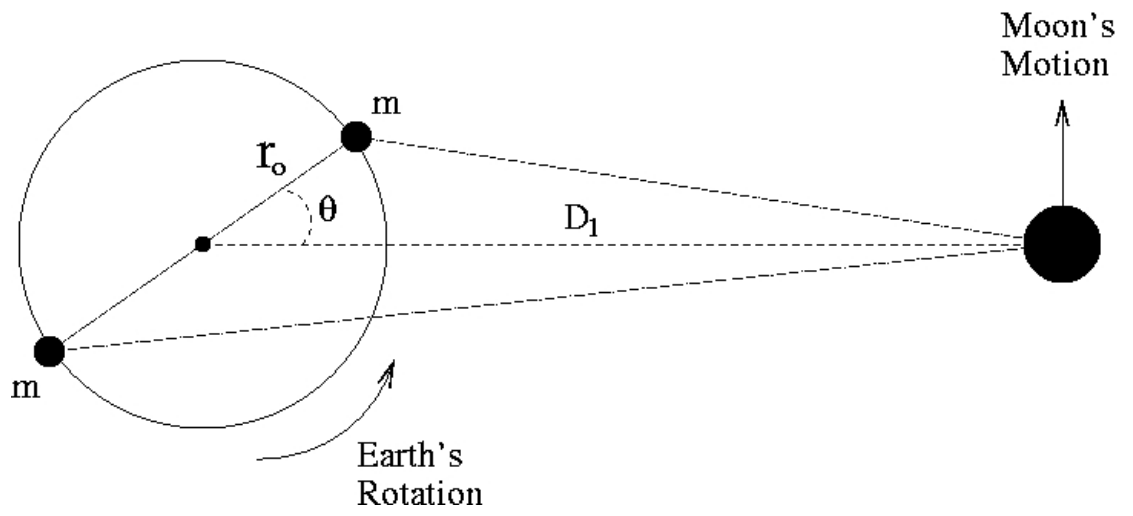
Figure 4. Schematic diagram to estimate the torque produced on the Moon by the bulges on the Earth. The drawing is not to scale.
Part Question Points 3a Find \(F_c\), the magnitude of the force produced on the Moon by the closest point mass. 0.4 Part Question Points 3b Find \(F_f\), the magnitude of the force produced on the Moon by the farthest point mass. 0.4 You may now evaluate the torques produced by the point masses.
Part Question Points 3c Find the magnitude of \(\tau_c\), the torque produced by the closest point mass. 0.4 Part Question Points 3d Find the magnitude of \(\tau_f\), the torque produced by the farthest point mass. 0.4 Part Question Points 3e Find the magnitude of the total torque \(\tau\) produced by the two masses. Since \(r_o\ll D_1\) you should approximate your expression to lowest significant order in \(r_o/D_1\). You may use that \((1+x)^a\approx1+ax\), if \(x\ll1\). 1.0 Part Question Points 3f Calculate the numerical value of the total torque \(\tau\), taking into account that \(\theta=3^\circ\) and that \(m=3.6\times10^{16}\ \mathrm{kg}\) (note that this mass is of the order of \(10^{-8}\) times the mass of the Earth). 0.5 Since the torque is the rate of change of angular momentum with time, find the increase in the distance Earth-Moon at present, per year. For this step, express the angular momentum of the Moon in terms of \(M_M\), \(M_E\), \(D_1\) and \(G\) only.
Part Question Points 3g Find the increase in the distance Earth-Moon at present, per year. 1.0 Finally, estimate how much the length of the day is increasing each year.
Part Question Points 3h Find the decrease of \(\omega_{E1}\) per year and how much is the length of the day at present increasing each year. 1.0 4. Where is the energy going?
In contrast to the angular momentum, that is conserved, the total (rotational plus gravitational) energy of the system is not. We will look into this in this last section.
Part Question Points 4a Write down an equation for the total (rotational plus gravitational) energy of the Earth-Moon system at the present, \(E\). Put this equation in terms of \(I_E\), \(\omega_{E1}\), \(M_M\), \(M_E\), \(D_1\) and \(G\) only. 0.4 Part Question Points 4b Write down an equation for the change in \(E\), \(\Delta E\), as a function of the changes in \(D_1\) and in \(\omega_{E1}\). Evaluate the numerical value of \(\Delta E\) for a year, using the values of changes in \(D_1\) and in \(\omega_{E1}\) found in questions 3g and 3h. 0.4 Verify that this loss of energy is consistent with an estimate for the energy dissipated as heat in the tides produced by the Moon on the Earth. Assume that the tides rise, on the average by 0.5 m, a layer of water \(h=0.5\ \mathrm{m}\) deep that covers the surface of the Earth (for simplicity assume that all the surface of the Earth is covered with water). This happens twice a day. Further assume that 10% of this gravitational energy is dissipated as heat due to viscosity when the water descends. Take the density of water to be \(\rho_{\mathrm{water}}=10^3\ \mathrm{kg\,m^{-3}}\) and the gravitational acceleration on the surface of the Earth to be \(g=9.8\ \mathrm{m\,s^{-2}}\).
Part Question Points 4c What is the mass of this surface layer of water? 0.2 Part Question Points 4d Calculate how much energy is dissipated in a year? How does this compare with the energy lost per year by the Earth-Moon system at present? 0.3 Official English text of the problem.
Problem 2: Doppler Laser Cooling and Optical Molasses
The purpose of this problem is to develop a simple theory to understand the so-called “laser cooling” and “optical molasses” phenomena. This refers to the cooling of a beam of neutral atoms, typically alkaline, by counterpropagating laser beams with the same frequency. This is part of the Physics Nobel Prize awarded to S. Chu, P. Phillips and C. Cohen-Tannoudji in 1997.
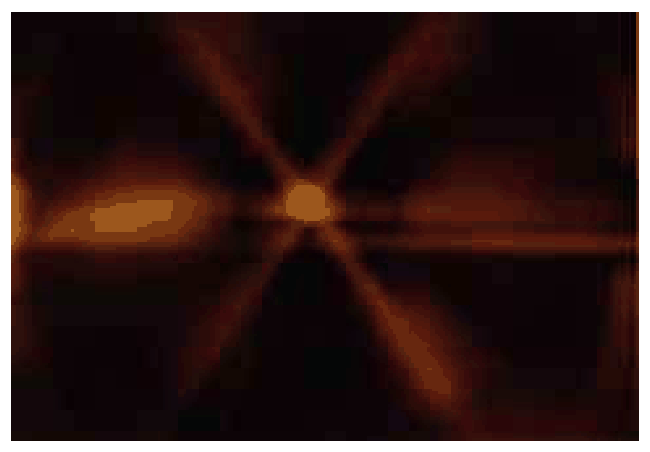
The image above shows sodium atoms (the bright spot in the center) trapped at the intersection of three orthogonal pairs of opposing laser beams. The trapping region is called “optical molasses” because the dissipative optical force resembles the viscous drag on a body moving through molasses.
In this problem you will analyze the basic phenomenon of the interaction between a photon incident on an atom and the basis of the dissipative mechanism in one dimension.
PART I: BASICS OF LASER COOLING
Consider an atom of mass \(m\) moving in the \(+x\) direction with velocity \(v\). For simplicity, we shall consider the problem to be one-dimensional, namely, we shall ignore the \(y\) and \(z\) directions (see figure 1). The atom has two internal energy levels. The energy of the lowest state is considered to be zero and the energy of the excited state to be \(\hbar\omega_0\), where \(\hbar=h/2\pi\). The atom is initially in the lowest state. A laser beam with frequency \(\omega_L\) in the laboratory is directed in the \(-x\) direction and it is incident on the atom. Quantum mechanically the laser is composed of a large number of photons, each with energy \(\hbar\omega_L\) and momentum \(-\hbar q\). A photon can be absorbed by the atom and later spontaneously emitted; this emission can occur with equal probabilities along the \(+x\) and \(-x\) directions. Since the atom moves at non-relativistic speeds, \(v/c\ll1\) (with \(c\) the speed of light) keep terms up to first order in this quantity only. Consider also \(\hbar q/mv\ll1\), namely, that the momentum of the atom is much larger than the momentum of a single photon. In writing your answers, keep only corrections linear in either of the above quantities.
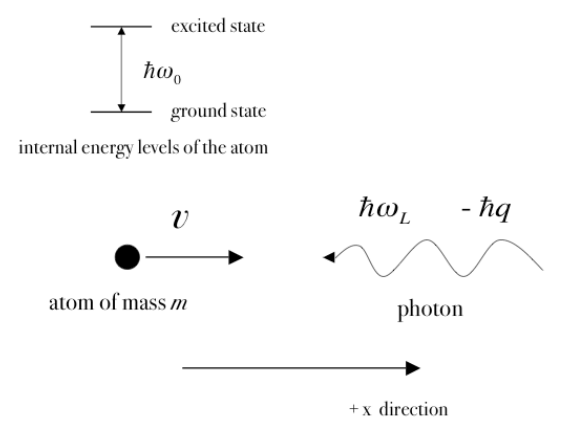
Fig.1 Sketch of an atom of mass \(m\) with velocity \(v\) in the \(+x\) direction, colliding with a photon with energy \(\hbar\omega_L\) and momentum \(-\hbar q\). The atom has two internal states with energy difference \(\hbar\omega_0\).
Assume that the laser frequency \(\omega_L\) is tuned such that, as seen by the moving atom, it is in resonance with the internal transition of the atom. Answer the following questions:
1. Absorption.
1a Write down the resonance condition for the absorption of the photon. 0.2 1b Write down the momentum \(p_{at}\) of the atom after absorption, as seen in the laboratory. 0.2 1c Write down the total energy \(\varepsilon_{at}\) of the atom after absorption, as seen in the laboratory. 0.2 2. Spontaneous emission of a photon in the \(-x\) direction.
At some time after the absorption of the incident photon, the atom may emit a photon in the \(-x\) direction.
2a Write down the energy of the emitted photon, \(\varepsilon_{ph}\), after the emission process in the \(-x\) direction, as seen in the laboratory. 0.2 2b Write down the momentum of the emitted photon \(p_{ph}\), after the emission process in the \(-x\) direction, as seen in the laboratory. 0.2 2c Write down the momentum of the atom \(p_{at}\), after the emission process in the \(-x\) direction, as seen in the laboratory. 0.2 2d Write down the total energy of the atom \(\varepsilon_{at}\), after the emission process in the \(-x\) direction, as seen in the laboratory. 0.2 3. Spontaneous emission of a photon in the \(+x\) direction.
At some time after the absorption of the incident photon, the atom may instead emit a photon in the \(+x\) direction.
3a Write down the energy of the emitted photon, \(\varepsilon_{ph}\), after the emission process in the \(+x\) direction, as seen in the laboratory. 0.2 3b Write down the momentum of the emitted photon \(p_{ph}\), after the emission process in the \(+x\) direction, as seen in the laboratory. 0.2 3c Write down the momentum of the atom \(p_{at}\), after the emission process in the \(+x\) direction, as seen in the laboratory. 0.2 3d Write down the total energy of the atom \(\varepsilon_{at}\), after the emission process in the \(+x\) direction, as seen in the laboratory. 0.2 4. Average emission after the absorption.
The spontaneous emission of a photon in the \(-x\) or in the \(+x\) directions occurs with the same probability. Taking this into account, answer the following questions.
4a Write down the average energy of an emitted photon, \(\varepsilon_{ph}\), after the emission process. 0.2 4b Write down the average momentum of an emitted photon \(p_{ph}\), after the emission process. 0.2 4c Write down the average total energy of the atom \(\varepsilon_{at}\), after the emission process. 0.2 4d Write down the average momentum of the atom \(p_{at}\), after the emission process. 0.2 5. Energy and momentum transfer.
Assuming a complete one-photon absorption-emission process only, as described above, there is a net average momentum and energy transfer between the laser radiation and the atom.
5a Write down the average energy change \(\Delta\varepsilon\) of the atom after a complete one-photon absorption-emission process. 0.2 5b Write down the average momentum change \(\Delta p\) of the atom after a complete one-photon absorption-emission process. 0.2 6. Energy and momentum transfer by a laser beam along the \(+x\) direction.
Consider now that a laser beam of frequency \(\omega'_L\) is incident on the atom along the \(+x\) direction, while the atom moves also in the \(+x\) direction with velocity \(v\). Assuming a resonance condition between the internal transition of the atom and the laser beam, as seen by the atom, answer the following questions:
6a Write down the average energy change \(\Delta\varepsilon\) of the atom after a complete one-photon absorption-emission process. 0.3 6b Write down the average momentum change \(\Delta p\) of the atom after a complete one-photon absorption-emission process. 0.3 PART II: DISSIPATION AND THE FUNDAMENTALS OF OPTICAL MOLASSES
Nature, however, imposes an inherent uncertainty in quantum processes. Thus, the fact that the atom can spontaneously emit a photon in a finite time after absorption, gives as a result that the resonance condition does not have to be obeyed exactly as in the discussion above. That is, the frequency of the laser beams \(\omega_L\) and \(\omega'_L\) may have any value and the absorption-emission process can still occur. These will happen with different (quantum) probabilities and, as one should expect, the maximum probability is found at the exact resonance condition. On the average, the time elapsed between a single process of absorption and emission is called the lifetime of the excited energy level of the atom and it is denoted by \(\Gamma^{-1}\).
Consider a collection of \(N\) atoms at rest in the laboratory frame of reference, and a laser beam of frequency \(\omega_L\) incident on them. The atoms absorb and emit continuously such that there is, on average, \(N_{exc}\) atoms in the excited state (and therefore, \(N-N_{exc}\) atoms in the ground state). A quantum mechanical calculation yields the following result:
\[ N_{exc} = N\frac{\Omega_R^2} {(\omega_0-\omega_L)^2+\dfrac{\Gamma^2}{4}+2\Omega_R^2} \]
where \(\omega_0\) is the resonance frequency of the atomic transition and \(\Omega_R\) is the so-called Rabi frequency; \(\Omega_R^2\) is proportional to the intensity of the laser beam. As mentioned above, you can see that this number is different from zero even if the resonance frequency \(\omega_0\) is different from the frequency of the laser beam \(\omega_L\). An alternative way of expressing the previous result is that the number of absorption-emission processes per unit of time is \(N_{exc}\Gamma\).
Consider the physical situation depicted in Figure 2, in which two counter propagating laser beams with the same but arbitrary frequency \(\omega_L\) are incident on a gas of \(N\) atoms that move in the \(+x\) direction with velocity \(v\).
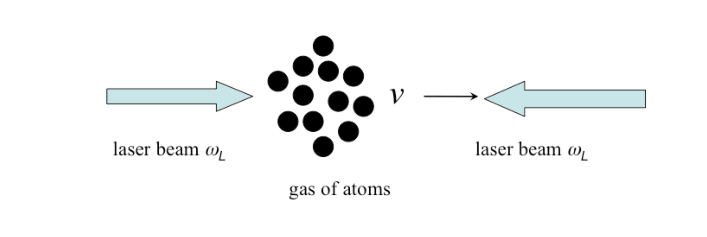
Figure 2. Two counter propagating laser beams with the same but arbitrary frequency \(\omega_L\) are incident on a gas of \(N\) atoms that move in the \(+x\) direction with velocity \(v\).
7. Force on the atomic beam by the lasers.
7a With the information found so far, find the force that the lasers exert on the atomic beam. You should assume that \(mv\gg\hbar q\). 1.5 8. Low velocity limit.
Assume now that the velocity of the atoms is small enough such that you can expand the force up to first order in \(v\).
8a Find an expression for the force found in Question (7a), in this limit. 1.5 Using this result, you can find the conditions for speeding up, slowing down, or no effect at all on the atoms by the laser radiation.
8b Write down the condition to obtain a positive force (speeding up the atoms). 0.25 8c Write down the condition to obtain a zero force. 0.25 8d Write down the condition to obtain a negative force (slowing down the atoms). 0.25 8e Consider now that the atoms are moving with a velocity \(-v\) (in the \(-x\) direction). Write down the condition to obtain a slowing down force on the atoms. 0.25 9. Optical molasses.
In the case of a negative force, one obtains a frictional dissipative force. Assume that initially, at \(t=0\), the gas of atoms has velocity \(v_0\).
9a In the limit of low velocities, find the velocity of the atoms after the laser beams have been on for a time \(\tau\). 1.5 9b Assume now that the gas of atoms is in thermal equilibrium at a temperature \(T_0\). Find the temperature \(T\) after the laser beams have been on for a time \(\tau\). 0.5 This model does not allow you to go to arbitrarily low temperatures.
Official English text of the problem.
Problem 3: Why Are Stars So Large?
The stars are spheres of hot gas. Most of them shine because they are fusing hydrogen into helium in their central parts. In this problem we use concepts of both classical and quantum mechanics, as well as of electrostatics and thermodynamics, to understand why stars have to be big enough to achieve this fusion process and also derive what would be the mass and radius of the smallest star that can fuse hydrogen.
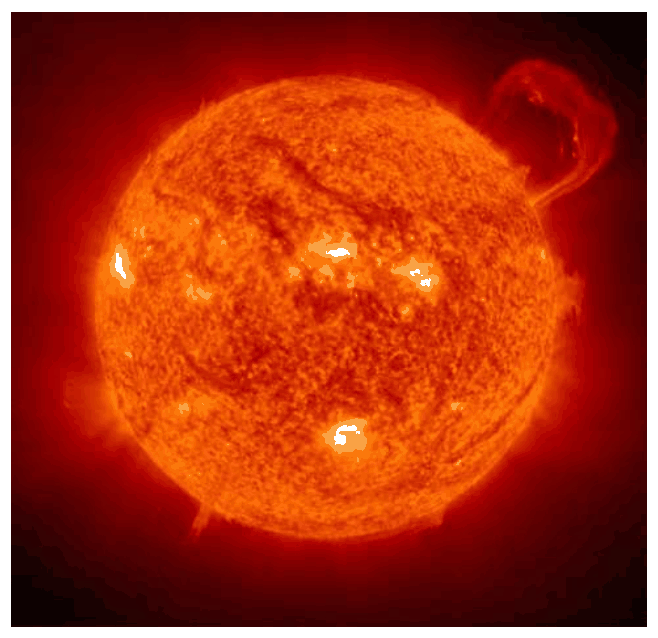
Figure 1. Our Sun, as most stars, shines as a result of thermonuclear fusion of hydrogen into helium in its central parts.
USEFUL CONSTANTS Gravitational constant = \(G=6.7\times10^{-11}\ \mathrm{m^3\,kg^{-1}\,s^{-2}}\) (misprint in the official paper: \(\mathrm{s^2}\) instead of \(\mathrm{s^{-2}}\)) Boltzmann’s constant = \(k=1.4\times10^{-23}\ \mathrm{J\,K^{-1}}\) Planck’s constant = \(h=6.6\times10^{-34}\ \mathrm{m^2\,kg\,s^{-1}}\) Mass of the proton = \(m_p=1.7\times10^{-27}\ \mathrm{kg}\) Mass of the electron = \(m_e=9.1\times10^{-31}\ \mathrm{kg}\) Unit of electric charge = \(q=1.6\times10^{-19}\ \mathrm{C}\) Electric constant (vacuum permittivity) = \(\varepsilon_0=8.9\times10^{-12}\ \mathrm{C^2\,N^{-1}\,m^{-2}}\) Radius of the Sun = \(R_S=7.0\times10^8\ \mathrm{m}\) Mass of the Sun = \(M_S=2.0\times10^{30}\ \mathrm{kg}\) 1. A classical estimate of the temperature at the center of the stars.
Assume that the gas that forms the star is pure ionized hydrogen (electrons and protons in equal amounts), and that it behaves like an ideal gas. From the classical point of view, to fuse two protons, they need to get as close as \(10^{-15}\ \mathrm{m}\) for the short range strong nuclear force, which is attractive, to become dominant. However, to bring them together they have to overcome first the repulsive action of Coulomb’s force. Assume classically that the two protons (taken to be point sources) are moving in an antiparallel way, each with velocity \(v_{rms}\), the root-mean-square (rms) velocity of the protons, in a one-dimensional frontal collision.
1a What has to be the temperature of the gas, \(T_c\), so that the distance of closest approach of the protons, \(d_c\), equals \(10^{-15}\ \mathrm{m}\)? Give this and all numerical values in this problem up to two significant figures. 1.5 2. Finding that the previous temperature estimate is wrong.
To check if the previous temperature estimate is reasonable, one needs an independent way of estimating the central temperature of a star. The structure of the stars is very complicated, but we can gain significant understanding making some assumptions. Stars are in equilibrium, that is, they do not expand or contract because the inward force of gravity is balanced by the outward force of pressure (see Figure 2). For a slab of gas the equation of hydrostatic equilibrium at a given distance \(r\) from the center of the star, is given by
\[ \frac{\Delta P}{\Delta r}=-\frac{GM_r\rho_r}{r^2}, \]
where \(P\) is the pressure of the gas, \(G\) the gravitational constant, \(M_r\) the mass of the star within a sphere of radius \(r\), and \(\rho_r\) is the density of the gas in the slab.
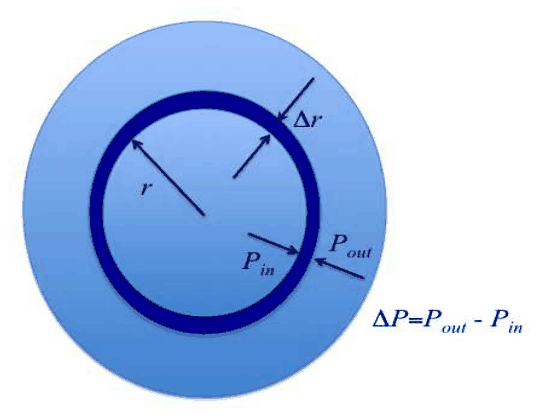
Figure 2. The stars are in hydrostatic equilibrium, with the pressure difference balancing gravity.
An order of magnitude estimate of the central temperature of the star can be obtained with values of the parameters at the center and at the surface of the star, making the following approximations:
\[ \Delta P\approx P_o-P_c, \]
where \(P_c\) and \(P_o\) are the pressures at the center and surface of the star, respectively. Since \(P_c\gg P_o\), we can assume that
\[ \Delta P\approx-P_c. \]
Within the same approximation, we can write
\[ \Delta r\approx R, \]
where \(R\) is the total radius of the star, and
\[ M_r\approx M_R=M, \]
with \(M\) the total mass of the star.
The density may be approximated by its value at the center,
\[ \rho_r\approx\rho_c. \]
You can assume that the pressure is that of an ideal gas.
2a Find an equation for the temperature at the center of the star, \(T_c\), in terms of the radius and mass of the star and of physical constants only. 0.5 We can use now the following prediction of this model as a criterion for its validity:
2b Using the equation found in (2a) write down the ratio \(M/R\) expected for a star in terms of physical constants and \(T_c\) only. 0.5 2c Use the value of \(T_c\) derived in section (1a) and find the numerical value of the ratio \(M/R\) expected for a star. 0.5 2d Now, calculate the ratio \(M(Sun)/R(Sun)\), and verify that this value is much smaller than the one found in (2c). 0.5 3. A quantum mechanical estimate of the temperature at the center of the stars
The large discrepancy found in (2d) suggests that the classical estimate for \(T_c\) obtained in (1a) is not correct. The solution to this discrepancy is found when we consider quantum mechanical effects, that tell us that the protons behave as waves and that a single proton is smeared on a size of the order of \(\lambda_p\), the de Broglie wavelength. This implies that if \(d_c\), the distance of closest approach of the protons is of the order of \(\lambda_p\), the protons in a quantum mechanical sense overlap and can fuse.
3a Assuming that \(d_c=\dfrac{\lambda_p}{2^{1/2}}\) is the condition that allows fusion, for a proton with velocity \(v_{rms}\), find an equation for \(T_c\) in terms of physical constants only. 1.0 3b Evaluate numerically the value of \(T_c\) obtained in (3a). 0.5 3c Use the value of \(T_c\) derived in (3b) to find the numerical value of the ratio \(M/R\) expected for a star, using the formula derived in (2b). Verify that this value is quite similar to the ratio \(M(Sun)/R(Sun)\) observed. 0.5 Indeed, stars in the so-called main sequence (fusing hydrogen) approximately do follow this ratio for a large range of masses.
4. The mass/radius ratio of the stars.
The previous agreement suggests that the quantum mechanical approach for estimating the temperature at the center of the Sun is correct.
4a Use the previous results to demonstrate that for any star fusing hydrogen, the ratio of mass \(M\) to radius \(R\) is the same and depends only on physical constants. Find the equation for the ratio \(M/R\) for stars fusing hydrogen. 0.5 5. The mass and radius of the smallest star.
The result found in (4a) suggests that there could be stars of any mass as long as such a relationship is fulfilled; however, this is not true.
The gas inside normal stars fusing hydrogen is known to behave approximately as an ideal gas. This means that \(d_e\), the typical separation between electrons is on the average larger that \(\lambda_e\), their typical de Broglie wavelength. If closer, the electrons would be in a so-called degenerate state and the stars would behave differently. Note the distinction in the ways we treat protons and electrons inside the star. For protons, their de Broglie waves should overlap closely as they collide in order to fuse, whereas for electrons their de Broglie waves should not overlap in order to remain as an ideal gas.
The density in the stars increases with decreasing radius. Nevertheless, for this order-of-magnitude estimate assume they are of uniform density. You may further use that \(m_p\gg m_e\).
5a Find an equation for \(n_e\), the average electron number density inside the star. 0.5 5b Find an equation for \(d_e\), the typical separation between electrons inside the star. 0.5 5c Use the \(d_e\geq\dfrac{\lambda_e}{2^{1/2}}\) condition to write down an equation for the radius of the smallest normal star possible. Take the temperature at the center of the star as typical for all the stellar interior. 1.5 5d Find the numerical value of the radius of the smallest normal star possible, both in meters and in units of solar radius. 0.5 5e Find the numerical value of the mass of the smallest normal star possible, both in kg and in units of solar masses. 0.5 6. Fusing helium nuclei in older stars.
As stars get older they will have fused most of the hydrogen in their cores into helium (He), so they are forced to start fusing helium into heavier elements in order to continue shining. A helium nucleus has two protons and two neutrons, so it has twice the charge and approximately four times the mass of a proton. We saw before that \(d_c=\dfrac{\lambda_p}{2^{1/2}}\) is the condition for the protons to fuse.
6a Set the equivalent condition for helium nuclei and find \(v_{rms}(He)\), the rms velocity of the helium nuclei and \(T(He)\), the temperature needed for helium fusion. 0.5 Official English text of the problem.
Internationale Physik-Olympiade
IPhO 2009
Mérida, Mexiko · 3 Theorieaufgaben mit vollständigen Lösungen
Aufgabe 1: Entwicklung des Erde-Mond-Systems
Wissenschaftler können den Abstand zwischen Erde und Mond mit großer Genauigkeit bestimmen. Dazu lassen sie einen Laserstrahl an speziellen Spiegeln reflektieren, die Astronauten 1969 auf der Mondoberfläche aufgestellt haben, und messen die Laufzeit des Lichts für den Hin- und Rückweg (siehe Abbildung 1).
Abbildung 1. Ein von einer Sternwarte ausgesandter Laserstrahl wird verwendet, um den Abstand zwischen Erde und Mond genau zu messen.
Mit diesen Beobachtungen haben sie direkt gemessen, dass sich der Mond langsam von der Erde entfernt. Das heißt, der Abstand zwischen Erde und Mond nimmt mit der Zeit zu. Dies geschieht, weil die Erde aufgrund von Gezeitendrehmomenten Drehimpuls auf den Mond überträgt, siehe Abbildung 2. In dieser Aufgabe werden Sie die grundlegenden Parameter dieses Phänomens herleiten.
Abbildung 2. Die Gravitation des Mondes erzeugt Gezeitenverformungen oder „Flutberge“ auf der Erde. Wegen der Erdrotation liegt die durch die Flutberge verlaufende Gerade nicht auf der Verbindungslinie zwischen Erde und Mond. Diese Abweichung erzeugt ein Drehmoment, das Drehimpuls von der Eigenrotation der Erde auf die Bahnbewegung des Mondes überträgt. Die Zeichnung ist nicht maßstabsgetreu.
1. Drehimpulserhaltung.
Sei \(L_1\) der gegenwärtige Gesamtdrehimpuls des Erde-Mond-Systems. Treffen Sie nun die folgenden Annahmen: i) \(L_1\) ist ausschließlich die Summe der Drehimpulse der Rotation der Erde um ihre Achse und der Bahnbewegung des Mondes um die Erde. ii) Die Mondbahn ist kreisförmig, und der Mond kann als Massenpunkt betrachtet werden. iii) Die Rotationsachse der Erde und die Umlaufachse des Mondes sind parallel. iv) Zur Vereinfachung der Rechnungen nehmen wir an, dass die Bewegung um den Erdmittelpunkt und nicht um den Schwerpunkt erfolgt. In der gesamten Aufgabe sind alle Trägheitsmomente, Drehmomente und Drehimpulse bezüglich der Erdachse definiert. v) Vernachlässigen Sie den Einfluss der Sonne.
Teil Frage Punkte 1a Stellen Sie die Gleichung für den gegenwärtigen Gesamtdrehimpuls des Erde-Mond-Systems auf. Drücken Sie diese Gleichung durch \(I_E\), das Trägheitsmoment der Erde, \(\omega_{E1}\), die gegenwärtige Winkelgeschwindigkeit der Erdrotation, \(I_{M1}\), das gegenwärtige Trägheitsmoment des Mondes bezüglich der Erdachse, und \(\omega_{M1}\), die gegenwärtige Winkelgeschwindigkeit des Mondumlaufs, aus. 0.2 Dieser Prozess der Drehimpulsübertragung endet, wenn die Rotationsperiode der Erde und die Umlaufperiode des Mondes um die Erde gleich lang sind. Dann liegen die vom Mond auf der Erde erzeugten Flutberge auf der Verbindungslinie zwischen Mond und Erde, und das Drehmoment verschwindet.
Teil Frage Punkte 1b Stellen Sie die Gleichung für den Gesamtdrehimpuls \(L_2\) des Erde-Mond-Systems im Endzustand auf. Treffen Sie dieselben Annahmen wie in Frage 1a. Drücken Sie diese Gleichung durch \(I_E\), das Trägheitsmoment der Erde, \(\omega_2\), die Winkelgeschwindigkeit der Erdrotation und der Bahnbewegung des Mondes im Endzustand, und \(I_{M2}\), das Trägheitsmoment des Mondes im Endzustand, aus. 0.2 Teil Frage Punkte 1c Vernachlässigen Sie den Beitrag der Erdrotation zum Gesamtdrehimpuls im Endzustand und stellen Sie die Gleichung auf, die die Drehimpulserhaltung für diese Aufgabe ausdrückt. 0.3 2. Abstand und Winkelgeschwindigkeit des Erde-Mond-Systems im Endzustand.
Nehmen Sie an, dass die Gravitationsgleichung für eine Kreisbahn (des Mondes um die Erde) stets gilt. Vernachlässigen Sie den Beitrag der Erdrotation zum Gesamtdrehimpuls im Endzustand.
Teil Frage Punkte 2a Stellen Sie die Gravitationsgleichung für die Kreisbahn des Mondes um die Erde im Endzustand in Abhängigkeit von \(M_E\), \(\omega_2\), \(G\) und dem Abstand \(D_2\) zwischen Erde und Mond im Endzustand auf. \(M_E\) ist die Masse der Erde und \(G\) die Gravitationskonstante. 0.2 Teil Frage Punkte 2b Stellen Sie die Gleichung für den Abstand \(D_2\) zwischen Erde und Mond im Endzustand in Abhängigkeit von den bekannten Parametern \(L_1\), dem Gesamtdrehimpuls des Systems, \(M_E\) und \(M_M\), den Massen der Erde beziehungsweise des Mondes, und \(G\) auf. 0.5 Teil Frage Punkte 2c Stellen Sie die Gleichung für die Winkelgeschwindigkeit \(\omega_2\) des Erde-Mond-Systems im Endzustand in Abhängigkeit von den bekannten Parametern \(L_1\), \(M_E\), \(M_M\) und \(G\) auf. 0.5 Im Folgenden sollen Sie die Zahlenwerte von \(D_2\) und \(\omega_2\) bestimmen. Dazu müssen Sie das Trägheitsmoment der Erde kennen.
Teil Frage Punkte 2d Stellen Sie die Gleichung für das Trägheitsmoment der Erde \(I_E\) auf. Nehmen Sie dabei an, dass die Erde eine Kugel mit der inneren Dichte \(\rho_i\) vom Mittelpunkt bis zum Radius \(r_i\) und der äußeren Dichte \(\rho_o\) vom Radius \(r_i\) bis zur Oberfläche beim Radius \(r_o\) ist (siehe Abbildung 3). 0.5 Abbildung 3. Die Erde als Kugel mit zwei Dichten, \(\rho_i\) und \(\rho_o\).
Bestimmen Sie die in dieser Aufgabe geforderten Zahlenwerte stets auf zwei signifikante Stellen.
Teil Frage Punkte 2e Berechnen Sie das Trägheitsmoment der Erde \(I_E\) mit \(\rho_i=1.3\times10^4\ \mathrm{kg\,m^{-3}}\), \(r_i=3.5\times10^6\ \mathrm{m}\), \(\rho_o=4.0\times10^3\ \mathrm{kg\,m^{-3}}\) und \(r_o=6.4\times10^6\ \mathrm{m}\). 0.2 Die Massen der Erde und des Mondes betragen \(M_E=6.0\times10^{24}\ \mathrm{kg}\) beziehungsweise \(M_M=7.3\times10^{22}\ \mathrm{kg}\). Der gegenwärtige Abstand zwischen Erde und Mond ist \(D_1=3.8\times10^8\ \mathrm{m}\). Die gegenwärtige Winkelgeschwindigkeit der Erdrotation beträgt \(\omega_{E1}=7.3\times10^{-5}\ \mathrm{s^{-1}}\). Die gegenwärtige Winkelgeschwindigkeit der Bahnbewegung des Mondes um die Erde beträgt \(\omega_{M1}=2.7\times10^{-6}\ \mathrm{s^{-1}}\), und die Gravitationskonstante ist \(G=6.7\times10^{-11}\ \mathrm{m^3\,kg^{-1}\,s^{-2}}\).
Teil Frage Punkte 2f Berechnen Sie den Zahlenwert des Gesamtdrehimpulses des Systems, \(L_1\). 0.2 Teil Frage Punkte 2g Bestimmen Sie den Abstand \(D_2\) im Endzustand in Metern und in Einheiten des gegenwärtigen Abstands \(D_1\). 0.3 Teil Frage Punkte 2h Bestimmen Sie die Winkelgeschwindigkeit \(\omega_2\) im Endzustand in \(\mathrm{s^{-1}}\) sowie die Tageslänge im Endzustand in Einheiten heutiger Tage. 0.3 Überprüfen Sie, dass die Vernachlässigung des Beitrags der Erdrotation zum Gesamtdrehimpuls im Endzustand gerechtfertigt ist, indem Sie das Verhältnis des Drehimpulses der Erde zu dem des Mondes im Endzustand bestimmen. Dieses Verhältnis sollte klein sein.
Teil Frage Punkte 2i Bestimmen Sie das Verhältnis des Drehimpulses der Erde zu dem des Mondes im Endzustand. 0.2 3. Um wie viel entfernt sich der Mond pro Jahr?
Nun werden Sie bestimmen, um wie viel sich der Mond jedes Jahr von der Erde entfernt. Dazu benötigen Sie die Gleichung für das gegenwärtig auf den Mond wirkende Drehmoment. Nehmen Sie an, dass sich die Flutberge durch zwei Massenpunkte mit jeweils der Masse \(m\) auf der Erdoberfläche annähern lassen, siehe Abb. 4. Sei \(\theta\) der Winkel zwischen der durch die Flutberge verlaufenden Geraden und der Verbindungslinie zwischen den Mittelpunkten von Erde und Mond.
Abbildung 4. Schematische Darstellung zur Abschätzung des Drehmoments, das die Flutberge auf der Erde auf den Mond ausüben. Die Zeichnung ist nicht maßstabsgetreu.
Teil Frage Punkte 3a Bestimmen Sie \(F_c\), den Betrag der Kraft, die der nähere Massenpunkt auf den Mond ausübt. 0.4 Teil Frage Punkte 3b Bestimmen Sie \(F_f\), den Betrag der Kraft, die der weiter entfernte Massenpunkt auf den Mond ausübt. 0.4 Nun können Sie die von den Massenpunkten erzeugten Drehmomente bestimmen.
Teil Frage Punkte 3c Bestimmen Sie den Betrag von \(\tau_c\), dem vom näheren Massenpunkt erzeugten Drehmoment. 0.4 Teil Frage Punkte 3d Bestimmen Sie den Betrag von \(\tau_f\), dem vom weiter entfernten Massenpunkt erzeugten Drehmoment. 0.4 Teil Frage Punkte 3e Bestimmen Sie den Betrag des von den beiden Massen erzeugten Gesamtdrehmoments \(\tau\). Da \(r_o\ll D_1\), sollen Sie Ihren Ausdruck in der niedrigsten nicht verschwindenden Ordnung in \(r_o/D_1\) annähern. Sie dürfen verwenden, dass \((1+x)^a\approx1+ax\), wenn \(x\ll1\). 1.0 Teil Frage Punkte 3f Berechnen Sie den Zahlenwert des Gesamtdrehmoments \(\tau\) unter Berücksichtigung von \(\theta=3^\circ\) und \(m=3.6\times10^{16}\ \mathrm{kg}\) (beachten Sie, dass diese Masse von der Größenordnung des \(10^{-8}\)-Fachen der Erdmasse ist). 0.5 Da das Drehmoment die zeitliche Änderungsrate des Drehimpulses ist, bestimmen Sie die gegenwärtige Zunahme des Abstands zwischen Erde und Mond pro Jahr. Drücken Sie für diesen Schritt den Drehimpuls des Mondes ausschließlich durch \(M_M\), \(M_E\), \(D_1\) und \(G\) aus.
Teil Frage Punkte 3g Bestimmen Sie die gegenwärtige Zunahme des Abstands zwischen Erde und Mond pro Jahr. 1.0 Schätzen Sie schließlich ab, um wie viel die Tageslänge jedes Jahr zunimmt.
Teil Frage Punkte 3h Bestimmen Sie die Abnahme von \(\omega_{E1}\) pro Jahr und die gegenwärtige jährliche Zunahme der Tageslänge. 1.0 4. Wohin geht die Energie?
Im Gegensatz zum Drehimpuls, der erhalten bleibt, ist die Gesamtenergie (Rotations- und Gravitationsenergie) des Systems nicht erhalten. Dies werden wir in diesem letzten Abschnitt untersuchen.
Teil Frage Punkte 4a Stellen Sie eine Gleichung für die gegenwärtige Gesamtenergie (Rotations- und Gravitationsenergie) des Erde-Mond-Systems, \(E\), auf. Drücken Sie diese Gleichung ausschließlich durch \(I_E\), \(\omega_{E1}\), \(M_M\), \(M_E\), \(D_1\) und \(G\) aus. 0.4 Teil Frage Punkte 4b Stellen Sie eine Gleichung für die Änderung von \(E\), \(\Delta E\), als Funktion der Änderungen von \(D_1\) und \(\omega_{E1}\) auf. Berechnen Sie den Zahlenwert von \(\Delta E\) für ein Jahr unter Verwendung der in den Fragen 3g und 3h bestimmten Änderungen von \(D_1\) und \(\omega_{E1}\). 0.4 Überprüfen Sie, dass dieser Energieverlust mit einer Abschätzung der Energie übereinstimmt, die bei den vom Mond auf der Erde erzeugten Gezeiten als Wärme dissipiert wird. Nehmen Sie an, dass die Gezeiten eine \(h=0.5\ \mathrm{m}\) tiefe Wasserschicht, die die Erdoberfläche bedeckt, im Mittel um 0,5 m anheben (nehmen Sie der Einfachheit halber an, dass die gesamte Erdoberfläche mit Wasser bedeckt ist). Dies geschieht zweimal täglich. Nehmen Sie ferner an, dass 10 % dieser Gravitationsenergie beim Absinken des Wassers aufgrund der Viskosität als Wärme dissipiert werden. Verwenden Sie für die Dichte des Wassers \(\rho_{\mathrm{water}}=10^3\ \mathrm{kg\,m^{-3}}\) und für die Fallbeschleunigung an der Erdoberfläche \(g=9.8\ \mathrm{m\,s^{-2}}\).
Teil Frage Punkte 4c Wie groß ist die Masse dieser oberflächlichen Wasserschicht? 0.2 Teil Frage Punkte 4d Berechnen Sie, wie viel Energie in einem Jahr dissipiert wird. Wie verhält sich dies zur Energie, die das Erde-Mond-System gegenwärtig pro Jahr verliert? 0.3 Aufgabentext aus dem offiziellen englischen Text übersetzt.
Aufgabe 2: Doppler-Laserkühlung und optische Melasse
Ziel dieser Aufgabe ist es, eine einfache Theorie zum Verständnis der sogenannten „Laserkühlung“ und „optischen Melasse“ zu entwickeln. Dabei geht es um die Kühlung eines Strahls neutraler Atome, typischerweise Alkaliatome, durch gegenläufige Laserstrahlen gleicher Frequenz. Dies ist Teil der Arbeiten, für die S. Chu, P. Phillips und C. Cohen-Tannoudji 1997 den Nobelpreis für Physik erhielten.
Das obige Bild zeigt Natriumatome (den hellen Fleck in der Mitte), die am Schnittpunkt dreier zueinander senkrechter Paare gegenläufiger Laserstrahlen eingefangen sind. Der Bereich, in dem die Atome eingefangen sind, wird als „optische Melasse“ bezeichnet, weil die dissipative optische Kraft der viskosen Widerstandskraft auf einen Körper ähnelt, der sich durch Melasse bewegt.
In dieser Aufgabe untersuchen Sie das grundlegende Phänomen der Wechselwirkung zwischen einem auf ein Atom treffenden Photon und dem Atom sowie die Grundlage des dissipativen Mechanismus in einer Dimension.
TEIL I: GRUNDLAGEN DER LASERKÜHLUNG
Betrachten Sie ein Atom der Masse \(m\), das sich mit der Geschwindigkeit \(v\) in \(+x\)-Richtung bewegt. Der Einfachheit halber betrachten wir das Problem als eindimensional, vernachlässigen also die \(y\)- und \(z\)-Richtungen (siehe Abbildung 1). Das Atom besitzt zwei innere Energieniveaus. Die Energie des niedrigsten Zustands wird gleich null gesetzt, die Energie des angeregten Zustands gleich \(\hbar\omega_0\), wobei \(\hbar=h/2\pi\). Das Atom befindet sich anfangs im niedrigsten Zustand. Ein Laserstrahl mit der Frequenz \(\omega_L\) im Laborsystem ist in \(-x\)-Richtung gerichtet und trifft auf das Atom. Quantenmechanisch besteht der Laserstrahl aus einer großen Anzahl von Photonen, die jeweils die Energie \(\hbar\omega_L\) und den Impuls \(-\hbar q\) besitzen. Ein Photon kann vom Atom absorbiert und später spontan emittiert werden; diese Emission kann mit gleicher Wahrscheinlichkeit in \(+x\)- oder \(-x\)-Richtung erfolgen. Da sich das Atom mit nichtrelativistischen Geschwindigkeiten bewegt, \(v/c\ll1\) (wobei \(c\) die Lichtgeschwindigkeit ist), berücksichtigen Sie nur Terme bis zur ersten Ordnung in dieser Größe. Nehmen Sie außerdem \(\hbar q/mv\ll1\) an, also dass der Impuls des Atoms viel größer als der Impuls eines einzelnen Photons ist. Behalten Sie in Ihren Antworten nur Korrekturen bei, die in einer der beiden obigen Größen linear sind.
Abb.1 Skizze eines Atoms der Masse \(m\) mit der Geschwindigkeit \(v\) in \(+x\)-Richtung, das mit einem Photon der Energie \(\hbar\omega_L\) und des Impulses \(-\hbar q\) zusammenstößt. Das Atom besitzt zwei innere Zustände mit der Energiedifferenz \(\hbar\omega_0\).
Nehmen Sie an, dass die Laserfrequenz \(\omega_L\) so abgestimmt ist, dass sie aus Sicht des bewegten Atoms mit dessen innerem Übergang in Resonanz ist. Beantworten Sie die folgenden Fragen:
1. Absorption.
1a Geben Sie die Resonanzbedingung für die Absorption des Photons an. 0.2 1b Geben Sie den Impuls \(p_{at}\) des Atoms nach der Absorption im Laborsystem an. 0.2 1c Geben Sie die Gesamtenergie \(\varepsilon_{at}\) des Atoms nach der Absorption im Laborsystem an. 0.2 2. Spontane Emission eines Photons in \(-x\)-Richtung.
Einige Zeit nach der Absorption des einfallenden Photons kann das Atom ein Photon in \(-x\)-Richtung emittieren.
2a Geben Sie die Energie des emittierten Photons, \(\varepsilon_{ph}\), nach dem Emissionsvorgang in \(-x\)-Richtung im Laborsystem an. 0.2 2b Geben Sie den Impuls des emittierten Photons \(p_{ph}\) nach dem Emissionsvorgang in \(-x\)-Richtung im Laborsystem an. 0.2 2c Geben Sie den Impuls des Atoms \(p_{at}\) nach dem Emissionsvorgang in \(-x\)-Richtung im Laborsystem an. 0.2 2d Geben Sie die Gesamtenergie des Atoms \(\varepsilon_{at}\) nach dem Emissionsvorgang in \(-x\)-Richtung im Laborsystem an. 0.2 3. Spontane Emission eines Photons in \(+x\)-Richtung.
Einige Zeit nach der Absorption des einfallenden Photons kann das Atom stattdessen ein Photon in \(+x\)-Richtung emittieren.
3a Geben Sie die Energie des emittierten Photons, \(\varepsilon_{ph}\), nach dem Emissionsvorgang in \(+x\)-Richtung im Laborsystem an. 0.2 3b Geben Sie den Impuls des emittierten Photons \(p_{ph}\) nach dem Emissionsvorgang in \(+x\)-Richtung im Laborsystem an. 0.2 3c Geben Sie den Impuls des Atoms \(p_{at}\) nach dem Emissionsvorgang in \(+x\)-Richtung im Laborsystem an. 0.2 3d Geben Sie die Gesamtenergie des Atoms \(\varepsilon_{at}\) nach dem Emissionsvorgang in \(+x\)-Richtung im Laborsystem an. 0.2 4. Mittelwerte der Emission nach der Absorption.
Die spontane Emission eines Photons in \(-x\)- oder \(+x\)-Richtung erfolgt mit gleicher Wahrscheinlichkeit. Beantworten Sie unter Berücksichtigung dieser Tatsache die folgenden Fragen.
4a Geben Sie die mittlere Energie eines emittierten Photons, \(\varepsilon_{ph}\), nach dem Emissionsvorgang an. 0.2 4b Geben Sie den mittleren Impuls eines emittierten Photons \(p_{ph}\) nach dem Emissionsvorgang an. 0.2 4c Geben Sie die mittlere Gesamtenergie des Atoms \(\varepsilon_{at}\) nach dem Emissionsvorgang an. 0.2 4d Geben Sie den mittleren Impuls des Atoms \(p_{at}\) nach dem Emissionsvorgang an. 0.2 5. Energie- und Impulsübertragung.
Betrachtet man nur einen vollständigen Absorptions-Emissions-Prozess eines einzelnen Photons wie oben beschrieben, so ergibt sich im Mittel eine Nettoübertragung von Impuls und Energie zwischen der Laserstrahlung und dem Atom.
5a Geben Sie die mittlere Energieänderung \(\Delta\varepsilon\) des Atoms nach einem vollständigen Absorptions-Emissions-Prozess eines einzelnen Photons an. 0.2 5b Geben Sie die mittlere Impulsänderung \(\Delta p\) des Atoms nach einem vollständigen Absorptions-Emissions-Prozess eines einzelnen Photons an. 0.2 6. Energie- und Impulsübertragung durch einen Laserstrahl in \(+x\)-Richtung.
Betrachten Sie nun einen Laserstrahl der Frequenz \(\omega'_L\), der in \(+x\)-Richtung auf das Atom trifft, während sich das Atom ebenfalls mit der Geschwindigkeit \(v\) in \(+x\)-Richtung bewegt. Beantworten Sie die folgenden Fragen unter der Annahme, dass aus Sicht des Atoms die Resonanzbedingung zwischen seinem inneren Übergang und dem Laserstrahl erfüllt ist:
6a Geben Sie die mittlere Energieänderung \(\Delta\varepsilon\) des Atoms nach einem vollständigen Absorptions-Emissions-Prozess eines einzelnen Photons an. 0.3 6b Geben Sie die mittlere Impulsänderung \(\Delta p\) des Atoms nach einem vollständigen Absorptions-Emissions-Prozess eines einzelnen Photons an. 0.3 TEIL II: DISSIPATION UND GRUNDLAGEN DER OPTISCHEN MELASSE
Die Natur bringt jedoch eine inhärente Unschärfe in Quantenprozessen mit sich. So hat die Tatsache, dass das Atom ein Photon innerhalb einer endlichen Zeit nach der Absorption spontan emittieren kann, zur Folge, dass die Resonanzbedingung nicht wie in der obigen Betrachtung exakt erfüllt sein muss. Das heißt, die Frequenzen der Laserstrahlen \(\omega_L\) und \(\omega'_L\) können beliebige Werte annehmen, und der Absorptions-Emissions-Prozess kann dennoch stattfinden. Diese Prozesse treten mit unterschiedlichen (quantenmechanischen) Wahrscheinlichkeiten auf, wobei erwartungsgemäß die größte Wahrscheinlichkeit bei exakter Erfüllung der Resonanzbedingung vorliegt. Die im Mittel zwischen der Absorption und der Emission bei einem einzelnen Prozess verstrichene Zeit heißt Lebensdauer des angeregten Energieniveaus des Atoms und wird mit \(\Gamma^{-1}\) bezeichnet.
Betrachten Sie eine Ansammlung von \(N\) Atomen, die im Laborsystem ruhen, und einen auf sie einfallenden Laserstrahl der Frequenz \(\omega_L\). Die Atome absorbieren und emittieren fortlaufend, sodass sich im Mittel \(N_{exc}\) Atome im angeregten Zustand befinden (und somit \(N-N_{exc}\) Atome im Grundzustand). Eine quantenmechanische Rechnung liefert das folgende Ergebnis:
\[ N_{exc} = N\frac{\Omega_R^2} {(\omega_0-\omega_L)^2+\dfrac{\Gamma^2}{4}+2\Omega_R^2} \]
Dabei ist \(\omega_0\) die Resonanzfrequenz des atomaren Übergangs und \(\Omega_R\) die sogenannte Rabi-Frequenz; \(\Omega_R^2\) ist proportional zur Intensität des Laserstrahls. Wie oben erwähnt, erkennen Sie, dass diese Zahl auch dann von null verschieden ist, wenn die Resonanzfrequenz \(\omega_0\) von der Frequenz des Laserstrahls \(\omega_L\) abweicht. Das vorherige Ergebnis lässt sich auch so ausdrücken, dass die Anzahl der Absorptions-Emissions-Prozesse pro Zeiteinheit \(N_{exc}\Gamma\) beträgt.
Betrachten Sie die in Abbildung 2 dargestellte physikalische Situation, in der zwei gegenläufige Laserstrahlen mit gleicher, aber beliebiger Frequenz \(\omega_L\) auf ein Gas aus \(N\) Atomen treffen, die sich mit der Geschwindigkeit \(v\) in \(+x\)-Richtung bewegen.
Abbildung 2. Zwei gegenläufige Laserstrahlen mit gleicher, aber beliebiger Frequenz \(\omega_L\) treffen auf ein Gas aus \(N\) Atomen, die sich mit der Geschwindigkeit \(v\) in \(+x\)-Richtung bewegen.
7. Kraft der Laser auf den Atomstrahl.
7a Bestimmen Sie mithilfe der bisher gewonnenen Erkenntnisse die Kraft, welche die Laser auf den Atomstrahl ausüben. Nehmen Sie dabei \(mv\gg\hbar q\) an. 1.5 8. Grenzfall kleiner Geschwindigkeiten.
Nehmen Sie nun an, dass die Geschwindigkeit der Atome so klein ist, dass Sie die Kraft bis zur ersten Ordnung in \(v\) entwickeln können.
8a Bestimmen Sie in diesem Grenzfall einen Ausdruck für die in Frage (7a) ermittelte Kraft. 1.5 Mithilfe dieses Ergebnisses können Sie die Bedingungen bestimmen, unter denen die Laserstrahlung die Atome beschleunigt, abbremst oder überhaupt nicht beeinflusst.
8b Geben Sie die Bedingung für eine positive Kraft an (Beschleunigung der Atome). 0.25 8c Geben Sie die Bedingung für eine verschwindende Kraft an. 0.25 8d Geben Sie die Bedingung für eine negative Kraft an (Abbremsung der Atome). 0.25 8e Betrachten Sie nun Atome, die sich mit der Geschwindigkeit \(-v\) (in \(-x\)-Richtung) bewegen. Geben Sie die Bedingung für eine die Atome abbremsende Kraft an. 0.25 9. Optische Melasse.
Im Fall einer negativen Kraft erhält man eine dissipative Reibungskraft. Nehmen Sie an, dass das Gas aus Atomen anfangs, bei \(t=0\), die Geschwindigkeit \(v_0\) besitzt.
9a Bestimmen Sie im Grenzfall kleiner Geschwindigkeiten die Geschwindigkeit der Atome, nachdem die Laserstrahlen für eine Zeit \(\tau\) eingeschaltet waren. 1.5 9b Nehmen Sie nun an, dass sich das Gas aus Atomen bei einer Temperatur \(T_0\) im thermischen Gleichgewicht befindet. Bestimmen Sie die Temperatur \(T\), nachdem die Laserstrahlen für eine Zeit \(\tau\) eingeschaltet waren. 0.5 Dieses Modell erlaubt es nicht, beliebig niedrige Temperaturen zu erreichen.
Aufgabentext aus dem offiziellen englischen Text übersetzt.
Aufgabe 3: Warum sind Sterne so groß?
Sterne sind Kugeln aus heißem Gas. Die meisten von ihnen leuchten, weil in ihrem Inneren Wasserstoff zu Helium fusioniert. In dieser Aufgabe verwenden wir Konzepte sowohl der klassischen Mechanik als auch der Quantenmechanik sowie der Elektrostatik und Thermodynamik, um zu verstehen, warum Sterne groß genug sein müssen, damit dieser Fusionsprozess stattfinden kann. Außerdem leiten wir die Masse und den Radius des kleinsten Sterns her, der Wasserstoff fusionieren kann.
Abbildung 1. Unsere Sonne leuchtet wie die meisten Sterne infolge der thermonuklearen Fusion von Wasserstoff zu Helium in ihrem Inneren.
NÜTZLICHE KONSTANTEN Gravitationskonstante = \(G=6.7\times10^{-11}\ \mathrm{m^3\,kg^{-1}\,s^{-2}}\) (Druckfehler im offiziellen Aufgabentext: \(\mathrm{s^2}\) statt \(\mathrm{s^{-2}}\)) Boltzmann-Konstante = \(k=1.4\times10^{-23}\ \mathrm{J\,K^{-1}}\) Plancksches Wirkungsquantum = \(h=6.6\times10^{-34}\ \mathrm{m^2\,kg\,s^{-1}}\) Masse des Protons = \(m_p=1.7\times10^{-27}\ \mathrm{kg}\) Masse des Elektrons = \(m_e=9.1\times10^{-31}\ \mathrm{kg}\) Elementarladung = \(q=1.6\times10^{-19}\ \mathrm{C}\) Elektrische Feldkonstante (Permittivität des Vakuums) = \(\varepsilon_0=8.9\times10^{-12}\ \mathrm{C^2\,N^{-1}\,m^{-2}}\) Radius der Sonne = \(R_S=7.0\times10^8\ \mathrm{m}\) Masse der Sonne = \(M_S=2.0\times10^{30}\ \mathrm{kg}\) 1. Eine klassische Abschätzung der Temperatur im Zentrum von Sternen.
Nehmen Sie an, dass das Gas, aus dem der Stern besteht, reiner ionisierter Wasserstoff ist (Elektronen und Protonen in gleicher Anzahl) und sich wie ein ideales Gas verhält. Aus klassischer Sicht müssen sich zwei Protonen auf \(10^{-15}\ \mathrm{m}\) annähern, um zu fusionieren, damit die kurzreichweitige, anziehende starke Kernkraft überwiegt. Um einander so nahe zu kommen, müssen sie jedoch zunächst die abstoßende Wirkung der Coulomb-Kraft überwinden. Nehmen Sie im klassischen Modell an, dass sich die beiden Protonen (als punktförmige Quellen betrachtet) bei einem eindimensionalen Frontalstoß antiparallel bewegen, jeweils mit der Geschwindigkeit \(v_{rms}\), der quadratisch gemittelten Geschwindigkeit (rms-Geschwindigkeit) der Protonen.
1a Wie groß muss die Temperatur des Gases, \(T_c\), sein, damit der kleinste Abstand der Protonen, \(d_c\), gleich \(10^{-15}\ \mathrm{m}\) ist? Geben Sie diesen und alle weiteren Zahlenwerte in dieser Aufgabe mit zwei signifikanten Stellen an. 1.5 2. Feststellung, dass die vorherige Temperaturabschätzung falsch ist.
Um zu prüfen, ob die vorherige Temperaturabschätzung plausibel ist, benötigt man eine unabhängige Methode zur Abschätzung der Zentraltemperatur eines Sterns. Der Aufbau von Sternen ist sehr kompliziert, doch mit einigen Annahmen können wir wesentliche Erkenntnisse gewinnen. Sterne befinden sich im Gleichgewicht, das heißt, sie dehnen sich weder aus noch ziehen sie sich zusammen, weil die nach innen gerichtete Gravitationskraft durch die nach außen gerichtete Druckkraft ausgeglichen wird (siehe Abbildung 2). Für eine Gasschicht in einem gegebenen Abstand \(r\) vom Zentrum des Sterns lautet die Gleichung des hydrostatischen Gleichgewichts
\[ \frac{\Delta P}{\Delta r}=-\frac{GM_r\rho_r}{r^2}, \]
wobei \(P\) der Gasdruck, \(G\) die Gravitationskonstante, \(M_r\) die Masse des Sterns innerhalb einer Kugel mit dem Radius \(r\) und \(\rho_r\) die Dichte des Gases in der Schicht ist.
Abbildung 2. Sterne befinden sich im hydrostatischen Gleichgewicht, wobei die Druckdifferenz die Gravitation ausgleicht.
Eine Abschätzung der Größenordnung der Zentraltemperatur des Sterns lässt sich mit den Werten der Parameter im Zentrum und an der Oberfläche des Sterns unter Verwendung der folgenden Näherungen erhalten:
\[ \Delta P\approx P_o-P_c, \]
wobei \(P_c\) und \(P_o\) die Drücke im Zentrum beziehungsweise an der Oberfläche des Sterns sind. Da \(P_c\gg P_o\), können wir annehmen, dass
\[ \Delta P\approx-P_c. \]
Im Rahmen derselben Näherung können wir schreiben
\[ \Delta r\approx R, \]
wobei \(R\) der Gesamtradius des Sterns ist, und
\[ M_r\approx M_R=M, \]
wobei \(M\) die Gesamtmasse des Sterns ist.
Die Dichte kann durch ihren Wert im Zentrum angenähert werden,
\[ \rho_r\approx\rho_c. \]
Sie können annehmen, dass der Druck dem eines idealen Gases entspricht.
2a Bestimmen Sie eine Gleichung für die Temperatur im Zentrum des Sterns, \(T_c\), die nur vom Radius und der Masse des Sterns sowie von physikalischen Konstanten abhängt. 0.5 Wir können nun die folgende Vorhersage dieses Modells als Kriterium für seine Gültigkeit verwenden:
2b Geben Sie mithilfe der in (2a) gefundenen Gleichung das für einen Stern zu erwartende Verhältnis \(M/R\) ausschließlich in Abhängigkeit von physikalischen Konstanten und \(T_c\) an. 0.5 2c Verwenden Sie den in Abschnitt (1a) hergeleiteten Wert von \(T_c\) und bestimmen Sie den Zahlenwert des für einen Stern zu erwartenden Verhältnisses \(M/R\). 0.5 2d Berechnen Sie nun das Verhältnis \(M(Sun)/R(Sun)\) und überprüfen Sie, dass dieser Wert viel kleiner ist als der in (2c) gefundene. 0.5 3. Eine quantenmechanische Abschätzung der Temperatur im Zentrum von Sternen
Die in (2d) festgestellte große Abweichung legt nahe, dass die in (1a) erhaltene klassische Abschätzung für \(T_c\) nicht richtig ist. Diese Abweichung lässt sich aufklären, wenn wir quantenmechanische Effekte berücksichtigen. Diese besagen, dass sich Protonen wie Wellen verhalten und dass ein einzelnes Proton über einen Bereich von der Größenordnung seiner De-Broglie-Wellenlänge \(\lambda_p\) verteilt ist. Das bedeutet: Wenn \(d_c\), der kleinste Abstand der Protonen, von der Größenordnung \(\lambda_p\) ist, überlappen sich die Protonen im quantenmechanischen Sinne und können fusionieren.
3a Nehmen Sie an, dass \(d_c=\dfrac{\lambda_p}{2^{1/2}}\) die Bedingung ist, die eine Fusion ermöglicht. Bestimmen Sie für ein Proton mit der Geschwindigkeit \(v_{rms}\) eine Gleichung für \(T_c\), die nur von physikalischen Konstanten abhängt. 1.0 3b Berechnen Sie den Zahlenwert des in (3a) erhaltenen \(T_c\). 0.5 3c Verwenden Sie den in (3b) hergeleiteten Wert von \(T_c\), um mithilfe der in (2b) hergeleiteten Formel den Zahlenwert des für einen Stern zu erwartenden Verhältnisses \(M/R\) zu bestimmen. Überprüfen Sie, dass dieser Wert dem beobachteten Verhältnis \(M(Sun)/R(Sun)\) recht nahekommt. 0.5 Tatsächlich weisen Sterne der sogenannten Hauptreihe (in denen Wasserstoff fusioniert) über einen großen Massenbereich näherungsweise dieses Verhältnis auf.
4. Das Verhältnis von Masse zu Radius bei Sternen.
Die zuvor gefundene Übereinstimmung legt nahe, dass der quantenmechanische Ansatz zur Abschätzung der Temperatur im Zentrum der Sonne richtig ist.
4a Zeigen Sie mithilfe der vorherigen Ergebnisse, dass das Verhältnis der Masse \(M\) zum Radius \(R\) für jeden Stern, in dem Wasserstoff fusioniert, gleich ist und nur von physikalischen Konstanten abhängt. Bestimmen Sie die Gleichung für das Verhältnis \(M/R\) für Sterne, in denen Wasserstoff fusioniert. 0.5 5. Die Masse und der Radius des kleinsten Sterns.
Das in (4a) gefundene Ergebnis legt nahe, dass es Sterne beliebiger Masse geben könnte, solange diese Beziehung erfüllt ist; dies ist jedoch nicht der Fall.
Es ist bekannt, dass sich das Gas im Inneren normaler Sterne, in denen Wasserstoff fusioniert, näherungsweise wie ein ideales Gas verhält. Das bedeutet, dass \(d_e\), der typische Abstand zwischen Elektronen, im Mittel größer ist als \(\lambda_e\), ihre typische De-Broglie-Wellenlänge. Bei kleineren Abständen befänden sich die Elektronen in einem sogenannten entarteten Zustand, und die Sterne würden sich anders verhalten. Beachten Sie den Unterschied in der Behandlung von Protonen und Elektronen im Inneren des Sterns. Bei Protonen müssen sich ihre De-Broglie-Wellen beim Zusammenstoß stark überlappen, damit sie fusionieren können, während sich bei Elektronen ihre De-Broglie-Wellen nicht überlappen dürfen, damit sie weiterhin ein ideales Gas bilden.
Die Dichte in den Sternen nimmt mit abnehmendem Radius zu. Nehmen Sie für diese Abschätzung der Größenordnung dennoch an, dass die Sterne eine gleichmäßige Dichte haben. Sie dürfen außerdem verwenden, dass \(m_p\gg m_e\).
5a Bestimmen Sie eine Gleichung für \(n_e\), die mittlere Elektronenanzahldichte im Inneren des Sterns. 0.5 5b Bestimmen Sie eine Gleichung für \(d_e\), den typischen Abstand zwischen Elektronen im Inneren des Sterns. 0.5 5c Geben Sie mithilfe der Bedingung \(d_e\geq\dfrac{\lambda_e}{2^{1/2}}\) eine Gleichung für den Radius des kleinstmöglichen normalen Sterns an. Betrachten Sie die Temperatur im Zentrum des Sterns als typisch für das gesamte Sterninnere. 1.5 5d Bestimmen Sie den Zahlenwert des Radius des kleinstmöglichen normalen Sterns, sowohl in Metern als auch in Einheiten des Sonnenradius. 0.5 5e Bestimmen Sie den Zahlenwert der Masse des kleinstmöglichen normalen Sterns, sowohl in kg als auch in Einheiten der Sonnenmasse. 0.5 6. Fusion von Heliumkernen in älteren Sternen.
Wenn Sterne älter werden, haben sie den größten Teil des Wasserstoffs in ihren Kernen zu Helium (He) fusioniert. Sie müssen daher beginnen, Helium zu schwereren Elementen zu fusionieren, um weiterhin zu leuchten. Ein Heliumkern hat zwei Protonen und zwei Neutronen, also die doppelte Ladung und ungefähr die vierfache Masse eines Protons. Wir haben zuvor gesehen, dass \(d_c=\dfrac{\lambda_p}{2^{1/2}}\) die Bedingung für die Fusion von Protonen ist.
6a Stellen Sie die entsprechende Bedingung für Heliumkerne auf und bestimmen Sie \(v_{rms}(He)\), die quadratisch gemittelte Geschwindigkeit der Heliumkerne, sowie \(T(He)\), die für die Heliumfusion erforderliche Temperatur. 0.5 Aufgabentext aus dem offiziellen englischen Text übersetzt.
Uluslararası Fizik Olimpiyatı
IPhO 2009
Mérida, Meksika · 3 teori sorusu, tam çözümleriyle
Soru 1: Dünya-Ay Sisteminin Evrimi
Bilim insanları Dünya-Ay uzaklığını büyük bir hassasiyetle belirleyebilmektedir. Bunu, bir lazer demetini astronotların 1969 yılında Ay yüzeyine yerleştirdiği özel aynalardan yansıtarak ve ışığın gidiş-dönüş süresini ölçerek yaparlar (bkz. Şekil 1).
Şekil 1. Bir gözlemevinden gönderilen lazer demeti, Dünya ile Ay arasındaki uzaklığı hassas biçimde ölçmek için kullanılır.
Bu gözlemlerle Ay'ın Dünya'dan yavaşça uzaklaştığını doğrudan ölçmüşlerdir. Başka bir deyişle, Dünya-Ay uzaklığı zamanla artmaktadır. Bunun nedeni, gelgit torkları nedeniyle Dünya'nın Ay'a açısal momentum aktarmasıdır; bkz. Şekil 2. Bu soruda bu olayın temel parametrelerini türeteceksiniz.
Şekil 2. Ay'ın kütleçekimi Dünya'da gelgit kaynaklı şekil değişimlerine, yani “şişkinliklere” yol açar. Dünya'nın dönmesi nedeniyle, şişkinliklerden geçen doğru Dünya ile Ay'ı birleştiren doğruyla aynı doğrultuda değildir. Bu doğrultu farkı, Dünya'nın dönme hareketinden Ay'ın öteleme hareketine açısal momentum aktaran bir tork oluşturur. Çizim ölçekli değildir.
1. Açısal Momentumun Korunumu.
Dünya-Ay sisteminin günümüzdeki toplam açısal momentumu \(L_1\) olsun. Şimdi şu varsayımları yapın: i) \(L_1\), yalnızca Dünya'nın kendi ekseni etrafındaki dönmesinin ve Ay'ın Dünya çevresindeki yörüngesindeki öteleme hareketinin açısal momentumlarının toplamıdır. ii) Ay'ın yörüngesi daireseldir ve Ay bir nokta olarak alınabilir. iii) Dünya'nın dönme ekseni ile Ay'ın dolanma ekseni paraleldir. iv) Hesaplamaları basitleştirmek için hareketin kütle merkezi etrafında değil, Dünya'nın merkezi etrafında gerçekleştiğini kabul ediyoruz. Soru boyunca tüm eylemsizlik momentleri, torklar ve açısal momentumlar Dünya'nın eksenine göre tanımlanmıştır. v) Güneş'in etkisini ihmal edin.
Kısım Soru Puan 1a Dünya-Ay sisteminin günümüzdeki toplam açısal momentumunu veren denklemi yazın. Bu denklemi Dünya'nın eylemsizlik momenti \(I_E\), Dünya'nın günümüzdeki dönme açısal frekansı \(\omega_{E1}\), Ay'ın Dünya'nın eksenine göre günümüzdeki eylemsizlik momenti \(I_{M1}\) ve Ay'ın günümüzdeki yörünge açısal frekansı \(\omega_{M1}\) cinsinden ifade edin. 0.2 Bu açısal momentum aktarımı süreci, Dünya'nın dönme periyodu ile Ay'ın Dünya çevresindeki dolanma periyodu eşit olduğunda sona erecektir. Bu durumda Ay'ın Dünya üzerinde oluşturduğu gelgit şişkinlikleri, Ay ile Dünya'yı birleştiren doğruyla aynı doğrultuda olacak ve tork ortadan kalkacaktır.
Kısım Soru Puan 1b Dünya-Ay sisteminin son durumdaki toplam açısal momentumu \(L_2\) için denklemi yazın. Soru 1a'daki varsayımların aynısını yapın. Bu denklemi Dünya'nın eylemsizlik momenti \(I_E\), Dünya'nın dönmesinin ve Ay'ın öteleme hareketinin son durumdaki açısal frekansı \(\omega_2\) ve Ay'ın son durumdaki eylemsizlik momenti \(I_{M2}\) cinsinden ifade edin. 0.2 Kısım Soru Puan 1c Dünya'nın dönmesinin son durumdaki toplam açısal momentuma katkısını ihmal ederek, bu soru için açısal momentumun korunumunu ifade eden denklemi yazın. 0.3 2. Dünya-Ay Sisteminin Son Durumdaki Uzaklığı ve Açısal Frekansı.
Dairesel yörünge için kütleçekim denkleminin (Ay'ın Dünya çevresindeki hareketi için) her zaman geçerli olduğunu varsayın. Dünya'nın dönmesinin son durumdaki toplam açısal momentuma katkısını ihmal edin.
Kısım Soru Puan 2a Son durumda Ay'ın Dünya çevresindeki dairesel yörüngesi için kütleçekim denklemini \(M_E\), \(\omega_2\), \(G\) ve Dünya ile Ay arasındaki son uzaklık \(D_2\) cinsinden yazın. \(M_E\), Dünya'nın kütlesi; \(G\) ise kütleçekim sabitidir. 0.2 Kısım Soru Puan 2b Dünya ile Ay arasındaki son uzaklık \(D_2\) için denklemi, bilinen parametreler olan sistemin toplam açısal momentumu \(L_1\), sırasıyla Dünya'nın ve Ay'ın kütleleri \(M_E\) ve \(M_M\) ile \(G\) cinsinden yazın. 0.5 Kısım Soru Puan 2c Dünya-Ay sisteminin son durumdaki açısal frekansı \(\omega_2\) için denklemi, bilinen \(L_1\), \(M_E\), \(M_M\) ve \(G\) parametreleri cinsinden yazın. 0.5 Aşağıda \(D_2\) ve \(\omega_2\) değerlerini sayısal olarak bulmanız istenecektir. Bunun için Dünya'nın eylemsizlik momentini bilmeniz gerekir.
Kısım Soru Puan 2d Dünya'yı, merkezinden \(r_i\) yarıçapına kadar iç yoğunluğu \(\rho_i\), \(r_i\) yarıçapından \(r_o\) yarıçapındaki yüzeyine kadar dış yoğunluğu \(\rho_o\) olan bir küre kabul ederek Dünya'nın eylemsizlik momenti \(I_E\) için denklemi yazın (bkz. Şekil 3). 0.5 Şekil 3. \(\rho_i\) ve \(\rho_o\) olmak üzere iki yoğunluğa sahip bir küre olarak Dünya.
Bu soruda istenen sayısal değerleri her zaman iki anlamlı basamakla belirleyin.
Kısım Soru Puan 2e \(\rho_i=1.3\times10^4\ \mathrm{kg\,m^{-3}}\), \(r_i=3.5\times10^6\ \mathrm{m}\), \(\rho_o=4.0\times10^3\ \mathrm{kg\,m^{-3}}\) ve \(r_o=6.4\times10^6\ \mathrm{m}\) değerlerini kullanarak Dünya'nın eylemsizlik momenti \(I_E\)'yi hesaplayın. 0.2 Dünya'nın ve Ay'ın kütleleri sırasıyla \(M_E=6.0\times10^{24}\ \mathrm{kg}\) ve \(M_M=7.3\times10^{22}\ \mathrm{kg}\)'dır. Dünya ile Ay arasındaki güncel uzaklık \(D_1=3.8\times10^8\ \mathrm{m}\)'dir. Dünya'nın günümüzdeki dönme açısal frekansı \(\omega_{E1}=7.3\times10^{-5}\ \mathrm{s^{-1}}\)'dir. Ay'ın Dünya çevresindeki öteleme hareketinin günümüzdeki açısal frekansı \(\omega_{M1}=2.7\times10^{-6}\ \mathrm{s^{-1}}\) ve kütleçekim sabiti \(G=6.7\times10^{-11}\ \mathrm{m^3\,kg^{-1}\,s^{-2}}\)'dir.
Kısım Soru Puan 2f Sistemin toplam açısal momentumu \(L_1\)'in sayısal değerini hesaplayın. 0.2 Kısım Soru Puan 2g Son uzaklık \(D_2\)'yi metre cinsinden ve güncel uzaklık \(D_1\)'in katı olarak bulun. 0.3 Kısım Soru Puan 2h Son açısal frekans \(\omega_2\)'yi \(\mathrm{s^{-1}}\) cinsinden ve son durumdaki gün uzunluğunu günümüzdeki günün katı olarak bulun. 0.3 Dünya'nın son açısal momentumunun Ay'ınkine oranını bularak, Dünya'nın dönmesinin son durumdaki toplam açısal momentuma katkısını ihmal etme varsayımının haklı olduğunu doğrulayın. Bu oranın küçük olması gerekir.
Kısım Soru Puan 2i Dünya'nın son açısal momentumunun Ay'ınkine oranını bulun. 0.2 3. Ay yılda ne kadar uzaklaşıyor?
Şimdi Ay'ın Dünya'dan her yıl ne kadar uzaklaştığını bulacaksınız. Bunun için Ay'a günümüzde etkiyen torkun denklemini bilmeniz gerekecektir. Gelgit şişkinliklerinin, Dünya'nın yüzeyinde bulunan ve her birinin kütlesi \(m\) olan iki noktasal kütleyle yaklaşık olarak temsil edilebildiğini varsayın; bkz. Şekil 4. Şişkinliklerden geçen doğru ile Dünya ve Ay'ın merkezlerini birleştiren doğru arasındaki açı \(\theta\) olsun.
Şekil 4. Dünya üzerindeki şişkinliklerin Ay üzerinde oluşturduğu torku tahmin etmek için kullanılan şematik gösterim. Çizim ölçekli değildir.
Kısım Soru Puan 3a En yakın noktasal kütlenin Ay'a uyguladığı kuvvetin büyüklüğü \(F_c\)'yi bulun. 0.4 Kısım Soru Puan 3b En uzak noktasal kütlenin Ay'a uyguladığı kuvvetin büyüklüğü \(F_f\)'yi bulun. 0.4 Artık noktasal kütlelerin oluşturduğu torkları hesaplayabilirsiniz.
Kısım Soru Puan 3c En yakın noktasal kütlenin oluşturduğu tork \(\tau_c\)'nin büyüklüğünü bulun. 0.4 Kısım Soru Puan 3d En uzak noktasal kütlenin oluşturduğu tork \(\tau_f\)'nin büyüklüğünü bulun. 0.4 Kısım Soru Puan 3e İki kütlenin oluşturduğu toplam tork \(\tau\)'nun büyüklüğünü bulun. \(r_o\ll D_1\) olduğundan, ifadenizi \(r_o/D_1\)'in sıfırdan farklı katkı veren en düşük mertebesine kadar yaklaşık olarak yazmalısınız. \((1+x)^a\approx1+ax\) yaklaşımının \(x\ll1\) için geçerli olduğunu kullanabilirsiniz. 1.0 Kısım Soru Puan 3f \(\theta=3^\circ\) ve \(m=3.6\times10^{16}\ \mathrm{kg}\) olduğunu dikkate alarak toplam tork \(\tau\)'nun sayısal değerini hesaplayın (bu kütlenin Dünya'nın kütlesinin \(10^{-8}\) katı mertebesinde olduğuna dikkat edin). 0.5 Tork, açısal momentumun zamana göre değişim hızı olduğundan, Dünya-Ay uzaklığının günümüzdeki yıllık artışını bulun. Bu adım için Ay'ın açısal momentumunu yalnızca \(M_M\), \(M_E\), \(D_1\) ve \(G\) cinsinden ifade edin.
Kısım Soru Puan 3g Dünya-Ay uzaklığının günümüzdeki yıllık artışını bulun. 1.0 Son olarak, gün uzunluğunun her yıl ne kadar arttığını tahmin edin.
Kısım Soru Puan 3h \(\omega_{E1}\)'in yıllık azalışını ve günümüzde gün uzunluğunun her yıl ne kadar arttığını bulun. 1.0 4. Enerji nereye gidiyor?
Korunan açısal momentumun aksine, sistemin toplam (dönme ve kütleçekim) enerjisi korunmaz. Bu son bölümde bunu inceleyeceğiz.
Kısım Soru Puan 4a Dünya-Ay sisteminin günümüzdeki toplam (dönme ve kütleçekim) enerjisi \(E\) için bir denklem yazın. Bu denklemi yalnızca \(I_E\), \(\omega_{E1}\), \(M_M\), \(M_E\), \(D_1\) ve \(G\) cinsinden ifade edin. 0.4 Kısım Soru Puan 4b \(E\)'deki değişim olan \(\Delta E\) için, \(D_1\) ve \(\omega_{E1}\)'deki değişimlerin bir fonksiyonu olarak bir denklem yazın. 3g ve 3h sorularında bulduğunuz \(D_1\) ve \(\omega_{E1}\) değişimlerini kullanarak bir yıl için \(\Delta E\)'nin sayısal değerini hesaplayın. 0.4 Bu enerji kaybının, Ay'ın Dünya'da oluşturduğu gelgitlerde ısı olarak harcanan enerjiye ilişkin bir tahminle tutarlı olduğunu doğrulayın. Gelgitlerin, Dünya yüzeyini kaplayan \(h=0.5\ \mathrm{m}\) derinliğindeki bir su tabakasını ortalama 0.5 m yükselttiğini varsayın (basitlik için Dünya'nın tüm yüzeyinin suyla kaplı olduğunu varsayın). Bu olay günde iki kez gerçekleşir. Ayrıca, su alçalırken bu kütleçekim enerjisinin %10'unun viskozite nedeniyle ısı olarak harcandığını varsayın. Suyun yoğunluğunu \(\rho_{\mathrm{water}}=10^3\ \mathrm{kg\,m^{-3}}\) ve Dünya yüzeyindeki kütleçekim ivmesini \(g=9.8\ \mathrm{m\,s^{-2}}\) alın.
Kısım Soru Puan 4c Bu yüzey su tabakasının kütlesi nedir? 0.2 Kısım Soru Puan 4d Bir yılda ne kadar enerjinin harcandığını hesaplayın. Bu değer, Dünya-Ay sisteminin günümüzde yılda kaybettiği enerjiyle nasıl karşılaştırılır? 0.3 Soru metni resmi İngilizce metinden çevrilmiştir.
Soru 2: Doppler Lazer Soğutması ve Optik Melas
Bu sorunun amacı, “lazer soğutması” ve “optik melas” olarak adlandırılan olguları anlamak için basit bir kuram geliştirmektir. Burada söz konusu olan, genellikle alkali elementlerden oluşan nötr atom demetinin, aynı frekansta ve zıt yönlerde ilerleyen lazer demetleriyle soğutulmasıdır. Bu çalışma, 1997 yılında S. Chu, P. Phillips ve C. Cohen-Tannoudji'ye verilen Nobel Fizik Ödülü'nün konuları arasındadır.
Yukarıdaki görüntü, birbirine dik üç çift karşıt yönlü lazer demetinin kesişiminde tuzaklanmış sodyum atomlarını (merkezdeki parlak nokta) göstermektedir. Tuzaklama bölgesine “optik melas” adı verilir; çünkü enerji yitimine yol açan optik kuvvet, melas içinde hareket eden bir cisme etki eden viskoz sürükleme kuvvetine benzer.
Bu soruda, bir atoma gelen fotonun atomla etkileşiminin temelini ve bir boyutta enerji yitimi mekanizmasının dayanağını inceleyeceksiniz.
BÖLÜM I: LAZER SOĞUTMASININ TEMELLERİ
\(+x\) yönünde \(v\) hızıyla hareket eden, kütlesi \(m\) olan bir atom düşünün. Basitlik için sorunu bir boyutlu ele alacağız; yani \(y\) ve \(z\) yönlerini göz ardı edeceğiz (bkz. şekil 1). Atomun iki iç enerji düzeyi vardır. En düşük enerjili durumun enerjisi sıfır, uyarılmış durumun enerjisi ise \(\hbar\omega_0\) olarak alınır; burada \(\hbar=h/2\pi\)'dir. Atom başlangıçta en düşük enerjili durumdadır. Laboratuvarda frekansı \(\omega_L\) olan bir lazer demeti \(-x\) yönünde ilerleyerek atoma gelir. Kuantum mekaniği açısından lazer, her biri \(\hbar\omega_L\) enerjisine ve \(-\hbar q\) momentumuna sahip çok sayıda fotondan oluşur. Atom bir fotonu soğurabilir ve daha sonra kendiliğinden bir foton yayabilir; bu yayım \(+x\) ve \(-x\) yönlerinde eşit olasılıklarla gerçekleşebilir. Atom göreli olmayan hızlarda hareket ettiğinden, \(v/c\ll1\) olduğundan (\(c\) ışık hızıdır), bu niceliğe göre yalnızca birinci mertebeye kadar olan terimleri tutun. Ayrıca \(\hbar q/mv\ll1\) olduğunu, yani atomun momentumunun tek bir fotonun momentumundan çok daha büyük olduğunu kabul edin. Cevaplarınızı yazarken, yukarıdaki niceliklerin her birine göre yalnızca doğrusal düzeltmeleri tutun.
Şekil 1. \(+x\) yönünde \(v\) hızıyla hareket eden, kütlesi \(m\) olan bir atomun, enerjisi \(\hbar\omega_L\) ve momentumu \(-\hbar q\) olan bir fotonla çarpışmasının şematik gösterimi. Atomun, aralarındaki enerji farkı \(\hbar\omega_0\) olan iki iç durumu vardır.
Lazer frekansı \(\omega_L\)'nin, hareketli atomun gördüğü haliyle atomun iç geçişiyle rezonansta olacak şekilde ayarlandığını varsayın. Aşağıdaki soruları cevaplayın:
1. Soğurma.
1a Fotonun soğurulması için rezonans koşulunu yazın. 0.2 1b Soğurmadan sonra atomun laboratuvardan gözlenen \(p_{at}\) momentumunu yazın. 0.2 1c Soğurmadan sonra atomun laboratuvardan gözlenen toplam \(\varepsilon_{at}\) enerjisini yazın. 0.2 2. \(-x\) yönünde kendiliğinden foton yayımı.
Gelen fotonun soğurulmasından bir süre sonra atom, \(-x\) yönünde bir foton yayabilir.
2a \(-x\) yönündeki yayım sürecinden sonra yayılan fotonun laboratuvardan gözlenen \(\varepsilon_{ph}\) enerjisini yazın. 0.2 2b \(-x\) yönündeki yayım sürecinden sonra yayılan fotonun laboratuvardan gözlenen \(p_{ph}\) momentumunu yazın. 0.2 2c \(-x\) yönündeki yayım sürecinden sonra atomun laboratuvardan gözlenen \(p_{at}\) momentumunu yazın. 0.2 2d \(-x\) yönündeki yayım sürecinden sonra atomun laboratuvardan gözlenen toplam \(\varepsilon_{at}\) enerjisini yazın. 0.2 3. \(+x\) yönünde kendiliğinden foton yayımı.
Gelen fotonun soğurulmasından bir süre sonra atom, bunun yerine \(+x\) yönünde bir foton yayabilir.
3a \(+x\) yönündeki yayım sürecinden sonra yayılan fotonun laboratuvardan gözlenen \(\varepsilon_{ph}\) enerjisini yazın. 0.2 3b \(+x\) yönündeki yayım sürecinden sonra yayılan fotonun laboratuvardan gözlenen \(p_{ph}\) momentumunu yazın. 0.2 3c \(+x\) yönündeki yayım sürecinden sonra atomun laboratuvardan gözlenen \(p_{at}\) momentumunu yazın. 0.2 3d \(+x\) yönündeki yayım sürecinden sonra atomun laboratuvardan gözlenen toplam \(\varepsilon_{at}\) enerjisini yazın. 0.2 4. Soğurmadan sonraki yayımın ortalamaları.
Bir fotonun \(-x\) veya \(+x\) yönlerinde kendiliğinden yayılması aynı olasılıkla gerçekleşir. Bunu dikkate alarak aşağıdaki soruları cevaplayın.
4a Yayım sürecinden sonra yayılan bir fotonun ortalama \(\varepsilon_{ph}\) enerjisini yazın. 0.2 4b Yayım sürecinden sonra yayılan bir fotonun ortalama \(p_{ph}\) momentumunu yazın. 0.2 4c Yayım sürecinden sonra atomun ortalama toplam \(\varepsilon_{at}\) enerjisini yazın. 0.2 4d Yayım sürecinden sonra atomun ortalama \(p_{at}\) momentumunu yazın. 0.2 5. Enerji ve momentum aktarımı.
Yalnızca yukarıda açıklanan tek fotonluk tam bir soğurma–yayım sürecini ele aldığımızda, lazer ışınımı ile atom arasında net bir ortalama momentum ve enerji aktarımı vardır.
5a Tek fotonluk tam bir soğurma–yayım sürecinden sonra atomun ortalama \(\Delta\varepsilon\) enerji değişimini yazın. 0.2 5b Tek fotonluk tam bir soğurma–yayım sürecinden sonra atomun ortalama \(\Delta p\) momentum değişimini yazın. 0.2 6. \(+x\) yönündeki bir lazer demetinin enerji ve momentum aktarımı.
Şimdi, frekansı \(\omega'_L\) olan bir lazer demetinin atoma \(+x\) yönünde geldiğini ve atomun da \(+x\) yönünde \(v\) hızıyla hareket ettiğini düşünün. Atomun gördüğü haliyle, atomun iç geçişi ile lazer demeti arasında rezonans koşulunun sağlandığını varsayarak aşağıdaki soruları cevaplayın:
6a Tek fotonluk tam bir soğurma–yayım sürecinden sonra atomun ortalama \(\Delta\varepsilon\) enerji değişimini yazın. 0.3 6b Tek fotonluk tam bir soğurma–yayım sürecinden sonra atomun ortalama \(\Delta p\) momentum değişimini yazın. 0.3 BÖLÜM II: ENERJİ YİTİMİ VE OPTİK MELASIN TEMELLERİ
Ancak doğa, kuantum süreçlerinde özünde bir belirsizlik barındırır. Dolayısıyla atomun soğurmadan sonra sonlu bir süre içinde kendiliğinden bir foton yayabilmesi, rezonans koşulunun yukarıdaki tartışmada olduğu gibi tam olarak sağlanmasının gerekmemesi sonucunu doğurur. Yani lazer demetlerinin \(\omega_L\) ve \(\omega'_L\) frekansları herhangi bir değer alabilir ve soğurma–yayım süreci yine de gerçekleşebilir. Bu süreçler farklı (kuantum) olasılıklarla gerçekleşir ve bekleneceği gibi en yüksek olasılık, tam rezonans koşulunda elde edilir. Tek bir soğurma ve yayım sürecinde soğurma ile yayım arasında geçen ortalama süreye, atomun uyarılmış enerji düzeyinin ömrü denir ve bu süre \(\Gamma^{-1}\) ile gösterilir.
Laboratuvar referans sisteminde durgun olan \(N\) atomdan oluşan bir topluluk ve bunların üzerine gelen, frekansı \(\omega_L\) olan bir lazer demeti düşünün. Atomlar sürekli olarak soğurma ve yayım yapar; böylece ortalama olarak \(N_{exc}\) atom uyarılmış durumda (dolayısıyla \(N-N_{exc}\) atom da temel durumda) bulunur. Kuantum mekaniksel bir hesaplama şu sonucu verir:
\[ N_{exc} = N\frac{\Omega_R^2} {(\omega_0-\omega_L)^2+\dfrac{\Gamma^2}{4}+2\Omega_R^2} \]
Burada \(\omega_0\), atomik geçişin rezonans frekansı, \(\Omega_R\) ise Rabi frekansı olarak adlandırılan niceliktir; \(\Omega_R^2\), lazer demetinin şiddetiyle orantılıdır. Yukarıda belirtildiği gibi, rezonans frekansı \(\omega_0\), lazer demetinin \(\omega_L\) frekansından farklı olsa bile bu sayının sıfırdan farklı olduğunu görebilirsiniz. Önceki sonucu ifade etmenin başka bir yolu da birim zamandaki soğurma–yayım süreçlerinin sayısının \(N_{exc}\Gamma\) olduğunu söylemektir.
Şekil 2'de gösterilen fiziksel durumu ele alın: aynı fakat keyfî \(\omega_L\) frekansına sahip, zıt yönlerde ilerleyen iki lazer demeti, \(+x\) yönünde \(v\) hızıyla hareket eden \(N\) atomdan oluşan bir gazın üzerine gelmektedir.
Şekil 2. Aynı fakat keyfî \(\omega_L\) frekansına sahip, zıt yönlerde ilerleyen iki lazer demeti, \(+x\) yönünde \(v\) hızıyla hareket eden \(N\) atomdan oluşan bir gazın üzerine gelmektedir.
7. Lazerlerin atom demetine uyguladığı kuvvet.
7a Şimdiye kadar elde edilen bilgileri kullanarak lazerlerin atom demetine uyguladığı kuvveti bulun. \(mv\gg\hbar q\) olduğunu varsaymalısınız. 1.5 8. Düşük hız sınırı.
Şimdi atomların hızının, kuvveti \(v\)'ye göre birinci mertebeye kadar açabileceğiniz kadar küçük olduğunu varsayın.
8a (7a) sorusunda bulunan kuvvet için bu sınırda bir ifade bulun. 1.5 Bu sonucu kullanarak lazer ışınımının atomları hızlandırma, yavaşlatma veya atomlar üzerinde hiçbir etki oluşturmama koşullarını bulabilirsiniz.
8b Pozitif bir kuvvet elde etme (atomları hızlandırma) koşulunu yazın. 0.25 8c Sıfır kuvvet elde etme koşulunu yazın. 0.25 8d Negatif bir kuvvet elde etme (atomları yavaşlatma) koşulunu yazın. 0.25 8e Şimdi atomların \(-v\) hızıyla (\(-x\) yönünde) hareket ettiğini düşünün. Atomları yavaşlatan bir kuvvet elde etme koşulunu yazın. 0.25 9. Optik melas.
Negatif kuvvet durumunda, sürtünme niteliğinde, enerji yitimine yol açan bir kuvvet elde edilir. Başlangıçta, \(t=0\) anında, atom gazının hızının \(v_0\) olduğunu varsayın.
9a Düşük hız sınırında, lazer demetleri \(\tau\) süresi boyunca açık kaldıktan sonra atomların hızını bulun. 1.5 9b Şimdi atom gazının \(T_0\) sıcaklığında ısıl dengede olduğunu varsayın. Lazer demetleri \(\tau\) süresi boyunca açık kaldıktan sonraki \(T\) sıcaklığını bulun. 0.5 Bu model, keyfî derecede düşük sıcaklıklara ulaşmanıza izin vermez.
Soru metni resmi İngilizce metinden çevrilmiştir.
Soru 3: Yıldızlar Neden Bu Kadar Büyüktür?
Yıldızlar sıcak gaz küreleridir. Çoğu, merkez bölgelerinde hidrojeni helyuma dönüştüren füzyon tepkimeleri sayesinde parlar. Bu soruda, yıldızların bu füzyon sürecini gerçekleştirebilmek için neden yeterince büyük olmaları gerektiğini anlamak ve hidrojen füzyonu gerçekleştirebilen en küçük yıldızın kütlesini ve yarıçapını türetmek için klasik mekanik ve kuantum mekaniğinin yanı sıra elektrostatik ve termodinamik kavramlarını kullanacağız.
Şekil 1. Güneşimiz, çoğu yıldız gibi, merkez bölgelerinde hidrojenin helyuma dönüştüğü termonükleer füzyon sonucunda parlar.
YARARLI SABİTLER Kütleçekim sabiti = \(G=6.7\times10^{-11}\ \mathrm{m^3\,kg^{-1}\,s^{-2}}\) (resmi metinde baskı hatası: \(\mathrm{s^{-2}}\) yerine \(\mathrm{s^2}\)) Boltzmann sabiti = \(k=1.4\times10^{-23}\ \mathrm{J\,K^{-1}}\) Planck sabiti = \(h=6.6\times10^{-34}\ \mathrm{m^2\,kg\,s^{-1}}\) Protonun kütlesi = \(m_p=1.7\times10^{-27}\ \mathrm{kg}\) Elektronun kütlesi = \(m_e=9.1\times10^{-31}\ \mathrm{kg}\) Temel elektrik yükü = \(q=1.6\times10^{-19}\ \mathrm{C}\) Elektrik sabiti (boşluğun elektriksel geçirgenliği) = \(\varepsilon_0=8.9\times10^{-12}\ \mathrm{C^2\,N^{-1}\,m^{-2}}\) Güneş'in yarıçapı = \(R_S=7.0\times10^8\ \mathrm{m}\) Güneş'in kütlesi = \(M_S=2.0\times10^{30}\ \mathrm{kg}\) 1. Yıldızların merkezindeki sıcaklığın klasik bir tahmini.
Yıldızı oluşturan gazın saf iyonlaşmış hidrojen olduğunu (eşit sayıda elektron ve proton içerdiğini) ve ideal gaz gibi davrandığını varsayın. Klasik bakış açısına göre, iki protonun füzyona girmesi için, kısa menzilli ve çekici olan güçlü nükleer kuvvetin baskın hâle geleceği \(10^{-15}\ \mathrm{m}\) uzaklığına kadar birbirlerine yaklaşmaları gerekir. Ancak birbirlerine yaklaşabilmek için önce Coulomb kuvvetinin itici etkisini yenmeleri gerekir. Klasik olarak, iki protonun (noktasal kaynaklar olarak kabul edilerek), bir boyutlu kafa kafaya çarpışmada, her biri protonların karekök ortalama kare (rms) hızı olan \(v_{rms}\) hızıyla birbirine zıt yönlerde hareket ettiğini varsayın.
1a Protonların birbirlerine en fazla yaklaştıkları uzaklığın, \(d_c\), \(10^{-15}\ \mathrm{m}\) olması için gazın sıcaklığı \(T_c\) ne olmalıdır? Bu değeri ve sorudaki tüm sayısal değerleri iki anlamlı basamakla verin. 1.5 2. Önceki sıcaklık tahmininin yanlış olduğunun belirlenmesi.
Önceki sıcaklık tahmininin makul olup olmadığını kontrol etmek için bir yıldızın merkez sıcaklığını tahmin etmenin bağımsız bir yoluna ihtiyaç vardır. Yıldızların yapısı çok karmaşıktır, ancak bazı varsayımlar yaparak bu yapıyı önemli ölçüde anlayabiliriz. Yıldızlar dengededir; yani içeriye doğru olan kütleçekim kuvveti dışarıya doğru olan basınç kuvvetiyle dengelendiği için genişlemez veya büzülmezler (bkz. Şekil 2). Yıldızın merkezinden belirli bir \(r\) uzaklığındaki bir gaz tabakası için hidrostatik denge denklemi
\[ \frac{\Delta P}{\Delta r}=-\frac{GM_r\rho_r}{r^2}, \]
şeklindedir; burada \(P\) gazın basıncı, \(G\) kütleçekim sabiti, \(M_r\) yıldızın \(r\) yarıçaplı bir küre içinde kalan kütlesi ve \(\rho_r\) tabakadaki gazın yoğunluğudur.
Şekil 2. Yıldızlar, basınç farkının kütleçekimini dengelediği hidrostatik denge durumundadır.
Yıldızın merkezindeki ve yüzeyindeki parametre değerleri kullanılarak, aşağıdaki yaklaşımlarla yıldızın merkez sıcaklığı için bir büyüklük mertebesi tahmini elde edilebilir:
\[ \Delta P\approx P_o-P_c, \]
burada \(P_c\) ve \(P_o\), sırasıyla yıldızın merkezindeki ve yüzeyindeki basınçlardır. \(P_c\gg P_o\) olduğundan,
\[ \Delta P\approx-P_c. \]
olduğunu varsayabiliriz. Aynı yaklaşım çerçevesinde,
\[ \Delta r\approx R, \]
yazabiliriz; burada \(R\) yıldızın toplam yarıçapıdır. Ayrıca,
\[ M_r\approx M_R=M, \]
olup \(M\) yıldızın toplam kütlesidir.
Yoğunluk, merkezdeki değeriyle yaklaşık olarak ifade edilebilir:
\[ \rho_r\approx\rho_c. \]
Basıncın ideal gaz basıncı olduğunu varsayabilirsiniz.
2a Yıldızın merkezindeki sıcaklık \(T_c\) için yalnızca yıldızın yarıçapı, kütlesi ve fiziksel sabitler cinsinden bir denklem bulun. 0.5 Şimdi bu modelin aşağıdaki öngörüsünü, geçerliliğinin bir ölçütü olarak kullanabiliriz:
2b (2a)'da bulunan denklemi kullanarak, bir yıldız için beklenen \(M/R\) oranını yalnızca fiziksel sabitler ve \(T_c\) cinsinden yazın. 0.5 2c (1a) kısmında elde edilen \(T_c\) değerini kullanarak, bir yıldız için beklenen \(M/R\) oranının sayısal değerini bulun. 0.5 2d Şimdi \(M(Sun)/R(Sun)\) oranını hesaplayın ve bu değerin (2c)'de bulunan değerden çok daha küçük olduğunu doğrulayın. 0.5 3. Yıldızların merkezindeki sıcaklığın kuantum mekaniksel bir tahmini
(2d)'de bulunan büyük uyuşmazlık, (1a)'da \(T_c\) için elde edilen klasik tahminin doğru olmadığını düşündürmektedir. Bu uyuşmazlığın çözümü, protonların dalga gibi davrandığını ve tek bir protonun de Broglie dalga boyu \(\lambda_p\) mertebesinde bir boyuta yayıldığını söyleyen kuantum mekaniksel etkiler dikkate alındığında bulunur. Bu, protonların birbirlerine en fazla yaklaştıkları uzaklık olan \(d_c\), \(\lambda_p\) mertebesindeyse, protonların kuantum mekaniksel anlamda örtüştüğü ve füzyona girebileceği anlamına gelir.
3a \(v_{rms}\) hızıyla hareket eden bir proton için füzyona izin veren koşulun \(d_c=\dfrac{\lambda_p}{2^{1/2}}\) olduğunu varsayarak, \(T_c\) için yalnızca fiziksel sabitler cinsinden bir denklem bulun. 1.0 3b (3a)'da elde edilen \(T_c\) değerini sayısal olarak hesaplayın. 0.5 3c (3b)'de elde edilen \(T_c\) değerini ve (2b)'de türetilen formülü kullanarak, bir yıldız için beklenen \(M/R\) oranının sayısal değerini bulun. Bu değerin gözlenen \(M(Sun)/R(Sun)\) oranına oldukça yakın olduğunu doğrulayın. 0.5 Gerçekten de, ana kol olarak adlandırılan evredeki (hidrojen füzyonu gerçekleştiren) yıldızlar, geniş bir kütle aralığında yaklaşık olarak bu orana uyar.
4. Yıldızların kütle/yarıçap oranı.
Önceki uyum, Güneş'in merkezindeki sıcaklığı tahmin etmek için kullanılan kuantum mekaniksel yaklaşımın doğru olduğunu düşündürmektedir.
4a Önceki sonuçları kullanarak, hidrojen füzyonu gerçekleştiren herhangi bir yıldız için \(M\) kütlesinin \(R\) yarıçapına oranının aynı olduğunu ve yalnızca fiziksel sabitlere bağlı olduğunu gösterin. Hidrojen füzyonu gerçekleştiren yıldızların \(M/R\) oranı için denklemi bulun. 0.5 5. En küçük yıldızın kütlesi ve yarıçapı.
(4a)'da bulunan sonuç, bu ilişki sağlandığı sürece herhangi bir kütlede yıldızların bulunabileceğini düşündürmektedir; ancak bu doğru değildir.
Hidrojen füzyonu gerçekleştiren normal yıldızların içindeki gazın yaklaşık olarak ideal gaz gibi davrandığı bilinmektedir. Bu, elektronlar arasındaki tipik uzaklık olan \(d_e\)'nin, ortalama olarak elektronların tipik de Broglie dalga boyu \(\lambda_e\)'den büyük olduğu anlamına gelir. Daha yakın olsalardı, elektronlar dejenere olarak adlandırılan bir durumda olur ve yıldızlar farklı davranırdı. Yıldızın içindeki protonları ve elektronları ele alış biçimlerimiz arasındaki ayrıma dikkat edin. Protonların füzyona girebilmesi için çarpışırken de Broglie dalgalarının güçlü biçimde örtüşmesi gerekirken, elektronların ideal gaz olarak kalabilmesi için de Broglie dalgalarının örtüşmemesi gerekir.
Yıldızlarda yarıçap azaldıkça yoğunluk artar. Bununla birlikte, bu büyüklük mertebesi tahmini için yıldızların düzgün yoğunluklu olduğunu varsayın. Ayrıca \(m_p\gg m_e\) olduğunu kullanabilirsiniz.
5a Yıldızın içindeki ortalama elektron sayı yoğunluğu \(n_e\) için bir denklem bulun. 0.5 5b Yıldızın içindeki elektronlar arasındaki tipik uzaklık \(d_e\) için bir denklem bulun. 0.5 5c \(d_e\geq\dfrac{\lambda_e}{2^{1/2}}\) koşulunu kullanarak, mümkün olan en küçük normal yıldızın yarıçapı için bir denklem yazın. Yıldızın merkezindeki sıcaklığı, yıldızın tüm iç bölgesi için tipik sıcaklık olarak alın. 1.5 5d Mümkün olan en küçük normal yıldızın yarıçapının sayısal değerini hem metre hem de Güneş yarıçapı biriminde bulun. 0.5 5e Mümkün olan en küçük normal yıldızın kütlesinin sayısal değerini hem kg hem de Güneş kütlesi biriminde bulun. 0.5 6. Yaşlı yıldızlarda helyum çekirdeklerinin füzyonu.
Yıldızlar yaşlandıkça çekirdeklerindeki hidrojenin çoğunu füzyon yoluyla helyuma (He) dönüştürmüş olurlar; dolayısıyla parlamaya devam etmek için helyumu daha ağır elementlere dönüştüren füzyon tepkimelerini başlatmak zorunda kalırlar. Bir helyum çekirdeği iki proton ve iki nötron içerir; bu nedenle yükü protonunkinin iki katı, kütlesi ise yaklaşık dört katıdır. Daha önce protonların füzyona girmesi için gereken koşulun \(d_c=\dfrac{\lambda_p}{2^{1/2}}\) olduğunu gördük.
6a Helyum çekirdekleri için eşdeğer koşulu yazın ve helyum çekirdeklerinin rms hızı \(v_{rms}(He)\) ile helyum füzyonu için gereken sıcaklık \(T(He)\)'yi bulun. 0.5 Soru metni resmi İngilizce metinden çevrilmiştir.
Olimpiada Internacional de Física
IPhO 2009
Mérida, México · 3 problemas teóricos con soluciones completas
Problema 1: Evolución del sistema Tierra-Luna
Los científicos pueden determinar la distancia Tierra-Luna con gran precisión. Lo consiguen haciendo que un haz láser se refleje en unos espejos especiales depositados en la superficie de la Luna por astronautas en 1969 y midiendo el tiempo de ida y vuelta de la luz (véase la Figura 1).
Figura 1. Se utiliza un haz láser enviado desde un observatorio para medir con precisión la distancia entre la Tierra y la Luna.
Con estas observaciones, han medido directamente que la Luna se aleja lentamente de la Tierra. Es decir, la distancia Tierra-Luna aumenta con el tiempo. Esto sucede porque, debido a los momentos de las fuerzas de marea, la Tierra transfiere momento angular a la Luna; véase la Figura 2. En este problema deducirá los parámetros básicos de este fenómeno.
Figura 2. La gravedad de la Luna produce deformaciones de marea o «abultamientos» en la Tierra. Debido a la rotación terrestre, la recta que pasa por los abultamientos no está alineada con la recta que une la Tierra y la Luna. Esta desalineación produce un momento de fuerza que transfiere momento angular de la rotación de la Tierra a la traslación de la Luna. El dibujo no está a escala.
1. Conservación del momento angular.
Sea \(L_1\) el momento angular total actual del sistema Tierra-Luna. Adopte ahora las siguientes hipótesis: i) \(L_1\) es únicamente la suma de los momentos angulares de la rotación de la Tierra alrededor de su eje y de la traslación de la Luna en su órbita alrededor de la Tierra. ii) La órbita de la Luna es circular y la Luna puede considerarse un punto. iii) El eje de rotación de la Tierra y el eje de revolución de la Luna son paralelos. iv) Para simplificar los cálculos, consideramos que el movimiento tiene lugar alrededor del centro de la Tierra y no del centro de masas. En todo el problema, todos los momentos de inercia, momentos de fuerza y momentos angulares se definen respecto al eje de la Tierra. v) Desprecie la influencia del Sol.
Parte Pregunta Puntos 1a Escriba la ecuación del momento angular total actual del sistema Tierra-Luna. Exprese esta ecuación en función de \(I_E\), el momento de inercia de la Tierra; \(\omega_{E1}\), la frecuencia angular actual de la rotación terrestre; \(I_{M1}\), el momento de inercia actual de la Luna respecto al eje de la Tierra; y \(\omega_{M1}\), la frecuencia angular actual de la órbita lunar. 0.2 Este proceso de transferencia de momento angular terminará cuando el período de rotación de la Tierra y el período de revolución de la Luna alrededor de la Tierra tengan la misma duración. En ese momento, los abultamientos de marea producidos por la Luna en la Tierra estarán alineados con la recta que une la Luna y la Tierra, y el momento de fuerza desaparecerá.
Parte Pregunta Puntos 1b Escriba la ecuación del momento angular total final \(L_2\) del sistema Tierra-Luna. Adopte las mismas hipótesis que en la pregunta 1a. Exprese esta ecuación en función de \(I_E\), el momento de inercia de la Tierra; \(\omega_2\), la frecuencia angular final de la rotación terrestre y de la traslación lunar; e \(I_{M2}\), el momento de inercia final de la Luna. 0.2 Parte Pregunta Puntos 1c Despreciando la contribución de la rotación terrestre al momento angular total final, escriba la ecuación que expresa la conservación del momento angular en este problema. 0.3 2. Separación final y frecuencia angular final del sistema Tierra-Luna.
Suponga que la ecuación gravitatoria para una órbita circular (de la Luna alrededor de la Tierra) es siempre válida. Desprecie la contribución de la rotación terrestre al momento angular total final.
Parte Pregunta Puntos 2a Escriba la ecuación gravitatoria para la órbita circular de la Luna alrededor de la Tierra, en el estado final, en función de \(M_E\), \(\omega_2\), \(G\) y la separación final \(D_2\) entre la Tierra y la Luna. \(M_E\) es la masa de la Tierra y \(G\) es la constante de gravitación universal. 0.2 Parte Pregunta Puntos 2b Escriba la ecuación de la separación final \(D_2\) entre la Tierra y la Luna en función de los parámetros conocidos: \(L_1\), el momento angular total del sistema; \(M_E\) y \(M_M\), las masas de la Tierra y de la Luna, respectivamente; y \(G\). 0.5 Parte Pregunta Puntos 2c Escriba la ecuación de la frecuencia angular final \(\omega_2\) del sistema Tierra-Luna en función de los parámetros conocidos \(L_1\), \(M_E\), \(M_M\) y \(G\). 0.5 Más adelante se le pedirá que halle los valores numéricos de \(D_2\) y \(\omega_2\). Para ello necesita conocer el momento de inercia de la Tierra.
Parte Pregunta Puntos 2d Escriba la ecuación del momento de inercia de la Tierra \(I_E\), suponiendo que es una esfera con densidad interior \(\rho_i\) desde el centro hasta un radio \(r_i\), y con densidad exterior \(\rho_o\) desde el radio \(r_i\) hasta la superficie, situada a un radio \(r_o\) (véase la Figura 3). 0.5 Figura 3. La Tierra como una esfera con dos densidades, \(\rho_i\) y \(\rho_o\).
Determine los valores numéricos solicitados en este problema siempre con dos cifras significativas.
Parte Pregunta Puntos 2e Calcule el momento de inercia de la Tierra \(I_E\), utilizando \(\rho_i=1.3\times10^4\ \mathrm{kg\,m^{-3}}\), \(r_i=3.5\times10^6\ \mathrm{m}\), \(\rho_o=4.0\times10^3\ \mathrm{kg\,m^{-3}}\) y \(r_o=6.4\times10^6\ \mathrm{m}\). 0.2 Las masas de la Tierra y de la Luna son \(M_E=6.0\times10^{24}\ \mathrm{kg}\) y \(M_M=7.3\times10^{22}\ \mathrm{kg}\), respectivamente. La separación actual entre la Tierra y la Luna es \(D_1=3.8\times10^8\ \mathrm{m}\). La frecuencia angular actual de la rotación terrestre es \(\omega_{E1}=7.3\times10^{-5}\ \mathrm{s^{-1}}\). La frecuencia angular actual de la traslación de la Luna alrededor de la Tierra es \(\omega_{M1}=2.7\times10^{-6}\ \mathrm{s^{-1}}\), y la constante de gravitación universal es \(G=6.7\times10^{-11}\ \mathrm{m^3\,kg^{-1}\,s^{-2}}\).
Parte Pregunta Puntos 2f Calcule el valor numérico del momento angular total del sistema, \(L_1\). 0.2 Parte Pregunta Puntos 2g Halle la separación final \(D_2\) en metros y en unidades de la separación actual \(D_1\). 0.3 Parte Pregunta Puntos 2h Halle la frecuencia angular final \(\omega_2\) en \(\mathrm{s^{-1}}\), así como la duración final del día en unidades de días actuales. 0.3 Compruebe que está justificado despreciar la contribución de la rotación terrestre al momento angular total final calculando el cociente entre el momento angular final de la Tierra y el de la Luna. Este cociente debería ser pequeño.
Parte Pregunta Puntos 2i Halle el cociente entre el momento angular final de la Tierra y el de la Luna. 0.2 3. ¿Cuánto se aleja la Luna cada año?
Ahora hallará cuánto se aleja la Luna de la Tierra cada año. Para ello, necesitará conocer la ecuación del momento de fuerza que actúa actualmente sobre la Luna. Suponga que los abultamientos de marea pueden aproximarse por dos masas puntuales, cada una de masa \(m\), situadas en la superficie de la Tierra; véase la Fig. 4. Sea \(\theta\) el ángulo entre la recta que pasa por los abultamientos y la recta que une los centros de la Tierra y de la Luna.
Figura 4. Diagrama esquemático para estimar el momento de fuerza producido sobre la Luna por los abultamientos de la Tierra. El dibujo no está a escala.
Parte Pregunta Puntos 3a Halle \(F_c\), el módulo de la fuerza ejercida sobre la Luna por la masa puntual más cercana. 0.4 Parte Pregunta Puntos 3b Halle \(F_f\), el módulo de la fuerza ejercida sobre la Luna por la masa puntual más lejana. 0.4 Ahora puede calcular los momentos de fuerza producidos por las masas puntuales.
Parte Pregunta Puntos 3c Halle el módulo de \(\tau_c\), el momento de fuerza producido por la masa puntual más cercana. 0.4 Parte Pregunta Puntos 3d Halle el módulo de \(\tau_f\), el momento de fuerza producido por la masa puntual más lejana. 0.4 Parte Pregunta Puntos 3e Halle el módulo del momento de fuerza total \(\tau\) producido por las dos masas. Puesto que \(r_o\ll D_1\), debe aproximar su expresión al orden significativo más bajo en \(r_o/D_1\). Puede utilizar que \((1+x)^a\approx1+ax\), si \(x\ll1\). 1.0 Parte Pregunta Puntos 3f Calcule el valor numérico del momento de fuerza total \(\tau\), teniendo en cuenta que \(\theta=3^\circ\) y que \(m=3.6\times10^{16}\ \mathrm{kg}\) (observe que esta masa es del orden de \(10^{-8}\) veces la masa de la Tierra). 0.5 Puesto que el momento de fuerza es la tasa de variación del momento angular con el tiempo, halle el aumento anual actual de la distancia Tierra-Luna. Para este paso, exprese el momento angular de la Luna únicamente en función de \(M_M\), \(M_E\), \(D_1\) y \(G\).
Parte Pregunta Puntos 3g Halle el aumento anual actual de la distancia Tierra-Luna. 1.0 Por último, estime cuánto aumenta la duración del día cada año.
Parte Pregunta Puntos 3h Halle la disminución anual de \(\omega_{E1}\) y cuánto aumenta actualmente la duración del día cada año. 1.0 4. ¿Adónde va la energía?
A diferencia del momento angular, que se conserva, la energía total (rotacional más gravitatoria) del sistema no se conserva. Lo examinaremos en esta última sección.
Parte Pregunta Puntos 4a Escriba una ecuación para la energía total (rotacional más gravitatoria) actual del sistema Tierra-Luna, \(E\). Exprese esta ecuación únicamente en función de \(I_E\), \(\omega_{E1}\), \(M_M\), \(M_E\), \(D_1\) y \(G\). 0.4 Parte Pregunta Puntos 4b Escriba una ecuación para la variación de \(E\), \(\Delta E\), en función de las variaciones de \(D_1\) y de \(\omega_{E1}\). Calcule el valor numérico de \(\Delta E\) para un año utilizando los valores de las variaciones de \(D_1\) y de \(\omega_{E1}\) hallados en las preguntas 3g y 3h. 0.4 Compruebe que esta pérdida de energía es compatible con una estimación de la energía disipada en forma de calor en las mareas producidas por la Luna en la Tierra. Suponga que las mareas elevan, en promedio, 0.5 m una capa de agua de \(h=0.5\ \mathrm{m}\) de espesor que cubre la superficie de la Tierra (para simplificar, suponga que toda la superficie de la Tierra está cubierta de agua). Esto sucede dos veces al día. Suponga además que el 10% de esta energía gravitatoria se disipa en forma de calor debido a la viscosidad cuando el agua desciende. Tome como densidad del agua \(\rho_{\mathrm{water}}=10^3\ \mathrm{kg\,m^{-3}}\) y como aceleración de la gravedad en la superficie de la Tierra \(g=9.8\ \mathrm{m\,s^{-2}}\).
Parte Pregunta Puntos 4c ¿Cuál es la masa de esta capa superficial de agua? 0.2 Parte Pregunta Puntos 4d ¿Cuánta energía se disipa en un año? ¿Cómo se compara con la energía que pierde actualmente el sistema Tierra-Luna cada año? 0.3 Enunciado traducido del texto oficial en inglés.
Problema 2: Enfriamiento Doppler por láser y melaza óptica
El propósito de este problema es desarrollar una teoría sencilla para comprender los fenómenos denominados «enfriamiento por láser» y «melaza óptica». Se trata del enfriamiento de un haz de átomos neutros, generalmente alcalinos, mediante haces láser que se propagan en sentidos opuestos con la misma frecuencia. Este tema forma parte de los trabajos por los que se concedió el Premio Nobel de Física a S. Chu, P. Phillips y C. Cohen-Tannoudji en 1997.
La imagen anterior muestra átomos de sodio (el punto brillante en el centro) atrapados en la intersección de tres pares ortogonales de haces láser opuestos. La región de atrapamiento se denomina «melaza óptica» porque la fuerza óptica disipativa se asemeja a la resistencia viscosa que experimenta un cuerpo al moverse a través de la melaza.
En este problema analizará el fenómeno básico de la interacción entre un fotón que incide sobre un átomo y el fundamento del mecanismo disipativo en una dimensión.
PARTE I: FUNDAMENTOS DEL ENFRIAMIENTO POR LÁSER
Considere un átomo de masa \(m\) que se mueve en la dirección \(+x\) con velocidad \(v\). Por simplicidad, consideraremos que el problema es unidimensional, es decir, ignoraremos las direcciones \(y\) y \(z\) (véase la figura 1). El átomo tiene dos niveles de energía interna. Se toma como cero la energía del estado de menor energía y como \(\hbar\omega_0\) la energía del estado excitado, donde \(\hbar=h/2\pi\). El átomo se encuentra inicialmente en el estado de menor energía. Un haz láser de frecuencia \(\omega_L\) en el laboratorio se dirige en la dirección \(-x\) e incide sobre el átomo. Desde el punto de vista de la mecánica cuántica, el láser está compuesto por un gran número de fotones, cada uno con energía \(\hbar\omega_L\) y momento lineal \(-\hbar q\). El átomo puede absorber un fotón y emitirlo espontáneamente más tarde; esta emisión puede producirse con igual probabilidad en las direcciones \(+x\) y \(-x\). Puesto que el átomo se mueve a velocidades no relativistas, \(v/c\ll1\) (siendo \(c\) la velocidad de la luz), conserve únicamente los términos hasta primer orden en esta cantidad. Considere también que \(\hbar q/mv\ll1\), es decir, que el momento lineal del átomo es mucho mayor que el de un solo fotón. Al escribir sus respuestas, conserve únicamente las correcciones lineales en cualquiera de las dos cantidades anteriores.
Fig.1 Esquema de un átomo de masa \(m\) con velocidad \(v\) en la dirección \(+x\), que colisiona con un fotón de energía \(\hbar\omega_L\) y momento lineal \(-\hbar q\). El átomo tiene dos estados internos con una diferencia de energía \(\hbar\omega_0\).
Suponga que la frecuencia del láser \(\omega_L\) está ajustada de manera que, vista por el átomo en movimiento, está en resonancia con la transición interna del átomo. Responda a las siguientes preguntas:
1. Absorción.
1a Escriba la condición de resonancia para la absorción del fotón. 0.2 1b Escriba el momento lineal \(p_{at}\) del átomo después de la absorción, observado en el laboratorio. 0.2 1c Escriba la energía total \(\varepsilon_{at}\) del átomo después de la absorción, observada en el laboratorio. 0.2 2. Emisión espontánea de un fotón en la dirección \(-x\).
En algún instante posterior a la absorción del fotón incidente, el átomo puede emitir un fotón en la dirección \(-x\).
2a Escriba la energía del fotón emitido, \(\varepsilon_{ph}\), después del proceso de emisión en la dirección \(-x\), observada en el laboratorio. 0.2 2b Escriba el momento lineal del fotón emitido \(p_{ph}\), después del proceso de emisión en la dirección \(-x\), observado en el laboratorio. 0.2 2c Escriba el momento lineal del átomo \(p_{at}\), después del proceso de emisión en la dirección \(-x\), observado en el laboratorio. 0.2 2d Escriba la energía total del átomo \(\varepsilon_{at}\), después del proceso de emisión en la dirección \(-x\), observada en el laboratorio. 0.2 3. Emisión espontánea de un fotón en la dirección \(+x\).
En algún instante posterior a la absorción del fotón incidente, el átomo puede, en cambio, emitir un fotón en la dirección \(+x\).
3a Escriba la energía del fotón emitido, \(\varepsilon_{ph}\), después del proceso de emisión en la dirección \(+x\), observada en el laboratorio. 0.2 3b Escriba el momento lineal del fotón emitido \(p_{ph}\), después del proceso de emisión en la dirección \(+x\), observado en el laboratorio. 0.2 3c Escriba el momento lineal del átomo \(p_{at}\), después del proceso de emisión en la dirección \(+x\), observado en el laboratorio. 0.2 3d Escriba la energía total del átomo \(\varepsilon_{at}\), después del proceso de emisión en la dirección \(+x\), observada en el laboratorio. 0.2 4. Valores medios de la emisión después de la absorción.
La emisión espontánea de un fotón en las direcciones \(-x\) o \(+x\) ocurre con la misma probabilidad. Teniendo esto en cuenta, responda a las siguientes preguntas.
4a Escriba la energía media de un fotón emitido, \(\varepsilon_{ph}\), después del proceso de emisión. 0.2 4b Escriba el momento lineal medio de un fotón emitido \(p_{ph}\), después del proceso de emisión. 0.2 4c Escriba la energía total media del átomo \(\varepsilon_{at}\), después del proceso de emisión. 0.2 4d Escriba el momento lineal medio del átomo \(p_{at}\), después del proceso de emisión. 0.2 5. Transferencia de energía y momento lineal.
Suponiendo únicamente un proceso completo de absorción y emisión de un solo fotón, como el descrito anteriormente, existe una transferencia media neta de momento lineal y energía entre la radiación láser y el átomo.
5a Escriba la variación media de energía \(\Delta\varepsilon\) del átomo después de un proceso completo de absorción y emisión de un solo fotón. 0.2 5b Escriba la variación media de momento lineal \(\Delta p\) del átomo después de un proceso completo de absorción y emisión de un solo fotón. 0.2 6. Transferencia de energía y momento lineal por un haz láser en la dirección \(+x\).
Considere ahora que un haz láser de frecuencia \(\omega'_L\) incide sobre el átomo en la dirección \(+x\), mientras que el átomo también se mueve en la dirección \(+x\) con velocidad \(v\). Suponiendo que se cumple una condición de resonancia entre la transición interna del átomo y el haz láser, tal como lo observa el átomo, responda a las siguientes preguntas:
6a Escriba la variación media de energía \(\Delta\varepsilon\) del átomo después de un proceso completo de absorción y emisión de un solo fotón. 0.3 6b Escriba la variación media de momento lineal \(\Delta p\) del átomo después de un proceso completo de absorción y emisión de un solo fotón. 0.3 PARTE II: DISIPACIÓN Y FUNDAMENTOS DE LA MELAZA ÓPTICA
Sin embargo, la naturaleza impone una incertidumbre inherente a los procesos cuánticos. Así, el hecho de que el átomo pueda emitir espontáneamente un fotón en un tiempo finito después de la absorción tiene como consecuencia que la condición de resonancia no deba cumplirse exactamente como en la discusión anterior. Es decir, las frecuencias de los haces láser \(\omega_L\) y \(\omega'_L\) pueden tener cualquier valor y el proceso de absorción y emisión puede seguir ocurriendo. Estos procesos ocurrirán con distintas probabilidades (cuánticas) y, como cabe esperar, la probabilidad máxima se alcanza cuando se cumple exactamente la condición de resonancia. El tiempo medio transcurrido entre la absorción y la emisión en un único proceso se denomina tiempo de vida del nivel de energía excitado del átomo y se representa por \(\Gamma^{-1}\).
Considere un conjunto de \(N\) átomos en reposo en el sistema de referencia del laboratorio y un haz láser de frecuencia \(\omega_L\) que incide sobre ellos. Los átomos absorben y emiten continuamente, de modo que hay, en promedio, \(N_{exc}\) átomos en el estado excitado (y, por tanto, \(N-N_{exc}\) átomos en el estado fundamental). Un cálculo de mecánica cuántica proporciona el siguiente resultado:
\[ N_{exc} = N\frac{\Omega_R^2} {(\omega_0-\omega_L)^2+\dfrac{\Gamma^2}{4}+2\Omega_R^2} \]
donde \(\omega_0\) es la frecuencia de resonancia de la transición atómica y \(\Omega_R\) es la denominada frecuencia de Rabi; \(\Omega_R^2\) es proporcional a la intensidad del haz láser. Como se ha mencionado antes, puede observarse que este número es distinto de cero incluso si la frecuencia de resonancia \(\omega_0\) es diferente de la frecuencia del haz láser \(\omega_L\). Una forma alternativa de expresar el resultado anterior es que el número de procesos de absorción y emisión por unidad de tiempo es \(N_{exc}\Gamma\).
Considere la situación física representada en la figura 2, en la que dos haces láser que se propagan en sentidos opuestos con la misma frecuencia \(\omega_L\), pero arbitraria, inciden sobre un gas de \(N\) átomos que se mueven en la dirección \(+x\) con velocidad \(v\).
Figura 2. Dos haces láser que se propagan en sentidos opuestos con la misma frecuencia \(\omega_L\), pero arbitraria, inciden sobre un gas de \(N\) átomos que se mueven en la dirección \(+x\) con velocidad \(v\).
7. Fuerza ejercida por los láseres sobre el haz atómico.
7a Con la información obtenida hasta ahora, determine la fuerza que los láseres ejercen sobre el haz atómico. Debe suponer que \(mv\gg\hbar q\). 1.5 8. Límite de bajas velocidades.
Suponga ahora que la velocidad de los átomos es lo suficientemente pequeña como para poder desarrollar la fuerza hasta primer orden en \(v\).
8a Obtenga una expresión para la fuerza hallada en la pregunta (7a), en este límite. 1.5 Utilizando este resultado, puede determinar las condiciones para que la radiación láser aumente la rapidez de los átomos, la disminuya o no tenga ningún efecto sobre ellos.
8b Escriba la condición para obtener una fuerza positiva (que aumente la rapidez de los átomos). 0.25 8c Escriba la condición para obtener una fuerza nula. 0.25 8d Escriba la condición para obtener una fuerza negativa (que frene los átomos). 0.25 8e Considere ahora que los átomos se mueven con una velocidad \(-v\) (en la dirección \(-x\)). Escriba la condición para obtener una fuerza que frene los átomos. 0.25 9. Melaza óptica.
En el caso de una fuerza negativa, se obtiene una fuerza disipativa de rozamiento. Suponga que inicialmente, en \(t=0\), el gas de átomos tiene una velocidad \(v_0\).
9a En el límite de bajas velocidades, determine la velocidad de los átomos después de que los haces láser hayan estado encendidos durante un tiempo \(\tau\). 1.5 9b Suponga ahora que el gas de átomos está en equilibrio térmico a una temperatura \(T_0\). Determine la temperatura \(T\) después de que los haces láser hayan estado encendidos durante un tiempo \(\tau\). 0.5 Este modelo no permite alcanzar temperaturas arbitrariamente bajas.
Enunciado traducido del texto oficial en inglés.
Problema 3: ¿Por qué son tan grandes las estrellas?
Las estrellas son esferas de gas caliente. La mayoría de ellas brillan porque en sus regiones centrales fusionan hidrógeno para formar helio. En este problema utilizamos conceptos tanto de mecánica clásica como de mecánica cuántica, así como de electrostática y termodinámica, para comprender por qué las estrellas deben ser lo suficientemente grandes para que se produzca este proceso de fusión y deducir también cuáles serían la masa y el radio de la estrella más pequeña capaz de fusionar hidrógeno.
Figura 1. Nuestro Sol, como la mayoría de las estrellas, brilla como resultado de la fusión termonuclear de hidrógeno en helio en sus regiones centrales.
CONSTANTES ÚTILES Constante de gravitación = \(G=6.7\times10^{-11}\ \mathrm{m^3\,kg^{-1}\,s^{-2}}\) (errata en el enunciado oficial: \(\mathrm{s^2}\) en lugar de \(\mathrm{s^{-2}}\)) Constante de Boltzmann = \(k=1.4\times10^{-23}\ \mathrm{J\,K^{-1}}\) Constante de Planck = \(h=6.6\times10^{-34}\ \mathrm{m^2\,kg\,s^{-1}}\) Masa del protón = \(m_p=1.7\times10^{-27}\ \mathrm{kg}\) Masa del electrón = \(m_e=9.1\times10^{-31}\ \mathrm{kg}\) Unidad de carga eléctrica = \(q=1.6\times10^{-19}\ \mathrm{C}\) Constante eléctrica (permitividad del vacío) = \(\varepsilon_0=8.9\times10^{-12}\ \mathrm{C^2\,N^{-1}\,m^{-2}}\) Radio del Sol = \(R_S=7.0\times10^8\ \mathrm{m}\) Masa del Sol = \(M_S=2.0\times10^{30}\ \mathrm{kg}\) 1. Una estimación clásica de la temperatura en el centro de las estrellas.
Suponga que el gas que forma la estrella es hidrógeno ionizado puro (electrones y protones en igual número) y que se comporta como un gas ideal. Desde el punto de vista clásico, para que dos protones se fusionen deben acercarse hasta una distancia de \(10^{-15}\ \mathrm{m}\), de modo que la fuerza nuclear fuerte, que es atractiva y de corto alcance, llegue a ser dominante. Sin embargo, para acercarse deben vencer primero la acción repulsiva de la fuerza de Coulomb. Suponga, en el marco clásico, que los dos protones (considerados fuentes puntuales) se mueven en sentidos opuestos, cada uno con velocidad \(v_{rms}\), la velocidad cuadrática media (rms) de los protones, en una colisión frontal unidimensional.
1a ¿Cuál debe ser la temperatura del gas, \(T_c\), para que la distancia de máxima aproximación de los protones, \(d_c\), sea igual a \(10^{-15}\ \mathrm{m}\)? Exprese este valor y todos los valores numéricos de este problema con dos cifras significativas. 1.5 2. Comprobación de que la estimación anterior de la temperatura es incorrecta.
Para comprobar si la estimación anterior de la temperatura es razonable, se necesita un método independiente para estimar la temperatura central de una estrella. La estructura de las estrellas es muy complicada, pero podemos comprender sus aspectos fundamentales si hacemos algunas suposiciones. Las estrellas están en equilibrio, es decir, no se expanden ni se contraen porque la fuerza de gravedad dirigida hacia el interior está compensada por la fuerza debida a la presión dirigida hacia el exterior (véase la Figura 2). Para una capa de gas, la ecuación de equilibrio hidrostático a una distancia dada \(r\) del centro de la estrella viene dada por
\[ \frac{\Delta P}{\Delta r}=-\frac{GM_r\rho_r}{r^2}, \]
donde \(P\) es la presión del gas, \(G\) la constante de gravitación, \(M_r\) la masa de la estrella contenida en una esfera de radio \(r\), y \(\rho_r\) es la densidad del gas en la capa.
Figura 2. Las estrellas están en equilibrio hidrostático: la diferencia de presión compensa la gravedad.
Se puede obtener una estimación del orden de magnitud de la temperatura central de la estrella a partir de los valores de los parámetros en el centro y en la superficie de la estrella, haciendo las siguientes aproximaciones:
\[ \Delta P\approx P_o-P_c, \]
donde \(P_c\) y \(P_o\) son las presiones en el centro y en la superficie de la estrella, respectivamente. Como \(P_c\gg P_o\), podemos suponer que
\[ \Delta P\approx-P_c. \]
Dentro de la misma aproximación, podemos escribir
\[ \Delta r\approx R, \]
donde \(R\) es el radio total de la estrella, y
\[ M_r\approx M_R=M, \]
siendo \(M\) la masa total de la estrella.
La densidad puede aproximarse por su valor en el centro,
\[ \rho_r\approx\rho_c. \]
Puede suponer que la presión es la de un gas ideal.
2a Obtenga una ecuación para la temperatura en el centro de la estrella, \(T_c\), únicamente en función del radio y la masa de la estrella y de constantes físicas. 0.5 Ahora podemos utilizar la siguiente predicción de este modelo como criterio de su validez:
2b Utilizando la ecuación obtenida en (2a), escriba el cociente \(M/R\) esperado para una estrella únicamente en función de constantes físicas y de \(T_c\). 0.5 2c Utilice el valor de \(T_c\) deducido en el apartado (1a) y obtenga el valor numérico del cociente \(M/R\) esperado para una estrella. 0.5 2d Calcule ahora el cociente \(M(Sun)/R(Sun)\) y compruebe que este valor es mucho menor que el obtenido en (2c). 0.5 3. Una estimación cuántica de la temperatura en el centro de las estrellas
La gran discrepancia encontrada en (2d) sugiere que la estimación clásica de \(T_c\) obtenida en (1a) no es correcta. Esta discrepancia se resuelve al considerar los efectos cuánticos, que nos indican que los protones se comportan como ondas y que un solo protón se encuentra extendido sobre una región de tamaño del orden de \(\lambda_p\), la longitud de onda de de Broglie. Esto implica que, si \(d_c\), la distancia de máxima aproximación de los protones, es del orden de \(\lambda_p\), los protones se solapan en el sentido cuántico y pueden fusionarse.
3a Suponiendo que \(d_c=\dfrac{\lambda_p}{2^{1/2}}\) es la condición que permite la fusión, obtenga, para un protón con velocidad \(v_{rms}\), una ecuación para \(T_c\) únicamente en función de constantes físicas. 1.0 3b Evalúe numéricamente el valor de \(T_c\) obtenido en (3a). 0.5 3c Utilice el valor de \(T_c\) deducido en (3b) para obtener el valor numérico del cociente \(M/R\) esperado para una estrella, utilizando la fórmula deducida en (2b). Compruebe que este valor es bastante similar al cociente \(M(Sun)/R(Sun)\) observado. 0.5 En efecto, las estrellas de la llamada secuencia principal (que fusionan hidrógeno) satisfacen aproximadamente este cociente en un amplio intervalo de masas.
4. El cociente masa/radio de las estrellas.
La concordancia anterior sugiere que el enfoque cuántico para estimar la temperatura en el centro del Sol es correcto.
4a Utilice los resultados anteriores para demostrar que, para cualquier estrella que fusione hidrógeno, el cociente entre la masa \(M\) y el radio \(R\) es el mismo y depende únicamente de constantes físicas. Obtenga la ecuación del cociente \(M/R\) para las estrellas que fusionan hidrógeno. 0.5 5. La masa y el radio de la estrella más pequeña.
El resultado obtenido en (4a) sugiere que podría haber estrellas de cualquier masa siempre que se cumpla dicha relación; sin embargo, esto no es cierto.
Se sabe que el gas del interior de las estrellas normales que fusionan hidrógeno se comporta aproximadamente como un gas ideal. Esto significa que \(d_e\), la separación entre electrones típica, es, en promedio, mayor que \(\lambda_e\), su longitud de onda de de Broglie típica. Si estuvieran más cerca, los electrones se encontrarían en un estado denominado degenerado y las estrellas se comportarían de manera diferente. Observe la diferencia entre las formas en que tratamos a los protones y a los electrones dentro de la estrella. En el caso de los protones, sus ondas de de Broglie deben solaparse estrechamente al colisionar para que se fusionen, mientras que, en el caso de los electrones, sus ondas de de Broglie no deben solaparse para que sigan comportándose como un gas ideal.
La densidad de las estrellas aumenta al disminuir el radio. No obstante, para esta estimación del orden de magnitud suponga que tienen densidad uniforme. También puede utilizar que \(m_p\gg m_e\).
5a Obtenga una ecuación para \(n_e\), la densidad numérica media de electrones en el interior de la estrella. 0.5 5b Obtenga una ecuación para \(d_e\), la separación típica entre electrones en el interior de la estrella. 0.5 5c Utilice la condición \(d_e\geq\dfrac{\lambda_e}{2^{1/2}}\) para escribir una ecuación para el radio de la estrella normal más pequeña posible. Tome la temperatura en el centro de la estrella como representativa de todo el interior estelar. 1.5 5d Obtenga el valor numérico del radio de la estrella normal más pequeña posible, tanto en metros como en unidades del radio solar. 0.5 5e Obtenga el valor numérico de la masa de la estrella normal más pequeña posible, tanto en kg como en unidades de masas solares. 0.5 6. Fusión de núcleos de helio en estrellas más viejas.
A medida que las estrellas envejecen, habrán fusionado la mayor parte del hidrógeno de sus núcleos para formar helio (He), por lo que se ven obligadas a comenzar a fusionar helio para formar elementos más pesados y así seguir brillando. Un núcleo de helio tiene dos protones y dos neutrones, de modo que tiene el doble de carga y aproximadamente cuatro veces la masa de un protón. Antes vimos que \(d_c=\dfrac{\lambda_p}{2^{1/2}}\) es la condición para que los protones se fusionen.
6a Establezca la condición equivalente para los núcleos de helio y obtenga \(v_{rms}(He)\), la velocidad cuadrática media de los núcleos de helio, y \(T(He)\), la temperatura necesaria para la fusión del helio. 0.5 Enunciado traducido del texto oficial en inglés.
国际物理奥林匹克
IPhO 2009
墨西哥梅里达 · 3 道理论题及完整解答
题目 1:地月系统的演化
科学家能够非常精确地测定地月距离。他们将激光束射向宇航员于 1969 年放置在月球表面的特殊反射镜,并测量光往返所需的时间,从而实现这一测量(见图 1)。
图 1. 从天文台发出的激光束用于精确测量地球与月球之间的距离。
通过这些观测,他们直接测得月球正在缓慢地远离地球。也就是说,地月距离随时间增大。这是因为潮汐力矩使地球向月球传递角动量,见图 2。在本题中,你将推导这一现象的基本参数。
图 2. 月球的引力使地球产生潮汐形变,即“隆起”。由于地球自转,穿过这些隆起的直线与地月连线不重合。这种偏离产生一个力矩,将地球自转的角动量传递给月球的公转。图未按比例绘制。
1. 角动量守恒。
设 \(L_1\) 为地月系统目前的总角动量。现在作如下假设:i) \(L_1\) 仅由地球绕自身轴线自转的角动量与月球绕地球沿轨道公转的角动量之和组成。ii) 月球轨道为圆形,且月球可视为质点。iii) 地球的自转轴与月球的公转轴平行。iv) 为简化计算,我们将运动视为绕地球中心而非质心的运动。在整道题中,所有转动惯量、力矩和角动量均相对于地球轴线定义。v) 忽略太阳的影响。
小题 问题 分值 1a 写出地月系统目前总角动量的表达式。用地球的转动惯量 \(I_E\)、地球目前的自转角频率 \(\omega_{E1}\)、月球目前相对于地球轴线的转动惯量 \(I_{M1}\),以及月球目前的公转角频率 \(\omega_{M1}\) 表示。 0.2 当地球的自转周期与月球绕地球的公转周期相等时,这一角动量传递过程将结束。此时,月球在地球上引起的潮汐隆起将与地月连线对齐,力矩随之消失。
小题 问题 分值 1b 写出地月系统最终总角动量 \(L_2\) 的表达式。采用与问题 1a 相同的假设。用地球的转动惯量 \(I_E\)、地球自转和月球公转的最终角频率 \(\omega_2\),以及月球最终的转动惯量 \(I_{M2}\) 表示。 0.2 小题 问题 分值 1c 忽略地球自转对最终总角动量的贡献,写出本题中角动量守恒的方程。 0.3 2. 地月系统的最终间距和最终角频率。
假设月球绕地球作圆周运动的引力方程始终成立。忽略地球自转对最终总角动量的贡献。
小题 问题 分值 2a 用 \(M_E\)、\(\omega_2\)、\(G\) 和地月最终间距 \(D_2\),写出最终状态下月球绕地球作圆周运动的引力方程。其中,\(M_E\) 为地球质量,\(G\) 为引力常量。 0.2 小题 问题 分值 2b 用已知参数——系统总角动量 \(L_1\)、地球质量 \(M_E\)、月球质量 \(M_M\) 和 \(G\)——写出地月最终间距 \(D_2\) 的表达式。 0.5 小题 问题 分值 2c 用已知参数 \(L_1\)、\(M_E\)、\(M_M\) 和 \(G\),写出地月系统最终角频率 \(\omega_2\) 的表达式。 0.5 下面将要求你求出 \(D_2\) 和 \(\omega_2\) 的数值。为此,你需要知道地球的转动惯量。
小题 问题 分值 2d 假设地球是一个球体,从中心到半径 \(r_i\) 处的内部密度为 \(\rho_i\),从半径 \(r_i\) 处到半径 \(r_o\) 的表面之间的外部密度为 \(\rho_o\)(见图 3),写出地球转动惯量 \(I_E\) 的表达式。 0.5 图 3. 将地球视为具有两种密度 \(\rho_i\) 和 \(\rho_o\) 的球体。
本题要求的所有数值结果均保留两位有效数字。
小题 问题 分值 2e 利用 \(\rho_i=1.3\times10^4\ \mathrm{kg\,m^{-3}}\)、\(r_i=3.5\times10^6\ \mathrm{m}\)、\(\rho_o=4.0\times10^3\ \mathrm{kg\,m^{-3}}\) 和 \(r_o=6.4\times10^6\ \mathrm{m}\),计算地球的转动惯量 \(I_E\)。 0.2 地球和月球的质量分别为 \(M_E=6.0\times10^{24}\ \mathrm{kg}\) 和 \(M_M=7.3\times10^{22}\ \mathrm{kg}\)。目前的地月间距为 \(D_1=3.8\times10^8\ \mathrm{m}\)。地球目前的自转角频率为 \(\omega_{E1}=7.3\times10^{-5}\ \mathrm{s^{-1}}\)。月球目前绕地球公转的角频率为 \(\omega_{M1}=2.7\times10^{-6}\ \mathrm{s^{-1}}\),引力常量为 \(G=6.7\times10^{-11}\ \mathrm{m^3\,kg^{-1}\,s^{-2}}\)。
小题 问题 分值 2f 计算系统总角动量 \(L_1\) 的数值。 0.2 小题 问题 分值 2g 求出最终间距 \(D_2\),分别以米和目前间距 \(D_1\) 为单位表示。 0.3 小题 问题 分值 2h 求出以 \(\mathrm{s^{-1}}\) 为单位的最终角频率 \(\omega_2\),以及以目前一天的长度为单位的最终日长。 0.3 通过求出地球最终角动量与月球最终角动量的比值,验证忽略地球自转对最终总角动量贡献的假设是合理的。这个比值应当很小。
小题 问题 分值 2i 求出地球最终角动量与月球最终角动量的比值。 0.2 3. 月球每年远离地球多少?
现在,你将求出月球每年远离地球的距离。为此,你需要知道目前作用在月球上的力矩的表达式。假设潮汐隆起可以近似为位于地球表面的两个质点,每个质点的质量均为 \(m\),见图 4。设 \(\theta\) 为穿过隆起的直线与地球、月球中心连线之间的夹角。
图 4. 用于估算地球上的隆起对月球产生的力矩的示意图。图未按比例绘制。
小题 问题 分值 3a 求距离月球较近的质点对月球的作用力大小 \(F_c\)。 0.4 小题 问题 分值 3b 求距离月球较远的质点对月球的作用力大小 \(F_f\)。 0.4 现在可以计算这两个质点产生的力矩。
小题 问题 分值 3c 求较近质点产生的力矩 \(\tau_c\) 的大小。 0.4 小题 问题 分值 3d 求较远质点产生的力矩 \(\tau_f\) 的大小。 0.4 小题 问题 分值 3e 求这两个质点产生的总力矩 \(\tau\) 的大小。由于 \(r_o\ll D_1\),应将表达式近似到 \(r_o/D_1\) 的最低非零阶。可以利用当 \(x\ll1\) 时,\((1+x)^a\approx1+ax\)。 1.0 小题 问题 分值 3f 已知 \(\theta=3^\circ\) 且 \(m=3.6\times10^{16}\ \mathrm{kg}\),计算总力矩 \(\tau\) 的数值(注意,这一质量约为地球质量的 \(10^{-8}\) 倍)。 0.5 由于力矩等于角动量对时间的变化率,求出目前地月距离每年的增量。在这一步中,将月球的角动量仅用 \(M_M\)、\(M_E\)、\(D_1\) 和 \(G\) 表示。
小题 问题 分值 3g 求出目前地月距离每年的增量。 1.0 最后,估算日长每年的增量。
小题 问题 分值 3h 求出 \(\omega_{E1}\) 每年的减小量,以及目前日长每年的增量。 1.0 4. 能量去了哪里?
与守恒的角动量不同,系统的总能量(转动动能与引力势能之和)并不守恒。在最后这一部分,我们将研究这一问题。
小题 问题 分值 4a 写出地月系统目前总能量(转动动能与引力势能之和)\(E\) 的表达式。仅用 \(I_E\)、\(\omega_{E1}\)、\(M_M\)、\(M_E\)、\(D_1\) 和 \(G\) 表示。 0.4 小题 问题 分值 4b 写出 \(E\) 的变化量 \(\Delta E\) 随 \(D_1\) 和 \(\omega_{E1}\) 的变化量而变化的表达式。利用问题 3g 和 3h 中求得的 \(D_1\) 和 \(\omega_{E1}\) 的变化量,计算一年内 \(\Delta E\) 的数值。 0.4 验证这一能量损失与月球在地球上引起的潮汐中以热量形式耗散的能量估算值相符。假设潮汐使覆盖地球表面、深度为 \(h=0.5\ \mathrm{m}\) 的一层水平均升高 0.5 m(为简化起见,假设整个地球表面都被水覆盖)。这一过程每天发生两次。进一步假设,当水下降时,这一引力势能的 10% 由于黏滞作用而以热量形式耗散。取水的密度为 \(\rho_{\mathrm{water}}=10^3\ \mathrm{kg\,m^{-3}}\),地球表面的重力加速度为 \(g=9.8\ \mathrm{m\,s^{-2}}\)。
小题 问题 分值 4c 这一表面水层的质量是多少? 0.2 小题 问题 分值 4d 计算一年内耗散的能量。这与地月系统目前每年损失的能量相比如何? 0.3 题目译自官方英文原文。
题目 2:多普勒激光冷却与光学黏胶
本题旨在建立一个简单的理论,以理解所谓的“激光冷却”和“光学黏胶”现象。这是指利用频率相同、传播方向相反的激光束来冷却一束中性原子,通常是碱金属原子。这是朱棣文、菲利普斯和科恩-塔努吉获得 1997 年诺贝尔物理学奖的部分研究内容。
上图展示了被俘获在三对相互正交、相向传播的激光束交汇处的钠原子(中心的亮斑)。这一俘获区域被称为“光学黏胶”,因为耗散性的光学力类似于物体在糖浆中运动时所受到的黏滞阻力。
在本题中,你将分析光子入射到原子上时相互作用的基本现象,以及一维情况下耗散机制的基础。
第 I 部分:激光冷却基础
考虑一个质量为 \(m\)、以速度 \(v\) 沿 \(+x\) 方向运动的原子。为简单起见,我们将问题视为一维问题,即忽略 \(y\) 和 \(z\) 方向(见图 1)。原子具有两个内部能级。最低能态的能量取为零,激发态的能量为 \(\hbar\omega_0\),其中 \(\hbar=h/2\pi\)。原子初始处于最低能态。一束在实验室中频率为 \(\omega_L\) 的激光沿 \(-x\) 方向传播,并入射到原子上。从量子力学的角度看,激光由大量光子组成,每个光子的能量为 \(\hbar\omega_L\),动量为 \(-\hbar q\)。原子可以吸收一个光子,随后自发发射一个光子;沿 \(+x\) 和 \(-x\) 方向发射的概率相等。由于原子以非相对论速度运动,\(v/c\ll1\)(其中 \(c\) 为光速),只保留这一量的一阶项。还应考虑 \(\hbar q/mv\ll1\),即原子的动量远大于单个光子的动量。作答时,只保留上述两个量各自的线性修正。
图 1. 一个质量为 \(m\)、以速度 \(v\) 沿 \(+x\) 方向运动的原子与一个能量为 \(\hbar\omega_L\)、动量为 \(-\hbar q\) 的光子碰撞的示意图。原子具有两个内部态,能量差为 \(\hbar\omega_0\)。
假设激光频率 \(\omega_L\) 已调节到使运动原子所观测到的激光与原子的内部跃迁共振。回答下列问题:
1. 吸收。
1a 写出吸收光子的共振条件。 0.2 1b 写出在实验室中观测到的原子吸收光子后的动量 \(p_{at}\)。 0.2 1c 写出在实验室中观测到的原子吸收光子后的总能量 \(\varepsilon_{at}\)。 0.2 2. 沿 \(-x\) 方向自发发射光子。
在吸收入射光子后的某一时刻,原子可能沿 \(-x\) 方向发射一个光子。
2a 写出沿 \(-x\) 方向发射过程结束后,在实验室中观测到的所发射光子的能量 \(\varepsilon_{ph}\)。 0.2 2b 写出沿 \(-x\) 方向发射过程结束后,在实验室中观测到的所发射光子的动量 \(p_{ph}\)。 0.2 2c 写出沿 \(-x\) 方向发射过程结束后,在实验室中观测到的原子的动量 \(p_{at}\)。 0.2 2d 写出沿 \(-x\) 方向发射过程结束后,在实验室中观测到的原子的总能量 \(\varepsilon_{at}\)。 0.2 3. 沿 \(+x\) 方向自发发射光子。
在吸收入射光子后的某一时刻,原子也可能改为沿 \(+x\) 方向发射一个光子。
3a 写出沿 \(+x\) 方向发射过程结束后,在实验室中观测到的所发射光子的能量 \(\varepsilon_{ph}\)。 0.2 3b 写出沿 \(+x\) 方向发射过程结束后,在实验室中观测到的所发射光子的动量 \(p_{ph}\)。 0.2 3c 写出沿 \(+x\) 方向发射过程结束后,在实验室中观测到的原子的动量 \(p_{at}\)。 0.2 3d 写出沿 \(+x\) 方向发射过程结束后,在实验室中观测到的原子的总能量 \(\varepsilon_{at}\)。 0.2 4. 吸收后发射过程的平均值。
沿 \(-x\) 或 \(+x\) 方向自发发射光子的概率相等。考虑这一点,回答下列问题。
4a 写出发射过程结束后,所发射光子的平均能量 \(\varepsilon_{ph}\)。 0.2 4b 写出发射过程结束后,所发射光子的平均动量 \(p_{ph}\)。 0.2 4c 写出发射过程结束后,原子的平均总能量 \(\varepsilon_{at}\)。 0.2 4d 写出发射过程结束后,原子的平均动量 \(p_{at}\)。 0.2 5. 能量和动量的传递。
假设只发生一次上述完整的单光子吸收—发射过程,激光辐射与原子之间将发生净的平均动量和能量传递。
5a 写出一次完整的单光子吸收—发射过程后,原子的平均能量变化 \(\Delta\varepsilon\)。 0.2 5b 写出一次完整的单光子吸收—发射过程后,原子的平均动量变化 \(\Delta p\)。 0.2 6. 沿 \(+x\) 方向传播的激光束所引起的能量和动量传递。
现在考虑一束频率为 \(\omega'_L\) 的激光沿 \(+x\) 方向入射到原子上,而原子也以速度 \(v\) 沿 \(+x\) 方向运动。假设在原子看来,原子的内部跃迁与激光束满足共振条件,回答下列问题:
6a 写出一次完整的单光子吸收—发射过程后,原子的平均能量变化 \(\Delta\varepsilon\)。 0.3 6b 写出一次完整的单光子吸收—发射过程后,原子的平均动量变化 \(\Delta p\)。 0.3 第 II 部分:耗散与光学黏胶的基本原理
然而,自然界中的量子过程具有内禀的不确定性。因此,原子在吸收光子后的有限时间内能够自发发射光子这一事实,意味着不必像上述讨论那样严格满足共振条件。也就是说,激光束的频率 \(\omega_L\) 和 \(\omega'_L\) 可以取任意值,吸收—发射过程仍然能够发生。这些过程发生的(量子)概率各不相同,而且正如所预期的那样,在严格满足共振条件时概率最大。一次吸收与发射之间经历的平均时间称为原子激发能级的寿命,记为 \(\Gamma^{-1}\)。
考虑在实验室参考系中静止的 \(N\) 个原子,以及入射到这些原子上的一束频率为 \(\omega_L\) 的激光。原子不断吸收和发射光子,使得平均有 \(N_{exc}\) 个原子处于激发态(因而有 \(N-N_{exc}\) 个原子处于基态)。量子力学计算给出以下结果:
\[ N_{exc} = N\frac{\Omega_R^2} {(\omega_0-\omega_L)^2+\dfrac{\Gamma^2}{4}+2\Omega_R^2} \]
其中,\(\omega_0\) 为原子跃迁的共振频率,\(\Omega_R\) 为所谓的拉比频率;\(\Omega_R^2\) 与激光束的强度成正比。正如上文所述,可以看出,即使共振频率 \(\omega_0\) 不同于激光束的频率 \(\omega_L\),这一数目仍不为零。上述结果也可以表述为:单位时间内发生的吸收—发射过程数为 \(N_{exc}\Gamma\)。
考虑图 2 所示的物理情形:两束传播方向相反、频率相同但可取任意值 \(\omega_L\) 的激光,入射到由 \(N\) 个以速度 \(v\) 沿 \(+x\) 方向运动的原子组成的气体上。
图 2. 两束传播方向相反、频率相同但可取任意值 \(\omega_L\) 的激光,入射到由 \(N\) 个以速度 \(v\) 沿 \(+x\) 方向运动的原子组成的气体上。
7. 激光对原子束施加的力。
7a 利用目前得到的信息,求激光对原子束施加的力。应假设 \(mv\gg\hbar q\)。 1.5 8. 低速极限。
现在假设原子的速度足够小,可以将力展开到 \(v\) 的一阶。
8a 求第 (7a) 问所得的力在此极限下的表达式。 1.5 利用这一结果,可以求出激光辐射使原子加速、减速或完全不产生影响的条件。
8b 写出获得正向力(使原子加速)的条件。 0.25 8c 写出力为零的条件。 0.25 8d 写出获得负向力(使原子减速)的条件。 0.25 8e 现在考虑原子以速度 \(-v\)(沿 \(-x\) 方向)运动。写出使原子受到减速力的条件。 0.25 9. 光学黏胶。
在力为负的情况下,得到的是摩擦性的耗散力。假设初始时刻 \(t=0\),原子气体的速度为 \(v_0\)。
9a 在低速极限下,求激光束开启时间 \(\tau\) 后原子的速度。 1.5 9b 现在假设原子气体处于温度为 \(T_0\) 的热平衡状态。求激光束开启时间 \(\tau\) 后的温度 \(T\)。 0.5 这一模型不能使温度降至任意低。
题目译自官方英文原文。
题目 3:为什么恒星如此巨大?
恒星是由炽热气体组成的球体。大多数恒星之所以发光,是因为其中心区域正在将氢聚变为氦。在本题中,我们将运用经典力学、量子力学、静电学和热力学的概念,理解为什么恒星必须足够大才能实现这一聚变过程,并推导出能够发生氢聚变的最小恒星的质量和半径。
图 1. 我们的太阳与大多数恒星一样,由于其中心区域发生氢聚变为氦的热核聚变而发光。
有用的常数 万有引力常量 = \(G=6.7\times10^{-11}\ \mathrm{m^3\,kg^{-1}\,s^{-2}}\)(官方试题此处有印刷错误,误作 \(\mathrm{s^2}\)) 玻尔兹曼常量 = \(k=1.4\times10^{-23}\ \mathrm{J\,K^{-1}}\) 普朗克常量 = \(h=6.6\times10^{-34}\ \mathrm{m^2\,kg\,s^{-1}}\) 质子质量 = \(m_p=1.7\times10^{-27}\ \mathrm{kg}\) 电子质量 = \(m_e=9.1\times10^{-31}\ \mathrm{kg}\) 元电荷 = \(q=1.6\times10^{-19}\ \mathrm{C}\) 电常数(真空介电常数) = \(\varepsilon_0=8.9\times10^{-12}\ \mathrm{C^2\,N^{-1}\,m^{-2}}\) 太阳半径 = \(R_S=7.0\times10^8\ \mathrm{m}\) 太阳质量 = \(M_S=2.0\times10^{30}\ \mathrm{kg}\) 1. 恒星中心温度的经典估算。
假设构成恒星的气体是纯电离氢(电子和质子的数量相等),并且可视为理想气体。从经典观点来看,要使两个质子发生聚变,它们必须靠近到 \(10^{-15}\ \mathrm{m}\) 的距离,使短程的、具有吸引作用的强核力占据主导地位。然而,要使它们靠近,首先必须克服库仑力的排斥作用。在经典框架下,假设两个质子(视为点源)沿相反方向运动,各自的速率均为质子的均方根(rms)速率 \(v_{rms}\),并发生一维正碰。
1a 气体的温度 \(T_c\) 必须为多少,才能使质子的最近接近距离 \(d_c\) 等于 \(10^{-15}\ \mathrm{m}\)?本题中此处及其余所有数值结果均保留两位有效数字。 1.5 2. 发现上述温度估算有误。
要检验上述温度估算是否合理,需要用一种独立的方法来估算恒星的中心温度。恒星的结构十分复杂,但通过作出一些假设,我们仍能获得相当深入的理解。恒星处于平衡状态,即既不膨胀也不收缩,因为向内的引力与向外的压力作用相平衡(见图 2)。对于距离恒星中心 \(r\) 处的一薄层气体,流体静力平衡方程为
\[ \frac{\Delta P}{\Delta r}=-\frac{GM_r\rho_r}{r^2}, \]
其中,\(P\) 是气体压强,\(G\) 是万有引力常量,\(M_r\) 是恒星内半径为 \(r\) 的球体所包含的质量,\(\rho_r\) 是该薄层中的气体密度。
图 2. 恒星处于流体静力平衡状态,压强差产生的力与引力相平衡。
利用恒星中心和表面处的参数值,并作出以下近似,可以对恒星的中心温度进行数量级估算:
\[ \Delta P\approx P_o-P_c, \]
其中,\(P_c\) 和 \(P_o\) 分别为恒星中心和表面的压强。由于 \(P_c\gg P_o\),可以假设
\[ \Delta P\approx-P_c. \]
在同样的近似下,可以写出
\[ \Delta r\approx R, \]
其中,\(R\) 是恒星的总半径,并且
\[ M_r\approx M_R=M, \]
其中,\(M\) 是恒星的总质量。
密度可以用其中心处的值来近似,
\[ \rho_r\approx\rho_c. \]
可以假设气体压强满足理想气体状态方程。
2a 求恒星中心温度 \(T_c\) 的表达式,仅用恒星的半径、质量和物理常数表示。 0.5 现在可以用该模型的以下预言作为判断其有效性的标准:
2b 利用 (2a) 中得到的方程,写出恒星应有的比值 \(M/R\),仅用物理常数和 \(T_c\) 表示。 0.5 2c 使用 (1a) 中导出的 \(T_c\) 值,求出恒星应有的比值 \(M/R\) 的数值。 0.5 2d 现在计算比值 \(M(Sun)/R(Sun)\),并验证该值远小于 (2c) 中得到的结果。 0.5 3. 恒星中心温度的量子力学估算
(2d) 中发现的巨大差异表明,(1a) 中用经典方法估算的 \(T_c\) 并不正确。考虑量子力学效应便能解释这一差异:质子具有波动性,单个质子弥散在尺度约为其德布罗意波长 \(\lambda_p\) 的区域内。这意味着,如果质子的最近接近距离 \(d_c\) 与 \(\lambda_p\) 的数量级相同,那么质子就在量子力学意义上发生重叠,从而能够发生聚变。
3a 假设允许聚变发生的条件为 \(d_c=\dfrac{\lambda_p}{2^{1/2}}\),对于速率为 \(v_{rms}\) 的质子,求出仅用物理常数表示的 \(T_c\) 的表达式。 1.0 3b 计算 (3a) 中得到的 \(T_c\) 的数值。 0.5 3c 使用 (3b) 中导出的 \(T_c\) 值以及 (2b) 中导出的公式,求出恒星应有的比值 \(M/R\) 的数值。验证该值与观测到的比值 \(M(Sun)/R(Sun)\) 十分接近。 0.5 事实上,所谓的主序星(正在进行氢聚变的恒星)在很大的质量范围内确实近似遵循这一比值关系。
4. 恒星的质量与半径之比。
上述结果的吻合表明,用量子力学方法估算太阳中心温度是正确的。
4a 利用前面的结果证明,对于任何正在进行氢聚变的恒星,其质量 \(M\) 与半径 \(R\) 之比都相同,并且仅取决于物理常数。求出发生氢聚变的恒星的比值 \(M/R\) 的表达式。 0.5 5. 最小恒星的质量和半径。
(4a) 中的结果似乎表明,只要满足这一关系,恒星就可以具有任意质量;然而,事实并非如此。
已知正在进行氢聚变的正常恒星内部的气体可近似视为理想气体。这意味着,电子间的典型间距 \(d_e\) 平均而言大于电子的典型德布罗意波长 \(\lambda_e\)。如果电子靠得更近,它们就会处于所谓的简并态,恒星的性质也会有所不同。注意,我们对恒星内部质子和电子的处理方式有所区别。对于质子,为了发生聚变,它们的德布罗意波在碰撞时应充分重叠;而对于电子,为了保持理想气体的性质,它们的德布罗意波则不应重叠。
恒星内部的密度随径向距离减小而增大。不过,在本题的数量级估算中,假设恒星密度均匀。还可以使用 \(m_p\gg m_e\) 这一条件。
5a 求恒星内部平均电子数密度 \(n_e\) 的表达式。 0.5 5b 求恒星内部电子间典型间距 \(d_e\) 的表达式。 0.5 5c 利用条件 \(d_e\geq\dfrac{\lambda_e}{2^{1/2}}\),写出可能存在的最小正常恒星的半径表达式。将恒星中心温度作为整个恒星内部的典型温度。 1.5 5d 求可能存在的最小正常恒星的半径数值,分别以米和太阳半径为单位表示。 0.5 5e 求可能存在的最小正常恒星的质量数值,分别以 kg 和太阳质量为单位表示。 0.5 6. 年老恒星中的氦核聚变。
随着恒星逐渐衰老,其核心中的大部分氢已经聚变为氦(He),因此,为了继续发光,它们不得不开始将氦聚变为更重的元素。氦核含有两个质子和两个中子,因此其电荷量为质子的两倍,质量约为质子的四倍。前面已经看到,\(d_c=\dfrac{\lambda_p}{2^{1/2}}\) 是质子发生聚变的条件。
6a 写出氦核聚变的相应条件,并求出氦核的均方根速率 \(v_{rms}(He)\) 以及氦聚变所需的温度 \(T(He)\)。 0.5 题目译自官方英文原文。
Международная физическая олимпиада
IPhO 2009
Мерида, Мексика · 3 теоретические задачи с полными решениями
Задача 1: Эволюция системы Земля—Луна
Учёные могут определять расстояние между Землёй и Луной с высокой точностью. Для этого они направляют лазерный луч на специальные зеркала, установленные на поверхности Луны астронавтами в 1969 году, и измеряют время прохождения света туда и обратно (см. рисунок 1).
Рисунок 1. Лазерный луч, посылаемый из обсерватории, используется для точного измерения расстояния между Землёй и Луной.
С помощью этих наблюдений было непосредственно установлено, что Луна медленно удаляется от Земли. Иными словами, расстояние между Землёй и Луной со временем увеличивается. Это происходит потому, что под действием моментов приливных сил Земля передаёт Луне момент импульса, см. рисунок 2. В этой задаче вы определите основные параметры данного явления.
Рисунок 2. Притяжение Луны вызывает приливные деформации, или «горбы», на Земле. Из-за вращения Земли прямая, проходящая через эти горбы, не совпадает с прямой, соединяющей Землю и Луну. Это несовпадение приводит к возникновению момента сил, который передаёт момент импульса от собственного вращения Земли орбитальному движению Луны. Масштаб на рисунке не соблюдён.
1. Сохранение момента импульса.
Пусть \(L_1\) — полный момент импульса системы Земля—Луна в настоящее время. Примем следующие предположения: i) \(L_1\) представляет собой сумму только момента импульса вращения Земли вокруг своей оси и момента импульса орбитального движения Луны вокруг Земли. ii) Орбита Луны круговая, а Луну можно считать материальной точкой. iii) Ось вращения Земли и ось орбитального движения Луны параллельны. iv) Для упрощения вычислений будем считать, что движение происходит вокруг центра Земли, а не вокруг центра масс. Во всей задаче все моменты инерции, моменты сил и моменты импульса определяются относительно оси Земли. v) Влиянием Солнца пренебрегаем.
Часть Вопрос Баллы 1a Запишите уравнение для полного момента импульса системы Земля—Луна в настоящее время. Выразите его через \(I_E\) — момент инерции Земли; \(\omega_{E1}\) — нынешнюю угловую частоту вращения Земли; \(I_{M1}\) — нынешний момент инерции Луны относительно оси Земли; и \(\omega_{M1}\) — нынешнюю угловую частоту орбитального движения Луны. 0.2 Этот процесс передачи момента импульса завершится, когда период вращения Земли и период обращения Луны вокруг Земли станут одинаковыми. Тогда приливные горбы, создаваемые Луной на Земле, расположатся на прямой, соединяющей Луну и Землю, и момент сил исчезнет.
Часть Вопрос Баллы 1b Запишите уравнение для конечного полного момента импульса \(L_2\) системы Земля—Луна. Используйте те же предположения, что и в вопросе 1a. Выразите его через \(I_E\) — момент инерции Земли; \(\omega_2\) — конечную угловую частоту вращения Земли и орбитального движения Луны; и \(I_{M2}\) — конечный момент инерции Луны. 0.2 Часть Вопрос Баллы 1c Пренебрегая вкладом вращения Земли в конечный полный момент импульса, запишите уравнение, выражающее закон сохранения момента импульса для этой задачи. 0.3 2. Конечное расстояние и конечная угловая частота системы Земля—Луна.
Считайте, что уравнение движения по круговой орбите под действием гравитации (для Луны вокруг Земли) выполняется всегда. Пренебрегайте вкладом вращения Земли в конечный полный момент импульса.
Часть Вопрос Баллы 2a Запишите уравнение движения Луны по круговой орбите вокруг Земли под действием гравитации в конечном состоянии через \(M_E\), \(\omega_2\), \(G\) и конечное расстояние \(D_2\) между Землёй и Луной. Здесь \(M_E\) — масса Земли, а \(G\) — гравитационная постоянная. 0.2 Часть Вопрос Баллы 2b Запишите уравнение для конечного расстояния \(D_2\) между Землёй и Луной через известные параметры: \(L_1\) — полный момент импульса системы, \(M_E\) и \(M_M\) — массы Земли и Луны соответственно, и \(G\). 0.5 Часть Вопрос Баллы 2c Запишите уравнение для конечной угловой частоты \(\omega_2\) системы Земля—Луна через известные параметры \(L_1\), \(M_E\), \(M_M\) и \(G\). 0.5 Ниже вам будет предложено найти численные значения \(D_2\) и \(\omega_2\). Для этого необходимо знать момент инерции Земли.
Часть Вопрос Баллы 2d Запишите уравнение для момента инерции Земли \(I_E\), считая её шаром с плотностью внутренней области \(\rho_i\) от центра до радиуса \(r_i\) и плотностью внешней области \(\rho_o\) от радиуса \(r_i\) до поверхности на радиусе \(r_o\) (см. рисунок 3). 0.5 Рисунок 3. Земля как шар с двумя плотностями, \(\rho_i\) и \(\rho_o\).
Все искомые численные значения в этой задаче определяйте с точностью до двух значащих цифр.
Часть Вопрос Баллы 2e Вычислите момент инерции Земли \(I_E\), используя \(\rho_i=1.3\times10^4\ \mathrm{kg\,m^{-3}}\), \(r_i=3.5\times10^6\ \mathrm{m}\), \(\rho_o=4.0\times10^3\ \mathrm{kg\,m^{-3}}\) и \(r_o=6.4\times10^6\ \mathrm{m}\). 0.2 Массы Земли и Луны равны соответственно \(M_E=6.0\times10^{24}\ \mathrm{kg}\) и \(M_M=7.3\times10^{22}\ \mathrm{kg}\). Нынешнее расстояние между Землёй и Луной составляет \(D_1=3.8\times10^8\ \mathrm{m}\). Нынешняя угловая частота вращения Земли равна \(\omega_{E1}=7.3\times10^{-5}\ \mathrm{s^{-1}}\). Нынешняя угловая частота орбитального движения Луны вокруг Земли равна \(\omega_{M1}=2.7\times10^{-6}\ \mathrm{s^{-1}}\), а гравитационная постоянная равна \(G=6.7\times10^{-11}\ \mathrm{m^3\,kg^{-1}\,s^{-2}}\).
Часть Вопрос Баллы 2f Вычислите численное значение полного момента импульса системы \(L_1\). 0.2 Часть Вопрос Баллы 2g Найдите конечное расстояние \(D_2\) в метрах и в единицах нынешнего расстояния \(D_1\). 0.3 Часть Вопрос Баллы 2h Найдите конечную угловую частоту \(\omega_2\) в \(\mathrm{s^{-1}}\), а также конечную продолжительность суток в единицах нынешних суток. 0.3 Убедитесь, что пренебрежение вкладом вращения Земли в конечный полный момент импульса оправданно, найдя отношение конечного момента импульса Земли к конечному моменту импульса Луны. Эта величина должна быть малой.
Часть Вопрос Баллы 2i Найдите отношение конечного момента импульса Земли к конечному моменту импульса Луны. 0.2 3. На сколько Луна удаляется за год?
Теперь вы найдёте, на сколько Луна удаляется от Земли за каждый год. Для этого потребуется выражение для момента сил, действующего на Луну в настоящее время. Предположите, что приливные горбы можно приближённо представить двумя материальными точками, каждая массой \(m\), расположенными на поверхности Земли, см. рис. 4. Пусть \(\theta\) — угол между прямой, проходящей через горбы, и прямой, соединяющей центры Земли и Луны.
Рисунок 4. Схема для оценки момента сил, с которым горбы на Земле действуют на Луну. Масштаб на рисунке не соблюдён.
Часть Вопрос Баллы 3a Найдите \(F_c\) — модуль силы, с которой ближайшая материальная точка действует на Луну. 0.4 Часть Вопрос Баллы 3b Найдите \(F_f\) — модуль силы, с которой наиболее удалённая материальная точка действует на Луну. 0.4 Теперь можно вычислить моменты сил, создаваемые материальными точками.
Часть Вопрос Баллы 3c Найдите модуль \(\tau_c\) — момента силы, создаваемого ближайшей материальной точкой. 0.4 Часть Вопрос Баллы 3d Найдите модуль \(\tau_f\) — момента силы, создаваемого наиболее удалённой материальной точкой. 0.4 Часть Вопрос Баллы 3e Найдите модуль полного момента сил \(\tau\), создаваемого двумя массами. Поскольку \(r_o\ll D_1\), получите приближённое выражение в низшем ненулевом порядке по \(r_o/D_1\). Можно использовать соотношение \((1+x)^a\approx1+ax\), если \(x\ll1\). 1.0 Часть Вопрос Баллы 3f Вычислите численное значение полного момента сил \(\tau\), учитывая, что \(\theta=3^\circ\) и \(m=3.6\times10^{16}\ \mathrm{kg}\) (обратите внимание, что эта масса составляет величину порядка \(10^{-8}\) массы Земли). 0.5 Поскольку момент сил равен скорости изменения момента импульса со временем, найдите нынешнее увеличение расстояния между Землёй и Луной за год. Для этого выразите момент импульса Луны только через \(M_M\), \(M_E\), \(D_1\) и \(G\).
Часть Вопрос Баллы 3g Найдите нынешнее увеличение расстояния между Землёй и Луной за год. 1.0 Наконец, оцените, на сколько увеличивается продолжительность суток за каждый год.
Часть Вопрос Баллы 3h Найдите уменьшение \(\omega_{E1}\) за год и нынешнее увеличение продолжительности суток за каждый год. 1.0 4. Куда уходит энергия?
В отличие от момента импульса, который сохраняется, полная энергия системы (энергия вращения плюс гравитационная энергия) не сохраняется. Мы рассмотрим это в последнем разделе.
Часть Вопрос Баллы 4a Запишите уравнение для полной энергии (энергии вращения плюс гравитационной энергии) системы Земля—Луна в настоящее время, \(E\). Выразите её только через \(I_E\), \(\omega_{E1}\), \(M_M\), \(M_E\), \(D_1\) и \(G\). 0.4 Часть Вопрос Баллы 4b Запишите уравнение для изменения энергии \(E\), \(\Delta E\), как функции изменений \(D_1\) и \(\omega_{E1}\). Вычислите численное значение \(\Delta E\) за год, используя значения изменений \(D_1\) и \(\omega_{E1}\), найденные в вопросах 3g и 3h. 0.4 Убедитесь, что эта потеря энергии согласуется с оценкой энергии, рассеиваемой в виде тепла при приливах, вызываемых Луной на Земле. Предположите, что приливы поднимают в среднем на 0.5 м слой воды глубиной \(h=0.5\ \mathrm{m}\), покрывающий поверхность Земли (для простоты считайте, что вся поверхность Земли покрыта водой). Это происходит дважды в сутки. Предположите также, что при опускании воды 10% этой гравитационной энергии рассеивается в виде тепла вследствие вязкости. Примите плотность воды равной \(\rho_{\mathrm{water}}=10^3\ \mathrm{kg\,m^{-3}}\), а ускорение свободного падения на поверхности Земли равным \(g=9.8\ \mathrm{m\,s^{-2}}\).
Часть Вопрос Баллы 4c Какова масса этого поверхностного слоя воды? 0.2 Часть Вопрос Баллы 4d Вычислите, сколько энергии рассеивается за год. Как это значение соотносится с энергией, теряемой системой Земля—Луна за год в настоящее время? 0.3 Условие переведено с официального английского текста.
Задача 2: Доплеровское лазерное охлаждение и оптическая патока
Цель этой задачи — построить простую теорию, позволяющую понять явления так называемого «лазерного охлаждения» и «оптической патоки». Речь идёт об охлаждении пучка нейтральных атомов, обычно атомов щелочных металлов, встречными лазерными пучками одинаковой частоты. Эти исследования входят в число работ, за которые С. Чу, У. Филлипс и К. Коэн-Таннуджи были удостоены Нобелевской премии по физике в 1997 году.
На изображении выше показаны атомы натрия (яркое пятно в центре), удерживаемые на пересечении трёх взаимно перпендикулярных пар встречных лазерных пучков. Область удержания называется «оптической патокой», поскольку диссипативная оптическая сила напоминает силу вязкого сопротивления, действующую на тело, движущееся в патоке.
В этой задаче вы рассмотрите основные особенности взаимодействия фотона с атомом, на который он падает, и основы механизма диссипации в одномерном случае.
ЧАСТЬ I: ОСНОВЫ ЛАЗЕРНОГО ОХЛАЖДЕНИЯ
Рассмотрим атом массой \(m\), движущийся в направлении \(+x\) со скоростью \(v\). Для простоты будем считать задачу одномерной, то есть не будем учитывать направления \(y\) и \(z\) (см. рисунок 1). Атом имеет два внутренних энергетических уровня. Энергию основного состояния примем равной нулю, а энергию возбуждённого состояния — равной \(\hbar\omega_0\), где \(\hbar=h/2\pi\). Первоначально атом находится в основном состоянии. Лазерный пучок с частотой \(\omega_L\) в лабораторной системе отсчёта направлен вдоль \(-x\) и падает на атом. С квантово-механической точки зрения лазерное излучение состоит из большого числа фотонов, каждый из которых имеет энергию \(\hbar\omega_L\) и импульс \(-\hbar q\). Фотон может быть поглощён атомом, после чего атом может спонтанно испустить фотон; испускание может происходить с равными вероятностями в направлениях \(+x\) и \(-x\). Поскольку атом движется с нерелятивистской скоростью, \(v/c\ll1\) (где \(c\) — скорость света), сохраняйте только члены не выше первого порядка по этой величине. Считайте также, что \(\hbar q/mv\ll1\), то есть импульс атома намного больше импульса одного фотона. Записывая ответы, сохраняйте только поправки, линейные по каждой из указанных выше величин.
Рис. 1. Схема столкновения атома массой \(m\), движущегося со скоростью \(v\) в направлении \(+x\), с фотоном, имеющим энергию \(\hbar\omega_L\) и импульс \(-\hbar q\). Атом имеет два внутренних состояния с разностью энергий \(\hbar\omega_0\).
Предположим, что частота лазера \(\omega_L\) настроена так, что в системе отсчёта движущегося атома излучение находится в резонансе с внутренним переходом атома. Ответьте на следующие вопросы:
1. Поглощение.
1a Запишите условие резонанса для поглощения фотона. 0.2 1b Запишите импульс \(p_{at}\) атома после поглощения в лабораторной системе отсчёта. 0.2 1c Запишите полную энергию \(\varepsilon_{at}\) атома после поглощения в лабораторной системе отсчёта. 0.2 2. Спонтанное испускание фотона в направлении \(-x\).
Через некоторое время после поглощения падающего фотона атом может испустить фотон в направлении \(-x\).
2a Запишите энергию испущенного фотона \(\varepsilon_{ph}\) после процесса испускания в направлении \(-x\) в лабораторной системе отсчёта. 0.2 2b Запишите импульс испущенного фотона \(p_{ph}\) после процесса испускания в направлении \(-x\) в лабораторной системе отсчёта. 0.2 2c Запишите импульс атома \(p_{at}\) после процесса испускания в направлении \(-x\) в лабораторной системе отсчёта. 0.2 2d Запишите полную энергию атома \(\varepsilon_{at}\) после процесса испускания в направлении \(-x\) в лабораторной системе отсчёта. 0.2 3. Спонтанное испускание фотона в направлении \(+x\).
Через некоторое время после поглощения падающего фотона атом может вместо этого испустить фотон в направлении \(+x\).
3a Запишите энергию испущенного фотона \(\varepsilon_{ph}\) после процесса испускания в направлении \(+x\) в лабораторной системе отсчёта. 0.2 3b Запишите импульс испущенного фотона \(p_{ph}\) после процесса испускания в направлении \(+x\) в лабораторной системе отсчёта. 0.2 3c Запишите импульс атома \(p_{at}\) после процесса испускания в направлении \(+x\) в лабораторной системе отсчёта. 0.2 3d Запишите полную энергию атома \(\varepsilon_{at}\) после процесса испускания в направлении \(+x\) в лабораторной системе отсчёта. 0.2 4. Усреднение по испусканию после поглощения.
Спонтанное испускание фотона в направлениях \(-x\) и \(+x\) происходит с одинаковой вероятностью. Учитывая это, ответьте на следующие вопросы.
4a Запишите среднюю энергию испущенного фотона \(\varepsilon_{ph}\) после процесса испускания. 0.2 4b Запишите средний импульс испущенного фотона \(p_{ph}\) после процесса испускания. 0.2 4c Запишите среднюю полную энергию атома \(\varepsilon_{at}\) после процесса испускания. 0.2 4d Запишите средний импульс атома \(p_{at}\) после процесса испускания. 0.2 5. Передача энергии и импульса.
Если рассматривать только полный однофотонный процесс поглощения–испускания, описанный выше, то в среднем между лазерным излучением и атомом происходит результирующий обмен импульсом и энергией.
5a Запишите среднее изменение энергии \(\Delta\varepsilon\) атома после полного однофотонного процесса поглощения–испускания. 0.2 5b Запишите среднее изменение импульса \(\Delta p\) атома после полного однофотонного процесса поглощения–испускания. 0.2 6. Передача энергии и импульса лазерным пучком, направленным вдоль \(+x\).
Теперь рассмотрим лазерный пучок с частотой \(\omega'_L\), падающий на атом в направлении \(+x\), при этом атом также движется в направлении \(+x\) со скоростью \(v\). Предполагая, что в системе отсчёта атома выполняется условие резонанса между его внутренним переходом и лазерным излучением, ответьте на следующие вопросы:
6a Запишите среднее изменение энергии \(\Delta\varepsilon\) атома после полного однофотонного процесса поглощения–испускания. 0.3 6b Запишите среднее изменение импульса \(\Delta p\) атома после полного однофотонного процесса поглощения–испускания. 0.3 ЧАСТЬ II: ДИССИПАЦИЯ И ОСНОВЫ ОПТИЧЕСКОЙ ПАТОКИ
Однако квантовым процессам присуща неопределённость, обусловленная самой природой. Поэтому тот факт, что атом может спонтанно испустить фотон через конечное время после поглощения, приводит к тому, что условие резонанса не обязано выполняться точно, как предполагалось выше. То есть частоты лазерных пучков \(\omega_L\) и \(\omega'_L\) могут принимать любые значения, и процесс поглощения–испускания всё равно может происходить. Такие процессы будут происходить с различными (квантовыми) вероятностями, причём, как и следовало ожидать, максимальная вероятность достигается при точном выполнении условия резонанса. Среднее время, проходящее между поглощением и испусканием в одном процессе, называется временем жизни возбуждённого энергетического уровня атома и обозначается \(\Gamma^{-1}\).
Рассмотрим совокупность из \(N\) атомов, покоящихся в лабораторной системе отсчёта, и падающий на них лазерный пучок с частотой \(\omega_L\). Атомы непрерывно поглощают и испускают фотоны, так что в среднем в возбуждённом состоянии находится \(N_{exc}\) атомов (и, следовательно, в основном состоянии находится \(N-N_{exc}\) атомов). Квантово-механический расчёт даёт следующий результат:
\[ N_{exc} = N\frac{\Omega_R^2} {(\omega_0-\omega_L)^2+\dfrac{\Gamma^2}{4}+2\Omega_R^2} \]
где \(\omega_0\) — резонансная частота атомного перехода, а \(\Omega_R\) — так называемая частота Раби; \(\Omega_R^2\) пропорциональна интенсивности лазерного пучка. Как отмечалось выше, видно, что это число отлично от нуля даже тогда, когда резонансная частота \(\omega_0\) отличается от частоты лазерного пучка \(\omega_L\). Предыдущий результат можно также выразить следующим образом: число процессов поглощения–испускания в единицу времени равно \(N_{exc}\Gamma\).
Рассмотрим физическую ситуацию, изображённую на рисунке 2: два встречных лазерных пучка с одинаковой, но произвольной частотой \(\omega_L\) падают на газ из \(N\) атомов, движущихся в направлении \(+x\) со скоростью \(v\).
Рисунок 2. Два встречных лазерных пучка с одинаковой, но произвольной частотой \(\omega_L\) падают на газ из \(N\) атомов, движущихся в направлении \(+x\) со скоростью \(v\).
7. Сила, действующая на атомный пучок со стороны лазеров.
7a Используя полученные к этому моменту сведения, найдите силу, с которой лазеры действуют на атомный пучок. Считайте, что \(mv\gg\hbar q\). 1.5 8. Предел малых скоростей.
Теперь предположим, что скорость атомов достаточно мала, чтобы можно было разложить силу до первого порядка по \(v\).
8a Найдите выражение для силы из вопроса (7a) в этом пределе. 1.5 Используя этот результат, можно найти условия, при которых лазерное излучение ускоряет атомы, замедляет их или вовсе не влияет на их движение.
8b Запишите условие, при котором сила положительна (атомы ускоряются). 0.25 8c Запишите условие, при котором сила равна нулю. 0.25 8d Запишите условие, при котором сила отрицательна (атомы замедляются). 0.25 8e Теперь рассмотрим атомы, движущиеся со скоростью \(-v\) (в направлении \(-x\)). Запишите условие, при котором на атомы действует замедляющая сила. 0.25 9. Оптическая патока.
В случае отрицательной силы возникает диссипативная сила трения. Предположим, что первоначально, при \(t=0\), газ атомов имеет скорость \(v_0\).
9a В пределе малых скоростей найдите скорость атомов после того, как лазерные пучки действовали в течение времени \(\tau\). 1.5 9b Теперь предположим, что газ атомов находится в тепловом равновесии при температуре \(T_0\). Найдите температуру \(T\) после того, как лазерные пучки действовали в течение времени \(\tau\). 0.5 Эта модель не позволяет достичь сколь угодно низких температур.
Условие переведено с официального английского текста.
Задача 3: Почему звёзды такие большие?
Звёзды представляют собой шары горячего газа. Большинство из них светятся благодаря превращению водорода в гелий в реакциях термоядерного синтеза, протекающих в их центральных областях. В этой задаче мы используем понятия классической и квантовой механики, а также электростатики и термодинамики, чтобы понять, почему для осуществления этого процесса синтеза звёзды должны быть достаточно большими, а также определить массу и радиус наименьшей звезды, в которой возможен синтез гелия из водорода.
Рисунок 1. Наше Солнце, как и большинство звёзд, светится в результате термоядерного синтеза гелия из водорода в его центральных областях.
ПОЛЕЗНЫЕ ПОСТОЯННЫЕ Гравитационная постоянная = \(G=6.7\times10^{-11}\ \mathrm{m^3\,kg^{-1}\,s^{-2}}\) (опечатка в официальном тексте: \(\mathrm{s^2}\) вместо \(\mathrm{s^{-2}}\)) Постоянная Больцмана = \(k=1.4\times10^{-23}\ \mathrm{J\,K^{-1}}\) Постоянная Планка = \(h=6.6\times10^{-34}\ \mathrm{m^2\,kg\,s^{-1}}\) Масса протона = \(m_p=1.7\times10^{-27}\ \mathrm{kg}\) Масса электрона = \(m_e=9.1\times10^{-31}\ \mathrm{kg}\) Элементарный электрический заряд = \(q=1.6\times10^{-19}\ \mathrm{C}\) Электрическая постоянная (диэлектрическая проницаемость вакуума) = \(\varepsilon_0=8.9\times10^{-12}\ \mathrm{C^2\,N^{-1}\,m^{-2}}\) Радиус Солнца = \(R_S=7.0\times10^8\ \mathrm{m}\) Масса Солнца = \(M_S=2.0\times10^{30}\ \mathrm{kg}\) 1. Классическая оценка температуры в центре звёзд.
Предположим, что газ, из которого состоит звезда, представляет собой чистый ионизованный водород (электроны и протоны в равных количествах) и ведёт себя как идеальный газ. С классической точки зрения для слияния двух протонов они должны сблизиться до расстояния \(10^{-15}\ \mathrm{m}\), на котором короткодействующая сила сильного ядерного взаимодействия, являющаяся силой притяжения, становится преобладающей. Однако для сближения им сначала необходимо преодолеть отталкивание, обусловленное кулоновской силой. В рамках классического описания предположим, что два протона (считаемые точечными источниками поля) движутся в противоположных направлениях, каждый со скоростью \(v_{rms}\), равной среднеквадратичной скорости протонов, и испытывают одномерное лобовое столкновение.
1a Какой должна быть температура газа \(T_c\), чтобы расстояние наибольшего сближения протонов \(d_c\) равнялось \(10^{-15}\ \mathrm{m}\)? Приведите это и все остальные численные значения в данной задаче с точностью до двух значащих цифр. 1.5 2. Выяснение ошибочности предыдущей оценки температуры.
Чтобы проверить, насколько разумна предыдущая оценка температуры, необходим независимый способ оценки температуры в центре звезды. Строение звёзд очень сложно, однако, приняв некоторые предположения, мы можем существенно продвинуться в его понимании. Звёзды находятся в равновесии, то есть не расширяются и не сжимаются, поскольку направленная внутрь сила тяжести уравновешивается направленной наружу силой давления (см. рисунок 2). Для слоя газа уравнение гидростатического равновесия на заданном расстоянии \(r\) от центра звезды имеет вид
\[ \frac{\Delta P}{\Delta r}=-\frac{GM_r\rho_r}{r^2}, \]
где \(P\) — давление газа, \(G\) — гравитационная постоянная, \(M_r\) — масса вещества звезды внутри сферы радиуса \(r\), а \(\rho_r\) — плотность газа в слое.
Рисунок 2. Звёзды находятся в гидростатическом равновесии: разность давлений уравновешивает силу тяжести.
Оценку порядка величины температуры в центре звезды можно получить по значениям параметров в центре и на поверхности звезды, используя следующие приближения:
\[ \Delta P\approx P_o-P_c, \]
где \(P_c\) и \(P_o\) — давления в центре и на поверхности звезды соответственно. Поскольку \(P_c\gg P_o\), можно считать, что
\[ \Delta P\approx-P_c. \]
В том же приближении можно записать
\[ \Delta r\approx R, \]
где \(R\) — полный радиус звезды, и
\[ M_r\approx M_R=M, \]
где \(M\) — полная масса звезды.
Плотность можно приближённо считать равной её значению в центре:
\[ \rho_r\approx\rho_c. \]
Можно считать, что давление определяется уравнением состояния идеального газа.
2a Найдите выражение для температуры в центре звезды \(T_c\) только через радиус и массу звезды и физические постоянные. 0.5 Теперь в качестве критерия применимости этой модели можно использовать следующее её предсказание:
2b Используя выражение, найденное в (2a), запишите ожидаемое для звезды отношение \(M/R\) только через физические постоянные и \(T_c\). 0.5 2c Используя значение \(T_c\), полученное в пункте (1a), найдите численное значение ожидаемого для звезды отношения \(M/R\). 0.5 2d Теперь вычислите отношение \(M(Sun)/R(Sun)\) и убедитесь, что это значение гораздо меньше найденного в (2c). 0.5 3. Квантово-механическая оценка температуры в центре звёзд
Большое расхождение, обнаруженное в (2d), указывает на то, что классическая оценка \(T_c\), полученная в (1a), неверна. Это расхождение устраняется при учёте квантово-механических эффектов, согласно которым протоны ведут себя как волны, а отдельный протон размыт в области размером порядка \(\lambda_p\), длины волны де Бройля. Это означает, что если расстояние наибольшего сближения протонов \(d_c\) имеет порядок \(\lambda_p\), то протоны в квантово-механическом смысле перекрываются и могут слиться.
3a Считая, что \(d_c=\dfrac{\lambda_p}{2^{1/2}}\) является условием, при котором возможен синтез, для протона со скоростью \(v_{rms}\) найдите выражение для \(T_c\) только через физические постоянные. 1.0 3b Вычислите численное значение \(T_c\), полученное в (3a). 0.5 3c Используя значение \(T_c\), полученное в (3b), найдите численное значение ожидаемого для звезды отношения \(M/R\) по формуле, выведенной в (2b). Убедитесь, что это значение достаточно близко к наблюдаемому отношению \(M(Sun)/R(Sun)\). 0.5 Действительно, звёзды так называемой главной последовательности (в которых происходит синтез гелия из водорода) приближённо удовлетворяют этому соотношению в широком диапазоне масс.
4. Отношение массы звезды к её радиусу.
Полученное согласие указывает на то, что квантово-механический подход к оценке температуры в центре Солнца является правильным.
4a Используя предыдущие результаты, покажите, что для любой звезды, в которой происходит синтез гелия из водорода, отношение массы \(M\) к радиусу \(R\) одинаково и зависит только от физических постоянных. Найдите выражение для отношения \(M/R\) для звёзд, в которых происходит синтез гелия из водорода. 0.5 5. Масса и радиус наименьшей звезды.
Результат, полученный в (4a), позволяет предположить, что при выполнении этого соотношения могли бы существовать звёзды любой массы; однако это не так.
Известно, что газ внутри обычных звёзд, в которых происходит синтез гелия из водорода, ведёт себя приближённо как идеальный газ. Это означает, что \(d_e\), характерное расстояние между электронами, в среднем больше \(\lambda_e\), их характерной длины волны де Бройля. При меньших расстояниях электроны находились бы в так называемом вырожденном состоянии, и звёзды вели бы себя иначе. Обратите внимание на различие в описании протонов и электронов внутри звезды. Для слияния протонов их волны де Бройля должны существенно перекрываться при столкновении, тогда как для сохранения свойств идеального газа волны де Бройля электронов не должны перекрываться.
Плотность внутри звёзд увеличивается с уменьшением расстояния до центра. Тем не менее для данной оценки порядка величины считайте, что плотность звёзд однородна. Можно также использовать условие \(m_p\gg m_e\).
5a Найдите выражение для \(n_e\), средней концентрации электронов внутри звезды. 0.5 5b Найдите выражение для \(d_e\), характерного расстояния между электронами внутри звезды. 0.5 5c Используя условие \(d_e\geq\dfrac{\lambda_e}{2^{1/2}}\), запишите выражение для радиуса наименьшей возможной обычной звезды. Считайте температуру в центре звезды характерной для всей её внутренней области. 1.5 5d Найдите численное значение радиуса наименьшей возможной обычной звезды как в метрах, так и в единицах радиуса Солнца. 0.5 5e Найдите численное значение массы наименьшей возможной обычной звезды как в кг, так и в единицах массы Солнца. 0.5 6. Слияние ядер гелия в стареющих звёздах.
По мере старения звёзд большая часть водорода в их ядрах превращается в гелий (He), поэтому, чтобы продолжать светиться, они вынуждены начать синтез более тяжёлых элементов из гелия. Ядро гелия содержит два протона и два нейтрона, поэтому его заряд вдвое больше, а масса примерно вчетверо больше, чем у протона. Ранее мы выяснили, что условием слияния протонов является \(d_c=\dfrac{\lambda_p}{2^{1/2}}\).
6a Запишите аналогичное условие для ядер гелия и найдите \(v_{rms}(He)\), среднеквадратичную скорость ядер гелия, и \(T(He)\), температуру, необходимую для синтеза из гелия. 0.5 Условие переведено с официального английского текста.
الأولمبياد الدولي للفيزياء
IPhO 2009
ميريدا، المكسيك · 3 مسائل نظرية مع حلول كاملة
المسألة 1: تطور منظومة الأرض والقمر
يستطيع العلماء تحديد المسافة بين الأرض والقمر بدقة كبيرة. ويحققون ذلك بإرسال حزمة ليزر تنعكس عن مرايا خاصة وضعها رواد الفضاء على سطح القمر عام 1969، وقياس زمن رحلة الضوء ذهابًا وإيابًا (انظر الشكل 1).
الشكل 1. تُستخدم حزمة ليزر مرسلة من مرصد لقياس المسافة بين الأرض والقمر بدقة.
باستخدام هذه الأرصاد، قاس العلماء مباشرةً أن القمر يبتعد ببطء عن الأرض. أي إن المسافة بين الأرض والقمر تزداد مع الزمن. ويحدث ذلك لأن الأرض تنقل زخمًا زاويًا إلى القمر بفعل عزوم قوى المد والجزر، انظر الشكل 2. في هذه المسألة، ستشتق المقادير الأساسية لهذه الظاهرة.
الشكل 2. تُحدث جاذبية القمر تشوهات مدية أو «انتفاخات» في الأرض. وبسبب دوران الأرض، لا يكون الخط المار بالانتفاخين على استقامة الخط الواصل بين الأرض والقمر. ويولّد عدم الاستقامة هذا عزمًا ينقل الزخم الزاوي من دوران الأرض حول نفسها إلى الحركة المدارية للقمر. الرسم ليس وفق مقياس رسم.
1. انحفاظ الزخم الزاوي.
ليكن \(L_1\) الزخم الزاوي الكلي الحالي لمنظومة الأرض والقمر. اعتمد الآن الافتراضات التالية: i) \(L_1\) هو مجموع الزخم الزاوي لدوران الأرض حول محورها ولحركة القمر في مداره حول الأرض فقط. ii) مدار القمر دائري، ويمكن اعتبار القمر نقطة. iii) محور دوران الأرض حول نفسها ومحور دوران القمر حول الأرض متوازيان. iv) لتبسيط الحسابات، نعتبر الحركة حول مركز الأرض لا حول مركز الكتلة. وتُعرَّف جميع عزوم القصور الذاتي وعزوم القوى والزخوم الزاوية في هذه المسألة بالنسبة إلى محور الأرض. v) أهمل تأثير الشمس.
الجزء السؤال الدرجات 1a اكتب معادلة الزخم الزاوي الكلي الحالي لمنظومة الأرض والقمر. عبّر عن هذه المعادلة بدلالة \(I_E\)، عزم القصور الذاتي للأرض؛ و\(\omega_{E1}\)، التردد الزاوي الحالي لدوران الأرض حول نفسها؛ و\(I_{M1}\)، عزم القصور الذاتي الحالي للقمر بالنسبة إلى محور الأرض؛ و\(\omega_{M1}\)، التردد الزاوي الحالي لدوران القمر في مداره. 0.2 ستنتهي عملية انتقال الزخم الزاوي هذه عندما يتساوى زمن دورة الأرض حول نفسها مع زمن دورة القمر حول الأرض. عندئذٍ، ستصبح الانتفاخات المدية التي يُحدثها القمر على الأرض على استقامة الخط الواصل بين القمر والأرض، وسيزول عزم القوة.
الجزء السؤال الدرجات 1b اكتب معادلة الزخم الزاوي الكلي النهائي \(L_2\) لمنظومة الأرض والقمر. اعتمد الافتراضات نفسها الواردة في السؤال 1a. عبّر عن هذه المعادلة بدلالة \(I_E\)، عزم القصور الذاتي للأرض؛ و\(\omega_2\)، التردد الزاوي النهائي لدوران الأرض حول نفسها وللحركة المدارية للقمر؛ و\(I_{M2}\)، عزم القصور الذاتي النهائي للقمر. 0.2 الجزء السؤال الدرجات 1c بإهمال مساهمة دوران الأرض حول نفسها في الزخم الزاوي الكلي النهائي، اكتب المعادلة التي تعبّر عن انحفاظ الزخم الزاوي في هذه المسألة. 0.3 2. المسافة النهائية والتردد الزاوي النهائي لمنظومة الأرض والقمر.
افترض أن معادلة الجاذبية لمدار دائري (للقمر حول الأرض) صالحة دائمًا. أهمل مساهمة دوران الأرض حول نفسها في الزخم الزاوي الكلي النهائي.
الجزء السؤال الدرجات 2a اكتب معادلة الجاذبية للمدار الدائري للقمر حول الأرض، في الحالة النهائية، بدلالة \(M_E\) و\(\omega_2\) و\(G\) والمسافة النهائية \(D_2\) بين الأرض والقمر. حيث \(M_E\) كتلة الأرض و\(G\) ثابت الجذب العام. 0.2 الجزء السؤال الدرجات 2b اكتب معادلة المسافة النهائية \(D_2\) بين الأرض والقمر بدلالة المقادير المعروفة: \(L_1\)، الزخم الزاوي الكلي للمنظومة، و\(M_E\) و\(M_M\)، كتلتي الأرض والقمر على الترتيب، و\(G\). 0.5 الجزء السؤال الدرجات 2c اكتب معادلة التردد الزاوي النهائي \(\omega_2\) لمنظومة الأرض والقمر بدلالة المقادير المعروفة \(L_1\) و\(M_E\) و\(M_M\) و\(G\). 0.5 سيُطلب منك فيما يلي إيجاد القيم العددية لكلٍّ من \(D_2\) و\(\omega_2\). ولهذا، تحتاج إلى معرفة عزم القصور الذاتي للأرض.
الجزء السؤال الدرجات 2d اكتب معادلة عزم القصور الذاتي للأرض \(I_E\)، بافتراض أنها كرة ذات كثافة داخلية \(\rho_i\) من المركز حتى نصف القطر \(r_i\)، وكثافة خارجية \(\rho_o\) من نصف القطر \(r_i\) حتى السطح عند نصف القطر \(r_o\) (انظر الشكل 3). 0.5 الشكل 3. الأرض بوصفها كرة ذات كثافتين، \(\rho_i\) و\(\rho_o\).
حدّد القيم العددية المطلوبة في هذه المسألة دائمًا بدقة رقمين معنويين.
الجزء السؤال الدرجات 2e احسب عزم القصور الذاتي للأرض \(I_E\)، باستخدام \(\rho_i=1.3\times10^4\ \mathrm{kg\,m^{-3}}\)، و\(r_i=3.5\times10^6\ \mathrm{m}\)، و\(\rho_o=4.0\times10^3\ \mathrm{kg\,m^{-3}}\)، و\(r_o=6.4\times10^6\ \mathrm{m}\). 0.2 كتلتا الأرض والقمر هما \(M_E=6.0\times10^{24}\ \mathrm{kg}\) و\(M_M=7.3\times10^{22}\ \mathrm{kg}\)، على الترتيب. والمسافة الحالية بين الأرض والقمر هي \(D_1=3.8\times10^8\ \mathrm{m}\). والتردد الزاوي الحالي لدوران الأرض حول نفسها هو \(\omega_{E1}=7.3\times10^{-5}\ \mathrm{s^{-1}}\). والتردد الزاوي الحالي للحركة المدارية للقمر حول الأرض هو \(\omega_{M1}=2.7\times10^{-6}\ \mathrm{s^{-1}}\)، وثابت الجذب العام هو \(G=6.7\times10^{-11}\ \mathrm{m^3\,kg^{-1}\,s^{-2}}\).
الجزء السؤال الدرجات 2f احسب القيمة العددية للزخم الزاوي الكلي للمنظومة، \(L_1\). 0.2 الجزء السؤال الدرجات 2g أوجد المسافة النهائية \(D_2\) بالأمتار وبدلالة المسافة الحالية \(D_1\) بوصفها وحدة قياس. 0.3 الجزء السؤال الدرجات 2h أوجد التردد الزاوي النهائي \(\omega_2\) بوحدة \(\mathrm{s^{-1}}\)، وكذلك المدة النهائية لليوم بوحدة الأيام الحالية. 0.3 تحقق من أن افتراض إهمال مساهمة دوران الأرض حول نفسها في الزخم الزاوي الكلي النهائي مبرَّر، وذلك بإيجاد نسبة الزخم الزاوي النهائي للأرض إلى نظيره للقمر. ينبغي أن تكون هذه النسبة صغيرة.
الجزء السؤال الدرجات 2i أوجد نسبة الزخم الزاوي النهائي للأرض إلى نظيره للقمر. 0.2 3. ما مقدار ابتعاد القمر كل سنة؟
ستجد الآن مقدار ابتعاد القمر عن الأرض كل سنة. ولهذا، ستحتاج إلى معرفة معادلة عزم القوة المؤثر حاليًا في القمر. افترض أنه يمكن تقريب الانتفاخين المديين بكتلتين نقطيتين، كتلة كل منهما \(m\)، تقعان على سطح الأرض، انظر الشكل 4. لتكن \(\theta\) الزاوية بين الخط المار بالانتفاخين والخط الواصل بين مركزي الأرض والقمر.
الشكل 4. رسم تخطيطي لتقدير عزم القوة الذي يؤثر به الانتفاخان على الأرض في القمر. الرسم ليس وفق مقياس رسم.
الجزء السؤال الدرجات 3a أوجد \(F_c\)، مقدار القوة التي تؤثر بها الكتلة النقطية الأقرب في القمر. 0.4 الجزء السؤال الدرجات 3b أوجد \(F_f\)، مقدار القوة التي تؤثر بها الكتلة النقطية الأبعد في القمر. 0.4 يمكنك الآن حساب عزوم القوى الناتجة عن الكتلتين النقطيتين.
الجزء السؤال الدرجات 3c أوجد مقدار \(\tau_c\)، عزم القوة الناتج عن الكتلة النقطية الأقرب. 0.4 الجزء السؤال الدرجات 3d أوجد مقدار \(\tau_f\)، عزم القوة الناتج عن الكتلة النقطية الأبعد. 0.4 الجزء السؤال الدرجات 3e أوجد مقدار عزم القوة الكلي \(\tau\) الناتج عن الكتلتين. بما أن \(r_o\ll D_1\)، ينبغي أن تقرّب التعبير الذي تحصل عليه إلى أدنى رتبة غير منعدمة في \(r_o/D_1\). يمكنك استخدام العلاقة \((1+x)^a\approx1+ax\)، إذا كان \(x\ll1\). 1.0 الجزء السؤال الدرجات 3f احسب القيمة العددية لعزم القوة الكلي \(\tau\)، مع الأخذ في الحسبان أن \(\theta=3^\circ\) وأن \(m=3.6\times10^{16}\ \mathrm{kg}\) (لاحظ أن هذه الكتلة من رتبة \(10^{-8}\) من كتلة الأرض). 0.5 بما أن عزم القوة هو معدل تغير الزخم الزاوي مع الزمن، أوجد الزيادة الحالية في المسافة بين الأرض والقمر خلال سنة. لهذه الخطوة، عبّر عن الزخم الزاوي للقمر بدلالة \(M_M\) و\(M_E\) و\(D_1\) و\(G\) فقط.
الجزء السؤال الدرجات 3g أوجد الزيادة الحالية في المسافة بين الأرض والقمر خلال سنة. 1.0 أخيرًا، قدّر مقدار ازدياد طول اليوم كل سنة.
الجزء السؤال الدرجات 3h أوجد مقدار تناقص \(\omega_{E1}\) خلال سنة، ومقدار ازدياد طول اليوم حاليًا كل سنة. 1.0 4. أين تذهب الطاقة؟
على خلاف الزخم الزاوي الذي ينحفظ، فإن الطاقة الكلية للمنظومة (الدورانية مضافًا إليها طاقة الجاذبية) لا تنحفظ. وسندرس ذلك في هذا القسم الأخير.
الجزء السؤال الدرجات 4a اكتب معادلة الطاقة الكلية الحالية (الدورانية مضافًا إليها طاقة الجاذبية) لمنظومة الأرض والقمر، \(E\). عبّر عن هذه المعادلة بدلالة \(I_E\) و\(\omega_{E1}\) و\(M_M\) و\(M_E\) و\(D_1\) و\(G\) فقط. 0.4 الجزء السؤال الدرجات 4b اكتب معادلة التغير في \(E\)، أي \(\Delta E\)، بدلالة التغيرين في \(D_1\) وفي \(\omega_{E1}\). احسب القيمة العددية لـ\(\Delta E\) خلال سنة، باستخدام قيمتي التغير في \(D_1\) وفي \(\omega_{E1}\) اللتين وجدتهما في السؤالين 3g و3h. 0.4 تحقق من أن هذا الفقد في الطاقة يتوافق مع تقدير للطاقة المبددة على هيئة حرارة في المد والجزر الذي يُحدثه القمر على الأرض. افترض أن المد يرفع، بمقدار 0.5 m في المتوسط، طبقة ماء عمقها \(h=0.5\ \mathrm{m}\) تغطي سطح الأرض (للتبسيط، افترض أن سطح الأرض كله مغطى بالماء). ويحدث ذلك مرتين في اليوم. وافترض أيضًا أن 10% من طاقة الجاذبية هذه تتبدد على هيئة حرارة بفعل اللزوجة عند هبوط الماء. خذ كثافة الماء \(\rho_{\mathrm{water}}=10^3\ \mathrm{kg\,m^{-3}}\)، وتسارع الجاذبية عند سطح الأرض \(g=9.8\ \mathrm{m\,s^{-2}}\).
الجزء السؤال الدرجات 4c ما كتلة هذه الطبقة السطحية من الماء؟ 0.2 الجزء السؤال الدرجات 4d احسب مقدار الطاقة المبددة خلال سنة. كيف يُقارَن ذلك بالطاقة التي تفقدها منظومة الأرض والقمر حاليًا خلال سنة؟ 0.3 نص المسألة مترجم عن النص الإنجليزي الرسمي.
المسألة 2: التبريد بالليزر بتأثير دوبلر والدبس البصري
الهدف من هذه المسألة هو تطوير نظرية بسيطة لفهم الظاهرتين المعروفتين باسم «التبريد بالليزر» و«الدبس البصري». ويُقصد بذلك تبريد حزمة من الذرات المتعادلة، التي تكون عادةً من الفلزات القلوية، بواسطة حزم ليزر متعاكسة الانتشار ذات التردد نفسه. وهذا جزء من العمل الذي مُنحت عليه جائزة نوبل في الفيزياء لكل من ستيفن تشو وويليام فيليبس وكلود كوهين تانوجي في عام 1997.
تُظهر الصورة أعلاه ذرات الصوديوم (البقعة المضيئة في الوسط) المحتجزة عند تقاطع ثلاثة أزواج متعامدة من حزم الليزر المتقابلة. وتُسمّى منطقة الاحتجاز «الدبس البصري» لأن القوة البصرية المبدِّدة تشبه قوة المقاومة اللزجة المؤثرة في جسم يتحرك عبر الدبس.
ستحلّل في هذه المسألة الظاهرة الأساسية لتفاعل فوتون ساقط على ذرة، وأساس آلية التبديد في بُعد واحد.
الجزء I: أساسيات التبريد بالليزر
اعتبر ذرة كتلتها \(m\) تتحرك في الاتجاه \(+x\) بسرعة \(v\). وللتبسيط، سنعتبر المسألة أحادية البُعد، أي إننا سنهمل الاتجاهين \(y\) و\(z\) (انظر الشكل 1). للذرة مستويان داخليان للطاقة. تُعتبر طاقة الحالة الدنيا مساوية للصفر، وطاقة الحالة المثارة مساوية لـ \(\hbar\omega_0\)، حيث \(\hbar=h/2\pi\). تكون الذرة في البداية في الحالة الدنيا. تُوجَّه حزمة ليزر ذات تردد \(\omega_L\) في المختبر في الاتجاه \(-x\)، وتسقط على الذرة. من منظور ميكانيكا الكم، يتكوّن الليزر من عدد كبير من الفوتونات، طاقة كل منها \(\hbar\omega_L\) وزخمه \(-\hbar q\). يمكن أن تمتص الذرة فوتونًا ثم تبعثه تلقائيًا لاحقًا؛ ويمكن أن يحدث هذا الانبعاث باحتمالين متساويين في الاتجاهين \(+x\) و\(-x\). وبما أن الذرة تتحرك بسرعات غير نسبية، فإن \(v/c\ll1\) (حيث \(c\) سرعة الضوء)، لذا احتفظ فقط بالحدود حتى الرتبة الأولى في هذه الكمية. واعتبر أيضًا أن \(\hbar q/mv\ll1\)، أي إن زخم الذرة أكبر بكثير من زخم فوتون واحد. وعند كتابة إجاباتك، احتفظ فقط بالتصحيحات الخطية في أيٍّ من الكميتين المذكورتين أعلاه.
الشكل 1. رسم تخطيطي لذرة كتلتها \(m\) وسرعتها \(v\) في الاتجاه \(+x\)، تتصادم مع فوتون طاقته \(\hbar\omega_L\) وزخمه \(-\hbar q\). للذرة حالتان داخليتان فرق الطاقة بينهما \(\hbar\omega_0\).
افترض أن تردد الليزر \(\omega_L\) مضبوط بحيث يكون، كما تراه الذرة المتحركة، في حالة رنين مع الانتقال الداخلي للذرة. أجب عن الأسئلة الآتية:
1. الامتصاص.
1a اكتب شرط الرنين لامتصاص الفوتون. 0.2 1b اكتب زخم الذرة \(p_{at}\) بعد الامتصاص، كما يُقاس في المختبر. 0.2 1c اكتب الطاقة الكلية للذرة \(\varepsilon_{at}\) بعد الامتصاص، كما تُقاس في المختبر. 0.2 2. الانبعاث التلقائي لفوتون في الاتجاه \(-x\).
في وقتٍ ما بعد امتصاص الفوتون الساقط، قد تبعث الذرة فوتونًا في الاتجاه \(-x\).
2a اكتب طاقة الفوتون المنبعث، \(\varepsilon_{ph}\)، بعد عملية الانبعاث في الاتجاه \(-x\)، كما تُقاس في المختبر. 0.2 2b اكتب زخم الفوتون المنبعث \(p_{ph}\)، بعد عملية الانبعاث في الاتجاه \(-x\)، كما يُقاس في المختبر. 0.2 2c اكتب زخم الذرة \(p_{at}\)، بعد عملية الانبعاث في الاتجاه \(-x\)، كما يُقاس في المختبر. 0.2 2d اكتب الطاقة الكلية للذرة \(\varepsilon_{at}\)، بعد عملية الانبعاث في الاتجاه \(-x\)، كما تُقاس في المختبر. 0.2 3. الانبعاث التلقائي لفوتون في الاتجاه \(+x\).
في وقتٍ ما بعد امتصاص الفوتون الساقط، قد تبعث الذرة بدلًا من ذلك فوتونًا في الاتجاه \(+x\).
3a اكتب طاقة الفوتون المنبعث، \(\varepsilon_{ph}\)، بعد عملية الانبعاث في الاتجاه \(+x\)، كما تُقاس في المختبر. 0.2 3b اكتب زخم الفوتون المنبعث \(p_{ph}\)، بعد عملية الانبعاث في الاتجاه \(+x\)، كما يُقاس في المختبر. 0.2 3c اكتب زخم الذرة \(p_{at}\)، بعد عملية الانبعاث في الاتجاه \(+x\)، كما يُقاس في المختبر. 0.2 3d اكتب الطاقة الكلية للذرة \(\varepsilon_{at}\)، بعد عملية الانبعاث في الاتجاه \(+x\)، كما تُقاس في المختبر. 0.2 4. متوسطات الانبعاث بعد الامتصاص.
يحدث الانبعاث التلقائي لفوتون في الاتجاه \(-x\) أو في الاتجاه \(+x\) بالاحتمال نفسه. مع أخذ ذلك في الحسبان، أجب عن الأسئلة الآتية.
4a اكتب متوسط طاقة الفوتون المنبعث، \(\varepsilon_{ph}\)، بعد عملية الانبعاث. 0.2 4b اكتب متوسط زخم الفوتون المنبعث \(p_{ph}\)، بعد عملية الانبعاث. 0.2 4c اكتب متوسط الطاقة الكلية للذرة \(\varepsilon_{at}\)، بعد عملية الانبعاث. 0.2 4d اكتب متوسط زخم الذرة \(p_{at}\)، بعد عملية الانبعاث. 0.2 5. انتقال الطاقة والزخم.
بافتراض حدوث عملية كاملة واحدة فقط لامتصاص فوتون واحد ثم انبعاثه، كما وُصفت أعلاه، يكون هناك متوسط انتقال صافٍ للزخم والطاقة بين إشعاع الليزر والذرة.
5a اكتب متوسط التغير في طاقة الذرة \(\Delta\varepsilon\) بعد عملية كاملة لامتصاص فوتون واحد ثم انبعاثه. 0.2 5b اكتب متوسط التغير في زخم الذرة \(\Delta p\) بعد عملية كاملة لامتصاص فوتون واحد ثم انبعاثه. 0.2 6. انتقال الطاقة والزخم بواسطة حزمة ليزر في الاتجاه \(+x\).
اعتبر الآن أن حزمة ليزر ذات تردد \(\omega'_L\) تسقط على الذرة في الاتجاه \(+x\)، بينما تتحرك الذرة أيضًا في الاتجاه \(+x\) بسرعة \(v\). بافتراض تحقق شرط الرنين بين الانتقال الداخلي للذرة وحزمة الليزر، كما تراه الذرة، أجب عن الأسئلة الآتية:
6a اكتب متوسط التغير في طاقة الذرة \(\Delta\varepsilon\) بعد عملية كاملة لامتصاص فوتون واحد ثم انبعاثه. 0.3 6b اكتب متوسط التغير في زخم الذرة \(\Delta p\) بعد عملية كاملة لامتصاص فوتون واحد ثم انبعاثه. 0.3 الجزء II: التبديد وأسس الدبس البصري
إلا أن الطبيعة تفرض عدم يقين متأصلًا في العمليات الكمومية. وهكذا، فإن قدرة الذرة على أن تبعث فوتونًا تلقائيًا خلال زمن محدود بعد الامتصاص تعني أن شرط الرنين لا يلزم أن يتحقق تمامًا كما في المناقشة أعلاه. أي إن ترددي حزمتي الليزر \(\omega_L\) و\(\omega'_L\) يمكن أن يأخذا أي قيمة، ومع ذلك يمكن أن تحدث عملية الامتصاص والانبعاث. وتحدث هذه العمليات باحتمالات (كمومية) مختلفة، وكما يُتوقَّع، يكون الاحتمال أعظميًا عند تحقق شرط الرنين تمامًا. ويُسمّى متوسط الزمن المنقضي بين الامتصاص والانبعاث في عملية واحدة عمر مستوى الطاقة المثار للذرة، ويُرمز إليه بـ \(\Gamma^{-1}\).
اعتبر مجموعة من \(N\) ذرة ساكنة في الإطار المرجعي للمختبر، وحزمة ليزر ذات تردد \(\omega_L\) تسقط عليها. تمتص الذرات وتبعث باستمرار بحيث يوجد، في المتوسط، \(N_{exc}\) ذرة في الحالة المثارة (ومن ثمّ \(N-N_{exc}\) ذرة في الحالة الأرضية). ويعطي حساب وفق ميكانيكا الكم النتيجة الآتية:
\[ N_{exc} = N\frac{\Omega_R^2} {(\omega_0-\omega_L)^2+\dfrac{\Gamma^2}{4}+2\Omega_R^2} \]
حيث \(\omega_0\) هو تردد رنين الانتقال الذري، و\(\Omega_R\) هو ما يُسمّى تردد رابي؛ وتتناسب \(\Omega_R^2\) مع شدة حزمة الليزر. وكما ذُكر أعلاه، يمكنك أن ترى أن هذا العدد يختلف عن الصفر حتى إذا اختلف تردد الرنين \(\omega_0\) عن تردد حزمة الليزر \(\omega_L\). ويمكن التعبير عن النتيجة السابقة بطريقة أخرى، وهي أن عدد عمليات الامتصاص والانبعاث في وحدة الزمن يساوي \(N_{exc}\Gamma\).
اعتبر الحالة الفيزيائية المبيّنة في الشكل 2، حيث تسقط حزمتا ليزر متعاكستا الانتشار لهما التردد نفسه، ولكنه اعتباطي، \(\omega_L\)، على غاز من \(N\) ذرة تتحرك في الاتجاه \(+x\) بسرعة \(v\).
الشكل 2. تسقط حزمتا ليزر متعاكستا الانتشار لهما التردد نفسه، ولكنه اعتباطي، \(\omega_L\)، على غاز من \(N\) ذرة تتحرك في الاتجاه \(+x\) بسرعة \(v\).
7. القوة التي يؤثر بها الليزران في الحزمة الذرية.
7a باستخدام المعلومات التي حصلت عليها حتى الآن، أوجد القوة التي يؤثر بها الليزران في الحزمة الذرية. عليك افتراض أن \(mv\gg\hbar q\). 1.5 8. حد السرعات الصغيرة.
افترض الآن أن سرعة الذرات صغيرة بما يكفي لتتمكن من توسيع القوة حتى الرتبة الأولى في \(v\).
8a أوجد تعبيرًا للقوة التي وجدتها في السؤال (7a)، في هذا الحد. 1.5 باستخدام هذه النتيجة، يمكنك إيجاد الشروط التي يؤدي فيها إشعاع الليزر إلى زيادة سرعة الذرات أو إبطائها أو عدم التأثير فيها إطلاقًا.
8b اكتب شرط الحصول على قوة موجبة (تزيد سرعة الذرات). 0.25 8c اكتب شرط الحصول على قوة معدومة. 0.25 8d اكتب شرط الحصول على قوة سالبة (تبطئ الذرات). 0.25 8e اعتبر الآن أن الذرات تتحرك بسرعة \(-v\) (في الاتجاه \(-x\)). اكتب شرط الحصول على قوة تُبطئ الذرات. 0.25 9. الدبس البصري.
في حالة القوة السالبة، نحصل على قوة احتكاك مبدِّدة. افترض أن غاز الذرات تكون له في البداية، عند \(t=0\)، سرعة \(v_0\).
9a في حد السرعات الصغيرة، أوجد سرعة الذرات بعد تشغيل حزمتي الليزر لمدة \(\tau\). 1.5 9b افترض الآن أن غاز الذرات في اتزان حراري عند درجة حرارة \(T_0\). أوجد درجة الحرارة \(T\) بعد تشغيل حزمتي الليزر لمدة \(\tau\). 0.5 لا يتيح لك هذا النموذج الوصول إلى درجات حرارة منخفضة كيفما تشاء.
نص المسألة مترجم عن النص الإنجليزي الرسمي.
المسألة 3: لماذا النجوم كبيرة إلى هذا الحد؟
النجوم كرات من الغاز الساخن. ويضيء معظمها بسبب اندماج الهيدروجين وتحوله إلى هيليوم في أجزائها المركزية. نستخدم في هذه المسألة مفاهيم من الميكانيكا الكلاسيكية وميكانيكا الكم، وكذلك من الكهروستاتيكا والديناميكا الحرارية، لفهم سبب ضرورة أن تكون النجوم كبيرة بما يكفي لتحقيق عملية الاندماج هذه، ولاشتقاق كتلة أصغر نجم يمكنه دمج الهيدروجين ونصف قطره.
الشكل 1. تضيء شمسنا، شأنها شأن معظم النجوم، نتيجة الاندماج النووي الحراري للهيدروجين وتحوله إلى هيليوم في أجزائها المركزية.
ثوابت مفيدة ثابت الجذب العام = \(G=6.7\times10^{-11}\ \mathrm{m^3\,kg^{-1}\,s^{-2}}\) (خطأ مطبعي في النص الرسمي: \(\mathrm{s^2}\) بدلًا من \(\mathrm{s^{-2}}\)) ثابت بولتزمان = \(k=1.4\times10^{-23}\ \mathrm{J\,K^{-1}}\) ثابت بلانك = \(h=6.6\times10^{-34}\ \mathrm{m^2\,kg\,s^{-1}}\) كتلة البروتون = \(m_p=1.7\times10^{-27}\ \mathrm{kg}\) كتلة الإلكترون = \(m_e=9.1\times10^{-31}\ \mathrm{kg}\) وحدة الشحنة الكهربائية = \(q=1.6\times10^{-19}\ \mathrm{C}\) الثابت الكهربائي (سماحية الفراغ) = \(\varepsilon_0=8.9\times10^{-12}\ \mathrm{C^2\,N^{-1}\,m^{-2}}\) نصف قطر الشمس = \(R_S=7.0\times10^8\ \mathrm{m}\) كتلة الشمس = \(M_S=2.0\times10^{30}\ \mathrm{kg}\) 1. تقدير كلاسيكي لدرجة الحرارة في مركز النجوم.
افترض أن الغاز الذي يتكون منه النجم هو هيدروجين مؤين نقي (إلكترونات وبروتونات بأعداد متساوية)، وأنه يسلك سلوك الغاز المثالي. من وجهة النظر الكلاسيكية، لكي يندمج بروتونان، يجب أن يقترب أحدهما من الآخر إلى مسافة \(10^{-15}\ \mathrm{m}\) حتى تصبح القوة النووية الشديدة، وهي قوة تجاذب قصيرة المدى، هي السائدة. ولكن لجعلهما يقتربان، يجب عليهما أولًا التغلب على التأثير التنافري لقوة كولوم. افترض، وفقًا للميكانيكا الكلاسيكية، أن البروتونين (اللذين يُعدّان مصدرين نقطيين) يتحركان في اتجاهين متعاكسين، كل منهما بسرعة \(v_{rms}\)، وهي الجذر التربيعي لمتوسط مربع سرعة البروتونات (rms)، في تصادم رأسي أحادي البعد.
1a ما درجة حرارة الغاز، \(T_c\)، اللازمة لكي تساوي مسافة أقرب اقتراب بين البروتونين، \(d_c\)، المقدار \(10^{-15}\ \mathrm{m}\)؟ أعطِ هذه القيمة وجميع القيم العددية في هذه المسألة مقربة إلى رقمين معنويين. 1.5 2. اكتشاف أن التقدير السابق لدرجة الحرارة غير صحيح.
للتحقق من معقولية التقدير السابق لدرجة الحرارة، نحتاج إلى طريقة مستقلة لتقدير درجة الحرارة المركزية للنجم. إن بنية النجوم معقدة جدًا، ولكن يمكننا التوصل إلى فهم مهم لها بوضع بعض الافتراضات. النجوم في حالة اتزان، أي إنها لا تتمدد ولا تنكمش لأن قوة الجاذبية المتجهة إلى الداخل تتوازن مع قوة الضغط المتجهة إلى الخارج (انظر الشكل 2). بالنسبة إلى شريحة من الغاز، تُعطى معادلة الاتزان الهيدروستاتيكي عند مسافة معينة \(r\) من مركز النجم بالعلاقة
\[ \frac{\Delta P}{\Delta r}=-\frac{GM_r\rho_r}{r^2}, \]
حيث \(P\) ضغط الغاز، و\(G\) ثابت الجذب العام، و\(M_r\) كتلة النجم داخل كرة نصف قطرها \(r\)، و\(\rho_r\) كثافة الغاز في الشريحة.
الشكل 2. تكون النجوم في حالة اتزان هيدروستاتيكي، إذ يوازن فرق الضغط الجاذبية.
يمكن الحصول على تقدير لرتبة مقدار درجة الحرارة المركزية للنجم باستخدام قيم المعلمات عند مركز النجم وعند سطحه، بإجراء التقريبات الآتية:
\[ \Delta P\approx P_o-P_c, \]
حيث \(P_c\) و\(P_o\) هما الضغطان عند مركز النجم وسطحه، على الترتيب. وبما أن \(P_c\gg P_o\)، يمكننا افتراض أن
\[ \Delta P\approx-P_c. \]
وفي إطار التقريب نفسه، يمكننا كتابة
\[ \Delta r\approx R, \]
حيث \(R\) نصف القطر الكلي للنجم، وكذلك
\[ M_r\approx M_R=M, \]
حيث \(M\) الكتلة الكلية للنجم.
ويمكن تقريب الكثافة بقيمتها عند المركز،
\[ \rho_r\approx\rho_c. \]
يمكنك افتراض أن الضغط هو ضغط غاز مثالي.
2a أوجد معادلة لدرجة الحرارة عند مركز النجم، \(T_c\)، بدلالة نصف قطر النجم وكتلته والثوابت الفيزيائية فقط. 0.5 يمكننا الآن استخدام التنبؤ الآتي لهذا النموذج معيارًا لصلاحيته:
2b باستخدام المعادلة التي توصلت إليها في (2a)، اكتب النسبة \(M/R\) المتوقعة لنجم بدلالة الثوابت الفيزيائية و\(T_c\) فقط. 0.5 2c استخدم قيمة \(T_c\) المستنتجة في القسم (1a)، وأوجد القيمة العددية للنسبة \(M/R\) المتوقعة لنجم. 0.5 2d احسب الآن النسبة \(M(Sun)/R(Sun)\)، وتحقق من أن هذه القيمة أصغر بكثير من القيمة التي وجدتها في (2c). 0.5 3. تقدير لدرجة الحرارة في مركز النجوم باستخدام ميكانيكا الكم
يشير التباين الكبير الذي ظهر في (2d) إلى أن التقدير الكلاسيكي لـ\(T_c\) الذي حصلنا عليه في (1a) غير صحيح. ويُحل هذا التباين عند أخذ التأثيرات الكمومية في الحسبان؛ فهي تخبرنا بأن البروتونات تسلك سلوك الموجات، وأن البروتون الواحد يكون منتشرًا على امتداد من رتبة \(\lambda_p\)، وهو طول موجة دي برولي. ويعني ذلك أنه إذا كانت \(d_c\)، وهي مسافة أقرب اقتراب بين البروتونين، من رتبة \(\lambda_p\)، فإن البروتونين يتداخلان بالمعنى الكمومي ويمكنهما الاندماج.
3a بافتراض أن \(d_c=\dfrac{\lambda_p}{2^{1/2}}\) هو الشرط الذي يسمح بالاندماج، أوجد، لبروتون سرعته \(v_{rms}\)، معادلة لـ\(T_c\) بدلالة الثوابت الفيزيائية فقط. 1.0 3b احسب عدديًا قيمة \(T_c\) التي حصلت عليها في (3a). 0.5 3c استخدم قيمة \(T_c\) المستنتجة في (3b) لإيجاد القيمة العددية للنسبة \(M/R\) المتوقعة لنجم، باستخدام الصيغة المستنتجة في (2b). تحقق من أن هذه القيمة قريبة جدًا من النسبة المرصودة \(M(Sun)/R(Sun)\). 0.5 وبالفعل، تتبع النجوم الواقعة فيما يُسمّى النسق الأساسي (التي تدمج الهيدروجين) هذه النسبة تقريبًا عبر نطاق واسع من الكتل.
4. نسبة الكتلة إلى نصف القطر للنجوم.
يشير التوافق السابق إلى صحة المقاربة الكمومية لتقدير درجة الحرارة في مركز الشمس.
4a استخدم النتائج السابقة لإثبات أن نسبة الكتلة \(M\) إلى نصف القطر \(R\) هي نفسها لأي نجم يدمج الهيدروجين، وأنها تعتمد على الثوابت الفيزيائية فقط. أوجد معادلة النسبة \(M/R\) للنجوم التي تدمج الهيدروجين. 0.5 5. كتلة أصغر نجم ونصف قطره.
تشير النتيجة التي توصلنا إليها في (4a) إلى إمكانية وجود نجوم بأي كتلة ما دامت هذه العلاقة متحققة؛ إلا أن ذلك غير صحيح.
من المعروف أن الغاز داخل النجوم العادية التي تدمج الهيدروجين يسلك تقريبًا سلوك الغاز المثالي. ويعني ذلك أن \(d_e\)، وهي المسافة الفاصلة النموذجية بين الإلكترونات، أكبر في المتوسط من \(\lambda_e\)، وهو طول موجة دي برولي النموذجي لها. ولو كانت الإلكترونات أقرب من ذلك، لكانت في حالة تُسمّى حالة الانحلال، ولسلكت النجوم سلوكًا مختلفًا. لاحظ الفرق بين طريقتي تعاملنا مع البروتونات والإلكترونات داخل النجم. فبالنسبة إلى البروتونات، ينبغي أن تتداخل موجات دي برولي الخاصة بها تداخلًا وثيقًا عند تصادمها لكي تندمج، أما بالنسبة إلى الإلكترونات فينبغي ألا تتداخل موجات دي برولي الخاصة بها لكي تبقى في حالة غاز مثالي.
تزداد الكثافة في النجوم مع تناقص نصف القطر. ومع ذلك، افترض لأغراض هذا التقدير لرتبة المقدار أن كثافتها منتظمة. ويمكنك أيضًا استخدام أن \(m_p\gg m_e\).
5a أوجد معادلة لـ\(n_e\)، وهو متوسط الكثافة العددية للإلكترونات داخل النجم. 0.5 5b أوجد معادلة لـ\(d_e\)، وهي المسافة الفاصلة النموذجية بين الإلكترونات داخل النجم. 0.5 5c استخدم الشرط \(d_e\geq\dfrac{\lambda_e}{2^{1/2}}\) لكتابة معادلة لنصف قطر أصغر نجم عادي ممكن. اعتبر درجة الحرارة عند مركز النجم درجة حرارة نموذجية لجميع أجزائه الداخلية. 1.5 5d أوجد القيمة العددية لنصف قطر أصغر نجم عادي ممكن، بالمتر وبوحدات نصف قطر الشمس. 0.5 5e أوجد القيمة العددية لكتلة أصغر نجم عادي ممكن، بالكيلوغرام وبوحدات الكتلة الشمسية. 0.5 6. اندماج أنوية الهيليوم في النجوم المتقدمة في العمر.
مع تقدم النجوم في العمر، تكون قد دمجت معظم الهيدروجين في لبّها وحولته إلى هيليوم (He)، فتضطر إلى البدء بدمج الهيليوم لتكوين عناصر أثقل كي تستمر في الإضاءة. تحتوي نواة الهيليوم على بروتونين ونيوترونين، لذا فإن شحنتها تساوي ضعفي شحنة البروتون، وكتلتها تساوي تقريبًا أربعة أمثال كتلته. رأينا سابقًا أن \(d_c=\dfrac{\lambda_p}{2^{1/2}}\) هو شرط اندماج البروتونات.
6a ضع الشرط المكافئ لأنوية الهيليوم، وأوجد \(v_{rms}(He)\)، وهي الجذر التربيعي لمتوسط مربع سرعة أنوية الهيليوم، و\(T(He)\)، وهي درجة الحرارة اللازمة لاندماج الهيليوم. 0.5 نص المسألة مترجم عن النص الإنجليزي الرسمي.