IPhO 2009 · Theory problem 1
Evolution of the Earth-Moon System
Scientists can determine the distance Earth-Moon with great precision. They achieve this by bouncing a laser beam on special mirrors deposited on the Moon´s surface by astronauts in 1969, and measuring the round travel time of the light (see Figure 1).
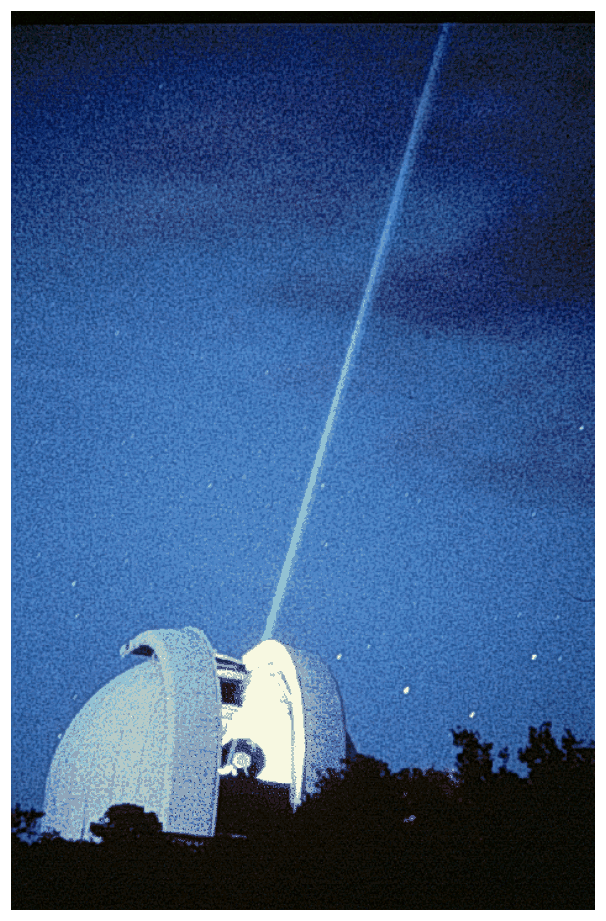
Figure 1. A laser beam sent from an observatory is used to measure accurately the distance between the Earth and the Moon.
With this observations, they have directly measured that the Moon is slowly receding from the Earth. That is, the Earth-Moon distance is increasing with time. This is happening because due to tidal torques the Earth is transferring angular momentum to the Moon, see Figure 2. In this problem you will derive the basic parameters of the phenomenon.
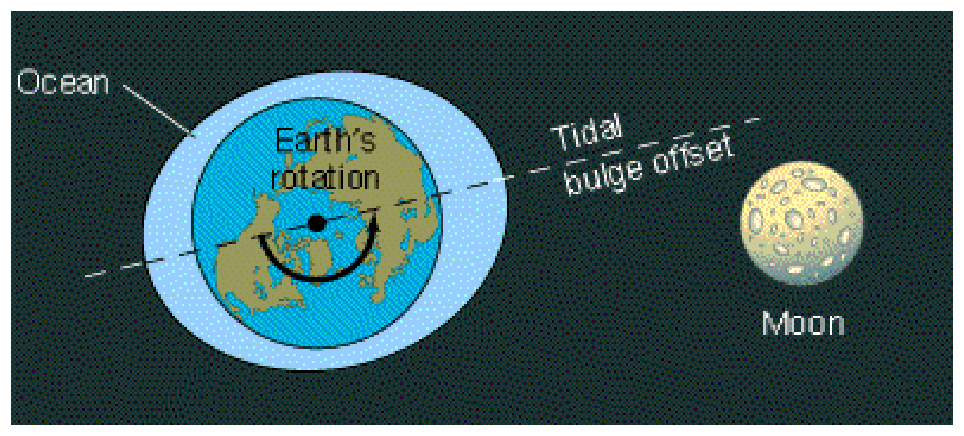
Figure 2. The Moon’s gravity produces tidal deformations or “bulges” in the Earth. Because of the Earth’s rotation, the line that goes through the bulges is not aligned with the line between the Earth and the Moon. This misalignment produces a torque that transfers angular momentum from the Earth’s rotation to the Moon’s translation. The drawing is not to scale.
1. Conservation of Angular Momentum.
Let \(L_1\) be the present total angular momentum of the Earth-Moon system. Now, make the following assumptions: i) \(L_1\) is the sum of the rotation of the Earth around its axis and the translation of the Moon in its orbit around the Earth only. ii) The Moon’s orbit is circular and the Moon can be taken as a point. iii) The Earth’s axis of rotation and the Moon’s axis of revolution are parallel. iv) To simplify the calculations, we take the motion to be around the center of the Earth and not the center of mass. Throughout the problem, all moments of inertia, torques and angular momenta are defined around the axis of the Earth. v) Ignore the influence of the Sun.
| Part | Question | Points |
|---|---|---|
| 1a | Write down the equation for the present total angular momentum of the Earth-Moon system. Set this equation in terms of \(I_E\), the moment of inertia of the Earth; \(\omega_{E1}\), the present angular frequency of the Earth’s rotation; \(I_{M1}\), the present moment of inertia of the Moon with respect to the Earth’s axis; and \(\omega_{M1}\), the present angular frequency of the Moon’s orbit. | 0.2 |
This process of transfer of angular momentum will end when the period of rotation of the Earth and the period of revolution of the Moon around the Earth have the same duration. At this point the tidal bulges produced by the Moon on the Earth will be aligned with the line between the Moon and the Earth and the torque will disappear.
| Part | Question | Points |
|---|---|---|
| 1b | Write down the equation for the final total angular momentum \(L_2\) of the Earth-Moon system. Make the same assumptions as in Question 1a. Set this equation in terms of \(I_E\), the moment of inertia of the Earth; \(\omega_2\), the final angular frequency of the Earth’s rotation and Moon’s translation; and \(I_{M2}\), the final moment of inertia of the Moon. | 0.2 |
| Part | Question | Points |
|---|---|---|
| 1c | Neglecting the contribution of the Earth’s rotation to the final total angular momentum, write down the equation that expresses the angular momentum conservation for this problem. | 0.3 |
2. Final Separation and Final Angular Frequency of the Earth-Moon System.
Assume that the gravitational equation for a circular orbit (of the Moon around the Earth) is always valid. Neglect the contribution of the Earth’s rotation to the final total angular momentum.
| Part | Question | Points |
|---|---|---|
| 2a | Write down the gravitational equation for the circular orbit of the Moon around the Earth, at the final state, in terms of \(M_E\), \(\omega_2\), \(G\) and the final separation \(D_2\) between the Earth and the Moon. \(M_E\) is the mass of the Earth and \(G\) is the gravitational constant. | 0.2 |
| Part | Question | Points |
|---|---|---|
| 2b | Write down the equation for the final separation \(D_2\) between the Earth and the Moon in terms of the known parameters, \(L_1\), the total angular momentum of the system, \(M_E\) and \(M_M\), the masses of the Earth and Moon, respectively, and \(G\). | 0.5 |
| Part | Question | Points |
|---|---|---|
| 2c | Write down the equation for the final angular frequency \(\omega_2\) of the Earth-Moon system in terms of the known parameters \(L_1\), \(M_E\), \(M_M\) and \(G\). | 0.5 |
Below you will be asked to find the numerical values of \(D_2\) and \(\omega_2\). For this you need to know the moment of inertia of the Earth.
| Part | Question | Points |
|---|---|---|
| 2d | Write down the equation for the moment of inertia of the Earth \(I_E\) assuming it is a sphere with inner density \(\rho_i\) from the center to a radius \(r_i\), and with outer density \(\rho_o\) from the radius \(r_i\) to the surface at a radius \(r_o\) (see Figure 3). | 0.5 |
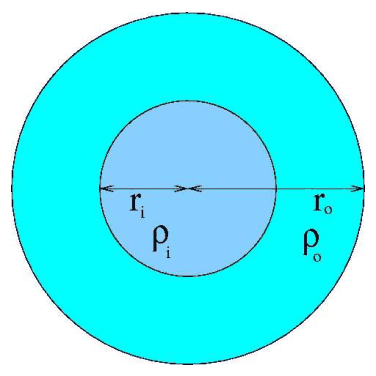
Figure 3. The Earth as a sphere with two densities, \(\rho_i\) and \(\rho_o\).
Determine the numerical values requested in this problem always to two significant digits.
| Part | Question | Points |
|---|---|---|
| 2e | Evaluate the moment of inertia of the Earth \(I_E\), using \(\rho_i=1.3\times10^4\ \mathrm{kg\,m^{-3}}\), \(r_i=3.5\times10^6\ \mathrm{m}\), \(\rho_o=4.0\times10^3\ \mathrm{kg\,m^{-3}}\), and \(r_o=6.4\times10^6\ \mathrm{m}\). | 0.2 |
The masses of the Earth and Moon are \(M_E=6.0\times10^{24}\ \mathrm{kg}\) and \(M_M=7.3\times10^{22}\ \mathrm{kg}\), respectively. The present separation between the Earth and the Moon is \(D_1=3.8\times10^8\ \mathrm{m}\). The present angular frequency of the Earth’s rotation is \(\omega_{E1}=7.3\times10^{-5}\ \mathrm{s^{-1}}\). The present angular frequency of the Moon’s translation around the Earth is \(\omega_{M1}=2.7\times10^{-6}\ \mathrm{s^{-1}}\), and the gravitational constant is \(G=6.7\times10^{-11}\ \mathrm{m^3\,kg^{-1}\,s^{-2}}\).
| Part | Question | Points |
|---|---|---|
| 2f | Evaluate the numerical value of the total angular momentum of the system, \(L_1\). | 0.2 |
| Part | Question | Points |
|---|---|---|
| 2g | Find the final separation \(D_2\) in meters and in units of the present separation \(D_1\). | 0.3 |
| Part | Question | Points |
|---|---|---|
| 2h | Find the final angular frequency \(\omega_2\) in \(\mathrm{s^{-1}}\), as well as the final duration of the day in units of present days. | 0.3 |
Verify that the assumption of neglecting the contribution of the Earth’s rotation to the final total angular momentum is justified by finding the ratio of the final angular momentum of the Earth to that of the Moon. This should be a small quantity.
| Part | Question | Points |
|---|---|---|
| 2i | Find the ratio of the final angular momentum of the Earth to that of the Moon. | 0.2 |
3. How much is the Moon receding per year?
Now, you will find how much the Moon is receding from the Earth each year. For this, you will need to know the equation for the torque acting at present on the Moon. Assume that the tidal bulges can be approximated by two point masses, each of mass \(m\), located on the surface of the Earth, see Fig. 4. Let \(\theta\) be the angle between the line that goes through the bulges and the line that joins the centers of the Earth and the Moon.
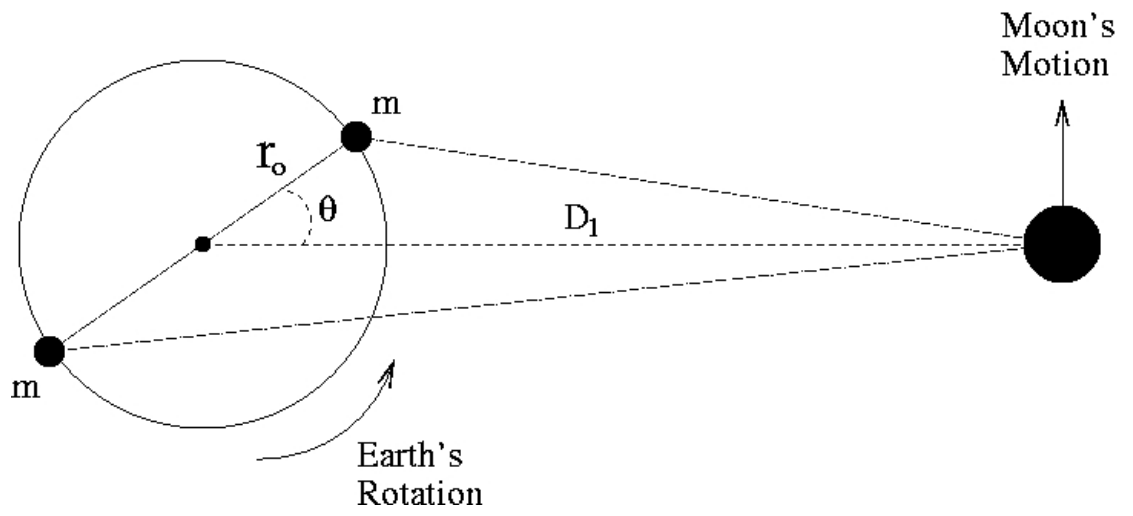
Figure 4. Schematic diagram to estimate the torque produced on the Moon by the bulges on the Earth. The drawing is not to scale.
| Part | Question | Points |
|---|---|---|
| 3a | Find \(F_c\), the magnitude of the force produced on the Moon by the closest point mass. | 0.4 |
| Part | Question | Points |
|---|---|---|
| 3b | Find \(F_f\), the magnitude of the force produced on the Moon by the farthest point mass. | 0.4 |
You may now evaluate the torques produced by the point masses.
| Part | Question | Points |
|---|---|---|
| 3c | Find the magnitude of \(\tau_c\), the torque produced by the closest point mass. | 0.4 |
| Part | Question | Points |
|---|---|---|
| 3d | Find the magnitude of \(\tau_f\), the torque produced by the farthest point mass. | 0.4 |
| Part | Question | Points |
|---|---|---|
| 3e | Find the magnitude of the total torque \(\tau\) produced by the two masses. Since \(r_o\ll D_1\) you should approximate your expression to lowest significant order in \(r_o/D_1\). You may use that \((1+x)^a\approx1+ax\), if \(x\ll1\). | 1.0 |
| Part | Question | Points |
|---|---|---|
| 3f | Calculate the numerical value of the total torque \(\tau\), taking into account that \(\theta=3^\circ\) and that \(m=3.6\times10^{16}\ \mathrm{kg}\) (note that this mass is of the order of \(10^{-8}\) times the mass of the Earth). | 0.5 |
Since the torque is the rate of change of angular momentum with time, find the increase in the distance Earth-Moon at present, per year. For this step, express the angular momentum of the Moon in terms of \(M_M\), \(M_E\), \(D_1\) and \(G\) only.
| Part | Question | Points |
|---|---|---|
| 3g | Find the increase in the distance Earth-Moon at present, per year. | 1.0 |
Finally, estimate how much the length of the day is increasing each year.
| Part | Question | Points |
|---|---|---|
| 3h | Find the decrease of \(\omega_{E1}\) per year and how much is the length of the day at present increasing each year. | 1.0 |
4. Where is the energy going?
In contrast to the angular momentum, that is conserved, the total (rotational plus gravitational) energy of the system is not. We will look into this in this last section.
| Part | Question | Points |
|---|---|---|
| 4a | Write down an equation for the total (rotational plus gravitational) energy of the Earth-Moon system at the present, \(E\). Put this equation in terms of \(I_E\), \(\omega_{E1}\), \(M_M\), \(M_E\), \(D_1\) and \(G\) only. | 0.4 |
| Part | Question | Points |
|---|---|---|
| 4b | Write down an equation for the change in \(E\), \(\Delta E\), as a function of the changes in \(D_1\) and in \(\omega_{E1}\). Evaluate the numerical value of \(\Delta E\) for a year, using the values of changes in \(D_1\) and in \(\omega_{E1}\) found in questions 3g and 3h. | 0.4 |
Verify that this loss of energy is consistent with an estimate for the energy dissipated as heat in the tides produced by the Moon on the Earth. Assume that the tides rise, on the average by 0.5 m, a layer of water \(h=0.5\ \mathrm{m}\) deep that covers the surface of the Earth (for simplicity assume that all the surface of the Earth is covered with water). This happens twice a day. Further assume that 10% of this gravitational energy is dissipated as heat due to viscosity when the water descends. Take the density of water to be \(\rho_{\mathrm{water}}=10^3\ \mathrm{kg\,m^{-3}}\) and the gravitational acceleration on the surface of the Earth to be \(g=9.8\ \mathrm{m\,s^{-2}}\).
| Part | Question | Points |
|---|---|---|
| 4c | What is the mass of this surface layer of water? | 0.2 |
| Part | Question | Points |
|---|---|---|
| 4d | Calculate how much energy is dissipated in a year? How does this compare with the energy lost per year by the Earth-Moon system at present? | 0.3 |
Official English text of the problem.
Answers
For the bulge forces and torques, define the distances \[ d_c=\sqrt{D_1^2+r_o^2-2D_1r_o\cos\theta}, \qquad d_f=\sqrt{D_1^2+r_o^2+2D_1r_o\cos\theta}. \] Let \(T_1\) and \(T_2\) denote the present and final day lengths. Numerical results are given to two significant figures.
- 1a: \(\displaystyle L_1=I_E\omega_{E1}+I_{M1}\omega_{M1}\).
- 1b: \(\displaystyle L_2=(I_E+I_{M2})\omega_2\).
- 1c: \(\displaystyle I_E\omega_{E1}+I_{M1}\omega_{M1}=L_1\simeq I_{M2}\omega_2\).
- 2a: \(\displaystyle \omega_2^2D_2^3=GM_E\).
- 2b: \(\displaystyle D_2=\frac{L_1^2}{GM_EM_M^2}\).
- 2c: \(\displaystyle \omega_2=\frac{G^2M_E^2M_M^3}{L_1^3}\).
- 2d: \(\displaystyle I_E=\frac{8\pi}{15}\left[\rho_i r_i^5+\rho_o(r_o^5-r_i^5)\right]\).
- 2e: \(\displaystyle I_E=8.0\times10^{37}\ \mathrm{kg\,m^2}\).
- 2f: \(\displaystyle L_1=3.4\times10^{34}\ \mathrm{kg\,m^2\,s^{-1}}\).
- 2g: \(\displaystyle D_2=5.5\times10^8\ \mathrm{m}=1.4D_1\).
- 2h: \(\displaystyle \omega_2=1.6\times10^{-6}\ \mathrm{s^{-1}},\qquad T_2/T_1=47\).
- 2i: \(\displaystyle \frac{L_{E2}}{L_{M2}}=\frac{I_E}{M_MD_2^2}=3.6\times10^{-3}\).
- 3a: \(\displaystyle F_c=\frac{GM_Mm}{d_c^2}\).
- 3b: \(\displaystyle F_f=\frac{GM_Mm}{d_f^2}\).
- 3c: \(\displaystyle \tau_c=\frac{GM_MmD_1r_o\sin\theta}{d_c^3}\).
- 3d: \(\displaystyle \tau_f=\frac{GM_MmD_1r_o\sin\theta}{d_f^3}\).
- 3e: \(\displaystyle \tau=\tau_c-\tau_f\simeq\frac{3GM_Mmr_o^2}{D_1^3}\sin(2\theta)\), directed along the Moon’s orbital angular momentum.
- 3f: \(\displaystyle \tau=4.1\times10^{16}\ \mathrm{N\,m}\).
- 3g: \(\displaystyle \dot D_1=\frac{2\tau}{M_M}\sqrt{\frac{D_1}{GM_E}}=3.5\times10^{-2}\ \mathrm{m\,yr^{-1}}=3.5\ \mathrm{cm\,yr^{-1}}\).
- 3h: In one year, \(\displaystyle \Delta\omega_{E1}=-1.6\times10^{-14}\ \mathrm{s^{-1}}\) and \(\displaystyle \Delta T_1=+1.9\times10^{-5}\ \mathrm{s}\).
- 4a: \(\displaystyle E=\frac12I_E\omega_{E1}^2-\frac{GM_EM_M}{2D_1}\).
- 4b: \(\displaystyle \Delta E\simeq I_E\omega_{E1}\Delta\omega_{E1}+\frac{GM_EM_M}{2D_1^2}\Delta D_1=-9.1\times10^{19}\ \mathrm{J}\) in one year.
- 4c: \(\displaystyle M_{\mathrm{water}}=4\pi r_o^2h\rho_{\mathrm{water}}=2.6\times10^{17}\ \mathrm{kg}\).
- 4d: \(\displaystyle E_{\mathrm{heat,yr}}=9.2\times10^{19}\ \mathrm{J}\), in close agreement with the mechanical energy loss of \(9.1\times10^{19}\ \mathrm{J}\) per year.
Solution
All calculations use the assumptions stated in the problem. Numerical results are rounded only at the end. For yearly changes, take \[ t_{\mathrm{yr}}=365\times24\times3600\ \mathrm{s}. \]
1a. Present angular momentum
The Earth’s spin and the Moon’s revolution are in the same sense about parallel axes, so their angular momenta add: \[ \boxed{L_1=I_E\omega_{E1}+I_{M1}\omega_{M1}.} \] Since the Moon is treated as a point at distance \(D_1\) from the Earth’s axis, \[ I_{M1}=M_MD_1^2. \]
1b. Final angular momentum
In the final synchronized state, both angular frequencies equal \(\omega_2\). Thus \[ \boxed{L_2=I_E\omega_2+I_{M2}\omega_2=(I_E+I_{M2})\omega_2,} \qquad I_{M2}=M_MD_2^2. \]
1c. Angular momentum conservation
There is no external torque in the stated model. The tidal torques transfer angular momentum internally, giving \(L_1=L_2\).
Neglecting only the final Earth spin contribution, \[ \boxed{I_E\omega_{E1}+I_{M1}\omega_{M1}\simeq I_{M2}\omega_2.} \] The present Earth spin must still be included in \(L_1\).
2a. Circular-orbit equation
The gravitational force supplies the Moon’s centripetal acceleration: \[ \frac{GM_EM_M}{D_2^2}=M_M\omega_2^2D_2. \] Cancelling \(M_M\) gives \[ \boxed{\omega_2^2D_2^3=GM_E.} \]
2b. Final separation
Within the approximation of part 1c, \[ L_1=M_MD_2^2\omega_2. \] Using \(\omega_2=\sqrt{GM_E/D_2^3}\), \[ L_1=M_M\sqrt{GM_ED_2}. \] Squaring and solving, \[ \boxed{D_2=\frac{L_1^2}{GM_EM_M^2}.} \]
2c. Final angular frequency
Substitution of the preceding result into the circular-orbit equation yields \[ \omega_2 =\sqrt{GM_E}\left(\frac{GM_EM_M^2}{L_1^2}\right)^{3/2}. \] Therefore \[ \boxed{\omega_2=\frac{G^2M_E^2M_M^3}{L_1^3}.} \]
2d. Earth’s moment of inertia
A thin spherical shell of radius \(r\), density \(\rho\), and thickness \(dr\) has \[ dm=4\pi\rho r^2\,dr, \qquad dI=\frac23r^2\,dm=\frac{8\pi}{3}\rho r^4\,dr. \] Integrating over the two density regions, \[ I_E=\frac{8\pi}{3} \left[ \rho_i\int_0^{r_i}r^4\,dr+ \rho_o\int_{r_i}^{r_o}r^4\,dr \right]. \] Thus \[ \boxed{ I_E=\frac{8\pi}{15} \left[\rho_i r_i^5+\rho_o(r_o^5-r_i^5)\right]. } \]
2e. Numerical moment of inertia
Substituting the given densities and radii, \[ I_E=\frac{8\pi}{15} \left[ (1.3\times10^4)(3.5\times10^6)^5 +(4.0\times10^3) \left((6.4\times10^6)^5-(3.5\times10^6)^5\right) \right]\mathrm{kg\,m^2}. \] Hence \[ \boxed{I_E=8.0\times10^{37}\ \mathrm{kg\,m^2}.} \]
2f. Present total angular momentum
Using the given present angular frequencies, \[ L_1=I_E\omega_{E1}+M_MD_1^2\omega_{M1}. \] The two contributions are \[ I_E\omega_{E1}=5.8\times10^{33}\ \mathrm{kg\,m^2\,s^{-1}}, \] \[ M_MD_1^2\omega_{M1}=2.8\times10^{34}\ \mathrm{kg\,m^2\,s^{-1}}. \] Adding them with unrounded intermediate values, \[ \boxed{L_1=3.4\times10^{34}\ \mathrm{kg\,m^2\,s^{-1}}.} \]
2g. Numerical final separation
Using part 2b and the unrounded value of \(L_1\), \[ \boxed{D_2=\frac{L_1^2}{GM_EM_M^2}=5.5\times10^8\ \mathrm{m}.} \] Relative to the present separation, \[ \boxed{\frac{D_2}{D_1}=1.4.} \]
2h. Final frequency and day length
From part 2c, \[ \boxed{\omega_2=1.6\times10^{-6}\ \mathrm{s^{-1}}.} \]
Since a rotation period is \(T=2\pi/\omega\), \[ \frac{T_2}{T_1} =\frac{2\pi/\omega_2}{2\pi/\omega_{E1}} =\frac{\omega_{E1}}{\omega_2}. \] Using unrounded intermediate values gives \[ \boxed{T_2=47T_1,} \] so the final day lasts 47 present days.
2i. Check of the neglected final spin
Both final angular momenta contain the same angular frequency: \[ \frac{L_{E2}}{L_{M2}} =\frac{I_E\omega_2}{M_MD_2^2\omega_2} =\frac{I_E}{M_MD_2^2}. \] Numerically, \[ \boxed{\frac{L_{E2}}{L_{M2}}=3.6\times10^{-3}.} \] The final Earth spin angular momentum is only \(0.36\%\) of the Moon’s orbital angular momentum, justifying its neglect.
3a. Force from the closest bulge
Choose the Earth’s center as the origin, put the Moon at \((D_1,0)\), and take positive \(y\) along the Moon’s instantaneous motion. The closest bulge is at \[ (r_o\cos\theta,r_o\sin\theta). \] Its distance from the Moon is therefore \[ d_c^2=(D_1-r_o\cos\theta)^2+(r_o\sin\theta)^2 =D_1^2+r_o^2-2D_1r_o\cos\theta. \] Newton’s gravitational law gives \[ \boxed{ F_c=\frac{GM_Mm}{D_1^2+r_o^2-2D_1r_o\cos\theta}. } \]
3b. Force from the farthest bulge
The farther bulge is at \[ (-r_o\cos\theta,-r_o\sin\theta). \] Consequently, \[ d_f^2=(D_1+r_o\cos\theta)^2+(r_o\sin\theta)^2 =D_1^2+r_o^2+2D_1r_o\cos\theta, \] and \[ \boxed{ F_f=\frac{GM_Mm}{D_1^2+r_o^2+2D_1r_o\cos\theta}. } \]
3c. Torque from the closest bulge
Only the force component perpendicular to the Earth-Moon line contributes to the torque about the Earth’s axis. For the closer bulge, \[ F_{c,y}=F_c\frac{r_o\sin\theta}{d_c}. \] Its torque is positive, in the direction of the Moon’s orbital angular momentum: \[ \tau_c=D_1F_{c,y}. \] Thus its magnitude is \[ \boxed{ \tau_c= \frac{GM_MmD_1r_o\sin\theta} {(D_1^2+r_o^2-2D_1r_o\cos\theta)^{3/2}}. } \]
3d. Torque from the farthest bulge
The farther bulge pulls the Moon in the negative \(y\) direction: \[ F_{f,y}=-F_f\frac{r_o\sin\theta}{d_f}. \] Its torque opposes the closer bulge’s torque. Its magnitude is \[ \boxed{ \tau_f= \frac{GM_MmD_1r_o\sin\theta} {(D_1^2+r_o^2+2D_1r_o\cos\theta)^{3/2}}. } \]
3e. Total torque to lowest nonzero order
Because \(d_c<d_f\), the closer bulge produces the larger torque. For the geometry shown, \[ \tau=\tau_c-\tau_f =GM_MmD_1r_o\sin\theta \left(\frac1{d_c^3}-\frac1{d_f^3}\right). \]
Define \(\epsilon=r_o/D_1\ll1\). Then \[ \frac1{d_c^3} =\frac1{D_1^3}(1+\epsilon^2-2\epsilon\cos\theta)^{-3/2} \simeq\frac1{D_1^3}(1+3\epsilon\cos\theta), \] and \[ \frac1{d_f^3} =\frac1{D_1^3}(1+\epsilon^2+2\epsilon\cos\theta)^{-3/2} \simeq\frac1{D_1^3}(1-3\epsilon\cos\theta). \] The zeroth-order terms cancel, leaving \[ \tau\simeq GM_MmD_1r_o\sin\theta \frac{6r_o\cos\theta}{D_1^4}. \] Therefore \[ \boxed{ \tau\simeq\frac{6GM_Mmr_o^2}{D_1^3}\sin\theta\cos\theta =\frac{3GM_Mmr_o^2}{D_1^3}\sin(2\theta). } \] This torque increases the Moon’s orbital angular momentum.
3f. Numerical torque
With \(\theta=3^\circ\), \[ \tau\simeq \frac{3(6.7\times10^{-11})(7.3\times10^{22}) (3.6\times10^{16})(6.4\times10^6)^2} {(3.8\times10^8)^3} \sin6^\circ. \] Hence \[ \boxed{\tau=4.1\times10^{16}\ \mathrm{N\,m}.} \]
3g. Present recession of the Moon
For a circular orbit at separation \(D\), \[ \omega_M=\sqrt{\frac{GM_E}{D^3}}, \] so the Moon’s angular momentum is \[ L_M=M_MD^2\omega_M=M_M\sqrt{GM_ED}. \] Differentiating with respect to time, \[ \tau=\frac{dL_M}{dt} =\frac{M_M}{2}\sqrt{\frac{GM_E}{D}}\,\dot D. \] Thus, at the present separation, \[ \boxed{\dot D_1=\frac{2\tau}{M_M}\sqrt{\frac{D_1}{GM_E}}.} \] Numerically, \[ \dot D_1=1.1\times10^{-9}\ \mathrm{m\,s^{-1}}. \] The increase over one year is \[ \Delta D_1=\dot D_1t_{\mathrm{yr}}, \] giving \[ \boxed{\Delta D_1=3.5\times10^{-2}\ \mathrm{m}=3.5\ \mathrm{cm} \quad\text{in one year}.} \]
3h. Earth’s slowing rotation and increasing day length
The torque on the Earth is opposite to the torque on the Moon. With constant \(I_E\), \[ I_E\dot\omega_E=-\tau. \] Therefore \[ \dot\omega_{E1}=-\frac{\tau}{I_E} =-5.2\times10^{-22}\ \mathrm{s^{-2}}, \] and the change in one year is \[ \boxed{ \Delta\omega_{E1}=-\frac{\tau t_{\mathrm{yr}}}{I_E} =-1.6\times10^{-14}\ \mathrm{s^{-1}}. } \]
Since \(T_E=2\pi/\omega_E\), a small change satisfies \[ \Delta T_E\simeq-\frac{2\pi}{\omega_E^2}\Delta\omega_E. \] Consequently, \[ \boxed{ \Delta T_1 =\frac{2\pi\tau t_{\mathrm{yr}}}{I_E\omega_{E1}^2} =1.9\times10^{-5}\ \mathrm{s} \quad\text{in one year}. } \] The day lengthens by approximately \(19\ \mathrm{\mu s}\) per year.
4a. Present mechanical energy
The mechanical energy consists of the Earth’s spin kinetic energy, the Moon’s orbital kinetic energy, and their gravitational potential energy: \[ E=\frac12I_E\omega_{E1}^2 +\frac12M_MD_1^2\omega_{M1}^2 -\frac{GM_EM_M}{D_1}. \] The circular-orbit relation gives \[ \frac12M_MD_1^2\omega_{M1}^2 =\frac{GM_EM_M}{2D_1}. \] Hence \[ \boxed{ E=\frac12I_E\omega_{E1}^2-\frac{GM_EM_M}{2D_1}. } \]
4b. Annual mechanical energy change
For changes \(\Delta\omega_{E1}\) and \(\Delta D_1\), the exact difference within this energy model is \[ \Delta E= \frac12I_E\left[(\omega_{E1}+\Delta\omega_{E1})^2-\omega_{E1}^2\right] -\frac{GM_EM_M}{2} \left[\frac1{D_1+\Delta D_1}-\frac1{D_1}\right]. \] The annual fractional changes are extremely small, so retaining first-order terms gives \[ \boxed{ \Delta E\simeq I_E\omega_{E1}\Delta\omega_{E1} +\frac{GM_EM_M}{2D_1^2}\Delta D_1. } \] The first term is negative: the Earth loses spin energy. The second is positive: the Moon’s orbital energy increases as its orbit expands.
Substituting the annual changes from parts 3g and 3h, retaining their unrounded values, \[ \boxed{\Delta E=-9.1\times10^{19}\ \mathrm{J} \quad\text{in one year}.} \]
The energy balance can also be expressed directly in terms of the torque: \[ \dot E_{\mathrm{spin}}=-\tau\omega_{E1}. \] Using the recession formula, \[ \dot E_{\mathrm{orbit}} =\frac{GM_EM_M}{2D_1^2}\dot D_1 =\tau\sqrt{\frac{GM_E}{D_1^3}}. \] Thus \[ \dot E=-\tau(\omega_{E1}-\omega_{M1}), \] where \(\omega_{M1}\) is understood through the circular-orbit relation. Since the Earth spins faster than the Moon revolves, the mechanical energy decreases; the difference becomes heat.
4c. Mass of the water layer
Since the layer is very thin compared with the Earth’s radius, its volume is its surface area times its thickness: \[ V\simeq4\pi r_o^2h. \] Therefore \[ M_{\mathrm{water}} =4\pi r_o^2h\rho_{\mathrm{water}} =4\pi(6.4\times10^6)^2(0.5)(10^3)\ \mathrm{kg}. \] Hence \[ \boxed{M_{\mathrm{water}}=2.6\times10^{17}\ \mathrm{kg}.} \]
4d. Annual heat dissipation
The stated average rise is \(H=0.5\ \mathrm{m}\). The gravitational energy gained by the layer in one rise is \[ E_{\mathrm{rise}}=M_{\mathrm{water}}gH. \] Ten percent is dissipated as heat during the subsequent descent. With two cycles per day, there are \(2\times365\) cycles per year: \[ E_{\mathrm{heat,yr}} =0.10(2\times365)M_{\mathrm{water}}gH. \] Substitution gives \[ \boxed{E_{\mathrm{heat,yr}}=9.2\times10^{19}\ \mathrm{J}.} \]
This agrees closely with the mechanical energy loss \[ |\Delta E|=9.1\times10^{19}\ \mathrm{J} \] found in part 4b. Within the simplified model, tidal dissipation accounts for the lost mechanical energy by converting it into heat.
The solution was checked against the official solution.
IPhO 2009 · Theorieaufgabe 1
Entwicklung des Erde-Mond-Systems
Wissenschaftler können den Abstand zwischen Erde und Mond mit großer Genauigkeit bestimmen. Dazu lassen sie einen Laserstrahl an speziellen Spiegeln reflektieren, die Astronauten 1969 auf der Mondoberfläche aufgestellt haben, und messen die Laufzeit des Lichts für den Hin- und Rückweg (siehe Abbildung 1).
Abbildung 1. Ein von einer Sternwarte ausgesandter Laserstrahl wird verwendet, um den Abstand zwischen Erde und Mond genau zu messen.
Mit diesen Beobachtungen haben sie direkt gemessen, dass sich der Mond langsam von der Erde entfernt. Das heißt, der Abstand zwischen Erde und Mond nimmt mit der Zeit zu. Dies geschieht, weil die Erde aufgrund von Gezeitendrehmomenten Drehimpuls auf den Mond überträgt, siehe Abbildung 2. In dieser Aufgabe werden Sie die grundlegenden Parameter dieses Phänomens herleiten.
Abbildung 2. Die Gravitation des Mondes erzeugt Gezeitenverformungen oder „Flutberge“ auf der Erde. Wegen der Erdrotation liegt die durch die Flutberge verlaufende Gerade nicht auf der Verbindungslinie zwischen Erde und Mond. Diese Abweichung erzeugt ein Drehmoment, das Drehimpuls von der Eigenrotation der Erde auf die Bahnbewegung des Mondes überträgt. Die Zeichnung ist nicht maßstabsgetreu.
1. Drehimpulserhaltung.
Sei \(L_1\) der gegenwärtige Gesamtdrehimpuls des Erde-Mond-Systems. Treffen Sie nun die folgenden Annahmen: i) \(L_1\) ist ausschließlich die Summe der Drehimpulse der Rotation der Erde um ihre Achse und der Bahnbewegung des Mondes um die Erde. ii) Die Mondbahn ist kreisförmig, und der Mond kann als Massenpunkt betrachtet werden. iii) Die Rotationsachse der Erde und die Umlaufachse des Mondes sind parallel. iv) Zur Vereinfachung der Rechnungen nehmen wir an, dass die Bewegung um den Erdmittelpunkt und nicht um den Schwerpunkt erfolgt. In der gesamten Aufgabe sind alle Trägheitsmomente, Drehmomente und Drehimpulse bezüglich der Erdachse definiert. v) Vernachlässigen Sie den Einfluss der Sonne.
| Teil | Frage | Punkte |
|---|---|---|
| 1a | Stellen Sie die Gleichung für den gegenwärtigen Gesamtdrehimpuls des Erde-Mond-Systems auf. Drücken Sie diese Gleichung durch \(I_E\), das Trägheitsmoment der Erde, \(\omega_{E1}\), die gegenwärtige Winkelgeschwindigkeit der Erdrotation, \(I_{M1}\), das gegenwärtige Trägheitsmoment des Mondes bezüglich der Erdachse, und \(\omega_{M1}\), die gegenwärtige Winkelgeschwindigkeit des Mondumlaufs, aus. | 0.2 |
Dieser Prozess der Drehimpulsübertragung endet, wenn die Rotationsperiode der Erde und die Umlaufperiode des Mondes um die Erde gleich lang sind. Dann liegen die vom Mond auf der Erde erzeugten Flutberge auf der Verbindungslinie zwischen Mond und Erde, und das Drehmoment verschwindet.
| Teil | Frage | Punkte |
|---|---|---|
| 1b | Stellen Sie die Gleichung für den Gesamtdrehimpuls \(L_2\) des Erde-Mond-Systems im Endzustand auf. Treffen Sie dieselben Annahmen wie in Frage 1a. Drücken Sie diese Gleichung durch \(I_E\), das Trägheitsmoment der Erde, \(\omega_2\), die Winkelgeschwindigkeit der Erdrotation und der Bahnbewegung des Mondes im Endzustand, und \(I_{M2}\), das Trägheitsmoment des Mondes im Endzustand, aus. | 0.2 |
| Teil | Frage | Punkte |
|---|---|---|
| 1c | Vernachlässigen Sie den Beitrag der Erdrotation zum Gesamtdrehimpuls im Endzustand und stellen Sie die Gleichung auf, die die Drehimpulserhaltung für diese Aufgabe ausdrückt. | 0.3 |
2. Abstand und Winkelgeschwindigkeit des Erde-Mond-Systems im Endzustand.
Nehmen Sie an, dass die Gravitationsgleichung für eine Kreisbahn (des Mondes um die Erde) stets gilt. Vernachlässigen Sie den Beitrag der Erdrotation zum Gesamtdrehimpuls im Endzustand.
| Teil | Frage | Punkte |
|---|---|---|
| 2a | Stellen Sie die Gravitationsgleichung für die Kreisbahn des Mondes um die Erde im Endzustand in Abhängigkeit von \(M_E\), \(\omega_2\), \(G\) und dem Abstand \(D_2\) zwischen Erde und Mond im Endzustand auf. \(M_E\) ist die Masse der Erde und \(G\) die Gravitationskonstante. | 0.2 |
| Teil | Frage | Punkte |
|---|---|---|
| 2b | Stellen Sie die Gleichung für den Abstand \(D_2\) zwischen Erde und Mond im Endzustand in Abhängigkeit von den bekannten Parametern \(L_1\), dem Gesamtdrehimpuls des Systems, \(M_E\) und \(M_M\), den Massen der Erde beziehungsweise des Mondes, und \(G\) auf. | 0.5 |
| Teil | Frage | Punkte |
|---|---|---|
| 2c | Stellen Sie die Gleichung für die Winkelgeschwindigkeit \(\omega_2\) des Erde-Mond-Systems im Endzustand in Abhängigkeit von den bekannten Parametern \(L_1\), \(M_E\), \(M_M\) und \(G\) auf. | 0.5 |
Im Folgenden sollen Sie die Zahlenwerte von \(D_2\) und \(\omega_2\) bestimmen. Dazu müssen Sie das Trägheitsmoment der Erde kennen.
| Teil | Frage | Punkte |
|---|---|---|
| 2d | Stellen Sie die Gleichung für das Trägheitsmoment der Erde \(I_E\) auf. Nehmen Sie dabei an, dass die Erde eine Kugel mit der inneren Dichte \(\rho_i\) vom Mittelpunkt bis zum Radius \(r_i\) und der äußeren Dichte \(\rho_o\) vom Radius \(r_i\) bis zur Oberfläche beim Radius \(r_o\) ist (siehe Abbildung 3). | 0.5 |
Abbildung 3. Die Erde als Kugel mit zwei Dichten, \(\rho_i\) und \(\rho_o\).
Bestimmen Sie die in dieser Aufgabe geforderten Zahlenwerte stets auf zwei signifikante Stellen.
| Teil | Frage | Punkte |
|---|---|---|
| 2e | Berechnen Sie das Trägheitsmoment der Erde \(I_E\) mit \(\rho_i=1.3\times10^4\ \mathrm{kg\,m^{-3}}\), \(r_i=3.5\times10^6\ \mathrm{m}\), \(\rho_o=4.0\times10^3\ \mathrm{kg\,m^{-3}}\) und \(r_o=6.4\times10^6\ \mathrm{m}\). | 0.2 |
Die Massen der Erde und des Mondes betragen \(M_E=6.0\times10^{24}\ \mathrm{kg}\) beziehungsweise \(M_M=7.3\times10^{22}\ \mathrm{kg}\). Der gegenwärtige Abstand zwischen Erde und Mond ist \(D_1=3.8\times10^8\ \mathrm{m}\). Die gegenwärtige Winkelgeschwindigkeit der Erdrotation beträgt \(\omega_{E1}=7.3\times10^{-5}\ \mathrm{s^{-1}}\). Die gegenwärtige Winkelgeschwindigkeit der Bahnbewegung des Mondes um die Erde beträgt \(\omega_{M1}=2.7\times10^{-6}\ \mathrm{s^{-1}}\), und die Gravitationskonstante ist \(G=6.7\times10^{-11}\ \mathrm{m^3\,kg^{-1}\,s^{-2}}\).
| Teil | Frage | Punkte |
|---|---|---|
| 2f | Berechnen Sie den Zahlenwert des Gesamtdrehimpulses des Systems, \(L_1\). | 0.2 |
| Teil | Frage | Punkte |
|---|---|---|
| 2g | Bestimmen Sie den Abstand \(D_2\) im Endzustand in Metern und in Einheiten des gegenwärtigen Abstands \(D_1\). | 0.3 |
| Teil | Frage | Punkte |
|---|---|---|
| 2h | Bestimmen Sie die Winkelgeschwindigkeit \(\omega_2\) im Endzustand in \(\mathrm{s^{-1}}\) sowie die Tageslänge im Endzustand in Einheiten heutiger Tage. | 0.3 |
Überprüfen Sie, dass die Vernachlässigung des Beitrags der Erdrotation zum Gesamtdrehimpuls im Endzustand gerechtfertigt ist, indem Sie das Verhältnis des Drehimpulses der Erde zu dem des Mondes im Endzustand bestimmen. Dieses Verhältnis sollte klein sein.
| Teil | Frage | Punkte |
|---|---|---|
| 2i | Bestimmen Sie das Verhältnis des Drehimpulses der Erde zu dem des Mondes im Endzustand. | 0.2 |
3. Um wie viel entfernt sich der Mond pro Jahr?
Nun werden Sie bestimmen, um wie viel sich der Mond jedes Jahr von der Erde entfernt. Dazu benötigen Sie die Gleichung für das gegenwärtig auf den Mond wirkende Drehmoment. Nehmen Sie an, dass sich die Flutberge durch zwei Massenpunkte mit jeweils der Masse \(m\) auf der Erdoberfläche annähern lassen, siehe Abb. 4. Sei \(\theta\) der Winkel zwischen der durch die Flutberge verlaufenden Geraden und der Verbindungslinie zwischen den Mittelpunkten von Erde und Mond.
Abbildung 4. Schematische Darstellung zur Abschätzung des Drehmoments, das die Flutberge auf der Erde auf den Mond ausüben. Die Zeichnung ist nicht maßstabsgetreu.
| Teil | Frage | Punkte |
|---|---|---|
| 3a | Bestimmen Sie \(F_c\), den Betrag der Kraft, die der nähere Massenpunkt auf den Mond ausübt. | 0.4 |
| Teil | Frage | Punkte |
|---|---|---|
| 3b | Bestimmen Sie \(F_f\), den Betrag der Kraft, die der weiter entfernte Massenpunkt auf den Mond ausübt. | 0.4 |
Nun können Sie die von den Massenpunkten erzeugten Drehmomente bestimmen.
| Teil | Frage | Punkte |
|---|---|---|
| 3c | Bestimmen Sie den Betrag von \(\tau_c\), dem vom näheren Massenpunkt erzeugten Drehmoment. | 0.4 |
| Teil | Frage | Punkte |
|---|---|---|
| 3d | Bestimmen Sie den Betrag von \(\tau_f\), dem vom weiter entfernten Massenpunkt erzeugten Drehmoment. | 0.4 |
| Teil | Frage | Punkte |
|---|---|---|
| 3e | Bestimmen Sie den Betrag des von den beiden Massen erzeugten Gesamtdrehmoments \(\tau\). Da \(r_o\ll D_1\), sollen Sie Ihren Ausdruck in der niedrigsten nicht verschwindenden Ordnung in \(r_o/D_1\) annähern. Sie dürfen verwenden, dass \((1+x)^a\approx1+ax\), wenn \(x\ll1\). | 1.0 |
| Teil | Frage | Punkte |
|---|---|---|
| 3f | Berechnen Sie den Zahlenwert des Gesamtdrehmoments \(\tau\) unter Berücksichtigung von \(\theta=3^\circ\) und \(m=3.6\times10^{16}\ \mathrm{kg}\) (beachten Sie, dass diese Masse von der Größenordnung des \(10^{-8}\)-Fachen der Erdmasse ist). | 0.5 |
Da das Drehmoment die zeitliche Änderungsrate des Drehimpulses ist, bestimmen Sie die gegenwärtige Zunahme des Abstands zwischen Erde und Mond pro Jahr. Drücken Sie für diesen Schritt den Drehimpuls des Mondes ausschließlich durch \(M_M\), \(M_E\), \(D_1\) und \(G\) aus.
| Teil | Frage | Punkte |
|---|---|---|
| 3g | Bestimmen Sie die gegenwärtige Zunahme des Abstands zwischen Erde und Mond pro Jahr. | 1.0 |
Schätzen Sie schließlich ab, um wie viel die Tageslänge jedes Jahr zunimmt.
| Teil | Frage | Punkte |
|---|---|---|
| 3h | Bestimmen Sie die Abnahme von \(\omega_{E1}\) pro Jahr und die gegenwärtige jährliche Zunahme der Tageslänge. | 1.0 |
4. Wohin geht die Energie?
Im Gegensatz zum Drehimpuls, der erhalten bleibt, ist die Gesamtenergie (Rotations- und Gravitationsenergie) des Systems nicht erhalten. Dies werden wir in diesem letzten Abschnitt untersuchen.
| Teil | Frage | Punkte |
|---|---|---|
| 4a | Stellen Sie eine Gleichung für die gegenwärtige Gesamtenergie (Rotations- und Gravitationsenergie) des Erde-Mond-Systems, \(E\), auf. Drücken Sie diese Gleichung ausschließlich durch \(I_E\), \(\omega_{E1}\), \(M_M\), \(M_E\), \(D_1\) und \(G\) aus. | 0.4 |
| Teil | Frage | Punkte |
|---|---|---|
| 4b | Stellen Sie eine Gleichung für die Änderung von \(E\), \(\Delta E\), als Funktion der Änderungen von \(D_1\) und \(\omega_{E1}\) auf. Berechnen Sie den Zahlenwert von \(\Delta E\) für ein Jahr unter Verwendung der in den Fragen 3g und 3h bestimmten Änderungen von \(D_1\) und \(\omega_{E1}\). | 0.4 |
Überprüfen Sie, dass dieser Energieverlust mit einer Abschätzung der Energie übereinstimmt, die bei den vom Mond auf der Erde erzeugten Gezeiten als Wärme dissipiert wird. Nehmen Sie an, dass die Gezeiten eine \(h=0.5\ \mathrm{m}\) tiefe Wasserschicht, die die Erdoberfläche bedeckt, im Mittel um 0,5 m anheben (nehmen Sie der Einfachheit halber an, dass die gesamte Erdoberfläche mit Wasser bedeckt ist). Dies geschieht zweimal täglich. Nehmen Sie ferner an, dass 10 % dieser Gravitationsenergie beim Absinken des Wassers aufgrund der Viskosität als Wärme dissipiert werden. Verwenden Sie für die Dichte des Wassers \(\rho_{\mathrm{water}}=10^3\ \mathrm{kg\,m^{-3}}\) und für die Fallbeschleunigung an der Erdoberfläche \(g=9.8\ \mathrm{m\,s^{-2}}\).
| Teil | Frage | Punkte |
|---|---|---|
| 4c | Wie groß ist die Masse dieser oberflächlichen Wasserschicht? | 0.2 |
| Teil | Frage | Punkte |
|---|---|---|
| 4d | Berechnen Sie, wie viel Energie in einem Jahr dissipiert wird. Wie verhält sich dies zur Energie, die das Erde-Mond-System gegenwärtig pro Jahr verliert? | 0.3 |
Aufgabentext aus dem offiziellen englischen Text übersetzt.
Antworten
Für die Kräfte und Drehmomente der Flutberge definieren wir die Abstände \[ d_c=\sqrt{D_1^2+r_o^2-2D_1r_o\cos\theta}, \qquad d_f=\sqrt{D_1^2+r_o^2+2D_1r_o\cos\theta}. \] \(T_1\) und \(T_2\) bezeichnen die gegenwärtige Tageslänge beziehungsweise die Tageslänge im Endzustand. Die numerischen Ergebnisse werden auf zwei signifikante Stellen angegeben.
- 1a: \(\displaystyle L_1=I_E\omega_{E1}+I_{M1}\omega_{M1}\).
- 1b: \(\displaystyle L_2=(I_E+I_{M2})\omega_2\).
- 1c: \(\displaystyle I_E\omega_{E1}+I_{M1}\omega_{M1}=L_1\simeq I_{M2}\omega_2\).
- 2a: \(\displaystyle \omega_2^2D_2^3=GM_E\).
- 2b: \(\displaystyle D_2=\frac{L_1^2}{GM_EM_M^2}\).
- 2c: \(\displaystyle \omega_2=\frac{G^2M_E^2M_M^3}{L_1^3}\).
- 2d: \(\displaystyle I_E=\frac{8\pi}{15}\left[\rho_i r_i^5+\rho_o(r_o^5-r_i^5)\right]\).
- 2e: \(\displaystyle I_E=8.0\times10^{37}\ \mathrm{kg\,m^2}\).
- 2f: \(\displaystyle L_1=3.4\times10^{34}\ \mathrm{kg\,m^2\,s^{-1}}\).
- 2g: \(\displaystyle D_2=5.5\times10^8\ \mathrm{m}=1.4D_1\).
- 2h: \(\displaystyle \omega_2=1.6\times10^{-6}\ \mathrm{s^{-1}},\qquad T_2/T_1=47\).
- 2i: \(\displaystyle \frac{L_{E2}}{L_{M2}}=\frac{I_E}{M_MD_2^2}=3.6\times10^{-3}\).
- 3a: \(\displaystyle F_c=\frac{GM_Mm}{d_c^2}\).
- 3b: \(\displaystyle F_f=\frac{GM_Mm}{d_f^2}\).
- 3c: \(\displaystyle \tau_c=\frac{GM_MmD_1r_o\sin\theta}{d_c^3}\).
- 3d: \(\displaystyle \tau_f=\frac{GM_MmD_1r_o\sin\theta}{d_f^3}\).
- 3e: \(\displaystyle \tau=\tau_c-\tau_f\simeq\frac{3GM_Mmr_o^2}{D_1^3}\sin(2\theta)\), in Richtung des Bahndrehimpulses des Mondes.
- 3f: \(\displaystyle \tau=4.1\times10^{16}\ \mathrm{N\,m}\).
- 3g: \(\displaystyle \dot D_1=\frac{2\tau}{M_M}\sqrt{\frac{D_1}{GM_E}}=3.5\times10^{-2}\ \mathrm{m\,yr^{-1}}=3.5\ \mathrm{cm\,yr^{-1}}\).
- 3h: In einem Jahr gilt \(\displaystyle \Delta\omega_{E1}=-1.6\times10^{-14}\ \mathrm{s^{-1}}\) und \(\displaystyle \Delta T_1=+1.9\times10^{-5}\ \mathrm{s}\).
- 4a: \(\displaystyle E=\frac12I_E\omega_{E1}^2-\frac{GM_EM_M}{2D_1}\).
- 4b: \(\displaystyle \Delta E\simeq I_E\omega_{E1}\Delta\omega_{E1}+\frac{GM_EM_M}{2D_1^2}\Delta D_1=-9.1\times10^{19}\ \mathrm{J}\) in einem Jahr.
- 4c: \(\displaystyle M_{\mathrm{water}}=4\pi r_o^2h\rho_{\mathrm{water}}=2.6\times10^{17}\ \mathrm{kg}\).
- 4d: \(\displaystyle E_{\mathrm{heat,yr}}=9.2\times10^{19}\ \mathrm{J}\), in guter Übereinstimmung mit dem Verlust an mechanischer Energie von \(9.1\times10^{19}\ \mathrm{J}\) pro Jahr.
Lösung
Alle Rechnungen verwenden die in der Aufgabenstellung genannten Annahmen. Numerische Ergebnisse werden erst am Ende gerundet. Für jährliche Änderungen setzen wir \[ t_{\mathrm{yr}}=365\times24\times3600\ \mathrm{s}. \]
1a. Gegenwärtiger Drehimpuls
Die Eigenrotation der Erde und der Umlauf des Mondes erfolgen im gleichen Drehsinn um parallele Achsen, sodass sich ihre Drehimpulse addieren: \[ \boxed{L_1=I_E\omega_{E1}+I_{M1}\omega_{M1}.} \] Da der Mond als Massenpunkt im Abstand \(D_1\) von der Erdachse behandelt wird, gilt \[ I_{M1}=M_MD_1^2. \]
1b. Drehimpuls im Endzustand
Im synchronisierten Endzustand sind beide Winkelgeschwindigkeiten gleich \(\omega_2\). Somit gilt \[ \boxed{L_2=I_E\omega_2+I_{M2}\omega_2=(I_E+I_{M2})\omega_2,} \qquad I_{M2}=M_MD_2^2. \]
1c. Drehimpulserhaltung
Im angegebenen Modell gibt es kein äußeres Drehmoment. Die Gezeitendrehmomente übertragen Drehimpuls innerhalb des Systems, sodass \(L_1=L_2\) gilt.
Vernachlässigt man nur den Beitrag der Eigenrotation der Erde im Endzustand, so erhält man \[ \boxed{I_E\omega_{E1}+I_{M1}\omega_{M1}\simeq I_{M2}\omega_2.} \] Die gegenwärtige Eigenrotation der Erde muss weiterhin in \(L_1\) berücksichtigt werden.
2a. Kreisbahngleichung
Die Gravitationskraft bewirkt die Zentripetalbeschleunigung des Mondes: \[ \frac{GM_EM_M}{D_2^2}=M_M\omega_2^2D_2. \] Kürzen von \(M_M\) ergibt \[ \boxed{\omega_2^2D_2^3=GM_E.} \]
2b. Abstand im Endzustand
Im Rahmen der Näherung aus Teil 1c gilt \[ L_1=M_MD_2^2\omega_2. \] Mit \(\omega_2=\sqrt{GM_E/D_2^3}\) folgt \[ L_1=M_M\sqrt{GM_ED_2}. \] Quadrieren und Auflösen ergibt \[ \boxed{D_2=\frac{L_1^2}{GM_EM_M^2}.} \]
2c. Winkelgeschwindigkeit im Endzustand
Einsetzen des vorhergehenden Ergebnisses in die Kreisbahngleichung liefert \[ \omega_2 =\sqrt{GM_E}\left(\frac{GM_EM_M^2}{L_1^2}\right)^{3/2}. \] Damit gilt \[ \boxed{\omega_2=\frac{G^2M_E^2M_M^3}{L_1^3}.} \]
2d. Trägheitsmoment der Erde
Für eine dünne Kugelschale mit Radius \(r\), Dichte \(\rho\) und Dicke \(dr\) gilt \[ dm=4\pi\rho r^2\,dr, \qquad dI=\frac23r^2\,dm=\frac{8\pi}{3}\rho r^4\,dr. \] Integration über die beiden Dichtebereiche ergibt \[ I_E=\frac{8\pi}{3} \left[ \rho_i\int_0^{r_i}r^4\,dr+ \rho_o\int_{r_i}^{r_o}r^4\,dr \right]. \] Somit gilt \[ \boxed{ I_E=\frac{8\pi}{15} \left[\rho_i r_i^5+\rho_o(r_o^5-r_i^5)\right]. } \]
2e. Zahlenwert des Trägheitsmoments
Einsetzen der gegebenen Dichten und Radien ergibt \[ I_E=\frac{8\pi}{15} \left[ (1.3\times10^4)(3.5\times10^6)^5 +(4.0\times10^3) \left((6.4\times10^6)^5-(3.5\times10^6)^5\right) \right]\mathrm{kg\,m^2}. \] Daraus folgt \[ \boxed{I_E=8.0\times10^{37}\ \mathrm{kg\,m^2}.} \]
2f. Gegenwärtiger Gesamtdrehimpuls
Mit den gegebenen gegenwärtigen Winkelgeschwindigkeiten gilt \[ L_1=I_E\omega_{E1}+M_MD_1^2\omega_{M1}. \] Die beiden Beiträge sind \[ I_E\omega_{E1}=5.8\times10^{33}\ \mathrm{kg\,m^2\,s^{-1}}, \] \[ M_MD_1^2\omega_{M1}=2.8\times10^{34}\ \mathrm{kg\,m^2\,s^{-1}}. \] Addition mit ungerundeten Zwischenwerten ergibt \[ \boxed{L_1=3.4\times10^{34}\ \mathrm{kg\,m^2\,s^{-1}}.} \]
2g. Zahlenwert des Abstands im Endzustand
Mit Teil 2b und dem ungerundeten Wert von \(L_1\) erhält man \[ \boxed{D_2=\frac{L_1^2}{GM_EM_M^2}=5.5\times10^8\ \mathrm{m}.} \] Bezogen auf den gegenwärtigen Abstand gilt \[ \boxed{\frac{D_2}{D_1}=1.4.} \]
2h. Winkelgeschwindigkeit und Tageslänge im Endzustand
Aus Teil 2c folgt \[ \boxed{\omega_2=1.6\times10^{-6}\ \mathrm{s^{-1}}.} \]
Da eine Rotationsperiode durch \(T=2\pi/\omega\) gegeben ist, gilt \[ \frac{T_2}{T_1} =\frac{2\pi/\omega_2}{2\pi/\omega_{E1}} =\frac{\omega_{E1}}{\omega_2}. \] Mit ungerundeten Zwischenwerten erhält man \[ \boxed{T_2=47T_1,} \] sodass ein Tag im Endzustand 47 heutige Tage dauert.
2i. Überprüfung der vernachlässigten Eigenrotation im Endzustand
Beide Drehimpulse im Endzustand enthalten dieselbe Winkelgeschwindigkeit: \[ \frac{L_{E2}}{L_{M2}} =\frac{I_E\omega_2}{M_MD_2^2\omega_2} =\frac{I_E}{M_MD_2^2}. \] Numerisch ergibt sich \[ \boxed{\frac{L_{E2}}{L_{M2}}=3.6\times10^{-3}.} \] Der Eigendrehimpuls der Erde im Endzustand beträgt nur \(0.36\%\) des Bahndrehimpulses des Mondes, was seine Vernachlässigung rechtfertigt.
3a. Kraft des näheren Flutbergs
Wir wählen den Erdmittelpunkt als Ursprung, setzen den Mond an die Position \((D_1,0)\) und legen die positive \(y\)-Richtung entlang der momentanen Bewegung des Mondes fest. Der nähere Flutberg befindet sich bei \[ (r_o\cos\theta,r_o\sin\theta). \] Sein Abstand vom Mond ergibt sich daher aus \[ d_c^2=(D_1-r_o\cos\theta)^2+(r_o\sin\theta)^2 =D_1^2+r_o^2-2D_1r_o\cos\theta. \] Das Newtonsche Gravitationsgesetz liefert \[ \boxed{ F_c=\frac{GM_Mm}{D_1^2+r_o^2-2D_1r_o\cos\theta}. } \]
3b. Kraft des weiter entfernten Flutbergs
Der weiter entfernte Flutberg befindet sich bei \[ (-r_o\cos\theta,-r_o\sin\theta). \] Folglich gilt \[ d_f^2=(D_1+r_o\cos\theta)^2+(r_o\sin\theta)^2 =D_1^2+r_o^2+2D_1r_o\cos\theta, \] und \[ \boxed{ F_f=\frac{GM_Mm}{D_1^2+r_o^2+2D_1r_o\cos\theta}. } \]
3c. Drehmoment des näheren Flutbergs
Nur die Kraftkomponente senkrecht zur Verbindungslinie zwischen Erde und Mond trägt zum Drehmoment bezüglich der Erdachse bei. Für den näheren Flutberg gilt \[ F_{c,y}=F_c\frac{r_o\sin\theta}{d_c}. \] Sein Drehmoment ist positiv und zeigt in Richtung des Bahndrehimpulses des Mondes: \[ \tau_c=D_1F_{c,y}. \] Sein Betrag ist somit \[ \boxed{ \tau_c= \frac{GM_MmD_1r_o\sin\theta} {(D_1^2+r_o^2-2D_1r_o\cos\theta)^{3/2}}. } \]
3d. Drehmoment des weiter entfernten Flutbergs
Der weiter entfernte Flutberg zieht den Mond in die negative \(y\)-Richtung: \[ F_{f,y}=-F_f\frac{r_o\sin\theta}{d_f}. \] Sein Drehmoment ist dem Drehmoment des näheren Flutbergs entgegengesetzt. Sein Betrag ist \[ \boxed{ \tau_f= \frac{GM_MmD_1r_o\sin\theta} {(D_1^2+r_o^2+2D_1r_o\cos\theta)^{3/2}}. } \]
3e. Gesamtdrehmoment in der niedrigsten nicht verschwindenden Ordnung
Da \(d_c<d_f\), erzeugt der nähere Flutberg das größere Drehmoment. Für die dargestellte Geometrie gilt \[ \tau=\tau_c-\tau_f =GM_MmD_1r_o\sin\theta \left(\frac1{d_c^3}-\frac1{d_f^3}\right). \]
Wir definieren \(\epsilon=r_o/D_1\ll1\). Dann gilt \[ \frac1{d_c^3} =\frac1{D_1^3}(1+\epsilon^2-2\epsilon\cos\theta)^{-3/2} \simeq\frac1{D_1^3}(1+3\epsilon\cos\theta), \] und \[ \frac1{d_f^3} =\frac1{D_1^3}(1+\epsilon^2+2\epsilon\cos\theta)^{-3/2} \simeq\frac1{D_1^3}(1-3\epsilon\cos\theta). \] Die Terme nullter Ordnung heben sich auf, sodass \[ \tau\simeq GM_MmD_1r_o\sin\theta \frac{6r_o\cos\theta}{D_1^4}. \] Damit folgt \[ \boxed{ \tau\simeq\frac{6GM_Mmr_o^2}{D_1^3}\sin\theta\cos\theta =\frac{3GM_Mmr_o^2}{D_1^3}\sin(2\theta). } \] Dieses Drehmoment vergrößert den Bahndrehimpuls des Mondes.
3f. Zahlenwert des Drehmoments
Mit \(\theta=3^\circ\) gilt \[ \tau\simeq \frac{3(6.7\times10^{-11})(7.3\times10^{22}) (3.6\times10^{16})(6.4\times10^6)^2} {(3.8\times10^8)^3} \sin6^\circ. \] Daraus folgt \[ \boxed{\tau=4.1\times10^{16}\ \mathrm{N\,m}.} \]
3g. Gegenwärtige Entfernung des Mondes von der Erde
Für eine Kreisbahn im Abstand \(D\) gilt \[ \omega_M=\sqrt{\frac{GM_E}{D^3}}, \] sodass der Drehimpuls des Mondes gegeben ist durch \[ L_M=M_MD^2\omega_M=M_M\sqrt{GM_ED}. \] Ableiten nach der Zeit ergibt \[ \tau=\frac{dL_M}{dt} =\frac{M_M}{2}\sqrt{\frac{GM_E}{D}}\,\dot D. \] Beim gegenwärtigen Abstand gilt somit \[ \boxed{\dot D_1=\frac{2\tau}{M_M}\sqrt{\frac{D_1}{GM_E}}.} \] Numerisch ergibt sich \[ \dot D_1=1.1\times10^{-9}\ \mathrm{m\,s^{-1}}. \] Die Zunahme innerhalb eines Jahres ist \[ \Delta D_1=\dot D_1t_{\mathrm{yr}}, \] woraus folgt \[ \boxed{\Delta D_1=3.5\times10^{-2}\ \mathrm{m}=3.5\ \mathrm{cm} \quad\text{in einem Jahr}.} \]
3h. Verlangsamung der Erdrotation und Zunahme der Tageslänge
Das Drehmoment auf die Erde ist dem Drehmoment auf den Mond entgegengesetzt. Bei konstantem \(I_E\) gilt \[ I_E\dot\omega_E=-\tau. \] Daher gilt \[ \dot\omega_{E1}=-\frac{\tau}{I_E} =-5.2\times10^{-22}\ \mathrm{s^{-2}}, \] und die Änderung innerhalb eines Jahres ist \[ \boxed{ \Delta\omega_{E1}=-\frac{\tau t_{\mathrm{yr}}}{I_E} =-1.6\times10^{-14}\ \mathrm{s^{-1}}. } \]
Da \(T_E=2\pi/\omega_E\), gilt für eine kleine Änderung \[ \Delta T_E\simeq-\frac{2\pi}{\omega_E^2}\Delta\omega_E. \] Folglich erhält man \[ \boxed{ \Delta T_1 =\frac{2\pi\tau t_{\mathrm{yr}}}{I_E\omega_{E1}^2} =1.9\times10^{-5}\ \mathrm{s} \quad\text{in einem Jahr}. } \] Der Tag verlängert sich um ungefähr \(19\ \mathrm{\mu s}\) pro Jahr.
4a. Gegenwärtige mechanische Energie
Die mechanische Energie setzt sich aus der Rotationsenergie der Erde, der kinetischen Energie der Bahnbewegung des Mondes und ihrer gravitativen potenziellen Energie zusammen: \[ E=\frac12I_E\omega_{E1}^2 +\frac12M_MD_1^2\omega_{M1}^2 -\frac{GM_EM_M}{D_1}. \] Die Kreisbahnbeziehung liefert \[ \frac12M_MD_1^2\omega_{M1}^2 =\frac{GM_EM_M}{2D_1}. \] Daraus folgt \[ \boxed{ E=\frac12I_E\omega_{E1}^2-\frac{GM_EM_M}{2D_1}. } \]
4b. Jährliche Änderung der mechanischen Energie
Für Änderungen \(\Delta\omega_{E1}\) und \(\Delta D_1\) ist die exakte Differenz innerhalb dieses Energiemodells \[ \Delta E= \frac12I_E\left[(\omega_{E1}+\Delta\omega_{E1})^2-\omega_{E1}^2\right] -\frac{GM_EM_M}{2} \left[\frac1{D_1+\Delta D_1}-\frac1{D_1}\right]. \] Die jährlichen relativen Änderungen sind äußerst klein, sodass die Beschränkung auf Terme erster Ordnung ergibt \[ \boxed{ \Delta E\simeq I_E\omega_{E1}\Delta\omega_{E1} +\frac{GM_EM_M}{2D_1^2}\Delta D_1. } \] Der erste Term ist negativ: Die Erde verliert Rotationsenergie. Der zweite ist positiv: Die Bahnenergie des Mondes nimmt zu, während sich seine Bahn ausweitet.
Einsetzen der jährlichen Änderungen aus den Teilen 3g und 3h unter Beibehaltung ihrer ungerundeten Werte ergibt \[ \boxed{\Delta E=-9.1\times10^{19}\ \mathrm{J} \quad\text{in einem Jahr}.} \]
Die Energiebilanz lässt sich auch direkt durch das Drehmoment ausdrücken: \[ \dot E_{\mathrm{spin}}=-\tau\omega_{E1}. \] Mit der Formel für die Abstandszunahme gilt \[ \dot E_{\mathrm{orbit}} =\frac{GM_EM_M}{2D_1^2}\dot D_1 =\tau\sqrt{\frac{GM_E}{D_1^3}}. \] Somit gilt \[ \dot E=-\tau(\omega_{E1}-\omega_{M1}), \] wobei \(\omega_{M1}\) durch die Kreisbahnbeziehung bestimmt ist. Da sich die Erde schneller dreht, als der Mond sie umläuft, nimmt die mechanische Energie ab; die Differenz wird in Wärme umgewandelt.
4c. Masse der Wasserschicht
Da die Schicht im Vergleich zum Erdradius sehr dünn ist, ist ihr Volumen gleich ihrer Oberfläche mal ihrer Dicke: \[ V\simeq4\pi r_o^2h. \] Daher gilt \[ M_{\mathrm{water}} =4\pi r_o^2h\rho_{\mathrm{water}} =4\pi(6.4\times10^6)^2(0.5)(10^3)\ \mathrm{kg}. \] Daraus folgt \[ \boxed{M_{\mathrm{water}}=2.6\times10^{17}\ \mathrm{kg}.} \]
4d. Jährliche Dissipation als Wärme
Die angegebene mittlere Anhebung beträgt \(H=0.5\ \mathrm{m}\). Die bei einer Anhebung von der Schicht gewonnene Gravitationsenergie ist \[ E_{\mathrm{rise}}=M_{\mathrm{water}}gH. \] Zehn Prozent werden beim anschließenden Absinken als Wärme dissipiert. Bei zwei Zyklen pro Tag gibt es \(2\times365\) Zyklen pro Jahr: \[ E_{\mathrm{heat,yr}} =0.10(2\times365)M_{\mathrm{water}}gH. \] Einsetzen ergibt \[ \boxed{E_{\mathrm{heat,yr}}=9.2\times10^{19}\ \mathrm{J}.} \]
Dies stimmt gut mit dem Verlust an mechanischer Energie \[ |\Delta E|=9.1\times10^{19}\ \mathrm{J} \] aus Teil 4b überein. Im Rahmen des vereinfachten Modells erklärt die Gezeitendissipation den Verlust an mechanischer Energie durch deren Umwandlung in Wärme.
Die Lösung wurde mit der offiziellen Lösung abgeglichen.
IPhO 2009 · Teori sorusu 1
Dünya-Ay Sisteminin Evrimi
Bilim insanları Dünya-Ay uzaklığını büyük bir hassasiyetle belirleyebilmektedir. Bunu, bir lazer demetini astronotların 1969 yılında Ay yüzeyine yerleştirdiği özel aynalardan yansıtarak ve ışığın gidiş-dönüş süresini ölçerek yaparlar (bkz. Şekil 1).
Şekil 1. Bir gözlemevinden gönderilen lazer demeti, Dünya ile Ay arasındaki uzaklığı hassas biçimde ölçmek için kullanılır.
Bu gözlemlerle Ay'ın Dünya'dan yavaşça uzaklaştığını doğrudan ölçmüşlerdir. Başka bir deyişle, Dünya-Ay uzaklığı zamanla artmaktadır. Bunun nedeni, gelgit torkları nedeniyle Dünya'nın Ay'a açısal momentum aktarmasıdır; bkz. Şekil 2. Bu soruda bu olayın temel parametrelerini türeteceksiniz.
Şekil 2. Ay'ın kütleçekimi Dünya'da gelgit kaynaklı şekil değişimlerine, yani “şişkinliklere” yol açar. Dünya'nın dönmesi nedeniyle, şişkinliklerden geçen doğru Dünya ile Ay'ı birleştiren doğruyla aynı doğrultuda değildir. Bu doğrultu farkı, Dünya'nın dönme hareketinden Ay'ın öteleme hareketine açısal momentum aktaran bir tork oluşturur. Çizim ölçekli değildir.
1. Açısal Momentumun Korunumu.
Dünya-Ay sisteminin günümüzdeki toplam açısal momentumu \(L_1\) olsun. Şimdi şu varsayımları yapın: i) \(L_1\), yalnızca Dünya'nın kendi ekseni etrafındaki dönmesinin ve Ay'ın Dünya çevresindeki yörüngesindeki öteleme hareketinin açısal momentumlarının toplamıdır. ii) Ay'ın yörüngesi daireseldir ve Ay bir nokta olarak alınabilir. iii) Dünya'nın dönme ekseni ile Ay'ın dolanma ekseni paraleldir. iv) Hesaplamaları basitleştirmek için hareketin kütle merkezi etrafında değil, Dünya'nın merkezi etrafında gerçekleştiğini kabul ediyoruz. Soru boyunca tüm eylemsizlik momentleri, torklar ve açısal momentumlar Dünya'nın eksenine göre tanımlanmıştır. v) Güneş'in etkisini ihmal edin.
| Kısım | Soru | Puan |
|---|---|---|
| 1a | Dünya-Ay sisteminin günümüzdeki toplam açısal momentumunu veren denklemi yazın. Bu denklemi Dünya'nın eylemsizlik momenti \(I_E\), Dünya'nın günümüzdeki dönme açısal frekansı \(\omega_{E1}\), Ay'ın Dünya'nın eksenine göre günümüzdeki eylemsizlik momenti \(I_{M1}\) ve Ay'ın günümüzdeki yörünge açısal frekansı \(\omega_{M1}\) cinsinden ifade edin. | 0.2 |
Bu açısal momentum aktarımı süreci, Dünya'nın dönme periyodu ile Ay'ın Dünya çevresindeki dolanma periyodu eşit olduğunda sona erecektir. Bu durumda Ay'ın Dünya üzerinde oluşturduğu gelgit şişkinlikleri, Ay ile Dünya'yı birleştiren doğruyla aynı doğrultuda olacak ve tork ortadan kalkacaktır.
| Kısım | Soru | Puan |
|---|---|---|
| 1b | Dünya-Ay sisteminin son durumdaki toplam açısal momentumu \(L_2\) için denklemi yazın. Soru 1a'daki varsayımların aynısını yapın. Bu denklemi Dünya'nın eylemsizlik momenti \(I_E\), Dünya'nın dönmesinin ve Ay'ın öteleme hareketinin son durumdaki açısal frekansı \(\omega_2\) ve Ay'ın son durumdaki eylemsizlik momenti \(I_{M2}\) cinsinden ifade edin. | 0.2 |
| Kısım | Soru | Puan |
|---|---|---|
| 1c | Dünya'nın dönmesinin son durumdaki toplam açısal momentuma katkısını ihmal ederek, bu soru için açısal momentumun korunumunu ifade eden denklemi yazın. | 0.3 |
2. Dünya-Ay Sisteminin Son Durumdaki Uzaklığı ve Açısal Frekansı.
Dairesel yörünge için kütleçekim denkleminin (Ay'ın Dünya çevresindeki hareketi için) her zaman geçerli olduğunu varsayın. Dünya'nın dönmesinin son durumdaki toplam açısal momentuma katkısını ihmal edin.
| Kısım | Soru | Puan |
|---|---|---|
| 2a | Son durumda Ay'ın Dünya çevresindeki dairesel yörüngesi için kütleçekim denklemini \(M_E\), \(\omega_2\), \(G\) ve Dünya ile Ay arasındaki son uzaklık \(D_2\) cinsinden yazın. \(M_E\), Dünya'nın kütlesi; \(G\) ise kütleçekim sabitidir. | 0.2 |
| Kısım | Soru | Puan |
|---|---|---|
| 2b | Dünya ile Ay arasındaki son uzaklık \(D_2\) için denklemi, bilinen parametreler olan sistemin toplam açısal momentumu \(L_1\), sırasıyla Dünya'nın ve Ay'ın kütleleri \(M_E\) ve \(M_M\) ile \(G\) cinsinden yazın. | 0.5 |
| Kısım | Soru | Puan |
|---|---|---|
| 2c | Dünya-Ay sisteminin son durumdaki açısal frekansı \(\omega_2\) için denklemi, bilinen \(L_1\), \(M_E\), \(M_M\) ve \(G\) parametreleri cinsinden yazın. | 0.5 |
Aşağıda \(D_2\) ve \(\omega_2\) değerlerini sayısal olarak bulmanız istenecektir. Bunun için Dünya'nın eylemsizlik momentini bilmeniz gerekir.
| Kısım | Soru | Puan |
|---|---|---|
| 2d | Dünya'yı, merkezinden \(r_i\) yarıçapına kadar iç yoğunluğu \(\rho_i\), \(r_i\) yarıçapından \(r_o\) yarıçapındaki yüzeyine kadar dış yoğunluğu \(\rho_o\) olan bir küre kabul ederek Dünya'nın eylemsizlik momenti \(I_E\) için denklemi yazın (bkz. Şekil 3). | 0.5 |
Şekil 3. \(\rho_i\) ve \(\rho_o\) olmak üzere iki yoğunluğa sahip bir küre olarak Dünya.
Bu soruda istenen sayısal değerleri her zaman iki anlamlı basamakla belirleyin.
| Kısım | Soru | Puan |
|---|---|---|
| 2e | \(\rho_i=1.3\times10^4\ \mathrm{kg\,m^{-3}}\), \(r_i=3.5\times10^6\ \mathrm{m}\), \(\rho_o=4.0\times10^3\ \mathrm{kg\,m^{-3}}\) ve \(r_o=6.4\times10^6\ \mathrm{m}\) değerlerini kullanarak Dünya'nın eylemsizlik momenti \(I_E\)'yi hesaplayın. | 0.2 |
Dünya'nın ve Ay'ın kütleleri sırasıyla \(M_E=6.0\times10^{24}\ \mathrm{kg}\) ve \(M_M=7.3\times10^{22}\ \mathrm{kg}\)'dır. Dünya ile Ay arasındaki güncel uzaklık \(D_1=3.8\times10^8\ \mathrm{m}\)'dir. Dünya'nın günümüzdeki dönme açısal frekansı \(\omega_{E1}=7.3\times10^{-5}\ \mathrm{s^{-1}}\)'dir. Ay'ın Dünya çevresindeki öteleme hareketinin günümüzdeki açısal frekansı \(\omega_{M1}=2.7\times10^{-6}\ \mathrm{s^{-1}}\) ve kütleçekim sabiti \(G=6.7\times10^{-11}\ \mathrm{m^3\,kg^{-1}\,s^{-2}}\)'dir.
| Kısım | Soru | Puan |
|---|---|---|
| 2f | Sistemin toplam açısal momentumu \(L_1\)'in sayısal değerini hesaplayın. | 0.2 |
| Kısım | Soru | Puan |
|---|---|---|
| 2g | Son uzaklık \(D_2\)'yi metre cinsinden ve güncel uzaklık \(D_1\)'in katı olarak bulun. | 0.3 |
| Kısım | Soru | Puan |
|---|---|---|
| 2h | Son açısal frekans \(\omega_2\)'yi \(\mathrm{s^{-1}}\) cinsinden ve son durumdaki gün uzunluğunu günümüzdeki günün katı olarak bulun. | 0.3 |
Dünya'nın son açısal momentumunun Ay'ınkine oranını bularak, Dünya'nın dönmesinin son durumdaki toplam açısal momentuma katkısını ihmal etme varsayımının haklı olduğunu doğrulayın. Bu oranın küçük olması gerekir.
| Kısım | Soru | Puan |
|---|---|---|
| 2i | Dünya'nın son açısal momentumunun Ay'ınkine oranını bulun. | 0.2 |
3. Ay yılda ne kadar uzaklaşıyor?
Şimdi Ay'ın Dünya'dan her yıl ne kadar uzaklaştığını bulacaksınız. Bunun için Ay'a günümüzde etkiyen torkun denklemini bilmeniz gerekecektir. Gelgit şişkinliklerinin, Dünya'nın yüzeyinde bulunan ve her birinin kütlesi \(m\) olan iki noktasal kütleyle yaklaşık olarak temsil edilebildiğini varsayın; bkz. Şekil 4. Şişkinliklerden geçen doğru ile Dünya ve Ay'ın merkezlerini birleştiren doğru arasındaki açı \(\theta\) olsun.
Şekil 4. Dünya üzerindeki şişkinliklerin Ay üzerinde oluşturduğu torku tahmin etmek için kullanılan şematik gösterim. Çizim ölçekli değildir.
| Kısım | Soru | Puan |
|---|---|---|
| 3a | En yakın noktasal kütlenin Ay'a uyguladığı kuvvetin büyüklüğü \(F_c\)'yi bulun. | 0.4 |
| Kısım | Soru | Puan |
|---|---|---|
| 3b | En uzak noktasal kütlenin Ay'a uyguladığı kuvvetin büyüklüğü \(F_f\)'yi bulun. | 0.4 |
Artık noktasal kütlelerin oluşturduğu torkları hesaplayabilirsiniz.
| Kısım | Soru | Puan |
|---|---|---|
| 3c | En yakın noktasal kütlenin oluşturduğu tork \(\tau_c\)'nin büyüklüğünü bulun. | 0.4 |
| Kısım | Soru | Puan |
|---|---|---|
| 3d | En uzak noktasal kütlenin oluşturduğu tork \(\tau_f\)'nin büyüklüğünü bulun. | 0.4 |
| Kısım | Soru | Puan |
|---|---|---|
| 3e | İki kütlenin oluşturduğu toplam tork \(\tau\)'nun büyüklüğünü bulun. \(r_o\ll D_1\) olduğundan, ifadenizi \(r_o/D_1\)'in sıfırdan farklı katkı veren en düşük mertebesine kadar yaklaşık olarak yazmalısınız. \((1+x)^a\approx1+ax\) yaklaşımının \(x\ll1\) için geçerli olduğunu kullanabilirsiniz. | 1.0 |
| Kısım | Soru | Puan |
|---|---|---|
| 3f | \(\theta=3^\circ\) ve \(m=3.6\times10^{16}\ \mathrm{kg}\) olduğunu dikkate alarak toplam tork \(\tau\)'nun sayısal değerini hesaplayın (bu kütlenin Dünya'nın kütlesinin \(10^{-8}\) katı mertebesinde olduğuna dikkat edin). | 0.5 |
Tork, açısal momentumun zamana göre değişim hızı olduğundan, Dünya-Ay uzaklığının günümüzdeki yıllık artışını bulun. Bu adım için Ay'ın açısal momentumunu yalnızca \(M_M\), \(M_E\), \(D_1\) ve \(G\) cinsinden ifade edin.
| Kısım | Soru | Puan |
|---|---|---|
| 3g | Dünya-Ay uzaklığının günümüzdeki yıllık artışını bulun. | 1.0 |
Son olarak, gün uzunluğunun her yıl ne kadar arttığını tahmin edin.
| Kısım | Soru | Puan |
|---|---|---|
| 3h | \(\omega_{E1}\)'in yıllık azalışını ve günümüzde gün uzunluğunun her yıl ne kadar arttığını bulun. | 1.0 |
4. Enerji nereye gidiyor?
Korunan açısal momentumun aksine, sistemin toplam (dönme ve kütleçekim) enerjisi korunmaz. Bu son bölümde bunu inceleyeceğiz.
| Kısım | Soru | Puan |
|---|---|---|
| 4a | Dünya-Ay sisteminin günümüzdeki toplam (dönme ve kütleçekim) enerjisi \(E\) için bir denklem yazın. Bu denklemi yalnızca \(I_E\), \(\omega_{E1}\), \(M_M\), \(M_E\), \(D_1\) ve \(G\) cinsinden ifade edin. | 0.4 |
| Kısım | Soru | Puan |
|---|---|---|
| 4b | \(E\)'deki değişim olan \(\Delta E\) için, \(D_1\) ve \(\omega_{E1}\)'deki değişimlerin bir fonksiyonu olarak bir denklem yazın. 3g ve 3h sorularında bulduğunuz \(D_1\) ve \(\omega_{E1}\) değişimlerini kullanarak bir yıl için \(\Delta E\)'nin sayısal değerini hesaplayın. | 0.4 |
Bu enerji kaybının, Ay'ın Dünya'da oluşturduğu gelgitlerde ısı olarak harcanan enerjiye ilişkin bir tahminle tutarlı olduğunu doğrulayın. Gelgitlerin, Dünya yüzeyini kaplayan \(h=0.5\ \mathrm{m}\) derinliğindeki bir su tabakasını ortalama 0.5 m yükselttiğini varsayın (basitlik için Dünya'nın tüm yüzeyinin suyla kaplı olduğunu varsayın). Bu olay günde iki kez gerçekleşir. Ayrıca, su alçalırken bu kütleçekim enerjisinin %10'unun viskozite nedeniyle ısı olarak harcandığını varsayın. Suyun yoğunluğunu \(\rho_{\mathrm{water}}=10^3\ \mathrm{kg\,m^{-3}}\) ve Dünya yüzeyindeki kütleçekim ivmesini \(g=9.8\ \mathrm{m\,s^{-2}}\) alın.
| Kısım | Soru | Puan |
|---|---|---|
| 4c | Bu yüzey su tabakasının kütlesi nedir? | 0.2 |
| Kısım | Soru | Puan |
|---|---|---|
| 4d | Bir yılda ne kadar enerjinin harcandığını hesaplayın. Bu değer, Dünya-Ay sisteminin günümüzde yılda kaybettiği enerjiyle nasıl karşılaştırılır? | 0.3 |
Soru metni resmi İngilizce metinden çevrilmiştir.
Cevaplar
Şişkinliklerin oluşturduğu kuvvetler ve torklar için uzaklıkları şöyle tanımlayalım: \[ d_c=\sqrt{D_1^2+r_o^2-2D_1r_o\cos\theta}, \qquad d_f=\sqrt{D_1^2+r_o^2+2D_1r_o\cos\theta}. \] \(T_1\) ve \(T_2\), günümüzdeki ve son durumdaki gün uzunluklarını göstersin. Sayısal sonuçlar iki anlamlı basamakla verilmiştir.
- 1a: \(\displaystyle L_1=I_E\omega_{E1}+I_{M1}\omega_{M1}\).
- 1b: \(\displaystyle L_2=(I_E+I_{M2})\omega_2\).
- 1c: \(\displaystyle I_E\omega_{E1}+I_{M1}\omega_{M1}=L_1\simeq I_{M2}\omega_2\).
- 2a: \(\displaystyle \omega_2^2D_2^3=GM_E\).
- 2b: \(\displaystyle D_2=\frac{L_1^2}{GM_EM_M^2}\).
- 2c: \(\displaystyle \omega_2=\frac{G^2M_E^2M_M^3}{L_1^3}\).
- 2d: \(\displaystyle I_E=\frac{8\pi}{15}\left[\rho_i r_i^5+\rho_o(r_o^5-r_i^5)\right]\).
- 2e: \(\displaystyle I_E=8.0\times10^{37}\ \mathrm{kg\,m^2}\).
- 2f: \(\displaystyle L_1=3.4\times10^{34}\ \mathrm{kg\,m^2\,s^{-1}}\).
- 2g: \(\displaystyle D_2=5.5\times10^8\ \mathrm{m}=1.4D_1\).
- 2h: \(\displaystyle \omega_2=1.6\times10^{-6}\ \mathrm{s^{-1}},\qquad T_2/T_1=47\).
- 2i: \(\displaystyle \frac{L_{E2}}{L_{M2}}=\frac{I_E}{M_MD_2^2}=3.6\times10^{-3}\).
- 3a: \(\displaystyle F_c=\frac{GM_Mm}{d_c^2}\).
- 3b: \(\displaystyle F_f=\frac{GM_Mm}{d_f^2}\).
- 3c: \(\displaystyle \tau_c=\frac{GM_MmD_1r_o\sin\theta}{d_c^3}\).
- 3d: \(\displaystyle \tau_f=\frac{GM_MmD_1r_o\sin\theta}{d_f^3}\).
- 3e: \(\displaystyle \tau=\tau_c-\tau_f\simeq\frac{3GM_Mmr_o^2}{D_1^3}\sin(2\theta)\), Ay'ın yörüngesel açısal momentumu yönündedir.
- 3f: \(\displaystyle \tau=4.1\times10^{16}\ \mathrm{N\,m}\).
- 3g: \(\displaystyle \dot D_1=\frac{2\tau}{M_M}\sqrt{\frac{D_1}{GM_E}}=3.5\times10^{-2}\ \mathrm{m\,yr^{-1}}=3.5\ \mathrm{cm\,yr^{-1}}\).
- 3h: Bir yılda, \(\displaystyle \Delta\omega_{E1}=-1.6\times10^{-14}\ \mathrm{s^{-1}}\) ve \(\displaystyle \Delta T_1=+1.9\times10^{-5}\ \mathrm{s}\).
- 4a: \(\displaystyle E=\frac12I_E\omega_{E1}^2-\frac{GM_EM_M}{2D_1}\).
- 4b: Bir yılda \(\displaystyle \Delta E\simeq I_E\omega_{E1}\Delta\omega_{E1}+\frac{GM_EM_M}{2D_1^2}\Delta D_1=-9.1\times10^{19}\ \mathrm{J}\).
- 4c: \(\displaystyle M_{\mathrm{water}}=4\pi r_o^2h\rho_{\mathrm{water}}=2.6\times10^{17}\ \mathrm{kg}\).
- 4d: \(\displaystyle E_{\mathrm{heat,yr}}=9.2\times10^{19}\ \mathrm{J}\), yıllık \(9.1\times10^{19}\ \mathrm{J}\) mekanik enerji kaybıyla yakın uyum içindedir.
Çözüm
Tüm hesaplamalarda soruda belirtilen varsayımlar kullanılmıştır. Sayısal sonuçlar yalnızca en sonda yuvarlanmıştır. Yıllık değişimler için \[ t_{\mathrm{yr}}=365\times24\times3600\ \mathrm{s}. \] alınır.
1a. Günümüzdeki açısal momentum
Dünya'nın kendi ekseni etrafındaki dönmesi ve Ay'ın dolanması, paralel eksenler etrafında aynı yönde olduğundan açısal momentumları toplanır: \[ \boxed{L_1=I_E\omega_{E1}+I_{M1}\omega_{M1}.} \] Ay, Dünya'nın ekseninden \(D_1\) uzaklıkta bir nokta olarak ele alındığından, \[ I_{M1}=M_MD_1^2. \]
1b. Son durumdaki açısal momentum
Son eşzamanlı durumda her iki açısal frekans da \(\omega_2\)'ye eşittir. Dolayısıyla \[ \boxed{L_2=I_E\omega_2+I_{M2}\omega_2=(I_E+I_{M2})\omega_2,} \qquad I_{M2}=M_MD_2^2. \]
1c. Açısal momentumun korunumu
Belirtilen modelde dış tork yoktur. Gelgit torkları sistem içinde açısal momentum aktarır ve \(L_1=L_2\) elde edilir.
Yalnızca Dünya'nın son durumdaki dönme katkısı ihmal edildiğinde, \[ \boxed{I_E\omega_{E1}+I_{M1}\omega_{M1}\simeq I_{M2}\omega_2.} \] Dünya'nın günümüzdeki dönmesi yine de \(L_1\)'e dahil edilmelidir.
2a. Dairesel yörünge denklemi
Kütleçekim kuvveti Ay'ın merkezcil ivmesini sağlar: \[ \frac{GM_EM_M}{D_2^2}=M_M\omega_2^2D_2. \] \(M_M\) sadeleştirildiğinde \[ \boxed{\omega_2^2D_2^3=GM_E.} \] elde edilir.
2b. Son uzaklık
1c kısmındaki yaklaşım çerçevesinde, \[ L_1=M_MD_2^2\omega_2. \] \(\omega_2=\sqrt{GM_E/D_2^3}\) kullanılarak, \[ L_1=M_M\sqrt{GM_ED_2}. \] Karesi alınıp çözüldüğünde, \[ \boxed{D_2=\frac{L_1^2}{GM_EM_M^2}.} \]
2c. Son açısal frekans
Önceki sonuç dairesel yörünge denkleminde yerine konulduğunda \[ \omega_2 =\sqrt{GM_E}\left(\frac{GM_EM_M^2}{L_1^2}\right)^{3/2}. \] elde edilir. Dolayısıyla \[ \boxed{\omega_2=\frac{G^2M_E^2M_M^3}{L_1^3}.} \]
2d. Dünya'nın eylemsizlik momenti
Yarıçapı \(r\), yoğunluğu \(\rho\) ve kalınlığı \(dr\) olan ince bir küresel kabuk için \[ dm=4\pi\rho r^2\,dr, \qquad dI=\frac23r^2\,dm=\frac{8\pi}{3}\rho r^4\,dr. \] İki yoğunluk bölgesi üzerinde integral alındığında, \[ I_E=\frac{8\pi}{3} \left[ \rho_i\int_0^{r_i}r^4\,dr+ \rho_o\int_{r_i}^{r_o}r^4\,dr \right]. \] Böylece \[ \boxed{ I_E=\frac{8\pi}{15} \left[\rho_i r_i^5+\rho_o(r_o^5-r_i^5)\right]. } \]
2e. Eylemsizlik momentinin sayısal değeri
Verilen yoğunluklar ve yarıçaplar yerine konulduğunda, \[ I_E=\frac{8\pi}{15} \left[ (1.3\times10^4)(3.5\times10^6)^5 +(4.0\times10^3) \left((6.4\times10^6)^5-(3.5\times10^6)^5\right) \right]\mathrm{kg\,m^2}. \] Buradan \[ \boxed{I_E=8.0\times10^{37}\ \mathrm{kg\,m^2}.} \]
2f. Günümüzdeki toplam açısal momentum
Verilen güncel açısal frekanslar kullanılarak, \[ L_1=I_E\omega_{E1}+M_MD_1^2\omega_{M1}. \] İki katkı şöyledir: \[ I_E\omega_{E1}=5.8\times10^{33}\ \mathrm{kg\,m^2\,s^{-1}}, \] \[ M_MD_1^2\omega_{M1}=2.8\times10^{34}\ \mathrm{kg\,m^2\,s^{-1}}. \] Yuvarlanmamış ara değerler kullanılarak toplandıklarında, \[ \boxed{L_1=3.4\times10^{34}\ \mathrm{kg\,m^2\,s^{-1}}.} \]
2g. Son uzaklığın sayısal değeri
2b kısmı ve \(L_1\)'in yuvarlanmamış değeri kullanılarak, \[ \boxed{D_2=\frac{L_1^2}{GM_EM_M^2}=5.5\times10^8\ \mathrm{m}.} \] Güncel uzaklığa oranı, \[ \boxed{\frac{D_2}{D_1}=1.4.} \]
2h. Son frekans ve gün uzunluğu
2c kısmından, \[ \boxed{\omega_2=1.6\times10^{-6}\ \mathrm{s^{-1}}.} \]
Dönme periyodu \(T=2\pi/\omega\) olduğundan, \[ \frac{T_2}{T_1} =\frac{2\pi/\omega_2}{2\pi/\omega_{E1}} =\frac{\omega_{E1}}{\omega_2}. \] Yuvarlanmamış ara değerler kullanıldığında \[ \boxed{T_2=47T_1,} \] elde edilir; yani son durumdaki bir gün, günümüzdeki 47 gün kadar sürer.
2i. İhmal edilen son dönme katkısının kontrolü
Son durumdaki her iki açısal momentum da aynı açısal frekansı içerir: \[ \frac{L_{E2}}{L_{M2}} =\frac{I_E\omega_2}{M_MD_2^2\omega_2} =\frac{I_E}{M_MD_2^2}. \] Sayısal olarak, \[ \boxed{\frac{L_{E2}}{L_{M2}}=3.6\times10^{-3}.} \] Dünya'nın son durumdaki dönme açısal momentumu, Ay'ın yörüngesel açısal momentumunun yalnızca \(0.36\%\)'sıdır; bu da ihmal edilmesini haklı kılar.
3a. En yakın şişkinliğin uyguladığı kuvvet
Dünya'nın merkezini başlangıç noktası seçelim, Ay'ı \((D_1,0)\) konumuna yerleştirelim ve pozitif \(y\) yönünü Ay'ın anlık hareketi yönünde alalım. En yakın şişkinliğin konumu \[ (r_o\cos\theta,r_o\sin\theta). \] olur. Dolayısıyla Ay'a olan uzaklığı için \[ d_c^2=(D_1-r_o\cos\theta)^2+(r_o\sin\theta)^2 =D_1^2+r_o^2-2D_1r_o\cos\theta. \] Newton'un kütleçekim yasası şunu verir: \[ \boxed{ F_c=\frac{GM_Mm}{D_1^2+r_o^2-2D_1r_o\cos\theta}. } \]
3b. En uzak şişkinliğin uyguladığı kuvvet
Daha uzaktaki şişkinliğin konumu \[ (-r_o\cos\theta,-r_o\sin\theta). \] olur. Bunun sonucunda, \[ d_f^2=(D_1+r_o\cos\theta)^2+(r_o\sin\theta)^2 =D_1^2+r_o^2+2D_1r_o\cos\theta, \] ve \[ \boxed{ F_f=\frac{GM_Mm}{D_1^2+r_o^2+2D_1r_o\cos\theta}. } \]
3c. En yakın şişkinliğin oluşturduğu tork
Dünya'nın eksenine göre torka yalnızca kuvvetin Dünya-Ay doğrusuna dik bileşeni katkıda bulunur. Daha yakındaki şişkinlik için, \[ F_{c,y}=F_c\frac{r_o\sin\theta}{d_c}. \] Oluşturduğu tork pozitiftir ve Ay'ın yörüngesel açısal momentumu yönündedir: \[ \tau_c=D_1F_{c,y}. \] Dolayısıyla büyüklüğü \[ \boxed{ \tau_c= \frac{GM_MmD_1r_o\sin\theta} {(D_1^2+r_o^2-2D_1r_o\cos\theta)^{3/2}}. } \]
3d. En uzak şişkinliğin oluşturduğu tork
Daha uzaktaki şişkinlik Ay'ı negatif \(y\) yönünde çeker: \[ F_{f,y}=-F_f\frac{r_o\sin\theta}{d_f}. \] Oluşturduğu tork, daha yakındaki şişkinliğin torkuna zıt yöndedir. Büyüklüğü \[ \boxed{ \tau_f= \frac{GM_MmD_1r_o\sin\theta} {(D_1^2+r_o^2+2D_1r_o\cos\theta)^{3/2}}. } \]
3e. Sıfırdan farklı en düşük mertebede toplam tork
\(d_c<d_f\) olduğundan, daha yakındaki şişkinlik daha büyük bir tork oluşturur. Gösterilen geometri için, \[ \tau=\tau_c-\tau_f =GM_MmD_1r_o\sin\theta \left(\frac1{d_c^3}-\frac1{d_f^3}\right). \]
\(\epsilon=r_o/D_1\ll1\) tanımını yapalım. O zaman \[ \frac1{d_c^3} =\frac1{D_1^3}(1+\epsilon^2-2\epsilon\cos\theta)^{-3/2} \simeq\frac1{D_1^3}(1+3\epsilon\cos\theta), \] ve \[ \frac1{d_f^3} =\frac1{D_1^3}(1+\epsilon^2+2\epsilon\cos\theta)^{-3/2} \simeq\frac1{D_1^3}(1-3\epsilon\cos\theta). \] Sıfırıncı mertebedeki terimler birbirini götürür ve geriye \[ \tau\simeq GM_MmD_1r_o\sin\theta \frac{6r_o\cos\theta}{D_1^4}. \] kalır. Dolayısıyla \[ \boxed{ \tau\simeq\frac{6GM_Mmr_o^2}{D_1^3}\sin\theta\cos\theta =\frac{3GM_Mmr_o^2}{D_1^3}\sin(2\theta). } \] Bu tork Ay'ın yörüngesel açısal momentumunu artırır.
3f. Torkun sayısal değeri
\(\theta=3^\circ\) için, \[ \tau\simeq \frac{3(6.7\times10^{-11})(7.3\times10^{22}) (3.6\times10^{16})(6.4\times10^6)^2} {(3.8\times10^8)^3} \sin6^\circ. \] Buradan \[ \boxed{\tau=4.1\times10^{16}\ \mathrm{N\,m}.} \]
3g. Ay'ın günümüzdeki uzaklaşması
\(D\) uzaklığındaki dairesel bir yörünge için, \[ \omega_M=\sqrt{\frac{GM_E}{D^3}}, \] dolayısıyla Ay'ın açısal momentumu \[ L_M=M_MD^2\omega_M=M_M\sqrt{GM_ED}. \] Zamana göre türev alındığında, \[ \tau=\frac{dL_M}{dt} =\frac{M_M}{2}\sqrt{\frac{GM_E}{D}}\,\dot D. \] Böylece güncel uzaklıkta, \[ \boxed{\dot D_1=\frac{2\tau}{M_M}\sqrt{\frac{D_1}{GM_E}}.} \] Sayısal olarak, \[ \dot D_1=1.1\times10^{-9}\ \mathrm{m\,s^{-1}}. \] Bir yıldaki artış \[ \Delta D_1=\dot D_1t_{\mathrm{yr}}, \] olduğundan, \[ \boxed{\Delta D_1=3.5\times10^{-2}\ \mathrm{m}=3.5\ \mathrm{cm} \quad\text{bir yılda}.} \]
3h. Dünya'nın yavaşlayan dönmesi ve artan gün uzunluğu
Dünya'ya etkiyen tork, Ay'a etkiyen torka zıt yöndedir. \(I_E\) sabit olduğunda, \[ I_E\dot\omega_E=-\tau. \] Dolayısıyla \[ \dot\omega_{E1}=-\frac{\tau}{I_E} =-5.2\times10^{-22}\ \mathrm{s^{-2}}, \] ve bir yıldaki değişim \[ \boxed{ \Delta\omega_{E1}=-\frac{\tau t_{\mathrm{yr}}}{I_E} =-1.6\times10^{-14}\ \mathrm{s^{-1}}. } \]
\(T_E=2\pi/\omega_E\) olduğundan, küçük bir değişim şu bağıntıyı sağlar: \[ \Delta T_E\simeq-\frac{2\pi}{\omega_E^2}\Delta\omega_E. \] Bunun sonucunda, \[ \boxed{ \Delta T_1 =\frac{2\pi\tau t_{\mathrm{yr}}}{I_E\omega_{E1}^2} =1.9\times10^{-5}\ \mathrm{s} \quad\text{bir yılda}. } \] Gün, yılda yaklaşık \(19\ \mathrm{\mu s}\) uzar.
4a. Günümüzdeki mekanik enerji
Mekanik enerji; Dünya'nın dönme kinetik enerjisinden, Ay'ın yörüngesel kinetik enerjisinden ve aralarındaki kütleçekim potansiyel enerjisinden oluşur: \[ E=\frac12I_E\omega_{E1}^2 +\frac12M_MD_1^2\omega_{M1}^2 -\frac{GM_EM_M}{D_1}. \] Dairesel yörünge bağıntısı şunu verir: \[ \frac12M_MD_1^2\omega_{M1}^2 =\frac{GM_EM_M}{2D_1}. \] Buradan \[ \boxed{ E=\frac12I_E\omega_{E1}^2-\frac{GM_EM_M}{2D_1}. } \]
4b. Yıllık mekanik enerji değişimi
\(\Delta\omega_{E1}\) ve \(\Delta D_1\) değişimleri için bu enerji modeli çerçevesindeki tam fark \[ \Delta E= \frac12I_E\left[(\omega_{E1}+\Delta\omega_{E1})^2-\omega_{E1}^2\right] -\frac{GM_EM_M}{2} \left[\frac1{D_1+\Delta D_1}-\frac1{D_1}\right]. \] Yıllık bağıl değişimler son derece küçüktür; bu nedenle birinci mertebeden terimler tutulduğunda \[ \boxed{ \Delta E\simeq I_E\omega_{E1}\Delta\omega_{E1} +\frac{GM_EM_M}{2D_1^2}\Delta D_1. } \] elde edilir. İlk terim negatiftir: Dünya dönme enerjisi kaybeder. İkinci terim pozitiftir: Ay'ın yörüngesi genişledikçe yörünge enerjisi artar.
3g ve 3h kısımlarındaki yıllık değişimler, yuvarlanmamış değerleri korunarak yerine konulduğunda, \[ \boxed{\Delta E=-9.1\times10^{19}\ \mathrm{J} \quad\text{bir yılda}.} \]
Enerji dengesi doğrudan tork cinsinden de ifade edilebilir: \[ \dot E_{\mathrm{spin}}=-\tau\omega_{E1}. \] Uzaklaşma formülü kullanılarak, \[ \dot E_{\mathrm{orbit}} =\frac{GM_EM_M}{2D_1^2}\dot D_1 =\tau\sqrt{\frac{GM_E}{D_1^3}}. \] Böylece \[ \dot E=-\tau(\omega_{E1}-\omega_{M1}), \] burada \(\omega_{M1}\), dairesel yörünge bağıntısıyla belirlenir. Dünya, Ay'ın dolanmasından daha hızlı döndüğü için mekanik enerji azalır; aradaki fark ısıya dönüşür.
4c. Su tabakasının kütlesi
Tabaka, Dünya'nın yarıçapına göre çok ince olduğundan hacmi, yüzey alanı ile kalınlığının çarpımıdır: \[ V\simeq4\pi r_o^2h. \] Dolayısıyla \[ M_{\mathrm{water}} =4\pi r_o^2h\rho_{\mathrm{water}} =4\pi(6.4\times10^6)^2(0.5)(10^3)\ \mathrm{kg}. \] Buradan \[ \boxed{M_{\mathrm{water}}=2.6\times10^{17}\ \mathrm{kg}.} \]
4d. Yıllık ısı olarak enerji kaybı
Belirtilen ortalama yükselme \(H=0.5\ \mathrm{m}\)'dir. Tabakanın bir yükselme sırasında kazandığı kütleçekim enerjisi \[ E_{\mathrm{rise}}=M_{\mathrm{water}}gH. \] Ardından gelen alçalma sırasında bunun yüzde onu ısı olarak harcanır. Günde iki çevrim olduğundan yılda \(2\times365\) çevrim vardır: \[ E_{\mathrm{heat,yr}} =0.10(2\times365)M_{\mathrm{water}}gH. \] Değerler yerine konulduğunda \[ \boxed{E_{\mathrm{heat,yr}}=9.2\times10^{19}\ \mathrm{J}.} \]
Bu değer, 4b kısmında bulunan \[ |\Delta E|=9.1\times10^{19}\ \mathrm{J} \] mekanik enerji kaybıyla yakın uyum içindedir. Basitleştirilmiş model çerçevesinde gelgitlerdeki enerji harcanması, kaybolan mekanik enerjiyi ısıya dönüştürerek bu kaybı açıklar.
Çözüm, resmi çözümle karşılaştırılarak kontrol edildi.
IPhO 2009 · Problema teórico 1
Evolución del sistema Tierra-Luna
Los científicos pueden determinar la distancia Tierra-Luna con gran precisión. Lo consiguen haciendo que un haz láser se refleje en unos espejos especiales depositados en la superficie de la Luna por astronautas en 1969 y midiendo el tiempo de ida y vuelta de la luz (véase la Figura 1).
Figura 1. Se utiliza un haz láser enviado desde un observatorio para medir con precisión la distancia entre la Tierra y la Luna.
Con estas observaciones, han medido directamente que la Luna se aleja lentamente de la Tierra. Es decir, la distancia Tierra-Luna aumenta con el tiempo. Esto sucede porque, debido a los momentos de las fuerzas de marea, la Tierra transfiere momento angular a la Luna; véase la Figura 2. En este problema deducirá los parámetros básicos de este fenómeno.
Figura 2. La gravedad de la Luna produce deformaciones de marea o «abultamientos» en la Tierra. Debido a la rotación terrestre, la recta que pasa por los abultamientos no está alineada con la recta que une la Tierra y la Luna. Esta desalineación produce un momento de fuerza que transfiere momento angular de la rotación de la Tierra a la traslación de la Luna. El dibujo no está a escala.
1. Conservación del momento angular.
Sea \(L_1\) el momento angular total actual del sistema Tierra-Luna. Adopte ahora las siguientes hipótesis: i) \(L_1\) es únicamente la suma de los momentos angulares de la rotación de la Tierra alrededor de su eje y de la traslación de la Luna en su órbita alrededor de la Tierra. ii) La órbita de la Luna es circular y la Luna puede considerarse un punto. iii) El eje de rotación de la Tierra y el eje de revolución de la Luna son paralelos. iv) Para simplificar los cálculos, consideramos que el movimiento tiene lugar alrededor del centro de la Tierra y no del centro de masas. En todo el problema, todos los momentos de inercia, momentos de fuerza y momentos angulares se definen respecto al eje de la Tierra. v) Desprecie la influencia del Sol.
| Parte | Pregunta | Puntos |
|---|---|---|
| 1a | Escriba la ecuación del momento angular total actual del sistema Tierra-Luna. Exprese esta ecuación en función de \(I_E\), el momento de inercia de la Tierra; \(\omega_{E1}\), la frecuencia angular actual de la rotación terrestre; \(I_{M1}\), el momento de inercia actual de la Luna respecto al eje de la Tierra; y \(\omega_{M1}\), la frecuencia angular actual de la órbita lunar. | 0.2 |
Este proceso de transferencia de momento angular terminará cuando el período de rotación de la Tierra y el período de revolución de la Luna alrededor de la Tierra tengan la misma duración. En ese momento, los abultamientos de marea producidos por la Luna en la Tierra estarán alineados con la recta que une la Luna y la Tierra, y el momento de fuerza desaparecerá.
| Parte | Pregunta | Puntos |
|---|---|---|
| 1b | Escriba la ecuación del momento angular total final \(L_2\) del sistema Tierra-Luna. Adopte las mismas hipótesis que en la pregunta 1a. Exprese esta ecuación en función de \(I_E\), el momento de inercia de la Tierra; \(\omega_2\), la frecuencia angular final de la rotación terrestre y de la traslación lunar; e \(I_{M2}\), el momento de inercia final de la Luna. | 0.2 |
| Parte | Pregunta | Puntos |
|---|---|---|
| 1c | Despreciando la contribución de la rotación terrestre al momento angular total final, escriba la ecuación que expresa la conservación del momento angular en este problema. | 0.3 |
2. Separación final y frecuencia angular final del sistema Tierra-Luna.
Suponga que la ecuación gravitatoria para una órbita circular (de la Luna alrededor de la Tierra) es siempre válida. Desprecie la contribución de la rotación terrestre al momento angular total final.
| Parte | Pregunta | Puntos |
|---|---|---|
| 2a | Escriba la ecuación gravitatoria para la órbita circular de la Luna alrededor de la Tierra, en el estado final, en función de \(M_E\), \(\omega_2\), \(G\) y la separación final \(D_2\) entre la Tierra y la Luna. \(M_E\) es la masa de la Tierra y \(G\) es la constante de gravitación universal. | 0.2 |
| Parte | Pregunta | Puntos |
|---|---|---|
| 2b | Escriba la ecuación de la separación final \(D_2\) entre la Tierra y la Luna en función de los parámetros conocidos: \(L_1\), el momento angular total del sistema; \(M_E\) y \(M_M\), las masas de la Tierra y de la Luna, respectivamente; y \(G\). | 0.5 |
| Parte | Pregunta | Puntos |
|---|---|---|
| 2c | Escriba la ecuación de la frecuencia angular final \(\omega_2\) del sistema Tierra-Luna en función de los parámetros conocidos \(L_1\), \(M_E\), \(M_M\) y \(G\). | 0.5 |
Más adelante se le pedirá que halle los valores numéricos de \(D_2\) y \(\omega_2\). Para ello necesita conocer el momento de inercia de la Tierra.
| Parte | Pregunta | Puntos |
|---|---|---|
| 2d | Escriba la ecuación del momento de inercia de la Tierra \(I_E\), suponiendo que es una esfera con densidad interior \(\rho_i\) desde el centro hasta un radio \(r_i\), y con densidad exterior \(\rho_o\) desde el radio \(r_i\) hasta la superficie, situada a un radio \(r_o\) (véase la Figura 3). | 0.5 |
Figura 3. La Tierra como una esfera con dos densidades, \(\rho_i\) y \(\rho_o\).
Determine los valores numéricos solicitados en este problema siempre con dos cifras significativas.
| Parte | Pregunta | Puntos |
|---|---|---|
| 2e | Calcule el momento de inercia de la Tierra \(I_E\), utilizando \(\rho_i=1.3\times10^4\ \mathrm{kg\,m^{-3}}\), \(r_i=3.5\times10^6\ \mathrm{m}\), \(\rho_o=4.0\times10^3\ \mathrm{kg\,m^{-3}}\) y \(r_o=6.4\times10^6\ \mathrm{m}\). | 0.2 |
Las masas de la Tierra y de la Luna son \(M_E=6.0\times10^{24}\ \mathrm{kg}\) y \(M_M=7.3\times10^{22}\ \mathrm{kg}\), respectivamente. La separación actual entre la Tierra y la Luna es \(D_1=3.8\times10^8\ \mathrm{m}\). La frecuencia angular actual de la rotación terrestre es \(\omega_{E1}=7.3\times10^{-5}\ \mathrm{s^{-1}}\). La frecuencia angular actual de la traslación de la Luna alrededor de la Tierra es \(\omega_{M1}=2.7\times10^{-6}\ \mathrm{s^{-1}}\), y la constante de gravitación universal es \(G=6.7\times10^{-11}\ \mathrm{m^3\,kg^{-1}\,s^{-2}}\).
| Parte | Pregunta | Puntos |
|---|---|---|
| 2f | Calcule el valor numérico del momento angular total del sistema, \(L_1\). | 0.2 |
| Parte | Pregunta | Puntos |
|---|---|---|
| 2g | Halle la separación final \(D_2\) en metros y en unidades de la separación actual \(D_1\). | 0.3 |
| Parte | Pregunta | Puntos |
|---|---|---|
| 2h | Halle la frecuencia angular final \(\omega_2\) en \(\mathrm{s^{-1}}\), así como la duración final del día en unidades de días actuales. | 0.3 |
Compruebe que está justificado despreciar la contribución de la rotación terrestre al momento angular total final calculando el cociente entre el momento angular final de la Tierra y el de la Luna. Este cociente debería ser pequeño.
| Parte | Pregunta | Puntos |
|---|---|---|
| 2i | Halle el cociente entre el momento angular final de la Tierra y el de la Luna. | 0.2 |
3. ¿Cuánto se aleja la Luna cada año?
Ahora hallará cuánto se aleja la Luna de la Tierra cada año. Para ello, necesitará conocer la ecuación del momento de fuerza que actúa actualmente sobre la Luna. Suponga que los abultamientos de marea pueden aproximarse por dos masas puntuales, cada una de masa \(m\), situadas en la superficie de la Tierra; véase la Fig. 4. Sea \(\theta\) el ángulo entre la recta que pasa por los abultamientos y la recta que une los centros de la Tierra y de la Luna.
Figura 4. Diagrama esquemático para estimar el momento de fuerza producido sobre la Luna por los abultamientos de la Tierra. El dibujo no está a escala.
| Parte | Pregunta | Puntos |
|---|---|---|
| 3a | Halle \(F_c\), el módulo de la fuerza ejercida sobre la Luna por la masa puntual más cercana. | 0.4 |
| Parte | Pregunta | Puntos |
|---|---|---|
| 3b | Halle \(F_f\), el módulo de la fuerza ejercida sobre la Luna por la masa puntual más lejana. | 0.4 |
Ahora puede calcular los momentos de fuerza producidos por las masas puntuales.
| Parte | Pregunta | Puntos |
|---|---|---|
| 3c | Halle el módulo de \(\tau_c\), el momento de fuerza producido por la masa puntual más cercana. | 0.4 |
| Parte | Pregunta | Puntos |
|---|---|---|
| 3d | Halle el módulo de \(\tau_f\), el momento de fuerza producido por la masa puntual más lejana. | 0.4 |
| Parte | Pregunta | Puntos |
|---|---|---|
| 3e | Halle el módulo del momento de fuerza total \(\tau\) producido por las dos masas. Puesto que \(r_o\ll D_1\), debe aproximar su expresión al orden significativo más bajo en \(r_o/D_1\). Puede utilizar que \((1+x)^a\approx1+ax\), si \(x\ll1\). | 1.0 |
| Parte | Pregunta | Puntos |
|---|---|---|
| 3f | Calcule el valor numérico del momento de fuerza total \(\tau\), teniendo en cuenta que \(\theta=3^\circ\) y que \(m=3.6\times10^{16}\ \mathrm{kg}\) (observe que esta masa es del orden de \(10^{-8}\) veces la masa de la Tierra). | 0.5 |
Puesto que el momento de fuerza es la tasa de variación del momento angular con el tiempo, halle el aumento anual actual de la distancia Tierra-Luna. Para este paso, exprese el momento angular de la Luna únicamente en función de \(M_M\), \(M_E\), \(D_1\) y \(G\).
| Parte | Pregunta | Puntos |
|---|---|---|
| 3g | Halle el aumento anual actual de la distancia Tierra-Luna. | 1.0 |
Por último, estime cuánto aumenta la duración del día cada año.
| Parte | Pregunta | Puntos |
|---|---|---|
| 3h | Halle la disminución anual de \(\omega_{E1}\) y cuánto aumenta actualmente la duración del día cada año. | 1.0 |
4. ¿Adónde va la energía?
A diferencia del momento angular, que se conserva, la energía total (rotacional más gravitatoria) del sistema no se conserva. Lo examinaremos en esta última sección.
| Parte | Pregunta | Puntos |
|---|---|---|
| 4a | Escriba una ecuación para la energía total (rotacional más gravitatoria) actual del sistema Tierra-Luna, \(E\). Exprese esta ecuación únicamente en función de \(I_E\), \(\omega_{E1}\), \(M_M\), \(M_E\), \(D_1\) y \(G\). | 0.4 |
| Parte | Pregunta | Puntos |
|---|---|---|
| 4b | Escriba una ecuación para la variación de \(E\), \(\Delta E\), en función de las variaciones de \(D_1\) y de \(\omega_{E1}\). Calcule el valor numérico de \(\Delta E\) para un año utilizando los valores de las variaciones de \(D_1\) y de \(\omega_{E1}\) hallados en las preguntas 3g y 3h. | 0.4 |
Compruebe que esta pérdida de energía es compatible con una estimación de la energía disipada en forma de calor en las mareas producidas por la Luna en la Tierra. Suponga que las mareas elevan, en promedio, 0.5 m una capa de agua de \(h=0.5\ \mathrm{m}\) de espesor que cubre la superficie de la Tierra (para simplificar, suponga que toda la superficie de la Tierra está cubierta de agua). Esto sucede dos veces al día. Suponga además que el 10% de esta energía gravitatoria se disipa en forma de calor debido a la viscosidad cuando el agua desciende. Tome como densidad del agua \(\rho_{\mathrm{water}}=10^3\ \mathrm{kg\,m^{-3}}\) y como aceleración de la gravedad en la superficie de la Tierra \(g=9.8\ \mathrm{m\,s^{-2}}\).
| Parte | Pregunta | Puntos |
|---|---|---|
| 4c | ¿Cuál es la masa de esta capa superficial de agua? | 0.2 |
| Parte | Pregunta | Puntos |
|---|---|---|
| 4d | ¿Cuánta energía se disipa en un año? ¿Cómo se compara con la energía que pierde actualmente el sistema Tierra-Luna cada año? | 0.3 |
Enunciado traducido del texto oficial en inglés.
Respuestas
Para las fuerzas y los momentos de fuerza de los abultamientos, se definen las distancias \[ d_c=\sqrt{D_1^2+r_o^2-2D_1r_o\cos\theta}, \qquad d_f=\sqrt{D_1^2+r_o^2+2D_1r_o\cos\theta}. \] Sean \(T_1\) y \(T_2\) las duraciones actual y final del día. Los resultados numéricos se dan con dos cifras significativas.
- 1a: \(\displaystyle L_1=I_E\omega_{E1}+I_{M1}\omega_{M1}\).
- 1b: \(\displaystyle L_2=(I_E+I_{M2})\omega_2\).
- 1c: \(\displaystyle I_E\omega_{E1}+I_{M1}\omega_{M1}=L_1\simeq I_{M2}\omega_2\).
- 2a: \(\displaystyle \omega_2^2D_2^3=GM_E\).
- 2b: \(\displaystyle D_2=\frac{L_1^2}{GM_EM_M^2}\).
- 2c: \(\displaystyle \omega_2=\frac{G^2M_E^2M_M^3}{L_1^3}\).
- 2d: \(\displaystyle I_E=\frac{8\pi}{15}\left[\rho_i r_i^5+\rho_o(r_o^5-r_i^5)\right]\).
- 2e: \(\displaystyle I_E=8.0\times10^{37}\ \mathrm{kg\,m^2}\).
- 2f: \(\displaystyle L_1=3.4\times10^{34}\ \mathrm{kg\,m^2\,s^{-1}}\).
- 2g: \(\displaystyle D_2=5.5\times10^8\ \mathrm{m}=1.4D_1\).
- 2h: \(\displaystyle \omega_2=1.6\times10^{-6}\ \mathrm{s^{-1}},\qquad T_2/T_1=47\).
- 2i: \(\displaystyle \frac{L_{E2}}{L_{M2}}=\frac{I_E}{M_MD_2^2}=3.6\times10^{-3}\).
- 3a: \(\displaystyle F_c=\frac{GM_Mm}{d_c^2}\).
- 3b: \(\displaystyle F_f=\frac{GM_Mm}{d_f^2}\).
- 3c: \(\displaystyle \tau_c=\frac{GM_MmD_1r_o\sin\theta}{d_c^3}\).
- 3d: \(\displaystyle \tau_f=\frac{GM_MmD_1r_o\sin\theta}{d_f^3}\).
- 3e: \(\displaystyle \tau=\tau_c-\tau_f\simeq\frac{3GM_Mmr_o^2}{D_1^3}\sin(2\theta)\), dirigido en el sentido del momento angular orbital de la Luna.
- 3f: \(\displaystyle \tau=4.1\times10^{16}\ \mathrm{N\,m}\).
- 3g: \(\displaystyle \dot D_1=\frac{2\tau}{M_M}\sqrt{\frac{D_1}{GM_E}}=3.5\times10^{-2}\ \mathrm{m\,yr^{-1}}=3.5\ \mathrm{cm\,yr^{-1}}\).
- 3h: En un año, \(\displaystyle \Delta\omega_{E1}=-1.6\times10^{-14}\ \mathrm{s^{-1}}\) y \(\displaystyle \Delta T_1=+1.9\times10^{-5}\ \mathrm{s}\).
- 4a: \(\displaystyle E=\frac12I_E\omega_{E1}^2-\frac{GM_EM_M}{2D_1}\).
- 4b: \(\displaystyle \Delta E\simeq I_E\omega_{E1}\Delta\omega_{E1}+\frac{GM_EM_M}{2D_1^2}\Delta D_1=-9.1\times10^{19}\ \mathrm{J}\) en un año.
- 4c: \(\displaystyle M_{\mathrm{water}}=4\pi r_o^2h\rho_{\mathrm{water}}=2.6\times10^{17}\ \mathrm{kg}\).
- 4d: \(\displaystyle E_{\mathrm{heat,yr}}=9.2\times10^{19}\ \mathrm{J}\), en estrecha concordancia con la pérdida de energía mecánica de \(9.1\times10^{19}\ \mathrm{J}\) por año.
Solución
Todos los cálculos utilizan las hipótesis indicadas en el enunciado. Los resultados numéricos se redondean únicamente al final. Para las variaciones anuales, se toma \[ t_{\mathrm{yr}}=365\times24\times3600\ \mathrm{s}. \]
1a. Momento angular actual
La rotación de la Tierra y la revolución de la Luna tienen el mismo sentido alrededor de ejes paralelos, por lo que sus momentos angulares se suman: \[ \boxed{L_1=I_E\omega_{E1}+I_{M1}\omega_{M1}.} \] Como la Luna se trata como un punto a una distancia \(D_1\) del eje de la Tierra, \[ I_{M1}=M_MD_1^2. \]
1b. Momento angular final
En el estado final sincronizado, ambas frecuencias angulares son iguales a \(\omega_2\). Por tanto, \[ \boxed{L_2=I_E\omega_2+I_{M2}\omega_2=(I_E+I_{M2})\omega_2,} \qquad I_{M2}=M_MD_2^2. \]
1c. Conservación del momento angular
En el modelo planteado no hay momento de fuerza externo. Los momentos de las fuerzas de marea transfieren momento angular internamente, de modo que \(L_1=L_2\).
Despreciando únicamente la contribución de la rotación terrestre final, \[ \boxed{I_E\omega_{E1}+I_{M1}\omega_{M1}\simeq I_{M2}\omega_2.} \] La rotación terrestre actual debe seguir incluyéndose en \(L_1\).
2a. Ecuación de la órbita circular
La fuerza gravitatoria proporciona la aceleración centrípeta de la Luna: \[ \frac{GM_EM_M}{D_2^2}=M_M\omega_2^2D_2. \] Al simplificar \(M_M\), se obtiene \[ \boxed{\omega_2^2D_2^3=GM_E.} \]
2b. Separación final
Dentro de la aproximación de la parte 1c, \[ L_1=M_MD_2^2\omega_2. \] Utilizando \(\omega_2=\sqrt{GM_E/D_2^3}\), \[ L_1=M_M\sqrt{GM_ED_2}. \] Elevando al cuadrado y despejando, \[ \boxed{D_2=\frac{L_1^2}{GM_EM_M^2}.} \]
2c. Frecuencia angular final
La sustitución del resultado anterior en la ecuación de la órbita circular da \[ \omega_2 =\sqrt{GM_E}\left(\frac{GM_EM_M^2}{L_1^2}\right)^{3/2}. \] Por tanto, \[ \boxed{\omega_2=\frac{G^2M_E^2M_M^3}{L_1^3}.} \]
2d. Momento de inercia de la Tierra
Una capa esférica delgada de radio \(r\), densidad \(\rho\) y espesor \(dr\) tiene \[ dm=4\pi\rho r^2\,dr, \qquad dI=\frac23r^2\,dm=\frac{8\pi}{3}\rho r^4\,dr. \] Integrando sobre las dos regiones de distinta densidad, \[ I_E=\frac{8\pi}{3} \left[ \rho_i\int_0^{r_i}r^4\,dr+ \rho_o\int_{r_i}^{r_o}r^4\,dr \right]. \] Así, \[ \boxed{ I_E=\frac{8\pi}{15} \left[\rho_i r_i^5+\rho_o(r_o^5-r_i^5)\right]. } \]
2e. Valor numérico del momento de inercia
Sustituyendo las densidades y los radios dados, \[ I_E=\frac{8\pi}{15} \left[ (1.3\times10^4)(3.5\times10^6)^5 +(4.0\times10^3) \left((6.4\times10^6)^5-(3.5\times10^6)^5\right) \right]\mathrm{kg\,m^2}. \] Por consiguiente, \[ \boxed{I_E=8.0\times10^{37}\ \mathrm{kg\,m^2}.} \]
2f. Momento angular total actual
Utilizando las frecuencias angulares actuales dadas, \[ L_1=I_E\omega_{E1}+M_MD_1^2\omega_{M1}. \] Las dos contribuciones son \[ I_E\omega_{E1}=5.8\times10^{33}\ \mathrm{kg\,m^2\,s^{-1}}, \] \[ M_MD_1^2\omega_{M1}=2.8\times10^{34}\ \mathrm{kg\,m^2\,s^{-1}}. \] Al sumarlas utilizando valores intermedios sin redondear, \[ \boxed{L_1=3.4\times10^{34}\ \mathrm{kg\,m^2\,s^{-1}}.} \]
2g. Valor numérico de la separación final
Utilizando la parte 2b y el valor sin redondear de \(L_1\), \[ \boxed{D_2=\frac{L_1^2}{GM_EM_M^2}=5.5\times10^8\ \mathrm{m}.} \] En relación con la separación actual, \[ \boxed{\frac{D_2}{D_1}=1.4.} \]
2h. Frecuencia final y duración del día
De la parte 2c, \[ \boxed{\omega_2=1.6\times10^{-6}\ \mathrm{s^{-1}}.} \]
Como el período de rotación es \(T=2\pi/\omega\), \[ \frac{T_2}{T_1} =\frac{2\pi/\omega_2}{2\pi/\omega_{E1}} =\frac{\omega_{E1}}{\omega_2}. \] Utilizando valores intermedios sin redondear, se obtiene \[ \boxed{T_2=47T_1,} \] por lo que el día final dura 47 días actuales.
2i. Comprobación de la contribución despreciada de la rotación final
Ambos momentos angulares finales contienen la misma frecuencia angular: \[ \frac{L_{E2}}{L_{M2}} =\frac{I_E\omega_2}{M_MD_2^2\omega_2} =\frac{I_E}{M_MD_2^2}. \] Numéricamente, \[ \boxed{\frac{L_{E2}}{L_{M2}}=3.6\times10^{-3}.} \] El momento angular final de rotación de la Tierra es solo el \(0.36\%\) del momento angular orbital de la Luna, lo que justifica despreciarlo.
3a. Fuerza debida al abultamiento más cercano
Se elige el centro de la Tierra como origen, se sitúa la Luna en \((D_1,0)\) y se toma el sentido positivo de \(y\) en el sentido del movimiento instantáneo de la Luna. El abultamiento más cercano se encuentra en \[ (r_o\cos\theta,r_o\sin\theta). \] Por tanto, su distancia a la Luna es \[ d_c^2=(D_1-r_o\cos\theta)^2+(r_o\sin\theta)^2 =D_1^2+r_o^2-2D_1r_o\cos\theta. \] La ley de gravitación de Newton da \[ \boxed{ F_c=\frac{GM_Mm}{D_1^2+r_o^2-2D_1r_o\cos\theta}. } \]
3b. Fuerza debida al abultamiento más lejano
El abultamiento más lejano se encuentra en \[ (-r_o\cos\theta,-r_o\sin\theta). \] En consecuencia, \[ d_f^2=(D_1+r_o\cos\theta)^2+(r_o\sin\theta)^2 =D_1^2+r_o^2+2D_1r_o\cos\theta, \] y \[ \boxed{ F_f=\frac{GM_Mm}{D_1^2+r_o^2+2D_1r_o\cos\theta}. } \]
3c. Momento de fuerza debido al abultamiento más cercano
Solo la componente de la fuerza perpendicular a la recta Tierra-Luna contribuye al momento de fuerza respecto al eje de la Tierra. Para el abultamiento más cercano, \[ F_{c,y}=F_c\frac{r_o\sin\theta}{d_c}. \] Su momento de fuerza es positivo, en el sentido del momento angular orbital de la Luna: \[ \tau_c=D_1F_{c,y}. \] Por tanto, su módulo es \[ \boxed{ \tau_c= \frac{GM_MmD_1r_o\sin\theta} {(D_1^2+r_o^2-2D_1r_o\cos\theta)^{3/2}}. } \]
3d. Momento de fuerza debido al abultamiento más lejano
El abultamiento más lejano atrae a la Luna en el sentido negativo de \(y\): \[ F_{f,y}=-F_f\frac{r_o\sin\theta}{d_f}. \] Su momento de fuerza se opone al del abultamiento más cercano. Su módulo es \[ \boxed{ \tau_f= \frac{GM_MmD_1r_o\sin\theta} {(D_1^2+r_o^2+2D_1r_o\cos\theta)^{3/2}}. } \]
3e. Momento de fuerza total al orden no nulo más bajo
Como \(d_c<d_f\), el abultamiento más cercano produce el mayor momento de fuerza. Para la geometría mostrada, \[ \tau=\tau_c-\tau_f =GM_MmD_1r_o\sin\theta \left(\frac1{d_c^3}-\frac1{d_f^3}\right). \]
Se define \(\epsilon=r_o/D_1\ll1\). Entonces, \[ \frac1{d_c^3} =\frac1{D_1^3}(1+\epsilon^2-2\epsilon\cos\theta)^{-3/2} \simeq\frac1{D_1^3}(1+3\epsilon\cos\theta), \] y \[ \frac1{d_f^3} =\frac1{D_1^3}(1+\epsilon^2+2\epsilon\cos\theta)^{-3/2} \simeq\frac1{D_1^3}(1-3\epsilon\cos\theta). \] Los términos de orden cero se cancelan, y queda \[ \tau\simeq GM_MmD_1r_o\sin\theta \frac{6r_o\cos\theta}{D_1^4}. \] Por tanto, \[ \boxed{ \tau\simeq\frac{6GM_Mmr_o^2}{D_1^3}\sin\theta\cos\theta =\frac{3GM_Mmr_o^2}{D_1^3}\sin(2\theta). } \] Este momento de fuerza aumenta el momento angular orbital de la Luna.
3f. Valor numérico del momento de fuerza
Con \(\theta=3^\circ\), \[ \tau\simeq \frac{3(6.7\times10^{-11})(7.3\times10^{22}) (3.6\times10^{16})(6.4\times10^6)^2} {(3.8\times10^8)^3} \sin6^\circ. \] Por consiguiente, \[ \boxed{\tau=4.1\times10^{16}\ \mathrm{N\,m}.} \]
3g. Alejamiento actual de la Luna
Para una órbita circular con separación \(D\), \[ \omega_M=\sqrt{\frac{GM_E}{D^3}}, \] por lo que el momento angular de la Luna es \[ L_M=M_MD^2\omega_M=M_M\sqrt{GM_ED}. \] Derivando respecto al tiempo, \[ \tau=\frac{dL_M}{dt} =\frac{M_M}{2}\sqrt{\frac{GM_E}{D}}\,\dot D. \] Así, para la separación actual, \[ \boxed{\dot D_1=\frac{2\tau}{M_M}\sqrt{\frac{D_1}{GM_E}}.} \] Numéricamente, \[ \dot D_1=1.1\times10^{-9}\ \mathrm{m\,s^{-1}}. \] El aumento durante un año es \[ \Delta D_1=\dot D_1t_{\mathrm{yr}}, \] lo que da \[ \boxed{\Delta D_1=3.5\times10^{-2}\ \mathrm{m}=3.5\ \mathrm{cm} \quad\text{en un año}.} \]
3h. Desaceleración de la rotación terrestre y aumento de la duración del día
El momento de fuerza sobre la Tierra es opuesto al momento de fuerza sobre la Luna. Con \(I_E\) constante, \[ I_E\dot\omega_E=-\tau. \] Por tanto, \[ \dot\omega_{E1}=-\frac{\tau}{I_E} =-5.2\times10^{-22}\ \mathrm{s^{-2}}, \] y la variación en un año es \[ \boxed{ \Delta\omega_{E1}=-\frac{\tau t_{\mathrm{yr}}}{I_E} =-1.6\times10^{-14}\ \mathrm{s^{-1}}. } \]
Como \(T_E=2\pi/\omega_E\), una pequeña variación satisface \[ \Delta T_E\simeq-\frac{2\pi}{\omega_E^2}\Delta\omega_E. \] En consecuencia, \[ \boxed{ \Delta T_1 =\frac{2\pi\tau t_{\mathrm{yr}}}{I_E\omega_{E1}^2} =1.9\times10^{-5}\ \mathrm{s} \quad\text{en un año}. } \] El día se alarga aproximadamente \(19\ \mathrm{\mu s}\) por año.
4a. Energía mecánica actual
La energía mecánica consta de la energía cinética de rotación de la Tierra, la energía cinética orbital de la Luna y su energía potencial gravitatoria: \[ E=\frac12I_E\omega_{E1}^2 +\frac12M_MD_1^2\omega_{M1}^2 -\frac{GM_EM_M}{D_1}. \] La relación de la órbita circular da \[ \frac12M_MD_1^2\omega_{M1}^2 =\frac{GM_EM_M}{2D_1}. \] Por consiguiente, \[ \boxed{ E=\frac12I_E\omega_{E1}^2-\frac{GM_EM_M}{2D_1}. } \]
4b. Variación anual de la energía mecánica
Para variaciones \(\Delta\omega_{E1}\) y \(\Delta D_1\), la diferencia exacta dentro de este modelo energético es \[ \Delta E= \frac12I_E\left[(\omega_{E1}+\Delta\omega_{E1})^2-\omega_{E1}^2\right] -\frac{GM_EM_M}{2} \left[\frac1{D_1+\Delta D_1}-\frac1{D_1}\right]. \] Las variaciones relativas anuales son extremadamente pequeñas, por lo que, conservando los términos de primer orden, se obtiene \[ \boxed{ \Delta E\simeq I_E\omega_{E1}\Delta\omega_{E1} +\frac{GM_EM_M}{2D_1^2}\Delta D_1. } \] El primer término es negativo: la Tierra pierde energía de rotación. El segundo es positivo: la energía orbital de la Luna aumenta a medida que su órbita se expande.
Sustituyendo las variaciones anuales de las partes 3g y 3h y conservando sus valores sin redondear, \[ \boxed{\Delta E=-9.1\times10^{19}\ \mathrm{J} \quad\text{en un año}.} \]
El balance energético también puede expresarse directamente en función del momento de fuerza: \[ \dot E_{\mathrm{spin}}=-\tau\omega_{E1}. \] Utilizando la fórmula del alejamiento, \[ \dot E_{\mathrm{orbit}} =\frac{GM_EM_M}{2D_1^2}\dot D_1 =\tau\sqrt{\frac{GM_E}{D_1^3}}. \] Así, \[ \dot E=-\tau(\omega_{E1}-\omega_{M1}), \] donde \(\omega_{M1}\) se entiende a través de la relación de la órbita circular. Como la Tierra gira sobre su eje más deprisa de lo que la Luna gira a su alrededor, la energía mecánica disminuye; la diferencia se convierte en calor.
4c. Masa de la capa de agua
Como la capa es muy delgada en comparación con el radio terrestre, su volumen es el producto del área de su superficie por su espesor: \[ V\simeq4\pi r_o^2h. \] Por tanto, \[ M_{\mathrm{water}} =4\pi r_o^2h\rho_{\mathrm{water}} =4\pi(6.4\times10^6)^2(0.5)(10^3)\ \mathrm{kg}. \] Por consiguiente, \[ \boxed{M_{\mathrm{water}}=2.6\times10^{17}\ \mathrm{kg}.} \]
4d. Disipación anual en forma de calor
La elevación media indicada es \(H=0.5\ \mathrm{m}\). La energía gravitatoria que gana la capa en una elevación es \[ E_{\mathrm{rise}}=M_{\mathrm{water}}gH. \] El diez por ciento se disipa en forma de calor durante el descenso posterior. Con dos ciclos al día, hay \(2\times365\) ciclos al año: \[ E_{\mathrm{heat,yr}} =0.10(2\times365)M_{\mathrm{water}}gH. \] Al sustituir, se obtiene \[ \boxed{E_{\mathrm{heat,yr}}=9.2\times10^{19}\ \mathrm{J}.} \]
Este resultado concuerda estrechamente con la pérdida de energía mecánica \[ |\Delta E|=9.1\times10^{19}\ \mathrm{J} \] hallada en la parte 4b. Dentro del modelo simplificado, la disipación por mareas explica la pérdida de energía mecánica al convertirla en calor.
La solución se comprobó con la solución oficial.
IPhO 2009 · 理论题 1
地月系统的演化
科学家能够非常精确地测定地月距离。他们将激光束射向宇航员于 1969 年放置在月球表面的特殊反射镜,并测量光往返所需的时间,从而实现这一测量(见图 1)。
图 1. 从天文台发出的激光束用于精确测量地球与月球之间的距离。
通过这些观测,他们直接测得月球正在缓慢地远离地球。也就是说,地月距离随时间增大。这是因为潮汐力矩使地球向月球传递角动量,见图 2。在本题中,你将推导这一现象的基本参数。
图 2. 月球的引力使地球产生潮汐形变,即“隆起”。由于地球自转,穿过这些隆起的直线与地月连线不重合。这种偏离产生一个力矩,将地球自转的角动量传递给月球的公转。图未按比例绘制。
1. 角动量守恒。
设 \(L_1\) 为地月系统目前的总角动量。现在作如下假设:i) \(L_1\) 仅由地球绕自身轴线自转的角动量与月球绕地球沿轨道公转的角动量之和组成。ii) 月球轨道为圆形,且月球可视为质点。iii) 地球的自转轴与月球的公转轴平行。iv) 为简化计算,我们将运动视为绕地球中心而非质心的运动。在整道题中,所有转动惯量、力矩和角动量均相对于地球轴线定义。v) 忽略太阳的影响。
| 小题 | 问题 | 分值 |
|---|---|---|
| 1a | 写出地月系统目前总角动量的表达式。用地球的转动惯量 \(I_E\)、地球目前的自转角频率 \(\omega_{E1}\)、月球目前相对于地球轴线的转动惯量 \(I_{M1}\),以及月球目前的公转角频率 \(\omega_{M1}\) 表示。 | 0.2 |
当地球的自转周期与月球绕地球的公转周期相等时,这一角动量传递过程将结束。此时,月球在地球上引起的潮汐隆起将与地月连线对齐,力矩随之消失。
| 小题 | 问题 | 分值 |
|---|---|---|
| 1b | 写出地月系统最终总角动量 \(L_2\) 的表达式。采用与问题 1a 相同的假设。用地球的转动惯量 \(I_E\)、地球自转和月球公转的最终角频率 \(\omega_2\),以及月球最终的转动惯量 \(I_{M2}\) 表示。 | 0.2 |
| 小题 | 问题 | 分值 |
|---|---|---|
| 1c | 忽略地球自转对最终总角动量的贡献,写出本题中角动量守恒的方程。 | 0.3 |
2. 地月系统的最终间距和最终角频率。
假设月球绕地球作圆周运动的引力方程始终成立。忽略地球自转对最终总角动量的贡献。
| 小题 | 问题 | 分值 |
|---|---|---|
| 2a | 用 \(M_E\)、\(\omega_2\)、\(G\) 和地月最终间距 \(D_2\),写出最终状态下月球绕地球作圆周运动的引力方程。其中,\(M_E\) 为地球质量,\(G\) 为引力常量。 | 0.2 |
| 小题 | 问题 | 分值 |
|---|---|---|
| 2b | 用已知参数——系统总角动量 \(L_1\)、地球质量 \(M_E\)、月球质量 \(M_M\) 和 \(G\)——写出地月最终间距 \(D_2\) 的表达式。 | 0.5 |
| 小题 | 问题 | 分值 |
|---|---|---|
| 2c | 用已知参数 \(L_1\)、\(M_E\)、\(M_M\) 和 \(G\),写出地月系统最终角频率 \(\omega_2\) 的表达式。 | 0.5 |
下面将要求你求出 \(D_2\) 和 \(\omega_2\) 的数值。为此,你需要知道地球的转动惯量。
| 小题 | 问题 | 分值 |
|---|---|---|
| 2d | 假设地球是一个球体,从中心到半径 \(r_i\) 处的内部密度为 \(\rho_i\),从半径 \(r_i\) 处到半径 \(r_o\) 的表面之间的外部密度为 \(\rho_o\)(见图 3),写出地球转动惯量 \(I_E\) 的表达式。 | 0.5 |
图 3. 将地球视为具有两种密度 \(\rho_i\) 和 \(\rho_o\) 的球体。
本题要求的所有数值结果均保留两位有效数字。
| 小题 | 问题 | 分值 |
|---|---|---|
| 2e | 利用 \(\rho_i=1.3\times10^4\ \mathrm{kg\,m^{-3}}\)、\(r_i=3.5\times10^6\ \mathrm{m}\)、\(\rho_o=4.0\times10^3\ \mathrm{kg\,m^{-3}}\) 和 \(r_o=6.4\times10^6\ \mathrm{m}\),计算地球的转动惯量 \(I_E\)。 | 0.2 |
地球和月球的质量分别为 \(M_E=6.0\times10^{24}\ \mathrm{kg}\) 和 \(M_M=7.3\times10^{22}\ \mathrm{kg}\)。目前的地月间距为 \(D_1=3.8\times10^8\ \mathrm{m}\)。地球目前的自转角频率为 \(\omega_{E1}=7.3\times10^{-5}\ \mathrm{s^{-1}}\)。月球目前绕地球公转的角频率为 \(\omega_{M1}=2.7\times10^{-6}\ \mathrm{s^{-1}}\),引力常量为 \(G=6.7\times10^{-11}\ \mathrm{m^3\,kg^{-1}\,s^{-2}}\)。
| 小题 | 问题 | 分值 |
|---|---|---|
| 2f | 计算系统总角动量 \(L_1\) 的数值。 | 0.2 |
| 小题 | 问题 | 分值 |
|---|---|---|
| 2g | 求出最终间距 \(D_2\),分别以米和目前间距 \(D_1\) 为单位表示。 | 0.3 |
| 小题 | 问题 | 分值 |
|---|---|---|
| 2h | 求出以 \(\mathrm{s^{-1}}\) 为单位的最终角频率 \(\omega_2\),以及以目前一天的长度为单位的最终日长。 | 0.3 |
通过求出地球最终角动量与月球最终角动量的比值,验证忽略地球自转对最终总角动量贡献的假设是合理的。这个比值应当很小。
| 小题 | 问题 | 分值 |
|---|---|---|
| 2i | 求出地球最终角动量与月球最终角动量的比值。 | 0.2 |
3. 月球每年远离地球多少?
现在,你将求出月球每年远离地球的距离。为此,你需要知道目前作用在月球上的力矩的表达式。假设潮汐隆起可以近似为位于地球表面的两个质点,每个质点的质量均为 \(m\),见图 4。设 \(\theta\) 为穿过隆起的直线与地球、月球中心连线之间的夹角。
图 4. 用于估算地球上的隆起对月球产生的力矩的示意图。图未按比例绘制。
| 小题 | 问题 | 分值 |
|---|---|---|
| 3a | 求距离月球较近的质点对月球的作用力大小 \(F_c\)。 | 0.4 |
| 小题 | 问题 | 分值 |
|---|---|---|
| 3b | 求距离月球较远的质点对月球的作用力大小 \(F_f\)。 | 0.4 |
现在可以计算这两个质点产生的力矩。
| 小题 | 问题 | 分值 |
|---|---|---|
| 3c | 求较近质点产生的力矩 \(\tau_c\) 的大小。 | 0.4 |
| 小题 | 问题 | 分值 |
|---|---|---|
| 3d | 求较远质点产生的力矩 \(\tau_f\) 的大小。 | 0.4 |
| 小题 | 问题 | 分值 |
|---|---|---|
| 3e | 求这两个质点产生的总力矩 \(\tau\) 的大小。由于 \(r_o\ll D_1\),应将表达式近似到 \(r_o/D_1\) 的最低非零阶。可以利用当 \(x\ll1\) 时,\((1+x)^a\approx1+ax\)。 | 1.0 |
| 小题 | 问题 | 分值 |
|---|---|---|
| 3f | 已知 \(\theta=3^\circ\) 且 \(m=3.6\times10^{16}\ \mathrm{kg}\),计算总力矩 \(\tau\) 的数值(注意,这一质量约为地球质量的 \(10^{-8}\) 倍)。 | 0.5 |
由于力矩等于角动量对时间的变化率,求出目前地月距离每年的增量。在这一步中,将月球的角动量仅用 \(M_M\)、\(M_E\)、\(D_1\) 和 \(G\) 表示。
| 小题 | 问题 | 分值 |
|---|---|---|
| 3g | 求出目前地月距离每年的增量。 | 1.0 |
最后,估算日长每年的增量。
| 小题 | 问题 | 分值 |
|---|---|---|
| 3h | 求出 \(\omega_{E1}\) 每年的减小量,以及目前日长每年的增量。 | 1.0 |
4. 能量去了哪里?
与守恒的角动量不同,系统的总能量(转动动能与引力势能之和)并不守恒。在最后这一部分,我们将研究这一问题。
| 小题 | 问题 | 分值 |
|---|---|---|
| 4a | 写出地月系统目前总能量(转动动能与引力势能之和)\(E\) 的表达式。仅用 \(I_E\)、\(\omega_{E1}\)、\(M_M\)、\(M_E\)、\(D_1\) 和 \(G\) 表示。 | 0.4 |
| 小题 | 问题 | 分值 |
|---|---|---|
| 4b | 写出 \(E\) 的变化量 \(\Delta E\) 随 \(D_1\) 和 \(\omega_{E1}\) 的变化量而变化的表达式。利用问题 3g 和 3h 中求得的 \(D_1\) 和 \(\omega_{E1}\) 的变化量,计算一年内 \(\Delta E\) 的数值。 | 0.4 |
验证这一能量损失与月球在地球上引起的潮汐中以热量形式耗散的能量估算值相符。假设潮汐使覆盖地球表面、深度为 \(h=0.5\ \mathrm{m}\) 的一层水平均升高 0.5 m(为简化起见,假设整个地球表面都被水覆盖)。这一过程每天发生两次。进一步假设,当水下降时,这一引力势能的 10% 由于黏滞作用而以热量形式耗散。取水的密度为 \(\rho_{\mathrm{water}}=10^3\ \mathrm{kg\,m^{-3}}\),地球表面的重力加速度为 \(g=9.8\ \mathrm{m\,s^{-2}}\)。
| 小题 | 问题 | 分值 |
|---|---|---|
| 4c | 这一表面水层的质量是多少? | 0.2 |
| 小题 | 问题 | 分值 |
|---|---|---|
| 4d | 计算一年内耗散的能量。这与地月系统目前每年损失的能量相比如何? | 0.3 |
题目译自官方英文原文。
答案
对于隆起产生的力和力矩,定义距离 \[ d_c=\sqrt{D_1^2+r_o^2-2D_1r_o\cos\theta}, \qquad d_f=\sqrt{D_1^2+r_o^2+2D_1r_o\cos\theta}. \] 用 \(T_1\) 和 \(T_2\) 分别表示目前和最终的日长。数值结果保留两位有效数字。
- 1a: \(\displaystyle L_1=I_E\omega_{E1}+I_{M1}\omega_{M1}\)。
- 1b: \(\displaystyle L_2=(I_E+I_{M2})\omega_2\)。
- 1c: \(\displaystyle I_E\omega_{E1}+I_{M1}\omega_{M1}=L_1\simeq I_{M2}\omega_2\)。
- 2a: \(\displaystyle \omega_2^2D_2^3=GM_E\)。
- 2b: \(\displaystyle D_2=\frac{L_1^2}{GM_EM_M^2}\)。
- 2c: \(\displaystyle \omega_2=\frac{G^2M_E^2M_M^3}{L_1^3}\)。
- 2d: \(\displaystyle I_E=\frac{8\pi}{15}\left[\rho_i r_i^5+\rho_o(r_o^5-r_i^5)\right]\)。
- 2e: \(\displaystyle I_E=8.0\times10^{37}\ \mathrm{kg\,m^2}\)。
- 2f: \(\displaystyle L_1=3.4\times10^{34}\ \mathrm{kg\,m^2\,s^{-1}}\)。
- 2g: \(\displaystyle D_2=5.5\times10^8\ \mathrm{m}=1.4D_1\)。
- 2h: \(\displaystyle \omega_2=1.6\times10^{-6}\ \mathrm{s^{-1}},\qquad T_2/T_1=47\)。
- 2i: \(\displaystyle \frac{L_{E2}}{L_{M2}}=\frac{I_E}{M_MD_2^2}=3.6\times10^{-3}\)。
- 3a: \(\displaystyle F_c=\frac{GM_Mm}{d_c^2}\)。
- 3b: \(\displaystyle F_f=\frac{GM_Mm}{d_f^2}\)。
- 3c: \(\displaystyle \tau_c=\frac{GM_MmD_1r_o\sin\theta}{d_c^3}\)。
- 3d: \(\displaystyle \tau_f=\frac{GM_MmD_1r_o\sin\theta}{d_f^3}\)。
- 3e: \(\displaystyle \tau=\tau_c-\tau_f\simeq\frac{3GM_Mmr_o^2}{D_1^3}\sin(2\theta)\),方向与月球的轨道角动量方向相同。
- 3f: \(\displaystyle \tau=4.1\times10^{16}\ \mathrm{N\,m}\)。
- 3g: \(\displaystyle \dot D_1=\frac{2\tau}{M_M}\sqrt{\frac{D_1}{GM_E}}=3.5\times10^{-2}\ \mathrm{m\,yr^{-1}}=3.5\ \mathrm{cm\,yr^{-1}}\)。
- 3h: 一年内,\(\displaystyle \Delta\omega_{E1}=-1.6\times10^{-14}\ \mathrm{s^{-1}}\),且 \(\displaystyle \Delta T_1=+1.9\times10^{-5}\ \mathrm{s}\)。
- 4a: \(\displaystyle E=\frac12I_E\omega_{E1}^2-\frac{GM_EM_M}{2D_1}\)。
- 4b: 一年内,\(\displaystyle \Delta E\simeq I_E\omega_{E1}\Delta\omega_{E1}+\frac{GM_EM_M}{2D_1^2}\Delta D_1=-9.1\times10^{19}\ \mathrm{J}\)。
- 4c: \(\displaystyle M_{\mathrm{water}}=4\pi r_o^2h\rho_{\mathrm{water}}=2.6\times10^{17}\ \mathrm{kg}\)。
- 4d: \(\displaystyle E_{\mathrm{heat,yr}}=9.2\times10^{19}\ \mathrm{J}\),与每年 \(9.1\times10^{19}\ \mathrm{J}\) 的机械能损失十分接近。
解答
所有计算均采用题目所述的假设。数值结果仅在最后进行舍入。计算每年的变化量时,取 \[ t_{\mathrm{yr}}=365\times24\times3600\ \mathrm{s}. \]
1a. 目前的角动量
地球自转与月球公转绕相互平行的轴沿同一方向进行,因此它们的角动量相加: \[ \boxed{L_1=I_E\omega_{E1}+I_{M1}\omega_{M1}.} \] 由于月球被视为距地球轴线 \(D_1\) 的质点, \[ I_{M1}=M_MD_1^2. \]
1b. 最终的角动量
在最终的同步状态下,两个角频率均等于 \(\omega_2\)。因此 \[ \boxed{L_2=I_E\omega_2+I_{M2}\omega_2=(I_E+I_{M2})\omega_2,} \qquad I_{M2}=M_MD_2^2. \]
1c. 角动量守恒
在所述模型中,没有外力矩。潮汐力矩在系统内部传递角动量,因此 \(L_1=L_2\)。
仅忽略地球最终自转的贡献, \[ \boxed{I_E\omega_{E1}+I_{M1}\omega_{M1}\simeq I_{M2}\omega_2.} \] 地球目前的自转角动量仍须计入 \(L_1\)。
2a. 圆轨道方程
引力为月球提供向心加速度: \[ \frac{GM_EM_M}{D_2^2}=M_M\omega_2^2D_2. \] 约去 \(M_M\),得到 \[ \boxed{\omega_2^2D_2^3=GM_E.} \]
2b. 最终间距
在小题 1c 的近似下, \[ L_1=M_MD_2^2\omega_2. \] 利用 \(\omega_2=\sqrt{GM_E/D_2^3}\), \[ L_1=M_M\sqrt{GM_ED_2}. \] 两边平方并求解,得 \[ \boxed{D_2=\frac{L_1^2}{GM_EM_M^2}.} \]
2c. 最终角频率
将前面的结果代入圆轨道方程,得到 \[ \omega_2 =\sqrt{GM_E}\left(\frac{GM_EM_M^2}{L_1^2}\right)^{3/2}. \] 因此 \[ \boxed{\omega_2=\frac{G^2M_E^2M_M^3}{L_1^3}.} \]
2d. 地球的转动惯量
对于半径为 \(r\)、密度为 \(\rho\)、厚度为 \(dr\) 的薄球壳,有 \[ dm=4\pi\rho r^2\,dr, \qquad dI=\frac23r^2\,dm=\frac{8\pi}{3}\rho r^4\,dr. \] 对两个不同密度的区域分别积分, \[ I_E=\frac{8\pi}{3} \left[ \rho_i\int_0^{r_i}r^4\,dr+ \rho_o\int_{r_i}^{r_o}r^4\,dr \right]. \] 因此 \[ \boxed{ I_E=\frac{8\pi}{15} \left[\rho_i r_i^5+\rho_o(r_o^5-r_i^5)\right]. } \]
2e. 转动惯量的数值
代入给定的密度和半径, \[ I_E=\frac{8\pi}{15} \left[ (1.3\times10^4)(3.5\times10^6)^5 +(4.0\times10^3) \left((6.4\times10^6)^5-(3.5\times10^6)^5\right) \right]\mathrm{kg\,m^2}. \] 于是 \[ \boxed{I_E=8.0\times10^{37}\ \mathrm{kg\,m^2}.} \]
2f. 目前的总角动量
利用给定的目前角频率, \[ L_1=I_E\omega_{E1}+M_MD_1^2\omega_{M1}. \] 两部分的贡献分别为 \[ I_E\omega_{E1}=5.8\times10^{33}\ \mathrm{kg\,m^2\,s^{-1}}, \] \[ M_MD_1^2\omega_{M1}=2.8\times10^{34}\ \mathrm{kg\,m^2\,s^{-1}}. \] 将未舍入的中间值相加, \[ \boxed{L_1=3.4\times10^{34}\ \mathrm{kg\,m^2\,s^{-1}}.} \]
2g. 最终间距的数值
利用小题 2b 和 \(L_1\) 的未舍入值, \[ \boxed{D_2=\frac{L_1^2}{GM_EM_M^2}=5.5\times10^8\ \mathrm{m}.} \] 相对于目前的间距, \[ \boxed{\frac{D_2}{D_1}=1.4.} \]
2h. 最终角频率和日长
由小题 2c, \[ \boxed{\omega_2=1.6\times10^{-6}\ \mathrm{s^{-1}}.} \]
由于转动周期为 \(T=2\pi/\omega\), \[ \frac{T_2}{T_1} =\frac{2\pi/\omega_2}{2\pi/\omega_{E1}} =\frac{\omega_{E1}}{\omega_2}. \] 使用未舍入的中间值,得到 \[ \boxed{T_2=47T_1,} \] 因此,最终一天的长度为目前的 47 天。
2i. 检验对最终自转的忽略
两个最终角动量都含有相同的角频率: \[ \frac{L_{E2}}{L_{M2}} =\frac{I_E\omega_2}{M_MD_2^2\omega_2} =\frac{I_E}{M_MD_2^2}. \] 数值上, \[ \boxed{\frac{L_{E2}}{L_{M2}}=3.6\times10^{-3}.} \] 地球最终的自转角动量仅为月球轨道角动量的 \(0.36\%\),因此忽略它是合理的。
3a. 较近隆起产生的力
取地球中心为原点,将月球置于 \((D_1,0)\),并取月球瞬时运动方向为 \(y\) 轴正方向。较近隆起的位置为 \[ (r_o\cos\theta,r_o\sin\theta). \] 因此,它与月球的距离满足 \[ d_c^2=(D_1-r_o\cos\theta)^2+(r_o\sin\theta)^2 =D_1^2+r_o^2-2D_1r_o\cos\theta. \] 由牛顿万有引力定律, \[ \boxed{ F_c=\frac{GM_Mm}{D_1^2+r_o^2-2D_1r_o\cos\theta}. } \]
3b. 较远隆起产生的力
较远隆起的位置为 \[ (-r_o\cos\theta,-r_o\sin\theta). \] 因此, \[ d_f^2=(D_1+r_o\cos\theta)^2+(r_o\sin\theta)^2 =D_1^2+r_o^2+2D_1r_o\cos\theta, \] 且 \[ \boxed{ F_f=\frac{GM_Mm}{D_1^2+r_o^2+2D_1r_o\cos\theta}. } \]
3c. 较近隆起产生的力矩
只有垂直于地月连线的力分量对绕地球轴线的力矩有贡献。对于较近的隆起, \[ F_{c,y}=F_c\frac{r_o\sin\theta}{d_c}. \] 其力矩为正,方向与月球的轨道角动量方向相同: \[ \tau_c=D_1F_{c,y}. \] 因此,其大小为 \[ \boxed{ \tau_c= \frac{GM_MmD_1r_o\sin\theta} {(D_1^2+r_o^2-2D_1r_o\cos\theta)^{3/2}}. } \]
3d. 较远隆起产生的力矩
较远隆起对月球的引力具有沿 \(y\) 轴负方向的分量: \[ F_{f,y}=-F_f\frac{r_o\sin\theta}{d_f}. \] 其力矩与较近隆起产生的力矩方向相反。其大小为 \[ \boxed{ \tau_f= \frac{GM_MmD_1r_o\sin\theta} {(D_1^2+r_o^2+2D_1r_o\cos\theta)^{3/2}}. } \]
3e. 最低非零阶的总力矩
由于 \(d_c<d_f\),较近隆起产生的力矩较大。对于图示的几何关系, \[ \tau=\tau_c-\tau_f =GM_MmD_1r_o\sin\theta \left(\frac1{d_c^3}-\frac1{d_f^3}\right). \]
定义 \(\epsilon=r_o/D_1\ll1\)。则 \[ \frac1{d_c^3} =\frac1{D_1^3}(1+\epsilon^2-2\epsilon\cos\theta)^{-3/2} \simeq\frac1{D_1^3}(1+3\epsilon\cos\theta), \] 且 \[ \frac1{d_f^3} =\frac1{D_1^3}(1+\epsilon^2+2\epsilon\cos\theta)^{-3/2} \simeq\frac1{D_1^3}(1-3\epsilon\cos\theta). \] 零阶项抵消,剩下 \[ \tau\simeq GM_MmD_1r_o\sin\theta \frac{6r_o\cos\theta}{D_1^4}. \] 因此 \[ \boxed{ \tau\simeq\frac{6GM_Mmr_o^2}{D_1^3}\sin\theta\cos\theta =\frac{3GM_Mmr_o^2}{D_1^3}\sin(2\theta). } \] 这一力矩使月球的轨道角动量增大。
3f. 力矩的数值
取 \(\theta=3^\circ\), \[ \tau\simeq \frac{3(6.7\times10^{-11})(7.3\times10^{22}) (3.6\times10^{16})(6.4\times10^6)^2} {(3.8\times10^8)^3} \sin6^\circ. \] 于是 \[ \boxed{\tau=4.1\times10^{16}\ \mathrm{N\,m}.} \]
3g. 月球目前的远离速率
对于间距为 \(D\) 的圆轨道, \[ \omega_M=\sqrt{\frac{GM_E}{D^3}}, \] 因此月球的角动量为 \[ L_M=M_MD^2\omega_M=M_M\sqrt{GM_ED}. \] 对时间求导, \[ \tau=\frac{dL_M}{dt} =\frac{M_M}{2}\sqrt{\frac{GM_E}{D}}\,\dot D. \] 因此,在目前的间距处, \[ \boxed{\dot D_1=\frac{2\tau}{M_M}\sqrt{\frac{D_1}{GM_E}}.} \] 数值上, \[ \dot D_1=1.1\times10^{-9}\ \mathrm{m\,s^{-1}}. \] 一年内的增量为 \[ \Delta D_1=\dot D_1t_{\mathrm{yr}}, \] 得到 \[ \boxed{\Delta D_1=3.5\times10^{-2}\ \mathrm{m}=3.5\ \mathrm{cm} \quad\text{一年内}.} \]
3h. 地球自转的减慢与日长的增加
作用在地球上的力矩与作用在月球上的力矩相反。在 \(I_E\) 不变的条件下, \[ I_E\dot\omega_E=-\tau. \] 因此 \[ \dot\omega_{E1}=-\frac{\tau}{I_E} =-5.2\times10^{-22}\ \mathrm{s^{-2}}, \] 一年内的变化量为 \[ \boxed{ \Delta\omega_{E1}=-\frac{\tau t_{\mathrm{yr}}}{I_E} =-1.6\times10^{-14}\ \mathrm{s^{-1}}. } \]
由于 \(T_E=2\pi/\omega_E\),微小变化满足 \[ \Delta T_E\simeq-\frac{2\pi}{\omega_E^2}\Delta\omega_E. \] 因此, \[ \boxed{ \Delta T_1 =\frac{2\pi\tau t_{\mathrm{yr}}}{I_E\omega_{E1}^2} =1.9\times10^{-5}\ \mathrm{s} \quad\text{一年内}. } \] 日长每年约增加 \(19\ \mathrm{\mu s}\)。
4a. 目前的机械能
机械能由地球的自转动能、月球的轨道动能以及两者之间的引力势能组成: \[ E=\frac12I_E\omega_{E1}^2 +\frac12M_MD_1^2\omega_{M1}^2 -\frac{GM_EM_M}{D_1}. \] 由圆轨道关系得 \[ \frac12M_MD_1^2\omega_{M1}^2 =\frac{GM_EM_M}{2D_1}. \] 于是 \[ \boxed{ E=\frac12I_E\omega_{E1}^2-\frac{GM_EM_M}{2D_1}. } \]
4b. 每年的机械能变化
对于变化量 \(\Delta\omega_{E1}\) 和 \(\Delta D_1\),在这一能量模型内,能量的精确差值为 \[ \Delta E= \frac12I_E\left[(\omega_{E1}+\Delta\omega_{E1})^2-\omega_{E1}^2\right] -\frac{GM_EM_M}{2} \left[\frac1{D_1+\Delta D_1}-\frac1{D_1}\right]. \] 每年的相对变化极小,因此保留一阶项得到 \[ \boxed{ \Delta E\simeq I_E\omega_{E1}\Delta\omega_{E1} +\frac{GM_EM_M}{2D_1^2}\Delta D_1. } \] 第一项为负:地球损失自转动能。第二项为正:月球的轨道能量随轨道扩大而增加。
代入小题 3g 和 3h 中求得的年度变化量,并保留其未舍入值, \[ \boxed{\Delta E=-9.1\times10^{19}\ \mathrm{J} \quad\text{一年内}.} \]
能量收支也可以直接用力矩表示: \[ \dot E_{\mathrm{spin}}=-\tau\omega_{E1}. \] 利用远离速率的公式, \[ \dot E_{\mathrm{orbit}} =\frac{GM_EM_M}{2D_1^2}\dot D_1 =\tau\sqrt{\frac{GM_E}{D_1^3}}. \] 因此 \[ \dot E=-\tau(\omega_{E1}-\omega_{M1}), \] 其中 \(\omega_{M1}\) 应由圆轨道关系确定。由于地球自转比月球公转快,机械能减少;减少的能量转化为热。
4c. 水层的质量
由于水层厚度远小于地球半径,其体积等于表面积乘以厚度: \[ V\simeq4\pi r_o^2h. \] 因此 \[ M_{\mathrm{water}} =4\pi r_o^2h\rho_{\mathrm{water}} =4\pi(6.4\times10^6)^2(0.5)(10^3)\ \mathrm{kg}. \] 于是 \[ \boxed{M_{\mathrm{water}}=2.6\times10^{17}\ \mathrm{kg}.} \]
4d. 每年的热耗散
题目给定的平均上升高度为 \(H=0.5\ \mathrm{m}\)。水层在一次上升中增加的重力势能为 \[ E_{\mathrm{rise}}=M_{\mathrm{water}}gH. \] 其中百分之十在随后的下降过程中以热量形式耗散。每天有两个周期,因此每年共有 \(2\times365\) 个周期: \[ E_{\mathrm{heat,yr}} =0.10(2\times365)M_{\mathrm{water}}gH. \] 代入数值得 \[ \boxed{E_{\mathrm{heat,yr}}=9.2\times10^{19}\ \mathrm{J}.} \]
这一结果与小题 4b 中求得的机械能损失 \[ |\Delta E|=9.1\times10^{19}\ \mathrm{J} \] 十分接近。在这一简化模型中,潮汐耗散将损失的机械能转化为热,从而解释了机械能的损失。
解答已与官方解答核对。
IPhO 2009 · Теоретическая задача 1
Эволюция системы Земля—Луна
Учёные могут определять расстояние между Землёй и Луной с высокой точностью. Для этого они направляют лазерный луч на специальные зеркала, установленные на поверхности Луны астронавтами в 1969 году, и измеряют время прохождения света туда и обратно (см. рисунок 1).
Рисунок 1. Лазерный луч, посылаемый из обсерватории, используется для точного измерения расстояния между Землёй и Луной.
С помощью этих наблюдений было непосредственно установлено, что Луна медленно удаляется от Земли. Иными словами, расстояние между Землёй и Луной со временем увеличивается. Это происходит потому, что под действием моментов приливных сил Земля передаёт Луне момент импульса, см. рисунок 2. В этой задаче вы определите основные параметры данного явления.
Рисунок 2. Притяжение Луны вызывает приливные деформации, или «горбы», на Земле. Из-за вращения Земли прямая, проходящая через эти горбы, не совпадает с прямой, соединяющей Землю и Луну. Это несовпадение приводит к возникновению момента сил, который передаёт момент импульса от собственного вращения Земли орбитальному движению Луны. Масштаб на рисунке не соблюдён.
1. Сохранение момента импульса.
Пусть \(L_1\) — полный момент импульса системы Земля—Луна в настоящее время. Примем следующие предположения: i) \(L_1\) представляет собой сумму только момента импульса вращения Земли вокруг своей оси и момента импульса орбитального движения Луны вокруг Земли. ii) Орбита Луны круговая, а Луну можно считать материальной точкой. iii) Ось вращения Земли и ось орбитального движения Луны параллельны. iv) Для упрощения вычислений будем считать, что движение происходит вокруг центра Земли, а не вокруг центра масс. Во всей задаче все моменты инерции, моменты сил и моменты импульса определяются относительно оси Земли. v) Влиянием Солнца пренебрегаем.
| Часть | Вопрос | Баллы |
|---|---|---|
| 1a | Запишите уравнение для полного момента импульса системы Земля—Луна в настоящее время. Выразите его через \(I_E\) — момент инерции Земли; \(\omega_{E1}\) — нынешнюю угловую частоту вращения Земли; \(I_{M1}\) — нынешний момент инерции Луны относительно оси Земли; и \(\omega_{M1}\) — нынешнюю угловую частоту орбитального движения Луны. | 0.2 |
Этот процесс передачи момента импульса завершится, когда период вращения Земли и период обращения Луны вокруг Земли станут одинаковыми. Тогда приливные горбы, создаваемые Луной на Земле, расположатся на прямой, соединяющей Луну и Землю, и момент сил исчезнет.
| Часть | Вопрос | Баллы |
|---|---|---|
| 1b | Запишите уравнение для конечного полного момента импульса \(L_2\) системы Земля—Луна. Используйте те же предположения, что и в вопросе 1a. Выразите его через \(I_E\) — момент инерции Земли; \(\omega_2\) — конечную угловую частоту вращения Земли и орбитального движения Луны; и \(I_{M2}\) — конечный момент инерции Луны. | 0.2 |
| Часть | Вопрос | Баллы |
|---|---|---|
| 1c | Пренебрегая вкладом вращения Земли в конечный полный момент импульса, запишите уравнение, выражающее закон сохранения момента импульса для этой задачи. | 0.3 |
2. Конечное расстояние и конечная угловая частота системы Земля—Луна.
Считайте, что уравнение движения по круговой орбите под действием гравитации (для Луны вокруг Земли) выполняется всегда. Пренебрегайте вкладом вращения Земли в конечный полный момент импульса.
| Часть | Вопрос | Баллы |
|---|---|---|
| 2a | Запишите уравнение движения Луны по круговой орбите вокруг Земли под действием гравитации в конечном состоянии через \(M_E\), \(\omega_2\), \(G\) и конечное расстояние \(D_2\) между Землёй и Луной. Здесь \(M_E\) — масса Земли, а \(G\) — гравитационная постоянная. | 0.2 |
| Часть | Вопрос | Баллы |
|---|---|---|
| 2b | Запишите уравнение для конечного расстояния \(D_2\) между Землёй и Луной через известные параметры: \(L_1\) — полный момент импульса системы, \(M_E\) и \(M_M\) — массы Земли и Луны соответственно, и \(G\). | 0.5 |
| Часть | Вопрос | Баллы |
|---|---|---|
| 2c | Запишите уравнение для конечной угловой частоты \(\omega_2\) системы Земля—Луна через известные параметры \(L_1\), \(M_E\), \(M_M\) и \(G\). | 0.5 |
Ниже вам будет предложено найти численные значения \(D_2\) и \(\omega_2\). Для этого необходимо знать момент инерции Земли.
| Часть | Вопрос | Баллы |
|---|---|---|
| 2d | Запишите уравнение для момента инерции Земли \(I_E\), считая её шаром с плотностью внутренней области \(\rho_i\) от центра до радиуса \(r_i\) и плотностью внешней области \(\rho_o\) от радиуса \(r_i\) до поверхности на радиусе \(r_o\) (см. рисунок 3). | 0.5 |
Рисунок 3. Земля как шар с двумя плотностями, \(\rho_i\) и \(\rho_o\).
Все искомые численные значения в этой задаче определяйте с точностью до двух значащих цифр.
| Часть | Вопрос | Баллы |
|---|---|---|
| 2e | Вычислите момент инерции Земли \(I_E\), используя \(\rho_i=1.3\times10^4\ \mathrm{kg\,m^{-3}}\), \(r_i=3.5\times10^6\ \mathrm{m}\), \(\rho_o=4.0\times10^3\ \mathrm{kg\,m^{-3}}\) и \(r_o=6.4\times10^6\ \mathrm{m}\). | 0.2 |
Массы Земли и Луны равны соответственно \(M_E=6.0\times10^{24}\ \mathrm{kg}\) и \(M_M=7.3\times10^{22}\ \mathrm{kg}\). Нынешнее расстояние между Землёй и Луной составляет \(D_1=3.8\times10^8\ \mathrm{m}\). Нынешняя угловая частота вращения Земли равна \(\omega_{E1}=7.3\times10^{-5}\ \mathrm{s^{-1}}\). Нынешняя угловая частота орбитального движения Луны вокруг Земли равна \(\omega_{M1}=2.7\times10^{-6}\ \mathrm{s^{-1}}\), а гравитационная постоянная равна \(G=6.7\times10^{-11}\ \mathrm{m^3\,kg^{-1}\,s^{-2}}\).
| Часть | Вопрос | Баллы |
|---|---|---|
| 2f | Вычислите численное значение полного момента импульса системы \(L_1\). | 0.2 |
| Часть | Вопрос | Баллы |
|---|---|---|
| 2g | Найдите конечное расстояние \(D_2\) в метрах и в единицах нынешнего расстояния \(D_1\). | 0.3 |
| Часть | Вопрос | Баллы |
|---|---|---|
| 2h | Найдите конечную угловую частоту \(\omega_2\) в \(\mathrm{s^{-1}}\), а также конечную продолжительность суток в единицах нынешних суток. | 0.3 |
Убедитесь, что пренебрежение вкладом вращения Земли в конечный полный момент импульса оправданно, найдя отношение конечного момента импульса Земли к конечному моменту импульса Луны. Эта величина должна быть малой.
| Часть | Вопрос | Баллы |
|---|---|---|
| 2i | Найдите отношение конечного момента импульса Земли к конечному моменту импульса Луны. | 0.2 |
3. На сколько Луна удаляется за год?
Теперь вы найдёте, на сколько Луна удаляется от Земли за каждый год. Для этого потребуется выражение для момента сил, действующего на Луну в настоящее время. Предположите, что приливные горбы можно приближённо представить двумя материальными точками, каждая массой \(m\), расположенными на поверхности Земли, см. рис. 4. Пусть \(\theta\) — угол между прямой, проходящей через горбы, и прямой, соединяющей центры Земли и Луны.
Рисунок 4. Схема для оценки момента сил, с которым горбы на Земле действуют на Луну. Масштаб на рисунке не соблюдён.
| Часть | Вопрос | Баллы |
|---|---|---|
| 3a | Найдите \(F_c\) — модуль силы, с которой ближайшая материальная точка действует на Луну. | 0.4 |
| Часть | Вопрос | Баллы |
|---|---|---|
| 3b | Найдите \(F_f\) — модуль силы, с которой наиболее удалённая материальная точка действует на Луну. | 0.4 |
Теперь можно вычислить моменты сил, создаваемые материальными точками.
| Часть | Вопрос | Баллы |
|---|---|---|
| 3c | Найдите модуль \(\tau_c\) — момента силы, создаваемого ближайшей материальной точкой. | 0.4 |
| Часть | Вопрос | Баллы |
|---|---|---|
| 3d | Найдите модуль \(\tau_f\) — момента силы, создаваемого наиболее удалённой материальной точкой. | 0.4 |
| Часть | Вопрос | Баллы |
|---|---|---|
| 3e | Найдите модуль полного момента сил \(\tau\), создаваемого двумя массами. Поскольку \(r_o\ll D_1\), получите приближённое выражение в низшем ненулевом порядке по \(r_o/D_1\). Можно использовать соотношение \((1+x)^a\approx1+ax\), если \(x\ll1\). | 1.0 |
| Часть | Вопрос | Баллы |
|---|---|---|
| 3f | Вычислите численное значение полного момента сил \(\tau\), учитывая, что \(\theta=3^\circ\) и \(m=3.6\times10^{16}\ \mathrm{kg}\) (обратите внимание, что эта масса составляет величину порядка \(10^{-8}\) массы Земли). | 0.5 |
Поскольку момент сил равен скорости изменения момента импульса со временем, найдите нынешнее увеличение расстояния между Землёй и Луной за год. Для этого выразите момент импульса Луны только через \(M_M\), \(M_E\), \(D_1\) и \(G\).
| Часть | Вопрос | Баллы |
|---|---|---|
| 3g | Найдите нынешнее увеличение расстояния между Землёй и Луной за год. | 1.0 |
Наконец, оцените, на сколько увеличивается продолжительность суток за каждый год.
| Часть | Вопрос | Баллы |
|---|---|---|
| 3h | Найдите уменьшение \(\omega_{E1}\) за год и нынешнее увеличение продолжительности суток за каждый год. | 1.0 |
4. Куда уходит энергия?
В отличие от момента импульса, который сохраняется, полная энергия системы (энергия вращения плюс гравитационная энергия) не сохраняется. Мы рассмотрим это в последнем разделе.
| Часть | Вопрос | Баллы |
|---|---|---|
| 4a | Запишите уравнение для полной энергии (энергии вращения плюс гравитационной энергии) системы Земля—Луна в настоящее время, \(E\). Выразите её только через \(I_E\), \(\omega_{E1}\), \(M_M\), \(M_E\), \(D_1\) и \(G\). | 0.4 |
| Часть | Вопрос | Баллы |
|---|---|---|
| 4b | Запишите уравнение для изменения энергии \(E\), \(\Delta E\), как функции изменений \(D_1\) и \(\omega_{E1}\). Вычислите численное значение \(\Delta E\) за год, используя значения изменений \(D_1\) и \(\omega_{E1}\), найденные в вопросах 3g и 3h. | 0.4 |
Убедитесь, что эта потеря энергии согласуется с оценкой энергии, рассеиваемой в виде тепла при приливах, вызываемых Луной на Земле. Предположите, что приливы поднимают в среднем на 0.5 м слой воды глубиной \(h=0.5\ \mathrm{m}\), покрывающий поверхность Земли (для простоты считайте, что вся поверхность Земли покрыта водой). Это происходит дважды в сутки. Предположите также, что при опускании воды 10% этой гравитационной энергии рассеивается в виде тепла вследствие вязкости. Примите плотность воды равной \(\rho_{\mathrm{water}}=10^3\ \mathrm{kg\,m^{-3}}\), а ускорение свободного падения на поверхности Земли равным \(g=9.8\ \mathrm{m\,s^{-2}}\).
| Часть | Вопрос | Баллы |
|---|---|---|
| 4c | Какова масса этого поверхностного слоя воды? | 0.2 |
| Часть | Вопрос | Баллы |
|---|---|---|
| 4d | Вычислите, сколько энергии рассеивается за год. Как это значение соотносится с энергией, теряемой системой Земля—Луна за год в настоящее время? | 0.3 |
Условие переведено с официального английского текста.
Ответы
Для сил и моментов сил, создаваемых приливными горбами, введём расстояния \[ d_c=\sqrt{D_1^2+r_o^2-2D_1r_o\cos\theta}, \qquad d_f=\sqrt{D_1^2+r_o^2+2D_1r_o\cos\theta}. \] Обозначим через \(T_1\) и \(T_2\) нынешнюю и конечную продолжительность суток. Численные результаты приведены с двумя значащими цифрами.
- 1a: \(\displaystyle L_1=I_E\omega_{E1}+I_{M1}\omega_{M1}\).
- 1b: \(\displaystyle L_2=(I_E+I_{M2})\omega_2\).
- 1c: \(\displaystyle I_E\omega_{E1}+I_{M1}\omega_{M1}=L_1\simeq I_{M2}\omega_2\).
- 2a: \(\displaystyle \omega_2^2D_2^3=GM_E\).
- 2b: \(\displaystyle D_2=\frac{L_1^2}{GM_EM_M^2}\).
- 2c: \(\displaystyle \omega_2=\frac{G^2M_E^2M_M^3}{L_1^3}\).
- 2d: \(\displaystyle I_E=\frac{8\pi}{15}\left[\rho_i r_i^5+\rho_o(r_o^5-r_i^5)\right]\).
- 2e: \(\displaystyle I_E=8.0\times10^{37}\ \mathrm{kg\,m^2}\).
- 2f: \(\displaystyle L_1=3.4\times10^{34}\ \mathrm{kg\,m^2\,s^{-1}}\).
- 2g: \(\displaystyle D_2=5.5\times10^8\ \mathrm{m}=1.4D_1\).
- 2h: \(\displaystyle \omega_2=1.6\times10^{-6}\ \mathrm{s^{-1}},\qquad T_2/T_1=47\).
- 2i: \(\displaystyle \frac{L_{E2}}{L_{M2}}=\frac{I_E}{M_MD_2^2}=3.6\times10^{-3}\).
- 3a: \(\displaystyle F_c=\frac{GM_Mm}{d_c^2}\).
- 3b: \(\displaystyle F_f=\frac{GM_Mm}{d_f^2}\).
- 3c: \(\displaystyle \tau_c=\frac{GM_MmD_1r_o\sin\theta}{d_c^3}\).
- 3d: \(\displaystyle \tau_f=\frac{GM_MmD_1r_o\sin\theta}{d_f^3}\).
- 3e: \(\displaystyle \tau=\tau_c-\tau_f\simeq\frac{3GM_Mmr_o^2}{D_1^3}\sin(2\theta)\), направлен вдоль орбитального момента импульса Луны.
- 3f: \(\displaystyle \tau=4.1\times10^{16}\ \mathrm{N\,m}\).
- 3g: \(\displaystyle \dot D_1=\frac{2\tau}{M_M}\sqrt{\frac{D_1}{GM_E}}=3.5\times10^{-2}\ \mathrm{m\,yr^{-1}}=3.5\ \mathrm{cm\,yr^{-1}}\).
- 3h: За один год \(\displaystyle \Delta\omega_{E1}=-1.6\times10^{-14}\ \mathrm{s^{-1}}\) и \(\displaystyle \Delta T_1=+1.9\times10^{-5}\ \mathrm{s}\).
- 4a: \(\displaystyle E=\frac12I_E\omega_{E1}^2-\frac{GM_EM_M}{2D_1}\).
- 4b: \(\displaystyle \Delta E\simeq I_E\omega_{E1}\Delta\omega_{E1}+\frac{GM_EM_M}{2D_1^2}\Delta D_1=-9.1\times10^{19}\ \mathrm{J}\) за один год.
- 4c: \(\displaystyle M_{\mathrm{water}}=4\pi r_o^2h\rho_{\mathrm{water}}=2.6\times10^{17}\ \mathrm{kg}\).
- 4d: \(\displaystyle E_{\mathrm{heat,yr}}=9.2\times10^{19}\ \mathrm{J}\), что хорошо согласуется с потерей механической энергии \(9.1\times10^{19}\ \mathrm{J}\) за год.
Решение
Во всех вычислениях используются предположения, сформулированные в условии. Численные результаты округляются только в конце. Для годовых изменений примем \[ t_{\mathrm{yr}}=365\times24\times3600\ \mathrm{s}. \]
1a. Нынешний момент импульса
Вращение Земли и обращение Луны происходят в одном направлении вокруг параллельных осей, поэтому их моменты импульса складываются: \[ \boxed{L_1=I_E\omega_{E1}+I_{M1}\omega_{M1}.} \] Поскольку Луна рассматривается как материальная точка на расстоянии \(D_1\) от оси Земли, \[ I_{M1}=M_MD_1^2. \]
1b. Конечный момент импульса
В конечном синхронизированном состоянии обе угловые частоты равны \(\omega_2\). Следовательно, \[ \boxed{L_2=I_E\omega_2+I_{M2}\omega_2=(I_E+I_{M2})\omega_2,} \qquad I_{M2}=M_MD_2^2. \]
1c. Сохранение момента импульса
В рассматриваемой модели внешний момент сил отсутствует. Моменты приливных сил передают момент импульса внутри системы, поэтому \(L_1=L_2\).
Пренебрегая только вкладом вращения Земли в конечном состоянии, получаем \[ \boxed{I_E\omega_{E1}+I_{M1}\omega_{M1}\simeq I_{M2}\omega_2.} \] Вклад нынешнего вращения Земли по-прежнему необходимо учитывать в \(L_1\).
2a. Уравнение круговой орбиты
Гравитационная сила сообщает Луне центростремительное ускорение: \[ \frac{GM_EM_M}{D_2^2}=M_M\omega_2^2D_2. \] Сокращая \(M_M\), получаем \[ \boxed{\omega_2^2D_2^3=GM_E.} \]
2b. Конечное расстояние
В приближении пункта 1c \[ L_1=M_MD_2^2\omega_2. \] Используя \(\omega_2=\sqrt{GM_E/D_2^3}\), получаем \[ L_1=M_M\sqrt{GM_ED_2}. \] Возводя в квадрат и решая уравнение, находим \[ \boxed{D_2=\frac{L_1^2}{GM_EM_M^2}.} \]
2c. Конечная угловая частота
Подстановка предыдущего результата в уравнение круговой орбиты даёт \[ \omega_2 =\sqrt{GM_E}\left(\frac{GM_EM_M^2}{L_1^2}\right)^{3/2}. \] Следовательно, \[ \boxed{\omega_2=\frac{G^2M_E^2M_M^3}{L_1^3}.} \]
2d. Момент инерции Земли
Для тонкого сферического слоя радиуса \(r\), плотности \(\rho\) и толщины \(dr\) имеем \[ dm=4\pi\rho r^2\,dr, \qquad dI=\frac23r^2\,dm=\frac{8\pi}{3}\rho r^4\,dr. \] Интегрируя по двум областям с разными плотностями, получаем \[ I_E=\frac{8\pi}{3} \left[ \rho_i\int_0^{r_i}r^4\,dr+ \rho_o\int_{r_i}^{r_o}r^4\,dr \right]. \] Таким образом, \[ \boxed{ I_E=\frac{8\pi}{15} \left[\rho_i r_i^5+\rho_o(r_o^5-r_i^5)\right]. } \]
2e. Численное значение момента инерции
Подставляя заданные плотности и радиусы, получаем \[ I_E=\frac{8\pi}{15} \left[ (1.3\times10^4)(3.5\times10^6)^5 +(4.0\times10^3) \left((6.4\times10^6)^5-(3.5\times10^6)^5\right) \right]\mathrm{kg\,m^2}. \] Отсюда \[ \boxed{I_E=8.0\times10^{37}\ \mathrm{kg\,m^2}.} \]
2f. Нынешний полный момент импульса
Используя заданные нынешние угловые частоты, получаем \[ L_1=I_E\omega_{E1}+M_MD_1^2\omega_{M1}. \] Два вклада равны \[ I_E\omega_{E1}=5.8\times10^{33}\ \mathrm{kg\,m^2\,s^{-1}}, \] \[ M_MD_1^2\omega_{M1}=2.8\times10^{34}\ \mathrm{kg\,m^2\,s^{-1}}. \] Складывая их без округления промежуточных значений, получаем \[ \boxed{L_1=3.4\times10^{34}\ \mathrm{kg\,m^2\,s^{-1}}.} \]
2g. Численное значение конечного расстояния
Используя результат пункта 2b и неокруглённое значение \(L_1\), получаем \[ \boxed{D_2=\frac{L_1^2}{GM_EM_M^2}=5.5\times10^8\ \mathrm{m}.} \] По отношению к нынешнему расстоянию \[ \boxed{\frac{D_2}{D_1}=1.4.} \]
2h. Конечная частота и продолжительность суток
Из пункта 2c \[ \boxed{\omega_2=1.6\times10^{-6}\ \mathrm{s^{-1}}.} \]
Поскольку период вращения равен \(T=2\pi/\omega\), \[ \frac{T_2}{T_1} =\frac{2\pi/\omega_2}{2\pi/\omega_{E1}} =\frac{\omega_{E1}}{\omega_2}. \] Использование неокруглённых промежуточных значений даёт \[ \boxed{T_2=47T_1,} \] то есть конечные сутки длятся 47 нынешних суток.
2i. Проверка допустимости пренебрежения конечным собственным вращением
Оба конечных момента импульса содержат одну и ту же угловую частоту: \[ \frac{L_{E2}}{L_{M2}} =\frac{I_E\omega_2}{M_MD_2^2\omega_2} =\frac{I_E}{M_MD_2^2}. \] Численно \[ \boxed{\frac{L_{E2}}{L_{M2}}=3.6\times10^{-3}.} \] Конечный момент импульса собственного вращения Земли составляет всего \(0.36\%\) орбитального момента импульса Луны, что оправдывает пренебрежение им.
3a. Сила со стороны ближайшего горба
Выберем центр Земли в качестве начала координат, поместим Луну в точку \((D_1,0)\) и направим положительную ось \(y\) вдоль мгновенного движения Луны. Ближайший горб находится в точке \[ (r_o\cos\theta,r_o\sin\theta). \] Поэтому его расстояние от Луны определяется выражением \[ d_c^2=(D_1-r_o\cos\theta)^2+(r_o\sin\theta)^2 =D_1^2+r_o^2-2D_1r_o\cos\theta. \] Закон всемирного тяготения Ньютона даёт \[ \boxed{ F_c=\frac{GM_Mm}{D_1^2+r_o^2-2D_1r_o\cos\theta}. } \]
3b. Сила со стороны наиболее удалённого горба
Дальний горб находится в точке \[ (-r_o\cos\theta,-r_o\sin\theta). \] Следовательно, \[ d_f^2=(D_1+r_o\cos\theta)^2+(r_o\sin\theta)^2 =D_1^2+r_o^2+2D_1r_o\cos\theta, \] и \[ \boxed{ F_f=\frac{GM_Mm}{D_1^2+r_o^2+2D_1r_o\cos\theta}. } \]
3c. Момент силы со стороны ближайшего горба
В момент силы относительно оси Земли вносит вклад только составляющая силы, перпендикулярная прямой Земля—Луна. Для ближнего горба \[ F_{c,y}=F_c\frac{r_o\sin\theta}{d_c}. \] Момент этой силы положителен и направлен вдоль орбитального момента импульса Луны: \[ \tau_c=D_1F_{c,y}. \] Таким образом, его модуль равен \[ \boxed{ \tau_c= \frac{GM_MmD_1r_o\sin\theta} {(D_1^2+r_o^2-2D_1r_o\cos\theta)^{3/2}}. } \]
3d. Момент силы со стороны наиболее удалённого горба
Дальний горб притягивает Луну в отрицательном направлении оси \(y\): \[ F_{f,y}=-F_f\frac{r_o\sin\theta}{d_f}. \] Момент этой силы противоположен моменту силы со стороны ближнего горба. Его модуль равен \[ \boxed{ \tau_f= \frac{GM_MmD_1r_o\sin\theta} {(D_1^2+r_o^2+2D_1r_o\cos\theta)^{3/2}}. } \]
3e. Полный момент сил в низшем ненулевом порядке
Поскольку \(d_c<d_f\), ближний горб создаёт больший момент силы. Для изображённого расположения \[ \tau=\tau_c-\tau_f =GM_MmD_1r_o\sin\theta \left(\frac1{d_c^3}-\frac1{d_f^3}\right). \]
Введём \(\epsilon=r_o/D_1\ll1\). Тогда \[ \frac1{d_c^3} =\frac1{D_1^3}(1+\epsilon^2-2\epsilon\cos\theta)^{-3/2} \simeq\frac1{D_1^3}(1+3\epsilon\cos\theta), \] и \[ \frac1{d_f^3} =\frac1{D_1^3}(1+\epsilon^2+2\epsilon\cos\theta)^{-3/2} \simeq\frac1{D_1^3}(1-3\epsilon\cos\theta). \] Члены нулевого порядка сокращаются, и остаётся \[ \tau\simeq GM_MmD_1r_o\sin\theta \frac{6r_o\cos\theta}{D_1^4}. \] Следовательно, \[ \boxed{ \tau\simeq\frac{6GM_Mmr_o^2}{D_1^3}\sin\theta\cos\theta =\frac{3GM_Mmr_o^2}{D_1^3}\sin(2\theta). } \] Этот момент сил увеличивает орбитальный момент импульса Луны.
3f. Численное значение момента сил
При \(\theta=3^\circ\) \[ \tau\simeq \frac{3(6.7\times10^{-11})(7.3\times10^{22}) (3.6\times10^{16})(6.4\times10^6)^2} {(3.8\times10^8)^3} \sin6^\circ. \] Отсюда \[ \boxed{\tau=4.1\times10^{16}\ \mathrm{N\,m}.} \]
3g. Нынешнее удаление Луны
Для круговой орбиты на расстоянии \(D\) \[ \omega_M=\sqrt{\frac{GM_E}{D^3}}, \] поэтому момент импульса Луны равен \[ L_M=M_MD^2\omega_M=M_M\sqrt{GM_ED}. \] Дифференцируя по времени, получаем \[ \tau=\frac{dL_M}{dt} =\frac{M_M}{2}\sqrt{\frac{GM_E}{D}}\,\dot D. \] Таким образом, при нынешнем расстоянии \[ \boxed{\dot D_1=\frac{2\tau}{M_M}\sqrt{\frac{D_1}{GM_E}}.} \] Численно \[ \dot D_1=1.1\times10^{-9}\ \mathrm{m\,s^{-1}}. \] Увеличение за один год равно \[ \Delta D_1=\dot D_1t_{\mathrm{yr}}, \] что даёт \[ \boxed{\Delta D_1=3.5\times10^{-2}\ \mathrm{m}=3.5\ \mathrm{cm} \quad\text{за один год}.} \]
3h. Замедление вращения Земли и увеличение продолжительности суток
Момент сил, действующий на Землю, противоположен моменту сил, действующему на Луну. При постоянном \(I_E\) \[ I_E\dot\omega_E=-\tau. \] Следовательно, \[ \dot\omega_{E1}=-\frac{\tau}{I_E} =-5.2\times10^{-22}\ \mathrm{s^{-2}}, \] а изменение за один год равно \[ \boxed{ \Delta\omega_{E1}=-\frac{\tau t_{\mathrm{yr}}}{I_E} =-1.6\times10^{-14}\ \mathrm{s^{-1}}. } \]
Поскольку \(T_E=2\pi/\omega_E\), для малого изменения выполняется \[ \Delta T_E\simeq-\frac{2\pi}{\omega_E^2}\Delta\omega_E. \] Следовательно, \[ \boxed{ \Delta T_1 =\frac{2\pi\tau t_{\mathrm{yr}}}{I_E\omega_{E1}^2} =1.9\times10^{-5}\ \mathrm{s} \quad\text{за один год}. } \] Продолжительность суток увеличивается примерно на \(19\ \mathrm{\mu s}\) за год.
4a. Нынешняя механическая энергия
Механическая энергия состоит из кинетической энергии собственного вращения Земли, кинетической энергии орбитального движения Луны и их гравитационной потенциальной энергии: \[ E=\frac12I_E\omega_{E1}^2 +\frac12M_MD_1^2\omega_{M1}^2 -\frac{GM_EM_M}{D_1}. \] Соотношение для круговой орбиты даёт \[ \frac12M_MD_1^2\omega_{M1}^2 =\frac{GM_EM_M}{2D_1}. \] Отсюда \[ \boxed{ E=\frac12I_E\omega_{E1}^2-\frac{GM_EM_M}{2D_1}. } \]
4b. Годовое изменение механической энергии
При изменениях \(\Delta\omega_{E1}\) и \(\Delta D_1\) точная разность в рамках этой модели энергии равна \[ \Delta E= \frac12I_E\left[(\omega_{E1}+\Delta\omega_{E1})^2-\omega_{E1}^2\right] -\frac{GM_EM_M}{2} \left[\frac1{D_1+\Delta D_1}-\frac1{D_1}\right]. \] Годовые относительные изменения чрезвычайно малы, поэтому, сохраняя члены первого порядка, получаем \[ \boxed{ \Delta E\simeq I_E\omega_{E1}\Delta\omega_{E1} +\frac{GM_EM_M}{2D_1^2}\Delta D_1. } \] Первый член отрицателен: Земля теряет энергию собственного вращения. Второй положителен: орбитальная энергия Луны увеличивается по мере расширения её орбиты.
Подставляя годовые изменения из пунктов 3g и 3h без округления их значений, получаем \[ \boxed{\Delta E=-9.1\times10^{19}\ \mathrm{J} \quad\text{за один год}.} \]
Баланс энергии можно также выразить непосредственно через момент сил: \[ \dot E_{\mathrm{spin}}=-\tau\omega_{E1}. \] Используя формулу для скорости удаления, получаем \[ \dot E_{\mathrm{orbit}} =\frac{GM_EM_M}{2D_1^2}\dot D_1 =\tau\sqrt{\frac{GM_E}{D_1^3}}. \] Таким образом, \[ \dot E=-\tau(\omega_{E1}-\omega_{M1}), \] где \(\omega_{M1}\) определяется соотношением для круговой орбиты. Поскольку Земля вращается быстрее, чем обращается Луна, механическая энергия уменьшается; разность превращается в тепло.
4c. Масса слоя воды
Поскольку слой очень тонок по сравнению с радиусом Земли, его объём равен произведению площади его поверхности на толщину: \[ V\simeq4\pi r_o^2h. \] Следовательно, \[ M_{\mathrm{water}} =4\pi r_o^2h\rho_{\mathrm{water}} =4\pi(6.4\times10^6)^2(0.5)(10^3)\ \mathrm{kg}. \] Отсюда \[ \boxed{M_{\mathrm{water}}=2.6\times10^{17}\ \mathrm{kg}.} \]
4d. Годовое рассеяние энергии в виде тепла
Заданная средняя высота подъёма равна \(H=0.5\ \mathrm{m}\). Гравитационная энергия, приобретаемая слоем за один подъём, равна \[ E_{\mathrm{rise}}=M_{\mathrm{water}}gH. \] Десять процентов рассеивается в виде тепла при последующем опускании. При двух циклах в сутки за год происходит \(2\times365\) циклов: \[ E_{\mathrm{heat,yr}} =0.10(2\times365)M_{\mathrm{water}}gH. \] Подстановка даёт \[ \boxed{E_{\mathrm{heat,yr}}=9.2\times10^{19}\ \mathrm{J}.} \]
Это хорошо согласуется с потерей механической энергии \[ |\Delta E|=9.1\times10^{19}\ \mathrm{J} \] из пункта 4b. В рамках упрощённой модели приливная диссипация объясняет потерю механической энергии её превращением в тепло.
Решение проверено по официальному решению.
IPhO 2009 · مسألة نظرية 1
تطور منظومة الأرض والقمر
يستطيع العلماء تحديد المسافة بين الأرض والقمر بدقة كبيرة. ويحققون ذلك بإرسال حزمة ليزر تنعكس عن مرايا خاصة وضعها رواد الفضاء على سطح القمر عام 1969، وقياس زمن رحلة الضوء ذهابًا وإيابًا (انظر الشكل 1).
الشكل 1. تُستخدم حزمة ليزر مرسلة من مرصد لقياس المسافة بين الأرض والقمر بدقة.
باستخدام هذه الأرصاد، قاس العلماء مباشرةً أن القمر يبتعد ببطء عن الأرض. أي إن المسافة بين الأرض والقمر تزداد مع الزمن. ويحدث ذلك لأن الأرض تنقل زخمًا زاويًا إلى القمر بفعل عزوم قوى المد والجزر، انظر الشكل 2. في هذه المسألة، ستشتق المقادير الأساسية لهذه الظاهرة.
الشكل 2. تُحدث جاذبية القمر تشوهات مدية أو «انتفاخات» في الأرض. وبسبب دوران الأرض، لا يكون الخط المار بالانتفاخين على استقامة الخط الواصل بين الأرض والقمر. ويولّد عدم الاستقامة هذا عزمًا ينقل الزخم الزاوي من دوران الأرض حول نفسها إلى الحركة المدارية للقمر. الرسم ليس وفق مقياس رسم.
1. انحفاظ الزخم الزاوي.
ليكن \(L_1\) الزخم الزاوي الكلي الحالي لمنظومة الأرض والقمر. اعتمد الآن الافتراضات التالية: i) \(L_1\) هو مجموع الزخم الزاوي لدوران الأرض حول محورها ولحركة القمر في مداره حول الأرض فقط. ii) مدار القمر دائري، ويمكن اعتبار القمر نقطة. iii) محور دوران الأرض حول نفسها ومحور دوران القمر حول الأرض متوازيان. iv) لتبسيط الحسابات، نعتبر الحركة حول مركز الأرض لا حول مركز الكتلة. وتُعرَّف جميع عزوم القصور الذاتي وعزوم القوى والزخوم الزاوية في هذه المسألة بالنسبة إلى محور الأرض. v) أهمل تأثير الشمس.
| الجزء | السؤال | الدرجات |
|---|---|---|
| 1a | اكتب معادلة الزخم الزاوي الكلي الحالي لمنظومة الأرض والقمر. عبّر عن هذه المعادلة بدلالة \(I_E\)، عزم القصور الذاتي للأرض؛ و\(\omega_{E1}\)، التردد الزاوي الحالي لدوران الأرض حول نفسها؛ و\(I_{M1}\)، عزم القصور الذاتي الحالي للقمر بالنسبة إلى محور الأرض؛ و\(\omega_{M1}\)، التردد الزاوي الحالي لدوران القمر في مداره. | 0.2 |
ستنتهي عملية انتقال الزخم الزاوي هذه عندما يتساوى زمن دورة الأرض حول نفسها مع زمن دورة القمر حول الأرض. عندئذٍ، ستصبح الانتفاخات المدية التي يُحدثها القمر على الأرض على استقامة الخط الواصل بين القمر والأرض، وسيزول عزم القوة.
| الجزء | السؤال | الدرجات |
|---|---|---|
| 1b | اكتب معادلة الزخم الزاوي الكلي النهائي \(L_2\) لمنظومة الأرض والقمر. اعتمد الافتراضات نفسها الواردة في السؤال 1a. عبّر عن هذه المعادلة بدلالة \(I_E\)، عزم القصور الذاتي للأرض؛ و\(\omega_2\)، التردد الزاوي النهائي لدوران الأرض حول نفسها وللحركة المدارية للقمر؛ و\(I_{M2}\)، عزم القصور الذاتي النهائي للقمر. | 0.2 |
| الجزء | السؤال | الدرجات |
|---|---|---|
| 1c | بإهمال مساهمة دوران الأرض حول نفسها في الزخم الزاوي الكلي النهائي، اكتب المعادلة التي تعبّر عن انحفاظ الزخم الزاوي في هذه المسألة. | 0.3 |
2. المسافة النهائية والتردد الزاوي النهائي لمنظومة الأرض والقمر.
افترض أن معادلة الجاذبية لمدار دائري (للقمر حول الأرض) صالحة دائمًا. أهمل مساهمة دوران الأرض حول نفسها في الزخم الزاوي الكلي النهائي.
| الجزء | السؤال | الدرجات |
|---|---|---|
| 2a | اكتب معادلة الجاذبية للمدار الدائري للقمر حول الأرض، في الحالة النهائية، بدلالة \(M_E\) و\(\omega_2\) و\(G\) والمسافة النهائية \(D_2\) بين الأرض والقمر. حيث \(M_E\) كتلة الأرض و\(G\) ثابت الجذب العام. | 0.2 |
| الجزء | السؤال | الدرجات |
|---|---|---|
| 2b | اكتب معادلة المسافة النهائية \(D_2\) بين الأرض والقمر بدلالة المقادير المعروفة: \(L_1\)، الزخم الزاوي الكلي للمنظومة، و\(M_E\) و\(M_M\)، كتلتي الأرض والقمر على الترتيب، و\(G\). | 0.5 |
| الجزء | السؤال | الدرجات |
|---|---|---|
| 2c | اكتب معادلة التردد الزاوي النهائي \(\omega_2\) لمنظومة الأرض والقمر بدلالة المقادير المعروفة \(L_1\) و\(M_E\) و\(M_M\) و\(G\). | 0.5 |
سيُطلب منك فيما يلي إيجاد القيم العددية لكلٍّ من \(D_2\) و\(\omega_2\). ولهذا، تحتاج إلى معرفة عزم القصور الذاتي للأرض.
| الجزء | السؤال | الدرجات |
|---|---|---|
| 2d | اكتب معادلة عزم القصور الذاتي للأرض \(I_E\)، بافتراض أنها كرة ذات كثافة داخلية \(\rho_i\) من المركز حتى نصف القطر \(r_i\)، وكثافة خارجية \(\rho_o\) من نصف القطر \(r_i\) حتى السطح عند نصف القطر \(r_o\) (انظر الشكل 3). | 0.5 |
الشكل 3. الأرض بوصفها كرة ذات كثافتين، \(\rho_i\) و\(\rho_o\).
حدّد القيم العددية المطلوبة في هذه المسألة دائمًا بدقة رقمين معنويين.
| الجزء | السؤال | الدرجات |
|---|---|---|
| 2e | احسب عزم القصور الذاتي للأرض \(I_E\)، باستخدام \(\rho_i=1.3\times10^4\ \mathrm{kg\,m^{-3}}\)، و\(r_i=3.5\times10^6\ \mathrm{m}\)، و\(\rho_o=4.0\times10^3\ \mathrm{kg\,m^{-3}}\)، و\(r_o=6.4\times10^6\ \mathrm{m}\). | 0.2 |
كتلتا الأرض والقمر هما \(M_E=6.0\times10^{24}\ \mathrm{kg}\) و\(M_M=7.3\times10^{22}\ \mathrm{kg}\)، على الترتيب. والمسافة الحالية بين الأرض والقمر هي \(D_1=3.8\times10^8\ \mathrm{m}\). والتردد الزاوي الحالي لدوران الأرض حول نفسها هو \(\omega_{E1}=7.3\times10^{-5}\ \mathrm{s^{-1}}\). والتردد الزاوي الحالي للحركة المدارية للقمر حول الأرض هو \(\omega_{M1}=2.7\times10^{-6}\ \mathrm{s^{-1}}\)، وثابت الجذب العام هو \(G=6.7\times10^{-11}\ \mathrm{m^3\,kg^{-1}\,s^{-2}}\).
| الجزء | السؤال | الدرجات |
|---|---|---|
| 2f | احسب القيمة العددية للزخم الزاوي الكلي للمنظومة، \(L_1\). | 0.2 |
| الجزء | السؤال | الدرجات |
|---|---|---|
| 2g | أوجد المسافة النهائية \(D_2\) بالأمتار وبدلالة المسافة الحالية \(D_1\) بوصفها وحدة قياس. | 0.3 |
| الجزء | السؤال | الدرجات |
|---|---|---|
| 2h | أوجد التردد الزاوي النهائي \(\omega_2\) بوحدة \(\mathrm{s^{-1}}\)، وكذلك المدة النهائية لليوم بوحدة الأيام الحالية. | 0.3 |
تحقق من أن افتراض إهمال مساهمة دوران الأرض حول نفسها في الزخم الزاوي الكلي النهائي مبرَّر، وذلك بإيجاد نسبة الزخم الزاوي النهائي للأرض إلى نظيره للقمر. ينبغي أن تكون هذه النسبة صغيرة.
| الجزء | السؤال | الدرجات |
|---|---|---|
| 2i | أوجد نسبة الزخم الزاوي النهائي للأرض إلى نظيره للقمر. | 0.2 |
3. ما مقدار ابتعاد القمر كل سنة؟
ستجد الآن مقدار ابتعاد القمر عن الأرض كل سنة. ولهذا، ستحتاج إلى معرفة معادلة عزم القوة المؤثر حاليًا في القمر. افترض أنه يمكن تقريب الانتفاخين المديين بكتلتين نقطيتين، كتلة كل منهما \(m\)، تقعان على سطح الأرض، انظر الشكل 4. لتكن \(\theta\) الزاوية بين الخط المار بالانتفاخين والخط الواصل بين مركزي الأرض والقمر.
الشكل 4. رسم تخطيطي لتقدير عزم القوة الذي يؤثر به الانتفاخان على الأرض في القمر. الرسم ليس وفق مقياس رسم.
| الجزء | السؤال | الدرجات |
|---|---|---|
| 3a | أوجد \(F_c\)، مقدار القوة التي تؤثر بها الكتلة النقطية الأقرب في القمر. | 0.4 |
| الجزء | السؤال | الدرجات |
|---|---|---|
| 3b | أوجد \(F_f\)، مقدار القوة التي تؤثر بها الكتلة النقطية الأبعد في القمر. | 0.4 |
يمكنك الآن حساب عزوم القوى الناتجة عن الكتلتين النقطيتين.
| الجزء | السؤال | الدرجات |
|---|---|---|
| 3c | أوجد مقدار \(\tau_c\)، عزم القوة الناتج عن الكتلة النقطية الأقرب. | 0.4 |
| الجزء | السؤال | الدرجات |
|---|---|---|
| 3d | أوجد مقدار \(\tau_f\)، عزم القوة الناتج عن الكتلة النقطية الأبعد. | 0.4 |
| الجزء | السؤال | الدرجات |
|---|---|---|
| 3e | أوجد مقدار عزم القوة الكلي \(\tau\) الناتج عن الكتلتين. بما أن \(r_o\ll D_1\)، ينبغي أن تقرّب التعبير الذي تحصل عليه إلى أدنى رتبة غير منعدمة في \(r_o/D_1\). يمكنك استخدام العلاقة \((1+x)^a\approx1+ax\)، إذا كان \(x\ll1\). | 1.0 |
| الجزء | السؤال | الدرجات |
|---|---|---|
| 3f | احسب القيمة العددية لعزم القوة الكلي \(\tau\)، مع الأخذ في الحسبان أن \(\theta=3^\circ\) وأن \(m=3.6\times10^{16}\ \mathrm{kg}\) (لاحظ أن هذه الكتلة من رتبة \(10^{-8}\) من كتلة الأرض). | 0.5 |
بما أن عزم القوة هو معدل تغير الزخم الزاوي مع الزمن، أوجد الزيادة الحالية في المسافة بين الأرض والقمر خلال سنة. لهذه الخطوة، عبّر عن الزخم الزاوي للقمر بدلالة \(M_M\) و\(M_E\) و\(D_1\) و\(G\) فقط.
| الجزء | السؤال | الدرجات |
|---|---|---|
| 3g | أوجد الزيادة الحالية في المسافة بين الأرض والقمر خلال سنة. | 1.0 |
أخيرًا، قدّر مقدار ازدياد طول اليوم كل سنة.
| الجزء | السؤال | الدرجات |
|---|---|---|
| 3h | أوجد مقدار تناقص \(\omega_{E1}\) خلال سنة، ومقدار ازدياد طول اليوم حاليًا كل سنة. | 1.0 |
4. أين تذهب الطاقة؟
على خلاف الزخم الزاوي الذي ينحفظ، فإن الطاقة الكلية للمنظومة (الدورانية مضافًا إليها طاقة الجاذبية) لا تنحفظ. وسندرس ذلك في هذا القسم الأخير.
| الجزء | السؤال | الدرجات |
|---|---|---|
| 4a | اكتب معادلة الطاقة الكلية الحالية (الدورانية مضافًا إليها طاقة الجاذبية) لمنظومة الأرض والقمر، \(E\). عبّر عن هذه المعادلة بدلالة \(I_E\) و\(\omega_{E1}\) و\(M_M\) و\(M_E\) و\(D_1\) و\(G\) فقط. | 0.4 |
| الجزء | السؤال | الدرجات |
|---|---|---|
| 4b | اكتب معادلة التغير في \(E\)، أي \(\Delta E\)، بدلالة التغيرين في \(D_1\) وفي \(\omega_{E1}\). احسب القيمة العددية لـ\(\Delta E\) خلال سنة، باستخدام قيمتي التغير في \(D_1\) وفي \(\omega_{E1}\) اللتين وجدتهما في السؤالين 3g و3h. | 0.4 |
تحقق من أن هذا الفقد في الطاقة يتوافق مع تقدير للطاقة المبددة على هيئة حرارة في المد والجزر الذي يُحدثه القمر على الأرض. افترض أن المد يرفع، بمقدار 0.5 m في المتوسط، طبقة ماء عمقها \(h=0.5\ \mathrm{m}\) تغطي سطح الأرض (للتبسيط، افترض أن سطح الأرض كله مغطى بالماء). ويحدث ذلك مرتين في اليوم. وافترض أيضًا أن 10% من طاقة الجاذبية هذه تتبدد على هيئة حرارة بفعل اللزوجة عند هبوط الماء. خذ كثافة الماء \(\rho_{\mathrm{water}}=10^3\ \mathrm{kg\,m^{-3}}\)، وتسارع الجاذبية عند سطح الأرض \(g=9.8\ \mathrm{m\,s^{-2}}\).
| الجزء | السؤال | الدرجات |
|---|---|---|
| 4c | ما كتلة هذه الطبقة السطحية من الماء؟ | 0.2 |
| الجزء | السؤال | الدرجات |
|---|---|---|
| 4d | احسب مقدار الطاقة المبددة خلال سنة. كيف يُقارَن ذلك بالطاقة التي تفقدها منظومة الأرض والقمر حاليًا خلال سنة؟ | 0.3 |
نص المسألة مترجم عن النص الإنجليزي الرسمي.
الإجابات
لحساب قوى الانتفاخين وعزومها، نعرّف المسافتين \[ d_c=\sqrt{D_1^2+r_o^2-2D_1r_o\cos\theta}, \qquad d_f=\sqrt{D_1^2+r_o^2+2D_1r_o\cos\theta}. \] ليكن \(T_1\) و\(T_2\) طولي اليوم الحالي والنهائي. تُعطى النتائج العددية بدقة رقمين معنويين.
- 1a: \(\displaystyle L_1=I_E\omega_{E1}+I_{M1}\omega_{M1}\).
- 1b: \(\displaystyle L_2=(I_E+I_{M2})\omega_2\).
- 1c: \(\displaystyle I_E\omega_{E1}+I_{M1}\omega_{M1}=L_1\simeq I_{M2}\omega_2\).
- 2a: \(\displaystyle \omega_2^2D_2^3=GM_E\).
- 2b: \(\displaystyle D_2=\frac{L_1^2}{GM_EM_M^2}\).
- 2c: \(\displaystyle \omega_2=\frac{G^2M_E^2M_M^3}{L_1^3}\).
- 2d: \(\displaystyle I_E=\frac{8\pi}{15}\left[\rho_i r_i^5+\rho_o(r_o^5-r_i^5)\right]\).
- 2e: \(\displaystyle I_E=8.0\times10^{37}\ \mathrm{kg\,m^2}\).
- 2f: \(\displaystyle L_1=3.4\times10^{34}\ \mathrm{kg\,m^2\,s^{-1}}\).
- 2g: \(\displaystyle D_2=5.5\times10^8\ \mathrm{m}=1.4D_1\).
- 2h: \(\displaystyle \omega_2=1.6\times10^{-6}\ \mathrm{s^{-1}},\qquad T_2/T_1=47\).
- 2i: \(\displaystyle \frac{L_{E2}}{L_{M2}}=\frac{I_E}{M_MD_2^2}=3.6\times10^{-3}\).
- 3a: \(\displaystyle F_c=\frac{GM_Mm}{d_c^2}\).
- 3b: \(\displaystyle F_f=\frac{GM_Mm}{d_f^2}\).
- 3c: \(\displaystyle \tau_c=\frac{GM_MmD_1r_o\sin\theta}{d_c^3}\).
- 3d: \(\displaystyle \tau_f=\frac{GM_MmD_1r_o\sin\theta}{d_f^3}\).
- 3e: \(\displaystyle \tau=\tau_c-\tau_f\simeq\frac{3GM_Mmr_o^2}{D_1^3}\sin(2\theta)\)، ويتجه في اتجاه الزخم الزاوي المداري للقمر.
- 3f: \(\displaystyle \tau=4.1\times10^{16}\ \mathrm{N\,m}\).
- 3g: \(\displaystyle \dot D_1=\frac{2\tau}{M_M}\sqrt{\frac{D_1}{GM_E}}=3.5\times10^{-2}\ \mathrm{m\,yr^{-1}}=3.5\ \mathrm{cm\,yr^{-1}}\).
- 3h: خلال سنة واحدة، \(\displaystyle \Delta\omega_{E1}=-1.6\times10^{-14}\ \mathrm{s^{-1}}\) و\(\displaystyle \Delta T_1=+1.9\times10^{-5}\ \mathrm{s}\).
- 4a: \(\displaystyle E=\frac12I_E\omega_{E1}^2-\frac{GM_EM_M}{2D_1}\).
- 4b: \(\displaystyle \Delta E\simeq I_E\omega_{E1}\Delta\omega_{E1}+\frac{GM_EM_M}{2D_1^2}\Delta D_1=-9.1\times10^{19}\ \mathrm{J}\) خلال سنة واحدة.
- 4c: \(\displaystyle M_{\mathrm{water}}=4\pi r_o^2h\rho_{\mathrm{water}}=2.6\times10^{17}\ \mathrm{kg}\).
- 4d: \(\displaystyle E_{\mathrm{heat,yr}}=9.2\times10^{19}\ \mathrm{J}\)، وهو متوافق بدرجة كبيرة مع فقد الطاقة الميكانيكية البالغ \(9.1\times10^{19}\ \mathrm{J}\) في السنة.
الحل
تستخدم جميع الحسابات الافتراضات الواردة في المسألة. ولا تُقرَّب النتائج العددية إلا في النهاية. ولحساب التغيرات السنوية، نأخذ \[ t_{\mathrm{yr}}=365\times24\times3600\ \mathrm{s}. \]
1a. الزخم الزاوي الحالي
يدور كلٌّ من الأرض حول نفسها والقمر حول الأرض في المنحى نفسه حول محورين متوازيين، لذا يُجمع زخماهما الزاويان: \[ \boxed{L_1=I_E\omega_{E1}+I_{M1}\omega_{M1}.} \] بما أن القمر يُعامل كنقطة على مسافة \(D_1\) من محور الأرض، فإن \[ I_{M1}=M_MD_1^2. \]
1b. الزخم الزاوي النهائي
في حالة التزامن النهائية، يساوي كلا الترددين الزاويين \(\omega_2\). ومن ثم \[ \boxed{L_2=I_E\omega_2+I_{M2}\omega_2=(I_E+I_{M2})\omega_2,} \qquad I_{M2}=M_MD_2^2. \]
1c. انحفاظ الزخم الزاوي
لا يوجد عزم قوة خارجي في النموذج المذكور. وتنقل عزوم قوى المد والجزر الزخم الزاوي داخليًا، مما يعطي \(L_1=L_2\).
بإهمال مساهمة دوران الأرض حول نفسها في الحالة النهائية فقط، \[ \boxed{I_E\omega_{E1}+I_{M1}\omega_{M1}\simeq I_{M2}\omega_2.} \] يجب مع ذلك تضمين دوران الأرض الحالي حول نفسها في \(L_1\).
2a. معادلة المدار الدائري
توفّر قوة الجاذبية التسارع المركزي للقمر: \[ \frac{GM_EM_M}{D_2^2}=M_M\omega_2^2D_2. \] باختزال \(M_M\)، نحصل على \[ \boxed{\omega_2^2D_2^3=GM_E.} \]
2b. المسافة النهائية
ضمن التقريب المستخدم في الجزء 1c، \[ L_1=M_MD_2^2\omega_2. \] باستخدام \(\omega_2=\sqrt{GM_E/D_2^3}\)، \[ L_1=M_M\sqrt{GM_ED_2}. \] بالتربيع والحل، \[ \boxed{D_2=\frac{L_1^2}{GM_EM_M^2}.} \]
2c. التردد الزاوي النهائي
بالتعويض بالنتيجة السابقة في معادلة المدار الدائري، نحصل على \[ \omega_2 =\sqrt{GM_E}\left(\frac{GM_EM_M^2}{L_1^2}\right)^{3/2}. \] وعليه \[ \boxed{\omega_2=\frac{G^2M_E^2M_M^3}{L_1^3}.} \]
2d. عزم القصور الذاتي للأرض
لقشرة كروية رقيقة نصف قطرها \(r\)، وكثافتها \(\rho\)، وسمكها \(dr\)، لدينا \[ dm=4\pi\rho r^2\,dr, \qquad dI=\frac23r^2\,dm=\frac{8\pi}{3}\rho r^4\,dr. \] بالتكامل على منطقتي الكثافة، \[ I_E=\frac{8\pi}{3} \left[ \rho_i\int_0^{r_i}r^4\,dr+ \rho_o\int_{r_i}^{r_o}r^4\,dr \right]. \] ومن ثم \[ \boxed{ I_E=\frac{8\pi}{15} \left[\rho_i r_i^5+\rho_o(r_o^5-r_i^5)\right]. } \]
2e. القيمة العددية لعزم القصور الذاتي
بالتعويض بالكثافات وأنصاف الأقطار المعطاة، \[ I_E=\frac{8\pi}{15} \left[ (1.3\times10^4)(3.5\times10^6)^5 +(4.0\times10^3) \left((6.4\times10^6)^5-(3.5\times10^6)^5\right) \right]\mathrm{kg\,m^2}. \] إذن \[ \boxed{I_E=8.0\times10^{37}\ \mathrm{kg\,m^2}.} \]
2f. الزخم الزاوي الكلي الحالي
باستخدام الترددين الزاويين الحاليين المعطيين، \[ L_1=I_E\omega_{E1}+M_MD_1^2\omega_{M1}. \] المساهمتان هما \[ I_E\omega_{E1}=5.8\times10^{33}\ \mathrm{kg\,m^2\,s^{-1}}, \] \[ M_MD_1^2\omega_{M1}=2.8\times10^{34}\ \mathrm{kg\,m^2\,s^{-1}}. \] بجمعهما باستخدام القيم الوسيطة غير المقرَّبة، \[ \boxed{L_1=3.4\times10^{34}\ \mathrm{kg\,m^2\,s^{-1}}.} \]
2g. القيمة العددية للمسافة النهائية
باستخدام الجزء 2b والقيمة غير المقرَّبة لـ\(L_1\)، \[ \boxed{D_2=\frac{L_1^2}{GM_EM_M^2}=5.5\times10^8\ \mathrm{m}.} \] بالنسبة إلى المسافة الحالية، \[ \boxed{\frac{D_2}{D_1}=1.4.} \]
2h. التردد النهائي وطول اليوم
من الجزء 2c، \[ \boxed{\omega_2=1.6\times10^{-6}\ \mathrm{s^{-1}}.} \]
بما أن زمن الدورة هو \(T=2\pi/\omega\)، فإن \[ \frac{T_2}{T_1} =\frac{2\pi/\omega_2}{2\pi/\omega_{E1}} =\frac{\omega_{E1}}{\omega_2}. \] باستخدام القيم الوسيطة غير المقرَّبة، نحصل على \[ \boxed{T_2=47T_1,} \] أي إن اليوم النهائي يستغرق 47 يومًا حاليًا.
2i. التحقق من إهمال الدوران الذاتي النهائي
يتضمن كلا الزخمين الزاويين النهائيين التردد الزاوي نفسه: \[ \frac{L_{E2}}{L_{M2}} =\frac{I_E\omega_2}{M_MD_2^2\omega_2} =\frac{I_E}{M_MD_2^2}. \] عدديًا، \[ \boxed{\frac{L_{E2}}{L_{M2}}=3.6\times10^{-3}.} \] لا يمثل الزخم الزاوي النهائي لدوران الأرض حول نفسها سوى \(0.36\%\) من الزخم الزاوي المداري للقمر، مما يبرر إهماله.
3a. القوة الناتجة عن الانتفاخ الأقرب
نختار مركز الأرض مبدأً للإحداثيات، ونضع القمر عند \((D_1,0)\)، ونجعل الاتجاه الموجب للمحور \(y\) في اتجاه الحركة اللحظية للقمر. يقع الانتفاخ الأقرب عند \[ (r_o\cos\theta,r_o\sin\theta). \] ومن ثم فإن المسافة بينه وبين القمر تحقق \[ d_c^2=(D_1-r_o\cos\theta)^2+(r_o\sin\theta)^2 =D_1^2+r_o^2-2D_1r_o\cos\theta. \] يعطي قانون نيوتن للجذب العام \[ \boxed{ F_c=\frac{GM_Mm}{D_1^2+r_o^2-2D_1r_o\cos\theta}. } \]
3b. القوة الناتجة عن الانتفاخ الأبعد
يقع الانتفاخ الأبعد عند \[ (-r_o\cos\theta,-r_o\sin\theta). \] وبالتالي، \[ d_f^2=(D_1+r_o\cos\theta)^2+(r_o\sin\theta)^2 =D_1^2+r_o^2+2D_1r_o\cos\theta, \] و \[ \boxed{ F_f=\frac{GM_Mm}{D_1^2+r_o^2+2D_1r_o\cos\theta}. } \]
3c. عزم القوة الناتج عن الانتفاخ الأقرب
لا تسهم في عزم القوة حول محور الأرض إلا مركبة القوة العمودية على الخط الواصل بين الأرض والقمر. وللانتفاخ الأقرب، \[ F_{c,y}=F_c\frac{r_o\sin\theta}{d_c}. \] عزم قوته موجب، وفي اتجاه الزخم الزاوي المداري للقمر: \[ \tau_c=D_1F_{c,y}. \] ومن ثم فإن مقداره هو \[ \boxed{ \tau_c= \frac{GM_MmD_1r_o\sin\theta} {(D_1^2+r_o^2-2D_1r_o\cos\theta)^{3/2}}. } \]
3d. عزم القوة الناتج عن الانتفاخ الأبعد
يجذب الانتفاخ الأبعد القمر في الاتجاه السالب للمحور \(y\): \[ F_{f,y}=-F_f\frac{r_o\sin\theta}{d_f}. \] يعاكس عزم قوته عزم قوة الانتفاخ الأقرب. ومقداره هو \[ \boxed{ \tau_f= \frac{GM_MmD_1r_o\sin\theta} {(D_1^2+r_o^2+2D_1r_o\cos\theta)^{3/2}}. } \]
3e. عزم القوة الكلي إلى أدنى رتبة غير منعدمة
بما أن \(d_c<d_f\)، فإن الانتفاخ الأقرب يولّد عزم القوة الأكبر. وللوضع الهندسي المبين، \[ \tau=\tau_c-\tau_f =GM_MmD_1r_o\sin\theta \left(\frac1{d_c^3}-\frac1{d_f^3}\right). \]
نعرّف \(\epsilon=r_o/D_1\ll1\). عندئذٍ \[ \frac1{d_c^3} =\frac1{D_1^3}(1+\epsilon^2-2\epsilon\cos\theta)^{-3/2} \simeq\frac1{D_1^3}(1+3\epsilon\cos\theta), \] و \[ \frac1{d_f^3} =\frac1{D_1^3}(1+\epsilon^2+2\epsilon\cos\theta)^{-3/2} \simeq\frac1{D_1^3}(1-3\epsilon\cos\theta). \] تُلغى حدود الرتبة الصفرية، ويتبقى \[ \tau\simeq GM_MmD_1r_o\sin\theta \frac{6r_o\cos\theta}{D_1^4}. \] وعليه \[ \boxed{ \tau\simeq\frac{6GM_Mmr_o^2}{D_1^3}\sin\theta\cos\theta =\frac{3GM_Mmr_o^2}{D_1^3}\sin(2\theta). } \] يزيد عزم القوة هذا الزخم الزاوي المداري للقمر.
3f. القيمة العددية لعزم القوة
عند \(\theta=3^\circ\)، \[ \tau\simeq \frac{3(6.7\times10^{-11})(7.3\times10^{22}) (3.6\times10^{16})(6.4\times10^6)^2} {(3.8\times10^8)^3} \sin6^\circ. \] إذن \[ \boxed{\tau=4.1\times10^{16}\ \mathrm{N\,m}.} \]
3g. ابتعاد القمر حاليًا
لمدار دائري عند مسافة \(D\)، \[ \omega_M=\sqrt{\frac{GM_E}{D^3}}, \] ومن ثم فإن الزخم الزاوي للقمر هو \[ L_M=M_MD^2\omega_M=M_M\sqrt{GM_ED}. \] بالتفاضل بالنسبة إلى الزمن، \[ \tau=\frac{dL_M}{dt} =\frac{M_M}{2}\sqrt{\frac{GM_E}{D}}\,\dot D. \] إذن، عند المسافة الحالية، \[ \boxed{\dot D_1=\frac{2\tau}{M_M}\sqrt{\frac{D_1}{GM_E}}.} \] عدديًا، \[ \dot D_1=1.1\times10^{-9}\ \mathrm{m\,s^{-1}}. \] الزيادة خلال سنة واحدة هي \[ \Delta D_1=\dot D_1t_{\mathrm{yr}}, \] مما يعطي \[ \boxed{\Delta D_1=3.5\times10^{-2}\ \mathrm{m}=3.5\ \mathrm{cm} \quad\text{خلال سنة واحدة}.} \]
3h. تباطؤ دوران الأرض وازدياد طول اليوم
عزم القوة المؤثر في الأرض معاكس لعزم القوة المؤثر في القمر. ومع ثبات \(I_E\)، \[ I_E\dot\omega_E=-\tau. \] وعليه \[ \dot\omega_{E1}=-\frac{\tau}{I_E} =-5.2\times10^{-22}\ \mathrm{s^{-2}}, \] ويكون التغير خلال سنة واحدة \[ \boxed{ \Delta\omega_{E1}=-\frac{\tau t_{\mathrm{yr}}}{I_E} =-1.6\times10^{-14}\ \mathrm{s^{-1}}. } \]
بما أن \(T_E=2\pi/\omega_E\)، فإن التغير الصغير يحقق \[ \Delta T_E\simeq-\frac{2\pi}{\omega_E^2}\Delta\omega_E. \] وبالتالي، \[ \boxed{ \Delta T_1 =\frac{2\pi\tau t_{\mathrm{yr}}}{I_E\omega_{E1}^2} =1.9\times10^{-5}\ \mathrm{s} \quad\text{خلال سنة واحدة}. } \] يزداد طول اليوم بمقدار \(19\ \mathrm{\mu s}\) تقريبًا في السنة.
4a. الطاقة الميكانيكية الحالية
تتألف الطاقة الميكانيكية من الطاقة الحركية لدوران الأرض حول نفسها، والطاقة الحركية المدارية للقمر، وطاقة وضع الجاذبية بينهما: \[ E=\frac12I_E\omega_{E1}^2 +\frac12M_MD_1^2\omega_{M1}^2 -\frac{GM_EM_M}{D_1}. \] تعطي علاقة المدار الدائري \[ \frac12M_MD_1^2\omega_{M1}^2 =\frac{GM_EM_M}{2D_1}. \] إذن \[ \boxed{ E=\frac12I_E\omega_{E1}^2-\frac{GM_EM_M}{2D_1}. } \]
4b. التغير السنوي في الطاقة الميكانيكية
للتغيرين \(\Delta\omega_{E1}\) و\(\Delta D_1\)، يكون الفرق الدقيق ضمن نموذج الطاقة هذا \[ \Delta E= \frac12I_E\left[(\omega_{E1}+\Delta\omega_{E1})^2-\omega_{E1}^2\right] -\frac{GM_EM_M}{2} \left[\frac1{D_1+\Delta D_1}-\frac1{D_1}\right]. \] التغيرات النسبية السنوية صغيرة للغاية، لذا فإن الاحتفاظ بحدود الرتبة الأولى يعطي \[ \boxed{ \Delta E\simeq I_E\omega_{E1}\Delta\omega_{E1} +\frac{GM_EM_M}{2D_1^2}\Delta D_1. } \] الحد الأول سالب: تفقد الأرض طاقة دورانها حول نفسها. والحد الثاني موجب: تزداد الطاقة المدارية للقمر مع اتساع مداره.
بالتعويض بالتغيرات السنوية من الجزأين 3g و3h، مع الاحتفاظ بقيمها غير المقرَّبة، \[ \boxed{\Delta E=-9.1\times10^{19}\ \mathrm{J} \quad\text{خلال سنة واحدة}.} \]
يمكن أيضًا التعبير عن ميزان الطاقة مباشرةً بدلالة عزم القوة: \[ \dot E_{\mathrm{spin}}=-\tau\omega_{E1}. \] باستخدام صيغة الابتعاد، \[ \dot E_{\mathrm{orbit}} =\frac{GM_EM_M}{2D_1^2}\dot D_1 =\tau\sqrt{\frac{GM_E}{D_1^3}}. \] ومن ثم \[ \dot E=-\tau(\omega_{E1}-\omega_{M1}), \] حيث تُحدَّد \(\omega_{M1}\) من خلال علاقة المدار الدائري. وبما أن دوران الأرض حول نفسها أسرع من دوران القمر حولها، فإن الطاقة الميكانيكية تتناقص؛ ويتحول الفرق إلى حرارة.
4c. كتلة طبقة الماء
بما أن الطبقة رقيقة جدًا مقارنةً بنصف قطر الأرض، فإن حجمها يساوي مساحة سطحها مضروبة في سمكها: \[ V\simeq4\pi r_o^2h. \] وعليه \[ M_{\mathrm{water}} =4\pi r_o^2h\rho_{\mathrm{water}} =4\pi(6.4\times10^6)^2(0.5)(10^3)\ \mathrm{kg}. \] إذن \[ \boxed{M_{\mathrm{water}}=2.6\times10^{17}\ \mathrm{kg}.} \]
4d. التبدد الحراري السنوي
متوسط الارتفاع المذكور هو \(H=0.5\ \mathrm{m}\). وطاقة وضع الجاذبية التي تكتسبها الطبقة في ارتفاع واحد هي \[ E_{\mathrm{rise}}=M_{\mathrm{water}}gH. \] يتبدد عشرة بالمئة منها على هيئة حرارة أثناء الهبوط اللاحق. ومع حدوث دورتين في اليوم، يكون عدد الدورات في السنة \(2\times365\): \[ E_{\mathrm{heat,yr}} =0.10(2\times365)M_{\mathrm{water}}gH. \] بالتعويض، نحصل على \[ \boxed{E_{\mathrm{heat,yr}}=9.2\times10^{19}\ \mathrm{J}.} \]
يتوافق هذا بدرجة كبيرة مع فقد الطاقة الميكانيكية \[ |\Delta E|=9.1\times10^{19}\ \mathrm{J} \] الذي وُجد في الجزء 4b. وضمن النموذج المبسط، يفسر التبدد بفعل المد والجزر فقد الطاقة الميكانيكية بتحويلها إلى حرارة.
تمت مراجعة الحل بمقارنته بالحل الرسمي.