IPhO 2009 · Theory problem 3
Why Are Stars So Large?
The stars are spheres of hot gas. Most of them shine because they are fusing hydrogen into helium in their central parts. In this problem we use concepts of both classical and quantum mechanics, as well as of electrostatics and thermodynamics, to understand why stars have to be big enough to achieve this fusion process and also derive what would be the mass and radius of the smallest star that can fuse hydrogen.
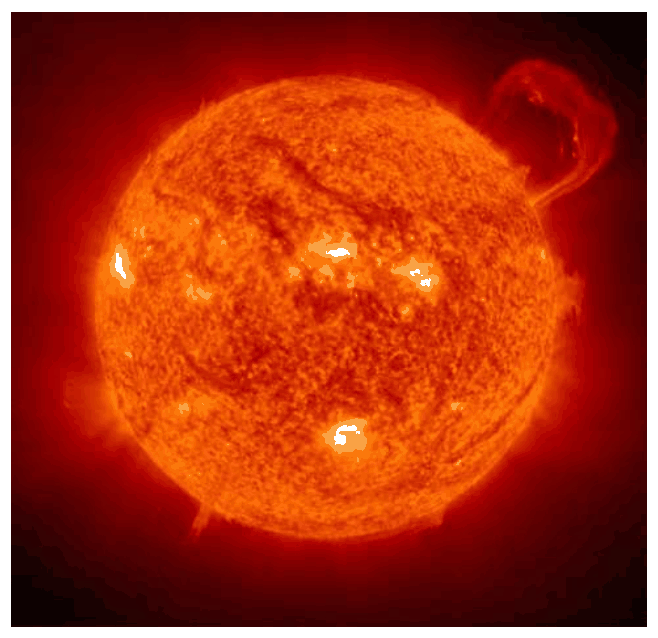
Figure 1. Our Sun, as most stars, shines as a result of thermonuclear fusion of hydrogen into helium in its central parts.
| USEFUL CONSTANTS |
|---|
| Gravitational constant = \(G=6.7\times10^{-11}\ \mathrm{m^3\,kg^{-1}\,s^{-2}}\) (misprint in the official paper: \(\mathrm{s^2}\) instead of \(\mathrm{s^{-2}}\)) |
| Boltzmann’s constant = \(k=1.4\times10^{-23}\ \mathrm{J\,K^{-1}}\) |
| Planck’s constant = \(h=6.6\times10^{-34}\ \mathrm{m^2\,kg\,s^{-1}}\) |
| Mass of the proton = \(m_p=1.7\times10^{-27}\ \mathrm{kg}\) |
| Mass of the electron = \(m_e=9.1\times10^{-31}\ \mathrm{kg}\) |
| Unit of electric charge = \(q=1.6\times10^{-19}\ \mathrm{C}\) |
| Electric constant (vacuum permittivity) = \(\varepsilon_0=8.9\times10^{-12}\ \mathrm{C^2\,N^{-1}\,m^{-2}}\) |
| Radius of the Sun = \(R_S=7.0\times10^8\ \mathrm{m}\) |
| Mass of the Sun = \(M_S=2.0\times10^{30}\ \mathrm{kg}\) |
1. A classical estimate of the temperature at the center of the stars.
Assume that the gas that forms the star is pure ionized hydrogen (electrons and protons in equal amounts), and that it behaves like an ideal gas. From the classical point of view, to fuse two protons, they need to get as close as \(10^{-15}\ \mathrm{m}\) for the short range strong nuclear force, which is attractive, to become dominant. However, to bring them together they have to overcome first the repulsive action of Coulomb’s force. Assume classically that the two protons (taken to be point sources) are moving in an antiparallel way, each with velocity \(v_{rms}\), the root-mean-square (rms) velocity of the protons, in a one-dimensional frontal collision.
| 1a | What has to be the temperature of the gas, \(T_c\), so that the distance of closest approach of the protons, \(d_c\), equals \(10^{-15}\ \mathrm{m}\)? Give this and all numerical values in this problem up to two significant figures. | 1.5 |
2. Finding that the previous temperature estimate is wrong.
To check if the previous temperature estimate is reasonable, one needs an independent way of estimating the central temperature of a star. The structure of the stars is very complicated, but we can gain significant understanding making some assumptions. Stars are in equilibrium, that is, they do not expand or contract because the inward force of gravity is balanced by the outward force of pressure (see Figure 2). For a slab of gas the equation of hydrostatic equilibrium at a given distance \(r\) from the center of the star, is given by
\[ \frac{\Delta P}{\Delta r}=-\frac{GM_r\rho_r}{r^2}, \]
where \(P\) is the pressure of the gas, \(G\) the gravitational constant, \(M_r\) the mass of the star within a sphere of radius \(r\), and \(\rho_r\) is the density of the gas in the slab.
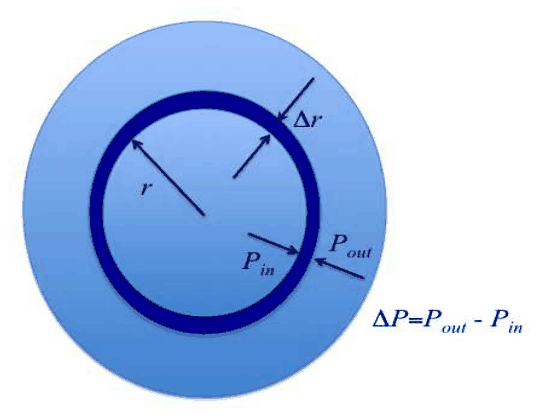
Figure 2. The stars are in hydrostatic equilibrium, with the pressure difference balancing gravity.
An order of magnitude estimate of the central temperature of the star can be obtained with values of the parameters at the center and at the surface of the star, making the following approximations:
\[ \Delta P\approx P_o-P_c, \]
where \(P_c\) and \(P_o\) are the pressures at the center and surface of the star, respectively. Since \(P_c\gg P_o\), we can assume that
\[ \Delta P\approx-P_c. \]
Within the same approximation, we can write
\[ \Delta r\approx R, \]
where \(R\) is the total radius of the star, and
\[ M_r\approx M_R=M, \]
with \(M\) the total mass of the star.
The density may be approximated by its value at the center,
\[ \rho_r\approx\rho_c. \]
You can assume that the pressure is that of an ideal gas.
| 2a | Find an equation for the temperature at the center of the star, \(T_c\), in terms of the radius and mass of the star and of physical constants only. | 0.5 |
We can use now the following prediction of this model as a criterion for its validity:
| 2b | Using the equation found in (2a) write down the ratio \(M/R\) expected for a star in terms of physical constants and \(T_c\) only. | 0.5 |
| 2c | Use the value of \(T_c\) derived in section (1a) and find the numerical value of the ratio \(M/R\) expected for a star. | 0.5 |
| 2d | Now, calculate the ratio \(M(Sun)/R(Sun)\), and verify that this value is much smaller than the one found in (2c). | 0.5 |
3. A quantum mechanical estimate of the temperature at the center of the stars
The large discrepancy found in (2d) suggests that the classical estimate for \(T_c\) obtained in (1a) is not correct. The solution to this discrepancy is found when we consider quantum mechanical effects, that tell us that the protons behave as waves and that a single proton is smeared on a size of the order of \(\lambda_p\), the de Broglie wavelength. This implies that if \(d_c\), the distance of closest approach of the protons is of the order of \(\lambda_p\), the protons in a quantum mechanical sense overlap and can fuse.
| 3a | Assuming that \(d_c=\dfrac{\lambda_p}{2^{1/2}}\) is the condition that allows fusion, for a proton with velocity \(v_{rms}\), find an equation for \(T_c\) in terms of physical constants only. | 1.0 |
| 3b | Evaluate numerically the value of \(T_c\) obtained in (3a). | 0.5 |
| 3c | Use the value of \(T_c\) derived in (3b) to find the numerical value of the ratio \(M/R\) expected for a star, using the formula derived in (2b). Verify that this value is quite similar to the ratio \(M(Sun)/R(Sun)\) observed. | 0.5 |
Indeed, stars in the so-called main sequence (fusing hydrogen) approximately do follow this ratio for a large range of masses.
4. The mass/radius ratio of the stars.
The previous agreement suggests that the quantum mechanical approach for estimating the temperature at the center of the Sun is correct.
| 4a | Use the previous results to demonstrate that for any star fusing hydrogen, the ratio of mass \(M\) to radius \(R\) is the same and depends only on physical constants. Find the equation for the ratio \(M/R\) for stars fusing hydrogen. | 0.5 |
5. The mass and radius of the smallest star.
The result found in (4a) suggests that there could be stars of any mass as long as such a relationship is fulfilled; however, this is not true.
The gas inside normal stars fusing hydrogen is known to behave approximately as an ideal gas. This means that \(d_e\), the typical separation between electrons is on the average larger that \(\lambda_e\), their typical de Broglie wavelength. If closer, the electrons would be in a so-called degenerate state and the stars would behave differently. Note the distinction in the ways we treat protons and electrons inside the star. For protons, their de Broglie waves should overlap closely as they collide in order to fuse, whereas for electrons their de Broglie waves should not overlap in order to remain as an ideal gas.
The density in the stars increases with decreasing radius. Nevertheless, for this order-of-magnitude estimate assume they are of uniform density. You may further use that \(m_p\gg m_e\).
| 5a | Find an equation for \(n_e\), the average electron number density inside the star. | 0.5 |
| 5b | Find an equation for \(d_e\), the typical separation between electrons inside the star. | 0.5 |
| 5c | Use the \(d_e\geq\dfrac{\lambda_e}{2^{1/2}}\) condition to write down an equation for the radius of the smallest normal star possible. Take the temperature at the center of the star as typical for all the stellar interior. | 1.5 |
| 5d | Find the numerical value of the radius of the smallest normal star possible, both in meters and in units of solar radius. | 0.5 |
| 5e | Find the numerical value of the mass of the smallest normal star possible, both in kg and in units of solar masses. | 0.5 |
6. Fusing helium nuclei in older stars.
As stars get older they will have fused most of the hydrogen in their cores into helium (He), so they are forced to start fusing helium into heavier elements in order to continue shining. A helium nucleus has two protons and two neutrons, so it has twice the charge and approximately four times the mass of a proton. We saw before that \(d_c=\dfrac{\lambda_p}{2^{1/2}}\) is the condition for the protons to fuse.
| 6a | Set the equivalent condition for helium nuclei and find \(v_{rms}(He)\), the rms velocity of the helium nuclei and \(T(He)\), the temperature needed for helium fusion. | 0.5 |
Official English text of the problem.
Answers
All results use the approximations prescribed in the problem. Numerical results are rounded to two significant figures, with unrounded values retained in intermediate calculations.
- 1a. \(\displaystyle T_c=\frac{q^2}{12\pi\varepsilon_0kd_c}=5.4\times10^9\ \mathrm{K}\).
- 2a. \(\displaystyle T_c\simeq\frac{GMm_p}{2kR}\).
- 2b. \(\displaystyle \frac{M}{R}\simeq\frac{2kT_c}{Gm_p}\).
- 2c. \(\displaystyle \frac{M}{R}=1.3\times10^{24}\ \mathrm{kg\,m^{-1}}\).
- 2d. \(\displaystyle \frac{M_S}{R_S}=2.9\times10^{21}\ \mathrm{kg\,m^{-1}}\). The classical prediction is \(4.7\times10^2\) times larger.
- 3a. \(\displaystyle T_c=\frac{m_pq^4}{24\pi^2\varepsilon_0^2kh^2}\).
- 3b. \(\displaystyle T_c=9.7\times10^6\ \mathrm{K}\).
- 3c. \(\displaystyle \frac{M}{R}=2.4\times10^{21}\ \mathrm{kg\,m^{-1}}\simeq0.84\,\frac{M_S}{R_S}\).
- 4a. \(\displaystyle \frac{M}{R}=\frac{q^4}{12\pi^2\varepsilon_0^2Gh^2}\).
- 5a. \(\displaystyle n_e=\frac{3M}{4\pi m_pR^3}\).
- 5b. \(\displaystyle d_e\simeq n_e^{-1/3}=\left(\frac{4\pi m_pR^3}{3M}\right)^{1/3}\).
- 5c. \(\displaystyle R_{\min}=\left(\frac{\varepsilon_0h^4}{2Gq^2m_p^{5/2}m_e^{3/2}}\right)^{1/2}\).
- 5d. \(\displaystyle R_{\min}=6.9\times10^7\ \mathrm{m}=0.099\,R_S\).
- 5e. \(\displaystyle M_{\min}=1.7\times10^{29}\ \mathrm{kg}=0.083\,M_S\).
- 6a. The condition is \(\displaystyle d_c(He)=\frac{\lambda_{He}}{\sqrt2}=\frac{h}{4\sqrt2\,m_pv_{rms}(He)}\), giving \[ v_{rms}(He)=\frac{\sqrt2\,q^2}{\pi\varepsilon_0h} =2.0\times10^6\ \mathrm{m\,s^{-1}}, \qquad T(He)=\frac{8m_pq^4}{3\pi^2\varepsilon_0^2kh^2} =6.2\times10^8\ \mathrm{K}. \]
Solution
1a. Classical temperature required for fusion
For a nonrelativistic ideal gas, equipartition gives the proton rms speed through
\[ \frac12m_pv_{rms}^2=\frac32kT_c. \]
The collision is head-on, but \(v_{rms}\) is the rms speed in the three-dimensional gas.
The two protons have equal and opposite momenta, so their center of mass is stationary. At closest approach, both momentarily stop. Taking their initial electrostatic potential energy to be negligible, conservation of energy gives
\[ 2\left(\frac12m_pv_{rms}^2\right) =\frac{q^2}{4\pi\varepsilon_0d_c}. \]
Thus
\[ 3kT_c=\frac{q^2}{4\pi\varepsilon_0d_c}, \qquad \boxed{T_c=\frac{q^2}{12\pi\varepsilon_0kd_c}}. \]
For \(d_c=10^{-15}\ \mathrm{m}\),
\[ T_c= \frac{(1.6\times10^{-19})^2} {12\pi(8.9\times10^{-12})(1.4\times10^{-23})(10^{-15})}, \]
so
\[ \boxed{T_c=5.4\times10^9\ \mathrm{K}}. \]
2a. Central temperature from hydrostatic equilibrium
Using the prescribed approximations, including a characteristic radial scale \(r\simeq R\),
\[ -\frac{P_c}{R}\simeq-\frac{GM\rho_c}{R^2}, \]
hence
\[ P_c\simeq\frac{GM\rho_c}{R}. \]
In fully ionized hydrogen, the proton and electron number densities are equal. Neglecting electron mass in the mass density,
\[ n_{p,c}=n_{e,c}\simeq\frac{\rho_c}{m_p}. \]
Both species contribute to the ideal-gas pressure:
\[ P_c=(n_{p,c}+n_{e,c})kT_c =\frac{2\rho_ckT_c}{m_p}. \]
Equating the pressure expressions and cancelling \(\rho_c\),
\[ \boxed{T_c\simeq\frac{GMm_p}{2kR}}. \]
2b. Mass-to-radius ratio
Rearranging the result of (2a),
\[ \boxed{\frac{M}{R}\simeq\frac{2kT_c}{Gm_p}}. \]
2c. Ratio predicted using the classical fusion temperature
Substitution of the temperature from (1a) gives
\[ \frac{M}{R} =\frac{2k}{Gm_p} \frac{q^2}{12\pi\varepsilon_0kd_c} =\frac{q^2}{6\pi\varepsilon_0Gm_pd_c}. \]
Numerically,
\[ \boxed{\frac{M}{R}=1.3\times10^{24}\ \mathrm{kg\,m^{-1}}}. \]
2d. Comparison with the Sun
The supplied solar mass and radius give
\[ \frac{M_S}{R_S} =\frac{2.0\times10^{30}}{7.0\times10^8} =\boxed{2.9\times10^{21}\ \mathrm{kg\,m^{-1}}}. \]
Using unrounded values, the comparison is
\[ \frac{(M/R)_{\mathrm{classical}}}{M_S/R_S} =\boxed{4.7\times10^2}. \]
The Sun’s ratio is therefore much smaller than the classical prediction. Within the hydrostatic model, the classical fusion temperature is far too high.
3a. Quantum estimate of the fusion temperature
For a proton moving at \(v_{rms}\), the de Broglie wavelength is
\[ \lambda_p=\frac{h}{m_pv_{rms}}. \]
The collision-energy relation from (1a) gives
\[ d_c=\frac{q^2}{4\pi\varepsilon_0m_pv_{rms}^2}. \]
Imposing the problem’s fusion condition,
\[ d_c=\frac{\lambda_p}{\sqrt2}, \]
we obtain
\[ \frac{q^2}{4\pi\varepsilon_0m_pv_{rms}^2} =\frac{h}{\sqrt2\,m_pv_{rms}}, \]
and consequently
\[ v_{rms}=\frac{\sqrt2\,q^2}{4\pi\varepsilon_0h}. \]
Using \(m_pv_{rms}^2=3kT_c\),
\[ T_c =\frac{m_p}{3k} \left(\frac{\sqrt2\,q^2}{4\pi\varepsilon_0h}\right)^2. \]
Therefore,
\[ \boxed{T_c=\frac{m_pq^4}{24\pi^2\varepsilon_0^2kh^2}}. \]
3b. Numerical quantum temperature
Substituting the given constants,
\[ T_c= \frac{(1.7\times10^{-27})(1.6\times10^{-19})^4} {24\pi^2(8.9\times10^{-12})^2 (1.4\times10^{-23})(6.6\times10^{-34})^2}, \]
which gives
\[ \boxed{T_c=9.7\times10^6\ \mathrm{K}}. \]
The corresponding proton rms speed is \(4.9\times10^5\ \mathrm{m\,s^{-1}}\).
3c. Mass-to-radius ratio using the quantum temperature
Using (2b) with the temperature from (3b),
\[ \frac{M}{R}=\frac{2kT_c}{Gm_p} =\boxed{2.4\times10^{21}\ \mathrm{kg\,m^{-1}}}. \]
The ratio to the solar value is
\[ \frac{M/R}{M_S/R_S}=\boxed{0.84}. \]
Thus the prediction is about \(16\%\) below the solar value, a close agreement for the order-of-magnitude approximations used.
4a. Common mass-to-radius ratio
Within this model, hydrogen fusion has the same characteristic temperature in every star. Combining (2b) and (3a),
\[ \frac{M}{R} =\frac{2k}{Gm_p} \frac{m_pq^4}{24\pi^2\varepsilon_0^2kh^2}. \]
The factors \(m_p\) and \(k\) cancel:
\[ \boxed{\frac{M}{R} =\frac{q^4}{12\pi^2\varepsilon_0^2Gh^2}}. \]
This depends only on physical constants. For the following parts, denote this common ratio by
\[ A\equiv\frac{q^4}{12\pi^2\varepsilon_0^2Gh^2}, \qquad M=AR. \]
5a. Mean electron number density
Each hydrogen proton supplies one electron. Neglecting electron mass,
\[ N_e=N_p\simeq\frac{M}{m_p}. \]
For a uniform spherical star of volume \(V=4\pi R^3/3\),
\[ \boxed{n_e=\frac{N_e}{V} =\frac{3M}{4\pi m_pR^3}}. \]
5b. Typical electron separation
The typical volume per electron is \(1/n_e\). Taking its cube root as the characteristic spacing,
\[ \boxed{d_e\simeq n_e^{-1/3} =\left(\frac{4\pi m_pR^3}{3M}\right)^{1/3}}. \]
5c. Radius of the smallest normal star
Equipartition for electrons gives
\[ m_ev_{e,rms}^2=3kT_c. \]
Their characteristic de Broglie wavelength is therefore
\[ \lambda_e=\frac{h}{m_ev_{e,rms}} =\frac{h}{\sqrt{3m_ekT_c}}. \]
The prescribed condition for avoiding electron degeneracy becomes
\[ d_e\geq\frac{\lambda_e}{\sqrt2} =\frac{h}{\sqrt{6m_ekT_c}}. \]
Using \(M=AR\) in the spacing formula,
\[ d_e^3=\frac{4\pi m_pR^2}{3A}. \]
Thus, along the model’s mass-radius relation, the spacing decreases as \(R^{2/3}\). The minimum permitted radius occurs at equality:
\[ \frac{4\pi m_pR_{\min}^2}{3A} =\left(\frac{h}{\sqrt{6m_ekT_c}}\right)^3. \]
Hence
\[ R_{\min}^2 =\frac{3Ah^3}{4\pi m_p(6m_ekT_c)^{3/2}}. \]
First substitute \(A=2kT_c/(Gm_p)\):
\[ R_{\min}^2 =\frac{h^3} {4\pi Gm_p^2m_e^{3/2}\sqrt{6kT_c}}. \]
From (3a),
\[ \sqrt{6kT_c} =\frac{q^2\sqrt{m_p}}{2\pi\varepsilon_0h}. \]
Therefore,
\[ R_{\min}^2 =\frac{\varepsilon_0h^4} {2Gq^2m_p^{5/2}m_e^{3/2}}, \]
or
\[ \boxed{ R_{\min} =\left( \frac{\varepsilon_0h^4} {2Gq^2m_p^{5/2}m_e^{3/2}} \right)^{1/2} }. \]
For a smaller radius along \(M=AR\), the electron waves would overlap according to the stated criterion, and the assumed ideal-gas description would cease to apply.
5d. Numerical minimum radius
Substitution gives
\[ \boxed{R_{\min}=6.9\times10^7\ \mathrm{m}}. \]
Dividing the unrounded result by the supplied solar radius,
\[ \boxed{\frac{R_{\min}}{R_S}=0.099}. \]
Thus the smallest normal star in this model has a radius of approximately one-tenth of the solar radius.
5e. Numerical minimum mass
Because \(M=AR\) with fixed positive \(A\), the minimum radius also gives the minimum mass:
\[ M_{\min} =AR_{\min} =\frac{q^4R_{\min}}{12\pi^2\varepsilon_0^2Gh^2}. \]
Numerically,
\[ \boxed{M_{\min}=1.7\times10^{29}\ \mathrm{kg}}, \qquad \boxed{\frac{M_{\min}}{M_S}=0.083}. \]
6a. Helium fusion
A helium nucleus has mass \(m_{He}\simeq4m_p\) and charge \(Q_{He}=2q\). Its de Broglie wavelength is
\[ \lambda_{He}=\frac{h}{4m_pv_{rms}(He)}. \]
The corresponding fusion condition is
\[ \boxed{ d_c(He)=\frac{\lambda_{He}}{\sqrt2} =\frac{h}{4\sqrt2\,m_pv_{rms}(He)} }. \]
For two helium nuclei approaching with equal and opposite rms velocities, energy conservation gives
\[ 4m_pv_{rms}(He)^2 =\frac{(2q)^2}{4\pi\varepsilon_0d_c(He)}. \]
Substituting the fusion condition and simplifying,
\[ \boxed{ v_{rms}(He)=\frac{\sqrt2\,q^2}{\pi\varepsilon_0h} }. \]
This is four times the proton speed obtained in (3a), so
\[ \boxed{v_{rms}(He)=2.0\times10^6\ \mathrm{m\,s^{-1}}}. \]
Equipartition now gives
\[ T(He)=\frac{4m_pv_{rms}(He)^2}{3k}. \]
Since the mass is four times greater and the speed is four times greater,
\[ T(He)=4(4^2)T_c=64T_c, \]
where \(T_c\) is the hydrogen fusion temperature from (3b). Therefore,
\[ \boxed{ T(He)=\frac{8m_pq^4}{3\pi^2\varepsilon_0^2kh^2} =6.2\times10^8\ \mathrm{K} }. \]
The solution was checked against the official solution.
IPhO 2009 · Theorieaufgabe 3
Warum sind Sterne so groß?
Sterne sind Kugeln aus heißem Gas. Die meisten von ihnen leuchten, weil in ihrem Inneren Wasserstoff zu Helium fusioniert. In dieser Aufgabe verwenden wir Konzepte sowohl der klassischen Mechanik als auch der Quantenmechanik sowie der Elektrostatik und Thermodynamik, um zu verstehen, warum Sterne groß genug sein müssen, damit dieser Fusionsprozess stattfinden kann. Außerdem leiten wir die Masse und den Radius des kleinsten Sterns her, der Wasserstoff fusionieren kann.
Abbildung 1. Unsere Sonne leuchtet wie die meisten Sterne infolge der thermonuklearen Fusion von Wasserstoff zu Helium in ihrem Inneren.
| NÜTZLICHE KONSTANTEN |
|---|
| Gravitationskonstante = \(G=6.7\times10^{-11}\ \mathrm{m^3\,kg^{-1}\,s^{-2}}\) (Druckfehler im offiziellen Aufgabentext: \(\mathrm{s^2}\) statt \(\mathrm{s^{-2}}\)) |
| Boltzmann-Konstante = \(k=1.4\times10^{-23}\ \mathrm{J\,K^{-1}}\) |
| Plancksches Wirkungsquantum = \(h=6.6\times10^{-34}\ \mathrm{m^2\,kg\,s^{-1}}\) |
| Masse des Protons = \(m_p=1.7\times10^{-27}\ \mathrm{kg}\) |
| Masse des Elektrons = \(m_e=9.1\times10^{-31}\ \mathrm{kg}\) |
| Elementarladung = \(q=1.6\times10^{-19}\ \mathrm{C}\) |
| Elektrische Feldkonstante (Permittivität des Vakuums) = \(\varepsilon_0=8.9\times10^{-12}\ \mathrm{C^2\,N^{-1}\,m^{-2}}\) |
| Radius der Sonne = \(R_S=7.0\times10^8\ \mathrm{m}\) |
| Masse der Sonne = \(M_S=2.0\times10^{30}\ \mathrm{kg}\) |
1. Eine klassische Abschätzung der Temperatur im Zentrum von Sternen.
Nehmen Sie an, dass das Gas, aus dem der Stern besteht, reiner ionisierter Wasserstoff ist (Elektronen und Protonen in gleicher Anzahl) und sich wie ein ideales Gas verhält. Aus klassischer Sicht müssen sich zwei Protonen auf \(10^{-15}\ \mathrm{m}\) annähern, um zu fusionieren, damit die kurzreichweitige, anziehende starke Kernkraft überwiegt. Um einander so nahe zu kommen, müssen sie jedoch zunächst die abstoßende Wirkung der Coulomb-Kraft überwinden. Nehmen Sie im klassischen Modell an, dass sich die beiden Protonen (als punktförmige Quellen betrachtet) bei einem eindimensionalen Frontalstoß antiparallel bewegen, jeweils mit der Geschwindigkeit \(v_{rms}\), der quadratisch gemittelten Geschwindigkeit (rms-Geschwindigkeit) der Protonen.
| 1a | Wie groß muss die Temperatur des Gases, \(T_c\), sein, damit der kleinste Abstand der Protonen, \(d_c\), gleich \(10^{-15}\ \mathrm{m}\) ist? Geben Sie diesen und alle weiteren Zahlenwerte in dieser Aufgabe mit zwei signifikanten Stellen an. | 1.5 |
2. Feststellung, dass die vorherige Temperaturabschätzung falsch ist.
Um zu prüfen, ob die vorherige Temperaturabschätzung plausibel ist, benötigt man eine unabhängige Methode zur Abschätzung der Zentraltemperatur eines Sterns. Der Aufbau von Sternen ist sehr kompliziert, doch mit einigen Annahmen können wir wesentliche Erkenntnisse gewinnen. Sterne befinden sich im Gleichgewicht, das heißt, sie dehnen sich weder aus noch ziehen sie sich zusammen, weil die nach innen gerichtete Gravitationskraft durch die nach außen gerichtete Druckkraft ausgeglichen wird (siehe Abbildung 2). Für eine Gasschicht in einem gegebenen Abstand \(r\) vom Zentrum des Sterns lautet die Gleichung des hydrostatischen Gleichgewichts
\[ \frac{\Delta P}{\Delta r}=-\frac{GM_r\rho_r}{r^2}, \]
wobei \(P\) der Gasdruck, \(G\) die Gravitationskonstante, \(M_r\) die Masse des Sterns innerhalb einer Kugel mit dem Radius \(r\) und \(\rho_r\) die Dichte des Gases in der Schicht ist.
Abbildung 2. Sterne befinden sich im hydrostatischen Gleichgewicht, wobei die Druckdifferenz die Gravitation ausgleicht.
Eine Abschätzung der Größenordnung der Zentraltemperatur des Sterns lässt sich mit den Werten der Parameter im Zentrum und an der Oberfläche des Sterns unter Verwendung der folgenden Näherungen erhalten:
\[ \Delta P\approx P_o-P_c, \]
wobei \(P_c\) und \(P_o\) die Drücke im Zentrum beziehungsweise an der Oberfläche des Sterns sind. Da \(P_c\gg P_o\), können wir annehmen, dass
\[ \Delta P\approx-P_c. \]
Im Rahmen derselben Näherung können wir schreiben
\[ \Delta r\approx R, \]
wobei \(R\) der Gesamtradius des Sterns ist, und
\[ M_r\approx M_R=M, \]
wobei \(M\) die Gesamtmasse des Sterns ist.
Die Dichte kann durch ihren Wert im Zentrum angenähert werden,
\[ \rho_r\approx\rho_c. \]
Sie können annehmen, dass der Druck dem eines idealen Gases entspricht.
| 2a | Bestimmen Sie eine Gleichung für die Temperatur im Zentrum des Sterns, \(T_c\), die nur vom Radius und der Masse des Sterns sowie von physikalischen Konstanten abhängt. | 0.5 |
Wir können nun die folgende Vorhersage dieses Modells als Kriterium für seine Gültigkeit verwenden:
| 2b | Geben Sie mithilfe der in (2a) gefundenen Gleichung das für einen Stern zu erwartende Verhältnis \(M/R\) ausschließlich in Abhängigkeit von physikalischen Konstanten und \(T_c\) an. | 0.5 |
| 2c | Verwenden Sie den in Abschnitt (1a) hergeleiteten Wert von \(T_c\) und bestimmen Sie den Zahlenwert des für einen Stern zu erwartenden Verhältnisses \(M/R\). | 0.5 |
| 2d | Berechnen Sie nun das Verhältnis \(M(Sun)/R(Sun)\) und überprüfen Sie, dass dieser Wert viel kleiner ist als der in (2c) gefundene. | 0.5 |
3. Eine quantenmechanische Abschätzung der Temperatur im Zentrum von Sternen
Die in (2d) festgestellte große Abweichung legt nahe, dass die in (1a) erhaltene klassische Abschätzung für \(T_c\) nicht richtig ist. Diese Abweichung lässt sich aufklären, wenn wir quantenmechanische Effekte berücksichtigen. Diese besagen, dass sich Protonen wie Wellen verhalten und dass ein einzelnes Proton über einen Bereich von der Größenordnung seiner De-Broglie-Wellenlänge \(\lambda_p\) verteilt ist. Das bedeutet: Wenn \(d_c\), der kleinste Abstand der Protonen, von der Größenordnung \(\lambda_p\) ist, überlappen sich die Protonen im quantenmechanischen Sinne und können fusionieren.
| 3a | Nehmen Sie an, dass \(d_c=\dfrac{\lambda_p}{2^{1/2}}\) die Bedingung ist, die eine Fusion ermöglicht. Bestimmen Sie für ein Proton mit der Geschwindigkeit \(v_{rms}\) eine Gleichung für \(T_c\), die nur von physikalischen Konstanten abhängt. | 1.0 |
| 3b | Berechnen Sie den Zahlenwert des in (3a) erhaltenen \(T_c\). | 0.5 |
| 3c | Verwenden Sie den in (3b) hergeleiteten Wert von \(T_c\), um mithilfe der in (2b) hergeleiteten Formel den Zahlenwert des für einen Stern zu erwartenden Verhältnisses \(M/R\) zu bestimmen. Überprüfen Sie, dass dieser Wert dem beobachteten Verhältnis \(M(Sun)/R(Sun)\) recht nahekommt. | 0.5 |
Tatsächlich weisen Sterne der sogenannten Hauptreihe (in denen Wasserstoff fusioniert) über einen großen Massenbereich näherungsweise dieses Verhältnis auf.
4. Das Verhältnis von Masse zu Radius bei Sternen.
Die zuvor gefundene Übereinstimmung legt nahe, dass der quantenmechanische Ansatz zur Abschätzung der Temperatur im Zentrum der Sonne richtig ist.
| 4a | Zeigen Sie mithilfe der vorherigen Ergebnisse, dass das Verhältnis der Masse \(M\) zum Radius \(R\) für jeden Stern, in dem Wasserstoff fusioniert, gleich ist und nur von physikalischen Konstanten abhängt. Bestimmen Sie die Gleichung für das Verhältnis \(M/R\) für Sterne, in denen Wasserstoff fusioniert. | 0.5 |
5. Die Masse und der Radius des kleinsten Sterns.
Das in (4a) gefundene Ergebnis legt nahe, dass es Sterne beliebiger Masse geben könnte, solange diese Beziehung erfüllt ist; dies ist jedoch nicht der Fall.
Es ist bekannt, dass sich das Gas im Inneren normaler Sterne, in denen Wasserstoff fusioniert, näherungsweise wie ein ideales Gas verhält. Das bedeutet, dass \(d_e\), der typische Abstand zwischen Elektronen, im Mittel größer ist als \(\lambda_e\), ihre typische De-Broglie-Wellenlänge. Bei kleineren Abständen befänden sich die Elektronen in einem sogenannten entarteten Zustand, und die Sterne würden sich anders verhalten. Beachten Sie den Unterschied in der Behandlung von Protonen und Elektronen im Inneren des Sterns. Bei Protonen müssen sich ihre De-Broglie-Wellen beim Zusammenstoß stark überlappen, damit sie fusionieren können, während sich bei Elektronen ihre De-Broglie-Wellen nicht überlappen dürfen, damit sie weiterhin ein ideales Gas bilden.
Die Dichte in den Sternen nimmt mit abnehmendem Radius zu. Nehmen Sie für diese Abschätzung der Größenordnung dennoch an, dass die Sterne eine gleichmäßige Dichte haben. Sie dürfen außerdem verwenden, dass \(m_p\gg m_e\).
| 5a | Bestimmen Sie eine Gleichung für \(n_e\), die mittlere Elektronenanzahldichte im Inneren des Sterns. | 0.5 |
| 5b | Bestimmen Sie eine Gleichung für \(d_e\), den typischen Abstand zwischen Elektronen im Inneren des Sterns. | 0.5 |
| 5c | Geben Sie mithilfe der Bedingung \(d_e\geq\dfrac{\lambda_e}{2^{1/2}}\) eine Gleichung für den Radius des kleinstmöglichen normalen Sterns an. Betrachten Sie die Temperatur im Zentrum des Sterns als typisch für das gesamte Sterninnere. | 1.5 |
| 5d | Bestimmen Sie den Zahlenwert des Radius des kleinstmöglichen normalen Sterns, sowohl in Metern als auch in Einheiten des Sonnenradius. | 0.5 |
| 5e | Bestimmen Sie den Zahlenwert der Masse des kleinstmöglichen normalen Sterns, sowohl in kg als auch in Einheiten der Sonnenmasse. | 0.5 |
6. Fusion von Heliumkernen in älteren Sternen.
Wenn Sterne älter werden, haben sie den größten Teil des Wasserstoffs in ihren Kernen zu Helium (He) fusioniert. Sie müssen daher beginnen, Helium zu schwereren Elementen zu fusionieren, um weiterhin zu leuchten. Ein Heliumkern hat zwei Protonen und zwei Neutronen, also die doppelte Ladung und ungefähr die vierfache Masse eines Protons. Wir haben zuvor gesehen, dass \(d_c=\dfrac{\lambda_p}{2^{1/2}}\) die Bedingung für die Fusion von Protonen ist.
| 6a | Stellen Sie die entsprechende Bedingung für Heliumkerne auf und bestimmen Sie \(v_{rms}(He)\), die quadratisch gemittelte Geschwindigkeit der Heliumkerne, sowie \(T(He)\), die für die Heliumfusion erforderliche Temperatur. | 0.5 |
Aufgabentext aus dem offiziellen englischen Text übersetzt.
Antworten
Alle Ergebnisse beruhen auf den in der Aufgabe vorgegebenen Näherungen. Die Zahlenwerte sind auf zwei signifikante Stellen gerundet; in den Zwischenrechnungen werden ungerundete Werte verwendet.
- 1a. \(\displaystyle T_c=\frac{q^2}{12\pi\varepsilon_0kd_c}=5.4\times10^9\ \mathrm{K}\).
- 2a. \(\displaystyle T_c\simeq\frac{GMm_p}{2kR}\).
- 2b. \(\displaystyle \frac{M}{R}\simeq\frac{2kT_c}{Gm_p}\).
- 2c. \(\displaystyle \frac{M}{R}=1.3\times10^{24}\ \mathrm{kg\,m^{-1}}\).
- 2d. \(\displaystyle \frac{M_S}{R_S}=2.9\times10^{21}\ \mathrm{kg\,m^{-1}}\). Die klassische Vorhersage ist um den Faktor \(4.7\times10^2\) größer.
- 3a. \(\displaystyle T_c=\frac{m_pq^4}{24\pi^2\varepsilon_0^2kh^2}\).
- 3b. \(\displaystyle T_c=9.7\times10^6\ \mathrm{K}\).
- 3c. \(\displaystyle \frac{M}{R}=2.4\times10^{21}\ \mathrm{kg\,m^{-1}}\simeq0.84\,\frac{M_S}{R_S}\).
- 4a. \(\displaystyle \frac{M}{R}=\frac{q^4}{12\pi^2\varepsilon_0^2Gh^2}\).
- 5a. \(\displaystyle n_e=\frac{3M}{4\pi m_pR^3}\).
- 5b. \(\displaystyle d_e\simeq n_e^{-1/3}=\left(\frac{4\pi m_pR^3}{3M}\right)^{1/3}\).
- 5c. \(\displaystyle R_{\min}=\left(\frac{\varepsilon_0h^4}{2Gq^2m_p^{5/2}m_e^{3/2}}\right)^{1/2}\).
- 5d. \(\displaystyle R_{\min}=6.9\times10^7\ \mathrm{m}=0.099\,R_S\).
- 5e. \(\displaystyle M_{\min}=1.7\times10^{29}\ \mathrm{kg}=0.083\,M_S\).
- 6a. Die Bedingung lautet \(\displaystyle d_c(He)=\frac{\lambda_{He}}{\sqrt2}=\frac{h}{4\sqrt2\,m_pv_{rms}(He)}\), woraus folgt \[ v_{rms}(He)=\frac{\sqrt2\,q^2}{\pi\varepsilon_0h} =2.0\times10^6\ \mathrm{m\,s^{-1}}, \qquad T(He)=\frac{8m_pq^4}{3\pi^2\varepsilon_0^2kh^2} =6.2\times10^8\ \mathrm{K}. \]
Lösung
1a. Klassisch erforderliche Temperatur für die Fusion
Für ein nichtrelativistisches ideales Gas liefert der Gleichverteilungssatz die quadratisch gemittelte Geschwindigkeit der Protonen über
\[ \frac12m_pv_{rms}^2=\frac32kT_c. \]
Der Stoß ist frontal, doch \(v_{rms}\) ist die quadratisch gemittelte Geschwindigkeit im dreidimensionalen Gas.
Die beiden Protonen haben gleich große, entgegengesetzt gerichtete Impulse, sodass ihr Schwerpunkt ruht. Beim kleinsten Abstand kommen beide kurzzeitig zum Stillstand. Wenn ihre anfängliche elektrostatische potenzielle Energie als vernachlässigbar angenommen wird, ergibt die Energieerhaltung
\[ 2\left(\frac12m_pv_{rms}^2\right) =\frac{q^2}{4\pi\varepsilon_0d_c}. \]
Somit gilt
\[ 3kT_c=\frac{q^2}{4\pi\varepsilon_0d_c}, \qquad \boxed{T_c=\frac{q^2}{12\pi\varepsilon_0kd_c}}. \]
Für \(d_c=10^{-15}\ \mathrm{m}\) gilt
\[ T_c= \frac{(1.6\times10^{-19})^2} {12\pi(8.9\times10^{-12})(1.4\times10^{-23})(10^{-15})}, \]
also
\[ \boxed{T_c=5.4\times10^9\ \mathrm{K}}. \]
2a. Zentraltemperatur aus dem hydrostatischen Gleichgewicht
Mit den vorgegebenen Näherungen, einschließlich einer charakteristischen radialen Skala \(r\simeq R\), gilt
\[ -\frac{P_c}{R}\simeq-\frac{GM\rho_c}{R^2}, \]
also
\[ P_c\simeq\frac{GM\rho_c}{R}. \]
In vollständig ionisiertem Wasserstoff sind die Protonen- und Elektronenanzahldichten gleich. Unter Vernachlässigung der Elektronenmasse in der Massendichte gilt
\[ n_{p,c}=n_{e,c}\simeq\frac{\rho_c}{m_p}. \]
Beide Teilchenarten tragen zum Druck des idealen Gases bei:
\[ P_c=(n_{p,c}+n_{e,c})kT_c =\frac{2\rho_ckT_c}{m_p}. \]
Durch Gleichsetzen der Ausdrücke für den Druck und Kürzen von \(\rho_c\) erhält man
\[ \boxed{T_c\simeq\frac{GMm_p}{2kR}}. \]
2b. Verhältnis von Masse zu Radius
Umstellen des Ergebnisses aus (2a) ergibt
\[ \boxed{\frac{M}{R}\simeq\frac{2kT_c}{Gm_p}}. \]
2c. Mit der klassischen Fusionstemperatur vorhergesagtes Verhältnis
Einsetzen der Temperatur aus (1a) ergibt
\[ \frac{M}{R} =\frac{2k}{Gm_p} \frac{q^2}{12\pi\varepsilon_0kd_c} =\frac{q^2}{6\pi\varepsilon_0Gm_pd_c}. \]
Numerisch ergibt sich
\[ \boxed{\frac{M}{R}=1.3\times10^{24}\ \mathrm{kg\,m^{-1}}}. \]
2d. Vergleich mit der Sonne
Aus der angegebenen Sonnenmasse und dem Sonnenradius folgt
\[ \frac{M_S}{R_S} =\frac{2.0\times10^{30}}{7.0\times10^8} =\boxed{2.9\times10^{21}\ \mathrm{kg\,m^{-1}}}. \]
Mit ungerundeten Werten ergibt der Vergleich
\[ \frac{(M/R)_{\mathrm{classical}}}{M_S/R_S} =\boxed{4.7\times10^2}. \]
Das Verhältnis der Sonne ist somit viel kleiner als die klassische Vorhersage. Im Rahmen des hydrostatischen Modells ist die klassische Fusionstemperatur viel zu hoch.
3a. Quantenmechanische Abschätzung der Fusionstemperatur
Für ein Proton, das sich mit \(v_{rms}\) bewegt, beträgt die De-Broglie-Wellenlänge
\[ \lambda_p=\frac{h}{m_pv_{rms}}. \]
Die Beziehung für die Stoßenergie aus (1a) ergibt
\[ d_c=\frac{q^2}{4\pi\varepsilon_0m_pv_{rms}^2}. \]
Fordern wir die in der Aufgabe angegebene Fusionsbedingung
\[ d_c=\frac{\lambda_p}{\sqrt2}, \]
so erhalten wir
\[ \frac{q^2}{4\pi\varepsilon_0m_pv_{rms}^2} =\frac{h}{\sqrt2\,m_pv_{rms}}, \]
und folglich
\[ v_{rms}=\frac{\sqrt2\,q^2}{4\pi\varepsilon_0h}. \]
Mit \(m_pv_{rms}^2=3kT_c\) folgt
\[ T_c =\frac{m_p}{3k} \left(\frac{\sqrt2\,q^2}{4\pi\varepsilon_0h}\right)^2. \]
Daher gilt
\[ \boxed{T_c=\frac{m_pq^4}{24\pi^2\varepsilon_0^2kh^2}}. \]
3b. Zahlenwert der quantenmechanisch bestimmten Temperatur
Einsetzen der angegebenen Konstanten liefert
\[ T_c= \frac{(1.7\times10^{-27})(1.6\times10^{-19})^4} {24\pi^2(8.9\times10^{-12})^2 (1.4\times10^{-23})(6.6\times10^{-34})^2}, \]
woraus sich ergibt
\[ \boxed{T_c=9.7\times10^6\ \mathrm{K}}. \]
Die zugehörige quadratisch gemittelte Geschwindigkeit der Protonen beträgt \(4.9\times10^5\ \mathrm{m\,s^{-1}}\).
3c. Verhältnis von Masse zu Radius mit der quantenmechanisch bestimmten Temperatur
Mit (2b) und der Temperatur aus (3b) folgt
\[ \frac{M}{R}=\frac{2kT_c}{Gm_p} =\boxed{2.4\times10^{21}\ \mathrm{kg\,m^{-1}}}. \]
Das Verhältnis zum Sonnenwert beträgt
\[ \frac{M/R}{M_S/R_S}=\boxed{0.84}. \]
Die Vorhersage liegt somit etwa \(16\%\) unter dem Sonnenwert, was angesichts der verwendeten Größenordnungsnäherungen eine gute Übereinstimmung darstellt.
4a. Gemeinsames Verhältnis von Masse zu Radius
In diesem Modell hat die Wasserstofffusion in jedem Stern dieselbe charakteristische Temperatur. Durch Kombination von (2b) und (3a) erhält man
\[ \frac{M}{R} =\frac{2k}{Gm_p} \frac{m_pq^4}{24\pi^2\varepsilon_0^2kh^2}. \]
Die Faktoren \(m_p\) und \(k\) kürzen sich:
\[ \boxed{\frac{M}{R} =\frac{q^4}{12\pi^2\varepsilon_0^2Gh^2}}. \]
Dies hängt nur von physikalischen Konstanten ab. Für die folgenden Teilaufgaben bezeichnen wir dieses gemeinsame Verhältnis mit
\[ A\equiv\frac{q^4}{12\pi^2\varepsilon_0^2Gh^2}, \qquad M=AR. \]
5a. Mittlere Elektronenanzahldichte
Zu jedem Wasserstoffproton gehört ein Elektron. Unter Vernachlässigung der Elektronenmasse gilt
\[ N_e=N_p\simeq\frac{M}{m_p}. \]
Für einen homogenen kugelförmigen Stern mit dem Volumen \(V=4\pi R^3/3\) gilt
\[ \boxed{n_e=\frac{N_e}{V} =\frac{3M}{4\pi m_pR^3}}. \]
5b. Typischer Elektronenabstand
Das typische Volumen pro Elektron beträgt \(1/n_e\). Nimmt man dessen Kubikwurzel als charakteristischen Abstand, so erhält man
\[ \boxed{d_e\simeq n_e^{-1/3} =\left(\frac{4\pi m_pR^3}{3M}\right)^{1/3}}. \]
5c. Radius des kleinsten normalen Sterns
Der Gleichverteilungssatz liefert für die Elektronen
\[ m_ev_{e,rms}^2=3kT_c. \]
Ihre charakteristische De-Broglie-Wellenlänge beträgt daher
\[ \lambda_e=\frac{h}{m_ev_{e,rms}} =\frac{h}{\sqrt{3m_ekT_c}}. \]
Die vorgegebene Bedingung zur Vermeidung der Elektronenentartung lautet damit
\[ d_e\geq\frac{\lambda_e}{\sqrt2} =\frac{h}{\sqrt{6m_ekT_c}}. \]
Mit \(M=AR\) in der Formel für den Abstand ergibt sich
\[ d_e^3=\frac{4\pi m_pR^2}{3A}. \]
Entlang der Masse-Radius-Beziehung des Modells nimmt der Abstand somit wie \(R^{2/3}\) ab. Der kleinste zulässige Radius wird bei Gleichheit erreicht:
\[ \frac{4\pi m_pR_{\min}^2}{3A} =\left(\frac{h}{\sqrt{6m_ekT_c}}\right)^3. \]
Daraus folgt
\[ R_{\min}^2 =\frac{3Ah^3}{4\pi m_p(6m_ekT_c)^{3/2}}. \]
Zunächst setzen wir \(A=2kT_c/(Gm_p)\) ein:
\[ R_{\min}^2 =\frac{h^3} {4\pi Gm_p^2m_e^{3/2}\sqrt{6kT_c}}. \]
Aus (3a) folgt
\[ \sqrt{6kT_c} =\frac{q^2\sqrt{m_p}}{2\pi\varepsilon_0h}. \]
Daher gilt
\[ R_{\min}^2 =\frac{\varepsilon_0h^4} {2Gq^2m_p^{5/2}m_e^{3/2}}, \]
oder
\[ \boxed{ R_{\min} =\left( \frac{\varepsilon_0h^4} {2Gq^2m_p^{5/2}m_e^{3/2}} \right)^{1/2} }. \]
Bei einem kleineren Radius entlang \(M=AR\) würden sich die Elektronenwellen nach dem angegebenen Kriterium überlappen, und die angenommene Beschreibung als ideales Gas wäre nicht mehr gültig.
5d. Zahlenwert des minimalen Radius
Einsetzen ergibt
\[ \boxed{R_{\min}=6.9\times10^7\ \mathrm{m}}. \]
Teilt man das ungerundete Ergebnis durch den angegebenen Sonnenradius, erhält man
\[ \boxed{\frac{R_{\min}}{R_S}=0.099}. \]
Der kleinste normale Stern in diesem Modell hat somit einen Radius von ungefähr einem Zehntel des Sonnenradius.
5e. Zahlenwert der minimalen Masse
Da \(M=AR\) mit festem positivem \(A\) gilt, ergibt der minimale Radius zugleich die minimale Masse:
\[ M_{\min} =AR_{\min} =\frac{q^4R_{\min}}{12\pi^2\varepsilon_0^2Gh^2}. \]
Numerisch ergibt sich
\[ \boxed{M_{\min}=1.7\times10^{29}\ \mathrm{kg}}, \qquad \boxed{\frac{M_{\min}}{M_S}=0.083}. \]
6a. Heliumfusion
Ein Heliumkern hat die Masse \(m_{He}\simeq4m_p\) und die Ladung \(Q_{He}=2q\). Seine De-Broglie-Wellenlänge beträgt
\[ \lambda_{He}=\frac{h}{4m_pv_{rms}(He)}. \]
Die entsprechende Fusionsbedingung lautet
\[ \boxed{ d_c(He)=\frac{\lambda_{He}}{\sqrt2} =\frac{h}{4\sqrt2\,m_pv_{rms}(He)} }. \]
Für zwei Heliumkerne, die sich mit gleich großen, entgegengesetzt gerichteten rms-Geschwindigkeiten aufeinander zubewegen, ergibt die Energieerhaltung
\[ 4m_pv_{rms}(He)^2 =\frac{(2q)^2}{4\pi\varepsilon_0d_c(He)}. \]
Einsetzen der Fusionsbedingung und Vereinfachen liefert
\[ \boxed{ v_{rms}(He)=\frac{\sqrt2\,q^2}{\pi\varepsilon_0h} }. \]
Dies ist das Vierfache der in (3a) erhaltenen Protonengeschwindigkeit, also
\[ \boxed{v_{rms}(He)=2.0\times10^6\ \mathrm{m\,s^{-1}}}. \]
Der Gleichverteilungssatz liefert nun
\[ T(He)=\frac{4m_pv_{rms}(He)^2}{3k}. \]
Da die Masse viermal so groß und die Geschwindigkeit viermal so groß ist, gilt
\[ T(He)=4(4^2)T_c=64T_c, \]
wobei \(T_c\) die Wasserstofffusionstemperatur aus (3b) ist. Daher gilt
\[ \boxed{ T(He)=\frac{8m_pq^4}{3\pi^2\varepsilon_0^2kh^2} =6.2\times10^8\ \mathrm{K} }. \]
Die Lösung wurde mit der offiziellen Lösung abgeglichen.
IPhO 2009 · Teori sorusu 3
Yıldızlar Neden Bu Kadar Büyüktür?
Yıldızlar sıcak gaz küreleridir. Çoğu, merkez bölgelerinde hidrojeni helyuma dönüştüren füzyon tepkimeleri sayesinde parlar. Bu soruda, yıldızların bu füzyon sürecini gerçekleştirebilmek için neden yeterince büyük olmaları gerektiğini anlamak ve hidrojen füzyonu gerçekleştirebilen en küçük yıldızın kütlesini ve yarıçapını türetmek için klasik mekanik ve kuantum mekaniğinin yanı sıra elektrostatik ve termodinamik kavramlarını kullanacağız.
Şekil 1. Güneşimiz, çoğu yıldız gibi, merkez bölgelerinde hidrojenin helyuma dönüştüğü termonükleer füzyon sonucunda parlar.
| YARARLI SABİTLER |
|---|
| Kütleçekim sabiti = \(G=6.7\times10^{-11}\ \mathrm{m^3\,kg^{-1}\,s^{-2}}\) (resmi metinde baskı hatası: \(\mathrm{s^{-2}}\) yerine \(\mathrm{s^2}\)) |
| Boltzmann sabiti = \(k=1.4\times10^{-23}\ \mathrm{J\,K^{-1}}\) |
| Planck sabiti = \(h=6.6\times10^{-34}\ \mathrm{m^2\,kg\,s^{-1}}\) |
| Protonun kütlesi = \(m_p=1.7\times10^{-27}\ \mathrm{kg}\) |
| Elektronun kütlesi = \(m_e=9.1\times10^{-31}\ \mathrm{kg}\) |
| Temel elektrik yükü = \(q=1.6\times10^{-19}\ \mathrm{C}\) |
| Elektrik sabiti (boşluğun elektriksel geçirgenliği) = \(\varepsilon_0=8.9\times10^{-12}\ \mathrm{C^2\,N^{-1}\,m^{-2}}\) |
| Güneş'in yarıçapı = \(R_S=7.0\times10^8\ \mathrm{m}\) |
| Güneş'in kütlesi = \(M_S=2.0\times10^{30}\ \mathrm{kg}\) |
1. Yıldızların merkezindeki sıcaklığın klasik bir tahmini.
Yıldızı oluşturan gazın saf iyonlaşmış hidrojen olduğunu (eşit sayıda elektron ve proton içerdiğini) ve ideal gaz gibi davrandığını varsayın. Klasik bakış açısına göre, iki protonun füzyona girmesi için, kısa menzilli ve çekici olan güçlü nükleer kuvvetin baskın hâle geleceği \(10^{-15}\ \mathrm{m}\) uzaklığına kadar birbirlerine yaklaşmaları gerekir. Ancak birbirlerine yaklaşabilmek için önce Coulomb kuvvetinin itici etkisini yenmeleri gerekir. Klasik olarak, iki protonun (noktasal kaynaklar olarak kabul edilerek), bir boyutlu kafa kafaya çarpışmada, her biri protonların karekök ortalama kare (rms) hızı olan \(v_{rms}\) hızıyla birbirine zıt yönlerde hareket ettiğini varsayın.
| 1a | Protonların birbirlerine en fazla yaklaştıkları uzaklığın, \(d_c\), \(10^{-15}\ \mathrm{m}\) olması için gazın sıcaklığı \(T_c\) ne olmalıdır? Bu değeri ve sorudaki tüm sayısal değerleri iki anlamlı basamakla verin. | 1.5 |
2. Önceki sıcaklık tahmininin yanlış olduğunun belirlenmesi.
Önceki sıcaklık tahmininin makul olup olmadığını kontrol etmek için bir yıldızın merkez sıcaklığını tahmin etmenin bağımsız bir yoluna ihtiyaç vardır. Yıldızların yapısı çok karmaşıktır, ancak bazı varsayımlar yaparak bu yapıyı önemli ölçüde anlayabiliriz. Yıldızlar dengededir; yani içeriye doğru olan kütleçekim kuvveti dışarıya doğru olan basınç kuvvetiyle dengelendiği için genişlemez veya büzülmezler (bkz. Şekil 2). Yıldızın merkezinden belirli bir \(r\) uzaklığındaki bir gaz tabakası için hidrostatik denge denklemi
\[ \frac{\Delta P}{\Delta r}=-\frac{GM_r\rho_r}{r^2}, \]
şeklindedir; burada \(P\) gazın basıncı, \(G\) kütleçekim sabiti, \(M_r\) yıldızın \(r\) yarıçaplı bir küre içinde kalan kütlesi ve \(\rho_r\) tabakadaki gazın yoğunluğudur.
Şekil 2. Yıldızlar, basınç farkının kütleçekimini dengelediği hidrostatik denge durumundadır.
Yıldızın merkezindeki ve yüzeyindeki parametre değerleri kullanılarak, aşağıdaki yaklaşımlarla yıldızın merkez sıcaklığı için bir büyüklük mertebesi tahmini elde edilebilir:
\[ \Delta P\approx P_o-P_c, \]
burada \(P_c\) ve \(P_o\), sırasıyla yıldızın merkezindeki ve yüzeyindeki basınçlardır. \(P_c\gg P_o\) olduğundan,
\[ \Delta P\approx-P_c. \]
olduğunu varsayabiliriz. Aynı yaklaşım çerçevesinde,
\[ \Delta r\approx R, \]
yazabiliriz; burada \(R\) yıldızın toplam yarıçapıdır. Ayrıca,
\[ M_r\approx M_R=M, \]
olup \(M\) yıldızın toplam kütlesidir.
Yoğunluk, merkezdeki değeriyle yaklaşık olarak ifade edilebilir:
\[ \rho_r\approx\rho_c. \]
Basıncın ideal gaz basıncı olduğunu varsayabilirsiniz.
| 2a | Yıldızın merkezindeki sıcaklık \(T_c\) için yalnızca yıldızın yarıçapı, kütlesi ve fiziksel sabitler cinsinden bir denklem bulun. | 0.5 |
Şimdi bu modelin aşağıdaki öngörüsünü, geçerliliğinin bir ölçütü olarak kullanabiliriz:
| 2b | (2a)'da bulunan denklemi kullanarak, bir yıldız için beklenen \(M/R\) oranını yalnızca fiziksel sabitler ve \(T_c\) cinsinden yazın. | 0.5 |
| 2c | (1a) kısmında elde edilen \(T_c\) değerini kullanarak, bir yıldız için beklenen \(M/R\) oranının sayısal değerini bulun. | 0.5 |
| 2d | Şimdi \(M(Sun)/R(Sun)\) oranını hesaplayın ve bu değerin (2c)'de bulunan değerden çok daha küçük olduğunu doğrulayın. | 0.5 |
3. Yıldızların merkezindeki sıcaklığın kuantum mekaniksel bir tahmini
(2d)'de bulunan büyük uyuşmazlık, (1a)'da \(T_c\) için elde edilen klasik tahminin doğru olmadığını düşündürmektedir. Bu uyuşmazlığın çözümü, protonların dalga gibi davrandığını ve tek bir protonun de Broglie dalga boyu \(\lambda_p\) mertebesinde bir boyuta yayıldığını söyleyen kuantum mekaniksel etkiler dikkate alındığında bulunur. Bu, protonların birbirlerine en fazla yaklaştıkları uzaklık olan \(d_c\), \(\lambda_p\) mertebesindeyse, protonların kuantum mekaniksel anlamda örtüştüğü ve füzyona girebileceği anlamına gelir.
| 3a | \(v_{rms}\) hızıyla hareket eden bir proton için füzyona izin veren koşulun \(d_c=\dfrac{\lambda_p}{2^{1/2}}\) olduğunu varsayarak, \(T_c\) için yalnızca fiziksel sabitler cinsinden bir denklem bulun. | 1.0 |
| 3b | (3a)'da elde edilen \(T_c\) değerini sayısal olarak hesaplayın. | 0.5 |
| 3c | (3b)'de elde edilen \(T_c\) değerini ve (2b)'de türetilen formülü kullanarak, bir yıldız için beklenen \(M/R\) oranının sayısal değerini bulun. Bu değerin gözlenen \(M(Sun)/R(Sun)\) oranına oldukça yakın olduğunu doğrulayın. | 0.5 |
Gerçekten de, ana kol olarak adlandırılan evredeki (hidrojen füzyonu gerçekleştiren) yıldızlar, geniş bir kütle aralığında yaklaşık olarak bu orana uyar.
4. Yıldızların kütle/yarıçap oranı.
Önceki uyum, Güneş'in merkezindeki sıcaklığı tahmin etmek için kullanılan kuantum mekaniksel yaklaşımın doğru olduğunu düşündürmektedir.
| 4a | Önceki sonuçları kullanarak, hidrojen füzyonu gerçekleştiren herhangi bir yıldız için \(M\) kütlesinin \(R\) yarıçapına oranının aynı olduğunu ve yalnızca fiziksel sabitlere bağlı olduğunu gösterin. Hidrojen füzyonu gerçekleştiren yıldızların \(M/R\) oranı için denklemi bulun. | 0.5 |
5. En küçük yıldızın kütlesi ve yarıçapı.
(4a)'da bulunan sonuç, bu ilişki sağlandığı sürece herhangi bir kütlede yıldızların bulunabileceğini düşündürmektedir; ancak bu doğru değildir.
Hidrojen füzyonu gerçekleştiren normal yıldızların içindeki gazın yaklaşık olarak ideal gaz gibi davrandığı bilinmektedir. Bu, elektronlar arasındaki tipik uzaklık olan \(d_e\)'nin, ortalama olarak elektronların tipik de Broglie dalga boyu \(\lambda_e\)'den büyük olduğu anlamına gelir. Daha yakın olsalardı, elektronlar dejenere olarak adlandırılan bir durumda olur ve yıldızlar farklı davranırdı. Yıldızın içindeki protonları ve elektronları ele alış biçimlerimiz arasındaki ayrıma dikkat edin. Protonların füzyona girebilmesi için çarpışırken de Broglie dalgalarının güçlü biçimde örtüşmesi gerekirken, elektronların ideal gaz olarak kalabilmesi için de Broglie dalgalarının örtüşmemesi gerekir.
Yıldızlarda yarıçap azaldıkça yoğunluk artar. Bununla birlikte, bu büyüklük mertebesi tahmini için yıldızların düzgün yoğunluklu olduğunu varsayın. Ayrıca \(m_p\gg m_e\) olduğunu kullanabilirsiniz.
| 5a | Yıldızın içindeki ortalama elektron sayı yoğunluğu \(n_e\) için bir denklem bulun. | 0.5 |
| 5b | Yıldızın içindeki elektronlar arasındaki tipik uzaklık \(d_e\) için bir denklem bulun. | 0.5 |
| 5c | \(d_e\geq\dfrac{\lambda_e}{2^{1/2}}\) koşulunu kullanarak, mümkün olan en küçük normal yıldızın yarıçapı için bir denklem yazın. Yıldızın merkezindeki sıcaklığı, yıldızın tüm iç bölgesi için tipik sıcaklık olarak alın. | 1.5 |
| 5d | Mümkün olan en küçük normal yıldızın yarıçapının sayısal değerini hem metre hem de Güneş yarıçapı biriminde bulun. | 0.5 |
| 5e | Mümkün olan en küçük normal yıldızın kütlesinin sayısal değerini hem kg hem de Güneş kütlesi biriminde bulun. | 0.5 |
6. Yaşlı yıldızlarda helyum çekirdeklerinin füzyonu.
Yıldızlar yaşlandıkça çekirdeklerindeki hidrojenin çoğunu füzyon yoluyla helyuma (He) dönüştürmüş olurlar; dolayısıyla parlamaya devam etmek için helyumu daha ağır elementlere dönüştüren füzyon tepkimelerini başlatmak zorunda kalırlar. Bir helyum çekirdeği iki proton ve iki nötron içerir; bu nedenle yükü protonunkinin iki katı, kütlesi ise yaklaşık dört katıdır. Daha önce protonların füzyona girmesi için gereken koşulun \(d_c=\dfrac{\lambda_p}{2^{1/2}}\) olduğunu gördük.
| 6a | Helyum çekirdekleri için eşdeğer koşulu yazın ve helyum çekirdeklerinin rms hızı \(v_{rms}(He)\) ile helyum füzyonu için gereken sıcaklık \(T(He)\)'yi bulun. | 0.5 |
Soru metni resmi İngilizce metinden çevrilmiştir.
Cevaplar
Tüm sonuçlarda soruda belirtilen yaklaşımlar kullanılmıştır. Sayısal sonuçlar iki anlamlı basamağa yuvarlanmış, ara hesaplamalarda ise yuvarlanmamış değerler korunmuştur.
- 1a. \(\displaystyle T_c=\frac{q^2}{12\pi\varepsilon_0kd_c}=5.4\times10^9\ \mathrm{K}\).
- 2a. \(\displaystyle T_c\simeq\frac{GMm_p}{2kR}\).
- 2b. \(\displaystyle \frac{M}{R}\simeq\frac{2kT_c}{Gm_p}\).
- 2c. \(\displaystyle \frac{M}{R}=1.3\times10^{24}\ \mathrm{kg\,m^{-1}}\).
- 2d. \(\displaystyle \frac{M_S}{R_S}=2.9\times10^{21}\ \mathrm{kg\,m^{-1}}\). Klasik öngörü bunun \(4.7\times10^2\) katıdır.
- 3a. \(\displaystyle T_c=\frac{m_pq^4}{24\pi^2\varepsilon_0^2kh^2}\).
- 3b. \(\displaystyle T_c=9.7\times10^6\ \mathrm{K}\).
- 3c. \(\displaystyle \frac{M}{R}=2.4\times10^{21}\ \mathrm{kg\,m^{-1}}\simeq0.84\,\frac{M_S}{R_S}\).
- 4a. \(\displaystyle \frac{M}{R}=\frac{q^4}{12\pi^2\varepsilon_0^2Gh^2}\).
- 5a. \(\displaystyle n_e=\frac{3M}{4\pi m_pR^3}\).
- 5b. \(\displaystyle d_e\simeq n_e^{-1/3}=\left(\frac{4\pi m_pR^3}{3M}\right)^{1/3}\).
- 5c. \(\displaystyle R_{\min}=\left(\frac{\varepsilon_0h^4}{2Gq^2m_p^{5/2}m_e^{3/2}}\right)^{1/2}\).
- 5d. \(\displaystyle R_{\min}=6.9\times10^7\ \mathrm{m}=0.099\,R_S\).
- 5e. \(\displaystyle M_{\min}=1.7\times10^{29}\ \mathrm{kg}=0.083\,M_S\).
- 6a. Koşul \(\displaystyle d_c(He)=\frac{\lambda_{He}}{\sqrt2}=\frac{h}{4\sqrt2\,m_pv_{rms}(He)}\) olup buradan \[ v_{rms}(He)=\frac{\sqrt2\,q^2}{\pi\varepsilon_0h} =2.0\times10^6\ \mathrm{m\,s^{-1}}, \qquad T(He)=\frac{8m_pq^4}{3\pi^2\varepsilon_0^2kh^2} =6.2\times10^8\ \mathrm{K}. \]
Çözüm
1a. Füzyon için gereken klasik sıcaklık
Göreli olmayan bir ideal gaz için eşbölüşüm ilkesi, protonun rms süratini
\[ \frac12m_pv_{rms}^2=\frac32kT_c. \]
bağıntısıyla verir. Çarpışma kafa kafayadır, ancak \(v_{rms}\) üç boyutlu gazdaki rms süratidir.
İki protonun momentumları eşit büyüklükte ve zıt yönlü olduğundan kütle merkezleri durgundur. En yakın konumda ikisi de anlık olarak durur. Başlangıçtaki elektrostatik potansiyel enerjileri ihmal edilebilir kabul edildiğinde, enerjinin korunumu
\[ 2\left(\frac12m_pv_{rms}^2\right) =\frac{q^2}{4\pi\varepsilon_0d_c}. \]
bağıntısını verir. Böylece
\[ 3kT_c=\frac{q^2}{4\pi\varepsilon_0d_c}, \qquad \boxed{T_c=\frac{q^2}{12\pi\varepsilon_0kd_c}}. \]
\(d_c=10^{-15}\ \mathrm{m}\) için,
\[ T_c= \frac{(1.6\times10^{-19})^2} {12\pi(8.9\times10^{-12})(1.4\times10^{-23})(10^{-15})}, \]
dolayısıyla
\[ \boxed{T_c=5.4\times10^9\ \mathrm{K}}. \]
2a. Hidrostatik dengeden merkez sıcaklığı
Karakteristik radyal ölçek \(r\simeq R\) dâhil olmak üzere belirtilen yaklaşımları kullanırsak,
\[ -\frac{P_c}{R}\simeq-\frac{GM\rho_c}{R^2}, \]
buradan
\[ P_c\simeq\frac{GM\rho_c}{R}. \]
Tamamen iyonlaşmış hidrojende proton ve elektron sayı yoğunlukları eşittir. Kütle yoğunluğunda elektron kütlesini ihmal edersek,
\[ n_{p,c}=n_{e,c}\simeq\frac{\rho_c}{m_p}. \]
Her iki parçacık türü de ideal gaz basıncına katkıda bulunur:
\[ P_c=(n_{p,c}+n_{e,c})kT_c =\frac{2\rho_ckT_c}{m_p}. \]
Basınç ifadelerini eşitleyip \(\rho_c\)'yi sadeleştirirsek,
\[ \boxed{T_c\simeq\frac{GMm_p}{2kR}}. \]
2b. Kütlenin yarıçapa oranı
(2a)'nın sonucunu yeniden düzenlersek,
\[ \boxed{\frac{M}{R}\simeq\frac{2kT_c}{Gm_p}}. \]
2c. Klasik füzyon sıcaklığı kullanılarak öngörülen oran
(1a)'daki sıcaklık yerine konulduğunda
\[ \frac{M}{R} =\frac{2k}{Gm_p} \frac{q^2}{12\pi\varepsilon_0kd_c} =\frac{q^2}{6\pi\varepsilon_0Gm_pd_c}. \]
Sayısal olarak,
\[ \boxed{\frac{M}{R}=1.3\times10^{24}\ \mathrm{kg\,m^{-1}}}. \]
2d. Güneş ile karşılaştırma
Verilen Güneş kütlesi ve yarıçapı kullanıldığında
\[ \frac{M_S}{R_S} =\frac{2.0\times10^{30}}{7.0\times10^8} =\boxed{2.9\times10^{21}\ \mathrm{kg\,m^{-1}}}. \]
Yuvarlanmamış değerler kullanılarak yapılan karşılaştırma şöyledir:
\[ \frac{(M/R)_{\mathrm{classical}}}{M_S/R_S} =\boxed{4.7\times10^2}. \]
Dolayısıyla Güneş'in oranı klasik öngörüden çok daha küçüktür. Hidrostatik model çerçevesinde, klasik füzyon sıcaklığı gereğinden çok yüksektir.
3a. Füzyon sıcaklığının kuantum tahmini
\(v_{rms}\) hızıyla hareket eden bir protonun de Broglie dalga boyu
\[ \lambda_p=\frac{h}{m_pv_{rms}}. \]
(1a)'daki çarpışma enerjisi bağıntısı
\[ d_c=\frac{q^2}{4\pi\varepsilon_0m_pv_{rms}^2}. \]
sonucunu verir. Sorudaki füzyon koşulunu uygularsak,
\[ d_c=\frac{\lambda_p}{\sqrt2}, \]
şunu elde ederiz:
\[ \frac{q^2}{4\pi\varepsilon_0m_pv_{rms}^2} =\frac{h}{\sqrt2\,m_pv_{rms}}, \]
ve dolayısıyla
\[ v_{rms}=\frac{\sqrt2\,q^2}{4\pi\varepsilon_0h}. \]
\(m_pv_{rms}^2=3kT_c\) bağıntısını kullanırsak,
\[ T_c =\frac{m_p}{3k} \left(\frac{\sqrt2\,q^2}{4\pi\varepsilon_0h}\right)^2. \]
Böylece,
\[ \boxed{T_c=\frac{m_pq^4}{24\pi^2\varepsilon_0^2kh^2}}. \]
3b. Kuantum sıcaklığının sayısal değeri
Verilen sabitleri yerine koyarsak,
\[ T_c= \frac{(1.7\times10^{-27})(1.6\times10^{-19})^4} {24\pi^2(8.9\times10^{-12})^2 (1.4\times10^{-23})(6.6\times10^{-34})^2}, \]
buradan
\[ \boxed{T_c=9.7\times10^6\ \mathrm{K}}. \]
Buna karşılık gelen proton rms sürati \(4.9\times10^5\ \mathrm{m\,s^{-1}}\)'dir.
3c. Kuantum sıcaklığı kullanılarak kütlenin yarıçapa oranı
(2b)'yi (3b)'deki sıcaklıkla kullanırsak,
\[ \frac{M}{R}=\frac{2kT_c}{Gm_p} =\boxed{2.4\times10^{21}\ \mathrm{kg\,m^{-1}}}. \]
Güneş değerine oranı
\[ \frac{M/R}{M_S/R_S}=\boxed{0.84}. \]
Dolayısıyla öngörü, Güneş değerinin yaklaşık \(16\%\) altındadır; kullanılan büyüklük mertebesi yaklaşımları için bu, iyi bir uyumdur.
4a. Ortak kütle/yarıçap oranı
Bu model çerçevesinde, hidrojen füzyonu her yıldızda aynı karakteristik sıcaklığa sahiptir. (2b) ile (3a)'yı birleştirirsek,
\[ \frac{M}{R} =\frac{2k}{Gm_p} \frac{m_pq^4}{24\pi^2\varepsilon_0^2kh^2}. \]
\(m_p\) ve \(k\) çarpanları sadeleşir:
\[ \boxed{\frac{M}{R} =\frac{q^4}{12\pi^2\varepsilon_0^2Gh^2}}. \]
Bu yalnızca fiziksel sabitlere bağlıdır. Sonraki kısımlar için bu ortak oranı şöyle gösterelim:
\[ A\equiv\frac{q^4}{12\pi^2\varepsilon_0^2Gh^2}, \qquad M=AR. \]
5a. Ortalama elektron sayı yoğunluğu
Her hidrojen protonuna bir elektron karşılık gelir. Elektron kütlesini ihmal edersek,
\[ N_e=N_p\simeq\frac{M}{m_p}. \]
Hacmi \(V=4\pi R^3/3\) olan düzgün yoğunluklu küresel bir yıldız için,
\[ \boxed{n_e=\frac{N_e}{V} =\frac{3M}{4\pi m_pR^3}}. \]
5b. Elektronlar arasındaki tipik uzaklık
Elektron başına düşen tipik hacim \(1/n_e\)'dir. Bunun küp kökünü karakteristik uzaklık olarak alırsak,
\[ \boxed{d_e\simeq n_e^{-1/3} =\left(\frac{4\pi m_pR^3}{3M}\right)^{1/3}}. \]
5c. En küçük normal yıldızın yarıçapı
Elektronlar için eşbölüşüm ilkesi
\[ m_ev_{e,rms}^2=3kT_c. \]
bağıntısını verir. Dolayısıyla karakteristik de Broglie dalga boyları
\[ \lambda_e=\frac{h}{m_ev_{e,rms}} =\frac{h}{\sqrt{3m_ekT_c}}. \]
Elektron dejenerasyonundan kaçınmak için verilen koşul şu hâle gelir:
\[ d_e\geq\frac{\lambda_e}{\sqrt2} =\frac{h}{\sqrt{6m_ekT_c}}. \]
Uzaklık formülünde \(M=AR\) kullanıldığında,
\[ d_e^3=\frac{4\pi m_pR^2}{3A}. \]
Böylece, modelin kütle-yarıçap ilişkisi boyunca uzaklık \(R^{2/3}\) ile orantılı olarak azalır. İzin verilen en küçük yarıçap, eşitlik durumunda elde edilir:
\[ \frac{4\pi m_pR_{\min}^2}{3A} =\left(\frac{h}{\sqrt{6m_ekT_c}}\right)^3. \]
Buradan
\[ R_{\min}^2 =\frac{3Ah^3}{4\pi m_p(6m_ekT_c)^{3/2}}. \]
Önce \(A=2kT_c/(Gm_p)\) ifadesini yerine koyalım:
\[ R_{\min}^2 =\frac{h^3} {4\pi Gm_p^2m_e^{3/2}\sqrt{6kT_c}}. \]
(3a)'dan,
\[ \sqrt{6kT_c} =\frac{q^2\sqrt{m_p}}{2\pi\varepsilon_0h}. \]
Dolayısıyla,
\[ R_{\min}^2 =\frac{\varepsilon_0h^4} {2Gq^2m_p^{5/2}m_e^{3/2}}, \]
ya da
\[ \boxed{ R_{\min} =\left( \frac{\varepsilon_0h^4} {2Gq^2m_p^{5/2}m_e^{3/2}} \right)^{1/2} }. \]
\(M=AR\) ilişkisi boyunca daha küçük bir yarıçap için, belirtilen ölçüte göre elektron dalgaları örtüşür ve varsayılan ideal gaz betimlemesi geçerliliğini yitirir.
5d. En küçük yarıçapın sayısal değeri
Değerler yerine konulduğunda
\[ \boxed{R_{\min}=6.9\times10^7\ \mathrm{m}}. \]
Yuvarlanmamış sonucu verilen Güneş yarıçapına bölersek,
\[ \boxed{\frac{R_{\min}}{R_S}=0.099}. \]
Dolayısıyla bu modeldeki en küçük normal yıldızın yarıçapı, Güneş yarıçapının yaklaşık onda biridir.
5e. En küçük kütlenin sayısal değeri
\(A\) sabit ve pozitif olmak üzere \(M=AR\) olduğundan, en küçük yarıçap aynı zamanda en küçük kütleyi verir:
\[ M_{\min} =AR_{\min} =\frac{q^4R_{\min}}{12\pi^2\varepsilon_0^2Gh^2}. \]
Sayısal olarak,
\[ \boxed{M_{\min}=1.7\times10^{29}\ \mathrm{kg}}, \qquad \boxed{\frac{M_{\min}}{M_S}=0.083}. \]
6a. Helyum füzyonu
Bir helyum çekirdeğinin kütlesi \(m_{He}\simeq4m_p\), yükü ise \(Q_{He}=2q\)'dur. De Broglie dalga boyu
\[ \lambda_{He}=\frac{h}{4m_pv_{rms}(He)}. \]
Buna karşılık gelen füzyon koşulu
\[ \boxed{ d_c(He)=\frac{\lambda_{He}}{\sqrt2} =\frac{h}{4\sqrt2\,m_pv_{rms}(He)} }. \]
Eşit büyüklükte ve zıt yönlü rms hızlarıyla birbirine yaklaşan iki helyum çekirdeği için enerjinin korunumu
\[ 4m_pv_{rms}(He)^2 =\frac{(2q)^2}{4\pi\varepsilon_0d_c(He)}. \]
bağıntısını verir. Füzyon koşulunu yerine koyup sadeleştirirsek,
\[ \boxed{ v_{rms}(He)=\frac{\sqrt2\,q^2}{\pi\varepsilon_0h} }. \]
Bu, (3a)'da elde edilen proton süratinin dört katıdır; dolayısıyla
\[ \boxed{v_{rms}(He)=2.0\times10^6\ \mathrm{m\,s^{-1}}}. \]
Eşbölüşüm ilkesi şimdi
\[ T(He)=\frac{4m_pv_{rms}(He)^2}{3k}. \]
bağıntısını verir. Kütle dört kat ve sürat dört kat olduğundan,
\[ T(He)=4(4^2)T_c=64T_c, \]
burada \(T_c\), (3b)'deki hidrojen füzyon sıcaklığıdır. Dolayısıyla,
\[ \boxed{ T(He)=\frac{8m_pq^4}{3\pi^2\varepsilon_0^2kh^2} =6.2\times10^8\ \mathrm{K} }. \]
Çözüm, resmi çözümle karşılaştırılarak kontrol edildi.
IPhO 2009 · Problema teórico 3
¿Por qué son tan grandes las estrellas?
Las estrellas son esferas de gas caliente. La mayoría de ellas brillan porque en sus regiones centrales fusionan hidrógeno para formar helio. En este problema utilizamos conceptos tanto de mecánica clásica como de mecánica cuántica, así como de electrostática y termodinámica, para comprender por qué las estrellas deben ser lo suficientemente grandes para que se produzca este proceso de fusión y deducir también cuáles serían la masa y el radio de la estrella más pequeña capaz de fusionar hidrógeno.
Figura 1. Nuestro Sol, como la mayoría de las estrellas, brilla como resultado de la fusión termonuclear de hidrógeno en helio en sus regiones centrales.
| CONSTANTES ÚTILES |
|---|
| Constante de gravitación = \(G=6.7\times10^{-11}\ \mathrm{m^3\,kg^{-1}\,s^{-2}}\) (errata en el enunciado oficial: \(\mathrm{s^2}\) en lugar de \(\mathrm{s^{-2}}\)) |
| Constante de Boltzmann = \(k=1.4\times10^{-23}\ \mathrm{J\,K^{-1}}\) |
| Constante de Planck = \(h=6.6\times10^{-34}\ \mathrm{m^2\,kg\,s^{-1}}\) |
| Masa del protón = \(m_p=1.7\times10^{-27}\ \mathrm{kg}\) |
| Masa del electrón = \(m_e=9.1\times10^{-31}\ \mathrm{kg}\) |
| Unidad de carga eléctrica = \(q=1.6\times10^{-19}\ \mathrm{C}\) |
| Constante eléctrica (permitividad del vacío) = \(\varepsilon_0=8.9\times10^{-12}\ \mathrm{C^2\,N^{-1}\,m^{-2}}\) |
| Radio del Sol = \(R_S=7.0\times10^8\ \mathrm{m}\) |
| Masa del Sol = \(M_S=2.0\times10^{30}\ \mathrm{kg}\) |
1. Una estimación clásica de la temperatura en el centro de las estrellas.
Suponga que el gas que forma la estrella es hidrógeno ionizado puro (electrones y protones en igual número) y que se comporta como un gas ideal. Desde el punto de vista clásico, para que dos protones se fusionen deben acercarse hasta una distancia de \(10^{-15}\ \mathrm{m}\), de modo que la fuerza nuclear fuerte, que es atractiva y de corto alcance, llegue a ser dominante. Sin embargo, para acercarse deben vencer primero la acción repulsiva de la fuerza de Coulomb. Suponga, en el marco clásico, que los dos protones (considerados fuentes puntuales) se mueven en sentidos opuestos, cada uno con velocidad \(v_{rms}\), la velocidad cuadrática media (rms) de los protones, en una colisión frontal unidimensional.
| 1a | ¿Cuál debe ser la temperatura del gas, \(T_c\), para que la distancia de máxima aproximación de los protones, \(d_c\), sea igual a \(10^{-15}\ \mathrm{m}\)? Exprese este valor y todos los valores numéricos de este problema con dos cifras significativas. | 1.5 |
2. Comprobación de que la estimación anterior de la temperatura es incorrecta.
Para comprobar si la estimación anterior de la temperatura es razonable, se necesita un método independiente para estimar la temperatura central de una estrella. La estructura de las estrellas es muy complicada, pero podemos comprender sus aspectos fundamentales si hacemos algunas suposiciones. Las estrellas están en equilibrio, es decir, no se expanden ni se contraen porque la fuerza de gravedad dirigida hacia el interior está compensada por la fuerza debida a la presión dirigida hacia el exterior (véase la Figura 2). Para una capa de gas, la ecuación de equilibrio hidrostático a una distancia dada \(r\) del centro de la estrella viene dada por
\[ \frac{\Delta P}{\Delta r}=-\frac{GM_r\rho_r}{r^2}, \]
donde \(P\) es la presión del gas, \(G\) la constante de gravitación, \(M_r\) la masa de la estrella contenida en una esfera de radio \(r\), y \(\rho_r\) es la densidad del gas en la capa.
Figura 2. Las estrellas están en equilibrio hidrostático: la diferencia de presión compensa la gravedad.
Se puede obtener una estimación del orden de magnitud de la temperatura central de la estrella a partir de los valores de los parámetros en el centro y en la superficie de la estrella, haciendo las siguientes aproximaciones:
\[ \Delta P\approx P_o-P_c, \]
donde \(P_c\) y \(P_o\) son las presiones en el centro y en la superficie de la estrella, respectivamente. Como \(P_c\gg P_o\), podemos suponer que
\[ \Delta P\approx-P_c. \]
Dentro de la misma aproximación, podemos escribir
\[ \Delta r\approx R, \]
donde \(R\) es el radio total de la estrella, y
\[ M_r\approx M_R=M, \]
siendo \(M\) la masa total de la estrella.
La densidad puede aproximarse por su valor en el centro,
\[ \rho_r\approx\rho_c. \]
Puede suponer que la presión es la de un gas ideal.
| 2a | Obtenga una ecuación para la temperatura en el centro de la estrella, \(T_c\), únicamente en función del radio y la masa de la estrella y de constantes físicas. | 0.5 |
Ahora podemos utilizar la siguiente predicción de este modelo como criterio de su validez:
| 2b | Utilizando la ecuación obtenida en (2a), escriba el cociente \(M/R\) esperado para una estrella únicamente en función de constantes físicas y de \(T_c\). | 0.5 |
| 2c | Utilice el valor de \(T_c\) deducido en el apartado (1a) y obtenga el valor numérico del cociente \(M/R\) esperado para una estrella. | 0.5 |
| 2d | Calcule ahora el cociente \(M(Sun)/R(Sun)\) y compruebe que este valor es mucho menor que el obtenido en (2c). | 0.5 |
3. Una estimación cuántica de la temperatura en el centro de las estrellas
La gran discrepancia encontrada en (2d) sugiere que la estimación clásica de \(T_c\) obtenida en (1a) no es correcta. Esta discrepancia se resuelve al considerar los efectos cuánticos, que nos indican que los protones se comportan como ondas y que un solo protón se encuentra extendido sobre una región de tamaño del orden de \(\lambda_p\), la longitud de onda de de Broglie. Esto implica que, si \(d_c\), la distancia de máxima aproximación de los protones, es del orden de \(\lambda_p\), los protones se solapan en el sentido cuántico y pueden fusionarse.
| 3a | Suponiendo que \(d_c=\dfrac{\lambda_p}{2^{1/2}}\) es la condición que permite la fusión, obtenga, para un protón con velocidad \(v_{rms}\), una ecuación para \(T_c\) únicamente en función de constantes físicas. | 1.0 |
| 3b | Evalúe numéricamente el valor de \(T_c\) obtenido en (3a). | 0.5 |
| 3c | Utilice el valor de \(T_c\) deducido en (3b) para obtener el valor numérico del cociente \(M/R\) esperado para una estrella, utilizando la fórmula deducida en (2b). Compruebe que este valor es bastante similar al cociente \(M(Sun)/R(Sun)\) observado. | 0.5 |
En efecto, las estrellas de la llamada secuencia principal (que fusionan hidrógeno) satisfacen aproximadamente este cociente en un amplio intervalo de masas.
4. El cociente masa/radio de las estrellas.
La concordancia anterior sugiere que el enfoque cuántico para estimar la temperatura en el centro del Sol es correcto.
| 4a | Utilice los resultados anteriores para demostrar que, para cualquier estrella que fusione hidrógeno, el cociente entre la masa \(M\) y el radio \(R\) es el mismo y depende únicamente de constantes físicas. Obtenga la ecuación del cociente \(M/R\) para las estrellas que fusionan hidrógeno. | 0.5 |
5. La masa y el radio de la estrella más pequeña.
El resultado obtenido en (4a) sugiere que podría haber estrellas de cualquier masa siempre que se cumpla dicha relación; sin embargo, esto no es cierto.
Se sabe que el gas del interior de las estrellas normales que fusionan hidrógeno se comporta aproximadamente como un gas ideal. Esto significa que \(d_e\), la separación entre electrones típica, es, en promedio, mayor que \(\lambda_e\), su longitud de onda de de Broglie típica. Si estuvieran más cerca, los electrones se encontrarían en un estado denominado degenerado y las estrellas se comportarían de manera diferente. Observe la diferencia entre las formas en que tratamos a los protones y a los electrones dentro de la estrella. En el caso de los protones, sus ondas de de Broglie deben solaparse estrechamente al colisionar para que se fusionen, mientras que, en el caso de los electrones, sus ondas de de Broglie no deben solaparse para que sigan comportándose como un gas ideal.
La densidad de las estrellas aumenta al disminuir el radio. No obstante, para esta estimación del orden de magnitud suponga que tienen densidad uniforme. También puede utilizar que \(m_p\gg m_e\).
| 5a | Obtenga una ecuación para \(n_e\), la densidad numérica media de electrones en el interior de la estrella. | 0.5 |
| 5b | Obtenga una ecuación para \(d_e\), la separación típica entre electrones en el interior de la estrella. | 0.5 |
| 5c | Utilice la condición \(d_e\geq\dfrac{\lambda_e}{2^{1/2}}\) para escribir una ecuación para el radio de la estrella normal más pequeña posible. Tome la temperatura en el centro de la estrella como representativa de todo el interior estelar. | 1.5 |
| 5d | Obtenga el valor numérico del radio de la estrella normal más pequeña posible, tanto en metros como en unidades del radio solar. | 0.5 |
| 5e | Obtenga el valor numérico de la masa de la estrella normal más pequeña posible, tanto en kg como en unidades de masas solares. | 0.5 |
6. Fusión de núcleos de helio en estrellas más viejas.
A medida que las estrellas envejecen, habrán fusionado la mayor parte del hidrógeno de sus núcleos para formar helio (He), por lo que se ven obligadas a comenzar a fusionar helio para formar elementos más pesados y así seguir brillando. Un núcleo de helio tiene dos protones y dos neutrones, de modo que tiene el doble de carga y aproximadamente cuatro veces la masa de un protón. Antes vimos que \(d_c=\dfrac{\lambda_p}{2^{1/2}}\) es la condición para que los protones se fusionen.
| 6a | Establezca la condición equivalente para los núcleos de helio y obtenga \(v_{rms}(He)\), la velocidad cuadrática media de los núcleos de helio, y \(T(He)\), la temperatura necesaria para la fusión del helio. | 0.5 |
Enunciado traducido del texto oficial en inglés.
Respuestas
Todos los resultados utilizan las aproximaciones indicadas en el problema. Los resultados numéricos se redondean a dos cifras significativas, conservando los valores sin redondear en los cálculos intermedios.
- 1a. \(\displaystyle T_c=\frac{q^2}{12\pi\varepsilon_0kd_c}=5.4\times10^9\ \mathrm{K}\).
- 2a. \(\displaystyle T_c\simeq\frac{GMm_p}{2kR}\).
- 2b. \(\displaystyle \frac{M}{R}\simeq\frac{2kT_c}{Gm_p}\).
- 2c. \(\displaystyle \frac{M}{R}=1.3\times10^{24}\ \mathrm{kg\,m^{-1}}\).
- 2d. \(\displaystyle \frac{M_S}{R_S}=2.9\times10^{21}\ \mathrm{kg\,m^{-1}}\). La predicción clásica es \(4.7\times10^2\) veces mayor.
- 3a. \(\displaystyle T_c=\frac{m_pq^4}{24\pi^2\varepsilon_0^2kh^2}\).
- 3b. \(\displaystyle T_c=9.7\times10^6\ \mathrm{K}\).
- 3c. \(\displaystyle \frac{M}{R}=2.4\times10^{21}\ \mathrm{kg\,m^{-1}}\simeq0.84\,\frac{M_S}{R_S}\).
- 4a. \(\displaystyle \frac{M}{R}=\frac{q^4}{12\pi^2\varepsilon_0^2Gh^2}\).
- 5a. \(\displaystyle n_e=\frac{3M}{4\pi m_pR^3}\).
- 5b. \(\displaystyle d_e\simeq n_e^{-1/3}=\left(\frac{4\pi m_pR^3}{3M}\right)^{1/3}\).
- 5c. \(\displaystyle R_{\min}=\left(\frac{\varepsilon_0h^4}{2Gq^2m_p^{5/2}m_e^{3/2}}\right)^{1/2}\).
- 5d. \(\displaystyle R_{\min}=6.9\times10^7\ \mathrm{m}=0.099\,R_S\).
- 5e. \(\displaystyle M_{\min}=1.7\times10^{29}\ \mathrm{kg}=0.083\,M_S\).
- 6a. La condición es \(\displaystyle d_c(He)=\frac{\lambda_{He}}{\sqrt2}=\frac{h}{4\sqrt2\,m_pv_{rms}(He)}\), lo que da \[ v_{rms}(He)=\frac{\sqrt2\,q^2}{\pi\varepsilon_0h} =2.0\times10^6\ \mathrm{m\,s^{-1}}, \qquad T(He)=\frac{8m_pq^4}{3\pi^2\varepsilon_0^2kh^2} =6.2\times10^8\ \mathrm{K}. \]
Solución
1a. Temperatura clásica necesaria para la fusión
Para un gas ideal no relativista, la equipartición proporciona la rapidez cuadrática media de los protones mediante
\[ \frac12m_pv_{rms}^2=\frac32kT_c. \]
La colisión es frontal, pero \(v_{rms}\) es la rapidez cuadrática media en el gas tridimensional.
Los dos protones tienen cantidades de movimiento iguales y opuestas, de modo que su centro de masas está en reposo. En el instante de máxima aproximación, ambos se detienen momentáneamente. Considerando despreciable su energía potencial electrostática inicial, la conservación de la energía da
\[ 2\left(\frac12m_pv_{rms}^2\right) =\frac{q^2}{4\pi\varepsilon_0d_c}. \]
Por tanto,
\[ 3kT_c=\frac{q^2}{4\pi\varepsilon_0d_c}, \qquad \boxed{T_c=\frac{q^2}{12\pi\varepsilon_0kd_c}}. \]
Para \(d_c=10^{-15}\ \mathrm{m}\),
\[ T_c= \frac{(1.6\times10^{-19})^2} {12\pi(8.9\times10^{-12})(1.4\times10^{-23})(10^{-15})}, \]
de modo que
\[ \boxed{T_c=5.4\times10^9\ \mathrm{K}}. \]
2a. Temperatura central a partir del equilibrio hidrostático
Utilizando las aproximaciones indicadas, incluida una escala radial característica \(r\simeq R\),
\[ -\frac{P_c}{R}\simeq-\frac{GM\rho_c}{R^2}, \]
por lo que
\[ P_c\simeq\frac{GM\rho_c}{R}. \]
En el hidrógeno completamente ionizado, las densidades numéricas de protones y electrones son iguales. Despreciando la masa de los electrones en la densidad de masa,
\[ n_{p,c}=n_{e,c}\simeq\frac{\rho_c}{m_p}. \]
Ambas especies contribuyen a la presión del gas ideal:
\[ P_c=(n_{p,c}+n_{e,c})kT_c =\frac{2\rho_ckT_c}{m_p}. \]
Igualando las expresiones de la presión y cancelando \(\rho_c\),
\[ \boxed{T_c\simeq\frac{GMm_p}{2kR}}. \]
2b. Cociente entre masa y radio
Reordenando el resultado de (2a),
\[ \boxed{\frac{M}{R}\simeq\frac{2kT_c}{Gm_p}}. \]
2c. Cociente predicho utilizando la temperatura clásica de fusión
Al sustituir la temperatura de (1a), se obtiene
\[ \frac{M}{R} =\frac{2k}{Gm_p} \frac{q^2}{12\pi\varepsilon_0kd_c} =\frac{q^2}{6\pi\varepsilon_0Gm_pd_c}. \]
Numéricamente,
\[ \boxed{\frac{M}{R}=1.3\times10^{24}\ \mathrm{kg\,m^{-1}}}. \]
2d. Comparación con el Sol
La masa y el radio solares proporcionados dan
\[ \frac{M_S}{R_S} =\frac{2.0\times10^{30}}{7.0\times10^8} =\boxed{2.9\times10^{21}\ \mathrm{kg\,m^{-1}}}. \]
Utilizando los valores sin redondear, la comparación es
\[ \frac{(M/R)_{\mathrm{classical}}}{M_S/R_S} =\boxed{4.7\times10^2}. \]
Por tanto, el cociente del Sol es mucho menor que la predicción clásica. Dentro del modelo hidrostático, la temperatura clásica de fusión es excesivamente alta.
3a. Estimación cuántica de la temperatura de fusión
Para un protón que se mueve con \(v_{rms}\), la longitud de onda de de Broglie es
\[ \lambda_p=\frac{h}{m_pv_{rms}}. \]
La relación de energía de la colisión de (1a) da
\[ d_c=\frac{q^2}{4\pi\varepsilon_0m_pv_{rms}^2}. \]
Al imponer la condición de fusión del problema,
\[ d_c=\frac{\lambda_p}{\sqrt2}, \]
obtenemos
\[ \frac{q^2}{4\pi\varepsilon_0m_pv_{rms}^2} =\frac{h}{\sqrt2\,m_pv_{rms}}, \]
y, en consecuencia,
\[ v_{rms}=\frac{\sqrt2\,q^2}{4\pi\varepsilon_0h}. \]
Utilizando \(m_pv_{rms}^2=3kT_c\),
\[ T_c =\frac{m_p}{3k} \left(\frac{\sqrt2\,q^2}{4\pi\varepsilon_0h}\right)^2. \]
Por tanto,
\[ \boxed{T_c=\frac{m_pq^4}{24\pi^2\varepsilon_0^2kh^2}}. \]
3b. Valor numérico de la temperatura cuántica
Sustituyendo las constantes dadas,
\[ T_c= \frac{(1.7\times10^{-27})(1.6\times10^{-19})^4} {24\pi^2(8.9\times10^{-12})^2 (1.4\times10^{-23})(6.6\times10^{-34})^2}, \]
lo que da
\[ \boxed{T_c=9.7\times10^6\ \mathrm{K}}. \]
La rapidez cuadrática media correspondiente de los protones es \(4.9\times10^5\ \mathrm{m\,s^{-1}}\).
3c. Cociente entre masa y radio utilizando la temperatura cuántica
Utilizando (2b) con la temperatura de (3b),
\[ \frac{M}{R}=\frac{2kT_c}{Gm_p} =\boxed{2.4\times10^{21}\ \mathrm{kg\,m^{-1}}}. \]
El cociente respecto al valor solar es
\[ \frac{M/R}{M_S/R_S}=\boxed{0.84}. \]
Así pues, la predicción es aproximadamente un \(16\%\) inferior al valor solar, una buena concordancia para las aproximaciones de orden de magnitud utilizadas.
4a. Cociente común entre masa y radio
Dentro de este modelo, la fusión del hidrógeno tiene la misma temperatura característica en todas las estrellas. Combinando (2b) y (3a),
\[ \frac{M}{R} =\frac{2k}{Gm_p} \frac{m_pq^4}{24\pi^2\varepsilon_0^2kh^2}. \]
Los factores \(m_p\) y \(k\) se cancelan:
\[ \boxed{\frac{M}{R} =\frac{q^4}{12\pi^2\varepsilon_0^2Gh^2}}. \]
Esto depende únicamente de constantes físicas. Para los apartados siguientes, denotemos este cociente común por
\[ A\equiv\frac{q^4}{12\pi^2\varepsilon_0^2Gh^2}, \qquad M=AR. \]
5a. Densidad numérica media de electrones
Cada protón del hidrógeno aporta un electrón. Despreciando la masa de los electrones,
\[ N_e=N_p\simeq\frac{M}{m_p}. \]
Para una estrella esférica uniforme de volumen \(V=4\pi R^3/3\),
\[ \boxed{n_e=\frac{N_e}{V} =\frac{3M}{4\pi m_pR^3}}. \]
5b. Separación típica entre electrones
El volumen típico por electrón es \(1/n_e\). Tomando su raíz cúbica como separación característica,
\[ \boxed{d_e\simeq n_e^{-1/3} =\left(\frac{4\pi m_pR^3}{3M}\right)^{1/3}}. \]
5c. Radio de la estrella normal más pequeña
La equipartición para los electrones da
\[ m_ev_{e,rms}^2=3kT_c. \]
Su longitud de onda de de Broglie característica es, por tanto,
\[ \lambda_e=\frac{h}{m_ev_{e,rms}} =\frac{h}{\sqrt{3m_ekT_c}}. \]
La condición indicada para evitar la degeneración electrónica se convierte en
\[ d_e\geq\frac{\lambda_e}{\sqrt2} =\frac{h}{\sqrt{6m_ekT_c}}. \]
Utilizando \(M=AR\) en la fórmula de la separación,
\[ d_e^3=\frac{4\pi m_pR^2}{3A}. \]
Así pues, a lo largo de la relación entre masa y radio del modelo, la separación disminuye como \(R^{2/3}\). El radio mínimo permitido se alcanza cuando se cumple la igualdad:
\[ \frac{4\pi m_pR_{\min}^2}{3A} =\left(\frac{h}{\sqrt{6m_ekT_c}}\right)^3. \]
Por consiguiente,
\[ R_{\min}^2 =\frac{3Ah^3}{4\pi m_p(6m_ekT_c)^{3/2}}. \]
Primero sustituimos \(A=2kT_c/(Gm_p)\):
\[ R_{\min}^2 =\frac{h^3} {4\pi Gm_p^2m_e^{3/2}\sqrt{6kT_c}}. \]
De (3a),
\[ \sqrt{6kT_c} =\frac{q^2\sqrt{m_p}}{2\pi\varepsilon_0h}. \]
Por tanto,
\[ R_{\min}^2 =\frac{\varepsilon_0h^4} {2Gq^2m_p^{5/2}m_e^{3/2}}, \]
o bien
\[ \boxed{ R_{\min} =\left( \frac{\varepsilon_0h^4} {2Gq^2m_p^{5/2}m_e^{3/2}} \right)^{1/2} }. \]
Para un radio menor a lo largo de \(M=AR\), las ondas de los electrones se solaparían según el criterio establecido, y la descripción supuesta de gas ideal dejaría de ser aplicable.
5d. Valor numérico del radio mínimo
La sustitución da
\[ \boxed{R_{\min}=6.9\times10^7\ \mathrm{m}}. \]
Dividiendo el resultado sin redondear por el radio solar proporcionado,
\[ \boxed{\frac{R_{\min}}{R_S}=0.099}. \]
Así pues, la estrella normal más pequeña de este modelo tiene un radio de aproximadamente una décima parte del radio solar.
5e. Valor numérico de la masa mínima
Como \(M=AR\) con \(A\) fijo y positivo, el radio mínimo también proporciona la masa mínima:
\[ M_{\min} =AR_{\min} =\frac{q^4R_{\min}}{12\pi^2\varepsilon_0^2Gh^2}. \]
Numéricamente,
\[ \boxed{M_{\min}=1.7\times10^{29}\ \mathrm{kg}}, \qquad \boxed{\frac{M_{\min}}{M_S}=0.083}. \]
6a. Fusión del helio
Un núcleo de helio tiene masa \(m_{He}\simeq4m_p\) y carga \(Q_{He}=2q\). Su longitud de onda de de Broglie es
\[ \lambda_{He}=\frac{h}{4m_pv_{rms}(He)}. \]
La condición de fusión correspondiente es
\[ \boxed{ d_c(He)=\frac{\lambda_{He}}{\sqrt2} =\frac{h}{4\sqrt2\,m_pv_{rms}(He)} }. \]
Para dos núcleos de helio que se aproximan con velocidades de módulo igual a la velocidad cuadrática media y de sentidos opuestos, la conservación de la energía da
\[ 4m_pv_{rms}(He)^2 =\frac{(2q)^2}{4\pi\varepsilon_0d_c(He)}. \]
Sustituyendo la condición de fusión y simplificando,
\[ \boxed{ v_{rms}(He)=\frac{\sqrt2\,q^2}{\pi\varepsilon_0h} }. \]
Esta rapidez es cuatro veces la del protón obtenida en (3a), de modo que
\[ \boxed{v_{rms}(He)=2.0\times10^6\ \mathrm{m\,s^{-1}}}. \]
La equipartición da ahora
\[ T(He)=\frac{4m_pv_{rms}(He)^2}{3k}. \]
Como la masa es cuatro veces mayor y la rapidez es cuatro veces mayor,
\[ T(He)=4(4^2)T_c=64T_c, \]
donde \(T_c\) es la temperatura de fusión del hidrógeno de (3b). Por tanto,
\[ \boxed{ T(He)=\frac{8m_pq^4}{3\pi^2\varepsilon_0^2kh^2} =6.2\times10^8\ \mathrm{K} }. \]
La solución se comprobó con la solución oficial.
IPhO 2009 · 理论题 3
为什么恒星如此巨大?
恒星是由炽热气体组成的球体。大多数恒星之所以发光,是因为其中心区域正在将氢聚变为氦。在本题中,我们将运用经典力学、量子力学、静电学和热力学的概念,理解为什么恒星必须足够大才能实现这一聚变过程,并推导出能够发生氢聚变的最小恒星的质量和半径。
图 1. 我们的太阳与大多数恒星一样,由于其中心区域发生氢聚变为氦的热核聚变而发光。
| 有用的常数 |
|---|
| 万有引力常量 = \(G=6.7\times10^{-11}\ \mathrm{m^3\,kg^{-1}\,s^{-2}}\)(官方试题此处有印刷错误,误作 \(\mathrm{s^2}\)) |
| 玻尔兹曼常量 = \(k=1.4\times10^{-23}\ \mathrm{J\,K^{-1}}\) |
| 普朗克常量 = \(h=6.6\times10^{-34}\ \mathrm{m^2\,kg\,s^{-1}}\) |
| 质子质量 = \(m_p=1.7\times10^{-27}\ \mathrm{kg}\) |
| 电子质量 = \(m_e=9.1\times10^{-31}\ \mathrm{kg}\) |
| 元电荷 = \(q=1.6\times10^{-19}\ \mathrm{C}\) |
| 电常数(真空介电常数) = \(\varepsilon_0=8.9\times10^{-12}\ \mathrm{C^2\,N^{-1}\,m^{-2}}\) |
| 太阳半径 = \(R_S=7.0\times10^8\ \mathrm{m}\) |
| 太阳质量 = \(M_S=2.0\times10^{30}\ \mathrm{kg}\) |
1. 恒星中心温度的经典估算。
假设构成恒星的气体是纯电离氢(电子和质子的数量相等),并且可视为理想气体。从经典观点来看,要使两个质子发生聚变,它们必须靠近到 \(10^{-15}\ \mathrm{m}\) 的距离,使短程的、具有吸引作用的强核力占据主导地位。然而,要使它们靠近,首先必须克服库仑力的排斥作用。在经典框架下,假设两个质子(视为点源)沿相反方向运动,各自的速率均为质子的均方根(rms)速率 \(v_{rms}\),并发生一维正碰。
| 1a | 气体的温度 \(T_c\) 必须为多少,才能使质子的最近接近距离 \(d_c\) 等于 \(10^{-15}\ \mathrm{m}\)?本题中此处及其余所有数值结果均保留两位有效数字。 | 1.5 |
2. 发现上述温度估算有误。
要检验上述温度估算是否合理,需要用一种独立的方法来估算恒星的中心温度。恒星的结构十分复杂,但通过作出一些假设,我们仍能获得相当深入的理解。恒星处于平衡状态,即既不膨胀也不收缩,因为向内的引力与向外的压力作用相平衡(见图 2)。对于距离恒星中心 \(r\) 处的一薄层气体,流体静力平衡方程为
\[ \frac{\Delta P}{\Delta r}=-\frac{GM_r\rho_r}{r^2}, \]
其中,\(P\) 是气体压强,\(G\) 是万有引力常量,\(M_r\) 是恒星内半径为 \(r\) 的球体所包含的质量,\(\rho_r\) 是该薄层中的气体密度。
图 2. 恒星处于流体静力平衡状态,压强差产生的力与引力相平衡。
利用恒星中心和表面处的参数值,并作出以下近似,可以对恒星的中心温度进行数量级估算:
\[ \Delta P\approx P_o-P_c, \]
其中,\(P_c\) 和 \(P_o\) 分别为恒星中心和表面的压强。由于 \(P_c\gg P_o\),可以假设
\[ \Delta P\approx-P_c. \]
在同样的近似下,可以写出
\[ \Delta r\approx R, \]
其中,\(R\) 是恒星的总半径,并且
\[ M_r\approx M_R=M, \]
其中,\(M\) 是恒星的总质量。
密度可以用其中心处的值来近似,
\[ \rho_r\approx\rho_c. \]
可以假设气体压强满足理想气体状态方程。
| 2a | 求恒星中心温度 \(T_c\) 的表达式,仅用恒星的半径、质量和物理常数表示。 | 0.5 |
现在可以用该模型的以下预言作为判断其有效性的标准:
| 2b | 利用 (2a) 中得到的方程,写出恒星应有的比值 \(M/R\),仅用物理常数和 \(T_c\) 表示。 | 0.5 |
| 2c | 使用 (1a) 中导出的 \(T_c\) 值,求出恒星应有的比值 \(M/R\) 的数值。 | 0.5 |
| 2d | 现在计算比值 \(M(Sun)/R(Sun)\),并验证该值远小于 (2c) 中得到的结果。 | 0.5 |
3. 恒星中心温度的量子力学估算
(2d) 中发现的巨大差异表明,(1a) 中用经典方法估算的 \(T_c\) 并不正确。考虑量子力学效应便能解释这一差异:质子具有波动性,单个质子弥散在尺度约为其德布罗意波长 \(\lambda_p\) 的区域内。这意味着,如果质子的最近接近距离 \(d_c\) 与 \(\lambda_p\) 的数量级相同,那么质子就在量子力学意义上发生重叠,从而能够发生聚变。
| 3a | 假设允许聚变发生的条件为 \(d_c=\dfrac{\lambda_p}{2^{1/2}}\),对于速率为 \(v_{rms}\) 的质子,求出仅用物理常数表示的 \(T_c\) 的表达式。 | 1.0 |
| 3b | 计算 (3a) 中得到的 \(T_c\) 的数值。 | 0.5 |
| 3c | 使用 (3b) 中导出的 \(T_c\) 值以及 (2b) 中导出的公式,求出恒星应有的比值 \(M/R\) 的数值。验证该值与观测到的比值 \(M(Sun)/R(Sun)\) 十分接近。 | 0.5 |
事实上,所谓的主序星(正在进行氢聚变的恒星)在很大的质量范围内确实近似遵循这一比值关系。
4. 恒星的质量与半径之比。
上述结果的吻合表明,用量子力学方法估算太阳中心温度是正确的。
| 4a | 利用前面的结果证明,对于任何正在进行氢聚变的恒星,其质量 \(M\) 与半径 \(R\) 之比都相同,并且仅取决于物理常数。求出发生氢聚变的恒星的比值 \(M/R\) 的表达式。 | 0.5 |
5. 最小恒星的质量和半径。
(4a) 中的结果似乎表明,只要满足这一关系,恒星就可以具有任意质量;然而,事实并非如此。
已知正在进行氢聚变的正常恒星内部的气体可近似视为理想气体。这意味着,电子间的典型间距 \(d_e\) 平均而言大于电子的典型德布罗意波长 \(\lambda_e\)。如果电子靠得更近,它们就会处于所谓的简并态,恒星的性质也会有所不同。注意,我们对恒星内部质子和电子的处理方式有所区别。对于质子,为了发生聚变,它们的德布罗意波在碰撞时应充分重叠;而对于电子,为了保持理想气体的性质,它们的德布罗意波则不应重叠。
恒星内部的密度随径向距离减小而增大。不过,在本题的数量级估算中,假设恒星密度均匀。还可以使用 \(m_p\gg m_e\) 这一条件。
| 5a | 求恒星内部平均电子数密度 \(n_e\) 的表达式。 | 0.5 |
| 5b | 求恒星内部电子间典型间距 \(d_e\) 的表达式。 | 0.5 |
| 5c | 利用条件 \(d_e\geq\dfrac{\lambda_e}{2^{1/2}}\),写出可能存在的最小正常恒星的半径表达式。将恒星中心温度作为整个恒星内部的典型温度。 | 1.5 |
| 5d | 求可能存在的最小正常恒星的半径数值,分别以米和太阳半径为单位表示。 | 0.5 |
| 5e | 求可能存在的最小正常恒星的质量数值,分别以 kg 和太阳质量为单位表示。 | 0.5 |
6. 年老恒星中的氦核聚变。
随着恒星逐渐衰老,其核心中的大部分氢已经聚变为氦(He),因此,为了继续发光,它们不得不开始将氦聚变为更重的元素。氦核含有两个质子和两个中子,因此其电荷量为质子的两倍,质量约为质子的四倍。前面已经看到,\(d_c=\dfrac{\lambda_p}{2^{1/2}}\) 是质子发生聚变的条件。
| 6a | 写出氦核聚变的相应条件,并求出氦核的均方根速率 \(v_{rms}(He)\) 以及氦聚变所需的温度 \(T(He)\)。 | 0.5 |
题目译自官方英文原文。
答案
所有结果均采用题目规定的近似。数值结果保留两位有效数字,中间计算保留未舍入的数值。
- 1a. \(\displaystyle T_c=\frac{q^2}{12\pi\varepsilon_0kd_c}=5.4\times10^9\ \mathrm{K}\)。
- 2a. \(\displaystyle T_c\simeq\frac{GMm_p}{2kR}\)。
- 2b. \(\displaystyle \frac{M}{R}\simeq\frac{2kT_c}{Gm_p}\)。
- 2c. \(\displaystyle \frac{M}{R}=1.3\times10^{24}\ \mathrm{kg\,m^{-1}}\)。
- 2d. \(\displaystyle \frac{M_S}{R_S}=2.9\times10^{21}\ \mathrm{kg\,m^{-1}}\)。经典预言值为该值的 \(4.7\times10^2\) 倍。
- 3a. \(\displaystyle T_c=\frac{m_pq^4}{24\pi^2\varepsilon_0^2kh^2}\)。
- 3b. \(\displaystyle T_c=9.7\times10^6\ \mathrm{K}\)。
- 3c. \(\displaystyle \frac{M}{R}=2.4\times10^{21}\ \mathrm{kg\,m^{-1}}\simeq0.84\,\frac{M_S}{R_S}\)。
- 4a. \(\displaystyle \frac{M}{R}=\frac{q^4}{12\pi^2\varepsilon_0^2Gh^2}\)。
- 5a. \(\displaystyle n_e=\frac{3M}{4\pi m_pR^3}\)。
- 5b. \(\displaystyle d_e\simeq n_e^{-1/3}=\left(\frac{4\pi m_pR^3}{3M}\right)^{1/3}\)。
- 5c. \(\displaystyle R_{\min}=\left(\frac{\varepsilon_0h^4}{2Gq^2m_p^{5/2}m_e^{3/2}}\right)^{1/2}\)。
- 5d. \(\displaystyle R_{\min}=6.9\times10^7\ \mathrm{m}=0.099\,R_S\)。
- 5e. \(\displaystyle M_{\min}=1.7\times10^{29}\ \mathrm{kg}=0.083\,M_S\)。
- 6a. 条件为 \(\displaystyle d_c(He)=\frac{\lambda_{He}}{\sqrt2}=\frac{h}{4\sqrt2\,m_pv_{rms}(He)}\),由此得到 \[ v_{rms}(He)=\frac{\sqrt2\,q^2}{\pi\varepsilon_0h} =2.0\times10^6\ \mathrm{m\,s^{-1}}, \qquad T(He)=\frac{8m_pq^4}{3\pi^2\varepsilon_0^2kh^2} =6.2\times10^8\ \mathrm{K}. \]
解答
1a. 聚变所需温度的经典估算
对于非相对论理想气体,由能量均分定理可得质子的均方根速率满足
\[ \frac12m_pv_{rms}^2=\frac32kT_c. \]
碰撞是正碰,但 \(v_{rms}\) 是三维气体中的均方根速率。
两个质子的动量大小相等、方向相反,因此它们的质心静止。在最近接近处,两个质子都瞬时停止。忽略它们初始的静电势能,由能量守恒得
\[ 2\left(\frac12m_pv_{rms}^2\right) =\frac{q^2}{4\pi\varepsilon_0d_c}. \]
因此
\[ 3kT_c=\frac{q^2}{4\pi\varepsilon_0d_c}, \qquad \boxed{T_c=\frac{q^2}{12\pi\varepsilon_0kd_c}}. \]
当 \(d_c=10^{-15}\ \mathrm{m}\) 时,
\[ T_c= \frac{(1.6\times10^{-19})^2} {12\pi(8.9\times10^{-12})(1.4\times10^{-23})(10^{-15})}, \]
所以
\[ \boxed{T_c=5.4\times10^9\ \mathrm{K}}. \]
2a. 由流体静力平衡求中心温度
采用题目规定的近似,包括取特征径向尺度为 \(r\simeq R\),有
\[ -\frac{P_c}{R}\simeq-\frac{GM\rho_c}{R^2}, \]
因此
\[ P_c\simeq\frac{GM\rho_c}{R}. \]
在完全电离的氢中,质子数密度与电子数密度相等。忽略电子质量对质量密度的贡献,
\[ n_{p,c}=n_{e,c}\simeq\frac{\rho_c}{m_p}. \]
两种粒子都对理想气体压强有贡献:
\[ P_c=(n_{p,c}+n_{e,c})kT_c =\frac{2\rho_ckT_c}{m_p}. \]
令两个压强表达式相等,并约去 \(\rho_c\),得
\[ \boxed{T_c\simeq\frac{GMm_p}{2kR}}. \]
2b. 质量与半径之比
将 (2a) 的结果整理,得
\[ \boxed{\frac{M}{R}\simeq\frac{2kT_c}{Gm_p}}. \]
2c. 使用经典聚变温度预言的比值
代入 (1a) 中的温度,得
\[ \frac{M}{R} =\frac{2k}{Gm_p} \frac{q^2}{12\pi\varepsilon_0kd_c} =\frac{q^2}{6\pi\varepsilon_0Gm_pd_c}. \]
数值为
\[ \boxed{\frac{M}{R}=1.3\times10^{24}\ \mathrm{kg\,m^{-1}}}. \]
2d. 与太阳比较
由给定的太阳质量和半径得
\[ \frac{M_S}{R_S} =\frac{2.0\times10^{30}}{7.0\times10^8} =\boxed{2.9\times10^{21}\ \mathrm{kg\,m^{-1}}}. \]
使用未舍入的数值进行比较,得
\[ \frac{(M/R)_{\mathrm{classical}}}{M_S/R_S} =\boxed{4.7\times10^2}. \]
因此,太阳的这一比值远小于经典预言值。在流体静力平衡模型中,经典聚变温度过高。
3a. 聚变温度的量子估算
对于以速率 \(v_{rms}\) 运动的质子,其德布罗意波长为
\[ \lambda_p=\frac{h}{m_pv_{rms}}. \]
由 (1a) 中的碰撞能量关系得
\[ d_c=\frac{q^2}{4\pi\varepsilon_0m_pv_{rms}^2}. \]
施加题目给定的聚变条件,
\[ d_c=\frac{\lambda_p}{\sqrt2}, \]
得到
\[ \frac{q^2}{4\pi\varepsilon_0m_pv_{rms}^2} =\frac{h}{\sqrt2\,m_pv_{rms}}, \]
从而
\[ v_{rms}=\frac{\sqrt2\,q^2}{4\pi\varepsilon_0h}. \]
利用 \(m_pv_{rms}^2=3kT_c\),
\[ T_c =\frac{m_p}{3k} \left(\frac{\sqrt2\,q^2}{4\pi\varepsilon_0h}\right)^2. \]
因此,
\[ \boxed{T_c=\frac{m_pq^4}{24\pi^2\varepsilon_0^2kh^2}}. \]
3b. 量子估算温度的数值
代入给定的常数,
\[ T_c= \frac{(1.7\times10^{-27})(1.6\times10^{-19})^4} {24\pi^2(8.9\times10^{-12})^2 (1.4\times10^{-23})(6.6\times10^{-34})^2}, \]
得到
\[ \boxed{T_c=9.7\times10^6\ \mathrm{K}}. \]
相应的质子均方根速率为 \(4.9\times10^5\ \mathrm{m\,s^{-1}}\)。
3c. 使用量子估算温度求质量与半径之比
将 (3b) 中的温度代入 (2b),得
\[ \frac{M}{R}=\frac{2kT_c}{Gm_p} =\boxed{2.4\times10^{21}\ \mathrm{kg\,m^{-1}}}. \]
它与太阳对应值之比为
\[ \frac{M/R}{M_S/R_S}=\boxed{0.84}. \]
因此,预言值比太阳的对应值低约 \(16\%\);对于这里采用的数量级近似而言,两者相当吻合。
4a. 共同的质量与半径之比
在此模型中,每颗恒星发生氢聚变的特征温度都相同。联立 (2b) 和 (3a),得
\[ \frac{M}{R} =\frac{2k}{Gm_p} \frac{m_pq^4}{24\pi^2\varepsilon_0^2kh^2}. \]
约去因子 \(m_p\) 和 \(k\):
\[ \boxed{\frac{M}{R} =\frac{q^4}{12\pi^2\varepsilon_0^2Gh^2}}. \]
这一结果仅取决于物理常数。在以下各问中,将这一共同的比值记为
\[ A\equiv\frac{q^4}{12\pi^2\varepsilon_0^2Gh^2}, \qquad M=AR. \]
5a. 平均电子数密度
每个氢质子对应一个电子。忽略电子质量,
\[ N_e=N_p\simeq\frac{M}{m_p}. \]
对于体积为 \(V=4\pi R^3/3\) 的均匀球形恒星,
\[ \boxed{n_e=\frac{N_e}{V} =\frac{3M}{4\pi m_pR^3}}. \]
5b. 电子间的典型间距
每个电子所占的典型体积为 \(1/n_e\)。取其立方根作为特征间距,得
\[ \boxed{d_e\simeq n_e^{-1/3} =\left(\frac{4\pi m_pR^3}{3M}\right)^{1/3}}. \]
5c. 最小正常恒星的半径
对电子应用能量均分定理,得
\[ m_ev_{e,rms}^2=3kT_c. \]
因此,电子的特征德布罗意波长为
\[ \lambda_e=\frac{h}{m_ev_{e,rms}} =\frac{h}{\sqrt{3m_ekT_c}}. \]
题目规定的避免电子简并的条件变为
\[ d_e\geq\frac{\lambda_e}{\sqrt2} =\frac{h}{\sqrt{6m_ekT_c}}. \]
在间距公式中代入 \(M=AR\),得
\[ d_e^3=\frac{4\pi m_pR^2}{3A}. \]
因此,沿着模型给出的质量与半径关系,间距随 \(R^{2/3}\) 减小。允许的最小半径对应于等号成立的情形:
\[ \frac{4\pi m_pR_{\min}^2}{3A} =\left(\frac{h}{\sqrt{6m_ekT_c}}\right)^3. \]
于是
\[ R_{\min}^2 =\frac{3Ah^3}{4\pi m_p(6m_ekT_c)^{3/2}}. \]
首先代入 \(A=2kT_c/(Gm_p)\):
\[ R_{\min}^2 =\frac{h^3} {4\pi Gm_p^2m_e^{3/2}\sqrt{6kT_c}}. \]
由 (3a),
\[ \sqrt{6kT_c} =\frac{q^2\sqrt{m_p}}{2\pi\varepsilon_0h}. \]
因此,
\[ R_{\min}^2 =\frac{\varepsilon_0h^4} {2Gq^2m_p^{5/2}m_e^{3/2}}, \]
或者
\[ \boxed{ R_{\min} =\left( \frac{\varepsilon_0h^4} {2Gq^2m_p^{5/2}m_e^{3/2}} \right)^{1/2} }. \]
沿着 \(M=AR\) 关系,若半径更小,则根据给定的判据,电子波将发生重叠,所假设的理想气体描述也就不再适用。
5d. 最小半径的数值
代入数值得
\[ \boxed{R_{\min}=6.9\times10^7\ \mathrm{m}}. \]
将未舍入的结果除以给定的太阳半径,得
\[ \boxed{\frac{R_{\min}}{R_S}=0.099}. \]
因此,在此模型中,最小正常恒星的半径约为太阳半径的十分之一。
5e. 最小质量的数值
由于 \(M=AR\),且 \(A\) 为固定的正值,最小半径也对应最小质量:
\[ M_{\min} =AR_{\min} =\frac{q^4R_{\min}}{12\pi^2\varepsilon_0^2Gh^2}. \]
数值为
\[ \boxed{M_{\min}=1.7\times10^{29}\ \mathrm{kg}}, \qquad \boxed{\frac{M_{\min}}{M_S}=0.083}. \]
6a. 氦聚变
氦核的质量为 \(m_{He}\simeq4m_p\),电荷量为 \(Q_{He}=2q\)。其德布罗意波长为
\[ \lambda_{He}=\frac{h}{4m_pv_{rms}(He)}. \]
相应的聚变条件为
\[ \boxed{ d_c(He)=\frac{\lambda_{He}}{\sqrt2} =\frac{h}{4\sqrt2\,m_pv_{rms}(He)} }. \]
对于以大小相等、方向相反的均方根速度相向运动的两个氦核,由能量守恒得
\[ 4m_pv_{rms}(He)^2 =\frac{(2q)^2}{4\pi\varepsilon_0d_c(He)}. \]
代入聚变条件并化简,得
\[ \boxed{ v_{rms}(He)=\frac{\sqrt2\,q^2}{\pi\varepsilon_0h} }. \]
这是 (3a) 中得到的质子速率的四倍,因此
\[ \boxed{v_{rms}(He)=2.0\times10^6\ \mathrm{m\,s^{-1}}}. \]
此时由能量均分定理得
\[ T(He)=\frac{4m_pv_{rms}(He)^2}{3k}. \]
由于质量为原来的四倍,速率也为原来的四倍,
\[ T(He)=4(4^2)T_c=64T_c, \]
其中,\(T_c\) 是 (3b) 中的氢聚变温度。因此,
\[ \boxed{ T(He)=\frac{8m_pq^4}{3\pi^2\varepsilon_0^2kh^2} =6.2\times10^8\ \mathrm{K} }. \]
解答已与官方解答核对。
IPhO 2009 · Теоретическая задача 3
Почему звёзды такие большие?
Звёзды представляют собой шары горячего газа. Большинство из них светятся благодаря превращению водорода в гелий в реакциях термоядерного синтеза, протекающих в их центральных областях. В этой задаче мы используем понятия классической и квантовой механики, а также электростатики и термодинамики, чтобы понять, почему для осуществления этого процесса синтеза звёзды должны быть достаточно большими, а также определить массу и радиус наименьшей звезды, в которой возможен синтез гелия из водорода.
Рисунок 1. Наше Солнце, как и большинство звёзд, светится в результате термоядерного синтеза гелия из водорода в его центральных областях.
| ПОЛЕЗНЫЕ ПОСТОЯННЫЕ |
|---|
| Гравитационная постоянная = \(G=6.7\times10^{-11}\ \mathrm{m^3\,kg^{-1}\,s^{-2}}\) (опечатка в официальном тексте: \(\mathrm{s^2}\) вместо \(\mathrm{s^{-2}}\)) |
| Постоянная Больцмана = \(k=1.4\times10^{-23}\ \mathrm{J\,K^{-1}}\) |
| Постоянная Планка = \(h=6.6\times10^{-34}\ \mathrm{m^2\,kg\,s^{-1}}\) |
| Масса протона = \(m_p=1.7\times10^{-27}\ \mathrm{kg}\) |
| Масса электрона = \(m_e=9.1\times10^{-31}\ \mathrm{kg}\) |
| Элементарный электрический заряд = \(q=1.6\times10^{-19}\ \mathrm{C}\) |
| Электрическая постоянная (диэлектрическая проницаемость вакуума) = \(\varepsilon_0=8.9\times10^{-12}\ \mathrm{C^2\,N^{-1}\,m^{-2}}\) |
| Радиус Солнца = \(R_S=7.0\times10^8\ \mathrm{m}\) |
| Масса Солнца = \(M_S=2.0\times10^{30}\ \mathrm{kg}\) |
1. Классическая оценка температуры в центре звёзд.
Предположим, что газ, из которого состоит звезда, представляет собой чистый ионизованный водород (электроны и протоны в равных количествах) и ведёт себя как идеальный газ. С классической точки зрения для слияния двух протонов они должны сблизиться до расстояния \(10^{-15}\ \mathrm{m}\), на котором короткодействующая сила сильного ядерного взаимодействия, являющаяся силой притяжения, становится преобладающей. Однако для сближения им сначала необходимо преодолеть отталкивание, обусловленное кулоновской силой. В рамках классического описания предположим, что два протона (считаемые точечными источниками поля) движутся в противоположных направлениях, каждый со скоростью \(v_{rms}\), равной среднеквадратичной скорости протонов, и испытывают одномерное лобовое столкновение.
| 1a | Какой должна быть температура газа \(T_c\), чтобы расстояние наибольшего сближения протонов \(d_c\) равнялось \(10^{-15}\ \mathrm{m}\)? Приведите это и все остальные численные значения в данной задаче с точностью до двух значащих цифр. | 1.5 |
2. Выяснение ошибочности предыдущей оценки температуры.
Чтобы проверить, насколько разумна предыдущая оценка температуры, необходим независимый способ оценки температуры в центре звезды. Строение звёзд очень сложно, однако, приняв некоторые предположения, мы можем существенно продвинуться в его понимании. Звёзды находятся в равновесии, то есть не расширяются и не сжимаются, поскольку направленная внутрь сила тяжести уравновешивается направленной наружу силой давления (см. рисунок 2). Для слоя газа уравнение гидростатического равновесия на заданном расстоянии \(r\) от центра звезды имеет вид
\[ \frac{\Delta P}{\Delta r}=-\frac{GM_r\rho_r}{r^2}, \]
где \(P\) — давление газа, \(G\) — гравитационная постоянная, \(M_r\) — масса вещества звезды внутри сферы радиуса \(r\), а \(\rho_r\) — плотность газа в слое.
Рисунок 2. Звёзды находятся в гидростатическом равновесии: разность давлений уравновешивает силу тяжести.
Оценку порядка величины температуры в центре звезды можно получить по значениям параметров в центре и на поверхности звезды, используя следующие приближения:
\[ \Delta P\approx P_o-P_c, \]
где \(P_c\) и \(P_o\) — давления в центре и на поверхности звезды соответственно. Поскольку \(P_c\gg P_o\), можно считать, что
\[ \Delta P\approx-P_c. \]
В том же приближении можно записать
\[ \Delta r\approx R, \]
где \(R\) — полный радиус звезды, и
\[ M_r\approx M_R=M, \]
где \(M\) — полная масса звезды.
Плотность можно приближённо считать равной её значению в центре:
\[ \rho_r\approx\rho_c. \]
Можно считать, что давление определяется уравнением состояния идеального газа.
| 2a | Найдите выражение для температуры в центре звезды \(T_c\) только через радиус и массу звезды и физические постоянные. | 0.5 |
Теперь в качестве критерия применимости этой модели можно использовать следующее её предсказание:
| 2b | Используя выражение, найденное в (2a), запишите ожидаемое для звезды отношение \(M/R\) только через физические постоянные и \(T_c\). | 0.5 |
| 2c | Используя значение \(T_c\), полученное в пункте (1a), найдите численное значение ожидаемого для звезды отношения \(M/R\). | 0.5 |
| 2d | Теперь вычислите отношение \(M(Sun)/R(Sun)\) и убедитесь, что это значение гораздо меньше найденного в (2c). | 0.5 |
3. Квантово-механическая оценка температуры в центре звёзд
Большое расхождение, обнаруженное в (2d), указывает на то, что классическая оценка \(T_c\), полученная в (1a), неверна. Это расхождение устраняется при учёте квантово-механических эффектов, согласно которым протоны ведут себя как волны, а отдельный протон размыт в области размером порядка \(\lambda_p\), длины волны де Бройля. Это означает, что если расстояние наибольшего сближения протонов \(d_c\) имеет порядок \(\lambda_p\), то протоны в квантово-механическом смысле перекрываются и могут слиться.
| 3a | Считая, что \(d_c=\dfrac{\lambda_p}{2^{1/2}}\) является условием, при котором возможен синтез, для протона со скоростью \(v_{rms}\) найдите выражение для \(T_c\) только через физические постоянные. | 1.0 |
| 3b | Вычислите численное значение \(T_c\), полученное в (3a). | 0.5 |
| 3c | Используя значение \(T_c\), полученное в (3b), найдите численное значение ожидаемого для звезды отношения \(M/R\) по формуле, выведенной в (2b). Убедитесь, что это значение достаточно близко к наблюдаемому отношению \(M(Sun)/R(Sun)\). | 0.5 |
Действительно, звёзды так называемой главной последовательности (в которых происходит синтез гелия из водорода) приближённо удовлетворяют этому соотношению в широком диапазоне масс.
4. Отношение массы звезды к её радиусу.
Полученное согласие указывает на то, что квантово-механический подход к оценке температуры в центре Солнца является правильным.
| 4a | Используя предыдущие результаты, покажите, что для любой звезды, в которой происходит синтез гелия из водорода, отношение массы \(M\) к радиусу \(R\) одинаково и зависит только от физических постоянных. Найдите выражение для отношения \(M/R\) для звёзд, в которых происходит синтез гелия из водорода. | 0.5 |
5. Масса и радиус наименьшей звезды.
Результат, полученный в (4a), позволяет предположить, что при выполнении этого соотношения могли бы существовать звёзды любой массы; однако это не так.
Известно, что газ внутри обычных звёзд, в которых происходит синтез гелия из водорода, ведёт себя приближённо как идеальный газ. Это означает, что \(d_e\), характерное расстояние между электронами, в среднем больше \(\lambda_e\), их характерной длины волны де Бройля. При меньших расстояниях электроны находились бы в так называемом вырожденном состоянии, и звёзды вели бы себя иначе. Обратите внимание на различие в описании протонов и электронов внутри звезды. Для слияния протонов их волны де Бройля должны существенно перекрываться при столкновении, тогда как для сохранения свойств идеального газа волны де Бройля электронов не должны перекрываться.
Плотность внутри звёзд увеличивается с уменьшением расстояния до центра. Тем не менее для данной оценки порядка величины считайте, что плотность звёзд однородна. Можно также использовать условие \(m_p\gg m_e\).
| 5a | Найдите выражение для \(n_e\), средней концентрации электронов внутри звезды. | 0.5 |
| 5b | Найдите выражение для \(d_e\), характерного расстояния между электронами внутри звезды. | 0.5 |
| 5c | Используя условие \(d_e\geq\dfrac{\lambda_e}{2^{1/2}}\), запишите выражение для радиуса наименьшей возможной обычной звезды. Считайте температуру в центре звезды характерной для всей её внутренней области. | 1.5 |
| 5d | Найдите численное значение радиуса наименьшей возможной обычной звезды как в метрах, так и в единицах радиуса Солнца. | 0.5 |
| 5e | Найдите численное значение массы наименьшей возможной обычной звезды как в кг, так и в единицах массы Солнца. | 0.5 |
6. Слияние ядер гелия в стареющих звёздах.
По мере старения звёзд большая часть водорода в их ядрах превращается в гелий (He), поэтому, чтобы продолжать светиться, они вынуждены начать синтез более тяжёлых элементов из гелия. Ядро гелия содержит два протона и два нейтрона, поэтому его заряд вдвое больше, а масса примерно вчетверо больше, чем у протона. Ранее мы выяснили, что условием слияния протонов является \(d_c=\dfrac{\lambda_p}{2^{1/2}}\).
| 6a | Запишите аналогичное условие для ядер гелия и найдите \(v_{rms}(He)\), среднеквадратичную скорость ядер гелия, и \(T(He)\), температуру, необходимую для синтеза из гелия. | 0.5 |
Условие переведено с официального английского текста.
Ответы
Все результаты получены с использованием приближений, предписанных в условии задачи. Численные результаты округлены до двух значащих цифр; в промежуточных вычислениях сохранены неокруглённые значения.
- 1a. \(\displaystyle T_c=\frac{q^2}{12\pi\varepsilon_0kd_c}=5.4\times10^9\ \mathrm{K}\).
- 2a. \(\displaystyle T_c\simeq\frac{GMm_p}{2kR}\).
- 2b. \(\displaystyle \frac{M}{R}\simeq\frac{2kT_c}{Gm_p}\).
- 2c. \(\displaystyle \frac{M}{R}=1.3\times10^{24}\ \mathrm{kg\,m^{-1}}\).
- 2d. \(\displaystyle \frac{M_S}{R_S}=2.9\times10^{21}\ \mathrm{kg\,m^{-1}}\). Классическое предсказание больше в \(4.7\times10^2\) раз.
- 3a. \(\displaystyle T_c=\frac{m_pq^4}{24\pi^2\varepsilon_0^2kh^2}\).
- 3b. \(\displaystyle T_c=9.7\times10^6\ \mathrm{K}\).
- 3c. \(\displaystyle \frac{M}{R}=2.4\times10^{21}\ \mathrm{kg\,m^{-1}}\simeq0.84\,\frac{M_S}{R_S}\).
- 4a. \(\displaystyle \frac{M}{R}=\frac{q^4}{12\pi^2\varepsilon_0^2Gh^2}\).
- 5a. \(\displaystyle n_e=\frac{3M}{4\pi m_pR^3}\).
- 5b. \(\displaystyle d_e\simeq n_e^{-1/3}=\left(\frac{4\pi m_pR^3}{3M}\right)^{1/3}\).
- 5c. \(\displaystyle R_{\min}=\left(\frac{\varepsilon_0h^4}{2Gq^2m_p^{5/2}m_e^{3/2}}\right)^{1/2}\).
- 5d. \(\displaystyle R_{\min}=6.9\times10^7\ \mathrm{m}=0.099\,R_S\).
- 5e. \(\displaystyle M_{\min}=1.7\times10^{29}\ \mathrm{kg}=0.083\,M_S\).
- 6a. Условие имеет вид \(\displaystyle d_c(He)=\frac{\lambda_{He}}{\sqrt2}=\frac{h}{4\sqrt2\,m_pv_{rms}(He)}\), откуда \[ v_{rms}(He)=\frac{\sqrt2\,q^2}{\pi\varepsilon_0h} =2.0\times10^6\ \mathrm{m\,s^{-1}}, \qquad T(He)=\frac{8m_pq^4}{3\pi^2\varepsilon_0^2kh^2} =6.2\times10^8\ \mathrm{K}. \]
Решение
1a. Температура, необходимая для синтеза в классическом описании
Для нерелятивистского идеального газа теорема о равнораспределении энергии определяет среднеквадратичную скорость протонов соотношением
\[ \frac12m_pv_{rms}^2=\frac32kT_c. \]
Столкновение является лобовым, однако \(v_{rms}\) — это среднеквадратичная скорость в трёхмерном газе.
Импульсы двух протонов равны по модулю и противоположны по направлению, поэтому их центр масс неподвижен. В момент наибольшего сближения оба протона мгновенно останавливаются. Пренебрегая их начальной электростатической потенциальной энергией, из закона сохранения энергии получаем
\[ 2\left(\frac12m_pv_{rms}^2\right) =\frac{q^2}{4\pi\varepsilon_0d_c}. \]
Таким образом,
\[ 3kT_c=\frac{q^2}{4\pi\varepsilon_0d_c}, \qquad \boxed{T_c=\frac{q^2}{12\pi\varepsilon_0kd_c}}. \]
При \(d_c=10^{-15}\ \mathrm{m}\)
\[ T_c= \frac{(1.6\times10^{-19})^2} {12\pi(8.9\times10^{-12})(1.4\times10^{-23})(10^{-15})}, \]
поэтому
\[ \boxed{T_c=5.4\times10^9\ \mathrm{K}}. \]
2a. Температура в центре из условия гидростатического равновесия
Используя предписанные приближения, в том числе характерный радиальный масштаб \(r\simeq R\), получаем
\[ -\frac{P_c}{R}\simeq-\frac{GM\rho_c}{R^2}, \]
откуда
\[ P_c\simeq\frac{GM\rho_c}{R}. \]
В полностью ионизованном водороде концентрации протонов и электронов равны. Пренебрегая массой электронов при определении массовой плотности, получаем
\[ n_{p,c}=n_{e,c}\simeq\frac{\rho_c}{m_p}. \]
Оба вида частиц вносят вклад в давление идеального газа:
\[ P_c=(n_{p,c}+n_{e,c})kT_c =\frac{2\rho_ckT_c}{m_p}. \]
Приравнивая выражения для давления и сокращая \(\rho_c\), получаем
\[ \boxed{T_c\simeq\frac{GMm_p}{2kR}}. \]
2b. Отношение массы к радиусу
Преобразуя результат (2a), получаем
\[ \boxed{\frac{M}{R}\simeq\frac{2kT_c}{Gm_p}}. \]
2c. Отношение, предсказываемое при классической температуре синтеза
Подстановка температуры из (1a) даёт
\[ \frac{M}{R} =\frac{2k}{Gm_p} \frac{q^2}{12\pi\varepsilon_0kd_c} =\frac{q^2}{6\pi\varepsilon_0Gm_pd_c}. \]
Численно
\[ \boxed{\frac{M}{R}=1.3\times10^{24}\ \mathrm{kg\,m^{-1}}}. \]
2d. Сравнение с Солнцем
Используя приведённые значения массы и радиуса Солнца, получаем
\[ \frac{M_S}{R_S} =\frac{2.0\times10^{30}}{7.0\times10^8} =\boxed{2.9\times10^{21}\ \mathrm{kg\,m^{-1}}}. \]
Сравнение с использованием неокруглённых значений даёт
\[ \frac{(M/R)_{\mathrm{classical}}}{M_S/R_S} =\boxed{4.7\times10^2}. \]
Таким образом, отношение для Солнца гораздо меньше классического предсказания. В рамках гидростатической модели классическая температура синтеза оказывается слишком высокой.
3a. Квантовая оценка температуры синтеза
Для протона, движущегося со скоростью \(v_{rms}\), длина волны де Бройля равна
\[ \lambda_p=\frac{h}{m_pv_{rms}}. \]
Соотношение для энергии столкновения из (1a) даёт
\[ d_c=\frac{q^2}{4\pi\varepsilon_0m_pv_{rms}^2}. \]
Накладывая заданное в условии задачи условие синтеза
\[ d_c=\frac{\lambda_p}{\sqrt2}, \]
получаем
\[ \frac{q^2}{4\pi\varepsilon_0m_pv_{rms}^2} =\frac{h}{\sqrt2\,m_pv_{rms}}, \]
и, следовательно,
\[ v_{rms}=\frac{\sqrt2\,q^2}{4\pi\varepsilon_0h}. \]
Используя \(m_pv_{rms}^2=3kT_c\), получаем
\[ T_c =\frac{m_p}{3k} \left(\frac{\sqrt2\,q^2}{4\pi\varepsilon_0h}\right)^2. \]
Следовательно,
\[ \boxed{T_c=\frac{m_pq^4}{24\pi^2\varepsilon_0^2kh^2}}. \]
3b. Численное значение квантовой оценки температуры
Подставляя заданные постоянные, получаем
\[ T_c= \frac{(1.7\times10^{-27})(1.6\times10^{-19})^4} {24\pi^2(8.9\times10^{-12})^2 (1.4\times10^{-23})(6.6\times10^{-34})^2}, \]
откуда
\[ \boxed{T_c=9.7\times10^6\ \mathrm{K}}. \]
Соответствующая среднеквадратичная скорость протонов равна \(4.9\times10^5\ \mathrm{m\,s^{-1}}\).
3c. Отношение массы к радиусу при квантовой оценке температуры
Используя (2b) с температурой из (3b), получаем
\[ \frac{M}{R}=\frac{2kT_c}{Gm_p} =\boxed{2.4\times10^{21}\ \mathrm{kg\,m^{-1}}}. \]
Отношение к солнечному значению равно
\[ \frac{M/R}{M_S/R_S}=\boxed{0.84}. \]
Таким образом, предсказанное значение примерно на \(16\%\) ниже солнечного, что представляет собой хорошее согласие для использованных приближений, дающих оценку порядка величины.
4a. Общее отношение массы к радиусу
В рамках этой модели синтез гелия из водорода имеет одну и ту же характерную температуру в каждой звезде. Объединяя (2b) и (3a), получаем
\[ \frac{M}{R} =\frac{2k}{Gm_p} \frac{m_pq^4}{24\pi^2\varepsilon_0^2kh^2}. \]
Множители \(m_p\) и \(k\) сокращаются:
\[ \boxed{\frac{M}{R} =\frac{q^4}{12\pi^2\varepsilon_0^2Gh^2}}. \]
Это выражение зависит только от физических постоянных. Для следующих пунктов обозначим это общее отношение как
\[ A\equiv\frac{q^4}{12\pi^2\varepsilon_0^2Gh^2}, \qquad M=AR. \]
5a. Средняя концентрация электронов
Каждому протону водорода соответствует один электрон. Пренебрегая массой электронов, получаем
\[ N_e=N_p\simeq\frac{M}{m_p}. \]
Для однородной сферической звезды объёмом \(V=4\pi R^3/3\)
\[ \boxed{n_e=\frac{N_e}{V} =\frac{3M}{4\pi m_pR^3}}. \]
5b. Характерное расстояние между электронами
Характерный объём, приходящийся на один электрон, равен \(1/n_e\). Принимая кубический корень из него за характерное расстояние, получаем
\[ \boxed{d_e\simeq n_e^{-1/3} =\left(\frac{4\pi m_pR^3}{3M}\right)^{1/3}}. \]
5c. Радиус наименьшей обычной звезды
Теорема о равнораспределении энергии для электронов даёт
\[ m_ev_{e,rms}^2=3kT_c. \]
Поэтому их характерная длина волны де Бройля равна
\[ \lambda_e=\frac{h}{m_ev_{e,rms}} =\frac{h}{\sqrt{3m_ekT_c}}. \]
Заданное условие отсутствия вырождения электронного газа принимает вид
\[ d_e\geq\frac{\lambda_e}{\sqrt2} =\frac{h}{\sqrt{6m_ekT_c}}. \]
Подставляя \(M=AR\) в формулу для расстояния, получаем
\[ d_e^3=\frac{4\pi m_pR^2}{3A}. \]
Таким образом, при выполнении модельного соотношения между массой и радиусом расстояние уменьшается как \(R^{2/3}\). Минимально допустимый радиус достигается при равенстве:
\[ \frac{4\pi m_pR_{\min}^2}{3A} =\left(\frac{h}{\sqrt{6m_ekT_c}}\right)^3. \]
Отсюда
\[ R_{\min}^2 =\frac{3Ah^3}{4\pi m_p(6m_ekT_c)^{3/2}}. \]
Сначала подставим \(A=2kT_c/(Gm_p)\):
\[ R_{\min}^2 =\frac{h^3} {4\pi Gm_p^2m_e^{3/2}\sqrt{6kT_c}}. \]
Из (3a)
\[ \sqrt{6kT_c} =\frac{q^2\sqrt{m_p}}{2\pi\varepsilon_0h}. \]
Следовательно,
\[ R_{\min}^2 =\frac{\varepsilon_0h^4} {2Gq^2m_p^{5/2}m_e^{3/2}}, \]
или
\[ \boxed{ R_{\min} =\left( \frac{\varepsilon_0h^4} {2Gq^2m_p^{5/2}m_e^{3/2}} \right)^{1/2} }. \]
При меньшем радиусе и выполнении \(M=AR\) электронные волны перекрывались бы согласно указанному критерию, и принятое описание в рамках модели идеального газа перестало бы быть применимым.
5d. Численное значение минимального радиуса
Подстановка даёт
\[ \boxed{R_{\min}=6.9\times10^7\ \mathrm{m}}. \]
Деля неокруглённый результат на заданный радиус Солнца, получаем
\[ \boxed{\frac{R_{\min}}{R_S}=0.099}. \]
Таким образом, радиус наименьшей обычной звезды в этой модели составляет приблизительно одну десятую радиуса Солнца.
5e. Численное значение минимальной массы
Поскольку \(M=AR\) при фиксированном положительном \(A\), минимальному радиусу соответствует также минимальная масса:
\[ M_{\min} =AR_{\min} =\frac{q^4R_{\min}}{12\pi^2\varepsilon_0^2Gh^2}. \]
Численно
\[ \boxed{M_{\min}=1.7\times10^{29}\ \mathrm{kg}}, \qquad \boxed{\frac{M_{\min}}{M_S}=0.083}. \]
6a. Синтез из гелия
Ядро гелия имеет массу \(m_{He}\simeq4m_p\) и заряд \(Q_{He}=2q\). Его длина волны де Бройля равна
\[ \lambda_{He}=\frac{h}{4m_pv_{rms}(He)}. \]
Соответствующее условие синтеза имеет вид
\[ \boxed{ d_c(He)=\frac{\lambda_{He}}{\sqrt2} =\frac{h}{4\sqrt2\,m_pv_{rms}(He)} }. \]
Для двух ядер гелия, сближающихся с равными по модулю и противоположными по направлению среднеквадратичными скоростями, закон сохранения энергии даёт
\[ 4m_pv_{rms}(He)^2 =\frac{(2q)^2}{4\pi\varepsilon_0d_c(He)}. \]
Подставляя условие синтеза и упрощая, получаем
\[ \boxed{ v_{rms}(He)=\frac{\sqrt2\,q^2}{\pi\varepsilon_0h} }. \]
Это в четыре раза больше скорости протона, полученной в (3a), поэтому
\[ \boxed{v_{rms}(He)=2.0\times10^6\ \mathrm{m\,s^{-1}}}. \]
Теперь теорема о равнораспределении энергии даёт
\[ T(He)=\frac{4m_pv_{rms}(He)^2}{3k}. \]
Поскольку масса в четыре раза больше и скорость в четыре раза больше,
\[ T(He)=4(4^2)T_c=64T_c, \]
где \(T_c\) — температура синтеза гелия из водорода из (3b). Следовательно,
\[ \boxed{ T(He)=\frac{8m_pq^4}{3\pi^2\varepsilon_0^2kh^2} =6.2\times10^8\ \mathrm{K} }. \]
Решение проверено по официальному решению.
IPhO 2009 · مسألة نظرية 3
لماذا النجوم كبيرة إلى هذا الحد؟
النجوم كرات من الغاز الساخن. ويضيء معظمها بسبب اندماج الهيدروجين وتحوله إلى هيليوم في أجزائها المركزية. نستخدم في هذه المسألة مفاهيم من الميكانيكا الكلاسيكية وميكانيكا الكم، وكذلك من الكهروستاتيكا والديناميكا الحرارية، لفهم سبب ضرورة أن تكون النجوم كبيرة بما يكفي لتحقيق عملية الاندماج هذه، ولاشتقاق كتلة أصغر نجم يمكنه دمج الهيدروجين ونصف قطره.
الشكل 1. تضيء شمسنا، شأنها شأن معظم النجوم، نتيجة الاندماج النووي الحراري للهيدروجين وتحوله إلى هيليوم في أجزائها المركزية.
| ثوابت مفيدة |
|---|
| ثابت الجذب العام = \(G=6.7\times10^{-11}\ \mathrm{m^3\,kg^{-1}\,s^{-2}}\) (خطأ مطبعي في النص الرسمي: \(\mathrm{s^2}\) بدلًا من \(\mathrm{s^{-2}}\)) |
| ثابت بولتزمان = \(k=1.4\times10^{-23}\ \mathrm{J\,K^{-1}}\) |
| ثابت بلانك = \(h=6.6\times10^{-34}\ \mathrm{m^2\,kg\,s^{-1}}\) |
| كتلة البروتون = \(m_p=1.7\times10^{-27}\ \mathrm{kg}\) |
| كتلة الإلكترون = \(m_e=9.1\times10^{-31}\ \mathrm{kg}\) |
| وحدة الشحنة الكهربائية = \(q=1.6\times10^{-19}\ \mathrm{C}\) |
| الثابت الكهربائي (سماحية الفراغ) = \(\varepsilon_0=8.9\times10^{-12}\ \mathrm{C^2\,N^{-1}\,m^{-2}}\) |
| نصف قطر الشمس = \(R_S=7.0\times10^8\ \mathrm{m}\) |
| كتلة الشمس = \(M_S=2.0\times10^{30}\ \mathrm{kg}\) |
1. تقدير كلاسيكي لدرجة الحرارة في مركز النجوم.
افترض أن الغاز الذي يتكون منه النجم هو هيدروجين مؤين نقي (إلكترونات وبروتونات بأعداد متساوية)، وأنه يسلك سلوك الغاز المثالي. من وجهة النظر الكلاسيكية، لكي يندمج بروتونان، يجب أن يقترب أحدهما من الآخر إلى مسافة \(10^{-15}\ \mathrm{m}\) حتى تصبح القوة النووية الشديدة، وهي قوة تجاذب قصيرة المدى، هي السائدة. ولكن لجعلهما يقتربان، يجب عليهما أولًا التغلب على التأثير التنافري لقوة كولوم. افترض، وفقًا للميكانيكا الكلاسيكية، أن البروتونين (اللذين يُعدّان مصدرين نقطيين) يتحركان في اتجاهين متعاكسين، كل منهما بسرعة \(v_{rms}\)، وهي الجذر التربيعي لمتوسط مربع سرعة البروتونات (rms)، في تصادم رأسي أحادي البعد.
| 1a | ما درجة حرارة الغاز، \(T_c\)، اللازمة لكي تساوي مسافة أقرب اقتراب بين البروتونين، \(d_c\)، المقدار \(10^{-15}\ \mathrm{m}\)؟ أعطِ هذه القيمة وجميع القيم العددية في هذه المسألة مقربة إلى رقمين معنويين. | 1.5 |
2. اكتشاف أن التقدير السابق لدرجة الحرارة غير صحيح.
للتحقق من معقولية التقدير السابق لدرجة الحرارة، نحتاج إلى طريقة مستقلة لتقدير درجة الحرارة المركزية للنجم. إن بنية النجوم معقدة جدًا، ولكن يمكننا التوصل إلى فهم مهم لها بوضع بعض الافتراضات. النجوم في حالة اتزان، أي إنها لا تتمدد ولا تنكمش لأن قوة الجاذبية المتجهة إلى الداخل تتوازن مع قوة الضغط المتجهة إلى الخارج (انظر الشكل 2). بالنسبة إلى شريحة من الغاز، تُعطى معادلة الاتزان الهيدروستاتيكي عند مسافة معينة \(r\) من مركز النجم بالعلاقة
\[ \frac{\Delta P}{\Delta r}=-\frac{GM_r\rho_r}{r^2}, \]
حيث \(P\) ضغط الغاز، و\(G\) ثابت الجذب العام، و\(M_r\) كتلة النجم داخل كرة نصف قطرها \(r\)، و\(\rho_r\) كثافة الغاز في الشريحة.
الشكل 2. تكون النجوم في حالة اتزان هيدروستاتيكي، إذ يوازن فرق الضغط الجاذبية.
يمكن الحصول على تقدير لرتبة مقدار درجة الحرارة المركزية للنجم باستخدام قيم المعلمات عند مركز النجم وعند سطحه، بإجراء التقريبات الآتية:
\[ \Delta P\approx P_o-P_c, \]
حيث \(P_c\) و\(P_o\) هما الضغطان عند مركز النجم وسطحه، على الترتيب. وبما أن \(P_c\gg P_o\)، يمكننا افتراض أن
\[ \Delta P\approx-P_c. \]
وفي إطار التقريب نفسه، يمكننا كتابة
\[ \Delta r\approx R, \]
حيث \(R\) نصف القطر الكلي للنجم، وكذلك
\[ M_r\approx M_R=M, \]
حيث \(M\) الكتلة الكلية للنجم.
ويمكن تقريب الكثافة بقيمتها عند المركز،
\[ \rho_r\approx\rho_c. \]
يمكنك افتراض أن الضغط هو ضغط غاز مثالي.
| 2a | أوجد معادلة لدرجة الحرارة عند مركز النجم، \(T_c\)، بدلالة نصف قطر النجم وكتلته والثوابت الفيزيائية فقط. | 0.5 |
يمكننا الآن استخدام التنبؤ الآتي لهذا النموذج معيارًا لصلاحيته:
| 2b | باستخدام المعادلة التي توصلت إليها في (2a)، اكتب النسبة \(M/R\) المتوقعة لنجم بدلالة الثوابت الفيزيائية و\(T_c\) فقط. | 0.5 |
| 2c | استخدم قيمة \(T_c\) المستنتجة في القسم (1a)، وأوجد القيمة العددية للنسبة \(M/R\) المتوقعة لنجم. | 0.5 |
| 2d | احسب الآن النسبة \(M(Sun)/R(Sun)\)، وتحقق من أن هذه القيمة أصغر بكثير من القيمة التي وجدتها في (2c). | 0.5 |
3. تقدير لدرجة الحرارة في مركز النجوم باستخدام ميكانيكا الكم
يشير التباين الكبير الذي ظهر في (2d) إلى أن التقدير الكلاسيكي لـ\(T_c\) الذي حصلنا عليه في (1a) غير صحيح. ويُحل هذا التباين عند أخذ التأثيرات الكمومية في الحسبان؛ فهي تخبرنا بأن البروتونات تسلك سلوك الموجات، وأن البروتون الواحد يكون منتشرًا على امتداد من رتبة \(\lambda_p\)، وهو طول موجة دي برولي. ويعني ذلك أنه إذا كانت \(d_c\)، وهي مسافة أقرب اقتراب بين البروتونين، من رتبة \(\lambda_p\)، فإن البروتونين يتداخلان بالمعنى الكمومي ويمكنهما الاندماج.
| 3a | بافتراض أن \(d_c=\dfrac{\lambda_p}{2^{1/2}}\) هو الشرط الذي يسمح بالاندماج، أوجد، لبروتون سرعته \(v_{rms}\)، معادلة لـ\(T_c\) بدلالة الثوابت الفيزيائية فقط. | 1.0 |
| 3b | احسب عدديًا قيمة \(T_c\) التي حصلت عليها في (3a). | 0.5 |
| 3c | استخدم قيمة \(T_c\) المستنتجة في (3b) لإيجاد القيمة العددية للنسبة \(M/R\) المتوقعة لنجم، باستخدام الصيغة المستنتجة في (2b). تحقق من أن هذه القيمة قريبة جدًا من النسبة المرصودة \(M(Sun)/R(Sun)\). | 0.5 |
وبالفعل، تتبع النجوم الواقعة فيما يُسمّى النسق الأساسي (التي تدمج الهيدروجين) هذه النسبة تقريبًا عبر نطاق واسع من الكتل.
4. نسبة الكتلة إلى نصف القطر للنجوم.
يشير التوافق السابق إلى صحة المقاربة الكمومية لتقدير درجة الحرارة في مركز الشمس.
| 4a | استخدم النتائج السابقة لإثبات أن نسبة الكتلة \(M\) إلى نصف القطر \(R\) هي نفسها لأي نجم يدمج الهيدروجين، وأنها تعتمد على الثوابت الفيزيائية فقط. أوجد معادلة النسبة \(M/R\) للنجوم التي تدمج الهيدروجين. | 0.5 |
5. كتلة أصغر نجم ونصف قطره.
تشير النتيجة التي توصلنا إليها في (4a) إلى إمكانية وجود نجوم بأي كتلة ما دامت هذه العلاقة متحققة؛ إلا أن ذلك غير صحيح.
من المعروف أن الغاز داخل النجوم العادية التي تدمج الهيدروجين يسلك تقريبًا سلوك الغاز المثالي. ويعني ذلك أن \(d_e\)، وهي المسافة الفاصلة النموذجية بين الإلكترونات، أكبر في المتوسط من \(\lambda_e\)، وهو طول موجة دي برولي النموذجي لها. ولو كانت الإلكترونات أقرب من ذلك، لكانت في حالة تُسمّى حالة الانحلال، ولسلكت النجوم سلوكًا مختلفًا. لاحظ الفرق بين طريقتي تعاملنا مع البروتونات والإلكترونات داخل النجم. فبالنسبة إلى البروتونات، ينبغي أن تتداخل موجات دي برولي الخاصة بها تداخلًا وثيقًا عند تصادمها لكي تندمج، أما بالنسبة إلى الإلكترونات فينبغي ألا تتداخل موجات دي برولي الخاصة بها لكي تبقى في حالة غاز مثالي.
تزداد الكثافة في النجوم مع تناقص نصف القطر. ومع ذلك، افترض لأغراض هذا التقدير لرتبة المقدار أن كثافتها منتظمة. ويمكنك أيضًا استخدام أن \(m_p\gg m_e\).
| 5a | أوجد معادلة لـ\(n_e\)، وهو متوسط الكثافة العددية للإلكترونات داخل النجم. | 0.5 |
| 5b | أوجد معادلة لـ\(d_e\)، وهي المسافة الفاصلة النموذجية بين الإلكترونات داخل النجم. | 0.5 |
| 5c | استخدم الشرط \(d_e\geq\dfrac{\lambda_e}{2^{1/2}}\) لكتابة معادلة لنصف قطر أصغر نجم عادي ممكن. اعتبر درجة الحرارة عند مركز النجم درجة حرارة نموذجية لجميع أجزائه الداخلية. | 1.5 |
| 5d | أوجد القيمة العددية لنصف قطر أصغر نجم عادي ممكن، بالمتر وبوحدات نصف قطر الشمس. | 0.5 |
| 5e | أوجد القيمة العددية لكتلة أصغر نجم عادي ممكن، بالكيلوغرام وبوحدات الكتلة الشمسية. | 0.5 |
6. اندماج أنوية الهيليوم في النجوم المتقدمة في العمر.
مع تقدم النجوم في العمر، تكون قد دمجت معظم الهيدروجين في لبّها وحولته إلى هيليوم (He)، فتضطر إلى البدء بدمج الهيليوم لتكوين عناصر أثقل كي تستمر في الإضاءة. تحتوي نواة الهيليوم على بروتونين ونيوترونين، لذا فإن شحنتها تساوي ضعفي شحنة البروتون، وكتلتها تساوي تقريبًا أربعة أمثال كتلته. رأينا سابقًا أن \(d_c=\dfrac{\lambda_p}{2^{1/2}}\) هو شرط اندماج البروتونات.
| 6a | ضع الشرط المكافئ لأنوية الهيليوم، وأوجد \(v_{rms}(He)\)، وهي الجذر التربيعي لمتوسط مربع سرعة أنوية الهيليوم، و\(T(He)\)، وهي درجة الحرارة اللازمة لاندماج الهيليوم. | 0.5 |
نص المسألة مترجم عن النص الإنجليزي الرسمي.
الإجابات
تستخدم جميع النتائج التقريبات المحددة في المسألة. قُرّبت النتائج العددية إلى رقمين معنويين، مع الاحتفاظ بالقيم غير المقربة في الحسابات الوسيطة.
- 1a. \(\displaystyle T_c=\frac{q^2}{12\pi\varepsilon_0kd_c}=5.4\times10^9\ \mathrm{K}\).
- 2a. \(\displaystyle T_c\simeq\frac{GMm_p}{2kR}\).
- 2b. \(\displaystyle \frac{M}{R}\simeq\frac{2kT_c}{Gm_p}\).
- 2c. \(\displaystyle \frac{M}{R}=1.3\times10^{24}\ \mathrm{kg\,m^{-1}}\).
- 2d. \(\displaystyle \frac{M_S}{R_S}=2.9\times10^{21}\ \mathrm{kg\,m^{-1}}\). التنبؤ الكلاسيكي أكبر بمقدار \(4.7\times10^2\) مرة.
- 3a. \(\displaystyle T_c=\frac{m_pq^4}{24\pi^2\varepsilon_0^2kh^2}\).
- 3b. \(\displaystyle T_c=9.7\times10^6\ \mathrm{K}\).
- 3c. \(\displaystyle \frac{M}{R}=2.4\times10^{21}\ \mathrm{kg\,m^{-1}}\simeq0.84\,\frac{M_S}{R_S}\).
- 4a. \(\displaystyle \frac{M}{R}=\frac{q^4}{12\pi^2\varepsilon_0^2Gh^2}\).
- 5a. \(\displaystyle n_e=\frac{3M}{4\pi m_pR^3}\).
- 5b. \(\displaystyle d_e\simeq n_e^{-1/3}=\left(\frac{4\pi m_pR^3}{3M}\right)^{1/3}\).
- 5c. \(\displaystyle R_{\min}=\left(\frac{\varepsilon_0h^4}{2Gq^2m_p^{5/2}m_e^{3/2}}\right)^{1/2}\).
- 5d. \(\displaystyle R_{\min}=6.9\times10^7\ \mathrm{m}=0.099\,R_S\).
- 5e. \(\displaystyle M_{\min}=1.7\times10^{29}\ \mathrm{kg}=0.083\,M_S\).
- 6a. الشرط هو \(\displaystyle d_c(He)=\frac{\lambda_{He}}{\sqrt2}=\frac{h}{4\sqrt2\,m_pv_{rms}(He)}\)، وهو يعطي \[ v_{rms}(He)=\frac{\sqrt2\,q^2}{\pi\varepsilon_0h} =2.0\times10^6\ \mathrm{m\,s^{-1}}, \qquad T(He)=\frac{8m_pq^4}{3\pi^2\varepsilon_0^2kh^2} =6.2\times10^8\ \mathrm{K}. \]
الحل
1a. درجة الحرارة الكلاسيكية اللازمة للاندماج
بالنسبة إلى غاز مثالي غير نسبي، يعطي مبدأ التوزيع المتساوي للطاقة الجذر التربيعي لمتوسط مربع سرعة البروتون من خلال
\[ \frac12m_pv_{rms}^2=\frac32kT_c. \]
التصادم رأسي، لكن \(v_{rms}\) هي الجذر التربيعي لمتوسط مربع السرعة في الغاز ثلاثي الأبعاد.
للبروتونين زخمان متساويان مقدارًا ومتعاكسان اتجاهًا، لذا فإن مركز كتلتهما ساكن. وعند أقرب اقتراب، يتوقف كلاهما لحظيًا. وباعتبار طاقة وضعهما الكهروستاتيكية الابتدائية مهملة، يعطي حفظ الطاقة
\[ 2\left(\frac12m_pv_{rms}^2\right) =\frac{q^2}{4\pi\varepsilon_0d_c}. \]
إذن
\[ 3kT_c=\frac{q^2}{4\pi\varepsilon_0d_c}, \qquad \boxed{T_c=\frac{q^2}{12\pi\varepsilon_0kd_c}}. \]
عند \(d_c=10^{-15}\ \mathrm{m}\)،
\[ T_c= \frac{(1.6\times10^{-19})^2} {12\pi(8.9\times10^{-12})(1.4\times10^{-23})(10^{-15})}, \]
ومن ثم
\[ \boxed{T_c=5.4\times10^9\ \mathrm{K}}. \]
2a. درجة الحرارة المركزية من الاتزان الهيدروستاتيكي
باستخدام التقريبات المحددة، بما فيها المقياس الشعاعي المميز \(r\simeq R\)،
\[ -\frac{P_c}{R}\simeq-\frac{GM\rho_c}{R^2}, \]
ومن ثم
\[ P_c\simeq\frac{GM\rho_c}{R}. \]
في الهيدروجين المتأين كليًا، تتساوى الكثافتان العدديتان للبروتونات والإلكترونات. وبإهمال كتلة الإلكترون في الكثافة الكتلية،
\[ n_{p,c}=n_{e,c}\simeq\frac{\rho_c}{m_p}. \]
يسهم كلا النوعين في ضغط الغاز المثالي:
\[ P_c=(n_{p,c}+n_{e,c})kT_c =\frac{2\rho_ckT_c}{m_p}. \]
بمساواة عبارتي الضغط واختزال \(\rho_c\)،
\[ \boxed{T_c\simeq\frac{GMm_p}{2kR}}. \]
2b. نسبة الكتلة إلى نصف القطر
بإعادة ترتيب نتيجة (2a)،
\[ \boxed{\frac{M}{R}\simeq\frac{2kT_c}{Gm_p}}. \]
2c. النسبة المتنبأ بها باستخدام درجة حرارة الاندماج الكلاسيكية
بالتعويض بدرجة الحرارة من (1a)، نحصل على
\[ \frac{M}{R} =\frac{2k}{Gm_p} \frac{q^2}{12\pi\varepsilon_0kd_c} =\frac{q^2}{6\pi\varepsilon_0Gm_pd_c}. \]
عدديًا،
\[ \boxed{\frac{M}{R}=1.3\times10^{24}\ \mathrm{kg\,m^{-1}}}. \]
2d. المقارنة مع الشمس
تعطي القيمتان المعطاتان لكتلة الشمس ونصف قطرها
\[ \frac{M_S}{R_S} =\frac{2.0\times10^{30}}{7.0\times10^8} =\boxed{2.9\times10^{21}\ \mathrm{kg\,m^{-1}}}. \]
وباستخدام القيم غير المقربة، تكون المقارنة
\[ \frac{(M/R)_{\mathrm{classical}}}{M_S/R_S} =\boxed{4.7\times10^2}. \]
إذن نسبة الشمس أصغر بكثير من التنبؤ الكلاسيكي. وفي إطار النموذج الهيدروستاتيكي، تكون درجة حرارة الاندماج الكلاسيكية أعلى بكثير مما ينبغي.
3a. التقدير الكمومي لدرجة حرارة الاندماج
لبروتون يتحرك بسرعة \(v_{rms}\)، يُعطى طول موجة دي برولي بالعلاقة
\[ \lambda_p=\frac{h}{m_pv_{rms}}. \]
تعطي علاقة طاقة التصادم من (1a)
\[ d_c=\frac{q^2}{4\pi\varepsilon_0m_pv_{rms}^2}. \]
وبفرض شرط الاندماج الوارد في المسألة،
\[ d_c=\frac{\lambda_p}{\sqrt2}, \]
نحصل على
\[ \frac{q^2}{4\pi\varepsilon_0m_pv_{rms}^2} =\frac{h}{\sqrt2\,m_pv_{rms}}, \]
وبالتالي
\[ v_{rms}=\frac{\sqrt2\,q^2}{4\pi\varepsilon_0h}. \]
باستخدام \(m_pv_{rms}^2=3kT_c\)،
\[ T_c =\frac{m_p}{3k} \left(\frac{\sqrt2\,q^2}{4\pi\varepsilon_0h}\right)^2. \]
وعليه،
\[ \boxed{T_c=\frac{m_pq^4}{24\pi^2\varepsilon_0^2kh^2}}. \]
3b. القيمة العددية لدرجة الحرارة الكمومية
بالتعويض بالثوابت المعطاة،
\[ T_c= \frac{(1.7\times10^{-27})(1.6\times10^{-19})^4} {24\pi^2(8.9\times10^{-12})^2 (1.4\times10^{-23})(6.6\times10^{-34})^2}, \]
وهذا يعطي
\[ \boxed{T_c=9.7\times10^6\ \mathrm{K}}. \]
الجذر التربيعي لمتوسط مربع سرعة البروتون الموافق لذلك هو \(4.9\times10^5\ \mathrm{m\,s^{-1}}\).
3c. نسبة الكتلة إلى نصف القطر باستخدام درجة الحرارة الكمومية
باستخدام (2b) مع درجة الحرارة من (3b)،
\[ \frac{M}{R}=\frac{2kT_c}{Gm_p} =\boxed{2.4\times10^{21}\ \mathrm{kg\,m^{-1}}}. \]
وتكون النسبة إلى القيمة الشمسية
\[ \frac{M/R}{M_S/R_S}=\boxed{0.84}. \]
إذن التنبؤ أقل من القيمة الشمسية بنحو \(16\%\)، وهو توافق وثيق بالنسبة إلى تقريبات رتبة المقدار المستخدمة.
4a. النسبة المشتركة للكتلة إلى نصف القطر
في إطار هذا النموذج، تكون لاندماج الهيدروجين درجة الحرارة المميزة نفسها في كل نجم. وبالجمع بين (2b) و(3a)،
\[ \frac{M}{R} =\frac{2k}{Gm_p} \frac{m_pq^4}{24\pi^2\varepsilon_0^2kh^2}. \]
يُختزل العاملان \(m_p\) و\(k\):
\[ \boxed{\frac{M}{R} =\frac{q^4}{12\pi^2\varepsilon_0^2Gh^2}}. \]
وهذا يعتمد على الثوابت الفيزيائية فقط. وفي الأجزاء التالية، نرمز إلى هذه النسبة المشتركة بالعلاقة
\[ A\equiv\frac{q^4}{12\pi^2\varepsilon_0^2Gh^2}, \qquad M=AR. \]
5a. متوسط الكثافة العددية للإلكترونات
يقابل كل بروتون هيدروجين إلكترون واحد. وبإهمال كتلة الإلكترون،
\[ N_e=N_p\simeq\frac{M}{m_p}. \]
لنجم كروي منتظم الكثافة حجمه \(V=4\pi R^3/3\)،
\[ \boxed{n_e=\frac{N_e}{V} =\frac{3M}{4\pi m_pR^3}}. \]
5b. المسافة الفاصلة النموذجية بين الإلكترونات
الحجم النموذجي المتاح لكل إلكترون هو \(1/n_e\). وبأخذ جذره التكعيبي بوصفه المسافة الفاصلة المميزة،
\[ \boxed{d_e\simeq n_e^{-1/3} =\left(\frac{4\pi m_pR^3}{3M}\right)^{1/3}}. \]
5c. نصف قطر أصغر نجم عادي
يعطي مبدأ التوزيع المتساوي للطاقة للإلكترونات
\[ m_ev_{e,rms}^2=3kT_c. \]
ومن ثم يكون طول موجة دي برولي المميز لها
\[ \lambda_e=\frac{h}{m_ev_{e,rms}} =\frac{h}{\sqrt{3m_ekT_c}}. \]
ويصبح الشرط المحدد لتجنب انحلال الإلكترونات
\[ d_e\geq\frac{\lambda_e}{\sqrt2} =\frac{h}{\sqrt{6m_ekT_c}}. \]
باستخدام \(M=AR\) في صيغة المسافة الفاصلة،
\[ d_e^3=\frac{4\pi m_pR^2}{3A}. \]
إذن، على امتداد علاقة الكتلة بنصف القطر في النموذج، تتناقص المسافة الفاصلة وفقًا لـ\(R^{2/3}\). ويتحقق أصغر نصف قطر مسموح به عند المساواة:
\[ \frac{4\pi m_pR_{\min}^2}{3A} =\left(\frac{h}{\sqrt{6m_ekT_c}}\right)^3. \]
ومن ثم
\[ R_{\min}^2 =\frac{3Ah^3}{4\pi m_p(6m_ekT_c)^{3/2}}. \]
نعوض أولًا بـ\(A=2kT_c/(Gm_p)\):
\[ R_{\min}^2 =\frac{h^3} {4\pi Gm_p^2m_e^{3/2}\sqrt{6kT_c}}. \]
من (3a)،
\[ \sqrt{6kT_c} =\frac{q^2\sqrt{m_p}}{2\pi\varepsilon_0h}. \]
وعليه،
\[ R_{\min}^2 =\frac{\varepsilon_0h^4} {2Gq^2m_p^{5/2}m_e^{3/2}}, \]
أو
\[ \boxed{ R_{\min} =\left( \frac{\varepsilon_0h^4} {2Gq^2m_p^{5/2}m_e^{3/2}} \right)^{1/2} }. \]
عند نصف قطر أصغر على امتداد \(M=AR\)، ستتداخل موجات الإلكترونات وفقًا للمعيار المذكور، ولن يعود وصف الغاز المثالي المفترض صالحًا.
5d. القيمة العددية لأصغر نصف قطر
يعطي التعويض
\[ \boxed{R_{\min}=6.9\times10^7\ \mathrm{m}}. \]
وبقسمة النتيجة غير المقربة على نصف قطر الشمس المعطى،
\[ \boxed{\frac{R_{\min}}{R_S}=0.099}. \]
إذن يبلغ نصف قطر أصغر نجم عادي في هذا النموذج نحو عُشر نصف قطر الشمس.
5e. القيمة العددية لأصغر كتلة
بما أن \(M=AR\) مع ثبات القيمة الموجبة لـ\(A\)، فإن أصغر نصف قطر يعطي أيضًا أصغر كتلة:
\[ M_{\min} =AR_{\min} =\frac{q^4R_{\min}}{12\pi^2\varepsilon_0^2Gh^2}. \]
عدديًا،
\[ \boxed{M_{\min}=1.7\times10^{29}\ \mathrm{kg}}, \qquad \boxed{\frac{M_{\min}}{M_S}=0.083}. \]
6a. اندماج الهيليوم
لنواة الهيليوم كتلة \(m_{He}\simeq4m_p\) وشحنة \(Q_{He}=2q\). وطول موجة دي برولي لها هو
\[ \lambda_{He}=\frac{h}{4m_pv_{rms}(He)}. \]
شرط الاندماج الموافق هو
\[ \boxed{ d_c(He)=\frac{\lambda_{He}}{\sqrt2} =\frac{h}{4\sqrt2\,m_pv_{rms}(He)} }. \]
لنواتي هيليوم تقتربان إحداهما من الأخرى بسرعتين متساويتين مقدارًا ومتعاكستين اتجاهًا، ومقدار كل منهما هو الجذر التربيعي لمتوسط مربع السرعة، يعطي حفظ الطاقة
\[ 4m_pv_{rms}(He)^2 =\frac{(2q)^2}{4\pi\varepsilon_0d_c(He)}. \]
بالتعويض بشرط الاندماج والتبسيط،
\[ \boxed{ v_{rms}(He)=\frac{\sqrt2\,q^2}{\pi\varepsilon_0h} }. \]
وهذه تساوي أربعة أمثال سرعة البروتون التي حصلنا عليها في (3a)، لذا
\[ \boxed{v_{rms}(He)=2.0\times10^6\ \mathrm{m\,s^{-1}}}. \]
يعطي مبدأ التوزيع المتساوي للطاقة الآن
\[ T(He)=\frac{4m_pv_{rms}(He)^2}{3k}. \]
بما أن الكتلة أكبر بأربعة أمثال والسرعة أكبر بأربعة أمثال،
\[ T(He)=4(4^2)T_c=64T_c, \]
حيث \(T_c\) درجة حرارة اندماج الهيدروجين من (3b). وعليه،
\[ \boxed{ T(He)=\frac{8m_pq^4}{3\pi^2\varepsilon_0^2kh^2} =6.2\times10^8\ \mathrm{K} }. \]
تمت مراجعة الحل بمقارنته بالحل الرسمي.