International Physics Olympiad
IPhO 2008
Hanoi, Vietnam · 3 theory problems with complete solutions
Problem 1: Water-Powered Rice-Pounding Mortar
A. Introduction
Rice is the main staple food of most people in Vietnam. To make white rice from paddy rice, one needs separate of the husk (a process called "hulling") and separate the bran layer ("milling"). The hilly parts of northern Vietnam are abundant with water streams, and people living there use water-powered rice-pounding mortar for bran layer separation. Figure 1 shows one of such mortars, Figure 2 shows how it works.
B. Design and operation
1. Design.
The rice-pounding mortar shown in Figure 1 has the following parts:
The mortar, basically a wooden container for rice.
The lever, which is a tree trunk with one larger end and one smaller end. It can rotate around a horizontal axis. A pestle is attached perpendicularly to the lever at the smaller end. The length of the pestle is such that it touches the rice in the mortar when the lever lies horizontally. The larger end of the lever is carved hollow to form a bucket. The shape of the bucket is crucial for the mortar's operation.
2. Modes of operation
The mortar has two modes.
Working mode. In this mode, the mortar goes through an operation cycle illustrated in Figure 2.
The rice-pounding function comes from the work that is transferred from the pestle to the rice during stage f) of Figure 2. If, for some reason, the pestle never touches the rice, we say that the mortar is not working.
Rest mode with the lever lifted up. During stage c) of the operation cycle (Figure 2), as the tilt angle \(\alpha\) increases, the amount of water in the bucket decreases. At one particular moment in time, the amount of water is just enough to counterbalance the weight of the lever. Denote the tilting angle at this instant by \(\beta\). If the lever is kept at angle \(\beta\) and the initial angular velocity is zero, then the lever will remain at this position forever. This is the rest mode with the lever lifted up. The stability of this position depends on the flow rate of water into the bucket, \(\Phi\). If \(\Phi\) exceeds some value \(\Phi_2\), then this rest mode is stable, and the mortar cannot be in the working mode.
In other words, \(\Phi_2\) is the minimal flow rate for the mortar not to work.
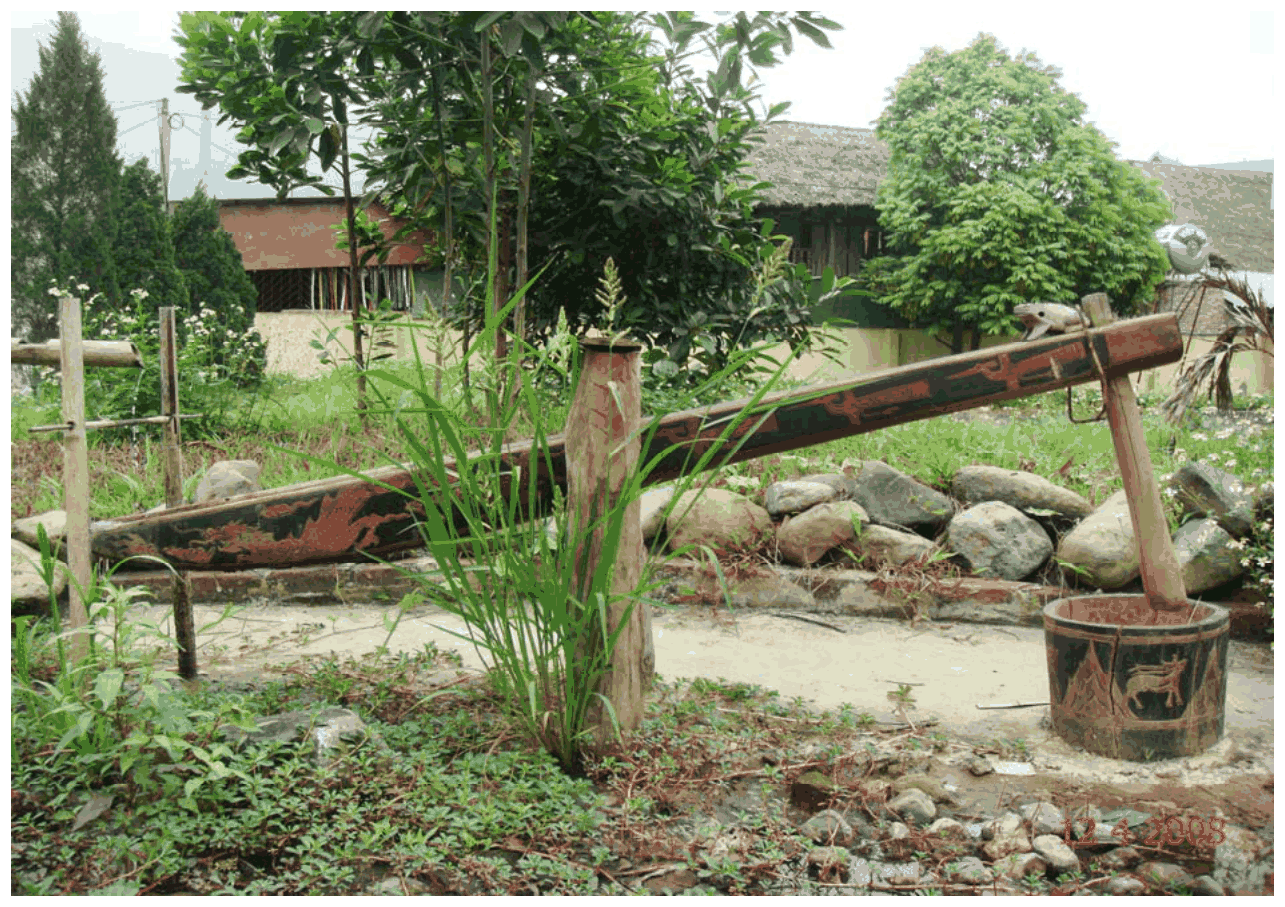
Figure 1
A water-powered rice-pounding mortarOPERATION CYCLE OF A WATER-POWERED RICE-POUNDING MORTAR
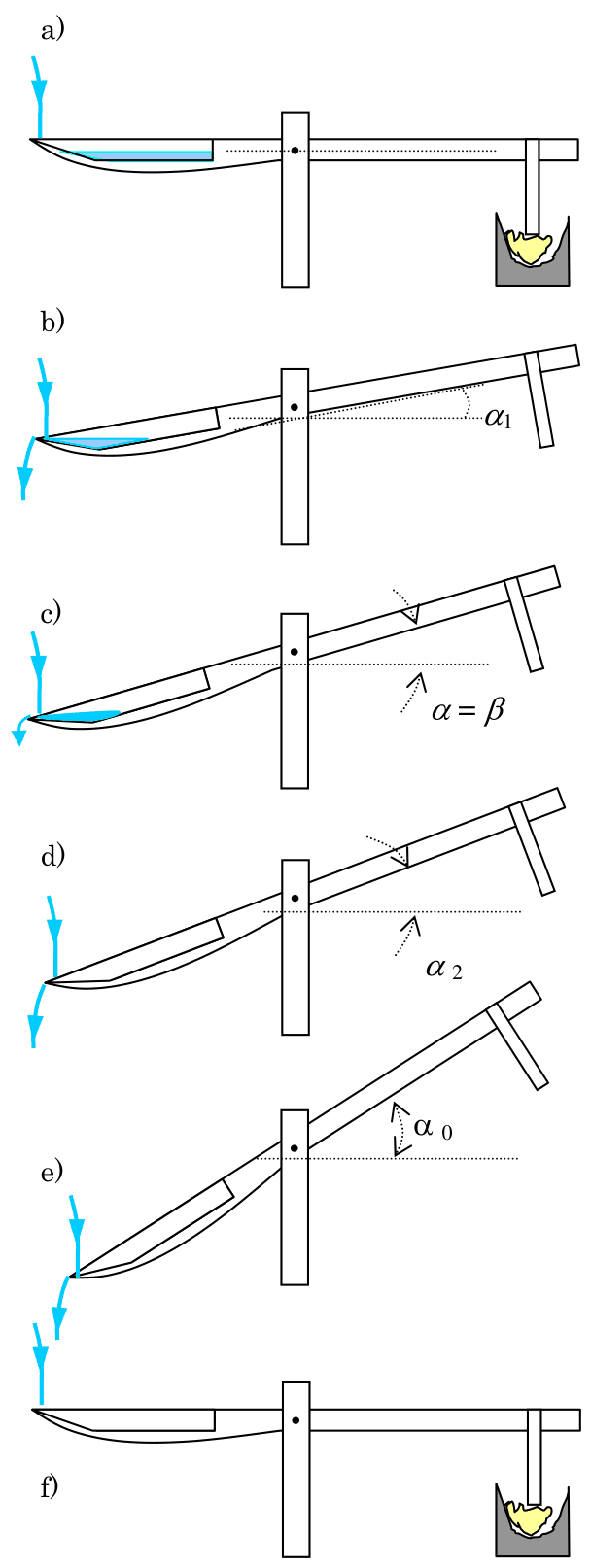
Figure 2
a) At the beginning there is no water in the bucket, the pestle rests on the mortar. Water flows into the bucket with a small rate, but for some time the lever remains in the horizontal position.
b) At some moment the amount of water is enough to lift the lever up. Due to the tilt, water rushes to the farther side of the bucket, tilting the lever more quickly.
Water starts to flow out at \(\alpha=\alpha_1\).
c) As the angle \(\alpha\) increases, water starts to flow out. At some particular tilt angle, \(\alpha=\beta\), the total torque is zero.
d) \(\alpha\) continues increasing, water continues to flow out until no water remains in the bucket.
e) \(\alpha\) keeps increasing because of inertia. Due to the shape of the bucket, water falls into the bucket but immediately flows out. The inertial motion of the lever continues until \(\alpha\) reaches the maximal value \(\alpha_0\).
f) With no water in the bucket, the weight of the lever pulls it back to the initial horizontal position. The pestle gives the mortar (with rice inside) a pound and a new cycle begins.
C. The problem
Consider a water-powered rice-pounding mortar with the following parameters (Figure 3)
The mass of the lever (including the pestle but without water) is \(M=30\ \mathrm{kg}\),
The center of mass of the lever is G. The lever rotates around the axis T (projected onto the point T on the figure).
The moment of inertia of the lever around T is \(I=12\ \mathrm{kg\cdot m^2}\).
When there is water in the bucket, the mass of water is denoted as \(m\), the center of mass of the water body is denoted as N.
The tilt angle of the lever with respect to the horizontal axis is \(\alpha\).
The main length measurements of the mortar and the bucket are as in Figure 3.
Neglect friction at the rotation axis and the force due to water falling onto the bucket. In this problem, we make an approximation that the water surface is always horizontal.
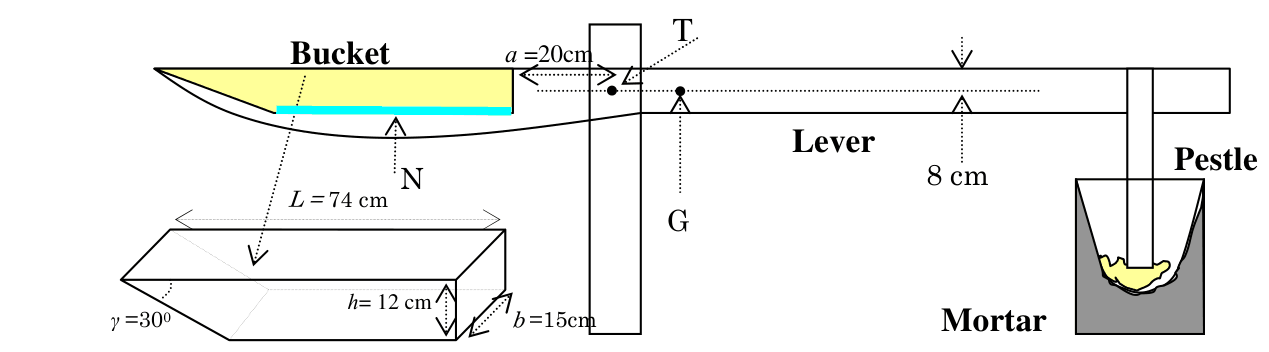
Figure 3 Design and dimensions of the rice-pounding mortar
1. The structure of the mortar
At the beginning, the bucket is empty, and the lever lies horizontally. Then water flows into the bucket until the lever starts rotating. The amount of water in the bucket at this moment is \(m=1.0\ \mathrm{kg}\).
1.1. Determine the distance from the center of mass G of the lever to the rotation axis T. It is known that GT is horizontal when the bucket is empty.
1.2. Water starts flowing out of the bucket when the angle between the lever and the horizontal axis reaches \(\alpha_1\). The bucket is completely empty when this angle is \(\alpha_2\).
Determine \(\alpha_1\) and \(\alpha_2\).
1.3. Let \(\mu(\alpha)\) be the total torque (relative to the axis T) which comes from the weight of the lever and the water in the bucket. \(\mu(\alpha)\) is zero when \(\alpha=\beta\). Determine \(\beta\) and the mass \(m_1\) of water in the bucket at this instant.
2. Parameters of the working mode
Let water flow into the bucket with a flow rate \(\Phi\) which is constant and small. The amount of water flowing into the bucket when the lever is in motion is negligible. In this part, neglect the change of the moment of inertia during the working cycle.
2.1. Sketch a graph of the torque \(\mu\) as a function of the angle \(\alpha\), \(\mu(\alpha)\), during one operation cycle. Write down explicitly the values of \(\mu(\alpha)\) at angle \(\alpha_1\), \(\alpha_2\), and \(\alpha=0\).
2.2. From the graph found in section 2.1., discuss and give the geometric interpretation of the value of the total energy \(W_{\mathrm{total}}\) produced by \(\mu(\alpha)\) and the work \(W_{\mathrm{pounding}}\) that is transferred from the pestle to the rice.
2.3. From the graph representing \(\mu\) versus \(\alpha\), estimate \(\alpha_0\) and \(W_{\mathrm{pounding}}\) (assume the kinetic energy of water flowing into the bucket and out of the bucket is negligible.) You may replace curve lines by zigzag lines, if it simplifies the calculation.
3. The rest mode
Let water flow into the bucket with a constant rate \(\Phi\), but one cannot neglect the amount of water flowing into the bucket during the motion of the lever.
3.1. Assuming the bucket is always overflown with water,
3.1.1. Sketch a graph of the torque \(\mu\) as a function of the angle \(\alpha\) in the vicinity of \(\alpha=\beta\). To which kind of equilibrium does the position \(\alpha=\beta\) of the lever belong?
3.1.2. Find the analytic form of the torque \(\mu(\alpha)\) as a function of \(\Delta\alpha\) when \(\alpha=\beta+\Delta\alpha\), and \(\Delta\alpha\) is small.
3.1.3. Write down the equation of motion of the lever, which moves with zero initial velocity from the position \(\alpha=\beta+\Delta\alpha\) (\(\Delta\alpha\) is small). Show that the motion is, with good accuracy, harmonic oscillation. Compute the period \(\tau\).
3.2. At a given \(\Phi\), the bucket is overflown with water at all times only if the lever moves sufficiently slowly. There is an upper limit on the amplitude of harmonic oscillation, which depends on \(\Phi\). Determine the minimal value \(\Phi_1\) of \(\Phi\) (in kg/s) so that the lever can make a harmonic oscillator motion with amplitude \(1^\circ\).
3.3. Assume that \(\Phi\) is sufficiently large so that during the free motion of the lever when the tilting angle decreases from \(\alpha_2\) to \(\alpha_1\) the bucket is always overflown with water. However, if \(\Phi\) is too large the mortar cannot operate. Assuming that the motion of the lever is that of a harmonic oscillator, estimate the minimal flow rate \(\Phi_2\) for the rice-pounding mortar to not work.
Official English text of the problem.
Problem 2: Cherenkov Light and Ring Imaging Counter
Light propagates in vacuum with the speed \(c\). There is no particle which moves with a speed higher than \(c\). However, it is possible that in a transparent medium a particle moves with a speed \(v\) higher than the speed of the light in the same medium \(\frac{c}{n}\), where \(n\) is the refraction index of the medium. Experiment (Cherenkov, 1934) and theory (Tamm and Frank, 1937) showed that a charged particle, moving with a speed \(v\) in a transparent medium with refractive index \(n\) such that \(v>\frac{c}{n}\), radiates light, called Cherenkov light, in directions forming with the trajectory an angle
\[ \theta=\arccos\frac{1}{\beta n} \tag{1} \]
where \(\beta=\frac{v}{c}\).
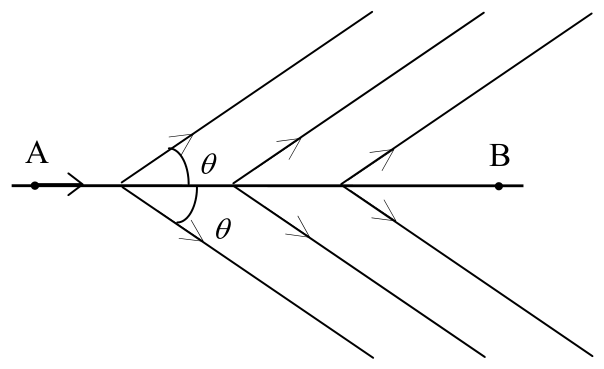
1. To establish this fact, consider a particle moving at constant velocity \(v>\frac{c}{n}\) on a straight line. It passes A at time 0 and B at time \(t_1\). As the problem is symmetric with respect to rotations around AB, it is sufficient to consider light rays in a plane containing AB.
At any point C between A and B, the particle emits a spherical light wave, which propagates with velocity \(\frac{c}{n}\). We define the wave front at a given time \(t\) as the envelope of all these spheres at this time.
1.1. Determine the wave front at time \(t_1\) and draw its intersection with a plane containing the trajectory of the particle.
1.2. Express the angle \(\varphi\) between this intersection and the trajectory of the particle in terms of \(n\) and \(\beta\).
2. Let us consider a beam of particles moving with velocity \(v>\frac{c}{n}\), such that the angle \(\theta\) is small, along a straight line IS. The beam crosses a concave spherical mirror of focal length \(f\) and center C, at point S. SC makes with SI a small angle \(\alpha\) (see the figure in the Answer Sheet). The particle beam creates a ring image in the focal plane of the mirror.
Explain why with the help of a sketch illustrating this fact. Give the position of the center O and the radius \(r\) of the ring image.
This set up is used in ring imaging Cherenkov counters (RICH) and the medium which the particle traverses is called the radiator.
Note: in all questions of the present problem, terms of second order and higher in \(\alpha\) and \(\theta\) will be neglected.
3. A beam of particles of known momentum \(p=10.0\ \mathrm{GeV}/c\) consists of three types of particles: protons, kaons and pions, with rest mass \(M_{\mathrm p}=0.94\ \mathrm{GeV}/c^2\), \(M_\kappa=0.50\ \mathrm{GeV}/c^2\) and \(M_\pi=0.14\ \mathrm{GeV}/c^2\), respectively. Remember that \(pc\) and \(Mc^2\) have the dimension of an energy, and 1 eV is the energy acquired by an electron after being accelerated by a voltage 1 V, and \(1\ \mathrm{GeV}=10^9\ \mathrm{eV}\), \(1\ \mathrm{MeV}=10^6\ \mathrm{eV}\).
The particle beam traverses an air medium (the radiator) under the pressure \(P\). The refraction index of air depends on the air pressure \(P\) according to the relation \(n=1+aP\) where \(a=2.7\times10^{-4}\ \mathrm{atm}^{-1}\)
3.1. Calculate for each of the three particle types the minimal value \(P_{\min}\) of the air pressure such that they emit Cherenkov light.
3.2. Calculate the pressure \(P_{\frac12}\) such that the ring image of kaons has a radius equal to one half of that corresponding to pions. Calculate the values of \(\theta_\kappa\) and \(\theta_\pi\) in this case.
Is it possible to observe the ring image of protons under this pressure?
4. Assume now that the beam is not perfectly monochromatic: the particles momenta are distributed over an interval centered at \(10\ \mathrm{GeV}/c\) having a half width at half height \(\Delta p\). This makes the ring image broaden, correspondingly \(\theta\) distribution has a half width at half height \(\Delta\theta\). The pressure of the radiator is \(P_{\frac12}\) determined in 3.2.
4.1. Calculate \(\frac{\Delta\theta_\kappa}{\Delta p}\) and \(\frac{\Delta\theta_\pi}{\Delta p}\), the values taken by \(\frac{\Delta\theta}{\Delta p}\) in the pions and kaons cases.
4.2. When the separation between the two ring images, \(\theta_\pi-\theta_\kappa\), is greater than 10 times the half-width sum \(\Delta\theta=\Delta\theta_\kappa+\Delta\theta_\pi\), that is \(\theta_\pi-\theta_\kappa>10\Delta\theta\), it is possible to distinguish well the two ring images. Calculate the maximal value of \(\Delta p\) such that the two ring images can still be well distinguished.
5. Cherenkov first discovered the effect bearing his name when he was observing a bottle of water located near a radioactive source. He saw that the water in the bottle emitted light.
5.1. Find out the minimal kinetic energy \(T_{\min}\) of a particle with a rest mass \(M\) moving in water, such that it emits Cherenkov light. The index of refraction of water is \(n=1.33\).
5.2. The radioactive source used by Cherenkov emits either \(\alpha\) particles (i.e. helium nuclei) having a rest mass \(M_\alpha=3.8\ \mathrm{GeV}/c^2\), or \(\beta\) particles (i.e. electrons) having a rest mass \(M_e=0.51\ \mathrm{MeV}/c^2\). Calculate the numerical values of \(T_{\min}\) for \(\alpha\) particles and \(\beta\) particles.
Knowing that the kinetic energy of particles emitted by radioactive sources never exceeds a few MeV, find out which particles give rise to the radiation observed by Cherenkov.
6. In the previous sections of the problem, the dependence of the Cherenkov effect on wavelength \(\lambda\) has been ignored. We now take into account the fact that the Cherenkov radiation of a particle has a broad continuous spectrum including the visible range (wavelengths from \(0.4\ \mu\mathrm m\) to \(0.8\ \mu\mathrm m\)). We know also that the index of refraction \(n\) of the radiator decreases linearly by 2% of \(n-1\) when \(\lambda\) increases over this range.
6.1. Consider a beam of pions with definite momentum of \(10.0\ \mathrm{GeV}/c\) moving in air at pressure 6 atm. Find out the angular difference \(\delta\theta\) associated with the two ends of the visible range.
6.2. On this basis, study qualitatively the effect of the dispersion on the ring image of pions with momentum distributed over an interval centered at \(p=10\ \mathrm{GeV}/c\) and having a half width at half height \(\Delta p=0.3\ \mathrm{GeV}/c\).
6.2.1. Calculate the broadening due to dispersion (varying refraction index) and that due to achromaticity of the beam (varying momentum).
6.2.2. Describe how the color of the ring changes when going from its inner to outer edges by checking the appropriate boxes in the Answer Sheet.
Official English text of the problem.
Problem 3: Change of Air Temperature with Altitude, Atmospheric Stability and Air Pollution
Vertical motion of air governs many atmospheric processes, such as the formation of clouds and precipitation and the dispersal of air pollutants. If the atmosphere is stable, vertical motion is restricted and air pollutants tend to be accumulated around the emission site rather than dispersed and diluted. Meanwhile, in an unstable atmosphere, vertical motion of air encourages the vertical dispersal of air pollutants. Therefore, the pollutants’ concentrations depend not only on the strength of emission sources but also on the stability of the atmosphere.
We shall determine the atmospheric stability by using the concept of air parcel in meteorology and compare the temperature of the air parcel rising or sinking adiabatically in the atmosphere to that of the surrounding air. We will see that in many cases an air parcel containing air pollutants and rising from the ground will come to rest at a certain altitude, called a mixing height. The greater the mixing height, the lower the air pollutant concentration. We will evaluate the mixing height and the concentration of carbon monoxide emitted by motorbikes in the Hanoi metropolitan area for a morning rush hour scenario, in which the vertical mixing is restricted due to a temperature inversion (air temperature increases with altitude) at elevations above 119 m.
Let us consider the air as an ideal diatomic gas, with molar mass \(\mu=29\ \mathrm{g/mol}\).
Quasi equilibrium adiabatic transformation obey the equation \(pV^\gamma=\mathrm{const}\), where \(\gamma=\dfrac{c_p}{c_V}\) is the ratio between isobaric and isochoric heat capacities of the gas.
The student may use the following data if necessary:
The universal gas constant is \(R=8.31\ \mathrm{J/(mol.K)}\).
The atmospheric pressure on ground is \(p_0=101.3\ \mathrm{kPa}\)
The acceleration due to gravity is constant, \(g=9.81\ \mathrm{m/s^2}\)
The molar isobaric heat capacity is \(c_p=\dfrac72R\) for air.
The molar isochoric heat capacity is \(c_V=\dfrac52R\) for air.
Mathematical hints
a. \[ \int\frac{dx}{A+Bx} =\frac1B\int\frac{d(A+Bx)}{A+Bx} =\frac1B\ln(A+Bx) \]
b. The solution of the differential equation \(\dfrac{dx}{dt}+Ax=B\) (with \(A\) and \(B\) constant) is \[ x(t)=x_1(t)+\frac BA \] where \(x_1(t)\) is the solution of the differential equation \(\dfrac{dx}{dt}+Ax=0\).
c. \[ \lim_{x\to\infty}\left(1+\frac1x\right)^x=e \]
1. Change of pressure with altitude.
1.1. Assume that the temperature of the atmosphere is uniform and equal to \(T_0\). Write down the expression giving the atmospheric pressure \(p\) as a function of the altitude \(z\).
1.2. Assume that the temperature of the atmosphere varies with the altitude according to the relation
\[ T(z)=T(0)-\Lambda z \]
where \(\Lambda\) is a constant, called the temperature lapse rate of the atmosphere (the vertical gradient of temperature is \(-\Lambda\)).
1.2.1. Write down the expression giving the atmospheric pressure \(p\) as a function of the altitude \(z\).
1.2.2. A process called free convection occurs when the air density increases with altitude. At which values of \(\Lambda\) does the free convection occur?
2. Change of the temperature of an air parcel in vertical motion
Consider an air parcel moving upward and downward in the atmosphere. An air parcel is a body of air of sufficient dimension, several meters across, to be treated as an independent thermodynamical entity, yet small enough for its temperature to be considered uniform. The vertical motion of an air parcel can be treated as a quasi adiabatic process, i.e. the exchange of heat with the surrounding air is negligible. If the air parcel rises in the atmosphere, it expands and cools. Conversely, if it moves downward, the increasing outside pressure will compress the air inside the parcel and its temperature will increase.
As the size of the parcel is not large, the atmospheric pressure at different points on the parcel boundary can be considered to have the same value \(p(z)\), with \(z\) - the altitude of the parcel center. The temperature in the parcel is uniform and equals to \(T_{\mathrm{parcel}}(z)\), which is generally different from the temperature of the surrounding air \(T(z)\). In parts 2.1 and 2.2, we do not make any assumption about the form of \(T(z)\).
2.1. The change of the parcel temperature \(T_{\mathrm{parcel}}\) with altitude is defined by \[ \frac{dT_{\mathrm{parcel}}}{dz}=-G. \] Derive the expression of \(G(T,T_{\mathrm{parcel}})\).
2.2. Consider a special atmospheric condition in which at any altitude \(z\) the temperature \(T\) of the atmosphere equals to that of the parcel \(T_{\mathrm{parcel}}\), \(T(z)=T_{\mathrm{parcel}}(z)\). We use \(\Gamma\) to denote the value of \(G\) when \(T=T_{\mathrm{parcel}}\), that is \[ \Gamma=-\frac{dT_{\mathrm{parcel}}}{dz} \] (with \(T=T_{\mathrm{parcel}}\)). \(\Gamma\) is called dry adiabatic lapse rate.
2.2.1. Derive the expression of \(\Gamma\)
2.2.2. Calculate the numerical value of \(\Gamma\).
2.2.3. Derive the expression of the atmospheric temperature \(T(z)\) as a function of the altitude.
2.3. Assume that the atmospheric temperature depends on altitude according to the relation \(T(z)=T(0)-\Lambda z\), where \(\Lambda\) is a constant. Find the dependence of the parcel temperature \(T_{\mathrm{parcel}}(z)\) on altitude \(z\).
2.4. Write down the approximate expression of \(T_{\mathrm{parcel}}(z)\) when \(|\Lambda z|\ll T(0)\) and \(T(0)\approx T_{\mathrm{parcel}}(0)\).
3. The atmospheric stability.
In this part, we assume that \(T\) changes linearly with altitude.
3.1. Consider an air parcel initially in equilibrium with its surrounding air at altitude \(z_0\), i.e. it has the same temperature \(T(z_0)\) as that of the surrounding air. If the parcel is moved slightly up and down (e.g. by atmospheric turbulence), one of the three following cases may occur:
- The air parcel finds its way back to the original altitude \(z_0\), the equilibrium of the parcel is stable. The atmosphere is said to be stable.
- The parcel keeps moving in the original direction, the equilibrium of the parcel is unstable. The atmosphere is unstable.
- The air parcel remains at its new position, the equilibrium of the parcel is indifferent. The atmosphere is said to be neutral.
What is the condition on \(\Lambda\) for the atmosphere to be stable, unstable or neutral?
3.2. A parcel has its temperature on ground \(T_{\mathrm{parcel}}(0)\) higher than the temperature \(T(0)\) of the surrounding air. The buoyancy force will make the parcel rise. Derive the expression for the maximal altitude the parcel can reach in the case of a stable atmosphere in terms of \(\Lambda\) and \(\Gamma\).
4. The mixing height
4.1. Table 1 shows air temperatures recorded by a radio sounding balloon at 7: 00 am on a November day in Hanoi. The change of temperature with altitude can be approximately described by the formula \(T(z)=T(0)-\Lambda z\) with different lapse rates \(\Lambda\) in the three layers \(0<z<96\ \mathrm{m}\), \(96\ \mathrm{m}<z<119\ \mathrm{m}\) and \(119\ \mathrm{m}<z<215\ \mathrm{m}\).
Consider an air parcel with temperature \(T_{\mathrm{parcel}}(0)=22^\circ\mathrm{C}\) ascending from ground. On the basis of the data given in Table 1 and using the above linear approximation, calculate the temperature of the parcel at the altitudes of 96 m and 119 m.
4.2. Determine the maximal elevation \(H\) the parcel can reach, and the temperature \(T_{\mathrm{parcel}}(H)\) of the parcel.
\(H\) is called the mixing height. Air pollutants emitted from ground can mix with the air in the atmosphere (e.g. by wind, turbulence and dispersion) and become diluted within this layer.
Table 1
Data recorded by a radio sounding balloon at 7:00 am on a November day in Hanoi.
Altitude, m Temperature, °C 5 21.5 60 20.6 64 20.5 69 20.5 75 20.4 81 20.3 90 20.2 96 20.1 102 20.1 109 20.1 113 20.1 119 20.1 128 20.2 136 20.3 145 20.4 153 20.5 159 20.6 168 20.8 178 21.0 189 21.5 202 21.8 215 22.0 225 22.1 234 22.2 246 22.3 257 22.3 5. Estimation of carbon monoxide (CO) pollution during a morning motorbike rush hour in Hanoi.
Hanoi metropolitan area can be approximated by a rectangle with base dimensions \(L\) and \(W\) as shown in the figure, with one side taken along the south-west bank of the Red River.
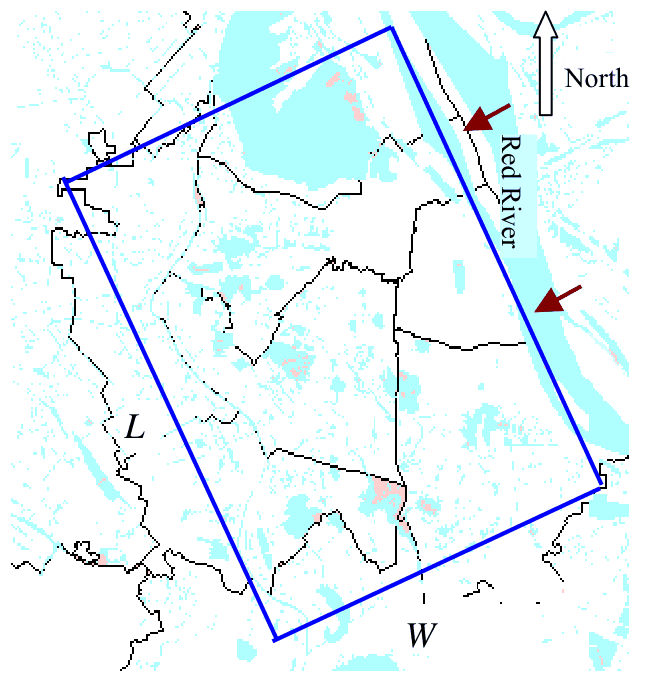
It is estimated that during the morning rush hour, from 7:00 am to 8:00 am, there are \(8\times10^5\) motorbikes on the road, each running on average 5 km and emitting 12 g of CO per kilometer. The amount of CO pollutant is approximately considered as emitted uniformly in time, at a constant rate \(M\) during the rush hour. At the same time, the clean north-east wind blows perpendicularly to the Red River (i.e. perpendicularly to the sides \(L\) of the rectangle) with velocity \(u\), passes the city with the same velocity, and carries a part of the CO-polluted air out of the city atmosphere.
Also, we use the following rough approximate model:
- The CO spreads quickly throughout the entire volume of the mixing layer above the Hanoi metropolitan area, so that the concentration \(C(t)\) of CO at time \(t\) can be assumed to be constant throughout that rectangular box of dimensions \(L\), \(W\) and \(H\).
- The upwind air entering the box is clean and no pollution is assumed to be lost from the box through the sides parallel to the wind.
- Before 7:00 am, the CO concentration in the atmosphere is negligible.
5.1. Derive the differential equation determining the CO pollutant concentration \(C(t)\) as a function of time.
5.2. Write down the solution of that equation for \(C(t)\).
5.3. Calculate the numerical value of the concentration \(C(t)\) at 8:00 a.m.
Given \(L=15\ \mathrm{km}\), \(W=8\ \mathrm{km}\), \(u=1\ \mathrm{m/s}\).
Official English text of the problem.
Internationale Physik-Olympiade
IPhO 2008
Hanoi, Vietnam · 3 Theorieaufgaben mit vollständigen Lösungen
Aufgabe 1: Wasserbetriebener Reisstampfmörser
A. Einführung
Reis ist das wichtigste Grundnahrungsmittel für die meisten Menschen in Vietnam. Um aus Rohreis weißen Reis zu gewinnen, müssen die Spelzen entfernt werden (ein als „Entspelzen“ bezeichneter Vorgang) und die Kleieschicht abgetragen werden („Schleifen“). Die hügeligen Regionen Nordvietnams sind reich an Wasserläufen, und die dort lebenden Menschen verwenden wasserbetriebene Reisstampfmörser, um die Kleieschicht zu entfernen. Abbildung 1 zeigt einen solchen Mörser. Abbildung 2 zeigt seine Funktionsweise.
B. Aufbau und Betrieb
1. Aufbau.
Der in Abbildung 1 gezeigte Reisstampfmörser besteht aus folgenden Teilen:
Dem Mörser, im Wesentlichen einem hölzernen Behälter für Reis.
Dem Hebel, einem Baumstamm mit einem dickeren und einem dünneren Ende. Er kann sich um eine horizontale Achse drehen. Am dünneren Ende ist ein Stößel senkrecht zum Hebel befestigt. Die Länge des Stößels ist so gewählt, dass er den Reis im Mörser berührt, wenn der Hebel horizontal liegt. Das dickere Ende des Hebels ist ausgehöhlt und bildet einen Schöpfbehälter. Die Form dieses Behälters ist für den Betrieb des Mörsers entscheidend.
2. Betriebszustände
Der Mörser hat zwei Betriebszustände.
Arbeitszustand. In diesem Zustand durchläuft der Mörser einen in Abbildung 2 dargestellten Arbeitszyklus.
Das Stampfen des Reises beruht auf der Arbeit, die während der Phase f) in Abbildung 2 vom Stößel auf den Reis übertragen wird. Wenn der Stößel aus irgendeinem Grund den Reis niemals berührt, sagen wir, dass der Mörser nicht arbeitet.
Ruhezustand mit angehobenem Hebel. Während der Phase c) des Arbeitszyklus (Abbildung 2) nimmt mit zunehmendem Neigungswinkel \(\alpha\) die Wassermenge im Schöpfbehälter ab. Zu einem bestimmten Zeitpunkt reicht die Wassermenge gerade aus, um die Gewichtskraft des Hebels auszugleichen. Der Neigungswinkel in diesem Augenblick sei \(\beta\). Wird der Hebel beim Winkel \(\beta\) gehalten und ist seine Anfangswinkelgeschwindigkeit null, so bleibt er für immer in dieser Stellung. Dies ist der Ruhezustand mit angehobenem Hebel. Die Stabilität dieser Stellung hängt vom Wasserzufluss in den Behälter, \(\Phi\), ab. Überschreitet \(\Phi\) einen bestimmten Wert \(\Phi_2\), so ist dieser Ruhezustand stabil, und der Mörser kann sich nicht im Arbeitszustand befinden.
Mit anderen Worten ist \(\Phi_2\) der kleinste Zufluss, bei dem der Mörser nicht arbeitet.
Abbildung 1
Ein wasserbetriebener ReisstampfmörserARBEITSZYKLUS EINES WASSERBETRIEBENEN REISSTAMPFMÖRSERS
Abbildung 2
a) Zu Beginn befindet sich kein Wasser im Schöpfbehälter, und der Stößel ruht auf dem Mörser. Wasser fließt mit geringer Rate in den Behälter, doch der Hebel bleibt zunächst eine Zeit lang in der horizontalen Stellung.
b) Zu einem bestimmten Zeitpunkt reicht die Wassermenge aus, um den Hebel anzuheben. Durch die Neigung strömt das Wasser zur weiter außen liegenden Seite des Behälters, wodurch sich der Hebel schneller neigt.
Bei \(\alpha=\alpha_1\) beginnt Wasser auszufließen.
c) Mit zunehmendem Winkel \(\alpha\) beginnt Wasser auszufließen. Bei einem bestimmten Neigungswinkel, \(\alpha=\beta\), ist das Gesamtdrehmoment null.
d) \(\alpha\) nimmt weiter zu, und Wasser fließt weiter aus, bis sich kein Wasser mehr im Behälter befindet.
e) Aufgrund der Trägheit nimmt \(\alpha\) weiter zu. Wegen der Form des Behälters fällt Wasser zwar hinein, fließt aber sofort wieder heraus. Die Trägheitsbewegung des Hebels setzt sich fort, bis \(\alpha\) den Maximalwert \(\alpha_0\) erreicht.
f) Da sich kein Wasser im Behälter befindet, zieht die Gewichtskraft des Hebels ihn in die ursprüngliche horizontale Stellung zurück. Der Stößel versetzt dem Mörser (mit dem darin befindlichen Reis) einen Schlag, und ein neuer Zyklus beginnt.
C. Die Aufgabe
Betrachten Sie einen wasserbetriebenen Reisstampfmörser mit den folgenden Parametern (Abbildung 3).
Die Masse des Hebels (einschließlich des Stößels, aber ohne Wasser) beträgt \(M=30\ \mathrm{kg}\).
Der Schwerpunkt des Hebels ist G. Der Hebel dreht sich um die Achse T (in der Abbildung auf den Punkt T projiziert).
Das Trägheitsmoment des Hebels bezüglich T beträgt \(I=12\ \mathrm{kg\cdot m^2}\).
Wenn sich Wasser im Behälter befindet, wird seine Masse mit \(m\) und der Schwerpunkt des Wasserkörpers mit N bezeichnet.
Der Neigungswinkel des Hebels gegenüber der Horizontalen ist \(\alpha\).
Die wichtigsten Längenmaße des Mörsers und des Schöpfbehälters sind in Abbildung 3 angegeben.
Vernachlässigen Sie die Reibung an der Drehachse und die Kraft durch das auf den Behälter fallende Wasser. In dieser Aufgabe nehmen wir näherungsweise an, dass die Wasseroberfläche stets horizontal ist.
Abbildung 3 Aufbau und Abmessungen des Reisstampfmörsers
1. Der Aufbau des Mörsers
Zu Beginn ist der Schöpfbehälter leer, und der Hebel liegt horizontal. Dann fließt Wasser in den Behälter, bis der Hebel sich zu drehen beginnt. Die Wassermenge im Behälter beträgt in diesem Augenblick \(m=1.0\ \mathrm{kg}\).
1.1. Bestimmen Sie den Abstand vom Schwerpunkt G des Hebels zur Drehachse T. Es ist bekannt, dass GT horizontal verläuft, wenn der Behälter leer ist.
1.2. Wasser beginnt aus dem Behälter auszufließen, wenn der Winkel zwischen dem Hebel und der Horizontalen \(\alpha_1\) erreicht. Der Behälter ist vollständig leer, wenn dieser Winkel \(\alpha_2\) beträgt.
Bestimmen Sie \(\alpha_1\) und \(\alpha_2\).
1.3. Es sei \(\mu(\alpha)\) das Gesamtdrehmoment (bezüglich der Achse T), das von den Gewichtskräften des Hebels und des Wassers im Behälter herrührt. \(\mu(\alpha)\) ist null, wenn \(\alpha=\beta\). Bestimmen Sie \(\beta\) und die Masse \(m_1\) des Wassers im Behälter in diesem Augenblick.
2. Parameter des Arbeitszustands
Wasser fließe mit einer konstanten, kleinen Zuflussrate \(\Phi\) in den Behälter. Die Wassermenge, die während der Bewegung des Hebels in den Behälter fließt, ist vernachlässigbar. Vernachlässigen Sie in diesem Teil die Änderung des Trägheitsmoments während des Arbeitszyklus.
2.1. Skizzieren Sie den Verlauf des Drehmoments \(\mu\) als Funktion des Winkels \(\alpha\), \(\mu(\alpha)\), während eines Arbeitszyklus. Geben Sie die Werte von \(\mu(\alpha)\) bei den Winkeln \(\alpha_1\), \(\alpha_2\) und \(\alpha=0\) ausdrücklich an.
2.2. Erörtern Sie anhand des in Abschnitt 2.1. ermittelten Graphen den Wert der gesamten durch \(\mu(\alpha)\) erzeugten Energie \(W_{\mathrm{total}}\) und der Arbeit \(W_{\mathrm{pounding}}\), die vom Stößel auf den Reis übertragen wird, und geben Sie deren geometrische Interpretation an.
2.3. Schätzen Sie anhand des Graphen von \(\mu\) in Abhängigkeit von \(\alpha\) die Größen \(\alpha_0\) und \(W_{\mathrm{pounding}}\) ab (nehmen Sie an, dass die kinetische Energie des in den Behälter ein- und aus ihm ausfließenden Wassers vernachlässigbar ist). Sie dürfen gekrümmte Linien durch Polygonzüge ersetzen, wenn dies die Rechnung vereinfacht.
3. Der Ruhezustand
Wasser fließe mit einer konstanten Rate \(\Phi\) in den Behälter, wobei die während der Bewegung des Hebels einfließende Wassermenge nicht vernachlässigt werden kann.
3.1. Nehmen Sie an, dass der Behälter stets mit Wasser überläuft.
3.1.1. Skizzieren Sie den Verlauf des Drehmoments \(\mu\) als Funktion des Winkels \(\alpha\) in der Umgebung von \(\alpha=\beta\). Um welche Art von Gleichgewicht handelt es sich bei der Stellung \(\alpha=\beta\) des Hebels?
3.1.2. Bestimmen Sie den analytischen Ausdruck des Drehmoments \(\mu(\alpha)\) als Funktion von \(\Delta\alpha\), wenn \(\alpha=\beta+\Delta\alpha\) und \(\Delta\alpha\) klein ist.
3.1.3. Stellen Sie die Bewegungsgleichung des Hebels auf, der sich aus der Stellung \(\alpha=\beta+\Delta\alpha\) mit der Anfangsgeschwindigkeit null in Bewegung setzt (\(\Delta\alpha\) ist klein). Zeigen Sie, dass die Bewegung in guter Näherung eine harmonische Schwingung ist. Berechnen Sie die Periodendauer \(\tau\).
3.2. Bei gegebenem \(\Phi\) läuft der Behälter nur dann zu jeder Zeit mit Wasser über, wenn sich der Hebel hinreichend langsam bewegt. Für die Amplitude der harmonischen Schwingung gibt es eine obere Grenze, die von \(\Phi\) abhängt. Bestimmen Sie den kleinsten Wert \(\Phi_1\) von \(\Phi\) (in kg/s), bei dem der Hebel eine harmonische Schwingung mit der Amplitude \(1^\circ\) ausführen kann.
3.3. Nehmen Sie an, dass \(\Phi\) hinreichend groß ist, sodass der Behälter während der freien Bewegung des Hebels stets mit Wasser überläuft, wenn der Neigungswinkel von \(\alpha_2\) auf \(\alpha_1\) abnimmt. Ist \(\Phi\) jedoch zu groß, kann der Mörser nicht arbeiten. Schätzen Sie unter der Annahme einer harmonischen Schwingung des Hebels die kleinste Zuflussrate \(\Phi_2\) ab, bei der der Reisstampfmörser nicht arbeitet.
Aufgabentext aus dem offiziellen englischen Text übersetzt.
Aufgabe 2: Tscherenkow-Licht und ringabbildender Zähler
Licht breitet sich im Vakuum mit der Geschwindigkeit \(c\) aus. Kein Teilchen bewegt sich mit einer Geschwindigkeit größer als \(c\). In einem transparenten Medium kann sich ein Teilchen jedoch mit einer Geschwindigkeit \(v\) bewegen, die größer ist als die Lichtgeschwindigkeit in demselben Medium \(\frac{c}{n}\), wobei \(n\) der Brechungsindex des Mediums ist. Experiment (Cherenkov, 1934) und Theorie (Tamm und Frank, 1937) zeigten, dass ein geladenes Teilchen, das sich in einem transparenten Medium mit dem Brechungsindex \(n\) mit einer Geschwindigkeit \(v\) bewegt, für die \(v>\frac{c}{n}\) gilt, Licht aussendet, das als Tscherenkow-Licht bezeichnet wird. Die Ausbreitungsrichtungen dieses Lichts bilden mit der Teilchenbahn den Winkel
\[ \theta=\arccos\frac{1}{\beta n} \tag{1} \]
wobei \(\beta=\frac{v}{c}\).
1. Um diesen Sachverhalt herzuleiten, betrachten wir ein Teilchen, das sich mit konstanter Geschwindigkeit \(v>\frac{c}{n}\) geradlinig bewegt. Es passiert A zum Zeitpunkt 0 und B zum Zeitpunkt \(t_1\). Da das Problem bezüglich Drehungen um AB symmetrisch ist, genügt es, Lichtstrahlen in einer Ebene zu betrachten, die AB enthält.
An jedem Punkt C zwischen A und B emittiert das Teilchen eine kugelförmige Lichtwelle, die sich mit der Geschwindigkeit \(\frac{c}{n}\) ausbreitet. Wir definieren die Wellenfront zu einem gegebenen Zeitpunkt \(t\) als die Einhüllende all dieser Kugeln zu diesem Zeitpunkt.
1.1. Bestimmen Sie die Wellenfront zum Zeitpunkt \(t_1\) und zeichnen Sie ihre Schnittlinie mit einer Ebene, die die Teilchenbahn enthält.
1.2. Drücken Sie den Winkel \(\varphi\) zwischen dieser Schnittlinie und der Teilchenbahn durch \(n\) und \(\beta\) aus.
2. Betrachten wir einen Teilchenstrahl, der sich entlang einer Geraden IS mit der Geschwindigkeit \(v>\frac{c}{n}\) bewegt, wobei der Winkel \(\theta\) klein ist. Der Strahl durchquert einen konkaven Kugelspiegel mit der Brennweite \(f\) und dem Mittelpunkt C am Punkt S. SC bildet mit SI einen kleinen Winkel \(\alpha\) (siehe die Abbildung auf dem Antwortblatt). Der Teilchenstrahl erzeugt in der Brennebene des Spiegels ein Ringbild.
Erklären Sie anhand einer Skizze, warum dies der Fall ist. Geben Sie die Lage des Mittelpunkts O und den Radius \(r\) des Ringbildes an.
Diese Anordnung wird in ringabbildenden Tscherenkow-Zählern (RICH) verwendet, und das Medium, das das Teilchen durchquert, wird als Radiator bezeichnet.
Hinweis: In allen Teilaufgaben dieser Aufgabe werden Terme zweiter und höherer Ordnung in \(\alpha\) und \(\theta\) vernachlässigt.
3. Ein Teilchenstrahl mit bekanntem Impuls \(p=10.0\ \mathrm{GeV}/c\) besteht aus drei Teilchensorten: Protonen, Kaonen und Pionen mit den jeweiligen Ruhemassen \(M_{\mathrm p}=0.94\ \mathrm{GeV}/c^2\), \(M_\kappa=0.50\ \mathrm{GeV}/c^2\) und \(M_\pi=0.14\ \mathrm{GeV}/c^2\). Denken Sie daran, dass \(pc\) und \(Mc^2\) die Dimension einer Energie haben und dass 1 eV die Energie ist, die ein Elektron bei der Beschleunigung durch eine Spannung von 1 V gewinnt, sowie dass \(1\ \mathrm{GeV}=10^9\ \mathrm{eV}\), \(1\ \mathrm{MeV}=10^6\ \mathrm{eV}\).
Der Teilchenstrahl durchquert Luft (den Radiator) unter dem Druck \(P\). Der Brechungsindex der Luft hängt vom Luftdruck \(P\) gemäß der Beziehung \(n=1+aP\) ab, wobei \(a=2.7\times10^{-4}\ \mathrm{atm}^{-1}\)
3.1. Berechnen Sie für jede der drei Teilchensorten den minimalen Luftdruck \(P_{\min}\), bei dem sie Tscherenkow-Licht emittieren.
3.2. Berechnen Sie den Druck \(P_{\frac12}\), bei dem der Radius des Ringbildes der Kaonen halb so groß ist wie derjenige der Pionen. Berechnen Sie für diesen Fall die Werte von \(\theta_\kappa\) und \(\theta_\pi\).
Kann bei diesem Druck das Ringbild der Protonen beobachtet werden?
4. Nehmen Sie nun an, dass der Strahl nicht vollkommen monochromatisch ist: Die Teilchenimpulse sind über ein Intervall mit dem Mittelpunkt \(10\ \mathrm{GeV}/c\) und der halben Breite bei halber Höhe \(\Delta p\) verteilt. Dadurch wird das Ringbild verbreitert; entsprechend hat die Verteilung von \(\theta\) eine halbe Breite bei halber Höhe \(\Delta\theta\). Der Druck des Radiators ist der in 3.2 bestimmte Wert \(P_{\frac12}\).
4.1. Berechnen Sie \(\frac{\Delta\theta_\kappa}{\Delta p}\) und \(\frac{\Delta\theta_\pi}{\Delta p}\), also die Werte von \(\frac{\Delta\theta}{\Delta p}\) für Pionen und Kaonen.
4.2. Wenn der Abstand zwischen den beiden Ringbildern, \(\theta_\pi-\theta_\kappa\), größer als das Zehnfache der Summe der halben Breiten \(\Delta\theta=\Delta\theta_\kappa+\Delta\theta_\pi\) ist, also \(\theta_\pi-\theta_\kappa>10\Delta\theta\), lassen sich die beiden Ringbilder gut unterscheiden. Berechnen Sie den maximalen Wert von \(\Delta p\), bei dem sich die beiden Ringbilder noch gut unterscheiden lassen.
5. Cherenkov entdeckte den nach ihm benannten Effekt erstmals, als er eine Flasche Wasser in der Nähe einer radioaktiven Quelle beobachtete. Er sah, dass das Wasser in der Flasche Licht aussandte.
5.1. Bestimmen Sie die minimale kinetische Energie \(T_{\min}\) eines Teilchens mit der Ruhemasse \(M\), das sich in Wasser bewegt, bei der es Tscherenkow-Licht emittiert. Der Brechungsindex von Wasser beträgt \(n=1.33\).
5.2. Die von Cherenkov verwendete radioaktive Quelle emittiert entweder \(\alpha\)-Teilchen (also Heliumkerne) mit der Ruhemasse \(M_\alpha=3.8\ \mathrm{GeV}/c^2\) oder \(\beta\)-Teilchen (also Elektronen) mit der Ruhemasse \(M_e=0.51\ \mathrm{MeV}/c^2\). Berechnen Sie die Zahlenwerte von \(T_{\min}\) für \(\alpha\)-Teilchen und \(\beta\)-Teilchen.
Bestimmen Sie unter Berücksichtigung der Tatsache, dass die kinetische Energie der von radioaktiven Quellen emittierten Teilchen niemals mehr als einige MeV beträgt, welche Teilchen die von Cherenkov beobachtete Strahlung hervorrufen.
6. In den vorherigen Teilen der Aufgabe wurde die Abhängigkeit des Tscherenkow-Effekts von der Wellenlänge \(\lambda\) außer Acht gelassen. Nun berücksichtigen wir, dass die Tscherenkow-Strahlung eines Teilchens ein breites kontinuierliches Spektrum besitzt, das den sichtbaren Bereich einschließt (Wellenlängen von \(0.4\ \mu\mathrm m\) bis \(0.8\ \mu\mathrm m\)). Außerdem wissen wir, dass der Brechungsindex \(n\) des Radiators linear um 2% von \(n-1\) abnimmt, wenn \(\lambda\) über diesen Bereich zunimmt.
6.1. Betrachten Sie einen Pionenstrahl mit einem eindeutig bestimmten Impuls von \(10.0\ \mathrm{GeV}/c\), der sich in Luft bei einem Druck von 6 atm bewegt. Bestimmen Sie die Winkeldifferenz \(\delta\theta\) zwischen den beiden Enden des sichtbaren Bereichs.
6.2. Untersuchen Sie auf dieser Grundlage qualitativ den Einfluss der Dispersion auf das Ringbild von Pionen, deren Impulse über ein Intervall mit dem Mittelpunkt \(p=10\ \mathrm{GeV}/c\) und der halben Breite bei halber Höhe \(\Delta p=0.3\ \mathrm{GeV}/c\) verteilt sind.
6.2.1. Berechnen Sie die Verbreiterung durch Dispersion (veränderlicher Brechungsindex) und diejenige durch die fehlende Monochromatizität des Strahls (veränderlicher Impuls).
6.2.2. Beschreiben Sie, wie sich die Farbe des Rings vom inneren zum äußeren Rand verändert, indem Sie die entsprechenden Kästchen auf dem Antwortblatt ankreuzen.
Aufgabentext aus dem offiziellen englischen Text übersetzt.
Aufgabe 3: Änderung der Lufttemperatur mit der Höhe, atmosphärische Stabilität und Luftverschmutzung
Vertikale Luftbewegungen bestimmen viele atmosphärische Prozesse, beispielsweise die Bildung von Wolken und Niederschlag sowie die Ausbreitung von Luftschadstoffen. Ist die Atmosphäre stabil, sind vertikale Bewegungen eingeschränkt, und Luftschadstoffe sammeln sich eher in der Nähe des Emissionsortes an, als sich auszubreiten und verdünnt zu werden. In einer instabilen Atmosphäre hingegen fördern vertikale Luftbewegungen die vertikale Ausbreitung von Luftschadstoffen. Daher hängen die Schadstoffkonzentrationen nicht nur von der Stärke der Emissionsquellen, sondern auch von der Stabilität der Atmosphäre ab.
Wir werden die atmosphärische Stabilität mithilfe des meteorologischen Konzepts des Luftpakets bestimmen und die Temperatur eines adiabatisch in der Atmosphäre aufsteigenden oder absinkenden Luftpakets mit der Temperatur der Umgebungsluft vergleichen. Wir werden sehen, dass ein Luftpaket, das Luftschadstoffe enthält und vom Boden aufsteigt, in vielen Fällen in einer bestimmten Höhe zur Ruhe kommt, die als Mischungshöhe bezeichnet wird. Je größer die Mischungshöhe ist, desto geringer ist die Luftschadstoffkonzentration. Wir werden die Mischungshöhe und die Konzentration des von Motorrädern im Großraum Hanoi ausgestoßenen Kohlenmonoxids für ein Szenario während des morgendlichen Berufsverkehrs berechnen, bei dem die vertikale Durchmischung durch eine Temperaturinversion (die Lufttemperatur nimmt mit der Höhe zu) oberhalb von 119 m eingeschränkt ist.
Wir betrachten Luft als ideales zweiatomiges Gas mit der molaren Masse \(\mu=29\ \mathrm{g/mol}\).
Quasistatische adiabatische Zustandsänderungen gehorchen der Gleichung \(pV^\gamma=\mathrm{const}\), wobei \(\gamma=\dfrac{c_p}{c_V}\) das Verhältnis der isobaren zur isochoren Wärmekapazität des Gases ist.
Bei Bedarf können die folgenden Daten verwendet werden:
Die universelle Gaskonstante ist \(R=8.31\ \mathrm{J/(mol.K)}\).
Der Luftdruck am Boden ist \(p_0=101.3\ \mathrm{kPa}\)
Die Erdbeschleunigung ist konstant, \(g=9.81\ \mathrm{m/s^2}\)
Die molare isobare Wärmekapazität der Luft ist \(c_p=\dfrac72R\).
Die molare isochore Wärmekapazität der Luft ist \(c_V=\dfrac52R\).
Mathematische Hinweise
a. \[ \int\frac{dx}{A+Bx} =\frac1B\int\frac{d(A+Bx)}{A+Bx} =\frac1B\ln(A+Bx) \]
b. Die Lösung der Differentialgleichung \(\dfrac{dx}{dt}+Ax=B\) (mit konstanten \(A\) und \(B\)) lautet \[ x(t)=x_1(t)+\frac BA \] wobei \(x_1(t)\) die Lösung der Differentialgleichung \(\dfrac{dx}{dt}+Ax=0\) ist.
c. \[ \lim_{x\to\infty}\left(1+\frac1x\right)^x=e \]
1. Änderung des Drucks mit der Höhe.
1.1. Nehmen Sie an, dass die Temperatur der Atmosphäre überall gleich \(T_0\) ist. Geben Sie den Ausdruck für den Luftdruck \(p\) als Funktion der Höhe \(z\) an.
1.2. Nehmen Sie an, dass die Temperatur der Atmosphäre gemäß der Beziehung
\[ T(z)=T(0)-\Lambda z \]
mit der Höhe variiert, wobei \(\Lambda\) eine Konstante ist, die als vertikale Temperaturabnahmerate der Atmosphäre bezeichnet wird (der vertikale Temperaturgradient ist \(-\Lambda\)).
1.2.1. Geben Sie den Ausdruck für den Luftdruck \(p\) als Funktion der Höhe \(z\) an.
1.2.2. Ein als freie Konvektion bezeichneter Prozess tritt auf, wenn die Luftdichte mit der Höhe zunimmt. Für welche Werte von \(\Lambda\) tritt freie Konvektion auf?
2. Änderung der Temperatur eines Luftpakets bei vertikaler Bewegung
Betrachten Sie ein Luftpaket, das sich in der Atmosphäre aufwärts und abwärts bewegt. Ein Luftpaket ist ein Luftvolumen mit einer Ausdehnung von mehreren Metern, das groß genug ist, um als eigenständiges thermodynamisches System behandelt zu werden, zugleich aber klein genug, um seine Temperatur als räumlich einheitlich anzusehen. Die vertikale Bewegung eines Luftpakets kann als näherungsweise adiabatischer Prozess behandelt werden, d. h., der Wärmeaustausch mit der Umgebungsluft ist vernachlässigbar. Steigt das Luftpaket in der Atmosphäre auf, dehnt es sich aus und kühlt ab. Bewegt es sich umgekehrt nach unten, komprimiert der zunehmende Außendruck die Luft im Paket, und ihre Temperatur steigt.
Da das Paket nicht groß ist, kann der Luftdruck an verschiedenen Punkten seiner Oberfläche als gleich angesehen werden und mit \(p(z)\) bezeichnet werden, wobei \(z\) die Höhe des Paketmittelpunkts ist. Die Temperatur im Paket ist räumlich einheitlich und beträgt \(T_{\mathrm{parcel}}(z)\); sie unterscheidet sich im Allgemeinen von der Temperatur der Umgebungsluft \(T(z)\). In den Teilen 2.1 und 2.2 treffen wir keine Annahme über die Form von \(T(z)\).
2.1. Die Änderung der Pakettemperatur \(T_{\mathrm{parcel}}\) mit der Höhe wird definiert durch \[ \frac{dT_{\mathrm{parcel}}}{dz}=-G. \] Leiten Sie den Ausdruck für \(G(T,T_{\mathrm{parcel}})\) her.
2.2. Betrachten Sie einen besonderen Zustand der Atmosphäre, in dem in jeder Höhe \(z\) die Temperatur \(T\) der Atmosphäre gleich der Pakettemperatur \(T_{\mathrm{parcel}}\) ist, \(T(z)=T_{\mathrm{parcel}}(z)\). Wir bezeichnen den Wert von \(G\) für \(T=T_{\mathrm{parcel}}\) mit \(\Gamma\), also \[ \Gamma=-\frac{dT_{\mathrm{parcel}}}{dz} \] (mit \(T=T_{\mathrm{parcel}}\)). \(\Gamma\) wird als trockenadiabatische Temperaturabnahmerate bezeichnet.
2.2.1. Leiten Sie den Ausdruck für \(\Gamma\) her
2.2.2. Berechnen Sie den Zahlenwert von \(\Gamma\).
2.2.3. Leiten Sie den Ausdruck für die Temperatur der Atmosphäre \(T(z)\) als Funktion der Höhe her.
2.3. Nehmen Sie an, dass die Temperatur der Atmosphäre gemäß der Beziehung \(T(z)=T(0)-\Lambda z\) von der Höhe abhängt, wobei \(\Lambda\) eine Konstante ist. Bestimmen Sie die Abhängigkeit der Pakettemperatur \(T_{\mathrm{parcel}}(z)\) von der Höhe \(z\).
2.4. Geben Sie den Näherungsausdruck für \(T_{\mathrm{parcel}}(z)\) an, wenn \(|\Lambda z|\ll T(0)\) und \(T(0)\approx T_{\mathrm{parcel}}(0)\) gelten.
3. Die atmosphärische Stabilität.
In diesem Teil nehmen wir an, dass sich \(T\) linear mit der Höhe ändert.
3.1. Betrachten Sie ein Luftpaket, das sich zunächst in der Höhe \(z_0\) im Gleichgewicht mit der Umgebungsluft befindet, d. h., es hat dieselbe Temperatur \(T(z_0)\) wie die Umgebungsluft. Wird das Paket geringfügig nach oben oder unten ausgelenkt (z. B. durch atmosphärische Turbulenz), kann einer der folgenden drei Fälle eintreten:
- Das Luftpaket kehrt zur ursprünglichen Höhe \(z_0\) zurück; das Gleichgewicht des Pakets ist stabil. Die Atmosphäre wird als stabil bezeichnet.
- Das Paket bewegt sich weiter in der ursprünglichen Richtung; das Gleichgewicht des Pakets ist instabil. Die Atmosphäre ist instabil.
- Das Luftpaket verbleibt an seiner neuen Position; das Gleichgewicht des Pakets ist indifferent. Die Atmosphäre wird als neutral bezeichnet.
Welche Bedingung muss \(\Lambda\) erfüllen, damit die Atmosphäre stabil, instabil oder neutral ist?
3.2. Die Temperatur eines Pakets am Boden \(T_{\mathrm{parcel}}(0)\) ist höher als die Temperatur \(T(0)\) der Umgebungsluft. Die Auftriebskraft lässt das Paket aufsteigen. Leiten Sie für eine stabile Atmosphäre den Ausdruck für die maximale Höhe her, die das Paket erreichen kann, in Abhängigkeit von \(\Lambda\) und \(\Gamma\).
4. Die Mischungshöhe
4.1. Tabelle 1 zeigt Lufttemperaturen, die an einem Novembertag um 7:00 Uhr in Hanoi mit einem Radiosondenballon gemessen wurden. Die Temperaturänderung mit der Höhe lässt sich näherungsweise durch die Formel \(T(z)=T(0)-\Lambda z\) beschreiben, mit unterschiedlichen Temperaturabnahmeraten \(\Lambda\) in den drei Schichten \(0<z<96\ \mathrm{m}\), \(96\ \mathrm{m}<z<119\ \mathrm{m}\) und \(119\ \mathrm{m}<z<215\ \mathrm{m}\).
Betrachten Sie ein Luftpaket mit der Temperatur \(T_{\mathrm{parcel}}(0)=22^\circ\mathrm{C}\), das vom Boden aufsteigt. Berechnen Sie anhand der Daten aus Tabelle 1 und unter Verwendung der obigen linearen Näherung die Temperatur des Pakets in den Höhen 96 m und 119 m.
4.2. Bestimmen Sie die maximale Höhe \(H\), die das Paket erreichen kann, und seine Temperatur \(T_{\mathrm{parcel}}(H)\).
\(H\) wird als Mischungshöhe bezeichnet. Vom Boden emittierte Luftschadstoffe können sich innerhalb dieser Schicht mit der Luft in der Atmosphäre vermischen (z. B. durch Wind, Turbulenz und Dispersion) und dadurch verdünnt werden.
Tabelle 1
Daten, die an einem Novembertag um 7:00 Uhr in Hanoi mit einem Radiosondenballon gemessen wurden.
Höhe, m Temperatur, °C 5 21.5 60 20.6 64 20.5 69 20.5 75 20.4 81 20.3 90 20.2 96 20.1 102 20.1 109 20.1 113 20.1 119 20.1 128 20.2 136 20.3 145 20.4 153 20.5 159 20.6 168 20.8 178 21.0 189 21.5 202 21.8 215 22.0 225 22.1 234 22.2 246 22.3 257 22.3 5. Abschätzung der Kohlenmonoxidbelastung (CO) während des morgendlichen Berufsverkehrs mit Motorrädern in Hanoi.
Der Großraum Hanoi kann näherungsweise als Rechteck mit den Seitenlängen \(L\) und \(W\) beschrieben werden, wie in der Abbildung gezeigt, wobei eine Seite entlang des südwestlichen Ufers des Roten Flusses verläuft.
Schätzungen zufolge sind während des morgendlichen Berufsverkehrs von 7:00 bis 8:00 Uhr \(8\times10^5\) Motorräder unterwegs, die jeweils durchschnittlich 5 km zurücklegen und 12 g CO pro Kilometer ausstoßen. Näherungsweise wird angenommen, dass der Schadstoff CO während des Berufsverkehrs zeitlich gleichmäßig mit einer konstanten Rate \(M\) emittiert wird. Gleichzeitig weht ein sauberer Nordostwind mit der Geschwindigkeit \(u\) senkrecht zum Roten Fluss (d. h. senkrecht zu den Seiten \(L\) des Rechtecks), durchquert die Stadt mit derselben Geschwindigkeit und transportiert einen Teil der CO-belasteten Luft aus der Stadtatmosphäre heraus.
Außerdem verwenden wir das folgende grobe Näherungsmodell:
- Das CO verteilt sich rasch im gesamten Volumen der Mischungsschicht über dem Großraum Hanoi, sodass die CO-Konzentration \(C(t)\) zum Zeitpunkt \(t\) im gesamten Quader mit den Abmessungen \(L\), \(W\) und \(H\) als räumlich konstant angenommen werden kann.
- Die von der Luvseite in den Quader einströmende Luft ist sauber, und es wird angenommen, dass durch die zum Wind parallelen Seiten kein Schadstoff aus dem Quader verloren geht.
- Vor 7:00 Uhr ist die CO-Konzentration in der Atmosphäre vernachlässigbar.
5.1. Leiten Sie die Differentialgleichung her, die die CO-Schadstoffkonzentration \(C(t)\) als Funktion der Zeit bestimmt.
5.2. Geben Sie die Lösung dieser Gleichung für \(C(t)\) an.
5.3. Berechnen Sie den Zahlenwert der Konzentration \(C(t)\) um 8:00 Uhr.
Gegeben sind \(L=15\ \mathrm{km}\), \(W=8\ \mathrm{km}\), \(u=1\ \mathrm{m/s}\).
Aufgabentext aus dem offiziellen englischen Text übersetzt.
Uluslararası Fizik Olimpiyatı
IPhO 2008
Hanoi, Vietnam · 3 teori sorusu, tam çözümleriyle
Soru 1: Suyla Çalışan Pirinç Dövme Havanı
A. Giriş
Pirinç, Vietnam'daki insanların çoğunun temel besin maddesidir. Çeltikten beyaz pirinç elde etmek için kavuzun ayrılması ("kavuz soyma" adı verilen bir işlem) ve kepek tabakasının ayrılması ("pirinç beyazlatma") gerekir. Vietnam'ın kuzeyindeki tepelik bölgelerde akarsular boldur ve burada yaşayan insanlar kepek tabakasını ayırmak için suyla çalışan pirinç dövme havanı kullanırlar. Şekil 1 bu havanlardan birini, Şekil 2 ise nasıl çalıştığını göstermektedir.
B. Tasarım ve çalışma
1. Tasarım.
Şekil 1'de gösterilen pirinç dövme havanı aşağıdaki parçalardan oluşur:
Havan, esas olarak pirincin konulduğu ahşap bir kaptır.
Kaldıraç, bir ucu kalın, diğer ucu ince olan bir ağaç gövdesidir. Yatay bir eksen etrafında dönebilir. Kaldıracın ince ucuna, kaldıraca dik olarak bir tokmak bağlanmıştır. Tokmağın uzunluğu, kaldıraç yatay durumdayken havandaki pirince değecek şekildedir. Kaldıracın kalın ucunun içi oyularak bir kova oluşturulmuştur. Kovanın biçimi, havanın çalışması açısından belirleyicidir.
2. Çalışma biçimleri
Havanın iki çalışma biçimi vardır.
İşleyen durum. Bu durumda havan, Şekil 2'de gösterilen çalışma çevrimini gerçekleştirir.
Pirinç dövme işlevi, Şekil 2'nin f) aşamasında tokmaktan pirince aktarılan iş sayesinde gerçekleşir. Herhangi bir nedenle tokmak pirince hiç değmiyorsa havanın çalışmadığını söyleriz.
Kaldıracın yukarıda olduğu durgun durum. Çalışma çevriminin c) aşamasında (Şekil 2), eğim açısı \(\alpha\) arttıkça kovadaki su miktarı azalır. Belirli bir anda su miktarı, kaldıracın ağırlığını tam olarak dengeleyecek kadardır. Bu andaki eğim açısını \(\beta\) ile gösterelim. Kaldıraç \(\beta\) açısında tutulur ve başlangıç açısal hızı sıfır olursa kaldıraç bu konumda sonsuza kadar kalır. Bu, kaldıracın yukarıda olduğu durgun durumdur. Bu konumun kararlılığı, kovaya giren suyun debisine, \(\Phi\), bağlıdır. \(\Phi\), belirli bir \(\Phi_2\) değerini aşarsa bu durgun durum kararlı olur ve havan işleyen durumda bulunamaz.
Başka bir deyişle \(\Phi_2\), havanın çalışmaması için gereken en küçük debidir.
Şekil 1
Suyla çalışan bir pirinç dövme havanıSUYLA ÇALIŞAN BİR PİRİNÇ DÖVME HAVANININ ÇALIŞMA ÇEVRİMİ
Şekil 2
a) Başlangıçta kovada su yoktur; tokmak havana dayanır. Su kovaya küçük bir debiyle akar, ancak kaldıraç bir süre yatay konumda kalır.
b) Bir anda su miktarı, kaldıracı yukarı kaldırmaya yeterli hâle gelir. Eğim nedeniyle su, kovanın uzak tarafına doğru hızla akar ve kaldıracın daha hızlı eğilmesine neden olur.
\(\alpha=\alpha_1\) olduğunda su dışarı akmaya başlar.
c) \(\alpha\) açısı arttıkça su dışarı akmaya başlar. Belirli bir eğim açısında, \(\alpha=\beta\), toplam tork sıfırdır.
d) \(\alpha\) artmaya devam eder; kovada hiç su kalmayana kadar su dışarı akmayı sürdürür.
e) Eylemsizlik nedeniyle \(\alpha\) artmaya devam eder. Kovanın biçimi nedeniyle kovaya düşen su hemen dışarı akar. Kaldıracın eylemsizlikten kaynaklanan hareketi, \(\alpha\) en büyük değeri olan \(\alpha_0\)'a ulaşana kadar sürer.
f) Kovada su yokken kaldıracın ağırlığı onu başlangıçtaki yatay konumuna geri çeker. Tokmak, havana (içindeki pirinçle birlikte) bir darbe indirir ve yeni bir çevrim başlar.
C. Soru
Aşağıdaki parametrelere sahip, suyla çalışan bir pirinç dövme havanını ele alın (Şekil 3).
Kaldıracın kütlesi (tokmak dâhil, su hariç) \(M=30\ \mathrm{kg}\)'dır.
Kaldıracın kütle merkezi G'dir. Kaldıraç, T ekseni etrafında döner (bu eksenin şekil üzerindeki izdüşümü T noktasıdır).
Kaldıracın T etrafındaki eylemsizlik momenti \(I=12\ \mathrm{kg\cdot m^2}\)'dir.
Kovada su varken suyun kütlesi \(m\), su kütlesinin kütle merkezi ise N ile gösterilir.
Kaldıracın yatay eksene göre eğim açısı \(\alpha\)'dır.
Havanın ve kovanın başlıca uzunluk ölçüleri Şekil 3'teki gibidir.
Dönme eksenindeki sürtünmeyi ve kovaya düşen suyun oluşturduğu kuvveti ihmal edin. Bu soruda, su yüzeyinin her zaman yatay olduğu yaklaşımını kullanıyoruz.
Şekil 3 Pirinç dövme havanının tasarımı ve boyutları
1. Havanın yapısı
Başlangıçta kova boştur ve kaldıraç yatay durumdadır. Ardından kaldıraç dönmeye başlayana kadar kovaya su akar. Bu anda kovadaki su miktarı \(m=1.0\ \mathrm{kg}\)'dır.
1.1. Kaldıracın kütle merkezi G ile dönme ekseni T arasındaki uzaklığı bulun. Kova boşken GT'nin yatay olduğu bilinmektedir.
1.2. Kaldıraç ile yatay eksen arasındaki açı \(\alpha_1\)'e ulaştığında su kovadan dışarı akmaya başlar. Bu açı \(\alpha_2\) olduğunda kova tamamen boşalır.
\(\alpha_1\) ve \(\alpha_2\)'yi bulun.
1.3. Kaldıracın ve kovadaki suyun ağırlıklarından kaynaklanan (T eksenine göre) toplam tork \(\mu(\alpha)\) olsun. \(\alpha=\beta\) olduğunda \(\mu(\alpha)\) sıfırdır. \(\beta\)'yı ve bu anda kovadaki suyun \(m_1\) kütlesini bulun.
2. İşleyen durumun parametreleri
Su, sabit ve küçük bir \(\Phi\) debisiyle kovaya aksın. Kaldıraç hareket hâlindeyken kovaya akan su miktarı ihmal edilebilir. Bu bölümde, çalışma çevrimi boyunca eylemsizlik momentindeki değişimi ihmal edin.
2.1. Bir çalışma çevrimi boyunca \(\mu\) torkunun \(\alpha\) açısına bağlılığını gösteren \(\mu(\alpha)\) grafiğini kabaca çizin. \(\alpha_1\), \(\alpha_2\) ve \(\alpha=0\) açılarındaki \(\mu(\alpha)\) değerlerini açıkça yazın.
2.2. 2.1. bölümünde bulunan grafikten yararlanarak \(\mu(\alpha)\)'nın ürettiği toplam \(W_{\mathrm{total}}\) enerjisinin ve tokmaktan pirince aktarılan \(W_{\mathrm{pounding}}\) işinin değerlerini tartışın ve geometrik yorumlarını verin.
2.3. \(\mu\)'nün \(\alpha\)'ya bağlılığını gösteren grafikten \(\alpha_0\) ve \(W_{\mathrm{pounding}}\)'i tahmin edin (kovaya giren ve kovadan çıkan suyun kinetik enerjisinin ihmal edilebilir olduğunu varsayın). Hesabı kolaylaştırıyorsa eğrileri kırık çizgilerle değiştirebilirsiniz.
3. Durgun durum
Su, sabit bir \(\Phi\) debisiyle kovaya aksın; ancak kaldıracın hareketi sırasında kovaya akan su miktarı ihmal edilemesin.
3.1. Kovanın sürekli suyla dolup taştığını varsayarak,
3.1.1. \(\alpha=\beta\) yakınında \(\mu\) torkunun \(\alpha\) açısına bağlılığını gösteren grafiği kabaca çizin. Kaldıracın \(\alpha=\beta\) konumu hangi tür dengeye karşılık gelir?
3.1.2. \(\alpha=\beta+\Delta\alpha\) ve \(\Delta\alpha\) küçükken \(\mu(\alpha)\) torkunun \(\Delta\alpha\)'ya bağlı analitik ifadesini bulun.
3.1.3. \(\alpha=\beta+\Delta\alpha\) konumundan sıfır başlangıç hızıyla harekete geçen kaldıracın hareket denklemini yazın (\(\Delta\alpha\) küçüktür). Hareketin iyi bir yaklaşıklıkla harmonik salınım olduğunu gösterin. \(\tau\) periyodunu hesaplayın.
3.2. Verilen bir \(\Phi\) için kova, ancak kaldıraç yeterince yavaş hareket ederse her an suyla dolup taşar. Harmonik salınımın genliği için \(\Phi\)'ye bağlı bir üst sınır vardır. Kaldıracın \(1^\circ\) genlikle harmonik salınım yapabilmesi için \(\Phi\)'nin gereken en küçük \(\Phi_1\) değerini (kg/s cinsinden) bulun.
3.3. \(\Phi\)'nin, kaldıracın serbest hareketi sırasında eğim açısı \(\alpha_2\)'den \(\alpha_1\)'e azalırken kovanın sürekli suyla dolup taşmasını sağlayacak kadar büyük olduğunu varsayın. Ancak \(\Phi\) çok büyükse havan çalışamaz. Kaldıracın hareketinin harmonik salınım olduğunu varsayarak pirinç dövme havanının çalışmaması için gereken en küçük \(\Phi_2\) debisini tahmin edin.
Soru metni resmi İngilizce metinden çevrilmiştir.
Soru 2: Cherenkov Işığı ve Halka Görüntüleme Sayacı
Işık boşlukta \(c\) hızıyla yayılır. \(c\)'den daha büyük bir hızla hareket eden hiçbir parçacık yoktur. Bununla birlikte, saydam bir ortamda bir parçacığın, aynı ortamdaki ışık hızı \(\frac{c}{n}\)'den daha büyük bir \(v\) hızıyla hareket etmesi mümkündür; burada \(n\), ortamın kırılma indisidir. Deney (Cherenkov, 1934) ve kuram (Tamm ve Frank, 1937), kırılma indisi \(n\) olan saydam bir ortamda \(v>\frac{c}{n}\) koşulunu sağlayan bir \(v\) hızıyla hareket eden yüklü bir parçacığın, yörüngesiyle
\[ \theta=\arccos\frac{1}{\beta n} \tag{1} \]
açısını yapan doğrultularda Cherenkov ışığı adı verilen ışık yaydığını göstermiştir; burada \(\beta=\frac{v}{c}\)'dir.
1. Bu sonucu göstermek için, bir doğru üzerinde sabit \(v>\frac{c}{n}\) hızıyla hareket eden bir parçacığı ele alın. Parçacık, 0 anında A'dan ve \(t_1\) anında B'den geçmektedir. Problem AB etrafındaki dönmelere göre simetrik olduğundan, AB'yi içeren bir düzlemdeki ışık ışınlarını ele almak yeterlidir.
Parçacık, A ile B arasındaki herhangi bir C noktasında, \(\frac{c}{n}\) hızıyla yayılan küresel bir ışık dalgası yayar. Belirli bir \(t\) anındaki dalga cephesini, bu andaki tüm bu kürelerin zarfı olarak tanımlıyoruz.
1.1. \(t_1\) anındaki dalga cephesini belirleyin ve parçacığın yörüngesini içeren bir düzlemle kesişimini çizin.
1.2. Bu kesişim ile parçacığın yörüngesi arasındaki \(\varphi\) açısını \(n\) ve \(\beta\) cinsinden ifade edin.
2. Bir IS doğrusu boyunca, \(\theta\) açısı küçük olacak şekilde \(v>\frac{c}{n}\) hızıyla hareket eden bir parçacık demetini ele alalım. Demet, odak uzaklığı \(f\) ve merkezi C olan çukur bir küresel aynayı S noktasında kesmektedir. SC, SI ile küçük bir \(\alpha\) açısı yapmaktadır (Cevap Kâğıdı'ndaki şekle bakın). Parçacık demeti, aynanın odak düzleminde halka biçiminde bir görüntü oluşturur.
Bu durumu gösteren bir çizim yardımıyla nedenini açıklayın. Halka görüntüsünün O merkezinin konumunu ve \(r\) yarıçapını verin.
Bu düzenek, halka görüntülemeli Cherenkov sayaçlarında (RICH) kullanılır ve parçacığın içinden geçtiği ortama ışıyıcı denir.
Not: Bu problemin tüm sorularında, \(\alpha\) ve \(\theta\)'ya göre ikinci ve daha yüksek mertebeden terimler ihmal edilecektir.
3. Momentumu \(p=10.0\ \mathrm{GeV}/c\) olarak bilinen bir parçacık demeti üç tür parçacıktan oluşmaktadır: durgun kütleleri sırasıyla \(M_{\mathrm p}=0.94\ \mathrm{GeV}/c^2\), \(M_\kappa=0.50\ \mathrm{GeV}/c^2\) ve \(M_\pi=0.14\ \mathrm{GeV}/c^2\) olan protonlar, kaonlar ve pionlar. \(pc\) ve \(Mc^2\)'nin enerji boyutunda olduğunu, 1 eV'un bir elektronun 1 V'luk bir gerilimle hızlandırıldıktan sonra kazandığı enerji olduğunu ve \(1\ \mathrm{GeV}=10^9\ \mathrm{eV}\), \(1\ \mathrm{MeV}=10^6\ \mathrm{eV}\) olduğunu hatırlayın.
Parçacık demeti, \(P\) basıncı altındaki bir hava ortamından (ışıyıcıdan) geçmektedir. Havanın kırılma indisi, hava basıncı \(P\)'ye \(n=1+aP\) bağıntısına göre bağlıdır; burada \(a=2.7\times10^{-4}\ \mathrm{atm}^{-1}\)'dir.
3.1. Üç parçacık türünün her biri için, Cherenkov ışığı yaymalarını sağlayan en küçük hava basıncı değerini, \(P_{\min}\)'i hesaplayın.
3.2. Kaonların halka görüntüsünün yarıçapının, pionlarınkine karşılık gelen yarıçapın yarısına eşit olmasını sağlayan \(P_{\frac12}\) basıncını hesaplayın. Bu durumda \(\theta_\kappa\) ve \(\theta_\pi\) değerlerini hesaplayın.
Bu basınç altında protonların halka görüntüsünü gözlemlemek mümkün müdür?
4. Şimdi demetin tam olarak monokromatik olmadığını varsayın: parçacıkların momentumları, merkezi \(10\ \mathrm{GeV}/c\) olan ve yarı yükseklikteki yarı genişliği \(\Delta p\) olan bir aralığa dağılmıştır. Bu, halka görüntüsünün genişlemesine yol açar; buna karşılık \(\theta\) dağılımının yarı yükseklikteki yarı genişliği \(\Delta\theta\) olur. Işıyıcının basıncı, 3.2'de belirlenen \(P_{\frac12}\)'dir.
4.1. \(\frac{\Delta\theta}{\Delta p}\)'nin pionlar ve kaonlar için aldığı değerler olan \(\frac{\Delta\theta_\kappa}{\Delta p}\) ve \(\frac{\Delta\theta_\pi}{\Delta p}\)'yi hesaplayın.
4.2. İki halka görüntüsü arasındaki ayrım, \(\theta_\pi-\theta_\kappa\), yarı genişlikler toplamı \(\Delta\theta=\Delta\theta_\kappa+\Delta\theta_\pi\)'nin 10 katından büyük olduğunda, yani \(\theta_\pi-\theta_\kappa>10\Delta\theta\) olduğunda, iki halka görüntüsünü iyi bir şekilde ayırt etmek mümkündür. İki halka görüntüsünün hâlâ iyi bir şekilde ayırt edilebilmesini sağlayan en büyük \(\Delta p\) değerini hesaplayın.
5. Cherenkov, kendi adını taşıyan etkiyi ilk kez radyoaktif bir kaynağın yakınında bulunan bir su şişesini gözlemlerken keşfetmiştir. Şişedeki suyun ışık yaydığını görmüştür.
5.1. Suda hareket eden, durgun kütlesi \(M\) olan bir parçacığın Cherenkov ışığı yaymasını sağlayan en küçük kinetik enerjiyi, \(T_{\min}\)'i bulun. Suyun kırılma indisi \(n=1.33\)'tür.
5.2. Cherenkov'un kullandığı radyoaktif kaynak, durgun kütlesi \(M_\alpha=3.8\ \mathrm{GeV}/c^2\) olan \(\alpha\) parçacıkları (yani helyum çekirdekleri) ya da durgun kütlesi \(M_e=0.51\ \mathrm{MeV}/c^2\) olan \(\beta\) parçacıkları (yani elektronlar) yaymaktadır. \(\alpha\) parçacıkları ve \(\beta\) parçacıkları için \(T_{\min}\)'in sayısal değerlerini hesaplayın.
Radyoaktif kaynaklardan yayılan parçacıkların kinetik enerjisinin hiçbir zaman birkaç MeV'u aşmadığını bilerek, Cherenkov'un gözlemlediği ışımaya hangi parçacıkların yol açtığını bulun.
6. Problemin önceki bölümlerinde, Cherenkov etkisinin dalga boyu \(\lambda\)'ya bağlılığı göz ardı edilmiştir. Şimdi, bir parçacığın Cherenkov ışımasının görünür bölgeyi (\(0.4\ \mu\mathrm m\) ile \(0.8\ \mu\mathrm m\) arasındaki dalga boylarını) de içeren geniş ve sürekli bir tayfa sahip olduğunu dikkate alıyoruz. Ayrıca, \(\lambda\) bu aralık boyunca arttığında, ışıyıcının kırılma indisi \(n\)'nin doğrusal olarak \(n-1\)'in %2'si kadar azaldığını biliyoruz.
6.1. Basıncı 6 atm olan havada hareket eden, momentumu kesin olarak \(10.0\ \mathrm{GeV}/c\) olan bir pion demetini ele alın. Görünür bölgenin iki ucuna karşılık gelen açısal farkı, \(\delta\theta\)'yı bulun.
6.2. Buna dayanarak, momentumları merkezi \(p=10\ \mathrm{GeV}/c\) olan ve yarı yükseklikteki yarı genişliği \(\Delta p=0.3\ \mathrm{GeV}/c\) olan bir aralığa dağılmış pionların halka görüntüsü üzerinde dispersiyonun etkisini nitel olarak inceleyin.
6.2.1. Dispersiyondan (değişen kırılma indisinden) ve demetin akromatikliğinden (değişen momentumdan) kaynaklanan genişlemeleri hesaplayın.
6.2.2. Cevap Kâğıdı'ndaki uygun kutuları işaretleyerek, halkanın iç kenarından dış kenarına doğru gidildiğinde renginin nasıl değiştiğini belirtin.
Soru metni resmi İngilizce metinden çevrilmiştir.
Soru 3: Hava Sıcaklığının Yükseklikle Değişimi, Atmosferik Kararlılık ve Hava Kirliliği
Havanın düşey hareketi, bulut ve yağış oluşumu ile hava kirleticilerinin dağılması gibi birçok atmosferik süreci belirler. Atmosfer kararlı ise düşey hareket sınırlanır ve hava kirleticileri dağılıp seyrelmek yerine salım noktasının çevresinde birikme eğilimi gösterir. Buna karşılık, kararsız bir atmosferde havanın düşey hareketi, hava kirleticilerinin düşey yönde dağılmasını kolaylaştırır. Dolayısıyla kirleticilerin derişimleri, yalnızca salım kaynaklarının şiddetine değil, atmosferin kararlılığına da bağlıdır.
Meteorolojideki hava parseli kavramını kullanarak atmosferik kararlılığı belirleyecek ve atmosferde adyabatik olarak yükselen ya da alçalan hava parselinin sıcaklığını çevresindeki havanın sıcaklığıyla karşılaştıracağız. Birçok durumda, hava kirleticileri içeren ve yerden yükselen bir hava parselinin, karışım yüksekliği adı verilen belirli bir yükseklikte durduğunu göreceğiz. Karışım yüksekliği ne kadar büyükse hava kirleticilerinin derişimi o kadar düşük olur. Hanoi metropol alanında motosikletlerin saldığı karbonmonoksitin derişimini ve karışım yüksekliğini, 119 m'nin üzerindeki yüksekliklerde görülen sıcaklık terselmesi (hava sıcaklığının yükseklikle artması) nedeniyle düşey karışımın sınırlı olduğu bir sabah yoğun trafik saati senaryosu için değerlendireceğiz.
Havayı, molar kütlesi \(\mu=29\ \mathrm{g/mol}\) olan ideal iki atomlu bir gaz olarak ele alalım.
Yarı dengeli adyabatik dönüşümler \(pV^\gamma=\mathrm{const}\) denklemine uyar; burada \(\gamma=\dfrac{c_p}{c_V}\), gazın sabit basınçtaki ve sabit hacimdeki ısı kapasitelerinin oranıdır.
Öğrenci, gerekirse aşağıdaki verileri kullanabilir:
Evrensel gaz sabiti \(R=8.31\ \mathrm{J/(mol.K)}\)'dir.
Yer seviyesindeki atmosfer basıncı \(p_0=101.3\ \mathrm{kPa}\)'dır.
Yerçekimi ivmesi sabittir ve \(g=9.81\ \mathrm{m/s^2}\)'dir.
Havanın sabit basınçtaki molar ısı kapasitesi \(c_p=\dfrac72R\)'dir.
Havanın sabit hacimdeki molar ısı kapasitesi \(c_V=\dfrac52R\)'dir.
Matematiksel ipuçları
a. \[ \int\frac{dx}{A+Bx} =\frac1B\int\frac{d(A+Bx)}{A+Bx} =\frac1B\ln(A+Bx) \]
b. \(\dfrac{dx}{dt}+Ax=B\) diferansiyel denkleminin (\(A\) ve \(B\) sabit olmak üzere) çözümü \[ x(t)=x_1(t)+\frac BA \] şeklindedir; burada \(x_1(t)\), \(\dfrac{dx}{dt}+Ax=0\) diferansiyel denkleminin çözümüdür.
c. \[ \lim_{x\to\infty}\left(1+\frac1x\right)^x=e \]
1. Basıncın yükseklikle değişimi.
1.1. Atmosferin sıcaklığının her yerde aynı ve \(T_0\)'a eşit olduğunu varsayın. Atmosfer basıncı \(p\)'yi, yükseklik \(z\)'nin fonksiyonu olarak veren ifadeyi yazın.
1.2. Atmosferin sıcaklığının yükseklikle
\[ T(z)=T(0)-\Lambda z \]
bağıntısına göre değiştiğini varsayın; burada \(\Lambda\), atmosferin sıcaklık azalma oranı olarak adlandırılan bir sabittir (sıcaklığın düşey gradyanı \(-\Lambda\)'dır).
1.2.1. Atmosfer basıncı \(p\)'yi, yükseklik \(z\)'nin fonksiyonu olarak veren ifadeyi yazın.
1.2.2. Hava yoğunluğu yükseklikle arttığında serbest konveksiyon adı verilen bir süreç ortaya çıkar. \(\Lambda\)'nın hangi değerlerinde serbest konveksiyon oluşur?
2. Düşey hareket eden bir hava parselinin sıcaklığının değişimi
Atmosferde yukarı ve aşağı hareket eden bir hava parselini ele alın. Hava parseli, bağımsız bir termodinamik sistem olarak ele alınabilecek kadar büyük, birkaç metre genişliğinde, ancak sıcaklığının her yerde aynı kabul edilebileceği kadar küçük bir hava kütlesidir. Bir hava parselinin düşey hareketi yaklaşık olarak adyabatik bir süreç olarak ele alınabilir; yani çevresindeki havayla ısı alışverişi ihmal edilebilir. Hava parseli atmosferde yükselirse genleşir ve soğur. Tersine, aşağı doğru hareket ederse artan dış basınç, parselin içindeki havayı sıkıştırır ve sıcaklığı artar.
Parselin boyutu büyük olmadığından, parsel sınırının farklı noktalarındaki atmosfer basıncının aynı \(p(z)\) değerine sahip olduğu kabul edilebilir; burada \(z\), parsel merkezinin yüksekliğidir. Parselin içindeki sıcaklık her yerde aynıdır ve \(T_{\mathrm{parcel}}(z)\)'ye eşittir; bu sıcaklık genellikle çevredeki havanın \(T(z)\) sıcaklığından farklıdır. 2.1 ve 2.2 kısımlarında \(T(z)\)'nin biçimi hakkında herhangi bir varsayım yapmıyoruz.
2.1. Parsel sıcaklığının \(T_{\mathrm{parcel}}\) yükseklikle değişimi \[ \frac{dT_{\mathrm{parcel}}}{dz}=-G. \] ile tanımlanır. \(G(T,T_{\mathrm{parcel}})\) ifadesini türetin.
2.2. Herhangi bir \(z\) yüksekliğinde atmosferin \(T\) sıcaklığının parselin \(T_{\mathrm{parcel}}\) sıcaklığına eşit olduğu, \(T(z)=T_{\mathrm{parcel}}(z)\), özel bir atmosfer koşulunu ele alın. \(T=T_{\mathrm{parcel}}\) olduğunda \(G\)'nin değerini \(\Gamma\) ile gösteriyoruz; yani \[ \Gamma=-\frac{dT_{\mathrm{parcel}}}{dz} \] (\(T=T_{\mathrm{parcel}}\) olmak üzere). \(\Gamma\), kuru adyabatik sıcaklık azalma oranı olarak adlandırılır.
2.2.1. \(\Gamma\) ifadesini türetin.
2.2.2. \(\Gamma\)'nın sayısal değerini hesaplayın.
2.2.3. Atmosfer sıcaklığı \(T(z)\)'yi yüksekliğin fonksiyonu olarak veren ifadeyi türetin.
2.3. Atmosfer sıcaklığının yüksekliğe \(T(z)=T(0)-\Lambda z\) bağıntısına göre bağlı olduğunu varsayın; burada \(\Lambda\) bir sabittir. Parsel sıcaklığı \(T_{\mathrm{parcel}}(z)\)'nin yükseklik \(z\)'ye bağımlılığını bulun.
2.4. \(|\Lambda z|\ll T(0)\) ve \(T(0)\approx T_{\mathrm{parcel}}(0)\) olduğunda \(T_{\mathrm{parcel}}(z)\)'nin yaklaşık ifadesini yazın.
3. Atmosferik kararlılık.
Bu bölümde \(T\)'nin yükseklikle doğrusal olarak değiştiğini varsayıyoruz.
3.1. Başlangıçta \(z_0\) yüksekliğinde çevresindeki havayla dengede olan, yani çevresindeki havayla aynı \(T(z_0)\) sıcaklığına sahip bir hava parselini ele alın. Parsel biraz yukarı ya da aşağı hareket ettirilirse (örneğin atmosferik türbülans nedeniyle), aşağıdaki üç durumdan biri ortaya çıkabilir:
- Hava parseli başlangıçtaki \(z_0\) yüksekliğine geri döner; parselin dengesi kararlıdır. Atmosferin kararlı olduğu söylenir.
- Parsel başlangıçtaki hareket yönünde ilerlemeye devam eder; parselin dengesi kararsızdır. Atmosfer kararsızdır.
- Hava parseli yeni konumunda kalır; parselin dengesi nötrdür. Atmosferin nötr olduğu söylenir.
Atmosferin kararlı, kararsız veya nötr olması için \(\Lambda\)'nın sağlaması gereken koşul nedir?
3.2. Bir parselin yer seviyesindeki \(T_{\mathrm{parcel}}(0)\) sıcaklığı, çevresindeki havanın \(T(0)\) sıcaklığından yüksektir. Kaldırma kuvveti parselin yükselmesini sağlar. Kararlı bir atmosfer durumunda parselin ulaşabileceği en büyük yüksekliğin ifadesini \(\Lambda\) ve \(\Gamma\) cinsinden türetin.
4. Karışım yüksekliği
4.1. Tablo 1, Hanoi'de bir kasım günü sabah saat 7:00'de bir radyosonda balonuyla kaydedilen hava sıcaklıklarını göstermektedir. Sıcaklığın yükseklikle değişimi, \(0<z<96\ \mathrm{m}\), \(96\ \mathrm{m}<z<119\ \mathrm{m}\) ve \(119\ \mathrm{m}<z<215\ \mathrm{m}\) şeklindeki üç tabakada farklı \(\Lambda\) azalma oranlarıyla, yaklaşık olarak \(T(z)=T(0)-\Lambda z\) formülüyle betimlenebilir.
Yer seviyesinden yükselen, sıcaklığı \(T_{\mathrm{parcel}}(0)=22^\circ\mathrm{C}\) olan bir hava parselini ele alın. Tablo 1'de verilen verilere dayanarak ve yukarıdaki doğrusal yaklaşımı kullanarak parselin 96 m ve 119 m yüksekliklerdeki sıcaklığını hesaplayın.
4.2. Parselin ulaşabileceği en büyük \(H\) yüksekliğini ve parselin \(T_{\mathrm{parcel}}(H)\) sıcaklığını belirleyin.
\(H\), karışım yüksekliği olarak adlandırılır. Yer seviyesinden salınan hava kirleticileri, atmosferdeki havayla karışabilir (örneğin rüzgâr, türbülans ve dağılma yoluyla) ve bu tabaka içinde seyrelebilir.
Tablo 1
Hanoi'de bir kasım günü sabah saat 7:00'de bir radyosonda balonuyla kaydedilen veriler.
Yükseklik, m Sıcaklık, °C 5 21.5 60 20.6 64 20.5 69 20.5 75 20.4 81 20.3 90 20.2 96 20.1 102 20.1 109 20.1 113 20.1 119 20.1 128 20.2 136 20.3 145 20.4 153 20.5 159 20.6 168 20.8 178 21.0 189 21.5 202 21.8 215 22.0 225 22.1 234 22.2 246 22.3 257 22.3 5. Hanoi'de sabah motosiklet trafiğinin yoğun olduğu bir saatte karbonmonoksit (CO) kirliliğinin tahmini.
Hanoi metropol alanı, şekilde gösterildiği gibi taban boyutları \(L\) ve \(W\) olan, bir kenarı Kızıl Nehir'in güneybatı kıyısı boyunca uzanan bir dikdörtgenle yaklaşık olarak temsil edilebilir.
Sabah saat 7:00 ile 8:00 arasındaki yoğun trafik saatinde yollarda \(8\times10^5\) motosiklet bulunduğu, her birinin ortalama 5 km yol katettiği ve kilometre başına 12 g CO saldığı tahmin edilmektedir. CO kirleticisinin, yoğun trafik saati boyunca yaklaşık olarak zamana göre düzgün biçimde, sabit bir \(M\) hızında salındığı kabul edilir. Aynı zamanda temiz kuzeydoğu rüzgârı, Kızıl Nehir'e dik (yani dikdörtgenin \(L\) kenarlarına dik) yönde \(u\) hızıyla eser, şehri aynı hızla geçer ve CO ile kirlenmiş havanın bir bölümünü şehir atmosferinin dışına taşır.
Ayrıca aşağıdaki kaba yaklaşık modeli kullanıyoruz:
- CO, Hanoi metropol alanı üzerindeki karışım tabakasının tüm hacmine hızla yayılır; böylece \(t\) anındaki CO derişimi \(C(t)\)'nin, boyutları \(L\), \(W\) ve \(H\) olan bu dikdörtgenler prizmasının her yerinde aynı olduğu varsayılabilir.
- Rüzgârın geldiği yönden kutuya giren hava temizdir ve rüzgâra paralel yan yüzeylerden kutu dışına kirletici kaybı olmadığı varsayılır.
- Sabah saat 7:00'den önce atmosferdeki CO derişimi ihmal edilebilir düzeydedir.
5.1. CO kirleticisinin derişimi \(C(t)\)'yi zamanın fonksiyonu olarak belirleyen diferansiyel denklemi türetin.
5.2. Bu denklemin \(C(t)\) için çözümünü yazın.
5.3. Sabah saat 8:00'deki \(C(t)\) derişiminin sayısal değerini hesaplayın.
Verilenler: \(L=15\ \mathrm{km}\), \(W=8\ \mathrm{km}\), \(u=1\ \mathrm{m/s}\).
Soru metni resmi İngilizce metinden çevrilmiştir.
Olimpiada Internacional de Física
IPhO 2008
Hanói, Vietnam · 3 problemas teóricos con soluciones completas
Problema 1: Mortero para pilar arroz accionado por agua
A. Introducción
El arroz es el principal alimento básico de la mayoría de la población de Vietnam. Para obtener arroz blanco a partir del arroz con cáscara, es necesario separar la cáscara (un proceso llamado «descascarillado») y eliminar la capa de salvado («blanqueado»). En las zonas montañosas del norte de Vietnam abundan los arroyos, y sus habitantes utilizan un mortero para pilar arroz accionado por agua para eliminar la capa de salvado. La Figura 1 muestra uno de estos morteros. La Figura 2 muestra su funcionamiento.
B. Diseño y funcionamiento
1. Diseño.
El mortero para pilar arroz que se muestra en la Figura 1 consta de las siguientes partes:
El mortero, que es básicamente un recipiente de madera para el arroz.
La palanca, que es un tronco de árbol con un extremo más grueso y otro más delgado. Puede girar alrededor de un eje horizontal. En el extremo más delgado se fija un pisón perpendicular a la palanca. La longitud del pisón es tal que toca el arroz del mortero cuando la palanca está horizontal. El extremo más grueso de la palanca se ahueca para formar una cubeta. La forma de la cubeta es fundamental para el funcionamiento del mortero.
2. Modos de funcionamiento
El mortero tiene dos modos.
Modo de trabajo. En este modo, el mortero realiza un ciclo de funcionamiento que se ilustra en la Figura 2.
La acción de pilar el arroz se debe al trabajo que el pisón transfiere al arroz durante la etapa f) de la Figura 2. Si, por algún motivo, el pisón nunca toca el arroz, decimos que el mortero no está trabajando.
Modo de reposo con la palanca elevada. Durante la etapa c) del ciclo de funcionamiento (Figura 2), a medida que aumenta el ángulo de inclinación \(\alpha\), disminuye la cantidad de agua en la cubeta. En un instante determinado, la cantidad de agua es justo la necesaria para contrarrestar el peso de la palanca. Denotemos por \(\beta\) el ángulo de inclinación en ese instante. Si la palanca se mantiene en el ángulo \(\beta\) y su velocidad angular inicial es cero, permanecerá en esta posición indefinidamente. Este es el modo de reposo con la palanca elevada. La estabilidad de esta posición depende del caudal de agua que entra en la cubeta, \(\Phi\). Si \(\Phi\) supera cierto valor \(\Phi_2\), este modo de reposo es estable y el mortero no puede estar en el modo de trabajo.
En otras palabras, \(\Phi_2\) es el caudal mínimo para que el mortero no trabaje.
Figura 1
Un mortero para pilar arroz accionado por aguaCICLO DE FUNCIONAMIENTO DE UN MORTERO PARA PILAR ARROZ ACCIONADO POR AGUA
Figura 2
a) Al principio no hay agua en la cubeta y el pisón descansa sobre el mortero. El agua entra en la cubeta con un caudal pequeño, pero durante cierto tiempo la palanca permanece en posición horizontal.
b) En cierto instante, la cantidad de agua es suficiente para elevar la palanca. Debido a la inclinación, el agua se precipita hacia el lado más alejado de la cubeta, haciendo que la palanca se incline más rápidamente.
El agua empieza a salir cuando \(\alpha=\alpha_1\).
c) A medida que aumenta el ángulo \(\alpha\), el agua empieza a salir. Para cierto ángulo de inclinación, \(\alpha=\beta\), el momento total de las fuerzas es cero.
d) \(\alpha\) sigue aumentando y el agua continúa saliendo hasta que no queda agua en la cubeta.
e) \(\alpha\) sigue aumentando por inercia. Debido a la forma de la cubeta, el agua cae en ella, pero sale inmediatamente. El movimiento por inercia de la palanca continúa hasta que \(\alpha\) alcanza el valor máximo \(\alpha_0\).
f) Sin agua en la cubeta, el peso de la palanca la hace volver a la posición horizontal inicial. El pisón golpea el mortero (con el arroz en su interior) y comienza un nuevo ciclo.
C. El problema
Considérese un mortero para pilar arroz accionado por agua con los siguientes parámetros (Figura 3)
La masa de la palanca (incluido el pisón, pero sin agua) es \(M=30\ \mathrm{kg}\),
El centro de masas de la palanca es G. La palanca gira alrededor del eje T (cuya proyección es el punto T de la figura).
El momento de inercia de la palanca respecto a T es \(I=12\ \mathrm{kg\cdot m^2}\).
Cuando hay agua en la cubeta, su masa se denota por \(m\) y el centro de masas del agua se denota por N.
El ángulo de inclinación de la palanca respecto al eje horizontal es \(\alpha\).
Las principales dimensiones del mortero y de la cubeta son las indicadas en la Figura 3.
Despréciense el rozamiento en el eje de giro y la fuerza debida al agua que cae sobre la cubeta. En este problema, adoptamos la aproximación de que la superficie del agua es siempre horizontal.
Figura 3 Diseño y dimensiones del mortero para pilar arroz
1. La estructura del mortero
Al principio, la cubeta está vacía y la palanca está horizontal. A continuación, entra agua en la cubeta hasta que la palanca empieza a girar. La cantidad de agua en la cubeta en ese instante es \(m=1.0\ \mathrm{kg}\).
1.1. Determine la distancia entre el centro de masas G de la palanca y el eje de giro T. Se sabe que GT es horizontal cuando la cubeta está vacía.
1.2. El agua empieza a salir de la cubeta cuando el ángulo entre la palanca y el eje horizontal alcanza \(\alpha_1\). La cubeta queda completamente vacía cuando este ángulo es \(\alpha_2\).
Determine \(\alpha_1\) y \(\alpha_2\).
1.3. Sea \(\mu(\alpha)\) el momento total de las fuerzas (respecto al eje T) debido al peso de la palanca y al del agua de la cubeta. \(\mu(\alpha)\) es cero cuando \(\alpha=\beta\). Determine \(\beta\) y la masa \(m_1\) de agua en la cubeta en ese instante.
2. Parámetros del modo de trabajo
Suponga que el agua entra en la cubeta con un caudal \(\Phi\) constante y pequeño. La cantidad de agua que entra en la cubeta mientras la palanca está en movimiento es despreciable. En esta parte, desprecie la variación del momento de inercia durante el ciclo de trabajo.
2.1. Esboce una gráfica del momento de las fuerzas \(\mu\) en función del ángulo \(\alpha\), \(\mu(\alpha)\), durante un ciclo de funcionamiento. Escriba explícitamente los valores de \(\mu(\alpha)\) para los ángulos \(\alpha_1\), \(\alpha_2\) y \(\alpha=0\).
2.2. A partir de la gráfica obtenida en el apartado 2.1., analice y dé la interpretación geométrica del valor de la energía total \(W_{\mathrm{total}}\) producida por \(\mu(\alpha)\) y del trabajo \(W_{\mathrm{pounding}}\) que el pisón transfiere al arroz.
2.3. A partir de la gráfica de \(\mu\) frente a \(\alpha\), estime \(\alpha_0\) y \(W_{\mathrm{pounding}}\) (suponga que la energía cinética del agua que entra y sale de la cubeta es despreciable). Puede sustituir las curvas por líneas poligonales si esto simplifica el cálculo.
3. El modo de reposo
Suponga que el agua entra en la cubeta con un caudal constante \(\Phi\), pero que no se puede despreciar la cantidad de agua que entra en ella durante el movimiento de la palanca.
3.1. Suponiendo que el agua rebosa siempre de la cubeta,
3.1.1. Esboce una gráfica del momento de las fuerzas \(\mu\) en función del ángulo \(\alpha\) en las proximidades de \(\alpha=\beta\). ¿A qué tipo de equilibrio corresponde la posición \(\alpha=\beta\) de la palanca?
3.1.2. Halle la expresión analítica del momento de las fuerzas \(\mu(\alpha)\) en función de \(\Delta\alpha\) cuando \(\alpha=\beta+\Delta\alpha\) y \(\Delta\alpha\) es pequeño.
3.1.3. Escriba la ecuación de movimiento de la palanca, que parte con velocidad inicial nula de la posición \(\alpha=\beta+\Delta\alpha\) (\(\Delta\alpha\) es pequeño). Demuestre que el movimiento es, con buena aproximación, una oscilación armónica. Calcule el período \(\tau\).
3.2. Para un valor dado de \(\Phi\), el agua rebosa de la cubeta en todo momento solo si la palanca se mueve lo suficientemente despacio. Existe un límite superior para la amplitud de la oscilación armónica, que depende de \(\Phi\). Determine el valor mínimo \(\Phi_1\) de \(\Phi\) (en kg/s) para que la palanca pueda realizar un movimiento armónico de amplitud \(1^\circ\).
3.3. Suponga que \(\Phi\) es lo suficientemente grande como para que, durante el movimiento libre de la palanca en el que el ángulo de inclinación disminuye de \(\alpha_2\) a \(\alpha_1\), el agua rebose siempre de la cubeta. Sin embargo, si \(\Phi\) es demasiado grande, el mortero no puede trabajar. Suponiendo que el movimiento de la palanca es el de un oscilador armónico, estime el caudal mínimo \(\Phi_2\) para que el mortero para pilar arroz no trabaje.
Enunciado traducido del texto oficial en inglés.
Problema 2: Luz Cherenkov y contador de imágenes anulares
La luz se propaga en el vacío con la velocidad \(c\). No hay ninguna partícula que se mueva con una velocidad superior a \(c\). Sin embargo, es posible que en un medio transparente una partícula se mueva con una velocidad \(v\) superior a la velocidad de la luz en ese mismo medio \(\frac{c}{n}\), donde \(n\) es el índice de refracción del medio. La experimentación (Cherenkov, 1934) y la teoría (Tamm y Frank, 1937) mostraron que una partícula cargada que se mueve con una velocidad \(v\) en un medio transparente de índice de refracción \(n\), de modo que \(v>\frac{c}{n}\), emite luz, denominada luz Cherenkov, en direcciones que forman con la trayectoria un ángulo
\[ \theta=\arccos\frac{1}{\beta n} \tag{1} \]
donde \(\beta=\frac{v}{c}\).
1. Para demostrar este hecho, considere una partícula que se mueve con velocidad constante \(v>\frac{c}{n}\) en línea recta. Pasa por A en el instante 0 y por B en el instante \(t_1\). Como el problema es simétrico respecto a las rotaciones alrededor de AB, basta con considerar los rayos luminosos en un plano que contenga AB.
En cualquier punto C entre A y B, la partícula emite una onda luminosa esférica que se propaga con velocidad \(\frac{c}{n}\). Definimos el frente de onda en un instante dado \(t\) como la envolvente de todas estas esferas en ese instante.
1.1. Determine el frente de onda en el instante \(t_1\) y dibuje su intersección con un plano que contenga la trayectoria de la partícula.
1.2. Exprese el ángulo \(\varphi\) entre esta intersección y la trayectoria de la partícula en función de \(n\) y \(\beta\).
2. Consideremos un haz de partículas que se mueven con velocidad \(v>\frac{c}{n}\), de modo que el ángulo \(\theta\) sea pequeño, a lo largo de una recta IS. El haz atraviesa un espejo esférico cóncavo de distancia focal \(f\) y centro C en el punto S. SC forma con SI un ángulo pequeño \(\alpha\) (véase la figura de la hoja de respuestas). El haz de partículas crea una imagen anular en el plano focal del espejo.
Explique por qué, con ayuda de un esquema que ilustre este hecho. Indique la posición del centro O y el radio \(r\) de la imagen anular.
Este montaje se utiliza en los contadores Cherenkov de imágenes anulares (RICH), y el medio que atraviesa la partícula se denomina radiador.
Nota: en todas las preguntas de este problema se despreciarán los términos de segundo orden y superiores en \(\alpha\) y \(\theta\).
3. Un haz de partículas de momento conocido \(p=10.0\ \mathrm{GeV}/c\) está formado por tres tipos de partículas: protones, kaones y piones, con masas en reposo \(M_{\mathrm p}=0.94\ \mathrm{GeV}/c^2\), \(M_\kappa=0.50\ \mathrm{GeV}/c^2\) y \(M_\pi=0.14\ \mathrm{GeV}/c^2\), respectivamente. Recuerde que \(pc\) y \(Mc^2\) tienen dimensiones de energía, que 1 eV es la energía adquirida por un electrón tras ser acelerado mediante una diferencia de potencial de 1 V, y que \(1\ \mathrm{GeV}=10^9\ \mathrm{eV}\), \(1\ \mathrm{MeV}=10^6\ \mathrm{eV}\).
El haz de partículas atraviesa un medio de aire (el radiador) a la presión \(P\). El índice de refracción del aire depende de la presión del aire \(P\) según la relación \(n=1+aP\), donde \(a=2.7\times10^{-4}\ \mathrm{atm}^{-1}\)
3.1. Calcule, para cada uno de los tres tipos de partículas, el valor mínimo \(P_{\min}\) de la presión del aire para que emitan luz Cherenkov.
3.2. Calcule la presión \(P_{\frac12}\) para la cual la imagen anular de los kaones tiene un radio igual a la mitad del correspondiente a los piones. Calcule los valores de \(\theta_\kappa\) y \(\theta_\pi\) en este caso.
¿Es posible observar la imagen anular de los protones a esta presión?
4. Suponga ahora que el haz no es perfectamente monocromático: los momentos de las partículas están distribuidos en un intervalo centrado en \(10\ \mathrm{GeV}/c\), con una semianchura a media altura \(\Delta p\). Esto hace que la imagen anular se ensanche; en consecuencia, la distribución de \(\theta\) tiene una semianchura a media altura \(\Delta\theta\). La presión del radiador es \(P_{\frac12}\), determinada en 3.2.
4.1. Calcule \(\frac{\Delta\theta_\kappa}{\Delta p}\) y \(\frac{\Delta\theta_\pi}{\Delta p}\), los valores que toma \(\frac{\Delta\theta}{\Delta p}\) en los casos de los piones y los kaones.
4.2. Cuando la separación entre las dos imágenes anulares, \(\theta_\pi-\theta_\kappa\), es mayor que 10 veces la suma de las semianchuras \(\Delta\theta=\Delta\theta_\kappa+\Delta\theta_\pi\), es decir, \(\theta_\pi-\theta_\kappa>10\Delta\theta\), es posible distinguir bien las dos imágenes anulares. Calcule el valor máximo de \(\Delta p\) para el cual todavía pueden distinguirse bien las dos imágenes anulares.
5. Cherenkov descubrió por primera vez el efecto que lleva su nombre mientras observaba una botella de agua situada cerca de una fuente radiactiva. Vio que el agua de la botella emitía luz.
5.1. Determine la energía cinética mínima \(T_{\min}\) de una partícula de masa en reposo \(M\) que se mueve en agua para que emita luz Cherenkov. El índice de refracción del agua es \(n=1.33\).
5.2. La fuente radiactiva utilizada por Cherenkov emite partículas \(\alpha\) (es decir, núcleos de helio), de masa en reposo \(M_\alpha=3.8\ \mathrm{GeV}/c^2\), o partículas \(\beta\) (es decir, electrones), de masa en reposo \(M_e=0.51\ \mathrm{MeV}/c^2\). Calcule los valores numéricos de \(T_{\min}\) para las partículas \(\alpha\) y las partículas \(\beta\).
Sabiendo que la energía cinética de las partículas emitidas por fuentes radiactivas nunca supera unos pocos MeV, determine qué partículas originan la radiación observada por Cherenkov.
6. En los apartados anteriores del problema se ha ignorado la dependencia del efecto Cherenkov con la longitud de onda \(\lambda\). Ahora tendremos en cuenta que la radiación Cherenkov de una partícula tiene un espectro continuo amplio que incluye el intervalo visible (longitudes de onda de \(0.4\ \mu\mathrm m\) a \(0.8\ \mu\mathrm m\)). Sabemos también que el índice de refracción \(n\) del radiador disminuye linealmente en un 2% de \(n-1\) cuando \(\lambda\) aumenta a lo largo de este intervalo.
6.1. Considere un haz de piones con un momento definido de \(10.0\ \mathrm{GeV}/c\) que se mueven en aire a una presión de 6 atm. Determine la diferencia angular \(\delta\theta\) asociada a los dos extremos del intervalo visible.
6.2. A partir de este resultado, estudie cualitativamente el efecto de la dispersión sobre la imagen anular de piones cuyo momento está distribuido en un intervalo centrado en \(p=10\ \mathrm{GeV}/c\), con una semianchura a media altura \(\Delta p=0.3\ \mathrm{GeV}/c\).
6.2.1. Calcule el ensanchamiento debido a la dispersión (variación del índice de refracción) y el debido a la falta de monocromaticidad del haz (variación del momento).
6.2.2. Describa cómo cambia el color del anillo al pasar de su borde interior al exterior marcando las casillas correspondientes en la hoja de respuestas.
Enunciado traducido del texto oficial en inglés.
Problema 3: Variación de la temperatura del aire con la altitud, estabilidad atmosférica y contaminación del aire
El movimiento vertical del aire determina muchos procesos atmosféricos, como la formación de nubes y precipitaciones y la dispersión de los contaminantes atmosféricos. Si la atmósfera es estable, el movimiento vertical está limitado y los contaminantes atmosféricos tienden a acumularse alrededor del lugar de emisión en vez de dispersarse y diluirse. En cambio, en una atmósfera inestable, el movimiento vertical del aire favorece la dispersión vertical de los contaminantes atmosféricos. Por tanto, las concentraciones de contaminantes no dependen solo de la intensidad de las fuentes de emisión, sino también de la estabilidad de la atmósfera.
Determinaremos la estabilidad atmosférica utilizando el concepto meteorológico de parcela de aire y comparando la temperatura de una parcela de aire que asciende o desciende adiabáticamente en la atmósfera con la del aire circundante. Veremos que, en muchos casos, una parcela de aire que contiene contaminantes atmosféricos y asciende desde el suelo se detiene a cierta altitud, denominada altura de mezcla. Cuanto mayor sea la altura de mezcla, menor será la concentración de contaminantes atmosféricos. Evaluaremos la altura de mezcla y la concentración de monóxido de carbono emitido por las motocicletas en el área metropolitana de Hanoi durante la hora punta de la mañana, en una situación en la que la mezcla vertical está limitada por una inversión térmica (la temperatura del aire aumenta con la altitud) por encima de los 119 m.
Consideremos el aire como un gas ideal diatómico, de masa molar \(\mu=29\ \mathrm{g/mol}\).
Las transformaciones adiabáticas cuasiestáticas obedecen la ecuación \(pV^\gamma=\mathrm{const}\), donde \(\gamma=\dfrac{c_p}{c_V}\) es el cociente entre las capacidades caloríficas isobárica e isocórica del gas.
El estudiante puede utilizar los siguientes datos si es necesario:
La constante universal de los gases es \(R=8.31\ \mathrm{J/(mol.K)}\).
La presión atmosférica a nivel del suelo es \(p_0=101.3\ \mathrm{kPa}\)
La aceleración de la gravedad es constante, \(g=9.81\ \mathrm{m/s^2}\)
La capacidad calorífica molar isobárica del aire es \(c_p=\dfrac72R\).
La capacidad calorífica molar isocórica del aire es \(c_V=\dfrac52R\).
Indicaciones matemáticas
a. \[ \int\frac{dx}{A+Bx} =\frac1B\int\frac{d(A+Bx)}{A+Bx} =\frac1B\ln(A+Bx) \]
b. La solución de la ecuación diferencial \(\dfrac{dx}{dt}+Ax=B\) (con \(A\) y \(B\) constantes) es \[ x(t)=x_1(t)+\frac BA \] donde \(x_1(t)\) es la solución de la ecuación diferencial \(\dfrac{dx}{dt}+Ax=0\).
c. \[ \lim_{x\to\infty}\left(1+\frac1x\right)^x=e \]
1. Variación de la presión con la altitud.
1.1. Suponga que la temperatura de la atmósfera es uniforme e igual a \(T_0\). Escriba la expresión de la presión atmosférica \(p\) en función de la altitud \(z\).
1.2. Suponga que la temperatura de la atmósfera varía con la altitud según la relación
\[ T(z)=T(0)-\Lambda z \]
donde \(\Lambda\) es una constante, denominada tasa de descenso de la temperatura de la atmósfera (el gradiente vertical de temperatura es \(-\Lambda\)).
1.2.1. Escriba la expresión de la presión atmosférica \(p\) en función de la altitud \(z\).
1.2.2. Cuando la densidad del aire aumenta con la altitud, se produce un proceso denominado convección libre. ¿Para qué valores de \(\Lambda\) se produce la convección libre?
2. Variación de la temperatura de una parcela de aire en movimiento vertical
Considere una parcela de aire que asciende y desciende en la atmósfera. Una parcela de aire es una porción de aire de dimensiones suficientes, de varios metros de extensión, para tratarla como una entidad termodinámica independiente, pero lo bastante pequeña como para considerar uniforme su temperatura. El movimiento vertical de una parcela de aire puede tratarse como un proceso cuasiadiabático, es decir, el intercambio de calor con el aire circundante es despreciable. Si la parcela de aire asciende en la atmósfera, se expande y se enfría. Por el contrario, si desciende, el aumento de la presión exterior comprime el aire de la parcela y su temperatura aumenta.
Como el tamaño de la parcela no es grande, puede considerarse que la presión atmosférica en los distintos puntos de su superficie tiene el mismo valor \(p(z)\), donde \(z\) es la altitud del centro de la parcela. La temperatura de la parcela es uniforme e igual a \(T_{\mathrm{parcel}}(z)\), que en general difiere de la temperatura del aire circundante \(T(z)\). En las partes 2.1 y 2.2 no hacemos ninguna suposición sobre la forma de \(T(z)\).
2.1. La variación de la temperatura de la parcela \(T_{\mathrm{parcel}}\) con la altitud se define mediante \[ \frac{dT_{\mathrm{parcel}}}{dz}=-G. \] Deduzca la expresión de \(G(T,T_{\mathrm{parcel}})\).
2.2. Considere una condición atmosférica especial en la que, a cualquier altitud \(z\), la temperatura \(T\) de la atmósfera es igual a la de la parcela \(T_{\mathrm{parcel}}\), \(T(z)=T_{\mathrm{parcel}}(z)\). Utilizamos \(\Gamma\) para denotar el valor de \(G\) cuando \(T=T_{\mathrm{parcel}}\), es decir, \[ \Gamma=-\frac{dT_{\mathrm{parcel}}}{dz} \] (con \(T=T_{\mathrm{parcel}}\)). \(\Gamma\) se denomina gradiente adiabático seco.
2.2.1. Deduzca la expresión de \(\Gamma\)
2.2.2. Calcule el valor numérico de \(\Gamma\).
2.2.3. Deduzca la expresión de la temperatura atmosférica \(T(z)\) en función de la altitud.
2.3. Suponga que la temperatura atmosférica depende de la altitud según la relación \(T(z)=T(0)-\Lambda z\), donde \(\Lambda\) es una constante. Determine la dependencia de la temperatura de la parcela \(T_{\mathrm{parcel}}(z)\) con la altitud \(z\).
2.4. Escriba la expresión aproximada de \(T_{\mathrm{parcel}}(z)\) cuando \(|\Lambda z|\ll T(0)\) y \(T(0)\approx T_{\mathrm{parcel}}(0)\).
3. La estabilidad atmosférica.
En esta parte, suponemos que \(T\) varía linealmente con la altitud.
3.1. Considere una parcela de aire inicialmente en equilibrio con el aire circundante a una altitud \(z_0\), es decir, tiene la misma temperatura \(T(z_0)\) que el aire circundante. Si la parcela se desplaza ligeramente hacia arriba o hacia abajo (por ejemplo, debido a la turbulencia atmosférica), puede darse uno de los tres casos siguientes:
- La parcela de aire regresa a la altitud original \(z_0\); el equilibrio de la parcela es estable. Se dice que la atmósfera es estable.
- La parcela sigue moviéndose en el sentido inicial; el equilibrio de la parcela es inestable. La atmósfera es inestable.
- La parcela de aire permanece en su nueva posición; el equilibrio de la parcela es indiferente. Se dice que la atmósfera es neutra.
¿Qué condición debe cumplir \(\Lambda\) para que la atmósfera sea estable, inestable o neutra?
3.2. Una parcela tiene a nivel del suelo una temperatura \(T_{\mathrm{parcel}}(0)\) superior a la temperatura \(T(0)\) del aire circundante. La fuerza de empuje hará que la parcela ascienda. Deduzca la expresión de la altitud máxima que puede alcanzar la parcela en una atmósfera estable en términos de \(\Lambda\) y \(\Gamma\).
4. La altura de mezcla
4.1. La tabla 1 muestra las temperaturas del aire registradas por un globo de radiosondeo a las 7:00 de la mañana de un día de noviembre en Hanoi. La variación de la temperatura con la altitud puede describirse aproximadamente mediante la fórmula \(T(z)=T(0)-\Lambda z\), con distintas tasas de descenso \(\Lambda\) en las tres capas \(0<z<96\ \mathrm{m}\), \(96\ \mathrm{m}<z<119\ \mathrm{m}\) y \(119\ \mathrm{m}<z<215\ \mathrm{m}\).
Considere una parcela de aire con temperatura \(T_{\mathrm{parcel}}(0)=22^\circ\mathrm{C}\) que asciende desde el suelo. A partir de los datos de la tabla 1 y utilizando la aproximación lineal anterior, calcule la temperatura de la parcela a las altitudes de 96 m y 119 m.
4.2. Determine la altura máxima \(H\) que puede alcanzar la parcela y su temperatura \(T_{\mathrm{parcel}}(H)\).
\(H\) se denomina altura de mezcla. Los contaminantes atmosféricos emitidos desde el suelo pueden mezclarse con el aire de la atmósfera (por ejemplo, mediante el viento, la turbulencia y la dispersión) y diluirse dentro de esta capa.
Tabla 1
Datos registrados por un globo de radiosondeo a las 7:00 de la mañana de un día de noviembre en Hanoi.
Altitud, m Temperatura, °C 5 21.5 60 20.6 64 20.5 69 20.5 75 20.4 81 20.3 90 20.2 96 20.1 102 20.1 109 20.1 113 20.1 119 20.1 128 20.2 136 20.3 145 20.4 153 20.5 159 20.6 168 20.8 178 21.0 189 21.5 202 21.8 215 22.0 225 22.1 234 22.2 246 22.3 257 22.3 5. Estimación de la contaminación por monóxido de carbono (CO) durante una hora punta matutina de tráfico de motocicletas en Hanoi.
El área metropolitana de Hanoi puede aproximarse mediante un rectángulo de dimensiones \(L\) y \(W\), como se muestra en la figura, con uno de sus lados situado a lo largo de la orilla suroeste del río Rojo.
Se estima que durante la hora punta de la mañana, de las 7:00 a las 8:00, circulan \(8\times10^5\) motocicletas, cada una de las cuales recorre una media de 5 km y emite 12 g de CO por kilómetro. Se considera, de forma aproximada, que el CO contaminante se emite uniformemente en el tiempo, a una tasa constante \(M\) durante la hora punta. Al mismo tiempo, un viento limpio del noreste sopla perpendicularmente al río Rojo (es decir, perpendicularmente a los lados \(L\) del rectángulo) con velocidad \(u\), atraviesa la ciudad con la misma velocidad y arrastra parte del aire contaminado con CO fuera de la atmósfera de la ciudad.
Además, utilizamos el siguiente modelo de aproximación:
- El CO se dispersa rápidamente por todo el volumen de la capa de mezcla situada sobre el área metropolitana de Hanoi, de modo que puede suponerse que la concentración \(C(t)\) de CO en el instante \(t\) es constante en todo ese paralelepípedo rectangular de dimensiones \(L\), \(W\) y \(H\).
- El aire que entra en el paralelepípedo por barlovento está limpio y se supone que no se pierde contaminación por las caras paralelas al viento.
- Antes de las 7:00 de la mañana, la concentración de CO en la atmósfera es despreciable.
5.1. Deduzca la ecuación diferencial que determina la concentración \(C(t)\) del contaminante CO en función del tiempo.
5.2. Escriba la solución de esa ecuación para \(C(t)\).
5.3. Calcule el valor numérico de la concentración \(C(t)\) a las 8:00 de la mañana.
Datos: \(L=15\ \mathrm{km}\), \(W=8\ \mathrm{km}\), \(u=1\ \mathrm{m/s}\).
Enunciado traducido del texto oficial en inglés.
国际物理奥林匹克
IPhO 2008
越南河内 · 3 道理论题及完整解答
题目 1:水力舂米碓
A. 引言
稻米是越南大多数人的主要食物。要将稻谷加工成白米,需要去除稻壳(这一过程称为“砻谷”),并去除糠层(“碾米”)。越南北部丘陵地区溪流众多,当地居民使用水力舂米碓去除糠层。图 1 展示了这样一台舂米碓,图 2 展示了它的工作原理。
B. 结构与运行
1. 结构。
图 1 所示的舂米碓由以下部分组成:
臼,基本上就是一个盛米的木制容器。
杠杆,由一端粗、一端细的树干制成,可以绕水平轴转动。在杠杆较细的一端垂直安装一根杵。杵的长度使得杠杆处于水平位置时,杵恰好接触臼中的米。杠杆较粗的一端被凿空,形成水斗。水斗的形状对舂米碓的运行至关重要。
2. 运行模式
舂米碓有两种模式。
工作模式。 在这种模式下,舂米碓经历图 2 所示的运行循环。
舂米功能来自图 2 的 f) 阶段中杵对米所做的功。如果由于某种原因,杵始终不接触米,我们就称舂米碓不工作。
杠杆抬起时的静止模式。 在运行循环的 c) 阶段(图 2),随着倾角 \(\alpha\) 增大,水斗中的水量减少。在某一时刻,水量恰好足以平衡杠杆的重量。将这一时刻的倾角记为 \(\beta\)。如果将杠杆置于角度 \(\beta\),且初始角速度为零,那么杠杆将永远保持在这一位置。这就是杠杆抬起时的静止模式。这一位置的稳定性取决于流入水斗的水流量 \(\Phi\)。如果 \(\Phi\) 超过某个值 \(\Phi_2\),这一静止模式就是稳定的,舂米碓便无法处于工作模式。
换言之,\(\Phi_2\) 是使舂米碓不工作的最小流量。
图 1
一台水力舂米碓水力舂米碓的运行循环
图 2
a) 起初,水斗中没有水,杵落在臼上。水以较小的流量流入水斗,但在一段时间内,杠杆仍保持水平。
b) 到某一时刻,水量足以使杠杆抬起。由于倾斜,水涌向水斗较远的一侧,使杠杆更快地倾转。
当 \(\alpha=\alpha_1\) 时,水开始流出。
c) 随着角度 \(\alpha\) 增大,水开始流出。在某一特定倾角 \(\alpha=\beta\) 处,合力矩为零。
d) \(\alpha\) 继续增大,水继续流出,直至水斗中的水全部流尽。
e) 由于惯性,\(\alpha\) 继续增大。由于水斗的形状,水落入水斗后立即流出。杠杆在惯性作用下继续运动,直至 \(\alpha\) 达到最大值 \(\alpha_0\)。
f) 水斗中没有水时,杠杆在自身重力作用下返回初始水平位置。杵向臼(其中盛有米)舂击一次,新的循环随即开始。
C. 问题
考虑一台具有以下参数的水力舂米碓(图 3)
杠杆的质量(包括杵,但不包括水)为 \(M=30\ \mathrm{kg}\),
杠杆的质心为 G。杠杆绕轴 T 转动(该轴在图中投影为点 T)。
杠杆绕 T 的转动惯量为 \(I=12\ \mathrm{kg\cdot m^2}\)。
当水斗中有水时,水的质量记为 \(m\),水体的质心记为 N。
杠杆相对于水平轴的倾角为 \(\alpha\)。
舂米碓和水斗的主要长度尺寸如图 3 所示。
忽略转轴处的摩擦以及水落到水斗上所产生的力。在本题中,近似认为水面始终保持水平。
图 3 舂米碓的结构与尺寸
1. 舂米碓的结构
起初,水斗为空,杠杆处于水平位置。随后,水流入水斗,直至杠杆开始转动。此时水斗中的水量为 \(m=1.0\ \mathrm{kg}\)。
1.1. 求杠杆质心 G 到转轴 T 的距离。已知水斗为空时,GT 是水平的。
1.2. 当杠杆与水平轴之间的夹角达到 \(\alpha_1\) 时,水开始从水斗中流出。当这一夹角为 \(\alpha_2\) 时,水斗中的水完全流尽。
求 \(\alpha_1\) 和 \(\alpha_2\)。
1.3. 设 \(\mu(\alpha)\) 为杠杆和水斗中水的重力产生的合力矩(相对于轴 T)。当 \(\alpha=\beta\) 时,\(\mu(\alpha)\) 为零。求 \(\beta\) 以及此时水斗中水的质量 \(m_1\)。
2. 工作模式的参数
设水以恒定且较小的流量 \(\Phi\) 流入水斗。杠杆运动过程中流入水斗的水量可以忽略。在本部分中,忽略工作循环中转动惯量的变化。
2.1. 画出一个运行循环中力矩 \(\mu\) 随角度 \(\alpha\) 变化的示意图,即 \(\mu(\alpha)\) 的图像。明确写出角度为 \(\alpha_1\)、\(\alpha_2\) 和 \(\alpha=0\) 时 \(\mu(\alpha)\) 的值。
2.2. 根据 2.1. 中得到的图像,讨论 \(\mu(\alpha)\) 所产生的总能量 \(W_{\mathrm{total}}\) 和杵传递给米的功 \(W_{\mathrm{pounding}}\) 的数值,并给出其几何解释。
2.3. 根据 \(\mu\) 随 \(\alpha\) 变化的图像,估算 \(\alpha_0\) 和 \(W_{\mathrm{pounding}}\)(假设流入和流出水斗的水的动能可以忽略)。如果能简化计算,可以用折线代替曲线。
3. 静止模式
设水以恒定流量 \(\Phi\) 流入水斗,但杠杆运动过程中流入水斗的水量不能忽略。
3.1. 假设水斗始终处于溢水状态,
3.1.1. 画出 \(\alpha=\beta\) 附近力矩 \(\mu\) 随角度 \(\alpha\) 变化的示意图。杠杆在 \(\alpha=\beta\) 处属于哪一类平衡?
3.1.2. 当 \(\alpha=\beta+\Delta\alpha\) 且 \(\Delta\alpha\) 很小时,求力矩 \(\mu(\alpha)\) 作为 \(\Delta\alpha\) 的函数的解析表达式。
3.1.3. 写出杠杆从位置 \(\alpha=\beta+\Delta\alpha\)(\(\Delta\alpha\) 很小)以零初速度开始运动时的运动方程。证明该运动可以很好地近似为简谐振动。计算周期 \(\tau\)。
3.2. 对于给定的 \(\Phi\),只有当杠杆运动足够缓慢时,水斗才能始终处于溢水状态。简谐振动的振幅存在一个取决于 \(\Phi\) 的上限。求使杠杆能够以 \(1^\circ\) 的振幅做简谐振动所需的 \(\Phi\) 的最小值 \(\Phi_1\)(单位为 kg/s)。
3.3. 假设 \(\Phi\) 足够大,使得杠杆自由运动、倾角从 \(\alpha_2\) 减小至 \(\alpha_1\) 的过程中,水斗始终处于溢水状态。然而,如果 \(\Phi\) 过大,舂米碓就无法工作。假设杠杆的运动为简谐振动,估算使舂米碓不工作的最小流量 \(\Phi_2\)。
题目译自官方英文原文。
题目 2:切伦科夫光与环形成像计数器
光在真空中以速度 \(c\) 传播。任何粒子的运动速率都不超过 \(c\)。然而,在透明介质中,粒子的运动速率 \(v\) 可以大于光在同一介质中的传播速率 \(\frac{c}{n}\),其中 \(n\) 是介质的折射率。实验(切伦科夫,1934 年)和理论(塔姆和弗兰克,1937 年)表明,带电粒子在折射率为 \(n\) 的透明介质中以速率 \(v\) 运动时,若满足 \(v>\frac{c}{n}\),就会沿着与其轨迹成下列夹角的方向辐射光,这种光称为切伦科夫光:
\[ \theta=\arccos\frac{1}{\beta n} \tag{1} \]
其中 \(\beta=\frac{v}{c}\)。
1. 为了证明这一事实,考虑一个以恒定速率 \(v>\frac{c}{n}\) 沿直线运动的粒子。它在时刻 0 经过 A 点,在时刻 \(t_1\) 经过 B 点。由于该问题关于绕 AB 的旋转具有对称性,只需考察包含 AB 的一个平面内的光线。
粒子在 A 与 B 之间的任意一点 C 发出一个球面光波,该光波以速率 \(\frac{c}{n}\) 传播。我们将给定时刻 \(t\) 的波前定义为该时刻所有这些球面的包络面。
1.1. 确定时刻 \(t_1\) 的波前,并画出它与包含粒子轨迹的一个平面的交线。
1.2. 用 \(n\) 和 \(\beta\) 表示该交线与粒子轨迹之间的夹角 \(\varphi\)。
2. 考虑一束沿直线 IS 以速率 \(v>\frac{c}{n}\) 运动的粒子,使得角 \(\theta\) 很小。粒子束在 S 点穿过一面焦距为 \(f\)、球心为 C 的凹球面镜。SC 与 SI 成一个小角 \(\alpha\)(见答题纸中的图)。粒子束在镜面的焦平面上形成一个环形像。
借助示意图解释这一现象。给出环形像的圆心 O 的位置及其半径 \(r\)。
这种装置用于环形成像切伦科夫计数器(RICH),粒子穿过的介质称为辐射体。
注意: 本题的所有问题均忽略 \(\alpha\) 和 \(\theta\) 的二阶及更高阶项。
3. 一束已知动量为 \(p=10.0\ \mathrm{GeV}/c\) 的粒子由三种粒子组成:质子、K 介子和 π 介子,其静止质量分别为 \(M_{\mathrm p}=0.94\ \mathrm{GeV}/c^2\)、\(M_\kappa=0.50\ \mathrm{GeV}/c^2\) 和 \(M_\pi=0.14\ \mathrm{GeV}/c^2\)。请记住,\(pc\) 和 \(Mc^2\) 具有能量的量纲,1 eV 是一个电子经 1 V 电压加速后获得的能量,且 \(1\ \mathrm{GeV}=10^9\ \mathrm{eV}\)、\(1\ \mathrm{MeV}=10^6\ \mathrm{eV}\)。
粒子束穿过压强为 \(P\) 的空气介质(辐射体)。空气的折射率随空气压强 \(P\) 变化,满足关系 \(n=1+aP\),其中 \(a=2.7\times10^{-4}\ \mathrm{atm}^{-1}\)。
3.1. 分别计算使这三种粒子发出切伦科夫光所需的空气压强最小值 \(P_{\min}\)。
3.2. 计算使 K 介子环形像的半径等于 π 介子环形像半径一半的压强 \(P_{\frac12}\)。计算此时 \(\theta_\kappa\) 和 \(\theta_\pi\) 的值。
在此压强下能否观察到质子的环形像?
4. 现在假设粒子束并非完全单色:粒子的动量分布在以 \(10\ \mathrm{GeV}/c\) 为中心的一个区间内,其半高半宽为 \(\Delta p\)。这使得环形像展宽,相应地,\(\theta\) 分布的半高半宽为 \(\Delta\theta\)。辐射体的压强为 3.2 中确定的 \(P_{\frac12}\)。
4.1. 计算 \(\frac{\Delta\theta_\kappa}{\Delta p}\) 和 \(\frac{\Delta\theta_\pi}{\Delta p}\),即 \(\frac{\Delta\theta}{\Delta p}\) 在 π 介子和 K 介子情形下的取值。
4.2. 当两个环形像的间隔 \(\theta_\pi-\theta_\kappa\) 大于半宽之和 \(\Delta\theta=\Delta\theta_\kappa+\Delta\theta_\pi\) 的 10 倍,即 \(\theta_\pi-\theta_\kappa>10\Delta\theta\) 时,就能清楚地区分这两个环形像。计算仍能清楚区分这两个环形像时 \(\Delta p\) 的最大值。
5. 切伦科夫在观察放置于放射源附近的一瓶水时,首次发现了以他的名字命名的效应。他看到瓶中的水发出了光。
5.1. 求静止质量为 \(M\) 的粒子在水中运动并发出切伦科夫光所需的最小动能 \(T_{\min}\)。水的折射率为 \(n=1.33\)。
5.2. 切伦科夫使用的放射源发射的粒子可能是静止质量为 \(M_\alpha=3.8\ \mathrm{GeV}/c^2\) 的 \(\alpha\) 粒子(即氦核),也可能是静止质量为 \(M_e=0.51\ \mathrm{MeV}/c^2\) 的 \(\beta\) 粒子(即电子)。计算 \(\alpha\) 粒子和 \(\beta\) 粒子的 \(T_{\min}\) 数值。
已知放射源发射的粒子的动能从不超过几 MeV,判断切伦科夫观察到的辐射是由哪种粒子产生的。
6. 在本题前面的各部分中,忽略了切伦科夫效应对波长 \(\lambda\) 的依赖。现在考虑这样一个事实:粒子的切伦科夫辐射具有宽广的连续光谱,其中包括可见光范围(波长从 \(0.4\ \mu\mathrm m\) 到 \(0.8\ \mu\mathrm m\))。我们还知道,当 \(\lambda\) 在此范围内增大时,辐射体的折射率 \(n\) 线性减小,减小量为 \(n-1\) 的 2%。
6.1. 考虑一束动量确定为 \(10.0\ \mathrm{GeV}/c\) 的 π 介子,在压强为 6 atm 的空气中运动。求可见光范围两端所对应的角度差 \(\delta\theta\)。
6.2. 在此基础上,定性研究色散对 π 介子环形像的影响,其中 π 介子的动量分布在以 \(p=10\ \mathrm{GeV}/c\) 为中心的一个区间内,半高半宽为 \(\Delta p=0.3\ \mathrm{GeV}/c\)。
6.2.1. 计算色散(折射率变化)引起的展宽以及粒子束的非单色性(动量变化)引起的展宽。
6.2.2. 通过勾选答题纸中相应的方框,描述环形像从内缘到外缘的颜色变化。
题目译自官方英文原文。
题目 3:气温随高度的变化、大气稳定度与空气污染
空气的垂直运动支配着许多大气过程,例如云和降水的形成以及空气污染物的扩散。如果大气是稳定的,垂直运动就会受到限制,空气污染物往往会积聚在排放地点附近,而不是扩散和稀释。相反,在不稳定的大气中,空气的垂直运动会促进空气污染物的垂直扩散。因此,污染物浓度不仅取决于排放源的强度,还取决于大气的稳定度。
我们将利用气象学中的气块概念,通过比较在大气中绝热上升或下沉的气块温度与周围空气温度,来判断大气的稳定度。我们将看到,在许多情况下,含有空气污染物并从地面上升的气块会在某一高度停止上升,这一高度称为混合层高度。混合层高度越大,空气污染物浓度越低。我们将估算河内都市区早高峰情景下的混合层高度以及摩托车排放的一氧化碳浓度。在这一情景中,119 m 以上高度处存在逆温(气温随高度升高而升高),因而垂直混合受到限制。
将空气视为理想双原子气体,其摩尔质量为 \(\mu=29\ \mathrm{g/mol}\)。
准平衡绝热过程遵循方程 \(pV^\gamma=\mathrm{const}\),其中 \(\gamma=\dfrac{c_p}{c_V}\) 是气体的定压热容与定容热容之比。
必要时,考生可以使用以下数据:
普适气体常量为 \(R=8.31\ \mathrm{J/(mol.K)}\)。
地面大气压为 \(p_0=101.3\ \mathrm{kPa}\)
重力加速度为常量,\(g=9.81\ \mathrm{m/s^2}\)
空气的摩尔定压热容为 \(c_p=\dfrac72R\)。
空气的摩尔定容热容为 \(c_V=\dfrac52R\)。
数学提示
a. \[ \int\frac{dx}{A+Bx} =\frac1B\int\frac{d(A+Bx)}{A+Bx} =\frac1B\ln(A+Bx) \]
b. 微分方程 \(\dfrac{dx}{dt}+Ax=B\)(其中 \(A\) 和 \(B\) 为常量)的解为 \[ x(t)=x_1(t)+\frac BA \] 其中 \(x_1(t)\) 是微分方程 \(\dfrac{dx}{dt}+Ax=0\) 的解。
c. \[ \lim_{x\to\infty}\left(1+\frac1x\right)^x=e \]
1. 气压随高度的变化。
1.1. 假设大气温度处处相同,等于 \(T_0\)。写出大气压 \(p\) 随高度 \(z\) 变化的表达式。
1.2. 假设大气温度随高度按以下关系变化
\[ T(z)=T(0)-\Lambda z \]
其中 \(\Lambda\) 为常量,称为大气的温度直减率(温度的垂直梯度为 \(-\Lambda\))。
1.2.1. 写出大气压 \(p\) 随高度 \(z\) 变化的表达式。
1.2.2. 当空气密度随高度升高而增大时,会发生一种称为自由对流的过程。\(\Lambda\) 取何值时会发生自由对流?
2. 气块在垂直运动中的温度变化
考虑一个在大气中上下运动的气块。气块是一团具有足够大尺度的空气,其横向尺度为数米,可以视为独立的热力学系统,同时又足够小,因而可以认为其温度均匀。气块的垂直运动可以视为近似绝热过程,即它与周围空气之间的热交换可以忽略。如果气块在大气中上升,它会膨胀并冷却。反之,如果气块向下运动,增大的外界气压会压缩气块内的空气,使其温度升高。
由于气块的尺度不大,可以认为气块边界上不同位置处的大气压具有相同的值 \(p(z)\),其中 \(z\) 为气块中心的高度。气块内温度均匀,等于 \(T_{\mathrm{parcel}}(z)\),一般不同于周围空气的温度 \(T(z)\)。在 2.1 和 2.2 两部分中,我们不对 \(T(z)\) 的形式作任何假设。
2.1. 气块温度 \(T_{\mathrm{parcel}}\) 随高度的变化由下式定义 \[ \frac{dT_{\mathrm{parcel}}}{dz}=-G. \] 推导 \(G(T,T_{\mathrm{parcel}})\) 的表达式。
2.2. 考虑一种特殊的大气状况:在任意高度 \(z\),大气温度 \(T\) 都等于气块温度 \(T_{\mathrm{parcel}}\),即 \(T(z)=T_{\mathrm{parcel}}(z)\)。我们用 \(\Gamma\) 表示 \(T=T_{\mathrm{parcel}}\) 时 \(G\) 的值,即 \[ \Gamma=-\frac{dT_{\mathrm{parcel}}}{dz} \] (其中 \(T=T_{\mathrm{parcel}}\))。\(\Gamma\) 称为干绝热直减率。
2.2.1. 推导 \(\Gamma\) 的表达式
2.2.2. 计算 \(\Gamma\) 的数值。
2.2.3. 推导大气温度 \(T(z)\) 随高度变化的表达式。
2.3. 假设大气温度随高度按关系 \(T(z)=T(0)-\Lambda z\) 变化,其中 \(\Lambda\) 为常量。求气块温度 \(T_{\mathrm{parcel}}(z)\) 与高度 \(z\) 的关系。
2.4. 当 \(|\Lambda z|\ll T(0)\) 且 \(T(0)\approx T_{\mathrm{parcel}}(0)\) 时,写出 \(T_{\mathrm{parcel}}(z)\) 的近似表达式。
3. 大气稳定度。
在本部分中,假设 \(T\) 随高度线性变化。
3.1. 考虑一个最初在高度 \(z_0\) 处与周围空气处于平衡的气块,即它与周围空气具有相同的温度 \(T(z_0)\)。如果气块受到微小的向上或向下位移(例如由大气湍流引起),则可能出现以下三种情况之一:
- 气块返回原来的高度 \(z_0\),气块的平衡是稳定的。此时称大气是稳定的。
- 气块沿原来的方向继续运动,气块的平衡是不稳定的。此时大气是不稳定的。
- 气块停留在新的位置,气块的平衡是随遇平衡。此时称大气是中性的。
大气分别处于稳定、不稳定或中性状态时,\(\Lambda\) 应满足什么条件?
3.2. 一个气块在地面的温度 \(T_{\mathrm{parcel}}(0)\) 高于周围空气的温度 \(T(0)\)。浮力将使气块上升。对于稳定大气,推导气块所能达到的最大高度的表达式,用 \(\Lambda\) 和 \(\Gamma\) 表示。
4. 混合层高度
4.1. 表 1 给出了河内 11 月某日上午 7:00 无线电探空气球记录的气温。气温随高度的变化可用公式 \(T(z)=T(0)-\Lambda z\) 近似描述,其中在 \(0<z<96\ \mathrm{m}\)、\(96\ \mathrm{m}<z<119\ \mathrm{m}\) 和 \(119\ \mathrm{m}<z<215\ \mathrm{m}\) 这三个气层中,直减率 \(\Lambda\) 各不相同。
考虑一个温度为 \(T_{\mathrm{parcel}}(0)=22^\circ\mathrm{C}\) 的气块从地面上升。根据表 1 所给数据,并使用上述线性近似,计算气块在 96 m 和 119 m 高度处的温度。
4.2. 确定气块所能达到的最大高度 \(H\),以及气块的温度 \(T_{\mathrm{parcel}}(H)\)。
\(H\) 称为混合层高度。从地面排放的空气污染物可以与大气中的空气混合(例如通过风、湍流和扩散),并在这一气层内得到稀释。
表 1
河内 11 月某日上午 7:00 无线电探空气球记录的数据。
高度,m 温度,°C 5 21.5 60 20.6 64 20.5 69 20.5 75 20.4 81 20.3 90 20.2 96 20.1 102 20.1 109 20.1 113 20.1 119 20.1 128 20.2 136 20.3 145 20.4 153 20.5 159 20.6 168 20.8 178 21.0 189 21.5 202 21.8 215 22.0 225 22.1 234 22.2 246 22.3 257 22.3 5. 估算河内摩托车早高峰期间的一氧化碳(CO)污染。
河内都市区可以近似为如图所示的长方形区域,其底面尺寸为 \(L\) 和 \(W\),其中一边沿红河西南岸。
据估计,在上午 7:00 至 8:00 的早高峰期间,路上共有 \(8\times10^5\) 辆摩托车,每辆车平均行驶 5 km,每千米排放 12 g CO。近似认为,在早高峰期间,CO 污染物以恒定速率 \(M\) 随时间均匀排放。同时,洁净的东北风以速度 \(u\) 垂直于红河吹来(即垂直于长方形的 \(L\) 边),以相同速度穿过城市,并将部分受 CO 污染的空气带出城市上空的大气。
此外,我们采用以下粗略的近似模型:
- CO 迅速扩散至河内都市区上方混合层的整个体积内,因此可以假设在时刻 \(t\),CO 的浓度 \(C(t)\) 在尺寸为 \(L\)、\(W\) 和 \(H\) 的整个长方体内处处相同。
- 从上风向进入长方体的空气是洁净的,并假设污染物不会通过平行于风向的侧面流出长方体。
- 上午 7:00 之前,大气中的 CO 浓度可以忽略。
5.1. 推导决定 CO 污染物浓度 \(C(t)\) 随时间变化的微分方程。
5.2. 写出该方程关于 \(C(t)\) 的解。
5.3. 计算上午 8:00 时浓度 \(C(t)\) 的数值。
已知 \(L=15\ \mathrm{km}\)、\(W=8\ \mathrm{km}\)、\(u=1\ \mathrm{m/s}\)。
题目译自官方英文原文。
Международная физическая олимпиада
IPhO 2008
Ханой, Вьетнам · 3 теоретические задачи с полными решениями
Задача 1: Водяная рисотолчея
A. Введение
Рис — основной продукт питания большинства жителей Вьетнама. Чтобы получить белый рис из необрушенного риса, необходимо отделить шелуху (этот процесс называется «шелушением») и удалить отрубевую оболочку («шлифование»). Холмистые районы северного Вьетнама изобилуют ручьями, и местные жители используют для удаления отрубевой оболочки водяные рисотолчеи. На рисунке 1 показана одна из таких рисотолчей, а на рисунке 2 — принцип её работы.
B. Устройство и принцип работы
1. Устройство.
Рисотолчея, показанная на рисунке 1, состоит из следующих частей:
Ступа — по существу, деревянная ёмкость для риса.
Рычаг — ствол дерева с одним толстым и одним тонким концом. Он может вращаться вокруг горизонтальной оси. К тонкому концу рычага перпендикулярно ему прикреплён пест. Длина песта такова, что при горизонтальном положении рычага он касается риса в ступе. В толстом конце рычага выдолблено углубление, образующее ковш. Форма ковша имеет решающее значение для работы рисотолчеи.
2. Режимы работы
У рисотолчеи есть два режима.
Рабочий режим. В этом режиме рисотолчея совершает рабочий цикл, показанный на рисунке 2.
Толчение риса происходит за счёт работы, которую пест совершает над рисом на стадии f) рисунка 2. Если по какой-либо причине пест никогда не касается риса, будем говорить, что рисотолчея не работает.
Режим покоя с поднятым рычагом. На стадии c) рабочего цикла (рисунок 2) по мере увеличения угла наклона \(\alpha\) количество воды в ковше уменьшается. В некоторый момент воды остаётся ровно столько, сколько нужно для уравновешивания силы тяжести рычага. Обозначим угол наклона в этот момент через \(\beta\). Если установить рычаг под углом \(\beta\) с нулевой начальной угловой скоростью, то он будет оставаться в этом положении сколь угодно долго. Это режим покоя с поднятым рычагом. Устойчивость этого положения зависит от расхода воды, поступающей в ковш, \(\Phi\). Если \(\Phi\) превышает некоторое значение \(\Phi_2\), то этот режим покоя устойчив и рисотолчея не может находиться в рабочем режиме.
Иными словами, \(\Phi_2\) — минимальный расход воды, при котором рисотолчея не работает.
Рисунок 1
Водяная рисотолчеяРАБОЧИЙ ЦИКЛ ВОДЯНОЙ РИСОТОЛЧЕИ
Рисунок 2
a) Вначале воды в ковше нет, пест опирается на ступу. Вода поступает в ковш с небольшим расходом, но некоторое время рычаг остаётся в горизонтальном положении.
b) В некоторый момент воды становится достаточно, чтобы поднять рычаг. Из-за наклона вода устремляется к дальнему краю ковша, ускоряя наклон рычага.
Вода начинает выливаться при \(\alpha=\alpha_1\).
c) По мере увеличения угла \(\alpha\) вода начинает выливаться. При некотором угле наклона \(\alpha=\beta\) суммарный момент сил равен нулю.
d) \(\alpha\) продолжает увеличиваться, вода продолжает выливаться, пока ковш не опустеет.
e) \(\alpha\) продолжает увеличиваться по инерции. Из-за формы ковша поступающая в него вода сразу же выливается. Движение рычага по инерции продолжается до тех пор, пока \(\alpha\) не достигнет максимального значения \(\alpha_0\).
f) Когда воды в ковше нет, сила тяжести рычага возвращает его в исходное горизонтальное положение. Пест ударяет по ступе с находящимся в ней рисом, и начинается новый цикл.
C. Задача
Рассмотрим водяную рисотолчею со следующими параметрами (рисунок 3).
Масса рычага (включая пест, но без воды) равна \(M=30\ \mathrm{kg}\).
Центр масс рычага находится в точке G. Рычаг вращается вокруг оси T (проецирующейся в точку T на рисунке).
Момент инерции рычага относительно T равен \(I=12\ \mathrm{kg\cdot m^2}\).
Когда в ковше есть вода, её массу обозначим через \(m\), а центр масс объёма воды — через N.
Угол наклона рычага относительно горизонтальной оси равен \(\alpha\).
Основные линейные размеры рисотолчеи и ковша указаны на рисунке 3.
Пренебрегите трением в оси вращения и силой, обусловленной падением воды в ковш. В этой задаче примем приближение, согласно которому поверхность воды всегда горизонтальна.
Рисунок 3 Устройство и размеры рисотолчеи
1. Устройство рисотолчеи
Вначале ковш пуст, а рычаг расположен горизонтально. Затем вода поступает в ковш до тех пор, пока рычаг не начнёт вращаться. Масса воды в ковше в этот момент равна \(m=1.0\ \mathrm{kg}\).
1.1. Определите расстояние от центра масс G рычага до оси вращения T. Известно, что при пустом ковше отрезок GT горизонтален.
1.2. Вода начинает выливаться из ковша, когда угол между рычагом и горизонтальной осью достигает \(\alpha_1\). Ковш полностью опустошается, когда этот угол равен \(\alpha_2\).
Определите \(\alpha_1\) и \(\alpha_2\).
1.3. Пусть \(\mu(\alpha)\) — суммарный момент сил тяжести рычага и воды в ковше относительно оси T. \(\mu(\alpha)\) равен нулю при \(\alpha=\beta\). Определите \(\beta\) и массу \(m_1\) воды в ковше в этот момент.
2. Параметры рабочего режима
Пусть вода поступает в ковш с постоянным малым расходом \(\Phi\). Количеством воды, поступающей в ковш во время движения рычага, можно пренебречь. В этой части задачи пренебрегите изменением момента инерции в течение рабочего цикла.
2.1. Изобразите схематически график зависимости момента сил \(\mu\) от угла \(\alpha\), \(\mu(\alpha)\), в течение одного рабочего цикла. Явно укажите значения \(\mu(\alpha)\) при углах \(\alpha_1\), \(\alpha_2\) и \(\alpha=0\).
2.2. Используя график, полученный в пункте 2.1., обсудите и дайте геометрическую интерпретацию величины полной энергии \(W_{\mathrm{total}}\), сообщаемой моментом сил \(\mu(\alpha)\), и работы \(W_{\mathrm{pounding}}\), которую пест совершает над рисом.
2.3. По графику зависимости \(\mu\) от \(\alpha\) оцените \(\alpha_0\) и \(W_{\mathrm{pounding}}\) (считайте, что кинетической энергией воды, поступающей в ковш и вытекающей из него, можно пренебречь). Если это упрощает расчёт, можно заменить кривые ломаными линиями.
3. Режим покоя
Пусть вода поступает в ковш с постоянным расходом \(\Phi\), но количеством воды, поступающей в ковш во время движения рычага, пренебрегать нельзя.
3.1. Считая, что ковш всегда наполнен водой до перелива,
3.1.1. Изобразите схематически график зависимости момента сил \(\mu\) от угла \(\alpha\) в окрестности \(\alpha=\beta\). К какому виду равновесия относится положение рычага \(\alpha=\beta\)?
3.1.2. Найдите аналитическое выражение момента сил \(\mu(\alpha)\) как функции \(\Delta\alpha\), если \(\alpha=\beta+\Delta\alpha\), а \(\Delta\alpha\) мало.
3.1.3. Запишите уравнение движения рычага, начинающего движение с нулевой начальной скоростью из положения \(\alpha=\beta+\Delta\alpha\) (\(\Delta\alpha\) мало). Покажите, что это движение с хорошей точностью представляет собой гармонические колебания. Вычислите период \(\tau\).
3.2. При заданном \(\Phi\) ковш постоянно наполнен водой до перелива только в том случае, если рычаг движется достаточно медленно. Существует верхний предел амплитуды гармонических колебаний, зависящий от \(\Phi\). Определите минимальное значение \(\Phi_1\) расхода \(\Phi\) (в кг/с), при котором рычаг может совершать гармонические колебания с амплитудой \(1^\circ\).
3.3. Предположим, что \(\Phi\) достаточно велик, чтобы при свободном движении рычага, когда угол наклона уменьшается от \(\alpha_2\) до \(\alpha_1\), ковш всегда оставался наполненным водой до перелива. Однако при слишком большом \(\Phi\) рисотолчея не может работать. Считая движение рычага гармоническим колебанием, оцените минимальный расход \(\Phi_2\), при котором рисотолчея не работает.
Условие переведено с официального английского текста.
Задача 2: Черенковское излучение и кольцевой черенковский счётчик
Свет распространяется в вакууме со скоростью \(c\). Ни одна частица не может двигаться со скоростью, превышающей \(c\). Однако в прозрачной среде частица может двигаться со скоростью \(v\), превышающей скорость света в этой же среде \(\frac{c}{n}\), где \(n\) — показатель преломления среды. Эксперимент (Черенков, 1934) и теория (Тамм и Франк, 1937) показали, что заряженная частица, движущаяся со скоростью \(v\) в прозрачной среде с показателем преломления \(n\) при условии \(v>\frac{c}{n}\), испускает свет, называемый черенковским излучением, в направлениях, образующих с траекторией угол
\[ \theta=\arccos\frac{1}{\beta n} \tag{1} \]
где \(\beta=\frac{v}{c}\).
1. Чтобы установить этот факт, рассмотрим частицу, движущуюся с постоянной скоростью \(v>\frac{c}{n}\) по прямой. Она проходит точку A в момент времени 0 и точку B в момент времени \(t_1\). Поскольку задача симметрична относительно вращений вокруг AB, достаточно рассмотреть световые лучи в плоскости, содержащей AB.
В любой точке C между A и B частица испускает сферическую световую волну, распространяющуюся со скоростью \(\frac{c}{n}\). Определим волновой фронт в данный момент времени \(t\) как огибающую всех этих сфер в этот момент.
1.1. Определите волновой фронт в момент времени \(t_1\) и изобразите его пересечение с плоскостью, содержащей траекторию частицы.
1.2. Выразите угол \(\varphi\) между этим пересечением и траекторией частицы через \(n\) и \(\beta\).
2. Рассмотрим пучок частиц, движущихся со скоростью \(v>\frac{c}{n}\), при которой угол \(\theta\) мал, вдоль прямой IS. Пучок пересекает вогнутое сферическое зеркало с фокусным расстоянием \(f\) и центром C в точке S. SC образует с SI малый угол \(\alpha\) (см. рисунок на листе ответов). Пучок частиц создаёт кольцевое изображение в фокальной плоскости зеркала.
Объясните, почему это происходит, с помощью схематического рисунка. Укажите положение центра O и радиус \(r\) кольцевого изображения.
Такая схема используется в кольцевых черенковских счётчиках (RICH), а среда, через которую проходит частица, называется радиатором.
Примечание: во всех вопросах этой задачи следует пренебрегать членами второго и более высоких порядков по \(\alpha\) и \(\theta\).
3. Пучок частиц с известным импульсом \(p=10.0\ \mathrm{GeV}/c\) состоит из частиц трёх типов: протонов, каонов и пионов с массами покоя \(M_{\mathrm p}=0.94\ \mathrm{GeV}/c^2\), \(M_\kappa=0.50\ \mathrm{GeV}/c^2\) и \(M_\pi=0.14\ \mathrm{GeV}/c^2\) соответственно. Напомним, что \(pc\) и \(Mc^2\) имеют размерность энергии, а 1 эВ — это энергия, приобретаемая электроном при ускорении разностью потенциалов 1 В, причём \(1\ \mathrm{GeV}=10^9\ \mathrm{eV}\), \(1\ \mathrm{MeV}=10^6\ \mathrm{eV}\).
Пучок частиц проходит через воздух (радиатор), находящийся под давлением \(P\). Показатель преломления воздуха зависит от давления воздуха \(P\) согласно соотношению \(n=1+aP\), где \(a=2.7\times10^{-4}\ \mathrm{atm}^{-1}\)
3.1. Для каждого из трёх типов частиц вычислите минимальное значение \(P_{\min}\) давления воздуха, при котором возникает черенковское излучение.
3.2. Вычислите давление \(P_{\frac12}\), при котором радиус кольцевого изображения каонов равен половине радиуса кольцевого изображения пионов. Вычислите значения \(\theta_\kappa\) и \(\theta_\pi\) в этом случае.
Можно ли при этом давлении наблюдать кольцевое изображение протонов?
4. Теперь предположим, что пучок не является строго монохроматическим: импульсы частиц распределены в интервале с центром в \(10\ \mathrm{GeV}/c\), причём полуширина распределения на половине высоты равна \(\Delta p\). Это приводит к уширению кольцевого изображения; соответственно, распределение \(\theta\) имеет полуширину на половине высоты \(\Delta\theta\). Давление в радиаторе равно \(P_{\frac12}\), определённому в 3.2.
4.1. Вычислите \(\frac{\Delta\theta_\kappa}{\Delta p}\) и \(\frac{\Delta\theta_\pi}{\Delta p}\) — значения отношения \(\frac{\Delta\theta}{\Delta p}\) для пионов и каонов.
4.2. Если расстояние между двумя кольцевыми изображениями, \(\theta_\pi-\theta_\kappa\), превышает в 10 раз сумму полуширин \(\Delta\theta=\Delta\theta_\kappa+\Delta\theta_\pi\), то есть \(\theta_\pi-\theta_\kappa>10\Delta\theta\), два кольцевых изображения можно хорошо различить. Вычислите максимальное значение \(\Delta p\), при котором два кольцевых изображения ещё можно хорошо различить.
5. Черенков впервые обнаружил эффект, названный его именем, наблюдая за бутылкой с водой, находившейся рядом с радиоактивным источником. Он увидел, что вода в бутылке испускает свет.
5.1. Найдите минимальную кинетическую энергию \(T_{\min}\) частицы с массой покоя \(M\), движущейся в воде, при которой она испускает черенковское излучение. Показатель преломления воды равен \(n=1.33\).
5.2. Радиоактивный источник, использованный Черенковым, испускает либо \(\alpha\)-частицы (то есть ядра гелия) с массой покоя \(M_\alpha=3.8\ \mathrm{GeV}/c^2\), либо \(\beta\)-частицы (то есть электроны) с массой покоя \(M_e=0.51\ \mathrm{MeV}/c^2\). Вычислите численные значения \(T_{\min}\) для \(\alpha\)-частиц и \(\beta\)-частиц.
Зная, что кинетическая энергия частиц, испускаемых радиоактивными источниками, никогда не превышает нескольких МэВ, определите, какие частицы вызывают излучение, наблюдавшееся Черенковым.
6. В предыдущих разделах задачи зависимость эффекта Черенкова от длины волны \(\lambda\) не учитывалась. Теперь учтём тот факт, что черенковское излучение частицы имеет широкий непрерывный спектр, включающий видимый диапазон (длины волн от \(0.4\ \mu\mathrm m\) до \(0.8\ \mu\mathrm m\)). Известно также, что показатель преломления \(n\) радиатора линейно уменьшается на 2% от \(n-1\) при увеличении \(\lambda\) в пределах этого диапазона.
6.1. Рассмотрим пучок пионов с определённым импульсом \(10.0\ \mathrm{GeV}/c\), движущихся в воздухе при давлении 6 атм. Найдите разность углов \(\delta\theta\), соответствующих двум границам видимого диапазона.
6.2. На этой основе качественно исследуйте влияние дисперсии на кольцевое изображение пионов, импульсы которых распределены в интервале с центром в \(p=10\ \mathrm{GeV}/c\) и полушириной на половине высоты \(\Delta p=0.3\ \mathrm{GeV}/c\).
6.2.1. Вычислите уширение, обусловленное дисперсией (изменением показателя преломления), и уширение, обусловленное немонохроматичностью пучка (разбросом импульсов).
6.2.2. Опишите, как меняется цвет кольца при переходе от его внутреннего края к внешнему, отметив соответствующие клетки на листе ответов.
Условие переведено с официального английского текста.
Задача 3: Изменение температуры воздуха с высотой, устойчивость атмосферы и загрязнение воздуха
Вертикальное движение воздуха определяет многие атмосферные процессы, такие как образование облаков и осадков и рассеивание загрязняющих воздух веществ. Если атмосфера устойчива, вертикальное движение ограничено и загрязняющие вещества имеют тенденцию накапливаться вблизи места выброса, а не рассеиваться и разбавляться. В то же время в неустойчивой атмосфере вертикальное движение воздуха способствует рассеиванию загрязняющих веществ по вертикали. Поэтому концентрации загрязняющих веществ зависят не только от интенсивности источников выбросов, но и от устойчивости атмосферы.
Мы будем определять устойчивость атмосферы, используя метеорологическое понятие воздушной частицы и сравнивая температуру воздушной частицы, адиабатически поднимающейся или опускающейся в атмосфере, с температурой окружающего воздуха. Мы увидим, что во многих случаях воздушная частица, содержащая загрязняющие вещества и поднимающаяся от поверхности земли, остановится на некоторой высоте, называемой высотой перемешивания. Чем больше высота перемешивания, тем ниже концентрация загрязняющих воздух веществ. Мы оценим высоту перемешивания и концентрацию монооксида углерода, выбрасываемого мотоциклами в Ханойской агломерации, для утреннего часа пик, когда вертикальное перемешивание ограничено температурной инверсией (температура воздуха растёт с высотой) на высотах более 119 м.
Будем рассматривать воздух как идеальный двухатомный газ с молярной массой \(\mu=29\ \mathrm{g/mol}\).
Квазиравновесное адиабатическое превращение подчиняется уравнению \(pV^\gamma=\mathrm{const}\), где \(\gamma=\dfrac{c_p}{c_V}\) — отношение изобарной и изохорной теплоёмкостей газа.
При необходимости участник может использовать следующие данные:
Универсальная газовая постоянная равна \(R=8.31\ \mathrm{J/(mol.K)}\).
Атмосферное давление у поверхности земли равно \(p_0=101.3\ \mathrm{kPa}\)
Ускорение свободного падения постоянно, \(g=9.81\ \mathrm{m/s^2}\)
Молярная изобарная теплоёмкость воздуха равна \(c_p=\dfrac72R\).
Молярная изохорная теплоёмкость воздуха равна \(c_V=\dfrac52R\).
Математические подсказки
a. \[ \int\frac{dx}{A+Bx} =\frac1B\int\frac{d(A+Bx)}{A+Bx} =\frac1B\ln(A+Bx) \]
b. Решение дифференциального уравнения \(\dfrac{dx}{dt}+Ax=B\) (где \(A\) и \(B\) — постоянные) имеет вид \[ x(t)=x_1(t)+\frac BA \] где \(x_1(t)\) — решение дифференциального уравнения \(\dfrac{dx}{dt}+Ax=0\).
c. \[ \lim_{x\to\infty}\left(1+\frac1x\right)^x=e \]
1. Изменение давления с высотой.
1.1. Предположим, что температура атмосферы всюду одинакова и равна \(T_0\). Запишите выражение для атмосферного давления \(p\) как функции высоты \(z\).
1.2. Предположим, что температура атмосферы изменяется с высотой согласно соотношению
\[ T(z)=T(0)-\Lambda z \]
где \(\Lambda\) — постоянная, называемая вертикальным градиентом убывания температуры атмосферы (вертикальная производная температуры равна \(-\Lambda\)).
1.2.1. Запишите выражение для атмосферного давления \(p\) как функции высоты \(z\).
1.2.2. Процесс, называемый свободной конвекцией, возникает, когда плотность воздуха увеличивается с высотой. При каких значениях \(\Lambda\) возникает свободная конвекция?
2. Изменение температуры воздушной частицы при вертикальном движении
Рассмотрим воздушную частицу, движущуюся вверх и вниз в атмосфере. Воздушная частица — это объём воздуха достаточно большого размера, порядка нескольких метров в поперечнике, чтобы его можно было рассматривать как самостоятельную термодинамическую систему, но при этом достаточно малого, чтобы его температуру можно было считать однородной. Вертикальное движение воздушной частицы можно рассматривать как квазиадиабатический процесс, то есть теплообменом с окружающим воздухом можно пренебречь. Если воздушная частица поднимается в атмосфере, она расширяется и охлаждается. И наоборот, если она движется вниз, возрастающее внешнее давление сжимает воздух внутри частицы и её температура повышается.
Поскольку размер частицы невелик, атмосферное давление в различных точках её границы можно считать одинаковым и равным \(p(z)\), где \(z\) — высота центра частицы. Температура внутри частицы однородна и равна \(T_{\mathrm{parcel}}(z)\), что в общем случае отличается от температуры окружающего воздуха \(T(z)\). В пунктах 2.1 и 2.2 мы не делаем никаких предположений о виде зависимости \(T(z)\).
2.1. Изменение температуры частицы \(T_{\mathrm{parcel}}\) с высотой определяется соотношением \[ \frac{dT_{\mathrm{parcel}}}{dz}=-G. \] Выведите выражение для \(G(T,T_{\mathrm{parcel}})\).
2.2. Рассмотрим особое состояние атмосферы, при котором на любой высоте \(z\) температура \(T\) атмосферы равна температуре частицы \(T_{\mathrm{parcel}}\), \(T(z)=T_{\mathrm{parcel}}(z)\). Обозначим через \(\Gamma\) значение \(G\) при \(T=T_{\mathrm{parcel}}\), то есть \[ \Gamma=-\frac{dT_{\mathrm{parcel}}}{dz} \] (при \(T=T_{\mathrm{parcel}}\)). Величина \(\Gamma\) называется сухоадиабатическим градиентом температуры.
2.2.1. Выведите выражение для \(\Gamma\)
2.2.2. Вычислите численное значение \(\Gamma\).
2.2.3. Выведите выражение для температуры атмосферы \(T(z)\) как функции высоты.
2.3. Предположим, что температура атмосферы зависит от высоты согласно соотношению \(T(z)=T(0)-\Lambda z\), где \(\Lambda\) — постоянная. Найдите зависимость температуры частицы \(T_{\mathrm{parcel}}(z)\) от высоты \(z\).
2.4. Запишите приближённое выражение для \(T_{\mathrm{parcel}}(z)\) при \(|\Lambda z|\ll T(0)\) и \(T(0)\approx T_{\mathrm{parcel}}(0)\).
3. Устойчивость атмосферы.
В этой части мы предполагаем, что \(T\) изменяется линейно с высотой.
3.1. Рассмотрим воздушную частицу, первоначально находящуюся в равновесии с окружающим воздухом на высоте \(z_0\), то есть имеющую ту же температуру \(T(z_0)\), что и окружающий воздух. Если частицу немного сместить вверх или вниз (например, вследствие атмосферной турбулентности), возможен один из следующих трёх случаев:
- Воздушная частица возвращается на исходную высоту \(z_0\); равновесие частицы устойчиво. Атмосферу называют устойчивой.
- Частица продолжает двигаться в первоначальном направлении; равновесие частицы неустойчиво. Атмосфера неустойчива.
- Воздушная частица остаётся в новом положении; равновесие частицы безразлично. Атмосферу называют нейтральной.
Какому условию должна удовлетворять \(\Lambda\), чтобы атмосфера была устойчивой, неустойчивой или нейтральной?
3.2. Температура частицы у поверхности земли \(T_{\mathrm{parcel}}(0)\) выше температуры окружающего воздуха \(T(0)\). Под действием выталкивающей силы частица будет подниматься. Выведите выражение для максимальной высоты, которой может достичь частица в устойчивой атмосфере, через \(\Lambda\) и \(\Gamma\).
4. Высота перемешивания
4.1. В таблице 1 приведены температуры воздуха, зарегистрированные радиозондом в 7:00 утра в один из ноябрьских дней в Ханое. Изменение температуры с высотой можно приближённо описать формулой \(T(z)=T(0)-\Lambda z\) с различными градиентами убывания температуры \(\Lambda\) в трёх слоях \(0<z<96\ \mathrm{m}\), \(96\ \mathrm{m}<z<119\ \mathrm{m}\) и \(119\ \mathrm{m}<z<215\ \mathrm{m}\).
Рассмотрим воздушную частицу с температурой \(T_{\mathrm{parcel}}(0)=22^\circ\mathrm{C}\), поднимающуюся от поверхности земли. На основе данных таблицы 1 и с использованием приведённого выше линейного приближения вычислите температуру частицы на высотах 96 м и 119 м.
4.2. Определите максимальную высоту \(H\), которой может достичь частица, и температуру частицы \(T_{\mathrm{parcel}}(H)\).
Величина \(H\) называется высотой перемешивания. Загрязняющие вещества, выбрасываемые у поверхности земли, могут смешиваться с атмосферным воздухом (например, благодаря ветру, турбулентности и рассеиванию) и разбавляться в пределах этого слоя.
Таблица 1
Данные, зарегистрированные радиозондом в 7:00 утра в один из ноябрьских дней в Ханое.
Высота, м Температура, °C 5 21.5 60 20.6 64 20.5 69 20.5 75 20.4 81 20.3 90 20.2 96 20.1 102 20.1 109 20.1 113 20.1 119 20.1 128 20.2 136 20.3 145 20.4 153 20.5 159 20.6 168 20.8 178 21.0 189 21.5 202 21.8 215 22.0 225 22.1 234 22.2 246 22.3 257 22.3 5. Оценка загрязнения монооксидом углерода (CO) в утренний час пик движения мотоциклов в Ханое.
Ханойскую агломерацию можно приближённо представить прямоугольником с размерами основания \(L\) и \(W\), как показано на рисунке, причём одна из его сторон проходит вдоль юго-западного берега Красной реки.
По оценкам, в утренний час пик, с 7:00 до 8:00, на дорогах находятся \(8\times10^5\) мотоциклов, каждый из которых проезжает в среднем 5 км и выбрасывает 12 г CO на километр пути. Будем приближённо считать, что CO выбрасывается равномерно во времени, с постоянной интенсивностью \(M\) в течение часа пик. Одновременно чистый северо-восточный ветер дует перпендикулярно Красной реке (то есть перпендикулярно сторонам \(L\) прямоугольника) со скоростью \(u\), проходит через город с той же скоростью и выносит часть загрязнённого CO воздуха из атмосферы города.
Кроме того, мы используем следующую грубую приближённую модель:
- CO быстро распространяется по всему объёму слоя перемешивания над Ханойской агломерацией, так что концентрацию \(C(t)\) CO в момент времени \(t\) можно считать одинаковой во всём этом прямоугольном параллелепипеде с размерами \(L\), \(W\) и \(H\).
- Воздух, поступающий в параллелепипед с наветренной стороны, чистый; предполагается, что загрязняющие вещества не выходят из параллелепипеда через грани, параллельные ветру.
- До 7:00 утра концентрацией CO в атмосфере можно пренебречь.
5.1. Выведите дифференциальное уравнение, определяющее концентрацию загрязняющего вещества CO \(C(t)\) как функцию времени.
5.2. Запишите решение этого уравнения для \(C(t)\).
5.3. Вычислите численное значение концентрации \(C(t)\) в 8:00 утра.
Дано: \(L=15\ \mathrm{km}\), \(W=8\ \mathrm{km}\), \(u=1\ \mathrm{m/s}\).
Условие переведено с официального английского текста.
الأولمبياد الدولي للفيزياء
IPhO 2008
هانوي، فيتنام · 3 مسائل نظرية مع حلول كاملة
المسألة 1: هاون لدق الأرز يعمل بالطاقة المائية
A. مقدمة
الأرز هو الغذاء الأساسي لمعظم سكان فيتنام. وللحصول على الأرز الأبيض من الأرز غير المقشور، يجب فصل القشرة الخارجية (في عملية تسمى «التقشير») وفصل طبقة النخالة («التبييض»). وتكثر المجاري المائية في المناطق الجبلية بشمال فيتنام، ويستخدم سكانها هاونًا لدق الأرز يعمل بالطاقة المائية لفصل طبقة النخالة. يوضح الشكل 1 أحد هذه الهواوين، ويوضح الشكل 2 كيفية عمله.
B. التصميم والتشغيل
1. التصميم.
يتكون هاون دق الأرز المبين في الشكل 1 من الأجزاء التالية:
الهاون، وهو في الأساس وعاء خشبي للأرز.
الرافعة، وهي جذع شجرة له طرف أكبر وطرف أصغر. ويمكنها الدوران حول محور أفقي. وتُثبَّت مدقّة عموديًا على الرافعة عند الطرف الأصغر. ويُختار طول المدقّة بحيث تلامس الأرز في الهاون عندما تكون الرافعة أفقية. ويُجوَّف الطرف الأكبر من الرافعة ليشكّل دلوًا. ولشكل الدلو أهمية حاسمة في تشغيل الهاون.
2. نمطا التشغيل
للهاون نمطان.
نمط العمل. في هذا النمط، يمر الهاون بدورة تشغيل موضحة في الشكل 2.
تنتج عملية دق الأرز عن الشغل الذي تنقله المدقّة إلى الأرز خلال المرحلة f) من الشكل 2. وإذا لم تلامس المدقّة الأرز مطلقًا، لأي سبب، فإننا نقول إن الهاون لا يعمل.
نمط السكون مع بقاء الرافعة مرفوعة. خلال المرحلة c) من دورة التشغيل (الشكل 2)، تتناقص كمية الماء في الدلو مع ازدياد زاوية الميل \(\alpha\). وفي لحظة معينة، تكون كمية الماء كافية تمامًا لموازنة وزن الرافعة. نرمز إلى زاوية الميل في هذه اللحظة بالرمز \(\beta\). وإذا أُبقيت الرافعة عند الزاوية \(\beta\) وكانت سرعتها الزاوية الابتدائية صفرًا، فإنها ستبقى في هذا الموضع إلى الأبد. وهذا هو نمط السكون مع بقاء الرافعة مرفوعة. ويتوقف استقرار هذا الموضع على معدل تدفق الماء إلى الدلو، \(\Phi\). فإذا تجاوز \(\Phi\) قيمة معينة \(\Phi_2\)، كان نمط السكون هذا مستقرًا، ولم يعد بإمكان الهاون أن يكون في نمط العمل.
بعبارة أخرى، \(\Phi_2\) هو أدنى معدل تدفق يجعل الهاون لا يعمل.
الشكل 1
هاون لدق الأرز يعمل بالطاقة المائيةدورة تشغيل هاون لدق الأرز يعمل بالطاقة المائية
الشكل 2
a) في البداية، لا يوجد ماء في الدلو، وتستقر المدقّة على الهاون. يتدفق الماء إلى الدلو بمعدل صغير، لكن الرافعة تبقى في الوضع الأفقي لبعض الوقت.
b) في لحظة ما، تصبح كمية الماء كافية لرفع الرافعة. وبسبب الميل، يندفع الماء إلى الجانب الأبعد من الدلو، مما يزيد ميل الرافعة بسرعة أكبر.
يبدأ الماء بالخروج عند \(\alpha=\alpha_1\).
c) مع ازدياد الزاوية \(\alpha\)، يبدأ الماء بالخروج. وعند زاوية ميل معينة، \(\alpha=\beta\)، يكون عزم الدوران الكلي صفرًا.
d) تستمر \(\alpha\) في الازدياد، ويستمر الماء في الخروج حتى يفرغ الدلو تمامًا.
e) تستمر \(\alpha\) في الازدياد بفعل القصور الذاتي. وبسبب شكل الدلو، يسقط الماء فيه لكنه يخرج منه فورًا. وتستمر حركة الرافعة بفعل القصور الذاتي حتى تبلغ \(\alpha\) قيمتها العظمى \(\alpha_0\).
f) عندما يخلو الدلو من الماء، يعيد وزن الرافعة سحبها إلى وضعها الأفقي الابتدائي. وتوجّه المدقّة ضربة إلى الهاون (الذي يحتوي على الأرز)، وتبدأ دورة جديدة.
C. المسألة
لنعتبر هاونًا لدق الأرز يعمل بالطاقة المائية، وله المعطيات التالية (الشكل 3)
كتلة الرافعة (بما فيها المدقّة، ومن دون الماء) هي \(M=30\ \mathrm{kg}\)،
مركز كتلة الرافعة هو G. وتدور الرافعة حول المحور T (الذي يُسقَط على النقطة T في الشكل).
عزم قصور الرافعة حول T هو \(I=12\ \mathrm{kg\cdot m^2}\).
عندما يوجد ماء في الدلو، نرمز إلى كتلته بالرمز \(m\)، وإلى مركز كتلة جسم الماء بالرمز N.
زاوية ميل الرافعة بالنسبة إلى المحور الأفقي هي \(\alpha\).
الأبعاد الطولية الرئيسية للهاون والدلو هي كما في الشكل 3.
أهمل الاحتكاك عند محور الدوران والقوة الناتجة عن سقوط الماء على الدلو. وفي هذه المسألة، نستخدم تقريبًا مفاده أن سطح الماء أفقي دائمًا.
الشكل 3 تصميم هاون دق الأرز وأبعاده
1. بنية الهاون
في البداية، يكون الدلو فارغًا والرافعة أفقية. ثم يتدفق الماء إلى الدلو حتى تبدأ الرافعة بالدوران. وتكون كمية الماء في الدلو عند هذه اللحظة \(m=1.0\ \mathrm{kg}\).
1.1. حدّد المسافة من مركز كتلة الرافعة G إلى محور الدوران T. ومن المعلوم أن GT أفقي عندما يكون الدلو فارغًا.
1.2. يبدأ الماء بالخروج من الدلو عندما تبلغ الزاوية بين الرافعة والمحور الأفقي \(\alpha_1\). ويفرغ الدلو تمامًا عندما تكون هذه الزاوية \(\alpha_2\).
حدّد \(\alpha_1\) و\(\alpha_2\).
1.3. لتكن \(\mu(\alpha)\) عزم الدوران الكلي (بالنسبة إلى المحور T) الناتج عن وزن الرافعة والماء في الدلو. تنعدم \(\mu(\alpha)\) عندما \(\alpha=\beta\). حدّد \(\beta\) وكتلة الماء \(m_1\) في الدلو عند هذه اللحظة.
2. معلمات نمط العمل
لنفترض أن الماء يتدفق إلى الدلو بمعدل تدفق \(\Phi\) ثابت وصغير. وتكون كمية الماء الداخلة إلى الدلو أثناء حركة الرافعة مهملة. أهمل في هذا الجزء تغير عزم القصور خلال دورة العمل.
2.1. ارسم رسمًا تقريبيًا لعزم الدوران \(\mu\) بدلالة الزاوية \(\alpha\)، أي \(\mu(\alpha)\)، خلال دورة تشغيل واحدة. اكتب صراحة قيم \(\mu(\alpha)\) عند الزوايا \(\alpha_1\) و\(\alpha_2\) و\(\alpha=0\).
2.2. انطلاقًا من الرسم البياني الذي حصلت عليه في البند 2.1.، ناقش قيمة الطاقة الكلية \(W_{\mathrm{total}}\) التي ينتجها \(\mu(\alpha)\)، والشغل \(W_{\mathrm{pounding}}\) الذي تنقله المدقّة إلى الأرز، وقدّم تفسيرًا هندسيًا لهما.
2.3. انطلاقًا من الرسم الذي يمثل \(\mu\) بدلالة \(\alpha\)، قدّر \(\alpha_0\) و\(W_{\mathrm{pounding}}\) (افترض أن الطاقة الحركية للماء الداخل إلى الدلو والخارج منه مهملة). يمكنك استبدال الخطوط المنحنية بخطوط منكّسرة إذا كان ذلك يسهّل الحساب.
3. نمط السكون
لنفترض أن الماء يتدفق إلى الدلو بمعدل ثابت \(\Phi\)، لكن لا يمكن إهمال كمية الماء الداخلة إلى الدلو أثناء حركة الرافعة.
3.1. بافتراض أن الدلو يفيض بالماء دائمًا،
3.1.1. ارسم رسمًا تقريبيًا لعزم الدوران \(\mu\) بدلالة الزاوية \(\alpha\) في جوار \(\alpha=\beta\). إلى أي نوع من الاتزان ينتمي موضع الرافعة \(\alpha=\beta\)؟
3.1.2. أوجد الصيغة التحليلية لعزم الدوران \(\mu(\alpha)\) بدلالة \(\Delta\alpha\) عندما \(\alpha=\beta+\Delta\alpha\)، وتكون \(\Delta\alpha\) صغيرة.
3.1.3. اكتب معادلة حركة الرافعة التي تتحرك بسرعة ابتدائية منعدمة من الموضع \(\alpha=\beta+\Delta\alpha\) (حيث \(\Delta\alpha\) صغيرة). بيّن أن الحركة اهتزاز توافقي بدقة جيدة. احسب الزمن الدوري \(\tau\).
3.2. عند قيمة معينة لـ\(\Phi\)، لا يبقى الدلو فائضًا بالماء في جميع الأوقات إلا إذا تحركت الرافعة ببطء كافٍ. وهناك حد أعلى لسعة الاهتزاز التوافقي يعتمد على \(\Phi\). حدّد أدنى قيمة \(\Phi_1\) لـ\(\Phi\) (بوحدة kg/s) بحيث تستطيع الرافعة أداء حركة مهتز توافقي بسعة \(1^\circ\).
3.3. افترض أن \(\Phi\) كبير بما يكفي ليظل الدلو فائضًا بالماء طوال الحركة الحرة للرافعة عندما تتناقص زاوية الميل من \(\alpha_2\) إلى \(\alpha_1\). لكن إذا كان \(\Phi\) كبيرًا جدًا، فلن يتمكن الهاون من العمل. بافتراض أن حركة الرافعة هي حركة مهتز توافقي، قدّر أدنى معدل تدفق \(\Phi_2\) يجعل هاون دق الأرز لا يعمل.
نص المسألة مترجم عن النص الإنجليزي الرسمي.
المسألة 2: ضوء تشيرنكوف وعدّاد التصوير الحلقي
ينتشر الضوء في الفراغ بسرعة \(c\). ولا يوجد جسيم يتحرك بسرعة أكبر من \(c\). ولكن يمكن لجسيم في وسط شفاف أن يتحرك بسرعة \(v\) أكبر من سرعة الضوء في الوسط نفسه \(\frac{c}{n}\)، حيث \(n\) معامل انكسار الوسط. وقد أظهرت التجربة (تشيرنكوف، 1934) والنظرية (تام وفرانك، 1937) أن جسيمًا مشحونًا يتحرك بسرعة \(v\) في وسط شفاف معامل انكساره \(n\)، بحيث \(v>\frac{c}{n}\)، يشع ضوءًا يسمى ضوء تشيرنكوف، في اتجاهات تصنع مع المسار زاوية
\[ \theta=\arccos\frac{1}{\beta n} \tag{1} \]
حيث \(\beta=\frac{v}{c}\).
1. لإثبات هذه الحقيقة، اعتبر جسيمًا يتحرك بسرعة ثابتة \(v>\frac{c}{n}\) على خط مستقيم. يمر بالنقطة A عند الزمن 0 وبالنقطة B عند الزمن \(t_1\). وبما أن المسألة متناظرة بالنسبة إلى الدوران حول AB، فيكفي النظر في الأشعة الضوئية الواقعة في مستوى يحتوي على AB.
عند أي نقطة C بين A وB، يصدر الجسيم موجة ضوئية كروية تنتشر بسرعة \(\frac{c}{n}\). ونعرّف جبهة الموجة عند زمن معين \(t\) بأنها السطح المغلّف لجميع هذه الكرات عند ذلك الزمن.
1.1. حدّد جبهة الموجة عند الزمن \(t_1\)، وارسم تقاطعها مع مستوى يحتوي على مسار الجسيم.
1.2. عبّر عن الزاوية \(\varphi\) بين هذا التقاطع ومسار الجسيم بدلالة \(n\) و\(\beta\).
2. لنعتبر حزمة من الجسيمات تتحرك بسرعة \(v>\frac{c}{n}\)، بحيث تكون الزاوية \(\theta\) صغيرة، على امتداد خط مستقيم IS. تعبر الحزمة مرآة كروية مقعرة بعدها البؤري \(f\) ومركزها C، عند النقطة S. يصنع SC مع SI زاوية صغيرة \(\alpha\) (انظر الشكل في ورقة الإجابة). وتُنشئ حزمة الجسيمات صورة حلقية في المستوى البؤري للمرآة.
فسّر سبب ذلك مستعينًا برسم تخطيطي يوضحه. وحدّد موضع المركز O ونصف القطر \(r\) للصورة الحلقية.
يُستخدم هذا الترتيب في عدّادات تشيرنكوف ذات التصوير الحلقي (RICH)، ويُسمّى الوسط الذي يجتازه الجسيم الوسط المشعّ.
ملاحظة: تُهمَل في جميع أسئلة هذه المسألة الحدود من الرتبة الثانية وما فوقها في \(\alpha\) و\(\theta\).
3. تتكوّن حزمة جسيمات ذات زخم معلوم \(p=10.0\ \mathrm{GeV}/c\) من ثلاثة أنواع من الجسيمات: البروتونات والكاونات والبيونات، وكتل سكونها هي \(M_{\mathrm p}=0.94\ \mathrm{GeV}/c^2\) و\(M_\kappa=0.50\ \mathrm{GeV}/c^2\) و\(M_\pi=0.14\ \mathrm{GeV}/c^2\)، على الترتيب. تذكّر أن لكل من \(pc\) و\(Mc^2\) بُعد الطاقة، وأن 1 eV هي الطاقة التي يكتسبها إلكترون بعد تسريعه بفرق جهد 1 V، وأن \(1\ \mathrm{GeV}=10^9\ \mathrm{eV}\)، و\(1\ \mathrm{MeV}=10^6\ \mathrm{eV}\).
تجتاز حزمة الجسيمات وسطًا من الهواء (الوسط المشعّ) تحت الضغط \(P\). ويعتمد معامل انكسار الهواء على ضغطه \(P\) وفق العلاقة \(n=1+aP\)، حيث \(a=2.7\times10^{-4}\ \mathrm{atm}^{-1}\)
3.1. احسب لكل نوع من أنواع الجسيمات الثلاثة القيمة الدنيا \(P_{\min}\) لضغط الهواء التي يصدر عندها ضوء تشيرنكوف.
3.2. احسب الضغط \(P_{\frac12}\) الذي يكون عنده نصف قطر الصورة الحلقية للكاونات مساويًا لنصف نظيره للبيونات. واحسب قيمتي \(\theta_\kappa\) و\(\theta_\pi\) في هذه الحالة.
هل يمكن رصد الصورة الحلقية للبروتونات عند هذا الضغط؟
4. افترض الآن أن الحزمة ليست أحادية الزخم تمامًا: تتوزع زخوم الجسيمات على مجال مركزه \(10\ \mathrm{GeV}/c\)، وله نصف عرض عند نصف الارتفاع مقداره \(\Delta p\). ويؤدي ذلك إلى اتساع الصورة الحلقية، ويكون لتوزيع \(\theta\)، تبعًا لذلك، نصف عرض عند نصف الارتفاع مقداره \(\Delta\theta\). ضغط الوسط المشعّ هو \(P_{\frac12}\) المحدّد في 3.2.
4.1. احسب \(\frac{\Delta\theta_\kappa}{\Delta p}\) و\(\frac{\Delta\theta_\pi}{\Delta p}\)، وهما القيمتان اللتان تأخذهما \(\frac{\Delta\theta}{\Delta p}\) في حالتي البيونات والكاونات.
4.2. عندما يكون الفصل بين الصورتين الحلقيتين، \(\theta_\pi-\theta_\kappa\)، أكبر من 10 أمثال مجموع نصفي العرض \(\Delta\theta=\Delta\theta_\kappa+\Delta\theta_\pi\)، أي عندما يكون \(\theta_\pi-\theta_\kappa>10\Delta\theta\)، يمكن تمييز الصورتين الحلقيتين جيدًا. احسب القيمة القصوى لـ\(\Delta p\) التي تظل عندها الصورتان الحلقيتان قابلتين للتمييز جيدًا.
5. اكتشف تشيرنكوف التأثير الذي يحمل اسمه أول مرة أثناء رصده زجاجة ماء بالقرب من مصدر مشعّ. فقد رأى أن الماء في الزجاجة يصدر ضوءًا.
5.1. أوجد الحد الأدنى للطاقة الحركية \(T_{\min}\) لجسيم كتلة سكونه \(M\) يتحرك في الماء، بحيث يصدر ضوء تشيرنكوف. معامل انكسار الماء هو \(n=1.33\).
5.2. يصدر المصدر المشعّ الذي استخدمه تشيرنكوف إما جسيمات \(\alpha\) (أي نوى الهيليوم) ذات كتلة السكون \(M_\alpha=3.8\ \mathrm{GeV}/c^2\)، أو جسيمات \(\beta\) (أي الإلكترونات) ذات كتلة السكون \(M_e=0.51\ \mathrm{MeV}/c^2\). احسب القيم العددية لـ\(T_{\min}\) لجسيمات \(\alpha\) وجسيمات \(\beta\).
علمًا بأن الطاقة الحركية للجسيمات المنبعثة من المصادر المشعّة لا تتجاوز أبدًا بضعة MeV، حدّد أي الجسيمات يولّد الإشعاع الذي رصده تشيرنكوف.
6. أُهمل في الأجزاء السابقة من المسألة اعتماد تأثير تشيرنكوف على الطول الموجي \(\lambda\). نأخذ الآن في الحسبان أن إشعاع تشيرنكوف الصادر عن جسيم له طيف متصل واسع يشمل النطاق المرئي (الأطوال الموجية من \(0.4\ \mu\mathrm m\) إلى \(0.8\ \mu\mathrm m\)). ونعلم أيضًا أن معامل الانكسار \(n\) للوسط المشعّ يتناقص خطيًا بمقدار 2% من \(n-1\) عندما يزداد \(\lambda\) عبر هذا النطاق.
6.1. اعتبر حزمة بيونات ذات زخم محدّد مقداره \(10.0\ \mathrm{GeV}/c\) تتحرك في الهواء عند ضغط 6 atm. أوجد الفرق الزاوي \(\delta\theta\) الموافق لطرفي النطاق المرئي.
6.2. بناءً على ذلك، ادرس كيفيًا تأثير التشتت في الصورة الحلقية لبيونات تتوزع زخومها على مجال مركزه \(p=10\ \mathrm{GeV}/c\)، وله نصف عرض عند نصف الارتفاع مقداره \(\Delta p=0.3\ \mathrm{GeV}/c\).
6.2.1. احسب الاتساع الناتج عن التشتت (تغيّر معامل الانكسار)، وذلك الناتج عن عدم أحادية زخم الحزمة (تغيّر الزخم).
6.2.2. صِف كيفية تغيّر لون الحلقة عند الانتقال من حافتها الداخلية إلى حافتها الخارجية بوضع علامات في الخانات المناسبة في ورقة الإجابة.
نص المسألة مترجم عن النص الإنجليزي الرسمي.
المسألة 3: تغير درجة حرارة الهواء مع الارتفاع، واستقرار الغلاف الجوي وتلوث الهواء
تتحكم الحركة الرأسية للهواء في كثير من العمليات الجوية، مثل تكوّن السحب والهطول وانتشار ملوثات الهواء. فإذا كان الغلاف الجوي مستقرًا، كانت الحركة الرأسية محدودة، ومالت ملوثات الهواء إلى التراكم حول موقع انبعاثها بدلًا من الانتشار وانخفاض تركيزها. أما في الغلاف الجوي غير المستقر، فتساعد الحركة الرأسية للهواء على انتشار ملوثات الهواء رأسيًا. لذلك، لا تعتمد تراكيز الملوثات على شدة مصادر الانبعاث وحدها، بل تعتمد أيضًا على استقرار الغلاف الجوي.
سنحدد استقرار الغلاف الجوي باستخدام مفهوم الحزمة الهوائية في علم الأرصاد الجوية، وبمقارنة درجة حرارة الحزمة الهوائية التي ترتفع أو تهبط أديباتيًا في الغلاف الجوي بدرجة حرارة الهواء المحيط بها. وسنرى أن الحزمة الهوائية التي تحتوي على ملوثات الهواء وتصعد من سطح الأرض تستقر، في كثير من الحالات، عند ارتفاع معين يسمى ارتفاع الخلط. وكلما زاد ارتفاع الخلط، انخفض تركيز ملوثات الهواء. وسنحسب ارتفاع الخلط وتركيز أول أكسيد الكربون المنبعث من الدراجات النارية في منطقة هانوي الحضرية في حالة ساعة الذروة الصباحية، حيث يكون الخلط الرأسي محدودًا بسبب انقلاب حراري (تزداد فيه درجة حرارة الهواء مع الارتفاع) عند ارتفاعات تتجاوز 119 m.
لنعتبر الهواء غازًا مثاليًا ثنائي الذرة، كتلته المولية \(\mu=29\ \mathrm{g/mol}\).
تخضع التحولات الأديباتية شبه الاتزانية للمعادلة \(pV^\gamma=\mathrm{const}\)، حيث \(\gamma=\dfrac{c_p}{c_V}\) هي نسبة السعة الحرارية للغاز عند ثبوت الضغط إلى سعته الحرارية عند ثبوت الحجم.
يمكن للطالب استخدام المعطيات الآتية عند الحاجة:
ثابت الغازات العام هو \(R=8.31\ \mathrm{J/(mol.K)}\).
الضغط الجوي عند سطح الأرض هو \(p_0=101.3\ \mathrm{kPa}\)
تسارع الجاذبية ثابت، \(g=9.81\ \mathrm{m/s^2}\)
السعة الحرارية المولية للهواء عند ثبوت الضغط هي \(c_p=\dfrac72R\).
السعة الحرارية المولية للهواء عند ثبوت الحجم هي \(c_V=\dfrac52R\).
تلميحات رياضية
a. \[ \int\frac{dx}{A+Bx} =\frac1B\int\frac{d(A+Bx)}{A+Bx} =\frac1B\ln(A+Bx) \]
b. حل المعادلة التفاضلية \(\dfrac{dx}{dt}+Ax=B\) (حيث \(A\) و\(B\) ثابتان) هو \[ x(t)=x_1(t)+\frac BA \] حيث \(x_1(t)\) هو حل المعادلة التفاضلية \(\dfrac{dx}{dt}+Ax=0\).
c. \[ \lim_{x\to\infty}\left(1+\frac1x\right)^x=e \]
1. تغير الضغط مع الارتفاع.
1.1. افترض أن درجة حرارة الغلاف الجوي منتظمة وتساوي \(T_0\). اكتب التعبير الذي يعطي الضغط الجوي \(p\) بدلالة الارتفاع \(z\).
1.2. افترض أن درجة حرارة الغلاف الجوي تتغير مع الارتفاع وفق العلاقة
\[ T(z)=T(0)-\Lambda z \]
حيث \(\Lambda\) ثابت يسمى معدل تناقص درجة الحرارة مع الارتفاع في الغلاف الجوي (التدرج الرأسي لدرجة الحرارة هو \(-\Lambda\)).
1.2.1. اكتب التعبير الذي يعطي الضغط الجوي \(p\) بدلالة الارتفاع \(z\).
1.2.2. تحدث عملية تسمى الحمل الحراري الحر عندما تزداد كثافة الهواء مع الارتفاع. عند أي قيم لـ\(\Lambda\) يحدث الحمل الحراري الحر؟
2. تغير درجة حرارة حزمة هوائية أثناء حركتها الرأسية
اعتبر حزمة هوائية تتحرك صعودًا وهبوطًا في الغلاف الجوي. والحزمة الهوائية كتلة من الهواء ذات أبعاد كافية، يبلغ امتدادها عدة أمتار، بحيث يمكن التعامل معها بوصفها كيانًا ترموديناميكيًا مستقلًا، لكنها صغيرة بما يكفي لاعتبار درجة حرارتها منتظمة. ويمكن التعامل مع الحركة الرأسية للحزمة الهوائية بوصفها عملية شبه أديباتية، أي إن تبادل الحرارة مع الهواء المحيط مهمل. فإذا ارتفعت الحزمة الهوائية في الغلاف الجوي، تمددت وبردت. وعلى العكس، إذا تحركت إلى أسفل، فإن ازدياد الضغط الخارجي يضغط الهواء داخل الحزمة، فترتفع درجة حرارته.
نظرًا إلى أن حجم الحزمة ليس كبيرًا، يمكن اعتبار الضغط الجوي عند النقاط المختلفة على حدود الحزمة ذا قيمة واحدة \(p(z)\)، حيث \(z\) هو ارتفاع مركز الحزمة. ودرجة الحرارة داخل الحزمة منتظمة وتساوي \(T_{\mathrm{parcel}}(z)\)، وهي تختلف عمومًا عن درجة حرارة الهواء المحيط \(T(z)\). في الجزأين 2.1 و2.2، لا نفترض أي شكل معين للدالة \(T(z)\).
2.1. يُعرَّف تغير درجة حرارة الحزمة \(T_{\mathrm{parcel}}\) مع الارتفاع بالعلاقة \[ \frac{dT_{\mathrm{parcel}}}{dz}=-G. \] اشتق التعبير عن \(G(T,T_{\mathrm{parcel}})\).
2.2. اعتبر حالة جوية خاصة تكون فيها درجة حرارة الغلاف الجوي \(T\) عند أي ارتفاع \(z\) مساوية لدرجة حرارة الحزمة \(T_{\mathrm{parcel}}\)، أي \(T(z)=T_{\mathrm{parcel}}(z)\). نستخدم \(\Gamma\) للدلالة على قيمة \(G\) عندما يكون \(T=T_{\mathrm{parcel}}\)، أي \[ \Gamma=-\frac{dT_{\mathrm{parcel}}}{dz} \] (مع \(T=T_{\mathrm{parcel}}\)). وتسمى \(\Gamma\) معدل التناقص الأديباتي الجاف لدرجة الحرارة مع الارتفاع.
2.2.1. اشتق التعبير عن \(\Gamma\)
2.2.2. احسب القيمة العددية لـ\(\Gamma\).
2.2.3. اشتق التعبير عن درجة حرارة الغلاف الجوي \(T(z)\) بدلالة الارتفاع.
2.3. افترض أن درجة حرارة الغلاف الجوي تعتمد على الارتفاع وفق العلاقة \(T(z)=T(0)-\Lambda z\)، حيث \(\Lambda\) ثابت. أوجد اعتماد درجة حرارة الحزمة \(T_{\mathrm{parcel}}(z)\) على الارتفاع \(z\).
2.4. اكتب التعبير التقريبي عن \(T_{\mathrm{parcel}}(z)\) عندما يكون \(|\Lambda z|\ll T(0)\) و\(T(0)\approx T_{\mathrm{parcel}}(0)\).
3. استقرار الغلاف الجوي.
في هذا الجزء، نفترض أن \(T\) تتغير خطيًا مع الارتفاع.
3.1. اعتبر حزمة هوائية في حالة اتزان ابتدائي مع الهواء المحيط بها عند ارتفاع \(z_0\)، أي إن درجة حرارتها تساوي درجة حرارة الهواء المحيط \(T(z_0)\). إذا أُزيحت الحزمة قليلًا إلى أعلى أو إلى أسفل (بفعل الاضطراب الجوي مثلًا)، فقد تحدث إحدى الحالات الثلاث الآتية:
- تعود الحزمة الهوائية إلى ارتفاعها الأصلي \(z_0\)، ويكون اتزان الحزمة مستقرًا. ويقال إن الغلاف الجوي مستقر.
- تواصل الحزمة حركتها في الاتجاه الأصلي، ويكون اتزان الحزمة غير مستقر. ويكون الغلاف الجوي غير مستقر.
- تبقى الحزمة الهوائية في موضعها الجديد، ويكون اتزان الحزمة محايدًا. ويقال إن الغلاف الجوي متعادل الاستقرار.
ما الشرط على \(\Lambda\) لكي يكون الغلاف الجوي مستقرًا أو غير مستقر أو متعادل الاستقرار؟
3.2. درجة حرارة حزمة عند سطح الأرض \(T_{\mathrm{parcel}}(0)\) أعلى من درجة حرارة الهواء المحيط \(T(0)\). ستجعل قوة الطفو الحزمة ترتفع. اشتق التعبير عن أقصى ارتفاع يمكن أن تبلغه الحزمة في حالة غلاف جوي مستقر بدلالة \(\Lambda\) و\(\Gamma\).
4. ارتفاع الخلط
4.1. يعرض الجدول 1 درجات حرارة الهواء التي سجلها منطاد سبر راديوي في الساعة 7:00 صباحًا في أحد أيام شهر نوفمبر في هانوي. ويمكن وصف تغير درجة الحرارة مع الارتفاع تقريبًا بالصيغة \(T(z)=T(0)-\Lambda z\)، بمعدلات تناقص مختلفة \(\Lambda\) في الطبقات الثلاث \(0<z<96\ \mathrm{m}\)، و\(96\ \mathrm{m}<z<119\ \mathrm{m}\)، و\(119\ \mathrm{m}<z<215\ \mathrm{m}\).
اعتبر حزمة هوائية درجة حرارتها \(T_{\mathrm{parcel}}(0)=22^\circ\mathrm{C}\) تصعد من سطح الأرض. استنادًا إلى المعطيات الواردة في الجدول 1 وباستخدام التقريب الخطي أعلاه، احسب درجة حرارة الحزمة عند الارتفاعين 96 m و119 m.
4.2. حدد أقصى ارتفاع \(H\) يمكن أن تبلغه الحزمة، ودرجة حرارتها \(T_{\mathrm{parcel}}(H)\).
يسمى \(H\) ارتفاع الخلط. ويمكن لملوثات الهواء المنبعثة من سطح الأرض أن تختلط بالهواء في الغلاف الجوي (بفعل الرياح والاضطراب والتشتت مثلًا)، فينخفض تركيزها داخل هذه الطبقة.
الجدول 1
معطيات سجلها منطاد سبر راديوي في الساعة 7:00 صباحًا في أحد أيام شهر نوفمبر في هانوي.
الارتفاع، m درجة الحرارة، °C 5 21.5 60 20.6 64 20.5 69 20.5 75 20.4 81 20.3 90 20.2 96 20.1 102 20.1 109 20.1 113 20.1 119 20.1 128 20.2 136 20.3 145 20.4 153 20.5 159 20.6 168 20.8 178 21.0 189 21.5 202 21.8 215 22.0 225 22.1 234 22.2 246 22.3 257 22.3 5. تقدير التلوث بأول أكسيد الكربون (CO) خلال ساعة الذروة الصباحية لحركة الدراجات النارية في هانوي.
يمكن تقريب منطقة هانوي الحضرية بمستطيل بُعداه \(L\) و\(W\) كما هو مبين في الشكل، ويقع أحد أضلاعه على امتداد الضفة الجنوبية الغربية للنهر الأحمر.
يُقدَّر أنه خلال ساعة الذروة الصباحية، من الساعة 7:00 صباحًا إلى الساعة 8:00 صباحًا، توجد \(8\times10^5\) دراجة نارية على الطرق، تقطع كل منها في المتوسط 5 km وتُصدر 12 g من CO لكل كيلومتر. ويُفترض تقريبًا أن كمية ملوث CO تنبعث بانتظام مع الزمن، بمعدل ثابت \(M\) خلال ساعة الذروة. وفي الوقت نفسه، تهب رياح نظيفة من الشمال الشرقي عموديًا على النهر الأحمر (أي عموديًا على ضلعي المستطيل ذوي الطول \(L\)) بسرعة \(u\)، وتعبر المدينة بالسرعة نفسها، وتحمل جزءًا من الهواء الملوث بـCO إلى خارج الغلاف الجوي للمدينة.
كذلك نستخدم النموذج التقريبي المبسط الآتي:
- ينتشر CO سريعًا في كامل حجم طبقة الخلط فوق منطقة هانوي الحضرية، بحيث يمكن افتراض أن تركيز CO، وهو \(C(t)\) عند الزمن \(t\)، ثابت في جميع أنحاء متوازي المستطيلات ذي الأبعاد \(L\) و\(W\) و\(H\).
- يكون الهواء الداخل إلى متوازي المستطيلات من الجهة المواجهة للرياح نظيفًا، ويُفترض عدم خروج أي ملوثات من متوازي المستطيلات عبر الجوانب الموازية للرياح.
- قبل الساعة 7:00 صباحًا، يكون تركيز CO في الغلاف الجوي مهملًا.
5.1. اشتق المعادلة التفاضلية التي تحدد تركيز ملوث CO، وهو \(C(t)\)، بدلالة الزمن.
5.2. اكتب حل هذه المعادلة لإيجاد \(C(t)\).
5.3. احسب القيمة العددية للتركيز \(C(t)\) عند الساعة 8:00 صباحًا.
المعطيات: \(L=15\ \mathrm{km}\)، و\(W=8\ \mathrm{km}\)، و\(u=1\ \mathrm{m/s}\).
نص المسألة مترجم عن النص الإنجليزي الرسمي.