IPhO 2008 · Theory problem 2
Cherenkov Light and Ring Imaging Counter
Light propagates in vacuum with the speed \(c\). There is no particle which moves with a speed higher than \(c\). However, it is possible that in a transparent medium a particle moves with a speed \(v\) higher than the speed of the light in the same medium \(\frac{c}{n}\), where \(n\) is the refraction index of the medium. Experiment (Cherenkov, 1934) and theory (Tamm and Frank, 1937) showed that a charged particle, moving with a speed \(v\) in a transparent medium with refractive index \(n\) such that \(v>\frac{c}{n}\), radiates light, called Cherenkov light, in directions forming with the trajectory an angle
\[ \theta=\arccos\frac{1}{\beta n} \tag{1} \]
where \(\beta=\frac{v}{c}\).
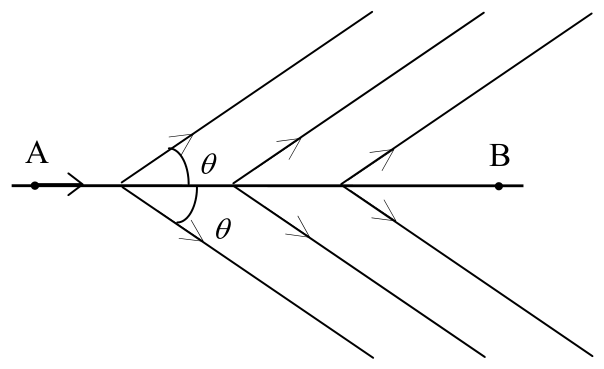
1. To establish this fact, consider a particle moving at constant velocity \(v>\frac{c}{n}\) on a straight line. It passes A at time 0 and B at time \(t_1\). As the problem is symmetric with respect to rotations around AB, it is sufficient to consider light rays in a plane containing AB.
At any point C between A and B, the particle emits a spherical light wave, which propagates with velocity \(\frac{c}{n}\). We define the wave front at a given time \(t\) as the envelope of all these spheres at this time.
1.1. Determine the wave front at time \(t_1\) and draw its intersection with a plane containing the trajectory of the particle.
1.2. Express the angle \(\varphi\) between this intersection and the trajectory of the particle in terms of \(n\) and \(\beta\).
2. Let us consider a beam of particles moving with velocity \(v>\frac{c}{n}\), such that the angle \(\theta\) is small, along a straight line IS. The beam crosses a concave spherical mirror of focal length \(f\) and center C, at point S. SC makes with SI a small angle \(\alpha\) (see the figure in the Answer Sheet). The particle beam creates a ring image in the focal plane of the mirror.
Explain why with the help of a sketch illustrating this fact. Give the position of the center O and the radius \(r\) of the ring image.
This set up is used in ring imaging Cherenkov counters (RICH) and the medium which the particle traverses is called the radiator.
Note: in all questions of the present problem, terms of second order and higher in \(\alpha\) and \(\theta\) will be neglected.
3. A beam of particles of known momentum \(p=10.0\ \mathrm{GeV}/c\) consists of three types of particles: protons, kaons and pions, with rest mass \(M_{\mathrm p}=0.94\ \mathrm{GeV}/c^2\), \(M_\kappa=0.50\ \mathrm{GeV}/c^2\) and \(M_\pi=0.14\ \mathrm{GeV}/c^2\), respectively. Remember that \(pc\) and \(Mc^2\) have the dimension of an energy, and 1 eV is the energy acquired by an electron after being accelerated by a voltage 1 V, and \(1\ \mathrm{GeV}=10^9\ \mathrm{eV}\), \(1\ \mathrm{MeV}=10^6\ \mathrm{eV}\).
The particle beam traverses an air medium (the radiator) under the pressure \(P\). The refraction index of air depends on the air pressure \(P\) according to the relation \(n=1+aP\) where \(a=2.7\times10^{-4}\ \mathrm{atm}^{-1}\)
3.1. Calculate for each of the three particle types the minimal value \(P_{\min}\) of the air pressure such that they emit Cherenkov light.
3.2. Calculate the pressure \(P_{\frac12}\) such that the ring image of kaons has a radius equal to one half of that corresponding to pions. Calculate the values of \(\theta_\kappa\) and \(\theta_\pi\) in this case.
Is it possible to observe the ring image of protons under this pressure?
4. Assume now that the beam is not perfectly monochromatic: the particles momenta are distributed over an interval centered at \(10\ \mathrm{GeV}/c\) having a half width at half height \(\Delta p\). This makes the ring image broaden, correspondingly \(\theta\) distribution has a half width at half height \(\Delta\theta\). The pressure of the radiator is \(P_{\frac12}\) determined in 3.2.
4.1. Calculate \(\frac{\Delta\theta_\kappa}{\Delta p}\) and \(\frac{\Delta\theta_\pi}{\Delta p}\), the values taken by \(\frac{\Delta\theta}{\Delta p}\) in the pions and kaons cases.
4.2. When the separation between the two ring images, \(\theta_\pi-\theta_\kappa\), is greater than 10 times the half-width sum \(\Delta\theta=\Delta\theta_\kappa+\Delta\theta_\pi\), that is \(\theta_\pi-\theta_\kappa>10\Delta\theta\), it is possible to distinguish well the two ring images. Calculate the maximal value of \(\Delta p\) such that the two ring images can still be well distinguished.
5. Cherenkov first discovered the effect bearing his name when he was observing a bottle of water located near a radioactive source. He saw that the water in the bottle emitted light.
5.1. Find out the minimal kinetic energy \(T_{\min}\) of a particle with a rest mass \(M\) moving in water, such that it emits Cherenkov light. The index of refraction of water is \(n=1.33\).
5.2. The radioactive source used by Cherenkov emits either \(\alpha\) particles (i.e. helium nuclei) having a rest mass \(M_\alpha=3.8\ \mathrm{GeV}/c^2\), or \(\beta\) particles (i.e. electrons) having a rest mass \(M_e=0.51\ \mathrm{MeV}/c^2\). Calculate the numerical values of \(T_{\min}\) for \(\alpha\) particles and \(\beta\) particles.
Knowing that the kinetic energy of particles emitted by radioactive sources never exceeds a few MeV, find out which particles give rise to the radiation observed by Cherenkov.
6. In the previous sections of the problem, the dependence of the Cherenkov effect on wavelength \(\lambda\) has been ignored. We now take into account the fact that the Cherenkov radiation of a particle has a broad continuous spectrum including the visible range (wavelengths from \(0.4\ \mu\mathrm m\) to \(0.8\ \mu\mathrm m\)). We know also that the index of refraction \(n\) of the radiator decreases linearly by 2% of \(n-1\) when \(\lambda\) increases over this range.
6.1. Consider a beam of pions with definite momentum of \(10.0\ \mathrm{GeV}/c\) moving in air at pressure 6 atm. Find out the angular difference \(\delta\theta\) associated with the two ends of the visible range.
6.2. On this basis, study qualitatively the effect of the dispersion on the ring image of pions with momentum distributed over an interval centered at \(p=10\ \mathrm{GeV}/c\) and having a half width at half height \(\Delta p=0.3\ \mathrm{GeV}/c\).
6.2.1. Calculate the broadening due to dispersion (varying refraction index) and that due to achromaticity of the beam (varying momentum).
6.2.2. Describe how the color of the ring changes when going from its inner to outer edges by checking the appropriate boxes in the Answer Sheet.
Official English text of the problem.
Answers
- 1.1. The common-tangent wave front is a right circular cone with vertex B and axis AB, opening backward along the trajectory. Its axial section consists of two tangent segments meeting at B. For emission beginning at A, the full outer boundary also includes the exposed rear cap of the first spherical wave.
- 1.2. \[ \boxed{\varphi=\arcsin\frac{1}{n\beta}},\qquad \theta=\frac{\pi}{2}-\varphi. \]
- 2. Let F be the midpoint of SC. The center O lies in the focal plane through F, in the plane ISC, on the opposite side of SC from I: \[ \boxed{FO\simeq f\alpha,\qquad CO\parallel IS,\qquad r\simeq f\theta.} \] The reference ray along IS reflects at S along SO.
- 3.1. \[ \boxed{P_{\min}=\frac{\sqrt{1+(Mc/p)^2}-1}{a}.} \] The threshold pressures are \[ \boxed{P_{\min,\mathrm p}\simeq16.3\ \mathrm{atm},\quad P_{\min,\kappa}\simeq4.63\ \mathrm{atm},\quad P_{\min,\pi}\simeq0.363\ \mathrm{atm}.} \] Nonzero emission requires pressure above the threshold.
- 3.2. \[ \boxed{P_{\frac12}\simeq6.05\ \mathrm{atm},\quad \theta_\kappa\simeq0.0277\ \mathrm{rad},\quad \theta_\pi\simeq0.0554\ \mathrm{rad}.} \] Protons produce no ring at this pressure.
- 4.1. \[ \boxed{\frac{\Delta\theta_\kappa}{\Delta p} \simeq9.0\times10^{-3}\frac{\mathrm{rad}}{\mathrm{GeV}/c},\qquad \frac{\Delta\theta_\pi}{\Delta p} \simeq3.5\times10^{-4}\frac{\mathrm{rad}}{\mathrm{GeV}/c}.} \]
- 4.2. The limiting half-width is \[ \boxed{\Delta p_{\mathrm{lim}}\simeq0.296\ \mathrm{GeV}/c.} \] The stated strict separation criterion requires \(\Delta p<\Delta p_{\mathrm{lim}}\).
- 5.1. \[ \boxed{T_{\min}=Mc^2\left(\frac{n}{\sqrt{n^2-1}}-1\right) =0.5168\,Mc^2\quad(n=1.33).} \]
- 5.2. \[ \boxed{T_{\min,\alpha}\simeq2.0\ \mathrm{GeV},\qquad T_{\min,e}\simeq0.26\ \mathrm{MeV}.} \] The observed radiation is produced by the \(\beta\) particles, namely electrons.
- 6.1. \[ \boxed{\delta\theta=\theta(0.4\ \mu\mathrm m)-\theta(0.8\ \mu\mathrm m) \simeq5.9\times10^{-4}\ \mathrm{rad}=0.59\ \mathrm{mrad}.} \]
- 6.2.1. Dispersion gives a full visible-spectrum angular span of approximately \(0.59\ \mathrm{mrad}\). Momentum spread gives \[ \boxed{\Delta\theta_p\simeq0.11\ \mathrm{mrad}\ \text{(half-width)},\qquad 2\Delta\theta_p\simeq0.21\ \mathrm{mrad}\ \text{(FWHM)}.} \] Corresponding radial widths are obtained by multiplying these angular widths by \(f\).
- 6.2.2. The inner edge is red and the outer edge is blue/violet. Dominant wavelengths decrease outward; momentum spread blurs and mixes neighboring colors.
Solution
Angles are measured in radians. The mirror geometry is treated to first order in the small angles. The relativistic momentum–speed and Cherenkov relations are retained when evaluating the numerical results.
1.1. Wave-front construction
Write the light speed in the medium as \[ u=\frac{c}{n}. \]
Suppose the particle passes C at time \(t_C\). At time \(t_1\), the wave emitted there has radius \[ R_C=u(t_1-t_C), \] while the particle has moved from C to B through the distance \[ CB=v(t_1-t_C). \] Consequently, \[ \frac{R_C}{CB}=\frac{u}{v}=\frac{1}{n\beta}, \] independent of C.
In any plane containing AB, the spherical waves appear as circles. Their radii are proportional to their centers’ distances from B. They therefore have the same two tangent lines through B. Rotating these tangents about AB produces a right circular cone with its vertex at B, opening backward.
The required sketch is constructed as follows:
- Draw AB horizontally, with B to the right and \(AB=vt_1\).
- Draw the largest wave circle centered at A, with radius \(ut_1\).
- Draw smaller wave circles centered at intermediate points C, with radii \(u(t_1-t_C)\).
- Draw the upper and lower common tangents from B to these circles. Mark a tangency point T on the circle centered at A and draw \(AT\perp BT\).
For the finite emission interval A–B, the conical portion extends from B to the tangency circle on the first sphere. If the whole outer boundary of the disturbed region is shown, its rear portion is the exposed spherical cap centered at A.
1.2. Wave-front angle and Cherenkov angle
In the right triangle ATB, \[ AT=\frac{c}{n}t_1,\qquad AB=vt_1. \] The acute angle between the tangent BT and the trajectory line is \(\varphi\), so \[ \sin\varphi=\frac{AT}{AB} =\frac{c}{nv} =\frac{1}{n\beta}. \] Thus \[ \boxed{\varphi=\arcsin\frac{1}{n\beta}.} \]
The light rays are normal to the wave front. Therefore the angle \(\theta\) between a ray and the forward particle direction satisfies \[ \theta+\varphi=\frac{\pi}{2}, \] and hence \[ \boxed{\cos\theta=\sin\varphi=\frac{1}{n\beta}.} \] This establishes equation (1).
2. Formation, center and radius of the ring
Here C denotes the mirror’s center of curvature. Since the mirror is spherical, \[ SC=2f. \] Let F be the midpoint of SC; the paraxial focal plane is perpendicular to SC at F.
First consider a reference light ray traveling along the particle-beam direction IS and striking the mirror at S. The normal to the mirror at S is SC. By the law of reflection, the reflected ray SO makes the same angle \(\alpha\) with SC as SI does, on the opposite side.
Its intersection O with the focal plane consequently satisfies \[ FO=f\tan\alpha\simeq f\alpha, \qquad SO\simeq f. \] Because \(CF=SF=f\), the same construction gives \[ CO\parallel IS. \]
Now fix an azimuth around the particle trajectory. All Cherenkov rays emitted at that azimuth have the same direction, even when emitted at different points of the trajectory. They form a parallel bundle, which the mirror focuses to one point in its focal plane.
Changing the azimuth changes the ray direction around a cone of half-angle \(\theta\). A paraxial mirror converts an angular displacement into a focal-plane displacement equal to \(f\) times that angle. Thus the image points have coordinates relative to O of the form \[ X=f\theta\cos\psi,\qquad Y=f\theta\sin\psi, \] where \(\psi\) is the azimuth. Therefore \[ X^2+Y^2=f^2\theta^2, \] which is a circle: \[ \boxed{r=f\theta.} \]
For the sketch, draw S at the right, C to its left, and F halfway between them. Put I above SC. The reference ray reflects at S toward O below SC. Draw the focal plane through F and mark the two ring intersections in the plane ISC at signed distances \[ -f\alpha+f\theta,\qquad -f\alpha-f\theta \] from F, taking the side toward I as positive. These points are separated by \(2f\theta\) and have midpoint O. The corresponding points from all azimuths form the ring.
3.1. Threshold pressures
Relativistic energy and momentum obey \[ E^2=p^2c^2+M^2c^4,\qquad \beta=\frac{pc}{E}. \] It is convenient to define \[ q=\frac{1}{\beta} =\sqrt{1+\left(\frac{Mc}{p}\right)^2}. \] The Cherenkov condition is \[ n\beta>1. \] At the threshold, \[ n_{\min}=q. \] Using \(n=1+aP\), \[ \boxed{P_{\min} =\frac{q-1}{a} =\frac{\sqrt{1+(Mc/p)^2}-1}{a}.} \]
With the supplied masses and \(p=10.0\ \mathrm{GeV}/c\):
| Particle | \(\beta\) | \(P_{\min}\) |
|---|---|---|
| Proton | \(0.995611\) | \(16.3\ \mathrm{atm}\) |
| Kaon | \(0.998752\) | \(4.63\ \mathrm{atm}\) |
| Pion | \(0.999902\) | \(0.363\ \mathrm{atm}\) |
At equality the Cherenkov angle is zero; a nonzero ring requires pressure above the threshold.
3.2. Pressure for a kaon ring of half the pion radius
Since \(r=f\theta\), the required radius ratio gives \[ \theta_\pi=2\theta_\kappa \] to the stated optical accuracy.
For each species, \[ \cos\theta_i=\frac{q_i}{n}, \qquad q_i=\sqrt{1+\left(\frac{M_i c}{p}\right)^2}. \] Using the double-angle identity, \[ \frac{q_\pi}{n} =\cos(2\theta_\kappa) =2\left(\frac{q_\kappa}{n}\right)^2-1. \] Thus \[ n^2+q_\pi n-2q_\kappa^2=0. \] The positive root is \[ n_*=\frac{\sqrt{q_\pi^2+8q_\kappa^2}-q_\pi}{2}. \]
Numerically, \[ q_\kappa=\sqrt{1+0.050^2},\qquad q_\pi=\sqrt{1+0.014^2}, \] giving \[ n_*\simeq1.00163306. \] Therefore \[ \boxed{P_{\frac12}=\frac{n_*-1}{a}\simeq6.05\ \mathrm{atm}.} \]
The corresponding angles are \[ \theta_\kappa=\arccos\frac{q_\kappa}{n_*} \simeq0.027685\ \mathrm{rad}, \] \[ \theta_\pi=\arccos\frac{q_\pi}{n_*} \simeq0.055371\ \mathrm{rad}. \] Hence \[ \boxed{\theta_\kappa\simeq27.7\ \mathrm{mrad},\qquad \theta_\pi\simeq55.4\ \mathrm{mrad}.} \]
The proton threshold is \(16.3\ \mathrm{atm}\), substantially above this pressure. Thus \[ \boxed{\text{No proton ring is produced.}} \]
4.1. Angular broadening from momentum spread
At fixed pressure, \(n\) is constant. Differentiate \[ \cos\theta=\frac{q}{n}, \qquad q=\sqrt{1+\frac{M^2c^2}{p^2}}. \] Since \[ \frac{dq}{dp}=-\frac{M^2c^2}{p^3q}, \] we obtain \[ \frac{d\theta}{dp} =\frac{M^2c^2}{np^3q\sin\theta}. \] Using \(q=1/\beta\) and \(q/n=\cos\theta\), this can also be written \[ \boxed{\frac{d\theta}{dp} =\frac{1-\beta^2}{p}\cot\theta.} \]
For a narrow momentum distribution, its transformation is locally linear, so \[ \Delta\theta\simeq \left|\frac{d\theta}{dp}\right|\Delta p. \] The derivative is positive: increasing momentum increases the Cherenkov angle.
Evaluating at \(p=10.0\ \mathrm{GeV}/c\) and the pressure from 3.2 gives \[ \left.\frac{d\theta}{dp}\right|_\kappa \simeq9.005\times10^{-3} \frac{\mathrm{rad}}{\mathrm{GeV}/c}, \] \[ \left.\frac{d\theta}{dp}\right|_\pi \simeq3.535\times10^{-4} \frac{\mathrm{rad}}{\mathrm{GeV}/c}. \] Therefore \[ \boxed{\frac{\Delta\theta_\kappa}{\Delta p} \simeq9.0\times10^{-3} \frac{\mathrm{rad}}{\mathrm{GeV}/c},} \] \[ \boxed{\frac{\Delta\theta_\pi}{\Delta p} \simeq3.5\times10^{-4} \frac{\mathrm{rad}}{\mathrm{GeV}/c}.} \]
4.2. Largest permitted momentum half-width
The required separation condition is \[ \theta_\pi-\theta_\kappa> 10\left(\Delta\theta_\kappa+\Delta\theta_\pi\right). \] Substituting the linear broadening relations gives \[ \Delta p< \frac{\theta_\pi-\theta_\kappa} {10\left[ (d\theta/dp)_\kappa+(d\theta/dp)_\pi \right]}. \]
Using the unrounded values, \[ \Delta p_{\mathrm{lim}} \simeq \frac{0.027685} {10(0.0090052+0.00035355)} \ \mathrm{GeV}/c. \] Thus \[ \boxed{\Delta p_{\mathrm{lim}}\simeq0.296\ \mathrm{GeV}/c.} \]
This is approximately \(3.0\%\) of the central momentum. Since the problem states a strict inequality, the well-distinguished regime is \[ \boxed{\Delta p<0.296\ \mathrm{GeV}/c.} \]
5.1. Kinetic-energy threshold in water
The relativistic kinetic energy is \[ T=(\gamma-1)Mc^2,\qquad \gamma=\frac{1}{\sqrt{1-\beta^2}}. \] At the Cherenkov threshold, \[ \beta_{\min}=\frac{1}{n}. \] Therefore \[ \gamma_{\min} =\frac{1}{\sqrt{1-1/n^2}} =\frac{n}{\sqrt{n^2-1}}, \] and \[ \boxed{ T_{\min} =Mc^2\left(\frac{n}{\sqrt{n^2-1}}-1\right). } \]
For water, \[ n=1.33,\qquad \gamma_{\min}\simeq1.51676, \] so \[ \boxed{T_{\min}\simeq0.5168\,Mc^2.} \] Nonzero radiation requires kinetic energy above this threshold.
5.2. Alpha particles and electrons
For an alpha particle, \[ T_{\min,\alpha} =0.51676(3.8\ \mathrm{GeV}) \simeq1.96\ \mathrm{GeV} \simeq2.0\ \mathrm{GeV}. \]
For an electron, \[ T_{\min,e} =0.51676(0.51\ \mathrm{MeV}) \simeq0.264\ \mathrm{MeV} \simeq0.26\ \mathrm{MeV}. \]
An alpha particle with kinetic energy of only a few MeV is far below its threshold of approximately \(1960\ \mathrm{MeV}\). Electrons with energies of a few MeV can readily exceed their threshold. Consequently, \[ \boxed{\text{The observed Cherenkov radiation is produced by electrons.}} \]
6.1. Angular difference across the visible spectrum
At \(P=6\ \mathrm{atm}\), \[ n=1+aP =1+(2.7\times10^{-4})(6) =1.00162. \] The magnitude of the refractive-index decrease across the visible range is \[ \delta n=0.02(n-1) =3.24\times10^{-5}. \]
For \(10.0\ \mathrm{GeV}/c\) pions, the representative Cherenkov angle is \[ \theta_0 =\arccos\left(\frac{\sqrt{1+(0.14/10.0)^2}}{1.00162}\right) \simeq0.05513\ \mathrm{rad}. \]
At fixed particle speed, differentiating \[ \cos\theta=\frac{1}{\beta n} \] with respect to \(n\) gives \[ -\sin\theta\,\frac{d\theta}{dn} =-\frac{1}{\beta n^2}. \] Hence \[ \boxed{\frac{d\theta}{dn}=\frac{\cot\theta}{n}.} \]
To first order in the index change, \[ \delta\theta \simeq\frac{\cot\theta_0}{n}\,\delta n \simeq5.86\times10^{-4}\ \mathrm{rad}. \] Thus \[ \boxed{\delta\theta\simeq5.9\times10^{-4}\ \mathrm{rad} =0.59\ \mathrm{mrad}.} \]
The shorter wavelength has the larger index and therefore the larger angle: \[ \theta(0.4\ \mu\mathrm m)>\theta(0.8\ \mu\mathrm m). \]
6.2.1. Dispersion broadening and momentum broadening
The dispersion broadening is the full angular span between the two visible endpoints: \[ \boxed{w_{\mathrm{disp}}=\delta\theta\simeq0.59\ \mathrm{mrad}.} \] The corresponding radial span is \[ \boxed{w_{r,\mathrm{disp}}=f\delta\theta \simeq5.9\times10^{-4}f.} \]
For the momentum spread, use the derivative from 4.1, now evaluated at \(6\ \mathrm{atm}\): \[ \left.\frac{d\theta}{dp}\right|_{\pi,\,6\,\mathrm{atm}} =\frac{1-\beta_\pi^2}{p}\cot\theta_0 \simeq3.55\times10^{-4} \frac{\mathrm{rad}}{\mathrm{GeV}/c}. \] With \(\Delta p=0.3\ \mathrm{GeV}/c\), \[ \Delta\theta_p \simeq(3.55\times10^{-4})(0.3) =1.07\times10^{-4}\ \mathrm{rad}. \] Therefore \[ \boxed{\Delta\theta_p\simeq0.11\ \mathrm{mrad}} \] is the half-width at half height, while \[ \boxed{w_{p,\mathrm{FWHM}}=2\Delta\theta_p \simeq0.21\ \mathrm{mrad}} \] is the full width at half maximum.
The corresponding radial half-width and FWHM are \[ \Delta r_p\simeq1.1\times10^{-4}f, \qquad w_{r,p,\mathrm{FWHM}}\simeq2.1\times10^{-4}f. \]
The visible-spectrum span from dispersion is about \(2.8\) times the momentum-induced FWHM. Dispersion therefore supplies the larger broadening scale. A unique combined FWHM cannot be calculated without specifying the momentum profile and the spectral weighting.
6.2.2. Color ordering across the ring
Because \[ \frac{dn}{d\lambda}<0, \qquad \frac{d\theta}{dn}=\frac{\cot\theta}{n}>0, \] we have \[ \frac{d\theta}{d\lambda}<0. \] Since \(r=f\theta\), \[ \boxed{\frac{dr}{d\lambda}<0.} \]
Longer wavelengths therefore produce smaller radii. The correct color choice is:
- Inner edge: red, corresponding to the longer wavelengths.
- Moving outward: progressively shorter dominant wavelengths, with neighboring colors overlapping.
- Outer edge: blue/violet, corresponding to the shortest wavelengths.
The momentum spread blurs this ordering, but its characteristic width is smaller than the chromatic span, so the red-inner, violet-outer pattern remains.
The solution was checked against the official solution.
IPhO 2008 · Theorieaufgabe 2
Tscherenkow-Licht und ringabbildender Zähler
Licht breitet sich im Vakuum mit der Geschwindigkeit \(c\) aus. Kein Teilchen bewegt sich mit einer Geschwindigkeit größer als \(c\). In einem transparenten Medium kann sich ein Teilchen jedoch mit einer Geschwindigkeit \(v\) bewegen, die größer ist als die Lichtgeschwindigkeit in demselben Medium \(\frac{c}{n}\), wobei \(n\) der Brechungsindex des Mediums ist. Experiment (Cherenkov, 1934) und Theorie (Tamm und Frank, 1937) zeigten, dass ein geladenes Teilchen, das sich in einem transparenten Medium mit dem Brechungsindex \(n\) mit einer Geschwindigkeit \(v\) bewegt, für die \(v>\frac{c}{n}\) gilt, Licht aussendet, das als Tscherenkow-Licht bezeichnet wird. Die Ausbreitungsrichtungen dieses Lichts bilden mit der Teilchenbahn den Winkel
\[ \theta=\arccos\frac{1}{\beta n} \tag{1} \]
wobei \(\beta=\frac{v}{c}\).
1. Um diesen Sachverhalt herzuleiten, betrachten wir ein Teilchen, das sich mit konstanter Geschwindigkeit \(v>\frac{c}{n}\) geradlinig bewegt. Es passiert A zum Zeitpunkt 0 und B zum Zeitpunkt \(t_1\). Da das Problem bezüglich Drehungen um AB symmetrisch ist, genügt es, Lichtstrahlen in einer Ebene zu betrachten, die AB enthält.
An jedem Punkt C zwischen A und B emittiert das Teilchen eine kugelförmige Lichtwelle, die sich mit der Geschwindigkeit \(\frac{c}{n}\) ausbreitet. Wir definieren die Wellenfront zu einem gegebenen Zeitpunkt \(t\) als die Einhüllende all dieser Kugeln zu diesem Zeitpunkt.
1.1. Bestimmen Sie die Wellenfront zum Zeitpunkt \(t_1\) und zeichnen Sie ihre Schnittlinie mit einer Ebene, die die Teilchenbahn enthält.
1.2. Drücken Sie den Winkel \(\varphi\) zwischen dieser Schnittlinie und der Teilchenbahn durch \(n\) und \(\beta\) aus.
2. Betrachten wir einen Teilchenstrahl, der sich entlang einer Geraden IS mit der Geschwindigkeit \(v>\frac{c}{n}\) bewegt, wobei der Winkel \(\theta\) klein ist. Der Strahl durchquert einen konkaven Kugelspiegel mit der Brennweite \(f\) und dem Mittelpunkt C am Punkt S. SC bildet mit SI einen kleinen Winkel \(\alpha\) (siehe die Abbildung auf dem Antwortblatt). Der Teilchenstrahl erzeugt in der Brennebene des Spiegels ein Ringbild.
Erklären Sie anhand einer Skizze, warum dies der Fall ist. Geben Sie die Lage des Mittelpunkts O und den Radius \(r\) des Ringbildes an.
Diese Anordnung wird in ringabbildenden Tscherenkow-Zählern (RICH) verwendet, und das Medium, das das Teilchen durchquert, wird als Radiator bezeichnet.
Hinweis: In allen Teilaufgaben dieser Aufgabe werden Terme zweiter und höherer Ordnung in \(\alpha\) und \(\theta\) vernachlässigt.
3. Ein Teilchenstrahl mit bekanntem Impuls \(p=10.0\ \mathrm{GeV}/c\) besteht aus drei Teilchensorten: Protonen, Kaonen und Pionen mit den jeweiligen Ruhemassen \(M_{\mathrm p}=0.94\ \mathrm{GeV}/c^2\), \(M_\kappa=0.50\ \mathrm{GeV}/c^2\) und \(M_\pi=0.14\ \mathrm{GeV}/c^2\). Denken Sie daran, dass \(pc\) und \(Mc^2\) die Dimension einer Energie haben und dass 1 eV die Energie ist, die ein Elektron bei der Beschleunigung durch eine Spannung von 1 V gewinnt, sowie dass \(1\ \mathrm{GeV}=10^9\ \mathrm{eV}\), \(1\ \mathrm{MeV}=10^6\ \mathrm{eV}\).
Der Teilchenstrahl durchquert Luft (den Radiator) unter dem Druck \(P\). Der Brechungsindex der Luft hängt vom Luftdruck \(P\) gemäß der Beziehung \(n=1+aP\) ab, wobei \(a=2.7\times10^{-4}\ \mathrm{atm}^{-1}\)
3.1. Berechnen Sie für jede der drei Teilchensorten den minimalen Luftdruck \(P_{\min}\), bei dem sie Tscherenkow-Licht emittieren.
3.2. Berechnen Sie den Druck \(P_{\frac12}\), bei dem der Radius des Ringbildes der Kaonen halb so groß ist wie derjenige der Pionen. Berechnen Sie für diesen Fall die Werte von \(\theta_\kappa\) und \(\theta_\pi\).
Kann bei diesem Druck das Ringbild der Protonen beobachtet werden?
4. Nehmen Sie nun an, dass der Strahl nicht vollkommen monochromatisch ist: Die Teilchenimpulse sind über ein Intervall mit dem Mittelpunkt \(10\ \mathrm{GeV}/c\) und der halben Breite bei halber Höhe \(\Delta p\) verteilt. Dadurch wird das Ringbild verbreitert; entsprechend hat die Verteilung von \(\theta\) eine halbe Breite bei halber Höhe \(\Delta\theta\). Der Druck des Radiators ist der in 3.2 bestimmte Wert \(P_{\frac12}\).
4.1. Berechnen Sie \(\frac{\Delta\theta_\kappa}{\Delta p}\) und \(\frac{\Delta\theta_\pi}{\Delta p}\), also die Werte von \(\frac{\Delta\theta}{\Delta p}\) für Pionen und Kaonen.
4.2. Wenn der Abstand zwischen den beiden Ringbildern, \(\theta_\pi-\theta_\kappa\), größer als das Zehnfache der Summe der halben Breiten \(\Delta\theta=\Delta\theta_\kappa+\Delta\theta_\pi\) ist, also \(\theta_\pi-\theta_\kappa>10\Delta\theta\), lassen sich die beiden Ringbilder gut unterscheiden. Berechnen Sie den maximalen Wert von \(\Delta p\), bei dem sich die beiden Ringbilder noch gut unterscheiden lassen.
5. Cherenkov entdeckte den nach ihm benannten Effekt erstmals, als er eine Flasche Wasser in der Nähe einer radioaktiven Quelle beobachtete. Er sah, dass das Wasser in der Flasche Licht aussandte.
5.1. Bestimmen Sie die minimale kinetische Energie \(T_{\min}\) eines Teilchens mit der Ruhemasse \(M\), das sich in Wasser bewegt, bei der es Tscherenkow-Licht emittiert. Der Brechungsindex von Wasser beträgt \(n=1.33\).
5.2. Die von Cherenkov verwendete radioaktive Quelle emittiert entweder \(\alpha\)-Teilchen (also Heliumkerne) mit der Ruhemasse \(M_\alpha=3.8\ \mathrm{GeV}/c^2\) oder \(\beta\)-Teilchen (also Elektronen) mit der Ruhemasse \(M_e=0.51\ \mathrm{MeV}/c^2\). Berechnen Sie die Zahlenwerte von \(T_{\min}\) für \(\alpha\)-Teilchen und \(\beta\)-Teilchen.
Bestimmen Sie unter Berücksichtigung der Tatsache, dass die kinetische Energie der von radioaktiven Quellen emittierten Teilchen niemals mehr als einige MeV beträgt, welche Teilchen die von Cherenkov beobachtete Strahlung hervorrufen.
6. In den vorherigen Teilen der Aufgabe wurde die Abhängigkeit des Tscherenkow-Effekts von der Wellenlänge \(\lambda\) außer Acht gelassen. Nun berücksichtigen wir, dass die Tscherenkow-Strahlung eines Teilchens ein breites kontinuierliches Spektrum besitzt, das den sichtbaren Bereich einschließt (Wellenlängen von \(0.4\ \mu\mathrm m\) bis \(0.8\ \mu\mathrm m\)). Außerdem wissen wir, dass der Brechungsindex \(n\) des Radiators linear um 2% von \(n-1\) abnimmt, wenn \(\lambda\) über diesen Bereich zunimmt.
6.1. Betrachten Sie einen Pionenstrahl mit einem eindeutig bestimmten Impuls von \(10.0\ \mathrm{GeV}/c\), der sich in Luft bei einem Druck von 6 atm bewegt. Bestimmen Sie die Winkeldifferenz \(\delta\theta\) zwischen den beiden Enden des sichtbaren Bereichs.
6.2. Untersuchen Sie auf dieser Grundlage qualitativ den Einfluss der Dispersion auf das Ringbild von Pionen, deren Impulse über ein Intervall mit dem Mittelpunkt \(p=10\ \mathrm{GeV}/c\) und der halben Breite bei halber Höhe \(\Delta p=0.3\ \mathrm{GeV}/c\) verteilt sind.
6.2.1. Berechnen Sie die Verbreiterung durch Dispersion (veränderlicher Brechungsindex) und diejenige durch die fehlende Monochromatizität des Strahls (veränderlicher Impuls).
6.2.2. Beschreiben Sie, wie sich die Farbe des Rings vom inneren zum äußeren Rand verändert, indem Sie die entsprechenden Kästchen auf dem Antwortblatt ankreuzen.
Aufgabentext aus dem offiziellen englischen Text übersetzt.
Antworten
- 1.1. Die durch gemeinsame Tangenten gebildete Wellenfront ist ein gerader Kreiskegel mit der Spitze B und der Achse AB, der sich entlang der Teilchenbahn nach hinten öffnet. Sein Achsenschnitt besteht aus zwei Tangentenstrecken, die sich in B treffen. Beginnt die Emission in A, umfasst die vollständige äußere Begrenzung außerdem die freiliegende hintere Kalotte der ersten Kugelwelle.
- 1.2. \[ \boxed{\varphi=\arcsin\frac{1}{n\beta}},\qquad \theta=\frac{\pi}{2}-\varphi. \]
- 2. Sei F der Mittelpunkt der Strecke SC. Der Mittelpunkt O liegt in der Brennebene durch F, in der Ebene ISC, auf der I gegenüberliegenden Seite von SC: \[ \boxed{FO\simeq f\alpha,\qquad CO\parallel IS,\qquad r\simeq f\theta.} \] Der Referenzstrahl entlang IS wird in S entlang SO reflektiert.
- 3.1. \[ \boxed{P_{\min}=\frac{\sqrt{1+(Mc/p)^2}-1}{a}.} \] Die Schwellendrücke betragen \[ \boxed{P_{\min,\mathrm p}\simeq16.3\ \mathrm{atm},\quad P_{\min,\kappa}\simeq4.63\ \mathrm{atm},\quad P_{\min,\pi}\simeq0.363\ \mathrm{atm}.} \] Eine von null verschiedene Emission erfordert einen Druck oberhalb der Schwelle.
- 3.2. \[ \boxed{P_{\frac12}\simeq6.05\ \mathrm{atm},\quad \theta_\kappa\simeq0.0277\ \mathrm{rad},\quad \theta_\pi\simeq0.0554\ \mathrm{rad}.} \] Protonen erzeugen bei diesem Druck keinen Ring.
- 4.1. \[ \boxed{\frac{\Delta\theta_\kappa}{\Delta p} \simeq9.0\times10^{-3}\frac{\mathrm{rad}}{\mathrm{GeV}/c},\qquad \frac{\Delta\theta_\pi}{\Delta p} \simeq3.5\times10^{-4}\frac{\mathrm{rad}}{\mathrm{GeV}/c}.} \]
- 4.2. Der Grenzwert der halben Breite beträgt \[ \boxed{\Delta p_{\mathrm{lim}}\simeq0.296\ \mathrm{GeV}/c.} \] Das angegebene strenge Trennkriterium erfordert \(\Delta p<\Delta p_{\mathrm{lim}}\).
- 5.1. \[ \boxed{T_{\min}=Mc^2\left(\frac{n}{\sqrt{n^2-1}}-1\right) =0.5168\,Mc^2\quad(n=1.33).} \]
- 5.2. \[ \boxed{T_{\min,\alpha}\simeq2.0\ \mathrm{GeV},\qquad T_{\min,e}\simeq0.26\ \mathrm{MeV}.} \] Die beobachtete Strahlung wird von den \(\beta\)-Teilchen, also Elektronen, erzeugt.
- 6.1. \[ \boxed{\delta\theta=\theta(0.4\ \mu\mathrm m)-\theta(0.8\ \mu\mathrm m) \simeq5.9\times10^{-4}\ \mathrm{rad}=0.59\ \mathrm{mrad}.} \]
- 6.2.1. Die Dispersion ergibt über das gesamte sichtbare Spektrum eine Winkelspanne von ungefähr \(0.59\ \mathrm{mrad}\). Die Impulsstreuung ergibt \[ \boxed{\Delta\theta_p\simeq0.11\ \mathrm{mrad}\ \text{(halbe Breite)},\qquad 2\Delta\theta_p\simeq0.21\ \mathrm{mrad}\ \text{(FWHM)}.} \] Die entsprechenden radialen Breiten erhält man durch Multiplikation dieser Winkelbreiten mit \(f\).
- 6.2.2. Der innere Rand ist rot und der äußere Rand blau/violett. Die dominierenden Wellenlängen nehmen nach außen hin ab; die Impulsstreuung verwischt und vermischt benachbarte Farben.
Lösung
Winkel werden im Bogenmaß angegeben. Die Spiegelgeometrie wird in erster Ordnung in den kleinen Winkeln behandelt. Bei der Berechnung der numerischen Ergebnisse werden die relativistische Beziehung zwischen Impuls und Geschwindigkeit sowie die Tscherenkow-Beziehung beibehalten.
1.1. Konstruktion der Wellenfront
Wir schreiben die Lichtgeschwindigkeit im Medium als \[ u=\frac{c}{n}. \]
Das Teilchen passiere C zum Zeitpunkt \(t_C\). Zum Zeitpunkt \(t_1\) hat die dort emittierte Welle den Radius \[ R_C=u(t_1-t_C), \] während das Teilchen von C nach B die Strecke \[ CB=v(t_1-t_C) \] zurückgelegt hat. Folglich ist \[ \frac{R_C}{CB}=\frac{u}{v}=\frac{1}{n\beta}, \] unabhängig von C.
In jeder Ebene, die AB enthält, erscheinen die Kugelwellen als Kreise. Ihre Radien sind proportional zu den Abständen ihrer Mittelpunkte von B. Daher besitzen sie dieselben zwei Tangenten durch B. Durch Rotation dieser Tangenten um AB entsteht ein gerader Kreiskegel mit der Spitze B, der sich nach hinten öffnet.
Die geforderte Skizze wird folgendermaßen konstruiert:
- Zeichnen Sie AB waagerecht, mit B rechts und \(AB=vt_1\).
- Zeichnen Sie den größten Wellenkreis mit dem Mittelpunkt A und dem Radius \(ut_1\).
- Zeichnen Sie kleinere Wellenkreise mit Mittelpunkten an dazwischenliegenden Punkten C und den Radien \(u(t_1-t_C)\).
- Zeichnen Sie die obere und die untere gemeinsame Tangente von B an diese Kreise. Markieren Sie einen Berührpunkt T auf dem Kreis mit dem Mittelpunkt A und zeichnen Sie \(AT\perp BT\).
Für das endliche Emissionsintervall A–B erstreckt sich der kegelförmige Teil von B bis zum Berührkreis auf der ersten Kugel. Wird die gesamte äußere Begrenzung des von den Wellen erfassten Bereichs dargestellt, so ist ihr hinterer Teil die freiliegende Kugelkalotte mit dem Mittelpunkt A.
1.2. Wellenfrontwinkel und Tscherenkow-Winkel
Im rechtwinkligen Dreieck ATB gilt \[ AT=\frac{c}{n}t_1,\qquad AB=vt_1. \] Der spitze Winkel zwischen der Tangente BT und der Bahngeraden ist \(\varphi\), also \[ \sin\varphi=\frac{AT}{AB} =\frac{c}{nv} =\frac{1}{n\beta}. \] Somit gilt \[ \boxed{\varphi=\arcsin\frac{1}{n\beta}.} \]
Die Lichtstrahlen stehen senkrecht auf der Wellenfront. Daher erfüllt der Winkel \(\theta\) zwischen einem Strahl und der Vorwärtsrichtung des Teilchens die Beziehung \[ \theta+\varphi=\frac{\pi}{2}, \] und somit \[ \boxed{\cos\theta=\sin\varphi=\frac{1}{n\beta}.} \] Damit ist Gleichung (1) hergeleitet.
2. Entstehung, Mittelpunkt und Radius des Rings
Hier bezeichnet C den Krümmungsmittelpunkt des Spiegels. Da der Spiegel kugelförmig ist, gilt \[ SC=2f. \] Sei F der Mittelpunkt der Strecke SC; die paraxiale Brennebene steht in F senkrecht auf SC.
Betrachten wir zunächst einen Referenzlichtstrahl, der sich entlang der Teilchenstrahlrichtung IS ausbreitet und in S auf den Spiegel trifft. Die Normale auf den Spiegel in S ist SC. Nach dem Reflexionsgesetz bildet der reflektierte Strahl SO mit SC denselben Winkel \(\alpha\) wie SI, jedoch auf der gegenüberliegenden Seite.
Sein Schnittpunkt O mit der Brennebene erfüllt daher \[ FO=f\tan\alpha\simeq f\alpha, \qquad SO\simeq f. \] Da \(CF=SF=f\), ergibt dieselbe Konstruktion \[ CO\parallel IS. \]
Nun wählen wir einen festen Azimut um die Teilchenbahn. Alle unter diesem Azimut emittierten Tscherenkow-Strahlen haben dieselbe Richtung, auch wenn sie an verschiedenen Punkten der Bahn emittiert werden. Sie bilden ein paralleles Bündel, das der Spiegel auf einen Punkt in seiner Brennebene fokussiert.
Eine Änderung des Azimuts lässt die Strahlrichtung auf einem Kegel mit dem halben Öffnungswinkel \(\theta\) umlaufen. Ein paraxialer Spiegel wandelt eine Winkelabweichung in eine Verschiebung in der Brennebene um, die gleich \(f\) mal diesem Winkel ist. Somit haben die Bildpunkte relativ zu O Koordinaten der Form \[ X=f\theta\cos\psi,\qquad Y=f\theta\sin\psi, \] wobei \(\psi\) der Azimut ist. Daher gilt \[ X^2+Y^2=f^2\theta^2, \] was einen Kreis beschreibt: \[ \boxed{r=f\theta.} \]
Zeichnen Sie für die Skizze S rechts, C links davon und F in der Mitte zwischen beiden. Platzieren Sie I oberhalb von SC. Der Referenzstrahl wird in S zu O unterhalb von SC reflektiert. Zeichnen Sie die Brennebene durch F und markieren Sie die beiden Schnittpunkte des Rings mit der Ebene ISC bei den vorzeichenbehafteten Abständen \[ -f\alpha+f\theta,\qquad -f\alpha-f\theta \] von F, wobei die Seite in Richtung I als positiv gilt. Diese Punkte haben den Abstand \(2f\theta\) voneinander und den Mittelpunkt O. Die entsprechenden Punkte für alle Azimute bilden den Ring.
3.1. Schwellendrücke
Für relativistische Energie und relativistischen Impuls gilt \[ E^2=p^2c^2+M^2c^4,\qquad \beta=\frac{pc}{E}. \] Zweckmäßigerweise definieren wir \[ q=\frac{1}{\beta} =\sqrt{1+\left(\frac{Mc}{p}\right)^2}. \] Die Tscherenkow-Bedingung lautet \[ n\beta>1. \] An der Schwelle gilt \[ n_{\min}=q. \] Mit \(n=1+aP\) folgt \[ \boxed{P_{\min} =\frac{q-1}{a} =\frac{\sqrt{1+(Mc/p)^2}-1}{a}.} \]
Mit den angegebenen Massen und \(p=10.0\ \mathrm{GeV}/c\):
| Teilchen | \(\beta\) | \(P_{\min}\) |
|---|---|---|
| Proton | \(0.995611\) | \(16.3\ \mathrm{atm}\) |
| Kaon | \(0.998752\) | \(4.63\ \mathrm{atm}\) |
| Pion | \(0.999902\) | \(0.363\ \mathrm{atm}\) |
Bei Gleichheit ist der Tscherenkow-Winkel null; ein Ring mit von null verschiedenem Radius erfordert einen Druck oberhalb der Schwelle.
3.2. Druck für einen Kaonenring mit dem halben Pionenradius
Da \(r=f\theta\), ergibt das geforderte Radienverhältnis \[ \theta_\pi=2\theta_\kappa \] innerhalb der angegebenen optischen Genauigkeit.
Für jede Teilchensorte gilt \[ \cos\theta_i=\frac{q_i}{n}, \qquad q_i=\sqrt{1+\left(\frac{M_i c}{p}\right)^2}. \] Mit der Doppelwinkelformel folgt \[ \frac{q_\pi}{n} =\cos(2\theta_\kappa) =2\left(\frac{q_\kappa}{n}\right)^2-1. \] Somit gilt \[ n^2+q_\pi n-2q_\kappa^2=0. \] Die positive Lösung lautet \[ n_*=\frac{\sqrt{q_\pi^2+8q_\kappa^2}-q_\pi}{2}. \]
Numerisch ist \[ q_\kappa=\sqrt{1+0.050^2},\qquad q_\pi=\sqrt{1+0.014^2}, \] woraus sich \[ n_*\simeq1.00163306 \] ergibt. Daher gilt \[ \boxed{P_{\frac12}=\frac{n_*-1}{a}\simeq6.05\ \mathrm{atm}.} \]
Die entsprechenden Winkel sind \[ \theta_\kappa=\arccos\frac{q_\kappa}{n_*} \simeq0.027685\ \mathrm{rad}, \] \[ \theta_\pi=\arccos\frac{q_\pi}{n_*} \simeq0.055371\ \mathrm{rad}. \] Somit gilt \[ \boxed{\theta_\kappa\simeq27.7\ \mathrm{mrad},\qquad \theta_\pi\simeq55.4\ \mathrm{mrad}.} \]
Die Protonenschwelle liegt bei \(16.3\ \mathrm{atm}\), deutlich oberhalb dieses Drucks. Somit gilt \[ \boxed{\text{Es entsteht kein Protonenring.}} \]
4.1. Winkelverbreiterung durch Impulsstreuung
Bei festem Druck ist \(n\) konstant. Wir differenzieren \[ \cos\theta=\frac{q}{n}, \qquad q=\sqrt{1+\frac{M^2c^2}{p^2}}. \] Da \[ \frac{dq}{dp}=-\frac{M^2c^2}{p^3q}, \] erhalten wir \[ \frac{d\theta}{dp} =\frac{M^2c^2}{np^3q\sin\theta}. \] Mit \(q=1/\beta\) und \(q/n=\cos\theta\) lässt sich dies auch schreiben als \[ \boxed{\frac{d\theta}{dp} =\frac{1-\beta^2}{p}\cot\theta.} \]
Für eine schmale Impulsverteilung ist die Umrechnung lokal linear, sodass \[ \Delta\theta\simeq \left|\frac{d\theta}{dp}\right|\Delta p. \] Die Ableitung ist positiv: Mit zunehmendem Impuls nimmt der Tscherenkow-Winkel zu.
Die Auswertung bei \(p=10.0\ \mathrm{GeV}/c\) und dem Druck aus 3.2 ergibt \[ \left.\frac{d\theta}{dp}\right|_\kappa \simeq9.005\times10^{-3} \frac{\mathrm{rad}}{\mathrm{GeV}/c}, \] \[ \left.\frac{d\theta}{dp}\right|_\pi \simeq3.535\times10^{-4} \frac{\mathrm{rad}}{\mathrm{GeV}/c}. \] Daher gilt \[ \boxed{\frac{\Delta\theta_\kappa}{\Delta p} \simeq9.0\times10^{-3} \frac{\mathrm{rad}}{\mathrm{GeV}/c},} \] \[ \boxed{\frac{\Delta\theta_\pi}{\Delta p} \simeq3.5\times10^{-4} \frac{\mathrm{rad}}{\mathrm{GeV}/c}.} \]
4.2. Größte zulässige halbe Impulsbreite
Die geforderte Trennbedingung lautet \[ \theta_\pi-\theta_\kappa> 10\left(\Delta\theta_\kappa+\Delta\theta_\pi\right). \] Einsetzen der linearen Beziehungen für die Verbreiterung ergibt \[ \Delta p< \frac{\theta_\pi-\theta_\kappa} {10\left[ (d\theta/dp)_\kappa+(d\theta/dp)_\pi \right]}. \]
Mit den ungerundeten Werten folgt \[ \Delta p_{\mathrm{lim}} \simeq \frac{0.027685} {10(0.0090052+0.00035355)} \ \mathrm{GeV}/c. \] Somit gilt \[ \boxed{\Delta p_{\mathrm{lim}}\simeq0.296\ \mathrm{GeV}/c.} \]
Dies entspricht ungefähr \(3.0\%\) des zentralen Impulses. Da die Aufgabe eine strenge Ungleichung vorgibt, lassen sich die Ringe gut unterscheiden, wenn \[ \boxed{\Delta p<0.296\ \mathrm{GeV}/c.} \]
5.1. Schwelle der kinetischen Energie in Wasser
Die relativistische kinetische Energie ist \[ T=(\gamma-1)Mc^2,\qquad \gamma=\frac{1}{\sqrt{1-\beta^2}}. \] An der Tscherenkow-Schwelle gilt \[ \beta_{\min}=\frac{1}{n}. \] Daher ist \[ \gamma_{\min} =\frac{1}{\sqrt{1-1/n^2}} =\frac{n}{\sqrt{n^2-1}}, \] und \[ \boxed{ T_{\min} =Mc^2\left(\frac{n}{\sqrt{n^2-1}}-1\right). } \]
Für Wasser gilt \[ n=1.33,\qquad \gamma_{\min}\simeq1.51676, \] also \[ \boxed{T_{\min}\simeq0.5168\,Mc^2.} \] Eine von null verschiedene Strahlung erfordert eine kinetische Energie oberhalb dieser Schwelle.
5.2. Alphateilchen und Elektronen
Für ein Alphateilchen gilt \[ T_{\min,\alpha} =0.51676(3.8\ \mathrm{GeV}) \simeq1.96\ \mathrm{GeV} \simeq2.0\ \mathrm{GeV}. \]
Für ein Elektron gilt \[ T_{\min,e} =0.51676(0.51\ \mathrm{MeV}) \simeq0.264\ \mathrm{MeV} \simeq0.26\ \mathrm{MeV}. \]
Ein Alphateilchen mit einer kinetischen Energie von nur wenigen MeV liegt weit unter seiner Schwelle von ungefähr \(1960\ \mathrm{MeV}\). Elektronen mit Energien von einigen MeV können ihre Schwelle ohne Weiteres überschreiten. Folglich gilt \[ \boxed{\text{Die beobachtete Tscherenkow-Strahlung wird von Elektronen erzeugt.}} \]
6.1. Winkeldifferenz über das sichtbare Spektrum
Bei \(P=6\ \mathrm{atm}\) gilt \[ n=1+aP =1+(2.7\times10^{-4})(6) =1.00162. \] Der Betrag der Abnahme des Brechungsindex über den sichtbaren Bereich ist \[ \delta n=0.02(n-1) =3.24\times10^{-5}. \]
Für Pionen mit \(10.0\ \mathrm{GeV}/c\) ist der repräsentative Tscherenkow-Winkel \[ \theta_0 =\arccos\left(\frac{\sqrt{1+(0.14/10.0)^2}}{1.00162}\right) \simeq0.05513\ \mathrm{rad}. \]
Bei fester Teilchengeschwindigkeit ergibt die Differentiation von \[ \cos\theta=\frac{1}{\beta n} \] nach \(n\) \[ -\sin\theta\,\frac{d\theta}{dn} =-\frac{1}{\beta n^2}. \] Somit gilt \[ \boxed{\frac{d\theta}{dn}=\frac{\cot\theta}{n}.} \]
In erster Ordnung in der Änderung des Brechungsindex gilt \[ \delta\theta \simeq\frac{\cot\theta_0}{n}\,\delta n \simeq5.86\times10^{-4}\ \mathrm{rad}. \] Damit folgt \[ \boxed{\delta\theta\simeq5.9\times10^{-4}\ \mathrm{rad} =0.59\ \mathrm{mrad}.} \]
Die kürzere Wellenlänge hat den größeren Brechungsindex und daher den größeren Winkel: \[ \theta(0.4\ \mu\mathrm m)>\theta(0.8\ \mu\mathrm m). \]
6.2.1. Verbreiterung durch Dispersion und Impulsstreuung
Die Dispersionsverbreiterung ist die gesamte Winkelspanne zwischen den beiden Enden des sichtbaren Bereichs: \[ \boxed{w_{\mathrm{disp}}=\delta\theta\simeq0.59\ \mathrm{mrad}.} \] Die entsprechende radiale Spanne beträgt \[ \boxed{w_{r,\mathrm{disp}}=f\delta\theta \simeq5.9\times10^{-4}f.} \]
Für die Impulsstreuung verwenden wir die Ableitung aus 4.1, nun ausgewertet bei \(6\ \mathrm{atm}\): \[ \left.\frac{d\theta}{dp}\right|_{\pi,\,6\,\mathrm{atm}} =\frac{1-\beta_\pi^2}{p}\cot\theta_0 \simeq3.55\times10^{-4} \frac{\mathrm{rad}}{\mathrm{GeV}/c}. \] Mit \(\Delta p=0.3\ \mathrm{GeV}/c\) gilt \[ \Delta\theta_p \simeq(3.55\times10^{-4})(0.3) =1.07\times10^{-4}\ \mathrm{rad}. \] Daher ist \[ \boxed{\Delta\theta_p\simeq0.11\ \mathrm{mrad}} \] die halbe Breite bei halber Höhe, während \[ \boxed{w_{p,\mathrm{FWHM}}=2\Delta\theta_p \simeq0.21\ \mathrm{mrad}} \] die volle Breite bei halbem Maximum ist.
Die entsprechende radiale halbe Breite und FWHM betragen \[ \Delta r_p\simeq1.1\times10^{-4}f, \qquad w_{r,p,\mathrm{FWHM}}\simeq2.1\times10^{-4}f. \]
Die durch Dispersion verursachte Spanne des sichtbaren Spektrums ist etwa \(2.8\)-mal so groß wie die durch den Impuls verursachte FWHM. Die Dispersion liefert daher den größeren Beitrag zur Verbreiterung. Ohne Angabe des Impulsprofils und der spektralen Gewichtung lässt sich keine eindeutige kombinierte FWHM berechnen.
6.2.2. Farbreihenfolge über den Ring
Da \[ \frac{dn}{d\lambda}<0, \qquad \frac{d\theta}{dn}=\frac{\cot\theta}{n}>0, \] gilt \[ \frac{d\theta}{d\lambda}<0. \] Wegen \(r=f\theta\) folgt \[ \boxed{\frac{dr}{d\lambda}<0.} \]
Längere Wellenlängen erzeugen daher kleinere Radien. Die richtige Farbauswahl lautet:
- Innerer Rand: rot, entsprechend den längeren Wellenlängen.
- Nach außen hin: zunehmend kürzere dominierende Wellenlängen, wobei benachbarte Farben einander überlagern.
- Äußerer Rand: blau/violett, entsprechend den kürzesten Wellenlängen.
Die Impulsstreuung verwischt diese Reihenfolge, aber ihre charakteristische Breite ist kleiner als die chromatische Spanne, sodass das Muster mit Rot innen und Violett außen erhalten bleibt.
Die Lösung wurde mit der offiziellen Lösung abgeglichen.
IPhO 2008 · Teori sorusu 2
Cherenkov Işığı ve Halka Görüntüleme Sayacı
Işık boşlukta \(c\) hızıyla yayılır. \(c\)'den daha büyük bir hızla hareket eden hiçbir parçacık yoktur. Bununla birlikte, saydam bir ortamda bir parçacığın, aynı ortamdaki ışık hızı \(\frac{c}{n}\)'den daha büyük bir \(v\) hızıyla hareket etmesi mümkündür; burada \(n\), ortamın kırılma indisidir. Deney (Cherenkov, 1934) ve kuram (Tamm ve Frank, 1937), kırılma indisi \(n\) olan saydam bir ortamda \(v>\frac{c}{n}\) koşulunu sağlayan bir \(v\) hızıyla hareket eden yüklü bir parçacığın, yörüngesiyle
\[ \theta=\arccos\frac{1}{\beta n} \tag{1} \]
açısını yapan doğrultularda Cherenkov ışığı adı verilen ışık yaydığını göstermiştir; burada \(\beta=\frac{v}{c}\)'dir.
1. Bu sonucu göstermek için, bir doğru üzerinde sabit \(v>\frac{c}{n}\) hızıyla hareket eden bir parçacığı ele alın. Parçacık, 0 anında A'dan ve \(t_1\) anında B'den geçmektedir. Problem AB etrafındaki dönmelere göre simetrik olduğundan, AB'yi içeren bir düzlemdeki ışık ışınlarını ele almak yeterlidir.
Parçacık, A ile B arasındaki herhangi bir C noktasında, \(\frac{c}{n}\) hızıyla yayılan küresel bir ışık dalgası yayar. Belirli bir \(t\) anındaki dalga cephesini, bu andaki tüm bu kürelerin zarfı olarak tanımlıyoruz.
1.1. \(t_1\) anındaki dalga cephesini belirleyin ve parçacığın yörüngesini içeren bir düzlemle kesişimini çizin.
1.2. Bu kesişim ile parçacığın yörüngesi arasındaki \(\varphi\) açısını \(n\) ve \(\beta\) cinsinden ifade edin.
2. Bir IS doğrusu boyunca, \(\theta\) açısı küçük olacak şekilde \(v>\frac{c}{n}\) hızıyla hareket eden bir parçacık demetini ele alalım. Demet, odak uzaklığı \(f\) ve merkezi C olan çukur bir küresel aynayı S noktasında kesmektedir. SC, SI ile küçük bir \(\alpha\) açısı yapmaktadır (Cevap Kâğıdı'ndaki şekle bakın). Parçacık demeti, aynanın odak düzleminde halka biçiminde bir görüntü oluşturur.
Bu durumu gösteren bir çizim yardımıyla nedenini açıklayın. Halka görüntüsünün O merkezinin konumunu ve \(r\) yarıçapını verin.
Bu düzenek, halka görüntülemeli Cherenkov sayaçlarında (RICH) kullanılır ve parçacığın içinden geçtiği ortama ışıyıcı denir.
Not: Bu problemin tüm sorularında, \(\alpha\) ve \(\theta\)'ya göre ikinci ve daha yüksek mertebeden terimler ihmal edilecektir.
3. Momentumu \(p=10.0\ \mathrm{GeV}/c\) olarak bilinen bir parçacık demeti üç tür parçacıktan oluşmaktadır: durgun kütleleri sırasıyla \(M_{\mathrm p}=0.94\ \mathrm{GeV}/c^2\), \(M_\kappa=0.50\ \mathrm{GeV}/c^2\) ve \(M_\pi=0.14\ \mathrm{GeV}/c^2\) olan protonlar, kaonlar ve pionlar. \(pc\) ve \(Mc^2\)'nin enerji boyutunda olduğunu, 1 eV'un bir elektronun 1 V'luk bir gerilimle hızlandırıldıktan sonra kazandığı enerji olduğunu ve \(1\ \mathrm{GeV}=10^9\ \mathrm{eV}\), \(1\ \mathrm{MeV}=10^6\ \mathrm{eV}\) olduğunu hatırlayın.
Parçacık demeti, \(P\) basıncı altındaki bir hava ortamından (ışıyıcıdan) geçmektedir. Havanın kırılma indisi, hava basıncı \(P\)'ye \(n=1+aP\) bağıntısına göre bağlıdır; burada \(a=2.7\times10^{-4}\ \mathrm{atm}^{-1}\)'dir.
3.1. Üç parçacık türünün her biri için, Cherenkov ışığı yaymalarını sağlayan en küçük hava basıncı değerini, \(P_{\min}\)'i hesaplayın.
3.2. Kaonların halka görüntüsünün yarıçapının, pionlarınkine karşılık gelen yarıçapın yarısına eşit olmasını sağlayan \(P_{\frac12}\) basıncını hesaplayın. Bu durumda \(\theta_\kappa\) ve \(\theta_\pi\) değerlerini hesaplayın.
Bu basınç altında protonların halka görüntüsünü gözlemlemek mümkün müdür?
4. Şimdi demetin tam olarak monokromatik olmadığını varsayın: parçacıkların momentumları, merkezi \(10\ \mathrm{GeV}/c\) olan ve yarı yükseklikteki yarı genişliği \(\Delta p\) olan bir aralığa dağılmıştır. Bu, halka görüntüsünün genişlemesine yol açar; buna karşılık \(\theta\) dağılımının yarı yükseklikteki yarı genişliği \(\Delta\theta\) olur. Işıyıcının basıncı, 3.2'de belirlenen \(P_{\frac12}\)'dir.
4.1. \(\frac{\Delta\theta}{\Delta p}\)'nin pionlar ve kaonlar için aldığı değerler olan \(\frac{\Delta\theta_\kappa}{\Delta p}\) ve \(\frac{\Delta\theta_\pi}{\Delta p}\)'yi hesaplayın.
4.2. İki halka görüntüsü arasındaki ayrım, \(\theta_\pi-\theta_\kappa\), yarı genişlikler toplamı \(\Delta\theta=\Delta\theta_\kappa+\Delta\theta_\pi\)'nin 10 katından büyük olduğunda, yani \(\theta_\pi-\theta_\kappa>10\Delta\theta\) olduğunda, iki halka görüntüsünü iyi bir şekilde ayırt etmek mümkündür. İki halka görüntüsünün hâlâ iyi bir şekilde ayırt edilebilmesini sağlayan en büyük \(\Delta p\) değerini hesaplayın.
5. Cherenkov, kendi adını taşıyan etkiyi ilk kez radyoaktif bir kaynağın yakınında bulunan bir su şişesini gözlemlerken keşfetmiştir. Şişedeki suyun ışık yaydığını görmüştür.
5.1. Suda hareket eden, durgun kütlesi \(M\) olan bir parçacığın Cherenkov ışığı yaymasını sağlayan en küçük kinetik enerjiyi, \(T_{\min}\)'i bulun. Suyun kırılma indisi \(n=1.33\)'tür.
5.2. Cherenkov'un kullandığı radyoaktif kaynak, durgun kütlesi \(M_\alpha=3.8\ \mathrm{GeV}/c^2\) olan \(\alpha\) parçacıkları (yani helyum çekirdekleri) ya da durgun kütlesi \(M_e=0.51\ \mathrm{MeV}/c^2\) olan \(\beta\) parçacıkları (yani elektronlar) yaymaktadır. \(\alpha\) parçacıkları ve \(\beta\) parçacıkları için \(T_{\min}\)'in sayısal değerlerini hesaplayın.
Radyoaktif kaynaklardan yayılan parçacıkların kinetik enerjisinin hiçbir zaman birkaç MeV'u aşmadığını bilerek, Cherenkov'un gözlemlediği ışımaya hangi parçacıkların yol açtığını bulun.
6. Problemin önceki bölümlerinde, Cherenkov etkisinin dalga boyu \(\lambda\)'ya bağlılığı göz ardı edilmiştir. Şimdi, bir parçacığın Cherenkov ışımasının görünür bölgeyi (\(0.4\ \mu\mathrm m\) ile \(0.8\ \mu\mathrm m\) arasındaki dalga boylarını) de içeren geniş ve sürekli bir tayfa sahip olduğunu dikkate alıyoruz. Ayrıca, \(\lambda\) bu aralık boyunca arttığında, ışıyıcının kırılma indisi \(n\)'nin doğrusal olarak \(n-1\)'in %2'si kadar azaldığını biliyoruz.
6.1. Basıncı 6 atm olan havada hareket eden, momentumu kesin olarak \(10.0\ \mathrm{GeV}/c\) olan bir pion demetini ele alın. Görünür bölgenin iki ucuna karşılık gelen açısal farkı, \(\delta\theta\)'yı bulun.
6.2. Buna dayanarak, momentumları merkezi \(p=10\ \mathrm{GeV}/c\) olan ve yarı yükseklikteki yarı genişliği \(\Delta p=0.3\ \mathrm{GeV}/c\) olan bir aralığa dağılmış pionların halka görüntüsü üzerinde dispersiyonun etkisini nitel olarak inceleyin.
6.2.1. Dispersiyondan (değişen kırılma indisinden) ve demetin akromatikliğinden (değişen momentumdan) kaynaklanan genişlemeleri hesaplayın.
6.2.2. Cevap Kâğıdı'ndaki uygun kutuları işaretleyerek, halkanın iç kenarından dış kenarına doğru gidildiğinde renginin nasıl değiştiğini belirtin.
Soru metni resmi İngilizce metinden çevrilmiştir.
Cevaplar
- 1.1. Ortak teğetlerin oluşturduğu dalga cephesi, tepesi B ve ekseni AB olan, yörünge boyunca geriye doğru açılan bir dik dairesel konidir. Eksen kesiti, B'de birleşen iki teğet doğru parçasından oluşur. Işımanın A'da başlaması durumunda, tam dış sınır ilk küresel dalganın açıkta kalan arka küresel başlığını da içerir.
- 1.2. \[ \boxed{\varphi=\arcsin\frac{1}{n\beta}},\qquad \theta=\frac{\pi}{2}-\varphi. \]
- 2. F, SC'nin orta noktası olsun. O merkezi, F'den geçen odak düzleminde, ISC düzlemi içinde ve SC'nin I'ya göre karşı tarafında yer alır: \[ \boxed{FO\simeq f\alpha,\qquad CO\parallel IS,\qquad r\simeq f\theta.} \] IS boyunca gelen referans ışını, S'de SO boyunca yansır.
- 3.1. \[ \boxed{P_{\min}=\frac{\sqrt{1+(Mc/p)^2}-1}{a}.} \] Eşik basınçları şöyledir: \[ \boxed{P_{\min,\mathrm p}\simeq16.3\ \mathrm{atm},\quad P_{\min,\kappa}\simeq4.63\ \mathrm{atm},\quad P_{\min,\pi}\simeq0.363\ \mathrm{atm}.} \] Sıfırdan farklı bir ışıma için basıncın eşiğin üzerinde olması gerekir.
- 3.2. \[ \boxed{P_{\frac12}\simeq6.05\ \mathrm{atm},\quad \theta_\kappa\simeq0.0277\ \mathrm{rad},\quad \theta_\pi\simeq0.0554\ \mathrm{rad}.} \] Protonlar bu basınçta halka oluşturmaz.
- 4.1. \[ \boxed{\frac{\Delta\theta_\kappa}{\Delta p} \simeq9.0\times10^{-3}\frac{\mathrm{rad}}{\mathrm{GeV}/c},\qquad \frac{\Delta\theta_\pi}{\Delta p} \simeq3.5\times10^{-4}\frac{\mathrm{rad}}{\mathrm{GeV}/c}.} \]
- 4.2. Sınır yarı genişlik şöyledir: \[ \boxed{\Delta p_{\mathrm{lim}}\simeq0.296\ \mathrm{GeV}/c.} \] Belirtilen kesin ayrım ölçütü, \(\Delta p<\Delta p_{\mathrm{lim}}\) olmasını gerektirir.
- 5.1. \[ \boxed{T_{\min}=Mc^2\left(\frac{n}{\sqrt{n^2-1}}-1\right) =0.5168\,Mc^2\quad(n=1.33).} \]
- 5.2. \[ \boxed{T_{\min,\alpha}\simeq2.0\ \mathrm{GeV},\qquad T_{\min,e}\simeq0.26\ \mathrm{MeV}.} \] Gözlemlenen ışımayı \(\beta\) parçacıkları, yani elektronlar üretir.
- 6.1. \[ \boxed{\delta\theta=\theta(0.4\ \mu\mathrm m)-\theta(0.8\ \mu\mathrm m) \simeq5.9\times10^{-4}\ \mathrm{rad}=0.59\ \mathrm{mrad}.} \]
- 6.2.1. Dispersiyon, görünür tayfın tamamı için yaklaşık \(0.59\ \mathrm{mrad}\)'lık bir açısal aralık verir. Momentum yayılımı ise şu sonucu verir: \[ \boxed{\Delta\theta_p\simeq0.11\ \mathrm{mrad}\ \text{(yarı genişlik)},\qquad 2\Delta\theta_p\simeq0.21\ \mathrm{mrad}\ \text{(FWHM)}.} \] Karşılık gelen radyal genişlikler, bu açısal genişlikler \(f\) ile çarpılarak elde edilir.
- 6.2.2. İç kenar kırmızı, dış kenar ise mavi/mordur. Baskın dalga boyları dışa doğru azalır; momentum yayılımı komşu renkleri bulanıklaştırır ve birbirine karıştırır.
Çözüm
Açılar radyan cinsinden ölçülmektedir. Ayna geometrisi, küçük açılara göre birinci mertebede ele alınmaktadır. Sayısal sonuçlar hesaplanırken göreli momentum–hız ve Cherenkov bağıntıları korunmaktadır.
1.1. Dalga cephesinin çizimi
Ortamdaki ışık hızını şöyle yazalım: \[ u=\frac{c}{n}. \]
Parçacığın C'den \(t_C\) anında geçtiğini varsayalım. \(t_1\) anında, burada yayılan dalganın yarıçapı \[ R_C=u(t_1-t_C), \] olurken parçacık C'den B'ye \[ CB=v(t_1-t_C). \] uzaklığını katetmiştir. Dolayısıyla, \[ \frac{R_C}{CB}=\frac{u}{v}=\frac{1}{n\beta}, \] oranı C'den bağımsızdır.
AB'yi içeren herhangi bir düzlemde, küresel dalgalar çember olarak görünür. Yarıçapları, merkezlerinin B'ye olan uzaklıklarıyla orantılıdır. Bu nedenle, B'den geçen aynı iki teğet doğruya sahiptirler. Bu teğetlerin AB etrafında döndürülmesi, tepesi B'de olan ve geriye doğru açılan bir dik dairesel koni oluşturur.
İstenen çizim şu şekilde oluşturulur:
- B sağda olacak ve \(AB=vt_1\) olacak şekilde AB'yi yatay çizin.
- Merkezi A ve yarıçapı \(ut_1\) olan en büyük dalga çemberini çizin.
- Merkezleri aradaki C noktalarında olan, yarıçapları \(u(t_1-t_C)\) olan daha küçük dalga çemberleri çizin.
- B'den bu çemberlere üst ve alt ortak teğetleri çizin. A merkezli çember üzerindeki bir teğet noktasını T ile işaretleyin ve \(AT\perp BT\) olacak şekilde AT'yi çizin.
Sonlu A–B ışıma aralığı için, konik bölüm B'den ilk küre üzerindeki teğet çemberine kadar uzanır. Etkilenen bölgenin tüm dış sınırı gösteriliyorsa, bu sınırın arka kısmı A merkezli, açıkta kalan küresel başlıktır.
1.2. Dalga cephesi açısı ve Cherenkov açısı
ATB dik üçgeninde, \[ AT=\frac{c}{n}t_1,\qquad AB=vt_1. \] BT teğeti ile yörünge doğrusu arasındaki dar açı \(\varphi\) olduğundan, \[ \sin\varphi=\frac{AT}{AB} =\frac{c}{nv} =\frac{1}{n\beta}. \] Böylece \[ \boxed{\varphi=\arcsin\frac{1}{n\beta}.} \]
Işık ışınları dalga cephesine diktir. Bu nedenle, bir ışın ile parçacığın ileri hareket yönü arasındaki \(\theta\) açısı \[ \theta+\varphi=\frac{\pi}{2}, \] bağıntısını sağlar ve buradan \[ \boxed{\cos\theta=\sin\varphi=\frac{1}{n\beta}.} \] elde edilir. Böylece (1) denklemi gösterilmiş olur.
2. Halkanın oluşumu, merkezi ve yarıçapı
Burada C, aynanın eğrilik merkezini göstermektedir. Ayna küresel olduğundan, \[ SC=2f. \] F, SC'nin orta noktası olsun; paraksiyal odak düzlemi F'de SC'ye diktir.
Önce, parçacık demetinin IS yönünde ilerleyen ve aynaya S'de çarpan bir referans ışık ışınını ele alalım. Aynanın S'deki normali SC'dir. Yansıma yasasına göre, yansıyan SO ışını SC ile, SI'nın yaptığı \(\alpha\) açısının aynısını karşı tarafta yapar.
Dolayısıyla, bu ışının odak düzlemiyle kesiştiği O noktası için \[ FO=f\tan\alpha\simeq f\alpha, \qquad SO\simeq f. \] geçerlidir. \(CF=SF=f\) olduğundan, aynı geometrik çizim \[ CO\parallel IS. \] sonucunu verir.
Şimdi parçacık yörüngesi etrafında bir azimut açısı sabitleyelim. Bu azimutta yayılan tüm Cherenkov ışınları, yörüngenin farklı noktalarından yayılsalar bile aynı doğrultudadır. Aynanın odak düzlemindeki bir noktaya odakladığı paralel bir demet oluştururlar.
Azimutun değiştirilmesi, ışının yönünü yarı açısı \(\theta\) olan bir koni etrafında değiştirir. Paraksiyal bir ayna, açısal bir sapmayı odak düzleminde bu açının \(f\) katına eşit bir yer değiştirmeye dönüştürür. Böylece görüntü noktalarının O'ya göre koordinatları \[ X=f\theta\cos\psi,\qquad Y=f\theta\sin\psi, \] biçimindedir; burada \(\psi\) azimut açısıdır. Dolayısıyla \[ X^2+Y^2=f^2\theta^2, \] bağıntısı, yarıçapı \[ \boxed{r=f\theta.} \] olan bir çemberi ifade eder.
Çizim için S'yi sağa, C'yi onun soluna ve F'yi ikisinin tam ortasına yerleştirin. I'yı SC'nin üstüne koyun. Referans ışını S'de yansıyarak SC'nin altındaki O'ya doğru gider. F'den geçen odak düzlemini çizin ve ISC düzlemindeki iki halka kesişimini, I'ya doğru olan tarafı pozitif alarak F'den itibaren \[ -f\alpha+f\theta,\qquad -f\alpha-f\theta \] işaretli uzaklıklarında işaretleyin. Bu noktaların arası \(2f\theta\)'dır ve orta noktaları O'dur. Tüm azimutlara karşılık gelen noktalar halkayı oluşturur.
3.1. Eşik basınçları
Göreli enerji ve momentum şu bağıntıları sağlar: \[ E^2=p^2c^2+M^2c^4,\qquad \beta=\frac{pc}{E}. \] Şu tanımı yapmak kullanışlıdır: \[ q=\frac{1}{\beta} =\sqrt{1+\left(\frac{Mc}{p}\right)^2}. \] Cherenkov koşulu şöyledir: \[ n\beta>1. \] Eşikte, \[ n_{\min}=q. \] \(n=1+aP\) kullanıldığında, \[ \boxed{P_{\min} =\frac{q-1}{a} =\frac{\sqrt{1+(Mc/p)^2}-1}{a}.} \]
Verilen kütleler ve \(p=10.0\ \mathrm{GeV}/c\) ile:
| Parçacık | \(\beta\) | \(P_{\min}\) |
|---|---|---|
| Proton | \(0.995611\) | \(16.3\ \mathrm{atm}\) |
| Kaon | \(0.998752\) | \(4.63\ \mathrm{atm}\) |
| Pion | \(0.999902\) | \(0.363\ \mathrm{atm}\) |
Eşitlik durumunda Cherenkov açısı sıfırdır; yarıçapı sıfırdan farklı bir halka için basıncın eşiğin üzerinde olması gerekir.
3.2. Kaon halkasının yarıçapının pion halkasınınkinin yarısı olması için gereken basınç
\(r=f\theta\) olduğundan, istenen yarıçap oranı, belirtilen optik doğruluk düzeyinde \[ \theta_\pi=2\theta_\kappa \] sonucunu verir.
Her bir tür için, \[ \cos\theta_i=\frac{q_i}{n}, \qquad q_i=\sqrt{1+\left(\frac{M_i c}{p}\right)^2}. \] Çift açı özdeşliği kullanıldığında, \[ \frac{q_\pi}{n} =\cos(2\theta_\kappa) =2\left(\frac{q_\kappa}{n}\right)^2-1. \] Böylece \[ n^2+q_\pi n-2q_\kappa^2=0. \] Pozitif kök şöyledir: \[ n_*=\frac{\sqrt{q_\pi^2+8q_\kappa^2}-q_\pi}{2}. \]
Sayısal olarak, \[ q_\kappa=\sqrt{1+0.050^2},\qquad q_\pi=\sqrt{1+0.014^2}, \] değerleri \[ n_*\simeq1.00163306. \] sonucunu verir. Dolayısıyla \[ \boxed{P_{\frac12}=\frac{n_*-1}{a}\simeq6.05\ \mathrm{atm}.} \]
Karşılık gelen açılar şöyledir: \[ \theta_\kappa=\arccos\frac{q_\kappa}{n_*} \simeq0.027685\ \mathrm{rad}, \] \[ \theta_\pi=\arccos\frac{q_\pi}{n_*} \simeq0.055371\ \mathrm{rad}. \] Böylece \[ \boxed{\theta_\kappa\simeq27.7\ \mathrm{mrad},\qquad \theta_\pi\simeq55.4\ \mathrm{mrad}.} \]
Proton eşiği \(16.3\ \mathrm{atm}\) olup bu basıncın oldukça üzerindedir. Dolayısıyla \[ \boxed{\text{Proton halkası oluşmaz.}} \]
4.1. Momentum yayılımından kaynaklanan açısal genişleme
Sabit basınçta \(n\) sabittir. Şu bağıntının türevini alalım: \[ \cos\theta=\frac{q}{n}, \qquad q=\sqrt{1+\frac{M^2c^2}{p^2}}. \] \[ \frac{dq}{dp}=-\frac{M^2c^2}{p^3q}, \] olduğundan, \[ \frac{d\theta}{dp} =\frac{M^2c^2}{np^3q\sin\theta}. \] elde edilir. \(q=1/\beta\) ve \(q/n=\cos\theta\) kullanılarak bu bağıntı şöyle de yazılabilir: \[ \boxed{\frac{d\theta}{dp} =\frac{1-\beta^2}{p}\cot\theta.} \]
Dar bir momentum dağılımı için dönüşüm yerel olarak doğrusaldır; dolayısıyla \[ \Delta\theta\simeq \left|\frac{d\theta}{dp}\right|\Delta p. \] Türev pozitiftir: momentumun artması Cherenkov açısını artırır.
\(p=10.0\ \mathrm{GeV}/c\) ve 3.2'de bulunan basınç için hesaplandığında, \[ \left.\frac{d\theta}{dp}\right|_\kappa \simeq9.005\times10^{-3} \frac{\mathrm{rad}}{\mathrm{GeV}/c}, \] \[ \left.\frac{d\theta}{dp}\right|_\pi \simeq3.535\times10^{-4} \frac{\mathrm{rad}}{\mathrm{GeV}/c}. \] elde edilir. Dolayısıyla \[ \boxed{\frac{\Delta\theta_\kappa}{\Delta p} \simeq9.0\times10^{-3} \frac{\mathrm{rad}}{\mathrm{GeV}/c},} \] \[ \boxed{\frac{\Delta\theta_\pi}{\Delta p} \simeq3.5\times10^{-4} \frac{\mathrm{rad}}{\mathrm{GeV}/c}.} \]
4.2. İzin verilen en büyük momentum yarı genişliği
Gerekli ayrım koşulu şöyledir: \[ \theta_\pi-\theta_\kappa> 10\left(\Delta\theta_\kappa+\Delta\theta_\pi\right). \] Doğrusal genişleme bağıntıları yerine konulduğunda, \[ \Delta p< \frac{\theta_\pi-\theta_\kappa} {10\left[ (d\theta/dp)_\kappa+(d\theta/dp)_\pi \right]}. \]
Yuvarlanmamış değerler kullanıldığında, \[ \Delta p_{\mathrm{lim}} \simeq \frac{0.027685} {10(0.0090052+0.00035355)} \ \mathrm{GeV}/c. \] Böylece \[ \boxed{\Delta p_{\mathrm{lim}}\simeq0.296\ \mathrm{GeV}/c.} \]
Bu, merkez momentumun yaklaşık \(3.0\%\)'üdür. Problemde kesin bir eşitsizlik belirtildiğinden, halkaların iyi ayırt edilebildiği bölge şöyledir: \[ \boxed{\Delta p<0.296\ \mathrm{GeV}/c.} \]
5.1. Sudaki kinetik enerji eşiği
Göreli kinetik enerji şöyledir: \[ T=(\gamma-1)Mc^2,\qquad \gamma=\frac{1}{\sqrt{1-\beta^2}}. \] Cherenkov eşiğinde, \[ \beta_{\min}=\frac{1}{n}. \] Dolayısıyla \[ \gamma_{\min} =\frac{1}{\sqrt{1-1/n^2}} =\frac{n}{\sqrt{n^2-1}}, \] ve \[ \boxed{ T_{\min} =Mc^2\left(\frac{n}{\sqrt{n^2-1}}-1\right). } \]
Su için, \[ n=1.33,\qquad \gamma_{\min}\simeq1.51676, \] olduğundan, \[ \boxed{T_{\min}\simeq0.5168\,Mc^2.} \] Sıfırdan farklı bir ışıma için kinetik enerjinin bu eşiğin üzerinde olması gerekir.
5.2. Alfa parçacıkları ve elektronlar
Bir alfa parçacığı için, \[ T_{\min,\alpha} =0.51676(3.8\ \mathrm{GeV}) \simeq1.96\ \mathrm{GeV} \simeq2.0\ \mathrm{GeV}. \]
Bir elektron için, \[ T_{\min,e} =0.51676(0.51\ \mathrm{MeV}) \simeq0.264\ \mathrm{MeV} \simeq0.26\ \mathrm{MeV}. \]
Kinetik enerjisi yalnızca birkaç MeV olan bir alfa parçacığı, yaklaşık \(1960\ \mathrm{MeV}\) olan eşiğinin çok altındadır. Enerjileri birkaç MeV olan elektronlar ise eşiklerini kolayca aşabilir. Sonuç olarak, \[ \boxed{\text{Gözlemlenen Cherenkov ışımasını elektronlar üretir.}} \]
6.1. Görünür tayf boyunca açısal fark
\(P=6\ \mathrm{atm}\) için, \[ n=1+aP =1+(2.7\times10^{-4})(6) =1.00162. \] Görünür bölge boyunca kırılma indisindeki azalmanın büyüklüğü şöyledir: \[ \delta n=0.02(n-1) =3.24\times10^{-5}. \]
\(10.0\ \mathrm{GeV}/c\) momentumlu pionlar için temsili Cherenkov açısı şöyledir: \[ \theta_0 =\arccos\left(\frac{\sqrt{1+(0.14/10.0)^2}}{1.00162}\right) \simeq0.05513\ \mathrm{rad}. \]
Parçacık hızı sabitken, \[ \cos\theta=\frac{1}{\beta n} \] bağıntısının \(n\)'ye göre türevi alındığında, \[ -\sin\theta\,\frac{d\theta}{dn} =-\frac{1}{\beta n^2}. \] Böylece \[ \boxed{\frac{d\theta}{dn}=\frac{\cot\theta}{n}.} \]
İndis değişimine göre birinci mertebede, \[ \delta\theta \simeq\frac{\cot\theta_0}{n}\,\delta n \simeq5.86\times10^{-4}\ \mathrm{rad}. \] Dolayısıyla \[ \boxed{\delta\theta\simeq5.9\times10^{-4}\ \mathrm{rad} =0.59\ \mathrm{mrad}.} \]
Daha kısa dalga boyunda indis ve dolayısıyla açı daha büyüktür: \[ \theta(0.4\ \mu\mathrm m)>\theta(0.8\ \mu\mathrm m). \]
6.2.1. Dispersiyon genişlemesi ve momentum genişlemesi
Dispersiyon genişlemesi, görünür bölgenin iki uç noktası arasındaki tam açısal aralıktır: \[ \boxed{w_{\mathrm{disp}}=\delta\theta\simeq0.59\ \mathrm{mrad}.} \] Karşılık gelen radyal aralık şöyledir: \[ \boxed{w_{r,\mathrm{disp}}=f\delta\theta \simeq5.9\times10^{-4}f.} \]
Momentum yayılımı için, 4.1'deki türevi bu kez \(6\ \mathrm{atm}\) için hesaplayarak kullanalım: \[ \left.\frac{d\theta}{dp}\right|_{\pi,\,6\,\mathrm{atm}} =\frac{1-\beta_\pi^2}{p}\cot\theta_0 \simeq3.55\times10^{-4} \frac{\mathrm{rad}}{\mathrm{GeV}/c}. \] \(\Delta p=0.3\ \mathrm{GeV}/c\) ile, \[ \Delta\theta_p \simeq(3.55\times10^{-4})(0.3) =1.07\times10^{-4}\ \mathrm{rad}. \] Dolayısıyla \[ \boxed{\Delta\theta_p\simeq0.11\ \mathrm{mrad}} \] yarı yükseklikteki yarı genişlik iken, \[ \boxed{w_{p,\mathrm{FWHM}}=2\Delta\theta_p \simeq0.21\ \mathrm{mrad}} \] yarı maksimumdaki tam genişliktir.
Karşılık gelen radyal yarı genişlik ve FWHM şöyledir: \[ \Delta r_p\simeq1.1\times10^{-4}f, \qquad w_{r,p,\mathrm{FWHM}}\simeq2.1\times10^{-4}f. \]
Dispersiyondan kaynaklanan görünür tayf aralığı, momentumun yol açtığı FWHM'nin yaklaşık \(2.8\) katıdır. Dolayısıyla dispersiyon daha büyük genişleme ölçeğini belirler. Momentum profili ve tayfsal ağırlıklandırma belirtilmeden birleşik FWHM için tek bir değer hesaplanamaz.
6.2.2. Halka boyunca renk sıralaması
\[ \frac{dn}{d\lambda}<0, \qquad \frac{d\theta}{dn}=\frac{\cot\theta}{n}>0, \] olduğundan, \[ \frac{d\theta}{d\lambda}<0. \] \(r=f\theta\) olduğuna göre, \[ \boxed{\frac{dr}{d\lambda}<0.} \]
Dolayısıyla daha uzun dalga boyları daha küçük yarıçaplar oluşturur. Doğru renk seçimi şöyledir:
- İç kenar: daha uzun dalga boylarına karşılık gelen kırmızı.
- Dışa doğru ilerlerken: komşu renkler birbiriyle örtüşürken, baskın dalga boyları giderek kısalır.
- Dış kenar: en kısa dalga boylarına karşılık gelen mavi/mor.
Momentum yayılımı bu sıralamayı bulanıklaştırır, ancak karakteristik genişliği kromatik aralıktan daha küçük olduğundan, içte kırmızı ve dışta mor örüntüsü korunur.
Çözüm, resmi çözümle karşılaştırılarak kontrol edildi.
IPhO 2008 · Problema teórico 2
Luz Cherenkov y contador de imágenes anulares
La luz se propaga en el vacío con la velocidad \(c\). No hay ninguna partícula que se mueva con una velocidad superior a \(c\). Sin embargo, es posible que en un medio transparente una partícula se mueva con una velocidad \(v\) superior a la velocidad de la luz en ese mismo medio \(\frac{c}{n}\), donde \(n\) es el índice de refracción del medio. La experimentación (Cherenkov, 1934) y la teoría (Tamm y Frank, 1937) mostraron que una partícula cargada que se mueve con una velocidad \(v\) en un medio transparente de índice de refracción \(n\), de modo que \(v>\frac{c}{n}\), emite luz, denominada luz Cherenkov, en direcciones que forman con la trayectoria un ángulo
\[ \theta=\arccos\frac{1}{\beta n} \tag{1} \]
donde \(\beta=\frac{v}{c}\).
1. Para demostrar este hecho, considere una partícula que se mueve con velocidad constante \(v>\frac{c}{n}\) en línea recta. Pasa por A en el instante 0 y por B en el instante \(t_1\). Como el problema es simétrico respecto a las rotaciones alrededor de AB, basta con considerar los rayos luminosos en un plano que contenga AB.
En cualquier punto C entre A y B, la partícula emite una onda luminosa esférica que se propaga con velocidad \(\frac{c}{n}\). Definimos el frente de onda en un instante dado \(t\) como la envolvente de todas estas esferas en ese instante.
1.1. Determine el frente de onda en el instante \(t_1\) y dibuje su intersección con un plano que contenga la trayectoria de la partícula.
1.2. Exprese el ángulo \(\varphi\) entre esta intersección y la trayectoria de la partícula en función de \(n\) y \(\beta\).
2. Consideremos un haz de partículas que se mueven con velocidad \(v>\frac{c}{n}\), de modo que el ángulo \(\theta\) sea pequeño, a lo largo de una recta IS. El haz atraviesa un espejo esférico cóncavo de distancia focal \(f\) y centro C en el punto S. SC forma con SI un ángulo pequeño \(\alpha\) (véase la figura de la hoja de respuestas). El haz de partículas crea una imagen anular en el plano focal del espejo.
Explique por qué, con ayuda de un esquema que ilustre este hecho. Indique la posición del centro O y el radio \(r\) de la imagen anular.
Este montaje se utiliza en los contadores Cherenkov de imágenes anulares (RICH), y el medio que atraviesa la partícula se denomina radiador.
Nota: en todas las preguntas de este problema se despreciarán los términos de segundo orden y superiores en \(\alpha\) y \(\theta\).
3. Un haz de partículas de momento conocido \(p=10.0\ \mathrm{GeV}/c\) está formado por tres tipos de partículas: protones, kaones y piones, con masas en reposo \(M_{\mathrm p}=0.94\ \mathrm{GeV}/c^2\), \(M_\kappa=0.50\ \mathrm{GeV}/c^2\) y \(M_\pi=0.14\ \mathrm{GeV}/c^2\), respectivamente. Recuerde que \(pc\) y \(Mc^2\) tienen dimensiones de energía, que 1 eV es la energía adquirida por un electrón tras ser acelerado mediante una diferencia de potencial de 1 V, y que \(1\ \mathrm{GeV}=10^9\ \mathrm{eV}\), \(1\ \mathrm{MeV}=10^6\ \mathrm{eV}\).
El haz de partículas atraviesa un medio de aire (el radiador) a la presión \(P\). El índice de refracción del aire depende de la presión del aire \(P\) según la relación \(n=1+aP\), donde \(a=2.7\times10^{-4}\ \mathrm{atm}^{-1}\)
3.1. Calcule, para cada uno de los tres tipos de partículas, el valor mínimo \(P_{\min}\) de la presión del aire para que emitan luz Cherenkov.
3.2. Calcule la presión \(P_{\frac12}\) para la cual la imagen anular de los kaones tiene un radio igual a la mitad del correspondiente a los piones. Calcule los valores de \(\theta_\kappa\) y \(\theta_\pi\) en este caso.
¿Es posible observar la imagen anular de los protones a esta presión?
4. Suponga ahora que el haz no es perfectamente monocromático: los momentos de las partículas están distribuidos en un intervalo centrado en \(10\ \mathrm{GeV}/c\), con una semianchura a media altura \(\Delta p\). Esto hace que la imagen anular se ensanche; en consecuencia, la distribución de \(\theta\) tiene una semianchura a media altura \(\Delta\theta\). La presión del radiador es \(P_{\frac12}\), determinada en 3.2.
4.1. Calcule \(\frac{\Delta\theta_\kappa}{\Delta p}\) y \(\frac{\Delta\theta_\pi}{\Delta p}\), los valores que toma \(\frac{\Delta\theta}{\Delta p}\) en los casos de los piones y los kaones.
4.2. Cuando la separación entre las dos imágenes anulares, \(\theta_\pi-\theta_\kappa\), es mayor que 10 veces la suma de las semianchuras \(\Delta\theta=\Delta\theta_\kappa+\Delta\theta_\pi\), es decir, \(\theta_\pi-\theta_\kappa>10\Delta\theta\), es posible distinguir bien las dos imágenes anulares. Calcule el valor máximo de \(\Delta p\) para el cual todavía pueden distinguirse bien las dos imágenes anulares.
5. Cherenkov descubrió por primera vez el efecto que lleva su nombre mientras observaba una botella de agua situada cerca de una fuente radiactiva. Vio que el agua de la botella emitía luz.
5.1. Determine la energía cinética mínima \(T_{\min}\) de una partícula de masa en reposo \(M\) que se mueve en agua para que emita luz Cherenkov. El índice de refracción del agua es \(n=1.33\).
5.2. La fuente radiactiva utilizada por Cherenkov emite partículas \(\alpha\) (es decir, núcleos de helio), de masa en reposo \(M_\alpha=3.8\ \mathrm{GeV}/c^2\), o partículas \(\beta\) (es decir, electrones), de masa en reposo \(M_e=0.51\ \mathrm{MeV}/c^2\). Calcule los valores numéricos de \(T_{\min}\) para las partículas \(\alpha\) y las partículas \(\beta\).
Sabiendo que la energía cinética de las partículas emitidas por fuentes radiactivas nunca supera unos pocos MeV, determine qué partículas originan la radiación observada por Cherenkov.
6. En los apartados anteriores del problema se ha ignorado la dependencia del efecto Cherenkov con la longitud de onda \(\lambda\). Ahora tendremos en cuenta que la radiación Cherenkov de una partícula tiene un espectro continuo amplio que incluye el intervalo visible (longitudes de onda de \(0.4\ \mu\mathrm m\) a \(0.8\ \mu\mathrm m\)). Sabemos también que el índice de refracción \(n\) del radiador disminuye linealmente en un 2% de \(n-1\) cuando \(\lambda\) aumenta a lo largo de este intervalo.
6.1. Considere un haz de piones con un momento definido de \(10.0\ \mathrm{GeV}/c\) que se mueven en aire a una presión de 6 atm. Determine la diferencia angular \(\delta\theta\) asociada a los dos extremos del intervalo visible.
6.2. A partir de este resultado, estudie cualitativamente el efecto de la dispersión sobre la imagen anular de piones cuyo momento está distribuido en un intervalo centrado en \(p=10\ \mathrm{GeV}/c\), con una semianchura a media altura \(\Delta p=0.3\ \mathrm{GeV}/c\).
6.2.1. Calcule el ensanchamiento debido a la dispersión (variación del índice de refracción) y el debido a la falta de monocromaticidad del haz (variación del momento).
6.2.2. Describa cómo cambia el color del anillo al pasar de su borde interior al exterior marcando las casillas correspondientes en la hoja de respuestas.
Enunciado traducido del texto oficial en inglés.
Respuestas
- 1.1. El frente de onda formado por las tangentes comunes es un cono circular recto con vértice B y eje AB, que se abre hacia atrás a lo largo de la trayectoria. Su sección axial consta de dos segmentos tangentes que se unen en B. Para una emisión que comienza en A, la frontera exterior completa también incluye el casquete posterior expuesto de la primera onda esférica.
- 1.2. \[ \boxed{\varphi=\arcsin\frac{1}{n\beta}},\qquad \theta=\frac{\pi}{2}-\varphi. \]
- 2. Sea F el punto medio de SC. El centro O se encuentra en el plano focal que pasa por F, en el plano ISC, al lado opuesto de SC respecto a I: \[ \boxed{FO\simeq f\alpha,\qquad CO\parallel IS,\qquad r\simeq f\theta.} \] El rayo de referencia que sigue IS se refleja en S a lo largo de SO.
- 3.1. \[ \boxed{P_{\min}=\frac{\sqrt{1+(Mc/p)^2}-1}{a}.} \] Las presiones umbral son \[ \boxed{P_{\min,\mathrm p}\simeq16.3\ \mathrm{atm},\quad P_{\min,\kappa}\simeq4.63\ \mathrm{atm},\quad P_{\min,\pi}\simeq0.363\ \mathrm{atm}.} \] Para que la emisión sea distinta de cero, la presión debe superar el umbral.
- 3.2. \[ \boxed{P_{\frac12}\simeq6.05\ \mathrm{atm},\quad \theta_\kappa\simeq0.0277\ \mathrm{rad},\quad \theta_\pi\simeq0.0554\ \mathrm{rad}.} \] Los protones no producen ningún anillo a esta presión.
- 4.1. \[ \boxed{\frac{\Delta\theta_\kappa}{\Delta p} \simeq9.0\times10^{-3}\frac{\mathrm{rad}}{\mathrm{GeV}/c},\qquad \frac{\Delta\theta_\pi}{\Delta p} \simeq3.5\times10^{-4}\frac{\mathrm{rad}}{\mathrm{GeV}/c}.} \]
- 4.2. La semianchura límite es \[ \boxed{\Delta p_{\mathrm{lim}}\simeq0.296\ \mathrm{GeV}/c.} \] El criterio estricto de separación indicado exige \(\Delta p<\Delta p_{\mathrm{lim}}\).
- 5.1. \[ \boxed{T_{\min}=Mc^2\left(\frac{n}{\sqrt{n^2-1}}-1\right) =0.5168\,Mc^2\quad(n=1.33).} \]
- 5.2. \[ \boxed{T_{\min,\alpha}\simeq2.0\ \mathrm{GeV},\qquad T_{\min,e}\simeq0.26\ \mathrm{MeV}.} \] La radiación observada es producida por las partículas \(\beta\), es decir, los electrones.
- 6.1. \[ \boxed{\delta\theta=\theta(0.4\ \mu\mathrm m)-\theta(0.8\ \mu\mathrm m) \simeq5.9\times10^{-4}\ \mathrm{rad}=0.59\ \mathrm{mrad}.} \]
- 6.2.1. La dispersión da lugar a una extensión angular total del espectro visible de aproximadamente \(0.59\ \mathrm{mrad}\). La dispersión de momentos da \[ \boxed{\Delta\theta_p\simeq0.11\ \mathrm{mrad}\ \text{(semianchura)},\qquad 2\Delta\theta_p\simeq0.21\ \mathrm{mrad}\ \text{(FWHM)}.} \] Las anchuras radiales correspondientes se obtienen multiplicando estas anchuras angulares por \(f\).
- 6.2.2. El borde interior es rojo y el exterior es azul/violeta. Las longitudes de onda dominantes disminuyen hacia el exterior; la dispersión de momentos difumina y mezcla los colores vecinos.
Solución
Los ángulos se miden en radianes. La geometría del espejo se trata a primer orden en los ángulos pequeños. Al evaluar los resultados numéricos se conservan las relaciones relativistas entre momento y velocidad y las relaciones de Cherenkov.
1.1. Construcción del frente de onda
Escribamos la velocidad de la luz en el medio como \[ u=\frac{c}{n}. \]
Supongamos que la partícula pasa por C en el instante \(t_C\). En el instante \(t_1\), la onda emitida allí tiene un radio \[ R_C=u(t_1-t_C), \] mientras que la partícula se ha desplazado de C a B recorriendo la distancia \[ CB=v(t_1-t_C). \] Por consiguiente, \[ \frac{R_C}{CB}=\frac{u}{v}=\frac{1}{n\beta}, \] independientemente de C.
En cualquier plano que contenga AB, las ondas esféricas aparecen como circunferencias. Sus radios son proporcionales a las distancias de sus centros a B. Por tanto, tienen las mismas dos rectas tangentes que pasan por B. Al girar estas tangentes alrededor de AB se obtiene un cono circular recto con vértice en B, que se abre hacia atrás.
El esquema solicitado se construye del siguiente modo:
- Dibuje AB horizontalmente, con B a la derecha y \(AB=vt_1\).
- Dibuje la mayor circunferencia de onda, centrada en A, con radio \(ut_1\).
- Dibuje circunferencias de onda más pequeñas, centradas en puntos intermedios C, con radios \(u(t_1-t_C)\).
- Dibuje las tangentes comunes superior e inferior desde B a estas circunferencias. Marque un punto de tangencia T en la circunferencia centrada en A y dibuje \(AT\perp BT\).
Para el intervalo finito de emisión A–B, la porción cónica se extiende desde B hasta la circunferencia de tangencia sobre la primera esfera. Si se representa toda la frontera exterior de la región perturbada, su porción posterior es el casquete esférico expuesto centrado en A.
1.2. Ángulo del frente de onda y ángulo de Cherenkov
En el triángulo rectángulo ATB, \[ AT=\frac{c}{n}t_1,\qquad AB=vt_1. \] El ángulo agudo entre la tangente BT y la recta de la trayectoria es \(\varphi\), de modo que \[ \sin\varphi=\frac{AT}{AB} =\frac{c}{nv} =\frac{1}{n\beta}. \] Así, \[ \boxed{\varphi=\arcsin\frac{1}{n\beta}.} \]
Los rayos luminosos son normales al frente de onda. Por tanto, el ángulo \(\theta\) entre un rayo y la dirección de avance de la partícula satisface \[ \theta+\varphi=\frac{\pi}{2}, \] y, en consecuencia, \[ \boxed{\cos\theta=\sin\varphi=\frac{1}{n\beta}.} \] Esto demuestra la ecuación (1).
2. Formación, centro y radio del anillo
Aquí C representa el centro de curvatura del espejo. Como el espejo es esférico, \[ SC=2f. \] Sea F el punto medio de SC; el plano focal paraxial es perpendicular a SC en F.
Consideremos primero un rayo luminoso de referencia que viaja en la dirección IS del haz de partículas e incide en el espejo en S. La normal al espejo en S es SC. Por la ley de la reflexión, el rayo reflejado SO forma con SC el mismo ángulo \(\alpha\) que SI, al lado opuesto.
Por consiguiente, su intersección O con el plano focal satisface \[ FO=f\tan\alpha\simeq f\alpha, \qquad SO\simeq f. \] Como \(CF=SF=f\), la misma construcción da \[ CO\parallel IS. \]
Fijemos ahora un acimut alrededor de la trayectoria de la partícula. Todos los rayos Cherenkov emitidos con ese acimut tienen la misma dirección, incluso cuando se emiten en distintos puntos de la trayectoria. Forman un haz paralelo que el espejo enfoca en un punto de su plano focal.
Al cambiar el acimut, la dirección del rayo recorre un cono de semiángulo \(\theta\). Un espejo paraxial convierte un desplazamiento angular en un desplazamiento en el plano focal igual a \(f\) multiplicado por ese ángulo. Así, los puntos de la imagen tienen coordenadas respecto a O de la forma \[ X=f\theta\cos\psi,\qquad Y=f\theta\sin\psi, \] donde \(\psi\) es el acimut. Por tanto, \[ X^2+Y^2=f^2\theta^2, \] que corresponde a una circunferencia: \[ \boxed{r=f\theta.} \]
Para el esquema, dibuje S a la derecha, C a su izquierda y F a mitad de camino entre ambos. Sitúe I por encima de SC. El rayo de referencia se refleja en S hacia O, situado por debajo de SC. Dibuje el plano focal que pasa por F y marque las dos intersecciones del anillo en el plano ISC a distancias con signo \[ -f\alpha+f\theta,\qquad -f\alpha-f\theta \] de F, tomando como positivo el lado dirigido hacia I. Estos puntos están separados por \(2f\theta\) y tienen O como punto medio. Los puntos correspondientes a todos los acimuts forman el anillo.
3.1. Presiones umbral
La energía y el momento relativistas cumplen \[ E^2=p^2c^2+M^2c^4,\qquad \beta=\frac{pc}{E}. \] Conviene definir \[ q=\frac{1}{\beta} =\sqrt{1+\left(\frac{Mc}{p}\right)^2}. \] La condición de Cherenkov es \[ n\beta>1. \] En el umbral, \[ n_{\min}=q. \] Usando \(n=1+aP\), \[ \boxed{P_{\min} =\frac{q-1}{a} =\frac{\sqrt{1+(Mc/p)^2}-1}{a}.} \]
Con las masas proporcionadas y \(p=10.0\ \mathrm{GeV}/c\):
| Partícula | \(\beta\) | \(P_{\min}\) |
|---|---|---|
| Protón | \(0.995611\) | \(16.3\ \mathrm{atm}\) |
| Kaón | \(0.998752\) | \(4.63\ \mathrm{atm}\) |
| Pión | \(0.999902\) | \(0.363\ \mathrm{atm}\) |
En la igualdad, el ángulo de Cherenkov es cero; para que el anillo tenga un radio distinto de cero, la presión debe superar el umbral.
3.2. Presión para que el anillo de kaones tenga la mitad del radio del de piones
Como \(r=f\theta\), la razón de radios requerida da \[ \theta_\pi=2\theta_\kappa \] con la precisión óptica indicada.
Para cada especie, \[ \cos\theta_i=\frac{q_i}{n}, \qquad q_i=\sqrt{1+\left(\frac{M_i c}{p}\right)^2}. \] Usando la identidad del ángulo doble, \[ \frac{q_\pi}{n} =\cos(2\theta_\kappa) =2\left(\frac{q_\kappa}{n}\right)^2-1. \] Así, \[ n^2+q_\pi n-2q_\kappa^2=0. \] La raíz positiva es \[ n_*=\frac{\sqrt{q_\pi^2+8q_\kappa^2}-q_\pi}{2}. \]
Numéricamente, \[ q_\kappa=\sqrt{1+0.050^2},\qquad q_\pi=\sqrt{1+0.014^2}, \] lo que da \[ n_*\simeq1.00163306. \] Por tanto, \[ \boxed{P_{\frac12}=\frac{n_*-1}{a}\simeq6.05\ \mathrm{atm}.} \]
Los ángulos correspondientes son \[ \theta_\kappa=\arccos\frac{q_\kappa}{n_*} \simeq0.027685\ \mathrm{rad}, \] \[ \theta_\pi=\arccos\frac{q_\pi}{n_*} \simeq0.055371\ \mathrm{rad}. \] En consecuencia, \[ \boxed{\theta_\kappa\simeq27.7\ \mathrm{mrad},\qquad \theta_\pi\simeq55.4\ \mathrm{mrad}.} \]
El umbral de los protones es \(16.3\ \mathrm{atm}\), considerablemente superior a esta presión. Así, \[ \boxed{\text{No se produce ningún anillo de protones.}} \]
4.1. Ensanchamiento angular debido a la dispersión de momentos
A presión fija, \(n\) es constante. Derivamos \[ \cos\theta=\frac{q}{n}, \qquad q=\sqrt{1+\frac{M^2c^2}{p^2}}. \] Como \[ \frac{dq}{dp}=-\frac{M^2c^2}{p^3q}, \] obtenemos \[ \frac{d\theta}{dp} =\frac{M^2c^2}{np^3q\sin\theta}. \] Usando \(q=1/\beta\) y \(q/n=\cos\theta\), también puede escribirse \[ \boxed{\frac{d\theta}{dp} =\frac{1-\beta^2}{p}\cot\theta.} \]
Para una distribución estrecha de momentos, su transformación es localmente lineal, de modo que \[ \Delta\theta\simeq \left|\frac{d\theta}{dp}\right|\Delta p. \] La derivada es positiva: al aumentar el momento, aumenta el ángulo de Cherenkov.
Evaluando para \(p=10.0\ \mathrm{GeV}/c\) y la presión de 3.2 se obtiene \[ \left.\frac{d\theta}{dp}\right|_\kappa \simeq9.005\times10^{-3} \frac{\mathrm{rad}}{\mathrm{GeV}/c}, \] \[ \left.\frac{d\theta}{dp}\right|_\pi \simeq3.535\times10^{-4} \frac{\mathrm{rad}}{\mathrm{GeV}/c}. \] Por tanto, \[ \boxed{\frac{\Delta\theta_\kappa}{\Delta p} \simeq9.0\times10^{-3} \frac{\mathrm{rad}}{\mathrm{GeV}/c},} \] \[ \boxed{\frac{\Delta\theta_\pi}{\Delta p} \simeq3.5\times10^{-4} \frac{\mathrm{rad}}{\mathrm{GeV}/c}.} \]
4.2. Máxima semianchura permitida del momento
La condición de separación requerida es \[ \theta_\pi-\theta_\kappa> 10\left(\Delta\theta_\kappa+\Delta\theta_\pi\right). \] Al sustituir las relaciones lineales de ensanchamiento se obtiene \[ \Delta p< \frac{\theta_\pi-\theta_\kappa} {10\left[ (d\theta/dp)_\kappa+(d\theta/dp)_\pi \right]}. \]
Usando los valores sin redondear, \[ \Delta p_{\mathrm{lim}} \simeq \frac{0.027685} {10(0.0090052+0.00035355)} \ \mathrm{GeV}/c. \] Así, \[ \boxed{\Delta p_{\mathrm{lim}}\simeq0.296\ \mathrm{GeV}/c.} \]
Esto equivale aproximadamente al \(3.0\%\) del momento central. Como el problema establece una desigualdad estricta, el régimen en el que se distinguen bien las imágenes es \[ \boxed{\Delta p<0.296\ \mathrm{GeV}/c.} \]
5.1. Umbral de energía cinética en agua
La energía cinética relativista es \[ T=(\gamma-1)Mc^2,\qquad \gamma=\frac{1}{\sqrt{1-\beta^2}}. \] En el umbral de Cherenkov, \[ \beta_{\min}=\frac{1}{n}. \] Por tanto, \[ \gamma_{\min} =\frac{1}{\sqrt{1-1/n^2}} =\frac{n}{\sqrt{n^2-1}}, \] y \[ \boxed{ T_{\min} =Mc^2\left(\frac{n}{\sqrt{n^2-1}}-1\right). } \]
Para el agua, \[ n=1.33,\qquad \gamma_{\min}\simeq1.51676, \] de modo que \[ \boxed{T_{\min}\simeq0.5168\,Mc^2.} \] Para que la radiación sea distinta de cero, la energía cinética debe superar este umbral.
5.2. Partículas alfa y electrones
Para una partícula alfa, \[ T_{\min,\alpha} =0.51676(3.8\ \mathrm{GeV}) \simeq1.96\ \mathrm{GeV} \simeq2.0\ \mathrm{GeV}. \]
Para un electrón, \[ T_{\min,e} =0.51676(0.51\ \mathrm{MeV}) \simeq0.264\ \mathrm{MeV} \simeq0.26\ \mathrm{MeV}. \]
Una partícula alfa con una energía cinética de solo unos pocos MeV está muy por debajo de su umbral, de aproximadamente \(1960\ \mathrm{MeV}\). Los electrones con energías de unos pocos MeV pueden superar fácilmente su umbral. Por consiguiente, \[ \boxed{\text{La radiación Cherenkov observada es producida por electrones.}} \]
6.1. Diferencia angular a lo largo del espectro visible
A \(P=6\ \mathrm{atm}\), \[ n=1+aP =1+(2.7\times10^{-4})(6) =1.00162. \] La magnitud de la disminución del índice de refracción a lo largo del intervalo visible es \[ \delta n=0.02(n-1) =3.24\times10^{-5}. \]
Para piones de \(10.0\ \mathrm{GeV}/c\), el ángulo de Cherenkov representativo es \[ \theta_0 =\arccos\left(\frac{\sqrt{1+(0.14/10.0)^2}}{1.00162}\right) \simeq0.05513\ \mathrm{rad}. \]
Manteniendo fija la velocidad de la partícula, al derivar \[ \cos\theta=\frac{1}{\beta n} \] respecto a \(n\) se obtiene \[ -\sin\theta\,\frac{d\theta}{dn} =-\frac{1}{\beta n^2}. \] En consecuencia, \[ \boxed{\frac{d\theta}{dn}=\frac{\cot\theta}{n}.} \]
A primer orden en la variación del índice, \[ \delta\theta \simeq\frac{\cot\theta_0}{n}\,\delta n \simeq5.86\times10^{-4}\ \mathrm{rad}. \] Así, \[ \boxed{\delta\theta\simeq5.9\times10^{-4}\ \mathrm{rad} =0.59\ \mathrm{mrad}.} \]
La longitud de onda más corta tiene el índice mayor y, por tanto, el ángulo mayor: \[ \theta(0.4\ \mu\mathrm m)>\theta(0.8\ \mu\mathrm m). \]
6.2.1. Ensanchamiento por dispersión y ensanchamiento por la distribución de momentos
El ensanchamiento por dispersión es la extensión angular total entre los dos extremos del visible: \[ \boxed{w_{\mathrm{disp}}=\delta\theta\simeq0.59\ \mathrm{mrad}.} \] La extensión radial correspondiente es \[ \boxed{w_{r,\mathrm{disp}}=f\delta\theta \simeq5.9\times10^{-4}f.} \]
Para la dispersión de momentos, usamos la derivada de 4.1, evaluada ahora a \(6\ \mathrm{atm}\): \[ \left.\frac{d\theta}{dp}\right|_{\pi,\,6\,\mathrm{atm}} =\frac{1-\beta_\pi^2}{p}\cot\theta_0 \simeq3.55\times10^{-4} \frac{\mathrm{rad}}{\mathrm{GeV}/c}. \] Con \(\Delta p=0.3\ \mathrm{GeV}/c\), \[ \Delta\theta_p \simeq(3.55\times10^{-4})(0.3) =1.07\times10^{-4}\ \mathrm{rad}. \] Por tanto, \[ \boxed{\Delta\theta_p\simeq0.11\ \mathrm{mrad}} \] es la semianchura a media altura, mientras que \[ \boxed{w_{p,\mathrm{FWHM}}=2\Delta\theta_p \simeq0.21\ \mathrm{mrad}} \] es la anchura total a media altura.
La semianchura radial y la FWHM correspondientes son \[ \Delta r_p\simeq1.1\times10^{-4}f, \qquad w_{r,p,\mathrm{FWHM}}\simeq2.1\times10^{-4}f. \]
La extensión del espectro visible debida a la dispersión es aproximadamente \(2.8\) veces la FWHM inducida por la distribución de momentos. Por tanto, la dispersión proporciona la mayor escala de ensanchamiento. No puede calcularse una FWHM combinada única sin especificar el perfil de la distribución de momentos y la ponderación espectral.
6.2.2. Orden de los colores a través del anillo
Como \[ \frac{dn}{d\lambda}<0, \qquad \frac{d\theta}{dn}=\frac{\cot\theta}{n}>0, \] tenemos \[ \frac{d\theta}{d\lambda}<0. \] Como \(r=f\theta\), \[ \boxed{\frac{dr}{d\lambda}<0.} \]
Por tanto, las longitudes de onda más largas producen radios menores. La elección correcta de los colores es:
- Borde interior: rojo, correspondiente a las longitudes de onda más largas.
- Hacia el exterior: longitudes de onda dominantes progresivamente más cortas, con solapamiento de los colores vecinos.
- Borde exterior: azul/violeta, correspondiente a las longitudes de onda más cortas.
La dispersión de momentos difumina este orden, pero su anchura característica es menor que la extensión cromática, por lo que se mantiene el patrón de rojo en el interior y violeta en el exterior.
La solución se comprobó con la solución oficial.
IPhO 2008 · 理论题 2
切伦科夫光与环形成像计数器
光在真空中以速度 \(c\) 传播。任何粒子的运动速率都不超过 \(c\)。然而,在透明介质中,粒子的运动速率 \(v\) 可以大于光在同一介质中的传播速率 \(\frac{c}{n}\),其中 \(n\) 是介质的折射率。实验(切伦科夫,1934 年)和理论(塔姆和弗兰克,1937 年)表明,带电粒子在折射率为 \(n\) 的透明介质中以速率 \(v\) 运动时,若满足 \(v>\frac{c}{n}\),就会沿着与其轨迹成下列夹角的方向辐射光,这种光称为切伦科夫光:
\[ \theta=\arccos\frac{1}{\beta n} \tag{1} \]
其中 \(\beta=\frac{v}{c}\)。
1. 为了证明这一事实,考虑一个以恒定速率 \(v>\frac{c}{n}\) 沿直线运动的粒子。它在时刻 0 经过 A 点,在时刻 \(t_1\) 经过 B 点。由于该问题关于绕 AB 的旋转具有对称性,只需考察包含 AB 的一个平面内的光线。
粒子在 A 与 B 之间的任意一点 C 发出一个球面光波,该光波以速率 \(\frac{c}{n}\) 传播。我们将给定时刻 \(t\) 的波前定义为该时刻所有这些球面的包络面。
1.1. 确定时刻 \(t_1\) 的波前,并画出它与包含粒子轨迹的一个平面的交线。
1.2. 用 \(n\) 和 \(\beta\) 表示该交线与粒子轨迹之间的夹角 \(\varphi\)。
2. 考虑一束沿直线 IS 以速率 \(v>\frac{c}{n}\) 运动的粒子,使得角 \(\theta\) 很小。粒子束在 S 点穿过一面焦距为 \(f\)、球心为 C 的凹球面镜。SC 与 SI 成一个小角 \(\alpha\)(见答题纸中的图)。粒子束在镜面的焦平面上形成一个环形像。
借助示意图解释这一现象。给出环形像的圆心 O 的位置及其半径 \(r\)。
这种装置用于环形成像切伦科夫计数器(RICH),粒子穿过的介质称为辐射体。
注意: 本题的所有问题均忽略 \(\alpha\) 和 \(\theta\) 的二阶及更高阶项。
3. 一束已知动量为 \(p=10.0\ \mathrm{GeV}/c\) 的粒子由三种粒子组成:质子、K 介子和 π 介子,其静止质量分别为 \(M_{\mathrm p}=0.94\ \mathrm{GeV}/c^2\)、\(M_\kappa=0.50\ \mathrm{GeV}/c^2\) 和 \(M_\pi=0.14\ \mathrm{GeV}/c^2\)。请记住,\(pc\) 和 \(Mc^2\) 具有能量的量纲,1 eV 是一个电子经 1 V 电压加速后获得的能量,且 \(1\ \mathrm{GeV}=10^9\ \mathrm{eV}\)、\(1\ \mathrm{MeV}=10^6\ \mathrm{eV}\)。
粒子束穿过压强为 \(P\) 的空气介质(辐射体)。空气的折射率随空气压强 \(P\) 变化,满足关系 \(n=1+aP\),其中 \(a=2.7\times10^{-4}\ \mathrm{atm}^{-1}\)。
3.1. 分别计算使这三种粒子发出切伦科夫光所需的空气压强最小值 \(P_{\min}\)。
3.2. 计算使 K 介子环形像的半径等于 π 介子环形像半径一半的压强 \(P_{\frac12}\)。计算此时 \(\theta_\kappa\) 和 \(\theta_\pi\) 的值。
在此压强下能否观察到质子的环形像?
4. 现在假设粒子束并非完全单色:粒子的动量分布在以 \(10\ \mathrm{GeV}/c\) 为中心的一个区间内,其半高半宽为 \(\Delta p\)。这使得环形像展宽,相应地,\(\theta\) 分布的半高半宽为 \(\Delta\theta\)。辐射体的压强为 3.2 中确定的 \(P_{\frac12}\)。
4.1. 计算 \(\frac{\Delta\theta_\kappa}{\Delta p}\) 和 \(\frac{\Delta\theta_\pi}{\Delta p}\),即 \(\frac{\Delta\theta}{\Delta p}\) 在 π 介子和 K 介子情形下的取值。
4.2. 当两个环形像的间隔 \(\theta_\pi-\theta_\kappa\) 大于半宽之和 \(\Delta\theta=\Delta\theta_\kappa+\Delta\theta_\pi\) 的 10 倍,即 \(\theta_\pi-\theta_\kappa>10\Delta\theta\) 时,就能清楚地区分这两个环形像。计算仍能清楚区分这两个环形像时 \(\Delta p\) 的最大值。
5. 切伦科夫在观察放置于放射源附近的一瓶水时,首次发现了以他的名字命名的效应。他看到瓶中的水发出了光。
5.1. 求静止质量为 \(M\) 的粒子在水中运动并发出切伦科夫光所需的最小动能 \(T_{\min}\)。水的折射率为 \(n=1.33\)。
5.2. 切伦科夫使用的放射源发射的粒子可能是静止质量为 \(M_\alpha=3.8\ \mathrm{GeV}/c^2\) 的 \(\alpha\) 粒子(即氦核),也可能是静止质量为 \(M_e=0.51\ \mathrm{MeV}/c^2\) 的 \(\beta\) 粒子(即电子)。计算 \(\alpha\) 粒子和 \(\beta\) 粒子的 \(T_{\min}\) 数值。
已知放射源发射的粒子的动能从不超过几 MeV,判断切伦科夫观察到的辐射是由哪种粒子产生的。
6. 在本题前面的各部分中,忽略了切伦科夫效应对波长 \(\lambda\) 的依赖。现在考虑这样一个事实:粒子的切伦科夫辐射具有宽广的连续光谱,其中包括可见光范围(波长从 \(0.4\ \mu\mathrm m\) 到 \(0.8\ \mu\mathrm m\))。我们还知道,当 \(\lambda\) 在此范围内增大时,辐射体的折射率 \(n\) 线性减小,减小量为 \(n-1\) 的 2%。
6.1. 考虑一束动量确定为 \(10.0\ \mathrm{GeV}/c\) 的 π 介子,在压强为 6 atm 的空气中运动。求可见光范围两端所对应的角度差 \(\delta\theta\)。
6.2. 在此基础上,定性研究色散对 π 介子环形像的影响,其中 π 介子的动量分布在以 \(p=10\ \mathrm{GeV}/c\) 为中心的一个区间内,半高半宽为 \(\Delta p=0.3\ \mathrm{GeV}/c\)。
6.2.1. 计算色散(折射率变化)引起的展宽以及粒子束的非单色性(动量变化)引起的展宽。
6.2.2. 通过勾选答题纸中相应的方框,描述环形像从内缘到外缘的颜色变化。
题目译自官方英文原文。
答案
- 1.1. 公切波前是一个以 B 为顶点、AB 为轴的正圆锥面,沿轨迹向后张开。其轴截面由在 B 点相交的两条切线段组成。若发射从 A 点开始,完整的外边界还包括第一个球面波后部露出的球冠。
- 1.2. \[ \boxed{\varphi=\arcsin\frac{1}{n\beta}},\qquad \theta=\frac{\pi}{2}-\varphi. \]
- 2. 设 F 为 SC 的中点。圆心 O 位于过 F 的焦平面内,也位于平面 ISC 内,且在 SC 的与 I 相反的一侧: \[ \boxed{FO\simeq f\alpha,\qquad CO\parallel IS,\qquad r\simeq f\theta.} \] 沿 IS 传播的参考光线在 S 点反射后沿 SO 传播。
- 3.1. \[ \boxed{P_{\min}=\frac{\sqrt{1+(Mc/p)^2}-1}{a}.} \] 阈值压强为 \[ \boxed{P_{\min,\mathrm p}\simeq16.3\ \mathrm{atm},\quad P_{\min,\kappa}\simeq4.63\ \mathrm{atm},\quad P_{\min,\pi}\simeq0.363\ \mathrm{atm}.} \] 要产生非零辐射,压强必须高于阈值。
- 3.2. \[ \boxed{P_{\frac12}\simeq6.05\ \mathrm{atm},\quad \theta_\kappa\simeq0.0277\ \mathrm{rad},\quad \theta_\pi\simeq0.0554\ \mathrm{rad}.} \] 在此压强下,质子不产生环形像。
- 4.1. \[ \boxed{\frac{\Delta\theta_\kappa}{\Delta p} \simeq9.0\times10^{-3}\frac{\mathrm{rad}}{\mathrm{GeV}/c},\qquad \frac{\Delta\theta_\pi}{\Delta p} \simeq3.5\times10^{-4}\frac{\mathrm{rad}}{\mathrm{GeV}/c}.} \]
- 4.2. 半宽的极限值为 \[ \boxed{\Delta p_{\mathrm{lim}}\simeq0.296\ \mathrm{GeV}/c.} \] 题目给出的严格分辨判据要求 \(\Delta p<\Delta p_{\mathrm{lim}}\)。
- 5.1. \[ \boxed{T_{\min}=Mc^2\left(\frac{n}{\sqrt{n^2-1}}-1\right) =0.5168\,Mc^2\quad(n=1.33).} \]
- 5.2. \[ \boxed{T_{\min,\alpha}\simeq2.0\ \mathrm{GeV},\qquad T_{\min,e}\simeq0.26\ \mathrm{MeV}.} \] 观测到的辐射由 \(\beta\) 粒子,即电子产生。
- 6.1. \[ \boxed{\delta\theta=\theta(0.4\ \mu\mathrm m)-\theta(0.8\ \mu\mathrm m) \simeq5.9\times10^{-4}\ \mathrm{rad}=0.59\ \mathrm{mrad}.} \]
- 6.2.1. 色散使整个可见光谱对应的角度跨度约为 \(0.59\ \mathrm{mrad}\)。动量展宽给出 \[ \boxed{\Delta\theta_p\simeq0.11\ \mathrm{mrad}\ \text{(半宽)},\qquad 2\Delta\theta_p\simeq0.21\ \mathrm{mrad}\ \text{(FWHM)}.} \] 将这些角宽乘以 \(f\),即可得到相应的径向宽度。
- 6.2.2. 内缘为红色,外缘为蓝色或紫色。主要波长向外逐渐减小;动量展宽使相邻颜色变得模糊并相互混合。
解答
角度以弧度为单位。镜面的几何关系采用小角度的一阶近似。计算数值结果时,保留相对论动量与速率的关系以及切伦科夫关系式。
1.1. 波前的构造
将介质中的光速记为 \[ u=\frac{c}{n}. \]
设粒子在时刻 \(t_C\) 经过 C 点。在时刻 \(t_1\),从该点发出的波的半径为 \[ R_C=u(t_1-t_C), \] 而粒子已从 C 点运动到 B 点,经过的距离为 \[ CB=v(t_1-t_C). \] 因此, \[ \frac{R_C}{CB}=\frac{u}{v}=\frac{1}{n\beta}, \] 与 C 点的位置无关。
在包含 AB 的任意平面内,球面波的截线为圆。这些圆的半径与其圆心到 B 点的距离成正比。因此,它们具有相同的两条过 B 点的切线。将这些切线绕 AB 旋转,就得到一个以 B 为顶点、向后张开的正圆锥面。
所需示意图按以下步骤绘制:
- 水平画出 AB,使 B 位于右侧,且 \(AB=vt_1\)。
- 以 A 为圆心、\(ut_1\) 为半径,画出最大的波圆。
- 以中间各点 C 为圆心、\(u(t_1-t_C)\) 为半径,画出较小的波圆。
- 从 B 点作这些圆的上下两条公切线。在以 A 为圆心的圆上标出一个切点 T,并画出 \(AT\perp BT\)。
对于 A–B 这一有限的发射区间,圆锥面部分从 B 点延伸至第一个球面上的切触圆。若画出受扰动区域的整个外边界,其后部就是以 A 为球心的露出球冠。
1.2. 波前角与切伦科夫角
在直角三角形 ATB 中, \[ AT=\frac{c}{n}t_1,\qquad AB=vt_1. \] 切线 BT 与轨迹直线之间的锐角为 \(\varphi\),所以 \[ \sin\varphi=\frac{AT}{AB} =\frac{c}{nv} =\frac{1}{n\beta}. \] 于是 \[ \boxed{\varphi=\arcsin\frac{1}{n\beta}.} \]
光线垂直于波前。因此,光线与粒子前进方向之间的夹角 \(\theta\) 满足 \[ \theta+\varphi=\frac{\pi}{2}, \] 从而 \[ \boxed{\cos\theta=\sin\varphi=\frac{1}{n\beta}.} \] 这就证明了式 (1)。
2. 环形像的形成、圆心与半径
这里 C 表示镜面的曲率中心。由于镜面是球面, \[ SC=2f. \] 设 F 为 SC 的中点;近轴焦平面在 F 点垂直于 SC。
先考虑一条沿粒子束方向 IS 传播、在 S 点射到镜面上的参考光线。镜面在 S 点的法线为 SC。根据反射定律,反射光线 SO 与 SC 的夹角同 SI 与 SC 的夹角一样,均为 \(\alpha\),但位于另一侧。
因此,反射光线与焦平面的交点 O 满足 \[ FO=f\tan\alpha\simeq f\alpha, \qquad SO\simeq f. \] 由于 \(CF=SF=f\),由同一几何构造还可得 \[ CO\parallel IS. \]
现在固定绕粒子轨迹的一个方位角。在该方位角上发出的所有切伦科夫光线,即使从轨迹上的不同点发出,也具有相同的方向。它们构成一束平行光,经镜面聚焦于其焦平面上的一点。
改变方位角时,光线方向绕着半顶角为 \(\theta\) 的圆锥面变化。在近轴近似下,镜面将角位移转换为焦平面上的位移,其大小等于 \(f\) 乘以该角度。因此,各像点相对于 O 的坐标具有如下形式: \[ X=f\theta\cos\psi,\qquad Y=f\theta\sin\psi, \] 其中 \(\psi\) 为方位角。因此 \[ X^2+Y^2=f^2\theta^2, \] 这是一条圆,其半径为 \[ \boxed{r=f\theta.} \]
作图时,将 S 画在右侧,C 画在其左侧,F 画在两者的中点。将 I 放在 SC 上方。参考光线在 S 点反射后射向 SC 下方的 O 点。画出过 F 的焦平面,并以朝向 I 的一侧为正方向,在平面 ISC 内标出环形像的两个交点,它们到 F 的有向距离分别为 \[ -f\alpha+f\theta,\qquad -f\alpha-f\theta\text{。} \] 这两点相距 \(2f\theta\),其中点为 O。所有方位角对应的像点共同构成这个环。
3.1. 阈值压强
相对论能量和动量满足 \[ E^2=p^2c^2+M^2c^4,\qquad \beta=\frac{pc}{E}. \] 为方便起见,定义 \[ q=\frac{1}{\beta} =\sqrt{1+\left(\frac{Mc}{p}\right)^2}. \] 切伦科夫条件为 \[ n\beta>1. \] 在阈值处, \[ n_{\min}=q. \] 利用 \(n=1+aP\),得 \[ \boxed{P_{\min} =\frac{q-1}{a} =\frac{\sqrt{1+(Mc/p)^2}-1}{a}.} \]
代入题给质量和 \(p=10.0\ \mathrm{GeV}/c\):
| 粒子 | \(\beta\) | \(P_{\min}\) |
|---|---|---|
| 质子 | \(0.995611\) | \(16.3\ \mathrm{atm}\) |
| K 介子 | \(0.998752\) | \(4.63\ \mathrm{atm}\) |
| π 介子 | \(0.999902\) | \(0.363\ \mathrm{atm}\) |
在等号成立时,切伦科夫角为零;要形成非零半径的环形像,压强必须高于阈值。
3.2. K 介子环半径为 π 介子环半径一半时的压强
由于 \(r=f\theta\),在题设的光学近似精度下,所要求的半径比给出 \[ \theta_\pi=2\theta_\kappa\text{。} \]
对于每种粒子, \[ \cos\theta_i=\frac{q_i}{n}, \qquad q_i=\sqrt{1+\left(\frac{M_i c}{p}\right)^2}. \] 利用二倍角公式, \[ \frac{q_\pi}{n} =\cos(2\theta_\kappa) =2\left(\frac{q_\kappa}{n}\right)^2-1. \] 因此 \[ n^2+q_\pi n-2q_\kappa^2=0. \] 正根为 \[ n_*=\frac{\sqrt{q_\pi^2+8q_\kappa^2}-q_\pi}{2}. \]
数值上, \[ q_\kappa=\sqrt{1+0.050^2},\qquad q_\pi=\sqrt{1+0.014^2}, \] 由此得到 \[ n_*\simeq1.00163306. \] 因此 \[ \boxed{P_{\frac12}=\frac{n_*-1}{a}\simeq6.05\ \mathrm{atm}.} \]
相应的角度为 \[ \theta_\kappa=\arccos\frac{q_\kappa}{n_*} \simeq0.027685\ \mathrm{rad}, \] \[ \theta_\pi=\arccos\frac{q_\pi}{n_*} \simeq0.055371\ \mathrm{rad}. \] 所以 \[ \boxed{\theta_\kappa\simeq27.7\ \mathrm{mrad},\qquad \theta_\pi\simeq55.4\ \mathrm{mrad}.} \]
质子的阈值压强为 \(16.3\ \mathrm{atm}\),远高于此压强。因此 \[ \boxed{\text{不会产生质子的环形像。}} \]
4.1. 动量展宽引起的角度展宽
在固定压强下,\(n\) 为常数。对下式求导: \[ \cos\theta=\frac{q}{n}, \qquad q=\sqrt{1+\frac{M^2c^2}{p^2}}. \] 由于 \[ \frac{dq}{dp}=-\frac{M^2c^2}{p^3q}, \] 得到 \[ \frac{d\theta}{dp} =\frac{M^2c^2}{np^3q\sin\theta}. \] 利用 \(q=1/\beta\) 和 \(q/n=\cos\theta\),也可写成 \[ \boxed{\frac{d\theta}{dp} =\frac{1-\beta^2}{p}\cot\theta.} \]
对于较窄的动量分布,其变换在局部可视为线性,因此 \[ \Delta\theta\simeq \left|\frac{d\theta}{dp}\right|\Delta p. \] 该导数为正:动量增大会使切伦科夫角增大。
在 \(p=10.0\ \mathrm{GeV}/c\) 和 3.2 中求得的压强下计算,得 \[ \left.\frac{d\theta}{dp}\right|_\kappa \simeq9.005\times10^{-3} \frac{\mathrm{rad}}{\mathrm{GeV}/c}, \] \[ \left.\frac{d\theta}{dp}\right|_\pi \simeq3.535\times10^{-4} \frac{\mathrm{rad}}{\mathrm{GeV}/c}. \] 因此 \[ \boxed{\frac{\Delta\theta_\kappa}{\Delta p} \simeq9.0\times10^{-3} \frac{\mathrm{rad}}{\mathrm{GeV}/c},} \] \[ \boxed{\frac{\Delta\theta_\pi}{\Delta p} \simeq3.5\times10^{-4} \frac{\mathrm{rad}}{\mathrm{GeV}/c}.} \]
4.2. 允许的最大动量半宽
所要求的分辨条件为 \[ \theta_\pi-\theta_\kappa> 10\left(\Delta\theta_\kappa+\Delta\theta_\pi\right). \] 代入线性展宽关系,得 \[ \Delta p< \frac{\theta_\pi-\theta_\kappa} {10\left[ (d\theta/dp)_\kappa+(d\theta/dp)_\pi \right]}. \]
使用未舍入的数值, \[ \Delta p_{\mathrm{lim}} \simeq \frac{0.027685} {10(0.0090052+0.00035355)} \ \mathrm{GeV}/c. \] 于是 \[ \boxed{\Delta p_{\mathrm{lim}}\simeq0.296\ \mathrm{GeV}/c.} \]
这约为中心动量的 \(3.0\%\)。由于题目给出的是严格不等式,能够清楚分辨的范围为 \[ \boxed{\Delta p<0.296\ \mathrm{GeV}/c.} \]
5.1. 水中的动能阈值
相对论动能为 \[ T=(\gamma-1)Mc^2,\qquad \gamma=\frac{1}{\sqrt{1-\beta^2}}. \] 在切伦科夫阈值处, \[ \beta_{\min}=\frac{1}{n}. \] 因此 \[ \gamma_{\min} =\frac{1}{\sqrt{1-1/n^2}} =\frac{n}{\sqrt{n^2-1}}, \] 并且 \[ \boxed{ T_{\min} =Mc^2\left(\frac{n}{\sqrt{n^2-1}}-1\right). } \]
对于水, \[ n=1.33,\qquad \gamma_{\min}\simeq1.51676, \] 所以 \[ \boxed{T_{\min}\simeq0.5168\,Mc^2.} \] 要产生非零辐射,动能必须高于这一阈值。
5.2. α 粒子与电子
对于 α 粒子, \[ T_{\min,\alpha} =0.51676(3.8\ \mathrm{GeV}) \simeq1.96\ \mathrm{GeV} \simeq2.0\ \mathrm{GeV}. \]
对于电子, \[ T_{\min,e} =0.51676(0.51\ \mathrm{MeV}) \simeq0.264\ \mathrm{MeV} \simeq0.26\ \mathrm{MeV}. \]
动能仅为几 MeV 的 α 粒子远低于其约为 \(1960\ \mathrm{MeV}\) 的阈值。能量为几 MeV 的电子则很容易超过自身阈值。因此, \[ \boxed{\text{观测到的切伦科夫辐射由电子产生。}} \]
6.1. 可见光谱两端的角度差
在 \(P=6\ \mathrm{atm}\) 时, \[ n=1+aP =1+(2.7\times10^{-4})(6) =1.00162. \] 整个可见光范围内折射率的减小量为 \[ \delta n=0.02(n-1) =3.24\times10^{-5}. \]
对于动量为 \(10.0\ \mathrm{GeV}/c\) 的 π 介子,代表性的切伦科夫角为 \[ \theta_0 =\arccos\left(\frac{\sqrt{1+(0.14/10.0)^2}}{1.00162}\right) \simeq0.05513\ \mathrm{rad}. \]
固定粒子速率,对 \[ \cos\theta=\frac{1}{\beta n} \] 关于 \(n\) 求导,得 \[ -\sin\theta\,\frac{d\theta}{dn} =-\frac{1}{\beta n^2}. \] 所以 \[ \boxed{\frac{d\theta}{dn}=\frac{\cot\theta}{n}.} \]
取折射率变化的一阶近似, \[ \delta\theta \simeq\frac{\cot\theta_0}{n}\,\delta n \simeq5.86\times10^{-4}\ \mathrm{rad}. \] 于是 \[ \boxed{\delta\theta\simeq5.9\times10^{-4}\ \mathrm{rad} =0.59\ \mathrm{mrad}.} \]
较短的波长对应较大的折射率,因而也对应较大的角度: \[ \theta(0.4\ \mu\mathrm m)>\theta(0.8\ \mu\mathrm m). \]
6.2.1. 色散展宽与动量展宽
色散展宽是可见光两个端点之间的完整角度跨度: \[ \boxed{w_{\mathrm{disp}}=\delta\theta\simeq0.59\ \mathrm{mrad}.} \] 相应的径向跨度为 \[ \boxed{w_{r,\mathrm{disp}}=f\delta\theta \simeq5.9\times10^{-4}f.} \]
对于动量展宽,使用 4.1 中的导数,但现在在 \(6\ \mathrm{atm}\) 下计算: \[ \left.\frac{d\theta}{dp}\right|_{\pi,\,6\,\mathrm{atm}} =\frac{1-\beta_\pi^2}{p}\cot\theta_0 \simeq3.55\times10^{-4} \frac{\mathrm{rad}}{\mathrm{GeV}/c}. \] 当 \(\Delta p=0.3\ \mathrm{GeV}/c\) 时, \[ \Delta\theta_p \simeq(3.55\times10^{-4})(0.3) =1.07\times10^{-4}\ \mathrm{rad}. \] 因此 \[ \boxed{\Delta\theta_p\simeq0.11\ \mathrm{mrad}} \] 为半高半宽,而 \[ \boxed{w_{p,\mathrm{FWHM}}=2\Delta\theta_p \simeq0.21\ \mathrm{mrad}} \] 为半高全宽。
相应的径向半宽和半高全宽为 \[ \Delta r_p\simeq1.1\times10^{-4}f, \qquad w_{r,p,\mathrm{FWHM}}\simeq2.1\times10^{-4}f. \]
色散造成的可见光谱跨度约为动量引起的半高全宽的 \(2.8\) 倍。因此,色散引起的展宽尺度更大。如果不指定动量分布的形状和光谱权重,就无法算出唯一的总半高全宽。
6.2.2. 环形像的颜色排列
由于 \[ \frac{dn}{d\lambda}<0, \qquad \frac{d\theta}{dn}=\frac{\cot\theta}{n}>0, \] 可得 \[ \frac{d\theta}{d\lambda}<0. \] 由于 \(r=f\theta\), \[ \boxed{\frac{dr}{d\lambda}<0.} \]
因此,较长的波长产生较小的半径。正确的颜色选择为:
- 内缘: 红色,对应较长的波长。
- 向外移动: 占主导的波长逐渐变短,相邻颜色相互重叠。
- 外缘: 蓝色或紫色,对应最短的波长。
动量展宽使这种排列变得模糊,但其特征宽度小于色散造成的跨度,因此仍保留内红外紫的分布。
解答已与官方解答核对。
IPhO 2008 · Теоретическая задача 2
Черенковское излучение и кольцевой черенковский счётчик
Свет распространяется в вакууме со скоростью \(c\). Ни одна частица не может двигаться со скоростью, превышающей \(c\). Однако в прозрачной среде частица может двигаться со скоростью \(v\), превышающей скорость света в этой же среде \(\frac{c}{n}\), где \(n\) — показатель преломления среды. Эксперимент (Черенков, 1934) и теория (Тамм и Франк, 1937) показали, что заряженная частица, движущаяся со скоростью \(v\) в прозрачной среде с показателем преломления \(n\) при условии \(v>\frac{c}{n}\), испускает свет, называемый черенковским излучением, в направлениях, образующих с траекторией угол
\[ \theta=\arccos\frac{1}{\beta n} \tag{1} \]
где \(\beta=\frac{v}{c}\).
1. Чтобы установить этот факт, рассмотрим частицу, движущуюся с постоянной скоростью \(v>\frac{c}{n}\) по прямой. Она проходит точку A в момент времени 0 и точку B в момент времени \(t_1\). Поскольку задача симметрична относительно вращений вокруг AB, достаточно рассмотреть световые лучи в плоскости, содержащей AB.
В любой точке C между A и B частица испускает сферическую световую волну, распространяющуюся со скоростью \(\frac{c}{n}\). Определим волновой фронт в данный момент времени \(t\) как огибающую всех этих сфер в этот момент.
1.1. Определите волновой фронт в момент времени \(t_1\) и изобразите его пересечение с плоскостью, содержащей траекторию частицы.
1.2. Выразите угол \(\varphi\) между этим пересечением и траекторией частицы через \(n\) и \(\beta\).
2. Рассмотрим пучок частиц, движущихся со скоростью \(v>\frac{c}{n}\), при которой угол \(\theta\) мал, вдоль прямой IS. Пучок пересекает вогнутое сферическое зеркало с фокусным расстоянием \(f\) и центром C в точке S. SC образует с SI малый угол \(\alpha\) (см. рисунок на листе ответов). Пучок частиц создаёт кольцевое изображение в фокальной плоскости зеркала.
Объясните, почему это происходит, с помощью схематического рисунка. Укажите положение центра O и радиус \(r\) кольцевого изображения.
Такая схема используется в кольцевых черенковских счётчиках (RICH), а среда, через которую проходит частица, называется радиатором.
Примечание: во всех вопросах этой задачи следует пренебрегать членами второго и более высоких порядков по \(\alpha\) и \(\theta\).
3. Пучок частиц с известным импульсом \(p=10.0\ \mathrm{GeV}/c\) состоит из частиц трёх типов: протонов, каонов и пионов с массами покоя \(M_{\mathrm p}=0.94\ \mathrm{GeV}/c^2\), \(M_\kappa=0.50\ \mathrm{GeV}/c^2\) и \(M_\pi=0.14\ \mathrm{GeV}/c^2\) соответственно. Напомним, что \(pc\) и \(Mc^2\) имеют размерность энергии, а 1 эВ — это энергия, приобретаемая электроном при ускорении разностью потенциалов 1 В, причём \(1\ \mathrm{GeV}=10^9\ \mathrm{eV}\), \(1\ \mathrm{MeV}=10^6\ \mathrm{eV}\).
Пучок частиц проходит через воздух (радиатор), находящийся под давлением \(P\). Показатель преломления воздуха зависит от давления воздуха \(P\) согласно соотношению \(n=1+aP\), где \(a=2.7\times10^{-4}\ \mathrm{atm}^{-1}\)
3.1. Для каждого из трёх типов частиц вычислите минимальное значение \(P_{\min}\) давления воздуха, при котором возникает черенковское излучение.
3.2. Вычислите давление \(P_{\frac12}\), при котором радиус кольцевого изображения каонов равен половине радиуса кольцевого изображения пионов. Вычислите значения \(\theta_\kappa\) и \(\theta_\pi\) в этом случае.
Можно ли при этом давлении наблюдать кольцевое изображение протонов?
4. Теперь предположим, что пучок не является строго монохроматическим: импульсы частиц распределены в интервале с центром в \(10\ \mathrm{GeV}/c\), причём полуширина распределения на половине высоты равна \(\Delta p\). Это приводит к уширению кольцевого изображения; соответственно, распределение \(\theta\) имеет полуширину на половине высоты \(\Delta\theta\). Давление в радиаторе равно \(P_{\frac12}\), определённому в 3.2.
4.1. Вычислите \(\frac{\Delta\theta_\kappa}{\Delta p}\) и \(\frac{\Delta\theta_\pi}{\Delta p}\) — значения отношения \(\frac{\Delta\theta}{\Delta p}\) для пионов и каонов.
4.2. Если расстояние между двумя кольцевыми изображениями, \(\theta_\pi-\theta_\kappa\), превышает в 10 раз сумму полуширин \(\Delta\theta=\Delta\theta_\kappa+\Delta\theta_\pi\), то есть \(\theta_\pi-\theta_\kappa>10\Delta\theta\), два кольцевых изображения можно хорошо различить. Вычислите максимальное значение \(\Delta p\), при котором два кольцевых изображения ещё можно хорошо различить.
5. Черенков впервые обнаружил эффект, названный его именем, наблюдая за бутылкой с водой, находившейся рядом с радиоактивным источником. Он увидел, что вода в бутылке испускает свет.
5.1. Найдите минимальную кинетическую энергию \(T_{\min}\) частицы с массой покоя \(M\), движущейся в воде, при которой она испускает черенковское излучение. Показатель преломления воды равен \(n=1.33\).
5.2. Радиоактивный источник, использованный Черенковым, испускает либо \(\alpha\)-частицы (то есть ядра гелия) с массой покоя \(M_\alpha=3.8\ \mathrm{GeV}/c^2\), либо \(\beta\)-частицы (то есть электроны) с массой покоя \(M_e=0.51\ \mathrm{MeV}/c^2\). Вычислите численные значения \(T_{\min}\) для \(\alpha\)-частиц и \(\beta\)-частиц.
Зная, что кинетическая энергия частиц, испускаемых радиоактивными источниками, никогда не превышает нескольких МэВ, определите, какие частицы вызывают излучение, наблюдавшееся Черенковым.
6. В предыдущих разделах задачи зависимость эффекта Черенкова от длины волны \(\lambda\) не учитывалась. Теперь учтём тот факт, что черенковское излучение частицы имеет широкий непрерывный спектр, включающий видимый диапазон (длины волн от \(0.4\ \mu\mathrm m\) до \(0.8\ \mu\mathrm m\)). Известно также, что показатель преломления \(n\) радиатора линейно уменьшается на 2% от \(n-1\) при увеличении \(\lambda\) в пределах этого диапазона.
6.1. Рассмотрим пучок пионов с определённым импульсом \(10.0\ \mathrm{GeV}/c\), движущихся в воздухе при давлении 6 атм. Найдите разность углов \(\delta\theta\), соответствующих двум границам видимого диапазона.
6.2. На этой основе качественно исследуйте влияние дисперсии на кольцевое изображение пионов, импульсы которых распределены в интервале с центром в \(p=10\ \mathrm{GeV}/c\) и полушириной на половине высоты \(\Delta p=0.3\ \mathrm{GeV}/c\).
6.2.1. Вычислите уширение, обусловленное дисперсией (изменением показателя преломления), и уширение, обусловленное немонохроматичностью пучка (разбросом импульсов).
6.2.2. Опишите, как меняется цвет кольца при переходе от его внутреннего края к внешнему, отметив соответствующие клетки на листе ответов.
Условие переведено с официального английского текста.
Ответы
- 1.1. Волновой фронт, образованный общими касательными, представляет собой прямой круговой конус с вершиной B и осью AB, раскрывающийся назад вдоль траектории. Его осевое сечение состоит из двух отрезков касательных, сходящихся в B. Если излучение начинается в A, полная внешняя граница включает также открытую заднюю часть первой сферической волны.
- 1.2. \[ \boxed{\varphi=\arcsin\frac{1}{n\beta}},\qquad \theta=\frac{\pi}{2}-\varphi. \]
- 2. Пусть F — середина SC. Центр O лежит в фокальной плоскости, проходящей через F, в плоскости ISC, по другую сторону от SC относительно I: \[ \boxed{FO\simeq f\alpha,\qquad CO\parallel IS,\qquad r\simeq f\theta.} \] Опорный луч, идущий вдоль IS, отражается в S вдоль SO.
- 3.1. \[ \boxed{P_{\min}=\frac{\sqrt{1+(Mc/p)^2}-1}{a}.} \] Пороговые давления равны \[ \boxed{P_{\min,\mathrm p}\simeq16.3\ \mathrm{atm},\quad P_{\min,\kappa}\simeq4.63\ \mathrm{atm},\quad P_{\min,\pi}\simeq0.363\ \mathrm{atm}.} \] Для ненулевого излучения давление должно превышать пороговое.
- 3.2. \[ \boxed{P_{\frac12}\simeq6.05\ \mathrm{atm},\quad \theta_\kappa\simeq0.0277\ \mathrm{rad},\quad \theta_\pi\simeq0.0554\ \mathrm{rad}.} \] При этом давлении протоны не создают кольца.
- 4.1. \[ \boxed{\frac{\Delta\theta_\kappa}{\Delta p} \simeq9.0\times10^{-3}\frac{\mathrm{rad}}{\mathrm{GeV}/c},\qquad \frac{\Delta\theta_\pi}{\Delta p} \simeq3.5\times10^{-4}\frac{\mathrm{rad}}{\mathrm{GeV}/c}.} \]
- 4.2. Предельная полуширина равна \[ \boxed{\Delta p_{\mathrm{lim}}\simeq0.296\ \mathrm{GeV}/c.} \] Указанный строгий критерий разделения требует \(\Delta p<\Delta p_{\mathrm{lim}}\).
- 5.1. \[ \boxed{T_{\min}=Mc^2\left(\frac{n}{\sqrt{n^2-1}}-1\right) =0.5168\,Mc^2\quad(n=1.33).} \]
- 5.2. \[ \boxed{T_{\min,\alpha}\simeq2.0\ \mathrm{GeV},\qquad T_{\min,e}\simeq0.26\ \mathrm{MeV}.} \] Наблюдаемое излучение создают \(\beta\)-частицы, то есть электроны.
- 6.1. \[ \boxed{\delta\theta=\theta(0.4\ \mu\mathrm m)-\theta(0.8\ \mu\mathrm m) \simeq5.9\times10^{-4}\ \mathrm{rad}=0.59\ \mathrm{mrad}.} \]
- 6.2.1. Дисперсия даёт полный угловой размах по видимому спектру приблизительно \(0.59\ \mathrm{mrad}\). Разброс импульсов даёт \[ \boxed{\Delta\theta_p\simeq0.11\ \mathrm{mrad}\ \text{(полуширина)},\qquad 2\Delta\theta_p\simeq0.21\ \mathrm{mrad}\ \text{(FWHM)}.} \] Соответствующие радиальные ширины получаются умножением этих угловых ширин на \(f\).
- 6.2.2. Внутренний край красный, а внешний — синий/фиолетовый. Преобладающие длины волн уменьшаются по направлению наружу; разброс импульсов размывает и смешивает соседние цвета.
Решение
Углы измеряются в радианах. Геометрия зеркала рассматривается в первом порядке по малым углам. При вычислении численных результатов сохраняются релятивистское соотношение между импульсом и скоростью и соотношение для черенковского излучения.
1.1. Построение волнового фронта
Обозначим скорость света в среде через \[ u=\frac{c}{n}. \]
Пусть частица проходит C в момент времени \(t_C\). В момент времени \(t_1\) волна, испущенная в этой точке, имеет радиус \[ R_C=u(t_1-t_C), \] а частица за это время проходит от C до B расстояние \[ CB=v(t_1-t_C). \] Следовательно, \[ \frac{R_C}{CB}=\frac{u}{v}=\frac{1}{n\beta}, \] независимо от C.
В любой плоскости, содержащей AB, сечения сферических волн представляют собой окружности. Их радиусы пропорциональны расстояниям от их центров до B. Поэтому они имеют две общие касательные, проходящие через B. При вращении этих касательных вокруг AB получается прямой круговой конус с вершиной в B, раскрывающийся назад.
Требуемый рисунок строится следующим образом:
- Изобразите AB горизонтально, расположив B справа, причём \(AB=vt_1\).
- Изобразите наибольшую волновую окружность с центром в A и радиусом \(ut_1\).
- Изобразите меньшие волновые окружности с центрами в промежуточных точках C и радиусами \(u(t_1-t_C)\).
- Проведите из B верхнюю и нижнюю общие касательные к этим окружностям. Отметьте точку касания T на окружности с центром в A и проведите \(AT\perp BT\).
Для конечного участка излучения A–B коническая часть простирается от B до окружности касания на первой сфере. Если изображать всю внешнюю границу возмущённой области, её задняя часть представляет собой открытую сферическую шапочку с центром в A.
1.2. Угол волнового фронта и черенковский угол
В прямоугольном треугольнике ATB \[ AT=\frac{c}{n}t_1,\qquad AB=vt_1. \] Острый угол между касательной BT и прямой траектории равен \(\varphi\), поэтому \[ \sin\varphi=\frac{AT}{AB} =\frac{c}{nv} =\frac{1}{n\beta}. \] Таким образом, \[ \boxed{\varphi=\arcsin\frac{1}{n\beta}.} \]
Световые лучи перпендикулярны волновому фронту. Поэтому угол \(\theta\) между лучом и направлением движения частицы удовлетворяет соотношению \[ \theta+\varphi=\frac{\pi}{2}, \] откуда \[ \boxed{\cos\theta=\sin\varphi=\frac{1}{n\beta}.} \] Тем самым установлено уравнение (1).
2. Образование, центр и радиус кольца
Здесь C обозначает центр кривизны зеркала. Поскольку зеркало сферическое, \[ SC=2f. \] Пусть F — середина SC; параксиальная фокальная плоскость перпендикулярна SC в точке F.
Сначала рассмотрим опорный световой луч, распространяющийся вдоль направления пучка частиц IS и падающий на зеркало в точке S. Нормаль к зеркалу в S направлена вдоль SC. По закону отражения отражённый луч SO образует с SC тот же угол \(\alpha\), что и SI, но с противоположной стороны.
Следовательно, для точки O его пересечения с фокальной плоскостью выполняется \[ FO=f\tan\alpha\simeq f\alpha, \qquad SO\simeq f. \] Поскольку \(CF=SF=f\), из того же построения следует \[ CO\parallel IS. \]
Теперь зафиксируем азимут вокруг траектории частицы. Все черенковские лучи, испущенные при этом азимуте, имеют одно и то же направление, даже если они испущены в разных точках траектории. Они образуют параллельный пучок, который зеркало фокусирует в одну точку своей фокальной плоскости.
При изменении азимута направление луча описывает конус с полууглом \(\theta\). В параксиальном приближении зеркало преобразует угловое отклонение в смещение в фокальной плоскости, равное произведению \(f\) на этот угол. Поэтому координаты точек изображения относительно O имеют вид \[ X=f\theta\cos\psi,\qquad Y=f\theta\sin\psi, \] где \(\psi\) — азимут. Следовательно, \[ X^2+Y^2=f^2\theta^2, \] что представляет собой окружность: \[ \boxed{r=f\theta.} \]
На рисунке расположите S справа, C слева от неё, а F посередине между ними. Поместите I выше SC. Опорный луч отражается в S по направлению к O, лежащей ниже SC. Проведите фокальную плоскость через F и отметьте две точки пересечения кольца с плоскостью ISC на расстояниях с учётом знака \[ -f\alpha+f\theta,\qquad -f\alpha-f\theta \] от F, считая положительным направление в сторону I. Эти точки разделены расстоянием \(2f\theta\), а середина отрезка между ними находится в O. Соответствующие точки для всех азимутов образуют кольцо.
3.1. Пороговые давления
Релятивистские энергия и импульс удовлетворяют соотношениям \[ E^2=p^2c^2+M^2c^4,\qquad \beta=\frac{pc}{E}. \] Удобно ввести обозначение \[ q=\frac{1}{\beta} =\sqrt{1+\left(\frac{Mc}{p}\right)^2}. \] Условие возникновения черенковского излучения имеет вид \[ n\beta>1. \] На пороге \[ n_{\min}=q. \] Используя \(n=1+aP\), получаем \[ \boxed{P_{\min} =\frac{q-1}{a} =\frac{\sqrt{1+(Mc/p)^2}-1}{a}.} \]
При заданных массах и \(p=10.0\ \mathrm{GeV}/c\):
| Частица | \(\beta\) | \(P_{\min}\) |
|---|---|---|
| Протон | \(0.995611\) | \(16.3\ \mathrm{atm}\) |
| Каон | \(0.998752\) | \(4.63\ \mathrm{atm}\) |
| Пион | \(0.999902\) | \(0.363\ \mathrm{atm}\) |
При равенстве черенковский угол равен нулю; для кольца ненулевого радиуса давление должно превышать пороговое.
3.2. Давление, при котором радиус каонного кольца равен половине радиуса пионного
Поскольку \(r=f\theta\), требуемое отношение радиусов даёт \[ \theta_\pi=2\theta_\kappa \] в пределах принятой точности оптического приближения.
Для каждого типа частиц \[ \cos\theta_i=\frac{q_i}{n}, \qquad q_i=\sqrt{1+\left(\frac{M_i c}{p}\right)^2}. \] Используя формулу двойного угла, получаем \[ \frac{q_\pi}{n} =\cos(2\theta_\kappa) =2\left(\frac{q_\kappa}{n}\right)^2-1. \] Таким образом, \[ n^2+q_\pi n-2q_\kappa^2=0. \] Положительный корень равен \[ n_*=\frac{\sqrt{q_\pi^2+8q_\kappa^2}-q_\pi}{2}. \]
Численно \[ q_\kappa=\sqrt{1+0.050^2},\qquad q_\pi=\sqrt{1+0.014^2}, \] откуда \[ n_*\simeq1.00163306. \] Следовательно, \[ \boxed{P_{\frac12}=\frac{n_*-1}{a}\simeq6.05\ \mathrm{atm}.} \]
Соответствующие углы равны \[ \theta_\kappa=\arccos\frac{q_\kappa}{n_*} \simeq0.027685\ \mathrm{rad}, \] \[ \theta_\pi=\arccos\frac{q_\pi}{n_*} \simeq0.055371\ \mathrm{rad}. \] Таким образом, \[ \boxed{\theta_\kappa\simeq27.7\ \mathrm{mrad},\qquad \theta_\pi\simeq55.4\ \mathrm{mrad}.} \]
Пороговое давление для протонов равно \(16.3\ \mathrm{atm}\), что существенно выше этого давления. Следовательно, \[ \boxed{\text{Протонное кольцо не образуется.}} \]
4.1. Угловое уширение из-за разброса импульсов
При фиксированном давлении \(n\) постоянно. Продифференцируем \[ \cos\theta=\frac{q}{n}, \qquad q=\sqrt{1+\frac{M^2c^2}{p^2}}. \] Поскольку \[ \frac{dq}{dp}=-\frac{M^2c^2}{p^3q}, \] получаем \[ \frac{d\theta}{dp} =\frac{M^2c^2}{np^3q\sin\theta}. \] Используя \(q=1/\beta\) и \(q/n=\cos\theta\), это можно также записать в виде \[ \boxed{\frac{d\theta}{dp} =\frac{1-\beta^2}{p}\cot\theta.} \]
Для узкого распределения импульсов преобразование локально линейно, поэтому \[ \Delta\theta\simeq \left|\frac{d\theta}{dp}\right|\Delta p. \] Производная положительна: при увеличении импульса черенковский угол увеличивается.
Вычисление при \(p=10.0\ \mathrm{GeV}/c\) и давлении из 3.2 даёт \[ \left.\frac{d\theta}{dp}\right|_\kappa \simeq9.005\times10^{-3} \frac{\mathrm{rad}}{\mathrm{GeV}/c}, \] \[ \left.\frac{d\theta}{dp}\right|_\pi \simeq3.535\times10^{-4} \frac{\mathrm{rad}}{\mathrm{GeV}/c}. \] Следовательно, \[ \boxed{\frac{\Delta\theta_\kappa}{\Delta p} \simeq9.0\times10^{-3} \frac{\mathrm{rad}}{\mathrm{GeV}/c},} \] \[ \boxed{\frac{\Delta\theta_\pi}{\Delta p} \simeq3.5\times10^{-4} \frac{\mathrm{rad}}{\mathrm{GeV}/c}.} \]
4.2. Наибольшая допустимая полуширина распределения импульсов
Требуемое условие разделения имеет вид \[ \theta_\pi-\theta_\kappa> 10\left(\Delta\theta_\kappa+\Delta\theta_\pi\right). \] Подстановка линейных соотношений для уширения даёт \[ \Delta p< \frac{\theta_\pi-\theta_\kappa} {10\left[ (d\theta/dp)_\kappa+(d\theta/dp)_\pi \right]}. \]
Используя неокруглённые значения, получаем \[ \Delta p_{\mathrm{lim}} \simeq \frac{0.027685} {10(0.0090052+0.00035355)} \ \mathrm{GeV}/c. \] Таким образом, \[ \boxed{\Delta p_{\mathrm{lim}}\simeq0.296\ \mathrm{GeV}/c.} \]
Это составляет приблизительно \(3.0\%\) центрального значения импульса. Поскольку в условии задачи задано строгое неравенство, кольца хорошо различимы при \[ \boxed{\Delta p<0.296\ \mathrm{GeV}/c.} \]
5.1. Пороговая кинетическая энергия в воде
Релятивистская кинетическая энергия равна \[ T=(\gamma-1)Mc^2,\qquad \gamma=\frac{1}{\sqrt{1-\beta^2}}. \] На пороге черенковского излучения \[ \beta_{\min}=\frac{1}{n}. \] Следовательно, \[ \gamma_{\min} =\frac{1}{\sqrt{1-1/n^2}} =\frac{n}{\sqrt{n^2-1}}, \] и \[ \boxed{ T_{\min} =Mc^2\left(\frac{n}{\sqrt{n^2-1}}-1\right). } \]
Для воды \[ n=1.33,\qquad \gamma_{\min}\simeq1.51676, \] поэтому \[ \boxed{T_{\min}\simeq0.5168\,Mc^2.} \] Для ненулевого излучения кинетическая энергия должна превышать этот порог.
5.2. Альфа-частицы и электроны
Для альфа-частицы \[ T_{\min,\alpha} =0.51676(3.8\ \mathrm{GeV}) \simeq1.96\ \mathrm{GeV} \simeq2.0\ \mathrm{GeV}. \]
Для электрона \[ T_{\min,e} =0.51676(0.51\ \mathrm{MeV}) \simeq0.264\ \mathrm{MeV} \simeq0.26\ \mathrm{MeV}. \]
Кинетическая энергия альфа-частицы, составляющая всего несколько МэВ, намного ниже её порогового значения, равного приблизительно \(1960\ \mathrm{MeV}\). Электроны с энергиями в несколько МэВ легко могут превысить свой порог. Следовательно, \[ \boxed{\text{Наблюдаемое черенковское излучение создаётся электронами.}} \]
6.1. Разность углов на границах видимого спектра
При \(P=6\ \mathrm{atm}\) \[ n=1+aP =1+(2.7\times10^{-4})(6) =1.00162. \] Величина уменьшения показателя преломления в пределах видимого диапазона равна \[ \delta n=0.02(n-1) =3.24\times10^{-5}. \]
Для пионов с импульсом \(10.0\ \mathrm{GeV}/c\) характерное значение черенковского угла равно \[ \theta_0 =\arccos\left(\frac{\sqrt{1+(0.14/10.0)^2}}{1.00162}\right) \simeq0.05513\ \mathrm{rad}. \]
При фиксированной скорости частицы дифференцирование \[ \cos\theta=\frac{1}{\beta n} \] по \(n\) даёт \[ -\sin\theta\,\frac{d\theta}{dn} =-\frac{1}{\beta n^2}. \] Отсюда \[ \boxed{\frac{d\theta}{dn}=\frac{\cot\theta}{n}.} \]
В первом порядке по изменению показателя преломления \[ \delta\theta \simeq\frac{\cot\theta_0}{n}\,\delta n \simeq5.86\times10^{-4}\ \mathrm{rad}. \] Таким образом, \[ \boxed{\delta\theta\simeq5.9\times10^{-4}\ \mathrm{rad} =0.59\ \mathrm{mrad}.} \]
Меньшей длине волны соответствует больший показатель преломления и, следовательно, больший угол: \[ \theta(0.4\ \mu\mathrm m)>\theta(0.8\ \mu\mathrm m). \]
6.2.1. Уширение из-за дисперсии и разброса импульсов
Уширение из-за дисперсии представляет собой полный угловой размах между двумя границами видимого диапазона: \[ \boxed{w_{\mathrm{disp}}=\delta\theta\simeq0.59\ \mathrm{mrad}.} \] Соответствующий радиальный размах равен \[ \boxed{w_{r,\mathrm{disp}}=f\delta\theta \simeq5.9\times10^{-4}f.} \]
Для разброса импульсов используем производную из 4.1, теперь вычисленную при \(6\ \mathrm{atm}\): \[ \left.\frac{d\theta}{dp}\right|_{\pi,\,6\,\mathrm{atm}} =\frac{1-\beta_\pi^2}{p}\cot\theta_0 \simeq3.55\times10^{-4} \frac{\mathrm{rad}}{\mathrm{GeV}/c}. \] При \(\Delta p=0.3\ \mathrm{GeV}/c\) \[ \Delta\theta_p \simeq(3.55\times10^{-4})(0.3) =1.07\times10^{-4}\ \mathrm{rad}. \] Следовательно, \[ \boxed{\Delta\theta_p\simeq0.11\ \mathrm{mrad}} \] — это полуширина на половине высоты, тогда как \[ \boxed{w_{p,\mathrm{FWHM}}=2\Delta\theta_p \simeq0.21\ \mathrm{mrad}} \] — это полная ширина на половине максимума.
Соответствующие радиальные полуширина и полная ширина на половине максимума (FWHM) равны \[ \Delta r_p\simeq1.1\times10^{-4}f, \qquad w_{r,p,\mathrm{FWHM}}\simeq2.1\times10^{-4}f. \]
Размах по видимому спектру, обусловленный дисперсией, примерно в \(2.8\) раза больше полной ширины на половине максимума, обусловленной разбросом импульсов. Поэтому дисперсия задаёт больший масштаб уширения. Однозначно вычислить суммарную полную ширину на половине максимума нельзя без задания формы распределения импульсов и спектральных весов.
6.2.2. Порядок цветов поперёк кольца
Поскольку \[ \frac{dn}{d\lambda}<0, \qquad \frac{d\theta}{dn}=\frac{\cot\theta}{n}>0, \] имеем \[ \frac{d\theta}{d\lambda}<0. \] Так как \(r=f\theta\), \[ \boxed{\frac{dr}{d\lambda}<0.} \]
Следовательно, большим длинам волн соответствуют меньшие радиусы. Правильный выбор цветов:
- Внутренний край: красный, соответствующий большим длинам волн.
- При движении наружу: преобладающие длины волн постепенно уменьшаются, а соседние цвета перекрываются.
- Внешний край: синий/фиолетовый, соответствующий наименьшим длинам волн.
Разброс импульсов размывает этот порядок, но его характерная ширина меньше хроматического размаха, поэтому картина с красным внутренним и фиолетовым внешним краем сохраняется.
Решение проверено по официальному решению.
IPhO 2008 · مسألة نظرية 2
ضوء تشيرنكوف وعدّاد التصوير الحلقي
ينتشر الضوء في الفراغ بسرعة \(c\). ولا يوجد جسيم يتحرك بسرعة أكبر من \(c\). ولكن يمكن لجسيم في وسط شفاف أن يتحرك بسرعة \(v\) أكبر من سرعة الضوء في الوسط نفسه \(\frac{c}{n}\)، حيث \(n\) معامل انكسار الوسط. وقد أظهرت التجربة (تشيرنكوف، 1934) والنظرية (تام وفرانك، 1937) أن جسيمًا مشحونًا يتحرك بسرعة \(v\) في وسط شفاف معامل انكساره \(n\)، بحيث \(v>\frac{c}{n}\)، يشع ضوءًا يسمى ضوء تشيرنكوف، في اتجاهات تصنع مع المسار زاوية
\[ \theta=\arccos\frac{1}{\beta n} \tag{1} \]
حيث \(\beta=\frac{v}{c}\).
1. لإثبات هذه الحقيقة، اعتبر جسيمًا يتحرك بسرعة ثابتة \(v>\frac{c}{n}\) على خط مستقيم. يمر بالنقطة A عند الزمن 0 وبالنقطة B عند الزمن \(t_1\). وبما أن المسألة متناظرة بالنسبة إلى الدوران حول AB، فيكفي النظر في الأشعة الضوئية الواقعة في مستوى يحتوي على AB.
عند أي نقطة C بين A وB، يصدر الجسيم موجة ضوئية كروية تنتشر بسرعة \(\frac{c}{n}\). ونعرّف جبهة الموجة عند زمن معين \(t\) بأنها السطح المغلّف لجميع هذه الكرات عند ذلك الزمن.
1.1. حدّد جبهة الموجة عند الزمن \(t_1\)، وارسم تقاطعها مع مستوى يحتوي على مسار الجسيم.
1.2. عبّر عن الزاوية \(\varphi\) بين هذا التقاطع ومسار الجسيم بدلالة \(n\) و\(\beta\).
2. لنعتبر حزمة من الجسيمات تتحرك بسرعة \(v>\frac{c}{n}\)، بحيث تكون الزاوية \(\theta\) صغيرة، على امتداد خط مستقيم IS. تعبر الحزمة مرآة كروية مقعرة بعدها البؤري \(f\) ومركزها C، عند النقطة S. يصنع SC مع SI زاوية صغيرة \(\alpha\) (انظر الشكل في ورقة الإجابة). وتُنشئ حزمة الجسيمات صورة حلقية في المستوى البؤري للمرآة.
فسّر سبب ذلك مستعينًا برسم تخطيطي يوضحه. وحدّد موضع المركز O ونصف القطر \(r\) للصورة الحلقية.
يُستخدم هذا الترتيب في عدّادات تشيرنكوف ذات التصوير الحلقي (RICH)، ويُسمّى الوسط الذي يجتازه الجسيم الوسط المشعّ.
ملاحظة: تُهمَل في جميع أسئلة هذه المسألة الحدود من الرتبة الثانية وما فوقها في \(\alpha\) و\(\theta\).
3. تتكوّن حزمة جسيمات ذات زخم معلوم \(p=10.0\ \mathrm{GeV}/c\) من ثلاثة أنواع من الجسيمات: البروتونات والكاونات والبيونات، وكتل سكونها هي \(M_{\mathrm p}=0.94\ \mathrm{GeV}/c^2\) و\(M_\kappa=0.50\ \mathrm{GeV}/c^2\) و\(M_\pi=0.14\ \mathrm{GeV}/c^2\)، على الترتيب. تذكّر أن لكل من \(pc\) و\(Mc^2\) بُعد الطاقة، وأن 1 eV هي الطاقة التي يكتسبها إلكترون بعد تسريعه بفرق جهد 1 V، وأن \(1\ \mathrm{GeV}=10^9\ \mathrm{eV}\)، و\(1\ \mathrm{MeV}=10^6\ \mathrm{eV}\).
تجتاز حزمة الجسيمات وسطًا من الهواء (الوسط المشعّ) تحت الضغط \(P\). ويعتمد معامل انكسار الهواء على ضغطه \(P\) وفق العلاقة \(n=1+aP\)، حيث \(a=2.7\times10^{-4}\ \mathrm{atm}^{-1}\)
3.1. احسب لكل نوع من أنواع الجسيمات الثلاثة القيمة الدنيا \(P_{\min}\) لضغط الهواء التي يصدر عندها ضوء تشيرنكوف.
3.2. احسب الضغط \(P_{\frac12}\) الذي يكون عنده نصف قطر الصورة الحلقية للكاونات مساويًا لنصف نظيره للبيونات. واحسب قيمتي \(\theta_\kappa\) و\(\theta_\pi\) في هذه الحالة.
هل يمكن رصد الصورة الحلقية للبروتونات عند هذا الضغط؟
4. افترض الآن أن الحزمة ليست أحادية الزخم تمامًا: تتوزع زخوم الجسيمات على مجال مركزه \(10\ \mathrm{GeV}/c\)، وله نصف عرض عند نصف الارتفاع مقداره \(\Delta p\). ويؤدي ذلك إلى اتساع الصورة الحلقية، ويكون لتوزيع \(\theta\)، تبعًا لذلك، نصف عرض عند نصف الارتفاع مقداره \(\Delta\theta\). ضغط الوسط المشعّ هو \(P_{\frac12}\) المحدّد في 3.2.
4.1. احسب \(\frac{\Delta\theta_\kappa}{\Delta p}\) و\(\frac{\Delta\theta_\pi}{\Delta p}\)، وهما القيمتان اللتان تأخذهما \(\frac{\Delta\theta}{\Delta p}\) في حالتي البيونات والكاونات.
4.2. عندما يكون الفصل بين الصورتين الحلقيتين، \(\theta_\pi-\theta_\kappa\)، أكبر من 10 أمثال مجموع نصفي العرض \(\Delta\theta=\Delta\theta_\kappa+\Delta\theta_\pi\)، أي عندما يكون \(\theta_\pi-\theta_\kappa>10\Delta\theta\)، يمكن تمييز الصورتين الحلقيتين جيدًا. احسب القيمة القصوى لـ\(\Delta p\) التي تظل عندها الصورتان الحلقيتان قابلتين للتمييز جيدًا.
5. اكتشف تشيرنكوف التأثير الذي يحمل اسمه أول مرة أثناء رصده زجاجة ماء بالقرب من مصدر مشعّ. فقد رأى أن الماء في الزجاجة يصدر ضوءًا.
5.1. أوجد الحد الأدنى للطاقة الحركية \(T_{\min}\) لجسيم كتلة سكونه \(M\) يتحرك في الماء، بحيث يصدر ضوء تشيرنكوف. معامل انكسار الماء هو \(n=1.33\).
5.2. يصدر المصدر المشعّ الذي استخدمه تشيرنكوف إما جسيمات \(\alpha\) (أي نوى الهيليوم) ذات كتلة السكون \(M_\alpha=3.8\ \mathrm{GeV}/c^2\)، أو جسيمات \(\beta\) (أي الإلكترونات) ذات كتلة السكون \(M_e=0.51\ \mathrm{MeV}/c^2\). احسب القيم العددية لـ\(T_{\min}\) لجسيمات \(\alpha\) وجسيمات \(\beta\).
علمًا بأن الطاقة الحركية للجسيمات المنبعثة من المصادر المشعّة لا تتجاوز أبدًا بضعة MeV، حدّد أي الجسيمات يولّد الإشعاع الذي رصده تشيرنكوف.
6. أُهمل في الأجزاء السابقة من المسألة اعتماد تأثير تشيرنكوف على الطول الموجي \(\lambda\). نأخذ الآن في الحسبان أن إشعاع تشيرنكوف الصادر عن جسيم له طيف متصل واسع يشمل النطاق المرئي (الأطوال الموجية من \(0.4\ \mu\mathrm m\) إلى \(0.8\ \mu\mathrm m\)). ونعلم أيضًا أن معامل الانكسار \(n\) للوسط المشعّ يتناقص خطيًا بمقدار 2% من \(n-1\) عندما يزداد \(\lambda\) عبر هذا النطاق.
6.1. اعتبر حزمة بيونات ذات زخم محدّد مقداره \(10.0\ \mathrm{GeV}/c\) تتحرك في الهواء عند ضغط 6 atm. أوجد الفرق الزاوي \(\delta\theta\) الموافق لطرفي النطاق المرئي.
6.2. بناءً على ذلك، ادرس كيفيًا تأثير التشتت في الصورة الحلقية لبيونات تتوزع زخومها على مجال مركزه \(p=10\ \mathrm{GeV}/c\)، وله نصف عرض عند نصف الارتفاع مقداره \(\Delta p=0.3\ \mathrm{GeV}/c\).
6.2.1. احسب الاتساع الناتج عن التشتت (تغيّر معامل الانكسار)، وذلك الناتج عن عدم أحادية زخم الحزمة (تغيّر الزخم).
6.2.2. صِف كيفية تغيّر لون الحلقة عند الانتقال من حافتها الداخلية إلى حافتها الخارجية بوضع علامات في الخانات المناسبة في ورقة الإجابة.
نص المسألة مترجم عن النص الإنجليزي الرسمي.
الإجابات
- 1.1. جبهة الموجة التي تشكّلها المماسات المشتركة هي مخروط دائري قائم رأسه B ومحوره AB، وينفتح إلى الخلف على امتداد المسار. ويتكوّن مقطعه المحوري من قطعتي مماس تلتقيان عند B. وإذا بدأ الإصدار عند A، فإن الحد الخارجي الكامل يشمل أيضًا القبة الخلفية المكشوفة للموجة الكروية الأولى.
- 1.2. \[ \boxed{\varphi=\arcsin\frac{1}{n\beta}},\qquad \theta=\frac{\pi}{2}-\varphi. \]
- 2. لتكن F منتصف SC. يقع المركز O في المستوى البؤري المار بالنقطة F، وفي المستوى ISC، على الجانب المقابل للنقطة I بالنسبة إلى SC: \[ \boxed{FO\simeq f\alpha,\qquad CO\parallel IS,\qquad r\simeq f\theta.} \] ينعكس الشعاع المرجعي الممتد على طول IS عند S على امتداد SO.
- 3.1. \[ \boxed{P_{\min}=\frac{\sqrt{1+(Mc/p)^2}-1}{a}.} \] ضغوط العتبة هي \[ \boxed{P_{\min,\mathrm p}\simeq16.3\ \mathrm{atm},\quad P_{\min,\kappa}\simeq4.63\ \mathrm{atm},\quad P_{\min,\pi}\simeq0.363\ \mathrm{atm}.} \] يتطلب الإصدار غير الصفري ضغطًا أعلى من العتبة.
- 3.2. \[ \boxed{P_{\frac12}\simeq6.05\ \mathrm{atm},\quad \theta_\kappa\simeq0.0277\ \mathrm{rad},\quad \theta_\pi\simeq0.0554\ \mathrm{rad}.} \] لا تنتج البروتونات حلقة عند هذا الضغط.
- 4.1. \[ \boxed{\frac{\Delta\theta_\kappa}{\Delta p} \simeq9.0\times10^{-3}\frac{\mathrm{rad}}{\mathrm{GeV}/c},\qquad \frac{\Delta\theta_\pi}{\Delta p} \simeq3.5\times10^{-4}\frac{\mathrm{rad}}{\mathrm{GeV}/c}.} \]
- 4.2. القيمة الحدّية لنصف العرض هي \[ \boxed{\Delta p_{\mathrm{lim}}\simeq0.296\ \mathrm{GeV}/c.} \] يتطلب معيار الفصل المعطى، القائم على متباينة صارمة، أن يكون \(\Delta p<\Delta p_{\mathrm{lim}}\).
- 5.1. \[ \boxed{T_{\min}=Mc^2\left(\frac{n}{\sqrt{n^2-1}}-1\right) =0.5168\,Mc^2\quad(n=1.33).} \]
- 5.2. \[ \boxed{T_{\min,\alpha}\simeq2.0\ \mathrm{GeV},\qquad T_{\min,e}\simeq0.26\ \mathrm{MeV}.} \] تنتج الإشعاع المرصود جسيمات \(\beta\)، أي الإلكترونات.
- 6.1. \[ \boxed{\delta\theta=\theta(0.4\ \mu\mathrm m)-\theta(0.8\ \mu\mathrm m) \simeq5.9\times10^{-4}\ \mathrm{rad}=0.59\ \mathrm{mrad}.} \]
- 6.2.1. يعطي التشتت امتدادًا زاويًا للطيف المرئي الكامل يبلغ نحو \(0.59\ \mathrm{mrad}\). ويعطي انتشار الزخم \[ \boxed{\Delta\theta_p\simeq0.11\ \mathrm{mrad}\ \text{(نصف العرض)},\qquad 2\Delta\theta_p\simeq0.21\ \mathrm{mrad}\ \text{(FWHM)}.} \] تُستخرج العروض الشعاعية المناظرة بضرب هذه العروض الزاوية في \(f\).
- 6.2.2. الحافة الداخلية حمراء والحافة الخارجية زرقاء/بنفسجية. وتتناقص الأطوال الموجية السائدة نحو الخارج؛ ويطمس انتشار الزخم الألوان المتجاورة ويمزجها.
الحل
تُقاس الزوايا بالراديان. وتُعالَج هندسة المرآة حتى الرتبة الأولى في الزوايا الصغيرة. ويُحتفَظ بعلاقة الزخم بالسرعة في النسبية وبعلاقة تشيرنكوف عند حساب النتائج العددية.
1.1. إنشاء جبهة الموجة
لنكتب سرعة الضوء في الوسط على الصورة \[ u=\frac{c}{n}. \]
افترض أن الجسيم يمر بالنقطة C عند الزمن \(t_C\). عند الزمن \(t_1\)، يكون نصف قطر الموجة الصادرة هناك \[ R_C=u(t_1-t_C), \] بينما يكون الجسيم قد تحرك من C إلى B قاطعًا المسافة \[ CB=v(t_1-t_C). \] ومن ثم، \[ \frac{R_C}{CB}=\frac{u}{v}=\frac{1}{n\beta}, \] بصرف النظر عن C.
في أي مستوى يحتوي على AB، تظهر الموجات الكروية على هيئة دوائر. وتتناسب أنصاف أقطارها مع مسافات مراكزها عن B. ولذلك تشترك في خطّي المماس نفسيهما المارّين بالنقطة B. وينتج عن تدوير هذين المماسّين حول AB مخروط دائري قائم رأسه عند B وينفتح إلى الخلف.
يُنشأ الرسم التخطيطي المطلوب كما يلي:
- ارسم AB أفقيًا، بحيث تكون B إلى اليمين ويكون \(AB=vt_1\).
- ارسم أكبر دائرة موجية مركزها A ونصف قطرها \(ut_1\).
- ارسم دوائر موجية أصغر، مراكزها نقاط وسيطة C وأنصاف أقطارها \(u(t_1-t_C)\).
- ارسم المماسّين المشتركين العلوي والسفلي من B إلى هذه الدوائر. عيّن نقطة تماس T على الدائرة التي مركزها A، وارسم \(AT\perp BT\).
بالنسبة إلى مجال الإصدار المحدود A–B، يمتد الجزء المخروطي من B إلى دائرة التماس على الكرة الأولى. وإذا أُظهر الحد الخارجي الكامل للمنطقة التي وصلها الاضطراب، فإن جزأه الخلفي هو القبة الكروية المكشوفة التي مركزها A.
1.2. زاوية جبهة الموجة وزاوية تشيرنكوف
في المثلث القائم ATB، \[ AT=\frac{c}{n}t_1,\qquad AB=vt_1. \] الزاوية الحادة بين المماس BT وخط المسار هي \(\varphi\)، ولذلك \[ \sin\varphi=\frac{AT}{AB} =\frac{c}{nv} =\frac{1}{n\beta}. \] إذن \[ \boxed{\varphi=\arcsin\frac{1}{n\beta}.} \]
الأشعة الضوئية عمودية على جبهة الموجة. ولذلك تحقق الزاوية \(\theta\) بين الشعاع واتجاه حركة الجسيم إلى الأمام \[ \theta+\varphi=\frac{\pi}{2}, \] ومن ثم \[ \boxed{\cos\theta=\sin\varphi=\frac{1}{n\beta}.} \] وهذا يثبت المعادلة (1).
2. تكوّن الحلقة ومركزها ونصف قطرها
ترمز C هنا إلى مركز تكوّر المرآة. وبما أن المرآة كروية، فإن \[ SC=2f. \] لتكن F منتصف SC؛ يكون المستوى البؤري في التقريب القريب من المحور عموديًا على SC عند F.
لننظر أولًا في شعاع ضوئي مرجعي ينتشر في اتجاه حزمة الجسيمات IS ويصطدم بالمرآة عند S. العمود على المرآة عند S هو SC. ووفقًا لقانون الانعكاس، يصنع الشعاع المنعكس SO مع SC الزاوية نفسها \(\alpha\) التي يصنعها SI، على الجانب المقابل.
وبالتالي تحقق نقطة تقاطعه O مع المستوى البؤري \[ FO=f\tan\alpha\simeq f\alpha, \qquad SO\simeq f. \] ولأن \(CF=SF=f\)، فإن الإنشاء نفسه يعطي \[ CO\parallel IS. \]
لنثبّت الآن زاوية سمتية حول مسار الجسيم. تكون لجميع أشعة تشيرنكوف الصادرة عند هذه الزاوية السمتية جهة الانتشار نفسها، حتى حين تصدر من نقاط مختلفة على المسار. وهي تشكّل حزمة متوازية تركّزها المرآة في نقطة واحدة في مستواها البؤري.
يؤدي تغيير الزاوية السمتية إلى تغيير اتجاه الشعاع حول مخروط نصف زاويته \(\theta\). وتحول المرآة، في التقريب القريب من المحور، الإزاحة الزاوية إلى إزاحة في المستوى البؤري تساوي حاصل ضرب \(f\) في تلك الزاوية. ومن ثم تكون إحداثيات نقاط الصورة بالنسبة إلى O على الصورة \[ X=f\theta\cos\psi,\qquad Y=f\theta\sin\psi, \] حيث \(\psi\) الزاوية السمتية. ولذلك \[ X^2+Y^2=f^2\theta^2, \] وهذه دائرة: \[ \boxed{r=f\theta.} \]
لرسم المخطط، ارسم S إلى اليمين وC إلى يسارها وF في منتصف المسافة بينهما. ضع I فوق SC. ينعكس الشعاع المرجعي عند S نحو O أسفل SC. ارسم المستوى البؤري المار بالنقطة F، وعيّن نقطتي تقاطع الحلقة مع المستوى ISC عند المسافتين الموجّهتين \[ -f\alpha+f\theta,\qquad -f\alpha-f\theta \] من F، مع اعتبار الجانب المتجه نحو I موجبًا. تفصل بين هاتين النقطتين مسافة \(2f\theta\)، ومنتصفهما O. وتشكّل النقاط المناظرة لجميع الزوايا السمتية الحلقة.
3.1. ضغوط العتبة
تخضع الطاقة والزخم في النسبية للعلاقتين \[ E^2=p^2c^2+M^2c^4,\qquad \beta=\frac{pc}{E}. \] من الملائم تعريف \[ q=\frac{1}{\beta} =\sqrt{1+\left(\frac{Mc}{p}\right)^2}. \] شرط تشيرنكوف هو \[ n\beta>1. \] عند العتبة، \[ n_{\min}=q. \] وباستخدام \(n=1+aP\)، \[ \boxed{P_{\min} =\frac{q-1}{a} =\frac{\sqrt{1+(Mc/p)^2}-1}{a}.} \]
باستخدام الكتل المعطاة و\(p=10.0\ \mathrm{GeV}/c\):
| الجسيم | \(\beta\) | \(P_{\min}\) |
|---|---|---|
| البروتون | \(0.995611\) | \(16.3\ \mathrm{atm}\) |
| الكاون | \(0.998752\) | \(4.63\ \mathrm{atm}\) |
| البيون | \(0.999902\) | \(0.363\ \mathrm{atm}\) |
عند المساواة تكون زاوية تشيرنكوف صفرًا؛ ويتطلب تكوّن حلقة ذات نصف قطر غير صفري ضغطًا أعلى من العتبة.
3.2. الضغط الذي يكون عنده نصف قطر حلقة الكاون نصف نصف قطر حلقة البيون
بما أن \(r=f\theta\)، فإن نسبة نصفي القطر المطلوبة تعطي \[ \theta_\pi=2\theta_\kappa \] ضمن الدقة البصرية المذكورة.
لكل نوع، \[ \cos\theta_i=\frac{q_i}{n}, \qquad q_i=\sqrt{1+\left(\frac{M_i c}{p}\right)^2}. \] وباستخدام متطابقة الزاوية المضاعفة، \[ \frac{q_\pi}{n} =\cos(2\theta_\kappa) =2\left(\frac{q_\kappa}{n}\right)^2-1. \] إذن \[ n^2+q_\pi n-2q_\kappa^2=0. \] الجذر الموجب هو \[ n_*=\frac{\sqrt{q_\pi^2+8q_\kappa^2}-q_\pi}{2}. \]
عدديًا، \[ q_\kappa=\sqrt{1+0.050^2},\qquad q_\pi=\sqrt{1+0.014^2}, \] مما يعطي \[ n_*\simeq1.00163306. \] ولذلك \[ \boxed{P_{\frac12}=\frac{n_*-1}{a}\simeq6.05\ \mathrm{atm}.} \]
الزاويتان المناظرتان هما \[ \theta_\kappa=\arccos\frac{q_\kappa}{n_*} \simeq0.027685\ \mathrm{rad}, \] \[ \theta_\pi=\arccos\frac{q_\pi}{n_*} \simeq0.055371\ \mathrm{rad}. \] ومن ثم \[ \boxed{\theta_\kappa\simeq27.7\ \mathrm{mrad},\qquad \theta_\pi\simeq55.4\ \mathrm{mrad}.} \]
عتبة البروتونات هي \(16.3\ \mathrm{atm}\)، وهي أعلى بكثير من هذا الضغط. إذن \[ \boxed{\text{لا تتكوّن حلقة للبروتونات.}} \]
4.1. الاتساع الزاوي الناتج عن انتشار الزخم
عند ثبوت الضغط، يكون \(n\) ثابتًا. نفاضل \[ \cos\theta=\frac{q}{n}, \qquad q=\sqrt{1+\frac{M^2c^2}{p^2}}. \] وبما أن \[ \frac{dq}{dp}=-\frac{M^2c^2}{p^3q}, \] نحصل على \[ \frac{d\theta}{dp} =\frac{M^2c^2}{np^3q\sin\theta}. \] وباستخدام \(q=1/\beta\) و\(q/n=\cos\theta\)، يمكن كتابة ذلك أيضًا على الصورة \[ \boxed{\frac{d\theta}{dp} =\frac{1-\beta^2}{p}\cot\theta.} \]
بالنسبة إلى توزيع ضيق للزخم، يكون تحويله خطيًا محليًا، ومن ثم \[ \Delta\theta\simeq \left|\frac{d\theta}{dp}\right|\Delta p. \] المشتقة موجبة: تؤدي زيادة الزخم إلى زيادة زاوية تشيرنكوف.
بالحساب عند \(p=10.0\ \mathrm{GeV}/c\) والضغط المحسوب في 3.2 نحصل على \[ \left.\frac{d\theta}{dp}\right|_\kappa \simeq9.005\times10^{-3} \frac{\mathrm{rad}}{\mathrm{GeV}/c}, \] \[ \left.\frac{d\theta}{dp}\right|_\pi \simeq3.535\times10^{-4} \frac{\mathrm{rad}}{\mathrm{GeV}/c}. \] ولذلك \[ \boxed{\frac{\Delta\theta_\kappa}{\Delta p} \simeq9.0\times10^{-3} \frac{\mathrm{rad}}{\mathrm{GeV}/c},} \] \[ \boxed{\frac{\Delta\theta_\pi}{\Delta p} \simeq3.5\times10^{-4} \frac{\mathrm{rad}}{\mathrm{GeV}/c}.} \]
4.2. أكبر نصف عرض مسموح به للزخم
شرط الفصل المطلوب هو \[ \theta_\pi-\theta_\kappa> 10\left(\Delta\theta_\kappa+\Delta\theta_\pi\right). \] بالتعويض بعلاقات الاتساع الخطية نحصل على \[ \Delta p< \frac{\theta_\pi-\theta_\kappa} {10\left[ (d\theta/dp)_\kappa+(d\theta/dp)_\pi \right]}. \]
باستخدام القيم غير المقرّبة، \[ \Delta p_{\mathrm{lim}} \simeq \frac{0.027685} {10(0.0090052+0.00035355)} \ \mathrm{GeV}/c. \] إذن \[ \boxed{\Delta p_{\mathrm{lim}}\simeq0.296\ \mathrm{GeV}/c.} \]
يساوي ذلك نحو \(3.0\%\) من الزخم المركزي. وبما أن المسألة تنص على متباينة صارمة، فإن مجال التمييز الجيد هو \[ \boxed{\Delta p<0.296\ \mathrm{GeV}/c.} \]
5.1. عتبة الطاقة الحركية في الماء
الطاقة الحركية النسبية هي \[ T=(\gamma-1)Mc^2,\qquad \gamma=\frac{1}{\sqrt{1-\beta^2}}. \] عند عتبة تشيرنكوف، \[ \beta_{\min}=\frac{1}{n}. \] ولذلك \[ \gamma_{\min} =\frac{1}{\sqrt{1-1/n^2}} =\frac{n}{\sqrt{n^2-1}}, \] و \[ \boxed{ T_{\min} =Mc^2\left(\frac{n}{\sqrt{n^2-1}}-1\right). } \]
بالنسبة إلى الماء، \[ n=1.33,\qquad \gamma_{\min}\simeq1.51676, \] ومن ثم \[ \boxed{T_{\min}\simeq0.5168\,Mc^2.} \] يتطلب الإشعاع غير الصفري طاقة حركية أعلى من هذه العتبة.
5.2. جسيمات ألفا والإلكترونات
بالنسبة إلى جسيم ألفا، \[ T_{\min,\alpha} =0.51676(3.8\ \mathrm{GeV}) \simeq1.96\ \mathrm{GeV} \simeq2.0\ \mathrm{GeV}. \]
بالنسبة إلى إلكترون، \[ T_{\min,e} =0.51676(0.51\ \mathrm{MeV}) \simeq0.264\ \mathrm{MeV} \simeq0.26\ \mathrm{MeV}. \]
يكون جسيم ألفا الذي لا تتجاوز طاقته الحركية بضعة MeV أدنى بكثير من عتبته التي تبلغ نحو \(1960\ \mathrm{MeV}\). أما الإلكترونات ذات الطاقات البالغة بضعة MeV فيمكنها تجاوز عتبتها بسهولة. وبالتالي، \[ \boxed{\text{تنتج الإلكترونات إشعاع Cherenkov المرصود.}} \]
6.1. الفرق الزاوي عبر الطيف المرئي
عند \(P=6\ \mathrm{atm}\)، \[ n=1+aP =1+(2.7\times10^{-4})(6) =1.00162. \] مقدار انخفاض معامل الانكسار عبر النطاق المرئي هو \[ \delta n=0.02(n-1) =3.24\times10^{-5}. \]
بالنسبة إلى بيونات زخمها \(10.0\ \mathrm{GeV}/c\)، تكون القيمة الممثلة لزاوية تشيرنكوف \[ \theta_0 =\arccos\left(\frac{\sqrt{1+(0.14/10.0)^2}}{1.00162}\right) \simeq0.05513\ \mathrm{rad}. \]
عند ثبوت سرعة الجسيم، تعطي مفاضلة \[ \cos\theta=\frac{1}{\beta n} \] بالنسبة إلى \(n\) \[ -\sin\theta\,\frac{d\theta}{dn} =-\frac{1}{\beta n^2}. \] ومن ثم \[ \boxed{\frac{d\theta}{dn}=\frac{\cot\theta}{n}.} \]
حتى الرتبة الأولى في تغيّر معامل الانكسار، \[ \delta\theta \simeq\frac{\cot\theta_0}{n}\,\delta n \simeq5.86\times10^{-4}\ \mathrm{rad}. \] إذن \[ \boxed{\delta\theta\simeq5.9\times10^{-4}\ \mathrm{rad} =0.59\ \mathrm{mrad}.} \]
يوافق الطول الموجي الأقصر معامل انكسار أكبر، وبالتالي زاوية أكبر: \[ \theta(0.4\ \mu\mathrm m)>\theta(0.8\ \mu\mathrm m). \]
6.2.1. الاتساع الناتج عن التشتت والاتساع الناتج عن الزخم
الاتساع الناتج عن التشتت هو الامتداد الزاوي الكامل بين طرفي النطاق المرئي: \[ \boxed{w_{\mathrm{disp}}=\delta\theta\simeq0.59\ \mathrm{mrad}.} \] والامتداد الشعاعي المناظر هو \[ \boxed{w_{r,\mathrm{disp}}=f\delta\theta \simeq5.9\times10^{-4}f.} \]
بالنسبة إلى انتشار الزخم، نستخدم المشتقة المستخرجة في 4.1، محسوبةً الآن عند \(6\ \mathrm{atm}\): \[ \left.\frac{d\theta}{dp}\right|_{\pi,\,6\,\mathrm{atm}} =\frac{1-\beta_\pi^2}{p}\cot\theta_0 \simeq3.55\times10^{-4} \frac{\mathrm{rad}}{\mathrm{GeV}/c}. \] مع \(\Delta p=0.3\ \mathrm{GeV}/c\)، \[ \Delta\theta_p \simeq(3.55\times10^{-4})(0.3) =1.07\times10^{-4}\ \mathrm{rad}. \] ولذلك فإن \[ \boxed{\Delta\theta_p\simeq0.11\ \mathrm{mrad}} \] هو نصف العرض عند نصف الارتفاع، بينما \[ \boxed{w_{p,\mathrm{FWHM}}=2\Delta\theta_p \simeq0.21\ \mathrm{mrad}} \] هو العرض الكامل عند نصف القيمة العظمى.
نصف العرض الشعاعي والعرض الكامل عند نصف القيمة العظمى (FWHM) المناظران هما \[ \Delta r_p\simeq1.1\times10^{-4}f, \qquad w_{r,p,\mathrm{FWHM}}\simeq2.1\times10^{-4}f. \]
يبلغ امتداد الطيف المرئي الناتج عن التشتت نحو \(2.8\) أمثال العرض الكامل عند نصف القيمة العظمى الناتج عن الزخم. ولذلك يقدّم التشتت مقياس الاتساع الأكبر. ولا يمكن حساب قيمة وحيدة للعرض الكامل عند نصف القيمة العظمى الناتج عن التأثيرين معًا دون تحديد شكل توزيع الزخم والترجيح الطيفي.
6.2.2. ترتيب الألوان عبر الحلقة
بما أن \[ \frac{dn}{d\lambda}<0, \qquad \frac{d\theta}{dn}=\frac{\cot\theta}{n}>0, \] فإن \[ \frac{d\theta}{d\lambda}<0. \] وبما أن \(r=f\theta\)، \[ \boxed{\frac{dr}{d\lambda}<0.} \]
إذن تنتج الأطوال الموجية الأطول أنصاف أقطار أصغر. والاختيار الصحيح للألوان هو:
- الحافة الداخلية: حمراء، وتقابل الأطوال الموجية الأطول.
- عند التحرك نحو الخارج: تتناقص الأطوال الموجية السائدة تدريجيًا، مع تداخل الألوان المتجاورة.
- الحافة الخارجية: زرقاء/بنفسجية، وتقابل أقصر الأطوال الموجية.
يطمس انتشار الزخم هذا الترتيب، لكن عرضه المميّز أصغر من الامتداد اللوني، ولذلك يبقى النمط الذي يكون فيه الأحمر في الداخل والبنفسجي في الخارج.
تمت مراجعة الحل بمقارنته بالحل الرسمي.