International Physics Olympiad
IPhO 2007
Isfahan, Iran · 3 theory problems with complete solutions
Problem 1: Dimensional analysis and black holes (Hawking radiation)
In physics, whenever we have an equality relation, both sides of the equation should be of the same type i.e. they must have the same dimensions. For example you cannot have a situation where the quantity on the right-hand side of the equation represents a length and the quantity on the left-hand side represents a time interval. Using this fact, sometimes one can nearly deduce the form of a physical relation without solving the problem analytically. For example if we were asked to find the time it takes for an object to fall from a height of \(h\) under the influence of a constant gravitational acceleration \(g\), we could argue that one only needs to build a quantity representing a time interval, using the quantities \(g\) and \(h\) and the only possible way of doing this is \(T=a(h/g)^{1/2}\). Notice that this solution includes an as yet undetermined coefficient \(a\) which is dimensionless and thus cannot be determined, using this method. This coefficient can be a number such as \(1\), \(1/2\), \(\sqrt{3}\), \(\pi\), or any other real number. This method of deducing physical relations is called dimensional analysis. In dimensional analysis the dimensionless coefficients are not important and we do not need to write them. Fortunately in most physical problems these coefficients are of the order of 1 and eliminating them does not change the order of magnitude of the physical quantities. Therefore, by applying the dimensional analysis to the above problem, one obtains \(T=(h/g)^{1/2}\).
Generally, the dimensions of a physical quantity are written in terms of the dimensions of four fundamental quantities: \(M\) (mass), \(L\) (length), \(T\) (time), and \(K\) (temperature). The dimensions of an arbitrary quantity, \(x\) is denoted by \([x]\). As an example, to express the dimensions of velocity \(v\), kinetic energy \(E_k\), and heat capacity \(C_V\) we write: \([v]=LT^{-1}\), \([E_k]=ML^2T^{-2}\), \([C_V]=ML^2T^{-2}K^{-1}\).
1 Fundamental Constants and Dimensional Analysis
1.1 Find the dimensions of the fundamental constants, i.e. the Planck's constant, \(h\), the speed of light, \(c\), the universal constant of gravitation, \(G\), and the Boltzmann constant, \(k_B\), in terms of the dimensions of length, mass, time, and temperature. 0.8 The Stefan-Boltzmann law states that the black body emissive power which is the total energy radiated per unit surface area of a black body in unit time is equal to \(\sigma\theta^4\) where \(\sigma\) is the Stefan-Boltzmann's constant and \(\theta\) is the absolute temperature of the black body.
1.2 Determine the dimensions of the Stefan-Boltzmann's constant in terms of the dimensions of length, mass, time, and temperature. 0.5 The Stefan-Boltzmann's constant is not a fundamental constant and one can write it in terms of fundamental constants i.e. one can write \(\sigma=ah^\alpha c^\beta G^\gamma k_B^\delta\). In this relation \(a\) is a dimensionless parameter of the order of 1. As mentioned before, the exact value of \(a\) is not significant from our viewpoint, so we will set it equal to 1.
1.3 Find \(\alpha\), \(\beta\), \(\gamma\), and \(\delta\) using dimensional analysis. 1.0 2 Physics of Black Holes
In this part of the problem, we would like to find out some properties of black holes using dimensional analysis. According to a certain theorem in physics known as the no hair theorem, all the characteristics of the black hole which we are considering in this problem depend only on the mass of the black hole. One characteristic of a black hole is the area of its event horizon. Roughly speaking, the event horizon is the boundary of the black hole. Inside this boundary, the gravity is so strong that even light cannot emerge from the region enclosed by the boundary.
We would like to find a relation between the mass of a black hole, \(m\), and the area of its event horizon, \(A\). This area depends on the mass of the black hole, the speed of light, and the universal constant of gravitation. As in 1.3 we shall write \(A=G^\alpha c^\beta m^\gamma\).
2.1 Use dimensional analysis to find \(\alpha\), \(\beta\), and \(\gamma\). 0.8 From the result of 2.1 it becomes clear that the area of the event horizon of a black hole increases with its mass. From a classical point of view, nothing comes out of a black hole and therefore in all physical processes the area of the event horizon can only increase. In analogy with the second law of thermodynamics, Bekenstein proposed to assign entropy, \(S\), to a black hole, proportional to the area of its event horizon i.e. \(S=\eta A\). This conjecture has been made more plausible using other arguments.
2.2 Use the thermodynamic definition of entropy \(dS=dQ/\theta\) to find the dimensions of entropy.
\(dQ\) is the exchanged heat and \(\theta\) is the absolute temperature of the system.0.2 2.3 As in 1.3, express the dimensioned constant \(\eta\) as a function of the fundamental constants \(h\), \(c\), \(G\), and \(k_B\). 1.1 Do not use dimensional analysis for the rest of problem, but you may use the results you have obtained in previous sections.
3 Hawking Radiation
With a semi-quantum mechanical approach, Hawking argued that contrary to the classical point of view, black holes emit radiation similar to the radiation of a black body at a temperature which is called the Hawking temperature.
3.1 Use \(E=mc^2\), which gives the energy of the black hole in terms of its mass, and the laws of thermodynamics to express the Hawking temperature \(\theta_H\) of a black hole in terms of its mass and the fundamental constants. Assume that the black hole does no work on its surroundings. 0.8 3.2 The mass of an isolated black hole will thus change because of the Hawking radiation. Use Stefan-Boltzmann's law to find the dependence of this rate of change on the Hawking temperature of the black hole, \(\theta_H\) and express it in terms of mass of the black hole and the fundamental constants. 0.7 3.3 Find the time \(t^*\), that it takes an isolated black hole of mass \(m\) to evaporate completely i.e. to lose all its mass. 1.1 From the viewpoint of thermodynamics, black holes exhibit certain exotic behaviors. For example the heat capacity of a black hole is negative.
3.4 Find the heat capacity of a black hole of mass \(m\). 0.6 4 Black Holes and the Cosmic Background Radiation
Consider a black hole exposed to the cosmic background radiation. The cosmic background radiation is a black body radiation with a temperature \(\theta_B\) which fills the entire universe. An object with a total area \(A\) will thus receive an energy equal to \(\sigma\theta_B^4\times A\) per unit time. A black hole, therefore, loses energy through Hawking radiation and gains energy from the cosmic background radiation.
4.1 Find the rate of change of a black hole's mass, in terms of the mass of the black hole, the temperature of the cosmic background radiation, and the fundamental constants. 0.8 4.2 At a certain mass, \(m^*\), this rate of change will vanish. Find \(m^*\) and express it in terms of \(\theta_B\) and the fundamental constants. 0.4 4.3 Use your answer to 4.2 to substitute for \(\theta_B\) in your answer to part 4.1 and express the rate of change of the mass of a black hole in terms of \(m\), \(m^*\), and the fundamental constants. 0.2 4.4 Find the Hawking temperature of a black hole at thermal equilibrium with cosmic background radiation. 0.4 4.5 Is the equilibrium stable or unstable? Why? (Express your answer mathematically) 0.6 Official English text of the problem.
Problem 2: Capacitive accelerometer for a car air bag
In this problem we deal with a simplified model of accelerometers designed to activate the safety air bags of automobiles during a collision. We would like to build an electromechanical system in such a way that when the acceleration exceeds a certain limit, one of the electrical parameters of the system such as the voltage at a certain point of the circuit will exceed a threshold and the air bag will be activated as a result.
Note: Ignore gravity in this problem.
1 Consider a capacitor with parallel plates as in Figure 1. The area of each plate in the capacitor is \(A\) and the distance between the two plates is \(d\). The distance between the two plates is much smaller than the dimensions of the plates. One of these plates is in contact with a wall through a spring with a spring constant \(k\), and the other plate is fixed. When the distance between the plates is \(d\) the spring is neither compressed nor stretched, in other words no force is exerted on the spring in this state. Assume that the permittivity of the air between the plates is that of free vacuum \(\varepsilon_0\). The capacitance corresponding to this distance between the plates of the capacitor is \(C_0=\varepsilon_0 A/d\). We put charges \(+Q\) and \(-Q\) on the plates and let the system achieve mechanical equilibrium.
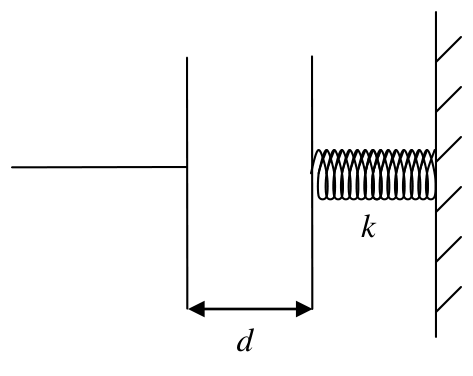
Figure 1
Part Question Points 1.1 Calculate the electrical force, \(F_E\), exerted by the plates on each other. 0.8 1.2 Let \(x\) be the displacement of the plate connected to the spring. Find \(x\). 0.6 1.3 In this state, what is the electrical potential difference \(V\) between the plates of the capacitor in terms of \(Q\), \(A\), \(d\), \(k\)? 0.4 1.4 Let \(C\) be the capacitance of the capacitor, defined as the ratio of charge to potential difference. Find \(C/C_0\) as a function of \(Q\), \(A\), \(d\) and \(k\). 0.3 1.5 What is the total energy, \(U\), stored in the system in terms of \(Q\), \(A\), \(d\) and \(k\)? 0.6 Figure 2, shows a mass \(M\) which is attached to a conducting plate with negligible mass and also to two springs having identical spring constants \(k\). The conducting plate can move back and forth in the space between two fixed conducting plates. All these plates are similar and have the same area \(A\). Thus these three plates constitute two capacitors. As shown in Figure 2, the fixed plates are connected to the given potentials \(V\) and \(-V\), and the middle plate is connected through a two-state switch to the ground. The wire connected to the movable plate does not disturb the motion of the plate and the three plates will always remain parallel. When the whole complex is not being accelerated, the distance from each fixed plate to the movable plate is \(d\) which is much smaller than the dimensions of the plates. The thickness of the movable plate can be ignored.
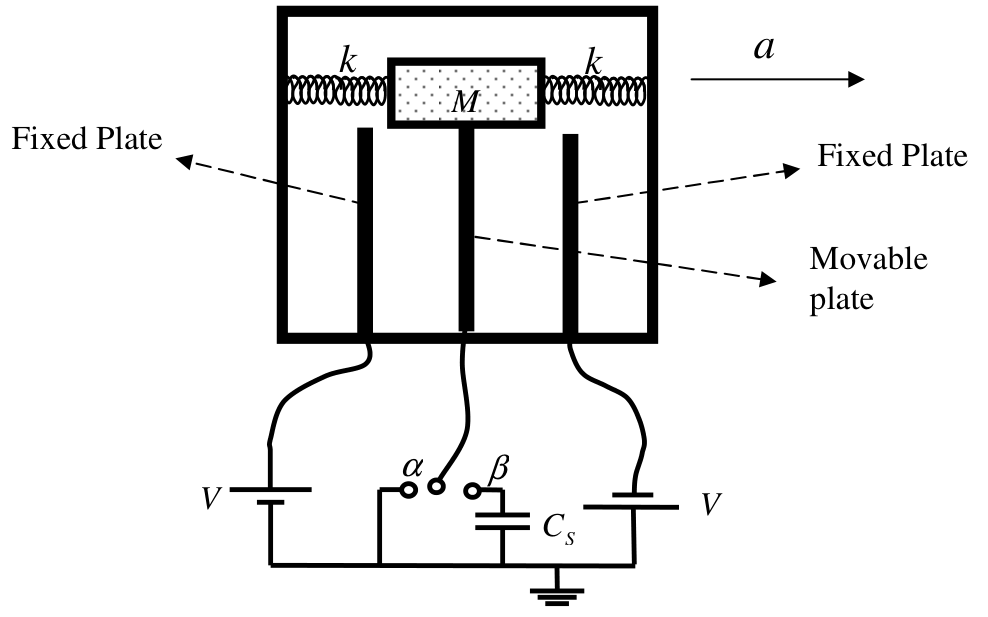
Figure 2
The switch can be in either one of the two states \(\alpha\) and \(\beta\). Assume that the capacitor complex is being accelerated along with the automobile, and the acceleration is constant. Assume that during this constant acceleration the spring does not oscillate and all components of this complex capacitor are in their equilibrium positions, i.e. they do not move with respect to each other, and hence with respect to the automobile.
Due to the acceleration, the movable plate will be displaced a certain amount \(x\) from the middle of the two fixed plates.
2 Consider the case where the switch is in state \(\alpha\) i.e. the movable plate is connected to the ground through a wire, then
Part Question Points 2.1 Find the charge on each capacitor as a function of \(x\). 0.4 2.2 Find the net electrical force on the movable plate, \(F_E\), as a function of \(x\). 0.4 2.3 Assume \(d\gg x\) and terms of order \(x^2\) can be ignored compared to terms of order \(d^2\). Simplify the answer to the previous part. 0.2 2.4 Write the total force on the movable plate (the sum of the electrical and the spring forces) as \(-k_{\mathrm{eff}}x\) and give the form of \(k_{\mathrm{eff}}\). 0.7 2.5 Express the constant acceleration \(a\) as a function of \(x\). 0.4 3 Now assume that the switch is in state \(\beta\) i.e. the movable plate is connected to the ground through a capacitor, the capacitance of which is \(C_S\) (there is no initial charge on the capacitors). If the movable plate is displaced by an amount \(x\) from its central position,
Part Question Points 3.1 Find \(V_S\) the electrical potential difference across the capacitor \(C_S\) as a function of \(x\). 1.5 3.2 Again assume that \(d\gg x\) and ignore terms of order \(x^2\) compared to terms of order \(d^2\). Simplify your answer to the previous part. 0.2 4 We would like to adjust the parameters in the problem such that the air bag will not be activated in normal braking but opens fast enough during a collision to prevent the driver’s head from colliding with the windshield or the steering wheel. As you have seen in Part 2, the force exerted on the movable plate by the springs and the electrical charges can be represented as that of a spring with an effective spring constant \(k_{\mathrm{eff}}\). The whole capacitor complex is similar to a mass and spring system of mass \(M\) and spring constant \(k_{\mathrm{eff}}\) under the influence of a constant acceleration \(a\), which in this problem is the acceleration of the automobile.
Note: In this part of the problem, the assumption that the mass and spring are in equilibrium under a constant acceleration and hence are fixed relative to the automobile, no longer holds.
Ignore friction and consider the following numerical values for the parameters of the problem:
\[ \begin{gathered} d=1.0\,\mathrm{cm},\qquad A=2.5\times10^{-2}\,\mathrm{m^2},\qquad k=4.2\times10^3\,\mathrm{N/m},\\ \varepsilon_0=8.85\times10^{-12}\,\mathrm{C^2/(N\,m^2)},\qquad V=12\,\mathrm V,\qquad M=0.15\,\mathrm{kg}. \end{gathered} \]
Part Question Points 4.1 Using this data, find the ratio of the electrical force you calculated in section 2.3 to the force of the springs and show that one can ignore the electrical forces compared to the spring forces. 0.6 Although we did not calculate the electrical forces for the case when the switch is in the state \(\beta\), it can be shown that in this situation, quite similarly, the electrical forces are as small and can be ignored.
Part Question Points 4.2 If the automobile while traveling with a constant velocity, suddenly brakes with a constant acceleration \(a\), what is the maximum displacement of the movable plate? Give your answer in parameter. 0.6 Assume that the switch is in state \(\beta\) and the system has been designed such that when the electrical voltage across the capacitor reaches \(V_S=0.15\,\mathrm V\), the air bag is activated. We would like the air bag not to be activated during normal braking when the automobile’s acceleration is less than the acceleration of gravity \(g=9.8\,\mathrm{m/s^2}\), but be activated otherwise.
Part Question Points 4.3 How much should \(C_S\) be for this purpose? 0.6 We would like to find out if the air bag will be activated fast enough to prevent the driver’s head from hitting the windshield or the steering wheel. Assume that as a result of collision, the automobile experiences a deceleration equal to \(g\) but the driver’s head keeps moving at a constant speed.
Part Question Points 4.4 By estimating the distance between the driver’s head and the steering wheel, find the time \(t_1\) it takes before the driver’s head hits the steering wheel. 0.8 4.5 Find the time \(t_2\) before the air bag is activated and compare it to \(t_1\). Is the air bag activated in time? Assume that airbag opens instantaneously. 0.9 Official English text of the problem.
Problem 3: Binary stars
Two stars rotating around their center of mass form a binary star system. Almost half of the stars in our galaxy are binary star systems. It is not easy to realize the binary nature of most of these star systems from Earth, since the distance between the two stars is much less than their distance from us and thus the stars cannot be resolved with telescopes. Therefore, we have to use either photometry or spectrometry to observe the variations in the intensity or the spectrum of a particular star to find out whether it is a binary system or not.
Photometry of Binary Stars
If we are exactly on the plane of motion of the two stars, then one star will occult (pass in front of) the other star at certain times and the intensity of the whole system will vary with time from our observation point. These binary systems are called ecliptic binaries.
1 Assume that two stars are moving on circular orbits around their common center of mass with a constant angular speed \(\omega\) and we are exactly on the plane of motion of the binary system. Also assume that the surface temperatures of the stars are \(T_1\) and \(T_2\) \((T_1>T_2)\), and the corresponding radii are \(R_1\) and \(R_2\) \((R_1>R_2)\), respectively. The total intensity of light, measured on Earth, is plotted in Figure 1 as a function of time. Careful measurements indicate that the intensities of the incident light from the stars corresponding to the minima are respectively 90 and 63 percent of the maximum intensity, \(I_0\), received from both stars \(\left(I_0=4.8\times10^{-9}\ \mathrm{W/m^2}\right)\). The vertical axis in Figure 1 shows the ratio \(I/I_0\) and the horizontal axis is marked in days.
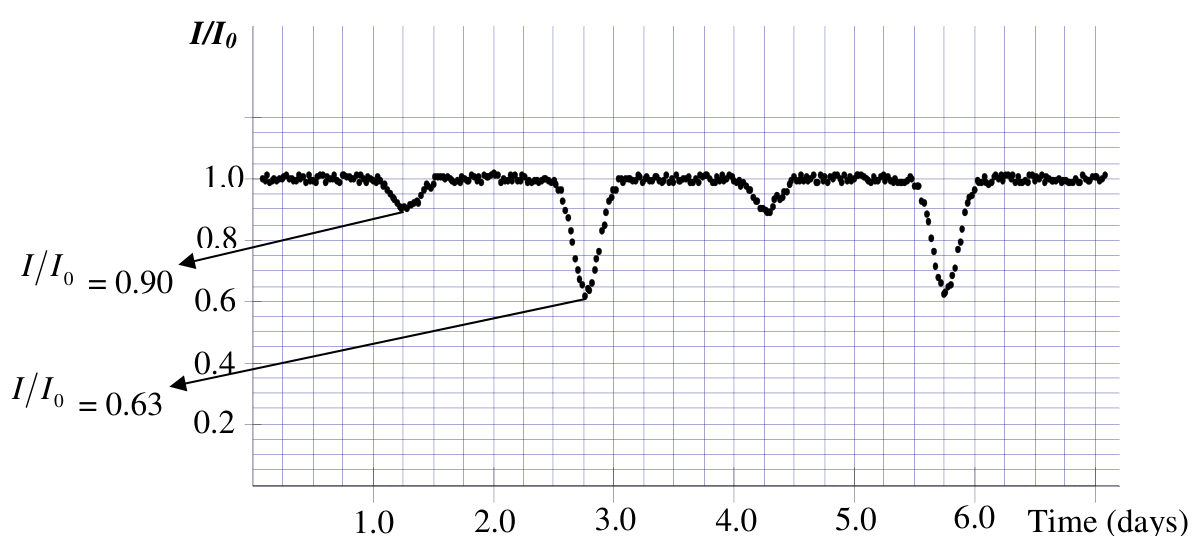
Figure 1. The relative intensity received from the binary star system as a function of time. The vertical axis has been scaled by \(I_0=4.8\times10^{-9}\ \mathrm{W/m^2}\). Time is given in days.
1.1 — 0.8 points
Find the period of the orbital motion. Give your answer in seconds up to two significant digits.
What is the angular frequency of the system in rad/sec?To a good approximation, the receiving radiation from a star is a uniform black body radiation from a flat disc with a radius equal to the radius of the star. Therefore, the power received from the star is proportional to \(AT^4\) where \(A\) is area of the disc and \(T\) is the surface temperature of the star.
1.2 — 1.6 points
Use the diagram in Figure 1 to find the ratios \(T_1/T_2\) and \(R_1/R_2\).
Spectrometry of Binary Systems
In this section, we are going to calculate the astronomical properties of a binary star by using experimental spectrometric data of the binary system.
Atoms absorb or emit radiation at their certain characteristic wavelengths. Consequently, the observed spectrum of a star contains absorption lines due to the atoms in the star’s atmosphere. Sodium has a characteristic yellow line spectrum (\(\mathrm{D}_1\) line) with a wavelength \(5895.9\ \text{Å}\) (\(10\ \text{Å}=1\ \mathrm{nm}\)). We examine the absorption spectrum of atomic Sodium at this wavelength for the binary system of the previous section. The spectrum of the light that we receive from the binary star is Doppler-shifted, because the stars are moving with respect to us. Each star has a different speed. Accordingly the absorption wavelength for each star will be shifted by a different amount. Highly accurate wavelength measurements are required to observe the Doppler shift since the speed of the stars is much less than the speed of light. The speed of the center of mass of the binary system we consider in this problem is much smaller than the orbital velocities of the stars. Hence all the Doppler shifts can be attributed to the orbital velocity of the stars. Table 1 shows the measured spectrum of the stars in the binary system we have observed.
Table 1: Absorption spectrum of the binary star system for the Sodium \(\mathrm{D}_1\) line
\(t/\mathrm{days}\) 0.3 0.6 0.9 1.2 1.5 1.8 2.1 2.4 \(\lambda_1\) (Å) 5897.5 5897.7 5897.2 5896.2 5895.1 5894.3 5894.1 5894.6 \(\lambda_2\) (Å) 5893.1 5892.8 5893.7 5896.2 5897.3 5898.7 5899.0 5898.1 \(t/\mathrm{days}\) 2.7 3.0 3.3 3.6 3.9 4.2 4.5 4.8 \(\lambda_1\) (Å) 5895.6 5896.7 5897.3 5897.7 5897.2 5896.2 5895.0 5894.3 \(\lambda_2\) (Å) 5896.4 5894.5 5893.1 5892.8 5893.7 5896.2 5897.4 5898.7 (Note: There is no need to make a graph of the data in this table)
2 Using Table 1,
2.1 — 1.8 points
Let \(v_1\) and \(v_2\) be the orbital velocity of each star. Find \(v_1\) and \(v_2\).
The speed of light \(c=3.0\times10^8\ \mathrm{m/s}\). Ignore all relativistic effects.2.2 — 0.7 points
Find the mass ratio of the stars \((m_1/m_2)\).
2.3 — 0.8 points
Let \(r_1\) and \(r_2\) be the distances of each star from their center of mass.
Find \(r_1\) and \(r_2\).2.4 — 0.2 points
Let \(r\) be the distance between the stars. Find \(r\).
3 The gravitational force is the only force acting between the stars.
3.1 — 1.2 points
Find the mass of each star up to one significant digit.
The universal gravitational constant \(G=6.7\times10^{-11}\ \mathrm{m^3\,kg^{-1}\,s^{-2}}\).General Characteristics of Stars
4 Most of the stars generate energy through the same mechanism. Because of this, there is an empirical relation between their mass, \(M\), and their luminosity, \(L\), which is the total radiant power of the star. This relation could be written in the form \(L/L_{\mathrm{Sun}}=(M/M_{\mathrm{Sun}})^\alpha\).
Here, \(M_{\mathrm{Sun}}=2.0\times10^{30}\ \mathrm{kg}\) is the solar mass and, \(L_{\mathrm{Sun}}=3.9\times10^{26}\ \mathrm{W}\) is the solar luminosity. This relation is shown in a log-log diagram in Figure 2.
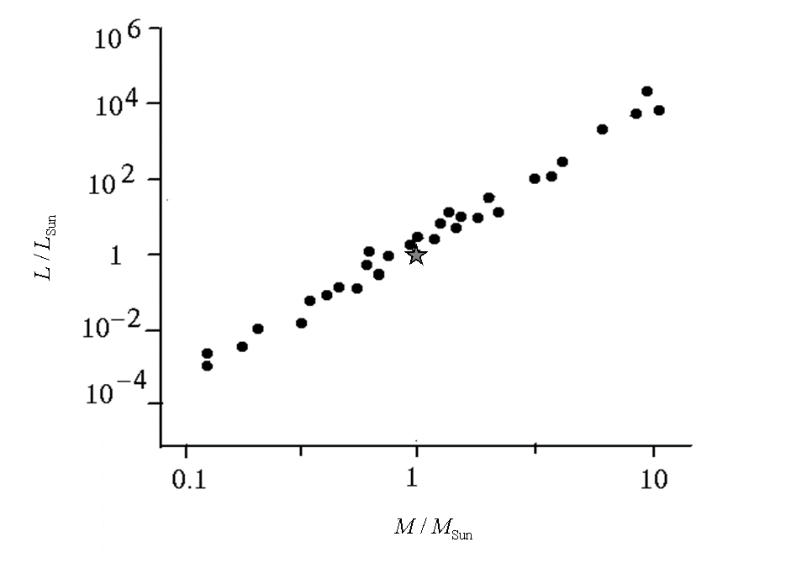
Figure 2. The luminosity of a star versus its mass varies as a power law. The diagram is log-log. The star-symbol represents Sun with a mass of \(2.0\times10^{30}\ \mathrm{kg}\) and luminosity of \(3.9\times10^{26}\ \mathrm{W}\).
4.1 — 0.6 points
Find \(\alpha\) up to one significant digit.
4.2 — 0.6 points
Let \(L_1\) and \(L_2\) be the luminosity of the stars in the binary system studied in the previous sections. Find \(L_1\) and \(L_2\).
4.3 — 0.9 points
What is the distance, \(d\), of the star system from us in light years?
To find the distance you can use the diagram of Figure 1. One light year is the distance light travels in one year.4.4 — 0.4 points
What is the maximum angular distance, \(\theta\), between the stars from our observation point?
4.5 — 0.4 points
What is the smallest aperture size for an optical telescope, \(D\), that can resolve these two stars?
Official English text of the problem.
Internationale Physik-Olympiade
IPhO 2007
Isfahan, Iran · 3 Theorieaufgaben mit vollständigen Lösungen
Aufgabe 1: Dimensionsanalyse und Schwarze Löcher (Hawking-Strahlung)
In der Physik müssen bei einer Gleichheitsbeziehung beide Seiten der Gleichung von derselben Art sein, d. h., sie müssen dieselben Dimensionen haben. Beispielsweise kann die Größe auf der rechten Seite einer Gleichung nicht eine Länge darstellen, während die Größe auf der linken Seite ein Zeitintervall darstellt. Mithilfe dieser Tatsache lässt sich manchmal die Form eines physikalischen Zusammenhangs nahezu herleiten, ohne das Problem analytisch zu lösen. Wenn wir beispielsweise die Zeit bestimmen sollten, die ein Körper benötigt, um unter dem Einfluss einer konstanten Fallbeschleunigung \(g\) aus einer Höhe \(h\) zu fallen, könnten wir argumentieren, dass wir lediglich aus den Größen \(g\) und \(h\) eine Größe bilden müssen, die ein Zeitintervall darstellt, und dass dies nur in der Form \(T=a(h/g)^{1/2}\) möglich ist. Beachten Sie, dass diese Lösung einen noch unbestimmten Koeffizienten \(a\) enthält, der dimensionslos ist und daher mit dieser Methode nicht bestimmt werden kann. Dieser Koeffizient kann eine Zahl wie \(1\), \(1/2\), \(\sqrt{3}\), \(\pi\) oder jede andere reelle Zahl sein. Diese Methode zur Herleitung physikalischer Zusammenhänge heißt Dimensionsanalyse. Bei der Dimensionsanalyse sind die dimensionslosen Koeffizienten nicht von Bedeutung und müssen nicht angeschrieben werden. Glücklicherweise sind diese Koeffizienten bei den meisten physikalischen Problemen von der Größenordnung 1, und ihr Weglassen verändert die Größenordnung der physikalischen Größen nicht. Wendet man die Dimensionsanalyse auf das obige Problem an, erhält man daher \(T=(h/g)^{1/2}\).
Im Allgemeinen werden die Dimensionen einer physikalischen Größe durch die Dimensionen von vier Grundgrößen ausgedrückt: \(M\) (Masse), \(L\) (Länge), \(T\) (Zeit) und \(K\) (Temperatur). Die Dimension einer beliebigen Größe \(x\) wird mit \([x]\) bezeichnet. Um beispielsweise die Dimensionen der Geschwindigkeit \(v\), der kinetischen Energie \(E_k\) und der Wärmekapazität \(C_V\) auszudrücken, schreiben wir: \([v]=LT^{-1}\), \([E_k]=ML^2T^{-2}\), \([C_V]=ML^2T^{-2}K^{-1}\).
1 Fundamentalkonstanten und Dimensionsanalyse
1.1 Bestimmen Sie die Dimensionen der Fundamentalkonstanten, d. h. der Planck-Konstante \(h\), der Lichtgeschwindigkeit \(c\), der universellen Gravitationskonstante \(G\) und der Boltzmann-Konstante \(k_B\), ausgedrückt durch die Dimensionen von Länge, Masse, Zeit und Temperatur. 0.8 Das Stefan-Boltzmann-Gesetz besagt, dass die spezifische Ausstrahlung eines schwarzen Körpers, also die gesamte Energie, die pro Flächeneinheit seiner Oberfläche und pro Zeiteinheit abgestrahlt wird, gleich \(\sigma\theta^4\) ist, wobei \(\sigma\) die Stefan-Boltzmann-Konstante und \(\theta\) die absolute Temperatur des schwarzen Körpers ist.
1.2 Bestimmen Sie die Dimension der Stefan-Boltzmann-Konstante, ausgedrückt durch die Dimensionen von Länge, Masse, Zeit und Temperatur. 0.5 Die Stefan-Boltzmann-Konstante ist keine Fundamentalkonstante und lässt sich durch Fundamentalkonstanten ausdrücken, d. h., man kann \(\sigma=ah^\alpha c^\beta G^\gamma k_B^\delta\) schreiben. In dieser Beziehung ist \(a\) ein dimensionsloser Parameter von der Größenordnung 1. Wie bereits erwähnt, ist der genaue Wert von \(a\) für unsere Betrachtung nicht von Bedeutung, daher setzen wir ihn gleich 1.
1.3 Bestimmen Sie \(\alpha\), \(\beta\), \(\gamma\) und \(\delta\) mithilfe der Dimensionsanalyse. 1.0 2 Physik Schwarzer Löcher
In diesem Teil der Aufgabe möchten wir mithilfe der Dimensionsanalyse einige Eigenschaften Schwarzer Löcher bestimmen. Nach einem bestimmten physikalischen Theorem, das als No-Hair-Theorem bekannt ist, hängen alle Eigenschaften des Schwarzen Lochs, das wir in dieser Aufgabe betrachten, ausschließlich von seiner Masse ab. Eine Eigenschaft eines Schwarzen Lochs ist die Fläche seines Ereignishorizonts. Anschaulich gesprochen ist der Ereignishorizont die Grenze des Schwarzen Lochs. Innerhalb dieser Grenze ist die Gravitation so stark, dass nicht einmal Licht aus dem von ihr umschlossenen Gebiet entweichen kann.
Wir möchten einen Zusammenhang zwischen der Masse eines Schwarzen Lochs \(m\) und der Fläche seines Ereignishorizonts \(A\) finden. Diese Fläche hängt von der Masse des Schwarzen Lochs, der Lichtgeschwindigkeit und der universellen Gravitationskonstante ab. Wie in 1.3 schreiben wir \(A=G^\alpha c^\beta m^\gamma\).
2.1 Bestimmen Sie \(\alpha\), \(\beta\) und \(\gamma\) mithilfe der Dimensionsanalyse. 0.8 Aus dem Ergebnis von 2.1 wird deutlich, dass die Fläche des Ereignishorizonts eines Schwarzen Lochs mit seiner Masse zunimmt. Aus klassischer Sicht kann nichts aus einem Schwarzen Loch entweichen, und daher kann die Fläche des Ereignishorizonts bei allen physikalischen Vorgängen nur zunehmen. In Analogie zum zweiten Hauptsatz der Thermodynamik schlug Bekenstein vor, einem Schwarzen Loch eine Entropie \(S\) zuzuordnen, die proportional zur Fläche seines Ereignishorizonts ist, d. h. \(S=\eta A\). Diese Vermutung wurde durch weitere Argumente plausibler gemacht.
2.2 Verwenden Sie die thermodynamische Definition der Entropie \(dS=dQ/\theta\), um die Dimension der Entropie zu bestimmen.
\(dQ\) ist die ausgetauschte Wärme und \(\theta\) die absolute Temperatur des Systems.0.2 2.3 Drücken Sie wie in 1.3 die dimensionsbehaftete Konstante \(\eta\) als Funktion der Fundamentalkonstanten \(h\), \(c\), \(G\) und \(k_B\) aus. 1.1 Verwenden Sie für den Rest der Aufgabe keine Dimensionsanalyse; Sie dürfen jedoch die Ergebnisse aus den vorhergehenden Abschnitten verwenden.
3 Hawking-Strahlung
Mit einem halbquantenmechanischen Ansatz begründete Hawking, dass Schwarze Löcher entgegen der klassischen Sichtweise Strahlung aussenden, die der Strahlung eines schwarzen Körpers bei einer Temperatur ähnelt, die als Hawking-Temperatur bezeichnet wird.
3.1 Verwenden Sie \(E=mc^2\), womit die Energie des Schwarzen Lochs durch seine Masse ausgedrückt wird, sowie die Hauptsätze der Thermodynamik, um die Hawking-Temperatur \(\theta_H\) eines Schwarzen Lochs durch seine Masse und die Fundamentalkonstanten auszudrücken. Nehmen Sie an, dass das Schwarze Loch keine Arbeit an seiner Umgebung verrichtet. 0.8 3.2 Die Masse eines isolierten Schwarzen Lochs ändert sich somit aufgrund der Hawking-Strahlung. Bestimmen Sie mithilfe des Stefan-Boltzmann-Gesetzes, wie diese Änderungsrate von der Hawking-Temperatur des Schwarzen Lochs \(\theta_H\) abhängt, und drücken Sie sie durch die Masse des Schwarzen Lochs und die Fundamentalkonstanten aus. 0.7 3.3 Bestimmen Sie die Zeit \(t^*\), die ein isoliertes Schwarzes Loch der Masse \(m\) benötigt, um vollständig zu verdampfen, d. h. seine gesamte Masse zu verlieren. 1.1 Aus thermodynamischer Sicht zeigen Schwarze Löcher einige exotische Verhaltensweisen. Beispielsweise ist die Wärmekapazität eines Schwarzen Lochs negativ.
3.4 Bestimmen Sie die Wärmekapazität eines Schwarzen Lochs der Masse \(m\). 0.6 4 Schwarze Löcher und die kosmische Hintergrundstrahlung
Betrachten Sie ein Schwarzes Loch, das der kosmischen Hintergrundstrahlung ausgesetzt ist. Die kosmische Hintergrundstrahlung ist eine Schwarzkörperstrahlung mit einer Temperatur \(\theta_B\), die das gesamte Universum erfüllt. Ein Körper mit einer Gesamtoberfläche \(A\) empfängt daher pro Zeiteinheit eine Energie von \(\sigma\theta_B^4\times A\). Ein Schwarzes Loch verliert somit Energie durch Hawking-Strahlung und gewinnt Energie aus der kosmischen Hintergrundstrahlung.
4.1 Bestimmen Sie die Änderungsrate der Masse eines Schwarzen Lochs, ausgedrückt durch die Masse des Schwarzen Lochs, die Temperatur der kosmischen Hintergrundstrahlung und die Fundamentalkonstanten. 0.8 4.2 Bei einer bestimmten Masse \(m^*\) verschwindet diese Änderungsrate. Bestimmen Sie \(m^*\) und drücken Sie sie durch \(\theta_B\) und die Fundamentalkonstanten aus. 0.4 4.3 Verwenden Sie Ihre Antwort auf 4.2, um \(\theta_B\) in Ihrer Antwort auf Teil 4.1 zu ersetzen, und drücken Sie die Änderungsrate der Masse eines Schwarzen Lochs durch \(m\), \(m^*\) und die Fundamentalkonstanten aus. 0.2 4.4 Bestimmen Sie die Hawking-Temperatur eines Schwarzen Lochs im thermischen Gleichgewicht mit der kosmischen Hintergrundstrahlung. 0.4 4.5 Ist das Gleichgewicht stabil oder instabil? Warum? (Drücken Sie Ihre Antwort mathematisch aus.) 0.6 Aufgabentext aus dem offiziellen englischen Text übersetzt.
Aufgabe 2: Kapazitiver Beschleunigungssensor für einen Autoairbag
In dieser Aufgabe betrachten wir ein vereinfachtes Modell von Beschleunigungssensoren, die dazu dienen, die Sicherheitsairbags von Kraftfahrzeugen bei einem Zusammenstoß auszulösen. Wir möchten ein elektromechanisches System so aufbauen, dass beim Überschreiten eines bestimmten Beschleunigungsgrenzwertes eine der elektrischen Größen des Systems, beispielsweise die Spannung an einer bestimmten Stelle der Schaltung, einen Schwellenwert überschreitet und dadurch der Airbag ausgelöst wird.
Hinweis: Vernachlässigen Sie in dieser Aufgabe die Schwerkraft.
1 Betrachten Sie einen Kondensator mit parallelen Platten wie in Abbildung 1. Die Fläche jeder Kondensatorplatte beträgt \(A\), und der Abstand zwischen den beiden Platten beträgt \(d\). Der Abstand zwischen den beiden Platten ist wesentlich kleiner als die Abmessungen der Platten. Eine dieser Platten ist über eine Feder mit der Federkonstanten \(k\) mit einer Wand verbunden, die andere Platte ist fest. Wenn der Abstand zwischen den Platten \(d\) beträgt, ist die Feder weder gestaucht noch gedehnt; mit anderen Worten wirkt in diesem Zustand keine Kraft auf die Feder. Nehmen Sie an, dass die Permittivität der Luft zwischen den Platten gleich der des Vakuums \(\varepsilon_0\) ist. Die diesem Plattenabstand entsprechende Kapazität des Kondensators beträgt \(C_0=\varepsilon_0 A/d\). Wir bringen die Ladungen \(+Q\) und \(-Q\) auf die Platten auf und lassen das System das mechanische Gleichgewicht erreichen.
Abbildung 1
Teil Frage Punkte 1.1 Berechnen Sie die elektrische Kraft \(F_E\), die die Platten aufeinander ausüben. 0.8 1.2 Sei \(x\) die Verschiebung der mit der Feder verbundenen Platte. Bestimmen Sie \(x\). 0.6 1.3 Wie groß ist in diesem Zustand die elektrische Potentialdifferenz \(V\) zwischen den Kondensatorplatten in Abhängigkeit von \(Q\), \(A\), \(d\), \(k\)? 0.4 1.4 Sei \(C\) die Kapazität des Kondensators, definiert als das Verhältnis von Ladung zu Potentialdifferenz. Bestimmen Sie \(C/C_0\) als Funktion von \(Q\), \(A\), \(d\) und \(k\). 0.3 1.5 Wie groß ist die gesamte im System gespeicherte Energie \(U\) in Abhängigkeit von \(Q\), \(A\), \(d\) und \(k\)? 0.6 Abbildung 2 zeigt eine Masse \(M\), die an einer leitenden Platte mit vernachlässigbarer Masse sowie an zwei Federn mit gleichen Federkonstanten \(k\) befestigt ist. Die leitende Platte kann sich im Raum zwischen zwei festen leitenden Platten hin und her bewegen. Alle diese Platten sind gleichartig und haben dieselbe Fläche \(A\). Diese drei Platten bilden somit zwei Kondensatoren. Wie in Abbildung 2 gezeigt, sind die festen Platten mit den vorgegebenen Potentialen \(V\) und \(-V\) verbunden, und die mittlere Platte ist über einen Schalter mit zwei Stellungen mit Masse verbunden. Der mit der beweglichen Platte verbundene Draht beeinträchtigt die Bewegung der Platte nicht, und die drei Platten bleiben stets parallel. Wenn die gesamte Anordnung nicht beschleunigt wird, beträgt der Abstand jeder festen Platte zur beweglichen Platte \(d\), wobei dieser Abstand wesentlich kleiner als die Abmessungen der Platten ist. Die Dicke der beweglichen Platte kann vernachlässigt werden.
Abbildung 2
Der Schalter kann sich in einer der beiden Stellungen \(\alpha\) und \(\beta\) befinden. Nehmen Sie an, dass die Kondensatoranordnung zusammen mit dem Auto beschleunigt wird und die Beschleunigung konstant ist. Nehmen Sie an, dass die Feder während dieser konstanten Beschleunigung nicht schwingt und alle Komponenten dieser Kondensatoranordnung ihre Gleichgewichtslagen einnehmen, sich also nicht relativ zueinander und damit auch nicht relativ zum Auto bewegen.
Aufgrund der Beschleunigung wird die bewegliche Platte um einen bestimmten Betrag \(x\) aus der Mitte zwischen den beiden festen Platten verschoben.
2 Betrachten Sie den Fall, dass sich der Schalter in Stellung \(\alpha\) befindet, die bewegliche Platte also über einen Draht mit Masse verbunden ist. Dann gilt:
Teil Frage Punkte 2.1 Bestimmen Sie die Ladung auf jedem Kondensator als Funktion von \(x\). 0.4 2.2 Bestimmen Sie die resultierende elektrische Kraft auf die bewegliche Platte, \(F_E\), als Funktion von \(x\). 0.4 2.3 Nehmen Sie an, dass \(d\gg x\) gilt und Terme der Ordnung \(x^2\) gegenüber Termen der Ordnung \(d^2\) vernachlässigt werden können. Vereinfachen Sie das Ergebnis des vorherigen Teils. 0.2 2.4 Schreiben Sie die Gesamtkraft auf die bewegliche Platte (die Summe aus elektrischer Kraft und Federkräften) in der Form \(-k_{\mathrm{eff}}x\) und geben Sie den Ausdruck für \(k_{\mathrm{eff}}\) an. 0.7 2.5 Drücken Sie die konstante Beschleunigung \(a\) als Funktion von \(x\) aus. 0.4 3 Nehmen Sie nun an, dass sich der Schalter in Stellung \(\beta\) befindet, die bewegliche Platte also über einen Kondensator mit der Kapazität \(C_S\) mit Masse verbunden ist (anfangs sind die Kondensatoren ungeladen). Wenn die bewegliche Platte um einen Betrag \(x\) aus ihrer Mittellage verschoben wird:
Teil Frage Punkte 3.1 Bestimmen Sie \(V_S\), die elektrische Potentialdifferenz am Kondensator \(C_S\), als Funktion von \(x\). 1.5 3.2 Nehmen Sie wiederum an, dass \(d\gg x\) gilt, und vernachlässigen Sie Terme der Ordnung \(x^2\) gegenüber Termen der Ordnung \(d^2\). Vereinfachen Sie das Ergebnis des vorherigen Teils. 0.2 4 Wir möchten die Parameter der Aufgabe so einstellen, dass der Airbag bei normalem Bremsen nicht ausgelöst wird, sich bei einem Zusammenstoß jedoch schnell genug öffnet, um zu verhindern, dass der Kopf des Fahrers gegen die Windschutzscheibe oder das Lenkrad prallt. Wie Sie in Teil 2 gesehen haben, lässt sich die von den Federn und den elektrischen Ladungen auf die bewegliche Platte ausgeübte Kraft als die Kraft einer Feder mit einer effektiven Federkonstanten \(k_{\mathrm{eff}}\) darstellen. Die gesamte Kondensatoranordnung entspricht einem Feder-Masse-System mit der Masse \(M\) und der Federkonstanten \(k_{\mathrm{eff}}\) unter dem Einfluss einer konstanten Beschleunigung \(a\), die in dieser Aufgabe die Beschleunigung des Autos ist.
Hinweis: In diesem Teil der Aufgabe gilt die Annahme nicht mehr, dass sich Masse und Feder unter einer konstanten Beschleunigung im Gleichgewicht befinden und daher relativ zum Auto ruhen.
Vernachlässigen Sie die Reibung und verwenden Sie die folgenden Zahlenwerte für die Parameter der Aufgabe:
\[ \begin{gathered} d=1.0\,\mathrm{cm},\qquad A=2.5\times10^{-2}\,\mathrm{m^2},\qquad k=4.2\times10^3\,\mathrm{N/m},\\ \varepsilon_0=8.85\times10^{-12}\,\mathrm{C^2/(N\,m^2)},\qquad V=12\,\mathrm V,\qquad M=0.15\,\mathrm{kg}. \end{gathered} \]
Teil Frage Punkte 4.1 Bestimmen Sie mit diesen Daten das Verhältnis der in Abschnitt 2.3 berechneten elektrischen Kraft zur Federkraft und zeigen Sie, dass die elektrischen Kräfte gegenüber den Federkräften vernachlässigt werden können. 0.6 Obwohl wir die elektrischen Kräfte für den Fall, dass sich der Schalter in Stellung \(\beta\) befindet, nicht berechnet haben, lässt sich zeigen, dass die elektrischen Kräfte in dieser Situation ganz ähnlich ebenso klein sind und vernachlässigt werden können.
Teil Frage Punkte 4.2 Wenn das Auto, das sich mit konstanter Geschwindigkeit bewegt, plötzlich mit einer konstanten Beschleunigung \(a\) bremst, wie groß ist dann die maximale Auslenkung der beweglichen Platte? Geben Sie Ihr Ergebnis in Abhängigkeit von den Parametern an. 0.6 Nehmen Sie an, dass sich der Schalter in Stellung \(\beta\) befindet und das System so ausgelegt ist, dass der Airbag ausgelöst wird, wenn die elektrische Spannung am Kondensator \(V_S=0.15\,\mathrm V\) erreicht. Wir möchten, dass der Airbag bei normalem Bremsen, wenn die Beschleunigung des Autos kleiner als die Erdbeschleunigung \(g=9.8\,\mathrm{m/s^2}\) ist, nicht ausgelöst wird, andernfalls jedoch schon.
Teil Frage Punkte 4.3 Wie groß muss \(C_S\) dafür sein? 0.6 Wir möchten herausfinden, ob der Airbag schnell genug ausgelöst wird, um zu verhindern, dass der Kopf des Fahrers gegen die Windschutzscheibe oder das Lenkrad prallt. Nehmen Sie an, dass das Auto infolge eines Zusammenstoßes eine Verzögerung mit dem Betrag \(g\) erfährt, der Kopf des Fahrers sich jedoch mit konstanter Geschwindigkeit weiterbewegt.
Teil Frage Punkte 4.4 Schätzen Sie den Abstand zwischen dem Kopf des Fahrers und dem Lenkrad ab und bestimmen Sie damit die Zeit \(t_1\), bis der Kopf des Fahrers gegen das Lenkrad prallt. 0.8 4.5 Bestimmen Sie die Zeit \(t_2\) bis zum Auslösen des Airbags und vergleichen Sie sie mit \(t_1\). Wird der Airbag rechtzeitig ausgelöst? Nehmen Sie an, dass sich der Airbag augenblicklich öffnet. 0.9 Aufgabentext aus dem offiziellen englischen Text übersetzt.
Aufgabe 3: Doppelsterne
Zwei Sterne, die ihren gemeinsamen Schwerpunkt umkreisen, bilden ein Doppelsternsystem. Fast die Hälfte der Sterne in unserer Galaxie sind Doppelsternsysteme. Bei den meisten dieser Sternsysteme ist es von der Erde aus nicht leicht zu erkennen, dass es sich um Doppelsterne handelt, da der Abstand zwischen den beiden Sternen viel kleiner als ihre Entfernung von uns ist und die Sterne daher mit Teleskopen nicht getrennt aufgelöst werden können. Deshalb müssen wir entweder mithilfe der Photometrie oder der Spektrometrie die Änderungen der Intensität oder des Spektrums eines bestimmten Sterns beobachten, um herauszufinden, ob es sich um ein Doppelsternsystem handelt oder nicht.
Photometrie von Doppelsternen
Wenn wir uns genau in der Bahnebene der beiden Sterne befinden, bedeckt zu bestimmten Zeiten ein Stern den anderen (er zieht vor ihm vorbei), und die Intensität des gesamten Systems ändert sich von unserem Beobachtungsort aus mit der Zeit. Solche Doppelsternsysteme nennt man Bedeckungsdoppelsterne.
1 Nehmen Sie an, dass sich zwei Sterne mit einer konstanten Winkelgeschwindigkeit \(\omega\) auf Kreisbahnen um ihren gemeinsamen Schwerpunkt bewegen und dass wir uns genau in der Bahnebene des Doppelsternsystems befinden. Nehmen Sie außerdem an, dass die Oberflächentemperaturen der Sterne \(T_1\) und \(T_2\) \((T_1>T_2)\) und die zugehörigen Radien \(R_1\) bzw. \(R_2\) \((R_1>R_2)\) betragen. Die auf der Erde gemessene Gesamtintensität des Lichts ist in Abbildung 1 als Funktion der Zeit dargestellt. Genaue Messungen zeigen, dass die Intensitäten des von den Sternen einfallenden Lichts bei den Minima 90 bzw. 63 Prozent der maximalen, von beiden Sternen empfangenen Intensität \(I_0\) betragen \(\left(I_0=4.8\times10^{-9}\ \mathrm{W/m^2}\right)\). Die vertikale Achse in Abbildung 1 zeigt das Verhältnis \(I/I_0\), und die horizontale Achse ist in Tagen beschriftet.
Abbildung 1. Die vom Doppelsternsystem empfangene relative Intensität als Funktion der Zeit. Die vertikale Achse ist auf \(I_0=4.8\times10^{-9}\ \mathrm{W/m^2}\) normiert. Die Zeit ist in Tagen angegeben.
1.1 — 0.8 Punkte
Bestimmen Sie die Umlaufzeit. Geben Sie Ihre Antwort in Sekunden mit zwei signifikanten Stellen an.
Wie groß ist die Kreisfrequenz des Systems in rad/sec?In guter Näherung ist die von einem Stern empfangene Strahlung die gleichmäßige Schwarzkörperstrahlung einer ebenen Scheibe, deren Radius gleich dem Radius des Sterns ist. Daher ist die vom Stern empfangene Leistung proportional zu \(AT^4\), wobei \(A\) die Fläche der Scheibe und \(T\) die Oberflächentemperatur des Sterns ist.
1.2 — 1.6 Punkte
Bestimmen Sie mithilfe des Diagramms in Abbildung 1 die Verhältnisse \(T_1/T_2\) und \(R_1/R_2\).
Spektrometrie von Doppelsternsystemen
In diesem Abschnitt werden wir die astronomischen Eigenschaften eines Doppelsterns mithilfe experimenteller spektrometrischer Daten des Doppelsternsystems berechnen.
Atome absorbieren oder emittieren Strahlung bei bestimmten charakteristischen Wellenlängen. Daher enthält das beobachtete Spektrum eines Sterns Absorptionslinien, die durch die Atome in seiner Atmosphäre verursacht werden. Natrium besitzt eine charakteristische gelbe Spektrallinie (\(\mathrm{D}_1\)-Linie) mit einer Wellenlänge von \(5895.9\ \text{Å}\) (\(10\ \text{Å}=1\ \mathrm{nm}\)). Wir untersuchen das Absorptionsspektrum von atomarem Natrium bei dieser Wellenlänge für das Doppelsternsystem aus dem vorherigen Abschnitt. Das Spektrum des Lichts, das wir vom Doppelstern empfangen, ist aufgrund des Dopplereffekts verschoben, da sich die Sterne relativ zu uns bewegen. Die beiden Sterne haben unterschiedliche Geschwindigkeiten. Dementsprechend ist die Absorptionswellenlänge jedes Sterns um einen anderen Betrag verschoben. Um die Dopplerverschiebung zu beobachten, sind hochpräzise Wellenlängenmessungen erforderlich, da die Geschwindigkeit der Sterne viel kleiner als die Lichtgeschwindigkeit ist. Die Geschwindigkeit des Schwerpunkts des in dieser Aufgabe betrachteten Doppelsternsystems ist viel kleiner als die Bahngeschwindigkeiten der Sterne. Daher können alle Dopplerverschiebungen auf die Bahngeschwindigkeiten der Sterne zurückgeführt werden. Tabelle 1 zeigt das gemessene Spektrum der Sterne des von uns beobachteten Doppelsternsystems.
Tabelle 1: Absorptionsspektrum des Doppelsternsystems für die Natrium-\(\mathrm{D}_1\)-Linie
\(t/\mathrm{days}\) 0.3 0.6 0.9 1.2 1.5 1.8 2.1 2.4 \(\lambda_1\) (Å) 5897.5 5897.7 5897.2 5896.2 5895.1 5894.3 5894.1 5894.6 \(\lambda_2\) (Å) 5893.1 5892.8 5893.7 5896.2 5897.3 5898.7 5899.0 5898.1 \(t/\mathrm{days}\) 2.7 3.0 3.3 3.6 3.9 4.2 4.5 4.8 \(\lambda_1\) (Å) 5895.6 5896.7 5897.3 5897.7 5897.2 5896.2 5895.0 5894.3 \(\lambda_2\) (Å) 5896.4 5894.5 5893.1 5892.8 5893.7 5896.2 5897.4 5898.7 (Hinweis: Es ist nicht erforderlich, die Daten dieser Tabelle grafisch darzustellen.)
2 Verwenden Sie Tabelle 1.
2.1 — 1.8 Punkte
Die Bahngeschwindigkeiten der beiden Sterne seien \(v_1\) und \(v_2\). Bestimmen Sie \(v_1\) und \(v_2\).
Die Lichtgeschwindigkeit beträgt \(c=3.0\times10^8\ \mathrm{m/s}\). Vernachlässigen Sie alle relativistischen Effekte.2.2 — 0.7 Punkte
Bestimmen Sie das Massenverhältnis der Sterne \((m_1/m_2)\).
2.3 — 0.8 Punkte
Die Abstände der beiden Sterne von ihrem gemeinsamen Schwerpunkt seien \(r_1\) und \(r_2\).
Bestimmen Sie \(r_1\) und \(r_2\).2.4 — 0.2 Punkte
Der Abstand zwischen den Sternen sei \(r\). Bestimmen Sie \(r\).
3 Die Gravitationskraft ist die einzige Kraft, die zwischen den Sternen wirkt.
3.1 — 1.2 Punkte
Bestimmen Sie die Masse jedes Sterns mit einer signifikanten Stelle.
Die universelle Gravitationskonstante beträgt \(G=6.7\times10^{-11}\ \mathrm{m^3\,kg^{-1}\,s^{-2}}\).Allgemeine Eigenschaften von Sternen
4 Die meisten Sterne erzeugen Energie durch denselben Mechanismus. Deshalb gibt es einen empirischen Zusammenhang zwischen ihrer Masse \(M\) und ihrer Leuchtkraft \(L\), also der gesamten Strahlungsleistung des Sterns. Dieser Zusammenhang lässt sich in der Form \(L/L_{\mathrm{Sun}}=(M/M_{\mathrm{Sun}})^\alpha\) schreiben.
Dabei ist \(M_{\mathrm{Sun}}=2.0\times10^{30}\ \mathrm{kg}\) die Sonnenmasse und \(L_{\mathrm{Sun}}=3.9\times10^{26}\ \mathrm{W}\) die Leuchtkraft der Sonne. Dieser Zusammenhang ist in Abbildung 2 in einem doppelt logarithmischen Diagramm dargestellt.
Abbildung 2. Die Leuchtkraft eines Sterns hängt gemäß einem Potenzgesetz von seiner Masse ab. Das Diagramm ist doppelt logarithmisch. Das Sternsymbol stellt die Sonne mit einer Masse von \(2.0\times10^{30}\ \mathrm{kg}\) und einer Leuchtkraft von \(3.9\times10^{26}\ \mathrm{W}\) dar.
4.1 — 0.6 Punkte
Bestimmen Sie \(\alpha\) mit einer signifikanten Stelle.
4.2 — 0.6 Punkte
Die Leuchtkräfte der Sterne in dem in den vorherigen Abschnitten untersuchten Doppelsternsystem seien \(L_1\) und \(L_2\). Bestimmen Sie \(L_1\) und \(L_2\).
4.3 — 0.9 Punkte
Wie groß ist die Entfernung \(d\) des Sternsystems von uns in Lichtjahren?
Zur Bestimmung der Entfernung können Sie das Diagramm in Abbildung 1 verwenden. Ein Lichtjahr ist die Strecke, die Licht in einem Jahr zurücklegt.4.4 — 0.4 Punkte
Wie groß ist der maximale Winkelabstand \(\theta\) zwischen den Sternen von unserem Beobachtungsort aus?
4.5 — 0.4 Punkte
Wie groß ist der kleinste Öffnungsdurchmesser \(D\) eines optischen Teleskops, mit dem sich diese beiden Sterne getrennt auflösen lassen?
Aufgabentext aus dem offiziellen englischen Text übersetzt.
Uluslararası Fizik Olimpiyatı
IPhO 2007
İsfahan, İran · 3 teori sorusu, tam çözümleriyle
Soru 1: Boyut analizi ve kara delikler (Hawking ışıması)
Fizikte bir eşitlik bağıntısı söz konusu olduğunda, denklemin her iki tarafı aynı türden olmalı, yani aynı boyutlara sahip olmalıdır. Örneğin, denklemin sağ tarafındaki niceliğin bir uzunluğu, sol tarafındaki niceliğin ise bir zaman aralığını temsil ettiği bir durum olamaz. Bu olgudan yararlanarak, bazen problemi analitik olarak çözmeden bir fiziksel bağıntının biçimini neredeyse tamamen çıkarabiliriz. Örneğin, sabit bir yer çekimi ivmesi \(g\) etkisinde bir cismin \(h\) yüksekliğinden düşmesi için geçen süreyi bulmamız istenseydi, yalnızca \(g\) ve \(h\) niceliklerini kullanarak bir zaman aralığını temsil eden bir nicelik oluşturmamız gerektiğini ve bunu yapmanın tek olası yolunun \(T=a(h/g)^{1/2}\) olduğunu ileri sürebilirdik. Bu çözümün, henüz belirlenmemiş, boyutsuz bir \(a\) katsayısı içerdiğine ve dolayısıyla bu katsayının bu yöntemle belirlenemeyeceğine dikkat edin. Bu katsayı \(1\), \(1/2\), \(\sqrt{3}\), \(\pi\) gibi bir sayı ya da herhangi bir başka gerçek sayı olabilir. Fiziksel bağıntıları çıkarmaya yarayan bu yönteme boyut analizi denir. Boyut analizinde boyutsuz katsayılar önemli değildir ve bunları yazmamız gerekmez. Neyse ki çoğu fizik probleminde bu katsayılar 1 mertebesindedir ve bunların çıkarılması fiziksel niceliklerin büyüklük mertebesini değiştirmez. Dolayısıyla, yukarıdaki probleme boyut analizi uygulandığında \(T=(h/g)^{1/2}\) elde edilir.
Genellikle bir fiziksel niceliğin boyutları, dört temel niceliğin boyutları cinsinden yazılır: \(M\) (kütle), \(L\) (uzunluk), \(T\) (zaman) ve \(K\) (sıcaklık). Herhangi bir \(x\) niceliğinin boyutları \([x]\) ile gösterilir. Örneğin, \(v\) hızının, \(E_k\) kinetik enerjisinin ve \(C_V\) ısı kapasitesinin boyutlarını ifade etmek için şöyle yazarız: \([v]=LT^{-1}\), \([E_k]=ML^2T^{-2}\), \([C_V]=ML^2T^{-2}K^{-1}\).
1 Temel Sabitler ve Boyut Analizi
1.1 Temel sabitlerin, yani Planck sabiti \(h\), ışık hızı \(c\), evrensel kütle çekim sabiti \(G\) ve Boltzmann sabiti \(k_B\)'nin boyutlarını uzunluk, kütle, zaman ve sıcaklık boyutları cinsinden bulun. 0.8 Stefan-Boltzmann yasasına göre, bir kara cismin birim yüzey alanından birim zamanda yayılan toplam enerji olan kara cismin ışıma gücü yoğunluğu, \(\sigma\) Stefan-Boltzmann sabiti ve \(\theta\) kara cismin mutlak sıcaklığı olmak üzere \(\sigma\theta^4\)'e eşittir.
1.2 Stefan-Boltzmann sabitinin boyutlarını uzunluk, kütle, zaman ve sıcaklık boyutları cinsinden belirleyin. 0.5 Stefan-Boltzmann sabiti temel bir sabit değildir ve temel sabitler cinsinden yazılabilir; yani \(\sigma=ah^\alpha c^\beta G^\gamma k_B^\delta\) yazılabilir. Bu bağıntıda \(a\), 1 mertebesinde boyutsuz bir parametredir. Daha önce belirtildiği gibi, \(a\)'nın tam değeri bizim açımızdan önemli değildir; bu nedenle onu 1'e eşit alacağız.
1.3 Boyut analizini kullanarak \(\alpha\), \(\beta\), \(\gamma\) ve \(\delta\)'yı bulun. 1.0 2 Kara Delik Fiziği
Sorunun bu bölümünde, boyut analizini kullanarak kara deliklerin bazı özelliklerini bulmak istiyoruz. Fizikte saçsızlık teoremi olarak bilinen bir teoreme göre, bu soruda ele aldığımız kara deliğin bütün özellikleri yalnızca kara deliğin kütlesine bağlıdır. Bir kara deliğin özelliklerinden biri, olay ufkunun alanıdır. Kabaca söylemek gerekirse, olay ufku kara deliğin sınırıdır. Bu sınırın içinde kütle çekimi o kadar güçlüdür ki ışık bile sınırın çevrelediği bölgeden dışarı çıkamaz.
Bir kara deliğin kütlesi \(m\) ile olay ufkunun alanı \(A\) arasında bir bağıntı bulmak istiyoruz. Bu alan kara deliğin kütlesine, ışık hızına ve evrensel kütle çekim sabitine bağlıdır. 1.3'te olduğu gibi \(A=G^\alpha c^\beta m^\gamma\) yazacağız.
2.1 Boyut analizini kullanarak \(\alpha\), \(\beta\) ve \(\gamma\)'yı bulun. 0.8 2.1'in sonucundan, bir kara deliğin olay ufkunun alanının kütlesiyle birlikte arttığı anlaşılır. Klasik bakış açısına göre, bir kara delikten hiçbir şey çıkmaz ve dolayısıyla bütün fiziksel süreçlerde olay ufkunun alanı yalnızca artabilir. Termodinamiğin ikinci yasasıyla benzerlik kuran Bekenstein, kara deliğe olay ufkunun alanıyla orantılı bir \(S\) entropisi atamayı, yani \(S=\eta A\) bağıntısını önerdi. Başka argümanlar da bu varsayımı daha makul hâle getirmiştir.
2.2 Entropinin boyutlarını bulmak için entropinin termodinamik tanımı olan \(dS=dQ/\theta\) bağıntısını kullanın.
\(dQ\) alışverişi yapılan ısı, \(\theta\) ise sistemin mutlak sıcaklığıdır.0.2 2.3 1.3'te olduğu gibi, boyutlu \(\eta\) sabitini \(h\), \(c\), \(G\) ve \(k_B\) temel sabitlerinin bir fonksiyonu olarak ifade edin. 1.1 Sorunun geri kalanında boyut analizi kullanmayın; ancak önceki bölümlerde elde ettiğiniz sonuçları kullanabilirsiniz.
3 Hawking Işıması
Hawking, yarı kuantum mekanik bir yaklaşımla, klasik bakış açısının aksine kara deliklerin, Hawking sıcaklığı adı verilen bir sıcaklıktaki kara cismin ışımasına benzer bir ışıma yaptığını ileri sürdü.
3.1 Kara deliğin enerjisini kütlesi cinsinden veren \(E=mc^2\) bağıntısını ve termodinamik yasalarını kullanarak bir kara deliğin Hawking sıcaklığı \(\theta_H\)'yi kütlesi ve temel sabitler cinsinden ifade edin. Kara deliğin çevresi üzerinde iş yapmadığını varsayın. 0.8 3.2 Yalıtılmış bir kara deliğin kütlesi, Hawking ışıması nedeniyle değişir. Stefan-Boltzmann yasasını kullanarak bu değişim hızının kara deliğin Hawking sıcaklığı \(\theta_H\)'ye bağımlılığını bulun ve bunu kara deliğin kütlesi ve temel sabitler cinsinden ifade edin. 0.7 3.3 Kütlesi \(m\) olan yalıtılmış bir kara deliğin tamamen buharlaşması, yani bütün kütlesini kaybetmesi için geçen \(t^*\) süresini bulun. 1.1 Termodinamik açıdan kara delikler bazı sıra dışı davranışlar sergiler. Örneğin, bir kara deliğin ısı kapasitesi negatiftir.
3.4 Kütlesi \(m\) olan bir kara deliğin ısı kapasitesini bulun. 0.6 4 Kara Delikler ve Kozmik Arka Plan Işıması
Kozmik arka plan ışımasına maruz kalan bir kara delik düşünün. Kozmik arka plan ışıması, tüm evreni dolduran, \(\theta_B\) sıcaklığındaki bir kara cisim ışımasıdır. Dolayısıyla toplam alanı \(A\) olan bir cisim, birim zamanda \(\sigma\theta_B^4\times A\)'ya eşit bir enerji alır. Bu nedenle bir kara delik, Hawking ışıması yoluyla enerji kaybederken kozmik arka plan ışımasından enerji kazanır.
4.1 Bir kara deliğin kütlesinin değişim hızını, kara deliğin kütlesi, kozmik arka plan ışımasının sıcaklığı ve temel sabitler cinsinden bulun. 0.8 4.2 Belirli bir \(m^*\) kütlesinde bu değişim hızı sıfır olacaktır. \(m^*\)'ı bulun ve \(\theta_B\) ile temel sabitler cinsinden ifade edin. 0.4 4.3 4.2'deki cevabınızı kullanarak 4.1 bölümündeki cevabınızda \(\theta_B\)'nin yerine karşılığını yazın ve bir kara deliğin kütlesinin değişim hızını \(m\), \(m^*\) ve temel sabitler cinsinden ifade edin. 0.2 4.4 Kozmik arka plan ışımasıyla ısıl dengede olan bir kara deliğin Hawking sıcaklığını bulun. 0.4 4.5 Denge kararlı mı, kararsız mı? Neden? (Cevabınızı matematiksel olarak ifade edin.) 0.6 Soru metni resmi İngilizce metinden çevrilmiştir.
Soru 2: Otomobil hava yastığı için kapasitif ivmeölçer
Bu soruda, çarpışma sırasında otomobillerin güvenlik hava yastıklarını etkinleştirmek üzere tasarlanmış ivmeölçerlerin basitleştirilmiş bir modelini ele alıyoruz. İvme belirli bir sınırı aştığında, devrenin belirli bir noktasındaki gerilim gibi sistemin elektriksel parametrelerinden birinin bir eşik değerini aşacağı ve bunun sonucunda hava yastığının etkinleşeceği bir elektromekanik sistem kurmak istiyoruz.
Not: Bu soruda yerçekimini ihmal ediniz.
1 Şekil 1'deki gibi paralel levhalı bir kondansatörü ele alınız. Kondansatördeki her bir levhanın alanı \(A\), iki levha arasındaki uzaklık ise \(d\)'dir. İki levha arasındaki uzaklık, levhaların boyutlarından çok küçüktür. Bu levhalardan biri, yay sabiti \(k\) olan bir yay aracılığıyla bir duvara bağlıdır; diğer levha ise sabittir. Levhalar arasındaki uzaklık \(d\) iken yay ne sıkışmış ne de uzamıştır; başka bir deyişle, bu durumda yaya kuvvet uygulanmaz. Levhalar arasındaki havanın elektriksel geçirgenliğinin boşluğun elektriksel geçirgenliği \(\varepsilon_0\) olduğunu varsayınız. Kondansatörün, levhalar arasındaki bu uzaklığa karşılık gelen sığası \(C_0=\varepsilon_0 A/d\)'dir. Levhalara \(+Q\) ve \(-Q\) yüklerini verip sistemin mekanik dengeye gelmesini bekliyoruz.
Şekil 1
Kısım Soru Puan 1.1 Levhaların birbirine uyguladığı elektriksel kuvveti, \(F_E\), hesaplayınız. 0.8 1.2 Yaya bağlı levhanın yer değiştirmesi \(x\) olsun. \(x\)'i bulunuz. 0.6 1.3 Bu durumda kondansatörün levhaları arasındaki elektriksel potansiyel farkı \(V\), \(Q\), \(A\), \(d\), \(k\) cinsinden nedir? 0.4 1.4 Kondansatörün, yükün potansiyel farkına oranı olarak tanımlanan sığası \(C\) olsun. \(C/C_0\)'ı \(Q\), \(A\), \(d\) ve \(k\)'nin fonksiyonu olarak bulunuz. 0.3 1.5 Sistemde depolanan toplam enerji \(U\), \(Q\), \(A\), \(d\) ve \(k\) cinsinden nedir? 0.6 Şekil 2, kütlesi ihmal edilebilen iletken bir levhaya ve yay sabitleri aynı \(k\) değerinde olan iki yaya bağlı bir \(M\) kütlesini göstermektedir. İletken levha, iki sabit iletken levha arasındaki boşlukta ileri geri hareket edebilir. Bu levhaların hepsi birbirine benzer ve aynı \(A\) alanına sahiptir. Böylece bu üç levha iki kondansatör oluşturur. Şekil 2'de gösterildiği gibi, sabit levhalar verilen \(V\) ve \(-V\) potansiyellerine bağlanmış, ortadaki levha ise iki konumlu bir anahtar üzerinden topraklanmıştır. Hareketli levhaya bağlı tel, levhanın hareketini etkilemez ve üç levha her zaman paralel kalır. Düzeneğin bütünü ivmelenmiyorken her bir sabit levhadan hareketli levhaya olan uzaklık \(d\)'dir ve bu uzaklık levhaların boyutlarından çok küçüktür. Hareketli levhanın kalınlığı ihmal edilebilir.
Şekil 2
Anahtar, \(\alpha\) ve \(\beta\) konumlarından birinde olabilir. Kondansatör düzeneğinin otomobille birlikte ivmelendiğini ve ivmenin sabit olduğunu varsayınız. Bu sabit ivmelenme sırasında yayın salınmadığını ve bu bileşik kondansatörün tüm bileşenlerinin denge konumlarında olduğunu, yani birbirlerine ve dolayısıyla otomobile göre hareket etmediklerini varsayınız.
İvmelenme nedeniyle hareketli levha, iki sabit levhanın ortasından belirli bir \(x\) miktarı kadar yer değiştirecektir.
2 Anahtarın \(\alpha\) konumunda olduğu, yani hareketli levhanın bir tel aracılığıyla topraklandığı durumu ele alınız; bu durumda
Kısım Soru Puan 2.1 Her bir kondansatörün yükünü \(x\)'in fonksiyonu olarak bulunuz. 0.4 2.2 Hareketli levha üzerindeki net elektriksel kuvveti, \(F_E\), \(x\)'in fonksiyonu olarak bulunuz. 0.4 2.3 \(d\gg x\) olduğunu ve \(x^2\) mertebesindeki terimlerin \(d^2\) mertebesindeki terimlere göre ihmal edilebileceğini varsayınız. Önceki kısma verdiğiniz cevabı sadeleştiriniz. 0.2 2.4 Hareketli levha üzerindeki toplam kuvveti (elektriksel kuvvet ile yay kuvvetlerinin toplamını) \(-k_{\mathrm{eff}}x\) biçiminde yazınız ve \(k_{\mathrm{eff}}\)'in ifadesini veriniz. 0.7 2.5 Sabit ivme \(a\)'yı \(x\)'in fonksiyonu olarak ifade ediniz. 0.4 3 Şimdi anahtarın \(\beta\) konumunda olduğunu, yani hareketli levhanın sığası \(C_S\) olan bir kondansatör üzerinden topraklandığını varsayınız (başlangıçta kondansatörler üzerinde yük yoktur). Hareketli levha merkez konumundan \(x\) miktarı kadar yer değiştirirse,
Kısım Soru Puan 3.1 \(C_S\) kondansatörünün uçları arasındaki elektriksel potansiyel farkı \(V_S\)'yi \(x\)'in fonksiyonu olarak bulunuz. 1.5 3.2 Yine \(d\gg x\) olduğunu varsayınız ve \(x^2\) mertebesindeki terimleri \(d^2\) mertebesindeki terimlere göre ihmal ediniz. Önceki kısma verdiğiniz cevabı sadeleştiriniz. 0.2 4 Sorudaki parametreleri, hava yastığı normal frenleme sırasında etkinleşmeyecek, ancak bir çarpışma sırasında sürücünün başının ön cama veya direksiyon simidine çarpmasını önleyecek kadar hızlı açılacak şekilde ayarlamak istiyoruz. Kısım 2'de gördüğünüz gibi, yayların ve elektrik yüklerinin hareketli levhaya uyguladığı kuvvet, etkin yay sabiti \(k_{\mathrm{eff}}\) olan bir yayın kuvveti olarak ifade edilebilir. Kondansatör düzeneğinin bütünü, bu soruda otomobilin ivmesi olan sabit bir \(a\) ivmesinin etkisi altındaki, kütlesi \(M\) ve yay sabiti \(k_{\mathrm{eff}}\) olan bir kütle-yay sistemine benzer.
Not: Sorunun bu kısmında, kütle ve yayın sabit ivme altında dengede olduğu ve dolayısıyla otomobile göre sabit kaldığı varsayımı artık geçerli değildir.
Sürtünmeyi ihmal ediniz ve sorunun parametreleri için aşağıdaki sayısal değerleri kullanınız:
\[ \begin{gathered} d=1.0\,\mathrm{cm},\qquad A=2.5\times10^{-2}\,\mathrm{m^2},\qquad k=4.2\times10^3\,\mathrm{N/m},\\ \varepsilon_0=8.85\times10^{-12}\,\mathrm{C^2/(N\,m^2)},\qquad V=12\,\mathrm V,\qquad M=0.15\,\mathrm{kg}. \end{gathered} \]
Kısım Soru Puan 4.1 Bu verileri kullanarak, 2.3 kısmında hesapladığınız elektriksel kuvvetin yayların kuvvetine oranını bulunuz ve elektriksel kuvvetlerin yay kuvvetlerine göre ihmal edilebileceğini gösteriniz. 0.6 Anahtarın \(\beta\) konumunda olduğu durum için elektriksel kuvvetleri hesaplamamış olsak da, bu durumda da benzer şekilde elektriksel kuvvetlerin aynı ölçüde küçük olduğu ve ihmal edilebileceği gösterilebilir.
Kısım Soru Puan 4.2 Sabit hızla ilerleyen otomobil aniden sabit bir \(a\) ivmesiyle fren yaparsa, hareketli levhanın en büyük yer değiştirmesi ne olur? Cevabınızı parametreler cinsinden veriniz. 0.6 Anahtarın \(\beta\) konumunda olduğunu ve sistemin, kondansatörün uçları arasındaki elektriksel gerilim \(V_S=0.15\,\mathrm V\)'a ulaştığında hava yastığını etkinleştirecek şekilde tasarlandığını varsayınız. Otomobilin ivmesinin yerçekimi ivmesi \(g=9.8\,\mathrm{m/s^2}\)'den küçük olduğu normal frenleme sırasında hava yastığının etkinleşmemesini, diğer durumlarda ise etkinleşmesini istiyoruz.
Kısım Soru Puan 4.3 Bu amaçla \(C_S\) ne kadar olmalıdır? 0.6 Hava yastığının, sürücünün başının ön cama veya direksiyon simidine çarpmasını önleyecek kadar hızlı etkinleşip etkinleşmeyeceğini bulmak istiyoruz. Çarpışma sonucunda otomobilin \(g\)'ye eşit bir yavaşlama ivmesine maruz kaldığını, ancak sürücünün başının sabit hızla hareket etmeyi sürdürdüğünü varsayınız.
Kısım Soru Puan 4.4 Sürücünün başı ile direksiyon simidi arasındaki uzaklığı tahmin ederek, sürücünün başının direksiyon simidine çarpmasına kadar geçen \(t_1\) süresini bulunuz. 0.8 4.5 Hava yastığının etkinleşmesine kadar geçen \(t_2\) süresini bulunuz ve bunu \(t_1\) ile karşılaştırınız. Hava yastığı zamanında etkinleşir mi? Hava yastığının anında açıldığını varsayınız. 0.9 Soru metni resmi İngilizce metinden çevrilmiştir.
Soru 3: Çift yıldızlar
Kütle merkezleri etrafında dolanan iki yıldız, bir çift yıldız sistemi oluşturur. Galaksimizdeki yıldızların neredeyse yarısı çift yıldız sistemlerindedir. Bu yıldız sistemlerinin çoğunun çift yıldız olduğunu Dünya'dan anlamak kolay değildir; çünkü iki yıldız arasındaki uzaklık, bize olan uzaklıklarından çok daha küçüktür ve bu nedenle yıldızlar teleskoplarla ayrı ayrı seçilemez. Bu yüzden, belirli bir yıldızın çift yıldız sistemi olup olmadığını anlamak için fotometri veya spektrometri kullanarak ışık şiddetindeki ya da tayfındaki değişimleri gözlemlememiz gerekir.
Çift Yıldızların Fotometrisi
Tam olarak iki yıldızın hareket düzleminde bulunuyorsak, belirli zamanlarda bir yıldız diğerini örter (onun önünden geçer) ve gözlem noktamızdan ölçülen tüm sistemin ışık şiddeti zamanla değişir. Bu çift yıldız sistemlerine örten çift yıldızlar denir.
1 İki yıldızın ortak kütle merkezleri etrafında dairesel yörüngelerde sabit bir \(\omega\) açısal hızıyla hareket ettiğini ve bizim tam olarak çift yıldız sisteminin hareket düzleminde bulunduğumuzu varsayın. Ayrıca yıldızların yüzey sıcaklıklarının sırasıyla \(T_1\) ve \(T_2\) \((T_1>T_2)\), bunlara karşılık gelen yarıçaplarının ise \(R_1\) ve \(R_2\) \((R_1>R_2)\) olduğunu varsayın. Dünya'da ölçülen toplam ışık şiddetinin zamana bağlı grafiği Şekil 1'de verilmiştir. Dikkatli ölçümler, minimumlara karşılık gelen yıldızlardan gelen ışık şiddetlerinin, her iki yıldızdan alınan maksimum ışık şiddeti \(I_0\)'ın sırasıyla yüzde 90'ı ve yüzde 63'ü olduğunu göstermektedir \(\left(I_0=4.8\times10^{-9}\ \mathrm{W/m^2}\right)\). Şekil 1'deki düşey eksen \(I/I_0\) oranını gösterir; yatay eksen ise gün cinsinden işaretlenmiştir.
Şekil 1. Çift yıldız sisteminden alınan bağıl ışık şiddetinin zamana bağlı değişimi. Düşey eksen \(I_0=4.8\times10^{-9}\ \mathrm{W/m^2}\) ile ölçeklendirilmiştir. Zaman gün cinsinden verilmiştir.
1.1 — 0.8 puan
Yörünge hareketinin periyodunu bulun. Cevabınızı iki anlamlı basamakla saniye cinsinden verin.
Sistemin rad/saniye cinsinden açısal frekansı nedir?İyi bir yaklaşımla, bir yıldızdan alınan ışınım, yarıçapı yıldızın yarıçapına eşit olan düz bir diskten gelen düzgün kara cisim ışınımı olarak kabul edilebilir. Dolayısıyla yıldızdan alınan güç, \(AT^4\) ile orantılıdır; burada \(A\) diskin alanı, \(T\) ise yıldızın yüzey sıcaklığıdır.
1.2 — 1.6 puan
Şekil 1'deki grafiği kullanarak \(T_1/T_2\) ve \(R_1/R_2\) oranlarını bulun.
Çift Yıldız Sistemlerinin Spektrometrisi
Bu bölümde, çift yıldız sisteminin deneysel spektrometri verilerini kullanarak bir çift yıldızın astronomik özelliklerini hesaplayacağız.
Atomlar, kendilerine özgü belirli dalga boylarında ışınım soğurur veya yayar. Bu nedenle, bir yıldızın gözlenen tayfı, yıldızın atmosferindeki atomlardan kaynaklanan soğurma çizgileri içerir. Sodyumun, dalga boyu \(5895.9\ \text{Å}\) olan karakteristik bir sarı tayf çizgisi (\(\mathrm{D}_1\) çizgisi) vardır (\(10\ \text{Å}=1\ \mathrm{nm}\)). Önceki bölümdeki çift yıldız sistemi için atomik sodyumun bu dalga boyundaki soğurma tayfını inceliyoruz. Yıldızlar bize göre hareket ettiğinden, çift yıldızdan aldığımız ışığın tayfı Doppler kaymasına uğrar. Her yıldızın sürati farklıdır. Buna bağlı olarak, her yıldızın soğurma dalga boyu farklı miktarda kayar. Yıldızların sürati ışık hızından çok daha küçük olduğundan, Doppler kaymasını gözlemlemek için çok yüksek doğrulukta dalga boyu ölçümleri gerekir. Bu soruda ele aldığımız çift yıldız sisteminin kütle merkezinin sürati, yıldızların yörünge süratlerinden çok daha küçüktür. Dolayısıyla tüm Doppler kaymaları yıldızların yörünge hareketine bağlanabilir. Tablo 1, gözlemlediğimiz çift yıldız sistemindeki yıldızların ölçülen tayfını göstermektedir.
Tablo 1: Çift yıldız sisteminin sodyum \(\mathrm{D}_1\) çizgisine ait soğurma tayfı
\(t/\mathrm{days}\) 0.3 0.6 0.9 1.2 1.5 1.8 2.1 2.4 \(\lambda_1\) (Å) 5897.5 5897.7 5897.2 5896.2 5895.1 5894.3 5894.1 5894.6 \(\lambda_2\) (Å) 5893.1 5892.8 5893.7 5896.2 5897.3 5898.7 5899.0 5898.1 \(t/\mathrm{days}\) 2.7 3.0 3.3 3.6 3.9 4.2 4.5 4.8 \(\lambda_1\) (Å) 5895.6 5896.7 5897.3 5897.7 5897.2 5896.2 5895.0 5894.3 \(\lambda_2\) (Å) 5896.4 5894.5 5893.1 5892.8 5893.7 5896.2 5897.4 5898.7 (Not: Bu tablodaki verilerin grafiğini çizmeniz gerekmez.)
2 Tablo 1'i kullanarak,
2.1 — 1.8 puan
Yıldızların yörünge süratleri \(v_1\) ve \(v_2\) olsun. \(v_1\) ve \(v_2\)'yi bulun.
Işık hızı \(c=3.0\times10^8\ \mathrm{m/s}\)'dir. Tüm görelilik etkilerini ihmal edin.2.2 — 0.7 puan
Yıldızların kütle oranını \((m_1/m_2)\) bulun.
2.3 — 0.8 puan
Yıldızların kütle merkezlerine olan uzaklıkları \(r_1\) ve \(r_2\) olsun.
\(r_1\) ve \(r_2\)'yi bulun.2.4 — 0.2 puan
Yıldızlar arasındaki uzaklık \(r\) olsun. \(r\)'yi bulun.
3 Yıldızlar arasında etki eden tek kuvvet kütle çekim kuvvetidir.
3.1 — 1.2 puan
Her yıldızın kütlesini bir anlamlı basamakla bulun.
Evrensel kütle çekim sabiti \(G=6.7\times10^{-11}\ \mathrm{m^3\,kg^{-1}\,s^{-2}}\)'dir.Yıldızların Genel Özellikleri
4 Yıldızların çoğu aynı mekanizmayla enerji üretir. Bu nedenle, kütleleri \(M\) ile yıldızın toplam ışınım gücünü ifade eden ışınım güçleri \(L\) arasında deneysel bir bağıntı vardır. Bu bağıntı \(L/L_{\mathrm{Sun}}=(M/M_{\mathrm{Sun}})^\alpha\) biçiminde yazılabilir.
Burada \(M_{\mathrm{Sun}}=2.0\times10^{30}\ \mathrm{kg}\) Güneş'in kütlesi, \(L_{\mathrm{Sun}}=3.9\times10^{26}\ \mathrm{W}\) ise Güneş'in ışınım gücüdür. Bu bağıntı Şekil 2'de çift logaritmik bir grafikte gösterilmiştir.
Şekil 2. Bir yıldızın ışınım gücü, kütlesine bağlı olarak bir kuvvet yasasına göre değişir. Grafik çift logaritmiktir. Yıldız simgesi, kütlesi \(2.0\times10^{30}\ \mathrm{kg}\) ve ışınım gücü \(3.9\times10^{26}\ \mathrm{W}\) olan Güneş'i temsil eder.
4.1 — 0.6 puan
\(\alpha\)'yı bir anlamlı basamakla bulun.
4.2 — 0.6 puan
Önceki bölümlerde incelenen çift yıldız sistemindeki yıldızların ışınım güçleri \(L_1\) ve \(L_2\) olsun. \(L_1\) ve \(L_2\)'yi bulun.
4.3 — 0.9 puan
Yıldız sisteminin bize olan uzaklığı \(d\), ışık yılı cinsinden nedir?
Uzaklığı bulmak için Şekil 1'deki grafiği kullanabilirsiniz. Bir ışık yılı, ışığın bir yılda aldığı yoldur.4.4 — 0.4 puan
Gözlem noktamızdan bakıldığında yıldızlar arasındaki en büyük açısal uzaklık \(\theta\) nedir?
4.5 — 0.4 puan
Bu iki yıldızı ayrı ayrı seçebilen bir optik teleskobun en küçük açıklık çapı \(D\) nedir?
Soru metni resmi İngilizce metinden çevrilmiştir.
Olimpiada Internacional de Física
IPhO 2007
Isfahán, Irán · 3 problemas teóricos con soluciones completas
Problema 1: Análisis dimensional y agujeros negros (radiación de Hawking)
En física, siempre que tenemos una relación de igualdad, ambos miembros de la ecuación deben ser del mismo tipo, es decir, deben tener las mismas dimensiones. Por ejemplo, no puede darse una situación en la que la magnitud del miembro derecho de la ecuación represente una longitud y la del miembro izquierdo represente un intervalo de tiempo. A partir de este hecho, a veces se puede deducir casi por completo la forma de una relación física sin resolver el problema analíticamente. Por ejemplo, si se nos pidiera hallar el tiempo que tarda un objeto en caer desde una altura de \(h\) bajo la influencia de una aceleración gravitatoria constante \(g\), podríamos argumentar que solo hace falta construir una magnitud que represente un intervalo de tiempo a partir de las magnitudes \(g\) y \(h\), y que la única forma posible de hacerlo es \(T=a(h/g)^{1/2}\). Obsérvese que esta solución incluye un coeficiente \(a\), aún indeterminado, que es adimensional y, por tanto, no puede determinarse mediante este método. Este coeficiente puede ser un número como \(1\), \(1/2\), \(\sqrt{3}\), \(\pi\) o cualquier otro número real. Este método para deducir relaciones físicas se denomina análisis dimensional. En el análisis dimensional, los coeficientes adimensionales no son importantes y no es necesario escribirlos. Afortunadamente, en la mayoría de los problemas físicos estos coeficientes son del orden de 1 y su eliminación no modifica el orden de magnitud de las magnitudes físicas. Por tanto, al aplicar el análisis dimensional al problema anterior, se obtiene \(T=(h/g)^{1/2}\).
En general, las dimensiones de una magnitud física se escriben en función de las dimensiones de cuatro magnitudes fundamentales: \(M\) (masa), \(L\) (longitud), \(T\) (tiempo) y \(K\) (temperatura). Las dimensiones de una magnitud arbitraria \(x\) se denotan por \([x]\). Por ejemplo, para expresar las dimensiones de la velocidad \(v\), la energía cinética \(E_k\) y la capacidad calorífica \(C_V\), escribimos: \([v]=LT^{-1}\), \([E_k]=ML^2T^{-2}\), \([C_V]=ML^2T^{-2}K^{-1}\).
1 Constantes fundamentales y análisis dimensional
1.1 Halle las dimensiones de las constantes fundamentales, es decir, la constante de Planck, \(h\), la velocidad de la luz, \(c\), la constante de gravitación universal, \(G\), y la constante de Boltzmann, \(k_B\), en función de las dimensiones de longitud, masa, tiempo y temperatura. 0.8 La ley de Stefan-Boltzmann establece que el poder emisivo de un cuerpo negro, que es la energía total radiada por unidad de superficie de un cuerpo negro y por unidad de tiempo, es igual a \(\sigma\theta^4\), donde \(\sigma\) es la constante de Stefan-Boltzmann y \(\theta\) es la temperatura absoluta del cuerpo negro.
1.2 Determine las dimensiones de la constante de Stefan-Boltzmann en función de las dimensiones de longitud, masa, tiempo y temperatura. 0.5 La constante de Stefan-Boltzmann no es una constante fundamental y puede escribirse en función de las constantes fundamentales, es decir, puede escribirse \(\sigma=ah^\alpha c^\beta G^\gamma k_B^\delta\). En esta relación, \(a\) es un parámetro adimensional del orden de 1. Como se ha mencionado antes, el valor exacto de \(a\) no es significativo desde nuestro punto de vista, por lo que lo tomaremos igual a 1.
1.3 Halle \(\alpha\), \(\beta\), \(\gamma\) y \(\delta\) mediante el análisis dimensional. 1.0 2 Física de los agujeros negros
En esta parte del problema, queremos averiguar algunas propiedades de los agujeros negros mediante el análisis dimensional. Según un teorema de la física conocido como el teorema de ausencia de pelo, todas las características del agujero negro que estamos considerando en este problema dependen únicamente de su masa. Una característica de un agujero negro es el área de su horizonte de sucesos. A grandes rasgos, el horizonte de sucesos es la frontera del agujero negro. Dentro de esta frontera, la gravedad es tan intensa que ni siquiera la luz puede salir de la región delimitada por ella.
Queremos hallar una relación entre la masa de un agujero negro, \(m\), y el área de su horizonte de sucesos, \(A\). Esta área depende de la masa del agujero negro, de la velocidad de la luz y de la constante de gravitación universal. Como en 1.3, escribiremos \(A=G^\alpha c^\beta m^\gamma\).
2.1 Utilice el análisis dimensional para hallar \(\alpha\), \(\beta\) y \(\gamma\). 0.8 Del resultado de 2.1 se desprende que el área del horizonte de sucesos de un agujero negro aumenta con su masa. Desde un punto de vista clásico, nada sale de un agujero negro y, por tanto, en todos los procesos físicos el área del horizonte de sucesos solo puede aumentar. Por analogía con el segundo principio de la termodinámica, Bekenstein propuso asignar a un agujero negro una entropía, \(S\), proporcional al área de su horizonte de sucesos, es decir, \(S=\eta A\). Otros argumentos han reforzado la plausibilidad de esta conjetura.
2.2 Utilice la definición termodinámica de entropía \(dS=dQ/\theta\) para hallar las dimensiones de la entropía.
\(dQ\) es el calor intercambiado y \(\theta\) es la temperatura absoluta del sistema.0.2 2.3 Como en 1.3, exprese la constante dimensional \(\eta\) en función de las constantes fundamentales \(h\), \(c\), \(G\) y \(k_B\). 1.1 No utilice el análisis dimensional en el resto del problema, aunque puede utilizar los resultados obtenidos en los apartados anteriores.
3 Radiación de Hawking
Mediante un enfoque semicuántico, Hawking argumentó que, contrariamente al punto de vista clásico, los agujeros negros emiten una radiación similar a la de un cuerpo negro a una temperatura denominada temperatura de Hawking.
3.1 Utilice \(E=mc^2\), que da la energía del agujero negro en función de su masa, y los principios de la termodinámica para expresar la temperatura de Hawking \(\theta_H\) de un agujero negro en función de su masa y de las constantes fundamentales. Suponga que el agujero negro no realiza trabajo sobre su entorno. 0.8 3.2 Por tanto, la masa de un agujero negro aislado cambiará debido a la radiación de Hawking. Utilice la ley de Stefan-Boltzmann para hallar cómo depende esta tasa de variación de la temperatura de Hawking del agujero negro, \(\theta_H\), y exprésela en función de la masa del agujero negro y de las constantes fundamentales. 0.7 3.3 Halle el tiempo \(t^*\) que tarda un agujero negro aislado de masa \(m\) en evaporarse por completo, es decir, en perder toda su masa. 1.1 Desde el punto de vista de la termodinámica, los agujeros negros presentan ciertos comportamientos exóticos. Por ejemplo, la capacidad calorífica de un agujero negro es negativa.
3.4 Halle la capacidad calorífica de un agujero negro de masa \(m\). 0.6 4 Los agujeros negros y la radiación cósmica de fondo
Considere un agujero negro expuesto a la radiación cósmica de fondo. La radiación cósmica de fondo es una radiación de cuerpo negro con una temperatura \(\theta_B\) que llena todo el universo. Por tanto, un objeto con un área total \(A\) recibirá una energía igual a \(\sigma\theta_B^4\times A\) por unidad de tiempo. Así pues, un agujero negro pierde energía mediante la radiación de Hawking y gana energía de la radiación cósmica de fondo.
4.1 Halle la tasa de variación de la masa de un agujero negro en función de la masa del agujero negro, de la temperatura de la radiación cósmica de fondo y de las constantes fundamentales. 0.8 4.2 Para una determinada masa, \(m^*\), esta tasa de variación se anulará. Halle \(m^*\) y exprésela en función de \(\theta_B\) y de las constantes fundamentales. 0.4 4.3 Utilice su respuesta a 4.2 para sustituir \(\theta_B\) en su respuesta al apartado 4.1 y exprese la tasa de variación de la masa de un agujero negro en función de \(m\), \(m^*\) y de las constantes fundamentales. 0.2 4.4 Halle la temperatura de Hawking de un agujero negro en equilibrio térmico con la radiación cósmica de fondo. 0.4 4.5 ¿Es estable o inestable el equilibrio? ¿Por qué? (Exprese su respuesta matemáticamente) 0.6 Enunciado traducido del texto oficial en inglés.
Problema 2: Acelerómetro capacitivo para el airbag de un automóvil
En este problema estudiamos un modelo simplificado de los acelerómetros diseñados para activar los airbags de seguridad de los automóviles durante una colisión. Queremos construir un sistema electromecánico de tal manera que, cuando la aceleración supere cierto límite, uno de los parámetros eléctricos del sistema, como la tensión en un punto determinado del circuito, supere un umbral y, como consecuencia, se active el airbag.
Nota: Desprecie la gravedad en este problema.
1 Considere un condensador de placas paralelas como el de la Figura 1. El área de cada placa del condensador es \(A\) y la distancia entre las dos placas es \(d\). La distancia entre las dos placas es mucho menor que las dimensiones de las placas. Una de estas placas está unida a una pared mediante un muelle de constante elástica \(k\), y la otra placa está fija. Cuando la distancia entre las placas es \(d\), el muelle no está comprimido ni estirado; en otras palabras, en este estado no se ejerce ninguna fuerza sobre el muelle. Suponga que la permitividad del aire entre las placas es la del vacío \(\varepsilon_0\). La capacidad correspondiente a esta distancia entre las placas del condensador es \(C_0=\varepsilon_0 A/d\). Depositamos cargas \(+Q\) y \(-Q\) en las placas y dejamos que el sistema alcance el equilibrio mecánico.
Figura 1
Parte Pregunta Puntos 1.1 Calcule la fuerza eléctrica, \(F_E\), que las placas ejercen entre sí. 0.8 1.2 Sea \(x\) el desplazamiento de la placa unida al muelle. Halle \(x\). 0.6 1.3 En este estado, ¿cuál es la diferencia de potencial eléctrico \(V\) entre las placas del condensador en función de \(Q\), \(A\), \(d\), \(k\)? 0.4 1.4 Sea \(C\) la capacidad del condensador, definida como el cociente entre la carga y la diferencia de potencial. Halle \(C/C_0\) en función de \(Q\), \(A\), \(d\) y \(k\). 0.3 1.5 ¿Cuál es la energía total, \(U\), almacenada en el sistema en función de \(Q\), \(A\), \(d\) y \(k\)? 0.6 La Figura 2 muestra una masa \(M\) unida a una placa conductora de masa despreciable y también a dos muelles con la misma constante elástica \(k\). La placa conductora puede moverse de un lado a otro en el espacio entre dos placas conductoras fijas. Todas estas placas son similares y tienen la misma área \(A\). Por tanto, estas tres placas constituyen dos condensadores. Como se muestra en la Figura 2, las placas fijas están conectadas a los potenciales dados \(V\) y \(-V\), y la placa central está conectada a tierra a través de un conmutador de dos posiciones. El cable conectado a la placa móvil no perturba el movimiento de la placa y las tres placas permanecerán siempre paralelas. Cuando el conjunto no está acelerando, la distancia de cada placa fija a la placa móvil es \(d\), que es mucho menor que las dimensiones de las placas. El espesor de la placa móvil puede despreciarse.
Figura 2
El conmutador puede encontrarse en cualquiera de las dos posiciones \(\alpha\) y \(\beta\). Suponga que el conjunto de condensadores acelera junto con el automóvil y que la aceleración es constante. Suponga que, durante esta aceleración constante, el muelle no oscila y todos los componentes de este conjunto de condensadores se encuentran en sus posiciones de equilibrio, es decir, no se mueven unos respecto de otros ni, por tanto, respecto del automóvil.
Debido a la aceleración, la placa móvil se desplazará una cierta distancia \(x\) desde el punto medio entre las dos placas fijas.
2 Considere el caso en que el conmutador está en la posición \(\alpha\), es decir, la placa móvil está conectada a tierra mediante un cable; entonces
Parte Pregunta Puntos 2.1 Halle la carga de cada condensador en función de \(x\). 0.4 2.2 Halle la fuerza eléctrica neta sobre la placa móvil, \(F_E\), en función de \(x\). 0.4 2.3 Suponga que \(d\gg x\) y que los términos de orden \(x^2\) pueden despreciarse frente a los términos de orden \(d^2\). Simplifique la respuesta al apartado anterior. 0.2 2.4 Escriba la fuerza total sobre la placa móvil (la suma de la fuerza eléctrica y las fuerzas de los muelles) como \(-k_{\mathrm{eff}}x\) y dé la expresión de \(k_{\mathrm{eff}}\). 0.7 2.5 Exprese la aceleración constante \(a\) en función de \(x\). 0.4 3 Suponga ahora que el conmutador está en la posición \(\beta\), es decir, la placa móvil está conectada a tierra a través de un condensador cuya capacidad es \(C_S\) (los condensadores no tienen carga inicial). Si la placa móvil se desplaza una distancia \(x\) desde su posición central,
Parte Pregunta Puntos 3.1 Halle \(V_S\), la diferencia de potencial eléctrico entre los terminales del condensador \(C_S\), en función de \(x\). 1.5 3.2 Suponga de nuevo que \(d\gg x\) y desprecie los términos de orden \(x^2\) frente a los términos de orden \(d^2\). Simplifique su respuesta al apartado anterior. 0.2 4 Queremos ajustar los parámetros del problema de manera que el airbag no se active durante una frenada normal, pero se abra con suficiente rapidez durante una colisión para evitar que la cabeza del conductor choque contra el parabrisas o el volante. Como ha visto en la Parte 2, la fuerza ejercida sobre la placa móvil por los muelles y las cargas eléctricas puede representarse como la de un muelle con una constante elástica efectiva \(k_{\mathrm{eff}}\). El conjunto de condensadores es similar a un sistema masa-muelle de masa \(M\) y constante elástica \(k_{\mathrm{eff}}\) sometido a una aceleración constante \(a\), que en este problema es la aceleración del automóvil.
Nota: En esta parte del problema, ya no es válida la suposición de que la masa y el muelle están en equilibrio bajo una aceleración constante y, por tanto, permanecen fijos respecto del automóvil.
Desprecie el rozamiento y considere los siguientes valores numéricos para los parámetros del problema:
\[ \begin{gathered} d=1.0\,\mathrm{cm},\qquad A=2.5\times10^{-2}\,\mathrm{m^2},\qquad k=4.2\times10^3\,\mathrm{N/m},\\ \varepsilon_0=8.85\times10^{-12}\,\mathrm{C^2/(N\,m^2)},\qquad V=12\,\mathrm V,\qquad M=0.15\,\mathrm{kg}. \end{gathered} \]
Parte Pregunta Puntos 4.1 Utilizando estos datos, halle el cociente entre la fuerza eléctrica que calculó en el apartado 2.3 y la fuerza de los muelles, y demuestre que las fuerzas eléctricas pueden despreciarse frente a las fuerzas de los muelles. 0.6 Aunque no hemos calculado las fuerzas eléctricas para el caso en que el conmutador está en la posición \(\beta\), puede demostrarse que, en esta situación, las fuerzas eléctricas son igualmente pequeñas y pueden despreciarse.
Parte Pregunta Puntos 4.2 Si el automóvil, mientras se desplaza con velocidad constante, frena de repente con una aceleración constante \(a\), ¿cuál es el desplazamiento máximo de la placa móvil? Dé su respuesta en función de los parámetros. 0.6 Suponga que el conmutador está en la posición \(\beta\) y que el sistema se ha diseñado de modo que, cuando la tensión eléctrica entre los terminales del condensador alcanza \(V_S=0.15\,\mathrm V\), se activa el airbag. Queremos que el airbag no se active durante una frenada normal cuando la aceleración del automóvil sea menor que la aceleración de la gravedad \(g=9.8\,\mathrm{m/s^2}\), pero que se active en caso contrario.
Parte Pregunta Puntos 4.3 ¿Cuánto debe valer \(C_S\) para este propósito? 0.6 Queremos averiguar si el airbag se activará con suficiente rapidez para evitar que la cabeza del conductor golpee el parabrisas o el volante. Suponga que, como resultado de la colisión, el automóvil experimenta una desaceleración igual a \(g\), pero la cabeza del conductor sigue moviéndose con velocidad constante.
Parte Pregunta Puntos 4.4 Estimando la distancia entre la cabeza del conductor y el volante, halle el tiempo \(t_1\) que transcurre hasta que la cabeza del conductor golpea el volante. 0.8 4.5 Halle el tiempo \(t_2\) que transcurre hasta que se activa el airbag y compárelo con \(t_1\). ¿Se activa el airbag a tiempo? Suponga que el airbag se abre instantáneamente. 0.9 Enunciado traducido del texto oficial en inglés.
Problema 3: Estrellas binarias
Dos estrellas que giran alrededor de su centro de masas forman un sistema estelar binario. Casi la mitad de las estrellas de nuestra galaxia forman sistemas estelares binarios. No es fácil reconocer desde la Tierra la naturaleza binaria de la mayoría de estos sistemas estelares, ya que la distancia entre las dos estrellas es mucho menor que su distancia a nosotros y, por tanto, no pueden distinguirse por separado con telescopios. Por ello, debemos recurrir a la fotometría o a la espectrometría para observar las variaciones de la intensidad o del espectro de una estrella determinada y averiguar si se trata de un sistema binario.
Fotometría de estrellas binarias
Si nos encontramos exactamente en el plano del movimiento de las dos estrellas, una de ellas ocultará (pasará por delante de) la otra en determinados momentos, y la intensidad del sistema en su conjunto variará con el tiempo desde nuestro punto de observación. Estos sistemas binarios se denominan binarias eclipsantes.
1 Suponga que dos estrellas se mueven en órbitas circulares alrededor de su centro de masas común con una velocidad angular constante \(\omega\) y que nos encontramos exactamente en el plano del movimiento del sistema binario. Suponga también que las temperaturas superficiales de las estrellas son \(T_1\) y \(T_2\) \((T_1>T_2)\), y que sus radios correspondientes son \(R_1\) y \(R_2\) \((R_1>R_2)\), respectivamente. La intensidad total de la luz, medida en la Tierra, se representa en la Figura 1 en función del tiempo. Mediciones cuidadosas indican que las intensidades de la luz incidente procedente de las estrellas correspondientes a los mínimos son, respectivamente, el 90 y el 63 por ciento de la intensidad máxima, \(I_0\), recibida de ambas estrellas \(\left(I_0=4.8\times10^{-9}\ \mathrm{W/m^2}\right)\). El eje vertical de la Figura 1 muestra el cociente \(I/I_0\), y el eje horizontal está graduado en días.
Figura 1. Intensidad relativa recibida del sistema estelar binario en función del tiempo. El eje vertical se ha normalizado mediante \(I_0=4.8\times10^{-9}\ \mathrm{W/m^2}\). El tiempo se expresa en días.
1.1 — 0.8 puntos
Halle el período del movimiento orbital. Exprese su respuesta en segundos con dos cifras significativas.
¿Cuál es la frecuencia angular del sistema en rad/sec?Con buena aproximación, la radiación recibida de una estrella es una radiación uniforme de cuerpo negro procedente de un disco plano cuyo radio es igual al de la estrella. Por tanto, la potencia recibida de la estrella es proporcional a \(AT^4\), donde \(A\) es el área del disco y \(T\) es la temperatura superficial de la estrella.
1.2 — 1.6 puntos
Utilice la gráfica de la Figura 1 para hallar los cocientes \(T_1/T_2\) y \(R_1/R_2\).
Espectrometría de sistemas binarios
En esta sección, vamos a calcular las propiedades astronómicas de una estrella binaria utilizando datos espectrométricos experimentales del sistema binario.
Los átomos absorben o emiten radiación a determinadas longitudes de onda características. En consecuencia, el espectro observado de una estrella contiene líneas de absorción debidas a los átomos de su atmósfera. El sodio tiene una línea espectral amarilla característica (la línea \(\mathrm{D}_1\)) con una longitud de onda de \(5895.9\ \text{Å}\) (\(10\ \text{Å}=1\ \mathrm{nm}\)). Examinamos el espectro de absorción del sodio atómico a esta longitud de onda para el sistema binario de la sección anterior. El espectro de la luz que recibimos de la estrella binaria presenta un desplazamiento Doppler, porque las estrellas se mueven con respecto a nosotros. Cada estrella tiene una rapidez diferente. Por consiguiente, la longitud de onda de absorción de cada estrella sufrirá un desplazamiento distinto. Para observar el desplazamiento Doppler se requieren mediciones de longitud de onda de gran precisión, ya que la rapidez de las estrellas es mucho menor que la de la luz. La rapidez del centro de masas del sistema binario que consideramos en este problema es mucho menor que las velocidades orbitales de las estrellas. Por tanto, todos los desplazamientos Doppler pueden atribuirse a la velocidad orbital de las estrellas. La Tabla 1 muestra el espectro medido de las estrellas del sistema binario que hemos observado.
Tabla 1: Espectro de absorción del sistema estelar binario para la línea \(\mathrm{D}_1\) del sodio
\(t/\mathrm{days}\) 0.3 0.6 0.9 1.2 1.5 1.8 2.1 2.4 \(\lambda_1\) (Å) 5897.5 5897.7 5897.2 5896.2 5895.1 5894.3 5894.1 5894.6 \(\lambda_2\) (Å) 5893.1 5892.8 5893.7 5896.2 5897.3 5898.7 5899.0 5898.1 \(t/\mathrm{days}\) 2.7 3.0 3.3 3.6 3.9 4.2 4.5 4.8 \(\lambda_1\) (Å) 5895.6 5896.7 5897.3 5897.7 5897.2 5896.2 5895.0 5894.3 \(\lambda_2\) (Å) 5896.4 5894.5 5893.1 5892.8 5893.7 5896.2 5897.4 5898.7 (Nota: No es necesario representar gráficamente los datos de esta tabla)
2 Utilizando la Tabla 1,
2.1 — 1.8 puntos
Sean \(v_1\) y \(v_2\) las velocidades orbitales de cada estrella. Halle \(v_1\) y \(v_2\).
La velocidad de la luz es \(c=3.0\times10^8\ \mathrm{m/s}\). Ignore todos los efectos relativistas.2.2 — 0.7 puntos
Halle el cociente entre las masas de las estrellas \((m_1/m_2)\).
2.3 — 0.8 puntos
Sean \(r_1\) y \(r_2\) las distancias de cada estrella a su centro de masas.
Halle \(r_1\) y \(r_2\).2.4 — 0.2 puntos
Sea \(r\) la distancia entre las estrellas. Halle \(r\).
3 La fuerza gravitatoria es la única fuerza que actúa entre las estrellas.
3.1 — 1.2 puntos
Halle la masa de cada estrella con una cifra significativa.
La constante de gravitación universal es \(G=6.7\times10^{-11}\ \mathrm{m^3\,kg^{-1}\,s^{-2}}\).Características generales de las estrellas
4 La mayoría de las estrellas generan energía mediante el mismo mecanismo. Por ello, existe una relación empírica entre su masa, \(M\), y su luminosidad, \(L\), que es la potencia radiante total de la estrella. Esta relación puede escribirse en la forma \(L/L_{\mathrm{Sun}}=(M/M_{\mathrm{Sun}})^\alpha\).
Aquí, \(M_{\mathrm{Sun}}=2.0\times10^{30}\ \mathrm{kg}\) es la masa solar y \(L_{\mathrm{Sun}}=3.9\times10^{26}\ \mathrm{W}\) es la luminosidad solar. Esta relación se muestra en un diagrama doblemente logarítmico en la Figura 2.
Figura 2. La luminosidad de una estrella varía con su masa según una ley de potencias. El diagrama es doblemente logarítmico. El símbolo de estrella representa al Sol, con una masa de \(2.0\times10^{30}\ \mathrm{kg}\) y una luminosidad de \(3.9\times10^{26}\ \mathrm{W}\).
4.1 — 0.6 puntos
Halle \(\alpha\) con una cifra significativa.
4.2 — 0.6 puntos
Sean \(L_1\) y \(L_2\) las luminosidades de las estrellas del sistema binario estudiado en las secciones anteriores. Halle \(L_1\) y \(L_2\).
4.3 — 0.9 puntos
¿Cuál es la distancia, \(d\), del sistema estelar a nosotros en años luz?
Para hallar la distancia puede utilizar la gráfica de la Figura 1. Un año luz es la distancia que recorre la luz en un año.4.4 — 0.4 puntos
¿Cuál es la separación angular máxima, \(\theta\), entre las estrellas desde nuestro punto de observación?
4.5 — 0.4 puntos
¿Cuál es el tamaño mínimo de la abertura de un telescopio óptico, \(D\), que permite distinguir estas dos estrellas por separado?
Enunciado traducido del texto oficial en inglés.
国际物理奥林匹克
IPhO 2007
伊朗伊斯法罕 · 3 道理论题及完整解答
题目 1:量纲分析与黑洞(霍金辐射)
在物理学中,只要有等式关系,等式两边的量就应当属于同一类型,即它们必须具有相同的量纲。例如,不可能出现等式右边的量表示长度,而左边的量表示时间间隔的情况。利用这一事实,有时无需解析求解问题,就几乎能够推导出物理关系的形式。例如,若要求一个物体在恒定重力加速度 \(g\) 的作用下从高度 \(h\) 下落所需的时间,我们可以这样推理:只需用 \(g\) 和 \(h\) 构造一个表示时间间隔的量,而唯一可能的形式是 \(T=a(h/g)^{1/2}\)。注意,这一结果包含一个尚未确定的系数 \(a\),它是无量纲的,因此无法用这种方法确定。这个系数可以是 \(1\)、\(1/2\)、\(\sqrt{3}\)、\(\pi\) 这样的数,也可以是任何其他实数。这种推导物理关系的方法称为量纲分析。在量纲分析中,无量纲系数并不重要,我们无需将其写出。幸运的是,在大多数物理问题中,这些系数的数量级为 1,略去它们不会改变物理量的数量级。因此,对上述问题进行量纲分析,可得 \(T=(h/g)^{1/2}\)。
通常,物理量的量纲用四个基本量的量纲表示:\(M\)(质量)、\(L\)(长度)、\(T\)(时间)和 \(K\)(温度)。任意量 \(x\) 的量纲记作 \([x]\)。例如,速度 \(v\)、动能 \(E_k\) 和热容 \(C_V\) 的量纲分别写为:\([v]=LT^{-1}\)、\([E_k]=ML^2T^{-2}\)、\([C_V]=ML^2T^{-2}K^{-1}\)。
1 基本常数与量纲分析
1.1 用长度、质量、时间和温度的量纲表示基本常数,即普朗克常数 \(h\)、光速 \(c\)、万有引力常数 \(G\) 和玻尔兹曼常数 \(k_B\) 的量纲。 0.8 斯特藩–玻尔兹曼定律指出,黑体的辐射出射度,即黑体单位表面积在单位时间内辐射的总能量,等于 \(\sigma\theta^4\),其中 \(\sigma\) 为斯特藩–玻尔兹曼常数,\(\theta\) 为黑体的绝对温度。
1.2 用长度、质量、时间和温度的量纲表示斯特藩–玻尔兹曼常数的量纲。 0.5 斯特藩–玻尔兹曼常数并非基本常数,可以用基本常数表示,即可写成 \(\sigma=ah^\alpha c^\beta G^\gamma k_B^\delta\)。在此关系式中,\(a\) 是一个数量级为 1 的无量纲参数。如前所述,从我们的角度看,\(a\) 的精确值并不重要,因此将其取为 1。
1.3 用量纲分析求出 \(\alpha\)、\(\beta\)、\(\gamma\) 和 \(\delta\)。 1.0 2 黑洞物理
在本题的这一部分,我们希望用量纲分析研究黑洞的一些性质。根据物理学中称为无毛定理的一个定理,本题所考虑的黑洞的所有特征都仅取决于黑洞的质量。黑洞的一个特征是其事件视界的面积。粗略地说,事件视界就是黑洞的边界。在这一边界内部,引力强大到连光都无法从边界包围的区域中逸出。
我们希望找出黑洞质量 \(m\) 与其事件视界面积 \(A\) 之间的关系。该面积取决于黑洞的质量、光速以及万有引力常数。与 1.3 中一样,我们写出 \(A=G^\alpha c^\beta m^\gamma\)。
2.1 用量纲分析求出 \(\alpha\)、\(\beta\) 和 \(\gamma\)。 0.8 由 2.1 的结果可知,黑洞的事件视界面积随其质量的增加而增大。从经典物理的观点来看,没有任何东西能够从黑洞中逸出,因此在所有物理过程中,事件视界的面积只能增大。类比热力学第二定律,贝肯斯坦提出,可以赋予黑洞一个熵 \(S\),它与黑洞的事件视界面积成正比,即 \(S=\eta A\)。其他一些论证进一步支持了这一猜想。
2.2 利用熵的热力学定义 \(dS=dQ/\theta\) 求出熵的量纲。
\(dQ\) 为交换的热量,\(\theta\) 为系统的绝对温度。0.2 2.3 与 1.3 中一样,将有量纲常数 \(\eta\) 表示为基本常数 \(h\)、\(c\)、\(G\) 和 \(k_B\) 的函数。 1.1 在本题余下的部分中,不要使用量纲分析,但可以使用前面各部分中已经得到的结果。
3 霍金辐射
霍金采用半量子力学的方法论证指出,与经典物理的观点相反,黑洞会发出类似于黑体辐射的辐射,其对应的温度称为霍金温度。
3.1 利用以黑洞质量表示其能量的关系式 \(E=mc^2\),以及热力学定律,将黑洞的霍金温度 \(\theta_H\) 用其质量和基本常数表示。假设黑洞不对周围环境做功。 0.8 3.2 因此,孤立黑洞的质量会因霍金辐射而改变。利用斯特藩–玻尔兹曼定律,求出这一变化率对黑洞霍金温度 \(\theta_H\) 的依赖关系,并用黑洞质量和基本常数表示这一变化率。 0.7 3.3 求质量为 \(m\) 的孤立黑洞完全蒸发,即失去全部质量所需的时间 \(t^*\)。 1.1 从热力学的角度来看,黑洞表现出某些奇特的性质。例如,黑洞的热容为负。
3.4 求质量为 \(m\) 的黑洞的热容。 0.6 4 黑洞与宇宙背景辐射
考虑一个处于宇宙背景辐射中的黑洞。宇宙背景辐射是充满整个宇宙、温度为 \(\theta_B\) 的黑体辐射。因此,总面积为 \(A\) 的物体在单位时间内接收到的能量等于 \(\sigma\theta_B^4\times A\)。所以,黑洞一方面通过霍金辐射损失能量,另一方面从宇宙背景辐射中获得能量。
4.1 求黑洞质量的变化率,用黑洞质量、宇宙背景辐射温度和基本常数表示。 0.8 4.2 当质量取某个值 \(m^*\) 时,这一变化率为零。求 \(m^*\),并用 \(\theta_B\) 和基本常数表示。 0.4 4.3 利用 4.2 的答案,替换 4.1 答案中的 \(\theta_B\),将黑洞质量的变化率用 \(m\)、\(m^*\) 和基本常数表示。 0.2 4.4 求与宇宙背景辐射处于热平衡的黑洞的霍金温度。 0.4 4.5 这一平衡是稳定的还是不稳定的?为什么?(用数学形式表述你的答案) 0.6 题目译自官方英文原文。
题目 2:汽车安全气囊用电容式加速度计
本题研究一种加速度计的简化模型,这种加速度计用于在汽车发生碰撞时触发安全气囊。我们希望构建一个机电系统,使其在加速度超过某一限值时,系统的某个电学参数(例如电路中某一点的电压)超过阈值,从而触发安全气囊。
注意:本题忽略重力。
1 考虑图 1 所示的平行板电容器。电容器每块极板的面积为 \(A\),两极板之间的距离为 \(d\)。两极板之间的距离远小于极板的尺寸。其中一块极板通过一根劲度系数为 \(k\) 的弹簧与墙壁相连,另一块极板固定。当极板间距为 \(d\) 时,弹簧既不压缩也不伸长,换言之,此时弹簧不受力。假设极板间空气的介电常数等于真空介电常数 \(\varepsilon_0\)。电容器在这一极板间距下的电容为 \(C_0=\varepsilon_0 A/d\)。我们使两极板分别带上电荷 \(+Q\) 和 \(-Q\),并让系统达到力学平衡。
图 1
小题 问题 分值 1.1 求两极板之间相互作用的电场力 \(F_E\)。 0.8 1.2 设与弹簧相连的极板的位移为 \(x\)。求 \(x\)。 0.6 1.3 在此状态下,电容器两极板间的电势差 \(V\) 为多少?用 \(Q\)、\(A\)、\(d\)、\(k\) 表示。 0.4 1.4 设电容器的电容为 \(C\),定义为电荷量与电势差之比。求 \(C/C_0\) 作为 \(Q\)、\(A\)、\(d\) 和 \(k\) 的函数。 0.3 1.5 系统中储存的总能量 \(U\) 为多少?用 \(Q\)、\(A\)、\(d\) 和 \(k\) 表示。 0.6 图 2 中,一个质量为 \(M\) 的物体与一块质量可忽略的导体板相连,并与两根劲度系数均为 \(k\) 的弹簧相连。该导体板可以在两块固定导体板之间来回运动。所有这些极板均相同,面积均为 \(A\)。因此,这三块极板构成两个电容器。如图 2 所示,两块固定极板分别接到给定电势 \(V\) 和 \(-V\),中间极板则通过一个双位开关接地。连接可动极板的导线不影响极板的运动,三块极板始终保持平行。当整个装置没有加速度时,每块固定极板与可动极板之间的距离均为 \(d\),该距离远小于极板的尺寸。可动极板的厚度可以忽略。
图 2
开关可以处于 \(\alpha\) 和 \(\beta\) 两种状态之一。假设电容器装置随汽车一起加速运动,且加速度恒定。假设在这一恒定加速度作用期间,弹簧不发生振动,整个电容器装置的所有部件均处于各自的平衡位置,即它们彼此之间没有相对运动,因而相对于汽车也没有运动。
由于加速度的作用,可动极板将从两块固定极板的中间位置移动一定位移 \(x\)。
2 考虑开关处于 \(\alpha\) 状态的情形,即可动极板通过导线接地,此时
小题 问题 分值 2.1 求每个电容器的电荷量作为 \(x\) 的函数。 0.4 2.2 求可动极板所受的电场合力 \(F_E\) 作为 \(x\) 的函数。 0.4 2.3 假设 \(d\gg x\),与 \(d^2\) 量级的项相比,\(x^2\) 量级的项可以忽略。简化上一小题的答案。 0.2 2.4 将可动极板所受的总力(电场力与弹簧力之和)写成 \(-k_{\mathrm{eff}}x\) 的形式,并给出 \(k_{\mathrm{eff}}\) 的表达式。 0.7 2.5 将恒定加速度 \(a\) 表示为 \(x\) 的函数。 0.4 3 现在假设开关处于 \(\beta\) 状态,即可动极板通过一个电容为 \(C_S\) 的电容器接地(各电容器初始均不带电)。如果可动极板从中央位置移动了位移 \(x\),
小题 问题 分值 3.1 求电容器 \(C_S\) 两端的电势差 \(V_S\) 作为 \(x\) 的函数。 1.5 3.2 再次假设 \(d\gg x\),并忽略相对于 \(d^2\) 量级的项而言的 \(x^2\) 量级的项。简化上一小题的答案。 0.2 4 我们希望调整本题中的参数,使安全气囊在正常制动时不会触发,而在碰撞时能够足够迅速地打开,以防驾驶员的头部撞上挡风玻璃或方向盘。如你在第 2 部分所见,弹簧和电荷对可动极板施加的力可以等效为一根劲度系数为 \(k_{\mathrm{eff}}\) 的弹簧所施加的力。整个电容器装置类似于一个质量为 \(M\)、劲度系数为 \(k_{\mathrm{eff}}\) 的弹簧振子系统,受到恒定加速度 \(a\) 的影响,在本题中该加速度就是汽车的加速度。
注意:在本题的这一部分中,物体与弹簧在恒定加速度下处于平衡、因而相对于汽车静止的假设不再成立。
忽略摩擦,并采用以下参数数值:
\[ \begin{gathered} d=1.0\,\mathrm{cm},\qquad A=2.5\times10^{-2}\,\mathrm{m^2},\qquad k=4.2\times10^3\,\mathrm{N/m},\\ \varepsilon_0=8.85\times10^{-12}\,\mathrm{C^2/(N\,m^2)},\qquad V=12\,\mathrm V,\qquad M=0.15\,\mathrm{kg}. \end{gathered} \]
小题 问题 分值 4.1 利用这些数据,求你在 2.3 中算出的电场力与弹簧力之比,并说明与弹簧力相比,电场力可以忽略。 0.6 虽然我们没有计算开关处于 \(\beta\) 状态时的电场力,但可以证明,在这种情况下,电场力同样很小,也可以忽略。
小题 问题 分值 4.2 如果汽车原先以恒定速度行驶,突然以恒定加速度 \(a\) 制动,可动极板的最大位移是多少?用参数表示你的答案。 0.6 假设开关处于 \(\beta\) 状态,且系统设计为当电容器两端的电压达到 \(V_S=0.15\,\mathrm V\) 时触发安全气囊。我们希望在正常制动、汽车加速度小于重力加速度 \(g=9.8\,\mathrm{m/s^2}\) 时,安全气囊不被触发,而在其他情况下被触发。
小题 问题 分值 4.3 为达到这一目的,\(C_S\) 应为多少? 0.6 我们希望确定安全气囊能否足够快地被触发,以防驾驶员的头部撞上挡风玻璃或方向盘。假设碰撞使汽车以大小等于 \(g\) 的加速度减速,而驾驶员的头部继续以恒定速度运动。
小题 问题 分值 4.4 估计驾驶员头部与方向盘之间的距离,求驾驶员头部撞上方向盘所需的时间 \(t_1\)。 0.8 4.5 求安全气囊被触发所需的时间 \(t_2\),并将其与 \(t_1\) 比较。安全气囊能否及时被触发?假设安全气囊瞬间打开。 0.9 题目译自官方英文原文。
题目 3:双星
两颗绕其质心转动的恒星构成一个双星系统。我们银河系中几乎一半的恒星属于双星系统。从地球上不容易辨认出这些恒星系统中的大多数具有双星性质,因为两颗恒星之间的距离远小于它们到我们的距离,因此无法用望远镜将它们分辨开来。所以,我们必须利用光度测量或光谱测量,观测某颗恒星的光强或光谱的变化,以判断它是否为双星系统。
双星的光度测量
如果我们恰好位于两颗恒星的运动平面内,那么在某些时刻,一颗恒星会遮掩另一颗恒星(从其前方经过),从我们的观测位置看,整个系统的光强就会随时间变化。这类双星系统称为食双星。
1 假设两颗恒星以恒定的角速度 \(\omega\) 绕它们的共同质心做圆周运动,而我们恰好位于该双星系统的运动平面内。再假设两颗恒星的表面温度分别为 \(T_1\) 和 \(T_2\) \((T_1>T_2)\),相应的半径分别为 \(R_1\) 和 \(R_2\) \((R_1>R_2)\)。图 1 给出了在地球上测得的总光强随时间的变化。精确测量表明,在两个极小值处,来自恒星的入射光强分别为接收到的两颗恒星的最大总光强 \(I_0\) 的 90% 和 63%,其中 \(\left(I_0=4.8\times10^{-9}\ \mathrm{W/m^2}\right)\)。图 1 的纵轴表示比值 \(I/I_0\),横轴以天为单位。
图 1. 接收到的双星系统的相对光强随时间的变化。纵轴以 \(I_0=4.8\times10^{-9}\ \mathrm{W/m^2}\) 归一化。时间以天为单位。
1.1 — 0.8 分
求轨道运动的周期。答案以秒为单位,保留两位有效数字。
该系统的角频率是多少?以 rad/sec 为单位。作为良好的近似,可以把接收到的恒星辐射看作来自一个平面圆盘的均匀黑体辐射,该圆盘的半径等于恒星的半径。因此,接收到的恒星辐射功率正比于 \(AT^4\),其中 \(A\) 是圆盘的面积,\(T\) 是恒星的表面温度。
1.2 — 1.6 分
利用图 1 求比值 \(T_1/T_2\) 和 \(R_1/R_2\)。
双星系统的光谱测量
在本节中,我们将利用双星系统的光谱测量实验数据,计算双星的天文学参数。
原子在特定的特征波长处吸收或发射辐射。因此,观测到的恒星光谱中含有由恒星大气中的原子产生的吸收线。钠有一条特征黄色谱线(\(\mathrm{D}_1\) 线),波长为 \(5895.9\ \text{Å}\)(\(10\ \text{Å}=1\ \mathrm{nm}\))。我们考察上一节中的双星系统在这一波长处的钠原子吸收光谱。由于恒星相对于我们运动,我们接收到的双星光谱会发生多普勒频移。两颗恒星的速率不同,因此每颗恒星的吸收波长的偏移量也不同。由于恒星的速率远小于光速,必须进行非常精确的波长测量才能观测到多普勒频移。本题所考虑的双星系统的质心速率远小于恒星的轨道速率。因此,所有多普勒频移都可以归因于恒星的轨道速度。表 1 给出了我们观测到的双星系统中两颗恒星的光谱测量结果。
表 1:双星系统的钠 \(\mathrm{D}_1\) 线吸收光谱
\(t/\mathrm{days}\) 0.3 0.6 0.9 1.2 1.5 1.8 2.1 2.4 \(\lambda_1\) (Å) 5897.5 5897.7 5897.2 5896.2 5895.1 5894.3 5894.1 5894.6 \(\lambda_2\) (Å) 5893.1 5892.8 5893.7 5896.2 5897.3 5898.7 5899.0 5898.1 \(t/\mathrm{days}\) 2.7 3.0 3.3 3.6 3.9 4.2 4.5 4.8 \(\lambda_1\) (Å) 5895.6 5896.7 5897.3 5897.7 5897.2 5896.2 5895.0 5894.3 \(\lambda_2\) (Å) 5896.4 5894.5 5893.1 5892.8 5893.7 5896.2 5897.4 5898.7 (注:不需要将此表中的数据绘制成图)
2 利用表 1,
2.1 — 1.8 分
设 \(v_1\) 和 \(v_2\) 分别为两颗恒星的轨道速率。求 \(v_1\) 和 \(v_2\)。
光速为 \(c=3.0\times10^8\ \mathrm{m/s}\)。忽略所有相对论效应。2.2 — 0.7 分
求两颗恒星的质量比 \((m_1/m_2)\)。
2.3 — 0.8 分
设 \(r_1\) 和 \(r_2\) 分别为两颗恒星到它们质心的距离。
求 \(r_1\) 和 \(r_2\)。2.4 — 0.2 分
设 \(r\) 为两颗恒星之间的距离。求 \(r\)。
3 两颗恒星之间仅有万有引力作用。
3.1 — 1.2 分
求每颗恒星的质量,保留一位有效数字。
万有引力常量为 \(G=6.7\times10^{-11}\ \mathrm{m^3\,kg^{-1}\,s^{-2}}\)。恒星的一般特征
4 大多数恒星通过相同的机制产生能量。因此,恒星的质量 \(M\) 与光度 \(L\) 之间存在一个经验关系,其中光度是恒星的总辐射功率。该关系可写成 \(L/L_{\mathrm{Sun}}=(M/M_{\mathrm{Sun}})^\alpha\)。
这里,\(M_{\mathrm{Sun}}=2.0\times10^{30}\ \mathrm{kg}\) 为太阳质量,\(L_{\mathrm{Sun}}=3.9\times10^{26}\ \mathrm{W}\) 为太阳光度。图 2 用双对数坐标图表示了这一关系。
图 2. 恒星的光度随质量按幂律变化。该图采用双对数坐标。星形符号表示太阳,其质量为 \(2.0\times10^{30}\ \mathrm{kg}\),光度为 \(3.9\times10^{26}\ \mathrm{W}\)。
4.1 — 0.6 分
求 \(\alpha\),保留一位有效数字。
4.2 — 0.6 分
设 \(L_1\) 和 \(L_2\) 分别为前面各节所研究的双星系统中两颗恒星的光度。求 \(L_1\) 和 \(L_2\)。
4.3 — 0.9 分
该恒星系统到我们的距离 \(d\) 是多少光年?
求距离时可以利用图 1。一光年是光在一年内传播的距离。4.4 — 0.4 分
从我们的观测位置看,两颗恒星之间的最大角距离 \(\theta\) 是多少?
4.5 — 0.4 分
能够分辨这两颗恒星的光学望远镜,其最小口径 \(D\) 是多少?
题目译自官方英文原文。
Международная физическая олимпиада
IPhO 2007
Исфахан, Иран · 3 теоретические задачи с полными решениями
Задача 1: Анализ размерностей и чёрные дыры (излучение Хокинга)
В физике всякий раз, когда записывается равенство, обе части уравнения должны быть величинами одного рода, то есть иметь одинаковые размерности. Например, недопустима ситуация, когда величина в правой части уравнения представляет собой длину, а величина в левой части — промежуток времени. Используя этот факт, иногда можно практически установить вид физической зависимости, не решая задачу аналитически. Например, если бы нам предложили найти время падения тела с высоты \(h\) при постоянном ускорении свободного падения \(g\), мы могли бы рассуждать так: достаточно составить величину, представляющую собой промежуток времени, из величин \(g\) и \(h\), и единственный возможный способ сделать это — записать \(T=a(h/g)^{1/2}\). Заметим, что это решение содержит пока не определённый коэффициент \(a\), который является безразмерным и потому не может быть определён этим методом. Этот коэффициент может быть числом, например \(1\), \(1/2\), \(\sqrt{3}\), \(\pi\), или любым другим действительным числом. Такой метод установления физических зависимостей называется анализом размерностей. При анализе размерностей безразмерные коэффициенты несущественны, и их можно не записывать. К счастью, в большинстве физических задач эти коэффициенты имеют порядок 1, и их исключение не меняет порядка величины физических величин. Поэтому, применяя анализ размерностей к приведённой выше задаче, получаем \(T=(h/g)^{1/2}\).
Обычно размерности физической величины выражают через размерности четырёх основных величин: \(M\) (масса), \(L\) (длина), \(T\) (время) и \(K\) (температура). Размерность произвольной величины \(x\) обозначается \([x]\). Например, для размерностей скорости \(v\), кинетической энергии \(E_k\) и теплоёмкости \(C_V\) записывают: \([v]=LT^{-1}\), \([E_k]=ML^2T^{-2}\), \([C_V]=ML^2T^{-2}K^{-1}\).
1 Фундаментальные постоянные и анализ размерностей
1.1 Найдите размерности фундаментальных постоянных, то есть постоянной Планка \(h\), скорости света \(c\), гравитационной постоянной \(G\) и постоянной Больцмана \(k_B\), через размерности длины, массы, времени и температуры. 0.8 Закон Стефана — Больцмана утверждает, что энергетическая светимость абсолютно чёрного тела, то есть полная энергия, излучаемая единицей площади поверхности абсолютно чёрного тела за единицу времени, равна \(\sigma\theta^4\), где \(\sigma\) — постоянная Стефана — Больцмана, а \(\theta\) — абсолютная температура абсолютно чёрного тела.
1.2 Определите размерность постоянной Стефана — Больцмана через размерности длины, массы, времени и температуры. 0.5 Постоянная Стефана — Больцмана не является фундаментальной постоянной, и её можно выразить через фундаментальные постоянные, то есть записать \(\sigma=ah^\alpha c^\beta G^\gamma k_B^\delta\). В этом соотношении \(a\) — безразмерный параметр порядка 1. Как отмечалось выше, точное значение \(a\) для нас несущественно, поэтому положим его равным 1.
1.3 Найдите \(\alpha\), \(\beta\), \(\gamma\) и \(\delta\) с помощью анализа размерностей. 1.0 2 Физика чёрных дыр
В этой части задачи мы хотим установить некоторые свойства чёрных дыр с помощью анализа размерностей. Согласно одной из физических теорем, известной как теорема об отсутствии волос, все характеристики чёрной дыры, рассматриваемой в этой задаче, зависят только от её массы. Одной из характеристик чёрной дыры является площадь её горизонта событий. Грубо говоря, горизонт событий — это граница чёрной дыры. Внутри этой границы гравитация настолько сильна, что даже свет не может выйти из ограниченной ею области.
Мы хотим найти связь между массой чёрной дыры \(m\) и площадью её горизонта событий \(A\). Эта площадь зависит от массы чёрной дыры, скорости света и гравитационной постоянной. Как и в 1.3, запишем \(A=G^\alpha c^\beta m^\gamma\).
2.1 С помощью анализа размерностей найдите \(\alpha\), \(\beta\) и \(\gamma\). 0.8 Из результата 2.1 следует, что площадь горизонта событий чёрной дыры растёт с увеличением её массы. С классической точки зрения из чёрной дыры ничто не выходит, поэтому во всех физических процессах площадь горизонта событий может только увеличиваться. По аналогии со вторым началом термодинамики Бекенштейн предложил приписать чёрной дыре энтропию \(S\), пропорциональную площади её горизонта событий, то есть \(S=\eta A\). Дополнительные аргументы сделали эту гипотезу более правдоподобной.
2.2 Используя термодинамическое определение энтропии \(dS=dQ/\theta\), найдите размерность энтропии.
\(dQ\) — количество теплоты, которым обменивается система с окружающей средой, а \(\theta\) — абсолютная температура системы.0.2 2.3 Как и в 1.3, выразите размерную постоянную \(\eta\) через фундаментальные постоянные \(h\), \(c\), \(G\) и \(k_B\). 1.1 В оставшейся части задачи не используйте анализ размерностей, однако можете пользоваться результатами, полученными в предыдущих частях.
3 Излучение Хокинга
Используя полуквантовый подход, Хокинг показал, что, вопреки классической точке зрения, чёрные дыры испускают излучение, подобное излучению абсолютно чёрного тела при температуре, которую называют температурой Хокинга.
3.1 Используя соотношение \(E=mc^2\), выражающее энергию чёрной дыры через её массу, и законы термодинамики, выразите температуру Хокинга \(\theta_H\) чёрной дыры через её массу и фундаментальные постоянные. Считайте, что чёрная дыра не совершает работы над окружающей средой. 0.8 3.2 Таким образом, масса изолированной чёрной дыры изменяется вследствие излучения Хокинга. Используя закон Стефана — Больцмана, найдите зависимость скорости изменения массы от температуры Хокинга чёрной дыры \(\theta_H\) и выразите эту скорость через массу чёрной дыры и фундаментальные постоянные. 0.7 3.3 Найдите время \(t^*\), за которое изолированная чёрная дыра массой \(m\) полностью испарится, то есть потеряет всю свою массу. 1.1 С точки зрения термодинамики чёрные дыры обладают некоторыми необычными свойствами. Например, теплоёмкость чёрной дыры отрицательна.
3.4 Найдите теплоёмкость чёрной дыры массой \(m\). 0.6 4 Чёрные дыры и реликтовое излучение
Рассмотрим чёрную дыру, на которую падает реликтовое излучение. Реликтовое излучение представляет собой излучение абсолютно чёрного тела с температурой \(\theta_B\), заполняющее всю Вселенную. Поэтому объект с полной площадью поверхности \(A\) получает за единицу времени энергию, равную \(\sigma\theta_B^4\times A\). Таким образом, чёрная дыра теряет энергию вследствие излучения Хокинга и получает энергию от реликтового излучения.
4.1 Найдите скорость изменения массы чёрной дыры, выразив её через массу чёрной дыры, температуру реликтового излучения и фундаментальные постоянные. 0.8 4.2 При некоторой массе \(m^*\) эта скорость изменения обращается в нуль. Найдите \(m^*\) и выразите её через \(\theta_B\) и фундаментальные постоянные. 0.4 4.3 Используя ответ к 4.2, подставьте выражение для \(\theta_B\) в ответ к пункту 4.1 и выразите скорость изменения массы чёрной дыры через \(m\), \(m^*\) и фундаментальные постоянные. 0.2 4.4 Найдите температуру Хокинга чёрной дыры, находящейся в тепловом равновесии с реликтовым излучением. 0.4 4.5 Является ли это равновесие устойчивым или неустойчивым? Почему? (Выразите ответ математически.) 0.6 Условие переведено с официального английского текста.
Задача 2: Ёмкостный акселерометр для автомобильной подушки безопасности
В этой задаче рассматривается упрощённая модель акселерометров, предназначенных для срабатывания автомобильных подушек безопасности при столкновении. Мы хотим построить электромеханическую систему так, чтобы при превышении ускорением некоторого предельного значения один из электрических параметров системы, например напряжение в определённой точке цепи, превышал пороговое значение, в результате чего срабатывала бы подушка безопасности.
Примечание: в этой задаче пренебрегайте силой тяжести.
1 Рассмотрим конденсатор с параллельными пластинами, показанный на рисунке 1. Площадь каждой пластины конденсатора равна \(A\), а расстояние между пластинами равно \(d\). Расстояние между пластинами намного меньше их размеров. Одна из пластин соединена со стенкой пружиной жёсткостью \(k\), а другая закреплена. Когда расстояние между пластинами равно \(d\), пружина не сжата и не растянута, то есть в этом состоянии на пружину не действует сила. Считайте, что диэлектрическая проницаемость воздуха между пластинами равна диэлектрической проницаемости вакуума \(\varepsilon_0\). Ёмкость, соответствующая этому расстоянию между пластинами конденсатора, равна \(C_0=\varepsilon_0 A/d\). Сообщим пластинам заряды \(+Q\) и \(-Q\) и дадим системе прийти в механическое равновесие.
Рисунок 1
Часть Вопрос Баллы 1.1 Вычислите электрическую силу \(F_E\), с которой пластины действуют друг на друга. 0.8 1.2 Пусть \(x\) — смещение пластины, соединённой с пружиной. Найдите \(x\). 0.6 1.3 Какова в этом состоянии разность электрических потенциалов \(V\) между пластинами конденсатора? Выразите её через \(Q\), \(A\), \(d\), \(k\). 0.4 1.4 Пусть \(C\) — ёмкость конденсатора, определяемая как отношение заряда к разности потенциалов. Найдите \(C/C_0\) как функцию \(Q\), \(A\), \(d\) и \(k\). 0.3 1.5 Какова полная энергия \(U\), запасённая в системе? Выразите её через \(Q\), \(A\), \(d\) и \(k\). 0.6 На рисунке 2 показан груз массой \(M\), прикреплённый к проводящей пластине пренебрежимо малой массы, а также к двум пружинам одинаковой жёсткости \(k\). Проводящая пластина может двигаться вперёд и назад в пространстве между двумя неподвижными проводящими пластинами. Все эти пластины одинаковы и имеют одну и ту же площадь \(A\). Таким образом, три пластины образуют два конденсатора. Как показано на рисунке 2, неподвижные пластины подключены к заданным потенциалам \(V\) и \(-V\), а средняя пластина соединена с землёй через двухпозиционный переключатель. Провод, соединённый с подвижной пластиной, не мешает её движению, и все три пластины всегда остаются параллельными. Когда вся система не испытывает ускорения, расстояние от каждой неподвижной пластины до подвижной равно \(d\), что намного меньше размеров пластин. Толщиной подвижной пластины можно пренебречь.
Рисунок 2
Переключатель может находиться в одном из двух положений: \(\alpha\) или \(\beta\). Предположим, что система конденсаторов движется с ускорением вместе с автомобилем и это ускорение постоянно. Считайте, что при этом постоянном ускорении пружина не колеблется, а все элементы системы конденсаторов находятся в положениях равновесия, то есть не движутся друг относительно друга и, следовательно, относительно автомобиля.
Из-за ускорения подвижная пластина сместится на некоторую величину \(x\) относительно середины промежутка между двумя неподвижными пластинами.
2 Рассмотрим случай, когда переключатель находится в положении \(\alpha\), то есть подвижная пластина соединена с землёй проводом. Тогда
Часть Вопрос Баллы 2.1 Найдите заряд каждого конденсатора как функцию \(x\). 0.4 2.2 Найдите результирующую электрическую силу, действующую на подвижную пластину, \(F_E\), как функцию \(x\). 0.4 2.3 Считайте, что \(d\gg x\) и членами порядка \(x^2\) можно пренебречь по сравнению с членами порядка \(d^2\). Упростите ответ на предыдущий пункт. 0.2 2.4 Запишите полную силу, действующую на подвижную пластину (сумму электрической силы и сил пружин), в виде \(-k_{\mathrm{eff}}x\) и приведите выражение для \(k_{\mathrm{eff}}\). 0.7 2.5 Выразите постоянное ускорение \(a\) как функцию \(x\). 0.4 3 Теперь предположим, что переключатель находится в положении \(\beta\), то есть подвижная пластина соединена с землёй через конденсатор ёмкостью \(C_S\) (первоначально конденсаторы не заряжены). Если подвижная пластина смещена на величину \(x\) относительно своего центрального положения,
Часть Вопрос Баллы 3.1 Найдите \(V_S\), разность электрических потенциалов на конденсаторе \(C_S\), как функцию \(x\). 1.5 3.2 Снова считайте, что \(d\gg x\), и пренебрегите членами порядка \(x^2\) по сравнению с членами порядка \(d^2\). Упростите ответ на предыдущий пункт. 0.2 4 Мы хотим подобрать параметры задачи так, чтобы подушка безопасности не срабатывала при обычном торможении, но при столкновении раскрывалась достаточно быстро, предотвращая удар головы водителя о ветровое стекло или рулевое колесо. Как вы видели в части 2, силу, действующую на подвижную пластину со стороны пружин и электрических зарядов, можно представить как силу пружины с эффективной жёсткостью \(k_{\mathrm{eff}}\). Вся система конденсаторов подобна системе «груз — пружина» с массой \(M\) и жёсткостью пружины \(k_{\mathrm{eff}}\), испытывающей постоянное ускорение \(a\), которое в этой задаче является ускорением автомобиля.
Примечание: в этой части задачи предположение о том, что груз и пружина находятся в равновесии при постоянном ускорении и потому неподвижны относительно автомобиля, больше не выполняется.
Пренебрегите трением и используйте следующие численные значения параметров задачи:
\[ \begin{gathered} d=1.0\,\mathrm{cm},\qquad A=2.5\times10^{-2}\,\mathrm{m^2},\qquad k=4.2\times10^3\,\mathrm{N/m},\\ \varepsilon_0=8.85\times10^{-12}\,\mathrm{C^2/(N\,m^2)},\qquad V=12\,\mathrm V,\qquad M=0.15\,\mathrm{kg}. \end{gathered} \]
Часть Вопрос Баллы 4.1 Используя эти данные, найдите отношение электрической силы, вычисленной в пункте 2.3, к силе пружин и покажите, что электрическими силами можно пренебречь по сравнению с силами пружин. 0.6 Хотя мы не вычисляли электрические силы для случая, когда переключатель находится в положении \(\beta\), можно показать, что и в этой ситуации электрические силы столь же малы и ими можно пренебречь.
Часть Вопрос Баллы 4.2 Если автомобиль, двигавшийся с постоянной скоростью, внезапно начинает тормозить с постоянным ускорением \(a\), каково максимальное смещение подвижной пластины? Выразите ответ через параметры задачи. 0.6 Предположим, что переключатель находится в положении \(\beta\), а система спроектирована так, что подушка безопасности срабатывает, когда напряжение на конденсаторе достигает \(V_S=0.15\,\mathrm V\). Мы хотим, чтобы подушка безопасности не срабатывала при обычном торможении, когда ускорение автомобиля меньше ускорения свободного падения \(g=9.8\,\mathrm{m/s^2}\), но срабатывала в остальных случаях.
Часть Вопрос Баллы 4.3 Какой должна быть ёмкость \(C_S\) для этого? 0.6 Мы хотим выяснить, сработает ли подушка безопасности достаточно быстро, чтобы предотвратить удар головы водителя о ветровое стекло или рулевое колесо. Предположим, что в результате столкновения автомобиль замедляется с ускорением, равным по модулю \(g\), а голова водителя продолжает двигаться с постоянной скоростью.
Часть Вопрос Баллы 4.4 Оценив расстояние между головой водителя и рулевым колесом, найдите время \(t_1\), через которое голова водителя ударится о рулевое колесо. 0.8 4.5 Найдите время \(t_2\) до срабатывания подушки безопасности и сравните его с \(t_1\). Сработает ли подушка безопасности вовремя? Считайте, что подушка раскрывается мгновенно. 0.9 Условие переведено с официального английского текста.
Задача 3: Двойные звёзды
Две звезды, обращающиеся вокруг своего центра масс, образуют двойную звёздную систему. Почти половина звёзд в нашей Галактике входит в двойные звёздные системы. Установить двойственность большинства таких систем при наблюдении с Земли непросто, поскольку расстояние между двумя звёздами намного меньше расстояния от них до нас, и поэтому телескопы не позволяют различить эти звёзды по отдельности. Следовательно, чтобы выяснить, является ли наблюдаемая звезда двойной системой, необходимо с помощью фотометрии или спектрометрии наблюдать изменения интенсивности её излучения или её спектра.
Фотометрия двойных звёзд
Если мы находимся точно в плоскости движения двух звёзд, то в определённые моменты одна звезда будет закрывать другую (проходить перед ней), и интенсивность излучения всей системы, наблюдаемая из нашей точки, будет меняться со временем. Такие двойные системы называются затменными двойными звёздами.
1 Предположим, что две звезды движутся по круговым орбитам вокруг общего центра масс с постоянной угловой скоростью \(\omega\), а мы находимся точно в плоскости движения двойной системы. Предположим также, что температуры поверхностей звёзд равны \(T_1\) и \(T_2\) \((T_1>T_2)\), а соответствующие радиусы равны \(R_1\) и \(R_2\) \((R_1>R_2)\). На рисунке 1 показана зависимость суммарной интенсивности света, измеренной на Земле, от времени. Точные измерения показывают, что интенсивности приходящего от звёзд света в минимумах составляют соответственно 90 и 63 процента от максимальной интенсивности \(I_0\), получаемой от обеих звёзд \(\left(I_0=4.8\times10^{-9}\ \mathrm{W/m^2}\right)\). По вертикальной оси на рисунке 1 отложено отношение \(I/I_0\), а по горизонтальной — время в сутках.
Рисунок 1. Зависимость относительной интенсивности излучения, получаемого от двойной звёздной системы, от времени. Значения по вертикальной оси нормированы на \(I_0=4.8\times10^{-9}\ \mathrm{W/m^2}\). Время указано в сутках.
1.1 — 0.8 балла
Найдите период орбитального движения. Дайте ответ в секундах с точностью до двух значащих цифр.
Какова угловая частота системы в рад/с?В хорошем приближении принимаемое излучение звезды можно считать равномерным излучением абсолютно чёрного тела в виде плоского диска, радиус которого равен радиусу звезды. Поэтому мощность излучения, получаемого от звезды, пропорциональна \(AT^4\), где \(A\) — площадь диска, а \(T\) — температура поверхности звезды.
1.2 — 1.6 балла
Используя график на рисунке 1, найдите отношения \(T_1/T_2\) и \(R_1/R_2\).
Спектрометрия двойных систем
В этом разделе мы вычислим астрономические характеристики двойной звезды, используя экспериментальные спектрометрические данные для двойной системы.
Атомы поглощают или испускают излучение на определённых характерных для них длинах волн. Поэтому наблюдаемый спектр звезды содержит линии поглощения, обусловленные атомами в её атмосфере. В спектре натрия имеется характерная жёлтая линия (линия \(\mathrm{D}_1\)) с длиной волны \(5895.9\ \text{Å}\) (\(10\ \text{Å}=1\ \mathrm{nm}\)). Рассмотрим спектр поглощения атомарного натрия на этой длине волны для двойной системы из предыдущего раздела. Спектр света, который мы получаем от двойной звезды, испытывает доплеровское смещение, поскольку звёзды движутся относительно нас. Скорости звёзд различны. Соответственно, длина волны линии поглощения каждой звезды смещается на разную величину. Для наблюдения доплеровского смещения необходимы высокоточные измерения длины волны, поскольку скорости звёзд намного меньше скорости света. Скорость центра масс двойной системы, рассматриваемой в этой задаче, намного меньше орбитальных скоростей звёзд. Поэтому все доплеровские смещения можно считать обусловленными орбитальным движением звёзд. В таблице 1 приведены результаты измерения спектра звёзд наблюдаемой нами двойной системы.
Таблица 1: Спектр поглощения двойной звёздной системы для линии \(\mathrm{D}_1\) натрия
\(t/\mathrm{days}\) 0.3 0.6 0.9 1.2 1.5 1.8 2.1 2.4 \(\lambda_1\) (Å) 5897.5 5897.7 5897.2 5896.2 5895.1 5894.3 5894.1 5894.6 \(\lambda_2\) (Å) 5893.1 5892.8 5893.7 5896.2 5897.3 5898.7 5899.0 5898.1 \(t/\mathrm{days}\) 2.7 3.0 3.3 3.6 3.9 4.2 4.5 4.8 \(\lambda_1\) (Å) 5895.6 5896.7 5897.3 5897.7 5897.2 5896.2 5895.0 5894.3 \(\lambda_2\) (Å) 5896.4 5894.5 5893.1 5892.8 5893.7 5896.2 5897.4 5898.7 (Примечание: строить график по данным этой таблицы не требуется)
2 Используя таблицу 1,
2.1 — 1.8 балла
Пусть \(v_1\) и \(v_2\) — орбитальные скорости звёзд. Найдите \(v_1\) и \(v_2\).
Скорость света \(c=3.0\times10^8\ \mathrm{m/s}\). Пренебрегите всеми релятивистскими эффектами.2.2 — 0.7 балла
Найдите отношение масс звёзд \((m_1/m_2)\).
2.3 — 0.8 балла
Пусть \(r_1\) и \(r_2\) — расстояния от каждой звезды до общего центра масс.
Найдите \(r_1\) и \(r_2\).2.4 — 0.2 балла
Пусть \(r\) — расстояние между звёздами. Найдите \(r\).
3 Сила тяготения — единственная сила, действующая между звёздами.
3.1 — 1.2 балла
Найдите массу каждой звезды с точностью до одной значащей цифры.
Гравитационная постоянная \(G=6.7\times10^{-11}\ \mathrm{m^3\,kg^{-1}\,s^{-2}}\).Общие характеристики звёзд
4 Большинство звёзд вырабатывает энергию посредством одного и того же механизма. Поэтому существует эмпирическая зависимость между их массой \(M\) и светимостью \(L\), то есть полной мощностью излучения звезды. Эту зависимость можно записать в виде \(L/L_{\mathrm{Sun}}=(M/M_{\mathrm{Sun}})^\alpha\).
Здесь \(M_{\mathrm{Sun}}=2.0\times10^{30}\ \mathrm{kg}\) — масса Солнца, а \(L_{\mathrm{Sun}}=3.9\times10^{26}\ \mathrm{W}\) — светимость Солнца. Эта зависимость представлена на рисунке 2 в двойном логарифмическом масштабе.
Рисунок 2. Светимость звезды зависит от её массы по степенному закону. Обе оси графика имеют логарифмический масштаб. Символом звёздочки обозначено Солнце с массой \(2.0\times10^{30}\ \mathrm{kg}\) и светимостью \(3.9\times10^{26}\ \mathrm{W}\).
4.1 — 0.6 балла
Найдите \(\alpha\) с точностью до одной значащей цифры.
4.2 — 0.6 балла
Пусть \(L_1\) и \(L_2\) — светимости звёзд двойной системы, рассмотренной в предыдущих разделах. Найдите \(L_1\) и \(L_2\).
4.3 — 0.9 балла
Каково расстояние \(d\) от нас до звёздной системы в световых годах?
Для нахождения расстояния можно использовать график на рисунке 1. Один световой год — это расстояние, которое свет проходит за один год.4.4 — 0.4 балла
Каково максимальное угловое расстояние \(\theta\) между звёздами при наблюдении из нашей точки?
4.5 — 0.4 балла
Каков наименьший диаметр апертуры оптического телескопа \(D\), позволяющего разрешить эти две звезды?
Условие переведено с официального английского текста.
الأولمبياد الدولي للفيزياء
IPhO 2007
أصفهان، إيران · 3 مسائل نظرية مع حلول كاملة
المسألة 1: التحليل البُعدي والثقوب السوداء (إشعاع هوكينغ)
في الفيزياء، كلما كانت لدينا علاقة مساواة، وجب أن يكون طرفا المعادلة من النوع نفسه، أي أن تكون لهما الأبعاد نفسها. فعلى سبيل المثال، لا يمكن أن تمثل الكمية في الطرف الأيمن من المعادلة طولًا، بينما تمثل الكمية في الطرف الأيسر فترة زمنية. وباستخدام هذه الحقيقة، يمكن أحيانًا استنتاج شكل علاقة فيزيائية تقريبًا دون حل المسألة تحليليًا. فمثلًا، إذا طُلب منا إيجاد الزمن الذي يستغرقه جسم للسقوط من ارتفاع \(h\) تحت تأثير تسارع جاذبية ثابت \(g\)، أمكننا أن نستدل بأن كل ما نحتاج إليه هو بناء كمية تمثل فترة زمنية باستخدام الكميتين \(g\) و\(h\)، وأن الطريقة الوحيدة الممكنة لذلك هي \(T=a(h/g)^{1/2}\). لاحظ أن هذا الحل يتضمن معاملًا \(a\) لم تُحدَّد قيمته بعد، وهو عديم الأبعاد، ولذلك لا يمكن تحديده باستخدام هذه الطريقة. وقد يكون هذا المعامل عددًا مثل \(1\)، أو \(1/2\)، أو \(\sqrt{3}\)، أو \(\pi\)، أو أي عدد حقيقي آخر. وتُسمّى هذه الطريقة لاستنتاج العلاقات الفيزيائية التحليل البُعدي. وفي التحليل البُعدي، لا تكون المعاملات العديمة الأبعاد مهمة، ولا نحتاج إلى كتابتها. ولحسن الحظ، تكون هذه المعاملات في معظم المسائل الفيزيائية من رتبة 1، ولا يؤدي حذفها إلى تغيير رتبة مقدار الكميات الفيزيائية. ولذلك، بتطبيق التحليل البُعدي على المسألة السابقة، نحصل على \(T=(h/g)^{1/2}\).
تُكتب أبعاد الكمية الفيزيائية عمومًا بدلالة أبعاد أربع كميات أساسية: \(M\) (الكتلة)، و\(L\) (الطول)، و\(T\) (الزمن)، و\(K\) (درجة الحرارة). ويُرمز إلى أبعاد كمية اعتباطية \(x\) بالرمز \([x]\). فعلى سبيل المثال، للتعبير عن أبعاد السرعة \(v\)، والطاقة الحركية \(E_k\)، والسعة الحرارية \(C_V\)، نكتب: \([v]=LT^{-1}\)، \([E_k]=ML^2T^{-2}\)، \([C_V]=ML^2T^{-2}K^{-1}\).
1 الثوابت الأساسية والتحليل البُعدي
1.1 أوجد أبعاد الثوابت الأساسية، أي ثابت بلانك \(h\)، وسرعة الضوء \(c\)، وثابت الجذب العام \(G\)، وثابت بولتزمان \(k_B\)، بدلالة أبعاد الطول والكتلة والزمن ودرجة الحرارة. 0.8 ينص قانون ستيفان–بولتزمان على أن القدرة الإشعاعية للجسم الأسود، وهي مجموع الطاقة التي يشعّها الجسم الأسود لكل وحدة مساحة من سطحه في وحدة الزمن، تساوي \(\sigma\theta^4\)، حيث \(\sigma\) هو ثابت ستيفان–بولتزمان و\(\theta\) هي درجة الحرارة المطلقة للجسم الأسود.
1.2 حدّد أبعاد ثابت ستيفان–بولتزمان بدلالة أبعاد الطول والكتلة والزمن ودرجة الحرارة. 0.5 ثابت ستيفان–بولتزمان ليس ثابتًا أساسيًا، ويمكن كتابته بدلالة الثوابت الأساسية، أي يمكن كتابة \(\sigma=ah^\alpha c^\beta G^\gamma k_B^\delta\). وفي هذه العلاقة، \(a\) معلمة عديمة الأبعاد من رتبة 1. وكما ذُكر سابقًا، فإن القيمة الدقيقة لـ\(a\) ليست ذات أهمية من وجهة نظرنا، ولذلك سنجعلها مساوية لـ1.
1.3 أوجد \(\alpha\)، و\(\beta\)، و\(\gamma\)، و\(\delta\) باستخدام التحليل البُعدي. 1.0 2 فيزياء الثقوب السوداء
في هذا الجزء من المسألة، نريد التعرّف إلى بعض خصائص الثقوب السوداء باستخدام التحليل البُعدي. وفقًا لمبرهنة في الفيزياء تُعرف باسم مبرهنة انعدام الشعر، تعتمد جميع خصائص الثقب الأسود الذي ندرسه في هذه المسألة على كتلة الثقب الأسود وحدها. ومن خصائص الثقب الأسود مساحة أفق الحدث الخاص به. وبصورة تقريبية، يمثّل أفق الحدث حدود الثقب الأسود. وداخل هذه الحدود، تكون الجاذبية شديدة إلى حدّ لا يستطيع معه حتى الضوء الخروج من المنطقة التي تحيط بها هذه الحدود.
نريد إيجاد علاقة بين كتلة الثقب الأسود \(m\) ومساحة أفق الحدث الخاص به \(A\). وتعتمد هذه المساحة على كتلة الثقب الأسود وسرعة الضوء وثابت الجذب العام. وكما في 1.3، سنكتب \(A=G^\alpha c^\beta m^\gamma\).
2.1 استخدم التحليل البُعدي لإيجاد \(\alpha\)، و\(\beta\)، و\(\gamma\). 0.8 يتضح من نتيجة 2.1 أن مساحة أفق الحدث للثقب الأسود تزداد بزيادة كتلته. ومن وجهة النظر الكلاسيكية، لا يخرج شيء من الثقب الأسود، ولذلك لا يمكن لمساحة أفق الحدث في جميع العمليات الفيزيائية إلا أن تزداد. وبالقياس إلى القانون الثاني للديناميكا الحرارية، اقترح بيكنشتاين إسناد إنتروبيا \(S\) إلى الثقب الأسود تتناسب مع مساحة أفق الحدث الخاص به، أي \(S=\eta A\). وقد اكتسب هذا التخمين مزيدًا من الوجاهة بالاستناد إلى حجج أخرى.
2.2 استخدم التعريف الديناميكي الحراري للإنتروبيا \(dS=dQ/\theta\) لإيجاد أبعاد الإنتروبيا.
حيث \(dQ\) هي الحرارة المتبادلة و\(\theta\) هي درجة الحرارة المطلقة للنظام.0.2 2.3 كما في 1.3، عبّر عن الثابت ذي الأبعاد \(\eta\) بوصفه دالة في الثوابت الأساسية \(h\)، و\(c\)، و\(G\)، و\(k_B\). 1.1 لا تستخدم التحليل البُعدي في بقية المسألة، ولكن يمكنك استخدام النتائج التي حصلت عليها في الأقسام السابقة.
3 إشعاع هوكينغ
استدل هوكينغ، باستخدام مقاربة شبه كمومية، على أن الثقوب السوداء، خلافًا لوجهة النظر الكلاسيكية، تصدر إشعاعًا شبيهًا بإشعاع جسم أسود عند درجة حرارة تُسمّى درجة حرارة هوكينغ.
3.1 استخدم \(E=mc^2\)، التي تعطي طاقة الثقب الأسود بدلالة كتلته، وقوانين الديناميكا الحرارية للتعبير عن درجة حرارة هوكينغ \(\theta_H\) لثقب أسود بدلالة كتلته والثوابت الأساسية. افترض أن الثقب الأسود لا يبذل شغلًا على محيطه. 0.8 3.2 ستتغير إذن كتلة الثقب الأسود المعزول بسبب إشعاع هوكينغ. استخدم قانون ستيفان–بولتزمان لإيجاد اعتماد معدل التغير هذا على درجة حرارة هوكينغ للثقب الأسود \(\theta_H\)، وعبّر عنه بدلالة كتلة الثقب الأسود والثوابت الأساسية. 0.7 3.3 أوجد الزمن \(t^*\) الذي يستغرقه ثقب أسود معزول كتلته \(m\) ليتبخر تمامًا، أي ليفقد كتلته كلها. 1.1 من وجهة نظر الديناميكا الحرارية، تُظهر الثقوب السوداء بعض السلوكيات غير المألوفة. فمثلًا، تكون السعة الحرارية للثقب الأسود سالبة.
3.4 أوجد السعة الحرارية لثقب أسود كتلته \(m\). 0.6 4 الثقوب السوداء وإشعاع الخلفية الكونية
اعتبر ثقبًا أسود معرّضًا لإشعاع الخلفية الكونية. إن إشعاع الخلفية الكونية هو إشعاع جسم أسود بدرجة حرارة \(\theta_B\)، يملأ الكون بأسره. ومن ثم، فإن جسمًا مساحته الكلية \(A\) يستقبل طاقة تساوي \(\sigma\theta_B^4\times A\) في وحدة الزمن. ولذلك يفقد الثقب الأسود طاقة عن طريق إشعاع هوكينغ، ويكتسب طاقة من إشعاع الخلفية الكونية.
4.1 أوجد معدل تغير كتلة الثقب الأسود بدلالة كتلة الثقب الأسود ودرجة حرارة إشعاع الخلفية الكونية والثوابت الأساسية. 0.8 4.2 عند كتلة معينة \(m^*\)، ينعدم معدل التغير هذا. أوجد \(m^*\) وعبّر عنها بدلالة \(\theta_B\) والثوابت الأساسية. 0.4 4.3 استخدم إجابتك عن 4.2 للتعويض عن \(\theta_B\) في إجابتك عن الجزء 4.1، وعبّر عن معدل تغير كتلة الثقب الأسود بدلالة \(m\)، و\(m^*\)، والثوابت الأساسية. 0.2 4.4 أوجد درجة حرارة هوكينغ لثقب أسود في اتزان حراري مع إشعاع الخلفية الكونية. 0.4 4.5 هل الاتزان مستقر أم غير مستقر؟ ولماذا؟ (عبّر عن إجابتك رياضيًا) 0.6 نص المسألة مترجم عن النص الإنجليزي الرسمي.
المسألة 2: مقياس تسارع سعوي لوسادة هوائية في سيارة
نتناول في هذه المسألة نموذجًا مبسطًا لمقاييس التسارع المصممة لتفعيل وسائد الأمان الهوائية في السيارات عند وقوع تصادم. نريد بناء منظومة كهروميكانيكية بحيث عندما يتجاوز التسارع حدًّا معينًا، تتجاوز إحدى الكميات الكهربائية للمنظومة، مثل الجهد عند نقطة معينة في الدارة، قيمة عتبة، فتُفعَّل الوسادة الهوائية نتيجة لذلك.
ملاحظة: أهمل الجاذبية في هذه المسألة.
1 اعتبر مكثفًا ذا لوحين متوازيين كما في الشكل 1. مساحة كل لوح من لوحي المكثف هي \(A\)، والمسافة بين اللوحين هي \(d\). المسافة بين اللوحين أصغر بكثير من أبعاد اللوحين. يتصل أحد هذين اللوحين بجدار بواسطة نابض ثابت مرونته \(k\)، بينما يكون اللوح الآخر ثابتًا. عندما تكون المسافة بين اللوحين \(d\)، لا يكون النابض منضغطًا ولا مستطيلًا؛ أي لا تؤثر في النابض أي قوة في هذه الحالة. افترض أن سماحية الهواء بين اللوحين تساوي سماحية الفراغ \(\varepsilon_0\). سعة المكثف الموافقة لهذه المسافة بين لوحيه هي \(C_0=\varepsilon_0 A/d\). نضع الشحنتين \(+Q\) و\(-Q\) على اللوحين، ونترك المنظومة تصل إلى الاتزان الميكانيكي.
الشكل 1
الجزء السؤال الدرجات 1.1 احسب القوة الكهربائية \(F_E\) التي يؤثر بها كل لوح في الآخر. 0.8 1.2 لتكن \(x\) إزاحة اللوح المتصل بالنابض. أوجد \(x\). 0.6 1.3 ما فرق الجهد الكهربائي \(V\) بين لوحي المكثف في هذه الحالة، بدلالة \(Q\)، و\(A\)، و\(d\)، و\(k\)؟ 0.4 1.4 لتكن \(C\) سعة المكثف، المعرَّفة بأنها نسبة الشحنة إلى فرق الجهد. أوجد \(C/C_0\) بدلالة \(Q\)، و\(A\)، و\(d\)، و\(k\). 0.3 1.5 ما الطاقة الكلية \(U\) المختزنة في المنظومة بدلالة \(Q\)، و\(A\)، و\(d\)، و\(k\)؟ 0.6 يُظهر الشكل 2 كتلة \(M\) متصلة بلوح موصل ذي كتلة مهملة، وكذلك بنابضين لهما ثابت المرونة نفسه \(k\). يستطيع اللوح الموصل التحرك ذهابًا وإيابًا في الحيز بين لوحين موصلين ثابتين. جميع هذه الألواح متماثلة ولها المساحة نفسها \(A\). وهكذا تشكل هذه الألواح الثلاثة مكثفين. كما هو مبين في الشكل 2، يُوصَل اللوحان الثابتان بالجهدين المعطيين \(V\) و\(-V\)، ويُوصَل اللوح الأوسط بالأرضي عبر مفتاح ذي وضعين. لا يعيق السلك المتصل باللوح المتحرك حركة اللوح، وتبقى الألواح الثلاثة متوازية دائمًا. عندما لا تتسارع المجموعة بأكملها، تكون المسافة من كل لوح ثابت إلى اللوح المتحرك \(d\)، وهي أصغر بكثير من أبعاد الألواح. يمكن إهمال سمك اللوح المتحرك.
الشكل 2
يمكن أن يكون المفتاح في أحد الوضعين \(\alpha\) و\(\beta\). افترض أن مجموعة المكثفات تتسارع مع السيارة، وأن التسارع ثابت. وافترض أنه خلال هذا التسارع الثابت لا يهتز النابض، وأن جميع مكونات مجموعة المكثفات هذه تكون في مواضع اتزانها، أي إنها لا تتحرك بعضها بالنسبة إلى بعض، ومن ثم بالنسبة إلى السيارة.
نتيجة التسارع، يُزاح اللوح المتحرك بمقدار معين \(x\) عن منتصف المسافة بين اللوحين الثابتين.
2 اعتبر الحالة التي يكون فيها المفتاح في الوضع \(\alpha\)، أي يكون اللوح المتحرك موصولًا بالأرضي بواسطة سلك، وعندئذٍ
الجزء السؤال الدرجات 2.1 أوجد شحنة كل مكثف بدلالة \(x\). 0.4 2.2 أوجد محصلة القوة الكهربائية المؤثرة في اللوح المتحرك، \(F_E\)، بدلالة \(x\). 0.4 2.3 افترض أن \(d\gg x\)، وأنه يمكن إهمال الحدود من رتبة \(x^2\) مقارنة بالحدود من رتبة \(d^2\). بسّط إجابة الجزء السابق. 0.2 2.4 اكتب القوة الكلية المؤثرة في اللوح المتحرك (مجموع القوة الكهربائية وقوتي النابضين) على الصورة \(-k_{\mathrm{eff}}x\)، وأعطِ تعبير \(k_{\mathrm{eff}}\). 0.7 2.5 عبّر عن التسارع الثابت \(a\) بدلالة \(x\). 0.4 3 افترض الآن أن المفتاح في الوضع \(\beta\)، أي إن اللوح المتحرك موصول بالأرضي عبر مكثف سعته \(C_S\) (لا توجد شحنة ابتدائية على المكثفات). إذا أُزيح اللوح المتحرك بمقدار \(x\) عن موضعه المركزي،
الجزء السؤال الدرجات 3.1 أوجد \(V_S\)، فرق الجهد الكهربائي بين طرفي المكثف \(C_S\)، بدلالة \(x\). 1.5 3.2 افترض مرة أخرى أن \(d\gg x\)، وأهمل الحدود من رتبة \(x^2\) مقارنة بالحدود من رتبة \(d^2\). بسّط إجابة الجزء السابق. 0.2 4 نريد ضبط معلمات المسألة بحيث لا تُفعَّل الوسادة الهوائية أثناء الكبح العادي، لكنها تنفتح بسرعة كافية عند التصادم لمنع رأس السائق من الاصطدام بالزجاج الأمامي أو عجلة القيادة. كما رأيت في الجزء 2، يمكن تمثيل القوة التي يؤثر بها النابضان والشحنات الكهربائية في اللوح المتحرك بقوة نابض ذي ثابت مرونة فعّال \(k_{\mathrm{eff}}\). تشبه مجموعة المكثفات بأكملها منظومة كتلة ونابض كتلتها \(M\) وثابت مرونتها \(k_{\mathrm{eff}}\)، تحت تأثير تسارع ثابت \(a\)، وهو في هذه المسألة تسارع السيارة.
ملاحظة: في هذا الجزء من المسألة، لم يعد الافتراض القائل بأن الكتلة والنابض في حالة اتزان تحت تسارع ثابت، ومن ثم ساكنان بالنسبة إلى السيارة، ساريًا.
أهمل الاحتكاك، واعتبر القيم العددية التالية لمعلمات المسألة:
\[ \begin{gathered} d=1.0\,\mathrm{cm},\qquad A=2.5\times10^{-2}\,\mathrm{m^2},\qquad k=4.2\times10^3\,\mathrm{N/m},\\ \varepsilon_0=8.85\times10^{-12}\,\mathrm{C^2/(N\,m^2)},\qquad V=12\,\mathrm V,\qquad M=0.15\,\mathrm{kg}. \end{gathered} \]
الجزء السؤال الدرجات 4.1 باستخدام هذه المعطيات، أوجد نسبة القوة الكهربائية التي حسبتها في البند 2.3 إلى قوة النابضين، وبيّن أنه يمكن إهمال القوى الكهربائية مقارنة بقوى النابضين. 0.6 مع أننا لم نحسب القوى الكهربائية للحالة التي يكون فيها المفتاح في الوضع \(\beta\)، يمكن إثبات أن القوى الكهربائية في هذه الحالة صغيرة بالقدر نفسه، على نحو مشابه تمامًا، ويمكن إهمالها.
الجزء السؤال الدرجات 4.2 إذا كانت السيارة تتحرك بسرعة ثابتة، ثم كُبحت فجأة بتسارع ثابت \(a\)، فما الإزاحة العظمى للوح المتحرك؟ أعطِ إجابتك بدلالة المعلمات. 0.6 افترض أن المفتاح في الوضع \(\beta\)، وأن المنظومة صُممت بحيث تُفعَّل الوسادة الهوائية عندما يبلغ الجهد الكهربائي بين طرفي المكثف \(V_S=0.15\,\mathrm V\). نريد ألا تُفعَّل الوسادة الهوائية أثناء الكبح العادي عندما يكون تسارع السيارة أقل من تسارع الجاذبية \(g=9.8\,\mathrm{m/s^2}\)، وأن تُفعَّل فيما عدا ذلك.
الجزء السؤال الدرجات 4.3 ما القيمة التي ينبغي أن تكون عليها \(C_S\) لهذا الغرض؟ 0.6 نريد معرفة ما إذا كانت الوسادة الهوائية ستُفعَّل بسرعة كافية لمنع رأس السائق من الاصطدام بالزجاج الأمامي أو عجلة القيادة. افترض أن السيارة تتعرض، نتيجة التصادم، لتباطؤ مقداره \(g\)، بينما يواصل رأس السائق الحركة بسرعة ثابتة.
الجزء السؤال الدرجات 4.4 بتقدير المسافة بين رأس السائق وعجلة القيادة، أوجد الزمن \(t_1\) الذي ينقضي قبل اصطدام رأس السائق بعجلة القيادة. 0.8 4.5 أوجد الزمن \(t_2\) الذي ينقضي قبل تفعيل الوسادة الهوائية، وقارنه بـ\(t_1\). هل تُفعَّل الوسادة الهوائية في الوقت المناسب؟ افترض أن الوسادة الهوائية تنفتح لحظيًا. 0.9 نص المسألة مترجم عن النص الإنجليزي الرسمي.
المسألة 3: النجوم الثنائية
يشكّل نجمان يدوران حول مركز كتلتهما نظامًا نجميًا ثنائيًا. ويقارب عدد النجوم التي تنتمي إلى أنظمة نجمية ثنائية نصف نجوم مجرتنا. وليس من السهل تمييز الطبيعة الثنائية لمعظم هذه الأنظمة النجمية من الأرض، لأن المسافة بين النجمين أصغر بكثير من بعدهما عنا، ولذلك لا يمكن فصل صورتيهما بالمقاريب. لذا علينا استخدام القياس الضوئي أو القياس الطيفي لرصد التغيرات في شدة ضوء نجم معين أو في طيفه، لتحديد ما إذا كان نظامًا ثنائيًا أم لا.
القياس الضوئي للنجوم الثنائية
إذا كنا واقعين تمامًا في مستوى حركة النجمين، فإن أحدهما سيحجب الآخر (يمر أمامه) في أوقات معينة، وستتغير شدة ضوء النظام بأكمله مع الزمن من موضع رصدنا. وتسمى هذه الأنظمة الثنائية بالثنائيات الكسوفية.
1 افترض أن نجمين يتحركان في مدارين دائريين حول مركز كتلتهما المشترك بسرعة زاوية ثابتة \(\omega\)، وأننا نقع تمامًا في مستوى حركة النظام الثنائي. وافترض أيضًا أن درجتي حرارة سطحي النجمين هما \(T_1\) و\(T_2\) \((T_1>T_2)\)، وأن نصفي قطريهما المناظرين هما \(R_1\) و\(R_2\) \((R_1>R_2)\)، على الترتيب. يبيّن الشكل 1 شدة الضوء الكلية المقيسة على الأرض بدلالة الزمن. وتشير القياسات الدقيقة إلى أن شدتي الضوء الوارد من النجمين عند القيمتين الدنيا تساويان، على الترتيب، 90 و63 بالمئة من الشدة العظمى، \(I_0\)، المستقبلة من النجمين معًا \(\left(I_0=4.8\times10^{-9}\ \mathrm{W/m^2}\right)\). يمثّل المحور الرأسي في الشكل 1 النسبة \(I/I_0\)، والمحور الأفقي مدرّج بالأيام.
الشكل 1. الشدة النسبية المستقبلة من النظام النجمي الثنائي بدلالة الزمن. قُسّمت قيم المحور الرأسي على \(I_0=4.8\times10^{-9}\ \mathrm{W/m^2}\). الزمن معطى بالأيام.
1.1 — 0.8 نقطة
أوجد الزمن الدوري للحركة المدارية. أعط إجابتك بوحدة الثانية إلى رقمين معنويين.
ما التردد الزاوي للنظام بوحدة rad/sec؟يمكن، بتقريب جيد، اعتبار الإشعاع المستقبَل من نجم إشعاع جسم أسود منتظمًا صادرًا عن قرص مستوٍ نصف قطره يساوي نصف قطر النجم. ولذلك تتناسب القدرة المستقبلة من النجم مع \(AT^4\)، حيث \(A\) مساحة القرص و\(T\) درجة حرارة سطح النجم.
1.2 — 1.6 نقطة
استخدم المخطط في الشكل 1 لإيجاد النسبتين \(T_1/T_2\) و\(R_1/R_2\).
القياس الطيفي للأنظمة الثنائية
في هذا القسم، سنحسب الخصائص الفلكية لنجم ثنائي باستخدام بيانات تجريبية للقياس الطيفي للنظام الثنائي.
تمتص الذرات الإشعاع أو تصدره عند أطوال موجية معينة مميزة لها. ولذلك يحتوي الطيف المرصود لنجم على خطوط امتصاص ناتجة عن الذرات الموجودة في غلافه الجوي. للصوديوم خط طيفي أصفر مميز (الخط \(\mathrm{D}_1\)) بطول موجي \(5895.9\ \text{Å}\) (\(10\ \text{Å}=1\ \mathrm{nm}\)). ندرس طيف امتصاص ذرات الصوديوم عند هذا الطول الموجي للنظام الثنائي الوارد في القسم السابق. يتعرض طيف الضوء الذي نستقبله من النجم الثنائي لانزياح دوبلر، لأن النجمين يتحركان بالنسبة إلينا. ولكل نجم سرعة مختلفة. وبناءً على ذلك، سينزاح الطول الموجي للامتصاص لكل نجم بمقدار مختلف. ويلزم إجراء قياسات عالية الدقة للطول الموجي لرصد انزياح دوبلر، لأن سرعة النجمين أصغر بكثير من سرعة الضوء. إن سرعة مركز كتلة النظام الثنائي الذي نتناوله في هذه المسألة أصغر بكثير من السرعتين المداريتين للنجمين. ومن ثم يمكن عزو جميع انزياحات دوبلر إلى السرعة المدارية للنجمين. يبيّن الجدول 1 الطيف المقيس لنجمي النظام الثنائي الذي رصدناه.
الجدول 1: طيف امتصاص النظام النجمي الثنائي لخط الصوديوم \(\mathrm{D}_1\)
\(t/\mathrm{days}\) 0.3 0.6 0.9 1.2 1.5 1.8 2.1 2.4 \(\lambda_1\) (Å) 5897.5 5897.7 5897.2 5896.2 5895.1 5894.3 5894.1 5894.6 \(\lambda_2\) (Å) 5893.1 5892.8 5893.7 5896.2 5897.3 5898.7 5899.0 5898.1 \(t/\mathrm{days}\) 2.7 3.0 3.3 3.6 3.9 4.2 4.5 4.8 \(\lambda_1\) (Å) 5895.6 5896.7 5897.3 5897.7 5897.2 5896.2 5895.0 5894.3 \(\lambda_2\) (Å) 5896.4 5894.5 5893.1 5892.8 5893.7 5896.2 5897.4 5898.7 (ملاحظة: لا حاجة إلى رسم بيانات هذا الجدول بيانيًا)
2 باستخدام الجدول 1،
2.1 — 1.8 نقطة
لتكن \(v_1\) و\(v_2\) السرعتين المداريتين للنجمين. أوجد \(v_1\) و\(v_2\).
سرعة الضوء \(c=3.0\times10^8\ \mathrm{m/s}\). أهمل جميع التأثيرات النسبية.2.2 — 0.7 نقطة
أوجد نسبة كتلتي النجمين \((m_1/m_2)\).
2.3 — 0.8 نقطة
لتكن \(r_1\) و\(r_2\) بعدي النجمين عن مركز كتلتهما.
أوجد \(r_1\) و\(r_2\).2.4 — 0.2 نقطة
لتكن \(r\) المسافة بين النجمين. أوجد \(r\).
3 قوة الجاذبية هي القوة الوحيدة المؤثرة بين النجمين.
3.1 — 1.2 نقطة
أوجد كتلة كل نجم إلى رقم معنوي واحد.
ثابت الجذب العام \(G=6.7\times10^{-11}\ \mathrm{m^3\,kg^{-1}\,s^{-2}}\).الخصائص العامة للنجوم
4 تولّد معظم النجوم الطاقة بالآلية نفسها. ولهذا توجد علاقة تجريبية بين كتلتها، \(M\)، ولمعانها، \(L\)، الذي يمثّل القدرة الإشعاعية الكلية للنجم. ويمكن كتابة هذه العلاقة بالصيغة \(L/L_{\mathrm{Sun}}=(M/M_{\mathrm{Sun}})^\alpha\).
هنا، \(M_{\mathrm{Sun}}=2.0\times10^{30}\ \mathrm{kg}\) هي كتلة الشمس، و\(L_{\mathrm{Sun}}=3.9\times10^{26}\ \mathrm{W}\) هو لمعان الشمس. وتظهر هذه العلاقة في مخطط لوغاريتمي على كلا المحورين في الشكل 2.
الشكل 2. يتغير لمعان النجم بدلالة كتلته وفق قانون قوة. المخطط لوغاريتمي على كلا المحورين. يمثّل الرمز النجمي الشمس ذات الكتلة \(2.0\times10^{30}\ \mathrm{kg}\) واللمعان \(3.9\times10^{26}\ \mathrm{W}\).
4.1 — 0.6 نقطة
أوجد \(\alpha\) إلى رقم معنوي واحد.
4.2 — 0.6 نقطة
لتكن \(L_1\) و\(L_2\) لمعاني النجمين في النظام الثنائي المدروس في الأقسام السابقة. أوجد \(L_1\) و\(L_2\).
4.3 — 0.9 نقطة
ما بعد النظام النجمي عنا، \(d\)، بالسنوات الضوئية؟
لإيجاد البعد يمكنك استخدام المخطط في الشكل 1. السنة الضوئية الواحدة هي المسافة التي يقطعها الضوء في سنة واحدة.4.4 — 0.4 نقطة
ما أقصى فصل زاوي، \(\theta\)، بين النجمين من موضع رصدنا؟
4.5 — 0.4 نقطة
ما أصغر قطر فتحة لمقراب بصري، \(D\)، يمكنه فصل صورتي هذين النجمين؟
نص المسألة مترجم عن النص الإنجليزي الرسمي.