International Physics Olympiad
IPhO 2006
Singapore · 3 theory problems with complete solutions
Problem 1: Gravity in a Neutron Interferometer
Enter all your answers into the Answer Script.
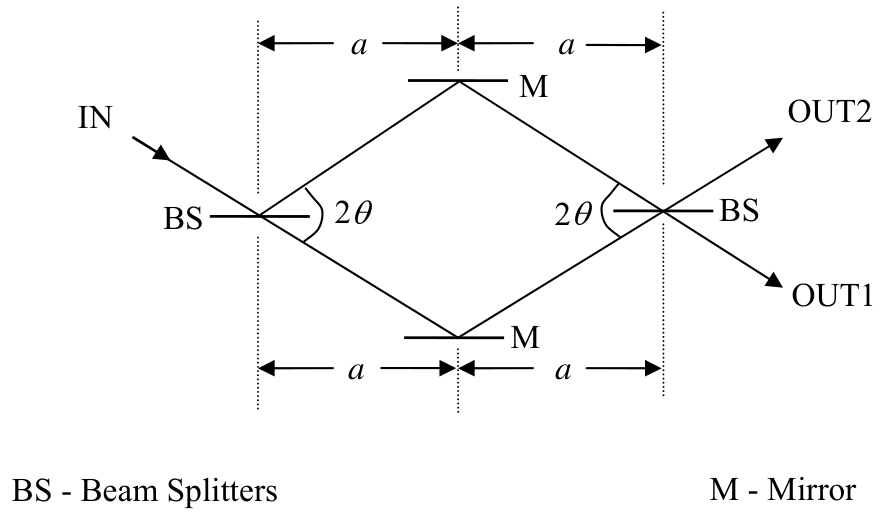
Figure 1a
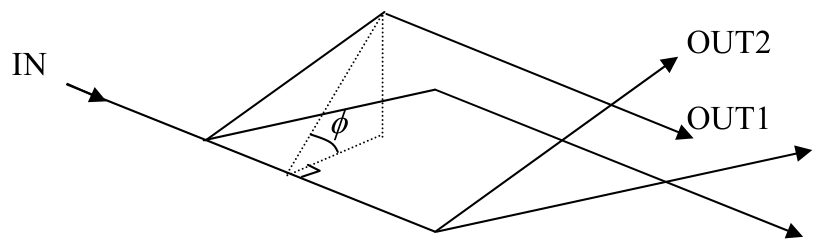
Figure 1b
Physical situation We consider the situation of the famous neutron-interferometer experiment by Collela, Overhauser and Werner, but idealize the set-up inasmuch as we shall assume perfect beam splitters and mirrors within the interferometer. The experiment studies the effect of the gravitational pull on the de Broglie waves of neutrons.
The symbolic representation of this interferometer in analogy to an optical interferometer is shown in Figure 1a. The neutrons enter the interferometer through the IN port and follow the two paths shown. The neutrons are detected at either one of the two output ports, OUT1 or OUT2. The two paths enclose a diamond-shaped area, which is typically a few \(\mathrm{cm^2}\) in size.
The neutron de Broglie waves (of typical wavelength of \(10^{-10}\ \mathrm{m}\)) interfere such that all neutrons emerge from the output port OUT1 if the interferometer plane is horizontal. But when the interferometer is tilted around the axis of the incoming neutron beam by angle \(\phi\) (Figure 1b), one observes a \(\phi\) dependent redistribution of the neutrons between the two output ports OUT1 and OUT2.
Geometry For \(\phi=0^\circ\) the interferometer plane is horizontal; for \(\phi=90^\circ\) the plane is vertical with the output ports above the tilt axis.
1.1 (1.0) How large is the diamond-shaped area \(A\) enclosed by the two paths of the interferometer?
1.2 (1.0) What is the height \(H\) of output port OUT1 above the horizontal plane of the tilt axis?
Express \(A\) and \(H\) in terms of \(a\), \(\theta\), and \(\phi\).
Optical path length The optical path length \(N_{\mathrm{opt}}\) (a number) is the ratio of the geometrical path length (a distance) and the wavelength \(\lambda\). If \(\lambda\) changes along the path, \(N_{\mathrm{opt}}\) is obtained by integrating \(\lambda^{-1}\) along the path.
1.3 (3.0) What is the difference \(\Delta N_{\mathrm{opt}}\) in the optical path lengths of the two paths when the interferometer has been tilted by angle \(\phi\)? Express your answer in terms of \(a\), \(\theta\), and \(\phi\) as well as the neutron mass \(M\), the de Broglie wavelength \(\lambda_0\) of the incoming neutrons, the gravitational acceleration \(g\), and Planck’s constant \(h\).
1.4 (1.0) Introduce the volume parameter
\[ V=\frac{h^2}{gM^2} \]
and express \(\Delta N_{\mathrm{opt}}\) solely in terms of \(A\), \(V\), \(\lambda_0\), and \(\phi\). State the value of \(V\) for \(M=1.675\times10^{-27}\ \mathrm{kg}\), \(g=9.800\ \mathrm{m\,s^{-2}}\), and \(h=6.626\times10^{-34}\ \mathrm{J\,s}\).
1.5 (2.0) How many cycles — from high intensity to low intensity and back to high intensity — are completed by output port OUT1 when \(\phi\) is increased from \(\phi=-90^\circ\) to \(\phi=90^\circ\)?
Experimental data The interferometer of an actual experiment was characterized by \(a=3.600\ \mathrm{cm}\) and \(\theta=22.10^\circ\), and 19.00 full cycles were observed.
1.6 (1.0) How large was \(\lambda_0\) in this experiment?
1.7 (1.0) If one observed 30.00 full cycles in another experiment of the same kind that uses neutrons with \(\lambda_0=0.2000\ \mathrm{nm}\), how large would be the area \(A\)?
Hint: If \(|\alpha x|\ll1\), it is permissible to replace \((1+x)^\alpha\) by \(1+\alpha x\).
Official English text of the problem.
Problem 2: Watching a Rod in Motion
Enter all your answers into the Answer Script.
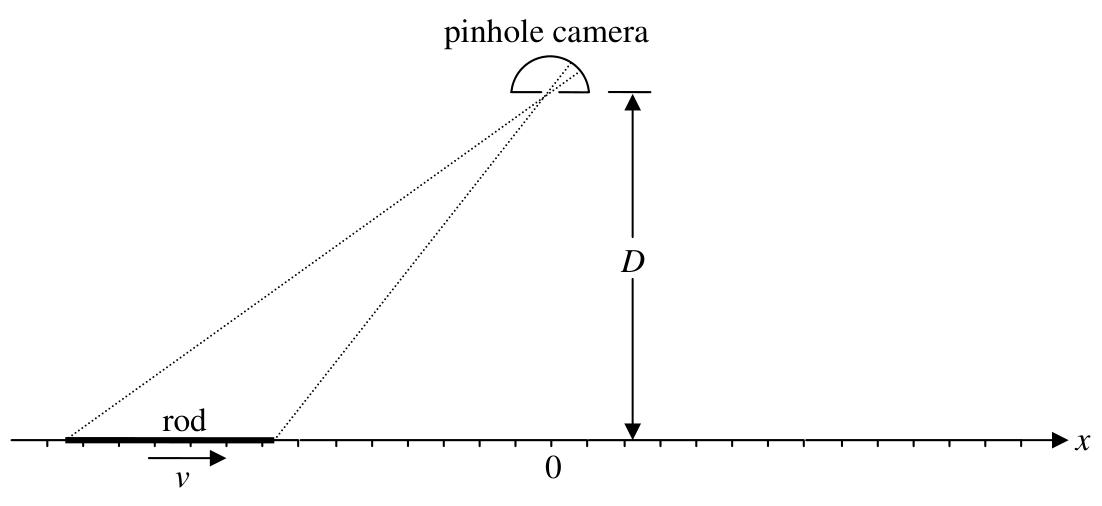
Physical situation A pinhole camera, with the pinhole at \(x=0\) and at distance \(D\) from the \(x\) axis, takes pictures of a rod, by opening the pinhole for a very short time. There are equidistant marks along the \(x\) axis by which the apparent length of the rod, as it is seen on the picture, can be determined from the pictures taken by the pinhole camera. On a picture of the rod at rest, its length is \(L\). However, the rod is not at rest, but is moving with constant velocity \(\upsilon\) along the \(x\) axis.
Basic relations A picture taken by the pinhole camera shows a tiny segment of the rod at position \(\tilde{x}\).
2.1 (0.6) What is the actual position \(x\) of this segment at the time when the picture is taken? State your answer in terms of \(\tilde{x}\), \(D\), \(L\), \(\upsilon\), and the speed of light \(c=3.00\times10^8\ \mathrm{m\,s^{-1}}\). Employ the quantities
\[ \beta=\frac{\upsilon}{c} \quad\text{and}\quad \gamma=\frac{1}{\sqrt{1-\beta^2}} \]
if they help to simplify your result.
2.2 (0.9) Find also the corresponding inverse relation, that is: express \(\tilde{x}\) in terms of \(x\), \(D\), \(L\), \(\upsilon\), and \(c\).
Note: The actual position is the position in the frame in which the camera is at rest
Apparent length of the rod The pinhole camera takes a picture at the instant when the actual position of the center of the rod is at some point \(x_0\).
2.3 (1.5) In terms of the given variables, determine the apparent length of the rod on this picture.
2.4 (1.5) Check one of the boxes in the Answer Script to indicate how the apparent length changes with time.
Symmetric picture One pinhole-camera picture shows both ends of the rod at the same distance from the pinhole.
2.5 (0.8) Determine the apparent length of the rod on this picture.
2.6 (1.0) What is the actual position of the middle of the rod at the time when this picture is taken?
2.7 (1.2) Where does the picture show the image of the middle of the rod?
Very early and very late pictures The pinhole camera took one picture very early, when the rod was very far away and approaching, and takes another picture very late, when the rod is very far away and receding. On one of the pictures the apparent length is \(1.00\ \mathrm{m}\), on the other picture it is \(3.00\ \mathrm{m}\).
2.8 (0.5) Check the box in the Answer Script to indicate which length is seen on which picture.
2.9 (1.0) Determine the velocity \(\upsilon\).
2.10 (0.6) Determine the length \(L\) of the rod at rest.
2.11 (0.4) Infer the apparent length on the symmetric picture.
2.4 Check one: The apparent length
☐ increases first, reaches a maximum value, then decreases.
☐ decreases first, reaches a minimum value, then increases.
☐ decreases all the time.
☐ increases all the time.1.5 Very early and very late pictures For Examiners Use Only 2.8 Check one:
☐ The apparent length is 1 m on the early picture and 3 m on the late picture.
☐ The apparent length is 3 m on the early picture and 1 m on the late picture.0.5 Official English text of the problem.
Problem 3: Five order-of-magnitude estimates: Digital Camera, Hard-boiled Egg, Lightning, Capillary Vessels, Skyscraper
This question consists of five independent parts. Each of them asks for an estimate of an order of magnitude only, not for a precise answer. Enter all your answers into the Answer Script.
Digital Camera Consider a digital camera with a square CCD chip with linear dimension \(L=35\ \mathrm{mm}\) having \(N_p=5\ \mathrm{Mpix}\) (\(1\ \mathrm{Mpix}=10^6\) pixels). The lens of this camera has a focal length of \(f=38\ \mathrm{mm}\). The well known sequence of numbers (2, 2.8, 4, 5.6, 8, 11, 16, 22) that appear on the lens refer to the so called F-number, which is denoted by \(F\#\) and defined as the ratio of the focal length and the diameter \(D\) of the aperture of the lens, \(F\#=f/D\).
3.1 (1.0) Find the best possible spatial resolution \(\Delta x_{\min}\), at the chip, of the camera as limited by the lens. Express your result in terms of the wavelength \(\lambda\) and the F-number \(F\#\) and give the numerical value for \(\lambda=500\ \mathrm{nm}\).
3.2 (0.5) Find the necessary number \(N\) of Mpix that the CCD chip should possess in order to match this optimal resolution.
3.3 (0.5) Sometimes, photographers try to use a camera at the smallest practical aperture. Suppose that we now have a camera of \(N_0=16\ \mathrm{Mpix}\), with the chip size and focal length as given above. Which value is to be chosen for \(F\#\) such that the image quality is not limited by the optics?
3.4 (0.5) Knowing that the human eye has an approximate angular resolution of \(\phi=2\ \mathrm{arcmin}\) and that a typical photo printer will print a minimum of 300 dpi (dots per inch), at what minimal distance \(z\) should you hold the printed page from your eyes so that you do not see the individual dots?
Data
1 inch \(=25.4\ \mathrm{mm}\) 1 arcmin \(=2.91\times10^{-4}\ \mathrm{rad}\) Hard-boiled egg An egg, taken directly from the fridge at temperature \(T_0=4^\circ\mathrm{C}\), is dropped into a pot with water that is kept boiling at temperature \(T_1\).
3.5 (0.5) How large is the amount of energy \(U\) that is needed to get the egg coagulated?
3.6 (0.5) How large is the heat flow \(J\) that is flowing into the egg?
3.7 (0.5) How large is the heat power \(P\) transferred to the egg?
3.8 (0.5) For how long do you need to cook the egg so that it is hard-boiled?
Hint You may use the simplified form of Fourier’s Law \(J=\kappa\Delta T/\Delta r\), where \(\Delta T\) is the temperature difference associated with \(\Delta r\), the typical length scale of the problem. The heat flow \(J\) is in units of \(\mathrm{W\,m^{-2}}\).
Data
Mass density of the egg: \(\mu=10^3\ \mathrm{kg\,m^{-3}}\) Specific heat capacity of the egg: \(C=4.2\ \mathrm{J\,K^{-1}\,g^{-1}}\) Radius of the egg: \(R=2.5\ \mathrm{cm}\) Coagulation temperature of albumen (egg protein): \(T_c=65^\circ\mathrm{C}\) Heat transport coefficient: \(\kappa=0.64\ \mathrm{W\,K^{-1}\,m^{-1}}\) (assumed to be the same for liquid and solid albumen) Lightning An oversimplified model of lightning is presented. Lightning is caused by the build-up of electrostatic charge in clouds. As a consequence, the bottom of the cloud usually gets positively charged and the top gets negatively charged, and the ground below the cloud gets negatively charged. When the corresponding electric field exceeds the breakdown strength value of air, a disruptive discharge occurs: this is lightning.
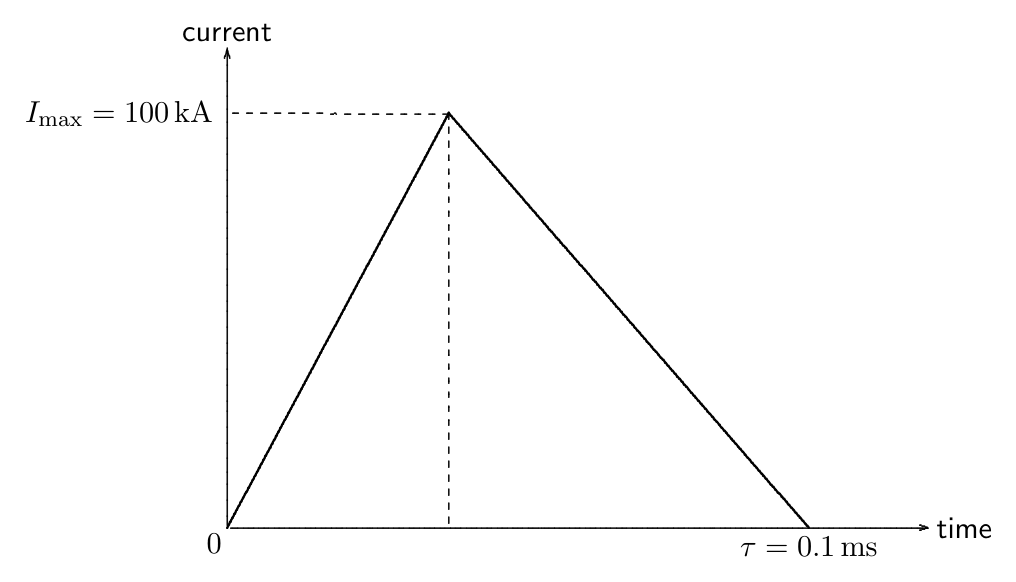
Idealized current pulse flowing between the cloud and the ground during lightning.
Answer the following questions with the aid of this simplified curve for the current as a function of time and these data:
Distance between the bottom of the cloud and the ground: \(h=1\ \mathrm{km}\); Breakdown electric field of humid air: \(E_0=300\ \mathrm{kV\,m^{-1}}\); Total number of lightning striking Earth per year: \(32\times10^6\); Total human population: \(6.5\times10^9\) people. 3.9 (0.5) What is the total charge \(Q\) released by lightning?
3.10 (0.5) What is the average current \(I\) flowing between the bottom of the cloud and the ground during lightning?
3.11 (1.0) Imagine that the energy of all storms of one year is collected and equally shared among all people. For how long could you continuously light up a 100 W light bulb for your share?
Capillary Vessels Let us regard blood as an incompressible viscous fluid with mass density \(\mu\) similar to that of water and dynamic viscosity \(\eta=4.5\ \mathrm{g\,m^{-1}\,s^{-1}}\). We model blood vessels as circular straight pipes with radius \(r\) and length \(L\) and describe the blood flow by Poiseuille’s law,
\[ \Delta p=RD, \]
the Fluid Dynamics analog of Ohm’s law in Electricity. Here \(\Delta p\) is the pressure difference between the entrance and the exit of the blood vessel, \(D=S\upsilon\) is the volume flow through the cross-sectional area \(S\) of the blood vessel and \(\upsilon\) is the blood velocity. The hydraulic resistance \(R\) is given by
\[ R=\frac{8\eta L}{\pi r^4}. \]
For the systemic blood circulation (the one flowing from the left ventricle to the right auricle of the heart), the blood flow is \(D\approx100\ \mathrm{cm^3\,s^{-1}}\) for a man at rest. Answer the following questions under the assumption that all capillary vessels are connected in parallel and that each of them has radius \(r=4\ \mu\mathrm{m}\) and length \(L=1\ \mathrm{mm}\) and operates under a pressure difference \(\Delta p=1\ \mathrm{kPa}\).
3.12 (1.0) How many capillary vessels are in the human body?
3.13 (0.5) How large is the velocity \(\upsilon\) with which blood is flowing through a capillary vessel?
Skyscraper At the bottom of a 1000 m high skyscraper, the outside temperature is \(T_{\mathrm{bot}}=30^\circ\mathrm{C}\). The objective is to estimate the outside temperature \(T_{\mathrm{top}}\) at the top. Consider a thin slab of air (ideal nitrogen gas with adiabatic coefficient \(\gamma=7/5\)) rising slowly to height \(z\) where the pressure is lower, and assume that this slab expands adiabatically so that its temperature drops to the temperature of the surrounding air.
3.14 (0.5) How is the fractional change in temperature \(dT/T\) related to \(dp/p\), the fractional change in pressure?
3.15 (0.5) Express the pressure difference \(dp\) in terms of \(dz\), the change in height.
3.16 (1.0) What is the resulting temperature at the top of the building?
Data
Boltzmann constant: \(k=1.38\times10^{-23}\ \mathrm{J\,K^{-1}}\) Mass of a nitrogen molecule: \(m=4.65\times10^{-26}\ \mathrm{kg}\) Gravitational acceleration: \(g=9.80\ \mathrm{m\,s^{-2}}\) Official English text of the problem.
Internationale Physik-Olympiade
IPhO 2006
Singapur · 3 Theorieaufgaben mit vollständigen Lösungen
Aufgabe 1: Gravitation in einem Neutroneninterferometer
Tragen Sie alle Ihre Antworten in den Antwortbogen ein.
Abbildung 1a
Abbildung 1b
Physikalische Situation Wir betrachten die Situation des berühmten Neutroneninterferometerexperiments von Collela, Overhauser und Werner, idealisieren den Aufbau jedoch insofern, als wir perfekte Strahlteiler und Spiegel innerhalb des Interferometers annehmen. Das Experiment untersucht den Einfluss der Schwerkraft auf die De-Broglie-Wellen von Neutronen.
Die schematische Darstellung dieses Interferometers in Analogie zu einem optischen Interferometer ist in Abbildung 1a gezeigt. Die Neutronen treten durch den Eingang IN in das Interferometer ein und folgen den beiden dargestellten Wegen. Die Neutronen werden an einem der beiden Ausgänge OUT1 oder OUT2 nachgewiesen. Die beiden Wege schließen eine rautenförmige Fläche ein, die typischerweise einige \(\mathrm{cm^2}\) groß ist.
Die De-Broglie-Wellen der Neutronen (mit einer typischen Wellenlänge von \(10^{-10}\ \mathrm{m}\)) interferieren so, dass alle Neutronen am Ausgang OUT1 austreten, wenn die Interferometerebene horizontal liegt. Wird das Interferometer jedoch um die Achse des einfallenden Neutronenstrahls um den Winkel \(\phi\) gekippt (Abbildung 1b), beobachtet man eine von \(\phi\) abhängige Umverteilung der Neutronen zwischen den beiden Ausgängen OUT1 und OUT2.
Geometrie Für \(\phi=0^\circ\) liegt die Interferometerebene horizontal; für \(\phi=90^\circ\) steht die Ebene vertikal, wobei sich die Ausgänge oberhalb der Kippachse befinden.
1.1 (1.0) Wie groß ist die rautenförmige Fläche \(A\), die von den beiden Wegen des Interferometers eingeschlossen wird?
1.2 (1.0) In welcher Höhe \(H\) liegt der Ausgang OUT1 über der horizontalen Ebene durch die Kippachse?
Drücken Sie \(A\) und \(H\) durch \(a\), \(\theta\) und \(\phi\) aus.
Optische Weglänge Die optische Weglänge \(N_{\mathrm{opt}}\) (eine Zahl) ist das Verhältnis der geometrischen Weglänge (einer Strecke) zur Wellenlänge \(\lambda\). Wenn sich \(\lambda\) entlang des Weges ändert, erhält man \(N_{\mathrm{opt}}\) durch Integration von \(\lambda^{-1}\) entlang des Weges.
1.3 (3.0) Wie groß ist die Differenz \(\Delta N_{\mathrm{opt}}\) der optischen Weglängen der beiden Wege, wenn das Interferometer um den Winkel \(\phi\) gekippt wurde? Drücken Sie Ihre Antwort durch \(a\), \(\theta\) und \(\phi\) sowie durch die Neutronenmasse \(M\), die De-Broglie-Wellenlänge \(\lambda_0\) der einfallenden Neutronen, die Erdbeschleunigung \(g\) und die Planck-Konstante \(h\) aus.
1.4 (1.0) Führen Sie den Volumenparameter
\[ V=\frac{h^2}{gM^2} \]
ein und drücken Sie \(\Delta N_{\mathrm{opt}}\) ausschließlich durch \(A\), \(V\), \(\lambda_0\) und \(\phi\) aus. Geben Sie den Wert von \(V\) für \(M=1.675\times10^{-27}\ \mathrm{kg}\), \(g=9.800\ \mathrm{m\,s^{-2}}\) und \(h=6.626\times10^{-34}\ \mathrm{J\,s}\) an.
1.5 (2.0) Wie viele Zyklen — von hoher Intensität zu niedriger Intensität und zurück zu hoher Intensität — werden am Ausgang OUT1 durchlaufen, wenn \(\phi\) von \(\phi=-90^\circ\) auf \(\phi=90^\circ\) erhöht wird?
Experimentelle Daten Das Interferometer eines tatsächlich durchgeführten Experiments war durch \(a=3.600\ \mathrm{cm}\) und \(\theta=22.10^\circ\) gekennzeichnet, und es wurden 19.00 vollständige Zyklen beobachtet.
1.6 (1.0) Wie groß war \(\lambda_0\) in diesem Experiment?
1.7 (1.0) Wenn in einem weiteren Experiment derselben Art mit Neutronen der Wellenlänge \(\lambda_0=0.2000\ \mathrm{nm}\) 30.00 vollständige Zyklen beobachtet würden, wie groß wäre dann die Fläche \(A\)?
Hinweis: Wenn \(|\alpha x|\ll1\), darf \((1+x)^\alpha\) durch \(1+\alpha x\) ersetzt werden.
Aufgabentext aus dem offiziellen englischen Text übersetzt.
Aufgabe 2: Beobachtung eines bewegten Stabes
Tragen Sie alle Ihre Antworten in den Antwortbogen ein.
Physikalische Situation Eine Lochkamera, deren Loch sich bei \(x=0\) im Abstand \(D\) von der \(x\)-Achse befindet, nimmt Bilder eines Stabes auf, indem das Loch für eine sehr kurze Zeit geöffnet wird. Entlang der \(x\)-Achse befinden sich Markierungen in gleichen Abständen, anhand derer sich die scheinbare Länge des Stabes, wie sie auf dem Bild erscheint, aus den Aufnahmen der Lochkamera bestimmen lässt. Auf einem Bild des ruhenden Stabes beträgt seine Länge \(L\). Der Stab ruht jedoch nicht, sondern bewegt sich mit konstanter Geschwindigkeit \(\upsilon\) entlang der \(x\)-Achse.
Grundlegende Beziehungen Ein mit der Lochkamera aufgenommenes Bild zeigt einen sehr kleinen Abschnitt des Stabes an der Position \(\tilde{x}\).
2.1 (0.6) Wie lautet die tatsächliche Position \(x\) dieses Abschnitts zum Zeitpunkt der Aufnahme? Geben Sie Ihre Antwort in Abhängigkeit von \(\tilde{x}\), \(D\), \(L\), \(\upsilon\) und der Lichtgeschwindigkeit \(c=3.00\times10^8\ \mathrm{m\,s^{-1}}\) an. Verwenden Sie die Größen
\[ \beta=\frac{\upsilon}{c} \quad\text{und}\quad \gamma=\frac{1}{\sqrt{1-\beta^2}} \]
falls diese Ihr Ergebnis vereinfachen.
2.2 (0.9) Bestimmen Sie auch die entsprechende Umkehrbeziehung, das heißt: Drücken Sie \(\tilde{x}\) durch \(x\), \(D\), \(L\), \(\upsilon\) und \(c\) aus.
Hinweis: Die tatsächliche Position ist die Position in dem Bezugssystem, in dem die Kamera ruht
Scheinbare Länge des Stabes Die Lochkamera nimmt ein Bild zu dem Zeitpunkt auf, zu dem sich die tatsächliche Position des Stabmittelpunkts an einem Punkt \(x_0\) befindet.
2.3 (1.5) Bestimmen Sie anhand der gegebenen Variablen die scheinbare Länge des Stabes auf diesem Bild.
2.4 (1.5) Kreuzen Sie eines der Kästchen im Antwortbogen an, um anzugeben, wie sich die scheinbare Länge mit der Zeit ändert.
Symmetrisches Bild Eine Aufnahme der Lochkamera zeigt beide Enden des Stabes im gleichen Abstand vom Loch.
2.5 (0.8) Bestimmen Sie die scheinbare Länge des Stabes auf diesem Bild.
2.6 (1.0) Wie lautet die tatsächliche Position der Mitte des Stabes zum Zeitpunkt dieser Aufnahme?
2.7 (1.2) An welcher Position zeigt das Bild die Abbildung der Mitte des Stabes?
Sehr frühe und sehr späte Aufnahmen Die Lochkamera hat sehr früh ein Bild aufgenommen, als der Stab sehr weit entfernt war und sich näherte, und nimmt sehr spät ein weiteres Bild auf, wenn der Stab sehr weit entfernt ist und sich entfernt. Auf einem der Bilder beträgt die scheinbare Länge \(1.00\ \mathrm{m}\), auf dem anderen \(3.00\ \mathrm{m}\).
2.8 (0.5) Kreuzen Sie das Kästchen im Antwortbogen an, das angibt, welche Länge auf welchem Bild zu sehen ist.
2.9 (1.0) Bestimmen Sie die Geschwindigkeit \(\upsilon\).
2.10 (0.6) Bestimmen Sie die Länge \(L\) des ruhenden Stabes.
2.11 (0.4) Leiten Sie daraus die scheinbare Länge auf dem symmetrischen Bild ab.
2.4 Kreuzen Sie eine Antwort an: Die scheinbare Länge
☐ nimmt zunächst zu, erreicht einen Höchstwert und nimmt dann ab.
☐ nimmt zunächst ab, erreicht einen Mindestwert und nimmt dann zu.
☐ nimmt die ganze Zeit ab.
☐ nimmt die ganze Zeit zu.1.5 Sehr frühe und sehr späte Aufnahmen Nur für die Korrektur 2.8 Kreuzen Sie eine Antwort an:
☐ Die scheinbare Länge beträgt auf der frühen Aufnahme 1 m und auf der späten Aufnahme 3 m.
☐ Die scheinbare Länge beträgt auf der frühen Aufnahme 3 m und auf der späten Aufnahme 1 m.0.5 Aufgabentext aus dem offiziellen englischen Text übersetzt.
Aufgabe 3: Fünf Größenordnungsabschätzungen: Digitalkamera, hartgekochtes Ei, Blitz, Kapillargefäße, Wolkenkratzer
Diese Aufgabe besteht aus fünf unabhängigen Teilen. In jedem davon wird lediglich eine Größenordnung abgeschätzt; eine genaue Antwort ist nicht erforderlich. Tragen Sie alle Ihre Antworten in den Antwortbogen ein.
Digitalkamera Betrachten Sie eine Digitalkamera mit einem quadratischen CCD-Chip der Seitenlänge \(L=35\ \mathrm{mm}\) mit \(N_p=5\ \mathrm{Mpix}\) (\(1\ \mathrm{Mpix}=10^6\) Pixel). Das Objektiv dieser Kamera hat eine Brennweite von \(f=38\ \mathrm{mm}\). Die bekannte Zahlenfolge (2, 2.8, 4, 5.6, 8, 11, 16, 22) auf dem Objektiv bezeichnet die sogenannte Blendenzahl, die mit \(F\#\) bezeichnet wird und als Verhältnis der Brennweite zum Durchmesser \(D\) der Objektivöffnung definiert ist: \(F\#=f/D\).
3.1 (1.0) Bestimmen Sie die bestmögliche räumliche Auflösung \(\Delta x_{\min}\) der Kamera auf dem Chip, die durch das Objektiv begrenzt wird. Drücken Sie Ihr Ergebnis durch die Wellenlänge \(\lambda\) und die Blendenzahl \(F\#\) aus und geben Sie den Zahlenwert für \(\lambda=500\ \mathrm{nm}\) an.
3.2 (0.5) Bestimmen Sie die erforderliche Anzahl \(N\) an Mpix, die der CCD-Chip besitzen sollte, um dieser optimalen Auflösung zu entsprechen.
3.3 (0.5) Fotografen versuchen manchmal, eine Kamera mit der kleinsten praktisch nutzbaren Blendenöffnung zu verwenden. Angenommen, wir haben nun eine Kamera mit \(N_0=16\ \mathrm{Mpix}\), deren Chipgröße und Brennweite den oben angegebenen Werten entsprechen. Welcher Wert ist für \(F\#\) zu wählen, damit die Bildqualität nicht durch die Optik begrenzt wird?
3.4 (0.5) Das menschliche Auge hat eine Winkelauflösung von ungefähr \(\phi=2\ \mathrm{arcmin}\), und ein typischer Fotodrucker druckt mit mindestens 300 dpi (Punkten pro Zoll). In welchem Mindestabstand \(z\) von Ihren Augen sollten Sie das bedruckte Blatt halten, damit Sie die einzelnen Punkte nicht sehen?
Daten
1 Zoll \(=25.4\ \mathrm{mm}\) 1 Winkelminute \(=2.91\times10^{-4}\ \mathrm{rad}\) Hartgekochtes Ei Ein Ei wird direkt aus dem Kühlschrank bei einer Temperatur von \(T_0=4^\circ\mathrm{C}\) entnommen und in einen Topf mit Wasser gegeben, das bei der Temperatur \(T_1\) am Sieden gehalten wird.
3.5 (0.5) Wie groß ist die Energiemenge \(U\), die benötigt wird, um das Ei zum Gerinnen zu bringen?
3.6 (0.5) Wie groß ist die Wärmestromdichte \(J\), mit der Wärme in das Ei fließt?
3.7 (0.5) Wie groß ist die auf das Ei übertragene Wärmeleistung \(P\)?
3.8 (0.5) Wie lange müssen Sie das Ei kochen, damit es hartgekocht ist?
Hinweis Sie dürfen die vereinfachte Form des Fourierschen Gesetzes \(J=\kappa\Delta T/\Delta r\) verwenden. Dabei ist \(\Delta T\) die Temperaturdifferenz über die Strecke \(\Delta r\), die charakteristische Längenskala des Problems. Die Wärmestromdichte \(J\) wird in Einheiten von \(\mathrm{W\,m^{-2}}\) angegeben.
Daten
Massendichte des Eis: \(\mu=10^3\ \mathrm{kg\,m^{-3}}\) Spezifische Wärmekapazität des Eis: \(C=4.2\ \mathrm{J\,K^{-1}\,g^{-1}}\) Radius des Eis: \(R=2.5\ \mathrm{cm}\) Gerinnungstemperatur des Eiklars (Eiproteins): \(T_c=65^\circ\mathrm{C}\) Wärmeleitfähigkeit: \(\kappa=0.64\ \mathrm{W\,K^{-1}\,m^{-1}}\) (für flüssiges und festes Eiklar als gleich angenommen) Blitz Es wird ein stark vereinfachtes Modell eines Blitzes vorgestellt. Blitze entstehen durch die Ansammlung elektrostatischer Ladung in Wolken. Dabei lädt sich die Unterseite der Wolke gewöhnlich positiv und die Oberseite negativ auf, während sich der Erdboden unter der Wolke negativ auflädt. Wenn das entsprechende elektrische Feld die Durchschlagsfeldstärke der Luft überschreitet, kommt es zu einer elektrischen Durchschlagsentladung: einem Blitz.
Idealisierter Stromimpuls, der während eines Blitzes zwischen der Wolke und dem Erdboden fließt.
Beantworten Sie die folgenden Fragen mithilfe dieser vereinfachten Kurve der Stromstärke als Funktion der Zeit und der folgenden Daten:
Abstand zwischen der Wolkenunterseite und dem Erdboden: \(h=1\ \mathrm{km}\); Durchschlagsfeldstärke feuchter Luft: \(E_0=300\ \mathrm{kV\,m^{-1}}\); Gesamtzahl der Blitzeinschläge auf der Erde pro Jahr: \(32\times10^6\); Gesamtbevölkerung der Erde: \(6.5\times10^9\) Menschen. 3.9 (0.5) Wie groß ist die gesamte bei einem Blitz freigesetzte Ladung \(Q\)?
3.10 (0.5) Wie groß ist die mittlere Stromstärke \(I\), die während eines Blitzes zwischen der Wolkenunterseite und dem Erdboden fließt?
3.11 (1.0) Stellen Sie sich vor, die Energie aller Gewitter eines Jahres würde gesammelt und gleichmäßig unter allen Menschen aufgeteilt. Wie lange könnten Sie mit Ihrem Anteil eine 100-W-Glühlampe ununterbrochen leuchten lassen?
Kapillargefäße Wir betrachten Blut als inkompressible viskose Flüssigkeit mit einer Massendichte \(\mu\), die der von Wasser ähnelt, und einer dynamischen Viskosität von \(\eta=4.5\ \mathrm{g\,m^{-1}\,s^{-1}}\). Wir modellieren Blutgefäße als gerade Rohre mit kreisförmigem Querschnitt, Radius \(r\) und Länge \(L\) und beschreiben den Blutstrom durch das Hagen-Poiseuille-Gesetz,
\[ \Delta p=RD, \]
das strömungsmechanische Analogon zum Ohmschen Gesetz der Elektrizitätslehre. Dabei ist \(\Delta p\) die Druckdifferenz zwischen Eintritt und Austritt des Blutgefäßes, \(D=S\upsilon\) der Volumenstrom durch die Querschnittsfläche \(S\) des Blutgefäßes und \(\upsilon\) die Strömungsgeschwindigkeit des Blutes. Der hydraulische Widerstand \(R\) ist gegeben durch
\[ R=\frac{8\eta L}{\pi r^4}. \]
Im Körperkreislauf (vom linken Ventrikel zum rechten Vorhof des Herzens) beträgt der Blutvolumenstrom bei einem ruhenden Mann \(D\approx100\ \mathrm{cm^3\,s^{-1}}\). Beantworten Sie die folgenden Fragen unter der Annahme, dass alle Kapillargefäße parallel geschaltet sind, jedes von ihnen den Radius \(r=4\ \mu\mathrm{m}\) und die Länge \(L=1\ \mathrm{mm}\) hat und an jedem eine Druckdifferenz von \(\Delta p=1\ \mathrm{kPa}\) anliegt.
3.12 (1.0) Wie viele Kapillargefäße gibt es im menschlichen Körper?
3.13 (0.5) Wie groß ist die Geschwindigkeit \(\upsilon\), mit der das Blut durch ein Kapillargefäß fließt?
Wolkenkratzer Am Fuß eines 1000 m hohen Wolkenkratzers beträgt die Außentemperatur \(T_{\mathrm{bot}}=30^\circ\mathrm{C}\). Ziel ist es, die Außentemperatur \(T_{\mathrm{top}}\) an der Spitze abzuschätzen. Betrachten Sie eine dünne Luftschicht (ideales Stickstoffgas mit dem Adiabatenexponenten \(\gamma=7/5\)), die langsam bis zur Höhe \(z\) aufsteigt, wo der Druck niedriger ist. Nehmen Sie an, dass sich diese Schicht adiabatisch ausdehnt, sodass ihre Temperatur auf die Temperatur der umgebenden Luft sinkt.
3.14 (0.5) Wie hängt die relative Temperaturänderung \(dT/T\) mit der relativen Druckänderung \(dp/p\) zusammen?
3.15 (0.5) Drücken Sie die Druckdifferenz \(dp\) durch die Höhenänderung \(dz\) aus.
3.16 (1.0) Welche Temperatur ergibt sich an der Spitze des Gebäudes?
Daten
Boltzmann-Konstante: \(k=1.38\times10^{-23}\ \mathrm{J\,K^{-1}}\) Masse eines Stickstoffmoleküls: \(m=4.65\times10^{-26}\ \mathrm{kg}\) Erdbeschleunigung: \(g=9.80\ \mathrm{m\,s^{-2}}\) Aufgabentext aus dem offiziellen englischen Text übersetzt.
Uluslararası Fizik Olimpiyatı
IPhO 2006
Singapur · 3 teori sorusu, tam çözümleriyle
Soru 1: Bir Nötron İnterferometresinde Kütleçekimi
Tüm cevaplarınızı Cevap Kâğıdına yazınız.
Şekil 1a
Şekil 1b
Fiziksel durum Collela, Overhauser ve Werner'in ünlü nötron interferometresi deneyindeki durumu ele alıyoruz; ancak interferometre içindeki demet ayırıcıların ve aynaların kusursuz olduğunu varsayarak düzeneği idealleştiriyoruz. Deney, kütleçekiminin nötronların de Broglie dalgaları üzerindeki etkisini inceler.
Bu interferometrenin, bir optik interferometreye benzetilerek oluşturulan şematik gösterimi Şekil 1a'da verilmiştir. Nötronlar interferometreye IN girişinden girer ve gösterilen iki yolu izler. Nötronlar, OUT1 veya OUT2 çıkışlarının birinde algılanır. İki yol, alanı tipik olarak birkaç \(\mathrm{cm^2}\) olan eşkenar dörtgen biçiminde bir bölgeyi çevreler.
Nötronların de Broglie dalgaları (tipik dalga boyları \(10^{-10}\ \mathrm{m}\)) öyle girişim yapar ki interferometre düzlemi yatay olduğunda tüm nötronlar OUT1 çıkışından çıkar. Ancak interferometre, gelen nötron demetinin ekseni etrafında \(\phi\) açısı kadar eğildiğinde (Şekil 1b), nötronların OUT1 ve OUT2 çıkışları arasındaki dağılımının \(\phi\)'ye bağlı olarak değiştiği gözlenir.
Geometri \(\phi=0^\circ\) için interferometre düzlemi yataydır; \(\phi=90^\circ\) için ise düzlem düşeydir ve çıkışlar eğme ekseninin üzerindedir.
1.1 (1.0) İnterferometrenin iki yolunun çevrelediği eşkenar dörtgen biçimindeki bölgenin alanı \(A\) ne kadardır?
1.2 (1.0) OUT1 çıkışının, eğme ekseninden geçen yatay düzleme göre yüksekliği \(H\) ne kadardır?
\(A\) ve \(H\)'yi \(a\), \(\theta\) ve \(\phi\) cinsinden ifade ediniz.
Optik yol uzunluğu Optik yol uzunluğu \(N_{\mathrm{opt}}\) (bir sayı), geometrik yol uzunluğunun (bir mesafe) dalga boyu \(\lambda\)'ya oranıdır. \(\lambda\) yol boyunca değişiyorsa, \(N_{\mathrm{opt}}\), yol boyunca \(\lambda^{-1}\)'in integrali alınarak elde edilir.
1.3 (3.0) İnterferometre \(\phi\) açısı kadar eğildiğinde iki yolun optik yol uzunlukları arasındaki fark \(\Delta N_{\mathrm{opt}}\) nedir? Cevabınızı \(a\), \(\theta\) ve \(\phi\)'nin yanı sıra nötron kütlesi \(M\), gelen nötronların de Broglie dalga boyu \(\lambda_0\), yerçekimi ivmesi \(g\) ve Planck sabiti \(h\) cinsinden ifade ediniz.
1.4 (1.0) Hacim parametresini
\[ V=\frac{h^2}{gM^2} \]
olarak tanımlayınız ve \(\Delta N_{\mathrm{opt}}\)'yi yalnızca \(A\), \(V\), \(\lambda_0\) ve \(\phi\) cinsinden ifade ediniz. \(M=1.675\times10^{-27}\ \mathrm{kg}\), \(g=9.800\ \mathrm{m\,s^{-2}}\) ve \(h=6.626\times10^{-34}\ \mathrm{J\,s}\) için \(V\)'nin değerini belirtiniz.
1.5 (2.0) \(\phi\), \(\phi=-90^\circ\)'den \(\phi=90^\circ\)'ye artırıldığında OUT1 çıkışında kaç döngü — yüksek şiddetten düşük şiddete ve tekrar yüksek şiddete — tamamlanır?
Deneysel veriler Gerçek bir deneyde kullanılan interferometrenin parametreleri \(a=3.600\ \mathrm{cm}\) ve \(\theta=22.10^\circ\) idi ve 19.00 tam döngü gözlendi.
1.6 (1.0) Bu deneyde \(\lambda_0\) ne kadardı?
1.7 (1.0) Aynı türden başka bir deneyde, \(\lambda_0=0.2000\ \mathrm{nm}\) dalga boyuna sahip nötronlar kullanılarak 30.00 tam döngü gözlenseydi, \(A\) alanı ne kadar olurdu?
İpucu: \(|\alpha x|\ll1\) ise, \((1+x)^\alpha\) yerine \(1+\alpha x\) kullanılabilir.
Soru metni resmi İngilizce metinden çevrilmiştir.
Soru 2: Hareket Hâlindeki Bir Çubuğu İzlemek
Tüm cevaplarınızı Cevap Kâğıdına yazınız.
Fiziksel durum İğne deliği \(x=0\) konumunda ve \(x\) ekseninden \(D\) uzaklıkta bulunan bir iğne deliği kamerası, deliği çok kısa bir süre açarak bir çubuğun fotoğraflarını çekmektedir. \(x\) ekseni boyunca eşit aralıklarla yerleştirilmiş işaretler vardır; bu işaretler yardımıyla, iğne deliği kamerasının çektiği fotoğraflardan çubuğun fotoğrafta görülen görünür uzunluğu belirlenebilir. Çubuğun durgun hâldeyken çekilmiş bir fotoğrafında uzunluğu \(L\)'dir. Ancak çubuk durgun değildir; \(x\) ekseni boyunca sabit \(\upsilon\) hızıyla hareket etmektedir.
Temel bağıntılar İğne deliği kamerasıyla çekilen bir fotoğrafta, çubuğun çok küçük bir parçası \(\tilde{x}\) konumunda görülmektedir.
2.1 (0.6) Fotoğrafın çekildiği anda bu parçanın gerçek konumu \(x\) nedir? Cevabınızı \(\tilde{x}\), \(D\), \(L\), \(\upsilon\) ve ışık hızı \(c=3.00\times10^8\ \mathrm{m\,s^{-1}}\) cinsinden ifade ediniz. Sonucunuzu sadeleştirmeye yardımcı oluyorsa
\[ \beta=\frac{\upsilon}{c} \quad\text{ve}\quad \gamma=\frac{1}{\sqrt{1-\beta^2}} \]
niceliklerini kullanınız.
2.2 (0.9) Buna karşılık gelen ters bağıntıyı da bulunuz; yani \(\tilde{x}\)'i \(x\), \(D\), \(L\), \(\upsilon\) ve \(c\) cinsinden ifade ediniz.
Not: Gerçek konum, kameranın durgun olduğu referans sistemindeki konumdur
Çubuğun görünür uzunluğu İğne deliği kamerası, çubuğun merkezinin gerçek konumunun bir \(x_0\) noktasında olduğu anda bir fotoğraf çekmektedir.
2.3 (1.5) Verilen değişkenler cinsinden, çubuğun bu fotoğraftaki görünür uzunluğunu belirleyiniz.
2.4 (1.5) Görünür uzunluğun zamanla nasıl değiştiğini belirtmek için Cevap Kâğıdındaki kutulardan birini işaretleyiniz.
Simetrik fotoğraf İğne deliği kamerasıyla çekilen bir fotoğrafta, çubuğun her iki ucu da iğne deliğinden aynı uzaklıkta görülmektedir.
2.5 (0.8) Çubuğun bu fotoğraftaki görünür uzunluğunu belirleyiniz.
2.6 (1.0) Bu fotoğrafın çekildiği anda çubuğun orta noktasının gerçek konumu nedir?
2.7 (1.2) Fotoğrafta çubuğun orta noktasının görüntüsü nerede görülür?
Çok erken ve çok geç çekilen fotoğraflar İğne deliği kamerası, çubuk çok uzaktayken ve yaklaşırken çok erken bir anda bir fotoğraf çekmiştir; çubuk çok uzaktayken ve uzaklaşırken çok geç bir anda da başka bir fotoğraf çekmektedir. Fotoğraflardan birinde görünür uzunluk \(1.00\ \mathrm{m}\), diğerinde ise \(3.00\ \mathrm{m}\)'dir.
2.8 (0.5) Hangi fotoğrafta hangi uzunluğun görüldüğünü belirtmek için Cevap Kâğıdındaki kutuyu işaretleyiniz.
2.9 (1.0) \(\upsilon\) hızını belirleyiniz.
2.10 (0.6) Çubuğun durgun hâldeki \(L\) uzunluğunu belirleyiniz.
2.11 (0.4) Simetrik fotoğraftaki görünür uzunluğu çıkarınız.
2.4 Birini işaretleyiniz: Görünür uzunluk
☐ önce artar, en büyük değerine ulaşır, sonra azalır.
☐ önce azalır, en küçük değerine ulaşır, sonra artar.
☐ sürekli azalır.
☐ sürekli artar.1.5 Çok erken ve çok geç çekilen fotoğraflar Yalnızca Değerlendiricilerin Kullanımı İçindir 2.8 Birini işaretleyiniz:
☐ Görünür uzunluk erken çekilen fotoğrafta 1 m, geç çekilen fotoğrafta 3 m'dir.
☐ Görünür uzunluk erken çekilen fotoğrafta 3 m, geç çekilen fotoğrafta 1 m'dir.0.5 Soru metni resmi İngilizce metinden çevrilmiştir.
Soru 3: Beş büyüklük mertebesi tahmini: Dijital Fotoğraf Makinesi, Katı Pişmiş Yumurta, Yıldırım, Kılcal Damarlar, Gökdelen
Bu soru birbirinden bağımsız beş bölümden oluşmaktadır. Her bölümde kesin bir cevap değil, yalnızca bir büyüklük mertebesi tahmini istenmektedir. Tüm cevaplarınızı Cevap Kâğıdına yazınız.
Dijital Fotoğraf Makinesi Kenar uzunluğu \(L=35\ \mathrm{mm}\) olan, \(N_p=5\ \mathrm{Mpix}\) (\(1\ \mathrm{Mpix}=10^6\) piksel) içeren kare bir CCD yongasına sahip bir dijital fotoğraf makinesi düşününüz. Bu makinenin objektifinin odak uzaklığı \(f=38\ \mathrm{mm}\)'dir. Objektifin üzerinde yer alan, iyi bilinen (2, 2.8, 4, 5.6, 8, 11, 16, 22) sayı dizisi, F sayısı olarak adlandırılan niceliği belirtir. Bu nicelik \(F\#\) ile gösterilir ve odak uzaklığının objektif açıklığının \(D\) çapına oranı olarak tanımlanır: \(F\#=f/D\).
3.1 (1.0) Fotoğraf makinesinin, objektifin sınırladığı, yonga üzerindeki mümkün olan en iyi uzaysal çözünürlüğünü \(\Delta x_{\min}\) bulunuz. Sonucunuzu dalga boyu \(\lambda\) ve F sayısı \(F\#\) cinsinden ifade ediniz ve \(\lambda=500\ \mathrm{nm}\) için sayısal değerini veriniz.
3.2 (0.5) CCD yongasının bu en iyi çözünürlüğe uyum sağlaması için sahip olması gereken Mpix sayısı \(N\)'yi bulunuz.
3.3 (0.5) Fotoğrafçılar bazen bir fotoğraf makinesini kullanılabilir en küçük açıklıkta kullanmaya çalışırlar. Şimdi, yonga boyutu ve odak uzaklığı yukarıda verilenlerle aynı olan, \(N_0=16\ \mathrm{Mpix}\)'lik bir fotoğraf makinemiz olduğunu varsayınız. Görüntü kalitesinin optik sistem tarafından sınırlanmaması için \(F\#\)'nin hangi değeri seçilmelidir?
3.4 (0.5) İnsan gözünün yaklaşık açısal çözünürlüğünün \(\phi=2\ \mathrm{arcmin}\) olduğunu ve tipik bir fotoğraf yazıcısının en az 300 dpi (inç başına nokta) ile baskı yaptığını bilerek, tek tek noktaları görmemek için basılı sayfayı gözlerinizden en az ne kadar \(z\) uzaklığında tutmanız gerektiğini bulunuz.
Veriler
1 inç \(=25.4\ \mathrm{mm}\) 1 yay dakikası \(=2.91\times10^{-4}\ \mathrm{rad}\) Katı pişmiş yumurta \(T_0=4^\circ\mathrm{C}\) sıcaklığındaki buzdolabından doğrudan alınan bir yumurta, içindeki su \(T_1\) sıcaklığında kaynar durumda tutulan bir tencereye bırakılır.
3.5 (0.5) Yumurtanın pıhtılaşması için gereken enerji miktarı \(U\) ne kadardır?
3.6 (0.5) Yumurtanın içine doğru akan ısı akısı \(J\) ne kadardır?
3.7 (0.5) Yumurtaya aktarılan ısıl güç \(P\) ne kadardır?
3.8 (0.5) Yumurtanın katı pişmiş olması için onu ne kadar süre pişirmeniz gerekir?
İpucu Fourier yasasının basitleştirilmiş biçimi olan \(J=\kappa\Delta T/\Delta r\) bağıntısını kullanabilirsiniz. Burada \(\Delta T\), problemin karakteristik uzunluk ölçeği \(\Delta r\) boyunca oluşan sıcaklık farkıdır. Isı akısı \(J\)'nin birimi \(\mathrm{W\,m^{-2}}\)'dir.
Veriler
Yumurtanın kütle yoğunluğu: \(\mu=10^3\ \mathrm{kg\,m^{-3}}\) Yumurtanın özgül ısı kapasitesi: \(C=4.2\ \mathrm{J\,K^{-1}\,g^{-1}}\) Yumurtanın yarıçapı: \(R=2.5\ \mathrm{cm}\) Albüminin (yumurta proteininin) pıhtılaşma sıcaklığı: \(T_c=65^\circ\mathrm{C}\) Isıl iletkenlik katsayısı: \(\kappa=0.64\ \mathrm{W\,K^{-1}\,m^{-1}}\) (sıvı ve katı albümin için aynı olduğu varsayılmaktadır) Yıldırım Yıldırım için oldukça basitleştirilmiş bir model sunulmaktadır. Yıldırım, bulutlarda elektrostatik yük birikmesinden kaynaklanır. Bunun sonucunda bulutun alt kısmı genellikle pozitif, üst kısmı negatif yüklenir ve bulutun altındaki yer yüzeyi negatif yüklenir. Buna karşılık gelen elektrik alan, havanın delinme dayanımını aştığında bir elektriksel boşalma meydana gelir: bu, yıldırımdır.
Yıldırım sırasında bulut ile yer arasında akan idealleştirilmiş akım darbesi.
Akımın zamana bağlı değişimini gösteren bu basitleştirilmiş eğriden ve aşağıdaki verilerden yararlanarak soruları cevaplayınız:
Bulutun alt kısmı ile yer arasındaki uzaklık: \(h=1\ \mathrm{km}\); Nemli havanın delinme elektrik alanı: \(E_0=300\ \mathrm{kV\,m^{-1}}\); Bir yılda Dünya'ya düşen toplam yıldırım sayısı: \(32\times10^6\); Toplam insan nüfusu: \(6.5\times10^9\) kişi. 3.9 (0.5) Yıldırımla boşalan toplam yük \(Q\) ne kadardır?
3.10 (0.5) Yıldırım sırasında bulutun alt kısmı ile yer arasında akan ortalama akım \(I\) ne kadardır?
3.11 (1.0) Bir yıl boyunca meydana gelen tüm fırtınaların enerjisinin toplandığını ve tüm insanlar arasında eşit olarak paylaştırıldığını düşününüz. Payınıza düşen enerjiyle 100 W'lık bir ampulü kesintisiz olarak ne kadar süre yakabilirsiniz?
Kılcal Damarlar Kanı, kütle yoğunluğu \(\mu\) suyunkine benzer ve dinamik viskozitesi \(\eta=4.5\ \mathrm{g\,m^{-1}\,s^{-1}}\) olan sıkıştırılamaz, viskoz bir akışkan olarak ele alalım. Kan damarlarını yarıçapı \(r\), uzunluğu \(L\) olan dairesel kesitli düz borular olarak modelleyelim ve kan akışını Poiseuille yasasıyla ifade edelim:
\[ \Delta p=RD, \]
Bu yasa, elektrikteki Ohm yasasının akışkanlar dinamiğindeki karşılığıdır. Burada \(\Delta p\), kan damarının girişi ile çıkışı arasındaki basınç farkı; \(D=S\upsilon\), kan damarının \(S\) kesit alanından geçen hacimsel debi ve \(\upsilon\), kanın hızıdır. Hidrolik direnç \(R\) şu şekilde verilir:
\[ R=\frac{8\eta L}{\pi r^4}. \]
Büyük kan dolaşımında (kalbin sol karıncığından sağ kulakçığına doğru olan dolaşımda), dinlenme hâlindeki bir erkekte kanın hacimsel debisi \(D\approx100\ \mathrm{cm^3\,s^{-1}}\)'dir. Tüm kılcal damarların paralel bağlı olduğunu, her birinin yarıçapının \(r=4\ \mu\mathrm{m}\), uzunluğunun \(L=1\ \mathrm{mm}\) olduğunu ve \(\Delta p=1\ \mathrm{kPa}\) basınç farkı altında çalıştığını varsayarak aşağıdaki soruları cevaplayınız.
3.12 (1.0) İnsan vücudunda kaç kılcal damar vardır?
3.13 (0.5) Kanın bir kılcal damardan akış hızı \(\upsilon\) ne kadardır?
Gökdelen 1000 m yüksekliğindeki bir gökdelenin tabanında dış ortam sıcaklığı \(T_{\mathrm{bot}}=30^\circ\mathrm{C}\)'dir. Amaç, tepedeki dış ortam sıcaklığı \(T_{\mathrm{top}}\)'ı tahmin etmektir. Basıncın daha düşük olduğu \(z\) yüksekliğine yavaşça yükselen ince bir hava tabakasını (adyabatik katsayısı \(\gamma=7/5\) olan ideal azot gazı) ele alınız ve bu tabakanın, sıcaklığı çevresindeki havanın sıcaklığına düşecek şekilde adyabatik olarak genleştiğini varsayınız.
3.14 (0.5) Sıcaklığın bağıl değişimi \(dT/T\) ile basıncın bağıl değişimi \(dp/p\) arasındaki ilişki nedir?
3.15 (0.5) Basınç farkı \(dp\)'yi yükseklik değişimi \(dz\) cinsinden ifade ediniz.
3.16 (1.0) Binanın tepesinde elde edilen sıcaklık nedir?
Veriler
Boltzmann sabiti: \(k=1.38\times10^{-23}\ \mathrm{J\,K^{-1}}\) Bir azot molekülünün kütlesi: \(m=4.65\times10^{-26}\ \mathrm{kg}\) Yerçekimi ivmesi: \(g=9.80\ \mathrm{m\,s^{-2}}\) Soru metni resmi İngilizce metinden çevrilmiştir.
Olimpiada Internacional de Física
IPhO 2006
Singapur · 3 problemas teóricos con soluciones completas
Problema 1: La gravedad en un interferómetro de neutrones
Escriba todas sus respuestas en la Hoja de respuestas.
Figura 1a
Figura 1b
Situación física Consideramos la situación del famoso experimento de interferometría de neutrones de Collela, Overhauser y Werner, pero idealizamos el montaje al suponer que los divisores de haz y los espejos del interferómetro son perfectos. El experimento estudia el efecto de la atracción gravitatoria sobre las ondas de de Broglie de los neutrones.
La representación simbólica de este interferómetro, por analogía con un interferómetro óptico, se muestra en la Figura 1a. Los neutrones entran en el interferómetro por el puerto IN y siguen las dos trayectorias indicadas. Los neutrones se detectan en uno de los dos puertos de salida, OUT1 u OUT2. Las dos trayectorias delimitan un área en forma de rombo, cuyo tamaño suele ser de unos pocos \(\mathrm{cm^2}\).
Las ondas de de Broglie de los neutrones (cuya longitud de onda típica es de \(10^{-10}\ \mathrm{m}\)) interfieren de tal manera que todos los neutrones salen por el puerto de salida OUT1 si el plano del interferómetro es horizontal. Sin embargo, cuando el interferómetro se inclina un ángulo \(\phi\) alrededor del eje del haz de neutrones incidente (Figura 1b), se observa una redistribución de los neutrones entre los dos puertos de salida OUT1 y OUT2 que depende de \(\phi\).
Geometría Para \(\phi=0^\circ\), el plano del interferómetro es horizontal; para \(\phi=90^\circ\), el plano es vertical y los puertos de salida se encuentran por encima del eje de inclinación.
1.1 (1.0) ¿Cuál es el área \(A\) del rombo delimitado por las dos trayectorias del interferómetro?
1.2 (1.0) ¿Cuál es la altura \(H\) del puerto de salida OUT1 sobre el plano horizontal que contiene el eje de inclinación?
Exprese \(A\) y \(H\) en función de \(a\), \(\theta\) y \(\phi\).
Longitud de camino óptico La longitud de camino óptico \(N_{\mathrm{opt}}\) (un número) es el cociente entre la longitud geométrica del camino (una distancia) y la longitud de onda \(\lambda\). Si \(\lambda\) varía a lo largo del camino, \(N_{\mathrm{opt}}\) se obtiene integrando \(\lambda^{-1}\) a lo largo de él.
1.3 (3.0) ¿Cuál es la diferencia \(\Delta N_{\mathrm{opt}}\) entre las longitudes de camino óptico de las dos trayectorias cuando el interferómetro se ha inclinado un ángulo \(\phi\)? Exprese su respuesta en función de \(a\), \(\theta\) y \(\phi\), así como de la masa del neutrón \(M\), la longitud de onda de de Broglie \(\lambda_0\) de los neutrones incidentes, la aceleración de la gravedad \(g\) y la constante de Planck \(h\).
1.4 (1.0) Introduzca el parámetro de volumen
\[ V=\frac{h^2}{gM^2} \]
y exprese \(\Delta N_{\mathrm{opt}}\) únicamente en función de \(A\), \(V\), \(\lambda_0\) y \(\phi\). Indique el valor de \(V\) para \(M=1.675\times10^{-27}\ \mathrm{kg}\), \(g=9.800\ \mathrm{m\,s^{-2}}\) y \(h=6.626\times10^{-34}\ \mathrm{J\,s}\).
1.5 (2.0) ¿Cuántos ciclos —de intensidad alta a intensidad baja y de nuevo a intensidad alta— se completan en el puerto de salida OUT1 cuando \(\phi\) aumenta desde \(\phi=-90^\circ\) hasta \(\phi=90^\circ\)?
Datos experimentales El interferómetro de un experimento real se caracterizaba por \(a=3.600\ \mathrm{cm}\) y \(\theta=22.10^\circ\), y se observaron 19.00 ciclos completos.
1.6 (1.0) ¿Cuál era el valor de \(\lambda_0\) en este experimento?
1.7 (1.0) Si se observaran 30.00 ciclos completos en otro experimento del mismo tipo que utilizara neutrones con \(\lambda_0=0.2000\ \mathrm{nm}\), ¿cuál sería el área \(A\)?
Indicación: Si \(|\alpha x|\ll1\), se puede sustituir \((1+x)^\alpha\) por \(1+\alpha x\).
Enunciado traducido del texto oficial en inglés.
Problema 2: Observación de una varilla en movimiento
Escriba todas sus respuestas en la Hoja de respuestas.
Situación física Una cámara estenopeica, cuyo orificio se encuentra en \(x=0\) y a una distancia \(D\) del eje \(x\), toma fotografías de una varilla abriendo el orificio durante un tiempo muy breve. A lo largo del eje \(x\) hay marcas equidistantes que permiten determinar la longitud aparente de la varilla, tal como se ve en la imagen, a partir de las fotografías tomadas por la cámara estenopeica. En una fotografía de la varilla en reposo, su longitud es \(L\). Sin embargo, la varilla no está en reposo, sino que se mueve con velocidad constante \(\upsilon\) a lo largo del eje \(x\).
Relaciones básicas Una fotografía tomada por la cámara estenopeica muestra un pequeño segmento de la varilla en la posición \(\tilde{x}\).
2.1 (0.6) ¿Cuál es la posición real \(x\) de este segmento en el instante en que se toma la fotografía? Exprese su respuesta en función de \(\tilde{x}\), \(D\), \(L\), \(\upsilon\) y la velocidad de la luz \(c=3.00\times10^8\ \mathrm{m\,s^{-1}}\). Utilice las magnitudes
\[ \beta=\frac{\upsilon}{c} \quad\text{y}\quad \gamma=\frac{1}{\sqrt{1-\beta^2}} \]
si ayudan a simplificar el resultado.
2.2 (0.9) Halle también la relación inversa correspondiente, es decir: exprese \(\tilde{x}\) en función de \(x\), \(D\), \(L\), \(\upsilon\) y \(c\).
Nota: La posición real es la posición en el sistema de referencia en el que la cámara está en reposo
Longitud aparente de la varilla La cámara estenopeica toma una fotografía en el instante en que la posición real del centro de la varilla se encuentra en cierto punto \(x_0\).
2.3 (1.5) En función de las variables dadas, determine la longitud aparente de la varilla en esta fotografía.
2.4 (1.5) Marque una de las casillas de la Hoja de respuestas para indicar cómo cambia la longitud aparente con el tiempo.
Fotografía simétrica Una fotografía tomada con la cámara estenopeica muestra ambos extremos de la varilla a la misma distancia del orificio.
2.5 (0.8) Determine la longitud aparente de la varilla en esta fotografía.
2.6 (1.0) ¿Cuál es la posición real del punto medio de la varilla en el instante en que se toma esta fotografía?
2.7 (1.2) ¿En qué posición aparece la imagen del punto medio de la varilla en la fotografía?
Fotografías muy temprana y muy tardía La cámara estenopeica tomó una fotografía muy temprano, cuando la varilla estaba muy lejos y se acercaba, y toma otra fotografía muy tarde, cuando la varilla está muy lejos y se aleja. En una de las fotografías la longitud aparente es \(1.00\ \mathrm{m}\), y en la otra es \(3.00\ \mathrm{m}\).
2.8 (0.5) Marque la casilla de la Hoja de respuestas para indicar qué longitud se observa en cada fotografía.
2.9 (1.0) Determine la velocidad \(\upsilon\).
2.10 (0.6) Determine la longitud \(L\) de la varilla en reposo.
2.11 (0.4) Deduzca la longitud aparente en la fotografía simétrica.
2.4 Marque una opción: La longitud aparente
☐ aumenta al principio, alcanza un valor máximo y luego disminuye.
☐ disminuye al principio, alcanza un valor mínimo y luego aumenta.
☐ disminuye en todo momento.
☐ aumenta en todo momento.1.5 Fotografías muy temprana y muy tardía Solo para uso de los examinadores 2.8 Marque una opción:
☐ La longitud aparente es de 1 m en la fotografía temprana y de 3 m en la fotografía tardía.
☐ La longitud aparente es de 3 m en la fotografía temprana y de 1 m en la fotografía tardía.0.5 Enunciado traducido del texto oficial en inglés.
Problema 3: Cinco estimaciones de orden de magnitud: Cámara digital, Huevo duro, Rayo, Vasos capilares, Rascacielos
Esta cuestión consta de cinco partes independientes. En cada una de ellas se pide únicamente una estimación de orden de magnitud, no una respuesta precisa. Anote todas sus respuestas en la Hoja de respuestas.
Cámara digital Considere una cámara digital con un chip CCD cuadrado de lado \(L=35\ \mathrm{mm}\) que tiene \(N_p=5\ \mathrm{Mpix}\) (\(1\ \mathrm{Mpix}=10^6\) píxeles). El objetivo de esta cámara tiene una distancia focal de \(f=38\ \mathrm{mm}\). La conocida secuencia de números (2, 2.8, 4, 5.6, 8, 11, 16, 22) que aparecen en el objetivo corresponde al llamado número F, que se denota por \(F\#\) y se define como el cociente entre la distancia focal y el diámetro \(D\) de la abertura del objetivo, \(F\#=f/D\).
3.1 (1.0) Determine la mejor resolución espacial posible \(\Delta x_{\min}\) de la cámara en el chip, limitada por el objetivo. Exprese el resultado en función de la longitud de onda \(\lambda\) y del número F \(F\#\), y dé su valor numérico para \(\lambda=500\ \mathrm{nm}\).
3.2 (0.5) Determine el número necesario \(N\) de Mpix que debería tener el chip CCD para alcanzar esta resolución óptima.
3.3 (0.5) A veces, los fotógrafos intentan utilizar una cámara con la menor abertura posible en la práctica. Suponga que ahora tenemos una cámara de \(N_0=16\ \mathrm{Mpix}\), con el tamaño del chip y la distancia focal indicados anteriormente. ¿Qué valor debe elegirse para \(F\#\) para que la calidad de la imagen no esté limitada por la óptica?
3.4 (0.5) Sabiendo que el ojo humano tiene una resolución angular aproximada de \(\phi=2\ \mathrm{arcmin}\) y que una impresora fotográfica típica imprime como mínimo a 300 dpi (puntos por pulgada), ¿a qué distancia mínima \(z\) de los ojos debe sostener la página impresa para no distinguir los puntos individuales?
Datos
1 pulgada \(=25.4\ \mathrm{mm}\) 1 minuto de arco \(=2.91\times10^{-4}\ \mathrm{rad}\) Huevo duro Se introduce un huevo, sacado directamente del frigorífico a una temperatura \(T_0=4^\circ\mathrm{C}\), en una olla con agua que se mantiene en ebullición a una temperatura \(T_1\).
3.5 (0.5) ¿Cuál es la cantidad de energía \(U\) necesaria para que el huevo coagule?
3.6 (0.5) ¿Cuál es la densidad de flujo de calor \(J\) que entra en el huevo?
3.7 (0.5) ¿Cuál es la potencia térmica \(P\) transferida al huevo?
3.8 (0.5) ¿Durante cuánto tiempo hay que cocer el huevo para que quede duro?
Indicación Puede utilizar la forma simplificada de la ley de Fourier \(J=\kappa\Delta T/\Delta r\), donde \(\Delta T\) es la diferencia de temperatura asociada a \(\Delta r\), la escala de longitud característica del problema. La densidad de flujo de calor \(J\) se expresa en unidades de \(\mathrm{W\,m^{-2}}\).
Datos
Densidad de masa del huevo: \(\mu=10^3\ \mathrm{kg\,m^{-3}}\) Calor específico del huevo: \(C=4.2\ \mathrm{J\,K^{-1}\,g^{-1}}\) Radio del huevo: \(R=2.5\ \mathrm{cm}\) Temperatura de coagulación de la albúmina (proteína del huevo): \(T_c=65^\circ\mathrm{C}\) Conductividad térmica: \(\kappa=0.64\ \mathrm{W\,K^{-1}\,m^{-1}}\) (se supone igual para la albúmina líquida y sólida) Rayo Se presenta un modelo muy simplificado del rayo. Los rayos se deben a la acumulación de carga electrostática en las nubes. Como consecuencia, la parte inferior de la nube suele cargarse positivamente y la parte superior negativamente, y el suelo situado bajo la nube se carga negativamente. Cuando el campo eléctrico correspondiente supera la rigidez dieléctrica del aire, se produce una descarga disruptiva: el rayo.
Pulso de corriente idealizado que circula entre la nube y el suelo durante un rayo.
Responda a las siguientes preguntas con ayuda de esta curva simplificada de la corriente en función del tiempo y de estos datos:
Distancia entre la parte inferior de la nube y el suelo: \(h=1\ \mathrm{km}\); Campo eléctrico de ruptura del aire húmedo: \(E_0=300\ \mathrm{kV\,m^{-1}}\); Número total de rayos que caen sobre la Tierra al año: \(32\times10^6\); Población humana total: \(6.5\times10^9\) personas. 3.9 (0.5) ¿Cuál es la carga total \(Q\) liberada por un rayo?
3.10 (0.5) ¿Cuál es la corriente media \(I\) que circula entre la parte inferior de la nube y el suelo durante un rayo?
3.11 (1.0) Imagine que se recoge la energía de todas las tormentas de un año y se reparte por igual entre todas las personas. ¿Durante cuánto tiempo podría mantener encendida de forma continua una bombilla de 100 W con la parte que le corresponde?
Vasos capilares Consideremos la sangre como un fluido viscoso incompresible cuya densidad de masa \(\mu\) es similar a la del agua y cuya viscosidad dinámica es \(\eta=4.5\ \mathrm{g\,m^{-1}\,s^{-1}}\). Modelizamos los vasos sanguíneos como tubos rectos de sección circular con radio \(r\) y longitud \(L\), y describimos el flujo sanguíneo mediante la ley de Poiseuille,
\[ \Delta p=RD, \]
el análogo en dinámica de fluidos de la ley de Ohm en electricidad. Aquí, \(\Delta p\) es la diferencia de presión entre la entrada y la salida del vaso sanguíneo, \(D=S\upsilon\) es el caudal volumétrico a través de la sección transversal de área \(S\) del vaso sanguíneo y \(\upsilon\) es la velocidad de la sangre. La resistencia hidráulica \(R\) viene dada por
\[ R=\frac{8\eta L}{\pi r^4}. \]
Para la circulación sanguínea sistémica (la que va del ventrículo izquierdo a la aurícula derecha del corazón), el caudal sanguíneo es \(D\approx100\ \mathrm{cm^3\,s^{-1}}\) en un hombre en reposo. Responda a las siguientes preguntas suponiendo que todos los vasos capilares están conectados en paralelo y que cada uno tiene un radio \(r=4\ \mu\mathrm{m}\) y una longitud \(L=1\ \mathrm{mm}\), y está sometido a una diferencia de presión \(\Delta p=1\ \mathrm{kPa}\).
3.12 (1.0) ¿Cuántos vasos capilares hay en el cuerpo humano?
3.13 (0.5) ¿Cuál es la velocidad \(\upsilon\) con la que circula la sangre por un vaso capilar?
Rascacielos En la base de un rascacielos de 1000 m de altura, la temperatura exterior es \(T_{\mathrm{bot}}=30^\circ\mathrm{C}\). El objetivo es estimar la temperatura exterior \(T_{\mathrm{top}}\) en la parte superior. Considere una capa delgada de aire (nitrógeno gaseoso ideal con coeficiente adiabático \(\gamma=7/5\)) que asciende lentamente hasta una altura \(z\), donde la presión es menor, y suponga que esta capa se expande adiabáticamente, de modo que su temperatura desciende hasta la del aire circundante.
3.14 (0.5) ¿Cómo se relaciona la variación relativa de temperatura \(dT/T\) con \(dp/p\), la variación relativa de presión?
3.15 (0.5) Exprese la diferencia de presión \(dp\) en función de \(dz\), la variación de altura.
3.16 (1.0) ¿Cuál es la temperatura resultante en la parte superior del edificio?
Datos
Constante de Boltzmann: \(k=1.38\times10^{-23}\ \mathrm{J\,K^{-1}}\) Masa de una molécula de nitrógeno: \(m=4.65\times10^{-26}\ \mathrm{kg}\) Aceleración de la gravedad: \(g=9.80\ \mathrm{m\,s^{-2}}\) Enunciado traducido del texto oficial en inglés.
国际物理奥林匹克
IPhO 2006
新加坡 · 3 道理论题及完整解答
题目 1:中子干涉仪中的重力
请将所有答案填写在答题纸上。
图 1a
图 1b
物理情境 我们考虑科莱拉、奥弗豪泽和沃纳所进行的著名中子干涉仪实验中的情形,但将装置理想化,假设干涉仪内的分束器和反射镜都是理想的。该实验研究重力对中子德布罗意波的影响。
图 1a 参照光学干涉仪的画法,给出了这种干涉仪的示意图。中子从 IN 端口进入干涉仪,并沿图示的两条路径传播。中子在两个输出端口 OUT1 或 OUT2 中的一个处被探测到。这两条路径围成一个菱形区域,其面积通常为几 \(\mathrm{cm^2}\)。
中子的德布罗意波(典型波长为 \(10^{-10}\ \mathrm{m}\))相互干涉,使得当干涉仪平面水平时,所有中子都从输出端口 OUT1 射出。但当干涉仪绕入射中子束的轴线倾转角度 \(\phi\) 时(图 1b),可以观察到中子在两个输出端口 OUT1 和 OUT2 之间的分配随 \(\phi\) 而变化。
几何关系 当 \(\phi=0^\circ\) 时,干涉仪平面水平;当 \(\phi=90^\circ\) 时,该平面竖直,输出端口位于倾转轴上方。
1.1 (1.0) 干涉仪的两条路径所围成的菱形区域的面积 \(A\) 是多少?
1.2 (1.0) 输出端口 OUT1 相对于经过倾转轴的水平面的高度 \(H\) 是多少?
用 \(a\)、\(\theta\) 和 \(\phi\) 表示 \(A\) 和 \(H\)。
光程 光程 \(N_{\mathrm{opt}}\)(一个数)是几何路径长度(一个距离)与波长 \(\lambda\) 的比值。如果 \(\lambda\) 沿路径变化,则沿路径对 \(\lambda^{-1}\) 积分即可得到 \(N_{\mathrm{opt}}\)。
1.3 (3.0) 当干涉仪倾转角度 \(\phi\) 后,两条路径的光程差 \(\Delta N_{\mathrm{opt}}\) 是多少?用 \(a\)、\(\theta\) 和 \(\phi\),以及中子质量 \(M\)、入射中子的德布罗意波长 \(\lambda_0\)、重力加速度 \(g\) 和普朗克常量 \(h\) 表示你的答案。
1.4 (1.0) 引入体积参数
\[ V=\frac{h^2}{gM^2} \]
并仅用 \(A\)、\(V\)、\(\lambda_0\) 和 \(\phi\) 表示 \(\Delta N_{\mathrm{opt}}\)。给出当 \(M=1.675\times10^{-27}\ \mathrm{kg}\)、\(g=9.800\ \mathrm{m\,s^{-2}}\) 且 \(h=6.626\times10^{-34}\ \mathrm{J\,s}\) 时 \(V\) 的值。
1.5 (2.0) 当 \(\phi\) 从 \(\phi=-90^\circ\) 增大到 \(\phi=90^\circ\) 时,输出端口 OUT1 的强度完成多少个周期的变化——从高强度到低强度,再回到高强度?
实验数据 某次实际实验所用干涉仪的参数为 \(a=3.600\ \mathrm{cm}\) 和 \(\theta=22.10^\circ\),观测到了 19.00 个完整周期。
1.6 (1.0) 该实验中的 \(\lambda_0\) 是多少?
1.7 (1.0) 如果在另一次同类实验中,使用 \(\lambda_0=0.2000\ \mathrm{nm}\) 的中子,观测到了 30.00 个完整周期,那么面积 \(A\) 应为多少?
提示:若 \(|\alpha x|\ll1\),可用 \(1+\alpha x\) 代替 \((1+x)^\alpha\)。
题目译自官方英文原文。
题目 2:观察运动中的杆
请将所有答案填写在答题纸上。
物理情境 一架针孔相机的针孔位于 \(x=0\) 处,与 \(x\) 轴的距离为 \(D\)。相机通过将针孔开启极短的时间来拍摄一根杆。沿 \(x\) 轴有等间距的刻度,可利用这些刻度从针孔相机拍摄的照片中确定杆在照片上呈现的视长度。在杆静止时拍摄的照片中,杆的长度为 \(L\)。然而,杆并非静止,而是以恒定速度 \(\upsilon\) 沿 \(x\) 轴运动。
基本关系 针孔相机拍摄的一张照片显示,杆上的一个微小线段位于 \(\tilde{x}\) 处。
2.1 (0.6) 拍摄照片的时刻,这一线段的实际位置 \(x\) 是多少?请用 \(\tilde{x}\)、\(D\)、\(L\)、\(\upsilon\) 和光速 \(c=3.00\times10^8\ \mathrm{m\,s^{-1}}\) 表示答案。如果有助于简化结果,可使用以下物理量:
\[ \beta=\frac{\upsilon}{c} \quad\text{和}\quad \gamma=\frac{1}{\sqrt{1-\beta^2}} \]
2.2 (0.9) 再求出相应的反向关系,即用 \(x\)、\(D\)、\(L\)、\(\upsilon\) 和 \(c\) 表示 \(\tilde{x}\)。
注意: 实际位置是指在相机静止的参考系中的位置。
杆的视长度 针孔相机在杆中心的实际位置为某点 \(x_0\) 的瞬间拍摄一张照片。
2.3 (1.5) 用给定的变量确定这张照片中杆的视长度。
2.4 (1.5) 在答题纸上勾选一个方框,指出视长度随时间如何变化。
对称照片 在针孔相机拍摄的一张照片中,杆的两端到针孔的距离相等。
2.5 (0.8) 确定这张照片中杆的视长度。
2.6 (1.0) 拍摄这张照片时,杆中点的实际位置在哪里?
2.7 (1.2) 照片中杆中点的像位于何处?
很早和很晚拍摄的照片 针孔相机在很早的时候拍摄了一张照片,当时杆距离相机很远,正在接近相机;又在很晚的时候拍摄另一张照片,此时杆距离相机很远,正在远离相机。其中一张照片中杆的视长度为 \(1.00\ \mathrm{m}\),另一张照片中则为 \(3.00\ \mathrm{m}\)。
2.8 (0.5) 在答题纸上勾选方框,指出各张照片分别对应哪个长度。
2.9 (1.0) 确定速度 \(\upsilon\)。
2.10 (0.6) 确定杆静止时的长度 \(L\)。
2.11 (0.4) 推出对称照片中的视长度。
2.4 请选择一项:视长度
☐ 先增大,达到最大值,然后减小。
☐ 先减小,达到最小值,然后增大。
☐ 始终减小。
☐ 始终增大。1.5 很早和很晚拍摄的照片 仅供阅卷人员使用 2.8 请选择一项:
☐ 较早的照片中视长度为 1 m,较晚的照片中为 3 m。
☐ 较早的照片中视长度为 3 m,较晚的照片中为 1 m。0.5 题目译自官方英文原文。
题目 3:五个数量级估算:数码相机、煮熟的鸡蛋、闪电、毛细血管、摩天大楼
本题由五个相互独立的部分组成。每一部分都只要求估算数量级,而不要求精确答案。请将所有答案填写在答题纸上。
数码相机 考虑一台数码相机,其正方形 CCD 芯片的边长为 \(L=35\ \mathrm{mm}\),具有 \(N_p=5\ \mathrm{Mpix}\)(\(1\ \mathrm{Mpix}=10^6\) 个像素)。这台相机的镜头焦距为 \(f=38\ \mathrm{mm}\)。镜头上常见的一组数字(2、2.8、4、5.6、8、11、16、22)表示所谓的光圈数,记作 \(F\#\),其定义为焦距与镜头光圈直径 \(D\) 之比,即 \(F\#=f/D\)。
3.1 (1.0) 求受镜头限制时,相机在芯片处能够达到的最佳空间分辨率 \(\Delta x_{\min}\)。用波长 \(\lambda\) 和光圈数 \(F\#\) 表示结果,并给出 \(\lambda=500\ \mathrm{nm}\) 时的数值。
3.2 (0.5) 为匹配这一最佳分辨率,求 CCD 芯片所需的百万像素数 \(N\)。
3.3 (0.5) 摄影师有时会尝试使用实际可行的最小光圈拍摄。假设现在有一台 \(N_0=16\ \mathrm{Mpix}\) 的相机,芯片尺寸和焦距均与上述相同。应选择哪个 \(F\#\) 值,才能使图像质量不受光学系统的限制?
3.4 (0.5) 已知人眼的角分辨率约为 \(\phi=2\ \mathrm{arcmin}\),而典型照片打印机的打印分辨率至少为 300 dpi(每英寸点数)。打印出的纸张与眼睛之间的距离 \(z\) 至少应为多少,才能看不出单个打印点?
数据
1 英寸 \(=25.4\ \mathrm{mm}\) 1 角分 \(=2.91\times10^{-4}\ \mathrm{rad}\) 煮熟的鸡蛋 将一个直接从冰箱中取出、温度为 \(T_0=4^\circ\mathrm{C}\) 的鸡蛋放入一锅水中,水保持在温度 \(T_1\) 下沸腾。
3.5 (0.5) 使鸡蛋凝固所需的能量 \(U\) 有多大?
3.6 (0.5) 流入鸡蛋的热流密度 \(J\) 有多大?
3.7 (0.5) 传入鸡蛋的热功率 \(P\) 有多大?
3.8 (0.5) 需要煮多长时间,才能使鸡蛋完全煮熟?
提示 可以使用傅里叶定律的简化形式 \(J=\kappa\Delta T/\Delta r\),其中 \(\Delta T\) 是与 \(\Delta r\) 对应的温差,\(\Delta r\) 为本问题的典型长度尺度。热流密度 \(J\) 的单位为 \(\mathrm{W\,m^{-2}}\)。
数据
鸡蛋的质量密度: \(\mu=10^3\ \mathrm{kg\,m^{-3}}\) 鸡蛋的比热容: \(C=4.2\ \mathrm{J\,K^{-1}\,g^{-1}}\) 鸡蛋的半径: \(R=2.5\ \mathrm{cm}\) 蛋清(鸡蛋蛋白质)的凝固温度: \(T_c=65^\circ\mathrm{C}\) 热导率: \(\kappa=0.64\ \mathrm{W\,K^{-1}\,m^{-1}}\)(假设液态与固态蛋清的热导率相同) 闪电 这里给出一个过度简化的闪电模型。闪电由云中静电荷的积累引起。因此,云底通常带正电,云顶带负电,而云下方的地面带负电。当相应的电场超过空气的击穿场强时,就会发生击穿放电,这就是闪电。
闪电期间在云与地面之间流动的理想化电流脉冲。
利用这一简化的电流随时间变化曲线以及下列数据,回答以下问题:
云底与地面之间的距离: \(h=1\ \mathrm{km}\); 潮湿空气的击穿电场: \(E_0=300\ \mathrm{kV\,m^{-1}}\); 每年击中地球的闪电总次数: \(32\times10^6\); 全球总人口: \(6.5\times10^9\) 人。 3.9 (0.5) 一次闪电释放的总电荷量 \(Q\) 是多少?
3.10 (0.5) 闪电期间在云底与地面之间流动的平均电流 \(I\) 是多少?
3.11 (1.0) 设想将一年中所有雷暴的能量收集起来,并平均分配给所有人。用你分得的能量,可以让一只 100 W 灯泡连续点亮多长时间?
毛细血管 将血液视为不可压缩的黏性流体,其质量密度 \(\mu\) 与水相近,动力黏度为 \(\eta=4.5\ \mathrm{g\,m^{-1}\,s^{-1}}\)。将血管建模为半径为 \(r\)、长度为 \(L\) 的圆形直管,并用泊肃叶定律描述血流:
\[ \Delta p=RD, \]
它是电学中的欧姆定律在流体力学中的对应形式。这里,\(\Delta p\) 为血管入口与出口之间的压强差,\(D=S\upsilon\) 为通过血管横截面积 \(S\) 的体积流量,\(\upsilon\) 为血流速度。流阻 \(R\) 为
\[ R=\frac{8\eta L}{\pi r^4}. \]
对于体循环(从心脏左心室流向右心房的循环),一个人在静息状态下的血流量为 \(D\approx100\ \mathrm{cm^3\,s^{-1}}\)。假设所有毛细血管均并联,每条毛细血管的半径为 \(r=4\ \mu\mathrm{m}\)、长度为 \(L=1\ \mathrm{mm}\),两端压强差为 \(\Delta p=1\ \mathrm{kPa}\),回答以下问题。
3.12 (1.0) 人体中有多少条毛细血管?
3.13 (0.5) 血液流过一条毛细血管的速度 \(\upsilon\) 有多大?
摩天大楼 在一座 1000 m 高的摩天大楼底部,室外温度为 \(T_{\mathrm{bot}}=30^\circ\mathrm{C}\)。本部分的目标是估算楼顶的室外温度 \(T_{\mathrm{top}}\)。考虑一薄层空气(视为绝热指数为 \(\gamma=7/5\) 的理想氮气)缓慢上升到压强较低的高度 \(z\),并假设该薄层绝热膨胀,使其温度降至周围空气的温度。
3.14 (0.5) 温度的相对变化 \(dT/T\) 与压强的相对变化 \(dp/p\) 有何关系?
3.15 (0.5) 用高度变化 \(dz\) 表示压强差 \(dp\)。
3.16 (1.0) 由此得到的楼顶温度是多少?
数据
玻尔兹曼常量: \(k=1.38\times10^{-23}\ \mathrm{J\,K^{-1}}\) 一个氮分子的质量: \(m=4.65\times10^{-26}\ \mathrm{kg}\) 重力加速度: \(g=9.80\ \mathrm{m\,s^{-2}}\) 题目译自官方英文原文。
Международная физическая олимпиада
IPhO 2006
Сингапур · 3 теоретические задачи с полными решениями
Задача 1: Гравитация в нейтронном интерферометре
Запишите все ответы в бланк ответов.
Рисунок 1a
Рисунок 1b
Физическая ситуация Рассмотрим знаменитый эксперимент Колеллы, Оверхаузера и Вернера с нейтронным интерферометром, идеализировав установку: будем считать делители пучка и зеркала внутри интерферометра идеальными. В эксперименте исследуется влияние силы тяжести на волны де Бройля нейтронов.
Схематическое изображение этого интерферометра по аналогии с оптическим интерферометром приведено на рисунке 1a. Нейтроны входят в интерферометр через вход IN и проходят по двум показанным путям. Нейтроны регистрируются на одном из двух выходов, OUT1 или OUT2. Два пути ограничивают область в форме ромба, площадь которой обычно составляет несколько \(\mathrm{cm^2}\).
Волны де Бройля нейтронов (с типичной длиной волны \(10^{-10}\ \mathrm{m}\)) интерферируют так, что все нейтроны выходят через выход OUT1, если плоскость интерферометра горизонтальна. Однако при повороте интерферометра вокруг оси входящего нейтронного пучка на угол \(\phi\) (рисунок 1b) наблюдается зависящее от \(\phi\) перераспределение нейтронов между двумя выходами OUT1 и OUT2.
Геометрия При \(\phi=0^\circ\) плоскость интерферометра горизонтальна; при \(\phi=90^\circ\) она вертикальна, причём выходы расположены выше оси поворота.
1.1 (1.0) Чему равна площадь \(A\) ромба, ограниченного двумя путями интерферометра?
1.2 (1.0) На какой высоте \(H\) над горизонтальной плоскостью, проходящей через ось поворота, находится выход OUT1?
Выразите \(A\) и \(H\) через \(a\), \(\theta\) и \(\phi\).
Оптическая длина пути Оптическая длина пути \(N_{\mathrm{opt}}\) (число) — это отношение геометрической длины пути (расстояния) к длине волны \(\lambda\). Если \(\lambda\) изменяется вдоль пути, то \(N_{\mathrm{opt}}\) определяется интегрированием \(\lambda^{-1}\) вдоль пути.
1.3 (3.0) Чему равна разность \(\Delta N_{\mathrm{opt}}\) оптических длин двух путей при повороте интерферометра на угол \(\phi\)? Выразите ответ через \(a\), \(\theta\) и \(\phi\), а также массу нейтрона \(M\), длину волны де Бройля входящих нейтронов \(\lambda_0\), ускорение свободного падения \(g\) и постоянную Планка \(h\).
1.4 (1.0) Введите параметр с размерностью объёма
\[ V=\frac{h^2}{gM^2} \]
и выразите \(\Delta N_{\mathrm{opt}}\) только через \(A\), \(V\), \(\lambda_0\) и \(\phi\). Укажите значение \(V\) при \(M=1.675\times10^{-27}\ \mathrm{kg}\), \(g=9.800\ \mathrm{m\,s^{-2}}\) и \(h=6.626\times10^{-34}\ \mathrm{J\,s}\).
1.5 (2.0) Сколько циклов изменения интенсивности — от высокой к низкой и обратно к высокой — происходит на выходе OUT1 при увеличении \(\phi\) от \(\phi=-90^\circ\) до \(\phi=90^\circ\)?
Экспериментальные данные Интерферометр в реальном эксперименте имел параметры \(a=3.600\ \mathrm{cm}\) и \(\theta=22.10^\circ\); наблюдалось 19.00 полных циклов.
1.6 (1.0) Чему равнялась \(\lambda_0\) в этом эксперименте?
1.7 (1.0) Если бы в другом аналогичном эксперименте с нейтронами, имеющими \(\lambda_0=0.2000\ \mathrm{nm}\), наблюдалось 30.00 полных циклов, чему была бы равна площадь \(A\)?
Указание: если \(|\alpha x|\ll1\), допустимо заменить \((1+x)^\alpha\) на \(1+\alpha x\).
Условие переведено с официального английского текста.
Задача 2: Наблюдение за движущимся стержнем
Занесите все ответы в Бланк ответов.
Физическая ситуация Камера-обскура, отверстие которой находится при \(x=0\) на расстоянии \(D\) от оси \(x\), фотографирует стержень, открывая отверстие на очень короткое время. Вдоль оси \(x\) нанесены равноотстоящие метки, по которым на снимках, сделанных камерой-обскурой, можно определить видимую длину стержня, то есть его длину на снимке. На снимке покоящегося стержня его длина равна \(L\). Однако стержень не покоится, а движется с постоянной скоростью \(\upsilon\) вдоль оси \(x\).
Основные соотношения На снимке, сделанном камерой-обскурой, малый участок стержня виден в положении \(\tilde{x}\).
2.1 (0.6) Каково истинное положение \(x\) этого участка в момент съёмки? Выразите ответ через \(\tilde{x}\), \(D\), \(L\), \(\upsilon\) и скорость света \(c=3.00\times10^8\ \mathrm{m\,s^{-1}}\). Используйте величины
\[ \beta=\frac{\upsilon}{c} \quad\text{и}\quad \gamma=\frac{1}{\sqrt{1-\beta^2}} \]
если они помогут упростить результат.
2.2 (0.9) Найдите также соответствующее обратное соотношение, то есть выразите \(\tilde{x}\) через \(x\), \(D\), \(L\), \(\upsilon\) и \(c\).
Примечание: Истинное положение — это положение в системе отсчёта, в которой камера покоится
Видимая длина стержня Камера-обскура делает снимок в тот момент, когда центр стержня в действительности находится в некоторой точке \(x_0\).
2.3 (1.5) Выразите видимую длину стержня на этом снимке через заданные величины.
2.4 (1.5) Отметьте одну из клеток в Бланке ответов, чтобы указать, как видимая длина изменяется со временем.
Симметричный снимок На одном из снимков камеры-обскуры оба конца стержня видны на одинаковом расстоянии от отверстия.
2.5 (0.8) Определите видимую длину стержня на этом снимке.
2.6 (1.0) Каково истинное положение середины стержня в момент съёмки этого снимка?
2.7 (1.2) Где на снимке находится изображение середины стержня?
Очень ранний и очень поздний снимки Камера-обскура сделала один снимок очень рано, когда стержень находился очень далеко и приближался, а другой делает очень поздно, когда стержень находится очень далеко и удаляется. На одном из снимков видимая длина равна \(1.00\ \mathrm{m}\), а на другом — \(3.00\ \mathrm{m}\).
2.8 (0.5) Отметьте клетку в Бланке ответов, чтобы указать, какая длина видна на каждом из снимков.
2.9 (1.0) Определите скорость \(\upsilon\).
2.10 (0.6) Определите длину \(L\) покоящегося стержня.
2.11 (0.4) Найдите видимую длину на симметричном снимке.
2.4 Отметьте один вариант: Видимая длина
☐ сначала увеличивается, достигает максимального значения, затем уменьшается.
☐ сначала уменьшается, достигает минимального значения, затем увеличивается.
☐ всё время уменьшается.
☐ всё время увеличивается.1.5 Очень ранний и очень поздний снимки Только для проверяющих 2.8 Отметьте один вариант:
☐ Видимая длина равна 1 м на раннем снимке и 3 м на позднем снимке.
☐ Видимая длина равна 3 м на раннем снимке и 1 м на позднем снимке.0.5 Условие переведено с официального английского текста.
Задача 3: Пять оценок по порядку величины: цифровой фотоаппарат, яйцо вкрутую, молния, капилляры, небоскрёб
Эта задача состоит из пяти независимых частей. В каждой из них требуется лишь оценка по порядку величины, а не точный ответ. Занесите все ответы в бланк ответов.
Цифровой фотоаппарат Рассмотрим цифровой фотоаппарат с квадратной ПЗС-матрицей со стороной \(L=35\ \mathrm{mm}\), содержащей \(N_p=5\ \mathrm{Mpix}\) (\(1\ \mathrm{Mpix}=10^6\) пикселей). Объектив этого фотоаппарата имеет фокусное расстояние \(f=38\ \mathrm{mm}\). Хорошо известная последовательность чисел (2, 2.8, 4, 5.6, 8, 11, 16, 22), нанесённых на объектив, соответствует так называемому диафрагменному числу, которое обозначается \(F\#\) и определяется как отношение фокусного расстояния к диаметру \(D\) отверстия диафрагмы объектива: \(F\#=f/D\).
3.1 (1.0) Найдите наилучшее возможное пространственное разрешение \(\Delta x_{\min}\) фотоаппарата в плоскости матрицы, ограниченное объективом. Выразите результат через длину волны \(\lambda\) и диафрагменное число \(F\#\) и приведите численное значение для \(\lambda=500\ \mathrm{nm}\).
3.2 (0.5) Найдите необходимое число \(N\) мегапикселей ПЗС-матрицы, обеспечивающее соответствие этому оптимальному разрешению.
3.3 (0.5) Иногда фотографы стремятся использовать фотоаппарат с наименьшим практически допустимым отверстием диафрагмы. Предположим, что теперь у нас есть фотоаппарат с \(N_0=16\ \mathrm{Mpix}\), размер матрицы и фокусное расстояние которого указаны выше. Какое значение \(F\#\) следует выбрать, чтобы качество изображения не ограничивалось оптикой?
3.4 (0.5) Известно, что угловое разрешение человеческого глаза составляет приблизительно \(\phi=2\ \mathrm{arcmin}\), а типичный фотопринтер печатает с разрешением не менее 300 dpi (точек на дюйм). На каком минимальном расстоянии \(z\) от глаз следует держать напечатанную страницу, чтобы не различать отдельные точки?
Данные
1 дюйм \(=25.4\ \mathrm{mm}\) 1 угловая минута \(=2.91\times10^{-4}\ \mathrm{rad}\) Яйцо вкрутую Яйцо, взятое непосредственно из холодильника при температуре \(T_0=4^\circ\mathrm{C}\), опускают в кастрюлю с водой, кипящей при постоянной температуре \(T_1\).
3.5 (0.5) Какое количество энергии \(U\) необходимо для свёртывания белка яйца?
3.6 (0.5) Какова плотность теплового потока \(J\), поступающего в яйцо?
3.7 (0.5) Какова тепловая мощность \(P\), передаваемая яйцу?
3.8 (0.5) Сколько времени нужно варить яйцо, чтобы оно сварилось вкрутую?
Указание Можно использовать упрощённую форму закона Фурье \(J=\kappa\Delta T/\Delta r\), где \(\Delta T\) — разность температур, соответствующая \(\Delta r\), характерному масштабу длины в задаче. Плотность теплового потока \(J\) измеряется в \(\mathrm{W\,m^{-2}}\).
Данные
Плотность яйца: \(\mu=10^3\ \mathrm{kg\,m^{-3}}\) Удельная теплоёмкость яйца: \(C=4.2\ \mathrm{J\,K^{-1}\,g^{-1}}\) Радиус яйца: \(R=2.5\ \mathrm{cm}\) Температура свёртывания альбумина (яичного белка): \(T_c=65^\circ\mathrm{C}\) Коэффициент теплопроводности: \(\kappa=0.64\ \mathrm{W\,K^{-1}\,m^{-1}}\) (считается одинаковым для жидкого и твёрдого белка) Молния Рассмотрим сильно упрощённую модель молнии. Молния возникает вследствие накопления электростатического заряда в облаках. В результате нижняя часть облака обычно заряжается положительно, верхняя — отрицательно, а поверхность земли под облаком — отрицательно. Когда соответствующее электрическое поле превышает электрическую прочность воздуха, происходит пробой: это и есть молния.
Идеализированный импульс тока, протекающего между облаком и землёй во время молнии.
Ответьте на следующие вопросы, используя эту упрощённую кривую зависимости тока от времени и следующие данные:
Расстояние между нижней частью облака и землёй: \(h=1\ \mathrm{km}\); Пробивная напряжённость электрического поля для влажного воздуха: \(E_0=300\ \mathrm{kV\,m^{-1}}\); Общее число ударов молнии в Землю за год: \(32\times10^6\); Общая численность населения Земли: \(6.5\times10^9\) человек. 3.9 (0.5) Каков полный заряд \(Q\), переносимый молнией?
3.10 (0.5) Каков средний ток \(I\), протекающий между нижней частью облака и землёй во время молнии?
3.11 (1.0) Представьте, что энергия всех гроз за один год собрана и поровну распределена между всеми людьми. Как долго вы могли бы непрерывно питать лампочку мощностью 100 Вт за счёт своей доли энергии?
Капилляры Будем считать кровь несжимаемой вязкой жидкостью с плотностью \(\mu\), близкой к плотности воды, и динамической вязкостью \(\eta=4.5\ \mathrm{g\,m^{-1}\,s^{-1}}\). Будем моделировать кровеносные сосуды прямыми трубками круглого сечения радиусом \(r\) и длиной \(L\), а течение крови описывать законом Пуазейля,
\[ \Delta p=RD, \]
который является гидродинамическим аналогом закона Ома в электричестве. Здесь \(\Delta p\) — разность давлений между входом и выходом кровеносного сосуда, \(D=S\upsilon\) — объёмный расход через поперечное сечение сосуда площадью \(S\), а \(\upsilon\) — скорость крови. Гидравлическое сопротивление \(R\) определяется выражением
\[ R=\frac{8\eta L}{\pi r^4}. \]
В большом круге кровообращения (от левого желудочка к правому предсердию сердца) объёмный расход крови у человека в состоянии покоя составляет \(D\approx100\ \mathrm{cm^3\,s^{-1}}\). Ответьте на следующие вопросы, предполагая, что все капилляры соединены параллельно, каждый из них имеет радиус \(r=4\ \mu\mathrm{m}\) и длину \(L=1\ \mathrm{mm}\), а разность давлений на его концах составляет \(\Delta p=1\ \mathrm{kPa}\).
3.12 (1.0) Сколько капилляров в организме человека?
3.13 (0.5) Какова скорость \(\upsilon\), с которой кровь течёт по капилляру?
Небоскрёб У основания небоскрёба высотой 1000 м температура наружного воздуха составляет \(T_{\mathrm{bot}}=30^\circ\mathrm{C}\). Требуется оценить температуру наружного воздуха \(T_{\mathrm{top}}\) на вершине здания. Рассмотрим тонкий слой воздуха (идеального газообразного азота с показателем адиабаты \(\gamma=7/5\)), медленно поднимающийся на высоту \(z\), где давление ниже, и предположим, что этот слой расширяется адиабатически, так что его температура понижается до температуры окружающего воздуха.
3.14 (0.5) Как относительное изменение температуры \(dT/T\) связано с относительным изменением давления \(dp/p\)?
3.15 (0.5) Выразите изменение давления \(dp\) через изменение высоты \(dz\).
3.16 (1.0) Какой в результате будет температура на вершине здания?
Данные
Постоянная Больцмана: \(k=1.38\times10^{-23}\ \mathrm{J\,K^{-1}}\) Масса молекулы азота: \(m=4.65\times10^{-26}\ \mathrm{kg}\) Ускорение свободного падения: \(g=9.80\ \mathrm{m\,s^{-2}}\) Условие переведено с официального английского текста.
الأولمبياد الدولي للفيزياء
IPhO 2006
سنغافورة · 3 مسائل نظرية مع حلول كاملة
المسألة 1: الجاذبية في مقياس تداخل النيوترونات
دوّن جميع إجاباتك في ورقة الإجابة.
الشكل 1a
الشكل 1b
الوضع الفيزيائي ندرس الوضع الذي تناولته تجربة كوليلا وأوفرهاوزر وويرنر الشهيرة باستخدام مقياس تداخل النيوترونات، ولكننا نجعل التجهيز مثاليًا بافتراض أن مقسّمات الحزمة والمرايا داخل مقياس التداخل مثالية. تدرس التجربة تأثير قوة الجاذبية في موجات دي برولي للنيوترونات.
يُبيّن الشكل 1a تمثيلًا رمزيًا لمقياس التداخل هذا، على غرار مقياس التداخل الضوئي. تدخل النيوترونات مقياس التداخل عبر منفذ الدخول IN وتسلك المسارين المبيّنين. وتُرصد النيوترونات عند أحد منفذي الخروج، OUT1 أو OUT2. يحيط المساران بمساحة على شكل مُعيَّن، تبلغ عادةً بضعة \(\mathrm{cm^2}\).
تتداخل موجات دي برولي للنيوترونات (التي يبلغ طولها الموجي عادةً \(10^{-10}\ \mathrm{m}\)) بحيث تخرج جميع النيوترونات من منفذ الخروج OUT1 إذا كان مستوى مقياس التداخل أفقيًا. ولكن عند إمالة مقياس التداخل حول محور حزمة النيوترونات الواردة بزاوية \(\phi\) (الشكل 1b)، يُلاحظ إعادة توزّع النيوترونات بين منفذي الخروج OUT1 وOUT2 على نحو يعتمد على \(\phi\).
الهندسة عند \(\phi=0^\circ\) يكون مستوى مقياس التداخل أفقيًا؛ وعند \(\phi=90^\circ\) يكون المستوى رأسيًا وتكون منافذ الخروج فوق محور الإمالة.
1.1 (1.0) ما مقدار المساحة \(A\) ذات الشكل المُعيَّن التي يحيط بها مسارا مقياس التداخل؟
1.2 (1.0) ما ارتفاع \(H\) منفذ الخروج OUT1 فوق المستوى الأفقي الذي يمر بمحور الإمالة؟
عبّر عن \(A\) و\(H\) بدلالة \(a\) و\(\theta\) و\(\phi\).
طول المسار البصري طول المسار البصري \(N_{\mathrm{opt}}\) (وهو عدد) هو نسبة طول المسار الهندسي (وهو مسافة) إلى الطول الموجي \(\lambda\). إذا تغيّر \(\lambda\) على امتداد المسار، يُحسَب \(N_{\mathrm{opt}}\) بتكامل \(\lambda^{-1}\) على امتداد المسار.
1.3 (3.0) ما الفرق \(\Delta N_{\mathrm{opt}}\) بين طولي المسارين البصريين عند إمالة مقياس التداخل بزاوية \(\phi\)؟ عبّر عن إجابتك بدلالة \(a\) و\(\theta\) و\(\phi\)، وكذلك كتلة النيوترون \(M\)، وطول موجة دي برولي \(\lambda_0\) للنيوترونات الواردة، وتسارع الجاذبية \(g\)، وثابت بلانك \(h\).
1.4 (1.0) عرّف المعامل الحجمي
\[ V=\frac{h^2}{gM^2} \]
وعبّر عن \(\Delta N_{\mathrm{opt}}\) بدلالة \(A\) و\(V\) و\(\lambda_0\) و\(\phi\) فقط. اذكر قيمة \(V\) عندما تكون \(M=1.675\times10^{-27}\ \mathrm{kg}\)، و\(g=9.800\ \mathrm{m\,s^{-2}}\)، و\(h=6.626\times10^{-34}\ \mathrm{J\,s}\).
1.5 (2.0) كم دورة — من شدة مرتفعة إلى شدة منخفضة ثم العودة إلى شدة مرتفعة — يُتمّها منفذ الخروج OUT1 عند زيادة \(\phi\) من \(\phi=-90^\circ\) إلى \(\phi=90^\circ\)؟
البيانات التجريبية اتّسم مقياس التداخل في تجربة فعلية بالقيمتين \(a=3.600\ \mathrm{cm}\) و\(\theta=22.10^\circ\)، ورُصدت 19.00 دورة كاملة.
1.6 (1.0) ما مقدار \(\lambda_0\) في هذه التجربة؟
1.7 (1.0) إذا رُصدت 30.00 دورة كاملة في تجربة أخرى من النوع نفسه تستخدم نيوترونات ذات \(\lambda_0=0.2000\ \mathrm{nm}\)، فما مقدار المساحة \(A\)؟
تلميح: إذا كان \(|\alpha x|\ll1\)، يجوز استبدال \((1+x)^\alpha\) بـ \(1+\alpha x\).
نص المسألة مترجم عن النص الإنجليزي الرسمي.
المسألة 2: مشاهدة قضيب متحرك
دوّن جميع إجاباتك في ورقة الإجابة.
الوضع الفيزيائي تلتقط كاميرا ذات ثقب، يقع ثقبها عند \(x=0\) وعلى مسافة \(D\) من محور \(x\)، صورًا لقضيب، وذلك بفتح الثقب لمدة قصيرة جدًا. توجد علامات متساوية التباعد على طول محور \(x\)، يمكن بواسطتها تحديد الطول الظاهري للقضيب، كما يبدو في الصورة، من الصور التي تلتقطها الكاميرا ذات الثقب. في صورة للقضيب وهو ساكن، يكون طوله \(L\). لكن القضيب ليس ساكنًا، بل يتحرك بسرعة ثابتة \(\upsilon\) على طول محور \(x\).
العلاقات الأساسية تُظهر صورة التقطتها الكاميرا ذات الثقب جزءًا صغيرًا جدًا من القضيب عند الموضع \(\tilde{x}\).
2.1 (0.6) ما الموضع الفعلي \(x\) لهذا الجزء لحظة التقاط الصورة؟ عبّر عن إجابتك بدلالة \(\tilde{x}\) و\(D\) و\(L\) و\(\upsilon\) وسرعة الضوء \(c=3.00\times10^8\ \mathrm{m\,s^{-1}}\). استخدم الكميتين
\[ \beta=\frac{\upsilon}{c} \quad\text{و}\quad \gamma=\frac{1}{\sqrt{1-\beta^2}} \]
إذا كانتا تساعدان على تبسيط نتيجتك.
2.2 (0.9) أوجد أيضًا العلاقة العكسية المقابلة، أي عبّر عن \(\tilde{x}\) بدلالة \(x\) و\(D\) و\(L\) و\(\upsilon\) و\(c\).
ملاحظة: الموضع الفعلي هو الموضع في الإطار المرجعي الذي تكون فيه الكاميرا ساكنة
الطول الظاهري للقضيب تلتقط الكاميرا ذات الثقب صورة في اللحظة التي يكون فيها الموضع الفعلي لمركز القضيب عند نقطة ما \(x_0\).
2.3 (1.5) حدّد، بدلالة المتغيرات المعطاة، الطول الظاهري للقضيب في هذه الصورة.
2.4 (1.5) ضع علامة في أحد المربعات في ورقة الإجابة لتبيّن كيف يتغير الطول الظاهري مع الزمن.
الصورة المتناظرة تُظهر إحدى صور الكاميرا ذات الثقب طرفي القضيب على المسافة نفسها من الثقب.
2.5 (0.8) حدّد الطول الظاهري للقضيب في هذه الصورة.
2.6 (1.0) ما الموضع الفعلي لمنتصف القضيب لحظة التقاط هذه الصورة؟
2.7 (1.2) أين تظهر صورة منتصف القضيب في هذه الصورة؟
صورتان في وقت مبكر جدًا ووقت متأخر جدًا التقطت الكاميرا ذات الثقب صورة في وقت مبكر جدًا، عندما كان القضيب بعيدًا جدًا ويقترب، وتلتقط صورة أخرى في وقت متأخر جدًا، عندما يكون القضيب بعيدًا جدًا ويبتعد. في إحدى الصورتين يبلغ الطول الظاهري \(1.00\ \mathrm{m}\)، وفي الصورة الأخرى يبلغ \(3.00\ \mathrm{m}\).
2.8 (0.5) ضع علامة في المربع في ورقة الإجابة لتبيّن أيّ الطولين يظهر في كل صورة.
2.9 (1.0) حدّد السرعة \(\upsilon\).
2.10 (0.6) حدّد طول القضيب \(L\) في حالة السكون.
2.11 (0.4) استنتج الطول الظاهري في الصورة المتناظرة.
2.4 اختر إجابة واحدة: الطول الظاهري
☐ يزداد أولًا، ويبلغ قيمة عظمى، ثم يتناقص.
☐ يتناقص أولًا، ويبلغ قيمة صغرى، ثم يزداد.
☐ يتناقص طوال الوقت.
☐ يزداد طوال الوقت.1.5 صورتان في وقت مبكر جدًا ووقت متأخر جدًا لاستخدام المصححين فقط 2.8 اختر إجابة واحدة:
☐ الطول الظاهري هو 1 m في الصورة المبكرة و3 m في الصورة المتأخرة.
☐ الطول الظاهري هو 3 m في الصورة المبكرة و1 m في الصورة المتأخرة.0.5 نص المسألة مترجم عن النص الإنجليزي الرسمي.
المسألة 3: خمسة تقديرات لرتبة المقدار: الكاميرا الرقمية، البيضة المسلوقة جيدًا، البرق، الأوعية الشعرية، ناطحة السحاب
يتألف هذا السؤال من خمسة أجزاء مستقلة. ويُطلب في كل منها تقدير رتبة المقدار فقط، وليس إجابة دقيقة. دوّن جميع إجاباتك في كراسة الإجابة.
الكاميرا الرقمية لننظر في كاميرا رقمية ذات شريحة CCD مربعة طول ضلعها \(L=35\ \mathrm{mm}\)، وتحتوي على \(N_p=5\ \mathrm{Mpix}\) (\(1\ \mathrm{Mpix}=10^6\) بكسل). البعد البؤري لعدسة هذه الكاميرا هو \(f=38\ \mathrm{mm}\). تشير سلسلة الأعداد المعروفة (2, 2.8, 4, 5.6, 8, 11, 16, 22) التي تظهر على العدسة إلى ما يسمى بالعدد البؤري، الذي يُرمز إليه بـ \(F\#\)، ويُعرَّف بأنه نسبة البعد البؤري إلى قطر فتحة العدسة \(D\)، أي \(F\#=f/D\).
3.1 (1.0) أوجد أفضل استبانة مكانية ممكنة \(\Delta x_{\min}\) للكاميرا عند الشريحة، كما تحددها العدسة. عبّر عن نتيجتك بدلالة الطول الموجي \(\lambda\) والعدد البؤري \(F\#\)، وأعطِ القيمة العددية عند \(\lambda=500\ \mathrm{nm}\).
3.2 (0.5) أوجد العدد اللازم \(N\) من الميغابكسلات الذي ينبغي أن تحتوي عليه شريحة CCD لكي تتوافق مع هذه الاستبانة المثلى.
3.3 (0.5) يحاول المصورون أحيانًا استخدام الكاميرا بأصغر فتحة عملية ممكنة. افترض أن لدينا الآن كاميرا ذات \(N_0=16\ \mathrm{Mpix}\)، وبحجم الشريحة والبعد البؤري المعطيين أعلاه. ما القيمة التي يجب اختيارها للعدد \(F\#\) بحيث لا تكون المنظومة البصرية هي العامل المحدِّد لجودة الصورة؟
3.4 (0.5) إذا علمت أن الاستبانة الزاوية التقريبية للعين البشرية هي \(\phi=2\ \mathrm{arcmin}\)، وأن طابعة الصور المعتادة تطبع بدقة لا تقل عن 300 dpi (نقطة لكل بوصة)، فما أقل مسافة \(z\) ينبغي أن تبعد بها الصفحة المطبوعة عن عينيك حتى لا ترى النقاط منفردة؟
المعطيات
1 بوصة \(=25.4\ \mathrm{mm}\) 1 دقيقة قوسية \(=2.91\times10^{-4}\ \mathrm{rad}\) البيضة المسلوقة جيدًا تُؤخذ بيضة مباشرة من الثلاجة عند درجة حرارة \(T_0=4^\circ\mathrm{C}\)، وتُسقط في قدر يحتوي على ماء يُحافَظ على غليانه عند درجة حرارة \(T_1\).
3.5 (0.5) ما مقدار الطاقة \(U\) اللازمة لتخثّر البيضة؟
3.6 (0.5) ما مقدار الفيض الحراري \(J\) المتجه إلى داخل البيضة؟
3.7 (0.5) ما مقدار القدرة الحرارية \(P\) المنقولة إلى البيضة؟
3.8 (0.5) ما المدة اللازمة لطهو البيضة حتى تصبح مسلوقة جيدًا؟
تلميح يمكنك استخدام الصيغة المبسطة لقانون فورييه \(J=\kappa\Delta T/\Delta r\)، حيث \(\Delta T\) هو فرق درجة الحرارة المرتبط بـ \(\Delta r\)، وهو مقياس الطول المميز للمسألة. يُقاس الفيض الحراري \(J\) بوحدة \(\mathrm{W\,m^{-2}}\).
المعطيات
الكثافة الكتلية للبيضة: \(\mu=10^3\ \mathrm{kg\,m^{-3}}\) السعة الحرارية النوعية للبيضة: \(C=4.2\ \mathrm{J\,K^{-1}\,g^{-1}}\) نصف قطر البيضة: \(R=2.5\ \mathrm{cm}\) درجة حرارة تخثّر الزلال (بروتين البيض): \(T_c=65^\circ\mathrm{C}\) معامل التوصيل الحراري: \(\kappa=0.64\ \mathrm{W\,K^{-1}\,m^{-1}}\) (يُفترض أنه متساوٍ للزلال السائل والصلب) البرق نعرض هنا نموذجًا شديد التبسيط للبرق. ينشأ البرق عن تراكم الشحنة الكهروستاتيكية في السحب. ونتيجة لذلك، يُشحن أسفل السحابة عادةً بشحنة موجبة، ويُشحن أعلاها بشحنة سالبة، كما تُشحن الأرض تحت السحابة بشحنة سالبة. وعندما يتجاوز المجال الكهربائي الناتج قيمة شدة الانهيار الكهربائي للهواء، يحدث تفريغ كهربائي انهياري: وهذا هو البرق.
نبضة تيار مثالية تسري بين السحابة والأرض أثناء البرق.
أجب عن الأسئلة الآتية مستعينًا بهذا المنحنى المبسط للتيار بدلالة الزمن وبالمعطيات التالية:
المسافة بين أسفل السحابة والأرض: \(h=1\ \mathrm{km}\)؛ مجال الانهيار الكهربائي للهواء الرطب: \(E_0=300\ \mathrm{kV\,m^{-1}}\)؛ العدد الإجمالي للصواعق التي تضرب الأرض سنويًا: \(32\times10^6\)؛ العدد الإجمالي لسكان العالم: \(6.5\times10^9\) نسمة. 3.9 (0.5) ما الشحنة الكلية \(Q\) التي يفرغها البرق؟
3.10 (0.5) ما متوسط التيار \(I\) الذي يسري بين أسفل السحابة والأرض أثناء البرق؟
3.11 (1.0) تخيّل أن طاقة جميع العواصف خلال سنة واحدة تُجمَع وتُوزَّع بالتساوي على جميع الناس. ما المدة التي يمكنك خلالها إضاءة مصباح قدرته 100 W بصورة متواصلة باستخدام حصتك؟
الأوعية الشعرية لنعتبر الدم مائعًا لزجًا غير قابل للانضغاط، كثافته الكتلية \(\mu\) مماثلة لكثافة الماء، ولزوجته الديناميكية \(\eta=4.5\ \mathrm{g\,m^{-1}\,s^{-1}}\). نمثّل الأوعية الدموية بأنابيب مستقيمة دائرية المقطع، نصف قطرها \(r\) وطولها \(L\)، ونصف جريان الدم بقانون بوازوي،
\[ \Delta p=RD, \]
وهو النظير في ديناميكا الموائع لقانون أوم في الكهرباء. هنا \(\Delta p\) هو فرق الضغط بين مدخل الوعاء الدموي ومخرجه، و\(D=S\upsilon\) هو معدل التدفق الحجمي عبر مساحة المقطع العرضي \(S\) للوعاء الدموي، و\(\upsilon\) هي سرعة الدم. وتُعطى المقاومة الهيدروليكية \(R\) بالعلاقة
\[ R=\frac{8\eta L}{\pi r^4}. \]
في الدورة الدموية الكبرى (التي يجري فيها الدم من البطين الأيسر إلى الأذين الأيمن للقلب)، يكون معدل تدفق الدم \(D\approx100\ \mathrm{cm^3\,s^{-1}}\) لرجل في حالة راحة. أجب عن الأسئلة الآتية بافتراض أن جميع الأوعية الشعرية موصولة على التوازي، وأن نصف قطر كل منها \(r=4\ \mu\mathrm{m}\)، وطولها \(L=1\ \mathrm{mm}\)، وتعمل تحت فرق ضغط \(\Delta p=1\ \mathrm{kPa}\).
3.12 (1.0) كم عدد الأوعية الشعرية في جسم الإنسان؟
3.13 (0.5) ما مقدار السرعة \(\upsilon\) التي يجري بها الدم عبر وعاء شعري؟
ناطحة السحاب عند أسفل ناطحة سحاب يبلغ ارتفاعها 1000 m، تكون درجة الحرارة الخارجية \(T_{\mathrm{bot}}=30^\circ\mathrm{C}\). والهدف هو تقدير درجة الحرارة الخارجية \(T_{\mathrm{top}}\) عند القمة. لننظر في طبقة رقيقة من الهواء (غاز نيتروجين مثالي معامله الأديباتي \(\gamma=7/5\)) ترتفع ببطء إلى ارتفاع \(z\) حيث يكون الضغط أقل، ولنفترض أن هذه الطبقة تتمدد أديباتيًا بحيث تنخفض درجة حرارتها إلى درجة حرارة الهواء المحيط.
3.14 (0.5) كيف يرتبط التغير النسبي في درجة الحرارة \(dT/T\) بالتغير النسبي في الضغط \(dp/p\)؟
3.15 (0.5) عبّر عن فرق الضغط \(dp\) بدلالة \(dz\)، وهو التغير في الارتفاع.
3.16 (1.0) ما درجة الحرارة الناتجة عند قمة المبنى؟
المعطيات
ثابت بولتزمان: \(k=1.38\times10^{-23}\ \mathrm{J\,K^{-1}}\) كتلة جزيء النيتروجين: \(m=4.65\times10^{-26}\ \mathrm{kg}\) تسارع الجاذبية: \(g=9.80\ \mathrm{m\,s^{-2}}\) نص المسألة مترجم عن النص الإنجليزي الرسمي.