IPhO 2006 · Theory problem 3
Five order-of-magnitude estimates: Digital Camera, Hard-boiled Egg, Lightning, Capillary Vessels, Skyscraper
This question consists of five independent parts. Each of them asks for an estimate of an order of magnitude only, not for a precise answer. Enter all your answers into the Answer Script.
Digital Camera Consider a digital camera with a square CCD chip with linear dimension \(L=35\ \mathrm{mm}\) having \(N_p=5\ \mathrm{Mpix}\) (\(1\ \mathrm{Mpix}=10^6\) pixels). The lens of this camera has a focal length of \(f=38\ \mathrm{mm}\). The well known sequence of numbers (2, 2.8, 4, 5.6, 8, 11, 16, 22) that appear on the lens refer to the so called F-number, which is denoted by \(F\#\) and defined as the ratio of the focal length and the diameter \(D\) of the aperture of the lens, \(F\#=f/D\).
3.1 (1.0) Find the best possible spatial resolution \(\Delta x_{\min}\), at the chip, of the camera as limited by the lens. Express your result in terms of the wavelength \(\lambda\) and the F-number \(F\#\) and give the numerical value for \(\lambda=500\ \mathrm{nm}\).
3.2 (0.5) Find the necessary number \(N\) of Mpix that the CCD chip should possess in order to match this optimal resolution.
3.3 (0.5) Sometimes, photographers try to use a camera at the smallest practical aperture. Suppose that we now have a camera of \(N_0=16\ \mathrm{Mpix}\), with the chip size and focal length as given above. Which value is to be chosen for \(F\#\) such that the image quality is not limited by the optics?
3.4 (0.5) Knowing that the human eye has an approximate angular resolution of \(\phi=2\ \mathrm{arcmin}\) and that a typical photo printer will print a minimum of 300 dpi (dots per inch), at what minimal distance \(z\) should you hold the printed page from your eyes so that you do not see the individual dots?
Data
| 1 inch | \(=25.4\ \mathrm{mm}\) |
| 1 arcmin | \(=2.91\times10^{-4}\ \mathrm{rad}\) |
Hard-boiled egg An egg, taken directly from the fridge at temperature \(T_0=4^\circ\mathrm{C}\), is dropped into a pot with water that is kept boiling at temperature \(T_1\).
3.5 (0.5) How large is the amount of energy \(U\) that is needed to get the egg coagulated?
3.6 (0.5) How large is the heat flow \(J\) that is flowing into the egg?
3.7 (0.5) How large is the heat power \(P\) transferred to the egg?
3.8 (0.5) For how long do you need to cook the egg so that it is hard-boiled?
Hint You may use the simplified form of Fourier’s Law \(J=\kappa\Delta T/\Delta r\), where \(\Delta T\) is the temperature difference associated with \(\Delta r\), the typical length scale of the problem. The heat flow \(J\) is in units of \(\mathrm{W\,m^{-2}}\).
Data
| Mass density of the egg: | \(\mu=10^3\ \mathrm{kg\,m^{-3}}\) |
| Specific heat capacity of the egg: | \(C=4.2\ \mathrm{J\,K^{-1}\,g^{-1}}\) |
| Radius of the egg: | \(R=2.5\ \mathrm{cm}\) |
| Coagulation temperature of albumen (egg protein): | \(T_c=65^\circ\mathrm{C}\) |
| Heat transport coefficient: | \(\kappa=0.64\ \mathrm{W\,K^{-1}\,m^{-1}}\) (assumed to be the same for liquid and solid albumen) |
Lightning An oversimplified model of lightning is presented. Lightning is caused by the build-up of electrostatic charge in clouds. As a consequence, the bottom of the cloud usually gets positively charged and the top gets negatively charged, and the ground below the cloud gets negatively charged. When the corresponding electric field exceeds the breakdown strength value of air, a disruptive discharge occurs: this is lightning.
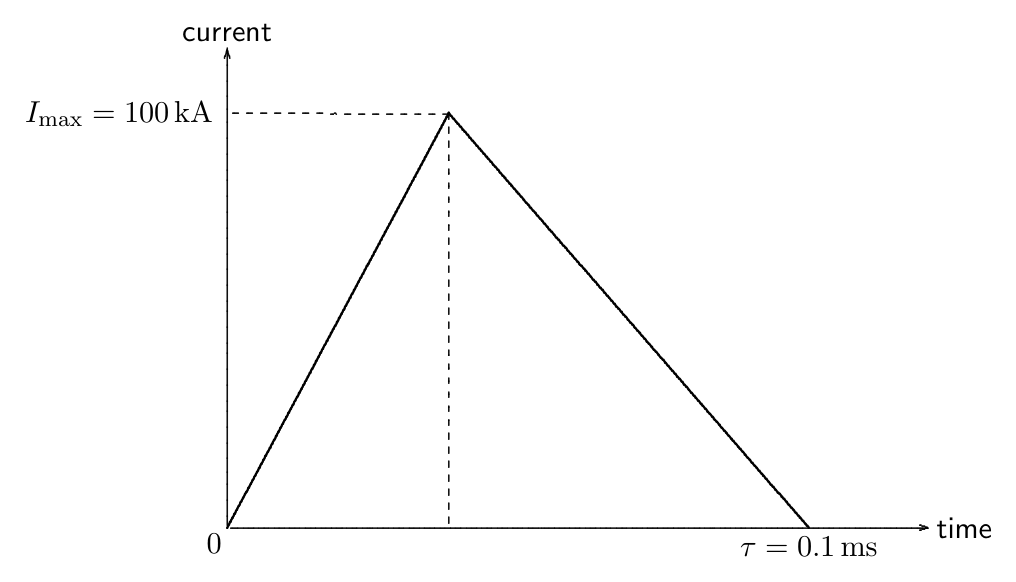
Idealized current pulse flowing between the cloud and the ground during lightning.
Answer the following questions with the aid of this simplified curve for the current as a function of time and these data:
| Distance between the bottom of the cloud and the ground: | \(h=1\ \mathrm{km}\); |
| Breakdown electric field of humid air: | \(E_0=300\ \mathrm{kV\,m^{-1}}\); |
| Total number of lightning striking Earth per year: | \(32\times10^6\); |
| Total human population: | \(6.5\times10^9\) people. |
3.9 (0.5) What is the total charge \(Q\) released by lightning?
3.10 (0.5) What is the average current \(I\) flowing between the bottom of the cloud and the ground during lightning?
3.11 (1.0) Imagine that the energy of all storms of one year is collected and equally shared among all people. For how long could you continuously light up a 100 W light bulb for your share?
Capillary Vessels Let us regard blood as an incompressible viscous fluid with mass density \(\mu\) similar to that of water and dynamic viscosity \(\eta=4.5\ \mathrm{g\,m^{-1}\,s^{-1}}\). We model blood vessels as circular straight pipes with radius \(r\) and length \(L\) and describe the blood flow by Poiseuille’s law,
\[ \Delta p=RD, \]
the Fluid Dynamics analog of Ohm’s law in Electricity. Here \(\Delta p\) is the pressure difference between the entrance and the exit of the blood vessel, \(D=S\upsilon\) is the volume flow through the cross-sectional area \(S\) of the blood vessel and \(\upsilon\) is the blood velocity. The hydraulic resistance \(R\) is given by
\[ R=\frac{8\eta L}{\pi r^4}. \]
For the systemic blood circulation (the one flowing from the left ventricle to the right auricle of the heart), the blood flow is \(D\approx100\ \mathrm{cm^3\,s^{-1}}\) for a man at rest. Answer the following questions under the assumption that all capillary vessels are connected in parallel and that each of them has radius \(r=4\ \mu\mathrm{m}\) and length \(L=1\ \mathrm{mm}\) and operates under a pressure difference \(\Delta p=1\ \mathrm{kPa}\).
3.12 (1.0) How many capillary vessels are in the human body?
3.13 (0.5) How large is the velocity \(\upsilon\) with which blood is flowing through a capillary vessel?
Skyscraper At the bottom of a 1000 m high skyscraper, the outside temperature is \(T_{\mathrm{bot}}=30^\circ\mathrm{C}\). The objective is to estimate the outside temperature \(T_{\mathrm{top}}\) at the top. Consider a thin slab of air (ideal nitrogen gas with adiabatic coefficient \(\gamma=7/5\)) rising slowly to height \(z\) where the pressure is lower, and assume that this slab expands adiabatically so that its temperature drops to the temperature of the surrounding air.
3.14 (0.5) How is the fractional change in temperature \(dT/T\) related to \(dp/p\), the fractional change in pressure?
3.15 (0.5) Express the pressure difference \(dp\) in terms of \(dz\), the change in height.
3.16 (1.0) What is the resulting temperature at the top of the building?
Data
| Boltzmann constant: | \(k=1.38\times10^{-23}\ \mathrm{J\,K^{-1}}\) |
| Mass of a nitrogen molecule: | \(m=4.65\times10^{-26}\ \mathrm{kg}\) |
| Gravitational acceleration: | \(g=9.80\ \mathrm{m\,s^{-2}}\) |
Official English text of the problem.
Answers
The main estimates use the diffraction scale \(\lambda F\#\), boiling water at \(100^\circ\mathrm{C}\), and \(E_0h\) as the characteristic lightning voltage.
- 3.1: \(\Delta x_{\min}\sim\lambda F\#\). At the largest available aperture, \(F\#=2\), this is \(\boxed{1.0\ \mu\mathrm{m}}\). The circular-aperture Rayleigh value is \(1.22\ \mu\mathrm{m}\).
- 3.2: \(\boxed{N\sim1.2\times10^3\ \mathrm{Mpix}}\), or \(8.2\times10^2\ \mathrm{Mpix}\) with the Rayleigh coefficient.
- 3.3: \(\boxed{F\#=16}\) using \(\Delta x\sim\lambda F\#\). A strict Rayleigh comparison gives \(\boxed{F\#=11}\).
- 3.4: \(\boxed{z_{\min}\approx0.15\ \mathrm{m}=15\ \mathrm{cm}}\).
- 3.5: \(\boxed{U\approx1.7\times10^4\ \mathrm{J}}\).
- 3.6: \(\boxed{J\sim2.5\times10^3\ \mathrm{W\,m^{-2}}}\).
- 3.7: \(\boxed{P\sim19\ \mathrm{W}}\).
- 3.8: \(\boxed{t\sim8.7\times10^2\ \mathrm{s}\approx15\ \mathrm{min}}\).
- 3.9: \(\boxed{Q=5\ \mathrm{C}}\).
- 3.10: \(\boxed{I=5.0\times10^4\ \mathrm{A}=50\ \mathrm{kA}}\).
- 3.11: \(\boxed{t\sim7.4\times10^4\ \mathrm{s}\approx20\ \mathrm{h}}\). A completely discharging capacitor model gives approximately \(10\ \mathrm{h}\).
- 3.12: \(\boxed{N_{\mathrm{cap}}\approx4.5\times10^9}\) capillary vessels.
- 3.13: \(\boxed{\upsilon\approx4.4\times10^{-4}\ \mathrm{m\,s^{-1}}=0.44\ \mathrm{mm\,s^{-1}}}\).
- 3.14: \(\boxed{\displaystyle\frac{dT}{T}=\frac{\gamma-1}{\gamma}\frac{dp}{p}=\frac27\frac{dp}{p}}\).
- 3.15: \(\boxed{\displaystyle dp=-\rho g\,dz=-\frac{mpg}{kT}\,dz}\), where \(\rho\) is the local air density.
- 3.16: \(\boxed{T_{\mathrm{top}}\approx294\ \mathrm{K}\approx21^\circ\mathrm{C}}\).
Solution
3.1. For an ideal lens, diffraction at the aperture limits the angular separation of distinguishable objects to the scale
\[ \theta_{\min}\sim\frac{\lambda}{D}. \]
For distant objects, an angular separation \(\theta\) corresponds to a separation \(f\theta\) in the focal plane. Thus
\[ \boxed{\Delta x_{\min}\sim f\frac{\lambda}{D}=\lambda F\#.} \]
At \(\lambda=500\ \mathrm{nm}\),
\[ \Delta x_{\min}\sim0.50(F\#)\ \mu\mathrm{m}. \]
The best resolution occurs at the largest aperture, corresponding to the smallest listed F-number, \(F\#=2\). Its diameter is \(D=f/2=19\ \mathrm{mm}\), giving
\[ \boxed{\Delta x_{\min}\sim1.0\ \mu\mathrm{m}.} \]
For a circular aperture, the Rayleigh criterion gives the more specific expression
\[ \Delta x_{\mathrm{Rayleigh}}=1.22\lambda F\#, \]
and hence \(1.22\ \mu\mathrm{m}\) at \(F\#=2\). The coefficient is not essential to the requested order-of-magnitude estimate.
3.2. For a square chip with square pixels of pitch \(a\), the total number of pixels is approximately \((L/a)^2\). Matching the pixel pitch to the optical resolution scale gives
\[ N_{\mathrm{pixels}}\sim \left(\frac{L}{\Delta x_{\min}}\right)^2. \]
Therefore,
\[ N_{\mathrm{pixels}}\sim \left(\frac{35\times10^{-3}}{1.0\times10^{-6}}\right)^2 =1.225\times10^9. \]
In megapixels,
\[ \boxed{N\sim1.2\times10^3\ \mathrm{Mpix}.} \]
Using the Rayleigh value instead gives
\[ N_{\mathrm{Rayleigh}} =\frac{1}{10^6} \left(\frac{35\times10^{-3}}{1.22\times10^{-6}}\right)^2 \approx8.2\times10^2\ \mathrm{Mpix}. \]
Both estimates require about \(10^3\ \mathrm{Mpix}\).
3.3. The pixel pitch of the 16 Mpix chip is
\[ a=\frac{L}{\sqrt{16\times10^6}} =\frac{35\ \mathrm{mm}}{4000} =8.75\ \mu\mathrm{m}. \]
For the optics not to set a coarser resolution than the pixels, require
\[ \lambda F\#\lesssim a. \]
Thus
\[ F\#\lesssim\frac{8.75\ \mu\mathrm{m}}{0.500\ \mu\mathrm{m}} =17.5. \]
The smallest aperture corresponds to the largest allowed F-number. Among the available settings, this gives
\[ \boxed{F\#=16.} \]
At this setting the estimated diffraction scale is \(8.0\ \mu\mathrm{m}\); at \(F\#=22\), it would be \(11\ \mu\mathrm{m}\).
If the Rayleigh coefficient is retained and the inequality is enforced strictly,
\[ 1.22\lambda F\#\leq a \quad\Longrightarrow\quad F\#\leq14.3. \]
The largest listed setting then becomes \(F\#=11\). This discrete choice depends on the resolution convention.
3.4. At 300 dpi, adjacent printed dots have separation
\[ d=\frac{25.4\ \mathrm{mm}}{300} =8.47\times10^{-5}\ \mathrm{m}. \]
At viewing distance \(z\), their angular separation is approximately \(d/z\). They cease to be individually resolved when
\[ \frac{d}{z}\lesssim\phi. \]
Using
\[ \phi=2(2.91\times10^{-4}) =5.82\times10^{-4}\ \mathrm{rad}, \]
we obtain
\[ \boxed{ z_{\min}\approx\frac{d}{\phi} =\frac{8.47\times10^{-5}}{5.82\times10^{-4}} \approx0.15\ \mathrm{m}. } \]
3.5. Treat the egg as a sphere with uniform density and specific heat capacity. Neglect the shell’s thermal effects and any additional enthalpy of coagulation, for which no data are supplied.
The egg’s mass is
\[ M=\frac43\pi R^3\mu =\frac43\pi(2.5\times10^{-2})^3(10^3) =6.54\times10^{-2}\ \mathrm{kg}. \]
Convert the specific heat capacity:
\[ C=4.2\times10^3\ \mathrm{J\,kg^{-1}\,K^{-1}}. \]
The energy needed to raise the egg from \(T_0\) to the coagulation temperature is estimated by
\[ U\approx MC(T_c-T_0). \]
Hence
\[ U\approx (6.54\times10^{-2})(4.2\times10^3)(65-4) =1.68\times10^4\ \mathrm{J}, \]
so
\[ \boxed{U\approx1.7\times10^4\ \mathrm{J}.} \]
3.6. Assume ordinary atmospheric boiling, so \(T_1\approx100^\circ\mathrm{C}\). For a characteristic heat flux, take the conduction length to be the egg radius and the temperature contrast to be the initial water-to-egg contrast:
\[ \Delta r\sim R,\qquad \Delta T\sim T_1-T_0=96\ \mathrm{K}. \]
Fourier’s law then gives the inward heat-flux magnitude
\[ J\sim\kappa\frac{T_1-T_0}{R} =0.64\frac{96}{2.5\times10^{-2}}. \]
Therefore,
\[ \boxed{J\sim2.5\times10^3\ \mathrm{W\,m^{-2}}.} \]
The actual temperature gradient changes during cooking; this is its characteristic scale.
3.7. Heat enters through the egg’s surface, whose area is
\[ A=4\pi R^2 =7.85\times10^{-3}\ \mathrm{m^2}. \]
Consequently,
\[ P\sim JA =\left(2.46\times10^3\right) \left(7.85\times10^{-3}\right) \approx19.3\ \mathrm{W}. \]
Thus
\[ \boxed{P\sim19\ \mathrm{W}.} \]
3.8. Divide the required heating energy by the characteristic heat-transfer power:
\[ t\sim\frac{U}{P}. \]
Combining the previous expressions also gives
\[ t\sim \frac{\frac43\pi R^3\mu C(T_c-T_0)} {4\pi R^2\kappa(T_1-T_0)/R} = \frac{\mu C R^2}{3\kappa} \frac{T_c-T_0}{T_1-T_0}. \]
Numerically,
\[ \boxed{ t\sim\frac{1.68\times10^4}{19.3} \approx8.7\times10^2\ \mathrm{s} \approx15\ \mathrm{min}. } \]
This estimate has the expected thermal-diffusion scaling \(t\propto R^2\).
3.9. The transferred charge is the area under the current–time graph:
\[ Q=\int_0^\tau I(t)\,dt. \]
The pulse is triangular, so its area is independent of when the peak occurs:
\[ Q=\frac12 I_{\max}\tau. \]
With \(I_{\max}=100\ \mathrm{kA}=10^5\ \mathrm{A}\) and \(\tau=0.1\ \mathrm{ms}=10^{-4}\ \mathrm{s}\),
\[ \boxed{Q=\frac12(10^5)(10^{-4})=5\ \mathrm{C}.} \]
3.10. The average current over the duration of the pulse is
\[ I=\frac{Q}{\tau} =\frac{I_{\max}}{2}. \]
Therefore,
\[ \boxed{I=5.0\times10^4\ \mathrm{A}=50\ \mathrm{kA}.} \]
3.11. Approximating the electric field between cloud and ground as uniform, the voltage at breakdown is
\[ V_0\approx E_0h =(300\times10^3)(10^3) =3.0\times10^8\ \mathrm{V}. \]
The electrical energy released is
\[ W=\int V(t)I(t)\,dt. \]
Using \(V_0\) as its characteristic voltage gives
\[ W\sim V_0Q =(3.0\times10^8)(5) =1.5\times10^9\ \mathrm{J} \]
per lightning strike.
The annual energy share per person is therefore
\[ W_{\mathrm{person}} \sim \frac{32\times10^6}{6.5\times10^9} (1.5\times10^9) \approx7.4\times10^6\ \mathrm{J}. \]
A \(100\ \mathrm{W}\) bulb consumes \(100\ \mathrm{J}\) each second, so
\[ \boxed{ t\sim\frac{W_{\mathrm{person}}}{100} \approx7.4\times10^4\ \mathrm{s} \approx20\ \mathrm{h}. } \]
For a cloud–ground system modeled as a capacitor that discharges completely, the voltage falls with the remaining charge. Its released energy is then
\[ W=\frac12 QV_0, \]
giving approximately \(3.7\times10^4\ \mathrm{s}\), or \(10\ \mathrm{h}\), per person. Both models give a lighting time of order one day.
3.12. The relevant SI quantities are
\[ \eta=4.5\times10^{-3}\ \mathrm{Pa\,s},\qquad r=4\times10^{-6}\ \mathrm{m},\qquad L=10^{-3}\ \mathrm{m}, \]
\[ \Delta p=10^3\ \mathrm{Pa},\qquad D_{\mathrm{total}}=100\ \mathrm{cm^3\,s^{-1}} =10^{-4}\ \mathrm{m^3\,s^{-1}}. \]
Poiseuille’s law gives the volume flow through one capillary:
\[ D_{\mathrm{cap}} =\frac{\Delta p}{R} =\frac{\pi r^4\Delta p}{8\eta L}. \]
Substitution yields
\[ D_{\mathrm{cap}} = \frac{\pi(4\times10^{-6})^4(10^3)} {8(4.5\times10^{-3})(10^{-3})} \approx2.23\times10^{-14}\ \mathrm{m^3\,s^{-1}}. \]
Since the identical capillaries are connected in parallel, each experiences the same pressure difference, and their volume flows add:
\[ D_{\mathrm{total}}=N_{\mathrm{cap}}D_{\mathrm{cap}}. \]
Thus
\[ \boxed{ N_{\mathrm{cap}} =\frac{10^{-4}}{2.23\times10^{-14}} \approx4.5\times10^9. } \]
3.13. The velocity appearing in \(D=S\upsilon\) is the mean velocity over the cross-section. Therefore,
\[ \upsilon=\frac{D_{\mathrm{cap}}}{\pi r^2} =\frac{\Delta p\,r^2}{8\eta L}. \]
Numerically,
\[ \upsilon= \frac{(10^3)(4\times10^{-6})^2} {8(4.5\times10^{-3})(10^{-3})}. \]
Hence
\[ \boxed{ \upsilon\approx4.4\times10^{-4}\ \mathrm{m\,s^{-1}} =0.44\ \mathrm{mm\,s^{-1}}. } \]
3.14. For a fixed quantity of ideal gas undergoing a quasistatic adiabatic expansion,
\[ pV^\gamma=\text{constant}. \]
Taking logarithmic differentials,
\[ \frac{dp}{p}+\gamma\frac{dV}{V}=0. \]
The ideal-gas law gives \(T\propto pV\), with \(T\) measured in kelvin, so
\[ \frac{dT}{T} =\frac{dp}{p}+\frac{dV}{V} =\left(1-\frac1\gamma\right)\frac{dp}{p}. \]
Thus
\[ \boxed{ \frac{dT}{T} =\frac{\gamma-1}{\gamma}\frac{dp}{p} =\frac27\frac{dp}{p}. } \]
Pressure and temperature both decrease as the slab rises.
3.15. Hydrostatic force balance on a thin horizontal layer gives
\[ dp=-\rho g\,dz, \]
where \(\rho\) is the local mass density.
For nitrogen molecules of mass \(m\), the ideal-gas law gives
\[ p=\frac{\rho}{m}kT, \qquad \rho=\frac{mp}{kT}. \]
Therefore,
\[ \boxed{ dp=-\rho g\,dz =-\frac{mpg}{kT}\,dz. } \]
3.16. Substitute the hydrostatic pressure gradient into the adiabatic temperature relation:
\[ \frac{dT}{T} = \frac{\gamma-1}{\gamma} \left(-\frac{mg}{kT}\,dz\right). \]
The temperature cancels from the right-hand side after multiplication by \(T\), giving a constant lapse rate:
\[ \frac{dT}{dz} =-\frac{\gamma-1}{\gamma}\frac{mg}{k}. \]
For the supplied constants,
\[ \frac{dT}{dz} = -\frac27 \frac{(4.65\times10^{-26})(9.80)} {1.38\times10^{-23}} \approx-9.43\times10^{-3}\ \mathrm{K\,m^{-1}}. \]
Over \(H=1000\ \mathrm{m}\), the temperature drop is approximately \(9.4\ \mathrm{K}\). Hence
\[ T_{\mathrm{top}} =T_{\mathrm{bot}} -\frac{\gamma-1}{\gamma}\frac{mgH}{k} \approx303.15-9.43 =293.72\ \mathrm{K}. \]
Therefore,
\[ \boxed{T_{\mathrm{top}}\approx294\ \mathrm{K}\approx21^\circ\mathrm{C}.} \]
The solution was checked against the official solution.
IPhO 2006 · Theorieaufgabe 3
Fünf Größenordnungsabschätzungen: Digitalkamera, hartgekochtes Ei, Blitz, Kapillargefäße, Wolkenkratzer
Diese Aufgabe besteht aus fünf unabhängigen Teilen. In jedem davon wird lediglich eine Größenordnung abgeschätzt; eine genaue Antwort ist nicht erforderlich. Tragen Sie alle Ihre Antworten in den Antwortbogen ein.
Digitalkamera Betrachten Sie eine Digitalkamera mit einem quadratischen CCD-Chip der Seitenlänge \(L=35\ \mathrm{mm}\) mit \(N_p=5\ \mathrm{Mpix}\) (\(1\ \mathrm{Mpix}=10^6\) Pixel). Das Objektiv dieser Kamera hat eine Brennweite von \(f=38\ \mathrm{mm}\). Die bekannte Zahlenfolge (2, 2.8, 4, 5.6, 8, 11, 16, 22) auf dem Objektiv bezeichnet die sogenannte Blendenzahl, die mit \(F\#\) bezeichnet wird und als Verhältnis der Brennweite zum Durchmesser \(D\) der Objektivöffnung definiert ist: \(F\#=f/D\).
3.1 (1.0) Bestimmen Sie die bestmögliche räumliche Auflösung \(\Delta x_{\min}\) der Kamera auf dem Chip, die durch das Objektiv begrenzt wird. Drücken Sie Ihr Ergebnis durch die Wellenlänge \(\lambda\) und die Blendenzahl \(F\#\) aus und geben Sie den Zahlenwert für \(\lambda=500\ \mathrm{nm}\) an.
3.2 (0.5) Bestimmen Sie die erforderliche Anzahl \(N\) an Mpix, die der CCD-Chip besitzen sollte, um dieser optimalen Auflösung zu entsprechen.
3.3 (0.5) Fotografen versuchen manchmal, eine Kamera mit der kleinsten praktisch nutzbaren Blendenöffnung zu verwenden. Angenommen, wir haben nun eine Kamera mit \(N_0=16\ \mathrm{Mpix}\), deren Chipgröße und Brennweite den oben angegebenen Werten entsprechen. Welcher Wert ist für \(F\#\) zu wählen, damit die Bildqualität nicht durch die Optik begrenzt wird?
3.4 (0.5) Das menschliche Auge hat eine Winkelauflösung von ungefähr \(\phi=2\ \mathrm{arcmin}\), und ein typischer Fotodrucker druckt mit mindestens 300 dpi (Punkten pro Zoll). In welchem Mindestabstand \(z\) von Ihren Augen sollten Sie das bedruckte Blatt halten, damit Sie die einzelnen Punkte nicht sehen?
Daten
| 1 Zoll | \(=25.4\ \mathrm{mm}\) |
| 1 Winkelminute | \(=2.91\times10^{-4}\ \mathrm{rad}\) |
Hartgekochtes Ei Ein Ei wird direkt aus dem Kühlschrank bei einer Temperatur von \(T_0=4^\circ\mathrm{C}\) entnommen und in einen Topf mit Wasser gegeben, das bei der Temperatur \(T_1\) am Sieden gehalten wird.
3.5 (0.5) Wie groß ist die Energiemenge \(U\), die benötigt wird, um das Ei zum Gerinnen zu bringen?
3.6 (0.5) Wie groß ist die Wärmestromdichte \(J\), mit der Wärme in das Ei fließt?
3.7 (0.5) Wie groß ist die auf das Ei übertragene Wärmeleistung \(P\)?
3.8 (0.5) Wie lange müssen Sie das Ei kochen, damit es hartgekocht ist?
Hinweis Sie dürfen die vereinfachte Form des Fourierschen Gesetzes \(J=\kappa\Delta T/\Delta r\) verwenden. Dabei ist \(\Delta T\) die Temperaturdifferenz über die Strecke \(\Delta r\), die charakteristische Längenskala des Problems. Die Wärmestromdichte \(J\) wird in Einheiten von \(\mathrm{W\,m^{-2}}\) angegeben.
Daten
| Massendichte des Eis: | \(\mu=10^3\ \mathrm{kg\,m^{-3}}\) |
| Spezifische Wärmekapazität des Eis: | \(C=4.2\ \mathrm{J\,K^{-1}\,g^{-1}}\) |
| Radius des Eis: | \(R=2.5\ \mathrm{cm}\) |
| Gerinnungstemperatur des Eiklars (Eiproteins): | \(T_c=65^\circ\mathrm{C}\) |
| Wärmeleitfähigkeit: | \(\kappa=0.64\ \mathrm{W\,K^{-1}\,m^{-1}}\) (für flüssiges und festes Eiklar als gleich angenommen) |
Blitz Es wird ein stark vereinfachtes Modell eines Blitzes vorgestellt. Blitze entstehen durch die Ansammlung elektrostatischer Ladung in Wolken. Dabei lädt sich die Unterseite der Wolke gewöhnlich positiv und die Oberseite negativ auf, während sich der Erdboden unter der Wolke negativ auflädt. Wenn das entsprechende elektrische Feld die Durchschlagsfeldstärke der Luft überschreitet, kommt es zu einer elektrischen Durchschlagsentladung: einem Blitz.
Idealisierter Stromimpuls, der während eines Blitzes zwischen der Wolke und dem Erdboden fließt.
Beantworten Sie die folgenden Fragen mithilfe dieser vereinfachten Kurve der Stromstärke als Funktion der Zeit und der folgenden Daten:
| Abstand zwischen der Wolkenunterseite und dem Erdboden: | \(h=1\ \mathrm{km}\); |
| Durchschlagsfeldstärke feuchter Luft: | \(E_0=300\ \mathrm{kV\,m^{-1}}\); |
| Gesamtzahl der Blitzeinschläge auf der Erde pro Jahr: | \(32\times10^6\); |
| Gesamtbevölkerung der Erde: | \(6.5\times10^9\) Menschen. |
3.9 (0.5) Wie groß ist die gesamte bei einem Blitz freigesetzte Ladung \(Q\)?
3.10 (0.5) Wie groß ist die mittlere Stromstärke \(I\), die während eines Blitzes zwischen der Wolkenunterseite und dem Erdboden fließt?
3.11 (1.0) Stellen Sie sich vor, die Energie aller Gewitter eines Jahres würde gesammelt und gleichmäßig unter allen Menschen aufgeteilt. Wie lange könnten Sie mit Ihrem Anteil eine 100-W-Glühlampe ununterbrochen leuchten lassen?
Kapillargefäße Wir betrachten Blut als inkompressible viskose Flüssigkeit mit einer Massendichte \(\mu\), die der von Wasser ähnelt, und einer dynamischen Viskosität von \(\eta=4.5\ \mathrm{g\,m^{-1}\,s^{-1}}\). Wir modellieren Blutgefäße als gerade Rohre mit kreisförmigem Querschnitt, Radius \(r\) und Länge \(L\) und beschreiben den Blutstrom durch das Hagen-Poiseuille-Gesetz,
\[ \Delta p=RD, \]
das strömungsmechanische Analogon zum Ohmschen Gesetz der Elektrizitätslehre. Dabei ist \(\Delta p\) die Druckdifferenz zwischen Eintritt und Austritt des Blutgefäßes, \(D=S\upsilon\) der Volumenstrom durch die Querschnittsfläche \(S\) des Blutgefäßes und \(\upsilon\) die Strömungsgeschwindigkeit des Blutes. Der hydraulische Widerstand \(R\) ist gegeben durch
\[ R=\frac{8\eta L}{\pi r^4}. \]
Im Körperkreislauf (vom linken Ventrikel zum rechten Vorhof des Herzens) beträgt der Blutvolumenstrom bei einem ruhenden Mann \(D\approx100\ \mathrm{cm^3\,s^{-1}}\). Beantworten Sie die folgenden Fragen unter der Annahme, dass alle Kapillargefäße parallel geschaltet sind, jedes von ihnen den Radius \(r=4\ \mu\mathrm{m}\) und die Länge \(L=1\ \mathrm{mm}\) hat und an jedem eine Druckdifferenz von \(\Delta p=1\ \mathrm{kPa}\) anliegt.
3.12 (1.0) Wie viele Kapillargefäße gibt es im menschlichen Körper?
3.13 (0.5) Wie groß ist die Geschwindigkeit \(\upsilon\), mit der das Blut durch ein Kapillargefäß fließt?
Wolkenkratzer Am Fuß eines 1000 m hohen Wolkenkratzers beträgt die Außentemperatur \(T_{\mathrm{bot}}=30^\circ\mathrm{C}\). Ziel ist es, die Außentemperatur \(T_{\mathrm{top}}\) an der Spitze abzuschätzen. Betrachten Sie eine dünne Luftschicht (ideales Stickstoffgas mit dem Adiabatenexponenten \(\gamma=7/5\)), die langsam bis zur Höhe \(z\) aufsteigt, wo der Druck niedriger ist. Nehmen Sie an, dass sich diese Schicht adiabatisch ausdehnt, sodass ihre Temperatur auf die Temperatur der umgebenden Luft sinkt.
3.14 (0.5) Wie hängt die relative Temperaturänderung \(dT/T\) mit der relativen Druckänderung \(dp/p\) zusammen?
3.15 (0.5) Drücken Sie die Druckdifferenz \(dp\) durch die Höhenänderung \(dz\) aus.
3.16 (1.0) Welche Temperatur ergibt sich an der Spitze des Gebäudes?
Daten
| Boltzmann-Konstante: | \(k=1.38\times10^{-23}\ \mathrm{J\,K^{-1}}\) |
| Masse eines Stickstoffmoleküls: | \(m=4.65\times10^{-26}\ \mathrm{kg}\) |
| Erdbeschleunigung: | \(g=9.80\ \mathrm{m\,s^{-2}}\) |
Aufgabentext aus dem offiziellen englischen Text übersetzt.
Antworten
Die Hauptabschätzungen verwenden die Beugungsskala \(\lambda F\#\), siedendes Wasser bei \(100^\circ\mathrm{C}\) und \(E_0h\) als charakteristische Spannung eines Blitzes.
- 3.1: \(\Delta x_{\min}\sim\lambda F\#\). Bei der größten verfügbaren Blendenöffnung, \(F\#=2\), ergibt sich \(\boxed{1.0\ \mu\mathrm{m}}\). Der Rayleigh-Wert für eine kreisförmige Öffnung beträgt \(1.22\ \mu\mathrm{m}\).
- 3.2: \(\boxed{N\sim1.2\times10^3\ \mathrm{Mpix}}\), beziehungsweise \(8.2\times10^2\ \mathrm{Mpix}\) mit dem Rayleigh-Koeffizienten.
- 3.3: \(\boxed{F\#=16}\) bei Verwendung von \(\Delta x\sim\lambda F\#\). Ein strenger Vergleich nach dem Rayleigh-Kriterium ergibt \(\boxed{F\#=11}\).
- 3.4: \(\boxed{z_{\min}\approx0.15\ \mathrm{m}=15\ \mathrm{cm}}\).
- 3.5: \(\boxed{U\approx1.7\times10^4\ \mathrm{J}}\).
- 3.6: \(\boxed{J\sim2.5\times10^3\ \mathrm{W\,m^{-2}}}\).
- 3.7: \(\boxed{P\sim19\ \mathrm{W}}\).
- 3.8: \(\boxed{t\sim8.7\times10^2\ \mathrm{s}\approx15\ \mathrm{min}}\).
- 3.9: \(\boxed{Q=5\ \mathrm{C}}\).
- 3.10: \(\boxed{I=5.0\times10^4\ \mathrm{A}=50\ \mathrm{kA}}\).
- 3.11: \(\boxed{t\sim7.4\times10^4\ \mathrm{s}\approx20\ \mathrm{h}}\). Ein Modell mit einem sich vollständig entladenden Kondensator ergibt ungefähr \(10\ \mathrm{h}\).
- 3.12: \(\boxed{N_{\mathrm{cap}}\approx4.5\times10^9}\) Kapillargefäße.
- 3.13: \(\boxed{\upsilon\approx4.4\times10^{-4}\ \mathrm{m\,s^{-1}}=0.44\ \mathrm{mm\,s^{-1}}}\).
- 3.14: \(\boxed{\displaystyle\frac{dT}{T}=\frac{\gamma-1}{\gamma}\frac{dp}{p}=\frac27\frac{dp}{p}}\).
- 3.15: \(\boxed{\displaystyle dp=-\rho g\,dz=-\frac{mpg}{kT}\,dz}\), wobei \(\rho\) die lokale Luftdichte ist.
- 3.16: \(\boxed{T_{\mathrm{top}}\approx294\ \mathrm{K}\approx21^\circ\mathrm{C}}\).
Lösung
3.1. Bei einer idealen Linse begrenzt die Beugung an der Blendenöffnung den Winkelabstand unterscheidbarer Objekte auf die Größenordnung
\[ \theta_{\min}\sim\frac{\lambda}{D}. \]
Bei weit entfernten Objekten entspricht ein Winkelabstand \(\theta\) einem Abstand \(f\theta\) in der Brennebene. Somit gilt
\[ \boxed{\Delta x_{\min}\sim f\frac{\lambda}{D}=\lambda F\#.} \]
Bei \(\lambda=500\ \mathrm{nm}\) gilt
\[ \Delta x_{\min}\sim0.50(F\#)\ \mu\mathrm{m}. \]
Die beste Auflösung wird bei der größten Blendenöffnung erreicht, die der kleinsten aufgeführten Blendenzahl \(F\#=2\) entspricht. Ihr Durchmesser beträgt \(D=f/2=19\ \mathrm{mm}\), woraus folgt:
\[ \boxed{\Delta x_{\min}\sim1.0\ \mu\mathrm{m}.} \]
Für eine kreisförmige Öffnung liefert das Rayleigh-Kriterium den genaueren Ausdruck
\[ \Delta x_{\mathrm{Rayleigh}}=1.22\lambda F\#, \]
und damit \(1.22\ \mu\mathrm{m}\) bei \(F\#=2\). Für die verlangte Größenordnungsabschätzung ist der Koeffizient nicht wesentlich.
3.2. Bei einem quadratischen Chip mit quadratischen Pixeln mit dem Rasterabstand \(a\) beträgt die Gesamtzahl der Pixel ungefähr \((L/a)^2\). Wird der Pixelabstand an die optische Auflösungsskala angepasst, ergibt sich
\[ N_{\mathrm{pixels}}\sim \left(\frac{L}{\Delta x_{\min}}\right)^2. \]
Daher gilt
\[ N_{\mathrm{pixels}}\sim \left(\frac{35\times10^{-3}}{1.0\times10^{-6}}\right)^2 =1.225\times10^9. \]
In Megapixeln ergibt sich
\[ \boxed{N\sim1.2\times10^3\ \mathrm{Mpix}.} \]
Verwendet man stattdessen den Rayleigh-Wert, erhält man
\[ N_{\mathrm{Rayleigh}} =\frac{1}{10^6} \left(\frac{35\times10^{-3}}{1.22\times10^{-6}}\right)^2 \approx8.2\times10^2\ \mathrm{Mpix}. \]
Beide Abschätzungen erfordern etwa \(10^3\ \mathrm{Mpix}\).
3.3. Der Pixelabstand des 16-Mpix-Chips beträgt
\[ a=\frac{L}{\sqrt{16\times10^6}} =\frac{35\ \mathrm{mm}}{4000} =8.75\ \mu\mathrm{m}. \]
Damit die Optik keine gröbere Auflösung als die Pixel vorgibt, muss gelten:
\[ \lambda F\#\lesssim a. \]
Somit gilt
\[ F\#\lesssim\frac{8.75\ \mu\mathrm{m}}{0.500\ \mu\mathrm{m}} =17.5. \]
Die kleinste Blendenöffnung entspricht der größten zulässigen Blendenzahl. Unter den verfügbaren Einstellungen ergibt sich damit
\[ \boxed{F\#=16.} \]
Bei dieser Einstellung beträgt die abgeschätzte Beugungsskala \(8.0\ \mu\mathrm{m}\); bei \(F\#=22\) wären es \(11\ \mu\mathrm{m}\).
Wird der Rayleigh-Koeffizient beibehalten und die Ungleichung streng eingehalten, gilt
\[ 1.22\lambda F\#\leq a \quad\Longrightarrow\quad F\#\leq14.3. \]
Die größte aufgeführte Einstellung ist dann \(F\#=11\). Diese diskrete Auswahl hängt von der verwendeten Auflösungskonvention ab.
3.4. Bei 300 dpi beträgt der Abstand benachbarter gedruckter Punkte
\[ d=\frac{25.4\ \mathrm{mm}}{300} =8.47\times10^{-5}\ \mathrm{m}. \]
Bei einem Betrachtungsabstand \(z\) beträgt ihr Winkelabstand ungefähr \(d/z\). Sie werden nicht mehr einzeln aufgelöst, wenn
\[ \frac{d}{z}\lesssim\phi. \]
Mit
\[ \phi=2(2.91\times10^{-4}) =5.82\times10^{-4}\ \mathrm{rad}, \]
erhalten wir
\[ \boxed{ z_{\min}\approx\frac{d}{\phi} =\frac{8.47\times10^{-5}}{5.82\times10^{-4}} \approx0.15\ \mathrm{m}. } \]
3.5. Wir behandeln das Ei als Kugel mit einheitlicher Dichte und spezifischer Wärmekapazität. Die thermischen Einflüsse der Schale sowie eine zusätzliche Gerinnungsenthalpie, für die keine Daten angegeben sind, werden vernachlässigt.
Die Masse des Eis beträgt
\[ M=\frac43\pi R^3\mu =\frac43\pi(2.5\times10^{-2})^3(10^3) =6.54\times10^{-2}\ \mathrm{kg}. \]
Wir rechnen die spezifische Wärmekapazität um:
\[ C=4.2\times10^3\ \mathrm{J\,kg^{-1}\,K^{-1}}. \]
Die Energie, die benötigt wird, um das Ei von \(T_0\) auf die Gerinnungstemperatur zu erwärmen, wird abgeschätzt durch
\[ U\approx MC(T_c-T_0). \]
Daraus folgt
\[ U\approx (6.54\times10^{-2})(4.2\times10^3)(65-4) =1.68\times10^4\ \mathrm{J}, \]
also
\[ \boxed{U\approx1.7\times10^4\ \mathrm{J}.} \]
3.6. Wir nehmen Sieden bei normalem Atmosphärendruck an, sodass \(T_1\approx100^\circ\mathrm{C}\) gilt. Zur Abschätzung einer charakteristischen Wärmestromdichte setzen wir die Wärmeleitungslänge gleich dem Radius des Eis und die Temperaturdifferenz gleich der anfänglichen Temperaturdifferenz zwischen Wasser und Ei:
\[ \Delta r\sim R,\qquad \Delta T\sim T_1-T_0=96\ \mathrm{K}. \]
Das Fouriersche Gesetz liefert dann für den Betrag der nach innen gerichteten Wärmestromdichte
\[ J\sim\kappa\frac{T_1-T_0}{R} =0.64\frac{96}{2.5\times10^{-2}}. \]
Daher gilt
\[ \boxed{J\sim2.5\times10^3\ \mathrm{W\,m^{-2}}.} \]
Der tatsächliche Temperaturgradient ändert sich während des Kochens; dies ist seine charakteristische Größenordnung.
3.7. Wärme tritt durch die Oberfläche des Eis ein. Ihr Flächeninhalt beträgt
\[ A=4\pi R^2 =7.85\times10^{-3}\ \mathrm{m^2}. \]
Folglich gilt
\[ P\sim JA =\left(2.46\times10^3\right) \left(7.85\times10^{-3}\right) \approx19.3\ \mathrm{W}. \]
Somit ergibt sich
\[ \boxed{P\sim19\ \mathrm{W}.} \]
3.8. Wir dividieren die erforderliche Heizenergie durch die charakteristische übertragene Wärmeleistung:
\[ t\sim\frac{U}{P}. \]
Durch Kombination der vorherigen Ausdrücke erhält man auch
\[ t\sim \frac{\frac43\pi R^3\mu C(T_c-T_0)} {4\pi R^2\kappa(T_1-T_0)/R} = \frac{\mu C R^2}{3\kappa} \frac{T_c-T_0}{T_1-T_0}. \]
Numerisch ergibt sich
\[ \boxed{ t\sim\frac{1.68\times10^4}{19.3} \approx8.7\times10^2\ \mathrm{s} \approx15\ \mathrm{min}. } \]
Diese Abschätzung zeigt die für Wärmediffusion erwartete Skalierung \(t\propto R^2\).
3.9. Die übertragene Ladung entspricht der Fläche unter dem Stromstärke-Zeit-Diagramm:
\[ Q=\int_0^\tau I(t)\,dt. \]
Der Impuls ist dreieckig, daher ist seine Fläche unabhängig davon, wann das Maximum auftritt:
\[ Q=\frac12 I_{\max}\tau. \]
Mit \(I_{\max}=100\ \mathrm{kA}=10^5\ \mathrm{A}\) und \(\tau=0.1\ \mathrm{ms}=10^{-4}\ \mathrm{s}\) folgt
\[ \boxed{Q=\frac12(10^5)(10^{-4})=5\ \mathrm{C}.} \]
3.10. Die über die Impulsdauer gemittelte Stromstärke beträgt
\[ I=\frac{Q}{\tau} =\frac{I_{\max}}{2}. \]
Daher gilt
\[ \boxed{I=5.0\times10^4\ \mathrm{A}=50\ \mathrm{kA}.} \]
3.11. Nähern wir das elektrische Feld zwischen Wolke und Erdboden als homogen an, so beträgt die Spannung beim Durchschlag
\[ V_0\approx E_0h =(300\times10^3)(10^3) =3.0\times10^8\ \mathrm{V}. \]
Die freigesetzte elektrische Energie ist
\[ W=\int V(t)I(t)\,dt. \]
Verwenden wir \(V_0\) als charakteristische Spannung, ergibt sich
\[ W\sim V_0Q =(3.0\times10^8)(5) =1.5\times10^9\ \mathrm{J} \]
pro Blitzeinschlag.
Der jährliche Energieanteil pro Person beträgt daher
\[ W_{\mathrm{person}} \sim \frac{32\times10^6}{6.5\times10^9} (1.5\times10^9) \approx7.4\times10^6\ \mathrm{J}. \]
Eine \(100\ \mathrm{W}\)-Glühlampe verbraucht pro Sekunde \(100\ \mathrm{J}\), somit gilt
\[ \boxed{ t\sim\frac{W_{\mathrm{person}}}{100} \approx7.4\times10^4\ \mathrm{s} \approx20\ \mathrm{h}. } \]
Wird das System aus Wolke und Erdboden als Kondensator modelliert, der sich vollständig entlädt, so sinkt die Spannung mit der verbleibenden Ladung. Die freigesetzte Energie beträgt dann
\[ W=\frac12 QV_0, \]
woraus sich ungefähr \(3.7\times10^4\ \mathrm{s}\), also \(10\ \mathrm{h}\), pro Person ergeben. Beide Modelle liefern eine Leuchtdauer in der Größenordnung eines Tages.
3.12. Die relevanten Größen in SI-Einheiten sind
\[ \eta=4.5\times10^{-3}\ \mathrm{Pa\,s},\qquad r=4\times10^{-6}\ \mathrm{m},\qquad L=10^{-3}\ \mathrm{m}, \]
\[ \Delta p=10^3\ \mathrm{Pa},\qquad D_{\mathrm{total}}=100\ \mathrm{cm^3\,s^{-1}} =10^{-4}\ \mathrm{m^3\,s^{-1}}. \]
Das Hagen-Poiseuille-Gesetz liefert für den Volumenstrom durch eine einzelne Kapillare:
\[ D_{\mathrm{cap}} =\frac{\Delta p}{R} =\frac{\pi r^4\Delta p}{8\eta L}. \]
Einsetzen ergibt
\[ D_{\mathrm{cap}} = \frac{\pi(4\times10^{-6})^4(10^3)} {8(4.5\times10^{-3})(10^{-3})} \approx2.23\times10^{-14}\ \mathrm{m^3\,s^{-1}}. \]
Da die identischen Kapillaren parallel geschaltet sind, liegt an jeder dieselbe Druckdifferenz an, und ihre Volumenströme addieren sich:
\[ D_{\mathrm{total}}=N_{\mathrm{cap}}D_{\mathrm{cap}}. \]
Somit gilt
\[ \boxed{ N_{\mathrm{cap}} =\frac{10^{-4}}{2.23\times10^{-14}} \approx4.5\times10^9. } \]
3.13. Die in \(D=S\upsilon\) auftretende Geschwindigkeit ist die über den Querschnitt gemittelte Geschwindigkeit. Daher gilt
\[ \upsilon=\frac{D_{\mathrm{cap}}}{\pi r^2} =\frac{\Delta p\,r^2}{8\eta L}. \]
Numerisch ergibt sich
\[ \upsilon= \frac{(10^3)(4\times10^{-6})^2} {8(4.5\times10^{-3})(10^{-3})}. \]
Daraus folgt
\[ \boxed{ \upsilon\approx4.4\times10^{-4}\ \mathrm{m\,s^{-1}} =0.44\ \mathrm{mm\,s^{-1}}. } \]
3.14. Für eine feste Menge eines idealen Gases, das sich quasistatisch und adiabatisch ausdehnt, gilt
\[ pV^\gamma=\text{konstant}. \]
Logarithmisches Differenzieren ergibt
\[ \frac{dp}{p}+\gamma\frac{dV}{V}=0. \]
Das ideale Gasgesetz liefert \(T\propto pV\), wobei \(T\) in Kelvin gemessen wird. Daher gilt
\[ \frac{dT}{T} =\frac{dp}{p}+\frac{dV}{V} =\left(1-\frac1\gamma\right)\frac{dp}{p}. \]
Somit ergibt sich
\[ \boxed{ \frac{dT}{T} =\frac{\gamma-1}{\gamma}\frac{dp}{p} =\frac27\frac{dp}{p}. } \]
Sowohl Druck als auch Temperatur nehmen beim Aufsteigen der Schicht ab.
3.15. Das hydrostatische Kräftegleichgewicht an einer dünnen horizontalen Schicht liefert
\[ dp=-\rho g\,dz, \]
wobei \(\rho\) die lokale Massendichte ist.
Für Stickstoffmoleküle der Masse \(m\) ergibt das ideale Gasgesetz
\[ p=\frac{\rho}{m}kT, \qquad \rho=\frac{mp}{kT}. \]
Daher gilt
\[ \boxed{ dp=-\rho g\,dz =-\frac{mpg}{kT}\,dz. } \]
3.16. Wir setzen den hydrostatischen Druckgradienten in die adiabatische Temperaturbeziehung ein:
\[ \frac{dT}{T} = \frac{\gamma-1}{\gamma} \left(-\frac{mg}{kT}\,dz\right). \]
Nach Multiplikation mit \(T\) kürzt sich die Temperatur auf der rechten Seite heraus, sodass sich ein konstanter vertikaler Temperaturgradient ergibt:
\[ \frac{dT}{dz} =-\frac{\gamma-1}{\gamma}\frac{mg}{k}. \]
Mit den angegebenen Konstanten ergibt sich
\[ \frac{dT}{dz} = -\frac27 \frac{(4.65\times10^{-26})(9.80)} {1.38\times10^{-23}} \approx-9.43\times10^{-3}\ \mathrm{K\,m^{-1}}. \]
Über \(H=1000\ \mathrm{m}\) beträgt die Temperaturabnahme ungefähr \(9.4\ \mathrm{K}\). Daraus folgt
\[ T_{\mathrm{top}} =T_{\mathrm{bot}} -\frac{\gamma-1}{\gamma}\frac{mgH}{k} \approx303.15-9.43 =293.72\ \mathrm{K}. \]
Daher gilt
\[ \boxed{T_{\mathrm{top}}\approx294\ \mathrm{K}\approx21^\circ\mathrm{C}.} \]
Die Lösung wurde mit der offiziellen Lösung abgeglichen.
IPhO 2006 · Teori sorusu 3
Beş büyüklük mertebesi tahmini: Dijital Fotoğraf Makinesi, Katı Pişmiş Yumurta, Yıldırım, Kılcal Damarlar, Gökdelen
Bu soru birbirinden bağımsız beş bölümden oluşmaktadır. Her bölümde kesin bir cevap değil, yalnızca bir büyüklük mertebesi tahmini istenmektedir. Tüm cevaplarınızı Cevap Kâğıdına yazınız.
Dijital Fotoğraf Makinesi Kenar uzunluğu \(L=35\ \mathrm{mm}\) olan, \(N_p=5\ \mathrm{Mpix}\) (\(1\ \mathrm{Mpix}=10^6\) piksel) içeren kare bir CCD yongasına sahip bir dijital fotoğraf makinesi düşününüz. Bu makinenin objektifinin odak uzaklığı \(f=38\ \mathrm{mm}\)'dir. Objektifin üzerinde yer alan, iyi bilinen (2, 2.8, 4, 5.6, 8, 11, 16, 22) sayı dizisi, F sayısı olarak adlandırılan niceliği belirtir. Bu nicelik \(F\#\) ile gösterilir ve odak uzaklığının objektif açıklığının \(D\) çapına oranı olarak tanımlanır: \(F\#=f/D\).
3.1 (1.0) Fotoğraf makinesinin, objektifin sınırladığı, yonga üzerindeki mümkün olan en iyi uzaysal çözünürlüğünü \(\Delta x_{\min}\) bulunuz. Sonucunuzu dalga boyu \(\lambda\) ve F sayısı \(F\#\) cinsinden ifade ediniz ve \(\lambda=500\ \mathrm{nm}\) için sayısal değerini veriniz.
3.2 (0.5) CCD yongasının bu en iyi çözünürlüğe uyum sağlaması için sahip olması gereken Mpix sayısı \(N\)'yi bulunuz.
3.3 (0.5) Fotoğrafçılar bazen bir fotoğraf makinesini kullanılabilir en küçük açıklıkta kullanmaya çalışırlar. Şimdi, yonga boyutu ve odak uzaklığı yukarıda verilenlerle aynı olan, \(N_0=16\ \mathrm{Mpix}\)'lik bir fotoğraf makinemiz olduğunu varsayınız. Görüntü kalitesinin optik sistem tarafından sınırlanmaması için \(F\#\)'nin hangi değeri seçilmelidir?
3.4 (0.5) İnsan gözünün yaklaşık açısal çözünürlüğünün \(\phi=2\ \mathrm{arcmin}\) olduğunu ve tipik bir fotoğraf yazıcısının en az 300 dpi (inç başına nokta) ile baskı yaptığını bilerek, tek tek noktaları görmemek için basılı sayfayı gözlerinizden en az ne kadar \(z\) uzaklığında tutmanız gerektiğini bulunuz.
Veriler
| 1 inç | \(=25.4\ \mathrm{mm}\) |
| 1 yay dakikası | \(=2.91\times10^{-4}\ \mathrm{rad}\) |
Katı pişmiş yumurta \(T_0=4^\circ\mathrm{C}\) sıcaklığındaki buzdolabından doğrudan alınan bir yumurta, içindeki su \(T_1\) sıcaklığında kaynar durumda tutulan bir tencereye bırakılır.
3.5 (0.5) Yumurtanın pıhtılaşması için gereken enerji miktarı \(U\) ne kadardır?
3.6 (0.5) Yumurtanın içine doğru akan ısı akısı \(J\) ne kadardır?
3.7 (0.5) Yumurtaya aktarılan ısıl güç \(P\) ne kadardır?
3.8 (0.5) Yumurtanın katı pişmiş olması için onu ne kadar süre pişirmeniz gerekir?
İpucu Fourier yasasının basitleştirilmiş biçimi olan \(J=\kappa\Delta T/\Delta r\) bağıntısını kullanabilirsiniz. Burada \(\Delta T\), problemin karakteristik uzunluk ölçeği \(\Delta r\) boyunca oluşan sıcaklık farkıdır. Isı akısı \(J\)'nin birimi \(\mathrm{W\,m^{-2}}\)'dir.
Veriler
| Yumurtanın kütle yoğunluğu: | \(\mu=10^3\ \mathrm{kg\,m^{-3}}\) |
| Yumurtanın özgül ısı kapasitesi: | \(C=4.2\ \mathrm{J\,K^{-1}\,g^{-1}}\) |
| Yumurtanın yarıçapı: | \(R=2.5\ \mathrm{cm}\) |
| Albüminin (yumurta proteininin) pıhtılaşma sıcaklığı: | \(T_c=65^\circ\mathrm{C}\) |
| Isıl iletkenlik katsayısı: | \(\kappa=0.64\ \mathrm{W\,K^{-1}\,m^{-1}}\) (sıvı ve katı albümin için aynı olduğu varsayılmaktadır) |
Yıldırım Yıldırım için oldukça basitleştirilmiş bir model sunulmaktadır. Yıldırım, bulutlarda elektrostatik yük birikmesinden kaynaklanır. Bunun sonucunda bulutun alt kısmı genellikle pozitif, üst kısmı negatif yüklenir ve bulutun altındaki yer yüzeyi negatif yüklenir. Buna karşılık gelen elektrik alan, havanın delinme dayanımını aştığında bir elektriksel boşalma meydana gelir: bu, yıldırımdır.
Yıldırım sırasında bulut ile yer arasında akan idealleştirilmiş akım darbesi.
Akımın zamana bağlı değişimini gösteren bu basitleştirilmiş eğriden ve aşağıdaki verilerden yararlanarak soruları cevaplayınız:
| Bulutun alt kısmı ile yer arasındaki uzaklık: | \(h=1\ \mathrm{km}\); |
| Nemli havanın delinme elektrik alanı: | \(E_0=300\ \mathrm{kV\,m^{-1}}\); |
| Bir yılda Dünya'ya düşen toplam yıldırım sayısı: | \(32\times10^6\); |
| Toplam insan nüfusu: | \(6.5\times10^9\) kişi. |
3.9 (0.5) Yıldırımla boşalan toplam yük \(Q\) ne kadardır?
3.10 (0.5) Yıldırım sırasında bulutun alt kısmı ile yer arasında akan ortalama akım \(I\) ne kadardır?
3.11 (1.0) Bir yıl boyunca meydana gelen tüm fırtınaların enerjisinin toplandığını ve tüm insanlar arasında eşit olarak paylaştırıldığını düşününüz. Payınıza düşen enerjiyle 100 W'lık bir ampulü kesintisiz olarak ne kadar süre yakabilirsiniz?
Kılcal Damarlar Kanı, kütle yoğunluğu \(\mu\) suyunkine benzer ve dinamik viskozitesi \(\eta=4.5\ \mathrm{g\,m^{-1}\,s^{-1}}\) olan sıkıştırılamaz, viskoz bir akışkan olarak ele alalım. Kan damarlarını yarıçapı \(r\), uzunluğu \(L\) olan dairesel kesitli düz borular olarak modelleyelim ve kan akışını Poiseuille yasasıyla ifade edelim:
\[ \Delta p=RD, \]
Bu yasa, elektrikteki Ohm yasasının akışkanlar dinamiğindeki karşılığıdır. Burada \(\Delta p\), kan damarının girişi ile çıkışı arasındaki basınç farkı; \(D=S\upsilon\), kan damarının \(S\) kesit alanından geçen hacimsel debi ve \(\upsilon\), kanın hızıdır. Hidrolik direnç \(R\) şu şekilde verilir:
\[ R=\frac{8\eta L}{\pi r^4}. \]
Büyük kan dolaşımında (kalbin sol karıncığından sağ kulakçığına doğru olan dolaşımda), dinlenme hâlindeki bir erkekte kanın hacimsel debisi \(D\approx100\ \mathrm{cm^3\,s^{-1}}\)'dir. Tüm kılcal damarların paralel bağlı olduğunu, her birinin yarıçapının \(r=4\ \mu\mathrm{m}\), uzunluğunun \(L=1\ \mathrm{mm}\) olduğunu ve \(\Delta p=1\ \mathrm{kPa}\) basınç farkı altında çalıştığını varsayarak aşağıdaki soruları cevaplayınız.
3.12 (1.0) İnsan vücudunda kaç kılcal damar vardır?
3.13 (0.5) Kanın bir kılcal damardan akış hızı \(\upsilon\) ne kadardır?
Gökdelen 1000 m yüksekliğindeki bir gökdelenin tabanında dış ortam sıcaklığı \(T_{\mathrm{bot}}=30^\circ\mathrm{C}\)'dir. Amaç, tepedeki dış ortam sıcaklığı \(T_{\mathrm{top}}\)'ı tahmin etmektir. Basıncın daha düşük olduğu \(z\) yüksekliğine yavaşça yükselen ince bir hava tabakasını (adyabatik katsayısı \(\gamma=7/5\) olan ideal azot gazı) ele alınız ve bu tabakanın, sıcaklığı çevresindeki havanın sıcaklığına düşecek şekilde adyabatik olarak genleştiğini varsayınız.
3.14 (0.5) Sıcaklığın bağıl değişimi \(dT/T\) ile basıncın bağıl değişimi \(dp/p\) arasındaki ilişki nedir?
3.15 (0.5) Basınç farkı \(dp\)'yi yükseklik değişimi \(dz\) cinsinden ifade ediniz.
3.16 (1.0) Binanın tepesinde elde edilen sıcaklık nedir?
Veriler
| Boltzmann sabiti: | \(k=1.38\times10^{-23}\ \mathrm{J\,K^{-1}}\) |
| Bir azot molekülünün kütlesi: | \(m=4.65\times10^{-26}\ \mathrm{kg}\) |
| Yerçekimi ivmesi: | \(g=9.80\ \mathrm{m\,s^{-2}}\) |
Soru metni resmi İngilizce metinden çevrilmiştir.
Cevaplar
Temel tahminlerde kırınım ölçeği olarak \(\lambda F\#\), kaynayan suyun sıcaklığı olarak \(100^\circ\mathrm{C}\) ve yıldırımın karakteristik gerilimi olarak \(E_0h\) kullanılmıştır.
- 3.1: \(\Delta x_{\min}\sim\lambda F\#\). Kullanılabilir en büyük açıklıkta, \(F\#=2\) için, bu değer \(\boxed{1.0\ \mu\mathrm{m}}\)'dir. Dairesel açıklık için Rayleigh değeri \(1.22\ \mu\mathrm{m}\)'dir.
- 3.2: \(\boxed{N\sim1.2\times10^3\ \mathrm{Mpix}}\); Rayleigh katsayısıyla ise \(8.2\times10^2\ \mathrm{Mpix}\).
- 3.3: \(\Delta x\sim\lambda F\#\) kullanıldığında \(\boxed{F\#=16}\). Rayleigh ölçütüne kesin olarak uyulan bir karşılaştırma \(\boxed{F\#=11}\) verir.
- 3.4: \(\boxed{z_{\min}\approx0.15\ \mathrm{m}=15\ \mathrm{cm}}\).
- 3.5: \(\boxed{U\approx1.7\times10^4\ \mathrm{J}}\).
- 3.6: \(\boxed{J\sim2.5\times10^3\ \mathrm{W\,m^{-2}}}\).
- 3.7: \(\boxed{P\sim19\ \mathrm{W}}\).
- 3.8: \(\boxed{t\sim8.7\times10^2\ \mathrm{s}\approx15\ \mathrm{min}}\).
- 3.9: \(\boxed{Q=5\ \mathrm{C}}\).
- 3.10: \(\boxed{I=5.0\times10^4\ \mathrm{A}=50\ \mathrm{kA}}\).
- 3.11: \(\boxed{t\sim7.4\times10^4\ \mathrm{s}\approx20\ \mathrm{h}}\). Tamamen boşalan bir kondansatör modeli yaklaşık \(10\ \mathrm{h}\) verir.
- 3.12: \(\boxed{N_{\mathrm{cap}}\approx4.5\times10^9}\) kılcal damar.
- 3.13: \(\boxed{\upsilon\approx4.4\times10^{-4}\ \mathrm{m\,s^{-1}}=0.44\ \mathrm{mm\,s^{-1}}}\).
- 3.14: \(\boxed{\displaystyle\frac{dT}{T}=\frac{\gamma-1}{\gamma}\frac{dp}{p}=\frac27\frac{dp}{p}}\).
- 3.15: \(\boxed{\displaystyle dp=-\rho g\,dz=-\frac{mpg}{kT}\,dz}\); burada \(\rho\), yerel hava yoğunluğudur.
- 3.16: \(\boxed{T_{\mathrm{top}}\approx294\ \mathrm{K}\approx21^\circ\mathrm{C}}\).
Çözüm
3.1. İdeal bir mercek için açıklıkta meydana gelen kırınım, ayırt edilebilir cisimlerin açısal ayrımını şu ölçekle sınırlar:
\[ \theta_{\min}\sim\frac{\lambda}{D}. \]
Uzak cisimler için \(\theta\) açısal ayrımı, odak düzleminde \(f\theta\) uzaklığına karşılık gelir. Dolayısıyla
\[ \boxed{\Delta x_{\min}\sim f\frac{\lambda}{D}=\lambda F\#.} \]
\(\lambda=500\ \mathrm{nm}\) için,
\[ \Delta x_{\min}\sim0.50(F\#)\ \mu\mathrm{m}. \]
En iyi çözünürlük, listelenen en küçük F sayısı olan \(F\#=2\)'ye karşılık gelen en büyük açıklıkta elde edilir. Bu açıklığın çapı \(D=f/2=19\ \mathrm{mm}\)'dir ve buradan
\[ \boxed{\Delta x_{\min}\sim1.0\ \mu\mathrm{m}.} \]
Dairesel bir açıklık için Rayleigh ölçütü daha kesin olan şu ifadeyi verir:
\[ \Delta x_{\mathrm{Rayleigh}}=1.22\lambda F\#, \]
Dolayısıyla \(F\#=2\) için \(1.22\ \mu\mathrm{m}\) elde edilir. İstenen büyüklük mertebesi tahmini için bu katsayı önemli değildir.
3.2. Piksel aralığı \(a\) olan kare piksellerden oluşan kare bir yonga için toplam piksel sayısı yaklaşık \((L/a)^2\)'dir. Piksel aralığı optik çözünürlük ölçeğine eşitlendiğinde
\[ N_{\mathrm{pixels}}\sim \left(\frac{L}{\Delta x_{\min}}\right)^2. \]
Böylece,
\[ N_{\mathrm{pixels}}\sim \left(\frac{35\times10^{-3}}{1.0\times10^{-6}}\right)^2 =1.225\times10^9. \]
Megapiksel cinsinden,
\[ \boxed{N\sim1.2\times10^3\ \mathrm{Mpix}.} \]
Bunun yerine Rayleigh değeri kullanılırsa
\[ N_{\mathrm{Rayleigh}} =\frac{1}{10^6} \left(\frac{35\times10^{-3}}{1.22\times10^{-6}}\right)^2 \approx8.2\times10^2\ \mathrm{Mpix}. \]
Her iki tahmin de yaklaşık \(10^3\ \mathrm{Mpix}\) gerektirir.
3.3. 16 Mpix'lik yonganın piksel aralığı
\[ a=\frac{L}{\sqrt{16\times10^6}} =\frac{35\ \mathrm{mm}}{4000} =8.75\ \mu\mathrm{m}. \]
Optik sistemin piksellerden daha kaba bir çözünürlük sınırı getirmemesi için şu koşul sağlanmalıdır:
\[ \lambda F\#\lesssim a. \]
Dolayısıyla
\[ F\#\lesssim\frac{8.75\ \mu\mathrm{m}}{0.500\ \mu\mathrm{m}} =17.5. \]
En küçük açıklık, izin verilen en büyük F sayısına karşılık gelir. Kullanılabilir ayarlar arasında bu koşul
\[ \boxed{F\#=16.} \]
Bu ayarda tahmini kırınım ölçeği \(8.0\ \mu\mathrm{m}\)'dir; \(F\#=22\) için ise \(11\ \mu\mathrm{m}\) olurdu.
Rayleigh katsayısı korunur ve eşitsizlik kesin olarak uygulanırsa,
\[ 1.22\lambda F\#\leq a \quad\Longrightarrow\quad F\#\leq14.3. \]
Bu durumda listelenen en büyük ayar \(F\#=11\) olur. Bu ayrık seçim, kullanılan çözünürlük tanımına bağlıdır.
3.4. 300 dpi'da, basılan komşu noktalar arasındaki uzaklık
\[ d=\frac{25.4\ \mathrm{mm}}{300} =8.47\times10^{-5}\ \mathrm{m}. \]
\(z\) bakış uzaklığında bu noktaların açısal ayrımı yaklaşık \(d/z\)'dir. Şu koşul sağlandığında noktalar tek tek ayırt edilemez:
\[ \frac{d}{z}\lesssim\phi. \]
Şu değeri kullanarak
\[ \phi=2(2.91\times10^{-4}) =5.82\times10^{-4}\ \mathrm{rad}, \]
şunu elde ederiz:
\[ \boxed{ z_{\min}\approx\frac{d}{\phi} =\frac{8.47\times10^{-5}}{5.82\times10^{-4}} \approx0.15\ \mathrm{m}. } \]
3.5. Yumurtayı yoğunluğu ve özgül ısı kapasitesi her yerde aynı olan bir küre olarak ele alalım. Kabuğun ısıl etkilerini ve hakkında veri verilmeyen ek pıhtılaşma entalpisini ihmal edelim.
Yumurtanın kütlesi
\[ M=\frac43\pi R^3\mu =\frac43\pi(2.5\times10^{-2})^3(10^3) =6.54\times10^{-2}\ \mathrm{kg}. \]
Özgül ısı kapasitesinin birimini dönüştürelim:
\[ C=4.2\times10^3\ \mathrm{J\,kg^{-1}\,K^{-1}}. \]
Yumurtanın sıcaklığını \(T_0\)'dan pıhtılaşma sıcaklığına yükseltmek için gereken enerji şöyle tahmin edilir:
\[ U\approx MC(T_c-T_0). \]
Buradan
\[ U\approx (6.54\times10^{-2})(4.2\times10^3)(65-4) =1.68\times10^4\ \mathrm{J}, \]
dolayısıyla
\[ \boxed{U\approx1.7\times10^4\ \mathrm{J}.} \]
3.6. Kaynamanın normal atmosfer basıncında gerçekleştiğini varsayalım; böylece \(T_1\approx100^\circ\mathrm{C}\) olur. Karakteristik bir ısı akısı için iletim uzunluğunu yumurtanın yarıçapı, sıcaklık farkını ise başlangıçta su ile yumurta arasındaki fark olarak alalım:
\[ \Delta r\sim R,\qquad \Delta T\sim T_1-T_0=96\ \mathrm{K}. \]
Bu durumda Fourier yasası, içeriye yönelen ısı akısının büyüklüğünü verir:
\[ J\sim\kappa\frac{T_1-T_0}{R} =0.64\frac{96}{2.5\times10^{-2}}. \]
Böylece,
\[ \boxed{J\sim2.5\times10^3\ \mathrm{W\,m^{-2}}.} \]
Gerçek sıcaklık gradyanı pişirme sırasında değişir; burada hesaplanan, onun karakteristik ölçeğidir.
3.7. Isı, yumurtanın yüzeyinden içeri girer. Bu yüzeyin alanı
\[ A=4\pi R^2 =7.85\times10^{-3}\ \mathrm{m^2}. \]
Bunun sonucunda,
\[ P\sim JA =\left(2.46\times10^3\right) \left(7.85\times10^{-3}\right) \approx19.3\ \mathrm{W}. \]
Dolayısıyla
\[ \boxed{P\sim19\ \mathrm{W}.} \]
3.8. Isıtma için gereken enerjiyi karakteristik ısı aktarım gücüne bölelim:
\[ t\sim\frac{U}{P}. \]
Önceki ifadeler birleştirilerek şu sonuç da elde edilir:
\[ t\sim \frac{\frac43\pi R^3\mu C(T_c-T_0)} {4\pi R^2\kappa(T_1-T_0)/R} = \frac{\mu C R^2}{3\kappa} \frac{T_c-T_0}{T_1-T_0}. \]
Sayısal olarak,
\[ \boxed{ t\sim\frac{1.68\times10^4}{19.3} \approx8.7\times10^2\ \mathrm{s} \approx15\ \mathrm{min}. } \]
Bu tahmin, ısıl yayınım için beklenen \(t\propto R^2\) ölçeklenmesine sahiptir.
3.9. Aktarılan yük, akım–zaman grafiğinin altında kalan alandır:
\[ Q=\int_0^\tau I(t)\,dt. \]
Darbe üçgen biçimindedir; dolayısıyla alanı, tepe değerine ne zaman ulaşıldığından bağımsızdır:
\[ Q=\frac12 I_{\max}\tau. \]
\(I_{\max}=100\ \mathrm{kA}=10^5\ \mathrm{A}\) ve \(\tau=0.1\ \mathrm{ms}=10^{-4}\ \mathrm{s}\) ile,
\[ \boxed{Q=\frac12(10^5)(10^{-4})=5\ \mathrm{C}.} \]
3.10. Darbe süresi boyunca ortalama akım
\[ I=\frac{Q}{\tau} =\frac{I_{\max}}{2}. \]
Böylece,
\[ \boxed{I=5.0\times10^4\ \mathrm{A}=50\ \mathrm{kA}.} \]
3.11. Bulut ile yer arasındaki elektrik alanı düzgün kabul edersek, delinme anındaki gerilim
\[ V_0\approx E_0h =(300\times10^3)(10^3) =3.0\times10^8\ \mathrm{V}. \]
Açığa çıkan elektrik enerjisi
\[ W=\int V(t)I(t)\,dt. \]
Karakteristik gerilim olarak \(V_0\) kullanıldığında
\[ W\sim V_0Q =(3.0\times10^8)(5) =1.5\times10^9\ \mathrm{J} \]
enerji, her bir yıldırım düşmesinde açığa çıkar.
Dolayısıyla kişi başına düşen yıllık enerji payı
\[ W_{\mathrm{person}} \sim \frac{32\times10^6}{6.5\times10^9} (1.5\times10^9) \approx7.4\times10^6\ \mathrm{J}. \]
\(100\ \mathrm{W}\)'lık bir ampul her saniye \(100\ \mathrm{J}\) tüketir; dolayısıyla
\[ \boxed{ t\sim\frac{W_{\mathrm{person}}}{100} \approx7.4\times10^4\ \mathrm{s} \approx20\ \mathrm{h}. } \]
Tamamen boşalan bir kondansatör olarak modellenen bulut–yer sisteminde gerilim, kalan yükle birlikte azalır. Bu durumda açığa çıkan enerji
\[ W=\frac12 QV_0, \]
olur ve kişi başına yaklaşık \(3.7\times10^4\ \mathrm{s}\), yani \(10\ \mathrm{h}\) verir. Her iki model de bir gün mertebesinde bir aydınlatma süresi verir.
3.12. İlgili niceliklerin SI birimlerindeki değerleri
\[ \eta=4.5\times10^{-3}\ \mathrm{Pa\,s},\qquad r=4\times10^{-6}\ \mathrm{m},\qquad L=10^{-3}\ \mathrm{m}, \]
\[ \Delta p=10^3\ \mathrm{Pa},\qquad D_{\mathrm{total}}=100\ \mathrm{cm^3\,s^{-1}} =10^{-4}\ \mathrm{m^3\,s^{-1}}. \]
Poiseuille yasası, bir kılcal damardan geçen hacimsel debiyi verir:
\[ D_{\mathrm{cap}} =\frac{\Delta p}{R} =\frac{\pi r^4\Delta p}{8\eta L}. \]
Değerler yerine konulduğunda
\[ D_{\mathrm{cap}} = \frac{\pi(4\times10^{-6})^4(10^3)} {8(4.5\times10^{-3})(10^{-3})} \approx2.23\times10^{-14}\ \mathrm{m^3\,s^{-1}}. \]
Özdeş kılcal damarlar paralel bağlı olduğundan her biri aynı basınç farkına maruz kalır ve hacimsel debileri toplanır:
\[ D_{\mathrm{total}}=N_{\mathrm{cap}}D_{\mathrm{cap}}. \]
Dolayısıyla
\[ \boxed{ N_{\mathrm{cap}} =\frac{10^{-4}}{2.23\times10^{-14}} \approx4.5\times10^9. } \]
3.13. \(D=S\upsilon\) ifadesinde yer alan hız, kesit boyunca ortalama hızdır. Bu nedenle,
\[ \upsilon=\frac{D_{\mathrm{cap}}}{\pi r^2} =\frac{\Delta p\,r^2}{8\eta L}. \]
Sayısal olarak,
\[ \upsilon= \frac{(10^3)(4\times10^{-6})^2} {8(4.5\times10^{-3})(10^{-3})}. \]
Buradan
\[ \boxed{ \upsilon\approx4.4\times10^{-4}\ \mathrm{m\,s^{-1}} =0.44\ \mathrm{mm\,s^{-1}}. } \]
3.14. Kuazistatik adyabatik genleşme geçiren sabit miktardaki ideal gaz için,
\[ pV^\gamma=\text{sabit}. \]
Logaritmik diferansiyeller alındığında,
\[ \frac{dp}{p}+\gamma\frac{dV}{V}=0. \]
İdeal gaz yasası, \(T\) kelvin cinsinden ölçülmek üzere, \(T\propto pV\) verir; dolayısıyla
\[ \frac{dT}{T} =\frac{dp}{p}+\frac{dV}{V} =\left(1-\frac1\gamma\right)\frac{dp}{p}. \]
Dolayısıyla
\[ \boxed{ \frac{dT}{T} =\frac{\gamma-1}{\gamma}\frac{dp}{p} =\frac27\frac{dp}{p}. } \]
Tabaka yükseldikçe hem basınç hem de sıcaklık azalır.
3.15. İnce bir yatay tabaka üzerindeki hidrostatik kuvvet dengesi
\[ dp=-\rho g\,dz, \]
bağıntısını verir; burada \(\rho\), yerel kütle yoğunluğudur.
Kütlesi \(m\) olan azot molekülleri için ideal gaz yasası
\[ p=\frac{\rho}{m}kT, \qquad \rho=\frac{mp}{kT}. \]
Böylece,
\[ \boxed{ dp=-\rho g\,dz =-\frac{mpg}{kT}\,dz. } \]
3.16. Hidrostatik basınç gradyanını adyabatik sıcaklık bağıntısında yerine koyalım:
\[ \frac{dT}{T} = \frac{\gamma-1}{\gamma} \left(-\frac{mg}{kT}\,dz\right). \]
\(T\) ile çarpıldıktan sonra sağ taraftaki sıcaklık sadeleşir ve yükseklikle sabit bir sıcaklık azalma oranı elde edilir:
\[ \frac{dT}{dz} =-\frac{\gamma-1}{\gamma}\frac{mg}{k}. \]
Verilen sabitler için,
\[ \frac{dT}{dz} = -\frac27 \frac{(4.65\times10^{-26})(9.80)} {1.38\times10^{-23}} \approx-9.43\times10^{-3}\ \mathrm{K\,m^{-1}}. \]
\(H=1000\ \mathrm{m}\) boyunca sıcaklık düşüşü yaklaşık \(9.4\ \mathrm{K}\)'dir. Buradan
\[ T_{\mathrm{top}} =T_{\mathrm{bot}} -\frac{\gamma-1}{\gamma}\frac{mgH}{k} \approx303.15-9.43 =293.72\ \mathrm{K}. \]
Böylece,
\[ \boxed{T_{\mathrm{top}}\approx294\ \mathrm{K}\approx21^\circ\mathrm{C}.} \]
Çözüm, resmi çözümle karşılaştırılarak kontrol edildi.
IPhO 2006 · Problema teórico 3
Cinco estimaciones de orden de magnitud: Cámara digital, Huevo duro, Rayo, Vasos capilares, Rascacielos
Esta cuestión consta de cinco partes independientes. En cada una de ellas se pide únicamente una estimación de orden de magnitud, no una respuesta precisa. Anote todas sus respuestas en la Hoja de respuestas.
Cámara digital Considere una cámara digital con un chip CCD cuadrado de lado \(L=35\ \mathrm{mm}\) que tiene \(N_p=5\ \mathrm{Mpix}\) (\(1\ \mathrm{Mpix}=10^6\) píxeles). El objetivo de esta cámara tiene una distancia focal de \(f=38\ \mathrm{mm}\). La conocida secuencia de números (2, 2.8, 4, 5.6, 8, 11, 16, 22) que aparecen en el objetivo corresponde al llamado número F, que se denota por \(F\#\) y se define como el cociente entre la distancia focal y el diámetro \(D\) de la abertura del objetivo, \(F\#=f/D\).
3.1 (1.0) Determine la mejor resolución espacial posible \(\Delta x_{\min}\) de la cámara en el chip, limitada por el objetivo. Exprese el resultado en función de la longitud de onda \(\lambda\) y del número F \(F\#\), y dé su valor numérico para \(\lambda=500\ \mathrm{nm}\).
3.2 (0.5) Determine el número necesario \(N\) de Mpix que debería tener el chip CCD para alcanzar esta resolución óptima.
3.3 (0.5) A veces, los fotógrafos intentan utilizar una cámara con la menor abertura posible en la práctica. Suponga que ahora tenemos una cámara de \(N_0=16\ \mathrm{Mpix}\), con el tamaño del chip y la distancia focal indicados anteriormente. ¿Qué valor debe elegirse para \(F\#\) para que la calidad de la imagen no esté limitada por la óptica?
3.4 (0.5) Sabiendo que el ojo humano tiene una resolución angular aproximada de \(\phi=2\ \mathrm{arcmin}\) y que una impresora fotográfica típica imprime como mínimo a 300 dpi (puntos por pulgada), ¿a qué distancia mínima \(z\) de los ojos debe sostener la página impresa para no distinguir los puntos individuales?
Datos
| 1 pulgada | \(=25.4\ \mathrm{mm}\) |
| 1 minuto de arco | \(=2.91\times10^{-4}\ \mathrm{rad}\) |
Huevo duro Se introduce un huevo, sacado directamente del frigorífico a una temperatura \(T_0=4^\circ\mathrm{C}\), en una olla con agua que se mantiene en ebullición a una temperatura \(T_1\).
3.5 (0.5) ¿Cuál es la cantidad de energía \(U\) necesaria para que el huevo coagule?
3.6 (0.5) ¿Cuál es la densidad de flujo de calor \(J\) que entra en el huevo?
3.7 (0.5) ¿Cuál es la potencia térmica \(P\) transferida al huevo?
3.8 (0.5) ¿Durante cuánto tiempo hay que cocer el huevo para que quede duro?
Indicación Puede utilizar la forma simplificada de la ley de Fourier \(J=\kappa\Delta T/\Delta r\), donde \(\Delta T\) es la diferencia de temperatura asociada a \(\Delta r\), la escala de longitud característica del problema. La densidad de flujo de calor \(J\) se expresa en unidades de \(\mathrm{W\,m^{-2}}\).
Datos
| Densidad de masa del huevo: | \(\mu=10^3\ \mathrm{kg\,m^{-3}}\) |
| Calor específico del huevo: | \(C=4.2\ \mathrm{J\,K^{-1}\,g^{-1}}\) |
| Radio del huevo: | \(R=2.5\ \mathrm{cm}\) |
| Temperatura de coagulación de la albúmina (proteína del huevo): | \(T_c=65^\circ\mathrm{C}\) |
| Conductividad térmica: | \(\kappa=0.64\ \mathrm{W\,K^{-1}\,m^{-1}}\) (se supone igual para la albúmina líquida y sólida) |
Rayo Se presenta un modelo muy simplificado del rayo. Los rayos se deben a la acumulación de carga electrostática en las nubes. Como consecuencia, la parte inferior de la nube suele cargarse positivamente y la parte superior negativamente, y el suelo situado bajo la nube se carga negativamente. Cuando el campo eléctrico correspondiente supera la rigidez dieléctrica del aire, se produce una descarga disruptiva: el rayo.
Pulso de corriente idealizado que circula entre la nube y el suelo durante un rayo.
Responda a las siguientes preguntas con ayuda de esta curva simplificada de la corriente en función del tiempo y de estos datos:
| Distancia entre la parte inferior de la nube y el suelo: | \(h=1\ \mathrm{km}\); |
| Campo eléctrico de ruptura del aire húmedo: | \(E_0=300\ \mathrm{kV\,m^{-1}}\); |
| Número total de rayos que caen sobre la Tierra al año: | \(32\times10^6\); |
| Población humana total: | \(6.5\times10^9\) personas. |
3.9 (0.5) ¿Cuál es la carga total \(Q\) liberada por un rayo?
3.10 (0.5) ¿Cuál es la corriente media \(I\) que circula entre la parte inferior de la nube y el suelo durante un rayo?
3.11 (1.0) Imagine que se recoge la energía de todas las tormentas de un año y se reparte por igual entre todas las personas. ¿Durante cuánto tiempo podría mantener encendida de forma continua una bombilla de 100 W con la parte que le corresponde?
Vasos capilares Consideremos la sangre como un fluido viscoso incompresible cuya densidad de masa \(\mu\) es similar a la del agua y cuya viscosidad dinámica es \(\eta=4.5\ \mathrm{g\,m^{-1}\,s^{-1}}\). Modelizamos los vasos sanguíneos como tubos rectos de sección circular con radio \(r\) y longitud \(L\), y describimos el flujo sanguíneo mediante la ley de Poiseuille,
\[ \Delta p=RD, \]
el análogo en dinámica de fluidos de la ley de Ohm en electricidad. Aquí, \(\Delta p\) es la diferencia de presión entre la entrada y la salida del vaso sanguíneo, \(D=S\upsilon\) es el caudal volumétrico a través de la sección transversal de área \(S\) del vaso sanguíneo y \(\upsilon\) es la velocidad de la sangre. La resistencia hidráulica \(R\) viene dada por
\[ R=\frac{8\eta L}{\pi r^4}. \]
Para la circulación sanguínea sistémica (la que va del ventrículo izquierdo a la aurícula derecha del corazón), el caudal sanguíneo es \(D\approx100\ \mathrm{cm^3\,s^{-1}}\) en un hombre en reposo. Responda a las siguientes preguntas suponiendo que todos los vasos capilares están conectados en paralelo y que cada uno tiene un radio \(r=4\ \mu\mathrm{m}\) y una longitud \(L=1\ \mathrm{mm}\), y está sometido a una diferencia de presión \(\Delta p=1\ \mathrm{kPa}\).
3.12 (1.0) ¿Cuántos vasos capilares hay en el cuerpo humano?
3.13 (0.5) ¿Cuál es la velocidad \(\upsilon\) con la que circula la sangre por un vaso capilar?
Rascacielos En la base de un rascacielos de 1000 m de altura, la temperatura exterior es \(T_{\mathrm{bot}}=30^\circ\mathrm{C}\). El objetivo es estimar la temperatura exterior \(T_{\mathrm{top}}\) en la parte superior. Considere una capa delgada de aire (nitrógeno gaseoso ideal con coeficiente adiabático \(\gamma=7/5\)) que asciende lentamente hasta una altura \(z\), donde la presión es menor, y suponga que esta capa se expande adiabáticamente, de modo que su temperatura desciende hasta la del aire circundante.
3.14 (0.5) ¿Cómo se relaciona la variación relativa de temperatura \(dT/T\) con \(dp/p\), la variación relativa de presión?
3.15 (0.5) Exprese la diferencia de presión \(dp\) en función de \(dz\), la variación de altura.
3.16 (1.0) ¿Cuál es la temperatura resultante en la parte superior del edificio?
Datos
| Constante de Boltzmann: | \(k=1.38\times10^{-23}\ \mathrm{J\,K^{-1}}\) |
| Masa de una molécula de nitrógeno: | \(m=4.65\times10^{-26}\ \mathrm{kg}\) |
| Aceleración de la gravedad: | \(g=9.80\ \mathrm{m\,s^{-2}}\) |
Enunciado traducido del texto oficial en inglés.
Respuestas
Las estimaciones principales utilizan la escala de difracción \(\lambda F\#\), agua hirviendo a \(100^\circ\mathrm{C}\) y \(E_0h\) como tensión característica del rayo.
- 3.1: \(\Delta x_{\min}\sim\lambda F\#\). Con la mayor abertura disponible, \(F\#=2\), resulta \(\boxed{1.0\ \mu\mathrm{m}}\). El valor de Rayleigh para una abertura circular es \(1.22\ \mu\mathrm{m}\).
- 3.2: \(\boxed{N\sim1.2\times10^3\ \mathrm{Mpix}}\), o \(8.2\times10^2\ \mathrm{Mpix}\) con el coeficiente de Rayleigh.
- 3.3: \(\boxed{F\#=16}\) utilizando \(\Delta x\sim\lambda F\#\). Una comparación estricta según el criterio de Rayleigh da \(\boxed{F\#=11}\).
- 3.4: \(\boxed{z_{\min}\approx0.15\ \mathrm{m}=15\ \mathrm{cm}}\).
- 3.5: \(\boxed{U\approx1.7\times10^4\ \mathrm{J}}\).
- 3.6: \(\boxed{J\sim2.5\times10^3\ \mathrm{W\,m^{-2}}}\).
- 3.7: \(\boxed{P\sim19\ \mathrm{W}}\).
- 3.8: \(\boxed{t\sim8.7\times10^2\ \mathrm{s}\approx15\ \mathrm{min}}\).
- 3.9: \(\boxed{Q=5\ \mathrm{C}}\).
- 3.10: \(\boxed{I=5.0\times10^4\ \mathrm{A}=50\ \mathrm{kA}}\).
- 3.11: \(\boxed{t\sim7.4\times10^4\ \mathrm{s}\approx20\ \mathrm{h}}\). Un modelo de condensador que se descarga por completo da aproximadamente \(10\ \mathrm{h}\).
- 3.12: \(\boxed{N_{\mathrm{cap}}\approx4.5\times10^9}\) vasos capilares.
- 3.13: \(\boxed{\upsilon\approx4.4\times10^{-4}\ \mathrm{m\,s^{-1}}=0.44\ \mathrm{mm\,s^{-1}}}\).
- 3.14: \(\boxed{\displaystyle\frac{dT}{T}=\frac{\gamma-1}{\gamma}\frac{dp}{p}=\frac27\frac{dp}{p}}\).
- 3.15: \(\boxed{\displaystyle dp=-\rho g\,dz=-\frac{mpg}{kT}\,dz}\), donde \(\rho\) es la densidad local del aire.
- 3.16: \(\boxed{T_{\mathrm{top}}\approx294\ \mathrm{K}\approx21^\circ\mathrm{C}}\).
Solución
3.1. Para un objetivo ideal, la difracción en la abertura limita la separación angular de los objetos distinguibles a la escala
\[ \theta_{\min}\sim\frac{\lambda}{D}. \]
Para objetos lejanos, una separación angular \(\theta\) corresponde a una separación \(f\theta\) en el plano focal. Por tanto,
\[ \boxed{\Delta x_{\min}\sim f\frac{\lambda}{D}=\lambda F\#.} \]
Para \(\lambda=500\ \mathrm{nm}\),
\[ \Delta x_{\min}\sim0.50(F\#)\ \mu\mathrm{m}. \]
La mejor resolución se obtiene con la mayor abertura, que corresponde al menor número F de la lista, \(F\#=2\). Su diámetro es \(D=f/2=19\ \mathrm{mm}\), lo que da
\[ \boxed{\Delta x_{\min}\sim1.0\ \mu\mathrm{m}.} \]
Para una abertura circular, el criterio de Rayleigh da la expresión más precisa
\[ \Delta x_{\mathrm{Rayleigh}}=1.22\lambda F\#, \]
y, por tanto, \(1.22\ \mu\mathrm{m}\) para \(F\#=2\). El coeficiente no es esencial para la estimación de orden de magnitud solicitada.
3.2. Para un chip cuadrado con píxeles cuadrados de paso \(a\), el número total de píxeles es aproximadamente \((L/a)^2\). Al igualar el paso de los píxeles a la escala de resolución óptica se obtiene
\[ N_{\mathrm{pixels}}\sim \left(\frac{L}{\Delta x_{\min}}\right)^2. \]
Por tanto,
\[ N_{\mathrm{pixels}}\sim \left(\frac{35\times10^{-3}}{1.0\times10^{-6}}\right)^2 =1.225\times10^9. \]
En megapíxeles,
\[ \boxed{N\sim1.2\times10^3\ \mathrm{Mpix}.} \]
Si se utiliza en cambio el valor de Rayleigh, se obtiene
\[ N_{\mathrm{Rayleigh}} =\frac{1}{10^6} \left(\frac{35\times10^{-3}}{1.22\times10^{-6}}\right)^2 \approx8.2\times10^2\ \mathrm{Mpix}. \]
Ambas estimaciones requieren unos \(10^3\ \mathrm{Mpix}\).
3.3. El paso de los píxeles del chip de 16 Mpix es
\[ a=\frac{L}{\sqrt{16\times10^6}} =\frac{35\ \mathrm{mm}}{4000} =8.75\ \mu\mathrm{m}. \]
Para que la óptica no imponga una resolución más gruesa que la de los píxeles, se exige
\[ \lambda F\#\lesssim a. \]
Así,
\[ F\#\lesssim\frac{8.75\ \mu\mathrm{m}}{0.500\ \mu\mathrm{m}} =17.5. \]
La menor abertura corresponde al mayor número F permitido. Entre los ajustes disponibles, esto da
\[ \boxed{F\#=16.} \]
Con este ajuste, la escala de difracción estimada es \(8.0\ \mu\mathrm{m}\); para \(F\#=22\), sería \(11\ \mu\mathrm{m}\).
Si se conserva el coeficiente de Rayleigh y se aplica la desigualdad estrictamente,
\[ 1.22\lambda F\#\leq a \quad\Longrightarrow\quad F\#\leq14.3. \]
El mayor ajuste de la lista pasa entonces a ser \(F\#=11\). Esta elección discreta depende de la convención utilizada para la resolución.
3.4. A 300 dpi, la separación entre puntos impresos adyacentes es
\[ d=\frac{25.4\ \mathrm{mm}}{300} =8.47\times10^{-5}\ \mathrm{m}. \]
A una distancia de observación \(z\), su separación angular es aproximadamente \(d/z\). Dejan de distinguirse individualmente cuando
\[ \frac{d}{z}\lesssim\phi. \]
Utilizando
\[ \phi=2(2.91\times10^{-4}) =5.82\times10^{-4}\ \mathrm{rad}, \]
obtenemos
\[ \boxed{ z_{\min}\approx\frac{d}{\phi} =\frac{8.47\times10^{-5}}{5.82\times10^{-4}} \approx0.15\ \mathrm{m}. } \]
3.5. Tratamos el huevo como una esfera de densidad y calor específico uniformes. Despreciamos los efectos térmicos de la cáscara y cualquier entalpía adicional de coagulación, para la que no se proporcionan datos.
La masa del huevo es
\[ M=\frac43\pi R^3\mu =\frac43\pi(2.5\times10^{-2})^3(10^3) =6.54\times10^{-2}\ \mathrm{kg}. \]
Convertimos el calor específico:
\[ C=4.2\times10^3\ \mathrm{J\,kg^{-1}\,K^{-1}}. \]
La energía necesaria para calentar el huevo desde \(T_0\) hasta la temperatura de coagulación se estima mediante
\[ U\approx MC(T_c-T_0). \]
Por tanto,
\[ U\approx (6.54\times10^{-2})(4.2\times10^3)(65-4) =1.68\times10^4\ \mathrm{J}, \]
de modo que
\[ \boxed{U\approx1.7\times10^4\ \mathrm{J}.} \]
3.6. Suponemos ebullición a presión atmosférica normal, de modo que \(T_1\approx100^\circ\mathrm{C}\). Para estimar una densidad de flujo de calor característica, tomamos como longitud de conducción el radio del huevo y como diferencia de temperatura la diferencia inicial entre el agua y el huevo:
\[ \Delta r\sim R,\qquad \Delta T\sim T_1-T_0=96\ \mathrm{K}. \]
La ley de Fourier da entonces la magnitud de la densidad de flujo de calor hacia el interior
\[ J\sim\kappa\frac{T_1-T_0}{R} =0.64\frac{96}{2.5\times10^{-2}}. \]
Por tanto,
\[ \boxed{J\sim2.5\times10^3\ \mathrm{W\,m^{-2}}.} \]
El gradiente real de temperatura cambia durante la cocción; esta es su escala característica.
3.7. El calor entra a través de la superficie del huevo, cuya área es
\[ A=4\pi R^2 =7.85\times10^{-3}\ \mathrm{m^2}. \]
En consecuencia,
\[ P\sim JA =\left(2.46\times10^3\right) \left(7.85\times10^{-3}\right) \approx19.3\ \mathrm{W}. \]
Así,
\[ \boxed{P\sim19\ \mathrm{W}.} \]
3.8. Dividimos la energía necesaria para el calentamiento entre la potencia característica de transferencia de calor:
\[ t\sim\frac{U}{P}. \]
Al combinar las expresiones anteriores también se obtiene
\[ t\sim \frac{\frac43\pi R^3\mu C(T_c-T_0)} {4\pi R^2\kappa(T_1-T_0)/R} = \frac{\mu C R^2}{3\kappa} \frac{T_c-T_0}{T_1-T_0}. \]
Numéricamente,
\[ \boxed{ t\sim\frac{1.68\times10^4}{19.3} \approx8.7\times10^2\ \mathrm{s} \approx15\ \mathrm{min}. } \]
Esta estimación presenta la dependencia \(t\propto R^2\) esperada para la difusión térmica.
3.9. La carga transferida es el área bajo la gráfica de corriente frente al tiempo:
\[ Q=\int_0^\tau I(t)\,dt. \]
El pulso es triangular, por lo que su área no depende del instante en que se alcanza el máximo:
\[ Q=\frac12 I_{\max}\tau. \]
Con \(I_{\max}=100\ \mathrm{kA}=10^5\ \mathrm{A}\) y \(\tau=0.1\ \mathrm{ms}=10^{-4}\ \mathrm{s}\),
\[ \boxed{Q=\frac12(10^5)(10^{-4})=5\ \mathrm{C}.} \]
3.10. La corriente media durante el pulso es
\[ I=\frac{Q}{\tau} =\frac{I_{\max}}{2}. \]
Por tanto,
\[ \boxed{I=5.0\times10^4\ \mathrm{A}=50\ \mathrm{kA}.} \]
3.11. Aproximando el campo eléctrico entre la nube y el suelo como uniforme, la tensión de ruptura es
\[ V_0\approx E_0h =(300\times10^3)(10^3) =3.0\times10^8\ \mathrm{V}. \]
La energía eléctrica liberada es
\[ W=\int V(t)I(t)\,dt. \]
Utilizando \(V_0\) como tensión característica se obtiene
\[ W\sim V_0Q =(3.0\times10^8)(5) =1.5\times10^9\ \mathrm{J} \]
por rayo.
La parte de la energía anual que corresponde a cada persona es, por tanto,
\[ W_{\mathrm{person}} \sim \frac{32\times10^6}{6.5\times10^9} (1.5\times10^9) \approx7.4\times10^6\ \mathrm{J}. \]
Una bombilla de \(100\ \mathrm{W}\) consume \(100\ \mathrm{J}\) cada segundo, de modo que
\[ \boxed{ t\sim\frac{W_{\mathrm{person}}}{100} \approx7.4\times10^4\ \mathrm{s} \approx20\ \mathrm{h}. } \]
Para un sistema nube-suelo modelizado como un condensador que se descarga por completo, la tensión disminuye con la carga restante. La energía liberada es entonces
\[ W=\frac12 QV_0, \]
lo que da aproximadamente \(3.7\times10^4\ \mathrm{s}\), o \(10\ \mathrm{h}\), por persona. Ambos modelos dan un tiempo de iluminación del orden de un día.
3.12. Las magnitudes pertinentes en el SI son
\[ \eta=4.5\times10^{-3}\ \mathrm{Pa\,s},\qquad r=4\times10^{-6}\ \mathrm{m},\qquad L=10^{-3}\ \mathrm{m}, \]
\[ \Delta p=10^3\ \mathrm{Pa},\qquad D_{\mathrm{total}}=100\ \mathrm{cm^3\,s^{-1}} =10^{-4}\ \mathrm{m^3\,s^{-1}}. \]
La ley de Poiseuille da el caudal volumétrico a través de un capilar:
\[ D_{\mathrm{cap}} =\frac{\Delta p}{R} =\frac{\pi r^4\Delta p}{8\eta L}. \]
Al sustituir se obtiene
\[ D_{\mathrm{cap}} = \frac{\pi(4\times10^{-6})^4(10^3)} {8(4.5\times10^{-3})(10^{-3})} \approx2.23\times10^{-14}\ \mathrm{m^3\,s^{-1}}. \]
Como los capilares idénticos están conectados en paralelo, todos están sometidos a la misma diferencia de presión y sus caudales volumétricos se suman:
\[ D_{\mathrm{total}}=N_{\mathrm{cap}}D_{\mathrm{cap}}. \]
Así,
\[ \boxed{ N_{\mathrm{cap}} =\frac{10^{-4}}{2.23\times10^{-14}} \approx4.5\times10^9. } \]
3.13. La velocidad que aparece en \(D=S\upsilon\) es la velocidad media sobre la sección transversal. Por tanto,
\[ \upsilon=\frac{D_{\mathrm{cap}}}{\pi r^2} =\frac{\Delta p\,r^2}{8\eta L}. \]
Numéricamente,
\[ \upsilon= \frac{(10^3)(4\times10^{-6})^2} {8(4.5\times10^{-3})(10^{-3})}. \]
Por consiguiente,
\[ \boxed{ \upsilon\approx4.4\times10^{-4}\ \mathrm{m\,s^{-1}} =0.44\ \mathrm{mm\,s^{-1}}. } \]
3.14. Para una cantidad fija de gas ideal que experimenta una expansión adiabática cuasiestática,
\[ pV^\gamma=\text{constante}. \]
Tomando diferenciales logarítmicos,
\[ \frac{dp}{p}+\gamma\frac{dV}{V}=0. \]
La ley de los gases ideales da \(T\propto pV\), con \(T\) expresada en kelvin, por lo que
\[ \frac{dT}{T} =\frac{dp}{p}+\frac{dV}{V} =\left(1-\frac1\gamma\right)\frac{dp}{p}. \]
Así,
\[ \boxed{ \frac{dT}{T} =\frac{\gamma-1}{\gamma}\frac{dp}{p} =\frac27\frac{dp}{p}. } \]
Tanto la presión como la temperatura disminuyen a medida que asciende la capa.
3.15. El equilibrio hidrostático de fuerzas sobre una capa horizontal delgada da
\[ dp=-\rho g\,dz, \]
donde \(\rho\) es la densidad de masa local.
Para moléculas de nitrógeno de masa \(m\), la ley de los gases ideales da
\[ p=\frac{\rho}{m}kT, \qquad \rho=\frac{mp}{kT}. \]
Por tanto,
\[ \boxed{ dp=-\rho g\,dz =-\frac{mpg}{kT}\,dz. } \]
3.16. Sustituimos el gradiente hidrostático de presión en la relación adiabática de temperatura:
\[ \frac{dT}{T} = \frac{\gamma-1}{\gamma} \left(-\frac{mg}{kT}\,dz\right). \]
Al multiplicar por \(T\), la temperatura se cancela en el miembro derecho, lo que da un gradiente térmico vertical constante:
\[ \frac{dT}{dz} =-\frac{\gamma-1}{\gamma}\frac{mg}{k}. \]
Con las constantes proporcionadas,
\[ \frac{dT}{dz} = -\frac27 \frac{(4.65\times10^{-26})(9.80)} {1.38\times10^{-23}} \approx-9.43\times10^{-3}\ \mathrm{K\,m^{-1}}. \]
A lo largo de \(H=1000\ \mathrm{m}\), el descenso de temperatura es aproximadamente \(9.4\ \mathrm{K}\). Por consiguiente,
\[ T_{\mathrm{top}} =T_{\mathrm{bot}} -\frac{\gamma-1}{\gamma}\frac{mgH}{k} \approx303.15-9.43 =293.72\ \mathrm{K}. \]
Por tanto,
\[ \boxed{T_{\mathrm{top}}\approx294\ \mathrm{K}\approx21^\circ\mathrm{C}.} \]
La solución se comprobó con la solución oficial.
IPhO 2006 · 理论题 3
五个数量级估算:数码相机、煮熟的鸡蛋、闪电、毛细血管、摩天大楼
本题由五个相互独立的部分组成。每一部分都只要求估算数量级,而不要求精确答案。请将所有答案填写在答题纸上。
数码相机 考虑一台数码相机,其正方形 CCD 芯片的边长为 \(L=35\ \mathrm{mm}\),具有 \(N_p=5\ \mathrm{Mpix}\)(\(1\ \mathrm{Mpix}=10^6\) 个像素)。这台相机的镜头焦距为 \(f=38\ \mathrm{mm}\)。镜头上常见的一组数字(2、2.8、4、5.6、8、11、16、22)表示所谓的光圈数,记作 \(F\#\),其定义为焦距与镜头光圈直径 \(D\) 之比,即 \(F\#=f/D\)。
3.1 (1.0) 求受镜头限制时,相机在芯片处能够达到的最佳空间分辨率 \(\Delta x_{\min}\)。用波长 \(\lambda\) 和光圈数 \(F\#\) 表示结果,并给出 \(\lambda=500\ \mathrm{nm}\) 时的数值。
3.2 (0.5) 为匹配这一最佳分辨率,求 CCD 芯片所需的百万像素数 \(N\)。
3.3 (0.5) 摄影师有时会尝试使用实际可行的最小光圈拍摄。假设现在有一台 \(N_0=16\ \mathrm{Mpix}\) 的相机,芯片尺寸和焦距均与上述相同。应选择哪个 \(F\#\) 值,才能使图像质量不受光学系统的限制?
3.4 (0.5) 已知人眼的角分辨率约为 \(\phi=2\ \mathrm{arcmin}\),而典型照片打印机的打印分辨率至少为 300 dpi(每英寸点数)。打印出的纸张与眼睛之间的距离 \(z\) 至少应为多少,才能看不出单个打印点?
数据
| 1 英寸 | \(=25.4\ \mathrm{mm}\) |
| 1 角分 | \(=2.91\times10^{-4}\ \mathrm{rad}\) |
煮熟的鸡蛋 将一个直接从冰箱中取出、温度为 \(T_0=4^\circ\mathrm{C}\) 的鸡蛋放入一锅水中,水保持在温度 \(T_1\) 下沸腾。
3.5 (0.5) 使鸡蛋凝固所需的能量 \(U\) 有多大?
3.6 (0.5) 流入鸡蛋的热流密度 \(J\) 有多大?
3.7 (0.5) 传入鸡蛋的热功率 \(P\) 有多大?
3.8 (0.5) 需要煮多长时间,才能使鸡蛋完全煮熟?
提示 可以使用傅里叶定律的简化形式 \(J=\kappa\Delta T/\Delta r\),其中 \(\Delta T\) 是与 \(\Delta r\) 对应的温差,\(\Delta r\) 为本问题的典型长度尺度。热流密度 \(J\) 的单位为 \(\mathrm{W\,m^{-2}}\)。
数据
| 鸡蛋的质量密度: | \(\mu=10^3\ \mathrm{kg\,m^{-3}}\) |
| 鸡蛋的比热容: | \(C=4.2\ \mathrm{J\,K^{-1}\,g^{-1}}\) |
| 鸡蛋的半径: | \(R=2.5\ \mathrm{cm}\) |
| 蛋清(鸡蛋蛋白质)的凝固温度: | \(T_c=65^\circ\mathrm{C}\) |
| 热导率: | \(\kappa=0.64\ \mathrm{W\,K^{-1}\,m^{-1}}\)(假设液态与固态蛋清的热导率相同) |
闪电 这里给出一个过度简化的闪电模型。闪电由云中静电荷的积累引起。因此,云底通常带正电,云顶带负电,而云下方的地面带负电。当相应的电场超过空气的击穿场强时,就会发生击穿放电,这就是闪电。
闪电期间在云与地面之间流动的理想化电流脉冲。
利用这一简化的电流随时间变化曲线以及下列数据,回答以下问题:
| 云底与地面之间的距离: | \(h=1\ \mathrm{km}\); |
| 潮湿空气的击穿电场: | \(E_0=300\ \mathrm{kV\,m^{-1}}\); |
| 每年击中地球的闪电总次数: | \(32\times10^6\); |
| 全球总人口: | \(6.5\times10^9\) 人。 |
3.9 (0.5) 一次闪电释放的总电荷量 \(Q\) 是多少?
3.10 (0.5) 闪电期间在云底与地面之间流动的平均电流 \(I\) 是多少?
3.11 (1.0) 设想将一年中所有雷暴的能量收集起来,并平均分配给所有人。用你分得的能量,可以让一只 100 W 灯泡连续点亮多长时间?
毛细血管 将血液视为不可压缩的黏性流体,其质量密度 \(\mu\) 与水相近,动力黏度为 \(\eta=4.5\ \mathrm{g\,m^{-1}\,s^{-1}}\)。将血管建模为半径为 \(r\)、长度为 \(L\) 的圆形直管,并用泊肃叶定律描述血流:
\[ \Delta p=RD, \]
它是电学中的欧姆定律在流体力学中的对应形式。这里,\(\Delta p\) 为血管入口与出口之间的压强差,\(D=S\upsilon\) 为通过血管横截面积 \(S\) 的体积流量,\(\upsilon\) 为血流速度。流阻 \(R\) 为
\[ R=\frac{8\eta L}{\pi r^4}. \]
对于体循环(从心脏左心室流向右心房的循环),一个人在静息状态下的血流量为 \(D\approx100\ \mathrm{cm^3\,s^{-1}}\)。假设所有毛细血管均并联,每条毛细血管的半径为 \(r=4\ \mu\mathrm{m}\)、长度为 \(L=1\ \mathrm{mm}\),两端压强差为 \(\Delta p=1\ \mathrm{kPa}\),回答以下问题。
3.12 (1.0) 人体中有多少条毛细血管?
3.13 (0.5) 血液流过一条毛细血管的速度 \(\upsilon\) 有多大?
摩天大楼 在一座 1000 m 高的摩天大楼底部,室外温度为 \(T_{\mathrm{bot}}=30^\circ\mathrm{C}\)。本部分的目标是估算楼顶的室外温度 \(T_{\mathrm{top}}\)。考虑一薄层空气(视为绝热指数为 \(\gamma=7/5\) 的理想氮气)缓慢上升到压强较低的高度 \(z\),并假设该薄层绝热膨胀,使其温度降至周围空气的温度。
3.14 (0.5) 温度的相对变化 \(dT/T\) 与压强的相对变化 \(dp/p\) 有何关系?
3.15 (0.5) 用高度变化 \(dz\) 表示压强差 \(dp\)。
3.16 (1.0) 由此得到的楼顶温度是多少?
数据
| 玻尔兹曼常量: | \(k=1.38\times10^{-23}\ \mathrm{J\,K^{-1}}\) |
| 一个氮分子的质量: | \(m=4.65\times10^{-26}\ \mathrm{kg}\) |
| 重力加速度: | \(g=9.80\ \mathrm{m\,s^{-2}}\) |
题目译自官方英文原文。
答案
主要估算采用衍射尺度 \(\lambda F\#\)、\(100^\circ\mathrm{C}\) 的沸水,并以 \(E_0h\) 作为闪电的特征电压。
- 3.1: \(\Delta x_{\min}\sim\lambda F\#\)。在可用的最大光圈 \(F\#=2\) 下,结果为 \(\boxed{1.0\ \mu\mathrm{m}}\)。圆孔的瑞利判据给出的值为 \(1.22\ \mu\mathrm{m}\)。
- 3.2: \(\boxed{N\sim1.2\times10^3\ \mathrm{Mpix}}\),若计入瑞利系数,则为 \(8.2\times10^2\ \mathrm{Mpix}\)。
- 3.3: 采用 \(\Delta x\sim\lambda F\#\) 时,\(\boxed{F\#=16}\)。严格按照瑞利判据比较,则得到 \(\boxed{F\#=11}\)。
- 3.4: \(\boxed{z_{\min}\approx0.15\ \mathrm{m}=15\ \mathrm{cm}}\)。
- 3.5: \(\boxed{U\approx1.7\times10^4\ \mathrm{J}}\)。
- 3.6: \(\boxed{J\sim2.5\times10^3\ \mathrm{W\,m^{-2}}}\)。
- 3.7: \(\boxed{P\sim19\ \mathrm{W}}\)。
- 3.8: \(\boxed{t\sim8.7\times10^2\ \mathrm{s}\approx15\ \mathrm{min}}\)。
- 3.9: \(\boxed{Q=5\ \mathrm{C}}\)。
- 3.10: \(\boxed{I=5.0\times10^4\ \mathrm{A}=50\ \mathrm{kA}}\)。
- 3.11: \(\boxed{t\sim7.4\times10^4\ \mathrm{s}\approx20\ \mathrm{h}}\)。完全放电的电容器模型给出的结果约为 \(10\ \mathrm{h}\)。
- 3.12: \(\boxed{N_{\mathrm{cap}}\approx4.5\times10^9}\) 条毛细血管。
- 3.13: \(\boxed{\upsilon\approx4.4\times10^{-4}\ \mathrm{m\,s^{-1}}=0.44\ \mathrm{mm\,s^{-1}}}\)。
- 3.14: \(\boxed{\displaystyle\frac{dT}{T}=\frac{\gamma-1}{\gamma}\frac{dp}{p}=\frac27\frac{dp}{p}}\)。
- 3.15: \(\boxed{\displaystyle dp=-\rho g\,dz=-\frac{mpg}{kT}\,dz}\),其中 \(\rho\) 为当地空气密度。
- 3.16: \(\boxed{T_{\mathrm{top}}\approx294\ \mathrm{K}\approx21^\circ\mathrm{C}}\)。
解答
3.1. 对于理想镜头,光圈处的衍射将可分辨物体之间的角间距限制在以下尺度:
\[ \theta_{\min}\sim\frac{\lambda}{D}. \]
对于远处的物体,角间距 \(\theta\) 对应于焦平面上的间距 \(f\theta\)。因此
\[ \boxed{\Delta x_{\min}\sim f\frac{\lambda}{D}=\lambda F\#.} \]
在 \(\lambda=500\ \mathrm{nm}\) 时,
\[ \Delta x_{\min}\sim0.50(F\#)\ \mu\mathrm{m}. \]
最大光圈对应于所列光圈数中的最小值 \(F\#=2\),此时分辨率最佳。其直径为 \(D=f/2=19\ \mathrm{mm}\),得到
\[ \boxed{\Delta x_{\min}\sim1.0\ \mu\mathrm{m}.} \]
对于圆形光圈,瑞利判据给出更具体的表达式
\[ \Delta x_{\mathrm{Rayleigh}}=1.22\lambda F\#, \]
因此在 \(F\#=2\) 时为 \(1.22\ \mu\mathrm{m}\)。对于题目要求的数量级估算,这一系数并非关键。
3.2. 对于由间距为 \(a\) 的正方形像素组成的正方形芯片,像素总数约为 \((L/a)^2\)。令像素间距与光学分辨率尺度相匹配,得到
\[ N_{\mathrm{pixels}}\sim \left(\frac{L}{\Delta x_{\min}}\right)^2. \]
因此,
\[ N_{\mathrm{pixels}}\sim \left(\frac{35\times10^{-3}}{1.0\times10^{-6}}\right)^2 =1.225\times10^9. \]
以百万像素为单位,
\[ \boxed{N\sim1.2\times10^3\ \mathrm{Mpix}.} \]
若改用瑞利判据给出的值,则有
\[ N_{\mathrm{Rayleigh}} =\frac{1}{10^6} \left(\frac{35\times10^{-3}}{1.22\times10^{-6}}\right)^2 \approx8.2\times10^2\ \mathrm{Mpix}. \]
两种估算均要求约 \(10^3\ \mathrm{Mpix}\)。
3.3. 16 Mpix 芯片的像素间距为
\[ a=\frac{L}{\sqrt{16\times10^6}} =\frac{35\ \mathrm{mm}}{4000} =8.75\ \mu\mathrm{m}. \]
要使光学系统的分辨率不比像素所允许的分辨率更差,需要满足
\[ \lambda F\#\lesssim a. \]
因此
\[ F\#\lesssim\frac{8.75\ \mu\mathrm{m}}{0.500\ \mu\mathrm{m}} =17.5. \]
最小光圈对应于允许的最大光圈数。在可用的档位中,应选
\[ \boxed{F\#=16.} \]
在这一档位下,估算的衍射尺度为 \(8.0\ \mu\mathrm{m}\);若采用 \(F\#=22\),则为 \(11\ \mu\mathrm{m}\)。
若保留瑞利系数,并严格要求不等式成立,
\[ 1.22\lambda F\#\leq a \quad\Longrightarrow\quad F\#\leq14.3. \]
此时,所列档位中最大的可选值变为 \(F\#=11\)。这一离散档位的选择取决于采用的分辨率判据。
3.4. 在 300 dpi 下,相邻打印点的间距为
\[ d=\frac{25.4\ \mathrm{mm}}{300} =8.47\times10^{-5}\ \mathrm{m}. \]
在观察距离为 \(z\) 时,它们的角间距约为 \(d/z\)。当满足下式时,就无法分辨单个打印点:
\[ \frac{d}{z}\lesssim\phi. \]
利用
\[ \phi=2(2.91\times10^{-4}) =5.82\times10^{-4}\ \mathrm{rad}, \]
得到
\[ \boxed{ z_{\min}\approx\frac{d}{\phi} =\frac{8.47\times10^{-5}}{5.82\times10^{-4}} \approx0.15\ \mathrm{m}. } \]
3.5. 将鸡蛋视为密度和比热容均匀的球体。忽略蛋壳的热学影响,以及凝固过程中的额外焓变,因为题目未提供相关数据。
鸡蛋的质量为
\[ M=\frac43\pi R^3\mu =\frac43\pi(2.5\times10^{-2})^3(10^3) =6.54\times10^{-2}\ \mathrm{kg}. \]
换算比热容的单位:
\[ C=4.2\times10^3\ \mathrm{J\,kg^{-1}\,K^{-1}}. \]
将鸡蛋从 \(T_0\) 加热到凝固温度所需的能量可估算为
\[ U\approx MC(T_c-T_0). \]
因此
\[ U\approx (6.54\times10^{-2})(4.2\times10^3)(65-4) =1.68\times10^4\ \mathrm{J}, \]
所以
\[ \boxed{U\approx1.7\times10^4\ \mathrm{J}.} \]
3.6. 假设水在通常的大气压下沸腾,因此 \(T_1\approx100^\circ\mathrm{C}\)。为了估算特征热流密度,取导热长度为鸡蛋半径,温差为水与鸡蛋之间的初始温差:
\[ \Delta r\sim R,\qquad \Delta T\sim T_1-T_0=96\ \mathrm{K}. \]
由傅里叶定律得到向内的热流密度大小
\[ J\sim\kappa\frac{T_1-T_0}{R} =0.64\frac{96}{2.5\times10^{-2}}. \]
因此,
\[ \boxed{J\sim2.5\times10^3\ \mathrm{W\,m^{-2}}.} \]
实际温度梯度会在煮蛋过程中变化;这里给出的是其特征尺度。
3.7. 热量通过鸡蛋表面传入,其表面积为
\[ A=4\pi R^2 =7.85\times10^{-3}\ \mathrm{m^2}. \]
因此,
\[ P\sim JA =\left(2.46\times10^3\right) \left(7.85\times10^{-3}\right) \approx19.3\ \mathrm{W}. \]
于是
\[ \boxed{P\sim19\ \mathrm{W}.} \]
3.8. 将所需的加热能量除以特征传热功率:
\[ t\sim\frac{U}{P}. \]
结合前面的表达式,也可得到
\[ t\sim \frac{\frac43\pi R^3\mu C(T_c-T_0)} {4\pi R^2\kappa(T_1-T_0)/R} = \frac{\mu C R^2}{3\kappa} \frac{T_c-T_0}{T_1-T_0}. \]
代入数值得
\[ \boxed{ t\sim\frac{1.68\times10^4}{19.3} \approx8.7\times10^2\ \mathrm{s} \approx15\ \mathrm{min}. } \]
这一估算具有预期的热扩散标度关系 \(t\propto R^2\)。
3.9. 转移的电荷量等于电流—时间图线下的面积:
\[ Q=\int_0^\tau I(t)\,dt. \]
脉冲呈三角形,因此其面积与峰值出现的时刻无关:
\[ Q=\frac12 I_{\max}\tau. \]
取 \(I_{\max}=100\ \mathrm{kA}=10^5\ \mathrm{A}\) 和 \(\tau=0.1\ \mathrm{ms}=10^{-4}\ \mathrm{s}\),
\[ \boxed{Q=\frac12(10^5)(10^{-4})=5\ \mathrm{C}.} \]
3.10. 脉冲持续时间内的平均电流为
\[ I=\frac{Q}{\tau} =\frac{I_{\max}}{2}. \]
因此,
\[ \boxed{I=5.0\times10^4\ \mathrm{A}=50\ \mathrm{kA}.} \]
3.11. 将云与地面之间的电场近似视为匀强电场,则击穿时的电压为
\[ V_0\approx E_0h =(300\times10^3)(10^3) =3.0\times10^8\ \mathrm{V}. \]
释放的电能为
\[ W=\int V(t)I(t)\,dt. \]
以 \(V_0\) 作为特征电压,可得
\[ W\sim V_0Q =(3.0\times10^8)(5) =1.5\times10^9\ \mathrm{J} \]
这是每次闪电释放的能量。
因此,每人每年分得的能量为
\[ W_{\mathrm{person}} \sim \frac{32\times10^6}{6.5\times10^9} (1.5\times10^9) \approx7.4\times10^6\ \mathrm{J}. \]
一只 \(100\ \mathrm{W}\) 的灯泡每秒消耗 \(100\ \mathrm{J}\) 的能量,因此
\[ \boxed{ t\sim\frac{W_{\mathrm{person}}}{100} \approx7.4\times10^4\ \mathrm{s} \approx20\ \mathrm{h}. } \]
若将云—地系统建模为一个完全放电的电容器,其电压会随剩余电荷量的减少而下降。此时释放的能量为
\[ W=\frac12 QV_0, \]
每人分得的能量可供照明约 \(3.7\times10^4\ \mathrm{s}\),即 \(10\ \mathrm{h}\)。两种模型给出的照明时间均为一天的数量级。
3.12. 以国际单位制表示的有关物理量为
\[ \eta=4.5\times10^{-3}\ \mathrm{Pa\,s},\qquad r=4\times10^{-6}\ \mathrm{m},\qquad L=10^{-3}\ \mathrm{m}, \]
\[ \Delta p=10^3\ \mathrm{Pa},\qquad D_{\mathrm{total}}=100\ \mathrm{cm^3\,s^{-1}} =10^{-4}\ \mathrm{m^3\,s^{-1}}. \]
泊肃叶定律给出通过一条毛细血管的体积流量:
\[ D_{\mathrm{cap}} =\frac{\Delta p}{R} =\frac{\pi r^4\Delta p}{8\eta L}. \]
代入得
\[ D_{\mathrm{cap}} = \frac{\pi(4\times10^{-6})^4(10^3)} {8(4.5\times10^{-3})(10^{-3})} \approx2.23\times10^{-14}\ \mathrm{m^3\,s^{-1}}. \]
由于这些相同的毛细血管并联,每条毛细血管两端的压强差相同,而体积流量相加:
\[ D_{\mathrm{total}}=N_{\mathrm{cap}}D_{\mathrm{cap}}. \]
因此
\[ \boxed{ N_{\mathrm{cap}} =\frac{10^{-4}}{2.23\times10^{-14}} \approx4.5\times10^9. } \]
3.13. \(D=S\upsilon\) 中的速度是横截面上的平均速度。因此,
\[ \upsilon=\frac{D_{\mathrm{cap}}}{\pi r^2} =\frac{\Delta p\,r^2}{8\eta L}. \]
代入数值得
\[ \upsilon= \frac{(10^3)(4\times10^{-6})^2} {8(4.5\times10^{-3})(10^{-3})}. \]
于是
\[ \boxed{ \upsilon\approx4.4\times10^{-4}\ \mathrm{m\,s^{-1}} =0.44\ \mathrm{mm\,s^{-1}}. } \]
3.14. 对于一定量的理想气体,其准静态绝热膨胀满足
\[ pV^\gamma=\text{常量}. \]
取对数微分,得
\[ \frac{dp}{p}+\gamma\frac{dV}{V}=0. \]
由理想气体状态方程可知 \(T\propto pV\),其中 \(T\) 以开尔文为单位,因此
\[ \frac{dT}{T} =\frac{dp}{p}+\frac{dV}{V} =\left(1-\frac1\gamma\right)\frac{dp}{p}. \]
于是
\[ \boxed{ \frac{dT}{T} =\frac{\gamma-1}{\gamma}\frac{dp}{p} =\frac27\frac{dp}{p}. } \]
随着空气薄层上升,压强和温度均降低。
3.15. 对一水平薄层应用流体静力平衡条件,得到
\[ dp=-\rho g\,dz, \]
其中 \(\rho\) 为当地的质量密度。
对于分子质量为 \(m\) 的氮气,理想气体状态方程给出
\[ p=\frac{\rho}{m}kT, \qquad \rho=\frac{mp}{kT}. \]
因此,
\[ \boxed{ dp=-\rho g\,dz =-\frac{mpg}{kT}\,dz. } \]
3.16. 将流体静力平衡下的压强梯度代入绝热温度关系:
\[ \frac{dT}{T} = \frac{\gamma-1}{\gamma} \left(-\frac{mg}{kT}\,dz\right). \]
两边乘以 \(T\) 后,右侧的温度约去,得到恒定的温度递减率:
\[ \frac{dT}{dz} =-\frac{\gamma-1}{\gamma}\frac{mg}{k}. \]
代入所给常量,
\[ \frac{dT}{dz} = -\frac27 \frac{(4.65\times10^{-26})(9.80)} {1.38\times10^{-23}} \approx-9.43\times10^{-3}\ \mathrm{K\,m^{-1}}. \]
在 \(H=1000\ \mathrm{m}\) 的高度差内,温度下降约 \(9.4\ \mathrm{K}\)。因此
\[ T_{\mathrm{top}} =T_{\mathrm{bot}} -\frac{\gamma-1}{\gamma}\frac{mgH}{k} \approx303.15-9.43 =293.72\ \mathrm{K}. \]
因此,
\[ \boxed{T_{\mathrm{top}}\approx294\ \mathrm{K}\approx21^\circ\mathrm{C}.} \]
解答已与官方解答核对。
IPhO 2006 · Теоретическая задача 3
Пять оценок по порядку величины: цифровой фотоаппарат, яйцо вкрутую, молния, капилляры, небоскрёб
Эта задача состоит из пяти независимых частей. В каждой из них требуется лишь оценка по порядку величины, а не точный ответ. Занесите все ответы в бланк ответов.
Цифровой фотоаппарат Рассмотрим цифровой фотоаппарат с квадратной ПЗС-матрицей со стороной \(L=35\ \mathrm{mm}\), содержащей \(N_p=5\ \mathrm{Mpix}\) (\(1\ \mathrm{Mpix}=10^6\) пикселей). Объектив этого фотоаппарата имеет фокусное расстояние \(f=38\ \mathrm{mm}\). Хорошо известная последовательность чисел (2, 2.8, 4, 5.6, 8, 11, 16, 22), нанесённых на объектив, соответствует так называемому диафрагменному числу, которое обозначается \(F\#\) и определяется как отношение фокусного расстояния к диаметру \(D\) отверстия диафрагмы объектива: \(F\#=f/D\).
3.1 (1.0) Найдите наилучшее возможное пространственное разрешение \(\Delta x_{\min}\) фотоаппарата в плоскости матрицы, ограниченное объективом. Выразите результат через длину волны \(\lambda\) и диафрагменное число \(F\#\) и приведите численное значение для \(\lambda=500\ \mathrm{nm}\).
3.2 (0.5) Найдите необходимое число \(N\) мегапикселей ПЗС-матрицы, обеспечивающее соответствие этому оптимальному разрешению.
3.3 (0.5) Иногда фотографы стремятся использовать фотоаппарат с наименьшим практически допустимым отверстием диафрагмы. Предположим, что теперь у нас есть фотоаппарат с \(N_0=16\ \mathrm{Mpix}\), размер матрицы и фокусное расстояние которого указаны выше. Какое значение \(F\#\) следует выбрать, чтобы качество изображения не ограничивалось оптикой?
3.4 (0.5) Известно, что угловое разрешение человеческого глаза составляет приблизительно \(\phi=2\ \mathrm{arcmin}\), а типичный фотопринтер печатает с разрешением не менее 300 dpi (точек на дюйм). На каком минимальном расстоянии \(z\) от глаз следует держать напечатанную страницу, чтобы не различать отдельные точки?
Данные
| 1 дюйм | \(=25.4\ \mathrm{mm}\) |
| 1 угловая минута | \(=2.91\times10^{-4}\ \mathrm{rad}\) |
Яйцо вкрутую Яйцо, взятое непосредственно из холодильника при температуре \(T_0=4^\circ\mathrm{C}\), опускают в кастрюлю с водой, кипящей при постоянной температуре \(T_1\).
3.5 (0.5) Какое количество энергии \(U\) необходимо для свёртывания белка яйца?
3.6 (0.5) Какова плотность теплового потока \(J\), поступающего в яйцо?
3.7 (0.5) Какова тепловая мощность \(P\), передаваемая яйцу?
3.8 (0.5) Сколько времени нужно варить яйцо, чтобы оно сварилось вкрутую?
Указание Можно использовать упрощённую форму закона Фурье \(J=\kappa\Delta T/\Delta r\), где \(\Delta T\) — разность температур, соответствующая \(\Delta r\), характерному масштабу длины в задаче. Плотность теплового потока \(J\) измеряется в \(\mathrm{W\,m^{-2}}\).
Данные
| Плотность яйца: | \(\mu=10^3\ \mathrm{kg\,m^{-3}}\) |
| Удельная теплоёмкость яйца: | \(C=4.2\ \mathrm{J\,K^{-1}\,g^{-1}}\) |
| Радиус яйца: | \(R=2.5\ \mathrm{cm}\) |
| Температура свёртывания альбумина (яичного белка): | \(T_c=65^\circ\mathrm{C}\) |
| Коэффициент теплопроводности: | \(\kappa=0.64\ \mathrm{W\,K^{-1}\,m^{-1}}\) (считается одинаковым для жидкого и твёрдого белка) |
Молния Рассмотрим сильно упрощённую модель молнии. Молния возникает вследствие накопления электростатического заряда в облаках. В результате нижняя часть облака обычно заряжается положительно, верхняя — отрицательно, а поверхность земли под облаком — отрицательно. Когда соответствующее электрическое поле превышает электрическую прочность воздуха, происходит пробой: это и есть молния.
Идеализированный импульс тока, протекающего между облаком и землёй во время молнии.
Ответьте на следующие вопросы, используя эту упрощённую кривую зависимости тока от времени и следующие данные:
| Расстояние между нижней частью облака и землёй: | \(h=1\ \mathrm{km}\); |
| Пробивная напряжённость электрического поля для влажного воздуха: | \(E_0=300\ \mathrm{kV\,m^{-1}}\); |
| Общее число ударов молнии в Землю за год: | \(32\times10^6\); |
| Общая численность населения Земли: | \(6.5\times10^9\) человек. |
3.9 (0.5) Каков полный заряд \(Q\), переносимый молнией?
3.10 (0.5) Каков средний ток \(I\), протекающий между нижней частью облака и землёй во время молнии?
3.11 (1.0) Представьте, что энергия всех гроз за один год собрана и поровну распределена между всеми людьми. Как долго вы могли бы непрерывно питать лампочку мощностью 100 Вт за счёт своей доли энергии?
Капилляры Будем считать кровь несжимаемой вязкой жидкостью с плотностью \(\mu\), близкой к плотности воды, и динамической вязкостью \(\eta=4.5\ \mathrm{g\,m^{-1}\,s^{-1}}\). Будем моделировать кровеносные сосуды прямыми трубками круглого сечения радиусом \(r\) и длиной \(L\), а течение крови описывать законом Пуазейля,
\[ \Delta p=RD, \]
который является гидродинамическим аналогом закона Ома в электричестве. Здесь \(\Delta p\) — разность давлений между входом и выходом кровеносного сосуда, \(D=S\upsilon\) — объёмный расход через поперечное сечение сосуда площадью \(S\), а \(\upsilon\) — скорость крови. Гидравлическое сопротивление \(R\) определяется выражением
\[ R=\frac{8\eta L}{\pi r^4}. \]
В большом круге кровообращения (от левого желудочка к правому предсердию сердца) объёмный расход крови у человека в состоянии покоя составляет \(D\approx100\ \mathrm{cm^3\,s^{-1}}\). Ответьте на следующие вопросы, предполагая, что все капилляры соединены параллельно, каждый из них имеет радиус \(r=4\ \mu\mathrm{m}\) и длину \(L=1\ \mathrm{mm}\), а разность давлений на его концах составляет \(\Delta p=1\ \mathrm{kPa}\).
3.12 (1.0) Сколько капилляров в организме человека?
3.13 (0.5) Какова скорость \(\upsilon\), с которой кровь течёт по капилляру?
Небоскрёб У основания небоскрёба высотой 1000 м температура наружного воздуха составляет \(T_{\mathrm{bot}}=30^\circ\mathrm{C}\). Требуется оценить температуру наружного воздуха \(T_{\mathrm{top}}\) на вершине здания. Рассмотрим тонкий слой воздуха (идеального газообразного азота с показателем адиабаты \(\gamma=7/5\)), медленно поднимающийся на высоту \(z\), где давление ниже, и предположим, что этот слой расширяется адиабатически, так что его температура понижается до температуры окружающего воздуха.
3.14 (0.5) Как относительное изменение температуры \(dT/T\) связано с относительным изменением давления \(dp/p\)?
3.15 (0.5) Выразите изменение давления \(dp\) через изменение высоты \(dz\).
3.16 (1.0) Какой в результате будет температура на вершине здания?
Данные
| Постоянная Больцмана: | \(k=1.38\times10^{-23}\ \mathrm{J\,K^{-1}}\) |
| Масса молекулы азота: | \(m=4.65\times10^{-26}\ \mathrm{kg}\) |
| Ускорение свободного падения: | \(g=9.80\ \mathrm{m\,s^{-2}}\) |
Условие переведено с официального английского текста.
Ответы
В основных оценках используются дифракционный масштаб \(\lambda F\#\), температура кипящей воды \(100^\circ\mathrm{C}\) и величина \(E_0h\) в качестве характерного напряжения при молнии.
- 3.1: \(\Delta x_{\min}\sim\lambda F\#\). При наибольшем доступном отверстии диафрагмы, \(F\#=2\), это даёт \(\boxed{1.0\ \mu\mathrm{m}}\). Значение по критерию Рэлея для круглого отверстия составляет \(1.22\ \mu\mathrm{m}\).
- 3.2: \(\boxed{N\sim1.2\times10^3\ \mathrm{Mpix}}\), или \(8.2\times10^2\ \mathrm{Mpix}\) с учётом коэффициента Рэлея.
- 3.3: \(\boxed{F\#=16}\) при использовании \(\Delta x\sim\lambda F\#\). Строгое сравнение по критерию Рэлея даёт \(\boxed{F\#=11}\).
- 3.4: \(\boxed{z_{\min}\approx0.15\ \mathrm{m}=15\ \mathrm{cm}}\).
- 3.5: \(\boxed{U\approx1.7\times10^4\ \mathrm{J}}\).
- 3.6: \(\boxed{J\sim2.5\times10^3\ \mathrm{W\,m^{-2}}}\).
- 3.7: \(\boxed{P\sim19\ \mathrm{W}}\).
- 3.8: \(\boxed{t\sim8.7\times10^2\ \mathrm{s}\approx15\ \mathrm{min}}\).
- 3.9: \(\boxed{Q=5\ \mathrm{C}}\).
- 3.10: \(\boxed{I=5.0\times10^4\ \mathrm{A}=50\ \mathrm{kA}}\).
- 3.11: \(\boxed{t\sim7.4\times10^4\ \mathrm{s}\approx20\ \mathrm{h}}\). Модель полностью разряжающегося конденсатора даёт приблизительно \(10\ \mathrm{h}\).
- 3.12: \(\boxed{N_{\mathrm{cap}}\approx4.5\times10^9}\) капилляров.
- 3.13: \(\boxed{\upsilon\approx4.4\times10^{-4}\ \mathrm{m\,s^{-1}}=0.44\ \mathrm{mm\,s^{-1}}}\).
- 3.14: \(\boxed{\displaystyle\frac{dT}{T}=\frac{\gamma-1}{\gamma}\frac{dp}{p}=\frac27\frac{dp}{p}}\).
- 3.15: \(\boxed{\displaystyle dp=-\rho g\,dz=-\frac{mpg}{kT}\,dz}\), где \(\rho\) — местная плотность воздуха.
- 3.16: \(\boxed{T_{\mathrm{top}}\approx294\ \mathrm{K}\approx21^\circ\mathrm{C}}\).
Решение
3.1. Для идеального объектива дифракция на отверстии диафрагмы ограничивает минимальное угловое расстояние между различимыми объектами величиной порядка
\[ \theta_{\min}\sim\frac{\lambda}{D}. \]
Для удалённых объектов угловому расстоянию \(\theta\) соответствует расстояние \(f\theta\) в фокальной плоскости. Поэтому
\[ \boxed{\Delta x_{\min}\sim f\frac{\lambda}{D}=\lambda F\#.} \]
При \(\lambda=500\ \mathrm{nm}\)
\[ \Delta x_{\min}\sim0.50(F\#)\ \mu\mathrm{m}. \]
Наилучшее разрешение достигается при наибольшем отверстии диафрагмы, которому соответствует наименьшее из приведённых диафрагменных чисел, \(F\#=2\). Диаметр отверстия равен \(D=f/2=19\ \mathrm{mm}\), что даёт
\[ \boxed{\Delta x_{\min}\sim1.0\ \mu\mathrm{m}.} \]
Для круглого отверстия критерий Рэлея даёт более точное выражение
\[ \Delta x_{\mathrm{Rayleigh}}=1.22\lambda F\#, \]
а значит, \(1.22\ \mu\mathrm{m}\) при \(F\#=2\). Этот коэффициент несущественен для требуемой оценки по порядку величины.
3.2. Для квадратной матрицы с квадратными пикселями с шагом \(a\) полное число пикселей приблизительно равно \((L/a)^2\). Приравнивая шаг пикселей к масштабу оптического разрешения, получаем
\[ N_{\mathrm{pixels}}\sim \left(\frac{L}{\Delta x_{\min}}\right)^2. \]
Следовательно,
\[ N_{\mathrm{pixels}}\sim \left(\frac{35\times10^{-3}}{1.0\times10^{-6}}\right)^2 =1.225\times10^9. \]
В мегапикселях:
\[ \boxed{N\sim1.2\times10^3\ \mathrm{Mpix}.} \]
Если вместо этого использовать значение по критерию Рэлея, получим
\[ N_{\mathrm{Rayleigh}} =\frac{1}{10^6} \left(\frac{35\times10^{-3}}{1.22\times10^{-6}}\right)^2 \approx8.2\times10^2\ \mathrm{Mpix}. \]
Обе оценки требуют около \(10^3\ \mathrm{Mpix}\).
3.3. Шаг пикселей матрицы с 16 мегапикселями равен
\[ a=\frac{L}{\sqrt{16\times10^6}} =\frac{35\ \mathrm{mm}}{4000} =8.75\ \mu\mathrm{m}. \]
Чтобы разрешение, задаваемое оптикой, не было хуже разрешения, задаваемого пикселями, необходимо
\[ \lambda F\#\lesssim a. \]
Поэтому
\[ F\#\lesssim\frac{8.75\ \mu\mathrm{m}}{0.500\ \mu\mathrm{m}} =17.5. \]
Наименьшему отверстию диафрагмы соответствует наибольшее допустимое диафрагменное число. Среди доступных значений это даёт
\[ \boxed{F\#=16.} \]
При такой настройке оценка дифракционного масштаба составляет \(8.0\ \mu\mathrm{m}\); при \(F\#=22\) она составила бы \(11\ \mu\mathrm{m}\).
Если сохранить коэффициент Рэлея и потребовать строгого выполнения неравенства,
\[ 1.22\lambda F\#\leq a \quad\Longrightarrow\quad F\#\leq14.3. \]
Тогда наибольшим из приведённых допустимых значений становится \(F\#=11\). Этот выбор из дискретного ряда зависит от принятого критерия разрешения.
3.4. При разрешении 300 dpi расстояние между соседними напечатанными точками равно
\[ d=\frac{25.4\ \mathrm{mm}}{300} =8.47\times10^{-5}\ \mathrm{m}. \]
При наблюдении с расстояния \(z\) угловое расстояние между ними приблизительно равно \(d/z\). Они перестают различаться по отдельности, когда
\[ \frac{d}{z}\lesssim\phi. \]
Используя
\[ \phi=2(2.91\times10^{-4}) =5.82\times10^{-4}\ \mathrm{rad}, \]
получаем
\[ \boxed{ z_{\min}\approx\frac{d}{\phi} =\frac{8.47\times10^{-5}}{5.82\times10^{-4}} \approx0.15\ \mathrm{m}. } \]
3.5. Будем считать яйцо шаром с однородными плотностью и удельной теплоёмкостью. Пренебрежём тепловым влиянием скорлупы и дополнительной энтальпией свёртывания, для которой данные не приведены.
Масса яйца равна
\[ M=\frac43\pi R^3\mu =\frac43\pi(2.5\times10^{-2})^3(10^3) =6.54\times10^{-2}\ \mathrm{kg}. \]
Переведём удельную теплоёмкость в единицы СИ:
\[ C=4.2\times10^3\ \mathrm{J\,kg^{-1}\,K^{-1}}. \]
Энергия, необходимая для нагревания яйца от \(T_0\) до температуры свёртывания, оценивается выражением
\[ U\approx MC(T_c-T_0). \]
Следовательно,
\[ U\approx (6.54\times10^{-2})(4.2\times10^3)(65-4) =1.68\times10^4\ \mathrm{J}, \]
так что
\[ \boxed{U\approx1.7\times10^4\ \mathrm{J}.} \]
3.6. Предположим, что вода кипит при обычном атмосферном давлении, так что \(T_1\approx100^\circ\mathrm{C}\). Для оценки характерной плотности теплового потока примем длину пути теплопроводности равной радиусу яйца, а разность температур — начальной разности температур воды и яйца:
\[ \Delta r\sim R,\qquad \Delta T\sim T_1-T_0=96\ \mathrm{K}. \]
Тогда закон Фурье даёт модуль направленной внутрь плотности теплового потока
\[ J\sim\kappa\frac{T_1-T_0}{R} =0.64\frac{96}{2.5\times10^{-2}}. \]
Следовательно,
\[ \boxed{J\sim2.5\times10^3\ \mathrm{W\,m^{-2}}.} \]
Реальный градиент температуры меняется в процессе варки; здесь оценена его характерная величина.
3.7. Теплота поступает через поверхность яйца, площадь которой равна
\[ A=4\pi R^2 =7.85\times10^{-3}\ \mathrm{m^2}. \]
Следовательно,
\[ P\sim JA =\left(2.46\times10^3\right) \left(7.85\times10^{-3}\right) \approx19.3\ \mathrm{W}. \]
Таким образом,
\[ \boxed{P\sim19\ \mathrm{W}.} \]
3.8. Разделим необходимую для нагревания энергию на характерную мощность теплопередачи:
\[ t\sim\frac{U}{P}. \]
Объединяя предыдущие выражения, также получаем
\[ t\sim \frac{\frac43\pi R^3\mu C(T_c-T_0)} {4\pi R^2\kappa(T_1-T_0)/R} = \frac{\mu C R^2}{3\kappa} \frac{T_c-T_0}{T_1-T_0}. \]
Численно:
\[ \boxed{ t\sim\frac{1.68\times10^4}{19.3} \approx8.7\times10^2\ \mathrm{s} \approx15\ \mathrm{min}. } \]
Эта оценка имеет ожидаемую для тепловой диффузии зависимость \(t\propto R^2\).
3.9. Перенесённый заряд равен площади под графиком зависимости тока от времени:
\[ Q=\int_0^\tau I(t)\,dt. \]
Импульс имеет треугольную форму, поэтому его площадь не зависит от момента достижения максимума:
\[ Q=\frac12 I_{\max}\tau. \]
При \(I_{\max}=100\ \mathrm{kA}=10^5\ \mathrm{A}\) и \(\tau=0.1\ \mathrm{ms}=10^{-4}\ \mathrm{s}\)
\[ \boxed{Q=\frac12(10^5)(10^{-4})=5\ \mathrm{C}.} \]
3.10. Средний ток за время импульса равен
\[ I=\frac{Q}{\tau} =\frac{I_{\max}}{2}. \]
Следовательно,
\[ \boxed{I=5.0\times10^4\ \mathrm{A}=50\ \mathrm{kA}.} \]
3.11. Считая электрическое поле между облаком и землёй однородным, получаем напряжение при пробое:
\[ V_0\approx E_0h =(300\times10^3)(10^3) =3.0\times10^8\ \mathrm{V}. \]
Выделившаяся электрическая энергия равна
\[ W=\int V(t)I(t)\,dt. \]
Используя \(V_0\) в качестве характерного напряжения, получаем
\[ W\sim V_0Q =(3.0\times10^8)(5) =1.5\times10^9\ \mathrm{J} \]
на один удар молнии.
Следовательно, годовая доля энергии на одного человека составляет
\[ W_{\mathrm{person}} \sim \frac{32\times10^6}{6.5\times10^9} (1.5\times10^9) \approx7.4\times10^6\ \mathrm{J}. \]
Лампочка мощностью \(100\ \mathrm{W}\) потребляет \(100\ \mathrm{J}\) каждую секунду, поэтому
\[ \boxed{ t\sim\frac{W_{\mathrm{person}}}{100} \approx7.4\times10^4\ \mathrm{s} \approx20\ \mathrm{h}. } \]
Если моделировать систему «облако — земля» полностью разряжающимся конденсатором, напряжение уменьшается вместе с оставшимся зарядом. Тогда выделившаяся энергия равна
\[ W=\frac12 QV_0, \]
что даёт приблизительно \(3.7\times10^4\ \mathrm{s}\), или \(10\ \mathrm{h}\), на человека. Обе модели дают время освещения порядка одних суток.
3.12. Нужные величины в единицах СИ:
\[ \eta=4.5\times10^{-3}\ \mathrm{Pa\,s},\qquad r=4\times10^{-6}\ \mathrm{m},\qquad L=10^{-3}\ \mathrm{m}, \]
\[ \Delta p=10^3\ \mathrm{Pa},\qquad D_{\mathrm{total}}=100\ \mathrm{cm^3\,s^{-1}} =10^{-4}\ \mathrm{m^3\,s^{-1}}. \]
Закон Пуазейля даёт объёмный расход через один капилляр:
\[ D_{\mathrm{cap}} =\frac{\Delta p}{R} =\frac{\pi r^4\Delta p}{8\eta L}. \]
Подстановка даёт
\[ D_{\mathrm{cap}} = \frac{\pi(4\times10^{-6})^4(10^3)} {8(4.5\times10^{-3})(10^{-3})} \approx2.23\times10^{-14}\ \mathrm{m^3\,s^{-1}}. \]
Поскольку одинаковые капилляры соединены параллельно, на каждом из них действует одна и та же разность давлений, а их объёмные расходы складываются:
\[ D_{\mathrm{total}}=N_{\mathrm{cap}}D_{\mathrm{cap}}. \]
Таким образом,
\[ \boxed{ N_{\mathrm{cap}} =\frac{10^{-4}}{2.23\times10^{-14}} \approx4.5\times10^9. } \]
3.13. Скорость, входящая в \(D=S\upsilon\), — это средняя по поперечному сечению скорость. Поэтому
\[ \upsilon=\frac{D_{\mathrm{cap}}}{\pi r^2} =\frac{\Delta p\,r^2}{8\eta L}. \]
Численно:
\[ \upsilon= \frac{(10^3)(4\times10^{-6})^2} {8(4.5\times10^{-3})(10^{-3})}. \]
Следовательно,
\[ \boxed{ \upsilon\approx4.4\times10^{-4}\ \mathrm{m\,s^{-1}} =0.44\ \mathrm{mm\,s^{-1}}. } \]
3.14. Для постоянного количества идеального газа при квазистатическом адиабатическом расширении
\[ pV^\gamma=\text{постоянная}. \]
Логарифмически дифференцируя, получаем
\[ \frac{dp}{p}+\gamma\frac{dV}{V}=0. \]
Уравнение состояния идеального газа даёт \(T\propto pV\), где \(T\) измеряется в кельвинах, поэтому
\[ \frac{dT}{T} =\frac{dp}{p}+\frac{dV}{V} =\left(1-\frac1\gamma\right)\frac{dp}{p}. \]
Таким образом,
\[ \boxed{ \frac{dT}{T} =\frac{\gamma-1}{\gamma}\frac{dp}{p} =\frac27\frac{dp}{p}. } \]
При подъёме слоя и давление, и температура уменьшаются.
3.15. Условие гидростатического равновесия сил, действующих на тонкий горизонтальный слой, даёт
\[ dp=-\rho g\,dz, \]
где \(\rho\) — местная плотность.
Для молекул азота массой \(m\) уравнение состояния идеального газа даёт
\[ p=\frac{\rho}{m}kT, \qquad \rho=\frac{mp}{kT}. \]
Следовательно,
\[ \boxed{ dp=-\rho g\,dz =-\frac{mpg}{kT}\,dz. } \]
3.16. Подставим гидростатический градиент давления в адиабатическую зависимость температуры:
\[ \frac{dT}{T} = \frac{\gamma-1}{\gamma} \left(-\frac{mg}{kT}\,dz\right). \]
После умножения на \(T\) температура в правой части сокращается, и получается постоянный вертикальный градиент температуры:
\[ \frac{dT}{dz} =-\frac{\gamma-1}{\gamma}\frac{mg}{k}. \]
Для приведённых постоянных
\[ \frac{dT}{dz} = -\frac27 \frac{(4.65\times10^{-26})(9.80)} {1.38\times10^{-23}} \approx-9.43\times10^{-3}\ \mathrm{K\,m^{-1}}. \]
На высоте \(H=1000\ \mathrm{m}\) падение температуры составляет приблизительно \(9.4\ \mathrm{K}\). Следовательно,
\[ T_{\mathrm{top}} =T_{\mathrm{bot}} -\frac{\gamma-1}{\gamma}\frac{mgH}{k} \approx303.15-9.43 =293.72\ \mathrm{K}. \]
Таким образом,
\[ \boxed{T_{\mathrm{top}}\approx294\ \mathrm{K}\approx21^\circ\mathrm{C}.} \]
Решение проверено по официальному решению.
IPhO 2006 · مسألة نظرية 3
خمسة تقديرات لرتبة المقدار: الكاميرا الرقمية، البيضة المسلوقة جيدًا، البرق، الأوعية الشعرية، ناطحة السحاب
يتألف هذا السؤال من خمسة أجزاء مستقلة. ويُطلب في كل منها تقدير رتبة المقدار فقط، وليس إجابة دقيقة. دوّن جميع إجاباتك في كراسة الإجابة.
الكاميرا الرقمية لننظر في كاميرا رقمية ذات شريحة CCD مربعة طول ضلعها \(L=35\ \mathrm{mm}\)، وتحتوي على \(N_p=5\ \mathrm{Mpix}\) (\(1\ \mathrm{Mpix}=10^6\) بكسل). البعد البؤري لعدسة هذه الكاميرا هو \(f=38\ \mathrm{mm}\). تشير سلسلة الأعداد المعروفة (2, 2.8, 4, 5.6, 8, 11, 16, 22) التي تظهر على العدسة إلى ما يسمى بالعدد البؤري، الذي يُرمز إليه بـ \(F\#\)، ويُعرَّف بأنه نسبة البعد البؤري إلى قطر فتحة العدسة \(D\)، أي \(F\#=f/D\).
3.1 (1.0) أوجد أفضل استبانة مكانية ممكنة \(\Delta x_{\min}\) للكاميرا عند الشريحة، كما تحددها العدسة. عبّر عن نتيجتك بدلالة الطول الموجي \(\lambda\) والعدد البؤري \(F\#\)، وأعطِ القيمة العددية عند \(\lambda=500\ \mathrm{nm}\).
3.2 (0.5) أوجد العدد اللازم \(N\) من الميغابكسلات الذي ينبغي أن تحتوي عليه شريحة CCD لكي تتوافق مع هذه الاستبانة المثلى.
3.3 (0.5) يحاول المصورون أحيانًا استخدام الكاميرا بأصغر فتحة عملية ممكنة. افترض أن لدينا الآن كاميرا ذات \(N_0=16\ \mathrm{Mpix}\)، وبحجم الشريحة والبعد البؤري المعطيين أعلاه. ما القيمة التي يجب اختيارها للعدد \(F\#\) بحيث لا تكون المنظومة البصرية هي العامل المحدِّد لجودة الصورة؟
3.4 (0.5) إذا علمت أن الاستبانة الزاوية التقريبية للعين البشرية هي \(\phi=2\ \mathrm{arcmin}\)، وأن طابعة الصور المعتادة تطبع بدقة لا تقل عن 300 dpi (نقطة لكل بوصة)، فما أقل مسافة \(z\) ينبغي أن تبعد بها الصفحة المطبوعة عن عينيك حتى لا ترى النقاط منفردة؟
المعطيات
| 1 بوصة | \(=25.4\ \mathrm{mm}\) |
| 1 دقيقة قوسية | \(=2.91\times10^{-4}\ \mathrm{rad}\) |
البيضة المسلوقة جيدًا تُؤخذ بيضة مباشرة من الثلاجة عند درجة حرارة \(T_0=4^\circ\mathrm{C}\)، وتُسقط في قدر يحتوي على ماء يُحافَظ على غليانه عند درجة حرارة \(T_1\).
3.5 (0.5) ما مقدار الطاقة \(U\) اللازمة لتخثّر البيضة؟
3.6 (0.5) ما مقدار الفيض الحراري \(J\) المتجه إلى داخل البيضة؟
3.7 (0.5) ما مقدار القدرة الحرارية \(P\) المنقولة إلى البيضة؟
3.8 (0.5) ما المدة اللازمة لطهو البيضة حتى تصبح مسلوقة جيدًا؟
تلميح يمكنك استخدام الصيغة المبسطة لقانون فورييه \(J=\kappa\Delta T/\Delta r\)، حيث \(\Delta T\) هو فرق درجة الحرارة المرتبط بـ \(\Delta r\)، وهو مقياس الطول المميز للمسألة. يُقاس الفيض الحراري \(J\) بوحدة \(\mathrm{W\,m^{-2}}\).
المعطيات
| الكثافة الكتلية للبيضة: | \(\mu=10^3\ \mathrm{kg\,m^{-3}}\) |
| السعة الحرارية النوعية للبيضة: | \(C=4.2\ \mathrm{J\,K^{-1}\,g^{-1}}\) |
| نصف قطر البيضة: | \(R=2.5\ \mathrm{cm}\) |
| درجة حرارة تخثّر الزلال (بروتين البيض): | \(T_c=65^\circ\mathrm{C}\) |
| معامل التوصيل الحراري: | \(\kappa=0.64\ \mathrm{W\,K^{-1}\,m^{-1}}\) (يُفترض أنه متساوٍ للزلال السائل والصلب) |
البرق نعرض هنا نموذجًا شديد التبسيط للبرق. ينشأ البرق عن تراكم الشحنة الكهروستاتيكية في السحب. ونتيجة لذلك، يُشحن أسفل السحابة عادةً بشحنة موجبة، ويُشحن أعلاها بشحنة سالبة، كما تُشحن الأرض تحت السحابة بشحنة سالبة. وعندما يتجاوز المجال الكهربائي الناتج قيمة شدة الانهيار الكهربائي للهواء، يحدث تفريغ كهربائي انهياري: وهذا هو البرق.
نبضة تيار مثالية تسري بين السحابة والأرض أثناء البرق.
أجب عن الأسئلة الآتية مستعينًا بهذا المنحنى المبسط للتيار بدلالة الزمن وبالمعطيات التالية:
| المسافة بين أسفل السحابة والأرض: | \(h=1\ \mathrm{km}\)؛ |
| مجال الانهيار الكهربائي للهواء الرطب: | \(E_0=300\ \mathrm{kV\,m^{-1}}\)؛ |
| العدد الإجمالي للصواعق التي تضرب الأرض سنويًا: | \(32\times10^6\)؛ |
| العدد الإجمالي لسكان العالم: | \(6.5\times10^9\) نسمة. |
3.9 (0.5) ما الشحنة الكلية \(Q\) التي يفرغها البرق؟
3.10 (0.5) ما متوسط التيار \(I\) الذي يسري بين أسفل السحابة والأرض أثناء البرق؟
3.11 (1.0) تخيّل أن طاقة جميع العواصف خلال سنة واحدة تُجمَع وتُوزَّع بالتساوي على جميع الناس. ما المدة التي يمكنك خلالها إضاءة مصباح قدرته 100 W بصورة متواصلة باستخدام حصتك؟
الأوعية الشعرية لنعتبر الدم مائعًا لزجًا غير قابل للانضغاط، كثافته الكتلية \(\mu\) مماثلة لكثافة الماء، ولزوجته الديناميكية \(\eta=4.5\ \mathrm{g\,m^{-1}\,s^{-1}}\). نمثّل الأوعية الدموية بأنابيب مستقيمة دائرية المقطع، نصف قطرها \(r\) وطولها \(L\)، ونصف جريان الدم بقانون بوازوي،
\[ \Delta p=RD, \]
وهو النظير في ديناميكا الموائع لقانون أوم في الكهرباء. هنا \(\Delta p\) هو فرق الضغط بين مدخل الوعاء الدموي ومخرجه، و\(D=S\upsilon\) هو معدل التدفق الحجمي عبر مساحة المقطع العرضي \(S\) للوعاء الدموي، و\(\upsilon\) هي سرعة الدم. وتُعطى المقاومة الهيدروليكية \(R\) بالعلاقة
\[ R=\frac{8\eta L}{\pi r^4}. \]
في الدورة الدموية الكبرى (التي يجري فيها الدم من البطين الأيسر إلى الأذين الأيمن للقلب)، يكون معدل تدفق الدم \(D\approx100\ \mathrm{cm^3\,s^{-1}}\) لرجل في حالة راحة. أجب عن الأسئلة الآتية بافتراض أن جميع الأوعية الشعرية موصولة على التوازي، وأن نصف قطر كل منها \(r=4\ \mu\mathrm{m}\)، وطولها \(L=1\ \mathrm{mm}\)، وتعمل تحت فرق ضغط \(\Delta p=1\ \mathrm{kPa}\).
3.12 (1.0) كم عدد الأوعية الشعرية في جسم الإنسان؟
3.13 (0.5) ما مقدار السرعة \(\upsilon\) التي يجري بها الدم عبر وعاء شعري؟
ناطحة السحاب عند أسفل ناطحة سحاب يبلغ ارتفاعها 1000 m، تكون درجة الحرارة الخارجية \(T_{\mathrm{bot}}=30^\circ\mathrm{C}\). والهدف هو تقدير درجة الحرارة الخارجية \(T_{\mathrm{top}}\) عند القمة. لننظر في طبقة رقيقة من الهواء (غاز نيتروجين مثالي معامله الأديباتي \(\gamma=7/5\)) ترتفع ببطء إلى ارتفاع \(z\) حيث يكون الضغط أقل، ولنفترض أن هذه الطبقة تتمدد أديباتيًا بحيث تنخفض درجة حرارتها إلى درجة حرارة الهواء المحيط.
3.14 (0.5) كيف يرتبط التغير النسبي في درجة الحرارة \(dT/T\) بالتغير النسبي في الضغط \(dp/p\)؟
3.15 (0.5) عبّر عن فرق الضغط \(dp\) بدلالة \(dz\)، وهو التغير في الارتفاع.
3.16 (1.0) ما درجة الحرارة الناتجة عند قمة المبنى؟
المعطيات
| ثابت بولتزمان: | \(k=1.38\times10^{-23}\ \mathrm{J\,K^{-1}}\) |
| كتلة جزيء النيتروجين: | \(m=4.65\times10^{-26}\ \mathrm{kg}\) |
| تسارع الجاذبية: | \(g=9.80\ \mathrm{m\,s^{-2}}\) |
نص المسألة مترجم عن النص الإنجليزي الرسمي.
الإجابات
تستخدم التقديرات الرئيسية مقياس الحيود \(\lambda F\#\)، وماءً يغلي عند \(100^\circ\mathrm{C}\)، والمقدار \(E_0h\) بوصفه فرق الجهد المميز للبرق.
- 3.1: \(\Delta x_{\min}\sim\lambda F\#\). عند أكبر فتحة متاحة، \(F\#=2\)، تكون هذه القيمة \(\boxed{1.0\ \mu\mathrm{m}}\). أما القيمة وفق معيار رايلي لفتحة دائرية فهي \(1.22\ \mu\mathrm{m}\).
- 3.2: \(\boxed{N\sim1.2\times10^3\ \mathrm{Mpix}}\)، أو \(8.2\times10^2\ \mathrm{Mpix}\) باستخدام معامل رايلي.
- 3.3: \(\boxed{F\#=16}\) باستخدام \(\Delta x\sim\lambda F\#\). وتعطي المقارنة الصارمة وفق معيار رايلي \(\boxed{F\#=11}\).
- 3.4: \(\boxed{z_{\min}\approx0.15\ \mathrm{m}=15\ \mathrm{cm}}\).
- 3.5: \(\boxed{U\approx1.7\times10^4\ \mathrm{J}}\).
- 3.6: \(\boxed{J\sim2.5\times10^3\ \mathrm{W\,m^{-2}}}\).
- 3.7: \(\boxed{P\sim19\ \mathrm{W}}\).
- 3.8: \(\boxed{t\sim8.7\times10^2\ \mathrm{s}\approx15\ \mathrm{min}}\).
- 3.9: \(\boxed{Q=5\ \mathrm{C}}\).
- 3.10: \(\boxed{I=5.0\times10^4\ \mathrm{A}=50\ \mathrm{kA}}\).
- 3.11: \(\boxed{t\sim7.4\times10^4\ \mathrm{s}\approx20\ \mathrm{h}}\). ويعطي نموذج مكثف يفرغ شحنته بالكامل نحو \(10\ \mathrm{h}\).
- 3.12: \(\boxed{N_{\mathrm{cap}}\approx4.5\times10^9}\) وعاء شعري.
- 3.13: \(\boxed{\upsilon\approx4.4\times10^{-4}\ \mathrm{m\,s^{-1}}=0.44\ \mathrm{mm\,s^{-1}}}\).
- 3.14: \(\boxed{\displaystyle\frac{dT}{T}=\frac{\gamma-1}{\gamma}\frac{dp}{p}=\frac27\frac{dp}{p}}\).
- 3.15: \(\boxed{\displaystyle dp=-\rho g\,dz=-\frac{mpg}{kT}\,dz}\)، حيث \(\rho\) هي كثافة الهواء المحلية.
- 3.16: \(\boxed{T_{\mathrm{top}}\approx294\ \mathrm{K}\approx21^\circ\mathrm{C}}\).
الحل
3.1. في حالة عدسة مثالية، يحدّ الحيود عند الفتحة الفصل الزاوي بين الأجسام التي يمكن تمييزها إلى المقياس
\[ \theta_{\min}\sim\frac{\lambda}{D}. \]
بالنسبة إلى الأجسام البعيدة، يقابل الفصل الزاوي \(\theta\) فصلًا مقداره \(f\theta\) في المستوى البؤري. ومن ثم
\[ \boxed{\Delta x_{\min}\sim f\frac{\lambda}{D}=\lambda F\#.} \]
عند \(\lambda=500\ \mathrm{nm}\)،
\[ \Delta x_{\min}\sim0.50(F\#)\ \mu\mathrm{m}. \]
تتحقق أفضل استبانة عند أكبر فتحة، وهي التي تقابل أصغر عدد بؤري مدرج، \(F\#=2\). ويبلغ قطرها \(D=f/2=19\ \mathrm{mm}\)، مما يعطي
\[ \boxed{\Delta x_{\min}\sim1.0\ \mu\mathrm{m}.} \]
بالنسبة إلى فتحة دائرية، يعطي معيار رايلي التعبير الأكثر تحديدًا
\[ \Delta x_{\mathrm{Rayleigh}}=1.22\lambda F\#, \]
ومن ثم القيمة \(1.22\ \mu\mathrm{m}\) عند \(F\#=2\). وليس هذا المعامل جوهريًا لتقدير رتبة المقدار المطلوب.
3.2. لشريحة مربعة ذات بكسلات مربعة بتباعد \(a\)، يكون العدد الإجمالي للبكسلات نحو \((L/a)^2\). وبجعل تباعد البكسلات مساويًا لمقياس الاستبانة البصرية نحصل على
\[ N_{\mathrm{pixels}}\sim \left(\frac{L}{\Delta x_{\min}}\right)^2. \]
وعليه،
\[ N_{\mathrm{pixels}}\sim \left(\frac{35\times10^{-3}}{1.0\times10^{-6}}\right)^2 =1.225\times10^9. \]
بوحدة الميغابكسل،
\[ \boxed{N\sim1.2\times10^3\ \mathrm{Mpix}.} \]
أما استخدام قيمة رايلي فيعطي
\[ N_{\mathrm{Rayleigh}} =\frac{1}{10^6} \left(\frac{35\times10^{-3}}{1.22\times10^{-6}}\right)^2 \approx8.2\times10^2\ \mathrm{Mpix}. \]
يتطلب كلا التقديرين نحو \(10^3\ \mathrm{Mpix}\).
3.3. تباعد البكسلات في الشريحة ذات 16 Mpix هو
\[ a=\frac{L}{\sqrt{16\times10^6}} =\frac{35\ \mathrm{mm}}{4000} =8.75\ \mu\mathrm{m}. \]
لكي لا تفرض المنظومة البصرية استبانة أخشن من استبانة البكسلات، نشترط
\[ \lambda F\#\lesssim a. \]
ومن ثم
\[ F\#\lesssim\frac{8.75\ \mu\mathrm{m}}{0.500\ \mu\mathrm{m}} =17.5. \]
تقابل أصغر فتحة أكبر عدد بؤري مسموح به. ومن بين الإعدادات المتاحة، نحصل على
\[ \boxed{F\#=16.} \]
عند هذا الإعداد، يكون مقياس الحيود المقدَّر \(8.0\ \mu\mathrm{m}\)؛ أما عند \(F\#=22\)، فسيكون \(11\ \mu\mathrm{m}\).
إذا احتُفظ بمعامل رايلي وطُبِّقت المتباينة بصرامة،
\[ 1.22\lambda F\#\leq a \quad\Longrightarrow\quad F\#\leq14.3. \]
يصبح أكبر إعداد مدرج حينئذٍ \(F\#=11\). ويعتمد هذا الاختيار من بين القيم المنفصلة على الاصطلاح المتَّبع للاستبانة.
3.4. عند دقة 300 dpi، تكون المسافة بين النقاط المطبوعة المتجاورة
\[ d=\frac{25.4\ \mathrm{mm}}{300} =8.47\times10^{-5}\ \mathrm{m}. \]
عند مسافة رؤية \(z\)، يكون فصلها الزاوي نحو \(d/z\). ولا تعود قابلة للتمييز منفردة عندما
\[ \frac{d}{z}\lesssim\phi. \]
باستخدام
\[ \phi=2(2.91\times10^{-4}) =5.82\times10^{-4}\ \mathrm{rad}, \]
نحصل على
\[ \boxed{ z_{\min}\approx\frac{d}{\phi} =\frac{8.47\times10^{-5}}{5.82\times10^{-4}} \approx0.15\ \mathrm{m}. } \]
3.5. نعامل البيضة على أنها كرة ذات كثافة وسعة حرارية نوعية منتظمتين. ونهمل التأثيرات الحرارية للقشرة وأي إنثالبي إضافي للتخثّر، إذ لم تُعطَ بيانات بشأنه.
كتلة البيضة هي
\[ M=\frac43\pi R^3\mu =\frac43\pi(2.5\times10^{-2})^3(10^3) =6.54\times10^{-2}\ \mathrm{kg}. \]
نحوّل السعة الحرارية النوعية:
\[ C=4.2\times10^3\ \mathrm{J\,kg^{-1}\,K^{-1}}. \]
تُقدَّر الطاقة اللازمة لرفع درجة حرارة البيضة من \(T_0\) إلى درجة حرارة التخثّر بالعلاقة
\[ U\approx MC(T_c-T_0). \]
وعليه
\[ U\approx (6.54\times10^{-2})(4.2\times10^3)(65-4) =1.68\times10^4\ \mathrm{J}, \]
إذًا
\[ \boxed{U\approx1.7\times10^4\ \mathrm{J}.} \]
3.6. نفترض الغليان عند الضغط الجوي المعتاد، بحيث \(T_1\approx100^\circ\mathrm{C}\). ولتقدير فيض حراري مميز، نأخذ طول التوصيل مساويًا لنصف قطر البيضة، وفرق درجة الحرارة مساويًا لفرقها الابتدائي بين الماء والبيضة:
\[ \Delta r\sim R,\qquad \Delta T\sim T_1-T_0=96\ \mathrm{K}. \]
يعطي قانون فورييه حينئذٍ مقدار الفيض الحراري المتجه إلى الداخل
\[ J\sim\kappa\frac{T_1-T_0}{R} =0.64\frac{96}{2.5\times10^{-2}}. \]
وعليه،
\[ \boxed{J\sim2.5\times10^3\ \mathrm{W\,m^{-2}}.} \]
يتغير تدرّج درجة الحرارة الفعلي أثناء الطهو؛ وهذا هو مقياسه المميز.
3.7. تدخل الحرارة عبر سطح البيضة، الذي تبلغ مساحته
\[ A=4\pi R^2 =7.85\times10^{-3}\ \mathrm{m^2}. \]
وبناءً على ذلك،
\[ P\sim JA =\left(2.46\times10^3\right) \left(7.85\times10^{-3}\right) \approx19.3\ \mathrm{W}. \]
ومن ثم
\[ \boxed{P\sim19\ \mathrm{W}.} \]
3.8. نقسم طاقة التسخين اللازمة على القدرة المميزة لانتقال الحرارة:
\[ t\sim\frac{U}{P}. \]
كما يعطي الجمع بين التعابير السابقة
\[ t\sim \frac{\frac43\pi R^3\mu C(T_c-T_0)} {4\pi R^2\kappa(T_1-T_0)/R} = \frac{\mu C R^2}{3\kappa} \frac{T_c-T_0}{T_1-T_0}. \]
عدديًا،
\[ \boxed{ t\sim\frac{1.68\times10^4}{19.3} \approx8.7\times10^2\ \mathrm{s} \approx15\ \mathrm{min}. } \]
يُظهر هذا التقدير علاقة التناسب المتوقعة للانتشار الحراري \(t\propto R^2\).
3.9. الشحنة المنقولة هي المساحة تحت منحنى التيار–الزمن:
\[ Q=\int_0^\tau I(t)\,dt. \]
النبضة مثلثية، لذا فإن مساحتها لا تعتمد على زمن حدوث الذروة:
\[ Q=\frac12 I_{\max}\tau. \]
باستخدام \(I_{\max}=100\ \mathrm{kA}=10^5\ \mathrm{A}\) و\(\tau=0.1\ \mathrm{ms}=10^{-4}\ \mathrm{s}\)،
\[ \boxed{Q=\frac12(10^5)(10^{-4})=5\ \mathrm{C}.} \]
3.10. متوسط التيار خلال مدة النبضة هو
\[ I=\frac{Q}{\tau} =\frac{I_{\max}}{2}. \]
وعليه،
\[ \boxed{I=5.0\times10^4\ \mathrm{A}=50\ \mathrm{kA}.} \]
3.11. بتقريب المجال الكهربائي بين السحابة والأرض على أنه منتظم، يكون فرق الجهد عند الانهيار
\[ V_0\approx E_0h =(300\times10^3)(10^3) =3.0\times10^8\ \mathrm{V}. \]
الطاقة الكهربائية المتحررة هي
\[ W=\int V(t)I(t)\,dt. \]
وباستخدام \(V_0\) بوصفه فرق الجهد المميز نحصل على
\[ W\sim V_0Q =(3.0\times10^8)(5) =1.5\times10^9\ \mathrm{J} \]
لكل صاعقة.
وعليه، تكون حصة الفرد السنوية من الطاقة
\[ W_{\mathrm{person}} \sim \frac{32\times10^6}{6.5\times10^9} (1.5\times10^9) \approx7.4\times10^6\ \mathrm{J}. \]
يستهلك مصباح قدرته \(100\ \mathrm{W}\) طاقة مقدارها \(100\ \mathrm{J}\) كل ثانية، لذا
\[ \boxed{ t\sim\frac{W_{\mathrm{person}}}{100} \approx7.4\times10^4\ \mathrm{s} \approx20\ \mathrm{h}. } \]
عند تمثيل منظومة السحابة–الأرض بمكثف يفرغ شحنته بالكامل، ينخفض فرق الجهد مع الشحنة المتبقية. وتكون الطاقة المتحررة حينئذٍ
\[ W=\frac12 QV_0, \]
مما يعطي نحو \(3.7\times10^4\ \mathrm{s}\)، أو \(10\ \mathrm{h}\)، لكل فرد. ويعطي كلا النموذجين زمن إضاءة من رتبة يوم واحد.
3.12. الكميات المعنية بوحدات النظام الدولي هي
\[ \eta=4.5\times10^{-3}\ \mathrm{Pa\,s},\qquad r=4\times10^{-6}\ \mathrm{m},\qquad L=10^{-3}\ \mathrm{m}, \]
\[ \Delta p=10^3\ \mathrm{Pa},\qquad D_{\mathrm{total}}=100\ \mathrm{cm^3\,s^{-1}} =10^{-4}\ \mathrm{m^3\,s^{-1}}. \]
يعطي قانون بوازوي معدل التدفق الحجمي عبر وعاء شعري واحد:
\[ D_{\mathrm{cap}} =\frac{\Delta p}{R} =\frac{\pi r^4\Delta p}{8\eta L}. \]
بالتعويض نحصل على
\[ D_{\mathrm{cap}} = \frac{\pi(4\times10^{-6})^4(10^3)} {8(4.5\times10^{-3})(10^{-3})} \approx2.23\times10^{-14}\ \mathrm{m^3\,s^{-1}}. \]
بما أن الأوعية الشعرية المتماثلة موصولة على التوازي، فإن كلًا منها يخضع لفرق الضغط نفسه، وتُجمع معدلات تدفقها الحجمي:
\[ D_{\mathrm{total}}=N_{\mathrm{cap}}D_{\mathrm{cap}}. \]
ومن ثم
\[ \boxed{ N_{\mathrm{cap}} =\frac{10^{-4}}{2.23\times10^{-14}} \approx4.5\times10^9. } \]
3.13. السرعة الواردة في \(D=S\upsilon\) هي السرعة المتوسطة على المقطع العرضي. وعليه،
\[ \upsilon=\frac{D_{\mathrm{cap}}}{\pi r^2} =\frac{\Delta p\,r^2}{8\eta L}. \]
عدديًا،
\[ \upsilon= \frac{(10^3)(4\times10^{-6})^2} {8(4.5\times10^{-3})(10^{-3})}. \]
وعليه
\[ \boxed{ \upsilon\approx4.4\times10^{-4}\ \mathrm{m\,s^{-1}} =0.44\ \mathrm{mm\,s^{-1}}. } \]
3.14. لكمية ثابتة من غاز مثالي تتمدد تمددًا أديباتيًا شبه ساكن،
\[ pV^\gamma=\text{ثابت}. \]
بأخذ التفاضلات اللوغاريتمية،
\[ \frac{dp}{p}+\gamma\frac{dV}{V}=0. \]
يعطي قانون الغاز المثالي \(T\propto pV\)، حيث تُقاس \(T\) بالكلفن، لذا
\[ \frac{dT}{T} =\frac{dp}{p}+\frac{dV}{V} =\left(1-\frac1\gamma\right)\frac{dp}{p}. \]
ومن ثم
\[ \boxed{ \frac{dT}{T} =\frac{\gamma-1}{\gamma}\frac{dp}{p} =\frac27\frac{dp}{p}. } \]
ينخفض كل من الضغط ودرجة الحرارة مع صعود الطبقة.
3.15. يعطي توازن القوى الهيدروستاتيكي على طبقة أفقية رقيقة
\[ dp=-\rho g\,dz, \]
حيث \(\rho\) هي الكثافة الكتلية المحلية.
لجزيئات نيتروجين كتلة كل منها \(m\)، يعطي قانون الغاز المثالي
\[ p=\frac{\rho}{m}kT, \qquad \rho=\frac{mp}{kT}. \]
وعليه،
\[ \boxed{ dp=-\rho g\,dz =-\frac{mpg}{kT}\,dz. } \]
3.16. نعوّض تدرّج الضغط الهيدروستاتيكي في علاقة درجة الحرارة الأديباتية:
\[ \frac{dT}{T} = \frac{\gamma-1}{\gamma} \left(-\frac{mg}{kT}\,dz\right). \]
تُختزل درجة الحرارة من الطرف الأيمن بعد الضرب في \(T\)، فنحصل على معدل ثابت لانخفاض درجة الحرارة مع الارتفاع:
\[ \frac{dT}{dz} =-\frac{\gamma-1}{\gamma}\frac{mg}{k}. \]
باستخدام الثوابت المعطاة،
\[ \frac{dT}{dz} = -\frac27 \frac{(4.65\times10^{-26})(9.80)} {1.38\times10^{-23}} \approx-9.43\times10^{-3}\ \mathrm{K\,m^{-1}}. \]
على ارتفاع \(H=1000\ \mathrm{m}\)، يبلغ الانخفاض في درجة الحرارة نحو \(9.4\ \mathrm{K}\). وعليه
\[ T_{\mathrm{top}} =T_{\mathrm{bot}} -\frac{\gamma-1}{\gamma}\frac{mgH}{k} \approx303.15-9.43 =293.72\ \mathrm{K}. \]
وعليه،
\[ \boxed{T_{\mathrm{top}}\approx294\ \mathrm{K}\approx21^\circ\mathrm{C}.} \]
تمت مراجعة الحل بمقارنته بالحل الرسمي.