IPhO 2006 · Theory problem 1
Gravity in a Neutron Interferometer
Enter all your answers into the Answer Script.
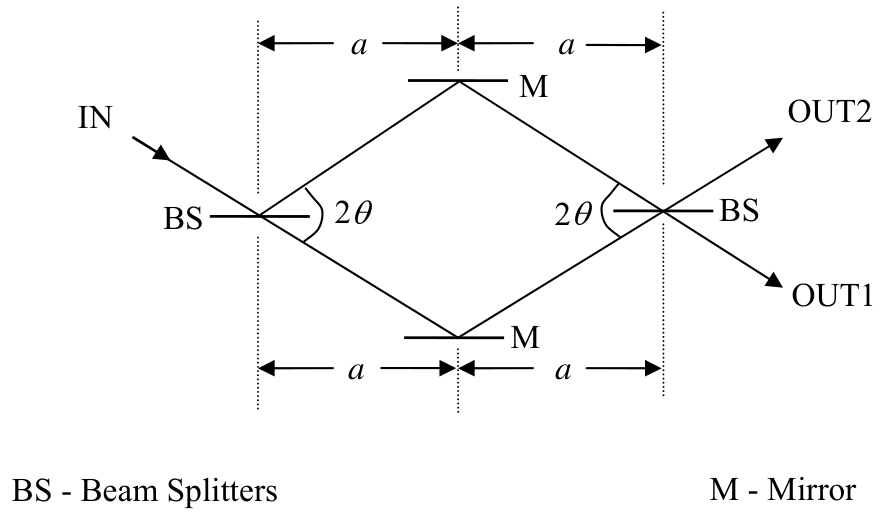
Figure 1a
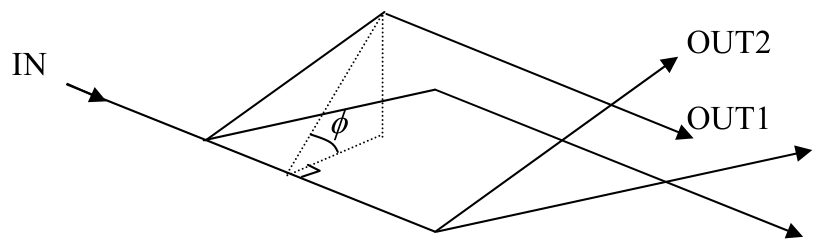
Figure 1b
Physical situation We consider the situation of the famous neutron-interferometer experiment by Collela, Overhauser and Werner, but idealize the set-up inasmuch as we shall assume perfect beam splitters and mirrors within the interferometer. The experiment studies the effect of the gravitational pull on the de Broglie waves of neutrons.
The symbolic representation of this interferometer in analogy to an optical interferometer is shown in Figure 1a. The neutrons enter the interferometer through the IN port and follow the two paths shown. The neutrons are detected at either one of the two output ports, OUT1 or OUT2. The two paths enclose a diamond-shaped area, which is typically a few \(\mathrm{cm^2}\) in size.
The neutron de Broglie waves (of typical wavelength of \(10^{-10}\ \mathrm{m}\)) interfere such that all neutrons emerge from the output port OUT1 if the interferometer plane is horizontal. But when the interferometer is tilted around the axis of the incoming neutron beam by angle \(\phi\) (Figure 1b), one observes a \(\phi\) dependent redistribution of the neutrons between the two output ports OUT1 and OUT2.
Geometry For \(\phi=0^\circ\) the interferometer plane is horizontal; for \(\phi=90^\circ\) the plane is vertical with the output ports above the tilt axis.
1.1 (1.0) How large is the diamond-shaped area \(A\) enclosed by the two paths of the interferometer?
1.2 (1.0) What is the height \(H\) of output port OUT1 above the horizontal plane of the tilt axis?
Express \(A\) and \(H\) in terms of \(a\), \(\theta\), and \(\phi\).
Optical path length The optical path length \(N_{\mathrm{opt}}\) (a number) is the ratio of the geometrical path length (a distance) and the wavelength \(\lambda\). If \(\lambda\) changes along the path, \(N_{\mathrm{opt}}\) is obtained by integrating \(\lambda^{-1}\) along the path.
1.3 (3.0) What is the difference \(\Delta N_{\mathrm{opt}}\) in the optical path lengths of the two paths when the interferometer has been tilted by angle \(\phi\)? Express your answer in terms of \(a\), \(\theta\), and \(\phi\) as well as the neutron mass \(M\), the de Broglie wavelength \(\lambda_0\) of the incoming neutrons, the gravitational acceleration \(g\), and Planck’s constant \(h\).
1.4 (1.0) Introduce the volume parameter
\[ V=\frac{h^2}{gM^2} \]
and express \(\Delta N_{\mathrm{opt}}\) solely in terms of \(A\), \(V\), \(\lambda_0\), and \(\phi\). State the value of \(V\) for \(M=1.675\times10^{-27}\ \mathrm{kg}\), \(g=9.800\ \mathrm{m\,s^{-2}}\), and \(h=6.626\times10^{-34}\ \mathrm{J\,s}\).
1.5 (2.0) How many cycles — from high intensity to low intensity and back to high intensity — are completed by output port OUT1 when \(\phi\) is increased from \(\phi=-90^\circ\) to \(\phi=90^\circ\)?
Experimental data The interferometer of an actual experiment was characterized by \(a=3.600\ \mathrm{cm}\) and \(\theta=22.10^\circ\), and 19.00 full cycles were observed.
1.6 (1.0) How large was \(\lambda_0\) in this experiment?
1.7 (1.0) If one observed 30.00 full cycles in another experiment of the same kind that uses neutrons with \(\lambda_0=0.2000\ \mathrm{nm}\), how large would be the area \(A\)?
Hint: If \(|\alpha x|\ll1\), it is permissible to replace \((1+x)^\alpha\) by \(1+\alpha x\).
Official English text of the problem.
Answers
Define the signed difference as \(\Delta N_{\mathrm{opt}}=N_{\mathrm{lower}}-N_{\mathrm{upper}}\), with the paths named according to Figure 1a. The phase results retain first order in the gravitational energy change.
- 1.1: \(\displaystyle A=2a^2\tan\theta.\)
- 1.2: \(\displaystyle H=2a\sin\theta\sin\phi.\)
- 1.3: \(\displaystyle \Delta N_{\mathrm{opt}}\simeq\frac{2M^2ga^2\lambda_0}{h^2}\tan\theta\sin\phi.\)
- 1.4: \(\displaystyle \Delta N_{\mathrm{opt}}\simeq\frac{A\lambda_0}{V}\sin\phi,\qquad V=1.597\times10^{-14}\ \mathrm{m^3}.\)
- 1.5: \(\displaystyle C=\frac{2A\lambda_0}{V}=\frac{4M^2ga^2\lambda_0}{h^2}\tan\theta\) cycles.
- 1.6: \(\displaystyle \lambda_0=1.441\times10^{-10}\ \mathrm{m}=0.1441\ \mathrm{nm}.\)
- 1.7: \(\displaystyle A=1.198\times10^{-3}\ \mathrm{m^2}=11.98\ \mathrm{cm^2}.\)
Solution
1.1 — Enclosed area
Label the entrance beam splitter \(O\), the upper mirror \(U\), the lower mirror \(D\), and the exit beam splitter \(R\), according to Figure 1a.
Each side of the diamond has length
\[ \ell=\frac{a}{\cos\theta}. \]
The horizontal diagonal \(OR\) is \(2a\), while the perpendicular diagonal \(UD\) is \(2a\tan\theta\). Therefore,
\[ \boxed{A=\frac12(2a)(2a\tan\theta)=2a^2\tan\theta.} \]
Tilting the apparatus does not change this area.
1.2 — Height of OUT1
The incoming beam is collinear with \(OD\), so the tilt axis lies along \(OD\). The opposite side \(UR\) is parallel to this axis.
The perpendicular distance, within the interferometer plane, from \(R\) to the tilt axis is
\[ d=\ell\sin(2\theta) =\frac{a}{\cos\theta}\,2\sin\theta\cos\theta =2a\sin\theta. \]
Rotating the plane by \(\phi\) gives this distance a vertical component \(d\sin\phi\). Hence
\[ \boxed{H=2a\sin\theta\sin\phi.} \]
Both \(U\) and \(R\) have height \(H\), while \(O\) and \(D\) remain at height zero. The OUT1 beam is parallel to the tilt axis, so it stays at height \(H\). For negative \(\phi\), \(H\) is negative.
1.3 — Difference in optical path lengths
Use nonrelativistic mechanics, a uniform gravitational field, and elastic interactions with the stationary ideal optical elements. Set the gravitational potential energy to zero on the tilt axis.
The incoming momentum and kinetic energy are
\[ p_0=\frac{h}{\lambda_0}, \qquad K_0=\frac{h^2}{2M\lambda_0^2}. \]
Energy conservation at height \(z\) gives
\[ \frac{p(z)^2}{2M}+Mgz=\frac{p_0^2}{2M}. \]
Using the de Broglie relation, the reciprocal wavelength is therefore
\[ \frac{1}{\lambda(z)} =\frac{p(z)}{h} =\frac{1}{\lambda_0} \sqrt{1-\frac{2M^2g\lambda_0^2z}{h^2}}. \]
We retain first order in the small ratio \(Mg|z|/K_0\). The hint then gives
\[ \frac{1}{\lambda(z)} \simeq \frac{1}{\lambda_0} -\frac{M^2g\lambda_0}{h^2}z. \]
At this accuracy we use the straight segments shown in the figure. For fixed endpoints, the extra geometrical length caused by a small gravitational deflection is second order in that deflection.
The two sloping segments \(OU\) and \(DR\) both have length \(\ell\), and their heights vary identically from \(0\) to \(H\). Thus their optical path lengths are equal:
\[ J=\int_0^\ell \frac{ds}{\lambda(Hs/\ell)}. \]
The remaining segments are at constant heights: \(OD\) is at zero and \(UR\) is at \(H\). Consequently,
\[ N_{\mathrm{lower}}=\frac{\ell}{\lambda_0}+J, \qquad N_{\mathrm{upper}}=J+\frac{\ell}{\lambda(H)}. \]
Subtracting,
\[ \begin{aligned} \Delta N_{\mathrm{opt}} &=\ell\left(\frac{1}{\lambda_0}-\frac{1}{\lambda(H)}\right)\\ &=\frac{\ell}{\lambda_0} \left[ 1-\sqrt{1-\frac{2M^2g\lambda_0^2H}{h^2}} \right]\\ &\simeq\frac{M^2g\lambda_0}{h^2}\ell H. \end{aligned} \]
Since
\[ \ell H =\frac{a}{\cos\theta}\,2a\sin\theta\sin\phi =2a^2\tan\theta\sin\phi, \]
the requested result is
\[ \boxed{ \Delta N_{\mathrm{opt}} \simeq \frac{2M^2ga^2\lambda_0}{h^2} \tan\theta\sin\phi. } \]
For positive \(\phi\), the upper path has the smaller optical length because its elevated segment has a smaller neutron momentum and hence a longer wavelength. Reversing the subtraction convention reverses the sign without changing the interference predictions.
1.4 — Volume parameter
Using \(A=2a^2\tan\theta\) and \(V=h^2/(gM^2)\),
\[ \boxed{\Delta N_{\mathrm{opt}}\simeq\frac{A\lambda_0}{V}\sin\phi.} \]
The dimensions of \(V\) are
\[ [V]= \frac{(\mathrm{kg\,m^2\,s^{-1}})^2} {(\mathrm{m\,s^{-2}})\mathrm{kg^2}} =\mathrm{m^3}. \]
Numerically,
\[ V= \frac{(6.626\times10^{-34})^2} {9.800(1.675\times10^{-27})^2} =1.5967876\ldots\times10^{-14}\ \mathrm{m^3}. \]
Thus
\[ \boxed{V=1.597\times10^{-14}\ \mathrm{m^3}.} \]
1.5 — Number of intensity cycles
An optical path difference of one corresponds to a relative phase change of \(2\pi\):
\[ \delta=2\pi\Delta N_{\mathrm{opt}}. \]
The given constructive interference at OUT1 when \(\phi=0\) fixes the constant phase offset. For the ideal equal-amplitude paths,
\[ \frac{I_{\mathrm{OUT1}}}{I_{\mathrm{in}}} =\frac{1+\cos\delta}{2} =\cos^2\!\left(\pi\frac{A\lambda_0}{V}\sin\phi\right). \]
Maxima occur at integer \(\Delta N_{\mathrm{opt}}\), and minima at half-integer values. Each increase of one in \(\Delta N_{\mathrm{opt}}\) therefore produces one intensity cycle.
As \(\phi\) increases from \(-90^\circ\) to \(90^\circ\), \(\sin\phi\) increases monotonically from \(-1\) to \(1\). Hence the total number of cycles is
\[ \begin{aligned} C &=\Delta N_{\mathrm{opt}}(90^\circ) -\Delta N_{\mathrm{opt}}(-90^\circ)\\ &=\frac{A\lambda_0}{V} -\left(-\frac{A\lambda_0}{V}\right). \end{aligned} \]
Therefore, to the same first-order accuracy,
\[ \boxed{ C=\frac{2A\lambda_0}{V} =\frac{4M^2ga^2\lambda_0}{h^2}\tan\theta. } \]
1.6 — Incoming wavelength
The experimental area is
\[ A=2(0.03600\ \mathrm{m})^2\tan(22.10^\circ) =1.052502\ldots\times10^{-3}\ \mathrm{m^2}. \]
Solving the cycle formula for the wavelength,
\[ \lambda_0=\frac{CV}{2A}. \]
Using \(C=19.00\) and retaining unrounded intermediate values,
\[ \lambda_0 = \frac{19.00(1.5967876\ldots\times10^{-14}\ \mathrm{m^3})} {2(1.052502\ldots\times10^{-3}\ \mathrm{m^2})} =1.441278\ldots\times10^{-10}\ \mathrm{m}. \]
Thus
\[ \boxed{\lambda_0=1.441\times10^{-10}\ \mathrm{m} =0.1441\ \mathrm{nm}.} \]
The approximation used above is well justified. These neutrons have speed
\[ v_0=\frac{h}{M\lambda_0}\simeq2.745\times10^3\ \mathrm{m\,s^{-1}}, \]
and the largest height is \(H_{\max}=2a\sin\theta\simeq0.02709\ \mathrm{m}\). Therefore,
\[ \frac{MgH_{\max}}{K_0} =\frac{2gH_{\max}}{v_0^2} \simeq7.05\times10^{-8}\ll1. \]
1.7 — Area for the second experiment
Rearranging the same cycle formula,
\[ A=\frac{CV}{2\lambda_0}. \]
With \(C=30.00\) and \(\lambda_0=0.2000\ \mathrm{nm}=2.000\times10^{-10}\ \mathrm{m}\),
\[ A= \frac{30.00(1.5967876\ldots\times10^{-14}\ \mathrm{m^3})} {2(2.000\times10^{-10}\ \mathrm{m})} =1.1975907\ldots\times10^{-3}\ \mathrm{m^2}. \]
Hence
\[ \boxed{A=1.198\times10^{-3}\ \mathrm{m^2}=11.98\ \mathrm{cm^2}.} \]
The solution was checked against the official solution.
IPhO 2006 · Theorieaufgabe 1
Gravitation in einem Neutroneninterferometer
Tragen Sie alle Ihre Antworten in den Antwortbogen ein.
Abbildung 1a
Abbildung 1b
Physikalische Situation Wir betrachten die Situation des berühmten Neutroneninterferometerexperiments von Collela, Overhauser und Werner, idealisieren den Aufbau jedoch insofern, als wir perfekte Strahlteiler und Spiegel innerhalb des Interferometers annehmen. Das Experiment untersucht den Einfluss der Schwerkraft auf die De-Broglie-Wellen von Neutronen.
Die schematische Darstellung dieses Interferometers in Analogie zu einem optischen Interferometer ist in Abbildung 1a gezeigt. Die Neutronen treten durch den Eingang IN in das Interferometer ein und folgen den beiden dargestellten Wegen. Die Neutronen werden an einem der beiden Ausgänge OUT1 oder OUT2 nachgewiesen. Die beiden Wege schließen eine rautenförmige Fläche ein, die typischerweise einige \(\mathrm{cm^2}\) groß ist.
Die De-Broglie-Wellen der Neutronen (mit einer typischen Wellenlänge von \(10^{-10}\ \mathrm{m}\)) interferieren so, dass alle Neutronen am Ausgang OUT1 austreten, wenn die Interferometerebene horizontal liegt. Wird das Interferometer jedoch um die Achse des einfallenden Neutronenstrahls um den Winkel \(\phi\) gekippt (Abbildung 1b), beobachtet man eine von \(\phi\) abhängige Umverteilung der Neutronen zwischen den beiden Ausgängen OUT1 und OUT2.
Geometrie Für \(\phi=0^\circ\) liegt die Interferometerebene horizontal; für \(\phi=90^\circ\) steht die Ebene vertikal, wobei sich die Ausgänge oberhalb der Kippachse befinden.
1.1 (1.0) Wie groß ist die rautenförmige Fläche \(A\), die von den beiden Wegen des Interferometers eingeschlossen wird?
1.2 (1.0) In welcher Höhe \(H\) liegt der Ausgang OUT1 über der horizontalen Ebene durch die Kippachse?
Drücken Sie \(A\) und \(H\) durch \(a\), \(\theta\) und \(\phi\) aus.
Optische Weglänge Die optische Weglänge \(N_{\mathrm{opt}}\) (eine Zahl) ist das Verhältnis der geometrischen Weglänge (einer Strecke) zur Wellenlänge \(\lambda\). Wenn sich \(\lambda\) entlang des Weges ändert, erhält man \(N_{\mathrm{opt}}\) durch Integration von \(\lambda^{-1}\) entlang des Weges.
1.3 (3.0) Wie groß ist die Differenz \(\Delta N_{\mathrm{opt}}\) der optischen Weglängen der beiden Wege, wenn das Interferometer um den Winkel \(\phi\) gekippt wurde? Drücken Sie Ihre Antwort durch \(a\), \(\theta\) und \(\phi\) sowie durch die Neutronenmasse \(M\), die De-Broglie-Wellenlänge \(\lambda_0\) der einfallenden Neutronen, die Erdbeschleunigung \(g\) und die Planck-Konstante \(h\) aus.
1.4 (1.0) Führen Sie den Volumenparameter
\[ V=\frac{h^2}{gM^2} \]
ein und drücken Sie \(\Delta N_{\mathrm{opt}}\) ausschließlich durch \(A\), \(V\), \(\lambda_0\) und \(\phi\) aus. Geben Sie den Wert von \(V\) für \(M=1.675\times10^{-27}\ \mathrm{kg}\), \(g=9.800\ \mathrm{m\,s^{-2}}\) und \(h=6.626\times10^{-34}\ \mathrm{J\,s}\) an.
1.5 (2.0) Wie viele Zyklen — von hoher Intensität zu niedriger Intensität und zurück zu hoher Intensität — werden am Ausgang OUT1 durchlaufen, wenn \(\phi\) von \(\phi=-90^\circ\) auf \(\phi=90^\circ\) erhöht wird?
Experimentelle Daten Das Interferometer eines tatsächlich durchgeführten Experiments war durch \(a=3.600\ \mathrm{cm}\) und \(\theta=22.10^\circ\) gekennzeichnet, und es wurden 19.00 vollständige Zyklen beobachtet.
1.6 (1.0) Wie groß war \(\lambda_0\) in diesem Experiment?
1.7 (1.0) Wenn in einem weiteren Experiment derselben Art mit Neutronen der Wellenlänge \(\lambda_0=0.2000\ \mathrm{nm}\) 30.00 vollständige Zyklen beobachtet würden, wie groß wäre dann die Fläche \(A\)?
Hinweis: Wenn \(|\alpha x|\ll1\), darf \((1+x)^\alpha\) durch \(1+\alpha x\) ersetzt werden.
Aufgabentext aus dem offiziellen englischen Text übersetzt.
Antworten
Wir definieren die vorzeichenbehaftete Differenz als \(\Delta N_{\mathrm{opt}}=N_{\mathrm{lower}}-N_{\mathrm{upper}}\), wobei die Wege gemäß Abbildung 1a benannt sind. Die Ergebnisse für die Phase berücksichtigen die Änderung der gravitativen potenziellen Energie bis zur ersten Ordnung.
- 1.1: \(\displaystyle A=2a^2\tan\theta.\)
- 1.2: \(\displaystyle H=2a\sin\theta\sin\phi.\)
- 1.3: \(\displaystyle \Delta N_{\mathrm{opt}}\simeq\frac{2M^2ga^2\lambda_0}{h^2}\tan\theta\sin\phi.\)
- 1.4: \(\displaystyle \Delta N_{\mathrm{opt}}\simeq\frac{A\lambda_0}{V}\sin\phi,\qquad V=1.597\times10^{-14}\ \mathrm{m^3}.\)
- 1.5: \(\displaystyle C=\frac{2A\lambda_0}{V}=\frac{4M^2ga^2\lambda_0}{h^2}\tan\theta\) Zyklen.
- 1.6: \(\displaystyle \lambda_0=1.441\times10^{-10}\ \mathrm{m}=0.1441\ \mathrm{nm}.\)
- 1.7: \(\displaystyle A=1.198\times10^{-3}\ \mathrm{m^2}=11.98\ \mathrm{cm^2}.\)
Lösung
1.1 — Eingeschlossene Fläche
Wir bezeichnen gemäß Abbildung 1a den Eingangsstrahlteiler mit \(O\), den oberen Spiegel mit \(U\), den unteren Spiegel mit \(D\) und den Ausgangsstrahlteiler mit \(R\).
Jede Seite der Raute hat die Länge
\[ \ell=\frac{a}{\cos\theta}. \]
Die horizontale Diagonale \(OR\) hat die Länge \(2a\), während die dazu senkrechte Diagonale \(UD\) die Länge \(2a\tan\theta\) hat. Daher gilt
\[ \boxed{A=\frac12(2a)(2a\tan\theta)=2a^2\tan\theta.} \]
Durch das Kippen der Apparatur ändert sich diese Fläche nicht.
1.2 — Höhe von OUT1
Der einfallende Strahl verläuft auf derselben Geraden wie \(OD\), sodass die Kippachse entlang \(OD\) liegt. Die gegenüberliegende Seite \(UR\) ist parallel zu dieser Achse.
Der innerhalb der Interferometerebene senkrecht zur Kippachse gemessene Abstand von \(R\) zur Kippachse ist
\[ d=\ell\sin(2\theta) =\frac{a}{\cos\theta}\,2\sin\theta\cos\theta =2a\sin\theta. \]
Wird die Ebene um \(\phi\) gedreht, erhält dieser Abstand eine vertikale Komponente \(d\sin\phi\). Somit gilt
\[ \boxed{H=2a\sin\theta\sin\phi.} \]
Sowohl \(U\) als auch \(R\) liegen auf der Höhe \(H\), während \(O\) und \(D\) auf der Höhe null bleiben. Der Strahl am Ausgang OUT1 ist parallel zur Kippachse und bleibt daher auf der Höhe \(H\). Für negative \(\phi\) ist \(H\) negativ.
1.3 — Differenz der optischen Weglängen
Wir verwenden die nichtrelativistische Mechanik, ein homogenes Gravitationsfeld und elastische Wechselwirkungen mit den ruhenden idealen optischen Elementen. Wir setzen die gravitative potenzielle Energie auf der Kippachse gleich null.
Der Impuls und die kinetische Energie der einfallenden Neutronen sind
\[ p_0=\frac{h}{\lambda_0}, \qquad K_0=\frac{h^2}{2M\lambda_0^2}. \]
Aus der Energieerhaltung auf der Höhe \(z\) folgt
\[ \frac{p(z)^2}{2M}+Mgz=\frac{p_0^2}{2M}. \]
Mit der De-Broglie-Beziehung ergibt sich daher für den Kehrwert der Wellenlänge
\[ \frac{1}{\lambda(z)} =\frac{p(z)}{h} =\frac{1}{\lambda_0} \sqrt{1-\frac{2M^2g\lambda_0^2z}{h^2}}. \]
Wir berücksichtigen Terme bis zur ersten Ordnung im kleinen Verhältnis \(Mg|z|/K_0\). Mit dem Hinweis ergibt sich dann
\[ \frac{1}{\lambda(z)} \simeq \frac{1}{\lambda_0} -\frac{M^2g\lambda_0}{h^2}z. \]
Bei dieser Genauigkeit verwenden wir die in der Abbildung dargestellten geraden Teilstrecken. Bei festen Endpunkten ist die zusätzliche geometrische Weglänge, die durch eine kleine gravitative Ablenkung entsteht, von zweiter Ordnung in dieser Ablenkung.
Die beiden ansteigenden Teilstrecken \(OU\) und \(DR\) haben beide die Länge \(\ell\), und ihre Höhen ändern sich auf identische Weise von \(0\) bis \(H\). Daher sind ihre optischen Weglängen gleich:
\[ J=\int_0^\ell \frac{ds}{\lambda(Hs/\ell)}. \]
Die übrigen Teilstrecken liegen auf konstanten Höhen: \(OD\) auf der Höhe null und \(UR\) auf der Höhe \(H\). Folglich gilt
\[ N_{\mathrm{lower}}=\frac{\ell}{\lambda_0}+J, \qquad N_{\mathrm{upper}}=J+\frac{\ell}{\lambda(H)}. \]
Durch Subtraktion erhält man
\[ \begin{aligned} \Delta N_{\mathrm{opt}} &=\ell\left(\frac{1}{\lambda_0}-\frac{1}{\lambda(H)}\right)\\ &=\frac{\ell}{\lambda_0} \left[ 1-\sqrt{1-\frac{2M^2g\lambda_0^2H}{h^2}} \right]\\ &\simeq\frac{M^2g\lambda_0}{h^2}\ell H. \end{aligned} \]
Da
\[ \ell H =\frac{a}{\cos\theta}\,2a\sin\theta\sin\phi =2a^2\tan\theta\sin\phi, \]
lautet das gesuchte Ergebnis
\[ \boxed{ \Delta N_{\mathrm{opt}} \simeq \frac{2M^2ga^2\lambda_0}{h^2} \tan\theta\sin\phi. } \]
Für positive \(\phi\) hat der obere Weg die kleinere optische Weglänge, weil die Neutronen auf seiner höher gelegenen Teilstrecke einen kleineren Impuls und damit eine größere Wellenlänge haben. Eine Umkehrung der Subtraktionskonvention kehrt das Vorzeichen um, ohne die Vorhersagen für die Interferenz zu verändern.
1.4 — Volumenparameter
Mit \(A=2a^2\tan\theta\) und \(V=h^2/(gM^2)\) gilt
\[ \boxed{\Delta N_{\mathrm{opt}}\simeq\frac{A\lambda_0}{V}\sin\phi.} \]
Die Dimension von \(V\) ergibt sich aus
\[ [V]= \frac{(\mathrm{kg\,m^2\,s^{-1}})^2} {(\mathrm{m\,s^{-2}})\mathrm{kg^2}} =\mathrm{m^3}. \]
Numerisch ergibt sich
\[ V= \frac{(6.626\times10^{-34})^2} {9.800(1.675\times10^{-27})^2} =1.5967876\ldots\times10^{-14}\ \mathrm{m^3}. \]
Somit gilt
\[ \boxed{V=1.597\times10^{-14}\ \mathrm{m^3}.} \]
1.5 — Anzahl der Intensitätszyklen
Eine optische Weglängendifferenz von eins entspricht einer relativen Phasenänderung von \(2\pi\):
\[ \delta=2\pi\Delta N_{\mathrm{opt}}. \]
Die vorgegebene konstruktive Interferenz am Ausgang OUT1 bei \(\phi=0\) legt den konstanten Phasenversatz fest. Für die idealen Wege mit gleichen Amplituden gilt
\[ \frac{I_{\mathrm{OUT1}}}{I_{\mathrm{in}}} =\frac{1+\cos\delta}{2} =\cos^2\!\left(\pi\frac{A\lambda_0}{V}\sin\phi\right). \]
Maxima treten bei ganzzahligen Werten von \(\Delta N_{\mathrm{opt}}\) auf, Minima bei halbzahligen Werten. Jede Zunahme von \(\Delta N_{\mathrm{opt}}\) um eins erzeugt daher einen Intensitätszyklus.
Wenn \(\phi\) von \(-90^\circ\) auf \(90^\circ\) zunimmt, steigt \(\sin\phi\) monoton von \(-1\) auf \(1\). Somit ist die Gesamtzahl der Zyklen
\[ \begin{aligned} C &=\Delta N_{\mathrm{opt}}(90^\circ) -\Delta N_{\mathrm{opt}}(-90^\circ)\\ &=\frac{A\lambda_0}{V} -\left(-\frac{A\lambda_0}{V}\right). \end{aligned} \]
Daher gilt mit derselben Genauigkeit erster Ordnung
\[ \boxed{ C=\frac{2A\lambda_0}{V} =\frac{4M^2ga^2\lambda_0}{h^2}\tan\theta. } \]
1.6 — Wellenlänge der einfallenden Neutronen
Die Fläche im Experiment beträgt
\[ A=2(0.03600\ \mathrm{m})^2\tan(22.10^\circ) =1.052502\ldots\times10^{-3}\ \mathrm{m^2}. \]
Löst man die Formel für die Zyklenzahl nach der Wellenlänge auf, erhält man
\[ \lambda_0=\frac{CV}{2A}. \]
Mit \(C=19.00\) und ungerundeten Zwischenwerten ergibt sich
\[ \lambda_0 = \frac{19.00(1.5967876\ldots\times10^{-14}\ \mathrm{m^3})} {2(1.052502\ldots\times10^{-3}\ \mathrm{m^2})} =1.441278\ldots\times10^{-10}\ \mathrm{m}. \]
Somit gilt
\[ \boxed{\lambda_0=1.441\times10^{-10}\ \mathrm{m} =0.1441\ \mathrm{nm}.} \]
Die oben verwendete Näherung ist gut gerechtfertigt. Diese Neutronen haben die Geschwindigkeit
\[ v_0=\frac{h}{M\lambda_0}\simeq2.745\times10^3\ \mathrm{m\,s^{-1}}, \]
und die größte Höhe ist \(H_{\max}=2a\sin\theta\simeq0.02709\ \mathrm{m}\). Daher gilt
\[ \frac{MgH_{\max}}{K_0} =\frac{2gH_{\max}}{v_0^2} \simeq7.05\times10^{-8}\ll1. \]
1.7 — Fläche für das zweite Experiment
Durch Umstellen derselben Formel für die Zyklenzahl erhält man
\[ A=\frac{CV}{2\lambda_0}. \]
Mit \(C=30.00\) und \(\lambda_0=0.2000\ \mathrm{nm}=2.000\times10^{-10}\ \mathrm{m}\) ergibt sich
\[ A= \frac{30.00(1.5967876\ldots\times10^{-14}\ \mathrm{m^3})} {2(2.000\times10^{-10}\ \mathrm{m})} =1.1975907\ldots\times10^{-3}\ \mathrm{m^2}. \]
Somit gilt
\[ \boxed{A=1.198\times10^{-3}\ \mathrm{m^2}=11.98\ \mathrm{cm^2}.} \]
Die Lösung wurde mit der offiziellen Lösung abgeglichen.
IPhO 2006 · Teori sorusu 1
Bir Nötron İnterferometresinde Kütleçekimi
Tüm cevaplarınızı Cevap Kâğıdına yazınız.
Şekil 1a
Şekil 1b
Fiziksel durum Collela, Overhauser ve Werner'in ünlü nötron interferometresi deneyindeki durumu ele alıyoruz; ancak interferometre içindeki demet ayırıcıların ve aynaların kusursuz olduğunu varsayarak düzeneği idealleştiriyoruz. Deney, kütleçekiminin nötronların de Broglie dalgaları üzerindeki etkisini inceler.
Bu interferometrenin, bir optik interferometreye benzetilerek oluşturulan şematik gösterimi Şekil 1a'da verilmiştir. Nötronlar interferometreye IN girişinden girer ve gösterilen iki yolu izler. Nötronlar, OUT1 veya OUT2 çıkışlarının birinde algılanır. İki yol, alanı tipik olarak birkaç \(\mathrm{cm^2}\) olan eşkenar dörtgen biçiminde bir bölgeyi çevreler.
Nötronların de Broglie dalgaları (tipik dalga boyları \(10^{-10}\ \mathrm{m}\)) öyle girişim yapar ki interferometre düzlemi yatay olduğunda tüm nötronlar OUT1 çıkışından çıkar. Ancak interferometre, gelen nötron demetinin ekseni etrafında \(\phi\) açısı kadar eğildiğinde (Şekil 1b), nötronların OUT1 ve OUT2 çıkışları arasındaki dağılımının \(\phi\)'ye bağlı olarak değiştiği gözlenir.
Geometri \(\phi=0^\circ\) için interferometre düzlemi yataydır; \(\phi=90^\circ\) için ise düzlem düşeydir ve çıkışlar eğme ekseninin üzerindedir.
1.1 (1.0) İnterferometrenin iki yolunun çevrelediği eşkenar dörtgen biçimindeki bölgenin alanı \(A\) ne kadardır?
1.2 (1.0) OUT1 çıkışının, eğme ekseninden geçen yatay düzleme göre yüksekliği \(H\) ne kadardır?
\(A\) ve \(H\)'yi \(a\), \(\theta\) ve \(\phi\) cinsinden ifade ediniz.
Optik yol uzunluğu Optik yol uzunluğu \(N_{\mathrm{opt}}\) (bir sayı), geometrik yol uzunluğunun (bir mesafe) dalga boyu \(\lambda\)'ya oranıdır. \(\lambda\) yol boyunca değişiyorsa, \(N_{\mathrm{opt}}\), yol boyunca \(\lambda^{-1}\)'in integrali alınarak elde edilir.
1.3 (3.0) İnterferometre \(\phi\) açısı kadar eğildiğinde iki yolun optik yol uzunlukları arasındaki fark \(\Delta N_{\mathrm{opt}}\) nedir? Cevabınızı \(a\), \(\theta\) ve \(\phi\)'nin yanı sıra nötron kütlesi \(M\), gelen nötronların de Broglie dalga boyu \(\lambda_0\), yerçekimi ivmesi \(g\) ve Planck sabiti \(h\) cinsinden ifade ediniz.
1.4 (1.0) Hacim parametresini
\[ V=\frac{h^2}{gM^2} \]
olarak tanımlayınız ve \(\Delta N_{\mathrm{opt}}\)'yi yalnızca \(A\), \(V\), \(\lambda_0\) ve \(\phi\) cinsinden ifade ediniz. \(M=1.675\times10^{-27}\ \mathrm{kg}\), \(g=9.800\ \mathrm{m\,s^{-2}}\) ve \(h=6.626\times10^{-34}\ \mathrm{J\,s}\) için \(V\)'nin değerini belirtiniz.
1.5 (2.0) \(\phi\), \(\phi=-90^\circ\)'den \(\phi=90^\circ\)'ye artırıldığında OUT1 çıkışında kaç döngü — yüksek şiddetten düşük şiddete ve tekrar yüksek şiddete — tamamlanır?
Deneysel veriler Gerçek bir deneyde kullanılan interferometrenin parametreleri \(a=3.600\ \mathrm{cm}\) ve \(\theta=22.10^\circ\) idi ve 19.00 tam döngü gözlendi.
1.6 (1.0) Bu deneyde \(\lambda_0\) ne kadardı?
1.7 (1.0) Aynı türden başka bir deneyde, \(\lambda_0=0.2000\ \mathrm{nm}\) dalga boyuna sahip nötronlar kullanılarak 30.00 tam döngü gözlenseydi, \(A\) alanı ne kadar olurdu?
İpucu: \(|\alpha x|\ll1\) ise, \((1+x)^\alpha\) yerine \(1+\alpha x\) kullanılabilir.
Soru metni resmi İngilizce metinden çevrilmiştir.
Cevaplar
Yolları Şekil 1a'ya göre adlandırarak işaretli farkı \(\Delta N_{\mathrm{opt}}=N_{\mathrm{lower}}-N_{\mathrm{upper}}\) olarak tanımlayalım. Fazla ilgili sonuçlarda, kütleçekimi potansiyel enerjisindeki değişimin birinci mertebesine kadar olan terimler tutulmuştur.
- 1.1: \(\displaystyle A=2a^2\tan\theta.\)
- 1.2: \(\displaystyle H=2a\sin\theta\sin\phi.\)
- 1.3: \(\displaystyle \Delta N_{\mathrm{opt}}\simeq\frac{2M^2ga^2\lambda_0}{h^2}\tan\theta\sin\phi.\)
- 1.4: \(\displaystyle \Delta N_{\mathrm{opt}}\simeq\frac{A\lambda_0}{V}\sin\phi,\qquad V=1.597\times10^{-14}\ \mathrm{m^3}.\)
- 1.5: \(\displaystyle C=\frac{2A\lambda_0}{V}=\frac{4M^2ga^2\lambda_0}{h^2}\tan\theta\) döngü.
- 1.6: \(\displaystyle \lambda_0=1.441\times10^{-10}\ \mathrm{m}=0.1441\ \mathrm{nm}.\)
- 1.7: \(\displaystyle A=1.198\times10^{-3}\ \mathrm{m^2}=11.98\ \mathrm{cm^2}.\)
Çözüm
1.1 — Çevrelenen alan
Şekil 1a'ya göre giriş demet ayırıcısını \(O\), üst aynayı \(U\), alt aynayı \(D\) ve çıkış demet ayırıcısını \(R\) ile gösterelim.
Eşkenar dörtgenin her bir kenarının uzunluğu
\[ \ell=\frac{a}{\cos\theta}. \]
Yatay köşegen \(OR\)'nin uzunluğu \(2a\), ona dik köşegen \(UD\)'nin uzunluğu ise \(2a\tan\theta\)'dır. Dolayısıyla,
\[ \boxed{A=\frac12(2a)(2a\tan\theta)=2a^2\tan\theta.} \]
Düzeneğin eğilmesi bu alanı değiştirmez.
1.2 — OUT1'in yüksekliği
Gelen demet \(OD\) ile aynı doğru üzerindedir; dolayısıyla eğme ekseni \(OD\) boyunca uzanır. Karşı kenar \(UR\) bu eksene paraleldir.
İnterferometre düzlemi içinde \(R\)'den eğme eksenine olan dik uzaklık
\[ d=\ell\sin(2\theta) =\frac{a}{\cos\theta}\,2\sin\theta\cos\theta =2a\sin\theta. \]
Düzlem \(\phi\) açısı kadar döndürüldüğünde bu uzaklığın düşey bileşeni \(d\sin\phi\) olur. Böylece
\[ \boxed{H=2a\sin\theta\sin\phi.} \]
Hem \(U\) hem de \(R\), \(H\) yüksekliğindedir; \(O\) ve \(D\) ise sıfır yüksekliğinde kalır. OUT1 demeti eğme eksenine paralel olduğundan \(H\) yüksekliğinde kalır. Negatif \(\phi\) için \(H\) negatiftir.
1.3 — Optik yol uzunlukları arasındaki fark
Göreli olmayan mekaniği, düzgün bir kütleçekim alanını ve durağan ideal optik elemanlarla esnek etkileşimleri kullanalım. Eğme ekseni üzerinde kütleçekimi potansiyel enerjisini sıfır alalım.
Gelen nötronların momentumu ve kinetik enerjisi
\[ p_0=\frac{h}{\lambda_0}, \qquad K_0=\frac{h^2}{2M\lambda_0^2}. \]
\(z\) yüksekliğinde enerjinin korunumu şu bağıntıyı verir:
\[ \frac{p(z)^2}{2M}+Mgz=\frac{p_0^2}{2M}. \]
Dolayısıyla, de Broglie bağıntısını kullanarak dalga boyunun tersini şöyle buluruz:
\[ \frac{1}{\lambda(z)} =\frac{p(z)}{h} =\frac{1}{\lambda_0} \sqrt{1-\frac{2M^2g\lambda_0^2z}{h^2}}. \]
Küçük \(Mg|z|/K_0\) oranında birinci mertebeye kadar olan terimleri tutuyoruz. Bu durumda ipucundan
\[ \frac{1}{\lambda(z)} \simeq \frac{1}{\lambda_0} -\frac{M^2g\lambda_0}{h^2}z. \]
elde edilir. Bu doğruluk düzeyinde, şekilde gösterilen doğru parçalarını kullanıyoruz. Uç noktalar sabitken, kütleçekiminin yol açtığı küçük bir sapmanın oluşturduğu ek geometrik uzunluk, bu sapmaya göre ikinci mertebedendir.
İki eğik parça \(OU\) ve \(DR\)'nin her ikisinin de uzunluğu \(\ell\)'dir ve yükseklikleri \(0\)'dan \(H\)'ye aynı biçimde değişir. Bu nedenle optik yol uzunlukları eşittir:
\[ J=\int_0^\ell \frac{ds}{\lambda(Hs/\ell)}. \]
Geriye kalan parçalar sabit yüksekliklerdedir: \(OD\) sıfır yüksekliğinde, \(UR\) ise \(H\) yüksekliğindedir. Sonuç olarak,
\[ N_{\mathrm{lower}}=\frac{\ell}{\lambda_0}+J, \qquad N_{\mathrm{upper}}=J+\frac{\ell}{\lambda(H)}. \]
Farklarını alırsak,
\[ \begin{aligned} \Delta N_{\mathrm{opt}} &=\ell\left(\frac{1}{\lambda_0}-\frac{1}{\lambda(H)}\right)\\ &=\frac{\ell}{\lambda_0} \left[ 1-\sqrt{1-\frac{2M^2g\lambda_0^2H}{h^2}} \right]\\ &\simeq\frac{M^2g\lambda_0}{h^2}\ell H. \end{aligned} \]
Şu eşitlik geçerli olduğundan,
\[ \ell H =\frac{a}{\cos\theta}\,2a\sin\theta\sin\phi =2a^2\tan\theta\sin\phi, \]
istenen sonuç
\[ \boxed{ \Delta N_{\mathrm{opt}} \simeq \frac{2M^2ga^2\lambda_0}{h^2} \tan\theta\sin\phi. } \]
Pozitif \(\phi\) için üst yolun optik uzunluğu daha küçüktür; çünkü yüksekteki parçasında nötron momentumu daha küçük, dolayısıyla dalga boyu daha büyüktür. Çıkarma sırasının ters seçilmesi, girişime ilişkin öngörüleri değiştirmeden işareti tersine çevirir.
1.4 — Hacim parametresi
\(A=2a^2\tan\theta\) ve \(V=h^2/(gM^2)\) kullanılırsa,
\[ \boxed{\Delta N_{\mathrm{opt}}\simeq\frac{A\lambda_0}{V}\sin\phi.} \]
\(V\)'nin boyutu
\[ [V]= \frac{(\mathrm{kg\,m^2\,s^{-1}})^2} {(\mathrm{m\,s^{-2}})\mathrm{kg^2}} =\mathrm{m^3}. \]
Sayısal olarak,
\[ V= \frac{(6.626\times10^{-34})^2} {9.800(1.675\times10^{-27})^2} =1.5967876\ldots\times10^{-14}\ \mathrm{m^3}. \]
Böylece
\[ \boxed{V=1.597\times10^{-14}\ \mathrm{m^3}.} \]
1.5 — Şiddet döngülerinin sayısı
Optik yol farkının bir olması, bağıl fazda \(2\pi\)'lik bir değişime karşılık gelir:
\[ \delta=2\pi\Delta N_{\mathrm{opt}}. \]
\(\phi=0\) iken OUT1'de yapıcı girişim gerçekleştiğine ilişkin verilen bilgi, sabit faz kaymasını belirler. İdeal, eşit genlikli yollar için,
\[ \frac{I_{\mathrm{OUT1}}}{I_{\mathrm{in}}} =\frac{1+\cos\delta}{2} =\cos^2\!\left(\pi\frac{A\lambda_0}{V}\sin\phi\right). \]
Maksimumlar, \(\Delta N_{\mathrm{opt}}\)'nin tam sayı değerlerinde; minimumlar ise yarım tam sayı değerlerinde oluşur. Dolayısıyla \(\Delta N_{\mathrm{opt}}\)'deki her bir birimlik artış, bir şiddet döngüsü oluşturur.
\(\phi\), \(-90^\circ\)'den \(90^\circ\)'ye artarken \(\sin\phi\), \(-1\)'den \(1\)'e monoton olarak artar. Bu nedenle toplam döngü sayısı
\[ \begin{aligned} C &=\Delta N_{\mathrm{opt}}(90^\circ) -\Delta N_{\mathrm{opt}}(-90^\circ)\\ &=\frac{A\lambda_0}{V} -\left(-\frac{A\lambda_0}{V}\right). \end{aligned} \]
Dolayısıyla, aynı birinci mertebe doğruluğunda,
\[ \boxed{ C=\frac{2A\lambda_0}{V} =\frac{4M^2ga^2\lambda_0}{h^2}\tan\theta. } \]
1.6 — Gelen nötronların dalga boyu
Deneydeki alan
\[ A=2(0.03600\ \mathrm{m})^2\tan(22.10^\circ) =1.052502\ldots\times10^{-3}\ \mathrm{m^2}. \]
Döngü formülünü dalga boyu için çözersek,
\[ \lambda_0=\frac{CV}{2A}. \]
\(C=19.00\) kullanıp ara değerleri yuvarlamadan koruyarak,
\[ \lambda_0 = \frac{19.00(1.5967876\ldots\times10^{-14}\ \mathrm{m^3})} {2(1.052502\ldots\times10^{-3}\ \mathrm{m^2})} =1.441278\ldots\times10^{-10}\ \mathrm{m}. \]
Böylece
\[ \boxed{\lambda_0=1.441\times10^{-10}\ \mathrm{m} =0.1441\ \mathrm{nm}.} \]
Yukarıda kullanılan yaklaşım oldukça geçerlidir. Bu nötronların sürati
\[ v_0=\frac{h}{M\lambda_0}\simeq2.745\times10^3\ \mathrm{m\,s^{-1}}, \]
ve en büyük yükseklik \(H_{\max}=2a\sin\theta\simeq0.02709\ \mathrm{m}\)'dir. Dolayısıyla,
\[ \frac{MgH_{\max}}{K_0} =\frac{2gH_{\max}}{v_0^2} \simeq7.05\times10^{-8}\ll1. \]
1.7 — İkinci deney için alan
Aynı döngü formülünü yeniden düzenlersek,
\[ A=\frac{CV}{2\lambda_0}. \]
\(C=30.00\) ve \(\lambda_0=0.2000\ \mathrm{nm}=2.000\times10^{-10}\ \mathrm{m}\) ile,
\[ A= \frac{30.00(1.5967876\ldots\times10^{-14}\ \mathrm{m^3})} {2(2.000\times10^{-10}\ \mathrm{m})} =1.1975907\ldots\times10^{-3}\ \mathrm{m^2}. \]
Böylece
\[ \boxed{A=1.198\times10^{-3}\ \mathrm{m^2}=11.98\ \mathrm{cm^2}.} \]
Çözüm, resmi çözümle karşılaştırılarak kontrol edildi.
IPhO 2006 · Problema teórico 1
La gravedad en un interferómetro de neutrones
Escriba todas sus respuestas en la Hoja de respuestas.
Figura 1a
Figura 1b
Situación física Consideramos la situación del famoso experimento de interferometría de neutrones de Collela, Overhauser y Werner, pero idealizamos el montaje al suponer que los divisores de haz y los espejos del interferómetro son perfectos. El experimento estudia el efecto de la atracción gravitatoria sobre las ondas de de Broglie de los neutrones.
La representación simbólica de este interferómetro, por analogía con un interferómetro óptico, se muestra en la Figura 1a. Los neutrones entran en el interferómetro por el puerto IN y siguen las dos trayectorias indicadas. Los neutrones se detectan en uno de los dos puertos de salida, OUT1 u OUT2. Las dos trayectorias delimitan un área en forma de rombo, cuyo tamaño suele ser de unos pocos \(\mathrm{cm^2}\).
Las ondas de de Broglie de los neutrones (cuya longitud de onda típica es de \(10^{-10}\ \mathrm{m}\)) interfieren de tal manera que todos los neutrones salen por el puerto de salida OUT1 si el plano del interferómetro es horizontal. Sin embargo, cuando el interferómetro se inclina un ángulo \(\phi\) alrededor del eje del haz de neutrones incidente (Figura 1b), se observa una redistribución de los neutrones entre los dos puertos de salida OUT1 y OUT2 que depende de \(\phi\).
Geometría Para \(\phi=0^\circ\), el plano del interferómetro es horizontal; para \(\phi=90^\circ\), el plano es vertical y los puertos de salida se encuentran por encima del eje de inclinación.
1.1 (1.0) ¿Cuál es el área \(A\) del rombo delimitado por las dos trayectorias del interferómetro?
1.2 (1.0) ¿Cuál es la altura \(H\) del puerto de salida OUT1 sobre el plano horizontal que contiene el eje de inclinación?
Exprese \(A\) y \(H\) en función de \(a\), \(\theta\) y \(\phi\).
Longitud de camino óptico La longitud de camino óptico \(N_{\mathrm{opt}}\) (un número) es el cociente entre la longitud geométrica del camino (una distancia) y la longitud de onda \(\lambda\). Si \(\lambda\) varía a lo largo del camino, \(N_{\mathrm{opt}}\) se obtiene integrando \(\lambda^{-1}\) a lo largo de él.
1.3 (3.0) ¿Cuál es la diferencia \(\Delta N_{\mathrm{opt}}\) entre las longitudes de camino óptico de las dos trayectorias cuando el interferómetro se ha inclinado un ángulo \(\phi\)? Exprese su respuesta en función de \(a\), \(\theta\) y \(\phi\), así como de la masa del neutrón \(M\), la longitud de onda de de Broglie \(\lambda_0\) de los neutrones incidentes, la aceleración de la gravedad \(g\) y la constante de Planck \(h\).
1.4 (1.0) Introduzca el parámetro de volumen
\[ V=\frac{h^2}{gM^2} \]
y exprese \(\Delta N_{\mathrm{opt}}\) únicamente en función de \(A\), \(V\), \(\lambda_0\) y \(\phi\). Indique el valor de \(V\) para \(M=1.675\times10^{-27}\ \mathrm{kg}\), \(g=9.800\ \mathrm{m\,s^{-2}}\) y \(h=6.626\times10^{-34}\ \mathrm{J\,s}\).
1.5 (2.0) ¿Cuántos ciclos —de intensidad alta a intensidad baja y de nuevo a intensidad alta— se completan en el puerto de salida OUT1 cuando \(\phi\) aumenta desde \(\phi=-90^\circ\) hasta \(\phi=90^\circ\)?
Datos experimentales El interferómetro de un experimento real se caracterizaba por \(a=3.600\ \mathrm{cm}\) y \(\theta=22.10^\circ\), y se observaron 19.00 ciclos completos.
1.6 (1.0) ¿Cuál era el valor de \(\lambda_0\) en este experimento?
1.7 (1.0) Si se observaran 30.00 ciclos completos en otro experimento del mismo tipo que utilizara neutrones con \(\lambda_0=0.2000\ \mathrm{nm}\), ¿cuál sería el área \(A\)?
Indicación: Si \(|\alpha x|\ll1\), se puede sustituir \((1+x)^\alpha\) por \(1+\alpha x\).
Enunciado traducido del texto oficial en inglés.
Respuestas
Definimos la diferencia con signo como \(\Delta N_{\mathrm{opt}}=N_{\mathrm{lower}}-N_{\mathrm{upper}}\), con las trayectorias denominadas según la Figura 1a. Los resultados relativos a la fase conservan los términos de primer orden en la variación de la energía gravitatoria.
- 1.1: \(\displaystyle A=2a^2\tan\theta.\)
- 1.2: \(\displaystyle H=2a\sin\theta\sin\phi.\)
- 1.3: \(\displaystyle \Delta N_{\mathrm{opt}}\simeq\frac{2M^2ga^2\lambda_0}{h^2}\tan\theta\sin\phi.\)
- 1.4: \(\displaystyle \Delta N_{\mathrm{opt}}\simeq\frac{A\lambda_0}{V}\sin\phi,\qquad V=1.597\times10^{-14}\ \mathrm{m^3}.\)
- 1.5: \(\displaystyle C=\frac{2A\lambda_0}{V}=\frac{4M^2ga^2\lambda_0}{h^2}\tan\theta\) ciclos.
- 1.6: \(\displaystyle \lambda_0=1.441\times10^{-10}\ \mathrm{m}=0.1441\ \mathrm{nm}.\)
- 1.7: \(\displaystyle A=1.198\times10^{-3}\ \mathrm{m^2}=11.98\ \mathrm{cm^2}.\)
Solución
1.1 — Área delimitada
Denotemos por \(O\) el divisor de haz de entrada, por \(U\) el espejo superior, por \(D\) el espejo inferior y por \(R\) el divisor de haz de salida, de acuerdo con la Figura 1a.
Cada lado del rombo tiene longitud
\[ \ell=\frac{a}{\cos\theta}. \]
La diagonal horizontal \(OR\) mide \(2a\), mientras que la diagonal perpendicular \(UD\) mide \(2a\tan\theta\). Por tanto,
\[ \boxed{A=\frac12(2a)(2a\tan\theta)=2a^2\tan\theta.} \]
La inclinación del aparato no modifica esta área.
1.2 — Altura de OUT1
El haz incidente es colineal con \(OD\), por lo que el eje de inclinación se encuentra a lo largo de \(OD\). El lado opuesto \(UR\) es paralelo a este eje.
La distancia perpendicular, dentro del plano del interferómetro, desde \(R\) hasta el eje de inclinación es
\[ d=\ell\sin(2\theta) =\frac{a}{\cos\theta}\,2\sin\theta\cos\theta =2a\sin\theta. \]
Al girar el plano un ángulo \(\phi\), esta distancia adquiere una componente vertical \(d\sin\phi\). Así pues,
\[ \boxed{H=2a\sin\theta\sin\phi.} \]
Tanto \(U\) como \(R\) se encuentran a una altura \(H\), mientras que \(O\) y \(D\) permanecen a altura cero. El haz OUT1 es paralelo al eje de inclinación, por lo que permanece a la altura \(H\). Para valores negativos de \(\phi\), \(H\) es negativa.
1.3 — Diferencia entre las longitudes de camino óptico
Utilizamos la mecánica no relativista, un campo gravitatorio uniforme e interacciones elásticas con los elementos ópticos ideales estacionarios. Fijamos el cero de la energía potencial gravitatoria en el eje de inclinación.
El momento lineal y la energía cinética de los neutrones incidentes son
\[ p_0=\frac{h}{\lambda_0}, \qquad K_0=\frac{h^2}{2M\lambda_0^2}. \]
La conservación de la energía a la altura \(z\) da
\[ \frac{p(z)^2}{2M}+Mgz=\frac{p_0^2}{2M}. \]
Utilizando la relación de de Broglie, el inverso de la longitud de onda es, por tanto,
\[ \frac{1}{\lambda(z)} =\frac{p(z)}{h} =\frac{1}{\lambda_0} \sqrt{1-\frac{2M^2g\lambda_0^2z}{h^2}}. \]
Conservamos los términos de primer orden en el pequeño cociente \(Mg|z|/K_0\). La indicación da entonces
\[ \frac{1}{\lambda(z)} \simeq \frac{1}{\lambda_0} -\frac{M^2g\lambda_0}{h^2}z. \]
Con este grado de precisión, utilizamos los segmentos rectos mostrados en la figura. Para extremos fijos, el incremento de longitud geométrica causado por una pequeña desviación gravitatoria es de segundo orden en dicha desviación.
Los dos segmentos inclinados \(OU\) y \(DR\) tienen ambos longitud \(\ell\), y sus alturas varían de forma idéntica desde \(0\) hasta \(H\). Por ello, sus longitudes de camino óptico son iguales:
\[ J=\int_0^\ell \frac{ds}{\lambda(Hs/\ell)}. \]
Los segmentos restantes se encuentran a alturas constantes: \(OD\) está a altura cero y \(UR\), a altura \(H\). En consecuencia,
\[ N_{\mathrm{lower}}=\frac{\ell}{\lambda_0}+J, \qquad N_{\mathrm{upper}}=J+\frac{\ell}{\lambda(H)}. \]
Restando,
\[ \begin{aligned} \Delta N_{\mathrm{opt}} &=\ell\left(\frac{1}{\lambda_0}-\frac{1}{\lambda(H)}\right)\\ &=\frac{\ell}{\lambda_0} \left[ 1-\sqrt{1-\frac{2M^2g\lambda_0^2H}{h^2}} \right]\\ &\simeq\frac{M^2g\lambda_0}{h^2}\ell H. \end{aligned} \]
Puesto que
\[ \ell H =\frac{a}{\cos\theta}\,2a\sin\theta\sin\phi =2a^2\tan\theta\sin\phi, \]
el resultado solicitado es
\[ \boxed{ \Delta N_{\mathrm{opt}} \simeq \frac{2M^2ga^2\lambda_0}{h^2} \tan\theta\sin\phi. } \]
Para valores positivos de \(\phi\), la trayectoria superior tiene la menor longitud de camino óptico porque, en su segmento elevado, el momento lineal del neutrón es menor y, por tanto, su longitud de onda es mayor. Invertir la convención de la resta invierte el signo sin modificar las predicciones de interferencia.
1.4 — Parámetro de volumen
Utilizando \(A=2a^2\tan\theta\) y \(V=h^2/(gM^2)\),
\[ \boxed{\Delta N_{\mathrm{opt}}\simeq\frac{A\lambda_0}{V}\sin\phi.} \]
Las dimensiones de \(V\) son
\[ [V]= \frac{(\mathrm{kg\,m^2\,s^{-1}})^2} {(\mathrm{m\,s^{-2}})\mathrm{kg^2}} =\mathrm{m^3}. \]
Numéricamente,
\[ V= \frac{(6.626\times10^{-34})^2} {9.800(1.675\times10^{-27})^2} =1.5967876\ldots\times10^{-14}\ \mathrm{m^3}. \]
Así,
\[ \boxed{V=1.597\times10^{-14}\ \mathrm{m^3}.} \]
1.5 — Número de ciclos de intensidad
Una diferencia de camino óptico de una unidad corresponde a una variación de fase relativa de \(2\pi\):
\[ \delta=2\pi\Delta N_{\mathrm{opt}}. \]
La interferencia constructiva en OUT1 para \(\phi=0\), indicada en el enunciado, fija el desfase constante. Para las trayectorias ideales de igual amplitud,
\[ \frac{I_{\mathrm{OUT1}}}{I_{\mathrm{in}}} =\frac{1+\cos\delta}{2} =\cos^2\!\left(\pi\frac{A\lambda_0}{V}\sin\phi\right). \]
Los máximos se producen para valores enteros de \(\Delta N_{\mathrm{opt}}\), y los mínimos, para valores semienteros. Por tanto, cada incremento de una unidad en \(\Delta N_{\mathrm{opt}}\) produce un ciclo de intensidad.
A medida que \(\phi\) aumenta desde \(-90^\circ\) hasta \(90^\circ\), \(\sin\phi\) aumenta monótonamente desde \(-1\) hasta \(1\). Así pues, el número total de ciclos es
\[ \begin{aligned} C &=\Delta N_{\mathrm{opt}}(90^\circ) -\Delta N_{\mathrm{opt}}(-90^\circ)\\ &=\frac{A\lambda_0}{V} -\left(-\frac{A\lambda_0}{V}\right). \end{aligned} \]
Por tanto, con la misma precisión de primer orden,
\[ \boxed{ C=\frac{2A\lambda_0}{V} =\frac{4M^2ga^2\lambda_0}{h^2}\tan\theta. } \]
1.6 — Longitud de onda incidente
El área experimental es
\[ A=2(0.03600\ \mathrm{m})^2\tan(22.10^\circ) =1.052502\ldots\times10^{-3}\ \mathrm{m^2}. \]
Despejando la longitud de onda en la fórmula del número de ciclos,
\[ \lambda_0=\frac{CV}{2A}. \]
Utilizando \(C=19.00\) y conservando los valores intermedios sin redondear,
\[ \lambda_0 = \frac{19.00(1.5967876\ldots\times10^{-14}\ \mathrm{m^3})} {2(1.052502\ldots\times10^{-3}\ \mathrm{m^2})} =1.441278\ldots\times10^{-10}\ \mathrm{m}. \]
Así,
\[ \boxed{\lambda_0=1.441\times10^{-10}\ \mathrm{m} =0.1441\ \mathrm{nm}.} \]
La aproximación utilizada anteriormente está bien justificada. Estos neutrones tienen una rapidez
\[ v_0=\frac{h}{M\lambda_0}\simeq2.745\times10^3\ \mathrm{m\,s^{-1}}, \]
y la altura máxima es \(H_{\max}=2a\sin\theta\simeq0.02709\ \mathrm{m}\). Por tanto,
\[ \frac{MgH_{\max}}{K_0} =\frac{2gH_{\max}}{v_0^2} \simeq7.05\times10^{-8}\ll1. \]
1.7 — Área para el segundo experimento
Reordenando la misma fórmula del número de ciclos,
\[ A=\frac{CV}{2\lambda_0}. \]
Con \(C=30.00\) y \(\lambda_0=0.2000\ \mathrm{nm}=2.000\times10^{-10}\ \mathrm{m}\),
\[ A= \frac{30.00(1.5967876\ldots\times10^{-14}\ \mathrm{m^3})} {2(2.000\times10^{-10}\ \mathrm{m})} =1.1975907\ldots\times10^{-3}\ \mathrm{m^2}. \]
Así pues,
\[ \boxed{A=1.198\times10^{-3}\ \mathrm{m^2}=11.98\ \mathrm{cm^2}.} \]
La solución se comprobó con la solución oficial.
IPhO 2006 · 理论题 1
中子干涉仪中的重力
请将所有答案填写在答题纸上。
图 1a
图 1b
物理情境 我们考虑科莱拉、奥弗豪泽和沃纳所进行的著名中子干涉仪实验中的情形,但将装置理想化,假设干涉仪内的分束器和反射镜都是理想的。该实验研究重力对中子德布罗意波的影响。
图 1a 参照光学干涉仪的画法,给出了这种干涉仪的示意图。中子从 IN 端口进入干涉仪,并沿图示的两条路径传播。中子在两个输出端口 OUT1 或 OUT2 中的一个处被探测到。这两条路径围成一个菱形区域,其面积通常为几 \(\mathrm{cm^2}\)。
中子的德布罗意波(典型波长为 \(10^{-10}\ \mathrm{m}\))相互干涉,使得当干涉仪平面水平时,所有中子都从输出端口 OUT1 射出。但当干涉仪绕入射中子束的轴线倾转角度 \(\phi\) 时(图 1b),可以观察到中子在两个输出端口 OUT1 和 OUT2 之间的分配随 \(\phi\) 而变化。
几何关系 当 \(\phi=0^\circ\) 时,干涉仪平面水平;当 \(\phi=90^\circ\) 时,该平面竖直,输出端口位于倾转轴上方。
1.1 (1.0) 干涉仪的两条路径所围成的菱形区域的面积 \(A\) 是多少?
1.2 (1.0) 输出端口 OUT1 相对于经过倾转轴的水平面的高度 \(H\) 是多少?
用 \(a\)、\(\theta\) 和 \(\phi\) 表示 \(A\) 和 \(H\)。
光程 光程 \(N_{\mathrm{opt}}\)(一个数)是几何路径长度(一个距离)与波长 \(\lambda\) 的比值。如果 \(\lambda\) 沿路径变化,则沿路径对 \(\lambda^{-1}\) 积分即可得到 \(N_{\mathrm{opt}}\)。
1.3 (3.0) 当干涉仪倾转角度 \(\phi\) 后,两条路径的光程差 \(\Delta N_{\mathrm{opt}}\) 是多少?用 \(a\)、\(\theta\) 和 \(\phi\),以及中子质量 \(M\)、入射中子的德布罗意波长 \(\lambda_0\)、重力加速度 \(g\) 和普朗克常量 \(h\) 表示你的答案。
1.4 (1.0) 引入体积参数
\[ V=\frac{h^2}{gM^2} \]
并仅用 \(A\)、\(V\)、\(\lambda_0\) 和 \(\phi\) 表示 \(\Delta N_{\mathrm{opt}}\)。给出当 \(M=1.675\times10^{-27}\ \mathrm{kg}\)、\(g=9.800\ \mathrm{m\,s^{-2}}\) 且 \(h=6.626\times10^{-34}\ \mathrm{J\,s}\) 时 \(V\) 的值。
1.5 (2.0) 当 \(\phi\) 从 \(\phi=-90^\circ\) 增大到 \(\phi=90^\circ\) 时,输出端口 OUT1 的强度完成多少个周期的变化——从高强度到低强度,再回到高强度?
实验数据 某次实际实验所用干涉仪的参数为 \(a=3.600\ \mathrm{cm}\) 和 \(\theta=22.10^\circ\),观测到了 19.00 个完整周期。
1.6 (1.0) 该实验中的 \(\lambda_0\) 是多少?
1.7 (1.0) 如果在另一次同类实验中,使用 \(\lambda_0=0.2000\ \mathrm{nm}\) 的中子,观测到了 30.00 个完整周期,那么面积 \(A\) 应为多少?
提示:若 \(|\alpha x|\ll1\),可用 \(1+\alpha x\) 代替 \((1+x)^\alpha\)。
题目译自官方英文原文。
答案
定义带符号的差值为 \(\Delta N_{\mathrm{opt}}=N_{\mathrm{lower}}-N_{\mathrm{upper}}\),其中两条路径按照图 1a 命名。相位结果保留到重力势能变化的一阶。
- 1.1: \(\displaystyle A=2a^2\tan\theta.\)
- 1.2: \(\displaystyle H=2a\sin\theta\sin\phi.\)
- 1.3: \(\displaystyle \Delta N_{\mathrm{opt}}\simeq\frac{2M^2ga^2\lambda_0}{h^2}\tan\theta\sin\phi.\)
- 1.4: \(\displaystyle \Delta N_{\mathrm{opt}}\simeq\frac{A\lambda_0}{V}\sin\phi,\qquad V=1.597\times10^{-14}\ \mathrm{m^3}.\)
- 1.5: \(\displaystyle C=\frac{2A\lambda_0}{V}=\frac{4M^2ga^2\lambda_0}{h^2}\tan\theta\) 个周期。
- 1.6: \(\displaystyle \lambda_0=1.441\times10^{-10}\ \mathrm{m}=0.1441\ \mathrm{nm}.\)
- 1.7: \(\displaystyle A=1.198\times10^{-3}\ \mathrm{m^2}=11.98\ \mathrm{cm^2}.\)
解答
1.1 — 所围成的面积
按照图 1a,将入口分束器标为 \(O\),上方反射镜标为 \(U\),下方反射镜标为 \(D\),出口分束器标为 \(R\)。
菱形的每条边长为
\[ \ell=\frac{a}{\cos\theta}. \]
水平对角线 \(OR\) 的长度为 \(2a\),与之垂直的对角线 \(UD\) 的长度为 \(2a\tan\theta\)。因此,
\[ \boxed{A=\frac12(2a)(2a\tan\theta)=2a^2\tan\theta.} \]
倾转装置不会改变这一面积。
1.2 — OUT1 的高度
入射束与 \(OD\) 共线,因此倾转轴沿 \(OD\) 方向。对边 \(UR\) 与该轴平行。
在干涉仪平面内,\(R\) 到倾转轴的垂直距离为
\[ d=\ell\sin(2\theta) =\frac{a}{\cos\theta}\,2\sin\theta\cos\theta =2a\sin\theta. \]
将该平面旋转 \(\phi\) 后,这段距离的竖直分量为 \(d\sin\phi\)。因此
\[ \boxed{H=2a\sin\theta\sin\phi.} \]
\(U\) 和 \(R\) 的高度均为 \(H\),而 \(O\) 和 \(D\) 的高度仍为零。OUT1 出射束与倾转轴平行,因此保持在高度 \(H\) 处。当 \(\phi\) 为负时,\(H\) 为负。
1.3 — 光程差
采用非相对论力学,假设重力场均匀,且中子与静止的理想光学元件之间的相互作用是弹性的。将倾转轴处的重力势能设为零。
入射中子的动量和动能分别为
\[ p_0=\frac{h}{\lambda_0}, \qquad K_0=\frac{h^2}{2M\lambda_0^2}. \]
在高度 \(z\) 处,由能量守恒可得
\[ \frac{p(z)^2}{2M}+Mgz=\frac{p_0^2}{2M}. \]
利用德布罗意关系,波长的倒数因此为
\[ \frac{1}{\lambda(z)} =\frac{p(z)}{h} =\frac{1}{\lambda_0} \sqrt{1-\frac{2M^2g\lambda_0^2z}{h^2}}. \]
我们对小比值 \(Mg|z|/K_0\) 保留到一阶。利用提示可得
\[ \frac{1}{\lambda(z)} \simeq \frac{1}{\lambda_0} -\frac{M^2g\lambda_0}{h^2}z. \]
在这一精度下,我们采用图中所示的直线段。对于固定的端点,微小的重力偏转所引起的额外几何长度是该偏转的二阶量。
两条倾斜线段 \(OU\) 和 \(DR\) 的长度均为 \(\ell\),且它们的高度都以相同方式从 \(0\) 变化到 \(H\)。因此它们的光程相等:
\[ J=\int_0^\ell \frac{ds}{\lambda(Hs/\ell)}. \]
其余两条线段的高度保持不变:\(OD\) 的高度为零,\(UR\) 的高度为 \(H\)。因此,
\[ N_{\mathrm{lower}}=\frac{\ell}{\lambda_0}+J, \qquad N_{\mathrm{upper}}=J+\frac{\ell}{\lambda(H)}. \]
相减得到,
\[ \begin{aligned} \Delta N_{\mathrm{opt}} &=\ell\left(\frac{1}{\lambda_0}-\frac{1}{\lambda(H)}\right)\\ &=\frac{\ell}{\lambda_0} \left[ 1-\sqrt{1-\frac{2M^2g\lambda_0^2H}{h^2}} \right]\\ &\simeq\frac{M^2g\lambda_0}{h^2}\ell H. \end{aligned} \]
由于
\[ \ell H =\frac{a}{\cos\theta}\,2a\sin\theta\sin\phi =2a^2\tan\theta\sin\phi, \]
所求结果为
\[ \boxed{ \Delta N_{\mathrm{opt}} \simeq \frac{2M^2ga^2\lambda_0}{h^2} \tan\theta\sin\phi. } \]
当 \(\phi\) 为正时,上方路径的光程较小,因为在其抬高的线段上,中子的动量较小,因而波长较长。若将相减顺序反过来,结果的符号也会反转,但不会改变对干涉现象的预测。
1.4 — 体积参数
利用 \(A=2a^2\tan\theta\) 和 \(V=h^2/(gM^2)\),
\[ \boxed{\Delta N_{\mathrm{opt}}\simeq\frac{A\lambda_0}{V}\sin\phi.} \]
\(V\) 的量纲为
\[ [V]= \frac{(\mathrm{kg\,m^2\,s^{-1}})^2} {(\mathrm{m\,s^{-2}})\mathrm{kg^2}} =\mathrm{m^3}. \]
代入数值得,
\[ V= \frac{(6.626\times10^{-34})^2} {9.800(1.675\times10^{-27})^2} =1.5967876\ldots\times10^{-14}\ \mathrm{m^3}. \]
因此
\[ \boxed{V=1.597\times10^{-14}\ \mathrm{m^3}.} \]
1.5 — 强度变化的周期数
光程差为一对应于 \(2\pi\) 的相对相位变化:
\[ \delta=2\pi\Delta N_{\mathrm{opt}}. \]
题目给出当 \(\phi=0\) 时 OUT1 处发生相长干涉,这确定了恒定的相位偏移。对于两条理想的等振幅路径,
\[ \frac{I_{\mathrm{OUT1}}}{I_{\mathrm{in}}} =\frac{1+\cos\delta}{2} =\cos^2\!\left(\pi\frac{A\lambda_0}{V}\sin\phi\right). \]
当 \(\Delta N_{\mathrm{opt}}\) 为整数时出现极大值,为半整数时出现极小值。因此,\(\Delta N_{\mathrm{opt}}\) 每增加一,就产生一个强度变化周期。
当 \(\phi\) 从 \(-90^\circ\) 增大到 \(90^\circ\) 时,\(\sin\phi\) 从 \(-1\) 单调增大到 \(1\)。因此,总周期数为
\[ \begin{aligned} C &=\Delta N_{\mathrm{opt}}(90^\circ) -\Delta N_{\mathrm{opt}}(-90^\circ)\\ &=\frac{A\lambda_0}{V} -\left(-\frac{A\lambda_0}{V}\right). \end{aligned} \]
因此,在同样的一阶精度下,
\[ \boxed{ C=\frac{2A\lambda_0}{V} =\frac{4M^2ga^2\lambda_0}{h^2}\tan\theta. } \]
1.6 — 入射波长
实验中的面积为
\[ A=2(0.03600\ \mathrm{m})^2\tan(22.10^\circ) =1.052502\ldots\times10^{-3}\ \mathrm{m^2}. \]
由周期数公式解出波长,
\[ \lambda_0=\frac{CV}{2A}. \]
代入 \(C=19.00\),并保留未经舍入的中间值,
\[ \lambda_0 = \frac{19.00(1.5967876\ldots\times10^{-14}\ \mathrm{m^3})} {2(1.052502\ldots\times10^{-3}\ \mathrm{m^2})} =1.441278\ldots\times10^{-10}\ \mathrm{m}. \]
因此
\[ \boxed{\lambda_0=1.441\times10^{-10}\ \mathrm{m} =0.1441\ \mathrm{nm}.} \]
上述近似具有充分依据。这些中子的速率为
\[ v_0=\frac{h}{M\lambda_0}\simeq2.745\times10^3\ \mathrm{m\,s^{-1}}, \]
而最大高度为 \(H_{\max}=2a\sin\theta\simeq0.02709\ \mathrm{m}\)。因此,
\[ \frac{MgH_{\max}}{K_0} =\frac{2gH_{\max}}{v_0^2} \simeq7.05\times10^{-8}\ll1. \]
1.7 — 第二次实验的面积
将同一个周期数公式变形,
\[ A=\frac{CV}{2\lambda_0}. \]
代入 \(C=30.00\) 和 \(\lambda_0=0.2000\ \mathrm{nm}=2.000\times10^{-10}\ \mathrm{m}\),
\[ A= \frac{30.00(1.5967876\ldots\times10^{-14}\ \mathrm{m^3})} {2(2.000\times10^{-10}\ \mathrm{m})} =1.1975907\ldots\times10^{-3}\ \mathrm{m^2}. \]
因此
\[ \boxed{A=1.198\times10^{-3}\ \mathrm{m^2}=11.98\ \mathrm{cm^2}.} \]
解答已与官方解答核对。
IPhO 2006 · Теоретическая задача 1
Гравитация в нейтронном интерферометре
Запишите все ответы в бланк ответов.
Рисунок 1a
Рисунок 1b
Физическая ситуация Рассмотрим знаменитый эксперимент Колеллы, Оверхаузера и Вернера с нейтронным интерферометром, идеализировав установку: будем считать делители пучка и зеркала внутри интерферометра идеальными. В эксперименте исследуется влияние силы тяжести на волны де Бройля нейтронов.
Схематическое изображение этого интерферометра по аналогии с оптическим интерферометром приведено на рисунке 1a. Нейтроны входят в интерферометр через вход IN и проходят по двум показанным путям. Нейтроны регистрируются на одном из двух выходов, OUT1 или OUT2. Два пути ограничивают область в форме ромба, площадь которой обычно составляет несколько \(\mathrm{cm^2}\).
Волны де Бройля нейтронов (с типичной длиной волны \(10^{-10}\ \mathrm{m}\)) интерферируют так, что все нейтроны выходят через выход OUT1, если плоскость интерферометра горизонтальна. Однако при повороте интерферометра вокруг оси входящего нейтронного пучка на угол \(\phi\) (рисунок 1b) наблюдается зависящее от \(\phi\) перераспределение нейтронов между двумя выходами OUT1 и OUT2.
Геометрия При \(\phi=0^\circ\) плоскость интерферометра горизонтальна; при \(\phi=90^\circ\) она вертикальна, причём выходы расположены выше оси поворота.
1.1 (1.0) Чему равна площадь \(A\) ромба, ограниченного двумя путями интерферометра?
1.2 (1.0) На какой высоте \(H\) над горизонтальной плоскостью, проходящей через ось поворота, находится выход OUT1?
Выразите \(A\) и \(H\) через \(a\), \(\theta\) и \(\phi\).
Оптическая длина пути Оптическая длина пути \(N_{\mathrm{opt}}\) (число) — это отношение геометрической длины пути (расстояния) к длине волны \(\lambda\). Если \(\lambda\) изменяется вдоль пути, то \(N_{\mathrm{opt}}\) определяется интегрированием \(\lambda^{-1}\) вдоль пути.
1.3 (3.0) Чему равна разность \(\Delta N_{\mathrm{opt}}\) оптических длин двух путей при повороте интерферометра на угол \(\phi\)? Выразите ответ через \(a\), \(\theta\) и \(\phi\), а также массу нейтрона \(M\), длину волны де Бройля входящих нейтронов \(\lambda_0\), ускорение свободного падения \(g\) и постоянную Планка \(h\).
1.4 (1.0) Введите параметр с размерностью объёма
\[ V=\frac{h^2}{gM^2} \]
и выразите \(\Delta N_{\mathrm{opt}}\) только через \(A\), \(V\), \(\lambda_0\) и \(\phi\). Укажите значение \(V\) при \(M=1.675\times10^{-27}\ \mathrm{kg}\), \(g=9.800\ \mathrm{m\,s^{-2}}\) и \(h=6.626\times10^{-34}\ \mathrm{J\,s}\).
1.5 (2.0) Сколько циклов изменения интенсивности — от высокой к низкой и обратно к высокой — происходит на выходе OUT1 при увеличении \(\phi\) от \(\phi=-90^\circ\) до \(\phi=90^\circ\)?
Экспериментальные данные Интерферометр в реальном эксперименте имел параметры \(a=3.600\ \mathrm{cm}\) и \(\theta=22.10^\circ\); наблюдалось 19.00 полных циклов.
1.6 (1.0) Чему равнялась \(\lambda_0\) в этом эксперименте?
1.7 (1.0) Если бы в другом аналогичном эксперименте с нейтронами, имеющими \(\lambda_0=0.2000\ \mathrm{nm}\), наблюдалось 30.00 полных циклов, чему была бы равна площадь \(A\)?
Указание: если \(|\alpha x|\ll1\), допустимо заменить \((1+x)^\alpha\) на \(1+\alpha x\).
Условие переведено с официального английского текста.
Ответы
Определим разность с учётом знака как \(\Delta N_{\mathrm{opt}}=N_{\mathrm{lower}}-N_{\mathrm{upper}}\), называя пути в соответствии с рисунком 1a. В результатах для фазы сохраняются члены первого порядка по изменению гравитационной потенциальной энергии.
- 1.1: \(\displaystyle A=2a^2\tan\theta.\)
- 1.2: \(\displaystyle H=2a\sin\theta\sin\phi.\)
- 1.3: \(\displaystyle \Delta N_{\mathrm{opt}}\simeq\frac{2M^2ga^2\lambda_0}{h^2}\tan\theta\sin\phi.\)
- 1.4: \(\displaystyle \Delta N_{\mathrm{opt}}\simeq\frac{A\lambda_0}{V}\sin\phi,\qquad V=1.597\times10^{-14}\ \mathrm{m^3}.\)
- 1.5: \(\displaystyle C=\frac{2A\lambda_0}{V}=\frac{4M^2ga^2\lambda_0}{h^2}\tan\theta\) циклов.
- 1.6: \(\displaystyle \lambda_0=1.441\times10^{-10}\ \mathrm{m}=0.1441\ \mathrm{nm}.\)
- 1.7: \(\displaystyle A=1.198\times10^{-3}\ \mathrm{m^2}=11.98\ \mathrm{cm^2}.\)
Решение
1.1 — Площадь ограниченной области
Обозначим входной делитель пучка через \(O\), верхнее зеркало через \(U\), нижнее зеркало через \(D\), а выходной делитель пучка через \(R\), в соответствии с рисунком 1a.
Каждая сторона ромба имеет длину
\[ \ell=\frac{a}{\cos\theta}. \]
Горизонтальная диагональ \(OR\) равна \(2a\), а перпендикулярная ей диагональ \(UD\) равна \(2a\tan\theta\). Поэтому
\[ \boxed{A=\frac12(2a)(2a\tan\theta)=2a^2\tan\theta.} \]
Поворот установки не изменяет эту площадь.
1.2 — Высота выхода OUT1
Входящий пучок лежит на одной прямой с \(OD\), поэтому ось поворота направлена вдоль \(OD\). Противоположная сторона \(UR\) параллельна этой оси.
Расстояние по перпендикуляру в плоскости интерферометра от \(R\) до оси поворота равно
\[ d=\ell\sin(2\theta) =\frac{a}{\cos\theta}\,2\sin\theta\cos\theta =2a\sin\theta. \]
При повороте плоскости на угол \(\phi\) у этого отрезка появляется вертикальная проекция \(d\sin\phi\). Следовательно,
\[ \boxed{H=2a\sin\theta\sin\phi.} \]
Точки \(U\) и \(R\) находятся на высоте \(H\), тогда как \(O\) и \(D\) остаются на нулевой высоте. Пучок OUT1 параллелен оси поворота, поэтому он остаётся на высоте \(H\). При отрицательных \(\phi\) величина \(H\) отрицательна.
1.3 — Разность оптических длин путей
Используем нерелятивистскую механику, считая гравитационное поле однородным, а взаимодействия с неподвижными идеальными оптическими элементами упругими. Примем гравитационную потенциальную энергию на оси поворота равной нулю.
Импульс и кинетическая энергия входящих нейтронов равны
\[ p_0=\frac{h}{\lambda_0}, \qquad K_0=\frac{h^2}{2M\lambda_0^2}. \]
Закон сохранения энергии на высоте \(z\) даёт
\[ \frac{p(z)^2}{2M}+Mgz=\frac{p_0^2}{2M}. \]
Следовательно, согласно соотношению де Бройля, обратная длина волны равна
\[ \frac{1}{\lambda(z)} =\frac{p(z)}{h} =\frac{1}{\lambda_0} \sqrt{1-\frac{2M^2g\lambda_0^2z}{h^2}}. \]
Сохраним члены первого порядка по малому отношению \(Mg|z|/K_0\). Тогда, воспользовавшись указанием, получаем
\[ \frac{1}{\lambda(z)} \simeq \frac{1}{\lambda_0} -\frac{M^2g\lambda_0}{h^2}z. \]
При такой точности можно использовать прямолинейные отрезки, показанные на рисунке. При фиксированных концах дополнительная геометрическая длина, обусловленная малым отклонением под действием силы тяжести, имеет второй порядок малости по этому отклонению.
Оба наклонных отрезка \(OU\) и \(DR\) имеют длину \(\ell\), а высота вдоль них изменяется одинаково от \(0\) до \(H\). Поэтому их оптические длины равны:
\[ J=\int_0^\ell \frac{ds}{\lambda(Hs/\ell)}. \]
Оставшиеся отрезки расположены на постоянной высоте: \(OD\) — на нулевой, а \(UR\) — на высоте \(H\). Следовательно,
\[ N_{\mathrm{lower}}=\frac{\ell}{\lambda_0}+J, \qquad N_{\mathrm{upper}}=J+\frac{\ell}{\lambda(H)}. \]
Вычитая, получаем
\[ \begin{aligned} \Delta N_{\mathrm{opt}} &=\ell\left(\frac{1}{\lambda_0}-\frac{1}{\lambda(H)}\right)\\ &=\frac{\ell}{\lambda_0} \left[ 1-\sqrt{1-\frac{2M^2g\lambda_0^2H}{h^2}} \right]\\ &\simeq\frac{M^2g\lambda_0}{h^2}\ell H. \end{aligned} \]
Поскольку
\[ \ell H =\frac{a}{\cos\theta}\,2a\sin\theta\sin\phi =2a^2\tan\theta\sin\phi, \]
искомый результат имеет вид
\[ \boxed{ \Delta N_{\mathrm{opt}} \simeq \frac{2M^2ga^2\lambda_0}{h^2} \tan\theta\sin\phi. } \]
При положительных \(\phi\) верхний путь имеет меньшую оптическую длину, поскольку на его приподнятом участке импульс нейтрона меньше, а значит, длина волны больше. Изменение порядка вычитания меняет знак разности, не изменяя предсказаний для интерференционной картины.
1.4 — Параметр с размерностью объёма
Используя \(A=2a^2\tan\theta\) и \(V=h^2/(gM^2)\), получаем
\[ \boxed{\Delta N_{\mathrm{opt}}\simeq\frac{A\lambda_0}{V}\sin\phi.} \]
Размерность \(V\) определяется следующим образом:
\[ [V]= \frac{(\mathrm{kg\,m^2\,s^{-1}})^2} {(\mathrm{m\,s^{-2}})\mathrm{kg^2}} =\mathrm{m^3}. \]
Численно
\[ V= \frac{(6.626\times10^{-34})^2} {9.800(1.675\times10^{-27})^2} =1.5967876\ldots\times10^{-14}\ \mathrm{m^3}. \]
Таким образом,
\[ \boxed{V=1.597\times10^{-14}\ \mathrm{m^3}.} \]
1.5 — Число циклов изменения интенсивности
Разности оптических длин путей, равной единице, соответствует изменение разности фаз на \(2\pi\):
\[ \delta=2\pi\Delta N_{\mathrm{opt}}. \]
Указанная в условии конструктивная интерференция на выходе OUT1 при \(\phi=0\) определяет постоянное смещение фазы. Для идеальных путей с равными амплитудами
\[ \frac{I_{\mathrm{OUT1}}}{I_{\mathrm{in}}} =\frac{1+\cos\delta}{2} =\cos^2\!\left(\pi\frac{A\lambda_0}{V}\sin\phi\right). \]
Максимумы возникают при целых значениях \(\Delta N_{\mathrm{opt}}\), а минимумы — при полуцелых. Поэтому каждое увеличение \(\Delta N_{\mathrm{opt}}\) на единицу соответствует одному циклу изменения интенсивности.
При увеличении \(\phi\) от \(-90^\circ\) до \(90^\circ\) величина \(\sin\phi\) монотонно возрастает от \(-1\) до \(1\). Следовательно, полное число циклов равно
\[ \begin{aligned} C &=\Delta N_{\mathrm{opt}}(90^\circ) -\Delta N_{\mathrm{opt}}(-90^\circ)\\ &=\frac{A\lambda_0}{V} -\left(-\frac{A\lambda_0}{V}\right). \end{aligned} \]
Таким образом, с той же точностью первого порядка,
\[ \boxed{ C=\frac{2A\lambda_0}{V} =\frac{4M^2ga^2\lambda_0}{h^2}\tan\theta. } \]
1.6 — Длина волны входящих нейтронов
Площадь в данном эксперименте равна
\[ A=2(0.03600\ \mathrm{m})^2\tan(22.10^\circ) =1.052502\ldots\times10^{-3}\ \mathrm{m^2}. \]
Выражая длину волны из формулы для числа циклов, получаем
\[ \lambda_0=\frac{CV}{2A}. \]
Используя \(C=19.00\) и сохраняя неокруглённые промежуточные значения, получаем
\[ \lambda_0 = \frac{19.00(1.5967876\ldots\times10^{-14}\ \mathrm{m^3})} {2(1.052502\ldots\times10^{-3}\ \mathrm{m^2})} =1.441278\ldots\times10^{-10}\ \mathrm{m}. \]
Таким образом,
\[ \boxed{\lambda_0=1.441\times10^{-10}\ \mathrm{m} =0.1441\ \mathrm{nm}.} \]
Использованное выше приближение вполне обоснованно. Скорость этих нейтронов равна
\[ v_0=\frac{h}{M\lambda_0}\simeq2.745\times10^3\ \mathrm{m\,s^{-1}}, \]
а наибольшая высота составляет \(H_{\max}=2a\sin\theta\simeq0.02709\ \mathrm{m}\). Поэтому
\[ \frac{MgH_{\max}}{K_0} =\frac{2gH_{\max}}{v_0^2} \simeq7.05\times10^{-8}\ll1. \]
1.7 — Площадь для второго эксперимента
Преобразуя ту же формулу для числа циклов, получаем
\[ A=\frac{CV}{2\lambda_0}. \]
При \(C=30.00\) и \(\lambda_0=0.2000\ \mathrm{nm}=2.000\times10^{-10}\ \mathrm{m}\)
\[ A= \frac{30.00(1.5967876\ldots\times10^{-14}\ \mathrm{m^3})} {2(2.000\times10^{-10}\ \mathrm{m})} =1.1975907\ldots\times10^{-3}\ \mathrm{m^2}. \]
Следовательно,
\[ \boxed{A=1.198\times10^{-3}\ \mathrm{m^2}=11.98\ \mathrm{cm^2}.} \]
Решение проверено по официальному решению.
IPhO 2006 · مسألة نظرية 1
الجاذبية في مقياس تداخل النيوترونات
دوّن جميع إجاباتك في ورقة الإجابة.
الشكل 1a
الشكل 1b
الوضع الفيزيائي ندرس الوضع الذي تناولته تجربة كوليلا وأوفرهاوزر وويرنر الشهيرة باستخدام مقياس تداخل النيوترونات، ولكننا نجعل التجهيز مثاليًا بافتراض أن مقسّمات الحزمة والمرايا داخل مقياس التداخل مثالية. تدرس التجربة تأثير قوة الجاذبية في موجات دي برولي للنيوترونات.
يُبيّن الشكل 1a تمثيلًا رمزيًا لمقياس التداخل هذا، على غرار مقياس التداخل الضوئي. تدخل النيوترونات مقياس التداخل عبر منفذ الدخول IN وتسلك المسارين المبيّنين. وتُرصد النيوترونات عند أحد منفذي الخروج، OUT1 أو OUT2. يحيط المساران بمساحة على شكل مُعيَّن، تبلغ عادةً بضعة \(\mathrm{cm^2}\).
تتداخل موجات دي برولي للنيوترونات (التي يبلغ طولها الموجي عادةً \(10^{-10}\ \mathrm{m}\)) بحيث تخرج جميع النيوترونات من منفذ الخروج OUT1 إذا كان مستوى مقياس التداخل أفقيًا. ولكن عند إمالة مقياس التداخل حول محور حزمة النيوترونات الواردة بزاوية \(\phi\) (الشكل 1b)، يُلاحظ إعادة توزّع النيوترونات بين منفذي الخروج OUT1 وOUT2 على نحو يعتمد على \(\phi\).
الهندسة عند \(\phi=0^\circ\) يكون مستوى مقياس التداخل أفقيًا؛ وعند \(\phi=90^\circ\) يكون المستوى رأسيًا وتكون منافذ الخروج فوق محور الإمالة.
1.1 (1.0) ما مقدار المساحة \(A\) ذات الشكل المُعيَّن التي يحيط بها مسارا مقياس التداخل؟
1.2 (1.0) ما ارتفاع \(H\) منفذ الخروج OUT1 فوق المستوى الأفقي الذي يمر بمحور الإمالة؟
عبّر عن \(A\) و\(H\) بدلالة \(a\) و\(\theta\) و\(\phi\).
طول المسار البصري طول المسار البصري \(N_{\mathrm{opt}}\) (وهو عدد) هو نسبة طول المسار الهندسي (وهو مسافة) إلى الطول الموجي \(\lambda\). إذا تغيّر \(\lambda\) على امتداد المسار، يُحسَب \(N_{\mathrm{opt}}\) بتكامل \(\lambda^{-1}\) على امتداد المسار.
1.3 (3.0) ما الفرق \(\Delta N_{\mathrm{opt}}\) بين طولي المسارين البصريين عند إمالة مقياس التداخل بزاوية \(\phi\)؟ عبّر عن إجابتك بدلالة \(a\) و\(\theta\) و\(\phi\)، وكذلك كتلة النيوترون \(M\)، وطول موجة دي برولي \(\lambda_0\) للنيوترونات الواردة، وتسارع الجاذبية \(g\)، وثابت بلانك \(h\).
1.4 (1.0) عرّف المعامل الحجمي
\[ V=\frac{h^2}{gM^2} \]
وعبّر عن \(\Delta N_{\mathrm{opt}}\) بدلالة \(A\) و\(V\) و\(\lambda_0\) و\(\phi\) فقط. اذكر قيمة \(V\) عندما تكون \(M=1.675\times10^{-27}\ \mathrm{kg}\)، و\(g=9.800\ \mathrm{m\,s^{-2}}\)، و\(h=6.626\times10^{-34}\ \mathrm{J\,s}\).
1.5 (2.0) كم دورة — من شدة مرتفعة إلى شدة منخفضة ثم العودة إلى شدة مرتفعة — يُتمّها منفذ الخروج OUT1 عند زيادة \(\phi\) من \(\phi=-90^\circ\) إلى \(\phi=90^\circ\)؟
البيانات التجريبية اتّسم مقياس التداخل في تجربة فعلية بالقيمتين \(a=3.600\ \mathrm{cm}\) و\(\theta=22.10^\circ\)، ورُصدت 19.00 دورة كاملة.
1.6 (1.0) ما مقدار \(\lambda_0\) في هذه التجربة؟
1.7 (1.0) إذا رُصدت 30.00 دورة كاملة في تجربة أخرى من النوع نفسه تستخدم نيوترونات ذات \(\lambda_0=0.2000\ \mathrm{nm}\)، فما مقدار المساحة \(A\)؟
تلميح: إذا كان \(|\alpha x|\ll1\)، يجوز استبدال \((1+x)^\alpha\) بـ \(1+\alpha x\).
نص المسألة مترجم عن النص الإنجليزي الرسمي.
الإجابات
نعرّف الفرق ذا الإشارة بالعلاقة \(\Delta N_{\mathrm{opt}}=N_{\mathrm{lower}}-N_{\mathrm{upper}}\)، مع تسمية المسارين وفقًا للشكل 1a. تحتفظ نتائج الطور بحدود الرتبة الأولى في تغيّر طاقة وضع الجاذبية.
- 1.1: \(\displaystyle A=2a^2\tan\theta.\)
- 1.2: \(\displaystyle H=2a\sin\theta\sin\phi.\)
- 1.3: \(\displaystyle \Delta N_{\mathrm{opt}}\simeq\frac{2M^2ga^2\lambda_0}{h^2}\tan\theta\sin\phi.\)
- 1.4: \(\displaystyle \Delta N_{\mathrm{opt}}\simeq\frac{A\lambda_0}{V}\sin\phi,\qquad V=1.597\times10^{-14}\ \mathrm{m^3}.\)
- 1.5: \(\displaystyle C=\frac{2A\lambda_0}{V}=\frac{4M^2ga^2\lambda_0}{h^2}\tan\theta\) دورة.
- 1.6: \(\displaystyle \lambda_0=1.441\times10^{-10}\ \mathrm{m}=0.1441\ \mathrm{nm}.\)
- 1.7: \(\displaystyle A=1.198\times10^{-3}\ \mathrm{m^2}=11.98\ \mathrm{cm^2}.\)
الحل
1.1 — المساحة المحصورة
لنرمز إلى مقسّم الحزمة عند المدخل بـ \(O\)، وإلى المرآة العلوية بـ \(U\)، وإلى المرآة السفلية بـ \(D\)، وإلى مقسّم الحزمة عند المخرج بـ \(R\)، وفقًا للشكل 1a.
طول كل ضلع من أضلاع المُعيَّن هو
\[ \ell=\frac{a}{\cos\theta}. \]
طول القطر الأفقي \(OR\) هو \(2a\)، بينما طول القطر العمودي عليه \(UD\) هو \(2a\tan\theta\). ومن ثم،
\[ \boxed{A=\frac12(2a)(2a\tan\theta)=2a^2\tan\theta.} \]
لا تتغيّر هذه المساحة عند إمالة الجهاز.
1.2 — ارتفاع OUT1
تقع الحزمة الواردة على استقامة \(OD\)، لذا يمتد محور الإمالة على طول \(OD\). ويوازي الضلع المقابل \(UR\) هذا المحور.
المسافة العمودية، ضمن مستوى مقياس التداخل، من \(R\) إلى محور الإمالة هي
\[ d=\ell\sin(2\theta) =\frac{a}{\cos\theta}\,2\sin\theta\cos\theta =2a\sin\theta. \]
يُكسب دوران المستوى بزاوية \(\phi\) هذه المسافة مركّبة رأسية \(d\sin\phi\). ومن ثم
\[ \boxed{H=2a\sin\theta\sin\phi.} \]
تقع كل من \(U\) و\(R\) على ارتفاع \(H\)، بينما تبقى \(O\) و\(D\) عند ارتفاع يساوي صفرًا. وحزمة OUT1 موازية لمحور الإمالة، لذا تبقى على ارتفاع \(H\). وعندما تكون \(\phi\) سالبة، يكون \(H\) سالبًا.
1.3 — الفرق بين طولي المسارين البصريين
نستخدم الميكانيكا غير النسبية، ومجال جاذبية منتظمًا، وتفاعلات مرنة مع العناصر البصرية المثالية الساكنة. ونجعل طاقة وضع الجاذبية مساوية للصفر على محور الإمالة.
زخم النيوترونات الواردة وطاقتها الحركية هما
\[ p_0=\frac{h}{\lambda_0}, \qquad K_0=\frac{h^2}{2M\lambda_0^2}. \]
يعطي انحفاظ الطاقة عند ارتفاع \(z\)
\[ \frac{p(z)^2}{2M}+Mgz=\frac{p_0^2}{2M}. \]
وباستخدام علاقة دي برولي، يكون مقلوب الطول الموجي إذن
\[ \frac{1}{\lambda(z)} =\frac{p(z)}{h} =\frac{1}{\lambda_0} \sqrt{1-\frac{2M^2g\lambda_0^2z}{h^2}}. \]
نحتفظ بحدود الرتبة الأولى في النسبة الصغيرة \(Mg|z|/K_0\). وعندئذ يعطي التلميح
\[ \frac{1}{\lambda(z)} \simeq \frac{1}{\lambda_0} -\frac{M^2g\lambda_0}{h^2}z. \]
عند هذا المستوى من الدقة نستخدم المقاطع المستقيمة المبيّنة في الشكل. فعندما تكون نقطتا النهاية ثابتتين، تكون الزيادة في الطول الهندسي الناتجة عن انحراف صغير بفعل الجاذبية من الرتبة الثانية في ذلك الانحراف.
طول كل من المقطعين المائلين \(OU\) و\(DR\) هو \(\ell\)، وتتغيّر ارتفاعاتهما بالطريقة نفسها من \(0\) إلى \(H\). لذا فإن طولي مساريهما البصريين متساويان:
\[ J=\int_0^\ell \frac{ds}{\lambda(Hs/\ell)}. \]
أما المقطعان الباقيان فهما عند ارتفاعين ثابتين: يقع \(OD\) عند ارتفاع يساوي صفرًا، ويقع \(UR\) عند ارتفاع \(H\). وبناءً على ذلك،
\[ N_{\mathrm{lower}}=\frac{\ell}{\lambda_0}+J, \qquad N_{\mathrm{upper}}=J+\frac{\ell}{\lambda(H)}. \]
بالطرح،
\[ \begin{aligned} \Delta N_{\mathrm{opt}} &=\ell\left(\frac{1}{\lambda_0}-\frac{1}{\lambda(H)}\right)\\ &=\frac{\ell}{\lambda_0} \left[ 1-\sqrt{1-\frac{2M^2g\lambda_0^2H}{h^2}} \right]\\ &\simeq\frac{M^2g\lambda_0}{h^2}\ell H. \end{aligned} \]
وبما أن
\[ \ell H =\frac{a}{\cos\theta}\,2a\sin\theta\sin\phi =2a^2\tan\theta\sin\phi, \]
فإن النتيجة المطلوبة هي
\[ \boxed{ \Delta N_{\mathrm{opt}} \simeq \frac{2M^2ga^2\lambda_0}{h^2} \tan\theta\sin\phi. } \]
عندما تكون \(\phi\) موجبة، يكون الطول البصري للمسار العلوي أصغر، لأن زخم النيوترون في مقطعه المرتفع أصغر، ومن ثم يكون طوله الموجي أكبر. ويؤدي عكس اصطلاح الطرح إلى عكس الإشارة دون تغيير التنبؤات المتعلقة بالتداخل.
1.4 — المعامل الحجمي
باستخدام \(A=2a^2\tan\theta\) و\(V=h^2/(gM^2)\)،
\[ \boxed{\Delta N_{\mathrm{opt}}\simeq\frac{A\lambda_0}{V}\sin\phi.} \]
أبعاد \(V\) هي
\[ [V]= \frac{(\mathrm{kg\,m^2\,s^{-1}})^2} {(\mathrm{m\,s^{-2}})\mathrm{kg^2}} =\mathrm{m^3}. \]
عدديًا،
\[ V= \frac{(6.626\times10^{-34})^2} {9.800(1.675\times10^{-27})^2} =1.5967876\ldots\times10^{-14}\ \mathrm{m^3}. \]
إذن
\[ \boxed{V=1.597\times10^{-14}\ \mathrm{m^3}.} \]
1.5 — عدد دورات الشدة
يقابل فرق في طول المسار البصري مقداره واحد تغيّرًا في الطور النسبي مقداره \(2\pi\):
\[ \delta=2\pi\Delta N_{\mathrm{opt}}. \]
يُحدّد التداخل البنّاء المعطى عند OUT1 عندما تكون \(\phi=0\) إزاحة الطور الثابتة. وللمسارين المثاليين ذوي السعتين المتساويتين،
\[ \frac{I_{\mathrm{OUT1}}}{I_{\mathrm{in}}} =\frac{1+\cos\delta}{2} =\cos^2\!\left(\pi\frac{A\lambda_0}{V}\sin\phi\right). \]
تحدث القيم العظمى عند قيم صحيحة لـ \(\Delta N_{\mathrm{opt}}\)، والقيم الصغرى عند قيم تساوي عددًا صحيحًا مضافًا إليه نصف. ولذلك فإن كل زيادة بمقدار واحد في \(\Delta N_{\mathrm{opt}}\) تُنتج دورة واحدة للشدة.
عندما تزداد \(\phi\) من \(-90^\circ\) إلى \(90^\circ\)، تزداد \(\sin\phi\) رتيبًا من \(-1\) إلى \(1\). ومن ثم يكون العدد الكلي للدورات
\[ \begin{aligned} C &=\Delta N_{\mathrm{opt}}(90^\circ) -\Delta N_{\mathrm{opt}}(-90^\circ)\\ &=\frac{A\lambda_0}{V} -\left(-\frac{A\lambda_0}{V}\right). \end{aligned} \]
وعليه، ضمن دقة الرتبة الأولى نفسها،
\[ \boxed{ C=\frac{2A\lambda_0}{V} =\frac{4M^2ga^2\lambda_0}{h^2}\tan\theta. } \]
1.6 — الطول الموجي الوارد
المساحة في التجربة هي
\[ A=2(0.03600\ \mathrm{m})^2\tan(22.10^\circ) =1.052502\ldots\times10^{-3}\ \mathrm{m^2}. \]
بحل صيغة عدد الدورات لإيجاد الطول الموجي،
\[ \lambda_0=\frac{CV}{2A}. \]
باستخدام \(C=19.00\) والاحتفاظ بالقيم الوسيطة دون تقريب،
\[ \lambda_0 = \frac{19.00(1.5967876\ldots\times10^{-14}\ \mathrm{m^3})} {2(1.052502\ldots\times10^{-3}\ \mathrm{m^2})} =1.441278\ldots\times10^{-10}\ \mathrm{m}. \]
إذن
\[ \boxed{\lambda_0=1.441\times10^{-10}\ \mathrm{m} =0.1441\ \mathrm{nm}.} \]
التقريب المستخدم أعلاه مبرَّر جيدًا. فسرعة هذه النيوترونات هي
\[ v_0=\frac{h}{M\lambda_0}\simeq2.745\times10^3\ \mathrm{m\,s^{-1}}, \]
وأكبر ارتفاع هو \(H_{\max}=2a\sin\theta\simeq0.02709\ \mathrm{m}\). ولذلك،
\[ \frac{MgH_{\max}}{K_0} =\frac{2gH_{\max}}{v_0^2} \simeq7.05\times10^{-8}\ll1. \]
1.7 — المساحة في التجربة الثانية
بإعادة ترتيب صيغة عدد الدورات نفسها،
\[ A=\frac{CV}{2\lambda_0}. \]
عند \(C=30.00\) و\(\lambda_0=0.2000\ \mathrm{nm}=2.000\times10^{-10}\ \mathrm{m}\)،
\[ A= \frac{30.00(1.5967876\ldots\times10^{-14}\ \mathrm{m^3})} {2(2.000\times10^{-10}\ \mathrm{m})} =1.1975907\ldots\times10^{-3}\ \mathrm{m^2}. \]
ومن ثم
\[ \boxed{A=1.198\times10^{-3}\ \mathrm{m^2}=11.98\ \mathrm{cm^2}.} \]
تمت مراجعة الحل بمقارنته بالحل الرسمي.