IPhO 2007 · Theory problem 3
Binary stars
Two stars rotating around their center of mass form a binary star system. Almost half of the stars in our galaxy are binary star systems. It is not easy to realize the binary nature of most of these star systems from Earth, since the distance between the two stars is much less than their distance from us and thus the stars cannot be resolved with telescopes. Therefore, we have to use either photometry or spectrometry to observe the variations in the intensity or the spectrum of a particular star to find out whether it is a binary system or not.
Photometry of Binary Stars
If we are exactly on the plane of motion of the two stars, then one star will occult (pass in front of) the other star at certain times and the intensity of the whole system will vary with time from our observation point. These binary systems are called ecliptic binaries.
1 Assume that two stars are moving on circular orbits around their common center of mass with a constant angular speed \(\omega\) and we are exactly on the plane of motion of the binary system. Also assume that the surface temperatures of the stars are \(T_1\) and \(T_2\) \((T_1>T_2)\), and the corresponding radii are \(R_1\) and \(R_2\) \((R_1>R_2)\), respectively. The total intensity of light, measured on Earth, is plotted in Figure 1 as a function of time. Careful measurements indicate that the intensities of the incident light from the stars corresponding to the minima are respectively 90 and 63 percent of the maximum intensity, \(I_0\), received from both stars \(\left(I_0=4.8\times10^{-9}\ \mathrm{W/m^2}\right)\). The vertical axis in Figure 1 shows the ratio \(I/I_0\) and the horizontal axis is marked in days.
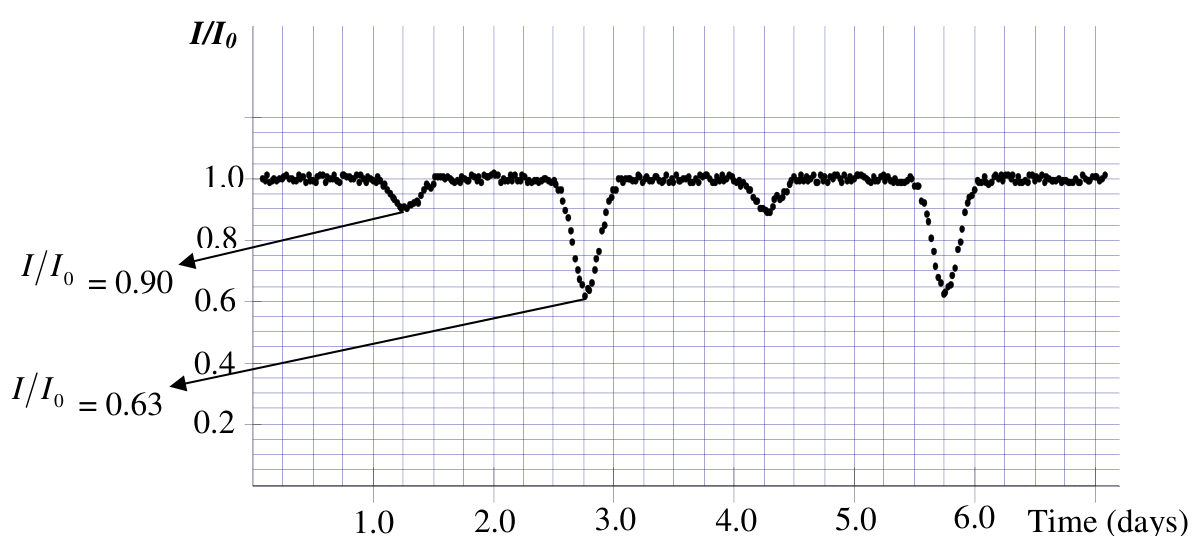
Figure 1. The relative intensity received from the binary star system as a function of time. The vertical axis has been scaled by \(I_0=4.8\times10^{-9}\ \mathrm{W/m^2}\). Time is given in days.
1.1 — 0.8 points
Find the period of the orbital motion. Give your answer in seconds up to two significant digits.
What is the angular frequency of the system in rad/sec?
To a good approximation, the receiving radiation from a star is a uniform black body radiation from a flat disc with a radius equal to the radius of the star. Therefore, the power received from the star is proportional to \(AT^4\) where \(A\) is area of the disc and \(T\) is the surface temperature of the star.
1.2 — 1.6 points
Use the diagram in Figure 1 to find the ratios \(T_1/T_2\) and \(R_1/R_2\).
Spectrometry of Binary Systems
In this section, we are going to calculate the astronomical properties of a binary star by using experimental spectrometric data of the binary system.
Atoms absorb or emit radiation at their certain characteristic wavelengths. Consequently, the observed spectrum of a star contains absorption lines due to the atoms in the star’s atmosphere. Sodium has a characteristic yellow line spectrum (\(\mathrm{D}_1\) line) with a wavelength \(5895.9\ \text{Å}\) (\(10\ \text{Å}=1\ \mathrm{nm}\)). We examine the absorption spectrum of atomic Sodium at this wavelength for the binary system of the previous section. The spectrum of the light that we receive from the binary star is Doppler-shifted, because the stars are moving with respect to us. Each star has a different speed. Accordingly the absorption wavelength for each star will be shifted by a different amount. Highly accurate wavelength measurements are required to observe the Doppler shift since the speed of the stars is much less than the speed of light. The speed of the center of mass of the binary system we consider in this problem is much smaller than the orbital velocities of the stars. Hence all the Doppler shifts can be attributed to the orbital velocity of the stars. Table 1 shows the measured spectrum of the stars in the binary system we have observed.
Table 1: Absorption spectrum of the binary star system for the Sodium \(\mathrm{D}_1\) line
| \(t/\mathrm{days}\) | 0.3 | 0.6 | 0.9 | 1.2 | 1.5 | 1.8 | 2.1 | 2.4 |
|---|---|---|---|---|---|---|---|---|
| \(\lambda_1\) (Å) | 5897.5 | 5897.7 | 5897.2 | 5896.2 | 5895.1 | 5894.3 | 5894.1 | 5894.6 |
| \(\lambda_2\) (Å) | 5893.1 | 5892.8 | 5893.7 | 5896.2 | 5897.3 | 5898.7 | 5899.0 | 5898.1 |
| \(t/\mathrm{days}\) | 2.7 | 3.0 | 3.3 | 3.6 | 3.9 | 4.2 | 4.5 | 4.8 |
|---|---|---|---|---|---|---|---|---|
| \(\lambda_1\) (Å) | 5895.6 | 5896.7 | 5897.3 | 5897.7 | 5897.2 | 5896.2 | 5895.0 | 5894.3 |
| \(\lambda_2\) (Å) | 5896.4 | 5894.5 | 5893.1 | 5892.8 | 5893.7 | 5896.2 | 5897.4 | 5898.7 |
(Note: There is no need to make a graph of the data in this table)
2 Using Table 1,
2.1 — 1.8 points
Let \(v_1\) and \(v_2\) be the orbital velocity of each star. Find \(v_1\) and \(v_2\).
The speed of light \(c=3.0\times10^8\ \mathrm{m/s}\). Ignore all relativistic effects.
2.2 — 0.7 points
Find the mass ratio of the stars \((m_1/m_2)\).
2.3 — 0.8 points
Let \(r_1\) and \(r_2\) be the distances of each star from their center of mass.
Find \(r_1\) and \(r_2\).
2.4 — 0.2 points
Let \(r\) be the distance between the stars. Find \(r\).
3 The gravitational force is the only force acting between the stars.
3.1 — 1.2 points
Find the mass of each star up to one significant digit.
The universal gravitational constant \(G=6.7\times10^{-11}\ \mathrm{m^3\,kg^{-1}\,s^{-2}}\).
General Characteristics of Stars
4 Most of the stars generate energy through the same mechanism. Because of this, there is an empirical relation between their mass, \(M\), and their luminosity, \(L\), which is the total radiant power of the star. This relation could be written in the form \(L/L_{\mathrm{Sun}}=(M/M_{\mathrm{Sun}})^\alpha\).
Here, \(M_{\mathrm{Sun}}=2.0\times10^{30}\ \mathrm{kg}\) is the solar mass and, \(L_{\mathrm{Sun}}=3.9\times10^{26}\ \mathrm{W}\) is the solar luminosity. This relation is shown in a log-log diagram in Figure 2.
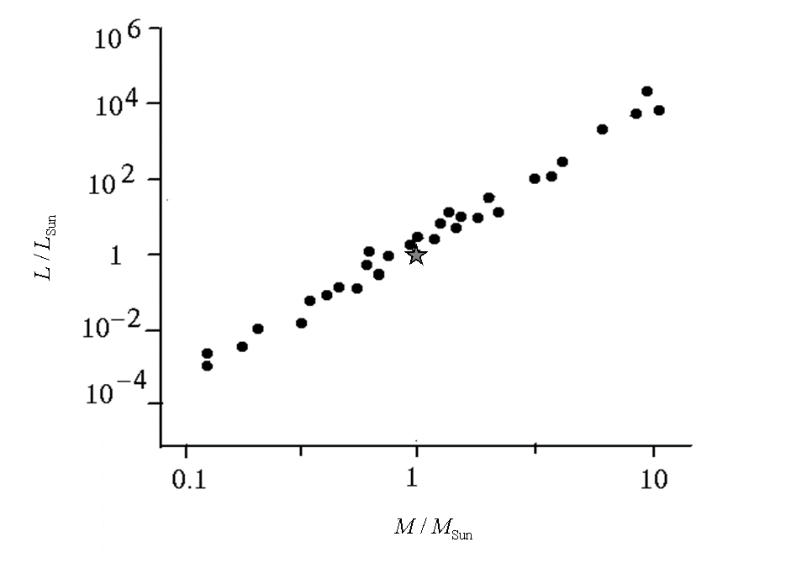
Figure 2. The luminosity of a star versus its mass varies as a power law. The diagram is log-log. The star-symbol represents Sun with a mass of \(2.0\times10^{30}\ \mathrm{kg}\) and luminosity of \(3.9\times10^{26}\ \mathrm{W}\).
4.1 — 0.6 points
Find \(\alpha\) up to one significant digit.
4.2 — 0.6 points
Let \(L_1\) and \(L_2\) be the luminosity of the stars in the binary system studied in the previous sections. Find \(L_1\) and \(L_2\).
4.3 — 0.9 points
What is the distance, \(d\), of the star system from us in light years?
To find the distance you can use the diagram of Figure 1. One light year is the distance light travels in one year.
4.4 — 0.4 points
What is the maximum angular distance, \(\theta\), between the stars from our observation point?
4.5 — 0.4 points
What is the smallest aperture size for an optical telescope, \(D\), that can resolve these two stars?
Official English text of the problem.
Answers
Later results use unrounded intermediate values.
- 1.1: \(P=3.0\ \mathrm{days}\simeq2.6\times10^5\ \mathrm{s}\); \(\omega\simeq2.4\times10^{-5}\ \mathrm{rad/s}\).
- 1.2: \(T_1/T_2\simeq1.39\); \(R_1/R_2\simeq1.56\).
- 2.1: \(v_1\simeq9.2\times10^4\ \mathrm{m/s}\); \(v_2\simeq1.6\times10^5\ \mathrm{m/s}\).
- 2.2: \(m_1/m_2\simeq1.7\).
- 2.3: \(r_1\simeq3.8\times10^9\ \mathrm{m}\); \(r_2\simeq6.5\times10^9\ \mathrm{m}\).
- 2.4: \(r\simeq1.0\times10^{10}\ \mathrm{m}\).
- 3.1: To one significant digit, \(m_1\simeq6\times10^{30}\ \mathrm{kg}\), \(m_2\simeq4\times10^{30}\ \mathrm{kg}\).
- 4.1: \(\alpha\simeq4\).
- 4.2: \(L_1\simeq3.2\times10^{28}\ \mathrm{W}\); \(L_2\simeq3.7\times10^{27}\ \mathrm{W}\).
- 4.3: \(d\simeq82\ \text{light years}\simeq7.7\times10^{17}\ \mathrm{m}\).
- 4.4: \(\theta_{\max}\simeq1.3\times10^{-8}\ \mathrm{rad}\), or \(2.7\times10^{-3}\) arcseconds.
- 4.5: \(D_{\min}\simeq54\ \mathrm{m}\), using the Rayleigh criterion at the given sodium wavelength, \(589.59\ \mathrm{nm}\).
Solution
1.1
The orbital period is the interval between successive minima of the same depth. Figure 1 gives approximately \(3.0\) days. Adjacent minima of different depths correspond to the two different conjunctions and are separated by half a period.
Thus \[ P=3.0\times86400\ \mathrm{s} =259200\ \mathrm{s} \simeq\boxed{2.6\times10^5\ \mathrm{s}}. \]
The angular frequency is \[ \omega=\frac{2\pi}{P} =2.424\ldots\times10^{-5}\ \mathrm{rad/s} \simeq\boxed{2.4\times10^{-5}\ \mathrm{rad/s}}. \]
1.2
Let the unobscured contributions to the intensity at Earth be \[ I_1=C R_1^2T_1^4,\qquad I_2=C R_2^2T_2^4, \] where \(C\) is common to both stars because they are effectively at the same distance. Outside eclipse, \[ I_0=I_1+I_2. \]
The edge-on geometry produces central eclipses. Since \(R_1>R_2\), the larger star can completely hide the smaller star. During this eclipse the lost intensity is \(I_2\).
At the other eclipse, the smaller star blocks an equal-sized patch of the hotter star. The lost intensity is then \[ B=C R_2^2T_1^4. \] Because \(T_1>T_2\), \(B>I_2\). Therefore, the shallower minimum is the eclipse in which star 2 is hidden.
The shallow minimum gives \[ I_1=0.90I_0,\qquad I_2=0.10I_0. \] The deep minimum gives \[ B=(1-0.63)I_0=0.37I_0. \]
Dividing \(B\) by \(I_2\), \[ \left(\frac{T_1}{T_2}\right)^4 =\frac{C R_2^2T_1^4}{C R_2^2T_2^4} =\frac{0.37}{0.10}=3.7, \] so \[ \boxed{\frac{T_1}{T_2}=3.7^{1/4}\simeq1.39}. \]
Similarly, \[ \left(\frac{R_1}{R_2}\right)^2 =\frac{I_1}{B} =\frac{0.90}{0.37}, \] hence \[ \boxed{\frac{R_1}{R_2} =\sqrt{\frac{0.90}{0.37}}\simeq1.56}. \]
2.1
For nonrelativistic motion, the Doppler shift is \[ \frac{\lambda-\lambda_0}{\lambda_0}=\frac{u}{c}, \] where \(u\) is the line-of-sight velocity, positive for recession, and \[ \lambda_0=5895.9\ \text{Å}. \]
In an edge-on circular orbit, the line-of-sight velocity varies sinusoidally between \(-v_i\) and \(+v_i\). Thus the wavelength amplitude determines the orbital speed: \[ v_i=\frac{c}{\lambda_0} \frac{\lambda_{i,\max}-\lambda_{i,\min}}{2}. \]
Using the tabulated extrema, \[ \Delta\lambda_1 =\frac{5897.7-5894.1}{2}\ \text{Å} =1.8\ \text{Å}, \] \[ \Delta\lambda_2 =\frac{5899.0-5892.8}{2}\ \text{Å} =3.1\ \text{Å}. \]
Therefore, \[ v_1=3.0\times10^8\frac{1.8}{5895.9} =9.159\ldots\times10^4\ \mathrm{m/s}, \] \[ v_2=3.0\times10^8\frac{3.1}{5895.9} =1.577\ldots\times10^5\ \mathrm{m/s}. \]
Thus \[ \boxed{v_1\simeq9.2\times10^4\ \mathrm{m/s},\qquad v_2\simeq1.6\times10^5\ \mathrm{m/s}}. \]
2.2
In the center-of-mass frame, the stars have equal and opposite momenta: \[ m_1v_1=m_2v_2. \] Consequently, \[ \boxed{\frac{m_1}{m_2} =\frac{v_2}{v_1} =\frac{3.1}{1.8} =1.722\ldots\simeq1.7}. \]
2.3
Both stars have the same angular frequency. For uniform circular motion, \[ v_i=\omega r_i, \qquad r_i=\frac{v_iP}{2\pi}. \]
Using the unrounded values from the preceding calculations, \[ r_1=3.778\ldots\times10^9\ \mathrm{m}, \qquad r_2=6.507\ldots\times10^9\ \mathrm{m}. \]
Therefore, \[ \boxed{r_1\simeq3.8\times10^9\ \mathrm{m},\qquad r_2\simeq6.5\times10^9\ \mathrm{m}}. \]
2.4
The center of mass lies between the stars, so their separation is \[ r=r_1+r_2=1.02854\ldots\times10^{10}\ \mathrm{m}. \] Thus, to two significant figures, \[ \boxed{r\simeq1.0\times10^{10}\ \mathrm{m}}. \]
3.1
The gravitational force supplies the centripetal force for each star: \[ \frac{Gm_1m_2}{r^2} =m_1\omega^2r_1 =m_2\omega^2r_2. \]
It follows that \[ m_1=\frac{\omega^2r_2r^2}{G}, \qquad m_2=\frac{\omega^2r_1r^2}{G}. \]
Substitution, retaining intermediate digits, gives \[ m_1=6.037\ldots\times10^{30}\ \mathrm{kg}, \qquad m_2=3.5056\ldots\times10^{30}\ \mathrm{kg}. \]
The requested answers to one significant digit are therefore \[ \boxed{m_1\simeq6\times10^{30}\ \mathrm{kg},\qquad m_2\simeq4\times10^{30}\ \mathrm{kg}}. \]
The unrounded calculated masses will be retained below, since raising prematurely rounded masses to a power would introduce substantial numerical error.
4.1
Taking logarithms of the empirical relation gives \[ \log\!\left(\frac{L}{L_{\mathrm{Sun}}}\right) =\alpha\log\!\left(\frac{M}{M_{\mathrm{Sun}}}\right). \] Thus \(\alpha\) is the slope of the trend in the log-log diagram.
The trend passes approximately through \[ \left(\frac{M}{M_{\mathrm{Sun}}}, \frac{L}{L_{\mathrm{Sun}}}\right) =(1,1) \quad\text{and}\quad (10,10^4). \] Hence \[ \alpha\simeq\frac{\log_{10}(10^4)-\log_{10}(1)} {\log_{10}(10)-\log_{10}(1)} =\boxed{4}. \]
4.2
With \(\alpha=4\), \[ L_i=L_{\mathrm{Sun}} \left(\frac{m_i}{M_{\mathrm{Sun}}}\right)^4. \]
Using the unrounded dynamical masses, \[ L_1 =3.9\times10^{26} \left(\frac{6.037\ldots\times10^{30}} {2.0\times10^{30}}\right)^4 =3.238\ldots\times10^{28}\ \mathrm{W}, \] \[ L_2 =3.9\times10^{26} \left(\frac{3.5056\ldots\times10^{30}} {2.0\times10^{30}}\right)^4 =3.681\ldots\times10^{27}\ \mathrm{W}. \]
Therefore, \[ \boxed{L_1\simeq3.2\times10^{28}\ \mathrm{W},\qquad L_2\simeq3.7\times10^{27}\ \mathrm{W}}. \]
As a consistency check, these give \(L_1/L_2\simeq8.8\), close to the photometric ratio \(I_1/I_2=9\), as expected for the approximate empirical law and measured data.
4.3
For isotropic radiation, luminosity \(L\) produces intensity \(L/(4\pi d^2)\) at distance \(d\). Outside eclipse, both stars contribute their full flux: \[ I_0=\frac{L_1+L_2}{4\pi d^2}. \]
Thus \[ d=\sqrt{\frac{L_1+L_2}{4\pi I_0}} =\sqrt{\frac{3.6065\ldots\times10^{28}} {4\pi(4.8\times10^{-9})}} =7.7325\ldots\times10^{17}\ \mathrm{m}. \]
Taking one year as approximately \(365\) days, \[ 1\ \text{light year} =c(365\times86400\ \mathrm{s}) \simeq9.46\times10^{15}\ \mathrm{m}. \] Therefore, \[ \boxed{d\simeq82\ \text{light years} \simeq7.7\times10^{17}\ \mathrm{m}}. \]
4.4
The projected separation is largest when the line joining the stars is perpendicular to the line of sight. Its value is then \(r\).
Since \(r\ll d\), the small-angle approximation gives \[ \theta_{\max}\simeq\frac{r}{d} =\frac{1.02854\ldots\times10^{10}} {7.7325\ldots\times10^{17}} =1.330\ldots\times10^{-8}\ \mathrm{rad}. \]
Hence \[ \boxed{\theta_{\max}\simeq1.3\times10^{-8}\ \mathrm{rad}} \] or approximately \[ \boxed{\theta_{\max}\simeq2.7\times10^{-3}\ \text{arcseconds}}. \]
4.5
For an ideal diffraction-limited telescope with a circular aperture, the Rayleigh criterion gives the minimum resolvable angular separation: \[ \theta_{\mathrm{R}}=1.22\frac{\lambda}{D}. \]
The smallest aperture capable of resolving the stars at their maximum separation therefore satisfies \[ D_{\min}=\frac{1.22\lambda}{\theta_{\max}}. \]
Using the sodium wavelength supplied in the problem, \[ \lambda=5895.9\ \text{Å} =5.8959\times10^{-7}\ \mathrm{m}, \] we obtain \[ D_{\min} =\frac{1.22(5.8959\times10^{-7})} {1.330\ldots\times10^{-8}}\ \mathrm{m} \simeq\boxed{54\ \mathrm{m}}. \]
More generally, the wavelength dependence is \[ \boxed{D_{\min}(\lambda)\simeq 54\ \mathrm{m}\left(\frac{\lambda}{589.59\ \mathrm{nm}}\right)}. \]
The solution was checked against the official solution.
IPhO 2007 · Theorieaufgabe 3
Doppelsterne
Zwei Sterne, die ihren gemeinsamen Schwerpunkt umkreisen, bilden ein Doppelsternsystem. Fast die Hälfte der Sterne in unserer Galaxie sind Doppelsternsysteme. Bei den meisten dieser Sternsysteme ist es von der Erde aus nicht leicht zu erkennen, dass es sich um Doppelsterne handelt, da der Abstand zwischen den beiden Sternen viel kleiner als ihre Entfernung von uns ist und die Sterne daher mit Teleskopen nicht getrennt aufgelöst werden können. Deshalb müssen wir entweder mithilfe der Photometrie oder der Spektrometrie die Änderungen der Intensität oder des Spektrums eines bestimmten Sterns beobachten, um herauszufinden, ob es sich um ein Doppelsternsystem handelt oder nicht.
Photometrie von Doppelsternen
Wenn wir uns genau in der Bahnebene der beiden Sterne befinden, bedeckt zu bestimmten Zeiten ein Stern den anderen (er zieht vor ihm vorbei), und die Intensität des gesamten Systems ändert sich von unserem Beobachtungsort aus mit der Zeit. Solche Doppelsternsysteme nennt man Bedeckungsdoppelsterne.
1 Nehmen Sie an, dass sich zwei Sterne mit einer konstanten Winkelgeschwindigkeit \(\omega\) auf Kreisbahnen um ihren gemeinsamen Schwerpunkt bewegen und dass wir uns genau in der Bahnebene des Doppelsternsystems befinden. Nehmen Sie außerdem an, dass die Oberflächentemperaturen der Sterne \(T_1\) und \(T_2\) \((T_1>T_2)\) und die zugehörigen Radien \(R_1\) bzw. \(R_2\) \((R_1>R_2)\) betragen. Die auf der Erde gemessene Gesamtintensität des Lichts ist in Abbildung 1 als Funktion der Zeit dargestellt. Genaue Messungen zeigen, dass die Intensitäten des von den Sternen einfallenden Lichts bei den Minima 90 bzw. 63 Prozent der maximalen, von beiden Sternen empfangenen Intensität \(I_0\) betragen \(\left(I_0=4.8\times10^{-9}\ \mathrm{W/m^2}\right)\). Die vertikale Achse in Abbildung 1 zeigt das Verhältnis \(I/I_0\), und die horizontale Achse ist in Tagen beschriftet.
Abbildung 1. Die vom Doppelsternsystem empfangene relative Intensität als Funktion der Zeit. Die vertikale Achse ist auf \(I_0=4.8\times10^{-9}\ \mathrm{W/m^2}\) normiert. Die Zeit ist in Tagen angegeben.
1.1 — 0.8 Punkte
Bestimmen Sie die Umlaufzeit. Geben Sie Ihre Antwort in Sekunden mit zwei signifikanten Stellen an.
Wie groß ist die Kreisfrequenz des Systems in rad/sec?
In guter Näherung ist die von einem Stern empfangene Strahlung die gleichmäßige Schwarzkörperstrahlung einer ebenen Scheibe, deren Radius gleich dem Radius des Sterns ist. Daher ist die vom Stern empfangene Leistung proportional zu \(AT^4\), wobei \(A\) die Fläche der Scheibe und \(T\) die Oberflächentemperatur des Sterns ist.
1.2 — 1.6 Punkte
Bestimmen Sie mithilfe des Diagramms in Abbildung 1 die Verhältnisse \(T_1/T_2\) und \(R_1/R_2\).
Spektrometrie von Doppelsternsystemen
In diesem Abschnitt werden wir die astronomischen Eigenschaften eines Doppelsterns mithilfe experimenteller spektrometrischer Daten des Doppelsternsystems berechnen.
Atome absorbieren oder emittieren Strahlung bei bestimmten charakteristischen Wellenlängen. Daher enthält das beobachtete Spektrum eines Sterns Absorptionslinien, die durch die Atome in seiner Atmosphäre verursacht werden. Natrium besitzt eine charakteristische gelbe Spektrallinie (\(\mathrm{D}_1\)-Linie) mit einer Wellenlänge von \(5895.9\ \text{Å}\) (\(10\ \text{Å}=1\ \mathrm{nm}\)). Wir untersuchen das Absorptionsspektrum von atomarem Natrium bei dieser Wellenlänge für das Doppelsternsystem aus dem vorherigen Abschnitt. Das Spektrum des Lichts, das wir vom Doppelstern empfangen, ist aufgrund des Dopplereffekts verschoben, da sich die Sterne relativ zu uns bewegen. Die beiden Sterne haben unterschiedliche Geschwindigkeiten. Dementsprechend ist die Absorptionswellenlänge jedes Sterns um einen anderen Betrag verschoben. Um die Dopplerverschiebung zu beobachten, sind hochpräzise Wellenlängenmessungen erforderlich, da die Geschwindigkeit der Sterne viel kleiner als die Lichtgeschwindigkeit ist. Die Geschwindigkeit des Schwerpunkts des in dieser Aufgabe betrachteten Doppelsternsystems ist viel kleiner als die Bahngeschwindigkeiten der Sterne. Daher können alle Dopplerverschiebungen auf die Bahngeschwindigkeiten der Sterne zurückgeführt werden. Tabelle 1 zeigt das gemessene Spektrum der Sterne des von uns beobachteten Doppelsternsystems.
Tabelle 1: Absorptionsspektrum des Doppelsternsystems für die Natrium-\(\mathrm{D}_1\)-Linie
| \(t/\mathrm{days}\) | 0.3 | 0.6 | 0.9 | 1.2 | 1.5 | 1.8 | 2.1 | 2.4 |
|---|---|---|---|---|---|---|---|---|
| \(\lambda_1\) (Å) | 5897.5 | 5897.7 | 5897.2 | 5896.2 | 5895.1 | 5894.3 | 5894.1 | 5894.6 |
| \(\lambda_2\) (Å) | 5893.1 | 5892.8 | 5893.7 | 5896.2 | 5897.3 | 5898.7 | 5899.0 | 5898.1 |
| \(t/\mathrm{days}\) | 2.7 | 3.0 | 3.3 | 3.6 | 3.9 | 4.2 | 4.5 | 4.8 |
|---|---|---|---|---|---|---|---|---|
| \(\lambda_1\) (Å) | 5895.6 | 5896.7 | 5897.3 | 5897.7 | 5897.2 | 5896.2 | 5895.0 | 5894.3 |
| \(\lambda_2\) (Å) | 5896.4 | 5894.5 | 5893.1 | 5892.8 | 5893.7 | 5896.2 | 5897.4 | 5898.7 |
(Hinweis: Es ist nicht erforderlich, die Daten dieser Tabelle grafisch darzustellen.)
2 Verwenden Sie Tabelle 1.
2.1 — 1.8 Punkte
Die Bahngeschwindigkeiten der beiden Sterne seien \(v_1\) und \(v_2\). Bestimmen Sie \(v_1\) und \(v_2\).
Die Lichtgeschwindigkeit beträgt \(c=3.0\times10^8\ \mathrm{m/s}\). Vernachlässigen Sie alle relativistischen Effekte.
2.2 — 0.7 Punkte
Bestimmen Sie das Massenverhältnis der Sterne \((m_1/m_2)\).
2.3 — 0.8 Punkte
Die Abstände der beiden Sterne von ihrem gemeinsamen Schwerpunkt seien \(r_1\) und \(r_2\).
Bestimmen Sie \(r_1\) und \(r_2\).
2.4 — 0.2 Punkte
Der Abstand zwischen den Sternen sei \(r\). Bestimmen Sie \(r\).
3 Die Gravitationskraft ist die einzige Kraft, die zwischen den Sternen wirkt.
3.1 — 1.2 Punkte
Bestimmen Sie die Masse jedes Sterns mit einer signifikanten Stelle.
Die universelle Gravitationskonstante beträgt \(G=6.7\times10^{-11}\ \mathrm{m^3\,kg^{-1}\,s^{-2}}\).
Allgemeine Eigenschaften von Sternen
4 Die meisten Sterne erzeugen Energie durch denselben Mechanismus. Deshalb gibt es einen empirischen Zusammenhang zwischen ihrer Masse \(M\) und ihrer Leuchtkraft \(L\), also der gesamten Strahlungsleistung des Sterns. Dieser Zusammenhang lässt sich in der Form \(L/L_{\mathrm{Sun}}=(M/M_{\mathrm{Sun}})^\alpha\) schreiben.
Dabei ist \(M_{\mathrm{Sun}}=2.0\times10^{30}\ \mathrm{kg}\) die Sonnenmasse und \(L_{\mathrm{Sun}}=3.9\times10^{26}\ \mathrm{W}\) die Leuchtkraft der Sonne. Dieser Zusammenhang ist in Abbildung 2 in einem doppelt logarithmischen Diagramm dargestellt.
Abbildung 2. Die Leuchtkraft eines Sterns hängt gemäß einem Potenzgesetz von seiner Masse ab. Das Diagramm ist doppelt logarithmisch. Das Sternsymbol stellt die Sonne mit einer Masse von \(2.0\times10^{30}\ \mathrm{kg}\) und einer Leuchtkraft von \(3.9\times10^{26}\ \mathrm{W}\) dar.
4.1 — 0.6 Punkte
Bestimmen Sie \(\alpha\) mit einer signifikanten Stelle.
4.2 — 0.6 Punkte
Die Leuchtkräfte der Sterne in dem in den vorherigen Abschnitten untersuchten Doppelsternsystem seien \(L_1\) und \(L_2\). Bestimmen Sie \(L_1\) und \(L_2\).
4.3 — 0.9 Punkte
Wie groß ist die Entfernung \(d\) des Sternsystems von uns in Lichtjahren?
Zur Bestimmung der Entfernung können Sie das Diagramm in Abbildung 1 verwenden. Ein Lichtjahr ist die Strecke, die Licht in einem Jahr zurücklegt.
4.4 — 0.4 Punkte
Wie groß ist der maximale Winkelabstand \(\theta\) zwischen den Sternen von unserem Beobachtungsort aus?
4.5 — 0.4 Punkte
Wie groß ist der kleinste Öffnungsdurchmesser \(D\) eines optischen Teleskops, mit dem sich diese beiden Sterne getrennt auflösen lassen?
Aufgabentext aus dem offiziellen englischen Text übersetzt.
Antworten
Für die späteren Ergebnisse werden ungerundete Zwischenwerte verwendet.
- 1.1: \(P=3.0\ \mathrm{days}\simeq2.6\times10^5\ \mathrm{s}\); \(\omega\simeq2.4\times10^{-5}\ \mathrm{rad/s}\).
- 1.2: \(T_1/T_2\simeq1.39\); \(R_1/R_2\simeq1.56\).
- 2.1: \(v_1\simeq9.2\times10^4\ \mathrm{m/s}\); \(v_2\simeq1.6\times10^5\ \mathrm{m/s}\).
- 2.2: \(m_1/m_2\simeq1.7\).
- 2.3: \(r_1\simeq3.8\times10^9\ \mathrm{m}\); \(r_2\simeq6.5\times10^9\ \mathrm{m}\).
- 2.4: \(r\simeq1.0\times10^{10}\ \mathrm{m}\).
- 3.1: Mit einer signifikanten Stelle: \(m_1\simeq6\times10^{30}\ \mathrm{kg}\), \(m_2\simeq4\times10^{30}\ \mathrm{kg}\).
- 4.1: \(\alpha\simeq4\).
- 4.2: \(L_1\simeq3.2\times10^{28}\ \mathrm{W}\); \(L_2\simeq3.7\times10^{27}\ \mathrm{W}\).
- 4.3: \(d\simeq82\ \text{Lichtjahre}\simeq7.7\times10^{17}\ \mathrm{m}\).
- 4.4: \(\theta_{\max}\simeq1.3\times10^{-8}\ \mathrm{rad}\), oder \(2.7\times10^{-3}\) Bogensekunden.
- 4.5: \(D_{\min}\simeq54\ \mathrm{m}\), unter Verwendung des Rayleigh-Kriteriums bei der angegebenen Natriumwellenlänge von \(589.59\ \mathrm{nm}\).
Lösung
1.1
Die Umlaufzeit ist der Zeitabstand zwischen aufeinanderfolgenden Minima gleicher Tiefe. Aus Abbildung 1 ergeben sich ungefähr \(3.0\) Tage. Benachbarte Minima unterschiedlicher Tiefe entsprechen den beiden verschiedenen Konjunktionen und liegen eine halbe Umlaufzeit auseinander.
Damit gilt \[ P=3.0\times86400\ \mathrm{s} =259200\ \mathrm{s} \simeq\boxed{2.6\times10^5\ \mathrm{s}}. \]
Die Kreisfrequenz ist \[ \omega=\frac{2\pi}{P} =2.424\ldots\times10^{-5}\ \mathrm{rad/s} \simeq\boxed{2.4\times10^{-5}\ \mathrm{rad/s}}. \]
1.2
Die Beiträge zur Intensität auf der Erde bei unbedeckten Sternen seien \[ I_1=C R_1^2T_1^4,\qquad I_2=C R_2^2T_2^4, \] wobei \(C\) für beide Sterne gleich ist, da sie praktisch gleich weit entfernt sind. Außerhalb einer Bedeckung gilt \[ I_0=I_1+I_2. \]
Da wir die Bahnebene von der Seite sehen, treten zentrale Bedeckungen auf. Wegen \(R_1>R_2\) kann der größere Stern den kleineren vollständig verdecken. Während dieser Bedeckung beträgt der Intensitätsverlust \(I_2\).
Bei der anderen Bedeckung verdeckt der kleinere Stern eine Fläche gleicher Größe auf dem heißeren Stern. Der Intensitätsverlust beträgt dann \[ B=C R_2^2T_1^4. \] Wegen \(T_1>T_2\) gilt \(B>I_2\). Daher gehört das flachere Minimum zu der Bedeckung, bei der Stern 2 verdeckt ist.
Aus dem flachen Minimum folgt \[ I_1=0.90I_0,\qquad I_2=0.10I_0. \] Aus dem tiefen Minimum folgt \[ B=(1-0.63)I_0=0.37I_0. \]
Division von \(B\) durch \(I_2\) ergibt \[ \left(\frac{T_1}{T_2}\right)^4 =\frac{C R_2^2T_1^4}{C R_2^2T_2^4} =\frac{0.37}{0.10}=3.7, \] also \[ \boxed{\frac{T_1}{T_2}=3.7^{1/4}\simeq1.39}. \]
Ebenso gilt \[ \left(\frac{R_1}{R_2}\right)^2 =\frac{I_1}{B} =\frac{0.90}{0.37}, \] und damit \[ \boxed{\frac{R_1}{R_2} =\sqrt{\frac{0.90}{0.37}}\simeq1.56}. \]
2.1
Für nichtrelativistische Bewegungen lautet die Dopplerverschiebung \[ \frac{\lambda-\lambda_0}{\lambda_0}=\frac{u}{c}, \] wobei \(u\) die Geschwindigkeit entlang der Sichtlinie ist, die bei einer Bewegung von uns weg positiv ist, und \[ \lambda_0=5895.9\ \text{Å}. \]
Bei einer von der Seite betrachteten Kreisbahn ändert sich die Geschwindigkeit entlang der Sichtlinie sinusförmig zwischen \(-v_i\) und \(+v_i\). Somit bestimmt die Amplitude der Wellenlängenänderung die Bahngeschwindigkeit: \[ v_i=\frac{c}{\lambda_0} \frac{\lambda_{i,\max}-\lambda_{i,\min}}{2}. \]
Mit den tabellierten Extremwerten ergibt sich \[ \Delta\lambda_1 =\frac{5897.7-5894.1}{2}\ \text{Å} =1.8\ \text{Å}, \] \[ \Delta\lambda_2 =\frac{5899.0-5892.8}{2}\ \text{Å} =3.1\ \text{Å}. \]
Daraus folgt \[ v_1=3.0\times10^8\frac{1.8}{5895.9} =9.159\ldots\times10^4\ \mathrm{m/s}, \] \[ v_2=3.0\times10^8\frac{3.1}{5895.9} =1.577\ldots\times10^5\ \mathrm{m/s}. \]
Damit gilt \[ \boxed{v_1\simeq9.2\times10^4\ \mathrm{m/s},\qquad v_2\simeq1.6\times10^5\ \mathrm{m/s}}. \]
2.2
Im Schwerpunktsystem haben die Sterne betragsgleiche, entgegengesetzt gerichtete Impulse: \[ m_1v_1=m_2v_2. \] Folglich gilt \[ \boxed{\frac{m_1}{m_2} =\frac{v_2}{v_1} =\frac{3.1}{1.8} =1.722\ldots\simeq1.7}. \]
2.3
Beide Sterne haben dieselbe Kreisfrequenz. Für eine gleichförmige Kreisbewegung gilt \[ v_i=\omega r_i, \qquad r_i=\frac{v_iP}{2\pi}. \]
Mit den ungerundeten Werten aus den vorherigen Berechnungen ergibt sich \[ r_1=3.778\ldots\times10^9\ \mathrm{m}, \qquad r_2=6.507\ldots\times10^9\ \mathrm{m}. \]
Daher gilt \[ \boxed{r_1\simeq3.8\times10^9\ \mathrm{m},\qquad r_2\simeq6.5\times10^9\ \mathrm{m}}. \]
2.4
Der Schwerpunkt liegt zwischen den Sternen, sodass ihr Abstand \[ r=r_1+r_2=1.02854\ldots\times10^{10}\ \mathrm{m} \] beträgt. Somit ergibt sich mit zwei signifikanten Stellen \[ \boxed{r\simeq1.0\times10^{10}\ \mathrm{m}}. \]
3.1
Die Gravitationskraft liefert die Zentripetalkraft für jeden Stern: \[ \frac{Gm_1m_2}{r^2} =m_1\omega^2r_1 =m_2\omega^2r_2. \]
Daraus folgt \[ m_1=\frac{\omega^2r_2r^2}{G}, \qquad m_2=\frac{\omega^2r_1r^2}{G}. \]
Einsetzen unter Beibehaltung der Stellen der Zwischenwerte ergibt \[ m_1=6.037\ldots\times10^{30}\ \mathrm{kg}, \qquad m_2=3.5056\ldots\times10^{30}\ \mathrm{kg}. \]
Die geforderten Antworten mit einer signifikanten Stelle lauten daher \[ \boxed{m_1\simeq6\times10^{30}\ \mathrm{kg},\qquad m_2\simeq4\times10^{30}\ \mathrm{kg}}. \]
Im Folgenden werden die ungerundeten berechneten Massen beibehalten, da das Potenzieren vorzeitig gerundeter Massen zu erheblichen numerischen Fehlern führen würde.
4.1
Logarithmieren des empirischen Zusammenhangs ergibt \[ \log\!\left(\frac{L}{L_{\mathrm{Sun}}}\right) =\alpha\log\!\left(\frac{M}{M_{\mathrm{Sun}}}\right). \] Somit ist \(\alpha\) die Steigung der Trendgeraden im doppelt logarithmischen Diagramm.
Die Trendgerade verläuft näherungsweise durch \[ \left(\frac{M}{M_{\mathrm{Sun}}}, \frac{L}{L_{\mathrm{Sun}}}\right) =(1,1) \quad\text{und}\quad (10,10^4). \] Daher gilt \[ \alpha\simeq\frac{\log_{10}(10^4)-\log_{10}(1)} {\log_{10}(10)-\log_{10}(1)} =\boxed{4}. \]
4.2
Mit \(\alpha=4\) gilt \[ L_i=L_{\mathrm{Sun}} \left(\frac{m_i}{M_{\mathrm{Sun}}}\right)^4. \]
Mit den ungerundeten, dynamisch bestimmten Massen ergibt sich \[ L_1 =3.9\times10^{26} \left(\frac{6.037\ldots\times10^{30}} {2.0\times10^{30}}\right)^4 =3.238\ldots\times10^{28}\ \mathrm{W}, \] \[ L_2 =3.9\times10^{26} \left(\frac{3.5056\ldots\times10^{30}} {2.0\times10^{30}}\right)^4 =3.681\ldots\times10^{27}\ \mathrm{W}. \]
Daher gilt \[ \boxed{L_1\simeq3.2\times10^{28}\ \mathrm{W},\qquad L_2\simeq3.7\times10^{27}\ \mathrm{W}}. \]
Als Konsistenzprüfung ergibt sich daraus \(L_1/L_2\simeq8.8\), was nahe am photometrischen Verhältnis \(I_1/I_2=9\) liegt, wie es für das näherungsweise gültige empirische Gesetz und die Messdaten zu erwarten ist.
4.3
Bei isotroper Strahlung erzeugt eine Leuchtkraft \(L\) die Intensität \(L/(4\pi d^2)\) in der Entfernung \(d\). Außerhalb einer Bedeckung tragen beide Sterne mit ihrem gesamten Strahlungsfluss bei: \[ I_0=\frac{L_1+L_2}{4\pi d^2}. \]
Damit gilt \[ d=\sqrt{\frac{L_1+L_2}{4\pi I_0}} =\sqrt{\frac{3.6065\ldots\times10^{28}} {4\pi(4.8\times10^{-9})}} =7.7325\ldots\times10^{17}\ \mathrm{m}. \]
Setzt man für ein Jahr näherungsweise \(365\) Tage an, so gilt \[ 1\ \text{Lichtjahr} =c(365\times86400\ \mathrm{s}) \simeq9.46\times10^{15}\ \mathrm{m}. \] Daher ergibt sich \[ \boxed{d\simeq82\ \text{Lichtjahre} \simeq7.7\times10^{17}\ \mathrm{m}}. \]
4.4
Der projizierte Abstand ist am größten, wenn die Verbindungslinie der Sterne senkrecht zur Sichtlinie steht. Sein Wert beträgt dann \(r\).
Wegen \(r\ll d\) ergibt die Kleinwinkelnäherung \[ \theta_{\max}\simeq\frac{r}{d} =\frac{1.02854\ldots\times10^{10}} {7.7325\ldots\times10^{17}} =1.330\ldots\times10^{-8}\ \mathrm{rad}. \]
Damit gilt \[ \boxed{\theta_{\max}\simeq1.3\times10^{-8}\ \mathrm{rad}} \] oder näherungsweise \[ \boxed{\theta_{\max}\simeq2.7\times10^{-3}\ \text{Bogensekunden}}. \]
4.5
Für ein ideales, beugungsbegrenztes Teleskop mit kreisförmiger Öffnung liefert das Rayleigh-Kriterium den kleinsten auflösbaren Winkelabstand: \[ \theta_{\mathrm{R}}=1.22\frac{\lambda}{D}. \]
Der kleinste Öffnungsdurchmesser, mit dem die Sterne bei ihrem maximalen Abstand getrennt aufgelöst werden können, erfüllt daher \[ D_{\min}=\frac{1.22\lambda}{\theta_{\max}}. \]
Mit der in der Aufgabe angegebenen Natriumwellenlänge \[ \lambda=5895.9\ \text{Å} =5.8959\times10^{-7}\ \mathrm{m}, \] erhalten wir \[ D_{\min} =\frac{1.22(5.8959\times10^{-7})} {1.330\ldots\times10^{-8}}\ \mathrm{m} \simeq\boxed{54\ \mathrm{m}}. \]
Allgemeiner lautet die Wellenlängenabhängigkeit \[ \boxed{D_{\min}(\lambda)\simeq 54\ \mathrm{m}\left(\frac{\lambda}{589.59\ \mathrm{nm}}\right)}. \]
Die Lösung wurde mit der offiziellen Lösung abgeglichen.
IPhO 2007 · Teori sorusu 3
Çift yıldızlar
Kütle merkezleri etrafında dolanan iki yıldız, bir çift yıldız sistemi oluşturur. Galaksimizdeki yıldızların neredeyse yarısı çift yıldız sistemlerindedir. Bu yıldız sistemlerinin çoğunun çift yıldız olduğunu Dünya'dan anlamak kolay değildir; çünkü iki yıldız arasındaki uzaklık, bize olan uzaklıklarından çok daha küçüktür ve bu nedenle yıldızlar teleskoplarla ayrı ayrı seçilemez. Bu yüzden, belirli bir yıldızın çift yıldız sistemi olup olmadığını anlamak için fotometri veya spektrometri kullanarak ışık şiddetindeki ya da tayfındaki değişimleri gözlemlememiz gerekir.
Çift Yıldızların Fotometrisi
Tam olarak iki yıldızın hareket düzleminde bulunuyorsak, belirli zamanlarda bir yıldız diğerini örter (onun önünden geçer) ve gözlem noktamızdan ölçülen tüm sistemin ışık şiddeti zamanla değişir. Bu çift yıldız sistemlerine örten çift yıldızlar denir.
1 İki yıldızın ortak kütle merkezleri etrafında dairesel yörüngelerde sabit bir \(\omega\) açısal hızıyla hareket ettiğini ve bizim tam olarak çift yıldız sisteminin hareket düzleminde bulunduğumuzu varsayın. Ayrıca yıldızların yüzey sıcaklıklarının sırasıyla \(T_1\) ve \(T_2\) \((T_1>T_2)\), bunlara karşılık gelen yarıçaplarının ise \(R_1\) ve \(R_2\) \((R_1>R_2)\) olduğunu varsayın. Dünya'da ölçülen toplam ışık şiddetinin zamana bağlı grafiği Şekil 1'de verilmiştir. Dikkatli ölçümler, minimumlara karşılık gelen yıldızlardan gelen ışık şiddetlerinin, her iki yıldızdan alınan maksimum ışık şiddeti \(I_0\)'ın sırasıyla yüzde 90'ı ve yüzde 63'ü olduğunu göstermektedir \(\left(I_0=4.8\times10^{-9}\ \mathrm{W/m^2}\right)\). Şekil 1'deki düşey eksen \(I/I_0\) oranını gösterir; yatay eksen ise gün cinsinden işaretlenmiştir.
Şekil 1. Çift yıldız sisteminden alınan bağıl ışık şiddetinin zamana bağlı değişimi. Düşey eksen \(I_0=4.8\times10^{-9}\ \mathrm{W/m^2}\) ile ölçeklendirilmiştir. Zaman gün cinsinden verilmiştir.
1.1 — 0.8 puan
Yörünge hareketinin periyodunu bulun. Cevabınızı iki anlamlı basamakla saniye cinsinden verin.
Sistemin rad/saniye cinsinden açısal frekansı nedir?
İyi bir yaklaşımla, bir yıldızdan alınan ışınım, yarıçapı yıldızın yarıçapına eşit olan düz bir diskten gelen düzgün kara cisim ışınımı olarak kabul edilebilir. Dolayısıyla yıldızdan alınan güç, \(AT^4\) ile orantılıdır; burada \(A\) diskin alanı, \(T\) ise yıldızın yüzey sıcaklığıdır.
1.2 — 1.6 puan
Şekil 1'deki grafiği kullanarak \(T_1/T_2\) ve \(R_1/R_2\) oranlarını bulun.
Çift Yıldız Sistemlerinin Spektrometrisi
Bu bölümde, çift yıldız sisteminin deneysel spektrometri verilerini kullanarak bir çift yıldızın astronomik özelliklerini hesaplayacağız.
Atomlar, kendilerine özgü belirli dalga boylarında ışınım soğurur veya yayar. Bu nedenle, bir yıldızın gözlenen tayfı, yıldızın atmosferindeki atomlardan kaynaklanan soğurma çizgileri içerir. Sodyumun, dalga boyu \(5895.9\ \text{Å}\) olan karakteristik bir sarı tayf çizgisi (\(\mathrm{D}_1\) çizgisi) vardır (\(10\ \text{Å}=1\ \mathrm{nm}\)). Önceki bölümdeki çift yıldız sistemi için atomik sodyumun bu dalga boyundaki soğurma tayfını inceliyoruz. Yıldızlar bize göre hareket ettiğinden, çift yıldızdan aldığımız ışığın tayfı Doppler kaymasına uğrar. Her yıldızın sürati farklıdır. Buna bağlı olarak, her yıldızın soğurma dalga boyu farklı miktarda kayar. Yıldızların sürati ışık hızından çok daha küçük olduğundan, Doppler kaymasını gözlemlemek için çok yüksek doğrulukta dalga boyu ölçümleri gerekir. Bu soruda ele aldığımız çift yıldız sisteminin kütle merkezinin sürati, yıldızların yörünge süratlerinden çok daha küçüktür. Dolayısıyla tüm Doppler kaymaları yıldızların yörünge hareketine bağlanabilir. Tablo 1, gözlemlediğimiz çift yıldız sistemindeki yıldızların ölçülen tayfını göstermektedir.
Tablo 1: Çift yıldız sisteminin sodyum \(\mathrm{D}_1\) çizgisine ait soğurma tayfı
| \(t/\mathrm{days}\) | 0.3 | 0.6 | 0.9 | 1.2 | 1.5 | 1.8 | 2.1 | 2.4 |
|---|---|---|---|---|---|---|---|---|
| \(\lambda_1\) (Å) | 5897.5 | 5897.7 | 5897.2 | 5896.2 | 5895.1 | 5894.3 | 5894.1 | 5894.6 |
| \(\lambda_2\) (Å) | 5893.1 | 5892.8 | 5893.7 | 5896.2 | 5897.3 | 5898.7 | 5899.0 | 5898.1 |
| \(t/\mathrm{days}\) | 2.7 | 3.0 | 3.3 | 3.6 | 3.9 | 4.2 | 4.5 | 4.8 |
|---|---|---|---|---|---|---|---|---|
| \(\lambda_1\) (Å) | 5895.6 | 5896.7 | 5897.3 | 5897.7 | 5897.2 | 5896.2 | 5895.0 | 5894.3 |
| \(\lambda_2\) (Å) | 5896.4 | 5894.5 | 5893.1 | 5892.8 | 5893.7 | 5896.2 | 5897.4 | 5898.7 |
(Not: Bu tablodaki verilerin grafiğini çizmeniz gerekmez.)
2 Tablo 1'i kullanarak,
2.1 — 1.8 puan
Yıldızların yörünge süratleri \(v_1\) ve \(v_2\) olsun. \(v_1\) ve \(v_2\)'yi bulun.
Işık hızı \(c=3.0\times10^8\ \mathrm{m/s}\)'dir. Tüm görelilik etkilerini ihmal edin.
2.2 — 0.7 puan
Yıldızların kütle oranını \((m_1/m_2)\) bulun.
2.3 — 0.8 puan
Yıldızların kütle merkezlerine olan uzaklıkları \(r_1\) ve \(r_2\) olsun.
\(r_1\) ve \(r_2\)'yi bulun.
2.4 — 0.2 puan
Yıldızlar arasındaki uzaklık \(r\) olsun. \(r\)'yi bulun.
3 Yıldızlar arasında etki eden tek kuvvet kütle çekim kuvvetidir.
3.1 — 1.2 puan
Her yıldızın kütlesini bir anlamlı basamakla bulun.
Evrensel kütle çekim sabiti \(G=6.7\times10^{-11}\ \mathrm{m^3\,kg^{-1}\,s^{-2}}\)'dir.
Yıldızların Genel Özellikleri
4 Yıldızların çoğu aynı mekanizmayla enerji üretir. Bu nedenle, kütleleri \(M\) ile yıldızın toplam ışınım gücünü ifade eden ışınım güçleri \(L\) arasında deneysel bir bağıntı vardır. Bu bağıntı \(L/L_{\mathrm{Sun}}=(M/M_{\mathrm{Sun}})^\alpha\) biçiminde yazılabilir.
Burada \(M_{\mathrm{Sun}}=2.0\times10^{30}\ \mathrm{kg}\) Güneş'in kütlesi, \(L_{\mathrm{Sun}}=3.9\times10^{26}\ \mathrm{W}\) ise Güneş'in ışınım gücüdür. Bu bağıntı Şekil 2'de çift logaritmik bir grafikte gösterilmiştir.
Şekil 2. Bir yıldızın ışınım gücü, kütlesine bağlı olarak bir kuvvet yasasına göre değişir. Grafik çift logaritmiktir. Yıldız simgesi, kütlesi \(2.0\times10^{30}\ \mathrm{kg}\) ve ışınım gücü \(3.9\times10^{26}\ \mathrm{W}\) olan Güneş'i temsil eder.
4.1 — 0.6 puan
\(\alpha\)'yı bir anlamlı basamakla bulun.
4.2 — 0.6 puan
Önceki bölümlerde incelenen çift yıldız sistemindeki yıldızların ışınım güçleri \(L_1\) ve \(L_2\) olsun. \(L_1\) ve \(L_2\)'yi bulun.
4.3 — 0.9 puan
Yıldız sisteminin bize olan uzaklığı \(d\), ışık yılı cinsinden nedir?
Uzaklığı bulmak için Şekil 1'deki grafiği kullanabilirsiniz. Bir ışık yılı, ışığın bir yılda aldığı yoldur.
4.4 — 0.4 puan
Gözlem noktamızdan bakıldığında yıldızlar arasındaki en büyük açısal uzaklık \(\theta\) nedir?
4.5 — 0.4 puan
Bu iki yıldızı ayrı ayrı seçebilen bir optik teleskobun en küçük açıklık çapı \(D\) nedir?
Soru metni resmi İngilizce metinden çevrilmiştir.
Cevaplar
Sonraki sonuçlarda yuvarlanmamış ara değerler kullanılmıştır.
- 1.1: \(P=3.0\ \mathrm{days}\simeq2.6\times10^5\ \mathrm{s}\); \(\omega\simeq2.4\times10^{-5}\ \mathrm{rad/s}\).
- 1.2: \(T_1/T_2\simeq1.39\); \(R_1/R_2\simeq1.56\).
- 2.1: \(v_1\simeq9.2\times10^4\ \mathrm{m/s}\); \(v_2\simeq1.6\times10^5\ \mathrm{m/s}\).
- 2.2: \(m_1/m_2\simeq1.7\).
- 2.3: \(r_1\simeq3.8\times10^9\ \mathrm{m}\); \(r_2\simeq6.5\times10^9\ \mathrm{m}\).
- 2.4: \(r\simeq1.0\times10^{10}\ \mathrm{m}\).
- 3.1: Bir anlamlı basamakla, \(m_1\simeq6\times10^{30}\ \mathrm{kg}\), \(m_2\simeq4\times10^{30}\ \mathrm{kg}\).
- 4.1: \(\alpha\simeq4\).
- 4.2: \(L_1\simeq3.2\times10^{28}\ \mathrm{W}\); \(L_2\simeq3.7\times10^{27}\ \mathrm{W}\).
- 4.3: \(d\simeq82\ \text{ışık yılı}\simeq7.7\times10^{17}\ \mathrm{m}\).
- 4.4: \(\theta_{\max}\simeq1.3\times10^{-8}\ \mathrm{rad}\) veya \(2.7\times10^{-3}\) yay saniyesi.
- 4.5: \(D_{\min}\simeq54\ \mathrm{m}\); verilen \(589.59\ \mathrm{nm}\) sodyum dalga boyunda Rayleigh ölçütü kullanılmıştır.
Çözüm
1.1
Yörünge periyodu, aynı derinlikteki ardışık minimumlar arasındaki zaman aralığıdır. Şekil 1'den yaklaşık \(3.0\) gün bulunur. Farklı derinliklerdeki komşu minimumlar, iki farklı kavuşuma karşılık gelir ve aralarında yarım periyot vardır.
Böylece \[ P=3.0\times86400\ \mathrm{s} =259200\ \mathrm{s} \simeq\boxed{2.6\times10^5\ \mathrm{s}}. \]
Açısal frekans \[ \omega=\frac{2\pi}{P} =2.424\ldots\times10^{-5}\ \mathrm{rad/s} \simeq\boxed{2.4\times10^{-5}\ \mathrm{rad/s}}. \]
1.2
Yıldızların örtülmedikleri durumda Dünya'daki ışık şiddetine katkıları \[ I_1=C R_1^2T_1^4,\qquad I_2=C R_2^2T_2^4, \] olsun; burada \(C\), yıldızlar pratikte aynı uzaklıkta oldukları için her ikisi için de aynıdır. Tutulma dışında, \[ I_0=I_1+I_2. \]
Yörünge düzleminden bakılması, merkezî tutulmalara yol açar. \(R_1>R_2\) olduğundan, büyük yıldız küçük yıldızı tamamen gizleyebilir. Bu tutulma sırasında kaybolan ışık şiddeti \(I_2\)'dir.
Diğer tutulmada küçük yıldız, daha sıcak yıldızın kendi diskiyle aynı büyüklükteki bir bölgesini örter. Bu durumda kaybolan ışık şiddeti \[ B=C R_2^2T_1^4. \] \(T_1>T_2\) olduğundan, \(B>I_2\)'dir. Dolayısıyla daha sığ minimum, 2 numaralı yıldızın gizlendiği tutulmadır.
Sığ minimumdan \[ I_1=0.90I_0,\qquad I_2=0.10I_0. \] Derin minimumdan \[ B=(1-0.63)I_0=0.37I_0. \]
\(B\)'yi \(I_2\)'ye bölersek, \[ \left(\frac{T_1}{T_2}\right)^4 =\frac{C R_2^2T_1^4}{C R_2^2T_2^4} =\frac{0.37}{0.10}=3.7, \] dolayısıyla \[ \boxed{\frac{T_1}{T_2}=3.7^{1/4}\simeq1.39}. \]
Benzer biçimde, \[ \left(\frac{R_1}{R_2}\right)^2 =\frac{I_1}{B} =\frac{0.90}{0.37}, \] buradan \[ \boxed{\frac{R_1}{R_2} =\sqrt{\frac{0.90}{0.37}}\simeq1.56}. \]
2.1
Göreli olmayan hareket için Doppler kayması \[ \frac{\lambda-\lambda_0}{\lambda_0}=\frac{u}{c}, \] şeklindedir; burada \(u\), uzaklaşma durumunda pozitif alınan görüş doğrultusundaki hızdır ve \[ \lambda_0=5895.9\ \text{Å}. \]
Yörünge düzleminden gözlenen dairesel bir yörüngede, görüş doğrultusundaki hız \(-v_i\) ile \(+v_i\) arasında sinüzoidal olarak değişir. Dolayısıyla dalga boyu değişiminin genliği yörünge süratini belirler: \[ v_i=\frac{c}{\lambda_0} \frac{\lambda_{i,\max}-\lambda_{i,\min}}{2}. \]
Tablodaki uç değerler kullanılarak, \[ \Delta\lambda_1 =\frac{5897.7-5894.1}{2}\ \text{Å} =1.8\ \text{Å}, \] \[ \Delta\lambda_2 =\frac{5899.0-5892.8}{2}\ \text{Å} =3.1\ \text{Å}. \]
Dolayısıyla, \[ v_1=3.0\times10^8\frac{1.8}{5895.9} =9.159\ldots\times10^4\ \mathrm{m/s}, \] \[ v_2=3.0\times10^8\frac{3.1}{5895.9} =1.577\ldots\times10^5\ \mathrm{m/s}. \]
Böylece \[ \boxed{v_1\simeq9.2\times10^4\ \mathrm{m/s},\qquad v_2\simeq1.6\times10^5\ \mathrm{m/s}}. \]
2.2
Kütle merkezi referans sisteminde yıldızların momentumları eşit büyüklükte ve zıt yönlüdür: \[ m_1v_1=m_2v_2. \] Bu nedenle, \[ \boxed{\frac{m_1}{m_2} =\frac{v_2}{v_1} =\frac{3.1}{1.8} =1.722\ldots\simeq1.7}. \]
2.3
Her iki yıldızın açısal frekansı aynıdır. Düzgün çembersel hareket için, \[ v_i=\omega r_i, \qquad r_i=\frac{v_iP}{2\pi}. \]
Önceki hesaplamalardaki yuvarlanmamış değerler kullanılarak, \[ r_1=3.778\ldots\times10^9\ \mathrm{m}, \qquad r_2=6.507\ldots\times10^9\ \mathrm{m}. \]
Dolayısıyla, \[ \boxed{r_1\simeq3.8\times10^9\ \mathrm{m},\qquad r_2\simeq6.5\times10^9\ \mathrm{m}}. \]
2.4
Kütle merkezi yıldızların arasında yer alır; dolayısıyla aralarındaki uzaklık \[ r=r_1+r_2=1.02854\ldots\times10^{10}\ \mathrm{m}. \] Böylece, iki anlamlı basamakla, \[ \boxed{r\simeq1.0\times10^{10}\ \mathrm{m}}. \]
3.1
Kütle çekim kuvveti, her yıldız için merkezcil kuvveti sağlar: \[ \frac{Gm_1m_2}{r^2} =m_1\omega^2r_1 =m_2\omega^2r_2. \]
Buradan \[ m_1=\frac{\omega^2r_2r^2}{G}, \qquad m_2=\frac{\omega^2r_1r^2}{G}. \]
Ara hesaplamalardaki basamaklar korunarak değerler yerine konulduğunda, \[ m_1=6.037\ldots\times10^{30}\ \mathrm{kg}, \qquad m_2=3.5056\ldots\times10^{30}\ \mathrm{kg}. \]
Dolayısıyla istenen bir anlamlı basamaklı cevaplar \[ \boxed{m_1\simeq6\times10^{30}\ \mathrm{kg},\qquad m_2\simeq4\times10^{30}\ \mathrm{kg}}. \]
Aşağıda, hesaplanan kütlelerin yuvarlanmamış değerleri kullanılacaktır; çünkü erken yuvarlanan kütlelerin kuvvetini almak önemli sayısal hatalara yol açar.
4.1
Deneysel bağıntının logaritması alınırsa \[ \log\!\left(\frac{L}{L_{\mathrm{Sun}}}\right) =\alpha\log\!\left(\frac{M}{M_{\mathrm{Sun}}}\right). \] Dolayısıyla \(\alpha\), çift logaritmik grafikteki eğilim doğrusunun eğimidir.
Eğilim doğrusu yaklaşık olarak \[ \left(\frac{M}{M_{\mathrm{Sun}}}, \frac{L}{L_{\mathrm{Sun}}}\right) =(1,1) \quad\text{ve}\quad (10,10^4). \] noktalarından geçer. Buradan \[ \alpha\simeq\frac{\log_{10}(10^4)-\log_{10}(1)} {\log_{10}(10)-\log_{10}(1)} =\boxed{4}. \]
4.2
\(\alpha=4\) için, \[ L_i=L_{\mathrm{Sun}} \left(\frac{m_i}{M_{\mathrm{Sun}}}\right)^4. \]
Dinamikten elde edilen yuvarlanmamış kütleler kullanılarak, \[ L_1 =3.9\times10^{26} \left(\frac{6.037\ldots\times10^{30}} {2.0\times10^{30}}\right)^4 =3.238\ldots\times10^{28}\ \mathrm{W}, \] \[ L_2 =3.9\times10^{26} \left(\frac{3.5056\ldots\times10^{30}} {2.0\times10^{30}}\right)^4 =3.681\ldots\times10^{27}\ \mathrm{W}. \]
Dolayısıyla, \[ \boxed{L_1\simeq3.2\times10^{28}\ \mathrm{W},\qquad L_2\simeq3.7\times10^{27}\ \mathrm{W}}. \]
Tutarlılık kontrolü olarak, bu değerler \(L_1/L_2\simeq8.8\) verir; bu da yaklaşık deneysel yasa ve ölçülen veriler için beklendiği üzere fotometrik oran olan \(I_1/I_2=9\)'a yakındır.
4.3
İzotropik ışınım için, \(L\) ışınım gücü \(d\) uzaklığında \(L/(4\pi d^2)\) ışık şiddeti oluşturur. Tutulma dışında, her iki yıldızın akısının tamamı alınır: \[ I_0=\frac{L_1+L_2}{4\pi d^2}. \]
Böylece \[ d=\sqrt{\frac{L_1+L_2}{4\pi I_0}} =\sqrt{\frac{3.6065\ldots\times10^{28}} {4\pi(4.8\times10^{-9})}} =7.7325\ldots\times10^{17}\ \mathrm{m}. \]
Bir yıl yaklaşık \(365\) gün alınırsa, \[ 1\ \text{ışık yılı} =c(365\times86400\ \mathrm{s}) \simeq9.46\times10^{15}\ \mathrm{m}. \] Dolayısıyla, \[ \boxed{d\simeq82\ \text{ışık yılı} \simeq7.7\times10^{17}\ \mathrm{m}}. \]
4.4
İzdüşüm uzaklığı, yıldızları birleştiren doğru görüş doğrultusuna dik olduğunda en büyüktür. Bu durumda değeri \(r\)'dir.
\(r\ll d\) olduğundan, küçük açı yaklaşımıyla \[ \theta_{\max}\simeq\frac{r}{d} =\frac{1.02854\ldots\times10^{10}} {7.7325\ldots\times10^{17}} =1.330\ldots\times10^{-8}\ \mathrm{rad}. \]
Buradan \[ \boxed{\theta_{\max}\simeq1.3\times10^{-8}\ \mathrm{rad}} \] veya yaklaşık olarak \[ \boxed{\theta_{\max}\simeq2.7\times10^{-3}\ \text{yay saniyesi}}. \]
4.5
Dairesel açıklığa sahip, ayırma gücü kırınımla sınırlı ideal bir teleskop için Rayleigh ölçütü, ayırt edilebilen en küçük açısal uzaklığı verir: \[ \theta_{\mathrm{R}}=1.22\frac{\lambda}{D}. \]
Dolayısıyla yıldızları en büyük açısal uzaklıklarında ayrı ayrı seçebilen en küçük açıklık çapı şu bağıntıyı sağlar: \[ D_{\min}=\frac{1.22\lambda}{\theta_{\max}}. \]
Soruda verilen sodyum dalga boyunu kullanarak, \[ \lambda=5895.9\ \text{Å} =5.8959\times10^{-7}\ \mathrm{m}, \] şunu elde ederiz: \[ D_{\min} =\frac{1.22(5.8959\times10^{-7})} {1.330\ldots\times10^{-8}}\ \mathrm{m} \simeq\boxed{54\ \mathrm{m}}. \]
Daha genel olarak, dalga boyuna bağımlılık \[ \boxed{D_{\min}(\lambda)\simeq 54\ \mathrm{m}\left(\frac{\lambda}{589.59\ \mathrm{nm}}\right)}. \]
Çözüm, resmi çözümle karşılaştırılarak kontrol edildi.
IPhO 2007 · Problema teórico 3
Estrellas binarias
Dos estrellas que giran alrededor de su centro de masas forman un sistema estelar binario. Casi la mitad de las estrellas de nuestra galaxia forman sistemas estelares binarios. No es fácil reconocer desde la Tierra la naturaleza binaria de la mayoría de estos sistemas estelares, ya que la distancia entre las dos estrellas es mucho menor que su distancia a nosotros y, por tanto, no pueden distinguirse por separado con telescopios. Por ello, debemos recurrir a la fotometría o a la espectrometría para observar las variaciones de la intensidad o del espectro de una estrella determinada y averiguar si se trata de un sistema binario.
Fotometría de estrellas binarias
Si nos encontramos exactamente en el plano del movimiento de las dos estrellas, una de ellas ocultará (pasará por delante de) la otra en determinados momentos, y la intensidad del sistema en su conjunto variará con el tiempo desde nuestro punto de observación. Estos sistemas binarios se denominan binarias eclipsantes.
1 Suponga que dos estrellas se mueven en órbitas circulares alrededor de su centro de masas común con una velocidad angular constante \(\omega\) y que nos encontramos exactamente en el plano del movimiento del sistema binario. Suponga también que las temperaturas superficiales de las estrellas son \(T_1\) y \(T_2\) \((T_1>T_2)\), y que sus radios correspondientes son \(R_1\) y \(R_2\) \((R_1>R_2)\), respectivamente. La intensidad total de la luz, medida en la Tierra, se representa en la Figura 1 en función del tiempo. Mediciones cuidadosas indican que las intensidades de la luz incidente procedente de las estrellas correspondientes a los mínimos son, respectivamente, el 90 y el 63 por ciento de la intensidad máxima, \(I_0\), recibida de ambas estrellas \(\left(I_0=4.8\times10^{-9}\ \mathrm{W/m^2}\right)\). El eje vertical de la Figura 1 muestra el cociente \(I/I_0\), y el eje horizontal está graduado en días.
Figura 1. Intensidad relativa recibida del sistema estelar binario en función del tiempo. El eje vertical se ha normalizado mediante \(I_0=4.8\times10^{-9}\ \mathrm{W/m^2}\). El tiempo se expresa en días.
1.1 — 0.8 puntos
Halle el período del movimiento orbital. Exprese su respuesta en segundos con dos cifras significativas.
¿Cuál es la frecuencia angular del sistema en rad/sec?
Con buena aproximación, la radiación recibida de una estrella es una radiación uniforme de cuerpo negro procedente de un disco plano cuyo radio es igual al de la estrella. Por tanto, la potencia recibida de la estrella es proporcional a \(AT^4\), donde \(A\) es el área del disco y \(T\) es la temperatura superficial de la estrella.
1.2 — 1.6 puntos
Utilice la gráfica de la Figura 1 para hallar los cocientes \(T_1/T_2\) y \(R_1/R_2\).
Espectrometría de sistemas binarios
En esta sección, vamos a calcular las propiedades astronómicas de una estrella binaria utilizando datos espectrométricos experimentales del sistema binario.
Los átomos absorben o emiten radiación a determinadas longitudes de onda características. En consecuencia, el espectro observado de una estrella contiene líneas de absorción debidas a los átomos de su atmósfera. El sodio tiene una línea espectral amarilla característica (la línea \(\mathrm{D}_1\)) con una longitud de onda de \(5895.9\ \text{Å}\) (\(10\ \text{Å}=1\ \mathrm{nm}\)). Examinamos el espectro de absorción del sodio atómico a esta longitud de onda para el sistema binario de la sección anterior. El espectro de la luz que recibimos de la estrella binaria presenta un desplazamiento Doppler, porque las estrellas se mueven con respecto a nosotros. Cada estrella tiene una rapidez diferente. Por consiguiente, la longitud de onda de absorción de cada estrella sufrirá un desplazamiento distinto. Para observar el desplazamiento Doppler se requieren mediciones de longitud de onda de gran precisión, ya que la rapidez de las estrellas es mucho menor que la de la luz. La rapidez del centro de masas del sistema binario que consideramos en este problema es mucho menor que las velocidades orbitales de las estrellas. Por tanto, todos los desplazamientos Doppler pueden atribuirse a la velocidad orbital de las estrellas. La Tabla 1 muestra el espectro medido de las estrellas del sistema binario que hemos observado.
Tabla 1: Espectro de absorción del sistema estelar binario para la línea \(\mathrm{D}_1\) del sodio
| \(t/\mathrm{days}\) | 0.3 | 0.6 | 0.9 | 1.2 | 1.5 | 1.8 | 2.1 | 2.4 |
|---|---|---|---|---|---|---|---|---|
| \(\lambda_1\) (Å) | 5897.5 | 5897.7 | 5897.2 | 5896.2 | 5895.1 | 5894.3 | 5894.1 | 5894.6 |
| \(\lambda_2\) (Å) | 5893.1 | 5892.8 | 5893.7 | 5896.2 | 5897.3 | 5898.7 | 5899.0 | 5898.1 |
| \(t/\mathrm{days}\) | 2.7 | 3.0 | 3.3 | 3.6 | 3.9 | 4.2 | 4.5 | 4.8 |
|---|---|---|---|---|---|---|---|---|
| \(\lambda_1\) (Å) | 5895.6 | 5896.7 | 5897.3 | 5897.7 | 5897.2 | 5896.2 | 5895.0 | 5894.3 |
| \(\lambda_2\) (Å) | 5896.4 | 5894.5 | 5893.1 | 5892.8 | 5893.7 | 5896.2 | 5897.4 | 5898.7 |
(Nota: No es necesario representar gráficamente los datos de esta tabla)
2 Utilizando la Tabla 1,
2.1 — 1.8 puntos
Sean \(v_1\) y \(v_2\) las velocidades orbitales de cada estrella. Halle \(v_1\) y \(v_2\).
La velocidad de la luz es \(c=3.0\times10^8\ \mathrm{m/s}\). Ignore todos los efectos relativistas.
2.2 — 0.7 puntos
Halle el cociente entre las masas de las estrellas \((m_1/m_2)\).
2.3 — 0.8 puntos
Sean \(r_1\) y \(r_2\) las distancias de cada estrella a su centro de masas.
Halle \(r_1\) y \(r_2\).
2.4 — 0.2 puntos
Sea \(r\) la distancia entre las estrellas. Halle \(r\).
3 La fuerza gravitatoria es la única fuerza que actúa entre las estrellas.
3.1 — 1.2 puntos
Halle la masa de cada estrella con una cifra significativa.
La constante de gravitación universal es \(G=6.7\times10^{-11}\ \mathrm{m^3\,kg^{-1}\,s^{-2}}\).
Características generales de las estrellas
4 La mayoría de las estrellas generan energía mediante el mismo mecanismo. Por ello, existe una relación empírica entre su masa, \(M\), y su luminosidad, \(L\), que es la potencia radiante total de la estrella. Esta relación puede escribirse en la forma \(L/L_{\mathrm{Sun}}=(M/M_{\mathrm{Sun}})^\alpha\).
Aquí, \(M_{\mathrm{Sun}}=2.0\times10^{30}\ \mathrm{kg}\) es la masa solar y \(L_{\mathrm{Sun}}=3.9\times10^{26}\ \mathrm{W}\) es la luminosidad solar. Esta relación se muestra en un diagrama doblemente logarítmico en la Figura 2.
Figura 2. La luminosidad de una estrella varía con su masa según una ley de potencias. El diagrama es doblemente logarítmico. El símbolo de estrella representa al Sol, con una masa de \(2.0\times10^{30}\ \mathrm{kg}\) y una luminosidad de \(3.9\times10^{26}\ \mathrm{W}\).
4.1 — 0.6 puntos
Halle \(\alpha\) con una cifra significativa.
4.2 — 0.6 puntos
Sean \(L_1\) y \(L_2\) las luminosidades de las estrellas del sistema binario estudiado en las secciones anteriores. Halle \(L_1\) y \(L_2\).
4.3 — 0.9 puntos
¿Cuál es la distancia, \(d\), del sistema estelar a nosotros en años luz?
Para hallar la distancia puede utilizar la gráfica de la Figura 1. Un año luz es la distancia que recorre la luz en un año.
4.4 — 0.4 puntos
¿Cuál es la separación angular máxima, \(\theta\), entre las estrellas desde nuestro punto de observación?
4.5 — 0.4 puntos
¿Cuál es el tamaño mínimo de la abertura de un telescopio óptico, \(D\), que permite distinguir estas dos estrellas por separado?
Enunciado traducido del texto oficial en inglés.
Respuestas
En los resultados posteriores se utilizan valores intermedios sin redondear.
- 1.1: \(P=3.0\ \mathrm{days}\simeq2.6\times10^5\ \mathrm{s}\); \(\omega\simeq2.4\times10^{-5}\ \mathrm{rad/s}\).
- 1.2: \(T_1/T_2\simeq1.39\); \(R_1/R_2\simeq1.56\).
- 2.1: \(v_1\simeq9.2\times10^4\ \mathrm{m/s}\); \(v_2\simeq1.6\times10^5\ \mathrm{m/s}\).
- 2.2: \(m_1/m_2\simeq1.7\).
- 2.3: \(r_1\simeq3.8\times10^9\ \mathrm{m}\); \(r_2\simeq6.5\times10^9\ \mathrm{m}\).
- 2.4: \(r\simeq1.0\times10^{10}\ \mathrm{m}\).
- 3.1: Con una cifra significativa, \(m_1\simeq6\times10^{30}\ \mathrm{kg}\), \(m_2\simeq4\times10^{30}\ \mathrm{kg}\).
- 4.1: \(\alpha\simeq4\).
- 4.2: \(L_1\simeq3.2\times10^{28}\ \mathrm{W}\); \(L_2\simeq3.7\times10^{27}\ \mathrm{W}\).
- 4.3: \(d\simeq82\ \text{años luz}\simeq7.7\times10^{17}\ \mathrm{m}\).
- 4.4: \(\theta_{\max}\simeq1.3\times10^{-8}\ \mathrm{rad}\), o \(2.7\times10^{-3}\) segundos de arco.
- 4.5: \(D_{\min}\simeq54\ \mathrm{m}\), utilizando el criterio de Rayleigh a la longitud de onda del sodio indicada, \(589.59\ \mathrm{nm}\).
Solución
1.1
El período orbital es el intervalo entre mínimos sucesivos de la misma profundidad. La Figura 1 da aproximadamente \(3.0\) días. Los mínimos adyacentes de distinta profundidad corresponden a las dos conjunciones diferentes y están separados por medio período.
Por tanto, \[ P=3.0\times86400\ \mathrm{s} =259200\ \mathrm{s} \simeq\boxed{2.6\times10^5\ \mathrm{s}}. \]
La frecuencia angular es \[ \omega=\frac{2\pi}{P} =2.424\ldots\times10^{-5}\ \mathrm{rad/s} \simeq\boxed{2.4\times10^{-5}\ \mathrm{rad/s}}. \]
1.2
Sean las contribuciones a la intensidad en la Tierra cuando no hay ocultación \[ I_1=C R_1^2T_1^4,\qquad I_2=C R_2^2T_2^4, \] donde \(C\) es común a ambas estrellas porque se encuentran prácticamente a la misma distancia. Fuera de los eclipses, \[ I_0=I_1+I_2. \]
La geometría de observación, con el plano orbital visto de canto, produce eclipses centrales. Como \(R_1>R_2\), la estrella mayor puede ocultar por completo a la menor. Durante este eclipse, la intensidad perdida es \(I_2\).
En el otro eclipse, la estrella menor oculta una región del mismo tamaño de la estrella más caliente. La intensidad perdida es entonces \[ B=C R_2^2T_1^4. \] Como \(T_1>T_2\), se cumple \(B>I_2\). Por tanto, el mínimo menos profundo corresponde al eclipse en el que la estrella 2 queda oculta.
El mínimo menos profundo da \[ I_1=0.90I_0,\qquad I_2=0.10I_0. \] El mínimo más profundo da \[ B=(1-0.63)I_0=0.37I_0. \]
Dividiendo \(B\) entre \(I_2\), \[ \left(\frac{T_1}{T_2}\right)^4 =\frac{C R_2^2T_1^4}{C R_2^2T_2^4} =\frac{0.37}{0.10}=3.7, \] de modo que \[ \boxed{\frac{T_1}{T_2}=3.7^{1/4}\simeq1.39}. \]
Análogamente, \[ \left(\frac{R_1}{R_2}\right)^2 =\frac{I_1}{B} =\frac{0.90}{0.37}, \] por lo que \[ \boxed{\frac{R_1}{R_2} =\sqrt{\frac{0.90}{0.37}}\simeq1.56}. \]
2.1
Para un movimiento no relativista, el desplazamiento Doppler es \[ \frac{\lambda-\lambda_0}{\lambda_0}=\frac{u}{c}, \] donde \(u\) es la velocidad en la dirección de la línea de visión, positiva para el alejamiento, y \[ \lambda_0=5895.9\ \text{Å}. \]
En una órbita circular vista de canto, la velocidad en la dirección de la línea de visión varía sinusoidalmente entre \(-v_i\) y \(+v_i\). Por tanto, la amplitud de la variación de la longitud de onda determina la rapidez orbital: \[ v_i=\frac{c}{\lambda_0} \frac{\lambda_{i,\max}-\lambda_{i,\min}}{2}. \]
Utilizando los valores extremos de la tabla, \[ \Delta\lambda_1 =\frac{5897.7-5894.1}{2}\ \text{Å} =1.8\ \text{Å}, \] \[ \Delta\lambda_2 =\frac{5899.0-5892.8}{2}\ \text{Å} =3.1\ \text{Å}. \]
Por tanto, \[ v_1=3.0\times10^8\frac{1.8}{5895.9} =9.159\ldots\times10^4\ \mathrm{m/s}, \] \[ v_2=3.0\times10^8\frac{3.1}{5895.9} =1.577\ldots\times10^5\ \mathrm{m/s}. \]
Así, \[ \boxed{v_1\simeq9.2\times10^4\ \mathrm{m/s},\qquad v_2\simeq1.6\times10^5\ \mathrm{m/s}}. \]
2.2
En el sistema de referencia del centro de masas, las estrellas tienen cantidades de movimiento de igual módulo y sentidos opuestos: \[ m_1v_1=m_2v_2. \] En consecuencia, \[ \boxed{\frac{m_1}{m_2} =\frac{v_2}{v_1} =\frac{3.1}{1.8} =1.722\ldots\simeq1.7}. \]
2.3
Ambas estrellas tienen la misma frecuencia angular. Para el movimiento circular uniforme, \[ v_i=\omega r_i, \qquad r_i=\frac{v_iP}{2\pi}. \]
Utilizando los valores sin redondear de los cálculos anteriores, \[ r_1=3.778\ldots\times10^9\ \mathrm{m}, \qquad r_2=6.507\ldots\times10^9\ \mathrm{m}. \]
Por tanto, \[ \boxed{r_1\simeq3.8\times10^9\ \mathrm{m},\qquad r_2\simeq6.5\times10^9\ \mathrm{m}}. \]
2.4
El centro de masas se encuentra entre las estrellas, de modo que su separación es \[ r=r_1+r_2=1.02854\ldots\times10^{10}\ \mathrm{m}. \] Así, con dos cifras significativas, \[ \boxed{r\simeq1.0\times10^{10}\ \mathrm{m}}. \]
3.1
La fuerza gravitatoria proporciona la fuerza centrípeta para cada estrella: \[ \frac{Gm_1m_2}{r^2} =m_1\omega^2r_1 =m_2\omega^2r_2. \]
De ello se deduce que \[ m_1=\frac{\omega^2r_2r^2}{G}, \qquad m_2=\frac{\omega^2r_1r^2}{G}. \]
Al sustituir, conservando las cifras intermedias, se obtiene \[ m_1=6.037\ldots\times10^{30}\ \mathrm{kg}, \qquad m_2=3.5056\ldots\times10^{30}\ \mathrm{kg}. \]
Las respuestas solicitadas con una cifra significativa son, por tanto, \[ \boxed{m_1\simeq6\times10^{30}\ \mathrm{kg},\qquad m_2\simeq4\times10^{30}\ \mathrm{kg}}. \]
En lo que sigue se conservarán las masas calculadas sin redondear, ya que elevar a una potencia masas redondeadas prematuramente introduciría un error numérico considerable.
4.1
Tomando logaritmos de la relación empírica se obtiene \[ \log\!\left(\frac{L}{L_{\mathrm{Sun}}}\right) =\alpha\log\!\left(\frac{M}{M_{\mathrm{Sun}}}\right). \] Por tanto, \(\alpha\) es la pendiente de la tendencia en el diagrama doblemente logarítmico.
La tendencia pasa aproximadamente por \[ \left(\frac{M}{M_{\mathrm{Sun}}}, \frac{L}{L_{\mathrm{Sun}}}\right) =(1,1) \quad\text{y}\quad (10,10^4). \] Por consiguiente, \[ \alpha\simeq\frac{\log_{10}(10^4)-\log_{10}(1)} {\log_{10}(10)-\log_{10}(1)} =\boxed{4}. \]
4.2
Con \(\alpha=4\), \[ L_i=L_{\mathrm{Sun}} \left(\frac{m_i}{M_{\mathrm{Sun}}}\right)^4. \]
Utilizando las masas dinámicas sin redondear, \[ L_1 =3.9\times10^{26} \left(\frac{6.037\ldots\times10^{30}} {2.0\times10^{30}}\right)^4 =3.238\ldots\times10^{28}\ \mathrm{W}, \] \[ L_2 =3.9\times10^{26} \left(\frac{3.5056\ldots\times10^{30}} {2.0\times10^{30}}\right)^4 =3.681\ldots\times10^{27}\ \mathrm{W}. \]
Por tanto, \[ \boxed{L_1\simeq3.2\times10^{28}\ \mathrm{W},\qquad L_2\simeq3.7\times10^{27}\ \mathrm{W}}. \]
Como comprobación de coherencia, estos valores dan \(L_1/L_2\simeq8.8\), próximo al cociente fotométrico \(I_1/I_2=9\), como cabe esperar dada la naturaleza aproximada de la ley empírica y de los datos medidos.
4.3
Para una radiación isótropa, una luminosidad \(L\) produce una intensidad \(L/(4\pi d^2)\) a una distancia \(d\). Fuera de los eclipses, ambas estrellas aportan la totalidad de su flujo: \[ I_0=\frac{L_1+L_2}{4\pi d^2}. \]
Por tanto, \[ d=\sqrt{\frac{L_1+L_2}{4\pi I_0}} =\sqrt{\frac{3.6065\ldots\times10^{28}} {4\pi(4.8\times10^{-9})}} =7.7325\ldots\times10^{17}\ \mathrm{m}. \]
Tomando un año como aproximadamente \(365\) días, \[ 1\ \text{año luz} =c(365\times86400\ \mathrm{s}) \simeq9.46\times10^{15}\ \mathrm{m}. \] Por tanto, \[ \boxed{d\simeq82\ \text{años luz} \simeq7.7\times10^{17}\ \mathrm{m}}. \]
4.4
La separación proyectada es máxima cuando la recta que une las estrellas es perpendicular a la línea de visión. Su valor es entonces \(r\).
Como \(r\ll d\), la aproximación de ángulos pequeños da \[ \theta_{\max}\simeq\frac{r}{d} =\frac{1.02854\ldots\times10^{10}} {7.7325\ldots\times10^{17}} =1.330\ldots\times10^{-8}\ \mathrm{rad}. \]
Por consiguiente, \[ \boxed{\theta_{\max}\simeq1.3\times10^{-8}\ \mathrm{rad}} \] o, aproximadamente, \[ \boxed{\theta_{\max}\simeq2.7\times10^{-3}\ \text{segundos de arco}}. \]
4.5
Para un telescopio ideal limitado por la difracción y con una abertura circular, el criterio de Rayleigh da la separación angular mínima resoluble: \[ \theta_{\mathrm{R}}=1.22\frac{\lambda}{D}. \]
Por tanto, la abertura mínima capaz de resolver las estrellas cuando su separación es máxima satisface \[ D_{\min}=\frac{1.22\lambda}{\theta_{\max}}. \]
Utilizando la longitud de onda del sodio proporcionada en el problema, \[ \lambda=5895.9\ \text{Å} =5.8959\times10^{-7}\ \mathrm{m}, \] obtenemos \[ D_{\min} =\frac{1.22(5.8959\times10^{-7})} {1.330\ldots\times10^{-8}}\ \mathrm{m} \simeq\boxed{54\ \mathrm{m}}. \]
De forma más general, la dependencia con la longitud de onda es \[ \boxed{D_{\min}(\lambda)\simeq 54\ \mathrm{m}\left(\frac{\lambda}{589.59\ \mathrm{nm}}\right)}. \]
La solución se comprobó con la solución oficial.
IPhO 2007 · 理论题 3
双星
两颗绕其质心转动的恒星构成一个双星系统。我们银河系中几乎一半的恒星属于双星系统。从地球上不容易辨认出这些恒星系统中的大多数具有双星性质,因为两颗恒星之间的距离远小于它们到我们的距离,因此无法用望远镜将它们分辨开来。所以,我们必须利用光度测量或光谱测量,观测某颗恒星的光强或光谱的变化,以判断它是否为双星系统。
双星的光度测量
如果我们恰好位于两颗恒星的运动平面内,那么在某些时刻,一颗恒星会遮掩另一颗恒星(从其前方经过),从我们的观测位置看,整个系统的光强就会随时间变化。这类双星系统称为食双星。
1 假设两颗恒星以恒定的角速度 \(\omega\) 绕它们的共同质心做圆周运动,而我们恰好位于该双星系统的运动平面内。再假设两颗恒星的表面温度分别为 \(T_1\) 和 \(T_2\) \((T_1>T_2)\),相应的半径分别为 \(R_1\) 和 \(R_2\) \((R_1>R_2)\)。图 1 给出了在地球上测得的总光强随时间的变化。精确测量表明,在两个极小值处,来自恒星的入射光强分别为接收到的两颗恒星的最大总光强 \(I_0\) 的 90% 和 63%,其中 \(\left(I_0=4.8\times10^{-9}\ \mathrm{W/m^2}\right)\)。图 1 的纵轴表示比值 \(I/I_0\),横轴以天为单位。
图 1. 接收到的双星系统的相对光强随时间的变化。纵轴以 \(I_0=4.8\times10^{-9}\ \mathrm{W/m^2}\) 归一化。时间以天为单位。
1.1 — 0.8 分
求轨道运动的周期。答案以秒为单位,保留两位有效数字。
该系统的角频率是多少?以 rad/sec 为单位。
作为良好的近似,可以把接收到的恒星辐射看作来自一个平面圆盘的均匀黑体辐射,该圆盘的半径等于恒星的半径。因此,接收到的恒星辐射功率正比于 \(AT^4\),其中 \(A\) 是圆盘的面积,\(T\) 是恒星的表面温度。
1.2 — 1.6 分
利用图 1 求比值 \(T_1/T_2\) 和 \(R_1/R_2\)。
双星系统的光谱测量
在本节中,我们将利用双星系统的光谱测量实验数据,计算双星的天文学参数。
原子在特定的特征波长处吸收或发射辐射。因此,观测到的恒星光谱中含有由恒星大气中的原子产生的吸收线。钠有一条特征黄色谱线(\(\mathrm{D}_1\) 线),波长为 \(5895.9\ \text{Å}\)(\(10\ \text{Å}=1\ \mathrm{nm}\))。我们考察上一节中的双星系统在这一波长处的钠原子吸收光谱。由于恒星相对于我们运动,我们接收到的双星光谱会发生多普勒频移。两颗恒星的速率不同,因此每颗恒星的吸收波长的偏移量也不同。由于恒星的速率远小于光速,必须进行非常精确的波长测量才能观测到多普勒频移。本题所考虑的双星系统的质心速率远小于恒星的轨道速率。因此,所有多普勒频移都可以归因于恒星的轨道速度。表 1 给出了我们观测到的双星系统中两颗恒星的光谱测量结果。
表 1:双星系统的钠 \(\mathrm{D}_1\) 线吸收光谱
| \(t/\mathrm{days}\) | 0.3 | 0.6 | 0.9 | 1.2 | 1.5 | 1.8 | 2.1 | 2.4 |
|---|---|---|---|---|---|---|---|---|
| \(\lambda_1\) (Å) | 5897.5 | 5897.7 | 5897.2 | 5896.2 | 5895.1 | 5894.3 | 5894.1 | 5894.6 |
| \(\lambda_2\) (Å) | 5893.1 | 5892.8 | 5893.7 | 5896.2 | 5897.3 | 5898.7 | 5899.0 | 5898.1 |
| \(t/\mathrm{days}\) | 2.7 | 3.0 | 3.3 | 3.6 | 3.9 | 4.2 | 4.5 | 4.8 |
|---|---|---|---|---|---|---|---|---|
| \(\lambda_1\) (Å) | 5895.6 | 5896.7 | 5897.3 | 5897.7 | 5897.2 | 5896.2 | 5895.0 | 5894.3 |
| \(\lambda_2\) (Å) | 5896.4 | 5894.5 | 5893.1 | 5892.8 | 5893.7 | 5896.2 | 5897.4 | 5898.7 |
(注:不需要将此表中的数据绘制成图)
2 利用表 1,
2.1 — 1.8 分
设 \(v_1\) 和 \(v_2\) 分别为两颗恒星的轨道速率。求 \(v_1\) 和 \(v_2\)。
光速为 \(c=3.0\times10^8\ \mathrm{m/s}\)。忽略所有相对论效应。
2.2 — 0.7 分
求两颗恒星的质量比 \((m_1/m_2)\)。
2.3 — 0.8 分
设 \(r_1\) 和 \(r_2\) 分别为两颗恒星到它们质心的距离。
求 \(r_1\) 和 \(r_2\)。
2.4 — 0.2 分
设 \(r\) 为两颗恒星之间的距离。求 \(r\)。
3 两颗恒星之间仅有万有引力作用。
3.1 — 1.2 分
求每颗恒星的质量,保留一位有效数字。
万有引力常量为 \(G=6.7\times10^{-11}\ \mathrm{m^3\,kg^{-1}\,s^{-2}}\)。
恒星的一般特征
4 大多数恒星通过相同的机制产生能量。因此,恒星的质量 \(M\) 与光度 \(L\) 之间存在一个经验关系,其中光度是恒星的总辐射功率。该关系可写成 \(L/L_{\mathrm{Sun}}=(M/M_{\mathrm{Sun}})^\alpha\)。
这里,\(M_{\mathrm{Sun}}=2.0\times10^{30}\ \mathrm{kg}\) 为太阳质量,\(L_{\mathrm{Sun}}=3.9\times10^{26}\ \mathrm{W}\) 为太阳光度。图 2 用双对数坐标图表示了这一关系。
图 2. 恒星的光度随质量按幂律变化。该图采用双对数坐标。星形符号表示太阳,其质量为 \(2.0\times10^{30}\ \mathrm{kg}\),光度为 \(3.9\times10^{26}\ \mathrm{W}\)。
4.1 — 0.6 分
求 \(\alpha\),保留一位有效数字。
4.2 — 0.6 分
设 \(L_1\) 和 \(L_2\) 分别为前面各节所研究的双星系统中两颗恒星的光度。求 \(L_1\) 和 \(L_2\)。
4.3 — 0.9 分
该恒星系统到我们的距离 \(d\) 是多少光年?
求距离时可以利用图 1。一光年是光在一年内传播的距离。
4.4 — 0.4 分
从我们的观测位置看,两颗恒星之间的最大角距离 \(\theta\) 是多少?
4.5 — 0.4 分
能够分辨这两颗恒星的光学望远镜,其最小口径 \(D\) 是多少?
题目译自官方英文原文。
答案
后续结果使用未经舍入的中间值。
- 1.1: \(P=3.0\ \mathrm{days}\simeq2.6\times10^5\ \mathrm{s}\);\(\omega\simeq2.4\times10^{-5}\ \mathrm{rad/s}\)。
- 1.2: \(T_1/T_2\simeq1.39\);\(R_1/R_2\simeq1.56\)。
- 2.1: \(v_1\simeq9.2\times10^4\ \mathrm{m/s}\);\(v_2\simeq1.6\times10^5\ \mathrm{m/s}\)。
- 2.2: \(m_1/m_2\simeq1.7\)。
- 2.3: \(r_1\simeq3.8\times10^9\ \mathrm{m}\);\(r_2\simeq6.5\times10^9\ \mathrm{m}\)。
- 2.4: \(r\simeq1.0\times10^{10}\ \mathrm{m}\)。
- 3.1: 保留一位有效数字,\(m_1\simeq6\times10^{30}\ \mathrm{kg}\),\(m_2\simeq4\times10^{30}\ \mathrm{kg}\)。
- 4.1: \(\alpha\simeq4\)。
- 4.2: \(L_1\simeq3.2\times10^{28}\ \mathrm{W}\);\(L_2\simeq3.7\times10^{27}\ \mathrm{W}\)。
- 4.3: \(d\simeq82\ \text{光年}\simeq7.7\times10^{17}\ \mathrm{m}\)。
- 4.4: \(\theta_{\max}\simeq1.3\times10^{-8}\ \mathrm{rad}\),或 \(2.7\times10^{-3}\) 角秒。
- 4.5: \(D_{\min}\simeq54\ \mathrm{m}\),采用瑞利判据,并使用给定的钠谱线波长 \(589.59\ \mathrm{nm}\)。
解答
1.1
轨道周期是相邻两个深度相同的极小值之间的时间间隔。由图 1 可得,周期约为 \(3.0\) 天。相邻的两个深度不同的极小值对应两次不同的合,相隔半个周期。
因此 \[ P=3.0\times86400\ \mathrm{s} =259200\ \mathrm{s} \simeq\boxed{2.6\times10^5\ \mathrm{s}}. \]
角频率为 \[ \omega=\frac{2\pi}{P} =2.424\ldots\times10^{-5}\ \mathrm{rad/s} \simeq\boxed{2.4\times10^{-5}\ \mathrm{rad/s}}. \]
1.2
设两颗恒星在未被遮掩时对地球处光强的贡献分别为 \[ I_1=C R_1^2T_1^4,\qquad I_2=C R_2^2T_2^4, \] 其中,两颗恒星的 \(C\) 相同,因为可以认为它们到我们的距离相同。在食以外的时段, \[ I_0=I_1+I_2. \]
视线位于轨道平面内的几何条件使得食发生时两星中心重合。由于 \(R_1>R_2\),较大的恒星能够完全遮住较小的恒星。在这次食中,损失的光强为 \(I_2\)。
在另一次食中,较小的恒星挡住较热恒星上与自身视圆面大小相同的一块区域。此时损失的光强为 \[ B=C R_2^2T_1^4. \] 由于 \(T_1>T_2\),所以 \(B>I_2\)。因此,较浅的极小值对应恒星 2 被遮住的那次食。
由较浅的极小值可得 \[ I_1=0.90I_0,\qquad I_2=0.10I_0. \] 由较深的极小值可得 \[ B=(1-0.63)I_0=0.37I_0. \]
将 \(B\) 除以 \(I_2\),得 \[ \left(\frac{T_1}{T_2}\right)^4 =\frac{C R_2^2T_1^4}{C R_2^2T_2^4} =\frac{0.37}{0.10}=3.7, \] 所以 \[ \boxed{\frac{T_1}{T_2}=3.7^{1/4}\simeq1.39}. \]
同理, \[ \left(\frac{R_1}{R_2}\right)^2 =\frac{I_1}{B} =\frac{0.90}{0.37}, \] 因此 \[ \boxed{\frac{R_1}{R_2} =\sqrt{\frac{0.90}{0.37}}\simeq1.56}. \]
2.1
对于非相对论运动,多普勒频移满足 \[ \frac{\lambda-\lambda_0}{\lambda_0}=\frac{u}{c}, \] 其中 \(u\) 为视向速度,远离我们时取正值,且 \[ \lambda_0=5895.9\ \text{Å}. \]
当视线位于圆轨道平面内时,视向速度在 \(-v_i\) 与 \(+v_i\) 之间按正弦规律变化。因此,波长变化的振幅决定轨道速率: \[ v_i=\frac{c}{\lambda_0} \frac{\lambda_{i,\max}-\lambda_{i,\min}}{2}. \]
利用表中列出的极值, \[ \Delta\lambda_1 =\frac{5897.7-5894.1}{2}\ \text{Å} =1.8\ \text{Å}, \] \[ \Delta\lambda_2 =\frac{5899.0-5892.8}{2}\ \text{Å} =3.1\ \text{Å}. \]
因此, \[ v_1=3.0\times10^8\frac{1.8}{5895.9} =9.159\ldots\times10^4\ \mathrm{m/s}, \] \[ v_2=3.0\times10^8\frac{3.1}{5895.9} =1.577\ldots\times10^5\ \mathrm{m/s}. \]
所以 \[ \boxed{v_1\simeq9.2\times10^4\ \mathrm{m/s},\qquad v_2\simeq1.6\times10^5\ \mathrm{m/s}}. \]
2.2
在质心参考系中,两颗恒星的动量大小相等、方向相反: \[ m_1v_1=m_2v_2. \] 因此, \[ \boxed{\frac{m_1}{m_2} =\frac{v_2}{v_1} =\frac{3.1}{1.8} =1.722\ldots\simeq1.7}. \]
2.3
两颗恒星具有相同的角频率。对于匀速圆周运动, \[ v_i=\omega r_i, \qquad r_i=\frac{v_iP}{2\pi}. \]
使用前面计算中未经舍入的数值,得到 \[ r_1=3.778\ldots\times10^9\ \mathrm{m}, \qquad r_2=6.507\ldots\times10^9\ \mathrm{m}. \]
因此, \[ \boxed{r_1\simeq3.8\times10^9\ \mathrm{m},\qquad r_2\simeq6.5\times10^9\ \mathrm{m}}. \]
2.4
质心位于两颗恒星之间,因此它们之间的距离为 \[ r=r_1+r_2=1.02854\ldots\times10^{10}\ \mathrm{m}. \] 所以,保留两位有效数字,得 \[ \boxed{r\simeq1.0\times10^{10}\ \mathrm{m}}. \]
3.1
万有引力为每颗恒星提供向心力: \[ \frac{Gm_1m_2}{r^2} =m_1\omega^2r_1 =m_2\omega^2r_2. \]
由此可得 \[ m_1=\frac{\omega^2r_2r^2}{G}, \qquad m_2=\frac{\omega^2r_1r^2}{G}. \]
代入数值并保留中间计算的位数,得到 \[ m_1=6.037\ldots\times10^{30}\ \mathrm{kg}, \qquad m_2=3.5056\ldots\times10^{30}\ \mathrm{kg}. \]
因此,按要求保留一位有效数字的答案为 \[ \boxed{m_1\simeq6\times10^{30}\ \mathrm{kg},\qquad m_2\simeq4\times10^{30}\ \mathrm{kg}}. \]
下文将保留计算所得的未经舍入的质量值,因为过早对质量值进行舍入,再对其求幂,会引入较大的数值误差。
4.1
对经验关系取对数,得 \[ \log\!\left(\frac{L}{L_{\mathrm{Sun}}}\right) =\alpha\log\!\left(\frac{M}{M_{\mathrm{Sun}}}\right). \] 因此,\(\alpha\) 是双对数坐标图中趋势线的斜率。
趋势线近似经过 \[ \left(\frac{M}{M_{\mathrm{Sun}}}, \frac{L}{L_{\mathrm{Sun}}}\right) =(1,1) \quad\text{和}\quad (10,10^4). \] 因此 \[ \alpha\simeq\frac{\log_{10}(10^4)-\log_{10}(1)} {\log_{10}(10)-\log_{10}(1)} =\boxed{4}. \]
4.2
取 \(\alpha=4\),有 \[ L_i=L_{\mathrm{Sun}} \left(\frac{m_i}{M_{\mathrm{Sun}}}\right)^4. \]
使用通过动力学计算得到的未经舍入的质量值, \[ L_1 =3.9\times10^{26} \left(\frac{6.037\ldots\times10^{30}} {2.0\times10^{30}}\right)^4 =3.238\ldots\times10^{28}\ \mathrm{W}, \] \[ L_2 =3.9\times10^{26} \left(\frac{3.5056\ldots\times10^{30}} {2.0\times10^{30}}\right)^4 =3.681\ldots\times10^{27}\ \mathrm{W}. \]
因此, \[ \boxed{L_1\simeq3.2\times10^{28}\ \mathrm{W},\qquad L_2\simeq3.7\times10^{27}\ \mathrm{W}}. \]
作为一致性检验,这些结果给出 \(L_1/L_2\simeq8.8\),接近光度测量得到的比值 \(I_1/I_2=9\),这与经验定律的近似性及测量数据的精度相符。
4.3
对于各向同性辐射,光度为 \(L\) 的恒星在距离 \(d\) 处产生的光强为 \(L/(4\pi d^2)\)。在食以外的时段,两颗恒星的辐射通量均完整地贡献于总光强: \[ I_0=\frac{L_1+L_2}{4\pi d^2}. \]
因此 \[ d=\sqrt{\frac{L_1+L_2}{4\pi I_0}} =\sqrt{\frac{3.6065\ldots\times10^{28}} {4\pi(4.8\times10^{-9})}} =7.7325\ldots\times10^{17}\ \mathrm{m}. \]
取一年约为 \(365\) 天, \[ 1\ \text{光年} =c(365\times86400\ \mathrm{s}) \simeq9.46\times10^{15}\ \mathrm{m}. \] 因此, \[ \boxed{d\simeq82\ \text{光年} \simeq7.7\times10^{17}\ \mathrm{m}}. \]
4.4
当两颗恒星的连线垂直于视线时,它们的投影间距最大,此时其值为 \(r\)。
由于 \(r\ll d\),由小角度近似可得 \[ \theta_{\max}\simeq\frac{r}{d} =\frac{1.02854\ldots\times10^{10}} {7.7325\ldots\times10^{17}} =1.330\ldots\times10^{-8}\ \mathrm{rad}. \]
因此 \[ \boxed{\theta_{\max}\simeq1.3\times10^{-8}\ \mathrm{rad}} \] 或近似为 \[ \boxed{\theta_{\max}\simeq2.7\times10^{-3}\ \text{角秒}}. \]
4.5
对于具有圆形孔径、分辨率达到衍射极限的理想望远镜,瑞利判据给出的最小可分辨角距离为: \[ \theta_{\mathrm{R}}=1.22\frac{\lambda}{D}. \]
因此,能够在两颗恒星角距离最大时将它们分辨开的最小口径满足 \[ D_{\min}=\frac{1.22\lambda}{\theta_{\max}}. \]
使用题目给出的钠谱线波长, \[ \lambda=5895.9\ \text{Å} =5.8959\times10^{-7}\ \mathrm{m}, \] 得到 \[ D_{\min} =\frac{1.22(5.8959\times10^{-7})} {1.330\ldots\times10^{-8}}\ \mathrm{m} \simeq\boxed{54\ \mathrm{m}}. \]
更一般地,其对波长的依赖关系为 \[ \boxed{D_{\min}(\lambda)\simeq 54\ \mathrm{m}\left(\frac{\lambda}{589.59\ \mathrm{nm}}\right)}. \]
解答已与官方解答核对。
IPhO 2007 · Теоретическая задача 3
Двойные звёзды
Две звезды, обращающиеся вокруг своего центра масс, образуют двойную звёздную систему. Почти половина звёзд в нашей Галактике входит в двойные звёздные системы. Установить двойственность большинства таких систем при наблюдении с Земли непросто, поскольку расстояние между двумя звёздами намного меньше расстояния от них до нас, и поэтому телескопы не позволяют различить эти звёзды по отдельности. Следовательно, чтобы выяснить, является ли наблюдаемая звезда двойной системой, необходимо с помощью фотометрии или спектрометрии наблюдать изменения интенсивности её излучения или её спектра.
Фотометрия двойных звёзд
Если мы находимся точно в плоскости движения двух звёзд, то в определённые моменты одна звезда будет закрывать другую (проходить перед ней), и интенсивность излучения всей системы, наблюдаемая из нашей точки, будет меняться со временем. Такие двойные системы называются затменными двойными звёздами.
1 Предположим, что две звезды движутся по круговым орбитам вокруг общего центра масс с постоянной угловой скоростью \(\omega\), а мы находимся точно в плоскости движения двойной системы. Предположим также, что температуры поверхностей звёзд равны \(T_1\) и \(T_2\) \((T_1>T_2)\), а соответствующие радиусы равны \(R_1\) и \(R_2\) \((R_1>R_2)\). На рисунке 1 показана зависимость суммарной интенсивности света, измеренной на Земле, от времени. Точные измерения показывают, что интенсивности приходящего от звёзд света в минимумах составляют соответственно 90 и 63 процента от максимальной интенсивности \(I_0\), получаемой от обеих звёзд \(\left(I_0=4.8\times10^{-9}\ \mathrm{W/m^2}\right)\). По вертикальной оси на рисунке 1 отложено отношение \(I/I_0\), а по горизонтальной — время в сутках.
Рисунок 1. Зависимость относительной интенсивности излучения, получаемого от двойной звёздной системы, от времени. Значения по вертикальной оси нормированы на \(I_0=4.8\times10^{-9}\ \mathrm{W/m^2}\). Время указано в сутках.
1.1 — 0.8 балла
Найдите период орбитального движения. Дайте ответ в секундах с точностью до двух значащих цифр.
Какова угловая частота системы в рад/с?
В хорошем приближении принимаемое излучение звезды можно считать равномерным излучением абсолютно чёрного тела в виде плоского диска, радиус которого равен радиусу звезды. Поэтому мощность излучения, получаемого от звезды, пропорциональна \(AT^4\), где \(A\) — площадь диска, а \(T\) — температура поверхности звезды.
1.2 — 1.6 балла
Используя график на рисунке 1, найдите отношения \(T_1/T_2\) и \(R_1/R_2\).
Спектрометрия двойных систем
В этом разделе мы вычислим астрономические характеристики двойной звезды, используя экспериментальные спектрометрические данные для двойной системы.
Атомы поглощают или испускают излучение на определённых характерных для них длинах волн. Поэтому наблюдаемый спектр звезды содержит линии поглощения, обусловленные атомами в её атмосфере. В спектре натрия имеется характерная жёлтая линия (линия \(\mathrm{D}_1\)) с длиной волны \(5895.9\ \text{Å}\) (\(10\ \text{Å}=1\ \mathrm{nm}\)). Рассмотрим спектр поглощения атомарного натрия на этой длине волны для двойной системы из предыдущего раздела. Спектр света, который мы получаем от двойной звезды, испытывает доплеровское смещение, поскольку звёзды движутся относительно нас. Скорости звёзд различны. Соответственно, длина волны линии поглощения каждой звезды смещается на разную величину. Для наблюдения доплеровского смещения необходимы высокоточные измерения длины волны, поскольку скорости звёзд намного меньше скорости света. Скорость центра масс двойной системы, рассматриваемой в этой задаче, намного меньше орбитальных скоростей звёзд. Поэтому все доплеровские смещения можно считать обусловленными орбитальным движением звёзд. В таблице 1 приведены результаты измерения спектра звёзд наблюдаемой нами двойной системы.
Таблица 1: Спектр поглощения двойной звёздной системы для линии \(\mathrm{D}_1\) натрия
| \(t/\mathrm{days}\) | 0.3 | 0.6 | 0.9 | 1.2 | 1.5 | 1.8 | 2.1 | 2.4 |
|---|---|---|---|---|---|---|---|---|
| \(\lambda_1\) (Å) | 5897.5 | 5897.7 | 5897.2 | 5896.2 | 5895.1 | 5894.3 | 5894.1 | 5894.6 |
| \(\lambda_2\) (Å) | 5893.1 | 5892.8 | 5893.7 | 5896.2 | 5897.3 | 5898.7 | 5899.0 | 5898.1 |
| \(t/\mathrm{days}\) | 2.7 | 3.0 | 3.3 | 3.6 | 3.9 | 4.2 | 4.5 | 4.8 |
|---|---|---|---|---|---|---|---|---|
| \(\lambda_1\) (Å) | 5895.6 | 5896.7 | 5897.3 | 5897.7 | 5897.2 | 5896.2 | 5895.0 | 5894.3 |
| \(\lambda_2\) (Å) | 5896.4 | 5894.5 | 5893.1 | 5892.8 | 5893.7 | 5896.2 | 5897.4 | 5898.7 |
(Примечание: строить график по данным этой таблицы не требуется)
2 Используя таблицу 1,
2.1 — 1.8 балла
Пусть \(v_1\) и \(v_2\) — орбитальные скорости звёзд. Найдите \(v_1\) и \(v_2\).
Скорость света \(c=3.0\times10^8\ \mathrm{m/s}\). Пренебрегите всеми релятивистскими эффектами.
2.2 — 0.7 балла
Найдите отношение масс звёзд \((m_1/m_2)\).
2.3 — 0.8 балла
Пусть \(r_1\) и \(r_2\) — расстояния от каждой звезды до общего центра масс.
Найдите \(r_1\) и \(r_2\).
2.4 — 0.2 балла
Пусть \(r\) — расстояние между звёздами. Найдите \(r\).
3 Сила тяготения — единственная сила, действующая между звёздами.
3.1 — 1.2 балла
Найдите массу каждой звезды с точностью до одной значащей цифры.
Гравитационная постоянная \(G=6.7\times10^{-11}\ \mathrm{m^3\,kg^{-1}\,s^{-2}}\).
Общие характеристики звёзд
4 Большинство звёзд вырабатывает энергию посредством одного и того же механизма. Поэтому существует эмпирическая зависимость между их массой \(M\) и светимостью \(L\), то есть полной мощностью излучения звезды. Эту зависимость можно записать в виде \(L/L_{\mathrm{Sun}}=(M/M_{\mathrm{Sun}})^\alpha\).
Здесь \(M_{\mathrm{Sun}}=2.0\times10^{30}\ \mathrm{kg}\) — масса Солнца, а \(L_{\mathrm{Sun}}=3.9\times10^{26}\ \mathrm{W}\) — светимость Солнца. Эта зависимость представлена на рисунке 2 в двойном логарифмическом масштабе.
Рисунок 2. Светимость звезды зависит от её массы по степенному закону. Обе оси графика имеют логарифмический масштаб. Символом звёздочки обозначено Солнце с массой \(2.0\times10^{30}\ \mathrm{kg}\) и светимостью \(3.9\times10^{26}\ \mathrm{W}\).
4.1 — 0.6 балла
Найдите \(\alpha\) с точностью до одной значащей цифры.
4.2 — 0.6 балла
Пусть \(L_1\) и \(L_2\) — светимости звёзд двойной системы, рассмотренной в предыдущих разделах. Найдите \(L_1\) и \(L_2\).
4.3 — 0.9 балла
Каково расстояние \(d\) от нас до звёздной системы в световых годах?
Для нахождения расстояния можно использовать график на рисунке 1. Один световой год — это расстояние, которое свет проходит за один год.
4.4 — 0.4 балла
Каково максимальное угловое расстояние \(\theta\) между звёздами при наблюдении из нашей точки?
4.5 — 0.4 балла
Каков наименьший диаметр апертуры оптического телескопа \(D\), позволяющего разрешить эти две звезды?
Условие переведено с официального английского текста.
Ответы
В последующих результатах используются неокруглённые промежуточные значения.
- 1.1: \(P=3.0\ \mathrm{days}\simeq2.6\times10^5\ \mathrm{s}\); \(\omega\simeq2.4\times10^{-5}\ \mathrm{rad/s}\).
- 1.2: \(T_1/T_2\simeq1.39\); \(R_1/R_2\simeq1.56\).
- 2.1: \(v_1\simeq9.2\times10^4\ \mathrm{m/s}\); \(v_2\simeq1.6\times10^5\ \mathrm{m/s}\).
- 2.2: \(m_1/m_2\simeq1.7\).
- 2.3: \(r_1\simeq3.8\times10^9\ \mathrm{m}\); \(r_2\simeq6.5\times10^9\ \mathrm{m}\).
- 2.4: \(r\simeq1.0\times10^{10}\ \mathrm{m}\).
- 3.1: С точностью до одной значащей цифры \(m_1\simeq6\times10^{30}\ \mathrm{kg}\), \(m_2\simeq4\times10^{30}\ \mathrm{kg}\).
- 4.1: \(\alpha\simeq4\).
- 4.2: \(L_1\simeq3.2\times10^{28}\ \mathrm{W}\); \(L_2\simeq3.7\times10^{27}\ \mathrm{W}\).
- 4.3: \(d\simeq82\ \text{световых года}\simeq7.7\times10^{17}\ \mathrm{m}\).
- 4.4: \(\theta_{\max}\simeq1.3\times10^{-8}\ \mathrm{rad}\), или \(2.7\times10^{-3}\) угловой секунды.
- 4.5: \(D_{\min}\simeq54\ \mathrm{m}\), при использовании критерия Рэлея для заданной длины волны линии натрия \(589.59\ \mathrm{nm}\).
Решение
1.1
Орбитальный период равен промежутку времени между последовательными минимумами одинаковой глубины. По рисунку 1 он составляет приблизительно \(3.0\) суток. Соседние минимумы разной глубины соответствуют двум различным соединениям и разделены половиной периода.
Таким образом, \[ P=3.0\times86400\ \mathrm{s} =259200\ \mathrm{s} \simeq\boxed{2.6\times10^5\ \mathrm{s}}. \]
Угловая частота равна \[ \omega=\frac{2\pi}{P} =2.424\ldots\times10^{-5}\ \mathrm{rad/s} \simeq\boxed{2.4\times10^{-5}\ \mathrm{rad/s}}. \]
1.2
Обозначим вклады незатенённых звёзд в интенсивность излучения на Земле через \[ I_1=C R_1^2T_1^4,\qquad I_2=C R_2^2T_2^4, \] где \(C\) одинаково для обеих звёзд, поскольку они находятся практически на одном расстоянии от нас. Вне затмения \[ I_0=I_1+I_2. \]
При наблюдении в плоскости орбит затмения являются центральными. Поскольку \(R_1>R_2\), большая звезда может полностью закрыть меньшую. Во время этого затмения интенсивность уменьшается на \(I_2\).
При другом затмении меньшая звезда закрывает участок диска более горячей звезды, равный по площади собственному диску. Уменьшение интенсивности тогда равно \[ B=C R_2^2T_1^4. \] Поскольку \(T_1>T_2\), имеем \(B>I_2\). Следовательно, менее глубокий минимум соответствует затмению, при котором скрыта звезда 2.
Из менее глубокого минимума получаем \[ I_1=0.90I_0,\qquad I_2=0.10I_0. \] Из глубокого минимума получаем \[ B=(1-0.63)I_0=0.37I_0. \]
Разделив \(B\) на \(I_2\), получаем \[ \left(\frac{T_1}{T_2}\right)^4 =\frac{C R_2^2T_1^4}{C R_2^2T_2^4} =\frac{0.37}{0.10}=3.7, \] так что \[ \boxed{\frac{T_1}{T_2}=3.7^{1/4}\simeq1.39}. \]
Аналогично, \[ \left(\frac{R_1}{R_2}\right)^2 =\frac{I_1}{B} =\frac{0.90}{0.37}, \] откуда \[ \boxed{\frac{R_1}{R_2} =\sqrt{\frac{0.90}{0.37}}\simeq1.56}. \]
2.1
При нерелятивистском движении доплеровское смещение определяется выражением \[ \frac{\lambda-\lambda_0}{\lambda_0}=\frac{u}{c}, \] где \(u\) — лучевая скорость, положительная при удалении, а \[ \lambda_0=5895.9\ \text{Å}. \]
При движении по круговой орбите, наблюдаемой с ребра, лучевая скорость изменяется синусоидально от \(-v_i\) до \(+v_i\). Поэтому амплитуда изменения длины волны определяет орбитальную скорость: \[ v_i=\frac{c}{\lambda_0} \frac{\lambda_{i,\max}-\lambda_{i,\min}}{2}. \]
Используя экстремальные значения из таблицы, получаем \[ \Delta\lambda_1 =\frac{5897.7-5894.1}{2}\ \text{Å} =1.8\ \text{Å}, \] \[ \Delta\lambda_2 =\frac{5899.0-5892.8}{2}\ \text{Å} =3.1\ \text{Å}. \]
Следовательно, \[ v_1=3.0\times10^8\frac{1.8}{5895.9} =9.159\ldots\times10^4\ \mathrm{m/s}, \] \[ v_2=3.0\times10^8\frac{3.1}{5895.9} =1.577\ldots\times10^5\ \mathrm{m/s}. \]
Таким образом, \[ \boxed{v_1\simeq9.2\times10^4\ \mathrm{m/s},\qquad v_2\simeq1.6\times10^5\ \mathrm{m/s}}. \]
2.2
В системе отсчёта центра масс импульсы звёзд равны по модулю и противоположны по направлению: \[ m_1v_1=m_2v_2. \] Следовательно, \[ \boxed{\frac{m_1}{m_2} =\frac{v_2}{v_1} =\frac{3.1}{1.8} =1.722\ldots\simeq1.7}. \]
2.3
Обе звезды имеют одинаковую угловую частоту. Для равномерного движения по окружности \[ v_i=\omega r_i, \qquad r_i=\frac{v_iP}{2\pi}. \]
Используя неокруглённые значения из предыдущих вычислений, получаем \[ r_1=3.778\ldots\times10^9\ \mathrm{m}, \qquad r_2=6.507\ldots\times10^9\ \mathrm{m}. \]
Следовательно, \[ \boxed{r_1\simeq3.8\times10^9\ \mathrm{m},\qquad r_2\simeq6.5\times10^9\ \mathrm{m}}. \]
2.4
Центр масс находится между звёздами, поэтому расстояние между ними равно \[ r=r_1+r_2=1.02854\ldots\times10^{10}\ \mathrm{m}. \] Таким образом, с точностью до двух значащих цифр \[ \boxed{r\simeq1.0\times10^{10}\ \mathrm{m}}. \]
3.1
Сила тяготения является центростремительной силой для каждой звезды: \[ \frac{Gm_1m_2}{r^2} =m_1\omega^2r_1 =m_2\omega^2r_2. \]
Отсюда следует, что \[ m_1=\frac{\omega^2r_2r^2}{G}, \qquad m_2=\frac{\omega^2r_1r^2}{G}. \]
Подстановка с сохранением промежуточных цифр даёт \[ m_1=6.037\ldots\times10^{30}\ \mathrm{kg}, \qquad m_2=3.5056\ldots\times10^{30}\ \mathrm{kg}. \]
Следовательно, требуемые ответы с точностью до одной значащей цифры имеют вид \[ \boxed{m_1\simeq6\times10^{30}\ \mathrm{kg},\qquad m_2\simeq4\times10^{30}\ \mathrm{kg}}. \]
Далее будем использовать неокруглённые вычисленные массы, поскольку возведение преждевременно округлённых масс в степень привело бы к существенной численной погрешности.
4.1
Логарифмируя эмпирическую зависимость, получаем \[ \log\!\left(\frac{L}{L_{\mathrm{Sun}}}\right) =\alpha\log\!\left(\frac{M}{M_{\mathrm{Sun}}}\right). \] Таким образом, \(\alpha\) — угловой коэффициент линии зависимости на графике в двойном логарифмическом масштабе.
Линия зависимости проходит приблизительно через точки \[ \left(\frac{M}{M_{\mathrm{Sun}}}, \frac{L}{L_{\mathrm{Sun}}}\right) =(1,1) \quad\text{и}\quad (10,10^4). \] Следовательно, \[ \alpha\simeq\frac{\log_{10}(10^4)-\log_{10}(1)} {\log_{10}(10)-\log_{10}(1)} =\boxed{4}. \]
4.2
При \(\alpha=4\) \[ L_i=L_{\mathrm{Sun}} \left(\frac{m_i}{M_{\mathrm{Sun}}}\right)^4. \]
Используя неокруглённые массы, определённые из динамики движения, получаем \[ L_1 =3.9\times10^{26} \left(\frac{6.037\ldots\times10^{30}} {2.0\times10^{30}}\right)^4 =3.238\ldots\times10^{28}\ \mathrm{W}, \] \[ L_2 =3.9\times10^{26} \left(\frac{3.5056\ldots\times10^{30}} {2.0\times10^{30}}\right)^4 =3.681\ldots\times10^{27}\ \mathrm{W}. \]
Следовательно, \[ \boxed{L_1\simeq3.2\times10^{28}\ \mathrm{W},\qquad L_2\simeq3.7\times10^{27}\ \mathrm{W}}. \]
Для проверки согласованности отметим, что эти значения дают \(L_1/L_2\simeq8.8\), что близко к фотометрическому отношению \(I_1/I_2=9\), как и следует ожидать с учётом приближённого характера эмпирического закона и измеренных данных.
4.3
При изотропном излучении светимость \(L\) создаёт на расстоянии \(d\) интенсивность \(L/(4\pi d^2)\). Вне затмения излучение обеих звёзд поступает к нам полностью: \[ I_0=\frac{L_1+L_2}{4\pi d^2}. \]
Таким образом, \[ d=\sqrt{\frac{L_1+L_2}{4\pi I_0}} =\sqrt{\frac{3.6065\ldots\times10^{28}} {4\pi(4.8\times10^{-9})}} =7.7325\ldots\times10^{17}\ \mathrm{m}. \]
Принимая продолжительность года приблизительно равной \(365\) суткам, получаем \[ 1\ \text{световой год} =c(365\times86400\ \mathrm{s}) \simeq9.46\times10^{15}\ \mathrm{m}. \] Следовательно, \[ \boxed{d\simeq82\ \text{световых года} \simeq7.7\times10^{17}\ \mathrm{m}}. \]
4.4
Расстояние между проекциями звёзд на плоскость неба максимально, когда соединяющая их прямая перпендикулярна лучу зрения. Тогда оно равно \(r\).
Поскольку \(r\ll d\), приближение малых углов даёт \[ \theta_{\max}\simeq\frac{r}{d} =\frac{1.02854\ldots\times10^{10}} {7.7325\ldots\times10^{17}} =1.330\ldots\times10^{-8}\ \mathrm{rad}. \]
Следовательно, \[ \boxed{\theta_{\max}\simeq1.3\times10^{-8}\ \mathrm{rad}} \] или приблизительно \[ \boxed{\theta_{\max}\simeq2.7\times10^{-3}\ \text{угловой секунды}}. \]
4.5
Для идеального телескопа с круглой апертурой, разрешение которого ограничено дифракцией, критерий Рэлея задаёт минимальное разрешаемое угловое расстояние: \[ \theta_{\mathrm{R}}=1.22\frac{\lambda}{D}. \]
Следовательно, наименьший диаметр апертуры, позволяющей разрешить звёзды при максимальном расстоянии между их изображениями, удовлетворяет соотношению \[ D_{\min}=\frac{1.22\lambda}{\theta_{\max}}. \]
Используя указанную в условии длину волны линии натрия, \[ \lambda=5895.9\ \text{Å} =5.8959\times10^{-7}\ \mathrm{m}, \] получаем \[ D_{\min} =\frac{1.22(5.8959\times10^{-7})} {1.330\ldots\times10^{-8}}\ \mathrm{m} \simeq\boxed{54\ \mathrm{m}}. \]
В более общем виде зависимость от длины волны имеет вид \[ \boxed{D_{\min}(\lambda)\simeq 54\ \mathrm{m}\left(\frac{\lambda}{589.59\ \mathrm{nm}}\right)}. \]
Решение проверено по официальному решению.
IPhO 2007 · مسألة نظرية 3
النجوم الثنائية
يشكّل نجمان يدوران حول مركز كتلتهما نظامًا نجميًا ثنائيًا. ويقارب عدد النجوم التي تنتمي إلى أنظمة نجمية ثنائية نصف نجوم مجرتنا. وليس من السهل تمييز الطبيعة الثنائية لمعظم هذه الأنظمة النجمية من الأرض، لأن المسافة بين النجمين أصغر بكثير من بعدهما عنا، ولذلك لا يمكن فصل صورتيهما بالمقاريب. لذا علينا استخدام القياس الضوئي أو القياس الطيفي لرصد التغيرات في شدة ضوء نجم معين أو في طيفه، لتحديد ما إذا كان نظامًا ثنائيًا أم لا.
القياس الضوئي للنجوم الثنائية
إذا كنا واقعين تمامًا في مستوى حركة النجمين، فإن أحدهما سيحجب الآخر (يمر أمامه) في أوقات معينة، وستتغير شدة ضوء النظام بأكمله مع الزمن من موضع رصدنا. وتسمى هذه الأنظمة الثنائية بالثنائيات الكسوفية.
1 افترض أن نجمين يتحركان في مدارين دائريين حول مركز كتلتهما المشترك بسرعة زاوية ثابتة \(\omega\)، وأننا نقع تمامًا في مستوى حركة النظام الثنائي. وافترض أيضًا أن درجتي حرارة سطحي النجمين هما \(T_1\) و\(T_2\) \((T_1>T_2)\)، وأن نصفي قطريهما المناظرين هما \(R_1\) و\(R_2\) \((R_1>R_2)\)، على الترتيب. يبيّن الشكل 1 شدة الضوء الكلية المقيسة على الأرض بدلالة الزمن. وتشير القياسات الدقيقة إلى أن شدتي الضوء الوارد من النجمين عند القيمتين الدنيا تساويان، على الترتيب، 90 و63 بالمئة من الشدة العظمى، \(I_0\)، المستقبلة من النجمين معًا \(\left(I_0=4.8\times10^{-9}\ \mathrm{W/m^2}\right)\). يمثّل المحور الرأسي في الشكل 1 النسبة \(I/I_0\)، والمحور الأفقي مدرّج بالأيام.
الشكل 1. الشدة النسبية المستقبلة من النظام النجمي الثنائي بدلالة الزمن. قُسّمت قيم المحور الرأسي على \(I_0=4.8\times10^{-9}\ \mathrm{W/m^2}\). الزمن معطى بالأيام.
1.1 — 0.8 نقطة
أوجد الزمن الدوري للحركة المدارية. أعط إجابتك بوحدة الثانية إلى رقمين معنويين.
ما التردد الزاوي للنظام بوحدة rad/sec؟
يمكن، بتقريب جيد، اعتبار الإشعاع المستقبَل من نجم إشعاع جسم أسود منتظمًا صادرًا عن قرص مستوٍ نصف قطره يساوي نصف قطر النجم. ولذلك تتناسب القدرة المستقبلة من النجم مع \(AT^4\)، حيث \(A\) مساحة القرص و\(T\) درجة حرارة سطح النجم.
1.2 — 1.6 نقطة
استخدم المخطط في الشكل 1 لإيجاد النسبتين \(T_1/T_2\) و\(R_1/R_2\).
القياس الطيفي للأنظمة الثنائية
في هذا القسم، سنحسب الخصائص الفلكية لنجم ثنائي باستخدام بيانات تجريبية للقياس الطيفي للنظام الثنائي.
تمتص الذرات الإشعاع أو تصدره عند أطوال موجية معينة مميزة لها. ولذلك يحتوي الطيف المرصود لنجم على خطوط امتصاص ناتجة عن الذرات الموجودة في غلافه الجوي. للصوديوم خط طيفي أصفر مميز (الخط \(\mathrm{D}_1\)) بطول موجي \(5895.9\ \text{Å}\) (\(10\ \text{Å}=1\ \mathrm{nm}\)). ندرس طيف امتصاص ذرات الصوديوم عند هذا الطول الموجي للنظام الثنائي الوارد في القسم السابق. يتعرض طيف الضوء الذي نستقبله من النجم الثنائي لانزياح دوبلر، لأن النجمين يتحركان بالنسبة إلينا. ولكل نجم سرعة مختلفة. وبناءً على ذلك، سينزاح الطول الموجي للامتصاص لكل نجم بمقدار مختلف. ويلزم إجراء قياسات عالية الدقة للطول الموجي لرصد انزياح دوبلر، لأن سرعة النجمين أصغر بكثير من سرعة الضوء. إن سرعة مركز كتلة النظام الثنائي الذي نتناوله في هذه المسألة أصغر بكثير من السرعتين المداريتين للنجمين. ومن ثم يمكن عزو جميع انزياحات دوبلر إلى السرعة المدارية للنجمين. يبيّن الجدول 1 الطيف المقيس لنجمي النظام الثنائي الذي رصدناه.
الجدول 1: طيف امتصاص النظام النجمي الثنائي لخط الصوديوم \(\mathrm{D}_1\)
| \(t/\mathrm{days}\) | 0.3 | 0.6 | 0.9 | 1.2 | 1.5 | 1.8 | 2.1 | 2.4 |
|---|---|---|---|---|---|---|---|---|
| \(\lambda_1\) (Å) | 5897.5 | 5897.7 | 5897.2 | 5896.2 | 5895.1 | 5894.3 | 5894.1 | 5894.6 |
| \(\lambda_2\) (Å) | 5893.1 | 5892.8 | 5893.7 | 5896.2 | 5897.3 | 5898.7 | 5899.0 | 5898.1 |
| \(t/\mathrm{days}\) | 2.7 | 3.0 | 3.3 | 3.6 | 3.9 | 4.2 | 4.5 | 4.8 |
|---|---|---|---|---|---|---|---|---|
| \(\lambda_1\) (Å) | 5895.6 | 5896.7 | 5897.3 | 5897.7 | 5897.2 | 5896.2 | 5895.0 | 5894.3 |
| \(\lambda_2\) (Å) | 5896.4 | 5894.5 | 5893.1 | 5892.8 | 5893.7 | 5896.2 | 5897.4 | 5898.7 |
(ملاحظة: لا حاجة إلى رسم بيانات هذا الجدول بيانيًا)
2 باستخدام الجدول 1،
2.1 — 1.8 نقطة
لتكن \(v_1\) و\(v_2\) السرعتين المداريتين للنجمين. أوجد \(v_1\) و\(v_2\).
سرعة الضوء \(c=3.0\times10^8\ \mathrm{m/s}\). أهمل جميع التأثيرات النسبية.
2.2 — 0.7 نقطة
أوجد نسبة كتلتي النجمين \((m_1/m_2)\).
2.3 — 0.8 نقطة
لتكن \(r_1\) و\(r_2\) بعدي النجمين عن مركز كتلتهما.
أوجد \(r_1\) و\(r_2\).
2.4 — 0.2 نقطة
لتكن \(r\) المسافة بين النجمين. أوجد \(r\).
3 قوة الجاذبية هي القوة الوحيدة المؤثرة بين النجمين.
3.1 — 1.2 نقطة
أوجد كتلة كل نجم إلى رقم معنوي واحد.
ثابت الجذب العام \(G=6.7\times10^{-11}\ \mathrm{m^3\,kg^{-1}\,s^{-2}}\).
الخصائص العامة للنجوم
4 تولّد معظم النجوم الطاقة بالآلية نفسها. ولهذا توجد علاقة تجريبية بين كتلتها، \(M\)، ولمعانها، \(L\)، الذي يمثّل القدرة الإشعاعية الكلية للنجم. ويمكن كتابة هذه العلاقة بالصيغة \(L/L_{\mathrm{Sun}}=(M/M_{\mathrm{Sun}})^\alpha\).
هنا، \(M_{\mathrm{Sun}}=2.0\times10^{30}\ \mathrm{kg}\) هي كتلة الشمس، و\(L_{\mathrm{Sun}}=3.9\times10^{26}\ \mathrm{W}\) هو لمعان الشمس. وتظهر هذه العلاقة في مخطط لوغاريتمي على كلا المحورين في الشكل 2.
الشكل 2. يتغير لمعان النجم بدلالة كتلته وفق قانون قوة. المخطط لوغاريتمي على كلا المحورين. يمثّل الرمز النجمي الشمس ذات الكتلة \(2.0\times10^{30}\ \mathrm{kg}\) واللمعان \(3.9\times10^{26}\ \mathrm{W}\).
4.1 — 0.6 نقطة
أوجد \(\alpha\) إلى رقم معنوي واحد.
4.2 — 0.6 نقطة
لتكن \(L_1\) و\(L_2\) لمعاني النجمين في النظام الثنائي المدروس في الأقسام السابقة. أوجد \(L_1\) و\(L_2\).
4.3 — 0.9 نقطة
ما بعد النظام النجمي عنا، \(d\)، بالسنوات الضوئية؟
لإيجاد البعد يمكنك استخدام المخطط في الشكل 1. السنة الضوئية الواحدة هي المسافة التي يقطعها الضوء في سنة واحدة.
4.4 — 0.4 نقطة
ما أقصى فصل زاوي، \(\theta\)، بين النجمين من موضع رصدنا؟
4.5 — 0.4 نقطة
ما أصغر قطر فتحة لمقراب بصري، \(D\)، يمكنه فصل صورتي هذين النجمين؟
نص المسألة مترجم عن النص الإنجليزي الرسمي.
الإجابات
تستخدم النتائج اللاحقة قيمًا وسيطة غير مقرّبة.
- 1.1: \(P=3.0\ \mathrm{days}\simeq2.6\times10^5\ \mathrm{s}\)؛ \(\omega\simeq2.4\times10^{-5}\ \mathrm{rad/s}\).
- 1.2: \(T_1/T_2\simeq1.39\)؛ \(R_1/R_2\simeq1.56\).
- 2.1: \(v_1\simeq9.2\times10^4\ \mathrm{m/s}\)؛ \(v_2\simeq1.6\times10^5\ \mathrm{m/s}\).
- 2.2: \(m_1/m_2\simeq1.7\).
- 2.3: \(r_1\simeq3.8\times10^9\ \mathrm{m}\)؛ \(r_2\simeq6.5\times10^9\ \mathrm{m}\).
- 2.4: \(r\simeq1.0\times10^{10}\ \mathrm{m}\).
- 3.1: إلى رقم معنوي واحد، \(m_1\simeq6\times10^{30}\ \mathrm{kg}\)، \(m_2\simeq4\times10^{30}\ \mathrm{kg}\).
- 4.1: \(\alpha\simeq4\).
- 4.2: \(L_1\simeq3.2\times10^{28}\ \mathrm{W}\)؛ \(L_2\simeq3.7\times10^{27}\ \mathrm{W}\).
- 4.3: \(d\simeq82\ \text{سنة ضوئية}\simeq7.7\times10^{17}\ \mathrm{m}\).
- 4.4: \(\theta_{\max}\simeq1.3\times10^{-8}\ \mathrm{rad}\)، أو \(2.7\times10^{-3}\) ثانية قوسية.
- 4.5: \(D_{\min}\simeq54\ \mathrm{m}\)، باستخدام معيار رايلي عند الطول الموجي المعطى للصوديوم، \(589.59\ \mathrm{nm}\).
الحل
1.1
الزمن الدوري المداري هو الفاصل الزمني بين قيمتين دنيا متتاليتين لهما العمق نفسه. يعطي الشكل 1 نحو \(3.0\) أيام. أما القيمتان الدنيا المتجاورتان المختلفتان في العمق فتقابلان الاقترانين المختلفين، ويفصل بينهما نصف زمن دوري.
إذن \[ P=3.0\times86400\ \mathrm{s} =259200\ \mathrm{s} \simeq\boxed{2.6\times10^5\ \mathrm{s}}. \]
التردد الزاوي هو \[ \omega=\frac{2\pi}{P} =2.424\ldots\times10^{-5}\ \mathrm{rad/s} \simeq\boxed{2.4\times10^{-5}\ \mathrm{rad/s}}. \]
1.2
لتكن مساهمتا النجمين في الشدة عند الأرض في غياب الحجب \[ I_1=C R_1^2T_1^4,\qquad I_2=C R_2^2T_2^4, \] حيث \(C\) ثابت مشترك للنجمين لأنهما يقعان عمليًا على البعد نفسه. خارج الكسوف، \[ I_0=I_1+I_2. \]
ينتج عن الرصد من داخل مستوى المدار كسوفان مركزيان. وبما أن \(R_1>R_2\)، يستطيع النجم الأكبر حجب النجم الأصغر بالكامل. وخلال هذا الكسوف تكون الشدة المفقودة \(I_2\).
في الكسوف الآخر، يحجب النجم الأصغر رقعة مساوية له في المساحة من النجم الأعلى حرارة. وتكون الشدة المفقودة حينئذ \[ B=C R_2^2T_1^4. \] بما أن \(T_1>T_2\)، فإن \(B>I_2\). ولذلك فإن القيمة الدنيا الأقل عمقًا تقابل الكسوف الذي يُحجب فيه النجم 2.
تعطي القيمة الدنيا الأقل عمقًا \[ I_1=0.90I_0,\qquad I_2=0.10I_0. \] وتعطي القيمة الدنيا الأعمق \[ B=(1-0.63)I_0=0.37I_0. \]
بقسمة \(B\) على \(I_2\)، \[ \left(\frac{T_1}{T_2}\right)^4 =\frac{C R_2^2T_1^4}{C R_2^2T_2^4} =\frac{0.37}{0.10}=3.7, \] ومن ثم \[ \boxed{\frac{T_1}{T_2}=3.7^{1/4}\simeq1.39}. \]
وبالمثل، \[ \left(\frac{R_1}{R_2}\right)^2 =\frac{I_1}{B} =\frac{0.90}{0.37}, \] وبالتالي \[ \boxed{\frac{R_1}{R_2} =\sqrt{\frac{0.90}{0.37}}\simeq1.56}. \]
2.1
في الحركة غير النسبية، يُعطى انزياح دوبلر بالعلاقة \[ \frac{\lambda-\lambda_0}{\lambda_0}=\frac{u}{c}, \] حيث \(u\) مركبة السرعة على خط النظر، وهي موجبة عند الابتعاد، و \[ \lambda_0=5895.9\ \text{Å}. \]
في مدار دائري نرصده من داخل مستواه، تتغير مركبة السرعة على خط النظر جيبيًا بين \(-v_i\) و\(+v_i\). ومن ثم تحدد سعة تغير الطول الموجي السرعة المدارية: \[ v_i=\frac{c}{\lambda_0} \frac{\lambda_{i,\max}-\lambda_{i,\min}}{2}. \]
باستخدام القيم القصوى والدنيا الواردة في الجدول، \[ \Delta\lambda_1 =\frac{5897.7-5894.1}{2}\ \text{Å} =1.8\ \text{Å}, \] \[ \Delta\lambda_2 =\frac{5899.0-5892.8}{2}\ \text{Å} =3.1\ \text{Å}. \]
ولذلك، \[ v_1=3.0\times10^8\frac{1.8}{5895.9} =9.159\ldots\times10^4\ \mathrm{m/s}, \] \[ v_2=3.0\times10^8\frac{3.1}{5895.9} =1.577\ldots\times10^5\ \mathrm{m/s}. \]
إذن \[ \boxed{v_1\simeq9.2\times10^4\ \mathrm{m/s},\qquad v_2\simeq1.6\times10^5\ \mathrm{m/s}}. \]
2.2
في إطار مركز الكتلة، يكون زخما النجمين متساويين مقدارًا ومتعاكسين اتجاهًا: \[ m_1v_1=m_2v_2. \] وبناءً على ذلك، \[ \boxed{\frac{m_1}{m_2} =\frac{v_2}{v_1} =\frac{3.1}{1.8} =1.722\ldots\simeq1.7}. \]
2.3
للنجمين التردد الزاوي نفسه. وفي الحركة الدائرية المنتظمة، \[ v_i=\omega r_i, \qquad r_i=\frac{v_iP}{2\pi}. \]
باستخدام القيم غير المقرّبة من الحسابات السابقة، \[ r_1=3.778\ldots\times10^9\ \mathrm{m}, \qquad r_2=6.507\ldots\times10^9\ \mathrm{m}. \]
ولذلك، \[ \boxed{r_1\simeq3.8\times10^9\ \mathrm{m},\qquad r_2\simeq6.5\times10^9\ \mathrm{m}}. \]
2.4
يقع مركز الكتلة بين النجمين، لذا فإن المسافة الفاصلة بينهما هي \[ r=r_1+r_2=1.02854\ldots\times10^{10}\ \mathrm{m}. \] إذن، إلى رقمين معنويين، \[ \boxed{r\simeq1.0\times10^{10}\ \mathrm{m}}. \]
3.1
توفّر قوة الجاذبية القوة الجاذبة المركزية لكل نجم: \[ \frac{Gm_1m_2}{r^2} =m_1\omega^2r_1 =m_2\omega^2r_2. \]
ويترتب على ذلك أن \[ m_1=\frac{\omega^2r_2r^2}{G}, \qquad m_2=\frac{\omega^2r_1r^2}{G}. \]
بالتعويض، مع الاحتفاظ بالأرقام في الحسابات الوسيطة، نحصل على \[ m_1=6.037\ldots\times10^{30}\ \mathrm{kg}, \qquad m_2=3.5056\ldots\times10^{30}\ \mathrm{kg}. \]
وعليه فإن الإجابتين المطلوبتين إلى رقم معنوي واحد هما \[ \boxed{m_1\simeq6\times10^{30}\ \mathrm{kg},\qquad m_2\simeq4\times10^{30}\ \mathrm{kg}}. \]
سنحتفظ فيما يلي بالكتلتين المحسوبتين دون تقريب، لأن رفع كتلتين مقربتين قبل الأوان إلى قوة سيُدخل خطأً عدديًا كبيرًا.
4.1
بأخذ لوغاريتم طرفي العلاقة التجريبية نحصل على \[ \log\!\left(\frac{L}{L_{\mathrm{Sun}}}\right) =\alpha\log\!\left(\frac{M}{M_{\mathrm{Sun}}}\right). \] إذن \(\alpha\) هو ميل خط الاتجاه في المخطط اللوغاريتمي على كلا المحورين.
يمر خط الاتجاه تقريبًا بالنقطتين \[ \left(\frac{M}{M_{\mathrm{Sun}}}, \frac{L}{L_{\mathrm{Sun}}}\right) =(1,1) \quad\text{و}\quad (10,10^4). \] ومن ثم \[ \alpha\simeq\frac{\log_{10}(10^4)-\log_{10}(1)} {\log_{10}(10)-\log_{10}(1)} =\boxed{4}. \]
4.2
عند \(\alpha=4\)، \[ L_i=L_{\mathrm{Sun}} \left(\frac{m_i}{M_{\mathrm{Sun}}}\right)^4. \]
باستخدام الكتلتين المستنتجتين من الحركة دون تقريب، \[ L_1 =3.9\times10^{26} \left(\frac{6.037\ldots\times10^{30}} {2.0\times10^{30}}\right)^4 =3.238\ldots\times10^{28}\ \mathrm{W}, \] \[ L_2 =3.9\times10^{26} \left(\frac{3.5056\ldots\times10^{30}} {2.0\times10^{30}}\right)^4 =3.681\ldots\times10^{27}\ \mathrm{W}. \]
ولذلك، \[ \boxed{L_1\simeq3.2\times10^{28}\ \mathrm{W},\qquad L_2\simeq3.7\times10^{27}\ \mathrm{W}}. \]
وللتحقق من الاتساق، تعطي هاتان القيمتان \(L_1/L_2\simeq8.8\)، وهي قريبة من النسبة المستنتجة من القياس الضوئي \(I_1/I_2=9\)، كما هو متوقع بالنظر إلى الطبيعة التقريبية للقانون التجريبي والبيانات المقيسة.
4.3
في حالة الإشعاع المتساوي في جميع الاتجاهات، ينتج عن اللمعان \(L\) شدة \(L/(4\pi d^2)\) على بعد \(d\). وخارج الكسوف، يسهم كلا النجمين بكامل تدفقه الإشعاعي: \[ I_0=\frac{L_1+L_2}{4\pi d^2}. \]
إذن \[ d=\sqrt{\frac{L_1+L_2}{4\pi I_0}} =\sqrt{\frac{3.6065\ldots\times10^{28}} {4\pi(4.8\times10^{-9})}} =7.7325\ldots\times10^{17}\ \mathrm{m}. \]
باعتبار السنة الواحدة نحو \(365\) يومًا، \[ 1\ \text{سنة ضوئية} =c(365\times86400\ \mathrm{s}) \simeq9.46\times10^{15}\ \mathrm{m}. \] ولذلك، \[ \boxed{d\simeq82\ \text{سنة ضوئية} \simeq7.7\times10^{17}\ \mathrm{m}}. \]
4.4
تكون المسافة المسقطة بين النجمين أعظمية عندما يكون الخط الواصل بينهما عموديًا على خط النظر. وتكون قيمتها حينئذ \(r\).
بما أن \(r\ll d\)، فإن تقريب الزوايا الصغيرة يعطي \[ \theta_{\max}\simeq\frac{r}{d} =\frac{1.02854\ldots\times10^{10}} {7.7325\ldots\times10^{17}} =1.330\ldots\times10^{-8}\ \mathrm{rad}. \]
ومن ثم \[ \boxed{\theta_{\max}\simeq1.3\times10^{-8}\ \mathrm{rad}} \] أو تقريبًا \[ \boxed{\theta_{\max}\simeq2.7\times10^{-3}\ \text{ثانية قوسية}}. \]
4.5
لمقراب مثالي ذي فتحة دائرية تحدّ ظاهرة الحيود من قدرته على الفصل، يعطي معيار رايلي أصغر فصل زاوي يمكن تمييزه: \[ \theta_{\mathrm{R}}=1.22\frac{\lambda}{D}. \]
ولذلك فإن أصغر قطر فتحة يتيح فصل صورتي النجمين عند أقصى تباعد بينهما يحقق \[ D_{\min}=\frac{1.22\lambda}{\theta_{\max}}. \]
باستخدام الطول الموجي للصوديوم المعطى في المسألة، \[ \lambda=5895.9\ \text{Å} =5.8959\times10^{-7}\ \mathrm{m}, \] نحصل على \[ D_{\min} =\frac{1.22(5.8959\times10^{-7})} {1.330\ldots\times10^{-8}}\ \mathrm{m} \simeq\boxed{54\ \mathrm{m}}. \]
وبصورة أعم، يكون الاعتماد على الطول الموجي وفق العلاقة \[ \boxed{D_{\min}(\lambda)\simeq 54\ \mathrm{m}\left(\frac{\lambda}{589.59\ \mathrm{nm}}\right)}. \]
تمت مراجعة الحل بمقارنته بالحل الرسمي.