IPhO 2012 · Theory problem 2
Kelvin water dropper
Problem T2. Kelvin water dropper (8 points)
The following facts about the surface tension may turn out to be useful for this problem. For the molecules of a liquid, the positions at the liquid-air interface are less favourable as compared with the positions in the bulk of the liquid. This interface is described by the so-called surface energy, \(U=\sigma S\), where \(S\) is the surface area of the interface and \(\sigma\) is the surface tension coefficient of the liquid. Moreover, two fragments of the liquid surface pull each other with a force \(F=\sigma l\), where \(l\) is the length of a straight line separating the fragments.
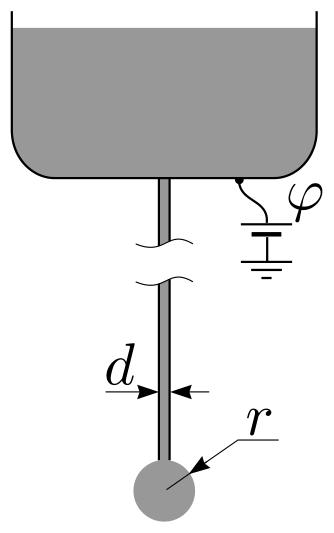
A long metallic pipe with internal diameter \(d\) is pointing directly downwards. Water is slowly dripping from a nozzle at its lower end, see fig. Water can be considered to be electrically conducting; its surface tension is \(\sigma\) and its density is \(\rho\). A droplet of radius \(r\) hangs below the nozzle. The radius grows slowly in time until the droplet separates from the nozzle due to the free fall acceleration \(g\). Always assume that \(d\ll r\).
Part A. Single pipe (4 points)
i. (1.2 pts) Find the radius \(r_{\max}\) of a drop just before it separates from the nozzle.
ii. (1.2 pts) Relative to the far-away surroundings, the pipe’s electrostatic potential is \(\varphi\). Find the charge \(Q\) of a drop when its radius is \(r\).
iii. (1.6 pts) Consider the situation in which \(r\) is kept constant and \(\varphi\) is slowly increased. The droplet becomes unstable and breaks into pieces if the hydrostatic pressure inside the droplet becomes smaller than the atmospheric pressure. Find the critical potential \(\varphi_{\max}\) at which this will happen.
Part B. Two pipes (4 points)
An apparatus called the “Kelvin water dropper” consists of two pipes, each identical to the one described in Part A, connected via a T-junction, see fig. The ends of both pipes are at the centres of two cylindrical electrodes (with height \(L\) and diameter \(D\) with \(L\gg D\gg r\)). For both tubes, the dripping rate is \(n\) droplets per unit time. Droplets fall from height \(H\) into conductive bowls underneath the nozzles, cross-connected to the electrodes as shown in the diagram. The electrodes are connected via a capacitance \(C\). There is no net charge on the system of bowls and electrodes. Note that the top water container is earthed as shown. The first droplet to fall will have some microscopic charge which will cause an imbalance between the two sides and a small charge separation across the capacitor.
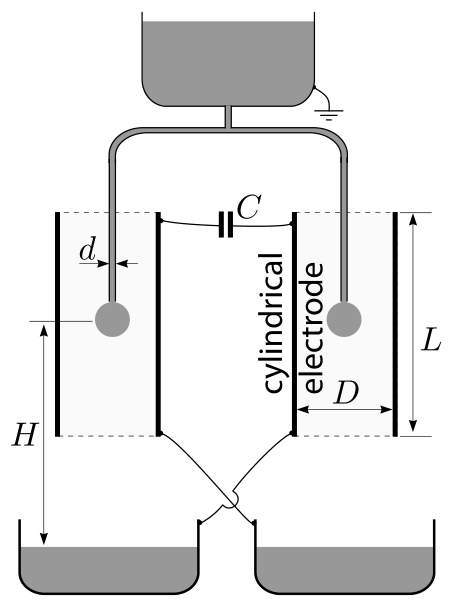
i. (1.2 pts) Express the absolute value of the charge \(Q_0\) of the drops as they separate from the tubes, and at the instant when the capacitor’s charge is \(q\). Express \(Q_0\) in terms of \(r_{\max}\) (from Part A-i) and neglect the effect described in Part A-iii.
ii. (1.5 pts) Find the dependence of \(q\) on time \(t\) by approximating it with a continuous function \(q(t)\) and assuming that \(q(0)=q_0\).
iii. (1.3 pts) The dropper’s functioning can be hindered by the effect shown in Part A-iii. In addition, a limit \(U_{\max}\) to the achievable potential between the electrodes is set by the electrostatic push between a droplet and the bowl beneath it. Find \(U_{\max}\).
Official English text of the problem.
Answers
Here \(\varepsilon_0\) is the vacuum permittivity, and \(q\) denotes the magnitude of the charge on either capacitor plate.
-
A-i: \[ \boxed{r_{\max}=\left(\frac{3\sigma d}{4\rho g}\right)^{1/3}}. \]
-
A-ii: \[ \boxed{Q=4\pi\varepsilon_0r\varphi}. \]
-
A-iii: \[ \boxed{\varphi_{\max}=2\sqrt{\frac{\sigma r}{\varepsilon_0}}}. \] The same threshold applies to the magnitude of a negative potential.
-
B-i: \[ \boxed{Q_0=\frac{2\pi\varepsilon_0r_{\max}}{C}\,q}. \]
-
B-ii: In the continuous approximation with negligible flight delay, \[ \boxed{q(t)=q_0\exp\!\left(\frac{2\pi\varepsilon_0nr_{\max}}{C}\,t\right)}. \]
-
B-iii: The limit due to electrostatic repulsion is \[ \boxed{ U_{\max} =r_{\max}\sqrt{\frac{2\rho gH}{3\varepsilon_0}} =\sqrt{\frac{\sigma dH}{2\varepsilon_0r_{\max}}} }. \]
No numerical parameter values are supplied.
Solution
Part A-i
The slowly growing drop is in mechanical equilibrium until its weight exceeds the maximum supporting force of surface tension.
The nozzle circumference is \(\pi d\). When the surface tension acts vertically around the neck, its maximum upward force is \[ F_\sigma=\pi d\sigma. \] The neck volume and the pressure-force correction at the small nozzle opening are negligible for \(d\ll r\). Approximating the drop as spherical, its weight is \[ mg=\frac{4}{3}\pi r^3\rho g. \]
At detachment, \[ \frac{4}{3}\pi r_{\max}^3\rho g=\pi d\sigma, \] hence \[ \boxed{r_{\max}=\left(\frac{3\sigma d}{4\rho g}\right)^{1/3}}. \]
The spherical approximation is consistent with this result: the ratio of gravitational to capillary stresses is \[ \frac{\rho g r_{\max}^2}{\sigma} =\frac{3d}{4r_{\max}}\ll1. \]
Part A-ii
The conducting drop and pipe have the same potential. Neglecting the thin pipe’s perturbation to the drop’s electric field, the drop behaves as a conducting sphere.
Outside a sphere carrying charge \(Q\), Gauss’s law gives \[ E(s)=\frac{Q}{4\pi\varepsilon_0s^2}. \] Taking the distant surroundings to have zero potential, \[ \varphi=\int_r^\infty E(s)\,ds =\frac{Q}{4\pi\varepsilon_0r}. \] Therefore \[ \boxed{Q=4\pi\varepsilon_0r\varphi}. \]
The sign of the drop’s charge is the sign of \(\varphi\).
Part A-iii
Surface tension produces an inward capillary pressure. From the given surface energy, \[ W_\sigma=4\pi r^2\sigma, \] the pressure required to increase the surface area is \[ p_\sigma=\frac{dW_\sigma}{dV} =\frac{8\pi r\sigma}{4\pi r^2} =\frac{2\sigma}{r}. \]
The electric field produces an outward pressure. For a conductor, the surface charge density is \(\varepsilon_0E\), and the field acting on that charge due to the other charges is \(E/2\). Thus \[ p_{\mathrm e}=\frac{\varepsilon_0E^2}{2}. \] Using Part A-ii, \[ E=\frac{Q}{4\pi\varepsilon_0r^2}=\frac{\varphi}{r}. \]
Consequently, mechanical equilibrium gives \[ p_{\mathrm{in}}-p_{\mathrm{atm}} =p_\sigma-p_{\mathrm e} =\frac{2\sigma}{r} -\frac{\varepsilon_0\varphi^2}{2r^2}. \]
According to the specified instability criterion, the threshold occurs when the internal pressure equals atmospheric pressure: \[ \frac{2\sigma}{r} =\frac{\varepsilon_0\varphi_{\max}^2}{2r^2}. \] Therefore \[ \boxed{\varphi_{\max}=2\sqrt{\frac{\sigma r}{\varepsilon_0}}}. \]
Equivalently, the corresponding charge magnitude is \[ Q_{\mathrm{crit}} =4\pi\varepsilon_0r\varphi_{\max} =8\pi\sqrt{\varepsilon_0\sigma r^3}. \]
Part B-i
Write \[ R=r_{\max}, \qquad U=\frac{q}{C}. \] We neglect stray capacitances compared with \(C\). By symmetry and zero net charge, the two electrode potentials relative to earth are \[ V_{\mathrm L}=+\frac{U}{2}, \qquad V_{\mathrm R}=-\frac{U}{2}. \]
Since \(L\gg D\), the potential near the centre of each cylinder, before accounting for the small drop, is approximately the cylinder’s potential. Since \(D\gg R\), the drop’s own contribution to its surface potential is approximately that of an isolated sphere.
The water and pipes are grounded. Thus, while the left drop remains attached, \[ 0=V_{\mathrm L}+\frac{Q_{\mathrm L}}{4\pi\varepsilon_0R}. \] It follows that \[ Q_{\mathrm L}=-2\pi\varepsilon_0RU. \] Similarly, \[ Q_{\mathrm R}=+2\pi\varepsilon_0RU. \]
The charge is retained upon separation, so its magnitude is \[ \boxed{ Q_0=2\pi\varepsilon_0RU =\frac{2\pi\varepsilon_0r_{\max}}{C}\,q }. \]
Because of the cross-connections, each drop falls into a bowl already carrying charge of the same sign as the drop. Its arrival therefore reinforces the charge separation.
Part B-ii
Use the continuous approximation and neglect the delay between detachment and collection. This assumes that the voltage changes little during a drop’s flight.
Each tube produces \(n\) drops per unit time. The positive capacitor plate receives positive charge at rate \(nQ_0\), while the negative plate receives negative charge at the same rate. Hence the magnitude \(q\) on either plate obeys \[ \frac{dq}{dt}=nQ_0 =\frac{2\pi\varepsilon_0nR}{C}\,q. \] There is no additional factor of two: a pair of drops increases the plate charges from \(+q,-q\) to \(+(q+Q_0),-(q+Q_0)\).
Integrating and imposing \(q(0)=q_0\), \[ \ln\frac{q(t)}{q_0} =\frac{2\pi\varepsilon_0nR}{C}\,t, \] so \[ \boxed{ q(t)=q_0\exp\!\left(\frac{2\pi\varepsilon_0nr_{\max}}{C}\,t\right) }. \]
The characteristic growth time is \[ \tau=\frac{C}{2\pi\varepsilon_0nr_{\max}}. \] The negligible-delay approximation requires the flight time to be small compared with \(\tau\). The exponential growth applies before breakup or electrostatic repulsion significantly interferes with collection.
Part B-iii
Consider the drop formed inside the positive electrode. It carries charge \(-Q_0\), and its collecting bowl is connected to the negative electrode.
Treat \(U\) as approximately constant during the fall. The potential produced by the apparatus changes from \(+U/2\) near the nozzle to \(-U/2\) at the bowl. Therefore the increase in the drop’s external electrostatic potential energy is \[ \Delta W_{\mathrm e} =(-Q_0)\left(-\frac{U}{2}-\frac{U}{2}\right) =Q_0U. \]
The potential used here is the potential produced by the apparatus. The drop’s zero total potential while attached also includes its own field. During flight, its charge and radius remain approximately constant, so its self-energy does not contribute to the translational work.
Neglecting air resistance and initial kinetic energy, the gravitational energy available is \[ mgH=\frac{4}{3}\pi R^3\rho gH. \] For collection to remain possible, this must be sufficient to overcome the electrostatic energy increase: \[ mgH\ge Q_0U. \]
At the energy limit, using \(Q_0=2\pi\varepsilon_0RU\), \[ \frac{4}{3}\pi R^3\rho gH =2\pi\varepsilon_0R\,U_{\max}^2. \] Thus \[ \boxed{ U_{\max}=r_{\max}\sqrt{\frac{2\rho gH}{3\varepsilon_0}} }. \]
Using the detachment condition \(mg=\pi d\sigma\), this can also be written \[ \boxed{ U_{\max}=\sqrt{\frac{\sigma dH}{2\varepsilon_0r_{\max}}} }. \]
The separate breakup threshold from Part A-iii, evaluated for a drop of radius \(r_{\max}\), corresponds to \[ U_{\mathrm{break}} =2\varphi_{\max}(r_{\max}) =4\sqrt{\frac{\sigma r_{\max}}{\varepsilon_0}}. \] This provides an additional restriction on operation with intact drops.
The solution was checked against the official solution.
IPhO 2012 · Theorieaufgabe 2
Kelvin-Wassertropfengenerator
Aufgabe T2. Kelvin-Wassertropfengenerator (8 Punkte)
Die folgenden Tatsachen zur Oberflächenspannung können für diese Aufgabe hilfreich sein. Für die Moleküle einer Flüssigkeit sind die Positionen an der Grenzfläche zwischen Flüssigkeit und Luft energetisch ungünstiger als die Positionen im Inneren der Flüssigkeit. Diese Grenzfläche wird durch die sogenannte Oberflächenenergie beschrieben, \(U=\sigma S\), wobei \(S\) der Flächeninhalt der Grenzfläche und \(\sigma\) der Oberflächenspannungskoeffizient der Flüssigkeit ist. Außerdem ziehen sich zwei Teilflächen der Flüssigkeitsoberfläche mit einer Kraft \(F=\sigma l\) gegenseitig an, wobei \(l\) die Länge einer geraden Trennlinie zwischen den Teilflächen ist.
Ein langes Metallrohr mit dem Innendurchmesser \(d\) ist senkrecht nach unten gerichtet. Aus einer Düse an seinem unteren Ende tropft langsam Wasser, siehe Abbildung. Wasser kann als elektrisch leitend betrachtet werden; seine Oberflächenspannung ist \(\sigma\) und seine Dichte \(\rho\). Unterhalb der Düse hängt ein Tropfen mit dem Radius \(r\). Der Radius wächst langsam mit der Zeit, bis sich der Tropfen aufgrund der Fallbeschleunigung \(g\) von der Düse löst. Nehmen Sie stets an, dass \(d\ll r\).
Teil A. Einzelnes Rohr (4 Punkte)
i. (1.2 Punkte) Bestimmen Sie den Radius \(r_{\max}\) eines Tropfens unmittelbar bevor er sich von der Düse löst.
ii. (1.2 Punkte) Gegenüber der weit entfernten Umgebung hat das Rohr das elektrostatische Potential \(\varphi\). Bestimmen Sie die Ladung \(Q\) eines Tropfens, wenn sein Radius \(r\) beträgt.
iii. (1.6 Punkte) Betrachten Sie die Situation, in der \(r\) konstant gehalten und \(\varphi\) langsam erhöht wird. Der Tropfen wird instabil und zerfällt, wenn der hydrostatische Druck im Tropfen kleiner als der Atmosphärendruck wird. Bestimmen Sie das kritische Potential \(\varphi_{\max}\), bei dem dies geschieht.
Teil B. Zwei Rohre (4 Punkte)
Eine als „Kelvin-Wassertropfengenerator“ bezeichnete Vorrichtung besteht aus zwei Rohren, die jeweils mit dem in Teil A beschriebenen Rohr identisch und über ein T-Stück miteinander verbunden sind, siehe Abbildung. Die Enden beider Rohre befinden sich in den Mittelpunkten zweier zylindrischer Elektroden (mit der Höhe \(L\) und dem Durchmesser \(D\), wobei \(L\gg D\gg r\)). Bei beiden Rohren beträgt die Tropfrate \(n\) Tropfen pro Zeiteinheit. Die Tropfen fallen aus der Höhe \(H\) in leitende Schalen unterhalb der Düsen, die wie in der Zeichnung dargestellt über Kreuz mit den Elektroden verbunden sind. Die Elektroden sind über einen Kondensator mit der Kapazität \(C\) verbunden. Die Gesamtladung des Systems aus Schalen und Elektroden ist null. Beachten Sie, dass der obere Wasserbehälter wie dargestellt geerdet ist. Der erste fallende Tropfen trägt eine mikroskopisch kleine Ladung, die ein Ungleichgewicht zwischen den beiden Seiten und eine geringe Ladungstrennung am Kondensator verursacht.
i. (1.2 Punkte) Geben Sie den Betrag der Ladung \(Q_0\) der Tropfen beim Ablösen von den Rohren zu dem Zeitpunkt an, an dem die Ladung des Kondensators \(q\) beträgt. Drücken Sie \(Q_0\) durch \(r_{\max}\) (aus Teil A-i) aus und vernachlässigen Sie den in Teil A-iii beschriebenen Effekt.
ii. (1.5 Punkte) Bestimmen Sie die Abhängigkeit von \(q\) von der Zeit \(t\), indem Sie sie durch eine stetige Funktion \(q(t)\) annähern und \(q(0)=q_0\) annehmen.
iii. (1.3 Punkte) Die Funktion des Wassertropfengenerators kann durch den in Teil A-iii beschriebenen Effekt beeinträchtigt werden. Darüber hinaus setzt die elektrostatische Abstoßung zwischen einem Tropfen und der darunterliegenden Schale der erreichbaren Potentialdifferenz zwischen den Elektroden eine Grenze \(U_{\max}\). Bestimmen Sie \(U_{\max}\).
Aufgabentext aus dem offiziellen englischen Text übersetzt.
Antworten
Hier ist \(\varepsilon_0\) die elektrische Feldkonstante, und \(q\) bezeichnet den Betrag der Ladung auf jeder der beiden Kondensatorplatten.
-
A-i: \[ \boxed{r_{\max}=\left(\frac{3\sigma d}{4\rho g}\right)^{1/3}}. \]
-
A-ii: \[ \boxed{Q=4\pi\varepsilon_0r\varphi}. \]
-
A-iii: \[ \boxed{\varphi_{\max}=2\sqrt{\frac{\sigma r}{\varepsilon_0}}}. \] Derselbe Schwellenwert gilt für den Betrag eines negativen Potentials.
-
B-i: \[ \boxed{Q_0=\frac{2\pi\varepsilon_0r_{\max}}{C}\,q}. \]
-
B-ii: In der kontinuierlichen Näherung bei vernachlässigbarer Verzögerung durch die Flugzeit gilt \[ \boxed{q(t)=q_0\exp\!\left(\frac{2\pi\varepsilon_0nr_{\max}}{C}\,t\right)}. \]
-
B-iii: Die durch die elektrostatische Abstoßung gesetzte Grenze ist \[ \boxed{ U_{\max} =r_{\max}\sqrt{\frac{2\rho gH}{3\varepsilon_0}} =\sqrt{\frac{\sigma dH}{2\varepsilon_0r_{\max}}} }. \]
Es sind keine Zahlenwerte für die Parameter angegeben.
Lösung
Teil A-i
Der langsam wachsende Tropfen befindet sich im mechanischen Gleichgewicht, bis seine Gewichtskraft die maximale Haltekraft der Oberflächenspannung übersteigt.
Der Umfang der Düse beträgt \(\pi d\). Wenn die Oberflächenspannung entlang des gesamten Tropfenhalses senkrecht wirkt, beträgt ihre maximale nach oben gerichtete Kraft \[ F_\sigma=\pi d\sigma. \] Das Volumen des Tropfenhalses und die Korrektur durch die Druckkraft an der kleinen Düsenöffnung sind für \(d\ll r\) vernachlässigbar. Nähert man den Tropfen als Kugel an, so beträgt seine Gewichtskraft \[ mg=\frac{4}{3}\pi r^3\rho g. \]
Beim Ablösen gilt \[ \frac{4}{3}\pi r_{\max}^3\rho g=\pi d\sigma, \] also \[ \boxed{r_{\max}=\left(\frac{3\sigma d}{4\rho g}\right)^{1/3}}. \]
Die Kugelnäherung ist mit diesem Ergebnis vereinbar: Das Verhältnis der durch die Schwerkraft verursachten Spannungen zu den Kapillarspannungen beträgt \[ \frac{\rho g r_{\max}^2}{\sigma} =\frac{3d}{4r_{\max}}\ll1. \]
Teil A-ii
Der leitende Tropfen und das Rohr haben dasselbe Potential. Vernachlässigt man die Störung des elektrischen Feldes des Tropfens durch das dünne Rohr, so verhält sich der Tropfen wie eine leitende Kugel.
Außerhalb einer Kugel mit der Ladung \(Q\) liefert das gaußsche Gesetz \[ E(s)=\frac{Q}{4\pi\varepsilon_0s^2}. \] Setzt man das Potential der weit entfernten Umgebung gleich null, so gilt \[ \varphi=\int_r^\infty E(s)\,ds =\frac{Q}{4\pi\varepsilon_0r}. \] Daher ist \[ \boxed{Q=4\pi\varepsilon_0r\varphi}. \]
Das Vorzeichen der Tropfenladung stimmt mit dem Vorzeichen von \(\varphi\) überein.
Teil A-iii
Die Oberflächenspannung erzeugt einen nach innen gerichteten Kapillardruck. Aus der gegebenen Oberflächenenergie \[ W_\sigma=4\pi r^2\sigma, \] ergibt sich der zur Vergrößerung der Oberfläche erforderliche Druck zu \[ p_\sigma=\frac{dW_\sigma}{dV} =\frac{8\pi r\sigma}{4\pi r^2} =\frac{2\sigma}{r}. \]
Das elektrische Feld erzeugt einen nach außen gerichteten Druck. Bei einem Leiter beträgt die Oberflächenladungsdichte \(\varepsilon_0E\), und das von den übrigen Ladungen erzeugte Feld, das auf diese Ladung wirkt, beträgt \(E/2\). Somit gilt \[ p_{\mathrm e}=\frac{\varepsilon_0E^2}{2}. \] Mit Teil A-ii folgt \[ E=\frac{Q}{4\pi\varepsilon_0r^2}=\frac{\varphi}{r}. \]
Aus dem mechanischen Gleichgewicht ergibt sich folglich \[ p_{\mathrm{in}}-p_{\mathrm{atm}} =p_\sigma-p_{\mathrm e} =\frac{2\sigma}{r} -\frac{\varepsilon_0\varphi^2}{2r^2}. \]
Gemäß dem vorgegebenen Instabilitätskriterium ist der Schwellenwert erreicht, wenn der Innendruck gleich dem Atmosphärendruck ist: \[ \frac{2\sigma}{r} =\frac{\varepsilon_0\varphi_{\max}^2}{2r^2}. \] Daher gilt \[ \boxed{\varphi_{\max}=2\sqrt{\frac{\sigma r}{\varepsilon_0}}}. \]
Gleichwertig dazu beträgt der entsprechende Ladungsbetrag \[ Q_{\mathrm{crit}} =4\pi\varepsilon_0r\varphi_{\max} =8\pi\sqrt{\varepsilon_0\sigma r^3}. \]
Teil B-i
Wir setzen \[ R=r_{\max}, \qquad U=\frac{q}{C}. \] Wir vernachlässigen Streukapazitäten gegenüber \(C\). Aufgrund der Symmetrie und der verschwindenden Gesamtladung betragen die beiden Elektrodenpotentiale gegenüber Erde \[ V_{\mathrm L}=+\frac{U}{2}, \qquad V_{\mathrm R}=-\frac{U}{2}. \]
Da \(L\gg D\), ist das Potential nahe dem Mittelpunkt jedes Zylinders ohne Berücksichtigung des kleinen Tropfens näherungsweise gleich dem Potential des Zylinders. Da \(D\gg R\), entspricht der Eigenbeitrag des Tropfens zu seinem Oberflächenpotential näherungsweise dem einer isolierten Kugel.
Das Wasser und die Rohre sind geerdet. Solange der linke Tropfen noch am Rohr hängt, gilt daher \[ 0=V_{\mathrm L}+\frac{Q_{\mathrm L}}{4\pi\varepsilon_0R}. \] Daraus folgt \[ Q_{\mathrm L}=-2\pi\varepsilon_0RU. \] Entsprechend gilt \[ Q_{\mathrm R}=+2\pi\varepsilon_0RU. \]
Die Ladung bleibt beim Ablösen erhalten. Ihr Betrag ist daher \[ \boxed{ Q_0=2\pi\varepsilon_0RU =\frac{2\pi\varepsilon_0r_{\max}}{C}\,q }. \]
Aufgrund der Verbindungen über Kreuz fällt jeder Tropfen in eine Schale, die bereits eine Ladung mit demselben Vorzeichen wie der Tropfen trägt. Sein Auftreffen verstärkt daher die Ladungstrennung.
Teil B-ii
Wir verwenden die kontinuierliche Näherung und vernachlässigen die Verzögerung zwischen dem Ablösen und dem Auffangen. Dies setzt voraus, dass sich die Spannung während des Fluges eines Tropfens nur wenig ändert.
Jedes Rohr erzeugt \(n\) Tropfen pro Zeiteinheit. Der positiven Kondensatorplatte wird positive Ladung mit der Rate \(nQ_0\) zugeführt, während der negativen Platte negative Ladung mit derselben Rate zugeführt wird. Daher gilt für den Betrag \(q\) auf jeder Platte \[ \frac{dq}{dt}=nQ_0 =\frac{2\pi\varepsilon_0nR}{C}\,q. \] Es gibt keinen zusätzlichen Faktor zwei: Ein Tropfenpaar erhöht die Plattenladungen von \(+q,-q\) auf \(+(q+Q_0),-(q+Q_0)\).
Durch Integration unter Berücksichtigung von \(q(0)=q_0\) erhält man \[ \ln\frac{q(t)}{q_0} =\frac{2\pi\varepsilon_0nR}{C}\,t, \] also \[ \boxed{ q(t)=q_0\exp\!\left(\frac{2\pi\varepsilon_0nr_{\max}}{C}\,t\right) }. \]
Die charakteristische Wachstumszeit ist \[ \tau=\frac{C}{2\pi\varepsilon_0nr_{\max}}. \] Die Näherung einer vernachlässigbaren Verzögerung setzt voraus, dass die Flugzeit klein gegenüber \(\tau\) ist. Das exponentielle Wachstum gilt, solange der Zerfall der Tropfen oder die elektrostatische Abstoßung das Auffangen nicht wesentlich beeinträchtigt.
Teil B-iii
Wir betrachten den Tropfen, der innerhalb der positiven Elektrode entsteht. Er trägt die Ladung \(-Q_0\), und seine Auffangschale ist mit der negativen Elektrode verbunden.
Wir behandeln \(U\) während des Falls als näherungsweise konstant. Das von der Vorrichtung erzeugte Potential ändert sich von \(+U/2\) nahe der Düse auf \(-U/2\) an der Schale. Daher beträgt die Zunahme der elektrostatischen potentiellen Energie des Tropfens im äußeren Feld \[ \Delta W_{\mathrm e} =(-Q_0)\left(-\frac{U}{2}-\frac{U}{2}\right) =Q_0U. \]
Das hier verwendete Potential ist das von der Vorrichtung erzeugte Potential. Das Gesamtpotential des Tropfens, das null ist, solange er noch am Rohr hängt, umfasst auch sein eigenes Feld. Während des Fluges bleiben seine Ladung und sein Radius näherungsweise konstant, sodass seine Selbstenergie keinen Beitrag zur Translationsarbeit leistet.
Vernachlässigt man den Luftwiderstand und die anfängliche kinetische Energie, so beträgt die verfügbare potentielle Energie im Schwerefeld \[ mgH=\frac{4}{3}\pi R^3\rho gH. \] Damit das Auffangen weiterhin möglich ist, muss diese Energie ausreichen, um die Zunahme der elektrostatischen Energie zu überwinden: \[ mgH\ge Q_0U. \]
An der energetischen Grenze gilt mit \(Q_0=2\pi\varepsilon_0RU\) \[ \frac{4}{3}\pi R^3\rho gH =2\pi\varepsilon_0R\,U_{\max}^2. \] Somit ist \[ \boxed{ U_{\max}=r_{\max}\sqrt{\frac{2\rho gH}{3\varepsilon_0}} }. \]
Mit der Ablösebedingung \(mg=\pi d\sigma\) lässt sich dies auch schreiben als \[ \boxed{ U_{\max}=\sqrt{\frac{\sigma dH}{2\varepsilon_0r_{\max}}} }. \]
Der gesonderte Schwellenwert für den Tropfenzerfall aus Teil A-iii entspricht für einen Tropfen mit dem Radius \(r_{\max}\) \[ U_{\mathrm{break}} =2\varphi_{\max}(r_{\max}) =4\sqrt{\frac{\sigma r_{\max}}{\varepsilon_0}}. \] Dies stellt eine zusätzliche Einschränkung für den Betrieb mit unzerfallenen Tropfen dar.
Die Lösung wurde mit der offiziellen Lösung abgeglichen.
IPhO 2012 · Teori sorusu 2
Kelvin su damlatıcısı
Soru T2. Kelvin su damlatıcısı (8 puan)
Yüzey gerilimine ilişkin aşağıdaki bilgiler bu soruda yararlı olabilir. Bir sıvının molekülleri açısından, sıvı-hava arayüzündeki konumlar sıvının içindeki konumlara göre daha az elverişlidir. Bu arayüz, yüzey enerjisi adı verilen \(U=\sigma S\) ile tanımlanır; burada \(S\) arayüzün yüzey alanı, \(\sigma\) ise sıvının yüzey gerilimi katsayısıdır. Ayrıca, sıvı yüzeyinin iki parçası birbirini \(F=\sigma l\) kuvvetiyle çeker; burada \(l\), parçaları birbirinden ayıran düz çizginin uzunluğudur.
İç çapı \(d\) olan uzun bir metal boru düşey olarak aşağıya yönelmiştir. Alt ucundaki bir ağızdan yavaşça su damlamaktadır; şekle bakınız. Su elektriksel olarak iletken kabul edilebilir; yüzey gerilimi \(\sigma\), yoğunluğu ise \(\rho\)'dur. Ağzın altında yarıçapı \(r\) olan bir damla asılı durmaktadır. Damla, serbest düşme ivmesi \(g\) nedeniyle ağızdan kopana kadar yarıçapı zamanla yavaşça büyür. Her zaman \(d\ll r\) olduğunu varsayınız.
Bölüm A. Tek boru (4 puan)
i. (1.2 puan) Bir damlanın ağızdan kopmadan hemen önceki yarıçapını, \(r_{\max}\), bulunuz.
ii. (1.2 puan) Borunun uzaktaki çevreye göre elektrostatik potansiyeli \(\varphi\)'dir. Yarıçapı \(r\) olduğunda bir damlanın \(Q\) yükünü bulunuz.
iii. (1.6 puan) \(r\)'nin sabit tutulduğu ve \(\varphi\)'nin yavaşça artırıldığı durumu ele alınız. Damlanın içindeki hidrostatik basınç atmosfer basıncının altına düşerse damla kararsız hâle gelir ve parçalara ayrılır. Bunun gerçekleşeceği kritik potansiyeli, \(\varphi_{\max}\), bulunuz.
Bölüm B. İki boru (4 puan)
“Kelvin su damlatıcısı” adı verilen düzenek, her biri Bölüm A'da açıklanan boruyla özdeş olan ve bir T-bağlantısıyla birleştirilmiş iki borudan oluşur; şekle bakınız. Her iki borunun uçları, iki silindirik elektrodun merkezlerinde bulunur (elektrotların yüksekliği \(L\), çapı \(D\) olup \(L\gg D\gg r\)'dir). Her iki boru için de damlama hızı birim zamanda \(n\) damladır. Damlalar, \(H\) yüksekliğinden ağızların altındaki iletken kaplara düşer; bu kaplar, şekilde gösterildiği gibi elektrotlara çapraz bağlanmıştır. Elektrotlar, sığası \(C\) olan bir kondansatör aracılığıyla birbirine bağlıdır. Kaplar ve elektrotlardan oluşan sistemin net yükü sıfırdır. Üstteki su haznesinin şekilde gösterildiği gibi topraklandığına dikkat ediniz. İlk düşen damla, iki taraf arasında bir dengesizliğe ve kondansatörün plakaları arasında küçük bir yük ayrışmasına neden olacak mikroskobik bir yük taşıyacaktır.
i. (1.2 puan) Kondansatörün yükünün \(q\) olduğu anda borulardan kopan damlaların yükünün mutlak değerini, \(Q_0\), ifade ediniz. \(Q_0\)'ı (Bölüm A-i'deki) \(r_{\max}\) cinsinden ifade ediniz ve Bölüm A-iii'te açıklanan etkiyi ihmal ediniz.
ii. (1.5 puan) \(q\)'yu sürekli bir \(q(t)\) fonksiyonuyla yaklaşık olarak temsil ederek ve \(q(0)=q_0\) olduğunu varsayarak \(q\)'nun \(t\) zamanına bağlılığını bulunuz.
iii. (1.3 puan) Bölüm A-iii'te gösterilen etki damlatıcının çalışmasını engelleyebilir. Ayrıca, bir damla ile altındaki kap arasındaki elektrostatik itme, elektrotlar arasında ulaşılabilecek potansiyel farkına bir \(U_{\max}\) sınırı getirir. \(U_{\max}\)'ı bulunuz.
Soru metni resmi İngilizce metinden çevrilmiştir.
Cevaplar
Burada \(\varepsilon_0\) boşluğun elektriksel geçirgenliğidir ve \(q\), kondansatörün herhangi bir plakasındaki yükün büyüklüğünü belirtir.
-
A-i: \[ \boxed{r_{\max}=\left(\frac{3\sigma d}{4\rho g}\right)^{1/3}}. \]
-
A-ii: \[ \boxed{Q=4\pi\varepsilon_0r\varphi}. \]
-
A-iii: \[ \boxed{\varphi_{\max}=2\sqrt{\frac{\sigma r}{\varepsilon_0}}}. \] Aynı eşik, negatif bir potansiyelin mutlak değeri için de geçerlidir.
-
B-i: \[ \boxed{Q_0=\frac{2\pi\varepsilon_0r_{\max}}{C}\,q}. \]
-
B-ii: Uçuş gecikmesinin ihmal edildiği sürekli yaklaşımda, \[ \boxed{q(t)=q_0\exp\!\left(\frac{2\pi\varepsilon_0nr_{\max}}{C}\,t\right)}. \]
-
B-iii: Elektrostatik itmeden kaynaklanan sınır \[ \boxed{ U_{\max} =r_{\max}\sqrt{\frac{2\rho gH}{3\varepsilon_0}} =\sqrt{\frac{\sigma dH}{2\varepsilon_0r_{\max}}} }. \] şeklindedir.
Parametrelerin sayısal değerleri verilmemiştir.
Çözüm
Bölüm A-i
Yavaşça büyüyen damla, ağırlığı yüzey geriliminin sağlayabileceği en büyük taşıyıcı kuvveti aşana kadar mekanik dengededir.
Ağzın çevre uzunluğu \(\pi d\)'dir. Yüzey gerilimi boyun çevresinde düşey yönde etki ettiğinde, yukarı yönlü kuvvetinin en büyük değeri \[ F_\sigma=\pi d\sigma. \] olur. \(d\ll r\) için boynun hacmi ve küçük ağız açıklığındaki basınç kuvvetine ilişkin düzeltme ihmal edilebilir. Damla küresel kabul edildiğinde ağırlığı \[ mg=\frac{4}{3}\pi r^3\rho g. \] olur.
Kopma anında, \[ \frac{4}{3}\pi r_{\max}^3\rho g=\pi d\sigma, \] dolayısıyla \[ \boxed{r_{\max}=\left(\frac{3\sigma d}{4\rho g}\right)^{1/3}}. \]
Küresellik yaklaşımı bu sonuçla tutarlıdır: kütleçekimden kaynaklanan gerilmelerin kapiler gerilmelere oranı \[ \frac{\rho g r_{\max}^2}{\sigma} =\frac{3d}{4r_{\max}}\ll1. \] olur.
Bölüm A-ii
İletken damla ve boru aynı potansiyele sahiptir. İnce borunun damlanın elektrik alanında oluşturduğu pertürbasyon ihmal edildiğinde, damla iletken bir küre gibi davranır.
\(Q\) yükü taşıyan bir kürenin dışında Gauss yasası \[ E(s)=\frac{Q}{4\pi\varepsilon_0s^2}. \] sonucunu verir. Uzaktaki çevrenin potansiyeli sıfır alındığında, \[ \varphi=\int_r^\infty E(s)\,ds =\frac{Q}{4\pi\varepsilon_0r}. \] Dolayısıyla \[ \boxed{Q=4\pi\varepsilon_0r\varphi}. \]
Damlanın yükünün işareti, \(\varphi\)'nin işaretiyle aynıdır.
Bölüm A-iii
Yüzey gerilimi içeriye doğru bir kapiler basınç oluşturur. Verilen yüzey enerjisi \[ W_\sigma=4\pi r^2\sigma, \] ifadesinden, yüzey alanını artırmak için gereken basınç \[ p_\sigma=\frac{dW_\sigma}{dV} =\frac{8\pi r\sigma}{4\pi r^2} =\frac{2\sigma}{r}. \] olarak bulunur.
Elektrik alan dışarıya doğru bir basınç oluşturur. Bir iletkende yüzey yük yoğunluğu \(\varepsilon_0E\)'dir ve diğer yüklerin bu yüke uyguladığı alan \(E/2\)'dir. Böylece \[ p_{\mathrm e}=\frac{\varepsilon_0E^2}{2}. \] Bölüm A-ii kullanılarak, \[ E=\frac{Q}{4\pi\varepsilon_0r^2}=\frac{\varphi}{r}. \]
Buna göre mekanik dengeden \[ p_{\mathrm{in}}-p_{\mathrm{atm}} =p_\sigma-p_{\mathrm e} =\frac{2\sigma}{r} -\frac{\varepsilon_0\varphi^2}{2r^2}. \] elde edilir.
Belirtilen kararsızlık ölçütüne göre, iç basınç atmosfer basıncına eşit olduğunda eşiğe ulaşılır: \[ \frac{2\sigma}{r} =\frac{\varepsilon_0\varphi_{\max}^2}{2r^2}. \] Dolayısıyla \[ \boxed{\varphi_{\max}=2\sqrt{\frac{\sigma r}{\varepsilon_0}}}. \]
Eşdeğer olarak, buna karşılık gelen yük büyüklüğü \[ Q_{\mathrm{crit}} =4\pi\varepsilon_0r\varphi_{\max} =8\pi\sqrt{\varepsilon_0\sigma r^3}. \] olur.
Bölüm B-i
\[ R=r_{\max}, \qquad U=\frac{q}{C}. \] yazalım. Parazit sığaları \(C\)'ye kıyasla ihmal ediyoruz. Simetri ve net yükün sıfır olması nedeniyle, iki elektrodun toprağa göre potansiyelleri \[ V_{\mathrm L}=+\frac{U}{2}, \qquad V_{\mathrm R}=-\frac{U}{2}. \] olur.
\(L\gg D\) olduğundan, küçük damlanın etkisi hesaba katılmadan önce her silindirin merkezi yakınındaki potansiyel yaklaşık olarak silindirin potansiyelidir. \(D\gg R\) olduğundan, damlanın kendi yüzey potansiyeline katkısı yaklaşık olarak yalıtılmış bir küreninkiyle aynıdır.
Su ve borular topraklanmıştır. Dolayısıyla, soldaki damla bağlı kaldığı sürece, \[ 0=V_{\mathrm L}+\frac{Q_{\mathrm L}}{4\pi\varepsilon_0R}. \] Buradan \[ Q_{\mathrm L}=-2\pi\varepsilon_0RU. \] elde edilir. Benzer biçimde, \[ Q_{\mathrm R}=+2\pi\varepsilon_0RU. \]
Kopma sırasında yük korunduğundan, büyüklüğü \[ \boxed{ Q_0=2\pi\varepsilon_0RU =\frac{2\pi\varepsilon_0r_{\max}}{C}\,q }. \] olur.
Çapraz bağlantılar nedeniyle her damla, kendisiyle aynı işaretli yükü zaten taşıyan bir kaba düşer. Bu nedenle damlanın kaba ulaşması yük ayrışmasını artırır.
Bölüm B-ii
Sürekli yaklaşımı kullanalım ve kopma ile toplanma arasındaki gecikmeyi ihmal edelim. Bu, bir damlanın uçuşu boyunca gerilimin çok az değiştiğini varsayar.
Her boru birim zamanda \(n\) damla üretir. Kondansatörün pozitif plakası \(nQ_0\) hızıyla pozitif yük alırken, negatif plakası aynı hızla negatif yük alır. Dolayısıyla, herhangi bir plakadaki \(q\) yük büyüklüğü \[ \frac{dq}{dt}=nQ_0 =\frac{2\pi\varepsilon_0nR}{C}\,q. \] bağıntısına uyar. Ek bir iki çarpanı yoktur: bir damla çifti plakalardaki yükleri \(+q,-q\)'dan \(+(q+Q_0),-(q+Q_0)\)'a çıkarır.
İntegral alıp \(q(0)=q_0\) koşulunu uygulayarak, \[ \ln\frac{q(t)}{q_0} =\frac{2\pi\varepsilon_0nR}{C}\,t, \] dolayısıyla \[ \boxed{ q(t)=q_0\exp\!\left(\frac{2\pi\varepsilon_0nr_{\max}}{C}\,t\right) }. \] elde edilir.
Karakteristik büyüme süresi \[ \tau=\frac{C}{2\pi\varepsilon_0nr_{\max}}. \] olur. Gecikmenin ihmal edildiği yaklaşım, uçuş süresinin \(\tau\)'ya kıyasla küçük olmasını gerektirir. Üstel büyüme, parçalanmanın veya elektrostatik itmenin damlaların toplanmasını önemli ölçüde engellemeye başlamasından önce geçerlidir.
Bölüm B-iii
Pozitif elektrodun içinde oluşan damlayı ele alalım. Bu damla \(-Q_0\) yükünü taşır ve onu toplayan kap negatif elektroda bağlıdır.
Düşüş sırasında \(U\)'yu yaklaşık olarak sabit kabul edelim. Düzeneğin oluşturduğu potansiyel, ağzın yakınında \(+U/2\) iken kapta \(-U/2\)'ye değişir. Dolayısıyla damlanın dış alandan kaynaklanan elektrostatik potansiyel enerjisindeki artış \[ \Delta W_{\mathrm e} =(-Q_0)\left(-\frac{U}{2}-\frac{U}{2}\right) =Q_0U. \] olur.
Burada kullanılan potansiyel, düzeneğin oluşturduğu potansiyeldir. Damla bağlıyken sıfır olan toplam potansiyeli, kendi alanının katkısını da içerir. Uçuş sırasında yükü ve yarıçapı yaklaşık olarak sabit kaldığından, öz enerjisi öteleme sırasında yapılan işe katkıda bulunmaz.
Hava direnci ve başlangıçtaki kinetik enerji ihmal edildiğinde, kullanılabilir kütleçekim enerjisi \[ mgH=\frac{4}{3}\pi R^3\rho gH. \] olur. Damlaların toplanabilmesi için bu enerji, elektrostatik enerji artışını karşılamaya yeterli olmalıdır: \[ mgH\ge Q_0U. \]
Enerji sınırında, \(Q_0=2\pi\varepsilon_0RU\) kullanılarak, \[ \frac{4}{3}\pi R^3\rho gH =2\pi\varepsilon_0R\,U_{\max}^2. \] Böylece \[ \boxed{ U_{\max}=r_{\max}\sqrt{\frac{2\rho gH}{3\varepsilon_0}} }. \]
\(mg=\pi d\sigma\) kopma koşulu kullanılarak bu sonuç \[ \boxed{ U_{\max}=\sqrt{\frac{\sigma dH}{2\varepsilon_0r_{\max}}} }. \] biçiminde de yazılabilir.
Bölüm A-iii'teki ayrı parçalanma eşiği, yarıçapı \(r_{\max}\) olan bir damla için değerlendirildiğinde, \[ U_{\mathrm{break}} =2\varphi_{\max}(r_{\max}) =4\sqrt{\frac{\sigma r_{\max}}{\varepsilon_0}}. \] değerine karşılık gelir. Bu, düzeneğin damlalar parçalanmadan çalışması için ek bir kısıtlama getirir.
Çözüm, resmi çözümle karşılaştırılarak kontrol edildi.
IPhO 2012 · Problema teórico 2
Gotero de Kelvin
Problema T2. Gotero de Kelvin (8 puntos)
Los siguientes hechos sobre la tensión superficial pueden resultar útiles para este problema. Para las moléculas de un líquido, las posiciones en la interfaz líquido-aire son menos favorables que las posiciones en el seno del líquido. Esta interfaz se describe mediante la denominada energía superficial, \(U=\sigma S\), donde \(S\) es el área de la interfaz y \(\sigma\) es el coeficiente de tensión superficial del líquido. Además, dos porciones de la superficie del líquido se atraen entre sí con una fuerza \(F=\sigma l\), donde \(l\) es la longitud de una línea recta que separa ambas porciones.
Un tubo metálico largo de diámetro interior \(d\) apunta verticalmente hacia abajo. De una boquilla situada en su extremo inferior gotea agua lentamente; véase la figura. El agua puede considerarse conductora de la electricidad; su tensión superficial es \(\sigma\) y su densidad es \(\rho\). Una gota de radio \(r\) cuelga de la boquilla. El radio aumenta lentamente con el tiempo hasta que la gota se desprende de la boquilla debido a la aceleración de caída libre \(g\). Supóngase siempre que \(d\ll r\).
Parte A. Un solo tubo (4 puntos)
i. (1.2 puntos) Halle el radio \(r_{\max}\) de una gota justo antes de que se desprenda de la boquilla.
ii. (1.2 puntos) El potencial electrostático del tubo con respecto al entorno lejano es \(\varphi\). Halle la carga \(Q\) de una gota cuando su radio es \(r\).
iii. (1.6 puntos) Considere la situación en la que \(r\) se mantiene constante y \(\varphi\) aumenta lentamente. La gota se vuelve inestable y se fragmenta si la presión hidrostática en su interior se hace menor que la presión atmosférica. Halle el potencial crítico \(\varphi_{\max}\) al que esto sucede.
Parte B. Dos tubos (4 puntos)
Un aparato denominado «gotero de Kelvin» consta de dos tubos, cada uno idéntico al descrito en la Parte A, conectados mediante una unión en T; véase la figura. Los extremos de ambos tubos se encuentran en los centros de dos electrodos cilíndricos (de altura \(L\) y diámetro \(D\), con \(L\gg D\gg r\)). En ambos tubos, la frecuencia de goteo es de \(n\) gotas por unidad de tiempo. Las gotas caen desde una altura \(H\) a unos recipientes conductores situados debajo de las boquillas y conectados de forma cruzada a los electrodos, como se muestra en el esquema. Los electrodos están conectados mediante una capacidad \(C\). La carga neta del sistema de recipientes y electrodos es nula. Obsérvese que el depósito de agua superior está conectado a tierra, como se muestra. La primera gota que caiga tendrá una pequeña carga microscópica que causará un desequilibrio entre los dos lados y una pequeña separación de cargas entre las placas del condensador.
i. (1.2 puntos) Exprese el valor absoluto de la carga \(Q_0\) de las gotas al desprenderse de los tubos, en el instante en que la carga del condensador es \(q\). Exprese \(Q_0\) en función de \(r_{\max}\) (de la Parte A-i) y desprecie el efecto descrito en la Parte A-iii.
ii. (1.5 puntos) Halle la dependencia de \(q\) con el tiempo \(t\), aproximándola mediante una función continua \(q(t)\) y suponiendo que \(q(0)=q_0\).
iii. (1.3 puntos) El funcionamiento del gotero puede verse dificultado por el efecto descrito en la Parte A-iii. Además, la repulsión electrostática entre una gota y el recipiente situado debajo de ella establece un límite \(U_{\max}\) para la diferencia de potencial que puede alcanzarse entre los electrodos. Halle \(U_{\max}\).
Enunciado traducido del texto oficial en inglés.
Respuestas
Aquí \(\varepsilon_0\) es la permitividad del vacío, y \(q\) denota el módulo de la carga de cualquiera de las placas del condensador.
-
A-i: \[ \boxed{r_{\max}=\left(\frac{3\sigma d}{4\rho g}\right)^{1/3}}. \]
-
A-ii: \[ \boxed{Q=4\pi\varepsilon_0r\varphi}. \]
-
A-iii: \[ \boxed{\varphi_{\max}=2\sqrt{\frac{\sigma r}{\varepsilon_0}}}. \] El mismo umbral se aplica al valor absoluto de un potencial negativo.
-
B-i: \[ \boxed{Q_0=\frac{2\pi\varepsilon_0r_{\max}}{C}\,q}. \]
-
B-ii: En la aproximación continua con un tiempo de vuelo despreciable, \[ \boxed{q(t)=q_0\exp\!\left(\frac{2\pi\varepsilon_0nr_{\max}}{C}\,t\right)}. \]
-
B-iii: El límite debido a la repulsión electrostática es \[ \boxed{ U_{\max} =r_{\max}\sqrt{\frac{2\rho gH}{3\varepsilon_0}} =\sqrt{\frac{\sigma dH}{2\varepsilon_0r_{\max}}} }. \]
No se proporcionan valores numéricos de los parámetros.
Solución
Parte A-i
La gota, que crece lentamente, se encuentra en equilibrio mecánico hasta que su peso supera la fuerza máxima de sustentación debida a la tensión superficial.
La circunferencia de la boquilla es \(\pi d\). Cuando la tensión superficial actúa verticalmente alrededor del cuello, su fuerza máxima hacia arriba es \[ F_\sigma=\pi d\sigma. \] El volumen del cuello y la corrección debida a la fuerza de presión en la pequeña abertura de la boquilla son despreciables para \(d\ll r\). Aproximando la gota por una esfera, su peso es \[ mg=\frac{4}{3}\pi r^3\rho g. \]
En el momento del desprendimiento, \[ \frac{4}{3}\pi r_{\max}^3\rho g=\pi d\sigma, \] de donde \[ \boxed{r_{\max}=\left(\frac{3\sigma d}{4\rho g}\right)^{1/3}}. \]
La aproximación esférica es coherente con este resultado: el cociente entre los esfuerzos gravitatorios y los capilares es \[ \frac{\rho g r_{\max}^2}{\sigma} =\frac{3d}{4r_{\max}}\ll1. \]
Parte A-ii
La gota conductora y el tubo tienen el mismo potencial. Despreciando la perturbación que el tubo delgado produce en el campo eléctrico de la gota, esta se comporta como una esfera conductora.
Fuera de una esfera con carga \(Q\), la ley de Gauss da \[ E(s)=\frac{Q}{4\pi\varepsilon_0s^2}. \] Tomando como nulo el potencial del entorno lejano, \[ \varphi=\int_r^\infty E(s)\,ds =\frac{Q}{4\pi\varepsilon_0r}. \] Por tanto, \[ \boxed{Q=4\pi\varepsilon_0r\varphi}. \]
El signo de la carga de la gota es el signo de \(\varphi\).
Parte A-iii
La tensión superficial produce una presión capilar hacia dentro. A partir de la energía superficial dada, \[ W_\sigma=4\pi r^2\sigma, \] la presión necesaria para aumentar el área superficial es \[ p_\sigma=\frac{dW_\sigma}{dV} =\frac{8\pi r\sigma}{4\pi r^2} =\frac{2\sigma}{r}. \]
El campo eléctrico produce una presión hacia fuera. En un conductor, la densidad superficial de carga es \(\varepsilon_0E\), y el campo que actúa sobre esa carga debido a las demás cargas es \(E/2\). Así, \[ p_{\mathrm e}=\frac{\varepsilon_0E^2}{2}. \] Utilizando la Parte A-ii, \[ E=\frac{Q}{4\pi\varepsilon_0r^2}=\frac{\varphi}{r}. \]
En consecuencia, el equilibrio mecánico da \[ p_{\mathrm{in}}-p_{\mathrm{atm}} =p_\sigma-p_{\mathrm e} =\frac{2\sigma}{r} -\frac{\varepsilon_0\varphi^2}{2r^2}. \]
Según el criterio de inestabilidad especificado, el umbral se alcanza cuando la presión interna es igual a la presión atmosférica: \[ \frac{2\sigma}{r} =\frac{\varepsilon_0\varphi_{\max}^2}{2r^2}. \] Por tanto, \[ \boxed{\varphi_{\max}=2\sqrt{\frac{\sigma r}{\varepsilon_0}}}. \]
De forma equivalente, el módulo de la carga correspondiente es \[ Q_{\mathrm{crit}} =4\pi\varepsilon_0r\varphi_{\max} =8\pi\sqrt{\varepsilon_0\sigma r^3}. \]
Parte B-i
Escribamos \[ R=r_{\max}, \qquad U=\frac{q}{C}. \] Despreciamos las capacidades parásitas frente a \(C\). Por simetría y al ser nula la carga neta, los potenciales de los dos electrodos con respecto a tierra son \[ V_{\mathrm L}=+\frac{U}{2}, \qquad V_{\mathrm R}=-\frac{U}{2}. \]
Como \(L\gg D\), el potencial cerca del centro de cada cilindro, antes de tener en cuenta la pequeña gota, es aproximadamente el potencial del cilindro. Como \(D\gg R\), la contribución de la propia gota al potencial de su superficie es aproximadamente la de una esfera aislada.
El agua y los tubos están conectados a tierra. Así, mientras la gota izquierda permanece unida al tubo, \[ 0=V_{\mathrm L}+\frac{Q_{\mathrm L}}{4\pi\varepsilon_0R}. \] Se deduce que \[ Q_{\mathrm L}=-2\pi\varepsilon_0RU. \] Análogamente, \[ Q_{\mathrm R}=+2\pi\varepsilon_0RU. \]
La carga se conserva al desprenderse la gota, por lo que su módulo es \[ \boxed{ Q_0=2\pi\varepsilon_0RU =\frac{2\pi\varepsilon_0r_{\max}}{C}\,q }. \]
Debido a las conexiones cruzadas, cada gota cae en un recipiente que ya tiene carga del mismo signo que ella. Por tanto, su llegada refuerza la separación de cargas.
Parte B-ii
Utilicemos la aproximación continua y despreciemos el retraso entre el desprendimiento y la recogida de la gota. Esto supone que la tensión varía poco durante el vuelo de una gota.
Cada tubo produce \(n\) gotas por unidad de tiempo. La placa positiva del condensador recibe carga positiva a un ritmo \(nQ_0\), mientras que la placa negativa recibe carga negativa al mismo ritmo. Por tanto, el módulo \(q\) de la carga de cualquiera de las placas satisface \[ \frac{dq}{dt}=nQ_0 =\frac{2\pi\varepsilon_0nR}{C}\,q. \] No hay ningún factor dos adicional: un par de gotas hace que las cargas de las placas pasen de \(+q,-q\) a \(+(q+Q_0),-(q+Q_0)\).
Integrando e imponiendo \(q(0)=q_0\), \[ \ln\frac{q(t)}{q_0} =\frac{2\pi\varepsilon_0nR}{C}\,t, \] de modo que \[ \boxed{ q(t)=q_0\exp\!\left(\frac{2\pi\varepsilon_0nr_{\max}}{C}\,t\right) }. \]
El tiempo característico de crecimiento es \[ \tau=\frac{C}{2\pi\varepsilon_0nr_{\max}}. \] La aproximación de retraso despreciable requiere que el tiempo de vuelo sea pequeño frente a \(\tau\). El crecimiento exponencial es válido antes de que la fragmentación o la repulsión electrostática dificulten significativamente la recogida de las gotas.
Parte B-iii
Consideremos la gota formada dentro del electrodo positivo. Tiene carga \(-Q_0\), y el recipiente que la recoge está conectado al electrodo negativo.
Tratemos \(U\) como aproximadamente constante durante la caída. El potencial producido por el aparato cambia de \(+U/2\) cerca de la boquilla a \(-U/2\) en el recipiente. Por tanto, el aumento de la energía potencial electrostática externa de la gota es \[ \Delta W_{\mathrm e} =(-Q_0)\left(-\frac{U}{2}-\frac{U}{2}\right) =Q_0U. \]
El potencial utilizado aquí es el producido por el aparato. El potencial total nulo de la gota mientras permanece unida al tubo incluye también su propio campo. Durante el vuelo, su carga y su radio permanecen aproximadamente constantes, por lo que su energía propia no contribuye al trabajo de traslación.
Despreciando la resistencia del aire y la energía cinética inicial, la energía gravitatoria disponible es \[ mgH=\frac{4}{3}\pi R^3\rho gH. \] Para que la recogida siga siendo posible, esta energía debe ser suficiente para superar el aumento de energía electrostática: \[ mgH\ge Q_0U. \]
En el límite energético, utilizando \(Q_0=2\pi\varepsilon_0RU\), \[ \frac{4}{3}\pi R^3\rho gH =2\pi\varepsilon_0R\,U_{\max}^2. \] Así, \[ \boxed{ U_{\max}=r_{\max}\sqrt{\frac{2\rho gH}{3\varepsilon_0}} }. \]
Utilizando la condición de desprendimiento \(mg=\pi d\sigma\), esto también puede escribirse como \[ \boxed{ U_{\max}=\sqrt{\frac{\sigma dH}{2\varepsilon_0r_{\max}}} }. \]
El umbral independiente de fragmentación de la Parte A-iii, evaluado para una gota de radio \(r_{\max}\), corresponde a \[ U_{\mathrm{break}} =2\varphi_{\max}(r_{\max}) =4\sqrt{\frac{\sigma r_{\max}}{\varepsilon_0}}. \] Esto impone una restricción adicional al funcionamiento con gotas intactas.
La solución se comprobó con la solución oficial.
IPhO 2012 · 理论题 2
开尔文滴水起电机
题目 T2. 开尔文滴水起电机(8 分)
以下有关表面张力的知识可能有助于解答本题。对于液体分子而言,与处于液体内部相比,处于液体与空气的界面上在能量上更不利。这个界面可用所谓的表面能来描述:\(U=\sigma S\),其中 \(S\) 是界面的表面积,\(\sigma\) 是液体的表面张力系数。此外,液体表面的两个部分以大小为 \(F=\sigma l\) 的力相互拉引,其中 \(l\) 是分隔这两个部分的直线的长度。
一根内径为 \(d\) 的长金属管竖直朝下。水从其下端的喷嘴缓慢滴落,如图所示。可以认为水是导电的;其表面张力系数为 \(\sigma\),密度为 \(\rho\)。一个半径为 \(r\) 的水滴悬挂在喷嘴下方。水滴的半径随时间缓慢增大,直到水滴在重力加速度 \(g\) 的作用下脱离喷嘴。始终假设 \(d\ll r\)。
部分 A. 单管(4 分)
i.(1.2 分) 求水滴即将脱离喷嘴时的半径 \(r_{\max}\)。
ii.(1.2 分) 相对于远处的周围环境,金属管的静电势为 \(\varphi\)。求水滴半径为 \(r\) 时所带的电荷量 \(Q\)。
iii.(1.6 分) 考虑保持 \(r\) 不变而缓慢增大 \(\varphi\) 的情形。如果水滴内部的流体静压小于大气压,水滴就会失稳并破碎。求发生这一现象时的临界电势 \(\varphi_{\max}\)。
部分 B. 双管(4 分)
一种称为“开尔文滴水起电机”的装置由两根管子组成,每根都与部分 A 中描述的管子相同,两根管子通过一个 T 形接头连接,如图所示。两根管子的末端分别位于两个圆柱形电极的中心(电极的高度为 \(L\),直径为 \(D\),且 \(L\gg D\gg r\))。两根管子的滴水速率均为每单位时间 \(n\) 滴。水滴从高度 \(H\) 处落入喷嘴下方的导电碗中,导电碗与电极按图示交叉连接。两个电极通过一个电容为 \(C\) 的电容器连接。由导电碗和电极组成的系统的净电荷为零。注意,顶部的储水容器如图所示接地。最先落下的水滴会带有微量电荷,使两侧出现不平衡,并使电容器两端产生少量电荷分离。
i.(1.2 分) 当电容器的电荷量为 \(q\) 时,写出刚脱离管子的水滴所带电荷量的绝对值 \(Q_0\) 的表达式。用 \(r_{\max}\)(由部分 A-i 求得)表示 \(Q_0\),并忽略部分 A-iii 中描述的效应。
ii.(1.5 分) 将 \(q\) 近似为连续函数 \(q(t)\),并假设 \(q(0)=q_0\),求 \(q\) 随时间 \(t\) 的变化关系。
iii.(1.3 分) 部分 A-iii 中所述的效应会妨碍滴水起电机的工作。此外,水滴与其下方导电碗之间的静电斥力也会使电极间可达到的电势差存在上限 \(U_{\max}\)。求 \(U_{\max}\)。
题目译自官方英文原文。
答案
这里,\(\varepsilon_0\) 为真空介电常数,\(q\) 表示电容器任一极板上电荷量的大小。
-
A-i: \[ \boxed{r_{\max}=\left(\frac{3\sigma d}{4\rho g}\right)^{1/3}}. \]
-
A-ii: \[ \boxed{Q=4\pi\varepsilon_0r\varphi}. \]
-
A-iii: \[ \boxed{\varphi_{\max}=2\sqrt{\frac{\sigma r}{\varepsilon_0}}}. \] 同一阈值也适用于负电势的绝对值。
-
B-i: \[ \boxed{Q_0=\frac{2\pi\varepsilon_0r_{\max}}{C}\,q}. \]
-
B-ii: 在连续近似下,忽略飞行延迟,有 \[ \boxed{q(t)=q_0\exp\!\left(\frac{2\pi\varepsilon_0nr_{\max}}{C}\,t\right)}. \]
-
B-iii: 静电斥力所导致的上限为 \[ \boxed{ U_{\max} =r_{\max}\sqrt{\frac{2\rho gH}{3\varepsilon_0}} =\sqrt{\frac{\sigma dH}{2\varepsilon_0r_{\max}}} }. \]
题目未给出任何参数的数值。
解答
部分 A-i
缓慢增大的水滴处于力学平衡状态,直到其重力超过表面张力所能提供的最大支撑力。
喷嘴的周长为 \(\pi d\)。当表面张力沿颈部周缘竖直作用时,其向上的力最大为 \[ F_\sigma=\pi d\sigma. \] 当 \(d\ll r\) 时,颈部的体积以及喷嘴小孔处压力所产生的力的修正均可忽略。将水滴近似为球形,其重力为 \[ mg=\frac{4}{3}\pi r^3\rho g. \]
在脱离时, \[ \frac{4}{3}\pi r_{\max}^3\rho g=\pi d\sigma, \] 因此 \[ \boxed{r_{\max}=\left(\frac{3\sigma d}{4\rho g}\right)^{1/3}}. \]
球形近似与这一结果相容:重力应力与毛细应力之比为 \[ \frac{\rho g r_{\max}^2}{\sigma} =\frac{3d}{4r_{\max}}\ll1. \]
部分 A-ii
导电水滴与金属管具有相同的电势。忽略细管对水滴电场的扰动,水滴可视为一个导体球。
在带电荷量为 \(Q\) 的球体外部,由高斯定律得 \[ E(s)=\frac{Q}{4\pi\varepsilon_0s^2}. \] 取远处周围环境的电势为零, \[ \varphi=\int_r^\infty E(s)\,ds =\frac{Q}{4\pi\varepsilon_0r}. \] 因此 \[ \boxed{Q=4\pi\varepsilon_0r\varphi}. \]
水滴所带电荷的符号与 \(\varphi\) 的符号相同。
部分 A-iii
表面张力产生向内的毛细压强。由给定的表面能, \[ W_\sigma=4\pi r^2\sigma, \] 增大表面积所需的压强为 \[ p_\sigma=\frac{dW_\sigma}{dV} =\frac{8\pi r\sigma}{4\pi r^2} =\frac{2\sigma}{r}. \]
电场产生向外的压强。对于导体,表面电荷密度为 \(\varepsilon_0E\),而其他电荷在该表面电荷处产生的电场为 \(E/2\)。因此 \[ p_{\mathrm e}=\frac{\varepsilon_0E^2}{2}. \] 利用部分 A-ii 的结果, \[ E=\frac{Q}{4\pi\varepsilon_0r^2}=\frac{\varphi}{r}. \]
因此,由力学平衡得 \[ p_{\mathrm{in}}-p_{\mathrm{atm}} =p_\sigma-p_{\mathrm e} =\frac{2\sigma}{r} -\frac{\varepsilon_0\varphi^2}{2r^2}. \]
根据题目规定的失稳判据,当内部压强等于大气压时达到阈值: \[ \frac{2\sigma}{r} =\frac{\varepsilon_0\varphi_{\max}^2}{2r^2}. \] 因此 \[ \boxed{\varphi_{\max}=2\sqrt{\frac{\sigma r}{\varepsilon_0}}}. \]
等价地,相应的电荷量大小为 \[ Q_{\mathrm{crit}} =4\pi\varepsilon_0r\varphi_{\max} =8\pi\sqrt{\varepsilon_0\sigma r^3}. \]
部分 B-i
记 \[ R=r_{\max}, \qquad U=\frac{q}{C}. \] 与 \(C\) 相比,忽略杂散电容。由对称性以及净电荷为零,两个电极相对于地的电势为 \[ V_{\mathrm L}=+\frac{U}{2}, \qquad V_{\mathrm R}=-\frac{U}{2}. \]
由于 \(L\gg D\),在不计小水滴的影响时,每个圆柱中心附近的电势近似等于该圆柱的电势。由于 \(D\gg R\),水滴自身对其表面电势的贡献近似等于一个孤立球的贡献。
水和管子均接地。因此,在左侧水滴尚未脱离时, \[ 0=V_{\mathrm L}+\frac{Q_{\mathrm L}}{4\pi\varepsilon_0R}. \] 由此得 \[ Q_{\mathrm L}=-2\pi\varepsilon_0RU. \] 类似地, \[ Q_{\mathrm R}=+2\pi\varepsilon_0RU. \]
水滴脱离时保留其电荷,因此电荷量的大小为 \[ \boxed{ Q_0=2\pi\varepsilon_0RU =\frac{2\pi\varepsilon_0r_{\max}}{C}\,q }. \]
由于采用交叉连接,每个水滴都落入一个已带有与水滴同号电荷的导电碗中。因此,水滴的到达会加强电荷分离。
部分 B-ii
采用连续近似,并忽略从水滴脱离到被收集之间的延迟。这一近似假设水滴飞行期间电压变化很小。
每根管子每单位时间产生 \(n\) 个水滴。电容器正极板以 \(nQ_0\) 的速率接收正电荷,负极板则以相同的速率接收负电荷。因此,任一极板上电荷量的大小 \(q\) 满足 \[ \frac{dq}{dt}=nQ_0 =\frac{2\pi\varepsilon_0nR}{C}\,q. \] 这里没有额外的因子 2:一对水滴使极板上的电荷量从 \(+q,-q\) 增加到 \(+(q+Q_0),-(q+Q_0)\)。
积分并代入条件 \(q(0)=q_0\),得 \[ \ln\frac{q(t)}{q_0} =\frac{2\pi\varepsilon_0nR}{C}\,t, \] 所以 \[ \boxed{ q(t)=q_0\exp\!\left(\frac{2\pi\varepsilon_0nr_{\max}}{C}\,t\right) }. \]
特征增长时间为 \[ \tau=\frac{C}{2\pi\varepsilon_0nr_{\max}}. \] 忽略延迟的近似要求飞行时间远小于 \(\tau\)。在水滴破碎或静电斥力显著妨碍水滴收集之前,指数增长规律适用。
部分 B-iii
考虑在正电极内形成的水滴。它带有电荷 \(-Q_0\),而收集它的导电碗与负电极连接。
认为下落期间 \(U\) 近似保持不变。装置产生的电势从喷嘴附近的 \(+U/2\) 变化到导电碗处的 \(-U/2\)。因此,水滴在外电场中的静电势能增加量为 \[ \Delta W_{\mathrm e} =(-Q_0)\left(-\frac{U}{2}-\frac{U}{2}\right) =Q_0U. \]
这里使用的电势是装置产生的电势。水滴在尚未脱离时的总电势为零,其中也包含水滴自身电场的贡献。在飞行过程中,水滴的电荷量和半径近似保持不变,因此其自能不影响平移过程中的功。
忽略空气阻力和初始动能,可利用的重力势能为 \[ mgH=\frac{4}{3}\pi R^3\rho gH. \] 要使水滴仍能被收集,这一能量必须足以克服静电势能的增加: \[ mgH\ge Q_0U. \]
在能量极限处,利用 \(Q_0=2\pi\varepsilon_0RU\),得 \[ \frac{4}{3}\pi R^3\rho gH =2\pi\varepsilon_0R\,U_{\max}^2. \] 因此 \[ \boxed{ U_{\max}=r_{\max}\sqrt{\frac{2\rho gH}{3\varepsilon_0}} }. \]
利用脱离条件 \(mg=\pi d\sigma\),也可写成 \[ \boxed{ U_{\max}=\sqrt{\frac{\sigma dH}{2\varepsilon_0r_{\max}}} }. \]
对于半径为 \(r_{\max}\) 的水滴,部分 A-iii 给出的另一项破碎阈值对应于 \[ U_{\mathrm{break}} =2\varphi_{\max}(r_{\max}) =4\sqrt{\frac{\sigma r_{\max}}{\varepsilon_0}}. \] 这为保持水滴完整的工作状态提供了一个额外限制。
解答已与官方解答核对。
IPhO 2012 · Теоретическая задача 2
Капельница Кельвина
Задача T2. Капельница Кельвина (8 баллов)
При решении этой задачи могут оказаться полезными следующие сведения о поверхностном натяжении. Для молекул жидкости положения на границе раздела жидкости и воздуха менее выгодны, чем положения в объёме жидкости. Эта граница раздела характеризуется так называемой поверхностной энергией \(U=\sigma S\), где \(S\) — площадь поверхности раздела, а \(\sigma\) — коэффициент поверхностного натяжения жидкости. Кроме того, два участка поверхности жидкости притягивают друг друга с силой \(F=\sigma l\), где \(l\) — длина прямой линии, разделяющей эти участки.
Длинная металлическая трубка с внутренним диаметром \(d\) направлена вертикально вниз. Из сопла на её нижнем конце медленно капает вода, см. рисунок. Воду можно считать электропроводящей; её коэффициент поверхностного натяжения равен \(\sigma\), а плотность — \(\rho\). Под соплом висит капля радиуса \(r\). Радиус медленно увеличивается со временем, пока капля не отрывается от сопла под действием силы тяжести при ускорении свободного падения \(g\). Во всех случаях считайте, что \(d\ll r\).
Часть A. Одна трубка (4 балла)
i. (1.2 балла) Найдите радиус \(r_{\max}\) капли непосредственно перед её отрывом от сопла.
ii. (1.2 балла) Электростатический потенциал трубки относительно удалённых окружающих тел равен \(\varphi\). Найдите заряд \(Q\) капли, когда её радиус равен \(r\).
iii. (1.6 балла) Рассмотрите ситуацию, в которой \(r\) поддерживается постоянным, а \(\varphi\) медленно увеличивается. Капля становится неустойчивой и распадается на части, если гидростатическое давление внутри неё становится меньше атмосферного. Найдите критический потенциал \(\varphi_{\max}\), при котором это произойдёт.
Часть B. Две трубки (4 балла)
Устройство, называемое «капельницей Кельвина», состоит из двух трубок, каждая из которых идентична описанной в части A; трубки соединены через тройник, см. рисунок. Концы обеих трубок находятся в центрах двух цилиндрических электродов (высотой \(L\) и диаметром \(D\), причём \(L\gg D\gg r\)). Из каждой трубки вытекает \(n\) капель в единицу времени. Капли падают с высоты \(H\) в проводящие чаши, расположенные под соплами и соединённые с электродами крест-накрест, как показано на схеме. Между электродами подключён конденсатор ёмкостью \(C\). Суммарный заряд системы чаш и электродов равен нулю. Обратите внимание, что верхний резервуар с водой заземлён, как показано на рисунке. Первая упавшая капля будет иметь некоторый микроскопически малый заряд, который нарушит равновесие между двумя сторонами и приведёт к небольшому разделению зарядов на обкладках конденсатора.
i. (1.2 балла) Выразите модуль заряда \(Q_0\) капель при их отрыве от трубок в тот момент, когда заряд конденсатора равен \(q\). Выразите \(Q_0\) через \(r_{\max}\) (из части A-i) и пренебрегите эффектом, описанным в части A-iii.
ii. (1.5 балла) Найдите зависимость \(q\) от времени \(t\), приближённо описывая её непрерывной функцией \(q(t)\) и полагая, что \(q(0)=q_0\).
iii. (1.3 балла) Работе капельницы может препятствовать эффект, рассмотренный в части A-iii. Кроме того, электростатическое отталкивание между каплей и расположенной под ней чашей устанавливает предел \(U_{\max}\) достижимой разности потенциалов между электродами. Найдите \(U_{\max}\).
Условие переведено с официального английского текста.
Ответы
Здесь \(\varepsilon_0\) — электрическая постоянная, а \(q\) обозначает модуль заряда на каждой из обкладок конденсатора.
-
A-i: \[ \boxed{r_{\max}=\left(\frac{3\sigma d}{4\rho g}\right)^{1/3}}. \]
-
A-ii: \[ \boxed{Q=4\pi\varepsilon_0r\varphi}. \]
-
A-iii: \[ \boxed{\varphi_{\max}=2\sqrt{\frac{\sigma r}{\varepsilon_0}}}. \] То же пороговое значение справедливо для модуля отрицательного потенциала.
-
B-i: \[ \boxed{Q_0=\frac{2\pi\varepsilon_0r_{\max}}{C}\,q}. \]
-
B-ii: В непрерывном приближении при пренебрежимо малой задержке, связанной с полётом капель, \[ \boxed{q(t)=q_0\exp\!\left(\frac{2\pi\varepsilon_0nr_{\max}}{C}\,t\right)}. \]
-
B-iii: Предел, обусловленный электростатическим отталкиванием, равен \[ \boxed{ U_{\max} =r_{\max}\sqrt{\frac{2\rho gH}{3\varepsilon_0}} =\sqrt{\frac{\sigma dH}{2\varepsilon_0r_{\max}}} }. \]
Численные значения параметров не заданы.
Решение
Часть A-i
Медленно растущая капля находится в механическом равновесии, пока действующая на неё сила тяжести не превысит максимальную удерживающую силу поверхностного натяжения.
Длина окружности сопла равна \(\pi d\). Когда сила поверхностного натяжения по всей окружности шейки направлена вертикально, её максимальное значение, направленное вверх, равно \[ F_\sigma=\pi d\sigma. \] При \(d\ll r\) объёмом шейки и поправкой, связанной с силой давления на малое отверстие сопла, можно пренебречь. Считая каплю сферической, получаем для силы тяжести \[ mg=\frac{4}{3}\pi r^3\rho g. \]
В момент отрыва \[ \frac{4}{3}\pi r_{\max}^3\rho g=\pi d\sigma, \] откуда \[ \boxed{r_{\max}=\left(\frac{3\sigma d}{4\rho g}\right)^{1/3}}. \]
Приближение сферической формы согласуется с этим результатом: отношение напряжений, обусловленных силой тяжести, к капиллярным напряжениям равно \[ \frac{\rho g r_{\max}^2}{\sigma} =\frac{3d}{4r_{\max}}\ll1. \]
Часть A-ii
Проводящая капля и трубка имеют одинаковый потенциал. Если пренебречь возмущением электрического поля капли, вносимым тонкой трубкой, капля ведёт себя как проводящая сфера.
Вне сферы с зарядом \(Q\) теорема Гаусса даёт \[ E(s)=\frac{Q}{4\pi\varepsilon_0s^2}. \] Принимая потенциал удалённых окружающих тел равным нулю, получаем \[ \varphi=\int_r^\infty E(s)\,ds =\frac{Q}{4\pi\varepsilon_0r}. \] Следовательно, \[ \boxed{Q=4\pi\varepsilon_0r\varphi}. \]
Знак заряда капли совпадает со знаком \(\varphi\).
Часть A-iii
Поверхностное натяжение создаёт направленное внутрь капиллярное давление. Из заданного выражения для поверхностной энергии \[ W_\sigma=4\pi r^2\sigma, \] получаем давление, необходимое для увеличения площади поверхности: \[ p_\sigma=\frac{dW_\sigma}{dV} =\frac{8\pi r\sigma}{4\pi r^2} =\frac{2\sigma}{r}. \]
Электрическое поле создаёт давление, направленное наружу. Для проводника поверхностная плотность заряда равна \(\varepsilon_0E\), а поле, действующее на этот заряд со стороны остальных зарядов, равно \(E/2\). Поэтому \[ p_{\mathrm e}=\frac{\varepsilon_0E^2}{2}. \] Используя результат части A-ii, получаем \[ E=\frac{Q}{4\pi\varepsilon_0r^2}=\frac{\varphi}{r}. \]
Таким образом, условие механического равновесия даёт \[ p_{\mathrm{in}}-p_{\mathrm{atm}} =p_\sigma-p_{\mathrm e} =\frac{2\sigma}{r} -\frac{\varepsilon_0\varphi^2}{2r^2}. \]
Согласно указанному критерию неустойчивости, порог достигается, когда внутреннее давление становится равным атмосферному: \[ \frac{2\sigma}{r} =\frac{\varepsilon_0\varphi_{\max}^2}{2r^2}. \] Следовательно, \[ \boxed{\varphi_{\max}=2\sqrt{\frac{\sigma r}{\varepsilon_0}}}. \]
Эквивалентно, соответствующий модуль заряда равен \[ Q_{\mathrm{crit}} =4\pi\varepsilon_0r\varphi_{\max} =8\pi\sqrt{\varepsilon_0\sigma r^3}. \]
Часть B-i
Обозначим \[ R=r_{\max}, \qquad U=\frac{q}{C}. \] Пренебрежём паразитными ёмкостями по сравнению с \(C\). В силу симметрии и равенства суммарного заряда нулю потенциалы двух электродов относительно земли равны \[ V_{\mathrm L}=+\frac{U}{2}, \qquad V_{\mathrm R}=-\frac{U}{2}. \]
Поскольку \(L\gg D\), потенциал вблизи центра каждого цилиндра без учёта малой капли приблизительно равен потенциалу цилиндра. Поскольку \(D\gg R\), собственный вклад капли в потенциал её поверхности приблизительно равен потенциалу изолированной сферы.
Вода и трубки заземлены. Поэтому, пока левая капля остаётся соединённой с трубкой, \[ 0=V_{\mathrm L}+\frac{Q_{\mathrm L}}{4\pi\varepsilon_0R}. \] Отсюда следует, что \[ Q_{\mathrm L}=-2\pi\varepsilon_0RU. \] Аналогично, \[ Q_{\mathrm R}=+2\pi\varepsilon_0RU. \]
При отрыве заряд сохраняется, поэтому его модуль равен \[ \boxed{ Q_0=2\pi\varepsilon_0RU =\frac{2\pi\varepsilon_0r_{\max}}{C}\,q }. \]
Благодаря перекрёстным соединениям каждая капля падает в чашу, уже несущую заряд того же знака, что и капля. Поэтому её попадание в чашу усиливает разделение зарядов.
Часть B-ii
Используем непрерывное приближение и пренебрежём задержкой между отрывом капли и её попаданием в чашу. Это предполагает, что за время полёта капли напряжение изменяется мало.
Из каждой трубки вытекает \(n\) капель в единицу времени. На положительную обкладку конденсатора поступает положительный заряд со скоростью \(nQ_0\), а на отрицательную обкладку с той же скоростью поступает отрицательный заряд. Поэтому модуль заряда \(q\) на каждой обкладке удовлетворяет уравнению \[ \frac{dq}{dt}=nQ_0 =\frac{2\pi\varepsilon_0nR}{C}\,q. \] Дополнительного множителя два нет: пара капель увеличивает заряды обкладок с \(+q,-q\) до \(+(q+Q_0),-(q+Q_0)\).
Интегрируя и учитывая условие \(q(0)=q_0\), получаем \[ \ln\frac{q(t)}{q_0} =\frac{2\pi\varepsilon_0nR}{C}\,t, \] так что \[ \boxed{ q(t)=q_0\exp\!\left(\frac{2\pi\varepsilon_0nr_{\max}}{C}\,t\right) }. \]
Характерное время роста равно \[ \tau=\frac{C}{2\pi\varepsilon_0nr_{\max}}. \] Чтобы задержкой можно было пренебречь, время полёта должно быть мало по сравнению с \(\tau\). Экспоненциальный рост имеет место до тех пор, пока распад капель или электростатическое отталкивание не начинают существенно препятствовать их попаданию в чаши.
Часть B-iii
Рассмотрим каплю, образовавшуюся внутри положительного электрода. Она несёт заряд \(-Q_0\), а чаша, в которую она падает, соединена с отрицательным электродом.
Будем считать \(U\) приблизительно постоянным за время падения. Потенциал, создаваемый устройством, изменяется от \(+U/2\) вблизи сопла до \(-U/2\) у чаши. Поэтому увеличение электростатической потенциальной энергии капли во внешнем поле равно \[ \Delta W_{\mathrm e} =(-Q_0)\left(-\frac{U}{2}-\frac{U}{2}\right) =Q_0U. \]
Здесь используется потенциал, создаваемый устройством. Полный потенциал капли, равный нулю, пока она соединена с трубкой, включает также вклад её собственного поля. Во время полёта её заряд и радиус остаются приблизительно постоянными, поэтому собственная энергия капли не вносит вклада в работу при её поступательном перемещении.
Если пренебречь сопротивлением воздуха и начальной кинетической энергией, доступная энергия силы тяжести равна \[ mgH=\frac{4}{3}\pi R^3\rho gH. \] Чтобы капля могла попасть в чашу, этой энергии должно быть достаточно для преодоления увеличения электростатической энергии: \[ mgH\ge Q_0U. \]
На энергетическом пределе, используя \(Q_0=2\pi\varepsilon_0RU\), получаем \[ \frac{4}{3}\pi R^3\rho gH =2\pi\varepsilon_0R\,U_{\max}^2. \] Следовательно, \[ \boxed{ U_{\max}=r_{\max}\sqrt{\frac{2\rho gH}{3\varepsilon_0}} }. \]
Используя условие отрыва \(mg=\pi d\sigma\), этот результат можно также записать в виде \[ \boxed{ U_{\max}=\sqrt{\frac{\sigma dH}{2\varepsilon_0r_{\max}}} }. \]
Отдельный порог распада из части A-iii, вычисленный для капли радиуса \(r_{\max}\), соответствует \[ U_{\mathrm{break}} =2\varphi_{\max}(r_{\max}) =4\sqrt{\frac{\sigma r_{\max}}{\varepsilon_0}}. \] Это накладывает дополнительное ограничение на работу устройства с целыми каплями.
Решение проверено по официальному решению.
IPhO 2012 · مسألة نظرية 2
قطّارة الماء لكلفن
المسألة T2. قطّارة الماء لكلفن (8 نقاط)
قد تكون الحقائق الآتية عن التوتر السطحي مفيدة في هذه المسألة. بالنسبة إلى جزيئات السائل، تكون المواضع عند السطح الفاصل بين السائل والهواء أقل ملاءمة من المواضع داخل السائل. ويُوصف هذا السطح الفاصل بما يُسمّى الطاقة السطحية، \(U=\sigma S\)، حيث \(S\) مساحة السطح الفاصل و\(\sigma\) معامل التوتر السطحي للسائل. كذلك، يشدّ كل جزء من جزأين من سطح السائل الجزء الآخر بقوة \(F=\sigma l\)، حيث \(l\) طول خط مستقيم يفصل بين الجزأين.
يتجه أنبوب معدني طويل، قطره الداخلي \(d\)، رأسيًا إلى الأسفل. يقطر الماء ببطء من فوهة عند طرفه السفلي، انظر الشكل. يمكن اعتبار الماء موصلًا للكهرباء؛ وتوتره السطحي \(\sigma\) وكثافته \(\rho\). تتدلّى أسفل الفوهة قطرة نصف قطرها \(r\). يزداد نصف القطر ببطء مع الزمن إلى أن تنفصل القطرة عن الفوهة بفعل تسارع السقوط الحر \(g\). افترض دائمًا أن \(d\ll r\).
الجزء A. أنبوب واحد (4 نقاط)
i. (1.2 نقطة) أوجد نصف قطر القطرة \(r_{\max}\) قبيل انفصالها عن الفوهة.
ii. (1.2 نقطة) الجهد الكهروستاتيكي للأنبوب بالنسبة إلى الوسط المحيط البعيد هو \(\varphi\). أوجد شحنة القطرة \(Q\) عندما يكون نصف قطرها \(r\).
iii. (1.6 نقطة) انظر في الحالة التي يُثبَّت فيها \(r\) ويُزاد \(\varphi\) ببطء. تصبح القطرة غير مستقرة وتتفتّت إذا أصبح الضغط الهيدروستاتيكي داخلها أقل من الضغط الجوي. أوجد الجهد الحرج \(\varphi_{\max}\) الذي يحدث عنده ذلك.
الجزء B. أنبوبان (4 نقاط)
يتكوّن جهاز يُسمّى «قطّارة الماء لكلفن» من أنبوبين، كل منهما مماثل للأنبوب الموصوف في الجزء A، موصولين بوصلة على شكل T، انظر الشكل. يقع طرفا الأنبوبين في مركزي قطبين أسطوانيين (ارتفاعهما \(L\) وقطرهما \(D\)، حيث \(L\gg D\gg r\)). معدل التقطير في كل من الأنبوبين هو \(n\) قطرة في وحدة الزمن. تسقط القطرات من ارتفاع \(H\) في وعاءين موصلين أسفل الفوهتين، موصولين بالقطبين توصيلًا متقاطعًا كما هو مبيّن في الرسم. يتصل القطبان عبر مكثّف سعته \(C\). الشحنة الصافية لمنظومة الوعاءين والقطبين تساوي صفرًا. لاحظ أن خزان الماء العلوي مؤرَّض كما هو مبيّن. تحمل أول قطرة تسقط شحنة متناهية الصغر تُحدث اختلالًا في التوازن بين الجانبين وفصلًا طفيفًا للشحنات بين لوحي المكثّف.
i. (1.2 نقطة) عبّر عن القيمة المطلقة لشحنة القطرات \(Q_0\) عند انفصالها عن الأنبوبين، في اللحظة التي تكون فيها شحنة المكثّف \(q\). عبّر عن \(Q_0\) بدلالة \(r_{\max}\) (من الجزء A-i)، وأهمل الأثر الموصوف في الجزء A-iii.
ii. (1.5 نقطة) أوجد اعتماد \(q\) على الزمن \(t\) بتقريبه بدالة متصلة \(q(t)\)، مع افتراض أن \(q(0)=q_0\).
iii. (1.3 نقطة) قد يعيق الأثر المبيّن في الجزء A-iii عمل القطّارة. وإضافةً إلى ذلك، يفرض التنافر الكهروستاتيكي بين القطرة والوعاء أسفلها حدًا أقصى \(U_{\max}\) لفرق الجهد الممكن بلوغه بين القطبين. أوجد \(U_{\max}\).
نص المسألة مترجم عن النص الإنجليزي الرسمي.
الإجابات
هنا \(\varepsilon_0\) سماحية الفراغ، ويرمز \(q\) إلى مقدار الشحنة على أيٍّ من لوحي المكثّف.
-
A-i: \[ \boxed{r_{\max}=\left(\frac{3\sigma d}{4\rho g}\right)^{1/3}}. \]
-
A-ii: \[ \boxed{Q=4\pi\varepsilon_0r\varphi}. \]
-
A-iii: \[ \boxed{\varphi_{\max}=2\sqrt{\frac{\sigma r}{\varepsilon_0}}}. \] تنطبق العتبة نفسها على القيمة المطلقة للجهد السالب.
-
B-i: \[ \boxed{Q_0=\frac{2\pi\varepsilon_0r_{\max}}{C}\,q}. \]
-
B-ii: في التقريب المتصل، مع إهمال التأخر الناجم عن زمن السقوط، \[ \boxed{q(t)=q_0\exp\!\left(\frac{2\pi\varepsilon_0nr_{\max}}{C}\,t\right)}. \]
-
B-iii: الحد الناتج عن التنافر الكهروستاتيكي هو \[ \boxed{ U_{\max} =r_{\max}\sqrt{\frac{2\rho gH}{3\varepsilon_0}} =\sqrt{\frac{\sigma dH}{2\varepsilon_0r_{\max}}} }. \]
لم تُعطَ قيم عددية للمعلمات.
الحل
الجزء A-i
تكون القطرة التي تنمو ببطء في حالة اتزان ميكانيكي إلى أن يتجاوز وزنها أقصى قوة إسناد يوفرها التوتر السطحي.
محيط الفوهة هو \(\pi d\). عندما يؤثر التوتر السطحي رأسيًا حول عنق القطرة، تكون قوته القصوى المتجهة إلى الأعلى \[ F_\sigma=\pi d\sigma. \] يمكن إهمال حجم العنق وتصحيح قوة الضغط عند فتحة الفوهة الصغيرة عندما يكون \(d\ll r\). وباعتبار القطرة كروية تقريبًا، يكون وزنها \[ mg=\frac{4}{3}\pi r^3\rho g. \]
عند الانفصال، \[ \frac{4}{3}\pi r_{\max}^3\rho g=\pi d\sigma, \] ومن ثم \[ \boxed{r_{\max}=\left(\frac{3\sigma d}{4\rho g}\right)^{1/3}}. \]
يتسق التقريب الكروي مع هذه النتيجة: فنسبة إجهادات الجاذبية إلى الإجهادات الشعرية هي \[ \frac{\rho g r_{\max}^2}{\sigma} =\frac{3d}{4r_{\max}}\ll1. \]
الجزء A-ii
للقطرة الموصلة والأنبوب الجهد نفسه. وبإهمال الاضطراب الذي يُحدثه الأنبوب الرفيع في المجال الكهربائي للقطرة، تتصرف القطرة ككرة موصلة.
خارج كرة تحمل شحنة \(Q\)، يعطي قانون غاوس \[ E(s)=\frac{Q}{4\pi\varepsilon_0s^2}. \] وباعتبار جهد الوسط المحيط البعيد صفرًا، \[ \varphi=\int_r^\infty E(s)\,ds =\frac{Q}{4\pi\varepsilon_0r}. \] إذًا \[ \boxed{Q=4\pi\varepsilon_0r\varphi}. \]
إشارة شحنة القطرة هي إشارة \(\varphi\).
الجزء A-iii
يُنتج التوتر السطحي ضغطًا شعريًا متجهًا إلى الداخل. انطلاقًا من الطاقة السطحية المعطاة، \[ W_\sigma=4\pi r^2\sigma, \] يكون الضغط اللازم لزيادة مساحة السطح \[ p_\sigma=\frac{dW_\sigma}{dV} =\frac{8\pi r\sigma}{4\pi r^2} =\frac{2\sigma}{r}. \]
يُنتج المجال الكهربائي ضغطًا متجهًا إلى الخارج. في الموصل، تكون كثافة الشحنة السطحية \(\varepsilon_0E\)، ويكون المجال المؤثر في تلك الشحنة بفعل الشحنات الأخرى \(E/2\). ومن ثم \[ p_{\mathrm e}=\frac{\varepsilon_0E^2}{2}. \] باستخدام الجزء A-ii، \[ E=\frac{Q}{4\pi\varepsilon_0r^2}=\frac{\varphi}{r}. \]
وعليه، يعطي الاتزان الميكانيكي \[ p_{\mathrm{in}}-p_{\mathrm{atm}} =p_\sigma-p_{\mathrm e} =\frac{2\sigma}{r} -\frac{\varepsilon_0\varphi^2}{2r^2}. \]
وفقًا لمعيار عدم الاستقرار المحدَّد، تُبلَغ العتبة عندما يتساوى الضغط الداخلي مع الضغط الجوي: \[ \frac{2\sigma}{r} =\frac{\varepsilon_0\varphi_{\max}^2}{2r^2}. \] إذًا \[ \boxed{\varphi_{\max}=2\sqrt{\frac{\sigma r}{\varepsilon_0}}}. \]
وبصورة مكافئة، يكون مقدار الشحنة المقابل \[ Q_{\mathrm{crit}} =4\pi\varepsilon_0r\varphi_{\max} =8\pi\sqrt{\varepsilon_0\sigma r^3}. \]
الجزء B-i
لنكتب \[ R=r_{\max}, \qquad U=\frac{q}{C}. \] نهمل السعات الطفيلية مقارنةً بـ \(C\). وبفعل التناظر وانعدام الشحنة الصافية، يكون جهدا القطبين بالنسبة إلى الأرض \[ V_{\mathrm L}=+\frac{U}{2}, \qquad V_{\mathrm R}=-\frac{U}{2}. \]
بما أن \(L\gg D\)، فإن الجهد بالقرب من مركز كل أسطوانة، قبل أخذ القطرة الصغيرة في الحسبان، يساوي تقريبًا جهد الأسطوانة. وبما أن \(D\gg R\)، فإن مساهمة القطرة نفسها في جهد سطحها تساوي تقريبًا مساهمة كرة معزولة.
الماء والأنبوبان مؤرَّضة. لذا، ما دامت القطرة اليسرى متصلة بالأنبوب، \[ 0=V_{\mathrm L}+\frac{Q_{\mathrm L}}{4\pi\varepsilon_0R}. \] ينتج عن ذلك \[ Q_{\mathrm L}=-2\pi\varepsilon_0RU. \] وبالمثل، \[ Q_{\mathrm R}=+2\pi\varepsilon_0RU. \]
تحتفظ القطرة بشحنتها عند الانفصال، ولذلك يكون مقدارها \[ \boxed{ Q_0=2\pi\varepsilon_0RU =\frac{2\pi\varepsilon_0r_{\max}}{C}\,q }. \]
بسبب التوصيلات المتقاطعة، تسقط كل قطرة في وعاء يحمل أصلًا شحنة من الإشارة نفسها التي تحملها القطرة. ولذلك يعزّز وصولها فصل الشحنات.
الجزء B-ii
نستخدم التقريب المتصل ونهمل التأخر بين الانفصال والتجميع. يفترض ذلك أن فرق الجهد يتغير تغيرًا طفيفًا خلال سقوط القطرة.
يُنتج كل أنبوب \(n\) قطرة في وحدة الزمن. يستقبل لوح المكثّف الموجب شحنة موجبة بمعدل \(nQ_0\)، بينما يستقبل اللوح السالب شحنة سالبة بالمعدل نفسه. ومن ثم فإن مقدار الشحنة \(q\) على أيٍّ من اللوحين يحقق \[ \frac{dq}{dt}=nQ_0 =\frac{2\pi\varepsilon_0nR}{C}\,q. \] لا يوجد عامل إضافي مقداره اثنان: إذ يزيد زوج من القطرات شحنتي اللوحين من \(+q,-q\) إلى \(+(q+Q_0),-(q+Q_0)\).
بالتكامل وفرض الشرط \(q(0)=q_0\)، \[ \ln\frac{q(t)}{q_0} =\frac{2\pi\varepsilon_0nR}{C}\,t, \] إذًا \[ \boxed{ q(t)=q_0\exp\!\left(\frac{2\pi\varepsilon_0nr_{\max}}{C}\,t\right) }. \]
الزمن المميّز للنمو هو \[ \tau=\frac{C}{2\pi\varepsilon_0nr_{\max}}. \] يتطلب تقريب إهمال التأخر أن يكون زمن السقوط صغيرًا مقارنةً بـ \(\tau\). ينطبق النمو الأُسّي قبل أن يؤثر تفتّت القطرات أو التنافر الكهروستاتيكي تأثيرًا كبيرًا في تجميعها.
الجزء B-iii
ننظر في القطرة المتكوّنة داخل القطب الموجب. تحمل هذه القطرة شحنة \(-Q_0\)، ووعاء تجميعها موصول بالقطب السالب.
نعتبر \(U\) ثابتًا تقريبًا أثناء السقوط. يتغير الجهد الناتج عن الجهاز من \(+U/2\) بالقرب من الفوهة إلى \(-U/2\) عند الوعاء. لذلك تكون الزيادة في طاقة الوضع الكهروستاتيكية الخارجية للقطرة \[ \Delta W_{\mathrm e} =(-Q_0)\left(-\frac{U}{2}-\frac{U}{2}\right) =Q_0U. \]
الجهد المستخدم هنا هو الجهد الناتج عن الجهاز. أما الجهد الكلي للقطرة، الذي يساوي صفرًا ما دامت متصلة بالأنبوب، فيشمل أيضًا مجالها الذاتي. أثناء السقوط، تبقى شحنتها ونصف قطرها ثابتين تقريبًا، لذا لا تسهم طاقتها الذاتية في شغل الحركة الانتقالية.
بإهمال مقاومة الهواء والطاقة الحركية الابتدائية، تكون طاقة الجاذبية المتاحة \[ mgH=\frac{4}{3}\pi R^3\rho gH. \] لكي يظل التجميع ممكنًا، يجب أن تكون هذه الطاقة كافية للتغلب على الزيادة في الطاقة الكهروستاتيكية: \[ mgH\ge Q_0U. \]
عند الحد الذي تفرضه الطاقة، وباستخدام \(Q_0=2\pi\varepsilon_0RU\)، \[ \frac{4}{3}\pi R^3\rho gH =2\pi\varepsilon_0R\,U_{\max}^2. \] ومن ثم \[ \boxed{ U_{\max}=r_{\max}\sqrt{\frac{2\rho gH}{3\varepsilon_0}} }. \]
وباستخدام شرط الانفصال \(mg=\pi d\sigma\)، يمكن أيضًا كتابة ذلك على الصورة \[ \boxed{ U_{\max}=\sqrt{\frac{\sigma dH}{2\varepsilon_0r_{\max}}} }. \]
عتبة التفتّت المستقلة المستنتجة في الجزء A-iii، عند حسابها لقطرة نصف قطرها \(r_{\max}\)، تقابل \[ U_{\mathrm{break}} =2\varphi_{\max}(r_{\max}) =4\sqrt{\frac{\sigma r_{\max}}{\varepsilon_0}}. \] وهذا يفرض قيدًا إضافيًا على التشغيل بقطرات تبقى سليمة.
تمت مراجعة الحل بمقارنته بالحل الرسمي.