International Physics Olympiad
IPhO 2003
Taipei, Taiwan · 3 theory problems with complete solutions
Problem 1: A Swing with a Falling Weight
A rigid cylindrical rod of radius \(R\) is held horizontal above the ground. With a string of negligible mass and length \(L\) (\(L>2\pi R\)), a pendulum bob of mass \(m\) is suspended from point \(A\) at the top of the rod as shown in Figure 1a. The bob is raised until it is level with \(A\) and then released from rest when the string is taut. Neglect any stretching of the string. Assume the pendulum bob may be treated as a mass point and swings only in a plane perpendicular to the axis of the rod. Accordingly, the pendulum bob is also referred to as the particle. The acceleration of gravity is \(\vec g\).
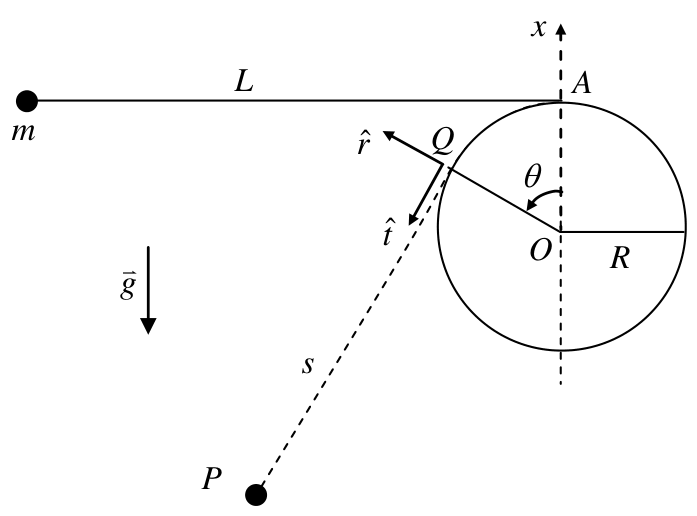
Figure 1a
Let \(O\) be the origin of the coordinate system. When the particle is at point \(P\), the string is tangential to the cylindrical surface at \(Q\). The length of the line segment \(QP\) is called \(s\). The unit tangent vector and the unit radial vector at \(Q\) are given by \(\hat t\) and \(\hat r\), respectively. The angular displacement \(\theta\) of the radius \(OQ\), as measured counterclockwise from the vertical \(x\)-axis along \(OA\), is taken to be positive.
When \(\theta=0\), the length \(s\) is equal to \(L\) and the gravitational potential energy \(U\) of the particle is zero. As the particle moves, the instantaneous time rates of change of \(\theta\) and \(s\) are given by \(\dot\theta\) and \(\dot s\), respectively.
Unless otherwise stated, all the speeds and velocities are relative to the fixed point \(O\).
Part A
In Part A, the string is taut as the particle moves. In terms of the quantities introduced above (i.e., \(s,\theta,\dot s,\dot\theta,R,L,g,\hat t\) and \(\hat r\)): find:
(a) The relation between \(\dot\theta\) and \(\dot s\). (0.5 point)
(b) The velocity \(\vec v_Q\) of the moving point \(Q\) relative to \(O\). (0.5 point)
(c) The particle’s velocity \(\vec v'\) relative to the moving point \(Q\) when it is at \(P\) (0.7 point)
(d) The particle’s velocity \(\vec v\) relative to \(O\) when it is at \(P\). (0.7 point)
(e) The \(\hat t\)-component of the particle’s acceleration relative to \(O\) when it is at \(P\). (0.7 point)
(f) The particle’s gravitational potential energy \(U\) when it is at \(P\). (0.5 point)
(g) The speed \(v_m\) of the particle at the lowest point of its trajectory. (0.7 point)
Part B
In Part B, the ratio \(L\) to \(R\) has the following value:
\[ \frac LR=\frac{9\pi}{8}+\frac23\cot\frac{\pi}{16} =3.534+3.352=6.886 \]
(h) What is the speed \(v_s\) of the particle when the string segment from \(Q\) to \(P\) is both straight and shortest in length? (in terms of \(g\) and \(R\)) (2.4 points)
(i) What is the speed \(v_H\) of the particle at its highest point \(H\) when it has swung to the other side of the rod? (in terms of \(g\) and \(R\)) (1.9 points)
Part C
In Part C, instead of being suspended from \(A\), the pendulum bob of mass \(m\) is connected by a string over the top of the rod to a heavier weight of mass \(M\), as shown in Figure 1b. The weight can also be treated as a particle.
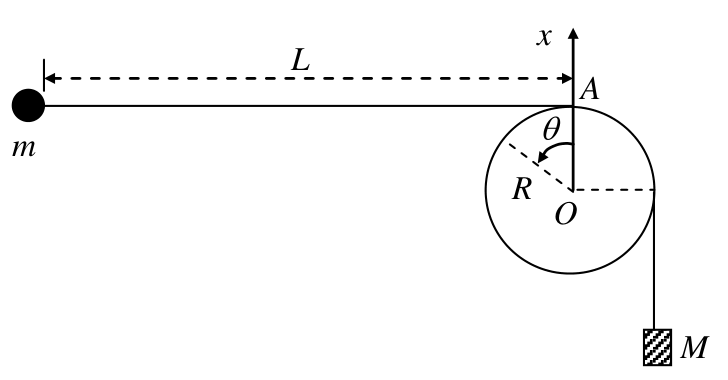
Figure 1b
Initially, the bob is held stationary at the same level as \(A\) so that, with the weight hanging below \(O\), the string is taut with a horizontal section of length \(L\). The bob is then released from rest and the weight starts falling. Assume that the bob remains in a vertical plane and can swing past the falling weight without any interruption.
The kinetic friction between the string and the rod surface is negligible. But the static friction is assumed to be large enough so that the weight will remain stationary once it has come to a stop (i.e. zero velocity).
(j) Assume that the weight indeed comes to a stop after falling a distance \(D\) and that \((L-D)\gg R\). If the particle can then swing around the rod to \(\theta=2\pi\) while both segments of the string free from the rod remain straight, the ratio \(\alpha=D/L\) must not be smaller than a critical value \(\alpha_c\). Neglecting terms of the order \(R/L\) or higher, obtain an estimate on \(\alpha_c\) in terms of \(M/m\). (3.4 points)
Official English text of the problem.
Problem 2: A Piezoelectric Crystal Resonator under an Alternating Voltage
Consider a uniform rod of unstressed length \(\ell\) and cross-sectional area \(A\) (Figure 2a). Its length changes by \(\Delta\ell\) when equal and opposite forces of magnitude \(F\) are applied to its ends faces normally. The stress \(T\) on the end faces is defined to be \(F/A\). The fractional change in its length, i.e., \(\Delta\ell/\ell\), is called the strain \(S\) of the rod. In terms of stress and strain, Hooke’s law may be expressed as
\[ T=YS \quad\text{or}\quad \frac{F}{A}=Y\frac{\Delta\ell}{\ell}. \tag{1} \]
where \(Y\) is called the Young’s modulus of the rod material. Note that a compressive stress \(T\) corresponds to \(F<0\) and a decrease in length (i.e., \(\Delta\ell<0\)). Such a stress is thus negative in value and is related to the pressure \(p\) by \(T=-p\).
For a uniform rod of density \(\rho\), the speed of propagation of longitudinal waves (i.e., sound speed) along the rod is given by
\[ u=\sqrt{Y/\rho}. \tag{2} \]
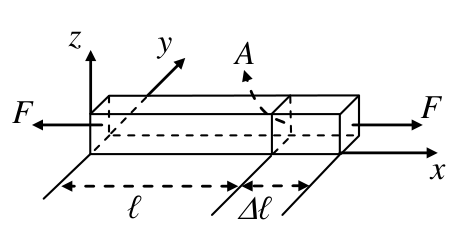
Figure 2a
The effect of damping and dissipation can be ignored in answering the following questions.
Part A: mechanical properties
A uniform rod of semi-infinite length, extending from \(x=0\) to \(\infty\) (see Figure 2b), has a density \(\rho\). It is initially stationary and unstressed. A piston then steadily exerts a small pressure \(p\) on its left face at \(x=0\) for a very short time \(\Delta t\), causing a pressure wave to propagate with speed \(u\) to the right.
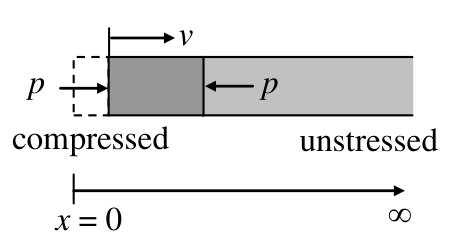
Figure 2b
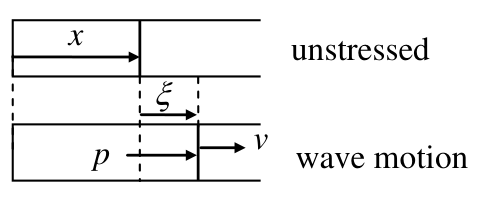
Figure 2c
(a) If the piston causes the rod’s left face to move at a constant velocity \(v\) (Figure 2b), what are the strain \(S\) and pressure \(p\) at the left face during the time \(\Delta t\)? Answers must be given in terms of \(\rho\), \(u\), and \(v\) only. (1.6 points)
(b) Consider a longitudinal wave traveling along the \(x\) direction in the rod. For a cross section at \(x\) when the rod is unstressed (Figure 2c), let \(\xi(x,t)\) be its displacement at time \(t\) and assume
\[ \xi(x,t)=\xi_0\sin k(x-ut) \tag{3} \]
where \(\xi_0\) and \(k\) are constants. Determine the corresponding velocity \(v(x,t)\), strain \(S(x,t)\), and pressure \(p(x,t)\) as a function of \(x\) and \(t\). (2.4 points)
Part B: electromechanical properties (including piezoelectric effect)
Consider a quartz crystal slab of length \(b\), thickness \(h\), and width \(w\) (Figure 2d). Its length and thickness are along the \(x\)-axis and \(z\)-axis. Electrodes are formed by thin metallic coatings at its top and bottom surfaces. Electrical leads that also serve as mounting support (Figure 2e) are soldered to the electrode’s centers, which may be assumed to be stationary for longitudinal oscillations along the \(x\) direction.
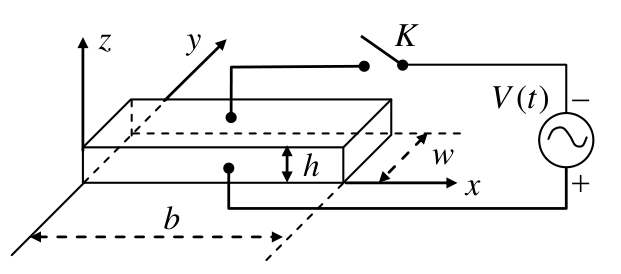
Figure 2d
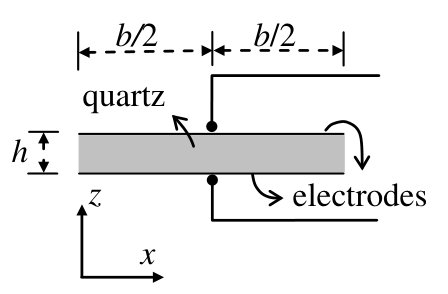
Figure 2e
The quartz crystal under consideration has a density \(\rho\) of \(2.65\times10^3\ \mathrm{kg/m^3}\) and Young’s modulus \(Y\) of \(7.87\times10^{10}\ \mathrm{N/m^2}\). The length \(b\) of the slab is \(1.00\ \mathrm{cm}\) and the width \(w\) and height \(h\) of the slab are such that \(h\ll w\) and \(w\ll b\). With switch \(K\) left open, we assume only longitudinal modes of standing wave oscillation in the \(x\) direction are excited in the quartz slab.
For a standing wave of frequency \(f=\omega/2\pi\), the displacement \(\xi(x,t)\) at time \(t\) of a cross section of the slab with equilibrium position \(x\) may be written as
\[ \xi(x,t)=2\xi_0g(x)\cos\omega t, \qquad (0\leq x\leq b) \tag{4a} \]
where \(\xi_0\) is a positive constant and the spatial function \(g(x)\) is of the form
\[ g(x)=B_1\sin k\left(x-\frac b2\right) +B_2\cos k\left(x-\frac b2\right). \tag{4b} \]
\(g(x)\) has the maximum value of one and \(k=\omega/u\). Keep in mind that the centers of the electrodes are stationary and the left and right faces of the slab are free and must have zero stress (or pressure).
(c) Determine the values of \(B_1\) and \(B_2\) in Eq. (4b) for a longitudinal standing wave in the quartz slab. (1.2 point)
(d) What are the two lowest frequencies at which longitudinal standing waves may be excited in the quartz slab? (1.2 point)
The piezoelectric effect is a special property of a quartz crystal. Compression or dilatation of the crystal generates an electric voltage across the crystal, and conversely, an external voltage applied across the crystal causes the crystal to expand or contract depending on the polarity of the voltage. Therefore, mechanical and electrical oscillations can be coupled and made to resonate through a quartz crystal.
To account for the piezoelectric effect, let the surface charge densities on the upper and lower electrodes be \(-\sigma\) and \(+\sigma\), respectively, when the quartz slab is under an electric field \(E\) in the \(z\) direction. Denote the slab’s strain and stress in the \(x\) direction by \(S\) and \(T\), respectively. Then the piezoelectric effect of the quartz crystal can be described by the following set of equations:
\[ S=(1/Y)T+d_pE \tag{5a} \]
\[ \sigma=d_pT+\varepsilon_TE \tag{5b} \]
where \(1/Y=1.27\times10^{-11}\ \mathrm{m^2/N}\) is the elastic compliance (i.e., inverse of Young’s modulus) at constant electric field and \(\varepsilon_T=4.06\times10^{-11}\ \mathrm{F/m}\) is the permittivity at constant stress, while \(d_p=2.25\times10^{-12}\ \mathrm{m/V}\) is the piezoelectric coefficient.
Let switch \(K\) in Fig. 2d be closed. The alternating voltage \(V(t)=V_m\cos\omega t\) now acts across the electrodes and a uniform electric field \(E(t)=V(t)/h\) in the \(z\) direction appears in the quartz slab. When a steady state is reached, a longitudinal standing wave oscillation of angular frequency \(\omega\) appears in the slab in the \(x\) direction.
With \(E\) being uniform, the wavelength \(\lambda\) and the frequency \(f\) of a longitudinal standing wave in the slab are still related by \(\lambda=u/f\) with \(u\) given by Eq. (2). But, as Eq. (5a) shows, \(T=YS\) is no longer valid, although the definitions of strain and stress remain unchanged and the end faces of the slab remain free with zero stress.
(e) Taking Eqs. (5a) and (5b) into account, the surface charge density \(\sigma\) on the lower electrode as a function of \(x\) and \(t\) is of the form,
\[ \sigma(x,t)= \left[ D_1\cos k\left(x-\frac b2\right)+D_2 \right]\frac{V(t)}h \]
where \(k=\omega/u\). Find the expressions for \(D_1\) and \(D_2\). (2.2 points)
(f) The total surface charge \(Q(t)\) on the lower electrode is related to \(V(t)\) by
\[ Q(t)= \left[ 1+\alpha^2\left(\frac{2}{kb}\tan\frac{kb}{2}-1\right) \right]C_0V(t). \tag{6} \]
Find the expression for \(C_0\) and the expression and numerical value of \(\alpha^2\). (1.4 points)
Official English text of the problem.
Problem 3: Neutrino Mass and Neutron Decay (Part A); Light Levitation (Part B)
Part A
Neutrino Mass and Neutron Decay
A free neutron of mass \(m_n\) decays at rest in the laboratory frame of reference into three non-interacting particles: a proton, an electron, and an anti-neutrino. The rest mass of the proton is \(m_p\), while the rest mass of the anti-neutrino \(m_v\) is assumed to be nonzero and much smaller than the rest mass of the electron \(m_e\). Denote the speed of light in vacuum by \(c\). The measured values of mass are as follows:
\[ m_n=939.56563\ \mathrm{MeV}/c^2,\quad m_p=938.27231\ \mathrm{MeV}/c^2,\quad m_e=0.5109907\ \mathrm{MeV}/c^2 \]
In the following, all energies and velocities are referred to the laboratory frame. Let \(E\) be the total energy of the electron coming out of the decay.
(a) Find the maximum possible value \(E_{\max}\) of \(E\) and the speed \(v_m\) of the anti-neutrino when \(E=E_{\max}\). Both answers must be expressed in terms of the rest masses of the particles and the speed of light. Given that \(m_v<7.3\ \mathrm{eV}/c^2\), compute \(E_{\max}\) and the ratio \(v_m/c\) to 3 significant digits.
(4.0 points)
Part B
Light Levitation
A transparent glass hemisphere with radius \(R\) and mass \(m\) has an index of refraction \(n\). In the medium outside the hemisphere, the index of refraction is equal to one. A parallel beam of monochromatic laser light is incident uniformly and normally onto the central portion of its planar surface, as shown in Figure 3. The acceleration of gravity \(\vec g\) is vertically downwards. The radius \(\delta\) of the circular cross-section of the laser beam is much smaller than \(R\). Both the glass hemisphere and the laser beam are axially symmetric with respect to the \(z\)-axis.
The glass hemisphere does not absorb any laser light. Its surface has been coated with a thin layer of transparent material so that reflections are negligible when light enters and leaves the glass hemisphere. The optical path traversed by laser light passing through the non-reflecting surface layer is also negligible.
(b) Neglecting terms of the order \((\delta/R)^3\) or higher, find the laser power \(P\) needed to balance the weight of the glass hemisphere.
(4.0 points)
Hint: \(\cos\theta\approx 1-\theta^2/2\) when \(\theta\) is much smaller than one.
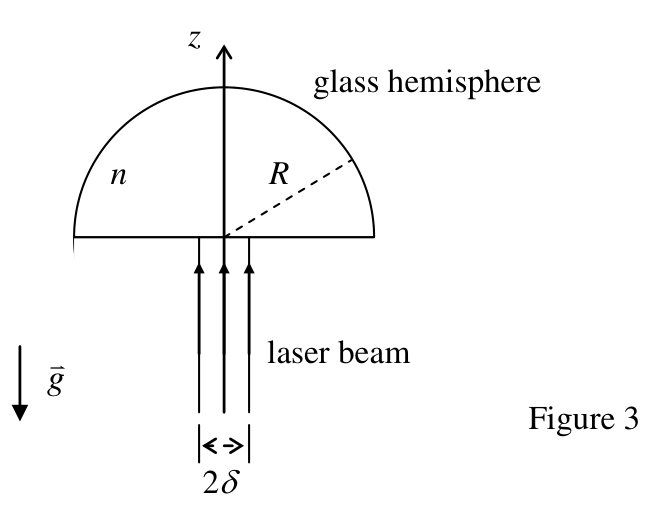
Figure 3
Official English text of the problem.
Internationale Physik-Olympiade
IPhO 2003
Taipeh, Taiwan · 3 Theorieaufgaben mit vollständigen Lösungen
Aufgabe 1: Eine Schaukel mit einem fallenden Gewicht
Ein starrer zylindrischer Stab mit dem Radius \(R\) wird waagerecht über dem Boden gehalten. An einem Faden mit vernachlässigbarer Masse und der Länge \(L\) (\(L>2\pi R\)) hängt ein Pendelkörper der Masse \(m\) vom Punkt \(A\) an der Oberseite des Stabs, wie in Abbildung 1a gezeigt. Der Pendelkörper wird angehoben, bis er sich auf gleicher Höhe mit \(A\) befindet, und dann bei gespanntem Faden aus der Ruhe losgelassen. Jegliche Dehnung des Fadens ist zu vernachlässigen. Es wird angenommen, dass der Pendelkörper als Massenpunkt behandelt werden kann und nur in einer Ebene senkrecht zur Achse des Stabs schwingt. Dementsprechend wird der Pendelkörper auch als Teilchen bezeichnet. Die Erdbeschleunigung ist \(\vec g\).
Abbildung 1a
Der Ursprung des Koordinatensystems sei \(O\). Wenn sich das Teilchen im Punkt \(P\) befindet, berührt der Faden die Zylinderoberfläche im Punkt \(Q\) tangential. Die Länge der Strecke \(QP\) wird mit \(s\) bezeichnet. Der tangentiale Einheitsvektor und der radiale Einheitsvektor bei \(Q\) werden mit \(\hat t\) beziehungsweise \(\hat r\) bezeichnet. Die Winkelauslenkung \(\theta\) des Radius \(OQ\), die von der vertikalen \(x\)-Achse entlang \(OA\) aus gegen den Uhrzeigersinn gemessen wird, wird als positiv definiert.
Für \(\theta=0\) ist die Länge \(s\) gleich \(L\), und die potenzielle Energie \(U\) des Teilchens im Schwerefeld ist null. Während sich das Teilchen bewegt, werden die momentanen zeitlichen Änderungsraten von \(\theta\) und \(s\) mit \(\dot\theta\) beziehungsweise \(\dot s\) bezeichnet.
Sofern nicht anders angegeben, beziehen sich alle Geschwindigkeitsbeträge und Geschwindigkeitsvektoren auf den festen Punkt \(O\).
Teil A
In Teil A ist der Faden während der Bewegung des Teilchens gespannt. Bestimmen Sie mithilfe der oben eingeführten Größen (d. h. \(s,\theta,\dot s,\dot\theta,R,L,g,\hat t\) und \(\hat r\)):
(a) Die Beziehung zwischen \(\dot\theta\) und \(\dot s\). (0.5 Punkte)
(b) Die Geschwindigkeit \(\vec v_Q\) des bewegten Punkts \(Q\) relativ zu \(O\). (0.5 Punkte)
(c) Die Geschwindigkeit \(\vec v'\) des Teilchens relativ zum bewegten Punkt \(Q\), wenn es sich in \(P\) befindet. (0.7 Punkte)
(d) Die Geschwindigkeit \(\vec v\) des Teilchens relativ zu \(O\), wenn es sich in \(P\) befindet. (0.7 Punkte)
(e) Die \(\hat t\)-Komponente der Beschleunigung des Teilchens relativ zu \(O\), wenn es sich in \(P\) befindet. (0.7 Punkte)
(f) Die potenzielle Energie \(U\) des Teilchens im Schwerefeld, wenn es sich in \(P\) befindet. (0.5 Punkte)
(g) Den Geschwindigkeitsbetrag \(v_m\) des Teilchens am tiefsten Punkt seiner Bahn. (0.7 Punkte)
Teil B
In Teil B hat das Verhältnis von \(L\) zu \(R\) den folgenden Wert:
\[ \frac LR=\frac{9\pi}{8}+\frac23\cot\frac{\pi}{16} =3.534+3.352=6.886 \]
(h) Wie groß ist der Geschwindigkeitsbetrag \(v_s\) des Teilchens, wenn der Fadenabschnitt von \(Q\) bis \(P\) sowohl gerade ist als auch seine kürzeste Länge hat? (Ausgedrückt durch \(g\) und \(R\)) (2.4 Punkte)
(i) Wie groß ist der Geschwindigkeitsbetrag \(v_H\) des Teilchens an seinem höchsten Punkt \(H\), nachdem es auf die andere Seite des Stabs geschwungen ist? (Ausgedrückt durch \(g\) und \(R\)) (1.9 Punkte)
Teil C
In Teil C hängt der Pendelkörper der Masse \(m\) nicht von \(A\), sondern ist durch einen über die Oberseite des Stabs geführten Faden mit einem schwereren Gewicht der Masse \(M\) verbunden, wie in Abbildung 1b gezeigt. Das Gewicht kann ebenfalls als Teilchen behandelt werden.
Abbildung 1b
Anfangs wird der Pendelkörper auf gleicher Höhe mit \(A\) in Ruhe gehalten, sodass der Faden bei unterhalb von \(O\) hängendem Gewicht gespannt ist und einen waagerechten Abschnitt der Länge \(L\) aufweist. Dann wird der Pendelkörper aus der Ruhe losgelassen, und das Gewicht beginnt zu fallen. Es wird angenommen, dass der Pendelkörper in einer vertikalen Ebene bleibt und ungehindert am fallenden Gewicht vorbeischwingen kann.
Die Gleitreibung zwischen dem Faden und der Oberfläche des Stabs ist vernachlässigbar. Es wird jedoch angenommen, dass die Haftreibung groß genug ist, damit das Gewicht in Ruhe bleibt, sobald es zum Stillstand gekommen ist (d. h. die Geschwindigkeit null erreicht hat).
(j) Nehmen Sie an, dass das Gewicht tatsächlich zum Stillstand kommt, nachdem es eine Strecke \(D\) gefallen ist, und dass \((L-D)\gg R\) gilt. Wenn das Teilchen anschließend bis \(\theta=2\pi\) um den Stab schwingen kann, während beide nicht am Stab anliegenden Fadenabschnitte gerade bleiben, darf das Verhältnis \(\alpha=D/L\) nicht kleiner als ein kritischer Wert \(\alpha_c\) sein. Vernachlässigen Sie Terme der Ordnung \(R/L\) oder höher und bestimmen Sie eine Näherung für \(\alpha_c\) in Abhängigkeit von \(M/m\). (3.4 Punkte)
Aufgabentext aus dem offiziellen englischen Text übersetzt.
Aufgabe 2: Ein piezoelektrischer Kristallresonator unter Wechselspannung
Betrachten Sie einen homogenen Stab mit der unbelasteten Länge \(\ell\) und der Querschnittsfläche \(A\) (Abbildung 2a). Seine Länge ändert sich um \(\Delta\ell\), wenn an seinen Stirnflächen senkrecht zu diesen gleich große, entgegengesetzt gerichtete Kräfte vom Betrag \(F\) angreifen. Die mechanische Spannung \(T\) an den Stirnflächen ist als \(F/A\) definiert. Die relative Längenänderung, also \(\Delta\ell/\ell\), wird als Dehnung \(S\) des Stabes bezeichnet. Mithilfe von Spannung und Dehnung lässt sich das Hooke’sche Gesetz schreiben als
\[ T=YS \quad\text{oder}\quad \frac{F}{A}=Y\frac{\Delta\ell}{\ell}. \tag{1} \]
Dabei wird \(Y\) als Elastizitätsmodul des Stabmaterials bezeichnet. Beachten Sie, dass eine Druckspannung \(T\) einer Kraft \(F<0\) und einer Längenabnahme (also \(\Delta\ell<0\)) entspricht. Eine solche Spannung ist somit negativ und hängt mit dem Druck \(p\) über \(T=-p\) zusammen.
Für einen homogenen Stab der Dichte \(\rho\) ist die Ausbreitungsgeschwindigkeit von Longitudinalwellen (also die Schallgeschwindigkeit) entlang des Stabes gegeben durch
\[ u=\sqrt{Y/\rho}. \tag{2} \]
Abbildung 2a
Der Einfluss von Dämpfung und Dissipation kann bei der Beantwortung der folgenden Fragen vernachlässigt werden.
Teil A: mechanische Eigenschaften
Ein homogener, halbunendlich langer Stab, der sich von \(x=0\) bis \(\infty\) erstreckt (siehe Abbildung 2b), hat die Dichte \(\rho\). Er ruht zunächst und ist unbelastet. Ein Kolben übt dann während einer sehr kurzen Zeit \(\Delta t\) einen konstanten, kleinen Druck \(p\) auf seine linke Stirnfläche bei \(x=0\) aus, wodurch sich eine Druckwelle mit der Geschwindigkeit \(u\) nach rechts ausbreitet.
Abbildung 2b
Abbildung 2c
(a) Wenn der Kolben bewirkt, dass sich die linke Stirnfläche des Stabes mit einer konstanten Geschwindigkeit \(v\) bewegt (Abbildung 2b), wie groß sind dann die Dehnung \(S\) und der Druck \(p\) an der linken Stirnfläche während der Zeit \(\Delta t\)? Die Antworten dürfen nur durch \(\rho\), \(u\) und \(v\) ausgedrückt werden. (1.6 Punkte)
(b) Betrachten Sie eine Longitudinalwelle, die sich im Stab in \(x\)-Richtung ausbreitet. Für einen Querschnitt, der sich im unbelasteten Stab bei \(x\) befindet (Abbildung 2c), sei \(\xi(x,t)\) seine Verschiebung zum Zeitpunkt \(t\), und es gelte
\[ \xi(x,t)=\xi_0\sin k(x-ut) \tag{3} \]
Dabei sind \(\xi_0\) und \(k\) Konstanten. Bestimmen Sie die zugehörige Geschwindigkeit \(v(x,t)\), Dehnung \(S(x,t)\) und den Druck \(p(x,t)\) als Funktionen von \(x\) und \(t\). (2.4 Punkte)
Teil B: elektromechanische Eigenschaften (einschließlich des piezoelektrischen Effekts)
Betrachten Sie eine Quarzkristallplatte der Länge \(b\), der Dicke \(h\) und der Breite \(w\) (Abbildung 2d). Ihre Länge und Dicke verlaufen entlang der \(x\)- bzw. \(z\)-Achse. Dünne metallische Beschichtungen auf ihrer Ober- und Unterseite bilden Elektroden. Elektrische Zuleitungen, die zugleich als Halterung dienen (Abbildung 2e), sind an die Mittelpunkte der Elektroden gelötet; diese Mittelpunkte können bei longitudinalen Schwingungen in \(x\)-Richtung als ruhend angenommen werden.
Abbildung 2d
Abbildung 2e
Der betrachtete Quarzkristall hat eine Dichte \(\rho\) von \(2.65\times10^3\ \mathrm{kg/m^3}\) und einen Elastizitätsmodul \(Y\) von \(7.87\times10^{10}\ \mathrm{N/m^2}\). Die Länge \(b\) der Platte beträgt \(1.00\ \mathrm{cm}\), und die Breite \(w\) und Höhe \(h\) der Platte sind so gewählt, dass \(h\ll w\) und \(w\ll b\) gelten. Bei geöffnetem Schalter \(K\) nehmen wir an, dass in der Quarzplatte nur longitudinale Moden stehender Wellen in \(x\)-Richtung angeregt werden.
Für eine stehende Welle der Frequenz \(f=\omega/2\pi\) lässt sich die Verschiebung \(\xi(x,t)\) eines Querschnitts der Platte mit der Gleichgewichtslage \(x\) zum Zeitpunkt \(t\) schreiben als
\[ \xi(x,t)=2\xi_0g(x)\cos\omega t, \qquad (0\leq x\leq b) \tag{4a} \]
Dabei ist \(\xi_0\) eine positive Konstante, und die Ortsfunktion \(g(x)\) hat die Form
\[ g(x)=B_1\sin k\left(x-\frac b2\right) +B_2\cos k\left(x-\frac b2\right). \tag{4b} \]
\(g(x)\) hat den Maximalwert eins, und es gilt \(k=\omega/u\). Beachten Sie, dass die Mittelpunkte der Elektroden ruhen und die linke und rechte Stirnfläche der Platte frei sind, sodass dort die mechanische Spannung (bzw. der Druck) null sein muss.
(c) Bestimmen Sie die Werte von \(B_1\) und \(B_2\) in Gl. (4b) für eine longitudinale stehende Welle in der Quarzplatte. (1.2 Punkte)
(d) Welches sind die beiden niedrigsten Frequenzen, bei denen longitudinale stehende Wellen in der Quarzplatte angeregt werden können? (1.2 Punkte)
Der piezoelektrische Effekt ist eine besondere Eigenschaft eines Quarzkristalls. Eine Kompression oder Dehnung des Kristalls erzeugt eine elektrische Spannung am Kristall; umgekehrt bewirkt eine von außen an den Kristall angelegte Spannung je nach ihrer Polarität eine Ausdehnung oder Kontraktion des Kristalls. Daher können mechanische und elektrische Schwingungen durch einen Quarzkristall gekoppelt und in Resonanz gebracht werden.
Um den piezoelektrischen Effekt zu berücksichtigen, seien die Flächenladungsdichten auf der oberen und unteren Elektrode \(-\sigma\) bzw. \(+\sigma\), wenn die Quarzplatte einem elektrischen Feld \(E\) in \(z\)-Richtung ausgesetzt ist. Die Dehnung und die mechanische Spannung der Platte in \(x\)-Richtung seien mit \(S\) bzw. \(T\) bezeichnet. Dann lässt sich der piezoelektrische Effekt des Quarzkristalls durch das folgende Gleichungssystem beschreiben:
\[ S=(1/Y)T+d_pE \tag{5a} \]
\[ \sigma=d_pT+\varepsilon_TE \tag{5b} \]
Dabei ist \(1/Y=1.27\times10^{-11}\ \mathrm{m^2/N}\) die elastische Nachgiebigkeit (also der Kehrwert des Elastizitätsmoduls) bei konstantem elektrischem Feld, \(\varepsilon_T=4.06\times10^{-11}\ \mathrm{F/m}\) die Permittivität bei konstanter mechanischer Spannung und \(d_p=2.25\times10^{-12}\ \mathrm{m/V}\) der piezoelektrische Koeffizient.
Nun werde der Schalter \(K\) in Abb. 2d geschlossen. Die Wechselspannung \(V(t)=V_m\cos\omega t\) liegt jetzt zwischen den Elektroden an, und in der Quarzplatte entsteht ein homogenes elektrisches Feld \(E(t)=V(t)/h\) in \(z\)-Richtung. Nach Erreichen des eingeschwungenen Zustands schwingt die Platte in \(x\)-Richtung in Form einer longitudinalen stehenden Welle mit der Kreisfrequenz \(\omega\).
Da \(E\) homogen ist, hängen die Wellenlänge \(\lambda\) und die Frequenz \(f\) einer longitudinalen stehenden Welle in der Platte weiterhin über \(\lambda=u/f\) zusammen, wobei \(u\) durch Gl. (2) gegeben ist. Wie Gl. (5a) zeigt, gilt jedoch \(T=YS\) nicht mehr, obwohl die Definitionen von Dehnung und mechanischer Spannung unverändert bleiben und die Stirnflächen der Platte weiterhin frei und spannungsfrei sind.
(e) Unter Berücksichtigung der Gln. (5a) und (5b) hat die Flächenladungsdichte \(\sigma\) auf der unteren Elektrode als Funktion von \(x\) und \(t\) die Form
\[ \sigma(x,t)= \left[ D_1\cos k\left(x-\frac b2\right)+D_2 \right]\frac{V(t)}h \]
Dabei ist \(k=\omega/u\). Bestimmen Sie die Ausdrücke für \(D_1\) und \(D_2\). (2.2 Punkte)
(f) Die gesamte Oberflächenladung \(Q(t)\) auf der unteren Elektrode hängt mit \(V(t)\) über
\[ Q(t)= \left[ 1+\alpha^2\left(\frac{2}{kb}\tan\frac{kb}{2}-1\right) \right]C_0V(t) \tag{6} \]
zusammen. Bestimmen Sie den Ausdruck für \(C_0\) sowie den Ausdruck und den Zahlenwert von \(\alpha^2\). (1.4 Punkte)
Aufgabentext aus dem offiziellen englischen Text übersetzt.
Aufgabe 3: Neutrinomasse und Neutronenzerfall (Teil A); Schweben durch Licht (Teil B)
Teil A
Neutrinomasse und Neutronenzerfall
Ein freies Neutron der Masse \(m_n\) zerfällt im Laborsystem aus der Ruhe in drei nicht miteinander wechselwirkende Teilchen: ein Proton, ein Elektron und ein Antineutrino. Die Ruhemasse des Protons ist \(m_p\), während angenommen wird, dass die Ruhemasse des Antineutrinos \(m_v\) von null verschieden und viel kleiner als die Ruhemasse des Elektrons \(m_e\) ist. Die Lichtgeschwindigkeit im Vakuum wird mit \(c\) bezeichnet. Die gemessenen Massenwerte lauten:
\[ m_n=939.56563\ \mathrm{MeV}/c^2,\quad m_p=938.27231\ \mathrm{MeV}/c^2,\quad m_e=0.5109907\ \mathrm{MeV}/c^2 \]
Im Folgenden beziehen sich alle Energien und Geschwindigkeiten auf das Laborsystem. Sei \(E\) die Gesamtenergie des beim Zerfall entstehenden Elektrons.
(a) Bestimmen Sie den größtmöglichen Wert \(E_{\max}\) von \(E\) und die Geschwindigkeit \(v_m\) des Antineutrinos für \(E=E_{\max}\). Beide Antworten müssen durch die Ruhemassen der Teilchen und die Lichtgeschwindigkeit ausgedrückt werden. Berechnen Sie unter der Voraussetzung \(m_v<7.3\ \mathrm{eV}/c^2\) die Werte von \(E_{\max}\) und des Verhältnisses \(v_m/c\) auf 3 signifikante Stellen.
(4.0 Punkte)
Teil B
Schweben durch Licht
Eine transparente Glashalbkugel mit dem Radius \(R\) und der Masse \(m\) hat den Brechungsindex \(n\). Im Medium außerhalb der Halbkugel ist der Brechungsindex gleich eins. Ein paralleles Bündel monochromatischen Laserlichts fällt gleichmäßig und senkrecht auf den mittleren Bereich ihrer ebenen Oberfläche, wie in Abbildung 3 dargestellt. Die Erdbeschleunigung \(\vec g\) ist senkrecht nach unten gerichtet. Der Radius \(\delta\) des kreisförmigen Querschnitts des Laserstrahls ist viel kleiner als \(R\). Sowohl die Glashalbkugel als auch der Laserstrahl sind rotationssymmetrisch bezüglich der \(z\)-Achse.
Die Glashalbkugel absorbiert kein Laserlicht. Ihre Oberfläche ist mit einer dünnen Schicht aus transparentem Material beschichtet, sodass Reflexionen beim Eintritt des Lichts in die Glashalbkugel und beim Austritt aus ihr vernachlässigbar sind. Auch die optische Weglänge, die das Laserlicht beim Durchgang durch die reflexionsfreie Oberflächenschicht zurücklegt, ist vernachlässigbar.
(b) Bestimmen Sie unter Vernachlässigung von Termen der Ordnung \((\delta/R)^3\) oder höher die Laserleistung \(P\), die erforderlich ist, um die Gewichtskraft der Glashalbkugel auszugleichen.
(4.0 Punkte)
Hinweis: \(\cos\theta\approx 1-\theta^2/2\), wenn \(\theta\) viel kleiner als eins ist.
Abbildung 3
Aufgabentext aus dem offiziellen englischen Text übersetzt.
Uluslararası Fizik Olimpiyatı
IPhO 2003
Taipei, Tayvan · 3 teori sorusu, tam çözümleriyle
Soru 1: Düşen Bir Ağırlıkla Salınım
Yarıçapı \(R\) olan rijit silindirik bir çubuk, yerden yüksekte yatay olarak tutulmaktadır. Kütlesi ihmal edilebilir, uzunluğu \(L\) (\(L>2\pi R\)) olan bir iple, kütlesi \(m\) olan bir sarkaç cismi, Şekil 1a'da gösterildiği gibi çubuğun tepesindeki \(A\) noktasından asılmıştır. Cisim, \(A\) ile aynı yüksekliğe gelinceye kadar kaldırılır ve ardından ip gerginken durgun hâlden serbest bırakılır. İpin uzamasını ihmal ediniz. Sarkaç cisminin noktasal bir kütle olarak ele alınabileceğini ve yalnızca çubuğun eksenine dik bir düzlemde salındığını varsayınız. Bu nedenle sarkaç cismi parçacık olarak da adlandırılacaktır. Yerçekimi ivmesi \(\vec g\)'dir.
Şekil 1a
Koordinat sisteminin başlangıç noktası \(O\) olsun. Parçacık \(P\) noktasındayken ip, silindirik yüzeye \(Q\) noktasında teğettir. \(QP\) doğru parçasının uzunluğu \(s\) olarak adlandırılır. \(Q\) noktasındaki birim teğet vektörü ve birim radyal vektör sırasıyla \(\hat t\) ve \(\hat r\) ile gösterilir. \(OQ\) yarıçapının \(\theta\) açısal yer değiştirmesi, \(OA\) doğrultusundaki düşey \(x\) ekseninden saat yönünün tersine ölçüldüğünde pozitif kabul edilir.
\(\theta=0\) iken \(s\) uzunluğu \(L\)'ye eşittir ve parçacığın kütleçekim potansiyel enerjisi \(U\) sıfırdır. Parçacık hareket ederken \(\theta\) ve \(s\)'nin zamana göre anlık değişim hızları sırasıyla \(\dot\theta\) ve \(\dot s\) ile gösterilir.
Aksi belirtilmedikçe tüm süratler ve hızlar, sabit \(O\) noktasına göredir.
Bölüm A
Bölüm A'da parçacık hareket ederken ip gergindir. Yukarıda tanımlanan nicelikler (yani \(s,\theta,\dot s,\dot\theta,R,L,g,\hat t\) ve \(\hat r\)) cinsinden aşağıdakileri bulunuz:
(a) \(\dot\theta\) ile \(\dot s\) arasındaki bağıntı. (0.5 puan)
(b) Hareketli \(Q\) noktasının \(O\)'ya göre \(\vec v_Q\) hızı. (0.5 puan)
(c) Parçacık \(P\)'deyken hareketli \(Q\) noktasına göre \(\vec v'\) hızı. (0.7 puan)
(d) Parçacık \(P\)'deyken \(O\)'ya göre \(\vec v\) hızı. (0.7 puan)
(e) Parçacık \(P\)'deyken \(O\)'ya göre ivmesinin \(\hat t\) bileşeni. (0.7 puan)
(f) Parçacık \(P\)'deyken kütleçekim potansiyel enerjisi \(U\). (0.5 puan)
(g) Parçacığın yörüngesinin en alçak noktasındaki \(v_m\) sürati. (0.7 puan)
Bölüm B
Bölüm B'de \(L\)'nin \(R\)'ye oranı aşağıdaki değere sahiptir:
\[ \frac LR=\frac{9\pi}{8}+\frac23\cot\frac{\pi}{16} =3.534+3.352=6.886 \]
(h) İpin \(Q\)'dan \(P\)'ye uzanan kısmı hem düz hem de en kısa uzunluktayken parçacığın \(v_s\) sürati nedir? (\(g\) ve \(R\) cinsinden) (2.4 puan)
(i) Parçacık çubuğun diğer tarafına salındığında ulaştığı en yüksek \(H\) noktasındaki \(v_H\) sürati nedir? (\(g\) ve \(R\) cinsinden) (1.9 puan)
Bölüm C
Bölüm C'de, kütlesi \(m\) olan sarkaç cismi \(A\)'dan asılmak yerine, Şekil 1b'de gösterildiği gibi çubuğun üstünden geçen bir iple kütlesi \(M\) olan daha ağır bir ağırlığa bağlanmıştır. Ağırlık da bir parçacık olarak ele alınabilir.
Şekil 1b
Başlangıçta sarkaç cismi \(A\) ile aynı yükseklikte hareketsiz tutulur; bu durumda ağırlık \(O\)'nun altında asılı dururken ip gergindir ve yatay kısmının uzunluğu \(L\)'dir. Ardından sarkaç cismi durgun hâlden serbest bırakılır ve ağırlık düşmeye başlar. Sarkaç cisminin düşey bir düzlemde kaldığını ve düşen ağırlığın yanından hareketi kesintiye uğramadan salınarak geçebildiğini varsayınız.
İp ile çubuğun yüzeyi arasındaki kinetik sürtünme ihmal edilebilir. Ancak statik sürtünmenin, ağırlığın bir kez durduktan (yani hızı sıfır olduktan) sonra hareketsiz kalmasını sağlayacak kadar büyük olduğu varsayılmaktadır.
(j) Ağırlığın gerçekten de \(D\) kadar düştükten sonra durduğunu ve \((L-D)\gg R\) olduğunu varsayınız. Parçacığın bundan sonra, ipin çubuğa temas etmeyen her iki kısmı da düz kalacak şekilde çubuğun çevresinde \(\theta=2\pi\)'ye kadar salınabilmesi için \(\alpha=D/L\) oranı, kritik bir \(\alpha_c\) değerinden küçük olmamalıdır. \(R/L\) mertebesindeki ve daha yüksek mertebedeki terimleri ihmal ederek \(\alpha_c\) için \(M/m\) cinsinden bir tahmin elde ediniz. (3.4 puan)
Soru metni resmi İngilizce metinden çevrilmiştir.
Soru 2: Alternatif Gerilim Altında Bir Piezoelektrik Kristal Rezonatör
Gerilmesiz durumdaki uzunluğu \(\ell\), kesit alanı \(A\) olan düzgün bir çubuk ele alalım (Şekil 2a). Uç yüzeylerine dik olarak, büyüklükleri \(F\) olan eşit ve zıt yönlü kuvvetler uygulandığında uzunluğu \(\Delta\ell\) kadar değişir. Uç yüzeylerindeki gerilme \(T\), \(F/A\) olarak tanımlanır. Uzunluğundaki bağıl değişime, yani \(\Delta\ell/\ell\) oranına, çubuğun birim şekil değiştirmesi \(S\) denir. Hooke yasası, gerilme ve birim şekil değiştirme cinsinden şöyle ifade edilebilir:
\[ T=YS \quad\text{veya}\quad \frac{F}{A}=Y\frac{\Delta\ell}{\ell}. \tag{1} \]
Burada \(Y\), çubuk malzemesinin Young modülü olarak adlandırılır. Bir basma gerilmesi \(T\)'nin, \(F<0\) durumuna ve uzunlukta bir azalmaya (yani \(\Delta\ell<0\)) karşılık geldiğine dikkat ediniz. Dolayısıyla böyle bir gerilmenin değeri negatiftir ve basınç \(p\) ile ilişkisi \(T=-p\) şeklindedir.
Yoğunluğu \(\rho\) olan düzgün bir çubukta, boyuna dalgaların çubuk boyunca yayılma hızı (yani ses hızı) şu şekilde verilir:
\[ u=\sqrt{Y/\rho}. \tag{2} \]
Şekil 2a
Aşağıdaki soruları yanıtlarken sönüm ve enerji kaybının etkileri ihmal edilebilir.
Bölüm A: mekanik özellikler
\(x=0\)'dan \(\infty\)'a uzanan (bkz. Şekil 2b), yarı sonsuz uzunluktaki düzgün bir çubuğun yoğunluğu \(\rho\)'dur. Çubuk başlangıçta durgun ve gerilmesizdir. Ardından bir piston, \(x=0\)'daki sol yüzeye çok kısa bir \(\Delta t\) süresi boyunca sabit ve küçük bir \(p\) basıncı uygulayarak sağa doğru \(u\) hızıyla yayılan bir basınç dalgası oluşturur.
Şekil 2b
Şekil 2c
(a) Piston, çubuğun sol yüzeyinin sabit bir \(v\) hızıyla hareket etmesine neden oluyorsa (Şekil 2b), \(\Delta t\) süresi boyunca sol yüzeydeki birim şekil değiştirme \(S\) ve basınç \(p\) nedir? Yanıtlar yalnızca \(\rho\), \(u\) ve \(v\) cinsinden verilmelidir. (1.6 puan)
(b) Çubuk içinde \(x\) doğrultusunda ilerleyen bir boyuna dalga ele alalım. Çubuk gerilmesizken \(x\) konumunda bulunan bir kesitin (Şekil 2c) \(t\) anındaki yer değiştirmesi \(\xi(x,t)\) olsun ve
\[ \xi(x,t)=\xi_0\sin k(x-ut) \tag{3} \]
olduğunu varsayalım; burada \(\xi_0\) ve \(k\) sabittir. Buna karşılık gelen hız \(v(x,t)\), birim şekil değiştirme \(S(x,t)\) ve basınç \(p(x,t)\) ifadelerini \(x\) ve \(t\)'nin fonksiyonu olarak belirleyiniz. (2.4 puan)
Bölüm B: elektromekanik özellikler (piezoelektrik etki dâhil)
Uzunluğu \(b\), kalınlığı \(h\) ve genişliği \(w\) olan bir kuvars kristali levha ele alalım (Şekil 2d). Uzunluğu \(x\) ekseni, kalınlığı ise \(z\) ekseni doğrultusundadır. Üst ve alt yüzeylerindeki ince metal kaplamalar elektrotları oluşturur. Aynı zamanda levhayı taşıyan destekler olarak da işlev gören elektrik bağlantı telleri (Şekil 2e), elektrotların merkezlerine lehimlenmiştir; bu merkezlerin \(x\) doğrultusundaki boyuna salınımlar sırasında hareketsiz kaldığı varsayılabilir.
Şekil 2d
Şekil 2e
Ele alınan kuvars kristalinin yoğunluğu \(\rho\), \(2.65\times10^3\ \mathrm{kg/m^3}\) ve Young modülü \(Y\), \(7.87\times10^{10}\ \mathrm{N/m^2}\)'dir. Levhanın uzunluğu \(b\), \(1.00\ \mathrm{cm}\)'dir; genişliği \(w\) ve yüksekliği \(h\), \(h\ll w\) ve \(w\ll b\) koşullarını sağlar. \(K\) anahtarı açık bırakıldığında, kuvars levhada yalnızca \(x\) doğrultusundaki boyuna duran dalga salınım modlarının uyarıldığını varsayıyoruz.
Frekansı \(f=\omega/2\pi\) olan bir duran dalga için, levhanın denge konumu \(x\) olan bir kesitinin \(t\) anındaki yer değiştirmesi \(\xi(x,t)\) şöyle yazılabilir:
\[ \xi(x,t)=2\xi_0g(x)\cos\omega t, \qquad (0\leq x\leq b) \tag{4a} \]
Burada \(\xi_0\) pozitif bir sabittir ve konuma bağlı \(g(x)\) fonksiyonu şu biçimdedir:
\[ g(x)=B_1\sin k\left(x-\frac b2\right) +B_2\cos k\left(x-\frac b2\right). \tag{4b} \]
\(g(x)\)'in maksimum değeri birdir ve \(k=\omega/u\)'dur. Elektrotların merkezlerinin hareketsiz olduğunu, levhanın sol ve sağ yüzeylerinin serbest olduğunu ve bu yüzeylerde gerilmenin (veya basıncın) sıfır olması gerektiğini unutmayınız.
(c) Kuvars levhadaki bir boyuna duran dalga için Denklem (4b)'deki \(B_1\) ve \(B_2\) değerlerini belirleyiniz. (1.2 puan)
(d) Kuvars levhada boyuna duran dalgaların uyarılabileceği en düşük iki frekans nedir? (1.2 puan)
Piezoelektrik etki, kuvars kristalinin özel bir özelliğidir. Kristalin sıkıştırılması veya genleşmesi, kristalin iki yüzü arasında bir elektrik gerilimi oluşturur; tersine, kristalin iki yüzü arasına uygulanan dış gerilim, gerilimin kutupluluğuna bağlı olarak kristalin genleşmesine veya büzülmesine neden olur. Dolayısıyla mekanik ve elektriksel salınımlar, bir kuvars kristali aracılığıyla birbirine bağlanabilir ve rezonansa getirilebilir.
Piezoelektrik etkiyi hesaba katmak için, kuvars levha \(z\) doğrultusunda bir \(E\) elektrik alanı altındayken üst ve alt elektrotlardaki yüzey yük yoğunlukları sırasıyla \(-\sigma\) ve \(+\sigma\) olsun. Levhanın \(x\) doğrultusundaki birim şekil değiştirmesini ve gerilmesini sırasıyla \(S\) ve \(T\) ile gösterelim. Bu durumda kuvars kristalinin piezoelektrik etkisi aşağıdaki denklem takımıyla betimlenebilir:
\[ S=(1/Y)T+d_pE \tag{5a} \]
\[ \sigma=d_pT+\varepsilon_TE \tag{5b} \]
Burada \(1/Y=1.27\times10^{-11}\ \mathrm{m^2/N}\), sabit elektrik alan altındaki elastik uyumluluk (yani Young modülünün tersi); \(\varepsilon_T=4.06\times10^{-11}\ \mathrm{F/m}\), sabit gerilme altındaki elektriksel geçirgenlik; \(d_p=2.25\times10^{-12}\ \mathrm{m/V}\) ise piezoelektrik katsayısıdır.
Şekil 2d'deki \(K\) anahtarı kapatılsın. Artık elektrotlar arasına \(V(t)=V_m\cos\omega t\) alternatif gerilimi uygulanır ve kuvars levhada \(z\) doğrultusunda düzgün bir \(E(t)=V(t)/h\) elektrik alanı oluşur. Kararlı duruma ulaşıldığında, levhada \(x\) doğrultusunda açısal frekansı \(\omega\) olan bir boyuna duran dalga salınımı oluşur.
\(E\) düzgün olduğundan, levhadaki bir boyuna duran dalganın dalga boyu \(\lambda\) ile frekansı \(f\) arasındaki ilişki hâlâ \(\lambda=u/f\) biçimindedir; burada \(u\), Denklem (2) ile verilir. Ancak Denklem (5a)'nın gösterdiği gibi, birim şekil değiştirme ve gerilme tanımları değişmemesine ve levhanın uç yüzeyleri sıfır gerilmeli serbest yüzeyler olarak kalmasına rağmen, \(T=YS\) artık geçerli değildir.
(e) Denklem (5a) ve (5b) hesaba katıldığında, alt elektrottaki yüzey yük yoğunluğu \(\sigma\), \(x\) ve \(t\)'nin fonksiyonu olarak şu biçimdedir:
\[ \sigma(x,t)= \left[ D_1\cos k\left(x-\frac b2\right)+D_2 \right]\frac{V(t)}h \]
Burada \(k=\omega/u\)'dur. \(D_1\) ve \(D_2\) için ifadeleri bulunuz. (2.2 puan)
(f) Alt elektrottaki toplam yüzey yükü \(Q(t)\) ile \(V(t)\) arasındaki ilişki şöyledir:
\[ Q(t)= \left[ 1+\alpha^2\left(\frac{2}{kb}\tan\frac{kb}{2}-1\right) \right]C_0V(t). \tag{6} \]
\(C_0\) için ifadeyi ve \(\alpha^2\) için hem ifadeyi hem de sayısal değeri bulunuz. (1.4 puan)
Soru metni resmi İngilizce metinden çevrilmiştir.
Soru 3: Nötrino Kütlesi ve Nötron Bozunması (Bölüm A); Işıkla Havada Tutma (Bölüm B)
Bölüm A
Nötrino Kütlesi ve Nötron Bozunması
Laboratuvar referans sisteminde durmakta olan, kütlesi \(m_n\) olan serbest bir nötron, birbiriyle etkileşmeyen üç parçacığa bozunur: bir proton, bir elektron ve bir antinötrino. Protonun durgun kütlesi \(m_p\)'dir; antinötrinonun durgun kütlesi \(m_v\)'nin ise sıfırdan farklı ve elektronun durgun kütlesi \(m_e\)'den çok küçük olduğu varsayılmaktadır. Işığın boşluktaki hızını \(c\) ile gösterelim. Kütlelerin ölçülen değerleri şöyledir:
\[ m_n=939.56563\ \mathrm{MeV}/c^2,\quad m_p=938.27231\ \mathrm{MeV}/c^2,\quad m_e=0.5109907\ \mathrm{MeV}/c^2 \]
Aşağıda tüm enerjiler ve hızlar laboratuvar referans sistemine göredir. Bozunmadan çıkan elektronun toplam enerjisi \(E\) olsun.
(a) \(E\)'nin alabileceği en büyük değer olan \(E_{\max}\)'ı ve \(E=E_{\max}\) olduğunda antinötrinonun sürati \(v_m\)'yi bulunuz. Her iki yanıt da parçacıkların durgun kütleleri ve ışık hızı cinsinden ifade edilmelidir. \(m_v<7.3\ \mathrm{eV}/c^2\) olduğu verildiğine göre, \(E_{\max}\)'ı ve \(v_m/c\) oranını 3 anlamlı basamakla hesaplayınız.
(4.0 puan)
Bölüm B
Işıkla Havada Tutma
Yarıçapı \(R\) ve kütlesi \(m\) olan saydam bir cam yarımkürenin kırılma indisi \(n\)'dir. Yarımkürenin dışındaki ortamın kırılma indisi bire eşittir. Tek renkli, paralel bir lazer ışık demeti, Şekil 3'te gösterildiği gibi yarımkürenin düz yüzeyinin merkezî bölümüne düzgün dağılımlı olarak ve dik gelir. Yerçekimi ivmesi \(\vec g\) düşey olarak aşağı yönlüdür. Lazer demetinin dairesel kesitinin yarıçapı \(\delta\), \(R\)'den çok küçüktür. Hem cam yarımküre hem de lazer demeti \(z\) eksenine göre eksenel simetriye sahiptir.
Cam yarımküre lazer ışığını hiç soğurmaz. Yüzeyi, ışık cam yarımküreye girerken ve yarımküreden çıkarken yansımalar ihmal edilebilecek şekilde, saydam bir malzemeden oluşan ince bir tabakayla kaplanmıştır. Yansıtıcı olmayan bu yüzey tabakasından geçen lazer ışığının katettiği optik yol da ihmal edilebilir.
(b) \((\delta/R)^3\) ve daha yüksek mertebeli terimleri ihmal ederek, cam yarımkürenin ağırlığını dengelemek için gereken lazer gücü \(P\)'yi bulunuz.
(4.0 puan)
İpucu: \(\theta\) birden çok küçük olduğunda \(\cos\theta\approx 1-\theta^2/2\) olur.
Şekil 3
Soru metni resmi İngilizce metinden çevrilmiştir.
Olimpiada Internacional de Física
IPhO 2003
Taipéi, Taiwán · 3 problemas teóricos con soluciones completas
Problema 1: Un péndulo con una pesa en caída
Una barra cilíndrica rígida de radio \(R\) se mantiene horizontal por encima del suelo. Mediante una cuerda de masa despreciable y longitud \(L\) (\(L>2\pi R\)), se suspende una masa pendular \(m\) del punto \(A\), situado en la parte superior de la barra, como se muestra en la Figura 1a. Se eleva la masa pendular hasta que queda a la misma altura que \(A\) y, con la cuerda tensa, se la suelta desde el reposo. Desprecie cualquier estiramiento de la cuerda. Suponga que la masa pendular puede tratarse como una masa puntual y que oscila únicamente en un plano perpendicular al eje de la barra. Por ello, también se denomina partícula a la masa pendular. La aceleración de la gravedad es \(\vec g\).
Figura 1a
Sea \(O\) el origen del sistema de coordenadas. Cuando la partícula se encuentra en el punto \(P\), la cuerda es tangente a la superficie cilíndrica en \(Q\). La longitud del segmento \(QP\) se denomina \(s\). El vector unitario tangente y el vector unitario radial en \(Q\) se denotan por \(\hat t\) y \(\hat r\), respectivamente. El desplazamiento angular \(\theta\) del radio \(OQ\), medido en sentido antihorario desde el eje vertical \(x\), orientado según \(OA\), se toma como positivo.
Cuando \(\theta=0\), la longitud \(s\) es igual a \(L\) y la energía potencial gravitatoria \(U\) de la partícula es cero. A medida que la partícula se mueve, las tasas instantáneas de variación temporal de \(\theta\) y \(s\) se denotan por \(\dot\theta\) y \(\dot s\), respectivamente.
Salvo que se indique lo contrario, todas las rapideces y velocidades se refieren al punto fijo \(O\).
Parte A
En la Parte A, la cuerda permanece tensa mientras la partícula se mueve. En función de las magnitudes introducidas anteriormente (es decir, \(s,\theta,\dot s,\dot\theta,R,L,g,\hat t\) y \(\hat r\)), determine:
(a) La relación entre \(\dot\theta\) y \(\dot s\). (0.5 puntos)
(b) La velocidad \(\vec v_Q\) del punto móvil \(Q\) respecto a \(O\). (0.5 puntos)
(c) La velocidad \(\vec v'\) de la partícula respecto al punto móvil \(Q\) cuando se encuentra en \(P\). (0.7 puntos)
(d) La velocidad \(\vec v\) de la partícula respecto a \(O\) cuando se encuentra en \(P\). (0.7 puntos)
(e) La componente según \(\hat t\) de la aceleración de la partícula respecto a \(O\) cuando se encuentra en \(P\). (0.7 puntos)
(f) La energía potencial gravitatoria \(U\) de la partícula cuando se encuentra en \(P\). (0.5 puntos)
(g) La rapidez \(v_m\) de la partícula en el punto más bajo de su trayectoria. (0.7 puntos)
Parte B
En la Parte B, el cociente entre \(L\) y \(R\) tiene el siguiente valor:
\[ \frac LR=\frac{9\pi}{8}+\frac23\cot\frac{\pi}{16} =3.534+3.352=6.886 \]
(h) ¿Cuál es la rapidez \(v_s\) de la partícula cuando el tramo de cuerda que va de \(Q\) a \(P\) es recto y tiene su longitud mínima? (en función de \(g\) y \(R\)) (2.4 puntos)
(i) ¿Cuál es la rapidez \(v_H\) de la partícula en su punto más alto \(H\), cuando ha pasado al otro lado de la barra? (en función de \(g\) y \(R\)) (1.9 puntos)
Parte C
En la Parte C, en lugar de estar suspendida de \(A\), la masa pendular \(m\) está unida mediante una cuerda que pasa por encima de la barra a una pesa de mayor masa \(M\), como se muestra en la Figura 1b. La pesa también puede tratarse como una partícula.
Figura 1b
Inicialmente, la masa pendular se mantiene en reposo a la misma altura que \(A\), de modo que, con la pesa colgando por debajo de \(O\), la cuerda está tensa y tiene un tramo horizontal de longitud \(L\). A continuación, se suelta la masa pendular desde el reposo y la pesa comienza a caer. Suponga que la masa pendular permanece en un plano vertical y puede pasar junto a la pesa en caída sin que se interrumpa su movimiento.
El rozamiento cinético entre la cuerda y la superficie de la barra es despreciable. Sin embargo, se supone que el rozamiento estático es lo suficientemente grande como para que la pesa permanezca en reposo una vez que se haya detenido (es decir, cuando su velocidad sea cero).
(j) Suponga que la pesa efectivamente se detiene tras caer una distancia \(D\) y que \((L-D)\gg R\). Si la partícula puede entonces girar alrededor de la barra hasta \(\theta=2\pi\) mientras ambos tramos de cuerda que no están en contacto con la barra permanecen rectos, el cociente \(\alpha=D/L\) no debe ser menor que un valor crítico \(\alpha_c\). Despreciando los términos de orden \(R/L\) o superior, obtenga una estimación de \(\alpha_c\) en función de \(M/m\). (3.4 puntos)
Enunciado traducido del texto oficial en inglés.
Problema 2: Un resonador de cristal piezoeléctrico sometido a una tensión alterna
Considere una barra uniforme de longitud sin esfuerzo aplicado \(\ell\) y área de sección transversal \(A\) (Figura 2a). Su longitud cambia en \(\Delta\ell\) cuando se aplican a sus caras extremas fuerzas iguales y opuestas de magnitud \(F\), perpendiculares a ellas. El esfuerzo \(T\) sobre las caras extremas se define como \(F/A\). El cambio relativo de su longitud, es decir, \(\Delta\ell/\ell\), se denomina deformación unitaria \(S\) de la barra. En términos del esfuerzo y la deformación unitaria, la ley de Hooke puede expresarse como
\[ T=YS \quad\text{o}\quad \frac{F}{A}=Y\frac{\Delta\ell}{\ell}. \tag{1} \]
donde \(Y\) se denomina módulo de Young del material de la barra. Observe que un esfuerzo de compresión \(T\) corresponde a \(F<0\) y a una disminución de la longitud (es decir, \(\Delta\ell<0\)). Por tanto, dicho esfuerzo es negativo y está relacionado con la presión \(p\) mediante \(T=-p\).
Para una barra uniforme de densidad \(\rho\), la velocidad de propagación de las ondas longitudinales (es decir, la velocidad del sonido) a lo largo de la barra viene dada por
\[ u=\sqrt{Y/\rho}. \tag{2} \]
Figura 2a
Se pueden despreciar los efectos del amortiguamiento y de la disipación al responder a las siguientes preguntas.
Parte A: propiedades mecánicas
Una barra uniforme de longitud semiinfinita, que se extiende desde \(x=0\) hasta \(\infty\) (véase la Figura 2b), tiene una densidad \(\rho\). Inicialmente está en reposo y sin esfuerzo aplicado. A continuación, un pistón ejerce de manera constante una pequeña presión \(p\) sobre su cara izquierda en \(x=0\) durante un tiempo muy breve \(\Delta t\), lo que hace que una onda de presión se propague hacia la derecha con velocidad \(u\).
Figura 2b
Figura 2c
(a) Si el pistón hace que la cara izquierda de la barra se mueva con una velocidad constante \(v\) (Figura 2b), ¿cuáles son la deformación unitaria \(S\) y la presión \(p\) en la cara izquierda durante el tiempo \(\Delta t\)? Las respuestas deben expresarse únicamente en términos de \(\rho\), \(u\) y \(v\). (1.6 puntos)
(b) Considere una onda longitudinal que se propaga a lo largo de la dirección \(x\) en la barra. Para una sección transversal situada en \(x\) cuando la barra no está sometida a esfuerzo (Figura 2c), sea \(\xi(x,t)\) su desplazamiento en el instante \(t\) y suponga que
\[ \xi(x,t)=\xi_0\sin k(x-ut) \tag{3} \]
donde \(\xi_0\) y \(k\) son constantes. Determine la velocidad \(v(x,t)\), la deformación unitaria \(S(x,t)\) y la presión \(p(x,t)\) correspondientes en función de \(x\) y \(t\). (2.4 puntos)
Parte B: propiedades electromecánicas (incluido el efecto piezoeléctrico)
Considere una lámina de cristal de cuarzo de longitud \(b\), espesor \(h\) y anchura \(w\) (Figura 2d). Su longitud y su espesor se orientan a lo largo de los ejes \(x\) y \(z\), respectivamente. Los electrodos están formados por finos recubrimientos metálicos en sus superficies superior e inferior. Unos conductores eléctricos que también sirven como soportes de montaje (Figura 2e) están soldados a los centros de los electrodos, que pueden suponerse inmóviles para las oscilaciones longitudinales en la dirección \(x\).
Figura 2d
Figura 2e
El cristal de cuarzo considerado tiene una densidad \(\rho\) de \(2.65\times10^3\ \mathrm{kg/m^3}\) y un módulo de Young \(Y\) de \(7.87\times10^{10}\ \mathrm{N/m^2}\). La longitud \(b\) de la lámina es \(1.00\ \mathrm{cm}\), y su anchura \(w\) y altura \(h\) son tales que \(h\ll w\) y \(w\ll b\). Con el interruptor \(K\) abierto, suponemos que en la lámina de cuarzo solo se excitan modos longitudinales de oscilación de ondas estacionarias en la dirección \(x\).
Para una onda estacionaria de frecuencia \(f=\omega/2\pi\), el desplazamiento \(\xi(x,t)\) en el instante \(t\) de una sección transversal de la lámina cuya posición de equilibrio es \(x\) puede escribirse como
\[ \xi(x,t)=2\xi_0g(x)\cos\omega t, \qquad (0\leq x\leq b) \tag{4a} \]
donde \(\xi_0\) es una constante positiva y la función espacial \(g(x)\) tiene la forma
\[ g(x)=B_1\sin k\left(x-\frac b2\right) +B_2\cos k\left(x-\frac b2\right). \tag{4b} \]
\(g(x)\) tiene un valor máximo de uno y \(k=\omega/u\). Tenga en cuenta que los centros de los electrodos están inmóviles y que las caras izquierda y derecha de la lámina están libres y deben tener un esfuerzo (o una presión) nulo.
(c) Determine los valores de \(B_1\) y \(B_2\) en la Ec. (4b) para una onda estacionaria longitudinal en la lámina de cuarzo. (1.2 puntos)
(d) ¿Cuáles son las dos frecuencias más bajas a las que pueden excitarse ondas estacionarias longitudinales en la lámina de cuarzo? (1.2 puntos)
El efecto piezoeléctrico es una propiedad especial del cristal de cuarzo. La compresión o dilatación del cristal genera una tensión eléctrica entre sus caras y, a la inversa, una tensión externa aplicada entre las caras del cristal hace que este se expanda o se contraiga según la polaridad de la tensión. Por tanto, las oscilaciones mecánicas y eléctricas pueden acoplarse y entrar en resonancia mediante un cristal de cuarzo.
Para tener en cuenta el efecto piezoeléctrico, sean \(-\sigma\) y \(+\sigma\) las densidades superficiales de carga de los electrodos superior e inferior, respectivamente, cuando la lámina de cuarzo está sometida a un campo eléctrico \(E\) en la dirección \(z\). Denotemos por \(S\) y \(T\) la deformación unitaria y el esfuerzo de la lámina en la dirección \(x\), respectivamente. Entonces, el efecto piezoeléctrico del cristal de cuarzo puede describirse mediante el siguiente sistema de ecuaciones:
\[ S=(1/Y)T+d_pE \tag{5a} \]
\[ \sigma=d_pT+\varepsilon_TE \tag{5b} \]
donde \(1/Y=1.27\times10^{-11}\ \mathrm{m^2/N}\) es la compliancia elástica (es decir, la inversa del módulo de Young) a campo eléctrico constante y \(\varepsilon_T=4.06\times10^{-11}\ \mathrm{F/m}\) es la permitividad a esfuerzo constante, mientras que \(d_p=2.25\times10^{-12}\ \mathrm{m/V}\) es el coeficiente piezoeléctrico.
Suponga que se cierra el interruptor \(K\) de la Fig. 2d. La tensión alterna \(V(t)=V_m\cos\omega t\) actúa ahora entre los electrodos y aparece en la lámina de cuarzo un campo eléctrico uniforme \(E(t)=V(t)/h\) en la dirección \(z\). Cuando se alcanza el régimen estacionario, aparece en la lámina una oscilación de onda estacionaria longitudinal de frecuencia angular \(\omega\) en la dirección \(x\).
Como \(E\) es uniforme, la longitud de onda \(\lambda\) y la frecuencia \(f\) de una onda estacionaria longitudinal en la lámina siguen estando relacionadas mediante \(\lambda=u/f\), con \(u\) dada por la Ec. (2). Sin embargo, como muestra la Ec. (5a), \(T=YS\) ya no es válida, aunque las definiciones de deformación unitaria y esfuerzo no cambian y las caras extremas de la lámina siguen estando libres, con esfuerzo nulo.
(e) Teniendo en cuenta las Ecs. (5a) y (5b), la densidad superficial de carga \(\sigma\) en el electrodo inferior, en función de \(x\) y \(t\), tiene la forma
\[ \sigma(x,t)= \left[ D_1\cos k\left(x-\frac b2\right)+D_2 \right]\frac{V(t)}h \]
donde \(k=\omega/u\). Halle las expresiones de \(D_1\) y \(D_2\). (2.2 puntos)
(f) La carga superficial total \(Q(t)\) en el electrodo inferior está relacionada con \(V(t)\) mediante
\[ Q(t)= \left[ 1+\alpha^2\left(\frac{2}{kb}\tan\frac{kb}{2}-1\right) \right]C_0V(t). \tag{6} \]
Halle la expresión de \(C_0\) y la expresión y el valor numérico de \(\alpha^2\). (1.4 puntos)
Enunciado traducido del texto oficial en inglés.
Problema 3: Masa del neutrino y desintegración del neutrón (Parte A); Levitación mediante luz (Parte B)
Parte A
Masa del neutrino y desintegración del neutrón
Un neutrón libre de masa \(m_n\), en reposo en el sistema de referencia del laboratorio, se desintegra en tres partículas que no interaccionan entre sí: un protón, un electrón y un antineutrino. La masa en reposo del protón es \(m_p\), mientras que se supone que la masa en reposo del antineutrino \(m_v\) es distinta de cero y mucho menor que la masa en reposo del electrón \(m_e\). Denotemos por \(c\) la velocidad de la luz en el vacío. Los valores medidos de las masas son los siguientes:
\[ m_n=939.56563\ \mathrm{MeV}/c^2,\quad m_p=938.27231\ \mathrm{MeV}/c^2,\quad m_e=0.5109907\ \mathrm{MeV}/c^2 \]
En lo que sigue, todas las energías y velocidades están referidas al sistema del laboratorio. Sea \(E\) la energía total del electrón emitido en la desintegración.
(a) Halle el valor máximo posible \(E_{\max}\) de \(E\) y la rapidez \(v_m\) del antineutrino cuando \(E=E_{\max}\). Ambas respuestas deben expresarse en función de las masas en reposo de las partículas y de la velocidad de la luz. Sabiendo que \(m_v<7.3\ \mathrm{eV}/c^2\), calcule \(E_{\max}\) y el cociente \(v_m/c\) con 3 cifras significativas.
(4.0 puntos)
Parte B
Levitación mediante luz
Una semiesfera de vidrio transparente de radio \(R\) y masa \(m\) tiene un índice de refracción \(n\). En el medio exterior a la semiesfera, el índice de refracción es igual a uno. Un haz paralelo de luz láser monocromática incide de manera uniforme y perpendicular sobre la porción central de su superficie plana, como se muestra en la Figura 3. La aceleración de la gravedad \(\vec g\) está dirigida verticalmente hacia abajo. El radio \(\delta\) de la sección transversal circular del haz láser es mucho menor que \(R\). Tanto la semiesfera de vidrio como el haz láser presentan simetría axial respecto al eje \(z\).
La semiesfera de vidrio no absorbe nada de la luz láser. Su superficie está recubierta con una capa delgada de material transparente, de modo que las reflexiones son despreciables cuando la luz entra en la semiesfera de vidrio y sale de ella. El camino óptico recorrido por la luz láser al atravesar la capa superficial antirreflectante también es despreciable.
(b) Despreciando los términos de orden \((\delta/R)^3\) o superior, halle la potencia láser \(P\) necesaria para equilibrar el peso de la semiesfera de vidrio.
(4.0 puntos)
Indicación: \(\cos\theta\approx 1-\theta^2/2\) cuando \(\theta\) es mucho menor que uno.
Figura 3
Enunciado traducido del texto oficial en inglés.
国际物理奥林匹克
IPhO 2003
台湾台北 · 3 道理论题及完整解答
题目 1:带有下落重物的摆
一根半径为 \(R\) 的刚性圆柱杆水平固定在地面上方。如图 1a 所示,用一根质量可忽略、长度为 \(L\)(\(L>2\pi R\))的细绳,将质量为 \(m\) 的摆球悬挂在圆柱杆顶部的 \(A\) 点。将摆球抬高至与 \(A\) 点等高的位置,在细绳绷直时由静止释放。忽略细绳的伸长。假设摆球可视为质点,且仅在垂直于圆柱杆轴线的平面内摆动。因此,摆球也称为质点。重力加速度为 \(\vec g\)。
图 1a
取 \(O\) 为坐标系原点。当质点位于 \(P\) 点时,细绳在 \(Q\) 点与圆柱面相切。线段 \(QP\) 的长度记为 \(s\)。\(Q\) 点处的单位切向量和单位径向量分别记为 \(\hat t\) 和 \(\hat r\)。半径 \(OQ\) 的角位移 \(\theta\) 从沿 \(OA\) 方向的竖直 \(x\) 轴起算,规定逆时针方向为正。
当 \(\theta=0\) 时,长度 \(s\) 等于 \(L\),质点的重力势能 \(U\) 为零。质点运动时,\(\theta\) 和 \(s\) 对时间的瞬时变化率分别记为 \(\dot\theta\) 和 \(\dot s\)。
除非另有说明,所有速率和速度均相对于固定点 \(O\) 而言。
部分 A
在部分 A 中,质点运动时细绳始终绷紧。用上述引入的量(即 \(s,\theta,\dot s,\dot\theta,R,L,g,\hat t\) 和 \(\hat r\))求:
(a) \(\dot\theta\) 与 \(\dot s\) 之间的关系。(0.5 分)
(b) 移动点 \(Q\) 相对于 \(O\) 的速度 \(\vec v_Q\)。(0.5 分)
(c) 质点位于 \(P\) 点时相对于移动点 \(Q\) 的速度 \(\vec v'\)。(0.7 分)
(d) 质点位于 \(P\) 点时相对于 \(O\) 的速度 \(\vec v\)。(0.7 分)
(e) 质点位于 \(P\) 点时相对于 \(O\) 的加速度的 \(\hat t\) 分量。(0.7 分)
(f) 质点位于 \(P\) 点时的重力势能 \(U\)。(0.5 分)
(g) 质点在其轨迹最低点处的速率 \(v_m\)。(0.7 分)
部分 B
在部分 B 中,\(L\) 与 \(R\) 的比值如下:
\[ \frac LR=\frac{9\pi}{8}+\frac23\cot\frac{\pi}{16} =3.534+3.352=6.886 \]
(h) 当从 \(Q\) 到 \(P\) 的绳段既保持笔直且长度最短时,质点的速率 \(v_s\) 是多少?(用 \(g\) 和 \(R\) 表示)(2.4 分)
(i) 当质点摆到圆柱杆的另一侧并到达最高点 \(H\) 时,其速率 \(v_H\) 是多少?(用 \(g\) 和 \(R\) 表示)(1.9 分)
部分 C
在部分 C 中,质量为 \(m\) 的摆球不再悬挂于 \(A\) 点,而是通过一根跨过圆柱杆顶部的细绳与质量为 \(M\) 的较重物体相连,如图 1b 所示。该重物也可视为质点。
图 1b
初始时,将摆球保持静止于与 \(A\) 点等高的位置,使重物悬挂在 \(O\) 点下方,细绳绷紧,其水平段长度为 \(L\)。随后将摆球由静止释放,重物开始下落。假设摆球始终在竖直平面内运动,且能够从下落的重物旁摆过而不受任何阻碍。
细绳与圆柱杆表面之间的滑动摩擦可忽略。但假设静摩擦足够大,使重物一旦停止运动(即速度为零)便保持静止。
(j) 假设重物确实在下落距离 \(D\) 后停止,且 \((L-D)\gg R\)。若此后质点能够绕圆柱杆摆动至 \(\theta=2\pi\),同时细绳不与圆柱杆接触的两段均保持笔直,则比值 \(\alpha=D/L\) 必须不小于临界值 \(\alpha_c\)。忽略 \(R/L\) 阶及更高阶的项,求 \(\alpha_c\) 的估计值,用 \(M/m\) 表示。(3.4 分)
题目译自官方英文原文。
题目 2:交变电压作用下的压电晶体谐振器
考虑一根未受应力时长度为 \(\ell\)、横截面积为 \(A\) 的均匀杆(图 2a)。当在两端面上沿法线方向施加大小均为 \(F\)、方向相反的力时,杆的长度变化为 \(\Delta\ell\)。端面上的应力 \(T\) 定义为 \(F/A\)。长度的相对变化,即 \(\Delta\ell/\ell\),称为杆的应变 \(S\)。用应力和应变表示,胡克定律可写为
\[ T=YS \quad\text{或}\quad \frac{F}{A}=Y\frac{\Delta\ell}{\ell}. \tag{1} \]
其中,\(Y\) 称为杆材料的杨氏模量。注意,压应力 \(T\) 对应于 \(F<0\) 和长度减小(即 \(\Delta\ell<0\))。因此,这种应力的值为负,与压强 \(p\) 的关系为 \(T=-p\)。
对于密度为 \(\rho\) 的均匀杆,纵波沿杆传播的速度(即声速)为
\[ u=\sqrt{Y/\rho}. \tag{2} \]
图 2a
回答以下问题时,可以忽略阻尼和耗散的影响。
部分 A: 力学性质
一根从 \(x=0\) 延伸至 \(\infty\) 的半无限长均匀杆(见图 2b),密度为 \(\rho\)。初始时,杆静止且未受应力。随后,一个活塞在很短的时间 \(\Delta t\) 内,持续向杆位于 \(x=0\) 处的左端面施加一个恒定的小压强 \(p\),使压强波以速度 \(u\) 向右传播。
图 2b
图 2c
(a) 如果活塞使杆的左端面以恒定速度 \(v\) 运动(图 2b),则在时间 \(\Delta t\) 内,左端面处的应变 \(S\) 和压强 \(p\) 是多少?答案必须仅用 \(\rho\)、\(u\) 和 \(v\) 表示。(1.6 分)
(b) 考虑沿杆的 \(x\) 方向传播的纵波。对于杆未受应力时位于 \(x\) 处的横截面(图 2c),令 \(\xi(x,t)\) 为其在时刻 \(t\) 的位移,并假设
\[ \xi(x,t)=\xi_0\sin k(x-ut) \tag{3} \]
其中,\(\xi_0\) 和 \(k\) 为常量。求相应的速度 \(v(x,t)\)、应变 \(S(x,t)\) 和压强 \(p(x,t)\) 关于 \(x\) 和 \(t\) 的函数。(2.4 分)
部分 B: 机电性质(包括压电效应)
考虑一块长为 \(b\)、厚为 \(h\)、宽为 \(w\) 的石英晶片(图 2d)。其长度和厚度方向分别沿 \(x\) 轴和 \(z\) 轴。晶片的上、下表面镀有薄金属层,形成电极。兼作安装支架的电引线(图 2e)焊接在电极的中心处;对于沿 \(x\) 方向的纵向振动,可以认为这些中心保持静止。
图 2d
图 2e
所考虑的石英晶体的密度 \(\rho\) 为 \(2.65\times10^3\ \mathrm{kg/m^3}\),杨氏模量 \(Y\) 为 \(7.87\times10^{10}\ \mathrm{N/m^2}\)。晶片的长度 \(b\) 为 \(1.00\ \mathrm{cm}\),宽度 \(w\) 和高度 \(h\) 满足 \(h\ll w\) 且 \(w\ll b\)。开关 \(K\) 保持断开时,假设石英晶片中仅激发沿 \(x\) 方向的纵向驻波振动模态。
对于频率为 \(f=\omega/2\pi\) 的驻波,晶片中平衡位置为 \(x\) 的横截面在时刻 \(t\) 的位移 \(\xi(x,t)\) 可写为
\[ \xi(x,t)=2\xi_0g(x)\cos\omega t, \qquad (0\leq x\leq b) \tag{4a} \]
其中,\(\xi_0\) 是正常量,空间函数 \(g(x)\) 的形式为
\[ g(x)=B_1\sin k\left(x-\frac b2\right) +B_2\cos k\left(x-\frac b2\right). \tag{4b} \]
\(g(x)\) 的最大值为一,且 \(k=\omega/u\)。请注意,电极的中心保持静止,晶片的左、右端面是自由端面,其应力(或压强)必须为零。
(c) 对于石英晶片中的纵向驻波,确定式 (4b) 中 \(B_1\) 和 \(B_2\) 的值。(1.2 分)
(d) 石英晶片中能够激发的纵向驻波的两个最低频率是多少?(1.2 分)
压电效应是石英晶体的一种特殊性质。晶体受到压缩或膨胀时,会在晶体两侧产生电压;反过来,在晶体两侧施加外电压,会使晶体膨胀或收缩,具体取决于电压的极性。因此,通过石英晶体,可以使机械振动与电振荡相互耦合并发生谐振。
为考虑压电效应,设石英晶片处于沿 \(z\) 方向的电场 \(E\) 中时,上、下电极的面电荷密度分别为 \(-\sigma\) 和 \(+\sigma\)。用 \(S\) 和 \(T\) 分别表示晶片沿 \(x\) 方向的应变和应力。于是,石英晶体的压电效应可由以下方程组描述:
\[ S=(1/Y)T+d_pE \tag{5a} \]
\[ \sigma=d_pT+\varepsilon_TE \tag{5b} \]
其中,\(1/Y=1.27\times10^{-11}\ \mathrm{m^2/N}\) 为恒定电场下的弹性柔量(即杨氏模量的倒数),\(\varepsilon_T=4.06\times10^{-11}\ \mathrm{F/m}\) 为恒定应力下的介电常数,而 \(d_p=2.25\times10^{-12}\ \mathrm{m/V}\) 为压电系数。
闭合图 2d 中的开关 \(K\)。此时,交变电压 \(V(t)=V_m\cos\omega t\) 施加在两电极之间,石英晶片中出现沿 \(z\) 方向的均匀电场 \(E(t)=V(t)/h\)。达到稳态后,晶片中沿 \(x\) 方向出现角频率为 \(\omega\) 的纵向驻波振动。
由于 \(E\) 均匀,晶片中纵向驻波的波长 \(\lambda\) 和频率 \(f\) 仍满足 \(\lambda=u/f\),其中 \(u\) 由式 (2) 给出。但是,如式 (5a) 所示,\(T=YS\) 不再成立,尽管应变和应力的定义不变,且晶片的端面仍为应力为零的自由端面。
(e) 考虑式 (5a) 和式 (5b),下电极的面电荷密度 \(\sigma\) 关于 \(x\) 和 \(t\) 的函数具有如下形式:
\[ \sigma(x,t)= \left[ D_1\cos k\left(x-\frac b2\right)+D_2 \right]\frac{V(t)}h \]
其中,\(k=\omega/u\)。求 \(D_1\) 和 \(D_2\) 的表达式。(2.2 分)
(f) 下电极上的总表面电荷 \(Q(t)\) 与 \(V(t)\) 的关系为
\[ Q(t)= \left[ 1+\alpha^2\left(\frac{2}{kb}\tan\frac{kb}{2}-1\right) \right]C_0V(t). \tag{6} \]
求 \(C_0\) 的表达式,以及 \(\alpha^2\) 的表达式和数值。(1.4 分)
题目译自官方英文原文。
题目 3:中微子质量与中子衰变(部分 A);光悬浮(部分 B)
部分 A
中微子质量与中子衰变
一个质量为 \(m_n\) 的自由中子在实验室参考系中静止,衰变为三个彼此无相互作用的粒子:一个质子、一个电子和一个反中微子。质子的静止质量为 \(m_p\),假设反中微子的静止质量 \(m_v\) 非零,且远小于电子的静止质量 \(m_e\)。用 \(c\) 表示真空中的光速。各质量的测量值如下:
\[ m_n=939.56563\ \mathrm{MeV}/c^2,\quad m_p=938.27231\ \mathrm{MeV}/c^2,\quad m_e=0.5109907\ \mathrm{MeV}/c^2 \]
以下所有能量和速度均相对于实验室参考系而言。设衰变产生的电子的总能量为 \(E\)。
(a) 求 \(E\) 的最大可能值 \(E_{\max}\),以及当 \(E=E_{\max}\) 时反中微子的速率 \(v_m\)。两个答案均须用各粒子的静止质量和光速表示。已知 \(m_v<7.3\ \mathrm{eV}/c^2\),计算 \(E_{\max}\) 和比值 \(v_m/c\),结果保留 3 位有效数字。
(4.0 分)
部分 B
光悬浮
一个半径为 \(R\)、质量为 \(m\) 的透明玻璃半球,其折射率为 \(n\)。半球外介质的折射率等于一。一束平行的单色激光均匀地垂直入射到半球平面的中央部分,如图 3 所示。重力加速度 \(\vec g\) 竖直向下。激光束的圆形横截面半径 \(\delta\) 远小于 \(R\)。玻璃半球和激光束均关于 \(z\) 轴轴对称。
玻璃半球不吸收任何激光。其表面镀有一层透明材料薄膜,使光进入和离开玻璃半球时的反射可以忽略不计。激光穿过这一无反射表面薄层时的光程也可以忽略不计。
(b) 忽略 \((\delta/R)^3\) 阶及更高阶的项,求平衡玻璃半球重力所需的激光功率 \(P\)。
(4.0 分)
提示:当 \(\theta\) 远小于一时,\(\cos\theta\approx 1-\theta^2/2\)。
图 3
题目译自官方英文原文。
Международная физическая олимпиада
IPhO 2003
Тайбэй, Тайвань · 3 теоретические задачи с полными решениями
Задача 1: Маятник с падающим грузом
Жёсткий цилиндрический стержень радиуса \(R\) закреплён горизонтально над землёй. На нити пренебрежимо малой массы и длины \(L\) (\(L>2\pi R\)) к точке \(A\) на верхней поверхности стержня подвешен шарик маятника массой \(m\), как показано на рисунке 1a. Шарик поднимают до уровня точки \(A\), натягивая нить, а затем отпускают без начальной скорости. Растяжением нити пренебречь. Считайте, что шарик маятника можно рассматривать как материальную точку и что он движется только в плоскости, перпендикулярной оси стержня. Поэтому далее шарик маятника также называется частицей. Ускорение свободного падения равно \(\vec g\).
Рисунок 1a
Пусть \(O\) — начало системы координат. Когда частица находится в точке \(P\), нить касается цилиндрической поверхности в точке \(Q\). Длина отрезка \(QP\) обозначается через \(s\). Единичный касательный вектор и единичный радиальный вектор в точке \(Q\) обозначаются соответственно через \(\hat t\) и \(\hat r\). Угол поворота \(\theta\) радиуса \(OQ\), отсчитываемый против часовой стрелки от вертикальной оси \(x\), направленной вдоль \(OA\), считается положительным.
При \(\theta=0\) длина \(s\) равна \(L\), а гравитационная потенциальная энергия \(U\) частицы равна нулю. При движении частицы мгновенные скорости изменения \(\theta\) и \(s\) со временем обозначаются соответственно через \(\dot\theta\) и \(\dot s\).
Если не оговорено иное, все скорости и их модули определяются относительно неподвижной точки \(O\).
Часть A
В части A нить остаётся натянутой при движении частицы. Через введённые выше величины (т. е. \(s,\theta,\dot s,\dot\theta,R,L,g,\hat t\) и \(\hat r\)) найдите:
(a) Связь между \(\dot\theta\) и \(\dot s\). (0.5 балла)
(b) Скорость \(\vec v_Q\) движущейся точки \(Q\) относительно \(O\). (0.5 балла)
(c) Скорость \(\vec v'\) частицы относительно движущейся точки \(Q\), когда частица находится в точке \(P\). (0.7 балла)
(d) Скорость \(\vec v\) частицы относительно \(O\), когда частица находится в точке \(P\). (0.7 балла)
(e) Компоненту ускорения частицы вдоль \(\hat t\) относительно \(O\), когда частица находится в точке \(P\). (0.7 балла)
(f) Гравитационную потенциальную энергию \(U\) частицы, когда она находится в точке \(P\). (0.5 балла)
(g) Модуль скорости \(v_m\) частицы в нижней точке её траектории. (0.7 балла)
Часть B
В части B отношение \(L\) к \(R\) имеет следующее значение:
\[ \frac LR=\frac{9\pi}{8}+\frac23\cot\frac{\pi}{16} =3.534+3.352=6.886 \]
(h) Каков модуль скорости \(v_s\) частицы, когда участок нити от \(Q\) до \(P\) одновременно прямолинеен и имеет наименьшую длину? (Выразите через \(g\) и \(R\).) (2.4 балла)
(i) Каков модуль скорости \(v_H\) частицы в её наивысшей точке \(H\), когда она окажется по другую сторону стержня? (Выразите через \(g\) и \(R\).) (1.9 балла)
Часть C
В части C шарик маятника массой \(m\) не подвешен к точке \(A\), а соединён нитью, перекинутой через верхнюю поверхность стержня, с более тяжёлым грузом массой \(M\), как показано на рисунке 1b. Груз также можно рассматривать как материальную точку.
Рисунок 1b
Вначале шарик удерживают неподвижно на уровне точки \(A\), так что при грузе, висящем ниже \(O\), нить натянута и имеет горизонтальный участок длины \(L\). Затем шарик отпускают без начальной скорости, и груз начинает падать. Считайте, что шарик остаётся в вертикальной плоскости и может беспрепятственно проходить мимо падающего груза.
Трением скольжения между нитью и поверхностью стержня можно пренебречь. Однако предполагается, что трение покоя достаточно велико, чтобы груз оставался неподвижным после остановки (т. е. после обращения его скорости в нуль).
(j) Предположим, что груз действительно останавливается, опустившись на расстояние \(D\), и что \((L-D)\gg R\). Чтобы после этого частица могла обогнуть стержень до \(\theta=2\pi\), причём оба участка нити, не соприкасающиеся со стержнем, оставались прямолинейными, отношение \(\alpha=D/L\) должно быть не меньше некоторого критического значения \(\alpha_c\). Пренебрегая членами порядка \(R/L\) и выше, получите оценку \(\alpha_c\) через \(M/m\). (3.4 балла)
Условие переведено с официального английского текста.
Задача 2: Пьезоэлектрический кристаллический резонатор под действием переменного напряжения
Рассмотрим однородный стержень длиной \(\ell\) в ненапряжённом состоянии и площадью поперечного сечения \(A\) (рисунок 2a). Его длина изменяется на \(\Delta\ell\), когда к его торцам перпендикулярно им прикладывают равные по модулю и противоположно направленные силы величиной \(F\). Механическое напряжение \(T\) на торцах определяется как \(F/A\). Относительное изменение длины стержня, то есть \(\Delta\ell/\ell\), называется относительной деформацией \(S\) стержня. Через механическое напряжение и относительную деформацию закон Гука можно записать в виде
\[ T=YS \quad\text{или}\quad \frac{F}{A}=Y\frac{\Delta\ell}{\ell}. \tag{1} \]
где \(Y\) называется модулем Юнга материала стержня. Обратите внимание, что сжимающему механическому напряжению \(T\) соответствуют \(F<0\) и уменьшение длины (то есть \(\Delta\ell<0\)). Поэтому такое напряжение отрицательно и связано с давлением \(p\) соотношением \(T=-p\).
Для однородного стержня плотностью \(\rho\) скорость распространения продольных волн (то есть скорость звука) вдоль стержня определяется выражением
\[ u=\sqrt{Y/\rho}. \tag{2} \]
Рисунок 2a
При ответе на следующие вопросы влиянием затухания и диссипации можно пренебречь.
Часть A: механические свойства
Однородный полубесконечный стержень, простирающийся от \(x=0\) до \(\infty\) (см. рисунок 2b), имеет плотность \(\rho\). Первоначально он неподвижен и не напряжён. Затем поршень в течение очень короткого времени \(\Delta t\) оказывает постоянное небольшое давление \(p\) на его левый торец при \(x=0\), вызывая волну давления, распространяющуюся вправо со скоростью \(u\).
Рисунок 2b
Рисунок 2c
(a) Если под действием поршня левый торец стержня движется с постоянной скоростью \(v\) (рисунок 2b), каковы относительная деформация \(S\) и давление \(p\) у левого торца в течение времени \(\Delta t\)? Ответы должны быть выражены только через \(\rho\), \(u\) и \(v\). (1.6 балла)
(b) Рассмотрим продольную волну, распространяющуюся в стержне вдоль направления \(x\). Пусть \(\xi(x,t)\) — смещение в момент времени \(t\) поперечного сечения, которое в ненапряжённом состоянии стержня находится в точке \(x\) (рисунок 2c), и предположим, что
\[ \xi(x,t)=\xi_0\sin k(x-ut) \tag{3} \]
где \(\xi_0\) и \(k\) — постоянные. Определите соответствующие скорость \(v(x,t)\), относительную деформацию \(S(x,t)\) и давление \(p(x,t)\) как функции \(x\) и \(t\). (2.4 балла)
Часть B: электромеханические свойства (с учётом пьезоэлектрического эффекта)
Рассмотрим пластину из кристалла кварца длиной \(b\), толщиной \(h\) и шириной \(w\) (рисунок 2d). Её длина и толщина направлены вдоль осей \(x\) и \(z\) соответственно. Электродами служат тонкие металлические покрытия на верхней и нижней поверхностях пластины. Электрические выводы, которые также служат опорами для крепления (рисунок 2e), припаяны к центрам электродов; эти центры можно считать неподвижными при продольных колебаниях вдоль направления \(x\).
Рисунок 2d
Рисунок 2e
Рассматриваемый кристалл кварца имеет плотность \(\rho\), равную \(2.65\times10^3\ \mathrm{kg/m^3}\), и модуль Юнга \(Y\), равный \(7.87\times10^{10}\ \mathrm{N/m^2}\). Длина \(b\) пластины равна \(1.00\ \mathrm{cm}\), а её ширина \(w\) и высота \(h\) таковы, что \(h\ll w\) и \(w\ll b\). При разомкнутом ключе \(K\) будем считать, что в кварцевой пластине возбуждаются только продольные моды стоячих волн в направлении \(x\).
Для стоячей волны частотой \(f=\omega/2\pi\) смещение \(\xi(x,t)\) в момент времени \(t\) поперечного сечения пластины, положение равновесия которого имеет координату \(x\), можно записать в виде
\[ \xi(x,t)=2\xi_0g(x)\cos\omega t, \qquad (0\leq x\leq b) \tag{4a} \]
где \(\xi_0\) — положительная постоянная, а пространственная функция \(g(x)\) имеет вид
\[ g(x)=B_1\sin k\left(x-\frac b2\right) +B_2\cos k\left(x-\frac b2\right). \tag{4b} \]
Максимальное значение \(g(x)\) равно единице, а \(k=\omega/u\). Помните, что центры электродов неподвижны, а левый и правый торцы пластины свободны, поэтому механическое напряжение (или давление) на них должно быть равно нулю.
(c) Определите значения \(B_1\) и \(B_2\) в уравнении (4b) для продольной стоячей волны в кварцевой пластине. (1.2 балла)
(d) Каковы две наименьшие частоты, на которых в кварцевой пластине могут возбуждаться продольные стоячие волны? (1.2 балла)
Пьезоэлектрический эффект — особое свойство кристалла кварца. Сжатие или растяжение кристалла создаёт электрическое напряжение между его гранями, и, наоборот, внешнее электрическое напряжение, приложенное к кристаллу, вызывает его расширение или сжатие в зависимости от полярности напряжения. Поэтому с помощью кристалла кварца можно связать механические и электрические колебания и добиться резонанса.
Для учёта пьезоэлектрического эффекта обозначим поверхностные плотности заряда на верхнем и нижнем электродах через \(-\sigma\) и \(+\sigma\) соответственно, когда кварцевая пластина находится в электрическом поле \(E\), направленном вдоль оси \(z\). Обозначим относительную деформацию и механическое напряжение в пластине в направлении \(x\) через \(S\) и \(T\) соответственно. Тогда пьезоэлектрический эффект в кристалле кварца можно описать следующей системой уравнений:
\[ S=(1/Y)T+d_pE \tag{5a} \]
\[ \sigma=d_pT+\varepsilon_TE \tag{5b} \]
где \(1/Y=1.27\times10^{-11}\ \mathrm{m^2/N}\) — упругая податливость (то есть величина, обратная модулю Юнга) при постоянном электрическом поле, \(\varepsilon_T=4.06\times10^{-11}\ \mathrm{F/m}\) — диэлектрическая проницаемость при постоянном механическом напряжении, а \(d_p=2.25\times10^{-12}\ \mathrm{m/V}\) — пьезоэлектрический коэффициент.
Пусть ключ \(K\) на рисунке 2d замкнут. Теперь к электродам приложено переменное напряжение \(V(t)=V_m\cos\omega t\), и в кварцевой пластине возникает однородное электрическое поле \(E(t)=V(t)/h\), направленное вдоль оси \(z\). После установления стационарного режима в пластине возникает продольная стоячая волна с угловой частотой \(\omega\) в направлении \(x\).
При однородном поле \(E\) длина волны \(\lambda\) и частота \(f\) продольной стоячей волны в пластине по-прежнему связаны соотношением \(\lambda=u/f\), где \(u\) задаётся уравнением (2). Однако, как следует из уравнения (5a), соотношение \(T=YS\) уже не выполняется, хотя определения относительной деформации и механического напряжения остаются прежними, а торцы пластины остаются свободными с нулевым механическим напряжением.
(e) С учётом уравнений (5a) и (5b) поверхностная плотность заряда \(\sigma\) на нижнем электроде как функция \(x\) и \(t\) имеет вид
\[ \sigma(x,t)= \left[ D_1\cos k\left(x-\frac b2\right)+D_2 \right]\frac{V(t)}h \]
где \(k=\omega/u\). Найдите выражения для \(D_1\) и \(D_2\). (2.2 балла)
(f) Полный поверхностный заряд \(Q(t)\) на нижнем электроде связан с \(V(t)\) соотношением
\[ Q(t)= \left[ 1+\alpha^2\left(\frac{2}{kb}\tan\frac{kb}{2}-1\right) \right]C_0V(t). \tag{6} \]
Найдите выражение для \(C_0\), а также выражение и численное значение \(\alpha^2\). (1.4 балла)
Условие переведено с официального английского текста.
Задача 3: Масса нейтрино и распад нейтрона (Часть A); Световая левитация (Часть B)
Часть A
Масса нейтрино и распад нейтрона
Свободный нейтрон массой \(m_n\), покоящийся в лабораторной системе отсчёта, распадается на три невзаимодействующие частицы: протон, электрон и антинейтрино. Масса покоя протона равна \(m_p\), а масса покоя антинейтрино \(m_v\) предполагается ненулевой и много меньшей массы покоя электрона \(m_e\). Обозначим скорость света в вакууме через \(c\). Измеренные значения масс таковы:
\[ m_n=939.56563\ \mathrm{MeV}/c^2,\quad m_p=938.27231\ \mathrm{MeV}/c^2,\quad m_e=0.5109907\ \mathrm{MeV}/c^2 \]
Далее все энергии и скорости относятся к лабораторной системе отсчёта. Пусть \(E\) — полная энергия электрона, образовавшегося при распаде.
(a) Найдите максимально возможное значение \(E_{\max}\) энергии \(E\) и скорость \(v_m\) антинейтрино при \(E=E_{\max}\). Оба ответа должны быть выражены через массы покоя частиц и скорость света. Учитывая, что \(m_v<7.3\ \mathrm{eV}/c^2\), вычислите \(E_{\max}\) и отношение \(v_m/c\) с точностью до 3 значащих цифр.
(4.0 балла)
Часть B
Световая левитация
Прозрачная стеклянная полусфера радиусом \(R\) и массой \(m\) имеет показатель преломления \(n\). В среде вне полусферы показатель преломления равен единице. Параллельный пучок монохроматического лазерного излучения равномерно освещает центральную часть её плоской поверхности, падая на неё перпендикулярно, как показано на рисунке 3. Ускорение свободного падения \(\vec g\) направлено вертикально вниз. Радиус \(\delta\) круглого поперечного сечения лазерного пучка много меньше \(R\). Стеклянная полусфера и лазерный пучок обладают осевой симметрией относительно оси \(z\).
Стеклянная полусфера не поглощает лазерное излучение. Её поверхность покрыта тонким слоем прозрачного материала, так что отражением света при входе в стеклянную полусферу и выходе из неё можно пренебречь. Оптической длиной пути лазерного излучения при прохождении через этот неотражающий поверхностный слой также можно пренебречь.
(b) Пренебрегая членами порядка \((\delta/R)^3\) и выше, найдите мощность лазера \(P\), необходимую для уравновешивания силы тяжести, действующей на стеклянную полусферу.
(4.0 балла)
Указание: \(\cos\theta\approx 1-\theta^2/2\), когда \(\theta\) много меньше единицы.
Рисунок 3
Условие переведено с официального английского текста.
الأولمبياد الدولي للفيزياء
IPhO 2003
تايبيه، تايوان · 3 مسائل نظرية مع حلول كاملة
المسألة 1: تأرجح مع ثقل ساقط
يُثبَّت قضيب أسطواني صلب نصف قطره \(R\) أفقيًا فوق سطح الأرض. وتُعلَّق كرة بندول كتلتها \(m\) من النقطة \(A\) الواقعة أعلى القضيب، بواسطة خيط مهمل الكتلة طوله \(L\) (\(L>2\pi R\))، كما هو موضح في الشكل 1a. تُرفع الكرة حتى تصبح في مستوى \(A\)، ثم تُترك من السكون والخيط مشدود. أهمل أي استطالة للخيط. افترض أن كرة البندول يمكن معاملتها بوصفها كتلة نقطية، وأنها تتأرجح فقط في مستوى عمودي على محور القضيب. وبناءً على ذلك، يُشار إلى كرة البندول أيضًا باسم الجسيم. تسارع الجاذبية هو \(\vec g\).
الشكل 1a
لتكن \(O\) مبدأ نظام الإحداثيات. عندما يكون الجسيم عند النقطة \(P\)، يكون الخيط مماسًا للسطح الأسطواني عند \(Q\). يُرمز إلى طول القطعة المستقيمة \(QP\) بالرمز \(s\). ويُرمز إلى متجه الوحدة المماسي ومتجه الوحدة الشعاعي عند \(Q\) بالرمزين \(\hat t\) و\(\hat r\)، على الترتيب. تُعد الإزاحة الزاوية \(\theta\) لنصف القطر \(OQ\) موجبة عندما تُقاس عكس اتجاه عقارب الساعة انطلاقًا من المحور الرأسي \(x\) الممتد على طول \(OA\).
عندما \(\theta=0\)، يكون الطول \(s\) مساويًا لـ\(L\)، وتكون طاقة وضع الجاذبية \(U\) للجسيم صفرًا. وأثناء حركة الجسيم، يُرمز إلى معدلي التغير اللحظيين مع الزمن لكلٍّ من \(\theta\) و\(s\) بالرمزين \(\dot\theta\) و\(\dot s\)، على الترتيب.
ما لم يُذكر خلاف ذلك، تُقاس جميع السرعات القياسية والمتجهة بالنسبة إلى النقطة الثابتة \(O\).
الجزء A
في الجزء A، يكون الخيط مشدودًا أثناء حركة الجسيم. بدلالة الكميات المعرَّفة أعلاه (أي \(s,\theta,\dot s,\dot\theta,R,L,g,\hat t\) و\(\hat r\))، أوجد:
(a) العلاقة بين \(\dot\theta\) و\(\dot s\). (0.5 نقطة)
(b) السرعة المتجهة \(\vec v_Q\) للنقطة المتحركة \(Q\) بالنسبة إلى \(O\). (0.5 نقطة)
(c) السرعة المتجهة \(\vec v'\) للجسيم بالنسبة إلى النقطة المتحركة \(Q\) عندما يكون عند \(P\) (0.7 نقطة)
(d) السرعة المتجهة \(\vec v\) للجسيم بالنسبة إلى \(O\) عندما يكون عند \(P\). (0.7 نقطة)
(e) مركبة تسارع الجسيم في اتجاه \(\hat t\) بالنسبة إلى \(O\) عندما يكون عند \(P\). (0.7 نقطة)
(f) طاقة وضع الجاذبية \(U\) للجسيم عندما يكون عند \(P\). (0.5 نقطة)
(g) سرعة الجسيم \(v_m\) عند أدنى نقطة في مساره. (0.7 نقطة)
الجزء B
في الجزء B، تكون لنسبة \(L\) إلى \(R\) القيمة الآتية:
\[ \frac LR=\frac{9\pi}{8}+\frac23\cot\frac{\pi}{16} =3.534+3.352=6.886 \]
(h) ما سرعة الجسيم \(v_s\) عندما يكون جزء الخيط الممتد من \(Q\) إلى \(P\) مستقيمًا وفي أقصر طول له في آن واحد؟ (بدلالة \(g\) و\(R\)) (2.4 نقطة)
(i) ما سرعة الجسيم \(v_H\) عند أعلى نقطة \(H\) يصل إليها بعد تأرجحه إلى الجانب الآخر من القضيب؟ (بدلالة \(g\) و\(R\)) (1.9 نقطة)
الجزء C
في الجزء C، بدلًا من تعليق كرة البندول ذات الكتلة \(m\) من \(A\)، تُوصَل بواسطة خيط يمر فوق أعلى القضيب بثقل أكبر كتلةً، كتلته \(M\)، كما هو موضح في الشكل 1b. ويمكن أيضًا معاملة الثقل بوصفه جسيمًا.
الشكل 1b
في البداية، تُمسك الكرة ساكنة في مستوى \(A\) نفسه، بحيث يكون الخيط مشدودًا وله جزء أفقي طوله \(L\)، بينما يتدلى الثقل أسفل \(O\). ثم تُترك الكرة من السكون، ويبدأ الثقل بالسقوط. افترض أن الكرة تبقى في مستوى رأسي، وأنها تستطيع التأرجح متجاوزةً الثقل الساقط دون أي إعاقة.
الاحتكاك الحركي بين الخيط وسطح القضيب مهمل. لكن يُفترض أن الاحتكاك السكوني كبير بما يكفي ليبقى الثقل ساكنًا بمجرد أن يتوقف (أي عندما تصبح سرعته صفرًا).
(j) افترض أن الثقل يتوقف بالفعل بعد سقوطه مسافة \(D\)، وأن \((L-D)\gg R\). إذا استطاع الجسيم بعد ذلك أن يتأرجح حول القضيب حتى \(\theta=2\pi\)، مع بقاء جزأي الخيط غير الملامسين للقضيب مستقيمين، فلا بد ألا تقل النسبة \(\alpha=D/L\) عن قيمة حرجة \(\alpha_c\). بإهمال الحدود من رتبة \(R/L\) أو أعلى، أوجد تقديرًا لـ\(\alpha_c\) بدلالة \(M/m\). (3.4 نقطة)
نص المسألة مترجم عن النص الإنجليزي الرسمي.
المسألة 2: مرنان بلوري كهرضغطي تحت تأثير جهد متناوب
لنعتبر قضيبًا منتظمًا طوله في غياب الإجهاد \(\ell\) ومساحة مقطعه العرضي \(A\) (الشكل 2a). يتغير طوله بمقدار \(\Delta\ell\) عندما تؤثر على وجهي نهايتيه، عموديًا عليهما، قوتان متساويتان في المقدار \(F\) ومتعاكستان في الاتجاه. يُعرَّف الإجهاد \(T\) على وجهي النهايتين بأنه \(F/A\). ويُسمّى التغير النسبي في طوله، أي \(\Delta\ell/\ell\)، الانفعال \(S\) للقضيب. وبدلالة الإجهاد والانفعال، يمكن التعبير عن قانون هوك كما يلي:
\[ T=YS \quad\text{أو}\quad \frac{F}{A}=Y\frac{\Delta\ell}{\ell}. \tag{1} \]
حيث يُسمّى \(Y\) معامل يونغ لمادة القضيب. لاحظ أن إجهاد الضغط \(T\) يقابل \(F<0\) ونقصانًا في الطول (أي \(\Delta\ell<0\)). ومن ثم تكون قيمة هذا الإجهاد سالبة، ويرتبط بالضغط \(p\) بالعلاقة \(T=-p\).
لقضيب منتظم كثافته \(\rho\)، تُعطى سرعة انتشار الموجات الطولية (أي سرعة الصوت) على امتداد القضيب بالعلاقة
\[ u=\sqrt{Y/\rho}. \tag{2} \]
الشكل 2a
يمكن إهمال تأثير التخميد والتبدد عند الإجابة عن الأسئلة التالية.
الجزء A: الخواص الميكانيكية
قضيب منتظم نصف لانهائي الطول، يمتد من \(x=0\) إلى \(\infty\) (انظر الشكل 2b)، كثافته \(\rho\). يكون القضيب في البداية ساكنًا وغير مُجهَد. ثم يؤثر مكبس بضغط صغير ثابت \(p\) على وجهه الأيسر عند \(x=0\) لمدة قصيرة جدًا \(\Delta t\)، مما يؤدي إلى انتشار موجة ضغط بسرعة \(u\) نحو اليمين.
الشكل 2b
الشكل 2c
(a) إذا جعل المكبس الوجه الأيسر للقضيب يتحرك بسرعة ثابتة \(v\) (الشكل 2b)، فما الانفعال \(S\) والضغط \(p\) عند الوجه الأيسر خلال الفترة \(\Delta t\)؟ يجب إعطاء الإجابات بدلالة \(\rho\) و\(u\) و\(v\) فقط. (1.6 درجة)
(b) لنعتبر موجة طولية تنتشر في اتجاه \(x\) في القضيب. ولمقطع عرضي موضعه \(x\) عندما يكون القضيب غير مُجهَد (الشكل 2c)، لتكن \(\xi(x,t)\) إزاحته عند الزمن \(t\)، ولنفترض أن
\[ \xi(x,t)=\xi_0\sin k(x-ut) \tag{3} \]
حيث \(\xi_0\) و\(k\) ثابتان. أوجد السرعة \(v(x,t)\) والانفعال \(S(x,t)\) والضغط \(p(x,t)\) الموافقة، بدلالة \(x\) و\(t\). (2.4 درجة)
الجزء B: الخواص الكهروميكانيكية (بما فيها التأثير الكهرضغطي)
لنعتبر صفيحة من بلورة الكوارتز طولها \(b\) وسُمكها \(h\) وعرضها \(w\) (الشكل 2d). يمتد طولها وسُمكها في اتجاهي المحور \(x\) والمحور \(z\)، على الترتيب. وتُشكَّل أقطاب كهربائية بطبقتين معدنيتين رقيقتين على سطحيها العلوي والسفلي. وتُلحم أسلاك توصيل كهربائية، تعمل أيضًا كدعامات تثبيت (الشكل 2e)، بمركزي القطبين، ويمكن افتراض سكون هذين المركزين عند حدوث اهتزازات طولية في اتجاه \(x\).
الشكل 2d
الشكل 2e
تبلغ كثافة \(\rho\) بلورة الكوارتز المدروسة \(2.65\times10^3\ \mathrm{kg/m^3}\)، ومعامل يونغ \(Y\) لها \(7.87\times10^{10}\ \mathrm{N/m^2}\). وطول الصفيحة \(b\) هو \(1.00\ \mathrm{cm}\)، أما عرضها \(w\) وارتفاعها \(h\) فيحققان \(h\ll w\) و\(w\ll b\). مع إبقاء المفتاح \(K\) مفتوحًا، نفترض أن الأنماط الوحيدة المُثارة في صفيحة الكوارتز هي أنماط الاهتزاز الطولي بموجات واقفة في اتجاه \(x\).
لموجة واقفة ترددها \(f=\omega/2\pi\)، يمكن كتابة الإزاحة \(\xi(x,t)\) عند الزمن \(t\) لمقطع عرضي من الصفيحة موضع اتزانه \(x\) كما يلي:
\[ \xi(x,t)=2\xi_0g(x)\cos\omega t, \qquad (0\leq x\leq b) \tag{4a} \]
حيث \(\xi_0\) ثابت موجب، والدالة المكانية \(g(x)\) لها الصورة
\[ g(x)=B_1\sin k\left(x-\frac b2\right) +B_2\cos k\left(x-\frac b2\right). \tag{4b} \]
تبلغ القيمة العظمى للدالة \(g(x)\) واحدًا، و\(k=\omega/u\). تذكّر أن مركزي القطبين ساكنان، وأن الوجهين الأيسر والأيمن للصفيحة حُرّان، ولذلك يجب أن ينعدم الإجهاد (أو الضغط) عليهما.
(c) أوجد قيمتي \(B_1\) و\(B_2\) في المعادلة (4b) لموجة طولية واقفة في صفيحة الكوارتز. (1.2 درجة)
(d) ما أدنى ترددين يمكن عندهما إثارة موجات طولية واقفة في صفيحة الكوارتز؟ (1.2 درجة)
التأثير الكهرضغطي خاصية مميزة لبلورة الكوارتز. فضغط البلورة أو تمديدها يولّد فرق جهد كهربائي عبرها، وبالعكس، يؤدي تطبيق فرق جهد خارجي عبر البلورة إلى تمددها أو انكماشها تبعًا لقطبية الجهد. لذلك يمكن اقتران الاهتزازات الميكانيكية والكهربائية وإحداث الرنين بينها باستخدام بلورة كوارتز.
لأخذ التأثير الكهرضغطي في الحسبان، لتكن كثافتا الشحنة السطحية على القطبين العلوي والسفلي \(-\sigma\) و\(+\sigma\)، على الترتيب، عندما تكون صفيحة الكوارتز تحت تأثير مجال كهربائي \(E\) في اتجاه \(z\). ولنرمز إلى انفعال الصفيحة وإجهادها في اتجاه \(x\) بالرمزين \(S\) و\(T\)، على الترتيب. عندئذ يمكن وصف التأثير الكهرضغطي لبلورة الكوارتز بمجموعة المعادلات التالية:
\[ S=(1/Y)T+d_pE \tag{5a} \]
\[ \sigma=d_pT+\varepsilon_TE \tag{5b} \]
حيث \(1/Y=1.27\times10^{-11}\ \mathrm{m^2/N}\) هو المطاوعة المرنة (أي مقلوب معامل يونغ) عند ثبات المجال الكهربائي، و\(\varepsilon_T=4.06\times10^{-11}\ \mathrm{F/m}\) هي السماحية الكهربائية عند ثبات الإجهاد، بينما \(d_p=2.25\times10^{-12}\ \mathrm{m/V}\) هو معامل الكهرضغطية.
لنُغلق المفتاح \(K\) في الشكل 2d. يصبح الجهد المتناوب \(V(t)=V_m\cos\omega t\) مطبَّقًا بين القطبين، وينشأ في صفيحة الكوارتز مجال كهربائي منتظم \(E(t)=V(t)/h\) في اتجاه \(z\). وعندما تتحقق الحالة المستقرة، ينشأ في الصفيحة اهتزاز طولي على هيئة موجة واقفة بتردد زاوي \(\omega\) في اتجاه \(x\).
بما أن \(E\) منتظم، يظل الطول الموجي \(\lambda\) والتردد \(f\) لموجة طولية واقفة في الصفيحة مرتبطين بالعلاقة \(\lambda=u/f\)، حيث تُعطى \(u\) بالمعادلة (2). لكن العلاقة \(T=YS\) لم تعد صحيحة، كما تُبيّن المعادلة (5a)، مع أن تعريفي الانفعال والإجهاد لم يتغيرا، ومع أن وجهي نهايتي الصفيحة يظلان حُرّين بإجهاد معدوم.
(e) بأخذ المعادلتين (5a) و(5b) في الحسبان، تكون كثافة الشحنة السطحية \(\sigma\) على القطب السفلي، بدلالة \(x\) و\(t\)، على الصورة
\[ \sigma(x,t)= \left[ D_1\cos k\left(x-\frac b2\right)+D_2 \right]\frac{V(t)}h \]
حيث \(k=\omega/u\). أوجد عبارتي \(D_1\) و\(D_2\). (2.2 درجة)
(f) ترتبط الشحنة السطحية الكلية \(Q(t)\) على القطب السفلي بالجهد \(V(t)\) بالعلاقة
\[ Q(t)= \left[ 1+\alpha^2\left(\frac{2}{kb}\tan\frac{kb}{2}-1\right) \right]C_0V(t). \tag{6} \]
أوجد عبارة \(C_0\)، وعبارة \(\alpha^2\) وقيمتها العددية. (1.4 درجة)
نص المسألة مترجم عن النص الإنجليزي الرسمي.
المسألة 3: كتلة النيوترينو واضمحلال النيوترون (الجزء A)؛ الرفع بالضوء (الجزء B)
الجزء A
كتلة النيوترينو واضمحلال النيوترون
يضمحل نيوترون حر كتلته \(m_n\)، وهو ساكن في الإطار المرجعي المختبري، إلى ثلاثة جسيمات لا تتفاعل فيما بينها: بروتون، وإلكترون، ونيوترينو مضاد. كتلة سكون البروتون هي \(m_p\)، بينما يُفترض أن كتلة سكون النيوترينو المضاد \(m_v\) غير صفرية وأصغر بكثير من كتلة سكون الإلكترون \(m_e\). نرمز إلى سرعة الضوء في الفراغ بالرمز \(c\). القيم المقيسة للكتل هي كما يلي:
\[ m_n=939.56563\ \mathrm{MeV}/c^2,\quad m_p=938.27231\ \mathrm{MeV}/c^2,\quad m_e=0.5109907\ \mathrm{MeV}/c^2 \]
فيما يلي، تُنسب جميع الطاقات والسرعات إلى الإطار المختبري. لتكن \(E\) الطاقة الكلية للإلكترون الناتج عن الاضمحلال.
(a) أوجد أكبر قيمة ممكنة \(E_{\max}\) للطاقة \(E\)، وسرعة النيوترينو المضاد \(v_m\) عندما تكون \(E=E_{\max}\). يجب التعبير عن كلتا الإجابتين بدلالة كتل سكون الجسيمات وسرعة الضوء. علمًا بأن \(m_v<7.3\ \mathrm{eV}/c^2\)، احسب \(E_{\max}\) والنسبة \(v_m/c\) إلى 3 أرقام معنوية.
(4.0 نقاط)
الجزء B
الرفع بالضوء
نصف كرة زجاجي شفاف نصف قطره \(R\) وكتلته \(m\)، ومعامل انكساره \(n\). معامل انكسار الوسط خارج نصف الكرة يساوي واحدًا. تسقط حزمة متوازية من ضوء ليزر أحادي اللون بصورة منتظمة وعمودية على الجزء المركزي من سطحه المستوي، كما هو موضح في الشكل 3. يتجه تسارع الجاذبية \(\vec g\) رأسيًا إلى الأسفل. نصف قطر المقطع العرضي الدائري لحزمة الليزر \(\delta\) أصغر بكثير من \(R\). ولكل من نصف الكرة الزجاجي وحزمة الليزر تناظر محوري حول المحور \(z\).
لا يمتص نصف الكرة الزجاجي أي ضوء من الليزر. وقد طُلي سطحه بطبقة رقيقة من مادة شفافة بحيث تكون الانعكاسات مهملة عند دخول الضوء إلى نصف الكرة الزجاجي وخروجه منه. كما أن المسار البصري الذي يقطعه ضوء الليزر أثناء عبوره الطبقة السطحية غير العاكسة مهمل أيضًا.
(b) بإهمال الحدود من الرتبة \((\delta/R)^3\) أو أعلى، أوجد قدرة الليزر \(P\) اللازمة لموازنة وزن نصف الكرة الزجاجي.
(4.0 نقاط)
تلميح: \(\cos\theta\approx 1-\theta^2/2\) عندما تكون \(\theta\) أصغر بكثير من واحد.
الشكل 3
نص المسألة مترجم عن النص الإنجليزي الرسمي.