IPhO 2003 · Theory problem 3
Neutrino Mass and Neutron Decay (Part A); Light Levitation (Part B)
Part A
Neutrino Mass and Neutron Decay
A free neutron of mass \(m_n\) decays at rest in the laboratory frame of reference into three non-interacting particles: a proton, an electron, and an anti-neutrino. The rest mass of the proton is \(m_p\), while the rest mass of the anti-neutrino \(m_v\) is assumed to be nonzero and much smaller than the rest mass of the electron \(m_e\). Denote the speed of light in vacuum by \(c\). The measured values of mass are as follows:
\[ m_n=939.56563\ \mathrm{MeV}/c^2,\quad m_p=938.27231\ \mathrm{MeV}/c^2,\quad m_e=0.5109907\ \mathrm{MeV}/c^2 \]
In the following, all energies and velocities are referred to the laboratory frame. Let \(E\) be the total energy of the electron coming out of the decay.
(a) Find the maximum possible value \(E_{\max}\) of \(E\) and the speed \(v_m\) of the anti-neutrino when \(E=E_{\max}\). Both answers must be expressed in terms of the rest masses of the particles and the speed of light. Given that \(m_v<7.3\ \mathrm{eV}/c^2\), compute \(E_{\max}\) and the ratio \(v_m/c\) to 3 significant digits.
(4.0 points)
Part B
Light Levitation
A transparent glass hemisphere with radius \(R\) and mass \(m\) has an index of refraction \(n\). In the medium outside the hemisphere, the index of refraction is equal to one. A parallel beam of monochromatic laser light is incident uniformly and normally onto the central portion of its planar surface, as shown in Figure 3. The acceleration of gravity \(\vec g\) is vertically downwards. The radius \(\delta\) of the circular cross-section of the laser beam is much smaller than \(R\). Both the glass hemisphere and the laser beam are axially symmetric with respect to the \(z\)-axis.
The glass hemisphere does not absorb any laser light. Its surface has been coated with a thin layer of transparent material so that reflections are negligible when light enters and leaves the glass hemisphere. The optical path traversed by laser light passing through the non-reflecting surface layer is also negligible.
(b) Neglecting terms of the order \((\delta/R)^3\) or higher, find the laser power \(P\) needed to balance the weight of the glass hemisphere.
(4.0 points)
Hint: \(\cos\theta\approx 1-\theta^2/2\) when \(\theta\) is much smaller than one.
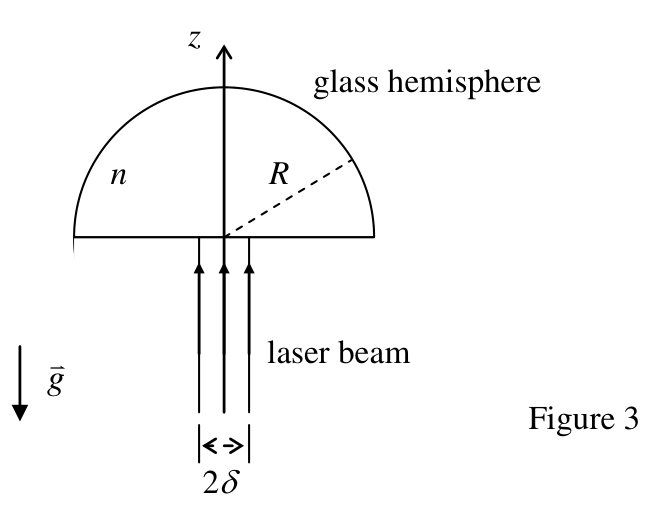
Figure 3
Official English text of the problem.
Answers
-
(a) The maximum total electron energy is \[ \boxed{E_{\max}= \frac{m_n^2+m_e^2-(m_p+m_v)^2}{2m_n}\,c^2.} \] At this endpoint, the anti-neutrino and proton have the same velocity, with speed \[ \boxed{ v_m=c\, \frac{\sqrt{\left[m_n^2-(m_p+m_v+m_e)^2\right] \left[m_n^2-(m_p+m_v-m_e)^2\right]}} {m_n^2+(m_p+m_v)^2-m_e^2}. } \] To three significant digits, \[ \boxed{E_{\max}=1.29\ \mathrm{MeV},\qquad \frac{v_m}{c}=1.27\times10^{-3}.} \]
-
(b) To the requested order, \[ \boxed{P=\frac{4mgcR^2}{(n-1)^2\delta^2}.} \]
Solution
(a) Neutrino Mass and Neutron Decay
Let the electron momentum have magnitude \(p_e\). Conservation of energy and momentum gives \[ E_p+E_v=m_nc^2-E,\qquad \boldsymbol p_p+\boldsymbol p_v=-\boldsymbol p_e. \]
Denote the invariant mass of the proton–anti-neutrino pair by \(\mathcal M\). Using the electron energy–momentum relation, \[ p_e^2c^2=E^2-m_e^2c^4, \] we obtain \[ \begin{aligned} \mathcal M^2c^4 &=(E_p+E_v)^2-c^2|\boldsymbol p_p+\boldsymbol p_v|^2\\ &=(m_nc^2-E)^2-p_e^2c^2\\ &=(m_n^2+m_e^2)c^4-2m_nc^2E. \end{aligned} \] Consequently, \[ E=\frac{m_n^2+m_e^2-\mathcal M^2}{2m_n}\,c^2. \] The electron energy is therefore largest when \(\mathcal M\) is smallest.
In the pair’s centre-of-momentum frame, the proton and anti-neutrino have equal and opposite momenta of magnitude \(q\). Thus \[ \mathcal Mc^2 =\sqrt{m_p^2c^4+q^2c^2} +\sqrt{m_v^2c^4+q^2c^2} \geq(m_p+m_v)c^2. \] Equality holds when \(q=0\): both particles are at rest in this frame, so they have the same velocity in the laboratory frame. This configuration is kinematically allowed because \(m_n>m_p+m_v+m_e\).
Writing \(M=m_p+m_v\), the endpoint energy is therefore \[ \boxed{E_{\max}=\frac{m_n^2+m_e^2-M^2}{2m_n}\,c^2.} \]
At the endpoint, the pair has energy \(m_nc^2-E_{\max}\) and momentum magnitude \(p_e\). Its common speed, which is the anti-neutrino speed, follows from \(\boldsymbol v=c^2\boldsymbol p/E_{\text{total}}\): \[ \frac{v_m}{c} =\frac{p_ec}{m_nc^2-E_{\max}} =\frac{\sqrt{E_{\max}^2-m_e^2c^4}} {m_nc^2-E_{\max}}. \] Substitution gives \[ \boxed{ v_m=c\, \frac{\sqrt{\left[m_n^2-(M+m_e)^2\right] \left[m_n^2-(M-m_e)^2\right]}} {m_n^2+M^2-m_e^2}, \qquad M=m_p+m_v. } \]
For the numerical evaluation, the limit \(m_v\to0^+\) gives \[ E_{\max}\simeq1.29256882\ \mathrm{MeV},\qquad \frac{v_m}{c}\simeq1.26538356\times10^{-3}. \] Increasing \(m_vc^2\) from zero to its upper bound of \(7.3\ \mathrm{eV}\) decreases these values by less than \(7.30\ \mathrm{eV}\) and \(8.5\times10^{-9}\), respectively. Hence the entire permitted mass range gives, to three significant digits, \[ \boxed{E_{\max}=1.29\ \mathrm{MeV},\qquad v_m/c=1.27\times10^{-3}.} \]
Here \(E_{\max}\) is the electron’s total energy. The anti-neutrino is slow at this endpoint despite its tiny mass: its momentum is also tiny, as required for it to share the proton’s velocity.
(b) Light Levitation
Consider a ray entering the hemisphere at distance \(r\) from the \(z\)-axis, where \(0\leq r\leq\delta\). It enters the planar surface normally and therefore continues vertically inside the glass.
At the spherical surface, let \(\theta\) be the angle between the incident ray and the outward normal. Geometry gives \[ \sin\theta=\frac rR. \] If \(\theta'\) is the angle of the emerging ray relative to that normal, Snell’s law gives \[ \sin\theta'=n\sin\theta=n\frac rR. \] For glass with \(n>1\), the emerging ray bends towards the axis. Its angle from the upward vertical has magnitude \[ \alpha=\theta'-\theta. \] Since \(r/R\leq\delta/R\ll1\), expansion at fixed \(n\) gives \[ \alpha=(n-1)\frac rR +O\!\left(\frac{r^3}{R^3}\right). \]
Both before entering and after leaving the hemisphere, light has momentum equal to its energy divided by \(c\). Absorption and reflection are negligible, so a ray bundle carrying power \(dP\) has incoming vertical momentum flux \(dP/c\) and outgoing vertical momentum flux \((dP/c)\cos\alpha\).
By momentum conservation, its upward force on the hemisphere is \[ dF_z=\frac{dP}{c}(1-\cos\alpha). \] Using the given small-angle approximation, \[ 1-\cos\alpha \simeq\frac{\alpha^2}{2} \simeq\frac{(n-1)^2r^2}{2R^2}. \] The transverse force components cancel by axial symmetry.
The incident intensity is uniform: \[ I=\frac{P}{\pi\delta^2}. \] An annulus of radius \(r\) and width \(dr\) therefore carries power \[ dP=I\,2\pi r\,dr. \] Integrating the vertical force over the beam, \[ \begin{aligned} F_z &\simeq \int_0^\delta \frac{I\,2\pi r\,dr}{c} \frac{(n-1)^2r^2}{2R^2}\\ &=\frac{\pi I(n-1)^2}{cR^2} \int_0^\delta r^3\,dr\\ &=\frac{P(n-1)^2\delta^2}{4cR^2}. \end{aligned} \] This retains the contribution of order \((\delta/R)^2\); the next correction to \(F_z/(P/c)\) is of order \((\delta/R)^4\).
Balancing this upward force against the weight, \[ mg=\frac{P(n-1)^2\delta^2}{4cR^2}, \] yields \[ \boxed{P=\frac{4mgcR^2}{(n-1)^2\delta^2}.} \]
The solution was checked against the official solution.
IPhO 2003 · Theorieaufgabe 3
Neutrinomasse und Neutronenzerfall (Teil A); Schweben durch Licht (Teil B)
Teil A
Neutrinomasse und Neutronenzerfall
Ein freies Neutron der Masse \(m_n\) zerfällt im Laborsystem aus der Ruhe in drei nicht miteinander wechselwirkende Teilchen: ein Proton, ein Elektron und ein Antineutrino. Die Ruhemasse des Protons ist \(m_p\), während angenommen wird, dass die Ruhemasse des Antineutrinos \(m_v\) von null verschieden und viel kleiner als die Ruhemasse des Elektrons \(m_e\) ist. Die Lichtgeschwindigkeit im Vakuum wird mit \(c\) bezeichnet. Die gemessenen Massenwerte lauten:
\[ m_n=939.56563\ \mathrm{MeV}/c^2,\quad m_p=938.27231\ \mathrm{MeV}/c^2,\quad m_e=0.5109907\ \mathrm{MeV}/c^2 \]
Im Folgenden beziehen sich alle Energien und Geschwindigkeiten auf das Laborsystem. Sei \(E\) die Gesamtenergie des beim Zerfall entstehenden Elektrons.
(a) Bestimmen Sie den größtmöglichen Wert \(E_{\max}\) von \(E\) und die Geschwindigkeit \(v_m\) des Antineutrinos für \(E=E_{\max}\). Beide Antworten müssen durch die Ruhemassen der Teilchen und die Lichtgeschwindigkeit ausgedrückt werden. Berechnen Sie unter der Voraussetzung \(m_v<7.3\ \mathrm{eV}/c^2\) die Werte von \(E_{\max}\) und des Verhältnisses \(v_m/c\) auf 3 signifikante Stellen.
(4.0 Punkte)
Teil B
Schweben durch Licht
Eine transparente Glashalbkugel mit dem Radius \(R\) und der Masse \(m\) hat den Brechungsindex \(n\). Im Medium außerhalb der Halbkugel ist der Brechungsindex gleich eins. Ein paralleles Bündel monochromatischen Laserlichts fällt gleichmäßig und senkrecht auf den mittleren Bereich ihrer ebenen Oberfläche, wie in Abbildung 3 dargestellt. Die Erdbeschleunigung \(\vec g\) ist senkrecht nach unten gerichtet. Der Radius \(\delta\) des kreisförmigen Querschnitts des Laserstrahls ist viel kleiner als \(R\). Sowohl die Glashalbkugel als auch der Laserstrahl sind rotationssymmetrisch bezüglich der \(z\)-Achse.
Die Glashalbkugel absorbiert kein Laserlicht. Ihre Oberfläche ist mit einer dünnen Schicht aus transparentem Material beschichtet, sodass Reflexionen beim Eintritt des Lichts in die Glashalbkugel und beim Austritt aus ihr vernachlässigbar sind. Auch die optische Weglänge, die das Laserlicht beim Durchgang durch die reflexionsfreie Oberflächenschicht zurücklegt, ist vernachlässigbar.
(b) Bestimmen Sie unter Vernachlässigung von Termen der Ordnung \((\delta/R)^3\) oder höher die Laserleistung \(P\), die erforderlich ist, um die Gewichtskraft der Glashalbkugel auszugleichen.
(4.0 Punkte)
Hinweis: \(\cos\theta\approx 1-\theta^2/2\), wenn \(\theta\) viel kleiner als eins ist.
Abbildung 3
Aufgabentext aus dem offiziellen englischen Text übersetzt.
Antworten
-
(a) Die maximale Gesamtenergie des Elektrons ist \[ \boxed{E_{\max}= \frac{m_n^2+m_e^2-(m_p+m_v)^2}{2m_n}\,c^2.} \] Bei diesem Endpunkt haben das Antineutrino und das Proton dieselbe Geschwindigkeit mit dem Betrag \[ \boxed{ v_m=c\, \frac{\sqrt{\left[m_n^2-(m_p+m_v+m_e)^2\right] \left[m_n^2-(m_p+m_v-m_e)^2\right]}} {m_n^2+(m_p+m_v)^2-m_e^2}. } \] Auf drei signifikante Stellen ergibt sich \[ \boxed{E_{\max}=1.29\ \mathrm{MeV},\qquad \frac{v_m}{c}=1.27\times10^{-3}.} \]
-
(b) Bis zur geforderten Ordnung gilt \[ \boxed{P=\frac{4mgcR^2}{(n-1)^2\delta^2}.} \]
Lösung
(a) Neutrinomasse und Neutronenzerfall
Der Betrag des Elektronenimpulses sei \(p_e\). Aus der Energie- und Impulserhaltung folgt \[ E_p+E_v=m_nc^2-E,\qquad \boldsymbol p_p+\boldsymbol p_v=-\boldsymbol p_e. \]
Die invariante Masse des Proton-Antineutrino-Paars sei \(\mathcal M\). Mit der Energie-Impuls-Beziehung des Elektrons, \[ p_e^2c^2=E^2-m_e^2c^4, \] erhalten wir \[ \begin{aligned} \mathcal M^2c^4 &=(E_p+E_v)^2-c^2|\boldsymbol p_p+\boldsymbol p_v|^2\\ &=(m_nc^2-E)^2-p_e^2c^2\\ &=(m_n^2+m_e^2)c^4-2m_nc^2E. \end{aligned} \] Folglich gilt \[ E=\frac{m_n^2+m_e^2-\mathcal M^2}{2m_n}\,c^2. \] Die Elektronenenergie ist somit am größten, wenn \(\mathcal M\) am kleinsten ist.
Im Schwerpunktsystem des Paars haben das Proton und das Antineutrino entgegengesetzt gerichtete Impulse mit demselben Betrag \(q\). Daher gilt \[ \mathcal Mc^2 =\sqrt{m_p^2c^4+q^2c^2} +\sqrt{m_v^2c^4+q^2c^2} \geq(m_p+m_v)c^2. \] Gleichheit gilt für \(q=0\): Beide Teilchen ruhen in diesem Bezugssystem, sodass sie im Laborsystem dieselbe Geschwindigkeit haben. Diese Konfiguration ist kinematisch möglich, weil \(m_n>m_p+m_v+m_e\).
Mit \(M=m_p+m_v\) ist die Endpunktsenergie somit \[ \boxed{E_{\max}=\frac{m_n^2+m_e^2-M^2}{2m_n}\,c^2.} \]
Am Endpunkt hat das Paar die Energie \(m_nc^2-E_{\max}\) und den Impulsbetrag \(p_e\). Der Betrag seiner gemeinsamen Geschwindigkeit, der zugleich der Geschwindigkeit des Antineutrinos entspricht, folgt aus \(\boldsymbol v=c^2\boldsymbol p/E_{\text{gesamt}}\): \[ \frac{v_m}{c} =\frac{p_ec}{m_nc^2-E_{\max}} =\frac{\sqrt{E_{\max}^2-m_e^2c^4}} {m_nc^2-E_{\max}}. \] Einsetzen ergibt \[ \boxed{ v_m=c\, \frac{\sqrt{\left[m_n^2-(M+m_e)^2\right] \left[m_n^2-(M-m_e)^2\right]}} {m_n^2+M^2-m_e^2}, \qquad M=m_p+m_v. } \]
Für die numerische Auswertung ergibt der Grenzübergang \(m_v\to0^+\) \[ E_{\max}\simeq1.29256882\ \mathrm{MeV},\qquad \frac{v_m}{c}\simeq1.26538356\times10^{-3}. \] Eine Erhöhung von \(m_vc^2\) von null bis zu seiner oberen Schranke von \(7.3\ \mathrm{eV}\) verringert diese Werte um weniger als \(7.30\ \mathrm{eV}\) beziehungsweise \(8.5\times10^{-9}\). Daher ergibt sich im gesamten zulässigen Massenbereich auf drei signifikante Stellen \[ \boxed{E_{\max}=1.29\ \mathrm{MeV},\qquad v_m/c=1.27\times10^{-3}.} \]
Dabei ist \(E_{\max}\) die Gesamtenergie des Elektrons. Das Antineutrino ist an diesem Endpunkt trotz seiner winzigen Masse langsam: Sein Impuls ist ebenfalls winzig, wie es erforderlich ist, damit es dieselbe Geschwindigkeit wie das Proton hat.
(b) Schweben durch Licht
Betrachten wir einen Lichtstrahl, der im Abstand \(r\) von der \(z\)-Achse in die Halbkugel eintritt, wobei \(0\leq r\leq\delta\). Er trifft senkrecht auf die ebene Oberfläche und verläuft daher im Glas weiterhin vertikal.
An der kugelförmigen Oberfläche sei \(\theta\) der Winkel zwischen dem einfallenden Strahl und der nach außen gerichteten Flächennormalen. Aus der Geometrie folgt \[ \sin\theta=\frac rR. \] Ist \(\theta'\) der Winkel des austretenden Strahls zu dieser Normalen, so liefert das snelliussche Brechungsgesetz \[ \sin\theta'=n\sin\theta=n\frac rR. \] Bei Glas mit \(n>1\) wird der austretende Strahl zur Achse hin gebrochen. Sein Winkel zur nach oben gerichteten Vertikalen hat den Betrag \[ \alpha=\theta'-\theta. \] Da \(r/R\leq\delta/R\ll1\), ergibt eine Entwicklung bei festem \(n\) \[ \alpha=(n-1)\frac rR +O\!\left(\frac{r^3}{R^3}\right). \]
Sowohl vor dem Eintritt in die Halbkugel als auch nach dem Austritt aus ihr hat das Licht einen Impuls, der gleich seiner Energie geteilt durch \(c\) ist. Absorption und Reflexion sind vernachlässigbar, sodass ein Strahlenbündel mit der Leistung \(dP\) einen einfallenden vertikalen Impulsstrom von \(dP/c\) und einen austretenden vertikalen Impulsstrom von \((dP/c)\cos\alpha\) hat.
Aus der Impulserhaltung folgt für seine nach oben gerichtete Kraft auf die Halbkugel \[ dF_z=\frac{dP}{c}(1-\cos\alpha). \] Mit der angegebenen Kleinwinkelnäherung gilt \[ 1-\cos\alpha \simeq\frac{\alpha^2}{2} \simeq\frac{(n-1)^2r^2}{2R^2}. \] Die transversalen Kraftkomponenten heben sich aufgrund der Rotationssymmetrie auf.
Die Intensität des einfallenden Lichts ist gleichmäßig: \[ I=\frac{P}{\pi\delta^2}. \] Durch einen Kreisring mit dem Radius \(r\) und der Breite \(dr\) tritt daher die Leistung \[ dP=I\,2\pi r\,dr. \] Die Integration der vertikalen Kraft über den Strahlquerschnitt ergibt \[ \begin{aligned} F_z &\simeq \int_0^\delta \frac{I\,2\pi r\,dr}{c} \frac{(n-1)^2r^2}{2R^2}\\ &=\frac{\pi I(n-1)^2}{cR^2} \int_0^\delta r^3\,dr\\ &=\frac{P(n-1)^2\delta^2}{4cR^2}. \end{aligned} \] Hierbei wird der Beitrag der Ordnung \((\delta/R)^2\) berücksichtigt; die nächste Korrektur zu \(F_z/(P/c)\) ist von der Ordnung \((\delta/R)^4\).
Das Gleichsetzen dieser nach oben gerichteten Kraft mit der Gewichtskraft, \[ mg=\frac{P(n-1)^2\delta^2}{4cR^2}, \] liefert \[ \boxed{P=\frac{4mgcR^2}{(n-1)^2\delta^2}.} \]
Die Lösung wurde mit der offiziellen Lösung abgeglichen.
IPhO 2003 · Teori sorusu 3
Nötrino Kütlesi ve Nötron Bozunması (Bölüm A); Işıkla Havada Tutma (Bölüm B)
Bölüm A
Nötrino Kütlesi ve Nötron Bozunması
Laboratuvar referans sisteminde durmakta olan, kütlesi \(m_n\) olan serbest bir nötron, birbiriyle etkileşmeyen üç parçacığa bozunur: bir proton, bir elektron ve bir antinötrino. Protonun durgun kütlesi \(m_p\)'dir; antinötrinonun durgun kütlesi \(m_v\)'nin ise sıfırdan farklı ve elektronun durgun kütlesi \(m_e\)'den çok küçük olduğu varsayılmaktadır. Işığın boşluktaki hızını \(c\) ile gösterelim. Kütlelerin ölçülen değerleri şöyledir:
\[ m_n=939.56563\ \mathrm{MeV}/c^2,\quad m_p=938.27231\ \mathrm{MeV}/c^2,\quad m_e=0.5109907\ \mathrm{MeV}/c^2 \]
Aşağıda tüm enerjiler ve hızlar laboratuvar referans sistemine göredir. Bozunmadan çıkan elektronun toplam enerjisi \(E\) olsun.
(a) \(E\)'nin alabileceği en büyük değer olan \(E_{\max}\)'ı ve \(E=E_{\max}\) olduğunda antinötrinonun sürati \(v_m\)'yi bulunuz. Her iki yanıt da parçacıkların durgun kütleleri ve ışık hızı cinsinden ifade edilmelidir. \(m_v<7.3\ \mathrm{eV}/c^2\) olduğu verildiğine göre, \(E_{\max}\)'ı ve \(v_m/c\) oranını 3 anlamlı basamakla hesaplayınız.
(4.0 puan)
Bölüm B
Işıkla Havada Tutma
Yarıçapı \(R\) ve kütlesi \(m\) olan saydam bir cam yarımkürenin kırılma indisi \(n\)'dir. Yarımkürenin dışındaki ortamın kırılma indisi bire eşittir. Tek renkli, paralel bir lazer ışık demeti, Şekil 3'te gösterildiği gibi yarımkürenin düz yüzeyinin merkezî bölümüne düzgün dağılımlı olarak ve dik gelir. Yerçekimi ivmesi \(\vec g\) düşey olarak aşağı yönlüdür. Lazer demetinin dairesel kesitinin yarıçapı \(\delta\), \(R\)'den çok küçüktür. Hem cam yarımküre hem de lazer demeti \(z\) eksenine göre eksenel simetriye sahiptir.
Cam yarımküre lazer ışığını hiç soğurmaz. Yüzeyi, ışık cam yarımküreye girerken ve yarımküreden çıkarken yansımalar ihmal edilebilecek şekilde, saydam bir malzemeden oluşan ince bir tabakayla kaplanmıştır. Yansıtıcı olmayan bu yüzey tabakasından geçen lazer ışığının katettiği optik yol da ihmal edilebilir.
(b) \((\delta/R)^3\) ve daha yüksek mertebeli terimleri ihmal ederek, cam yarımkürenin ağırlığını dengelemek için gereken lazer gücü \(P\)'yi bulunuz.
(4.0 puan)
İpucu: \(\theta\) birden çok küçük olduğunda \(\cos\theta\approx 1-\theta^2/2\) olur.
Şekil 3
Soru metni resmi İngilizce metinden çevrilmiştir.
Cevaplar
-
(a) Elektronun en büyük toplam enerjisi \[ \boxed{E_{\max}= \frac{m_n^2+m_e^2-(m_p+m_v)^2}{2m_n}\,c^2.} \] Bu uç noktada antinötrino ve proton aynı hıza sahiptir; süratleri \[ \boxed{ v_m=c\, \frac{\sqrt{\left[m_n^2-(m_p+m_v+m_e)^2\right] \left[m_n^2-(m_p+m_v-m_e)^2\right]}} {m_n^2+(m_p+m_v)^2-m_e^2}. } \] Üç anlamlı basamakla, \[ \boxed{E_{\max}=1.29\ \mathrm{MeV},\qquad \frac{v_m}{c}=1.27\times10^{-3}.} \]
-
(b) İstenen mertebeye kadar, \[ \boxed{P=\frac{4mgcR^2}{(n-1)^2\delta^2}.} \]
Çözüm
(a) Nötrino Kütlesi ve Nötron Bozunması
Elektronun momentumunun büyüklüğü \(p_e\) olsun. Enerji ve momentumun korunumu şu bağıntıları verir: \[ E_p+E_v=m_nc^2-E,\qquad \boldsymbol p_p+\boldsymbol p_v=-\boldsymbol p_e. \]
Proton–antinötrino çiftinin değişmez kütlesini \(\mathcal M\) ile gösterelim. Elektronun enerji–momentum bağıntısını, \[ p_e^2c^2=E^2-m_e^2c^4, \] kullanarak \[ \begin{aligned} \mathcal M^2c^4 &=(E_p+E_v)^2-c^2|\boldsymbol p_p+\boldsymbol p_v|^2\\ &=(m_nc^2-E)^2-p_e^2c^2\\ &=(m_n^2+m_e^2)c^4-2m_nc^2E. \end{aligned} \] elde ederiz. Dolayısıyla, \[ E=\frac{m_n^2+m_e^2-\mathcal M^2}{2m_n}\,c^2. \] Buna göre elektronun enerjisi, \(\mathcal M\) en küçük olduğunda en büyüktür.
Çiftin toplam momentumunun sıfır olduğu referans sisteminde proton ve antinötrino, büyüklükleri \(q\) olan eşit ve zıt yönlü momentumlara sahiptir. Böylece \[ \mathcal Mc^2 =\sqrt{m_p^2c^4+q^2c^2} +\sqrt{m_v^2c^4+q^2c^2} \geq(m_p+m_v)c^2. \] Eşitlik \(q=0\) olduğunda sağlanır: her iki parçacık da bu referans sisteminde durmaktadır; dolayısıyla laboratuvar referans sisteminde aynı hıza sahiptirler. \(m_n>m_p+m_v+m_e\) olduğundan bu durum kinematik olarak mümkündür.
\(M=m_p+m_v\) yazarsak, uç nokta enerjisi dolayısıyla \[ \boxed{E_{\max}=\frac{m_n^2+m_e^2-M^2}{2m_n}\,c^2.} \]
Uç noktada çiftin enerjisi \(m_nc^2-E_{\max}\), momentumunun büyüklüğü ise \(p_e\)'dir. Antinötrinonun süratine eşit olan ortak süratleri, \(\boldsymbol v=c^2\boldsymbol p/E_{\text{toplam}}\) bağıntısından bulunur: \[ \frac{v_m}{c} =\frac{p_ec}{m_nc^2-E_{\max}} =\frac{\sqrt{E_{\max}^2-m_e^2c^4}} {m_nc^2-E_{\max}}. \] Yerine koyma işlemiyle \[ \boxed{ v_m=c\, \frac{\sqrt{\left[m_n^2-(M+m_e)^2\right] \left[m_n^2-(M-m_e)^2\right]}} {m_n^2+M^2-m_e^2}, \qquad M=m_p+m_v. } \] elde edilir.
Sayısal hesaplama için \(m_v\to0^+\) limiti şu değerleri verir: \[ E_{\max}\simeq1.29256882\ \mathrm{MeV},\qquad \frac{v_m}{c}\simeq1.26538356\times10^{-3}. \] \(m_vc^2\)'nin sıfırdan üst sınırı olan \(7.3\ \mathrm{eV}\)'a artırılması, bu değerleri sırasıyla \(7.30\ \mathrm{eV}\)'dan ve \(8.5\times10^{-9}\)'dan daha az azaltır. Bu nedenle izin verilen tüm kütle aralığında, üç anlamlı basamakla, \[ \boxed{E_{\max}=1.29\ \mathrm{MeV},\qquad v_m/c=1.27\times10^{-3}.} \]
Burada \(E_{\max}\), elektronun toplam enerjisidir. Antinötrino, çok küçük kütlesine rağmen bu uç noktada yavaştır: protonla aynı hıza sahip olması için gerektiği üzere, momentumu da çok küçüktür.
(b) Işıkla Havada Tutma
Yarımküreye \(z\) ekseninden \(r\) uzaklıkta giren bir ışın ele alalım; burada \(0\leq r\leq\delta\)'dır. Işın düz yüzeye dik olarak girer ve bu nedenle camın içinde düşey doğrultuda ilerlemeye devam eder.
Küresel yüzeyde, gelen ışın ile dışa dönük normal arasındaki açı \(\theta\) olsun. Geometriden \[ \sin\theta=\frac rR. \] elde edilir. Çıkan ışının bu normale göre açısı \(\theta'\) ise, Snell yasası \[ \sin\theta'=n\sin\theta=n\frac rR. \] bağıntısını verir. \(n>1\) olan cam için çıkan ışın eksene doğru kırılır. Yukarı yönlü düşey doğrultuyla yaptığı açının büyüklüğü \[ \alpha=\theta'-\theta. \] olur. \(r/R\leq\delta/R\ll1\) olduğundan, sabit \(n\) için yapılan açılım \[ \alpha=(n-1)\frac rR +O\!\left(\frac{r^3}{R^3}\right). \] sonucunu verir.
Işığın momentumu, hem yarımküreye girmeden önce hem de yarımküreden çıktıktan sonra enerjisinin \(c\)'ye bölümüne eşittir. Soğurma ve yansıma ihmal edilebilir olduğundan, \(dP\) gücü taşıyan bir ışın demetinin gelen düşey momentum akısı \(dP/c\), çıkan düşey momentum akısı ise \((dP/c)\cos\alpha\)'dır.
Momentumun korunumuna göre, bu demetin yarımküreye uyguladığı yukarı yönlü kuvvet \[ dF_z=\frac{dP}{c}(1-\cos\alpha). \] olur. Verilen küçük açı yaklaşımını kullanarak, \[ 1-\cos\alpha \simeq\frac{\alpha^2}{2} \simeq\frac{(n-1)^2r^2}{2R^2}. \] elde ederiz. Enine kuvvet bileşenleri eksenel simetri nedeniyle birbirini götürür.
Gelen ışığın şiddeti düzgün dağılımlıdır: \[ I=\frac{P}{\pi\delta^2}. \] Bu nedenle yarıçapı \(r\), genişliği \(dr\) olan bir halka şu gücü taşır: \[ dP=I\,2\pi r\,dr. \] Düşey kuvvetin demet boyunca integralini alarak, \[ \begin{aligned} F_z &\simeq \int_0^\delta \frac{I\,2\pi r\,dr}{c} \frac{(n-1)^2r^2}{2R^2}\\ &=\frac{\pi I(n-1)^2}{cR^2} \int_0^\delta r^3\,dr\\ &=\frac{P(n-1)^2\delta^2}{4cR^2}. \end{aligned} \] elde ederiz. Burada \((\delta/R)^2\) mertebesindeki katkı korunmuştur; \(F_z/(P/c)\) için bir sonraki düzeltme \((\delta/R)^4\) mertebesindedir.
Bu yukarı yönlü kuvveti ağırlıkla dengeleyerek, \[ mg=\frac{P(n-1)^2\delta^2}{4cR^2}, \] şu sonucu elde ederiz: \[ \boxed{P=\frac{4mgcR^2}{(n-1)^2\delta^2}.} \]
Çözüm, resmi çözümle karşılaştırılarak kontrol edildi.
IPhO 2003 · Problema teórico 3
Masa del neutrino y desintegración del neutrón (Parte A); Levitación mediante luz (Parte B)
Parte A
Masa del neutrino y desintegración del neutrón
Un neutrón libre de masa \(m_n\), en reposo en el sistema de referencia del laboratorio, se desintegra en tres partículas que no interaccionan entre sí: un protón, un electrón y un antineutrino. La masa en reposo del protón es \(m_p\), mientras que se supone que la masa en reposo del antineutrino \(m_v\) es distinta de cero y mucho menor que la masa en reposo del electrón \(m_e\). Denotemos por \(c\) la velocidad de la luz en el vacío. Los valores medidos de las masas son los siguientes:
\[ m_n=939.56563\ \mathrm{MeV}/c^2,\quad m_p=938.27231\ \mathrm{MeV}/c^2,\quad m_e=0.5109907\ \mathrm{MeV}/c^2 \]
En lo que sigue, todas las energías y velocidades están referidas al sistema del laboratorio. Sea \(E\) la energía total del electrón emitido en la desintegración.
(a) Halle el valor máximo posible \(E_{\max}\) de \(E\) y la rapidez \(v_m\) del antineutrino cuando \(E=E_{\max}\). Ambas respuestas deben expresarse en función de las masas en reposo de las partículas y de la velocidad de la luz. Sabiendo que \(m_v<7.3\ \mathrm{eV}/c^2\), calcule \(E_{\max}\) y el cociente \(v_m/c\) con 3 cifras significativas.
(4.0 puntos)
Parte B
Levitación mediante luz
Una semiesfera de vidrio transparente de radio \(R\) y masa \(m\) tiene un índice de refracción \(n\). En el medio exterior a la semiesfera, el índice de refracción es igual a uno. Un haz paralelo de luz láser monocromática incide de manera uniforme y perpendicular sobre la porción central de su superficie plana, como se muestra en la Figura 3. La aceleración de la gravedad \(\vec g\) está dirigida verticalmente hacia abajo. El radio \(\delta\) de la sección transversal circular del haz láser es mucho menor que \(R\). Tanto la semiesfera de vidrio como el haz láser presentan simetría axial respecto al eje \(z\).
La semiesfera de vidrio no absorbe nada de la luz láser. Su superficie está recubierta con una capa delgada de material transparente, de modo que las reflexiones son despreciables cuando la luz entra en la semiesfera de vidrio y sale de ella. El camino óptico recorrido por la luz láser al atravesar la capa superficial antirreflectante también es despreciable.
(b) Despreciando los términos de orden \((\delta/R)^3\) o superior, halle la potencia láser \(P\) necesaria para equilibrar el peso de la semiesfera de vidrio.
(4.0 puntos)
Indicación: \(\cos\theta\approx 1-\theta^2/2\) cuando \(\theta\) es mucho menor que uno.
Figura 3
Enunciado traducido del texto oficial en inglés.
Respuestas
-
(a) La energía total máxima del electrón es \[ \boxed{E_{\max}= \frac{m_n^2+m_e^2-(m_p+m_v)^2}{2m_n}\,c^2.} \] En este extremo del espectro, el antineutrino y el protón tienen la misma velocidad, cuya magnitud es \[ \boxed{ v_m=c\, \frac{\sqrt{\left[m_n^2-(m_p+m_v+m_e)^2\right] \left[m_n^2-(m_p+m_v-m_e)^2\right]}} {m_n^2+(m_p+m_v)^2-m_e^2}. } \] Con tres cifras significativas, \[ \boxed{E_{\max}=1.29\ \mathrm{MeV},\qquad \frac{v_m}{c}=1.27\times10^{-3}.} \]
-
(b) Hasta el orden solicitado, \[ \boxed{P=\frac{4mgcR^2}{(n-1)^2\delta^2}.} \]
Solución
(a) Masa del neutrino y desintegración del neutrón
Sea \(p_e\) la magnitud del momento lineal del electrón. La conservación de la energía y del momento lineal da \[ E_p+E_v=m_nc^2-E,\qquad \boldsymbol p_p+\boldsymbol p_v=-\boldsymbol p_e. \]
Denotemos por \(\mathcal M\) la masa invariante del par protón–antineutrino. Utilizando la relación entre la energía y el momento lineal del electrón, \[ p_e^2c^2=E^2-m_e^2c^4, \] obtenemos \[ \begin{aligned} \mathcal M^2c^4 &=(E_p+E_v)^2-c^2|\boldsymbol p_p+\boldsymbol p_v|^2\\ &=(m_nc^2-E)^2-p_e^2c^2\\ &=(m_n^2+m_e^2)c^4-2m_nc^2E. \end{aligned} \] Por consiguiente, \[ E=\frac{m_n^2+m_e^2-\mathcal M^2}{2m_n}\,c^2. \] Por tanto, la energía del electrón es máxima cuando \(\mathcal M\) es mínima.
En el sistema de referencia del centro de momentos del par, el protón y el antineutrino tienen momentos lineales de igual magnitud \(q\) y sentidos opuestos. Así, \[ \mathcal Mc^2 =\sqrt{m_p^2c^4+q^2c^2} +\sqrt{m_v^2c^4+q^2c^2} \geq(m_p+m_v)c^2. \] La igualdad se cumple cuando \(q=0\): ambas partículas están en reposo en este sistema, por lo que tienen la misma velocidad en el sistema del laboratorio. Esta configuración está permitida cinemáticamente porque \(m_n>m_p+m_v+m_e\).
Escribiendo \(M=m_p+m_v\), la energía en el extremo del espectro es, por tanto, \[ \boxed{E_{\max}=\frac{m_n^2+m_e^2-M^2}{2m_n}\,c^2.} \]
En el extremo del espectro, el par tiene una energía \(m_nc^2-E_{\max}\) y un momento lineal de magnitud \(p_e\). La rapidez común de sus partículas, que es la rapidez del antineutrino, se obtiene de \(\boldsymbol v=c^2\boldsymbol p/E_{\text{total}}\): \[ \frac{v_m}{c} =\frac{p_ec}{m_nc^2-E_{\max}} =\frac{\sqrt{E_{\max}^2-m_e^2c^4}} {m_nc^2-E_{\max}}. \] Al sustituir se obtiene \[ \boxed{ v_m=c\, \frac{\sqrt{\left[m_n^2-(M+m_e)^2\right] \left[m_n^2-(M-m_e)^2\right]}} {m_n^2+M^2-m_e^2}, \qquad M=m_p+m_v. } \]
Para la evaluación numérica, el límite \(m_v\to0^+\) da \[ E_{\max}\simeq1.29256882\ \mathrm{MeV},\qquad \frac{v_m}{c}\simeq1.26538356\times10^{-3}. \] Al aumentar \(m_vc^2\) desde cero hasta su cota superior de \(7.3\ \mathrm{eV}\), estos valores disminuyen en menos de \(7.30\ \mathrm{eV}\) y \(8.5\times10^{-9}\), respectivamente. Por ello, todo el intervalo de masas permitido da, con tres cifras significativas, \[ \boxed{E_{\max}=1.29\ \mathrm{MeV},\qquad v_m/c=1.27\times10^{-3}.} \]
Aquí \(E_{\max}\) es la energía total del electrón. El antineutrino es lento en este extremo del espectro a pesar de su masa diminuta: su momento lineal también es diminuto, como se requiere para que tenga la misma velocidad que el protón.
(b) Levitación mediante luz
Consideremos un rayo que entra en la semiesfera a una distancia \(r\) del eje \(z\), donde \(0\leq r\leq\delta\). Incide perpendicularmente sobre la superficie plana y, por tanto, continúa verticalmente dentro del vidrio.
En la superficie esférica, sea \(\theta\) el ángulo entre el rayo incidente y la normal hacia el exterior. Por geometría, \[ \sin\theta=\frac rR. \] Si \(\theta'\) es el ángulo del rayo emergente respecto a esa normal, la ley de Snell da \[ \sin\theta'=n\sin\theta=n\frac rR. \] Para un vidrio con \(n>1\), el rayo emergente se desvía hacia el eje. El ángulo que forma con la vertical ascendente tiene magnitud \[ \alpha=\theta'-\theta. \] Puesto que \(r/R\leq\delta/R\ll1\), un desarrollo con \(n\) fijo da \[ \alpha=(n-1)\frac rR +O\!\left(\frac{r^3}{R^3}\right). \]
Tanto antes de entrar como después de salir de la semiesfera, la luz tiene un momento lineal igual a su energía dividida por \(c\). La absorción y la reflexión son despreciables, por lo que un haz de rayos que transporta una potencia \(dP\) tiene un flujo entrante de momento lineal vertical \(dP/c\) y un flujo saliente de momento lineal vertical \((dP/c)\cos\alpha\).
Por conservación del momento lineal, la fuerza ascendente que ejerce sobre la semiesfera es \[ dF_z=\frac{dP}{c}(1-\cos\alpha). \] Utilizando la aproximación dada para ángulos pequeños, \[ 1-\cos\alpha \simeq\frac{\alpha^2}{2} \simeq\frac{(n-1)^2r^2}{2R^2}. \] Las componentes transversales de la fuerza se cancelan por simetría axial.
La intensidad incidente es uniforme: \[ I=\frac{P}{\pi\delta^2}. \] Por tanto, una corona circular de radio \(r\) y anchura \(dr\) transporta una potencia \[ dP=I\,2\pi r\,dr. \] Integrando la fuerza vertical sobre el haz, \[ \begin{aligned} F_z &\simeq \int_0^\delta \frac{I\,2\pi r\,dr}{c} \frac{(n-1)^2r^2}{2R^2}\\ &=\frac{\pi I(n-1)^2}{cR^2} \int_0^\delta r^3\,dr\\ &=\frac{P(n-1)^2\delta^2}{4cR^2}. \end{aligned} \] En esta expresión se conserva la contribución de orden \((\delta/R)^2\); la siguiente corrección a \(F_z/(P/c)\) es de orden \((\delta/R)^4\).
Al equilibrar esta fuerza ascendente con el peso, \[ mg=\frac{P(n-1)^2\delta^2}{4cR^2}, \] se obtiene \[ \boxed{P=\frac{4mgcR^2}{(n-1)^2\delta^2}.} \]
La solución se comprobó con la solución oficial.
IPhO 2003 · 理论题 3
中微子质量与中子衰变(部分 A);光悬浮(部分 B)
部分 A
中微子质量与中子衰变
一个质量为 \(m_n\) 的自由中子在实验室参考系中静止,衰变为三个彼此无相互作用的粒子:一个质子、一个电子和一个反中微子。质子的静止质量为 \(m_p\),假设反中微子的静止质量 \(m_v\) 非零,且远小于电子的静止质量 \(m_e\)。用 \(c\) 表示真空中的光速。各质量的测量值如下:
\[ m_n=939.56563\ \mathrm{MeV}/c^2,\quad m_p=938.27231\ \mathrm{MeV}/c^2,\quad m_e=0.5109907\ \mathrm{MeV}/c^2 \]
以下所有能量和速度均相对于实验室参考系而言。设衰变产生的电子的总能量为 \(E\)。
(a) 求 \(E\) 的最大可能值 \(E_{\max}\),以及当 \(E=E_{\max}\) 时反中微子的速率 \(v_m\)。两个答案均须用各粒子的静止质量和光速表示。已知 \(m_v<7.3\ \mathrm{eV}/c^2\),计算 \(E_{\max}\) 和比值 \(v_m/c\),结果保留 3 位有效数字。
(4.0 分)
部分 B
光悬浮
一个半径为 \(R\)、质量为 \(m\) 的透明玻璃半球,其折射率为 \(n\)。半球外介质的折射率等于一。一束平行的单色激光均匀地垂直入射到半球平面的中央部分,如图 3 所示。重力加速度 \(\vec g\) 竖直向下。激光束的圆形横截面半径 \(\delta\) 远小于 \(R\)。玻璃半球和激光束均关于 \(z\) 轴轴对称。
玻璃半球不吸收任何激光。其表面镀有一层透明材料薄膜,使光进入和离开玻璃半球时的反射可以忽略不计。激光穿过这一无反射表面薄层时的光程也可以忽略不计。
(b) 忽略 \((\delta/R)^3\) 阶及更高阶的项,求平衡玻璃半球重力所需的激光功率 \(P\)。
(4.0 分)
提示:当 \(\theta\) 远小于一时,\(\cos\theta\approx 1-\theta^2/2\)。
图 3
题目译自官方英文原文。
答案
-
(a) 电子的最大总能量为 \[ \boxed{E_{\max}= \frac{m_n^2+m_e^2-(m_p+m_v)^2}{2m_n}\,c^2.} \] 在这一端点处,反中微子与质子的速度相同,其速率为 \[ \boxed{ v_m=c\, \frac{\sqrt{\left[m_n^2-(m_p+m_v+m_e)^2\right] \left[m_n^2-(m_p+m_v-m_e)^2\right]}} {m_n^2+(m_p+m_v)^2-m_e^2}. } \] 保留三位有效数字,得到 \[ \boxed{E_{\max}=1.29\ \mathrm{MeV},\qquad \frac{v_m}{c}=1.27\times10^{-3}.} \]
-
(b) 保留到题目要求的阶数,得到 \[ \boxed{P=\frac{4mgcR^2}{(n-1)^2\delta^2}.} \]
解答
(a) 中微子质量与中子衰变
设电子的动量大小为 \(p_e\)。由能量守恒和动量守恒得 \[ E_p+E_v=m_nc^2-E,\qquad \boldsymbol p_p+\boldsymbol p_v=-\boldsymbol p_e. \]
用 \(\mathcal M\) 表示质子与反中微子组成的二粒子系统的不变质量。利用电子的能量–动量关系 \[ p_e^2c^2=E^2-m_e^2c^4, \] 可得 \[ \begin{aligned} \mathcal M^2c^4 &=(E_p+E_v)^2-c^2|\boldsymbol p_p+\boldsymbol p_v|^2\\ &=(m_nc^2-E)^2-p_e^2c^2\\ &=(m_n^2+m_e^2)c^4-2m_nc^2E. \end{aligned} \] 因此, \[ E=\frac{m_n^2+m_e^2-\mathcal M^2}{2m_n}\,c^2. \] 所以,当 \(\mathcal M\) 最小时,电子的能量最大。
在该二粒子系统的动量中心系中,质子与反中微子的动量大小相等、方向相反,大小均为 \(q\)。于是 \[ \mathcal Mc^2 =\sqrt{m_p^2c^4+q^2c^2} +\sqrt{m_v^2c^4+q^2c^2} \geq(m_p+m_v)c^2. \] 当 \(q=0\) 时等号成立:两个粒子在此参考系中均静止,因此它们在实验室参考系中具有相同的速度。由于 \(m_n>m_p+m_v+m_e\),这一状态在运动学上是允许的。
记 \(M=m_p+m_v\),则端点能量为 \[ \boxed{E_{\max}=\frac{m_n^2+m_e^2-M^2}{2m_n}\,c^2.} \]
在端点处,该二粒子系统的能量为 \(m_nc^2-E_{\max}\),动量大小为 \(p_e\)。两个粒子的共同速率,也就是反中微子的速率,可由 \(\boldsymbol v=c^2\boldsymbol p/E_{\text{总}}\) 求得: \[ \frac{v_m}{c} =\frac{p_ec}{m_nc^2-E_{\max}} =\frac{\sqrt{E_{\max}^2-m_e^2c^4}} {m_nc^2-E_{\max}}. \] 代入可得 \[ \boxed{ v_m=c\, \frac{\sqrt{\left[m_n^2-(M+m_e)^2\right] \left[m_n^2-(M-m_e)^2\right]}} {m_n^2+M^2-m_e^2}, \qquad M=m_p+m_v. } \]
进行数值计算时,取极限 \(m_v\to0^+\),得到 \[ E_{\max}\simeq1.29256882\ \mathrm{MeV},\qquad \frac{v_m}{c}\simeq1.26538356\times10^{-3}. \] 将 \(m_vc^2\) 从零增大至其上限 \(7.3\ \mathrm{eV}\),这两个数值的减小量分别小于 \(7.30\ \mathrm{eV}\) 和 \(8.5\times10^{-9}\)。因此,在整个允许的质量范围内,保留三位有效数字均得到 \[ \boxed{E_{\max}=1.29\ \mathrm{MeV},\qquad v_m/c=1.27\times10^{-3}.} \]
这里的 \(E_{\max}\) 是电子的总能量。尽管反中微子的质量极小,它在这一端点处的速率却很低:为了与质子具有相同的速度,它的动量也必须极小。
(b) 光悬浮
考虑一条在距 \(z\) 轴为 \(r\) 处进入半球的光线,其中 \(0\leq r\leq\delta\)。它垂直入射到平面上,因此在玻璃内部继续沿竖直方向传播。
在球面处,设入射光线与外法线之间的夹角为 \(\theta\)。由几何关系得 \[ \sin\theta=\frac rR. \] 若出射光线与该法线之间的夹角为 \(\theta'\),则由斯涅尔定律得 \[ \sin\theta'=n\sin\theta=n\frac rR. \] 对于 \(n>1\) 的玻璃,出射光线向轴线方向偏折。它与竖直向上方向的夹角大小为 \[ \alpha=\theta'-\theta. \] 由于 \(r/R\leq\delta/R\ll1\),在 \(n\) 固定时展开,得到 \[ \alpha=(n-1)\frac rR +O\!\left(\frac{r^3}{R^3}\right). \]
在进入半球之前和离开半球之后,光的动量均等于其能量除以 \(c\)。吸收和反射可以忽略不计,因此,携带功率 \(dP\) 的一束光线,其入射竖直动量通量为 \(dP/c\),出射竖直动量通量为 \((dP/c)\cos\alpha\)。
根据动量守恒,这束光线对半球施加的向上作用力为 \[ dF_z=\frac{dP}{c}(1-\cos\alpha). \] 利用题目给出的小角近似, \[ 1-\cos\alpha \simeq\frac{\alpha^2}{2} \simeq\frac{(n-1)^2r^2}{2R^2}. \] 由于轴对称性,力的横向分量相互抵消。
入射光强均匀: \[ I=\frac{P}{\pi\delta^2}. \] 因此,半径为 \(r\)、宽度为 \(dr\) 的圆环所携带的功率为 \[ dP=I\,2\pi r\,dr. \] 对整个光束的竖直作用力积分,得到 \[ \begin{aligned} F_z &\simeq \int_0^\delta \frac{I\,2\pi r\,dr}{c} \frac{(n-1)^2r^2}{2R^2}\\ &=\frac{\pi I(n-1)^2}{cR^2} \int_0^\delta r^3\,dr\\ &=\frac{P(n-1)^2\delta^2}{4cR^2}. \end{aligned} \] 这里保留了 \((\delta/R)^2\) 阶的贡献;\(F_z/(P/c)\) 的下一阶修正为 \((\delta/R)^4\) 阶。
令这一向上的作用力与重力平衡, \[ mg=\frac{P(n-1)^2\delta^2}{4cR^2}, \] 得到 \[ \boxed{P=\frac{4mgcR^2}{(n-1)^2\delta^2}.} \]
解答已与官方解答核对。
IPhO 2003 · Теоретическая задача 3
Масса нейтрино и распад нейтрона (Часть A); Световая левитация (Часть B)
Часть A
Масса нейтрино и распад нейтрона
Свободный нейтрон массой \(m_n\), покоящийся в лабораторной системе отсчёта, распадается на три невзаимодействующие частицы: протон, электрон и антинейтрино. Масса покоя протона равна \(m_p\), а масса покоя антинейтрино \(m_v\) предполагается ненулевой и много меньшей массы покоя электрона \(m_e\). Обозначим скорость света в вакууме через \(c\). Измеренные значения масс таковы:
\[ m_n=939.56563\ \mathrm{MeV}/c^2,\quad m_p=938.27231\ \mathrm{MeV}/c^2,\quad m_e=0.5109907\ \mathrm{MeV}/c^2 \]
Далее все энергии и скорости относятся к лабораторной системе отсчёта. Пусть \(E\) — полная энергия электрона, образовавшегося при распаде.
(a) Найдите максимально возможное значение \(E_{\max}\) энергии \(E\) и скорость \(v_m\) антинейтрино при \(E=E_{\max}\). Оба ответа должны быть выражены через массы покоя частиц и скорость света. Учитывая, что \(m_v<7.3\ \mathrm{eV}/c^2\), вычислите \(E_{\max}\) и отношение \(v_m/c\) с точностью до 3 значащих цифр.
(4.0 балла)
Часть B
Световая левитация
Прозрачная стеклянная полусфера радиусом \(R\) и массой \(m\) имеет показатель преломления \(n\). В среде вне полусферы показатель преломления равен единице. Параллельный пучок монохроматического лазерного излучения равномерно освещает центральную часть её плоской поверхности, падая на неё перпендикулярно, как показано на рисунке 3. Ускорение свободного падения \(\vec g\) направлено вертикально вниз. Радиус \(\delta\) круглого поперечного сечения лазерного пучка много меньше \(R\). Стеклянная полусфера и лазерный пучок обладают осевой симметрией относительно оси \(z\).
Стеклянная полусфера не поглощает лазерное излучение. Её поверхность покрыта тонким слоем прозрачного материала, так что отражением света при входе в стеклянную полусферу и выходе из неё можно пренебречь. Оптической длиной пути лазерного излучения при прохождении через этот неотражающий поверхностный слой также можно пренебречь.
(b) Пренебрегая членами порядка \((\delta/R)^3\) и выше, найдите мощность лазера \(P\), необходимую для уравновешивания силы тяжести, действующей на стеклянную полусферу.
(4.0 балла)
Указание: \(\cos\theta\approx 1-\theta^2/2\), когда \(\theta\) много меньше единицы.
Рисунок 3
Условие переведено с официального английского текста.
Ответы
-
(a) Максимальная полная энергия электрона равна \[ \boxed{E_{\max}= \frac{m_n^2+m_e^2-(m_p+m_v)^2}{2m_n}\,c^2.} \] При этом предельном значении энергии антинейтрино и протон имеют одинаковую скорость, модуль которой равен \[ \boxed{ v_m=c\, \frac{\sqrt{\left[m_n^2-(m_p+m_v+m_e)^2\right] \left[m_n^2-(m_p+m_v-m_e)^2\right]}} {m_n^2+(m_p+m_v)^2-m_e^2}. } \] С точностью до трёх значащих цифр, \[ \boxed{E_{\max}=1.29\ \mathrm{MeV},\qquad \frac{v_m}{c}=1.27\times10^{-3}.} \]
-
(b) С учётом членов требуемого порядка, \[ \boxed{P=\frac{4mgcR^2}{(n-1)^2\delta^2}.} \]
Решение
(a) Масса нейтрино и распад нейтрона
Пусть модуль импульса электрона равен \(p_e\). Законы сохранения энергии и импульса дают \[ E_p+E_v=m_nc^2-E,\qquad \boldsymbol p_p+\boldsymbol p_v=-\boldsymbol p_e. \]
Обозначим инвариантную массу пары протон–антинейтрино через \(\mathcal M\). Используя связь между энергией и импульсом электрона, \[ p_e^2c^2=E^2-m_e^2c^4, \] получаем \[ \begin{aligned} \mathcal M^2c^4 &=(E_p+E_v)^2-c^2|\boldsymbol p_p+\boldsymbol p_v|^2\\ &=(m_nc^2-E)^2-p_e^2c^2\\ &=(m_n^2+m_e^2)c^4-2m_nc^2E. \end{aligned} \] Следовательно, \[ E=\frac{m_n^2+m_e^2-\mathcal M^2}{2m_n}\,c^2. \] Таким образом, энергия электрона максимальна, когда \(\mathcal M\) минимальна.
В системе центра импульса пары протон и антинейтрино имеют равные по модулю и противоположно направленные импульсы с модулем \(q\). Поэтому \[ \mathcal Mc^2 =\sqrt{m_p^2c^4+q^2c^2} +\sqrt{m_v^2c^4+q^2c^2} \geq(m_p+m_v)c^2. \] Равенство достигается при \(q=0\): обе частицы покоятся в этой системе отсчёта, поэтому в лабораторной системе они имеют одинаковую скорость. Такая конфигурация кинематически допустима, поскольку \(m_n>m_p+m_v+m_e\).
Обозначая \(M=m_p+m_v\), получаем предельную энергию \[ \boxed{E_{\max}=\frac{m_n^2+m_e^2-M^2}{2m_n}\,c^2.} \]
При предельной энергии электрона энергия пары равна \(m_nc^2-E_{\max}\), а модуль её импульса равен \(p_e\). Общий модуль скорости частиц пары, равный скорости антинейтрино, находится из соотношения \(\boldsymbol v=c^2\boldsymbol p/E_{\text{полная}}\): \[ \frac{v_m}{c} =\frac{p_ec}{m_nc^2-E_{\max}} =\frac{\sqrt{E_{\max}^2-m_e^2c^4}} {m_nc^2-E_{\max}}. \] Подстановка даёт \[ \boxed{ v_m=c\, \frac{\sqrt{\left[m_n^2-(M+m_e)^2\right] \left[m_n^2-(M-m_e)^2\right]}} {m_n^2+M^2-m_e^2}, \qquad M=m_p+m_v. } \]
Для численного расчёта переход к пределу \(m_v\to0^+\) даёт \[ E_{\max}\simeq1.29256882\ \mathrm{MeV},\qquad \frac{v_m}{c}\simeq1.26538356\times10^{-3}. \] При увеличении \(m_vc^2\) от нуля до верхней границы \(7.3\ \mathrm{eV}\) эти значения уменьшаются менее чем на \(7.30\ \mathrm{eV}\) и \(8.5\times10^{-9}\) соответственно. Поэтому во всём допустимом диапазоне масс с точностью до трёх значащих цифр получаем \[ \boxed{E_{\max}=1.29\ \mathrm{MeV},\qquad v_m/c=1.27\times10^{-3}.} \]
Здесь \(E_{\max}\) — полная энергия электрона. При этом предельном значении энергии антинейтрино движется медленно, несмотря на свою чрезвычайно малую массу: его импульс также чрезвычайно мал, что необходимо, чтобы его скорость совпадала со скоростью протона.
(b) Световая левитация
Рассмотрим луч, входящий в полусферу на расстоянии \(r\) от оси \(z\), где \(0\leq r\leq\delta\). Он падает на плоскую поверхность перпендикулярно и потому продолжает распространяться вертикально внутри стекла.
Пусть \(\theta\) — угол между падающим лучом и внешней нормалью к сферической поверхности. Из геометрии следует \[ \sin\theta=\frac rR. \] Если \(\theta'\) — угол выходящего луча относительно этой нормали, то закон Снеллиуса даёт \[ \sin\theta'=n\sin\theta=n\frac rR. \] Для стекла с \(n>1\) выходящий луч отклоняется к оси. Угол между ним и направленной вверх вертикалью равен \[ \alpha=\theta'-\theta. \] Поскольку \(r/R\leq\delta/R\ll1\), разложение при фиксированном \(n\) даёт \[ \alpha=(n-1)\frac rR +O\!\left(\frac{r^3}{R^3}\right). \]
Как до входа в полусферу, так и после выхода из неё импульс света равен его энергии, делённой на \(c\). Поглощением и отражением можно пренебречь, поэтому для пучка лучей мощностью \(dP\) входящий поток вертикальной составляющей импульса равен \(dP/c\), а выходящий — \((dP/c)\cos\alpha\).
По закону сохранения импульса направленная вверх сила, с которой этот пучок действует на полусферу, равна \[ dF_z=\frac{dP}{c}(1-\cos\alpha). \] Используя данное приближение для малых углов, получаем \[ 1-\cos\alpha \simeq\frac{\alpha^2}{2} \simeq\frac{(n-1)^2r^2}{2R^2}. \] Поперечные составляющие силы взаимно компенсируются в силу осевой симметрии.
Интенсивность падающего излучения однородна: \[ I=\frac{P}{\pi\delta^2}. \] Поэтому через кольцо радиусом \(r\) и шириной \(dr\) проходит излучение мощностью \[ dP=I\,2\pi r\,dr. \] Интегрируя вертикальную силу по сечению пучка, получаем \[ \begin{aligned} F_z &\simeq \int_0^\delta \frac{I\,2\pi r\,dr}{c} \frac{(n-1)^2r^2}{2R^2}\\ &=\frac{\pi I(n-1)^2}{cR^2} \int_0^\delta r^3\,dr\\ &=\frac{P(n-1)^2\delta^2}{4cR^2}. \end{aligned} \] Здесь сохранён вклад порядка \((\delta/R)^2\); следующая поправка к \(F_z/(P/c)\) имеет порядок \((\delta/R)^4\).
Приравнивая эту направленную вверх силу к силе тяжести, \[ mg=\frac{P(n-1)^2\delta^2}{4cR^2}, \] получаем \[ \boxed{P=\frac{4mgcR^2}{(n-1)^2\delta^2}.} \]
Решение проверено по официальному решению.
IPhO 2003 · مسألة نظرية 3
كتلة النيوترينو واضمحلال النيوترون (الجزء A)؛ الرفع بالضوء (الجزء B)
الجزء A
كتلة النيوترينو واضمحلال النيوترون
يضمحل نيوترون حر كتلته \(m_n\)، وهو ساكن في الإطار المرجعي المختبري، إلى ثلاثة جسيمات لا تتفاعل فيما بينها: بروتون، وإلكترون، ونيوترينو مضاد. كتلة سكون البروتون هي \(m_p\)، بينما يُفترض أن كتلة سكون النيوترينو المضاد \(m_v\) غير صفرية وأصغر بكثير من كتلة سكون الإلكترون \(m_e\). نرمز إلى سرعة الضوء في الفراغ بالرمز \(c\). القيم المقيسة للكتل هي كما يلي:
\[ m_n=939.56563\ \mathrm{MeV}/c^2,\quad m_p=938.27231\ \mathrm{MeV}/c^2,\quad m_e=0.5109907\ \mathrm{MeV}/c^2 \]
فيما يلي، تُنسب جميع الطاقات والسرعات إلى الإطار المختبري. لتكن \(E\) الطاقة الكلية للإلكترون الناتج عن الاضمحلال.
(a) أوجد أكبر قيمة ممكنة \(E_{\max}\) للطاقة \(E\)، وسرعة النيوترينو المضاد \(v_m\) عندما تكون \(E=E_{\max}\). يجب التعبير عن كلتا الإجابتين بدلالة كتل سكون الجسيمات وسرعة الضوء. علمًا بأن \(m_v<7.3\ \mathrm{eV}/c^2\)، احسب \(E_{\max}\) والنسبة \(v_m/c\) إلى 3 أرقام معنوية.
(4.0 نقاط)
الجزء B
الرفع بالضوء
نصف كرة زجاجي شفاف نصف قطره \(R\) وكتلته \(m\)، ومعامل انكساره \(n\). معامل انكسار الوسط خارج نصف الكرة يساوي واحدًا. تسقط حزمة متوازية من ضوء ليزر أحادي اللون بصورة منتظمة وعمودية على الجزء المركزي من سطحه المستوي، كما هو موضح في الشكل 3. يتجه تسارع الجاذبية \(\vec g\) رأسيًا إلى الأسفل. نصف قطر المقطع العرضي الدائري لحزمة الليزر \(\delta\) أصغر بكثير من \(R\). ولكل من نصف الكرة الزجاجي وحزمة الليزر تناظر محوري حول المحور \(z\).
لا يمتص نصف الكرة الزجاجي أي ضوء من الليزر. وقد طُلي سطحه بطبقة رقيقة من مادة شفافة بحيث تكون الانعكاسات مهملة عند دخول الضوء إلى نصف الكرة الزجاجي وخروجه منه. كما أن المسار البصري الذي يقطعه ضوء الليزر أثناء عبوره الطبقة السطحية غير العاكسة مهمل أيضًا.
(b) بإهمال الحدود من الرتبة \((\delta/R)^3\) أو أعلى، أوجد قدرة الليزر \(P\) اللازمة لموازنة وزن نصف الكرة الزجاجي.
(4.0 نقاط)
تلميح: \(\cos\theta\approx 1-\theta^2/2\) عندما تكون \(\theta\) أصغر بكثير من واحد.
الشكل 3
نص المسألة مترجم عن النص الإنجليزي الرسمي.
الإجابات
-
(a) الطاقة الكلية العظمى للإلكترون هي \[ \boxed{E_{\max}= \frac{m_n^2+m_e^2-(m_p+m_v)^2}{2m_n}\,c^2.} \] عند هذه القيمة الحدية، تكون للنيوترينو المضاد والبروتون السرعة المتجهة نفسها، ومقدارها \[ \boxed{ v_m=c\, \frac{\sqrt{\left[m_n^2-(m_p+m_v+m_e)^2\right] \left[m_n^2-(m_p+m_v-m_e)^2\right]}} {m_n^2+(m_p+m_v)^2-m_e^2}. } \] إلى ثلاثة أرقام معنوية، \[ \boxed{E_{\max}=1.29\ \mathrm{MeV},\qquad \frac{v_m}{c}=1.27\times10^{-3}.} \]
-
(b) إلى الرتبة المطلوبة، \[ \boxed{P=\frac{4mgcR^2}{(n-1)^2\delta^2}.} \]
الحل
(a) كتلة النيوترينو واضمحلال النيوترون
ليكن مقدار زخم الإلكترون \(p_e\). يعطي حفظ الطاقة والزخم \[ E_p+E_v=m_nc^2-E,\qquad \boldsymbol p_p+\boldsymbol p_v=-\boldsymbol p_e. \]
نرمز إلى الكتلة اللامتغيرة لزوج البروتون والنيوترينو المضاد بالرمز \(\mathcal M\). باستخدام علاقة الطاقة والزخم للإلكترون، \[ p_e^2c^2=E^2-m_e^2c^4, \] نحصل على \[ \begin{aligned} \mathcal M^2c^4 &=(E_p+E_v)^2-c^2|\boldsymbol p_p+\boldsymbol p_v|^2\\ &=(m_nc^2-E)^2-p_e^2c^2\\ &=(m_n^2+m_e^2)c^4-2m_nc^2E. \end{aligned} \] وعليه، \[ E=\frac{m_n^2+m_e^2-\mathcal M^2}{2m_n}\,c^2. \] إذن تكون طاقة الإلكترون عظمى عندما تكون \(\mathcal M\) صغرى.
في إطار مركز الزخم للزوج، يكون زخما البروتون والنيوترينو المضاد متساويين في المقدار \(q\) ومتعاكسين في الاتجاه. ومن ثم \[ \mathcal Mc^2 =\sqrt{m_p^2c^4+q^2c^2} +\sqrt{m_v^2c^4+q^2c^2} \geq(m_p+m_v)c^2. \] تتحقق المساواة عندما يكون \(q=0\): إذ يكون كلا الجسيمين ساكنًا في هذا الإطار، ولذلك تكون لهما السرعة المتجهة نفسها في الإطار المختبري. وهذه الحالة مسموحة حركيًا لأن \(m_n>m_p+m_v+m_e\).
بكتابة \(M=m_p+m_v\)، تكون الطاقة عند القيمة الحدية إذن \[ \boxed{E_{\max}=\frac{m_n^2+m_e^2-M^2}{2m_n}\,c^2.} \]
عند القيمة الحدية، تكون طاقة الزوج \(m_nc^2-E_{\max}\) ومقدار زخمه \(p_e\). ويُستنتج مقدار السرعة المشتركة للجسيمين، وهو سرعة النيوترينو المضاد، من \(\boldsymbol v=c^2\boldsymbol p/E_{\text{الكلية}}\): \[ \frac{v_m}{c} =\frac{p_ec}{m_nc^2-E_{\max}} =\frac{\sqrt{E_{\max}^2-m_e^2c^4}} {m_nc^2-E_{\max}}. \] بالتعويض نحصل على \[ \boxed{ v_m=c\, \frac{\sqrt{\left[m_n^2-(M+m_e)^2\right] \left[m_n^2-(M-m_e)^2\right]}} {m_n^2+M^2-m_e^2}, \qquad M=m_p+m_v. } \]
للحساب العددي، تعطينا النهاية \(m_v\to0^+\) \[ E_{\max}\simeq1.29256882\ \mathrm{MeV},\qquad \frac{v_m}{c}\simeq1.26538356\times10^{-3}. \] تؤدي زيادة \(m_vc^2\) من الصفر إلى حده الأعلى البالغ \(7.3\ \mathrm{eV}\) إلى نقصان هاتين القيمتين بأقل من \(7.30\ \mathrm{eV}\) و\(8.5\times10^{-9}\)، على الترتيب. ومن ثم فإن مجال الكتلة المسموح به بأكمله يعطي، إلى ثلاثة أرقام معنوية، \[ \boxed{E_{\max}=1.29\ \mathrm{MeV},\qquad v_m/c=1.27\times10^{-3}.} \]
هنا تمثل \(E_{\max}\) الطاقة الكلية للإلكترون. ويكون النيوترينو المضاد بطيئًا عند هذه القيمة الحدية رغم ضآلة كتلته: فزخمه ضئيل أيضًا، كما يلزم لكي تكون له سرعة البروتون المتجهة نفسها.
(b) الرفع بالضوء
لننظر في شعاع يدخل نصف الكرة على مسافة \(r\) من المحور \(z\)، حيث \(0\leq r\leq\delta\). يدخل الشعاع السطح المستوي عموديًا، ولذلك يواصل سيره رأسيًا داخل الزجاج.
عند السطح الكروي، لتكن \(\theta\) الزاوية بين الشعاع الساقط والعمود على السطح المتجه إلى الخارج. من الهندسة نجد \[ \sin\theta=\frac rR. \] إذا كانت \(\theta'\) زاوية الشعاع الخارج بالنسبة إلى ذلك العمود، فإن قانون سنيل يعطي \[ \sin\theta'=n\sin\theta=n\frac rR. \] للزجاج الذي يحقق \(n>1\)، ينحرف الشعاع الخارج نحو المحور. ويكون مقدار زاويته مع الاتجاه الرأسي إلى الأعلى \[ \alpha=\theta'-\theta. \] وبما أن \(r/R\leq\delta/R\ll1\)، فإن التوسع مع تثبيت \(n\) يعطي \[ \alpha=(n-1)\frac rR +O\!\left(\frac{r^3}{R^3}\right). \]
قبل دخول الضوء إلى نصف الكرة وبعد خروجه منه، يكون زخمه مساويًا لطاقته مقسومة على \(c\). والامتصاص والانعكاس مهملان، لذا فإن حزمة أشعة تحمل قدرة \(dP\) يكون لها تدفق زخم رأسي وارد مقداره \(dP/c\)، وتدفق زخم رأسي صادر مقداره \((dP/c)\cos\alpha\).
من حفظ الزخم، تكون القوة التي تؤثر بها الحزمة إلى الأعلى على نصف الكرة \[ dF_z=\frac{dP}{c}(1-\cos\alpha). \] باستخدام تقريب الزاوية الصغيرة المعطى، \[ 1-\cos\alpha \simeq\frac{\alpha^2}{2} \simeq\frac{(n-1)^2r^2}{2R^2}. \] تتلاشى مركبات القوة المستعرضة بفعل التناظر المحوري.
شدة الضوء الساقط منتظمة: \[ I=\frac{P}{\pi\delta^2}. \] لذلك تحمل حلقة نصف قطرها \(r\) وعرضها \(dr\) قدرة \[ dP=I\,2\pi r\,dr. \] بتكامل القوة الرأسية على امتداد الحزمة، \[ \begin{aligned} F_z &\simeq \int_0^\delta \frac{I\,2\pi r\,dr}{c} \frac{(n-1)^2r^2}{2R^2}\\ &=\frac{\pi I(n-1)^2}{cR^2} \int_0^\delta r^3\,dr\\ &=\frac{P(n-1)^2\delta^2}{4cR^2}. \end{aligned} \] يحتفظ هذا بالمساهمة من الرتبة \((\delta/R)^2\)؛ أما التصحيح التالي للنسبة \(F_z/(P/c)\) فمن الرتبة \((\delta/R)^4\).
بموازنة هذه القوة المتجهة إلى الأعلى مع الوزن، \[ mg=\frac{P(n-1)^2\delta^2}{4cR^2}, \] نحصل على \[ \boxed{P=\frac{4mgcR^2}{(n-1)^2\delta^2}.} \]
تمت مراجعة الحل بمقارنته بالحل الرسمي.