International Physics Olympiad
IPhO 2002
Bali, Indonesia · 3 theory problems with complete solutions
Problem 1: Ground-Penetrating Radar
Ground-penetrating radar (GPR) is used to detect and locate underground objects near the surface by means of transmitting electromagnetic waves into the ground and receiving the waves reflected from those objects. The antenna and the detector are directly on the ground and they are located at the same point.
A linearly polarized electromagnetic plane wave of angular frequency \(\omega\) propagating in the \(z\) direction is represented by the following expression for its field:
\[ E=E_0e^{-\alpha z}\cos(\omega t-\beta z), \tag{1} \]
where \(E_0\) is constant, \(\alpha\) is the attenuation coefficient and \(\beta\) is the wave number expressed respectively as follows
\[ \alpha=\omega\left\{ \frac{\mu\varepsilon}{2} \left[ \left(1+\frac{\sigma^2}{\varepsilon^2\omega^2}\right)^{1/2}-1 \right]\right\}^{1/2}, \qquad \beta=\omega\left\{ \frac{\mu\varepsilon}{2} \left[ \left(1+\frac{\sigma^2}{\varepsilon^2\omega^2}\right)^{1/2}+1 \right]\right\}^{1/2} \tag{2} \]
with \(\mu,\varepsilon,\) and \(\sigma\) denoting the magnetic permeability, the electrical permittivity, and the electrical conductivity respectively.
The signal becomes undetected when the amplitude of the radar signal arriving at the object drops below \(1/e\) (\(\approx 37\%\)) of its initial value. An electromagnetic wave of variable frequency (10 MHz – 1000 MHz) is usually used to allow adjustment of range and resolution of detection.
The performance of GPR depends on its resolution. The resolution is given by the minimum separation between the two adjacent reflectors to be detected. The minimum separation should give rise to a minimum phase difference of \(180^\circ\) between the two reflected waves at the detector.
Questions:
(Given : \(\mu_0=4\pi\times10^{-7}\ \mathrm{H/m}\) and \(\varepsilon_0=8.85\times10^{-12}\ \mathrm{F/m}\))
-
Assume that the ground is non-magnetic (\(\mu=\mu_0\)) satisfying the condition \(\left(\dfrac{\sigma}{\omega\varepsilon}\right)^2\ll1\). Derive the expression of propagation speed \(v\) in terms of \(\mu\) and \(\varepsilon\), using equations (1) and (2) [1.0 pts].
-
Determine the maximum depth of detection of an object in the ground with conductivity of 1.0 mS/m and permittivity of \(9\varepsilon_0\), satisfying the condition \(\left(\dfrac{\sigma}{\omega\varepsilon}\right)^2\ll1\), (\(\mathrm{S}=\mathrm{ohm}^{-1}\) ; use \(\mu=\mu_0\)). [2.0 pts]
-
Consider two parallel conducting rods buried horizontally in the ground. The rods are 4 meter deep. The ground is known to have conductivity of 1.0 mS/m and permittivity of \(9\varepsilon_0\). Suppose the GPR measurement is carried out at a position aproximately above one of the rod. Assume point detector is used. Determine the minimum frequency required to get a lateral resolution of 50 cm [3.5 pts].
-
To determine the depth of a buried rod \(d\) in the same ground, consider the measurements carried out along a line perpendicular to the rod. The result is described by the following figure:
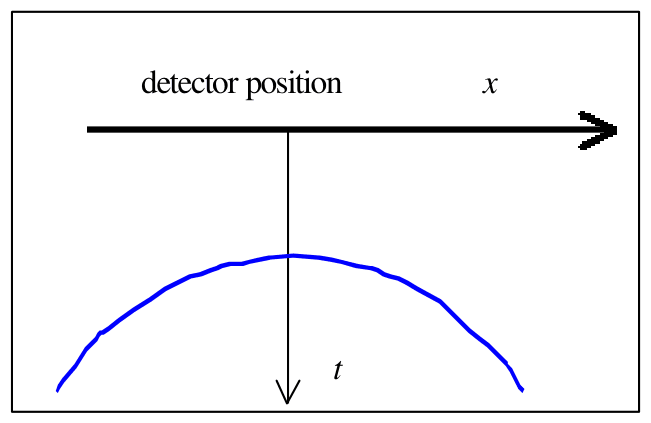
Graph of traveltime \(t\) vs detector position \(x\), \(t_{\min}=100\ \mathrm{ns}\).
Derive \(t\) as a function of \(x\) and determine \(d\) [3.5 pts].
Official English text of the problem.
-
Problem 2: Sensing Electrical Signals
Some seawater animals have the ability to detect other creatures at some distance away due to electric currents produced by the creatures during the breathing processes or other processes involving muscular contraction. Some predators use this electrical signal to locate their preys, even when buried under the sands.
The physical mechanism underlying the current generation at the prey and its detection by the predator can be modeled as described by Figure II-1. The current generated by the prey flows between two spheres with positive and negative potential in the prey’s body. The distance between the centers of the two spheres is \(l_s\), each having a radius of \(r_s\), which is much smaller than \(l_s\). The seawater resistivity is \(\rho\). Assume that the resistivity of the prey’s body is the same as that of the surrounding seawater, implying that the boundary surrounding the prey in the figure can be ignored.
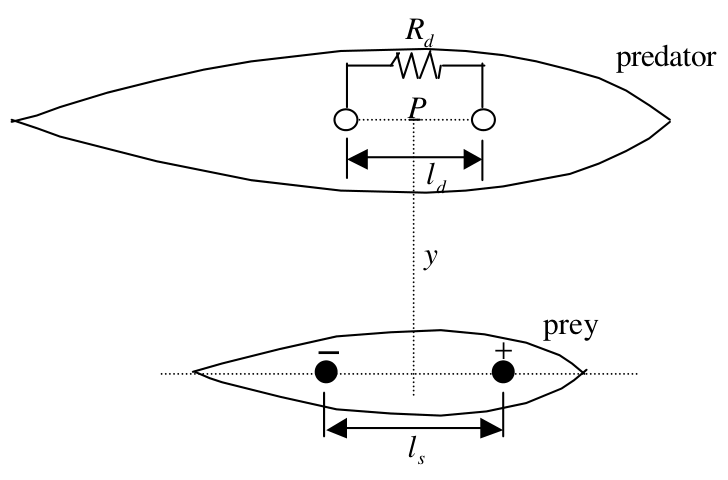
Figure II-1. A model describing the detection of electric power coming from a prey by its predator.
In order to describe the detection of electric power by the predator coming from the prey, the detector is modeled similarly by two spheres on the predator’s body and in contact with the surrounding seawater, lying parallel to the pair in the prey’s body. They are separated by a distance of \(l_d\), each having a radius of \(r_d\) which is much smaller than \(l_d\). In this case, the center of the detector is located at a distance \(y\) right above the source and the line connecting the two spheres is parallel to the electric field as shown in Figure II-1. Both \(l_s\) and \(l_d\) are also much smaller than \(y\). The electric field strength along the line connecting the two spheres is assumed to be constant. Therefore the detector forms a closed circuit system connecting the prey, the surrounding seawater and the predator as described in Figure II-2.
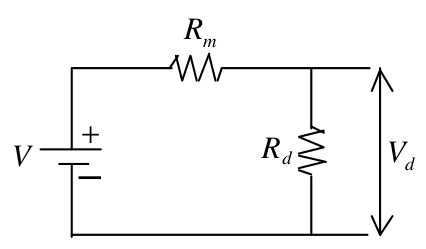
Figure II-2. The equivalent closed circuit system involving the sensing predator, the prey and the surrounding seawater.
In the figure, \(V\) is the voltage difference between the detector’s spheres due to the electric field induced by the prey, \(R_m\) is the inner resistance due to the surrounding sea water. Further, \(V_d\) and \(R_d\) are respectively the voltage difference between the detecting spheres and the resistance of the detecting element within the predator.
Questions:
-
Determine the current density vector \(\vec{j}\) (current per unit area) caused by a point current source \(I_s\) at a distance \(r\) in an infinite medium. [1.5 pts]
-
Based on the law \(\vec{E}=\rho\vec{j}\), determine the electric field strength \(\vec{E}_p\) at the middle of the detecting spheres (at point P) for a given current \(I_s\) that flows between two spheres in the prey’s body [2.0 pts].
-
Determine for the same current \(I_s\), the voltage difference between the source spheres (\(V_s\)) in the prey [1.5 pts]. Determine the resistance between the two source spheres (\(R_s\)) [0.5 pts] and the power produced by the source (\(P_s\)) [0.5 pts].
-
Determine \(R_m\) [0.5 pts], \(V_d\) [1.0 pts] in Figure II-2 and calculate also the power transferred from the source to the detector (\(P_d\)) [0.5 pts].
-
Determine the optimum value of \(R_d\) leading to maximum detected power [1.5 pts] and determine also the maximum power [0.5 pts].
Official English text of the problem.
-
Problem 3: A Heavy Vehicle Moving on An Inclined Road
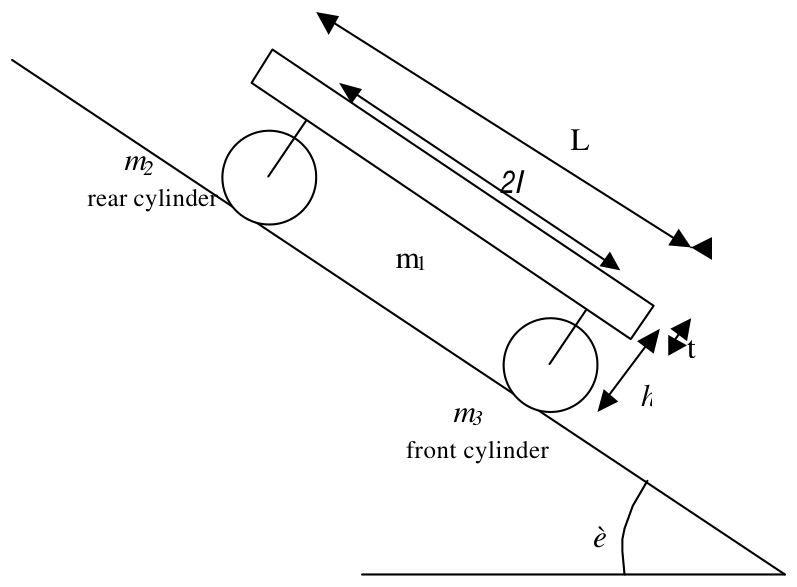
Figure III-1: A simplified model of a heavy vehicle moving on an inclined road.
The above figure is a simplified model of a heavy vehicle (road roller) with one rear and one front cylinder as its wheels on an inclined road with inclination angle of \(\theta\) (labelled è in the figure) as shown in Figure III-1. Each of the two cylinders has a total mass \(M(m_2=m_3=M)\) and consists of a cylindrical shell of outer radius \(R_o\), inner radius \(R_i=0.8R_o\) and eight number of spokes with total mass \(0.2M\). The mass of the undercarriage supporting the vehicle’s body is negligible. The cylinder can be modeled as shown in Figure III-2. The vehicle is moving down the road under the influence of gravitational and frictional forces. The front and rear cylinder are positioned symmetrically with respect to the vehicle.
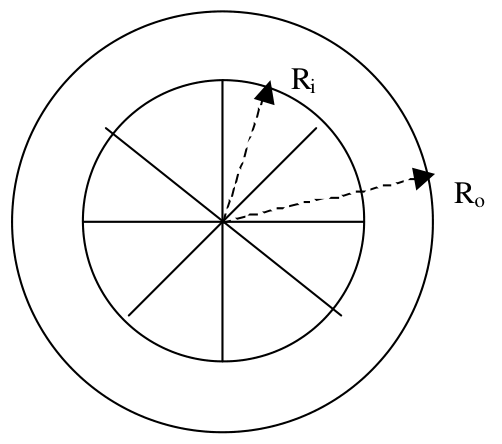
Figure III-2: A simplified model of the cylinders.
The static and kinetic friction coefficients between the cylinder and the road are \(\mu_s\) and \(\mu_k\) respectively. The body of the vehicle has a mass of \(5M\), length of \(L\) and thickness of \(t\). The distance between the front and the rear cylinder is \(2l\) while the distance from the center of cylinder to the base of the vehicle’s body is \(h\). Assume that the rolling friction between the cylinder and its axis is negligible.
Questions:
-
Calculate the moment of inertia of either cylinder [1.5 pts].
-
Draw all forces that act on the body, the front cylinder, and the rear one. Write down equations of motion for each part of them [2.5 pts].
-
The vehicle is assummed to move from rest, then freely move under gravitational influence. State all the possible types of motion of the system and derive their accelerations in terms of the given physical quantities [4.0 pts].
-
Assume that after the vehicle travels a distance \(d\) by pure rolling from rest the vehicle enters a section of the road with all the friction coefficients drop to smaller constant values \(\mu_s'\) and \(\mu_k'\) such that the two cylinders start to slide. Calculate the linear and angular velocities of each cylinder after the vehicle has traveled a total distance of \(s\) meters. Here we assume that \(d\) and \(s\) is much larger than the dimension of vehicle [2.0 pts]
Official English text of the problem.
-
Internationale Physik-Olympiade
IPhO 2002
Bali, Indonesien · 3 Theorieaufgaben mit vollständigen Lösungen
Aufgabe 1: Bodenradar
Bodenradar (GPR) wird eingesetzt, um oberflächennahe unterirdische Objekte zu erkennen und zu orten, indem elektromagnetische Wellen in den Boden gesendet und die von diesen Objekten reflektierten Wellen empfangen werden. Die Antenne und der Detektor befinden sich unmittelbar auf dem Boden am selben Ort.
Eine linear polarisierte ebene elektromagnetische Welle mit der Kreisfrequenz \(\omega\), die sich in \(z\)-Richtung ausbreitet, wird durch den folgenden Ausdruck für ihr Feld beschrieben:
\[ E=E_0e^{-\alpha z}\cos(\omega t-\beta z), \tag{1} \]
wobei \(E_0\) konstant ist, \(\alpha\) der Dämpfungskoeffizient und \(\beta\) die Wellenzahl sind, die jeweils durch die folgenden Ausdrücke gegeben sind:
\[ \alpha=\omega\left\{ \frac{\mu\varepsilon}{2} \left[ \left(1+\frac{\sigma^2}{\varepsilon^2\omega^2}\right)^{1/2}-1 \right]\right\}^{1/2}, \qquad \beta=\omega\left\{ \frac{\mu\varepsilon}{2} \left[ \left(1+\frac{\sigma^2}{\varepsilon^2\omega^2}\right)^{1/2}+1 \right]\right\}^{1/2} \tag{2} \]
Dabei bezeichnen \(\mu,\varepsilon,\) und \(\sigma\) die magnetische Permeabilität, die elektrische Permittivität bzw. die elektrische Leitfähigkeit.
Das Signal ist nicht mehr nachweisbar, wenn die Amplitude des am Objekt ankommenden Radarsignals unter \(1/e\) (\(\approx 37\%\)) ihres Anfangswerts fällt. Üblicherweise wird eine elektromagnetische Welle mit variabler Frequenz (10 MHz – 1000 MHz) verwendet, um die Reichweite und die Auflösung der Ortung anpassen zu können.
Die Leistungsfähigkeit des Bodenradars hängt von seiner Auflösung ab. Die Auflösung ist durch den Mindestabstand zwischen zwei benachbarten, zu detektierenden Reflektoren gegeben. Dieser Mindestabstand muss am Detektor zu einer Phasendifferenz von mindestens \(180^\circ\) zwischen den beiden reflektierten Wellen führen.
Fragen:
(Gegeben: \(\mu_0=4\pi\times10^{-7}\ \mathrm{H/m}\) und \(\varepsilon_0=8.85\times10^{-12}\ \mathrm{F/m}\))
-
Nehmen Sie an, dass der Boden nichtmagnetisch ist (\(\mu=\mu_0\)) und die Bedingung \(\left(\dfrac{\sigma}{\omega\varepsilon}\right)^2\ll1\) erfüllt. Leiten Sie mithilfe der Gleichungen (1) und (2) den Ausdruck für die Ausbreitungsgeschwindigkeit \(v\) in Abhängigkeit von \(\mu\) und \(\varepsilon\) her [1.0 Punkte].
-
Bestimmen Sie die maximale Tiefe, in der ein Objekt in einem Boden mit einer Leitfähigkeit von 1.0 mS/m und einer Permittivität von \(9\varepsilon_0\) detektiert werden kann, wobei die Bedingung \(\left(\dfrac{\sigma}{\omega\varepsilon}\right)^2\ll1\) erfüllt ist (\(\mathrm{S}=\mathrm{ohm}^{-1}\) ; verwenden Sie \(\mu=\mu_0\)). [2.0 Punkte]
-
Betrachten Sie zwei parallele leitende Stäbe, die horizontal im Boden vergraben sind. Die Stäbe befinden sich in einer Tiefe von 4 Metern. Der Boden hat bekanntermaßen eine Leitfähigkeit von 1.0 mS/m und eine Permittivität von \(9\varepsilon_0\). Die Bodenradarmessung werde an einer Position ungefähr über einem der Stäbe durchgeführt. Nehmen Sie an, dass ein punktförmiger Detektor verwendet wird. Bestimmen Sie die Mindestfrequenz, die erforderlich ist, um eine laterale Auflösung von 50 cm zu erreichen [3.5 Punkte].
-
Um die Tiefe \(d\) eines im selben Boden vergrabenen Stabes zu bestimmen, betrachten Sie Messungen entlang einer Geraden senkrecht zum Stab. Das Ergebnis wird durch die folgende Abbildung beschrieben:
Diagramm der Laufzeit \(t\) in Abhängigkeit von der Detektorposition \(x\), \(t_{\min}=100\ \mathrm{ns}\).
Leiten Sie \(t\) als Funktion von \(x\) her und bestimmen Sie \(d\) [3.5 Punkte].
Aufgabentext aus dem offiziellen englischen Text übersetzt.
-
Aufgabe 2: Wahrnehmung elektrischer Signale
Einige Meerestiere können andere Lebewesen aus einiger Entfernung anhand elektrischer Ströme wahrnehmen, die diese beim Atmen oder bei anderen Vorgängen erzeugen, die mit Muskelkontraktionen verbunden sind. Manche Räuber nutzen dieses elektrische Signal, um ihre Beute auch dann zu orten, wenn sie im Sand vergraben ist.
Der physikalische Mechanismus, der der Stromerzeugung im Beutetier und der Wahrnehmung durch den Räuber zugrunde liegt, lässt sich wie in Abbildung II-1 dargestellt modellieren. Der vom Beutetier erzeugte Strom fließt zwischen zwei Kugeln mit positivem und negativem Potential im Körper des Beutetiers. Der Abstand zwischen den Mittelpunkten der beiden Kugeln beträgt \(l_s\); jede Kugel hat den Radius \(r_s\), der wesentlich kleiner als \(l_s\) ist. Der spezifische elektrische Widerstand des Meerwassers ist \(\rho\). Nehmen Sie an, dass der spezifische elektrische Widerstand des Körpers des Beutetiers dem des umgebenden Meerwassers entspricht, sodass die in der Abbildung eingezeichnete Begrenzung des Beutetiers vernachlässigt werden kann.
Abbildung II-1. Ein Modell zur Beschreibung der Erfassung der von einem Beutetier ausgehenden elektrischen Leistung durch seinen Räuber.
Um die Erfassung der vom Beutetier ausgehenden elektrischen Leistung durch den Räuber zu beschreiben, wird der Detektor ebenfalls durch zwei Kugeln am Körper des Räubers modelliert, die mit dem umgebenden Meerwasser in Kontakt stehen und parallel zum Kugelpaar im Körper des Beutetiers angeordnet sind. Ihr Abstand beträgt \(l_d\); jede Kugel hat den Radius \(r_d\), der wesentlich kleiner als \(l_d\) ist. Dabei befindet sich der Mittelpunkt des Detektors im Abstand \(y\) direkt über der Quelle, und die Verbindungslinie der beiden Kugeln verläuft parallel zum elektrischen Feld, wie in Abbildung II-1 dargestellt. Sowohl \(l_s\) als auch \(l_d\) sind ebenfalls wesentlich kleiner als \(y\). Die elektrische Feldstärke entlang der Verbindungslinie der beiden Kugeln wird als konstant angenommen. Der Detektor bildet somit einen geschlossenen Stromkreis, der das Beutetier, das umgebende Meerwasser und den Räuber miteinander verbindet, wie in Abbildung II-2 dargestellt.
Abbildung II-2. Der äquivalente geschlossene Stromkreis aus dem wahrnehmenden Räuber, dem Beutetier und dem umgebenden Meerwasser.
In der Abbildung ist \(V\) die durch das elektrische Feld des Beutetiers hervorgerufene Spannung zwischen den Kugeln des Detektors, und \(R_m\) ist der durch das umgebende Meerwasser bedingte Innenwiderstand. Ferner bezeichnen \(V_d\) und \(R_d\) die Spannung zwischen den Detektorkugeln beziehungsweise den Widerstand des Detektorelements im Inneren des Räubers.
Fragen:
-
Bestimmen Sie den Stromdichtevektor \(\vec{j}\) (Strom pro Flächeneinheit), den eine punktförmige Stromquelle \(I_s\) im Abstand \(r\) in einem unendlichen Medium erzeugt. [1.5 Punkte]
-
Bestimmen Sie mithilfe des Gesetzes \(\vec{E}=\rho\vec{j}\) die elektrische Feldstärke \(\vec{E}_p\) in der Mitte zwischen den Detektorkugeln (am Punkt P) für einen gegebenen Strom \(I_s\), der zwischen den beiden Kugeln im Körper des Beutetiers fließt [2.0 Punkte].
-
Bestimmen Sie für denselben Strom \(I_s\) die Spannung zwischen den Quellkugeln (\(V_s\)) im Beutetier [1.5 Punkte]. Bestimmen Sie den Widerstand zwischen den beiden Quellkugeln (\(R_s\)) [0.5 Punkte] und die von der Quelle erzeugte Leistung (\(P_s\)) [0.5 Punkte].
-
Bestimmen Sie \(R_m\) [0.5 Punkte] und \(V_d\) [1.0 Punkte] in Abbildung II-2 und berechnen Sie außerdem die von der Quelle auf den Detektor übertragene Leistung (\(P_d\)) [0.5 Punkte].
-
Bestimmen Sie den optimalen Wert von \(R_d\), bei dem die vom Detektor aufgenommene Leistung maximal ist [1.5 Punkte], und bestimmen Sie außerdem die maximale Leistung [0.5 Punkte].
Aufgabentext aus dem offiziellen englischen Text übersetzt.
-
Aufgabe 3: Ein schweres Fahrzeug auf einer geneigten Straße
Abbildung III-1: Vereinfachtes Modell eines schweren Fahrzeugs auf einer geneigten Straße.
Die obige Abbildung zeigt ein vereinfachtes Modell eines schweren Fahrzeugs (einer Straßenwalze), das sich mit einer hinteren und einer vorderen Walze als Rädern auf einer Straße mit dem Neigungswinkel \(\theta\) (in der Abbildung als è bezeichnet) befindet, wie in Abbildung III-1 dargestellt. Jede der beiden Walzen hat die Gesamtmasse \(M(m_2=m_3=M)\) und besteht aus einem zylindrischen Mantel mit dem Außenradius \(R_o\), dem Innenradius \(R_i=0.8R_o\) und acht Speichen mit der Gesamtmasse \(0.2M\). Die Masse des Fahrgestells, das den Fahrzeugaufbau trägt, ist vernachlässigbar. Die Walze kann wie in Abbildung III-2 modelliert werden. Das Fahrzeug bewegt sich unter dem Einfluss von Gravitations- und Reibungskräften die Straße hinab. Die vordere und die hintere Walze sind bezüglich des Fahrzeugs symmetrisch angeordnet.
Abbildung III-2: Vereinfachtes Modell der Walzen.
Die Haft- und Gleitreibungskoeffizienten zwischen der Walze und der Straße sind \(\mu_s\) bzw. \(\mu_k\). Der Fahrzeugaufbau hat die Masse \(5M\), die Länge \(L\) und die Dicke \(t\). Der Abstand zwischen der vorderen und der hinteren Walze beträgt \(2l\), während der Abstand vom Mittelpunkt der Walze zur Unterseite des Fahrzeugaufbaus \(h\) beträgt. Nehmen Sie an, dass die Rollreibung zwischen der Walze und ihrer Achse vernachlässigbar ist.
Fragen:
-
Berechnen Sie das Trägheitsmoment einer der beiden Walzen [1.5 Punkte].
-
Zeichnen Sie alle Kräfte ein, die auf den Aufbau, die vordere Walze und die hintere Walze wirken. Stellen Sie die Bewegungsgleichungen für jeden dieser Teile auf [2.5 Punkte].
-
Es wird angenommen, dass das Fahrzeug aus der Ruhe startet und sich dann unter dem Einfluss der Gravitation frei bewegt. Geben Sie alle möglichen Bewegungsarten des Systems an und leiten Sie deren Beschleunigungen in Abhängigkeit von den gegebenen physikalischen Größen her [4.0 Punkte].
-
Nehmen Sie an, dass das Fahrzeug, nachdem es aus der Ruhe die Strecke \(d\) rein rollend zurückgelegt hat, einen Straßenabschnitt erreicht, auf dem alle Reibungskoeffizienten auf kleinere konstante Werte \(\mu_s'\) und \(\mu_k'\) abfallen, sodass beide Walzen zu gleiten beginnen. Berechnen Sie die Translations- und Winkelgeschwindigkeiten jeder Walze, nachdem das Fahrzeug insgesamt eine Strecke von \(s\) Metern zurückgelegt hat. Dabei nehmen wir an, dass \(d\) und \(s\) viel größer als die Abmessungen des Fahrzeugs sind [2.0 Punkte]
Aufgabentext aus dem offiziellen englischen Text übersetzt.
-
Uluslararası Fizik Olimpiyatı
IPhO 2002
Bali, Endonezya · 3 teori sorusu, tam çözümleriyle
Soru 1: Yer Radarı
Yer radarı (GPR), zemine elektromanyetik dalgalar gönderip yer altındaki nesnelerden yansıyan dalgaları alarak yüzeye yakın nesneleri tespit etmek ve konumlarını belirlemek için kullanılır. Anten ve dedektör doğrudan zemin üzerinde, aynı noktada bulunur.
\(z\) yönünde yayılan, açısal frekansı \(\omega\) olan doğrusal kutuplanmış bir elektromanyetik düzlem dalganın alanı aşağıdaki ifadeyle gösterilir:
\[ E=E_0e^{-\alpha z}\cos(\omega t-\beta z), \tag{1} \]
Burada \(E_0\) sabittir; \(\alpha\) zayıflama katsayısı, \(\beta\) ise dalga sayısıdır ve sırasıyla aşağıdaki gibi ifade edilirler:
\[ \alpha=\omega\left\{ \frac{\mu\varepsilon}{2} \left[ \left(1+\frac{\sigma^2}{\varepsilon^2\omega^2}\right)^{1/2}-1 \right]\right\}^{1/2}, \qquad \beta=\omega\left\{ \frac{\mu\varepsilon}{2} \left[ \left(1+\frac{\sigma^2}{\varepsilon^2\omega^2}\right)^{1/2}+1 \right]\right\}^{1/2} \tag{2} \]
Burada \(\mu,\varepsilon,\) ve \(\sigma\) sırasıyla manyetik geçirgenliği, elektriksel geçirgenliği ve elektriksel iletkenliği belirtir.
Nesneye ulaşan radar sinyalinin genliği başlangıç değerinin \(1/e\)'sinin (\(\approx 37\%\)) altına düştüğünde sinyal algılanamaz hâle gelir. Algılama menzilinin ve çözünürlüğünün ayarlanabilmesi için genellikle değişken frekanslı (10 MHz – 1000 MHz) bir elektromanyetik dalga kullanılır.
Yer radarının performansı çözünürlüğüne bağlıdır. Çözünürlük, birbirine komşu iki yansıtıcının ayırt edilebilmesi için aralarında bulunması gereken en küçük uzaklıkla verilir. Bu en küçük uzaklık, dedektörde iki yansıyan dalga arasında en az \(180^\circ\) faz farkı oluşturmalıdır.
Sorular:
(Verilenler: \(\mu_0=4\pi\times10^{-7}\ \mathrm{H/m}\) ve \(\varepsilon_0=8.85\times10^{-12}\ \mathrm{F/m}\))
-
Zeminin manyetik olmadığını (\(\mu=\mu_0\)) ve \(\left(\dfrac{\sigma}{\omega\varepsilon}\right)^2\ll1\) koşulunu sağladığını varsayın. (1) ve (2) denklemlerini kullanarak yayılma hızı \(v\)'nin \(\mu\) ve \(\varepsilon\) cinsinden ifadesini türetin [1.0 puan].
-
İletkenliği 1.0 mS/m ve elektriksel geçirgenliği \(9\varepsilon_0\) olan, \(\left(\dfrac{\sigma}{\omega\varepsilon}\right)^2\ll1\) koşulunu sağlayan bir zemindeki bir nesnenin algılanabileceği en büyük derinliği belirleyin (\(\mathrm{S}=\mathrm{ohm}^{-1}\) ; \(\mu=\mu_0\) kullanın). [2.0 puan]
-
Zemine yatay olarak gömülmüş, birbirine paralel iki iletken çubuğu ele alın. Çubuklar 4 metre derinliktedir. Zeminin iletkenliğinin 1.0 mS/m ve elektriksel geçirgenliğinin \(9\varepsilon_0\) olduğu bilinmektedir. Yer radarı ölçümünün, yaklaşık olarak çubuklardan birinin tam üzerinde yapıldığını varsayın. Noktasal bir dedektör kullanıldığını kabul edin. 50 cm yanal çözünürlük elde etmek için gereken en küçük frekansı belirleyin [3.5 puan].
-
Aynı zemine gömülmüş bir çubuğun \(d\) derinliğini belirlemek için çubuğa dik bir doğru boyunca yapılan ölçümleri ele alın. Sonuç aşağıdaki şekilde gösterilmiştir:
Gidiş-dönüş süresi \(t\)'nin dedektör konumu \(x\)'e göre grafiği, \(t_{\min}=100\ \mathrm{ns}\).
\(t\)'yi \(x\)'in bir fonksiyonu olarak türetin ve \(d\)'yi belirleyin [3.5 puan].
Soru metni resmi İngilizce metinden çevrilmiştir.
-
Soru 2: Elektriksel Sinyallerin Algılanması
Bazı deniz hayvanları, diğer canlıların solunum sırasında veya kas kasılmasını içeren başka süreçlerde ürettikleri elektrik akımları sayesinde bu canlıları belirli bir uzaklıktan algılayabilir. Bazı yırtıcılar, avları kumun altına gömülmüş olsa bile, onların yerini belirlemek için bu elektriksel sinyali kullanır.
Avda akımın oluşmasını ve yırtıcının bu akımı algılamasını sağlayan fiziksel mekanizma, Şekil II-1'de gösterildiği gibi modellenebilir. Avın ürettiği akım, avın vücudundaki pozitif ve negatif potansiyelli iki küre arasında akar. İki kürenin merkezleri arasındaki uzaklık \(l_s\), her birinin yarıçapı ise \(l_s\)'den çok daha küçük olan \(r_s\)'dir. Deniz suyunun özdirenci \(\rho\)'dur. Avın vücudunun özdirencinin çevresindeki deniz suyunun özdirenciyle aynı olduğunu varsayın; bu durumda şekilde avı çevreleyen sınır göz ardı edilebilir.
Şekil II-1. Bir avdan gelen elektriksel gücün yırtıcısı tarafından algılanmasını betimleyen model.
Avdan gelen elektriksel gücün yırtıcı tarafından algılanmasını betimlemek için, algılayıcı da benzer biçimde, yırtıcının vücudunda bulunan ve çevredeki deniz suyuyla temas eden, avın vücudundaki küre çiftine paralel duran iki küreyle modellenir. Bu küreler arasındaki uzaklık \(l_d\), her birinin yarıçapı ise \(l_d\)'den çok daha küçük olan \(r_d\)'dir. Bu durumda algılayıcının merkezi kaynağın tam üstünde, kaynaktan \(y\) uzaklıkta bulunur ve iki küreyi birleştiren doğru, Şekil II-1'de gösterildiği gibi elektrik alanına paraleldir. Hem \(l_s\) hem de \(l_d\), \(y\)'den de çok daha küçüktür. İki küreyi birleştiren doğru boyunca elektrik alan şiddetinin sabit olduğu varsayılır. Böylece algılayıcı, Şekil II-2'de gösterildiği gibi avı, çevredeki deniz suyunu ve yırtıcıyı birbirine bağlayan kapalı bir devre sistemi oluşturur.
Şekil II-2. Algılayan yırtıcıyı, avı ve çevredeki deniz suyunu içeren eşdeğer kapalı devre sistemi.
Şekilde \(V\), avın oluşturduğu elektrik alanından kaynaklanan, algılayıcı küreleri arasındaki gerilim farkıdır; \(R_m\) ise çevredeki deniz suyundan kaynaklanan iç dirençtir. Ayrıca \(V_d\) ve \(R_d\), sırasıyla algılayıcı küreler arasındaki gerilim farkı ve yırtıcının içindeki algılama elemanının direncidir.
Sorular:
-
Sonsuz bir ortamda, noktasal bir \(I_s\) akım kaynağının \(r\) uzaklıkta oluşturduğu akım yoğunluğu vektörünü \(\vec{j}\) (birim alan başına akım) bulun. [1.5 puan]
-
\(\vec{E}=\rho\vec{j}\) yasasını kullanarak, avın vücudundaki iki küre arasında akan belirli bir \(I_s\) akımı için algılayıcı kürelerin orta noktasındaki (P noktasındaki) elektrik alan şiddetini \(\vec{E}_p\) bulun [2.0 puan].
-
Aynı \(I_s\) akımı için, avdaki kaynak küreler arasındaki gerilim farkını (\(V_s\)) bulun [1.5 puan]. İki kaynak küre arasındaki direnci (\(R_s\)) [0.5 puan] ve kaynağın ürettiği gücü (\(P_s\)) [0.5 puan] bulun.
-
Şekil II-2'deki \(R_m\)'yi [0.5 puan], \(V_d\)'yi [1.0 puan] bulun ve kaynaktan algılayıcıya aktarılan gücü (\(P_d\)) de hesaplayın [0.5 puan].
-
Algılanan gücü maksimum yapan en uygun \(R_d\) değerini bulun [1.5 puan] ve maksimum gücü de belirleyin [0.5 puan].
Soru metni resmi İngilizce metinden çevrilmiştir.
-
Soru 3: Eğimli Bir Yolda Hareket Eden Ağır Bir Araç
Şekil III-1: Eğimli bir yolda hareket eden ağır bir aracın basitleştirilmiş modeli.
Yukarıdaki şekil, Şekil III-1'de gösterildiği gibi eğim açısı \(\theta\) (şekilde è ile gösterilmiştir) olan bir yolda, tekerlek olarak biri arkada diğeri önde olmak üzere iki silindire sahip ağır bir aracın (yol silindirinin) basitleştirilmiş modelidir. İki silindirin her birinin toplam kütlesi \(M(m_2=m_3=M)\) olup her biri, dış yarıçapı \(R_o\), iç yarıçapı \(R_i=0.8R_o\) olan silindirik bir kabuk ile toplam kütlesi \(0.2M\) olan sekiz adet radyal çubuktan oluşur. Aracın gövdesini taşıyan şasinin kütlesi ihmal edilebilir. Silindir, Şekil III-2'de gösterildiği gibi modellenebilir. Araç, yerçekimi ve sürtünme kuvvetlerinin etkisi altında yokuş aşağı hareket etmektedir. Ön ve arka silindir, araca göre simetrik olarak yerleştirilmiştir.
Şekil III-2: Silindirlerin basitleştirilmiş modeli.
Silindir ile yol arasındaki statik ve kinetik sürtünme katsayıları sırasıyla \(\mu_s\) ve \(\mu_k\)'dır. Aracın gövdesinin kütlesi \(5M\), uzunluğu \(L\) ve kalınlığı \(t\)'dir. Ön ve arka silindir arasındaki uzaklık \(2l\), silindirin merkezinden araç gövdesinin tabanına olan uzaklık ise \(h\)'dir. Silindir ile mili arasındaki yuvarlanma sürtünmesinin ihmal edilebilir olduğunu varsayın.
Sorular:
-
Silindirlerden herhangi birinin eylemsizlik momentini hesaplayın [1.5 puan].
-
Gövdeye, ön silindire ve arka silindire etki eden tüm kuvvetleri çizerek gösterin. Bu parçaların her biri için hareket denklemlerini yazın [2.5 puan].
-
Aracın durgun hâlden harekete başladığı ve ardından yerçekimi etkisi altında serbestçe hareket ettiği varsayılmaktadır. Sistemin olası tüm hareket türlerini belirtin ve bunların ivmelerini verilen fiziksel nicelikler cinsinden türetin [4.0 puan].
-
Aracın durgun hâlden başlayıp kaymadan yuvarlanarak \(d\) kadar yol aldıktan sonra, tüm sürtünme katsayılarının daha küçük sabit \(\mu_s'\) ve \(\mu_k'\) değerlerine düştüğü ve bunun sonucunda iki silindirin de kaymaya başladığı bir yol kesimine girdiğini varsayın. Araç toplam \(s\) metre yol aldıktan sonra her bir silindirin çizgisel ve açısal hızlarını hesaplayın. Burada \(d\) ve \(s\)'nin aracın boyutlarından çok daha büyük olduğunu varsayıyoruz [2.0 puan]
Soru metni resmi İngilizce metinden çevrilmiştir.
-
Olimpiada Internacional de Física
IPhO 2002
Bali, Indonesia · 3 problemas teóricos con soluciones completas
Problema 1: Radar de penetración terrestre
El radar de penetración terrestre (GPR) se utiliza para detectar y localizar objetos subterráneos próximos a la superficie mediante la transmisión de ondas electromagnéticas al interior del terreno y la recepción de las ondas reflejadas por dichos objetos. La antena y el detector se encuentran directamente sobre el terreno y están situados en el mismo punto.
Una onda electromagnética plana, linealmente polarizada, de frecuencia angular \(\omega\), que se propaga en la dirección \(z\), se representa mediante la siguiente expresión de su campo:
\[ E=E_0e^{-\alpha z}\cos(\omega t-\beta z), \tag{1} \]
donde \(E_0\) es constante, \(\alpha\) es el coeficiente de atenuación y \(\beta\) es el número de onda, expresados respectivamente de la siguiente manera:
\[ \alpha=\omega\left\{ \frac{\mu\varepsilon}{2} \left[ \left(1+\frac{\sigma^2}{\varepsilon^2\omega^2}\right)^{1/2}-1 \right]\right\}^{1/2}, \qquad \beta=\omega\left\{ \frac{\mu\varepsilon}{2} \left[ \left(1+\frac{\sigma^2}{\varepsilon^2\omega^2}\right)^{1/2}+1 \right]\right\}^{1/2} \tag{2} \]
donde \(\mu,\varepsilon,\) y \(\sigma\) denotan la permeabilidad magnética, la permitividad eléctrica y la conductividad eléctrica, respectivamente.
La señal deja de detectarse cuando la amplitud de la señal de radar que llega al objeto cae por debajo de \(1/e\) (\(\approx 37\%\)) de su valor inicial. Habitualmente se utiliza una onda electromagnética de frecuencia variable (10 MHz – 1000 MHz) para poder ajustar el alcance y la resolución de la detección.
El rendimiento del GPR depende de su resolución. La resolución viene dada por la separación mínima entre los dos reflectores adyacentes que se desea detectar. Esta separación mínima debe producir una diferencia de fase mínima de \(180^\circ\) entre las dos ondas reflejadas en el detector.
Preguntas:
(Datos: \(\mu_0=4\pi\times10^{-7}\ \mathrm{H/m}\) y \(\varepsilon_0=8.85\times10^{-12}\ \mathrm{F/m}\))
-
Suponga que el terreno es no magnético (\(\mu=\mu_0\)) y satisface la condición \(\left(\dfrac{\sigma}{\omega\varepsilon}\right)^2\ll1\). Deduzca la expresión de la velocidad de propagación \(v\) en función de \(\mu\) y \(\varepsilon\), utilizando las ecuaciones (1) y (2) [1.0 pts].
-
Determine la profundidad máxima de detección de un objeto en un terreno con una conductividad de 1.0 mS/m y una permitividad de \(9\varepsilon_0\), que satisface la condición \(\left(\dfrac{\sigma}{\omega\varepsilon}\right)^2\ll1\), (\(\mathrm{S}=\mathrm{ohm}^{-1}\) ; utilice \(\mu=\mu_0\)). [2.0 pts]
-
Considere dos varillas conductoras paralelas enterradas horizontalmente en el terreno. Las varillas están a 4 metros de profundidad. Se sabe que el terreno tiene una conductividad de 1.0 mS/m y una permitividad de \(9\varepsilon_0\). Suponga que la medición con GPR se realiza en una posición aproximadamente sobre una de las varillas. Suponga que se utiliza un detector puntual. Determine la frecuencia mínima necesaria para obtener una resolución lateral de 50 cm [3.5 pts].
-
Para determinar la profundidad \(d\) de una varilla enterrada en el mismo terreno, considere las mediciones realizadas a lo largo de una línea perpendicular a la varilla. El resultado se describe en la siguiente figura:
Gráfica del tiempo de recorrido \(t\) en función de la posición del detector \(x\), \(t_{\min}=100\ \mathrm{ns}\).
Deduzca \(t\) en función de \(x\) y determine \(d\) [3.5 pts].
Enunciado traducido del texto oficial en inglés.
-
Problema 2: Detección de señales eléctricas
Algunos animales marinos tienen la capacidad de detectar otras criaturas a cierta distancia gracias a las corrientes eléctricas que estas producen durante la respiración u otros procesos que implican contracción muscular. Algunos depredadores utilizan esta señal eléctrica para localizar a sus presas, incluso cuando están enterradas en la arena.
El mecanismo físico que subyace a la generación de corriente en la presa y a su detección por el depredador puede modelarse como se describe en la Figura II-1. La corriente generada por la presa circula entre dos esferas con potencial positivo y negativo situadas en el cuerpo de la presa. La distancia entre los centros de las dos esferas es \(l_s\), y cada una tiene un radio \(r_s\), mucho menor que \(l_s\). La resistividad del agua de mar es \(\rho\). Suponga que la resistividad del cuerpo de la presa es la misma que la del agua de mar circundante, lo que implica que puede ignorarse el contorno que rodea a la presa en la figura.
Figura II-1. Modelo que describe la detección de la potencia eléctrica procedente de una presa por parte de su depredador.
Para describir la detección por parte del depredador de la potencia eléctrica procedente de la presa, el detector se modela de manera similar mediante dos esferas situadas en el cuerpo del depredador y en contacto con el agua de mar circundante, dispuestas paralelamente al par de esferas del cuerpo de la presa. Están separadas por una distancia \(l_d\), y cada una tiene un radio \(r_d\), mucho menor que \(l_d\). En este caso, el centro del detector se encuentra a una distancia \(y\) justo por encima de la fuente, y la línea que une las dos esferas es paralela al campo eléctrico, como se muestra en la Figura II-1. Tanto \(l_s\) como \(l_d\) son también mucho menores que \(y\). Se supone que la intensidad del campo eléctrico a lo largo de la línea que une las dos esferas es constante. Por tanto, el detector forma un circuito cerrado que conecta la presa, el agua de mar circundante y el depredador, como se describe en la Figura II-2.
Figura II-2. Circuito cerrado equivalente que incluye al depredador que detecta la señal, la presa y el agua de mar circundante.
En la figura, \(V\) es la diferencia de potencial entre las esferas del detector debida al campo eléctrico inducido por la presa, y \(R_m\) es la resistencia interna debida al agua de mar circundante. Además, \(V_d\) y \(R_d\) son, respectivamente, la diferencia de potencial entre las esferas detectoras y la resistencia del elemento detector situado en el interior del depredador.
Preguntas:
-
Determine el vector densidad de corriente \(\vec{j}\) (corriente por unidad de área) producido por una fuente puntual de corriente \(I_s\) a una distancia \(r\) en un medio infinito. [1.5 puntos]
-
A partir de la ley \(\vec{E}=\rho\vec{j}\), determine la intensidad del campo eléctrico \(\vec{E}_p\) en el punto medio entre las esferas detectoras (en el punto P) para una corriente dada \(I_s\) que circula entre dos esferas situadas en el cuerpo de la presa [2.0 puntos].
-
Determine, para la misma corriente \(I_s\), la diferencia de potencial entre las esferas de la fuente (\(V_s\)) situadas en la presa [1.5 puntos]. Determine la resistencia entre las dos esferas de la fuente (\(R_s\)) [0.5 puntos] y la potencia producida por la fuente (\(P_s\)) [0.5 puntos].
-
Determine \(R_m\) [0.5 puntos] y \(V_d\) [1.0 puntos] en la Figura II-2 y calcule también la potencia transferida de la fuente al detector (\(P_d\)) [0.5 puntos].
-
Determine el valor óptimo de \(R_d\) que proporciona la máxima potencia detectada [1.5 puntos] y determine también la potencia máxima [0.5 puntos].
Enunciado traducido del texto oficial en inglés.
-
Problema 3: Un vehículo pesado que se mueve por una carretera inclinada
Figura III-1: Modelo simplificado de un vehículo pesado que se mueve por una carretera inclinada.
La figura anterior es un modelo simplificado de un vehículo pesado (apisonadora) cuyas ruedas son un cilindro trasero y otro delantero, sobre una carretera inclinada con un ángulo de inclinación \(\theta\) (indicado como è en la figura), como se muestra en la Figura III-1. Cada uno de los dos cilindros tiene una masa total \(M(m_2=m_3=M)\) y consta de una envolvente cilíndrica de radio exterior \(R_o\), radio interior \(R_i=0.8R_o\) y ocho radios con una masa total de \(0.2M\). La masa del bastidor que sostiene la carrocería del vehículo es despreciable. El cilindro puede modelarse como se muestra en la Figura III-2. El vehículo desciende por la carretera bajo la acción de las fuerzas gravitatoria y de rozamiento. Los cilindros delantero y trasero están situados simétricamente con respecto al vehículo.
Figura III-2: Modelo simplificado de los cilindros.
Los coeficientes de rozamiento estático y cinético entre el cilindro y la carretera son \(\mu_s\) y \(\mu_k\), respectivamente. La carrocería del vehículo tiene una masa de \(5M\), una longitud de \(L\) y un espesor de \(t\). La distancia entre el cilindro delantero y el trasero es \(2l\), mientras que la distancia desde el centro del cilindro hasta la base de la carrocería del vehículo es \(h\). Suponga que el rozamiento de rodadura entre el cilindro y su eje es despreciable.
Preguntas:
-
Calcule el momento de inercia de cualquiera de los cilindros [1.5 puntos].
-
Dibuje todas las fuerzas que actúan sobre la carrocería, el cilindro delantero y el trasero. Escriba las ecuaciones del movimiento de cada una de estas partes [2.5 puntos].
-
Se supone que el vehículo parte del reposo y luego se mueve libremente bajo la acción de la gravedad. Indique todos los tipos posibles de movimiento del sistema y deduzca sus aceleraciones en función de las magnitudes físicas dadas [4.0 puntos].
-
Suponga que, después de recorrer una distancia \(d\) rodando sin deslizar desde el reposo, el vehículo entra en un tramo de la carretera donde todos los coeficientes de rozamiento disminuyen hasta unos valores constantes menores \(\mu_s'\) y \(\mu_k'\), de modo que los dos cilindros empiezan a deslizar. Calcule las velocidades lineal y angular de cada cilindro después de que el vehículo haya recorrido una distancia total de \(s\) metros. Aquí suponemos que \(d\) y \(s\) son mucho mayores que las dimensiones del vehículo [2.0 puntos]
Enunciado traducido del texto oficial en inglés.
-
国际物理奥林匹克
IPhO 2002
印度尼西亚巴厘岛 · 3 道理论题及完整解答
题目 1:探地雷达
探地雷达(GPR)通过向地下发射电磁波并接收地下物体反射的电磁波,来探测和定位埋藏在地表附近的物体。天线和探测器直接放置在地面上,且位于同一点。
沿 \(z\) 方向传播、角频率为 \(\omega\) 的线偏振电磁平面波,其电场可表示为:
\[ E=E_0e^{-\alpha z}\cos(\omega t-\beta z), \tag{1} \]
其中,\(E_0\) 为常量,\(\alpha\) 为衰减系数,\(\beta\) 为波数,后两者分别表示为
\[ \alpha=\omega\left\{ \frac{\mu\varepsilon}{2} \left[ \left(1+\frac{\sigma^2}{\varepsilon^2\omega^2}\right)^{1/2}-1 \right]\right\}^{1/2}, \qquad \beta=\omega\left\{ \frac{\mu\varepsilon}{2} \left[ \left(1+\frac{\sigma^2}{\varepsilon^2\omega^2}\right)^{1/2}+1 \right]\right\}^{1/2} \tag{2} \]
其中,\(\mu,\varepsilon,\) 和 \(\sigma\) 分别表示磁导率、介电常数和电导率。
当到达物体的雷达信号振幅降至其初始值的 \(1/e\)(\(\approx 37\%\))以下时,信号便无法被探测到。通常使用频率可调的电磁波(10 MHz – 1000 MHz),以便调节探测范围和分辨率。
探地雷达的性能取决于其分辨率。分辨率由能够分辨的两个相邻反射体之间的最小间距给出。此最小间距应使两束反射波到达探测器时产生至少 \(180^\circ\) 的相位差。
问题:
(已知:\(\mu_0=4\pi\times10^{-7}\ \mathrm{H/m}\) 和 \(\varepsilon_0=8.85\times10^{-12}\ \mathrm{F/m}\))
-
假设地下介质为非磁性介质(\(\mu=\mu_0\)),且满足条件 \(\left(\dfrac{\sigma}{\omega\varepsilon}\right)^2\ll1\)。利用式 (1) 和式 (2),推导传播速度 \(v\) 用 \(\mu\) 和 \(\varepsilon\) 表示的表达式 [1.0 分]。
-
地下介质的电导率为 1.0 mS/m,介电常数为 \(9\varepsilon_0\),且满足条件 \(\left(\dfrac{\sigma}{\omega\varepsilon}\right)^2\ll1\)。求埋藏在其中的物体能够被探测到的最大深度(\(\mathrm{S}=\mathrm{ohm}^{-1}\);取 \(\mu=\mu_0\))。[2.0 分]
-
考虑两根平行的导电棒,水平埋藏在地下,埋深为 4 米。已知地下介质的电导率为 1.0 mS/m,介电常数为 \(9\varepsilon_0\)。假设探地雷达在大致位于其中一根导电棒正上方的位置进行测量,并使用点探测器。求获得 50 cm 横向分辨率所需的最低频率 [3.5 分]。
-
为确定埋藏在同一地下介质中的一根导电棒的深度 \(d\),考虑沿垂直于导电棒的直线进行测量。测量结果如下图所示:
传播时间 \(t\) 随探测器位置 \(x\) 变化的曲线,\(t_{\min}=100\ \mathrm{ns}\)。
推导 \(t\) 关于 \(x\) 的函数,并确定 \(d\) [3.5 分]。
题目译自官方英文原文。
-
题目 2:电信号的感知
一些海洋动物能够探测到一定距离外的其他生物,这是因为这些生物在呼吸过程或其他涉及肌肉收缩的过程中会产生电流。一些捕食者利用这种电信号来确定猎物的位置,即使猎物埋在沙中也能如此。
猎物产生电流以及捕食者探测该电流的物理机制,可以用图 II-1 所示的模型来描述。猎物产生的电流在其体内两个分别处于正电势和负电势的球体之间流动。两个球体的球心间距为 \(l_s\),每个球体的半径均为 \(r_s\),且远小于 \(l_s\)。海水的电阻率为 \(\rho\)。假设猎物身体的电阻率与周围海水的电阻率相同,这意味着可以忽略图中围绕猎物的边界。
图 II-1. 描述捕食者探测来自猎物的电功率的模型。
为了描述捕食者对来自猎物的电功率的探测,同样将探测器建模为捕食者身体上与周围海水接触的两个球体,其排列方向与猎物体内的两个球体平行。这两个球体的间距为 \(l_d\),每个球体的半径均为 \(r_d\),且远小于 \(l_d\)。在此情形下,探测器的中心位于电流源正上方、距其 \(y\) 处,两个球体的连线与电场平行,如图 II-1 所示。\(l_s\) 和 \(l_d\) 也都远小于 \(y\)。假设沿这两个球体连线的电场强度恒定。因此,探测器构成了一个连接猎物、周围海水和捕食者的闭合电路系统,如图 II-2 所示。
图 II-2. 由进行感知的捕食者、猎物和周围海水组成的等效闭合电路系统。
图中,\(V\) 是由猎物产生的电场在探测器两球体之间形成的电势差,\(R_m\) 是周围海水造成的内阻。此外,\(V_d\) 和 \(R_d\) 分别为探测球体之间的电势差和捕食者体内探测元件的电阻。
问题:
-
求无限介质中点电流源 \(I_s\) 在距其 \(r\) 处产生的电流密度矢量 \(\vec{j}\)(单位面积上的电流)。[1.5 分]
-
根据定律 \(\vec{E}=\rho\vec{j}\),对于在猎物体内两个球体之间流动的给定电流 \(I_s\),求探测球体中点(P 点)处的电场强度 \(\vec{E}_p\) [2.0 分]。
-
对于同一电流 \(I_s\),求猎物体内两个源球体之间的电势差(\(V_s\))[1.5 分]。求两个源球体之间的电阻(\(R_s\))[0.5 分]以及电流源产生的功率(\(P_s\))[0.5 分]。
-
求图 II-2 中的 \(R_m\) [0.5 分]、\(V_d\) [1.0 分],并计算从电流源传递至探测器的功率(\(P_d\))[0.5 分]。
-
求使探测功率最大的 \(R_d\) 最优值 [1.5 分],并求出该最大功率 [0.5 分]。
题目译自官方英文原文。
-
题目 3:在倾斜道路上运动的重型车辆
图 III-1:在倾斜道路上运动的重型车辆的简化模型。
上图是重型车辆(压路机)的简化模型,其前后各有一个圆筒作为车轮,位于倾角为 \(\theta\)(图中标为 è)的道路上,如图 III-1 所示。两个圆筒各自的总质量均为 \(M(m_2=m_3=M)\),每个圆筒由一个外半径为 \(R_o\)、内半径为 \(R_i=0.8R_o\) 的圆筒壳和八根总质量为 \(0.2M\) 的辐条组成。支撑车身的底架质量可忽略不计。圆筒可用图 III-2 所示的模型表示。车辆在重力和摩擦力的作用下沿道路向下运动。前后圆筒相对于车辆对称布置。
图 III-2:圆筒的简化模型。
圆筒与道路之间的静摩擦系数和动摩擦系数分别为 \(\mu_s\) 和 \(\mu_k\)。车身的质量为 \(5M\),长度为 \(L\),厚度为 \(t\)。前后圆筒之间的距离为 \(2l\),圆筒中心到车身底面的距离为 \(h\)。假设圆筒与其轴之间的滚动摩擦可忽略不计。
问题:
-
计算任一圆筒的转动惯量 [1.5 分]。
-
画出作用在车身、前圆筒和后圆筒上的所有力。分别写出各部分的运动方程 [2.5 分]。
-
假设车辆从静止开始运动,随后在重力作用下自由运动。列出该系统所有可能的运动类型,并用给定的物理量推导出各类型的加速度 [4.0 分]。
-
假设车辆从静止开始纯滚动,行进距离 \(d\) 后进入一段道路,该路段上的所有摩擦系数均降至较小的恒定值 \(\mu_s'\) 和 \(\mu_k'\),使得两个圆筒都开始滑动。计算车辆行进总距离为 \(s\) 米时各圆筒的线速度和角速度。这里假设 \(d\) 和 \(s\) 均远大于车辆的尺寸 [2.0 分]
题目译自官方英文原文。
-
Международная физическая олимпиада
IPhO 2002
Бали, Индонезия · 3 теоретические задачи с полными решениями
Задача 1: Георадар
Георадар (GPR) используется для обнаружения и определения положения подземных объектов вблизи поверхности посредством излучения электромагнитных волн в грунт и приёма волн, отражённых от этих объектов. Антенна и приёмник находятся непосредственно на поверхности грунта в одной и той же точке.
Линейно поляризованная плоская электромагнитная волна с угловой частотой \(\omega\), распространяющаяся в направлении \(z\), описывается следующим выражением для её поля:
\[ E=E_0e^{-\alpha z}\cos(\omega t-\beta z), \tag{1} \]
где \(E_0\) — постоянная, \(\alpha\) — коэффициент затухания, а \(\beta\) — волновое число, которые выражаются соответственно следующим образом:
\[ \alpha=\omega\left\{ \frac{\mu\varepsilon}{2} \left[ \left(1+\frac{\sigma^2}{\varepsilon^2\omega^2}\right)^{1/2}-1 \right]\right\}^{1/2}, \qquad \beta=\omega\left\{ \frac{\mu\varepsilon}{2} \left[ \left(1+\frac{\sigma^2}{\varepsilon^2\omega^2}\right)^{1/2}+1 \right]\right\}^{1/2} \tag{2} \]
Здесь \(\mu,\varepsilon,\) и \(\sigma\) обозначают соответственно магнитную проницаемость, диэлектрическую проницаемость и удельную электрическую проводимость.
Сигнал перестаёт обнаруживаться, когда амплитуда сигнала георадара, достигающего объекта, становится меньше \(1/e\) (\(\approx 37\%\)) от её начального значения. Обычно используется электромагнитная волна с изменяемой частотой (10 МГц – 1000 МГц), что позволяет регулировать дальность обнаружения и разрешение.
Эффективность георадара зависит от его разрешения. Разрешение определяется минимальным расстоянием между двумя соседними отражателями, которые можно различить. При этом минимальном расстоянии разность фаз двух отражённых волн на приёмнике должна составлять не менее \(180^\circ\).
Вопросы:
(Дано: \(\mu_0=4\pi\times10^{-7}\ \mathrm{H/m}\) и \(\varepsilon_0=8.85\times10^{-12}\ \mathrm{F/m}\))
-
Предположим, что грунт немагнитный (\(\mu=\mu_0\)) и выполняется условие \(\left(\dfrac{\sigma}{\omega\varepsilon}\right)^2\ll1\). Используя уравнения (1) и (2), выведите выражение для скорости распространения \(v\) через \(\mu\) и \(\varepsilon\) [1.0 балла].
-
Определите максимальную глубину обнаружения объекта в грунте с удельной проводимостью 1.0 мСм/м и диэлектрической проницаемостью \(9\varepsilon_0\), для которого выполняется условие \(\left(\dfrac{\sigma}{\omega\varepsilon}\right)^2\ll1\), (\(\mathrm{S}=\mathrm{ohm}^{-1}\) ; используйте \(\mu=\mu_0\)). [2.0 балла]
-
Рассмотрим два параллельных проводящих стержня, расположенных горизонтально в грунте. Стержни находятся на глубине 4 метра. Известно, что удельная проводимость грунта равна 1.0 мСм/м, а диэлектрическая проницаемость — \(9\varepsilon_0\). Предположим, что измерение георадаром проводится приблизительно над одним из стержней. Считайте, что используется точечный приёмник. Определите минимальную частоту, необходимую для получения поперечного разрешения 50 см [3.5 балла].
-
Чтобы определить глубину залегания стержня \(d\) в том же грунте, рассмотрим измерения, проведённые вдоль линии, перпендикулярной стержню. Результат представлен на следующем рисунке:
График зависимости времени распространения \(t\) от положения приёмника \(x\), \(t_{\min}=100\ \mathrm{ns}\).
Выведите зависимость \(t\) от \(x\) и определите \(d\) [3.5 балла].
Условие переведено с официального английского текста.
-
Задача 2: Обнаружение электрических сигналов
Некоторые морские животные способны обнаруживать других животных на некотором расстоянии благодаря электрическим токам, возникающим у тех при дыхании или других процессах, связанных с сокращением мышц. Некоторые хищники используют этот электрический сигнал, чтобы определять местонахождение своей добычи, даже когда она зарыта в песке.
Физический механизм возникновения тока у добычи и его обнаружения хищником можно описать с помощью модели, представленной на рисунке II-1. Ток, создаваемый добычей, течёт между двумя сферами с положительным и отрицательным потенциалами в её теле. Расстояние между центрами двух сфер равно \(l_s\), радиус каждой из них равен \(r_s\) и много меньше \(l_s\). Удельное сопротивление морской воды равно \(\rho\). Предположим, что удельное сопротивление тела добычи такое же, как у окружающей морской воды; это означает, что границей тела добычи, показанной на рисунке, можно пренебречь.
Рисунок II-1. Модель, описывающая регистрацию хищником электрической мощности, поступающей от добычи.
Чтобы описать регистрацию хищником электрической мощности, поступающей от добычи, детектор аналогичным образом моделируется двумя сферами на теле хищника, находящимися в контакте с окружающей морской водой и расположенными параллельно паре сфер в теле добычи. Расстояние между ними равно \(l_d\), радиус каждой из них равен \(r_d\) и много меньше \(l_d\). При этом центр детектора находится на расстоянии \(y\) непосредственно над источником, а линия, соединяющая две сферы, параллельна электрическому полю, как показано на рисунке II-1. Величины \(l_s\) и \(l_d\) также много меньше \(y\). Предполагается, что напряжённость электрического поля вдоль линии, соединяющей две сферы, постоянна. Таким образом, детектор образует замкнутую электрическую цепь, соединяющую добычу, окружающую морскую воду и хищника, как показано на рисунке II-2.
Рисунок II-2. Эквивалентная замкнутая электрическая цепь, включающая хищника, регистрирующего сигнал, добычу и окружающую морскую воду.
На рисунке \(V\) — разность потенциалов между сферами детектора, обусловленная электрическим полем, создаваемым добычей, а \(R_m\) — внутреннее сопротивление, обусловленное окружающей морской водой. Далее, \(V_d\) и \(R_d\) — соответственно разность потенциалов между сферами детектора и сопротивление чувствительного элемента внутри хищника.
Вопросы:
-
Определите вектор плотности тока \(\vec{j}\) (ток на единицу площади), создаваемого точечным источником тока \(I_s\) на расстоянии \(r\) в бесконечной среде. [1.5 балла]
-
На основании закона \(\vec{E}=\rho\vec{j}\) определите напряжённость электрического поля \(\vec{E}_p\) посередине между сферами детектора (в точке P) при заданном токе \(I_s\), текущем между двумя сферами в теле добычи [2.0 балла].
-
Для того же тока \(I_s\) определите разность потенциалов между сферами источника (\(V_s\)) в теле добычи [1.5 балла]. Определите сопротивление между двумя сферами источника (\(R_s\)) [0.5 балла] и мощность, вырабатываемую источником (\(P_s\)) [0.5 балла].
-
Определите \(R_m\) [0.5 балла], \(V_d\) [1.0 балла] на рисунке II-2, а также вычислите мощность, передаваемую от источника к детектору (\(P_d\)) [0.5 балла].
-
Определите оптимальное значение \(R_d\), при котором регистрируемая мощность максимальна [1.5 балла], а также определите максимальную мощность [0.5 балла].
Условие переведено с официального английского текста.
-
Задача 3: Тяжёлое транспортное средство, движущееся по наклонной дороге
Рисунок III-1: Упрощённая модель тяжёлого транспортного средства, движущегося по наклонной дороге.
На рисунке выше представлена упрощённая модель тяжёлого транспортного средства (дорожного катка) с одним задним и одним передним цилиндром, служащими колёсами, на дороге с углом наклона \(\theta\) (на рисунке обозначен как è), как показано на рисунке III-1. Каждый из двух цилиндров имеет полную массу \(M(m_2=m_3=M)\) и состоит из цилиндрической оболочки с внешним радиусом \(R_o\), внутренним радиусом \(R_i=0.8R_o\) и восьми спиц общей массой \(0.2M\). Массой ходовой части, поддерживающей корпус транспортного средства, можно пренебречь. Модель цилиндра показана на рисунке III-2. Транспортное средство движется вниз по дороге под действием сил тяжести и трения. Передний и задний цилиндры расположены симметрично относительно транспортного средства.
Рисунок III-2: Упрощённая модель цилиндров.
Коэффициенты трения покоя и скольжения между цилиндром и дорогой равны соответственно \(\mu_s\) и \(\mu_k\). Корпус транспортного средства имеет массу \(5M\), длину \(L\) и толщину \(t\). Расстояние между передним и задним цилиндрами равно \(2l\), а расстояние от центра цилиндра до основания корпуса транспортного средства равно \(h\). Считайте, что трением качения между цилиндром и его осью можно пренебречь.
Вопросы:
-
Вычислите момент инерции каждого из цилиндров [1.5 балла].
-
Изобразите все силы, действующие на корпус, передний и задний цилиндры. Запишите уравнения движения для каждой из этих частей [2.5 балла].
-
Предполагается, что транспортное средство начинает движение из состояния покоя и далее свободно движется под действием силы тяжести. Укажите все возможные виды движения системы и выведите выражения для соответствующих ускорений через заданные физические величины [4.0 балла].
-
Предположим, что после прохождения расстояния \(d\) из состояния покоя при качении без проскальзывания транспортное средство въезжает на участок дороги, где все коэффициенты трения уменьшаются до меньших постоянных значений \(\mu_s'\) и \(\mu_k'\), так что оба цилиндра начинают скользить. Вычислите линейную и угловую скорости каждого цилиндра после того, как транспортное средство пройдёт общее расстояние \(s\) метров. При этом предполагается, что \(d\) и \(s\) значительно больше размеров транспортного средства [2.0 балла]
Условие переведено с официального английского текста.
-
الأولمبياد الدولي للفيزياء
IPhO 2002
بالي، إندونيسيا · 3 مسائل نظرية مع حلول كاملة
المسألة 1: الرادار المخترق للأرض
يُستخدم الرادار المخترق للأرض (GPR) لكشف الأجسام المدفونة بالقرب من سطح الأرض وتحديد مواقعها، وذلك بإرسال موجات كهرومغناطيسية إلى داخل الأرض واستقبال الموجات المنعكسة عن تلك الأجسام. يوضع الهوائي والكاشف مباشرة على سطح الأرض، ويقعان عند النقطة نفسها.
تُمثَّل موجة كهرومغناطيسية مستوية مستقطبة خطيًا، ذات تردد زاوي \(\omega\) وتنتشر في اتجاه \(z\)، بالتعبير الآتي لمجالها:
\[ E=E_0e^{-\alpha z}\cos(\omega t-\beta z), \tag{1} \]
حيث \(E_0\) ثابت، و\(\alpha\) معامل التوهين، و\(\beta\) العدد الموجي، ويُعبَّر عن الأخيرين، على الترتيب، كما يأتي:
\[ \alpha=\omega\left\{ \frac{\mu\varepsilon}{2} \left[ \left(1+\frac{\sigma^2}{\varepsilon^2\omega^2}\right)^{1/2}-1 \right]\right\}^{1/2}, \qquad \beta=\omega\left\{ \frac{\mu\varepsilon}{2} \left[ \left(1+\frac{\sigma^2}{\varepsilon^2\omega^2}\right)^{1/2}+1 \right]\right\}^{1/2} \tag{2} \]
حيث ترمز \(\mu,\varepsilon,\) و\(\sigma\) إلى النفاذية المغناطيسية والسماحية الكهربائية والموصلية الكهربائية، على الترتيب.
تصبح الإشارة غير قابلة للكشف عندما تنخفض سعة إشارة الرادار الواصلة إلى الجسم إلى أقل من \(1/e\) (\(\approx 37\%\)) من قيمتها الابتدائية. وعادةً ما تُستخدم موجة كهرومغناطيسية ذات تردد متغير (10 MHz – 1000 MHz) لإتاحة ضبط مدى الكشف وقدرته على التمييز.
يعتمد أداء الرادار المخترق للأرض على قدرته على التمييز. وتُحدَّد هذه القدرة بأصغر مسافة فاصلة بين عاكسين متجاورين يمكن كشفهما. ويجب أن تُنتج هذه المسافة الدنيا فرق طور لا يقل عن \(180^\circ\) بين الموجتين المنعكستين عند الكاشف.
الأسئلة:
(المعطيات: \(\mu_0=4\pi\times10^{-7}\ \mathrm{H/m}\) و\(\varepsilon_0=8.85\times10^{-12}\ \mathrm{F/m}\))
-
افترض أن الأرض غير مغناطيسية (\(\mu=\mu_0\)) وتحقق الشرط \(\left(\dfrac{\sigma}{\omega\varepsilon}\right)^2\ll1\). اشتق تعبير سرعة الانتشار \(v\) بدلالة \(\mu\) و\(\varepsilon\)، باستخدام المعادلتين (1) و(2) [1.0 نقطة].
-
حدِّد أقصى عمق يمكن عنده كشف جسم في أرض موصليتها 1.0 mS/m وسماحيتها \(9\varepsilon_0\)، وتحقق الشرط \(\left(\dfrac{\sigma}{\omega\varepsilon}\right)^2\ll1\)، (\(\mathrm{S}=\mathrm{ohm}^{-1}\)؛ استخدم \(\mu=\mu_0\)). [2.0 نقطة]
-
اعتبر قضيبين موصلين متوازيين مدفونين أفقيًا في الأرض. يقع القضيبان على عمق 4 أمتار. ومن المعلوم أن موصلية الأرض 1.0 mS/m وسماحيتها \(9\varepsilon_0\). افترض أن القياس بالرادار المخترق للأرض يُجرى عند موضع يقع فوق أحد القضيبين تقريبًا. وافترض استخدام كاشف نقطي. حدِّد أدنى تردد مطلوب للحصول على قدرة تمييز جانبية قدرها 50 cm [3.5 نقطة].
-
لتحديد عمق قضيب مدفون \(d\) في الأرض نفسها، اعتبر القياسات التي تُجرى على طول خط عمودي على القضيب. يوضِّح الشكل الآتي النتيجة:
رسم بياني لزمن الانتقال \(t\) بدلالة موضع الكاشف \(x\)، حيث \(t_{\min}=100\ \mathrm{ns}\).
اشتق \(t\) بوصفه دالة في \(x\)، وحدِّد \(d\) [3.5 نقطة].
نص المسألة مترجم عن النص الإنجليزي الرسمي.
-
المسألة 2: استشعار الإشارات الكهربائية
تمتلك بعض الحيوانات البحرية القدرة على اكتشاف كائنات أخرى على مسافة منها بفضل التيارات الكهربائية التي تولّدها تلك الكائنات أثناء عمليات التنفس أو غيرها من العمليات التي تنطوي على انقباض العضلات. وتستخدم بعض الحيوانات المفترسة هذه الإشارة الكهربائية لتحديد مواقع فرائسها، حتى عندما تكون مدفونة تحت الرمال.
يمكن نمذجة الآلية الفيزيائية الكامنة وراء توليد التيار لدى الفريسة وكشفه لدى المفترس كما يوضّح الشكل II-1. يسري التيار الذي تولّده الفريسة بين كرتين ذواتي جهد موجب وسالب في جسم الفريسة. وتبلغ المسافة بين مركزي الكرتين \(l_s\)، ونصف قطر كل منهما \(r_s\)، وهو أصغر بكثير من \(l_s\). والمقاومية الكهربائية لماء البحر هي \(\rho\). افترض أن مقاومية جسم الفريسة تساوي مقاومية ماء البحر المحيط بها، مما يعني إمكان إهمال الحد المحيط بالفريسة في الشكل.
الشكل II-1. نموذج يصف كشف المفترس للقدرة الكهربائية الآتية من فريسة.
لوصف كشف المفترس للقدرة الكهربائية الآتية من الفريسة، يُنمذج الكاشف على نحو مماثل بكرتين على جسم المفترس تلامسان ماء البحر المحيط به، ويقع الزوج المكوّن منهما موازيًا لزوج الكرتين في جسم الفريسة. تفصل بينهما مسافة \(l_d\)، ونصف قطر كل منهما \(r_d\)، وهو أصغر بكثير من \(l_d\). في هذه الحالة، يقع مركز الكاشف على مسافة \(y\) فوق المصدر مباشرة، ويكون الخط الواصل بين الكرتين موازيًا للمجال الكهربائي كما يوضّح الشكل II-1. وكل من \(l_s\) و\(l_d\) أصغر بكثير أيضًا من \(y\). ويُفترض أن شدة المجال الكهربائي ثابتة على امتداد الخط الواصل بين الكرتين. ومن ثم يشكّل الكاشف منظومة دارة مغلقة تصل بين الفريسة وماء البحر المحيط والمفترس، كما يوضّح الشكل II-2.
الشكل II-2. منظومة الدارة المغلقة المكافئة التي تضم المفترس المستشعِر والفريسة وماء البحر المحيط.
في الشكل، يمثّل \(V\) فرق الجهد بين كرتي الكاشف الناشئ عن المجال الكهربائي الذي تولّده الفريسة، وتمثّل \(R_m\) المقاومة الداخلية الناشئة عن ماء البحر المحيط. كذلك يمثّل \(V_d\) و\(R_d\)، على الترتيب، فرق الجهد بين كرتي الكشف ومقاومة عنصر الكشف داخل المفترس.
الأسئلة:
-
أوجد متجه كثافة التيار \(\vec{j}\) (التيار لكل وحدة مساحة) الناشئ عن مصدر تيار نقطي \(I_s\) على مسافة \(r\) في وسط لانهائي. [1.5 درجة]
-
استنادًا إلى القانون \(\vec{E}=\rho\vec{j}\)، أوجد شدة المجال الكهربائي \(\vec{E}_p\) في منتصف المسافة بين كرتي الكشف (عند النقطة P) لتيار معطى \(I_s\) يسري بين كرتين في جسم الفريسة [2.0 درجة].
-
أوجد، للتيار نفسه \(I_s\)، فرق الجهد بين كرتي المصدر (\(V_s\)) في الفريسة [1.5 درجة]. وأوجد المقاومة بين كرتي المصدر (\(R_s\)) [0.5 درجة] والقدرة التي ينتجها المصدر (\(P_s\)) [0.5 درجة].
-
أوجد \(R_m\) [0.5 درجة] و\(V_d\) [1.0 درجة] في الشكل II-2، واحسب أيضًا القدرة المنتقلة من المصدر إلى الكاشف (\(P_d\)) [0.5 درجة].
-
أوجد القيمة المثلى لـ \(R_d\) التي تؤدي إلى أقصى قدرة مكتشفة [1.5 درجة]، وأوجد أيضًا هذه القدرة القصوى [0.5 درجة].
نص المسألة مترجم عن النص الإنجليزي الرسمي.
-
المسألة 3: مركبة ثقيلة تتحرك على طريق مائل
الشكل III-1: نموذج مبسط لمركبة ثقيلة تتحرك على طريق مائل.
يمثل الشكل أعلاه نموذجًا مبسطًا لمركبة ثقيلة (مدحلة طرق) لها أسطوانة خلفية وأخرى أمامية تقومان مقام عجلتيها على طريق مائل بزاوية ميل \(\theta\) (يُرمز إليها في الشكل بالرمز è) كما هو موضح في الشكل III-1. لكل من الأسطوانتين كتلة كلية \(M(m_2=m_3=M)\)، وتتكون من غلاف أسطواني نصف قطره الخارجي \(R_o\) ونصف قطره الداخلي \(R_i=0.8R_o\)، ومن ثمانية قضبان شعاعية كتلتها الكلية \(0.2M\). كتلة الهيكل السفلي الذي يحمل جسم المركبة مهملة. ويمكن تمثيل الأسطوانة بالنموذج الموضح في الشكل III-2. تتحرك المركبة إلى أسفل الطريق تحت تأثير قوتي الجاذبية والاحتكاك. وتوضع الأسطوانتان الأمامية والخلفية بصورة متناظرة بالنسبة إلى المركبة.
الشكل III-2: نموذج مبسط للأسطوانتين.
معاملا الاحتكاك السكوني والحركي بين الأسطوانة والطريق هما \(\mu_s\) و\(\mu_k\) على الترتيب. كتلة جسم المركبة \(5M\)، وطوله \(L\)، وسُمكه \(t\). المسافة بين الأسطوانتين الأمامية والخلفية هي \(2l\)، بينما المسافة من مركز الأسطوانة إلى قاعدة جسم المركبة هي \(h\). افترض أن احتكاك التدحرج بين الأسطوانة ومحورها مهمل.
الأسئلة:
-
احسب عزم القصور الذاتي لأي من الأسطوانتين [1.5 درجة].
-
ارسم جميع القوى المؤثرة على الجسم، والأسطوانة الأمامية، والأسطوانة الخلفية. اكتب معادلات الحركة لكل جزء منها [2.5 درجة].
-
يُفترض أن المركبة تنطلق من السكون، ثم تتحرك بحرية تحت تأثير الجاذبية. اذكر جميع أنواع الحركة الممكنة للنظام، واشتق تسارعاتها بدلالة الكميات الفيزيائية المعطاة [4.0 درجات].
-
افترض أن المركبة، بعد أن تقطع مسافة \(d\) بتدحرج محض انطلاقًا من السكون، تدخل مقطعًا من الطريق تنخفض فيه جميع معاملات الاحتكاك إلى قيم ثابتة أصغر، هي \(\mu_s'\) و\(\mu_k'\)، بحيث تبدأ الأسطوانتان بالانزلاق. احسب السرعتين الخطية والزاوية لكل أسطوانة بعد أن تقطع المركبة مسافة كلية مقدارها \(s\) مترًا. نفترض هنا أن \(d\) و\(s\) أكبر بكثير من أبعاد المركبة [2.0 درجة]
نص المسألة مترجم عن النص الإنجليزي الرسمي.
-