IPhO 2002 · Theory problem 3
A Heavy Vehicle Moving on An Inclined Road
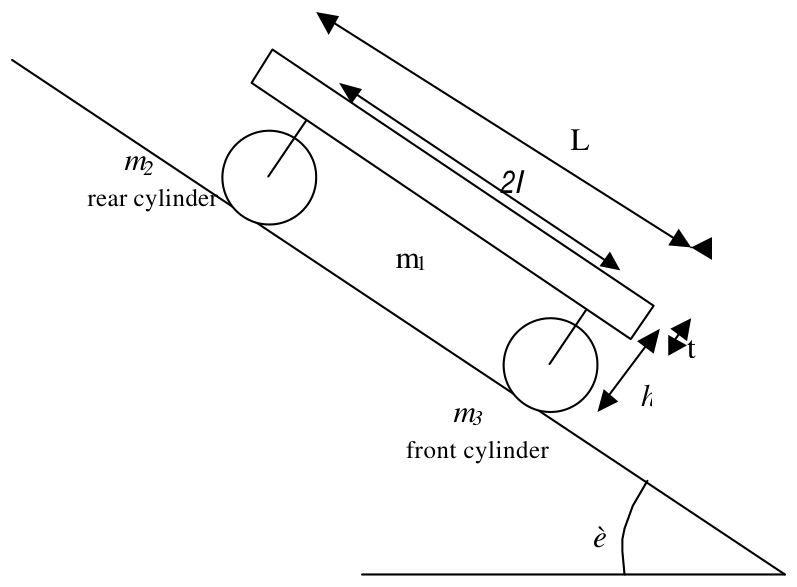
Figure III-1: A simplified model of a heavy vehicle moving on an inclined road.
The above figure is a simplified model of a heavy vehicle (road roller) with one rear and one front cylinder as its wheels on an inclined road with inclination angle of \(\theta\) (labelled è in the figure) as shown in Figure III-1. Each of the two cylinders has a total mass \(M(m_2=m_3=M)\) and consists of a cylindrical shell of outer radius \(R_o\), inner radius \(R_i=0.8R_o\) and eight number of spokes with total mass \(0.2M\). The mass of the undercarriage supporting the vehicle’s body is negligible. The cylinder can be modeled as shown in Figure III-2. The vehicle is moving down the road under the influence of gravitational and frictional forces. The front and rear cylinder are positioned symmetrically with respect to the vehicle.
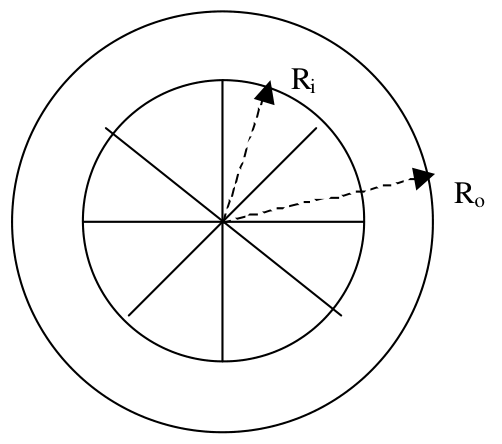
Figure III-2: A simplified model of the cylinders.
The static and kinetic friction coefficients between the cylinder and the road are \(\mu_s\) and \(\mu_k\) respectively. The body of the vehicle has a mass of \(5M\), length of \(L\) and thickness of \(t\). The distance between the front and the rear cylinder is \(2l\) while the distance from the center of cylinder to the base of the vehicle’s body is \(h\). Assume that the rolling friction between the cylinder and its axis is negligible.
Questions:
-
Calculate the moment of inertia of either cylinder [1.5 pts].
-
Draw all forces that act on the body, the front cylinder, and the rear one. Write down equations of motion for each part of them [2.5 pts].
-
The vehicle is assummed to move from rest, then freely move under gravitational influence. State all the possible types of motion of the system and derive their accelerations in terms of the given physical quantities [4.0 pts].
-
Assume that after the vehicle travels a distance \(d\) by pure rolling from rest the vehicle enters a section of the road with all the friction coefficients drop to smaller constant values \(\mu_s'\) and \(\mu_k'\) such that the two cylinders start to slide. Calculate the linear and angular velocities of each cylinder after the vehicle has traveled a total distance of \(s\) meters. Here we assume that \(d\) and \(s\) is much larger than the dimension of vehicle [2.0 pts]
Official English text of the problem.
Answers
Write \(\theta\) for the inclination angle and define \[ R=R_o,\qquad b=h+\frac t2,\qquad \kappa=\frac{262}{375},\qquad q=\frac{5b}{7l}. \] Subscripts \(r,f\) denote rear and front. Linear acceleration is positive downhill; angular acceleration is positive in the direction of downhill rolling.
-
Moment of inertia of either cylinder \[ \boxed{I=\kappa MR^2=\frac{262}{375}MR^2 \simeq0.699MR^2.} \] Its SI unit is \(\mathrm{kg\,m^2}\).
-
Equations of motion
Let the axle force on cylinder \(i\) have components \(P_i\) downhill and \(Q_i\) toward the road. Let \(N_i\) be its road-normal force and \(f_i\) its uphill friction force. These are signed reference components.
For the body and massless undercarriage, \[ \boxed{ \begin{aligned} 5Ma&=5Mg\sin\theta-P_r-P_f,\\ Q_r+Q_f&=5Mg\cos\theta,\\ l(Q_f-Q_r)&=b(P_r+P_f). \end{aligned}} \] For each cylinder, \[ \boxed{ Ma=Mg\sin\theta+P_i-f_i,\qquad N_i=Mg\cos\theta+Q_i,\qquad I\alpha_i=Rf_i.} \]
Consequently, \[ \boxed{7Ma=7Mg\sin\theta-f_r-f_f,} \] \[ \boxed{ N_{r,f}(a)=\frac{7M}{2} \left[g\cos\theta\mp q(g\sin\theta-a)\right].} \]
- Rolling and sliding regimes
For compactness, define \[ \alpha_i^{\rm sl}(a)=\frac{\mu_kN_i(a)}{\kappa MR}. \]
| Rear cylinder | Front cylinder | Common linear acceleration \(a\) | \(\alpha_r\) | \(\alpha_f\) |
|---|---|---|---|---|
| Rolls | Rolls | \(\displaystyle a_0=\frac{7g\sin\theta}{7+2\kappa}\simeq0.8336g\sin\theta\) | \(a_0/R\) | \(a_0/R\) |
| Slides | Rolls | \(\displaystyle a_{\rm SR}=\frac{7g[(2+q\mu_k)\sin\theta-\mu_k\cos\theta]}{14+2\kappa+7q\mu_k}\) | \(\alpha_r^{\rm sl}(a_{\rm SR})\) | \(a_{\rm SR}/R\) |
| Rolls | Slides | \(\displaystyle a_{\rm RS}=\frac{7g[(2-q\mu_k)\sin\theta-\mu_k\cos\theta]}{14+2\kappa-7q\mu_k}\) | \(a_{\rm RS}/R\) | \(\alpha_f^{\rm sl}(a_{\rm RS})\) |
| Slides | Slides | \(\displaystyle a_{\rm SS}=g(\sin\theta-\mu_k\cos\theta)\) | \(\alpha_r^{\rm sl}(a_{\rm SS})\) | \(\alpha_f^{\rm sl}(a_{\rm SS})\) |
These are the four contact-mode equations. Each requires \(N_r,N_f\ge0\), together with \[ \boxed{\kappa Ma\le\mu_sN_i\quad\text{for a rolling cylinder},} \] \[ \boxed{a>R\alpha_i^{\rm sl}\quad\text{for a cylinder sliding downhill from rest}.} \] Equalities describe boundaries between modes.
Both cylinders roll from rest if \[ \boxed{ \tan\theta\le \frac{(7+2\kappa)\mu_s}{2\kappa(1+q\mu_s)}.} \] The rear cylinder reaches its static-friction limit first. Thus loss of grip from the both-rolling branch leads to rear-only sliding or directly to both sliding; front-only sliding is the alternative conditional mixed contact mode, not the first loss of grip of that branch.
- Velocities after entering the lower-friction section
For \(s\ge d\), put \[ v_d=\sqrt{2a_0d},\qquad a_1=g(\sin\theta-\mu_k'\cos\theta), \] \[ v=\sqrt{v_d^2+2a_1(s-d)},\qquad \Delta\tau=\frac{2(s-d)}{v+v_d}. \] Then \[ \boxed{v_r=v_f=v,} \] \[ \boxed{ \omega_{r,f}= \frac{v_d}{R} +\frac{7\mu_k'g\cos\theta}{2\kappa R} (1\mp q\mu_k')\,\Delta\tau.} \] The minus sign is for the rear cylinder. Linear velocities have units \(\mathrm{m\,s^{-1}}\), and angular velocities have units \(\mathrm{rad\,s^{-1}}\).
Solution
1. Moment of inertia
Treat the shell as uniform and each spoke as a uniform thin radial rod extending from the axle to \(R_i\).
The shell has mass \(0.8M\), so its moment of inertia about the cylinder axis is \[ I_{\rm shell} =\frac12(0.8M)(R^2+R_i^2). \]
Each spoke has mass \(0.2M/8\). A uniform rod of length \(R_i\), rotating about an axis through one end perpendicular to the rod, has moment of inertia \(mR_i^2/3\). Hence \[ I_{\rm spokes} =8\left[\frac13\left(\frac{0.2M}{8}\right)R_i^2\right] =\frac{0.2M}{3}R_i^2. \]
Using \(R_i=0.8R\), \[ \begin{aligned} I &=MR^2\left[ \frac{0.8}{2}(1+0.8^2) +\frac{0.2}{3}(0.8^2) \right]\\ &=MR^2\left(\frac{82}{125}+\frac{16}{375}\right). \end{aligned} \] Therefore \[ \boxed{I=\frac{262}{375}MR^2=\kappa MR^2.} \]
2. Force diagrams and equations of motion
Choose the \(x\)-axis downhill along the road and the \(y\)-axis perpendicular to the road, pointing away from it.
We use the intended rigid-vehicle model: both cylinders remain in contact with the straight road, their centers have the same acceleration \(a\), and the body remains parallel to the road. Its angular acceleration is therefore zero. The body’s center of mass is midway between the axles and a perpendicular distance \[ b=h+\frac t2 \] above the axle line.
The force diagrams should show the following.
- Body, including the massless undercarriage: weight \(5Mg\), vertically downward at its center of mass; at each axle position, a force with components \(-P_i\) along the road and \(+Q_i\) perpendicular to it.
- Rear cylinder: weight \(Mg\), vertically downward through its center; axle-force components \(P_r\) downhill and \(Q_r\) toward the road; road reaction \(N_r\), perpendicular to the road at contact; friction \(f_r\), uphill at contact.
- Front cylinder: the corresponding forces \(Mg,P_f,Q_f,N_f,f_f\).
The axle-force arrows are reference directions: an individual signed component may be negative. Friction points uphill in the downhill-sliding modes considered here and also supplies the torque for downhill rolling.
Newton’s second law for the body gives \[ 5Ma=5Mg\sin\theta-P_r-P_f \] and \[ Q_r+Q_f=5Mg\cos\theta. \]
Taking moments about the body’s center of mass, the two axle positions have road-parallel coordinates \(-l,+l\) and perpendicular coordinate \(-b\). Zero angular acceleration gives \[ l(Q_f-Q_r)-b(P_r+P_f)=0. \] Thus \[ \boxed{l(Q_f-Q_r)=b(P_r+P_f).} \]
For cylinder \(i\), translational motion gives \[ Ma=Mg\sin\theta+P_i-f_i, \] \[ N_i-Mg\cos\theta-Q_i=0. \] Only the road friction produces torque about the cylinder axis, because bearing friction is neglected: \[ \boxed{I\alpha_i=Rf_i.} \]
Adding the three downhill equations eliminates the internal axle forces: \[ \boxed{7Ma=7Mg\sin\theta-(f_r+f_f).} \]
The normal reactions satisfy \[ N_r+N_f=7Mg\cos\theta. \] Also, \[ N_f-N_r=Q_f-Q_r =\frac{b}{l}(P_r+P_f). \] Using the body’s downhill equation, \[ N_f-N_r=\frac{5Mb}{l}(g\sin\theta-a) =7Mq(g\sin\theta-a). \] Therefore \[ \boxed{ N_r(a)=\frac{7M}{2} \left[g\cos\theta-q(g\sin\theta-a)\right],} \] \[ \boxed{ N_f(a)=\frac{7M}{2} \left[g\cos\theta+q(g\sin\theta-a)\right].} \]
These equations include the transfer of load toward the front. Equivalently, \[ N_f-N_r=q(f_r+f_f). \]
The body length \(L\) does not enter: the body has no angular acceleration, and its center of mass is fixed by symmetry.
3. Possible motions and their accelerations
Assume the usual ordering \[ 0\le\mu_k\le\mu_s. \]
For a cylinder rolling without slipping, \[ a=R\alpha_i. \] Its rotational equation then requires \[ \boxed{f_i=\frac{I}{R^2}a=\kappa Ma.} \] This force must satisfy the static-friction bound \[ \kappa Ma\le\mu_sN_i. \]
For a cylinder whose contact point slides downhill, \[ f_i=\mu_kN_i,\qquad \boxed{\alpha_i=\frac{\mu_kN_i}{\kappa MR}.} \]
To check the direction of sliding, define the downhill velocity of the cylinder’s contact point relative to the road: \[ u_i=v-R\omega_i. \] Starting from rest, a constant-acceleration sliding solution has \[ u_i=(a-R\alpha_i)\tau. \] Thus uphill kinetic friction is consistent with downhill sliding only if \[ \boxed{a>R\alpha_i.} \]
All formulas below also require nonnegative normal reactions. A vanishing reaction marks possible loss of contact; beyond that boundary the assumed two-contact, non-pitching model no longer applies.
Both cylinders roll without slipping.
Here \[ f_r=f_f=\kappa Ma. \] The combined downhill equation becomes \[ 7Ma=7Mg\sin\theta-2\kappa Ma. \] Hence \[ \boxed{ a_0=\frac{7g\sin\theta}{7+2\kappa} =\frac{2625}{3149}g\sin\theta \simeq0.8336g\sin\theta,} \] and \[ \boxed{\alpha_r=\alpha_f=\frac{a_0}{R}.} \]
The required friction at either contact is \[ f_0=\frac{7\kappa Mg\sin\theta}{7+2\kappa}. \]
Writing \[ \eta=\frac{2\kappa}{7+2\kappa}, \] the reactions are \[ N_{r,f}^{(0)} =\frac{7Mg}{2}\left(\cos\theta\mp q\eta\sin\theta\right). \] Since \(N_r^{(0)}\le N_f^{(0)}\), the rear contact imposes the stricter static-friction condition: \[ f_0\le\mu_sN_r^{(0)}. \] Rearrangement gives \[ \eta(1+q\mu_s)\tan\theta\le\mu_s, \] or \[ \boxed{ \tan\theta\le \frac{(7+2\kappa)\mu_s}{2\kappa(1+q\mu_s)}.} \]
As an independent check, pure rolling has kinetic energy \[ K=\frac12(7M)v^2 +2\left(\frac12I\frac{v^2}{R^2}\right) =\frac12(7+2\kappa)Mv^2. \] Equating its increase to the loss of gravitational potential energy gives the same \(a_0\).
Rear cylinder slides; front cylinder rolls.
Now \[ f_r=\mu_kN_r(a),\qquad f_f=\kappa Ma. \] Therefore \[ (7+\kappa)Ma =7Mg\sin\theta-\mu_kN_r(a). \] Substituting the normal reaction, \[ (7+\kappa)a =7g\sin\theta -\frac{7\mu_k}{2} \left[g\cos\theta-q(g\sin\theta-a)\right]. \] Collecting the terms containing \(a\), \[ \boxed{ a_{\rm SR} =\frac{7g[(2+q\mu_k)\sin\theta-\mu_k\cos\theta]} {14+2\kappa+7q\mu_k}.} \] The angular accelerations are \[ \boxed{ \alpha_r=\frac{\mu_kN_r(a_{\rm SR})}{\kappa MR}, \qquad \alpha_f=\frac{a_{\rm SR}}R.} \]
The consistency conditions are \[ \boxed{ a_{\rm SR}> \frac{\mu_kN_r(a_{\rm SR})}{\kappa M},\qquad \kappa Ma_{\rm SR}\le\mu_sN_f(a_{\rm SR}).} \] The first makes the rear contact slide downhill; the second allows the front to remain rolling.
This is the mixed branch to test when the rear loses static grip. If the front cannot supply its required static friction, both cylinders must slide.
Rear cylinder rolls; front cylinder slides.
For completeness, the other mixed contact combination has \[ f_r=\kappa Ma,\qquad f_f=\mu_kN_f(a). \] Thus \[ (7+\kappa)Ma =7Mg\sin\theta-\mu_kN_f(a), \] which yields \[ \boxed{ a_{\rm RS} =\frac{7g[(2-q\mu_k)\sin\theta-\mu_k\cos\theta]} {14+2\kappa-7q\mu_k}.} \] Its angular accelerations are \[ \boxed{ \alpha_r=\frac{a_{\rm RS}}R,\qquad \alpha_f=\frac{\mu_kN_f(a_{\rm RS})}{\kappa MR}.} \] Its consistency conditions are \[ \boxed{ \kappa Ma_{\rm RS}\le\mu_sN_r(a_{\rm RS}),\qquad a_{\rm RS}> \frac{\mu_kN_f(a_{\rm RS})}{\kappa M}.} \]
This is a conditional sliding-state solution. It does not describe the front being the first cylinder to lose grip from the both-rolling branch, because that branch requires equal friction at the two contacts while the front has the larger normal reaction.
Both cylinders slide.
In this case, \[ f_r+f_f=\mu_k(N_r+N_f)=7\mu_kMg\cos\theta. \] Hence \[ \boxed{a_{\rm SS}=g(\sin\theta-\mu_k\cos\theta).} \]
Since \[ g\sin\theta-a_{\rm SS}=\mu_kg\cos\theta, \] the normal reactions reduce to \[ \boxed{ N_{r,f}^{\rm SS} =\frac{7Mg\cos\theta}{2}(1\mp q\mu_k).} \] Therefore \[ \boxed{ \alpha_{r,f} =\frac{7\mu_kg\cos\theta}{2\kappa R} (1\mp q\mu_k).} \]
The front has the larger angular acceleration. Consequently, the stricter condition for both contact points to slide downhill from rest is \[ a_{\rm SS}>R\alpha_f. \] For \(0\le\theta<\pi/2\), this is \[ \boxed{ \tan\theta> \mu_k\left[1+\frac{7}{2\kappa}(1+q\mu_k)\right].} \] Maintaining both contacts also requires \[ q\mu_k\le1. \]
If \(\mu_k=0\), the cylinders undergo pure translational sliding from rest: \[ a=g\sin\theta,\qquad \alpha_r=\alpha_f=0. \]
The distinction between the onset of sliding and its continuation matters: static friction determines whether a contact loses grip, whereas the kinetic conditions above determine whether an assumed sliding state is consistent. A kinetic solution should not replace an available no-slip solution merely because \(\mu_k<\mu_s\).
4. Motion on the lower-friction section
During the initial pure-rolling distance \(d\), the acceleration is \(a_0\). Starting from rest, \[ \boxed{v_d=\sqrt{2a_0d},\qquad \omega_{r,d}=\omega_{f,d}=\frac{v_d}{R}.} \]
We neglect the short transition during which only one cylinder has reached the new surface, using the stated large-distance approximation. There is no impulsive change in either linear or angular velocity.
Once both cylinders slide on the new surface, replace \(\mu_k\) by \(\mu_k'\) in the preceding both-sliding results: \[ a_1=g(\sin\theta-\mu_k'\cos\theta), \] \[ N_{r,f}'=\frac{7Mg\cos\theta}{2}(1\mp q\mu_k'), \] \[ \alpha_{r,f}'= \frac{7\mu_k'g\cos\theta}{2\kappa R}(1\mp q\mu_k'). \] These quantities are constant.
Over the remaining distance \(s-d\), \[ v^2=v_d^2+2a_1(s-d), \] so both cylinder centers have velocity \[ \boxed{ v_r=v_f= \sqrt{ \frac{14gd\sin\theta}{7+2\kappa} +2g(\sin\theta-\mu_k'\cos\theta)(s-d) }.} \]
The elapsed time on this section follows from the average velocity: \[ s-d=\frac{v+v_d}{2}\Delta\tau, \] hence \[ \boxed{\Delta\tau=\frac{2(s-d)}{v+v_d}.} \]
Integrating the constant angular accelerations gives \[ \boxed{ \omega_r= \frac{v_d}{R} +\frac{7\mu_k'g\cos\theta}{2\kappa R} (1-q\mu_k')\frac{2(s-d)}{v+v_d},} \] \[ \boxed{ \omega_f= \frac{v_d}{R} +\frac{7\mu_k'g\cos\theta}{2\kappa R} (1+q\mu_k')\frac{2(s-d)}{v+v_d}.} \]
The premise that both cylinders begin sliding requires a consistent downhill-sliding regime. Indeed, immediately after entry, \[ v-R\omega_i=(a_1-R\alpha_i')\Delta\tau, \] so the condition is \(a_1>R\alpha_f'\), together with nonnegative reactions. The reduced static coefficient \(\mu_s'\) determines loss of grip, but does not enter the subsequent velocities once both contacts are sliding.
The solution was checked against the official solution. Where this solution differs from the official solution, the official solution contains an error or a misprint.
IPhO 2002 · Theorieaufgabe 3
Ein schweres Fahrzeug auf einer geneigten Straße
Abbildung III-1: Vereinfachtes Modell eines schweren Fahrzeugs auf einer geneigten Straße.
Die obige Abbildung zeigt ein vereinfachtes Modell eines schweren Fahrzeugs (einer Straßenwalze), das sich mit einer hinteren und einer vorderen Walze als Rädern auf einer Straße mit dem Neigungswinkel \(\theta\) (in der Abbildung als è bezeichnet) befindet, wie in Abbildung III-1 dargestellt. Jede der beiden Walzen hat die Gesamtmasse \(M(m_2=m_3=M)\) und besteht aus einem zylindrischen Mantel mit dem Außenradius \(R_o\), dem Innenradius \(R_i=0.8R_o\) und acht Speichen mit der Gesamtmasse \(0.2M\). Die Masse des Fahrgestells, das den Fahrzeugaufbau trägt, ist vernachlässigbar. Die Walze kann wie in Abbildung III-2 modelliert werden. Das Fahrzeug bewegt sich unter dem Einfluss von Gravitations- und Reibungskräften die Straße hinab. Die vordere und die hintere Walze sind bezüglich des Fahrzeugs symmetrisch angeordnet.
Abbildung III-2: Vereinfachtes Modell der Walzen.
Die Haft- und Gleitreibungskoeffizienten zwischen der Walze und der Straße sind \(\mu_s\) bzw. \(\mu_k\). Der Fahrzeugaufbau hat die Masse \(5M\), die Länge \(L\) und die Dicke \(t\). Der Abstand zwischen der vorderen und der hinteren Walze beträgt \(2l\), während der Abstand vom Mittelpunkt der Walze zur Unterseite des Fahrzeugaufbaus \(h\) beträgt. Nehmen Sie an, dass die Rollreibung zwischen der Walze und ihrer Achse vernachlässigbar ist.
Fragen:
-
Berechnen Sie das Trägheitsmoment einer der beiden Walzen [1.5 Punkte].
-
Zeichnen Sie alle Kräfte ein, die auf den Aufbau, die vordere Walze und die hintere Walze wirken. Stellen Sie die Bewegungsgleichungen für jeden dieser Teile auf [2.5 Punkte].
-
Es wird angenommen, dass das Fahrzeug aus der Ruhe startet und sich dann unter dem Einfluss der Gravitation frei bewegt. Geben Sie alle möglichen Bewegungsarten des Systems an und leiten Sie deren Beschleunigungen in Abhängigkeit von den gegebenen physikalischen Größen her [4.0 Punkte].
-
Nehmen Sie an, dass das Fahrzeug, nachdem es aus der Ruhe die Strecke \(d\) rein rollend zurückgelegt hat, einen Straßenabschnitt erreicht, auf dem alle Reibungskoeffizienten auf kleinere konstante Werte \(\mu_s'\) und \(\mu_k'\) abfallen, sodass beide Walzen zu gleiten beginnen. Berechnen Sie die Translations- und Winkelgeschwindigkeiten jeder Walze, nachdem das Fahrzeug insgesamt eine Strecke von \(s\) Metern zurückgelegt hat. Dabei nehmen wir an, dass \(d\) und \(s\) viel größer als die Abmessungen des Fahrzeugs sind [2.0 Punkte]
Aufgabentext aus dem offiziellen englischen Text übersetzt.
Antworten
Bezeichnen wir den Neigungswinkel mit \(\theta\) und definieren wir \[ R=R_o,\qquad b=h+\frac t2,\qquad \kappa=\frac{262}{375},\qquad q=\frac{5b}{7l}. \] Die Indizes \(r,f\) bezeichnen die hintere bzw. die vordere Walze. Die Translationsbeschleunigung ist hangabwärts positiv; die Winkelbeschleunigung ist in der Drehrichtung beim Abwärtsrollen positiv.
-
Trägheitsmoment einer der beiden Walzen \[ \boxed{I=\kappa MR^2=\frac{262}{375}MR^2 \simeq0.699MR^2.} \] Seine SI-Einheit ist \(\mathrm{kg\,m^2}\).
-
Bewegungsgleichungen
Die Achskraft auf die Walze \(i\) habe die Komponenten \(P_i\) hangabwärts und \(Q_i\) zur Straße hin. Ihre Normalkraft von der Straße sei \(N_i\) und ihre hangaufwärts gerichtete Reibungskraft sei \(f_i\). Dies sind vorzeichenbehaftete Komponenten bezüglich der angegebenen Bezugsrichtungen.
Für den Aufbau und das masselose Fahrgestell gilt \[ \boxed{ \begin{aligned} 5Ma&=5Mg\sin\theta-P_r-P_f,\\ Q_r+Q_f&=5Mg\cos\theta,\\ l(Q_f-Q_r)&=b(P_r+P_f). \end{aligned}} \] Für jede Walze gilt \[ \boxed{ Ma=Mg\sin\theta+P_i-f_i,\qquad N_i=Mg\cos\theta+Q_i,\qquad I\alpha_i=Rf_i.} \]
Folglich gilt \[ \boxed{7Ma=7Mg\sin\theta-f_r-f_f,} \] \[ \boxed{ N_{r,f}(a)=\frac{7M}{2} \left[g\cos\theta\mp q(g\sin\theta-a)\right].} \]
- Roll- und Gleitzustände
Zur Abkürzung definieren wir \[ \alpha_i^{\rm sl}(a)=\frac{\mu_kN_i(a)}{\kappa MR}. \]
| Hintere Walze | Vordere Walze | Gemeinsame Translationsbeschleunigung \(a\) | \(\alpha_r\) | \(\alpha_f\) |
|---|---|---|---|---|
| Rollt | Rollt | \(\displaystyle a_0=\frac{7g\sin\theta}{7+2\kappa}\simeq0.8336g\sin\theta\) | \(a_0/R\) | \(a_0/R\) |
| Gleitet | Rollt | \(\displaystyle a_{\rm SR}=\frac{7g[(2+q\mu_k)\sin\theta-\mu_k\cos\theta]}{14+2\kappa+7q\mu_k}\) | \(\alpha_r^{\rm sl}(a_{\rm SR})\) | \(a_{\rm SR}/R\) |
| Rollt | Gleitet | \(\displaystyle a_{\rm RS}=\frac{7g[(2-q\mu_k)\sin\theta-\mu_k\cos\theta]}{14+2\kappa-7q\mu_k}\) | \(a_{\rm RS}/R\) | \(\alpha_f^{\rm sl}(a_{\rm RS})\) |
| Gleitet | Gleitet | \(\displaystyle a_{\rm SS}=g(\sin\theta-\mu_k\cos\theta)\) | \(\alpha_r^{\rm sl}(a_{\rm SS})\) | \(\alpha_f^{\rm sl}(a_{\rm SS})\) |
Dies sind die Gleichungen für die vier Kontaktzustände. Jeder setzt \(N_r,N_f\ge0\) voraus, zusammen mit \[ \boxed{\kappa Ma\le\mu_sN_i\quad\text{für eine rollende Walze},} \] \[ \boxed{a>R\alpha_i^{\rm sl}\quad\text{für eine aus der Ruhe hangabwärts gleitende Walze}.} \] Gleichheiten beschreiben die Grenzen zwischen den Zuständen.
Beide Walzen rollen aus der Ruhe an, wenn \[ \boxed{ \tan\theta\le \frac{(7+2\kappa)\mu_s}{2\kappa(1+q\mu_s)}.} \] Die hintere Walze erreicht zuerst ihre Haftreibungsgrenze. Daher führt der Haftungsverlust aus dem Lösungszweig mit zwei rollenden Walzen zum alleinigen Gleiten der hinteren Walze oder unmittelbar zum Gleiten beider Walzen; das alleinige Gleiten der vorderen Walze ist der alternative, an Bedingungen geknüpfte gemischte Kontaktzustand und nicht der erste Haftungsverlust dieses Zweigs.
- Geschwindigkeiten nach dem Eintritt in den Abschnitt mit geringerer Reibung
Für \(s\ge d\) setzen wir \[ v_d=\sqrt{2a_0d},\qquad a_1=g(\sin\theta-\mu_k'\cos\theta), \] \[ v=\sqrt{v_d^2+2a_1(s-d)},\qquad \Delta\tau=\frac{2(s-d)}{v+v_d}. \] Dann gilt \[ \boxed{v_r=v_f=v,} \] \[ \boxed{ \omega_{r,f}= \frac{v_d}{R} +\frac{7\mu_k'g\cos\theta}{2\kappa R} (1\mp q\mu_k')\,\Delta\tau.} \] Das Minuszeichen gilt für die hintere Walze. Die Translationsgeschwindigkeiten haben die Einheit \(\mathrm{m\,s^{-1}}\), die Winkelgeschwindigkeiten die Einheit \(\mathrm{rad\,s^{-1}}\).
Lösung
1. Trägheitsmoment
Wir behandeln den Mantel als homogen und jede Speiche als homogenen dünnen radialen Stab, der sich von der Achse bis \(R_i\) erstreckt.
Der Mantel hat die Masse \(0.8M\), sodass sein Trägheitsmoment bezüglich der Walzenachse wie folgt lautet: \[ I_{\rm shell} =\frac12(0.8M)(R^2+R_i^2). \]
Jede Speiche hat die Masse \(0.2M/8\). Ein homogener Stab der Länge \(R_i\), der um eine durch eines seiner Enden verlaufende, zum Stab senkrechte Achse rotiert, hat das Trägheitsmoment \(mR_i^2/3\). Daher gilt \[ I_{\rm spokes} =8\left[\frac13\left(\frac{0.2M}{8}\right)R_i^2\right] =\frac{0.2M}{3}R_i^2. \]
Mit \(R_i=0.8R\) folgt \[ \begin{aligned} I &=MR^2\left[ \frac{0.8}{2}(1+0.8^2) +\frac{0.2}{3}(0.8^2) \right]\\ &=MR^2\left(\frac{82}{125}+\frac{16}{375}\right). \end{aligned} \] Somit ist \[ \boxed{I=\frac{262}{375}MR^2=\kappa MR^2.} \]
2. Kräftediagramme und Bewegungsgleichungen
Wir wählen die \(x\)-Achse hangabwärts entlang der Straße und die \(y\)-Achse senkrecht zur Straße, von ihr weg gerichtet.
Wir verwenden das vorgesehene Modell eines starren Fahrzeugs: Beide Walzen bleiben in Kontakt mit der geraden Straße, ihre Mittelpunkte haben dieselbe Beschleunigung \(a\), und der Aufbau bleibt parallel zur Straße. Seine Winkelbeschleunigung ist daher null. Der Schwerpunkt des Aufbaus liegt mittig zwischen den Achsen und im senkrechten Abstand \[ b=h+\frac t2 \] oberhalb der Verbindungslinie der Achsen.
Die Kräftediagramme sollen Folgendes zeigen.
- Aufbau einschließlich des masselosen Fahrgestells: die Gewichtskraft \(5Mg\), die im Schwerpunkt vertikal nach unten wirkt; an jeder Achsposition eine Kraft mit den Komponenten \(-P_i\) entlang der Straße und \(+Q_i\) senkrecht dazu.
- Hintere Walze: die Gewichtskraft \(Mg\), die durch ihren Mittelpunkt vertikal nach unten wirkt; die Achskraftkomponenten \(P_r\) hangabwärts und \(Q_r\) zur Straße hin; die Normalkraft \(N_r\) der Straße, die am Berührungspunkt senkrecht zur Straße wirkt; die Reibungskraft \(f_r\), die am Berührungspunkt hangaufwärts wirkt.
- Vordere Walze: die entsprechenden Kräfte \(Mg,P_f,Q_f,N_f,f_f\).
Die Pfeile der Achskräfte geben Bezugsrichtungen an: Eine einzelne vorzeichenbehaftete Komponente kann negativ sein. In den hier betrachteten Zuständen mit hangabwärts gerichtetem Gleiten zeigt die Reibungskraft hangaufwärts; sie liefert auch das Drehmoment für das Abwärtsrollen.
Das zweite Newtonsche Gesetz liefert für den Aufbau \[ 5Ma=5Mg\sin\theta-P_r-P_f \] und \[ Q_r+Q_f=5Mg\cos\theta. \]
Bei der Bildung der Drehmomente bezüglich des Schwerpunkts des Aufbaus haben die beiden Achspositionen die straßenparallelen Koordinaten \(-l,+l\) und die senkrechte Koordinate \(-b\). Aus der verschwindenden Winkelbeschleunigung folgt \[ l(Q_f-Q_r)-b(P_r+P_f)=0. \] Damit gilt \[ \boxed{l(Q_f-Q_r)=b(P_r+P_f).} \]
Für die Walze \(i\) ergibt die Translationsbewegung \[ Ma=Mg\sin\theta+P_i-f_i, \] \[ N_i-Mg\cos\theta-Q_i=0. \] Nur die Reibung an der Straße erzeugt ein Drehmoment bezüglich der Walzenachse, da die Lagerreibung vernachlässigt wird: \[ \boxed{I\alpha_i=Rf_i.} \]
Durch Addition der drei Gleichungen für die hangabwärts gerichtete Bewegung werden die inneren Achskräfte eliminiert: \[ \boxed{7Ma=7Mg\sin\theta-(f_r+f_f).} \]
Für die Normalkräfte gilt \[ N_r+N_f=7Mg\cos\theta. \] Außerdem gilt \[ N_f-N_r=Q_f-Q_r =\frac{b}{l}(P_r+P_f). \] Mit der Gleichung für die hangabwärts gerichtete Bewegung des Aufbaus folgt \[ N_f-N_r=\frac{5Mb}{l}(g\sin\theta-a) =7Mq(g\sin\theta-a). \] Somit gilt \[ \boxed{ N_r(a)=\frac{7M}{2} \left[g\cos\theta-q(g\sin\theta-a)\right],} \] \[ \boxed{ N_f(a)=\frac{7M}{2} \left[g\cos\theta+q(g\sin\theta-a)\right].} \]
Diese Gleichungen berücksichtigen die Lastverlagerung nach vorn. Gleichwertig dazu gilt \[ N_f-N_r=q(f_r+f_f). \]
Die Länge \(L\) des Aufbaus geht nicht ein: Der Aufbau hat keine Winkelbeschleunigung, und sein Schwerpunkt ist durch die Symmetrie festgelegt.
3. Mögliche Bewegungen und ihre Beschleunigungen
Wir nehmen die übliche Größenordnung der Reibungskoeffizienten an: \[ 0\le\mu_k\le\mu_s. \]
Für eine ohne Gleiten rollende Walze gilt \[ a=R\alpha_i. \] Ihre Rotationsgleichung erfordert dann \[ \boxed{f_i=\frac{I}{R^2}a=\kappa Ma.} \] Diese Kraft muss die Haftreibungsgrenze einhalten: \[ \kappa Ma\le\mu_sN_i. \]
Für eine Walze, deren Berührungspunkt hangabwärts gleitet, gilt \[ f_i=\mu_kN_i,\qquad \boxed{\alpha_i=\frac{\mu_kN_i}{\kappa MR}.} \]
Um die Gleitrichtung zu überprüfen, definieren wir die hangabwärts gerichtete Geschwindigkeit des Berührungspunkts der Walze relativ zur Straße: \[ u_i=v-R\omega_i. \] Für eine aus der Ruhe beginnende Gleitbewegung mit konstanter Beschleunigung gilt \[ u_i=(a-R\alpha_i)\tau. \] Eine hangaufwärts gerichtete Gleitreibung ist also nur dann mit hangabwärts gerichtetem Gleiten vereinbar, wenn \[ \boxed{a>R\alpha_i.} \]
Alle folgenden Formeln setzen außerdem nichtnegative Normalkräfte voraus. Eine verschwindende Normalkraft kennzeichnet einen möglichen Kontaktverlust; jenseits dieser Grenze gilt das angenommene Modell mit zwei Kontakten und ohne Nickbewegung nicht mehr.
Beide Walzen rollen ohne Gleiten.
Hier gilt \[ f_r=f_f=\kappa Ma. \] Die zusammengefasste Gleichung für die hangabwärts gerichtete Bewegung lautet dann \[ 7Ma=7Mg\sin\theta-2\kappa Ma. \] Daraus folgt \[ \boxed{ a_0=\frac{7g\sin\theta}{7+2\kappa} =\frac{2625}{3149}g\sin\theta \simeq0.8336g\sin\theta,} \] und \[ \boxed{\alpha_r=\alpha_f=\frac{a_0}{R}.} \]
Die an jedem der beiden Kontakte erforderliche Reibungskraft beträgt \[ f_0=\frac{7\kappa Mg\sin\theta}{7+2\kappa}. \]
Mit der Bezeichnung \[ \eta=\frac{2\kappa}{7+2\kappa}, \] lauten die Normalkräfte \[ N_{r,f}^{(0)} =\frac{7Mg}{2}\left(\cos\theta\mp q\eta\sin\theta\right). \] Da \(N_r^{(0)}\le N_f^{(0)}\), stellt der hintere Kontakt die strengere Haftreibungsbedingung: \[ f_0\le\mu_sN_r^{(0)}. \] Umformen ergibt \[ \eta(1+q\mu_s)\tan\theta\le\mu_s, \] oder \[ \boxed{ \tan\theta\le \frac{(7+2\kappa)\mu_s}{2\kappa(1+q\mu_s)}.} \]
Als unabhängige Überprüfung betrachten wir die kinetische Energie beim reinen Rollen: \[ K=\frac12(7M)v^2 +2\left(\frac12I\frac{v^2}{R^2}\right) =\frac12(7+2\kappa)Mv^2. \] Setzt man ihre Zunahme gleich der Abnahme der gravitativen potenziellen Energie, erhält man dasselbe \(a_0\).
Die hintere Walze gleitet; die vordere Walze rollt.
Nun gilt \[ f_r=\mu_kN_r(a),\qquad f_f=\kappa Ma. \] Daher gilt \[ (7+\kappa)Ma =7Mg\sin\theta-\mu_kN_r(a). \] Einsetzen der Normalkraft ergibt \[ (7+\kappa)a =7g\sin\theta -\frac{7\mu_k}{2} \left[g\cos\theta-q(g\sin\theta-a)\right]. \] Fassen wir die Terme mit \(a\) zusammen, erhalten wir \[ \boxed{ a_{\rm SR} =\frac{7g[(2+q\mu_k)\sin\theta-\mu_k\cos\theta]} {14+2\kappa+7q\mu_k}.} \] Die Winkelbeschleunigungen sind \[ \boxed{ \alpha_r=\frac{\mu_kN_r(a_{\rm SR})}{\kappa MR}, \qquad \alpha_f=\frac{a_{\rm SR}}R.} \]
Die Konsistenzbedingungen lauten \[ \boxed{ a_{\rm SR}> \frac{\mu_kN_r(a_{\rm SR})}{\kappa M},\qquad \kappa Ma_{\rm SR}\le\mu_sN_f(a_{\rm SR}).} \] Die erste bewirkt, dass der hintere Kontakt hangabwärts gleitet; die zweite ermöglicht es der vorderen Walze, weiterhin zu rollen.
Dies ist der gemischte Lösungszweig, der zu prüfen ist, wenn die hintere Walze ihre Haftung verliert. Kann die vordere Walze die erforderliche Haftreibung nicht aufbringen, müssen beide Walzen gleiten.
Die hintere Walze rollt; die vordere Walze gleitet.
Der Vollständigkeit halber gilt für die andere gemischte Kombination der Kontaktzustände \[ f_r=\kappa Ma,\qquad f_f=\mu_kN_f(a). \] Somit gilt \[ (7+\kappa)Ma =7Mg\sin\theta-\mu_kN_f(a), \] woraus folgt \[ \boxed{ a_{\rm RS} =\frac{7g[(2-q\mu_k)\sin\theta-\mu_k\cos\theta]} {14+2\kappa-7q\mu_k}.} \] Die zugehörigen Winkelbeschleunigungen sind \[ \boxed{ \alpha_r=\frac{a_{\rm RS}}R,\qquad \alpha_f=\frac{\mu_kN_f(a_{\rm RS})}{\kappa MR}.} \] Die zugehörigen Konsistenzbedingungen lauten \[ \boxed{ \kappa Ma_{\rm RS}\le\mu_sN_r(a_{\rm RS}),\qquad a_{\rm RS}> \frac{\mu_kN_f(a_{\rm RS})}{\kappa M}.} \]
Dies ist eine an Bedingungen geknüpfte Lösung für einen Gleitzustand. Sie beschreibt nicht den Fall, dass aus dem Lösungszweig mit zwei rollenden Walzen die vordere Walze als erste die Haftung verliert, denn dieser Zweig erfordert an beiden Kontakten gleich große Reibungskräfte, während vorn die größere Normalkraft wirkt.
Beide Walzen gleiten.
In diesem Fall gilt \[ f_r+f_f=\mu_k(N_r+N_f)=7\mu_kMg\cos\theta. \] Daher gilt \[ \boxed{a_{\rm SS}=g(\sin\theta-\mu_k\cos\theta).} \]
Wegen \[ g\sin\theta-a_{\rm SS}=\mu_kg\cos\theta, \] vereinfachen sich die Normalkräfte zu \[ \boxed{ N_{r,f}^{\rm SS} =\frac{7Mg\cos\theta}{2}(1\mp q\mu_k).} \] Somit gilt \[ \boxed{ \alpha_{r,f} =\frac{7\mu_kg\cos\theta}{2\kappa R} (1\mp q\mu_k).} \]
Die vordere Walze hat die größere Winkelbeschleunigung. Folglich lautet die strengere Bedingung dafür, dass beide Berührungspunkte aus der Ruhe hangabwärts gleiten, \[ a_{\rm SS}>R\alpha_f. \] Für \(0\le\theta<\pi/2\) lautet sie \[ \boxed{ \tan\theta> \mu_k\left[1+\frac{7}{2\kappa}(1+q\mu_k)\right].} \] Damit beide Kontakte erhalten bleiben, muss außerdem gelten \[ q\mu_k\le1. \]
Wenn \(\mu_k=0\), führen die Walzen aus der Ruhe eine reine translatorische Gleitbewegung aus: \[ a=g\sin\theta,\qquad \alpha_r=\alpha_f=0. \]
Die Unterscheidung zwischen dem Einsetzen und dem Fortbestehen des Gleitens ist wesentlich: Die Haftreibung bestimmt, ob ein Kontakt die Haftung verliert, während die obigen Bedingungen für die Gleitreibung bestimmen, ob ein angenommener Gleitzustand konsistent ist. Eine Lösung mit Gleitreibung sollte eine mögliche Lösung ohne Gleiten nicht allein deshalb ersetzen, weil \(\mu_k<\mu_s\).
4. Bewegung auf dem Abschnitt mit geringerer Reibung
Auf der anfänglichen, rein rollend zurückgelegten Strecke \(d\) beträgt die Beschleunigung \(a_0\). Bei einem Start aus der Ruhe gilt \[ \boxed{v_d=\sqrt{2a_0d},\qquad \omega_{r,d}=\omega_{f,d}=\frac{v_d}{R}.} \]
Wir vernachlässigen den kurzen Übergang, während dessen erst eine Walze die neue Oberfläche erreicht hat, und verwenden dabei die angegebene Näherung für große Strecken. Weder die Translations- noch die Winkelgeschwindigkeit ändert sich sprunghaft.
Sobald beide Walzen auf der neuen Oberfläche gleiten, ersetzen wir in den vorangegangenen Ergebnissen für das Gleiten beider Walzen \(\mu_k\) durch \(\mu_k'\): \[ a_1=g(\sin\theta-\mu_k'\cos\theta), \] \[ N_{r,f}'=\frac{7Mg\cos\theta}{2}(1\mp q\mu_k'), \] \[ \alpha_{r,f}'= \frac{7\mu_k'g\cos\theta}{2\kappa R}(1\mp q\mu_k'). \] Diese Größen sind konstant.
Für die verbleibende Strecke \(s-d\) gilt \[ v^2=v_d^2+2a_1(s-d), \] sodass sich für die Geschwindigkeit beider Walzenmittelpunkte ergibt: \[ \boxed{ v_r=v_f= \sqrt{ \frac{14gd\sin\theta}{7+2\kappa} +2g(\sin\theta-\mu_k'\cos\theta)(s-d) }.} \]
Die auf diesem Abschnitt verstrichene Zeit ergibt sich aus der mittleren Geschwindigkeit: \[ s-d=\frac{v+v_d}{2}\Delta\tau, \] also \[ \boxed{\Delta\tau=\frac{2(s-d)}{v+v_d}.} \]
Die Integration der konstanten Winkelbeschleunigungen ergibt \[ \boxed{ \omega_r= \frac{v_d}{R} +\frac{7\mu_k'g\cos\theta}{2\kappa R} (1-q\mu_k')\frac{2(s-d)}{v+v_d},} \] \[ \boxed{ \omega_f= \frac{v_d}{R} +\frac{7\mu_k'g\cos\theta}{2\kappa R} (1+q\mu_k')\frac{2(s-d)}{v+v_d}.} \]
Die Voraussetzung, dass beide Walzen zu gleiten beginnen, erfordert einen konsistenten Zustand mit hangabwärts gerichtetem Gleiten. Tatsächlich gilt unmittelbar nach dem Eintritt \[ v-R\omega_i=(a_1-R\alpha_i')\Delta\tau, \] sodass die Bedingung \(a_1>R\alpha_f'\) zusammen mit nichtnegativen Normalkräften erfüllt sein muss. Der verringerte Haftreibungskoeffizient \(\mu_s'\) bestimmt den Haftungsverlust, geht aber nicht in die anschließenden Geschwindigkeiten ein, sobald beide Kontakte gleiten.
Die Lösung wurde mit der offiziellen Lösung abgeglichen. Wo diese Lösung von der offiziellen Lösung abweicht, enthält die offizielle Lösung einen Fehler oder Druckfehler.
IPhO 2002 · Teori sorusu 3
Eğimli Bir Yolda Hareket Eden Ağır Bir Araç
Şekil III-1: Eğimli bir yolda hareket eden ağır bir aracın basitleştirilmiş modeli.
Yukarıdaki şekil, Şekil III-1'de gösterildiği gibi eğim açısı \(\theta\) (şekilde è ile gösterilmiştir) olan bir yolda, tekerlek olarak biri arkada diğeri önde olmak üzere iki silindire sahip ağır bir aracın (yol silindirinin) basitleştirilmiş modelidir. İki silindirin her birinin toplam kütlesi \(M(m_2=m_3=M)\) olup her biri, dış yarıçapı \(R_o\), iç yarıçapı \(R_i=0.8R_o\) olan silindirik bir kabuk ile toplam kütlesi \(0.2M\) olan sekiz adet radyal çubuktan oluşur. Aracın gövdesini taşıyan şasinin kütlesi ihmal edilebilir. Silindir, Şekil III-2'de gösterildiği gibi modellenebilir. Araç, yerçekimi ve sürtünme kuvvetlerinin etkisi altında yokuş aşağı hareket etmektedir. Ön ve arka silindir, araca göre simetrik olarak yerleştirilmiştir.
Şekil III-2: Silindirlerin basitleştirilmiş modeli.
Silindir ile yol arasındaki statik ve kinetik sürtünme katsayıları sırasıyla \(\mu_s\) ve \(\mu_k\)'dır. Aracın gövdesinin kütlesi \(5M\), uzunluğu \(L\) ve kalınlığı \(t\)'dir. Ön ve arka silindir arasındaki uzaklık \(2l\), silindirin merkezinden araç gövdesinin tabanına olan uzaklık ise \(h\)'dir. Silindir ile mili arasındaki yuvarlanma sürtünmesinin ihmal edilebilir olduğunu varsayın.
Sorular:
-
Silindirlerden herhangi birinin eylemsizlik momentini hesaplayın [1.5 puan].
-
Gövdeye, ön silindire ve arka silindire etki eden tüm kuvvetleri çizerek gösterin. Bu parçaların her biri için hareket denklemlerini yazın [2.5 puan].
-
Aracın durgun hâlden harekete başladığı ve ardından yerçekimi etkisi altında serbestçe hareket ettiği varsayılmaktadır. Sistemin olası tüm hareket türlerini belirtin ve bunların ivmelerini verilen fiziksel nicelikler cinsinden türetin [4.0 puan].
-
Aracın durgun hâlden başlayıp kaymadan yuvarlanarak \(d\) kadar yol aldıktan sonra, tüm sürtünme katsayılarının daha küçük sabit \(\mu_s'\) ve \(\mu_k'\) değerlerine düştüğü ve bunun sonucunda iki silindirin de kaymaya başladığı bir yol kesimine girdiğini varsayın. Araç toplam \(s\) metre yol aldıktan sonra her bir silindirin çizgisel ve açısal hızlarını hesaplayın. Burada \(d\) ve \(s\)'nin aracın boyutlarından çok daha büyük olduğunu varsayıyoruz [2.0 puan]
Soru metni resmi İngilizce metinden çevrilmiştir.
Cevaplar
Eğim açısını \(\theta\) ile gösterelim ve şu tanımları yapalım: \[ R=R_o,\qquad b=h+\frac t2,\qquad \kappa=\frac{262}{375},\qquad q=\frac{5b}{7l}. \] \(r,f\) alt indisleri sırasıyla arka ve ön silindiri gösterir. Çizgisel ivmenin pozitif yönü yokuş aşağıdır; açısal ivmenin pozitif yönü ise yokuş aşağı yuvarlanma yönüdür.
-
Silindirlerden herhangi birinin eylemsizlik momenti \[ \boxed{I=\kappa MR^2=\frac{262}{375}MR^2 \simeq0.699MR^2.} \] SI birimi \(\mathrm{kg\,m^2}\)'dir.
-
Hareket denklemleri
\(i\) silindirine milin uyguladığı kuvvetin yokuş aşağı bileşeni \(P_i\), yola doğru bileşeni ise \(Q_i\) olsun. Yolun silindire uyguladığı normal kuvvet \(N_i\), yokuş yukarı sürtünme kuvveti ise \(f_i\) olsun. Bunlar, belirtilen referans yönlerine göre işaretli bileşenlerdir.
Gövde ve kütlesiz şasi için, \[ \boxed{ \begin{aligned} 5Ma&=5Mg\sin\theta-P_r-P_f,\\ Q_r+Q_f&=5Mg\cos\theta,\\ l(Q_f-Q_r)&=b(P_r+P_f). \end{aligned}} \] Her bir silindir için, \[ \boxed{ Ma=Mg\sin\theta+P_i-f_i,\qquad N_i=Mg\cos\theta+Q_i,\qquad I\alpha_i=Rf_i.} \]
Dolayısıyla, \[ \boxed{7Ma=7Mg\sin\theta-f_r-f_f,} \] \[ \boxed{ N_{r,f}(a)=\frac{7M}{2} \left[g\cos\theta\mp q(g\sin\theta-a)\right].} \]
- Yuvarlanma ve kayma rejimleri
Kısa yazım için şu tanımı yapalım: \[ \alpha_i^{\rm sl}(a)=\frac{\mu_kN_i(a)}{\kappa MR}. \]
| Arka silindir | Ön silindir | Ortak çizgisel ivme \(a\) | \(\alpha_r\) | \(\alpha_f\) |
|---|---|---|---|---|
| Yuvarlanır | Yuvarlanır | \(\displaystyle a_0=\frac{7g\sin\theta}{7+2\kappa}\simeq0.8336g\sin\theta\) | \(a_0/R\) | \(a_0/R\) |
| Kayar | Yuvarlanır | \(\displaystyle a_{\rm SR}=\frac{7g[(2+q\mu_k)\sin\theta-\mu_k\cos\theta]}{14+2\kappa+7q\mu_k}\) | \(\alpha_r^{\rm sl}(a_{\rm SR})\) | \(a_{\rm SR}/R\) |
| Yuvarlanır | Kayar | \(\displaystyle a_{\rm RS}=\frac{7g[(2-q\mu_k)\sin\theta-\mu_k\cos\theta]}{14+2\kappa-7q\mu_k}\) | \(a_{\rm RS}/R\) | \(\alpha_f^{\rm sl}(a_{\rm RS})\) |
| Kayar | Kayar | \(\displaystyle a_{\rm SS}=g(\sin\theta-\mu_k\cos\theta)\) | \(\alpha_r^{\rm sl}(a_{\rm SS})\) | \(\alpha_f^{\rm sl}(a_{\rm SS})\) |
Bunlar dört temas durumunun denklemleridir. Her biri için \(N_r,N_f\ge0\) koşulunun yanı sıra şu koşullar gereklidir: \[ \boxed{\kappa Ma\le\mu_sN_i\quad\text{yuvarlanan bir silindir için},} \] \[ \boxed{a>R\alpha_i^{\rm sl}\quad\text{durgun hâlden yokuş aşağı kaymaya başlayan bir silindir için}.} \] Eşitlikler, durumlar arasındaki sınırları tanımlar.
Her iki silindir de durgun hâlden başlayarak yuvarlanır; bunun koşulu \[ \boxed{ \tan\theta\le \frac{(7+2\kappa)\mu_s}{2\kappa(1+q\mu_s)}.} \] Statik sürtünme sınırına önce arka silindir ulaşır. Bu nedenle, her iki silindirin yuvarlandığı çözüm dalında tutunmanın kaybolması, yalnızca arka silindirin kaymasına veya doğrudan her iki silindirin kaymasına yol açar; yalnızca ön silindirin kayması, alternatif koşullu karma temas durumudur ve bu daldaki ilk tutunma kaybı değildir.
- Sürtünmenin daha düşük olduğu kesime girildikten sonraki hızlar
\(s\ge d\) için şu tanımları yapalım: \[ v_d=\sqrt{2a_0d},\qquad a_1=g(\sin\theta-\mu_k'\cos\theta), \] \[ v=\sqrt{v_d^2+2a_1(s-d)},\qquad \Delta\tau=\frac{2(s-d)}{v+v_d}. \] Bu durumda \[ \boxed{v_r=v_f=v,} \] \[ \boxed{ \omega_{r,f}= \frac{v_d}{R} +\frac{7\mu_k'g\cos\theta}{2\kappa R} (1\mp q\mu_k')\,\Delta\tau.} \] Eksi işareti arka silindir içindir. Çizgisel hızların birimi \(\mathrm{m\,s^{-1}}\), açısal hızların birimi ise \(\mathrm{rad\,s^{-1}}\)'dir.
Çözüm
1. Eylemsizlik momenti
Kabuğu homojen, her bir radyal çubuğu ise milden \(R_i\)'ye kadar uzanan homojen, ince bir çubuk olarak ele alalım.
Kabuğun kütlesi \(0.8M\) olduğundan, silindir eksenine göre eylemsizlik momenti \[ I_{\rm shell} =\frac12(0.8M)(R^2+R_i^2). \]
Her bir çubuğun kütlesi \(0.2M/8\)'dir. Uzunluğu \(R_i\) olan homojen bir çubuğun, bir ucundan geçen ve çubuğa dik olan bir eksen etrafında dönmesi durumunda eylemsizlik momenti \(mR_i^2/3\)'tür. Dolayısıyla \[ I_{\rm spokes} =8\left[\frac13\left(\frac{0.2M}{8}\right)R_i^2\right] =\frac{0.2M}{3}R_i^2. \]
\(R_i=0.8R\) kullanılarak, \[ \begin{aligned} I &=MR^2\left[ \frac{0.8}{2}(1+0.8^2) +\frac{0.2}{3}(0.8^2) \right]\\ &=MR^2\left(\frac{82}{125}+\frac{16}{375}\right). \end{aligned} \] Böylece \[ \boxed{I=\frac{262}{375}MR^2=\kappa MR^2.} \]
2. Kuvvet diyagramları ve hareket denklemleri
\(x\) eksenini yol boyunca yokuş aşağı, \(y\) eksenini ise yola dik ve yoldan dışarı doğru seçelim.
Soruda amaçlanan rijit araç modelini kullanıyoruz: Her iki silindir de düz yol ile temasını korur, merkezlerinin ivmeleri aynı \(a\) değerindedir ve gövde yola paralel kalır. Dolayısıyla gövdenin açısal ivmesi sıfırdır. Gövdenin kütle merkezi, millerin tam ortasında ve milleri birleştiren doğrunun dik doğrultuda \[ b=h+\frac t2 \] kadar üzerindedir.
Kuvvet diyagramlarında aşağıdakiler gösterilmelidir.
- Kütlesiz şasi dâhil gövde: Kütle merkezinde düşey aşağı yönlü \(5Mg\) ağırlığı; her bir mil konumunda, yol boyunca \(-P_i\) ve yola dik doğrultuda \(+Q_i\) bileşenlerine sahip bir kuvvet.
- Arka silindir: Merkezinden geçen, düşey aşağı yönlü \(Mg\) ağırlığı; mil kuvvetinin yokuş aşağı \(P_r\) ve yola doğru \(Q_r\) bileşenleri; temas noktasında yola dik \(N_r\) yol tepki kuvveti; temas noktasında yokuş yukarı yönlü \(f_r\) sürtünme kuvveti.
- Ön silindir: Bunlara karşılık gelen \(Mg,P_f,Q_f,N_f,f_f\) kuvvetleri.
Mil kuvvetinin okları referans yönlerini gösterir: İşaretli bileşenlerden herhangi biri negatif olabilir. Burada ele alınan yokuş aşağı kayma durumlarında sürtünme yokuş yukarı yönlüdür; ayrıca yokuş aşağı yuvarlanma için gerekli torku da sağlar.
Gövde için Newton'un ikinci yasası şu denklemleri verir: \[ 5Ma=5Mg\sin\theta-P_r-P_f \] ve \[ Q_r+Q_f=5Mg\cos\theta. \]
Gövdenin kütle merkezine göre moment alındığında, iki mil konumunun yola paralel koordinatları \(-l,+l\), yola dik koordinatı ise \(-b\)'dir. Açısal ivmenin sıfır olması şu sonucu verir: \[ l(Q_f-Q_r)-b(P_r+P_f)=0. \] Dolayısıyla \[ \boxed{l(Q_f-Q_r)=b(P_r+P_f).} \]
\(i\) silindiri için öteleme hareketi şu denklemleri verir: \[ Ma=Mg\sin\theta+P_i-f_i, \] \[ N_i-Mg\cos\theta-Q_i=0. \] Yatak sürtünmesi ihmal edildiğinden, silindir ekseni etrafında yalnızca yol sürtünmesi tork oluşturur: \[ \boxed{I\alpha_i=Rf_i.} \]
Yokuş aşağı doğrultudaki üç denklemin toplanması, iç kuvvetler olan mil kuvvetlerini ortadan kaldırır: \[ \boxed{7Ma=7Mg\sin\theta-(f_r+f_f).} \]
Normal tepki kuvvetleri şu bağıntıyı sağlar: \[ N_r+N_f=7Mg\cos\theta. \] Ayrıca, \[ N_f-N_r=Q_f-Q_r =\frac{b}{l}(P_r+P_f). \] Gövdenin yokuş aşağı doğrultudaki denklemi kullanılarak, \[ N_f-N_r=\frac{5Mb}{l}(g\sin\theta-a) =7Mq(g\sin\theta-a). \] Böylece \[ \boxed{ N_r(a)=\frac{7M}{2} \left[g\cos\theta-q(g\sin\theta-a)\right],} \] \[ \boxed{ N_f(a)=\frac{7M}{2} \left[g\cos\theta+q(g\sin\theta-a)\right].} \]
Bu denklemler, yükün ön tarafa aktarılmasını içerir. Eşdeğer olarak, \[ N_f-N_r=q(f_r+f_f). \]
Gövde uzunluğu \(L\) denklemlere girmez: Gövdenin açısal ivmesi yoktur ve kütle merkezinin konumu simetri ile belirlenir.
3. Olası hareketler ve ivmeleri
Alışılagelen sıralamayı varsayalım: \[ 0\le\mu_k\le\mu_s. \]
Kaymadan yuvarlanan bir silindir için, \[ a=R\alpha_i. \] Bu durumda dönme hareketi denklemi şu koşulu gerektirir: \[ \boxed{f_i=\frac{I}{R^2}a=\kappa Ma.} \] Bu kuvvet, statik sürtünme sınırını sağlamalıdır: \[ \kappa Ma\le\mu_sN_i. \]
Temas noktası yokuş aşağı kayan bir silindir için, \[ f_i=\mu_kN_i,\qquad \boxed{\alpha_i=\frac{\mu_kN_i}{\kappa MR}.} \]
Kayma yönünü denetlemek için, silindirin temas noktasının yola göre yokuş aşağı hızını tanımlayalım: \[ u_i=v-R\omega_i. \] Durgun hâlden başlayan sabit ivmeli bir kayma çözümünde, \[ u_i=(a-R\alpha_i)\tau. \] Dolayısıyla yokuş yukarı yönlü kinetik sürtünme, ancak şu koşulda yokuş aşağı kayma ile tutarlıdır: \[ \boxed{a>R\alpha_i.} \]
Aşağıdaki tüm formüller ayrıca normal tepki kuvvetlerinin negatif olmamasını gerektirir. Bir tepki kuvvetinin sıfıra inmesi, olası temas kaybını belirtir; bu sınırın ötesinde, iki temasın korunduğu ve gövdenin öne ya da arkaya doğru açısal hareket yapmadığı varsayılan model artık geçerli değildir.
Her iki silindir de kaymadan yuvarlanır.
Bu durumda \[ f_r=f_f=\kappa Ma. \] Yokuş aşağı doğrultudaki birleşik denklem şu hâli alır: \[ 7Ma=7Mg\sin\theta-2\kappa Ma. \] Buradan \[ \boxed{ a_0=\frac{7g\sin\theta}{7+2\kappa} =\frac{2625}{3149}g\sin\theta \simeq0.8336g\sin\theta,} \] ve \[ \boxed{\alpha_r=\alpha_f=\frac{a_0}{R}.} \]
Her bir temas noktasında gerekli sürtünme kuvveti \[ f_0=\frac{7\kappa Mg\sin\theta}{7+2\kappa}. \]
Şu tanımı yaparsak, \[ \eta=\frac{2\kappa}{7+2\kappa}, \] tepki kuvvetleri \[ N_{r,f}^{(0)} =\frac{7Mg}{2}\left(\cos\theta\mp q\eta\sin\theta\right). \] \(N_r^{(0)}\le N_f^{(0)}\) olduğundan, arka temas noktası daha sıkı statik sürtünme koşulunu belirler: \[ f_0\le\mu_sN_r^{(0)}. \] Yeniden düzenlenirse \[ \eta(1+q\mu_s)\tan\theta\le\mu_s, \] veya \[ \boxed{ \tan\theta\le \frac{(7+2\kappa)\mu_s}{2\kappa(1+q\mu_s)}.} \]
Bağımsız bir kontrol olarak, kaymadan yuvarlanma durumunda kinetik enerji \[ K=\frac12(7M)v^2 +2\left(\frac12I\frac{v^2}{R^2}\right) =\frac12(7+2\kappa)Mv^2. \] Bu enerjideki artışı kütleçekim potansiyel enerjisindeki azalmaya eşitlemek, aynı \(a_0\) değerini verir.
Arka silindir kayar; ön silindir yuvarlanır.
Bu durumda \[ f_r=\mu_kN_r(a),\qquad f_f=\kappa Ma. \] Dolayısıyla \[ (7+\kappa)Ma =7Mg\sin\theta-\mu_kN_r(a). \] Normal tepki kuvveti yerine yazılırsa, \[ (7+\kappa)a =7g\sin\theta -\frac{7\mu_k}{2} \left[g\cos\theta-q(g\sin\theta-a)\right]. \] \(a\) içeren terimler bir araya getirilirse, \[ \boxed{ a_{\rm SR} =\frac{7g[(2+q\mu_k)\sin\theta-\mu_k\cos\theta]} {14+2\kappa+7q\mu_k}.} \] Açısal ivmeler \[ \boxed{ \alpha_r=\frac{\mu_kN_r(a_{\rm SR})}{\kappa MR}, \qquad \alpha_f=\frac{a_{\rm SR}}R.} \]
Tutarlılık koşulları \[ \boxed{ a_{\rm SR}> \frac{\mu_kN_r(a_{\rm SR})}{\kappa M},\qquad \kappa Ma_{\rm SR}\le\mu_sN_f(a_{\rm SR}).} \] İlk koşul arka temas noktasının yokuş aşağı kaymasını sağlar; ikinci koşul ise ön silindirin yuvarlanmayı sürdürmesine izin verir.
Arka silindir statik tutunmasını kaybettiğinde sınanması gereken karma çözüm dalı budur. Ön temas noktası gerekli statik sürtünmeyi sağlayamazsa, her iki silindir de kaymalıdır.
Arka silindir yuvarlanır; ön silindir kayar.
Tüm olasılıkları kapsamak için, diğer karma temas birleşiminde \[ f_r=\kappa Ma,\qquad f_f=\mu_kN_f(a). \] Dolayısıyla \[ (7+\kappa)Ma =7Mg\sin\theta-\mu_kN_f(a), \] buradan \[ \boxed{ a_{\rm RS} =\frac{7g[(2-q\mu_k)\sin\theta-\mu_k\cos\theta]} {14+2\kappa-7q\mu_k}.} \] Bu durumdaki açısal ivmeler \[ \boxed{ \alpha_r=\frac{a_{\rm RS}}R,\qquad \alpha_f=\frac{\mu_kN_f(a_{\rm RS})}{\kappa MR}.} \] Tutarlılık koşulları ise \[ \boxed{ \kappa Ma_{\rm RS}\le\mu_sN_r(a_{\rm RS}),\qquad a_{\rm RS}> \frac{\mu_kN_f(a_{\rm RS})}{\kappa M}.} \]
Bu, koşullu bir kayma durumu çözümüdür. Her iki silindirin yuvarlandığı çözüm dalından çıkarken tutunmayı ilk kaybeden silindirin ön silindir olmasını betimlemez; çünkü o dalda iki temas noktasında eşit sürtünme gerekirken ön silindirdeki normal tepki kuvveti daha büyüktür.
Her iki silindir de kayar.
Bu durumda, \[ f_r+f_f=\mu_k(N_r+N_f)=7\mu_kMg\cos\theta. \] Buradan \[ \boxed{a_{\rm SS}=g(\sin\theta-\mu_k\cos\theta).} \]
Şu bağıntı geçerli olduğundan, \[ g\sin\theta-a_{\rm SS}=\mu_kg\cos\theta, \] normal tepki kuvvetleri şu biçime indirgenir: \[ \boxed{ N_{r,f}^{\rm SS} =\frac{7Mg\cos\theta}{2}(1\mp q\mu_k).} \] Böylece \[ \boxed{ \alpha_{r,f} =\frac{7\mu_kg\cos\theta}{2\kappa R} (1\mp q\mu_k).} \]
Ön silindirin açısal ivmesi daha büyüktür. Dolayısıyla, her iki temas noktasının durgun hâlden başlayarak yokuş aşağı kayması için daha sıkı olan koşul \[ a_{\rm SS}>R\alpha_f. \] \(0\le\theta<\pi/2\) için bu koşul \[ \boxed{ \tan\theta> \mu_k\left[1+\frac{7}{2\kappa}(1+q\mu_k)\right].} \] Her iki temasın da korunması ayrıca şu koşulu gerektirir: \[ q\mu_k\le1. \]
\(\mu_k=0\) ise, silindirler durgun hâlden başlayarak yalnızca öteleme yaparak kayar: \[ a=g\sin\theta,\qquad \alpha_r=\alpha_f=0. \]
Kaymanın başlaması ile sürmesi arasındaki ayrım önemlidir: Statik sürtünme, bir temas noktasının tutunmayı kaybedip kaybetmeyeceğini belirlerken, yukarıdaki kinetik koşullar varsayılan bir kayma durumunun tutarlı olup olmadığını belirler. Yalnızca \(\mu_k<\mu_s\) olduğu için, geçerli bir kaymadan yuvarlanma çözümünün yerine kinetik sürtünmeli bir çözüm kullanılmamalıdır.
4. Sürtünmenin daha düşük olduğu kesimdeki hareket
Başlangıçtaki kaymadan yuvarlanılan \(d\) mesafesi boyunca ivme \(a_0\)'dır. Durgun hâlden başlandığında, \[ \boxed{v_d=\sqrt{2a_0d},\qquad \omega_{r,d}=\omega_{f,d}=\frac{v_d}{R}.} \]
Verilen büyük mesafe yaklaşımını kullanarak, yalnızca bir silindirin yeni yüzeye ulaşmış olduğu kısa geçiş süresini ihmal ediyoruz. Çizgisel hızda da açısal hızda da impulsif bir değişim olmaz.
Her iki silindir de yeni yüzeyde kaymaya başladığında, yukarıda her iki silindirin kaydığı durum için elde edilen sonuçlarda \(\mu_k\) yerine \(\mu_k'\) yazılır: \[ a_1=g(\sin\theta-\mu_k'\cos\theta), \] \[ N_{r,f}'=\frac{7Mg\cos\theta}{2}(1\mp q\mu_k'), \] \[ \alpha_{r,f}'= \frac{7\mu_k'g\cos\theta}{2\kappa R}(1\mp q\mu_k'). \] Bu nicelikler sabittir.
Kalan \(s-d\) mesafesi boyunca, \[ v^2=v_d^2+2a_1(s-d), \] dolayısıyla her iki silindirin merkezinin hızı \[ \boxed{ v_r=v_f= \sqrt{ \frac{14gd\sin\theta}{7+2\kappa} +2g(\sin\theta-\mu_k'\cos\theta)(s-d) }.} \]
Bu kesimde geçen süre, ortalama hızdan bulunur: \[ s-d=\frac{v+v_d}{2}\Delta\tau, \] buradan \[ \boxed{\Delta\tau=\frac{2(s-d)}{v+v_d}.} \]
Sabit açısal ivmelerin integrali alınırsa \[ \boxed{ \omega_r= \frac{v_d}{R} +\frac{7\mu_k'g\cos\theta}{2\kappa R} (1-q\mu_k')\frac{2(s-d)}{v+v_d},} \] \[ \boxed{ \omega_f= \frac{v_d}{R} +\frac{7\mu_k'g\cos\theta}{2\kappa R} (1+q\mu_k')\frac{2(s-d)}{v+v_d}.} \]
Her iki silindirin de kaymaya başladığı öncülü, tutarlı bir yokuş aşağı kayma rejimi gerektirir. Nitekim, yeni kesime girişin hemen ardından, \[ v-R\omega_i=(a_1-R\alpha_i')\Delta\tau, \] dolayısıyla koşul, tepki kuvvetlerinin negatif olmamasıyla birlikte \(a_1>R\alpha_f'\)'dir. Azalmış statik sürtünme katsayısı \(\mu_s'\), tutunmanın kaybolmasını belirler; ancak her iki temas noktası da kaymaya başladıktan sonraki hız ifadelerine girmez.
Çözüm, resmi çözümle karşılaştırılarak kontrol edildi. Bu çözümün resmi çözümden ayrıldığı yerlerde resmi çözümde bir hata ya da baskı hatası vardır.
IPhO 2002 · Problema teórico 3
Un vehículo pesado que se mueve por una carretera inclinada
Figura III-1: Modelo simplificado de un vehículo pesado que se mueve por una carretera inclinada.
La figura anterior es un modelo simplificado de un vehículo pesado (apisonadora) cuyas ruedas son un cilindro trasero y otro delantero, sobre una carretera inclinada con un ángulo de inclinación \(\theta\) (indicado como è en la figura), como se muestra en la Figura III-1. Cada uno de los dos cilindros tiene una masa total \(M(m_2=m_3=M)\) y consta de una envolvente cilíndrica de radio exterior \(R_o\), radio interior \(R_i=0.8R_o\) y ocho radios con una masa total de \(0.2M\). La masa del bastidor que sostiene la carrocería del vehículo es despreciable. El cilindro puede modelarse como se muestra en la Figura III-2. El vehículo desciende por la carretera bajo la acción de las fuerzas gravitatoria y de rozamiento. Los cilindros delantero y trasero están situados simétricamente con respecto al vehículo.
Figura III-2: Modelo simplificado de los cilindros.
Los coeficientes de rozamiento estático y cinético entre el cilindro y la carretera son \(\mu_s\) y \(\mu_k\), respectivamente. La carrocería del vehículo tiene una masa de \(5M\), una longitud de \(L\) y un espesor de \(t\). La distancia entre el cilindro delantero y el trasero es \(2l\), mientras que la distancia desde el centro del cilindro hasta la base de la carrocería del vehículo es \(h\). Suponga que el rozamiento de rodadura entre el cilindro y su eje es despreciable.
Preguntas:
-
Calcule el momento de inercia de cualquiera de los cilindros [1.5 puntos].
-
Dibuje todas las fuerzas que actúan sobre la carrocería, el cilindro delantero y el trasero. Escriba las ecuaciones del movimiento de cada una de estas partes [2.5 puntos].
-
Se supone que el vehículo parte del reposo y luego se mueve libremente bajo la acción de la gravedad. Indique todos los tipos posibles de movimiento del sistema y deduzca sus aceleraciones en función de las magnitudes físicas dadas [4.0 puntos].
-
Suponga que, después de recorrer una distancia \(d\) rodando sin deslizar desde el reposo, el vehículo entra en un tramo de la carretera donde todos los coeficientes de rozamiento disminuyen hasta unos valores constantes menores \(\mu_s'\) y \(\mu_k'\), de modo que los dos cilindros empiezan a deslizar. Calcule las velocidades lineal y angular de cada cilindro después de que el vehículo haya recorrido una distancia total de \(s\) metros. Aquí suponemos que \(d\) y \(s\) son mucho mayores que las dimensiones del vehículo [2.0 puntos]
Enunciado traducido del texto oficial en inglés.
Respuestas
Denotemos por \(\theta\) el ángulo de inclinación y definamos \[ R=R_o,\qquad b=h+\frac t2,\qquad \kappa=\frac{262}{375},\qquad q=\frac{5b}{7l}. \] Los subíndices \(r,f\) indican trasero y delantero. La aceleración lineal es positiva cuesta abajo; la aceleración angular es positiva en el sentido de rodadura cuesta abajo.
-
Momento de inercia de cualquiera de los cilindros \[ \boxed{I=\kappa MR^2=\frac{262}{375}MR^2 \simeq0.699MR^2.} \] Su unidad en el SI es \(\mathrm{kg\,m^2}\).
-
Ecuaciones del movimiento
Sean \(P_i\), dirigida cuesta abajo, y \(Q_i\), dirigida hacia la carretera, las componentes de la fuerza que ejerce el eje sobre el cilindro \(i\). Sean \(N_i\) la fuerza normal que ejerce la carretera sobre él y \(f_i\) su fuerza de rozamiento dirigida cuesta arriba. Estas son componentes de referencia con signo.
Para la carrocería y el bastidor de masa despreciable, \[ \boxed{ \begin{aligned} 5Ma&=5Mg\sin\theta-P_r-P_f,\\ Q_r+Q_f&=5Mg\cos\theta,\\ l(Q_f-Q_r)&=b(P_r+P_f). \end{aligned}} \] Para cada cilindro, \[ \boxed{ Ma=Mg\sin\theta+P_i-f_i,\qquad N_i=Mg\cos\theta+Q_i,\qquad I\alpha_i=Rf_i.} \]
Por consiguiente, \[ \boxed{7Ma=7Mg\sin\theta-f_r-f_f,} \] \[ \boxed{ N_{r,f}(a)=\frac{7M}{2} \left[g\cos\theta\mp q(g\sin\theta-a)\right].} \]
- Regímenes de rodadura y deslizamiento
Para abreviar, definamos \[ \alpha_i^{\rm sl}(a)=\frac{\mu_kN_i(a)}{\kappa MR}. \]
| Cilindro trasero | Cilindro delantero | Aceleración lineal común \(a\) | \(\alpha_r\) | \(\alpha_f\) |
|---|---|---|---|---|
| Rueda | Rueda | \(\displaystyle a_0=\frac{7g\sin\theta}{7+2\kappa}\simeq0.8336g\sin\theta\) | \(a_0/R\) | \(a_0/R\) |
| Desliza | Rueda | \(\displaystyle a_{\rm SR}=\frac{7g[(2+q\mu_k)\sin\theta-\mu_k\cos\theta]}{14+2\kappa+7q\mu_k}\) | \(\alpha_r^{\rm sl}(a_{\rm SR})\) | \(a_{\rm SR}/R\) |
| Rueda | Desliza | \(\displaystyle a_{\rm RS}=\frac{7g[(2-q\mu_k)\sin\theta-\mu_k\cos\theta]}{14+2\kappa-7q\mu_k}\) | \(a_{\rm RS}/R\) | \(\alpha_f^{\rm sl}(a_{\rm RS})\) |
| Desliza | Desliza | \(\displaystyle a_{\rm SS}=g(\sin\theta-\mu_k\cos\theta)\) | \(\alpha_r^{\rm sl}(a_{\rm SS})\) | \(\alpha_f^{\rm sl}(a_{\rm SS})\) |
Estas son las ecuaciones de los cuatro modos de contacto. Cada uno requiere \(N_r,N_f\ge0\), junto con \[ \boxed{\kappa Ma\le\mu_sN_i\quad\text{para un cilindro que rueda},} \] \[ \boxed{a>R\alpha_i^{\rm sl}\quad\text{para un cilindro que desliza cuesta abajo desde el reposo}.} \] Las igualdades describen los límites entre los modos.
Ambos cilindros ruedan desde el reposo si \[ \boxed{ \tan\theta\le \frac{(7+2\kappa)\mu_s}{2\kappa(1+q\mu_s)}.} \] El cilindro trasero alcanza primero su límite de rozamiento estático. Por tanto, la pérdida de adherencia a partir de la rama en la que ambos ruedan conduce al deslizamiento únicamente del trasero o directamente al deslizamiento de ambos; el deslizamiento únicamente del delantero es el modo de contacto mixto alternativo, sujeto a sus condiciones, y no la primera pérdida de adherencia de esa rama.
- Velocidades después de entrar en el tramo de menor rozamiento
Para \(s\ge d\), tomemos \[ v_d=\sqrt{2a_0d},\qquad a_1=g(\sin\theta-\mu_k'\cos\theta), \] \[ v=\sqrt{v_d^2+2a_1(s-d)},\qquad \Delta\tau=\frac{2(s-d)}{v+v_d}. \] Entonces \[ \boxed{v_r=v_f=v,} \] \[ \boxed{ \omega_{r,f}= \frac{v_d}{R} +\frac{7\mu_k'g\cos\theta}{2\kappa R} (1\mp q\mu_k')\,\Delta\tau.} \] El signo menos corresponde al cilindro trasero. Las velocidades lineales se expresan en \(\mathrm{m\,s^{-1}}\), y las velocidades angulares, en \(\mathrm{rad\,s^{-1}}\).
Solución
1. Momento de inercia
Consideremos la envolvente uniforme y cada radio como una varilla radial delgada y uniforme que se extiende desde el eje hasta \(R_i\).
La envolvente tiene una masa de \(0.8M\), por lo que su momento de inercia respecto al eje del cilindro es \[ I_{\rm shell} =\frac12(0.8M)(R^2+R_i^2). \]
Cada radio tiene una masa de \(0.2M/8\). Una varilla uniforme de longitud \(R_i\), que gira alrededor de un eje perpendicular a ella que pasa por uno de sus extremos, tiene un momento de inercia \(mR_i^2/3\). Por tanto, \[ I_{\rm spokes} =8\left[\frac13\left(\frac{0.2M}{8}\right)R_i^2\right] =\frac{0.2M}{3}R_i^2. \]
Usando \(R_i=0.8R\), \[ \begin{aligned} I &=MR^2\left[ \frac{0.8}{2}(1+0.8^2) +\frac{0.2}{3}(0.8^2) \right]\\ &=MR^2\left(\frac{82}{125}+\frac{16}{375}\right). \end{aligned} \] Por tanto, \[ \boxed{I=\frac{262}{375}MR^2=\kappa MR^2.} \]
2. Diagramas de fuerzas y ecuaciones del movimiento
Elijamos el eje \(x\) a lo largo de la carretera, dirigido cuesta abajo, y el eje \(y\) perpendicular a la carretera, dirigido hacia fuera de ella.
Utilizamos el modelo de vehículo rígido previsto: ambos cilindros permanecen en contacto con la carretera recta, sus centros tienen la misma aceleración \(a\) y la carrocería permanece paralela a la carretera. Su aceleración angular es, por tanto, nula. El centro de masas de la carrocería está a mitad de camino entre los ejes y a una distancia perpendicular \[ b=h+\frac t2 \] por encima de la línea que une los ejes.
Los diagramas de fuerzas deben mostrar lo siguiente.
- Carrocería, incluido el bastidor de masa despreciable: peso \(5Mg\), vertical hacia abajo, aplicado en su centro de masas; en la posición de cada eje, una fuerza con componentes \(-P_i\) a lo largo de la carretera y \(+Q_i\) perpendicular a ella.
- Cilindro trasero: peso \(Mg\), vertical hacia abajo y que pasa por su centro; componentes de la fuerza del eje \(P_r\) cuesta abajo y \(Q_r\) hacia la carretera; reacción de la carretera \(N_r\), perpendicular a esta en el punto de contacto; rozamiento \(f_r\), cuesta arriba en el punto de contacto.
- Cilindro delantero: las fuerzas correspondientes \(Mg,P_f,Q_f,N_f,f_f\).
Las flechas de las fuerzas de los ejes indican sentidos de referencia: una componente individual con signo puede ser negativa. El rozamiento apunta cuesta arriba en los modos de deslizamiento cuesta abajo considerados aquí y también proporciona el momento de fuerza necesario para rodar cuesta abajo.
La segunda ley de Newton para la carrocería da \[ 5Ma=5Mg\sin\theta-P_r-P_f \] y \[ Q_r+Q_f=5Mg\cos\theta. \]
Al tomar momentos respecto al centro de masas de la carrocería, las posiciones de los dos ejes tienen coordenadas paralelas a la carretera \(-l,+l\) y coordenada perpendicular \(-b\). La aceleración angular nula da \[ l(Q_f-Q_r)-b(P_r+P_f)=0. \] Así, \[ \boxed{l(Q_f-Q_r)=b(P_r+P_f).} \]
Para el cilindro \(i\), el movimiento de traslación da \[ Ma=Mg\sin\theta+P_i-f_i, \] \[ N_i-Mg\cos\theta-Q_i=0. \] Solo el rozamiento con la carretera produce un momento de fuerza respecto al eje del cilindro, ya que se desprecia el rozamiento en los cojinetes: \[ \boxed{I\alpha_i=Rf_i.} \]
Al sumar las tres ecuaciones en la dirección cuesta abajo, se eliminan las fuerzas internas de los ejes: \[ \boxed{7Ma=7Mg\sin\theta-(f_r+f_f).} \]
Las reacciones normales satisfacen \[ N_r+N_f=7Mg\cos\theta. \] Además, \[ N_f-N_r=Q_f-Q_r =\frac{b}{l}(P_r+P_f). \] Usando la ecuación de la carrocería en la dirección cuesta abajo, \[ N_f-N_r=\frac{5Mb}{l}(g\sin\theta-a) =7Mq(g\sin\theta-a). \] Por tanto, \[ \boxed{ N_r(a)=\frac{7M}{2} \left[g\cos\theta-q(g\sin\theta-a)\right],} \] \[ \boxed{ N_f(a)=\frac{7M}{2} \left[g\cos\theta+q(g\sin\theta-a)\right].} \]
Estas ecuaciones incluyen la transferencia de carga hacia la parte delantera. De forma equivalente, \[ N_f-N_r=q(f_r+f_f). \]
La longitud de la carrocería \(L\) no interviene: la carrocería no tiene aceleración angular y su centro de masas queda fijado por la simetría.
3. Movimientos posibles y sus aceleraciones
Supongamos la relación de orden habitual \[ 0\le\mu_k\le\mu_s. \]
Para un cilindro que rueda sin deslizar, \[ a=R\alpha_i. \] Su ecuación de rotación exige entonces \[ \boxed{f_i=\frac{I}{R^2}a=\kappa Ma.} \] Esta fuerza debe satisfacer el límite del rozamiento estático \[ \kappa Ma\le\mu_sN_i. \]
Para un cilindro cuyo punto de contacto desliza cuesta abajo, \[ f_i=\mu_kN_i,\qquad \boxed{\alpha_i=\frac{\mu_kN_i}{\kappa MR}.} \]
Para comprobar el sentido del deslizamiento, definamos la velocidad cuesta abajo del punto de contacto del cilindro respecto a la carretera: \[ u_i=v-R\omega_i. \] Partiendo del reposo, una solución de deslizamiento con aceleración constante tiene \[ u_i=(a-R\alpha_i)\tau. \] Así, el rozamiento cinético cuesta arriba es compatible con el deslizamiento cuesta abajo solo si \[ \boxed{a>R\alpha_i.} \]
Todas las fórmulas que siguen requieren también reacciones normales no negativas. Una reacción nula señala una posible pérdida de contacto; más allá de ese límite, el modelo supuesto de dos contactos sin cabeceo deja de ser aplicable.
Ambos cilindros ruedan sin deslizar.
Aquí \[ f_r=f_f=\kappa Ma. \] La ecuación conjunta en la dirección cuesta abajo se convierte en \[ 7Ma=7Mg\sin\theta-2\kappa Ma. \] Por tanto, \[ \boxed{ a_0=\frac{7g\sin\theta}{7+2\kappa} =\frac{2625}{3149}g\sin\theta \simeq0.8336g\sin\theta,} \] y \[ \boxed{\alpha_r=\alpha_f=\frac{a_0}{R}.} \]
La fuerza de rozamiento necesaria en cada contacto es \[ f_0=\frac{7\kappa Mg\sin\theta}{7+2\kappa}. \]
Escribiendo \[ \eta=\frac{2\kappa}{7+2\kappa}, \] las reacciones son \[ N_{r,f}^{(0)} =\frac{7Mg}{2}\left(\cos\theta\mp q\eta\sin\theta\right). \] Como \(N_r^{(0)}\le N_f^{(0)}\), el contacto trasero impone la condición de rozamiento estático más restrictiva: \[ f_0\le\mu_sN_r^{(0)}. \] Reordenando se obtiene \[ \eta(1+q\mu_s)\tan\theta\le\mu_s, \] o bien \[ \boxed{ \tan\theta\le \frac{(7+2\kappa)\mu_s}{2\kappa(1+q\mu_s)}.} \]
Como comprobación independiente, en la rodadura sin deslizamiento la energía cinética es \[ K=\frac12(7M)v^2 +2\left(\frac12I\frac{v^2}{R^2}\right) =\frac12(7+2\kappa)Mv^2. \] Al igualar su incremento a la pérdida de energía potencial gravitatoria, se obtiene la misma \(a_0\).
El cilindro trasero desliza; el delantero rueda.
Ahora \[ f_r=\mu_kN_r(a),\qquad f_f=\kappa Ma. \] Por tanto, \[ (7+\kappa)Ma =7Mg\sin\theta-\mu_kN_r(a). \] Sustituyendo la reacción normal, \[ (7+\kappa)a =7g\sin\theta -\frac{7\mu_k}{2} \left[g\cos\theta-q(g\sin\theta-a)\right]. \] Agrupando los términos que contienen \(a\), \[ \boxed{ a_{\rm SR} =\frac{7g[(2+q\mu_k)\sin\theta-\mu_k\cos\theta]} {14+2\kappa+7q\mu_k}.} \] Las aceleraciones angulares son \[ \boxed{ \alpha_r=\frac{\mu_kN_r(a_{\rm SR})}{\kappa MR}, \qquad \alpha_f=\frac{a_{\rm SR}}R.} \]
Las condiciones de compatibilidad son \[ \boxed{ a_{\rm SR}> \frac{\mu_kN_r(a_{\rm SR})}{\kappa M},\qquad \kappa Ma_{\rm SR}\le\mu_sN_f(a_{\rm SR}).} \] La primera hace que el contacto trasero deslice cuesta abajo; la segunda permite que el delantero siga rodando.
Esta es la rama mixta que debe comprobarse cuando el trasero pierde la adherencia estática. Si el delantero no puede proporcionar el rozamiento estático necesario, ambos cilindros deben deslizar.
El cilindro trasero rueda; el delantero desliza.
Para completar el análisis, la otra combinación mixta de contactos tiene \[ f_r=\kappa Ma,\qquad f_f=\mu_kN_f(a). \] Así, \[ (7+\kappa)Ma =7Mg\sin\theta-\mu_kN_f(a), \] lo que da \[ \boxed{ a_{\rm RS} =\frac{7g[(2-q\mu_k)\sin\theta-\mu_k\cos\theta]} {14+2\kappa-7q\mu_k}.} \] Sus aceleraciones angulares son \[ \boxed{ \alpha_r=\frac{a_{\rm RS}}R,\qquad \alpha_f=\frac{\mu_kN_f(a_{\rm RS})}{\kappa MR}.} \] Sus condiciones de compatibilidad son \[ \boxed{ \kappa Ma_{\rm RS}\le\mu_sN_r(a_{\rm RS}),\qquad a_{\rm RS}> \frac{\mu_kN_f(a_{\rm RS})}{\kappa M}.} \]
Esta es una solución de deslizamiento sujeta a condiciones. No describe que el delantero sea el primer cilindro en perder adherencia a partir de la rama en la que ambos ruedan, porque esa rama requiere el mismo rozamiento en los dos contactos, mientras que el delantero tiene la mayor reacción normal.
Ambos cilindros deslizan.
En este caso, \[ f_r+f_f=\mu_k(N_r+N_f)=7\mu_kMg\cos\theta. \] Por tanto, \[ \boxed{a_{\rm SS}=g(\sin\theta-\mu_k\cos\theta).} \]
Como \[ g\sin\theta-a_{\rm SS}=\mu_kg\cos\theta, \] las reacciones normales se reducen a \[ \boxed{ N_{r,f}^{\rm SS} =\frac{7Mg\cos\theta}{2}(1\mp q\mu_k).} \] Por tanto, \[ \boxed{ \alpha_{r,f} =\frac{7\mu_kg\cos\theta}{2\kappa R} (1\mp q\mu_k).} \]
El delantero tiene la mayor aceleración angular. Por consiguiente, la condición más restrictiva para que ambos puntos de contacto deslicen cuesta abajo desde el reposo es \[ a_{\rm SS}>R\alpha_f. \] Para \(0\le\theta<\pi/2\), esta condición es \[ \boxed{ \tan\theta> \mu_k\left[1+\frac{7}{2\kappa}(1+q\mu_k)\right].} \] Mantener ambos contactos también requiere \[ q\mu_k\le1. \]
Si \(\mu_k=0\), los cilindros experimentan un deslizamiento de traslación pura desde el reposo: \[ a=g\sin\theta,\qquad \alpha_r=\alpha_f=0. \]
La distinción entre el inicio del deslizamiento y su continuación es relevante: el rozamiento estático determina si un contacto pierde adherencia, mientras que las condiciones cinéticas anteriores determinan si un estado de deslizamiento supuesto es compatible. Una solución con rozamiento cinético no debe sustituir a una solución sin deslizamiento admisible por el mero hecho de que \(\mu_k<\mu_s\).
4. Movimiento en el tramo de menor rozamiento
Durante la distancia inicial \(d\) recorrida rodando sin deslizar, la aceleración es \(a_0\). Partiendo del reposo, \[ \boxed{v_d=\sqrt{2a_0d},\qquad \omega_{r,d}=\omega_{f,d}=\frac{v_d}{R}.} \]
Despreciamos la breve transición durante la cual solo un cilindro ha alcanzado la nueva superficie, usando la aproximación de grandes distancias indicada. No hay ningún cambio impulsivo ni en la velocidad lineal ni en la angular.
Una vez que ambos cilindros deslizan sobre la nueva superficie, sustituimos \(\mu_k\) por \(\mu_k'\) en los resultados anteriores para el deslizamiento de ambos: \[ a_1=g(\sin\theta-\mu_k'\cos\theta), \] \[ N_{r,f}'=\frac{7Mg\cos\theta}{2}(1\mp q\mu_k'), \] \[ \alpha_{r,f}'= \frac{7\mu_k'g\cos\theta}{2\kappa R}(1\mp q\mu_k'). \] Estas magnitudes son constantes.
Durante la distancia restante \(s-d\), \[ v^2=v_d^2+2a_1(s-d), \] por lo que los centros de ambos cilindros tienen velocidad \[ \boxed{ v_r=v_f= \sqrt{ \frac{14gd\sin\theta}{7+2\kappa} +2g(\sin\theta-\mu_k'\cos\theta)(s-d) }.} \]
El tiempo transcurrido en este tramo se obtiene a partir de la velocidad media: \[ s-d=\frac{v+v_d}{2}\Delta\tau, \] de donde \[ \boxed{\Delta\tau=\frac{2(s-d)}{v+v_d}.} \]
Al integrar las aceleraciones angulares constantes, se obtiene \[ \boxed{ \omega_r= \frac{v_d}{R} +\frac{7\mu_k'g\cos\theta}{2\kappa R} (1-q\mu_k')\frac{2(s-d)}{v+v_d},} \] \[ \boxed{ \omega_f= \frac{v_d}{R} +\frac{7\mu_k'g\cos\theta}{2\kappa R} (1+q\mu_k')\frac{2(s-d)}{v+v_d}.} \]
La premisa de que ambos cilindros comienzan a deslizar requiere un régimen compatible de deslizamiento cuesta abajo. En efecto, inmediatamente después de entrar, \[ v-R\omega_i=(a_1-R\alpha_i')\Delta\tau, \] por lo que la condición es \(a_1>R\alpha_f'\), junto con reacciones no negativas. El coeficiente estático reducido \(\mu_s'\) determina la pérdida de adherencia, pero no interviene en las velocidades posteriores una vez que ambos contactos están deslizando.
La solución se comprobó con la solución oficial. Donde esta solución difiere de la solución oficial, la solución oficial contiene un error o una errata.
IPhO 2002 · 理论题 3
在倾斜道路上运动的重型车辆
图 III-1:在倾斜道路上运动的重型车辆的简化模型。
上图是重型车辆(压路机)的简化模型,其前后各有一个圆筒作为车轮,位于倾角为 \(\theta\)(图中标为 è)的道路上,如图 III-1 所示。两个圆筒各自的总质量均为 \(M(m_2=m_3=M)\),每个圆筒由一个外半径为 \(R_o\)、内半径为 \(R_i=0.8R_o\) 的圆筒壳和八根总质量为 \(0.2M\) 的辐条组成。支撑车身的底架质量可忽略不计。圆筒可用图 III-2 所示的模型表示。车辆在重力和摩擦力的作用下沿道路向下运动。前后圆筒相对于车辆对称布置。
图 III-2:圆筒的简化模型。
圆筒与道路之间的静摩擦系数和动摩擦系数分别为 \(\mu_s\) 和 \(\mu_k\)。车身的质量为 \(5M\),长度为 \(L\),厚度为 \(t\)。前后圆筒之间的距离为 \(2l\),圆筒中心到车身底面的距离为 \(h\)。假设圆筒与其轴之间的滚动摩擦可忽略不计。
问题:
-
计算任一圆筒的转动惯量 [1.5 分]。
-
画出作用在车身、前圆筒和后圆筒上的所有力。分别写出各部分的运动方程 [2.5 分]。
-
假设车辆从静止开始运动,随后在重力作用下自由运动。列出该系统所有可能的运动类型,并用给定的物理量推导出各类型的加速度 [4.0 分]。
-
假设车辆从静止开始纯滚动,行进距离 \(d\) 后进入一段道路,该路段上的所有摩擦系数均降至较小的恒定值 \(\mu_s'\) 和 \(\mu_k'\),使得两个圆筒都开始滑动。计算车辆行进总距离为 \(s\) 米时各圆筒的线速度和角速度。这里假设 \(d\) 和 \(s\) 均远大于车辆的尺寸 [2.0 分]
题目译自官方英文原文。
答案
用 \(\theta\) 表示倾角,并定义 \[ R=R_o,\qquad b=h+\frac t2,\qquad \kappa=\frac{262}{375},\qquad q=\frac{5b}{7l}. \] 下标 \(r,f\) 分别表示后圆筒和前圆筒。线加速度以沿坡向下为正;角加速度以沿坡向下滚动的转动方向为正。
-
任一圆筒的转动惯量 \[ \boxed{I=\kappa MR^2=\frac{262}{375}MR^2 \simeq0.699MR^2.} \] 其国际单位制单位为 \(\mathrm{kg\,m^2}\)。
-
运动方程
设车轴对圆筒 \(i\) 的作用力沿坡向下的分量为 \(P_i\),指向路面的分量为 \(Q_i\)。设路面对它的法向支持力为 \(N_i\),沿坡向上的摩擦力为 \(f_i\)。这些均为按所选参考方向定义的有符号分量。
对于车身和无质量底架, \[ \boxed{ \begin{aligned} 5Ma&=5Mg\sin\theta-P_r-P_f,\\ Q_r+Q_f&=5Mg\cos\theta,\\ l(Q_f-Q_r)&=b(P_r+P_f). \end{aligned}} \] 对于每个圆筒, \[ \boxed{ Ma=Mg\sin\theta+P_i-f_i,\qquad N_i=Mg\cos\theta+Q_i,\qquad I\alpha_i=Rf_i.} \]
因此, \[ \boxed{7Ma=7Mg\sin\theta-f_r-f_f,} \] \[ \boxed{ N_{r,f}(a)=\frac{7M}{2} \left[g\cos\theta\mp q(g\sin\theta-a)\right].} \]
- 滚动和滑动状态
为简洁起见,定义 \[ \alpha_i^{\rm sl}(a)=\frac{\mu_kN_i(a)}{\kappa MR}. \]
| 后圆筒 | 前圆筒 | 共同的线加速度 \(a\) | \(\alpha_r\) | \(\alpha_f\) |
|---|---|---|---|---|
| 滚动 | 滚动 | \(\displaystyle a_0=\frac{7g\sin\theta}{7+2\kappa}\simeq0.8336g\sin\theta\) | \(a_0/R\) | \(a_0/R\) |
| 滑动 | 滚动 | \(\displaystyle a_{\rm SR}=\frac{7g[(2+q\mu_k)\sin\theta-\mu_k\cos\theta]}{14+2\kappa+7q\mu_k}\) | \(\alpha_r^{\rm sl}(a_{\rm SR})\) | \(a_{\rm SR}/R\) |
| 滚动 | 滑动 | \(\displaystyle a_{\rm RS}=\frac{7g[(2-q\mu_k)\sin\theta-\mu_k\cos\theta]}{14+2\kappa-7q\mu_k}\) | \(a_{\rm RS}/R\) | \(\alpha_f^{\rm sl}(a_{\rm RS})\) |
| 滑动 | 滑动 | \(\displaystyle a_{\rm SS}=g(\sin\theta-\mu_k\cos\theta)\) | \(\alpha_r^{\rm sl}(a_{\rm SS})\) | \(\alpha_f^{\rm sl}(a_{\rm SS})\) |
以上是四种接触模式的方程。每种模式都要求 \(N_r,N_f\ge0\),并且满足 \[ \boxed{\kappa Ma\le\mu_sN_i\quad\text{对于滚动的圆筒},} \] \[ \boxed{a>R\alpha_i^{\rm sl}\quad\text{对于从静止开始沿坡向下滑动的圆筒}.} \] 等号对应各模式之间的边界。
若 \[ \boxed{ \tan\theta\le \frac{(7+2\kappa)\mu_s}{2\kappa(1+q\mu_s)}.} \] 则两个圆筒均从静止开始滚动。后圆筒首先达到静摩擦极限。因此,从两个圆筒均滚动的分支失去静摩擦约束后,会进入仅后圆筒滑动或直接进入两个圆筒均滑动的状态;仅前圆筒滑动是另一种有条件成立的混合接触模式,并非该分支首次失去静摩擦约束时出现的状态。
- 进入摩擦系数较小的路段后的速度
对于 \(s\ge d\),令 \[ v_d=\sqrt{2a_0d},\qquad a_1=g(\sin\theta-\mu_k'\cos\theta), \] \[ v=\sqrt{v_d^2+2a_1(s-d)},\qquad \Delta\tau=\frac{2(s-d)}{v+v_d}. \] 则 \[ \boxed{v_r=v_f=v,} \] \[ \boxed{ \omega_{r,f}= \frac{v_d}{R} +\frac{7\mu_k'g\cos\theta}{2\kappa R} (1\mp q\mu_k')\,\Delta\tau.} \] 负号对应后圆筒。线速度的单位为 \(\mathrm{m\,s^{-1}}\),角速度的单位为 \(\mathrm{rad\,s^{-1}}\)。
解答
1. 转动惯量
将圆筒壳视为均匀壳体,将每根辐条视为从车轴沿径向延伸至 \(R_i\) 的均匀细杆。
圆筒壳的质量为 \(0.8M\),因此其绕圆筒轴线的转动惯量为 \[ I_{\rm shell} =\frac12(0.8M)(R^2+R_i^2). \]
每根辐条的质量为 \(0.2M/8\)。长度为 \(R_i\) 的均匀细杆绕通过一端且垂直于杆的轴转动时,转动惯量为 \(mR_i^2/3\)。因此 \[ I_{\rm spokes} =8\left[\frac13\left(\frac{0.2M}{8}\right)R_i^2\right] =\frac{0.2M}{3}R_i^2. \]
代入 \(R_i=0.8R\), \[ \begin{aligned} I &=MR^2\left[ \frac{0.8}{2}(1+0.8^2) +\frac{0.2}{3}(0.8^2) \right]\\ &=MR^2\left(\frac{82}{125}+\frac{16}{375}\right). \end{aligned} \] 所以 \[ \boxed{I=\frac{262}{375}MR^2=\kappa MR^2.} \]
2. 受力图和运动方程
选取 \(x\) 轴沿道路向下,\(y\) 轴垂直于道路并指向远离路面的方向。
采用题意所指的刚性车辆模型:两个圆筒始终与笔直的路面接触,圆心具有相同的加速度 \(a\),车身始终与道路平行。因此,车身的角加速度为零。车身质心位于两车轴的中间,并处于车轴连线的上方,其到车轴连线的垂直距离为 \[ b=h+\frac t2. \]
受力图应标出以下各力。
- 车身,包括无质量底架: 重力 \(5Mg\),作用于质心,竖直向下;每个车轴处的作用力,其沿道路的分量为 \(-P_i\),垂直于道路的分量为 \(+Q_i\)。
- 后圆筒: 重力 \(Mg\),通过圆心,竖直向下;车轴作用力的分量 \(P_r\) 沿坡向下,\(Q_r\) 指向路面;路面支持力 \(N_r\),作用于接触点,垂直于道路;摩擦力 \(f_r\),作用于接触点,沿坡向上。
- 前圆筒: 相应的各力为 \(Mg,P_f,Q_f,N_f,f_f\)。
车轴作用力的箭头表示参考方向:某个有符号分量可以为负。在这里讨论的沿坡向下滑动模式中,摩擦力沿坡向上;它也提供沿坡向下滚动所需的力矩。
对车身应用牛顿第二定律,得到 \[ 5Ma=5Mg\sin\theta-P_r-P_f \] 以及 \[ Q_r+Q_f=5Mg\cos\theta. \]
对车身质心取力矩,两车轴位置沿道路方向的坐标为 \(-l,+l\),垂直于道路方向的坐标为 \(-b\)。由角加速度为零,得到 \[ l(Q_f-Q_r)-b(P_r+P_f)=0. \] 因此 \[ \boxed{l(Q_f-Q_r)=b(P_r+P_f).} \]
对于圆筒 \(i\),由平动方程得到 \[ Ma=Mg\sin\theta+P_i-f_i, \] \[ N_i-Mg\cos\theta-Q_i=0. \] 由于忽略轴承摩擦,只有路面摩擦力对圆筒轴线产生力矩: \[ \boxed{I\alpha_i=Rf_i.} \]
将三个沿坡向下的运动方程相加,消去车轴处的内力: \[ \boxed{7Ma=7Mg\sin\theta-(f_r+f_f).} \]
法向支持力满足 \[ N_r+N_f=7Mg\cos\theta. \] 此外, \[ N_f-N_r=Q_f-Q_r =\frac{b}{l}(P_r+P_f). \] 利用车身沿坡向下的运动方程, \[ N_f-N_r=\frac{5Mb}{l}(g\sin\theta-a) =7Mq(g\sin\theta-a). \] 因此 \[ \boxed{ N_r(a)=\frac{7M}{2} \left[g\cos\theta-q(g\sin\theta-a)\right],} \] \[ \boxed{ N_f(a)=\frac{7M}{2} \left[g\cos\theta+q(g\sin\theta-a)\right].} \]
这些方程包含了载荷向前方转移的效应。等价地, \[ N_f-N_r=q(f_r+f_f). \]
车身长度 \(L\) 不出现在结果中:车身没有角加速度,其质心位置由对称性确定。
3. 可能的运动及其加速度
假设通常的大小关系成立: \[ 0\le\mu_k\le\mu_s. \]
对于无滑动滚动的圆筒, \[ a=R\alpha_i. \] 由其转动方程可知,此时所需的摩擦力为 \[ \boxed{f_i=\frac{I}{R^2}a=\kappa Ma.} \] 该力必须满足静摩擦力的上限约束 \[ \kappa Ma\le\mu_sN_i. \]
对于接触点沿坡向下滑动的圆筒, \[ f_i=\mu_kN_i,\qquad \boxed{\alpha_i=\frac{\mu_kN_i}{\kappa MR}.} \]
为检验滑动方向,定义圆筒接触点相对于路面沿坡向下的速度: \[ u_i=v-R\omega_i. \] 从静止开始的恒加速度滑动解满足 \[ u_i=(a-R\alpha_i)\tau. \] 因此,只有在 \[ \boxed{a>R\alpha_i.} \] 时,沿坡向上的滑动摩擦力才与沿坡向下的滑动相一致。
下列所有公式还要求法向支持力非负。支持力降为零标志着可能失去接触;越过这一边界后,所假设的保持两处接触且无俯仰运动的模型便不再适用。
两个圆筒均无滑动滚动。
此时 \[ f_r=f_f=\kappa Ma. \] 整体沿坡向下的运动方程变为 \[ 7Ma=7Mg\sin\theta-2\kappa Ma. \] 因此 \[ \boxed{ a_0=\frac{7g\sin\theta}{7+2\kappa} =\frac{2625}{3149}g\sin\theta \simeq0.8336g\sin\theta,} \] 并且 \[ \boxed{\alpha_r=\alpha_f=\frac{a_0}{R}.} \]
每个接触点所需的摩擦力为 \[ f_0=\frac{7\kappa Mg\sin\theta}{7+2\kappa}. \]
记 \[ \eta=\frac{2\kappa}{7+2\kappa}, \] 则支持力为 \[ N_{r,f}^{(0)} =\frac{7Mg}{2}\left(\cos\theta\mp q\eta\sin\theta\right). \] 由于 \(N_r^{(0)}\le N_f^{(0)}\),后接触点给出的静摩擦条件更为严格: \[ f_0\le\mu_sN_r^{(0)}. \] 整理得 \[ \eta(1+q\mu_s)\tan\theta\le\mu_s, \] 即 \[ \boxed{ \tan\theta\le \frac{(7+2\kappa)\mu_s}{2\kappa(1+q\mu_s)}.} \]
作为独立检验,纯滚动时的动能为 \[ K=\frac12(7M)v^2 +2\left(\frac12I\frac{v^2}{R^2}\right) =\frac12(7+2\kappa)Mv^2. \] 令动能的增加量等于重力势能的减少量,可得到相同的 \(a_0\)。
后圆筒滑动;前圆筒滚动。
此时 \[ f_r=\mu_kN_r(a),\qquad f_f=\kappa Ma. \] 因此 \[ (7+\kappa)Ma =7Mg\sin\theta-\mu_kN_r(a). \] 代入法向支持力, \[ (7+\kappa)a =7g\sin\theta -\frac{7\mu_k}{2} \left[g\cos\theta-q(g\sin\theta-a)\right]. \] 合并含 \(a\) 的项,得到 \[ \boxed{ a_{\rm SR} =\frac{7g[(2+q\mu_k)\sin\theta-\mu_k\cos\theta]} {14+2\kappa+7q\mu_k}.} \] 角加速度为 \[ \boxed{ \alpha_r=\frac{\mu_kN_r(a_{\rm SR})}{\kappa MR}, \qquad \alpha_f=\frac{a_{\rm SR}}R.} \]
自洽条件为 \[ \boxed{ a_{\rm SR}> \frac{\mu_kN_r(a_{\rm SR})}{\kappa M},\qquad \kappa Ma_{\rm SR}\le\mu_sN_f(a_{\rm SR}).} \] 第一个条件使后接触点沿坡向下滑动;第二个条件使前圆筒能够保持滚动。
当后圆筒失去静摩擦约束时,应检验这一混合分支。如果前接触点无法提供所需的静摩擦力,则两个圆筒都必须滑动。
后圆筒滚动;前圆筒滑动。
为完整起见,另一种混合接触组合满足 \[ f_r=\kappa Ma,\qquad f_f=\mu_kN_f(a). \] 因此 \[ (7+\kappa)Ma =7Mg\sin\theta-\mu_kN_f(a), \] 由此得到 \[ \boxed{ a_{\rm RS} =\frac{7g[(2-q\mu_k)\sin\theta-\mu_k\cos\theta]} {14+2\kappa-7q\mu_k}.} \] 其角加速度为 \[ \boxed{ \alpha_r=\frac{a_{\rm RS}}R,\qquad \alpha_f=\frac{\mu_kN_f(a_{\rm RS})}{\kappa MR}.} \] 其自洽条件为 \[ \boxed{ \kappa Ma_{\rm RS}\le\mu_sN_r(a_{\rm RS}),\qquad a_{\rm RS}> \frac{\mu_kN_f(a_{\rm RS})}{\kappa M}.} \]
这是一个有条件成立的滑动状态解。它并不描述前圆筒从两个圆筒均滚动的分支中首先失去静摩擦约束的情形,因为在该分支中,两个接触点所需的摩擦力相等,而前接触点的法向支持力较大。
两个圆筒均滑动。
此时, \[ f_r+f_f=\mu_k(N_r+N_f)=7\mu_kMg\cos\theta. \] 因此 \[ \boxed{a_{\rm SS}=g(\sin\theta-\mu_k\cos\theta).} \]
由于 \[ g\sin\theta-a_{\rm SS}=\mu_kg\cos\theta, \] 法向支持力简化为 \[ \boxed{ N_{r,f}^{\rm SS} =\frac{7Mg\cos\theta}{2}(1\mp q\mu_k).} \] 因此 \[ \boxed{ \alpha_{r,f} =\frac{7\mu_kg\cos\theta}{2\kappa R} (1\mp q\mu_k).} \]
前圆筒的角加速度较大。因此,两个接触点均从静止开始沿坡向下滑动的更严格条件为 \[ a_{\rm SS}>R\alpha_f. \] 对于 \(0\le\theta<\pi/2\),该条件为 \[ \boxed{ \tan\theta> \mu_k\left[1+\frac{7}{2\kappa}(1+q\mu_k)\right].} \] 保持两处接触还要求 \[ q\mu_k\le1. \]
若 \(\mu_k=0\),两个圆筒从静止开始作纯平动滑动: \[ a=g\sin\theta,\qquad \alpha_r=\alpha_f=0. \]
必须区分滑动的开始与滑动的持续:静摩擦决定接触点是否失去无滑动约束,而上述动摩擦条件决定假设的滑动状态是否自洽。不能仅因 \(\mu_k<\mu_s\),就用动摩擦解替代一个成立的无滑动解。
4. 在摩擦系数较小的路段上的运动
在最初纯滚动的距离 \(d\) 内,加速度为 \(a_0\)。从静止开始, \[ \boxed{v_d=\sqrt{2a_0d},\qquad \omega_{r,d}=\omega_{f,d}=\frac{v_d}{R}.} \]
利用题目给出的大距离近似,忽略只有一个圆筒到达新路面时的短暂过渡过程。线速度和角速度均不会发生冲量引起的突变。
当两个圆筒均在新路面上滑动后,将前述两个圆筒均滑动的结果中的 \(\mu_k\) 替换为 \(\mu_k'\): \[ a_1=g(\sin\theta-\mu_k'\cos\theta), \] \[ N_{r,f}'=\frac{7Mg\cos\theta}{2}(1\mp q\mu_k'), \] \[ \alpha_{r,f}'= \frac{7\mu_k'g\cos\theta}{2\kappa R}(1\mp q\mu_k'). \] 这些量均为常量。
在剩余距离 \(s-d\) 内, \[ v^2=v_d^2+2a_1(s-d), \] 因此,两个圆筒圆心的速度均为 \[ \boxed{ v_r=v_f= \sqrt{ \frac{14gd\sin\theta}{7+2\kappa} +2g(\sin\theta-\mu_k'\cos\theta)(s-d) }.} \]
由平均速度可求得在该路段上经过的时间: \[ s-d=\frac{v+v_d}{2}\Delta\tau, \] 因此 \[ \boxed{\Delta\tau=\frac{2(s-d)}{v+v_d}.} \]
对恒定的角加速度积分,得到 \[ \boxed{ \omega_r= \frac{v_d}{R} +\frac{7\mu_k'g\cos\theta}{2\kappa R} (1-q\mu_k')\frac{2(s-d)}{v+v_d},} \] \[ \boxed{ \omega_f= \frac{v_d}{R} +\frac{7\mu_k'g\cos\theta}{2\kappa R} (1+q\mu_k')\frac{2(s-d)}{v+v_d}.} \]
两个圆筒均开始滑动这一前提要求沿坡向下滑动的状态自洽。事实上,刚进入新路段后, \[ v-R\omega_i=(a_1-R\alpha_i')\Delta\tau, \] 因此条件为 \(a_1>R\alpha_f'\),同时要求支持力非负。减小后的静摩擦系数 \(\mu_s'\) 决定是否失去无滑动约束,但一旦两个接触点都开始滑动,它就不再出现在后续速度的表达式中。
解答已与官方解答核对。本解答与官方解答不同之处,均为官方解答中的错误或印刷错误。
IPhO 2002 · Теоретическая задача 3
Тяжёлое транспортное средство, движущееся по наклонной дороге
Рисунок III-1: Упрощённая модель тяжёлого транспортного средства, движущегося по наклонной дороге.
На рисунке выше представлена упрощённая модель тяжёлого транспортного средства (дорожного катка) с одним задним и одним передним цилиндром, служащими колёсами, на дороге с углом наклона \(\theta\) (на рисунке обозначен как è), как показано на рисунке III-1. Каждый из двух цилиндров имеет полную массу \(M(m_2=m_3=M)\) и состоит из цилиндрической оболочки с внешним радиусом \(R_o\), внутренним радиусом \(R_i=0.8R_o\) и восьми спиц общей массой \(0.2M\). Массой ходовой части, поддерживающей корпус транспортного средства, можно пренебречь. Модель цилиндра показана на рисунке III-2. Транспортное средство движется вниз по дороге под действием сил тяжести и трения. Передний и задний цилиндры расположены симметрично относительно транспортного средства.
Рисунок III-2: Упрощённая модель цилиндров.
Коэффициенты трения покоя и скольжения между цилиндром и дорогой равны соответственно \(\mu_s\) и \(\mu_k\). Корпус транспортного средства имеет массу \(5M\), длину \(L\) и толщину \(t\). Расстояние между передним и задним цилиндрами равно \(2l\), а расстояние от центра цилиндра до основания корпуса транспортного средства равно \(h\). Считайте, что трением качения между цилиндром и его осью можно пренебречь.
Вопросы:
-
Вычислите момент инерции каждого из цилиндров [1.5 балла].
-
Изобразите все силы, действующие на корпус, передний и задний цилиндры. Запишите уравнения движения для каждой из этих частей [2.5 балла].
-
Предполагается, что транспортное средство начинает движение из состояния покоя и далее свободно движется под действием силы тяжести. Укажите все возможные виды движения системы и выведите выражения для соответствующих ускорений через заданные физические величины [4.0 балла].
-
Предположим, что после прохождения расстояния \(d\) из состояния покоя при качении без проскальзывания транспортное средство въезжает на участок дороги, где все коэффициенты трения уменьшаются до меньших постоянных значений \(\mu_s'\) и \(\mu_k'\), так что оба цилиндра начинают скользить. Вычислите линейную и угловую скорости каждого цилиндра после того, как транспортное средство пройдёт общее расстояние \(s\) метров. При этом предполагается, что \(d\) и \(s\) значительно больше размеров транспортного средства [2.0 балла]
Условие переведено с официального английского текста.
Ответы
Обозначим угол наклона через \(\theta\) и введём обозначения \[ R=R_o,\qquad b=h+\frac t2,\qquad \kappa=\frac{262}{375},\qquad q=\frac{5b}{7l}. \] Индексы \(r,f\) обозначают задний и передний цилиндры. Положительное направление линейного ускорения — вниз по склону; положительное направление углового ускорения соответствует качению вниз по склону.
-
Момент инерции каждого из цилиндров \[ \boxed{I=\kappa MR^2=\frac{262}{375}MR^2 \simeq0.699MR^2.} \] Его единица СИ — \(\mathrm{kg\,m^2}\).
-
Уравнения движения
Пусть сила, действующая со стороны оси на цилиндр \(i\), имеет составляющие \(P_i\) вниз по склону и \(Q_i\) к дороге. Пусть \(N_i\) — действующая на него нормальная реакция дороги, а \(f_i\) — сила трения, направленная вверх по склону. Это алгебраические составляющие относительно выбранных направлений.
Для корпуса и невесомой ходовой части \[ \boxed{ \begin{aligned} 5Ma&=5Mg\sin\theta-P_r-P_f,\\ Q_r+Q_f&=5Mg\cos\theta,\\ l(Q_f-Q_r)&=b(P_r+P_f). \end{aligned}} \] Для каждого цилиндра \[ \boxed{ Ma=Mg\sin\theta+P_i-f_i,\qquad N_i=Mg\cos\theta+Q_i,\qquad I\alpha_i=Rf_i.} \]
Следовательно, \[ \boxed{7Ma=7Mg\sin\theta-f_r-f_f,} \] \[ \boxed{ N_{r,f}(a)=\frac{7M}{2} \left[g\cos\theta\mp q(g\sin\theta-a)\right].} \]
- Режимы качения и скольжения
Для краткости определим \[ \alpha_i^{\rm sl}(a)=\frac{\mu_kN_i(a)}{\kappa MR}. \]
| Задний цилиндр | Передний цилиндр | Общее линейное ускорение \(a\) | \(\alpha_r\) | \(\alpha_f\) |
|---|---|---|---|---|
| Катится | Катится | \(\displaystyle a_0=\frac{7g\sin\theta}{7+2\kappa}\simeq0.8336g\sin\theta\) | \(a_0/R\) | \(a_0/R\) |
| Скользит | Катится | \(\displaystyle a_{\rm SR}=\frac{7g[(2+q\mu_k)\sin\theta-\mu_k\cos\theta]}{14+2\kappa+7q\mu_k}\) | \(\alpha_r^{\rm sl}(a_{\rm SR})\) | \(a_{\rm SR}/R\) |
| Катится | Скользит | \(\displaystyle a_{\rm RS}=\frac{7g[(2-q\mu_k)\sin\theta-\mu_k\cos\theta]}{14+2\kappa-7q\mu_k}\) | \(a_{\rm RS}/R\) | \(\alpha_f^{\rm sl}(a_{\rm RS})\) |
| Скользит | Скользит | \(\displaystyle a_{\rm SS}=g(\sin\theta-\mu_k\cos\theta)\) | \(\alpha_r^{\rm sl}(a_{\rm SS})\) | \(\alpha_f^{\rm sl}(a_{\rm SS})\) |
Это уравнения для четырёх режимов контакта. Для каждого из них необходимо выполнение \(N_r,N_f\ge0\), а также условий \[ \boxed{\kappa Ma\le\mu_sN_i\quad\text{для катящегося цилиндра},} \] \[ \boxed{a>R\alpha_i^{\rm sl}\quad\text{для цилиндра, скользящего вниз по склону из состояния покоя}.} \] Равенства описывают границы между режимами.
Оба цилиндра катятся из состояния покоя, если \[ \boxed{ \tan\theta\le \frac{(7+2\kappa)\mu_s}{2\kappa(1+q\mu_s)}.} \] Задний цилиндр первым достигает предела трения покоя. Поэтому потеря сцепления при качении обоих цилиндров приводит к скольжению только заднего цилиндра либо сразу к скольжению обоих; скольжение только переднего цилиндра представляет собой альтернативный смешанный режим контакта, возможный при выполнении соответствующих условий, а не первую потерю сцепления при таком качении.
- Скорости после въезда на участок с меньшим трением
Для \(s\ge d\) положим \[ v_d=\sqrt{2a_0d},\qquad a_1=g(\sin\theta-\mu_k'\cos\theta), \] \[ v=\sqrt{v_d^2+2a_1(s-d)},\qquad \Delta\tau=\frac{2(s-d)}{v+v_d}. \] Тогда \[ \boxed{v_r=v_f=v,} \] \[ \boxed{ \omega_{r,f}= \frac{v_d}{R} +\frac{7\mu_k'g\cos\theta}{2\kappa R} (1\mp q\mu_k')\,\Delta\tau.} \] Знак минус относится к заднему цилиндру. Линейные скорости измеряются в \(\mathrm{m\,s^{-1}}\), а угловые скорости — в \(\mathrm{rad\,s^{-1}}\).
Решение
1. Момент инерции
Будем считать оболочку однородной, а каждую спицу — однородным тонким радиальным стержнем, идущим от оси до \(R_i\).
Масса оболочки равна \(0.8M\), поэтому её момент инерции относительно оси цилиндра равен \[ I_{\rm shell} =\frac12(0.8M)(R^2+R_i^2). \]
Масса каждой спицы равна \(0.2M/8\). Однородный стержень длиной \(R_i\), вращающийся вокруг оси, проходящей через один из его концов перпендикулярно стержню, имеет момент инерции \(mR_i^2/3\). Следовательно, \[ I_{\rm spokes} =8\left[\frac13\left(\frac{0.2M}{8}\right)R_i^2\right] =\frac{0.2M}{3}R_i^2. \]
Используя \(R_i=0.8R\), получаем \[ \begin{aligned} I &=MR^2\left[ \frac{0.8}{2}(1+0.8^2) +\frac{0.2}{3}(0.8^2) \right]\\ &=MR^2\left(\frac{82}{125}+\frac{16}{375}\right). \end{aligned} \] Поэтому \[ \boxed{I=\frac{262}{375}MR^2=\kappa MR^2.} \]
2. Схемы сил и уравнения движения
Направим ось \(x\) вниз по склону вдоль дороги, а ось \(y\) — перпендикулярно дороге, от её поверхности.
Используем подразумеваемую модель транспортного средства с жёсткой конструкцией: оба цилиндра остаются в контакте с прямолинейной дорогой, их центры имеют одинаковое ускорение \(a\), а корпус остаётся параллельным дороге. Поэтому его угловое ускорение равно нулю. Центр масс корпуса находится посередине между осями цилиндров и на расстоянии по перпендикуляру \[ b=h+\frac t2 \] выше линии, соединяющей эти оси.
На схемах сил следует показать следующее.
- Корпус вместе с невесомой ходовой частью: сила тяжести \(5Mg\), направленная вертикально вниз и приложенная в центре масс; в положении каждой оси — сила с составляющими \(-P_i\) вдоль дороги и \(+Q_i\) перпендикулярно ей.
- Задний цилиндр: сила тяжести \(Mg\), направленная вертикально вниз через его центр; составляющие силы со стороны оси \(P_r\) вниз по склону и \(Q_r\) к дороге; реакция дороги \(N_r\), перпендикулярная дороге в точке контакта; сила трения \(f_r\), направленная вверх по склону в точке контакта.
- Передний цилиндр: соответствующие силы \(Mg,P_f,Q_f,N_f,f_f\).
Стрелки сил со стороны осей задают направления отсчёта: отдельная алгебраическая составляющая может быть отрицательной. В рассматриваемых здесь режимах скольжения вниз по склону сила трения направлена вверх по склону; она также создаёт момент сил, необходимый для качения вниз по склону.
Второй закон Ньютона для корпуса даёт \[ 5Ma=5Mg\sin\theta-P_r-P_f \] и \[ Q_r+Q_f=5Mg\cos\theta. \]
При вычислении моментов сил относительно центра масс корпуса координаты двух осей вдоль дороги равны \(-l,+l\), а координата по перпендикуляру равна \(-b\). Из равенства нулю углового ускорения следует \[ l(Q_f-Q_r)-b(P_r+P_f)=0. \] Таким образом, \[ \boxed{l(Q_f-Q_r)=b(P_r+P_f).} \]
Для цилиндра \(i\) уравнения поступательного движения имеют вид \[ Ma=Mg\sin\theta+P_i-f_i, \] \[ N_i-Mg\cos\theta-Q_i=0. \] Только сила трения о дорогу создаёт момент относительно оси цилиндра, поскольку трением в подшипниках пренебрегаем: \[ \boxed{I\alpha_i=Rf_i.} \]
Складывая три уравнения для движения вниз по склону, исключаем внутренние силы со стороны осей: \[ \boxed{7Ma=7Mg\sin\theta-(f_r+f_f).} \]
Нормальные реакции удовлетворяют соотношению \[ N_r+N_f=7Mg\cos\theta. \] Кроме того, \[ N_f-N_r=Q_f-Q_r =\frac{b}{l}(P_r+P_f). \] Используя уравнение движения корпуса вниз по склону, получаем \[ N_f-N_r=\frac{5Mb}{l}(g\sin\theta-a) =7Mq(g\sin\theta-a). \] Поэтому \[ \boxed{ N_r(a)=\frac{7M}{2} \left[g\cos\theta-q(g\sin\theta-a)\right],} \] \[ \boxed{ N_f(a)=\frac{7M}{2} \left[g\cos\theta+q(g\sin\theta-a)\right].} \]
Эти уравнения учитывают перераспределение нагрузки в сторону переднего цилиндра. Эквивалентная запись: \[ N_f-N_r=q(f_r+f_f). \]
Длина корпуса \(L\) в уравнения не входит: корпус не имеет углового ускорения, а положение его центра масс определяется симметрией.
3. Возможные виды движения и соответствующие ускорения
Предположим, что выполняется обычное соотношение \[ 0\le\mu_k\le\mu_s. \]
Для цилиндра, катящегося без проскальзывания, \[ a=R\alpha_i. \] Тогда из уравнения его вращательного движения следует \[ \boxed{f_i=\frac{I}{R^2}a=\kappa Ma.} \] Эта сила должна удовлетворять ограничению для трения покоя \[ \kappa Ma\le\mu_sN_i. \]
Для цилиндра, точка контакта которого скользит вниз по склону, \[ f_i=\mu_kN_i,\qquad \boxed{\alpha_i=\frac{\mu_kN_i}{\kappa MR}.} \]
Для проверки направления скольжения определим направленную вниз по склону скорость точки контакта цилиндра относительно дороги: \[ u_i=v-R\omega_i. \] Для движения из состояния покоя решение со скольжением и постоянными ускорениями даёт \[ u_i=(a-R\alpha_i)\tau. \] Таким образом, направленная вверх по склону сила трения скольжения согласуется со скольжением вниз по склону только при условии \[ \boxed{a>R\alpha_i.} \]
Все приведённые ниже формулы также требуют неотрицательности нормальных реакций. Обращение реакции в нуль указывает на возможную потерю контакта; за этой границей принятая модель с двумя контактами и без продольного наклона корпуса больше не применима.
Оба цилиндра катятся без проскальзывания.
В этом случае \[ f_r=f_f=\kappa Ma. \] Суммарное уравнение движения вниз по склону принимает вид \[ 7Ma=7Mg\sin\theta-2\kappa Ma. \] Следовательно, \[ \boxed{ a_0=\frac{7g\sin\theta}{7+2\kappa} =\frac{2625}{3149}g\sin\theta \simeq0.8336g\sin\theta,} \] и \[ \boxed{\alpha_r=\alpha_f=\frac{a_0}{R}.} \]
Требуемая сила трения в каждом из контактов равна \[ f_0=\frac{7\kappa Mg\sin\theta}{7+2\kappa}. \]
Обозначив \[ \eta=\frac{2\kappa}{7+2\kappa}, \] получаем реакции \[ N_{r,f}^{(0)} =\frac{7Mg}{2}\left(\cos\theta\mp q\eta\sin\theta\right). \] Поскольку \(N_r^{(0)}\le N_f^{(0)}\), задний контакт накладывает более строгое условие на трение покоя: \[ f_0\le\mu_sN_r^{(0)}. \] После преобразования получаем \[ \eta(1+q\mu_s)\tan\theta\le\mu_s, \] или \[ \boxed{ \tan\theta\le \frac{(7+2\kappa)\mu_s}{2\kappa(1+q\mu_s)}.} \]
Для независимой проверки заметим, что при качении без проскальзывания кинетическая энергия равна \[ K=\frac12(7M)v^2 +2\left(\frac12I\frac{v^2}{R^2}\right) =\frac12(7+2\kappa)Mv^2. \] Приравнивая её увеличение убыли гравитационной потенциальной энергии, получаем то же значение \(a_0\).
Задний цилиндр скользит; передний цилиндр катится.
Теперь \[ f_r=\mu_kN_r(a),\qquad f_f=\kappa Ma. \] Поэтому \[ (7+\kappa)Ma =7Mg\sin\theta-\mu_kN_r(a). \] Подставляя нормальную реакцию, получаем \[ (7+\kappa)a =7g\sin\theta -\frac{7\mu_k}{2} \left[g\cos\theta-q(g\sin\theta-a)\right]. \] Собирая члены, содержащие \(a\), находим \[ \boxed{ a_{\rm SR} =\frac{7g[(2+q\mu_k)\sin\theta-\mu_k\cos\theta]} {14+2\kappa+7q\mu_k}.} \] Угловые ускорения равны \[ \boxed{ \alpha_r=\frac{\mu_kN_r(a_{\rm SR})}{\kappa MR}, \qquad \alpha_f=\frac{a_{\rm SR}}R.} \]
Условия согласованности имеют вид \[ \boxed{ a_{\rm SR}> \frac{\mu_kN_r(a_{\rm SR})}{\kappa M},\qquad \kappa Ma_{\rm SR}\le\mu_sN_f(a_{\rm SR}).} \] Первое обеспечивает скольжение задней точки контакта вниз по склону; второе позволяет переднему цилиндру продолжать катиться без проскальзывания.
Именно этот смешанный режим следует проверять, когда задний цилиндр теряет сцепление, обеспечиваемое трением покоя. Если передний контакт не может обеспечить требуемую силу трения покоя, оба цилиндра должны скользить.
Задний цилиндр катится; передний цилиндр скользит.
Для полноты рассмотрим другую смешанную комбинацию режимов контакта, для которой \[ f_r=\kappa Ma,\qquad f_f=\mu_kN_f(a). \] Тогда \[ (7+\kappa)Ma =7Mg\sin\theta-\mu_kN_f(a), \] откуда получаем \[ \boxed{ a_{\rm RS} =\frac{7g[(2-q\mu_k)\sin\theta-\mu_k\cos\theta]} {14+2\kappa-7q\mu_k}.} \] Угловые ускорения в этом случае равны \[ \boxed{ \alpha_r=\frac{a_{\rm RS}}R,\qquad \alpha_f=\frac{\mu_kN_f(a_{\rm RS})}{\kappa MR}.} \] Условия согласованности имеют вид \[ \boxed{ \kappa Ma_{\rm RS}\le\mu_sN_r(a_{\rm RS}),\qquad a_{\rm RS}> \frac{\mu_kN_f(a_{\rm RS})}{\kappa M}.} \]
Это решение для состояния со скольжением, допустимое при выполнении соответствующих условий. Оно не описывает ситуацию, в которой передний цилиндр первым теряет сцепление при качении обоих цилиндров, поскольку при таком качении требуются одинаковые силы трения в обоих контактах, а нормальная реакция переднего контакта больше.
Оба цилиндра скользят.
В этом случае \[ f_r+f_f=\mu_k(N_r+N_f)=7\mu_kMg\cos\theta. \] Следовательно, \[ \boxed{a_{\rm SS}=g(\sin\theta-\mu_k\cos\theta).} \]
Поскольку \[ g\sin\theta-a_{\rm SS}=\mu_kg\cos\theta, \] нормальные реакции принимают вид \[ \boxed{ N_{r,f}^{\rm SS} =\frac{7Mg\cos\theta}{2}(1\mp q\mu_k).} \] Поэтому \[ \boxed{ \alpha_{r,f} =\frac{7\mu_kg\cos\theta}{2\kappa R} (1\mp q\mu_k).} \]
Передний цилиндр имеет большее угловое ускорение. Следовательно, более строгое условие скольжения обеих точек контакта вниз по склону из состояния покоя имеет вид \[ a_{\rm SS}>R\alpha_f. \] При \(0\le\theta<\pi/2\) оно записывается как \[ \boxed{ \tan\theta> \mu_k\left[1+\frac{7}{2\kappa}(1+q\mu_k)\right].} \] Для сохранения обоих контактов также необходимо \[ q\mu_k\le1. \]
Если \(\mu_k=0\), цилиндры, начав движение из состояния покоя, скользят чисто поступательно: \[ a=g\sin\theta,\qquad \alpha_r=\alpha_f=0. \]
Важно различать начало скольжения и его продолжение: трение покоя определяет, теряется ли сцепление в контакте, тогда как приведённые выше условия для трения скольжения определяют согласованность предполагаемого состояния со скольжением. Решение со скольжением не должно заменять допустимое решение без проскальзывания только потому, что \(\mu_k<\mu_s\).
4. Движение на участке с меньшим трением
На начальном расстоянии \(d\), проходимом при качении без проскальзывания, ускорение равно \(a_0\). Для движения из состояния покоя \[ \boxed{v_d=\sqrt{2a_0d},\qquad \omega_{r,d}=\omega_{f,d}=\frac{v_d}{R}.} \]
Пренебрежём коротким переходным этапом, во время которого только один цилиндр уже достиг новой поверхности, используя указанное в условии приближение больших расстояний. Ни линейная, ни угловая скорость не изменяются скачком.
Когда оба цилиндра скользят по новой поверхности, заменим \(\mu_k\) на \(\mu_k'\) в полученных выше результатах для скольжения обоих цилиндров: \[ a_1=g(\sin\theta-\mu_k'\cos\theta), \] \[ N_{r,f}'=\frac{7Mg\cos\theta}{2}(1\mp q\mu_k'), \] \[ \alpha_{r,f}'= \frac{7\mu_k'g\cos\theta}{2\kappa R}(1\mp q\mu_k'). \] Эти величины постоянны.
На оставшемся расстоянии \(s-d\) \[ v^2=v_d^2+2a_1(s-d), \] так что центры обоих цилиндров имеют скорость \[ \boxed{ v_r=v_f= \sqrt{ \frac{14gd\sin\theta}{7+2\kappa} +2g(\sin\theta-\mu_k'\cos\theta)(s-d) }.} \]
Время движения на этом участке определяется через среднюю скорость: \[ s-d=\frac{v+v_d}{2}\Delta\tau, \] откуда \[ \boxed{\Delta\tau=\frac{2(s-d)}{v+v_d}.} \]
Интегрируя постоянные угловые ускорения, получаем \[ \boxed{ \omega_r= \frac{v_d}{R} +\frac{7\mu_k'g\cos\theta}{2\kappa R} (1-q\mu_k')\frac{2(s-d)}{v+v_d},} \] \[ \boxed{ \omega_f= \frac{v_d}{R} +\frac{7\mu_k'g\cos\theta}{2\kappa R} (1+q\mu_k')\frac{2(s-d)}{v+v_d}.} \]
Предположение о том, что оба цилиндра начинают скользить, требует согласованного режима скольжения вниз по склону. Действительно, сразу после въезда \[ v-R\omega_i=(a_1-R\alpha_i')\Delta\tau, \] поэтому условие имеет вид \(a_1>R\alpha_f'\), наряду с неотрицательностью реакций. Уменьшенный коэффициент трения покоя \(\mu_s'\) определяет потерю сцепления, но не входит в выражения для последующих скоростей, когда в обоих контактах происходит скольжение.
Решение проверено по официальному решению. Там, где это решение расходится с официальным, в официальном решении есть ошибка или опечатка.
IPhO 2002 · مسألة نظرية 3
مركبة ثقيلة تتحرك على طريق مائل
الشكل III-1: نموذج مبسط لمركبة ثقيلة تتحرك على طريق مائل.
يمثل الشكل أعلاه نموذجًا مبسطًا لمركبة ثقيلة (مدحلة طرق) لها أسطوانة خلفية وأخرى أمامية تقومان مقام عجلتيها على طريق مائل بزاوية ميل \(\theta\) (يُرمز إليها في الشكل بالرمز è) كما هو موضح في الشكل III-1. لكل من الأسطوانتين كتلة كلية \(M(m_2=m_3=M)\)، وتتكون من غلاف أسطواني نصف قطره الخارجي \(R_o\) ونصف قطره الداخلي \(R_i=0.8R_o\)، ومن ثمانية قضبان شعاعية كتلتها الكلية \(0.2M\). كتلة الهيكل السفلي الذي يحمل جسم المركبة مهملة. ويمكن تمثيل الأسطوانة بالنموذج الموضح في الشكل III-2. تتحرك المركبة إلى أسفل الطريق تحت تأثير قوتي الجاذبية والاحتكاك. وتوضع الأسطوانتان الأمامية والخلفية بصورة متناظرة بالنسبة إلى المركبة.
الشكل III-2: نموذج مبسط للأسطوانتين.
معاملا الاحتكاك السكوني والحركي بين الأسطوانة والطريق هما \(\mu_s\) و\(\mu_k\) على الترتيب. كتلة جسم المركبة \(5M\)، وطوله \(L\)، وسُمكه \(t\). المسافة بين الأسطوانتين الأمامية والخلفية هي \(2l\)، بينما المسافة من مركز الأسطوانة إلى قاعدة جسم المركبة هي \(h\). افترض أن احتكاك التدحرج بين الأسطوانة ومحورها مهمل.
الأسئلة:
-
احسب عزم القصور الذاتي لأي من الأسطوانتين [1.5 درجة].
-
ارسم جميع القوى المؤثرة على الجسم، والأسطوانة الأمامية، والأسطوانة الخلفية. اكتب معادلات الحركة لكل جزء منها [2.5 درجة].
-
يُفترض أن المركبة تنطلق من السكون، ثم تتحرك بحرية تحت تأثير الجاذبية. اذكر جميع أنواع الحركة الممكنة للنظام، واشتق تسارعاتها بدلالة الكميات الفيزيائية المعطاة [4.0 درجات].
-
افترض أن المركبة، بعد أن تقطع مسافة \(d\) بتدحرج محض انطلاقًا من السكون، تدخل مقطعًا من الطريق تنخفض فيه جميع معاملات الاحتكاك إلى قيم ثابتة أصغر، هي \(\mu_s'\) و\(\mu_k'\)، بحيث تبدأ الأسطوانتان بالانزلاق. احسب السرعتين الخطية والزاوية لكل أسطوانة بعد أن تقطع المركبة مسافة كلية مقدارها \(s\) مترًا. نفترض هنا أن \(d\) و\(s\) أكبر بكثير من أبعاد المركبة [2.0 درجة]
نص المسألة مترجم عن النص الإنجليزي الرسمي.
الإجابات
لنرمز إلى زاوية الميل بالرمز \(\theta\)، ولنعرّف \[ R=R_o,\qquad b=h+\frac t2,\qquad \kappa=\frac{262}{375},\qquad q=\frac{5b}{7l}. \] يشير الدليلان السفليان \(r,f\) إلى الخلف والأمام. يُعد التسارع الخطي موجبًا نحو أسفل المنحدر، ويُعد التسارع الزاوي موجبًا في اتجاه التدحرج نحو أسفل المنحدر.
-
عزم القصور الذاتي لأي من الأسطوانتين \[ \boxed{I=\kappa MR^2=\frac{262}{375}MR^2 \simeq0.699MR^2.} \] وحدته في النظام الدولي للوحدات هي \(\mathrm{kg\,m^2}\).
-
معادلات الحركة
لتكن مركبتا قوة المحور المؤثرة على الأسطوانة \(i\) هما \(P_i\) نحو أسفل المنحدر و\(Q_i\) نحو الطريق. ولتكن \(N_i\) القوة العمودية التي يؤثر بها الطريق عليها، و\(f_i\) قوة الاحتكاك المؤثرة عليها نحو أعلى المنحدر. هذه مركبات مرجعية ذات إشارة.
بالنسبة إلى الجسم والهيكل السفلي عديم الكتلة، \[ \boxed{ \begin{aligned} 5Ma&=5Mg\sin\theta-P_r-P_f,\\ Q_r+Q_f&=5Mg\cos\theta,\\ l(Q_f-Q_r)&=b(P_r+P_f). \end{aligned}} \] وبالنسبة إلى كل أسطوانة، \[ \boxed{ Ma=Mg\sin\theta+P_i-f_i,\qquad N_i=Mg\cos\theta+Q_i,\qquad I\alpha_i=Rf_i.} \]
ومن ثم، \[ \boxed{7Ma=7Mg\sin\theta-f_r-f_f,} \] \[ \boxed{ N_{r,f}(a)=\frac{7M}{2} \left[g\cos\theta\mp q(g\sin\theta-a)\right].} \]
- حالات التدحرج والانزلاق
للاختصار، نعرّف \[ \alpha_i^{\rm sl}(a)=\frac{\mu_kN_i(a)}{\kappa MR}. \]
| الأسطوانة الخلفية | الأسطوانة الأمامية | التسارع الخطي المشترك \(a\) | \(\alpha_r\) | \(\alpha_f\) |
|---|---|---|---|---|
| تتدحرج | تتدحرج | \(\displaystyle a_0=\frac{7g\sin\theta}{7+2\kappa}\simeq0.8336g\sin\theta\) | \(a_0/R\) | \(a_0/R\) |
| تنزلق | تتدحرج | \(\displaystyle a_{\rm SR}=\frac{7g[(2+q\mu_k)\sin\theta-\mu_k\cos\theta]}{14+2\kappa+7q\mu_k}\) | \(\alpha_r^{\rm sl}(a_{\rm SR})\) | \(a_{\rm SR}/R\) |
| تتدحرج | تنزلق | \(\displaystyle a_{\rm RS}=\frac{7g[(2-q\mu_k)\sin\theta-\mu_k\cos\theta]}{14+2\kappa-7q\mu_k}\) | \(a_{\rm RS}/R\) | \(\alpha_f^{\rm sl}(a_{\rm RS})\) |
| تنزلق | تنزلق | \(\displaystyle a_{\rm SS}=g(\sin\theta-\mu_k\cos\theta)\) | \(\alpha_r^{\rm sl}(a_{\rm SS})\) | \(\alpha_f^{\rm sl}(a_{\rm SS})\) |
هذه هي معادلات حالات التلامس الأربع. وتتطلب كل منها \(N_r,N_f\ge0\)، إلى جانب \[ \boxed{\kappa Ma\le\mu_sN_i\quad\text{للأسطوانة المتدحرجة},} \] \[ \boxed{a>R\alpha_i^{\rm sl}\quad\text{للأسطوانة المنزلقة نحو أسفل المنحدر انطلاقًا من السكون}.} \] تصف المساواة الحدود الفاصلة بين الحالات.
تتدحرج الأسطوانتان انطلاقًا من السكون إذا كان \[ \boxed{ \tan\theta\le \frac{(7+2\kappa)\mu_s}{2\kappa(1+q\mu_s)}.} \] تصل الأسطوانة الخلفية إلى حد الاحتكاك السكوني أولًا. لذا فإن فقدان التماسك عند الانتقال من فرع تدحرج الأسطوانتين يؤدي إلى انزلاق الخلفية وحدها أو مباشرة إلى انزلاق الاثنتين؛ أما انزلاق الأمامية وحدها فهو حالة التلامس المختلطة البديلة المشروطة، وليس أول فقدان للتماسك في ذلك الفرع.
- السرعات بعد دخول المقطع ذي الاحتكاك الأقل
عندما \(s\ge d\)، نضع \[ v_d=\sqrt{2a_0d},\qquad a_1=g(\sin\theta-\mu_k'\cos\theta), \] \[ v=\sqrt{v_d^2+2a_1(s-d)},\qquad \Delta\tau=\frac{2(s-d)}{v+v_d}. \] عندئذ \[ \boxed{v_r=v_f=v,} \] \[ \boxed{ \omega_{r,f}= \frac{v_d}{R} +\frac{7\mu_k'g\cos\theta}{2\kappa R} (1\mp q\mu_k')\,\Delta\tau.} \] تخص إشارة الطرح الأسطوانة الخلفية. وحدات السرعات الخطية هي \(\mathrm{m\,s^{-1}}\)، ووحدات السرعات الزاوية هي \(\mathrm{rad\,s^{-1}}\).
الحل
1. عزم القصور الذاتي
نعدّ الغلاف منتظمًا، وكل قضيب شعاعي قضيبًا رفيعًا منتظمًا يمتد من المحور إلى \(R_i\).
كتلة الغلاف هي \(0.8M\)، ولذلك يكون عزم قصوره الذاتي حول محور الأسطوانة \[ I_{\rm shell} =\frac12(0.8M)(R^2+R_i^2). \]
كتلة كل قضيب شعاعي هي \(0.2M/8\). والقضيب المنتظم الذي طوله \(R_i\)، ويدور حول محور يمر بأحد طرفيه ويعامد القضيب، له عزم قصور ذاتي مقداره \(mR_i^2/3\). ومن ثم \[ I_{\rm spokes} =8\left[\frac13\left(\frac{0.2M}{8}\right)R_i^2\right] =\frac{0.2M}{3}R_i^2. \]
باستخدام \(R_i=0.8R\)، \[ \begin{aligned} I &=MR^2\left[ \frac{0.8}{2}(1+0.8^2) +\frac{0.2}{3}(0.8^2) \right]\\ &=MR^2\left(\frac{82}{125}+\frac{16}{375}\right). \end{aligned} \] إذن \[ \boxed{I=\frac{262}{375}MR^2=\kappa MR^2.} \]
2. مخططات القوى ومعادلات الحركة
نختار المحور \(x\) على امتداد الطريق نحو أسفل المنحدر، والمحور \(y\) عموديًا على الطريق وموجهًا بعيدًا عنه.
نستخدم نموذج المركبة الصلبة المقصود: تبقى الأسطوانتان على تماس مع الطريق المستقيم، ويكون لمركزيهما التسارع نفسه \(a\)، ويبقى الجسم موازيًا للطريق. ومن ثم يكون تسارعه الزاوي صفرًا. يقع مركز كتلة الجسم في منتصف المسافة بين المحورين، وعلى مسافة عمودية \[ b=h+\frac t2 \] فوق الخط الواصل بين المحورين.
ينبغي أن تُظهر مخططات القوى ما يأتي.
- الجسم، بما فيه الهيكل السفلي عديم الكتلة: الوزن \(5Mg\)، متجهًا رأسيًا إلى أسفل عند مركز كتلته؛ وعند موضع كل محور، قوة مركبتاها \(-P_i\) على امتداد الطريق و\(+Q_i\) عموديًا عليه.
- الأسطوانة الخلفية: الوزن \(Mg\)، متجهًا رأسيًا إلى أسفل ومارًا بمركزها؛ ومركبتا قوة المحور \(P_r\) نحو أسفل المنحدر و\(Q_r\) نحو الطريق؛ ورد فعل الطريق \(N_r\)، عموديًا على الطريق عند نقطة التلامس؛ والاحتكاك \(f_r\)، نحو أعلى المنحدر عند نقطة التلامس.
- الأسطوانة الأمامية: القوى المناظرة \(Mg,P_f,Q_f,N_f,f_f\).
أسهم قوى المحور تحدد اتجاهات مرجعية: فقد تكون إحدى المركبات ذات الإشارة سالبة. يتجه الاحتكاك نحو أعلى المنحدر في حالات الانزلاق نحو أسفل المنحدر المدروسة هنا، كما يوفر عزم القوة اللازم للتدحرج نحو أسفل المنحدر.
يعطي قانون نيوتن الثاني للجسم \[ 5Ma=5Mg\sin\theta-P_r-P_f \] و \[ Q_r+Q_f=5Mg\cos\theta. \]
عند أخذ عزوم القوى حول مركز كتلة الجسم، يكون إحداثيا موضعي المحورين الموازيان للطريق \(-l,+l\)، وإحداثيهما العمودي \(-b\). ويعطي انعدام التسارع الزاوي \[ l(Q_f-Q_r)-b(P_r+P_f)=0. \] إذًا \[ \boxed{l(Q_f-Q_r)=b(P_r+P_f).} \]
بالنسبة إلى الأسطوانة \(i\)، تعطي الحركة الانتقالية \[ Ma=Mg\sin\theta+P_i-f_i, \] \[ N_i-Mg\cos\theta-Q_i=0. \] لا يولّد عزمًا حول محور الأسطوانة إلا احتكاك الطريق، لأن احتكاك المحامل مهمل: \[ \boxed{I\alpha_i=Rf_i.} \]
بجمع المعادلات الثلاث في اتجاه أسفل المنحدر، تُحذف قوى المحاور الداخلية: \[ \boxed{7Ma=7Mg\sin\theta-(f_r+f_f).} \]
تحقق ردود الفعل العمودية \[ N_r+N_f=7Mg\cos\theta. \] كذلك، \[ N_f-N_r=Q_f-Q_r =\frac{b}{l}(P_r+P_f). \] وباستخدام معادلة الجسم في اتجاه أسفل المنحدر، \[ N_f-N_r=\frac{5Mb}{l}(g\sin\theta-a) =7Mq(g\sin\theta-a). \] ومن ثم \[ \boxed{ N_r(a)=\frac{7M}{2} \left[g\cos\theta-q(g\sin\theta-a)\right],} \] \[ \boxed{ N_f(a)=\frac{7M}{2} \left[g\cos\theta+q(g\sin\theta-a)\right].} \]
تتضمن هذه المعادلات انتقال الحمل نحو الأمام. وبصورة مكافئة، \[ N_f-N_r=q(f_r+f_f). \]
لا يدخل طول الجسم \(L\) في الحساب: فليس للجسم تسارع زاوي، ويتحدد مركز كتلته بالتناظر.
3. الحركات الممكنة وتسارعاتها
نفترض الترتيب المعتاد \[ 0\le\mu_k\le\mu_s. \]
بالنسبة إلى أسطوانة تتدحرج دون انزلاق، \[ a=R\alpha_i. \] تقتضي معادلتها الدورانية عندئذ \[ \boxed{f_i=\frac{I}{R^2}a=\kappa Ma.} \] يجب أن تحقق هذه القوة حد الاحتكاك السكوني \[ \kappa Ma\le\mu_sN_i. \]
بالنسبة إلى أسطوانة تنزلق نقطة تماسها نحو أسفل المنحدر، \[ f_i=\mu_kN_i,\qquad \boxed{\alpha_i=\frac{\mu_kN_i}{\kappa MR}.} \]
للتحقق من اتجاه الانزلاق، نعرّف سرعة نقطة تماس الأسطوانة بالنسبة إلى الطريق في اتجاه أسفل المنحدر: \[ u_i=v-R\omega_i. \] عند الانطلاق من السكون، يعطي حل الانزلاق ذي التسارع الثابت \[ u_i=(a-R\alpha_i)\tau. \] لذا فإن الاحتكاك الحركي المتجه نحو أعلى المنحدر لا يتسق مع الانزلاق نحو أسفل المنحدر إلا إذا كان \[ \boxed{a>R\alpha_i.} \]
تتطلب جميع الصيغ أدناه أيضًا أن تكون ردود الفعل العمودية غير سالبة. ويشير انعدام رد فعل إلى احتمال فقدان التلامس؛ وبعد تجاوز ذلك الحد، لا يعود النموذج المفترض، القائم على نقطتي تلامس وعدم دوران المركبة إلى الأمام أو الخلف، صالحًا.
تتدحرج الأسطوانتان دون انزلاق.
هنا \[ f_r=f_f=\kappa Ma. \] تصبح المعادلة المجمعة في اتجاه أسفل المنحدر \[ 7Ma=7Mg\sin\theta-2\kappa Ma. \] ومن ثم \[ \boxed{ a_0=\frac{7g\sin\theta}{7+2\kappa} =\frac{2625}{3149}g\sin\theta \simeq0.8336g\sin\theta,} \] و \[ \boxed{\alpha_r=\alpha_f=\frac{a_0}{R}.} \]
الاحتكاك المطلوب عند كل من نقطتي التلامس هو \[ f_0=\frac{7\kappa Mg\sin\theta}{7+2\kappa}. \]
بوضع \[ \eta=\frac{2\kappa}{7+2\kappa}, \] تكون ردود الفعل \[ N_{r,f}^{(0)} =\frac{7Mg}{2}\left(\cos\theta\mp q\eta\sin\theta\right). \] بما أن \(N_r^{(0)}\le N_f^{(0)}\)، فإن نقطة التلامس الخلفية تفرض الشرط الأشد للاحتكاك السكوني: \[ f_0\le\mu_sN_r^{(0)}. \] وبإعادة الترتيب نحصل على \[ \eta(1+q\mu_s)\tan\theta\le\mu_s, \] أو \[ \boxed{ \tan\theta\le \frac{(7+2\kappa)\mu_s}{2\kappa(1+q\mu_s)}.} \]
للتحقق بصورة مستقلة، تكون الطاقة الحركية في التدحرج المحض \[ K=\frac12(7M)v^2 +2\left(\frac12I\frac{v^2}{R^2}\right) =\frac12(7+2\kappa)Mv^2. \] وبمساواة زيادتها بالنقص في طاقة الوضع الثقالية نحصل على القيمة نفسها لـ \(a_0\).
تنزلق الأسطوانة الخلفية؛ وتتدحرج الأسطوانة الأمامية.
الآن \[ f_r=\mu_kN_r(a),\qquad f_f=\kappa Ma. \] ومن ثم \[ (7+\kappa)Ma =7Mg\sin\theta-\mu_kN_r(a). \] بالتعويض عن رد الفعل العمودي، \[ (7+\kappa)a =7g\sin\theta -\frac{7\mu_k}{2} \left[g\cos\theta-q(g\sin\theta-a)\right]. \] وبتجميع الحدود التي تحتوي على \(a\)، \[ \boxed{ a_{\rm SR} =\frac{7g[(2+q\mu_k)\sin\theta-\mu_k\cos\theta]} {14+2\kappa+7q\mu_k}.} \] يكون التسارعان الزاويان \[ \boxed{ \alpha_r=\frac{\mu_kN_r(a_{\rm SR})}{\kappa MR}, \qquad \alpha_f=\frac{a_{\rm SR}}R.} \]
شرطا الاتساق هما \[ \boxed{ a_{\rm SR}> \frac{\mu_kN_r(a_{\rm SR})}{\kappa M},\qquad \kappa Ma_{\rm SR}\le\mu_sN_f(a_{\rm SR}).} \] يجعل الأول نقطة التلامس الخلفية تنزلق نحو أسفل المنحدر؛ ويتيح الثاني للأسطوانة الأمامية أن تظل متدحرجة.
هذا هو الفرع المختلط الذي ينبغي اختباره عندما تفقد الأسطوانة الخلفية تماسكها السكوني. وإذا لم تستطع الأسطوانة الأمامية توفير الاحتكاك السكوني المطلوب، فلا بد أن تنزلق الأسطوانتان.
تتدحرج الأسطوانة الخلفية؛ وتنزلق الأسطوانة الأمامية.
استكمالًا للحالات، تحقق تركيبة التلامس المختلطة الأخرى \[ f_r=\kappa Ma,\qquad f_f=\mu_kN_f(a). \] إذًا \[ (7+\kappa)Ma =7Mg\sin\theta-\mu_kN_f(a), \] مما يعطي \[ \boxed{ a_{\rm RS} =\frac{7g[(2-q\mu_k)\sin\theta-\mu_k\cos\theta]} {14+2\kappa-7q\mu_k}.} \] يكون التسارعان الزاويان في هذه الحالة \[ \boxed{ \alpha_r=\frac{a_{\rm RS}}R,\qquad \alpha_f=\frac{\mu_kN_f(a_{\rm RS})}{\kappa MR}.} \] وشرطا اتساقها هما \[ \boxed{ \kappa Ma_{\rm RS}\le\mu_sN_r(a_{\rm RS}),\qquad a_{\rm RS}> \frac{\mu_kN_f(a_{\rm RS})}{\kappa M}.} \]
هذا حل مشروط لحالة انزلاق. وهو لا يصف كون الأسطوانة الأمامية أول أسطوانة تفقد التماسك انطلاقًا من فرع تدحرج الأسطوانتين، لأن ذلك الفرع يتطلب احتكاكًا متساويًا عند نقطتي التلامس، بينما يكون رد الفعل العمودي عند الأمامية أكبر.
تنزلق الأسطوانتان.
في هذه الحالة، \[ f_r+f_f=\mu_k(N_r+N_f)=7\mu_kMg\cos\theta. \] ومن ثم \[ \boxed{a_{\rm SS}=g(\sin\theta-\mu_k\cos\theta).} \]
بما أن \[ g\sin\theta-a_{\rm SS}=\mu_kg\cos\theta, \] تُختزل ردود الفعل العمودية إلى \[ \boxed{ N_{r,f}^{\rm SS} =\frac{7Mg\cos\theta}{2}(1\mp q\mu_k).} \] ومن ثم \[ \boxed{ \alpha_{r,f} =\frac{7\mu_kg\cos\theta}{2\kappa R} (1\mp q\mu_k).} \]
للأسطوانة الأمامية التسارع الزاوي الأكبر. ولذلك فإن الشرط الأشد لانزلاق نقطتي التلامس نحو أسفل المنحدر انطلاقًا من السكون هو \[ a_{\rm SS}>R\alpha_f. \] عندما \(0\le\theta<\pi/2\)، يصبح هذا الشرط \[ \boxed{ \tan\theta> \mu_k\left[1+\frac{7}{2\kappa}(1+q\mu_k)\right].} \] ويتطلب الحفاظ على نقطتي التلامس أيضًا \[ q\mu_k\le1. \]
إذا كان \(\mu_k=0\)، فإن الأسطوانتين تنزلقان بحركة انتقالية محضة انطلاقًا من السكون: \[ a=g\sin\theta,\qquad \alpha_r=\alpha_f=0. \]
من الضروري التمييز بين بدء الانزلاق واستمراره: فالاحتكاك السكوني يحدد ما إذا كان التلامس يفقد التماسك، بينما تحدد الشروط الحركية أعلاه ما إذا كانت حالة الانزلاق المفترضة متسقة. ولا ينبغي إحلال حل يعتمد على الاحتكاك الحركي محل حل متاح دون انزلاق لمجرد أن \(\mu_k<\mu_s\).
4. الحركة على المقطع ذي الاحتكاك الأقل
خلال المسافة الابتدائية \(d\) المقطوعة بتدحرج محض، يكون التسارع \(a_0\). وعند الانطلاق من السكون، \[ \boxed{v_d=\sqrt{2a_0d},\qquad \omega_{r,d}=\omega_{f,d}=\frac{v_d}{R}.} \]
نهمل الفترة الانتقالية القصيرة التي تكون فيها أسطوانة واحدة فقط قد وصلت إلى السطح الجديد، باستخدام تقريب المسافات الكبيرة المذكور. ولا يحدث تغير اندفاعي في السرعة الخطية أو الزاوية.
بمجرد أن تنزلق الأسطوانتان على السطح الجديد، نستبدل \(\mu_k\) بـ \(\mu_k'\) في النتائج السابقة لانزلاق الأسطوانتين: \[ a_1=g(\sin\theta-\mu_k'\cos\theta), \] \[ N_{r,f}'=\frac{7Mg\cos\theta}{2}(1\mp q\mu_k'), \] \[ \alpha_{r,f}'= \frac{7\mu_k'g\cos\theta}{2\kappa R}(1\mp q\mu_k'). \] هذه الكميات ثابتة.
على امتداد المسافة المتبقية \(s-d\)، \[ v^2=v_d^2+2a_1(s-d), \] فتكون سرعة مركز كل من الأسطوانتين \[ \boxed{ v_r=v_f= \sqrt{ \frac{14gd\sin\theta}{7+2\kappa} +2g(\sin\theta-\mu_k'\cos\theta)(s-d) }.} \]
يُستنتج الزمن المنقضي على هذا المقطع من السرعة المتوسطة: \[ s-d=\frac{v+v_d}{2}\Delta\tau, \] ومن ثم \[ \boxed{\Delta\tau=\frac{2(s-d)}{v+v_d}.} \]
يعطي تكامل التسارعين الزاويين الثابتين \[ \boxed{ \omega_r= \frac{v_d}{R} +\frac{7\mu_k'g\cos\theta}{2\kappa R} (1-q\mu_k')\frac{2(s-d)}{v+v_d},} \] \[ \boxed{ \omega_f= \frac{v_d}{R} +\frac{7\mu_k'g\cos\theta}{2\kappa R} (1+q\mu_k')\frac{2(s-d)}{v+v_d}.} \]
تتطلب فرضية بدء الأسطوانتين بالانزلاق وجود حالة متسقة من الانزلاق نحو أسفل المنحدر. فمباشرة بعد الدخول، \[ v-R\omega_i=(a_1-R\alpha_i')\Delta\tau, \] ولذلك يكون الشرط \(a_1>R\alpha_f'\)، إلى جانب كون ردود الفعل غير سالبة. يحدد معامل الاحتكاك السكوني المخفّض \(\mu_s'\) فقدان التماسك، لكنه لا يدخل في السرعات اللاحقة بعد أن تصبح نقطتا التلامس في حالة انزلاق.
تمت مراجعة الحل بمقارنته بالحل الرسمي. حيثما يختلف هذا الحل عن الحل الرسمي، يحتوي الحل الرسمي على خطأ أو خطأ مطبعي.