IPhO 2002 · Theory problem 2
Sensing Electrical Signals
Some seawater animals have the ability to detect other creatures at some distance away due to electric currents produced by the creatures during the breathing processes or other processes involving muscular contraction. Some predators use this electrical signal to locate their preys, even when buried under the sands.
The physical mechanism underlying the current generation at the prey and its detection by the predator can be modeled as described by Figure II-1. The current generated by the prey flows between two spheres with positive and negative potential in the prey’s body. The distance between the centers of the two spheres is \(l_s\), each having a radius of \(r_s\), which is much smaller than \(l_s\). The seawater resistivity is \(\rho\). Assume that the resistivity of the prey’s body is the same as that of the surrounding seawater, implying that the boundary surrounding the prey in the figure can be ignored.
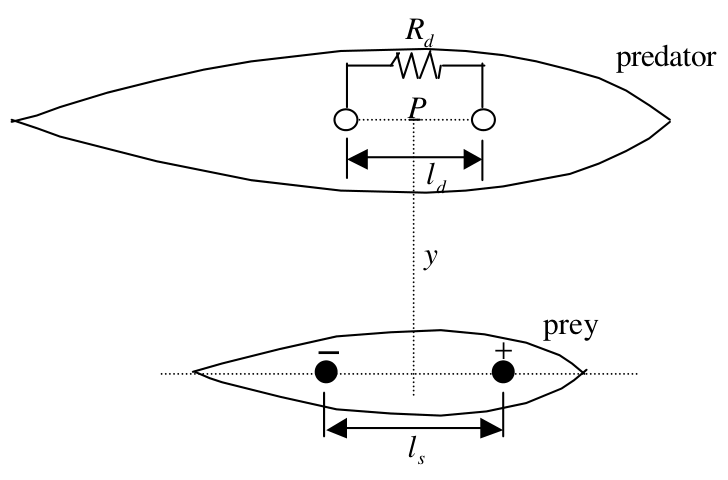
Figure II-1. A model describing the detection of electric power coming from a prey by its predator.
In order to describe the detection of electric power by the predator coming from the prey, the detector is modeled similarly by two spheres on the predator’s body and in contact with the surrounding seawater, lying parallel to the pair in the prey’s body. They are separated by a distance of \(l_d\), each having a radius of \(r_d\) which is much smaller than \(l_d\). In this case, the center of the detector is located at a distance \(y\) right above the source and the line connecting the two spheres is parallel to the electric field as shown in Figure II-1. Both \(l_s\) and \(l_d\) are also much smaller than \(y\). The electric field strength along the line connecting the two spheres is assumed to be constant. Therefore the detector forms a closed circuit system connecting the prey, the surrounding seawater and the predator as described in Figure II-2.
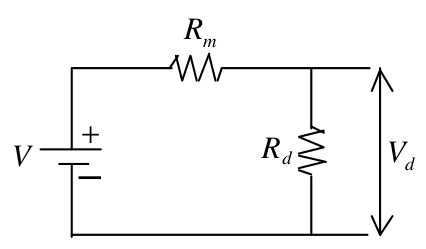
Figure II-2. The equivalent closed circuit system involving the sensing predator, the prey and the surrounding seawater.
In the figure, \(V\) is the voltage difference between the detector’s spheres due to the electric field induced by the prey, \(R_m\) is the inner resistance due to the surrounding sea water. Further, \(V_d\) and \(R_d\) are respectively the voltage difference between the detecting spheres and the resistance of the detecting element within the predator.
Questions:
-
Determine the current density vector \(\vec{j}\) (current per unit area) caused by a point current source \(I_s\) at a distance \(r\) in an infinite medium. [1.5 pts]
-
Based on the law \(\vec{E}=\rho\vec{j}\), determine the electric field strength \(\vec{E}_p\) at the middle of the detecting spheres (at point P) for a given current \(I_s\) that flows between two spheres in the prey’s body [2.0 pts].
-
Determine for the same current \(I_s\), the voltage difference between the source spheres (\(V_s\)) in the prey [1.5 pts]. Determine the resistance between the two source spheres (\(R_s\)) [0.5 pts] and the power produced by the source (\(P_s\)) [0.5 pts].
-
Determine \(R_m\) [0.5 pts], \(V_d\) [1.0 pts] in Figure II-2 and calculate also the power transferred from the source to the detector (\(P_d\)) [0.5 pts].
-
Determine the optimum value of \(R_d\) leading to maximum detected power [1.5 pts] and determine also the maximum power [0.5 pts].
Official English text of the problem.
Answers
Let \(\hat{\mathbf x}\) point from the prey’s negative sphere toward its positive sphere. Voltages below are positive magnitudes. Results retain the leading terms under the stated assumptions \[ r_s\ll l_s,\qquad r_d\ll l_d,\qquad l_s,l_d\ll y. \] The problem supplies no numerical parameter values, so the answers are symbolic.
-
With \(\hat{\mathbf r}\) directed away from the point source, \[ \boxed{\vec j(r)=\frac{I_s}{4\pi r^2}\hat{\mathbf r}}. \]
-
The field points from the positive-source side toward the negative-source side: \[ \boxed{\vec E_p\simeq-\frac{\rho I_s l_s}{4\pi y^3}\hat{\mathbf x}}. \]
-
The source voltage, resistance, and power are \[ \boxed{V_s\simeq\frac{\rho I_s}{2\pi r_s}},\qquad \boxed{R_s\simeq\frac{\rho}{2\pi r_s}},\qquad \boxed{P_s\simeq\frac{\rho I_s^2}{2\pi r_s}}. \]
-
The seawater resistance and open-circuit detector voltage are \[ \boxed{R_m\simeq\frac{\rho}{2\pi r_d}},\qquad V\simeq\frac{\rho I_s l_s l_d}{4\pi y^3}. \] Consequently, \[ \boxed{V_d=\frac{R_d}{R_m+R_d}\,V},\qquad \boxed{P_d=\frac{V^2R_d}{(R_m+R_d)^2}}. \]
-
Maximum detected power occurs at \[ \boxed{R_{d,\mathrm{opt}}=R_m\simeq\frac{\rho}{2\pi r_d}}. \] Its value is \[ \boxed{ P_{d,\max}=\frac{V^2}{4R_m} \simeq\frac{\rho I_s^2l_s^2l_d^2r_d}{32\pi y^6} \simeq P_s\frac{r_sr_dl_s^2l_d^2}{16y^6} }. \]
Solution
1. Current density of a point current source
In a homogeneous, isotropic, infinite medium, spherical symmetry requires the current density to be radial and to have the same magnitude everywhere on a sphere centered on the source.
Conservation of current gives \[ I_s=\oint \vec j\cdot d\vec A=4\pi r^2j(r). \] Therefore, \[ \boxed{\vec j(r)=\frac{I_s}{4\pi r^2}\hat{\mathbf r}}. \] For a positive source the current is outward; a sink carrying the same current has the opposite sign. The current density has SI units \(\mathrm{A\,m^{-2}}\).
2. Electric field at P
Place the midpoint of the prey’s two spheres at the origin. The positive sphere is at \(x=l_s/2\), the negative sphere at \(x=-l_s/2\), and P is at \((0,y)\).
Since the spheres are small compared with their separation and their distance from P, replace them by a point source \(+I_s\) and a point sink \(-I_s\). Their common distance from P is \[ R=\sqrt{y^2+\frac{l_s^2}{4}}. \]
By superposition, \[ \begin{aligned} \vec j(P) &=\frac{I_s}{4\pi R^3} \left[ \left(-\frac{l_s}{2}\hat{\mathbf x}+y\hat{\mathbf y}\right) -\left(\frac{l_s}{2}\hat{\mathbf x}+y\hat{\mathbf y}\right) \right]\\ &=-\frac{I_s l_s}{4\pi R^3}\hat{\mathbf x}. \end{aligned} \] The vertical components cancel, while the horizontal components add.
Using the local form of Ohm’s law, \(\vec E=\rho\vec j\), \[ \vec E_p =-\frac{\rho I_s l_s} {4\pi\left(y^2+l_s^2/4\right)^{3/2}}\hat{\mathbf x}. \] This expression is exact within the point-source approximation. With \(l_s\ll y\), \[ \boxed{\vec E_p\simeq-\frac{\rho I_s l_s}{4\pi y^3}\hat{\mathbf x}}. \]
Thus P lies on the equatorial line of a current dipole, whose field decreases as \(y^{-3}\).
3. Source voltage, resistance, and power
For a single point source, the radial electric field is \[ E_r(r)=\frac{\rho I_s}{4\pi r^2}. \] Taking the potential at infinity as zero, \[ \phi(r)=\int_r^\infty E_r(r')\,dr' =\frac{\rho I_s}{4\pi r}. \] A sink of current \(I_s\) produces the negative of this potential.
At either source sphere, its own contribution to the surface potential has magnitude \[ \frac{\rho I_s}{4\pi r_s}. \] The contribution from the other sphere is of order \(\rho I_s/(4\pi l_s)\), smaller by \(r_s/l_s\), and is neglected at leading order. Hence \[ \phi_+\simeq\frac{\rho I_s}{4\pi r_s}, \qquad \phi_-\simeq-\frac{\rho I_s}{4\pi r_s}. \]
The voltage difference is therefore \[ \boxed{V_s=\phi_+-\phi_-\simeq\frac{\rho I_s}{2\pi r_s}}. \]
For completeness, retaining the mutual potential of the two monopoles would give \[ V_s\simeq\frac{\rho I_s}{2\pi} \left(\frac1{r_s}-\frac1{l_s}\right), \] whose second term is negligible under the stated assumption.
The resistance seen between the source spheres follows from Ohm’s law: \[ \boxed{R_s=\frac{V_s}{I_s}\simeq\frac{\rho}{2\pi r_s}}. \]
The electrical power supplied by the prey is \[ \boxed{P_s=I_sV_s=I_s^2R_s \simeq\frac{\rho I_s^2}{2\pi r_s}}. \]
4. Seawater resistance, detector voltage, and detected power
A current through the detector enters the surrounding water at one detector sphere and leaves it at the other. The resistance of this path is obtained by applying part 3 to spheres of radius \(r_d\), separated by \(l_d\). Since \(r_d\ll l_d\), \[ \boxed{R_m\simeq\frac{\rho}{2\pi r_d}}. \] Physically, each small spherical contact contributes a spreading resistance \(\rho/(4\pi r_d)\).
The prey’s electric field is approximately uniform along the detector because \(l_d\ll y\). The right detector sphere is at higher potential, so the open-circuit voltage is \[ \begin{aligned} V &=\phi_{\mathrm{right}}-\phi_{\mathrm{left}} =-\int_{\mathrm{left}}^{\mathrm{right}}\vec E_p\cdot d\vec l\\ &\simeq |\vec E_p|\,l_d =\frac{\rho I_s l_s l_d}{4\pi y^3}. \end{aligned} \]
In the equivalent circuit of Figure II-2, Kirchhoff’s voltage law gives \[ I_d=\frac{V}{R_m+R_d}. \] Therefore, \[ \boxed{ V_d=I_dR_d =\frac{R_d}{R_m+R_d}V \simeq \frac{\rho I_s l_s l_d}{4\pi y^3} \frac{R_d}{R_d+\rho/(2\pi r_d)} }. \]
The power dissipated in the detecting element is \[ \boxed{ P_d=I_d^2R_d=\frac{V_d^2}{R_d} =\frac{V^2R_d}{(R_m+R_d)^2} }. \] In terms of the given parameters, \[ \boxed{ P_d\simeq \frac{\rho^2I_s^2l_s^2l_d^2}{16\pi^2y^6} \frac{R_d}{\left[R_d+\rho/(2\pi r_d)\right]^2} }. \]
5. Optimum detector resistance and maximum power
For the given source current and geometry, \(V\) and \(R_m\) are fixed. Differentiating the detected power with respect to \(R_d\), \[ \frac{dP_d}{dR_d} =V^2\frac{R_m-R_d}{(R_m+R_d)^3}. \] The derivative is positive for \(R_d<R_m\) and negative for \(R_d>R_m\). Thus the maximum occurs when \[ \boxed{R_{d,\mathrm{opt}}=R_m\simeq\frac{\rho}{2\pi r_d}}. \] This is the maximum-power-transfer condition.
At this resistance, \(V_d=V/2\), giving \[ P_{d,\max}=\frac{V^2}{4R_m}. \] Substitution yields \[ \begin{aligned} P_{d,\max} &\simeq \left(\frac{\rho I_s l_s l_d}{4\pi y^3}\right)^2 \frac{2\pi r_d}{4\rho}\\ &=\boxed{\frac{\rho I_s^2l_s^2l_d^2r_d}{32\pi y^6}}. \end{aligned} \]
Using the source power from part 3, this can also be written as \[ \boxed{ \frac{P_{d,\max}}{P_s} \simeq\frac{r_sr_dl_s^2l_d^2}{16y^6} }. \] The \(y^{-6}\) dependence results from squaring the dipole field, which decreases as \(y^{-3}\).
The solution was checked against the official solution.
IPhO 2002 · Theorieaufgabe 2
Wahrnehmung elektrischer Signale
Einige Meerestiere können andere Lebewesen aus einiger Entfernung anhand elektrischer Ströme wahrnehmen, die diese beim Atmen oder bei anderen Vorgängen erzeugen, die mit Muskelkontraktionen verbunden sind. Manche Räuber nutzen dieses elektrische Signal, um ihre Beute auch dann zu orten, wenn sie im Sand vergraben ist.
Der physikalische Mechanismus, der der Stromerzeugung im Beutetier und der Wahrnehmung durch den Räuber zugrunde liegt, lässt sich wie in Abbildung II-1 dargestellt modellieren. Der vom Beutetier erzeugte Strom fließt zwischen zwei Kugeln mit positivem und negativem Potential im Körper des Beutetiers. Der Abstand zwischen den Mittelpunkten der beiden Kugeln beträgt \(l_s\); jede Kugel hat den Radius \(r_s\), der wesentlich kleiner als \(l_s\) ist. Der spezifische elektrische Widerstand des Meerwassers ist \(\rho\). Nehmen Sie an, dass der spezifische elektrische Widerstand des Körpers des Beutetiers dem des umgebenden Meerwassers entspricht, sodass die in der Abbildung eingezeichnete Begrenzung des Beutetiers vernachlässigt werden kann.
Abbildung II-1. Ein Modell zur Beschreibung der Erfassung der von einem Beutetier ausgehenden elektrischen Leistung durch seinen Räuber.
Um die Erfassung der vom Beutetier ausgehenden elektrischen Leistung durch den Räuber zu beschreiben, wird der Detektor ebenfalls durch zwei Kugeln am Körper des Räubers modelliert, die mit dem umgebenden Meerwasser in Kontakt stehen und parallel zum Kugelpaar im Körper des Beutetiers angeordnet sind. Ihr Abstand beträgt \(l_d\); jede Kugel hat den Radius \(r_d\), der wesentlich kleiner als \(l_d\) ist. Dabei befindet sich der Mittelpunkt des Detektors im Abstand \(y\) direkt über der Quelle, und die Verbindungslinie der beiden Kugeln verläuft parallel zum elektrischen Feld, wie in Abbildung II-1 dargestellt. Sowohl \(l_s\) als auch \(l_d\) sind ebenfalls wesentlich kleiner als \(y\). Die elektrische Feldstärke entlang der Verbindungslinie der beiden Kugeln wird als konstant angenommen. Der Detektor bildet somit einen geschlossenen Stromkreis, der das Beutetier, das umgebende Meerwasser und den Räuber miteinander verbindet, wie in Abbildung II-2 dargestellt.
Abbildung II-2. Der äquivalente geschlossene Stromkreis aus dem wahrnehmenden Räuber, dem Beutetier und dem umgebenden Meerwasser.
In der Abbildung ist \(V\) die durch das elektrische Feld des Beutetiers hervorgerufene Spannung zwischen den Kugeln des Detektors, und \(R_m\) ist der durch das umgebende Meerwasser bedingte Innenwiderstand. Ferner bezeichnen \(V_d\) und \(R_d\) die Spannung zwischen den Detektorkugeln beziehungsweise den Widerstand des Detektorelements im Inneren des Räubers.
Fragen:
-
Bestimmen Sie den Stromdichtevektor \(\vec{j}\) (Strom pro Flächeneinheit), den eine punktförmige Stromquelle \(I_s\) im Abstand \(r\) in einem unendlichen Medium erzeugt. [1.5 Punkte]
-
Bestimmen Sie mithilfe des Gesetzes \(\vec{E}=\rho\vec{j}\) die elektrische Feldstärke \(\vec{E}_p\) in der Mitte zwischen den Detektorkugeln (am Punkt P) für einen gegebenen Strom \(I_s\), der zwischen den beiden Kugeln im Körper des Beutetiers fließt [2.0 Punkte].
-
Bestimmen Sie für denselben Strom \(I_s\) die Spannung zwischen den Quellkugeln (\(V_s\)) im Beutetier [1.5 Punkte]. Bestimmen Sie den Widerstand zwischen den beiden Quellkugeln (\(R_s\)) [0.5 Punkte] und die von der Quelle erzeugte Leistung (\(P_s\)) [0.5 Punkte].
-
Bestimmen Sie \(R_m\) [0.5 Punkte] und \(V_d\) [1.0 Punkte] in Abbildung II-2 und berechnen Sie außerdem die von der Quelle auf den Detektor übertragene Leistung (\(P_d\)) [0.5 Punkte].
-
Bestimmen Sie den optimalen Wert von \(R_d\), bei dem die vom Detektor aufgenommene Leistung maximal ist [1.5 Punkte], und bestimmen Sie außerdem die maximale Leistung [0.5 Punkte].
Aufgabentext aus dem offiziellen englischen Text übersetzt.
Antworten
Der Einheitsvektor \(\hat{\mathbf x}\) zeige von der negativen Kugel des Beutetiers zu seiner positiven Kugel. Die folgenden Spannungen sind positive Beträge. In den Ergebnissen werden unter den angegebenen Annahmen die führenden Terme beibehalten: \[ r_s\ll l_s,\qquad r_d\ll l_d,\qquad l_s,l_d\ll y. \] Da in der Aufgabe keine numerischen Parameterwerte angegeben sind, werden die Antworten symbolisch angegeben.
-
Mit dem von der Punktquelle weg gerichteten Einheitsvektor \(\hat{\mathbf r}\) gilt \[ \boxed{\vec j(r)=\frac{I_s}{4\pi r^2}\hat{\mathbf r}}. \]
-
Das Feld zeigt von der Seite der positiven Quelle zur Seite der negativen Quelle: \[ \boxed{\vec E_p\simeq-\frac{\rho I_s l_s}{4\pi y^3}\hat{\mathbf x}}. \]
-
Spannung, Widerstand und Leistung der Quelle sind \[ \boxed{V_s\simeq\frac{\rho I_s}{2\pi r_s}},\qquad \boxed{R_s\simeq\frac{\rho}{2\pi r_s}},\qquad \boxed{P_s\simeq\frac{\rho I_s^2}{2\pi r_s}}. \]
-
Der Widerstand des Meerwassers und die Leerlaufspannung des Detektors sind \[ \boxed{R_m\simeq\frac{\rho}{2\pi r_d}},\qquad V\simeq\frac{\rho I_s l_s l_d}{4\pi y^3}. \] Folglich gilt \[ \boxed{V_d=\frac{R_d}{R_m+R_d}\,V},\qquad \boxed{P_d=\frac{V^2R_d}{(R_m+R_d)^2}}. \]
-
Die vom Detektor aufgenommene Leistung ist maximal bei \[ \boxed{R_{d,\mathrm{opt}}=R_m\simeq\frac{\rho}{2\pi r_d}}. \] Ihr Wert beträgt \[ \boxed{ P_{d,\max}=\frac{V^2}{4R_m} \simeq\frac{\rho I_s^2l_s^2l_d^2r_d}{32\pi y^6} \simeq P_s\frac{r_sr_dl_s^2l_d^2}{16y^6} }. \]
Lösung
1. Stromdichte einer punktförmigen Stromquelle
In einem homogenen, isotropen, unendlichen Medium muss die Stromdichte aufgrund der Kugelsymmetrie radial gerichtet sein und auf einer Kugel mit der Quelle im Mittelpunkt überall denselben Betrag haben.
Aus der Stromerhaltung folgt \[ I_s=\oint \vec j\cdot d\vec A=4\pi r^2j(r). \] Daher gilt \[ \boxed{\vec j(r)=\frac{I_s}{4\pi r^2}\hat{\mathbf r}}. \] Bei einer positiven Quelle fließt der Strom nach außen; bei einer Senke mit demselben Strom ist das Vorzeichen umgekehrt. Die Stromdichte hat die SI-Einheit \(\mathrm{A\,m^{-2}}\).
2. Elektrisches Feld am Punkt P
Wir legen den Mittelpunkt zwischen den beiden Kugeln des Beutetiers in den Koordinatenursprung. Die positive Kugel befindet sich bei \(x=l_s/2\), die negative Kugel bei \(x=-l_s/2\) und P bei \((0,y)\).
Da die Kugeln im Vergleich zu ihrem gegenseitigen Abstand und ihrem Abstand von P klein sind, ersetzen wir sie durch eine Punktquelle \(+I_s\) und eine Punktsenke \(-I_s\). Ihr gemeinsamer Abstand von P ist \[ R=\sqrt{y^2+\frac{l_s^2}{4}}. \]
Nach dem Superpositionsprinzip gilt \[ \begin{aligned} \vec j(P) &=\frac{I_s}{4\pi R^3} \left[ \left(-\frac{l_s}{2}\hat{\mathbf x}+y\hat{\mathbf y}\right) -\left(\frac{l_s}{2}\hat{\mathbf x}+y\hat{\mathbf y}\right) \right]\\ &=-\frac{I_s l_s}{4\pi R^3}\hat{\mathbf x}. \end{aligned} \] Die vertikalen Komponenten heben sich auf, während sich die horizontalen Komponenten addieren.
Mit der lokalen Form des ohmschen Gesetzes, \(\vec E=\rho\vec j\), ergibt sich \[ \vec E_p =-\frac{\rho I_s l_s} {4\pi\left(y^2+l_s^2/4\right)^{3/2}}\hat{\mathbf x}. \] Dieser Ausdruck ist innerhalb der Punktquellennäherung exakt. Für \(l_s\ll y\) gilt \[ \boxed{\vec E_p\simeq-\frac{\rho I_s l_s}{4\pi y^3}\hat{\mathbf x}}. \]
P liegt somit auf der Äquatorlinie eines Stromdipols, dessen Feld wie \(y^{-3}\) abnimmt.
3. Spannung, Widerstand und Leistung der Quelle
Für eine einzelne Punktquelle ist das radiale elektrische Feld \[ E_r(r)=\frac{\rho I_s}{4\pi r^2}. \] Wählt man das Potential im Unendlichen gleich null, so gilt \[ \phi(r)=\int_r^\infty E_r(r')\,dr' =\frac{\rho I_s}{4\pi r}. \] Eine Senke mit dem Strom \(I_s\) erzeugt das Negative dieses Potentials.
An jeder der beiden Quellkugeln hat der eigene Beitrag zum Oberflächenpotential den Betrag \[ \frac{\rho I_s}{4\pi r_s}. \] Der Beitrag der jeweils anderen Kugel ist von der Größenordnung \(\rho I_s/(4\pi l_s)\), also um den Faktor \(r_s/l_s\) kleiner, und wird in führender Ordnung vernachlässigt. Somit gilt \[ \phi_+\simeq\frac{\rho I_s}{4\pi r_s}, \qquad \phi_-\simeq-\frac{\rho I_s}{4\pi r_s}. \]
Die Spannung beträgt daher \[ \boxed{V_s=\phi_+-\phi_-\simeq\frac{\rho I_s}{2\pi r_s}}. \]
Der Vollständigkeit halber würde die Berücksichtigung des gegenseitigen Potentialbeitrags der beiden Monopole \[ V_s\simeq\frac{\rho I_s}{2\pi} \left(\frac1{r_s}-\frac1{l_s}\right) \] ergeben, wobei der zweite Term unter der angegebenen Annahme vernachlässigbar ist.
Der zwischen den Quellkugeln wirksame Widerstand folgt aus dem ohmschen Gesetz: \[ \boxed{R_s=\frac{V_s}{I_s}\simeq\frac{\rho}{2\pi r_s}}. \]
Die vom Beutetier bereitgestellte elektrische Leistung ist \[ \boxed{P_s=I_sV_s=I_s^2R_s \simeq\frac{\rho I_s^2}{2\pi r_s}}. \]
4. Widerstand des Meerwassers, Detektorspannung und aufgenommene Leistung
Ein Strom durch den Detektor tritt an einer Detektorkugel in das umgebende Wasser ein und verlässt es an der anderen. Den Widerstand dieses Stromwegs erhält man, indem man Teil 3 auf Kugeln mit dem Radius \(r_d\) und dem Abstand \(l_d\) anwendet. Wegen \(r_d\ll l_d\) gilt \[ \boxed{R_m\simeq\frac{\rho}{2\pi r_d}}. \] Physikalisch trägt jeder kleine kugelförmige Kontakt einen Ausbreitungswiderstand \(\rho/(4\pi r_d)\) bei.
Das elektrische Feld des Beutetiers ist entlang des Detektors näherungsweise homogen, da \(l_d\ll y\). Die rechte Detektorkugel liegt auf höherem Potential, sodass die Leerlaufspannung \[ \begin{aligned} V &=\phi_{\mathrm{right}}-\phi_{\mathrm{left}} =-\int_{\mathrm{left}}^{\mathrm{right}}\vec E_p\cdot d\vec l\\ &\simeq |\vec E_p|\,l_d =\frac{\rho I_s l_s l_d}{4\pi y^3} \end{aligned} \] beträgt.
Im Ersatzschaltbild in Abbildung II-2 liefert die kirchhoffsche Maschenregel \[ I_d=\frac{V}{R_m+R_d}. \] Daher gilt \[ \boxed{ V_d=I_dR_d =\frac{R_d}{R_m+R_d}V \simeq \frac{\rho I_s l_s l_d}{4\pi y^3} \frac{R_d}{R_d+\rho/(2\pi r_d)} }. \]
Die im Detektorelement umgesetzte Leistung ist \[ \boxed{ P_d=I_d^2R_d=\frac{V_d^2}{R_d} =\frac{V^2R_d}{(R_m+R_d)^2} }. \] Ausgedrückt durch die gegebenen Parameter gilt \[ \boxed{ P_d\simeq \frac{\rho^2I_s^2l_s^2l_d^2}{16\pi^2y^6} \frac{R_d}{\left[R_d+\rho/(2\pi r_d)\right]^2} }. \]
5. Optimaler Detektorwiderstand und maximale Leistung
Für den gegebenen Quellstrom und die gegebene Geometrie sind \(V\) und \(R_m\) fest. Die Ableitung der vom Detektor aufgenommenen Leistung nach \(R_d\) ergibt \[ \frac{dP_d}{dR_d} =V^2\frac{R_m-R_d}{(R_m+R_d)^3}. \] Die Ableitung ist für \(R_d<R_m\) positiv und für \(R_d>R_m\) negativ. Das Maximum liegt somit bei \[ \boxed{R_{d,\mathrm{opt}}=R_m\simeq\frac{\rho}{2\pi r_d}}. \] Dies ist die Bedingung für Leistungsanpassung.
Bei diesem Widerstand gilt \(V_d=V/2\), woraus \[ P_{d,\max}=\frac{V^2}{4R_m} \] folgt. Einsetzen ergibt \[ \begin{aligned} P_{d,\max} &\simeq \left(\frac{\rho I_s l_s l_d}{4\pi y^3}\right)^2 \frac{2\pi r_d}{4\rho}\\ &=\boxed{\frac{\rho I_s^2l_s^2l_d^2r_d}{32\pi y^6}}. \end{aligned} \]
Mit der Quellleistung aus Teil 3 lässt sich dies auch schreiben als \[ \boxed{ \frac{P_{d,\max}}{P_s} \simeq\frac{r_sr_dl_s^2l_d^2}{16y^6} }. \] Die Abhängigkeit von \(y^{-6}\) ergibt sich durch Quadrieren des Dipolfeldes, das wie \(y^{-3}\) abnimmt.
Die Lösung wurde mit der offiziellen Lösung abgeglichen.
IPhO 2002 · Teori sorusu 2
Elektriksel Sinyallerin Algılanması
Bazı deniz hayvanları, diğer canlıların solunum sırasında veya kas kasılmasını içeren başka süreçlerde ürettikleri elektrik akımları sayesinde bu canlıları belirli bir uzaklıktan algılayabilir. Bazı yırtıcılar, avları kumun altına gömülmüş olsa bile, onların yerini belirlemek için bu elektriksel sinyali kullanır.
Avda akımın oluşmasını ve yırtıcının bu akımı algılamasını sağlayan fiziksel mekanizma, Şekil II-1'de gösterildiği gibi modellenebilir. Avın ürettiği akım, avın vücudundaki pozitif ve negatif potansiyelli iki küre arasında akar. İki kürenin merkezleri arasındaki uzaklık \(l_s\), her birinin yarıçapı ise \(l_s\)'den çok daha küçük olan \(r_s\)'dir. Deniz suyunun özdirenci \(\rho\)'dur. Avın vücudunun özdirencinin çevresindeki deniz suyunun özdirenciyle aynı olduğunu varsayın; bu durumda şekilde avı çevreleyen sınır göz ardı edilebilir.
Şekil II-1. Bir avdan gelen elektriksel gücün yırtıcısı tarafından algılanmasını betimleyen model.
Avdan gelen elektriksel gücün yırtıcı tarafından algılanmasını betimlemek için, algılayıcı da benzer biçimde, yırtıcının vücudunda bulunan ve çevredeki deniz suyuyla temas eden, avın vücudundaki küre çiftine paralel duran iki küreyle modellenir. Bu küreler arasındaki uzaklık \(l_d\), her birinin yarıçapı ise \(l_d\)'den çok daha küçük olan \(r_d\)'dir. Bu durumda algılayıcının merkezi kaynağın tam üstünde, kaynaktan \(y\) uzaklıkta bulunur ve iki küreyi birleştiren doğru, Şekil II-1'de gösterildiği gibi elektrik alanına paraleldir. Hem \(l_s\) hem de \(l_d\), \(y\)'den de çok daha küçüktür. İki küreyi birleştiren doğru boyunca elektrik alan şiddetinin sabit olduğu varsayılır. Böylece algılayıcı, Şekil II-2'de gösterildiği gibi avı, çevredeki deniz suyunu ve yırtıcıyı birbirine bağlayan kapalı bir devre sistemi oluşturur.
Şekil II-2. Algılayan yırtıcıyı, avı ve çevredeki deniz suyunu içeren eşdeğer kapalı devre sistemi.
Şekilde \(V\), avın oluşturduğu elektrik alanından kaynaklanan, algılayıcı küreleri arasındaki gerilim farkıdır; \(R_m\) ise çevredeki deniz suyundan kaynaklanan iç dirençtir. Ayrıca \(V_d\) ve \(R_d\), sırasıyla algılayıcı küreler arasındaki gerilim farkı ve yırtıcının içindeki algılama elemanının direncidir.
Sorular:
-
Sonsuz bir ortamda, noktasal bir \(I_s\) akım kaynağının \(r\) uzaklıkta oluşturduğu akım yoğunluğu vektörünü \(\vec{j}\) (birim alan başına akım) bulun. [1.5 puan]
-
\(\vec{E}=\rho\vec{j}\) yasasını kullanarak, avın vücudundaki iki küre arasında akan belirli bir \(I_s\) akımı için algılayıcı kürelerin orta noktasındaki (P noktasındaki) elektrik alan şiddetini \(\vec{E}_p\) bulun [2.0 puan].
-
Aynı \(I_s\) akımı için, avdaki kaynak küreler arasındaki gerilim farkını (\(V_s\)) bulun [1.5 puan]. İki kaynak küre arasındaki direnci (\(R_s\)) [0.5 puan] ve kaynağın ürettiği gücü (\(P_s\)) [0.5 puan] bulun.
-
Şekil II-2'deki \(R_m\)'yi [0.5 puan], \(V_d\)'yi [1.0 puan] bulun ve kaynaktan algılayıcıya aktarılan gücü (\(P_d\)) de hesaplayın [0.5 puan].
-
Algılanan gücü maksimum yapan en uygun \(R_d\) değerini bulun [1.5 puan] ve maksimum gücü de belirleyin [0.5 puan].
Soru metni resmi İngilizce metinden çevrilmiştir.
Cevaplar
\(\hat{\mathbf x}\), avın negatif küresinden pozitif küresine doğru yönelsin. Aşağıdaki gerilimler pozitif büyüklüklerdir. Sonuçlarda, belirtilen \[ r_s\ll l_s,\qquad r_d\ll l_d,\qquad l_s,l_d\ll y \] varsayımları altında baskın terimler korunmuştur. Soruda parametreler için sayısal değer verilmediğinden cevaplar semboliktir.
-
\(\hat{\mathbf r}\), noktasal kaynaktan dışarıya doğru yönelmek üzere, \[ \boxed{\vec j(r)=\frac{I_s}{4\pi r^2}\hat{\mathbf r}}. \]
-
Alan, pozitif kaynak tarafından negatif kaynak tarafına doğru yönelir: \[ \boxed{\vec E_p\simeq-\frac{\rho I_s l_s}{4\pi y^3}\hat{\mathbf x}}. \]
-
Kaynak gerilimi, direnci ve gücü şöyledir: \[ \boxed{V_s\simeq\frac{\rho I_s}{2\pi r_s}},\qquad \boxed{R_s\simeq\frac{\rho}{2\pi r_s}},\qquad \boxed{P_s\simeq\frac{\rho I_s^2}{2\pi r_s}}. \]
-
Deniz suyunun direnci ve algılayıcının açık devre gerilimi şöyledir: \[ \boxed{R_m\simeq\frac{\rho}{2\pi r_d}},\qquad V\simeq\frac{\rho I_s l_s l_d}{4\pi y^3}. \] Dolayısıyla, \[ \boxed{V_d=\frac{R_d}{R_m+R_d}\,V},\qquad \boxed{P_d=\frac{V^2R_d}{(R_m+R_d)^2}}. \]
-
Algılanan güç, \[ \boxed{R_{d,\mathrm{opt}}=R_m\simeq\frac{\rho}{2\pi r_d}} \] olduğunda maksimum olur. Bu gücün değeri şöyledir: \[ \boxed{ P_{d,\max}=\frac{V^2}{4R_m} \simeq\frac{\rho I_s^2l_s^2l_d^2r_d}{32\pi y^6} \simeq P_s\frac{r_sr_dl_s^2l_d^2}{16y^6} }. \]
Çözüm
1. Noktasal bir akım kaynağının akım yoğunluğu
Homojen, izotrop ve sonsuz bir ortamda küresel simetri, akım yoğunluğunun radyal olmasını ve merkezi kaynakta olan bir kürenin her noktasında aynı büyüklüğe sahip olmasını gerektirir.
Akımın korunumu şu bağıntıyı verir: \[ I_s=\oint \vec j\cdot d\vec A=4\pi r^2j(r). \] Dolayısıyla, \[ \boxed{\vec j(r)=\frac{I_s}{4\pi r^2}\hat{\mathbf r}}. \] Pozitif bir kaynak için akım dışarıya doğrudur; aynı akımı yutan bir kuyunun işareti terstir. Akım yoğunluğunun SI birimi \(\mathrm{A\,m^{-2}}\)'dir.
2. P noktasındaki elektrik alanı
Avın iki küresinin orta noktasını orijine yerleştirelim. Pozitif küre \(x=l_s/2\), negatif küre \(x=-l_s/2\) konumunda, P ise \((0,y)\) noktasındadır.
Küreler, aralarındaki uzaklığa ve P'ye olan uzaklıklarına kıyasla küçük olduğundan, bunların yerine noktasal bir \(+I_s\) kaynağı ve noktasal bir \(-I_s\) kuyusu koyalım. P'ye olan ortak uzaklıkları şöyledir: \[ R=\sqrt{y^2+\frac{l_s^2}{4}}. \]
Süperpozisyon ilkesine göre, \[ \begin{aligned} \vec j(P) &=\frac{I_s}{4\pi R^3} \left[ \left(-\frac{l_s}{2}\hat{\mathbf x}+y\hat{\mathbf y}\right) -\left(\frac{l_s}{2}\hat{\mathbf x}+y\hat{\mathbf y}\right) \right]\\ &=-\frac{I_s l_s}{4\pi R^3}\hat{\mathbf x}. \end{aligned} \] Düşey bileşenler birbirini götürürken yatay bileşenler toplanır.
Ohm yasasının yerel biçimi olan \(\vec E=\rho\vec j\) kullanıldığında, \[ \vec E_p =-\frac{\rho I_s l_s} {4\pi\left(y^2+l_s^2/4\right)^{3/2}}\hat{\mathbf x}. \] Bu ifade, noktasal kaynak yaklaşımı çerçevesinde kesindir. \(l_s\ll y\) olduğunda, \[ \boxed{\vec E_p\simeq-\frac{\rho I_s l_s}{4\pi y^3}\hat{\mathbf x}}. \]
Dolayısıyla P, alanı \(y^{-3}\) ile azalan bir akım dipolünün ekvator doğrusu üzerinde bulunur.
3. Kaynak gerilimi, direnci ve gücü
Tek bir noktasal kaynak için radyal elektrik alanı şöyledir: \[ E_r(r)=\frac{\rho I_s}{4\pi r^2}. \] Sonsuzdaki potansiyel sıfır alındığında, \[ \phi(r)=\int_r^\infty E_r(r')\,dr' =\frac{\rho I_s}{4\pi r}. \] \(I_s\) akımını yutan bir kuyu, bu potansiyelin negatifini oluşturur.
Kaynak kürelerin her birinde, kürenin kendi yüzey potansiyeline katkısının büyüklüğü şöyledir: \[ \frac{\rho I_s}{4\pi r_s}. \] Diğer küreden gelen katkı \(\rho I_s/(4\pi l_s)\) mertebesindedir; bu katkının kürenin kendi katkısına oranı \(r_s/l_s\) olduğundan, baskın mertebede ihmal edilir. Böylece, \[ \phi_+\simeq\frac{\rho I_s}{4\pi r_s}, \qquad \phi_-\simeq-\frac{\rho I_s}{4\pi r_s}. \]
Bu nedenle gerilim farkı şöyledir: \[ \boxed{V_s=\phi_+-\phi_-\simeq\frac{\rho I_s}{2\pi r_s}}. \]
Tamlık açısından, iki monopolün birbirlerinin potansiyeline katkıları korunsaydı, \[ V_s\simeq\frac{\rho I_s}{2\pi} \left(\frac1{r_s}-\frac1{l_s}\right), \] elde edilirdi; buradaki ikinci terim, belirtilen varsayım altında ihmal edilebilir.
Kaynak küreler arasında görülen direnç, Ohm yasasından elde edilir: \[ \boxed{R_s=\frac{V_s}{I_s}\simeq\frac{\rho}{2\pi r_s}}. \]
Avın sağladığı elektriksel güç şöyledir: \[ \boxed{P_s=I_sV_s=I_s^2R_s \simeq\frac{\rho I_s^2}{2\pi r_s}}. \]
4. Deniz suyunun direnci, algılayıcı gerilimi ve algılanan güç
Algılayıcıdan geçen akım, çevredeki suya algılayıcı kürelerden birinde girer ve diğerinde sudan çıkar. Bu yolun direnci, 3. kısımdaki sonuç, yarıçapları \(r_d\) ve aralarındaki uzaklık \(l_d\) olan kürelere uygulanarak elde edilir. \(r_d\ll l_d\) olduğundan, \[ \boxed{R_m\simeq\frac{\rho}{2\pi r_d}}. \] Fiziksel olarak, her küçük küresel temas noktası \(\rho/(4\pi r_d)\) değerinde bir yayılma direnci katkısı yapar.
\(l_d\ll y\) olduğundan avın elektrik alanı algılayıcı boyunca yaklaşık olarak düzgündür. Sağdaki algılayıcı küre daha yüksek potansiyeldedir; dolayısıyla açık devre gerilimi şöyledir: \[ \begin{aligned} V &=\phi_{\mathrm{right}}-\phi_{\mathrm{left}} =-\int_{\mathrm{left}}^{\mathrm{right}}\vec E_p\cdot d\vec l\\ &\simeq |\vec E_p|\,l_d =\frac{\rho I_s l_s l_d}{4\pi y^3}. \end{aligned} \]
Şekil II-2'deki eşdeğer devrede Kirchhoff'un gerilim yasası şu bağıntıyı verir: \[ I_d=\frac{V}{R_m+R_d}. \] Dolayısıyla, \[ \boxed{ V_d=I_dR_d =\frac{R_d}{R_m+R_d}V \simeq \frac{\rho I_s l_s l_d}{4\pi y^3} \frac{R_d}{R_d+\rho/(2\pi r_d)} }. \]
Algılama elemanında harcanan güç şöyledir: \[ \boxed{ P_d=I_d^2R_d=\frac{V_d^2}{R_d} =\frac{V^2R_d}{(R_m+R_d)^2} }. \] Verilen parametreler cinsinden, \[ \boxed{ P_d\simeq \frac{\rho^2I_s^2l_s^2l_d^2}{16\pi^2y^6} \frac{R_d}{\left[R_d+\rho/(2\pi r_d)\right]^2} }. \]
5. En uygun algılayıcı direnci ve maksimum güç
Verilen kaynak akımı ve geometri için \(V\) ve \(R_m\) sabittir. Algılanan gücün \(R_d\)'ye göre türevi alındığında, \[ \frac{dP_d}{dR_d} =V^2\frac{R_m-R_d}{(R_m+R_d)^3}. \] Türev, \(R_d<R_m\) için pozitif, \(R_d>R_m\) için negatiftir. Dolayısıyla maksimum, \[ \boxed{R_{d,\mathrm{opt}}=R_m\simeq\frac{\rho}{2\pi r_d}} \] olduğunda elde edilir. Bu, maksimum güç aktarımı koşuludur.
Bu dirençte \(V_d=V/2\) olur ve şu sonuç elde edilir: \[ P_{d,\max}=\frac{V^2}{4R_m}. \] Yerine koyma işlemi şu sonucu verir: \[ \begin{aligned} P_{d,\max} &\simeq \left(\frac{\rho I_s l_s l_d}{4\pi y^3}\right)^2 \frac{2\pi r_d}{4\rho}\\ &=\boxed{\frac{\rho I_s^2l_s^2l_d^2r_d}{32\pi y^6}}. \end{aligned} \]
- kısımdaki kaynak gücü kullanılarak bu sonuç şöyle de yazılabilir: \[ \boxed{ \frac{P_{d,\max}}{P_s} \simeq\frac{r_sr_dl_s^2l_d^2}{16y^6} }. \] \(y^{-6}\) bağımlılığı, \(y^{-3}\) ile azalan dipol alanının karesinin alınmasından kaynaklanır.
Çözüm, resmi çözümle karşılaştırılarak kontrol edildi.
IPhO 2002 · Problema teórico 2
Detección de señales eléctricas
Algunos animales marinos tienen la capacidad de detectar otras criaturas a cierta distancia gracias a las corrientes eléctricas que estas producen durante la respiración u otros procesos que implican contracción muscular. Algunos depredadores utilizan esta señal eléctrica para localizar a sus presas, incluso cuando están enterradas en la arena.
El mecanismo físico que subyace a la generación de corriente en la presa y a su detección por el depredador puede modelarse como se describe en la Figura II-1. La corriente generada por la presa circula entre dos esferas con potencial positivo y negativo situadas en el cuerpo de la presa. La distancia entre los centros de las dos esferas es \(l_s\), y cada una tiene un radio \(r_s\), mucho menor que \(l_s\). La resistividad del agua de mar es \(\rho\). Suponga que la resistividad del cuerpo de la presa es la misma que la del agua de mar circundante, lo que implica que puede ignorarse el contorno que rodea a la presa en la figura.
Figura II-1. Modelo que describe la detección de la potencia eléctrica procedente de una presa por parte de su depredador.
Para describir la detección por parte del depredador de la potencia eléctrica procedente de la presa, el detector se modela de manera similar mediante dos esferas situadas en el cuerpo del depredador y en contacto con el agua de mar circundante, dispuestas paralelamente al par de esferas del cuerpo de la presa. Están separadas por una distancia \(l_d\), y cada una tiene un radio \(r_d\), mucho menor que \(l_d\). En este caso, el centro del detector se encuentra a una distancia \(y\) justo por encima de la fuente, y la línea que une las dos esferas es paralela al campo eléctrico, como se muestra en la Figura II-1. Tanto \(l_s\) como \(l_d\) son también mucho menores que \(y\). Se supone que la intensidad del campo eléctrico a lo largo de la línea que une las dos esferas es constante. Por tanto, el detector forma un circuito cerrado que conecta la presa, el agua de mar circundante y el depredador, como se describe en la Figura II-2.
Figura II-2. Circuito cerrado equivalente que incluye al depredador que detecta la señal, la presa y el agua de mar circundante.
En la figura, \(V\) es la diferencia de potencial entre las esferas del detector debida al campo eléctrico inducido por la presa, y \(R_m\) es la resistencia interna debida al agua de mar circundante. Además, \(V_d\) y \(R_d\) son, respectivamente, la diferencia de potencial entre las esferas detectoras y la resistencia del elemento detector situado en el interior del depredador.
Preguntas:
-
Determine el vector densidad de corriente \(\vec{j}\) (corriente por unidad de área) producido por una fuente puntual de corriente \(I_s\) a una distancia \(r\) en un medio infinito. [1.5 puntos]
-
A partir de la ley \(\vec{E}=\rho\vec{j}\), determine la intensidad del campo eléctrico \(\vec{E}_p\) en el punto medio entre las esferas detectoras (en el punto P) para una corriente dada \(I_s\) que circula entre dos esferas situadas en el cuerpo de la presa [2.0 puntos].
-
Determine, para la misma corriente \(I_s\), la diferencia de potencial entre las esferas de la fuente (\(V_s\)) situadas en la presa [1.5 puntos]. Determine la resistencia entre las dos esferas de la fuente (\(R_s\)) [0.5 puntos] y la potencia producida por la fuente (\(P_s\)) [0.5 puntos].
-
Determine \(R_m\) [0.5 puntos] y \(V_d\) [1.0 puntos] en la Figura II-2 y calcule también la potencia transferida de la fuente al detector (\(P_d\)) [0.5 puntos].
-
Determine el valor óptimo de \(R_d\) que proporciona la máxima potencia detectada [1.5 puntos] y determine también la potencia máxima [0.5 puntos].
Enunciado traducido del texto oficial en inglés.
Respuestas
Sea \(\hat{\mathbf x}\) el vector que apunta desde la esfera negativa de la presa hacia su esfera positiva. Las diferencias de potencial que se indican a continuación son magnitudes positivas. En los resultados se conservan los términos dominantes bajo las hipótesis indicadas \[ r_s\ll l_s,\qquad r_d\ll l_d,\qquad l_s,l_d\ll y. \] El problema no proporciona valores numéricos de los parámetros, por lo que las respuestas son simbólicas.
-
Con \(\hat{\mathbf r}\) dirigido hacia fuera desde la fuente puntual, \[ \boxed{\vec j(r)=\frac{I_s}{4\pi r^2}\hat{\mathbf r}}. \]
-
El campo apunta desde el lado de la fuente positiva hacia el lado de la fuente negativa: \[ \boxed{\vec E_p\simeq-\frac{\rho I_s l_s}{4\pi y^3}\hat{\mathbf x}}. \]
-
La diferencia de potencial, la resistencia y la potencia de la fuente son \[ \boxed{V_s\simeq\frac{\rho I_s}{2\pi r_s}},\qquad \boxed{R_s\simeq\frac{\rho}{2\pi r_s}},\qquad \boxed{P_s\simeq\frac{\rho I_s^2}{2\pi r_s}}. \]
-
La resistencia del agua de mar y la diferencia de potencial del detector en circuito abierto son \[ \boxed{R_m\simeq\frac{\rho}{2\pi r_d}},\qquad V\simeq\frac{\rho I_s l_s l_d}{4\pi y^3}. \] Por consiguiente, \[ \boxed{V_d=\frac{R_d}{R_m+R_d}\,V},\qquad \boxed{P_d=\frac{V^2R_d}{(R_m+R_d)^2}}. \]
-
La potencia detectada es máxima cuando \[ \boxed{R_{d,\mathrm{opt}}=R_m\simeq\frac{\rho}{2\pi r_d}}. \] Su valor es \[ \boxed{ P_{d,\max}=\frac{V^2}{4R_m} \simeq\frac{\rho I_s^2l_s^2l_d^2r_d}{32\pi y^6} \simeq P_s\frac{r_sr_dl_s^2l_d^2}{16y^6} }. \]
Solución
1. Densidad de corriente de una fuente puntual de corriente
En un medio homogéneo, isótropo e infinito, la simetría esférica exige que la densidad de corriente sea radial y tenga el mismo módulo en todos los puntos de una esfera centrada en la fuente.
La conservación de la corriente da \[ I_s=\oint \vec j\cdot d\vec A=4\pi r^2j(r). \] Por tanto, \[ \boxed{\vec j(r)=\frac{I_s}{4\pi r^2}\hat{\mathbf r}}. \] Para una fuente positiva, la corriente se dirige hacia fuera; un sumidero por el que circula la misma corriente tiene el signo opuesto. La densidad de corriente tiene unidades del SI \(\mathrm{A\,m^{-2}}\).
2. Campo eléctrico en P
Situemos el punto medio entre las dos esferas de la presa en el origen. La esfera positiva se encuentra en \(x=l_s/2\), la esfera negativa en \(x=-l_s/2\) y P en \((0,y)\).
Como las esferas son pequeñas en comparación con su separación y con su distancia a P, las sustituimos por una fuente puntual \(+I_s\) y un sumidero puntual \(-I_s\). Su distancia común a P es \[ R=\sqrt{y^2+\frac{l_s^2}{4}}. \]
Por superposición, \[ \begin{aligned} \vec j(P) &=\frac{I_s}{4\pi R^3} \left[ \left(-\frac{l_s}{2}\hat{\mathbf x}+y\hat{\mathbf y}\right) -\left(\frac{l_s}{2}\hat{\mathbf x}+y\hat{\mathbf y}\right) \right]\\ &=-\frac{I_s l_s}{4\pi R^3}\hat{\mathbf x}. \end{aligned} \] Las componentes verticales se cancelan, mientras que las componentes horizontales se suman.
Utilizando la forma local de la ley de Ohm, \(\vec E=\rho\vec j\), \[ \vec E_p =-\frac{\rho I_s l_s} {4\pi\left(y^2+l_s^2/4\right)^{3/2}}\hat{\mathbf x}. \] Esta expresión es exacta dentro de la aproximación de fuentes puntuales. Con \(l_s\ll y\), \[ \boxed{\vec E_p\simeq-\frac{\rho I_s l_s}{4\pi y^3}\hat{\mathbf x}}. \]
Así, P se encuentra en la línea ecuatorial de un dipolo de corriente, cuyo campo decrece como \(y^{-3}\).
3. Diferencia de potencial, resistencia y potencia de la fuente
Para una única fuente puntual, el campo eléctrico radial es \[ E_r(r)=\frac{\rho I_s}{4\pi r^2}. \] Tomando como cero el potencial en el infinito, \[ \phi(r)=\int_r^\infty E_r(r')\,dr' =\frac{\rho I_s}{4\pi r}. \] Un sumidero de corriente \(I_s\) produce el negativo de este potencial.
En cada esfera de la fuente, su propia contribución al potencial superficial tiene un módulo de \[ \frac{\rho I_s}{4\pi r_s}. \] La contribución de la otra esfera es del orden de \(\rho I_s/(4\pi l_s)\), menor en un factor \(r_s/l_s\), y se desprecia en la aproximación de orden dominante. Por ello, \[ \phi_+\simeq\frac{\rho I_s}{4\pi r_s}, \qquad \phi_-\simeq-\frac{\rho I_s}{4\pi r_s}. \]
La diferencia de potencial es, por tanto, \[ \boxed{V_s=\phi_+-\phi_-\simeq\frac{\rho I_s}{2\pi r_s}}. \]
Para completar el análisis, si se conservara el potencial mutuo de los dos monopolos, se obtendría \[ V_s\simeq\frac{\rho I_s}{2\pi} \left(\frac1{r_s}-\frac1{l_s}\right), \] cuyo segundo término es despreciable bajo la hipótesis indicada.
La resistencia vista entre las esferas de la fuente se obtiene de la ley de Ohm: \[ \boxed{R_s=\frac{V_s}{I_s}\simeq\frac{\rho}{2\pi r_s}}. \]
La potencia eléctrica suministrada por la presa es \[ \boxed{P_s=I_sV_s=I_s^2R_s \simeq\frac{\rho I_s^2}{2\pi r_s}}. \]
4. Resistencia del agua de mar, diferencia de potencial del detector y potencia detectada
Una corriente que atraviesa el detector entra en el agua circundante por una de las esferas detectoras y sale de ella por la otra. La resistencia de este trayecto se obtiene aplicando el apartado 3 a esferas de radio \(r_d\), separadas por \(l_d\). Puesto que \(r_d\ll l_d\), \[ \boxed{R_m\simeq\frac{\rho}{2\pi r_d}}. \] Físicamente, cada pequeño contacto esférico aporta una resistencia de dispersión \(\rho/(4\pi r_d)\).
El campo eléctrico de la presa es aproximadamente uniforme a lo largo del detector porque \(l_d\ll y\). La esfera detectora de la derecha se encuentra a un potencial mayor, por lo que la diferencia de potencial en circuito abierto es \[ \begin{aligned} V &=\phi_{\mathrm{right}}-\phi_{\mathrm{left}} =-\int_{\mathrm{left}}^{\mathrm{right}}\vec E_p\cdot d\vec l\\ &\simeq |\vec E_p|\,l_d =\frac{\rho I_s l_s l_d}{4\pi y^3}. \end{aligned} \]
En el circuito equivalente de la Figura II-2, la ley de tensiones de Kirchhoff da \[ I_d=\frac{V}{R_m+R_d}. \] Por tanto, \[ \boxed{ V_d=I_dR_d =\frac{R_d}{R_m+R_d}V \simeq \frac{\rho I_s l_s l_d}{4\pi y^3} \frac{R_d}{R_d+\rho/(2\pi r_d)} }. \]
La potencia disipada en el elemento detector es \[ \boxed{ P_d=I_d^2R_d=\frac{V_d^2}{R_d} =\frac{V^2R_d}{(R_m+R_d)^2} }. \] En función de los parámetros dados, \[ \boxed{ P_d\simeq \frac{\rho^2I_s^2l_s^2l_d^2}{16\pi^2y^6} \frac{R_d}{\left[R_d+\rho/(2\pi r_d)\right]^2} }. \]
5. Resistencia óptima del detector y potencia máxima
Para la corriente de la fuente y la geometría dadas, \(V\) y \(R_m\) son constantes. Derivando la potencia detectada respecto de \(R_d\), \[ \frac{dP_d}{dR_d} =V^2\frac{R_m-R_d}{(R_m+R_d)^3}. \] La derivada es positiva para \(R_d<R_m\) y negativa para \(R_d>R_m\). Por tanto, el máximo se alcanza cuando \[ \boxed{R_{d,\mathrm{opt}}=R_m\simeq\frac{\rho}{2\pi r_d}}. \] Esta es la condición de máxima transferencia de potencia.
Con esta resistencia, \(V_d=V/2\), lo que da \[ P_{d,\max}=\frac{V^2}{4R_m}. \] La sustitución conduce a \[ \begin{aligned} P_{d,\max} &\simeq \left(\frac{\rho I_s l_s l_d}{4\pi y^3}\right)^2 \frac{2\pi r_d}{4\rho}\\ &=\boxed{\frac{\rho I_s^2l_s^2l_d^2r_d}{32\pi y^6}}. \end{aligned} \]
Utilizando la potencia de la fuente del apartado 3, esto también puede escribirse como \[ \boxed{ \frac{P_{d,\max}}{P_s} \simeq\frac{r_sr_dl_s^2l_d^2}{16y^6} }. \] La dependencia \(y^{-6}\) resulta de elevar al cuadrado el campo del dipolo, que decrece como \(y^{-3}\).
La solución se comprobó con la solución oficial.
IPhO 2002 · 理论题 2
电信号的感知
一些海洋动物能够探测到一定距离外的其他生物,这是因为这些生物在呼吸过程或其他涉及肌肉收缩的过程中会产生电流。一些捕食者利用这种电信号来确定猎物的位置,即使猎物埋在沙中也能如此。
猎物产生电流以及捕食者探测该电流的物理机制,可以用图 II-1 所示的模型来描述。猎物产生的电流在其体内两个分别处于正电势和负电势的球体之间流动。两个球体的球心间距为 \(l_s\),每个球体的半径均为 \(r_s\),且远小于 \(l_s\)。海水的电阻率为 \(\rho\)。假设猎物身体的电阻率与周围海水的电阻率相同,这意味着可以忽略图中围绕猎物的边界。
图 II-1. 描述捕食者探测来自猎物的电功率的模型。
为了描述捕食者对来自猎物的电功率的探测,同样将探测器建模为捕食者身体上与周围海水接触的两个球体,其排列方向与猎物体内的两个球体平行。这两个球体的间距为 \(l_d\),每个球体的半径均为 \(r_d\),且远小于 \(l_d\)。在此情形下,探测器的中心位于电流源正上方、距其 \(y\) 处,两个球体的连线与电场平行,如图 II-1 所示。\(l_s\) 和 \(l_d\) 也都远小于 \(y\)。假设沿这两个球体连线的电场强度恒定。因此,探测器构成了一个连接猎物、周围海水和捕食者的闭合电路系统,如图 II-2 所示。
图 II-2. 由进行感知的捕食者、猎物和周围海水组成的等效闭合电路系统。
图中,\(V\) 是由猎物产生的电场在探测器两球体之间形成的电势差,\(R_m\) 是周围海水造成的内阻。此外,\(V_d\) 和 \(R_d\) 分别为探测球体之间的电势差和捕食者体内探测元件的电阻。
问题:
-
求无限介质中点电流源 \(I_s\) 在距其 \(r\) 处产生的电流密度矢量 \(\vec{j}\)(单位面积上的电流)。[1.5 分]
-
根据定律 \(\vec{E}=\rho\vec{j}\),对于在猎物体内两个球体之间流动的给定电流 \(I_s\),求探测球体中点(P 点)处的电场强度 \(\vec{E}_p\) [2.0 分]。
-
对于同一电流 \(I_s\),求猎物体内两个源球体之间的电势差(\(V_s\))[1.5 分]。求两个源球体之间的电阻(\(R_s\))[0.5 分]以及电流源产生的功率(\(P_s\))[0.5 分]。
-
求图 II-2 中的 \(R_m\) [0.5 分]、\(V_d\) [1.0 分],并计算从电流源传递至探测器的功率(\(P_d\))[0.5 分]。
-
求使探测功率最大的 \(R_d\) 最优值 [1.5 分],并求出该最大功率 [0.5 分]。
题目译自官方英文原文。
答案
令 \(\hat{\mathbf x}\) 从猎物的负电势球体指向正电势球体。下文中的电压均取正的大小。结果在以下题设假设下保留主导项: \[ r_s\ll l_s,\qquad r_d\ll l_d,\qquad l_s,l_d\ll y. \] 题目未提供参数的具体数值,因此答案均以符号表示。
-
取 \(\hat{\mathbf r}\) 的方向为背离点电流源的方向, \[ \boxed{\vec j(r)=\frac{I_s}{4\pi r^2}\hat{\mathbf r}}. \]
-
电场从正电势源球体一侧指向负电势源球体一侧: \[ \boxed{\vec E_p\simeq-\frac{\rho I_s l_s}{4\pi y^3}\hat{\mathbf x}}. \]
-
电流源的电压、电阻和功率为 \[ \boxed{V_s\simeq\frac{\rho I_s}{2\pi r_s}},\qquad \boxed{R_s\simeq\frac{\rho}{2\pi r_s}},\qquad \boxed{P_s\simeq\frac{\rho I_s^2}{2\pi r_s}}. \]
-
海水电阻和探测器的开路电压为 \[ \boxed{R_m\simeq\frac{\rho}{2\pi r_d}},\qquad V\simeq\frac{\rho I_s l_s l_d}{4\pi y^3}. \] 因此, \[ \boxed{V_d=\frac{R_d}{R_m+R_d}\,V},\qquad \boxed{P_d=\frac{V^2R_d}{(R_m+R_d)^2}}. \]
-
当 \[ \boxed{R_{d,\mathrm{opt}}=R_m\simeq\frac{\rho}{2\pi r_d}}. \] 时,探测功率达到最大。其值为 \[ \boxed{ P_{d,\max}=\frac{V^2}{4R_m} \simeq\frac{\rho I_s^2l_s^2l_d^2r_d}{32\pi y^6} \simeq P_s\frac{r_sr_dl_s^2l_d^2}{16y^6} }. \]
解答
1. 点电流源的电流密度
在均匀、各向同性的无限介质中,球对称性要求电流密度沿径向,并且在以电流源为球心的球面上各处大小相同。
由电流守恒可得 \[ I_s=\oint \vec j\cdot d\vec A=4\pi r^2j(r). \] 因此, \[ \boxed{\vec j(r)=\frac{I_s}{4\pi r^2}\hat{\mathbf r}}. \] 对于正电流源,电流向外流出;吸收相同电流的电流汇则具有相反的符号。电流密度的 SI 单位为 \(\mathrm{A\,m^{-2}}\)。
2. P 点处的电场
将猎物两个球体的中点置于原点。正电势球体位于 \(x=l_s/2\),负电势球体位于 \(x=-l_s/2\),P 点位于 \((0,y)\)。
由于球体的大小相对于它们的间距以及它们到 P 点的距离都很小,可将其替换为点电流源 \(+I_s\) 和点电流汇 \(-I_s\)。它们到 P 点的距离相同,均为 \[ R=\sqrt{y^2+\frac{l_s^2}{4}}. \]
根据叠加原理, \[ \begin{aligned} \vec j(P) &=\frac{I_s}{4\pi R^3} \left[ \left(-\frac{l_s}{2}\hat{\mathbf x}+y\hat{\mathbf y}\right) -\left(\frac{l_s}{2}\hat{\mathbf x}+y\hat{\mathbf y}\right) \right]\\ &=-\frac{I_s l_s}{4\pi R^3}\hat{\mathbf x}. \end{aligned} \] 竖直分量相互抵消,而水平分量相加。
利用欧姆定律的微分形式 \(\vec E=\rho\vec j\), \[ \vec E_p =-\frac{\rho I_s l_s} {4\pi\left(y^2+l_s^2/4\right)^{3/2}}\hat{\mathbf x}. \] 在点电流源近似下,该表达式是精确的。当 \(l_s\ll y\) 时, \[ \boxed{\vec E_p\simeq-\frac{\rho I_s l_s}{4\pi y^3}\hat{\mathbf x}}. \]
因此,P 点位于电流偶极子的中垂线上,该处电场按 \(y^{-3}\) 衰减。
3. 电流源的电压、电阻和功率
对于单个点电流源,径向电场为 \[ E_r(r)=\frac{\rho I_s}{4\pi r^2}. \] 取无穷远处的电势为零, \[ \phi(r)=\int_r^\infty E_r(r')\,dr' =\frac{\rho I_s}{4\pi r}. \] 电流为 \(I_s\) 的电流汇产生的电势为此电势的相反数。
在任一源球体处,其自身对表面电势的贡献大小为 \[ \frac{\rho I_s}{4\pi r_s}. \] 另一球体的贡献为 \(\rho I_s/(4\pi l_s)\) 量级,仅为自身贡献的 \(r_s/l_s\),在主导阶近似中可忽略。因此 \[ \phi_+\simeq\frac{\rho I_s}{4\pi r_s}, \qquad \phi_-\simeq-\frac{\rho I_s}{4\pi r_s}. \]
于是电势差为 \[ \boxed{V_s=\phi_+-\phi_-\simeq\frac{\rho I_s}{2\pi r_s}}. \]
为完整起见,若保留两个单极子相互产生的电势,则有 \[ V_s\simeq\frac{\rho I_s}{2\pi} \left(\frac1{r_s}-\frac1{l_s}\right), \] 其中第二项在题设假设下可以忽略。
由欧姆定律可得两个源球体之间的等效电阻: \[ \boxed{R_s=\frac{V_s}{I_s}\simeq\frac{\rho}{2\pi r_s}}. \]
猎物提供的电功率为 \[ \boxed{P_s=I_sV_s=I_s^2R_s \simeq\frac{\rho I_s^2}{2\pi r_s}}. \]
4. 海水电阻、探测器电压和探测功率
流经探测器的电流从一个探测球体进入周围海水,并从另一个球体流出海水。将第 3 部分的结果应用于半径为 \(r_d\)、间距为 \(l_d\) 的球体,即可得到这条路径的电阻。由于 \(r_d\ll l_d\), \[ \boxed{R_m\simeq\frac{\rho}{2\pi r_d}}. \] 从物理上看,每个小球形接触体均贡献一个扩展电阻 \(\rho/(4\pi r_d)\)。
由于 \(l_d\ll y\),猎物产生的电场沿探测器近似均匀。右侧探测球体的电势较高,因此开路电压为 \[ \begin{aligned} V &=\phi_{\mathrm{right}}-\phi_{\mathrm{left}} =-\int_{\mathrm{left}}^{\mathrm{right}}\vec E_p\cdot d\vec l\\ &\simeq |\vec E_p|\,l_d =\frac{\rho I_s l_s l_d}{4\pi y^3}. \end{aligned} \]
在图 II-2 的等效电路中,由基尔霍夫电压定律可得 \[ I_d=\frac{V}{R_m+R_d}. \] 因此, \[ \boxed{ V_d=I_dR_d =\frac{R_d}{R_m+R_d}V \simeq \frac{\rho I_s l_s l_d}{4\pi y^3} \frac{R_d}{R_d+\rho/(2\pi r_d)} }. \]
探测元件中耗散的功率为 \[ \boxed{ P_d=I_d^2R_d=\frac{V_d^2}{R_d} =\frac{V^2R_d}{(R_m+R_d)^2} }. \] 用给定参数表示,得到 \[ \boxed{ P_d\simeq \frac{\rho^2I_s^2l_s^2l_d^2}{16\pi^2y^6} \frac{R_d}{\left[R_d+\rho/(2\pi r_d)\right]^2} }. \]
5. 最优探测器电阻和最大功率
对于给定的源电流和几何参数,\(V\) 和 \(R_m\) 均为定值。将探测功率对 \(R_d\) 求导, \[ \frac{dP_d}{dR_d} =V^2\frac{R_m-R_d}{(R_m+R_d)^3}. \] 当 \(R_d<R_m\) 时,导数为正;当 \(R_d>R_m\) 时,导数为负。因此,当 \[ \boxed{R_{d,\mathrm{opt}}=R_m\simeq\frac{\rho}{2\pi r_d}}. \] 时,功率达到最大。这就是最大功率传输条件。
在此电阻下,\(V_d=V/2\),于是 \[ P_{d,\max}=\frac{V^2}{4R_m}. \] 代入可得 \[ \begin{aligned} P_{d,\max} &\simeq \left(\frac{\rho I_s l_s l_d}{4\pi y^3}\right)^2 \frac{2\pi r_d}{4\rho}\\ &=\boxed{\frac{\rho I_s^2l_s^2l_d^2r_d}{32\pi y^6}}. \end{aligned} \]
利用第 3 部分中的源功率,还可将其写为 \[ \boxed{ \frac{P_{d,\max}}{P_s} \simeq\frac{r_sr_dl_s^2l_d^2}{16y^6} }. \] \(y^{-6}\) 的依赖关系来自对偶极子电场取平方,因为该电场按 \(y^{-3}\) 衰减。
解答已与官方解答核对。
IPhO 2002 · Теоретическая задача 2
Обнаружение электрических сигналов
Некоторые морские животные способны обнаруживать других животных на некотором расстоянии благодаря электрическим токам, возникающим у тех при дыхании или других процессах, связанных с сокращением мышц. Некоторые хищники используют этот электрический сигнал, чтобы определять местонахождение своей добычи, даже когда она зарыта в песке.
Физический механизм возникновения тока у добычи и его обнаружения хищником можно описать с помощью модели, представленной на рисунке II-1. Ток, создаваемый добычей, течёт между двумя сферами с положительным и отрицательным потенциалами в её теле. Расстояние между центрами двух сфер равно \(l_s\), радиус каждой из них равен \(r_s\) и много меньше \(l_s\). Удельное сопротивление морской воды равно \(\rho\). Предположим, что удельное сопротивление тела добычи такое же, как у окружающей морской воды; это означает, что границей тела добычи, показанной на рисунке, можно пренебречь.
Рисунок II-1. Модель, описывающая регистрацию хищником электрической мощности, поступающей от добычи.
Чтобы описать регистрацию хищником электрической мощности, поступающей от добычи, детектор аналогичным образом моделируется двумя сферами на теле хищника, находящимися в контакте с окружающей морской водой и расположенными параллельно паре сфер в теле добычи. Расстояние между ними равно \(l_d\), радиус каждой из них равен \(r_d\) и много меньше \(l_d\). При этом центр детектора находится на расстоянии \(y\) непосредственно над источником, а линия, соединяющая две сферы, параллельна электрическому полю, как показано на рисунке II-1. Величины \(l_s\) и \(l_d\) также много меньше \(y\). Предполагается, что напряжённость электрического поля вдоль линии, соединяющей две сферы, постоянна. Таким образом, детектор образует замкнутую электрическую цепь, соединяющую добычу, окружающую морскую воду и хищника, как показано на рисунке II-2.
Рисунок II-2. Эквивалентная замкнутая электрическая цепь, включающая хищника, регистрирующего сигнал, добычу и окружающую морскую воду.
На рисунке \(V\) — разность потенциалов между сферами детектора, обусловленная электрическим полем, создаваемым добычей, а \(R_m\) — внутреннее сопротивление, обусловленное окружающей морской водой. Далее, \(V_d\) и \(R_d\) — соответственно разность потенциалов между сферами детектора и сопротивление чувствительного элемента внутри хищника.
Вопросы:
-
Определите вектор плотности тока \(\vec{j}\) (ток на единицу площади), создаваемого точечным источником тока \(I_s\) на расстоянии \(r\) в бесконечной среде. [1.5 балла]
-
На основании закона \(\vec{E}=\rho\vec{j}\) определите напряжённость электрического поля \(\vec{E}_p\) посередине между сферами детектора (в точке P) при заданном токе \(I_s\), текущем между двумя сферами в теле добычи [2.0 балла].
-
Для того же тока \(I_s\) определите разность потенциалов между сферами источника (\(V_s\)) в теле добычи [1.5 балла]. Определите сопротивление между двумя сферами источника (\(R_s\)) [0.5 балла] и мощность, вырабатываемую источником (\(P_s\)) [0.5 балла].
-
Определите \(R_m\) [0.5 балла], \(V_d\) [1.0 балла] на рисунке II-2, а также вычислите мощность, передаваемую от источника к детектору (\(P_d\)) [0.5 балла].
-
Определите оптимальное значение \(R_d\), при котором регистрируемая мощность максимальна [1.5 балла], а также определите максимальную мощность [0.5 балла].
Условие переведено с официального английского текста.
Ответы
Пусть \(\hat{\mathbf x}\) направлен от отрицательной сферы добычи к её положительной сфере. Приведённые ниже напряжения представляют собой положительные величины. В результатах сохранены главные члены при указанных предположениях \[ r_s\ll l_s,\qquad r_d\ll l_d,\qquad l_s,l_d\ll y. \] В условии задачи не приведены численные значения параметров, поэтому ответы даны в буквенном виде.
-
Если \(\hat{\mathbf r}\) направлен от точечного источника, \[ \boxed{\vec j(r)=\frac{I_s}{4\pi r^2}\hat{\mathbf r}}. \]
-
Поле направлено от стороны положительного источника к стороне отрицательного источника: \[ \boxed{\vec E_p\simeq-\frac{\rho I_s l_s}{4\pi y^3}\hat{\mathbf x}}. \]
-
Напряжение, сопротивление и мощность источника равны \[ \boxed{V_s\simeq\frac{\rho I_s}{2\pi r_s}},\qquad \boxed{R_s\simeq\frac{\rho}{2\pi r_s}},\qquad \boxed{P_s\simeq\frac{\rho I_s^2}{2\pi r_s}}. \]
-
Сопротивление морской воды и напряжение холостого хода детектора равны \[ \boxed{R_m\simeq\frac{\rho}{2\pi r_d}},\qquad V\simeq\frac{\rho I_s l_s l_d}{4\pi y^3}. \] Следовательно, \[ \boxed{V_d=\frac{R_d}{R_m+R_d}\,V},\qquad \boxed{P_d=\frac{V^2R_d}{(R_m+R_d)^2}}. \]
-
Максимальная регистрируемая мощность достигается при \[ \boxed{R_{d,\mathrm{opt}}=R_m\simeq\frac{\rho}{2\pi r_d}}. \] Её значение равно \[ \boxed{ P_{d,\max}=\frac{V^2}{4R_m} \simeq\frac{\rho I_s^2l_s^2l_d^2r_d}{32\pi y^6} \simeq P_s\frac{r_sr_dl_s^2l_d^2}{16y^6} }. \]
Решение
1. Плотность тока точечного источника тока
В однородной изотропной бесконечной среде сферическая симметрия требует, чтобы плотность тока была направлена радиально и имела одинаковый модуль во всех точках сферы с центром в источнике.
Из условия сохранения тока получаем \[ I_s=\oint \vec j\cdot d\vec A=4\pi r^2j(r). \] Следовательно, \[ \boxed{\vec j(r)=\frac{I_s}{4\pi r^2}\hat{\mathbf r}}. \] Для положительного источника ток направлен наружу; для стока с тем же током знак противоположен. Единица плотности тока в СИ — \(\mathrm{A\,m^{-2}}\).
2. Электрическое поле в точке P
Поместим середину отрезка между двумя сферами добычи в начало координат. Положительная сфера находится в точке \(x=l_s/2\), отрицательная — в точке \(x=-l_s/2\), а точка P имеет координаты \((0,y)\).
Поскольку размеры сфер малы по сравнению с расстоянием между ними и расстоянием от них до P, заменим их точечным источником \(+I_s\) и точечным стоком \(-I_s\). Их одинаковое расстояние до P равно \[ R=\sqrt{y^2+\frac{l_s^2}{4}}. \]
По принципу суперпозиции, \[ \begin{aligned} \vec j(P) &=\frac{I_s}{4\pi R^3} \left[ \left(-\frac{l_s}{2}\hat{\mathbf x}+y\hat{\mathbf y}\right) -\left(\frac{l_s}{2}\hat{\mathbf x}+y\hat{\mathbf y}\right) \right]\\ &=-\frac{I_s l_s}{4\pi R^3}\hat{\mathbf x}. \end{aligned} \] Вертикальные составляющие взаимно компенсируются, а горизонтальные складываются.
Используя закон Ома в локальной форме, \(\vec E=\rho\vec j\), получаем \[ \vec E_p =-\frac{\rho I_s l_s} {4\pi\left(y^2+l_s^2/4\right)^{3/2}}\hat{\mathbf x}. \] Это выражение является точным в приближении точечных источников. При \(l_s\ll y\) \[ \boxed{\vec E_p\simeq-\frac{\rho I_s l_s}{4\pi y^3}\hat{\mathbf x}}. \]
Таким образом, P лежит на экваториальной линии токового диполя, поле которого убывает как \(y^{-3}\).
3. Напряжение, сопротивление и мощность источника
Для одиночного точечного источника радиальная составляющая электрического поля равна \[ E_r(r)=\frac{\rho I_s}{4\pi r^2}. \] Принимая потенциал на бесконечности равным нулю, получаем \[ \phi(r)=\int_r^\infty E_r(r')\,dr' =\frac{\rho I_s}{4\pi r}. \] Сток тока \(I_s\) создаёт потенциал, противоположный по знаку.
Для каждой из сфер источника модуль её собственного вклада в потенциал на поверхности равен \[ \frac{\rho I_s}{4\pi r_s}. \] Вклад другой сферы имеет порядок \(\rho I_s/(4\pi l_s)\), составляет долю \(r_s/l_s\) от собственного вклада и в главном приближении не учитывается. Поэтому \[ \phi_+\simeq\frac{\rho I_s}{4\pi r_s}, \qquad \phi_-\simeq-\frac{\rho I_s}{4\pi r_s}. \]
Следовательно, разность потенциалов равна \[ \boxed{V_s=\phi_+-\phi_-\simeq\frac{\rho I_s}{2\pi r_s}}. \]
Для полноты отметим, что учёт взаимного вклада двух монополей в потенциал дал бы \[ V_s\simeq\frac{\rho I_s}{2\pi} \left(\frac1{r_s}-\frac1{l_s}\right), \] где вторым членом можно пренебречь при указанном предположении.
Сопротивление между сферами источника определяется из закона Ома: \[ \boxed{R_s=\frac{V_s}{I_s}\simeq\frac{\rho}{2\pi r_s}}. \]
Электрическая мощность, вырабатываемая добычей, равна \[ \boxed{P_s=I_sV_s=I_s^2R_s \simeq\frac{\rho I_s^2}{2\pi r_s}}. \]
4. Сопротивление морской воды, напряжение детектора и регистрируемая мощность
Ток, проходящий через детектор, входит в окружающую воду у одной сферы детектора и выходит из неё у другой. Сопротивление этого пути получается применением результата пункта 3 к сферам радиуса \(r_d\), разделённым расстоянием \(l_d\). Поскольку \(r_d\ll l_d\), \[ \boxed{R_m\simeq\frac{\rho}{2\pi r_d}}. \] Физически каждый малый сферический контакт вносит сопротивление растекания \(\rho/(4\pi r_d)\).
Электрическое поле добычи приблизительно однородно вдоль детектора, поскольку \(l_d\ll y\). Правая сфера детектора имеет более высокий потенциал, поэтому напряжение холостого хода равно \[ \begin{aligned} V &=\phi_{\mathrm{right}}-\phi_{\mathrm{left}} =-\int_{\mathrm{left}}^{\mathrm{right}}\vec E_p\cdot d\vec l\\ &\simeq |\vec E_p|\,l_d =\frac{\rho I_s l_s l_d}{4\pi y^3}. \end{aligned} \]
Для эквивалентной цепи на рисунке II-2 второе правило Кирхгофа даёт \[ I_d=\frac{V}{R_m+R_d}. \] Следовательно, \[ \boxed{ V_d=I_dR_d =\frac{R_d}{R_m+R_d}V \simeq \frac{\rho I_s l_s l_d}{4\pi y^3} \frac{R_d}{R_d+\rho/(2\pi r_d)} }. \]
Мощность, выделяющаяся в чувствительном элементе, равна \[ \boxed{ P_d=I_d^2R_d=\frac{V_d^2}{R_d} =\frac{V^2R_d}{(R_m+R_d)^2} }. \] Через заданные параметры она выражается следующим образом: \[ \boxed{ P_d\simeq \frac{\rho^2I_s^2l_s^2l_d^2}{16\pi^2y^6} \frac{R_d}{\left[R_d+\rho/(2\pi r_d)\right]^2} }. \]
5. Оптимальное сопротивление детектора и максимальная мощность
При заданных токе источника и геометрии величины \(V\) и \(R_m\) постоянны. Дифференцируя регистрируемую мощность по \(R_d\), получаем \[ \frac{dP_d}{dR_d} =V^2\frac{R_m-R_d}{(R_m+R_d)^3}. \] Производная положительна при \(R_d<R_m\) и отрицательна при \(R_d>R_m\). Следовательно, максимум достигается при \[ \boxed{R_{d,\mathrm{opt}}=R_m\simeq\frac{\rho}{2\pi r_d}}. \] Это условие передачи максимальной мощности.
При таком сопротивлении \(V_d=V/2\), откуда \[ P_{d,\max}=\frac{V^2}{4R_m}. \] Подстановка даёт \[ \begin{aligned} P_{d,\max} &\simeq \left(\frac{\rho I_s l_s l_d}{4\pi y^3}\right)^2 \frac{2\pi r_d}{4\rho}\\ &=\boxed{\frac{\rho I_s^2l_s^2l_d^2r_d}{32\pi y^6}}. \end{aligned} \]
Используя мощность источника из пункта 3, это можно также записать в виде \[ \boxed{ \frac{P_{d,\max}}{P_s} \simeq\frac{r_sr_dl_s^2l_d^2}{16y^6} }. \] Зависимость \(y^{-6}\) возникает в результате возведения в квадрат дипольного поля, убывающего как \(y^{-3}\).
Решение проверено по официальному решению.
IPhO 2002 · مسألة نظرية 2
استشعار الإشارات الكهربائية
تمتلك بعض الحيوانات البحرية القدرة على اكتشاف كائنات أخرى على مسافة منها بفضل التيارات الكهربائية التي تولّدها تلك الكائنات أثناء عمليات التنفس أو غيرها من العمليات التي تنطوي على انقباض العضلات. وتستخدم بعض الحيوانات المفترسة هذه الإشارة الكهربائية لتحديد مواقع فرائسها، حتى عندما تكون مدفونة تحت الرمال.
يمكن نمذجة الآلية الفيزيائية الكامنة وراء توليد التيار لدى الفريسة وكشفه لدى المفترس كما يوضّح الشكل II-1. يسري التيار الذي تولّده الفريسة بين كرتين ذواتي جهد موجب وسالب في جسم الفريسة. وتبلغ المسافة بين مركزي الكرتين \(l_s\)، ونصف قطر كل منهما \(r_s\)، وهو أصغر بكثير من \(l_s\). والمقاومية الكهربائية لماء البحر هي \(\rho\). افترض أن مقاومية جسم الفريسة تساوي مقاومية ماء البحر المحيط بها، مما يعني إمكان إهمال الحد المحيط بالفريسة في الشكل.
الشكل II-1. نموذج يصف كشف المفترس للقدرة الكهربائية الآتية من فريسة.
لوصف كشف المفترس للقدرة الكهربائية الآتية من الفريسة، يُنمذج الكاشف على نحو مماثل بكرتين على جسم المفترس تلامسان ماء البحر المحيط به، ويقع الزوج المكوّن منهما موازيًا لزوج الكرتين في جسم الفريسة. تفصل بينهما مسافة \(l_d\)، ونصف قطر كل منهما \(r_d\)، وهو أصغر بكثير من \(l_d\). في هذه الحالة، يقع مركز الكاشف على مسافة \(y\) فوق المصدر مباشرة، ويكون الخط الواصل بين الكرتين موازيًا للمجال الكهربائي كما يوضّح الشكل II-1. وكل من \(l_s\) و\(l_d\) أصغر بكثير أيضًا من \(y\). ويُفترض أن شدة المجال الكهربائي ثابتة على امتداد الخط الواصل بين الكرتين. ومن ثم يشكّل الكاشف منظومة دارة مغلقة تصل بين الفريسة وماء البحر المحيط والمفترس، كما يوضّح الشكل II-2.
الشكل II-2. منظومة الدارة المغلقة المكافئة التي تضم المفترس المستشعِر والفريسة وماء البحر المحيط.
في الشكل، يمثّل \(V\) فرق الجهد بين كرتي الكاشف الناشئ عن المجال الكهربائي الذي تولّده الفريسة، وتمثّل \(R_m\) المقاومة الداخلية الناشئة عن ماء البحر المحيط. كذلك يمثّل \(V_d\) و\(R_d\)، على الترتيب، فرق الجهد بين كرتي الكشف ومقاومة عنصر الكشف داخل المفترس.
الأسئلة:
-
أوجد متجه كثافة التيار \(\vec{j}\) (التيار لكل وحدة مساحة) الناشئ عن مصدر تيار نقطي \(I_s\) على مسافة \(r\) في وسط لانهائي. [1.5 درجة]
-
استنادًا إلى القانون \(\vec{E}=\rho\vec{j}\)، أوجد شدة المجال الكهربائي \(\vec{E}_p\) في منتصف المسافة بين كرتي الكشف (عند النقطة P) لتيار معطى \(I_s\) يسري بين كرتين في جسم الفريسة [2.0 درجة].
-
أوجد، للتيار نفسه \(I_s\)، فرق الجهد بين كرتي المصدر (\(V_s\)) في الفريسة [1.5 درجة]. وأوجد المقاومة بين كرتي المصدر (\(R_s\)) [0.5 درجة] والقدرة التي ينتجها المصدر (\(P_s\)) [0.5 درجة].
-
أوجد \(R_m\) [0.5 درجة] و\(V_d\) [1.0 درجة] في الشكل II-2، واحسب أيضًا القدرة المنتقلة من المصدر إلى الكاشف (\(P_d\)) [0.5 درجة].
-
أوجد القيمة المثلى لـ \(R_d\) التي تؤدي إلى أقصى قدرة مكتشفة [1.5 درجة]، وأوجد أيضًا هذه القدرة القصوى [0.5 درجة].
نص المسألة مترجم عن النص الإنجليزي الرسمي.
الإجابات
ليكن اتجاه \(\hat{\mathbf x}\) من الكرة السالبة للفريسة نحو كرتها الموجبة. فروق الجهد أدناه مقادير موجبة. وتحتفظ النتائج بالحدود الرائدة في ظل الافتراضات المذكورة \[ r_s\ll l_s,\qquad r_d\ll l_d,\qquad l_s,l_d\ll y. \] لا تعطي المسألة قيمًا عددية للمعلمات، لذا تكون الإجابات رمزية.
-
عندما يكون \(\hat{\mathbf r}\) متجهًا بعيدًا عن المصدر النقطي، \[ \boxed{\vec j(r)=\frac{I_s}{4\pi r^2}\hat{\mathbf r}}. \]
-
يتجه المجال من جهة المصدر الموجب نحو جهة المصدر السالب: \[ \boxed{\vec E_p\simeq-\frac{\rho I_s l_s}{4\pi y^3}\hat{\mathbf x}}. \]
-
يُعطى فرق جهد المصدر ومقاومته وقدرته بالعلاقات \[ \boxed{V_s\simeq\frac{\rho I_s}{2\pi r_s}},\qquad \boxed{R_s\simeq\frac{\rho}{2\pi r_s}},\qquad \boxed{P_s\simeq\frac{\rho I_s^2}{2\pi r_s}}. \]
-
تُعطى مقاومة ماء البحر وفرق جهد الكاشف في حالة الدارة المفتوحة بالعلاقتين \[ \boxed{R_m\simeq\frac{\rho}{2\pi r_d}},\qquad V\simeq\frac{\rho I_s l_s l_d}{4\pi y^3}. \] وبالتالي، \[ \boxed{V_d=\frac{R_d}{R_m+R_d}\,V},\qquad \boxed{P_d=\frac{V^2R_d}{(R_m+R_d)^2}}. \]
-
تتحقق أقصى قدرة مكتشفة عند \[ \boxed{R_{d,\mathrm{opt}}=R_m\simeq\frac{\rho}{2\pi r_d}}. \] وتبلغ قيمتها \[ \boxed{ P_{d,\max}=\frac{V^2}{4R_m} \simeq\frac{\rho I_s^2l_s^2l_d^2r_d}{32\pi y^6} \simeq P_s\frac{r_sr_dl_s^2l_d^2}{16y^6} }. \]
الحل
1. كثافة التيار لمصدر تيار نقطي
في وسط متجانس ومتساوي الخواص ولانهائي، يقتضي التناظر الكروي أن تكون كثافة التيار شعاعية وأن يكون لها المقدار نفسه في كل موضع على كرة مركزها المصدر.
يعطي انحفاظ التيار \[ I_s=\oint \vec j\cdot d\vec A=4\pi r^2j(r). \] ومن ثم، \[ \boxed{\vec j(r)=\frac{I_s}{4\pi r^2}\hat{\mathbf r}}. \] بالنسبة إلى مصدر موجب، يتجه التيار إلى الخارج؛ أما مصرف يسحب التيار نفسه فتكون إشارته معاكسة. ووحدة كثافة التيار في النظام الدولي للوحدات هي \(\mathrm{A\,m^{-2}}\).
2. المجال الكهربائي عند P
نضع منتصف المسافة بين كرتي الفريسة عند نقطة الأصل. تقع الكرة الموجبة عند \(x=l_s/2\)، والكرة السالبة عند \(x=-l_s/2\)، وتقع P عند \((0,y)\).
بما أن الكرتين صغيرتان مقارنة بالمسافة الفاصلة بينهما وبُعدهما عن P، نستبدلهما بمصدر نقطي \(+I_s\) ومصرف نقطي \(-I_s\). وتبلغ المسافة المشتركة بين كل منهما وP \[ R=\sqrt{y^2+\frac{l_s^2}{4}}. \]
وفقًا لمبدأ التراكب، \[ \begin{aligned} \vec j(P) &=\frac{I_s}{4\pi R^3} \left[ \left(-\frac{l_s}{2}\hat{\mathbf x}+y\hat{\mathbf y}\right) -\left(\frac{l_s}{2}\hat{\mathbf x}+y\hat{\mathbf y}\right) \right]\\ &=-\frac{I_s l_s}{4\pi R^3}\hat{\mathbf x}. \end{aligned} \] تتلاشى المركبتان الرأسيّتان، بينما تتضافر المركبتان الأفقيّتان.
باستخدام الصيغة المحلية لقانون أوم، \(\vec E=\rho\vec j\)، \[ \vec E_p =-\frac{\rho I_s l_s} {4\pi\left(y^2+l_s^2/4\right)^{3/2}}\hat{\mathbf x}. \] هذا التعبير دقيق ضمن تقريب المصدر النقطي. وعندما يكون \(l_s\ll y\)، \[ \boxed{\vec E_p\simeq-\frac{\rho I_s l_s}{4\pi y^3}\hat{\mathbf x}}. \]
إذن تقع P على الخط الاستوائي لثنائي قطب تياري، يتناقص مجاله وفقًا لـ \(y^{-3}\).
3. فرق جهد المصدر ومقاومته وقدرته
بالنسبة إلى مصدر نقطي منفرد، يُعطى المجال الكهربائي الشعاعي بالعلاقة \[ E_r(r)=\frac{\rho I_s}{4\pi r^2}. \] باتخاذ الجهد عند اللانهاية مساويًا للصفر، \[ \phi(r)=\int_r^\infty E_r(r')\,dr' =\frac{\rho I_s}{4\pi r}. \] يولّد مصرف لتيار \(I_s\) جهدًا يساوي سالب هذا الجهد.
عند كل من كرتي المصدر، يكون مقدار مساهمتها الذاتية في جهد سطحها \[ \frac{\rho I_s}{4\pi r_s}. \] تكون مساهمة الكرة الأخرى من رتبة \(\rho I_s/(4\pi l_s)\)، أي إن نسبتها إلى المساهمة الذاتية هي \(r_s/l_s\)، وتُهمل في الرتبة الرائدة. ومن ثم \[ \phi_+\simeq\frac{\rho I_s}{4\pi r_s}, \qquad \phi_-\simeq-\frac{\rho I_s}{4\pi r_s}. \]
وعليه، يكون فرق الجهد \[ \boxed{V_s=\phi_+-\phi_-\simeq\frac{\rho I_s}{2\pi r_s}}. \]
واستكمالًا للعرض، فإن الاحتفاظ بالجهد المتبادل لأحاديّي القطب يعطي \[ V_s\simeq\frac{\rho I_s}{2\pi} \left(\frac1{r_s}-\frac1{l_s}\right), \] حيث يكون الحد الثاني مهملًا في ظل الافتراض المذكور.
تُستنتج المقاومة المقاسة بين كرتي المصدر من قانون أوم: \[ \boxed{R_s=\frac{V_s}{I_s}\simeq\frac{\rho}{2\pi r_s}}. \]
القدرة الكهربائية التي تزود بها الفريسة هي \[ \boxed{P_s=I_sV_s=I_s^2R_s \simeq\frac{\rho I_s^2}{2\pi r_s}}. \]
4. مقاومة ماء البحر وفرق جهد الكاشف والقدرة المكتشفة
يدخل التيار المار عبر الكاشف إلى الماء المحيط عند إحدى كرتي الكاشف ويخرج منه عند الأخرى. وتُستخرج مقاومة هذا المسار بتطبيق الجزء 3 على كرتين نصف قطر كل منهما \(r_d\)، تفصل بينهما مسافة \(l_d\). وبما أن \(r_d\ll l_d\)، \[ \boxed{R_m\simeq\frac{\rho}{2\pi r_d}}. \] من الناحية الفيزيائية، يساهم كل تماس كروي صغير بمقاومة انتشار للتيار مقدارها \(\rho/(4\pi r_d)\).
يكون المجال الكهربائي للفريسة منتظمًا تقريبًا على امتداد الكاشف لأن \(l_d\ll y\). وتكون كرة الكاشف اليمنى عند جهد أعلى، لذا يُعطى فرق الجهد في حالة الدارة المفتوحة بالعلاقة \[ \begin{aligned} V &=\phi_{\mathrm{right}}-\phi_{\mathrm{left}} =-\int_{\mathrm{left}}^{\mathrm{right}}\vec E_p\cdot d\vec l\\ &\simeq |\vec E_p|\,l_d =\frac{\rho I_s l_s l_d}{4\pi y^3}. \end{aligned} \]
في الدارة المكافئة في الشكل II-2، يعطي قانون كيرشوف للجهد \[ I_d=\frac{V}{R_m+R_d}. \] ومن ثم، \[ \boxed{ V_d=I_dR_d =\frac{R_d}{R_m+R_d}V \simeq \frac{\rho I_s l_s l_d}{4\pi y^3} \frac{R_d}{R_d+\rho/(2\pi r_d)} }. \]
القدرة المبدّدة في عنصر الكشف هي \[ \boxed{ P_d=I_d^2R_d=\frac{V_d^2}{R_d} =\frac{V^2R_d}{(R_m+R_d)^2} }. \] وبدلالة المعلمات المعطاة، \[ \boxed{ P_d\simeq \frac{\rho^2I_s^2l_s^2l_d^2}{16\pi^2y^6} \frac{R_d}{\left[R_d+\rho/(2\pi r_d)\right]^2} }. \]
5. المقاومة المثلى للكاشف والقدرة القصوى
لتيار المصدر والترتيب الهندسي المعطيين، يكون كل من \(V\) و\(R_m\) ثابتًا. وباشتقاق القدرة المكتشفة بالنسبة إلى \(R_d\)، \[ \frac{dP_d}{dR_d} =V^2\frac{R_m-R_d}{(R_m+R_d)^3}. \] تكون المشتقة موجبة عندما \(R_d<R_m\)، وسالبة عندما \(R_d>R_m\). لذا تتحقق القيمة القصوى عندما \[ \boxed{R_{d,\mathrm{opt}}=R_m\simeq\frac{\rho}{2\pi r_d}}. \] وهذا هو شرط انتقال القدرة القصوى.
عند هذه المقاومة، يكون \(V_d=V/2\)، مما يعطي \[ P_{d,\max}=\frac{V^2}{4R_m}. \] وبالتعويض نحصل على \[ \begin{aligned} P_{d,\max} &\simeq \left(\frac{\rho I_s l_s l_d}{4\pi y^3}\right)^2 \frac{2\pi r_d}{4\rho}\\ &=\boxed{\frac{\rho I_s^2l_s^2l_d^2r_d}{32\pi y^6}}. \end{aligned} \]
وباستخدام قدرة المصدر من الجزء 3، يمكن أيضًا كتابة ذلك على الصورة \[ \boxed{ \frac{P_{d,\max}}{P_s} \simeq\frac{r_sr_dl_s^2l_d^2}{16y^6} }. \] ينشأ الاعتماد على \(y^{-6}\) من تربيع مجال ثنائي القطب، الذي يتناقص وفقًا لـ \(y^{-3}\).
تمت مراجعة الحل بمقارنته بالحل الرسمي.