International Physics Olympiad
IPhO 2004
Pohang, Korea · 3 theory problems with complete solutions
Problem 1: “Ping-Pong” Resistor
A capacitor consists of two circular parallel plates both with radius \(R\) separated by distance \(d\), where \(d\ll R\), as shown in Fig. 1.1(a). The top plate is connected to a constant voltage source at a potential \(V\) while the bottom plate is grounded. Then a thin and small disk of mass \(m\) with radius \(r\) (\(\ll R,d\)) and thickness \(t\) (\(\ll r\)) is placed on the center of the bottom plate, as shown in Fig. 1.1(b).
Let us assume that the space between the plates is in vacuum with the dielectric constant \(\varepsilon_0\); the plates and the disk are made of perfect conductors; and all the electrostatic edge effects may be neglected. The inductance of the whole circuit and the relativistic effects can be safely disregarded. The image charge effect can also be neglected.
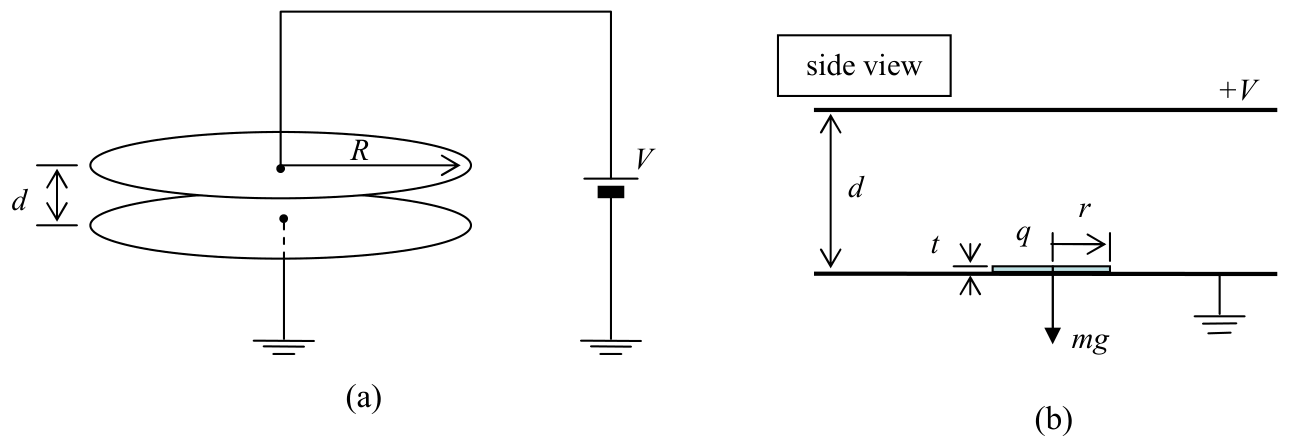
Figure 1.1 Schematic drawings of (a) a parallel plate capacitor connected to a constant voltage source and (b) a side view of the parallel plates with a small disk inserted inside the capacitor. (See text for details.)
(a) [1.2 points] Calculate the electrostatic force \(F_{\mathrm p}\) between the plates separated by \(d\) before inserting the disk in-between as shown in Fig. 1.1(a).
(b) [0.8 points] When the disk is placed on the bottom plate, a charge \(q\) on the disk of Fig. 1.1(b) is related to the voltage \(V\) by \(q=\chi V\). Find \(\chi\) in terms of \(r\), \(d\), and \(\varepsilon_0\).
(c) [0.5 points] The parallel plates lie perpendicular to a uniform gravitational field \(g\). To lift up the disk at rest initially, we need to increase the applied voltage beyond a threshold voltage \(V_{\mathrm{th}}\). Obtain \(V_{\mathrm{th}}\) in terms of \(m\), \(g\), \(d\), and \(\chi\).
(d) [2.3 points] When \(V>V_{\mathrm{th}}\), the disk makes an up-and-down motion between the plates. (Assume that the disk moves only vertically without any wobbling.) The collisions between the disk and the plates are inelastic with the restitution coefficient \(\eta\equiv(v_{\mathrm{after}}/v_{\mathrm{before}})\), where \(v_{\mathrm{before}}\) and \(v_{\mathrm{after}}\) are the speeds of the disk just before and after the collision respectively. The plates are stationarily fixed in position. The speed of the disk just after the collision at the bottom plate approaches a “steady-state speed” \(v_{\mathrm s}\), which depends on \(V\) as follows:
\[ v_{\mathrm s}=\sqrt{\alpha V^2+\beta}. \tag{1.1} \]
Obtain the coefficients \(\alpha\) and \(\beta\) in terms of \(m\), \(g\), \(\chi\), \(d\), and \(\eta\). Assume that the whole surface of the disk touches the plate evenly and simultaneously so that the complete charge exchange happens instantaneously at every collision.
(e) [2.2 points] After reaching its steady state, the time-averaged current \(I\) through the capacitor plates can be approximated by \(I=\gamma V^2\) when \(qV\gg mgd\). Express the coefficient \(\gamma\) in terms of \(m\), \(\chi\), \(d\), and \(\eta\).
(f) [3 points] When the applied voltage \(V\) is decreased (extremely slowly), there exists a critical voltage \(V_{\mathrm c}\) below which the charge will cease to flow. Find \(V_{\mathrm c}\) and the corresponding current \(I_{\mathrm c}\) in terms of \(m\), \(g\), \(\chi\), \(d\), and \(\eta\). By comparing \(V_{\mathrm c}\) with the lift-up threshold \(V_{\mathrm{th}}\) discussed in (c), make a rough sketch of the \(I-V\) characteristics when \(V\) is increased and decreased in the range from \(V=0\) to \(3V_{\mathrm{th}}\).
Official English text of the problem.
Problem 2: Rising Balloon
A rubber balloon filled with helium gas goes up high into the sky where the pressure and temperature decrease with height. In the following questions, assume that the shape of the balloon remains spherical regardless of the payload, and neglect the payload volume. Also assume that the temperature of the helium gas inside of the balloon is always the same as that of the ambient air, and treat all gases as ideal gases. The universal gas constant is \(R=8.31\ \mathrm{J/mol\cdot K}\) and the molar masses of helium and air are \(M_H=4.00\times10^{-3}\ \mathrm{kg/mol}\) and \(M_A=28.9\times10^{-3}\ \mathrm{kg/mol}\), respectively. The gravitational acceleration is \(g=9.8\ \mathrm{m/s^2}\).
[Part A ]
(a) [1.5 points] Let the pressure of the ambient air be \(P\) and the temperature be \(T\). The pressure inside of the balloon is higher than that of outside due to the surface tension of the balloon. The balloon contains \(n\) moles of helium gas and the pressure inside is \(P+\Delta P\). Find the buoyant force \(F_B\) acting on the balloon as a function of \(P\) and \(\Delta P\).
(b) [2 points] On one particular summer day in Korea, the air temperature \(T\) at the height \(z\) from the sea level was found to be \(T(z)=T_0(1-z/z_0)\) in the range of \(0<z<15\ \mathrm{km}\) with \(z_0=49\ \mathrm{km}\) and \(T_0=303\ \mathrm{K}\). The pressure and density at the sea level were \(P_0=1.0\ \mathrm{atm}=1.01\times10^5\ \mathrm{Pa}\) and \(\rho_0=1.16\ \mathrm{kg/m^3}\), respectively. For this height range, the pressure takes the form
\[ P(z)=P_0(1-z/z_0)^\eta. \tag{2.1} \]
Express \(\eta\) in terms of \(z_0\), \(\rho_0\), \(P_0\), and \(g\), and find its numerical value to the two significant digits. Treat the gravitational acceleration as a constant, independent of height.
[Part B ]
When a rubber balloon of spherical shape with un-stretched radius \(r_0\) is inflated to a sphere of radius \(r\) \((\ge r_0)\), the balloon surface contains extra elastic energy due to the stretching. In a simplistic theory, the elastic energy at constant temperature \(T\) can be expressed by
\[ U=4\pi r_0^2\kappa RT \left(2\lambda^2+\frac{1}{\lambda^4}-3\right) \tag{2.2} \]
where \(\lambda\equiv r/r_0\) \((\ge1)\) is the size-inflation ratio and \(\kappa\) is a constant in units of \(\mathrm{mol/m^2}\).
(c) [2 points] Express \(\Delta P\) in terms of parameters given in Eq. (2.2), and sketch \(\Delta P\) as a function of \(\lambda=r/r_0\).
(d) [1.5 points] The constant \(\kappa\) can be determined from the amount of the gas needed to inflate the balloon. At \(T_0=303\ \mathrm{K}\) and \(P_0=1.0\ \mathrm{atm}=1.01\times10^5\ \mathrm{Pa}\), an un-stretched balloon \((\lambda=1)\) contains \(n_0=12.5\) moles of helium. It takes \(n=3.6n_0=45\) moles in total to inflate the balloon to \(\lambda=1.5\) at the same \(T_0\) and \(P_0\). Express the balloon parameter \(a\), defined as \(a=\kappa/\kappa_0\), in terms of \(n\), \(n_0\), and \(\lambda\), where \(\kappa_0\equiv r_0P_0/(4RT_0)\). Evaluate \(a\) to the two significant digits.
[Part C]
A balloon is prepared as in (d) at the sea level (inflated to \(\lambda=1.5\) with \(n=3.6n_0=45\) moles of helium gas at \(T_0=303\ \mathrm{K}\) and \(P_0=1\ \mathrm{atm}=1.01\times10^5\ \mathrm{Pa}\)). The total mass including gas, balloon itself, and other payloads is \(M_T=1.12\ \mathrm{kg}\). Now let the balloon rise from the sea level.
(e) [3 points] Suppose that the balloon eventually stops at the height \(z_f\) where the buoyant force balances the total weight. Find \(z_f\) and the inflation ratio \(\lambda_f\) at that height. Give the answers in two significant digits. Assume there are no drift effect and no gas leakage during the upward flight.
Official English text of the problem.
Problem 3: Atomic Probe Microscope
Atomic probe microscopes (APMs) are powerful tools in the field of nano-science. The motion of a cantilever in APM can be detected by a photo-detector monitoring the reflected laser beam, as shown in Fig. 3.1. The cantilever can move only in the vertical direction and its displacement \(z\) as a function of time \(t\) can be described by the equation
\[ m\frac{d^2z}{dt^2}+b\frac{dz}{dt}+kz=F, \tag{3.1} \]
where \(m\) is the cantilever mass, \(k=m\omega_0^2\) is the spring constant of the cantilever, \(b\) is a small damping coefficient satisfying \(\omega_0\gg(b/m)>0\), and finally \(F\) is an external driving force of the piezoelectric tube.
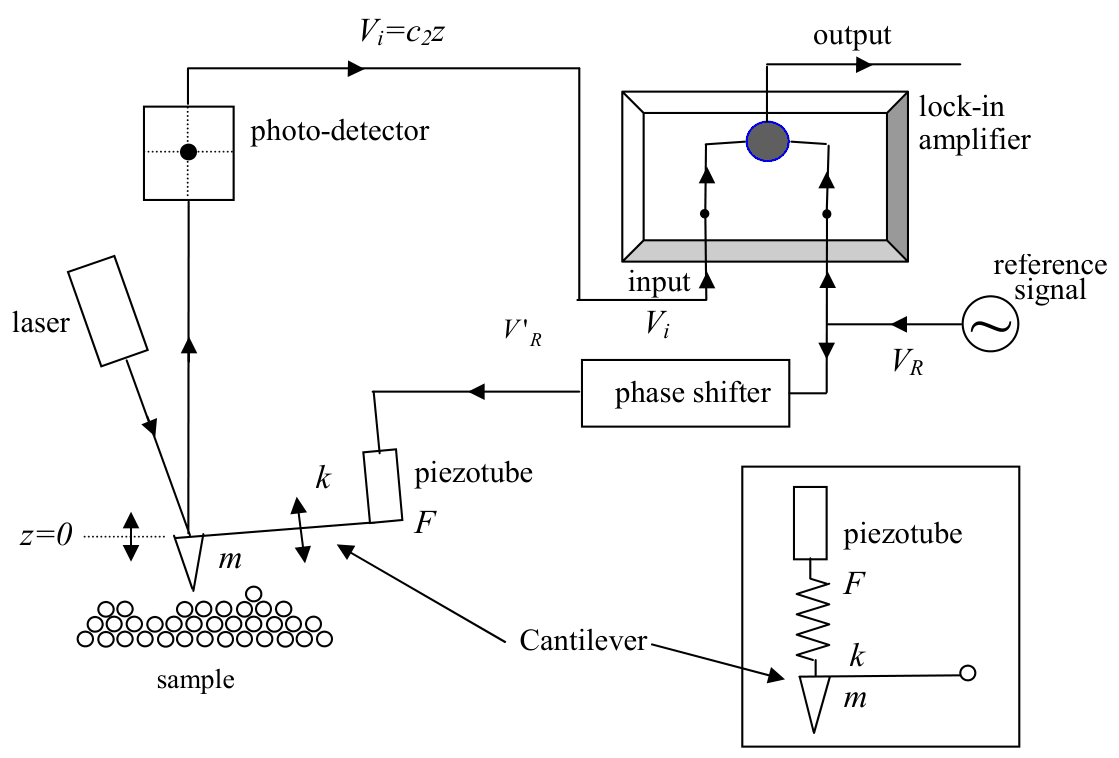
Figure 3.1 A schematic diagram for a scanning probe microscope (SPM). The inset in the lower right corner represents a simplified mechanical model to describe the coupling of the piezotube with the cantilever.
[Part A]
(a) [1.5 points] When \(F=F_0\sin\omega t\), \(z(t)\) satisfying Eq. (3.1) can be written as \(z(t)=A\sin(\omega t-\phi)\), where \(A>0\) and \(0\leq\phi\leq\pi\). Find the expression of the amplitude \(A\) and \(\tan\phi\) in terms of \(F_0\), \(m\), \(\omega\), \(\omega_0\), and \(b\). Obtain \(A\) and the phase \(\phi\) at the resonance frequency \(\omega=\omega_0\).
(b) [1 point] A lock-in amplifier shown in Fig.3.1 multiplies an input signal by the lock-in reference signal, \(V_R=V_{R0}\sin\omega t\), and then passes only the dc (direct current) component of the multiplied signal. Assume that the input signal is given by \(V_i=V_{i0}\sin(\omega_i t-\phi_i)\). Here \(V_{R0}\), \(V_{i0}\), \(\omega_i\), and \(\phi_i\) are all positive given constants. Find the condition on \(\omega\) (>0) for a non-vanishing output signal. What is the expression for the magnitude of the non-vanishing dc output signal at this frequency?
(c) [1.5 points] Passing through the phase shifter, the lock-in reference voltage \(V_R=V_{R0}\sin\omega t\) changes to \(V'_R=V_{R0}\sin(\omega t+\pi/2)\). \(V'_R\), applied to the piezoelectric tube, drives the cantilever with a force \(F=c_1V'_R\). Then, the photo-detector converts the displacement of the cantilever, \(z\), into a voltage \(V_i=c_2z\). Here \(c_1\) and \(c_2\) are constants. Find the expression for the magnitude of the dc output signal at \(\omega=\omega_0\).
(d) [2 points] The small change \(\Delta m\) of the cantilever mass shifts the resonance frequency by \(\Delta\omega_0\). As a result, the phase \(\phi\) at the original resonance frequency \(\omega_0\) shifts by \(\Delta\phi\). Find the mass change \(\Delta m\) corresponding to the phase shift \(\Delta\phi=\pi/1800\), which is a typical resolution in phase measurements. The physical parameters of the cantilever are given by \(m=1.0\times10^{-12}\ \mathrm{kg}\), \(k=1.0\ \mathrm{N/m}\), and \((b/m)=1.0\times10^3\ \mathrm{s}^{-1}\). Use the approximations \((1+x)^a\approx1+ax\) and \(\tan(\pi/2+x)\approx-1/x\) when \(|x|\ll1\).
[Part B]
From now on let us consider the situation that some forces, besides the driving force discussed in Part A, act on the cantilever due to the sample as shown in Fig.3.1.
(e) [1.5 points] Assuming that the additional force \(f(h)\) depends only on the distance \(h\) between the cantilever and the sample surface, one can find a new equilibrium position \(h_0\). Near \(h=h_0\), we can write \(f(h)\approx f(h_0)+c_3(h-h_0)\), where \(c_3\) is a constant in \(h\). Find the new resonance frequency \(\omega'_0\) in terms of \(\omega_0\), \(m\), and \(c_3\).
(f) [2.5 points] While scanning the surface by moving the sample horizontally, the tip of the cantilever charged with \(Q=6e\) encounters an electron of charge \(q=e\) trapped (localized in space) at some distance below the surface. During the scanning around the electron, the maximum shift of the resonance frequency \(\Delta\omega_0\) \((=\omega'_0-\omega_0)\) is observed to be much smaller than \(\omega_0\). Express the distance \(d_0\) from the cantilever to the trapped electron at the maximum shift in terms of \(m\), \(q\), \(Q\), \(\omega_0\), \(\Delta\omega_0\), and the Coulomb constant \(k_e\). Evaluate \(d_0\) in nm (\(1\ \mathrm{nm}=1\times10^{-9}\ \mathrm{m}\)) for \(\Delta\omega_0=20\ \mathrm{s}^{-1}\). The physical parameters of the cantilever are \(m=1.0\times10^{-12}\ \mathrm{kg}\) and \(k=1.0\ \mathrm{N/m}\). Disregard any polarization effect in both the cantilever tip and the surface. Note that \(k_e=1/(4\pi\varepsilon_0)=9.0\times10^9\ \mathrm{N\cdot m^2/C^2}\) and \(e=-1.6\times10^{-19}\ \mathrm{C}\).
Official English text of the problem.
Internationale Physik-Olympiade
IPhO 2004
Pohang, Korea · 3 Theorieaufgaben mit vollständigen Lösungen
Aufgabe 1: „Ping-Pong“-Widerstand
Ein Kondensator besteht aus zwei kreisförmigen, parallelen Platten mit jeweils dem Radius \(R\), deren Abstand \(d\) beträgt, wobei \(d\ll R\) gilt, wie in Abb. 1.1(a) dargestellt. Die obere Platte ist an eine konstante Spannungsquelle angeschlossen und liegt auf dem Potential \(V\), während die untere Platte geerdet ist. Anschließend wird eine dünne, kleine Scheibe der Masse \(m\) mit dem Radius \(r\) (\(\ll R,d\)) und der Dicke \(t\) (\(\ll r\)) mittig auf die untere Platte gelegt, wie in Abb. 1.1(b) dargestellt.
Wir nehmen an, dass sich zwischen den Platten Vakuum mit der Dielektrizitätskonstante \(\varepsilon_0\) befindet, dass die Platten und die Scheibe aus idealen Leitern bestehen und dass sämtliche elektrostatischen Randeffekte vernachlässigt werden können. Die Induktivität des gesamten Stromkreises und relativistische Effekte können ohne Weiteres außer Acht gelassen werden. Auch der Einfluss von Spiegelladungen kann vernachlässigt werden.
Abbildung 1.1 Schematische Darstellungen von (a) einem an eine konstante Spannungsquelle angeschlossenen Plattenkondensator und (b) einer Seitenansicht der parallelen Platten mit einer kleinen Scheibe im Inneren des Kondensators. (Einzelheiten siehe Text.)
(a) [1.2 Punkte] Berechnen Sie die elektrostatische Kraft \(F_{\mathrm p}\) zwischen den Platten im Abstand \(d\), bevor die Scheibe dazwischengelegt wird, wie in Abb. 1.1(a) dargestellt.
(b) [0.8 Punkte] Wenn die Scheibe auf die untere Platte gelegt wird, hängt die Ladung \(q\) auf der Scheibe in Abb. 1.1(b) gemäß \(q=\chi V\) mit der Spannung \(V\) zusammen. Bestimmen Sie \(\chi\) in Abhängigkeit von \(r\), \(d\) und \(\varepsilon_0\).
(c) [0.5 Punkte] Die parallelen Platten stehen senkrecht zu einem homogenen Schwerefeld \(g\). Damit die anfangs ruhende Scheibe abhebt, muss die angelegte Spannung über eine Schwellenspannung \(V_{\mathrm{th}}\) erhöht werden. Bestimmen Sie \(V_{\mathrm{th}}\) in Abhängigkeit von \(m\), \(g\), \(d\) und \(\chi\).
(d) [2.3 Punkte] Wenn \(V>V_{\mathrm{th}}\) gilt, bewegt sich die Scheibe zwischen den Platten auf und ab. (Nehmen Sie an, dass sich die Scheibe ausschließlich vertikal ohne jegliches Taumeln bewegt.) Die Stöße zwischen der Scheibe und den Platten sind unelastisch mit der Stoßzahl \(\eta\equiv(v_{\mathrm{after}}/v_{\mathrm{before}})\), wobei \(v_{\mathrm{before}}\) und \(v_{\mathrm{after}}\) die Geschwindigkeitsbeträge der Scheibe unmittelbar vor bzw. nach dem Stoß sind. Die Platten sind ortsfest befestigt. Der Geschwindigkeitsbetrag der Scheibe unmittelbar nach dem Stoß an der unteren Platte nähert sich einem „stationären Geschwindigkeitsbetrag“ \(v_{\mathrm s}\), der wie folgt von \(V\) abhängt:
\[ v_{\mathrm s}=\sqrt{\alpha V^2+\beta}. \tag{1.1} \]
Bestimmen Sie die Koeffizienten \(\alpha\) und \(\beta\) in Abhängigkeit von \(m\), \(g\), \(\chi\), \(d\) und \(\eta\). Nehmen Sie an, dass die gesamte Oberfläche der Scheibe die Platte gleichmäßig und gleichzeitig berührt, sodass bei jedem Stoß der vollständige Ladungsaustausch augenblicklich erfolgt.
(e) [2.2 Punkte] Nach Erreichen des stationären Zustands lässt sich der zeitlich gemittelte Strom \(I\) durch die Kondensatorplatten für \(qV\gg mgd\) durch \(I=\gamma V^2\) annähern. Drücken Sie den Koeffizienten \(\gamma\) durch \(m\), \(\chi\), \(d\) und \(\eta\) aus.
(f) [3 Punkte] Wird die angelegte Spannung \(V\) (äußerst langsam) verringert, so gibt es eine kritische Spannung \(V_{\mathrm c}\), unterhalb derer der Ladungsfluss zum Erliegen kommt. Bestimmen Sie \(V_{\mathrm c}\) und den zugehörigen Strom \(I_{\mathrm c}\) in Abhängigkeit von \(m\), \(g\), \(\chi\), \(d\) und \(\eta\). Vergleichen Sie \(V_{\mathrm c}\) mit der in (c) behandelten Abhebe-Schwellenspannung \(V_{\mathrm{th}}\) und skizzieren Sie grob die \(I-V\)-Kennlinie, wenn \(V\) im Bereich von \(V=0\) bis \(3V_{\mathrm{th}}\) erhöht und verringert wird.
Aufgabentext aus dem offiziellen englischen Text übersetzt.
Aufgabe 2: Aufsteigender Ballon
Ein mit Heliumgas gefüllter Gummiballon steigt hoch in den Himmel auf, wo Druck und Temperatur mit zunehmender Höhe abnehmen. Nehmen Sie bei den folgenden Fragen an, dass der Ballon unabhängig von der Nutzlast kugelförmig bleibt, und vernachlässigen Sie das Volumen der Nutzlast. Nehmen Sie außerdem an, dass die Temperatur des Heliumgases im Inneren des Ballons stets gleich der Temperatur der Umgebungsluft ist, und behandeln Sie alle Gase als ideale Gase. Die universelle Gaskonstante ist \(R=8.31\ \mathrm{J/mol\cdot K}\), und die molaren Massen von Helium und Luft betragen \(M_H=4.00\times10^{-3}\ \mathrm{kg/mol}\) bzw. \(M_A=28.9\times10^{-3}\ \mathrm{kg/mol}\). Die Fallbeschleunigung beträgt \(g=9.8\ \mathrm{m/s^2}\).
[Teil A ]
(a) [1.5 Punkte] Der Druck der Umgebungsluft sei \(P\) und ihre Temperatur \(T\). Aufgrund der Oberflächenspannung des Ballons ist der Druck im Inneren höher als der Außendruck. Der Ballon enthält \(n\) Mol Heliumgas, und der Innendruck beträgt \(P+\Delta P\). Bestimmen Sie die auf den Ballon wirkende Auftriebskraft \(F_B\) als Funktion von \(P\) und \(\Delta P\).
(b) [2 Punkte] An einem bestimmten Sommertag in Korea wurde festgestellt, dass die Lufttemperatur \(T\) in der Höhe \(z\) über dem Meeresspiegel im Bereich \(0<z<15\ \mathrm{km}\) durch \(T(z)=T_0(1-z/z_0)\) mit \(z_0=49\ \mathrm{km}\) und \(T_0=303\ \mathrm{K}\) gegeben war. Druck und Dichte auf Meereshöhe betrugen \(P_0=1.0\ \mathrm{atm}=1.01\times10^5\ \mathrm{Pa}\) bzw. \(\rho_0=1.16\ \mathrm{kg/m^3}\). In diesem Höhenbereich hat der Druck die Form
\[ P(z)=P_0(1-z/z_0)^\eta. \tag{2.1} \]
Drücken Sie \(\eta\) durch \(z_0\), \(\rho_0\), \(P_0\) und \(g\) aus und bestimmen Sie seinen Zahlenwert auf zwei signifikante Stellen. Behandeln Sie die Fallbeschleunigung als höhenunabhängige Konstante.
[Teil B ]
Wird ein kugelförmiger Gummiballon mit dem Radius \(r_0\) im ungedehnten Zustand zu einer Kugel mit dem Radius \(r\) \((\ge r_0)\) aufgeblasen, so speichert die Ballonoberfläche durch die Dehnung zusätzliche elastische Energie. In einer vereinfachten Theorie lässt sich die elastische Energie bei konstanter Temperatur \(T\) ausdrücken als
\[ U=4\pi r_0^2\kappa RT \left(2\lambda^2+\frac{1}{\lambda^4}-3\right) \tag{2.2} \]
wobei \(\lambda\equiv r/r_0\) \((\ge1)\) das Aufblähungsverhältnis ist und \(\kappa\) eine Konstante mit der Einheit \(\mathrm{mol/m^2}\).
(c) [2 Punkte] Drücken Sie \(\Delta P\) durch die in Gl. (2.2) angegebenen Parameter aus und skizzieren Sie \(\Delta P\) als Funktion von \(\lambda=r/r_0\).
(d) [1.5 Punkte] Die Konstante \(\kappa\) kann aus der zum Aufblasen des Ballons benötigten Gasmenge bestimmt werden. Bei \(T_0=303\ \mathrm{K}\) und \(P_0=1.0\ \mathrm{atm}=1.01\times10^5\ \mathrm{Pa}\) enthält ein ungedehnter Ballon \((\lambda=1)\) \(n_0=12.5\) Mol Helium. Insgesamt sind \(n=3.6n_0=45\) Mol erforderlich, um den Ballon bei denselben Werten von \(T_0\) und \(P_0\) auf \(\lambda=1.5\) aufzublasen. Drücken Sie den durch \(a=\kappa/\kappa_0\) definierten Ballonparameter \(a\) durch \(n\), \(n_0\) und \(\lambda\) aus, wobei \(\kappa_0\equiv r_0P_0/(4RT_0)\). Berechnen Sie \(a\) auf zwei signifikante Stellen.
[Teil C]
Ein Ballon wird auf Meereshöhe wie in (d) vorbereitet (mit \(n=3.6n_0=45\) Mol Heliumgas bei \(T_0=303\ \mathrm{K}\) und \(P_0=1\ \mathrm{atm}=1.01\times10^5\ \mathrm{Pa}\) auf \(\lambda=1.5\) aufgeblasen). Die Gesamtmasse einschließlich Gas, Ballonhülle und weiterer Nutzlasten beträgt \(M_T=1.12\ \mathrm{kg}\). Nun wird der Ballon von Meereshöhe aus aufsteigen gelassen.
(e) [3 Punkte] Nehmen Sie an, dass der Ballon schließlich in der Höhe \(z_f\) zum Stillstand kommt, in der die Auftriebskraft die gesamte Gewichtskraft ausgleicht. Bestimmen Sie \(z_f\) und das Aufblähungsverhältnis \(\lambda_f\) in dieser Höhe. Geben Sie die Ergebnisse mit zwei signifikanten Stellen an. Nehmen Sie an, dass während des Aufstiegs weder Drifteffekte noch Gasverluste auftreten.
Aufgabentext aus dem offiziellen englischen Text übersetzt.
Aufgabe 3: Atomsondenmikroskop
Atomsondenmikroskope (APMs) sind leistungsfähige Werkzeuge in den Nanowissenschaften. Die Bewegung eines Federbalkens in einem APM lässt sich mit einem Photodetektor erfassen, der den reflektierten Laserstrahl überwacht, wie in Abb. 3.1 dargestellt. Der Federbalken kann sich nur in vertikaler Richtung bewegen, und seine Auslenkung \(z\) als Funktion der Zeit \(t\) lässt sich durch die Gleichung
\[ m\frac{d^2z}{dt^2}+b\frac{dz}{dt}+kz=F, \tag{3.1} \]
beschreiben, wobei \(m\) die Masse des Federbalkens, \(k=m\omega_0^2\) seine Federkonstante, \(b\) ein kleiner Dämpfungskoeffizient mit \(\omega_0\gg(b/m)>0\) und schließlich \(F\) eine äußere Antriebskraft der piezoelektrischen Röhre ist.
Abbildung 3.1 Schematische Darstellung eines Rastersondenmikroskops (SPM). Die Einfügung in der unteren rechten Ecke zeigt ein vereinfachtes mechanisches Modell zur Beschreibung der Kopplung zwischen der Piezoröhre und dem Federbalken.
[Teil A]
(a) [1.5 Punkte] Für \(F=F_0\sin\omega t\) lässt sich eine Lösung \(z(t)\) von Gl. (3.1) als \(z(t)=A\sin(\omega t-\phi)\) mit \(A>0\) und \(0\leq\phi\leq\pi\) schreiben. Bestimmen Sie die Ausdrücke für die Amplitude \(A\) und \(\tan\phi\) in Abhängigkeit von \(F_0\), \(m\), \(\omega\), \(\omega_0\) und \(b\). Bestimmen Sie \(A\) und die Phase \(\phi\) bei der Resonanzfrequenz \(\omega=\omega_0\).
(b) [1 Punkt] Der in Abb. 3.1 dargestellte Lock-in-Verstärker multipliziert ein Eingangssignal mit dem Lock-in-Referenzsignal \(V_R=V_{R0}\sin\omega t\) und lässt anschließend nur den Gleichanteil des Produktsignals passieren. Nehmen Sie an, dass das Eingangssignal durch \(V_i=V_{i0}\sin(\omega_i t-\phi_i)\) gegeben ist. Dabei sind \(V_{R0}\), \(V_{i0}\), \(\omega_i\) und \(\phi_i\) vorgegebene positive Konstanten. Bestimmen Sie die Bedingung an \(\omega\) (>0) für ein nicht verschwindendes Ausgangssignal. Wie lautet der Ausdruck für den Betrag des nicht verschwindenden Gleichspannungsausgangssignals bei dieser Frequenz?
(c) [1.5 Punkte] Beim Durchlaufen des Phasenschiebers wird die Lock-in-Referenzspannung \(V_R=V_{R0}\sin\omega t\) in \(V'_R=V_{R0}\sin(\omega t+\pi/2)\) umgewandelt. Die an die piezoelektrische Röhre angelegte Spannung \(V'_R\) treibt den Federbalken mit der Kraft \(F=c_1V'_R\) an. Anschließend wandelt der Photodetektor die Auslenkung \(z\) des Federbalkens in eine Spannung \(V_i=c_2z\) um. Dabei sind \(c_1\) und \(c_2\) Konstanten. Bestimmen Sie den Ausdruck für den Betrag des Gleichspannungsausgangssignals bei \(\omega=\omega_0\).
(d) [2 Punkte] Eine kleine Änderung \(\Delta m\) der Masse des Federbalkens verschiebt die Resonanzfrequenz um \(\Delta\omega_0\). Dadurch verschiebt sich die Phase \(\phi\) bei der ursprünglichen Resonanzfrequenz \(\omega_0\) um \(\Delta\phi\). Bestimmen Sie die Massenänderung \(\Delta m\), die einer Phasenverschiebung von \(\Delta\phi=\pi/1800\) entspricht, einer typischen Auflösung bei Phasenmessungen. Die physikalischen Parameter des Federbalkens sind \(m=1.0\times10^{-12}\ \mathrm{kg}\), \(k=1.0\ \mathrm{N/m}\) und \((b/m)=1.0\times10^3\ \mathrm{s}^{-1}\). Verwenden Sie für \(|x|\ll1\) die Näherungen \((1+x)^a\approx1+ax\) und \(\tan(\pi/2+x)\approx-1/x\).
[Teil B]
Im Folgenden betrachten wir den Fall, dass neben der in Teil A behandelten Antriebskraft weitere, von der Probe verursachte Kräfte auf den Federbalken wirken, wie in Abb. 3.1 dargestellt.
(e) [1.5 Punkte] Unter der Annahme, dass die zusätzliche Kraft \(f(h)\) nur vom Abstand \(h\) zwischen dem Federbalken und der Probenoberfläche abhängt, lässt sich eine neue Gleichgewichtslage \(h_0\) bestimmen. In der Nähe von \(h=h_0\) können wir \(f(h)\approx f(h_0)+c_3(h-h_0)\) schreiben, wobei \(c_3\) bezüglich \(h\) konstant ist. Bestimmen Sie die neue Resonanzfrequenz \(\omega'_0\) in Abhängigkeit von \(\omega_0\), \(m\) und \(c_3\).
(f) [2.5 Punkte] Beim Abtasten der Oberfläche durch horizontales Verschieben der Probe trifft die mit \(Q=6e\) geladene Spitze des Federbalkens auf ein Elektron mit der Ladung \(q=e\), das in einem gewissen Abstand unterhalb der Oberfläche eingefangen (räumlich lokalisiert) ist. Beim Abtasten der Umgebung des Elektrons wird beobachtet, dass die maximale Verschiebung der Resonanzfrequenz \(\Delta\omega_0\) \((=\omega'_0-\omega_0)\) sehr viel kleiner als \(\omega_0\) ist. Drücken Sie den Abstand \(d_0\) zwischen dem Federbalken und dem eingefangenen Elektron bei maximaler Verschiebung durch \(m\), \(q\), \(Q\), \(\omega_0\), \(\Delta\omega_0\) und die Coulomb-Konstante \(k_e\) aus. Berechnen Sie \(d_0\) in nm (\(1\ \mathrm{nm}=1\times10^{-9}\ \mathrm{m}\)) für \(\Delta\omega_0=20\ \mathrm{s}^{-1}\). Die physikalischen Parameter des Federbalkens sind \(m=1.0\times10^{-12}\ \mathrm{kg}\) und \(k=1.0\ \mathrm{N/m}\). Vernachlässigen Sie jegliche Polarisationseffekte sowohl in der Spitze des Federbalkens als auch in der Oberfläche. Beachten Sie, dass \(k_e=1/(4\pi\varepsilon_0)=9.0\times10^9\ \mathrm{N\cdot m^2/C^2}\) und \(e=-1.6\times10^{-19}\ \mathrm{C}\) gelten.
Aufgabentext aus dem offiziellen englischen Text übersetzt.
Uluslararası Fizik Olimpiyatı
IPhO 2004
Pohang, Kore · 3 teori sorusu, tam çözümleriyle
Soru 1: “Ping-Pong” Direnci
Bir kondansatör, Şekil 1.1(a)'da gösterildiği gibi, her ikisi de \(R\) yarıçaplı, aralarında \(d\) uzaklığı bulunan iki dairesel paralel levhadan oluşmaktadır; burada \(d\ll R\)'dir. Üst levha, \(V\) potansiyelinde sabit bir gerilim kaynağına bağlıdır; alt levha ise topraklanmıştır. Daha sonra, Şekil 1.1(b)'de gösterildiği gibi, alt levhanın merkezine kütlesi \(m\), yarıçapı \(r\) (\(\ll R,d\)) ve kalınlığı \(t\) (\(\ll r\)) olan ince ve küçük bir disk yerleştirilir.
Levhalar arasındaki ortamın dielektrik sabiti \(\varepsilon_0\) olan vakum olduğunu, levhaların ve diskin mükemmel iletkenlerden yapıldığını ve tüm elektrostatik kenar etkilerinin ihmal edilebileceğini varsayalım. Tüm devrenin indüktansı ve görelilik etkileri rahatlıkla göz ardı edilebilir. Görüntü yükü etkisi de ihmal edilebilir.
Şekil 1.1 (a) Sabit bir gerilim kaynağına bağlı paralel levhalı bir kondansatörün ve (b) içine küçük bir disk yerleştirilmiş kondansatörün paralel levhalarının yandan görünüşünün şematik çizimleri. (Ayrıntılar için metne bakınız.)
(a) [1.2 puan] Şekil 1.1(a)'da gösterildiği gibi, disk araya yerleştirilmeden önce aralarında \(d\) uzaklığı bulunan levhalar arasındaki elektrostatik kuvveti \(F_{\mathrm p}\) hesaplayınız.
(b) [0.8 puan] Disk alt levhaya yerleştirildiğinde, Şekil 1.1(b)'deki diskin \(q\) yükü ile \(V\) gerilimi arasında \(q=\chi V\) bağıntısı vardır. \(\chi\)'yi \(r\), \(d\) ve \(\varepsilon_0\) cinsinden bulunuz.
(c) [0.5 puan] Paralel levhalar, düzgün bir \(g\) kütleçekim alanına diktir. Başlangıçta durmakta olan diski kaldırmak için uygulanan gerilimi bir \(V_{\mathrm{th}}\) eşik geriliminin üzerine çıkarmamız gerekir. \(V_{\mathrm{th}}\)'yi \(m\), \(g\), \(d\) ve \(\chi\) cinsinden elde ediniz.
(d) [2.3 puan] \(V>V_{\mathrm{th}}\) olduğunda disk, levhalar arasında yukarı-aşağı hareket eder. (Diskin hiç yalpalamadan yalnızca düşey doğrultuda hareket ettiğini varsayınız.) Disk ile levhalar arasındaki çarpışmalar esnek değildir ve çarpışmaların geri sekme katsayısı \(\eta\equiv(v_{\mathrm{after}}/v_{\mathrm{before}})\) olarak tanımlanır; burada \(v_{\mathrm{before}}\) ve \(v_{\mathrm{after}}\), sırasıyla diskin çarpışmadan hemen önceki ve hemen sonraki süratleridir. Levhalar bulundukları konumlarda sabit tutulmaktadır. Diskin alt levhayla çarpışmasından hemen sonraki sürati, \(V\)'ye aşağıdaki gibi bağlı olan bir “kararlı durum sürati” \(v_{\mathrm s}\)'ye yaklaşır:
\[ v_{\mathrm s}=\sqrt{\alpha V^2+\beta}. \tag{1.1} \]
\(\alpha\) ve \(\beta\) katsayılarını \(m\), \(g\), \(\chi\), \(d\) ve \(\eta\) cinsinden elde ediniz. Diskin tüm yüzeyinin levhaya düzgün biçimde ve aynı anda temas ettiğini, böylece her çarpışmada yük alışverişinin tamamının anında gerçekleştiğini varsayınız.
(e) [2.2 puan] Kararlı duruma ulaşıldıktan sonra, \(qV\gg mgd\) olduğunda kondansatör levhalarından geçen zaman ortalamalı \(I\) akımı yaklaşık olarak \(I=\gamma V^2\) ile verilebilir. \(\gamma\) katsayısını \(m\), \(\chi\), \(d\) ve \(\eta\) cinsinden ifade ediniz.
(f) [3 puan] Uygulanan \(V\) gerilimi (son derece yavaş biçimde) azaltıldığında, altına inildiğinde yük akışının duracağı bir \(V_{\mathrm c}\) kritik gerilimi vardır. \(V_{\mathrm c}\)'yi ve buna karşılık gelen \(I_{\mathrm c}\) akımını \(m\), \(g\), \(\chi\), \(d\) ve \(\eta\) cinsinden bulunuz. \(V_{\mathrm c}\)'yi (c)'de ele alınan kalkış eşiği \(V_{\mathrm{th}}\) ile karşılaştırarak, \(V\) gerilimi \(V=0\) ile \(3V_{\mathrm{th}}\) aralığında artırılıp azaltıldığında ortaya çıkan \(I-V\) karakteristiğinin yaklaşık bir çizimini yapınız.
Soru metni resmi İngilizce metinden çevrilmiştir.
Soru 2: Yükselen Balon
Helyum gazıyla doldurulmuş kauçuk bir balon, basınç ve sıcaklığın yükseklikle azaldığı gökyüzünde yükseklere çıkar. Aşağıdaki sorularda, taşıdığı yük ne olursa olsun balonun küresel biçimini koruduğunu varsayın ve yükün hacmini ihmal edin. Ayrıca balonun içindeki helyum gazının sıcaklığının her zaman çevredeki havanın sıcaklığıyla aynı olduğunu varsayın ve tüm gazları ideal gaz olarak ele alın. Evrensel gaz sabiti \(R=8.31\ \mathrm{J/mol\cdot K}\), helyumun ve havanın molar kütleleri ise sırasıyla \(M_H=4.00\times10^{-3}\ \mathrm{kg/mol}\) ve \(M_A=28.9\times10^{-3}\ \mathrm{kg/mol}\)'dür. Yer çekimi ivmesi \(g=9.8\ \mathrm{m/s^2}\)'dir.
[Bölüm A ]
(a) [1.5 puan] Çevredeki havanın basıncı \(P\), sıcaklığı \(T\) olsun. Balonun yüzey gerilimi nedeniyle içindeki basınç, dışındaki basınçtan daha yüksektir. Balon \(n\) mol helyum gazı içermekte olup içindeki basınç \(P+\Delta P\)'dir. Balona etkiyen kaldırma kuvveti \(F_B\)'yi \(P\) ve \(\Delta P\)'nin bir fonksiyonu olarak bulun.
(b) [2 puan] Kore'de belirli bir yaz gününde, deniz seviyesinden \(z\) yüksekliğindeki hava sıcaklığı \(T\)'nin, \(0<z<15\ \mathrm{km}\) aralığında \(T(z)=T_0(1-z/z_0)\) olduğu belirlenmiştir; burada \(z_0=49\ \mathrm{km}\) ve \(T_0=303\ \mathrm{K}\)'dir. Deniz seviyesindeki basınç ve yoğunluk sırasıyla \(P_0=1.0\ \mathrm{atm}=1.01\times10^5\ \mathrm{Pa}\) ve \(\rho_0=1.16\ \mathrm{kg/m^3}\)'tür. Bu yükseklik aralığında basınç şu biçimdedir:
\[ P(z)=P_0(1-z/z_0)^\eta. \tag{2.1} \]
\(\eta\)'yı \(z_0\), \(\rho_0\), \(P_0\) ve \(g\) cinsinden ifade edin ve sayısal değerini iki anlamlı basamakla bulun. Yer çekimi ivmesini yükseklikten bağımsız bir sabit olarak alın.
[Bölüm B ]
Gerilmemiş yarıçapı \(r_0\) olan küresel bir kauçuk balon, yarıçapı \(r\) \((\ge r_0)\) olan bir küre hâline gelecek şekilde şişirildiğinde, balonun yüzeyinde gerilmeden kaynaklanan ek esneklik enerjisi depolanır. Basitleştirilmiş bir kuramda, sabit \(T\) sıcaklığındaki esneklik enerjisi
\[ U=4\pi r_0^2\kappa RT \left(2\lambda^2+\frac{1}{\lambda^4}-3\right) \tag{2.2} \]
ile ifade edilebilir; burada \(\lambda\equiv r/r_0\) \((\ge1)\) boyutça şişme oranı, \(\kappa\) ise birimi \(\mathrm{mol/m^2}\) olan bir sabittir.
(c) [2 puan] \(\Delta P\)'yi Denklem (2.2)'de verilen parametreler cinsinden ifade edin ve \(\Delta P\)'nin \(\lambda=r/r_0\)'a bağlı grafiğini kabaca çizin.
(d) [1.5 puan] \(\kappa\) sabiti, balonu şişirmek için gereken gaz miktarından belirlenebilir. \(T_0=303\ \mathrm{K}\) ve \(P_0=1.0\ \mathrm{atm}=1.01\times10^5\ \mathrm{Pa}\) koşullarında, gerilmemiş bir balon \((\lambda=1)\), \(n_0=12.5\) mol helyum içerir. Balonu aynı \(T_0\) ve \(P_0\) koşullarında \(\lambda=1.5\)'e kadar şişirmek için toplam \(n=3.6n_0=45\) mol gerekir. \(a=\kappa/\kappa_0\) olarak tanımlanan balon parametresi \(a\)'yı \(n\), \(n_0\) ve \(\lambda\) cinsinden ifade edin; burada \(\kappa_0\equiv r_0P_0/(4RT_0)\)'dır. \(a\)'nın değerini iki anlamlı basamakla hesaplayın.
[Bölüm C]
Deniz seviyesinde (d)'deki gibi bir balon hazırlanır (\(T_0=303\ \mathrm{K}\) ve \(P_0=1\ \mathrm{atm}=1.01\times10^5\ \mathrm{Pa}\) koşullarında \(n=3.6n_0=45\) mol helyum gazıyla \(\lambda=1.5\)'e kadar şişirilir). Gaz, balonun kendisi ve taşıdığı diğer yükler dâhil toplam kütle \(M_T=1.12\ \mathrm{kg}\)'dır. Şimdi balon deniz seviyesinden yükselmeye bırakılsın.
(e) [3 puan] Balonun sonunda kaldırma kuvvetinin toplam ağırlığı dengelediği \(z_f\) yüksekliğinde durduğunu varsayın. \(z_f\)'yi ve bu yükseklikteki şişme oranı \(\lambda_f\)'yi bulun. Cevapları iki anlamlı basamakla verin. Yukarı doğru uçuş sırasında sürüklenme etkisinin ve gaz sızıntısının olmadığını varsayın.
Soru metni resmi İngilizce metinden çevrilmiştir.
Soru 3: Atomik Sonda Mikroskobu
Atomik sonda mikroskopları (APM), nanobilim alanında güçlü araçlardır. APM'deki bir konsolun hareketi, Şekil 3.1'de gösterildiği gibi, yansıyan lazer demetini izleyen bir fotodedektörle algılanabilir. Konsol yalnızca düşey yönde hareket edebilir ve yer değiştirmesi \(z\), zamanın \(t\) bir fonksiyonu olarak şu denklemle betimlenebilir:
\[ m\frac{d^2z}{dt^2}+b\frac{dz}{dt}+kz=F, \tag{3.1} \]
Burada \(m\) konsolun kütlesi, \(k=m\omega_0^2\) konsolun yay sabiti, \(b\), \(\omega_0\gg(b/m)>0\) koşulunu sağlayan küçük bir sönüm katsayısı ve son olarak \(F\), piezoelektrik tüpün uyguladığı dış sürücü kuvvettir.
Şekil 3.1 Bir taramalı sonda mikroskobunun (SPM) şematik gösterimi. Sağ alt köşedeki küçük şekil, piezoelektrik tüp ile konsol arasındaki bağlaşımı betimleyen basitleştirilmiş bir mekanik modeli göstermektedir.
[Bölüm A]
(a) [1.5 puan] \(F=F_0\sin\omega t\) olduğunda, Denklem (3.1)'i sağlayan \(z(t)\), \(z(t)=A\sin(\omega t-\phi)\) biçiminde yazılabilir; burada \(A>0\) ve \(0\leq\phi\leq\pi\)'dir. \(A\) genliğinin ve \(\tan\phi\)'nin ifadelerini \(F_0\), \(m\), \(\omega\), \(\omega_0\) ve \(b\) cinsinden bulunuz. \(\omega=\omega_0\) rezonans frekansında \(A\)'yı ve \(\phi\) fazını elde ediniz.
(b) [1 puan] Şekil 3.1'de gösterilen bir kilitlemeli yükselteç, giriş sinyalini \(V_R=V_{R0}\sin\omega t\) referans sinyaliyle çarpar ve ardından çarpım sinyalinin yalnızca dc (doğru akım) bileşenini geçirir. Giriş sinyalinin \(V_i=V_{i0}\sin(\omega_i t-\phi_i)\) ile verildiğini varsayınız. Burada \(V_{R0}\), \(V_{i0}\), \(\omega_i\) ve \(\phi_i\), verilen pozitif sabitlerdir. Çıkış sinyalinin sıfırdan farklı olması için \(\omega\) (>0) üzerindeki koşulu bulunuz. Bu frekansta sıfırdan farklı dc çıkış sinyalinin büyüklüğünün ifadesi nedir?
(c) [1.5 puan] Faz kaydırıcıdan geçen \(V_R=V_{R0}\sin\omega t\) kilitlemeli yükselteç referans gerilimi, \(V'_R=V_{R0}\sin(\omega t+\pi/2)\) biçimine dönüşür. Piezoelektrik tüpe uygulanan \(V'_R\), konsolu \(F=c_1V'_R\) kuvvetiyle sürer. Ardından fotodedektör, konsolun \(z\) yer değiştirmesini \(V_i=c_2z\) gerilimine dönüştürür. Burada \(c_1\) ve \(c_2\) sabitlerdir. \(\omega=\omega_0\) için dc çıkış sinyalinin büyüklüğünün ifadesini bulunuz.
(d) [2 puan] Konsol kütlesindeki küçük bir \(\Delta m\) değişimi, rezonans frekansını \(\Delta\omega_0\) kadar kaydırır. Bunun sonucunda, başlangıçtaki \(\omega_0\) rezonans frekansında \(\phi\) fazı \(\Delta\phi\) kadar kayar. Faz ölçümlerinde tipik bir çözünürlük olan \(\Delta\phi=\pi/1800\) faz kaymasına karşılık gelen \(\Delta m\) kütle değişimini bulunuz. Konsolun fiziksel parametreleri \(m=1.0\times10^{-12}\ \mathrm{kg}\), \(k=1.0\ \mathrm{N/m}\) ve \((b/m)=1.0\times10^3\ \mathrm{s}^{-1}\) olarak verilmiştir. \(|x|\ll1\) olduğunda \((1+x)^a\approx1+ax\) ve \(\tan(\pi/2+x)\approx-1/x\) yaklaşımlarını kullanınız.
[Bölüm B]
Bundan sonra, Bölüm A'da ele alınan sürücü kuvvete ek olarak, Şekil 3.1'de gösterildiği gibi numuneden kaynaklanan bazı kuvvetlerin konsola etki ettiği durumu ele alalım.
(e) [1.5 puan] Ek \(f(h)\) kuvvetinin yalnızca konsol ile numune yüzeyi arasındaki \(h\) uzaklığına bağlı olduğu varsayılarak, yeni bir \(h_0\) denge konumu bulunabilir. \(h=h_0\) yakınında \(f(h)\approx f(h_0)+c_3(h-h_0)\) yazabiliriz; burada \(c_3\), \(h\)'ye göre sabittir. Yeni \(\omega'_0\) rezonans frekansını \(\omega_0\), \(m\) ve \(c_3\) cinsinden bulunuz.
(f) [2.5 puan] Numune yatay olarak hareket ettirilerek yüzey taranırken, \(Q=6e\) yüküne sahip konsol ucu, yüzeyin bir miktar altında tuzaklanmış (uzayda yerelleşmiş), yükü \(q=e\) olan bir elektronla karşılaşır. Elektronun çevresi taranırken, rezonans frekansındaki en büyük \(\Delta\omega_0\) \((=\omega'_0-\omega_0)\) kaymasının \(\omega_0\)'dan çok küçük olduğu gözlenir. Kaymanın en büyük olduğu durumda konsol ile tuzaklanmış elektron arasındaki \(d_0\) uzaklığını \(m\), \(q\), \(Q\), \(\omega_0\), \(\Delta\omega_0\) ve Coulomb sabiti \(k_e\) cinsinden ifade ediniz. \(\Delta\omega_0=20\ \mathrm{s}^{-1}\) için \(d_0\)'ı nm (\(1\ \mathrm{nm}=1\times10^{-9}\ \mathrm{m}\)) cinsinden hesaplayınız. Konsolun fiziksel parametreleri \(m=1.0\times10^{-12}\ \mathrm{kg}\) ve \(k=1.0\ \mathrm{N/m}\)'dir. Hem konsol ucundaki hem de yüzeydeki tüm kutuplanma etkilerini ihmal ediniz. \(k_e=1/(4\pi\varepsilon_0)=9.0\times10^9\ \mathrm{N\cdot m^2/C^2}\) ve \(e=-1.6\times10^{-19}\ \mathrm{C}\) olduğunu dikkate alınız.
Soru metni resmi İngilizce metinden çevrilmiştir.
Olimpiada Internacional de Física
IPhO 2004
Pohang, Corea · 3 problemas teóricos con soluciones completas
Problema 1: Resistencia de «ping-pong»
Un condensador consta de dos placas circulares paralelas, ambas de radio \(R\), separadas por una distancia \(d\), donde \(d\ll R\), como se muestra en la Fig. 1.1(a). La placa superior está conectada a una fuente de tensión constante a un potencial \(V\), mientras que la placa inferior está conectada a tierra. A continuación, se coloca un disco pequeño y delgado de masa \(m\), radio \(r\) (\(\ll R,d\)) y espesor \(t\) (\(\ll r\)) en el centro de la placa inferior, como se muestra en la Fig. 1.1(b).
Supongamos que entre las placas hay vacío, con constante dieléctrica \(\varepsilon_0\); que las placas y el disco están hechos de conductores perfectos; y que pueden despreciarse todos los efectos electrostáticos de borde. La inductancia de todo el circuito y los efectos relativistas pueden despreciarse sin problema. También puede despreciarse el efecto de las cargas imagen.
Figura 1.1 Esquemas de (a) un condensador de placas paralelas conectado a una fuente de tensión constante y (b) una vista lateral de las placas paralelas con un pequeño disco introducido en el condensador. (Véanse los detalles en el texto.)
(a) [1.2 puntos] Calcule la fuerza electrostática \(F_{\mathrm p}\) entre las placas separadas por \(d\) antes de introducir el disco entre ellas, como se muestra en la Fig. 1.1(a).
(b) [0.8 puntos] Cuando el disco se coloca sobre la placa inferior, la carga \(q\) del disco de la Fig. 1.1(b) está relacionada con la tensión \(V\) mediante \(q=\chi V\). Halle \(\chi\) en función de \(r\), \(d\) y \(\varepsilon_0\).
(c) [0.5 puntos] Las placas paralelas son perpendiculares a un campo gravitatorio uniforme \(g\). Para levantar el disco, inicialmente en reposo, es necesario aumentar la tensión aplicada por encima de una tensión umbral \(V_{\mathrm{th}}\). Obtenga \(V_{\mathrm{th}}\) en función de \(m\), \(g\), \(d\) y \(\chi\).
(d) [2.3 puntos] Cuando \(V>V_{\mathrm{th}}\), el disco realiza un movimiento de subida y bajada entre las placas. (Suponga que el disco se mueve únicamente en dirección vertical, sin ningún bamboleo.) Los choques entre el disco y las placas son inelásticos, con un coeficiente de restitución \(\eta\equiv(v_{\mathrm{after}}/v_{\mathrm{before}})\), donde \(v_{\mathrm{before}}\) y \(v_{\mathrm{after}}\) son los módulos de la velocidad del disco justo antes y después del choque, respectivamente. Las placas permanecen fijas en su posición. El módulo de la velocidad del disco justo después del choque con la placa inferior se aproxima a una «velocidad de régimen estacionario» \(v_{\mathrm s}\), que depende de \(V\) de la siguiente manera:
\[ v_{\mathrm s}=\sqrt{\alpha V^2+\beta}. \tag{1.1} \]
Obtenga los coeficientes \(\alpha\) y \(\beta\) en función de \(m\), \(g\), \(\chi\), \(d\) y \(\eta\). Suponga que toda la superficie del disco toca la placa de manera uniforme y simultánea, de modo que el intercambio completo de carga se produce instantáneamente en cada choque.
(e) [2.2 puntos] Una vez alcanzado el régimen estacionario, la corriente media temporal \(I\) a través de las placas del condensador puede aproximarse por \(I=\gamma V^2\) cuando \(qV\gg mgd\). Exprese el coeficiente \(\gamma\) en función de \(m\), \(\chi\), \(d\) y \(\eta\).
(f) [3 puntos] Cuando la tensión aplicada \(V\) se reduce (de forma extremadamente lenta), existe una tensión crítica \(V_{\mathrm c}\) por debajo de la cual deja de circular carga. Halle \(V_{\mathrm c}\) y la corriente correspondiente \(I_{\mathrm c}\) en función de \(m\), \(g\), \(\chi\), \(d\) y \(\eta\). Comparando \(V_{\mathrm c}\) con el umbral de despegue \(V_{\mathrm{th}}\) estudiado en (c), trace un esbozo de las características \(I-V\) cuando \(V\) aumenta y disminuye en el intervalo de \(V=0\) a \(3V_{\mathrm{th}}\).
Enunciado traducido del texto oficial en inglés.
Problema 2: Globo ascendente
Un globo de goma lleno de helio asciende hasta gran altura en el cielo, donde la presión y la temperatura disminuyen con la altura. En las siguientes preguntas, suponga que el globo mantiene su forma esférica independientemente de la carga útil y desprecie el volumen de esta. Suponga también que la temperatura del helio en el interior del globo es siempre la misma que la del aire ambiente y trate todos los gases como gases ideales. La constante universal de los gases es \(R=8.31\ \mathrm{J/mol\cdot K}\) y las masas molares del helio y del aire son \(M_H=4.00\times10^{-3}\ \mathrm{kg/mol}\) y \(M_A=28.9\times10^{-3}\ \mathrm{kg/mol}\), respectivamente. La aceleración de la gravedad es \(g=9.8\ \mathrm{m/s^2}\).
[Parte A ]
(a) [1.5 puntos] Sean \(P\) la presión del aire ambiente y \(T\) su temperatura. La presión en el interior del globo es mayor que la exterior debido a la tensión superficial del globo. El globo contiene \(n\) moles de helio y la presión en su interior es \(P+\Delta P\). Halle la fuerza de empuje \(F_B\) que actúa sobre el globo en función de \(P\) y \(\Delta P\).
(b) [2 puntos] En un determinado día de verano en Corea, se observó que la temperatura del aire \(T\) a una altura \(z\) sobre el nivel del mar era \(T(z)=T_0(1-z/z_0)\) en el intervalo \(0<z<15\ \mathrm{km}\), con \(z_0=49\ \mathrm{km}\) y \(T_0=303\ \mathrm{K}\). La presión y la densidad al nivel del mar eran \(P_0=1.0\ \mathrm{atm}=1.01\times10^5\ \mathrm{Pa}\) y \(\rho_0=1.16\ \mathrm{kg/m^3}\), respectivamente. Para este intervalo de alturas, la presión tiene la forma
\[ P(z)=P_0(1-z/z_0)^\eta. \tag{2.1} \]
Exprese \(\eta\) en términos de \(z_0\), \(\rho_0\), \(P_0\) y \(g\), y halle su valor numérico con dos cifras significativas. Considere que la aceleración de la gravedad es constante e independiente de la altura.
[Parte B ]
Cuando un globo de goma de forma esférica, cuyo radio sin estirar es \(r_0\), se infla hasta formar una esfera de radio \(r\) \((\ge r_0)\), la superficie del globo almacena energía elástica adicional debido al estiramiento. En una teoría simplificada, la energía elástica a temperatura constante \(T\) se puede expresar como
\[ U=4\pi r_0^2\kappa RT \left(2\lambda^2+\frac{1}{\lambda^4}-3\right) \tag{2.2} \]
donde \(\lambda\equiv r/r_0\) \((\ge1)\) es la razón de inflado y \(\kappa\) es una constante cuyas unidades son \(\mathrm{mol/m^2}\).
(c) [2 puntos] Exprese \(\Delta P\) en términos de los parámetros dados en la ec. (2.2) y esboce la gráfica de \(\Delta P\) en función de \(\lambda=r/r_0\).
(d) [1.5 puntos] La constante \(\kappa\) se puede determinar a partir de la cantidad de gas necesaria para inflar el globo. A \(T_0=303\ \mathrm{K}\) y \(P_0=1.0\ \mathrm{atm}=1.01\times10^5\ \mathrm{Pa}\), un globo sin estirar \((\lambda=1)\) contiene \(n_0=12.5\) moles de helio. Se necesitan \(n=3.6n_0=45\) moles en total para inflar el globo hasta \(\lambda=1.5\) a los mismos valores de \(T_0\) y \(P_0\). Exprese el parámetro del globo \(a\), definido como \(a=\kappa/\kappa_0\), en términos de \(n\), \(n_0\) y \(\lambda\), donde \(\kappa_0\equiv r_0P_0/(4RT_0)\). Calcule \(a\) con dos cifras significativas.
[Parte C]
Se prepara un globo como en (d) al nivel del mar (inflado hasta \(\lambda=1.5\) con \(n=3.6n_0=45\) moles de helio a \(T_0=303\ \mathrm{K}\) y \(P_0=1\ \mathrm{atm}=1.01\times10^5\ \mathrm{Pa}\)). La masa total, que incluye el gas, el propio globo y las demás cargas útiles, es \(M_T=1.12\ \mathrm{kg}\). Ahora se deja que el globo ascienda desde el nivel del mar.
(e) [3 puntos] Suponga que el globo acaba deteniéndose a la altura \(z_f\), donde la fuerza de empuje equilibra el peso total. Halle \(z_f\) y la razón de inflado \(\lambda_f\) a esa altura. Dé las respuestas con dos cifras significativas. Suponga que no hay efectos de deriva ni fugas de gas durante el ascenso.
Enunciado traducido del texto oficial en inglés.
Problema 3: Microscopio de sonda atómica
Los microscopios de sonda atómica (APM) son herramientas muy potentes en el campo de la nanociencia. El movimiento de una palanca en voladizo en un APM puede detectarse mediante un fotodetector que registra el haz láser reflejado, como se muestra en la Fig. 3.1. La palanca solo puede moverse en la dirección vertical y su desplazamiento \(z\) en función del tiempo \(t\) puede describirse mediante la ecuación
\[ m\frac{d^2z}{dt^2}+b\frac{dz}{dt}+kz=F, \tag{3.1} \]
donde \(m\) es la masa de la palanca, \(k=m\omega_0^2\) es su constante elástica, \(b\) es un pequeño coeficiente de amortiguamiento que satisface \(\omega_0\gg(b/m)>0\) y, por último, \(F\) es una fuerza excitadora externa ejercida por el tubo piezoeléctrico.
Figura 3.1 Diagrama esquemático de un microscopio de sonda de barrido (SPM). El recuadro de la esquina inferior derecha representa un modelo mecánico simplificado para describir el acoplamiento del tubo piezoeléctrico con la palanca.
[Parte A]
(a) [1.5 puntos] Cuando \(F=F_0\sin\omega t\), la función \(z(t)\) que satisface la Ec. (3.1) puede escribirse como \(z(t)=A\sin(\omega t-\phi)\), donde \(A>0\) y \(0\leq\phi\leq\pi\). Halle las expresiones de la amplitud \(A\) y de \(\tan\phi\) en función de \(F_0\), \(m\), \(\omega\), \(\omega_0\) y \(b\). Obtenga \(A\) y la fase \(\phi\) a la frecuencia de resonancia \(\omega=\omega_0\).
(b) [1 punto] El amplificador de detección síncrona (lock-in) que se muestra en la Fig. 3.1 multiplica una señal de entrada por la señal de referencia del lock-in, \(V_R=V_{R0}\sin\omega t\), y después deja pasar únicamente la componente continua (dc) de la señal resultante de la multiplicación. Suponga que la señal de entrada viene dada por \(V_i=V_{i0}\sin(\omega_i t-\phi_i)\). Aquí, \(V_{R0}\), \(V_{i0}\), \(\omega_i\) y \(\phi_i\) son constantes positivas dadas. Halle la condición que debe cumplir \(\omega\) (>0) para que la señal de salida no sea nula. ¿Cuál es la expresión de la magnitud de la señal de salida continua no nula a esta frecuencia?
(c) [1.5 puntos] Al pasar por el desfasador, la tensión de referencia del lock-in \(V_R=V_{R0}\sin\omega t\) se transforma en \(V'_R=V_{R0}\sin(\omega t+\pi/2)\). La tensión \(V'_R\), aplicada al tubo piezoeléctrico, excita la palanca con una fuerza \(F=c_1V'_R\). A continuación, el fotodetector convierte el desplazamiento de la palanca, \(z\), en una tensión \(V_i=c_2z\). Aquí, \(c_1\) y \(c_2\) son constantes. Halle la expresión de la magnitud de la señal de salida continua para \(\omega=\omega_0\).
(d) [2 puntos] Una pequeña variación \(\Delta m\) de la masa de la palanca produce un desplazamiento \(\Delta\omega_0\) de la frecuencia de resonancia. Como resultado, la fase \(\phi\) a la frecuencia de resonancia original \(\omega_0\) cambia en \(\Delta\phi\). Halle la variación de masa \(\Delta m\) correspondiente al cambio de fase \(\Delta\phi=\pi/1800\), que es una resolución típica en las mediciones de fase. Los parámetros físicos de la palanca son \(m=1.0\times10^{-12}\ \mathrm{kg}\), \(k=1.0\ \mathrm{N/m}\) y \((b/m)=1.0\times10^3\ \mathrm{s}^{-1}\). Utilice las aproximaciones \((1+x)^a\approx1+ax\) y \(\tan(\pi/2+x)\approx-1/x\) cuando \(|x|\ll1\).
[Parte B]
A partir de ahora, consideremos la situación en la que, además de la fuerza excitadora estudiada en la Parte A, actúan sobre la palanca algunas fuerzas debidas a la muestra, como se indica en la Fig. 3.1.
(e) [1.5 puntos] Suponiendo que la fuerza adicional \(f(h)\) depende únicamente de la distancia \(h\) entre la palanca y la superficie de la muestra, se puede encontrar una nueva posición de equilibrio \(h_0\). Cerca de \(h=h_0\), podemos escribir \(f(h)\approx f(h_0)+c_3(h-h_0)\), donde \(c_3\) es una constante independiente de \(h\). Halle la nueva frecuencia de resonancia \(\omega'_0\) en función de \(\omega_0\), \(m\) y \(c_3\).
(f) [2.5 puntos] Durante el barrido de la superficie mediante el desplazamiento horizontal de la muestra, la punta de la palanca, cargada con \(Q=6e\), se encuentra con un electrón de carga \(q=e\) atrapado (localizado en el espacio) a cierta distancia bajo la superficie. Durante el barrido en torno al electrón, se observa que el desplazamiento máximo de la frecuencia de resonancia \(\Delta\omega_0\) \((=\omega'_0-\omega_0)\) es mucho menor que \(\omega_0\). Exprese la distancia \(d_0\) entre la palanca y el electrón atrapado cuando se produce el desplazamiento máximo en función de \(m\), \(q\), \(Q\), \(\omega_0\), \(\Delta\omega_0\) y la constante de Coulomb \(k_e\). Calcule \(d_0\) en nm (\(1\ \mathrm{nm}=1\times10^{-9}\ \mathrm{m}\)) para \(\Delta\omega_0=20\ \mathrm{s}^{-1}\). Los parámetros físicos de la palanca son \(m=1.0\times10^{-12}\ \mathrm{kg}\) y \(k=1.0\ \mathrm{N/m}\). Desprecie cualquier efecto de polarización tanto en la punta de la palanca como en la superficie. Tenga en cuenta que \(k_e=1/(4\pi\varepsilon_0)=9.0\times10^9\ \mathrm{N\cdot m^2/C^2}\) y \(e=-1.6\times10^{-19}\ \mathrm{C}\).
Enunciado traducido del texto oficial en inglés.
国际物理奥林匹克
IPhO 2004
韩国浦项 · 3 道理论题及完整解答
题目 1:“乒乓”电阻器
一个电容器由两块半径均为 \(R\) 的圆形平行极板组成,两板间距为 \(d\),其中 \(d\ll R\),如图 1.1(a) 所示。上极板连接到一个恒定电压源,电势为 \(V\),下极板接地。然后,将一个质量为 \(m\)、半径为 \(r\)(\(\ll R,d\))、厚度为 \(t\)(\(\ll r\))的薄小圆盘放在下极板的中央,如图 1.1(b) 所示。
假设两极板之间为真空,介电常数为 \(\varepsilon_0\);极板和圆盘均由理想导体制成;所有静电边缘效应均可忽略。整个电路的电感和相对论效应都可以忽略不计。镜像电荷效应也可以忽略。
图 1.1 示意图:(a) 连接到恒定电压源的平行板电容器;(b) 电容器内部放入一个小圆盘后,平行极板的侧视图。(详见正文。)
(a) [1.2 分] 在尚未将圆盘放入两板之间时,如图 1.1(a) 所示,计算间距为 \(d\) 的两极板之间的静电力 \(F_{\mathrm p}\)。
(b) [0.8 分] 当圆盘放在下极板上时,图 1.1(b) 中圆盘上的电荷量 \(q\) 与电压 \(V\) 的关系为 \(q=\chi V\)。用 \(r\)、\(d\) 和 \(\varepsilon_0\) 表示 \(\chi\)。
(c) [0.5 分] 两平行极板与均匀重力场 \(g\) 垂直。要使最初静止的圆盘升起,必须将外加电压增大到超过阈值电压 \(V_{\mathrm{th}}\)。用 \(m\)、\(g\)、\(d\) 和 \(\chi\) 表示 \(V_{\mathrm{th}}\)。
(d) [2.3 分] 当 \(V>V_{\mathrm{th}}\) 时,圆盘在两极板之间上下运动。(假设圆盘仅沿竖直方向运动,不发生任何晃动。)圆盘与极板之间的碰撞为非弹性碰撞,恢复系数为 \(\eta\equiv(v_{\mathrm{after}}/v_{\mathrm{before}})\),其中 \(v_{\mathrm{before}}\) 和 \(v_{\mathrm{after}}\) 分别为圆盘碰撞前瞬间和碰撞后瞬间的速率。两极板固定不动。圆盘与下极板碰撞后瞬间的速率趋于“稳态速率” \(v_{\mathrm s}\),它与 \(V\) 的关系如下:
\[ v_{\mathrm s}=\sqrt{\alpha V^2+\beta}. \tag{1.1} \]
用 \(m\)、\(g\)、\(\chi\)、\(d\) 和 \(\eta\) 表示系数 \(\alpha\) 和 \(\beta\)。假设圆盘的整个表面均匀且同时接触极板,从而每次碰撞时都瞬间完成全部电荷交换。
(e) [2.2 分] 达到稳态后,当 \(qV\gg mgd\) 时,通过电容器极板的时间平均电流 \(I\) 可近似表示为 \(I=\gamma V^2\)。用 \(m\)、\(\chi\)、\(d\) 和 \(\eta\) 表示系数 \(\gamma\)。
(f) [3 分] 当外加电压 \(V\)(极其缓慢地)减小时,存在一个临界电压 \(V_{\mathrm c}\),低于该电压时电荷将停止流动。用 \(m\)、\(g\)、\(\chi\)、\(d\) 和 \(\eta\) 表示 \(V_{\mathrm c}\) 及相应的电流 \(I_{\mathrm c}\)。将 \(V_{\mathrm c}\) 与 (c) 中讨论的起升阈值电压 \(V_{\mathrm{th}}\) 比较,画出 \(V\) 在 \(V=0\) 到 \(3V_{\mathrm{th}}\) 范围内增大和减小时的 \(I-V\) 特性示意图。
题目译自官方英文原文。
题目 2:上升的气球
一个充满氦气的橡胶气球升向高空,那里的气压和温度随高度增加而降低。在以下各问中,假设无论载荷如何,气球始终保持球形,并忽略载荷的体积。还假设气球内氦气的温度始终与周围空气的温度相同,并将所有气体视为理想气体。普适气体常量为 \(R=8.31\ \mathrm{J/mol\cdot K}\),氦气和空气的摩尔质量分别为 \(M_H=4.00\times10^{-3}\ \mathrm{kg/mol}\) 和 \(M_A=28.9\times10^{-3}\ \mathrm{kg/mol}\)。重力加速度为 \(g=9.8\ \mathrm{m/s^2}\)。
[部分 A ]
(a) [1.5 分] 设周围空气的压强为 \(P\),温度为 \(T\)。由于气球的表面张力,气球内部的压强高于外部压强。气球内装有 \(n\) 摩尔氦气,内部压强为 \(P+\Delta P\)。求气球所受浮力 \(F_B\) 关于 \(P\) 和 \(\Delta P\) 的表达式。
(b) [2 分] 在韩国某个夏日,测得海拔高度 \(z\) 处的空气温度 \(T\) 在 \(0<z<15\ \mathrm{km}\) 范围内满足 \(T(z)=T_0(1-z/z_0)\),其中 \(z_0=49\ \mathrm{km}\),\(T_0=303\ \mathrm{K}\)。海平面处的压强和密度分别为 \(P_0=1.0\ \mathrm{atm}=1.01\times10^5\ \mathrm{Pa}\) 和 \(\rho_0=1.16\ \mathrm{kg/m^3}\)。在这一高度范围内,压强具有如下形式:
\[ P(z)=P_0(1-z/z_0)^\eta. \tag{2.1} \]
用 \(z_0\)、\(\rho_0\)、\(P_0\) 和 \(g\) 表示 \(\eta\),并求其数值,保留两位有效数字。将重力加速度视为与高度无关的常量。
[部分 B ]
当一个未拉伸时半径为 \(r_0\) 的球形橡胶气球被充气至半径为 \(r\) \((\ge r_0)\) 的球体时,气球表面因拉伸而具有额外的弹性势能。在一种简化理论中,恒定温度 \(T\) 下的弹性势能可表示为
\[ U=4\pi r_0^2\kappa RT \left(2\lambda^2+\frac{1}{\lambda^4}-3\right) \tag{2.2} \]
其中 \(\lambda\equiv r/r_0\) \((\ge1)\) 为尺寸膨胀比,\(\kappa\) 为常量,单位为 \(\mathrm{mol/m^2}\)。
(c) [2 分] 用式 (2.2) 中给出的参数表示 \(\Delta P\),并画出 \(\Delta P\) 随 \(\lambda=r/r_0\) 变化的示意图。
(d) [1.5 分] 常量 \(\kappa\) 可由气球充气所需的气体量确定。在 \(T_0=303\ \mathrm{K}\)、\(P_0=1.0\ \mathrm{atm}=1.01\times10^5\ \mathrm{Pa}\) 时,一个未拉伸的气球 \((\lambda=1)\) 内装有 \(n_0=12.5\) 摩尔氦气。在相同的 \(T_0\) 和 \(P_0\) 下,将气球充气至 \(\lambda=1.5\) 共需 \(n=3.6n_0=45\) 摩尔氦气。气球参数 \(a\) 定义为 \(a=\kappa/\kappa_0\),其中 \(\kappa_0\equiv r_0P_0/(4RT_0)\)。用 \(n\)、\(n_0\) 和 \(\lambda\) 表示 \(a\)。计算 \(a\) 的值,保留两位有效数字。
[部分 C]
在海平面处按照 (d) 中的方法准备一个气球(在 \(T_0=303\ \mathrm{K}\)、\(P_0=1\ \mathrm{atm}=1.01\times10^5\ \mathrm{Pa}\) 下充入 \(n=3.6n_0=45\) 摩尔氦气,使其膨胀至 \(\lambda=1.5\))。包括气体、气球本身及其他载荷在内的总质量为 \(M_T=1.12\ \mathrm{kg}\)。现在让气球从海平面开始上升。
(e) [3 分] 假设气球最终停在高度 \(z_f\) 处,此处的浮力与总重力平衡。求 \(z_f\) 以及该高度处的膨胀比 \(\lambda_f\)。答案保留两位有效数字。假设上升过程中不存在漂移效应,也没有气体泄漏。
题目译自官方英文原文。
题目 3:原子探针显微镜
原子探针显微镜(APM)是纳米科学领域的有力工具。如图 3.1 所示,可利用光电探测器监测反射激光束,从而检测 APM 中悬臂梁的运动。悬臂梁只能沿竖直方向运动,其位移 \(z\) 随时间 \(t\) 的变化可由下式描述:
\[ m\frac{d^2z}{dt^2}+b\frac{dz}{dt}+kz=F, \tag{3.1} \]
其中,\(m\) 为悬臂梁的质量,\(k=m\omega_0^2\) 为悬臂梁的劲度系数,\(b\) 为较小的阻尼系数,满足 \(\omega_0\gg(b/m)>0\),而 \(F\) 为压电管施加的外驱动力。
图 3.1 扫描探针显微镜(SPM)示意图。右下角的插图为描述压电管与悬臂梁之间耦合的简化力学模型。
[部分 A]
(a) [1.5 分] 当 \(F=F_0\sin\omega t\) 时,满足式 (3.1) 的 \(z(t)\) 可写为 \(z(t)=A\sin(\omega t-\phi)\),其中 \(A>0\),且 \(0\leq\phi\leq\pi\)。求振幅 \(A\) 和 \(\tan\phi\) 用 \(F_0\)、\(m\)、\(\omega\)、\(\omega_0\) 和 \(b\) 表示的表达式。求共振频率 \(\omega=\omega_0\) 处的 \(A\) 和相位 \(\phi\)。
(b) [1 分] 图 3.1 所示的锁相放大器将输入信号与锁相参考信号 \(V_R=V_{R0}\sin\omega t\) 相乘,然后仅让乘积信号中的直流分量通过。假设输入信号为 \(V_i=V_{i0}\sin(\omega_i t-\phi_i)\)。这里,\(V_{R0}\)、\(V_{i0}\)、\(\omega_i\) 和 \(\phi_i\) 均为给定的正常数。求使输出信号非零时 \(\omega\) (>0) 应满足的条件。在此频率下,非零的直流输出信号的大小如何表示?
(c) [1.5 分] 锁相参考电压 \(V_R=V_{R0}\sin\omega t\) 通过移相器后变为 \(V'_R=V_{R0}\sin(\omega t+\pi/2)\)。将 \(V'_R\) 施加于压电管,便以力 \(F=c_1V'_R\) 驱动悬臂梁。随后,光电探测器将悬臂梁的位移 \(z\) 转换为电压 \(V_i=c_2z\)。这里,\(c_1\) 和 \(c_2\) 为常数。求 \(\omega=\omega_0\) 时直流输出信号大小的表达式。
(d) [2 分] 悬臂梁质量的微小变化 \(\Delta m\) 使共振频率发生偏移 \(\Delta\omega_0\)。因此,在原共振频率 \(\omega_0\) 处,相位 \(\phi\) 发生偏移 \(\Delta\phi\)。求相位偏移 \(\Delta\phi=\pi/1800\) 所对应的质量变化 \(\Delta m\),这一相位偏移是相位测量的典型分辨率。悬臂梁的物理参数为 \(m=1.0\times10^{-12}\ \mathrm{kg}\)、\(k=1.0\ \mathrm{N/m}\) 和 \((b/m)=1.0\times10^3\ \mathrm{s}^{-1}\)。当 \(|x|\ll1\) 时,使用近似式 \((1+x)^a\approx1+ax\) 和 \(\tan(\pi/2+x)\approx-1/x\)。
[部分 B]
从现在起,我们考虑如下情况:除部分 A 中讨论的驱动力外,悬臂梁还受到样品施加的一些力,如图 3.1 所示。
(e) [1.5 分] 假设附加力 \(f(h)\) 仅取决于悬臂梁与样品表面之间的距离 \(h\),则可以找到一个新的平衡位置 \(h_0\)。在 \(h=h_0\) 附近,可写出 \(f(h)\approx f(h_0)+c_3(h-h_0)\),其中 \(c_3\) 是与 \(h\) 无关的常数。求新的共振频率 \(\omega'_0\) 用 \(\omega_0\)、\(m\) 和 \(c_3\) 表示的表达式。
(f) [2.5 分] 通过水平移动样品来扫描其表面时,带电量为 \(Q=6e\) 的悬臂梁尖端遇到一个电荷为 \(q=e\) 的电子,该电子被俘获在表面下方一定距离处(局域在空间中)。在电子周围扫描时,观测到共振频率的最大偏移 \(\Delta\omega_0\) \((=\omega'_0-\omega_0)\) 远小于 \(\omega_0\)。用 \(m\)、\(q\)、\(Q\)、\(\omega_0\)、\(\Delta\omega_0\) 和库仑常量 \(k_e\) 表示发生最大偏移时悬臂梁与被俘获电子之间的距离 \(d_0\)。对于 \(\Delta\omega_0=20\ \mathrm{s}^{-1}\),以 nm 为单位计算 \(d_0\)(\(1\ \mathrm{nm}=1\times10^{-9}\ \mathrm{m}\))。悬臂梁的物理参数为 \(m=1.0\times10^{-12}\ \mathrm{kg}\) 和 \(k=1.0\ \mathrm{N/m}\)。忽略悬臂梁尖端和样品表面中的任何极化效应。注意,\(k_e=1/(4\pi\varepsilon_0)=9.0\times10^9\ \mathrm{N\cdot m^2/C^2}\),且 \(e=-1.6\times10^{-19}\ \mathrm{C}\)。
题目译自官方英文原文。
Международная физическая олимпиада
IPhO 2004
Пхохан, Корея · 3 теоретические задачи с полными решениями
Задача 1: Резистор «Пинг-понг»
Конденсатор состоит из двух круглых параллельных пластин радиуса \(R\), разделённых расстоянием \(d\), причём \(d\ll R\), как показано на рис. 1.1(a). Верхняя пластина подключена к источнику постоянного напряжения и имеет потенциал \(V\), а нижняя пластина заземлена. Затем в центр нижней пластины помещают тонкий маленький диск массой \(m\), радиусом \(r\) (\(\ll R,d\)) и толщиной \(t\) (\(\ll r\)), как показано на рис. 1.1(b).
Предположим, что между пластинами находится вакуум с диэлектрической проницаемостью \(\varepsilon_0\); пластины и диск изготовлены из идеальных проводников; всеми электростатическими краевыми эффектами можно пренебречь. Индуктивностью всей цепи и релятивистскими эффектами также можно пренебречь. Влиянием зарядов-изображений тоже можно пренебречь.
Рисунок 1.1. Схематические изображения: (a) плоский конденсатор, подключённый к источнику постоянного напряжения; (b) вид сбоку на параллельные пластины с маленьким диском внутри конденсатора. (Подробности см. в тексте.)
(a) [1.2 балла] Вычислите электростатическую силу \(F_{\mathrm p}\) между пластинами, разделёнными расстоянием \(d\), до помещения между ними диска, как показано на рис. 1.1(a).
(b) [0.8 балла] Когда диск находится на нижней пластине, его заряд \(q\) на рис. 1.1(b) связан с напряжением \(V\) соотношением \(q=\chi V\). Найдите \(\chi\) через \(r\), \(d\) и \(\varepsilon_0\).
(c) [0.5 балла] Параллельные пластины расположены перпендикулярно однородному полю тяжести \(g\). Чтобы первоначально покоящийся диск начал подниматься, приложенное напряжение необходимо увеличить выше порогового значения \(V_{\mathrm{th}}\). Выразите \(V_{\mathrm{th}}\) через \(m\), \(g\), \(d\) и \(\chi\).
(d) [2.3 балла] При \(V>V_{\mathrm{th}}\) диск движется вверх и вниз между пластинами. (Предположите, что диск движется только вертикально, без каких-либо покачиваний.) Столкновения диска с пластинами неупругие, с коэффициентом восстановления \(\eta\equiv(v_{\mathrm{after}}/v_{\mathrm{before}})\), где \(v_{\mathrm{before}}\) и \(v_{\mathrm{after}}\) — скорости диска непосредственно до и после столкновения соответственно. Пластины неподвижно закреплены. Скорость диска сразу после столкновения с нижней пластиной стремится к «установившейся скорости» \(v_{\mathrm s}\), которая зависит от \(V\) следующим образом:
\[ v_{\mathrm s}=\sqrt{\alpha V^2+\beta}. \tag{1.1} \]
Выразите коэффициенты \(\alpha\) и \(\beta\) через \(m\), \(g\), \(\chi\), \(d\) и \(\eta\). Предположите, что вся поверхность диска соприкасается с пластиной равномерно и одновременно, так что при каждом столкновении полная перезарядка происходит мгновенно.
(e) [2.2 балла] После установления стационарного режима средний по времени ток \(I\) через пластины конденсатора при \(qV\gg mgd\) можно приближённо описать выражением \(I=\gamma V^2\). Выразите коэффициент \(\gamma\) через \(m\), \(\chi\), \(d\) и \(\eta\).
(f) [3 балла] При уменьшении приложенного напряжения \(V\) (чрезвычайно медленном) существует критическое напряжение \(V_{\mathrm c}\), ниже которого перенос заряда прекращается. Найдите \(V_{\mathrm c}\) и соответствующий ток \(I_{\mathrm c}\) через \(m\), \(g\), \(\chi\), \(d\) и \(\eta\). Сравнив \(V_{\mathrm c}\) с пороговым напряжением отрыва \(V_{\mathrm{th}}\), рассмотренным в (c), схематически изобразите вольт-амперную характеристику \(I-V\) при увеличении и уменьшении \(V\) в диапазоне от \(V=0\) до \(3V_{\mathrm{th}}\).
Условие переведено с официального английского текста.
Задача 2: Поднимающийся воздушный шар
Резиновый воздушный шар, наполненный гелием, поднимается высоко в небо, где давление и температура уменьшаются с высотой. В следующих вопросах считайте, что шар сохраняет сферическую форму независимо от полезной нагрузки, и пренебрегайте объёмом полезной нагрузки. Также считайте, что температура гелия внутри шара всегда равна температуре окружающего воздуха, а все газы являются идеальными. Универсальная газовая постоянная равна \(R=8.31\ \mathrm{J/mol\cdot K}\), а молярные массы гелия и воздуха равны соответственно \(M_H=4.00\times10^{-3}\ \mathrm{kg/mol}\) и \(M_A=28.9\times10^{-3}\ \mathrm{kg/mol}\). Ускорение свободного падения равно \(g=9.8\ \mathrm{m/s^2}\).
[Часть A ]
(a) [1.5 балла] Пусть давление окружающего воздуха равно \(P\), а температура — \(T\). Из-за поверхностного натяжения оболочки давление внутри шара выше наружного. Шар содержит \(n\) молей гелия, а давление внутри него равно \(P+\Delta P\). Найдите действующую на шар выталкивающую силу \(F_B\) как функцию \(P\) и \(\Delta P\).
(b) [2 балла] В один из летних дней в Корее было установлено, что температура воздуха \(T\) на высоте \(z\) над уровнем моря описывается зависимостью \(T(z)=T_0(1-z/z_0)\) в диапазоне \(0<z<15\ \mathrm{km}\), где \(z_0=49\ \mathrm{km}\) и \(T_0=303\ \mathrm{K}\). Давление и плотность на уровне моря составляли соответственно \(P_0=1.0\ \mathrm{atm}=1.01\times10^5\ \mathrm{Pa}\) и \(\rho_0=1.16\ \mathrm{kg/m^3}\). В этом диапазоне высот давление имеет вид
\[ P(z)=P_0(1-z/z_0)^\eta. \tag{2.1} \]
Выразите \(\eta\) через \(z_0\), \(\rho_0\), \(P_0\) и \(g\) и найдите его численное значение с двумя значащими цифрами. Считайте ускорение свободного падения постоянным, не зависящим от высоты.
[Часть B ]
Когда резиновый шар сферической формы с радиусом \(r_0\) в нерастянутом состоянии надувают до радиуса \(r\) \((\ge r_0)\), его оболочка приобретает дополнительную упругую энергию вследствие растяжения. В упрощённой теории упругая энергия при постоянной температуре \(T\) может быть выражена как
\[ U=4\pi r_0^2\kappa RT \left(2\lambda^2+\frac{1}{\lambda^4}-3\right) \tag{2.2} \]
где \(\lambda\equiv r/r_0\) \((\ge1)\) — коэффициент увеличения радиуса при надувании, а \(\kappa\) — постоянная, измеряемая в \(\mathrm{mol/m^2}\).
(c) [2 балла] Выразите \(\Delta P\) через параметры, приведённые в уравнении (2.2), и изобразите эскиз графика зависимости \(\Delta P\) от \(\lambda=r/r_0\).
(d) [1.5 балла] Постоянную \(\kappa\) можно определить по количеству газа, необходимому для надувания шара. При \(T_0=303\ \mathrm{K}\) и \(P_0=1.0\ \mathrm{atm}=1.01\times10^5\ \mathrm{Pa}\) нерастянутый шар \((\lambda=1)\) содержит \(n_0=12.5\) молей гелия. Чтобы надуть шар до \(\lambda=1.5\) при тех же \(T_0\) и \(P_0\), требуется в общей сложности \(n=3.6n_0=45\) молей. Выразите параметр шара \(a\), определяемый как \(a=\kappa/\kappa_0\), через \(n\), \(n_0\) и \(\lambda\), где \(\kappa_0\equiv r_0P_0/(4RT_0)\). Вычислите \(a\) с двумя значащими цифрами.
[Часть C]
На уровне моря шар подготавливают так же, как в пункте (d) (надувают до \(\lambda=1.5\), заполнив его \(n=3.6n_0=45\) молями гелия при \(T_0=303\ \mathrm{K}\) и \(P_0=1\ \mathrm{atm}=1.01\times10^5\ \mathrm{Pa}\)). Полная масса, включающая газ, сам шар и всю полезную нагрузку, равна \(M_T=1.12\ \mathrm{kg}\). Теперь шар отпускают, и он поднимается с уровня моря.
(e) [3 балла] Предположим, что шар в конце концов останавливается на высоте \(z_f\), где выталкивающая сила уравновешивает полную силу тяжести. Найдите \(z_f\) и коэффициент увеличения радиуса \(\lambda_f\) на этой высоте. Приведите ответы с двумя значащими цифрами. Считайте, что при подъёме отсутствуют снос шара и утечка газа.
Условие переведено с официального английского текста.
Задача 3: Атомный зондовый микроскоп
Атомные зондовые микроскопы (APM) являются мощным инструментом нанонауки. Движение кантилевера в APM можно регистрировать с помощью фотодетектора, отслеживающего отражённый лазерный луч, как показано на рис. 3.1. Кантилевер может двигаться только в вертикальном направлении, и его смещение \(z\) как функция времени \(t\) описывается уравнением
\[ m\frac{d^2z}{dt^2}+b\frac{dz}{dt}+kz=F, \tag{3.1} \]
где \(m\) — масса кантилевера, \(k=m\omega_0^2\) — его жёсткость, \(b\) — малый коэффициент затухания, удовлетворяющий условию \(\omega_0\gg(b/m)>0\), а \(F\) — внешняя вынуждающая сила, создаваемая пьезоэлектрической трубкой.
Рисунок 3.1. Схема сканирующего зондового микроскопа (SPM). На вставке в правом нижнем углу показана упрощённая механическая модель, описывающая связь пьезотрубки с кантилевером.
[Часть A]
(a) [1.5 балла] При \(F=F_0\sin\omega t\) решение \(z(t)\) уравнения (3.1) можно записать в виде \(z(t)=A\sin(\omega t-\phi)\), где \(A>0\) и \(0\leq\phi\leq\pi\). Найдите выражения для амплитуды \(A\) и \(\tan\phi\) через \(F_0\), \(m\), \(\omega\), \(\omega_0\) и \(b\). Найдите \(A\) и фазу \(\phi\) при резонансной частоте \(\omega=\omega_0\).
(b) [1 балл] Синхронный усилитель, показанный на рис. 3.1, умножает входной сигнал на опорный сигнал \(V_R=V_{R0}\sin\omega t\), а затем пропускает только постоянную составляющую произведения сигналов. Пусть входной сигнал имеет вид \(V_i=V_{i0}\sin(\omega_i t-\phi_i)\). Здесь \(V_{R0}\), \(V_{i0}\), \(\omega_i\) и \(\phi_i\) — заданные положительные постоянные. Найдите условие на \(\omega\) (>0), при котором выходной сигнал отличен от нуля. Каково выражение для модуля ненулевого постоянного выходного сигнала при этой частоте?
(c) [1.5 балла] При прохождении через фазовращатель опорное напряжение синхронного усилителя \(V_R=V_{R0}\sin\omega t\) преобразуется в \(V'_R=V_{R0}\sin(\omega t+\pi/2)\). Напряжение \(V'_R\), приложенное к пьезоэлектрической трубке, приводит кантилевер в движение силой \(F=c_1V'_R\). Затем фотодетектор преобразует смещение кантилевера \(z\) в напряжение \(V_i=c_2z\). Здесь \(c_1\) и \(c_2\) — постоянные. Найдите выражение для модуля постоянного выходного сигнала при \(\omega=\omega_0\).
(d) [2 балла] Малое изменение \(\Delta m\) массы кантилевера приводит к сдвигу резонансной частоты на \(\Delta\omega_0\). В результате фаза \(\phi\) на исходной резонансной частоте \(\omega_0\) изменяется на \(\Delta\phi\). Найдите изменение массы \(\Delta m\), соответствующее сдвигу фазы \(\Delta\phi=\pi/1800\), который является типичным разрешением при измерении фазы. Физические параметры кантилевера: \(m=1.0\times10^{-12}\ \mathrm{kg}\), \(k=1.0\ \mathrm{N/m}\) и \((b/m)=1.0\times10^3\ \mathrm{s}^{-1}\). Используйте приближения \((1+x)^a\approx1+ax\) и \(\tan(\pi/2+x)\approx-1/x\) при \(|x|\ll1\).
[Часть B]
Далее рассмотрим ситуацию, в которой на кантилевер, помимо вынуждающей силы, рассмотренной в Части A, действуют силы со стороны образца, как показано на рис. 3.1.
(e) [1.5 балла] Предполагая, что дополнительная сила \(f(h)\) зависит только от расстояния \(h\) между кантилевером и поверхностью образца, можно найти новое положение равновесия \(h_0\). Вблизи \(h=h_0\) можно записать \(f(h)\approx f(h_0)+c_3(h-h_0)\), где \(c_3\) не зависит от \(h\). Найдите новую резонансную частоту \(\omega'_0\) через \(\omega_0\), \(m\) и \(c_3\).
(f) [2.5 балла] При сканировании поверхности путём горизонтального перемещения образца остриё кантилевера с зарядом \(Q=6e\) оказывается вблизи электрона с зарядом \(q=e\), захваченного (локализованного в пространстве) на некоторой глубине под поверхностью. При сканировании в окрестности электрона наблюдаемый максимальный сдвиг резонансной частоты \(\Delta\omega_0\) \((=\omega'_0-\omega_0)\) оказывается значительно меньше \(\omega_0\). Выразите расстояние \(d_0\) от кантилевера до захваченного электрона при максимальном сдвиге через \(m\), \(q\), \(Q\), \(\omega_0\), \(\Delta\omega_0\) и постоянную Кулона \(k_e\). Вычислите \(d_0\) в нм (\(1\ \mathrm{nm}=1\times10^{-9}\ \mathrm{m}\)) при \(\Delta\omega_0=20\ \mathrm{s}^{-1}\). Физические параметры кантилевера: \(m=1.0\times10^{-12}\ \mathrm{kg}\) и \(k=1.0\ \mathrm{N/m}\). Пренебрегите любыми эффектами поляризации как острия кантилевера, так и поверхности. Учтите, что \(k_e=1/(4\pi\varepsilon_0)=9.0\times10^9\ \mathrm{N\cdot m^2/C^2}\) и \(e=-1.6\times10^{-19}\ \mathrm{C}\).
Условие переведено с официального английского текста.
الأولمبياد الدولي للفيزياء
IPhO 2004
بوهانغ، كوريا · 3 مسائل نظرية مع حلول كاملة
المسألة 1: مقاومة «كرة الطاولة»
يتكوّن مكثّف من لوحين دائريين متوازيين نصف قطر كلٍّ منهما \(R\)، تفصل بينهما مسافة \(d\)، حيث \(d\ll R\)، كما هو موضّح في الشكل 1.1(a). يُوصَل اللوح العلوي بمصدر جهد ثابت عند جهد \(V\)، بينما يُؤرَّض اللوح السفلي. ثم يوضع قرص رقيق وصغير كتلته \(m\)، ونصف قطره \(r\) (\(\ll R,d\))، وسُمكه \(t\) (\(\ll r\))، في مركز اللوح السفلي، كما هو موضّح في الشكل 1.1(b).
لنفترض أن الحيّز بين اللوحين فراغ ثابت عزله الكهربائي \(\varepsilon_0\)؛ وأن اللوحين والقرص مصنوعون من موصلات مثالية؛ وأن جميع تأثيرات الحواف الكهروستاتيكية يمكن إهمالها. ويمكن إهمال محاثة الدائرة بأكملها والتأثيرات النسبية دون تأثير يُعتدّ به. كما يمكن إهمال تأثير الشحنة الصورية.
الشكل 1.1 رسوم تخطيطية لـ (a) مكثّف ذي لوحين متوازيين موصول بمصدر جهد ثابت، و(b) منظر جانبي للوحين المتوازيين مع قرص صغير موضوع داخل المكثّف. (انظر النص للاطلاع على التفاصيل.)
(a) [1.2 نقطة] احسب القوة الكهروستاتيكية \(F_{\mathrm p}\) بين اللوحين اللذين تفصل بينهما مسافة \(d\)، قبل إدخال القرص بينهما كما هو موضّح في الشكل 1.1(a).
(b) [0.8 نقطة] عندما يوضع القرص على اللوح السفلي، ترتبط الشحنة \(q\) على القرص في الشكل 1.1(b) بالجهد \(V\) وفق العلاقة \(q=\chi V\). أوجد \(\chi\) بدلالة \(r\) و\(d\) و\(\varepsilon_0\).
(c) [0.5 نقطة] يقع اللوحان المتوازيان عموديًّا على مجال جاذبية منتظم \(g\). لرفع القرص الساكن ابتداءً، نحتاج إلى زيادة الجهد المطبّق إلى ما يتجاوز جهد عتبة \(V_{\mathrm{th}}\). استنتج \(V_{\mathrm{th}}\) بدلالة \(m\) و\(g\) و\(d\) و\(\chi\).
(d) [2.3 نقطة] عندما يكون \(V>V_{\mathrm{th}}\)، يتحرّك القرص صعودًا وهبوطًا بين اللوحين. (افترض أن القرص يتحرّك رأسيًّا فقط دون أي تمايل.) تكون التصادمات بين القرص واللوحين غير مرنة، بمعامل ارتداد \(\eta\equiv(v_{\mathrm{after}}/v_{\mathrm{before}})\)، حيث \(v_{\mathrm{before}}\) و\(v_{\mathrm{after}}\) هما سرعتا القرص قبل التصادم مباشرة وبعده مباشرة، على الترتيب. واللوحان مثبّتان في موضعيهما وساكنان. تقترب سرعة القرص بعد التصادم مباشرة مع اللوح السفلي من «سرعة الحالة المستقرة» \(v_{\mathrm s}\)، التي تعتمد على \(V\) كما يأتي:
\[ v_{\mathrm s}=\sqrt{\alpha V^2+\beta}. \tag{1.1} \]
استنتج المعاملين \(\alpha\) و\(\beta\) بدلالة \(m\) و\(g\) و\(\chi\) و\(d\) و\(\eta\). افترض أن سطح القرص بأكمله يلامس اللوح بصورة متساوية وفي اللحظة نفسها، بحيث يحدث التبادل الكامل للشحنة لحظيًّا عند كل تصادم.
(e) [2.2 نقطة] بعد بلوغ الحالة المستقرة، يمكن تقريب المتوسط الزمني للتيار \(I\) المار عبر لوحي المكثّف بالعلاقة \(I=\gamma V^2\) عندما يكون \(qV\gg mgd\). عبّر عن المعامل \(\gamma\) بدلالة \(m\) و\(\chi\) و\(d\) و\(\eta\).
(f) [3 نقاط] عندما يُخفَّض الجهد المطبّق \(V\) (ببطء شديد)، يوجد جهد حرج \(V_{\mathrm c}\) يتوقّف دونه سريان الشحنة. أوجد \(V_{\mathrm c}\) والتيار الموافق له \(I_{\mathrm c}\) بدلالة \(m\) و\(g\) و\(\chi\) و\(d\) و\(\eta\). وبمقارنة \(V_{\mathrm c}\) بعتبة الارتفاع \(V_{\mathrm{th}}\) التي نوقشت في (c)، ارسم رسمًا تقريبيًّا لخصائص \(I-V\) عند زيادة \(V\) وخفضه في المجال من \(V=0\) إلى \(3V_{\mathrm{th}}\).
نص المسألة مترجم عن النص الإنجليزي الرسمي.
المسألة 2: بالون صاعد
يرتفع بالون مطاطي مملوء بغاز الهيليوم عاليًا في السماء، حيث ينخفض الضغط ودرجة الحرارة مع الارتفاع. في الأسئلة التالية، افترض أن شكل البالون يظل كرويًا بصرف النظر عن الحمولة، وأهمل حجم الحمولة. وافترض أيضًا أن درجة حرارة غاز الهيليوم داخل البالون تساوي دائمًا درجة حرارة الهواء المحيط، وعامل جميع الغازات بوصفها غازات مثالية. ثابت الغازات العام هو \(R=8.31\ \mathrm{J/mol\cdot K}\)، والكتلتان الموليتان للهيليوم والهواء هما \(M_H=4.00\times10^{-3}\ \mathrm{kg/mol}\) و\(M_A=28.9\times10^{-3}\ \mathrm{kg/mol}\)، على الترتيب. تسارع الجاذبية هو \(g=9.8\ \mathrm{m/s^2}\).
[الجزء A ]
(a) [1.5 درجة] ليكن ضغط الهواء المحيط \(P\) ودرجة حرارته \(T\). يكون الضغط داخل البالون أعلى منه خارجه بسبب التوتر السطحي للبالون. يحتوي البالون على \(n\) مول من غاز الهيليوم، ويبلغ الضغط داخله \(P+\Delta P\). أوجد قوة الطفو \(F_B\) المؤثرة في البالون بدلالة \(P\) و\(\Delta P\).
(b) [درجتان] في أحد أيام الصيف في كوريا، وُجد أن درجة حرارة الهواء \(T\) عند ارتفاع \(z\) عن مستوى سطح البحر تُعطى بالعلاقة \(T(z)=T_0(1-z/z_0)\) في المجال \(0<z<15\ \mathrm{km}\)، حيث \(z_0=49\ \mathrm{km}\) و\(T_0=303\ \mathrm{K}\). وكان الضغط والكثافة عند مستوى سطح البحر \(P_0=1.0\ \mathrm{atm}=1.01\times10^5\ \mathrm{Pa}\) و\(\rho_0=1.16\ \mathrm{kg/m^3}\)، على الترتيب. في هذا المجال من الارتفاعات، يأخذ الضغط الصورة
\[ P(z)=P_0(1-z/z_0)^\eta. \tag{2.1} \]
عبّر عن \(\eta\) بدلالة \(z_0\) و\(\rho_0\) و\(P_0\) و\(g\)، وأوجد قيمتها العددية برقمين معنويين. اعتبر تسارع الجاذبية ثابتًا لا يعتمد على الارتفاع.
[الجزء B ]
عندما يُنفخ بالون مطاطي كروي الشكل نصف قطره قبل التمدد \(r_0\) ليصبح كرة نصف قطرها \(r\) \((\ge r_0)\)، تختزن قشرة البالون طاقة مرونية إضافية بسبب التمدد. في نظرية مبسطة، يمكن التعبير عن الطاقة المرونية عند درجة حرارة ثابتة \(T\) بالعلاقة
\[ U=4\pi r_0^2\kappa RT \left(2\lambda^2+\frac{1}{\lambda^4}-3\right) \tag{2.2} \]
حيث \(\lambda\equiv r/r_0\) \((\ge1)\) هي نسبة التضخم في الأبعاد، و\(\kappa\) ثابت وحدته \(\mathrm{mol/m^2}\).
(c) [درجتان] عبّر عن \(\Delta P\) بدلالة المعلمات المعطاة في المعادلة (2.2)، وارسم رسمًا تخطيطيًا لـ\(\Delta P\) بدلالة \(\lambda=r/r_0\).
(d) [1.5 درجة] يمكن تحديد الثابت \(\kappa\) من كمية الغاز اللازمة لنفخ البالون. عند \(T_0=303\ \mathrm{K}\) و\(P_0=1.0\ \mathrm{atm}=1.01\times10^5\ \mathrm{Pa}\)، يحتوي البالون غير المتمدد \((\lambda=1)\) على \(n_0=12.5\) مول من الهيليوم. ويلزم ما مجموعه \(n=3.6n_0=45\) مول لنفخ البالون حتى \(\lambda=1.5\) عند نفس \(T_0\) و\(P_0\). عبّر عن معلمة البالون \(a\)، المعرّفة بالعلاقة \(a=\kappa/\kappa_0\)، بدلالة \(n\) و\(n_0\) و\(\lambda\)، حيث \(\kappa_0\equiv r_0P_0/(4RT_0)\). احسب \(a\) برقمين معنويين.
[الجزء C]
يُجهَّز بالون كما في (d) عند مستوى سطح البحر (يُنفخ حتى \(\lambda=1.5\) باستخدام \(n=3.6n_0=45\) مول من غاز الهيليوم عند \(T_0=303\ \mathrm{K}\) و\(P_0=1\ \mathrm{atm}=1.01\times10^5\ \mathrm{Pa}\)). وتبلغ الكتلة الكلية، بما فيها الغاز والبالون نفسه والحمولات الأخرى، \(M_T=1.12\ \mathrm{kg}\). دع البالون الآن يرتفع من مستوى سطح البحر.
(e) [3 درجات] افترض أن البالون يتوقف في النهاية عند الارتفاع \(z_f\)، حيث تتوازن قوة الطفو مع الوزن الكلي. أوجد \(z_f\) ونسبة التضخم \(\lambda_f\) عند ذلك الارتفاع. أعط الإجابات برقمين معنويين. افترض عدم وجود تأثير للانجراف أو تسرب للغاز أثناء الصعود.
نص المسألة مترجم عن النص الإنجليزي الرسمي.
المسألة 3: مجهر المسبار الذري
تُعد مجاهر المسبار الذري (APMs) أدوات فعالة في مجال علوم النانو. ويمكن رصد حركة عارضة كابولية في مجهر المسبار الذري بواسطة كاشف ضوئي يراقب حزمة الليزر المنعكسة، كما هو مبين في الشكل 3.1. لا يمكن للعارضة الكابولية أن تتحرك إلا في الاتجاه الرأسي، ويمكن وصف إزاحتها \(z\) بدلالة الزمن \(t\) بالمعادلة
\[ m\frac{d^2z}{dt^2}+b\frac{dz}{dt}+kz=F, \tag{3.1} \]
حيث \(m\) كتلة العارضة الكابولية، و\(k=m\omega_0^2\) ثابت النابض للعارضة الكابولية، و\(b\) معامل تخميد صغير يحقق \(\omega_0\gg(b/m)>0\)، وأخيرًا \(F\) قوة إثارة خارجية يولدها الأنبوب الكهروضغطي.
الشكل 3.1 رسم تخطيطي لمجهر المسبار الماسح (SPM). يمثل الرسم المصغر في الزاوية اليمنى السفلية نموذجًا ميكانيكيًا مبسطًا لوصف اقتران الأنبوب الكهروضغطي بالعارضة الكابولية.
[الجزء A]
(a) [1.5 درجة] عندما تكون \(F=F_0\sin\omega t\)، يمكن كتابة \(z(t)\) التي تحقق المعادلة (3.1) على الصورة \(z(t)=A\sin(\omega t-\phi)\)، حيث \(A>0\) و\(0\leq\phi\leq\pi\). أوجد عبارتي السعة \(A\) و\(\tan\phi\) بدلالة \(F_0\)، و\(m\)، و\(\omega\)، و\(\omega_0\)، و\(b\). احسب \(A\) والطور \(\phi\) عند تردد الرنين \(\omega=\omega_0\).
(b) [1 درجة] يضرب المضخم المتزامن المبين في الشكل 3.1 إشارة الدخل في الإشارة المرجعية للمضخم المتزامن، \(V_R=V_{R0}\sin\omega t\)، ثم يمرر المركبة المستمرة (dc، التيار المستمر) فقط من الإشارة الناتجة عن الضرب. افترض أن إشارة الدخل تُعطى بالعلاقة \(V_i=V_{i0}\sin(\omega_i t-\phi_i)\). هنا \(V_{R0}\)، و\(V_{i0}\)، و\(\omega_i\)، و\(\phi_i\) جميعها ثوابت موجبة معلومة. أوجد الشرط على \(\omega\) (>0) للحصول على إشارة خرج غير منعدمة. ما عبارة مقدار إشارة الخرج المستمرة غير المنعدمة عند هذا التردد؟
(c) [1.5 درجة] عند مرور الجهد المرجعي للمضخم المتزامن \(V_R=V_{R0}\sin\omega t\) عبر مُزيح الطور، يتغير إلى \(V'_R=V_{R0}\sin(\omega t+\pi/2)\). ويُطبَّق \(V'_R\) على الأنبوب الكهروضغطي، فيثير العارضة الكابولية بقوة \(F=c_1V'_R\). ثم يحول الكاشف الضوئي إزاحة العارضة الكابولية، \(z\)، إلى جهد \(V_i=c_2z\). هنا \(c_1\) و\(c_2\) ثابتان. أوجد عبارة مقدار إشارة الخرج المستمرة عند \(\omega=\omega_0\).
(d) [2 درجة] يؤدي تغير صغير \(\Delta m\) في كتلة العارضة الكابولية إلى إزاحة تردد الرنين بمقدار \(\Delta\omega_0\). ونتيجة لذلك، ينزاح الطور \(\phi\) عند تردد الرنين الأصلي \(\omega_0\) بمقدار \(\Delta\phi\). أوجد تغير الكتلة \(\Delta m\) الموافق لانزياح الطور \(\Delta\phi=\pi/1800\)، وهو قدرة تمييز نموذجية في قياسات الطور. تُعطى المعلمات الفيزيائية للعارضة الكابولية بالقيم \(m=1.0\times10^{-12}\ \mathrm{kg}\)، و\(k=1.0\ \mathrm{N/m}\)، و\((b/m)=1.0\times10^3\ \mathrm{s}^{-1}\). استخدم التقريبين \((1+x)^a\approx1+ax\) و\(\tan(\pi/2+x)\approx-1/x\) عندما يكون \(|x|\ll1\).
[الجزء B]
لننظر من الآن فصاعدًا في الحالة التي تؤثر فيها بعض القوى الناتجة عن العينة على العارضة الكابولية، بالإضافة إلى قوة الإثارة التي نوقشت في الجزء A، كما هو مبين في الشكل 3.1.
(e) [1.5 درجة] بافتراض أن القوة الإضافية \(f(h)\) تعتمد فقط على المسافة \(h\) بين العارضة الكابولية وسطح العينة، يمكن إيجاد موضع اتزان جديد \(h_0\). بالقرب من \(h=h_0\)، يمكننا كتابة \(f(h)\approx f(h_0)+c_3(h-h_0)\)، حيث \(c_3\) ثابت بالنسبة إلى \(h\). أوجد تردد الرنين الجديد \(\omega'_0\) بدلالة \(\omega_0\)، و\(m\)، و\(c_3\).
(f) [2.5 درجة] أثناء مسح السطح بتحريك العينة أفقيًا، يمر رأس العارضة الكابولية المشحون بشحنة \(Q=6e\) بالقرب من إلكترون شحنته \(q=e\) محبوس (موضَّع مكانيًا) على مسافة ما تحت السطح. أثناء المسح حول الإلكترون، يُلاحظ أن أقصى انزياح في تردد الرنين \(\Delta\omega_0\) \((=\omega'_0-\omega_0)\) أصغر بكثير من \(\omega_0\). عبّر عن المسافة \(d_0\) من العارضة الكابولية إلى الإلكترون المحبوس عند أقصى انزياح بدلالة \(m\)، و\(q\)، و\(Q\)، و\(\omega_0\)، و\(\Delta\omega_0\)، وثابت كولوم \(k_e\). احسب \(d_0\) بوحدة nm (\(1\ \mathrm{nm}=1\times10^{-9}\ \mathrm{m}\)) عندما يكون \(\Delta\omega_0=20\ \mathrm{s}^{-1}\). المعلمات الفيزيائية للعارضة الكابولية هي \(m=1.0\times10^{-12}\ \mathrm{kg}\) و\(k=1.0\ \mathrm{N/m}\). أهمل أي تأثير للاستقطاب في كل من رأس العارضة الكابولية والسطح. لاحظ أن \(k_e=1/(4\pi\varepsilon_0)=9.0\times10^9\ \mathrm{N\cdot m^2/C^2}\) و\(e=-1.6\times10^{-19}\ \mathrm{C}\).
نص المسألة مترجم عن النص الإنجليزي الرسمي.