International Physics Olympiad
IPhO 2000
Leicester, United Kingdom · 3 theory problems with complete solutions
Problem 1: Five short parts: bungee jumper, heat engine, age of the Earth from U-Pb dating, uniformly charged sphere, rotating copper ring in the Earth's magnetic field
A
A bungee jumper is attached to one end of a long elastic rope. The other end of the elastic rope is fixed to a high bridge. The jumper steps off the bridge and falls, from rest, towards the river below. He does not hit the water. The mass of the jumper is \(m\), the unstretched length of the rope is \(L\), the rope has a force constant (force to produce 1 m extension) of \(k\) and the gravitational field strength is \(g\).
You may assume that
- the jumper can be regarded as a point mass \(m\) attached to the end of the rope,
- the mass of the rope is negligible compared to \(m\),
- the rope obeys Hooke’s law,
- air resistance can be ignored throughout the fall of the jumper.
Obtain expressions for the following and insert on the answer sheet:
(a) the distance \(y\) dropped by the jumper before coming instantaneously to rest for the first time,
(b) the maximum speed \(\upsilon\) attained by the jumper during this drop,
(c) the time \(t\) taken during the drop before coming to rest for the first time.
B
A heat engine operates between two identical bodies at different temperatures \(T_{\mathrm A}\) and \(T_{\mathrm B}\) (\(T_{\mathrm A}>T_{\mathrm B}\)), with each body having mass \(m\) and constant specific heat capacity \(s\). The bodies remain at constant pressure and undergo no change of phase.
(a) Showing full working, obtain an expression for the final temperature \(T_0\) attained by the two bodies A and B, if the heat engine extracts from the system the maximum amount of mechanical work that is theoretically possible.
Write your expression for the final temperature \(T_0\) on the answer sheet.
(b) Hence, obtain and write on the answer sheet an expression for this maximum amount of work available.
The heat engine operates between two tanks of water each of volume \(2.50\ \mathrm{m^3}\). One tank is at \(350\ \mathrm K\) and the other is at \(300\ \mathrm K\).
(c) Calculate the maximum amount of mechanical energy obtainable. Insert the value on the answer sheet.
Specific heat capacity of water \(=4.19\times10^3\ \mathrm{J\,kg^{-1}\,K^{-1}}\)
Density of water \(=1.00\times10^3\ \mathrm{kg\,m^{-3}}\)
C
It is assumed that when the earth was formed the isotopes \({}^{238}\mathrm U\) and \({}^{235}\mathrm U\) were present but not their decay products. The decays of \({}^{238}\mathrm U\) and \({}^{235}\mathrm U\) are used to establish the age of the earth, \(T\).
(a) The isotope \({}^{238}\mathrm U\) decays with a half-life of \(4.50\times10^9\) years. The decay products in the resulting radioactive series have half-lives short compared to this; to a first approximation their existence can be ignored. The decay series terminates in the stable lead isotope \({}^{206}\mathrm{Pb}\).
Obtain and insert on the answer sheet an expression for the number of \({}^{206}\mathrm{Pb}\) atoms, denoted \({}^{206}n\), produced by radioactive decay with time \(t\), in terms of the present number of \({}^{238}\mathrm U\) atoms, denoted \({}^{238}N\), and the half-life time of \({}^{238}\mathrm U\). (You may find it helpful to work in units of \(10^9\) years.)
(b) Similarly, \({}^{235}\mathrm U\) decays with a half-life of \(0.710\times10^9\) years through a series of shorter half-life products to give the stable isotope \({}^{207}\mathrm{Pb}\).
Write down on the answer sheet an equation relating \({}^{207}n\) to \({}^{235}N\) and the half-life of \({}^{235}\mathrm U\).
(c) A uranium ore, mixed with a lead ore, is analysed with a mass spectrometer. The relative concentrations of the three lead isotopes \({}^{204}\mathrm{Pb}\), \({}^{206}\mathrm{Pb}\) and \({}^{207}\mathrm{Pb}\) are measured and the number of atoms are found to be in the ratios \(1.00:29.6:22.6\) respectively. The isotope \({}^{204}\mathrm{Pb}\) is used for reference as it is not of radioactive origin. Analysing a pure lead ore gives ratios of \(1.00:17.9:15.5\).
Given that the ratio \({}^{238}N:{}^{235}N\) is \(137:1\), derive and insert on the answer sheet an equation involving \(T\).
(d) Assume that \(T\) is much greater than the half lives of both uranium isotopes and hence obtain an approximate value for \(T\).
(e) This approximate value is clearly not significantly greater than the longer half life, but can be used to obtain a much more accurate value for \(T\). Hence, or otherwise, estimate a value for the age of the earth correct to within 2%.
D
Charge \(Q\) is uniformly distributed in vacuo throughout a spherical volume of radius \(R\).
(a) Derive expressions for the electric field strength at distance \(r\) from the centre of the sphere for \(r\le R\) and \(r>R\).
(b) Obtain an expression for the total electric energy associated with this distribution of charge.
Insert your answers to (a) and (b) on the answer sheet.
E
A circular ring of thin copper wire is set rotating about a vertical diameter at a point within the Earth’s magnetic field. The magnetic flux density of the Earth’s magnetic field at this point is \(44.5\ \mu\mathrm T\) directed at an angle of \(64^\circ\) below the horizontal. Given that the density of copper is \(8.90\times10^3\ \mathrm{kg\,m^{-3}}\) and its resistivity is \(1.70\times10^{-8}\ \Omega\,\mathrm m\), calculate how long it will take for the angular velocity of the ring to halve. Show the steps of your working and insert the value of the time on the answer sheet. This time is much longer than the time for one revolution.
You may assume that the frictional effects of the supports and air are negligible, and for the purposes of this question you should ignore self-inductance effects, although these would not be negligible.
Official English text of the problem.
Problem 2: Charge-to-mass ratio of the electron (magnetic focusing in a CRT; beta particles between charged plates)
(a) A cathode ray tube (CRT), consisting of an electron gun and a screen, is placed within a uniform constant magnetic field of magnitude \(\mathbf B\) such that the magnetic field is parallel to the beam axis of the gun, as shown in figure 2.3.
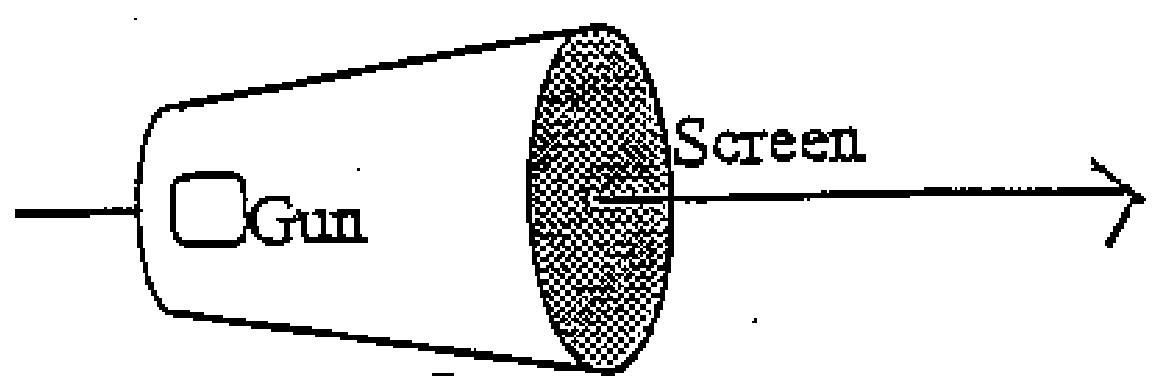
Figure 2.3
The electron beam emerges from the anode of the electron gun on the axis, but with a divergence of up to \(5^\circ\) from the axis, as illustrated in figure 2.4. In general a diffuse spot is produced on the screen, but for certain values of the magnetic field a sharply focused spot is obtained.
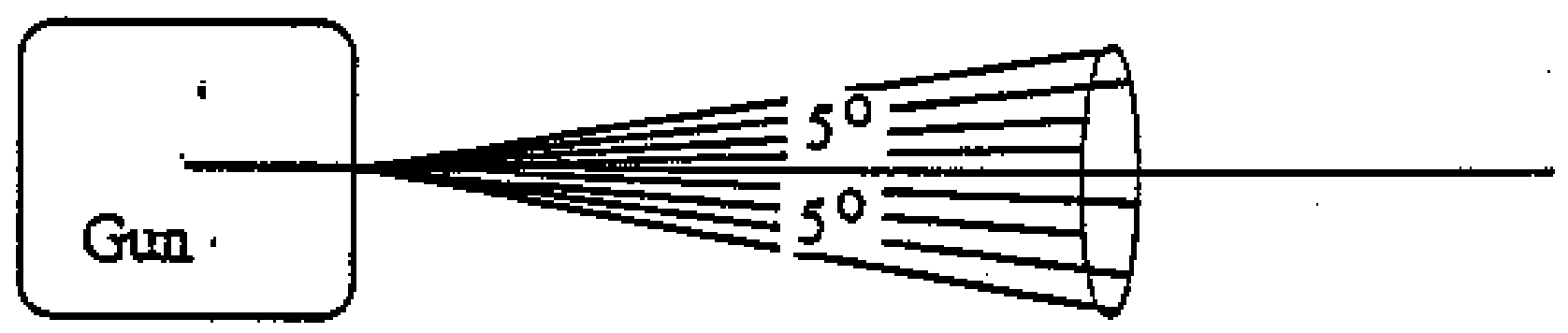
Figure 2.4
By considering the motion of an electron initially moving at an angle \(\beta\) (where \(0\leq\beta\leq5^\circ\)) to the axis as it leaves the electron gun, and considering the components of its motion parallel and perpendicular to the axis, derive an expression for the charge to mass ratio \(e/m\) for the electron in terms of the following quantities:
the smallest magnetic field for which a focused spot is obtained,
the accelerating potential difference across the electron gun \(V\)
(note that \(V<2\ \mathrm{kV}\)),
and \(D\), the distance between the anode and the screen.Write your expression in the box provided in section 2a of the answer sheet.
(b) Consider another method of evaluating the charge to mass ratio of the electron. The arrangement is shown from a side view and in plan view (from above) in figure 2.5, with the direction of the magnetic field marked \(\mathbf B\). Within this uniform magnetic field \(\mathbf B\) are placed two brass circular plates of radius \(\rho\) which are separated by a very small distance \(t\). A potential difference \(V\) is maintained between them. The plates are mutually parallel and co-axial, however their axis is perpendicular to the magnetic field. A photographic film, covers the inside of the curved surface of a cylinder of radius \(\rho+s\), which is held co-axial with the plates. In other words, the film is at a radial distance \(s\) from the edges of the plates. The entire arrangement is placed in vacuo. Note that \(t\) is very much smaller than both \(s\) and \(\rho\).
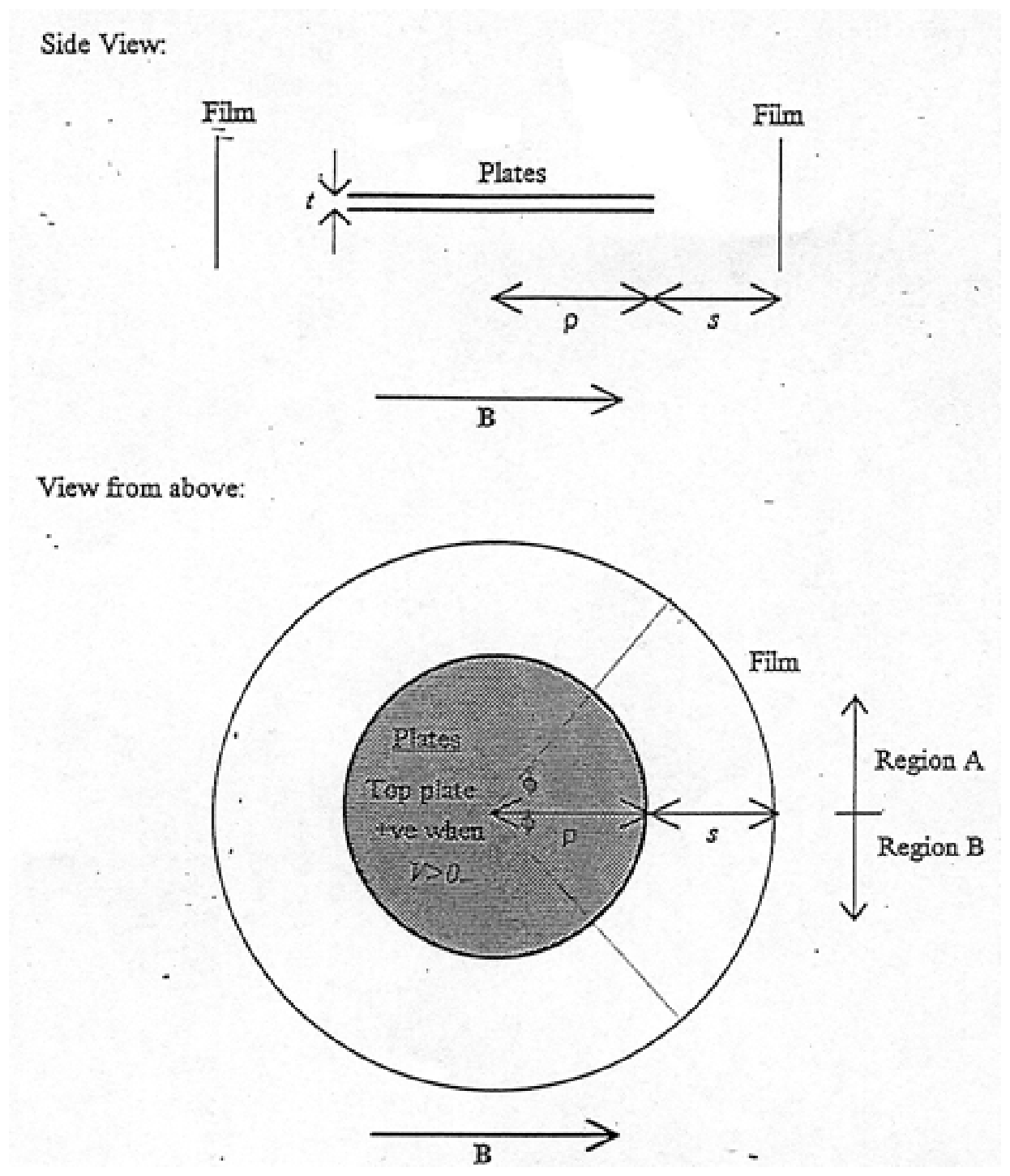
Figure 2.5
A point source of \(\beta\) particles, which emits the \(\beta\) particles uniformly in all directions with a range of velocities, is placed between the centres of the plates, and the same piece of film is exposed under three different conditions:
firstly with \(B=0\), and \(V=0\),
secondly with \(B=B_0\), and \(V=V_0\), and
thirdly with \(B=-B_0\), and \(V=-V_0\);where \(V_0\) and \(B_0\) are positive constants. Please note that the upper plate is positively charged when \(V>0\) (negative when \(V<0\)), and that the magnetic field is in the direction defined by figure 2.5 when \(B>0\) (in the opposite direction when \(B<0\)). For this part you may assume the gap is negligibly small.
Two regions of the film are labelled A and B on figure 2.5. After exposure and development, a sketch of one of these regions is given in figure 2.6. From which region was this piece taken (on your answer sheet write A or B)? Justify your answer by showing the directions of the forces acting on the electron.
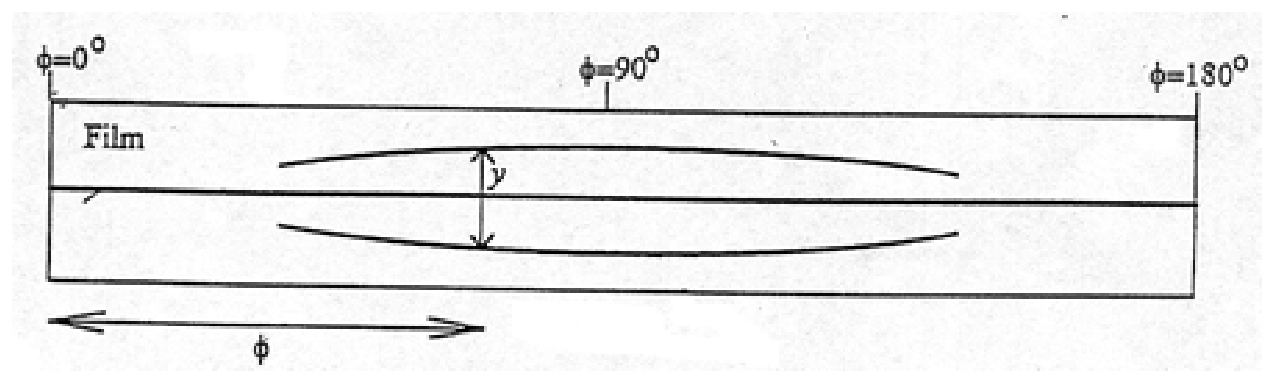
Figure 2.6
(c) After exposure and development, a sketch of the film is given in figure 2.6. Measurements are made of the separation of the two outermost traces with a microscope, and this distance (\(y\)) is also indicated for one particular angle on figure 2.6. The results are given in the table below, the angle \(\phi\) being defined in figure 2.5 as the angle between the magnetic field and a line joining the centre of the plates to the point on the film.
Angle to field /degrees \(\phi\) 90 60 50 40 30 23 Separation /mm \(y\) 17.4 12.7 9.7 6.4 3.3 End of trace Numerical values of the system parameters are given below:
\[ B_0=6.91\ \mathrm{mT} \qquad V_0=580\ \mathrm V \qquad t=0.80\ \mathrm{mm} \] \[ s=41.0\ \mathrm{mm} \]
In addition, you may take the speed of light in vacuum to be \(3.00\times10^8\ \mathrm{m\,s^{-1}}\), and the rest mass of the electron to be \(9.11\times10^{-31}\ \mathrm{kg}\).
Determine the maximum \(\beta\) particle kinetic energy observed.
Write the maximum kinetic energy as a numerical result in eV in the box on the answer sheet, section 2f.
(d) Using the information given in part (f) [i.e. part (c) above], obtain a value for the charge to rest mass ratio of the electron. This should be done by plotting an appropriate graph on the paper provided.
Indicate algebraically the quantities being plotted on the horizontal and vertical axes both on the graph itself and on the answer sheet in the boxes provided in section 2g.
Write your value for the charge to mass ratio of the electron in the box provided on the answer sheet, section 2g.
Please note that the answer you obtain may not agree with the accepted value because of a systematic error in the observations.
Official English text of the problem.
Problem 3: Gravitational-wave detector (Part A) and gravitational deflection of light by the Sun (Part B)
Gravitational waves and the effects of gravity on light.
Part A
This part is concerned with the difficulties of detecting gravitational waves generated by astronomical events. It should be realised that the explosion of a distant supernova may produce fluctuations in the gravitational field strength at the surface of the Earth of about \(10^{-19}\ \mathrm{N\,kg^{-1}}\).
A model for a gravitational wave detector (see figure 3.1) consists of two metal rods each 1m long, held at right angles to each other. One end of each rod is polished optically flat and the other end is held rigidly. The position of one rod is adjusted so there is a minimum signal received from the photocell (see figure 3.1).
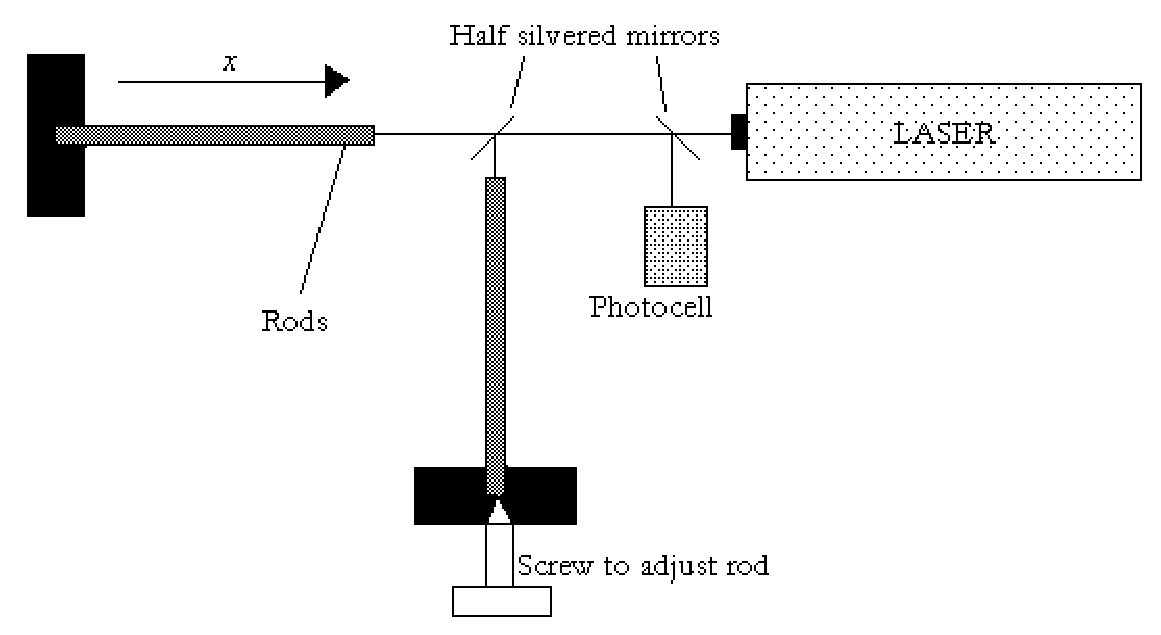
Figure 3.1
The rods are given a short sharp impulse by a piezoelectric device. As a result the free ends of the rods oscillate with a longitudinal displacement \(\Delta x_t\), where
\[ \Delta x_t=ae^{-\mu t}\cos(\omega t+\phi), \]
and \(a,\mu,\omega\) and \(\phi\) are constants.
(a) If the amplitude of the motion is reduced by 20% during a 50s interval determine a value for \(\mu\).
(b) Determine also a value for \(\omega\) given that the rods are made of aluminium with a density (\(\rho\)) of \(2700\ \mathrm{kg\,m^{-3}}\) and a Young modulus (\(E\)) of \(7.1\times10^{10}\ \mathrm{Pa}\).
(c) It is impossible to make the rods exactly the same length so the photocell signal has a beat frequency of \(0.005\ \mathrm{Hz}\). What is the difference in length of the rods?
(d) For the rod of length \(l\), derive an algebraic expression for the change in length, \(\Delta l\), due to a change, \(\Delta g\), in the gravitational field strength, \(g\), in terms of \(l\) and other constants of the rod material.
(e) The light produced by the laser is monochromatic with a wavelength of 656nm. If the minimum fringe shift that can be detected is \(10^{-4}\) of the wavelength of the laser, what is the minimum value of \(l\) necessary if such a system were to be capable of detecting variations in \(g\) of \(10^{-19}\ \mathrm{N\,kg^{-1}}\)?
A non-directional form of gravitational wave detector consists of a sphere of copper-alloy of mass 1168 kg, suspended in a vacuum from a vibration-reducing assembly. Transducers, containing tuned circuits, are attached to the sphere to detect changes in its dimensions. The transducers will, however, pick up all spurious vibrations due to, for example, temperature effects and noise due to electric pick up.
(f) To reduce vibrations due to temperature effects the sphere is maintained at a temperature of 100 mK. By what factor will the amplitude of the atomic vibrations been reduced in cooling the assembly from 300 K?
(g) The sphere is initially cooled to 4.2 K using liquid nitrogen and liquid helium. The temperature, \(T\), is further reduced to 100 mK by a refrigeration process, which removes energy from the system at an average rate of 1 mW. Given that the specific thermal capacity, \(s\), of the copper-alloy varies directly as \(T^3\) at these low temperatures, estimate the time taken for the system to cool from 4.2 K to 100 mK, given that \(s=0.072\ \mathrm{J\,kg^{-1}\,K^{-1}}\) at 4.2 K.
Part B
This part is concerned with the effect of a gravitational field on the propagation of light in space.
(a) A photon emitted from the surface of the Sun (mass \(M\), radius \(R\)) is red-shifted. By assuming a rest-mass equivalent for the photon energy, apply Newtonian gravitational theory to show that the effective (or measured) frequency of the photon at infinity is reduced (red-shifted) by the factor \((1-GM/Rc^2)\).
(b) A reduction of the photon’s frequency is equivalent to an increase in its time period, or, using the photon as a standard clock, a dilation of time. In addition, it may be shown that a time dilation is always accompanied by a contraction in the unit of length by the same factor.
We will now try to study the effect that this has on the propagation of light near the Sun. Let us first define an effective refractive index \(n_r\) at a point \(r\) from the centre of the Sun. Let
\[ n_r=\frac{c}{c'_r}, \]
where \(c\) is the speed of light as measured by a co-ordinate system far away from the Sun’s gravitational influence (\(r\to\infty\)), and \(c'_r\) is the speed of light as measured by a co-ordinate system at a distance \(r\) from the centre of the Sun.
Show that \(n_r\) may be approximated to:
\[ n_r=1+\frac{\alpha GM}{rc^2}, \]
for small \(GM/rc^2\), where \(\alpha\) is a constant that you determine.
(c) Using this expression for \(n_r\), calculate in radians the deflection of a light ray from its straight path as it passes the edge of the Sun.
Data:
Gravitational constant, \(G=6.67\times10^{-11}\ \mathrm{N\,m^2\,kg^{-2}}\).
Mass of Sun, \(M=1.99\times10^{30}\ \mathrm{kg}\).
Radius of Sun, \(R=6.95\times10^8\ \mathrm{m}\).
Velocity of light, \(c=3.00\times10^8\ \mathrm{m\,s^{-1}}\).You may also need the following integral:
\[ \int_{-\infty}^{+\infty}\frac{dx}{(x^2+a^2)^{3/2}} =\frac{2}{a^2}. \]
Official English text of the problem.
Internationale Physik-Olympiade
IPhO 2000
Leicester, Vereinigtes Königreich · 3 Theorieaufgaben mit vollständigen Lösungen
Aufgabe 1: Fünf kurze Teile: Bungeespringer, Wärmekraftmaschine, Alter der Erde aus der U-Pb-Datierung, homogen geladene Kugel, rotierender Kupferring im Erdmagnetfeld
A
Ein Bungeespringer ist an einem Ende eines langen elastischen Seils befestigt. Das andere Ende des elastischen Seils ist an einer hohen Brücke befestigt. Der Springer tritt von der Brücke und fällt aus der Ruhe auf den darunterliegenden Fluss zu. Er erreicht das Wasser nicht. Die Masse des Springers ist \(m\), die ungedehnte Länge des Seils ist \(L\), das Seil hat eine Federkonstante (Kraft zur Erzeugung einer Dehnung von 1 m) von \(k\), und die Gravitationsfeldstärke ist \(g\).
Sie dürfen annehmen, dass
- der Springer als punktförmige Masse \(m\) am Ende des Seils betrachtet werden kann,
- die Masse des Seils gegenüber \(m\) vernachlässigbar ist,
- das Seil dem Hooke’schen Gesetz gehorcht,
- der Luftwiderstand während des gesamten Falls des Springers vernachlässigt werden kann.
Leiten Sie Ausdrücke für die folgenden Größen her und tragen Sie sie auf dem Antwortblatt ein:
(a) die Strecke \(y\), die der Springer fällt, bevor er zum ersten Mal augenblicklich zur Ruhe kommt,
(b) die maximale Geschwindigkeit \(\upsilon\), die der Springer während dieses Falls erreicht,
(c) die Zeit \(t\), die während des Falls vergeht, bevor er zum ersten Mal zur Ruhe kommt.
B
Eine Wärmekraftmaschine arbeitet zwischen zwei identischen Körpern mit unterschiedlichen Temperaturen \(T_{\mathrm A}\) und \(T_{\mathrm B}\) (\(T_{\mathrm A}>T_{\mathrm B}\)), wobei jeder Körper die Masse \(m\) und die konstante spezifische Wärmekapazität \(s\) hat. Die Körper stehen unter konstantem Druck und durchlaufen keinen Phasenübergang.
(a) Leiten Sie unter Angabe des vollständigen Rechenwegs einen Ausdruck für die Endtemperatur \(T_0\) her, die die beiden Körper A und B erreichen, wenn die Wärmekraftmaschine dem System die theoretisch maximal mögliche mechanische Arbeit entnimmt.
Tragen Sie Ihren Ausdruck für die Endtemperatur \(T_0\) auf dem Antwortblatt ein.
(b) Leiten Sie daraus einen Ausdruck für diese maximal verfügbare Arbeit her und tragen Sie ihn auf dem Antwortblatt ein.
Die Wärmekraftmaschine arbeitet zwischen zwei Wassertanks mit einem Volumen von jeweils \(2.50\ \mathrm{m^3}\). Ein Tank hat eine Temperatur von \(350\ \mathrm K\), der andere von \(300\ \mathrm K\).
(c) Berechnen Sie die maximal gewinnbare mechanische Energie. Tragen Sie den Wert auf dem Antwortblatt ein.
Spezifische Wärmekapazität von Wasser \(=4.19\times10^3\ \mathrm{J\,kg^{-1}\,K^{-1}}\)
Dichte von Wasser \(=1.00\times10^3\ \mathrm{kg\,m^{-3}}\)
C
Es wird angenommen, dass bei der Entstehung der Erde die Isotope \({}^{238}\mathrm U\) und \({}^{235}\mathrm U\) vorhanden waren, ihre Zerfallsprodukte jedoch nicht. Die Zerfälle von \({}^{238}\mathrm U\) und \({}^{235}\mathrm U\) werden verwendet, um das Alter der Erde, \(T\), zu bestimmen.
(a) Das Isotop \({}^{238}\mathrm U\) zerfällt mit einer Halbwertszeit von \(4.50\times10^9\) Jahren. Die Zerfallsprodukte in der daraus entstehenden radioaktiven Zerfallsreihe haben im Vergleich dazu kurze Halbwertszeiten; in erster Näherung kann ihre Existenz vernachlässigt werden. Die Zerfallsreihe endet beim stabilen Bleiisotop \({}^{206}\mathrm{Pb}\).
Leiten Sie einen Ausdruck für die Anzahl der durch radioaktiven Zerfall während der Zeit \(t\) erzeugten \({}^{206}\mathrm{Pb}\)-Atome, bezeichnet mit \({}^{206}n\), in Abhängigkeit von der heutigen Anzahl der \({}^{238}\mathrm U\)-Atome, bezeichnet mit \({}^{238}N\), und der Halbwertszeit von \({}^{238}\mathrm U\) her und tragen Sie ihn auf dem Antwortblatt ein. (Es kann hilfreich sein, mit Zeiteinheiten von \(10^9\) Jahren zu arbeiten.)
(b) Ebenso zerfällt \({}^{235}\mathrm U\) mit einer Halbwertszeit von \(0.710\times10^9\) Jahren über eine Reihe von Produkten mit kürzeren Halbwertszeiten zum stabilen Isotop \({}^{207}\mathrm{Pb}\).
Schreiben Sie auf dem Antwortblatt eine Gleichung auf, die \({}^{207}n\) mit \({}^{235}N\) und der Halbwertszeit von \({}^{235}\mathrm U\) verknüpft.
(c) Ein mit einem Bleierz vermischtes Uranerz wird mit einem Massenspektrometer analysiert. Die relativen Konzentrationen der drei Bleiisotope \({}^{204}\mathrm{Pb}\), \({}^{206}\mathrm{Pb}\) und \({}^{207}\mathrm{Pb}\) werden gemessen, und es wird festgestellt, dass ihre Atomzahlen in dieser Reihenfolge im Verhältnis \(1.00:29.6:22.6\) stehen. Das Isotop \({}^{204}\mathrm{Pb}\) wird als Referenz verwendet, da es nicht radioaktiven Ursprungs ist. Die Analyse eines reinen Bleierzes ergibt die Verhältnisse \(1.00:17.9:15.5\).
Leiten Sie unter Verwendung des gegebenen Verhältnisses \({}^{238}N:{}^{235}N\) von \(137:1\) eine Gleichung her, die \(T\) enthält, und tragen Sie sie auf dem Antwortblatt ein.
(d) Nehmen Sie an, dass \(T\) wesentlich größer als die Halbwertszeiten beider Uranisotope ist, und bestimmen Sie daraus einen Näherungswert für \(T\).
(e) Dieser Näherungswert ist offensichtlich nicht wesentlich größer als die längere Halbwertszeit, kann aber verwendet werden, um einen deutlich genaueren Wert für \(T\) zu erhalten. Schätzen Sie damit oder auf andere Weise das Alter der Erde mit einer Genauigkeit von 2% ab.
D
Die Ladung \(Q\) ist im Vakuum gleichmäßig über ein kugelförmiges Volumen mit dem Radius \(R\) verteilt.
(a) Leiten Sie Ausdrücke für die elektrische Feldstärke im Abstand \(r\) vom Mittelpunkt der Kugel für \(r\le R\) und \(r>R\) her.
(b) Bestimmen Sie einen Ausdruck für die gesamte elektrische Energie dieser Ladungsverteilung.
Tragen Sie Ihre Antworten zu (a) und (b) auf dem Antwortblatt ein.
E
Ein kreisförmiger Ring aus dünnem Kupferdraht wird an einem Ort im Erdmagnetfeld in Rotation um einen vertikalen Durchmesser versetzt. Die magnetische Flussdichte des Erdmagnetfelds an diesem Ort beträgt \(44.5\ \mu\mathrm T\) und ist unter einem Winkel von \(64^\circ\) unterhalb der Horizontalen gerichtet. Berechnen Sie unter Verwendung der Dichte von Kupfer von \(8.90\times10^3\ \mathrm{kg\,m^{-3}}\) und seines spezifischen elektrischen Widerstands von \(1.70\times10^{-8}\ \Omega\,\mathrm m\), wie lange es dauert, bis sich die Winkelgeschwindigkeit des Rings halbiert hat. Geben Sie die Schritte Ihres Rechenwegs an und tragen Sie den Wert der Zeit auf dem Antwortblatt ein. Diese Zeit ist wesentlich länger als die Dauer einer Umdrehung.
Sie dürfen annehmen, dass die Reibungseinflüsse der Lager und der Luft vernachlässigbar sind. Für diese Aufgabe sollen Sie außerdem Selbstinduktionseffekte ignorieren, obwohl diese nicht vernachlässigbar wären.
Aufgabentext aus dem offiziellen englischen Text übersetzt.
Aufgabe 2: Ladungs-Masse-Verhältnis des Elektrons (magnetische Fokussierung in einer CRT; Betateilchen zwischen geladenen Platten)
(a) Eine Kathodenstrahlröhre (CRT), die aus einer Elektronenkanone und einem Leuchtschirm besteht, wird in einem homogenen, zeitlich konstanten Magnetfeld vom Betrag \(\mathbf B\) so angeordnet, dass das Magnetfeld parallel zur Strahlachse der Elektronenkanone verläuft, wie in Abbildung 2.3 gezeigt.
Abbildung 2.3
Der Elektronenstrahl tritt auf der Achse aus der Anode der Elektronenkanone aus, weist jedoch eine Divergenz von bis zu \(5^\circ\) gegenüber der Achse auf, wie in Abbildung 2.4 dargestellt. Im Allgemeinen entsteht auf dem Schirm ein diffuser Fleck, doch bei bestimmten Werten des Magnetfeldes erhält man einen scharf fokussierten Fleck.
Abbildung 2.4
Betrachten Sie die Bewegung eines Elektrons, das sich beim Verlassen der Elektronenkanone zunächst unter einem Winkel \(\beta\) (mit \(0\leq\beta\leq5^\circ\)) zur Achse bewegt, sowie die Komponenten seiner Bewegung parallel und senkrecht zur Achse. Leiten Sie daraus einen Ausdruck für das Ladungs-Masse-Verhältnis \(e/m\) des Elektrons in Abhängigkeit von den folgenden Größen her:
dem kleinsten Magnetfeld, bei dem ein fokussierter Fleck entsteht,
der Beschleunigungsspannung an der Elektronenkanone \(V\)
(beachten Sie, dass \(V<2\ \mathrm{kV}\)),
und \(D\), dem Abstand zwischen Anode und Schirm.Tragen Sie Ihren Ausdruck in das dafür vorgesehene Kästchen in Abschnitt 2a des Antwortbogens ein.
(b) Betrachten Sie eine weitere Methode zur Bestimmung des Ladungs-Masse-Verhältnisses des Elektrons. Die Anordnung ist in Abbildung 2.5 in einer Seitenansicht und einer Draufsicht (von oben) dargestellt; die Richtung des Magnetfeldes ist mit \(\mathbf B\) gekennzeichnet. In diesem homogenen Magnetfeld \(\mathbf B\) befinden sich zwei kreisförmige Messingplatten mit dem Radius \(\rho\), die durch einen sehr kleinen Abstand \(t\) voneinander getrennt sind. Zwischen ihnen wird eine Spannung \(V\) aufrechterhalten. Die Platten sind parallel zueinander und koaxial angeordnet; ihre Achse steht jedoch senkrecht zum Magnetfeld. Ein fotografischer Film bedeckt die Innenseite der Mantelfläche eines Zylinders mit dem Radius \(\rho+s\), der koaxial zu den Platten angeordnet ist. Mit anderen Worten: Der Film befindet sich im radialen Abstand \(s\) von den Plattenrändern. Die gesamte Anordnung befindet sich im Vakuum. Beachten Sie, dass \(t\) sehr viel kleiner ist als sowohl \(s\) als auch \(\rho\).
Abbildung 2.5
Eine punktförmige Quelle von \(\beta\)-Teilchen, die die \(\beta\)-Teilchen mit unterschiedlichen Geschwindigkeiten gleichmäßig in alle Richtungen emittiert, wird zwischen den Mittelpunkten der Platten angeordnet. Dasselbe Stück Film wird unter drei verschiedenen Bedingungen belichtet:
erstens bei \(B=0\) und \(V=0\),
zweitens bei \(B=B_0\) und \(V=V_0\) und
drittens bei \(B=-B_0\) und \(V=-V_0\);dabei sind \(V_0\) und \(B_0\) positive Konstanten. Beachten Sie bitte, dass die obere Platte bei \(V>0\) positiv geladen ist (bei \(V<0\) negativ) und dass das Magnetfeld bei \(B>0\) in die in Abbildung 2.5 festgelegte Richtung zeigt (bei \(B<0\) in die entgegengesetzte Richtung). Für diesen Aufgabenteil dürfen Sie annehmen, dass der Spalt vernachlässigbar klein ist.
Zwei Bereiche des Films sind in Abbildung 2.5 mit A und B bezeichnet. Eine Skizze eines dieser Bereiche nach der Belichtung und Entwicklung ist in Abbildung 2.6 dargestellt. Aus welchem Bereich stammt dieses Stück (schreiben Sie A oder B auf Ihren Antwortbogen)? Begründen Sie Ihre Antwort, indem Sie die Richtungen der auf das Elektron wirkenden Kräfte angeben.
Abbildung 2.6
(c) Eine Skizze des Films nach der Belichtung und Entwicklung ist in Abbildung 2.6 dargestellt. Der Abstand der beiden äußersten Spuren wird mit einem Mikroskop gemessen; dieser Abstand (\(y\)) ist in Abbildung 2.6 auch für einen bestimmten Winkel eingezeichnet. Die Ergebnisse sind in der folgenden Tabelle angegeben. Der Winkel \(\phi\) ist in Abbildung 2.5 als der Winkel zwischen dem Magnetfeld und einer Verbindungslinie vom Mittelpunkt der Platten zu dem Punkt auf dem Film definiert.
Winkel zum Feld /Grad \(\phi\) 90 60 50 40 30 23 Abstand /mm \(y\) 17.4 12.7 9.7 6.4 3.3 Ende der Spur Die Zahlenwerte der Systemparameter sind nachstehend angegeben:
\[ B_0=6.91\ \mathrm{mT} \qquad V_0=580\ \mathrm V \qquad t=0.80\ \mathrm{mm} \] \[ s=41.0\ \mathrm{mm} \]
Außerdem dürfen Sie für die Lichtgeschwindigkeit im Vakuum \(3.00\times10^8\ \mathrm{m\,s^{-1}}\) und für die Ruhemasse des Elektrons \(9.11\times10^{-31}\ \mathrm{kg}\) verwenden.
Bestimmen Sie die größte beobachtete kinetische Energie der \(\beta\)-Teilchen.
Tragen Sie die maximale kinetische Energie als Zahlenwert in eV in das Kästchen in Abschnitt 2f des Antwortbogens ein.
(d) Bestimmen Sie anhand der in Teil (f) [d. h. Teil (c) oben] gegebenen Informationen einen Wert für das Verhältnis von Ladung zu Ruhemasse des Elektrons. Zeichnen Sie dazu ein geeignetes Diagramm auf das bereitgestellte Papier.
Geben Sie die auf der horizontalen und der vertikalen Achse aufgetragenen Größen als algebraische Ausdrücke an, sowohl im Diagramm selbst als auch in den dafür vorgesehenen Kästchen in Abschnitt 2g des Antwortbogens.
Tragen Sie Ihren Wert für das Ladungs-Masse-Verhältnis des Elektrons in das dafür vorgesehene Kästchen in Abschnitt 2g des Antwortbogens ein.
Beachten Sie bitte, dass Ihr Ergebnis aufgrund eines systematischen Fehlers in den Beobachtungen vom anerkannten Wert abweichen kann.
Aufgabentext aus dem offiziellen englischen Text übersetzt.
Aufgabe 3: Gravitationswellendetektor (Teil A) und gravitative Ablenkung des Lichts durch die Sonne (Teil B)
Gravitationswellen und die Auswirkungen der Gravitation auf Licht.
Teil A
Dieser Teil behandelt die Schwierigkeiten beim Nachweis von Gravitationswellen, die durch astronomische Ereignisse erzeugt werden. Man muss sich dabei vor Augen halten, dass die Explosion einer weit entfernten Supernova Schwankungen der Gravitationsfeldstärke an der Erdoberfläche von etwa \(10^{-19}\ \mathrm{N\,kg^{-1}}\) hervorrufen kann.
Ein Modell für einen Gravitationswellendetektor (siehe Abbildung 3.1) besteht aus zwei jeweils 1m langen Metallstäben, die im rechten Winkel zueinander angeordnet sind. Ein Ende jedes Stabes ist optisch eben poliert, während das andere Ende fest eingespannt ist. Die Position eines Stabes wird so eingestellt, dass das von der Fotozelle empfangene Signal minimal ist (siehe Abbildung 3.1).
Abbildung 3.1
Den Stäben wird durch eine piezoelektrische Vorrichtung ein kurzer, kräftiger Stoß versetzt. Dadurch schwingen die freien Enden der Stäbe mit einer longitudinalen Auslenkung \(\Delta x_t\), wobei
\[ \Delta x_t=ae^{-\mu t}\cos(\omega t+\phi), \]
und \(a,\mu,\omega\) und \(\phi\) Konstanten sind.
(a) Wenn die Amplitude der Bewegung innerhalb eines Zeitintervalls von 50s um 20% abnimmt, bestimmen Sie einen Wert für \(\mu\).
(b) Bestimmen Sie auch einen Wert für \(\omega\), wenn die Stäbe aus Aluminium mit einer Dichte (\(\rho\)) von \(2700\ \mathrm{kg\,m^{-3}}\) und einem Elastizitätsmodul (\(E\)) von \(7.1\times10^{10}\ \mathrm{Pa}\) bestehen.
(c) Es ist unmöglich, die Stäbe exakt gleich lang herzustellen, sodass das Signal der Fotozelle eine Schwebungsfrequenz von \(0.005\ \mathrm{Hz}\) aufweist. Wie groß ist der Längenunterschied zwischen den Stäben?
(d) Leiten Sie für den Stab der Länge \(l\) einen algebraischen Ausdruck für die Längenänderung \(\Delta l\) infolge einer Änderung \(\Delta g\) der Gravitationsfeldstärke \(g\) in Abhängigkeit von \(l\) und weiteren Konstanten des Stabmaterials her.
(e) Das vom Laser erzeugte Licht ist monochromatisch und hat eine Wellenlänge von 656nm. Wenn die kleinste nachweisbare Streifenverschiebung \(10^{-4}\) der Wellenlänge des Lasers beträgt, welcher Mindestwert von \(l\) ist erforderlich, damit ein solches System Änderungen von \(g\) um \(10^{-19}\ \mathrm{N\,kg^{-1}}\) nachweisen kann?
Eine richtungsunabhängige Form eines Gravitationswellendetektors besteht aus einer Kugel aus einer Kupferlegierung mit einer Masse von 1168 kg, die im Vakuum an einer schwingungsdämpfenden Aufhängung hängt. An der Kugel sind Messwandler mit abgestimmten Schwingkreisen angebracht, um Änderungen ihrer Abmessungen nachzuweisen. Die Messwandler erfassen jedoch auch sämtliche Störschwingungen, beispielsweise durch Temperatureinflüsse, sowie Rauschen durch elektrische Einstreuungen.
(f) Um Schwingungen durch Temperatureinflüsse zu verringern, wird die Kugel auf einer Temperatur von 100 mK gehalten. Um welchen Faktor wird die Amplitude der atomaren Schwingungen beim Abkühlen der Anordnung von 300 K verringert?
(g) Die Kugel wird zunächst mithilfe von flüssigem Stickstoff und flüssigem Helium auf 4.2 K abgekühlt. Die Temperatur \(T\) wird durch einen Kälteprozess, der dem System Energie mit einer mittleren Leistung von 1 mW entzieht, weiter auf 100 mK gesenkt. Die spezifische Wärmekapazität \(s\) der Kupferlegierung ist bei diesen niedrigen Temperaturen direkt proportional zu \(T^3\). Schätzen Sie die Zeit ab, die benötigt wird, um das System von 4.2 K auf 100 mK abzukühlen, wenn bei 4.2 K gilt: \(s=0.072\ \mathrm{J\,kg^{-1}\,K^{-1}}\).
Teil B
Dieser Teil behandelt die Wirkung eines Gravitationsfeldes auf die Ausbreitung von Licht im Raum.
(a) Ein Photon, das von der Oberfläche der Sonne (Masse \(M\), Radius \(R\)) emittiert wird, erfährt eine Rotverschiebung. Nehmen Sie für die Photonenenergie ein Ruhemasseäquivalent an und zeigen Sie mithilfe der Newtonschen Gravitationstheorie, dass die effektive (oder gemessene) Frequenz des Photons im Unendlichen um den Faktor \((1-GM/Rc^2)\) verringert (rotverschoben) ist.
(b) Eine Verringerung der Frequenz des Photons entspricht einer Verlängerung seiner Periodendauer oder, wenn man das Photon als Referenzuhr verwendet, einer Zeitdilatation. Außerdem lässt sich zeigen, dass eine Zeitdilatation stets mit einer Kontraktion der Längeneinheit um denselben Faktor einhergeht.
Wir wollen nun versuchen, die Auswirkung dieses Effekts auf die Lichtausbreitung in Sonnennähe zu untersuchen. Definieren wir zunächst einen effektiven Brechungsindex \(n_r\) an einem Punkt im Abstand \(r\) vom Mittelpunkt der Sonne. Es sei
\[ n_r=\frac{c}{c'_r}, \]
wobei \(c\) die Lichtgeschwindigkeit ist, die in einem Koordinatensystem weit außerhalb des gravitativen Einflusses der Sonne (\(r\to\infty\)) gemessen wird, und \(c'_r\) die Lichtgeschwindigkeit, die in einem Koordinatensystem im Abstand \(r\) vom Mittelpunkt der Sonne gemessen wird.
Zeigen Sie, dass \(n_r\) näherungsweise wie folgt dargestellt werden kann:
\[ n_r=1+\frac{\alpha GM}{rc^2}, \]
für kleine Werte von \(GM/rc^2\), wobei \(\alpha\) eine von Ihnen zu bestimmende Konstante ist.
(c) Berechnen Sie mithilfe dieses Ausdrucks für \(n_r\) im Bogenmaß die Ablenkung eines Lichtstrahls von seiner geradlinigen Bahn, wenn er am Sonnenrand vorbeiläuft.
Daten:
Gravitationskonstante, \(G=6.67\times10^{-11}\ \mathrm{N\,m^2\,kg^{-2}}\).
Masse der Sonne, \(M=1.99\times10^{30}\ \mathrm{kg}\).
Radius der Sonne, \(R=6.95\times10^8\ \mathrm{m}\).
Lichtgeschwindigkeit, \(c=3.00\times10^8\ \mathrm{m\,s^{-1}}\).Möglicherweise benötigen Sie auch das folgende Integral:
\[ \int_{-\infty}^{+\infty}\frac{dx}{(x^2+a^2)^{3/2}} =\frac{2}{a^2}. \]
Aufgabentext aus dem offiziellen englischen Text übersetzt.
Uluslararası Fizik Olimpiyatı
IPhO 2000
Leicester, Birleşik Krallık · 3 teori sorusu, tam çözümleriyle
Soru 1: Beş kısa bölüm: bungee atlayıcısı, ısı makinesi, U-Pb tarihlemesiyle Dünya'nın yaşı, düzgün yüklü küre, Dünya'nın manyetik alanında dönen bakır halka
A
Bir bungee atlayıcısı uzun, esnek bir ipin bir ucuna bağlıdır. Esnek ipin diğer ucu yüksek bir köprüye sabitlenmiştir. Atlayıcı köprüden kendini bırakarak durgun hâlden aşağıdaki nehre doğru düşer. Suya çarpmaz. Atlayıcının kütlesi \(m\), ipin gerilmemiş uzunluğu \(L\), ipin kuvvet sabiti (1 m uzama oluşturmak için gereken kuvvet) \(k\) ve yerçekimi alan şiddeti \(g\)'dir.
Şunları varsayabilirsiniz:
- atlayıcı, ipin ucuna bağlı \(m\) kütleli bir noktasal cisim olarak ele alınabilir,
- ipin kütlesi \(m\)'ye kıyasla ihmal edilebilir,
- ip Hooke yasasına uyar,
- atlayıcının düşüşü boyunca hava direnci ihmal edilebilir.
Aşağıdakiler için ifadeler elde edin ve cevap kâğıdına yazın:
(a) atlayıcının ilk kez anlık olarak durgun hâle gelene kadar düştüğü \(y\) mesafesi,
(b) atlayıcının bu düşüş sırasında ulaştığı en büyük sürat \(\upsilon\),
(c) düşüş sırasında ilk kez durgun hâle gelene kadar geçen \(t\) süresi.
B
Bir ısı makinesi, farklı \(T_{\mathrm A}\) ve \(T_{\mathrm B}\) sıcaklıklarındaki (\(T_{\mathrm A}>T_{\mathrm B}\)) özdeş iki cisim arasında çalışmaktadır; her bir cismin kütlesi \(m\) ve sabit özgül ısı kapasitesi \(s\)'dir. Cisimler sabit basınçta kalır ve hâl değiştirmez.
(a) Isı makinesi sistemden teorik olarak mümkün olan en büyük miktarda mekanik işi elde ediyorsa, A ve B cisimlerinin ulaştığı son sıcaklık \(T_0\) için tüm işlem adımlarını göstererek bir ifade elde edin.
Son sıcaklık \(T_0\) için bulduğunuz ifadeyi cevap kâğıdına yazın.
(b) Buradan hareketle, elde edilebilecek bu en büyük iş miktarı için bir ifade elde edin ve cevap kâğıdına yazın.
Isı makinesi, her birinin hacmi \(2.50\ \mathrm{m^3}\) olan iki su tankı arasında çalışmaktadır. Tanklardan biri \(350\ \mathrm K\), diğeri ise \(300\ \mathrm K\) sıcaklığındadır.
(c) Elde edilebilecek en büyük mekanik enerji miktarını hesaplayın. Değeri cevap kâğıdına yazın.
Suyun özgül ısı kapasitesi \(=4.19\times10^3\ \mathrm{J\,kg^{-1}\,K^{-1}}\)
Suyun yoğunluğu \(=1.00\times10^3\ \mathrm{kg\,m^{-3}}\)
C
Dünya oluştuğunda \({}^{238}\mathrm U\) ve \({}^{235}\mathrm U\) izotoplarının bulunduğu, ancak bunların bozunma ürünlerinin bulunmadığı varsayılmaktadır. Dünya'nın yaşı \(T\)'yi belirlemek için \({}^{238}\mathrm U\) ve \({}^{235}\mathrm U\) bozunmaları kullanılır.
(a) \({}^{238}\mathrm U\) izotopu, \(4.50\times10^9\) yıllık yarı ömürle bozunur. Ortaya çıkan radyoaktif serideki bozunma ürünlerinin yarı ömürleri buna kıyasla kısadır; ilk yaklaşımda bunların varlığı ihmal edilebilir. Bozunma serisi, kararlı kurşun izotopu \({}^{206}\mathrm{Pb}\) ile son bulur.
\(t\) süresi boyunca radyoaktif bozunmayla üretilen ve \({}^{206}n\) ile gösterilen \({}^{206}\mathrm{Pb}\) atomlarının sayısı için, \({}^{238}N\) ile gösterilen günümüzdeki \({}^{238}\mathrm U\) atomlarının sayısı ve \({}^{238}\mathrm U\)'nun yarı ömrü cinsinden bir ifade elde edin ve cevap kâğıdına yazın. (\(10^9\) yıl birimini kullanarak çalışmak işinizi kolaylaştırabilir.)
(b) Benzer şekilde, \({}^{235}\mathrm U\), \(0.710\times10^9\) yıllık yarı ömürle, daha kısa yarı ömürlü ürünlerden oluşan bir seri üzerinden bozunarak kararlı \({}^{207}\mathrm{Pb}\) izotopunu oluşturur.
\({}^{207}n\)'yi \({}^{235}N\) ve \({}^{235}\mathrm U\)'nun yarı ömrüyle ilişkilendiren bir denklemi cevap kâğıdına yazın.
(c) Bir kurşun cevheriyle karışmış uranyum cevheri, kütle spektrometresiyle analiz edilir. Üç kurşun izotopunun, \({}^{204}\mathrm{Pb}\), \({}^{206}\mathrm{Pb}\) ve \({}^{207}\mathrm{Pb}\)'nin bağıl derişimleri ölçülür ve atom sayılarının oranları sırasıyla \(1.00:29.6:22.6\) olarak bulunur. \({}^{204}\mathrm{Pb}\) izotopu radyoaktif kökenli olmadığı için referans olarak kullanılır. Saf bir kurşun cevherinin analizi, \(1.00:17.9:15.5\) oranlarını verir.
\({}^{238}N:{}^{235}N\) oranının \(137:1\) olduğu verildiğine göre, \(T\)'yi içeren bir denklem türetin ve cevap kâğıdına yazın.
(d) \(T\)'nin her iki uranyum izotopunun yarı ömürlerinden çok daha büyük olduğunu varsayın ve buradan \(T\) için yaklaşık bir değer elde edin.
(e) Bu yaklaşık değerin daha uzun olan yarı ömürden belirgin ölçüde büyük olmadığı açıktır; ancak bu değer, \(T\) için çok daha doğru bir değer elde etmekte kullanılabilir. Buradan hareketle veya başka bir yöntemle, Dünya'nın yaşını %2 hata payı içinde tahmin edin.
D
\(Q\) yükü, boşlukta, yarıçapı \(R\) olan küresel bir hacim boyunca düzgün olarak dağılmıştır.
(a) Kürenin merkezinden \(r\) uzaklıktaki elektrik alan şiddeti için, \(r\le R\) ve \(r>R\) durumlarında geçerli ifadeleri türetin.
(b) Bu yük dağılımına ait toplam elektrik enerjisi için bir ifade elde edin.
(a) ve (b) için cevaplarınızı cevap kâğıdına yazın.
E
İnce bakır telden yapılmış dairesel bir halka, Dünya'nın manyetik alanı içindeki bir noktada düşey bir çapı etrafında dönmeye başlatılır. Dünya'nın manyetik alanının bu noktadaki manyetik akı yoğunluğu \(44.5\ \mu\mathrm T\) olup yatayın altında \(64^\circ\) açı yapacak şekilde yönelmiştir. Bakırın yoğunluğunun \(8.90\times10^3\ \mathrm{kg\,m^{-3}}\) ve özdirencinin \(1.70\times10^{-8}\ \Omega\,\mathrm m\) olduğu verildiğine göre, halkanın açısal hızının yarıya inmesinin ne kadar süreceğini hesaplayın. İşlem adımlarınızı gösterin ve süreyi cevap kâğıdına yazın. Bu süre, bir tam dönüş için geçen süreden çok daha uzundur.
Desteklerin ve havanın sürtünme etkilerinin ihmal edilebilir olduğunu varsayabilirsiniz; ayrıca bu soru kapsamında, gerçekte ihmal edilebilir olmamalarına rağmen özindüktans etkilerini ihmal etmelisiniz.
Soru metni resmi İngilizce metinden çevrilmiştir.
Soru 2: Elektronun yük/kütle oranı (CRT'de manyetik odaklama; yüklü levhalar arasındaki beta parçacıkları)
(a) Bir elektron tabancası ve bir ekrandan oluşan bir katot ışın tüpü (CRT), şekil 2.3'te gösterildiği gibi, büyüklüğü \(\mathbf B\) olan düzgün ve sabit bir manyetik alanın içine, manyetik alan tabancanın demet eksenine paralel olacak biçimde yerleştirilmiştir.
Şekil 2.3
Elektron demeti, elektron tabancasının anodundan eksen üzerinde çıkar; ancak şekil 2.4'te gösterildiği gibi eksenden \(5^\circ\)'ye kadar açılarla ıraksar. Ekranda genellikle dağınık bir leke oluşur, fakat manyetik alanın belirli değerlerinde keskin biçimde odaklanmış bir leke elde edilir.
Şekil 2.4
Elektron tabancasından ayrılırken başlangıçta eksenle \(\beta\) açısı (burada \(0\leq\beta\leq5^\circ\)) yaparak hareket eden bir elektronun hareketini ve bu hareketin eksene paralel ve dik bileşenlerini ele alarak, elektronun yük/kütle oranı \(e/m\) için aşağıdaki nicelikler cinsinden bir ifade türetiniz:
odaklanmış bir leke elde edilen en küçük manyetik alan,
elektron tabancasındaki hızlandırıcı potansiyel farkı \(V\)
(\(V<2\ \mathrm{kV}\) olduğuna dikkat ediniz),
ve anot ile ekran arasındaki uzaklık \(D\).İfadenizi cevap kâğıdının 2a bölümünde ayrılan kutuya yazınız.
(b) Elektronun yük/kütle oranını belirlemek için başka bir yöntem ele alınız. Düzeneğin yandan ve üstten görünüşleri şekil 2.5'te verilmiş, manyetik alanın yönü \(\mathbf B\) ile işaretlenmiştir. Bu düzgün \(\mathbf B\) manyetik alanının içine, yarıçapı \(\rho\) olan ve aralarında çok küçük bir \(t\) uzaklığı bulunan iki dairesel pirinç levha yerleştirilmiştir. Levhalar arasında \(V\) potansiyel farkı korunmaktadır. Levhalar birbirine paralel ve eş eksenlidir; ancak eksenleri manyetik alana diktir. Levhalarla eş eksenli tutulan, yarıçapı \(\rho+s\) olan bir silindirin eğri yüzeyinin iç kısmı fotoğraf filmiyle kaplıdır. Başka bir deyişle film, levhaların kenarlarından radyal doğrultuda \(s\) uzaklığındadır. Düzeneğin tamamı vakuma yerleştirilmiştir. \(t\)'nin hem \(s\)'den hem de \(\rho\)'dan çok daha küçük olduğuna dikkat ediniz.
Şekil 2.5
Levhaların merkezleri arasına, çeşitli hızlarda \(\beta\) parçacıklarını her yöne eşit biçimde yayan noktasal bir \(\beta\) parçacığı kaynağı yerleştirilir ve aynı film parçası üç farklı koşulda ışınlanır:
ilk olarak \(B=0\) ve \(V=0\) iken,
ikinci olarak \(B=B_0\) ve \(V=V_0\) iken ve
üçüncü olarak \(B=-B_0\) ve \(V=-V_0\) iken;burada \(V_0\) ve \(B_0\) pozitif sabitlerdir. \(V>0\) iken üst levhanın pozitif (\(V<0\) iken negatif) yüklü olduğuna ve \(B>0\) iken manyetik alanın şekil 2.5'te tanımlanan yönde (\(B<0\) iken ters yönde) olduğuna dikkat ediniz. Bu kısımda levhalar arasındaki aralığın ihmal edilebilecek kadar küçük olduğunu varsayabilirsiniz.
Filmin iki bölgesi şekil 2.5'te A ve B olarak etiketlenmiştir. Işınlama ve banyo işlemlerinden sonra bu bölgelerden birinin çizimi şekil 2.6'da verilmiştir. Bu parça hangi bölgeden alınmıştır (cevap kâğıdınıza A veya B yazınız)? Elektrona etki eden kuvvetlerin yönlerini göstererek cevabınızı gerekçelendiriniz.
Şekil 2.6
(c) Işınlama ve banyo işlemlerinden sonra filmin çizimi şekil 2.6'da verilmiştir. En dıştaki iki iz arasındaki uzaklık mikroskopla ölçülür; bu uzaklık (\(y\)), belirli bir açı için şekil 2.6'da da gösterilmiştir. Sonuçlar aşağıdaki tabloda verilmiştir; \(\phi\) açısı, şekil 2.5'te manyetik alan ile levhaların merkezini film üzerindeki noktaya birleştiren doğru arasındaki açı olarak tanımlanmıştır.
Alanla yapılan açı /derece \(\phi\) 90 60 50 40 30 23 İzler arası uzaklık /mm \(y\) 17.4 12.7 9.7 6.4 3.3 İzin sonu Sistem parametrelerinin sayısal değerleri aşağıda verilmiştir:
\[ B_0=6.91\ \mathrm{mT} \qquad V_0=580\ \mathrm V \qquad t=0.80\ \mathrm{mm} \] \[ s=41.0\ \mathrm{mm} \]
Ayrıca ışığın boşluktaki hızını \(3.00\times10^8\ \mathrm{m\,s^{-1}}\), elektronun durgun kütlesini ise \(9.11\times10^{-31}\ \mathrm{kg}\) alabilirsiniz.
Gözlenen en büyük \(\beta\) parçacığı kinetik enerjisini belirleyiniz.
En büyük kinetik enerjiyi, eV cinsinden sayısal bir sonuç olarak cevap kâğıdının 2f bölümündeki kutuya yazınız.
(d) (f) kısmında [yani yukarıdaki (c) kısmında] verilen bilgileri kullanarak elektronun yük/durgun kütle oranı için bir değer elde ediniz. Bunu, verilen kâğıda uygun bir grafik çizerek yapınız.
Yatay ve düşey eksenlerde gösterilen nicelikleri hem grafiğin üzerinde hem de cevap kâğıdının 2g bölümünde ayrılan kutularda cebirsel olarak belirtiniz.
Elektronun yük/kütle oranı için bulduğunuz değeri cevap kâğıdının 2g bölümünde ayrılan kutuya yazınız.
Gözlemlerdeki sistematik bir hata nedeniyle elde ettiğiniz cevabın kabul edilen değerle uyuşmayabileceğine dikkat ediniz.
Soru metni resmi İngilizce metinden çevrilmiştir.
Soru 3: Kütleçekim dalgası dedektörü (Bölüm A) ve ışığın Güneş tarafından kütleçekimsel saptırılması (Bölüm B)
Kütleçekim dalgaları ve kütleçekimin ışık üzerindeki etkileri.
Bölüm A
Bu bölüm, astronomik olayların ürettiği kütleçekim dalgalarını saptamanın güçlüklerini ele almaktadır. Uzak bir süpernovanın patlamasının, Dünya yüzeyindeki kütleçekim alan şiddetinde yaklaşık \(10^{-19}\ \mathrm{N\,kg^{-1}}\) büyüklüğünde dalgalanmalar oluşturabileceği göz önünde bulundurulmalıdır.
Bir kütleçekim dalgası dedektörü modeli (bkz. şekil 3.1), birbirine dik tutulan ve her biri 1m uzunluğunda olan iki metal çubuktan oluşur. Her çubuğun bir ucu optik olarak düz olacak şekilde parlatılmış, diğer ucu ise rijit biçimde sabitlenmiştir. Çubuklardan birinin konumu, fotoselden alınan sinyal en küçük olacak şekilde ayarlanır (bkz. şekil 3.1).
Şekil 3.1
Çubuklara piezoelektrik bir aygıtla kısa süreli, ani bir itme uygulanır. Bunun sonucunda çubukların serbest uçları, boyuna yer değiştirmeleri \(\Delta x_t\) olacak şekilde salınır; burada
\[ \Delta x_t=ae^{-\mu t}\cos(\omega t+\phi), \]
ve \(a,\mu,\omega\) ile \(\phi\) sabitlerdir.
(a) Hareketin genliği 50s'lik bir zaman aralığında %20 azalıyorsa \(\mu\) için bir değer belirleyiniz.
(b) Çubukların, yoğunluğu (\(\rho\)) \(2700\ \mathrm{kg\,m^{-3}}\) ve Young modülü (\(E\)) \(7.1\times10^{10}\ \mathrm{Pa}\) olan alüminyumdan yapıldığı verildiğine göre, \(\omega\) için de bir değer belirleyiniz.
(c) Çubukları tam olarak aynı uzunlukta yapmak olanaksızdır; bu nedenle fotosel sinyalinin vurum frekansı \(0.005\ \mathrm{Hz}\)'dir. Çubukların uzunlukları arasındaki fark nedir?
(d) Uzunluğu \(l\) olan çubuk için, kütleçekim alan şiddeti \(g\)'deki \(\Delta g\) değişiminin yol açtığı uzunluk değişimini, \(\Delta l\), \(l\) ve çubuk malzemesinin diğer sabitleri cinsinden veren cebirsel bir ifade türetiniz.
(e) Lazerin ürettiği ışık tek renklidir ve dalga boyu 656nm'dir. Saptanabilen en küçük saçak kayması lazerin dalga boyunun \(10^{-4}\)'ü ise, böyle bir sistemin \(g\)'deki \(10^{-19}\ \mathrm{N\,kg^{-1}}\) büyüklüğündeki değişimleri saptayabilmesi için gereken en küçük \(l\) değeri nedir?
Yön bağımlılığı olmayan bir kütleçekim dalgası dedektörü türü, titreşimleri azaltan bir düzeneğe bağlı olarak vakum içinde asılı duran, 1168 kg kütleli bir bakır alaşımı küreden oluşur. Boyutlarındaki değişimleri saptamak için küreye, ayarlı devreler içeren dönüştürücüler bağlanmıştır. Ancak bu dönüştürücüler, örneğin sıcaklık etkilerinden kaynaklanan istenmeyen tüm titreşimleri ve elektriksel parazitlerden kaynaklanan gürültüyü de algılar.
(f) Sıcaklık etkilerinden kaynaklanan titreşimleri azaltmak için küre 100 mK sıcaklıkta tutulur. Düzenek 300 K'den soğutulduğunda atomik titreşimlerin genliği kaç kat azalmış olur?
(g) Küre başlangıçta sıvı azot ve sıvı helyum kullanılarak 4.2 K'e soğutulur. Ardından sıcaklık, \(T\), sistemden ortalama 1 mW hızla enerji uzaklaştıran bir soğutma işlemiyle 100 mK'e düşürülür. Bu düşük sıcaklıklarda bakır alaşımının özgül ısı kapasitesi \(s\)'nin \(T^3\) ile doğru orantılı olduğu ve 4.2 K'de \(s=0.072\ \mathrm{J\,kg^{-1}\,K^{-1}}\) olduğu verildiğine göre, sistemin 4.2 K'den 100 mK'e soğuması için gereken süreyi tahmin ediniz.
Bölüm B
Bu bölüm, bir kütleçekim alanının ışığın uzaydaki yayılımına etkisini ele almaktadır.
(a) Güneş'in (kütlesi \(M\), yarıçapı \(R\)) yüzeyinden yayılan bir foton kırmızıya kayar. Foton enerjisine karşılık gelen bir durgun kütle eşdeğeri varsayarak Newton'un kütleçekim kuramını uygulayınız ve fotonun sonsuzdaki etkin (veya ölçülen) frekansının \((1-GM/Rc^2)\) çarpanıyla azaldığını (kırmızıya kaydığını) gösteriniz.
(b) Fotonun frekansındaki azalma, periyodundaki bir artışa ya da foton standart bir saat olarak kullanıldığında, zaman genişlemesine eşdeğerdir. Ayrıca, zaman genişlemesine her zaman uzunluk biriminde aynı çarpanla bir kısalmanın eşlik ettiği gösterilebilir.
Şimdi bunun Güneş yakınında ışığın yayılımı üzerindeki etkisini incelemeye çalışacağız. Önce Güneş'in merkezinden \(r\) uzaklıktaki bir noktada etkin kırılma indisi \(n_r\)'yi tanımlayalım.
\[ n_r=\frac{c}{c'_r}, \]
olsun; burada \(c\), Güneş'in kütleçekim etkisinden çok uzaktaki (\(r\to\infty\)) bir koordinat sisteminde ölçülen ışık hızı, \(c'_r\) ise Güneş'in merkezinden \(r\) uzaklıktaki bir koordinat sisteminde ölçülen ışık hızıdır.
\(n_r\)'nin yaklaşık olarak aşağıdaki biçimde yazılabileceğini gösteriniz:
\[ n_r=1+\frac{\alpha GM}{rc^2}, \]
burada \(GM/rc^2\) küçüktür ve \(\alpha\), sizin belirleyeceğiniz bir sabittir.
(c) \(n_r\) için bu ifadeyi kullanarak, Güneş'in kenarından geçerken bir ışık ışınının doğrusal yolundan sapmasını radyan cinsinden hesaplayınız.
Veriler:
Kütleçekim sabiti, \(G=6.67\times10^{-11}\ \mathrm{N\,m^2\,kg^{-2}}\).
Güneş'in kütlesi, \(M=1.99\times10^{30}\ \mathrm{kg}\).
Güneş'in yarıçapı, \(R=6.95\times10^8\ \mathrm{m}\).
Işık hızı, \(c=3.00\times10^8\ \mathrm{m\,s^{-1}}\).Aşağıdaki integrale de ihtiyaç duyabilirsiniz:
\[ \int_{-\infty}^{+\infty}\frac{dx}{(x^2+a^2)^{3/2}} =\frac{2}{a^2}. \]
Soru metni resmi İngilizce metinden çevrilmiştir.
Olimpiada Internacional de Física
IPhO 2000
Leicester, Reino Unido · 3 problemas teóricos con soluciones completas
Problema 1: Cinco apartados breves: salto con cuerda elástica, máquina térmica, edad de la Tierra mediante datación U-Pb, esfera uniformemente cargada, aro de cobre en rotación en el campo magnético terrestre
A
Una persona que realiza un salto con cuerda elástica está sujeta a un extremo de una larga cuerda elástica. El otro extremo de la cuerda está fijado a un puente elevado. La persona se deja caer desde el puente, partiendo del reposo, hacia el río que hay debajo. No llega a tocar el agua. La masa de la persona es \(m\), la longitud de la cuerda sin estirar es \(L\), la constante elástica de la cuerda (fuerza necesaria para producir un alargamiento de 1 m) es \(k\) y la intensidad del campo gravitatorio es \(g\).
Puede suponer que
- la persona puede considerarse una masa puntual \(m\) sujeta al extremo de la cuerda,
- la masa de la cuerda es despreciable frente a \(m\),
- la cuerda obedece la ley de Hooke,
- la resistencia del aire puede despreciarse durante toda la caída de la persona.
Obtenga expresiones para las siguientes magnitudes y anótelas en la hoja de respuestas:
(a) la distancia \(y\) que cae la persona antes de quedar instantáneamente en reposo por primera vez,
(b) la rapidez máxima \(\upsilon\) que alcanza la persona durante esta caída,
(c) el tiempo \(t\) transcurrido durante la caída hasta quedar en reposo por primera vez.
B
Una máquina térmica funciona entre dos cuerpos idénticos a temperaturas diferentes \(T_{\mathrm A}\) y \(T_{\mathrm B}\) (\(T_{\mathrm A}>T_{\mathrm B}\)), cada uno de masa \(m\) y calor específico constante \(s\). Los cuerpos permanecen a presión constante y no experimentan ningún cambio de fase.
(a) Mostrando todo el desarrollo, obtenga una expresión para la temperatura final \(T_0\) que alcanzan los dos cuerpos A y B si la máquina térmica extrae del sistema la máxima cantidad de trabajo mecánico teóricamente posible.
Escriba su expresión para la temperatura final \(T_0\) en la hoja de respuestas.
(b) A partir de lo anterior, obtenga y escriba en la hoja de respuestas una expresión para esta cantidad máxima de trabajo disponible.
La máquina térmica funciona entre dos depósitos de agua, cada uno de volumen \(2.50\ \mathrm{m^3}\). Uno de los depósitos está a \(350\ \mathrm K\) y el otro a \(300\ \mathrm K\).
(c) Calcule la máxima cantidad de energía mecánica que puede obtenerse. Anote el valor en la hoja de respuestas.
Calor específico del agua \(=4.19\times10^3\ \mathrm{J\,kg^{-1}\,K^{-1}}\)
Densidad del agua \(=1.00\times10^3\ \mathrm{kg\,m^{-3}}\)
C
Se supone que, cuando se formó la Tierra, estaban presentes los isótopos \({}^{238}\mathrm U\) y \({}^{235}\mathrm U\), pero no sus productos de desintegración. Las desintegraciones de \({}^{238}\mathrm U\) y \({}^{235}\mathrm U\) se utilizan para determinar la edad de la Tierra, \(T\).
(a) El isótopo \({}^{238}\mathrm U\) se desintegra con un período de semidesintegración de \(4.50\times10^9\) años. Los productos de desintegración de la serie radiactiva resultante tienen períodos de semidesintegración cortos en comparación con este; en una primera aproximación, puede ignorarse su existencia. La serie de desintegración termina en el isótopo estable de plomo \({}^{206}\mathrm{Pb}\).
Obtenga y anote en la hoja de respuestas una expresión para el número de átomos de \({}^{206}\mathrm{Pb}\), denotado por \({}^{206}n\), producidos por desintegración radiactiva durante un tiempo \(t\), en función del número actual de átomos de \({}^{238}\mathrm U\), denotado por \({}^{238}N\), y del período de semidesintegración del \({}^{238}\mathrm U\). (Puede resultarle útil trabajar en unidades de \(10^9\) años.)
(b) De forma análoga, el \({}^{235}\mathrm U\) se desintegra con un período de semidesintegración de \(0.710\times10^9\) años a través de una serie de productos con períodos de semidesintegración más cortos, dando lugar al isótopo estable \({}^{207}\mathrm{Pb}\).
Escriba en la hoja de respuestas una ecuación que relacione \({}^{207}n\) con \({}^{235}N\) y el período de semidesintegración del \({}^{235}\mathrm U\).
(c) Se analiza mediante un espectrómetro de masas un mineral de uranio mezclado con un mineral de plomo. Se miden las concentraciones relativas de los tres isótopos de plomo \({}^{204}\mathrm{Pb}\), \({}^{206}\mathrm{Pb}\) y \({}^{207}\mathrm{Pb}\), y se encuentra que los números de átomos están en las proporciones \(1.00:29.6:22.6\), respectivamente. El isótopo \({}^{204}\mathrm{Pb}\) se utiliza como referencia, ya que no es de origen radiactivo. El análisis de un mineral de plomo puro da las proporciones \(1.00:17.9:15.5\).
Sabiendo que la razón \({}^{238}N:{}^{235}N\) es \(137:1\), deduzca y anote en la hoja de respuestas una ecuación que contenga \(T\).
(d) Suponga que \(T\) es mucho mayor que los períodos de semidesintegración de ambos isótopos de uranio y obtenga así un valor aproximado de \(T\).
(e) Es evidente que este valor aproximado no es significativamente mayor que el período de semidesintegración más largo, pero puede utilizarse para obtener un valor mucho más preciso de \(T\). A partir de lo anterior, o por otro método, estime un valor de la edad de la Tierra con un error inferior al 2%.
D
Una carga \(Q\) está distribuida uniformemente en el vacío por todo un volumen esférico de radio \(R\).
(a) Deduzca expresiones para la intensidad del campo eléctrico a una distancia \(r\) del centro de la esfera para \(r\le R\) y \(r>R\).
(b) Obtenga una expresión para la energía eléctrica total asociada a esta distribución de carga.
Anote sus respuestas a (a) y (b) en la hoja de respuestas.
E
Se pone en rotación un aro circular de alambre fino de cobre alrededor de un diámetro vertical, en un punto del campo magnético terrestre. La densidad de flujo magnético del campo terrestre en ese punto es \(44.5\ \mu\mathrm T\) y está dirigida formando un ángulo de \(64^\circ\) por debajo de la horizontal. Sabiendo que la densidad del cobre es \(8.90\times10^3\ \mathrm{kg\,m^{-3}}\) y su resistividad es \(1.70\times10^{-8}\ \Omega\,\mathrm m\), calcule cuánto tiempo tardará la velocidad angular del aro en reducirse a la mitad. Muestre los pasos de su cálculo y anote el valor del tiempo en la hoja de respuestas. Este tiempo es mucho mayor que el tiempo de una revolución.
Puede suponer que los efectos del rozamiento de los soportes y del aire son despreciables y, a efectos de esta cuestión, debe ignorar los efectos de autoinducción, aunque estos no serían despreciables.
Enunciado traducido del texto oficial en inglés.
Problema 2: Relación carga-masa del electrón (enfoque magnético en un CRT; partículas beta entre placas cargadas)
(a) Un tubo de rayos catódicos (CRT), que consta de un cañón de electrones y una pantalla, se coloca en un campo magnético uniforme y constante de magnitud \(\mathbf B\), de modo que el campo magnético sea paralelo al eje del haz del cañón, como se muestra en la figura 2.3.
Figura 2.3
El haz de electrones sale del ánodo del cañón de electrones sobre el eje, pero con una divergencia de hasta \(5^\circ\) respecto al eje, como se ilustra en la figura 2.4. En general, se produce una mancha difusa en la pantalla, pero para ciertos valores del campo magnético se obtiene una mancha nítidamente enfocada.
Figura 2.4
Considerando el movimiento de un electrón que inicialmente se mueve formando un ángulo \(\beta\) (donde \(0\leq\beta\leq5^\circ\)) con el eje al salir del cañón de electrones, y considerando las componentes de su movimiento paralela y perpendicular al eje, deduzca una expresión para la relación carga-masa \(e/m\) del electrón en función de las siguientes magnitudes:
el menor campo magnético para el que se obtiene una mancha enfocada,
la diferencia de potencial aceleradora entre los extremos del cañón de electrones \(V\)
(tenga en cuenta que \(V<2\ \mathrm{kV}\)),
y \(D\), la distancia entre el ánodo y la pantalla.Escriba su expresión en el recuadro destinado a ello en la sección 2a de la hoja de respuestas.
(b) Considere otro método para determinar la relación carga-masa del electrón. La disposición se muestra en una vista lateral y en una vista en planta (desde arriba) en la figura 2.5, con la dirección del campo magnético indicada mediante \(\mathbf B\). Dentro de este campo magnético uniforme \(\mathbf B\) se colocan dos placas circulares de latón de radio \(\rho\), separadas por una distancia muy pequeña \(t\). Entre ellas se mantiene una diferencia de potencial \(V\). Las placas son paralelas entre sí y coaxiales; sin embargo, su eje es perpendicular al campo magnético. Una película fotográfica recubre el interior de la superficie curva de un cilindro de radio \(\rho+s\), que se mantiene coaxial con las placas. En otras palabras, la película se encuentra a una distancia radial \(s\) de los bordes de las placas. Todo el dispositivo se coloca en el vacío. Tenga en cuenta que \(t\) es mucho menor que \(s\) y que \(\rho\).
Figura 2.5
Una fuente puntual de partículas \(\beta\), que emite las partículas \(\beta\) uniformemente en todas las direcciones con un intervalo de velocidades, se coloca entre los centros de las placas, y el mismo trozo de película se expone en tres condiciones diferentes:
en primer lugar, con \(B=0\) y \(V=0\),
en segundo lugar, con \(B=B_0\) y \(V=V_0\), y
en tercer lugar, con \(B=-B_0\) y \(V=-V_0\);donde \(V_0\) y \(B_0\) son constantes positivas. Tenga en cuenta que la placa superior está cargada positivamente cuando \(V>0\) (negativamente cuando \(V<0\)), y que el campo magnético tiene el sentido definido en la figura 2.5 cuando \(B>0\) (el sentido opuesto cuando \(B<0\)). Para este apartado, puede suponer que la separación entre las placas es despreciablemente pequeña.
En la figura 2.5 se identifican dos regiones de la película con las letras A y B. Tras la exposición y el revelado, en la figura 2.6 se muestra un esquema de una de estas regiones. ¿De qué región se tomó este trozo (escriba A o B en su hoja de respuestas)? Justifique su respuesta indicando los sentidos de las fuerzas que actúan sobre el electrón.
Figura 2.6
(c) Tras la exposición y el revelado, en la figura 2.6 se muestra un esquema de la película. Se mide con un microscopio la separación entre las dos trazas más externas, y esta distancia (\(y\)) también se indica para un ángulo concreto en la figura 2.6. Los resultados se recogen en la tabla siguiente; el ángulo \(\phi\) se define en la figura 2.5 como el ángulo entre el campo magnético y una línea que une el centro de las placas con el punto de la película.
Ángulo respecto al campo /grados \(\phi\) 90 60 50 40 30 23 Separación /mm \(y\) 17.4 12.7 9.7 6.4 3.3 Fin de la traza A continuación se dan los valores numéricos de los parámetros del sistema:
\[ B_0=6.91\ \mathrm{mT} \qquad V_0=580\ \mathrm V \qquad t=0.80\ \mathrm{mm} \] \[ s=41.0\ \mathrm{mm} \]
Además, puede tomar la velocidad de la luz en el vacío como \(3.00\times10^8\ \mathrm{m\,s^{-1}}\), y la masa en reposo del electrón como \(9.11\times10^{-31}\ \mathrm{kg}\).
Determine la máxima energía cinética observada de las partículas \(\beta\).
Escriba la energía cinética máxima como un resultado numérico en eV en el recuadro de la sección 2f de la hoja de respuestas.
(d) Utilizando la información proporcionada en el apartado (f) [es decir, el apartado (c) anterior], obtenga un valor de la relación entre la carga y la masa en reposo del electrón. Para ello, debe trazar una gráfica adecuada en el papel proporcionado.
Indique algebraicamente las magnitudes representadas en los ejes horizontal y vertical, tanto en la propia gráfica como en los recuadros destinados a ello en la sección 2g de la hoja de respuestas.
Escriba su valor de la relación carga-masa del electrón en el recuadro destinado a ello en la sección 2g de la hoja de respuestas.
Tenga en cuenta que la respuesta que obtenga puede no coincidir con el valor aceptado debido a un error sistemático en las observaciones.
Enunciado traducido del texto oficial en inglés.
Problema 3: Detector de ondas gravitacionales (Parte A) y desviación gravitacional de la luz por el Sol (Parte B)
Ondas gravitacionales y efectos de la gravedad sobre la luz.
Parte A
Esta parte trata de las dificultades para detectar ondas gravitacionales generadas por fenómenos astronómicos. Debe tenerse en cuenta que la explosión de una supernova lejana puede producir fluctuaciones de la intensidad del campo gravitatorio en la superficie de la Tierra de aproximadamente \(10^{-19}\ \mathrm{N\,kg^{-1}}\).
Un modelo de detector de ondas gravitacionales (véase la figura 3.1) consta de dos barras metálicas de 1m de longitud cada una, dispuestas perpendicularmente entre sí. Un extremo de cada barra está pulido hasta obtener una superficie ópticamente plana, y el otro está sujeto rígidamente. La posición de una de las barras se ajusta de modo que la señal recibida de la fotocélula sea mínima (véase la figura 3.1).
Figura 3.1
Se aplica a las barras un impulso breve y brusco mediante un dispositivo piezoeléctrico. Como resultado, los extremos libres de las barras oscilan con un desplazamiento longitudinal \(\Delta x_t\), donde
\[ \Delta x_t=ae^{-\mu t}\cos(\omega t+\phi), \]
y \(a,\mu,\omega\) y \(\phi\) son constantes.
(a) Si la amplitud del movimiento se reduce un 20% durante un intervalo de 50s, determine un valor de \(\mu\).
(b) Determine también un valor de \(\omega\), sabiendo que las barras son de aluminio, con una densidad (\(\rho\)) de \(2700\ \mathrm{kg\,m^{-3}}\) y un módulo de Young (\(E\)) de \(7.1\times10^{10}\ \mathrm{Pa}\).
(c) Es imposible fabricar las barras con exactamente la misma longitud, por lo que la señal de la fotocélula tiene una frecuencia de batido de \(0.005\ \mathrm{Hz}\). ¿Cuál es la diferencia de longitud entre las barras?
(d) Para la barra de longitud \(l\), deduzca una expresión algebraica para el cambio de longitud, \(\Delta l\), debido a un cambio, \(\Delta g\), en la intensidad del campo gravitatorio, \(g\), en función de \(l\) y de otras constantes del material de la barra.
(e) La luz producida por el láser es monocromática, con una longitud de onda de 656nm. Si el desplazamiento mínimo de las franjas que puede detectarse es \(10^{-4}\) de la longitud de onda del láser, ¿cuál es el valor mínimo de \(l\) necesario para que un sistema de este tipo sea capaz de detectar variaciones de \(g\) de \(10^{-19}\ \mathrm{N\,kg^{-1}}\)?
Un tipo no direccional de detector de ondas gravitacionales consiste en una esfera de aleación de cobre de masa 1168 kg, suspendida en el vacío de un sistema que reduce las vibraciones. A la esfera se fijan transductores que contienen circuitos sintonizados para detectar cambios en sus dimensiones. Sin embargo, los transductores captarán todas las vibraciones espurias debidas, por ejemplo, a efectos térmicos, así como el ruido debido a la captación de interferencias eléctricas.
(f) Para reducir las vibraciones debidas a los efectos térmicos, la esfera se mantiene a una temperatura de 100 mK. ¿En qué factor se habrá reducido la amplitud de las vibraciones atómicas al enfriar el conjunto desde 300 K?
(g) La esfera se enfría inicialmente hasta 4.2 K utilizando nitrógeno líquido y helio líquido. La temperatura, \(T\), se reduce después hasta 100 mK mediante un proceso de refrigeración que extrae energía del sistema a una tasa media de 1 mW. Sabiendo que la capacidad calorífica específica, \(s\), de la aleación de cobre es directamente proporcional a \(T^3\) a estas bajas temperaturas, estime el tiempo que tarda el sistema en enfriarse desde 4.2 K hasta 100 mK, dado que \(s=0.072\ \mathrm{J\,kg^{-1}\,K^{-1}}\) a 4.2 K.
Parte B
Esta parte trata del efecto de un campo gravitatorio sobre la propagación de la luz en el espacio.
(a) Un fotón emitido desde la superficie del Sol (masa \(M\), radio \(R\)) experimenta un corrimiento al rojo. Suponiendo una masa en reposo equivalente a la energía del fotón, aplique la teoría gravitatoria newtoniana para demostrar que la frecuencia efectiva (o medida) del fotón en el infinito se reduce (experimenta un corrimiento al rojo) por el factor \((1-GM/Rc^2)\).
(b) Una reducción de la frecuencia del fotón equivale a un aumento de su período o, si se utiliza el fotón como reloj patrón, a una dilatación del tiempo. Además, puede demostrarse que una dilatación del tiempo siempre va acompañada de una contracción de la unidad de longitud por el mismo factor.
Ahora intentaremos estudiar el efecto que esto tiene sobre la propagación de la luz cerca del Sol. Definamos primero un índice de refracción efectivo \(n_r\) en un punto situado a una distancia \(r\) del centro del Sol. Sea
\[ n_r=\frac{c}{c'_r}, \]
donde \(c\) es la velocidad de la luz medida en un sistema de coordenadas alejado de la influencia gravitatoria del Sol (\(r\to\infty\)), y \(c'_r\) es la velocidad de la luz medida en un sistema de coordenadas situado a una distancia \(r\) del centro del Sol.
Demuestre que \(n_r\) puede aproximarse por:
\[ n_r=1+\frac{\alpha GM}{rc^2}, \]
para valores pequeños de \(GM/rc^2\), donde \(\alpha\) es una constante que debe determinar.
(c) Utilizando esta expresión para \(n_r\), calcule en radianes la desviación de un rayo de luz respecto de su trayectoria rectilínea al pasar junto al borde del Sol.
Datos:
Constante gravitacional, \(G=6.67\times10^{-11}\ \mathrm{N\,m^2\,kg^{-2}}\).
Masa del Sol, \(M=1.99\times10^{30}\ \mathrm{kg}\).
Radio del Sol, \(R=6.95\times10^8\ \mathrm{m}\).
Velocidad de la luz, \(c=3.00\times10^8\ \mathrm{m\,s^{-1}}\).También puede necesitar la siguiente integral:
\[ \int_{-\infty}^{+\infty}\frac{dx}{(x^2+a^2)^{3/2}} =\frac{2}{a^2}. \]
Enunciado traducido del texto oficial en inglés.
国际物理奥林匹克
IPhO 2000
英国莱斯特 · 3 道理论题及完整解答
题目 1:五个短题:蹦极者、热机、利用 U-Pb 定年法测定地球年龄、均匀带电球体、在地磁场中转动的铜环
A
一名蹦极者系在一根长弹性绳的一端。弹性绳的另一端固定在一座高桥上。蹦极者从桥上迈出,由静止开始向下方的河流下落。他不会碰到水面。蹦极者的质量为 \(m\),绳的原长为 \(L\),绳的劲度系数(使绳伸长 1 m 所需的力)为 \(k\),重力场强度为 \(g\)。
可以假设:
- 蹦极者可视为系在绳端的质量为 \(m\) 的质点,
- 与 \(m\) 相比,绳的质量可以忽略,
- 绳遵循胡克定律,
- 在蹦极者下落的整个过程中,空气阻力可以忽略。
求出下列各量的表达式,并填在答题纸上:
(a) 蹦极者第一次瞬时静止之前下落的距离 \(y\),
(b) 蹦极者在此次下落过程中达到的最大速率 \(\upsilon\),
(c) 从开始下落到第一次静止所经历的时间 \(t\)。
B
一台热机在温度分别为 \(T_{\mathrm A}\) 和 \(T_{\mathrm B}\)(\(T_{\mathrm A}>T_{\mathrm B}\))的两个相同物体之间工作,每个物体的质量均为 \(m\),比热容均为常量 \(s\)。两个物体均保持恒定压强,且不发生相变。
(a) 如果热机从该系统中输出理论上可能的最大机械功,求两个物体 A 和 B 达到的最终温度 \(T_0\) 的表达式,并写出完整的推导过程。
将最终温度 \(T_0\) 的表达式写在答题纸上。
(b) 由此求出可获得的最大功的表达式,并写在答题纸上。
这台热机在两箱水之间工作,每箱水的体积均为 \(2.50\ \mathrm{m^3}\)。一箱水的温度为 \(350\ \mathrm K\),另一箱为 \(300\ \mathrm K\)。
(c) 计算可获得的最大机械能。将数值填在答题纸上。
水的比热容 \(=4.19\times10^3\ \mathrm{J\,kg^{-1}\,K^{-1}}\)
水的密度 \(=1.00\times10^3\ \mathrm{kg\,m^{-3}}\)
C
假设地球形成时存在同位素 \({}^{238}\mathrm U\) 和 \({}^{235}\mathrm U\),但不存在它们的衰变产物。利用 \({}^{238}\mathrm U\) 和 \({}^{235}\mathrm U\) 的衰变来确定地球的年龄 \(T\)。
(a) 同位素 \({}^{238}\mathrm U\) 的衰变半衰期为 \(4.50\times10^9\) 年。由此形成的放射性衰变系中,各衰变产物的半衰期与之相比都很短;在一级近似下,可以忽略它们的存在。该衰变系最终生成稳定的铅同位素 \({}^{206}\mathrm{Pb}\)。
求出经过时间 \(t\) 的放射性衰变所产生的 \({}^{206}\mathrm{Pb}\) 原子数(记为 \({}^{206}n\))的表达式,用现存的 \({}^{238}\mathrm U\) 原子数(记为 \({}^{238}N\))以及 \({}^{238}\mathrm U\) 的半衰期表示,并填在答题纸上。(以 \(10^9\) 年为单位进行计算可能会有所帮助。)
(b) 类似地,\({}^{235}\mathrm U\) 的衰变半衰期为 \(0.710\times10^9\) 年,它经过一系列半衰期较短的产物,最终生成稳定同位素 \({}^{207}\mathrm{Pb}\)。
在答题纸上写出联系 \({}^{207}n\)、\({}^{235}N\) 和 \({}^{235}\mathrm U\) 的半衰期的方程。
(c) 用质谱仪分析一份混有铅矿石的铀矿石。测得三种铅同位素 \({}^{204}\mathrm{Pb}\)、\({}^{206}\mathrm{Pb}\) 和 \({}^{207}\mathrm{Pb}\) 的相对含量,发现其原子数之比分别为 \(1.00:29.6:22.6\)。同位素 \({}^{204}\mathrm{Pb}\) 被用作参照,因为它不是由放射性衰变产生的。对纯铅矿石进行分析,得到的比例为 \(1.00:17.9:15.5\)。
已知 \({}^{238}N:{}^{235}N\) 为 \(137:1\),推导一个含有 \(T\) 的方程,并填在答题纸上。
(d) 假设 \(T\) 远大于两种铀同位素的半衰期,由此求出 \(T\) 的近似值。
(e) 这个近似值显然并不显著大于较长的那个半衰期,但可用它求得精确得多的 \(T\) 值。利用这一点或其他方法,估算地球年龄,要求误差在 2% 以内。
D
电荷 \(Q\) 在真空中均匀分布于半径为 \(R\) 的球形体积内。
(a) 分别对 \(r\le R\) 和 \(r>R\),推导距球心 \(r\) 处的电场强度表达式。
(b) 求出这一电荷分布所具有的总电能的表达式。
将 (a) 和 (b) 的答案填在答题纸上。
E
一个由细铜丝制成的圆环,在地磁场中的某处绕一条竖直直径转动。该处地磁场的磁感应强度为 \(44.5\ \mu\mathrm T\),方向与水平面成 \(64^\circ\) 角并指向下方。已知铜的密度为 \(8.90\times10^3\ \mathrm{kg\,m^{-3}}\),电阻率为 \(1.70\times10^{-8}\ \Omega\,\mathrm m\),计算圆环的角速度减半需要多长时间。写出计算步骤,并将时间的数值填在答题纸上。这一时间远长于圆环转一圈所需的时间。
可以假设支架摩擦和空气阻力的影响可以忽略。为解答本题,应忽略自感效应,尽管实际上自感效应并不可忽略。
题目译自官方英文原文。
题目 2:电子的荷质比(阴极射线管中的磁聚焦;带电平板之间的贝塔粒子)
(a) 将一个由电子枪和荧光屏组成的阴极射线管(CRT)置于大小为 \(\mathbf B\) 的匀强恒定磁场中,使磁场方向与电子枪的束流轴线平行,如图 2.3 所示。
图 2.3
电子束从电子枪阳极的轴线上射出,但相对于轴线的发散角最大可达 \(5^\circ\),如图 2.4 所示。一般情况下,荧光屏上会形成一个弥散的光斑,但在磁场取某些值时,会得到一个清晰聚焦的光斑。
图 2.4
考虑一个离开电子枪时初速度方向与轴线成 \(\beta\) 角(其中 \(0\leq\beta\leq5^\circ\))的电子,分析其平行于轴线和垂直于轴线的分运动,推导电子荷质比 \(e/m\) 用下列各量表示的表达式:
能够得到聚焦光斑的最小磁场,
电子枪两端的加速电势差 \(V\)
(注意 \(V<2\ \mathrm{kV}\)),
以及阳极到荧光屏的距离 \(D\)。将你的表达式写在答题纸第 2a 节所提供的方框内。
(b) 考虑另一种测定电子荷质比的方法。图 2.5 给出了实验装置的侧视图和俯视图(从上方观察),其中磁场方向标为 \(\mathbf B\)。在这个匀强磁场 \(\mathbf B\) 中,放置两块半径为 \(\rho\) 的黄铜圆板,两板之间的距离 \(t\) 很小。两板之间保持电势差 \(V\)。两板相互平行且共轴,但其轴线垂直于磁场。在一个半径为 \(\rho+s\) 的圆柱面的内侧覆上感光胶片,并使该圆柱面与两板共轴。换言之,胶片与两板边缘之间的径向距离为 \(s\)。整个装置置于真空中。注意,\(t\) 远小于 \(s\) 和 \(\rho\)。
图 2.5
在两板中心之间放置一个 \(\beta\) 粒子点源,它向各个方向均匀发射速率分布在一定范围内的 \(\beta\) 粒子,并在以下三种不同条件下使同一张胶片曝光:
第一次,\(B=0\),且 \(V=0\),
第二次,\(B=B_0\),且 \(V=V_0\),以及
第三次,\(B=-B_0\),且 \(V=-V_0\);其中 \(V_0\) 和 \(B_0\) 为正常数。请注意,当 \(V>0\) 时,上板带正电(当 \(V<0\) 时带负电);当 \(B>0\) 时,磁场方向为图 2.5 所规定的方向(当 \(B<0\) 时,方向相反)。在本小题中,可以假设板间间隙小到可以忽略不计。
图 2.5 中将胶片上的两个区域标为 A 和 B。曝光并显影后,其中一个区域的示意图如图 2.6 所示。这段胶片取自哪个区域(在答题纸上写 A 或 B)?请标出电子所受各力的方向,以说明你的答案。
图 2.6
(c) 曝光并显影后,胶片的示意图如图 2.6 所示。用显微镜测量两条最外侧径迹之间的间距,图 2.6 中还标出了某一特定角度下的这个距离(\(y\))。测量结果列于下表,角度 \(\phi\) 在图 2.5 中定义为磁场方向与从两板中心连到胶片上相应点的连线之间的夹角。
与磁场方向的夹角 /度 \(\phi\) 90 60 50 40 30 23 间距 /mm \(y\) 17.4 12.7 9.7 6.4 3.3 径迹终点 装置各参数的数值如下:
\[ B_0=6.91\ \mathrm{mT} \qquad V_0=580\ \mathrm V \qquad t=0.80\ \mathrm{mm} \] \[ s=41.0\ \mathrm{mm} \]
此外,真空中的光速可取为 \(3.00\times10^8\ \mathrm{m\,s^{-1}}\),电子的静质量可取为 \(9.11\times10^{-31}\ \mathrm{kg}\)。
求观测到的 \(\beta\) 粒子的最大动能。
将最大动能的数值结果以 eV 为单位写在答题纸第 2f 节的方框内。
(d) 利用 (f) 部分[即上文 (c) 部分]给出的信息,求电子的电荷量与静质量之比。应在所提供的纸上绘制适当的图像来求得该值。
在图像本身以及答题纸第 2g 节所提供的方框内,均用代数式标明横轴和纵轴所表示的量。
将你求得的电子荷质比写在答题纸第 2g 节所提供的方框内。
请注意,由于观测中存在系统误差,你得到的答案可能与公认值不一致。
题目译自官方英文原文。
题目 3:引力波探测器(A 部分)与太阳引力对光的偏折(B 部分)
引力波与引力对光的影响。
A 部分
本部分讨论探测天文事件所产生的引力波时面临的困难。应当认识到,遥远的超新星爆发可能使地球表面的引力场强度产生约为 \(10^{-19}\ \mathrm{N\,kg^{-1}}\) 的波动。
一种引力波探测器模型(见图 3.1)由两根各长 1m、彼此垂直放置的金属杆组成。每根杆的一端抛光至光学平面精度,另一端则刚性固定。调节其中一根杆的位置,使光电池接收到的信号最小(见图 3.1)。
图 3.1
用压电装置向两根杆施加一个短促的冲量。于是,杆的自由端发生振动,其纵向位移为 \(\Delta x_t\),其中
\[ \Delta x_t=ae^{-\mu t}\cos(\omega t+\phi), \]
而 \(a,\mu,\omega\) 和 \(\phi\) 均为常量。
(a) 若在 50s 内振幅减小了 20%,求 \(\mu\) 的值。
(b) 已知杆由铝制成,其密度(\(\rho\))为 \(2700\ \mathrm{kg\,m^{-3}}\),杨氏模量(\(E\))为 \(7.1\times10^{10}\ \mathrm{Pa}\),再求 \(\omega\) 的值。
(c) 两根杆的长度不可能做得完全相同,因此光电池信号的拍频为 \(0.005\ \mathrm{Hz}\)。两根杆的长度差是多少?
(d) 对于长度为 \(l\) 的杆,推导引力场强度 \(g\) 的变化 \(\Delta g\) 所引起的杆长变化 \(\Delta l\) 的代数表达式,用 \(l\) 及杆材料的其他常量表示。
(e) 激光器发出的光为波长 656nm 的单色光。若能探测到的最小条纹位移为激光波长的 \(10^{-4}\),则要使这样的系统能够探测到 \(g\) 的 \(10^{-19}\ \mathrm{N\,kg^{-1}}\) 的变化,\(l\) 至少需要多大?
一种无方向性的引力波探测器由质量为 1168 kg 的铜合金球组成,该球通过减振组件悬挂在真空中。球上装有包含调谐电路的换能器,以探测其尺寸的变化。然而,换能器也会拾取所有杂散振动,例如温度效应引起的振动,以及电干扰拾取所产生的噪声。
(f) 为减小温度效应引起的振动,球保持在 100 mK 的温度下。当装置从 300 K 冷却到这一温度时,原子振动的振幅将减小到原来的几分之一?
(g) 首先用液氮和液氦将球冷却至 4.2 K。随后通过制冷过程将温度 \(T\) 进一步降至 100 mK,该过程以平均 1 mW 的速率从系统中移走能量。已知在这些低温下,铜合金的比热容 \(s\) 与 \(T^3\) 成正比,且在 4.2 K 时 \(s=0.072\ \mathrm{J\,kg^{-1}\,K^{-1}}\),估算系统从 4.2 K 冷却至 100 mK 所需的时间。
B 部分
本部分讨论引力场对光在空间中传播的影响。
(a) 从太阳(质量为 \(M\),半径为 \(R\))表面发出的光子会发生红移。假设光子的能量具有等效静质量,应用牛顿引力理论证明:在无穷远处,光子的有效(或测得的)频率减小(红移)为原来的 \((1-GM/Rc^2)\) 倍。
(b) 光子频率的减小等价于其周期的增大;若将光子用作标准时钟,这就对应于时间膨胀。此外,可以证明,时间膨胀总是伴随着长度单位按同一因子收缩。
现在我们尝试研究这一效应对太阳附近光传播的影响。首先定义距太阳中心 \(r\) 处的有效折射率 \(n_r\)。令
\[ n_r=\frac{c}{c'_r}, \]
其中,\(c\) 是在远离太阳引力影响的坐标系(\(r\to\infty\))中测得的光速,而 \(c'_r\) 是在距太阳中心 \(r\) 处的坐标系中测得的光速。
证明 \(n_r\) 可近似为:
\[ n_r=1+\frac{\alpha GM}{rc^2}, \]
此式适用于 \(GM/rc^2\) 很小的情形,其中 \(\alpha\) 是需要你确定的常量。
(c) 利用这个 \(n_r\) 的表达式,计算光线掠过太阳边缘时相对于直线路径的偏折角,以弧度表示。
数据:
引力常量,\(G=6.67\times10^{-11}\ \mathrm{N\,m^2\,kg^{-2}}\)。
太阳质量,\(M=1.99\times10^{30}\ \mathrm{kg}\)。
太阳半径,\(R=6.95\times10^8\ \mathrm{m}\)。
光速,\(c=3.00\times10^8\ \mathrm{m\,s^{-1}}\)。你可能还需要用到以下积分:
\[ \int_{-\infty}^{+\infty}\frac{dx}{(x^2+a^2)^{3/2}} =\frac{2}{a^2}. \]
题目译自官方英文原文。
Международная физическая олимпиада
IPhO 2000
Лестер, Великобритания · 3 теоретические задачи с полными решениями
Задача 1: Пять коротких частей: прыжок на упругом канате, тепловая машина, возраст Земли по уран-свинцовому датированию, равномерно заряженный шар, медное кольцо, вращающееся в магнитном поле Земли
A
Прыгун прикреплён к одному концу длинного упругого каната. Другой конец каната закреплён на высоком мосту. Прыгун сходит с моста и падает без начальной скорости к реке внизу. Он не касается воды. Масса прыгуна равна \(m\), длина нерастянутого каната равна \(L\), жёсткость каната (сила, необходимая для удлинения на 1 м) равна \(k\), а напряжённость гравитационного поля равна \(g\).
Можно считать, что
- прыгуна можно рассматривать как материальную точку массой \(m\), прикреплённую к концу каната,
- масса каната пренебрежимо мала по сравнению с \(m\),
- канат подчиняется закону Гука,
- сопротивлением воздуха можно пренебречь на протяжении всего падения прыгуна.
Получите выражения для следующих величин и внесите их в лист ответов:
(a) расстояние \(y\), которое пролетит прыгун до первой мгновенной остановки,
(b) максимальная скорость \(\upsilon\), которую достигнет прыгун за время этого падения,
(c) время \(t\) от начала падения до первой остановки.
B
Тепловая машина работает между двумя одинаковыми телами с различными температурами \(T_{\mathrm A}\) и \(T_{\mathrm B}\) (\(T_{\mathrm A}>T_{\mathrm B}\)); каждое тело имеет массу \(m\) и постоянную удельную теплоёмкость \(s\). Давление тел остаётся постоянным, фазовые переходы отсутствуют.
(a) Приведя полный вывод, получите выражение для конечной температуры \(T_0\) двух тел A и B, если тепловая машина извлекает из системы теоретически максимально возможную механическую работу.
Запишите выражение для конечной температуры \(T_0\) в лист ответов.
(b) Используя полученный результат, найдите и запишите в лист ответов выражение для этой максимальной работы.
Тепловая машина работает между двумя резервуарами с водой объёмом \(2.50\ \mathrm{m^3}\) каждый. Температура воды в одном резервуаре равна \(350\ \mathrm K\), а в другом — \(300\ \mathrm K\).
(c) Вычислите максимальную механическую энергию, которую можно получить. Внесите значение в лист ответов.
Удельная теплоёмкость воды \(=4.19\times10^3\ \mathrm{J\,kg^{-1}\,K^{-1}}\)
Плотность воды \(=1.00\times10^3\ \mathrm{kg\,m^{-3}}\)
C
Предполагается, что при образовании Земли изотопы \({}^{238}\mathrm U\) и \({}^{235}\mathrm U\) присутствовали, а продукты их распада отсутствовали. Распад \({}^{238}\mathrm U\) и \({}^{235}\mathrm U\) используют для определения возраста Земли \(T\).
(a) Изотоп \({}^{238}\mathrm U\) распадается с периодом полураспада \(4.50\times10^9\) лет. Периоды полураспада продуктов возникающего радиоактивного ряда малы по сравнению с этой величиной; в первом приближении их существованием можно пренебречь. Ряд распада заканчивается стабильным изотопом свинца \({}^{206}\mathrm{Pb}\).
Получите и внесите в лист ответов выражение для числа атомов \({}^{206}\mathrm{Pb}\), обозначаемого \({}^{206}n\), образовавшихся в результате радиоактивного распада за время \(t\), через нынешнее число атомов \({}^{238}\mathrm U\), обозначаемое \({}^{238}N\), и период полураспада \({}^{238}\mathrm U\). (Возможно, будет удобно измерять время в единицах \(10^9\) лет.)
(b) Аналогично, \({}^{235}\mathrm U\) распадается с периодом полураспада \(0.710\times10^9\) лет через ряд продуктов с более короткими периодами полураспада, образуя стабильный изотоп \({}^{207}\mathrm{Pb}\).
Запишите в лист ответов уравнение, связывающее \({}^{207}n\) с \({}^{235}N\) и периодом полураспада \({}^{235}\mathrm U\).
(c) Урановую руду, смешанную со свинцовой рудой, анализируют с помощью масс-спектрометра. Измеряют относительные концентрации трёх изотопов свинца \({}^{204}\mathrm{Pb}\), \({}^{206}\mathrm{Pb}\) и \({}^{207}\mathrm{Pb}\) и устанавливают, что числа их атомов относятся как \(1.00:29.6:22.6\) соответственно. Изотоп \({}^{204}\mathrm{Pb}\) используют в качестве эталона, поскольку он не имеет радиоактивного происхождения. Анализ чистой свинцовой руды даёт отношения \(1.00:17.9:15.5\).
Учитывая, что отношение \({}^{238}N:{}^{235}N\) равно \(137:1\), выведите и внесите в лист ответов уравнение, содержащее \(T\).
(d) Предположите, что \(T\) значительно превышает периоды полураспада обоих изотопов урана, и на этом основании получите приближённое значение \(T\).
(e) Это приближённое значение явно не намного превышает больший из периодов полураспада, однако его можно использовать для получения гораздо более точного значения \(T\). Используя его или иной способ, оцените возраст Земли с точностью до 2%.
D
Заряд \(Q\) равномерно распределён в вакууме по объёму шара радиуса \(R\).
(a) Выведите выражения для напряжённости электрического поля на расстоянии \(r\) от центра шара при \(r\le R\) и \(r>R\).
(b) Получите выражение для полной электрической энергии этого распределения заряда.
Внесите ответы на (a) и (b) в лист ответов.
E
Круглое кольцо из тонкой медной проволоки приводят во вращение вокруг вертикального диаметра в некоторой точке магнитного поля Земли. Индукция магнитного поля Земли в этой точке равна \(44.5\ \mu\mathrm T\) и направлена под углом \(64^\circ\) к горизонту вниз. Учитывая, что плотность меди равна \(8.90\times10^3\ \mathrm{kg\,m^{-3}}\), а её удельное электрическое сопротивление равно \(1.70\times10^{-8}\ \Omega\,\mathrm m\), вычислите время, за которое угловая скорость кольца уменьшится вдвое. Приведите ход вычислений и внесите значение времени в лист ответов. Это время значительно превышает время одного оборота.
Можно считать, что трение в опорах и сопротивление воздуха пренебрежимо малы; при решении этой задачи следует пренебречь эффектами самоиндукции, хотя в действительности они не были бы пренебрежимо малы.
Условие переведено с официального английского текста.
Задача 2: Отношение заряда электрона к его массе (магнитная фокусировка в ЭЛТ; бета-частицы между заряженными пластинами)
(a) Электронно-лучевая трубка (ЭЛТ), состоящая из электронной пушки и экрана, помещена в однородное постоянное магнитное поле величиной \(\mathbf B\) так, что магнитное поле параллельно оси пучка электронной пушки, как показано на рисунке 2.3.
Рисунок 2.3
Электронный пучок выходит из анода электронной пушки на оси, однако направления движения электронов отклоняются от оси на угол до \(5^\circ\), как показано на рисунке 2.4. Обычно на экране образуется размытое пятно, но при определённых значениях магнитного поля получается чётко сфокусированное пятно.
Рисунок 2.4
Рассматривая движение электрона, который при выходе из электронной пушки первоначально движется под углом \(\beta\) (где \(0\leq\beta\leq5^\circ\)) к оси, и составляющие его движения вдоль и перпендикулярно оси, выведите выражение для отношения заряда электрона к его массе \(e/m\) через следующие величины:
наименьшее магнитное поле, при котором получается сфокусированное пятно,
ускоряющую разность потенциалов в электронной пушке \(V\)
(обратите внимание, что \(V<2\ \mathrm{kV}\)),
и \(D\) — расстояние между анодом и экраном.Запишите полученное выражение в отведённую рамку в разделе 2a листа ответов.
(b) Рассмотрим другой метод определения отношения заряда электрона к его массе. На рисунке 2.5 установка показана сбоку и в плане (сверху), а направление магнитного поля обозначено \(\mathbf B\). В этом однородном магнитном поле \(\mathbf B\) расположены две круглые латунные пластины радиусом \(\rho\), разделённые очень малым расстоянием \(t\). Между ними поддерживается разность потенциалов \(V\). Пластины параллельны друг другу и соосны, однако их ось перпендикулярна магнитному полю. Фотоплёнка покрывает внутреннюю боковую поверхность цилиндра радиусом \(\rho+s\), установленного соосно с пластинами. Иными словами, плёнка находится на расстоянии \(s\) от краёв пластин в радиальном направлении. Вся установка помещена в вакуум. Обратите внимание, что \(t\) гораздо меньше как \(s\), так и \(\rho\).
Рисунок 2.5
Между центрами пластин помещён точечный источник \(\beta\)-частиц, испускающий \(\beta\)-частицы с различными скоростями равномерно во всех направлениях; один и тот же участок плёнки экспонируют при трёх различных условиях:
сначала при \(B=0\) и \(V=0\),
затем при \(B=B_0\) и \(V=V_0\), и
наконец при \(B=-B_0\) и \(V=-V_0\);где \(V_0\) и \(B_0\) — положительные постоянные. Обратите внимание, что верхняя пластина заряжена положительно при \(V>0\) (отрицательно при \(V<0\)), а магнитное поле направлено так, как указано на рисунке 2.5, при \(B>0\) (в противоположную сторону при \(B<0\)). В этой части можно считать зазор пренебрежимо малым.
Два участка плёнки обозначены на рисунке 2.5 буквами A и B. На рисунке 2.6 схематически изображён один из этих участков после экспонирования и проявления. С какого участка взят этот фрагмент (напишите в листе ответов A или B)? Обоснуйте ответ, указав направления сил, действующих на электрон.
Рисунок 2.6
(c) На рисунке 2.6 схематически изображена плёнка после экспонирования и проявления. С помощью микроскопа измеряют расстояние между двумя крайними следами; это расстояние (\(y\)) также указано для одного конкретного угла на рисунке 2.6. Результаты приведены в таблице ниже; угол \(\phi\) определён на рисунке 2.5 как угол между магнитным полем и прямой, соединяющей центр пластин с точкой на плёнке.
Угол к полю /градусы \(\phi\) 90 60 50 40 30 23 Расстояние /мм \(y\) 17.4 12.7 9.7 6.4 3.3 Конец следа Численные значения параметров установки приведены ниже:
\[ B_0=6.91\ \mathrm{mT} \qquad V_0=580\ \mathrm V \qquad t=0.80\ \mathrm{mm} \] \[ s=41.0\ \mathrm{mm} \]
Кроме того, можно принять скорость света в вакууме равной \(3.00\times10^8\ \mathrm{m\,s^{-1}}\), а массу покоя электрона — равной \(9.11\times10^{-31}\ \mathrm{kg}\).
Определите максимальную наблюдаемую кинетическую энергию \(\beta\)-частиц.
Запишите численное значение максимальной кинетической энергии в эВ в рамку в разделе 2f листа ответов.
(d) Используя информацию, приведённую в части (f) [т. е. в части (c) выше], получите значение отношения заряда электрона к его массе покоя. Для этого постройте подходящий график на предоставленной бумаге.
Укажите в алгебраическом виде величины, откладываемые по горизонтальной и вертикальной осям, как на самом графике, так и в отведённых рамках в разделе 2g листа ответов.
Запишите полученное значение отношения заряда электрона к его массе в отведённую рамку в разделе 2g листа ответов.
Обратите внимание, что полученный ответ может не совпадать с общепринятым значением из-за систематической погрешности наблюдений.
Условие переведено с официального английского текста.
Задача 3: Детектор гравитационных волн (Часть A) и гравитационное отклонение света Солнцем (Часть B)
Гравитационные волны и влияние гравитации на свет.
Часть A
В этой части рассматриваются трудности обнаружения гравитационных волн, порождаемых астрономическими событиями. Следует учитывать, что взрыв далёкой сверхновой может вызывать колебания напряжённости гравитационного поля на поверхности Земли порядка \(10^{-19}\ \mathrm{N\,kg^{-1}}\).
Модель детектора гравитационных волн (см. рисунок 3.1) состоит из двух металлических стержней длиной 1 м каждый, закреплённых под прямым углом друг к другу. Один торец каждого стержня отполирован до оптически плоской поверхности, а другой конец жёстко закреплён. Положение одного из стержней регулируют так, чтобы сигнал фотоэлемента был минимальным (см. рисунок 3.1).
Рисунок 3.1
С помощью пьезоэлектрического устройства на стержни воздействуют коротким резким импульсом. В результате свободные концы стержней совершают колебания с продольным смещением \(\Delta x_t\), где
\[ \Delta x_t=ae^{-\mu t}\cos(\omega t+\phi), \]
а \(a,\mu,\omega\) и \(\phi\) — постоянные.
(a) Если за промежуток времени 50 с амплитуда движения уменьшается на 20%, определите значение \(\mu\).
(b) Определите также значение \(\omega\), если стержни изготовлены из алюминия плотностью (\(\rho\)) \(2700\ \mathrm{kg\,m^{-3}}\) и с модулем Юнга (\(E\)) \(7.1\times10^{10}\ \mathrm{Pa}\).
(c) Невозможно изготовить стержни совершенно одинаковой длины, поэтому в сигнале фотоэлемента наблюдаются биения с частотой \(0.005\ \mathrm{Hz}\). Какова разность длин стержней?
(d) Для стержня длиной \(l\) выведите алгебраическое выражение для изменения длины \(\Delta l\), вызванного изменением \(\Delta g\) напряжённости гравитационного поля \(g\), через \(l\) и другие постоянные, характеризующие материал стержня.
(e) Свет, излучаемый лазером, монохроматичен и имеет длину волны 656 нм. Если минимальный обнаруживаемый сдвиг интерференционных полос соответствует \(10^{-4}\) длины волны лазера, каково минимальное значение \(l\), необходимое для того, чтобы такая система могла обнаруживать изменения \(g\) величиной \(10^{-19}\ \mathrm{N\,kg^{-1}}\)?
Ненаправленный детектор гравитационных волн представляет собой шар из медного сплава массой 1168 кг, подвешенный в вакууме к виброизолирующему устройству. К шару прикреплены преобразователи, содержащие настроенные колебательные контуры и предназначенные для обнаружения изменений его размеров. Однако эти преобразователи будут регистрировать и все паразитные колебания, обусловленные, например, температурными эффектами, а также шумы из-за электрических наводок.
(f) Для уменьшения колебаний, обусловленных температурными эффектами, шар поддерживают при температуре 100 мК. Во сколько раз уменьшится амплитуда колебаний атомов при охлаждении установки от 300 К?
(g) Сначала шар охлаждают до 4.2 К с помощью жидкого азота и жидкого гелия. Затем температуру \(T\) понижают до 100 мК с помощью холодильного процесса, при котором энергия отводится из системы со средней мощностью 1 мВт. Известно, что при этих низких температурах удельная теплоёмкость \(s\) медного сплава прямо пропорциональна \(T^3\). Оцените время охлаждения системы от 4.2 К до 100 мК, если при 4.2 К \(s=0.072\ \mathrm{J\,kg^{-1}\,K^{-1}}\).
Часть B
В этой части рассматривается влияние гравитационного поля на распространение света в пространстве.
(a) Фотон, испущенный с поверхности Солнца (масса \(M\), радиус \(R\)), испытывает красное смещение. Приписав энергии фотона эквивалентную массу покоя, примените ньютоновскую теорию гравитации и покажите, что эффективная (или измеряемая) частота фотона на бесконечности уменьшается (испытывает красное смещение), умножаясь на коэффициент \((1-GM/Rc^2)\).
(b) Уменьшение частоты фотона эквивалентно увеличению его периода или, если использовать фотон в качестве эталонных часов, замедлению времени. Кроме того, можно показать, что замедление времени всегда сопровождается сокращением единицы длины в такое же число раз.
Теперь попробуем исследовать, как это влияет на распространение света вблизи Солнца. Сначала определим эффективный показатель преломления \(n_r\) в точке на расстоянии \(r\) от центра Солнца. Пусть
\[ n_r=\frac{c}{c'_r}, \]
где \(c\) — скорость света, измеряемая в системе координат, находящейся далеко за пределами гравитационного влияния Солнца (\(r\to\infty\)), а \(c'_r\) — скорость света, измеряемая в системе координат на расстоянии \(r\) от центра Солнца.
Покажите, что \(n_r\) можно приближённо представить в виде:
\[ n_r=1+\frac{\alpha GM}{rc^2}, \]
при малых \(GM/rc^2\), где \(\alpha\) — постоянная, которую требуется определить.
(c) Используя это выражение для \(n_r\), вычислите в радианах отклонение светового луча от прямолинейной траектории при прохождении вблизи края Солнца.
Данные:
Гравитационная постоянная, \(G=6.67\times10^{-11}\ \mathrm{N\,m^2\,kg^{-2}}\).
Масса Солнца, \(M=1.99\times10^{30}\ \mathrm{kg}\).
Радиус Солнца, \(R=6.95\times10^8\ \mathrm{m}\).
Скорость света, \(c=3.00\times10^8\ \mathrm{m\,s^{-1}}\).Вам также может понадобиться следующий интеграл:
\[ \int_{-\infty}^{+\infty}\frac{dx}{(x^2+a^2)^{3/2}} =\frac{2}{a^2}. \]
Условие переведено с официального английского текста.
الأولمبياد الدولي للفيزياء
IPhO 2000
ليستر، المملكة المتحدة · 3 مسائل نظرية مع حلول كاملة
المسألة 1: خمسة أجزاء قصيرة: قافز بالحبل المرن، ومحرك حراري، وعمر الأرض من التأريخ بـ U-Pb، وكرة مشحونة بانتظام، وحلقة نحاسية تدور في المجال المغناطيسي للأرض
A
يرتبط قافز بالحبل المرن بأحد طرفي حبل مرن طويل. والطرف الآخر للحبل المرن مثبت بجسر مرتفع. يخطو القافز خارج الجسر ويسقط من السكون نحو النهر أسفله، دون أن يلامس الماء. كتلة القافز هي \(m\)، وطول الحبل غير الممدود هو \(L\)، وثابت قوة الحبل (القوة اللازمة لإحداث استطالة مقدارها 1 m) هو \(k\)، وشدة مجال الجاذبية هي \(g\).
يمكنك افتراض أن
- القافز يمكن اعتباره كتلة نقطية \(m\) مرتبطة بطرف الحبل،
- كتلة الحبل مهملة مقارنةً بـ \(m\)،
- الحبل يخضع لقانون هوك،
- يمكن إهمال مقاومة الهواء طوال سقوط القافز.
أوجد تعبيرات للكميات الآتية ودوّنها في ورقة الإجابة:
(a) المسافة \(y\) التي يهبطها القافز قبل أن يسكن لحظيًا لأول مرة،
(b) السرعة القصوى \(\upsilon\) التي يبلغها القافز أثناء هذا الهبوط،
(c) الزمن \(t\) المستغرق أثناء الهبوط حتى يسكن لأول مرة.
B
يعمل محرك حراري بين جسمين متماثلين عند درجتي حرارة مختلفتين \(T_{\mathrm A}\) و\(T_{\mathrm B}\) (\(T_{\mathrm A}>T_{\mathrm B}\))، ولكل جسم كتلة \(m\) وسعة حرارية نوعية ثابتة \(s\). يظل الجسمان عند ضغط ثابت ولا يطرأ عليهما أي تغير في الطور.
(a) أوجد، مع إظهار خطوات الحل كاملةً، تعبيرًا لدرجة الحرارة النهائية \(T_0\) التي يبلغها الجسمان A وB، إذا استخلص المحرك الحراري من النظام أكبر مقدار من الشغل الميكانيكي ممكن نظريًا.
اكتب تعبيرك لدرجة الحرارة النهائية \(T_0\) في ورقة الإجابة.
(b) ومن ثم، أوجد تعبيرًا لهذا المقدار الأقصى من الشغل المتاح واكتبه في ورقة الإجابة.
يعمل المحرك الحراري بين خزانين من الماء، حجم كل منهما \(2.50\ \mathrm{m^3}\). درجة حرارة أحد الخزانين \(350\ \mathrm K\)، ودرجة حرارة الآخر \(300\ \mathrm K\).
(c) احسب أكبر مقدار من الطاقة الميكانيكية يمكن الحصول عليه. دوّن القيمة في ورقة الإجابة.
السعة الحرارية النوعية للماء \(=4.19\times10^3\ \mathrm{J\,kg^{-1}\,K^{-1}}\)
كثافة الماء \(=1.00\times10^3\ \mathrm{kg\,m^{-3}}\)
C
يُفترض أنه عند تشكّل الأرض كان النظيران \({}^{238}\mathrm U\) و\({}^{235}\mathrm U\) موجودين، بينما لم تكن نواتج اضمحلالهما موجودة. ويُستخدم اضمحلال \({}^{238}\mathrm U\) و\({}^{235}\mathrm U\) لتحديد عمر الأرض، \(T\).
(a) يضمحل النظير \({}^{238}\mathrm U\) بعمر نصف مقداره \(4.50\times10^9\) سنة. ولنواتج الاضمحلال في السلسلة الإشعاعية الناتجة أعمار نصف قصيرة مقارنةً بهذا العمر؛ ويمكن إهمال وجودها في تقريب أول. تنتهي سلسلة الاضمحلال بنظير الرصاص المستقر \({}^{206}\mathrm{Pb}\).
أوجد تعبيرًا لعدد ذرات \({}^{206}\mathrm{Pb}\)، الذي يُرمز إليه بـ \({}^{206}n\)، الناتجة عن الاضمحلال الإشعاعي خلال الزمن \(t\)، بدلالة العدد الحالي لذرات \({}^{238}\mathrm U\)، الذي يُرمز إليه بـ \({}^{238}N\)، وعمر النصف لـ \({}^{238}\mathrm U\)، ودوّنه في ورقة الإجابة. (قد تجد من المفيد استخدام وحدات مقدارها \(10^9\) سنة.)
(b) وبالمثل، يضمحل \({}^{235}\mathrm U\) بعمر نصف مقداره \(0.710\times10^9\) سنة عبر سلسلة من النواتج ذات أعمار نصف أقصر، ليعطي النظير المستقر \({}^{207}\mathrm{Pb}\).
اكتب في ورقة الإجابة معادلة تربط \({}^{207}n\) بـ \({}^{235}N\) وعمر النصف لـ \({}^{235}\mathrm U\).
(c) يُحلَّل خام يورانيوم مخلوط بخام رصاص باستخدام مطياف الكتلة. تُقاس التراكيز النسبية لنظائر الرصاص الثلاثة \({}^{204}\mathrm{Pb}\) و\({}^{206}\mathrm{Pb}\) و\({}^{207}\mathrm{Pb}\)، ويُوجد أن أعداد الذرات تتناسب بالنسب \(1.00:29.6:22.6\) على الترتيب. يُستخدم النظير \({}^{204}\mathrm{Pb}\) مرجعًا لأنه ليس ذا منشأ إشعاعي. ويعطي تحليل خام رصاص نقي النسب \(1.00:17.9:15.5\).
بمعرفة أن النسبة \({}^{238}N:{}^{235}N\) هي \(137:1\)، اشتق معادلة تتضمن \(T\) ودوّنها في ورقة الإجابة.
(d) افترض أن \(T\) أكبر بكثير من عمري النصف لكلا نظيري اليورانيوم، ومن ثم أوجد قيمة تقريبية لـ \(T\).
(e) من الواضح أن هذه القيمة التقريبية ليست أكبر بدرجة ملحوظة من عمر النصف الأطول، ولكن يمكن استخدامها للحصول على قيمة أدق بكثير لـ \(T\). ومن ثم، أو بأي طريقة أخرى، قدّر قيمة لعمر الأرض بدقة في حدود 2%.
D
تتوزع شحنة \(Q\) بانتظام في الفراغ في كامل حجم كرة نصف قطرها \(R\).
(a) اشتق تعبيرين لشدة المجال الكهربائي على بُعد \(r\) من مركز الكرة لكل من \(r\le R\) و\(r>R\).
(b) أوجد تعبيرًا للطاقة الكهربائية الكلية المرتبطة بهذا التوزيع للشحنة.
دوّن إجابتيك عن (a) و(b) في ورقة الإجابة.
E
تُجعل حلقة دائرية من سلك نحاسي رفيع تدور حول قطر رأسي عند نقطة ضمن المجال المغناطيسي للأرض. تبلغ كثافة الفيض المغناطيسي للمجال المغناطيسي للأرض عند هذه النقطة \(44.5\ \mu\mathrm T\)، وتتجه بزاوية \(64^\circ\) تحت الأفقي. علمًا بأن كثافة النحاس \(8.90\times10^3\ \mathrm{kg\,m^{-3}}\) ومقاوميته الكهربائية \(1.70\times10^{-8}\ \Omega\,\mathrm m\)، احسب الزمن اللازم لانخفاض السرعة الزاوية للحلقة إلى النصف. بيّن خطوات الحل ودوّن قيمة الزمن في ورقة الإجابة. هذا الزمن أطول بكثير من زمن دورة واحدة.
يمكنك افتراض أن تأثيرات احتكاك المساند والهواء مهملة، وعليك، لأغراض هذا السؤال، إهمال تأثيرات الحث الذاتي، مع أنها ليست مهملة في الواقع.
نص المسألة مترجم عن النص الإنجليزي الرسمي.
المسألة 2: نسبة شحنة الإلكترون إلى كتلته (التركيز المغناطيسي في أنبوب أشعة المهبط CRT؛ جسيمات بيتا بين لوحين مشحونين)
(a) يوضع أنبوب أشعة المهبط (CRT)، المكوَّن من مدفع إلكتروني وشاشة، داخل مجال مغناطيسي منتظم وثابت مقداره \(\mathbf B\)، بحيث يكون المجال المغناطيسي موازيًا لمحور حزمة المدفع، كما هو موضح في الشكل 2.3.
الشكل 2.3
تخرج حزمة الإلكترونات من مصعد المدفع الإلكتروني على المحور، ولكن بتباعد عن المحور يصل إلى \(5^\circ\)، كما هو موضح في الشكل 2.4. وتتكون عمومًا بقعة منتشرة على الشاشة، غير أنه عند قيم معينة للمجال المغناطيسي تتكون بقعة مركَّزة بوضوح.
الشكل 2.4
بالنظر في حركة إلكترون يتحرك في البداية بزاوية \(\beta\) (حيث \(0\leq\beta\leq5^\circ\)) مع المحور عند مغادرته المدفع الإلكتروني، وبالنظر في مركبتي حركته الموازية للمحور والعمودية عليه، اشتق تعبيرًا لنسبة شحنة الإلكترون إلى كتلته \(e/m\) بدلالة الكميات الآتية:
أصغر مجال مغناطيسي تتكون عنده بقعة مركَّزة،
فرق جهد التسريع بين طرفي المدفع الإلكتروني \(V\)
(لاحظ أن \(V<2\ \mathrm{kV}\))،
و\(D\)، وهي المسافة بين المصعد والشاشة.اكتب التعبير الذي توصلت إليه في المربع المخصص في القسم 2a من ورقة الإجابة.
(b) انظر في طريقة أخرى لتعيين نسبة شحنة الإلكترون إلى كتلته. يبيّن الشكل 2.5 الترتيب التجريبي في منظر جانبي ومسقط أفقي (من أعلى)، مع الإشارة إلى اتجاه المجال المغناطيسي بالرمز \(\mathbf B\). يوضع داخل هذا المجال المغناطيسي المنتظم \(\mathbf B\) لوحان دائريان من النحاس الأصفر، نصف قطر كل منهما \(\rho\)، وتفصل بينهما مسافة صغيرة جدًا \(t\). ويُحافَظ على فرق جهد \(V\) بينهما. اللوحان متوازيان ومتحدا المحور، إلا أن محورهما عمودي على المجال المغناطيسي. ويغطي فيلم فوتوغرافي السطح الداخلي المنحني لأسطوانة نصف قطرها \(\rho+s\)، تُثبَّت بحيث تكون متحدة المحور مع اللوحين. وبعبارة أخرى، يقع الفيلم على مسافة شعاعية \(s\) من حافتي اللوحين. يوضع الترتيب بأكمله في الفراغ. لاحظ أن \(t\) أصغر بكثير من كلٍّ من \(s\) و\(\rho\).
الشكل 2.5
يوضع بين مركزي اللوحين مصدر نقطي لجسيمات \(\beta\)، يصدر جسيمات \(\beta\) بانتظام في جميع الاتجاهات بسرعات ضمن نطاق من القيم، وتُعرَّض قطعة الفيلم نفسها للجسيمات في ثلاث حالات مختلفة:
أولًا عند \(B=0\)، و\(V=0\)،
ثانيًا عند \(B=B_0\)، و\(V=V_0\)، و
ثالثًا عند \(B=-B_0\)، و\(V=-V_0\)؛حيث \(V_0\) و\(B_0\) ثابتان موجبان. يرجى ملاحظة أن اللوح العلوي موجب الشحنة عندما \(V>0\) (وسالب الشحنة عندما \(V<0\))، وأن المجال المغناطيسي يكون في الاتجاه المحدد في الشكل 2.5 عندما \(B>0\) (وفي الاتجاه المعاكس عندما \(B<0\)). يمكنك في هذا الجزء افتراض أن الفجوة صغيرة إلى حد يمكن إهماله.
تُشار إلى منطقتين من الفيلم بالرمزين A وB في الشكل 2.5. وبعد التعريض والتحميض، يُعطى رسم تخطيطي لإحدى هاتين المنطقتين في الشكل 2.6. من أي منطقة أُخذت هذه القطعة (اكتب A أو B في ورقة إجابتك)؟ علّل إجابتك بإظهار اتجاهات القوى المؤثرة في الإلكترون.
الشكل 2.6
(c) بعد التعريض والتحميض، يُعطى رسم تخطيطي للفيلم في الشكل 2.6. تُقاس المسافة الفاصلة بين الأثرين الخارجيين باستخدام مجهر، ويُشار أيضًا إلى هذه المسافة (\(y\)) عند زاوية معينة في الشكل 2.6. وترد النتائج في الجدول أدناه، حيث تُعرَّف الزاوية \(\phi\) في الشكل 2.5 بأنها الزاوية بين المجال المغناطيسي والخط الواصل بين مركز اللوحين والنقطة على الفيلم.
الزاوية مع المجال /بالدرجات \(\phi\) 90 60 50 40 30 23 المسافة الفاصلة /mm \(y\) 17.4 12.7 9.7 6.4 3.3 نهاية الأثر ترد أدناه القيم العددية لمعلمات المنظومة:
\[ B_0=6.91\ \mathrm{mT} \qquad V_0=580\ \mathrm V \qquad t=0.80\ \mathrm{mm} \] \[ s=41.0\ \mathrm{mm} \]
بالإضافة إلى ذلك، يمكنك أخذ سرعة الضوء في الفراغ مساويةً لـ \(3.00\times10^8\ \mathrm{m\,s^{-1}}\)، وكتلة سكون الإلكترون مساويةً لـ \(9.11\times10^{-31}\ \mathrm{kg}\).
حدّد أكبر طاقة حركية مرصودة لجسيمات \(\beta\).
اكتب أكبر طاقة حركية بوصفها نتيجة عددية بوحدة eV في المربع الموجود في القسم 2f من ورقة الإجابة.
(d) باستخدام المعلومات الواردة في الجزء (f) [أي الجزء (c) أعلاه]، أوجد قيمة لنسبة شحنة الإلكترون إلى كتلة سكونه. ينبغي إجراء ذلك برسم منحنى بياني مناسب على الورق المقدم.
بيّن جبريًا الكميتين الممثلتين على المحورين الأفقي والرأسي، على الرسم البياني نفسه وفي المربعين المخصصين في القسم 2g من ورقة الإجابة.
اكتب القيمة التي حصلت عليها لنسبة شحنة الإلكترون إلى كتلته في المربع المخصص في القسم 2g من ورقة الإجابة.
يرجى ملاحظة أن الإجابة التي تحصل عليها قد لا تتفق مع القيمة المعتمدة بسبب خطأ منهجي في القياسات.
نص المسألة مترجم عن النص الإنجليزي الرسمي.
المسألة 3: كاشف موجات الجاذبية (الجزء A) وانحراف الضوء بفعل جاذبية الشمس (الجزء B)
موجات الجاذبية وتأثيرات الجاذبية في الضوء.
الجزء A
يتناول هذا الجزء صعوبات الكشف عن موجات الجاذبية الناشئة عن أحداث فلكية. وينبغي إدراك أن انفجار مستعر أعظم بعيد قد يُحدث تقلبات في شدة مجال الجاذبية عند سطح الأرض تبلغ نحو \(10^{-19}\ \mathrm{N\,kg^{-1}}\).
يتكون نموذج لكاشف موجات الجاذبية (انظر الشكل 3.1) من قضيبين معدنيين، طول كل منهما 1m، موضوعين بحيث يتعامدان. صُقل أحد طرفي كل قضيب ليصبح مستويًا بدقة بصرية، وثُبّت الطرف الآخر تثبيتًا محكمًا. ويُضبط موضع أحد القضيبين بحيث تصبح الإشارة المستقبَلة من الخلية الكهروضوئية عند قيمتها الدنيا (انظر الشكل 3.1).
الشكل 3.1
يُعطى القضيبان دفعة حادة قصيرة بواسطة جهاز كهرضغطي. ونتيجة لذلك، يهتز طرفاهما الحران بإزاحة طولية \(\Delta x_t\)، حيث
\[ \Delta x_t=ae^{-\mu t}\cos(\omega t+\phi), \]
و\(a,\mu,\omega\) و\(\phi\) ثوابت.
(a) إذا انخفضت سعة الحركة بنسبة 20% خلال فترة زمنية مقدارها 50s، فحدّد قيمة \(\mu\).
(b) حدّد أيضًا قيمة \(\omega\)، علمًا بأن القضيبين مصنوعان من الألومنيوم الذي تبلغ كثافته (\(\rho\)) \(2700\ \mathrm{kg\,m^{-3}}\)، ومعامل يونغ (\(E\)) له \(7.1\times10^{10}\ \mathrm{Pa}\).
(c) يستحيل صنع القضيبين بالطول نفسه تمامًا، ولذلك يظهر في إشارة الخلية الكهروضوئية تردد خفقان مقداره \(0.005\ \mathrm{Hz}\). ما الفرق بين طولي القضيبين؟
(d) لقضيب طوله \(l\)، اشتق تعبيرًا جبريًا للتغير في الطول، \(\Delta l\)، الناتج عن تغير، \(\Delta g\)، في شدة مجال الجاذبية، \(g\)، بدلالة \(l\) وثوابت أخرى لمادة القضيب.
(e) الضوء الذي ينتجه الليزر أحادي اللون وطوله الموجي 656nm. إذا كانت أصغر إزاحة للأهداب يمكن كشفها تساوي \(10^{-4}\) من الطول الموجي لليزر، فما أصغر قيمة لازمة لـ\(l\) لكي يكون مثل هذا النظام قادرًا على كشف تغيرات في \(g\) مقدارها \(10^{-19}\ \mathrm{N\,kg^{-1}}\)؟
يتكون نوع غير اتجاهي من كواشف موجات الجاذبية من كرة من سبيكة نحاسية كتلتها 1168 kg، معلّقة في فراغ من منظومة لتقليل الاهتزازات. وتُثبّت على الكرة محوّلات تحتوي على دوائر موالفة لكشف التغيرات في أبعادها. إلا أن هذه المحوّلات تلتقط جميع الاهتزازات الطفيلية الناجمة، على سبيل المثال، عن التأثيرات الحرارية، وكذلك الضجيج الناتج عن التقاط التشويش الكهربائي.
(f) لتقليل الاهتزازات الناتجة عن التأثيرات الحرارية، تُحفظ الكرة عند درجة حرارة 100 mK. بأي عامل تنخفض سعة الاهتزازات الذرية عند تبريد المنظومة من 300 K؟
(g) تُبرَّد الكرة أولًا إلى 4.2 K باستخدام النيتروجين السائل والهيليوم السائل. ثم تُخفَّض درجة الحرارة، \(T\)، إلى 100 mK بعملية تبريد تسحب الطاقة من النظام بمعدل متوسط قدره 1 mW. علمًا بأن السعة الحرارية النوعية، \(s\)، للسبيكة النحاسية تتناسب طرديًا مع \(T^3\) عند درجات الحرارة المنخفضة هذه، قدّر الزمن اللازم لتبريد النظام من 4.2 K إلى 100 mK، إذا كانت \(s=0.072\ \mathrm{J\,kg^{-1}\,K^{-1}}\) عند 4.2 K.
الجزء B
يتناول هذا الجزء تأثير مجال الجاذبية في انتشار الضوء في الفضاء.
(a) يتعرض فوتون ينبعث من سطح الشمس (كتلتها \(M\) ونصف قطرها \(R\)) لانزياح نحو الأحمر. بافتراض كتلة سكون مكافئة لطاقة الفوتون، طبّق نظرية نيوتن للجاذبية لتبيّن أن التردد الفعّال (أو المقاس) للفوتون عند اللانهاية ينخفض (ينزاح نحو الأحمر) بالعامل \((1-GM/Rc^2)\).
(b) يكافئ انخفاض تردد الفوتون زيادةً في زمنه الدوري، أو تمددًا للزمن إذا استُخدم الفوتون ساعةً معيارية. ويمكن، إضافةً إلى ذلك، إثبات أن تمدد الزمن يصاحبه دائمًا انكماش في وحدة الطول بالعامل نفسه.
سنحاول الآن دراسة تأثير ذلك في انتشار الضوء بالقرب من الشمس. لنعرّف أولًا معامل انكسار فعّالًا \(n_r\) عند نقطة تبعد مسافة \(r\) عن مركز الشمس. ليكن
\[ n_r=\frac{c}{c'_r}, \]
حيث \(c\) سرعة الضوء كما تُقاس في نظام إحداثيات بعيد عن تأثير جاذبية الشمس (\(r\to\infty\))، و\(c'_r\) سرعة الضوء كما تُقاس في نظام إحداثيات يقع على مسافة \(r\) من مركز الشمس.
بيّن أنه يمكن تقريب \(n_r\) إلى:
\[ n_r=1+\frac{\alpha GM}{rc^2}, \]
عندما تكون \(GM/rc^2\) صغيرة، حيث \(\alpha\) ثابت عليك تحديده.
(c) باستخدام هذا التعبير لـ\(n_r\)، احسب بالراديان انحراف شعاع ضوئي عن مساره المستقيم عند مروره بمحاذاة حافة الشمس.
المعطيات:
ثابت الجاذبية، \(G=6.67\times10^{-11}\ \mathrm{N\,m^2\,kg^{-2}}\).
كتلة الشمس، \(M=1.99\times10^{30}\ \mathrm{kg}\).
نصف قطر الشمس، \(R=6.95\times10^8\ \mathrm{m}\).
سرعة الضوء، \(c=3.00\times10^8\ \mathrm{m\,s^{-1}}\).قد تحتاج أيضًا إلى التكامل الآتي:
\[ \int_{-\infty}^{+\infty}\frac{dx}{(x^2+a^2)^{3/2}} =\frac{2}{a^2}. \]
نص المسألة مترجم عن النص الإنجليزي الرسمي.