International Physics Olympiad
IPhO 1999
Padua, Italy · 3 theory problems with complete solutions
Problem 1: Absorption of radiation by a gas
A cylindrical vessel, with its axis vertical, contains a molecular gas at thermodynamic equilibrium. The upper base of the cylinder can be displaced freely and is made out of a glass plate; let's assume that there is no gas leakage and that the friction between glass plate and cylinder walls is just sufficient to damp oscillations but doesn't involve any significant loss of energy with respect to the other energies involved. Initially the gas temperature is equal to that of the surrounding environment. The gas can be considered as perfect within a good approximation. Let's assume that the cylinder walls (including the bases) have a very low thermal conductivity and capacity, and therefore the heat transfer between gas and environment is very slow, and can be neglected in the solution of this problem.
Through the glass plate we send into the cylinder the light emitted by a constant power laser; this radiation is easily transmitted by air and glass but is completely absorbed by the gas inside the vessel. By absorbing this radiation the molecules reach excited states, where they quickly emit infrared radiation returning in steps to the molecular ground state; this infrared radiation, however, is further absorbed by other molecules and is reflected by the vessel walls, including the glass plate. The energy absorbed from the laser is therefore transferred in a very short time into thermal movement (molecular chaos) and thereafter stays in the gas for a sufficiently long time.
We observe that the glass plate moves upwards; after a certain irradiation time we switch the laser off and we measure this displacement.
- Using the data below and - if necessary - those on the sheet with physical constants, compute the temperature and the pressure of the gas after the irradiation. [2 points]
- Compute the mechanical work carried out by the gas as a consequence of the radiation absorption. [1 point]
- Compute the radiant energy absorbed during the irradiation. [2 points]
- Compute the power emitted by the laser that is absorbed by the gas, and the corresponding number of photons (and thus of elementary absorption processes) per unit time. [1.5 points]
- Compute the efficiency of the conversion process of optical energy into a change of mechanical potential energy of the glass plate. [1 point]
Thereafter the cylinder axis is slowly rotated by 90°, bringing it into a horizontal direction. The heat exchanges between gas and vessel can still be neglected.
- State whether the pressure and/or the temperature of the gas change as a consequence of such a rotation, and - if that is the case – what is its/their new value. [2.5 points]
Data
Room pressure: \(p_0 = 101.3\ \mathrm{kPa}\)
Room temperature: \(T_0 = 20.0^\circ\mathrm{C}\)
Inner diameter of the cylinder: \(2r = 100\ \mathrm{mm}\)
Mass of the glass plate: \(m = 800\ \mathrm{g}\)
Quantity of gas within the vessel: \(n = 0.100\ \mathrm{mol}\)
Molar specific heat at constant volume of the gas: \(c_V = 20.8\ \mathrm{J/(mol\cdot K)}\)
Emission wavelength of the laser: \(\lambda = 514\ \mathrm{nm}\)
Irradiation time: \(\Delta t = 10.0\ \mathrm{s}\)
Displacement of the movable plate after irradiation: \(\Delta s = 30.0\ \mathrm{mm}\)Physical constants and general data
In addition to the numerical data given within the text of the individual problems, the knowledge of some general data and physical constants may be useful, and you may find them among the following ones. These are nearly the most accurate data currently available, and they have thus a large number of digits; you are expected, however, to write your results with a number of digits that must be appropriate for each problem.
Speed of light in vacuum: \(c = 299792458\ \mathrm{m\cdot s^{-1}}\)
Magnetic permeability of vacuum: \(\mu_0 = 4\pi\cdot10^{-7}\ \mathrm{H\cdot m^{-1}}\)
Dielectric constant of vacuum: \(\varepsilon_0 = 8.8541878\ \mathrm{pF\cdot m^{-1}}\)
Gravitational constant: \(G = 6.67259\cdot10^{-11}\ \mathrm{m^3/(kg\cdot s^2)}\)
Gas constant: \(R = 8.314510\ \mathrm{J/(mol\cdot K)}\)
Boltzmann's constant: \(k = 1.380658\cdot10^{-23}\ \mathrm{J\cdot K^{-1}}\)
Stefan's constant: \(\sigma = 56.703\ \mathrm{nW/(m^2\cdot K^4)}\)
Proton charge: \(e = 1.60217733\cdot10^{-19}\ \mathrm{C}\)
Electron mass: \(m_e = 9.1093897\cdot10^{-31}\ \mathrm{kg}\)
Planck's constant: \(h = 6.6260755\cdot10^{-34}\ \mathrm{J\cdot s}\)
Base of centigrade scale: \(T_K = 273.15\ \mathrm{K}\)
Sun mass: \(M_S = 1.991\cdot10^{30}\ \mathrm{kg}\)
Earth mass: \(M_E = 5.979\cdot10^{24}\ \mathrm{kg}\)
Mean radius of Earth: \(r_E = 6.373\ \mathrm{Mm}\)
Major semiaxis of Earth orbit: \(R_E = 1.4957\cdot10^{11}\ \mathrm{m}\)
Sidereal day: \(d_S = 86.16406\ \mathrm{ks}\)
Year: \(y = 31.558150\ \mathrm{Ms}\)
Standard value of the gravitational field at the Earth surface: \(g = 9.80665\ \mathrm{m\cdot s^{-2}}\)
Standard value of the atmospheric pressure at sea level: \(p_0 = 101325\ \mathrm{Pa}\)
Refractive index of air for visibile light, at standard pressure and \(15^\circ\mathrm{C}\): \(n_{\mathrm{air}} = 1.000277\)
Solar constant: \(S = 1355\ \mathrm{W\cdot m^{-2}}\)
Jupiter mass: \(M = 1.901\cdot10^{27}\ \mathrm{kg}\)
Equatorial Jupiter radius: \(R_B = 69.8\ \mathrm{Mm}\)
Average radius of Jupiter’s orbit: \(R = 7.783\cdot10^{11}\ \mathrm{m}\)
Jovian day: \(d_J = 35.6\ \mathrm{ks}\)
Jovian year: \(y_J = 374.32\ \mathrm{Ms}\)
\(\pi\): \(3.14159265\)Official English text of the problem.
Problem 2: Magnetic field with a V-shaped wire
Among the first successes of the interpretation by Ampère of magnetic phenomena, we have the computation of the magnetic field \(\mathbf B\) generated by wires carrying an electric current, as compared to early assumptions originally made by Biot and Savart.
A particularly interesting case is that of a very long thin wire, carrying a constant current \(i\), made out of two rectilinear sections and bent in the form of a "V", with angular half-span¹ \(\alpha\) (see figure). According to Ampère's computations, the magnitude \(B\) of the magnetic field in a given point P lying on the axis of the "V", outside of it and at a distance \(d\) from its vertex, is proportional to \(\tan\left(\frac{\alpha}{2}\right)\). Ampère's work was later embodied in Maxwell's electromagnetic theory, and is universally accepted.
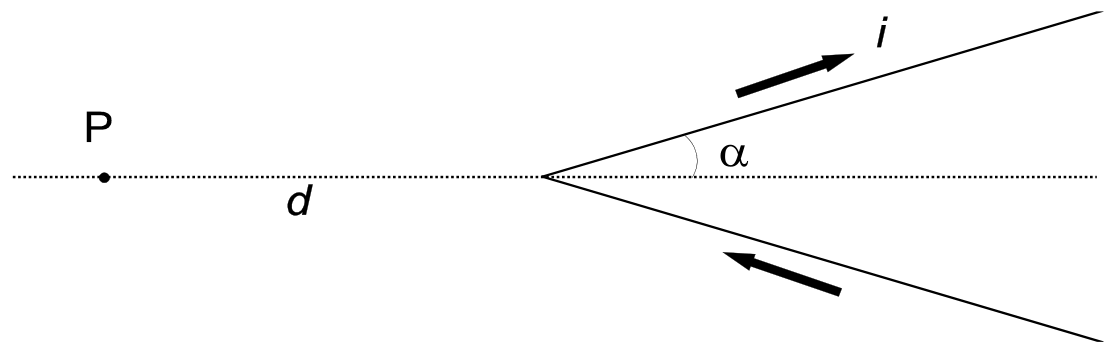
Using our contemporary knowledge of electromagnetism,
-
Find the direction of the field \(\mathbf B\) in P. [1 point]
-
Knowing that the field is proportional to \(\tan\left(\frac{\alpha}{2}\right)\), find the proportionality factor \(k\) in \[ |\mathbf B(\mathrm P)|=k\tan\left(\frac{\alpha}{2}\right). \] [1.5 points]
-
Compute the field \(\mathbf B\) in a point \(\mathrm P^*\) symmetric to P with respect to the vertex, i.e. along the axis and at the same distance \(d\), but inside the "V" (see figure). [2 points]
¹ Throughout this problem \(\alpha\) is expressed in radians
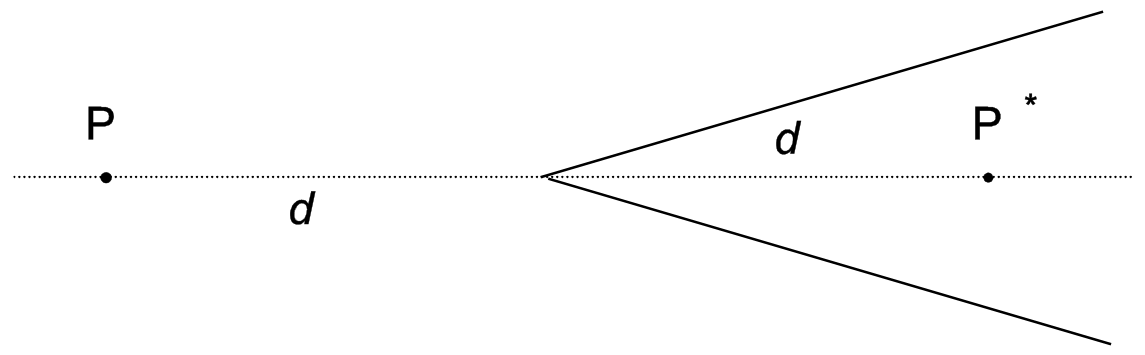
- In order to measure the magnetic field, we place in P a small magnetic needle with moment of inertia \(I\) and magnetic dipole moment \(\boldsymbol\mu\); it oscillates around a fixed point in a plane containing the direction of \(\mathbf B\). Compute the period of small oscillations of this needle as a function of \(B\). [2.5 points]
In the same conditions Biot and Savart had instead assumed that the magnetic field in P might have been (we use here the modern notation) \(B(\mathrm P)=\frac{i\mu_0\alpha}{\pi^2d}\), where \(\mu_0\) is the magnetic permeability of vacuum. In fact they attempted to decide with an experiment between the two interpretations (Ampère's and Biot and Savart's) by measuring the oscillation period of the magnetic needle as a function of the "V" span. For some \(\alpha\) values, however, the differences are too small to be easily measurable.
- If, in order to distinguish experimentally between the two predictions for the magnetic needle oscillation period \(T\) in P, we need a difference by at least 10%, namely \(T_1>1.10\,T_2\) (\(T_1\) being the Ampère prediction and \(T_2\) the Biot-Savart prediction) state in which range, approximately, we must choose the "V" half-span \(\alpha\) for being able to decide between the two interpretations. [3 points]
Hint
Depending on which path you follow in your solution, the following trigonometric equation might be useful: \[ \tan\left(\frac{\alpha}{2}\right)=\frac{\sin\alpha}{1+\cos\alpha} \]
Physical constants and general data
In addition to the numerical data given within the text of the individual problems, the knowledge of some general data and physical constants may be useful, and you may find them among the following ones. These are nearly the most accurate data currently available, and they have thus a large number of digits; you are expected, however, to write your results with a number of digits that must be appropriate for each problem.
Speed of light in vacuum: \(c=299792458\ \mathrm{m\cdot s^{-1}}\)
Magnetic permeability of vacuum: \(\mu_0=4\pi\cdot10^{-7}\ \mathrm{H\cdot m^{-1}}\)
Dielectric constant of vacuum: \(\varepsilon_0=8.8541878\ \mathrm{pF\cdot m^{-1}}\)
Gravitational constant: \(G=6.67259\cdot10^{-11}\ \mathrm{m^3/(kg\cdot s^2)}\)
Gas constant: \(R=8.314510\ \mathrm{J/(mol\cdot K)}\)
Boltzmann's constant: \(k=1.380658\cdot10^{-23}\ \mathrm{J\cdot K^{-1}}\)
Stefan's constant: \(\sigma=56.703\ \mathrm{nW/(m^2\cdot K^4)}\)
Proton charge: \(e=1.60217733\cdot10^{-19}\ \mathrm C\)
Electron mass: \(m_e=9.1093897\cdot10^{-31}\ \mathrm{kg}\)
Planck's constant: \(h=6.6260755\cdot10^{-34}\ \mathrm{J\cdot s}\)
Base of centigrade scale: \(T_K=273.15\ \mathrm K\)
Sun mass: \(M_S=1.991\cdot10^{30}\ \mathrm{kg}\)
Earth mass: \(M_E=5.979\cdot10^{24}\ \mathrm{kg}\)
Mean radius of Earth: \(r_E=6.373\ \mathrm{Mm}\)
Major semiaxis of Earth orbit: \(R_E=1.4957\cdot10^{11}\ \mathrm m\)
Sidereal day: \(d_S=86.16406\ \mathrm{ks}\)
Year: \(y=31.558150\ \mathrm{Ms}\)
Standard value of the gravitational field at the Earth surface: \(g=9.80665\ \mathrm{m\cdot s^{-2}}\)
Standard value of the atmospheric pressure at sea level: \(p_0=101325\ \mathrm{Pa}\)
Refractive index of air for visibile light, at standard pressure and \(15\,^\circ\mathrm C\): \(n_{\mathrm{air}}=1.000277\)
Solar constant: \(S=1355\ \mathrm{W\cdot m^{-2}}\)
Jupiter mass: \(M=1.901\cdot10^{27}\ \mathrm{kg}\)
Equatorial Jupiter radius: \(R_B=69.8\ \mathrm{Mm}\)
Mean radius of Jupiter’s orbit: \(R=7.783\cdot10^{11}\ \mathrm m\)
Jovian day: \(d_J=35.6\ \mathrm{ks}\)
Jovian year: \(y_J=374.32\ \mathrm{Ms}\)
\(\pi\): \(3.14159265\)Official English text of the problem.
-
Problem 3: A space probe to Jupiter
We consider in this problem a method frequently used to accelerate space probes in the desired direction. The space probe flies by a planet, and can significantly increase its speed and modify considerably its flight direction, by taking away a very small amount of energy from the planet's orbital motion. We analyze here this effect for a space probe passing near Jupiter.
The planet Jupiter orbits around the Sun along an elliptical trajectory, that can be approximated by a circumference of average radius \(R\); in order to proceed with the analysis of the physical situation we must first:
- Find the speed \(V\) of the planet along its orbit around the Sun. [1.5 points]
- When the probe is between the Sun and Jupiter (on the segment Sun-Jupiter), find the distance from Jupiter where the Sun's gravitational attraction balances that by Jupiter. [1 point]
A space probe of mass \(m=825\ \mathrm{kg}\) flies by Jupiter. For simplicity assume that the trajectory of the space probe is entirely in the plane of Jupiter's orbit; in this way we neglect the important case in which the space probe is expelled from Jupiter’s orbital plane.
We only consider what happens in the region where Jupiter's attraction overwhelms all other gravitational forces.
In the reference frame of the Sun's center of mass the initial speed of the space probe is \(v_0=1.00\cdot10^4\ \mathrm{m/s}\) (along the positive \(y\) direction) while Jupiter's speed is along the negative \(x\) direction (see figure 1); by "initial speed" we mean the space probe speed when it's in the interplanetary space, still far from Jupiter but already in the region where the Sun's attraction is negligible with respect to Jupiter's. We assume that the encounter occurs in a sufficiently short time to allow neglecting the change of direction of Jupiter along its orbit around the Sun. We also assume that the probe passes behind Jupiter, i.e. the \(x\) coordinate is greater for the probe than for Jupiter when the \(y\) coordinate is the same.
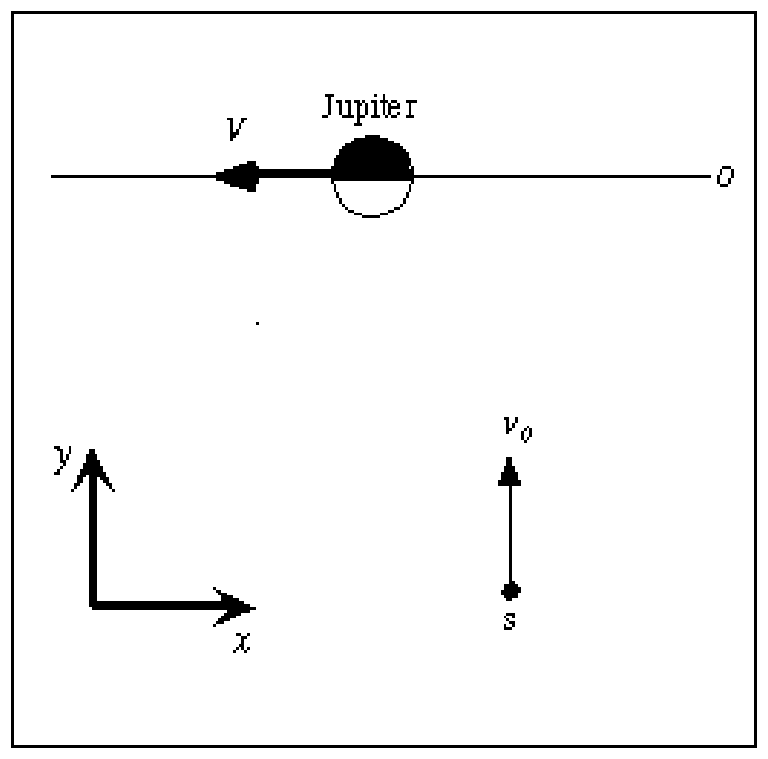
Figure 1: View in the Sun center of mass system. O denotes Jupiter’s orbit, s is the space probe.
- Find the space probe's direction of motion (as the angle \(\varphi\) between its direction and the \(x\) axis) and its speed \(v'\) in Jupiter's reference frame, when it's still far away from Jupiter. [2 points]
- Find the value of the space probe's total mechanical energy \(E\) in Jupiter's reference frame, putting – as usual – equal to zero the value of its potential energy at a very large distance, in this case when it is far enough to move with almost constant velocity owing to the smallness of all gravitational interactions. [1 point]
The space probe's trajectory in the reference frame of Jupiter is a hyperbola and its equation in polar coordinates in this reference frame is
\[ \frac{1}{r} = \frac{GM}{v'^2b^2} \left( 1+\sqrt{1+\frac{2Ev'^2b^2}{G^2M^2m}}\cos\theta \right). \tag{1} \]
where \(b\) is the distance between one of the asymptotes and Jupiter (the so called impact parameter), \(E\) is the probe’s total mechanical energy in Jupiter’s reference frame, \(G\) is the gravitational constant, \(M\) is the mass of Jupiter, \(r\) and \(\theta\) are the polar coordinates (the radial distance and the polar angle).
Figure 2 shows the two branches of a hyperbola as described by equation (1); the asymptotes and the polar co-ordinates are also shown. Note that equation (1) has its origin in the "attractive focus" of the hyperbola. The space probe's trajectory is the attractive trajectory (the emphasized branch).
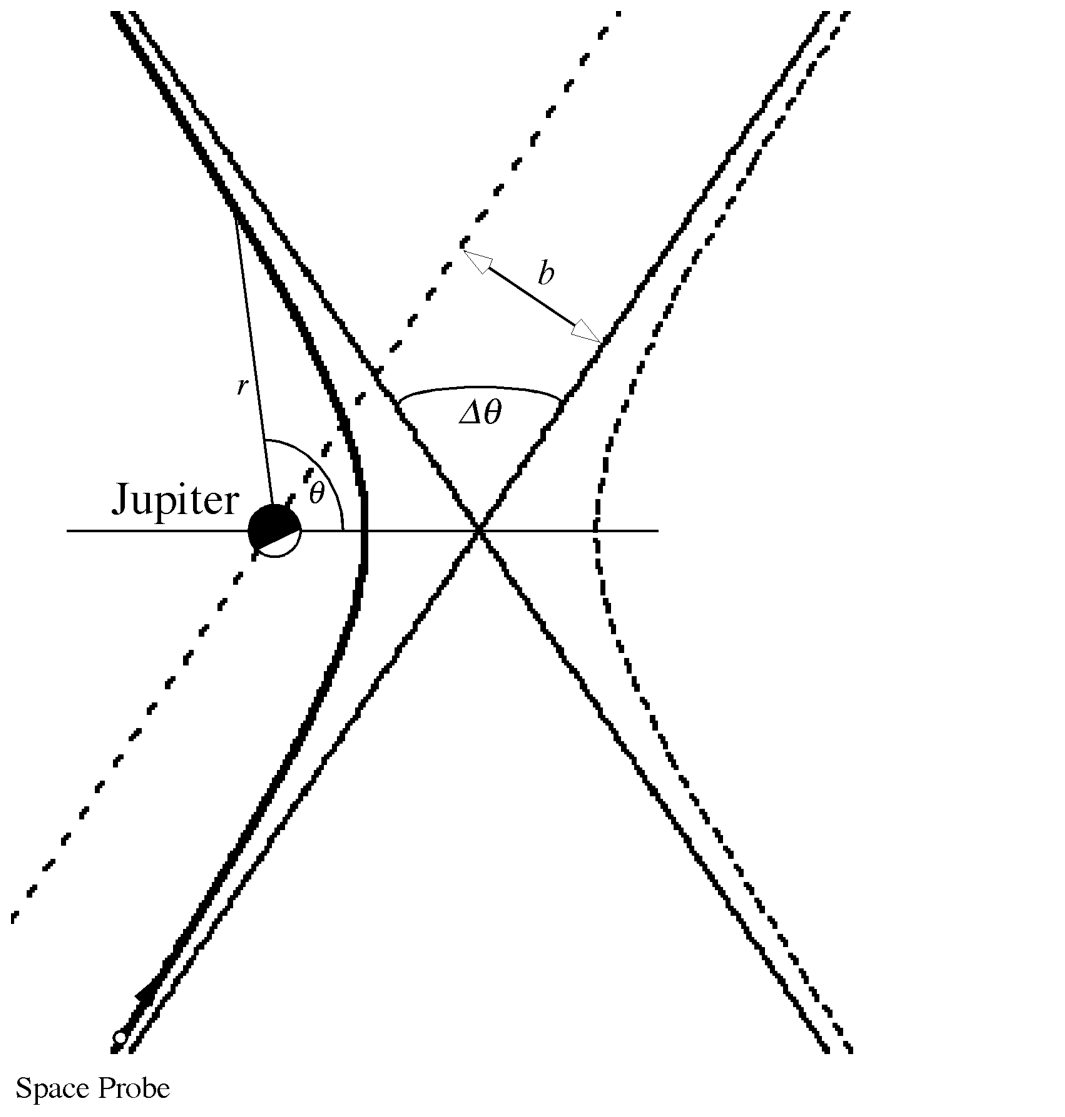
Figure 2
- Using equation (1) describing the space probe's trajectory, find the total angular deviation \(\Delta\theta\) in Jupiter’s reference frame (as shown in figure 2) and express it as a function of initial speed \(v'\) and impact parameter \(b\). [2 points]
- Assume that the probe cannot pass Jupiter at a distance less than three Jupiter radii from the center of the planet; find the minimum possible impact parameter and the maximum possible angular deviation. [1 point]
- Find an equation for the final speed \(v''\) of the probe in the Sun's reference frame as a function only of Jupiter’s speed \(V\), the probe’s initial speed \(v_0\) and the deviation angle \(\Delta\theta\). [1 point]
- Use the previous result to find the numerical value of the final speed \(v''\) in the Sun's reference frame when the angular deviation has its maximum possible value. [0.5 points]
Hint
Depending on which path you follow in your solution, the following trigonometric formulas might be useful:
\[ \sin(\alpha+\beta)=\sin\alpha\cos\beta+\cos\alpha\sin\beta \]
\[ \cos(\alpha+\beta)=\cos\alpha\cos\beta-\sin\alpha\sin\beta \]
Physical constants and general data
In addition to the numerical data given within the text of the individual problems, the knowledge of some general data and physical constants may be useful, and you may find them among the following ones. These are nearly the most accurate data currently available, and they have thus a large number of digits; you are expected, however, to write your results with a number of digits that must be appropriate for each problem.
Speed of light in vacuum: \(c=299792458\ \mathrm{m\cdot s^{-1}}\) Magnetic permeability of vacuum: \(\mu_0=4\pi\cdot10^{-7}\ \mathrm{H\cdot m^{-1}}\) Dielectric constant of vacuum: \(\varepsilon_0=8.8541878\ \mathrm{pF\cdot m^{-1}}\) Gravitational constant: \(G=6.67259\cdot10^{-11}\ \mathrm{m^3/(kg\cdot s^2)}\) Gas constant: \(R=8.314510\ \mathrm{J/(mol\cdot K)}\) Boltzmann's constant: \(k=1.380658\cdot10^{-23}\ \mathrm{J\cdot K^{-1}}\) Stefan's constant: \(\sigma=56.703\ \mathrm{nW/(m^2\cdot K^4)}\) Proton charge: \(e=1.60217733\cdot10^{-19}\ \mathrm{C}\) Electron mass: \(m_e=9.1093897\cdot10^{-31}\ \mathrm{kg}\) Planck's constant: \(h=6.6260755\cdot10^{-34}\ \mathrm{J\cdot s}\) Base of centigrade scale: \(T_{\mathrm K}=273.15\ \mathrm{K}\) Sun mass: \(M_{\mathrm S}=1.991\cdot10^{30}\ \mathrm{kg}\) Earth mass: \(M_{\mathrm E}=5.979\cdot10^{24}\ \mathrm{kg}\) Mean radius of Earth: \(r_{\mathrm E}=6.373\ \mathrm{Mm}\) Major semiaxis of Earth orbit: \(R_{\mathrm E}=1.4957\cdot10^{11}\ \mathrm{m}\) Sidereal day: \(d_{\mathrm S}=86.16406\ \mathrm{ks}\) Year: \(y=31.558150\ \mathrm{Ms}\) Standard value of the gravitational field at the Earth surface: \(g=9.80665\ \mathrm{m\cdot s^{-2}}\) Standard value of the atmospheric pressure at sea level: \(p_0=101325\ \mathrm{Pa}\) Refractive index of air for visibile light, at standard pressure and \(15\,^\circ\mathrm C\): \(n_{\mathrm{air}}=1.000277\) Solar constant: \(S=1355\ \mathrm{W\cdot m^{-2}}\) Jupiter mass: \(M=1.901\cdot10^{27}\ \mathrm{kg}\) Equatorial Jupiter radius: \(R_{\mathrm B}=69.8\ \mathrm{Mm}\) Average radius of Jupiter’s orbit: \(R=7.783\cdot10^{11}\ \mathrm{m}\) Jovian day: \(d_{\mathrm J}=35.6\ \mathrm{ks}\) Jovian year: \(y_{\mathrm J}=374.32\ \mathrm{Ms}\) \(\pi\): \(3.14159265\) Official English text of the problem.
Internationale Physik-Olympiade
IPhO 1999
Padua, Italien · 3 Theorieaufgaben mit vollständigen Lösungen
Aufgabe 1: Absorption von Strahlung durch ein Gas
Ein zylindrisches Gefäß mit vertikaler Achse enthält ein molekulares Gas im thermodynamischen Gleichgewicht. Die obere Grundfläche des Zylinders besteht aus einer frei verschiebbaren Glasplatte; wir nehmen an, dass kein Gas entweicht und die Reibung zwischen der Glasplatte und den Zylinderwänden gerade ausreicht, um Schwingungen zu dämpfen, aber im Vergleich zu den anderen beteiligten Energien keinen nennenswerten Energieverlust verursacht. Anfangs ist die Temperatur des Gases gleich der Umgebungstemperatur. Das Gas kann in guter Näherung als ideal betrachtet werden. Wir nehmen an, dass die Zylinderwände (einschließlich der Grundflächen) eine sehr geringe Wärmeleitfähigkeit und Wärmekapazität haben, sodass der Wärmeaustausch zwischen Gas und Umgebung sehr langsam erfolgt und bei der Lösung dieser Aufgabe vernachlässigt werden kann.
Durch die Glasplatte senden wir das Licht eines Lasers mit konstanter Leistung in den Zylinder; diese Strahlung wird von Luft und Glas gut durchgelassen, vom Gas im Gefäß jedoch vollständig absorbiert. Durch die Absorption dieser Strahlung gelangen die Moleküle in angeregte Zustände, aus denen sie unter rascher Emission von Infrarotstrahlung schrittweise in den molekularen Grundzustand zurückkehren; diese Infrarotstrahlung wird jedoch wiederum von anderen Molekülen absorbiert und von den Gefäßwänden einschließlich der Glasplatte reflektiert. Die vom Laser absorbierte Energie wird daher in sehr kurzer Zeit in thermische Bewegung (ungeordnete Molekülbewegung) umgewandelt und verbleibt anschließend hinreichend lange im Gas.
Wir beobachten, dass sich die Glasplatte nach oben bewegt; nach einer bestimmten Bestrahlungsdauer schalten wir den Laser aus und messen diese Verschiebung.
- Berechnen Sie anhand der nachstehenden Daten und – falls erforderlich – der Angaben auf dem Blatt mit den physikalischen Konstanten die Temperatur und den Druck des Gases nach der Bestrahlung. [2 Punkte]
- Berechnen Sie die mechanische Arbeit, die das Gas infolge der Strahlungsabsorption verrichtet. [1 Punkt]
- Berechnen Sie die während der Bestrahlung absorbierte Strahlungsenergie. [2 Punkte]
- Berechnen Sie die vom Laser ausgesandte und vom Gas absorbierte Leistung sowie die entsprechende Anzahl von Photonen (und damit von elementaren Absorptionsvorgängen) pro Zeiteinheit. [1.5 Punkte]
- Berechnen Sie den Wirkungsgrad der Umwandlung optischer Energie in eine Änderung der mechanischen potenziellen Energie der Glasplatte. [1 Punkt]
Anschließend wird die Zylinderachse langsam um 90° gedreht, sodass sie horizontal liegt. Der Wärmeaustausch zwischen Gas und Gefäß kann weiterhin vernachlässigt werden.
- Geben Sie an, ob sich der Druck und/oder die Temperatur des Gases infolge dieser Drehung ändern, und bestimmen Sie gegebenenfalls den jeweiligen neuen Wert. [2.5 Punkte]
Daten
Umgebungsdruck: \(p_0 = 101.3\ \mathrm{kPa}\)
Umgebungstemperatur: \(T_0 = 20.0^\circ\mathrm{C}\)
Innendurchmesser des Zylinders: \(2r = 100\ \mathrm{mm}\)
Masse der Glasplatte: \(m = 800\ \mathrm{g}\)
Stoffmenge des Gases im Gefäß: \(n = 0.100\ \mathrm{mol}\)
Molare Wärmekapazität des Gases bei konstantem Volumen: \(c_V = 20.8\ \mathrm{J/(mol\cdot K)}\)
Emissionswellenlänge des Lasers: \(\lambda = 514\ \mathrm{nm}\)
Bestrahlungsdauer: \(\Delta t = 10.0\ \mathrm{s}\)
Verschiebung der beweglichen Platte nach der Bestrahlung: \(\Delta s = 30.0\ \mathrm{mm}\)Physikalische Konstanten und allgemeine Daten
Zusätzlich zu den im Text der einzelnen Aufgaben angegebenen Zahlenwerten kann die Kenntnis einiger allgemeiner Daten und physikalischer Konstanten nützlich sein; diese finden Sie in der folgenden Zusammenstellung. Es handelt sich um nahezu die genauesten derzeit verfügbaren Werte, weshalb sie eine große Anzahl von Ziffern aufweisen; Ihre Ergebnisse sollen Sie jedoch mit einer der jeweiligen Aufgabe angemessenen Anzahl von Ziffern angeben.
Lichtgeschwindigkeit im Vakuum: \(c = 299792458\ \mathrm{m\cdot s^{-1}}\)
Magnetische Permeabilität des Vakuums: \(\mu_0 = 4\pi\cdot10^{-7}\ \mathrm{H\cdot m^{-1}}\)
Elektrische Permittivität des Vakuums: \(\varepsilon_0 = 8.8541878\ \mathrm{pF\cdot m^{-1}}\)
Gravitationskonstante: \(G = 6.67259\cdot10^{-11}\ \mathrm{m^3/(kg\cdot s^2)}\)
Gaskonstante: \(R = 8.314510\ \mathrm{J/(mol\cdot K)}\)
Boltzmann-Konstante: \(k = 1.380658\cdot10^{-23}\ \mathrm{J\cdot K^{-1}}\)
Stefan-Boltzmann-Konstante: \(\sigma = 56.703\ \mathrm{nW/(m^2\cdot K^4)}\)
Protonenladung: \(e = 1.60217733\cdot10^{-19}\ \mathrm{C}\)
Elektronenmasse: \(m_e = 9.1093897\cdot10^{-31}\ \mathrm{kg}\)
Plancksches Wirkungsquantum: \(h = 6.6260755\cdot10^{-34}\ \mathrm{J\cdot s}\)
Nullpunkt der Celsius-Skala: \(T_K = 273.15\ \mathrm{K}\)
Sonnenmasse: \(M_S = 1.991\cdot10^{30}\ \mathrm{kg}\)
Erdmasse: \(M_E = 5.979\cdot10^{24}\ \mathrm{kg}\)
Mittlerer Erdradius: \(r_E = 6.373\ \mathrm{Mm}\)
Große Halbachse der Erdbahn: \(R_E = 1.4957\cdot10^{11}\ \mathrm{m}\)
Siderischer Tag: \(d_S = 86.16406\ \mathrm{ks}\)
Jahr: \(y = 31.558150\ \mathrm{Ms}\)
Normwert der Gravitationsfeldstärke an der Erdoberfläche: \(g = 9.80665\ \mathrm{m\cdot s^{-2}}\)
Normwert des atmosphärischen Drucks auf Meereshöhe: \(p_0 = 101325\ \mathrm{Pa}\)
Brechungsindex von Luft für sichtbares Licht bei Normaldruck und \(15^\circ\mathrm{C}\): \(n_{\mathrm{air}} = 1.000277\)
Solarkonstante: \(S = 1355\ \mathrm{W\cdot m^{-2}}\)
Jupitermasse: \(M = 1.901\cdot10^{27}\ \mathrm{kg}\)
Äquatorradius des Jupiters: \(R_B = 69.8\ \mathrm{Mm}\)
Mittlerer Radius der Jupiterbahn: \(R = 7.783\cdot10^{11}\ \mathrm{m}\)
Jupitertag: \(d_J = 35.6\ \mathrm{ks}\)
Jupiterjahr: \(y_J = 374.32\ \mathrm{Ms}\)
\(\pi\): \(3.14159265\)Aufgabentext aus dem offiziellen englischen Text übersetzt.
Aufgabe 2: Magnetfeld eines V-förmigen Drahtes
Zu den ersten Erfolgen von Ampères Deutung magnetischer Erscheinungen gehört die Berechnung des Magnetfeldes \(\mathbf B\), das von stromdurchflossenen Drähten erzeugt wird, im Vergleich zu den frühen, ursprünglich von Biot und Savart aufgestellten Annahmen.
Ein besonders interessanter Fall ist der eines sehr langen, dünnen Drahtes, der einen konstanten Strom \(i\) führt, aus zwei geradlinigen Abschnitten besteht und mit dem halben Öffnungswinkel¹ \(\alpha\) zu einem „V“ gebogen ist (siehe Abbildung). Nach Ampères Berechnungen ist der Betrag \(B\) des Magnetfeldes in einem gegebenen Punkt P, der auf der Symmetrieachse des „V“ außerhalb desselben und im Abstand \(d\) von seinem Scheitelpunkt liegt, proportional zu \(\tan\left(\frac{\alpha}{2}\right)\). Ampères Arbeit ging später in Maxwells elektromagnetische Theorie ein und ist allgemein anerkannt.
Bestimmen Sie mithilfe unserer heutigen Kenntnisse des Elektromagnetismus Folgendes:
-
Bestimmen Sie die Richtung des Feldes \(\mathbf B\) in P. [1 Punkt]
-
Bestimmen Sie unter Verwendung der Tatsache, dass das Feld proportional zu \(\tan\left(\frac{\alpha}{2}\right)\) ist, den Proportionalitätsfaktor \(k\) in \[ |\mathbf B(\mathrm P)|=k\tan\left(\frac{\alpha}{2}\right). \] [1.5 Punkte]
-
Berechnen Sie das Feld \(\mathbf B\) in einem Punkt \(\mathrm P^*\), der bezüglich des Scheitelpunktes symmetrisch zu P liegt, also auf der Symmetrieachse und im gleichen Abstand \(d\), jedoch innerhalb des „V“ (siehe Abbildung). [2 Punkte]
¹ In dieser gesamten Aufgabe wird \(\alpha\) im Bogenmaß angegeben
- Um das Magnetfeld zu messen, bringen wir in P eine kleine Magnetnadel mit dem Trägheitsmoment \(I\) und dem magnetischen Dipolmoment \(\boldsymbol\mu\) an; sie schwingt um einen festen Punkt in einer Ebene, die die Richtung von \(\mathbf B\) enthält. Berechnen Sie die Periodendauer kleiner Schwingungen dieser Nadel als Funktion von \(B\). [2.5 Punkte]
Unter denselben Bedingungen hatten Biot und Savart stattdessen angenommen, dass das Magnetfeld in P durch \(B(\mathrm P)=\frac{i\mu_0\alpha}{\pi^2d}\) gegeben sein könnte (hier verwenden wir die moderne Schreibweise), wobei \(\mu_0\) die magnetische Permeabilität des Vakuums ist. Tatsächlich versuchten sie, durch ein Experiment zwischen den beiden Deutungen (derjenigen von Ampère und derjenigen von Biot und Savart) zu entscheiden, indem sie die Schwingungsdauer der Magnetnadel als Funktion des Öffnungswinkels des „V“ maßen. Für manche Werte von \(\alpha\) sind die Unterschiede jedoch zu gering, um leicht messbar zu sein.
- Um experimentell zwischen den beiden Vorhersagen für die Schwingungsdauer \(T\) der Magnetnadel in P unterscheiden zu können, benötigen wir einen Unterschied von mindestens 10%, nämlich \(T_1>1.10\,T_2\) (wobei \(T_1\) die Vorhersage von Ampère und \(T_2\) diejenige von Biot und Savart ist). Geben Sie an, in welchem Bereich wir den halben Öffnungswinkel \(\alpha\) des „V“ näherungsweise wählen müssen, um zwischen den beiden Deutungen entscheiden zu können. [3 Punkte]
Hinweis
Je nachdem, welchen Lösungsweg Sie wählen, könnte die folgende trigonometrische Gleichung nützlich sein: \[ \tan\left(\frac{\alpha}{2}\right)=\frac{\sin\alpha}{1+\cos\alpha} \]
Physikalische Konstanten und allgemeine Daten
Zusätzlich zu den im Text der einzelnen Aufgaben angegebenen Zahlenwerten kann die Kenntnis einiger allgemeiner Daten und physikalischer Konstanten nützlich sein; diese finden Sie in der folgenden Zusammenstellung. Dies sind nahezu die genauesten derzeit verfügbaren Daten, weshalb sie viele Ziffern aufweisen; von Ihnen wird jedoch erwartet, dass Sie Ihre Ergebnisse mit einer für die jeweilige Aufgabe angemessenen Anzahl von Ziffern angeben.
Lichtgeschwindigkeit im Vakuum: \(c=299792458\ \mathrm{m\cdot s^{-1}}\)
Magnetische Permeabilität des Vakuums: \(\mu_0=4\pi\cdot10^{-7}\ \mathrm{H\cdot m^{-1}}\)
Dielektrizitätskonstante des Vakuums: \(\varepsilon_0=8.8541878\ \mathrm{pF\cdot m^{-1}}\)
Gravitationskonstante: \(G=6.67259\cdot10^{-11}\ \mathrm{m^3/(kg\cdot s^2)}\)
Gaskonstante: \(R=8.314510\ \mathrm{J/(mol\cdot K)}\)
Boltzmann-Konstante: \(k=1.380658\cdot10^{-23}\ \mathrm{J\cdot K^{-1}}\)
Stefan-Boltzmann-Konstante: \(\sigma=56.703\ \mathrm{nW/(m^2\cdot K^4)}\)
Protonenladung: \(e=1.60217733\cdot10^{-19}\ \mathrm C\)
Elektronenmasse: \(m_e=9.1093897\cdot10^{-31}\ \mathrm{kg}\)
Plancksches Wirkungsquantum: \(h=6.6260755\cdot10^{-34}\ \mathrm{J\cdot s}\)
Nullpunkt der Celsius-Skala: \(T_K=273.15\ \mathrm K\)
Sonnenmasse: \(M_S=1.991\cdot10^{30}\ \mathrm{kg}\)
Erdmasse: \(M_E=5.979\cdot10^{24}\ \mathrm{kg}\)
Mittlerer Erdradius: \(r_E=6.373\ \mathrm{Mm}\)
Große Halbachse der Erdbahn: \(R_E=1.4957\cdot10^{11}\ \mathrm m\)
Sterntag: \(d_S=86.16406\ \mathrm{ks}\)
Jahr: \(y=31.558150\ \mathrm{Ms}\)
Normwert der Schwerebeschleunigung an der Erdoberfläche: \(g=9.80665\ \mathrm{m\cdot s^{-2}}\)
Normwert des Luftdrucks auf Meereshöhe: \(p_0=101325\ \mathrm{Pa}\)
Brechungsindex von Luft für sichtbares Licht bei Normaldruck und \(15\,^\circ\mathrm C\): \(n_{\mathrm{air}}=1.000277\)
Solarkonstante: \(S=1355\ \mathrm{W\cdot m^{-2}}\)
Jupitermasse: \(M=1.901\cdot10^{27}\ \mathrm{kg}\)
Äquatorradius des Jupiters: \(R_B=69.8\ \mathrm{Mm}\)
Mittlerer Radius der Jupiterbahn: \(R=7.783\cdot10^{11}\ \mathrm m\)
Jupitertag: \(d_J=35.6\ \mathrm{ks}\)
Jupiterjahr: \(y_J=374.32\ \mathrm{Ms}\)
\(\pi\): \(3.14159265\)Aufgabentext aus dem offiziellen englischen Text übersetzt.
-
Aufgabe 3: Eine Raumsonde zum Jupiter
In dieser Aufgabe betrachten wir eine häufig verwendete Methode, um Raumsonden in die gewünschte Richtung zu beschleunigen. Die Raumsonde fliegt an einem Planeten vorbei und kann dabei ihre Geschwindigkeit erheblich erhöhen und ihre Flugrichtung beträchtlich ändern, indem sie der Bahnbewegung des Planeten eine sehr kleine Energiemenge entzieht. Wir untersuchen diesen Effekt hier für eine Raumsonde, die nahe am Jupiter vorbeifliegt.
Der Planet Jupiter umkreist die Sonne auf einer elliptischen Bahn, die durch einen Kreis mit dem mittleren Radius \(R\) angenähert werden kann; um die physikalische Situation analysieren zu können, müssen wir zunächst:
- Bestimmen Sie die Geschwindigkeit \(V\) des Planeten auf seiner Bahn um die Sonne. [1.5 Punkte]
- Bestimmen Sie für eine Sonde zwischen Sonne und Jupiter (auf der Strecke Sonne–Jupiter) den Abstand vom Jupiter, bei dem die Gravitationskraft der Sonne die des Jupiters ausgleicht. [1 Punkt]
Eine Raumsonde der Masse \(m=825\ \mathrm{kg}\) fliegt am Jupiter vorbei. Nehmen Sie der Einfachheit halber an, dass die Bahn der Raumsonde vollständig in der Bahnebene des Jupiters liegt; damit vernachlässigen wir den wichtigen Fall, in dem die Raumsonde aus der Bahnebene des Jupiters herausgeschleudert wird.
Wir betrachten nur die Vorgänge in dem Gebiet, in dem die Anziehungskraft des Jupiters alle anderen Gravitationskräfte bei Weitem überwiegt.
Im Bezugssystem des Schwerpunkts der Sonne beträgt die Anfangsgeschwindigkeit der Raumsonde \(v_0=1.00\cdot10^4\ \mathrm{m/s}\) (in positiver \(y\)-Richtung), während die Geschwindigkeit des Jupiters in negative \(x\)-Richtung weist (siehe Abbildung 1); mit „Anfangsgeschwindigkeit“ meinen wir die Geschwindigkeit der Raumsonde im interplanetaren Raum, wenn sie noch weit vom Jupiter entfernt ist, sich aber bereits in dem Gebiet befindet, in dem die Anziehungskraft der Sonne gegenüber der des Jupiters vernachlässigbar ist. Wir nehmen an, dass die Begegnung in einer hinreichend kurzen Zeit stattfindet, sodass die Richtungsänderung des Jupiters auf seiner Bahn um die Sonne vernachlässigt werden kann. Außerdem nehmen wir an, dass die Sonde hinter dem Jupiter vorbeifliegt, d. h., bei gleicher \(y\)-Koordinate ist die \(x\)-Koordinate der Sonde größer als die des Jupiters.
Abbildung 1: Ansicht im Schwerpunktsystem der Sonne. O bezeichnet die Bahn des Jupiters, s die Raumsonde.
- Bestimmen Sie die Bewegungsrichtung der Raumsonde (als Winkel \(\varphi\) zwischen ihrer Bewegungsrichtung und der \(x\)-Achse) und ihre Geschwindigkeit \(v'\) im Bezugssystem des Jupiters, wenn sie noch weit vom Jupiter entfernt ist. [2 Punkte]
- Bestimmen Sie den Wert der gesamten mechanischen Energie \(E\) der Raumsonde im Bezugssystem des Jupiters, wobei – wie üblich – ihre potenzielle Energie in sehr großer Entfernung gleich null gesetzt wird; hier bedeutet dies eine Entfernung, in der sie sich aufgrund der geringen Stärke aller gravitativen Wechselwirkungen mit nahezu konstanter Geschwindigkeit bewegt. [1 Punkt]
Die Bahn der Raumsonde im Bezugssystem des Jupiters ist eine Hyperbel, deren Gleichung in Polarkoordinaten in diesem Bezugssystem lautet:
\[ \frac{1}{r} = \frac{GM}{v'^2b^2} \left( 1+\sqrt{1+\frac{2Ev'^2b^2}{G^2M^2m}}\cos\theta \right). \tag{1} \]
Dabei ist \(b\) der Abstand zwischen einer der Asymptoten und dem Jupiter (der sogenannte Stoßparameter), \(E\) die gesamte mechanische Energie der Sonde im Bezugssystem des Jupiters, \(G\) die Gravitationskonstante, \(M\) die Masse des Jupiters und \(r\) und \(\theta\) die Polarkoordinaten (der radiale Abstand und der Polarwinkel).
Abbildung 2 zeigt die beiden Äste einer Hyperbel, wie sie durch Gleichung (1) beschrieben wird; auch die Asymptoten und die Polarkoordinaten sind eingezeichnet. Beachten Sie, dass der Ursprung von Gleichung (1) im „anziehenden Brennpunkt“ der Hyperbel liegt. Die Bahn der Raumsonde ist die Bahn für eine anziehende Kraft (der hervorgehobene Ast).
Abbildung 2
- Bestimmen Sie mithilfe von Gleichung (1), die die Bahn der Raumsonde beschreibt, den gesamten Ablenkwinkel \(\Delta\theta\) im Bezugssystem des Jupiters (wie in Abbildung 2 dargestellt) und drücken Sie ihn als Funktion der Anfangsgeschwindigkeit \(v'\) und des Stoßparameters \(b\) aus. [2 Punkte]
- Nehmen Sie an, dass die Sonde den Jupiter nicht in einem Abstand von weniger als drei Jupiterradien vom Mittelpunkt des Planeten passieren darf; bestimmen Sie den kleinstmöglichen Stoßparameter und den größtmöglichen Ablenkwinkel. [1 Punkt]
- Bestimmen Sie eine Gleichung für die Endgeschwindigkeit \(v''\) der Sonde im Bezugssystem der Sonne, die nur von der Geschwindigkeit \(V\) des Jupiters, der Anfangsgeschwindigkeit \(v_0\) der Sonde und dem Ablenkwinkel \(\Delta\theta\) abhängt. [1 Punkt]
- Bestimmen Sie mithilfe des vorherigen Ergebnisses den Zahlenwert der Endgeschwindigkeit \(v''\) im Bezugssystem der Sonne, wenn der Ablenkwinkel seinen größtmöglichen Wert hat. [0.5 Punkte]
Hinweis
Je nach gewähltem Lösungsweg können die folgenden trigonometrischen Formeln hilfreich sein:
\[ \sin(\alpha+\beta)=\sin\alpha\cos\beta+\cos\alpha\sin\beta \]
\[ \cos(\alpha+\beta)=\cos\alpha\cos\beta-\sin\alpha\sin\beta \]
Physikalische Konstanten und allgemeine Daten
Zusätzlich zu den Zahlenangaben im Text der einzelnen Aufgaben kann die Kenntnis einiger allgemeiner Daten und physikalischer Konstanten hilfreich sein; diese finden Sie in der folgenden Zusammenstellung. Diese Daten gehören zu den genauesten derzeit verfügbaren und enthalten daher viele Ziffern; es wird jedoch erwartet, dass Sie Ihre Ergebnisse mit einer für die jeweilige Aufgabe angemessenen Anzahl von Ziffern angeben.
Lichtgeschwindigkeit im Vakuum: \(c=299792458\ \mathrm{m\cdot s^{-1}}\) Magnetische Permeabilität des Vakuums: \(\mu_0=4\pi\cdot10^{-7}\ \mathrm{H\cdot m^{-1}}\) Elektrische Permittivität des Vakuums: \(\varepsilon_0=8.8541878\ \mathrm{pF\cdot m^{-1}}\) Gravitationskonstante: \(G=6.67259\cdot10^{-11}\ \mathrm{m^3/(kg\cdot s^2)}\) Gaskonstante: \(R=8.314510\ \mathrm{J/(mol\cdot K)}\) Boltzmann-Konstante: \(k=1.380658\cdot10^{-23}\ \mathrm{J\cdot K^{-1}}\) Stefan-Boltzmann-Konstante: \(\sigma=56.703\ \mathrm{nW/(m^2\cdot K^4)}\) Protonenladung: \(e=1.60217733\cdot10^{-19}\ \mathrm{C}\) Elektronenmasse: \(m_e=9.1093897\cdot10^{-31}\ \mathrm{kg}\) Planck-Konstante: \(h=6.6260755\cdot10^{-34}\ \mathrm{J\cdot s}\) Nullpunkt der Celsius-Skala: \(T_{\mathrm K}=273.15\ \mathrm{K}\) Sonnenmasse: \(M_{\mathrm S}=1.991\cdot10^{30}\ \mathrm{kg}\) Erdmasse: \(M_{\mathrm E}=5.979\cdot10^{24}\ \mathrm{kg}\) Mittlerer Erdradius: \(r_{\mathrm E}=6.373\ \mathrm{Mm}\) Große Halbachse der Erdbahn: \(R_{\mathrm E}=1.4957\cdot10^{11}\ \mathrm{m}\) Siderischer Tag: \(d_{\mathrm S}=86.16406\ \mathrm{ks}\) Jahr: \(y=31.558150\ \mathrm{Ms}\) Normwert der Gravitationsfeldstärke an der Erdoberfläche: \(g=9.80665\ \mathrm{m\cdot s^{-2}}\) Normwert des Luftdrucks auf Meereshöhe: \(p_0=101325\ \mathrm{Pa}\) Brechungsindex von Luft für sichtbares Licht bei Normaldruck und \(15\,^\circ\mathrm C\): \(n_{\mathrm{air}}=1.000277\) Solarkonstante: \(S=1355\ \mathrm{W\cdot m^{-2}}\) Jupitermasse: \(M=1.901\cdot10^{27}\ \mathrm{kg}\) Äquatorradius des Jupiters: \(R_{\mathrm B}=69.8\ \mathrm{Mm}\) Mittlerer Radius der Jupiterbahn: \(R=7.783\cdot10^{11}\ \mathrm{m}\) Jupitertag: \(d_{\mathrm J}=35.6\ \mathrm{ks}\) Jupiterjahr: \(y_{\mathrm J}=374.32\ \mathrm{Ms}\) \(\pi\): \(3.14159265\) Aufgabentext aus dem offiziellen englischen Text übersetzt.
Uluslararası Fizik Olimpiyatı
IPhO 1999
Padova, İtalya · 3 teori sorusu, tam çözümleriyle
Soru 1: Işınımın bir gaz tarafından soğurulması
Ekseni düşey olan silindirik bir kap, termodinamik dengede bulunan moleküler bir gaz içermektedir. Silindirin üst tabanı serbestçe hareket edebilen bir cam levhadan yapılmıştır; gaz sızıntısı olmadığını ve cam levha ile silindirin duvarları arasındaki sürtünmenin salınımları sönümlemeye yetecek kadar olduğunu, ancak söz konusu diğer enerjilere kıyasla kayda değer bir enerji kaybına yol açmadığını varsayalım. Başlangıçta gazın sıcaklığı, çevresindeki ortamın sıcaklığına eşittir. Gaz, iyi bir yaklaşıklıkla ideal kabul edilebilir. Silindirin duvarlarının (tabanlar dâhil) ısıl iletkenliğinin ve ısı kapasitesinin çok düşük olduğunu, dolayısıyla gaz ile ortam arasındaki ısı aktarımının çok yavaş gerçekleştiğini ve bu sorunun çözümünde ihmal edilebileceğini varsayalım.
Sabit güçlü bir lazerin yaydığı ışığı cam levhadan geçirerek silindirin içine gönderiyoruz; bu ışınım hava ve camdan kolayca geçmekte, ancak kabın içindeki gaz tarafından tamamen soğurulmaktadır. Bu ışınımı soğuran moleküller uyarılmış durumlara geçer; bu durumlarda hızla kızılötesi ışınım yayarak basamaklar hâlinde moleküler temel duruma dönerler. Ancak bu kızılötesi ışınım, başka moleküller tarafından yeniden soğurulur ve cam levha da dâhil olmak üzere kabın duvarlarından yansır. Dolayısıyla lazerden soğurulan enerji çok kısa bir sürede ısıl harekete (moleküler kaosa) aktarılır ve ardından yeterince uzun bir süre gazın içinde kalır.
Cam levhanın yukarı doğru hareket ettiğini gözlemliyoruz; belirli bir ışınlama süresinin ardından lazeri kapatıyor ve bu yer değiştirmeyi ölçüyoruz.
- Aşağıdaki verileri ve gerekirse fiziksel sabitler sayfasındaki verileri kullanarak ışınlama sonrasında gazın sıcaklığını ve basıncını hesaplayınız. [2 puan]
- Işınımın soğurulması sonucunda gazın yaptığı mekanik işi hesaplayınız. [1 puan]
- Işınlama sırasında soğurulan ışınım enerjisini hesaplayınız. [2 puan]
- Lazerin yaydığı gücün gaz tarafından soğurulan kısmını ve buna karşılık gelen birim zamandaki foton sayısını (dolayısıyla temel soğurma süreçlerinin sayısını) hesaplayınız. [1.5 puan]
- Optik enerjinin cam levhanın mekanik potansiyel enerjisindeki değişime dönüştürülmesi sürecinin verimini hesaplayınız. [1 puan]
Ardından silindirin ekseni yavaşça 90° döndürülerek yatay doğrultuya getirilir. Gaz ile kap arasındaki ısı alışverişi yine ihmal edilebilir.
- Böyle bir döndürme sonucunda gazın basıncının ve/veya sıcaklığının değişip değişmediğini ve değişiyorsa yeni değerinin/değerlerinin ne olduğunu belirtiniz. [2.5 puan]
Veriler
Ortam basıncı: \(p_0 = 101.3\ \mathrm{kPa}\)
Ortam sıcaklığı: \(T_0 = 20.0^\circ\mathrm{C}\)
Silindirin iç çapı: \(2r = 100\ \mathrm{mm}\)
Cam levhanın kütlesi: \(m = 800\ \mathrm{g}\)
Kap içindeki gazın madde miktarı: \(n = 0.100\ \mathrm{mol}\)
Gazın sabit hacimdeki molar ısı kapasitesi: \(c_V = 20.8\ \mathrm{J/(mol\cdot K)}\)
Lazerin yaydığı ışığın dalga boyu: \(\lambda = 514\ \mathrm{nm}\)
Işınlama süresi: \(\Delta t = 10.0\ \mathrm{s}\)
Hareketli levhanın ışınlama sonrasındaki yer değiştirmesi: \(\Delta s = 30.0\ \mathrm{mm}\)Fiziksel sabitler ve genel veriler
Her bir sorunun metninde verilen sayısal verilere ek olarak, bazı genel verilerin ve fiziksel sabitlerin bilinmesi yararlı olabilir; bunları aşağıda bulabilirsiniz. Bunlar günümüzde mevcut olan en hassas verilere yakın olduklarından çok sayıda basamakla verilmiştir; ancak sonuçlarınızı her soruya uygun sayıda basamakla yazmanız beklenmektedir.
Işığın boşluktaki hızı: \(c = 299792458\ \mathrm{m\cdot s^{-1}}\)
Boşluğun manyetik geçirgenliği: \(\mu_0 = 4\pi\cdot10^{-7}\ \mathrm{H\cdot m^{-1}}\)
Boşluğun dielektrik sabiti: \(\varepsilon_0 = 8.8541878\ \mathrm{pF\cdot m^{-1}}\)
Kütleçekim sabiti: \(G = 6.67259\cdot10^{-11}\ \mathrm{m^3/(kg\cdot s^2)}\)
Gaz sabiti: \(R = 8.314510\ \mathrm{J/(mol\cdot K)}\)
Boltzmann sabiti: \(k = 1.380658\cdot10^{-23}\ \mathrm{J\cdot K^{-1}}\)
Stefan sabiti: \(\sigma = 56.703\ \mathrm{nW/(m^2\cdot K^4)}\)
Protonun yükü: \(e = 1.60217733\cdot10^{-19}\ \mathrm{C}\)
Elektronun kütlesi: \(m_e = 9.1093897\cdot10^{-31}\ \mathrm{kg}\)
Planck sabiti: \(h = 6.6260755\cdot10^{-34}\ \mathrm{J\cdot s}\)
Santigrat ölçeğinin sıfır noktasının mutlak sıcaklığı: \(T_K = 273.15\ \mathrm{K}\)
Güneş'in kütlesi: \(M_S = 1.991\cdot10^{30}\ \mathrm{kg}\)
Dünya'nın kütlesi: \(M_E = 5.979\cdot10^{24}\ \mathrm{kg}\)
Dünya'nın ortalama yarıçapı: \(r_E = 6.373\ \mathrm{Mm}\)
Dünya'nın yörüngesinin büyük yarı ekseni: \(R_E = 1.4957\cdot10^{11}\ \mathrm{m}\)
Yıldız günü: \(d_S = 86.16406\ \mathrm{ks}\)
Yıl: \(y = 31.558150\ \mathrm{Ms}\)
Dünya yüzeyindeki yerçekimi alanının standart değeri: \(g = 9.80665\ \mathrm{m\cdot s^{-2}}\)
Deniz seviyesindeki atmosfer basıncının standart değeri: \(p_0 = 101325\ \mathrm{Pa}\)
Standart basınçta ve \(15^\circ\mathrm{C}\) sıcaklıkta havanın görünür ışık için kırılma indisi: \(n_{\mathrm{air}} = 1.000277\)
Güneş sabiti: \(S = 1355\ \mathrm{W\cdot m^{-2}}\)
Jüpiter'in kütlesi: \(M = 1.901\cdot10^{27}\ \mathrm{kg}\)
Jüpiter'in ekvator yarıçapı: \(R_B = 69.8\ \mathrm{Mm}\)
Jüpiter'in yörüngesinin ortalama yarıçapı: \(R = 7.783\cdot10^{11}\ \mathrm{m}\)
Jüpiter günü: \(d_J = 35.6\ \mathrm{ks}\)
Jüpiter yılı: \(y_J = 374.32\ \mathrm{Ms}\)
\(\pi\): \(3.14159265\)Soru metni resmi İngilizce metinden çevrilmiştir.
Soru 2: V biçiminde bir telin manyetik alanı
Ampère'in manyetik olaylara ilişkin yorumunun ilk başarıları arasında, Biot ve Savart'ın başlangıçta ortaya attığı varsayımlarla karşılaştırılan, elektrik akımı taşıyan tellerin oluşturduğu manyetik alanın \(\mathbf B\) hesaplanması yer alır.
Özellikle ilginç bir durum, sabit bir \(i\) akımı taşıyan, iki doğrusal parçadan oluşan ve yarı açıklık açısı¹ \(\alpha\) olacak şekilde "V" biçiminde bükülmüş çok uzun, ince bir teldir (şekle bakınız). Ampère'in hesaplamalarına göre, "V"nin ekseni üzerinde, dışında ve tepe noktasından \(d\) uzaklıkta bulunan bir P noktasındaki manyetik alanın \(B\) büyüklüğü, \(\tan\left(\frac{\alpha}{2}\right)\) ile orantılıdır. Ampère'in çalışması daha sonra Maxwell'in elektromanyetik kuramının bir parçası olmuş ve evrensel olarak kabul görmüştür.
Günümüzdeki elektromanyetizma bilgilerimizi kullanarak,
-
P noktasındaki \(\mathbf B\) alanının yönünü bulunuz. [1 puan]
-
Alanın \(\tan\left(\frac{\alpha}{2}\right)\) ile orantılı olduğunu bilerek, \[ |\mathbf B(\mathrm P)|=k\tan\left(\frac{\alpha}{2}\right). \] bağıntısındaki \(k\) orantı katsayısını bulunuz. [1.5 puan]
-
P noktasının tepe noktasına göre simetriği olan, yani eksen üzerinde ve aynı \(d\) uzaklığında, ancak "V"nin içinde bulunan bir \(\mathrm P^*\) noktasındaki \(\mathbf B\) alanını hesaplayınız (şekle bakınız). [2 puan]
¹ Bu soru boyunca \(\alpha\) radyan cinsinden ifade edilmektedir
- Manyetik alanı ölçmek için P noktasına, eylemsizlik momenti \(I\) ve manyetik dipol momenti \(\boldsymbol\mu\) olan küçük bir manyetik iğne yerleştiriyoruz; iğne, \(\mathbf B\) yönünü içeren bir düzlemde sabit bir nokta etrafında salınmaktadır. Bu iğnenin küçük salınımlarının periyodunu \(B\)'nin bir fonksiyonu olarak hesaplayınız. [2.5 puan]
Aynı koşullar altında Biot ve Savart ise P noktasındaki manyetik alanın (burada modern gösterimi kullanıyoruz) \(B(\mathrm P)=\frac{i\mu_0\alpha}{\pi^2d}\) olabileceğini varsaymışlardı; burada \(\mu_0\), boşluğun manyetik geçirgenliğidir. Nitekim manyetik iğnenin salınım periyodunu "V"nin açıklık açısının bir fonksiyonu olarak ölçerek, iki yorum (Ampère'in yorumu ile Biot ve Savart'ın yorumu) arasında deneysel bir karar vermeye çalışmışlardı. Ancak bazı \(\alpha\) değerleri için farklar kolayca ölçülemeyecek kadar küçüktür.
- P noktasındaki manyetik iğnenin salınım periyodu \(T\) için verilen iki öngörüyü deneysel olarak ayırt edebilmek amacıyla en az %10'luk bir farka, yani \(T_1>1.10\,T_2\) koşuluna (\(T_1\) Ampère'in, \(T_2\) ise Biot–Savart'ın öngörüsüdür) ihtiyaç duyuyorsak, iki yorum arasında karar verebilmek için "V"nin yarı açıklık açısı \(\alpha\)'yı yaklaşık olarak hangi aralıkta seçmemiz gerektiğini belirtiniz. [3 puan]
İpucu
Çözümünüzde izlediğiniz yola bağlı olarak, aşağıdaki trigonometrik eşitlik yararlı olabilir: \[ \tan\left(\frac{\alpha}{2}\right)=\frac{\sin\alpha}{1+\cos\alpha} \]
Fiziksel sabitler ve genel veriler
Her bir sorunun metninde verilen sayısal verilere ek olarak, bazı genel verilerin ve fiziksel sabitlerin bilinmesi yararlı olabilir; bunları aşağıda bulabilirsiniz. Bunlar, günümüzde mevcut en hassas verilere yakın olduklarından çok sayıda basamak içerir; ancak sizden sonuçlarınızı her soruya uygun sayıda basamakla yazmanız beklenmektedir.
Işığın boşluktaki hızı: \(c=299792458\ \mathrm{m\cdot s^{-1}}\)
Boşluğun manyetik geçirgenliği: \(\mu_0=4\pi\cdot10^{-7}\ \mathrm{H\cdot m^{-1}}\)
Boşluğun dielektrik sabiti: \(\varepsilon_0=8.8541878\ \mathrm{pF\cdot m^{-1}}\)
Evrensel kütleçekim sabiti: \(G=6.67259\cdot10^{-11}\ \mathrm{m^3/(kg\cdot s^2)}\)
Gaz sabiti: \(R=8.314510\ \mathrm{J/(mol\cdot K)}\)
Boltzmann sabiti: \(k=1.380658\cdot10^{-23}\ \mathrm{J\cdot K^{-1}}\)
Stefan sabiti: \(\sigma=56.703\ \mathrm{nW/(m^2\cdot K^4)}\)
Protonun yükü: \(e=1.60217733\cdot10^{-19}\ \mathrm C\)
Elektronun kütlesi: \(m_e=9.1093897\cdot10^{-31}\ \mathrm{kg}\)
Planck sabiti: \(h=6.6260755\cdot10^{-34}\ \mathrm{J\cdot s}\)
Santigrat ölçeğinin sıfır noktası: \(T_K=273.15\ \mathrm K\)
Güneş'in kütlesi: \(M_S=1.991\cdot10^{30}\ \mathrm{kg}\)
Dünya'nın kütlesi: \(M_E=5.979\cdot10^{24}\ \mathrm{kg}\)
Dünya'nın ortalama yarıçapı: \(r_E=6.373\ \mathrm{Mm}\)
Dünya yörüngesinin büyük yarı ekseni: \(R_E=1.4957\cdot10^{11}\ \mathrm m\)
Yıldız günü: \(d_S=86.16406\ \mathrm{ks}\)
Yıl: \(y=31.558150\ \mathrm{Ms}\)
Dünya yüzeyindeki kütleçekim alanının standart değeri: \(g=9.80665\ \mathrm{m\cdot s^{-2}}\)
Deniz seviyesindeki atmosfer basıncının standart değeri: \(p_0=101325\ \mathrm{Pa}\)
Standart basınçta ve \(15\,^\circ\mathrm C\) sıcaklıkta, görünür ışık için havanın kırılma indisi: \(n_{\mathrm{air}}=1.000277\)
Güneş sabiti: \(S=1355\ \mathrm{W\cdot m^{-2}}\)
Jüpiter'in kütlesi: \(M=1.901\cdot10^{27}\ \mathrm{kg}\)
Jüpiter'in ekvator yarıçapı: \(R_B=69.8\ \mathrm{Mm}\)
Jüpiter yörüngesinin ortalama yarıçapı: \(R=7.783\cdot10^{11}\ \mathrm m\)
Jüpiter günü: \(d_J=35.6\ \mathrm{ks}\)
Jüpiter yılı: \(y_J=374.32\ \mathrm{Ms}\)
\(\pi\): \(3.14159265\)Soru metni resmi İngilizce metinden çevrilmiştir.
-
Soru 3: Jüpiter'e giden bir uzay sondası
Bu soruda, uzay sondalarını istenen yönde hızlandırmak için sıkça kullanılan bir yöntemi ele alıyoruz. Uzay sondası bir gezegenin yakınından geçer ve gezegenin yörünge hareketinden çok küçük miktarda enerji alarak süratini önemli ölçüde artırabilir ve uçuş yönünü büyük ölçüde değiştirebilir. Burada bu etkiyi Jüpiter'in yakınından geçen bir uzay sondası için inceliyoruz.
Jüpiter gezegeni, Güneş'in çevresinde, ortalama yarıçapı \(R\) olan bir çemberle yaklaşık olarak temsil edilebilen eliptik bir yörüngede dolanır; bu fiziksel durumu inceleyebilmek için önce şunları yapmalıyız:
- Gezegenin Güneş çevresindeki yörüngesi boyunca hareket ederken sahip olduğu \(V\) süratini bulunuz. [1.5 puan]
- Sonda Güneş ile Jüpiter arasındayken (Güneş-Jüpiter doğru parçası üzerinde), Güneş'in kütleçekim kuvvetinin Jüpiter'inkini dengelediği noktanın Jüpiter'e uzaklığını bulunuz. [1 puan]
Kütlesi \(m=825\ \mathrm{kg}\) olan bir uzay sondası Jüpiter'in yakınından geçmektedir. Basitlik için uzay sondasının yörüngesinin bütünüyle Jüpiter'in yörünge düzleminde olduğunu varsayınız; böylece uzay sondasının Jüpiter'in yörünge düzleminin dışına fırlatıldığı önemli durumu ihmal ediyoruz.
Yalnızca Jüpiter'in çekiminin diğer tüm kütleçekim kuvvetlerine baskın olduğu bölgede olup bitenleri ele alıyoruz.
Güneş'in kütle merkezine bağlı referans sisteminde uzay sondasının ilk sürati \(v_0=1.00\cdot10^4\ \mathrm{m/s}\) olup hızı pozitif \(y\) yönündedir; Jüpiter'in hızı ise negatif \(x\) yönündedir (bkz. şekil 1). “İlk sürat” ile uzay sondasının gezegenler arası uzayda, hâlâ Jüpiter'den uzakta olmakla birlikte Güneş'in çekiminin Jüpiter'inkine göre ihmal edilebilir olduğu bölgeye girmişken sahip olduğu sürati kastediyoruz. Karşılaşmanın, Jüpiter'in Güneş çevresindeki yörüngesi boyunca hareket yönündeki değişimin ihmal edilebileceği kadar kısa bir sürede gerçekleştiğini varsayıyoruz. Ayrıca sondanın Jüpiter'in arkasından geçtiğini, yani \(y\) koordinatları aynı olduğunda sondanın \(x\) koordinatının Jüpiter'inkinden büyük olduğunu varsayıyoruz.
Şekil 1: Güneş'in kütle merkezine bağlı sistemden görünüm. O, Jüpiter'in yörüngesini; s, uzay sondasını göstermektedir.
- Uzay sondası henüz Jüpiter'den uzaktayken, Jüpiter'e bağlı referans sistemindeki hareket yönünü (hareket yönü ile \(x\) ekseni arasındaki \(\varphi\) açısı olarak) ve \(v'\) süratini bulunuz. [2 puan]
- Uzay sondasının Jüpiter'e bağlı referans sistemindeki toplam mekanik enerjisi \(E\)'nin değerini bulunuz. Her zamanki gibi, potansiyel enerjisinin çok büyük bir uzaklıktaki değerini sıfır alınız; burada bu, tüm kütleçekim etkileşimlerinin küçüklüğü nedeniyle hemen hemen sabit hızla hareket edebilecek kadar uzakta olduğu duruma karşılık gelir. [1 puan]
Uzay sondasının Jüpiter'e bağlı referans sistemindeki yörüngesi bir hiperboldür ve bu referans sistemindeki kutupsal koordinatlarla denklemi şöyledir:
\[ \frac{1}{r} = \frac{GM}{v'^2b^2} \left( 1+\sqrt{1+\frac{2Ev'^2b^2}{G^2M^2m}}\cos\theta \right). \tag{1} \]
Burada \(b\), asimptotlardan biri ile Jüpiter arasındaki uzaklık (çarpışma parametresi olarak adlandırılır); \(E\), sondanın Jüpiter'e bağlı referans sistemindeki toplam mekanik enerjisi; \(G\), kütleçekim sabiti; \(M\), Jüpiter'in kütlesi; \(r\) ve \(\theta\) ise kutupsal koordinatlardır (radyal uzaklık ve kutupsal açı).
Şekil 2, denklem (1) ile tanımlanan bir hiperbolün iki kolunu göstermektedir; asimptotlar ve kutupsal koordinatlar da gösterilmiştir. Denklem (1)'de koordinat başlangıcının hiperbolün “çekici odağında” olduğuna dikkat ediniz. Uzay sondasının yörüngesi, çekim etkisi altındaki yörüngedir (vurgulanan kol).
Şekil 2
- Uzay sondasının yörüngesini tanımlayan denklem (1)'i kullanarak, Jüpiter'e bağlı referans sistemindeki toplam açısal sapmayı \(\Delta\theta\) (şekil 2'de gösterildiği gibi) bulunuz ve bunu ilk sürat \(v'\) ile çarpışma parametresi \(b\)'nin bir fonksiyonu olarak ifade ediniz. [2 puan]
- Sondanın, gezegenin merkezine üç Jüpiter yarıçapından daha yakın bir uzaklıktan geçemeyeceğini varsayınız; mümkün olan en küçük çarpışma parametresini ve mümkün olan en büyük açısal sapmayı bulunuz. [1 puan]
- Sondanın Güneş'e bağlı referans sistemindeki son sürati \(v''\) için yalnızca Jüpiter'in sürati \(V\), sondanın ilk sürati \(v_0\) ve sapma açısı \(\Delta\theta\)'nın fonksiyonu olan bir denklem bulunuz. [1 puan]
- Açısal sapma mümkün olan en büyük değerini aldığında, Güneş'e bağlı referans sistemindeki son sürat \(v''\)'nün sayısal değerini bulmak için önceki sonucu kullanınız. [0.5 puan]
İpucu
Çözümünüzde izlediğiniz yola bağlı olarak, aşağıdaki trigonometrik bağıntılar yararlı olabilir:
\[ \sin(\alpha+\beta)=\sin\alpha\cos\beta+\cos\alpha\sin\beta \]
\[ \cos(\alpha+\beta)=\cos\alpha\cos\beta-\sin\alpha\sin\beta \]
Fiziksel sabitler ve genel veriler
Soruların metinlerinde verilen sayısal verilere ek olarak, bazı genel verileri ve fiziksel sabitleri bilmek yararlı olabilir; bunları aşağıda bulabilirsiniz. Bunlar, günümüzde mevcut en hassas verilere yakın olduklarından çok sayıda basamak içerir; ancak sonuçlarınızı her soru için uygun sayıda basamakla yazmanız beklenmektedir.
Işığın boşluktaki sürati: \(c=299792458\ \mathrm{m\cdot s^{-1}}\) Boşluğun manyetik geçirgenliği: \(\mu_0=4\pi\cdot10^{-7}\ \mathrm{H\cdot m^{-1}}\) Boşluğun dielektrik sabiti: \(\varepsilon_0=8.8541878\ \mathrm{pF\cdot m^{-1}}\) Kütleçekim sabiti: \(G=6.67259\cdot10^{-11}\ \mathrm{m^3/(kg\cdot s^2)}\) Gaz sabiti: \(R=8.314510\ \mathrm{J/(mol\cdot K)}\) Boltzmann sabiti: \(k=1.380658\cdot10^{-23}\ \mathrm{J\cdot K^{-1}}\) Stefan sabiti: \(\sigma=56.703\ \mathrm{nW/(m^2\cdot K^4)}\) Protonun yükü: \(e=1.60217733\cdot10^{-19}\ \mathrm{C}\) Elektronun kütlesi: \(m_e=9.1093897\cdot10^{-31}\ \mathrm{kg}\) Planck sabiti: \(h=6.6260755\cdot10^{-34}\ \mathrm{J\cdot s}\) Santigrat ölçeğinin sıfır noktası: \(T_{\mathrm K}=273.15\ \mathrm{K}\) Güneş'in kütlesi: \(M_{\mathrm S}=1.991\cdot10^{30}\ \mathrm{kg}\) Dünya'nın kütlesi: \(M_{\mathrm E}=5.979\cdot10^{24}\ \mathrm{kg}\) Dünya'nın ortalama yarıçapı: \(r_{\mathrm E}=6.373\ \mathrm{Mm}\) Dünya'nın yörüngesinin büyük yarı ekseni: \(R_{\mathrm E}=1.4957\cdot10^{11}\ \mathrm{m}\) Yıldız günü: \(d_{\mathrm S}=86.16406\ \mathrm{ks}\) Yıl: \(y=31.558150\ \mathrm{Ms}\) Dünya yüzeyindeki kütleçekim alanının standart değeri: \(g=9.80665\ \mathrm{m\cdot s^{-2}}\) Deniz seviyesindeki atmosfer basıncının standart değeri: \(p_0=101325\ \mathrm{Pa}\) Standart basınçta ve \(15\,^\circ\mathrm C\) sıcaklıkta havanın görünür ışık için kırılma indisi: \(n_{\mathrm{air}}=1.000277\) Güneş sabiti: \(S=1355\ \mathrm{W\cdot m^{-2}}\) Jüpiter'in kütlesi: \(M=1.901\cdot10^{27}\ \mathrm{kg}\) Jüpiter'in ekvator yarıçapı: \(R_{\mathrm B}=69.8\ \mathrm{Mm}\) Jüpiter'in yörüngesinin ortalama yarıçapı: \(R=7.783\cdot10^{11}\ \mathrm{m}\) Jüpiter günü: \(d_{\mathrm J}=35.6\ \mathrm{ks}\) Jüpiter yılı: \(y_{\mathrm J}=374.32\ \mathrm{Ms}\) \(\pi\): \(3.14159265\) Soru metni resmi İngilizce metinden çevrilmiştir.
Olimpiada Internacional de Física
IPhO 1999
Padua, Italia · 3 problemas teóricos con soluciones completas
Problema 1: Absorción de radiación por un gas
Un recipiente cilíndrico, con su eje vertical, contiene un gas molecular en equilibrio termodinámico. La base superior del cilindro puede desplazarse libremente y está constituida por una placa de vidrio; supongamos que no hay fugas de gas y que el rozamiento entre la placa de vidrio y las paredes del cilindro es justo el suficiente para amortiguar las oscilaciones, pero no implica ninguna pérdida de energía significativa en comparación con las demás energías involucradas. Inicialmente, la temperatura del gas es igual a la del ambiente circundante. El gas puede considerarse ideal con buena aproximación. Supongamos que las paredes del cilindro (incluidas las bases) tienen una conductividad térmica y una capacidad calorífica muy bajas y, por tanto, la transferencia de calor entre el gas y el ambiente es muy lenta y puede despreciarse en la resolución de este problema.
A través de la placa de vidrio enviamos al interior del cilindro la luz emitida por un láser de potencia constante; esta radiación se transmite fácilmente a través del aire y del vidrio, pero es absorbida por completo por el gas del interior del recipiente. Al absorber esta radiación, las moléculas alcanzan estados excitados, en los que emiten rápidamente radiación infrarroja y regresan por etapas al estado fundamental molecular; sin embargo, esta radiación infrarroja es absorbida a su vez por otras moléculas y reflejada por las paredes del recipiente, incluida la placa de vidrio. Por tanto, la energía absorbida del láser se transforma en un tiempo muy breve en movimiento térmico (caos molecular) y permanece después en el gas durante un tiempo suficientemente largo.
Observamos que la placa de vidrio se mueve hacia arriba; tras un cierto tiempo de irradiación, apagamos el láser y medimos este desplazamiento.
- Utilizando los datos que figuran a continuación y, si es necesario, los de la hoja de constantes físicas, calcule la temperatura y la presión del gas después de la irradiación. [2 puntos]
- Calcule el trabajo mecánico realizado por el gas como consecuencia de la absorción de radiación. [1 punto]
- Calcule la energía radiante absorbida durante la irradiación. [2 puntos]
- Calcule la potencia emitida por el láser que es absorbida por el gas y el número correspondiente de fotones (y, por tanto, de procesos elementales de absorción) por unidad de tiempo. [1.5 puntos]
- Calcule el rendimiento del proceso de conversión de energía óptica en una variación de la energía potencial mecánica de la placa de vidrio. [1 punto]
A continuación, se gira lentamente el eje del cilindro 90°, hasta situarlo en dirección horizontal. Los intercambios de calor entre el gas y el recipiente siguen siendo despreciables.
- Indique si la presión y/o la temperatura del gas cambian como consecuencia de dicha rotación y, en caso afirmativo, cuál es su nuevo valor o cuáles son sus nuevos valores. [2.5 puntos]
Datos
Presión ambiente: \(p_0 = 101.3\ \mathrm{kPa}\)
Temperatura ambiente: \(T_0 = 20.0^\circ\mathrm{C}\)
Diámetro interior del cilindro: \(2r = 100\ \mathrm{mm}\)
Masa de la placa de vidrio: \(m = 800\ \mathrm{g}\)
Cantidad de gas en el recipiente: \(n = 0.100\ \mathrm{mol}\)
Capacidad calorífica molar a volumen constante del gas: \(c_V = 20.8\ \mathrm{J/(mol\cdot K)}\)
Longitud de onda de emisión del láser: \(\lambda = 514\ \mathrm{nm}\)
Tiempo de irradiación: \(\Delta t = 10.0\ \mathrm{s}\)
Desplazamiento de la placa móvil tras la irradiación: \(\Delta s = 30.0\ \mathrm{mm}\)Constantes físicas y datos generales
Además de los datos numéricos proporcionados en el texto de cada problema, puede resultar útil conocer algunos datos generales y constantes físicas, que se encuentran entre los siguientes. Estos datos se cuentan entre los más precisos disponibles actualmente y, por ello, tienen un gran número de cifras; no obstante, se espera que exprese sus resultados con un número de cifras adecuado para cada problema.
Velocidad de la luz en el vacío: \(c = 299792458\ \mathrm{m\cdot s^{-1}}\)
Permeabilidad magnética del vacío: \(\mu_0 = 4\pi\cdot10^{-7}\ \mathrm{H\cdot m^{-1}}\)
Constante dieléctrica del vacío: \(\varepsilon_0 = 8.8541878\ \mathrm{pF\cdot m^{-1}}\)
Constante de gravitación: \(G = 6.67259\cdot10^{-11}\ \mathrm{m^3/(kg\cdot s^2)}\)
Constante de los gases: \(R = 8.314510\ \mathrm{J/(mol\cdot K)}\)
Constante de Boltzmann: \(k = 1.380658\cdot10^{-23}\ \mathrm{J\cdot K^{-1}}\)
Constante de Stefan: \(\sigma = 56.703\ \mathrm{nW/(m^2\cdot K^4)}\)
Carga del protón: \(e = 1.60217733\cdot10^{-19}\ \mathrm{C}\)
Masa del electrón: \(m_e = 9.1093897\cdot10^{-31}\ \mathrm{kg}\)
Constante de Planck: \(h = 6.6260755\cdot10^{-34}\ \mathrm{J\cdot s}\)
Origen de la escala centígrada: \(T_K = 273.15\ \mathrm{K}\)
Masa del Sol: \(M_S = 1.991\cdot10^{30}\ \mathrm{kg}\)
Masa de la Tierra: \(M_E = 5.979\cdot10^{24}\ \mathrm{kg}\)
Radio medio de la Tierra: \(r_E = 6.373\ \mathrm{Mm}\)
Semieje mayor de la órbita terrestre: \(R_E = 1.4957\cdot10^{11}\ \mathrm{m}\)
Día sidéreo: \(d_S = 86.16406\ \mathrm{ks}\)
Año: \(y = 31.558150\ \mathrm{Ms}\)
Valor estándar del campo gravitatorio en la superficie terrestre: \(g = 9.80665\ \mathrm{m\cdot s^{-2}}\)
Valor estándar de la presión atmosférica al nivel del mar: \(p_0 = 101325\ \mathrm{Pa}\)
Índice de refracción del aire para la luz visible, a presión estándar y a \(15^\circ\mathrm{C}\): \(n_{\mathrm{air}} = 1.000277\)
Constante solar: \(S = 1355\ \mathrm{W\cdot m^{-2}}\)
Masa de Júpiter: \(M = 1.901\cdot10^{27}\ \mathrm{kg}\)
Radio ecuatorial de Júpiter: \(R_B = 69.8\ \mathrm{Mm}\)
Radio medio de la órbita de Júpiter: \(R = 7.783\cdot10^{11}\ \mathrm{m}\)
Día joviano: \(d_J = 35.6\ \mathrm{ks}\)
Año joviano: \(y_J = 374.32\ \mathrm{Ms}\)
\(\pi\): \(3.14159265\)Enunciado traducido del texto oficial en inglés.
Problema 2: Campo magnético de un alambre en forma de V
Entre los primeros éxitos de la interpretación de los fenómenos magnéticos por Ampère se encuentra el cálculo del campo magnético \(\mathbf B\) generado por alambres que conducen una corriente eléctrica, en comparación con las primeras hipótesis formuladas originalmente por Biot y Savart.
Un caso particularmente interesante es el de un alambre delgado muy largo, que conduce una corriente constante \(i\), formado por dos tramos rectilíneos y doblado en forma de «V», con un ángulo de semiapertura¹ \(\alpha\) (véase la figura). Según los cálculos de Ampère, el módulo \(B\) del campo magnético en un punto dado P situado sobre el eje de la «V», fuera de ella y a una distancia \(d\) de su vértice, es proporcional a \(\tan\left(\frac{\alpha}{2}\right)\). El trabajo de Ampère se incorporó posteriormente a la teoría electromagnética de Maxwell y goza de aceptación universal.
Utilizando nuestros conocimientos actuales de electromagnetismo,
-
Determine la dirección y el sentido del campo \(\mathbf B\) en P. [1 punto]
-
Sabiendo que el campo es proporcional a \(\tan\left(\frac{\alpha}{2}\right)\), determine el factor de proporcionalidad \(k\) en \[ |\mathbf B(\mathrm P)|=k\tan\left(\frac{\alpha}{2}\right). \] [1.5 puntos]
-
Calcule el campo \(\mathbf B\) en un punto \(\mathrm P^*\) simétrico de P respecto al vértice, es decir, situado sobre el eje y a la misma distancia \(d\), pero dentro de la «V» (véase la figura). [2 puntos]
¹ En todo este problema, \(\alpha\) se expresa en radianes
- Para medir el campo magnético, colocamos en P una pequeña aguja magnética con momento de inercia \(I\) y momento dipolar magnético \(\boldsymbol\mu\); oscila alrededor de un punto fijo en un plano que contiene la dirección de \(\mathbf B\). Calcule el período de las pequeñas oscilaciones de esta aguja en función de \(B\). [2.5 puntos]
En las mismas condiciones, Biot y Savart habían supuesto, en cambio, que el campo magnético en P podría ser (utilizamos aquí la notación moderna) \(B(\mathrm P)=\frac{i\mu_0\alpha}{\pi^2d}\), donde \(\mu_0\) es la permeabilidad magnética del vacío. De hecho, intentaron decidir experimentalmente entre las dos interpretaciones (la de Ampère y la de Biot y Savart) midiendo el período de oscilación de la aguja magnética en función de la apertura de la «V». Sin embargo, para algunos valores de \(\alpha\), las diferencias son demasiado pequeñas para poder medirlas fácilmente.
- Si, para distinguir experimentalmente entre las dos predicciones del período de oscilación \(T\) de la aguja magnética en P, necesitamos una diferencia de al menos el 10%, es decir, \(T_1>1.10\,T_2\) (siendo \(T_1\) la predicción de Ampère y \(T_2\) la de Biot-Savart), indique en qué intervalo, aproximadamente, debemos elegir la semiapertura \(\alpha\) de la «V» para poder decidir entre las dos interpretaciones. [3 puntos]
Sugerencia
Según el procedimiento que siga en su solución, la siguiente ecuación trigonométrica puede resultar útil: \[ \tan\left(\frac{\alpha}{2}\right)=\frac{\sin\alpha}{1+\cos\alpha} \]
Constantes físicas y datos generales
Además de los datos numéricos que se proporcionan en el texto de cada problema, puede ser útil conocer algunos datos generales y constantes físicas, que encontrará a continuación. Estos datos se cuentan entre los más precisos disponibles actualmente y, por ello, tienen un gran número de cifras; no obstante, se espera que exprese sus resultados con un número de cifras adecuado para cada problema.
Velocidad de la luz en el vacío: \(c=299792458\ \mathrm{m\cdot s^{-1}}\)
Permeabilidad magnética del vacío: \(\mu_0=4\pi\cdot10^{-7}\ \mathrm{H\cdot m^{-1}}\)
Constante dieléctrica del vacío: \(\varepsilon_0=8.8541878\ \mathrm{pF\cdot m^{-1}}\)
Constante de gravitación universal: \(G=6.67259\cdot10^{-11}\ \mathrm{m^3/(kg\cdot s^2)}\)
Constante de los gases: \(R=8.314510\ \mathrm{J/(mol\cdot K)}\)
Constante de Boltzmann: \(k=1.380658\cdot10^{-23}\ \mathrm{J\cdot K^{-1}}\)
Constante de Stefan: \(\sigma=56.703\ \mathrm{nW/(m^2\cdot K^4)}\)
Carga del protón: \(e=1.60217733\cdot10^{-19}\ \mathrm C\)
Masa del electrón: \(m_e=9.1093897\cdot10^{-31}\ \mathrm{kg}\)
Constante de Planck: \(h=6.6260755\cdot10^{-34}\ \mathrm{J\cdot s}\)
Origen de la escala centígrada: \(T_K=273.15\ \mathrm K\)
Masa del Sol: \(M_S=1.991\cdot10^{30}\ \mathrm{kg}\)
Masa de la Tierra: \(M_E=5.979\cdot10^{24}\ \mathrm{kg}\)
Radio medio de la Tierra: \(r_E=6.373\ \mathrm{Mm}\)
Semieje mayor de la órbita terrestre: \(R_E=1.4957\cdot10^{11}\ \mathrm m\)
Día sidéreo: \(d_S=86.16406\ \mathrm{ks}\)
Año: \(y=31.558150\ \mathrm{Ms}\)
Valor estándar del campo gravitatorio en la superficie terrestre: \(g=9.80665\ \mathrm{m\cdot s^{-2}}\)
Valor estándar de la presión atmosférica al nivel del mar: \(p_0=101325\ \mathrm{Pa}\)
Índice de refracción del aire para la luz visible, a presión estándar y a \(15\,^\circ\mathrm C\): \(n_{\mathrm{air}}=1.000277\)
Constante solar: \(S=1355\ \mathrm{W\cdot m^{-2}}\)
Masa de Júpiter: \(M=1.901\cdot10^{27}\ \mathrm{kg}\)
Radio ecuatorial de Júpiter: \(R_B=69.8\ \mathrm{Mm}\)
Radio medio de la órbita de Júpiter: \(R=7.783\cdot10^{11}\ \mathrm m\)
Día joviano: \(d_J=35.6\ \mathrm{ks}\)
Año joviano: \(y_J=374.32\ \mathrm{Ms}\)
\(\pi\): \(3.14159265\)Enunciado traducido del texto oficial en inglés.
-
Problema 3: Una sonda espacial hacia Júpiter
En este problema consideramos un método utilizado con frecuencia para acelerar sondas espaciales en la dirección deseada. La sonda espacial pasa cerca de un planeta y puede aumentar significativamente su rapidez y modificar considerablemente su dirección de vuelo, tomando una cantidad muy pequeña de energía del movimiento orbital del planeta. Aquí analizamos este efecto para una sonda espacial que pasa cerca de Júpiter.
El planeta Júpiter orbita alrededor del Sol siguiendo una trayectoria elíptica que puede aproximarse por una circunferencia de radio medio \(R\); para proceder al análisis de la situación física, primero debemos:
- Hallar la rapidez \(V\) del planeta en su órbita alrededor del Sol. [1.5 puntos]
- Cuando la sonda se encuentra entre el Sol y Júpiter (en el segmento Sol-Júpiter), hallar la distancia a Júpiter a la que la atracción gravitatoria del Sol equilibra la de Júpiter. [1 punto]
Una sonda espacial de masa \(m=825\ \mathrm{kg}\) pasa cerca de Júpiter. Por simplicidad, supongamos que la trayectoria de la sonda espacial se encuentra enteramente en el plano de la órbita de Júpiter; de este modo, despreciamos el importante caso en el que la sonda espacial es expulsada del plano orbital de Júpiter.
Solo consideramos lo que ocurre en la región donde la atracción de Júpiter predomina ampliamente sobre todas las demás fuerzas gravitatorias.
En el sistema de referencia del centro de masas del Sol, la rapidez inicial de la sonda espacial es \(v_0=1.00\cdot10^4\ \mathrm{m/s}\) (en la dirección positiva de \(y\)), mientras que la velocidad de Júpiter apunta en la dirección negativa de \(x\) (véase la figura 1); por «rapidez inicial» entendemos la rapidez de la sonda espacial cuando se encuentra en el espacio interplanetario, aún lejos de Júpiter, pero ya en la región donde la atracción del Sol es despreciable frente a la de Júpiter. Suponemos que el encuentro tiene lugar en un tiempo suficientemente corto como para poder despreciar el cambio de dirección de Júpiter a lo largo de su órbita alrededor del Sol. También suponemos que la sonda pasa por detrás de Júpiter, es decir, que la coordenada \(x\) de la sonda es mayor que la de Júpiter cuando la coordenada \(y\) es la misma.
Figura 1: Vista en el sistema del centro de masas del Sol. O representa la órbita de Júpiter y s es la sonda espacial.
- Hallar la dirección de movimiento de la sonda espacial (como el ángulo \(\varphi\) entre su dirección y el eje \(x\)) y su rapidez \(v'\) en el sistema de referencia de Júpiter, cuando aún se encuentra lejos de Júpiter. [2 puntos]
- Hallar el valor de la energía mecánica total \(E\) de la sonda espacial en el sistema de referencia de Júpiter, tomando —como es habitual— igual a cero su energía potencial a una distancia muy grande, en este caso cuando está lo suficientemente lejos como para moverse con una velocidad casi constante debido a la pequeñez de todas las interacciones gravitatorias. [1 punto]
La trayectoria de la sonda espacial en el sistema de referencia de Júpiter es una hipérbola y su ecuación en coordenadas polares en este sistema de referencia es
\[ \frac{1}{r} = \frac{GM}{v'^2b^2} \left( 1+\sqrt{1+\frac{2Ev'^2b^2}{G^2M^2m}}\cos\theta \right). \tag{1} \]
donde \(b\) es la distancia entre una de las asíntotas y Júpiter (el llamado parámetro de impacto), \(E\) es la energía mecánica total de la sonda en el sistema de referencia de Júpiter, \(G\) es la constante de gravitación universal, \(M\) es la masa de Júpiter, y \(r\) y \(\theta\) son las coordenadas polares (la distancia radial y el ángulo polar).
La figura 2 muestra las dos ramas de una hipérbola tal como las describe la ecuación (1); también se muestran las asíntotas y las coordenadas polares. Obsérvese que la ecuación (1) tiene su origen en el «foco atractivo» de la hipérbola. La trayectoria de la sonda espacial es la trayectoria atractiva (la rama resaltada).
Figura 2
- Utilizando la ecuación (1), que describe la trayectoria de la sonda espacial, hallar la desviación angular total \(\Delta\theta\) en el sistema de referencia de Júpiter (tal como se muestra en la figura 2) y expresarla en función de la rapidez inicial \(v'\) y del parámetro de impacto \(b\). [2 puntos]
- Suponer que la sonda no puede pasar junto a Júpiter a una distancia del centro del planeta inferior a tres radios de Júpiter; hallar el mínimo parámetro de impacto posible y la máxima desviación angular posible. [1 punto]
- Hallar una ecuación para la rapidez final \(v''\) de la sonda en el sistema de referencia del Sol en función únicamente de la rapidez \(V\) de Júpiter, la rapidez inicial \(v_0\) de la sonda y el ángulo de desviación \(\Delta\theta\). [1 punto]
- Utilizar el resultado anterior para hallar el valor numérico de la rapidez final \(v''\) en el sistema de referencia del Sol cuando la desviación angular tiene su máximo valor posible. [0.5 puntos]
Sugerencia
Según el procedimiento que se siga en la solución, las siguientes fórmulas trigonométricas pueden resultar útiles:
\[ \sin(\alpha+\beta)=\sin\alpha\cos\beta+\cos\alpha\sin\beta \]
\[ \cos(\alpha+\beta)=\cos\alpha\cos\beta-\sin\alpha\sin\beta \]
Constantes físicas y datos generales
Además de los datos numéricos proporcionados en el texto de cada problema, puede resultar útil conocer algunos datos generales y constantes físicas, que se encuentran entre los siguientes. Estos datos se cuentan entre los más precisos disponibles actualmente y, por tanto, tienen un gran número de cifras; sin embargo, se espera que los resultados se escriban con un número de cifras adecuado para cada problema.
Rapidez de la luz en el vacío: \(c=299792458\ \mathrm{m\cdot s^{-1}}\) Permeabilidad magnética del vacío: \(\mu_0=4\pi\cdot10^{-7}\ \mathrm{H\cdot m^{-1}}\) Constante dieléctrica del vacío: \(\varepsilon_0=8.8541878\ \mathrm{pF\cdot m^{-1}}\) Constante de gravitación universal: \(G=6.67259\cdot10^{-11}\ \mathrm{m^3/(kg\cdot s^2)}\) Constante de los gases: \(R=8.314510\ \mathrm{J/(mol\cdot K)}\) Constante de Boltzmann: \(k=1.380658\cdot10^{-23}\ \mathrm{J\cdot K^{-1}}\) Constante de Stefan: \(\sigma=56.703\ \mathrm{nW/(m^2\cdot K^4)}\) Carga del protón: \(e=1.60217733\cdot10^{-19}\ \mathrm{C}\) Masa del electrón: \(m_e=9.1093897\cdot10^{-31}\ \mathrm{kg}\) Constante de Planck: \(h=6.6260755\cdot10^{-34}\ \mathrm{J\cdot s}\) Origen de la escala centígrada: \(T_{\mathrm K}=273.15\ \mathrm{K}\) Masa del Sol: \(M_{\mathrm S}=1.991\cdot10^{30}\ \mathrm{kg}\) Masa de la Tierra: \(M_{\mathrm E}=5.979\cdot10^{24}\ \mathrm{kg}\) Radio medio de la Tierra: \(r_{\mathrm E}=6.373\ \mathrm{Mm}\) Semieje mayor de la órbita terrestre: \(R_{\mathrm E}=1.4957\cdot10^{11}\ \mathrm{m}\) Día sidéreo: \(d_{\mathrm S}=86.16406\ \mathrm{ks}\) Año: \(y=31.558150\ \mathrm{Ms}\) Valor estándar del campo gravitatorio en la superficie terrestre: \(g=9.80665\ \mathrm{m\cdot s^{-2}}\) Valor estándar de la presión atmosférica al nivel del mar: \(p_0=101325\ \mathrm{Pa}\) Índice de refracción del aire para la luz visible, a presión estándar y \(15\,^\circ\mathrm C\): \(n_{\mathrm{air}}=1.000277\) Constante solar: \(S=1355\ \mathrm{W\cdot m^{-2}}\) Masa de Júpiter: \(M=1.901\cdot10^{27}\ \mathrm{kg}\) Radio ecuatorial de Júpiter: \(R_{\mathrm B}=69.8\ \mathrm{Mm}\) Radio medio de la órbita de Júpiter: \(R=7.783\cdot10^{11}\ \mathrm{m}\) Día joviano: \(d_{\mathrm J}=35.6\ \mathrm{ks}\) Año joviano: \(y_{\mathrm J}=374.32\ \mathrm{Ms}\) \(\pi\): \(3.14159265\) Enunciado traducido del texto oficial en inglés.
国际物理奥林匹克
IPhO 1999
意大利帕多瓦 · 3 道理论题及完整解答
题目 1:气体对辐射的吸收
一个轴线竖直的圆柱形容器内装有处于热力学平衡状态的分子气体。圆柱体的上底面由一块可以自由移动的玻璃板构成;假设气体不会泄漏,玻璃板与圆柱体侧壁之间的摩擦仅足以使振动衰减,而与所涉及的其他能量相比,摩擦造成的能量损失可以忽略。初始时,气体的温度与周围环境的温度相同。可以很好地将该气体近似为理想气体。假设圆柱体的器壁(包括两个底面)的热导率和热容都很小,因此气体与环境之间的热传递非常缓慢,在本题的求解中可以忽略。
将一台功率恒定的激光器发出的光通过玻璃板射入圆柱体;这种辐射很容易透过空气和玻璃,但会被容器内的气体完全吸收。分子吸收这种辐射后跃迁到激发态,随后迅速发出红外辐射,逐级返回分子基态;然而,这些红外辐射又会被其他分子吸收,并被包括玻璃板在内的容器壁反射。因此,从激光吸收的能量在极短时间内转化为热运动(分子的无规则运动)的能量,此后在足够长的时间内留在气体中。
可以观察到玻璃板向上移动;照射一定时间后,关闭激光器并测量这一位移。
- 利用下面的数据,以及在必要时利用物理常数表中的数据,计算照射后气体的温度和压强。[2 分]
- 计算气体因吸收辐射而对外做的机械功。[1 分]
- 计算照射过程中吸收的辐射能。[2 分]
- 计算激光器发出的、被气体吸收的功率,以及相应的单位时间内的光子数(也就是基本吸收过程的次数)。[1.5 分]
- 计算光能转化为玻璃板机械势能增量的效率。[1 分]
随后,将圆柱体的轴线缓慢转动 90°,使其变为水平方向。气体与容器之间的热交换仍可忽略。
- 说明这种转动是否会使气体的压强和/或温度发生变化;如果会,求出变化后的数值。[2.5 分]
数据
室内压强:\(p_0 = 101.3\ \mathrm{kPa}\)
室内温度:\(T_0 = 20.0^\circ\mathrm{C}\)
圆柱体内径:\(2r = 100\ \mathrm{mm}\)
玻璃板质量:\(m = 800\ \mathrm{g}\)
容器内气体的物质的量:\(n = 0.100\ \mathrm{mol}\)
气体的定容摩尔热容:\(c_V = 20.8\ \mathrm{J/(mol\cdot K)}\)
激光器的发射波长:\(\lambda = 514\ \mathrm{nm}\)
照射时间:\(\Delta t = 10.0\ \mathrm{s}\)
照射后可动玻璃板的位移:\(\Delta s = 30.0\ \mathrm{mm}\)物理常数和通用数据
除了各题题干给出的数值数据外,了解一些通用数据和物理常数也可能有所帮助,下表列出了这些数据。这些数值几乎是目前可获得的最精确数据,因此位数较多;不过,作答时应根据各题的情况,采用适当的有效数字位数。
真空中的光速:\(c = 299792458\ \mathrm{m\cdot s^{-1}}\)
真空磁导率:\(\mu_0 = 4\pi\cdot10^{-7}\ \mathrm{H\cdot m^{-1}}\)
真空介电常数:\(\varepsilon_0 = 8.8541878\ \mathrm{pF\cdot m^{-1}}\)
万有引力常数:\(G = 6.67259\cdot10^{-11}\ \mathrm{m^3/(kg\cdot s^2)}\)
气体常数:\(R = 8.314510\ \mathrm{J/(mol\cdot K)}\)
玻尔兹曼常数:\(k = 1.380658\cdot10^{-23}\ \mathrm{J\cdot K^{-1}}\)
斯特藩常数:\(\sigma = 56.703\ \mathrm{nW/(m^2\cdot K^4)}\)
质子电荷:\(e = 1.60217733\cdot10^{-19}\ \mathrm{C}\)
电子质量:\(m_e = 9.1093897\cdot10^{-31}\ \mathrm{kg}\)
普朗克常数:\(h = 6.6260755\cdot10^{-34}\ \mathrm{J\cdot s}\)
摄氏温标零点对应的热力学温度:\(T_K = 273.15\ \mathrm{K}\)
太阳质量:\(M_S = 1.991\cdot10^{30}\ \mathrm{kg}\)
地球质量:\(M_E = 5.979\cdot10^{24}\ \mathrm{kg}\)
地球平均半径:\(r_E = 6.373\ \mathrm{Mm}\)
地球轨道半长轴:\(R_E = 1.4957\cdot10^{11}\ \mathrm{m}\)
恒星日:\(d_S = 86.16406\ \mathrm{ks}\)
年:\(y = 31.558150\ \mathrm{Ms}\)
地球表面重力场强度的标准值:\(g = 9.80665\ \mathrm{m\cdot s^{-2}}\)
海平面大气压强的标准值:\(p_0 = 101325\ \mathrm{Pa}\)
标准压强、\(15^\circ\mathrm{C}\) 时空气对可见光的折射率:\(n_{\mathrm{air}} = 1.000277\)
太阳常数:\(S = 1355\ \mathrm{W\cdot m^{-2}}\)
木星质量:\(M = 1.901\cdot10^{27}\ \mathrm{kg}\)
木星赤道半径:\(R_B = 69.8\ \mathrm{Mm}\)
木星轨道平均半径:\(R = 7.783\cdot10^{11}\ \mathrm{m}\)
木星日:\(d_J = 35.6\ \mathrm{ks}\)
木星年:\(y_J = 374.32\ \mathrm{Ms}\)
\(\pi\):\(3.14159265\)题目译自官方英文原文。
题目 2:V 形导线产生的磁场
安培对磁现象的解释所取得的最早成果之一,是计算载流导线产生的磁场 \(\mathbf B\),并与毕奥和萨伐尔最初提出的早期假设进行比较。
一个特别有趣的情形是:一根很长的细导线由两段直线部分组成,弯成“V”形,夹角的一半¹为 \(\alpha\),其中通有恒定电流 \(i\)(见图)。根据安培的计算,在“V”形外部的对称轴上、距顶点为 \(d\) 的给定点 P 处,磁场的大小 \(B\) 与 \(\tan\left(\frac{\alpha}{2}\right)\) 成正比。安培的工作后来被纳入麦克斯韦电磁理论,并得到普遍认可。
运用我们现今的电磁学知识,
-
求 P 点处磁场 \(\mathbf B\) 的方向。[1 分]
-
已知磁场与 \(\tan\left(\frac{\alpha}{2}\right)\) 成正比,求下式中的比例系数 \(k\): \[ |\mathbf B(\mathrm P)|=k\tan\left(\frac{\alpha}{2}\right). \] [1.5 分]
-
计算与 P 关于顶点对称的 \(\mathrm P^*\) 点处的磁场 \(\mathbf B\),即该点同样位于对称轴上,距顶点的距离也为 \(d\),但位于“V”形内部(见图)。[2 分]
¹ 本题中 \(\alpha\) 均以弧度表示
- 为了测量磁场,我们在 P 点放置一根转动惯量为 \(I\)、磁偶极矩为 \(\boldsymbol\mu\) 的小磁针;它在包含 \(\mathbf B\) 方向的平面内绕一个固定点振动。求该磁针的小振动周期与 \(B\) 的函数关系。[2.5 分]
在相同条件下,毕奥和萨伐尔却曾假设 P 点处的磁场可能为(这里采用现代记号)\(B(\mathrm P)=\frac{i\mu_0\alpha}{\pi^2d}\),其中 \(\mu_0\) 为真空磁导率。事实上,他们曾尝试通过实验测量磁针振动周期随“V”形夹角的变化关系,以判定这两种解释(安培的解释与毕奥和萨伐尔的解释)孰是孰非。然而,对于某些 \(\alpha\) 值,两者的差异太小,难以测量。
- 如果为了在实验上区分 P 点处磁针振动周期 \(T\) 的两种预测,我们需要至少 10% 的差异,即 \(T_1>1.10\,T_2\)(\(T_1\) 为安培的预测,\(T_2\) 为毕奥–萨伐尔的预测),请指出,要能判别这两种解释,“V”形夹角的一半 \(\alpha\) 大致应选在哪个范围内。[3 分]
提示
根据你所采用的解题方法,下列三角恒等式可能有用: \[ \tan\left(\frac{\alpha}{2}\right)=\frac{\sin\alpha}{1+\cos\alpha} \]
物理常量和一般数据
除各题题干中给出的数值数据外,一些一般数据和物理常量也可能有用,可在下列数据中查找。这些数据几乎是目前能获得的最精确数据,因此保留了较多位数;不过,你应根据各题的具体情况,以适当的位数写出结果。
真空中的光速:\(c=299792458\ \mathrm{m\cdot s^{-1}}\)
真空磁导率:\(\mu_0=4\pi\cdot10^{-7}\ \mathrm{H\cdot m^{-1}}\)
真空介电常数:\(\varepsilon_0=8.8541878\ \mathrm{pF\cdot m^{-1}}\)
万有引力常量:\(G=6.67259\cdot10^{-11}\ \mathrm{m^3/(kg\cdot s^2)}\)
气体常量:\(R=8.314510\ \mathrm{J/(mol\cdot K)}\)
玻尔兹曼常量:\(k=1.380658\cdot10^{-23}\ \mathrm{J\cdot K^{-1}}\)
斯特藩常量:\(\sigma=56.703\ \mathrm{nW/(m^2\cdot K^4)}\)
质子电荷:\(e=1.60217733\cdot10^{-19}\ \mathrm C\)
电子质量:\(m_e=9.1093897\cdot10^{-31}\ \mathrm{kg}\)
普朗克常量:\(h=6.6260755\cdot10^{-34}\ \mathrm{J\cdot s}\)
摄氏温标零点对应的热力学温度:\(T_K=273.15\ \mathrm K\)
太阳质量:\(M_S=1.991\cdot10^{30}\ \mathrm{kg}\)
地球质量:\(M_E=5.979\cdot10^{24}\ \mathrm{kg}\)
地球平均半径:\(r_E=6.373\ \mathrm{Mm}\)
地球轨道半长轴:\(R_E=1.4957\cdot10^{11}\ \mathrm m\)
恒星日:\(d_S=86.16406\ \mathrm{ks}\)
年:\(y=31.558150\ \mathrm{Ms}\)
地球表面重力场强的标准值:\(g=9.80665\ \mathrm{m\cdot s^{-2}}\)
海平面大气压的标准值:\(p_0=101325\ \mathrm{Pa}\)
标准气压和 \(15\,^\circ\mathrm C\) 下空气对可见光的折射率:\(n_{\mathrm{air}}=1.000277\)
太阳常量:\(S=1355\ \mathrm{W\cdot m^{-2}}\)
木星质量:\(M=1.901\cdot10^{27}\ \mathrm{kg}\)
木星赤道半径:\(R_B=69.8\ \mathrm{Mm}\)
木星轨道平均半径:\(R=7.783\cdot10^{11}\ \mathrm m\)
木星日:\(d_J=35.6\ \mathrm{ks}\)
木星年:\(y_J=374.32\ \mathrm{Ms}\)
\(\pi\):\(3.14159265\)题目译自官方英文原文。
-
题目 3:飞往木星的空间探测器
本题讨论一种常用于使空间探测器沿所需方向加速的方法。空间探测器飞掠一颗行星时,可以从行星的轨道运动中获取极少量的能量,从而显著提高自身的速率,并大幅改变飞行方向。这里,我们分析空间探测器经过木星附近时的这一效应。
木星沿椭圆轨道绕太阳运行,该轨道可以近似为半径等于平均轨道半径 \(R\) 的圆;为了进一步分析这一物理情境,我们首先需要:
- 求木星沿绕日轨道运行的速率 \(V\)。[1.5 分]
- 当探测器位于太阳与木星之间(在太阳—木星连线上)时,求太阳与木星对探测器的引力相平衡的位置到木星的距离。[1 分]
一艘质量为 \(m=825\ \mathrm{kg}\) 的空间探测器飞掠木星。为简化问题,假设探测器的轨迹完全位于木星轨道平面内;这样,我们就忽略了探测器被抛出木星轨道平面这一重要情形。
我们只考虑木星引力远大于其他所有引力的区域内所发生的情况。
在太阳质心参考系中,空间探测器的初始速率为 \(v_0=1.00\cdot10^4\ \mathrm{m/s}\)(沿 \(y\) 轴正方向),而木星的速度沿 \(x\) 轴负方向(见图 1);这里的“初始速率”是指探测器处于行星际空间中、仍远离木星,但已进入太阳引力相对于木星引力可以忽略的区域时的速率。我们假设交会过程的持续时间足够短,可以忽略木星沿绕日轨道运动时方向的变化。还假设探测器从木星后方经过,即当探测器与木星的 \(y\) 坐标相同时,探测器的 \(x\) 坐标大于木星的 \(x\) 坐标。
图 1:太阳质心参考系中的示意图。O 表示木星轨道,s 表示空间探测器。
- 求探测器仍远离木星时,在木星参考系中的运动方向(用其运动方向与 \(x\) 轴之间的夹角 \(\varphi\) 表示)和速率 \(v'\)。[2 分]
- 求探测器在木星参考系中的总机械能 \(E\)。按照惯例,将极远处的势能取为零;这里的极远处是指距离足够远、所有引力相互作用都很微弱,以致探测器几乎以恒定速度运动的位置。[1 分]
在木星参考系中,探测器的轨迹是一条双曲线,其在该参考系中的极坐标方程为
\[ \frac{1}{r} = \frac{GM}{v'^2b^2} \left( 1+\sqrt{1+\frac{2Ev'^2b^2}{G^2M^2m}}\cos\theta \right). \tag{1} \]
其中,\(b\) 是一条渐近线与木星之间的距离(即所谓的碰撞参数),\(E\) 是探测器在木星参考系中的总机械能,\(G\) 是引力常量,\(M\) 是木星的质量,\(r\) 和 \(\theta\) 是极坐标(径向距离和极角)。
图 2 给出了方程 (1) 所描述的双曲线的两支,同时标出了渐近线和极坐标。注意,方程 (1) 的原点位于双曲线的“吸引焦点”。探测器的轨迹是吸引力作用下的轨迹(图中加粗的一支)。
图 2
- 利用描述探测器轨迹的方程 (1),求木星参考系中的总偏转角 \(\Delta\theta\)(如图 2 所示),并将其表示为初始速率 \(v'\) 和碰撞参数 \(b\) 的函数。[2 分]
- 假设探测器经过木星时,到木星中心的距离不能小于木星半径的三倍;求可能的最小碰撞参数和最大偏转角。[1 分]
- 求探测器在太阳参考系中的最终速率 \(v''\) 的表达式,使其仅为木星速率 \(V\)、探测器初始速率 \(v_0\) 和偏转角 \(\Delta\theta\) 的函数。[1 分]
- 利用上一问的结果,求偏转角达到可能的最大值时,探测器在太阳参考系中的最终速率 \(v''\) 的数值。[0.5 分]
提示
根据你所采用的解题方法,以下三角公式可能有所帮助:
\[ \sin(\alpha+\beta)=\sin\alpha\cos\beta+\cos\alpha\sin\beta \]
\[ \cos(\alpha+\beta)=\cos\alpha\cos\beta-\sin\alpha\sin\beta \]
物理常量和通用数据
除各题正文中给出的数值数据外,一些通用数据和物理常量也可能有用,可在下表中查找。这些数据几乎是目前可获得的最精确数据,因此给出了较多位数;不过,你应根据各题的具体情况,选用适当的位数表示结果。
真空中的光速: \(c=299792458\ \mathrm{m\cdot s^{-1}}\) 真空磁导率: \(\mu_0=4\pi\cdot10^{-7}\ \mathrm{H\cdot m^{-1}}\) 真空介电常数: \(\varepsilon_0=8.8541878\ \mathrm{pF\cdot m^{-1}}\) 引力常量: \(G=6.67259\cdot10^{-11}\ \mathrm{m^3/(kg\cdot s^2)}\) 气体常量: \(R=8.314510\ \mathrm{J/(mol\cdot K)}\) 玻尔兹曼常量: \(k=1.380658\cdot10^{-23}\ \mathrm{J\cdot K^{-1}}\) 斯特藩常量: \(\sigma=56.703\ \mathrm{nW/(m^2\cdot K^4)}\) 质子电荷量: \(e=1.60217733\cdot10^{-19}\ \mathrm{C}\) 电子质量: \(m_e=9.1093897\cdot10^{-31}\ \mathrm{kg}\) 普朗克常量: \(h=6.6260755\cdot10^{-34}\ \mathrm{J\cdot s}\) 摄氏温标零点对应的热力学温度: \(T_{\mathrm K}=273.15\ \mathrm{K}\) 太阳质量: \(M_{\mathrm S}=1.991\cdot10^{30}\ \mathrm{kg}\) 地球质量: \(M_{\mathrm E}=5.979\cdot10^{24}\ \mathrm{kg}\) 地球平均半径: \(r_{\mathrm E}=6.373\ \mathrm{Mm}\) 地球轨道半长轴: \(R_{\mathrm E}=1.4957\cdot10^{11}\ \mathrm{m}\) 恒星日: \(d_{\mathrm S}=86.16406\ \mathrm{ks}\) 年: \(y=31.558150\ \mathrm{Ms}\) 地球表面重力场强度的标准值: \(g=9.80665\ \mathrm{m\cdot s^{-2}}\) 海平面大气压的标准值: \(p_0=101325\ \mathrm{Pa}\) 标准气压、\(15\,^\circ\mathrm C\) 时空气对可见光的折射率: \(n_{\mathrm{air}}=1.000277\) 太阳常量: \(S=1355\ \mathrm{W\cdot m^{-2}}\) 木星质量: \(M=1.901\cdot10^{27}\ \mathrm{kg}\) 木星赤道半径: \(R_{\mathrm B}=69.8\ \mathrm{Mm}\) 木星轨道平均半径: \(R=7.783\cdot10^{11}\ \mathrm{m}\) 木星日: \(d_{\mathrm J}=35.6\ \mathrm{ks}\) 木星年: \(y_{\mathrm J}=374.32\ \mathrm{Ms}\) \(\pi\): \(3.14159265\) 题目译自官方英文原文。
Международная физическая олимпиада
IPhO 1999
Падуя, Италия · 3 теоретические задачи с полными решениями
Задача 1: Поглощение излучения газом
В цилиндрическом сосуде с вертикальной осью находится молекулярный газ в состоянии термодинамического равновесия. Верхнее основание цилиндра представляет собой стеклянную пластину, которая может свободно перемещаться; предположим, что утечки газа нет, а трение между стеклянной пластиной и стенками цилиндра лишь обеспечивает затухание колебаний, но не приводит к потерям энергии, существенным по сравнению с другими энергиями, рассматриваемыми в задаче. Первоначально температура газа равна температуре окружающей среды. Газ с хорошим приближением можно считать идеальным. Предположим, что стенки цилиндра (включая основания) обладают очень малой теплопроводностью и теплоёмкостью, поэтому теплообмен между газом и окружающей средой происходит очень медленно и им можно пренебречь при решении этой задачи.
Через стеклянную пластину в цилиндр направляют свет лазера постоянной мощности; это излучение свободно проходит через воздух и стекло, но полностью поглощается газом внутри сосуда. Поглощая это излучение, молекулы переходят в возбуждённые состояния, из которых быстро возвращаются поэтапно в основное состояние, испуская инфракрасное излучение; однако это инфракрасное излучение затем поглощается другими молекулами и отражается от стенок сосуда, включая стеклянную пластину. Таким образом, энергия, поглощённая от лазера, за очень короткое время переходит в энергию теплового движения (хаотического движения молекул) и затем остаётся в газе в течение достаточно длительного времени.
Наблюдается перемещение стеклянной пластины вверх; через некоторое время после начала облучения лазер выключают и измеряют это перемещение.
- Используя приведённые ниже данные и, при необходимости, данные из листа физических постоянных, вычислите температуру и давление газа после облучения. [2 балла]
- Вычислите механическую работу, совершённую газом вследствие поглощения излучения. [1 балл]
- Вычислите энергию излучения, поглощённую за время облучения. [2 балла]
- Вычислите мощность излучения лазера, поглощаемого газом, и соответствующее число фотонов (а следовательно, и элементарных актов поглощения) в единицу времени. [1.5 балла]
- Вычислите КПД процесса преобразования оптической энергии в изменение механической потенциальной энергии стеклянной пластины. [1 балл]
Затем ось цилиндра медленно поворачивают на 90°, приводя её в горизонтальное положение. Теплообменом между газом и сосудом по-прежнему можно пренебречь.
- Укажите, изменяются ли давление и/или температура газа вследствие такого поворота, и, если изменяются, найдите их новые значения. [2.5 балла]
Данные
Давление в помещении: \(p_0 = 101.3\ \mathrm{kPa}\)
Температура в помещении: \(T_0 = 20.0^\circ\mathrm{C}\)
Внутренний диаметр цилиндра: \(2r = 100\ \mathrm{mm}\)
Масса стеклянной пластины: \(m = 800\ \mathrm{g}\)
Количество вещества газа в сосуде: \(n = 0.100\ \mathrm{mol}\)
Молярная теплоёмкость газа при постоянном объёме: \(c_V = 20.8\ \mathrm{J/(mol\cdot K)}\)
Длина волны излучения лазера: \(\lambda = 514\ \mathrm{nm}\)
Время облучения: \(\Delta t = 10.0\ \mathrm{s}\)
Перемещение подвижной пластины после облучения: \(\Delta s = 30.0\ \mathrm{mm}\)Физические постоянные и общие данные
Помимо численных данных, приведённых в условиях отдельных задач, могут оказаться полезными некоторые общие данные и физические постоянные, которые вы можете найти ниже. Эти данные близки к наиболее точным из имеющихся в настоящее время и поэтому содержат большое число цифр; однако от вас ожидается, что вы будете записывать результаты с числом цифр, соответствующим каждой задаче.
Скорость света в вакууме: \(c = 299792458\ \mathrm{m\cdot s^{-1}}\)
Магнитная постоянная: \(\mu_0 = 4\pi\cdot10^{-7}\ \mathrm{H\cdot m^{-1}}\)
Электрическая постоянная: \(\varepsilon_0 = 8.8541878\ \mathrm{pF\cdot m^{-1}}\)
Гравитационная постоянная: \(G = 6.67259\cdot10^{-11}\ \mathrm{m^3/(kg\cdot s^2)}\)
Универсальная газовая постоянная: \(R = 8.314510\ \mathrm{J/(mol\cdot K)}\)
Постоянная Больцмана: \(k = 1.380658\cdot10^{-23}\ \mathrm{J\cdot K^{-1}}\)
Постоянная Стефана — Больцмана: \(\sigma = 56.703\ \mathrm{nW/(m^2\cdot K^4)}\)
Заряд протона: \(e = 1.60217733\cdot10^{-19}\ \mathrm{C}\)
Масса электрона: \(m_e = 9.1093897\cdot10^{-31}\ \mathrm{kg}\)
Постоянная Планка: \(h = 6.6260755\cdot10^{-34}\ \mathrm{J\cdot s}\)
Температура нуля шкалы Цельсия: \(T_K = 273.15\ \mathrm{K}\)
Масса Солнца: \(M_S = 1.991\cdot10^{30}\ \mathrm{kg}\)
Масса Земли: \(M_E = 5.979\cdot10^{24}\ \mathrm{kg}\)
Средний радиус Земли: \(r_E = 6.373\ \mathrm{Mm}\)
Большая полуось орбиты Земли: \(R_E = 1.4957\cdot10^{11}\ \mathrm{m}\)
Звёздные сутки: \(d_S = 86.16406\ \mathrm{ks}\)
Год: \(y = 31.558150\ \mathrm{Ms}\)
Стандартное значение напряжённости гравитационного поля на поверхности Земли: \(g = 9.80665\ \mathrm{m\cdot s^{-2}}\)
Стандартное значение атмосферного давления на уровне моря: \(p_0 = 101325\ \mathrm{Pa}\)
Показатель преломления воздуха для видимого света при стандартном давлении и \(15^\circ\mathrm{C}\): \(n_{\mathrm{air}} = 1.000277\)
Солнечная постоянная: \(S = 1355\ \mathrm{W\cdot m^{-2}}\)
Масса Юпитера: \(M = 1.901\cdot10^{27}\ \mathrm{kg}\)
Экваториальный радиус Юпитера: \(R_B = 69.8\ \mathrm{Mm}\)
Средний радиус орбиты Юпитера: \(R = 7.783\cdot10^{11}\ \mathrm{m}\)
Сутки на Юпитере: \(d_J = 35.6\ \mathrm{ks}\)
Год на Юпитере: \(y_J = 374.32\ \mathrm{Ms}\)
\(\pi\): \(3.14159265\)Условие переведено с официального английского текста.
Задача 2: Магнитное поле V-образного провода
Одним из первых успехов предложенного Ампером объяснения магнитных явлений стало вычисление магнитного поля \(\mathbf B\), создаваемого проводами с электрическим током, в сравнении с первоначальными предположениями Био и Савара.
Особенно интересен случай очень длинного тонкого провода, по которому течёт постоянный ток \(i\): провод состоит из двух прямолинейных участков и согнут в форме буквы V с половинным углом раствора¹ \(\alpha\) (см. рисунок). Согласно вычислениям Ампера, модуль \(B\) магнитного поля в заданной точке P, лежащей на оси V вне угла на расстоянии \(d\) от его вершины, пропорционален \(\tan\left(\frac{\alpha}{2}\right)\). Позднее работа Ампера вошла в электромагнитную теорию Максвелла и получила всеобщее признание.
Используя современные знания об электромагнетизме,
-
Найдите направление поля \(\mathbf B\) в точке P. [1 балл]
-
Зная, что поле пропорционально \(\tan\left(\frac{\alpha}{2}\right)\), найдите коэффициент пропорциональности \(k\) в выражении \[ |\mathbf B(\mathrm P)|=k\tan\left(\frac{\alpha}{2}\right). \] [1.5 балла]
-
Вычислите поле \(\mathbf B\) в точке \(\mathrm P^*\), симметричной точке P относительно вершины, то есть лежащей на оси на том же расстоянии \(d\), но внутри угла V (см. рисунок). [2 балла]
¹ Во всей задаче \(\alpha\) выражается в радианах
- Для измерения магнитного поля поместим в точку P небольшую магнитную стрелку с моментом инерции \(I\) и магнитным дипольным моментом \(\boldsymbol\mu\); она колеблется вокруг неподвижной точки в плоскости, содержащей направление \(\mathbf B\). Вычислите период малых колебаний этой стрелки как функцию \(B\). [2.5 балла]
Для тех же условий Био и Савар, напротив, предполагали, что магнитное поле в точке P могло бы определяться выражением (здесь мы используем современные обозначения) \(B(\mathrm P)=\frac{i\mu_0\alpha}{\pi^2d}\), где \(\mu_0\) — магнитная проницаемость вакуума. Они действительно пытались экспериментально сделать выбор между двумя объяснениями (Ампера и Био и Савара), измеряя период колебаний магнитной стрелки в зависимости от угла раствора V. Однако при некоторых значениях \(\alpha\) различия слишком малы, чтобы их можно было легко измерить.
- Если для экспериментального различения двух предсказаний периода \(T\) колебаний магнитной стрелки в точке P требуется различие не менее 10%, а именно \(T_1>1.10\,T_2\) (где \(T_1\) — предсказание Ампера, а \(T_2\) — предсказание Био и Савара), укажите, в каком приблизительно диапазоне следует выбирать половинный угол раствора V \(\alpha\), чтобы можно было сделать выбор между двумя объяснениями. [3 балла]
Указание
В зависимости от выбранного способа решения может оказаться полезным следующее тригонометрическое равенство: \[ \tan\left(\frac{\alpha}{2}\right)=\frac{\sin\alpha}{1+\cos\alpha} \]
Физические постоянные и общие данные
Помимо численных данных, приведённых в тексте отдельных задач, могут пригодиться некоторые общие данные и физические постоянные, которые вы найдёте ниже. Эти данные близки к наиболее точным из имеющихся в настоящее время и поэтому содержат большое число цифр; однако в ваших результатах число значащих цифр должно соответствовать каждой конкретной задаче.
Скорость света в вакууме: \(c=299792458\ \mathrm{m\cdot s^{-1}}\)
Магнитная проницаемость вакуума: \(\mu_0=4\pi\cdot10^{-7}\ \mathrm{H\cdot m^{-1}}\)
Диэлектрическая проницаемость вакуума: \(\varepsilon_0=8.8541878\ \mathrm{pF\cdot m^{-1}}\)
Гравитационная постоянная: \(G=6.67259\cdot10^{-11}\ \mathrm{m^3/(kg\cdot s^2)}\)
Универсальная газовая постоянная: \(R=8.314510\ \mathrm{J/(mol\cdot K)}\)
Постоянная Больцмана: \(k=1.380658\cdot10^{-23}\ \mathrm{J\cdot K^{-1}}\)
Постоянная Стефана — Больцмана: \(\sigma=56.703\ \mathrm{nW/(m^2\cdot K^4)}\)
Заряд протона: \(e=1.60217733\cdot10^{-19}\ \mathrm C\)
Масса электрона: \(m_e=9.1093897\cdot10^{-31}\ \mathrm{kg}\)
Постоянная Планка: \(h=6.6260755\cdot10^{-34}\ \mathrm{J\cdot s}\)
Начало шкалы Цельсия: \(T_K=273.15\ \mathrm K\)
Масса Солнца: \(M_S=1.991\cdot10^{30}\ \mathrm{kg}\)
Масса Земли: \(M_E=5.979\cdot10^{24}\ \mathrm{kg}\)
Средний радиус Земли: \(r_E=6.373\ \mathrm{Mm}\)
Большая полуось орбиты Земли: \(R_E=1.4957\cdot10^{11}\ \mathrm m\)
Звёздные сутки: \(d_S=86.16406\ \mathrm{ks}\)
Год: \(y=31.558150\ \mathrm{Ms}\)
Стандартное значение ускорения свободного падения на поверхности Земли: \(g=9.80665\ \mathrm{m\cdot s^{-2}}\)
Стандартное значение атмосферного давления на уровне моря: \(p_0=101325\ \mathrm{Pa}\)
Показатель преломления воздуха для видимого света при стандартном давлении и \(15\,^\circ\mathrm C\): \(n_{\mathrm{air}}=1.000277\)
Солнечная постоянная: \(S=1355\ \mathrm{W\cdot m^{-2}}\)
Масса Юпитера: \(M=1.901\cdot10^{27}\ \mathrm{kg}\)
Экваториальный радиус Юпитера: \(R_B=69.8\ \mathrm{Mm}\)
Средний радиус орбиты Юпитера: \(R=7.783\cdot10^{11}\ \mathrm m\)
Сутки на Юпитере: \(d_J=35.6\ \mathrm{ks}\)
Год на Юпитере: \(y_J=374.32\ \mathrm{Ms}\)
\(\pi\): \(3.14159265\)Условие переведено с официального английского текста.
-
Задача 3: Космический зонд к Юпитеру
В этой задаче рассматривается метод, часто используемый для ускорения космических зондов в нужном направлении. Пролетая вблизи планеты, космический зонд может существенно увеличить свою скорость и значительно изменить направление полёта, отняв очень небольшую часть энергии орбитального движения планеты. Здесь мы анализируем этот эффект для космического зонда, пролетающего вблизи Юпитера.
Планета Юпитер обращается вокруг Солнца по эллиптической траектории, которую можно приближённо считать окружностью со средним радиусом \(R\); чтобы приступить к анализу этой физической ситуации, сначала необходимо:
- Найти скорость \(V\) планеты на её орбите вокруг Солнца. [1.5 балла]
- Когда зонд находится между Солнцем и Юпитером (на отрезке Солнце—Юпитер), найти расстояние от Юпитера, на котором сила гравитационного притяжения Солнца уравновешивается силой притяжения Юпитера. [1 балл]
Космический зонд массой \(m=825\ \mathrm{kg}\) пролетает вблизи Юпитера. Для простоты предположим, что траектория космического зонда целиком лежит в плоскости орбиты Юпитера; тем самым мы не рассматриваем важный случай, когда космический зонд выбрасывается из плоскости орбиты Юпитера.
Мы рассматриваем только то, что происходит в области, где сила притяжения Юпитера значительно превосходит все остальные гравитационные силы.
В системе отсчёта центра масс Солнца начальная скорость космического зонда равна \(v_0=1.00\cdot10^4\ \mathrm{m/s}\) (и направлена вдоль положительного направления оси \(y\)), тогда как скорость Юпитера направлена вдоль отрицательного направления оси \(x\) (см. рисунок 1); под «начальной скоростью» мы понимаем скорость космического зонда в межпланетном пространстве, когда он ещё далёк от Юпитера, но уже находится в области, где притяжение Солнца пренебрежимо мало по сравнению с притяжением Юпитера. Мы предполагаем, что сближение происходит за достаточно короткое время, чтобы можно было пренебречь изменением направления движения Юпитера по его орбите вокруг Солнца. Мы также предполагаем, что зонд проходит позади Юпитера, то есть при одинаковой координате \(y\) координата \(x\) зонда больше, чем координата \(x\) Юпитера.
Рисунок 1: Вид в системе отсчёта центра масс Солнца. O обозначает орбиту Юпитера, s — космический зонд.
- Найти направление движения космического зонда (в виде угла \(\varphi\) между направлением его движения и осью \(x\)) и его скорость \(v'\) в системе отсчёта Юпитера, когда зонд ещё находится далеко от Юпитера. [2 балла]
- Найти значение полной механической энергии \(E\) космического зонда в системе отсчёта Юпитера, положив, как обычно, его потенциальную энергию равной нулю на очень большом расстоянии — в данном случае, когда зонд находится достаточно далеко, чтобы двигаться с практически постоянной скоростью вследствие малости всех гравитационных взаимодействий. [1 балл]
Траектория космического зонда в системе отсчёта Юпитера представляет собой гиперболу, уравнение которой в полярных координатах в этой системе отсчёта имеет вид
\[ \frac{1}{r} = \frac{GM}{v'^2b^2} \left( 1+\sqrt{1+\frac{2Ev'^2b^2}{G^2M^2m}}\cos\theta \right). \tag{1} \]
где \(b\) — расстояние между одной из асимптот и Юпитером (так называемый прицельный параметр), \(E\) — полная механическая энергия зонда в системе отсчёта Юпитера, \(G\) — гравитационная постоянная, \(M\) — масса Юпитера, \(r\) и \(\theta\) — полярные координаты (радиальное расстояние и полярный угол).
На рисунке 2 показаны две ветви гиперболы, описываемой уравнением (1); также показаны асимптоты и полярные координаты. Обратите внимание, что начало координат в уравнении (1) находится в «притягивающем фокусе» гиперболы. Траектория космического зонда соответствует движению под действием силы притяжения (выделенная ветвь).
Рисунок 2
- Используя уравнение (1), описывающее траекторию космического зонда, найти полный угол отклонения \(\Delta\theta\) в системе отсчёта Юпитера (как показано на рисунке 2) и выразить его как функцию начальной скорости \(v'\) и прицельного параметра \(b\). [2 балла]
- Предположим, что зонд не может проходить мимо Юпитера на расстоянии от центра планеты менее трёх радиусов Юпитера; найти минимально возможный прицельный параметр и максимально возможный угол отклонения. [1 балл]
- Найти выражение для конечной скорости \(v''\) зонда в системе отсчёта Солнца, зависящее только от скорости Юпитера \(V\), начальной скорости зонда \(v_0\) и угла отклонения \(\Delta\theta\). [1 балл]
- Используя предыдущий результат, найти численное значение конечной скорости \(v''\) в системе отсчёта Солнца, когда угол отклонения имеет максимально возможное значение. [0.5 балла]
Подсказка
В зависимости от выбранного способа решения вам могут пригодиться следующие тригонометрические формулы:
\[ \sin(\alpha+\beta)=\sin\alpha\cos\beta+\cos\alpha\sin\beta \]
\[ \cos(\alpha+\beta)=\cos\alpha\cos\beta-\sin\alpha\sin\beta \]
Физические постоянные и общие данные
Помимо численных данных, приведённых в условиях отдельных задач, могут пригодиться некоторые общие данные и физические постоянные, которые вы найдёте в следующем списке. Эти данные близки к наиболее точным из доступных в настоящее время и поэтому содержат большое число цифр; однако в своих результатах следует оставлять число цифр, соответствующее точности каждой задачи.
Скорость света в вакууме: \(c=299792458\ \mathrm{m\cdot s^{-1}}\) Магнитная постоянная: \(\mu_0=4\pi\cdot10^{-7}\ \mathrm{H\cdot m^{-1}}\) Электрическая постоянная: \(\varepsilon_0=8.8541878\ \mathrm{pF\cdot m^{-1}}\) Гравитационная постоянная: \(G=6.67259\cdot10^{-11}\ \mathrm{m^3/(kg\cdot s^2)}\) Универсальная газовая постоянная: \(R=8.314510\ \mathrm{J/(mol\cdot K)}\) Постоянная Больцмана: \(k=1.380658\cdot10^{-23}\ \mathrm{J\cdot K^{-1}}\) Постоянная Стефана—Больцмана: \(\sigma=56.703\ \mathrm{nW/(m^2\cdot K^4)}\) Заряд протона: \(e=1.60217733\cdot10^{-19}\ \mathrm{C}\) Масса электрона: \(m_e=9.1093897\cdot10^{-31}\ \mathrm{kg}\) Постоянная Планка: \(h=6.6260755\cdot10^{-34}\ \mathrm{J\cdot s}\) Начало шкалы Цельсия: \(T_{\mathrm K}=273.15\ \mathrm{K}\) Масса Солнца: \(M_{\mathrm S}=1.991\cdot10^{30}\ \mathrm{kg}\) Масса Земли: \(M_{\mathrm E}=5.979\cdot10^{24}\ \mathrm{kg}\) Средний радиус Земли: \(r_{\mathrm E}=6.373\ \mathrm{Mm}\) Большая полуось земной орбиты: \(R_{\mathrm E}=1.4957\cdot10^{11}\ \mathrm{m}\) Звёздные сутки: \(d_{\mathrm S}=86.16406\ \mathrm{ks}\) Год: \(y=31.558150\ \mathrm{Ms}\) Стандартное значение ускорения свободного падения на поверхности Земли: \(g=9.80665\ \mathrm{m\cdot s^{-2}}\) Стандартное значение атмосферного давления на уровне моря: \(p_0=101325\ \mathrm{Pa}\) Показатель преломления воздуха для видимого света при стандартном давлении и \(15\,^\circ\mathrm C\): \(n_{\mathrm{air}}=1.000277\) Солнечная постоянная: \(S=1355\ \mathrm{W\cdot m^{-2}}\) Масса Юпитера: \(M=1.901\cdot10^{27}\ \mathrm{kg}\) Экваториальный радиус Юпитера: \(R_{\mathrm B}=69.8\ \mathrm{Mm}\) Средний радиус орбиты Юпитера: \(R=7.783\cdot10^{11}\ \mathrm{m}\) Юпитерианские сутки: \(d_{\mathrm J}=35.6\ \mathrm{ks}\) Юпитерианский год: \(y_{\mathrm J}=374.32\ \mathrm{Ms}\) \(\pi\): \(3.14159265\) Условие переведено с официального английского текста.
الأولمبياد الدولي للفيزياء
IPhO 1999
بادوفا، إيطاليا · 3 مسائل نظرية مع حلول كاملة
المسألة 1: امتصاص غاز للإشعاع
يحتوي وعاء أسطواني، محوره رأسي، على غاز جزيئي في حالة اتزان ديناميكي حراري. تتكون القاعدة العلوية للأسطوانة من لوح زجاجي يمكنه التحرك بحرية؛ ولنفترض أنه لا يوجد تسرب للغاز، وأن الاحتكاك بين اللوح الزجاجي وجدران الأسطوانة يكفي فقط لتخميد الاهتزازات، لكنه لا يتسبب في فقد ملحوظ للطاقة مقارنة بالطاقات الأخرى المعنية. في البداية، تكون درجة حرارة الغاز مساوية لدرجة حرارة الوسط المحيط. ويمكن اعتبار الغاز مثاليًا بتقريب جيد. لنفترض أن جدران الأسطوانة (بما فيها القاعدتان) ذات موصلية حرارية وسعة حرارية منخفضتين جدًا، ولذلك يكون انتقال الحرارة بين الغاز والوسط المحيط بطيئًا جدًا، ويمكن إهماله في حل هذه المسألة.
نُدخل إلى الأسطوانة، عبر اللوح الزجاجي، الضوء المنبعث من ليزر ذي قدرة ثابتة؛ ينفذ هذا الإشعاع بسهولة عبر الهواء والزجاج، لكن الغاز داخل الوعاء يمتصه بالكامل. وبامتصاص هذا الإشعاع، تنتقل الجزيئات إلى حالات مثارة، تُصدر منها سريعًا إشعاعًا تحت أحمر، عائدةً على مراحل إلى الحالة الأساسية للجزيء؛ غير أن جزيئات أخرى تمتص هذا الإشعاع تحت الأحمر بدورها، وتعكسه جدران الوعاء، بما فيها اللوح الزجاجي. ومن ثم تتحول الطاقة الممتصة من الليزر، خلال زمن قصير جدًا، إلى حركة حرارية (حركة جزيئية عشوائية)، وتبقى بعد ذلك في الغاز زمنًا طويلًا بما يكفي.
نلاحظ أن اللوح الزجاجي يتحرك إلى أعلى؛ وبعد زمن معين من التشعيع نطفئ الليزر ونقيس هذه الإزاحة.
- باستخدام المعطيات أدناه، ومعطيات ورقة الثوابت الفيزيائية عند الحاجة، احسب درجة حرارة الغاز وضغطه بعد التشعيع. [2 نقطة]
- احسب الشغل الميكانيكي الذي يبذله الغاز نتيجة امتصاص الإشعاع. [1 نقطة]
- احسب الطاقة الإشعاعية الممتصة أثناء التشعيع. [2 نقطة]
- احسب قدرة الإشعاع المنبعث من الليزر التي يمتصها الغاز، والعدد المقابل من الفوتونات (ومن ثم من عمليات الامتصاص الأولية) في وحدة الزمن. [1.5 نقطة]
- احسب كفاءة عملية تحويل الطاقة الضوئية إلى تغير في طاقة الوضع الميكانيكية للوح الزجاجي. [1 نقطة]
بعد ذلك، يُدار محور الأسطوانة ببطء بزاوية 90°، ليصبح أفقيًا. ويظل بالإمكان إهمال التبادل الحراري بين الغاز والوعاء.
- بيّن ما إذا كان ضغط الغاز و/أو درجة حرارته يتغيران نتيجة هذا الدوران، وإذا حدث تغير، فما القيمة الجديدة لكل كمية تتغير. [2.5 نقطة]
المعطيات
ضغط الغرفة: \(p_0 = 101.3\ \mathrm{kPa}\)
درجة حرارة الغرفة: \(T_0 = 20.0^\circ\mathrm{C}\)
القطر الداخلي للأسطوانة: \(2r = 100\ \mathrm{mm}\)
كتلة اللوح الزجاجي: \(m = 800\ \mathrm{g}\)
كمية المادة الغازية داخل الوعاء: \(n = 0.100\ \mathrm{mol}\)
السعة الحرارية المولية للغاز عند حجم ثابت: \(c_V = 20.8\ \mathrm{J/(mol\cdot K)}\)
الطول الموجي لإشعاع الليزر: \(\lambda = 514\ \mathrm{nm}\)
زمن التشعيع: \(\Delta t = 10.0\ \mathrm{s}\)
إزاحة اللوح المتحرك بعد التشعيع: \(\Delta s = 30.0\ \mathrm{mm}\)الثوابت الفيزيائية والمعطيات العامة
إضافة إلى المعطيات العددية الواردة في نص كل مسألة، قد تكون معرفة بعض المعطيات العامة والثوابت الفيزيائية مفيدة، ويمكنكم العثور عليها ضمن القائمة التالية. وهذه من أدق المعطيات المتاحة حاليًا تقريبًا، ولذلك تتضمن عددًا كبيرًا من الأرقام؛ ومع ذلك، يُتوقع منكم كتابة نتائجكم بعدد من الأرقام يناسب كل مسألة.
سرعة الضوء في الفراغ: \(c = 299792458\ \mathrm{m\cdot s^{-1}}\)
النفاذية المغناطيسية للفراغ: \(\mu_0 = 4\pi\cdot10^{-7}\ \mathrm{H\cdot m^{-1}}\)
السماحية الكهربائية للفراغ: \(\varepsilon_0 = 8.8541878\ \mathrm{pF\cdot m^{-1}}\)
ثابت الجذب العام: \(G = 6.67259\cdot10^{-11}\ \mathrm{m^3/(kg\cdot s^2)}\)
ثابت الغازات: \(R = 8.314510\ \mathrm{J/(mol\cdot K)}\)
ثابت بولتزمان: \(k = 1.380658\cdot10^{-23}\ \mathrm{J\cdot K^{-1}}\)
ثابت ستيفان: \(\sigma = 56.703\ \mathrm{nW/(m^2\cdot K^4)}\)
شحنة البروتون: \(e = 1.60217733\cdot10^{-19}\ \mathrm{C}\)
كتلة الإلكترون: \(m_e = 9.1093897\cdot10^{-31}\ \mathrm{kg}\)
ثابت بلانك: \(h = 6.6260755\cdot10^{-34}\ \mathrm{J\cdot s}\)
نقطة الصفر في المقياس المئوي: \(T_K = 273.15\ \mathrm{K}\)
كتلة الشمس: \(M_S = 1.991\cdot10^{30}\ \mathrm{kg}\)
كتلة الأرض: \(M_E = 5.979\cdot10^{24}\ \mathrm{kg}\)
متوسط نصف قطر الأرض: \(r_E = 6.373\ \mathrm{Mm}\)
نصف المحور الأكبر لمدار الأرض: \(R_E = 1.4957\cdot10^{11}\ \mathrm{m}\)
اليوم النجمي: \(d_S = 86.16406\ \mathrm{ks}\)
السنة: \(y = 31.558150\ \mathrm{Ms}\)
القيمة القياسية لشدة مجال الجاذبية عند سطح الأرض: \(g = 9.80665\ \mathrm{m\cdot s^{-2}}\)
القيمة القياسية للضغط الجوي عند مستوى سطح البحر: \(p_0 = 101325\ \mathrm{Pa}\)
معامل انكسار الهواء للضوء المرئي، عند الضغط القياسي ودرجة حرارة \(15^\circ\mathrm{C}\): \(n_{\mathrm{air}} = 1.000277\)
الثابت الشمسي: \(S = 1355\ \mathrm{W\cdot m^{-2}}\)
كتلة المشتري: \(M = 1.901\cdot10^{27}\ \mathrm{kg}\)
نصف قطر المشتري الاستوائي: \(R_B = 69.8\ \mathrm{Mm}\)
متوسط نصف قطر مدار المشتري: \(R = 7.783\cdot10^{11}\ \mathrm{m}\)
يوم المشتري: \(d_J = 35.6\ \mathrm{ks}\)
سنة المشتري: \(y_J = 374.32\ \mathrm{Ms}\)
\(\pi\): \(3.14159265\)نص المسألة مترجم عن النص الإنجليزي الرسمي.
المسألة 2: المجال المغناطيسي لسلك على شكل V
من أولى نجاحات تفسير أمبير للظواهر المغناطيسية حساب المجال المغناطيسي \(\mathbf B\) الذي تولّده الأسلاك الحاملة لتيار كهربائي، مقارنةً بالافتراضات المبكرة التي وضعها بيو وسافار في الأصل.
من الحالات المثيرة للاهتمام بوجه خاص حالة سلك رفيع طويل جدًا، يحمل تيارًا ثابتًا \(i\)، ويتكوّن من جزأين مستقيمين مثنيين على شكل الحرف "V"، ونصف زاوية فتحته¹ هو \(\alpha\) (انظر الشكل). وفقًا لحسابات أمبير، فإن مقدار المجال المغناطيسي \(B\) عند نقطة معيّنة P تقع على محور الحرف "V"، خارجه وعلى مسافة \(d\) من رأسه، يتناسب طرديًا مع \(\tan\left(\frac{\alpha}{2}\right)\). وقد أُدرج عمل أمبير لاحقًا في نظرية ماكسويل الكهرومغناطيسية، وهو مقبول على نطاق عالمي.
باستخدام معرفتنا المعاصرة بالكهرومغناطيسية،
-
أوجد اتجاه المجال \(\mathbf B\) عند P. [1 نقطة]
-
علمًا بأن المجال يتناسب طرديًا مع \(\tan\left(\frac{\alpha}{2}\right)\)، أوجد ثابت التناسب \(k\) في \[ |\mathbf B(\mathrm P)|=k\tan\left(\frac{\alpha}{2}\right). \] [1.5 نقطة]
-
احسب المجال \(\mathbf B\) عند نقطة \(\mathrm P^*\) متناظرة مع P بالنسبة إلى الرأس، أي تقع على المحور وعلى المسافة نفسها \(d\)، ولكن داخل الحرف "V" (انظر الشكل). [2 نقطتان]
¹ يُعبَّر عن \(\alpha\) بالراديان في جميع أجزاء هذه المسألة
- لقياس المجال المغناطيسي، نضع عند P إبرة مغناطيسية صغيرة عزم قصورها الذاتي \(I\) وعزمها المغناطيسي ثنائي القطب \(\boldsymbol\mu\)؛ وتتذبذب حول نقطة ثابتة في مستوى يحتوي على اتجاه \(\mathbf B\). احسب زمن دورة التذبذبات الصغيرة لهذه الإبرة بدلالة \(B\). [2.5 نقطة]
في الظروف نفسها، كان بيو وسافار قد افترضا بدلًا من ذلك أن المجال المغناطيسي عند P قد يكون (نستخدم هنا الترميز الحديث) \(B(\mathrm P)=\frac{i\mu_0\alpha}{\pi^2d}\)، حيث \(\mu_0\) هي النفاذية المغناطيسية للفراغ. وقد حاولا بالفعل الحسم تجريبيًا بين التفسيرين (تفسير أمبير وتفسير بيو وسافار) بقياس زمن دورة تذبذب الإبرة المغناطيسية بدلالة زاوية فتحة الحرف "V". غير أن الفروق، لبعض قيم \(\alpha\)، تكون صغيرة جدًا بحيث يصعب قياسها بسهولة.
- إذا كنا، للتمييز تجريبيًا بين التنبؤين بزمن دورة تذبذب الإبرة المغناطيسية \(T\) عند P، نحتاج إلى فرق لا يقل عن 10%، أي \(T_1>1.10\,T_2\) (حيث \(T_1\) هو تنبؤ أمبير و\(T_2\) هو تنبؤ بيو–سافار)، فحدّد المجال التقريبي الذي يجب أن نختار ضمنه نصف زاوية فتحة الحرف "V"، أي \(\alpha\)، لكي نتمكّن من الحسم بين التفسيرين. [3 نقاط]
تلميح
بحسب المسار الذي تتّبعه في الحل، قد تكون المعادلة المثلثية التالية مفيدة: \[ \tan\left(\frac{\alpha}{2}\right)=\frac{\sin\alpha}{1+\cos\alpha} \]
الثوابت الفيزيائية والمعطيات العامة
إضافةً إلى المعطيات العددية الواردة في نص كل مسألة، قد تكون معرفة بعض المعطيات العامة والثوابت الفيزيائية مفيدة، ويمكنك أن تجدها ضمن القائمة التالية. وهذه من أدق المعطيات المتاحة حاليًا تقريبًا، ولذلك تتضمّن عددًا كبيرًا من الأرقام؛ غير أنه يُتوقَّع منك أن تكتب نتائجك بعدد من الأرقام يتناسب مع كل مسألة.
سرعة الضوء في الفراغ: \(c=299792458\ \mathrm{m\cdot s^{-1}}\)
النفاذية المغناطيسية للفراغ: \(\mu_0=4\pi\cdot10^{-7}\ \mathrm{H\cdot m^{-1}}\)
السماحية الكهربائية للفراغ: \(\varepsilon_0=8.8541878\ \mathrm{pF\cdot m^{-1}}\)
ثابت الجاذبية: \(G=6.67259\cdot10^{-11}\ \mathrm{m^3/(kg\cdot s^2)}\)
ثابت الغازات: \(R=8.314510\ \mathrm{J/(mol\cdot K)}\)
ثابت بولتزمان: \(k=1.380658\cdot10^{-23}\ \mathrm{J\cdot K^{-1}}\)
ثابت ستيفان: \(\sigma=56.703\ \mathrm{nW/(m^2\cdot K^4)}\)
شحنة البروتون: \(e=1.60217733\cdot10^{-19}\ \mathrm C\)
كتلة الإلكترون: \(m_e=9.1093897\cdot10^{-31}\ \mathrm{kg}\)
ثابت بلانك: \(h=6.6260755\cdot10^{-34}\ \mathrm{J\cdot s}\)
نقطة الصفر في المقياس المئوي: \(T_K=273.15\ \mathrm K\)
كتلة الشمس: \(M_S=1.991\cdot10^{30}\ \mathrm{kg}\)
كتلة الأرض: \(M_E=5.979\cdot10^{24}\ \mathrm{kg}\)
متوسط نصف قطر الأرض: \(r_E=6.373\ \mathrm{Mm}\)
نصف المحور الأكبر لمدار الأرض: \(R_E=1.4957\cdot10^{11}\ \mathrm m\)
اليوم النجمي: \(d_S=86.16406\ \mathrm{ks}\)
السنة: \(y=31.558150\ \mathrm{Ms}\)
القيمة المعيارية لمجال الجاذبية عند سطح الأرض: \(g=9.80665\ \mathrm{m\cdot s^{-2}}\)
القيمة المعيارية للضغط الجوي عند مستوى سطح البحر: \(p_0=101325\ \mathrm{Pa}\)
معامل انكسار الهواء للضوء المرئي، عند الضغط المعياري ودرجة حرارة \(15\,^\circ\mathrm C\): \(n_{\mathrm{air}}=1.000277\)
الثابت الشمسي: \(S=1355\ \mathrm{W\cdot m^{-2}}\)
كتلة المشتري: \(M=1.901\cdot10^{27}\ \mathrm{kg}\)
نصف قطر المشتري الاستوائي: \(R_B=69.8\ \mathrm{Mm}\)
متوسط نصف قطر مدار المشتري: \(R=7.783\cdot10^{11}\ \mathrm m\)
اليوم على المشتري: \(d_J=35.6\ \mathrm{ks}\)
السنة على المشتري: \(y_J=374.32\ \mathrm{Ms}\)
\(\pi\): \(3.14159265\)نص المسألة مترجم عن النص الإنجليزي الرسمي.
-
المسألة 3: مسبار فضائي إلى المشتري
ندرس في هذه المسألة طريقة تُستخدم كثيرًا لتسريع المسابير الفضائية في الاتجاه المطلوب. يمر المسبار الفضائي بالقرب من كوكب، ويمكنه أن يزيد سرعته زيادة كبيرة وأن يغيّر اتجاه طيرانه تغييرًا ملحوظًا، وذلك باكتساب مقدار ضئيل جدًا من الطاقة من الحركة المدارية للكوكب. ونحلّل هنا هذا التأثير لمسبار فضائي يمر بالقرب من المشتري.
يدور كوكب المشتري حول الشمس في مسار إهليلجي يمكن تقريبه بمحيط دائرة متوسط نصف قطرها \(R\)؛ ولكي نمضي في تحليل الوضع الفيزيائي، علينا أولًا:
- إيجاد سرعة الكوكب \(V\) على طول مداره حول الشمس. [1.5 درجة]
- عندما يكون المسبار بين الشمس والمشتري (على القطعة المستقيمة الواصلة بين الشمس والمشتري)، إيجاد المسافة من المشتري التي تتوازن عندها قوة جذب الشمس مع قوة جذب المشتري. [1 درجة]
يمر مسبار فضائي كتلته \(m=825\ \mathrm{kg}\) بالقرب من المشتري. للتبسيط، افترض أن مسار المسبار الفضائي يقع بأكمله في مستوى مدار المشتري؛ وبهذا نهمل الحالة المهمة التي يُقذف فيها المسبار الفضائي خارج مستوى مدار المشتري.
نقتصر على دراسة ما يحدث في المنطقة التي تتغلب فيها قوة جذب المشتري على جميع قوى الجاذبية الأخرى.
في الإطار المرجعي لمركز كتلة الشمس، تبلغ السرعة الابتدائية للمسبار الفضائي \(v_0=1.00\cdot10^4\ \mathrm{m/s}\) (في اتجاه \(y\) الموجب)، بينما تتجه سرعة المشتري في اتجاه \(x\) السالب (انظر الشكل 1)؛ ونقصد بعبارة «السرعة الابتدائية» سرعة المسبار الفضائي حين يكون في الفضاء بين الكواكب، ولا يزال بعيدًا عن المشتري، لكنه دخل بالفعل المنطقة التي يكون فيها جذب الشمس مهملًا مقارنة بجذب المشتري. نفترض أن اللقاء يحدث خلال زمن قصير بما يكفي لإهمال تغير اتجاه حركة المشتري على طول مداره حول الشمس. ونفترض أيضًا أن المسبار يمر خلف المشتري، أي إن الإحداثي \(x\) للمسبار أكبر منه للمشتري عندما يتساوى الإحداثي \(y\) لهما.
الشكل 1: منظر في إطار مركز كتلة الشمس. يرمز O إلى مدار المشتري، وs إلى المسبار الفضائي.
- أوجد اتجاه حركة المسبار الفضائي (معبّرًا عنه بالزاوية \(\varphi\) بين اتجاهه والمحور \(x\)) وسرعته \(v'\) في الإطار المرجعي للمشتري، عندما يكون ما يزال بعيدًا عن المشتري. [2 درجة]
- أوجد قيمة الطاقة الميكانيكية الكلية \(E\) للمسبار الفضائي في الإطار المرجعي للمشتري، مع اعتبار طاقة وضعه، كالمعتاد، مساوية للصفر على مسافة كبيرة جدًا؛ أي، في هذه الحالة، عندما يكون بعيدًا بما يكفي ليتحرك بسرعة متجهة شبه ثابتة بسبب ضآلة جميع التآثرات الثقالية. [1 درجة]
مسار المسبار الفضائي في الإطار المرجعي للمشتري قطع زائد، ومعادلته بالإحداثيات القطبية في هذا الإطار المرجعي هي
\[ \frac{1}{r} = \frac{GM}{v'^2b^2} \left( 1+\sqrt{1+\frac{2Ev'^2b^2}{G^2M^2m}}\cos\theta \right). \tag{1} \]
حيث \(b\) هي المسافة بين أحد الخطين المقاربين والمشتري (وتُسمّى معامل التصادم)، و\(E\) هي الطاقة الميكانيكية الكلية للمسبار في الإطار المرجعي للمشتري، و\(G\) ثابت الجذب العام، و\(M\) كتلة المشتري، و\(r\) و\(\theta\) هما الإحداثيان القطبيان (المسافة الشعاعية والزاوية القطبية).
يبين الشكل 2 فرعي قطع زائد تصفه المعادلة (1)؛ كما يبين الخطين المقاربين والإحداثيات القطبية. لاحظ أن أصل الإحداثيات في المعادلة (1) يقع عند «البؤرة الجاذبة» للقطع الزائد. ومسار المسبار الفضائي هو مسار التجاذب (الفرع المرسوم بخط غليظ).
الشكل 2
- باستخدام المعادلة (1) التي تصف مسار المسبار الفضائي، أوجد الانحراف الزاوي الكلي \(\Delta\theta\) في الإطار المرجعي للمشتري (كما هو موضح في الشكل 2)، وعبّر عنه بدلالة السرعة الابتدائية \(v'\) ومعامل التصادم \(b\). [2 درجة]
- افترض أن المسبار لا يمكن أن يمر بالمشتري على مسافة من مركز الكوكب تقل عن ثلاثة أمثال نصف قطر المشتري؛ أوجد أصغر معامل تصادم ممكن وأكبر انحراف زاوي ممكن. [1 درجة]
- أوجد معادلة للسرعة النهائية \(v''\) للمسبار في الإطار المرجعي للشمس بدلالة سرعة المشتري \(V\)، والسرعة الابتدائية للمسبار \(v_0\)، وزاوية الانحراف \(\Delta\theta\) فقط. [1 درجة]
- استخدم النتيجة السابقة لإيجاد القيمة العددية للسرعة النهائية \(v''\) في الإطار المرجعي للشمس عندما يبلغ الانحراف الزاوي أكبر قيمة ممكنة له. [0.5 درجة]
تلميح
قد تفيدك المتطابقات المثلثية الآتية، بحسب الطريقة التي تتبعها في الحل:
\[ \sin(\alpha+\beta)=\sin\alpha\cos\beta+\cos\alpha\sin\beta \]
\[ \cos(\alpha+\beta)=\cos\alpha\cos\beta-\sin\alpha\sin\beta \]
الثوابت الفيزيائية والمعطيات العامة
بالإضافة إلى المعطيات العددية الواردة في نص كل مسألة، قد تكون معرفة بعض المعطيات العامة والثوابت الفيزيائية مفيدة، ويمكنك العثور عليها فيما يلي. هذه المعطيات من أدق المعطيات المتاحة حاليًا تقريبًا، ولذلك تتضمن عددًا كبيرًا من الأرقام؛ ومع ذلك، يُتوقع منك أن تكتب نتائجك بعدد من الأرقام يناسب كل مسألة.
سرعة الضوء في الفراغ: \(c=299792458\ \mathrm{m\cdot s^{-1}}\) النفاذية المغناطيسية للفراغ: \(\mu_0=4\pi\cdot10^{-7}\ \mathrm{H\cdot m^{-1}}\) السماحية الكهربائية للفراغ: \(\varepsilon_0=8.8541878\ \mathrm{pF\cdot m^{-1}}\) ثابت الجذب العام: \(G=6.67259\cdot10^{-11}\ \mathrm{m^3/(kg\cdot s^2)}\) ثابت الغازات: \(R=8.314510\ \mathrm{J/(mol\cdot K)}\) ثابت بولتزمان: \(k=1.380658\cdot10^{-23}\ \mathrm{J\cdot K^{-1}}\) ثابت ستيفان: \(\sigma=56.703\ \mathrm{nW/(m^2\cdot K^4)}\) شحنة البروتون: \(e=1.60217733\cdot10^{-19}\ \mathrm{C}\) كتلة الإلكترون: \(m_e=9.1093897\cdot10^{-31}\ \mathrm{kg}\) ثابت بلانك: \(h=6.6260755\cdot10^{-34}\ \mathrm{J\cdot s}\) نقطة الصفر في المقياس المئوي: \(T_{\mathrm K}=273.15\ \mathrm{K}\) كتلة الشمس: \(M_{\mathrm S}=1.991\cdot10^{30}\ \mathrm{kg}\) كتلة الأرض: \(M_{\mathrm E}=5.979\cdot10^{24}\ \mathrm{kg}\) متوسط نصف قطر الأرض: \(r_{\mathrm E}=6.373\ \mathrm{Mm}\) نصف المحور الأكبر لمدار الأرض: \(R_{\mathrm E}=1.4957\cdot10^{11}\ \mathrm{m}\) اليوم النجمي: \(d_{\mathrm S}=86.16406\ \mathrm{ks}\) السنة: \(y=31.558150\ \mathrm{Ms}\) القيمة القياسية لمجال الجاذبية عند سطح الأرض: \(g=9.80665\ \mathrm{m\cdot s^{-2}}\) القيمة القياسية للضغط الجوي عند مستوى سطح البحر: \(p_0=101325\ \mathrm{Pa}\) معامل انكسار الهواء للضوء المرئي، عند الضغط القياسي ودرجة حرارة \(15\,^\circ\mathrm C\): \(n_{\mathrm{air}}=1.000277\) الثابت الشمسي: \(S=1355\ \mathrm{W\cdot m^{-2}}\) كتلة المشتري: \(M=1.901\cdot10^{27}\ \mathrm{kg}\) نصف قطر المشتري الاستوائي: \(R_{\mathrm B}=69.8\ \mathrm{Mm}\) متوسط نصف قطر مدار المشتري: \(R=7.783\cdot10^{11}\ \mathrm{m}\) اليوم على المشتري: \(d_{\mathrm J}=35.6\ \mathrm{ks}\) السنة على المشتري: \(y_{\mathrm J}=374.32\ \mathrm{Ms}\) \(\pi\): \(3.14159265\) نص المسألة مترجم عن النص الإنجليزي الرسمي.