IPhO 1999 · Theory problem 3
A space probe to Jupiter
We consider in this problem a method frequently used to accelerate space probes in the desired direction. The space probe flies by a planet, and can significantly increase its speed and modify considerably its flight direction, by taking away a very small amount of energy from the planet's orbital motion. We analyze here this effect for a space probe passing near Jupiter.
The planet Jupiter orbits around the Sun along an elliptical trajectory, that can be approximated by a circumference of average radius \(R\); in order to proceed with the analysis of the physical situation we must first:
- Find the speed \(V\) of the planet along its orbit around the Sun. [1.5 points]
- When the probe is between the Sun and Jupiter (on the segment Sun-Jupiter), find the distance from Jupiter where the Sun's gravitational attraction balances that by Jupiter. [1 point]
A space probe of mass \(m=825\ \mathrm{kg}\) flies by Jupiter. For simplicity assume that the trajectory of the space probe is entirely in the plane of Jupiter's orbit; in this way we neglect the important case in which the space probe is expelled from Jupiter’s orbital plane.
We only consider what happens in the region where Jupiter's attraction overwhelms all other gravitational forces.
In the reference frame of the Sun's center of mass the initial speed of the space probe is \(v_0=1.00\cdot10^4\ \mathrm{m/s}\) (along the positive \(y\) direction) while Jupiter's speed is along the negative \(x\) direction (see figure 1); by "initial speed" we mean the space probe speed when it's in the interplanetary space, still far from Jupiter but already in the region where the Sun's attraction is negligible with respect to Jupiter's. We assume that the encounter occurs in a sufficiently short time to allow neglecting the change of direction of Jupiter along its orbit around the Sun. We also assume that the probe passes behind Jupiter, i.e. the \(x\) coordinate is greater for the probe than for Jupiter when the \(y\) coordinate is the same.
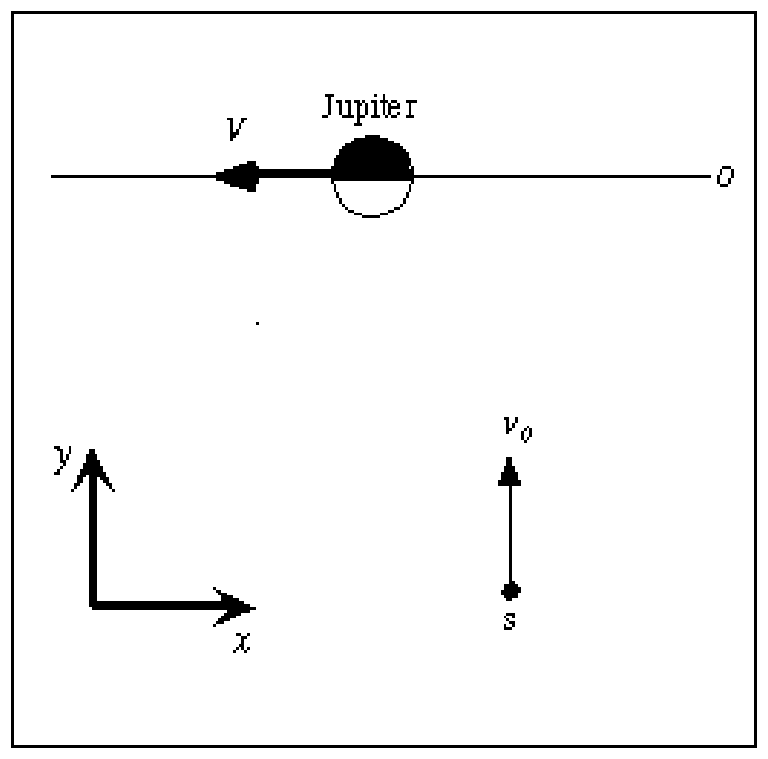
Figure 1: View in the Sun center of mass system. O denotes Jupiter’s orbit, s is the space probe.
- Find the space probe's direction of motion (as the angle \(\varphi\) between its direction and the \(x\) axis) and its speed \(v'\) in Jupiter's reference frame, when it's still far away from Jupiter. [2 points]
- Find the value of the space probe's total mechanical energy \(E\) in Jupiter's reference frame, putting – as usual – equal to zero the value of its potential energy at a very large distance, in this case when it is far enough to move with almost constant velocity owing to the smallness of all gravitational interactions. [1 point]
The space probe's trajectory in the reference frame of Jupiter is a hyperbola and its equation in polar coordinates in this reference frame is
\[ \frac{1}{r} = \frac{GM}{v'^2b^2} \left( 1+\sqrt{1+\frac{2Ev'^2b^2}{G^2M^2m}}\cos\theta \right). \tag{1} \]
where \(b\) is the distance between one of the asymptotes and Jupiter (the so called impact parameter), \(E\) is the probe’s total mechanical energy in Jupiter’s reference frame, \(G\) is the gravitational constant, \(M\) is the mass of Jupiter, \(r\) and \(\theta\) are the polar coordinates (the radial distance and the polar angle).
Figure 2 shows the two branches of a hyperbola as described by equation (1); the asymptotes and the polar co-ordinates are also shown. Note that equation (1) has its origin in the "attractive focus" of the hyperbola. The space probe's trajectory is the attractive trajectory (the emphasized branch).
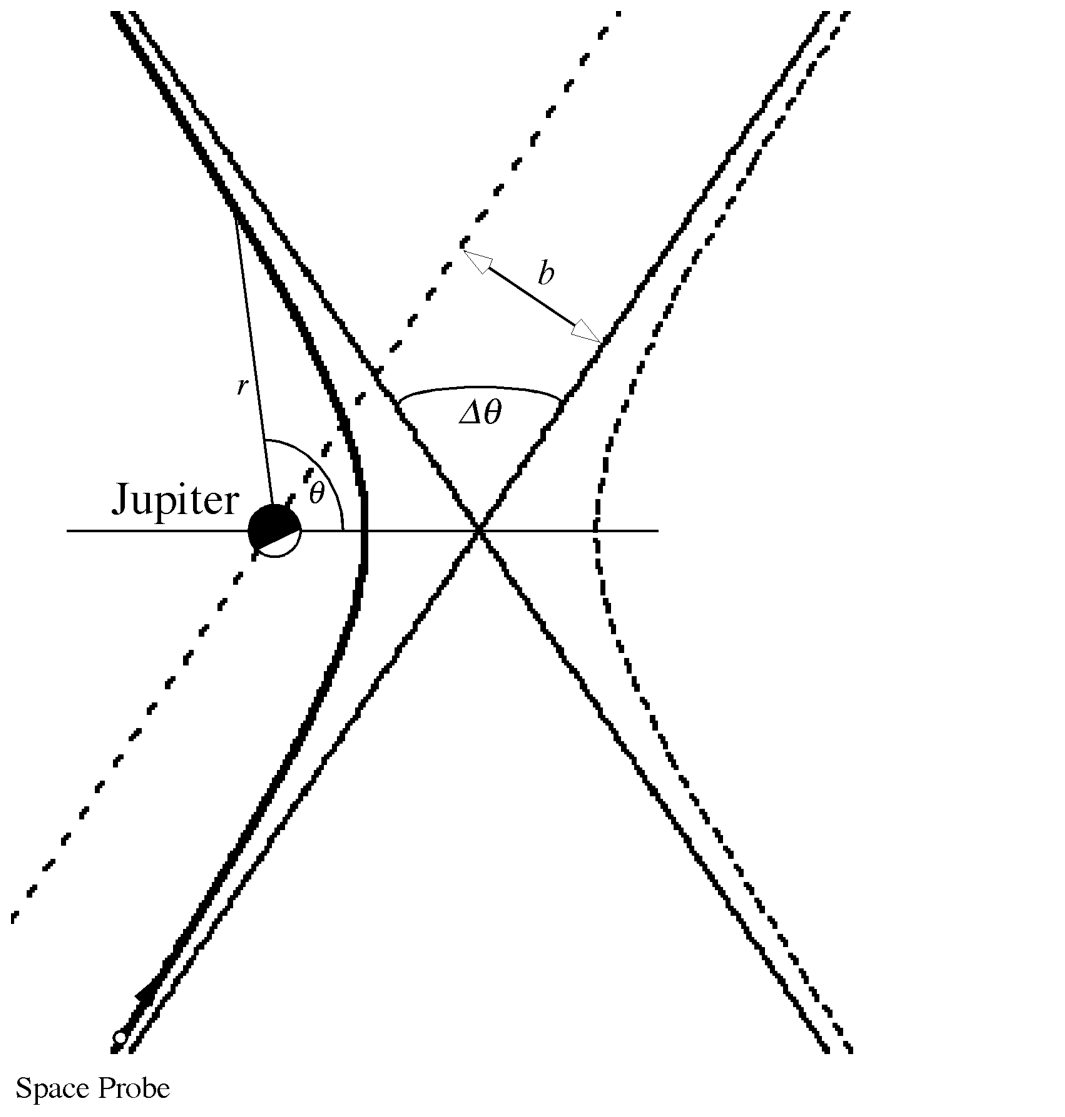
Figure 2
- Using equation (1) describing the space probe's trajectory, find the total angular deviation \(\Delta\theta\) in Jupiter’s reference frame (as shown in figure 2) and express it as a function of initial speed \(v'\) and impact parameter \(b\). [2 points]
- Assume that the probe cannot pass Jupiter at a distance less than three Jupiter radii from the center of the planet; find the minimum possible impact parameter and the maximum possible angular deviation. [1 point]
- Find an equation for the final speed \(v''\) of the probe in the Sun's reference frame as a function only of Jupiter’s speed \(V\), the probe’s initial speed \(v_0\) and the deviation angle \(\Delta\theta\). [1 point]
- Use the previous result to find the numerical value of the final speed \(v''\) in the Sun's reference frame when the angular deviation has its maximum possible value. [0.5 points]
Hint
Depending on which path you follow in your solution, the following trigonometric formulas might be useful:
\[ \sin(\alpha+\beta)=\sin\alpha\cos\beta+\cos\alpha\sin\beta \]
\[ \cos(\alpha+\beta)=\cos\alpha\cos\beta-\sin\alpha\sin\beta \]
Physical constants and general data
In addition to the numerical data given within the text of the individual problems, the knowledge of some general data and physical constants may be useful, and you may find them among the following ones. These are nearly the most accurate data currently available, and they have thus a large number of digits; you are expected, however, to write your results with a number of digits that must be appropriate for each problem.
| Speed of light in vacuum: | \(c=299792458\ \mathrm{m\cdot s^{-1}}\) |
| Magnetic permeability of vacuum: | \(\mu_0=4\pi\cdot10^{-7}\ \mathrm{H\cdot m^{-1}}\) |
| Dielectric constant of vacuum: | \(\varepsilon_0=8.8541878\ \mathrm{pF\cdot m^{-1}}\) |
| Gravitational constant: | \(G=6.67259\cdot10^{-11}\ \mathrm{m^3/(kg\cdot s^2)}\) |
| Gas constant: | \(R=8.314510\ \mathrm{J/(mol\cdot K)}\) |
| Boltzmann's constant: | \(k=1.380658\cdot10^{-23}\ \mathrm{J\cdot K^{-1}}\) |
| Stefan's constant: | \(\sigma=56.703\ \mathrm{nW/(m^2\cdot K^4)}\) |
| Proton charge: | \(e=1.60217733\cdot10^{-19}\ \mathrm{C}\) |
| Electron mass: | \(m_e=9.1093897\cdot10^{-31}\ \mathrm{kg}\) |
| Planck's constant: | \(h=6.6260755\cdot10^{-34}\ \mathrm{J\cdot s}\) |
| Base of centigrade scale: | \(T_{\mathrm K}=273.15\ \mathrm{K}\) |
| Sun mass: | \(M_{\mathrm S}=1.991\cdot10^{30}\ \mathrm{kg}\) |
| Earth mass: | \(M_{\mathrm E}=5.979\cdot10^{24}\ \mathrm{kg}\) |
| Mean radius of Earth: | \(r_{\mathrm E}=6.373\ \mathrm{Mm}\) |
| Major semiaxis of Earth orbit: | \(R_{\mathrm E}=1.4957\cdot10^{11}\ \mathrm{m}\) |
| Sidereal day: | \(d_{\mathrm S}=86.16406\ \mathrm{ks}\) |
| Year: | \(y=31.558150\ \mathrm{Ms}\) |
| Standard value of the gravitational field at the Earth surface: | \(g=9.80665\ \mathrm{m\cdot s^{-2}}\) |
| Standard value of the atmospheric pressure at sea level: | \(p_0=101325\ \mathrm{Pa}\) |
| Refractive index of air for visibile light, at standard pressure and \(15\,^\circ\mathrm C\): | \(n_{\mathrm{air}}=1.000277\) |
| Solar constant: | \(S=1355\ \mathrm{W\cdot m^{-2}}\) |
| Jupiter mass: | \(M=1.901\cdot10^{27}\ \mathrm{kg}\) |
| Equatorial Jupiter radius: | \(R_{\mathrm B}=69.8\ \mathrm{Mm}\) |
| Average radius of Jupiter’s orbit: | \(R=7.783\cdot10^{11}\ \mathrm{m}\) |
| Jovian day: | \(d_{\mathrm J}=35.6\ \mathrm{ks}\) |
| Jovian year: | \(y_{\mathrm J}=374.32\ \mathrm{Ms}\) |
| \(\pi\): | \(3.14159265\) |
Official English text of the problem.
Answers
-
Jupiter’s orbital speed is \[ \boxed{V=\sqrt{\frac{GM_{\mathrm S}}{R}} \simeq1.31\times10^4\ \mathrm{m\,s^{-1}}.} \]
-
The distance from Jupiter toward the Sun is \[ \boxed{d=\frac{R}{1+\sqrt{M_{\mathrm S}/M}} \simeq2.33\times10^{10}\ \mathrm m.} \]
-
The initial velocity in Jupiter’s frame is \(\mathbf v'_{\mathrm i}=(V,v_0)\). Thus \[ \boxed{\varphi=\tan^{-1}\!\left(\frac{v_0}{V}\right)=37.4^\circ,\qquad v'=\sqrt{V^2+v_0^2}=1.65\times10^4\ \mathrm{m\,s^{-1}}.} \] The angle is measured counterclockwise from the positive \(x\) axis.
-
The total mechanical energy in Jupiter’s frame is \[ \boxed{E=\frac12m(V^2+v_0^2)=1.12\times10^{11}\ \mathrm J.} \]
-
The angular deviation is \[ \boxed{\Delta\theta =2\tan^{-1}\!\left(\frac{GM}{b\,v'^2}\right).} \]
-
With \(r_0=3R_{\mathrm B}\), \[ \boxed{b_{\min} =\sqrt{r_0^2+\frac{2GMr_0}{v'^2}} =4.90\times10^8\ \mathrm m,} \] \[ \boxed{\Delta\theta_{\max} =2\sin^{-1}\!\left(\frac{1}{1+r_0v'^2/(GM)}\right) =87.4^\circ\ \simeq1.53\ \mathrm{rad}.} \]
-
The final speed in the Sun’s frame is \[ \boxed{v''= \sqrt{v_0^2+2V^2(1-\cos\Delta\theta) +2Vv_0\sin\Delta\theta}.} \]
-
At the maximum allowed deviation, \[ \boxed{v''=2.62\times10^4\ \mathrm{m\,s^{-1}} =26.2\ \mathrm{km\,s^{-1}}.} \]
Solution
We use Newtonian gravitation and the approximations specified in the problem. Jupiter’s orbit is circular, and its velocity is effectively constant during the encounter. The probe’s mass is negligible compared with Jupiter’s mass. During the flyby we neglect the Sun’s force, so Jupiter’s frame is treated as inertial and the probe moves in the potential \[ U(r)=-\frac{GMm}{r}. \] The initial and final velocities refer to the asymptotic velocities of this two-body approximation. Numerical calculations retain unrounded intermediate values.
1. Jupiter’s orbital speed
The Sun’s gravitational attraction supplies Jupiter’s centripetal force: \[ \frac{GM_{\mathrm S}M}{R^2}=\frac{MV^2}{R}. \] Therefore \[ V=\sqrt{\frac{GM_{\mathrm S}}{R}}. \] Using the supplied constants, \[ V= \sqrt{\frac{(6.67259\times10^{-11})(1.991\times10^{30})} {7.783\times10^{11}}} =1.30650\times10^4\ \mathrm{m\,s^{-1}}. \] Thus \[ \boxed{V=1.31\times10^4\ \mathrm{m\,s^{-1}}.} \]
The alternative circular-orbit calculation \(V=2\pi R/y_{\mathrm J}\) gives \(1.30642\times10^4\ \mathrm{m\,s^{-1}}\), agreeing at the reported precision.
2. Point where the gravitational attractions balance
Let \(d\) be the distance from Jupiter toward the Sun. The distance from the Sun is then \(R-d\). The two gravitational forces point in opposite directions, so their balance requires \[ \frac{GMm}{d^2}=\frac{GM_{\mathrm S}m}{(R-d)^2}. \] Taking positive square roots, \[ \frac{R-d}{d}=\sqrt{\frac{M_{\mathrm S}}{M}}. \] Solving, \[ d=\frac{R}{1+\sqrt{M_{\mathrm S}/M}}. \] Numerically, \[ d=\frac{7.783\times10^{11}} {1+\sqrt{(1.991\times10^{30})/(1.901\times10^{27})}} =2.33285\times10^{10}\ \mathrm m. \] Hence \[ \boxed{d=2.33\times10^{10}\ \mathrm m.} \]
3. Initial motion in Jupiter’s frame
In the Sun’s frame, the initial velocities are \[ \mathbf v_{\mathrm i}=v_0\hat{\mathbf y}, \qquad \mathbf V_{\mathrm J}=-V\hat{\mathbf x}. \] The Galilean velocity transformation gives \[ \mathbf v'_{\mathrm i} =\mathbf v_{\mathrm i}-\mathbf V_{\mathrm J} =V\hat{\mathbf x}+v_0\hat{\mathbf y}. \] Both components are positive, so the velocity lies in the first quadrant: \[ \tan\varphi=\frac{v_0}{V}, \qquad v'=\sqrt{V^2+v_0^2}. \] Numerically, \[ \varphi=\tan^{-1}\!\left(\frac{1.00\times10^4}{1.30650\times10^4}\right) =37.4306^\circ, \] \[ v'=\sqrt{(1.30650\times10^4)^2+(1.00\times10^4)^2} =1.64528\times10^4\ \mathrm{m\,s^{-1}}. \] Thus \[ \boxed{\varphi=37.4^\circ,\qquad v'=1.65\times10^4\ \mathrm{m\,s^{-1}}.} \]
4. Total mechanical energy in Jupiter’s frame
The potential energy vanishes at infinite separation. Consequently, the conserved total energy equals the initial asymptotic kinetic energy: \[ E=\frac12mv'^2=\frac12m(V^2+v_0^2). \] Substitution gives \[ E=\frac12(825)(1.64528\times10^4)^2 =1.11661\times10^{11}\ \mathrm J. \] Therefore \[ \boxed{E=1.12\times10^{11}\ \mathrm J.} \] Its positive value is consistent with an unbound hyperbolic orbit.
5. Angular deviation
Using \(E=\tfrac12mv'^2\), write equation (1) as \[ r=\frac{p}{1+e\cos\theta}, \] where \[ p=\frac{v'^2b^2}{GM}, \qquad e=\sqrt{1+\frac{b^2v'^4}{G^2M^2}}>1. \]
At either asymptote, \(r\to\infty\), so \[ 1+e\cos\theta=0. \] Let the asymptotic polar angles be \(\pm\theta_\infty\), where \[ \cos\theta_\infty=-\frac1e, \qquad \frac{\pi}{2}<\theta_\infty<\pi. \]
On the incoming asymptote, the velocity points opposite to the radial direction. Its angle relative to the periapsis axis is therefore \(\pi-\theta_\infty\). On the outgoing asymptote, the velocity points along the radial direction and has angle \(\theta_\infty\). Their difference is \[ \Delta\theta =\theta_\infty-(\pi-\theta_\infty) =2\theta_\infty-\pi. \] It follows that \[ \sin\frac{\Delta\theta}{2} =\sin\left(\theta_\infty-\frac{\pi}{2}\right) =-\cos\theta_\infty =\frac1e. \] Since \(0<\Delta\theta/2<\pi/2\), \[ \tan\frac{\Delta\theta}{2} =\frac{1}{\sqrt{e^2-1}} =\frac{GM}{bv'^2}. \] Thus \[ \boxed{\Delta\theta =2\tan^{-1}\!\left(\frac{GM}{bv'^2}\right).} \]
Equivalently, \[ \Delta\theta =2\sin^{-1}\!\left[ \frac{1}{\sqrt{1+b^2v'^4/(G^2M^2)}} \right]. \]
6. Minimum impact parameter and maximum deviation
Let \(r_{\mathrm p}\) be the closest distance to Jupiter’s center, and \(v_{\mathrm p}\) the speed there. Conservation of energy gives \[ \frac12mv_{\mathrm p}^2-\frac{GMm}{r_{\mathrm p}} =\frac12mv'^2, \] so \[ v_{\mathrm p}^2=v'^2+\frac{2GM}{r_{\mathrm p}}. \]
The force is central, so angular momentum about Jupiter is conserved. At closest approach the velocity is perpendicular to the radius: \[ mbv'=mr_{\mathrm p}v_{\mathrm p}. \] Squaring and substituting the energy result, \[ b^2v'^2 =r_{\mathrm p}^2\left(v'^2+\frac{2GM}{r_{\mathrm p}}\right), \] which yields \[ b^2=r_{\mathrm p}^2+\frac{2GMr_{\mathrm p}}{v'^2}. \]
This expression increases with \(r_{\mathrm p}\). Hence the smallest permitted impact parameter occurs at \[ r_{\mathrm p}=r_0=3R_{\mathrm B} =3(69.8\times10^6)\ \mathrm m. \] Therefore \[ b_{\min} =\sqrt{r_0^2+\frac{2GMr_0}{v'^2}}. \] Using \[ GM=1.268459359\times10^{17}\ \mathrm{m^3\,s^{-2}}, \] we obtain \[ b_{\min}=4.89996\times10^8\ \mathrm m, \] or \[ \boxed{b_{\min}=4.90\times10^8\ \mathrm m.} \]
The deflection decreases as \(b\) increases, so its maximum occurs at \(b_{\min}\). Thus \[ \Delta\theta_{\max} =2\tan^{-1}\!\left(\frac{GM}{b_{\min}v'^2}\right). \]
To express this directly through the closest distance, substitute the relation for \(b_{\min}^2\) into the eccentricity: \[ e_{\min}^2 =1+\frac{b_{\min}^2v'^4}{G^2M^2} =\left(1+\frac{r_0v'^2}{GM}\right)^2. \] Hence \[ e_{\min}=1+\frac{r_0v'^2}{GM}=1.44687 \] and \[ \Delta\theta_{\max} =2\sin^{-1}\!\left(\frac1{e_{\min}}\right) =1.52615\ \mathrm{rad} =87.4421^\circ. \] Therefore \[ \boxed{\Delta\theta_{\max}=87.4^\circ.} \]
7. Final speed in the Sun’s frame
Energy conservation in Jupiter’s frame ensures that the outgoing asymptotic speed is still \(v'\).
Because the probe passes behind Jupiter, the gravitational deflection rotates its velocity counterclockwise in the given \(x,y\) coordinates. The outgoing relative velocity consequently makes angle \(\varphi+\Delta\theta\) with the positive \(x\) axis: \[ \mathbf v'_{\mathrm f} =v'\cos(\varphi+\Delta\theta)\hat{\mathbf x} +v'\sin(\varphi+\Delta\theta)\hat{\mathbf y}. \]
Using \[ v'\cos\varphi=V,\qquad v'\sin\varphi=v_0, \] the addition formulas give \[ v'_{\mathrm f,x}=V\cos\Delta\theta-v_0\sin\Delta\theta, \] \[ v'_{\mathrm f,y}=V\sin\Delta\theta+v_0\cos\Delta\theta. \]
Transforming back to the Sun’s frame requires adding Jupiter’s velocity \(-V\hat{\mathbf x}\): \[ v''_x=V(\cos\Delta\theta-1)-v_0\sin\Delta\theta, \] \[ v''_y=V\sin\Delta\theta+v_0\cos\Delta\theta. \] Therefore \[ \begin{aligned} v''^2 &=(v''_x)^2+(v''_y)^2\\ &=V^2\left[(\cos\Delta\theta-1)^2+\sin^2\Delta\theta\right]\\ &\quad+v_0^2\left[\sin^2\Delta\theta+\cos^2\Delta\theta\right] +2Vv_0\sin\Delta\theta\\ &=2V^2(1-\cos\Delta\theta)+v_0^2+2Vv_0\sin\Delta\theta. \end{aligned} \] Thus the requested expression is \[ \boxed{ v''=\sqrt{v_0^2+2V^2(1-\cos\Delta\theta) +2Vv_0\sin\Delta\theta}. } \]
As a consistency check, setting \(\Delta\theta=0\) gives \(v''=v_0\).
8. Final speed at maximum angular deviation
Substituting the unrounded values \[ V=1.30650\times10^4\ \mathrm{m\,s^{-1}}, \qquad v_0=1.00\times10^4\ \mathrm{m\,s^{-1}}, \qquad \Delta\theta_{\max}=1.52615\ \mathrm{rad}, \] gives \[ \begin{aligned} v'' &=\Big[ (1.00\times10^4)^2 +2(1.30650\times10^4)^2(1-\cos1.52615)\\ &\qquad +2(1.30650\times10^4)(1.00\times10^4)\sin1.52615 \Big]^{1/2}\\ &=2.62144\times10^4\ \mathrm{m\,s^{-1}}. \end{aligned} \] Hence \[ \boxed{v''=2.62\times10^4\ \mathrm{m\,s^{-1}} =26.2\ \mathrm{km\,s^{-1}}.} \]
Jupiter’s gravity changes the direction of the probe’s asymptotic velocity in Jupiter’s frame. This change produces the increase in speed and kinetic energy in the Sun’s frame, supplied by a negligible reduction in Jupiter’s orbital energy.
The solution was checked against the official solution.
IPhO 1999 · Theorieaufgabe 3
Eine Raumsonde zum Jupiter
In dieser Aufgabe betrachten wir eine häufig verwendete Methode, um Raumsonden in die gewünschte Richtung zu beschleunigen. Die Raumsonde fliegt an einem Planeten vorbei und kann dabei ihre Geschwindigkeit erheblich erhöhen und ihre Flugrichtung beträchtlich ändern, indem sie der Bahnbewegung des Planeten eine sehr kleine Energiemenge entzieht. Wir untersuchen diesen Effekt hier für eine Raumsonde, die nahe am Jupiter vorbeifliegt.
Der Planet Jupiter umkreist die Sonne auf einer elliptischen Bahn, die durch einen Kreis mit dem mittleren Radius \(R\) angenähert werden kann; um die physikalische Situation analysieren zu können, müssen wir zunächst:
- Bestimmen Sie die Geschwindigkeit \(V\) des Planeten auf seiner Bahn um die Sonne. [1.5 Punkte]
- Bestimmen Sie für eine Sonde zwischen Sonne und Jupiter (auf der Strecke Sonne–Jupiter) den Abstand vom Jupiter, bei dem die Gravitationskraft der Sonne die des Jupiters ausgleicht. [1 Punkt]
Eine Raumsonde der Masse \(m=825\ \mathrm{kg}\) fliegt am Jupiter vorbei. Nehmen Sie der Einfachheit halber an, dass die Bahn der Raumsonde vollständig in der Bahnebene des Jupiters liegt; damit vernachlässigen wir den wichtigen Fall, in dem die Raumsonde aus der Bahnebene des Jupiters herausgeschleudert wird.
Wir betrachten nur die Vorgänge in dem Gebiet, in dem die Anziehungskraft des Jupiters alle anderen Gravitationskräfte bei Weitem überwiegt.
Im Bezugssystem des Schwerpunkts der Sonne beträgt die Anfangsgeschwindigkeit der Raumsonde \(v_0=1.00\cdot10^4\ \mathrm{m/s}\) (in positiver \(y\)-Richtung), während die Geschwindigkeit des Jupiters in negative \(x\)-Richtung weist (siehe Abbildung 1); mit „Anfangsgeschwindigkeit“ meinen wir die Geschwindigkeit der Raumsonde im interplanetaren Raum, wenn sie noch weit vom Jupiter entfernt ist, sich aber bereits in dem Gebiet befindet, in dem die Anziehungskraft der Sonne gegenüber der des Jupiters vernachlässigbar ist. Wir nehmen an, dass die Begegnung in einer hinreichend kurzen Zeit stattfindet, sodass die Richtungsänderung des Jupiters auf seiner Bahn um die Sonne vernachlässigt werden kann. Außerdem nehmen wir an, dass die Sonde hinter dem Jupiter vorbeifliegt, d. h., bei gleicher \(y\)-Koordinate ist die \(x\)-Koordinate der Sonde größer als die des Jupiters.
Abbildung 1: Ansicht im Schwerpunktsystem der Sonne. O bezeichnet die Bahn des Jupiters, s die Raumsonde.
- Bestimmen Sie die Bewegungsrichtung der Raumsonde (als Winkel \(\varphi\) zwischen ihrer Bewegungsrichtung und der \(x\)-Achse) und ihre Geschwindigkeit \(v'\) im Bezugssystem des Jupiters, wenn sie noch weit vom Jupiter entfernt ist. [2 Punkte]
- Bestimmen Sie den Wert der gesamten mechanischen Energie \(E\) der Raumsonde im Bezugssystem des Jupiters, wobei – wie üblich – ihre potenzielle Energie in sehr großer Entfernung gleich null gesetzt wird; hier bedeutet dies eine Entfernung, in der sie sich aufgrund der geringen Stärke aller gravitativen Wechselwirkungen mit nahezu konstanter Geschwindigkeit bewegt. [1 Punkt]
Die Bahn der Raumsonde im Bezugssystem des Jupiters ist eine Hyperbel, deren Gleichung in Polarkoordinaten in diesem Bezugssystem lautet:
\[ \frac{1}{r} = \frac{GM}{v'^2b^2} \left( 1+\sqrt{1+\frac{2Ev'^2b^2}{G^2M^2m}}\cos\theta \right). \tag{1} \]
Dabei ist \(b\) der Abstand zwischen einer der Asymptoten und dem Jupiter (der sogenannte Stoßparameter), \(E\) die gesamte mechanische Energie der Sonde im Bezugssystem des Jupiters, \(G\) die Gravitationskonstante, \(M\) die Masse des Jupiters und \(r\) und \(\theta\) die Polarkoordinaten (der radiale Abstand und der Polarwinkel).
Abbildung 2 zeigt die beiden Äste einer Hyperbel, wie sie durch Gleichung (1) beschrieben wird; auch die Asymptoten und die Polarkoordinaten sind eingezeichnet. Beachten Sie, dass der Ursprung von Gleichung (1) im „anziehenden Brennpunkt“ der Hyperbel liegt. Die Bahn der Raumsonde ist die Bahn für eine anziehende Kraft (der hervorgehobene Ast).
Abbildung 2
- Bestimmen Sie mithilfe von Gleichung (1), die die Bahn der Raumsonde beschreibt, den gesamten Ablenkwinkel \(\Delta\theta\) im Bezugssystem des Jupiters (wie in Abbildung 2 dargestellt) und drücken Sie ihn als Funktion der Anfangsgeschwindigkeit \(v'\) und des Stoßparameters \(b\) aus. [2 Punkte]
- Nehmen Sie an, dass die Sonde den Jupiter nicht in einem Abstand von weniger als drei Jupiterradien vom Mittelpunkt des Planeten passieren darf; bestimmen Sie den kleinstmöglichen Stoßparameter und den größtmöglichen Ablenkwinkel. [1 Punkt]
- Bestimmen Sie eine Gleichung für die Endgeschwindigkeit \(v''\) der Sonde im Bezugssystem der Sonne, die nur von der Geschwindigkeit \(V\) des Jupiters, der Anfangsgeschwindigkeit \(v_0\) der Sonde und dem Ablenkwinkel \(\Delta\theta\) abhängt. [1 Punkt]
- Bestimmen Sie mithilfe des vorherigen Ergebnisses den Zahlenwert der Endgeschwindigkeit \(v''\) im Bezugssystem der Sonne, wenn der Ablenkwinkel seinen größtmöglichen Wert hat. [0.5 Punkte]
Hinweis
Je nach gewähltem Lösungsweg können die folgenden trigonometrischen Formeln hilfreich sein:
\[ \sin(\alpha+\beta)=\sin\alpha\cos\beta+\cos\alpha\sin\beta \]
\[ \cos(\alpha+\beta)=\cos\alpha\cos\beta-\sin\alpha\sin\beta \]
Physikalische Konstanten und allgemeine Daten
Zusätzlich zu den Zahlenangaben im Text der einzelnen Aufgaben kann die Kenntnis einiger allgemeiner Daten und physikalischer Konstanten hilfreich sein; diese finden Sie in der folgenden Zusammenstellung. Diese Daten gehören zu den genauesten derzeit verfügbaren und enthalten daher viele Ziffern; es wird jedoch erwartet, dass Sie Ihre Ergebnisse mit einer für die jeweilige Aufgabe angemessenen Anzahl von Ziffern angeben.
| Lichtgeschwindigkeit im Vakuum: | \(c=299792458\ \mathrm{m\cdot s^{-1}}\) |
| Magnetische Permeabilität des Vakuums: | \(\mu_0=4\pi\cdot10^{-7}\ \mathrm{H\cdot m^{-1}}\) |
| Elektrische Permittivität des Vakuums: | \(\varepsilon_0=8.8541878\ \mathrm{pF\cdot m^{-1}}\) |
| Gravitationskonstante: | \(G=6.67259\cdot10^{-11}\ \mathrm{m^3/(kg\cdot s^2)}\) |
| Gaskonstante: | \(R=8.314510\ \mathrm{J/(mol\cdot K)}\) |
| Boltzmann-Konstante: | \(k=1.380658\cdot10^{-23}\ \mathrm{J\cdot K^{-1}}\) |
| Stefan-Boltzmann-Konstante: | \(\sigma=56.703\ \mathrm{nW/(m^2\cdot K^4)}\) |
| Protonenladung: | \(e=1.60217733\cdot10^{-19}\ \mathrm{C}\) |
| Elektronenmasse: | \(m_e=9.1093897\cdot10^{-31}\ \mathrm{kg}\) |
| Planck-Konstante: | \(h=6.6260755\cdot10^{-34}\ \mathrm{J\cdot s}\) |
| Nullpunkt der Celsius-Skala: | \(T_{\mathrm K}=273.15\ \mathrm{K}\) |
| Sonnenmasse: | \(M_{\mathrm S}=1.991\cdot10^{30}\ \mathrm{kg}\) |
| Erdmasse: | \(M_{\mathrm E}=5.979\cdot10^{24}\ \mathrm{kg}\) |
| Mittlerer Erdradius: | \(r_{\mathrm E}=6.373\ \mathrm{Mm}\) |
| Große Halbachse der Erdbahn: | \(R_{\mathrm E}=1.4957\cdot10^{11}\ \mathrm{m}\) |
| Siderischer Tag: | \(d_{\mathrm S}=86.16406\ \mathrm{ks}\) |
| Jahr: | \(y=31.558150\ \mathrm{Ms}\) |
| Normwert der Gravitationsfeldstärke an der Erdoberfläche: | \(g=9.80665\ \mathrm{m\cdot s^{-2}}\) |
| Normwert des Luftdrucks auf Meereshöhe: | \(p_0=101325\ \mathrm{Pa}\) |
| Brechungsindex von Luft für sichtbares Licht bei Normaldruck und \(15\,^\circ\mathrm C\): | \(n_{\mathrm{air}}=1.000277\) |
| Solarkonstante: | \(S=1355\ \mathrm{W\cdot m^{-2}}\) |
| Jupitermasse: | \(M=1.901\cdot10^{27}\ \mathrm{kg}\) |
| Äquatorradius des Jupiters: | \(R_{\mathrm B}=69.8\ \mathrm{Mm}\) |
| Mittlerer Radius der Jupiterbahn: | \(R=7.783\cdot10^{11}\ \mathrm{m}\) |
| Jupitertag: | \(d_{\mathrm J}=35.6\ \mathrm{ks}\) |
| Jupiterjahr: | \(y_{\mathrm J}=374.32\ \mathrm{Ms}\) |
| \(\pi\): | \(3.14159265\) |
Aufgabentext aus dem offiziellen englischen Text übersetzt.
Antworten
-
Die Bahngeschwindigkeit des Jupiters beträgt \[ \boxed{V=\sqrt{\frac{GM_{\mathrm S}}{R}} \simeq1.31\times10^4\ \mathrm{m\,s^{-1}}.} \]
-
Der Abstand vom Jupiter in Richtung Sonne beträgt \[ \boxed{d=\frac{R}{1+\sqrt{M_{\mathrm S}/M}} \simeq2.33\times10^{10}\ \mathrm m.} \]
-
Die Anfangsgeschwindigkeit im Bezugssystem des Jupiters ist \(\mathbf v'_{\mathrm i}=(V,v_0)\). Somit gilt \[ \boxed{\varphi=\tan^{-1}\!\left(\frac{v_0}{V}\right)=37.4^\circ,\qquad v'=\sqrt{V^2+v_0^2}=1.65\times10^4\ \mathrm{m\,s^{-1}}.} \] Der Winkel wird von der positiven \(x\)-Achse aus gegen den Uhrzeigersinn gemessen.
-
Die gesamte mechanische Energie im Bezugssystem des Jupiters beträgt \[ \boxed{E=\frac12m(V^2+v_0^2)=1.12\times10^{11}\ \mathrm J.} \]
-
Der Ablenkwinkel beträgt \[ \boxed{\Delta\theta =2\tan^{-1}\!\left(\frac{GM}{b\,v'^2}\right).} \]
-
Mit \(r_0=3R_{\mathrm B}\) gilt \[ \boxed{b_{\min} =\sqrt{r_0^2+\frac{2GMr_0}{v'^2}} =4.90\times10^8\ \mathrm m,} \] \[ \boxed{\Delta\theta_{\max} =2\sin^{-1}\!\left(\frac{1}{1+r_0v'^2/(GM)}\right) =87.4^\circ\ \simeq1.53\ \mathrm{rad}.} \]
-
Die Endgeschwindigkeit im Bezugssystem der Sonne beträgt \[ \boxed{v''= \sqrt{v_0^2+2V^2(1-\cos\Delta\theta) +2Vv_0\sin\Delta\theta}.} \]
-
Beim größten zulässigen Ablenkwinkel gilt \[ \boxed{v''=2.62\times10^4\ \mathrm{m\,s^{-1}} =26.2\ \mathrm{km\,s^{-1}}.} \]
Lösung
Wir verwenden das Newtonsche Gravitationsgesetz und die in der Aufgabe angegebenen Näherungen. Die Bahn des Jupiters ist kreisförmig, und seine Geschwindigkeit ist während der Begegnung praktisch konstant. Die Masse der Sonde ist gegenüber der Masse des Jupiters vernachlässigbar. Während des Vorbeiflugs vernachlässigen wir die Kraft der Sonne, sodass das Bezugssystem des Jupiters als Inertialsystem behandelt wird und sich die Sonde im folgenden Potenzial bewegt: \[ U(r)=-\frac{GMm}{r}. \] Die Anfangs- und Endgeschwindigkeiten beziehen sich auf die asymptotischen Geschwindigkeiten dieser Zweikörpernäherung. Bei den numerischen Berechnungen werden ungerundete Zwischenwerte beibehalten.
1. Bahngeschwindigkeit des Jupiters
Die Gravitationskraft der Sonne liefert die Zentripetalkraft für den Jupiter: \[ \frac{GM_{\mathrm S}M}{R^2}=\frac{MV^2}{R}. \] Daher gilt \[ V=\sqrt{\frac{GM_{\mathrm S}}{R}}. \] Mit den angegebenen Konstanten ergibt sich \[ V= \sqrt{\frac{(6.67259\times10^{-11})(1.991\times10^{30})} {7.783\times10^{11}}} =1.30650\times10^4\ \mathrm{m\,s^{-1}}. \] Somit gilt \[ \boxed{V=1.31\times10^4\ \mathrm{m\,s^{-1}}.} \]
Die alternative Berechnung für eine Kreisbahn \(V=2\pi R/y_{\mathrm J}\) ergibt \(1.30642\times10^4\ \mathrm{m\,s^{-1}}\), was bei der angegebenen Genauigkeit übereinstimmt.
2. Punkt, an dem sich die Gravitationskräfte ausgleichen
Sei \(d\) der Abstand vom Jupiter in Richtung Sonne. Der Abstand von der Sonne ist dann \(R-d\). Die beiden Gravitationskräfte weisen in entgegengesetzte Richtungen, sodass für ihr Gleichgewicht gelten muss: \[ \frac{GMm}{d^2}=\frac{GM_{\mathrm S}m}{(R-d)^2}. \] Ziehen der positiven Quadratwurzeln ergibt \[ \frac{R-d}{d}=\sqrt{\frac{M_{\mathrm S}}{M}}. \] Auflösen liefert \[ d=\frac{R}{1+\sqrt{M_{\mathrm S}/M}}. \] Numerisch ergibt sich \[ d=\frac{7.783\times10^{11}} {1+\sqrt{(1.991\times10^{30})/(1.901\times10^{27})}} =2.33285\times10^{10}\ \mathrm m. \] Damit gilt \[ \boxed{d=2.33\times10^{10}\ \mathrm m.} \]
3. Anfangsbewegung im Bezugssystem des Jupiters
Im Bezugssystem der Sonne lauten die Anfangsgeschwindigkeiten \[ \mathbf v_{\mathrm i}=v_0\hat{\mathbf y}, \qquad \mathbf V_{\mathrm J}=-V\hat{\mathbf x}. \] Die Galilei-Transformation der Geschwindigkeit ergibt \[ \mathbf v'_{\mathrm i} =\mathbf v_{\mathrm i}-\mathbf V_{\mathrm J} =V\hat{\mathbf x}+v_0\hat{\mathbf y}. \] Beide Komponenten sind positiv, sodass der Geschwindigkeitsvektor im ersten Quadranten liegt: \[ \tan\varphi=\frac{v_0}{V}, \qquad v'=\sqrt{V^2+v_0^2}. \] Numerisch ergibt sich \[ \varphi=\tan^{-1}\!\left(\frac{1.00\times10^4}{1.30650\times10^4}\right) =37.4306^\circ, \] \[ v'=\sqrt{(1.30650\times10^4)^2+(1.00\times10^4)^2} =1.64528\times10^4\ \mathrm{m\,s^{-1}}. \] Somit gilt \[ \boxed{\varphi=37.4^\circ,\qquad v'=1.65\times10^4\ \mathrm{m\,s^{-1}}.} \]
4. Gesamte mechanische Energie im Bezugssystem des Jupiters
Die potenzielle Energie verschwindet bei unendlichem Abstand. Folglich ist die erhaltene Gesamtenergie gleich der anfänglichen asymptotischen kinetischen Energie: \[ E=\frac12mv'^2=\frac12m(V^2+v_0^2). \] Einsetzen ergibt \[ E=\frac12(825)(1.64528\times10^4)^2 =1.11661\times10^{11}\ \mathrm J. \] Daher gilt \[ \boxed{E=1.12\times10^{11}\ \mathrm J.} \] Ihr positiver Wert steht im Einklang mit einer ungebundenen hyperbolischen Bahn.
5. Ablenkwinkel
Mit \(E=\tfrac12mv'^2\) schreiben wir Gleichung (1) in der Form \[ r=\frac{p}{1+e\cos\theta}, \] wobei \[ p=\frac{v'^2b^2}{GM}, \qquad e=\sqrt{1+\frac{b^2v'^4}{G^2M^2}}>1. \]
An beiden Asymptoten gilt \(r\to\infty\), also \[ 1+e\cos\theta=0. \] Die asymptotischen Polarwinkel seien \(\pm\theta_\infty\), wobei \[ \cos\theta_\infty=-\frac1e, \qquad \frac{\pi}{2}<\theta_\infty<\pi. \]
Auf der einlaufenden Asymptote weist die Geschwindigkeit entgegen der radialen Richtung. Ihr Winkel gegenüber der Periapsisachse beträgt daher \(\pi-\theta_\infty\). Auf der auslaufenden Asymptote weist die Geschwindigkeit in radialer Richtung und hat den Winkel \(\theta_\infty\). Die Differenz dieser Winkel ist \[ \Delta\theta =\theta_\infty-(\pi-\theta_\infty) =2\theta_\infty-\pi. \] Daraus folgt \[ \sin\frac{\Delta\theta}{2} =\sin\left(\theta_\infty-\frac{\pi}{2}\right) =-\cos\theta_\infty =\frac1e. \] Wegen \(0<\Delta\theta/2<\pi/2\) gilt \[ \tan\frac{\Delta\theta}{2} =\frac{1}{\sqrt{e^2-1}} =\frac{GM}{bv'^2}. \] Somit gilt \[ \boxed{\Delta\theta =2\tan^{-1}\!\left(\frac{GM}{bv'^2}\right).} \]
Gleichwertig ist \[ \Delta\theta =2\sin^{-1}\!\left[ \frac{1}{\sqrt{1+b^2v'^4/(G^2M^2)}} \right]. \]
6. Kleinster Stoßparameter und größter Ablenkwinkel
Sei \(r_{\mathrm p}\) der kleinste Abstand zum Mittelpunkt des Jupiters und \(v_{\mathrm p}\) die Geschwindigkeit an dieser Stelle. Aus der Energieerhaltung folgt \[ \frac12mv_{\mathrm p}^2-\frac{GMm}{r_{\mathrm p}} =\frac12mv'^2, \] also \[ v_{\mathrm p}^2=v'^2+\frac{2GM}{r_{\mathrm p}}. \]
Die Kraft ist eine Zentralkraft, sodass der Drehimpuls bezüglich des Jupiters erhalten bleibt. Am Punkt der größten Annäherung steht die Geschwindigkeit senkrecht zum Radius: \[ mbv'=mr_{\mathrm p}v_{\mathrm p}. \] Quadrieren und Einsetzen des Ergebnisses aus der Energieerhaltung ergibt \[ b^2v'^2 =r_{\mathrm p}^2\left(v'^2+\frac{2GM}{r_{\mathrm p}}\right), \] woraus folgt \[ b^2=r_{\mathrm p}^2+\frac{2GMr_{\mathrm p}}{v'^2}. \]
Dieser Ausdruck wächst mit \(r_{\mathrm p}\). Daher tritt der kleinste zulässige Stoßparameter auf bei \[ r_{\mathrm p}=r_0=3R_{\mathrm B} =3(69.8\times10^6)\ \mathrm m. \] Daher gilt \[ b_{\min} =\sqrt{r_0^2+\frac{2GMr_0}{v'^2}}. \] Mit \[ GM=1.268459359\times10^{17}\ \mathrm{m^3\,s^{-2}}, \] erhalten wir \[ b_{\min}=4.89996\times10^8\ \mathrm m, \] also \[ \boxed{b_{\min}=4.90\times10^8\ \mathrm m.} \]
Der Ablenkwinkel nimmt mit wachsendem \(b\) ab, sodass er bei \(b_{\min}\) maximal ist. Somit gilt \[ \Delta\theta_{\max} =2\tan^{-1}\!\left(\frac{GM}{b_{\min}v'^2}\right). \]
Um dies direkt durch den kleinsten Abstand auszudrücken, setzen wir die Beziehung für \(b_{\min}^2\) in die Exzentrizität ein: \[ e_{\min}^2 =1+\frac{b_{\min}^2v'^4}{G^2M^2} =\left(1+\frac{r_0v'^2}{GM}\right)^2. \] Damit gilt \[ e_{\min}=1+\frac{r_0v'^2}{GM}=1.44687 \] und \[ \Delta\theta_{\max} =2\sin^{-1}\!\left(\frac1{e_{\min}}\right) =1.52615\ \mathrm{rad} =87.4421^\circ. \] Daher gilt \[ \boxed{\Delta\theta_{\max}=87.4^\circ.} \]
7. Endgeschwindigkeit im Bezugssystem der Sonne
Die Energieerhaltung im Bezugssystem des Jupiters gewährleistet, dass der Betrag der auslaufenden asymptotischen Geschwindigkeit weiterhin \(v'\) beträgt.
Da die Sonde hinter dem Jupiter vorbeifliegt, dreht die gravitative Ablenkung ihren Geschwindigkeitsvektor in den gegebenen \(x,y\)-Koordinaten gegen den Uhrzeigersinn. Die auslaufende Relativgeschwindigkeit bildet folglich mit der positiven \(x\)-Achse den Winkel \(\varphi+\Delta\theta\): \[ \mathbf v'_{\mathrm f} =v'\cos(\varphi+\Delta\theta)\hat{\mathbf x} +v'\sin(\varphi+\Delta\theta)\hat{\mathbf y}. \]
Mit \[ v'\cos\varphi=V,\qquad v'\sin\varphi=v_0, \] liefern die Additionstheoreme \[ v'_{\mathrm f,x}=V\cos\Delta\theta-v_0\sin\Delta\theta, \] \[ v'_{\mathrm f,y}=V\sin\Delta\theta+v_0\cos\Delta\theta. \]
Bei der Rücktransformation in das Bezugssystem der Sonne muss die Geschwindigkeit des Jupiters \(-V\hat{\mathbf x}\) addiert werden: \[ v''_x=V(\cos\Delta\theta-1)-v_0\sin\Delta\theta, \] \[ v''_y=V\sin\Delta\theta+v_0\cos\Delta\theta. \] Daher gilt \[ \begin{aligned} v''^2 &=(v''_x)^2+(v''_y)^2\\ &=V^2\left[(\cos\Delta\theta-1)^2+\sin^2\Delta\theta\right]\\ &\quad+v_0^2\left[\sin^2\Delta\theta+\cos^2\Delta\theta\right] +2Vv_0\sin\Delta\theta\\ &=2V^2(1-\cos\Delta\theta)+v_0^2+2Vv_0\sin\Delta\theta. \end{aligned} \] Somit lautet der gesuchte Ausdruck \[ \boxed{ v''=\sqrt{v_0^2+2V^2(1-\cos\Delta\theta) +2Vv_0\sin\Delta\theta}. } \]
Als Konsistenzprüfung ergibt das Einsetzen von \(\Delta\theta=0\) den Wert \(v''=v_0\).
8. Endgeschwindigkeit bei größtem Ablenkwinkel
Einsetzen der ungerundeten Werte \[ V=1.30650\times10^4\ \mathrm{m\,s^{-1}}, \qquad v_0=1.00\times10^4\ \mathrm{m\,s^{-1}}, \qquad \Delta\theta_{\max}=1.52615\ \mathrm{rad}, \] ergibt \[ \begin{aligned} v'' &=\Big[ (1.00\times10^4)^2 +2(1.30650\times10^4)^2(1-\cos1.52615)\\ &\qquad +2(1.30650\times10^4)(1.00\times10^4)\sin1.52615 \Big]^{1/2}\\ &=2.62144\times10^4\ \mathrm{m\,s^{-1}}. \end{aligned} \] Damit gilt \[ \boxed{v''=2.62\times10^4\ \mathrm{m\,s^{-1}} =26.2\ \mathrm{km\,s^{-1}}.} \]
Die Gravitation des Jupiters ändert die Richtung der asymptotischen Geschwindigkeit der Sonde im Bezugssystem des Jupiters. Diese Änderung bewirkt die Zunahme der Geschwindigkeit und der kinetischen Energie im Bezugssystem der Sonne; die dafür erforderliche Energie stammt aus einer vernachlässigbar kleinen Verringerung der Bahnenergie des Jupiters.
Die Lösung wurde mit der offiziellen Lösung abgeglichen.
IPhO 1999 · Teori sorusu 3
Jüpiter'e giden bir uzay sondası
Bu soruda, uzay sondalarını istenen yönde hızlandırmak için sıkça kullanılan bir yöntemi ele alıyoruz. Uzay sondası bir gezegenin yakınından geçer ve gezegenin yörünge hareketinden çok küçük miktarda enerji alarak süratini önemli ölçüde artırabilir ve uçuş yönünü büyük ölçüde değiştirebilir. Burada bu etkiyi Jüpiter'in yakınından geçen bir uzay sondası için inceliyoruz.
Jüpiter gezegeni, Güneş'in çevresinde, ortalama yarıçapı \(R\) olan bir çemberle yaklaşık olarak temsil edilebilen eliptik bir yörüngede dolanır; bu fiziksel durumu inceleyebilmek için önce şunları yapmalıyız:
- Gezegenin Güneş çevresindeki yörüngesi boyunca hareket ederken sahip olduğu \(V\) süratini bulunuz. [1.5 puan]
- Sonda Güneş ile Jüpiter arasındayken (Güneş-Jüpiter doğru parçası üzerinde), Güneş'in kütleçekim kuvvetinin Jüpiter'inkini dengelediği noktanın Jüpiter'e uzaklığını bulunuz. [1 puan]
Kütlesi \(m=825\ \mathrm{kg}\) olan bir uzay sondası Jüpiter'in yakınından geçmektedir. Basitlik için uzay sondasının yörüngesinin bütünüyle Jüpiter'in yörünge düzleminde olduğunu varsayınız; böylece uzay sondasının Jüpiter'in yörünge düzleminin dışına fırlatıldığı önemli durumu ihmal ediyoruz.
Yalnızca Jüpiter'in çekiminin diğer tüm kütleçekim kuvvetlerine baskın olduğu bölgede olup bitenleri ele alıyoruz.
Güneş'in kütle merkezine bağlı referans sisteminde uzay sondasının ilk sürati \(v_0=1.00\cdot10^4\ \mathrm{m/s}\) olup hızı pozitif \(y\) yönündedir; Jüpiter'in hızı ise negatif \(x\) yönündedir (bkz. şekil 1). “İlk sürat” ile uzay sondasının gezegenler arası uzayda, hâlâ Jüpiter'den uzakta olmakla birlikte Güneş'in çekiminin Jüpiter'inkine göre ihmal edilebilir olduğu bölgeye girmişken sahip olduğu sürati kastediyoruz. Karşılaşmanın, Jüpiter'in Güneş çevresindeki yörüngesi boyunca hareket yönündeki değişimin ihmal edilebileceği kadar kısa bir sürede gerçekleştiğini varsayıyoruz. Ayrıca sondanın Jüpiter'in arkasından geçtiğini, yani \(y\) koordinatları aynı olduğunda sondanın \(x\) koordinatının Jüpiter'inkinden büyük olduğunu varsayıyoruz.
Şekil 1: Güneş'in kütle merkezine bağlı sistemden görünüm. O, Jüpiter'in yörüngesini; s, uzay sondasını göstermektedir.
- Uzay sondası henüz Jüpiter'den uzaktayken, Jüpiter'e bağlı referans sistemindeki hareket yönünü (hareket yönü ile \(x\) ekseni arasındaki \(\varphi\) açısı olarak) ve \(v'\) süratini bulunuz. [2 puan]
- Uzay sondasının Jüpiter'e bağlı referans sistemindeki toplam mekanik enerjisi \(E\)'nin değerini bulunuz. Her zamanki gibi, potansiyel enerjisinin çok büyük bir uzaklıktaki değerini sıfır alınız; burada bu, tüm kütleçekim etkileşimlerinin küçüklüğü nedeniyle hemen hemen sabit hızla hareket edebilecek kadar uzakta olduğu duruma karşılık gelir. [1 puan]
Uzay sondasının Jüpiter'e bağlı referans sistemindeki yörüngesi bir hiperboldür ve bu referans sistemindeki kutupsal koordinatlarla denklemi şöyledir:
\[ \frac{1}{r} = \frac{GM}{v'^2b^2} \left( 1+\sqrt{1+\frac{2Ev'^2b^2}{G^2M^2m}}\cos\theta \right). \tag{1} \]
Burada \(b\), asimptotlardan biri ile Jüpiter arasındaki uzaklık (çarpışma parametresi olarak adlandırılır); \(E\), sondanın Jüpiter'e bağlı referans sistemindeki toplam mekanik enerjisi; \(G\), kütleçekim sabiti; \(M\), Jüpiter'in kütlesi; \(r\) ve \(\theta\) ise kutupsal koordinatlardır (radyal uzaklık ve kutupsal açı).
Şekil 2, denklem (1) ile tanımlanan bir hiperbolün iki kolunu göstermektedir; asimptotlar ve kutupsal koordinatlar da gösterilmiştir. Denklem (1)'de koordinat başlangıcının hiperbolün “çekici odağında” olduğuna dikkat ediniz. Uzay sondasının yörüngesi, çekim etkisi altındaki yörüngedir (vurgulanan kol).
Şekil 2
- Uzay sondasının yörüngesini tanımlayan denklem (1)'i kullanarak, Jüpiter'e bağlı referans sistemindeki toplam açısal sapmayı \(\Delta\theta\) (şekil 2'de gösterildiği gibi) bulunuz ve bunu ilk sürat \(v'\) ile çarpışma parametresi \(b\)'nin bir fonksiyonu olarak ifade ediniz. [2 puan]
- Sondanın, gezegenin merkezine üç Jüpiter yarıçapından daha yakın bir uzaklıktan geçemeyeceğini varsayınız; mümkün olan en küçük çarpışma parametresini ve mümkün olan en büyük açısal sapmayı bulunuz. [1 puan]
- Sondanın Güneş'e bağlı referans sistemindeki son sürati \(v''\) için yalnızca Jüpiter'in sürati \(V\), sondanın ilk sürati \(v_0\) ve sapma açısı \(\Delta\theta\)'nın fonksiyonu olan bir denklem bulunuz. [1 puan]
- Açısal sapma mümkün olan en büyük değerini aldığında, Güneş'e bağlı referans sistemindeki son sürat \(v''\)'nün sayısal değerini bulmak için önceki sonucu kullanınız. [0.5 puan]
İpucu
Çözümünüzde izlediğiniz yola bağlı olarak, aşağıdaki trigonometrik bağıntılar yararlı olabilir:
\[ \sin(\alpha+\beta)=\sin\alpha\cos\beta+\cos\alpha\sin\beta \]
\[ \cos(\alpha+\beta)=\cos\alpha\cos\beta-\sin\alpha\sin\beta \]
Fiziksel sabitler ve genel veriler
Soruların metinlerinde verilen sayısal verilere ek olarak, bazı genel verileri ve fiziksel sabitleri bilmek yararlı olabilir; bunları aşağıda bulabilirsiniz. Bunlar, günümüzde mevcut en hassas verilere yakın olduklarından çok sayıda basamak içerir; ancak sonuçlarınızı her soru için uygun sayıda basamakla yazmanız beklenmektedir.
| Işığın boşluktaki sürati: | \(c=299792458\ \mathrm{m\cdot s^{-1}}\) |
| Boşluğun manyetik geçirgenliği: | \(\mu_0=4\pi\cdot10^{-7}\ \mathrm{H\cdot m^{-1}}\) |
| Boşluğun dielektrik sabiti: | \(\varepsilon_0=8.8541878\ \mathrm{pF\cdot m^{-1}}\) |
| Kütleçekim sabiti: | \(G=6.67259\cdot10^{-11}\ \mathrm{m^3/(kg\cdot s^2)}\) |
| Gaz sabiti: | \(R=8.314510\ \mathrm{J/(mol\cdot K)}\) |
| Boltzmann sabiti: | \(k=1.380658\cdot10^{-23}\ \mathrm{J\cdot K^{-1}}\) |
| Stefan sabiti: | \(\sigma=56.703\ \mathrm{nW/(m^2\cdot K^4)}\) |
| Protonun yükü: | \(e=1.60217733\cdot10^{-19}\ \mathrm{C}\) |
| Elektronun kütlesi: | \(m_e=9.1093897\cdot10^{-31}\ \mathrm{kg}\) |
| Planck sabiti: | \(h=6.6260755\cdot10^{-34}\ \mathrm{J\cdot s}\) |
| Santigrat ölçeğinin sıfır noktası: | \(T_{\mathrm K}=273.15\ \mathrm{K}\) |
| Güneş'in kütlesi: | \(M_{\mathrm S}=1.991\cdot10^{30}\ \mathrm{kg}\) |
| Dünya'nın kütlesi: | \(M_{\mathrm E}=5.979\cdot10^{24}\ \mathrm{kg}\) |
| Dünya'nın ortalama yarıçapı: | \(r_{\mathrm E}=6.373\ \mathrm{Mm}\) |
| Dünya'nın yörüngesinin büyük yarı ekseni: | \(R_{\mathrm E}=1.4957\cdot10^{11}\ \mathrm{m}\) |
| Yıldız günü: | \(d_{\mathrm S}=86.16406\ \mathrm{ks}\) |
| Yıl: | \(y=31.558150\ \mathrm{Ms}\) |
| Dünya yüzeyindeki kütleçekim alanının standart değeri: | \(g=9.80665\ \mathrm{m\cdot s^{-2}}\) |
| Deniz seviyesindeki atmosfer basıncının standart değeri: | \(p_0=101325\ \mathrm{Pa}\) |
| Standart basınçta ve \(15\,^\circ\mathrm C\) sıcaklıkta havanın görünür ışık için kırılma indisi: | \(n_{\mathrm{air}}=1.000277\) |
| Güneş sabiti: | \(S=1355\ \mathrm{W\cdot m^{-2}}\) |
| Jüpiter'in kütlesi: | \(M=1.901\cdot10^{27}\ \mathrm{kg}\) |
| Jüpiter'in ekvator yarıçapı: | \(R_{\mathrm B}=69.8\ \mathrm{Mm}\) |
| Jüpiter'in yörüngesinin ortalama yarıçapı: | \(R=7.783\cdot10^{11}\ \mathrm{m}\) |
| Jüpiter günü: | \(d_{\mathrm J}=35.6\ \mathrm{ks}\) |
| Jüpiter yılı: | \(y_{\mathrm J}=374.32\ \mathrm{Ms}\) |
| \(\pi\): | \(3.14159265\) |
Soru metni resmi İngilizce metinden çevrilmiştir.
Cevaplar
-
Jüpiter'in yörünge sürati \[ \boxed{V=\sqrt{\frac{GM_{\mathrm S}}{R}} \simeq1.31\times10^4\ \mathrm{m\,s^{-1}}.} \]
-
Jüpiter'den Güneş yönündeki uzaklık \[ \boxed{d=\frac{R}{1+\sqrt{M_{\mathrm S}/M}} \simeq2.33\times10^{10}\ \mathrm m.} \]
-
Jüpiter'e bağlı sistemdeki ilk hız \(\mathbf v'_{\mathrm i}=(V,v_0)\) olur. Dolayısıyla \[ \boxed{\varphi=\tan^{-1}\!\left(\frac{v_0}{V}\right)=37.4^\circ,\qquad v'=\sqrt{V^2+v_0^2}=1.65\times10^4\ \mathrm{m\,s^{-1}}.} \] Açı, pozitif \(x\) ekseninden itibaren saat yönünün tersine ölçülür.
-
Jüpiter'e bağlı sistemdeki toplam mekanik enerji \[ \boxed{E=\frac12m(V^2+v_0^2)=1.12\times10^{11}\ \mathrm J.} \]
-
Açısal sapma \[ \boxed{\Delta\theta =2\tan^{-1}\!\left(\frac{GM}{b\,v'^2}\right).} \]
-
\(r_0=3R_{\mathrm B}\) olmak üzere, \[ \boxed{b_{\min} =\sqrt{r_0^2+\frac{2GMr_0}{v'^2}} =4.90\times10^8\ \mathrm m,} \] \[ \boxed{\Delta\theta_{\max} =2\sin^{-1}\!\left(\frac{1}{1+r_0v'^2/(GM)}\right) =87.4^\circ\ \simeq1.53\ \mathrm{rad}.} \]
-
Güneş'e bağlı sistemdeki son sürat \[ \boxed{v''= \sqrt{v_0^2+2V^2(1-\cos\Delta\theta) +2Vv_0\sin\Delta\theta}.} \]
-
İzin verilen en büyük sapmada, \[ \boxed{v''=2.62\times10^4\ \mathrm{m\,s^{-1}} =26.2\ \mathrm{km\,s^{-1}}.} \]
Çözüm
Newton'un kütleçekim yasasını ve soruda belirtilen yaklaşımları kullanıyoruz. Jüpiter'in yörüngesi daireseldir ve karşılaşma boyunca hızı pratikte sabittir. Sondanın kütlesi, Jüpiter'in kütlesine kıyasla ihmal edilebilir. Yakın geçiş sırasında Güneş'in kuvvetini ihmal ettiğimizden, Jüpiter'e bağlı sistemi eylemsiz kabul ederiz ve sonda şu potansiyelde hareket eder: \[ U(r)=-\frac{GMm}{r}. \] İlk ve son hızlar, bu iki cisim yaklaşımındaki asimptotik hızları ifade eder. Sayısal hesaplamalarda ara değerler yuvarlanmadan kullanılır.
1. Jüpiter'in yörünge sürati
Güneş'in kütleçekim kuvveti, Jüpiter'in merkezcil kuvvetini sağlar: \[ \frac{GM_{\mathrm S}M}{R^2}=\frac{MV^2}{R}. \] Dolayısıyla \[ V=\sqrt{\frac{GM_{\mathrm S}}{R}}. \] Verilen sabitleri kullanarak, \[ V= \sqrt{\frac{(6.67259\times10^{-11})(1.991\times10^{30})} {7.783\times10^{11}}} =1.30650\times10^4\ \mathrm{m\,s^{-1}}. \] Böylece \[ \boxed{V=1.31\times10^4\ \mathrm{m\,s^{-1}}.} \]
Alternatif dairesel yörünge hesabı \(V=2\pi R/y_{\mathrm J}\), \(1.30642\times10^4\ \mathrm{m\,s^{-1}}\) sonucunu verir; bu, belirtilen hassasiyet düzeyinde önceki sonuçla uyumludur.
2. Kütleçekim kuvvetlerinin dengelendiği nokta
Jüpiter'den Güneş yönündeki uzaklık \(d\) olsun. Bu durumda Güneş'e uzaklık \(R-d\) olur. İki kütleçekim kuvveti zıt yönlerde olduğundan, dengelenmeleri için \[ \frac{GMm}{d^2}=\frac{GM_{\mathrm S}m}{(R-d)^2}. \] Pozitif karekökler alınırsa, \[ \frac{R-d}{d}=\sqrt{\frac{M_{\mathrm S}}{M}}. \] Çözülürse, \[ d=\frac{R}{1+\sqrt{M_{\mathrm S}/M}}. \] Sayısal olarak, \[ d=\frac{7.783\times10^{11}} {1+\sqrt{(1.991\times10^{30})/(1.901\times10^{27})}} =2.33285\times10^{10}\ \mathrm m. \] Dolayısıyla \[ \boxed{d=2.33\times10^{10}\ \mathrm m.} \]
3. Jüpiter'e bağlı sistemde başlangıç hareketi
Güneş'e bağlı sistemde ilk hızlar şöyledir: \[ \mathbf v_{\mathrm i}=v_0\hat{\mathbf y}, \qquad \mathbf V_{\mathrm J}=-V\hat{\mathbf x}. \] Galile hız dönüşümü şunu verir: \[ \mathbf v'_{\mathrm i} =\mathbf v_{\mathrm i}-\mathbf V_{\mathrm J} =V\hat{\mathbf x}+v_0\hat{\mathbf y}. \] Her iki bileşen de pozitif olduğundan hız birinci bölgededir: \[ \tan\varphi=\frac{v_0}{V}, \qquad v'=\sqrt{V^2+v_0^2}. \] Sayısal olarak, \[ \varphi=\tan^{-1}\!\left(\frac{1.00\times10^4}{1.30650\times10^4}\right) =37.4306^\circ, \] \[ v'=\sqrt{(1.30650\times10^4)^2+(1.00\times10^4)^2} =1.64528\times10^4\ \mathrm{m\,s^{-1}}. \] Böylece \[ \boxed{\varphi=37.4^\circ,\qquad v'=1.65\times10^4\ \mathrm{m\,s^{-1}}.} \]
4. Jüpiter'e bağlı sistemde toplam mekanik enerji
Potansiyel enerji sonsuz uzaklıkta sıfırdır. Dolayısıyla korunan toplam enerji, başlangıçtaki asimptotik kinetik enerjiye eşittir: \[ E=\frac12mv'^2=\frac12m(V^2+v_0^2). \] Değerler yerine konulduğunda \[ E=\frac12(825)(1.64528\times10^4)^2 =1.11661\times10^{11}\ \mathrm J. \] Dolayısıyla \[ \boxed{E=1.12\times10^{11}\ \mathrm J.} \] Enerjinin pozitif olması, bağlı olmayan hiperbolik bir yörüngeyle tutarlıdır.
5. Açısal sapma
\(E=\tfrac12mv'^2\) kullanılarak denklem (1) şöyle yazılır: \[ r=\frac{p}{1+e\cos\theta}, \] burada \[ p=\frac{v'^2b^2}{GM}, \qquad e=\sqrt{1+\frac{b^2v'^4}{G^2M^2}}>1. \]
Her iki asimptotta da \(r\to\infty\) olduğundan, \[ 1+e\cos\theta=0. \] Asimptotik kutupsal açılar \(\pm\theta_\infty\) olsun; burada \[ \cos\theta_\infty=-\frac1e, \qquad \frac{\pi}{2}<\theta_\infty<\pi. \]
Geliş asimptotunda hız, radyal yönün tersine yönelir. Bu nedenle enberi eksenine göre açısı \(\pi-\theta_\infty\) olur. Gidiş asimptotunda ise hız radyal yöndedir ve açısı \(\theta_\infty\) olur. Bu iki açının farkı \[ \Delta\theta =\theta_\infty-(\pi-\theta_\infty) =2\theta_\infty-\pi. \] Buradan \[ \sin\frac{\Delta\theta}{2} =\sin\left(\theta_\infty-\frac{\pi}{2}\right) =-\cos\theta_\infty =\frac1e. \] \(0<\Delta\theta/2<\pi/2\) olduğundan, \[ \tan\frac{\Delta\theta}{2} =\frac{1}{\sqrt{e^2-1}} =\frac{GM}{bv'^2}. \] Böylece \[ \boxed{\Delta\theta =2\tan^{-1}\!\left(\frac{GM}{bv'^2}\right).} \]
Eşdeğer olarak, \[ \Delta\theta =2\sin^{-1}\!\left[ \frac{1}{\sqrt{1+b^2v'^4/(G^2M^2)}} \right]. \]
6. En küçük çarpışma parametresi ve en büyük sapma
Jüpiter'in merkezine en yakın uzaklık \(r_{\mathrm p}\), bu noktadaki sürat ise \(v_{\mathrm p}\) olsun. Enerjinin korunumu \[ \frac12mv_{\mathrm p}^2-\frac{GMm}{r_{\mathrm p}} =\frac12mv'^2, \] bağıntısını verir; dolayısıyla \[ v_{\mathrm p}^2=v'^2+\frac{2GM}{r_{\mathrm p}}. \]
Kuvvet merkezi olduğundan, Jüpiter'e göre açısal momentum korunur. En yakın geçiş noktasında hız, yarıçapa diktir: \[ mbv'=mr_{\mathrm p}v_{\mathrm p}. \] Karesi alınıp enerjiden elde edilen sonuç yerine konulduğunda, \[ b^2v'^2 =r_{\mathrm p}^2\left(v'^2+\frac{2GM}{r_{\mathrm p}}\right), \] buradan \[ b^2=r_{\mathrm p}^2+\frac{2GMr_{\mathrm p}}{v'^2}. \]
Bu ifade \(r_{\mathrm p}\) ile artar. Dolayısıyla izin verilen en küçük çarpışma parametresi şu uzaklıkta elde edilir: \[ r_{\mathrm p}=r_0=3R_{\mathrm B} =3(69.8\times10^6)\ \mathrm m. \] Bu nedenle \[ b_{\min} =\sqrt{r_0^2+\frac{2GMr_0}{v'^2}}. \] Şu değer kullanılarak, \[ GM=1.268459359\times10^{17}\ \mathrm{m^3\,s^{-2}}, \] elde edilir: \[ b_{\min}=4.89996\times10^8\ \mathrm m, \] ya da \[ \boxed{b_{\min}=4.90\times10^8\ \mathrm m.} \]
\(b\) arttıkça sapma azalır; dolayısıyla en büyük sapma \(b_{\min}\) değerinde gerçekleşir. Böylece \[ \Delta\theta_{\max} =2\tan^{-1}\!\left(\frac{GM}{b_{\min}v'^2}\right). \]
Bunu doğrudan en yakın uzaklık cinsinden ifade etmek için, \(b_{\min}^2\) bağıntısını dışmerkezlik ifadesinde yerine koyalım: \[ e_{\min}^2 =1+\frac{b_{\min}^2v'^4}{G^2M^2} =\left(1+\frac{r_0v'^2}{GM}\right)^2. \] Dolayısıyla \[ e_{\min}=1+\frac{r_0v'^2}{GM}=1.44687 \] ve \[ \Delta\theta_{\max} =2\sin^{-1}\!\left(\frac1{e_{\min}}\right) =1.52615\ \mathrm{rad} =87.4421^\circ. \] Böylece \[ \boxed{\Delta\theta_{\max}=87.4^\circ.} \]
7. Güneş'e bağlı sistemde son sürat
Jüpiter'e bağlı sistemde enerjinin korunumu, gidişteki asimptotik süratin yine \(v'\) olmasını sağlar.
Sonda Jüpiter'in arkasından geçtiği için, kütleçekim kaynaklı sapma, verilen \(x,y\) koordinatlarında hızını saat yönünün tersine döndürür. Bu nedenle gidişteki bağıl hız, pozitif \(x\) ekseniyle \(\varphi+\Delta\theta\) açısını yapar: \[ \mathbf v'_{\mathrm f} =v'\cos(\varphi+\Delta\theta)\hat{\mathbf x} +v'\sin(\varphi+\Delta\theta)\hat{\mathbf y}. \]
Şu bağıntılar kullanılarak, \[ v'\cos\varphi=V,\qquad v'\sin\varphi=v_0, \] toplam açı formüllerinden \[ v'_{\mathrm f,x}=V\cos\Delta\theta-v_0\sin\Delta\theta, \] \[ v'_{\mathrm f,y}=V\sin\Delta\theta+v_0\cos\Delta\theta. \]
Güneş'e bağlı sisteme geri dönüşüm, Jüpiter'in \(-V\hat{\mathbf x}\) hızının eklenmesini gerektirir: \[ v''_x=V(\cos\Delta\theta-1)-v_0\sin\Delta\theta, \] \[ v''_y=V\sin\Delta\theta+v_0\cos\Delta\theta. \] Dolayısıyla \[ \begin{aligned} v''^2 &=(v''_x)^2+(v''_y)^2\\ &=V^2\left[(\cos\Delta\theta-1)^2+\sin^2\Delta\theta\right]\\ &\quad+v_0^2\left[\sin^2\Delta\theta+\cos^2\Delta\theta\right] +2Vv_0\sin\Delta\theta\\ &=2V^2(1-\cos\Delta\theta)+v_0^2+2Vv_0\sin\Delta\theta. \end{aligned} \] Böylece istenen ifade \[ \boxed{ v''=\sqrt{v_0^2+2V^2(1-\cos\Delta\theta) +2Vv_0\sin\Delta\theta}. } \]
Bir tutarlılık kontrolü olarak, \(\Delta\theta=0\) alındığında \(v''=v_0\) elde edilir.
8. En büyük açısal sapmada son sürat
Yuvarlanmamış değerler \[ V=1.30650\times10^4\ \mathrm{m\,s^{-1}}, \qquad v_0=1.00\times10^4\ \mathrm{m\,s^{-1}}, \qquad \Delta\theta_{\max}=1.52615\ \mathrm{rad}, \] yerine konulduğunda \[ \begin{aligned} v'' &=\Big[ (1.00\times10^4)^2 +2(1.30650\times10^4)^2(1-\cos1.52615)\\ &\qquad +2(1.30650\times10^4)(1.00\times10^4)\sin1.52615 \Big]^{1/2}\\ &=2.62144\times10^4\ \mathrm{m\,s^{-1}}. \end{aligned} \] Dolayısıyla \[ \boxed{v''=2.62\times10^4\ \mathrm{m\,s^{-1}} =26.2\ \mathrm{km\,s^{-1}}.} \]
Jüpiter'in kütleçekimi, sondanın Jüpiter'e bağlı sistemdeki asimptotik hızının yönünü değiştirir. Bu değişim, Güneş'e bağlı sistemde süratin ve kinetik enerjinin artmasını sağlar; bu artış, Jüpiter'in yörünge enerjisindeki ihmal edilebilir bir azalmadan karşılanır.
Çözüm, resmi çözümle karşılaştırılarak kontrol edildi.
IPhO 1999 · Problema teórico 3
Una sonda espacial hacia Júpiter
En este problema consideramos un método utilizado con frecuencia para acelerar sondas espaciales en la dirección deseada. La sonda espacial pasa cerca de un planeta y puede aumentar significativamente su rapidez y modificar considerablemente su dirección de vuelo, tomando una cantidad muy pequeña de energía del movimiento orbital del planeta. Aquí analizamos este efecto para una sonda espacial que pasa cerca de Júpiter.
El planeta Júpiter orbita alrededor del Sol siguiendo una trayectoria elíptica que puede aproximarse por una circunferencia de radio medio \(R\); para proceder al análisis de la situación física, primero debemos:
- Hallar la rapidez \(V\) del planeta en su órbita alrededor del Sol. [1.5 puntos]
- Cuando la sonda se encuentra entre el Sol y Júpiter (en el segmento Sol-Júpiter), hallar la distancia a Júpiter a la que la atracción gravitatoria del Sol equilibra la de Júpiter. [1 punto]
Una sonda espacial de masa \(m=825\ \mathrm{kg}\) pasa cerca de Júpiter. Por simplicidad, supongamos que la trayectoria de la sonda espacial se encuentra enteramente en el plano de la órbita de Júpiter; de este modo, despreciamos el importante caso en el que la sonda espacial es expulsada del plano orbital de Júpiter.
Solo consideramos lo que ocurre en la región donde la atracción de Júpiter predomina ampliamente sobre todas las demás fuerzas gravitatorias.
En el sistema de referencia del centro de masas del Sol, la rapidez inicial de la sonda espacial es \(v_0=1.00\cdot10^4\ \mathrm{m/s}\) (en la dirección positiva de \(y\)), mientras que la velocidad de Júpiter apunta en la dirección negativa de \(x\) (véase la figura 1); por «rapidez inicial» entendemos la rapidez de la sonda espacial cuando se encuentra en el espacio interplanetario, aún lejos de Júpiter, pero ya en la región donde la atracción del Sol es despreciable frente a la de Júpiter. Suponemos que el encuentro tiene lugar en un tiempo suficientemente corto como para poder despreciar el cambio de dirección de Júpiter a lo largo de su órbita alrededor del Sol. También suponemos que la sonda pasa por detrás de Júpiter, es decir, que la coordenada \(x\) de la sonda es mayor que la de Júpiter cuando la coordenada \(y\) es la misma.
Figura 1: Vista en el sistema del centro de masas del Sol. O representa la órbita de Júpiter y s es la sonda espacial.
- Hallar la dirección de movimiento de la sonda espacial (como el ángulo \(\varphi\) entre su dirección y el eje \(x\)) y su rapidez \(v'\) en el sistema de referencia de Júpiter, cuando aún se encuentra lejos de Júpiter. [2 puntos]
- Hallar el valor de la energía mecánica total \(E\) de la sonda espacial en el sistema de referencia de Júpiter, tomando —como es habitual— igual a cero su energía potencial a una distancia muy grande, en este caso cuando está lo suficientemente lejos como para moverse con una velocidad casi constante debido a la pequeñez de todas las interacciones gravitatorias. [1 punto]
La trayectoria de la sonda espacial en el sistema de referencia de Júpiter es una hipérbola y su ecuación en coordenadas polares en este sistema de referencia es
\[ \frac{1}{r} = \frac{GM}{v'^2b^2} \left( 1+\sqrt{1+\frac{2Ev'^2b^2}{G^2M^2m}}\cos\theta \right). \tag{1} \]
donde \(b\) es la distancia entre una de las asíntotas y Júpiter (el llamado parámetro de impacto), \(E\) es la energía mecánica total de la sonda en el sistema de referencia de Júpiter, \(G\) es la constante de gravitación universal, \(M\) es la masa de Júpiter, y \(r\) y \(\theta\) son las coordenadas polares (la distancia radial y el ángulo polar).
La figura 2 muestra las dos ramas de una hipérbola tal como las describe la ecuación (1); también se muestran las asíntotas y las coordenadas polares. Obsérvese que la ecuación (1) tiene su origen en el «foco atractivo» de la hipérbola. La trayectoria de la sonda espacial es la trayectoria atractiva (la rama resaltada).
Figura 2
- Utilizando la ecuación (1), que describe la trayectoria de la sonda espacial, hallar la desviación angular total \(\Delta\theta\) en el sistema de referencia de Júpiter (tal como se muestra en la figura 2) y expresarla en función de la rapidez inicial \(v'\) y del parámetro de impacto \(b\). [2 puntos]
- Suponer que la sonda no puede pasar junto a Júpiter a una distancia del centro del planeta inferior a tres radios de Júpiter; hallar el mínimo parámetro de impacto posible y la máxima desviación angular posible. [1 punto]
- Hallar una ecuación para la rapidez final \(v''\) de la sonda en el sistema de referencia del Sol en función únicamente de la rapidez \(V\) de Júpiter, la rapidez inicial \(v_0\) de la sonda y el ángulo de desviación \(\Delta\theta\). [1 punto]
- Utilizar el resultado anterior para hallar el valor numérico de la rapidez final \(v''\) en el sistema de referencia del Sol cuando la desviación angular tiene su máximo valor posible. [0.5 puntos]
Sugerencia
Según el procedimiento que se siga en la solución, las siguientes fórmulas trigonométricas pueden resultar útiles:
\[ \sin(\alpha+\beta)=\sin\alpha\cos\beta+\cos\alpha\sin\beta \]
\[ \cos(\alpha+\beta)=\cos\alpha\cos\beta-\sin\alpha\sin\beta \]
Constantes físicas y datos generales
Además de los datos numéricos proporcionados en el texto de cada problema, puede resultar útil conocer algunos datos generales y constantes físicas, que se encuentran entre los siguientes. Estos datos se cuentan entre los más precisos disponibles actualmente y, por tanto, tienen un gran número de cifras; sin embargo, se espera que los resultados se escriban con un número de cifras adecuado para cada problema.
| Rapidez de la luz en el vacío: | \(c=299792458\ \mathrm{m\cdot s^{-1}}\) |
| Permeabilidad magnética del vacío: | \(\mu_0=4\pi\cdot10^{-7}\ \mathrm{H\cdot m^{-1}}\) |
| Constante dieléctrica del vacío: | \(\varepsilon_0=8.8541878\ \mathrm{pF\cdot m^{-1}}\) |
| Constante de gravitación universal: | \(G=6.67259\cdot10^{-11}\ \mathrm{m^3/(kg\cdot s^2)}\) |
| Constante de los gases: | \(R=8.314510\ \mathrm{J/(mol\cdot K)}\) |
| Constante de Boltzmann: | \(k=1.380658\cdot10^{-23}\ \mathrm{J\cdot K^{-1}}\) |
| Constante de Stefan: | \(\sigma=56.703\ \mathrm{nW/(m^2\cdot K^4)}\) |
| Carga del protón: | \(e=1.60217733\cdot10^{-19}\ \mathrm{C}\) |
| Masa del electrón: | \(m_e=9.1093897\cdot10^{-31}\ \mathrm{kg}\) |
| Constante de Planck: | \(h=6.6260755\cdot10^{-34}\ \mathrm{J\cdot s}\) |
| Origen de la escala centígrada: | \(T_{\mathrm K}=273.15\ \mathrm{K}\) |
| Masa del Sol: | \(M_{\mathrm S}=1.991\cdot10^{30}\ \mathrm{kg}\) |
| Masa de la Tierra: | \(M_{\mathrm E}=5.979\cdot10^{24}\ \mathrm{kg}\) |
| Radio medio de la Tierra: | \(r_{\mathrm E}=6.373\ \mathrm{Mm}\) |
| Semieje mayor de la órbita terrestre: | \(R_{\mathrm E}=1.4957\cdot10^{11}\ \mathrm{m}\) |
| Día sidéreo: | \(d_{\mathrm S}=86.16406\ \mathrm{ks}\) |
| Año: | \(y=31.558150\ \mathrm{Ms}\) |
| Valor estándar del campo gravitatorio en la superficie terrestre: | \(g=9.80665\ \mathrm{m\cdot s^{-2}}\) |
| Valor estándar de la presión atmosférica al nivel del mar: | \(p_0=101325\ \mathrm{Pa}\) |
| Índice de refracción del aire para la luz visible, a presión estándar y \(15\,^\circ\mathrm C\): | \(n_{\mathrm{air}}=1.000277\) |
| Constante solar: | \(S=1355\ \mathrm{W\cdot m^{-2}}\) |
| Masa de Júpiter: | \(M=1.901\cdot10^{27}\ \mathrm{kg}\) |
| Radio ecuatorial de Júpiter: | \(R_{\mathrm B}=69.8\ \mathrm{Mm}\) |
| Radio medio de la órbita de Júpiter: | \(R=7.783\cdot10^{11}\ \mathrm{m}\) |
| Día joviano: | \(d_{\mathrm J}=35.6\ \mathrm{ks}\) |
| Año joviano: | \(y_{\mathrm J}=374.32\ \mathrm{Ms}\) |
| \(\pi\): | \(3.14159265\) |
Enunciado traducido del texto oficial en inglés.
Respuestas
-
La rapidez orbital de Júpiter es \[ \boxed{V=\sqrt{\frac{GM_{\mathrm S}}{R}} \simeq1.31\times10^4\ \mathrm{m\,s^{-1}}.} \]
-
La distancia desde Júpiter hacia el Sol es \[ \boxed{d=\frac{R}{1+\sqrt{M_{\mathrm S}/M}} \simeq2.33\times10^{10}\ \mathrm m.} \]
-
La velocidad inicial en el sistema de Júpiter es \(\mathbf v'_{\mathrm i}=(V,v_0)\). Por tanto, \[ \boxed{\varphi=\tan^{-1}\!\left(\frac{v_0}{V}\right)=37.4^\circ,\qquad v'=\sqrt{V^2+v_0^2}=1.65\times10^4\ \mathrm{m\,s^{-1}}.} \] El ángulo se mide en sentido antihorario desde el semieje positivo \(x\).
-
La energía mecánica total en el sistema de Júpiter es \[ \boxed{E=\frac12m(V^2+v_0^2)=1.12\times10^{11}\ \mathrm J.} \]
-
La desviación angular es \[ \boxed{\Delta\theta =2\tan^{-1}\!\left(\frac{GM}{b\,v'^2}\right).} \]
-
Con \(r_0=3R_{\mathrm B}\), \[ \boxed{b_{\min} =\sqrt{r_0^2+\frac{2GMr_0}{v'^2}} =4.90\times10^8\ \mathrm m,} \] \[ \boxed{\Delta\theta_{\max} =2\sin^{-1}\!\left(\frac{1}{1+r_0v'^2/(GM)}\right) =87.4^\circ\ \simeq1.53\ \mathrm{rad}.} \]
-
La rapidez final en el sistema del Sol es \[ \boxed{v''= \sqrt{v_0^2+2V^2(1-\cos\Delta\theta) +2Vv_0\sin\Delta\theta}.} \]
-
Para la máxima desviación permitida, \[ \boxed{v''=2.62\times10^4\ \mathrm{m\,s^{-1}} =26.2\ \mathrm{km\,s^{-1}}.} \]
Solución
Utilizamos la gravitación newtoniana y las aproximaciones especificadas en el problema. La órbita de Júpiter es circular y su velocidad es prácticamente constante durante el encuentro. La masa de la sonda es despreciable frente a la masa de Júpiter. Durante el sobrevuelo despreciamos la fuerza del Sol, por lo que el sistema de referencia de Júpiter se considera inercial y la sonda se mueve en el potencial \[ U(r)=-\frac{GMm}{r}. \] Las velocidades inicial y final se refieren a las velocidades asintóticas de esta aproximación de dos cuerpos. En los cálculos numéricos se conservan los valores intermedios sin redondear.
1. Rapidez orbital de Júpiter
La atracción gravitatoria del Sol proporciona la fuerza centrípeta de Júpiter: \[ \frac{GM_{\mathrm S}M}{R^2}=\frac{MV^2}{R}. \] Por tanto, \[ V=\sqrt{\frac{GM_{\mathrm S}}{R}}. \] Utilizando las constantes proporcionadas, \[ V= \sqrt{\frac{(6.67259\times10^{-11})(1.991\times10^{30})} {7.783\times10^{11}}} =1.30650\times10^4\ \mathrm{m\,s^{-1}}. \] Así, \[ \boxed{V=1.31\times10^4\ \mathrm{m\,s^{-1}}.} \]
El cálculo alternativo para una órbita circular \(V=2\pi R/y_{\mathrm J}\) da \(1.30642\times10^4\ \mathrm{m\,s^{-1}}\), en concordancia con la precisión indicada.
2. Punto donde se equilibran las atracciones gravitatorias
Sea \(d\) la distancia desde Júpiter hacia el Sol. La distancia al Sol es entonces \(R-d\). Las dos fuerzas gravitatorias apuntan en sentidos opuestos, por lo que su equilibrio requiere \[ \frac{GMm}{d^2}=\frac{GM_{\mathrm S}m}{(R-d)^2}. \] Tomando las raíces cuadradas positivas, \[ \frac{R-d}{d}=\sqrt{\frac{M_{\mathrm S}}{M}}. \] Despejando, \[ d=\frac{R}{1+\sqrt{M_{\mathrm S}/M}}. \] Numéricamente, \[ d=\frac{7.783\times10^{11}} {1+\sqrt{(1.991\times10^{30})/(1.901\times10^{27})}} =2.33285\times10^{10}\ \mathrm m. \] Por consiguiente, \[ \boxed{d=2.33\times10^{10}\ \mathrm m.} \]
3. Movimiento inicial en el sistema de Júpiter
En el sistema del Sol, las velocidades iniciales son \[ \mathbf v_{\mathrm i}=v_0\hat{\mathbf y}, \qquad \mathbf V_{\mathrm J}=-V\hat{\mathbf x}. \] La transformación galileana de velocidades da \[ \mathbf v'_{\mathrm i} =\mathbf v_{\mathrm i}-\mathbf V_{\mathrm J} =V\hat{\mathbf x}+v_0\hat{\mathbf y}. \] Ambas componentes son positivas, por lo que la velocidad se encuentra en el primer cuadrante: \[ \tan\varphi=\frac{v_0}{V}, \qquad v'=\sqrt{V^2+v_0^2}. \] Numéricamente, \[ \varphi=\tan^{-1}\!\left(\frac{1.00\times10^4}{1.30650\times10^4}\right) =37.4306^\circ, \] \[ v'=\sqrt{(1.30650\times10^4)^2+(1.00\times10^4)^2} =1.64528\times10^4\ \mathrm{m\,s^{-1}}. \] Así, \[ \boxed{\varphi=37.4^\circ,\qquad v'=1.65\times10^4\ \mathrm{m\,s^{-1}}.} \]
4. Energía mecánica total en el sistema de Júpiter
La energía potencial se anula a una separación infinita. En consecuencia, la energía total conservada es igual a la energía cinética asintótica inicial: \[ E=\frac12mv'^2=\frac12m(V^2+v_0^2). \] Al sustituir se obtiene \[ E=\frac12(825)(1.64528\times10^4)^2 =1.11661\times10^{11}\ \mathrm J. \] Por tanto, \[ \boxed{E=1.12\times10^{11}\ \mathrm J.} \] Su valor positivo es coherente con una órbita hiperbólica no ligada.
5. Desviación angular
Utilizando \(E=\tfrac12mv'^2\), escribimos la ecuación (1) como \[ r=\frac{p}{1+e\cos\theta}, \] donde \[ p=\frac{v'^2b^2}{GM}, \qquad e=\sqrt{1+\frac{b^2v'^4}{G^2M^2}}>1. \]
En cualquiera de las asíntotas, \(r\to\infty\), de modo que \[ 1+e\cos\theta=0. \] Sean \(\pm\theta_\infty\) los ángulos polares asintóticos, donde \[ \cos\theta_\infty=-\frac1e, \qquad \frac{\pi}{2}<\theta_\infty<\pi. \]
En la asíntota de entrada, la velocidad apunta en sentido opuesto a la dirección radial. Su ángulo respecto al eje del periapsis es, por tanto, \(\pi-\theta_\infty\). En la asíntota de salida, la velocidad apunta en la dirección radial y forma un ángulo \(\theta_\infty\). Su diferencia es \[ \Delta\theta =\theta_\infty-(\pi-\theta_\infty) =2\theta_\infty-\pi. \] De ello se deduce que \[ \sin\frac{\Delta\theta}{2} =\sin\left(\theta_\infty-\frac{\pi}{2}\right) =-\cos\theta_\infty =\frac1e. \] Puesto que \(0<\Delta\theta/2<\pi/2\), \[ \tan\frac{\Delta\theta}{2} =\frac{1}{\sqrt{e^2-1}} =\frac{GM}{bv'^2}. \] Así, \[ \boxed{\Delta\theta =2\tan^{-1}\!\left(\frac{GM}{bv'^2}\right).} \]
De forma equivalente, \[ \Delta\theta =2\sin^{-1}\!\left[ \frac{1}{\sqrt{1+b^2v'^4/(G^2M^2)}} \right]. \]
6. Parámetro de impacto mínimo y desviación máxima
Sea \(r_{\mathrm p}\) la distancia mínima al centro de Júpiter y \(v_{\mathrm p}\) la rapidez en ese punto. La conservación de la energía da \[ \frac12mv_{\mathrm p}^2-\frac{GMm}{r_{\mathrm p}} =\frac12mv'^2, \] de modo que \[ v_{\mathrm p}^2=v'^2+\frac{2GM}{r_{\mathrm p}}. \]
La fuerza es central, por lo que se conserva el momento angular respecto a Júpiter. En el punto de máxima aproximación, la velocidad es perpendicular al radio: \[ mbv'=mr_{\mathrm p}v_{\mathrm p}. \] Elevando al cuadrado y sustituyendo el resultado de la conservación de la energía, \[ b^2v'^2 =r_{\mathrm p}^2\left(v'^2+\frac{2GM}{r_{\mathrm p}}\right), \] lo que da \[ b^2=r_{\mathrm p}^2+\frac{2GMr_{\mathrm p}}{v'^2}. \]
Esta expresión aumenta con \(r_{\mathrm p}\). Por tanto, el menor parámetro de impacto permitido se obtiene cuando \[ r_{\mathrm p}=r_0=3R_{\mathrm B} =3(69.8\times10^6)\ \mathrm m. \] Por tanto, \[ b_{\min} =\sqrt{r_0^2+\frac{2GMr_0}{v'^2}}. \] Utilizando \[ GM=1.268459359\times10^{17}\ \mathrm{m^3\,s^{-2}}, \] obtenemos \[ b_{\min}=4.89996\times10^8\ \mathrm m, \] o bien \[ \boxed{b_{\min}=4.90\times10^8\ \mathrm m.} \]
La desviación disminuye al aumentar \(b\), por lo que su máximo se alcanza para \(b_{\min}\). Así, \[ \Delta\theta_{\max} =2\tan^{-1}\!\left(\frac{GM}{b_{\min}v'^2}\right). \]
Para expresar este resultado directamente en función de la distancia mínima, sustituimos la relación para \(b_{\min}^2\) en la excentricidad: \[ e_{\min}^2 =1+\frac{b_{\min}^2v'^4}{G^2M^2} =\left(1+\frac{r_0v'^2}{GM}\right)^2. \] Por consiguiente, \[ e_{\min}=1+\frac{r_0v'^2}{GM}=1.44687 \] y \[ \Delta\theta_{\max} =2\sin^{-1}\!\left(\frac1{e_{\min}}\right) =1.52615\ \mathrm{rad} =87.4421^\circ. \] Por tanto, \[ \boxed{\Delta\theta_{\max}=87.4^\circ.} \]
7. Rapidez final en el sistema del Sol
La conservación de la energía en el sistema de Júpiter garantiza que la rapidez asintótica de salida sigue siendo \(v'\).
Como la sonda pasa por detrás de Júpiter, la desviación gravitatoria hace girar su velocidad en sentido antihorario en las coordenadas \(x,y\) dadas. Por tanto, la velocidad relativa de salida forma un ángulo \(\varphi+\Delta\theta\) con el semieje positivo \(x\): \[ \mathbf v'_{\mathrm f} =v'\cos(\varphi+\Delta\theta)\hat{\mathbf x} +v'\sin(\varphi+\Delta\theta)\hat{\mathbf y}. \]
Utilizando \[ v'\cos\varphi=V,\qquad v'\sin\varphi=v_0, \] las fórmulas de adición dan \[ v'_{\mathrm f,x}=V\cos\Delta\theta-v_0\sin\Delta\theta, \] \[ v'_{\mathrm f,y}=V\sin\Delta\theta+v_0\cos\Delta\theta. \]
Para volver al sistema del Sol, hay que sumar la velocidad de Júpiter \(-V\hat{\mathbf x}\): \[ v''_x=V(\cos\Delta\theta-1)-v_0\sin\Delta\theta, \] \[ v''_y=V\sin\Delta\theta+v_0\cos\Delta\theta. \] Por tanto, \[ \begin{aligned} v''^2 &=(v''_x)^2+(v''_y)^2\\ &=V^2\left[(\cos\Delta\theta-1)^2+\sin^2\Delta\theta\right]\\ &\quad+v_0^2\left[\sin^2\Delta\theta+\cos^2\Delta\theta\right] +2Vv_0\sin\Delta\theta\\ &=2V^2(1-\cos\Delta\theta)+v_0^2+2Vv_0\sin\Delta\theta. \end{aligned} \] Así, la expresión solicitada es \[ \boxed{ v''=\sqrt{v_0^2+2V^2(1-\cos\Delta\theta) +2Vv_0\sin\Delta\theta}. } \]
Como comprobación de coherencia, al tomar \(\Delta\theta=0\) se obtiene \(v''=v_0\).
8. Rapidez final para la máxima desviación angular
Al sustituir los valores sin redondear \[ V=1.30650\times10^4\ \mathrm{m\,s^{-1}}, \qquad v_0=1.00\times10^4\ \mathrm{m\,s^{-1}}, \qquad \Delta\theta_{\max}=1.52615\ \mathrm{rad}, \] se obtiene \[ \begin{aligned} v'' &=\Big[ (1.00\times10^4)^2 +2(1.30650\times10^4)^2(1-\cos1.52615)\\ &\qquad +2(1.30650\times10^4)(1.00\times10^4)\sin1.52615 \Big]^{1/2}\\ &=2.62144\times10^4\ \mathrm{m\,s^{-1}}. \end{aligned} \] Por consiguiente, \[ \boxed{v''=2.62\times10^4\ \mathrm{m\,s^{-1}} =26.2\ \mathrm{km\,s^{-1}}.} \]
La gravedad de Júpiter cambia la dirección de la velocidad asintótica de la sonda en el sistema de Júpiter. Este cambio produce el aumento de la rapidez y de la energía cinética en el sistema del Sol, aportado por una reducción despreciable de la energía orbital de Júpiter.
La solución se comprobó con la solución oficial.
IPhO 1999 · 理论题 3
飞往木星的空间探测器
本题讨论一种常用于使空间探测器沿所需方向加速的方法。空间探测器飞掠一颗行星时,可以从行星的轨道运动中获取极少量的能量,从而显著提高自身的速率,并大幅改变飞行方向。这里,我们分析空间探测器经过木星附近时的这一效应。
木星沿椭圆轨道绕太阳运行,该轨道可以近似为半径等于平均轨道半径 \(R\) 的圆;为了进一步分析这一物理情境,我们首先需要:
- 求木星沿绕日轨道运行的速率 \(V\)。[1.5 分]
- 当探测器位于太阳与木星之间(在太阳—木星连线上)时,求太阳与木星对探测器的引力相平衡的位置到木星的距离。[1 分]
一艘质量为 \(m=825\ \mathrm{kg}\) 的空间探测器飞掠木星。为简化问题,假设探测器的轨迹完全位于木星轨道平面内;这样,我们就忽略了探测器被抛出木星轨道平面这一重要情形。
我们只考虑木星引力远大于其他所有引力的区域内所发生的情况。
在太阳质心参考系中,空间探测器的初始速率为 \(v_0=1.00\cdot10^4\ \mathrm{m/s}\)(沿 \(y\) 轴正方向),而木星的速度沿 \(x\) 轴负方向(见图 1);这里的“初始速率”是指探测器处于行星际空间中、仍远离木星,但已进入太阳引力相对于木星引力可以忽略的区域时的速率。我们假设交会过程的持续时间足够短,可以忽略木星沿绕日轨道运动时方向的变化。还假设探测器从木星后方经过,即当探测器与木星的 \(y\) 坐标相同时,探测器的 \(x\) 坐标大于木星的 \(x\) 坐标。
图 1:太阳质心参考系中的示意图。O 表示木星轨道,s 表示空间探测器。
- 求探测器仍远离木星时,在木星参考系中的运动方向(用其运动方向与 \(x\) 轴之间的夹角 \(\varphi\) 表示)和速率 \(v'\)。[2 分]
- 求探测器在木星参考系中的总机械能 \(E\)。按照惯例,将极远处的势能取为零;这里的极远处是指距离足够远、所有引力相互作用都很微弱,以致探测器几乎以恒定速度运动的位置。[1 分]
在木星参考系中,探测器的轨迹是一条双曲线,其在该参考系中的极坐标方程为
\[ \frac{1}{r} = \frac{GM}{v'^2b^2} \left( 1+\sqrt{1+\frac{2Ev'^2b^2}{G^2M^2m}}\cos\theta \right). \tag{1} \]
其中,\(b\) 是一条渐近线与木星之间的距离(即所谓的碰撞参数),\(E\) 是探测器在木星参考系中的总机械能,\(G\) 是引力常量,\(M\) 是木星的质量,\(r\) 和 \(\theta\) 是极坐标(径向距离和极角)。
图 2 给出了方程 (1) 所描述的双曲线的两支,同时标出了渐近线和极坐标。注意,方程 (1) 的原点位于双曲线的“吸引焦点”。探测器的轨迹是吸引力作用下的轨迹(图中加粗的一支)。
图 2
- 利用描述探测器轨迹的方程 (1),求木星参考系中的总偏转角 \(\Delta\theta\)(如图 2 所示),并将其表示为初始速率 \(v'\) 和碰撞参数 \(b\) 的函数。[2 分]
- 假设探测器经过木星时,到木星中心的距离不能小于木星半径的三倍;求可能的最小碰撞参数和最大偏转角。[1 分]
- 求探测器在太阳参考系中的最终速率 \(v''\) 的表达式,使其仅为木星速率 \(V\)、探测器初始速率 \(v_0\) 和偏转角 \(\Delta\theta\) 的函数。[1 分]
- 利用上一问的结果,求偏转角达到可能的最大值时,探测器在太阳参考系中的最终速率 \(v''\) 的数值。[0.5 分]
提示
根据你所采用的解题方法,以下三角公式可能有所帮助:
\[ \sin(\alpha+\beta)=\sin\alpha\cos\beta+\cos\alpha\sin\beta \]
\[ \cos(\alpha+\beta)=\cos\alpha\cos\beta-\sin\alpha\sin\beta \]
物理常量和通用数据
除各题正文中给出的数值数据外,一些通用数据和物理常量也可能有用,可在下表中查找。这些数据几乎是目前可获得的最精确数据,因此给出了较多位数;不过,你应根据各题的具体情况,选用适当的位数表示结果。
| 真空中的光速: | \(c=299792458\ \mathrm{m\cdot s^{-1}}\) |
| 真空磁导率: | \(\mu_0=4\pi\cdot10^{-7}\ \mathrm{H\cdot m^{-1}}\) |
| 真空介电常数: | \(\varepsilon_0=8.8541878\ \mathrm{pF\cdot m^{-1}}\) |
| 引力常量: | \(G=6.67259\cdot10^{-11}\ \mathrm{m^3/(kg\cdot s^2)}\) |
| 气体常量: | \(R=8.314510\ \mathrm{J/(mol\cdot K)}\) |
| 玻尔兹曼常量: | \(k=1.380658\cdot10^{-23}\ \mathrm{J\cdot K^{-1}}\) |
| 斯特藩常量: | \(\sigma=56.703\ \mathrm{nW/(m^2\cdot K^4)}\) |
| 质子电荷量: | \(e=1.60217733\cdot10^{-19}\ \mathrm{C}\) |
| 电子质量: | \(m_e=9.1093897\cdot10^{-31}\ \mathrm{kg}\) |
| 普朗克常量: | \(h=6.6260755\cdot10^{-34}\ \mathrm{J\cdot s}\) |
| 摄氏温标零点对应的热力学温度: | \(T_{\mathrm K}=273.15\ \mathrm{K}\) |
| 太阳质量: | \(M_{\mathrm S}=1.991\cdot10^{30}\ \mathrm{kg}\) |
| 地球质量: | \(M_{\mathrm E}=5.979\cdot10^{24}\ \mathrm{kg}\) |
| 地球平均半径: | \(r_{\mathrm E}=6.373\ \mathrm{Mm}\) |
| 地球轨道半长轴: | \(R_{\mathrm E}=1.4957\cdot10^{11}\ \mathrm{m}\) |
| 恒星日: | \(d_{\mathrm S}=86.16406\ \mathrm{ks}\) |
| 年: | \(y=31.558150\ \mathrm{Ms}\) |
| 地球表面重力场强度的标准值: | \(g=9.80665\ \mathrm{m\cdot s^{-2}}\) |
| 海平面大气压的标准值: | \(p_0=101325\ \mathrm{Pa}\) |
| 标准气压、\(15\,^\circ\mathrm C\) 时空气对可见光的折射率: | \(n_{\mathrm{air}}=1.000277\) |
| 太阳常量: | \(S=1355\ \mathrm{W\cdot m^{-2}}\) |
| 木星质量: | \(M=1.901\cdot10^{27}\ \mathrm{kg}\) |
| 木星赤道半径: | \(R_{\mathrm B}=69.8\ \mathrm{Mm}\) |
| 木星轨道平均半径: | \(R=7.783\cdot10^{11}\ \mathrm{m}\) |
| 木星日: | \(d_{\mathrm J}=35.6\ \mathrm{ks}\) |
| 木星年: | \(y_{\mathrm J}=374.32\ \mathrm{Ms}\) |
| \(\pi\): | \(3.14159265\) |
题目译自官方英文原文。
答案
-
木星的轨道速率为 \[ \boxed{V=\sqrt{\frac{GM_{\mathrm S}}{R}} \simeq1.31\times10^4\ \mathrm{m\,s^{-1}}.} \]
-
从木星朝向太阳方向量取的距离为 \[ \boxed{d=\frac{R}{1+\sqrt{M_{\mathrm S}/M}} \simeq2.33\times10^{10}\ \mathrm m.} \]
-
在木星参考系中的初始速度为 \(\mathbf v'_{\mathrm i}=(V,v_0)\)。因此 \[ \boxed{\varphi=\tan^{-1}\!\left(\frac{v_0}{V}\right)=37.4^\circ,\qquad v'=\sqrt{V^2+v_0^2}=1.65\times10^4\ \mathrm{m\,s^{-1}}.} \] 该角度从 \(x\) 轴正方向起逆时针量取。
-
在木星参考系中的总机械能为 \[ \boxed{E=\frac12m(V^2+v_0^2)=1.12\times10^{11}\ \mathrm J.} \]
-
偏转角为 \[ \boxed{\Delta\theta =2\tan^{-1}\!\left(\frac{GM}{b\,v'^2}\right).} \]
-
取 \(r_0=3R_{\mathrm B}\),有 \[ \boxed{b_{\min} =\sqrt{r_0^2+\frac{2GMr_0}{v'^2}} =4.90\times10^8\ \mathrm m,} \] \[ \boxed{\Delta\theta_{\max} =2\sin^{-1}\!\left(\frac{1}{1+r_0v'^2/(GM)}\right) =87.4^\circ\ \simeq1.53\ \mathrm{rad}.} \]
-
在太阳参考系中的最终速率为 \[ \boxed{v''= \sqrt{v_0^2+2V^2(1-\cos\Delta\theta) +2Vv_0\sin\Delta\theta}.} \]
-
在允许的最大偏转角下, \[ \boxed{v''=2.62\times10^4\ \mathrm{m\,s^{-1}} =26.2\ \mathrm{km\,s^{-1}}.} \]
解答
我们采用牛顿引力理论以及题目中指定的近似。木星的轨道为圆形,且在交会过程中,其速度可视为恒定。与木星质量相比,探测器的质量可以忽略。飞掠过程中忽略太阳的引力,因此将木星参考系视为惯性系,探测器在以下势能场中运动: \[ U(r)=-\frac{GMm}{r}. \] 初始速度和最终速度均指这一二体近似中的渐近速度。数值计算保留未经舍入的中间值。
1. 木星的轨道速率
太阳的引力提供木星的向心力: \[ \frac{GM_{\mathrm S}M}{R^2}=\frac{MV^2}{R}. \] 因此 \[ V=\sqrt{\frac{GM_{\mathrm S}}{R}}. \] 利用给定的常量, \[ V= \sqrt{\frac{(6.67259\times10^{-11})(1.991\times10^{30})} {7.783\times10^{11}}} =1.30650\times10^4\ \mathrm{m\,s^{-1}}. \] 于是 \[ \boxed{V=1.31\times10^4\ \mathrm{m\,s^{-1}}.} \]
也可以用圆轨道公式 \(V=2\pi R/y_{\mathrm J}\) 计算,得到 \(1.30642\times10^4\ \mathrm{m\,s^{-1}}\),在所报告的精度下与上述结果一致。
2. 引力平衡点
设 \(d\) 为从木星朝向太阳方向量取的距离,则到太阳的距离为 \(R-d\)。两个引力的方向相反,因此平衡条件为 \[ \frac{GMm}{d^2}=\frac{GM_{\mathrm S}m}{(R-d)^2}. \] 两边取正平方根,得 \[ \frac{R-d}{d}=\sqrt{\frac{M_{\mathrm S}}{M}}. \] 解得 \[ d=\frac{R}{1+\sqrt{M_{\mathrm S}/M}}. \] 代入数值得 \[ d=\frac{7.783\times10^{11}} {1+\sqrt{(1.991\times10^{30})/(1.901\times10^{27})}} =2.33285\times10^{10}\ \mathrm m. \] 因此 \[ \boxed{d=2.33\times10^{10}\ \mathrm m.} \]
3. 木星参考系中的初始运动
在太阳参考系中,初始速度分别为 \[ \mathbf v_{\mathrm i}=v_0\hat{\mathbf y}, \qquad \mathbf V_{\mathrm J}=-V\hat{\mathbf x}. \] 由伽利略速度变换得 \[ \mathbf v'_{\mathrm i} =\mathbf v_{\mathrm i}-\mathbf V_{\mathrm J} =V\hat{\mathbf x}+v_0\hat{\mathbf y}. \] 两个分量均为正,因此速度方向位于第一象限: \[ \tan\varphi=\frac{v_0}{V}, \qquad v'=\sqrt{V^2+v_0^2}. \] 代入数值得 \[ \varphi=\tan^{-1}\!\left(\frac{1.00\times10^4}{1.30650\times10^4}\right) =37.4306^\circ, \] \[ v'=\sqrt{(1.30650\times10^4)^2+(1.00\times10^4)^2} =1.64528\times10^4\ \mathrm{m\,s^{-1}}. \] 于是 \[ \boxed{\varphi=37.4^\circ,\qquad v'=1.65\times10^4\ \mathrm{m\,s^{-1}}.} \]
4. 木星参考系中的总机械能
在无限远处势能为零。因此,守恒的总能量等于初始渐近动能: \[ E=\frac12mv'^2=\frac12m(V^2+v_0^2). \] 代入得 \[ E=\frac12(825)(1.64528\times10^4)^2 =1.11661\times10^{11}\ \mathrm J. \] 因此 \[ \boxed{E=1.12\times10^{11}\ \mathrm J.} \] 该值为正,与非束缚的双曲线轨道相符。
5. 偏转角
利用 \(E=\tfrac12mv'^2\),将方程 (1) 写成 \[ r=\frac{p}{1+e\cos\theta}, \] 其中 \[ p=\frac{v'^2b^2}{GM}, \qquad e=\sqrt{1+\frac{b^2v'^4}{G^2M^2}}>1. \]
趋近任一渐近线时,\(r\to\infty\),因此 \[ 1+e\cos\theta=0. \] 设渐近极角为 \(\pm\theta_\infty\),其中 \[ \cos\theta_\infty=-\frac1e, \qquad \frac{\pi}{2}<\theta_\infty<\pi. \]
在入射渐近线上,速度方向与径向相反。因此,其相对于近心点轴的角度为 \(\pi-\theta_\infty\)。在出射渐近线上,速度沿径向,其角度为 \(\theta_\infty\)。两者之差为 \[ \Delta\theta =\theta_\infty-(\pi-\theta_\infty) =2\theta_\infty-\pi. \] 由此可得 \[ \sin\frac{\Delta\theta}{2} =\sin\left(\theta_\infty-\frac{\pi}{2}\right) =-\cos\theta_\infty =\frac1e. \] 由于 \(0<\Delta\theta/2<\pi/2\), \[ \tan\frac{\Delta\theta}{2} =\frac{1}{\sqrt{e^2-1}} =\frac{GM}{bv'^2}. \] 于是 \[ \boxed{\Delta\theta =2\tan^{-1}\!\left(\frac{GM}{bv'^2}\right).} \]
等价地, \[ \Delta\theta =2\sin^{-1}\!\left[ \frac{1}{\sqrt{1+b^2v'^4/(G^2M^2)}} \right]. \]
6. 最小碰撞参数和最大偏转角
设 \(r_{\mathrm p}\) 为到木星中心的最近距离,\(v_{\mathrm p}\) 为该处的速率。由能量守恒得 \[ \frac12mv_{\mathrm p}^2-\frac{GMm}{r_{\mathrm p}} =\frac12mv'^2, \] 所以 \[ v_{\mathrm p}^2=v'^2+\frac{2GM}{r_{\mathrm p}}. \]
该力为有心力,因此相对于木星的角动量守恒。在最近点处,速度与径向垂直: \[ mbv'=mr_{\mathrm p}v_{\mathrm p}. \] 两边平方,并代入能量守恒的结果,得 \[ b^2v'^2 =r_{\mathrm p}^2\left(v'^2+\frac{2GM}{r_{\mathrm p}}\right), \] 由此得到 \[ b^2=r_{\mathrm p}^2+\frac{2GMr_{\mathrm p}}{v'^2}. \]
该表达式随 \(r_{\mathrm p}\) 增大而增大。因此,允许的最小碰撞参数对应于 \[ r_{\mathrm p}=r_0=3R_{\mathrm B} =3(69.8\times10^6)\ \mathrm m. \] 因此 \[ b_{\min} =\sqrt{r_0^2+\frac{2GMr_0}{v'^2}}. \] 利用 \[ GM=1.268459359\times10^{17}\ \mathrm{m^3\,s^{-2}}, \] 得到 \[ b_{\min}=4.89996\times10^8\ \mathrm m, \] 即 \[ \boxed{b_{\min}=4.90\times10^8\ \mathrm m.} \]
偏转角随 \(b\) 增大而减小,因此其最大值在 \(b_{\min}\) 处取得。于是 \[ \Delta\theta_{\max} =2\tan^{-1}\!\left(\frac{GM}{b_{\min}v'^2}\right). \]
为了直接用最近距离表示这一结果,将 \(b_{\min}^2\) 的关系式代入离心率表达式: \[ e_{\min}^2 =1+\frac{b_{\min}^2v'^4}{G^2M^2} =\left(1+\frac{r_0v'^2}{GM}\right)^2. \] 因此 \[ e_{\min}=1+\frac{r_0v'^2}{GM}=1.44687 \] 且 \[ \Delta\theta_{\max} =2\sin^{-1}\!\left(\frac1{e_{\min}}\right) =1.52615\ \mathrm{rad} =87.4421^\circ. \] 因此 \[ \boxed{\Delta\theta_{\max}=87.4^\circ.} \]
7. 太阳参考系中的最终速率
木星参考系中的能量守恒保证了出射渐近速率仍为 \(v'\)。
由于探测器从木星后方经过,引力造成的偏转使其速度在给定的 \(x,y\) 坐标系中逆时针转动。因此,出射相对速度与 \(x\) 轴正方向的夹角为 \(\varphi+\Delta\theta\): \[ \mathbf v'_{\mathrm f} =v'\cos(\varphi+\Delta\theta)\hat{\mathbf x} +v'\sin(\varphi+\Delta\theta)\hat{\mathbf y}. \]
利用 \[ v'\cos\varphi=V,\qquad v'\sin\varphi=v_0, \] 由和角公式得 \[ v'_{\mathrm f,x}=V\cos\Delta\theta-v_0\sin\Delta\theta, \] \[ v'_{\mathrm f,y}=V\sin\Delta\theta+v_0\cos\Delta\theta. \]
变换回太阳参考系时,需要加上木星的速度 \(-V\hat{\mathbf x}\): \[ v''_x=V(\cos\Delta\theta-1)-v_0\sin\Delta\theta, \] \[ v''_y=V\sin\Delta\theta+v_0\cos\Delta\theta. \] 因此 \[ \begin{aligned} v''^2 &=(v''_x)^2+(v''_y)^2\\ &=V^2\left[(\cos\Delta\theta-1)^2+\sin^2\Delta\theta\right]\\ &\quad+v_0^2\left[\sin^2\Delta\theta+\cos^2\Delta\theta\right] +2Vv_0\sin\Delta\theta\\ &=2V^2(1-\cos\Delta\theta)+v_0^2+2Vv_0\sin\Delta\theta. \end{aligned} \] 于是所求表达式为 \[ \boxed{ v''=\sqrt{v_0^2+2V^2(1-\cos\Delta\theta) +2Vv_0\sin\Delta\theta}. } \]
作为一致性检验,令 \(\Delta\theta=0\),可得 \(v''=v_0\)。
8. 最大偏转角下的最终速率
代入未经舍入的数值 \[ V=1.30650\times10^4\ \mathrm{m\,s^{-1}}, \qquad v_0=1.00\times10^4\ \mathrm{m\,s^{-1}}, \qquad \Delta\theta_{\max}=1.52615\ \mathrm{rad}, \] 得到 \[ \begin{aligned} v'' &=\Big[ (1.00\times10^4)^2 +2(1.30650\times10^4)^2(1-\cos1.52615)\\ &\qquad +2(1.30650\times10^4)(1.00\times10^4)\sin1.52615 \Big]^{1/2}\\ &=2.62144\times10^4\ \mathrm{m\,s^{-1}}. \end{aligned} \] 因此 \[ \boxed{v''=2.62\times10^4\ \mathrm{m\,s^{-1}} =26.2\ \mathrm{km\,s^{-1}}.} \]
木星引力改变了探测器在木星参考系中的渐近速度方向。这一变化使探测器在太阳参考系中的速率和动能增加,所需能量来自木星轨道能量微不足道的减少。
解答已与官方解答核对。
IPhO 1999 · Теоретическая задача 3
Космический зонд к Юпитеру
В этой задаче рассматривается метод, часто используемый для ускорения космических зондов в нужном направлении. Пролетая вблизи планеты, космический зонд может существенно увеличить свою скорость и значительно изменить направление полёта, отняв очень небольшую часть энергии орбитального движения планеты. Здесь мы анализируем этот эффект для космического зонда, пролетающего вблизи Юпитера.
Планета Юпитер обращается вокруг Солнца по эллиптической траектории, которую можно приближённо считать окружностью со средним радиусом \(R\); чтобы приступить к анализу этой физической ситуации, сначала необходимо:
- Найти скорость \(V\) планеты на её орбите вокруг Солнца. [1.5 балла]
- Когда зонд находится между Солнцем и Юпитером (на отрезке Солнце—Юпитер), найти расстояние от Юпитера, на котором сила гравитационного притяжения Солнца уравновешивается силой притяжения Юпитера. [1 балл]
Космический зонд массой \(m=825\ \mathrm{kg}\) пролетает вблизи Юпитера. Для простоты предположим, что траектория космического зонда целиком лежит в плоскости орбиты Юпитера; тем самым мы не рассматриваем важный случай, когда космический зонд выбрасывается из плоскости орбиты Юпитера.
Мы рассматриваем только то, что происходит в области, где сила притяжения Юпитера значительно превосходит все остальные гравитационные силы.
В системе отсчёта центра масс Солнца начальная скорость космического зонда равна \(v_0=1.00\cdot10^4\ \mathrm{m/s}\) (и направлена вдоль положительного направления оси \(y\)), тогда как скорость Юпитера направлена вдоль отрицательного направления оси \(x\) (см. рисунок 1); под «начальной скоростью» мы понимаем скорость космического зонда в межпланетном пространстве, когда он ещё далёк от Юпитера, но уже находится в области, где притяжение Солнца пренебрежимо мало по сравнению с притяжением Юпитера. Мы предполагаем, что сближение происходит за достаточно короткое время, чтобы можно было пренебречь изменением направления движения Юпитера по его орбите вокруг Солнца. Мы также предполагаем, что зонд проходит позади Юпитера, то есть при одинаковой координате \(y\) координата \(x\) зонда больше, чем координата \(x\) Юпитера.
Рисунок 1: Вид в системе отсчёта центра масс Солнца. O обозначает орбиту Юпитера, s — космический зонд.
- Найти направление движения космического зонда (в виде угла \(\varphi\) между направлением его движения и осью \(x\)) и его скорость \(v'\) в системе отсчёта Юпитера, когда зонд ещё находится далеко от Юпитера. [2 балла]
- Найти значение полной механической энергии \(E\) космического зонда в системе отсчёта Юпитера, положив, как обычно, его потенциальную энергию равной нулю на очень большом расстоянии — в данном случае, когда зонд находится достаточно далеко, чтобы двигаться с практически постоянной скоростью вследствие малости всех гравитационных взаимодействий. [1 балл]
Траектория космического зонда в системе отсчёта Юпитера представляет собой гиперболу, уравнение которой в полярных координатах в этой системе отсчёта имеет вид
\[ \frac{1}{r} = \frac{GM}{v'^2b^2} \left( 1+\sqrt{1+\frac{2Ev'^2b^2}{G^2M^2m}}\cos\theta \right). \tag{1} \]
где \(b\) — расстояние между одной из асимптот и Юпитером (так называемый прицельный параметр), \(E\) — полная механическая энергия зонда в системе отсчёта Юпитера, \(G\) — гравитационная постоянная, \(M\) — масса Юпитера, \(r\) и \(\theta\) — полярные координаты (радиальное расстояние и полярный угол).
На рисунке 2 показаны две ветви гиперболы, описываемой уравнением (1); также показаны асимптоты и полярные координаты. Обратите внимание, что начало координат в уравнении (1) находится в «притягивающем фокусе» гиперболы. Траектория космического зонда соответствует движению под действием силы притяжения (выделенная ветвь).
Рисунок 2
- Используя уравнение (1), описывающее траекторию космического зонда, найти полный угол отклонения \(\Delta\theta\) в системе отсчёта Юпитера (как показано на рисунке 2) и выразить его как функцию начальной скорости \(v'\) и прицельного параметра \(b\). [2 балла]
- Предположим, что зонд не может проходить мимо Юпитера на расстоянии от центра планеты менее трёх радиусов Юпитера; найти минимально возможный прицельный параметр и максимально возможный угол отклонения. [1 балл]
- Найти выражение для конечной скорости \(v''\) зонда в системе отсчёта Солнца, зависящее только от скорости Юпитера \(V\), начальной скорости зонда \(v_0\) и угла отклонения \(\Delta\theta\). [1 балл]
- Используя предыдущий результат, найти численное значение конечной скорости \(v''\) в системе отсчёта Солнца, когда угол отклонения имеет максимально возможное значение. [0.5 балла]
Подсказка
В зависимости от выбранного способа решения вам могут пригодиться следующие тригонометрические формулы:
\[ \sin(\alpha+\beta)=\sin\alpha\cos\beta+\cos\alpha\sin\beta \]
\[ \cos(\alpha+\beta)=\cos\alpha\cos\beta-\sin\alpha\sin\beta \]
Физические постоянные и общие данные
Помимо численных данных, приведённых в условиях отдельных задач, могут пригодиться некоторые общие данные и физические постоянные, которые вы найдёте в следующем списке. Эти данные близки к наиболее точным из доступных в настоящее время и поэтому содержат большое число цифр; однако в своих результатах следует оставлять число цифр, соответствующее точности каждой задачи.
| Скорость света в вакууме: | \(c=299792458\ \mathrm{m\cdot s^{-1}}\) |
| Магнитная постоянная: | \(\mu_0=4\pi\cdot10^{-7}\ \mathrm{H\cdot m^{-1}}\) |
| Электрическая постоянная: | \(\varepsilon_0=8.8541878\ \mathrm{pF\cdot m^{-1}}\) |
| Гравитационная постоянная: | \(G=6.67259\cdot10^{-11}\ \mathrm{m^3/(kg\cdot s^2)}\) |
| Универсальная газовая постоянная: | \(R=8.314510\ \mathrm{J/(mol\cdot K)}\) |
| Постоянная Больцмана: | \(k=1.380658\cdot10^{-23}\ \mathrm{J\cdot K^{-1}}\) |
| Постоянная Стефана—Больцмана: | \(\sigma=56.703\ \mathrm{nW/(m^2\cdot K^4)}\) |
| Заряд протона: | \(e=1.60217733\cdot10^{-19}\ \mathrm{C}\) |
| Масса электрона: | \(m_e=9.1093897\cdot10^{-31}\ \mathrm{kg}\) |
| Постоянная Планка: | \(h=6.6260755\cdot10^{-34}\ \mathrm{J\cdot s}\) |
| Начало шкалы Цельсия: | \(T_{\mathrm K}=273.15\ \mathrm{K}\) |
| Масса Солнца: | \(M_{\mathrm S}=1.991\cdot10^{30}\ \mathrm{kg}\) |
| Масса Земли: | \(M_{\mathrm E}=5.979\cdot10^{24}\ \mathrm{kg}\) |
| Средний радиус Земли: | \(r_{\mathrm E}=6.373\ \mathrm{Mm}\) |
| Большая полуось земной орбиты: | \(R_{\mathrm E}=1.4957\cdot10^{11}\ \mathrm{m}\) |
| Звёздные сутки: | \(d_{\mathrm S}=86.16406\ \mathrm{ks}\) |
| Год: | \(y=31.558150\ \mathrm{Ms}\) |
| Стандартное значение ускорения свободного падения на поверхности Земли: | \(g=9.80665\ \mathrm{m\cdot s^{-2}}\) |
| Стандартное значение атмосферного давления на уровне моря: | \(p_0=101325\ \mathrm{Pa}\) |
| Показатель преломления воздуха для видимого света при стандартном давлении и \(15\,^\circ\mathrm C\): | \(n_{\mathrm{air}}=1.000277\) |
| Солнечная постоянная: | \(S=1355\ \mathrm{W\cdot m^{-2}}\) |
| Масса Юпитера: | \(M=1.901\cdot10^{27}\ \mathrm{kg}\) |
| Экваториальный радиус Юпитера: | \(R_{\mathrm B}=69.8\ \mathrm{Mm}\) |
| Средний радиус орбиты Юпитера: | \(R=7.783\cdot10^{11}\ \mathrm{m}\) |
| Юпитерианские сутки: | \(d_{\mathrm J}=35.6\ \mathrm{ks}\) |
| Юпитерианский год: | \(y_{\mathrm J}=374.32\ \mathrm{Ms}\) |
| \(\pi\): | \(3.14159265\) |
Условие переведено с официального английского текста.
Ответы
-
Орбитальная скорость Юпитера равна \[ \boxed{V=\sqrt{\frac{GM_{\mathrm S}}{R}} \simeq1.31\times10^4\ \mathrm{m\,s^{-1}}.} \]
-
Расстояние от Юпитера в направлении Солнца равно \[ \boxed{d=\frac{R}{1+\sqrt{M_{\mathrm S}/M}} \simeq2.33\times10^{10}\ \mathrm m.} \]
-
Начальная скорость в системе отсчёта Юпитера равна \(\mathbf v'_{\mathrm i}=(V,v_0)\). Следовательно, \[ \boxed{\varphi=\tan^{-1}\!\left(\frac{v_0}{V}\right)=37.4^\circ,\qquad v'=\sqrt{V^2+v_0^2}=1.65\times10^4\ \mathrm{m\,s^{-1}}.} \] Угол отсчитывается против часовой стрелки от положительного направления оси \(x\).
-
Полная механическая энергия в системе отсчёта Юпитера равна \[ \boxed{E=\frac12m(V^2+v_0^2)=1.12\times10^{11}\ \mathrm J.} \]
-
Угол отклонения равен \[ \boxed{\Delta\theta =2\tan^{-1}\!\left(\frac{GM}{b\,v'^2}\right).} \]
-
При \(r_0=3R_{\mathrm B}\) \[ \boxed{b_{\min} =\sqrt{r_0^2+\frac{2GMr_0}{v'^2}} =4.90\times10^8\ \mathrm m,} \] \[ \boxed{\Delta\theta_{\max} =2\sin^{-1}\!\left(\frac{1}{1+r_0v'^2/(GM)}\right) =87.4^\circ\ \simeq1.53\ \mathrm{rad}.} \]
-
Конечная скорость в системе отсчёта Солнца равна \[ \boxed{v''= \sqrt{v_0^2+2V^2(1-\cos\Delta\theta) +2Vv_0\sin\Delta\theta}.} \]
-
При максимально допустимом отклонении \[ \boxed{v''=2.62\times10^4\ \mathrm{m\,s^{-1}} =26.2\ \mathrm{km\,s^{-1}}.} \]
Решение
Используем ньютоновский закон всемирного тяготения и приближения, указанные в условии. Орбита Юпитера круговая, а его скорость за время сближения практически постоянна. Масса зонда пренебрежимо мала по сравнению с массой Юпитера. Во время пролёта мы пренебрегаем силой притяжения Солнца, поэтому систему отсчёта Юпитера считаем инерциальной, а зонд движется в поле с потенциальной энергией \[ U(r)=-\frac{GMm}{r}. \] Под начальной и конечной скоростями понимаются асимптотические скорости в этом приближении задачи двух тел. В численных расчётах промежуточные значения сохраняются без округления.
1. Орбитальная скорость Юпитера
Сила гравитационного притяжения Солнца служит центростремительной силой для Юпитера: \[ \frac{GM_{\mathrm S}M}{R^2}=\frac{MV^2}{R}. \] Следовательно, \[ V=\sqrt{\frac{GM_{\mathrm S}}{R}}. \] Используя приведённые постоянные, получаем \[ V= \sqrt{\frac{(6.67259\times10^{-11})(1.991\times10^{30})} {7.783\times10^{11}}} =1.30650\times10^4\ \mathrm{m\,s^{-1}}. \] Таким образом, \[ \boxed{V=1.31\times10^4\ \mathrm{m\,s^{-1}}.} \]
Альтернативный расчёт для круговой орбиты по формуле \(V=2\pi R/y_{\mathrm J}\) даёт \(1.30642\times10^4\ \mathrm{m\,s^{-1}}\), что согласуется с приведённым результатом в пределах указанной точности.
2. Точка, в которой силы гравитационного притяжения уравновешиваются
Пусть \(d\) — расстояние от Юпитера в направлении Солнца. Тогда расстояние от Солнца равно \(R-d\). Две силы гравитационного притяжения направлены противоположно, поэтому условие их равновесия имеет вид \[ \frac{GMm}{d^2}=\frac{GM_{\mathrm S}m}{(R-d)^2}. \] Извлекая положительные квадратные корни, получаем \[ \frac{R-d}{d}=\sqrt{\frac{M_{\mathrm S}}{M}}. \] Решая уравнение, находим \[ d=\frac{R}{1+\sqrt{M_{\mathrm S}/M}}. \] Численно \[ d=\frac{7.783\times10^{11}} {1+\sqrt{(1.991\times10^{30})/(1.901\times10^{27})}} =2.33285\times10^{10}\ \mathrm m. \] Следовательно, \[ \boxed{d=2.33\times10^{10}\ \mathrm m.} \]
3. Начальное движение в системе отсчёта Юпитера
В системе отсчёта Солнца начальные скорости равны \[ \mathbf v_{\mathrm i}=v_0\hat{\mathbf y}, \qquad \mathbf V_{\mathrm J}=-V\hat{\mathbf x}. \] Преобразование скоростей Галилея даёт \[ \mathbf v'_{\mathrm i} =\mathbf v_{\mathrm i}-\mathbf V_{\mathrm J} =V\hat{\mathbf x}+v_0\hat{\mathbf y}. \] Обе компоненты положительны, поэтому вектор скорости направлен в первую координатную четверть: \[ \tan\varphi=\frac{v_0}{V}, \qquad v'=\sqrt{V^2+v_0^2}. \] Численно \[ \varphi=\tan^{-1}\!\left(\frac{1.00\times10^4}{1.30650\times10^4}\right) =37.4306^\circ, \] \[ v'=\sqrt{(1.30650\times10^4)^2+(1.00\times10^4)^2} =1.64528\times10^4\ \mathrm{m\,s^{-1}}. \] Таким образом, \[ \boxed{\varphi=37.4^\circ,\qquad v'=1.65\times10^4\ \mathrm{m\,s^{-1}}.} \]
4. Полная механическая энергия в системе отсчёта Юпитера
Потенциальная энергия обращается в нуль на бесконечно большом расстоянии. Поэтому сохраняющаяся полная энергия равна начальной асимптотической кинетической энергии: \[ E=\frac12mv'^2=\frac12m(V^2+v_0^2). \] Подстановка даёт \[ E=\frac12(825)(1.64528\times10^4)^2 =1.11661\times10^{11}\ \mathrm J. \] Следовательно, \[ \boxed{E=1.12\times10^{11}\ \mathrm J.} \] Её положительное значение согласуется с незамкнутой гиперболической орбитой.
5. Угол отклонения
Используя \(E=\tfrac12mv'^2\), запишем уравнение (1) в виде \[ r=\frac{p}{1+e\cos\theta}, \] где \[ p=\frac{v'^2b^2}{GM}, \qquad e=\sqrt{1+\frac{b^2v'^4}{G^2M^2}}>1. \]
При приближении к любой из асимптот \(r\to\infty\), поэтому \[ 1+e\cos\theta=0. \] Обозначим асимптотические полярные углы через \(\pm\theta_\infty\), где \[ \cos\theta_\infty=-\frac1e, \qquad \frac{\pi}{2}<\theta_\infty<\pi. \]
На входящей асимптоте скорость направлена противоположно радиальному направлению. Поэтому угол между ней и осью, проходящей через перицентр, равен \(\pi-\theta_\infty\). На выходящей асимптоте скорость направлена вдоль радиального направления и образует угол \(\theta_\infty\). Разность этих углов равна \[ \Delta\theta =\theta_\infty-(\pi-\theta_\infty) =2\theta_\infty-\pi. \] Отсюда следует, что \[ \sin\frac{\Delta\theta}{2} =\sin\left(\theta_\infty-\frac{\pi}{2}\right) =-\cos\theta_\infty =\frac1e. \] Поскольку \(0<\Delta\theta/2<\pi/2\), \[ \tan\frac{\Delta\theta}{2} =\frac{1}{\sqrt{e^2-1}} =\frac{GM}{bv'^2}. \] Таким образом, \[ \boxed{\Delta\theta =2\tan^{-1}\!\left(\frac{GM}{bv'^2}\right).} \]
Эквивалентная запись: \[ \Delta\theta =2\sin^{-1}\!\left[ \frac{1}{\sqrt{1+b^2v'^4/(G^2M^2)}} \right]. \]
6. Минимальный прицельный параметр и максимальный угол отклонения
Пусть \(r_{\mathrm p}\) — наименьшее расстояние до центра Юпитера, а \(v_{\mathrm p}\) — скорость в этой точке. Закон сохранения энергии даёт \[ \frac12mv_{\mathrm p}^2-\frac{GMm}{r_{\mathrm p}} =\frac12mv'^2, \] откуда \[ v_{\mathrm p}^2=v'^2+\frac{2GM}{r_{\mathrm p}}. \]
Сила является центральной, поэтому момент импульса относительно Юпитера сохраняется. В точке наибольшего сближения скорость перпендикулярна радиусу: \[ mbv'=mr_{\mathrm p}v_{\mathrm p}. \] Возводя в квадрат и подставляя результат, полученный из закона сохранения энергии, находим \[ b^2v'^2 =r_{\mathrm p}^2\left(v'^2+\frac{2GM}{r_{\mathrm p}}\right), \] откуда \[ b^2=r_{\mathrm p}^2+\frac{2GMr_{\mathrm p}}{v'^2}. \]
Это выражение возрастает с увеличением \(r_{\mathrm p}\). Поэтому наименьший допустимый прицельный параметр достигается при \[ r_{\mathrm p}=r_0=3R_{\mathrm B} =3(69.8\times10^6)\ \mathrm m. \] Следовательно, \[ b_{\min} =\sqrt{r_0^2+\frac{2GMr_0}{v'^2}}. \] Используя \[ GM=1.268459359\times10^{17}\ \mathrm{m^3\,s^{-2}}, \] получаем \[ b_{\min}=4.89996\times10^8\ \mathrm m, \] или \[ \boxed{b_{\min}=4.90\times10^8\ \mathrm m.} \]
Угол отклонения уменьшается с увеличением \(b\), поэтому его максимум достигается при \(b_{\min}\). Таким образом, \[ \Delta\theta_{\max} =2\tan^{-1}\!\left(\frac{GM}{b_{\min}v'^2}\right). \]
Чтобы выразить его непосредственно через наименьшее расстояние, подставим соотношение для \(b_{\min}^2\) в выражение для эксцентриситета: \[ e_{\min}^2 =1+\frac{b_{\min}^2v'^4}{G^2M^2} =\left(1+\frac{r_0v'^2}{GM}\right)^2. \] Следовательно, \[ e_{\min}=1+\frac{r_0v'^2}{GM}=1.44687 \] и \[ \Delta\theta_{\max} =2\sin^{-1}\!\left(\frac1{e_{\min}}\right) =1.52615\ \mathrm{rad} =87.4421^\circ. \] Таким образом, \[ \boxed{\Delta\theta_{\max}=87.4^\circ.} \]
7. Конечная скорость в системе отсчёта Солнца
Из закона сохранения энергии в системе отсчёта Юпитера следует, что модуль выходящей асимптотической скорости по-прежнему равен \(v'\).
Поскольку зонд проходит позади Юпитера, гравитационное отклонение поворачивает вектор его скорости против часовой стрелки в заданной системе координат \(x,y\). Поэтому выходящая относительная скорость образует угол \(\varphi+\Delta\theta\) с положительным направлением оси \(x\): \[ \mathbf v'_{\mathrm f} =v'\cos(\varphi+\Delta\theta)\hat{\mathbf x} +v'\sin(\varphi+\Delta\theta)\hat{\mathbf y}. \]
Используя \[ v'\cos\varphi=V,\qquad v'\sin\varphi=v_0, \] из формул сложения получаем \[ v'_{\mathrm f,x}=V\cos\Delta\theta-v_0\sin\Delta\theta, \] \[ v'_{\mathrm f,y}=V\sin\Delta\theta+v_0\cos\Delta\theta. \]
Для обратного перехода в систему отсчёта Солнца необходимо прибавить скорость Юпитера \(-V\hat{\mathbf x}\): \[ v''_x=V(\cos\Delta\theta-1)-v_0\sin\Delta\theta, \] \[ v''_y=V\sin\Delta\theta+v_0\cos\Delta\theta. \] Следовательно, \[ \begin{aligned} v''^2 &=(v''_x)^2+(v''_y)^2\\ &=V^2\left[(\cos\Delta\theta-1)^2+\sin^2\Delta\theta\right]\\ &\quad+v_0^2\left[\sin^2\Delta\theta+\cos^2\Delta\theta\right] +2Vv_0\sin\Delta\theta\\ &=2V^2(1-\cos\Delta\theta)+v_0^2+2Vv_0\sin\Delta\theta. \end{aligned} \] Таким образом, искомое выражение имеет вид \[ \boxed{ v''=\sqrt{v_0^2+2V^2(1-\cos\Delta\theta) +2Vv_0\sin\Delta\theta}. } \]
Для проверки согласованности положим \(\Delta\theta=0\), что даёт \(v''=v_0\).
8. Конечная скорость при максимальном угле отклонения
Подстановка неокруглённых значений \[ V=1.30650\times10^4\ \mathrm{m\,s^{-1}}, \qquad v_0=1.00\times10^4\ \mathrm{m\,s^{-1}}, \qquad \Delta\theta_{\max}=1.52615\ \mathrm{rad}, \] даёт \[ \begin{aligned} v'' &=\Big[ (1.00\times10^4)^2 +2(1.30650\times10^4)^2(1-\cos1.52615)\\ &\qquad +2(1.30650\times10^4)(1.00\times10^4)\sin1.52615 \Big]^{1/2}\\ &=2.62144\times10^4\ \mathrm{m\,s^{-1}}. \end{aligned} \] Следовательно, \[ \boxed{v''=2.62\times10^4\ \mathrm{m\,s^{-1}} =26.2\ \mathrm{km\,s^{-1}}.} \]
Сила притяжения Юпитера изменяет направление асимптотической скорости зонда в системе отсчёта Юпитера. Это изменение приводит к увеличению скорости и кинетической энергии в системе отсчёта Солнца за счёт пренебрежимо малого уменьшения орбитальной энергии Юпитера.
Решение проверено по официальному решению.
IPhO 1999 · مسألة نظرية 3
مسبار فضائي إلى المشتري
ندرس في هذه المسألة طريقة تُستخدم كثيرًا لتسريع المسابير الفضائية في الاتجاه المطلوب. يمر المسبار الفضائي بالقرب من كوكب، ويمكنه أن يزيد سرعته زيادة كبيرة وأن يغيّر اتجاه طيرانه تغييرًا ملحوظًا، وذلك باكتساب مقدار ضئيل جدًا من الطاقة من الحركة المدارية للكوكب. ونحلّل هنا هذا التأثير لمسبار فضائي يمر بالقرب من المشتري.
يدور كوكب المشتري حول الشمس في مسار إهليلجي يمكن تقريبه بمحيط دائرة متوسط نصف قطرها \(R\)؛ ولكي نمضي في تحليل الوضع الفيزيائي، علينا أولًا:
- إيجاد سرعة الكوكب \(V\) على طول مداره حول الشمس. [1.5 درجة]
- عندما يكون المسبار بين الشمس والمشتري (على القطعة المستقيمة الواصلة بين الشمس والمشتري)، إيجاد المسافة من المشتري التي تتوازن عندها قوة جذب الشمس مع قوة جذب المشتري. [1 درجة]
يمر مسبار فضائي كتلته \(m=825\ \mathrm{kg}\) بالقرب من المشتري. للتبسيط، افترض أن مسار المسبار الفضائي يقع بأكمله في مستوى مدار المشتري؛ وبهذا نهمل الحالة المهمة التي يُقذف فيها المسبار الفضائي خارج مستوى مدار المشتري.
نقتصر على دراسة ما يحدث في المنطقة التي تتغلب فيها قوة جذب المشتري على جميع قوى الجاذبية الأخرى.
في الإطار المرجعي لمركز كتلة الشمس، تبلغ السرعة الابتدائية للمسبار الفضائي \(v_0=1.00\cdot10^4\ \mathrm{m/s}\) (في اتجاه \(y\) الموجب)، بينما تتجه سرعة المشتري في اتجاه \(x\) السالب (انظر الشكل 1)؛ ونقصد بعبارة «السرعة الابتدائية» سرعة المسبار الفضائي حين يكون في الفضاء بين الكواكب، ولا يزال بعيدًا عن المشتري، لكنه دخل بالفعل المنطقة التي يكون فيها جذب الشمس مهملًا مقارنة بجذب المشتري. نفترض أن اللقاء يحدث خلال زمن قصير بما يكفي لإهمال تغير اتجاه حركة المشتري على طول مداره حول الشمس. ونفترض أيضًا أن المسبار يمر خلف المشتري، أي إن الإحداثي \(x\) للمسبار أكبر منه للمشتري عندما يتساوى الإحداثي \(y\) لهما.
الشكل 1: منظر في إطار مركز كتلة الشمس. يرمز O إلى مدار المشتري، وs إلى المسبار الفضائي.
- أوجد اتجاه حركة المسبار الفضائي (معبّرًا عنه بالزاوية \(\varphi\) بين اتجاهه والمحور \(x\)) وسرعته \(v'\) في الإطار المرجعي للمشتري، عندما يكون ما يزال بعيدًا عن المشتري. [2 درجة]
- أوجد قيمة الطاقة الميكانيكية الكلية \(E\) للمسبار الفضائي في الإطار المرجعي للمشتري، مع اعتبار طاقة وضعه، كالمعتاد، مساوية للصفر على مسافة كبيرة جدًا؛ أي، في هذه الحالة، عندما يكون بعيدًا بما يكفي ليتحرك بسرعة متجهة شبه ثابتة بسبب ضآلة جميع التآثرات الثقالية. [1 درجة]
مسار المسبار الفضائي في الإطار المرجعي للمشتري قطع زائد، ومعادلته بالإحداثيات القطبية في هذا الإطار المرجعي هي
\[ \frac{1}{r} = \frac{GM}{v'^2b^2} \left( 1+\sqrt{1+\frac{2Ev'^2b^2}{G^2M^2m}}\cos\theta \right). \tag{1} \]
حيث \(b\) هي المسافة بين أحد الخطين المقاربين والمشتري (وتُسمّى معامل التصادم)، و\(E\) هي الطاقة الميكانيكية الكلية للمسبار في الإطار المرجعي للمشتري، و\(G\) ثابت الجذب العام، و\(M\) كتلة المشتري، و\(r\) و\(\theta\) هما الإحداثيان القطبيان (المسافة الشعاعية والزاوية القطبية).
يبين الشكل 2 فرعي قطع زائد تصفه المعادلة (1)؛ كما يبين الخطين المقاربين والإحداثيات القطبية. لاحظ أن أصل الإحداثيات في المعادلة (1) يقع عند «البؤرة الجاذبة» للقطع الزائد. ومسار المسبار الفضائي هو مسار التجاذب (الفرع المرسوم بخط غليظ).
الشكل 2
- باستخدام المعادلة (1) التي تصف مسار المسبار الفضائي، أوجد الانحراف الزاوي الكلي \(\Delta\theta\) في الإطار المرجعي للمشتري (كما هو موضح في الشكل 2)، وعبّر عنه بدلالة السرعة الابتدائية \(v'\) ومعامل التصادم \(b\). [2 درجة]
- افترض أن المسبار لا يمكن أن يمر بالمشتري على مسافة من مركز الكوكب تقل عن ثلاثة أمثال نصف قطر المشتري؛ أوجد أصغر معامل تصادم ممكن وأكبر انحراف زاوي ممكن. [1 درجة]
- أوجد معادلة للسرعة النهائية \(v''\) للمسبار في الإطار المرجعي للشمس بدلالة سرعة المشتري \(V\)، والسرعة الابتدائية للمسبار \(v_0\)، وزاوية الانحراف \(\Delta\theta\) فقط. [1 درجة]
- استخدم النتيجة السابقة لإيجاد القيمة العددية للسرعة النهائية \(v''\) في الإطار المرجعي للشمس عندما يبلغ الانحراف الزاوي أكبر قيمة ممكنة له. [0.5 درجة]
تلميح
قد تفيدك المتطابقات المثلثية الآتية، بحسب الطريقة التي تتبعها في الحل:
\[ \sin(\alpha+\beta)=\sin\alpha\cos\beta+\cos\alpha\sin\beta \]
\[ \cos(\alpha+\beta)=\cos\alpha\cos\beta-\sin\alpha\sin\beta \]
الثوابت الفيزيائية والمعطيات العامة
بالإضافة إلى المعطيات العددية الواردة في نص كل مسألة، قد تكون معرفة بعض المعطيات العامة والثوابت الفيزيائية مفيدة، ويمكنك العثور عليها فيما يلي. هذه المعطيات من أدق المعطيات المتاحة حاليًا تقريبًا، ولذلك تتضمن عددًا كبيرًا من الأرقام؛ ومع ذلك، يُتوقع منك أن تكتب نتائجك بعدد من الأرقام يناسب كل مسألة.
| سرعة الضوء في الفراغ: | \(c=299792458\ \mathrm{m\cdot s^{-1}}\) |
| النفاذية المغناطيسية للفراغ: | \(\mu_0=4\pi\cdot10^{-7}\ \mathrm{H\cdot m^{-1}}\) |
| السماحية الكهربائية للفراغ: | \(\varepsilon_0=8.8541878\ \mathrm{pF\cdot m^{-1}}\) |
| ثابت الجذب العام: | \(G=6.67259\cdot10^{-11}\ \mathrm{m^3/(kg\cdot s^2)}\) |
| ثابت الغازات: | \(R=8.314510\ \mathrm{J/(mol\cdot K)}\) |
| ثابت بولتزمان: | \(k=1.380658\cdot10^{-23}\ \mathrm{J\cdot K^{-1}}\) |
| ثابت ستيفان: | \(\sigma=56.703\ \mathrm{nW/(m^2\cdot K^4)}\) |
| شحنة البروتون: | \(e=1.60217733\cdot10^{-19}\ \mathrm{C}\) |
| كتلة الإلكترون: | \(m_e=9.1093897\cdot10^{-31}\ \mathrm{kg}\) |
| ثابت بلانك: | \(h=6.6260755\cdot10^{-34}\ \mathrm{J\cdot s}\) |
| نقطة الصفر في المقياس المئوي: | \(T_{\mathrm K}=273.15\ \mathrm{K}\) |
| كتلة الشمس: | \(M_{\mathrm S}=1.991\cdot10^{30}\ \mathrm{kg}\) |
| كتلة الأرض: | \(M_{\mathrm E}=5.979\cdot10^{24}\ \mathrm{kg}\) |
| متوسط نصف قطر الأرض: | \(r_{\mathrm E}=6.373\ \mathrm{Mm}\) |
| نصف المحور الأكبر لمدار الأرض: | \(R_{\mathrm E}=1.4957\cdot10^{11}\ \mathrm{m}\) |
| اليوم النجمي: | \(d_{\mathrm S}=86.16406\ \mathrm{ks}\) |
| السنة: | \(y=31.558150\ \mathrm{Ms}\) |
| القيمة القياسية لمجال الجاذبية عند سطح الأرض: | \(g=9.80665\ \mathrm{m\cdot s^{-2}}\) |
| القيمة القياسية للضغط الجوي عند مستوى سطح البحر: | \(p_0=101325\ \mathrm{Pa}\) |
| معامل انكسار الهواء للضوء المرئي، عند الضغط القياسي ودرجة حرارة \(15\,^\circ\mathrm C\): | \(n_{\mathrm{air}}=1.000277\) |
| الثابت الشمسي: | \(S=1355\ \mathrm{W\cdot m^{-2}}\) |
| كتلة المشتري: | \(M=1.901\cdot10^{27}\ \mathrm{kg}\) |
| نصف قطر المشتري الاستوائي: | \(R_{\mathrm B}=69.8\ \mathrm{Mm}\) |
| متوسط نصف قطر مدار المشتري: | \(R=7.783\cdot10^{11}\ \mathrm{m}\) |
| اليوم على المشتري: | \(d_{\mathrm J}=35.6\ \mathrm{ks}\) |
| السنة على المشتري: | \(y_{\mathrm J}=374.32\ \mathrm{Ms}\) |
| \(\pi\): | \(3.14159265\) |
نص المسألة مترجم عن النص الإنجليزي الرسمي.
الإجابات
-
سرعة المشتري المدارية هي \[ \boxed{V=\sqrt{\frac{GM_{\mathrm S}}{R}} \simeq1.31\times10^4\ \mathrm{m\,s^{-1}}.} \]
-
المسافة من المشتري في اتجاه الشمس هي \[ \boxed{d=\frac{R}{1+\sqrt{M_{\mathrm S}/M}} \simeq2.33\times10^{10}\ \mathrm m.} \]
-
السرعة المتجهة الابتدائية في إطار المشتري هي \(\mathbf v'_{\mathrm i}=(V,v_0)\). ومن ثم \[ \boxed{\varphi=\tan^{-1}\!\left(\frac{v_0}{V}\right)=37.4^\circ,\qquad v'=\sqrt{V^2+v_0^2}=1.65\times10^4\ \mathrm{m\,s^{-1}}.} \] تُقاس الزاوية عكس اتجاه عقارب الساعة انطلاقًا من المحور \(x\) الموجب.
-
الطاقة الميكانيكية الكلية في إطار المشتري هي \[ \boxed{E=\frac12m(V^2+v_0^2)=1.12\times10^{11}\ \mathrm J.} \]
-
الانحراف الزاوي هو \[ \boxed{\Delta\theta =2\tan^{-1}\!\left(\frac{GM}{b\,v'^2}\right).} \]
-
عند \(r_0=3R_{\mathrm B}\)، \[ \boxed{b_{\min} =\sqrt{r_0^2+\frac{2GMr_0}{v'^2}} =4.90\times10^8\ \mathrm m,} \] \[ \boxed{\Delta\theta_{\max} =2\sin^{-1}\!\left(\frac{1}{1+r_0v'^2/(GM)}\right) =87.4^\circ\ \simeq1.53\ \mathrm{rad}.} \]
-
السرعة النهائية في إطار الشمس هي \[ \boxed{v''= \sqrt{v_0^2+2V^2(1-\cos\Delta\theta) +2Vv_0\sin\Delta\theta}.} \]
-
عند أكبر انحراف مسموح به، \[ \boxed{v''=2.62\times10^4\ \mathrm{m\,s^{-1}} =26.2\ \mathrm{km\,s^{-1}}.} \]
الحل
نستخدم قانون نيوتن للجاذبية والتقريبات المحددة في المسألة. مدار المشتري دائري، وسرعته المتجهة ثابتة عمليًا أثناء اللقاء. كتلة المسبار مهملة مقارنة بكتلة المشتري. نهمل قوة الشمس أثناء المرور بالقرب من المشتري، ولذلك نعامل إطار المشتري بوصفه إطارًا عطاليًا، ويتحرك المسبار في مجال طاقة الوضع \[ U(r)=-\frac{GMm}{r}. \] تشير السرعتان المتجهتان الابتدائية والنهائية إلى السرعتين المتجهتين المقاربتين في هذا التقريب لمسألة الجسمين. تُجرى الحسابات العددية مع الاحتفاظ بالقيم الوسيطة دون تقريب.
1. سرعة المشتري المدارية
يوفر جذب الشمس الثقالي القوة المركزية اللازمة لحركة المشتري: \[ \frac{GM_{\mathrm S}M}{R^2}=\frac{MV^2}{R}. \] لذلك \[ V=\sqrt{\frac{GM_{\mathrm S}}{R}}. \] باستخدام الثوابت المعطاة، \[ V= \sqrt{\frac{(6.67259\times10^{-11})(1.991\times10^{30})} {7.783\times10^{11}}} =1.30650\times10^4\ \mathrm{m\,s^{-1}}. \] ومن ثم \[ \boxed{V=1.31\times10^4\ \mathrm{m\,s^{-1}}.} \]
يعطي الحساب البديل للمدار الدائري \(V=2\pi R/y_{\mathrm J}\) القيمة \(1.30642\times10^4\ \mathrm{m\,s^{-1}}\)، وهي متفقة مع النتيجة ضمن الدقة المعروضة.
2. النقطة التي تتوازن عندها قوتا الجذب الثقالي
لتكن \(d\) المسافة من المشتري في اتجاه الشمس. تكون المسافة من الشمس عندئذ \(R-d\). تتجه قوتا الجذب الثقالي في اتجاهين متعاكسين، ولذلك يتطلب توازنهما \[ \frac{GMm}{d^2}=\frac{GM_{\mathrm S}m}{(R-d)^2}. \] بأخذ الجذرين التربيعيين الموجبين، \[ \frac{R-d}{d}=\sqrt{\frac{M_{\mathrm S}}{M}}. \] وبحل المعادلة، \[ d=\frac{R}{1+\sqrt{M_{\mathrm S}/M}}. \] عدديًا، \[ d=\frac{7.783\times10^{11}} {1+\sqrt{(1.991\times10^{30})/(1.901\times10^{27})}} =2.33285\times10^{10}\ \mathrm m. \] إذن \[ \boxed{d=2.33\times10^{10}\ \mathrm m.} \]
3. الحركة الابتدائية في إطار المشتري
في إطار الشمس، السرعتان المتجهتان الابتدائيتان هما \[ \mathbf v_{\mathrm i}=v_0\hat{\mathbf y}, \qquad \mathbf V_{\mathrm J}=-V\hat{\mathbf x}. \] يعطي تحويل غاليليو للسرعات \[ \mathbf v'_{\mathrm i} =\mathbf v_{\mathrm i}-\mathbf V_{\mathrm J} =V\hat{\mathbf x}+v_0\hat{\mathbf y}. \] كلتا المركبتين موجبة، ولذلك يقع متجه السرعة في الربع الأول: \[ \tan\varphi=\frac{v_0}{V}, \qquad v'=\sqrt{V^2+v_0^2}. \] عدديًا، \[ \varphi=\tan^{-1}\!\left(\frac{1.00\times10^4}{1.30650\times10^4}\right) =37.4306^\circ, \] \[ v'=\sqrt{(1.30650\times10^4)^2+(1.00\times10^4)^2} =1.64528\times10^4\ \mathrm{m\,s^{-1}}. \] ومن ثم \[ \boxed{\varphi=37.4^\circ,\qquad v'=1.65\times10^4\ \mathrm{m\,s^{-1}}.} \]
4. الطاقة الميكانيكية الكلية في إطار المشتري
تنعدم طاقة الوضع عند انفصال لا نهائي. وبناءً على ذلك، تساوي الطاقة الكلية المحفوظة الطاقة الحركية الابتدائية المقاربة: \[ E=\frac12mv'^2=\frac12m(V^2+v_0^2). \] بالتعويض نحصل على \[ E=\frac12(825)(1.64528\times10^4)^2 =1.11661\times10^{11}\ \mathrm J. \] لذلك \[ \boxed{E=1.12\times10^{11}\ \mathrm J.} \] تتفق قيمتها الموجبة مع مدار غير مقيد على شكل قطع زائد.
5. الانحراف الزاوي
باستخدام \(E=\tfrac12mv'^2\)، نكتب المعادلة (1) على الصورة \[ r=\frac{p}{1+e\cos\theta}, \] حيث \[ p=\frac{v'^2b^2}{GM}, \qquad e=\sqrt{1+\frac{b^2v'^4}{G^2M^2}}>1. \]
عند أي من الخطين المقاربين، \(r\to\infty\)، ومن ثم \[ 1+e\cos\theta=0. \] لتكن الزاويتان القطبيتان المقاربتان \(\pm\theta_\infty\)، حيث \[ \cos\theta_\infty=-\frac1e, \qquad \frac{\pi}{2}<\theta_\infty<\pi. \]
على الخط المقارب الوارد، تتجه السرعة عكس الاتجاه الشعاعي. ولذلك تكون زاويتها بالنسبة إلى محور الحضيض \(\pi-\theta_\infty\). وعلى الخط المقارب الصادر، تتجه السرعة في الاتجاه الشعاعي وتكون زاويتها \(\theta_\infty\). والفرق بينهما هو \[ \Delta\theta =\theta_\infty-(\pi-\theta_\infty) =2\theta_\infty-\pi. \] ويترتب على ذلك أن \[ \sin\frac{\Delta\theta}{2} =\sin\left(\theta_\infty-\frac{\pi}{2}\right) =-\cos\theta_\infty =\frac1e. \] وبما أن \(0<\Delta\theta/2<\pi/2\)، \[ \tan\frac{\Delta\theta}{2} =\frac{1}{\sqrt{e^2-1}} =\frac{GM}{bv'^2}. \] ومن ثم \[ \boxed{\Delta\theta =2\tan^{-1}\!\left(\frac{GM}{bv'^2}\right).} \]
وبصورة مكافئة، \[ \Delta\theta =2\sin^{-1}\!\left[ \frac{1}{\sqrt{1+b^2v'^4/(G^2M^2)}} \right]. \]
6. أصغر معامل تصادم وأكبر انحراف
لتكن \(r_{\mathrm p}\) أقصر مسافة إلى مركز المشتري، و\(v_{\mathrm p}\) السرعة عندها. يعطي انحفاظ الطاقة \[ \frac12mv_{\mathrm p}^2-\frac{GMm}{r_{\mathrm p}} =\frac12mv'^2, \] ومن ثم \[ v_{\mathrm p}^2=v'^2+\frac{2GM}{r_{\mathrm p}}. \]
القوة مركزية، ولذلك يُحفظ الزخم الزاوي حول المشتري. وعند أقرب اقتراب، تكون السرعة عمودية على نصف القطر: \[ mbv'=mr_{\mathrm p}v_{\mathrm p}. \] بالتربيع والتعويض بنتيجة انحفاظ الطاقة، \[ b^2v'^2 =r_{\mathrm p}^2\left(v'^2+\frac{2GM}{r_{\mathrm p}}\right), \] فنحصل على \[ b^2=r_{\mathrm p}^2+\frac{2GMr_{\mathrm p}}{v'^2}. \]
يزداد هذا التعبير بزيادة \(r_{\mathrm p}\). لذلك تتحقق أصغر قيمة مسموح بها لمعامل التصادم عند \[ r_{\mathrm p}=r_0=3R_{\mathrm B} =3(69.8\times10^6)\ \mathrm m. \] وعليه \[ b_{\min} =\sqrt{r_0^2+\frac{2GMr_0}{v'^2}}. \] باستخدام \[ GM=1.268459359\times10^{17}\ \mathrm{m^3\,s^{-2}}, \] نحصل على \[ b_{\min}=4.89996\times10^8\ \mathrm m, \] أي \[ \boxed{b_{\min}=4.90\times10^8\ \mathrm m.} \]
يتناقص الانحراف بزيادة \(b\)، ولذلك يبلغ قيمته العظمى عند \(b_{\min}\). ومن ثم \[ \Delta\theta_{\max} =2\tan^{-1}\!\left(\frac{GM}{b_{\min}v'^2}\right). \]
للتعبير عن ذلك مباشرة بدلالة أقصر مسافة، نعوّض بعلاقة \(b_{\min}^2\) في تعبير الاختلاف المركزي: \[ e_{\min}^2 =1+\frac{b_{\min}^2v'^4}{G^2M^2} =\left(1+\frac{r_0v'^2}{GM}\right)^2. \] إذن \[ e_{\min}=1+\frac{r_0v'^2}{GM}=1.44687 \] و \[ \Delta\theta_{\max} =2\sin^{-1}\!\left(\frac1{e_{\min}}\right) =1.52615\ \mathrm{rad} =87.4421^\circ. \] لذلك \[ \boxed{\Delta\theta_{\max}=87.4^\circ.} \]
7. السرعة النهائية في إطار الشمس
يضمن انحفاظ الطاقة في إطار المشتري أن تظل السرعة المقاربة الصادرة مساوية لـ \(v'\).
لأن المسبار يمر خلف المشتري، فإن الانحراف الثقالي يدير متجه سرعته عكس اتجاه عقارب الساعة في الإحداثيين المعطيين \(x,y\). وبالتالي تصنع السرعة المتجهة النسبية الصادرة زاوية \(\varphi+\Delta\theta\) مع المحور \(x\) الموجب: \[ \mathbf v'_{\mathrm f} =v'\cos(\varphi+\Delta\theta)\hat{\mathbf x} +v'\sin(\varphi+\Delta\theta)\hat{\mathbf y}. \]
باستخدام \[ v'\cos\varphi=V,\qquad v'\sin\varphi=v_0, \] تعطي متطابقات جمع الزوايا \[ v'_{\mathrm f,x}=V\cos\Delta\theta-v_0\sin\Delta\theta, \] \[ v'_{\mathrm f,y}=V\sin\Delta\theta+v_0\cos\Delta\theta. \]
يتطلب التحويل مجددًا إلى إطار الشمس إضافة سرعة المشتري المتجهة \(-V\hat{\mathbf x}\): \[ v''_x=V(\cos\Delta\theta-1)-v_0\sin\Delta\theta, \] \[ v''_y=V\sin\Delta\theta+v_0\cos\Delta\theta. \] لذلك \[ \begin{aligned} v''^2 &=(v''_x)^2+(v''_y)^2\\ &=V^2\left[(\cos\Delta\theta-1)^2+\sin^2\Delta\theta\right]\\ &\quad+v_0^2\left[\sin^2\Delta\theta+\cos^2\Delta\theta\right] +2Vv_0\sin\Delta\theta\\ &=2V^2(1-\cos\Delta\theta)+v_0^2+2Vv_0\sin\Delta\theta. \end{aligned} \] ومن ثم يكون التعبير المطلوب \[ \boxed{ v''=\sqrt{v_0^2+2V^2(1-\cos\Delta\theta) +2Vv_0\sin\Delta\theta}. } \]
للتحقق من الاتساق، يؤدي وضع \(\Delta\theta=0\) إلى \(v''=v_0\).
8. السرعة النهائية عند أكبر انحراف زاوي
بالتعويض بالقيم غير المقربة \[ V=1.30650\times10^4\ \mathrm{m\,s^{-1}}, \qquad v_0=1.00\times10^4\ \mathrm{m\,s^{-1}}, \qquad \Delta\theta_{\max}=1.52615\ \mathrm{rad}, \] نحصل على \[ \begin{aligned} v'' &=\Big[ (1.00\times10^4)^2 +2(1.30650\times10^4)^2(1-\cos1.52615)\\ &\qquad +2(1.30650\times10^4)(1.00\times10^4)\sin1.52615 \Big]^{1/2}\\ &=2.62144\times10^4\ \mathrm{m\,s^{-1}}. \end{aligned} \] إذن \[ \boxed{v''=2.62\times10^4\ \mathrm{m\,s^{-1}} =26.2\ \mathrm{km\,s^{-1}}.} \]
تغيّر جاذبية المشتري اتجاه السرعة المتجهة المقاربة للمسبار في إطار المشتري. ويؤدي هذا التغير إلى زيادة السرعة والطاقة الحركية في إطار الشمس، وتأتي هذه الزيادة من نقصان ضئيل لا يُعتد به في الطاقة المدارية للمشتري.
تمت مراجعة الحل بمقارنته بالحل الرسمي.