IPhO 2000 · Theory problem 3
Gravitational-wave detector (Part A) and gravitational deflection of light by the Sun (Part B)
Gravitational waves and the effects of gravity on light.
Part A
This part is concerned with the difficulties of detecting gravitational waves generated by astronomical events. It should be realised that the explosion of a distant supernova may produce fluctuations in the gravitational field strength at the surface of the Earth of about \(10^{-19}\ \mathrm{N\,kg^{-1}}\).
A model for a gravitational wave detector (see figure 3.1) consists of two metal rods each 1m long, held at right angles to each other. One end of each rod is polished optically flat and the other end is held rigidly. The position of one rod is adjusted so there is a minimum signal received from the photocell (see figure 3.1).
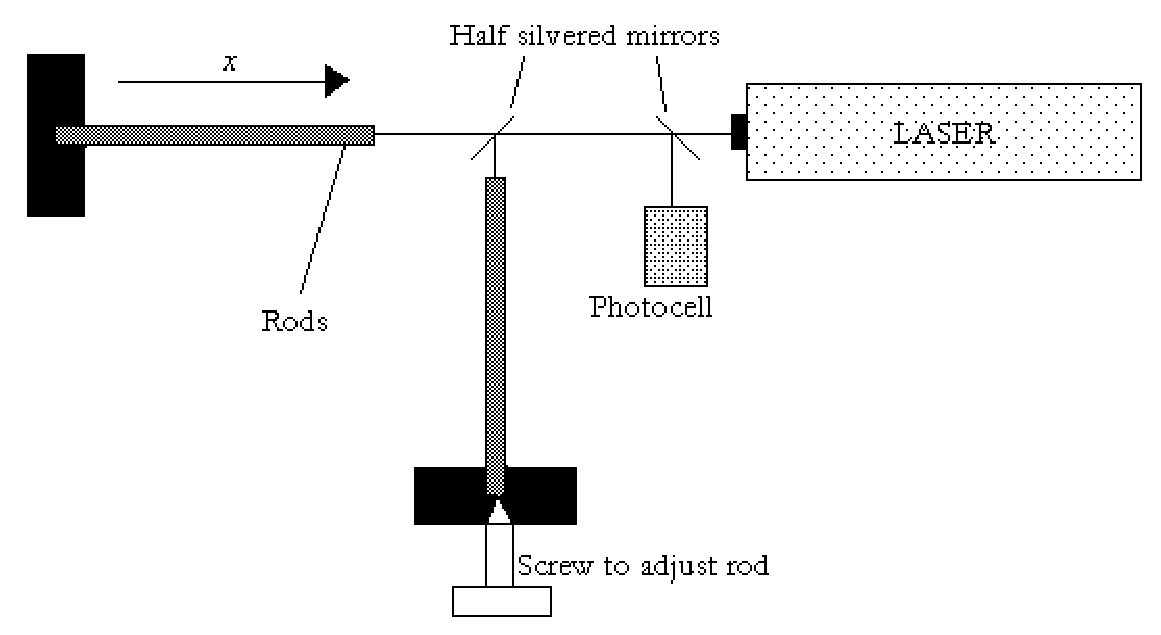
Figure 3.1
The rods are given a short sharp impulse by a piezoelectric device. As a result the free ends of the rods oscillate with a longitudinal displacement \(\Delta x_t\), where
\[ \Delta x_t=ae^{-\mu t}\cos(\omega t+\phi), \]
and \(a,\mu,\omega\) and \(\phi\) are constants.
(a) If the amplitude of the motion is reduced by 20% during a 50s interval determine a value for \(\mu\).
(b) Determine also a value for \(\omega\) given that the rods are made of aluminium with a density (\(\rho\)) of \(2700\ \mathrm{kg\,m^{-3}}\) and a Young modulus (\(E\)) of \(7.1\times10^{10}\ \mathrm{Pa}\).
(c) It is impossible to make the rods exactly the same length so the photocell signal has a beat frequency of \(0.005\ \mathrm{Hz}\). What is the difference in length of the rods?
(d) For the rod of length \(l\), derive an algebraic expression for the change in length, \(\Delta l\), due to a change, \(\Delta g\), in the gravitational field strength, \(g\), in terms of \(l\) and other constants of the rod material.
(e) The light produced by the laser is monochromatic with a wavelength of 656nm. If the minimum fringe shift that can be detected is \(10^{-4}\) of the wavelength of the laser, what is the minimum value of \(l\) necessary if such a system were to be capable of detecting variations in \(g\) of \(10^{-19}\ \mathrm{N\,kg^{-1}}\)?
A non-directional form of gravitational wave detector consists of a sphere of copper-alloy of mass 1168 kg, suspended in a vacuum from a vibration-reducing assembly. Transducers, containing tuned circuits, are attached to the sphere to detect changes in its dimensions. The transducers will, however, pick up all spurious vibrations due to, for example, temperature effects and noise due to electric pick up.
(f) To reduce vibrations due to temperature effects the sphere is maintained at a temperature of 100 mK. By what factor will the amplitude of the atomic vibrations been reduced in cooling the assembly from 300 K?
(g) The sphere is initially cooled to 4.2 K using liquid nitrogen and liquid helium. The temperature, \(T\), is further reduced to 100 mK by a refrigeration process, which removes energy from the system at an average rate of 1 mW. Given that the specific thermal capacity, \(s\), of the copper-alloy varies directly as \(T^3\) at these low temperatures, estimate the time taken for the system to cool from 4.2 K to 100 mK, given that \(s=0.072\ \mathrm{J\,kg^{-1}\,K^{-1}}\) at 4.2 K.
Part B
This part is concerned with the effect of a gravitational field on the propagation of light in space.
(a) A photon emitted from the surface of the Sun (mass \(M\), radius \(R\)) is red-shifted. By assuming a rest-mass equivalent for the photon energy, apply Newtonian gravitational theory to show that the effective (or measured) frequency of the photon at infinity is reduced (red-shifted) by the factor \((1-GM/Rc^2)\).
(b) A reduction of the photon’s frequency is equivalent to an increase in its time period, or, using the photon as a standard clock, a dilation of time. In addition, it may be shown that a time dilation is always accompanied by a contraction in the unit of length by the same factor.
We will now try to study the effect that this has on the propagation of light near the Sun. Let us first define an effective refractive index \(n_r\) at a point \(r\) from the centre of the Sun. Let
\[ n_r=\frac{c}{c'_r}, \]
where \(c\) is the speed of light as measured by a co-ordinate system far away from the Sun’s gravitational influence (\(r\to\infty\)), and \(c'_r\) is the speed of light as measured by a co-ordinate system at a distance \(r\) from the centre of the Sun.
Show that \(n_r\) may be approximated to:
\[ n_r=1+\frac{\alpha GM}{rc^2}, \]
for small \(GM/rc^2\), where \(\alpha\) is a constant that you determine.
(c) Using this expression for \(n_r\), calculate in radians the deflection of a light ray from its straight path as it passes the edge of the Sun.
Data:
Gravitational constant, \(G=6.67\times10^{-11}\ \mathrm{N\,m^2\,kg^{-2}}\).
Mass of Sun, \(M=1.99\times10^{30}\ \mathrm{kg}\).
Radius of Sun, \(R=6.95\times10^8\ \mathrm{m}\).
Velocity of light, \(c=3.00\times10^8\ \mathrm{m\,s^{-1}}\).
You may also need the following integral:
\[ \int_{-\infty}^{+\infty}\frac{dx}{(x^2+a^2)^{3/2}} =\frac{2}{a^2}. \]
Official English text of the problem.
Answers
- A(a): \(\boxed{\mu=4.46\times10^{-3}\ \mathrm{s^{-1}}}\).
- A(b): For the fundamental longitudinal mode, \(\boxed{\omega\simeq8.06\times10^3\ \mathrm{rad\,s^{-1}}}\).
- A(c): \(\boxed{|l_1-l_2|\simeq3.90\times10^{-6}\ \mathrm{m}=3.90\ \mu\mathrm{m}}\).
- A(d): \(\boxed{\Delta l=\dfrac{\rho l^2\Delta g}{2E}}\), with \(\Delta g\) taken along the rod, positive towards its free end.
- A(e): \(\boxed{l_{\min}\simeq1.31\times10^8\ \mathrm{m}}\), interpreting the threshold as an optical path difference and taking one arm’s axial response relative to the other.
- A(f): The amplitude decreases by a factor \(\boxed{54.8}\), to \(\boxed{0.0183}\) of its initial value, in the classical harmonic model.
- A(g): \(\boxed{t\simeq8.83\times10^4\ \mathrm{s}\simeq24.5\ \mathrm{h}}\).
- B(a): \(\boxed{\nu_\infty\simeq\nu_R\left(1-\dfrac{GM}{Rc^2}\right)}\).
- B(b): \(\boxed{\alpha=2,\qquad n_r\simeq1+\dfrac{2GM}{rc^2}}\).
- B(c): \(\boxed{\theta=\dfrac{4GM}{Rc^2}=8.49\times10^{-6}\ \mathrm{rad}}\), towards the Sun.
Solution
A(a)
The amplitude envelope is
\[ A(t)=ae^{-\mu t}. \]
A reduction by \(20\%\) means that the amplitude after \(50\ \mathrm{s}\) is \(0.80\) times its previous value:
\[ \frac{A(t+50)}{A(t)}=e^{-50\mu}=0.80. \]
Therefore,
\[ \boxed{\mu=-\frac{\ln(0.80)}{50} =4.46\times10^{-3}\ \mathrm{s^{-1}}}. \]
A(b)
Treat the rod as a uniform elastic continuum, and take the observed oscillation to be its fundamental longitudinal mode.
Let \(u(x,t)\) be the longitudinal displacement and \(S\) the cross-sectional area. The longitudinal force is \(ES\,\partial u/\partial x\). Newton’s second law for a short element gives
\[ \rho S\,dx\,\frac{\partial^2u}{\partial t^2} =ES\,dx\,\frac{\partial^2u}{\partial x^2}. \]
Thus longitudinal waves travel at
\[ v=\sqrt{\frac{E}{\rho}}. \]
The fixed end has zero displacement, while the free end has zero longitudinal stress:
\[ u(0,t)=0, \qquad \left.\frac{\partial u}{\partial x}\right|_{x=l}=0. \]
For a mode with spatial dependence \(\sin(kx)\), the free-end condition requires
\[ \cos(kl)=0. \]
For the fundamental mode, \(kl=\pi/2\), so the rod is one quarter of a wavelength long. Hence
\[ \omega_0=vk=\frac{\pi}{2l}\sqrt{\frac{E}{\rho}}. \]
Numerically,
\[ v=\sqrt{\frac{7.1\times10^{10}}{2700}} =5.128\times10^3\ \mathrm{m\,s^{-1}}, \]
and, for \(l=1\ \mathrm{m}\),
\[ \omega_0=\frac{\pi}{2}(5.128\times10^3) =8.055\times10^3\ \mathrm{rad\,s^{-1}}. \]
For linear damping, the observed angular frequency is \(\omega=\sqrt{\omega_0^2-\mu^2}\). Since \(\mu\ll\omega_0\), this correction is negligible:
\[ \boxed{\omega\simeq8.06\times10^3\ \mathrm{rad\,s^{-1}}}. \]
The corresponding frequency is
\[ f=\frac{\omega}{2\pi}=\frac{v}{4l} \simeq1.282\times10^3\ \mathrm{Hz}. \]
A(c)
For rods made of the same material and oscillating in the same fundamental mode,
\[ f(l)=\frac{v}{4l}. \]
Consequently, their beat frequency is
\[ f_{\mathrm b}=|f_1-f_2| =\frac{v}{4}\left|\frac1{l_1}-\frac1{l_2}\right|. \]
For a small length difference \(\delta l=|l_1-l_2|\), with both lengths approximately \(l\),
\[ f_{\mathrm b}\simeq\frac{v}{4l^2}\delta l =\frac{f}{l}\delta l. \]
Therefore,
\[ \delta l\simeq\frac{l f_{\mathrm b}}{f} =\frac{(1)(0.005)}{1281.998}\ \mathrm{m}, \]
giving
\[ \boxed{\delta l\simeq3.90\times10^{-6}\ \mathrm{m}}. \]
The ratio \(\delta l/l\simeq3.9\times10^{-6}\) confirms the validity of the small-difference approximation.
A(d)
Use linear elasticity and a quasi-static gravitational perturbation. Let \(x\) run from the fixed end, \(x=0\), to the free end, \(x=l\), and let \(\Delta g\) denote the signed component of the field change along this direction.
The material beyond a cross-section at \(x\) has mass
\[ m(x)=\rho S(l-x). \]
The additional axial force transmitted through that section is therefore
\[ \Delta F(x)=\rho S(l-x)\Delta g. \]
By Young’s modulus, the change in local strain is
\[ \Delta\epsilon(x)=\frac{\Delta F(x)}{ES} =\frac{\rho(l-x)\Delta g}{E}. \]
Integrating the extension of all elements,
\[ \Delta l =\int_0^l\Delta\epsilon(x)\,dx =\frac{\rho\Delta g}{E}\int_0^l(l-x)\,dx. \]
Thus
\[ \boxed{\Delta l=\frac{\rho l^2\Delta g}{2E}}. \]
A field change directed towards the fixed end gives compression, represented by a negative \(\Delta g\).
A(e)
A displacement \(\Delta l\) of a reflecting end changes the round-trip optical path by \(2\Delta l\). Taking the field change along one rod, with the other acting as the longitudinal reference,
\[ |\Delta D|=2|\Delta l|. \]
A change of optical path by one wavelength moves the interference condition through one fringe. The stated sensitivity therefore corresponds to
\[ |\Delta D|_{\min}=10^{-4}\lambda =10^{-4}(656\times10^{-9}) =6.56\times10^{-11}\ \mathrm{m}. \]
The minimum detectable rod-end displacement is consequently
\[ |\Delta l|_{\min}=3.28\times10^{-11}\ \mathrm{m}. \]
Using A(d),
\[ 2|\Delta l|=\frac{\rho l^2|\Delta g|}{E}. \]
At the detection threshold,
\[ l_{\min} =\sqrt{\frac{E\,10^{-4}\lambda}{\rho|\Delta g|}}. \]
Substitution gives
\[ l_{\min} =\sqrt{ \frac{(7.1\times10^{10})(10^{-4})(656\times10^{-9})} {(2700)(10^{-19})} }, \]
so
\[ \boxed{l_{\min}\simeq1.31\times10^8\ \mathrm{m}}. \]
More generally, if both rods respond, \(\Delta g\) in this expression is replaced by the difference between their signed axial field changes.
A(f)
In the classical harmonic approximation, an atomic displacement \(x\) has elastic potential energy \(\tfrac12\kappa x^2\). Equipartition gives
\[ \frac12\kappa\langle x^2\rangle=\frac12 k_{\mathrm B}T. \]
For unchanged effective stiffness \(\kappa\), the characteristic vibration amplitude therefore scales as
\[ A\propto\sqrt{T}. \]
Since \(100\ \mathrm{mK}=0.100\ \mathrm{K}\),
\[ \frac{A_{\mathrm{cold}}}{A_{\mathrm{warm}}} =\sqrt{\frac{0.100}{300}} =\frac1{\sqrt{3000}} =0.0183. \]
Thus the amplitude is reduced by a factor
\[ \boxed{\frac{A_{\mathrm{warm}}}{A_{\mathrm{cold}}} =\sqrt{3000}\simeq54.8}. \]
This estimate uses classical thermal vibrations and neglects quantum zero-point motion.
A(g)
Let
\[ T_i=4.2\ \mathrm{K},\qquad T_f=0.100\ \mathrm{K},\qquad s_i=0.072\ \mathrm{J\,kg^{-1}\,K^{-1}}. \]
The specified heat-capacity law is
\[ s(T)=s_i\left(\frac{T}{T_i}\right)^3. \]
The heat that must be removed from the sphere is
\[ Q=m\int_{T_f}^{T_i}s(T)\,dT =\frac{ms_i}{T_i^3}\int_{T_f}^{T_i}T^3\,dT. \]
Therefore,
\[ Q=\frac{ms_i}{4T_i^3}(T_i^4-T_f^4) =\frac{ms_iT_i}{4} \left[1-\left(\frac{T_f}{T_i}\right)^4\right]. \]
Numerically,
\[ Q= \frac{(1168)(0.072)(4.2)}4 \left[1-\left(\frac{0.100}{4.2}\right)^4\right] \simeq88.3\ \mathrm{J}. \]
At average cooling power \(P=1.00\times10^{-3}\ \mathrm{W}\),
\[ t=\frac QP =\frac{88.3}{10^{-3}}\ \mathrm{s}. \]
Hence
\[ \boxed{t\simeq8.83\times10^4\ \mathrm{s} \simeq24.5\ \mathrm{h}}. \]
B(a)
Let the emitted frequency be \(\nu_R\). Following the prescribed Newtonian model, assign the photon an energy-equivalent gravitational mass
\[ m_\gamma=\frac{h\nu_R}{c^2}. \]
The work required to move this mass from the solar surface to infinity is
\[ W=\int_R^\infty\frac{GMm_\gamma}{r^2}\,dr =\frac{GMm_\gamma}{R}. \]
Conservation of energy gives
\[ h\nu_\infty=h\nu_R-\frac{GMm_\gamma}{R}. \]
Substituting \(m_\gamma=h\nu_R/c^2\),
\[ h\nu_\infty =h\nu_R\left(1-\frac{GM}{Rc^2}\right), \]
and therefore
\[ \boxed{\nu_\infty\simeq \nu_R\left(1-\frac{GM}{Rc^2}\right)}. \]
This is a first-order weak-field result. Using the emitted energy to calculate \(m_\gamma\) introduces only higher-order corrections. For the Sun,
\[ \frac{GM}{Rc^2}=2.12\times10^{-6}\ll1, \]
so the approximation is well justified.
B(b)
Define
\[ \epsilon=\frac{GM}{rc^2}, \qquad q=1-\epsilon. \]
The frequency reduction by \(q\) corresponds to an increase in the clock period by \(1/q\). According to the length-contraction rule supplied in the question, the associated length scale decreases by \(q\).
Thus, in the problem’s comparison with distant coordinates, the effective speed scales as
\[ \frac{c'_r}{c}\simeq\frac{q}{1/q}=q^2. \]
It follows that
\[ n_r=\frac{c}{c'_r} \simeq\frac1{(1-\epsilon)^2}. \]
Expanding to first order,
\[ (1-\epsilon)^{-2}=1+2\epsilon+O(\epsilon^2). \]
Therefore,
\[ \boxed{n_r\simeq1+\frac{2GM}{rc^2}}, \qquad \boxed{\alpha=2}. \]
Here \(c'_r\) is the effective coordinate speed used in the question’s refractive-index model. A local measurement using proper lengths and times still gives the vacuum speed \(c\).
B(c)
Take the incoming light ray to travel approximately along the \(x\)-direction, with impact parameter \(b\). Along its unperturbed path,
\[ y=b,\qquad r=\sqrt{x^2+b^2}. \]
The refractive index is
\[ n(x,y)=1+\frac{\alpha GM}{c^2\sqrt{x^2+y^2}}. \]
Snell’s law for a continuously varying refractive index gives the ray equation
\[ \frac{d}{ds}(n\hat{\boldsymbol t})=\boldsymbol\nabla n, \]
where \(\hat{\boldsymbol t}\) is the ray’s unit tangent. For a small deflection, \(ds\simeq dx\) and \(n\simeq1\), so its transverse component becomes
\[ \frac{d\theta}{dx}\simeq\frac{\partial n}{\partial y}. \]
Differentiation gives
\[ \frac{\partial n}{\partial y} =-\frac{\alpha GM\,y} {c^2(x^2+y^2)^{3/2}}. \]
To first order, this may be evaluated along the straight path \(y=b\):
\[ \Delta\theta =-\frac{\alpha GMb}{c^2} \int_{-\infty}^{+\infty} \frac{dx}{(x^2+b^2)^{3/2}}. \]
Using the supplied integral,
\[ \Delta\theta =-\frac{\alpha GMb}{c^2}\frac2{b^2} =-\frac{2\alpha GM}{bc^2}. \]
The negative sign indicates bending towards the Sun. For a ray grazing its edge, \(b\simeq R\), and \(\alpha=2\), giving the deflection magnitude
\[ \theta=\frac{4GM}{Rc^2}. \]
Numerically,
\[ \theta= \frac{4(6.67\times10^{-11})(1.99\times10^{30})} {(6.95\times10^8)(3.00\times10^8)^2}. \]
Thus
\[ \boxed{\theta=8.49\times10^{-6}\ \mathrm{rad} \quad\text{towards the Sun}}. \]
This is approximately \(1.75\) arcseconds.
The solution was checked against the official solution.
IPhO 2000 · Theorieaufgabe 3
Gravitationswellendetektor (Teil A) und gravitative Ablenkung des Lichts durch die Sonne (Teil B)
Gravitationswellen und die Auswirkungen der Gravitation auf Licht.
Teil A
Dieser Teil behandelt die Schwierigkeiten beim Nachweis von Gravitationswellen, die durch astronomische Ereignisse erzeugt werden. Man muss sich dabei vor Augen halten, dass die Explosion einer weit entfernten Supernova Schwankungen der Gravitationsfeldstärke an der Erdoberfläche von etwa \(10^{-19}\ \mathrm{N\,kg^{-1}}\) hervorrufen kann.
Ein Modell für einen Gravitationswellendetektor (siehe Abbildung 3.1) besteht aus zwei jeweils 1m langen Metallstäben, die im rechten Winkel zueinander angeordnet sind. Ein Ende jedes Stabes ist optisch eben poliert, während das andere Ende fest eingespannt ist. Die Position eines Stabes wird so eingestellt, dass das von der Fotozelle empfangene Signal minimal ist (siehe Abbildung 3.1).
Abbildung 3.1
Den Stäben wird durch eine piezoelektrische Vorrichtung ein kurzer, kräftiger Stoß versetzt. Dadurch schwingen die freien Enden der Stäbe mit einer longitudinalen Auslenkung \(\Delta x_t\), wobei
\[ \Delta x_t=ae^{-\mu t}\cos(\omega t+\phi), \]
und \(a,\mu,\omega\) und \(\phi\) Konstanten sind.
(a) Wenn die Amplitude der Bewegung innerhalb eines Zeitintervalls von 50s um 20% abnimmt, bestimmen Sie einen Wert für \(\mu\).
(b) Bestimmen Sie auch einen Wert für \(\omega\), wenn die Stäbe aus Aluminium mit einer Dichte (\(\rho\)) von \(2700\ \mathrm{kg\,m^{-3}}\) und einem Elastizitätsmodul (\(E\)) von \(7.1\times10^{10}\ \mathrm{Pa}\) bestehen.
(c) Es ist unmöglich, die Stäbe exakt gleich lang herzustellen, sodass das Signal der Fotozelle eine Schwebungsfrequenz von \(0.005\ \mathrm{Hz}\) aufweist. Wie groß ist der Längenunterschied zwischen den Stäben?
(d) Leiten Sie für den Stab der Länge \(l\) einen algebraischen Ausdruck für die Längenänderung \(\Delta l\) infolge einer Änderung \(\Delta g\) der Gravitationsfeldstärke \(g\) in Abhängigkeit von \(l\) und weiteren Konstanten des Stabmaterials her.
(e) Das vom Laser erzeugte Licht ist monochromatisch und hat eine Wellenlänge von 656nm. Wenn die kleinste nachweisbare Streifenverschiebung \(10^{-4}\) der Wellenlänge des Lasers beträgt, welcher Mindestwert von \(l\) ist erforderlich, damit ein solches System Änderungen von \(g\) um \(10^{-19}\ \mathrm{N\,kg^{-1}}\) nachweisen kann?
Eine richtungsunabhängige Form eines Gravitationswellendetektors besteht aus einer Kugel aus einer Kupferlegierung mit einer Masse von 1168 kg, die im Vakuum an einer schwingungsdämpfenden Aufhängung hängt. An der Kugel sind Messwandler mit abgestimmten Schwingkreisen angebracht, um Änderungen ihrer Abmessungen nachzuweisen. Die Messwandler erfassen jedoch auch sämtliche Störschwingungen, beispielsweise durch Temperatureinflüsse, sowie Rauschen durch elektrische Einstreuungen.
(f) Um Schwingungen durch Temperatureinflüsse zu verringern, wird die Kugel auf einer Temperatur von 100 mK gehalten. Um welchen Faktor wird die Amplitude der atomaren Schwingungen beim Abkühlen der Anordnung von 300 K verringert?
(g) Die Kugel wird zunächst mithilfe von flüssigem Stickstoff und flüssigem Helium auf 4.2 K abgekühlt. Die Temperatur \(T\) wird durch einen Kälteprozess, der dem System Energie mit einer mittleren Leistung von 1 mW entzieht, weiter auf 100 mK gesenkt. Die spezifische Wärmekapazität \(s\) der Kupferlegierung ist bei diesen niedrigen Temperaturen direkt proportional zu \(T^3\). Schätzen Sie die Zeit ab, die benötigt wird, um das System von 4.2 K auf 100 mK abzukühlen, wenn bei 4.2 K gilt: \(s=0.072\ \mathrm{J\,kg^{-1}\,K^{-1}}\).
Teil B
Dieser Teil behandelt die Wirkung eines Gravitationsfeldes auf die Ausbreitung von Licht im Raum.
(a) Ein Photon, das von der Oberfläche der Sonne (Masse \(M\), Radius \(R\)) emittiert wird, erfährt eine Rotverschiebung. Nehmen Sie für die Photonenenergie ein Ruhemasseäquivalent an und zeigen Sie mithilfe der Newtonschen Gravitationstheorie, dass die effektive (oder gemessene) Frequenz des Photons im Unendlichen um den Faktor \((1-GM/Rc^2)\) verringert (rotverschoben) ist.
(b) Eine Verringerung der Frequenz des Photons entspricht einer Verlängerung seiner Periodendauer oder, wenn man das Photon als Referenzuhr verwendet, einer Zeitdilatation. Außerdem lässt sich zeigen, dass eine Zeitdilatation stets mit einer Kontraktion der Längeneinheit um denselben Faktor einhergeht.
Wir wollen nun versuchen, die Auswirkung dieses Effekts auf die Lichtausbreitung in Sonnennähe zu untersuchen. Definieren wir zunächst einen effektiven Brechungsindex \(n_r\) an einem Punkt im Abstand \(r\) vom Mittelpunkt der Sonne. Es sei
\[ n_r=\frac{c}{c'_r}, \]
wobei \(c\) die Lichtgeschwindigkeit ist, die in einem Koordinatensystem weit außerhalb des gravitativen Einflusses der Sonne (\(r\to\infty\)) gemessen wird, und \(c'_r\) die Lichtgeschwindigkeit, die in einem Koordinatensystem im Abstand \(r\) vom Mittelpunkt der Sonne gemessen wird.
Zeigen Sie, dass \(n_r\) näherungsweise wie folgt dargestellt werden kann:
\[ n_r=1+\frac{\alpha GM}{rc^2}, \]
für kleine Werte von \(GM/rc^2\), wobei \(\alpha\) eine von Ihnen zu bestimmende Konstante ist.
(c) Berechnen Sie mithilfe dieses Ausdrucks für \(n_r\) im Bogenmaß die Ablenkung eines Lichtstrahls von seiner geradlinigen Bahn, wenn er am Sonnenrand vorbeiläuft.
Daten:
Gravitationskonstante, \(G=6.67\times10^{-11}\ \mathrm{N\,m^2\,kg^{-2}}\).
Masse der Sonne, \(M=1.99\times10^{30}\ \mathrm{kg}\).
Radius der Sonne, \(R=6.95\times10^8\ \mathrm{m}\).
Lichtgeschwindigkeit, \(c=3.00\times10^8\ \mathrm{m\,s^{-1}}\).
Möglicherweise benötigen Sie auch das folgende Integral:
\[ \int_{-\infty}^{+\infty}\frac{dx}{(x^2+a^2)^{3/2}} =\frac{2}{a^2}. \]
Aufgabentext aus dem offiziellen englischen Text übersetzt.
Antworten
- A(a): \(\boxed{\mu=4.46\times10^{-3}\ \mathrm{s^{-1}}}\).
- A(b): Für die longitudinale Grundschwingung gilt \(\boxed{\omega\simeq8.06\times10^3\ \mathrm{rad\,s^{-1}}}\).
- A(c): \(\boxed{|l_1-l_2|\simeq3.90\times10^{-6}\ \mathrm{m}=3.90\ \mu\mathrm{m}}\).
- A(d): \(\boxed{\Delta l=\dfrac{\rho l^2\Delta g}{2E}}\), wobei \(\Delta g\) entlang des Stabes und in Richtung seines freien Endes positiv angesetzt wird.
- A(e): \(\boxed{l_{\min}\simeq1.31\times10^8\ \mathrm{m}}\), wenn die Nachweisgrenze als optischer Gangunterschied interpretiert und die axiale Reaktion eines Arms relativ zum anderen betrachtet wird.
- A(f): Die Amplitude nimmt im klassischen harmonischen Modell um den Faktor \(\boxed{54.8}\) auf \(\boxed{0.0183}\) ihres Anfangswerts ab.
- A(g): \(\boxed{t\simeq8.83\times10^4\ \mathrm{s}\simeq24.5\ \mathrm{h}}\).
- B(a): \(\boxed{\nu_\infty\simeq\nu_R\left(1-\dfrac{GM}{Rc^2}\right)}\).
- B(b): \(\boxed{\alpha=2,\qquad n_r\simeq1+\dfrac{2GM}{rc^2}}\).
- B(c): \(\boxed{\theta=\dfrac{4GM}{Rc^2}=8.49\times10^{-6}\ \mathrm{rad}}\), zur Sonne hin.
Lösung
A(a)
Die Amplitudenhüllkurve ist
\[ A(t)=ae^{-\mu t}. \]
Eine Verringerung um \(20\%\) bedeutet, dass die Amplitude nach \(50\ \mathrm{s}\) das \(0.80\)-Fache ihres vorherigen Werts beträgt:
\[ \frac{A(t+50)}{A(t)}=e^{-50\mu}=0.80. \]
Daher gilt
\[ \boxed{\mu=-\frac{\ln(0.80)}{50} =4.46\times10^{-3}\ \mathrm{s^{-1}}}. \]
A(b)
Wir behandeln den Stab als homogenes elastisches Kontinuum und nehmen an, dass die beobachtete Schwingung seine longitudinale Grundschwingung ist.
Es seien \(u(x,t)\) die longitudinale Auslenkung und \(S\) die Querschnittsfläche. Die Längskraft ist \(ES\,\partial u/\partial x\). Das zweite Newtonsche Gesetz liefert für ein kurzes Stabelement
\[ \rho S\,dx\,\frac{\partial^2u}{\partial t^2} =ES\,dx\,\frac{\partial^2u}{\partial x^2}. \]
Somit breiten sich Longitudinalwellen mit folgender Geschwindigkeit aus:
\[ v=\sqrt{\frac{E}{\rho}}. \]
Am eingespannten Ende verschwindet die Auslenkung, während am freien Ende die Längsspannung verschwindet:
\[ u(0,t)=0, \qquad \left.\frac{\partial u}{\partial x}\right|_{x=l}=0. \]
Für eine Schwingungsmode mit der Ortsabhängigkeit \(\sin(kx)\) verlangt die Randbedingung am freien Ende
\[ \cos(kl)=0. \]
Für die Grundschwingung gilt \(kl=\pi/2\), sodass die Stablänge einem Viertel der Wellenlänge entspricht. Folglich ist
\[ \omega_0=vk=\frac{\pi}{2l}\sqrt{\frac{E}{\rho}}. \]
Numerisch ergibt sich
\[ v=\sqrt{\frac{7.1\times10^{10}}{2700}} =5.128\times10^3\ \mathrm{m\,s^{-1}}, \]
und für \(l=1\ \mathrm{m}\) gilt
\[ \omega_0=\frac{\pi}{2}(5.128\times10^3) =8.055\times10^3\ \mathrm{rad\,s^{-1}}. \]
Bei linearer Dämpfung beträgt die beobachtete Kreisfrequenz \(\omega=\sqrt{\omega_0^2-\mu^2}\). Da \(\mu\ll\omega_0\), ist diese Korrektur vernachlässigbar:
\[ \boxed{\omega\simeq8.06\times10^3\ \mathrm{rad\,s^{-1}}}. \]
Die zugehörige Frequenz ist
\[ f=\frac{\omega}{2\pi}=\frac{v}{4l} \simeq1.282\times10^3\ \mathrm{Hz}. \]
A(c)
Für Stäbe aus demselben Material, die in derselben Grundschwingungsmode schwingen, gilt
\[ f(l)=\frac{v}{4l}. \]
Ihre Schwebungsfrequenz beträgt daher
\[ f_{\mathrm b}=|f_1-f_2| =\frac{v}{4}\left|\frac1{l_1}-\frac1{l_2}\right|. \]
Für einen kleinen Längenunterschied \(\delta l=|l_1-l_2|\), wobei beide Längen näherungsweise \(l\) betragen, gilt
\[ f_{\mathrm b}\simeq\frac{v}{4l^2}\delta l =\frac{f}{l}\delta l. \]
Daher ist
\[ \delta l\simeq\frac{l f_{\mathrm b}}{f} =\frac{(1)(0.005)}{1281.998}\ \mathrm{m}, \]
woraus folgt:
\[ \boxed{\delta l\simeq3.90\times10^{-6}\ \mathrm{m}}. \]
Das Verhältnis \(\delta l/l\simeq3.9\times10^{-6}\) bestätigt die Gültigkeit der Näherung für kleine Längenunterschiede.
A(d)
Wir verwenden die lineare Elastizitätstheorie und nehmen eine quasistatische gravitative Störung an. Die Koordinate \(x\) verlaufe vom eingespannten Ende bei \(x=0\) zum freien Ende bei \(x=l\), und \(\Delta g\) bezeichne die vorzeichenbehaftete Komponente der Feldänderung entlang dieser Richtung.
Das Material jenseits eines Querschnitts bei \(x\) hat die Masse
\[ m(x)=\rho S(l-x). \]
Die zusätzliche Axialkraft, die durch diesen Querschnitt übertragen wird, ist daher
\[ \Delta F(x)=\rho S(l-x)\Delta g. \]
Aus der Definition des Elastizitätsmoduls ergibt sich für die Änderung der lokalen Dehnung
\[ \Delta\epsilon(x)=\frac{\Delta F(x)}{ES} =\frac{\rho(l-x)\Delta g}{E}. \]
Durch Integration der Verlängerungen aller Elemente erhalten wir
\[ \Delta l =\int_0^l\Delta\epsilon(x)\,dx =\frac{\rho\Delta g}{E}\int_0^l(l-x)\,dx. \]
Somit gilt
\[ \boxed{\Delta l=\frac{\rho l^2\Delta g}{2E}}. \]
Eine zum eingespannten Ende gerichtete Feldänderung führt zu einer Stauchung, die durch ein negatives \(\Delta g\) beschrieben wird.
A(e)
Eine Verschiebung \(\Delta l\) eines reflektierenden Endes ändert den optischen Weg für Hin- und Rückweg um \(2\Delta l\). Nehmen wir an, dass die Feldänderung entlang eines Stabes erfolgt, während der andere als longitudinale Referenz dient, so gilt
\[ |\Delta D|=2|\Delta l|. \]
Eine Änderung des optischen Weges um eine Wellenlänge verschiebt die Interferenzbedingung um einen Streifen. Die angegebene Empfindlichkeit entspricht daher
\[ |\Delta D|_{\min}=10^{-4}\lambda =10^{-4}(656\times10^{-9}) =6.56\times10^{-11}\ \mathrm{m}. \]
Die kleinste nachweisbare Verschiebung des Stabendes beträgt folglich
\[ |\Delta l|_{\min}=3.28\times10^{-11}\ \mathrm{m}. \]
Mit A(d) ergibt sich
\[ 2|\Delta l|=\frac{\rho l^2|\Delta g|}{E}. \]
An der Nachweisgrenze gilt
\[ l_{\min} =\sqrt{\frac{E\,10^{-4}\lambda}{\rho|\Delta g|}}. \]
Einsetzen ergibt
\[ l_{\min} =\sqrt{ \frac{(7.1\times10^{10})(10^{-4})(656\times10^{-9})} {(2700)(10^{-19})} }, \]
also
\[ \boxed{l_{\min}\simeq1.31\times10^8\ \mathrm{m}}. \]
Allgemeiner wird, wenn beide Stäbe reagieren, \(\Delta g\) in diesem Ausdruck durch die Differenz ihrer vorzeichenbehafteten axialen Feldänderungen ersetzt.
A(f)
In der klassischen harmonischen Näherung besitzt eine atomare Auslenkung \(x\) die elastische potenzielle Energie \(\tfrac12\kappa x^2\). Der Gleichverteilungssatz liefert
\[ \frac12\kappa\langle x^2\rangle=\frac12 k_{\mathrm B}T. \]
Bei unveränderter effektiver Steifigkeit \(\kappa\) skaliert die charakteristische Schwingungsamplitude daher gemäß
\[ A\propto\sqrt{T}. \]
Da \(100\ \mathrm{mK}=0.100\ \mathrm{K}\), gilt
\[ \frac{A_{\mathrm{cold}}}{A_{\mathrm{warm}}} =\sqrt{\frac{0.100}{300}} =\frac1{\sqrt{3000}} =0.0183. \]
Die Amplitude wird somit um folgenden Faktor verringert:
\[ \boxed{\frac{A_{\mathrm{warm}}}{A_{\mathrm{cold}}} =\sqrt{3000}\simeq54.8}. \]
Diese Abschätzung verwendet klassische thermische Schwingungen und vernachlässigt die quantenmechanische Nullpunktsbewegung.
A(g)
Es seien
\[ T_i=4.2\ \mathrm{K},\qquad T_f=0.100\ \mathrm{K},\qquad s_i=0.072\ \mathrm{J\,kg^{-1}\,K^{-1}}. \]
Das angegebene Gesetz für die Wärmekapazität lautet
\[ s(T)=s_i\left(\frac{T}{T_i}\right)^3. \]
Die Wärme, die der Kugel entzogen werden muss, beträgt
\[ Q=m\int_{T_f}^{T_i}s(T)\,dT =\frac{ms_i}{T_i^3}\int_{T_f}^{T_i}T^3\,dT. \]
Daher gilt
\[ Q=\frac{ms_i}{4T_i^3}(T_i^4-T_f^4) =\frac{ms_iT_i}{4} \left[1-\left(\frac{T_f}{T_i}\right)^4\right]. \]
Numerisch ergibt sich
\[ Q= \frac{(1168)(0.072)(4.2)}4 \left[1-\left(\frac{0.100}{4.2}\right)^4\right] \simeq88.3\ \mathrm{J}. \]
Bei einer mittleren Kühlleistung von \(P=1.00\times10^{-3}\ \mathrm{W}\) gilt
\[ t=\frac QP =\frac{88.3}{10^{-3}}\ \mathrm{s}. \]
Folglich ist
\[ \boxed{t\simeq8.83\times10^4\ \mathrm{s} \simeq24.5\ \mathrm{h}}. \]
B(a)
Die emittierte Frequenz sei \(\nu_R\). Entsprechend dem vorgegebenen Newtonschen Modell ordnen wir dem Photon eine seiner Energie äquivalente schwere Masse zu:
\[ m_\gamma=\frac{h\nu_R}{c^2}. \]
Die Arbeit, die erforderlich ist, um diese Masse von der Sonnenoberfläche ins Unendliche zu bewegen, beträgt
\[ W=\int_R^\infty\frac{GMm_\gamma}{r^2}\,dr =\frac{GMm_\gamma}{R}. \]
Aus der Energieerhaltung folgt
\[ h\nu_\infty=h\nu_R-\frac{GMm_\gamma}{R}. \]
Einsetzen von \(m_\gamma=h\nu_R/c^2\) ergibt
\[ h\nu_\infty =h\nu_R\left(1-\frac{GM}{Rc^2}\right), \]
und daher
\[ \boxed{\nu_\infty\simeq \nu_R\left(1-\frac{GM}{Rc^2}\right)}. \]
Dies ist ein Ergebnis erster Ordnung in der Schwachfeldnäherung. Die Verwendung der emittierten Energie zur Berechnung von \(m_\gamma\) führt nur zu Korrekturen höherer Ordnung. Für die Sonne gilt
\[ \frac{GM}{Rc^2}=2.12\times10^{-6}\ll1, \]
sodass die Näherung gut gerechtfertigt ist.
B(b)
Wir definieren
\[ \epsilon=\frac{GM}{rc^2}, \qquad q=1-\epsilon. \]
Die Verringerung der Frequenz um den Faktor \(q\) entspricht einer Verlängerung der Taktperiode der Uhr um den Faktor \(1/q\). Nach der in der Aufgabe angegebenen Regel zur Längenkontraktion nimmt der zugehörige Längenmaßstab um den Faktor \(q\) ab.
Damit skaliert die effektive Geschwindigkeit beim in der Aufgabe vorgenommenen Vergleich mit weit entfernten Koordinaten gemäß
\[ \frac{c'_r}{c}\simeq\frac{q}{1/q}=q^2. \]
Daraus folgt
\[ n_r=\frac{c}{c'_r} \simeq\frac1{(1-\epsilon)^2}. \]
Die Entwicklung bis zur ersten Ordnung ergibt
\[ (1-\epsilon)^{-2}=1+2\epsilon+O(\epsilon^2). \]
Daher ist
\[ \boxed{n_r\simeq1+\frac{2GM}{rc^2}}, \qquad \boxed{\alpha=2}. \]
Hier ist \(c'_r\) die effektive Koordinatengeschwindigkeit, die im Brechungsindexmodell der Aufgabe verwendet wird. Eine lokale Messung mit Eigenlängen und Eigenzeiten ergibt weiterhin die Vakuumlichtgeschwindigkeit \(c\).
B(c)
Der einfallende Lichtstrahl breite sich näherungsweise entlang der \(x\)-Richtung mit dem Stoßparameter \(b\) aus. Entlang seiner ungestörten Bahn gilt
\[ y=b,\qquad r=\sqrt{x^2+b^2}. \]
Der Brechungsindex ist
\[ n(x,y)=1+\frac{\alpha GM}{c^2\sqrt{x^2+y^2}}. \]
Das Snelliussche Brechungsgesetz liefert für einen kontinuierlich veränderlichen Brechungsindex die Strahlgleichung
\[ \frac{d}{ds}(n\hat{\boldsymbol t})=\boldsymbol\nabla n, \]
wobei \(\hat{\boldsymbol t}\) der Einheitstangentenvektor des Strahls ist. Für eine kleine Ablenkung gelten \(ds\simeq dx\) und \(n\simeq1\), sodass sich für die transversale Komponente der Gleichung ergibt:
\[ \frac{d\theta}{dx}\simeq\frac{\partial n}{\partial y}. \]
Differenzieren ergibt
\[ \frac{\partial n}{\partial y} =-\frac{\alpha GM\,y} {c^2(x^2+y^2)^{3/2}}. \]
In erster Ordnung kann dies entlang der geraden Bahn \(y=b\) ausgewertet werden:
\[ \Delta\theta =-\frac{\alpha GMb}{c^2} \int_{-\infty}^{+\infty} \frac{dx}{(x^2+b^2)^{3/2}}. \]
Mit dem angegebenen Integral folgt
\[ \Delta\theta =-\frac{\alpha GMb}{c^2}\frac2{b^2} =-\frac{2\alpha GM}{bc^2}. \]
Das negative Vorzeichen zeigt an, dass die Ablenkung zur Sonne hin erfolgt. Für einen Strahl, der den Sonnenrand streift, gilt \(b\simeq R\), und mit \(\alpha=2\) ergibt sich der Betrag der Ablenkung zu
\[ \theta=\frac{4GM}{Rc^2}. \]
Numerisch ergibt sich
\[ \theta= \frac{4(6.67\times10^{-11})(1.99\times10^{30})} {(6.95\times10^8)(3.00\times10^8)^2}. \]
Somit ist
\[ \boxed{\theta=8.49\times10^{-6}\ \mathrm{rad} \quad\text{zur Sonne hin}}. \]
Dies entspricht ungefähr \(1.75\) Bogensekunden.
Die Lösung wurde mit der offiziellen Lösung abgeglichen.
IPhO 2000 · Teori sorusu 3
Kütleçekim dalgası dedektörü (Bölüm A) ve ışığın Güneş tarafından kütleçekimsel saptırılması (Bölüm B)
Kütleçekim dalgaları ve kütleçekimin ışık üzerindeki etkileri.
Bölüm A
Bu bölüm, astronomik olayların ürettiği kütleçekim dalgalarını saptamanın güçlüklerini ele almaktadır. Uzak bir süpernovanın patlamasının, Dünya yüzeyindeki kütleçekim alan şiddetinde yaklaşık \(10^{-19}\ \mathrm{N\,kg^{-1}}\) büyüklüğünde dalgalanmalar oluşturabileceği göz önünde bulundurulmalıdır.
Bir kütleçekim dalgası dedektörü modeli (bkz. şekil 3.1), birbirine dik tutulan ve her biri 1m uzunluğunda olan iki metal çubuktan oluşur. Her çubuğun bir ucu optik olarak düz olacak şekilde parlatılmış, diğer ucu ise rijit biçimde sabitlenmiştir. Çubuklardan birinin konumu, fotoselden alınan sinyal en küçük olacak şekilde ayarlanır (bkz. şekil 3.1).
Şekil 3.1
Çubuklara piezoelektrik bir aygıtla kısa süreli, ani bir itme uygulanır. Bunun sonucunda çubukların serbest uçları, boyuna yer değiştirmeleri \(\Delta x_t\) olacak şekilde salınır; burada
\[ \Delta x_t=ae^{-\mu t}\cos(\omega t+\phi), \]
ve \(a,\mu,\omega\) ile \(\phi\) sabitlerdir.
(a) Hareketin genliği 50s'lik bir zaman aralığında %20 azalıyorsa \(\mu\) için bir değer belirleyiniz.
(b) Çubukların, yoğunluğu (\(\rho\)) \(2700\ \mathrm{kg\,m^{-3}}\) ve Young modülü (\(E\)) \(7.1\times10^{10}\ \mathrm{Pa}\) olan alüminyumdan yapıldığı verildiğine göre, \(\omega\) için de bir değer belirleyiniz.
(c) Çubukları tam olarak aynı uzunlukta yapmak olanaksızdır; bu nedenle fotosel sinyalinin vurum frekansı \(0.005\ \mathrm{Hz}\)'dir. Çubukların uzunlukları arasındaki fark nedir?
(d) Uzunluğu \(l\) olan çubuk için, kütleçekim alan şiddeti \(g\)'deki \(\Delta g\) değişiminin yol açtığı uzunluk değişimini, \(\Delta l\), \(l\) ve çubuk malzemesinin diğer sabitleri cinsinden veren cebirsel bir ifade türetiniz.
(e) Lazerin ürettiği ışık tek renklidir ve dalga boyu 656nm'dir. Saptanabilen en küçük saçak kayması lazerin dalga boyunun \(10^{-4}\)'ü ise, böyle bir sistemin \(g\)'deki \(10^{-19}\ \mathrm{N\,kg^{-1}}\) büyüklüğündeki değişimleri saptayabilmesi için gereken en küçük \(l\) değeri nedir?
Yön bağımlılığı olmayan bir kütleçekim dalgası dedektörü türü, titreşimleri azaltan bir düzeneğe bağlı olarak vakum içinde asılı duran, 1168 kg kütleli bir bakır alaşımı küreden oluşur. Boyutlarındaki değişimleri saptamak için küreye, ayarlı devreler içeren dönüştürücüler bağlanmıştır. Ancak bu dönüştürücüler, örneğin sıcaklık etkilerinden kaynaklanan istenmeyen tüm titreşimleri ve elektriksel parazitlerden kaynaklanan gürültüyü de algılar.
(f) Sıcaklık etkilerinden kaynaklanan titreşimleri azaltmak için küre 100 mK sıcaklıkta tutulur. Düzenek 300 K'den soğutulduğunda atomik titreşimlerin genliği kaç kat azalmış olur?
(g) Küre başlangıçta sıvı azot ve sıvı helyum kullanılarak 4.2 K'e soğutulur. Ardından sıcaklık, \(T\), sistemden ortalama 1 mW hızla enerji uzaklaştıran bir soğutma işlemiyle 100 mK'e düşürülür. Bu düşük sıcaklıklarda bakır alaşımının özgül ısı kapasitesi \(s\)'nin \(T^3\) ile doğru orantılı olduğu ve 4.2 K'de \(s=0.072\ \mathrm{J\,kg^{-1}\,K^{-1}}\) olduğu verildiğine göre, sistemin 4.2 K'den 100 mK'e soğuması için gereken süreyi tahmin ediniz.
Bölüm B
Bu bölüm, bir kütleçekim alanının ışığın uzaydaki yayılımına etkisini ele almaktadır.
(a) Güneş'in (kütlesi \(M\), yarıçapı \(R\)) yüzeyinden yayılan bir foton kırmızıya kayar. Foton enerjisine karşılık gelen bir durgun kütle eşdeğeri varsayarak Newton'un kütleçekim kuramını uygulayınız ve fotonun sonsuzdaki etkin (veya ölçülen) frekansının \((1-GM/Rc^2)\) çarpanıyla azaldığını (kırmızıya kaydığını) gösteriniz.
(b) Fotonun frekansındaki azalma, periyodundaki bir artışa ya da foton standart bir saat olarak kullanıldığında, zaman genişlemesine eşdeğerdir. Ayrıca, zaman genişlemesine her zaman uzunluk biriminde aynı çarpanla bir kısalmanın eşlik ettiği gösterilebilir.
Şimdi bunun Güneş yakınında ışığın yayılımı üzerindeki etkisini incelemeye çalışacağız. Önce Güneş'in merkezinden \(r\) uzaklıktaki bir noktada etkin kırılma indisi \(n_r\)'yi tanımlayalım.
\[ n_r=\frac{c}{c'_r}, \]
olsun; burada \(c\), Güneş'in kütleçekim etkisinden çok uzaktaki (\(r\to\infty\)) bir koordinat sisteminde ölçülen ışık hızı, \(c'_r\) ise Güneş'in merkezinden \(r\) uzaklıktaki bir koordinat sisteminde ölçülen ışık hızıdır.
\(n_r\)'nin yaklaşık olarak aşağıdaki biçimde yazılabileceğini gösteriniz:
\[ n_r=1+\frac{\alpha GM}{rc^2}, \]
burada \(GM/rc^2\) küçüktür ve \(\alpha\), sizin belirleyeceğiniz bir sabittir.
(c) \(n_r\) için bu ifadeyi kullanarak, Güneş'in kenarından geçerken bir ışık ışınının doğrusal yolundan sapmasını radyan cinsinden hesaplayınız.
Veriler:
Kütleçekim sabiti, \(G=6.67\times10^{-11}\ \mathrm{N\,m^2\,kg^{-2}}\).
Güneş'in kütlesi, \(M=1.99\times10^{30}\ \mathrm{kg}\).
Güneş'in yarıçapı, \(R=6.95\times10^8\ \mathrm{m}\).
Işık hızı, \(c=3.00\times10^8\ \mathrm{m\,s^{-1}}\).
Aşağıdaki integrale de ihtiyaç duyabilirsiniz:
\[ \int_{-\infty}^{+\infty}\frac{dx}{(x^2+a^2)^{3/2}} =\frac{2}{a^2}. \]
Soru metni resmi İngilizce metinden çevrilmiştir.
Cevaplar
- A(a): \(\boxed{\mu=4.46\times10^{-3}\ \mathrm{s^{-1}}}\).
- A(b): Temel boyuna mod için, \(\boxed{\omega\simeq8.06\times10^3\ \mathrm{rad\,s^{-1}}}\).
- A(c): \(\boxed{|l_1-l_2|\simeq3.90\times10^{-6}\ \mathrm{m}=3.90\ \mu\mathrm{m}}\).
- A(d): \(\boxed{\Delta l=\dfrac{\rho l^2\Delta g}{2E}}\); burada \(\Delta g\), çubuk boyunca alınır ve serbest uca doğru pozitiftir.
- A(e): \(\boxed{l_{\min}\simeq1.31\times10^8\ \mathrm{m}}\); eşik, optik yol farkı olarak yorumlanmış ve bir kolun diğerine göre eksenel tepkisi alınmıştır.
- A(f): Klasik harmonik modelde genlik \(\boxed{54.8}\) kat azalarak başlangıç değerinin \(\boxed{0.0183}\)'üne düşer.
- A(g): \(\boxed{t\simeq8.83\times10^4\ \mathrm{s}\simeq24.5\ \mathrm{h}}\).
- B(a): \(\boxed{\nu_\infty\simeq\nu_R\left(1-\dfrac{GM}{Rc^2}\right)}\).
- B(b): \(\boxed{\alpha=2,\qquad n_r\simeq1+\dfrac{2GM}{rc^2}}\).
- B(c): \(\boxed{\theta=\dfrac{4GM}{Rc^2}=8.49\times10^{-6}\ \mathrm{rad}}\), Güneş'e doğru.
Çözüm
A(a)
Genlik zarfı
\[ A(t)=ae^{-\mu t}. \]
şeklindedir. \(20\%\)'lik bir azalma, \(50\ \mathrm{s}\) sonraki genliğin önceki değerinin \(0.80\) katı olması anlamına gelir:
\[ \frac{A(t+50)}{A(t)}=e^{-50\mu}=0.80. \]
Dolayısıyla,
\[ \boxed{\mu=-\frac{\ln(0.80)}{50} =4.46\times10^{-3}\ \mathrm{s^{-1}}}. \]
A(b)
Çubuğu düzgün bir elastik sürekli ortam olarak ele alalım ve gözlenen salınımın temel boyuna mod olduğunu kabul edelim.
\(u(x,t)\) boyuna yer değiştirme, \(S\) ise kesit alanı olsun. Boyuna kuvvet \(ES\,\partial u/\partial x\)'tir. Kısa bir elemana Newton'un ikinci yasası uygulandığında
\[ \rho S\,dx\,\frac{\partial^2u}{\partial t^2} =ES\,dx\,\frac{\partial^2u}{\partial x^2}. \]
elde edilir. Böylece boyuna dalgalar
\[ v=\sqrt{\frac{E}{\rho}}. \]
hızıyla yayılır. Sabit uçta yer değiştirme sıfır, serbest uçta ise boyuna gerilme sıfırdır:
\[ u(0,t)=0, \qquad \left.\frac{\partial u}{\partial x}\right|_{x=l}=0. \]
Uzaysal bağımlılığı \(\sin(kx)\) olan bir mod için serbest uç koşulu
\[ \cos(kl)=0. \]
olmasını gerektirir. Temel mod için \(kl=\pi/2\)'dir; dolayısıyla çubuğun uzunluğu dalga boyunun dörtte biridir. Buradan
\[ \omega_0=vk=\frac{\pi}{2l}\sqrt{\frac{E}{\rho}}. \]
Sayısal olarak,
\[ v=\sqrt{\frac{7.1\times10^{10}}{2700}} =5.128\times10^3\ \mathrm{m\,s^{-1}}, \]
ve \(l=1\ \mathrm{m}\) için,
\[ \omega_0=\frac{\pi}{2}(5.128\times10^3) =8.055\times10^3\ \mathrm{rad\,s^{-1}}. \]
Doğrusal sönüm durumunda gözlenen açısal frekans \(\omega=\sqrt{\omega_0^2-\mu^2}\)'dir. \(\mu\ll\omega_0\) olduğundan bu düzeltme ihmal edilebilir:
\[ \boxed{\omega\simeq8.06\times10^3\ \mathrm{rad\,s^{-1}}}. \]
Buna karşılık gelen frekans
\[ f=\frac{\omega}{2\pi}=\frac{v}{4l} \simeq1.282\times10^3\ \mathrm{Hz}. \]
şeklindedir.
A(c)
Aynı malzemeden yapılmış ve aynı temel modda salınan çubuklar için,
\[ f(l)=\frac{v}{4l}. \]
Dolayısıyla vurum frekansları
\[ f_{\mathrm b}=|f_1-f_2| =\frac{v}{4}\left|\frac1{l_1}-\frac1{l_2}\right|. \]
şeklindedir. Her iki uzunluğun da yaklaşık \(l\) olduğu küçük bir \(\delta l=|l_1-l_2|\) uzunluk farkı için,
\[ f_{\mathrm b}\simeq\frac{v}{4l^2}\delta l =\frac{f}{l}\delta l. \]
Dolayısıyla,
\[ \delta l\simeq\frac{l f_{\mathrm b}}{f} =\frac{(1)(0.005)}{1281.998}\ \mathrm{m}, \]
buradan
\[ \boxed{\delta l\simeq3.90\times10^{-6}\ \mathrm{m}}. \]
elde edilir. \(\delta l/l\simeq3.9\times10^{-6}\) oranı, küçük fark yaklaşımının geçerliliğini doğrular.
A(d)
Doğrusal elastikliği ve yarı statik bir kütleçekim pertürbasyonunu kullanalım. \(x\), sabit uçtan, \(x=0\), serbest uca, \(x=l\), doğru artsın ve \(\Delta g\), alan değişiminin bu yöndeki işaretli bileşenini göstersin.
\(x\) konumundaki bir kesitin ötesinde kalan malzemenin kütlesi
\[ m(x)=\rho S(l-x). \]
şeklindedir. Dolayısıyla bu kesitten iletilen ek eksenel kuvvet
\[ \Delta F(x)=\rho S(l-x)\Delta g. \]
olur. Young modülü bağıntısına göre yerel birim uzamadaki değişim
\[ \Delta\epsilon(x)=\frac{\Delta F(x)}{ES} =\frac{\rho(l-x)\Delta g}{E}. \]
şeklindedir. Tüm elemanların uzamaları integre edilirse,
\[ \Delta l =\int_0^l\Delta\epsilon(x)\,dx =\frac{\rho\Delta g}{E}\int_0^l(l-x)\,dx. \]
Böylece
\[ \boxed{\Delta l=\frac{\rho l^2\Delta g}{2E}}. \]
Sabit uca doğru yönelen bir alan değişimi, negatif bir \(\Delta g\) ile temsil edilen sıkışmaya yol açar.
A(e)
Yansıtıcı bir ucun \(\Delta l\) kadar yer değiştirmesi, gidiş-dönüş optik yolunu \(2\Delta l\) kadar değiştirir. Alan değişimi bir çubuk boyunca alınır ve diğer çubuk boyuna referans olarak kullanılırsa,
\[ |\Delta D|=2|\Delta l|. \]
Optik yolun bir dalga boyu kadar değişmesi, girişim koşulunu bir saçak kadar kaydırır. Dolayısıyla belirtilen duyarlılık
\[ |\Delta D|_{\min}=10^{-4}\lambda =10^{-4}(656\times10^{-9}) =6.56\times10^{-11}\ \mathrm{m}. \]
değerine karşılık gelir. Bu nedenle saptanabilen en küçük çubuk ucu yer değiştirmesi
\[ |\Delta l|_{\min}=3.28\times10^{-11}\ \mathrm{m}. \]
olur. A(d) kullanılarak,
\[ 2|\Delta l|=\frac{\rho l^2|\Delta g|}{E}. \]
Saptama eşiğinde,
\[ l_{\min} =\sqrt{\frac{E\,10^{-4}\lambda}{\rho|\Delta g|}}. \]
Değerler yerine konursa
\[ l_{\min} =\sqrt{ \frac{(7.1\times10^{10})(10^{-4})(656\times10^{-9})} {(2700)(10^{-19})} }, \]
dolayısıyla
\[ \boxed{l_{\min}\simeq1.31\times10^8\ \mathrm{m}}. \]
Daha genel olarak, her iki çubuk da tepki veriyorsa bu ifadede \(\Delta g\) yerine çubukların işaretli eksenel alan değişimleri arasındaki fark konur.
A(f)
Klasik harmonik yaklaşımda, bir atomun \(x\) yer değiştirmesine karşılık gelen elastik potansiyel enerji \(\tfrac12\kappa x^2\)'dir. Enerjinin eşbölüşümü ilkesi
\[ \frac12\kappa\langle x^2\rangle=\frac12 k_{\mathrm B}T. \]
bağıntısını verir. Etkin yay sabiti \(\kappa\) değişmediğinde, karakteristik titreşim genliği bu nedenle
\[ A\propto\sqrt{T}. \]
şeklinde ölçeklenir. \(100\ \mathrm{mK}=0.100\ \mathrm{K}\) olduğundan,
\[ \frac{A_{\mathrm{cold}}}{A_{\mathrm{warm}}} =\sqrt{\frac{0.100}{300}} =\frac1{\sqrt{3000}} =0.0183. \]
Böylece genlik
\[ \boxed{\frac{A_{\mathrm{warm}}}{A_{\mathrm{cold}}} =\sqrt{3000}\simeq54.8}. \]
kat azalır. Bu tahmin, klasik ısıl titreşimleri kullanır ve kuantum sıfır noktası hareketini ihmal eder.
A(g)
Şöyle tanımlayalım:
\[ T_i=4.2\ \mathrm{K},\qquad T_f=0.100\ \mathrm{K},\qquad s_i=0.072\ \mathrm{J\,kg^{-1}\,K^{-1}}. \]
Belirtilen ısı kapasitesi yasası
\[ s(T)=s_i\left(\frac{T}{T_i}\right)^3. \]
şeklindedir. Küreden uzaklaştırılması gereken ısı
\[ Q=m\int_{T_f}^{T_i}s(T)\,dT =\frac{ms_i}{T_i^3}\int_{T_f}^{T_i}T^3\,dT. \]
olur. Dolayısıyla,
\[ Q=\frac{ms_i}{4T_i^3}(T_i^4-T_f^4) =\frac{ms_iT_i}{4} \left[1-\left(\frac{T_f}{T_i}\right)^4\right]. \]
Sayısal olarak,
\[ Q= \frac{(1168)(0.072)(4.2)}4 \left[1-\left(\frac{0.100}{4.2}\right)^4\right] \simeq88.3\ \mathrm{J}. \]
Ortalama soğutma gücü \(P=1.00\times10^{-3}\ \mathrm{W}\) olduğunda,
\[ t=\frac QP =\frac{88.3}{10^{-3}}\ \mathrm{s}. \]
Buradan
\[ \boxed{t\simeq8.83\times10^4\ \mathrm{s} \simeq24.5\ \mathrm{h}}. \]
B(a)
Yayılan fotonun frekansı \(\nu_R\) olsun. Verilen Newton modelini izleyerek fotona, enerjisine eşdeğer bir kütleçekim kütlesi atayalım:
\[ m_\gamma=\frac{h\nu_R}{c^2}. \]
Bu kütleyi Güneş yüzeyinden sonsuza taşımak için gereken iş
\[ W=\int_R^\infty\frac{GMm_\gamma}{r^2}\,dr =\frac{GMm_\gamma}{R}. \]
olur. Enerjinin korunumu
\[ h\nu_\infty=h\nu_R-\frac{GMm_\gamma}{R}. \]
bağıntısını verir. \(m_\gamma=h\nu_R/c^2\) yerine konursa,
\[ h\nu_\infty =h\nu_R\left(1-\frac{GM}{Rc^2}\right), \]
ve dolayısıyla
\[ \boxed{\nu_\infty\simeq \nu_R\left(1-\frac{GM}{Rc^2}\right)}. \]
Bu, zayıf alan için birinci mertebeden bir sonuçtur. \(m_\gamma\)'yı hesaplamak için yayım anındaki enerjinin kullanılması yalnızca daha yüksek mertebeden düzeltmeler getirir. Güneş için,
\[ \frac{GM}{Rc^2}=2.12\times10^{-6}\ll1, \]
olduğundan yaklaşım oldukça geçerlidir.
B(b)
Şöyle tanımlayalım:
\[ \epsilon=\frac{GM}{rc^2}, \qquad q=1-\epsilon. \]
Frekansın \(q\) çarpanıyla azalması, saatin periyodunun \(1/q\) çarpanıyla artmasına karşılık gelir. Soruda verilen uzunluk kısalması kuralına göre, buna eşlik eden uzunluk ölçeği \(q\) çarpanıyla azalır.
Böylece, soruda uzak koordinatlarla yapılan karşılaştırmada etkin hız
\[ \frac{c'_r}{c}\simeq\frac{q}{1/q}=q^2. \]
şeklinde ölçeklenir. Buradan
\[ n_r=\frac{c}{c'_r} \simeq\frac1{(1-\epsilon)^2}. \]
Birinci mertebeye kadar açılım yapılırsa,
\[ (1-\epsilon)^{-2}=1+2\epsilon+O(\epsilon^2). \]
Dolayısıyla,
\[ \boxed{n_r\simeq1+\frac{2GM}{rc^2}}, \qquad \boxed{\alpha=2}. \]
Burada \(c'_r\), sorunun kırılma indisi modelinde kullanılan etkin koordinat hızıdır. Öz uzunluklar ve öz zamanlar kullanılarak yapılan yerel bir ölçüm yine boşluktaki ışık hızı \(c\)'yi verir.
B(c)
Gelen ışık ışınının, \(b\) çarpma parametresiyle yaklaşık olarak \(x\) doğrultusunda ilerlediğini kabul edelim. Pertürbe olmamış yolu boyunca,
\[ y=b,\qquad r=\sqrt{x^2+b^2}. \]
Kırılma indisi
\[ n(x,y)=1+\frac{\alpha GM}{c^2\sqrt{x^2+y^2}}. \]
şeklindedir. Sürekli değişen bir kırılma indisi için Snell yasası, ışın denklemini verir:
\[ \frac{d}{ds}(n\hat{\boldsymbol t})=\boldsymbol\nabla n, \]
burada \(\hat{\boldsymbol t}\), ışının birim teğet vektörüdür. Küçük bir sapma için \(ds\simeq dx\) ve \(n\simeq1\) olduğundan, denklemin enine bileşeni
\[ \frac{d\theta}{dx}\simeq\frac{\partial n}{\partial y}. \]
halini alır. Türev alınırsa
\[ \frac{\partial n}{\partial y} =-\frac{\alpha GM\,y} {c^2(x^2+y^2)^{3/2}}. \]
Birinci mertebede bu ifade, \(y=b\) doğrusal yolu boyunca hesaplanabilir:
\[ \Delta\theta =-\frac{\alpha GMb}{c^2} \int_{-\infty}^{+\infty} \frac{dx}{(x^2+b^2)^{3/2}}. \]
Verilen integral kullanılarak,
\[ \Delta\theta =-\frac{\alpha GMb}{c^2}\frac2{b^2} =-\frac{2\alpha GM}{bc^2}. \]
Negatif işaret, Güneş'e doğru bükülmeyi gösterir. Güneş'in kenarına teğet geçen bir ışın için \(b\simeq R\) ve \(\alpha=2\) olduğundan, sapmanın büyüklüğü
\[ \theta=\frac{4GM}{Rc^2}. \]
olur. Sayısal olarak,
\[ \theta= \frac{4(6.67\times10^{-11})(1.99\times10^{30})} {(6.95\times10^8)(3.00\times10^8)^2}. \]
Böylece
\[ \boxed{\theta=8.49\times10^{-6}\ \mathrm{rad} \quad\text{Güneş'e doğru}}. \]
Bu, yaklaşık \(1.75\) yay saniyesidir.
Çözüm, resmi çözümle karşılaştırılarak kontrol edildi.
IPhO 2000 · Problema teórico 3
Detector de ondas gravitacionales (Parte A) y desviación gravitacional de la luz por el Sol (Parte B)
Ondas gravitacionales y efectos de la gravedad sobre la luz.
Parte A
Esta parte trata de las dificultades para detectar ondas gravitacionales generadas por fenómenos astronómicos. Debe tenerse en cuenta que la explosión de una supernova lejana puede producir fluctuaciones de la intensidad del campo gravitatorio en la superficie de la Tierra de aproximadamente \(10^{-19}\ \mathrm{N\,kg^{-1}}\).
Un modelo de detector de ondas gravitacionales (véase la figura 3.1) consta de dos barras metálicas de 1m de longitud cada una, dispuestas perpendicularmente entre sí. Un extremo de cada barra está pulido hasta obtener una superficie ópticamente plana, y el otro está sujeto rígidamente. La posición de una de las barras se ajusta de modo que la señal recibida de la fotocélula sea mínima (véase la figura 3.1).
Figura 3.1
Se aplica a las barras un impulso breve y brusco mediante un dispositivo piezoeléctrico. Como resultado, los extremos libres de las barras oscilan con un desplazamiento longitudinal \(\Delta x_t\), donde
\[ \Delta x_t=ae^{-\mu t}\cos(\omega t+\phi), \]
y \(a,\mu,\omega\) y \(\phi\) son constantes.
(a) Si la amplitud del movimiento se reduce un 20% durante un intervalo de 50s, determine un valor de \(\mu\).
(b) Determine también un valor de \(\omega\), sabiendo que las barras son de aluminio, con una densidad (\(\rho\)) de \(2700\ \mathrm{kg\,m^{-3}}\) y un módulo de Young (\(E\)) de \(7.1\times10^{10}\ \mathrm{Pa}\).
(c) Es imposible fabricar las barras con exactamente la misma longitud, por lo que la señal de la fotocélula tiene una frecuencia de batido de \(0.005\ \mathrm{Hz}\). ¿Cuál es la diferencia de longitud entre las barras?
(d) Para la barra de longitud \(l\), deduzca una expresión algebraica para el cambio de longitud, \(\Delta l\), debido a un cambio, \(\Delta g\), en la intensidad del campo gravitatorio, \(g\), en función de \(l\) y de otras constantes del material de la barra.
(e) La luz producida por el láser es monocromática, con una longitud de onda de 656nm. Si el desplazamiento mínimo de las franjas que puede detectarse es \(10^{-4}\) de la longitud de onda del láser, ¿cuál es el valor mínimo de \(l\) necesario para que un sistema de este tipo sea capaz de detectar variaciones de \(g\) de \(10^{-19}\ \mathrm{N\,kg^{-1}}\)?
Un tipo no direccional de detector de ondas gravitacionales consiste en una esfera de aleación de cobre de masa 1168 kg, suspendida en el vacío de un sistema que reduce las vibraciones. A la esfera se fijan transductores que contienen circuitos sintonizados para detectar cambios en sus dimensiones. Sin embargo, los transductores captarán todas las vibraciones espurias debidas, por ejemplo, a efectos térmicos, así como el ruido debido a la captación de interferencias eléctricas.
(f) Para reducir las vibraciones debidas a los efectos térmicos, la esfera se mantiene a una temperatura de 100 mK. ¿En qué factor se habrá reducido la amplitud de las vibraciones atómicas al enfriar el conjunto desde 300 K?
(g) La esfera se enfría inicialmente hasta 4.2 K utilizando nitrógeno líquido y helio líquido. La temperatura, \(T\), se reduce después hasta 100 mK mediante un proceso de refrigeración que extrae energía del sistema a una tasa media de 1 mW. Sabiendo que la capacidad calorífica específica, \(s\), de la aleación de cobre es directamente proporcional a \(T^3\) a estas bajas temperaturas, estime el tiempo que tarda el sistema en enfriarse desde 4.2 K hasta 100 mK, dado que \(s=0.072\ \mathrm{J\,kg^{-1}\,K^{-1}}\) a 4.2 K.
Parte B
Esta parte trata del efecto de un campo gravitatorio sobre la propagación de la luz en el espacio.
(a) Un fotón emitido desde la superficie del Sol (masa \(M\), radio \(R\)) experimenta un corrimiento al rojo. Suponiendo una masa en reposo equivalente a la energía del fotón, aplique la teoría gravitatoria newtoniana para demostrar que la frecuencia efectiva (o medida) del fotón en el infinito se reduce (experimenta un corrimiento al rojo) por el factor \((1-GM/Rc^2)\).
(b) Una reducción de la frecuencia del fotón equivale a un aumento de su período o, si se utiliza el fotón como reloj patrón, a una dilatación del tiempo. Además, puede demostrarse que una dilatación del tiempo siempre va acompañada de una contracción de la unidad de longitud por el mismo factor.
Ahora intentaremos estudiar el efecto que esto tiene sobre la propagación de la luz cerca del Sol. Definamos primero un índice de refracción efectivo \(n_r\) en un punto situado a una distancia \(r\) del centro del Sol. Sea
\[ n_r=\frac{c}{c'_r}, \]
donde \(c\) es la velocidad de la luz medida en un sistema de coordenadas alejado de la influencia gravitatoria del Sol (\(r\to\infty\)), y \(c'_r\) es la velocidad de la luz medida en un sistema de coordenadas situado a una distancia \(r\) del centro del Sol.
Demuestre que \(n_r\) puede aproximarse por:
\[ n_r=1+\frac{\alpha GM}{rc^2}, \]
para valores pequeños de \(GM/rc^2\), donde \(\alpha\) es una constante que debe determinar.
(c) Utilizando esta expresión para \(n_r\), calcule en radianes la desviación de un rayo de luz respecto de su trayectoria rectilínea al pasar junto al borde del Sol.
Datos:
Constante gravitacional, \(G=6.67\times10^{-11}\ \mathrm{N\,m^2\,kg^{-2}}\).
Masa del Sol, \(M=1.99\times10^{30}\ \mathrm{kg}\).
Radio del Sol, \(R=6.95\times10^8\ \mathrm{m}\).
Velocidad de la luz, \(c=3.00\times10^8\ \mathrm{m\,s^{-1}}\).
También puede necesitar la siguiente integral:
\[ \int_{-\infty}^{+\infty}\frac{dx}{(x^2+a^2)^{3/2}} =\frac{2}{a^2}. \]
Enunciado traducido del texto oficial en inglés.
Respuestas
- A(a): \(\boxed{\mu=4.46\times10^{-3}\ \mathrm{s^{-1}}}\).
- A(b): Para el modo longitudinal fundamental, \(\boxed{\omega\simeq8.06\times10^3\ \mathrm{rad\,s^{-1}}}\).
- A(c): \(\boxed{|l_1-l_2|\simeq3.90\times10^{-6}\ \mathrm{m}=3.90\ \mu\mathrm{m}}\).
- A(d): \(\boxed{\Delta l=\dfrac{\rho l^2\Delta g}{2E}}\), tomando \(\Delta g\) a lo largo de la barra, positivo hacia su extremo libre.
- A(e): \(\boxed{l_{\min}\simeq1.31\times10^8\ \mathrm{m}}\), interpretando el umbral como una diferencia de camino óptico y considerando la respuesta axial de un brazo respecto del otro.
- A(f): La amplitud disminuye en un factor de \(\boxed{54.8}\), hasta \(\boxed{0.0183}\) de su valor inicial, en el modelo armónico clásico.
- A(g): \(\boxed{t\simeq8.83\times10^4\ \mathrm{s}\simeq24.5\ \mathrm{h}}\).
- B(a): \(\boxed{\nu_\infty\simeq\nu_R\left(1-\dfrac{GM}{Rc^2}\right)}\).
- B(b): \(\boxed{\alpha=2,\qquad n_r\simeq1+\dfrac{2GM}{rc^2}}\).
- B(c): \(\boxed{\theta=\dfrac{4GM}{Rc^2}=8.49\times10^{-6}\ \mathrm{rad}}\), hacia el Sol.
Solución
A(a)
La envolvente de la amplitud es
\[ A(t)=ae^{-\mu t}. \]
Una reducción del \(20\%\) significa que la amplitud después de \(50\ \mathrm{s}\) es \(0.80\) veces su valor anterior:
\[ \frac{A(t+50)}{A(t)}=e^{-50\mu}=0.80. \]
Por tanto,
\[ \boxed{\mu=-\frac{\ln(0.80)}{50} =4.46\times10^{-3}\ \mathrm{s^{-1}}}. \]
A(b)
Trate la barra como un medio continuo elástico uniforme y considere que la oscilación observada corresponde a su modo longitudinal fundamental.
Sean \(u(x,t)\) el desplazamiento longitudinal y \(S\) el área de la sección transversal. La fuerza longitudinal es \(ES\,\partial u/\partial x\). La segunda ley de Newton aplicada a un elemento corto da
\[ \rho S\,dx\,\frac{\partial^2u}{\partial t^2} =ES\,dx\,\frac{\partial^2u}{\partial x^2}. \]
Así, las ondas longitudinales se propagan a
\[ v=\sqrt{\frac{E}{\rho}}. \]
El extremo fijo tiene desplazamiento nulo, mientras que el extremo libre tiene esfuerzo longitudinal nulo:
\[ u(0,t)=0, \qquad \left.\frac{\partial u}{\partial x}\right|_{x=l}=0. \]
Para un modo con dependencia espacial \(\sin(kx)\), la condición en el extremo libre exige
\[ \cos(kl)=0. \]
Para el modo fundamental, \(kl=\pi/2\), por lo que la longitud de la barra es un cuarto de la longitud de onda. Por consiguiente,
\[ \omega_0=vk=\frac{\pi}{2l}\sqrt{\frac{E}{\rho}}. \]
Numéricamente,
\[ v=\sqrt{\frac{7.1\times10^{10}}{2700}} =5.128\times10^3\ \mathrm{m\,s^{-1}}, \]
y, para \(l=1\ \mathrm{m}\),
\[ \omega_0=\frac{\pi}{2}(5.128\times10^3) =8.055\times10^3\ \mathrm{rad\,s^{-1}}. \]
Para un amortiguamiento lineal, la frecuencia angular observada es \(\omega=\sqrt{\omega_0^2-\mu^2}\). Puesto que \(\mu\ll\omega_0\), esta corrección es despreciable:
\[ \boxed{\omega\simeq8.06\times10^3\ \mathrm{rad\,s^{-1}}}. \]
La frecuencia correspondiente es
\[ f=\frac{\omega}{2\pi}=\frac{v}{4l} \simeq1.282\times10^3\ \mathrm{Hz}. \]
A(c)
Para barras del mismo material que oscilan en el mismo modo fundamental,
\[ f(l)=\frac{v}{4l}. \]
En consecuencia, su frecuencia de batido es
\[ f_{\mathrm b}=|f_1-f_2| =\frac{v}{4}\left|\frac1{l_1}-\frac1{l_2}\right|. \]
Para una pequeña diferencia de longitud \(\delta l=|l_1-l_2|\), con ambas longitudes aproximadamente iguales a \(l\),
\[ f_{\mathrm b}\simeq\frac{v}{4l^2}\delta l =\frac{f}{l}\delta l. \]
Por tanto,
\[ \delta l\simeq\frac{l f_{\mathrm b}}{f} =\frac{(1)(0.005)}{1281.998}\ \mathrm{m}, \]
lo que da
\[ \boxed{\delta l\simeq3.90\times10^{-6}\ \mathrm{m}}. \]
El cociente \(\delta l/l\simeq3.9\times10^{-6}\) confirma la validez de la aproximación de pequeña diferencia.
A(d)
Utilice la elasticidad lineal y una perturbación gravitatoria cuasiestática. Sea \(x\) la coordenada que va desde el extremo fijo, \(x=0\), hasta el extremo libre, \(x=l\), y sea \(\Delta g\) la componente con signo de la variación del campo a lo largo de esta dirección.
El material situado más allá de una sección transversal en \(x\) tiene una masa
\[ m(x)=\rho S(l-x). \]
Por tanto, la fuerza axial adicional transmitida a través de esa sección es
\[ \Delta F(x)=\rho S(l-x)\Delta g. \]
Por la definición del módulo de Young, la variación de la deformación unitaria local es
\[ \Delta\epsilon(x)=\frac{\Delta F(x)}{ES} =\frac{\rho(l-x)\Delta g}{E}. \]
Integrando el alargamiento de todos los elementos,
\[ \Delta l =\int_0^l\Delta\epsilon(x)\,dx =\frac{\rho\Delta g}{E}\int_0^l(l-x)\,dx. \]
Así,
\[ \boxed{\Delta l=\frac{\rho l^2\Delta g}{2E}}. \]
Una variación del campo dirigida hacia el extremo fijo produce una compresión, representada por un \(\Delta g\) negativo.
A(e)
Un desplazamiento \(\Delta l\) de un extremo reflector modifica el camino óptico de ida y vuelta en \(2\Delta l\). Tomando la variación del campo a lo largo de una barra, mientras la otra actúa como referencia longitudinal,
\[ |\Delta D|=2|\Delta l|. \]
Una variación del camino óptico de una longitud de onda desplaza la condición de interferencia en una franja. Por tanto, la sensibilidad indicada corresponde a
\[ |\Delta D|_{\min}=10^{-4}\lambda =10^{-4}(656\times10^{-9}) =6.56\times10^{-11}\ \mathrm{m}. \]
En consecuencia, el desplazamiento mínimo detectable del extremo de la barra es
\[ |\Delta l|_{\min}=3.28\times10^{-11}\ \mathrm{m}. \]
Utilizando A(d),
\[ 2|\Delta l|=\frac{\rho l^2|\Delta g|}{E}. \]
En el umbral de detección,
\[ l_{\min} =\sqrt{\frac{E\,10^{-4}\lambda}{\rho|\Delta g|}}. \]
La sustitución da
\[ l_{\min} =\sqrt{ \frac{(7.1\times10^{10})(10^{-4})(656\times10^{-9})} {(2700)(10^{-19})} }, \]
por lo que
\[ \boxed{l_{\min}\simeq1.31\times10^8\ \mathrm{m}}. \]
En general, si ambas barras responden, \(\Delta g\) en esta expresión se sustituye por la diferencia entre las variaciones con signo de sus componentes axiales del campo.
A(f)
En la aproximación armónica clásica, un desplazamiento atómico \(x\) tiene una energía potencial elástica \(\tfrac12\kappa x^2\). La equipartición da
\[ \frac12\kappa\langle x^2\rangle=\frac12 k_{\mathrm B}T. \]
Si la rigidez efectiva \(\kappa\) permanece constante, la amplitud característica de vibración es, por tanto, proporcional a
\[ A\propto\sqrt{T}. \]
Puesto que \(100\ \mathrm{mK}=0.100\ \mathrm{K}\),
\[ \frac{A_{\mathrm{cold}}}{A_{\mathrm{warm}}} =\sqrt{\frac{0.100}{300}} =\frac1{\sqrt{3000}} =0.0183. \]
Así, la amplitud se reduce en un factor
\[ \boxed{\frac{A_{\mathrm{warm}}}{A_{\mathrm{cold}}} =\sqrt{3000}\simeq54.8}. \]
Esta estimación utiliza vibraciones térmicas clásicas y desprecia el movimiento cuántico de punto cero.
A(g)
Sean
\[ T_i=4.2\ \mathrm{K},\qquad T_f=0.100\ \mathrm{K},\qquad s_i=0.072\ \mathrm{J\,kg^{-1}\,K^{-1}}. \]
La ley especificada para la capacidad calorífica es
\[ s(T)=s_i\left(\frac{T}{T_i}\right)^3. \]
El calor que debe extraerse de la esfera es
\[ Q=m\int_{T_f}^{T_i}s(T)\,dT =\frac{ms_i}{T_i^3}\int_{T_f}^{T_i}T^3\,dT. \]
Por tanto,
\[ Q=\frac{ms_i}{4T_i^3}(T_i^4-T_f^4) =\frac{ms_iT_i}{4} \left[1-\left(\frac{T_f}{T_i}\right)^4\right]. \]
Numéricamente,
\[ Q= \frac{(1168)(0.072)(4.2)}4 \left[1-\left(\frac{0.100}{4.2}\right)^4\right] \simeq88.3\ \mathrm{J}. \]
Con una potencia media de refrigeración \(P=1.00\times10^{-3}\ \mathrm{W}\),
\[ t=\frac QP =\frac{88.3}{10^{-3}}\ \mathrm{s}. \]
Por consiguiente,
\[ \boxed{t\simeq8.83\times10^4\ \mathrm{s} \simeq24.5\ \mathrm{h}}. \]
B(a)
Sea \(\nu_R\) la frecuencia emitida. Siguiendo el modelo newtoniano prescrito, asigne al fotón una masa gravitatoria equivalente a su energía
\[ m_\gamma=\frac{h\nu_R}{c^2}. \]
El trabajo necesario para trasladar esta masa desde la superficie solar hasta el infinito es
\[ W=\int_R^\infty\frac{GMm_\gamma}{r^2}\,dr =\frac{GMm_\gamma}{R}. \]
La conservación de la energía da
\[ h\nu_\infty=h\nu_R-\frac{GMm_\gamma}{R}. \]
Sustituyendo \(m_\gamma=h\nu_R/c^2\),
\[ h\nu_\infty =h\nu_R\left(1-\frac{GM}{Rc^2}\right), \]
y, por tanto,
\[ \boxed{\nu_\infty\simeq \nu_R\left(1-\frac{GM}{Rc^2}\right)}. \]
Este es un resultado de primer orden en la aproximación de campo débil. Utilizar la energía emitida para calcular \(m_\gamma\) introduce únicamente correcciones de orden superior. Para el Sol,
\[ \frac{GM}{Rc^2}=2.12\times10^{-6}\ll1, \]
por lo que la aproximación está bien justificada.
B(b)
Defina
\[ \epsilon=\frac{GM}{rc^2}, \qquad q=1-\epsilon. \]
La reducción de la frecuencia por el factor \(q\) corresponde a un aumento del período del reloj por el factor \(1/q\). Según la regla de contracción de longitudes proporcionada en el enunciado, la escala de longitud asociada disminuye por el factor \(q\).
Así, en la comparación del problema con coordenadas lejanas, la velocidad efectiva varía según
\[ \frac{c'_r}{c}\simeq\frac{q}{1/q}=q^2. \]
De ello se deduce que
\[ n_r=\frac{c}{c'_r} \simeq\frac1{(1-\epsilon)^2}. \]
Desarrollando hasta primer orden,
\[ (1-\epsilon)^{-2}=1+2\epsilon+O(\epsilon^2). \]
Por tanto,
\[ \boxed{n_r\simeq1+\frac{2GM}{rc^2}}, \qquad \boxed{\alpha=2}. \]
Aquí \(c'_r\) es la velocidad coordenada efectiva utilizada en el modelo de índice de refracción del enunciado. Una medición local con longitudes y tiempos propios sigue dando la velocidad en el vacío \(c\).
B(c)
Considere que el rayo de luz incidente se propaga aproximadamente en la dirección \(x\), con un parámetro de impacto \(b\). A lo largo de su trayectoria no perturbada,
\[ y=b,\qquad r=\sqrt{x^2+b^2}. \]
El índice de refracción es
\[ n(x,y)=1+\frac{\alpha GM}{c^2\sqrt{x^2+y^2}}. \]
La ley de Snell para un índice de refracción que varía continuamente da la ecuación del rayo
\[ \frac{d}{ds}(n\hat{\boldsymbol t})=\boldsymbol\nabla n, \]
donde \(\hat{\boldsymbol t}\) es el vector tangente unitario del rayo. Para una desviación pequeña, \(ds\simeq dx\) y \(n\simeq1\), por lo que su componente transversal se convierte en
\[ \frac{d\theta}{dx}\simeq\frac{\partial n}{\partial y}. \]
La derivación da
\[ \frac{\partial n}{\partial y} =-\frac{\alpha GM\,y} {c^2(x^2+y^2)^{3/2}}. \]
A primer orden, esto puede evaluarse a lo largo de la trayectoria rectilínea \(y=b\):
\[ \Delta\theta =-\frac{\alpha GMb}{c^2} \int_{-\infty}^{+\infty} \frac{dx}{(x^2+b^2)^{3/2}}. \]
Utilizando la integral proporcionada,
\[ \Delta\theta =-\frac{\alpha GMb}{c^2}\frac2{b^2} =-\frac{2\alpha GM}{bc^2}. \]
El signo negativo indica una desviación hacia el Sol. Para un rayo que pasa rozando su borde, \(b\simeq R\), y \(\alpha=2\), lo que da la magnitud de la desviación
\[ \theta=\frac{4GM}{Rc^2}. \]
Numéricamente,
\[ \theta= \frac{4(6.67\times10^{-11})(1.99\times10^{30})} {(6.95\times10^8)(3.00\times10^8)^2}. \]
Así,
\[ \boxed{\theta=8.49\times10^{-6}\ \mathrm{rad} \quad\text{hacia el Sol}}. \]
Esto equivale aproximadamente a \(1.75\) segundos de arco.
La solución se comprobó con la solución oficial.
IPhO 2000 · 理论题 3
引力波探测器(A 部分)与太阳引力对光的偏折(B 部分)
引力波与引力对光的影响。
A 部分
本部分讨论探测天文事件所产生的引力波时面临的困难。应当认识到,遥远的超新星爆发可能使地球表面的引力场强度产生约为 \(10^{-19}\ \mathrm{N\,kg^{-1}}\) 的波动。
一种引力波探测器模型(见图 3.1)由两根各长 1m、彼此垂直放置的金属杆组成。每根杆的一端抛光至光学平面精度,另一端则刚性固定。调节其中一根杆的位置,使光电池接收到的信号最小(见图 3.1)。
图 3.1
用压电装置向两根杆施加一个短促的冲量。于是,杆的自由端发生振动,其纵向位移为 \(\Delta x_t\),其中
\[ \Delta x_t=ae^{-\mu t}\cos(\omega t+\phi), \]
而 \(a,\mu,\omega\) 和 \(\phi\) 均为常量。
(a) 若在 50s 内振幅减小了 20%,求 \(\mu\) 的值。
(b) 已知杆由铝制成,其密度(\(\rho\))为 \(2700\ \mathrm{kg\,m^{-3}}\),杨氏模量(\(E\))为 \(7.1\times10^{10}\ \mathrm{Pa}\),再求 \(\omega\) 的值。
(c) 两根杆的长度不可能做得完全相同,因此光电池信号的拍频为 \(0.005\ \mathrm{Hz}\)。两根杆的长度差是多少?
(d) 对于长度为 \(l\) 的杆,推导引力场强度 \(g\) 的变化 \(\Delta g\) 所引起的杆长变化 \(\Delta l\) 的代数表达式,用 \(l\) 及杆材料的其他常量表示。
(e) 激光器发出的光为波长 656nm 的单色光。若能探测到的最小条纹位移为激光波长的 \(10^{-4}\),则要使这样的系统能够探测到 \(g\) 的 \(10^{-19}\ \mathrm{N\,kg^{-1}}\) 的变化,\(l\) 至少需要多大?
一种无方向性的引力波探测器由质量为 1168 kg 的铜合金球组成,该球通过减振组件悬挂在真空中。球上装有包含调谐电路的换能器,以探测其尺寸的变化。然而,换能器也会拾取所有杂散振动,例如温度效应引起的振动,以及电干扰拾取所产生的噪声。
(f) 为减小温度效应引起的振动,球保持在 100 mK 的温度下。当装置从 300 K 冷却到这一温度时,原子振动的振幅将减小到原来的几分之一?
(g) 首先用液氮和液氦将球冷却至 4.2 K。随后通过制冷过程将温度 \(T\) 进一步降至 100 mK,该过程以平均 1 mW 的速率从系统中移走能量。已知在这些低温下,铜合金的比热容 \(s\) 与 \(T^3\) 成正比,且在 4.2 K 时 \(s=0.072\ \mathrm{J\,kg^{-1}\,K^{-1}}\),估算系统从 4.2 K 冷却至 100 mK 所需的时间。
B 部分
本部分讨论引力场对光在空间中传播的影响。
(a) 从太阳(质量为 \(M\),半径为 \(R\))表面发出的光子会发生红移。假设光子的能量具有等效静质量,应用牛顿引力理论证明:在无穷远处,光子的有效(或测得的)频率减小(红移)为原来的 \((1-GM/Rc^2)\) 倍。
(b) 光子频率的减小等价于其周期的增大;若将光子用作标准时钟,这就对应于时间膨胀。此外,可以证明,时间膨胀总是伴随着长度单位按同一因子收缩。
现在我们尝试研究这一效应对太阳附近光传播的影响。首先定义距太阳中心 \(r\) 处的有效折射率 \(n_r\)。令
\[ n_r=\frac{c}{c'_r}, \]
其中,\(c\) 是在远离太阳引力影响的坐标系(\(r\to\infty\))中测得的光速,而 \(c'_r\) 是在距太阳中心 \(r\) 处的坐标系中测得的光速。
证明 \(n_r\) 可近似为:
\[ n_r=1+\frac{\alpha GM}{rc^2}, \]
此式适用于 \(GM/rc^2\) 很小的情形,其中 \(\alpha\) 是需要你确定的常量。
(c) 利用这个 \(n_r\) 的表达式,计算光线掠过太阳边缘时相对于直线路径的偏折角,以弧度表示。
数据:
引力常量,\(G=6.67\times10^{-11}\ \mathrm{N\,m^2\,kg^{-2}}\)。
太阳质量,\(M=1.99\times10^{30}\ \mathrm{kg}\)。
太阳半径,\(R=6.95\times10^8\ \mathrm{m}\)。
光速,\(c=3.00\times10^8\ \mathrm{m\,s^{-1}}\)。
你可能还需要用到以下积分:
\[ \int_{-\infty}^{+\infty}\frac{dx}{(x^2+a^2)^{3/2}} =\frac{2}{a^2}. \]
题目译自官方英文原文。
答案
- A(a): \(\boxed{\mu=4.46\times10^{-3}\ \mathrm{s^{-1}}}\)。
- A(b): 对于纵向振动的基模, \(\boxed{\omega\simeq8.06\times10^3\ \mathrm{rad\,s^{-1}}}\)。
- A(c): \(\boxed{|l_1-l_2|\simeq3.90\times10^{-6}\ \mathrm{m}=3.90\ \mu\mathrm{m}}\)。
- A(d): \(\boxed{\Delta l=\dfrac{\rho l^2\Delta g}{2E}}\),其中 \(\Delta g\) 取沿杆方向的分量,以指向自由端为正。
- A(e): \(\boxed{l_{\min}\simeq1.31\times10^8\ \mathrm{m}}\),这里将阈值理解为光程差,并取一个臂相对于另一个臂的轴向响应。
- A(f): 在经典谐振模型中,振幅减小为原来的 \(\boxed{54.8}\) 分之一,即初始值的 \(\boxed{0.0183}\)。
- A(g): \(\boxed{t\simeq8.83\times10^4\ \mathrm{s}\simeq24.5\ \mathrm{h}}\)。
- B(a): \(\boxed{\nu_\infty\simeq\nu_R\left(1-\dfrac{GM}{Rc^2}\right)}\)。
- B(b): \(\boxed{\alpha=2,\qquad n_r\simeq1+\dfrac{2GM}{rc^2}}\)。
- B(c): \(\boxed{\theta=\dfrac{4GM}{Rc^2}=8.49\times10^{-6}\ \mathrm{rad}}\),方向朝向太阳。
解答
A(a)
振幅包络为
\[ A(t)=ae^{-\mu t}. \]
振幅减小 \(20\%\) 意味着经过 \(50\ \mathrm{s}\) 后,振幅为此前的 \(0.80\) 倍:
\[ \frac{A(t+50)}{A(t)}=e^{-50\mu}=0.80. \]
因此,
\[ \boxed{\mu=-\frac{\ln(0.80)}{50} =4.46\times10^{-3}\ \mathrm{s^{-1}}}. \]
A(b)
将杆视为均匀的弹性连续介质,并认为观测到的振动是其纵向振动的基模。
设 \(u(x,t)\) 为纵向位移,\(S\) 为横截面积。纵向力为 \(ES\,\partial u/\partial x\)。对一个短微元应用牛顿第二定律,得
\[ \rho S\,dx\,\frac{\partial^2u}{\partial t^2} =ES\,dx\,\frac{\partial^2u}{\partial x^2}. \]
因此,纵波的传播速度为
\[ v=\sqrt{\frac{E}{\rho}}. \]
固定端的位移为零,而自由端的纵向应力为零:
\[ u(0,t)=0, \qquad \left.\frac{\partial u}{\partial x}\right|_{x=l}=0. \]
对于空间依赖关系为 \(\sin(kx)\) 的振动模式,自由端条件要求
\[ \cos(kl)=0. \]
对于基模,\(kl=\pi/2\),所以杆长等于四分之一波长。因此
\[ \omega_0=vk=\frac{\pi}{2l}\sqrt{\frac{E}{\rho}}. \]
代入数值,得
\[ v=\sqrt{\frac{7.1\times10^{10}}{2700}} =5.128\times10^3\ \mathrm{m\,s^{-1}}, \]
且对于 \(l=1\ \mathrm{m}\),
\[ \omega_0=\frac{\pi}{2}(5.128\times10^3) =8.055\times10^3\ \mathrm{rad\,s^{-1}}. \]
在线性阻尼情况下,观测到的角频率为 \(\omega=\sqrt{\omega_0^2-\mu^2}\)。由于 \(\mu\ll\omega_0\),这一修正可以忽略:
\[ \boxed{\omega\simeq8.06\times10^3\ \mathrm{rad\,s^{-1}}}. \]
对应的频率为
\[ f=\frac{\omega}{2\pi}=\frac{v}{4l} \simeq1.282\times10^3\ \mathrm{Hz}. \]
A(c)
对于由相同材料制成、以相同基模振动的杆,
\[ f(l)=\frac{v}{4l}. \]
因此,它们的拍频为
\[ f_{\mathrm b}=|f_1-f_2| =\frac{v}{4}\left|\frac1{l_1}-\frac1{l_2}\right|. \]
当长度差 \(\delta l=|l_1-l_2|\) 很小,且两根杆的长度均近似为 \(l\) 时,
\[ f_{\mathrm b}\simeq\frac{v}{4l^2}\delta l =\frac{f}{l}\delta l. \]
因此,
\[ \delta l\simeq\frac{l f_{\mathrm b}}{f} =\frac{(1)(0.005)}{1281.998}\ \mathrm{m}, \]
得到
\[ \boxed{\delta l\simeq3.90\times10^{-6}\ \mathrm{m}}. \]
比值 \(\delta l/l\simeq3.9\times10^{-6}\) 证实了小差值近似的有效性。
A(d)
采用线性弹性理论,并将引力扰动视为准静态扰动。令 \(x\) 从固定端 \(x=0\) 延伸至自由端 \(x=l\),以 \(\Delta g\) 表示场强变化沿此方向的带符号分量。
位于 \(x\) 处的横截面以外、朝向自由端一侧的材料质量为
\[ m(x)=\rho S(l-x). \]
因此,通过该截面传递的附加轴向力为
\[ \Delta F(x)=\rho S(l-x)\Delta g. \]
由杨氏模量的定义,局部应变的变化为
\[ \Delta\epsilon(x)=\frac{\Delta F(x)}{ES} =\frac{\rho(l-x)\Delta g}{E}. \]
对所有微元的伸长量积分,
\[ \Delta l =\int_0^l\Delta\epsilon(x)\,dx =\frac{\rho\Delta g}{E}\int_0^l(l-x)\,dx. \]
于是
\[ \boxed{\Delta l=\frac{\rho l^2\Delta g}{2E}}. \]
指向固定端的场强变化会使杆受压,对应于负的 \(\Delta g\)。
A(e)
反射端发生位移 \(\Delta l\) 时,往返光程改变 \(2\Delta l\)。取场强变化沿其中一根杆的方向,另一根杆作为纵向参考,则
\[ |\Delta D|=2|\Delta l|. \]
光程改变一个波长,就会使干涉条件移动一个条纹。因此,题给灵敏度对应于
\[ |\Delta D|_{\min}=10^{-4}\lambda =10^{-4}(656\times10^{-9}) =6.56\times10^{-11}\ \mathrm{m}. \]
因此,可探测到的最小杆端位移为
\[ |\Delta l|_{\min}=3.28\times10^{-11}\ \mathrm{m}. \]
利用 A(d) 的结果,
\[ 2|\Delta l|=\frac{\rho l^2|\Delta g|}{E}. \]
在探测阈值处,
\[ l_{\min} =\sqrt{\frac{E\,10^{-4}\lambda}{\rho|\Delta g|}}. \]
代入得
\[ l_{\min} =\sqrt{ \frac{(7.1\times10^{10})(10^{-4})(656\times10^{-9})} {(2700)(10^{-19})} }, \]
所以
\[ \boxed{l_{\min}\simeq1.31\times10^8\ \mathrm{m}}. \]
更一般地,若两根杆都产生响应,则此表达式中的 \(\Delta g\) 应替换为两根杆各自带符号的轴向场强变化之差。
A(f)
在经典谐振近似下,原子位移为 \(x\) 时的弹性势能为 \(\tfrac12\kappa x^2\)。由能量均分定理,
\[ \frac12\kappa\langle x^2\rangle=\frac12 k_{\mathrm B}T. \]
当有效劲度系数 \(\kappa\) 不变时,特征振幅因此满足
\[ A\propto\sqrt{T}. \]
由于 \(100\ \mathrm{mK}=0.100\ \mathrm{K}\),
\[ \frac{A_{\mathrm{cold}}}{A_{\mathrm{warm}}} =\sqrt{\frac{0.100}{300}} =\frac1{\sqrt{3000}} =0.0183. \]
因此,振幅减小的倍数为
\[ \boxed{\frac{A_{\mathrm{warm}}}{A_{\mathrm{cold}}} =\sqrt{3000}\simeq54.8}. \]
这一估算采用经典热振动模型,并忽略量子零点运动。
A(g)
令
\[ T_i=4.2\ \mathrm{K},\qquad T_f=0.100\ \mathrm{K},\qquad s_i=0.072\ \mathrm{J\,kg^{-1}\,K^{-1}}. \]
题给的比热容规律为
\[ s(T)=s_i\left(\frac{T}{T_i}\right)^3. \]
必须从球中移走的热量为
\[ Q=m\int_{T_f}^{T_i}s(T)\,dT =\frac{ms_i}{T_i^3}\int_{T_f}^{T_i}T^3\,dT. \]
因此,
\[ Q=\frac{ms_i}{4T_i^3}(T_i^4-T_f^4) =\frac{ms_iT_i}{4} \left[1-\left(\frac{T_f}{T_i}\right)^4\right]. \]
代入数值,得
\[ Q= \frac{(1168)(0.072)(4.2)}4 \left[1-\left(\frac{0.100}{4.2}\right)^4\right] \simeq88.3\ \mathrm{J}. \]
在平均制冷功率为 \(P=1.00\times10^{-3}\ \mathrm{W}\) 时,
\[ t=\frac QP =\frac{88.3}{10^{-3}}\ \mathrm{s}. \]
因此
\[ \boxed{t\simeq8.83\times10^4\ \mathrm{s} \simeq24.5\ \mathrm{h}}. \]
B(a)
设发射频率为 \(\nu_R\)。按照题目指定的牛顿模型,赋予光子一个与其能量等效的引力质量
\[ m_\gamma=\frac{h\nu_R}{c^2}. \]
将这一质量从太阳表面移至无穷远处所需的功为
\[ W=\int_R^\infty\frac{GMm_\gamma}{r^2}\,dr =\frac{GMm_\gamma}{R}. \]
由能量守恒,
\[ h\nu_\infty=h\nu_R-\frac{GMm_\gamma}{R}. \]
代入 \(m_\gamma=h\nu_R/c^2\),
\[ h\nu_\infty =h\nu_R\left(1-\frac{GM}{Rc^2}\right), \]
因此
\[ \boxed{\nu_\infty\simeq \nu_R\left(1-\frac{GM}{Rc^2}\right)}. \]
这是弱场条件下的一阶结果。用发射时的能量计算 \(m_\gamma\) 只会引入更高阶的修正。对于太阳,
\[ \frac{GM}{Rc^2}=2.12\times10^{-6}\ll1, \]
所以这一近似完全合理。
B(b)
定义
\[ \epsilon=\frac{GM}{rc^2}, \qquad q=1-\epsilon. \]
频率减小为原来的 \(q\) 倍,对应于时钟周期增大为原来的 \(1/q\) 倍。根据题目给出的长度收缩规则,相应的长度尺度减小为原来的 \(q\) 倍。
因此,在题目与远处坐标进行的比较中,有效速度满足
\[ \frac{c'_r}{c}\simeq\frac{q}{1/q}=q^2. \]
由此可得
\[ n_r=\frac{c}{c'_r} \simeq\frac1{(1-\epsilon)^2}. \]
展开至一阶,
\[ (1-\epsilon)^{-2}=1+2\epsilon+O(\epsilon^2). \]
因此,
\[ \boxed{n_r\simeq1+\frac{2GM}{rc^2}}, \qquad \boxed{\alpha=2}. \]
这里,\(c'_r\) 是题目折射率模型中使用的有效坐标速度。使用固有长度和固有时间进行局部测量,得到的仍是真空光速 \(c\)。
B(c)
取入射光线近似沿 \(x\) 方向传播,碰撞参数为 \(b\)。沿其未受扰动的路径,
\[ y=b,\qquad r=\sqrt{x^2+b^2}. \]
折射率为
\[ n(x,y)=1+\frac{\alpha GM}{c^2\sqrt{x^2+y^2}}. \]
对于连续变化的折射率,由斯涅尔定律可得光线方程
\[ \frac{d}{ds}(n\hat{\boldsymbol t})=\boldsymbol\nabla n, \]
其中 \(\hat{\boldsymbol t}\) 是光线的单位切向量。当偏折很小时,\(ds\simeq dx\) 且 \(n\simeq1\),因此其横向分量变为
\[ \frac{d\theta}{dx}\simeq\frac{\partial n}{\partial y}. \]
求导得
\[ \frac{\partial n}{\partial y} =-\frac{\alpha GM\,y} {c^2(x^2+y^2)^{3/2}}. \]
在一阶近似下,可沿直线路径 \(y=b\) 计算此式:
\[ \Delta\theta =-\frac{\alpha GMb}{c^2} \int_{-\infty}^{+\infty} \frac{dx}{(x^2+b^2)^{3/2}}. \]
利用题给积分,
\[ \Delta\theta =-\frac{\alpha GMb}{c^2}\frac2{b^2} =-\frac{2\alpha GM}{bc^2}. \]
负号表示光线朝太阳方向弯曲。对于掠过太阳边缘的光线,\(b\simeq R\),且 \(\alpha=2\),由此得到偏折角的大小
\[ \theta=\frac{4GM}{Rc^2}. \]
代入数值,得
\[ \theta= \frac{4(6.67\times10^{-11})(1.99\times10^{30})} {(6.95\times10^8)(3.00\times10^8)^2}. \]
于是
\[ \boxed{\theta=8.49\times10^{-6}\ \mathrm{rad} \quad\text{朝向太阳}}. \]
这约为 \(1.75\) 角秒。
解答已与官方解答核对。
IPhO 2000 · Теоретическая задача 3
Детектор гравитационных волн (Часть A) и гравитационное отклонение света Солнцем (Часть B)
Гравитационные волны и влияние гравитации на свет.
Часть A
В этой части рассматриваются трудности обнаружения гравитационных волн, порождаемых астрономическими событиями. Следует учитывать, что взрыв далёкой сверхновой может вызывать колебания напряжённости гравитационного поля на поверхности Земли порядка \(10^{-19}\ \mathrm{N\,kg^{-1}}\).
Модель детектора гравитационных волн (см. рисунок 3.1) состоит из двух металлических стержней длиной 1 м каждый, закреплённых под прямым углом друг к другу. Один торец каждого стержня отполирован до оптически плоской поверхности, а другой конец жёстко закреплён. Положение одного из стержней регулируют так, чтобы сигнал фотоэлемента был минимальным (см. рисунок 3.1).
Рисунок 3.1
С помощью пьезоэлектрического устройства на стержни воздействуют коротким резким импульсом. В результате свободные концы стержней совершают колебания с продольным смещением \(\Delta x_t\), где
\[ \Delta x_t=ae^{-\mu t}\cos(\omega t+\phi), \]
а \(a,\mu,\omega\) и \(\phi\) — постоянные.
(a) Если за промежуток времени 50 с амплитуда движения уменьшается на 20%, определите значение \(\mu\).
(b) Определите также значение \(\omega\), если стержни изготовлены из алюминия плотностью (\(\rho\)) \(2700\ \mathrm{kg\,m^{-3}}\) и с модулем Юнга (\(E\)) \(7.1\times10^{10}\ \mathrm{Pa}\).
(c) Невозможно изготовить стержни совершенно одинаковой длины, поэтому в сигнале фотоэлемента наблюдаются биения с частотой \(0.005\ \mathrm{Hz}\). Какова разность длин стержней?
(d) Для стержня длиной \(l\) выведите алгебраическое выражение для изменения длины \(\Delta l\), вызванного изменением \(\Delta g\) напряжённости гравитационного поля \(g\), через \(l\) и другие постоянные, характеризующие материал стержня.
(e) Свет, излучаемый лазером, монохроматичен и имеет длину волны 656 нм. Если минимальный обнаруживаемый сдвиг интерференционных полос соответствует \(10^{-4}\) длины волны лазера, каково минимальное значение \(l\), необходимое для того, чтобы такая система могла обнаруживать изменения \(g\) величиной \(10^{-19}\ \mathrm{N\,kg^{-1}}\)?
Ненаправленный детектор гравитационных волн представляет собой шар из медного сплава массой 1168 кг, подвешенный в вакууме к виброизолирующему устройству. К шару прикреплены преобразователи, содержащие настроенные колебательные контуры и предназначенные для обнаружения изменений его размеров. Однако эти преобразователи будут регистрировать и все паразитные колебания, обусловленные, например, температурными эффектами, а также шумы из-за электрических наводок.
(f) Для уменьшения колебаний, обусловленных температурными эффектами, шар поддерживают при температуре 100 мК. Во сколько раз уменьшится амплитуда колебаний атомов при охлаждении установки от 300 К?
(g) Сначала шар охлаждают до 4.2 К с помощью жидкого азота и жидкого гелия. Затем температуру \(T\) понижают до 100 мК с помощью холодильного процесса, при котором энергия отводится из системы со средней мощностью 1 мВт. Известно, что при этих низких температурах удельная теплоёмкость \(s\) медного сплава прямо пропорциональна \(T^3\). Оцените время охлаждения системы от 4.2 К до 100 мК, если при 4.2 К \(s=0.072\ \mathrm{J\,kg^{-1}\,K^{-1}}\).
Часть B
В этой части рассматривается влияние гравитационного поля на распространение света в пространстве.
(a) Фотон, испущенный с поверхности Солнца (масса \(M\), радиус \(R\)), испытывает красное смещение. Приписав энергии фотона эквивалентную массу покоя, примените ньютоновскую теорию гравитации и покажите, что эффективная (или измеряемая) частота фотона на бесконечности уменьшается (испытывает красное смещение), умножаясь на коэффициент \((1-GM/Rc^2)\).
(b) Уменьшение частоты фотона эквивалентно увеличению его периода или, если использовать фотон в качестве эталонных часов, замедлению времени. Кроме того, можно показать, что замедление времени всегда сопровождается сокращением единицы длины в такое же число раз.
Теперь попробуем исследовать, как это влияет на распространение света вблизи Солнца. Сначала определим эффективный показатель преломления \(n_r\) в точке на расстоянии \(r\) от центра Солнца. Пусть
\[ n_r=\frac{c}{c'_r}, \]
где \(c\) — скорость света, измеряемая в системе координат, находящейся далеко за пределами гравитационного влияния Солнца (\(r\to\infty\)), а \(c'_r\) — скорость света, измеряемая в системе координат на расстоянии \(r\) от центра Солнца.
Покажите, что \(n_r\) можно приближённо представить в виде:
\[ n_r=1+\frac{\alpha GM}{rc^2}, \]
при малых \(GM/rc^2\), где \(\alpha\) — постоянная, которую требуется определить.
(c) Используя это выражение для \(n_r\), вычислите в радианах отклонение светового луча от прямолинейной траектории при прохождении вблизи края Солнца.
Данные:
Гравитационная постоянная, \(G=6.67\times10^{-11}\ \mathrm{N\,m^2\,kg^{-2}}\).
Масса Солнца, \(M=1.99\times10^{30}\ \mathrm{kg}\).
Радиус Солнца, \(R=6.95\times10^8\ \mathrm{m}\).
Скорость света, \(c=3.00\times10^8\ \mathrm{m\,s^{-1}}\).
Вам также может понадобиться следующий интеграл:
\[ \int_{-\infty}^{+\infty}\frac{dx}{(x^2+a^2)^{3/2}} =\frac{2}{a^2}. \]
Условие переведено с официального английского текста.
Ответы
- A(a): \(\boxed{\mu=4.46\times10^{-3}\ \mathrm{s^{-1}}}\).
- A(b): Для основной моды продольных колебаний \(\boxed{\omega\simeq8.06\times10^3\ \mathrm{rad\,s^{-1}}}\).
- A(c): \(\boxed{|l_1-l_2|\simeq3.90\times10^{-6}\ \mathrm{m}=3.90\ \mu\mathrm{m}}\).
- A(d): \(\boxed{\Delta l=\dfrac{\rho l^2\Delta g}{2E}}\), где \(\Delta g\) — проекция изменения поля на ось стержня, положительное направление которой обращено к его свободному концу.
- A(e): \(\boxed{l_{\min}\simeq1.31\times10^8\ \mathrm{m}}\), если понимать порог как оптическую разность хода и рассматривать продольное изменение одного плеча относительно другого.
- A(f): В классической гармонической модели амплитуда уменьшается в \(\boxed{54.8}\) раза, до \(\boxed{0.0183}\) от начального значения.
- A(g): \(\boxed{t\simeq8.83\times10^4\ \mathrm{s}\simeq24.5\ \mathrm{h}}\).
- B(a): \(\boxed{\nu_\infty\simeq\nu_R\left(1-\dfrac{GM}{Rc^2}\right)}\).
- B(b): \(\boxed{\alpha=2,\qquad n_r\simeq1+\dfrac{2GM}{rc^2}}\).
- B(c): \(\boxed{\theta=\dfrac{4GM}{Rc^2}=8.49\times10^{-6}\ \mathrm{rad}}\), в сторону Солнца.
Решение
A(a)
Огибающая амплитуды имеет вид
\[ A(t)=ae^{-\mu t}. \]
Уменьшение на \(20\%\) означает, что через \(50\ \mathrm{s}\) амплитуда составляет \(0.80\) от своего предыдущего значения:
\[ \frac{A(t+50)}{A(t)}=e^{-50\mu}=0.80. \]
Следовательно,
\[ \boxed{\mu=-\frac{\ln(0.80)}{50} =4.46\times10^{-3}\ \mathrm{s^{-1}}}. \]
A(b)
Будем рассматривать стержень как однородную упругую сплошную среду и считать, что наблюдаемые колебания соответствуют его основной продольной моде.
Пусть \(u(x,t)\) — продольное смещение, а \(S\) — площадь поперечного сечения. Продольная сила равна \(ES\,\partial u/\partial x\). Второй закон Ньютона для малого элемента даёт
\[ \rho S\,dx\,\frac{\partial^2u}{\partial t^2} =ES\,dx\,\frac{\partial^2u}{\partial x^2}. \]
Таким образом, продольные волны распространяются со скоростью
\[ v=\sqrt{\frac{E}{\rho}}. \]
На закреплённом конце смещение равно нулю, а на свободном конце равно нулю продольное напряжение:
\[ u(0,t)=0, \qquad \left.\frac{\partial u}{\partial x}\right|_{x=l}=0. \]
Для моды с пространственной зависимостью \(\sin(kx)\) условие на свободном конце требует
\[ \cos(kl)=0. \]
Для основной моды \(kl=\pi/2\), поэтому длина стержня равна четверти длины волны. Отсюда
\[ \omega_0=vk=\frac{\pi}{2l}\sqrt{\frac{E}{\rho}}. \]
Численно
\[ v=\sqrt{\frac{7.1\times10^{10}}{2700}} =5.128\times10^3\ \mathrm{m\,s^{-1}}, \]
а при \(l=1\ \mathrm{m}\)
\[ \omega_0=\frac{\pi}{2}(5.128\times10^3) =8.055\times10^3\ \mathrm{rad\,s^{-1}}. \]
При линейном затухании наблюдаемая угловая частота равна \(\omega=\sqrt{\omega_0^2-\mu^2}\). Поскольку \(\mu\ll\omega_0\), этой поправкой можно пренебречь:
\[ \boxed{\omega\simeq8.06\times10^3\ \mathrm{rad\,s^{-1}}}. \]
Соответствующая частота равна
\[ f=\frac{\omega}{2\pi}=\frac{v}{4l} \simeq1.282\times10^3\ \mathrm{Hz}. \]
A(c)
Для стержней из одного и того же материала, колеблющихся в одной и той же основной моде,
\[ f(l)=\frac{v}{4l}. \]
Следовательно, частота их биений равна
\[ f_{\mathrm b}=|f_1-f_2| =\frac{v}{4}\left|\frac1{l_1}-\frac1{l_2}\right|. \]
При малой разности длин \(\delta l=|l_1-l_2|\), когда обе длины приблизительно равны \(l\),
\[ f_{\mathrm b}\simeq\frac{v}{4l^2}\delta l =\frac{f}{l}\delta l. \]
Следовательно,
\[ \delta l\simeq\frac{l f_{\mathrm b}}{f} =\frac{(1)(0.005)}{1281.998}\ \mathrm{m}, \]
откуда
\[ \boxed{\delta l\simeq3.90\times10^{-6}\ \mathrm{m}}. \]
Отношение \(\delta l/l\simeq3.9\times10^{-6}\) подтверждает применимость приближения малой разности длин.
A(d)
Воспользуемся линейной теорией упругости и рассмотрим квазистатическое возмущение гравитационного поля. Пусть координата \(x\) отсчитывается от закреплённого конца, \(x=0\), к свободному концу, \(x=l\), а \(\Delta g\) обозначает проекцию изменения поля на это направление с учётом знака.
Часть стержня за поперечным сечением с координатой \(x\) имеет массу
\[ m(x)=\rho S(l-x). \]
Поэтому дополнительная продольная сила, передаваемая через это сечение, равна
\[ \Delta F(x)=\rho S(l-x)\Delta g. \]
Согласно определению модуля Юнга, изменение локальной относительной деформации равно
\[ \Delta\epsilon(x)=\frac{\Delta F(x)}{ES} =\frac{\rho(l-x)\Delta g}{E}. \]
Интегрируя удлинения всех элементов, получаем
\[ \Delta l =\int_0^l\Delta\epsilon(x)\,dx =\frac{\rho\Delta g}{E}\int_0^l(l-x)\,dx. \]
Таким образом,
\[ \boxed{\Delta l=\frac{\rho l^2\Delta g}{2E}}. \]
Изменение поля, направленное к закреплённому концу, вызывает сжатие и описывается отрицательным значением \(\Delta g\).
A(e)
Смещение отражающего торца на \(\Delta l\) изменяет оптическую длину пути света туда и обратно на \(2\Delta l\). Полагая, что изменение поля направлено вдоль одного стержня, а другой служит опорой для сравнения продольных изменений, получаем
\[ |\Delta D|=2|\Delta l|. \]
Изменение оптической длины пути на одну длину волны соответствует сдвигу интерференционной картины на одну полосу. Поэтому указанной чувствительности соответствует
\[ |\Delta D|_{\min}=10^{-4}\lambda =10^{-4}(656\times10^{-9}) =6.56\times10^{-11}\ \mathrm{m}. \]
Следовательно, минимальное обнаруживаемое смещение конца стержня равно
\[ |\Delta l|_{\min}=3.28\times10^{-11}\ \mathrm{m}. \]
Используя A(d), получаем
\[ 2|\Delta l|=\frac{\rho l^2|\Delta g|}{E}. \]
На пороге обнаружения
\[ l_{\min} =\sqrt{\frac{E\,10^{-4}\lambda}{\rho|\Delta g|}}. \]
Подстановка даёт
\[ l_{\min} =\sqrt{ \frac{(7.1\times10^{10})(10^{-4})(656\times10^{-9})} {(2700)(10^{-19})} }, \]
так что
\[ \boxed{l_{\min}\simeq1.31\times10^8\ \mathrm{m}}. \]
В более общем случае, когда реагируют оба стержня, \(\Delta g\) в этом выражении заменяется разностью проекций изменений поля на их оси с учётом знаков.
A(f)
В классическом гармоническом приближении смещению атома \(x\) соответствует потенциальная энергия упругой деформации \(\tfrac12\kappa x^2\). Теорема о равнораспределении энергии даёт
\[ \frac12\kappa\langle x^2\rangle=\frac12 k_{\mathrm B}T. \]
Поэтому при неизменной эффективной жёсткости \(\kappa\) характерная амплитуда колебаний изменяется по закону
\[ A\propto\sqrt{T}. \]
Поскольку \(100\ \mathrm{mK}=0.100\ \mathrm{K}\),
\[ \frac{A_{\mathrm{cold}}}{A_{\mathrm{warm}}} =\sqrt{\frac{0.100}{300}} =\frac1{\sqrt{3000}} =0.0183. \]
Таким образом, коэффициент уменьшения амплитуды равен
\[ \boxed{\frac{A_{\mathrm{warm}}}{A_{\mathrm{cold}}} =\sqrt{3000}\simeq54.8}. \]
Эта оценка основана на классическом описании тепловых колебаний и не учитывает квантовые нулевые колебания.
A(g)
Пусть
\[ T_i=4.2\ \mathrm{K},\qquad T_f=0.100\ \mathrm{K},\qquad s_i=0.072\ \mathrm{J\,kg^{-1}\,K^{-1}}. \]
Заданный закон изменения теплоёмкости имеет вид
\[ s(T)=s_i\left(\frac{T}{T_i}\right)^3. \]
Количество теплоты, которое необходимо отвести от шара, равно
\[ Q=m\int_{T_f}^{T_i}s(T)\,dT =\frac{ms_i}{T_i^3}\int_{T_f}^{T_i}T^3\,dT. \]
Следовательно,
\[ Q=\frac{ms_i}{4T_i^3}(T_i^4-T_f^4) =\frac{ms_iT_i}{4} \left[1-\left(\frac{T_f}{T_i}\right)^4\right]. \]
Численно
\[ Q= \frac{(1168)(0.072)(4.2)}4 \left[1-\left(\frac{0.100}{4.2}\right)^4\right] \simeq88.3\ \mathrm{J}. \]
При средней мощности охлаждения \(P=1.00\times10^{-3}\ \mathrm{W}\)
\[ t=\frac QP =\frac{88.3}{10^{-3}}\ \mathrm{s}. \]
Отсюда
\[ \boxed{t\simeq8.83\times10^4\ \mathrm{s} \simeq24.5\ \mathrm{h}}. \]
B(a)
Пусть частота испущенного фотона равна \(\nu_R\). Следуя заданной ньютоновской модели, припишем фотону гравитационную массу, эквивалентную его энергии:
\[ m_\gamma=\frac{h\nu_R}{c^2}. \]
Работа, необходимая для перемещения этой массы с поверхности Солнца на бесконечность, равна
\[ W=\int_R^\infty\frac{GMm_\gamma}{r^2}\,dr =\frac{GMm_\gamma}{R}. \]
Закон сохранения энергии даёт
\[ h\nu_\infty=h\nu_R-\frac{GMm_\gamma}{R}. \]
Подставляя \(m_\gamma=h\nu_R/c^2\), получаем
\[ h\nu_\infty =h\nu_R\left(1-\frac{GM}{Rc^2}\right), \]
и, следовательно,
\[ \boxed{\nu_\infty\simeq \nu_R\left(1-\frac{GM}{Rc^2}\right)}. \]
Этот результат получен в первом порядке приближения слабого поля. Использование энергии фотона при испускании для вычисления \(m_\gamma\) вносит лишь поправки более высокого порядка. Для Солнца
\[ \frac{GM}{Rc^2}=2.12\times10^{-6}\ll1, \]
поэтому это приближение вполне оправданно.
B(b)
Введём обозначения
\[ \epsilon=\frac{GM}{rc^2}, \qquad q=1-\epsilon. \]
Уменьшению частоты с коэффициентом \(q\) соответствует увеличение периода часов в \(1/q\) раз. Согласно приведённому в условии правилу сокращения длины, соответствующий масштаб длины уменьшается с коэффициентом \(q\).
Таким образом, при принятом в задаче сравнении с удалёнными координатами эффективная скорость изменяется по закону
\[ \frac{c'_r}{c}\simeq\frac{q}{1/q}=q^2. \]
Отсюда следует, что
\[ n_r=\frac{c}{c'_r} \simeq\frac1{(1-\epsilon)^2}. \]
Разлагая до первого порядка, получаем
\[ (1-\epsilon)^{-2}=1+2\epsilon+O(\epsilon^2). \]
Следовательно,
\[ \boxed{n_r\simeq1+\frac{2GM}{rc^2}}, \qquad \boxed{\alpha=2}. \]
Здесь \(c'_r\) — эффективная координатная скорость, используемая в заданной в условии модели показателя преломления. Локальное измерение с использованием собственных длин и времён по-прежнему даёт скорость света в вакууме \(c\).
B(c)
Пусть падающий световой луч распространяется приблизительно вдоль направления \(x\) с прицельным параметром \(b\). Вдоль его невозмущённой траектории
\[ y=b,\qquad r=\sqrt{x^2+b^2}. \]
Показатель преломления равен
\[ n(x,y)=1+\frac{\alpha GM}{c^2\sqrt{x^2+y^2}}. \]
Закон Снеллиуса для непрерывно изменяющегося показателя преломления даёт уравнение луча
\[ \frac{d}{ds}(n\hat{\boldsymbol t})=\boldsymbol\nabla n, \]
где \(\hat{\boldsymbol t}\) — единичный вектор касательной к лучу. При малом отклонении \(ds\simeq dx\) и \(n\simeq1\), поэтому поперечная компонента этого уравнения принимает вид
\[ \frac{d\theta}{dx}\simeq\frac{\partial n}{\partial y}. \]
Дифференцирование даёт
\[ \frac{\partial n}{\partial y} =-\frac{\alpha GM\,y} {c^2(x^2+y^2)^{3/2}}. \]
В первом порядке это выражение можно вычислять вдоль прямолинейной траектории \(y=b\):
\[ \Delta\theta =-\frac{\alpha GMb}{c^2} \int_{-\infty}^{+\infty} \frac{dx}{(x^2+b^2)^{3/2}}. \]
Используя приведённый в условии интеграл, получаем
\[ \Delta\theta =-\frac{\alpha GMb}{c^2}\frac2{b^2} =-\frac{2\alpha GM}{bc^2}. \]
Отрицательный знак указывает на отклонение в сторону Солнца. Для луча, проходящего у самого его края, \(b\simeq R\), а \(\alpha=2\), поэтому модуль угла отклонения равен
\[ \theta=\frac{4GM}{Rc^2}. \]
Численно
\[ \theta= \frac{4(6.67\times10^{-11})(1.99\times10^{30})} {(6.95\times10^8)(3.00\times10^8)^2}. \]
Таким образом,
\[ \boxed{\theta=8.49\times10^{-6}\ \mathrm{rad} \quad\text{в сторону Солнца}}. \]
Это составляет приблизительно \(1.75\) угловой секунды.
Решение проверено по официальному решению.
IPhO 2000 · مسألة نظرية 3
كاشف موجات الجاذبية (الجزء A) وانحراف الضوء بفعل جاذبية الشمس (الجزء B)
موجات الجاذبية وتأثيرات الجاذبية في الضوء.
الجزء A
يتناول هذا الجزء صعوبات الكشف عن موجات الجاذبية الناشئة عن أحداث فلكية. وينبغي إدراك أن انفجار مستعر أعظم بعيد قد يُحدث تقلبات في شدة مجال الجاذبية عند سطح الأرض تبلغ نحو \(10^{-19}\ \mathrm{N\,kg^{-1}}\).
يتكون نموذج لكاشف موجات الجاذبية (انظر الشكل 3.1) من قضيبين معدنيين، طول كل منهما 1m، موضوعين بحيث يتعامدان. صُقل أحد طرفي كل قضيب ليصبح مستويًا بدقة بصرية، وثُبّت الطرف الآخر تثبيتًا محكمًا. ويُضبط موضع أحد القضيبين بحيث تصبح الإشارة المستقبَلة من الخلية الكهروضوئية عند قيمتها الدنيا (انظر الشكل 3.1).
الشكل 3.1
يُعطى القضيبان دفعة حادة قصيرة بواسطة جهاز كهرضغطي. ونتيجة لذلك، يهتز طرفاهما الحران بإزاحة طولية \(\Delta x_t\)، حيث
\[ \Delta x_t=ae^{-\mu t}\cos(\omega t+\phi), \]
و\(a,\mu,\omega\) و\(\phi\) ثوابت.
(a) إذا انخفضت سعة الحركة بنسبة 20% خلال فترة زمنية مقدارها 50s، فحدّد قيمة \(\mu\).
(b) حدّد أيضًا قيمة \(\omega\)، علمًا بأن القضيبين مصنوعان من الألومنيوم الذي تبلغ كثافته (\(\rho\)) \(2700\ \mathrm{kg\,m^{-3}}\)، ومعامل يونغ (\(E\)) له \(7.1\times10^{10}\ \mathrm{Pa}\).
(c) يستحيل صنع القضيبين بالطول نفسه تمامًا، ولذلك يظهر في إشارة الخلية الكهروضوئية تردد خفقان مقداره \(0.005\ \mathrm{Hz}\). ما الفرق بين طولي القضيبين؟
(d) لقضيب طوله \(l\)، اشتق تعبيرًا جبريًا للتغير في الطول، \(\Delta l\)، الناتج عن تغير، \(\Delta g\)، في شدة مجال الجاذبية، \(g\)، بدلالة \(l\) وثوابت أخرى لمادة القضيب.
(e) الضوء الذي ينتجه الليزر أحادي اللون وطوله الموجي 656nm. إذا كانت أصغر إزاحة للأهداب يمكن كشفها تساوي \(10^{-4}\) من الطول الموجي لليزر، فما أصغر قيمة لازمة لـ\(l\) لكي يكون مثل هذا النظام قادرًا على كشف تغيرات في \(g\) مقدارها \(10^{-19}\ \mathrm{N\,kg^{-1}}\)؟
يتكون نوع غير اتجاهي من كواشف موجات الجاذبية من كرة من سبيكة نحاسية كتلتها 1168 kg، معلّقة في فراغ من منظومة لتقليل الاهتزازات. وتُثبّت على الكرة محوّلات تحتوي على دوائر موالفة لكشف التغيرات في أبعادها. إلا أن هذه المحوّلات تلتقط جميع الاهتزازات الطفيلية الناجمة، على سبيل المثال، عن التأثيرات الحرارية، وكذلك الضجيج الناتج عن التقاط التشويش الكهربائي.
(f) لتقليل الاهتزازات الناتجة عن التأثيرات الحرارية، تُحفظ الكرة عند درجة حرارة 100 mK. بأي عامل تنخفض سعة الاهتزازات الذرية عند تبريد المنظومة من 300 K؟
(g) تُبرَّد الكرة أولًا إلى 4.2 K باستخدام النيتروجين السائل والهيليوم السائل. ثم تُخفَّض درجة الحرارة، \(T\)، إلى 100 mK بعملية تبريد تسحب الطاقة من النظام بمعدل متوسط قدره 1 mW. علمًا بأن السعة الحرارية النوعية، \(s\)، للسبيكة النحاسية تتناسب طرديًا مع \(T^3\) عند درجات الحرارة المنخفضة هذه، قدّر الزمن اللازم لتبريد النظام من 4.2 K إلى 100 mK، إذا كانت \(s=0.072\ \mathrm{J\,kg^{-1}\,K^{-1}}\) عند 4.2 K.
الجزء B
يتناول هذا الجزء تأثير مجال الجاذبية في انتشار الضوء في الفضاء.
(a) يتعرض فوتون ينبعث من سطح الشمس (كتلتها \(M\) ونصف قطرها \(R\)) لانزياح نحو الأحمر. بافتراض كتلة سكون مكافئة لطاقة الفوتون، طبّق نظرية نيوتن للجاذبية لتبيّن أن التردد الفعّال (أو المقاس) للفوتون عند اللانهاية ينخفض (ينزاح نحو الأحمر) بالعامل \((1-GM/Rc^2)\).
(b) يكافئ انخفاض تردد الفوتون زيادةً في زمنه الدوري، أو تمددًا للزمن إذا استُخدم الفوتون ساعةً معيارية. ويمكن، إضافةً إلى ذلك، إثبات أن تمدد الزمن يصاحبه دائمًا انكماش في وحدة الطول بالعامل نفسه.
سنحاول الآن دراسة تأثير ذلك في انتشار الضوء بالقرب من الشمس. لنعرّف أولًا معامل انكسار فعّالًا \(n_r\) عند نقطة تبعد مسافة \(r\) عن مركز الشمس. ليكن
\[ n_r=\frac{c}{c'_r}, \]
حيث \(c\) سرعة الضوء كما تُقاس في نظام إحداثيات بعيد عن تأثير جاذبية الشمس (\(r\to\infty\))، و\(c'_r\) سرعة الضوء كما تُقاس في نظام إحداثيات يقع على مسافة \(r\) من مركز الشمس.
بيّن أنه يمكن تقريب \(n_r\) إلى:
\[ n_r=1+\frac{\alpha GM}{rc^2}, \]
عندما تكون \(GM/rc^2\) صغيرة، حيث \(\alpha\) ثابت عليك تحديده.
(c) باستخدام هذا التعبير لـ\(n_r\)، احسب بالراديان انحراف شعاع ضوئي عن مساره المستقيم عند مروره بمحاذاة حافة الشمس.
المعطيات:
ثابت الجاذبية، \(G=6.67\times10^{-11}\ \mathrm{N\,m^2\,kg^{-2}}\).
كتلة الشمس، \(M=1.99\times10^{30}\ \mathrm{kg}\).
نصف قطر الشمس، \(R=6.95\times10^8\ \mathrm{m}\).
سرعة الضوء، \(c=3.00\times10^8\ \mathrm{m\,s^{-1}}\).
قد تحتاج أيضًا إلى التكامل الآتي:
\[ \int_{-\infty}^{+\infty}\frac{dx}{(x^2+a^2)^{3/2}} =\frac{2}{a^2}. \]
نص المسألة مترجم عن النص الإنجليزي الرسمي.
الإجابات
- A(a): \(\boxed{\mu=4.46\times10^{-3}\ \mathrm{s^{-1}}}\).
- A(b): للنمط الطولي الأساسي، \(\boxed{\omega\simeq8.06\times10^3\ \mathrm{rad\,s^{-1}}}\).
- A(c): \(\boxed{|l_1-l_2|\simeq3.90\times10^{-6}\ \mathrm{m}=3.90\ \mu\mathrm{m}}\).
- A(d): \(\boxed{\Delta l=\dfrac{\rho l^2\Delta g}{2E}}\)، حيث تؤخذ \(\Delta g\) على امتداد القضيب، وتكون موجبة باتجاه طرفه الحر.
- A(e): \(\boxed{l_{\min}\simeq1.31\times10^8\ \mathrm{m}}\)، بتفسير عتبة الكشف على أنها فرق في المسار البصري، وأخذ الاستجابة المحورية لأحد الذراعين بالنسبة إلى الآخر.
- A(f): تنخفض السعة بعامل \(\boxed{54.8}\)، لتصبح \(\boxed{0.0183}\) من قيمتها الابتدائية، في النموذج التوافقي الكلاسيكي.
- A(g): \(\boxed{t\simeq8.83\times10^4\ \mathrm{s}\simeq24.5\ \mathrm{h}}\).
- B(a): \(\boxed{\nu_\infty\simeq\nu_R\left(1-\dfrac{GM}{Rc^2}\right)}\).
- B(b): \(\boxed{\alpha=2,\qquad n_r\simeq1+\dfrac{2GM}{rc^2}}\).
- B(c): \(\boxed{\theta=\dfrac{4GM}{Rc^2}=8.49\times10^{-6}\ \mathrm{rad}}\)، باتجاه الشمس.
الحل
A(a)
غلاف سعة الاهتزاز هو
\[ A(t)=ae^{-\mu t}. \]
يعني الانخفاض بنسبة \(20\%\) أن السعة بعد \(50\ \mathrm{s}\) تساوي \(0.80\) من قيمتها السابقة:
\[ \frac{A(t+50)}{A(t)}=e^{-50\mu}=0.80. \]
إذًا،
\[ \boxed{\mu=-\frac{\ln(0.80)}{50} =4.46\times10^{-3}\ \mathrm{s^{-1}}}. \]
A(b)
نُمثّل القضيب بوسط متصل مرن منتظم، ونعدّ الاهتزاز المرصود نمطه الطولي الأساسي.
لتكن \(u(x,t)\) الإزاحة الطولية و\(S\) مساحة المقطع العرضي. القوة الطولية هي \(ES\,\partial u/\partial x\). ويعطي قانون نيوتن الثاني لعنصر قصير
\[ \rho S\,dx\,\frac{\partial^2u}{\partial t^2} =ES\,dx\,\frac{\partial^2u}{\partial x^2}. \]
ومن ثم تنتقل الموجات الطولية بسرعة
\[ v=\sqrt{\frac{E}{\rho}}. \]
تكون الإزاحة عند الطرف المثبّت صفرًا، بينما يكون الإجهاد الطولي عند الطرف الحر صفرًا:
\[ u(0,t)=0, \qquad \left.\frac{\partial u}{\partial x}\right|_{x=l}=0. \]
لنمط ذي اعتماد مكاني على الصورة \(\sin(kx)\)، يقتضي شرط الطرف الحر أن
\[ \cos(kl)=0. \]
في النمط الأساسي، \(kl=\pi/2\)، ولذلك يساوي طول القضيب ربع طول موجي. ومن ثم
\[ \omega_0=vk=\frac{\pi}{2l}\sqrt{\frac{E}{\rho}}. \]
عدديًا،
\[ v=\sqrt{\frac{7.1\times10^{10}}{2700}} =5.128\times10^3\ \mathrm{m\,s^{-1}}, \]
وعندما يكون \(l=1\ \mathrm{m}\)،
\[ \omega_0=\frac{\pi}{2}(5.128\times10^3) =8.055\times10^3\ \mathrm{rad\,s^{-1}}. \]
في حالة التخميد الخطي، يكون التردد الزاوي المرصود \(\omega=\sqrt{\omega_0^2-\mu^2}\). وبما أن \(\mu\ll\omega_0\)، فإن هذا التصحيح مهمل:
\[ \boxed{\omega\simeq8.06\times10^3\ \mathrm{rad\,s^{-1}}}. \]
والتردد المقابل هو
\[ f=\frac{\omega}{2\pi}=\frac{v}{4l} \simeq1.282\times10^3\ \mathrm{Hz}. \]
A(c)
لقضيبين مصنوعين من المادة نفسها ويهتزان في النمط الأساسي نفسه،
\[ f(l)=\frac{v}{4l}. \]
وعليه، فإن تردد الخفقان بينهما هو
\[ f_{\mathrm b}=|f_1-f_2| =\frac{v}{4}\left|\frac1{l_1}-\frac1{l_2}\right|. \]
إذا كان الفرق بين الطولين صغيرًا، \(\delta l=|l_1-l_2|\)، وكان كلا الطولين يساوي تقريبًا \(l\)، فإن
\[ f_{\mathrm b}\simeq\frac{v}{4l^2}\delta l =\frac{f}{l}\delta l. \]
إذًا،
\[ \delta l\simeq\frac{l f_{\mathrm b}}{f} =\frac{(1)(0.005)}{1281.998}\ \mathrm{m}, \]
فنحصل على
\[ \boxed{\delta l\simeq3.90\times10^{-6}\ \mathrm{m}}. \]
تؤكد النسبة \(\delta l/l\simeq3.9\times10^{-6}\) صلاحية تقريب الفرق الصغير.
A(d)
نستخدم المرونة الخطية واضطرابًا شبه ساكن في مجال الجاذبية. ليكن \(x\) ممتدًا من الطرف المثبّت، \(x=0\)، إلى الطرف الحر، \(x=l\)، ولتدلّ \(\Delta g\) على المركبة ذات الإشارة لتغير المجال على امتداد هذا الاتجاه.
كتلة المادة الواقعة بعد مقطع عرضي عند \(x\) هي
\[ m(x)=\rho S(l-x). \]
لذلك تكون القوة المحورية الإضافية المنقولة عبر ذلك المقطع
\[ \Delta F(x)=\rho S(l-x)\Delta g. \]
وفقًا لتعريف معامل يونغ، يكون التغير في الانفعال الموضعي
\[ \Delta\epsilon(x)=\frac{\Delta F(x)}{ES} =\frac{\rho(l-x)\Delta g}{E}. \]
وبتكامل استطالة جميع العناصر،
\[ \Delta l =\int_0^l\Delta\epsilon(x)\,dx =\frac{\rho\Delta g}{E}\int_0^l(l-x)\,dx. \]
إذًا
\[ \boxed{\Delta l=\frac{\rho l^2\Delta g}{2E}}. \]
يؤدي تغير المجال باتجاه الطرف المثبّت إلى انضغاط، وتمثّله قيمة سالبة لـ\(\Delta g\).
A(e)
تؤدي إزاحة \(\Delta l\) لطرف عاكس إلى تغير المسار البصري ذهابًا وإيابًا بمقدار \(2\Delta l\). وبأخذ تغير المجال على امتداد أحد القضيبين، مع استخدام الآخر مرجعًا طوليًا،
\[ |\Delta D|=2|\Delta l|. \]
يؤدي تغير المسار البصري بمقدار طول موجي واحد إلى انتقال شرط التداخل بمقدار هدب واحد. ولذلك تقابل الحساسية المذكورة
\[ |\Delta D|_{\min}=10^{-4}\lambda =10^{-4}(656\times10^{-9}) =6.56\times10^{-11}\ \mathrm{m}. \]
وعليه، فإن أصغر إزاحة يمكن كشفها لطرف القضيب هي
\[ |\Delta l|_{\min}=3.28\times10^{-11}\ \mathrm{m}. \]
باستخدام A(d)،
\[ 2|\Delta l|=\frac{\rho l^2|\Delta g|}{E}. \]
عند عتبة الكشف،
\[ l_{\min} =\sqrt{\frac{E\,10^{-4}\lambda}{\rho|\Delta g|}}. \]
يعطي التعويض
\[ l_{\min} =\sqrt{ \frac{(7.1\times10^{10})(10^{-4})(656\times10^{-9})} {(2700)(10^{-19})} }, \]
ومن ثم
\[ \boxed{l_{\min}\simeq1.31\times10^8\ \mathrm{m}}. \]
وبصورة أعم، إذا استجاب القضيبان معًا، تُستبدل \(\Delta g\) في هذا التعبير بالفرق بين تغيري المجال المحوريين ذوي الإشارة على امتدادهما.
A(f)
في التقريب التوافقي الكلاسيكي، تقابل الإزاحة الذرية \(x\) طاقة وضع مرونية \(\tfrac12\kappa x^2\). ويعطي مبدأ التوزيع المتساوي للطاقة
\[ \frac12\kappa\langle x^2\rangle=\frac12 k_{\mathrm B}T. \]
وعند ثبات الصلابة الفعّالة \(\kappa\)، تتناسب سعة الاهتزاز المميّزة وفقًا للعلاقة
\[ A\propto\sqrt{T}. \]
بما أن \(100\ \mathrm{mK}=0.100\ \mathrm{K}\)، فإن
\[ \frac{A_{\mathrm{cold}}}{A_{\mathrm{warm}}} =\sqrt{\frac{0.100}{300}} =\frac1{\sqrt{3000}} =0.0183. \]
إذًا تنخفض السعة بعامل
\[ \boxed{\frac{A_{\mathrm{warm}}}{A_{\mathrm{cold}}} =\sqrt{3000}\simeq54.8}. \]
يستخدم هذا التقدير الاهتزازات الحرارية الكلاسيكية ويهمل حركة نقطة الصفر الكمومية.
A(g)
لتكن
\[ T_i=4.2\ \mathrm{K},\qquad T_f=0.100\ \mathrm{K},\qquad s_i=0.072\ \mathrm{J\,kg^{-1}\,K^{-1}}. \]
قانون السعة الحرارية المعطى هو
\[ s(T)=s_i\left(\frac{T}{T_i}\right)^3. \]
كمية الحرارة التي يجب سحبها من الكرة هي
\[ Q=m\int_{T_f}^{T_i}s(T)\,dT =\frac{ms_i}{T_i^3}\int_{T_f}^{T_i}T^3\,dT. \]
إذًا،
\[ Q=\frac{ms_i}{4T_i^3}(T_i^4-T_f^4) =\frac{ms_iT_i}{4} \left[1-\left(\frac{T_f}{T_i}\right)^4\right]. \]
عدديًا،
\[ Q= \frac{(1168)(0.072)(4.2)}4 \left[1-\left(\frac{0.100}{4.2}\right)^4\right] \simeq88.3\ \mathrm{J}. \]
عند قدرة تبريد متوسطة \(P=1.00\times10^{-3}\ \mathrm{W}\)،
\[ t=\frac QP =\frac{88.3}{10^{-3}}\ \mathrm{s}. \]
ومن ثم
\[ \boxed{t\simeq8.83\times10^4\ \mathrm{s} \simeq24.5\ \mathrm{h}}. \]
B(a)
ليكن التردد عند الانبعاث \(\nu_R\). وفقًا للنموذج النيوتني المحدد، ننسب إلى الفوتون كتلة ثقالية مكافئة لطاقته
\[ m_\gamma=\frac{h\nu_R}{c^2}. \]
الشغل اللازم لنقل هذه الكتلة من سطح الشمس إلى اللانهاية هو
\[ W=\int_R^\infty\frac{GMm_\gamma}{r^2}\,dr =\frac{GMm_\gamma}{R}. \]
يعطي حفظ الطاقة
\[ h\nu_\infty=h\nu_R-\frac{GMm_\gamma}{R}. \]
بالتعويض بـ\(m_\gamma=h\nu_R/c^2\)،
\[ h\nu_\infty =h\nu_R\left(1-\frac{GM}{Rc^2}\right), \]
وبالتالي
\[ \boxed{\nu_\infty\simeq \nu_R\left(1-\frac{GM}{Rc^2}\right)}. \]
هذه نتيجة من الرتبة الأولى في تقريب المجال الضعيف. ولا يؤدي استخدام طاقة الانبعاث لحساب \(m_\gamma\) إلا إلى تصحيحات من رتب أعلى. وبالنسبة إلى الشمس،
\[ \frac{GM}{Rc^2}=2.12\times10^{-6}\ll1, \]
ولذلك فإن التقريب مبرّر تمامًا.
B(b)
نعرّف
\[ \epsilon=\frac{GM}{rc^2}, \qquad q=1-\epsilon. \]
يقابل انخفاض التردد بالعامل \(q\) زيادة في الزمن الدوري للساعة بالعامل \(1/q\). ووفقًا لقاعدة انكماش الأطوال المعطاة في السؤال، ينخفض مقياس الطول المصاحب بالعامل \(q\).
وعليه، في المقارنة مع الإحداثيات البعيدة المستخدمة في المسألة، تتغير السرعة الفعّالة وفقًا للعلاقة
\[ \frac{c'_r}{c}\simeq\frac{q}{1/q}=q^2. \]
ويترتب على ذلك أن
\[ n_r=\frac{c}{c'_r} \simeq\frac1{(1-\epsilon)^2}. \]
بالتوسيع حتى الرتبة الأولى،
\[ (1-\epsilon)^{-2}=1+2\epsilon+O(\epsilon^2). \]
إذًا،
\[ \boxed{n_r\simeq1+\frac{2GM}{rc^2}}, \qquad \boxed{\alpha=2}. \]
هنا تمثل \(c'_r\) السرعة الإحداثية الفعّالة المستخدمة في نموذج معامل الانكسار الوارد في السؤال. أما القياس المحلي باستخدام الأطوال والأزمنة الخاصة، فيظل يعطي سرعة الضوء في الفراغ \(c\).
B(c)
نفترض أن الشعاع الضوئي الوارد ينتشر تقريبًا على امتداد الاتجاه \(x\)، بمعامل تصادم \(b\). وعلى امتداد مساره غير المضطرب،
\[ y=b,\qquad r=\sqrt{x^2+b^2}. \]
معامل الانكسار هو
\[ n(x,y)=1+\frac{\alpha GM}{c^2\sqrt{x^2+y^2}}. \]
يعطي قانون سنيل لمعامل انكسار يتغير باستمرار معادلة الشعاع
\[ \frac{d}{ds}(n\hat{\boldsymbol t})=\boldsymbol\nabla n, \]
حيث \(\hat{\boldsymbol t}\) متجه الوحدة المماس للشعاع. ولانحراف صغير، يكون \(ds\simeq dx\) و\(n\simeq1\)، فتصبح مركبتها العرضية
\[ \frac{d\theta}{dx}\simeq\frac{\partial n}{\partial y}. \]
يعطي الاشتقاق
\[ \frac{\partial n}{\partial y} =-\frac{\alpha GM\,y} {c^2(x^2+y^2)^{3/2}}. \]
حتى الرتبة الأولى، يمكن حساب ذلك على امتداد المسار المستقيم \(y=b\):
\[ \Delta\theta =-\frac{\alpha GMb}{c^2} \int_{-\infty}^{+\infty} \frac{dx}{(x^2+b^2)^{3/2}}. \]
باستخدام التكامل المعطى،
\[ \Delta\theta =-\frac{\alpha GMb}{c^2}\frac2{b^2} =-\frac{2\alpha GM}{bc^2}. \]
تشير الإشارة السالبة إلى انحناء الشعاع باتجاه الشمس. ولشعاع يمر بمحاذاة حافتها، يكون \(b\simeq R\)، ومع \(\alpha=2\)، نحصل على مقدار الانحراف
\[ \theta=\frac{4GM}{Rc^2}. \]
عدديًا،
\[ \theta= \frac{4(6.67\times10^{-11})(1.99\times10^{30})} {(6.95\times10^8)(3.00\times10^8)^2}. \]
إذًا
\[ \boxed{\theta=8.49\times10^{-6}\ \mathrm{rad} \quad\text{باتجاه الشمس}}. \]
يساوي ذلك نحو \(1.75\) ثانية قوسية.
تمت مراجعة الحل بمقارنته بالحل الرسمي.