International Physics Olympiad
IPhO 1997
Sudbury, Canada · 3 theory problems with complete solutions
Problem 1: Scaling
(a) A small mass hangs on the end of a massless ideal spring and oscillates up and down at its natural frequency \(f\). If the spring is cut in half and the mass reattached at the end, what is the new frequency \(f'\)? (1.5 marks)
(b) The radius of a hydrogen atom in its ground state is \(a_0 = 0.0529\ \mathrm{nm}\) (the “Bohr radius”). What is the radius \(a'\) of a “muonic-hydrogen” atom in which the electron is replaced by an identically charged muon, with mass 207 times that of the electron? Assume the proton mass is much larger than that of the muon and electron. (2 marks)
(c) The mean temperature of the earth is \(T = 287\ \mathrm{K}\). What would the new mean temperature \(T'\) be if the mean distance between the earth and the sun was reduced by 1%?
(2 marks)(d) On a given day, the air is dry and has a density \(\rho = 1.2500\ \mathrm{kg/m^3}\). The next day the humidity has increased and the air is 2% by mass water vapour. The pressure and temperature are the same as the day before. What is the air density \(\rho'\) now? (2 marks)
Mean molecular weight of dry air: 28.8 (g/mol)
Molecular weight of water: 18 (g/mol)Assume ideal-gas behaviour.
(e) A type of helicopter can hover if the mechanical power output of its engine is \(P\). If another helicopter is made which is an exact ½-scale replica (in all linear dimensions) of the first, what mechanical power \(P'\) is required for it to hover? (2.5 marks)
Official English text of the problem.
Problem 2: Nuclear Masses and Stability
All energies in this question are expressed in MeV - millions of electron volts.
One MeV = \(1.6\times10^{-13}\) J, but it is not necessary to know this to solve the problem.The mass \(M\) of an atomic nucleus with \(Z\) protons and \(N\) neutrons (i.e. the mass number \(A=N+Z\)) is the sum of masses of the free constituent nucleons (protons and neutrons) minus the binding energy \(B/c^2\).
\[ Mc^2=Zm_pc^2+Nm_nc^2-B \]
The graph shown below plots the maximum value of \(B/A\) for a given value of \(A\), vs. \(A\).
The greater the value of \(B/A\), in general, the more stable is the nucleus.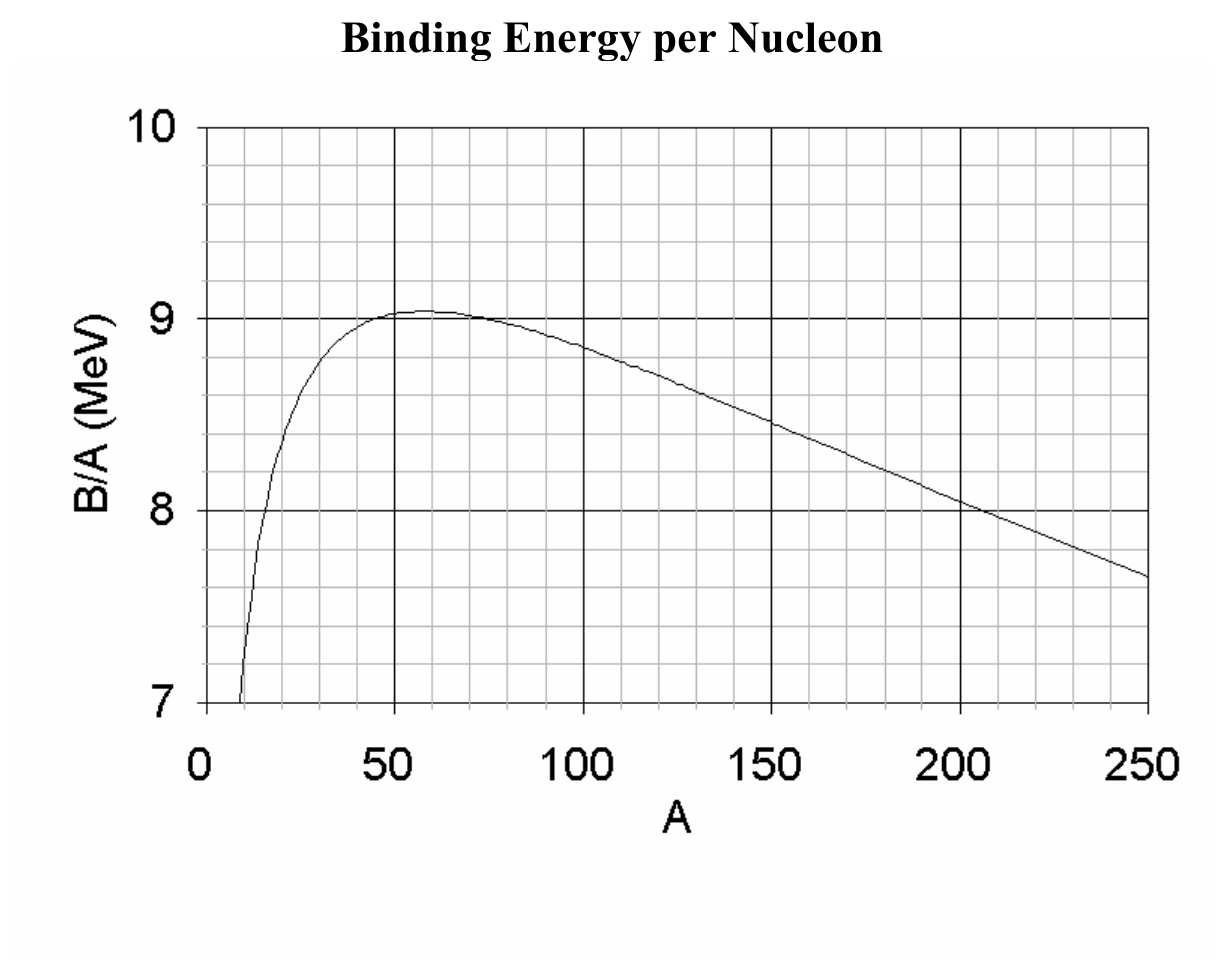
(a) Above a certain mass number \(A_\alpha\), nuclei have binding energies which are always small enough to allow the emission of alpha-particles (\(A=4\)). Use a linear approximation to this curve above \(A=100\) to estimate \(A_\alpha\). (3 marks)
For this model, assume the following:
- Both initial and final nuclei are represented on this curve.
- The total binding energy of the alpha-particle is given by \(B_4=25.0\) MeV (this cannot be read off the graph!).
(b) The binding energy of an atomic nucleus with \(Z\) protons and \(N\) neutrons (\(A=N+Z\)) is given by a semi-empirical formula:
\[ B=a_vA-a_sA^{2/3}-a_cZ^2A^{-1/3} -a_a\frac{(N-Z)^2}{A}-\delta \]
The value of \(\delta\) is given by:
\(+a_pA^{-3/4}\) for odd-\(N\)/odd-\(Z\) nuclei
\(0\) for even-\(N\)/odd-\(Z\) or odd-\(N\)/even-\(Z\) nuclei
\(-a_pA^{-3/4}\) for even-\(N\)/even-\(Z\) nuclei
The values of the coefficients are:
\[ a_v=15.8\text{ MeV};\quad a_s=16.8\text{ MeV};\quad a_c=0.72\text{ MeV};\quad a_a=23.5\text{ MeV};\quad a_p=33.5\text{ MeV}. \]
(i) Derive an expression for the proton number \(Z_{\max}\) of the nucleus with the largest binding energy for a given mass number \(A\). Ignore the \(\delta\)-term for this part only. (2 marks)
(ii) What is the value of \(Z\) for the \(A=200\) nucleus with the largest \(B/A\)? Include the effect of the \(\delta\)-term. (2 marks)
(iii) Consider the three nuclei with \(A=128\) listed in the table on the answer sheet. Determine which ones are energetically stable and which ones have sufficient energy to decay by the processes listed below. Determine \(Z_{\max}\) as defined in part (i) and fill out the table on your answer sheet.
In filling out the table, please:
- Mark processes which are energetically allowed thus: √
- Mark processes which are NOT energetically allowed thus: 0
- Consider only transitions between these three nuclei.
Decay processes:
(1) \(\beta^-\) - decay; emission from the nucleus of an electron
(2) \(\beta^+\) - decay; emission from the nucleus of a positron
(3) \(\beta^-\beta^-\) - decay; emission from the nucleus of two electrons simultaneously
(4) Electron capture; capture of an atomic electron by the nucleus.The rest mass energy of an electron (and positron) is \(m_ec^2=0.51\) MeV; that of a proton is \(m_pc^2=938.27\) MeV; that of a neutron is \(m_nc^2=939.57\) MeV.
(3 marks)
(b) (iii)
Nucleus/Process \(\beta^-\) - decay \(\beta^+\) - decay Electron-capture \(\beta^-\beta^-\) - decay \({}^{128}_{53}\mathrm{I}\) \({}^{128}_{54}\mathrm{Xe}\) \({}^{128}_{55}\mathrm{Cs}\) Notation : \({}^{A}_{Z}X\)
\(X\) = Chemical Symbol
Official English text of the problem.
Problem 3: Solar-Powered Aircraft
We wish to design an aircraft which will stay aloft using solar power alone. The most efficient type of layout is one with a wing whose top surface is completely covered in solar cells. The cells supply electrical power with which the motor drives the propeller.
Consider a wing of rectangular plan-form with span \(l\), chord (width) \(c\); the wing area is \(S = cl\), and the wing aspect ratio \(A = l/c\). We can get an approximate idea of the wing’s performance by considering a slice of air of height \(x\) and length \(l\) being deflected downward at a small angle \(\varepsilon\) with only a very small change in speed. Control surfaces can be used to select an optimal value of \(\varepsilon\) for flight. This simple model corresponds closely to reality if \(x = \pi l/4\), and we can assume this to be the case. The total mass of the aircraft is \(M\) and it flies horizontally with velocity \(\vec{v}\) relative to the surrounding air. In the following calculations consider only the air flow around the wing.
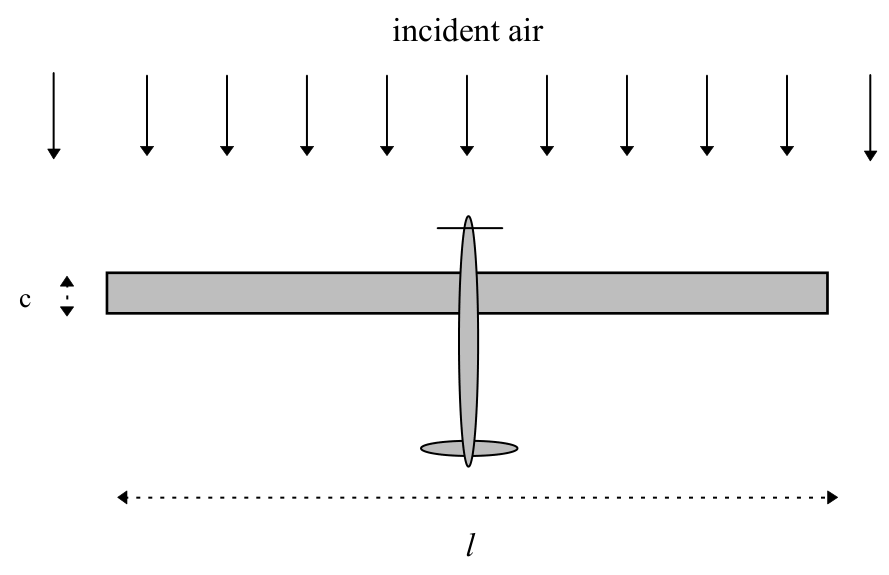
Top view of aircraft (in its own frame of reference):
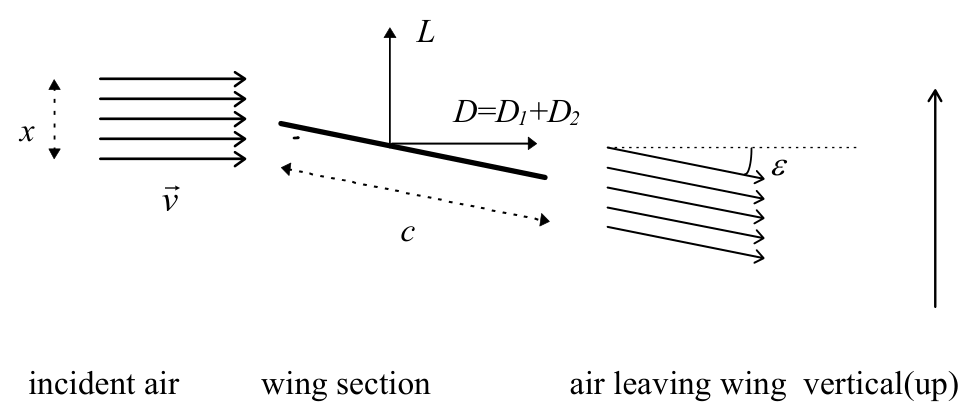
Side view of wing (in a frame of reference moving with the aircraft):
Ignore the modification of the airflow due to the propeller.
(a) Consider the change in momentum of the air moving past the wing, with no change in speed while it does so. Derive expressions for the vertical lift force \(L\) and the horizontal drag force \(D_1\) on the wing in terms of wing dimensions, \(v\), \(\varepsilon\), and the air density \(\rho\). Assume the direction of air flow is always parallel to the plane of the side-view diagram.
(3 marks)
(b) There is an additional horizontal drag force \(D_2\) caused by the friction of air flowing over the surface of the wing. The air slows slightly, with a change of speed \(\Delta v\) (\(\ll 1\%\) of \(v\)) given by:
\[ \frac{\Delta v}{v}=\frac{f}{A} \]
The value of \(f\) is independent of \(\varepsilon\).
Find an expression (in terms of \(M, f, A, S, \rho\) and \(g\)- the acceleration due to gravity) for the flight speed \(v_0\) corresponding to a minimum power being needed to maintain this aircraft in flight at constant altitude and velocity. Neglect terms of order \((\varepsilon^2 f)\) or higher.
(3 marks)
You may find the following small angle approximation useful:
\[ 1-\cos\varepsilon\approx\frac{\sin^2\varepsilon}{2} \]
(c) On the answer sheet, sketch a graph of power \(P\) versus flight speed \(v\). Show the separate contributions to the power needed from the two sources of drag. Find an expression (in terms of \(M, f, A, S, \rho\) and \(g\)) for the minimum power, \(P_{\min}\).
(2 marks)
(d) If the solar cells can supply sufficient energy so that the electric motors and propellers generate mechanical power of \(I = 10\) watts per square metre of wing area, calculate the maximum wing loading \(Mg/S\) (\(\mathrm{N/m^2}\)) for this power and flight speed \(v_0\) (\(\mathrm{m/s}\)). Assume \(\rho = 1.25\ \mathrm{kg/m^3}\), \(f = 0.004\), \(A = 10\).
(2 marks)
Official English text of the problem.
Internationale Physik-Olympiade
IPhO 1997
Sudbury, Kanada · 3 Theorieaufgaben mit vollständigen Lösungen
Aufgabe 1: Skalierung
(a) Eine kleine Masse hängt am Ende einer masselosen idealen Feder und schwingt mit ihrer Eigenfrequenz \(f\) auf und ab. Wenn die Feder halbiert und die Masse wieder am Ende befestigt wird, wie groß ist dann die neue Frequenz \(f'\)? (1.5 Punkte)
(b) Der Radius eines Wasserstoffatoms im Grundzustand beträgt \(a_0 = 0.0529\ \mathrm{nm}\) (der „Bohrsche Radius“). Wie groß ist der Radius \(a'\) eines „myonischen Wasserstoffatoms“, in dem das Elektron durch ein gleich geladenes Myon ersetzt ist, dessen Masse das 207-Fache der Elektronenmasse beträgt? Nehmen Sie an, dass die Protonenmasse viel größer als die Masse des Myons und des Elektrons ist. (2 Punkte)
(c) Die mittlere Temperatur der Erde beträgt \(T = 287\ \mathrm{K}\). Wie groß wäre die neue mittlere Temperatur \(T'\), wenn der mittlere Abstand zwischen Erde und Sonne um 1% verringert würde?
(2 Punkte)(d) An einem bestimmten Tag ist die Luft trocken und hat eine Dichte von \(\rho = 1.2500\ \mathrm{kg/m^3}\). Am nächsten Tag ist die Luftfeuchtigkeit gestiegen, und der Massenanteil des Wasserdampfs in der Luft beträgt 2%. Druck und Temperatur sind dieselben wie am Vortag. Wie groß ist nun die Luftdichte \(\rho'\)? (2 Punkte)
Mittlere molare Masse trockener Luft: 28.8 (g/mol)
Molare Masse von Wasser: 18 (g/mol)Nehmen Sie ideales Gasverhalten an.
(e) Ein Hubschraubertyp kann schweben, wenn die mechanische Ausgangsleistung seines Motors \(P\) beträgt. Wenn ein weiterer Hubschrauber gebaut wird, der eine exakte Nachbildung des ersten im Maßstab ½ (in allen linearen Abmessungen) ist, welche mechanische Leistung \(P'\) benötigt er zum Schweben? (2.5 Punkte)
Aufgabentext aus dem offiziellen englischen Text übersetzt.
Aufgabe 2: Kernmassen und Stabilität
Alle Energien in dieser Aufgabe werden in MeV angegeben – Millionen Elektronenvolt.
Ein MeV = \(1.6\times10^{-13}\) J; diese Umrechnung muss jedoch zur Lösung der Aufgabe nicht bekannt sein.Die Masse \(M\) eines Atomkerns mit \(Z\) Protonen und \(N\) Neutronen (also der Massenzahl \(A=N+Z\)) ist die Summe der Massen seiner freien Nukleonen (Protonen und Neutronen) abzüglich der Bindungsenergie \(B/c^2\).
\[ Mc^2=Zm_pc^2+Nm_nc^2-B \]
Das folgende Diagramm zeigt den Maximalwert von \(B/A\) für einen gegebenen Wert von \(A\) in Abhängigkeit von \(A\).
Je größer der Wert von \(B/A\), desto stabiler ist im Allgemeinen der Kern.(a) Oberhalb einer bestimmten Massenzahl \(A_\alpha\) sind die Bindungsenergien der Kerne stets klein genug, um die Emission von Alphateilchen (\(A=4\)) zu ermöglichen. Verwenden Sie eine lineare Näherung dieser Kurve oberhalb von \(A=100\), um \(A_\alpha\) abzuschätzen. (3 Punkte)
Nehmen Sie für dieses Modell Folgendes an:
- Sowohl der Ausgangs- als auch der Endkern liegen auf dieser Kurve.
- Die gesamte Bindungsenergie des Alphateilchens beträgt \(B_4=25.0\) MeV (dies lässt sich nicht aus dem Diagramm ablesen!).
(b) Die Bindungsenergie eines Atomkerns mit \(Z\) Protonen und \(N\) Neutronen (\(A=N+Z\)) wird durch eine semiempirische Formel beschrieben:
\[ B=a_vA-a_sA^{2/3}-a_cZ^2A^{-1/3} -a_a\frac{(N-Z)^2}{A}-\delta \]
Der Wert von \(\delta\) ist gegeben durch:
\(+a_pA^{-3/4}\) für Kerne mit ungeradem \(N\) und ungeradem \(Z\)
\(0\) für Kerne mit geradem \(N\) und ungeradem \(Z\) oder ungeradem \(N\) und geradem \(Z\)
\(-a_pA^{-3/4}\) für Kerne mit geradem \(N\) und geradem \(Z\)
Die Koeffizienten haben die Werte:
\[ a_v=15.8\text{ MeV};\quad a_s=16.8\text{ MeV};\quad a_c=0.72\text{ MeV};\quad a_a=23.5\text{ MeV};\quad a_p=33.5\text{ MeV}. \]
(i) Leiten Sie einen Ausdruck für die Protonenzahl \(Z_{\max}\) des Kerns mit der größten Bindungsenergie bei gegebener Massenzahl \(A\) her. Vernachlässigen Sie den \(\delta\)-Term nur in dieser Teilaufgabe. (2 Punkte)
(ii) Welchen Wert hat \(Z\) für den Kern mit \(A=200\), der das größte \(B/A\) besitzt? Berücksichtigen Sie den Einfluss des \(\delta\)-Terms. (2 Punkte)
(iii) Betrachten Sie die drei Kerne mit \(A=128\), die in der Tabelle auf dem Antwortblatt aufgeführt sind. Bestimmen Sie, welche davon energetisch stabil sind und welche genügend Energie besitzen, um durch die unten aufgeführten Prozesse zu zerfallen. Bestimmen Sie \(Z_{\max}\) gemäß der Definition in Teil (i) und füllen Sie die Tabelle auf Ihrem Antwortblatt aus.
Beachten Sie beim Ausfüllen der Tabelle bitte Folgendes:
- Kennzeichnen Sie energetisch erlaubte Prozesse mit: √
- Kennzeichnen Sie energetisch NICHT erlaubte Prozesse mit: 0
- Berücksichtigen Sie ausschließlich Übergänge zwischen diesen drei Kernen.
Zerfallsprozesse:
(1) \(\beta^-\)-Zerfall; Emission eines Elektrons aus dem Kern
(2) \(\beta^+\)-Zerfall; Emission eines Positrons aus dem Kern
(3) \(\beta^-\beta^-\)-Zerfall; gleichzeitige Emission zweier Elektronen aus dem Kern
(4) Elektroneneinfang; Einfang eines Hüllenelektrons durch den Kern.Die Ruheenergie eines Elektrons (und eines Positrons) beträgt \(m_ec^2=0.51\) MeV; die eines Protons beträgt \(m_pc^2=938.27\) MeV; die eines Neutrons beträgt \(m_nc^2=939.57\) MeV.
(3 Punkte)
(b) (iii)
Kern/Prozess \(\beta^-\)-Zerfall \(\beta^+\)-Zerfall Elektroneneinfang \(\beta^-\beta^-\)-Zerfall \({}^{128}_{53}\mathrm{I}\) \({}^{128}_{54}\mathrm{Xe}\) \({}^{128}_{55}\mathrm{Cs}\) Schreibweise: \({}^{A}_{Z}X\)
\(X\) = chemisches Symbol
Aufgabentext aus dem offiziellen englischen Text übersetzt.
Aufgabe 3: Solarbetriebenes Flugzeug
Wir möchten ein Flugzeug entwerfen, das allein mit Solarenergie in der Luft bleibt. Die effizienteste Bauform besitzt einen Tragflügel, dessen Oberseite vollständig mit Solarzellen bedeckt ist. Die Zellen liefern die elektrische Leistung, mit der der Motor den Propeller antreibt.
Betrachten Sie einen Tragflügel mit rechteckigem Grundriss, der Spannweite \(l\) und der Flügeltiefe (Breite) \(c\); die Flügelfläche beträgt \(S = cl\), und die Flügelstreckung ist \(A = l/c\). Eine ungefähre Vorstellung von den aerodynamischen Eigenschaften des Tragflügels erhalten wir, indem wir eine Luftschicht der Höhe \(x\) und der Länge \(l\) betrachten, die unter einem kleinen Winkel \(\varepsilon\) nach unten abgelenkt wird, wobei sich ihr Geschwindigkeitsbetrag nur sehr geringfügig ändert. Mithilfe von Steuerflächen lässt sich ein für den Flug optimaler Wert von \(\varepsilon\) einstellen. Dieses einfache Modell stimmt gut mit der Wirklichkeit überein, wenn \(x = \pi l/4\), und wir können annehmen, dass dies der Fall ist. Die Gesamtmasse des Flugzeugs beträgt \(M\), und es fliegt horizontal mit der Geschwindigkeit \(\vec{v}\) relativ zur umgebenden Luft. Berücksichtigen Sie bei den folgenden Berechnungen nur die Luftströmung um den Tragflügel.
Draufsicht auf das Flugzeug (in seinem eigenen Bezugssystem):
Seitenansicht des Tragflügels (in einem mit dem Flugzeug mitbewegten Bezugssystem):
Vernachlässigen Sie die Veränderung der Luftströmung durch den Propeller.
(a) Betrachten Sie die Impulsänderung der am Tragflügel vorbeiströmenden Luft, wobei sich ihr Geschwindigkeitsbetrag dabei nicht ändert. Leiten Sie Ausdrücke für die vertikale Auftriebskraft \(L\) und die horizontale Widerstandskraft \(D_1\) am Tragflügel in Abhängigkeit von den Flügelabmessungen, \(v\), \(\varepsilon\) und der Luftdichte \(\rho\) her. Nehmen Sie an, dass die Richtung der Luftströmung stets parallel zur Zeichenebene der Seitenansicht ist.
(3 Punkte)
(b) Durch die Reibung der über die Flügeloberfläche strömenden Luft entsteht eine zusätzliche horizontale Widerstandskraft \(D_2\). Die Luft wird geringfügig abgebremst, wobei die Änderung des Geschwindigkeitsbetrags \(\Delta v\) (\(\ll 1\%\) von \(v\)) gegeben ist durch:
\[ \frac{\Delta v}{v}=\frac{f}{A} \]
Der Wert von \(f\) ist unabhängig von \(\varepsilon\).
Bestimmen Sie einen Ausdruck (in Abhängigkeit von \(M, f, A, S, \rho\) und \(g\), der Erdbeschleunigung) für die Fluggeschwindigkeit \(v_0\), bei der die zum Flug mit konstanter Höhe und Geschwindigkeit erforderliche Leistung minimal ist. Vernachlässigen Sie Terme der Ordnung \((\varepsilon^2 f)\) oder höher.
(3 Punkte)
Die folgende Kleinwinkelnäherung kann hilfreich sein:
\[ 1-\cos\varepsilon\approx\frac{\sin^2\varepsilon}{2} \]
(c) Skizzieren Sie auf dem Antwortblatt ein Diagramm der Leistung \(P\) in Abhängigkeit von der Fluggeschwindigkeit \(v\). Zeigen Sie die einzelnen Beiträge zur erforderlichen Leistung aufgrund der beiden Ursachen des Luftwiderstands. Bestimmen Sie einen Ausdruck (in Abhängigkeit von \(M, f, A, S, \rho\) und \(g\)) für die minimale Leistung \(P_{\min}\).
(2 Punkte)
(d) Wenn die Solarzellen genügend Energie liefern können, sodass die Elektromotoren und Propeller eine mechanische Leistung von \(I = 10\) Watt pro Quadratmeter Flügelfläche erzeugen, berechnen Sie für diese Leistung die maximale Flächenbelastung \(Mg/S\) (\(\mathrm{N/m^2}\)) und die Fluggeschwindigkeit \(v_0\) (\(\mathrm{m/s}\)). Nehmen Sie \(\rho = 1.25\ \mathrm{kg/m^3}\), \(f = 0.004\), \(A = 10\) an.
(2 Punkte)
Aufgabentext aus dem offiziellen englischen Text übersetzt.
Uluslararası Fizik Olimpiyatı
IPhO 1997
Sudbury, Kanada · 3 teori sorusu, tam çözümleriyle
Soru 1: Ölçeklendirme
(a) Kütlesiz ideal bir yayın ucuna asılan küçük bir kütle, yayın doğal frekansı \(f\) ile aşağı yukarı salınmaktadır. Yay iki eşit parçaya kesilir ve kütle parçalardan birinin ucuna yeniden asılırsa yeni frekans \(f'\) ne olur? (1.5 puan)
(b) Temel durumdaki bir hidrojen atomunun yarıçapı \(a_0 = 0.0529\ \mathrm{nm}\) değerindedir (“Bohr yarıçapı”). Elektronun yerine aynı yüke sahip ve kütlesi elektronunkinin 207 katı olan bir müonun geçtiği “müonik hidrojen” atomunun yarıçapı \(a'\) nedir? Protonun kütlesinin müonun ve elektronun kütlelerinden çok daha büyük olduğunu varsayın. (2 puan)
(c) Dünya'nın ortalama sıcaklığı \(T = 287\ \mathrm{K}\) değerindedir. Dünya ile Güneş arasındaki ortalama uzaklık %1 azaltılsaydı yeni ortalama sıcaklık \(T'\) ne olurdu?
(2 puan)(d) Belirli bir günde hava kurudur ve yoğunluğu \(\rho = 1.2500\ \mathrm{kg/m^3}\) değerindedir. Ertesi gün nem artmış ve havanın kütlece %2'si su buharı hâline gelmiştir. Basınç ve sıcaklık bir önceki günle aynıdır. Havanın şimdiki yoğunluğu \(\rho'\) nedir? (2 puan)
Kuru havanın ortalama mol kütlesi: 28.8 (g/mol)
Suyun mol kütlesi: 18 (g/mol)İdeal gaz davranışı varsayın.
(e) Bir tür helikopter, motorunun mekanik güç çıkışı \(P\) olduğunda havada asılı kalabilmektedir. İlk helikopterin (tüm doğrusal boyutları bakımından) tam ½ ölçekli bir kopyası olan başka bir helikopter yapılırsa bunun havada asılı kalması için gereken mekanik güç \(P'\) nedir? (2.5 puan)
Soru metni resmi İngilizce metinden çevrilmiştir.
Soru 2: Çekirdek Kütleleri ve Kararlılık
Bu sorudaki tüm enerjiler MeV — milyon elektron volt — cinsinden ifade edilmiştir.
Bir MeV = \(1.6\times10^{-13}\) J'dür, ancak problemi çözmek için bunu bilmek gerekli değildir.\(Z\) proton ve \(N\) nötron içeren (yani kütle numarası \(A=N+Z\) olan) bir atom çekirdeğinin \(M\) kütlesi, onu oluşturan serbest nükleonların (proton ve nötronların) kütleleri toplamından bağlanma enerjisinin kütle karşılığı \(B/c^2\) çıkarılarak bulunur.
\[ Mc^2=Zm_pc^2+Nm_nc^2-B \]
Aşağıdaki grafikte, verilen bir \(A\) değeri için \(B/A\)'nın en büyük değeri \(A\)'ya karşı çizilmiştir.
Genel olarak \(B/A\) değeri ne kadar büyükse çekirdek o kadar kararlıdır.(a) Belirli bir \(A_\alpha\) kütle numarasının üzerinde, çekirdeklerin bağlanma enerjileri alfa parçacığı (\(A=4\)) salımına izin verecek kadar küçüktür. \(A_\alpha\)'yı tahmin etmek için bu eğriye \(A=100\)'ün üzerinde doğrusal bir yaklaşım uygulayın. (3 puan)
Bu model için aşağıdakileri varsayın:
- Hem başlangıç hem de son çekirdek bu eğri üzerinde temsil edilmektedir.
- Alfa parçacığının toplam bağlanma enerjisi \(B_4=25.0\) MeV olarak verilmiştir (bu değer grafikten okunamaz!).
(b) \(Z\) proton ve \(N\) nötron içeren (\(A=N+Z\)) bir atom çekirdeğinin bağlanma enerjisi yarı ampirik bir formülle verilir:
\[ B=a_vA-a_sA^{2/3}-a_cZ^2A^{-1/3} -a_a\frac{(N-Z)^2}{A}-\delta \]
\(\delta\)'nın değeri şöyledir:
\(N\)'si tek/\(Z\)'si tek çekirdekler için \(+a_pA^{-3/4}\)
\(N\)'si çift/\(Z\)'si tek veya \(N\)'si tek/\(Z\)'si çift çekirdekler için \(0\)
\(N\)'si çift/\(Z\)'si çift çekirdekler için \(-a_pA^{-3/4}\)
Katsayıların değerleri şunlardır:
\[ a_v=15.8\text{ MeV};\quad a_s=16.8\text{ MeV};\quad a_c=0.72\text{ MeV};\quad a_a=23.5\text{ MeV};\quad a_p=33.5\text{ MeV}. \]
(i) Verilen bir \(A\) kütle numarası için en büyük bağlanma enerjisine sahip çekirdeğin \(Z_{\max}\) proton sayısını veren bir ifade türetin. Yalnızca bu kısımda \(\delta\) terimini ihmal edin. (2 puan)
(ii) \(A=200\) olan ve en büyük \(B/A\) değerine sahip çekirdeğin \(Z\) değeri nedir? \(\delta\) teriminin etkisini de hesaba katın. (2 puan)
(iii) Cevap kâğıdındaki tabloda listelenen, \(A=128\) olan üç çekirdeği ele alın. Hangilerinin enerji açısından kararlı olduğunu ve hangilerinin aşağıda listelenen süreçlerle bozunmak için yeterli enerjiye sahip olduğunu belirleyin. (i) kısmında tanımlanan \(Z_{\max}\)'ı belirleyin ve cevap kâğıdınızdaki tabloyu doldurun.
Tabloyu doldururken lütfen:
- Enerji açısından mümkün olan süreçleri şöyle işaretleyin: √
- Enerji açısından mümkün OLMAYAN süreçleri şöyle işaretleyin: 0
- Yalnızca bu üç çekirdek arasındaki geçişleri dikkate alın.
Bozunma süreçleri:
(1) \(\beta^-\) bozunması; çekirdekten bir elektron salınması
(2) \(\beta^+\) bozunması; çekirdekten bir pozitron salınması
(3) \(\beta^-\beta^-\) bozunması; çekirdekten aynı anda iki elektron salınması
(4) Elektron yakalama; bir atom elektronunun çekirdek tarafından yakalanması.Bir elektronun (ve pozitronun) durgunluk enerjisi \(m_ec^2=0.51\) MeV; bir protonunki \(m_pc^2=938.27\) MeV; bir nötronunki ise \(m_nc^2=939.57\) MeV'dir.
(3 puan)
(b) (iii)
Çekirdek/Süreç \(\beta^-\) bozunması \(\beta^+\) bozunması Elektron yakalama \(\beta^-\beta^-\) bozunması \({}^{128}_{53}\mathrm{I}\) \({}^{128}_{54}\mathrm{Xe}\) \({}^{128}_{55}\mathrm{Cs}\) Gösterim: \({}^{A}_{Z}X\)
\(X\) = Kimyasal Sembol
Soru metni resmi İngilizce metinden çevrilmiştir.
Soru 3: Güneş Enerjili Uçak
Yalnızca güneş enerjisini kullanarak havada kalacak bir uçak tasarlamak istiyoruz. En verimli tasarım, üst yüzeyi tamamen güneş hücreleriyle kaplı bir kanada sahip olandır. Hücreler, motorun pervaneyi döndürmek için kullandığı elektrik gücünü sağlar.
Açıklığı \(l\), veter uzunluğu (genişliği) \(c\) olan, üstten görünüşü dikdörtgen biçimindeki bir kanadı ele alın; kanat alanı \(S = cl\), kanat açıklık oranı ise \(A = l/c\)'dir. Yüksekliği \(x\) ve uzunluğu \(l\) olan bir hava diliminin, sürati yalnızca çok az değişerek küçük bir \(\varepsilon\) açısıyla aşağı doğru saptırılmasını ele alarak kanadın performansı hakkında yaklaşık bir fikir edinebiliriz. Uçuş için en uygun \(\varepsilon\) değerini seçmek üzere kumanda yüzeyleri kullanılabilir. Bu basit model, \(x = \pi l/4\) olduğunda gerçeğe oldukça iyi uyar ve bunun geçerli olduğunu varsayabiliriz. Uçağın toplam kütlesi \(M\)'dir ve çevresindeki havaya göre \(\vec{v}\) hızıyla yatay olarak uçmaktadır. Aşağıdaki hesaplamalarda yalnızca kanat çevresindeki hava akışını dikkate alın.
Uçağın üstten görünüşü (kendi referans sisteminde):
Kanadın yandan görünüşü (uçakla birlikte hareket eden bir referans sisteminde):
Pervanenin hava akışında oluşturduğu değişikliği ihmal edin.
(a) Kanadın yanından geçen havanın, bu sırada sürati hiç değişmeden gerçekleşen momentum değişimini ele alın. Kanat boyutları, \(v\), \(\varepsilon\) ve hava yoğunluğu \(\rho\) cinsinden, kanada etki eden düşey kaldırma kuvveti \(L\) ve yatay sürükleme kuvveti \(D_1\) için ifadeler türetin. Hava akışının yönünün her zaman yandan görünüş çiziminin düzlemine paralel olduğunu varsayın.
(3 puan)
(b) Kanat yüzeyi üzerinden akan havanın sürtünmesinden kaynaklanan ek bir yatay sürükleme kuvveti \(D_2\) vardır. Hava hafifçe yavaşlar; süratindeki \(\Delta v\) değişimi (\(v\)'nin \(\ll 1\%\)'i) şu şekilde verilir:
\[ \frac{\Delta v}{v}=\frac{f}{A} \]
\(f\)'nin değeri \(\varepsilon\)'dan bağımsızdır.
Bu uçağı sabit irtifada ve sabit hızla uçuşta tutmak için gereken gücün en küçük olduğu uçuş sürati \(v_0\) için (\(M, f, A, S, \rho\) ve yer çekimi ivmesi \(g\) cinsinden) bir ifade bulun. \((\varepsilon^2 f)\) veya daha yüksek mertebeden terimleri ihmal edin.
(3 puan)
Aşağıdaki küçük açı yaklaşımı yararlı olabilir:
\[ 1-\cos\varepsilon\approx\frac{\sin^2\varepsilon}{2} \]
(c) Cevap kâğıdına, \(P\) gücünün \(v\) uçuş süratine bağlılığını gösteren bir grafik çizin. İki sürükleme kaynağının gereken güce katkılarını ayrı ayrı gösterin. En küçük güç \(P_{\min}\) için (\(M, f, A, S, \rho\) ve \(g\) cinsinden) bir ifade bulun.
(2 puan)
(d) Güneş hücreleri, elektrik motorları ve pervanelerin kanat alanının metrekaresi başına \(I = 10\) watt mekanik güç üretmesine yetecek kadar enerji sağlayabiliyorsa, bu güç için en büyük kanat yüklemesini \(Mg/S\) (\(\mathrm{N/m^2}\)) ve uçuş süratini \(v_0\) (\(\mathrm{m/s}\)) hesaplayın. \(\rho = 1.25\ \mathrm{kg/m^3}\), \(f = 0.004\), \(A = 10\) olduğunu varsayın.
(2 puan)
Soru metni resmi İngilizce metinden çevrilmiştir.
Olimpiada Internacional de Física
IPhO 1997
Sudbury, Canadá · 3 problemas teóricos con soluciones completas
Problema 1: Leyes de escala
(a) Una pequeña masa cuelga del extremo de un muelle ideal de masa despreciable y oscila verticalmente con su frecuencia natural \(f\). Si se corta el muelle por la mitad y se vuelve a fijar la masa en el extremo, ¿cuál es la nueva frecuencia \(f'\)? (1.5 puntos)
(b) El radio de un átomo de hidrógeno en su estado fundamental es \(a_0 = 0.0529\ \mathrm{nm}\) (el «radio de Bohr»). ¿Cuál es el radio \(a'\) de un átomo de «hidrógeno muónico» en el que el electrón se sustituye por un muón con la misma carga y una masa 207 veces mayor que la del electrón? Suponga que la masa del protón es mucho mayor que la del muón y la del electrón. (2 puntos)
(c) La temperatura media de la Tierra es \(T = 287\ \mathrm{K}\). ¿Cuál sería la nueva temperatura media \(T'\) si la distancia media entre la Tierra y el Sol se redujera un 1%?
(2 puntos)(d) Un día determinado, el aire está seco y tiene una densidad \(\rho = 1.2500\ \mathrm{kg/m^3}\). Al día siguiente, la humedad ha aumentado y el aire contiene un 2% en masa de vapor de agua. La presión y la temperatura son las mismas que el día anterior. ¿Cuál es ahora la densidad del aire \(\rho'\)? (2 puntos)
Masa molar media del aire seco: 28.8 (g/mol)
Masa molar del agua: 18 (g/mol)Suponga un comportamiento de gas ideal.
(e) Un tipo de helicóptero puede mantenerse en vuelo estacionario si la potencia mecánica que entrega su motor es \(P\). Si se fabrica otro helicóptero que es una réplica exacta a escala ½ (en todas sus dimensiones lineales) del primero, ¿qué potencia mecánica \(P'\) necesita para mantenerse en vuelo estacionario? (2.5 puntos)
Enunciado traducido del texto oficial en inglés.
Problema 2: Masas nucleares y estabilidad
Todas las energías de este problema se expresan en MeV: millones de electronvoltios.
Un MeV = \(1.6\times10^{-13}\) J, pero no es necesario saberlo para resolver el problema.La masa \(M\) de un núcleo atómico con \(Z\) protones y \(N\) neutrones (es decir, con número másico \(A=N+Z\)) es la suma de las masas de los nucleones constituyentes libres (protones y neutrones) menos la energía de enlace \(B/c^2\).
\[ Mc^2=Zm_pc^2+Nm_nc^2-B \]
La gráfica que se muestra a continuación representa el valor máximo de \(B/A\) para un valor dado de \(A\), en función de \(A\).
En general, cuanto mayor es el valor de \(B/A\), más estable es el núcleo.(a) Por encima de cierto número másico \(A_\alpha\), los núcleos tienen energías de enlace que siempre son lo suficientemente pequeñas como para permitir la emisión de partículas alfa (\(A=4\)). Utilice una aproximación lineal de esta curva para \(A=100\) en adelante a fin de estimar \(A_\alpha\). (3 puntos)
Para este modelo, suponga lo siguiente:
- Tanto el núcleo inicial como el final están representados en esta curva.
- La energía de enlace total de la partícula alfa viene dada por \(B_4=25.0\) MeV (¡este valor no puede leerse en la gráfica!).
(b) La energía de enlace de un núcleo atómico con \(Z\) protones y \(N\) neutrones (\(A=N+Z\)) viene dada por una fórmula semiempírica:
\[ B=a_vA-a_sA^{2/3}-a_cZ^2A^{-1/3} -a_a\frac{(N-Z)^2}{A}-\delta \]
El valor de \(\delta\) viene dado por:
\(+a_pA^{-3/4}\) para núcleos con \(N\) impar y \(Z\) impar
\(0\) para núcleos con \(N\) par y \(Z\) impar o con \(N\) impar y \(Z\) par
\(-a_pA^{-3/4}\) para núcleos con \(N\) par y \(Z\) par
Los valores de los coeficientes son:
\[ a_v=15.8\text{ MeV};\quad a_s=16.8\text{ MeV};\quad a_c=0.72\text{ MeV};\quad a_a=23.5\text{ MeV};\quad a_p=33.5\text{ MeV}. \]
(i) Deduzca una expresión para el número de protones \(Z_{\max}\) del núcleo con la mayor energía de enlace para un número másico \(A\) dado. Ignore el término \(\delta\) únicamente en este apartado. (2 puntos)
(ii) ¿Cuál es el valor de \(Z\) para el núcleo con \(A=200\) que tiene el mayor \(B/A\)? Incluya el efecto del término \(\delta\). (2 puntos)
(iii) Considere los tres núcleos con \(A=128\) que figuran en la tabla de la hoja de respuestas. Determine cuáles son energéticamente estables y cuáles tienen energía suficiente para desintegrarse mediante los procesos que se enumeran a continuación. Determine \(Z_{\max}\) tal como se define en el apartado (i) y complete la tabla de la hoja de respuestas.
Al completar la tabla:
- Marque los procesos energéticamente permitidos así: √
- Marque los procesos que NO están energéticamente permitidos así: 0
- Considere únicamente transiciones entre estos tres núcleos.
Procesos de desintegración:
(1) Desintegración \(\beta^-\); emisión de un electrón por el núcleo
(2) Desintegración \(\beta^+\); emisión de un positrón por el núcleo
(3) Desintegración \(\beta^-\beta^-\); emisión simultánea de dos electrones por el núcleo
(4) Captura electrónica; captura de un electrón atómico por el núcleo.La energía en reposo de un electrón (y de un positrón) es \(m_ec^2=0.51\) MeV; la de un protón es \(m_pc^2=938.27\) MeV; la de un neutrón es \(m_nc^2=939.57\) MeV.
(3 puntos)
(b) (iii)
Núcleo/Proceso Desintegración \(\beta^-\) Desintegración \(\beta^+\) Captura electrónica Desintegración \(\beta^-\beta^-\) \({}^{128}_{53}\mathrm{I}\) \({}^{128}_{54}\mathrm{Xe}\) \({}^{128}_{55}\mathrm{Cs}\) Notación: \({}^{A}_{Z}X\)
\(X\) = Símbolo químico
Enunciado traducido del texto oficial en inglés.
Problema 3: Avión propulsado por energía solar
Deseamos diseñar un avión que se mantenga en vuelo utilizando únicamente energía solar. La configuración más eficiente es aquella en la que la superficie superior del ala está completamente cubierta de células solares. Estas células suministran la energía eléctrica con la que el motor acciona la hélice.
Consideremos un ala de planta rectangular con envergadura \(l\) y cuerda (anchura) \(c\); la superficie alar es \(S = cl\), y el alargamiento del ala es \(A = l/c\). Podemos obtener una idea aproximada del comportamiento del ala considerando una capa de aire de altura \(x\) y longitud \(l\) que se desvía hacia abajo un ángulo pequeño \(\varepsilon\), con una variación muy pequeña de su rapidez. Las superficies de control permiten seleccionar un valor óptimo de \(\varepsilon\) para el vuelo. Este modelo sencillo se ajusta bien a la realidad si \(x = \pi l/4\), y podemos suponer que así ocurre. La masa total del avión es \(M\) y este vuela horizontalmente con velocidad \(\vec{v}\) respecto al aire circundante. En los cálculos siguientes, considere únicamente el flujo de aire alrededor del ala.
Vista superior del avión (en su propio sistema de referencia):
Vista lateral del ala (en un sistema de referencia que se mueve con el avión):
Ignore la modificación del flujo de aire debida a la hélice.
(a) Considere la variación de la cantidad de movimiento del aire que pasa junto al ala, sin que cambie su rapidez durante el proceso. Deduzca expresiones para la fuerza de sustentación vertical \(L\) y la fuerza de resistencia horizontal \(D_1\) que actúan sobre el ala, en función de las dimensiones del ala, \(v\), \(\varepsilon\) y la densidad del aire \(\rho\). Suponga que la dirección del flujo de aire es siempre paralela al plano del diagrama de la vista lateral.
(3 puntos)
(b) Existe una fuerza de resistencia horizontal adicional \(D_2\), causada por el rozamiento del aire que fluye sobre la superficie del ala. El aire se frena ligeramente, con una variación de rapidez \(\Delta v\) (\(\ll 1\%\) de \(v\)) dada por:
\[ \frac{\Delta v}{v}=\frac{f}{A} \]
El valor de \(f\) es independiente de \(\varepsilon\).
Obtenga una expresión (en función de \(M, f, A, S, \rho\) y \(g\), la aceleración de la gravedad) para la rapidez de vuelo \(v_0\) que corresponde a la potencia mínima necesaria para mantener este avión en vuelo a altitud y velocidad constantes. Desprecie los términos de orden \((\varepsilon^2 f)\) o superior.
(3 puntos)
Puede resultar útil la siguiente aproximación para ángulos pequeños:
\[ 1-\cos\varepsilon\approx\frac{\sin^2\varepsilon}{2} \]
(c) En la hoja de respuestas, esboce una gráfica de la potencia \(P\) en función de la rapidez de vuelo \(v\). Muestre por separado las contribuciones a la potencia necesaria debidas a las dos fuentes de resistencia. Obtenga una expresión (en función de \(M, f, A, S, \rho\) y \(g\)) para la potencia mínima, \(P_{\min}\).
(2 puntos)
(d) Si las células solares pueden suministrar suficiente energía para que los motores eléctricos y las hélices generen una potencia mecánica de \(I = 10\) vatios por metro cuadrado de superficie alar, calcule la carga alar máxima \(Mg/S\) (\(\mathrm{N/m^2}\)) para esta potencia y la rapidez de vuelo \(v_0\) (\(\mathrm{m/s}\)). Suponga que \(\rho = 1.25\ \mathrm{kg/m^3}\), \(f = 0.004\), \(A = 10\).
(2 puntos)
Enunciado traducido del texto oficial en inglés.
国际物理奥林匹克
IPhO 1997
加拿大萨德伯里 · 3 道理论题及完整解答
题目 1:标度关系
(a) 一个小物体悬挂在质量可忽略的理想弹簧末端,以固有频率 \(f\) 上下振动。如果将弹簧切成两半,并将该物体重新悬挂在其中一半的末端,新的频率 \(f'\) 是多少? (1.5 分)
(b) 基态氢原子的半径为 \(a_0 = 0.0529\ \mathrm{nm}\)(即“玻尔半径”)。如果用一个电荷与电子相同、质量为电子质量 207 倍的 μ 子替代电子,所形成的“μ 子氢”原子的半径 \(a'\) 是多少?假设质子的质量远大于 μ 子和电子的质量。 (2 分)
(c) 地球的平均温度为 \(T = 287\ \mathrm{K}\)。如果地球与太阳之间的平均距离减小 1%,新的平均温度 \(T'\) 是多少?
(2 分)(d) 某一天,空气干燥,密度为 \(\rho = 1.2500\ \mathrm{kg/m^3}\)。第二天,湿度增加,水蒸气占空气总质量的 2%。气压和温度与前一天相同。此时空气密度 \(\rho'\) 是多少? (2 分)
干空气的平均摩尔质量:28.8 (g/mol)
水的摩尔质量:18 (g/mol)假设气体遵循理想气体规律。
(e) 某型号直升机在发动机输出机械功率为 \(P\) 时能够悬停。如果制造另一架直升机,其所有线性尺寸均严格缩小为原直升机的 ½,悬停所需的机械功率 \(P'\) 是多少? (2.5 分)
题目译自官方英文原文。
题目 2:原子核的质量与稳定性
本题中的所有能量均以 MeV(兆电子伏特,即百万电子伏特)为单位。
1 MeV = \(1.6\times10^{-13}\) J,但解答本题不需要知道这一换算关系。一个含有 \(Z\) 个质子和 \(N\) 个中子(即质量数 \(A=N+Z\))的原子核,其质量 \(M\) 等于组成它的各个自由核子(质子和中子)的质量之和,减去结合能所对应的质量 \(B/c^2\)。
\[ Mc^2=Zm_pc^2+Nm_nc^2-B \]
下图给出了对于给定的 \(A\) 值,\(B/A\) 的最大值随 \(A\) 的变化关系。
一般而言,\(B/A\) 的值越大,原子核就越稳定。(a) 当质量数超过某个值 \(A_\alpha\) 时,原子核的结合能总是足够小,因而允许发射 α 粒子(\(A=4\))。对这条曲线在 \(A=100\) 以上的部分采用线性近似,估算 \(A_\alpha\)。(3 分)
对于这一模型,作如下假设:
- 初始原子核和最终原子核都由这条曲线上的点表示。
- α 粒子的总结合能为 \(B_4=25.0\) MeV(这一数值无法从图中读出!)。
(b) 一个含有 \(Z\) 个质子和 \(N\) 个中子(\(A=N+Z\))的原子核,其结合能由以下半经验公式给出:
\[ B=a_vA-a_sA^{2/3}-a_cZ^2A^{-1/3} -a_a\frac{(N-Z)^2}{A}-\delta \]
\(\delta\) 的取值如下:
对于 \(N\) 为奇数、\(Z\) 为奇数的原子核,取 \(+a_pA^{-3/4}\)
对于 \(N\) 为偶数、\(Z\) 为奇数或 \(N\) 为奇数、\(Z\) 为偶数的原子核,取 \(0\)
对于 \(N\) 为偶数、\(Z\) 为偶数的原子核,取 \(-a_pA^{-3/4}\)
各系数的数值为:
\[ a_v=15.8\text{ MeV};\quad a_s=16.8\text{ MeV};\quad a_c=0.72\text{ MeV};\quad a_a=23.5\text{ MeV};\quad a_p=33.5\text{ MeV}. \]
(i) 推导在给定质量数 \(A\) 时,结合能最大的原子核的质子数 \(Z_{\max}\) 的表达式。仅在本小问中忽略 \(\delta\) 项。(2 分)
(ii) 对于 \(A=200\) 的原子核,使 \(B/A\) 最大的 \(Z\) 值是多少?须计入 \(\delta\) 项的影响。(2 分)
(iii) 考虑答题纸表格中列出的三个 \(A=128\) 的原子核。判断哪些原子核在能量上是稳定的,哪些具有足够的能量通过下列过程发生衰变。求出第 (i) 小问中定义的 \(Z_{\max}\),并填写答题纸上的表格。
填写表格时,请:
- 用 √ 标记能量上允许的过程
- 用 0 标记能量上不允许的过程
- 仅考虑这三个原子核之间的跃迁。
衰变过程:
(1) \(\beta^-\) 衰变;原子核发射一个电子
(2) \(\beta^+\) 衰变;原子核发射一个正电子
(3) \(\beta^-\beta^-\) 衰变;原子核同时发射两个电子
(4) 电子俘获;原子核俘获一个原子中的电子。电子(及正电子)的静止能量为 \(m_ec^2=0.51\) MeV;质子的静止能量为 \(m_pc^2=938.27\) MeV;中子的静止能量为 \(m_nc^2=939.57\) MeV。
(3 分)
(b) (iii)
原子核/过程 \(\beta^-\) 衰变 \(\beta^+\) 衰变 电子俘获 \(\beta^-\beta^-\) 衰变 \({}^{128}_{53}\mathrm{I}\) \({}^{128}_{54}\mathrm{Xe}\) \({}^{128}_{55}\mathrm{Cs}\) 符号表示:\({}^{A}_{Z}X\)
\(X\) = 化学元素符号
题目译自官方英文原文。
题目 3:太阳能飞机
我们希望设计一架仅靠太阳能就能持续飞行的飞机。效率最高的布局是将机翼上表面完全覆盖太阳能电池。太阳能电池提供电能,由电动机驱动螺旋桨。
考虑一个平面形状为矩形的机翼,其翼展为 \(l\),翼弦(宽度)为 \(c\);机翼面积为 \(S = cl\),展弦比为 \(A = l/c\)。设一层高度为 \(x\)、长度为 \(l\) 的空气以小角度 \(\varepsilon\) 向下偏转,而速率仅发生极小的变化,通过考察这一过程,我们可以大致了解机翼的性能。可以利用操纵面选择适合飞行的最佳 \(\varepsilon\) 值。当 \(x = \pi l/4\) 时,这一简单模型与实际情况十分接近,我们可以假定此关系成立。飞机的总质量为 \(M\),相对于周围空气以速度 \(\vec{v}\) 水平飞行。在以下计算中,只考虑机翼周围的气流。
飞机的俯视图(在飞机自身的参考系中):
机翼的侧视图(在随飞机运动的参考系中):
忽略螺旋桨对气流的影响。
(a) 考虑空气流经机翼时的动量变化,假定此过程中空气的速率不变。用机翼尺寸、\(v\)、\(\varepsilon\) 和空气密度 \(\rho\) 推导机翼所受竖直升力 \(L\) 和水平阻力 \(D_1\) 的表达式。假设气流方向始终平行于侧视图所在的平面。
(3 分)
(b) 空气流过机翼表面时的摩擦会产生额外的水平阻力 \(D_2\)。空气略微减速,其速率变化量 \(\Delta v\)(\(\ll 1\%\) 的 \(v\))满足:
\[ \frac{\Delta v}{v}=\frac{f}{A} \]
\(f\) 的值与 \(\varepsilon\) 无关。
求使飞机以恒定高度和速度飞行所需功率最小时的飞行速率 \(v_0\) 的表达式(用 \(M, f, A, S, \rho\) 和重力加速度 \(g\) 表示)。忽略 \((\varepsilon^2 f)\) 阶及更高阶的项。
(3 分)
以下小角近似可能有用:
\[ 1-\cos\varepsilon\approx\frac{\sin^2\varepsilon}{2} \]
(c) 在答题纸上画出功率 \(P\) 随飞行速率 \(v\) 变化的示意图。分别画出两种阻力所对应的所需功率。求最小功率 \(P_{\min}\) 的表达式(用 \(M, f, A, S, \rho\) 和 \(g\) 表示)。
(2 分)
(d) 如果太阳能电池能够提供足够的能量,使电动机和螺旋桨按每平方米机翼面积产生 \(I = 10\) 瓦的机械功率,计算在此功率下的最大翼载荷 \(Mg/S\)(\(\mathrm{N/m^2}\))和飞行速率 \(v_0\)(\(\mathrm{m/s}\))。假设 \(\rho = 1.25\ \mathrm{kg/m^3}\)、\(f = 0.004\)、\(A = 10\)。
(2 分)
题目译自官方英文原文。
Международная физическая олимпиада
IPhO 1997
Садбери, Канада · 3 теоретические задачи с полными решениями
Задача 1: Масштабирование
(a) Небольшой груз подвешен к концу идеальной пружины с пренебрежимо малой массой и совершает вертикальные колебания с собственной частотой \(f\). Если разрезать пружину пополам и снова подвесить груз к концу одной из половин, какой будет новая частота \(f'\)? (1.5 балла)
(b) Радиус атома водорода в основном состоянии равен \(a_0 = 0.0529\ \mathrm{nm}\) («боровский радиус»). Чему равен радиус \(a'\) атома «мюонного водорода», в котором электрон заменён мюоном с таким же зарядом и массой, в 207 раз превышающей массу электрона? Считайте, что масса протона намного больше масс мюона и электрона. (2 балла)
(c) Средняя температура Земли равна \(T = 287\ \mathrm{K}\). Какой стала бы новая средняя температура \(T'\), если бы среднее расстояние между Землёй и Солнцем уменьшилось на 1%?
(2 балла)(d) В некоторый день воздух сухой и имеет плотность \(\rho = 1.2500\ \mathrm{kg/m^3}\). На следующий день влажность повысилась, и теперь водяной пар составляет 2% массы воздуха. Давление и температура остались такими же, как накануне. Чему теперь равна плотность воздуха \(\rho'\)? (2 балла)
Средняя молярная масса сухого воздуха: 28.8 (г/моль)
Молярная масса воды: 18 (г/моль)Считайте газ идеальным.
(e) Вертолёт определённого типа может зависать в воздухе, если механическая мощность его двигателя равна \(P\). Если изготовить другой вертолёт, представляющий собой точную копию первого в масштабе ½ (по всем линейным размерам), какая механическая мощность \(P'\) потребуется ему для зависания? (2.5 балла)
Условие переведено с официального английского текста.
Задача 2: Массы и устойчивость ядер
Все энергии в этой задаче выражены в МэВ — миллионах электронвольт.
Один МэВ = \(1.6\times10^{-13}\) Дж, однако для решения задачи знать это не требуется.Масса \(M\) атомного ядра с \(Z\) протонами и \(N\) нейтронами (т. е. с массовым числом \(A=N+Z\)) равна сумме масс свободных составляющих его нуклонов (протонов и нейтронов) за вычетом энергии связи, делённой на квадрат скорости света, \(B/c^2\).
\[ Mc^2=Zm_pc^2+Nm_nc^2-B \]
На приведённом ниже графике показана зависимость максимального значения \(B/A\) при заданном значении \(A\) от \(A\).
В общем случае чем больше значение \(B/A\), тем устойчивее ядро.(a) При массовых числах выше некоторого значения \(A_\alpha\) энергии связи ядер всегда достаточно малы, чтобы было возможно испускание альфа-частиц (\(A=4\)). Используя линейную аппроксимацию этой кривой на участке выше \(A=100\), оцените \(A_\alpha\). (3 балла)
В этой модели примите следующие допущения:
- Как исходное, так и конечное ядро представлены на этой кривой.
- Полная энергия связи альфа-частицы равна \(B_4=25.0\) МэВ (это значение нельзя определить по графику!).
(b) Энергия связи атомного ядра с \(Z\) протонами и \(N\) нейтронами (\(A=N+Z\)) задаётся полуэмпирической формулой:
\[ B=a_vA-a_sA^{2/3}-a_cZ^2A^{-1/3} -a_a\frac{(N-Z)^2}{A}-\delta \]
Величина \(\delta\) задаётся следующим образом:
\(+a_pA^{-3/4}\) для ядер с нечётным \(N\) и нечётным \(Z\)
\(0\) для ядер с чётным \(N\) и нечётным \(Z\) или нечётным \(N\) и чётным \(Z\)
\(-a_pA^{-3/4}\) для ядер с чётным \(N\) и чётным \(Z\)
Значения коэффициентов:
\[ a_v=15.8\text{ MeV};\quad a_s=16.8\text{ MeV};\quad a_c=0.72\text{ MeV};\quad a_a=23.5\text{ MeV};\quad a_p=33.5\text{ MeV}. \]
(i) Выведите выражение для числа протонов \(Z_{\max}\) в ядре с наибольшей энергией связи при заданном массовом числе \(A\). Только в этом пункте пренебрегите членом с \(\delta\). (2 балла)
(ii) Чему равно \(Z\) для ядра с \(A=200\), имеющего наибольшее значение \(B/A\)? Учтите влияние члена с \(\delta\). (2 балла)
(iii) Рассмотрите три ядра с \(A=128\), перечисленные в таблице на бланке ответов. Определите, какие из них энергетически устойчивы, а какие обладают достаточной энергией для распада посредством перечисленных ниже процессов. Определите \(Z_{\max}\) согласно определению в пункте (i) и заполните таблицу на бланке ответов.
При заполнении таблицы:
- Отметьте энергетически разрешённые процессы знаком: √
- Отметьте энергетически НЕ разрешённые процессы знаком: 0
- Рассматривайте только переходы между этими тремя ядрами.
Процессы распада:
(1) \(\beta^-\)-распад; испускание ядром электрона
(2) \(\beta^+\)-распад; испускание ядром позитрона
(3) \(\beta^-\beta^-\)-распад; одновременное испускание ядром двух электронов
(4) Электронный захват; захват ядром атомного электрона.Энергия покоя электрона (и позитрона) равна \(m_ec^2=0.51\) МэВ; протона — \(m_pc^2=938.27\) МэВ; нейтрона — \(m_nc^2=939.57\) МэВ.
(3 балла)
(b) (iii)
Ядро/Процесс \(\beta^-\)-распад \(\beta^+\)-распад Электронный захват \(\beta^-\beta^-\)-распад \({}^{128}_{53}\mathrm{I}\) \({}^{128}_{54}\mathrm{Xe}\) \({}^{128}_{55}\mathrm{Cs}\) Обозначение: \({}^{A}_{Z}X\)
\(X\) = химический символ
Условие переведено с официального английского текста.
Задача 3: Самолёт на солнечной энергии
Мы хотим спроектировать самолёт, который будет держаться в воздухе, используя только солнечную энергию. Наиболее эффективна компоновка с крылом, верхняя поверхность которого полностью покрыта солнечными элементами. Эти элементы вырабатывают электрическую энергию, за счёт которой двигатель приводит во вращение воздушный винт.
Рассмотрим крыло прямоугольной формы в плане с размахом \(l\) и хордой (шириной) \(c\); площадь крыла равна \(S = cl\), а его удлинение — \(A = l/c\). Приближённое представление об аэродинамических характеристиках крыла можно получить, рассматривая слой воздуха высотой \(x\) и длиной \(l\), отклоняемый вниз на малый угол \(\varepsilon\) при очень небольшом изменении скорости. С помощью рулевых поверхностей можно выбрать оптимальное для полёта значение \(\varepsilon\). Эта простая модель хорошо соответствует действительности при \(x = \pi l/4\), и далее будем считать это условие выполненным. Полная масса самолёта равна \(M\), и он летит горизонтально со скоростью \(\vec{v}\) относительно окружающего воздуха. В последующих расчётах рассматривайте только обтекание крыла воздухом.
Вид самолёта сверху (в связанной с ним системе отсчёта):
Вид крыла сбоку (в системе отсчёта, движущейся вместе с самолётом):
Пренебрегите изменением воздушного потока под действием воздушного винта.
(a) Рассмотрите изменение импульса воздуха, проходящего мимо крыла, при неизменном модуле его скорости. Получите выражения для вертикальной подъёмной силы \(L\) и горизонтальной силы сопротивления \(D_1\), действующих на крыло, через размеры крыла, \(v\), \(\varepsilon\) и плотность воздуха \(\rho\). Считайте, что направление воздушного потока всегда параллельно плоскости рисунка с видом сбоку.
(3 балла)
(b) Существует дополнительная горизонтальная сила сопротивления \(D_2\), обусловленная трением воздуха, обтекающего поверхность крыла. Воздух немного замедляется, причём изменение скорости \(\Delta v\) (\(\ll 1\%\) от \(v\)) задаётся выражением:
\[ \frac{\Delta v}{v}=\frac{f}{A} \]
Значение \(f\) не зависит от \(\varepsilon\).
Найдите выражение (через \(M, f, A, S, \rho\) и \(g\) — ускорение свободного падения) для скорости полёта \(v_0\), при которой мощность, необходимая для поддержания полёта этого самолёта на постоянной высоте с постоянной скоростью, минимальна. Пренебрегите членами порядка \((\varepsilon^2 f)\) и выше.
(3 балла)
Вам может пригодиться следующее приближение для малых углов:
\[ 1-\cos\varepsilon\approx\frac{\sin^2\varepsilon}{2} \]
(c) На листе ответов схематически изобразите график зависимости мощности \(P\) от скорости полёта \(v\). Покажите отдельно вклады в требуемую мощность от двух источников сопротивления. Найдите выражение (через \(M, f, A, S, \rho\) и \(g\)) для минимальной мощности \(P_{\min}\).
(2 балла)
(d) Если солнечные элементы могут обеспечить достаточно энергии, чтобы электродвигатели и воздушные винты развивали механическую мощность \(I = 10\) ватт на квадратный метр площади крыла, вычислите максимальную нагрузку на крыло \(Mg/S\) (\(\mathrm{N/m^2}\)) при этой мощности и скорость полёта \(v_0\) (\(\mathrm{m/s}\)). Примите \(\rho = 1.25\ \mathrm{kg/m^3}\), \(f = 0.004\), \(A = 10\).
(2 балла)
Условие переведено с официального английского текста.
الأولمبياد الدولي للفيزياء
IPhO 1997
سدبري، كندا · 3 مسائل نظرية مع حلول كاملة
المسألة 1: قوانين التحجيم
(a) تُعلَّق كتلة صغيرة بطرف نابض مثالي عديم الكتلة، فتتذبذب صعودًا وهبوطًا بترددها الطبيعي \(f\). إذا قُطع النابض إلى نصفين وأُعيد تعليق الكتلة بطرف أحدهما، فما التردد الجديد \(f'\)؟ (1.5 درجة)
(b) نصف قطر ذرة الهيدروجين في حالتها الأرضية هو \(a_0 = 0.0529\ \mathrm{nm}\) («نصف قطر بور»). ما نصف القطر \(a'\) لذرة «الهيدروجين الميوني» التي يُستبدل فيها الإلكترون بميون له الشحنة نفسها، وتبلغ كتلته 207 أمثال كتلة الإلكترون؟ افترض أن كتلة البروتون أكبر بكثير من كتلتَي الميون والإلكترون. (درجتان)
(c) متوسط درجة حرارة الأرض هو \(T = 287\ \mathrm{K}\). ماذا يصبح متوسط درجة الحرارة الجديد \(T'\) إذا انخفض متوسط المسافة بين الأرض والشمس بنسبة 1%؟
(درجتان)(d) في يوم معين، يكون الهواء جافًا وكثافته \(\rho = 1.2500\ \mathrm{kg/m^3}\). وفي اليوم التالي، تزداد الرطوبة ويصبح بخار الماء مكوِّنًا لنسبة 2% من كتلة الهواء. ويبقى الضغط ودرجة الحرارة كما كانا في اليوم السابق. فما كثافة الهواء \(\rho'\) الآن؟ (درجتان)
متوسط الكتلة المولية للهواء الجاف: 28.8 (g/mol)
الكتلة المولية للماء: 18 (g/mol)افترض سلوك الغاز المثالي.
(e) يستطيع نوع من المروحيات التحويم عندما تكون القدرة الميكانيكية التي ينتجها محركه \(P\). إذا صُنعت مروحية أخرى تكون نسخة مطابقة للأولى بمقياس ½ (في جميع الأبعاد الخطية)، فما القدرة الميكانيكية \(P'\) اللازمة لتحويمها؟ (2.5 درجة)
نص المسألة مترجم عن النص الإنجليزي الرسمي.
المسألة 2: الكتل النووية والاستقرار
يُعبَّر عن جميع الطاقات في هذه المسألة بوحدة MeV، أي مليون إلكترون فولت.
1 MeV = \(1.6\times10^{-13}\ \mathrm{J}\)، ولكن لا يلزم معرفة ذلك لحل المسألة.كتلة \(M\) لنواة ذرية تحتوي على \(Z\) من البروتونات و\(N\) من النيوترونات (أي إن العدد الكتلي هو \(A=N+Z\)) هي مجموع كتل النوكليونات الحرة المكوِّنة لها (البروتونات والنيوترونات) مطروحًا منه طاقة الربط \(B/c^2\).
\[ Mc^2=Zm_pc^2+Nm_nc^2-B \]
يمثّل الرسم البياني أدناه القيمة العظمى لـ \(B/A\) عند قيمة معيّنة لـ \(A\)، بدلالة \(A\).
بوجه عام، كلما زادت قيمة \(B/A\)، كانت النواة أكثر استقرارًا.(a) فوق عدد كتلي معيّن \(A_\alpha\)، تكون طاقات ربط النوى صغيرة دائمًا بما يكفي للسماح بانبعاث جسيمات ألفا (\(A=4\)). استخدم تقريبًا خطيًا لهذا المنحنى فوق \(A=100\) لتقدير \(A_\alpha\). (3 درجات)
في هذا النموذج، افترض ما يلي:
- تُمثَّل كلٌّ من النواة الابتدائية والنواة النهائية على هذا المنحنى.
- تُعطى طاقة الربط الكلية لجسيم ألفا بالعلاقة \(B_4=25.0\ \mathrm{MeV}\) (لا يمكن قراءة هذه القيمة من الرسم البياني!).
(b) تُعطى طاقة الربط لنواة ذرية تحتوي على \(Z\) من البروتونات و\(N\) من النيوترونات (\(A=N+Z\)) بصيغة شبه تجريبية:
\[ B=a_vA-a_sA^{2/3}-a_cZ^2A^{-1/3} -a_a\frac{(N-Z)^2}{A}-\delta \]
تُعطى قيمة \(\delta\) كما يلي:
\(+a_pA^{-3/4}\) للنوى ذات \(N\) الفردي و\(Z\) الفردي
\(0\) للنوى ذات \(N\) الزوجي و\(Z\) الفردي أو \(N\) الفردي و\(Z\) الزوجي
\(-a_pA^{-3/4}\) للنوى ذات \(N\) الزوجي و\(Z\) الزوجي
قيم المعاملات هي:
\[ a_v=15.8\text{ MeV};\quad a_s=16.8\text{ MeV};\quad a_c=0.72\text{ MeV};\quad a_a=23.5\text{ MeV};\quad a_p=33.5\text{ MeV}. \]
(i) اشتق تعبيرًا لعدد البروتونات \(Z_{\max}\) في النواة ذات طاقة الربط الأكبر عند عدد كتلي معيّن \(A\). أهمل الحد \(\delta\) في هذا الجزء فقط. (درجتان)
(ii) ما قيمة \(Z\) للنواة ذات \(A=200\) التي تكون لها أكبر قيمة لـ \(B/A\)؟ ضمّن تأثير الحد \(\delta\). (درجتان)
(iii) انظر إلى النوى الثلاث ذات \(A=128\) المدرجة في الجدول في ورقة الإجابة. حدّد أيّها مستقر من ناحية الطاقة، وأيّها يمتلك طاقة كافية للاضمحلال بالعمليات المذكورة أدناه. حدّد \(Z_{\max}\) كما عُرِّف في الجزء (i)، وأكمل الجدول في ورقة إجابتك.
عند إكمال الجدول، يُرجى:
- وضع العلامة √ للعمليات المسموح بها من ناحية الطاقة.
- وضع العلامة 0 للعمليات غير المسموح بها من ناحية الطاقة.
- النظر فقط في الانتقالات بين هذه النوى الثلاث.
عمليات الاضمحلال:
(1) اضمحلال \(\beta^-\)؛ انبعاث إلكترون من النواة
(2) اضمحلال \(\beta^+\)؛ انبعاث بوزيترون من النواة
(3) اضمحلال \(\beta^-\beta^-\)؛ انبعاث إلكترونين من النواة في وقت واحد
(4) الأسر الإلكتروني؛ أسر النواة لإلكترون ذري.طاقة السكون للإلكترون (والبوزيترون) هي \(m_ec^2=0.51\ \mathrm{MeV}\)؛ وللبروتون هي \(m_pc^2=938.27\ \mathrm{MeV}\)؛ وللنيوترون هي \(m_nc^2=939.57\ \mathrm{MeV}\).
(3 درجات)
(b) (iii)
النواة/العملية اضمحلال \(\beta^-\) اضمحلال \(\beta^+\) الأسر الإلكتروني اضمحلال \(\beta^-\beta^-\) \({}^{128}_{53}\mathrm{I}\) \({}^{128}_{54}\mathrm{Xe}\) \({}^{128}_{55}\mathrm{Cs}\) الترميز: \({}^{A}_{Z}X\)
\(X\) = الرمز الكيميائي
نص المسألة مترجم عن النص الإنجليزي الرسمي.
المسألة 3: طائرة تعمل بالطاقة الشمسية
نرغب في تصميم طائرة تبقى محلّقة باستخدام الطاقة الشمسية وحدها. وأكثر التصاميم كفاءة هو تصميم ذو جناح تغطي الخلايا الشمسية سطحه العلوي بالكامل. وتوفّر هذه الخلايا القدرة الكهربائية التي يستخدمها المحرك لتدوير المروحة.
لننظر في جناح مستطيل الشكل عند النظر إليه من أعلى، باعه \(l\) ووتره (عرضه) \(c\)؛ مساحة الجناح هي \(S = cl\)، ونسبة استطالته هي \(A = l/c\). يمكننا تكوين فكرة تقريبية عن أداء الجناح بالنظر في شريحة من الهواء ارتفاعها \(x\) وطولها \(l\)، تنحرف إلى أسفل بزاوية صغيرة \(\varepsilon\)، مع تغير ضئيل جدًا في مقدار سرعتها. ويمكن استخدام أسطح التحكم لاختيار قيمة مثلى للزاوية \(\varepsilon\) أثناء الطيران. يتوافق هذا النموذج البسيط مع الواقع بدرجة كبيرة إذا كان \(x = \pi l/4\)، ويمكننا افتراض تحقق ذلك. الكتلة الكلية للطائرة هي \(M\)، وهي تطير أفقيًا بسرعة متجهة \(\vec{v}\) بالنسبة إلى الهواء المحيط بها. في الحسابات الآتية، اقتصر على النظر في جريان الهواء حول الجناح.
منظر علوي للطائرة (في إطارها المرجعي الخاص):
منظر جانبي للجناح (في إطار مرجعي يتحرك مع الطائرة):
أهمل التغير في جريان الهواء الناتج عن المروحة.
(a) انظر في تغير كمية حركة الهواء المار بالجناح، دون أن يتغير مقدار سرعته أثناء مروره. اشتق تعبيرين لقوة الرفع الرأسية \(L\) وقوة السحب الأفقية \(D_1\) المؤثرتين في الجناح، بدلالة أبعاد الجناح، و\(v\)، و\(\varepsilon\)، وكثافة الهواء \(\rho\). افترض أن اتجاه جريان الهواء يوازي دائمًا مستوى رسم المنظر الجانبي.
(3 درجات)
(b) توجد قوة سحب أفقية إضافية \(D_2\) ناتجة عن احتكاك الهواء المنساب على سطح الجناح. يتباطأ الهواء قليلًا، بمقدار تغير في السرعة \(\Delta v\) (\(\ll 1\%\) من \(v\)) يُعطى بالعلاقة:
\[ \frac{\Delta v}{v}=\frac{f}{A} \]
قيمة \(f\) مستقلة عن \(\varepsilon\).
أوجد تعبيرًا (بدلالة \(M, f, A, S, \rho\) و\(g\)، وهو تسارع الجاذبية) لسرعة الطيران \(v_0\) التي تقابل أقل قدرة لازمة لإبقاء هذه الطائرة محلّقة على ارتفاع ثابت وبسرعة متجهة ثابتة. أهمل الحدود من الرتبة \((\varepsilon^2 f)\) أو أعلى.
(3 درجات)
قد تجد التقريب الآتي للزوايا الصغيرة مفيدًا:
\[ 1-\cos\varepsilon\approx\frac{\sin^2\varepsilon}{2} \]
(c) ارسم على ورقة الإجابة رسمًا بيانيًا تقريبيًا للقدرة \(P\) بدلالة سرعة الطيران \(v\). بيّن المساهمة المنفصلة لكل من مصدري السحب في القدرة المطلوبة. أوجد تعبيرًا (بدلالة \(M, f, A, S, \rho\) و\(g\)) للقدرة الدنيا، \(P_{\min}\).
(درجتان)
(d) إذا كانت الخلايا الشمسية تستطيع توفير طاقة كافية بحيث تولّد المحركات الكهربائية والمراوح قدرة ميكانيكية مقدارها \(I = 10\) واط لكل متر مربع من مساحة الجناح، فاحسب أقصى تحميل للجناح \(Mg/S\) (\(\mathrm{N/m^2}\)) لهذه القدرة، وسرعة الطيران \(v_0\) (\(\mathrm{m/s}\)). افترض أن \(\rho = 1.25\ \mathrm{kg/m^3}\)، و\(f = 0.004\)، و\(A = 10\).
(درجتان)
نص المسألة مترجم عن النص الإنجليزي الرسمي.