International Physics Olympiad
IPhO 1996
Oslo, Norway · 3 theory problems with complete solutions
Problem 1: Five unrelated short problems (resistor network, skier on a hill, heat capacity of a metal, radiation heat shield, magnetic field between two conductors)
(The five parts of this problem are unrelated)
a) Five \(1\Omega\) resistances are connected as shown in the figure. The resistance in the conducting wires (fully drawn lines) is negligible.
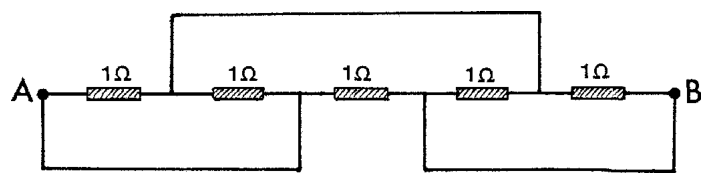
Determine the resulting resistance \(R\) between A and B. (1 point)
b)
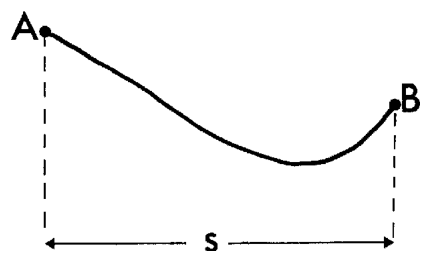
A skier starts from rest at point A and slides down the hill, without turning or braking. The friction coefficient is \(\mu\). When he stops at point B, his horizontal displacement is \(s\). What is the height difference \(h\) between points A and B?
(The velocity of the skier is small so that the additional pressure on the snow due to the curvature can be neglected. Neglect also the friction of air and the dependence of \(\mu\) on the velocity of the skier.) (1.5 points)c) A thermally insulated piece of metal is heated under atmospheric pressure by an electric current so that it receives electric energy at a constant power \(P\). This leads to an increase of the absolute temperature \(T\) of the metal with time \(t\) as follows:
\[ T(t)=T_0\left[1+a(t-t_0)\right]^{1/4}. \]
Here \(a\), \(t_0\) and \(T_0\) are constants. Determine the heat capacity \(C_p(T)\) of the metal (temperature dependent in the temperature range of the experiment). (2 points)
d) A black plane surface at a constant high temperature \(T_h\) is parallel to another black plane surface at a constant lower temperature \(T_l\). Between the plates is vacuum.
In order to reduce the heat flow due to radiation, a heat shield consisting of two thin black plates, thermally isolated from each other, is placed between the warm and the cold surfaces and parallel to these. After some time stationary conditions are obtained.
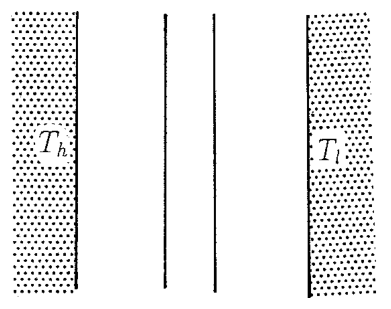
By what factor \(\xi\) is the stationary heat flow reduced due to the presence of the heat shield? Neglect end effects due to the finite size of the surfaces. (1.5 points)
e) Two straight and very long nonmagnetic conductors \(C_+\) and \(C_-\), insulated from each other, carry a current \(I\) in the positive and the negative \(z\) direction, respectively. The cross sections of the conductors (hatched in the figure) are limited by circles of diameter \(D\) in the \(x\)-\(y\) plane, with a distance \(D/2\) between the centres. Thereby the resulting cross sections each have an area \(\left(\frac{1}{12}\pi+\frac{1}{8}\sqrt{3}\right)D^2\). The current in each conductor is uniformly distributed over the cross section.
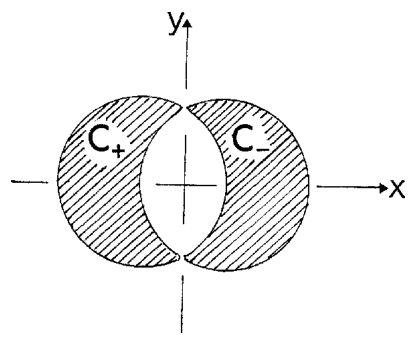
Determine the magnetic field \(B(x,y)\) in the space between the conductors. (4 points)
Official English text of the problem.
Problem 2: Electrons between coaxial cylinders in a magnetic field (magnetic cut-off)
The space between a pair of coaxial cylindrical conductors is evacuated. The radius of the inner cylinder is \(a\), and the inner radius of the outer cylinder is \(b\), as shown in the figure below. The outer cylinder, called the anode, may be given a positive potential \(V\) relative to the inner cylinder. A static homogeneous magnetic field \(\vec B\) parallel to the cylinder axis, directed out of the plane of the figure, is also present. Induced charges in the conductors are neglected.
We study the dynamics of electrons with rest mass \(m\) and charge \(-e\). The electrons are released at the surface of the inner cylinder.
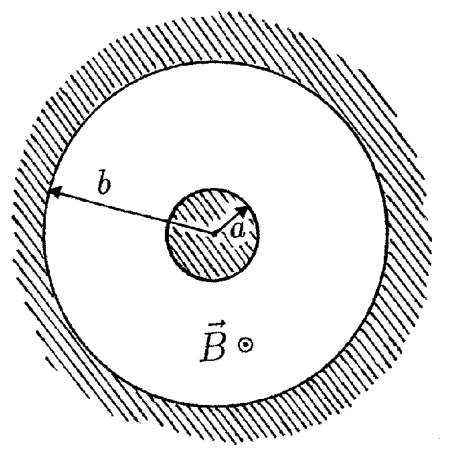
a) First the potential \(V\) is turned on, but \(\vec B=0\). An electron is set free with negligible velocity at the surface of the inner cylinder. Determine its speed \(v\) when it hits the anode. Give the answer both when a non-relativistic treatment is sufficient, and when it is not. (1 point)
For the remaining parts of this problem a non-relativistic treatment suffices.
b) Now \(V=0\), but the homogeneous magnetic field \(\vec B\) is present. An electron starts out with an initial velocity \(\vec v_0\) in the radial direction. For magnetic fields larger than a critical value \(B_c\), the electron will not reach the anode. Make a sketch of the trajectory of the electron when \(B\) is slightly more than \(B_c\). Determine \(B_c\). (2 points)
From now on both the potential \(V\) and the homogeneous magnetic field \(\vec B\) are present.
c) The magnetic field will give the electron a non-zero angular momentum \(L\) with respect to the cylinder axis. Write down an equation for the rate of change \(dL/dt\) of the angular momentum. Show that this equation implies that
\[ L-keBr^2 \]
is constant during the motion, where \(k\) is a definite pure number. Here \(r\) is the distance from the cylinder axis. Determine the value of \(k\). (3 points)
d) Consider an electron, released from the inner cylinder with negligible velocity, that does not reach the anode, but has a maximal distance from the cylinder axis equal to \(r_m\). Determine the speed \(v\) at the point where the radial distance is maximal, in terms of \(r_m\). (1 point)
e) We are interested in using the magnetic field to regulate the electron current to the anode. For \(B\) larger than a critical magnetic field \(B_c\), an electron, released with negligible velocity, will not reach the anode. Determine \(B_c\).
(1 point)f) If the electrons are set free by heating the inner cylinder an electron will in general have an initial nonzero velocity at the surface of the inner cylinder. The component of the initial velocity parallel to \(\vec B\) is \(v_B\), the components orthogonal to \(\vec B\) are \(v_r\) (in the radial direction) and \(v_\varphi\) (in the azimuthal direction, i.e. orthogonal to the radial direction).
Determine for this situation the critical magnetic field \(B_c\) for reaching the anode. (2 points)
Official English text of the problem.
Problem 3: Mid-ocean tides in the Earth-Moon system
In this problem we consider some gross features of the magnitude of mid-ocean tides on earth. We simplify the problem by making the following assumptions:
(i) The earth and the moon are considered to be an isolated system,
(ii) the distance between the moon and the earth is assumed to be constant,
(iii) the earth is assumed to be completely covered by an ocean,
(iv) the dynamic effects of the rotation of the earth around its axis are neglected, and
(v) the gravitational attraction of the earth can be determined as if all mass were concentrated at the centre of the earth.The following data are given:
Mass of the earth: \(M = 5.98 \cdot 10^{24}\ \mathrm{kg}\)
Mass of the moon: \(M_m = 7.3 \cdot 10^{22}\ \mathrm{kg}\)
Radius of the earth: \(R = 6.37 \cdot 10^6\ \mathrm{m}\)
Distance between centre of the earth and centre of the moon:
\(L = 3.84 \cdot 10^8\ \mathrm{m}\)
The gravitational constant: \(G = 6.67 \cdot 10^{-11}\ \mathrm{m^3\,kg^{-1}\,s^{-2}}\).a) The moon and the earth rotate with angular velocity \(\omega\) about their common centre of mass, \(C\). How far is \(C\) from the centre of the earth? (Denote this distance by \(l\).)
Determine the numerical value of \(\omega\). (2 points)
We now use a frame of reference that is co-rotating with the moon and the center of the earth around \(C\). In this frame of reference the shape of the liquid surface of the earth is static.
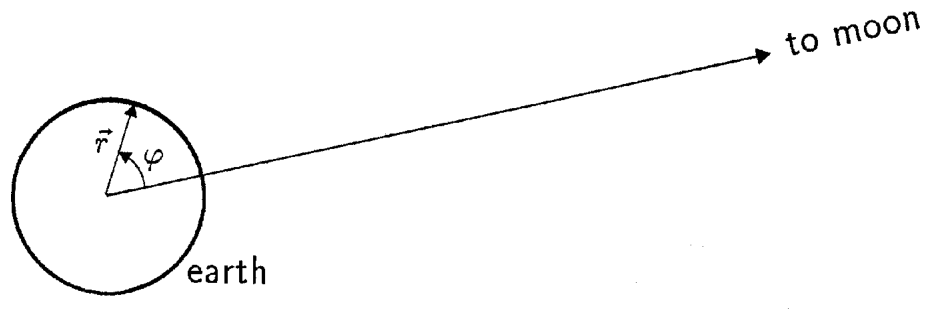
In the plane \(P\) through \(C\) and orthogonal to the axis of rotation the position of a point mass on the liquid surface of the earth can be described by polar coordinates \(r,\varphi\) as shown in the figure. Here \(r\) is the distance from the centre of the earth.
We will study the shape
\[ r(\varphi)=R+h(\varphi) \]
of the liquid surface of the earth in the plane \(P\).
b) Consider a mass point (mass \(m\)) on the liquid surface of the earth (in the plane \(P\)). In our frame of reference it is acted upon by a centrifugal force and by gravitational forces from the moon and the earth. Write down an expression for the potential energy corresponding to these three forces.
Note: Any force \(F(r)\), radially directed with respect to some origin, is the negative derivative of a spherically symmetric potential energy \(V(r)\):
\(F(r)=-V'(r)\). (3 points)c) Find, in terms of the given quantities \(M,M_m\), etc, the approximate form \(h(\varphi)\) of the tidal bulge. What is the difference in meters between high tide and low tide in this model?
You may use the approximate expression
\[ \frac{1}{\sqrt{1+a^2-2a\cos\theta}} \approx 1+a\cos\theta+\frac12a^2(3\cos^2\theta-1), \]
valid for \(a\) much less than unity.
In this analysis make simplifying approximations whenever they are reasonable. (5 points)
Official English text of the problem.
Internationale Physik-Olympiade
IPhO 1996
Oslo, Norwegen · 3 Theorieaufgaben mit vollständigen Lösungen
Aufgabe 1: Fünf voneinander unabhängige Kurzaufgaben (Widerstandsnetzwerk, Skifahrer auf einem Hügel, Wärmekapazität eines Metalls, Strahlungsschutzschild, Magnetfeld zwischen zwei Leitern)
(Die fünf Teile dieser Aufgabe sind voneinander unabhängig)
a) Fünf Widerstände von jeweils \(1\Omega\) sind wie in der Abbildung gezeigt miteinander verbunden. Der Widerstand der Verbindungsdrähte (durchgezogene Linien) ist vernachlässigbar.
Bestimmen Sie den Gesamtwiderstand \(R\) zwischen A und B. (1 Punkt)
b)
Ein Skifahrer startet aus der Ruhe am Punkt A und gleitet den Hügel hinunter, ohne Kurven zu fahren oder zu bremsen. Der Reibungskoeffizient ist \(\mu\). Wenn er am Punkt B zum Stillstand kommt, beträgt seine horizontale Verschiebung \(s\). Wie groß ist der Höhenunterschied \(h\) zwischen den Punkten A und B?
(Die Geschwindigkeit des Skifahrers ist so gering, dass der zusätzliche Druck auf den Schnee aufgrund der Bahnkrümmung vernachlässigt werden kann. Vernachlässigen Sie außerdem den Luftwiderstand und die Abhängigkeit von \(\mu\) von der Geschwindigkeit des Skifahrers.) (1.5 Punkte)c) Ein thermisch isoliertes Metallstück wird bei Atmosphärendruck durch einen elektrischen Strom erwärmt, sodass ihm elektrische Energie mit konstanter Leistung \(P\) zugeführt wird. Dadurch steigt die absolute Temperatur \(T\) des Metalls mit der Zeit \(t\) gemäß:
\[ T(t)=T_0\left[1+a(t-t_0)\right]^{1/4}. \]
Dabei sind \(a\), \(t_0\) und \(T_0\) Konstanten. Bestimmen Sie die Wärmekapazität \(C_p(T)\) des Metalls (die im Temperaturbereich des Experiments temperaturabhängig ist). (2 Punkte)
d) Eine schwarze ebene Oberfläche mit einer konstanten hohen Temperatur \(T_h\) ist parallel zu einer anderen schwarzen ebenen Oberfläche mit einer konstanten niedrigeren Temperatur \(T_l\) angeordnet. Zwischen den Platten herrscht Vakuum.
Um den Wärmestrom durch Strahlung zu verringern, wird ein Strahlungsschutzschild aus zwei dünnen schwarzen, thermisch voneinander isolierten Platten zwischen der warmen und der kalten Oberfläche und parallel zu diesen angeordnet. Nach einiger Zeit stellt sich ein stationärer Zustand ein.
Um welchen Faktor \(\xi\) wird der stationäre Wärmestrom durch den Strahlungsschutzschild verringert? Vernachlässigen Sie Randeffekte aufgrund der endlichen Größe der Oberflächen. (1.5 Punkte)
e) Zwei gerade und sehr lange nichtmagnetische Leiter \(C_+\) und \(C_-\), die voneinander isoliert sind, führen jeweils einen Strom \(I\) in positiver beziehungsweise negativer \(z\)-Richtung. Die Querschnitte der Leiter (in der Abbildung schraffiert) werden durch Kreise mit dem Durchmesser \(D\) in der \(x\)-\(y\)-Ebene begrenzt, deren Mittelpunkte den Abstand \(D/2\) voneinander haben. Die sich daraus ergebenden Querschnitte haben jeweils eine Fläche von \(\left(\frac{1}{12}\pi+\frac{1}{8}\sqrt{3}\right)D^2\). Der Strom ist in jedem Leiter gleichmäßig über den Querschnitt verteilt.
Bestimmen Sie das Magnetfeld \(B(x,y)\) im Raum zwischen den Leitern. (4 Punkte)
Aufgabentext aus dem offiziellen englischen Text übersetzt.
Aufgabe 2: Elektronen zwischen koaxialen Zylindern in einem Magnetfeld (magnetische Sperrung)
Der Raum zwischen zwei koaxialen zylindrischen Leitern ist evakuiert. Der Radius des inneren Zylinders beträgt \(a\), und der Innenradius des äußeren Zylinders beträgt \(b\), wie in der folgenden Abbildung gezeigt. Der äußere Zylinder, der als Anode bezeichnet wird, kann gegenüber dem inneren Zylinder auf ein positives Potential \(V\) gebracht werden. Außerdem liegt ein statisches homogenes Magnetfeld \(\vec B\) parallel zur Zylinderachse vor, das aus der Zeichenebene heraus gerichtet ist. Influenzladungen in den Leitern werden vernachlässigt.
Wir untersuchen die Dynamik von Elektronen mit der Ruhemasse \(m\) und der Ladung \(-e\). Die Elektronen werden an der Oberfläche des inneren Zylinders freigesetzt.
a) Zunächst wird das Potential \(V\) angelegt, aber es gilt \(\vec B=0\). Ein Elektron wird mit vernachlässigbarer Geschwindigkeit an der Oberfläche des inneren Zylinders freigesetzt. Bestimmen Sie seine Geschwindigkeit \(v\), wenn es auf die Anode trifft. Geben Sie die Antwort sowohl für den Fall an, dass eine nichtrelativistische Behandlung ausreicht, als auch für den Fall, dass sie nicht ausreicht. (1 Punkt)
Für die übrigen Teile dieser Aufgabe genügt eine nichtrelativistische Behandlung.
b) Nun gilt \(V=0\), aber das homogene Magnetfeld \(\vec B\) ist vorhanden. Ein Elektron startet mit einer Anfangsgeschwindigkeit \(\vec v_0\) in radialer Richtung. Bei Magnetfeldern oberhalb eines kritischen Wertes \(B_c\) erreicht das Elektron die Anode nicht. Skizzieren Sie die Bahn des Elektrons, wenn \(B\) geringfügig größer als \(B_c\) ist. Bestimmen Sie \(B_c\). (2 Punkte)
Von nun an sind sowohl das Potential \(V\) als auch das homogene Magnetfeld \(\vec B\) vorhanden.
c) Das Magnetfeld verleiht dem Elektron einen von null verschiedenen Drehimpuls \(L\) bezüglich der Zylinderachse. Stellen Sie eine Gleichung für die zeitliche Änderung \(dL/dt\) des Drehimpulses auf. Zeigen Sie, dass aus dieser Gleichung folgt, dass
\[ L-keBr^2 \]
während der Bewegung konstant ist, wobei \(k\) eine bestimmte dimensionslose Zahl ist. Dabei ist \(r\) der Abstand von der Zylinderachse. Bestimmen Sie den Wert von \(k\). (3 Punkte)
d) Betrachten Sie ein Elektron, das mit vernachlässigbarer Geschwindigkeit am inneren Zylinder freigesetzt wird und die Anode nicht erreicht, sondern einen maximalen Abstand \(r_m\) von der Zylinderachse hat. Bestimmen Sie die Geschwindigkeit \(v\) an der Stelle des maximalen radialen Abstands in Abhängigkeit von \(r_m\). (1 Punkt)
e) Wir möchten das Magnetfeld dazu verwenden, den Elektronenstrom zur Anode zu regeln. Für \(B\) oberhalb eines kritischen Magnetfeldes \(B_c\) erreicht ein mit vernachlässigbarer Geschwindigkeit freigesetztes Elektron die Anode nicht. Bestimmen Sie \(B_c\).
(1 Punkt)f) Werden die Elektronen durch Erhitzen des inneren Zylinders freigesetzt, so hat ein Elektron an der Oberfläche des inneren Zylinders im Allgemeinen eine von null verschiedene Anfangsgeschwindigkeit. Die Komponente der Anfangsgeschwindigkeit parallel zu \(\vec B\) ist \(v_B\), die Komponenten senkrecht zu \(\vec B\) sind \(v_r\) (in radialer Richtung) und \(v_\varphi\) (in azimutaler Richtung, d. h. senkrecht zur radialen Richtung).
Bestimmen Sie für diesen Fall das kritische Magnetfeld \(B_c\) für das Erreichen der Anode. (2 Punkte)
Aufgabentext aus dem offiziellen englischen Text übersetzt.
Aufgabe 3: Gezeiten auf dem offenen Ozean im Erde-Mond-System
In dieser Aufgabe betrachten wir einige grundlegende Eigenschaften der Stärke der Gezeiten auf dem offenen Ozean der Erde. Wir vereinfachen die Aufgabe durch die folgenden Annahmen:
(i) Erde und Mond werden als isoliertes System betrachtet,
(ii) der Abstand zwischen Mond und Erde wird als konstant angenommen,
(iii) die Erde wird als vollständig von einem Ozean bedeckt angenommen,
(iv) die dynamischen Auswirkungen der Rotation der Erde um ihre Achse werden vernachlässigt, und
(v) die Gravitationsanziehung der Erde kann so bestimmt werden, als wäre ihre gesamte Masse im Erdmittelpunkt konzentriert.Die folgenden Daten sind gegeben:
Masse der Erde: \(M = 5.98 \cdot 10^{24}\ \mathrm{kg}\)
Masse des Mondes: \(M_m = 7.3 \cdot 10^{22}\ \mathrm{kg}\)
Radius der Erde: \(R = 6.37 \cdot 10^6\ \mathrm{m}\)
Abstand zwischen Erdmittelpunkt und Mondmittelpunkt:
\(L = 3.84 \cdot 10^8\ \mathrm{m}\)
Gravitationskonstante: \(G = 6.67 \cdot 10^{-11}\ \mathrm{m^3\,kg^{-1}\,s^{-2}}\).a) Mond und Erde bewegen sich mit der Winkelgeschwindigkeit \(\omega\) um ihren gemeinsamen Schwerpunkt \(C\). Wie weit ist \(C\) vom Erdmittelpunkt entfernt? (Bezeichnen Sie diesen Abstand mit \(l\).)
Bestimmen Sie den Zahlenwert von \(\omega\). (2 Punkte)
Wir verwenden nun ein Bezugssystem, das mit dem Mond und dem Erdmittelpunkt um \(C\) mitrotiert. In diesem Bezugssystem ist die Form der Flüssigkeitsoberfläche der Erde zeitlich unveränderlich.
In der Ebene \(P\), die durch \(C\) verläuft und senkrecht zur Rotationsachse steht, lässt sich die Lage eines Massenpunkts auf der Flüssigkeitsoberfläche der Erde durch die Polarkoordinaten \(r,\varphi\) beschreiben, wie in der Abbildung dargestellt. Dabei ist \(r\) der Abstand vom Erdmittelpunkt.
Wir untersuchen die Form
\[ r(\varphi)=R+h(\varphi) \]
der Flüssigkeitsoberfläche der Erde in der Ebene \(P\).
b) Betrachten Sie einen Massenpunkt (Masse \(m\)) auf der Flüssigkeitsoberfläche der Erde (in der Ebene \(P\)). In unserem Bezugssystem wirken auf ihn eine Zentrifugalkraft sowie die Gravitationskräfte des Mondes und der Erde. Geben Sie einen Ausdruck für die diesen drei Kräften entsprechende potenzielle Energie an.
Hinweis: Jede Kraft \(F(r)\), die bezüglich eines Ursprungs radial gerichtet ist, ist die negative Ableitung einer kugelsymmetrischen potenziellen Energie \(V(r)\):
\(F(r)=-V'(r)\). (3 Punkte)c) Bestimmen Sie anhand der gegebenen Größen \(M,M_m\) usw. die näherungsweise Form \(h(\varphi)\) des Flutbergs. Wie groß ist in diesem Modell der Höhenunterschied zwischen Hochwasser und Niedrigwasser in Metern?
Sie dürfen den Näherungsausdruck
\[ \frac{1}{\sqrt{1+a^2-2a\cos\theta}} \approx 1+a\cos\theta+\frac12a^2(3\cos^2\theta-1), \]
verwenden, der für \(a\) sehr viel kleiner als eins gilt.
Verwenden Sie bei dieser Untersuchung vereinfachende Näherungen, wo immer sie gerechtfertigt sind. (5 Punkte)
Aufgabentext aus dem offiziellen englischen Text übersetzt.
Uluslararası Fizik Olimpiyatı
IPhO 1996
Oslo, Norveç · 3 teori sorusu, tam çözümleriyle
Soru 1: Birbirinden bağımsız beş kısa soru (direnç ağı, bir yamaçtaki kayakçı, bir metalin ısı kapasitesi, ışınımla ısı aktarımına karşı kalkan, iki iletken arasındaki manyetik alan)
(Bu sorunun beş kısmı birbirinden bağımsızdır)
a) Her biri \(1\Omega\) olan beş direnç, şekilde gösterildiği gibi bağlanmıştır. İletken tellerin (kesintisiz çizgiler) direnci ihmal edilebilir.
A ile B arasındaki eşdeğer direnç \(R\)'yi belirleyiniz. (1 puan)
b)
Bir kayakçı A noktasında durgun hâlden harekete başlar ve dönmeden ya da fren yapmadan yamaçtan aşağı kayar. Sürtünme katsayısı \(\mu\)'dür. B noktasında durduğunda yatay yer değiştirmesi \(s\)'dir. A ve B noktaları arasındaki yükseklik farkı \(h\) nedir?
(Kayakçının hızı, eğrilik nedeniyle kar üzerinde oluşan ek basıncın ihmal edilebileceği kadar küçüktür. Hava direncini ve \(\mu\)'nün kayakçının hızına bağımlılığını da ihmal ediniz.) (1.5 puan)c) Isıl olarak yalıtılmış bir metal parçası, atmosfer basıncı altında elektrik akımıyla, sabit \(P\) gücünde elektrik enerjisi alacak şekilde ısıtılmaktadır. Bunun sonucunda metalin mutlak sıcaklığı \(T\), \(t\) zamanına bağlı olarak aşağıdaki gibi artmaktadır:
\[ T(t)=T_0\left[1+a(t-t_0)\right]^{1/4}. \]
Burada \(a\), \(t_0\) ve \(T_0\) sabitlerdir. Metalin (deneyin sıcaklık aralığında sıcaklığa bağlı olan) ısı kapasitesi \(C_p(T)\)'yi belirleyiniz. (2 puan)
d) Sabit ve yüksek bir \(T_h\) sıcaklığındaki siyah düzlem yüzey, sabit ve daha düşük bir \(T_l\) sıcaklığındaki başka bir siyah düzlem yüzeye paraleldir. Levhalar arasında vakum vardır.
Işınımla ısı aktarımını azaltmak amacıyla, birbirinden ısıl olarak yalıtılmış iki ince siyah levhadan oluşan bir ısı kalkanı, sıcak ve soğuk yüzeylerin arasına ve bu yüzeylere paralel olarak yerleştirilir. Bir süre sonra kararlı duruma ulaşılır.
Isı kalkanının varlığı, kararlı durumdaki ısı aktarım hızını hangi \(\xi\) çarpanı kadar azaltır? Yüzeylerin sonlu boyutlarından kaynaklanan kenar etkilerini ihmal ediniz. (1.5 puan)
e) Birbirinden yalıtılmış, düz ve çok uzun iki manyetik olmayan iletken \(C_+\) ve \(C_-\), sırasıyla pozitif ve negatif \(z\) yönünde \(I\) akımı taşımaktadır. İletkenlerin (şekilde taralı olarak gösterilen) kesitleri, \(x\)-\(y\) düzleminde merkezleri arasındaki uzaklık \(D/2\) olan, \(D\) çaplı çemberlerle sınırlanmıştır. Böylece oluşan kesitlerin her birinin alanı \(\left(\frac{1}{12}\pi+\frac{1}{8}\sqrt{3}\right)D^2\)'dir. Her bir iletkendeki akım, kesit boyunca düzgün dağılmıştır.
İletkenler arasındaki boşlukta manyetik alan \(B(x,y)\)'yi belirleyiniz. (4 puan)
Soru metni resmi İngilizce metinden çevrilmiştir.
Soru 2: Manyetik alanda eş eksenli silindirler arasındaki elektronlar (manyetik kesim)
Eş eksenli iki silindirik iletken arasındaki boşluk vakumlanmıştır. Aşağıdaki şekilde gösterildiği gibi, iç silindirin yarıçapı \(a\), dış silindirin iç yarıçapı ise \(b\)'dir. Anot adı verilen dış silindire, iç silindire göre pozitif bir \(V\) potansiyeli uygulanabilir. Ayrıca, silindir eksenine paralel, şekil düzleminden dışarıya doğru yönelmiş, zamana göre değişmeyen düzgün bir \(\vec B\) manyetik alanı vardır. İletkenlerde indüklenen yükler ihmal edilmektedir.
Durgun kütlesi \(m\), yükü \(-e\) olan elektronların dinamiğini inceliyoruz. Elektronlar iç silindirin yüzeyinden serbest bırakılmaktadır.
a) Önce \(V\) potansiyeli uygulanır, ancak \(\vec B=0\)'dır. Bir elektron, iç silindirin yüzeyinden ihmal edilebilir bir hızla serbest bırakılır. Anoda çarptığı andaki \(v\) süratini bulunuz. Cevabı hem göreli olmayan bir yaklaşımın yeterli olduğu hem de yeterli olmadığı durum için veriniz. (1 puan)
Bu sorunun geri kalan kısımlarında göreli olmayan bir yaklaşım yeterlidir.
b) Şimdi \(V=0\)'dır, ancak düzgün \(\vec B\) manyetik alanı vardır. Bir elektron, radyal yönde bir \(\vec v_0\) ilk hızıyla harekete başlar. Manyetik alanın kritik bir \(B_c\) değerinden büyük olması durumunda elektron anoda ulaşamaz. \(B\)'nin \(B_c\)'den biraz büyük olduğu durumda elektronun yörüngesini kabaca çiziniz. \(B_c\)'yi bulunuz. (2 puan)
Bundan sonraki kısımlarda hem \(V\) potansiyeli hem de düzgün \(\vec B\) manyetik alanı vardır.
c) Manyetik alan, elektrona silindir eksenine göre sıfırdan farklı bir \(L\) açısal momentumu kazandıracaktır. Açısal momentumun değişim hızı \(dL/dt\) için bir denklem yazınız. Bu denklemin, hareket boyunca
\[ L-keBr^2 \]
ifadesinin sabit kaldığını gösterdiğini kanıtlayınız; burada \(k\), belirli bir boyutsuz sayıdır. \(r\) ise silindir ekseninden olan uzaklıktır. \(k\)'nın değerini bulunuz. (3 puan)
d) İç silindirden ihmal edilebilir bir hızla serbest bırakılan, anoda ulaşamayan ve silindir ekseninden en büyük uzaklığı \(r_m\) olan bir elektronu ele alınız. Radyal uzaklığın en büyük olduğu noktadaki \(v\) süratini \(r_m\) cinsinden bulunuz. (1 puan)
e) Anoda giden elektron akımını düzenlemek için manyetik alanı kullanmak istiyoruz. \(B\), kritik bir \(B_c\) manyetik alanından büyük olduğunda, ihmal edilebilir bir hızla serbest bırakılan bir elektron anoda ulaşamaz. \(B_c\)'yi bulunuz.
(1 puan)f) Elektronlar iç silindir ısıtılarak serbest bırakılırsa, bir elektronun iç silindirin yüzeyinde genellikle sıfırdan farklı bir ilk hızı olur. İlk hızın \(\vec B\)'ye paralel bileşeni \(v_B\), \(\vec B\)'ye dik bileşenleri ise \(v_r\) (radyal yönde) ve \(v_\varphi\) (azimutal yönde, yani radyal yöne dik) olsun.
Bu durum için anoda ulaşmanın sınırını belirleyen kritik \(B_c\) manyetik alanını bulunuz. (2 puan)
Soru metni resmi İngilizce metinden çevrilmiştir.
Soru 3: Dünya–Ay sisteminde açık okyanus gelgitleri
Bu soruda, Dünya üzerindeki açık okyanus gelgitlerinin büyüklüğüne ilişkin bazı genel özellikleri ele alıyoruz. Aşağıdaki varsayımları yaparak problemi basitleştiriyoruz:
(i) Dünya ve Ay yalıtılmış bir sistem olarak kabul edilmektedir,
(ii) Ay ile Dünya arasındaki uzaklığın sabit olduğu varsayılmaktadır,
(iii) Dünya'nın bütünüyle bir okyanusla kaplı olduğu varsayılmaktadır,
(iv) Dünya'nın kendi ekseni etrafındaki dönüşünün dinamik etkileri ihmal edilmektedir ve
(v) Dünya'nın kütleçekim kuvveti, tüm kütlesi Dünya'nın merkezinde toplanmış gibi hesaplanabilmektedir.Aşağıdaki veriler verilmiştir:
Dünya'nın kütlesi: \(M = 5.98 \cdot 10^{24}\ \mathrm{kg}\)
Ay'ın kütlesi: \(M_m = 7.3 \cdot 10^{22}\ \mathrm{kg}\)
Dünya'nın yarıçapı: \(R = 6.37 \cdot 10^6\ \mathrm{m}\)
Dünya'nın merkezi ile Ay'ın merkezi arasındaki uzaklık:
\(L = 3.84 \cdot 10^8\ \mathrm{m}\)
Kütleçekim sabiti: \(G = 6.67 \cdot 10^{-11}\ \mathrm{m^3\,kg^{-1}\,s^{-2}}\).a) Ay ve Dünya, ortak kütle merkezleri \(C\) etrafında \(\omega\) açısal hızıyla dönmektedir. \(C\), Dünya'nın merkezinden ne kadar uzaktadır? (Bu uzaklığı \(l\) ile gösteriniz.)
\(\omega\)'nın sayısal değerini belirleyiniz. (2 puan)
Şimdi, Ay ve Dünya'nın merkeziyle birlikte \(C\) etrafında dönen bir referans sistemi kullanıyoruz. Bu referans sisteminde Dünya'nın sıvı yüzeyinin şekli zamanla değişmez.
\(C\)'den geçen ve dönme eksenine dik olan \(P\) düzleminde, Dünya'nın sıvı yüzeyi üzerindeki bir noktasal kütlenin konumu, şekilde gösterildiği gibi \(r,\varphi\) kutupsal koordinatlarıyla tanımlanabilir. Burada \(r\), Dünya'nın merkezinden olan uzaklıktır.
Dünya'nın sıvı yüzeyinin \(P\) düzlemindeki
\[ r(\varphi)=R+h(\varphi) \]
şeklini inceleyeceğiz.
b) Dünya'nın sıvı yüzeyi üzerinde (\(P\) düzleminde) bir noktasal kütle (kütlesi \(m\)) ele alınız. Referans sistemimizde bu kütleye bir merkezkaç kuvveti ile Ay ve Dünya'nın kütleçekim kuvvetleri etki eder. Bu üç kuvvete karşılık gelen potansiyel enerji için bir ifade yazınız.
Not: Herhangi bir başlangıç noktasına göre radyal doğrultuda yönelmiş herhangi bir \(F(r)\) kuvveti, küresel simetrik bir \(V(r)\) potansiyel enerjisinin türevinin negatifidir:
\(F(r)=-V'(r)\). (3 puan)c) Gelgit kabarmasının yaklaşık \(h(\varphi)\) biçimini, verilen \(M,M_m\) vb. nicelikler cinsinden bulunuz. Bu modelde yüksek su ile alçak su seviyeleri arasındaki fark kaç metredir?
\(a\)'nın birden çok küçük olduğu durumlarda geçerli olan
\[ \frac{1}{\sqrt{1+a^2-2a\cos\theta}} \approx 1+a\cos\theta+\frac12a^2(3\cos^2\theta-1), \]
yaklaşık ifadesini kullanabilirsiniz.
Bu analizde, makul olduğu her durumda basitleştirici yaklaşımlar yapınız. (5 puan)
Soru metni resmi İngilizce metinden çevrilmiştir.
Olimpiada Internacional de Física
IPhO 1996
Oslo, Noruega · 3 problemas teóricos con soluciones completas
Problema 1: Cinco problemas breves independientes (red de resistencias, esquiador en una colina, capacidad calorífica de un metal, pantalla térmica contra la radiación, campo magnético entre dos conductores)
(Las cinco partes de este problema son independientes)
a) Se conectan cinco resistencias de \(1\Omega\) como se muestra en la figura. La resistencia de los cables conductores (líneas continuas) es despreciable.
Determine la resistencia equivalente \(R\) entre A y B. (1 punto)
b)
Un esquiador parte del reposo en el punto A y se desliza colina abajo, sin girar ni frenar. El coeficiente de rozamiento es \(\mu\). Cuando se detiene en el punto B, su desplazamiento horizontal es \(s\). ¿Cuál es la diferencia de altura \(h\) entre los puntos A y B?
(La velocidad del esquiador es pequeña, de modo que puede despreciarse la presión adicional sobre la nieve debida a la curvatura. Desprecie también la resistencia del aire y la dependencia de \(\mu\) respecto de la velocidad del esquiador.) (1.5 puntos)c) Una pieza de metal térmicamente aislada se calienta a presión atmosférica mediante una corriente eléctrica, de modo que recibe energía eléctrica a una potencia constante \(P\). Esto provoca un aumento de la temperatura absoluta \(T\) del metal con el tiempo \(t\) de la siguiente forma:
\[ T(t)=T_0\left[1+a(t-t_0)\right]^{1/4}. \]
Aquí \(a\), \(t_0\) y \(T_0\) son constantes. Determine la capacidad calorífica \(C_p(T)\) del metal (dependiente de la temperatura en el intervalo de temperaturas del experimento). (2 puntos)
d) Una superficie plana negra a una temperatura alta constante \(T_h\) es paralela a otra superficie plana negra a una temperatura inferior constante \(T_l\). Entre las placas hay vacío.
Para reducir el flujo de calor por radiación, se coloca entre las superficies caliente y fría, y paralelamente a ellas, una pantalla térmica formada por dos placas negras delgadas, térmicamente aisladas entre sí. Transcurrido cierto tiempo, se alcanza un estado estacionario.
¿Por qué factor \(\xi\) se reduce el flujo de calor estacionario debido a la presencia de la pantalla térmica? Desprecie los efectos de borde debidos al tamaño finito de las superficies. (1.5 puntos)
e) Dos conductores rectos, muy largos y no magnéticos, \(C_+\) y \(C_-\), aislados entre sí, transportan una corriente \(I\) en los sentidos positivo y negativo del eje \(z\), respectivamente. Las secciones transversales de los conductores (rayadas en la figura) están delimitadas por circunferencias de diámetro \(D\) en el plano \(x\)-\(y\), con una distancia \(D/2\) entre sus centros. Así, cada una de las secciones transversales resultantes tiene un área \(\left(\frac{1}{12}\pi+\frac{1}{8}\sqrt{3}\right)D^2\). La corriente en cada conductor está distribuida uniformemente por la sección transversal.
Determine el campo magnético \(B(x,y)\) en el espacio entre los conductores. (4 puntos)
Enunciado traducido del texto oficial en inglés.
Problema 2: Electrones entre cilindros coaxiales en un campo magnético (corte magnético)
El espacio entre dos conductores cilíndricos coaxiales está al vacío. El radio del cilindro interior es \(a\), y el radio interno del cilindro exterior es \(b\), como se muestra en la figura siguiente. Al cilindro exterior, denominado ánodo, se le puede aplicar un potencial positivo \(V\) respecto al cilindro interior. También hay un campo magnético estático y homogéneo \(\vec B\), paralelo al eje de los cilindros y dirigido hacia fuera del plano de la figura. Se desprecian las cargas inducidas en los conductores.
Estudiamos la dinámica de electrones de masa en reposo \(m\) y carga \(-e\). Los electrones se liberan en la superficie del cilindro interior.
a) En primer lugar se aplica el potencial \(V\), pero \(\vec B=0\). Se libera un electrón con velocidad despreciable en la superficie del cilindro interior. Determine su rapidez \(v\) al chocar con el ánodo. Dé la respuesta tanto para el caso en que basta un tratamiento no relativista como para el caso en que no basta. (1 punto)
En los apartados restantes de este problema basta un tratamiento no relativista.
b) Ahora \(V=0\), pero está presente el campo magnético homogéneo \(\vec B\). Un electrón parte con una velocidad inicial \(\vec v_0\) en la dirección radial. Para campos magnéticos mayores que un valor crítico \(B_c\), el electrón no alcanzará el ánodo. Dibuje un esquema de la trayectoria del electrón cuando \(B\) es ligeramente mayor que \(B_c\). Determine \(B_c\). (2 puntos)
A partir de ahora están presentes tanto el potencial \(V\) como el campo magnético homogéneo \(\vec B\).
c) El campo magnético conferirá al electrón un momento angular \(L\) no nulo respecto al eje de los cilindros. Escriba una ecuación para la tasa de variación \(dL/dt\) del momento angular. Demuestre que esta ecuación implica que
\[ L-keBr^2 \]
es constante durante el movimiento, donde \(k\) es un número adimensional determinado. Aquí \(r\) es la distancia al eje de los cilindros. Determine el valor de \(k\). (3 puntos)
d) Considere un electrón, liberado del cilindro interior con velocidad despreciable, que no alcanza el ánodo, sino que llega a una distancia máxima del eje de los cilindros igual a \(r_m\). Determine la rapidez \(v\) en el punto donde la distancia radial es máxima, en función de \(r_m\). (1 punto)
e) Nos interesa utilizar el campo magnético para regular la corriente de electrones hacia el ánodo. Para \(B\) mayor que un campo magnético crítico \(B_c\), un electrón liberado con velocidad despreciable no alcanzará el ánodo. Determine \(B_c\).
(1 punto)f) Si los electrones se liberan calentando el cilindro interior, un electrón tendrá, en general, una velocidad inicial no nula en la superficie de dicho cilindro. La componente de la velocidad inicial paralela a \(\vec B\) es \(v_B\), y las componentes perpendiculares a \(\vec B\) son \(v_r\) (en la dirección radial) y \(v_\varphi\) (en la dirección azimutal, es decir, perpendicular a la dirección radial).
Determine para esta situación el campo magnético crítico \(B_c\) para alcanzar el ánodo. (2 puntos)
Enunciado traducido del texto oficial en inglés.
Problema 3: Mareas en mar abierto en el sistema Tierra-Luna
En este problema consideramos algunas características generales de la magnitud de las mareas en mar abierto en la Tierra. Simplificamos el problema mediante las siguientes hipótesis:
(i) La Tierra y la Luna se consideran un sistema aislado,
(ii) se supone que la distancia entre la Luna y la Tierra es constante,
(iii) se supone que la Tierra está completamente cubierta por un océano,
(iv) se desprecian los efectos dinámicos de la rotación de la Tierra alrededor de su eje, y
(v) la atracción gravitatoria de la Tierra puede determinarse como si toda su masa estuviera concentrada en su centro.Se proporcionan los siguientes datos:
Masa de la Tierra: \(M = 5.98 \cdot 10^{24}\ \mathrm{kg}\)
Masa de la Luna: \(M_m = 7.3 \cdot 10^{22}\ \mathrm{kg}\)
Radio de la Tierra: \(R = 6.37 \cdot 10^6\ \mathrm{m}\)
Distancia entre el centro de la Tierra y el centro de la Luna:
\(L = 3.84 \cdot 10^8\ \mathrm{m}\)
Constante de gravitación universal: \(G = 6.67 \cdot 10^{-11}\ \mathrm{m^3\,kg^{-1}\,s^{-2}}\).a) La Luna y la Tierra giran con velocidad angular \(\omega\) alrededor de su centro de masas común, \(C\). ¿A qué distancia del centro de la Tierra se encuentra \(C\)? (Denote esta distancia por \(l\).)
Determine el valor numérico de \(\omega\). (2 puntos)
Utilizamos ahora un sistema de referencia que gira solidariamente con la Luna y el centro de la Tierra alrededor de \(C\). En este sistema de referencia, la forma de la superficie líquida de la Tierra es estática.
En el plano \(P\) que pasa por \(C\) y es perpendicular al eje de rotación, la posición de una masa puntual sobre la superficie líquida de la Tierra puede describirse mediante las coordenadas polares \(r,\varphi\), como se muestra en la figura. Aquí, \(r\) es la distancia al centro de la Tierra.
Estudiaremos la forma
\[ r(\varphi)=R+h(\varphi) \]
de la superficie líquida de la Tierra en el plano \(P\).
b) Considere una masa puntual (de masa \(m\)) sobre la superficie líquida de la Tierra (en el plano \(P\)). En nuestro sistema de referencia, sobre ella actúan una fuerza centrífuga y las fuerzas gravitatorias de la Luna y de la Tierra. Escriba una expresión para la energía potencial correspondiente a estas tres fuerzas.
Nota: Toda fuerza \(F(r)\), dirigida radialmente con respecto a un origen, es la derivada negativa de una energía potencial con simetría esférica \(V(r)\):
\(F(r)=-V'(r)\). (3 puntos)c) Halle, en función de las magnitudes dadas \(M,M_m\), etc., la forma aproximada \(h(\varphi)\) del abultamiento de marea. ¿Cuál es la diferencia en metros entre la pleamar y la bajamar en este modelo?
Puede utilizar la expresión aproximada
\[ \frac{1}{\sqrt{1+a^2-2a\cos\theta}} \approx 1+a\cos\theta+\frac12a^2(3\cos^2\theta-1), \]
válida para \(a\) mucho menor que la unidad.
En este análisis, haga aproximaciones simplificadoras siempre que sean razonables. (5 puntos)
Enunciado traducido del texto oficial en inglés.
国际物理奥林匹克
IPhO 1996
挪威奥斯陆 · 3 道理论题及完整解答
题目 1:五道互不相关的短题(电阻网络、山坡上的滑雪者、金属的热容、辐射隔热屏、两导体之间的磁场)
(本题的五个部分互不相关)
a) 五个阻值为 \(1\Omega\) 的电阻如图所示连接。导线(实线)的电阻可以忽略不计。
求 A、B 之间的等效电阻 \(R\)。(1 分)
b)
一名滑雪者从 A 点由静止开始沿山坡滑下,途中既不转弯也不制动。摩擦系数为 \(\mu\)。当他在 B 点停下时,水平位移为 \(s\)。A、B 两点之间的高度差 \(h\) 是多少?
(滑雪者的速度很小,因此可以忽略轨迹弯曲引起的对雪面的附加压力。也忽略空气阻力以及 \(\mu\) 随滑雪者速度的变化。)(1.5 分)c) 一块与外界绝热的金属在大气压下由电流加热,以恒定功率 \(P\) 接收电能。这使金属的绝对温度 \(T\) 随时间 \(t\) 按下式升高:
\[ T(t)=T_0\left[1+a(t-t_0)\right]^{1/4}. \]
其中 \(a\)、\(t_0\) 和 \(T_0\) 为常量。求金属的热容 \(C_p(T)\)(在实验温度范围内随温度变化)。(2 分)
d) 一个保持恒定高温 \(T_h\) 的黑体平面与另一个保持恒定较低温度 \(T_l\) 的黑体平面相互平行。两板之间为真空。
为减少辐射传热,在热表面与冷表面之间放置一个由两块相互绝热的黑体薄板组成的隔热屏,使其与这两个表面平行。经过一段时间后,系统达到稳态。
由于隔热屏的存在,稳态热流率降至原来的几分之一,即减小因子 \(\xi\) 为多少?忽略表面尺寸有限所引起的边缘效应。(1.5 分)
e) 两根相互绝缘、很长的非磁性直导体 \(C_+\) 和 \(C_-\) 分别沿 \(z\) 轴正方向和负方向通有电流 \(I\)。导体的横截面(图中阴影部分)由 \(x\)-\(y\) 平面内直径为 \(D\) 的圆限定,两圆圆心的间距为 \(D/2\)。由此得到的两个横截面的面积均为 \(\left(\frac{1}{12}\pi+\frac{1}{8}\sqrt{3}\right)D^2\)。每根导体中的电流均匀分布在其横截面上。
求两导体之间空间内的磁场 \(B(x,y)\)。(4 分)
题目译自官方英文原文。
题目 2:磁场中同轴圆柱导体之间的电子(磁截止)
一对同轴圆柱导体之间的空间被抽成真空。内圆柱的半径为 \(a\),外圆柱的内半径为 \(b\),如下图所示。外圆柱称为阳极,可以使其相对于内圆柱具有正电势 \(V\)。此外,还有一个平行于圆柱轴线、方向垂直于图面向外的静态匀强磁场 \(\vec B\)。忽略导体中的感应电荷。
我们研究静止质量为 \(m\)、电荷为 \(-e\) 的电子的动力学。电子从内圆柱表面释放。
a) 首先施加电势 \(V\),但 \(\vec B=0\)。一个电子以可忽略的初速度从内圆柱表面释放。求它撞击阳极时的速率 \(v\)。分别给出可以采用非相对论处理和必须采用相对论处理时的答案。(1 分)
本题其余各部分均可采用非相对论处理。
b) 现在 \(V=0\),但存在匀强磁场 \(\vec B\)。一个电子以沿径向的初速度 \(\vec v_0\) 出发。当磁场大于某个临界值 \(B_c\) 时,电子将无法到达阳极。画出 \(B\) 略大于 \(B_c\) 时电子轨迹的示意图。求 \(B_c\)。(2 分)
从现在起,电势 \(V\) 和匀强磁场 \(\vec B\) 同时存在。
c) 磁场会使电子获得相对于圆柱轴线的非零角动量 \(L\)。写出角动量变化率 \(dL/dt\) 的方程。证明由此方程可知
\[ L-keBr^2 \]
在运动过程中保持不变,其中 \(k\) 是一个确定的无量纲数。这里 \(r\) 是到圆柱轴线的距离。求 \(k\) 的值。(3 分)
d) 考虑一个以可忽略的初速度从内圆柱释放的电子,它未到达阳极,而是到圆柱轴线的最大距离为 \(r_m\)。用 \(r_m\) 表示电子在径向距离最大处的速率 \(v\)。(1 分)
e) 我们希望利用磁场调节流向阳极的电子电流。当 \(B\) 大于某个临界磁场 \(B_c\) 时,以可忽略的初速度释放的电子将无法到达阳极。求 \(B_c\)。
(1 分)f) 如果通过加热内圆柱来释放电子,则电子在内圆柱表面通常具有非零初速度。初速度平行于 \(\vec B\) 的分量为 \(v_B\),垂直于 \(\vec B\) 的分量为 \(v_r\)(沿径向)和 \(v_\varphi\)(沿方位角方向,即垂直于径向)。
求这种情况下电子能够到达阳极的临界磁场 \(B_c\)。(2 分)
题目译自官方英文原文。
题目 3:地月系统中的大洋潮汐
本题研究地球上大洋潮汐幅度的一些总体特征。我们作如下假设,以简化问题:
(i) 将地球和月球视为一个孤立系统,
(ii) 假设月球与地球之间的距离保持不变,
(iii) 假设地球完全被海洋覆盖,
(iv) 忽略地球自转的动力学效应,以及
(v) 计算地球的引力时,可视为其全部质量都集中在地心。已知下列数据:
地球质量:\(M = 5.98 \cdot 10^{24}\ \mathrm{kg}\)
月球质量:\(M_m = 7.3 \cdot 10^{22}\ \mathrm{kg}\)
地球半径:\(R = 6.37 \cdot 10^6\ \mathrm{m}\)
地心与月心之间的距离:
\(L = 3.84 \cdot 10^8\ \mathrm{m}\)
万有引力常量:\(G = 6.67 \cdot 10^{-11}\ \mathrm{m^3\,kg^{-1}\,s^{-2}}\)。a) 月球和地球以角速度 \(\omega\) 绕它们的共同质心 \(C\) 转动。\(C\) 距地心多远?(将此距离记为 \(l\)。)
求 \(\omega\) 的数值。(2 分)
现在采用一个随月球和地心一起绕 \(C\) 转动的参考系。在此参考系中,地球液面的形状保持不变。
在通过 \(C\) 且垂直于转轴的平面 \(P\) 内,地球液面上一个质点的位置可用图中所示的极坐标 \(r,\varphi\) 描述。其中,\(r\) 是该质点到地心的距离。
我们将研究平面 \(P\) 内地球液面的形状
\[ r(\varphi)=R+h(\varphi)\text{。} \]
b) 考虑地球液面上(位于平面 \(P\) 内)的一个质点(质量为 \(m\))。在我们采用的参考系中,它受到离心力以及月球和地球的引力作用。写出与这三个力对应的势能表达式。
注: 任何相对于某一原点沿径向的力 \(F(r)\),都等于某个球对称势能 \(V(r)\) 的负导数:
\(F(r)=-V'(r)\)。(3 分)c) 用给定的量 \(M,M_m\) 等,求潮汐隆起形状 \(h(\varphi)\) 的近似表达式。在此模型中,高潮与低潮之间的高度差是多少米?
可以使用近似表达式
\[ \frac{1}{\sqrt{1+a^2-2a\cos\theta}} \approx 1+a\cos\theta+\frac12a^2(3\cos^2\theta-1), \]
该式适用于 \(a\) 远小于 1 的情况。
在分析过程中,只要合理,就可以作简化近似。(5 分)
题目译自官方英文原文。
Международная физическая олимпиада
IPhO 1996
Осло, Норвегия · 3 теоретические задачи с полными решениями
Задача 1: Пять независимых коротких задач (цепь резисторов, лыжник на склоне, теплоёмкость металла, радиационный тепловой экран, магнитное поле между двумя проводниками)
(Пять частей этой задачи не связаны между собой)
a) Пять резисторов сопротивлением \(1\Omega\) каждый соединены так, как показано на рисунке. Сопротивлением соединительных проводов (сплошные линии) можно пренебречь.
Определите эквивалентное сопротивление \(R\) между A и B. (1 балл)
b)
Лыжник начинает движение из состояния покоя в точке A и скользит вниз по склону, не поворачивая и не тормозя. Коэффициент трения равен \(\mu\). К моменту остановки в точке B его горизонтальное перемещение составляет \(s\). Какова разность высот \(h\) между точками A и B?
(Скорость лыжника мала, поэтому дополнительным давлением на снег, обусловленным кривизной траектории, можно пренебречь. Пренебрегите также сопротивлением воздуха и зависимостью \(\mu\) от скорости лыжника.) (1.5 балла)c) Теплоизолированный кусок металла нагревают при атмосферном давлении электрическим током, подводя к нему электрическую энергию с постоянной мощностью \(P\). В результате абсолютная температура \(T\) металла возрастает со временем \(t\) по следующему закону:
\[ T(t)=T_0\left[1+a(t-t_0)\right]^{1/4}. \]
Здесь \(a\), \(t_0\) и \(T_0\) — постоянные. Определите теплоёмкость \(C_p(T)\) металла (зависящую от температуры в температурном диапазоне эксперимента). (2 балла)
d) Плоская абсолютно чёрная поверхность с постоянной высокой температурой \(T_h\) параллельна другой плоской абсолютно чёрной поверхности с постоянной более низкой температурой \(T_l\). Между пластинами — вакуум.
Для уменьшения теплового потока, передаваемого излучением, между горячей и холодной поверхностями параллельно им помещают тепловой экран, состоящий из двух тонких абсолютно чёрных пластин, теплоизолированных друг от друга. Через некоторое время устанавливается стационарный режим.
Во сколько раз \(\xi\) уменьшается стационарный тепловой поток благодаря наличию теплового экрана? Пренебрегите краевыми эффектами, связанными с конечными размерами поверхностей. (1.5 балла)
e) По двум прямым очень длинным немагнитным проводникам \(C_+\) и \(C_-\), изолированным друг от друга, течёт ток \(I\) соответственно в положительном и отрицательном направлениях оси \(z\). Поперечные сечения проводников (заштрихованные на рисунке) ограничены окружностями диаметра \(D\) в плоскости \(x\)-\(y\), расстояние между центрами которых равно \(D/2\). При этом площадь каждого из получающихся поперечных сечений равна \(\left(\frac{1}{12}\pi+\frac{1}{8}\sqrt{3}\right)D^2\). Ток в каждом проводнике равномерно распределён по поперечному сечению.
Определите магнитное поле \(B(x,y)\) в пространстве между проводниками. (4 балла)
Условие переведено с официального английского текста.
Задача 2: Электроны между коаксиальными цилиндрами в магнитном поле (магнитное запирание)
Пространство между двумя коаксиальными цилиндрическими проводниками вакуумировано. Радиус внутреннего цилиндра равен \(a\), а внутренний радиус внешнего цилиндра равен \(b\), как показано на рисунке ниже. Внешнему цилиндру, называемому анодом, можно сообщить положительный потенциал \(V\) относительно внутреннего цилиндра. Имеется также постоянное однородное магнитное поле \(\vec B\), параллельное оси цилиндров и направленное из плоскости рисунка к наблюдателю. Индуцированными зарядами в проводниках пренебрегают.
Рассмотрим динамику электронов с массой покоя \(m\) и зарядом \(-e\). Электроны испускаются с поверхности внутреннего цилиндра.
a) Сначала прикладывают напряжение \(V\), но \(\vec B=0\). Электрон вылетает с поверхности внутреннего цилиндра с пренебрежимо малой скоростью. Определите его скорость \(v\) при попадании на анод. Дайте ответ как для случая, когда достаточно нерелятивистского рассмотрения, так и для случая, когда оно неприменимо. (1 балл)
В остальных пунктах этой задачи достаточно нерелятивистского рассмотрения.
b) Теперь \(V=0\), но имеется однородное магнитное поле \(\vec B\). Электрон начинает движение с начальной скоростью \(\vec v_0\), направленной по радиусу. При магнитных полях, превышающих критическое значение \(B_c\), электрон не достигает анода. Изобразите схематически траекторию электрона, когда \(B\) немного больше \(B_c\). Определите \(B_c\). (2 балла)
Далее одновременно приложено напряжение \(V\) и имеется однородное магнитное поле \(\vec B\).
c) Под действием магнитного поля электрон приобретает ненулевой момент импульса \(L\) относительно оси цилиндров. Запишите уравнение для скорости изменения \(dL/dt\) момента импульса. Покажите, что из этого уравнения следует, что величина
\[ L-keBr^2 \]
остаётся постоянной в ходе движения, где \(k\) — определённое безразмерное число. Здесь \(r\) — расстояние от оси цилиндров. Определите значение \(k\). (3 балла)
d) Рассмотрим электрон, вылетевший с поверхности внутреннего цилиндра с пренебрежимо малой скоростью, который не достигает анода, а удаляется от оси цилиндров на максимальное расстояние \(r_m\). Определите скорость \(v\) в точке максимального удаления от оси, выразив её через \(r_m\). (1 балл)
e) Мы хотим использовать магнитное поле для регулирования электронного тока на анод. При \(B\), превышающем критическое магнитное поле \(B_c\), электрон, вылетевший с пренебрежимо малой скоростью, не достигает анода. Определите \(B_c\).
(1 балл)f) Если электроны испускаются вследствие нагревания внутреннего цилиндра, то электрон на его поверхности в общем случае имеет ненулевую начальную скорость. Компонента начальной скорости, параллельная \(\vec B\), равна \(v_B\), а компоненты, перпендикулярные \(\vec B\), равны \(v_r\) (в радиальном направлении) и \(v_\varphi\) (в азимутальном направлении, то есть перпендикулярно радиальному направлению).
Определите для этого случая критическое магнитное поле \(B_c\), при котором электрон достигает анода. (2 балла)
Условие переведено с официального английского текста.
Задача 3: Приливы в открытом океане в системе Земля–Луна
В этой задаче мы рассмотрим некоторые общие особенности величины приливов в открытом океане на Земле. Упростим задачу, приняв следующие допущения:
(i) Земля и Луна рассматриваются как изолированная система,
(ii) расстояние между Луной и Землёй считается постоянным,
(iii) предполагается, что Земля полностью покрыта океаном,
(iv) динамическими эффектами вращения Земли вокруг своей оси пренебрегаем, и
(v) гравитационное притяжение Земли можно определять так, как если бы вся её масса была сосредоточена в центре Земли.Даны следующие величины:
Масса Земли: \(M = 5.98 \cdot 10^{24}\ \mathrm{kg}\)
Масса Луны: \(M_m = 7.3 \cdot 10^{22}\ \mathrm{kg}\)
Радиус Земли: \(R = 6.37 \cdot 10^6\ \mathrm{m}\)
Расстояние между центром Земли и центром Луны:
\(L = 3.84 \cdot 10^8\ \mathrm{m}\)
Гравитационная постоянная: \(G = 6.67 \cdot 10^{-11}\ \mathrm{m^3\,kg^{-1}\,s^{-2}}\).a) Луна и Земля вращаются с угловой скоростью \(\omega\) вокруг своего общего центра масс \(C\). На каком расстоянии от центра Земли находится \(C\)? (Обозначьте это расстояние через \(l\).)
Определите численное значение \(\omega\). (2 балла)
Теперь воспользуемся системой отсчёта, вращающейся вместе с Луной и центром Земли вокруг \(C\). В этой системе отсчёта форма жидкой поверхности Земли не меняется со временем.
В плоскости \(P\), проходящей через \(C\) перпендикулярно оси вращения, положение материальной точки на жидкой поверхности Земли можно описать полярными координатами \(r,\varphi\), как показано на рисунке. Здесь \(r\) — расстояние от центра Земли.
Мы будем исследовать форму
\[ r(\varphi)=R+h(\varphi) \]
жидкой поверхности Земли в плоскости \(P\).
b) Рассмотрим материальную точку (массой \(m\)) на жидкой поверхности Земли (в плоскости \(P\)). В нашей системе отсчёта на неё действуют центробежная сила и силы гравитационного притяжения со стороны Луны и Земли. Запишите выражение для потенциальной энергии, соответствующей этим трём силам.
Примечание: Любая сила \(F(r)\), направленная радиально относительно некоторого начала координат, равна взятой с обратным знаком производной сферически симметричной потенциальной энергии \(V(r)\):
\(F(r)=-V'(r)\). (3 балла)c) Найдите приближённую форму \(h(\varphi)\) приливного горба через заданные величины \(M,M_m\) и т. д. Какова в этой модели разность уровней воды при приливе и отливе в метрах?
Можно воспользоваться приближённым выражением
\[ \frac{1}{\sqrt{1+a^2-2a\cos\theta}} \approx 1+a\cos\theta+\frac12a^2(3\cos^2\theta-1), \]
справедливым при \(a\), значительно меньшем единицы.
При анализе используйте упрощающие приближения везде, где они обоснованны. (5 баллов)
Условие переведено с официального английского текста.
الأولمبياد الدولي للفيزياء
IPhO 1996
أوسلو، النرويج · 3 مسائل نظرية مع حلول كاملة
المسألة 1: خمس مسائل قصيرة غير مترابطة (شبكة مقاومات، متزلج على تل، السعة الحرارية لفلز، درع حراري للإشعاع، المجال المغناطيسي بين موصلين)
(الأجزاء الخمسة لهذه المسألة غير مترابطة)
a) وُصلت خمس مقاومات، قيمة كل منها \(1\Omega\)، كما هو مبين في الشكل. مقاومة أسلاك التوصيل (الخطوط المتصلة) مهملة.
أوجد المقاومة المكافئة \(R\) بين A وB. (1 نقطة)
b)
ينطلق متزلج من السكون عند النقطة A وينزلق هابطًا التل، دون أن ينعطف أو يستخدم المكابح. معامل الاحتكاك هو \(\mu\). وعندما يتوقف عند النقطة B، تكون إزاحته الأفقية \(s\). ما فرق الارتفاع \(h\) بين النقطتين A وB؟
(سرعة المتزلج صغيرة بحيث يمكن إهمال الضغط الإضافي على الثلج الناتج عن انحناء المسار. أهمل أيضًا مقاومة الهواء واعتماد \(\mu\) على سرعة المتزلج.) (1.5 نقطة)c) تُسخَّن قطعة فلزية معزولة حراريًا تحت الضغط الجوي بواسطة تيار كهربائي، بحيث تتلقى طاقة كهربائية بقدرة ثابتة \(P\). يؤدي ذلك إلى ازدياد درجة الحرارة المطلقة \(T\) للفلز مع الزمن \(t\) وفق العلاقة الآتية:
\[ T(t)=T_0\left[1+a(t-t_0)\right]^{1/4}. \]
حيث \(a\) و\(t_0\) و\(T_0\) ثوابت. أوجد السعة الحرارية \(C_p(T)\) للفلز (وهي تعتمد على درجة الحرارة ضمن مجال درجات الحرارة في التجربة). (2 نقطة)
d) سطح مستوٍ أسود عند درجة حرارة مرتفعة ثابتة \(T_h\) يوازي سطحًا مستويًا أسود آخر عند درجة حرارة منخفضة ثابتة \(T_l\). ويوجد فراغ بين اللوحين.
لتقليل معدل انتقال الحرارة بالإشعاع، يوضع بين السطح الساخن والسطح البارد، وبالتوازي معهما، درع حراري يتكون من لوحين رقيقين أسودين معزولين حراريًا أحدهما عن الآخر. وبعد مرور بعض الوقت، تتحقق حالة مستقرة.
بأي عامل \(\xi\) ينخفض معدل انتقال الحرارة في الحالة المستقرة بسبب وجود الدرع الحراري؟ أهمل تأثيرات الحواف الناتجة عن الأبعاد المحدودة للسطحين. (1.5 نقطة)
e) يحمل موصلان مستقيمان طويلان جدًا وغير مغناطيسيين، \(C_+\) و\(C_-\)، معزولان أحدهما عن الآخر، تيارًا \(I\) في اتجاه \(z\) الموجب والسالب، على الترتيب. يحد المقطعين العرضيين للموصلين (المظللين بخطوط مائلة في الشكل) دائرتان قطر كل منهما \(D\) في المستوى \(x\)-\(y\)، والمسافة بين مركزيهما \(D/2\). وبذلك تكون مساحة كل من المقطعين العرضيين الناتجين \(\left(\frac{1}{12}\pi+\frac{1}{8}\sqrt{3}\right)D^2\). يتوزع التيار في كل موصل بانتظام على المقطع العرضي.
أوجد المجال المغناطيسي \(B(x,y)\) في الحيز بين الموصلين. (4 نقاط)
نص المسألة مترجم عن النص الإنجليزي الرسمي.
المسألة 2: إلكترونات بين أسطوانتين متحدتي المحور في مجال مغناطيسي (القطع المغناطيسي)
الحَيّز بين موصلين أسطوانيين متحدي المحور مفرَّغ من الهواء. نصف قطر الأسطوانة الداخلية هو \(a\)، ونصف القطر الداخلي للأسطوانة الخارجية هو \(b\)، كما هو موضح في الشكل أدناه. يمكن إكساب الأسطوانة الخارجية، المسماة المصعد، جهداً موجباً \(V\) بالنسبة إلى الأسطوانة الداخلية. ويوجد أيضاً مجال مغناطيسي ساكن ومتجانس \(\vec B\) موازٍ لمحور الأسطوانتين ومتجه إلى خارج مستوى الشكل. تُهمَل الشحنات المستحثة في الموصلين.
ندرس ديناميكا إلكترونات كتلة سكونها \(m\) وشحنتها \(-e\). تُطلَق الإلكترونات من سطح الأسطوانة الداخلية.
a) يُطبَّق أولاً فرق الجهد \(V\)، مع بقاء \(\vec B=0\). يُطلَق إلكترون بسرعة مهملة من سطح الأسطوانة الداخلية. حدِّد مقدار سرعته \(v\) عندما يصطدم بالمصعد. أعطِ الإجابة في كلٍّ من الحالة التي تكفي فيها المعالجة غير النسبية والحالة التي لا تكفي فيها. (نقطة واحدة)
تكفي المعالجة غير النسبية في الأجزاء المتبقية من هذه المسألة.
b) الآن \(V=0\)، لكن المجال المغناطيسي المتجانس \(\vec B\) موجود. ينطلق إلكترون بسرعة ابتدائية \(\vec v_0\) في الاتجاه الشعاعي. عند مجالات مغناطيسية أكبر من قيمة حرجة \(B_c\)، لن يصل الإلكترون إلى المصعد. ارسم رسماً تخطيطياً لمسار الإلكترون عندما تكون \(B\) أكبر قليلاً من \(B_c\). حدِّد \(B_c\). (نقطتان)
من الآن فصاعداً، يوجد كلٌّ من فرق الجهد \(V\) والمجال المغناطيسي المتجانس \(\vec B\).
c) يُكسب المجال المغناطيسي الإلكترون زخماً زاويّاً غير صفري \(L\) حول محور الأسطوانتين. اكتب معادلة لمعدل تغيّر الزخم الزاوي \(dL/dt\). بيِّن أن هذه المعادلة تقتضي أن يكون
\[ L-keBr^2 \]
ثابتاً أثناء الحركة، حيث \(k\) عدد مجرد محدد. وتمثل \(r\) هنا المسافة من محور الأسطوانتين. حدِّد قيمة \(k\). (3 نقاط)
d) اعتبر إلكتروناً يُطلَق من الأسطوانة الداخلية بسرعة مهملة، ولا يصل إلى المصعد، لكنه يبلغ مسافة قصوى من محور الأسطوانتين تساوي \(r_m\). حدِّد مقدار السرعة \(v\) عند النقطة التي تكون فيها المسافة الشعاعية عظمى، بدلالة \(r_m\). (نقطة واحدة)
e) نرغب في استخدام المجال المغناطيسي لتنظيم تيار الإلكترونات المتجه إلى المصعد. عندما تكون \(B\) أكبر من مجال مغناطيسي حرج \(B_c\)، فإن إلكتروناً يُطلَق بسرعة مهملة لن يصل إلى المصعد. حدِّد \(B_c\).
(نقطة واحدة)f) إذا أُطلِقت الإلكترونات بتسخين الأسطوانة الداخلية، فسيكون للإلكترون عموماً سرعة ابتدائية غير صفرية عند سطح الأسطوانة الداخلية. مركبة السرعة الابتدائية الموازية لـ \(\vec B\) هي \(v_B\)، والمركبتان المتعامدتان مع \(\vec B\) هما \(v_r\) (في الاتجاه الشعاعي) و\(v_\varphi\) (في الاتجاه السمتي، أي المتعامد مع الاتجاه الشعاعي).
حدِّد في هذه الحالة المجال المغناطيسي الحرج \(B_c\) للوصول إلى المصعد. (نقطتان)
نص المسألة مترجم عن النص الإنجليزي الرسمي.
المسألة 3: المد والجزر في وسط المحيط في منظومة الأرض والقمر
نتناول في هذه المسألة بعض السمات العامة لمقدار المد والجزر في وسط المحيط على الأرض. ونبسّط المسألة باعتماد الافتراضات الآتية:
(i) تُعدّ الأرض والقمر منظومة معزولة،
(ii) يُفترض أن المسافة بين القمر والأرض ثابتة،
(iii) يُفترض أن الأرض مغطاة بالكامل بمحيط،
(iv) تُهمَل التأثيرات الديناميكية لدوران الأرض حول محورها، و
(v) يمكن تحديد قوة جذب الأرض كما لو كانت كتلتها كلها مركّزة في مركزها.المعطيات الآتية معلومة:
كتلة الأرض: \(M = 5.98 \cdot 10^{24}\ \mathrm{kg}\)
كتلة القمر: \(M_m = 7.3 \cdot 10^{22}\ \mathrm{kg}\)
نصف قطر الأرض: \(R = 6.37 \cdot 10^6\ \mathrm{m}\)
المسافة بين مركز الأرض ومركز القمر:
\(L = 3.84 \cdot 10^8\ \mathrm{m}\)
ثابت الجذب العام: \(G = 6.67 \cdot 10^{-11}\ \mathrm{m^3\,kg^{-1}\,s^{-2}}\).a) يدور القمر والأرض بسرعة زاوية \(\omega\) حول مركز كتلتهما المشترك \(C\). ما بُعد \(C\) عن مركز الأرض؟ (رمز إلى هذه المسافة بـ \(l\).)
حدّد القيمة العددية لـ \(\omega\). (نقطتان)
نستخدم الآن إطارًا مرجعيًا يدور مع القمر ومركز الأرض حول \(C\). ويكون شكل السطح السائل للأرض ساكنًا في هذا الإطار المرجعي.
في المستوى \(P\) المارّ بـ \(C\) والعمودي على محور الدوران، يمكن وصف موضع كتلة نقطية على السطح السائل للأرض بالإحداثيين القطبيين \(r,\varphi\)، كما هو موضح في الشكل. وهنا تمثّل \(r\) المسافة من مركز الأرض.
سندرس شكل السطح السائل للأرض
\[ r(\varphi)=R+h(\varphi) \]
في المستوى \(P\).
b) اعتبر نقطة مادية (كتلتها \(m\)) على السطح السائل للأرض (في المستوى \(P\)). تؤثّر فيها، في إطارنا المرجعي، قوة طرد مركزي وقوتا جذب من القمر والأرض. اكتب تعبيرًا لطاقة الوضع المقابلة لهذه القوى الثلاث.
ملاحظة: أي قوة \(F(r)\) تتجه شعاعيًا بالنسبة إلى مبدأ معيّن تساوي سالب مشتقة طاقة وضع ذات تناظر كروي \(V(r)\):
\(F(r)=-V'(r)\). (3 نقاط)c) أوجد، بدلالة الكميات المعطاة \(M,M_m\) وغيرها، الشكل التقريبي \(h(\varphi)\) لانتفاخ المد. ما الفرق بالأمتار بين منسوب المد العالي ومنسوب الجزر المنخفض في هذا النموذج؟
يمكنك استخدام التعبير التقريبي
\[ \frac{1}{\sqrt{1+a^2-2a\cos\theta}} \approx 1+a\cos\theta+\frac12a^2(3\cos^2\theta-1), \]
الصالح عندما تكون \(a\) أصغر بكثير من الواحد.
استخدم في هذا التحليل تقريبات مبسِّطة كلما كان ذلك معقولًا. (5 نقاط)
نص المسألة مترجم عن النص الإنجليزي الرسمي.