IPhO 1996 · Theory problem 3
Mid-ocean tides in the Earth-Moon system
In this problem we consider some gross features of the magnitude of mid-ocean tides on earth. We simplify the problem by making the following assumptions:
(i) The earth and the moon are considered to be an isolated system,
(ii) the distance between the moon and the earth is assumed to be constant,
(iii) the earth is assumed to be completely covered by an ocean,
(iv) the dynamic effects of the rotation of the earth around its axis are neglected, and
(v) the gravitational attraction of the earth can be determined as if all mass were concentrated at the centre of the earth.
The following data are given:
Mass of the earth: \(M = 5.98 \cdot 10^{24}\ \mathrm{kg}\)
Mass of the moon: \(M_m = 7.3 \cdot 10^{22}\ \mathrm{kg}\)
Radius of the earth: \(R = 6.37 \cdot 10^6\ \mathrm{m}\)
Distance between centre of the earth and centre of the moon:
\(L = 3.84 \cdot 10^8\ \mathrm{m}\)
The gravitational constant: \(G = 6.67 \cdot 10^{-11}\ \mathrm{m^3\,kg^{-1}\,s^{-2}}\).
a) The moon and the earth rotate with angular velocity \(\omega\) about their common centre of mass, \(C\). How far is \(C\) from the centre of the earth? (Denote this distance by \(l\).)
Determine the numerical value of \(\omega\). (2 points)
We now use a frame of reference that is co-rotating with the moon and the center of the earth around \(C\). In this frame of reference the shape of the liquid surface of the earth is static.
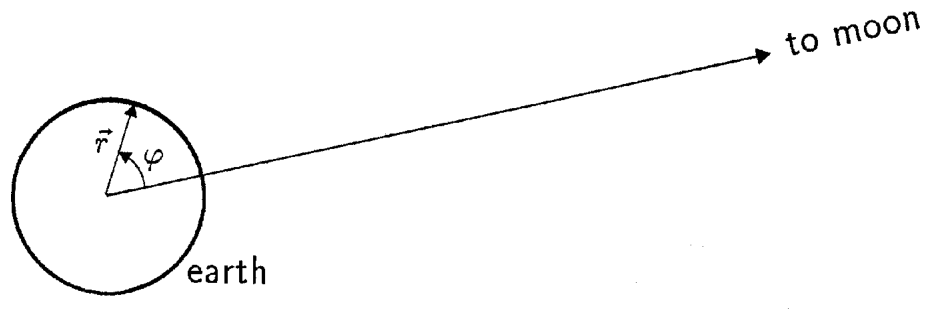
In the plane \(P\) through \(C\) and orthogonal to the axis of rotation the position of a point mass on the liquid surface of the earth can be described by polar coordinates \(r,\varphi\) as shown in the figure. Here \(r\) is the distance from the centre of the earth.
We will study the shape
\[ r(\varphi)=R+h(\varphi) \]
of the liquid surface of the earth in the plane \(P\).
b) Consider a mass point (mass \(m\)) on the liquid surface of the earth (in the plane \(P\)). In our frame of reference it is acted upon by a centrifugal force and by gravitational forces from the moon and the earth. Write down an expression for the potential energy corresponding to these three forces.
Note: Any force \(F(r)\), radially directed with respect to some origin, is the negative derivative of a spherically symmetric potential energy \(V(r)\):
\(F(r)=-V'(r)\). (3 points)
c) Find, in terms of the given quantities \(M,M_m\), etc, the approximate form \(h(\varphi)\) of the tidal bulge. What is the difference in meters between high tide and low tide in this model?
You may use the approximate expression
\[ \frac{1}{\sqrt{1+a^2-2a\cos\theta}} \approx 1+a\cos\theta+\frac12a^2(3\cos^2\theta-1), \]
valid for \(a\) much less than unity.
In this analysis make simplifying approximations whenever they are reasonable. (5 points)
Official English text of the problem.
Answers
-
a) The centre of mass lies toward the Moon, at \[ \boxed{l=\frac{M_mL}{M+M_m}\approx4.6\times10^6\ \mathrm{m}} \] from the Earth’s centre. The angular velocity is \[ \boxed{\omega=\sqrt{\frac{G(M+M_m)}{L^3}} \approx2.67\times10^{-6}\ \mathrm{rad\,s^{-1}}.} \]
-
b) Up to an additive constant, \[ \boxed{ V(r,\varphi)= -\frac{GMm}{r} -\frac{GM_m m}{\sqrt{L^2+r^2-2Lr\cos\varphi}} -\frac12m\omega^2\left(r^2+l^2-2lr\cos\varphi\right). } \]
-
c) The leading tidal shape is \[ \boxed{ h(\varphi)=h_{\min} +\frac{3M_mR^4}{2ML^3}\cos^2\varphi, } \] where the constant \(h_{\min}\) fixes the reference sea level. Equivalently, relative to the mean height \(\bar h_P\) around the section, \[ \boxed{ h(\varphi)-\bar h_P =\frac{3M_mR^4}{4ML^3}\cos2\varphi \approx(0.27\ \mathrm{m})\cos2\varphi. } \] High tides occur at \(\varphi=0,\pi\), and low tides at \(\varphi=\pi/2,3\pi/2\). Their height difference is \[ \boxed{\Delta h=\frac{3M_mR^4}{2ML^3}\approx0.53\ \mathrm{m}.} \]
Solution
a)
The centre of mass lies on the line joining the Earth and Moon. Taking distances from it gives
\[ Ml=M_m(L-l), \]
and therefore
\[ l=\frac{M_m}{M+M_m}L =\frac{7.3\times10^{22}}{5.98\times10^{24}+7.3\times10^{22}} (3.84\times10^8) =4.631\ldots\times10^6\ \mathrm{m}. \]
Thus \(C\) lies inside the Earth, since \(l<R\).
The Earth moves in a circle of radius \(l\) about \(C\). Its gravitational attraction to the Moon supplies the centripetal force:
\[ M\omega^2l=\frac{GMM_m}{L^2}. \]
Substituting the expression for \(l\),
\[ \boxed{\omega^2=\frac{G(M+M_m)}{L^3}.} \]
Numerically,
\[ \omega =\sqrt{ \frac{(6.67\times10^{-11})(5.98\times10^{24}+7.3\times10^{22})} {(3.84\times10^8)^3} } =\boxed{2.67\times10^{-6}\ \mathrm{rad\,s^{-1}}}. \]
We will also use the exact relation
\[ \boxed{\omega^2l=\frac{GM_m}{L^2}.} \]
b)
Place the origin at the Earth’s centre and take \(\varphi=0\) toward the Moon. The Moon and \(C\) then lie at distances \(L\) and \(l\) along that direction.
By the cosine rule, the distance from the mass point to the Moon is
\[ d=\sqrt{L^2+r^2-2Lr\cos\varphi}. \]
Because the point lies in the plane perpendicular to the rotation axis through \(C\), its distance from that axis is
\[ s=\sqrt{r^2+l^2-2lr\cos\varphi}. \]
The gravitational potential energies are
\[ V_E=-\frac{GMm}{r}, \qquad V_m=-\frac{GM_m m}{d}. \]
The centrifugal force points away from the rotation axis and has magnitude \(m\omega^2s\). Hence
\[ -\frac{dV_{\mathrm{cf}}}{ds}=m\omega^2s \quad\Longrightarrow\quad V_{\mathrm{cf}}=-\frac12m\omega^2s^2. \]
Adding the three contributions gives
\[ \boxed{ V(r,\varphi)= -\frac{GMm}{r} -\frac{GM_m m}{\sqrt{L^2+r^2-2Lr\cos\varphi}} -\frac12m\omega^2(r^2+l^2-2lr\cos\varphi) +\text{constant}. } \]
c)
For a fluid at rest, hydrostatic equilibrium requires
\[ \nabla p=-\rho\nabla\Phi, \qquad \Phi=\frac Vm. \]
Pressure is constant along the free surface, so that surface must be an equipotential of \(\Phi\).
Since
\[ \frac RL=0.0166\ll1, \]
we expand the lunar potential through second order in \(r/L\):
\[ -\frac{GM_m}{d} \approx -\frac{GM_m}{L} -\frac{GM_mr}{L^2}\cos\varphi -\frac{GM_mr^2}{2L^3}(3\cos^2\varphi-1). \]
The centrifugal potential per unit mass is
\[ -\frac12\omega^2(r^2+l^2-2lr\cos\varphi) = -\frac12\omega^2r^2-\frac12\omega^2l^2 +\omega^2lr\cos\varphi. \]
Using the relation found in part a),
\[ -\frac{GM_mr}{L^2}\cos\varphi +\omega^2lr\cos\varphi=0. \]
Thus the uniform part of the Moon’s gravitational field is cancelled by the corresponding centrifugal term. After absorbing terms independent of position into a constant,
\[ \Phi(r,\varphi) \approx -\frac{GM}{r} -\frac12\omega^2r^2 -\frac{GM_mr^2}{2L^3}(3\cos^2\varphi-1) +\text{constant}. \]
Now put \(r=R+h(\varphi)\), with \(|h|\ll R\). The Earth’s potential becomes
\[ -\frac{GM}{R+h} \approx -\frac{GM}{R}+\frac{GM}{R^2}h = -\frac{GM}{R}+gh, \]
where
\[ g=\frac{GM}{R^2}=9.83\ \mathrm{m\,s^{-2}}. \]
In the smaller centrifugal and lunar terms, we may set \(r=R\). For example, the centrifugal correction to the coefficient of \(h\), relative to \(g\), is only
\[ \frac{\omega^2R}{g}=4.62\times10^{-6}. \]
The centrifugal potential evaluated at \(R\) is independent of \(\varphi\) within \(P\), so it contributes only to the constant surface level. The equipotential condition therefore reduces to
\[ gh(\varphi) -\frac{GM_mR^2}{2L^3}(3\cos^2\varphi-1) =\text{constant}. \]
Consequently,
\[ h(\varphi) = H+\frac{M_mR^4}{2ML^3}(3\cos^2\varphi-1), \]
where \(H\) is independent of \(\varphi\). This constant is fixed by the reference sea level or a volume normalization; the angular tidal variation does not depend on it.
Writing the result relative to its minimum gives
\[ \boxed{ h(\varphi)=h_{\min} +\frac{3M_mR^4}{2ML^3}\cos^2\varphi. } \]
Alternatively, using \(\cos^2\varphi=(1+\cos2\varphi)/2\),
\[ \boxed{ h(\varphi)-\bar h_P =\frac{3M_mR^4}{4ML^3}\cos2\varphi. } \]
The surface therefore has two equal maxima along the Earth–Moon line: one facing the Moon and one on the opposite side. Its two minima lie perpendicular to that line in \(P\). Equality of the two bulges holds to the retained order in \(R/L\).
The difference between maximum and minimum is
\[ \begin{aligned} \Delta h &=\frac{3M_mR^4}{2ML^3}\\ &=\frac32 \frac{7.3\times10^{22}}{5.98\times10^{24}} \frac{(6.37\times10^6)^4}{(3.84\times10^8)^3} \ \mathrm{m}\\ &=0.532447\ldots\ \mathrm{m}. \end{aligned} \]
Hence
\[ \boxed{\Delta h\approx0.53\ \mathrm{m}.} \]
The amplitude relative to the mean in \(P\) is half this value, approximately \(0.27\ \mathrm{m}\). This small deformation confirms the validity of the linear expansion in \(h/R\).
The solution was checked against the official solution.
IPhO 1996 · Theorieaufgabe 3
Gezeiten auf dem offenen Ozean im Erde-Mond-System
In dieser Aufgabe betrachten wir einige grundlegende Eigenschaften der Stärke der Gezeiten auf dem offenen Ozean der Erde. Wir vereinfachen die Aufgabe durch die folgenden Annahmen:
(i) Erde und Mond werden als isoliertes System betrachtet,
(ii) der Abstand zwischen Mond und Erde wird als konstant angenommen,
(iii) die Erde wird als vollständig von einem Ozean bedeckt angenommen,
(iv) die dynamischen Auswirkungen der Rotation der Erde um ihre Achse werden vernachlässigt, und
(v) die Gravitationsanziehung der Erde kann so bestimmt werden, als wäre ihre gesamte Masse im Erdmittelpunkt konzentriert.
Die folgenden Daten sind gegeben:
Masse der Erde: \(M = 5.98 \cdot 10^{24}\ \mathrm{kg}\)
Masse des Mondes: \(M_m = 7.3 \cdot 10^{22}\ \mathrm{kg}\)
Radius der Erde: \(R = 6.37 \cdot 10^6\ \mathrm{m}\)
Abstand zwischen Erdmittelpunkt und Mondmittelpunkt:
\(L = 3.84 \cdot 10^8\ \mathrm{m}\)
Gravitationskonstante: \(G = 6.67 \cdot 10^{-11}\ \mathrm{m^3\,kg^{-1}\,s^{-2}}\).
a) Mond und Erde bewegen sich mit der Winkelgeschwindigkeit \(\omega\) um ihren gemeinsamen Schwerpunkt \(C\). Wie weit ist \(C\) vom Erdmittelpunkt entfernt? (Bezeichnen Sie diesen Abstand mit \(l\).)
Bestimmen Sie den Zahlenwert von \(\omega\). (2 Punkte)
Wir verwenden nun ein Bezugssystem, das mit dem Mond und dem Erdmittelpunkt um \(C\) mitrotiert. In diesem Bezugssystem ist die Form der Flüssigkeitsoberfläche der Erde zeitlich unveränderlich.
In der Ebene \(P\), die durch \(C\) verläuft und senkrecht zur Rotationsachse steht, lässt sich die Lage eines Massenpunkts auf der Flüssigkeitsoberfläche der Erde durch die Polarkoordinaten \(r,\varphi\) beschreiben, wie in der Abbildung dargestellt. Dabei ist \(r\) der Abstand vom Erdmittelpunkt.
Wir untersuchen die Form
\[ r(\varphi)=R+h(\varphi) \]
der Flüssigkeitsoberfläche der Erde in der Ebene \(P\).
b) Betrachten Sie einen Massenpunkt (Masse \(m\)) auf der Flüssigkeitsoberfläche der Erde (in der Ebene \(P\)). In unserem Bezugssystem wirken auf ihn eine Zentrifugalkraft sowie die Gravitationskräfte des Mondes und der Erde. Geben Sie einen Ausdruck für die diesen drei Kräften entsprechende potenzielle Energie an.
Hinweis: Jede Kraft \(F(r)\), die bezüglich eines Ursprungs radial gerichtet ist, ist die negative Ableitung einer kugelsymmetrischen potenziellen Energie \(V(r)\):
\(F(r)=-V'(r)\). (3 Punkte)
c) Bestimmen Sie anhand der gegebenen Größen \(M,M_m\) usw. die näherungsweise Form \(h(\varphi)\) des Flutbergs. Wie groß ist in diesem Modell der Höhenunterschied zwischen Hochwasser und Niedrigwasser in Metern?
Sie dürfen den Näherungsausdruck
\[ \frac{1}{\sqrt{1+a^2-2a\cos\theta}} \approx 1+a\cos\theta+\frac12a^2(3\cos^2\theta-1), \]
verwenden, der für \(a\) sehr viel kleiner als eins gilt.
Verwenden Sie bei dieser Untersuchung vereinfachende Näherungen, wo immer sie gerechtfertigt sind. (5 Punkte)
Aufgabentext aus dem offiziellen englischen Text übersetzt.
Antworten
-
a) Der Schwerpunkt liegt in Richtung des Mondes im Abstand \[ \boxed{l=\frac{M_mL}{M+M_m}\approx4.6\times10^6\ \mathrm{m}} \] vom Erdmittelpunkt. Die Winkelgeschwindigkeit beträgt \[ \boxed{\omega=\sqrt{\frac{G(M+M_m)}{L^3}} \approx2.67\times10^{-6}\ \mathrm{rad\,s^{-1}}.} \]
-
b) Bis auf eine additive Konstante gilt \[ \boxed{ V(r,\varphi)= -\frac{GMm}{r} -\frac{GM_m m}{\sqrt{L^2+r^2-2Lr\cos\varphi}} -\frac12m\omega^2\left(r^2+l^2-2lr\cos\varphi\right). } \]
-
c) Die Form der Gezeitenverformung in führender Ordnung ist \[ \boxed{ h(\varphi)=h_{\min} +\frac{3M_mR^4}{2ML^3}\cos^2\varphi, } \] wobei die Konstante \(h_{\min}\) den Bezugsmeeresspiegel festlegt. Gleichwertig ergibt sich relativ zur mittleren Höhe \(\bar h_P\) entlang des Querschnitts \[ \boxed{ h(\varphi)-\bar h_P =\frac{3M_mR^4}{4ML^3}\cos2\varphi \approx(0.27\ \mathrm{m})\cos2\varphi. } \] Hochwasser tritt bei \(\varphi=0,\pi\) auf, Niedrigwasser bei \(\varphi=\pi/2,3\pi/2\). Der Höhenunterschied beträgt \[ \boxed{\Delta h=\frac{3M_mR^4}{2ML^3}\approx0.53\ \mathrm{m}.} \]
Lösung
a)
Der Schwerpunkt liegt auf der Verbindungslinie zwischen Erde und Mond. Für die Abstände von diesem Schwerpunkt gilt
\[ Ml=M_m(L-l), \]
und daher
\[ l=\frac{M_m}{M+M_m}L =\frac{7.3\times10^{22}}{5.98\times10^{24}+7.3\times10^{22}} (3.84\times10^8) =4.631\ldots\times10^6\ \mathrm{m}. \]
Somit liegt \(C\) im Inneren der Erde, da \(l<R\).
Die Erde bewegt sich auf einem Kreis mit dem Radius \(l\) um \(C\). Die Gravitationsanziehung durch den Mond liefert die Zentripetalkraft:
\[ M\omega^2l=\frac{GMM_m}{L^2}. \]
Einsetzen des Ausdrucks für \(l\) ergibt
\[ \boxed{\omega^2=\frac{G(M+M_m)}{L^3}.} \]
Numerisch ergibt sich
\[ \omega =\sqrt{ \frac{(6.67\times10^{-11})(5.98\times10^{24}+7.3\times10^{22})} {(3.84\times10^8)^3} } =\boxed{2.67\times10^{-6}\ \mathrm{rad\,s^{-1}}}. \]
Außerdem verwenden wir die exakte Beziehung
\[ \boxed{\omega^2l=\frac{GM_m}{L^2}.} \]
b)
Wir legen den Ursprung in den Erdmittelpunkt und wählen \(\varphi=0\) in Richtung des Mondes. Der Mond und \(C\) liegen dann in dieser Richtung in den Abständen \(L\) bzw. \(l\).
Nach dem Kosinussatz beträgt der Abstand des Massenpunkts vom Mond
\[ d=\sqrt{L^2+r^2-2Lr\cos\varphi}. \]
Da der Punkt in der Ebene senkrecht zur Rotationsachse durch \(C\) liegt, beträgt sein Abstand von dieser Achse
\[ s=\sqrt{r^2+l^2-2lr\cos\varphi}. \]
Die potenziellen Energien im Gravitationsfeld sind
\[ V_E=-\frac{GMm}{r}, \qquad V_m=-\frac{GM_m m}{d}. \]
Die Zentrifugalkraft ist von der Rotationsachse weg gerichtet und hat den Betrag \(m\omega^2s\). Daher gilt
\[ -\frac{dV_{\mathrm{cf}}}{ds}=m\omega^2s \quad\Longrightarrow\quad V_{\mathrm{cf}}=-\frac12m\omega^2s^2. \]
Addition der drei Beiträge ergibt
\[ \boxed{ V(r,\varphi)= -\frac{GMm}{r} -\frac{GM_m m}{\sqrt{L^2+r^2-2Lr\cos\varphi}} -\frac12m\omega^2(r^2+l^2-2lr\cos\varphi) +\text{Konstante}. } \]
c)
Für eine ruhende Flüssigkeit erfordert das hydrostatische Gleichgewicht
\[ \nabla p=-\rho\nabla\Phi, \qquad \Phi=\frac Vm. \]
Entlang der freien Oberfläche ist der Druck konstant, daher muss diese Oberfläche eine Äquipotentialfläche von \(\Phi\) sein.
Da
\[ \frac RL=0.0166\ll1, \]
entwickeln wir das Mondpotenzial bis zur zweiten Ordnung in \(r/L\):
\[ -\frac{GM_m}{d} \approx -\frac{GM_m}{L} -\frac{GM_mr}{L^2}\cos\varphi -\frac{GM_mr^2}{2L^3}(3\cos^2\varphi-1). \]
Das Zentrifugalpotenzial pro Masseneinheit ist
\[ -\frac12\omega^2(r^2+l^2-2lr\cos\varphi) = -\frac12\omega^2r^2-\frac12\omega^2l^2 +\omega^2lr\cos\varphi. \]
Mit der in Teil a) gefundenen Beziehung gilt
\[ -\frac{GM_mr}{L^2}\cos\varphi +\omega^2lr\cos\varphi=0. \]
Somit wird der räumlich konstante Anteil des Gravitationsfeldes des Mondes durch den entsprechenden Zentrifugalterm aufgehoben. Fassen wir die ortsunabhängigen Terme zu einer Konstanten zusammen, ergibt sich
\[ \Phi(r,\varphi) \approx -\frac{GM}{r} -\frac12\omega^2r^2 -\frac{GM_mr^2}{2L^3}(3\cos^2\varphi-1) +\text{Konstante}. \]
Nun setzen wir \(r=R+h(\varphi)\) mit \(|h|\ll R\). Das Erdpotenzial wird zu
\[ -\frac{GM}{R+h} \approx -\frac{GM}{R}+\frac{GM}{R^2}h = -\frac{GM}{R}+gh, \]
wobei
\[ g=\frac{GM}{R^2}=9.83\ \mathrm{m\,s^{-2}}. \]
In den kleineren Zentrifugal- und Mondtermen dürfen wir \(r=R\) setzen. Beispielsweise beträgt die Zentrifugalkorrektur zum Koeffizienten von \(h\), bezogen auf \(g\), lediglich
\[ \frac{\omega^2R}{g}=4.62\times10^{-6}. \]
Das bei \(R\) ausgewertete Zentrifugalpotenzial ist innerhalb von \(P\) unabhängig von \(\varphi\) und trägt somit nur zum konstanten Oberflächenniveau bei. Die Äquipotentialbedingung vereinfacht sich daher zu
\[ gh(\varphi) -\frac{GM_mR^2}{2L^3}(3\cos^2\varphi-1) =\text{Konstante}. \]
Folglich gilt
\[ h(\varphi) = H+\frac{M_mR^4}{2ML^3}(3\cos^2\varphi-1), \]
wobei \(H\) unabhängig von \(\varphi\) ist. Diese Konstante wird durch den Bezugsmeeresspiegel oder eine Volumennormierung festgelegt; die Winkelabhängigkeit der Gezeitenverformung hängt nicht von ihr ab.
Schreiben wir das Ergebnis relativ zu seinem Minimum, erhalten wir
\[ \boxed{ h(\varphi)=h_{\min} +\frac{3M_mR^4}{2ML^3}\cos^2\varphi. } \]
Alternativ ergibt sich mit \(\cos^2\varphi=(1+\cos2\varphi)/2\)
\[ \boxed{ h(\varphi)-\bar h_P =\frac{3M_mR^4}{4ML^3}\cos2\varphi. } \]
Die Oberfläche besitzt somit zwei gleich hohe Maxima entlang der Verbindungslinie zwischen Erde und Mond: eines auf der dem Mond zugewandten Seite und eines auf der gegenüberliegenden Seite. Ihre beiden Minima liegen in \(P\) senkrecht zu dieser Linie. Die Gleichheit der beiden Flutberge gilt bis zur berücksichtigten Ordnung in \(R/L\).
Der Unterschied zwischen Maximum und Minimum beträgt
\[ \begin{aligned} \Delta h &=\frac{3M_mR^4}{2ML^3}\\ &=\frac32 \frac{7.3\times10^{22}}{5.98\times10^{24}} \frac{(6.37\times10^6)^4}{(3.84\times10^8)^3} \ \mathrm{m}\\ &=0.532447\ldots\ \mathrm{m}. \end{aligned} \]
Damit ist
\[ \boxed{\Delta h\approx0.53\ \mathrm{m}.} \]
Die Amplitude relativ zum Mittelwert in \(P\) ist halb so groß, also ungefähr \(0.27\ \mathrm{m}\). Diese kleine Verformung bestätigt die Gültigkeit der linearen Entwicklung in \(h/R\).
Die Lösung wurde mit der offiziellen Lösung abgeglichen.
IPhO 1996 · Teori sorusu 3
Dünya–Ay sisteminde açık okyanus gelgitleri
Bu soruda, Dünya üzerindeki açık okyanus gelgitlerinin büyüklüğüne ilişkin bazı genel özellikleri ele alıyoruz. Aşağıdaki varsayımları yaparak problemi basitleştiriyoruz:
(i) Dünya ve Ay yalıtılmış bir sistem olarak kabul edilmektedir,
(ii) Ay ile Dünya arasındaki uzaklığın sabit olduğu varsayılmaktadır,
(iii) Dünya'nın bütünüyle bir okyanusla kaplı olduğu varsayılmaktadır,
(iv) Dünya'nın kendi ekseni etrafındaki dönüşünün dinamik etkileri ihmal edilmektedir ve
(v) Dünya'nın kütleçekim kuvveti, tüm kütlesi Dünya'nın merkezinde toplanmış gibi hesaplanabilmektedir.
Aşağıdaki veriler verilmiştir:
Dünya'nın kütlesi: \(M = 5.98 \cdot 10^{24}\ \mathrm{kg}\)
Ay'ın kütlesi: \(M_m = 7.3 \cdot 10^{22}\ \mathrm{kg}\)
Dünya'nın yarıçapı: \(R = 6.37 \cdot 10^6\ \mathrm{m}\)
Dünya'nın merkezi ile Ay'ın merkezi arasındaki uzaklık:
\(L = 3.84 \cdot 10^8\ \mathrm{m}\)
Kütleçekim sabiti: \(G = 6.67 \cdot 10^{-11}\ \mathrm{m^3\,kg^{-1}\,s^{-2}}\).
a) Ay ve Dünya, ortak kütle merkezleri \(C\) etrafında \(\omega\) açısal hızıyla dönmektedir. \(C\), Dünya'nın merkezinden ne kadar uzaktadır? (Bu uzaklığı \(l\) ile gösteriniz.)
\(\omega\)'nın sayısal değerini belirleyiniz. (2 puan)
Şimdi, Ay ve Dünya'nın merkeziyle birlikte \(C\) etrafında dönen bir referans sistemi kullanıyoruz. Bu referans sisteminde Dünya'nın sıvı yüzeyinin şekli zamanla değişmez.
\(C\)'den geçen ve dönme eksenine dik olan \(P\) düzleminde, Dünya'nın sıvı yüzeyi üzerindeki bir noktasal kütlenin konumu, şekilde gösterildiği gibi \(r,\varphi\) kutupsal koordinatlarıyla tanımlanabilir. Burada \(r\), Dünya'nın merkezinden olan uzaklıktır.
Dünya'nın sıvı yüzeyinin \(P\) düzlemindeki
\[ r(\varphi)=R+h(\varphi) \]
şeklini inceleyeceğiz.
b) Dünya'nın sıvı yüzeyi üzerinde (\(P\) düzleminde) bir noktasal kütle (kütlesi \(m\)) ele alınız. Referans sistemimizde bu kütleye bir merkezkaç kuvveti ile Ay ve Dünya'nın kütleçekim kuvvetleri etki eder. Bu üç kuvvete karşılık gelen potansiyel enerji için bir ifade yazınız.
Not: Herhangi bir başlangıç noktasına göre radyal doğrultuda yönelmiş herhangi bir \(F(r)\) kuvveti, küresel simetrik bir \(V(r)\) potansiyel enerjisinin türevinin negatifidir:
\(F(r)=-V'(r)\). (3 puan)
c) Gelgit kabarmasının yaklaşık \(h(\varphi)\) biçimini, verilen \(M,M_m\) vb. nicelikler cinsinden bulunuz. Bu modelde yüksek su ile alçak su seviyeleri arasındaki fark kaç metredir?
\(a\)'nın birden çok küçük olduğu durumlarda geçerli olan
\[ \frac{1}{\sqrt{1+a^2-2a\cos\theta}} \approx 1+a\cos\theta+\frac12a^2(3\cos^2\theta-1), \]
yaklaşık ifadesini kullanabilirsiniz.
Bu analizde, makul olduğu her durumda basitleştirici yaklaşımlar yapınız. (5 puan)
Soru metni resmi İngilizce metinden çevrilmiştir.
Cevaplar
-
a) Kütle merkezi, Dünya'nın merkezinden Ay yönünde \[ \boxed{l=\frac{M_mL}{M+M_m}\approx4.6\times10^6\ \mathrm{m}} \] uzaklıkta bulunur. Açısal hız \[ \boxed{\omega=\sqrt{\frac{G(M+M_m)}{L^3}} \approx2.67\times10^{-6}\ \mathrm{rad\,s^{-1}}.} \] olarak bulunur.
-
b) Toplamsal bir sabit dışında, \[ \boxed{ V(r,\varphi)= -\frac{GMm}{r} -\frac{GM_m m}{\sqrt{L^2+r^2-2Lr\cos\varphi}} -\frac12m\omega^2\left(r^2+l^2-2lr\cos\varphi\right). } \]
-
c) Başat mertebede gelgit şekli \[ \boxed{ h(\varphi)=h_{\min} +\frac{3M_mR^4}{2ML^3}\cos^2\varphi, } \] olup, burada \(h_{\min}\) sabiti referans deniz seviyesini belirler. Eşdeğer olarak, kesit boyunca ortalama yükseklik \(\bar h_P\)'ye göre, \[ \boxed{ h(\varphi)-\bar h_P =\frac{3M_mR^4}{4ML^3}\cos2\varphi \approx(0.27\ \mathrm{m})\cos2\varphi. } \] Yüksek su seviyeleri \(\varphi=0,\pi\) konumlarında, alçak su seviyeleri ise \(\varphi=\pi/2,3\pi/2\) konumlarında oluşur. Aralarındaki yükseklik farkı \[ \boxed{\Delta h=\frac{3M_mR^4}{2ML^3}\approx0.53\ \mathrm{m}.} \] olarak bulunur.
Çözüm
a)
Kütle merkezi, Dünya ile Ay'ı birleştiren doğru üzerinde bulunur. Uzaklıkları kütle merkezinden ölçersek
\[ Ml=M_m(L-l), \]
ve dolayısıyla
\[ l=\frac{M_m}{M+M_m}L =\frac{7.3\times10^{22}}{5.98\times10^{24}+7.3\times10^{22}} (3.84\times10^8) =4.631\ldots\times10^6\ \mathrm{m}. \]
elde edilir. Böylece, \(l<R\) olduğundan \(C\) Dünya'nın içinde yer alır.
Dünya, \(C\) etrafında \(l\) yarıçaplı bir çember üzerinde hareket eder. Ay ile arasındaki kütleçekim kuvveti, merkezcil kuvveti sağlar:
\[ M\omega^2l=\frac{GMM_m}{L^2}. \]
\(l\) için bulunan ifadeyi yerine koyarsak,
\[ \boxed{\omega^2=\frac{G(M+M_m)}{L^3}.} \]
Sayısal olarak,
\[ \omega =\sqrt{ \frac{(6.67\times10^{-11})(5.98\times10^{24}+7.3\times10^{22})} {(3.84\times10^8)^3} } =\boxed{2.67\times10^{-6}\ \mathrm{rad\,s^{-1}}}. \]
Ayrıca şu kesin bağıntıyı da kullanacağız:
\[ \boxed{\omega^2l=\frac{GM_m}{L^2}.} \]
b)
Koordinat başlangıcını Dünya'nın merkezine yerleştirelim ve \(\varphi=0\) yönünü Ay'a doğru seçelim. Bu durumda Ay ve \(C\), bu yönde sırasıyla \(L\) ve \(l\) uzaklıklarında bulunur.
Kosinüs teoremine göre, noktasal kütlenin Ay'a uzaklığı
\[ d=\sqrt{L^2+r^2-2Lr\cos\varphi}. \]
Nokta, \(C\)'den geçen dönme eksenine dik düzlemde bulunduğundan, bu eksene olan uzaklığı
\[ s=\sqrt{r^2+l^2-2lr\cos\varphi}. \]
Kütleçekim potansiyel enerjileri
\[ V_E=-\frac{GMm}{r}, \qquad V_m=-\frac{GM_m m}{d}. \]
Merkezkaç kuvveti dönme ekseninden dışarı doğru yönelir ve büyüklüğü \(m\omega^2s\)'dir. Dolayısıyla
\[ -\frac{dV_{\mathrm{cf}}}{ds}=m\omega^2s \quad\Longrightarrow\quad V_{\mathrm{cf}}=-\frac12m\omega^2s^2. \]
Üç katkının toplamı şu ifadeyi verir:
\[ \boxed{ V(r,\varphi)= -\frac{GMm}{r} -\frac{GM_m m}{\sqrt{L^2+r^2-2Lr\cos\varphi}} -\frac12m\omega^2(r^2+l^2-2lr\cos\varphi) +\text{sabit}. } \]
c)
Durgun bir akışkan için hidrostatik denge koşulu
\[ \nabla p=-\rho\nabla\Phi, \qquad \Phi=\frac Vm. \]
Serbest yüzey boyunca basınç sabittir; dolayısıyla bu yüzey, \(\Phi\)'nin bir eşpotansiyel yüzeyi olmalıdır.
\[ \frac RL=0.0166\ll1, \]
olduğundan, Ay'ın potansiyelini \(r/L\)'nin ikinci mertebesine kadar açarız:
\[ -\frac{GM_m}{d} \approx -\frac{GM_m}{L} -\frac{GM_mr}{L^2}\cos\varphi -\frac{GM_mr^2}{2L^3}(3\cos^2\varphi-1). \]
Birim kütle başına merkezkaç potansiyeli
\[ -\frac12\omega^2(r^2+l^2-2lr\cos\varphi) = -\frac12\omega^2r^2-\frac12\omega^2l^2 +\omega^2lr\cos\varphi. \]
a) kısmında bulunan bağıntıyı kullanarak,
\[ -\frac{GM_mr}{L^2}\cos\varphi +\omega^2lr\cos\varphi=0. \]
Böylece Ay'ın kütleçekim alanının düzgün kısmı, karşılık gelen merkezkaç terimiyle birbirini götürür. Konumdan bağımsız terimler bir sabit içinde toplandıktan sonra,
\[ \Phi(r,\varphi) \approx -\frac{GM}{r} -\frac12\omega^2r^2 -\frac{GM_mr^2}{2L^3}(3\cos^2\varphi-1) +\text{sabit}. \]
Şimdi \(|h|\ll R\) olmak üzere \(r=R+h(\varphi)\) yazalım. Dünya'nın potansiyeli
\[ -\frac{GM}{R+h} \approx -\frac{GM}{R}+\frac{GM}{R^2}h = -\frac{GM}{R}+gh, \]
haline gelir; burada
\[ g=\frac{GM}{R^2}=9.83\ \mathrm{m\,s^{-2}}. \]
Daha küçük olan merkezkaç ve Ay'a ait terimlerde \(r=R\) alabiliriz. Örneğin, \(h\)'nin katsayısındaki merkezkaç düzeltmesinin \(g\)'ye oranı yalnızca
\[ \frac{\omega^2R}{g}=4.62\times10^{-6}. \]
\(R\)'de hesaplanan merkezkaç potansiyeli, \(P\) içinde \(\varphi\)'den bağımsızdır; dolayısıyla yalnızca sabit yüzey seviyesine katkıda bulunur. Bu nedenle eşpotansiyel koşulu şu biçime indirgenir:
\[ gh(\varphi) -\frac{GM_mR^2}{2L^3}(3\cos^2\varphi-1) =\text{sabit}. \]
Sonuç olarak,
\[ h(\varphi) = H+\frac{M_mR^4}{2ML^3}(3\cos^2\varphi-1), \]
burada \(H\), \(\varphi\)'den bağımsızdır. Bu sabit, referans deniz seviyesi veya hacim normalizasyonuyla belirlenir; gelgitin açısal değişimi bu sabite bağlı değildir.
Sonucu minimum değerine göre yazarsak
\[ \boxed{ h(\varphi)=h_{\min} +\frac{3M_mR^4}{2ML^3}\cos^2\varphi. } \]
Alternatif olarak, \(\cos^2\varphi=(1+\cos2\varphi)/2\) kullanılarak,
\[ \boxed{ h(\varphi)-\bar h_P =\frac{3M_mR^4}{4ML^3}\cos2\varphi. } \]
Dolayısıyla yüzeyin Dünya–Ay doğrusu boyunca iki eşit maksimumu vardır: biri Ay'a bakan tarafta, diğeri karşı taraftadır. İki minimumu ise \(P\) içinde bu doğruya dik yönde bulunur. İki kabarmanın eşitliği, \(R/L\) açılımında korunan mertebeye kadar geçerlidir.
Maksimum ile minimum arasındaki fark
\[ \begin{aligned} \Delta h &=\frac{3M_mR^4}{2ML^3}\\ &=\frac32 \frac{7.3\times10^{22}}{5.98\times10^{24}} \frac{(6.37\times10^6)^4}{(3.84\times10^8)^3} \ \mathrm{m}\\ &=0.532447\ldots\ \mathrm{m}. \end{aligned} \]
Böylece
\[ \boxed{\Delta h\approx0.53\ \mathrm{m}.} \]
\(P\)'deki ortalamaya göre genlik bu değerin yarısıdır ve yaklaşık \(0.27\ \mathrm{m}\)'dir. Bu küçük şekil değişimi, \(h/R\) cinsinden doğrusal açılımın geçerliliğini doğrular.
Çözüm, resmi çözümle karşılaştırılarak kontrol edildi.
IPhO 1996 · Problema teórico 3
Mareas en mar abierto en el sistema Tierra-Luna
En este problema consideramos algunas características generales de la magnitud de las mareas en mar abierto en la Tierra. Simplificamos el problema mediante las siguientes hipótesis:
(i) La Tierra y la Luna se consideran un sistema aislado,
(ii) se supone que la distancia entre la Luna y la Tierra es constante,
(iii) se supone que la Tierra está completamente cubierta por un océano,
(iv) se desprecian los efectos dinámicos de la rotación de la Tierra alrededor de su eje, y
(v) la atracción gravitatoria de la Tierra puede determinarse como si toda su masa estuviera concentrada en su centro.
Se proporcionan los siguientes datos:
Masa de la Tierra: \(M = 5.98 \cdot 10^{24}\ \mathrm{kg}\)
Masa de la Luna: \(M_m = 7.3 \cdot 10^{22}\ \mathrm{kg}\)
Radio de la Tierra: \(R = 6.37 \cdot 10^6\ \mathrm{m}\)
Distancia entre el centro de la Tierra y el centro de la Luna:
\(L = 3.84 \cdot 10^8\ \mathrm{m}\)
Constante de gravitación universal: \(G = 6.67 \cdot 10^{-11}\ \mathrm{m^3\,kg^{-1}\,s^{-2}}\).
a) La Luna y la Tierra giran con velocidad angular \(\omega\) alrededor de su centro de masas común, \(C\). ¿A qué distancia del centro de la Tierra se encuentra \(C\)? (Denote esta distancia por \(l\).)
Determine el valor numérico de \(\omega\). (2 puntos)
Utilizamos ahora un sistema de referencia que gira solidariamente con la Luna y el centro de la Tierra alrededor de \(C\). En este sistema de referencia, la forma de la superficie líquida de la Tierra es estática.
En el plano \(P\) que pasa por \(C\) y es perpendicular al eje de rotación, la posición de una masa puntual sobre la superficie líquida de la Tierra puede describirse mediante las coordenadas polares \(r,\varphi\), como se muestra en la figura. Aquí, \(r\) es la distancia al centro de la Tierra.
Estudiaremos la forma
\[ r(\varphi)=R+h(\varphi) \]
de la superficie líquida de la Tierra en el plano \(P\).
b) Considere una masa puntual (de masa \(m\)) sobre la superficie líquida de la Tierra (en el plano \(P\)). En nuestro sistema de referencia, sobre ella actúan una fuerza centrífuga y las fuerzas gravitatorias de la Luna y de la Tierra. Escriba una expresión para la energía potencial correspondiente a estas tres fuerzas.
Nota: Toda fuerza \(F(r)\), dirigida radialmente con respecto a un origen, es la derivada negativa de una energía potencial con simetría esférica \(V(r)\):
\(F(r)=-V'(r)\). (3 puntos)
c) Halle, en función de las magnitudes dadas \(M,M_m\), etc., la forma aproximada \(h(\varphi)\) del abultamiento de marea. ¿Cuál es la diferencia en metros entre la pleamar y la bajamar en este modelo?
Puede utilizar la expresión aproximada
\[ \frac{1}{\sqrt{1+a^2-2a\cos\theta}} \approx 1+a\cos\theta+\frac12a^2(3\cos^2\theta-1), \]
válida para \(a\) mucho menor que la unidad.
En este análisis, haga aproximaciones simplificadoras siempre que sean razonables. (5 puntos)
Enunciado traducido del texto oficial en inglés.
Respuestas
-
a) El centro de masas se encuentra en dirección a la Luna, a una distancia \[ \boxed{l=\frac{M_mL}{M+M_m}\approx4.6\times10^6\ \mathrm{m}} \] del centro de la Tierra. La velocidad angular es \[ \boxed{\omega=\sqrt{\frac{G(M+M_m)}{L^3}} \approx2.67\times10^{-6}\ \mathrm{rad\,s^{-1}}.} \]
-
b) Salvo una constante aditiva, \[ \boxed{ V(r,\varphi)= -\frac{GMm}{r} -\frac{GM_m m}{\sqrt{L^2+r^2-2Lr\cos\varphi}} -\frac12m\omega^2\left(r^2+l^2-2lr\cos\varphi\right). } \]
-
c) La forma de la marea al orden dominante es \[ \boxed{ h(\varphi)=h_{\min} +\frac{3M_mR^4}{2ML^3}\cos^2\varphi, } \] donde la constante \(h_{\min}\) fija el nivel de referencia del mar. De manera equivalente, con respecto a la altura media \(\bar h_P\) a lo largo de la sección, \[ \boxed{ h(\varphi)-\bar h_P =\frac{3M_mR^4}{4ML^3}\cos2\varphi \approx(0.27\ \mathrm{m})\cos2\varphi. } \] Las pleamares se producen en \(\varphi=0,\pi\), y las bajamares en \(\varphi=\pi/2,3\pi/2\). Su diferencia de altura es \[ \boxed{\Delta h=\frac{3M_mR^4}{2ML^3}\approx0.53\ \mathrm{m}.} \]
Solución
a)
El centro de masas se encuentra sobre la recta que une la Tierra y la Luna. Tomando las distancias desde él, se obtiene
\[ Ml=M_m(L-l), \]
y, por tanto,
\[ l=\frac{M_m}{M+M_m}L =\frac{7.3\times10^{22}}{5.98\times10^{24}+7.3\times10^{22}} (3.84\times10^8) =4.631\ldots\times10^6\ \mathrm{m}. \]
Así, \(C\) se encuentra en el interior de la Tierra, puesto que \(l<R\).
La Tierra se mueve en una circunferencia de radio \(l\) alrededor de \(C\). La atracción gravitatoria que ejerce la Luna sobre ella proporciona la fuerza centrípeta:
\[ M\omega^2l=\frac{GMM_m}{L^2}. \]
Sustituyendo la expresión de \(l\),
\[ \boxed{\omega^2=\frac{G(M+M_m)}{L^3}.} \]
Numéricamente,
\[ \omega =\sqrt{ \frac{(6.67\times10^{-11})(5.98\times10^{24}+7.3\times10^{22})} {(3.84\times10^8)^3} } =\boxed{2.67\times10^{-6}\ \mathrm{rad\,s^{-1}}}. \]
También utilizaremos la relación exacta
\[ \boxed{\omega^2l=\frac{GM_m}{L^2}.} \]
b)
Situemos el origen en el centro de la Tierra y tomemos \(\varphi=0\) en dirección a la Luna. La Luna y \(C\) se encuentran entonces a distancias \(L\) y \(l\) en esa dirección.
Por el teorema del coseno, la distancia de la masa puntual a la Luna es
\[ d=\sqrt{L^2+r^2-2Lr\cos\varphi}. \]
Como el punto se encuentra en el plano perpendicular al eje de rotación que pasa por \(C\), su distancia a ese eje es
\[ s=\sqrt{r^2+l^2-2lr\cos\varphi}. \]
Las energías potenciales gravitatorias son
\[ V_E=-\frac{GMm}{r}, \qquad V_m=-\frac{GM_m m}{d}. \]
La fuerza centrífuga apunta alejándose del eje de rotación y tiene módulo \(m\omega^2s\). Por tanto,
\[ -\frac{dV_{\mathrm{cf}}}{ds}=m\omega^2s \quad\Longrightarrow\quad V_{\mathrm{cf}}=-\frac12m\omega^2s^2. \]
Sumando las tres contribuciones se obtiene
\[ \boxed{ V(r,\varphi)= -\frac{GMm}{r} -\frac{GM_m m}{\sqrt{L^2+r^2-2Lr\cos\varphi}} -\frac12m\omega^2(r^2+l^2-2lr\cos\varphi) +\text{constante}. } \]
c)
Para un fluido en reposo, el equilibrio hidrostático exige
\[ \nabla p=-\rho\nabla\Phi, \qquad \Phi=\frac Vm. \]
La presión es constante a lo largo de la superficie libre, por lo que esta superficie debe ser una equipotencial de \(\Phi\).
Puesto que
\[ \frac RL=0.0166\ll1, \]
desarrollamos el potencial lunar hasta segundo orden en \(r/L\):
\[ -\frac{GM_m}{d} \approx -\frac{GM_m}{L} -\frac{GM_mr}{L^2}\cos\varphi -\frac{GM_mr^2}{2L^3}(3\cos^2\varphi-1). \]
El potencial centrífugo por unidad de masa es
\[ -\frac12\omega^2(r^2+l^2-2lr\cos\varphi) = -\frac12\omega^2r^2-\frac12\omega^2l^2 +\omega^2lr\cos\varphi. \]
Utilizando la relación obtenida en el apartado a),
\[ -\frac{GM_mr}{L^2}\cos\varphi +\omega^2lr\cos\varphi=0. \]
Así, la parte uniforme del campo gravitatorio de la Luna queda cancelada por el término centrífugo correspondiente. Tras absorber en una constante los términos independientes de la posición,
\[ \Phi(r,\varphi) \approx -\frac{GM}{r} -\frac12\omega^2r^2 -\frac{GM_mr^2}{2L^3}(3\cos^2\varphi-1) +\text{constante}. \]
Sustituyamos ahora \(r=R+h(\varphi)\), con \(|h|\ll R\). El potencial terrestre se convierte en
\[ -\frac{GM}{R+h} \approx -\frac{GM}{R}+\frac{GM}{R^2}h = -\frac{GM}{R}+gh, \]
donde
\[ g=\frac{GM}{R^2}=9.83\ \mathrm{m\,s^{-2}}. \]
En los términos centrífugo y lunar, de menor magnitud, podemos tomar \(r=R\). Por ejemplo, la corrección centrífuga al coeficiente de \(h\), relativa a \(g\), es tan solo
\[ \frac{\omega^2R}{g}=4.62\times10^{-6}. \]
El potencial centrífugo evaluado en \(R\) es independiente de \(\varphi\) dentro de \(P\), de modo que solo contribuye al nivel constante de la superficie. Por tanto, la condición de equipotencialidad se reduce a
\[ gh(\varphi) -\frac{GM_mR^2}{2L^3}(3\cos^2\varphi-1) =\text{constante}. \]
En consecuencia,
\[ h(\varphi) = H+\frac{M_mR^4}{2ML^3}(3\cos^2\varphi-1), \]
donde \(H\) es independiente de \(\varphi\). Esta constante queda fijada por el nivel de referencia del mar o por una normalización del volumen; la variación angular de la marea no depende de ella.
Escribiendo el resultado con respecto a su mínimo se obtiene
\[ \boxed{ h(\varphi)=h_{\min} +\frac{3M_mR^4}{2ML^3}\cos^2\varphi. } \]
Alternativamente, utilizando \(\cos^2\varphi=(1+\cos2\varphi)/2\),
\[ \boxed{ h(\varphi)-\bar h_P =\frac{3M_mR^4}{4ML^3}\cos2\varphi. } \]
La superficie presenta, por tanto, dos máximos iguales sobre la recta Tierra–Luna: uno orientado hacia la Luna y otro en el lado opuesto. Sus dos mínimos se encuentran en la dirección perpendicular a esa recta en \(P\). La igualdad de los dos abultamientos se cumple hasta el orden conservado en \(R/L\).
La diferencia entre el máximo y el mínimo es
\[ \begin{aligned} \Delta h &=\frac{3M_mR^4}{2ML^3}\\ &=\frac32 \frac{7.3\times10^{22}}{5.98\times10^{24}} \frac{(6.37\times10^6)^4}{(3.84\times10^8)^3} \ \mathrm{m}\\ &=0.532447\ldots\ \mathrm{m}. \end{aligned} \]
Por tanto,
\[ \boxed{\Delta h\approx0.53\ \mathrm{m}.} \]
La amplitud con respecto a la media en \(P\) es la mitad de este valor, aproximadamente \(0.27\ \mathrm{m}\). Esta pequeña deformación confirma la validez del desarrollo lineal en \(h/R\).
La solución se comprobó con la solución oficial.
IPhO 1996 · 理论题 3
地月系统中的大洋潮汐
本题研究地球上大洋潮汐幅度的一些总体特征。我们作如下假设,以简化问题:
(i) 将地球和月球视为一个孤立系统,
(ii) 假设月球与地球之间的距离保持不变,
(iii) 假设地球完全被海洋覆盖,
(iv) 忽略地球自转的动力学效应,以及
(v) 计算地球的引力时,可视为其全部质量都集中在地心。
已知下列数据:
地球质量:\(M = 5.98 \cdot 10^{24}\ \mathrm{kg}\)
月球质量:\(M_m = 7.3 \cdot 10^{22}\ \mathrm{kg}\)
地球半径:\(R = 6.37 \cdot 10^6\ \mathrm{m}\)
地心与月心之间的距离:
\(L = 3.84 \cdot 10^8\ \mathrm{m}\)
万有引力常量:\(G = 6.67 \cdot 10^{-11}\ \mathrm{m^3\,kg^{-1}\,s^{-2}}\)。
a) 月球和地球以角速度 \(\omega\) 绕它们的共同质心 \(C\) 转动。\(C\) 距地心多远?(将此距离记为 \(l\)。)
求 \(\omega\) 的数值。(2 分)
现在采用一个随月球和地心一起绕 \(C\) 转动的参考系。在此参考系中,地球液面的形状保持不变。
在通过 \(C\) 且垂直于转轴的平面 \(P\) 内,地球液面上一个质点的位置可用图中所示的极坐标 \(r,\varphi\) 描述。其中,\(r\) 是该质点到地心的距离。
我们将研究平面 \(P\) 内地球液面的形状
\[ r(\varphi)=R+h(\varphi)\text{。} \]
b) 考虑地球液面上(位于平面 \(P\) 内)的一个质点(质量为 \(m\))。在我们采用的参考系中,它受到离心力以及月球和地球的引力作用。写出与这三个力对应的势能表达式。
注: 任何相对于某一原点沿径向的力 \(F(r)\),都等于某个球对称势能 \(V(r)\) 的负导数:
\(F(r)=-V'(r)\)。(3 分)
c) 用给定的量 \(M,M_m\) 等,求潮汐隆起形状 \(h(\varphi)\) 的近似表达式。在此模型中,高潮与低潮之间的高度差是多少米?
可以使用近似表达式
\[ \frac{1}{\sqrt{1+a^2-2a\cos\theta}} \approx 1+a\cos\theta+\frac12a^2(3\cos^2\theta-1), \]
该式适用于 \(a\) 远小于 1 的情况。
在分析过程中,只要合理,就可以作简化近似。(5 分)
题目译自官方英文原文。
答案
-
a) 质心位于从地心指向月球的方向上,距地心 \[ \boxed{l=\frac{M_mL}{M+M_m}\approx4.6\times10^6\ \mathrm{m}}\text{。} \] 角速度为 \[ \boxed{\omega=\sqrt{\frac{G(M+M_m)}{L^3}} \approx2.67\times10^{-6}\ \mathrm{rad\,s^{-1}}.} \]
-
b) 略去一个加性常数后, \[ \boxed{ V(r,\varphi)= -\frac{GMm}{r} -\frac{GM_m m}{\sqrt{L^2+r^2-2Lr\cos\varphi}} -\frac12m\omega^2\left(r^2+l^2-2lr\cos\varphi\right). } \]
-
c) 潮汐形状的首阶近似为 \[ \boxed{ h(\varphi)=h_{\min} +\frac{3M_mR^4}{2ML^3}\cos^2\varphi, } \] 其中常数 \(h_{\min}\) 确定基准海平面。等价地,相对于沿该截面一周的平均高度 \(\bar h_P\),有 \[ \boxed{ h(\varphi)-\bar h_P =\frac{3M_mR^4}{4ML^3}\cos2\varphi \approx(0.27\ \mathrm{m})\cos2\varphi. } \] 高潮出现在 \(\varphi=0,\pi\) 处,低潮出现在 \(\varphi=\pi/2,3\pi/2\) 处。两者的高度差为 \[ \boxed{\Delta h=\frac{3M_mR^4}{2ML^3}\approx0.53\ \mathrm{m}.} \]
解答
a)
质心位于地球与月球的连线上。以到质心的距离计算,有
\[ Ml=M_m(L-l), \]
因此
\[ l=\frac{M_m}{M+M_m}L =\frac{7.3\times10^{22}}{5.98\times10^{24}+7.3\times10^{22}} (3.84\times10^8) =4.631\ldots\times10^6\ \mathrm{m}. \]
由于 \(l<R\),所以 \(C\) 位于地球内部。
地球绕 \(C\) 做半径为 \(l\) 的圆周运动。月球对地球的引力提供向心力:
\[ M\omega^2l=\frac{GMM_m}{L^2}. \]
代入 \(l\) 的表达式,得
\[ \boxed{\omega^2=\frac{G(M+M_m)}{L^3}.} \]
代入数值,
\[ \omega =\sqrt{ \frac{(6.67\times10^{-11})(5.98\times10^{24}+7.3\times10^{22})} {(3.84\times10^8)^3} } =\boxed{2.67\times10^{-6}\ \mathrm{rad\,s^{-1}}}. \]
后面还将用到精确关系
\[ \boxed{\omega^2l=\frac{GM_m}{L^2}.} \]
b)
将原点设在地心,并取指向月球的方向为 \(\varphi=0\)。于是,月球和 \(C\) 分别位于沿此方向距地心 \(L\) 和 \(l\) 处。
由余弦定理,质点到月球的距离为
\[ d=\sqrt{L^2+r^2-2Lr\cos\varphi}. \]
由于该点位于通过 \(C\) 且垂直于转轴的平面内,它到转轴的距离为
\[ s=\sqrt{r^2+l^2-2lr\cos\varphi}. \]
引力势能分别为
\[ V_E=-\frac{GMm}{r}, \qquad V_m=-\frac{GM_m m}{d}. \]
离心力的方向背离转轴,大小为 \(m\omega^2s\)。因此
\[ -\frac{dV_{\mathrm{cf}}}{ds}=m\omega^2s \quad\Longrightarrow\quad V_{\mathrm{cf}}=-\frac12m\omega^2s^2. \]
将这三项相加,得
\[ \boxed{ V(r,\varphi)= -\frac{GMm}{r} -\frac{GM_m m}{\sqrt{L^2+r^2-2Lr\cos\varphi}} -\frac12m\omega^2(r^2+l^2-2lr\cos\varphi) +\text{常数}. } \]
c)
对于静止流体,流体静力学平衡要求
\[ \nabla p=-\rho\nabla\Phi, \qquad \Phi=\frac Vm. \]
自由表面上的压强处处相同,因此该表面必须是 \(\Phi\) 的等势面。
由于
\[ \frac RL=0.0166\ll1, \]
我们将月球的引力势按 \(r/L\) 展开至二阶:
\[ -\frac{GM_m}{d} \approx -\frac{GM_m}{L} -\frac{GM_mr}{L^2}\cos\varphi -\frac{GM_mr^2}{2L^3}(3\cos^2\varphi-1). \]
单位质量的离心势能为
\[ -\frac12\omega^2(r^2+l^2-2lr\cos\varphi) = -\frac12\omega^2r^2-\frac12\omega^2l^2 +\omega^2lr\cos\varphi. \]
利用 a) 部分求得的关系,
\[ -\frac{GM_mr}{L^2}\cos\varphi +\omega^2lr\cos\varphi=0. \]
因此,月球引力场中的均匀部分被相应的离心项抵消。将与位置无关的项并入常数后,
\[ \Phi(r,\varphi) \approx -\frac{GM}{r} -\frac12\omega^2r^2 -\frac{GM_mr^2}{2L^3}(3\cos^2\varphi-1) +\text{常数}. \]
现在令 \(r=R+h(\varphi)\),其中 \(|h|\ll R\)。地球的引力势变为
\[ -\frac{GM}{R+h} \approx -\frac{GM}{R}+\frac{GM}{R^2}h = -\frac{GM}{R}+gh, \]
其中
\[ g=\frac{GM}{R^2}=9.83\ \mathrm{m\,s^{-2}}. \]
在较小的离心项和月球引力项中,可以取 \(r=R\)。例如,离心项对 \(h\) 的系数的修正与 \(g\) 之比仅为
\[ \frac{\omega^2R}{g}=4.62\times10^{-6}. \]
在 \(R\) 处计算的离心势在平面 \(P\) 内与 \(\varphi\) 无关,因此它只影响液面高度中的常数项。于是等势条件化为
\[ gh(\varphi) -\frac{GM_mR^2}{2L^3}(3\cos^2\varphi-1) =\text{常数}. \]
因此,
\[ h(\varphi) = H+\frac{M_mR^4}{2ML^3}(3\cos^2\varphi-1), \]
其中 \(H\) 与 \(\varphi\) 无关。该常数由基准海平面或体积归一化条件确定;潮汐高度随角度的变化不依赖于该常数。
将结果写成相对于最小值的形式,得
\[ \boxed{ h(\varphi)=h_{\min} +\frac{3M_mR^4}{2ML^3}\cos^2\varphi. } \]
或者,利用 \(\cos^2\varphi=(1+\cos2\varphi)/2\),得
\[ \boxed{ h(\varphi)-\bar h_P =\frac{3M_mR^4}{4ML^3}\cos2\varphi. } \]
因此,液面沿地月连线有两个相等的极大值:一个位于朝向月球的一侧,另一个位于背向月球的一侧。两个极小值位于平面 \(P\) 内垂直于该连线的方向上。在所保留的 \(R/L\) 展开阶数下,这两个隆起的高度相等。
最大值与最小值之差为
\[ \begin{aligned} \Delta h &=\frac{3M_mR^4}{2ML^3}\\ &=\frac32 \frac{7.3\times10^{22}}{5.98\times10^{24}} \frac{(6.37\times10^6)^4}{(3.84\times10^8)^3} \ \mathrm{m}\\ &=0.532447\ldots\ \mathrm{m}. \end{aligned} \]
所以
\[ \boxed{\Delta h\approx0.53\ \mathrm{m}.} \]
相对于平面 \(P\) 内平均高度的振幅为该值的一半,约为 \(0.27\ \mathrm{m}\)。这一微小形变证实了对 \(h/R\) 作线性展开的有效性。
解答已与官方解答核对。
IPhO 1996 · Теоретическая задача 3
Приливы в открытом океане в системе Земля–Луна
В этой задаче мы рассмотрим некоторые общие особенности величины приливов в открытом океане на Земле. Упростим задачу, приняв следующие допущения:
(i) Земля и Луна рассматриваются как изолированная система,
(ii) расстояние между Луной и Землёй считается постоянным,
(iii) предполагается, что Земля полностью покрыта океаном,
(iv) динамическими эффектами вращения Земли вокруг своей оси пренебрегаем, и
(v) гравитационное притяжение Земли можно определять так, как если бы вся её масса была сосредоточена в центре Земли.
Даны следующие величины:
Масса Земли: \(M = 5.98 \cdot 10^{24}\ \mathrm{kg}\)
Масса Луны: \(M_m = 7.3 \cdot 10^{22}\ \mathrm{kg}\)
Радиус Земли: \(R = 6.37 \cdot 10^6\ \mathrm{m}\)
Расстояние между центром Земли и центром Луны:
\(L = 3.84 \cdot 10^8\ \mathrm{m}\)
Гравитационная постоянная: \(G = 6.67 \cdot 10^{-11}\ \mathrm{m^3\,kg^{-1}\,s^{-2}}\).
a) Луна и Земля вращаются с угловой скоростью \(\omega\) вокруг своего общего центра масс \(C\). На каком расстоянии от центра Земли находится \(C\)? (Обозначьте это расстояние через \(l\).)
Определите численное значение \(\omega\). (2 балла)
Теперь воспользуемся системой отсчёта, вращающейся вместе с Луной и центром Земли вокруг \(C\). В этой системе отсчёта форма жидкой поверхности Земли не меняется со временем.
В плоскости \(P\), проходящей через \(C\) перпендикулярно оси вращения, положение материальной точки на жидкой поверхности Земли можно описать полярными координатами \(r,\varphi\), как показано на рисунке. Здесь \(r\) — расстояние от центра Земли.
Мы будем исследовать форму
\[ r(\varphi)=R+h(\varphi) \]
жидкой поверхности Земли в плоскости \(P\).
b) Рассмотрим материальную точку (массой \(m\)) на жидкой поверхности Земли (в плоскости \(P\)). В нашей системе отсчёта на неё действуют центробежная сила и силы гравитационного притяжения со стороны Луны и Земли. Запишите выражение для потенциальной энергии, соответствующей этим трём силам.
Примечание: Любая сила \(F(r)\), направленная радиально относительно некоторого начала координат, равна взятой с обратным знаком производной сферически симметричной потенциальной энергии \(V(r)\):
\(F(r)=-V'(r)\). (3 балла)
c) Найдите приближённую форму \(h(\varphi)\) приливного горба через заданные величины \(M,M_m\) и т. д. Какова в этой модели разность уровней воды при приливе и отливе в метрах?
Можно воспользоваться приближённым выражением
\[ \frac{1}{\sqrt{1+a^2-2a\cos\theta}} \approx 1+a\cos\theta+\frac12a^2(3\cos^2\theta-1), \]
справедливым при \(a\), значительно меньшем единицы.
При анализе используйте упрощающие приближения везде, где они обоснованны. (5 баллов)
Условие переведено с официального английского текста.
Ответы
-
a) Центр масс расположен в направлении Луны на расстоянии \[ \boxed{l=\frac{M_mL}{M+M_m}\approx4.6\times10^6\ \mathrm{m}} \] от центра Земли. Угловая скорость равна \[ \boxed{\omega=\sqrt{\frac{G(M+M_m)}{L^3}} \approx2.67\times10^{-6}\ \mathrm{rad\,s^{-1}}.} \]
-
b) С точностью до аддитивной постоянной \[ \boxed{ V(r,\varphi)= -\frac{GMm}{r} -\frac{GM_m m}{\sqrt{L^2+r^2-2Lr\cos\varphi}} -\frac12m\omega^2\left(r^2+l^2-2lr\cos\varphi\right). } \]
-
c) В главном приближении форма приливного горба имеет вид \[ \boxed{ h(\varphi)=h_{\min} +\frac{3M_mR^4}{2ML^3}\cos^2\varphi, } \] где постоянная \(h_{\min}\) задаёт исходный уровень моря. Эквивалентная запись относительно средней высоты \(\bar h_P\) по контуру сечения: \[ \boxed{ h(\varphi)-\bar h_P =\frac{3M_mR^4}{4ML^3}\cos2\varphi \approx(0.27\ \mathrm{m})\cos2\varphi. } \] Приливы наблюдаются при \(\varphi=0,\pi\), а отливы — при \(\varphi=\pi/2,3\pi/2\). Разность их уровней равна \[ \boxed{\Delta h=\frac{3M_mR^4}{2ML^3}\approx0.53\ \mathrm{m}.} \]
Решение
a)
Центр масс лежит на прямой, соединяющей Землю и Луну. Отсчитывая расстояния от него, получаем
\[ Ml=M_m(L-l), \]
и, следовательно,
\[ l=\frac{M_m}{M+M_m}L =\frac{7.3\times10^{22}}{5.98\times10^{24}+7.3\times10^{22}} (3.84\times10^8) =4.631\ldots\times10^6\ \mathrm{m}. \]
Таким образом, \(C\) находится внутри Земли, поскольку \(l<R\).
Земля движется по окружности радиуса \(l\) вокруг \(C\). Сила гравитационного притяжения к Луне служит центростремительной силой:
\[ M\omega^2l=\frac{GMM_m}{L^2}. \]
Подставляя выражение для \(l\), получаем
\[ \boxed{\omega^2=\frac{G(M+M_m)}{L^3}.} \]
Численно
\[ \omega =\sqrt{ \frac{(6.67\times10^{-11})(5.98\times10^{24}+7.3\times10^{22})} {(3.84\times10^8)^3} } =\boxed{2.67\times10^{-6}\ \mathrm{rad\,s^{-1}}}. \]
Нам также понадобится точное соотношение
\[ \boxed{\omega^2l=\frac{GM_m}{L^2}.} \]
b)
Поместим начало координат в центр Земли и выберем направление \(\varphi=0\) в сторону Луны. Тогда Луна и \(C\) находятся на расстояниях \(L\) и \(l\) в этом направлении.
По теореме косинусов расстояние от материальной точки до Луны равно
\[ d=\sqrt{L^2+r^2-2Lr\cos\varphi}. \]
Поскольку точка лежит в плоскости, перпендикулярной оси вращения, проходящей через \(C\), её расстояние до этой оси равно
\[ s=\sqrt{r^2+l^2-2lr\cos\varphi}. \]
Потенциальные энергии гравитационного взаимодействия равны
\[ V_E=-\frac{GMm}{r}, \qquad V_m=-\frac{GM_m m}{d}. \]
Центробежная сила направлена от оси вращения и имеет величину \(m\omega^2s\). Поэтому
\[ -\frac{dV_{\mathrm{cf}}}{ds}=m\omega^2s \quad\Longrightarrow\quad V_{\mathrm{cf}}=-\frac12m\omega^2s^2. \]
Складывая три вклада, получаем
\[ \boxed{ V(r,\varphi)= -\frac{GMm}{r} -\frac{GM_m m}{\sqrt{L^2+r^2-2Lr\cos\varphi}} -\frac12m\omega^2(r^2+l^2-2lr\cos\varphi) +\text{постоянная}. } \]
c)
Для покоящейся жидкости условие гидростатического равновесия имеет вид
\[ \nabla p=-\rho\nabla\Phi, \qquad \Phi=\frac Vm. \]
Давление вдоль свободной поверхности постоянно, поэтому эта поверхность должна быть эквипотенциальной поверхностью потенциала \(\Phi\).
Поскольку
\[ \frac RL=0.0166\ll1, \]
разложим потенциал Луны до второго порядка по \(r/L\):
\[ -\frac{GM_m}{d} \approx -\frac{GM_m}{L} -\frac{GM_mr}{L^2}\cos\varphi -\frac{GM_mr^2}{2L^3}(3\cos^2\varphi-1). \]
Центробежная потенциальная энергия на единицу массы равна
\[ -\frac12\omega^2(r^2+l^2-2lr\cos\varphi) = -\frac12\omega^2r^2-\frac12\omega^2l^2 +\omega^2lr\cos\varphi. \]
Используя соотношение, найденное в пункте a), получаем
\[ -\frac{GM_mr}{L^2}\cos\varphi +\omega^2lr\cos\varphi=0. \]
Таким образом, однородная составляющая гравитационного поля Луны компенсируется соответствующим центробежным членом. Включая не зависящие от положения члены в постоянную, получаем
\[ \Phi(r,\varphi) \approx -\frac{GM}{r} -\frac12\omega^2r^2 -\frac{GM_mr^2}{2L^3}(3\cos^2\varphi-1) +\text{постоянная}. \]
Теперь положим \(r=R+h(\varphi)\), где \(|h|\ll R\). Потенциал Земли принимает вид
\[ -\frac{GM}{R+h} \approx -\frac{GM}{R}+\frac{GM}{R^2}h = -\frac{GM}{R}+gh, \]
где
\[ g=\frac{GM}{R^2}=9.83\ \mathrm{m\,s^{-2}}. \]
В меньших по величине центробежном и лунном членах можно положить \(r=R\). Например, отношение центробежной поправки к коэффициенту при \(h\) к величине \(g\) составляет всего
\[ \frac{\omega^2R}{g}=4.62\times10^{-6}. \]
Центробежный потенциал, вычисленный при \(R\), не зависит от \(\varphi\) в плоскости \(P\), поэтому он даёт вклад только в постоянный уровень поверхности. Таким образом, условие эквипотенциальности сводится к
\[ gh(\varphi) -\frac{GM_mR^2}{2L^3}(3\cos^2\varphi-1) =\text{постоянная}. \]
Следовательно,
\[ h(\varphi) = H+\frac{M_mR^4}{2ML^3}(3\cos^2\varphi-1), \]
где \(H\) не зависит от \(\varphi\). Эта постоянная определяется выбором исходного уровня моря или условием нормировки объёма; угловая зависимость приливного изменения уровня от неё не зависит.
Записывая результат относительно минимального уровня, получаем
\[ \boxed{ h(\varphi)=h_{\min} +\frac{3M_mR^4}{2ML^3}\cos^2\varphi. } \]
Другой вариант записи получается с использованием \(\cos^2\varphi=(1+\cos2\varphi)/2\):
\[ \boxed{ h(\varphi)-\bar h_P =\frac{3M_mR^4}{4ML^3}\cos2\varphi. } \]
Таким образом, поверхность имеет два одинаковых максимума вдоль линии Земля–Луна: один обращён к Луне, а другой расположен на противоположной стороне. Два минимума находятся на перпендикуляре к этой линии в плоскости \(P\). Равенство двух приливных горбов справедливо в пределах сохраняемого порядка по \(R/L\).
Разность между максимальным и минимальным уровнями равна
\[ \begin{aligned} \Delta h &=\frac{3M_mR^4}{2ML^3}\\ &=\frac32 \frac{7.3\times10^{22}}{5.98\times10^{24}} \frac{(6.37\times10^6)^4}{(3.84\times10^8)^3} \ \mathrm{m}\\ &=0.532447\ldots\ \mathrm{m}. \end{aligned} \]
Следовательно,
\[ \boxed{\Delta h\approx0.53\ \mathrm{m}.} \]
Амплитуда относительно среднего уровня в \(P\) равна половине этой величины, приблизительно \(0.27\ \mathrm{m}\). Эта малая деформация подтверждает применимость линейного разложения по \(h/R\).
Решение проверено по официальному решению.
IPhO 1996 · مسألة نظرية 3
المد والجزر في وسط المحيط في منظومة الأرض والقمر
نتناول في هذه المسألة بعض السمات العامة لمقدار المد والجزر في وسط المحيط على الأرض. ونبسّط المسألة باعتماد الافتراضات الآتية:
(i) تُعدّ الأرض والقمر منظومة معزولة،
(ii) يُفترض أن المسافة بين القمر والأرض ثابتة،
(iii) يُفترض أن الأرض مغطاة بالكامل بمحيط،
(iv) تُهمَل التأثيرات الديناميكية لدوران الأرض حول محورها، و
(v) يمكن تحديد قوة جذب الأرض كما لو كانت كتلتها كلها مركّزة في مركزها.
المعطيات الآتية معلومة:
كتلة الأرض: \(M = 5.98 \cdot 10^{24}\ \mathrm{kg}\)
كتلة القمر: \(M_m = 7.3 \cdot 10^{22}\ \mathrm{kg}\)
نصف قطر الأرض: \(R = 6.37 \cdot 10^6\ \mathrm{m}\)
المسافة بين مركز الأرض ومركز القمر:
\(L = 3.84 \cdot 10^8\ \mathrm{m}\)
ثابت الجذب العام: \(G = 6.67 \cdot 10^{-11}\ \mathrm{m^3\,kg^{-1}\,s^{-2}}\).
a) يدور القمر والأرض بسرعة زاوية \(\omega\) حول مركز كتلتهما المشترك \(C\). ما بُعد \(C\) عن مركز الأرض؟ (رمز إلى هذه المسافة بـ \(l\).)
حدّد القيمة العددية لـ \(\omega\). (نقطتان)
نستخدم الآن إطارًا مرجعيًا يدور مع القمر ومركز الأرض حول \(C\). ويكون شكل السطح السائل للأرض ساكنًا في هذا الإطار المرجعي.
في المستوى \(P\) المارّ بـ \(C\) والعمودي على محور الدوران، يمكن وصف موضع كتلة نقطية على السطح السائل للأرض بالإحداثيين القطبيين \(r,\varphi\)، كما هو موضح في الشكل. وهنا تمثّل \(r\) المسافة من مركز الأرض.
سندرس شكل السطح السائل للأرض
\[ r(\varphi)=R+h(\varphi) \]
في المستوى \(P\).
b) اعتبر نقطة مادية (كتلتها \(m\)) على السطح السائل للأرض (في المستوى \(P\)). تؤثّر فيها، في إطارنا المرجعي، قوة طرد مركزي وقوتا جذب من القمر والأرض. اكتب تعبيرًا لطاقة الوضع المقابلة لهذه القوى الثلاث.
ملاحظة: أي قوة \(F(r)\) تتجه شعاعيًا بالنسبة إلى مبدأ معيّن تساوي سالب مشتقة طاقة وضع ذات تناظر كروي \(V(r)\):
\(F(r)=-V'(r)\). (3 نقاط)
c) أوجد، بدلالة الكميات المعطاة \(M,M_m\) وغيرها، الشكل التقريبي \(h(\varphi)\) لانتفاخ المد. ما الفرق بالأمتار بين منسوب المد العالي ومنسوب الجزر المنخفض في هذا النموذج؟
يمكنك استخدام التعبير التقريبي
\[ \frac{1}{\sqrt{1+a^2-2a\cos\theta}} \approx 1+a\cos\theta+\frac12a^2(3\cos^2\theta-1), \]
الصالح عندما تكون \(a\) أصغر بكثير من الواحد.
استخدم في هذا التحليل تقريبات مبسِّطة كلما كان ذلك معقولًا. (5 نقاط)
نص المسألة مترجم عن النص الإنجليزي الرسمي.
الإجابات
-
a) يقع مركز الكتلة باتجاه القمر، على بُعد \[ \boxed{l=\frac{M_mL}{M+M_m}\approx4.6\times10^6\ \mathrm{m}} \] من مركز الأرض. والسرعة الزاوية هي \[ \boxed{\omega=\sqrt{\frac{G(M+M_m)}{L^3}} \approx2.67\times10^{-6}\ \mathrm{rad\,s^{-1}}.} \]
-
b) مع إهمال ثابت جمعي اختياري، \[ \boxed{ V(r,\varphi)= -\frac{GMm}{r} -\frac{GM_m m}{\sqrt{L^2+r^2-2Lr\cos\varphi}} -\frac12m\omega^2\left(r^2+l^2-2lr\cos\varphi\right). } \]
-
c) شكل المد في التقريب الرئيس هو \[ \boxed{ h(\varphi)=h_{\min} +\frac{3M_mR^4}{2ML^3}\cos^2\varphi, } \] حيث يحدّد الثابت \(h_{\min}\) منسوب البحر المرجعي. وبصورة مكافئة، بالنسبة إلى متوسط الارتفاع \(\bar h_P\) حول المقطع، \[ \boxed{ h(\varphi)-\bar h_P =\frac{3M_mR^4}{4ML^3}\cos2\varphi \approx(0.27\ \mathrm{m})\cos2\varphi. } \] يحدث المد العالي عند \(\varphi=0,\pi\)، والجزر المنخفض عند \(\varphi=\pi/2,3\pi/2\). والفرق بين ارتفاعيهما هو \[ \boxed{\Delta h=\frac{3M_mR^4}{2ML^3}\approx0.53\ \mathrm{m}.} \]
الحل
a)
يقع مركز الكتلة على المستقيم الواصل بين الأرض والقمر. وبقياس المسافات منه نحصل على
\[ Ml=M_m(L-l), \]
ومن ثمّ
\[ l=\frac{M_m}{M+M_m}L =\frac{7.3\times10^{22}}{5.98\times10^{24}+7.3\times10^{22}} (3.84\times10^8) =4.631\ldots\times10^6\ \mathrm{m}. \]
إذن يقع \(C\) داخل الأرض، لأن \(l<R\).
تتحرك الأرض في دائرة نصف قطرها \(l\) حول \(C\). وتوفّر قوة التجاذب بينها وبين القمر القوة الجاذبة المركزية:
\[ M\omega^2l=\frac{GMM_m}{L^2}. \]
بالتعويض عن \(l\) بتعبيرها،
\[ \boxed{\omega^2=\frac{G(M+M_m)}{L^3}.} \]
عدديًا،
\[ \omega =\sqrt{ \frac{(6.67\times10^{-11})(5.98\times10^{24}+7.3\times10^{22})} {(3.84\times10^8)^3} } =\boxed{2.67\times10^{-6}\ \mathrm{rad\,s^{-1}}}. \]
وسنستخدم أيضًا العلاقة الدقيقة
\[ \boxed{\omega^2l=\frac{GM_m}{L^2}.} \]
b)
نضع مبدأ الإحداثيات في مركز الأرض، ونختار \(\varphi=0\) في اتجاه القمر. عندئذ يقع القمر و\(C\) على بُعدين \(L\) و\(l\) في ذلك الاتجاه.
وفق قانون جيب التمام، تكون المسافة من النقطة المادية إلى القمر
\[ d=\sqrt{L^2+r^2-2Lr\cos\varphi}. \]
ولأن النقطة تقع في المستوى العمودي على محور الدوران المارّ بـ \(C\)، فإن بُعدها عن ذلك المحور هو
\[ s=\sqrt{r^2+l^2-2lr\cos\varphi}. \]
طاقتا وضع الجاذبية هما
\[ V_E=-\frac{GMm}{r}, \qquad V_m=-\frac{GM_m m}{d}. \]
تتجه قوة الطرد المركزي بعيدًا عن محور الدوران، ومقدارها \(m\omega^2s\). ومن ثمّ
\[ -\frac{dV_{\mathrm{cf}}}{ds}=m\omega^2s \quad\Longrightarrow\quad V_{\mathrm{cf}}=-\frac12m\omega^2s^2. \]
بجمع المساهمات الثلاث نحصل على
\[ \boxed{ V(r,\varphi)= -\frac{GMm}{r} -\frac{GM_m m}{\sqrt{L^2+r^2-2Lr\cos\varphi}} -\frac12m\omega^2(r^2+l^2-2lr\cos\varphi) +\text{ثابت}. } \]
c)
بالنسبة إلى مائع ساكن، يتطلب الاتزان الهيدروستاتيكي أن يكون
\[ \nabla p=-\rho\nabla\Phi, \qquad \Phi=\frac Vm. \]
الضغط ثابت على امتداد السطح الحر، لذا يجب أن يكون هذا السطح سطح تساوي جهد لـ \(\Phi\).
بما أن
\[ \frac RL=0.0166\ll1, \]
نوسّع جهد القمر حتى الرتبة الثانية في \(r/L\):
\[ -\frac{GM_m}{d} \approx -\frac{GM_m}{L} -\frac{GM_mr}{L^2}\cos\varphi -\frac{GM_mr^2}{2L^3}(3\cos^2\varphi-1). \]
طاقة وضع الطرد المركزي لكل وحدة كتلة هي
\[ -\frac12\omega^2(r^2+l^2-2lr\cos\varphi) = -\frac12\omega^2r^2-\frac12\omega^2l^2 +\omega^2lr\cos\varphi. \]
باستخدام العلاقة التي وجدناها في الجزء a)،
\[ -\frac{GM_mr}{L^2}\cos\varphi +\omega^2lr\cos\varphi=0. \]
إذن يُلغى الجزء المنتظم من مجال جاذبية القمر بواسطة حدّ الطرد المركزي المقابل. وبعد إدراج الحدود المستقلة عن الموضع ضمن ثابت،
\[ \Phi(r,\varphi) \approx -\frac{GM}{r} -\frac12\omega^2r^2 -\frac{GM_mr^2}{2L^3}(3\cos^2\varphi-1) +\text{ثابت}. \]
نضع الآن \(r=R+h(\varphi)\)، حيث \(|h|\ll R\). ويصبح جهد الأرض
\[ -\frac{GM}{R+h} \approx -\frac{GM}{R}+\frac{GM}{R^2}h = -\frac{GM}{R}+gh, \]
حيث
\[ g=\frac{GM}{R^2}=9.83\ \mathrm{m\,s^{-2}}. \]
في حدّي الطرد المركزي والقمر الأصغر مقدارًا، يمكننا وضع \(r=R\). فعلى سبيل المثال، لا يتجاوز التصحيح الناتج عن الطرد المركزي لمعامل \(h\)، نسبةً إلى \(g\)، القيمة
\[ \frac{\omega^2R}{g}=4.62\times10^{-6}. \]
جهد الطرد المركزي المحسوب عند \(R\) مستقل عن \(\varphi\) ضمن \(P\)، لذا لا يسهم إلا في المنسوب الثابت للسطح. ومن ثمّ يُختزل شرط تساوي الجهد إلى
\[ gh(\varphi) -\frac{GM_mR^2}{2L^3}(3\cos^2\varphi-1) =\text{ثابت}. \]
وبالتالي،
\[ h(\varphi) = H+\frac{M_mR^4}{2ML^3}(3\cos^2\varphi-1), \]
حيث \(H\) مستقل عن \(\varphi\). يُحدَّد هذا الثابت بمنسوب البحر المرجعي أو بشرط تطبيع الحجم؛ ولا يعتمد عليه التغيّر الزاوي للمد والجزر.
بكتابة النتيجة بالنسبة إلى قيمتها الصغرى نحصل على
\[ \boxed{ h(\varphi)=h_{\min} +\frac{3M_mR^4}{2ML^3}\cos^2\varphi. } \]
وبدلًا من ذلك، باستخدام \(\cos^2\varphi=(1+\cos2\varphi)/2\)،
\[ \boxed{ h(\varphi)-\bar h_P =\frac{3M_mR^4}{4ML^3}\cos2\varphi. } \]
لذلك يكون للسطح قيمتان عظميان متساويتان على امتداد المستقيم الواصل بين الأرض والقمر: إحداهما في الجانب المواجه للقمر والأخرى في الجانب المقابل. وتقع قيمتاه الصغريان في الاتجاه العمودي على ذلك المستقيم في \(P\). ويصحّ تساوي الانتفاخين حتى الرتبة المحتفَظ بها في \(R/L\).
الفرق بين القيمة العظمى والقيمة الصغرى هو
\[ \begin{aligned} \Delta h &=\frac{3M_mR^4}{2ML^3}\\ &=\frac32 \frac{7.3\times10^{22}}{5.98\times10^{24}} \frac{(6.37\times10^6)^4}{(3.84\times10^8)^3} \ \mathrm{m}\\ &=0.532447\ldots\ \mathrm{m}. \end{aligned} \]
ومن ثمّ
\[ \boxed{\Delta h\approx0.53\ \mathrm{m}.} \]
السعة بالنسبة إلى المتوسط في \(P\) تساوي نصف هذه القيمة، أي نحو \(0.27\ \mathrm{m}\). ويؤكد هذا التشوّه الصغير صلاحية التوسّع الخطي في \(h/R\).
تمت مراجعة الحل بمقارنته بالحل الرسمي.