IPhO 1996 · Theory problem 2
Electrons between coaxial cylinders in a magnetic field (magnetic cut-off)
The space between a pair of coaxial cylindrical conductors is evacuated. The radius of the inner cylinder is \(a\), and the inner radius of the outer cylinder is \(b\), as shown in the figure below. The outer cylinder, called the anode, may be given a positive potential \(V\) relative to the inner cylinder. A static homogeneous magnetic field \(\vec B\) parallel to the cylinder axis, directed out of the plane of the figure, is also present. Induced charges in the conductors are neglected.
We study the dynamics of electrons with rest mass \(m\) and charge \(-e\). The electrons are released at the surface of the inner cylinder.
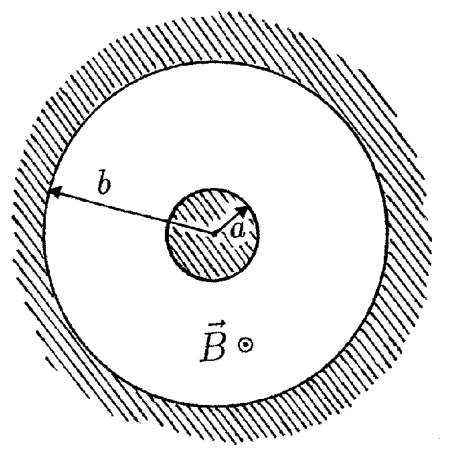
a) First the potential \(V\) is turned on, but \(\vec B=0\). An electron is set free with negligible velocity at the surface of the inner cylinder. Determine its speed \(v\) when it hits the anode. Give the answer both when a non-relativistic treatment is sufficient, and when it is not. (1 point)
For the remaining parts of this problem a non-relativistic treatment suffices.
b) Now \(V=0\), but the homogeneous magnetic field \(\vec B\) is present. An electron starts out with an initial velocity \(\vec v_0\) in the radial direction. For magnetic fields larger than a critical value \(B_c\), the electron will not reach the anode. Make a sketch of the trajectory of the electron when \(B\) is slightly more than \(B_c\). Determine \(B_c\). (2 points)
From now on both the potential \(V\) and the homogeneous magnetic field \(\vec B\) are present.
c) The magnetic field will give the electron a non-zero angular momentum \(L\) with respect to the cylinder axis. Write down an equation for the rate of change \(dL/dt\) of the angular momentum. Show that this equation implies that
\[ L-keBr^2 \]
is constant during the motion, where \(k\) is a definite pure number. Here \(r\) is the distance from the cylinder axis. Determine the value of \(k\). (3 points)
d) Consider an electron, released from the inner cylinder with negligible velocity, that does not reach the anode, but has a maximal distance from the cylinder axis equal to \(r_m\). Determine the speed \(v\) at the point where the radial distance is maximal, in terms of \(r_m\). (1 point)
e) We are interested in using the magnetic field to regulate the electron current to the anode. For \(B\) larger than a critical magnetic field \(B_c\), an electron, released with negligible velocity, will not reach the anode. Determine \(B_c\).
(1 point)
f) If the electrons are set free by heating the inner cylinder an electron will in general have an initial nonzero velocity at the surface of the inner cylinder. The component of the initial velocity parallel to \(\vec B\) is \(v_B\), the components orthogonal to \(\vec B\) are \(v_r\) (in the radial direction) and \(v_\varphi\) (in the azimuthal direction, i.e. orthogonal to the radial direction).
Determine for this situation the critical magnetic field \(B_c\) for reaching the anode. (2 points)
Official English text of the problem.
Answers
Here \(B\) is the magnetic-field magnitude, \(c\) is the speed of light, and positive azimuthal velocity means counterclockwise motion in the figure. Thus \(v_\varphi\) in part (f) is signed.
-
a) For \(eV\ll mc^2\), \[ \boxed{v=\sqrt{\frac{2eV}{m}}.} \] Relativistically, \[ \boxed{v=c\sqrt{1-\left(1+\frac{eV}{mc^2}\right)^{-2}}.} \]
-
b) \[ \boxed{B_c=\frac{2mbv_0}{e(b^2-a^2)}.} \] The trajectory is a counterclockwise circular arc of radius \(R=mv_0/(eB)\). For \(B\) just above \(B_c\), its maximum distance from the cylinder axis is just below \(b\), and it returns to the inner cylinder.
-
c) \[ \boxed{\frac{dL}{dt}=eBr\dot r,\qquad L-\frac{eB}{2}r^2=\text{constant},\qquad k=\frac12.} \]
-
d) \[ \boxed{v=\frac{eB(r_m^2-a^2)}{2mr_m}.} \] Equivalently, \[ v=\sqrt{\frac{2eV}{m}\frac{\ln(r_m/a)}{\ln(b/a)}}. \]
-
e) \[ \boxed{B_c=\frac{2mb}{e(b^2-a^2)} \sqrt{\frac{2eV}{m}} =\frac{b}{b^2-a^2}\sqrt{\frac{8mV}{e}}.} \]
-
f) For an electron emitted into the gap, \[ \boxed{ B_c=\frac{2m}{e(b^2-a^2)} \left[ b\sqrt{v_r^2+v_\varphi^2+\frac{2eV}{m}} -av_\varphi \right]. } \] This is independent of \(v_B\).
Solution
Take the positive \(z\)-axis along \(\vec B\), out of the figure. The positive azimuthal direction is then counterclockwise. Let \(L\) denote the signed \(z\)-component of the electron’s mechanical angular momentum. After part (a), we use non-relativistic mechanics as stipulated.
a)
The electric potential increases by \(V\) between the inner cylinder and the anode. Since the electron’s charge is \(-e\), its potential energy decreases by \(eV\). Conservation of energy therefore gives
\[ K_{\mathrm{final}}=eV. \]
When this energy is small compared with the rest energy, \(eV\ll mc^2\),
\[ \frac12mv^2=eV, \]
so
\[ \boxed{v=\sqrt{\frac{2eV}{m}}.} \]
For a relativistic treatment,
\[ (\gamma-1)mc^2=eV, \qquad \gamma=\frac{1}{\sqrt{1-v^2/c^2}}. \]
Thus
\[ \gamma=1+\frac{eV}{mc^2}, \]
and
\[ \boxed{ v=c\sqrt{1-\left(1+\frac{eV}{mc^2}\right)^{-2}}. } \]
Expanding this expression for \(eV/(mc^2)\ll1\) recovers the non-relativistic result.
b)
The magnetic force is perpendicular to the velocity, so it does no work. The electron’s speed remains \(v_0\), and its motion perpendicular to the uniform magnetic field is circular. The orbit radius \(R\) follows from
\[ \frac{mv_0^2}{R}=ev_0B, \]
giving
\[ R=\frac{mv_0}{eB}. \]
Choose the release point to be \(P=(a,0)\), with initial velocity along the positive \(x\)-axis. Because
\[ \vec F=-e\,\vec v\times\vec B, \]
the initial force points along the positive \(y\)-axis. The circle therefore has centre
\[ C=(a,R) \]
and equation
\[ (x-a)^2+(y-R)^2=R^2. \]
The distance from the cylinder axis \(O\) to the orbit centre is
\[ OC=\sqrt{a^2+R^2}. \]
Consequently, the maximum radial distance attained is
\[ r_{\max}=\sqrt{a^2+R^2}+R. \]
At the critical field, this maximum equals \(b\):
\[ \sqrt{a^2+R_c^2}+R_c=b. \]
Squaring after rearrangement gives
\[ a^2+R_c^2=(b-R_c)^2, \qquad R_c=\frac{b^2-a^2}{2b}. \]
Hence
\[ \boxed{ B_c=\frac{mv_0}{eR_c} =\frac{2mbv_0}{e(b^2-a^2)}. } \]
For the requested sketch, draw the two concentric cylinder boundaries and start the electron at their right-hand radial line, on the inner boundary. Its initial tangent points directly outward, and the path bends upward, following the circle centred at \(C=(a,R)\) counterclockwise. Its farthest point from \(O\) lies on the ray \(OC\). When \(B\) is slightly greater than \(B_c\), this point lies just inside the anode. The electron then moves inward and strikes the inner cylinder again. The return point has polar angle
\[ \varphi_{\mathrm{return}}=2\arctan(R/a). \]
c)
The electric force is radial and therefore exerts no torque about the cylinder axis.
Writing the velocity as
\[ \vec v=\dot r\,\hat{\boldsymbol r} +r\dot\varphi\,\hat{\boldsymbol\varphi} +v_z\,\hat{\boldsymbol z}, \]
the magnetic force is
\[ -e\,\vec v\times\vec B =-eBr\dot\varphi\,\hat{\boldsymbol r} +eB\dot r\,\hat{\boldsymbol\varphi}. \]
Its azimuthal component is \(F_\varphi=eB\dot r\). Therefore,
\[ \frac{dL}{dt}=rF_\varphi=eBr\dot r. \]
Since \(B\) is constant,
\[ eBr\dot r=\frac{eB}{2}\frac{d(r^2)}{dt}. \]
It follows that
\[ \frac{d}{dt}\left(L-\frac{eB}{2}r^2\right)=0, \]
so
\[ \boxed{L-\frac{eB}{2}r^2=\text{constant},\qquad k=\frac12.} \]
In particular, between release at \(r=a\) and any later position,
\[ L(r)=L(a)+\frac{eB}{2}(r^2-a^2). \]
d)
The electron starts with negligible velocity, so \(L(a)=0\). Thus
\[ L(r)=\frac{eB}{2}(r^2-a^2). \]
Neither field produces an axial force, so the initially vanishing axial velocity remains zero. At the maximum radial distance \(r_m\), the radial velocity also vanishes. The velocity there is therefore entirely azimuthal, giving
\[ L(r_m)=mr_mv. \]
Consequently,
\[ mr_mv=\frac{eB}{2}(r_m^2-a^2), \]
and
\[ \boxed{v=\frac{eB(r_m^2-a^2)}{2mr_m}.} \]
An equivalent expression follows from energy conservation. In the charge-free cylindrical gap, Gauss’s law gives \(rE_r=\text{constant}\). With the inner cylinder at zero potential and the anode at \(V\), the potential is
\[ \Phi(r)=V\frac{\ln(r/a)}{\ln(b/a)}. \]
Since the magnetic field does no work,
\[ \frac12mv^2=e\Phi(r_m), \]
which gives
\[ \boxed{ v=\sqrt{\frac{2eV}{m}\frac{\ln(r_m/a)}{\ln(b/a)}}. } \]
These two expressions must agree at the actual turning radius \(r_m\).
e)
At the critical field, the electron’s maximum radial distance is exactly \(b\). It reaches the anode tangentially, with zero radial velocity.
Energy conservation fixes its speed there:
\[ v_b=\sqrt{\frac{2eV}{m}}. \]
Using part (d) with \(r_m=b\),
\[ v_b=\frac{eB_c(b^2-a^2)}{2mb}. \]
Therefore,
\[ \boxed{ B_c=\frac{2mb}{e(b^2-a^2)} \sqrt{\frac{2eV}{m}} =\frac{b}{b^2-a^2}\sqrt{\frac{8mV}{e}}. } \]
For \(B>B_c\), the azimuthal kinetic energy required at \(r=b\) by angular-momentum conservation exceeds the total kinetic energy available there. The electron cannot reach the anode.
f)
Take the initial radial component to point into the gap, so \(v_r\ge0\). Denote the later radial and azimuthal velocity components by \(u_r\) and \(u_\varphi\).
There is no axial force, so
\[ u_z=v_B \]
throughout the motion. The initial angular momentum is
\[ L(a)=mav_\varphi. \]
The conservation law from part (c) gives
\[ mr u_\varphi =mav_\varphi+\frac{eB}{2}(r^2-a^2). \]
At the anode,
\[ u_\varphi(b) =\frac{a}{b}v_\varphi +\frac{eB(b^2-a^2)}{2mb}. \]
Energy conservation between the two cylinders gives
\[ \frac12m\left[u_r(b)^2+u_\varphi(b)^2+v_B^2\right] = \frac12m\left[v_r^2+v_\varphi^2+v_B^2\right]+eV. \]
The axial kinetic energies cancel. Defining
\[ W=\sqrt{v_r^2+v_\varphi^2+\frac{2eV}{m}}, \]
we obtain
\[ u_r(b)^2+u_\varphi(b)^2=W^2. \]
Thus the condition for reaching the anode is
\[ \left| av_\varphi+\frac{eB}{2m}(b^2-a^2) \right|\le bW. \]
At \(B=0\), \(|av_\varphi|<bW\). As the positive field is increased, the upper boundary is reached when
\[ av_\varphi+\frac{eB_c}{2m}(b^2-a^2)=bW. \]
Solving,
\[ \boxed{ B_c=\frac{2m}{e(b^2-a^2)} \left[ b\sqrt{v_r^2+v_\varphi^2+\frac{2eV}{m}} -av_\varphi \right]. } \]
The absence of \(v_B\) reflects the fact that axial motion neither changes the distance from the cylinder axis nor exchanges energy with the transverse motion.
To verify that the anode condition does not overlook an earlier radial turning point, set
\[ s=\ln(r/a),\qquad \alpha=\frac{eBa}{2m},\qquad \beta=v_\varphi-\alpha. \]
The angular-momentum and energy equations give
\[ u_r^2(s) =v_r^2+v_\varphi^2 +\frac{2eV}{m\ln(b/a)}s -\left(\alpha e^s+\beta e^{-s}\right)^2. \]
Its second derivative is
\[ \frac{d^2u_r^2}{ds^2} =-4\alpha^2e^{2s}-4\beta^2e^{-2s}\le0. \]
Thus \(u_r^2\) is concave as a function of \(s\). If it is nonnegative at both cylinders, it is nonnegative throughout the gap. The condition used above therefore determines the actual cut-off.
Setting \(v_r=v_\varphi=0\) recovers part (e). Setting \(V=0\), \(v_\varphi=0\), and \(v_r=v_0\) recovers part (b).
The solution was checked against the official solution.
IPhO 1996 · Theorieaufgabe 2
Elektronen zwischen koaxialen Zylindern in einem Magnetfeld (magnetische Sperrung)
Der Raum zwischen zwei koaxialen zylindrischen Leitern ist evakuiert. Der Radius des inneren Zylinders beträgt \(a\), und der Innenradius des äußeren Zylinders beträgt \(b\), wie in der folgenden Abbildung gezeigt. Der äußere Zylinder, der als Anode bezeichnet wird, kann gegenüber dem inneren Zylinder auf ein positives Potential \(V\) gebracht werden. Außerdem liegt ein statisches homogenes Magnetfeld \(\vec B\) parallel zur Zylinderachse vor, das aus der Zeichenebene heraus gerichtet ist. Influenzladungen in den Leitern werden vernachlässigt.
Wir untersuchen die Dynamik von Elektronen mit der Ruhemasse \(m\) und der Ladung \(-e\). Die Elektronen werden an der Oberfläche des inneren Zylinders freigesetzt.
a) Zunächst wird das Potential \(V\) angelegt, aber es gilt \(\vec B=0\). Ein Elektron wird mit vernachlässigbarer Geschwindigkeit an der Oberfläche des inneren Zylinders freigesetzt. Bestimmen Sie seine Geschwindigkeit \(v\), wenn es auf die Anode trifft. Geben Sie die Antwort sowohl für den Fall an, dass eine nichtrelativistische Behandlung ausreicht, als auch für den Fall, dass sie nicht ausreicht. (1 Punkt)
Für die übrigen Teile dieser Aufgabe genügt eine nichtrelativistische Behandlung.
b) Nun gilt \(V=0\), aber das homogene Magnetfeld \(\vec B\) ist vorhanden. Ein Elektron startet mit einer Anfangsgeschwindigkeit \(\vec v_0\) in radialer Richtung. Bei Magnetfeldern oberhalb eines kritischen Wertes \(B_c\) erreicht das Elektron die Anode nicht. Skizzieren Sie die Bahn des Elektrons, wenn \(B\) geringfügig größer als \(B_c\) ist. Bestimmen Sie \(B_c\). (2 Punkte)
Von nun an sind sowohl das Potential \(V\) als auch das homogene Magnetfeld \(\vec B\) vorhanden.
c) Das Magnetfeld verleiht dem Elektron einen von null verschiedenen Drehimpuls \(L\) bezüglich der Zylinderachse. Stellen Sie eine Gleichung für die zeitliche Änderung \(dL/dt\) des Drehimpulses auf. Zeigen Sie, dass aus dieser Gleichung folgt, dass
\[ L-keBr^2 \]
während der Bewegung konstant ist, wobei \(k\) eine bestimmte dimensionslose Zahl ist. Dabei ist \(r\) der Abstand von der Zylinderachse. Bestimmen Sie den Wert von \(k\). (3 Punkte)
d) Betrachten Sie ein Elektron, das mit vernachlässigbarer Geschwindigkeit am inneren Zylinder freigesetzt wird und die Anode nicht erreicht, sondern einen maximalen Abstand \(r_m\) von der Zylinderachse hat. Bestimmen Sie die Geschwindigkeit \(v\) an der Stelle des maximalen radialen Abstands in Abhängigkeit von \(r_m\). (1 Punkt)
e) Wir möchten das Magnetfeld dazu verwenden, den Elektronenstrom zur Anode zu regeln. Für \(B\) oberhalb eines kritischen Magnetfeldes \(B_c\) erreicht ein mit vernachlässigbarer Geschwindigkeit freigesetztes Elektron die Anode nicht. Bestimmen Sie \(B_c\).
(1 Punkt)
f) Werden die Elektronen durch Erhitzen des inneren Zylinders freigesetzt, so hat ein Elektron an der Oberfläche des inneren Zylinders im Allgemeinen eine von null verschiedene Anfangsgeschwindigkeit. Die Komponente der Anfangsgeschwindigkeit parallel zu \(\vec B\) ist \(v_B\), die Komponenten senkrecht zu \(\vec B\) sind \(v_r\) (in radialer Richtung) und \(v_\varphi\) (in azimutaler Richtung, d. h. senkrecht zur radialen Richtung).
Bestimmen Sie für diesen Fall das kritische Magnetfeld \(B_c\) für das Erreichen der Anode. (2 Punkte)
Aufgabentext aus dem offiziellen englischen Text übersetzt.
Antworten
Hier ist \(B\) der Betrag des Magnetfeldes, \(c\) die Lichtgeschwindigkeit, und eine positive Azimutalgeschwindigkeit bedeutet eine Bewegung gegen den Uhrzeigersinn in der Abbildung. Somit ist \(v_\varphi\) in Teil (f) eine vorzeichenbehaftete Größe.
-
a) Für \(eV\ll mc^2\) gilt \[ \boxed{v=\sqrt{\frac{2eV}{m}}.} \] Relativistisch gilt \[ \boxed{v=c\sqrt{1-\left(1+\frac{eV}{mc^2}\right)^{-2}}.} \]
-
b) \[ \boxed{B_c=\frac{2mbv_0}{e(b^2-a^2)}.} \] Die Bahn ist ein gegen den Uhrzeigersinn durchlaufener Kreisbogen mit dem Radius \(R=mv_0/(eB)\). Für \(B\) knapp oberhalb von \(B_c\) liegt sein maximaler Abstand von der Zylinderachse knapp unter \(b\), und das Elektron kehrt zum inneren Zylinder zurück.
-
c) \[ \boxed{\frac{dL}{dt}=eBr\dot r,\qquad L-\frac{eB}{2}r^2=\text{konstant},\qquad k=\frac12.} \]
-
d) \[ \boxed{v=\frac{eB(r_m^2-a^2)}{2mr_m}.} \] Äquivalent gilt \[ v=\sqrt{\frac{2eV}{m}\frac{\ln(r_m/a)}{\ln(b/a)}}. \]
-
e) \[ \boxed{B_c=\frac{2mb}{e(b^2-a^2)} \sqrt{\frac{2eV}{m}} =\frac{b}{b^2-a^2}\sqrt{\frac{8mV}{e}}.} \]
-
f) Für ein in den Zwischenraum emittiertes Elektron gilt \[ \boxed{ B_c=\frac{2m}{e(b^2-a^2)} \left[ b\sqrt{v_r^2+v_\varphi^2+\frac{2eV}{m}} -av_\varphi \right]. } \] Dies ist unabhängig von \(v_B\).
Lösung
Wir wählen die positive \(z\)-Achse entlang von \(\vec B\), aus der Zeichenebene heraus. Die positive azimutale Richtung verläuft dann gegen den Uhrzeigersinn. Mit \(L\) bezeichnen wir die vorzeichenbehaftete \(z\)-Komponente des mechanischen Drehimpulses des Elektrons. Nach Teil (a) verwenden wir wie vorgegeben die nichtrelativistische Mechanik.
a)
Das elektrische Potential steigt zwischen dem inneren Zylinder und der Anode um \(V\) an. Da die Ladung des Elektrons \(-e\) beträgt, nimmt seine potentielle Energie um \(eV\) ab. Aus der Energieerhaltung folgt daher
\[ K_{\mathrm{final}}=eV. \]
Ist diese Energie klein gegenüber der Ruheenergie, \(eV\ll mc^2\), so gilt
\[ \frac12mv^2=eV, \]
also
\[ \boxed{v=\sqrt{\frac{2eV}{m}}.} \]
Bei einer relativistischen Behandlung gilt
\[ (\gamma-1)mc^2=eV, \qquad \gamma=\frac{1}{\sqrt{1-v^2/c^2}}. \]
Somit ist
\[ \gamma=1+\frac{eV}{mc^2}, \]
und
\[ \boxed{ v=c\sqrt{1-\left(1+\frac{eV}{mc^2}\right)^{-2}}. } \]
Entwickelt man diesen Ausdruck für \(eV/(mc^2)\ll1\), erhält man wieder das nichtrelativistische Ergebnis.
b)
Die magnetische Kraft steht senkrecht zur Geschwindigkeit und verrichtet daher keine Arbeit. Der Geschwindigkeitsbetrag des Elektrons bleibt \(v_0\), und seine Bewegung senkrecht zum homogenen Magnetfeld ist kreisförmig. Der Bahnradius \(R\) folgt aus
\[ \frac{mv_0^2}{R}=ev_0B, \]
also
\[ R=\frac{mv_0}{eB}. \]
Wir wählen den Freisetzungspunkt als \(P=(a,0)\), mit einer Anfangsgeschwindigkeit entlang der positiven \(x\)-Achse. Wegen
\[ \vec F=-e\,\vec v\times\vec B, \]
zeigt die anfängliche Kraft entlang der positiven \(y\)-Achse. Der Kreis hat daher den Mittelpunkt
\[ C=(a,R) \]
und die Gleichung
\[ (x-a)^2+(y-R)^2=R^2. \]
Der Abstand von der Zylinderachse \(O\) zum Bahnmittelpunkt beträgt
\[ OC=\sqrt{a^2+R^2}. \]
Folglich ist der maximal erreichte radiale Abstand
\[ r_{\max}=\sqrt{a^2+R^2}+R. \]
Beim kritischen Feld ist dieses Maximum gleich \(b\):
\[ \sqrt{a^2+R_c^2}+R_c=b. \]
Umstellen und anschließendes Quadrieren ergibt
\[ a^2+R_c^2=(b-R_c)^2, \qquad R_c=\frac{b^2-a^2}{2b}. \]
Daher gilt
\[ \boxed{ B_c=\frac{mv_0}{eR_c} =\frac{2mbv_0}{e(b^2-a^2)}. } \]
Für die geforderte Skizze zeichnet man die beiden konzentrischen Zylinderbegrenzungen und lässt das Elektron auf der nach rechts gerichteten radialen Linie an der inneren Begrenzung starten. Seine anfängliche Tangente zeigt direkt nach außen, und die Bahn krümmt sich nach oben und folgt dem Kreis mit dem Mittelpunkt \(C=(a,R)\) gegen den Uhrzeigersinn. Der von \(O\) am weitesten entfernte Punkt liegt auf dem Strahl \(OC\). Wenn \(B\) geringfügig größer als \(B_c\) ist, liegt dieser Punkt knapp innerhalb der Anode. Das Elektron bewegt sich dann nach innen und trifft erneut auf den inneren Zylinder. Der Rückkehrpunkt hat den Polarwinkel
\[ \varphi_{\mathrm{return}}=2\arctan(R/a). \]
c)
Die elektrische Kraft ist radial und übt daher kein Drehmoment um die Zylinderachse aus.
Schreiben wir die Geschwindigkeit als
\[ \vec v=\dot r\,\hat{\boldsymbol r} +r\dot\varphi\,\hat{\boldsymbol\varphi} +v_z\,\hat{\boldsymbol z}, \]
so lautet die magnetische Kraft
\[ -e\,\vec v\times\vec B =-eBr\dot\varphi\,\hat{\boldsymbol r} +eB\dot r\,\hat{\boldsymbol\varphi}. \]
Ihre azimutale Komponente ist \(F_\varphi=eB\dot r\). Daher gilt
\[ \frac{dL}{dt}=rF_\varphi=eBr\dot r. \]
Da \(B\) konstant ist, gilt
\[ eBr\dot r=\frac{eB}{2}\frac{d(r^2)}{dt}. \]
Daraus folgt
\[ \frac{d}{dt}\left(L-\frac{eB}{2}r^2\right)=0, \]
also
\[ \boxed{L-\frac{eB}{2}r^2=\text{konstant},\qquad k=\frac12.} \]
Insbesondere gilt zwischen der Freisetzung bei \(r=a\) und jeder späteren Position
\[ L(r)=L(a)+\frac{eB}{2}(r^2-a^2). \]
d)
Das Elektron startet mit vernachlässigbarer Geschwindigkeit, sodass \(L(a)=0\) gilt. Somit ist
\[ L(r)=\frac{eB}{2}(r^2-a^2). \]
Keines der beiden Felder erzeugt eine axiale Kraft, daher bleibt die anfangs verschwindende axiale Geschwindigkeit null. Beim maximalen radialen Abstand \(r_m\) verschwindet auch die radiale Geschwindigkeit. Die Geschwindigkeit ist dort daher rein azimutal, sodass
\[ L(r_m)=mr_mv. \]
Folglich gilt
\[ mr_mv=\frac{eB}{2}(r_m^2-a^2), \]
und
\[ \boxed{v=\frac{eB(r_m^2-a^2)}{2mr_m}.} \]
Ein äquivalenter Ausdruck folgt aus der Energieerhaltung. Im ladungsfreien zylindrischen Zwischenraum liefert das gaußsche Gesetz \(rE_r=\text{konstant}\). Liegt der innere Zylinder auf dem Potential null und die Anode auf \(V\), so lautet das Potential
\[ \Phi(r)=V\frac{\ln(r/a)}{\ln(b/a)}. \]
Da das Magnetfeld keine Arbeit verrichtet, gilt
\[ \frac12mv^2=e\Phi(r_m), \]
woraus folgt
\[ \boxed{ v=\sqrt{\frac{2eV}{m}\frac{\ln(r_m/a)}{\ln(b/a)}}. } \]
Diese beiden Ausdrücke müssen beim tatsächlichen Umkehrradius \(r_m\) übereinstimmen.
e)
Beim kritischen Feld ist der maximale radiale Abstand des Elektrons genau \(b\). Es erreicht die Anode tangential mit verschwindender radialer Geschwindigkeit.
Die Energieerhaltung legt seinen Geschwindigkeitsbetrag dort fest:
\[ v_b=\sqrt{\frac{2eV}{m}}. \]
Aus Teil (d) mit \(r_m=b\) folgt
\[ v_b=\frac{eB_c(b^2-a^2)}{2mb}. \]
Daher gilt
\[ \boxed{ B_c=\frac{2mb}{e(b^2-a^2)} \sqrt{\frac{2eV}{m}} =\frac{b}{b^2-a^2}\sqrt{\frac{8mV}{e}}. } \]
Für \(B>B_c\) übersteigt die aufgrund der Drehimpulserhaltung bei \(r=b\) erforderliche azimutale kinetische Energie die dort insgesamt verfügbare kinetische Energie. Das Elektron kann die Anode nicht erreichen.
f)
Wir nehmen an, dass die anfängliche radiale Komponente in den Zwischenraum zeigt, sodass \(v_r\ge0\) gilt. Die späteren radialen und azimutalen Geschwindigkeitskomponenten bezeichnen wir mit \(u_r\) und \(u_\varphi\).
Es wirkt keine axiale Kraft, daher gilt
\[ u_z=v_B \]
während der gesamten Bewegung. Der anfängliche Drehimpuls ist
\[ L(a)=mav_\varphi. \]
Der Erhaltungssatz aus Teil (c) ergibt
\[ mr u_\varphi =mav_\varphi+\frac{eB}{2}(r^2-a^2). \]
An der Anode gilt
\[ u_\varphi(b) =\frac{a}{b}v_\varphi +\frac{eB(b^2-a^2)}{2mb}. \]
Die Energieerhaltung zwischen den beiden Zylindern ergibt
\[ \frac12m\left[u_r(b)^2+u_\varphi(b)^2+v_B^2\right] = \frac12m\left[v_r^2+v_\varphi^2+v_B^2\right]+eV. \]
Die axialen kinetischen Energien heben sich auf. Mit der Definition
\[ W=\sqrt{v_r^2+v_\varphi^2+\frac{2eV}{m}}, \]
erhalten wir
\[ u_r(b)^2+u_\varphi(b)^2=W^2. \]
Die Bedingung für das Erreichen der Anode lautet somit
\[ \left| av_\varphi+\frac{eB}{2m}(b^2-a^2) \right|\le bW. \]
Bei \(B=0\) gilt \(|av_\varphi|<bW\). Wird das positive Feld erhöht, so wird die obere Grenze erreicht, wenn
\[ av_\varphi+\frac{eB_c}{2m}(b^2-a^2)=bW. \]
Auflösen ergibt
\[ \boxed{ B_c=\frac{2m}{e(b^2-a^2)} \left[ b\sqrt{v_r^2+v_\varphi^2+\frac{2eV}{m}} -av_\varphi \right]. } \]
Dass \(v_B\) nicht vorkommt, spiegelt die Tatsache wider, dass die axiale Bewegung weder den Abstand von der Zylinderachse verändert noch Energie mit der transversalen Bewegung austauscht.
Um zu überprüfen, dass die Bedingung an der Anode keinen früheren radialen Umkehrpunkt übersieht, setzen wir
\[ s=\ln(r/a),\qquad \alpha=\frac{eBa}{2m},\qquad \beta=v_\varphi-\alpha. \]
Die Drehimpuls- und Energiegleichungen ergeben
\[ u_r^2(s) =v_r^2+v_\varphi^2 +\frac{2eV}{m\ln(b/a)}s -\left(\alpha e^s+\beta e^{-s}\right)^2. \]
Die zweite Ableitung lautet
\[ \frac{d^2u_r^2}{ds^2} =-4\alpha^2e^{2s}-4\beta^2e^{-2s}\le0. \]
Somit ist \(u_r^2\) als Funktion von \(s\) konkav. Ist es an beiden Zylindern nichtnegativ, so ist es im gesamten Zwischenraum nichtnegativ. Die oben verwendete Bedingung bestimmt daher die tatsächliche Sperrgrenze.
Setzt man \(v_r=v_\varphi=0\), erhält man wieder Teil (e). Setzt man \(V=0\), \(v_\varphi=0\) und \(v_r=v_0\), erhält man wieder Teil (b).
Die Lösung wurde mit der offiziellen Lösung abgeglichen.
IPhO 1996 · Teori sorusu 2
Manyetik alanda eş eksenli silindirler arasındaki elektronlar (manyetik kesim)
Eş eksenli iki silindirik iletken arasındaki boşluk vakumlanmıştır. Aşağıdaki şekilde gösterildiği gibi, iç silindirin yarıçapı \(a\), dış silindirin iç yarıçapı ise \(b\)'dir. Anot adı verilen dış silindire, iç silindire göre pozitif bir \(V\) potansiyeli uygulanabilir. Ayrıca, silindir eksenine paralel, şekil düzleminden dışarıya doğru yönelmiş, zamana göre değişmeyen düzgün bir \(\vec B\) manyetik alanı vardır. İletkenlerde indüklenen yükler ihmal edilmektedir.
Durgun kütlesi \(m\), yükü \(-e\) olan elektronların dinamiğini inceliyoruz. Elektronlar iç silindirin yüzeyinden serbest bırakılmaktadır.
a) Önce \(V\) potansiyeli uygulanır, ancak \(\vec B=0\)'dır. Bir elektron, iç silindirin yüzeyinden ihmal edilebilir bir hızla serbest bırakılır. Anoda çarptığı andaki \(v\) süratini bulunuz. Cevabı hem göreli olmayan bir yaklaşımın yeterli olduğu hem de yeterli olmadığı durum için veriniz. (1 puan)
Bu sorunun geri kalan kısımlarında göreli olmayan bir yaklaşım yeterlidir.
b) Şimdi \(V=0\)'dır, ancak düzgün \(\vec B\) manyetik alanı vardır. Bir elektron, radyal yönde bir \(\vec v_0\) ilk hızıyla harekete başlar. Manyetik alanın kritik bir \(B_c\) değerinden büyük olması durumunda elektron anoda ulaşamaz. \(B\)'nin \(B_c\)'den biraz büyük olduğu durumda elektronun yörüngesini kabaca çiziniz. \(B_c\)'yi bulunuz. (2 puan)
Bundan sonraki kısımlarda hem \(V\) potansiyeli hem de düzgün \(\vec B\) manyetik alanı vardır.
c) Manyetik alan, elektrona silindir eksenine göre sıfırdan farklı bir \(L\) açısal momentumu kazandıracaktır. Açısal momentumun değişim hızı \(dL/dt\) için bir denklem yazınız. Bu denklemin, hareket boyunca
\[ L-keBr^2 \]
ifadesinin sabit kaldığını gösterdiğini kanıtlayınız; burada \(k\), belirli bir boyutsuz sayıdır. \(r\) ise silindir ekseninden olan uzaklıktır. \(k\)'nın değerini bulunuz. (3 puan)
d) İç silindirden ihmal edilebilir bir hızla serbest bırakılan, anoda ulaşamayan ve silindir ekseninden en büyük uzaklığı \(r_m\) olan bir elektronu ele alınız. Radyal uzaklığın en büyük olduğu noktadaki \(v\) süratini \(r_m\) cinsinden bulunuz. (1 puan)
e) Anoda giden elektron akımını düzenlemek için manyetik alanı kullanmak istiyoruz. \(B\), kritik bir \(B_c\) manyetik alanından büyük olduğunda, ihmal edilebilir bir hızla serbest bırakılan bir elektron anoda ulaşamaz. \(B_c\)'yi bulunuz.
(1 puan)
f) Elektronlar iç silindir ısıtılarak serbest bırakılırsa, bir elektronun iç silindirin yüzeyinde genellikle sıfırdan farklı bir ilk hızı olur. İlk hızın \(\vec B\)'ye paralel bileşeni \(v_B\), \(\vec B\)'ye dik bileşenleri ise \(v_r\) (radyal yönde) ve \(v_\varphi\) (azimutal yönde, yani radyal yöne dik) olsun.
Bu durum için anoda ulaşmanın sınırını belirleyen kritik \(B_c\) manyetik alanını bulunuz. (2 puan)
Soru metni resmi İngilizce metinden çevrilmiştir.
Cevaplar
Burada \(B\) manyetik alanın büyüklüğü, \(c\) ışık hızıdır; pozitif azimutal hız ise şekilde saat yönünün tersine hareket anlamına gelir. Dolayısıyla (f) kısmındaki \(v_\varphi\) işaretli bir büyüklüktür.
-
a) \(eV\ll mc^2\) için, \[ \boxed{v=\sqrt{\frac{2eV}{m}}.} \] Göreli durumda, \[ \boxed{v=c\sqrt{1-\left(1+\frac{eV}{mc^2}\right)^{-2}}.} \]
-
b) \[ \boxed{B_c=\frac{2mbv_0}{e(b^2-a^2)}.} \] Yörünge, yarıçapı \(R=mv_0/(eB)\) olan ve saat yönünün tersine izlenen bir çember yayıdır. \(B\), \(B_c\)'nin hemen üzerindeyken elektronun silindir ekseninden en büyük uzaklığı \(b\)'nin hemen altında olur ve elektron iç silindire geri döner.
-
c) \[ \boxed{\frac{dL}{dt}=eBr\dot r,\qquad L-\frac{eB}{2}r^2=\text{sabit},\qquad k=\frac12.} \]
-
d) \[ \boxed{v=\frac{eB(r_m^2-a^2)}{2mr_m}.} \] Eşdeğer olarak, \[ v=\sqrt{\frac{2eV}{m}\frac{\ln(r_m/a)}{\ln(b/a)}}. \]
-
e) \[ \boxed{B_c=\frac{2mb}{e(b^2-a^2)} \sqrt{\frac{2eV}{m}} =\frac{b}{b^2-a^2}\sqrt{\frac{8mV}{e}}.} \]
-
f) Boşluğa doğru salınan bir elektron için, \[ \boxed{ B_c=\frac{2m}{e(b^2-a^2)} \left[ b\sqrt{v_r^2+v_\varphi^2+\frac{2eV}{m}} -av_\varphi \right]. } \] Bu değer \(v_B\)'den bağımsızdır.
Çözüm
Pozitif \(z\) eksenini, şekil düzleminden dışarıya doğru, \(\vec B\) yönünde seçelim. Bu durumda pozitif azimutal yön, saat yönünün tersidir. \(L\), elektronun mekanik açısal momentumunun işaretli \(z\) bileşenini göstersin. (a) kısmından sonra, belirtildiği üzere göreli olmayan mekaniği kullanıyoruz.
a)
Elektrik potansiyeli, iç silindirden anoda giderken \(V\) kadar artar. Elektronun yükü \(-e\) olduğundan, potansiyel enerjisi \(eV\) kadar azalır. Dolayısıyla enerji korunumu
\[ K_{\mathrm{final}}=eV. \]
sonucunu verir. Bu enerji durgunluk enerjisine kıyasla küçük olduğunda, \(eV\ll mc^2\),
\[ \frac12mv^2=eV, \]
olduğundan
\[ \boxed{v=\sqrt{\frac{2eV}{m}}.} \]
Göreli bir yaklaşım için,
\[ (\gamma-1)mc^2=eV, \qquad \gamma=\frac{1}{\sqrt{1-v^2/c^2}}. \]
Böylece
\[ \gamma=1+\frac{eV}{mc^2}, \]
ve
\[ \boxed{ v=c\sqrt{1-\left(1+\frac{eV}{mc^2}\right)^{-2}}. } \]
Bu ifade \(eV/(mc^2)\ll1\) için seriye açıldığında göreli olmayan sonuç yeniden elde edilir.
b)
Manyetik kuvvet hıza diktir, dolayısıyla iş yapmaz. Elektronun sürati \(v_0\) olarak kalır ve düzgün manyetik alana dik düzlemdeki hareketi çemberseldir. Yörünge yarıçapı \(R\),
\[ \frac{mv_0^2}{R}=ev_0B, \]
bağıntısından
\[ R=\frac{mv_0}{eB}. \]
olarak bulunur. Serbest bırakılma noktasını \(P=(a,0)\), ilk hızın yönünü ise pozitif \(x\) ekseni yönünde seçelim.
\[ \vec F=-e\,\vec v\times\vec B, \]
olduğundan başlangıçtaki kuvvet pozitif \(y\) ekseni yönündedir. Dolayısıyla çemberin merkezi
\[ C=(a,R) \]
ve denklemi
\[ (x-a)^2+(y-R)^2=R^2. \]
olur. Silindir ekseni \(O\)'dan yörüngenin merkezine olan uzaklık
\[ OC=\sqrt{a^2+R^2}. \]
şeklindedir. Buna göre ulaşılan en büyük radyal uzaklık
\[ r_{\max}=\sqrt{a^2+R^2}+R. \]
olur. Kritik alanda bu en büyük uzaklık \(b\)'ye eşittir:
\[ \sqrt{a^2+R_c^2}+R_c=b. \]
Düzenleyip karesini aldığımızda
\[ a^2+R_c^2=(b-R_c)^2, \qquad R_c=\frac{b^2-a^2}{2b}. \]
elde edilir. Dolayısıyla
\[ \boxed{ B_c=\frac{mv_0}{eR_c} =\frac{2mbv_0}{e(b^2-a^2)}. } \]
İstenen çizim için eş merkezli iki silindirin sınırlarını çiziniz ve elektronu, sağa doğru uzanan radyal doğru üzerinde, iç sınırdan başlatınız. Yörüngenin başlangıçtaki teğeti doğrudan dışarıya yönelir; yörünge yukarıya doğru kıvrılarak merkezi \(C=(a,R)\) olan çemberi saat yönünün tersine izler. Yörüngenin \(O\)'dan en uzak noktası \(OC\) ışını üzerindedir. \(B\), \(B_c\)'den biraz büyük olduğunda bu nokta anodun hemen iç tarafında kalır. Elektron daha sonra içeriye doğru hareket eder ve yeniden iç silindire çarpar. Geri dönüş noktasının kutupsal açısı
\[ \varphi_{\mathrm{return}}=2\arctan(R/a). \]
şeklindedir.
c)
Elektrik kuvveti radyaldir ve bu nedenle silindir eksenine göre tork oluşturmaz.
Hızı
\[ \vec v=\dot r\,\hat{\boldsymbol r} +r\dot\varphi\,\hat{\boldsymbol\varphi} +v_z\,\hat{\boldsymbol z}, \]
şeklinde yazarsak manyetik kuvvet
\[ -e\,\vec v\times\vec B =-eBr\dot\varphi\,\hat{\boldsymbol r} +eB\dot r\,\hat{\boldsymbol\varphi}. \]
olur. Bu kuvvetin azimutal bileşeni \(F_\varphi=eB\dot r\)'dir. Dolayısıyla,
\[ \frac{dL}{dt}=rF_\varphi=eBr\dot r. \]
\(B\) sabit olduğundan,
\[ eBr\dot r=\frac{eB}{2}\frac{d(r^2)}{dt}. \]
Buradan
\[ \frac{d}{dt}\left(L-\frac{eB}{2}r^2\right)=0, \]
olduğu ve dolayısıyla
\[ \boxed{L-\frac{eB}{2}r^2=\text{sabit},\qquad k=\frac12.} \]
sonucu çıkar. Özel olarak, \(r=a\)'daki serbest bırakılma anı ile daha sonraki herhangi bir konum arasında,
\[ L(r)=L(a)+\frac{eB}{2}(r^2-a^2). \]
d)
Elektron ihmal edilebilir bir hızla harekete başladığından \(L(a)=0\)'dır. Böylece
\[ L(r)=\frac{eB}{2}(r^2-a^2). \]
Her iki alan da eksenel bir kuvvet oluşturmadığından, başlangıçta sıfır olan eksenel hız sıfır kalır. En büyük radyal uzaklık \(r_m\)'de radyal hız da sıfır olur. Dolayısıyla bu noktadaki hız bütünüyle azimutaldir ve
\[ L(r_m)=mr_mv. \]
olur. Buna göre,
\[ mr_mv=\frac{eB}{2}(r_m^2-a^2), \]
ve
\[ \boxed{v=\frac{eB(r_m^2-a^2)}{2mr_m}.} \]
Eşdeğer bir ifade enerji korunumundan elde edilir. Yük bulunmayan silindirik boşlukta Gauss yasası \(rE_r=\text{sabit}\) sonucunu verir. İç silindirin potansiyeli sıfır, anodunki \(V\) olduğunda potansiyel
\[ \Phi(r)=V\frac{\ln(r/a)}{\ln(b/a)}. \]
şeklindedir. Manyetik alan iş yapmadığından,
\[ \frac12mv^2=e\Phi(r_m), \]
olur ve buradan
\[ \boxed{ v=\sqrt{\frac{2eV}{m}\frac{\ln(r_m/a)}{\ln(b/a)}}. } \]
elde edilir. Bu iki ifade, gerçek dönüm yarıçapı \(r_m\)'de aynı değeri vermelidir.
e)
Kritik alanda elektronun en büyük radyal uzaklığı tam olarak \(b\)'dir. Elektron anoda, radyal hızı sıfır olacak şekilde teğetsel olarak ulaşır.
Enerji korunumu, elektronun buradaki süratini belirler:
\[ v_b=\sqrt{\frac{2eV}{m}}. \]
(d) kısmını \(r_m=b\) için kullanırsak,
\[ v_b=\frac{eB_c(b^2-a^2)}{2mb}. \]
Dolayısıyla,
\[ \boxed{ B_c=\frac{2mb}{e(b^2-a^2)} \sqrt{\frac{2eV}{m}} =\frac{b}{b^2-a^2}\sqrt{\frac{8mV}{e}}. } \]
\(B>B_c\) için, açısal momentum korunumunun \(r=b\)'de gerektirdiği azimutal kinetik enerji, o konumda mevcut olan toplam kinetik enerjiyi aşar. Elektron anoda ulaşamaz.
f)
İlk hızın radyal bileşeninin boşluğa doğru yöneldiğini alalım; dolayısıyla \(v_r\ge0\) olsun. Daha sonraki radyal ve azimutal hız bileşenlerini \(u_r\) ve \(u_\varphi\) ile gösterelim.
Eksenel kuvvet olmadığından, hareket boyunca
\[ u_z=v_B \]
olur. Başlangıçtaki açısal momentum
\[ L(a)=mav_\varphi. \]
şeklindedir. (c) kısmındaki korunum yasası
\[ mr u_\varphi =mav_\varphi+\frac{eB}{2}(r^2-a^2). \]
sonucunu verir. Anotta,
\[ u_\varphi(b) =\frac{a}{b}v_\varphi +\frac{eB(b^2-a^2)}{2mb}. \]
İki silindir arasındaki enerji korunumu
\[ \frac12m\left[u_r(b)^2+u_\varphi(b)^2+v_B^2\right] = \frac12m\left[v_r^2+v_\varphi^2+v_B^2\right]+eV. \]
bağıntısını verir. Eksenel kinetik enerji terimleri birbirini götürür.
\[ W=\sqrt{v_r^2+v_\varphi^2+\frac{2eV}{m}}, \]
tanımını yaparsak
\[ u_r(b)^2+u_\varphi(b)^2=W^2. \]
elde ederiz. Dolayısıyla anoda ulaşma koşulu
\[ \left| av_\varphi+\frac{eB}{2m}(b^2-a^2) \right|\le bW. \]
şeklindedir. \(B=0\) iken \(|av_\varphi|<bW\)'dir. Pozitif alan artırıldıkça üst sınıra
\[ av_\varphi+\frac{eB_c}{2m}(b^2-a^2)=bW. \]
olduğunda ulaşılır. Buradan çözülürse,
\[ \boxed{ B_c=\frac{2m}{e(b^2-a^2)} \left[ b\sqrt{v_r^2+v_\varphi^2+\frac{2eV}{m}} -av_\varphi \right]. } \]
Sonuçta \(v_B\)'nin bulunmaması, eksenel hareketin silindir ekseninden uzaklığı değiştirmemesini ve enine hareketle enerji alışverişinde bulunmamasını yansıtır.
Anottaki koşulun daha önceki bir radyal dönüm noktasını gözden kaçırmadığını doğrulamak için
\[ s=\ln(r/a),\qquad \alpha=\frac{eBa}{2m},\qquad \beta=v_\varphi-\alpha. \]
tanımlarını yapalım. Açısal momentum ve enerji denklemleri
\[ u_r^2(s) =v_r^2+v_\varphi^2 +\frac{2eV}{m\ln(b/a)}s -\left(\alpha e^s+\beta e^{-s}\right)^2. \]
sonucunu verir. Bunun ikinci türevi
\[ \frac{d^2u_r^2}{ds^2} =-4\alpha^2e^{2s}-4\beta^2e^{-2s}\le0. \]
şeklindedir. Dolayısıyla \(u_r^2\), \(s\)'nin bir fonksiyonu olarak konkavdır. Her iki silindirde de negatif değilse, boşluğun tamamında negatif değildir. Bu nedenle yukarıda kullanılan koşul gerçek kesim sınırını belirler.
\(v_r=v_\varphi=0\) alınırsa (e) kısmı yeniden elde edilir. \(V=0\), \(v_\varphi=0\) ve \(v_r=v_0\) alınırsa (b) kısmı yeniden elde edilir.
Çözüm, resmi çözümle karşılaştırılarak kontrol edildi.
IPhO 1996 · Problema teórico 2
Electrones entre cilindros coaxiales en un campo magnético (corte magnético)
El espacio entre dos conductores cilíndricos coaxiales está al vacío. El radio del cilindro interior es \(a\), y el radio interno del cilindro exterior es \(b\), como se muestra en la figura siguiente. Al cilindro exterior, denominado ánodo, se le puede aplicar un potencial positivo \(V\) respecto al cilindro interior. También hay un campo magnético estático y homogéneo \(\vec B\), paralelo al eje de los cilindros y dirigido hacia fuera del plano de la figura. Se desprecian las cargas inducidas en los conductores.
Estudiamos la dinámica de electrones de masa en reposo \(m\) y carga \(-e\). Los electrones se liberan en la superficie del cilindro interior.
a) En primer lugar se aplica el potencial \(V\), pero \(\vec B=0\). Se libera un electrón con velocidad despreciable en la superficie del cilindro interior. Determine su rapidez \(v\) al chocar con el ánodo. Dé la respuesta tanto para el caso en que basta un tratamiento no relativista como para el caso en que no basta. (1 punto)
En los apartados restantes de este problema basta un tratamiento no relativista.
b) Ahora \(V=0\), pero está presente el campo magnético homogéneo \(\vec B\). Un electrón parte con una velocidad inicial \(\vec v_0\) en la dirección radial. Para campos magnéticos mayores que un valor crítico \(B_c\), el electrón no alcanzará el ánodo. Dibuje un esquema de la trayectoria del electrón cuando \(B\) es ligeramente mayor que \(B_c\). Determine \(B_c\). (2 puntos)
A partir de ahora están presentes tanto el potencial \(V\) como el campo magnético homogéneo \(\vec B\).
c) El campo magnético conferirá al electrón un momento angular \(L\) no nulo respecto al eje de los cilindros. Escriba una ecuación para la tasa de variación \(dL/dt\) del momento angular. Demuestre que esta ecuación implica que
\[ L-keBr^2 \]
es constante durante el movimiento, donde \(k\) es un número adimensional determinado. Aquí \(r\) es la distancia al eje de los cilindros. Determine el valor de \(k\). (3 puntos)
d) Considere un electrón, liberado del cilindro interior con velocidad despreciable, que no alcanza el ánodo, sino que llega a una distancia máxima del eje de los cilindros igual a \(r_m\). Determine la rapidez \(v\) en el punto donde la distancia radial es máxima, en función de \(r_m\). (1 punto)
e) Nos interesa utilizar el campo magnético para regular la corriente de electrones hacia el ánodo. Para \(B\) mayor que un campo magnético crítico \(B_c\), un electrón liberado con velocidad despreciable no alcanzará el ánodo. Determine \(B_c\).
(1 punto)
f) Si los electrones se liberan calentando el cilindro interior, un electrón tendrá, en general, una velocidad inicial no nula en la superficie de dicho cilindro. La componente de la velocidad inicial paralela a \(\vec B\) es \(v_B\), y las componentes perpendiculares a \(\vec B\) son \(v_r\) (en la dirección radial) y \(v_\varphi\) (en la dirección azimutal, es decir, perpendicular a la dirección radial).
Determine para esta situación el campo magnético crítico \(B_c\) para alcanzar el ánodo. (2 puntos)
Enunciado traducido del texto oficial en inglés.
Respuestas
Aquí \(B\) es el módulo del campo magnético, \(c\) es la velocidad de la luz, y una velocidad azimutal positiva corresponde a un movimiento en sentido antihorario en la figura. Por tanto, \(v_\varphi\) en el apartado (f) es una magnitud con signo.
-
a) Para \(eV\ll mc^2\), \[ \boxed{v=\sqrt{\frac{2eV}{m}}.} \] En el caso relativista, \[ \boxed{v=c\sqrt{1-\left(1+\frac{eV}{mc^2}\right)^{-2}}.} \]
-
b) \[ \boxed{B_c=\frac{2mbv_0}{e(b^2-a^2)}.} \] La trayectoria es un arco de circunferencia recorrido en sentido antihorario, de radio \(R=mv_0/(eB)\). Para \(B\) apenas mayor que \(B_c\), su distancia máxima al eje de los cilindros es ligeramente inferior a \(b\), y el electrón regresa al cilindro interior.
-
c) \[ \boxed{\frac{dL}{dt}=eBr\dot r,\qquad L-\frac{eB}{2}r^2=\text{constante},\qquad k=\frac12.} \]
-
d) \[ \boxed{v=\frac{eB(r_m^2-a^2)}{2mr_m}.} \] De forma equivalente, \[ v=\sqrt{\frac{2eV}{m}\frac{\ln(r_m/a)}{\ln(b/a)}}. \]
-
e) \[ \boxed{B_c=\frac{2mb}{e(b^2-a^2)} \sqrt{\frac{2eV}{m}} =\frac{b}{b^2-a^2}\sqrt{\frac{8mV}{e}}.} \]
-
f) Para un electrón emitido hacia el espacio entre los cilindros, \[ \boxed{ B_c=\frac{2m}{e(b^2-a^2)} \left[ b\sqrt{v_r^2+v_\varphi^2+\frac{2eV}{m}} -av_\varphi \right]. } \] Este valor es independiente de \(v_B\).
Solución
Tomemos el eje \(z\) positivo en la dirección de \(\vec B\), hacia fuera de la figura. La dirección azimutal positiva es entonces la antihoraria. Sea \(L\) la componente \(z\), con su signo, del momento angular mecánico del electrón. Después del apartado (a), utilizaremos la mecánica no relativista, tal como se estipula.
a)
El potencial eléctrico aumenta en \(V\) entre el cilindro interior y el ánodo. Como la carga del electrón es \(-e\), su energía potencial disminuye en \(eV\). Por tanto, la conservación de la energía da
\[ K_{\mathrm{final}}=eV. \]
Cuando esta energía es pequeña en comparación con la energía en reposo, \(eV\ll mc^2\),
\[ \frac12mv^2=eV, \]
de modo que
\[ \boxed{v=\sqrt{\frac{2eV}{m}}.} \]
Para un tratamiento relativista,
\[ (\gamma-1)mc^2=eV, \qquad \gamma=\frac{1}{\sqrt{1-v^2/c^2}}. \]
Así,
\[ \gamma=1+\frac{eV}{mc^2}, \]
y
\[ \boxed{ v=c\sqrt{1-\left(1+\frac{eV}{mc^2}\right)^{-2}}. } \]
Al desarrollar esta expresión para \(eV/(mc^2)\ll1\), se recupera el resultado no relativista.
b)
La fuerza magnética es perpendicular a la velocidad, por lo que no realiza trabajo. La rapidez del electrón se mantiene en \(v_0\), y su movimiento perpendicular al campo magnético uniforme es circular. El radio de la órbita \(R\) se obtiene de
\[ \frac{mv_0^2}{R}=ev_0B, \]
lo que da
\[ R=\frac{mv_0}{eB}. \]
Elijamos como punto de liberación \(P=(a,0)\), con velocidad inicial en el sentido positivo del eje \(x\). Como
\[ \vec F=-e\,\vec v\times\vec B, \]
la fuerza inicial apunta en el sentido positivo del eje \(y\). Por tanto, la circunferencia tiene centro
\[ C=(a,R) \]
y ecuación
\[ (x-a)^2+(y-R)^2=R^2. \]
La distancia desde el eje de los cilindros \(O\) hasta el centro de la órbita es
\[ OC=\sqrt{a^2+R^2}. \]
En consecuencia, la distancia radial máxima alcanzada es
\[ r_{\max}=\sqrt{a^2+R^2}+R. \]
Para el campo crítico, este máximo es igual a \(b\):
\[ \sqrt{a^2+R_c^2}+R_c=b. \]
Al reordenar y elevar al cuadrado, se obtiene
\[ a^2+R_c^2=(b-R_c)^2, \qquad R_c=\frac{b^2-a^2}{2b}. \]
Por tanto,
\[ \boxed{ B_c=\frac{mv_0}{eR_c} =\frac{2mbv_0}{e(b^2-a^2)}. } \]
Para el esquema solicitado, dibuje las dos circunferencias concéntricas que delimitan los cilindros y sitúe el electrón inicialmente en la circunferencia interior, sobre el radio horizontal dirigido hacia la derecha. Su tangente inicial apunta directamente hacia fuera, y la trayectoria se curva hacia arriba, siguiendo en sentido antihorario la circunferencia centrada en \(C=(a,R)\). Su punto más alejado de \(O\) se encuentra en la semirrecta \(OC\). Cuando \(B\) es ligeramente mayor que \(B_c\), este punto queda justo por dentro del ánodo. El electrón se mueve entonces hacia dentro y vuelve a chocar con el cilindro interior. El punto de retorno tiene un ángulo polar
\[ \varphi_{\mathrm{return}}=2\arctan(R/a). \]
c)
La fuerza eléctrica es radial y, por tanto, no ejerce momento respecto al eje de los cilindros.
Escribiendo la velocidad como
\[ \vec v=\dot r\,\hat{\boldsymbol r} +r\dot\varphi\,\hat{\boldsymbol\varphi} +v_z\,\hat{\boldsymbol z}, \]
la fuerza magnética es
\[ -e\,\vec v\times\vec B =-eBr\dot\varphi\,\hat{\boldsymbol r} +eB\dot r\,\hat{\boldsymbol\varphi}. \]
Su componente azimutal es \(F_\varphi=eB\dot r\). Por tanto,
\[ \frac{dL}{dt}=rF_\varphi=eBr\dot r. \]
Como \(B\) es constante,
\[ eBr\dot r=\frac{eB}{2}\frac{d(r^2)}{dt}. \]
Se deduce que
\[ \frac{d}{dt}\left(L-\frac{eB}{2}r^2\right)=0, \]
de modo que
\[ \boxed{L-\frac{eB}{2}r^2=\text{constante},\qquad k=\frac12.} \]
En particular, entre la liberación en \(r=a\) y cualquier posición posterior,
\[ L(r)=L(a)+\frac{eB}{2}(r^2-a^2). \]
d)
El electrón parte con velocidad despreciable, por lo que \(L(a)=0\). Así,
\[ L(r)=\frac{eB}{2}(r^2-a^2). \]
Ninguno de los dos campos produce una fuerza axial, por lo que la velocidad axial, inicialmente nula, sigue siendo cero. En la distancia radial máxima \(r_m\), la velocidad radial también se anula. Por tanto, la velocidad en ese punto es enteramente azimutal, lo que da
\[ L(r_m)=mr_mv. \]
En consecuencia,
\[ mr_mv=\frac{eB}{2}(r_m^2-a^2), \]
y
\[ \boxed{v=\frac{eB(r_m^2-a^2)}{2mr_m}.} \]
De la conservación de la energía se obtiene una expresión equivalente. En el espacio cilíndrico entre los conductores, libre de carga, la ley de Gauss da \(rE_r=\text{constante}\). Con el cilindro interior a potencial cero y el ánodo a potencial \(V\), el potencial es
\[ \Phi(r)=V\frac{\ln(r/a)}{\ln(b/a)}. \]
Como el campo magnético no realiza trabajo,
\[ \frac12mv^2=e\Phi(r_m), \]
lo que da
\[ \boxed{ v=\sqrt{\frac{2eV}{m}\frac{\ln(r_m/a)}{\ln(b/a)}}. } \]
Estas dos expresiones deben coincidir en el radio real de retorno \(r_m\).
e)
Para el campo crítico, la distancia radial máxima del electrón es exactamente \(b\). Alcanza el ánodo tangencialmente, con velocidad radial nula.
La conservación de la energía determina su rapidez allí:
\[ v_b=\sqrt{\frac{2eV}{m}}. \]
Utilizando el apartado (d) con \(r_m=b\),
\[ v_b=\frac{eB_c(b^2-a^2)}{2mb}. \]
Por tanto,
\[ \boxed{ B_c=\frac{2mb}{e(b^2-a^2)} \sqrt{\frac{2eV}{m}} =\frac{b}{b^2-a^2}\sqrt{\frac{8mV}{e}}. } \]
Para \(B>B_c\), la energía cinética azimutal exigida en \(r=b\) por la conservación del momento angular supera la energía cinética total disponible allí. El electrón no puede alcanzar el ánodo.
f)
Tomemos la componente radial inicial dirigida hacia el espacio entre los cilindros, de modo que \(v_r\ge0\). Denotemos las componentes radial y azimutal posteriores de la velocidad por \(u_r\) y \(u_\varphi\).
No hay fuerza axial, por lo que
\[ u_z=v_B \]
durante todo el movimiento. El momento angular inicial es
\[ L(a)=mav_\varphi. \]
La ley de conservación del apartado (c) da
\[ mr u_\varphi =mav_\varphi+\frac{eB}{2}(r^2-a^2). \]
En el ánodo,
\[ u_\varphi(b) =\frac{a}{b}v_\varphi +\frac{eB(b^2-a^2)}{2mb}. \]
La conservación de la energía entre los dos cilindros da
\[ \frac12m\left[u_r(b)^2+u_\varphi(b)^2+v_B^2\right] = \frac12m\left[v_r^2+v_\varphi^2+v_B^2\right]+eV. \]
Las energías cinéticas axiales se cancelan. Definiendo
\[ W=\sqrt{v_r^2+v_\varphi^2+\frac{2eV}{m}}, \]
obtenemos
\[ u_r(b)^2+u_\varphi(b)^2=W^2. \]
Así, la condición para alcanzar el ánodo es
\[ \left| av_\varphi+\frac{eB}{2m}(b^2-a^2) \right|\le bW. \]
Para \(B=0\), \(|av_\varphi|<bW\). Al aumentar el campo positivo, se alcanza el límite superior cuando
\[ av_\varphi+\frac{eB_c}{2m}(b^2-a^2)=bW. \]
Despejando,
\[ \boxed{ B_c=\frac{2m}{e(b^2-a^2)} \left[ b\sqrt{v_r^2+v_\varphi^2+\frac{2eV}{m}} -av_\varphi \right]. } \]
La ausencia de \(v_B\) refleja el hecho de que el movimiento axial no modifica la distancia al eje de los cilindros ni intercambia energía con el movimiento transversal.
Para verificar que la condición en el ánodo no pasa por alto un punto de retorno radial anterior, hagamos
\[ s=\ln(r/a),\qquad \alpha=\frac{eBa}{2m},\qquad \beta=v_\varphi-\alpha. \]
Las ecuaciones del momento angular y de la energía dan
\[ u_r^2(s) =v_r^2+v_\varphi^2 +\frac{2eV}{m\ln(b/a)}s -\left(\alpha e^s+\beta e^{-s}\right)^2. \]
Su segunda derivada es
\[ \frac{d^2u_r^2}{ds^2} =-4\alpha^2e^{2s}-4\beta^2e^{-2s}\le0. \]
Por tanto, \(u_r^2\) es una función cóncava de \(s\). Si es no negativa en ambos cilindros, es no negativa en todo el espacio entre ellos. La condición utilizada anteriormente determina, por tanto, el corte real.
Al hacer \(v_r=v_\varphi=0\), se recupera el apartado (e). Al hacer \(V=0\), \(v_\varphi=0\) y \(v_r=v_0\), se recupera el apartado (b).
La solución se comprobó con la solución oficial.
IPhO 1996 · 理论题 2
磁场中同轴圆柱导体之间的电子(磁截止)
一对同轴圆柱导体之间的空间被抽成真空。内圆柱的半径为 \(a\),外圆柱的内半径为 \(b\),如下图所示。外圆柱称为阳极,可以使其相对于内圆柱具有正电势 \(V\)。此外,还有一个平行于圆柱轴线、方向垂直于图面向外的静态匀强磁场 \(\vec B\)。忽略导体中的感应电荷。
我们研究静止质量为 \(m\)、电荷为 \(-e\) 的电子的动力学。电子从内圆柱表面释放。
a) 首先施加电势 \(V\),但 \(\vec B=0\)。一个电子以可忽略的初速度从内圆柱表面释放。求它撞击阳极时的速率 \(v\)。分别给出可以采用非相对论处理和必须采用相对论处理时的答案。(1 分)
本题其余各部分均可采用非相对论处理。
b) 现在 \(V=0\),但存在匀强磁场 \(\vec B\)。一个电子以沿径向的初速度 \(\vec v_0\) 出发。当磁场大于某个临界值 \(B_c\) 时,电子将无法到达阳极。画出 \(B\) 略大于 \(B_c\) 时电子轨迹的示意图。求 \(B_c\)。(2 分)
从现在起,电势 \(V\) 和匀强磁场 \(\vec B\) 同时存在。
c) 磁场会使电子获得相对于圆柱轴线的非零角动量 \(L\)。写出角动量变化率 \(dL/dt\) 的方程。证明由此方程可知
\[ L-keBr^2 \]
在运动过程中保持不变,其中 \(k\) 是一个确定的无量纲数。这里 \(r\) 是到圆柱轴线的距离。求 \(k\) 的值。(3 分)
d) 考虑一个以可忽略的初速度从内圆柱释放的电子,它未到达阳极,而是到圆柱轴线的最大距离为 \(r_m\)。用 \(r_m\) 表示电子在径向距离最大处的速率 \(v\)。(1 分)
e) 我们希望利用磁场调节流向阳极的电子电流。当 \(B\) 大于某个临界磁场 \(B_c\) 时,以可忽略的初速度释放的电子将无法到达阳极。求 \(B_c\)。
(1 分)
f) 如果通过加热内圆柱来释放电子,则电子在内圆柱表面通常具有非零初速度。初速度平行于 \(\vec B\) 的分量为 \(v_B\),垂直于 \(\vec B\) 的分量为 \(v_r\)(沿径向)和 \(v_\varphi\)(沿方位角方向,即垂直于径向)。
求这种情况下电子能够到达阳极的临界磁场 \(B_c\)。(2 分)
题目译自官方英文原文。
答案
这里 \(B\) 是磁场的大小,\(c\) 是光速,方位角速度分量为正表示沿图中的逆时针方向运动。因此,(f) 中的 \(v_\varphi\) 是带符号的量。
-
a) 当 \(eV\ll mc^2\) 时, \[ \boxed{v=\sqrt{\frac{2eV}{m}}.} \] 采用相对论处理时, \[ \boxed{v=c\sqrt{1-\left(1+\frac{eV}{mc^2}\right)^{-2}}.} \]
-
b) \[ \boxed{B_c=\frac{2mbv_0}{e(b^2-a^2)}.} \] 轨迹是半径为 \(R=mv_0/(eB)\) 的逆时针圆弧。当 \(B\) 略大于 \(B_c\) 时,电子到圆柱轴线的最大距离略小于 \(b\),随后返回内圆柱。
-
c) \[ \boxed{\frac{dL}{dt}=eBr\dot r,\qquad L-\frac{eB}{2}r^2=\text{常量},\qquad k=\frac12.} \]
-
d) \[ \boxed{v=\frac{eB(r_m^2-a^2)}{2mr_m}.} \] 等价地, \[ v=\sqrt{\frac{2eV}{m}\frac{\ln(r_m/a)}{\ln(b/a)}}. \]
-
e) \[ \boxed{B_c=\frac{2mb}{e(b^2-a^2)} \sqrt{\frac{2eV}{m}} =\frac{b}{b^2-a^2}\sqrt{\frac{8mV}{e}}.} \]
-
f) 对于向间隙内发射的电子, \[ \boxed{ B_c=\frac{2m}{e(b^2-a^2)} \left[ b\sqrt{v_r^2+v_\varphi^2+\frac{2eV}{m}} -av_\varphi \right]. } \] 该结果与 \(v_B\) 无关。
解答
取 \(z\) 轴正方向沿 \(\vec B\),即垂直于图面向外。于是方位角正方向为逆时针方向。用 \(L\) 表示电子机械角动量带符号的 \(z\) 分量。在 (a) 之后,我们按题目要求采用非相对论力学。
a)
从内圆柱到阳极,电势升高 \(V\)。由于电子的电荷为 \(-e\),其电势能减少 \(eV\)。因此,由能量守恒可得
\[ K_{\mathrm{final}}=eV. \]
当这一能量远小于静止能量,即 \(eV\ll mc^2\) 时,
\[ \frac12mv^2=eV, \]
所以
\[ \boxed{v=\sqrt{\frac{2eV}{m}}.} \]
采用相对论处理时,
\[ (\gamma-1)mc^2=eV, \qquad \gamma=\frac{1}{\sqrt{1-v^2/c^2}}. \]
因此
\[ \gamma=1+\frac{eV}{mc^2}, \]
从而
\[ \boxed{ v=c\sqrt{1-\left(1+\frac{eV}{mc^2}\right)^{-2}}. } \]
在 \(eV/(mc^2)\ll1\) 时展开此表达式,即可得到非相对论结果。
b)
磁场力垂直于速度,因此不做功。电子的速率保持为 \(v_0\),其在垂直于匀强磁场的平面内做圆周运动。轨道半径 \(R\) 由下式确定:
\[ \frac{mv_0^2}{R}=ev_0B, \]
得到
\[ R=\frac{mv_0}{eB}. \]
选取释放点为 \(P=(a,0)\),初速度沿 \(x\) 轴正方向。由于
\[ \vec F=-e\,\vec v\times\vec B, \]
初始时的力沿 \(y\) 轴正方向。因此,圆心为
\[ C=(a,R) \]
且圆的方程为
\[ (x-a)^2+(y-R)^2=R^2. \]
圆柱轴线 \(O\) 到轨道圆心的距离为
\[ OC=\sqrt{a^2+R^2}. \]
因此,电子所能达到的最大径向距离为
\[ r_{\max}=\sqrt{a^2+R^2}+R. \]
在临界磁场下,这一最大值等于 \(b\):
\[ \sqrt{a^2+R_c^2}+R_c=b. \]
移项后平方,得到
\[ a^2+R_c^2=(b-R_c)^2, \qquad R_c=\frac{b^2-a^2}{2b}. \]
因此
\[ \boxed{ B_c=\frac{mv_0}{eR_c} =\frac{2mbv_0}{e(b^2-a^2)}. } \]
绘制所要求的示意图时,画出两个同心的圆柱边界,并将电子的出发点取在向右的径向线与内边界的交点处。其初始切线方向沿径向向外,轨迹向上弯曲,沿以 \(C=(a,R)\) 为圆心的圆逆时针运动。轨迹上距 \(O\) 最远的点位于射线 \(OC\) 上。当 \(B\) 略大于 \(B_c\) 时,该点恰好位于阳极内侧附近。随后电子向内运动,再次撞击内圆柱。返回点的极角为
\[ \varphi_{\mathrm{return}}=2\arctan(R/a). \]
c)
电场力沿径向,因此对圆柱轴线的力矩为零。
将速度写为
\[ \vec v=\dot r\,\hat{\boldsymbol r} +r\dot\varphi\,\hat{\boldsymbol\varphi} +v_z\,\hat{\boldsymbol z}, \]
则磁场力为
\[ -e\,\vec v\times\vec B =-eBr\dot\varphi\,\hat{\boldsymbol r} +eB\dot r\,\hat{\boldsymbol\varphi}. \]
其方位角分量为 \(F_\varphi=eB\dot r\)。因此,
\[ \frac{dL}{dt}=rF_\varphi=eBr\dot r. \]
由于 \(B\) 为常量,
\[ eBr\dot r=\frac{eB}{2}\frac{d(r^2)}{dt}. \]
于是
\[ \frac{d}{dt}\left(L-\frac{eB}{2}r^2\right)=0, \]
所以
\[ \boxed{L-\frac{eB}{2}r^2=\text{常量},\qquad k=\frac12.} \]
特别地,从 \(r=a\) 处释放到之后任意位置,有
\[ L(r)=L(a)+\frac{eB}{2}(r^2-a^2). \]
d)
电子的初速度可忽略,因此 \(L(a)=0\)。于是
\[ L(r)=\frac{eB}{2}(r^2-a^2). \]
电场和磁场均不产生轴向力,因此初始为零的轴向速度始终为零。在最大径向距离 \(r_m\) 处,径向速度也为零。因此,该处的速度完全沿方位角方向,从而
\[ L(r_m)=mr_mv. \]
因此,
\[ mr_mv=\frac{eB}{2}(r_m^2-a^2), \]
从而
\[ \boxed{v=\frac{eB(r_m^2-a^2)}{2mr_m}.} \]
由能量守恒可得到一个等价的表达式。在无电荷的圆柱形间隙内,高斯定律给出 \(rE_r=\text{常量}\)。取内圆柱电势为零、阳极电势为 \(V\),则电势为
\[ \Phi(r)=V\frac{\ln(r/a)}{\ln(b/a)}. \]
由于磁场不做功,
\[ \frac12mv^2=e\Phi(r_m), \]
由此得到
\[ \boxed{ v=\sqrt{\frac{2eV}{m}\frac{\ln(r_m/a)}{\ln(b/a)}}. } \]
在实际的径向转折半径 \(r_m\) 处,这两个表达式必须一致。
e)
在临界磁场下,电子的最大径向距离恰好为 \(b\)。它沿切向到达阳极,径向速度为零。
由能量守恒确定其在该处的速率:
\[ v_b=\sqrt{\frac{2eV}{m}}. \]
在 (d) 的结果中取 \(r_m=b\),得到
\[ v_b=\frac{eB_c(b^2-a^2)}{2mb}. \]
因此,
\[ \boxed{ B_c=\frac{2mb}{e(b^2-a^2)} \sqrt{\frac{2eV}{m}} =\frac{b}{b^2-a^2}\sqrt{\frac{8mV}{e}}. } \]
当 \(B>B_c\) 时,角动量守恒所要求的 \(r=b\) 处的方位角方向动能超过了电子在该处可具有的总动能。电子无法到达阳极。
f)
取初始径向速度分量指向间隙内,因此 \(v_r\ge0\)。用 \(u_r\) 和 \(u_\varphi\) 分别表示之后的径向和方位角方向的速度分量。
由于没有轴向力,
\[ u_z=v_B \]
在整个运动过程中成立。初始角动量为
\[ L(a)=mav_\varphi. \]
由 (c) 中的守恒定律可得
\[ mr u_\varphi =mav_\varphi+\frac{eB}{2}(r^2-a^2). \]
在阳极处,
\[ u_\varphi(b) =\frac{a}{b}v_\varphi +\frac{eB(b^2-a^2)}{2mb}. \]
由两个圆柱之间的能量守恒可得
\[ \frac12m\left[u_r(b)^2+u_\varphi(b)^2+v_B^2\right] = \frac12m\left[v_r^2+v_\varphi^2+v_B^2\right]+eV. \]
轴向动能相互抵消。定义
\[ W=\sqrt{v_r^2+v_\varphi^2+\frac{2eV}{m}}, \]
得到
\[ u_r(b)^2+u_\varphi(b)^2=W^2. \]
因此,到达阳极的条件为
\[ \left| av_\varphi+\frac{eB}{2m}(b^2-a^2) \right|\le bW. \]
当 \(B=0\) 时,\(|av_\varphi|<bW\)。随着正向磁场增大,达到上限时满足
\[ av_\varphi+\frac{eB_c}{2m}(b^2-a^2)=bW. \]
解得
\[ \boxed{ B_c=\frac{2m}{e(b^2-a^2)} \left[ b\sqrt{v_r^2+v_\varphi^2+\frac{2eV}{m}} -av_\varphi \right]. } \]
结果中不含 \(v_B\),反映了轴向运动既不改变到圆柱轴线的距离,也不与横向运动交换能量。
为了验证阳极处的条件没有遗漏更早出现的径向转折点,令
\[ s=\ln(r/a),\qquad \alpha=\frac{eBa}{2m},\qquad \beta=v_\varphi-\alpha. \]
由角动量方程和能量方程可得
\[ u_r^2(s) =v_r^2+v_\varphi^2 +\frac{2eV}{m\ln(b/a)}s -\left(\alpha e^s+\beta e^{-s}\right)^2. \]
其二阶导数为
\[ \frac{d^2u_r^2}{ds^2} =-4\alpha^2e^{2s}-4\beta^2e^{-2s}\le0. \]
因此,\(u_r^2\) 是 \(s\) 的凹函数。如果它在两个圆柱处均非负,那么它在整个间隙内均非负。因此,上述条件确定的就是实际的截止条件。
令 \(v_r=v_\varphi=0\),即可得到 (e) 的结果。令 \(V=0\)、\(v_\varphi=0\) 且 \(v_r=v_0\),即可得到 (b) 的结果。
解答已与官方解答核对。
IPhO 1996 · Теоретическая задача 2
Электроны между коаксиальными цилиндрами в магнитном поле (магнитное запирание)
Пространство между двумя коаксиальными цилиндрическими проводниками вакуумировано. Радиус внутреннего цилиндра равен \(a\), а внутренний радиус внешнего цилиндра равен \(b\), как показано на рисунке ниже. Внешнему цилиндру, называемому анодом, можно сообщить положительный потенциал \(V\) относительно внутреннего цилиндра. Имеется также постоянное однородное магнитное поле \(\vec B\), параллельное оси цилиндров и направленное из плоскости рисунка к наблюдателю. Индуцированными зарядами в проводниках пренебрегают.
Рассмотрим динамику электронов с массой покоя \(m\) и зарядом \(-e\). Электроны испускаются с поверхности внутреннего цилиндра.
a) Сначала прикладывают напряжение \(V\), но \(\vec B=0\). Электрон вылетает с поверхности внутреннего цилиндра с пренебрежимо малой скоростью. Определите его скорость \(v\) при попадании на анод. Дайте ответ как для случая, когда достаточно нерелятивистского рассмотрения, так и для случая, когда оно неприменимо. (1 балл)
В остальных пунктах этой задачи достаточно нерелятивистского рассмотрения.
b) Теперь \(V=0\), но имеется однородное магнитное поле \(\vec B\). Электрон начинает движение с начальной скоростью \(\vec v_0\), направленной по радиусу. При магнитных полях, превышающих критическое значение \(B_c\), электрон не достигает анода. Изобразите схематически траекторию электрона, когда \(B\) немного больше \(B_c\). Определите \(B_c\). (2 балла)
Далее одновременно приложено напряжение \(V\) и имеется однородное магнитное поле \(\vec B\).
c) Под действием магнитного поля электрон приобретает ненулевой момент импульса \(L\) относительно оси цилиндров. Запишите уравнение для скорости изменения \(dL/dt\) момента импульса. Покажите, что из этого уравнения следует, что величина
\[ L-keBr^2 \]
остаётся постоянной в ходе движения, где \(k\) — определённое безразмерное число. Здесь \(r\) — расстояние от оси цилиндров. Определите значение \(k\). (3 балла)
d) Рассмотрим электрон, вылетевший с поверхности внутреннего цилиндра с пренебрежимо малой скоростью, который не достигает анода, а удаляется от оси цилиндров на максимальное расстояние \(r_m\). Определите скорость \(v\) в точке максимального удаления от оси, выразив её через \(r_m\). (1 балл)
e) Мы хотим использовать магнитное поле для регулирования электронного тока на анод. При \(B\), превышающем критическое магнитное поле \(B_c\), электрон, вылетевший с пренебрежимо малой скоростью, не достигает анода. Определите \(B_c\).
(1 балл)
f) Если электроны испускаются вследствие нагревания внутреннего цилиндра, то электрон на его поверхности в общем случае имеет ненулевую начальную скорость. Компонента начальной скорости, параллельная \(\vec B\), равна \(v_B\), а компоненты, перпендикулярные \(\vec B\), равны \(v_r\) (в радиальном направлении) и \(v_\varphi\) (в азимутальном направлении, то есть перпендикулярно радиальному направлению).
Определите для этого случая критическое магнитное поле \(B_c\), при котором электрон достигает анода. (2 балла)
Условие переведено с официального английского текста.
Ответы
Здесь \(B\) — модуль магнитного поля, \(c\) — скорость света, а положительная азимутальная скорость соответствует движению против часовой стрелки на рисунке. Таким образом, \(v_\varphi\) в пункте (f) — величина со знаком.
-
a) При \(eV\ll mc^2\), \[ \boxed{v=\sqrt{\frac{2eV}{m}}.} \] В релятивистском случае \[ \boxed{v=c\sqrt{1-\left(1+\frac{eV}{mc^2}\right)^{-2}}.} \]
-
b) \[ \boxed{B_c=\frac{2mbv_0}{e(b^2-a^2)}.} \] Траектория представляет собой дугу окружности радиуса \(R=mv_0/(eB)\), по которой электрон движется против часовой стрелки. При \(B\), лишь немного превышающем \(B_c\), максимальное расстояние от электрона до оси цилиндров чуть меньше \(b\), и электрон возвращается на внутренний цилиндр.
-
c) \[ \boxed{\frac{dL}{dt}=eBr\dot r,\qquad L-\frac{eB}{2}r^2=\text{постоянная},\qquad k=\frac12.} \]
-
d) \[ \boxed{v=\frac{eB(r_m^2-a^2)}{2mr_m}.} \] Эквивалентное выражение: \[ v=\sqrt{\frac{2eV}{m}\frac{\ln(r_m/a)}{\ln(b/a)}}. \]
-
e) \[ \boxed{B_c=\frac{2mb}{e(b^2-a^2)} \sqrt{\frac{2eV}{m}} =\frac{b}{b^2-a^2}\sqrt{\frac{8mV}{e}}.} \]
-
f) Для электрона, испущенного в зазор, \[ \boxed{ B_c=\frac{2m}{e(b^2-a^2)} \left[ b\sqrt{v_r^2+v_\varphi^2+\frac{2eV}{m}} -av_\varphi \right]. } \] Эта величина не зависит от \(v_B\).
Решение
Направим положительную ось \(z\) вдоль \(\vec B\), из плоскости рисунка к наблюдателю. Тогда положительное азимутальное направление соответствует движению против часовой стрелки. Обозначим через \(L\) проекцию механического момента импульса электрона на ось \(z\), учитываемую со знаком. После пункта (a) будем использовать нерелятивистскую механику, как указано в условии.
a)
При переходе от внутреннего цилиндра к аноду электрический потенциал возрастает на \(V\). Поскольку заряд электрона равен \(-e\), его потенциальная энергия уменьшается на \(eV\). Поэтому закон сохранения энергии даёт
\[ K_{\mathrm{final}}=eV. \]
Когда эта энергия мала по сравнению с энергией покоя, \(eV\ll mc^2\),
\[ \frac12mv^2=eV, \]
так что
\[ \boxed{v=\sqrt{\frac{2eV}{m}}.} \]
При релятивистском рассмотрении
\[ (\gamma-1)mc^2=eV, \qquad \gamma=\frac{1}{\sqrt{1-v^2/c^2}}. \]
Следовательно,
\[ \gamma=1+\frac{eV}{mc^2}, \]
и
\[ \boxed{ v=c\sqrt{1-\left(1+\frac{eV}{mc^2}\right)^{-2}}. } \]
Разложение этого выражения при \(eV/(mc^2)\ll1\) приводит к нерелятивистскому результату.
b)
Магнитная сила перпендикулярна скорости и потому не совершает работы. Модуль скорости электрона остаётся равным \(v_0\), а его движение в плоскости, перпендикулярной однородному магнитному полю, происходит по окружности. Радиус орбиты \(R\) определяется из уравнения
\[ \frac{mv_0^2}{R}=ev_0B, \]
откуда
\[ R=\frac{mv_0}{eB}. \]
Выберем точку вылета \(P=(a,0)\), а начальную скорость направим вдоль положительной оси \(x\). Поскольку
\[ \vec F=-e\,\vec v\times\vec B, \]
начальная сила направлена вдоль положительной оси \(y\). Поэтому центр окружности находится в точке
\[ C=(a,R) \]
и её уравнение имеет вид
\[ (x-a)^2+(y-R)^2=R^2. \]
Расстояние от оси цилиндров \(O\) до центра орбиты равно
\[ OC=\sqrt{a^2+R^2}. \]
Следовательно, максимальное достигаемое расстояние от оси равно
\[ r_{\max}=\sqrt{a^2+R^2}+R. \]
При критическом поле этот максимум равен \(b\):
\[ \sqrt{a^2+R_c^2}+R_c=b. \]
После переноса слагаемого и возведения в квадрат получаем
\[ a^2+R_c^2=(b-R_c)^2, \qquad R_c=\frac{b^2-a^2}{2b}. \]
Отсюда
\[ \boxed{ B_c=\frac{mv_0}{eR_c} =\frac{2mbv_0}{e(b^2-a^2)}. } \]
Чтобы построить требуемый схематический рисунок, изобразим две концентрические границы цилиндров и поместим электрон на внутренней границе справа от центра, на горизонтальном радиусе. Начальная касательная к траектории направлена радиально наружу, а траектория изгибается вверх, следуя против часовой стрелки по окружности с центром \(C=(a,R)\). Её наиболее удалённая от \(O\) точка лежит на луче \(OC\). Когда \(B\) немного больше \(B_c\), эта точка находится чуть ближе к оси, чем анод. Затем электрон движется внутрь и снова попадает на внутренний цилиндр. Полярный угол точки возвращения равен
\[ \varphi_{\mathrm{return}}=2\arctan(R/a). \]
c)
Электрическая сила направлена радиально и поэтому не создаёт момента сил относительно оси цилиндров.
Записывая скорость в виде
\[ \vec v=\dot r\,\hat{\boldsymbol r} +r\dot\varphi\,\hat{\boldsymbol\varphi} +v_z\,\hat{\boldsymbol z}, \]
получаем магнитную силу
\[ -e\,\vec v\times\vec B =-eBr\dot\varphi\,\hat{\boldsymbol r} +eB\dot r\,\hat{\boldsymbol\varphi}. \]
Её азимутальная компонента равна \(F_\varphi=eB\dot r\). Поэтому
\[ \frac{dL}{dt}=rF_\varphi=eBr\dot r. \]
Поскольку \(B\) постоянно,
\[ eBr\dot r=\frac{eB}{2}\frac{d(r^2)}{dt}. \]
Отсюда следует, что
\[ \frac{d}{dt}\left(L-\frac{eB}{2}r^2\right)=0, \]
так что
\[ \boxed{L-\frac{eB}{2}r^2=\text{постоянная},\qquad k=\frac12.} \]
В частности, для точки вылета при \(r=a\) и любого последующего положения имеем
\[ L(r)=L(a)+\frac{eB}{2}(r^2-a^2). \]
d)
Электрон начинает движение с пренебрежимо малой скоростью, поэтому \(L(a)=0\). Следовательно,
\[ L(r)=\frac{eB}{2}(r^2-a^2). \]
Ни одно из полей не создаёт силы вдоль оси, поэтому первоначально равная нулю осевая скорость остаётся нулевой. При максимальном удалении от оси \(r_m\) радиальная скорость также обращается в нуль. Таким образом, скорость в этой точке направлена исключительно по азимуту, откуда
\[ L(r_m)=mr_mv. \]
Следовательно,
\[ mr_mv=\frac{eB}{2}(r_m^2-a^2), \]
и
\[ \boxed{v=\frac{eB(r_m^2-a^2)}{2mr_m}.} \]
Эквивалентное выражение следует из закона сохранения энергии. В цилиндрическом зазоре, где отсутствует объёмный заряд, теорема Гаусса даёт \(rE_r=\text{постоянная}\). Если потенциал внутреннего цилиндра равен нулю, а потенциал анода равен \(V\), то потенциал в зазоре имеет вид
\[ \Phi(r)=V\frac{\ln(r/a)}{\ln(b/a)}. \]
Поскольку магнитное поле не совершает работы,
\[ \frac12mv^2=e\Phi(r_m), \]
откуда
\[ \boxed{ v=\sqrt{\frac{2eV}{m}\frac{\ln(r_m/a)}{\ln(b/a)}}. } \]
При фактическом радиусе точки поворота \(r_m\) эти два выражения должны совпадать.
e)
При критическом поле максимальное расстояние от электрона до оси в точности равно \(b\). Он достигает анода по касательной, с нулевой радиальной скоростью.
Закон сохранения энергии определяет его скорость в этой точке:
\[ v_b=\sqrt{\frac{2eV}{m}}. \]
Используя пункт (d) при \(r_m=b\), получаем
\[ v_b=\frac{eB_c(b^2-a^2)}{2mb}. \]
Поэтому
\[ \boxed{ B_c=\frac{2mb}{e(b^2-a^2)} \sqrt{\frac{2eV}{m}} =\frac{b}{b^2-a^2}\sqrt{\frac{8mV}{e}}. } \]
При \(B>B_c\) азимутальная кинетическая энергия, требуемая при \(r=b\) законом сохранения для момента импульса, превышает полную кинетическую энергию, доступную в этой точке. Электрон не может достичь анода.
f)
Пусть начальная радиальная компонента направлена в зазор, так что \(v_r\ge0\). Обозначим радиальную и азимутальную компоненты скорости в последующий момент через \(u_r\) и \(u_\varphi\).
Сила вдоль оси отсутствует, поэтому
\[ u_z=v_B \]
на протяжении всего движения. Начальный момент импульса равен
\[ L(a)=mav_\varphi. \]
Закон сохранения из пункта (c) даёт
\[ mr u_\varphi =mav_\varphi+\frac{eB}{2}(r^2-a^2). \]
На аноде
\[ u_\varphi(b) =\frac{a}{b}v_\varphi +\frac{eB(b^2-a^2)}{2mb}. \]
Закон сохранения энергии при движении между двумя цилиндрами даёт
\[ \frac12m\left[u_r(b)^2+u_\varphi(b)^2+v_B^2\right] = \frac12m\left[v_r^2+v_\varphi^2+v_B^2\right]+eV. \]
Кинетические энергии осевого движения сокращаются. Вводя обозначение
\[ W=\sqrt{v_r^2+v_\varphi^2+\frac{2eV}{m}}, \]
получаем
\[ u_r(b)^2+u_\varphi(b)^2=W^2. \]
Таким образом, условие достижения анода имеет вид
\[ \left| av_\varphi+\frac{eB}{2m}(b^2-a^2) \right|\le bW. \]
При \(B=0\) имеем \(|av_\varphi|<bW\). При увеличении положительного поля верхняя граница достигается, когда
\[ av_\varphi+\frac{eB_c}{2m}(b^2-a^2)=bW. \]
Решая это уравнение, получаем
\[ \boxed{ B_c=\frac{2m}{e(b^2-a^2)} \left[ b\sqrt{v_r^2+v_\varphi^2+\frac{2eV}{m}} -av_\varphi \right]. } \]
Отсутствие \(v_B\) отражает тот факт, что осевое движение не изменяет расстояние до оси цилиндров и не обменивается энергией с поперечным движением.
Чтобы убедиться, что условие на аноде не упускает возможную более раннюю точку поворота радиального движения, положим
\[ s=\ln(r/a),\qquad \alpha=\frac{eBa}{2m},\qquad \beta=v_\varphi-\alpha. \]
Уравнения для момента импульса и энергии дают
\[ u_r^2(s) =v_r^2+v_\varphi^2 +\frac{2eV}{m\ln(b/a)}s -\left(\alpha e^s+\beta e^{-s}\right)^2. \]
Вторая производная этой функции равна
\[ \frac{d^2u_r^2}{ds^2} =-4\alpha^2e^{2s}-4\beta^2e^{-2s}\le0. \]
Таким образом, \(u_r^2\) — вогнутая функция переменной \(s\). Если она неотрицательна на обоих цилиндрах, то она неотрицательна во всём зазоре. Следовательно, использованное выше условие определяет действительный порог магнитного запирания.
Полагая \(v_r=v_\varphi=0\), получаем результат пункта (e). Полагая \(V=0\), \(v_\varphi=0\) и \(v_r=v_0\), получаем результат пункта (b).
Решение проверено по официальному решению.
IPhO 1996 · مسألة نظرية 2
إلكترونات بين أسطوانتين متحدتي المحور في مجال مغناطيسي (القطع المغناطيسي)
الحَيّز بين موصلين أسطوانيين متحدي المحور مفرَّغ من الهواء. نصف قطر الأسطوانة الداخلية هو \(a\)، ونصف القطر الداخلي للأسطوانة الخارجية هو \(b\)، كما هو موضح في الشكل أدناه. يمكن إكساب الأسطوانة الخارجية، المسماة المصعد، جهداً موجباً \(V\) بالنسبة إلى الأسطوانة الداخلية. ويوجد أيضاً مجال مغناطيسي ساكن ومتجانس \(\vec B\) موازٍ لمحور الأسطوانتين ومتجه إلى خارج مستوى الشكل. تُهمَل الشحنات المستحثة في الموصلين.
ندرس ديناميكا إلكترونات كتلة سكونها \(m\) وشحنتها \(-e\). تُطلَق الإلكترونات من سطح الأسطوانة الداخلية.
a) يُطبَّق أولاً فرق الجهد \(V\)، مع بقاء \(\vec B=0\). يُطلَق إلكترون بسرعة مهملة من سطح الأسطوانة الداخلية. حدِّد مقدار سرعته \(v\) عندما يصطدم بالمصعد. أعطِ الإجابة في كلٍّ من الحالة التي تكفي فيها المعالجة غير النسبية والحالة التي لا تكفي فيها. (نقطة واحدة)
تكفي المعالجة غير النسبية في الأجزاء المتبقية من هذه المسألة.
b) الآن \(V=0\)، لكن المجال المغناطيسي المتجانس \(\vec B\) موجود. ينطلق إلكترون بسرعة ابتدائية \(\vec v_0\) في الاتجاه الشعاعي. عند مجالات مغناطيسية أكبر من قيمة حرجة \(B_c\)، لن يصل الإلكترون إلى المصعد. ارسم رسماً تخطيطياً لمسار الإلكترون عندما تكون \(B\) أكبر قليلاً من \(B_c\). حدِّد \(B_c\). (نقطتان)
من الآن فصاعداً، يوجد كلٌّ من فرق الجهد \(V\) والمجال المغناطيسي المتجانس \(\vec B\).
c) يُكسب المجال المغناطيسي الإلكترون زخماً زاويّاً غير صفري \(L\) حول محور الأسطوانتين. اكتب معادلة لمعدل تغيّر الزخم الزاوي \(dL/dt\). بيِّن أن هذه المعادلة تقتضي أن يكون
\[ L-keBr^2 \]
ثابتاً أثناء الحركة، حيث \(k\) عدد مجرد محدد. وتمثل \(r\) هنا المسافة من محور الأسطوانتين. حدِّد قيمة \(k\). (3 نقاط)
d) اعتبر إلكتروناً يُطلَق من الأسطوانة الداخلية بسرعة مهملة، ولا يصل إلى المصعد، لكنه يبلغ مسافة قصوى من محور الأسطوانتين تساوي \(r_m\). حدِّد مقدار السرعة \(v\) عند النقطة التي تكون فيها المسافة الشعاعية عظمى، بدلالة \(r_m\). (نقطة واحدة)
e) نرغب في استخدام المجال المغناطيسي لتنظيم تيار الإلكترونات المتجه إلى المصعد. عندما تكون \(B\) أكبر من مجال مغناطيسي حرج \(B_c\)، فإن إلكتروناً يُطلَق بسرعة مهملة لن يصل إلى المصعد. حدِّد \(B_c\).
(نقطة واحدة)
f) إذا أُطلِقت الإلكترونات بتسخين الأسطوانة الداخلية، فسيكون للإلكترون عموماً سرعة ابتدائية غير صفرية عند سطح الأسطوانة الداخلية. مركبة السرعة الابتدائية الموازية لـ \(\vec B\) هي \(v_B\)، والمركبتان المتعامدتان مع \(\vec B\) هما \(v_r\) (في الاتجاه الشعاعي) و\(v_\varphi\) (في الاتجاه السمتي، أي المتعامد مع الاتجاه الشعاعي).
حدِّد في هذه الحالة المجال المغناطيسي الحرج \(B_c\) للوصول إلى المصعد. (نقطتان)
نص المسألة مترجم عن النص الإنجليزي الرسمي.
الإجابات
تمثل \(B\) هنا مقدار المجال المغناطيسي، و\(c\) سرعة الضوء، وتعني السرعة السمتية الموجبة حركة عكس اتجاه عقارب الساعة في الشكل. لذا فإن \(v_\varphi\) في الجزء (f) كمية ذات إشارة.
-
a) عندما يكون \(eV\ll mc^2\)، \[ \boxed{v=\sqrt{\frac{2eV}{m}}.} \] وفي المعالجة النسبية، \[ \boxed{v=c\sqrt{1-\left(1+\frac{eV}{mc^2}\right)^{-2}}.} \]
-
b) \[ \boxed{B_c=\frac{2mbv_0}{e(b^2-a^2)}.} \] المسار قوس دائري يُقطَع عكس اتجاه عقارب الساعة، ونصف قطره \(R=mv_0/(eB)\). عندما تكون \(B\) أعلى بقليل من \(B_c\)، تكون المسافة القصوى للإلكترون من محور الأسطوانتين أقل بقليل من \(b\)، ويعود إلى الأسطوانة الداخلية.
-
c) \[ \boxed{\frac{dL}{dt}=eBr\dot r,\qquad L-\frac{eB}{2}r^2=\text{ثابت},\qquad k=\frac12.} \]
-
d) \[ \boxed{v=\frac{eB(r_m^2-a^2)}{2mr_m}.} \] وبصورة مكافئة، \[ v=\sqrt{\frac{2eV}{m}\frac{\ln(r_m/a)}{\ln(b/a)}}. \]
-
e) \[ \boxed{B_c=\frac{2mb}{e(b^2-a^2)} \sqrt{\frac{2eV}{m}} =\frac{b}{b^2-a^2}\sqrt{\frac{8mV}{e}}.} \]
-
f) لإلكترون منبعث إلى داخل الحَيّز الفاصل، \[ \boxed{ B_c=\frac{2m}{e(b^2-a^2)} \left[ b\sqrt{v_r^2+v_\varphi^2+\frac{2eV}{m}} -av_\varphi \right]. } \] وهذه النتيجة مستقلة عن \(v_B\).
الحل
نختار الاتجاه الموجب للمحور \(z\) في اتجاه \(\vec B\)، إلى خارج الشكل. عندئذ يكون الاتجاه السمتي الموجب عكس اتجاه عقارب الساعة. ولتكن \(L\) المركبة ذات الإشارة على المحور \(z\) للزخم الزاوي الميكانيكي للإلكترون. بعد الجزء (a)، نستخدم الميكانيكا غير النسبية وفقاً لما تنص عليه المسألة.
a)
يزداد الجهد الكهربائي بمقدار \(V\) بين الأسطوانة الداخلية والمصعد. وبما أن شحنة الإلكترون هي \(-e\)، فإن طاقة وضعه تنخفض بمقدار \(eV\). ومن ثم يعطي حفظ الطاقة
\[ K_{\mathrm{final}}=eV. \]
عندما تكون هذه الطاقة صغيرة مقارنة بطاقة السكون، أي \(eV\ll mc^2\)،
\[ \frac12mv^2=eV, \]
ومن ثم
\[ \boxed{v=\sqrt{\frac{2eV}{m}}.} \]
أما في المعالجة النسبية،
\[ (\gamma-1)mc^2=eV, \qquad \gamma=\frac{1}{\sqrt{1-v^2/c^2}}. \]
إذن
\[ \gamma=1+\frac{eV}{mc^2}, \]
و
\[ \boxed{ v=c\sqrt{1-\left(1+\frac{eV}{mc^2}\right)^{-2}}. } \]
بتوسيع هذا التعبير عندما يكون \(eV/(mc^2)\ll1\)، نستعيد النتيجة غير النسبية.
b)
القوة المغناطيسية متعامدة مع السرعة، ولذلك لا تبذل شغلاً. يبقى مقدار سرعة الإلكترون \(v_0\)، وتكون حركته المتعامدة مع المجال المغناطيسي المنتظم دائرية. يُستنتَج نصف قطر المدار \(R\) من
\[ \frac{mv_0^2}{R}=ev_0B, \]
فنحصل على
\[ R=\frac{mv_0}{eB}. \]
نختار نقطة الإطلاق \(P=(a,0)\)، بحيث تكون السرعة الابتدائية في الاتجاه الموجب للمحور \(x\). وبما أن
\[ \vec F=-e\,\vec v\times\vec B, \]
فإن القوة الابتدائية تتجه في الاتجاه الموجب للمحور \(y\). لذلك يكون مركز الدائرة
\[ C=(a,R) \]
ومعادلتها
\[ (x-a)^2+(y-R)^2=R^2. \]
المسافة من محور الأسطوانتين \(O\) إلى مركز المدار هي
\[ OC=\sqrt{a^2+R^2}. \]
وبالتالي، فإن المسافة الشعاعية القصوى التي يبلغها الإلكترون هي
\[ r_{\max}=\sqrt{a^2+R^2}+R. \]
عند المجال الحرج، تساوي هذه المسافة القصوى \(b\):
\[ \sqrt{a^2+R_c^2}+R_c=b. \]
بالتربيع بعد إعادة الترتيب نحصل على
\[ a^2+R_c^2=(b-R_c)^2, \qquad R_c=\frac{b^2-a^2}{2b}. \]
ومن ثم
\[ \boxed{ B_c=\frac{mv_0}{eR_c} =\frac{2mbv_0}{e(b^2-a^2)}. } \]
لإنشاء الرسم التخطيطي المطلوب، ارسم حدَّي الأسطوانتين المتحدي المركز، واجعل الإلكترون ينطلق من الحد الداخلي عند تقاطعه مع الخط الشعاعي المتجه إلى اليمين. يكون المماس الابتدائي لمساره متجهاً مباشرة إلى الخارج، وينحني المسار إلى الأعلى، متبعاً الدائرة التي مركزها \(C=(a,R)\) عكس اتجاه عقارب الساعة. وتقع أبعد نقطة له عن \(O\) على الشعاع \(OC\). عندما تكون \(B\) أكبر قليلاً من \(B_c\)، تقع هذه النقطة إلى الداخل من المصعد بقليل. ثم يتحرك الإلكترون نحو الداخل ويصطدم بالأسطوانة الداخلية مجدداً. وتكون الزاوية القطبية لنقطة العودة
\[ \varphi_{\mathrm{return}}=2\arctan(R/a). \]
c)
القوة الكهربائية شعاعية، ولذلك لا تولِّد عزماً حول محور الأسطوانتين.
بكتابة السرعة على الصورة
\[ \vec v=\dot r\,\hat{\boldsymbol r} +r\dot\varphi\,\hat{\boldsymbol\varphi} +v_z\,\hat{\boldsymbol z}, \]
تكون القوة المغناطيسية
\[ -e\,\vec v\times\vec B =-eBr\dot\varphi\,\hat{\boldsymbol r} +eB\dot r\,\hat{\boldsymbol\varphi}. \]
مركبتها السمتية هي \(F_\varphi=eB\dot r\). ولذلك،
\[ \frac{dL}{dt}=rF_\varphi=eBr\dot r. \]
بما أن \(B\) ثابت،
\[ eBr\dot r=\frac{eB}{2}\frac{d(r^2)}{dt}. \]
ينتج عن ذلك أن
\[ \frac{d}{dt}\left(L-\frac{eB}{2}r^2\right)=0, \]
ومن ثم
\[ \boxed{L-\frac{eB}{2}r^2=\text{ثابت},\qquad k=\frac12.} \]
وعلى وجه الخصوص، بين لحظة الإطلاق عند \(r=a\) وأي موضع لاحق،
\[ L(r)=L(a)+\frac{eB}{2}(r^2-a^2). \]
d)
ينطلق الإلكترون بسرعة مهملة، ولذلك \(L(a)=0\). إذن
\[ L(r)=\frac{eB}{2}(r^2-a^2). \]
لا يولِّد أيٌّ من المجالين قوة محورية، ولذلك تبقى السرعة المحورية، المنعدمة ابتدائياً، صفراً. وعند المسافة الشعاعية القصوى \(r_m\)، تنعدم السرعة الشعاعية أيضاً. ومن ثم تكون السرعة هناك سمتية تماماً، مما يعطي
\[ L(r_m)=mr_mv. \]
وبالتالي،
\[ mr_mv=\frac{eB}{2}(r_m^2-a^2), \]
و
\[ \boxed{v=\frac{eB(r_m^2-a^2)}{2mr_m}.} \]
يمكن استنتاج تعبير مكافئ من حفظ الطاقة. ففي الحَيّز الأسطواني الفاصل الخالي من الشحنات، يعطي قانون غاوس \(rE_r=\text{ثابت}\). وعندما يكون جهد الأسطوانة الداخلية صفراً وجهد المصعد \(V\)، يكون الجهد
\[ \Phi(r)=V\frac{\ln(r/a)}{\ln(b/a)}. \]
بما أن المجال المغناطيسي لا يبذل شغلاً،
\[ \frac12mv^2=e\Phi(r_m), \]
مما يعطي
\[ \boxed{ v=\sqrt{\frac{2eV}{m}\frac{\ln(r_m/a)}{\ln(b/a)}}. } \]
يجب أن يتفق هذان التعبيران عند نصف قطر الانقلاب الفعلي \(r_m\).
e)
عند المجال الحرج، تكون المسافة الشعاعية القصوى للإلكترون مساوية تماماً لـ \(b\). ويصل إلى المصعد مماسّياً، بسرعة شعاعية تساوي صفراً.
يحدِّد حفظ الطاقة مقدار سرعته هناك:
\[ v_b=\sqrt{\frac{2eV}{m}}. \]
باستخدام الجزء (d) مع \(r_m=b\)،
\[ v_b=\frac{eB_c(b^2-a^2)}{2mb}. \]
ولذلك،
\[ \boxed{ B_c=\frac{2mb}{e(b^2-a^2)} \sqrt{\frac{2eV}{m}} =\frac{b}{b^2-a^2}\sqrt{\frac{8mV}{e}}. } \]
عندما يكون \(B>B_c\)، تتجاوز طاقة الحركة السمتية التي يقتضيها حفظ الزخم الزاوي عند \(r=b\) مجموع طاقة الحركة المتاحة هناك. فلا يستطيع الإلكترون الوصول إلى المصعد.
f)
نأخذ المركبة الشعاعية الابتدائية متجهة إلى داخل الحَيّز الفاصل، بحيث \(v_r\ge0\). ونرمز إلى مركبتي السرعة الشعاعية والسمتية اللاحقتين بـ \(u_r\) و\(u_\varphi\).
لا توجد قوة محورية، ولذلك
\[ u_z=v_B \]
طوال الحركة. والزخم الزاوي الابتدائي هو
\[ L(a)=mav_\varphi. \]
يعطي قانون الحفظ من الجزء (c)
\[ mr u_\varphi =mav_\varphi+\frac{eB}{2}(r^2-a^2). \]
عند المصعد،
\[ u_\varphi(b) =\frac{a}{b}v_\varphi +\frac{eB(b^2-a^2)}{2mb}. \]
يعطي حفظ الطاقة بين الأسطوانتين
\[ \frac12m\left[u_r(b)^2+u_\varphi(b)^2+v_B^2\right] = \frac12m\left[v_r^2+v_\varphi^2+v_B^2\right]+eV. \]
تُختزَل طاقتا الحركة المحوريتان. وبالتعريف
\[ W=\sqrt{v_r^2+v_\varphi^2+\frac{2eV}{m}}, \]
نحصل على
\[ u_r(b)^2+u_\varphi(b)^2=W^2. \]
إذن شرط الوصول إلى المصعد هو
\[ \left| av_\varphi+\frac{eB}{2m}(b^2-a^2) \right|\le bW. \]
عند \(B=0\)، يكون \(|av_\varphi|<bW\). ومع زيادة المجال الموجب، يُبلَغ الحد الأعلى عندما
\[ av_\varphi+\frac{eB_c}{2m}(b^2-a^2)=bW. \]
وبالحل،
\[ \boxed{ B_c=\frac{2m}{e(b^2-a^2)} \left[ b\sqrt{v_r^2+v_\varphi^2+\frac{2eV}{m}} -av_\varphi \right]. } \]
يعكس غياب \(v_B\) حقيقة أن الحركة المحورية لا تغيِّر المسافة من محور الأسطوانتين، ولا تتبادل الطاقة مع الحركة المستعرضة.
للتحقق من أن شرط الوصول إلى المصعد لا يغفل نقطة انقلاب شعاعية سابقة، نضع
\[ s=\ln(r/a),\qquad \alpha=\frac{eBa}{2m},\qquad \beta=v_\varphi-\alpha. \]
تعطي معادلتا الزخم الزاوي والطاقة
\[ u_r^2(s) =v_r^2+v_\varphi^2 +\frac{2eV}{m\ln(b/a)}s -\left(\alpha e^s+\beta e^{-s}\right)^2. \]
ومشتقتها الثانية هي
\[ \frac{d^2u_r^2}{ds^2} =-4\alpha^2e^{2s}-4\beta^2e^{-2s}\le0. \]
إذن \(u_r^2\) دالة مقعَّرة في \(s\). فإذا كانت غير سالبة عند كلتا الأسطوانتين، فهي غير سالبة في كامل الحَيّز الفاصل. ولذلك فإن الشرط المستخدم أعلاه يحدِّد القطع الفعلي.
بوضع \(v_r=v_\varphi=0\) نستعيد نتيجة الجزء (e). وبوضع \(V=0\)، و\(v_\varphi=0\)، و\(v_r=v_0\) نستعيد نتيجة الجزء (b).
تمت مراجعة الحل بمقارنته بالحل الرسمي.