IPhO 1996 · Theory problem 1
Five unrelated short problems (resistor network, skier on a hill, heat capacity of a metal, radiation heat shield, magnetic field between two conductors)
(The five parts of this problem are unrelated)
a) Five \(1\Omega\) resistances are connected as shown in the figure. The resistance in the conducting wires (fully drawn lines) is negligible.
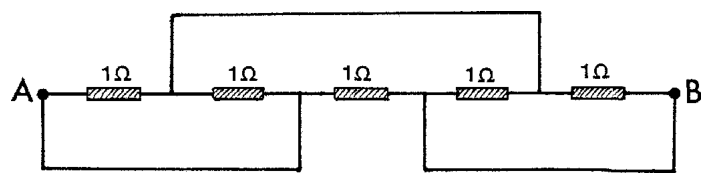
Determine the resulting resistance \(R\) between A and B. (1 point)
b)
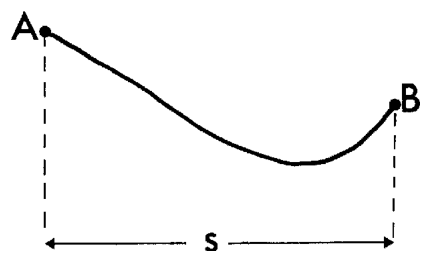
A skier starts from rest at point A and slides down the hill, without turning or braking. The friction coefficient is \(\mu\). When he stops at point B, his horizontal displacement is \(s\). What is the height difference \(h\) between points A and B?
(The velocity of the skier is small so that the additional pressure on the snow due to the curvature can be neglected. Neglect also the friction of air and the dependence of \(\mu\) on the velocity of the skier.) (1.5 points)
c) A thermally insulated piece of metal is heated under atmospheric pressure by an electric current so that it receives electric energy at a constant power \(P\). This leads to an increase of the absolute temperature \(T\) of the metal with time \(t\) as follows:
\[ T(t)=T_0\left[1+a(t-t_0)\right]^{1/4}. \]
Here \(a\), \(t_0\) and \(T_0\) are constants. Determine the heat capacity \(C_p(T)\) of the metal (temperature dependent in the temperature range of the experiment). (2 points)
d) A black plane surface at a constant high temperature \(T_h\) is parallel to another black plane surface at a constant lower temperature \(T_l\). Between the plates is vacuum.
In order to reduce the heat flow due to radiation, a heat shield consisting of two thin black plates, thermally isolated from each other, is placed between the warm and the cold surfaces and parallel to these. After some time stationary conditions are obtained.
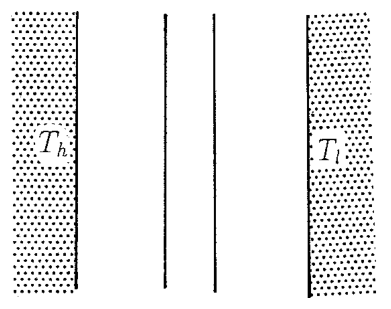
By what factor \(\xi\) is the stationary heat flow reduced due to the presence of the heat shield? Neglect end effects due to the finite size of the surfaces. (1.5 points)
e) Two straight and very long nonmagnetic conductors \(C_+\) and \(C_-\), insulated from each other, carry a current \(I\) in the positive and the negative \(z\) direction, respectively. The cross sections of the conductors (hatched in the figure) are limited by circles of diameter \(D\) in the \(x\)-\(y\) plane, with a distance \(D/2\) between the centres. Thereby the resulting cross sections each have an area \(\left(\frac{1}{12}\pi+\frac{1}{8}\sqrt{3}\right)D^2\). The current in each conductor is uniformly distributed over the cross section.
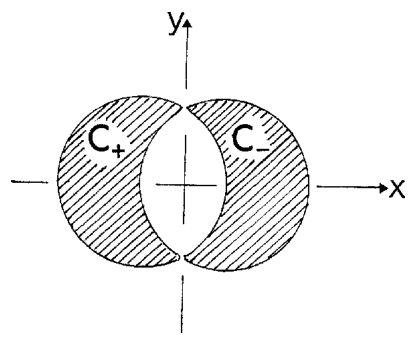
Determine the magnetic field \(B(x,y)\) in the space between the conductors. (4 points)
Official English text of the problem.
Answers
- a) \(\displaystyle R=\frac12\,\Omega=0.5\,\Omega.\)
- b) \(\displaystyle h=\mu s\), with A higher than B.
- c) \(\displaystyle C_p(T)=\frac{4PT^3}{aT_0^4}\), in \(\mathrm{J\,K^{-1}}\) when SI units are used.
- d) \(\displaystyle \dot Q_{\mathrm{shield}}=\frac{\dot Q_0}{3}\): a threefold reduction, \(\displaystyle \xi=\frac{\dot Q_0}{\dot Q_{\mathrm{shield}}}=3.\)
- e) Throughout the lens-shaped gap, \[ \boxed{\mathbf B(x,y)=\frac{6\mu_0 I}{(2\pi+3\sqrt3)D}\,\hat{\mathbf y}.} \] The field is uniform and points in the positive \(y\) direction.
Solution
a)
Let each resistance be \(r=1\,\Omega\), and label the four interior junctions \(N_1,N_2,N_3,N_4\) from left to right. The ideal connecting wires identify the following nodes:
\[ A=N_2,\qquad N_1=N_4=X,\qquad N_3=B. \]
Consequently, the first and second resistors both connect A to X and are in parallel. The fourth and fifth both connect X to B and are also in parallel:
\[ R_{AX}=R_{XB}=\frac r2. \]
These two equivalent resistances form a series branch from A to B, of resistance \(r/2+r/2=r\). The third resistor connects A directly to B, providing another branch of resistance \(r\). Thus
\[ \frac1R=\frac1r+\frac1r, \qquad \boxed{R=\frac r2=0.5\,\Omega.} \]
b)
Let \(\theta\) be the local angle of the skier’s path to the horizontal and \(d\ell\) an element of path length. Neglecting the additional normal force due to curvature, as instructed, gives
\[ N=mg\cos\theta. \]
The friction force has magnitude \(\mu N\) and opposes the motion. The energy dissipated over the path is therefore
\[ E_{\mathrm{fr}} =\int_A^B \mu mg\cos\theta\,d\ell. \]
For the path shown, the horizontal coordinate increases throughout the motion, and
\[ dx=\cos\theta\,d\ell. \]
It follows that
\[ E_{\mathrm{fr}}=\mu mg\int_A^B dx=\mu mgs. \]
The skier starts and ends at rest, so the loss of gravitational potential energy equals the energy dissipated by friction. Writing \(h=y_A-y_B\),
\[ mgh=\mu mgs, \qquad \boxed{h=\mu s.} \]
Within the stated approximation, the result depends only on the horizontal displacement.
c)
The metal is thermally insulated, but electrical work supplies energy at rate \(P\). At constant atmospheric pressure \(p\), the first law gives
\[ dU=P\,dt-p\,dV. \]
Since the enthalpy is \(H=U+pV\), and \(dp=0\),
\[ dH=P\,dt. \]
Using the total heat capacity of the piece at constant pressure,
\[ C_p(T)=\left(\frac{\partial H}{\partial T}\right)_p, \]
we obtain
\[ P=C_p(T)\frac{dT}{dt}. \]
Raise the given temperature law to the fourth power:
\[ T^4=T_0^4\left[1+a(t-t_0)\right]. \]
Differentiating,
\[ 4T^3\frac{dT}{dt}=aT_0^4. \]
Hence
\[ \boxed{C_p(T)=\frac{4PT^3}{aT_0^4} =\frac{4P}{aT_0}\left(\frac{T}{T_0}\right)^3.} \]
Thus the heat capacity is proportional to \(T^3\) over the experimental temperature range. Since \(a\) has units \(\mathrm{s^{-1}}\), the expression has units \(\mathrm{J\,K^{-1}}\).
d)
For two black parallel surfaces with negligible edge effects, the Stefan–Boltzmann law gives the net radiative heat flux
\[ q_0=\sigma\left(T_h^4-T_l^4\right) \]
before the shield is inserted.
Let \(T_1\) and \(T_2\) be the temperatures of the thin shield plates, ordered from the hot side to the cold side. Each thin plate has a common temperature on its two faces. At steady state, neither plate accumulates energy, so the net heat flux \(q\) is the same across all three vacuum gaps:
\[ q=\sigma(T_h^4-T_1^4) =\sigma(T_1^4-T_2^4) =\sigma(T_2^4-T_l^4). \]
Adding the three temperature differences gives
\[ 3q=\sigma(T_h^4-T_l^4)=q_0. \]
The same ratio applies to total heat flow:
\[ \boxed{\frac{\dot Q_{\mathrm{shield}}}{\dot Q_0}=\frac13.} \]
Therefore the heat flow is reduced by a factor
\[ \boxed{\xi=3.} \]
e)
Let the area of either actual conductor’s cross section be
\[ A_c=\left(\frac{\pi}{12}+\frac{\sqrt3}{8}\right)D^2. \]
The magnitude of the uniform current density is
\[ J=\frac{I}{A_c}. \]
The circles have radius \(D/2\). With the origin shown in the figure, their centres are
\[ \mathbf r_+=-\frac D4\,\hat{\mathbf x}, \qquad \mathbf r_-=\frac D4\,\hat{\mathbf x}. \]
Use superposition to represent the actual current distribution by two complete circular cylinders:
- a left cylinder carrying uniform current density \(+J\hat{\mathbf z}\);
- a right cylinder carrying uniform current density \(-J\hat{\mathbf z}\).
In their overlap, the two current densities cancel. In each crescent, the remaining current density is exactly that of the actual conductor. Thus this construction reproduces the physical current distribution.
For a very long circular cylinder carrying uniform current density \(J\hat{\mathbf z}\), cylindrical symmetry and Ampère’s law give, at an interior radius \(\rho\),
\[ B(\rho)\,2\pi\rho=\mu_0J\pi\rho^2, \qquad B(\rho)=\frac{\mu_0J\rho}{2}. \]
In vector form, for a cylinder centred at \(\mathbf r_c\),
\[ \mathbf B(\mathbf r) =\frac{\mu_0J}{2}\, \hat{\mathbf z}\times(\mathbf r-\mathbf r_c). \]
Every point in the lens-shaped gap is inside both fictitious cylinders. Their fields there are
\[ \begin{aligned} \mathbf B_+(x,y) &=\frac{\mu_0J}{2} \left[-y\,\hat{\mathbf x} +\left(x+\frac D4\right)\hat{\mathbf y}\right],\\ \mathbf B_-(x,y) &=\frac{\mu_0J}{2} \left[y\,\hat{\mathbf x} -\left(x-\frac D4\right)\hat{\mathbf y}\right]. \end{aligned} \]
Adding them cancels every coordinate-dependent term:
\[ \mathbf B(x,y) =\frac{\mu_0JD}{4}\,\hat{\mathbf y}. \]
Substituting \(J=I/A_c\),
\[ \boxed{ \mathbf B(x,y) =\frac{\mu_0 I D}{4A_c}\,\hat{\mathbf y} =\frac{6\mu_0 I}{(2\pi+3\sqrt3)D}\,\hat{\mathbf y}. } \]
This uniform field applies throughout the gap defined by the simultaneous inequalities
\[ \left(x+\frac D4\right)^2+y^2<\frac{D^2}{4}, \qquad \left(x-\frac D4\right)^2+y^2<\frac{D^2}{4}. \]
Its direction is upward in the figure, consistent with the right-hand rule for both currents.
The solution was checked against the official solution.
IPhO 1996 · Theorieaufgabe 1
Fünf voneinander unabhängige Kurzaufgaben (Widerstandsnetzwerk, Skifahrer auf einem Hügel, Wärmekapazität eines Metalls, Strahlungsschutzschild, Magnetfeld zwischen zwei Leitern)
(Die fünf Teile dieser Aufgabe sind voneinander unabhängig)
a) Fünf Widerstände von jeweils \(1\Omega\) sind wie in der Abbildung gezeigt miteinander verbunden. Der Widerstand der Verbindungsdrähte (durchgezogene Linien) ist vernachlässigbar.
Bestimmen Sie den Gesamtwiderstand \(R\) zwischen A und B. (1 Punkt)
b)
Ein Skifahrer startet aus der Ruhe am Punkt A und gleitet den Hügel hinunter, ohne Kurven zu fahren oder zu bremsen. Der Reibungskoeffizient ist \(\mu\). Wenn er am Punkt B zum Stillstand kommt, beträgt seine horizontale Verschiebung \(s\). Wie groß ist der Höhenunterschied \(h\) zwischen den Punkten A und B?
(Die Geschwindigkeit des Skifahrers ist so gering, dass der zusätzliche Druck auf den Schnee aufgrund der Bahnkrümmung vernachlässigt werden kann. Vernachlässigen Sie außerdem den Luftwiderstand und die Abhängigkeit von \(\mu\) von der Geschwindigkeit des Skifahrers.) (1.5 Punkte)
c) Ein thermisch isoliertes Metallstück wird bei Atmosphärendruck durch einen elektrischen Strom erwärmt, sodass ihm elektrische Energie mit konstanter Leistung \(P\) zugeführt wird. Dadurch steigt die absolute Temperatur \(T\) des Metalls mit der Zeit \(t\) gemäß:
\[ T(t)=T_0\left[1+a(t-t_0)\right]^{1/4}. \]
Dabei sind \(a\), \(t_0\) und \(T_0\) Konstanten. Bestimmen Sie die Wärmekapazität \(C_p(T)\) des Metalls (die im Temperaturbereich des Experiments temperaturabhängig ist). (2 Punkte)
d) Eine schwarze ebene Oberfläche mit einer konstanten hohen Temperatur \(T_h\) ist parallel zu einer anderen schwarzen ebenen Oberfläche mit einer konstanten niedrigeren Temperatur \(T_l\) angeordnet. Zwischen den Platten herrscht Vakuum.
Um den Wärmestrom durch Strahlung zu verringern, wird ein Strahlungsschutzschild aus zwei dünnen schwarzen, thermisch voneinander isolierten Platten zwischen der warmen und der kalten Oberfläche und parallel zu diesen angeordnet. Nach einiger Zeit stellt sich ein stationärer Zustand ein.
Um welchen Faktor \(\xi\) wird der stationäre Wärmestrom durch den Strahlungsschutzschild verringert? Vernachlässigen Sie Randeffekte aufgrund der endlichen Größe der Oberflächen. (1.5 Punkte)
e) Zwei gerade und sehr lange nichtmagnetische Leiter \(C_+\) und \(C_-\), die voneinander isoliert sind, führen jeweils einen Strom \(I\) in positiver beziehungsweise negativer \(z\)-Richtung. Die Querschnitte der Leiter (in der Abbildung schraffiert) werden durch Kreise mit dem Durchmesser \(D\) in der \(x\)-\(y\)-Ebene begrenzt, deren Mittelpunkte den Abstand \(D/2\) voneinander haben. Die sich daraus ergebenden Querschnitte haben jeweils eine Fläche von \(\left(\frac{1}{12}\pi+\frac{1}{8}\sqrt{3}\right)D^2\). Der Strom ist in jedem Leiter gleichmäßig über den Querschnitt verteilt.
Bestimmen Sie das Magnetfeld \(B(x,y)\) im Raum zwischen den Leitern. (4 Punkte)
Aufgabentext aus dem offiziellen englischen Text übersetzt.
Antworten
- a) \(\displaystyle R=\frac12\,\Omega=0.5\,\Omega.\)
- b) \(\displaystyle h=\mu s\), wobei A höher liegt als B.
- c) \(\displaystyle C_p(T)=\frac{4PT^3}{aT_0^4}\), in \(\mathrm{J\,K^{-1}}\) bei Verwendung von SI-Einheiten.
- d) \(\displaystyle \dot Q_{\mathrm{shield}}=\frac{\dot Q_0}{3}\): eine Verringerung um den Faktor drei, \(\displaystyle \xi=\frac{\dot Q_0}{\dot Q_{\mathrm{shield}}}=3.\)
- e) Im gesamten linsenförmigen Zwischenraum gilt \[ \boxed{\mathbf B(x,y)=\frac{6\mu_0 I}{(2\pi+3\sqrt3)D}\,\hat{\mathbf y}.} \] Das Feld ist homogen und zeigt in die positive \(y\)-Richtung.
Lösung
a)
Jeder Widerstand sei \(r=1\,\Omega\), und die vier inneren Knoten seien von links nach rechts mit \(N_1,N_2,N_3,N_4\) bezeichnet. Durch die idealen Verbindungsdrähte fallen die folgenden Knoten jeweils zusammen:
\[ A=N_2,\qquad N_1=N_4=X,\qquad N_3=B. \]
Folglich verbinden sowohl der erste als auch der zweite Widerstand A mit X und sind parallel geschaltet. Der vierte und der fünfte verbinden beide X mit B und sind ebenfalls parallel geschaltet:
\[ R_{AX}=R_{XB}=\frac r2. \]
Diese beiden Ersatzwiderstände bilden einen Zweig von A nach B, in dem sie in Reihe geschaltet sind und dessen Widerstand \(r/2+r/2=r\) beträgt. Der dritte Widerstand verbindet A direkt mit B und bildet damit einen weiteren Zweig mit dem Widerstand \(r\). Somit gilt
\[ \frac1R=\frac1r+\frac1r, \qquad \boxed{R=\frac r2=0.5\,\Omega.} \]
b)
Es sei \(\theta\) der lokale Winkel der Bahn des Skifahrers zur Horizontalen und \(d\ell\) ein Bahnlängenelement. Vernachlässigt man wie vorgegeben die zusätzliche Normalkraft aufgrund der Bahnkrümmung, so ergibt sich
\[ N=mg\cos\theta. \]
Die Reibungskraft hat den Betrag \(\mu N\) und wirkt der Bewegung entgegen. Die entlang der Bahn dissipierte Energie beträgt daher
\[ E_{\mathrm{fr}} =\int_A^B \mu mg\cos\theta\,d\ell. \]
Bei der dargestellten Bahn nimmt die horizontale Koordinate während der gesamten Bewegung zu, und es gilt
\[ dx=\cos\theta\,d\ell. \]
Daraus folgt
\[ E_{\mathrm{fr}}=\mu mg\int_A^B dx=\mu mgs. \]
Der Skifahrer ist sowohl am Anfang als auch am Ende in Ruhe, sodass die Abnahme der potenziellen Energie im Schwerefeld gleich der durch Reibung dissipierten Energie ist. Mit \(h=y_A-y_B\) ergibt sich
\[ mgh=\mu mgs, \qquad \boxed{h=\mu s.} \]
Im Rahmen der angegebenen Näherung hängt das Ergebnis nur von der horizontalen Verschiebung ab.
c)
Das Metall ist thermisch isoliert, doch durch elektrische Arbeit wird ihm Energie mit der Leistung \(P\) zugeführt. Bei konstantem Atmosphärendruck \(p\) liefert der erste Hauptsatz
\[ dU=P\,dt-p\,dV. \]
Da die Enthalpie \(H=U+pV\) ist und \(dp=0\) gilt, folgt
\[ dH=P\,dt. \]
Mit der gesamten Wärmekapazität des Metallstücks bei konstantem Druck,
\[ C_p(T)=\left(\frac{\partial H}{\partial T}\right)_p, \]
erhalten wir
\[ P=C_p(T)\frac{dT}{dt}. \]
Wir erheben das gegebene Temperaturgesetz zur vierten Potenz:
\[ T^4=T_0^4\left[1+a(t-t_0)\right]. \]
Durch Differenzieren ergibt sich
\[ 4T^3\frac{dT}{dt}=aT_0^4. \]
Damit folgt
\[ \boxed{C_p(T)=\frac{4PT^3}{aT_0^4} =\frac{4P}{aT_0}\left(\frac{T}{T_0}\right)^3.} \]
Die Wärmekapazität ist somit im Temperaturbereich des Experiments proportional zu \(T^3\). Da \(a\) die Einheit \(\mathrm{s^{-1}}\) hat, hat der Ausdruck die Einheit \(\mathrm{J\,K^{-1}}\).
d)
Für zwei schwarze parallele Oberflächen mit vernachlässigbaren Randeffekten liefert das Stefan–Boltzmann-Gesetz die Nettowärmestromdichte durch Strahlung
\[ q_0=\sigma\left(T_h^4-T_l^4\right) \]
vor dem Einsetzen des Strahlungsschutzschilds.
Es seien \(T_1\) und \(T_2\) die Temperaturen der dünnen Platten des Strahlungsschutzschilds, geordnet von der heißen zur kalten Seite. Jede dünne Platte hat auf ihren beiden Seiten dieselbe Temperatur. Im stationären Zustand speichert keine der Platten zusätzliche Energie, sodass die Nettowärmestromdichte \(q\) in allen drei Vakuumzwischenräumen gleich ist:
\[ q=\sigma(T_h^4-T_1^4) =\sigma(T_1^4-T_2^4) =\sigma(T_2^4-T_l^4). \]
Durch Addition der drei Differenzen der vierten Potenzen der Temperaturen ergibt sich
\[ 3q=\sigma(T_h^4-T_l^4)=q_0. \]
Dasselbe Verhältnis gilt für den gesamten Wärmestrom:
\[ \boxed{\frac{\dot Q_{\mathrm{shield}}}{\dot Q_0}=\frac13.} \]
Der Wärmestrom wird daher um den folgenden Faktor verringert:
\[ \boxed{\xi=3.} \]
e)
Die Querschnittsfläche jedes der beiden tatsächlichen Leiter sei
\[ A_c=\left(\frac{\pi}{12}+\frac{\sqrt3}{8}\right)D^2. \]
Der Betrag der homogenen Stromdichte ist
\[ J=\frac{I}{A_c}. \]
Die Kreise haben den Radius \(D/2\). Bezüglich des in der Abbildung dargestellten Ursprungs liegen ihre Mittelpunkte bei
\[ \mathbf r_+=-\frac D4\,\hat{\mathbf x}, \qquad \mathbf r_-=\frac D4\,\hat{\mathbf x}. \]
Mithilfe des Superpositionsprinzips stellen wir die tatsächliche Stromverteilung durch zwei vollständige Kreiszylinder dar:
- einen linken Zylinder mit der homogenen Stromdichte \(+J\hat{\mathbf z}\);
- einen rechten Zylinder mit der homogenen Stromdichte \(-J\hat{\mathbf z}\).
In ihrem Überlappungsbereich heben sich die beiden Stromdichten auf. In jedem sichelförmigen Bereich entspricht die verbleibende Stromdichte genau derjenigen des tatsächlichen Leiters. Diese Konstruktion bildet somit die physikalische Stromverteilung nach.
Für einen sehr langen Kreiszylinder mit homogener Stromdichte \(J\hat{\mathbf z}\) ergeben die Zylindersymmetrie und das ampèresche Gesetz bei einem radialen Abstand \(\rho\) im Inneren
\[ B(\rho)\,2\pi\rho=\mu_0J\pi\rho^2, \qquad B(\rho)=\frac{\mu_0J\rho}{2}. \]
In Vektorform gilt für einen Zylinder mit dem Mittelpunkt \(\mathbf r_c\)
\[ \mathbf B(\mathbf r) =\frac{\mu_0J}{2}\, \hat{\mathbf z}\times(\mathbf r-\mathbf r_c). \]
Jeder Punkt im linsenförmigen Zwischenraum liegt innerhalb beider fiktiven Zylinder. Ihre Felder sind dort
\[ \begin{aligned} \mathbf B_+(x,y) &=\frac{\mu_0J}{2} \left[-y\,\hat{\mathbf x} +\left(x+\frac D4\right)\hat{\mathbf y}\right],\\ \mathbf B_-(x,y) &=\frac{\mu_0J}{2} \left[y\,\hat{\mathbf x} -\left(x-\frac D4\right)\hat{\mathbf y}\right]. \end{aligned} \]
Bei ihrer Addition heben sich sämtliche koordinatenabhängigen Terme auf:
\[ \mathbf B(x,y) =\frac{\mu_0JD}{4}\,\hat{\mathbf y}. \]
Durch Einsetzen von \(J=I/A_c\) ergibt sich
\[ \boxed{ \mathbf B(x,y) =\frac{\mu_0 I D}{4A_c}\,\hat{\mathbf y} =\frac{6\mu_0 I}{(2\pi+3\sqrt3)D}\,\hat{\mathbf y}. } \]
Dieses homogene Feld gilt im gesamten Zwischenraum, der durch die gleichzeitig zu erfüllenden Ungleichungen
\[ \left(x+\frac D4\right)^2+y^2<\frac{D^2}{4}, \qquad \left(x-\frac D4\right)^2+y^2<\frac{D^2}{4} \]
definiert ist.
Seine Richtung ist in der Abbildung nach oben, im Einklang mit der Rechte-Hand-Regel für beide Ströme.
Die Lösung wurde mit der offiziellen Lösung abgeglichen.
IPhO 1996 · Teori sorusu 1
Birbirinden bağımsız beş kısa soru (direnç ağı, bir yamaçtaki kayakçı, bir metalin ısı kapasitesi, ışınımla ısı aktarımına karşı kalkan, iki iletken arasındaki manyetik alan)
(Bu sorunun beş kısmı birbirinden bağımsızdır)
a) Her biri \(1\Omega\) olan beş direnç, şekilde gösterildiği gibi bağlanmıştır. İletken tellerin (kesintisiz çizgiler) direnci ihmal edilebilir.
A ile B arasındaki eşdeğer direnç \(R\)'yi belirleyiniz. (1 puan)
b)
Bir kayakçı A noktasında durgun hâlden harekete başlar ve dönmeden ya da fren yapmadan yamaçtan aşağı kayar. Sürtünme katsayısı \(\mu\)'dür. B noktasında durduğunda yatay yer değiştirmesi \(s\)'dir. A ve B noktaları arasındaki yükseklik farkı \(h\) nedir?
(Kayakçının hızı, eğrilik nedeniyle kar üzerinde oluşan ek basıncın ihmal edilebileceği kadar küçüktür. Hava direncini ve \(\mu\)'nün kayakçının hızına bağımlılığını da ihmal ediniz.) (1.5 puan)
c) Isıl olarak yalıtılmış bir metal parçası, atmosfer basıncı altında elektrik akımıyla, sabit \(P\) gücünde elektrik enerjisi alacak şekilde ısıtılmaktadır. Bunun sonucunda metalin mutlak sıcaklığı \(T\), \(t\) zamanına bağlı olarak aşağıdaki gibi artmaktadır:
\[ T(t)=T_0\left[1+a(t-t_0)\right]^{1/4}. \]
Burada \(a\), \(t_0\) ve \(T_0\) sabitlerdir. Metalin (deneyin sıcaklık aralığında sıcaklığa bağlı olan) ısı kapasitesi \(C_p(T)\)'yi belirleyiniz. (2 puan)
d) Sabit ve yüksek bir \(T_h\) sıcaklığındaki siyah düzlem yüzey, sabit ve daha düşük bir \(T_l\) sıcaklığındaki başka bir siyah düzlem yüzeye paraleldir. Levhalar arasında vakum vardır.
Işınımla ısı aktarımını azaltmak amacıyla, birbirinden ısıl olarak yalıtılmış iki ince siyah levhadan oluşan bir ısı kalkanı, sıcak ve soğuk yüzeylerin arasına ve bu yüzeylere paralel olarak yerleştirilir. Bir süre sonra kararlı duruma ulaşılır.
Isı kalkanının varlığı, kararlı durumdaki ısı aktarım hızını hangi \(\xi\) çarpanı kadar azaltır? Yüzeylerin sonlu boyutlarından kaynaklanan kenar etkilerini ihmal ediniz. (1.5 puan)
e) Birbirinden yalıtılmış, düz ve çok uzun iki manyetik olmayan iletken \(C_+\) ve \(C_-\), sırasıyla pozitif ve negatif \(z\) yönünde \(I\) akımı taşımaktadır. İletkenlerin (şekilde taralı olarak gösterilen) kesitleri, \(x\)-\(y\) düzleminde merkezleri arasındaki uzaklık \(D/2\) olan, \(D\) çaplı çemberlerle sınırlanmıştır. Böylece oluşan kesitlerin her birinin alanı \(\left(\frac{1}{12}\pi+\frac{1}{8}\sqrt{3}\right)D^2\)'dir. Her bir iletkendeki akım, kesit boyunca düzgün dağılmıştır.
İletkenler arasındaki boşlukta manyetik alan \(B(x,y)\)'yi belirleyiniz. (4 puan)
Soru metni resmi İngilizce metinden çevrilmiştir.
Cevaplar
- a) \(\displaystyle R=\frac12\,\Omega=0.5\,\Omega.\)
- b) \(\displaystyle h=\mu s\); A, B'den daha yüksektedir.
- c) \(\displaystyle C_p(T)=\frac{4PT^3}{aT_0^4}\); SI birimleri kullanıldığında birimi \(\mathrm{J\,K^{-1}}\)'dir.
- d) \(\displaystyle \dot Q_{\mathrm{shield}}=\frac{\dot Q_0}{3}\): üç kat azalma, \(\displaystyle \xi=\frac{\dot Q_0}{\dot Q_{\mathrm{shield}}}=3.\)
- e) Mercek biçimindeki boşluğun tamamında, \[ \boxed{\mathbf B(x,y)=\frac{6\mu_0 I}{(2\pi+3\sqrt3)D}\,\hat{\mathbf y}.} \] Alan düzgündür ve pozitif \(y\) yönündedir.
Çözüm
a)
Her bir direnç \(r=1\,\Omega\) olsun ve içerideki dört bağlantı noktasını soldan sağa \(N_1,N_2,N_3,N_4\) olarak adlandıralım. İdeal bağlantı telleri, aşağıdaki noktaları aynı düğüm hâline getirir:
\[ A=N_2,\qquad N_1=N_4=X,\qquad N_3=B. \]
Dolayısıyla birinci ve ikinci dirençlerin ikisi de A ile X arasına bağlıdır ve birbirine paraleldir. Dördüncü ve beşinci dirençlerin ikisi de X ile B arasına bağlıdır ve bunlar da birbirine paraleldir:
\[ R_{AX}=R_{XB}=\frac r2. \]
Bu iki eşdeğer direnç, A'dan B'ye uzanan, direnci \(r/2+r/2=r\) olan seri bir kol oluşturur. Üçüncü direnç, A'yı doğrudan B'ye bağlayarak direnci \(r\) olan başka bir kol oluşturur. Böylece
\[ \frac1R=\frac1r+\frac1r, \qquad \boxed{R=\frac r2=0.5\,\Omega.} \]
b)
Kayakçının izlediği yolun yatayla yaptığı yerel açı \(\theta\), yol uzunluğunun bir elemanı ise \(d\ell\) olsun. Soruda belirtildiği gibi eğrilikten kaynaklanan ek normal kuvvet ihmal edildiğinde
\[ N=mg\cos\theta. \]
Sürtünme kuvvetinin büyüklüğü \(\mu N\)'dir ve yönü harekete zıttır. Bu nedenle yol boyunca sürtünmeyle harcanan enerji
\[ E_{\mathrm{fr}} =\int_A^B \mu mg\cos\theta\,d\ell. \]
Gösterilen yol için yatay koordinat hareket boyunca artar ve
\[ dx=\cos\theta\,d\ell. \]
Buradan
\[ E_{\mathrm{fr}}=\mu mg\int_A^B dx=\mu mgs. \]
Kayakçı harekete durgun hâlden başlayıp sonunda durduğundan, kütleçekim potansiyel enerjisindeki azalma sürtünmeyle harcanan enerjiye eşittir. \(h=y_A-y_B\) yazılırsa,
\[ mgh=\mu mgs, \qquad \boxed{h=\mu s.} \]
Belirtilen yaklaşım çerçevesinde sonuç yalnızca yatay yer değiştirmeye bağlıdır.
c)
Metal ısıl olarak yalıtılmıştır, ancak elektriksel iş yoluyla \(P\) hızında enerji sağlanır. Sabit atmosfer basıncı \(p\) altında, termodinamiğin birinci yasası
\[ dU=P\,dt-p\,dV. \]
Entalpi \(H=U+pV\) olduğundan ve \(dp=0\) olduğuna göre,
\[ dH=P\,dt. \]
Parçanın sabit basınçtaki toplam ısı kapasitesi
\[ C_p(T)=\left(\frac{\partial H}{\partial T}\right)_p, \]
kullanılarak
\[ P=C_p(T)\frac{dT}{dt}. \]
Verilen sıcaklık bağıntısının dördüncü kuvvetini alalım:
\[ T^4=T_0^4\left[1+a(t-t_0)\right]. \]
Türev alındığında,
\[ 4T^3\frac{dT}{dt}=aT_0^4. \]
Dolayısıyla
\[ \boxed{C_p(T)=\frac{4PT^3}{aT_0^4} =\frac{4P}{aT_0}\left(\frac{T}{T_0}\right)^3.} \]
Böylece ısı kapasitesi, deneyin sıcaklık aralığında \(T^3\) ile orantılıdır. \(a\)'nın birimi \(\mathrm{s^{-1}}\) olduğundan, ifadenin birimi \(\mathrm{J\,K^{-1}}\)'dir.
d)
Kenar etkilerinin ihmal edilebildiği iki siyah paralel yüzey için Stefan–Boltzmann yasası, kalkan yerleştirilmeden önceki net ışınımla ısı akısını
\[ q_0=\sigma\left(T_h^4-T_l^4\right) \]
olarak verir.
İnce kalkan levhalarının sıcaklıkları, sıcak taraftan soğuk tarafa doğru sırasıyla \(T_1\) ve \(T_2\) olsun. Her ince levhanın iki yüzü aynı sıcaklıktadır. Kararlı durumda levhaların hiçbirinde enerji birikmez; dolayısıyla net ısı akısı \(q\), üç vakum aralığının tümünde aynıdır:
\[ q=\sigma(T_h^4-T_1^4) =\sigma(T_1^4-T_2^4) =\sigma(T_2^4-T_l^4). \]
Üç sıcaklık farkı toplandığında
\[ 3q=\sigma(T_h^4-T_l^4)=q_0. \]
Aynı oran, toplam ısı aktarım hızı için de geçerlidir:
\[ \boxed{\frac{\dot Q_{\mathrm{shield}}}{\dot Q_0}=\frac13.} \]
Dolayısıyla ısı aktarım hızı şu çarpan kadar azalır:
\[ \boxed{\xi=3.} \]
e)
Gerçek iletkenlerden herhangi birinin kesit alanı
\[ A_c=\left(\frac{\pi}{12}+\frac{\sqrt3}{8}\right)D^2. \]
Düzgün akım yoğunluğunun büyüklüğü
\[ J=\frac{I}{A_c}. \]
Çemberlerin yarıçapı \(D/2\)'dir. Şekilde gösterilen koordinat başlangıcına göre merkezleri
\[ \mathbf r_+=-\frac D4\,\hat{\mathbf x}, \qquad \mathbf r_-=\frac D4\,\hat{\mathbf x}. \]
Gerçek akım dağılımını, süperpozisyon ilkesini kullanarak iki tam dairesel silindirle temsil edelim:
- düzgün akım yoğunluğu \(+J\hat{\mathbf z}\) olan bir sol silindir;
- düzgün akım yoğunluğu \(-J\hat{\mathbf z}\) olan bir sağ silindir.
Örtüşme bölgelerinde iki akım yoğunluğu birbirini yok eder. Her hilal biçimli bölgede kalan akım yoğunluğu, gerçek iletkeninkiyle tam olarak aynıdır. Böylece bu kurgu, fiziksel akım dağılımını aynen verir.
Düzgün akım yoğunluğu \(J\hat{\mathbf z}\) olan çok uzun bir dairesel silindir için silindirik simetri ve Ampère yasası, silindirin içindeki \(\rho\) yarıçapında
\[ B(\rho)\,2\pi\rho=\mu_0J\pi\rho^2, \qquad B(\rho)=\frac{\mu_0J\rho}{2}. \]
Merkezi \(\mathbf r_c\) olan bir silindir için vektörel biçimde,
\[ \mathbf B(\mathbf r) =\frac{\mu_0J}{2}\, \hat{\mathbf z}\times(\mathbf r-\mathbf r_c). \]
Mercek biçimindeki boşluğun her noktası, her iki varsayımsal silindirin de içindedir. Bu bölgedeki alanları
\[ \begin{aligned} \mathbf B_+(x,y) &=\frac{\mu_0J}{2} \left[-y\,\hat{\mathbf x} +\left(x+\frac D4\right)\hat{\mathbf y}\right],\\ \mathbf B_-(x,y) &=\frac{\mu_0J}{2} \left[y\,\hat{\mathbf x} -\left(x-\frac D4\right)\hat{\mathbf y}\right]. \end{aligned} \]
Bu alanlar toplandığında koordinatlara bağlı tüm terimler birbirini götürür:
\[ \mathbf B(x,y) =\frac{\mu_0JD}{4}\,\hat{\mathbf y}. \]
\(J=I/A_c\) yerine konulduğunda,
\[ \boxed{ \mathbf B(x,y) =\frac{\mu_0 I D}{4A_c}\,\hat{\mathbf y} =\frac{6\mu_0 I}{(2\pi+3\sqrt3)D}\,\hat{\mathbf y}. } \]
Bu düzgün alan, aşağıdaki eşitsizliklerin aynı anda sağlandığı boşluğun tamamında geçerlidir:
\[ \left(x+\frac D4\right)^2+y^2<\frac{D^2}{4}, \qquad \left(x-\frac D4\right)^2+y^2<\frac{D^2}{4}. \]
Alanın yönü, her iki akım için de sağ el kuralıyla uyumlu olarak, şekilde yukarı doğrudur.
Çözüm, resmi çözümle karşılaştırılarak kontrol edildi.
IPhO 1996 · Problema teórico 1
Cinco problemas breves independientes (red de resistencias, esquiador en una colina, capacidad calorífica de un metal, pantalla térmica contra la radiación, campo magnético entre dos conductores)
(Las cinco partes de este problema son independientes)
a) Se conectan cinco resistencias de \(1\Omega\) como se muestra en la figura. La resistencia de los cables conductores (líneas continuas) es despreciable.
Determine la resistencia equivalente \(R\) entre A y B. (1 punto)
b)
Un esquiador parte del reposo en el punto A y se desliza colina abajo, sin girar ni frenar. El coeficiente de rozamiento es \(\mu\). Cuando se detiene en el punto B, su desplazamiento horizontal es \(s\). ¿Cuál es la diferencia de altura \(h\) entre los puntos A y B?
(La velocidad del esquiador es pequeña, de modo que puede despreciarse la presión adicional sobre la nieve debida a la curvatura. Desprecie también la resistencia del aire y la dependencia de \(\mu\) respecto de la velocidad del esquiador.) (1.5 puntos)
c) Una pieza de metal térmicamente aislada se calienta a presión atmosférica mediante una corriente eléctrica, de modo que recibe energía eléctrica a una potencia constante \(P\). Esto provoca un aumento de la temperatura absoluta \(T\) del metal con el tiempo \(t\) de la siguiente forma:
\[ T(t)=T_0\left[1+a(t-t_0)\right]^{1/4}. \]
Aquí \(a\), \(t_0\) y \(T_0\) son constantes. Determine la capacidad calorífica \(C_p(T)\) del metal (dependiente de la temperatura en el intervalo de temperaturas del experimento). (2 puntos)
d) Una superficie plana negra a una temperatura alta constante \(T_h\) es paralela a otra superficie plana negra a una temperatura inferior constante \(T_l\). Entre las placas hay vacío.
Para reducir el flujo de calor por radiación, se coloca entre las superficies caliente y fría, y paralelamente a ellas, una pantalla térmica formada por dos placas negras delgadas, térmicamente aisladas entre sí. Transcurrido cierto tiempo, se alcanza un estado estacionario.
¿Por qué factor \(\xi\) se reduce el flujo de calor estacionario debido a la presencia de la pantalla térmica? Desprecie los efectos de borde debidos al tamaño finito de las superficies. (1.5 puntos)
e) Dos conductores rectos, muy largos y no magnéticos, \(C_+\) y \(C_-\), aislados entre sí, transportan una corriente \(I\) en los sentidos positivo y negativo del eje \(z\), respectivamente. Las secciones transversales de los conductores (rayadas en la figura) están delimitadas por circunferencias de diámetro \(D\) en el plano \(x\)-\(y\), con una distancia \(D/2\) entre sus centros. Así, cada una de las secciones transversales resultantes tiene un área \(\left(\frac{1}{12}\pi+\frac{1}{8}\sqrt{3}\right)D^2\). La corriente en cada conductor está distribuida uniformemente por la sección transversal.
Determine el campo magnético \(B(x,y)\) en el espacio entre los conductores. (4 puntos)
Enunciado traducido del texto oficial en inglés.
Respuestas
- a) \(\displaystyle R=\frac12\,\Omega=0.5\,\Omega.\)
- b) \(\displaystyle h=\mu s\), con A más alto que B.
- c) \(\displaystyle C_p(T)=\frac{4PT^3}{aT_0^4}\), en \(\mathrm{J\,K^{-1}}\) cuando se utilizan unidades del SI.
- d) \(\displaystyle \dot Q_{\mathrm{shield}}=\frac{\dot Q_0}{3}\): una reducción por un factor de tres, \(\displaystyle \xi=\frac{\dot Q_0}{\dot Q_{\mathrm{shield}}}=3.\)
- e) En todo el hueco en forma de lente, \[ \boxed{\mathbf B(x,y)=\frac{6\mu_0 I}{(2\pi+3\sqrt3)D}\,\hat{\mathbf y}.} \] El campo es uniforme y apunta en el sentido positivo del eje \(y\).
Solución
a)
Sea cada resistencia \(r=1\,\Omega\), y designemos las cuatro uniones interiores como \(N_1,N_2,N_3,N_4\), de izquierda a derecha. Los cables de conexión ideales hacen que los siguientes puntos correspondan a los mismos nodos:
\[ A=N_2,\qquad N_1=N_4=X,\qquad N_3=B. \]
Por consiguiente, la primera y la segunda resistencia conectan ambas A con X y están en paralelo. La cuarta y la quinta conectan ambas X con B y también están en paralelo:
\[ R_{AX}=R_{XB}=\frac r2. \]
Estas dos resistencias equivalentes forman una rama en serie de A a B, de resistencia \(r/2+r/2=r\). La tercera resistencia conecta A directamente con B, proporcionando otra rama de resistencia \(r\). Por tanto,
\[ \frac1R=\frac1r+\frac1r, \qquad \boxed{R=\frac r2=0.5\,\Omega.} \]
b)
Sea \(\theta\) el ángulo local de la trayectoria del esquiador con la horizontal y \(d\ell\) un elemento de longitud de la trayectoria. Al despreciar la fuerza normal adicional debida a la curvatura, como se indica, se obtiene
\[ N=mg\cos\theta. \]
La fuerza de rozamiento tiene módulo \(\mu N\) y se opone al movimiento. Por tanto, la energía disipada a lo largo de la trayectoria es
\[ E_{\mathrm{fr}} =\int_A^B \mu mg\cos\theta\,d\ell. \]
Para la trayectoria mostrada, la coordenada horizontal aumenta durante todo el movimiento, y
\[ dx=\cos\theta\,d\ell. \]
De ello se deduce que
\[ E_{\mathrm{fr}}=\mu mg\int_A^B dx=\mu mgs. \]
El esquiador comienza y termina en reposo, por lo que la pérdida de energía potencial gravitatoria es igual a la energía disipada por rozamiento. Escribiendo \(h=y_A-y_B\),
\[ mgh=\mu mgs, \qquad \boxed{h=\mu s.} \]
Dentro de la aproximación indicada, el resultado depende únicamente del desplazamiento horizontal.
c)
El metal está térmicamente aislado, pero el trabajo eléctrico suministra energía a un ritmo \(P\). A presión atmosférica constante \(p\), el primer principio de la termodinámica da
\[ dU=P\,dt-p\,dV. \]
Puesto que la entalpía es \(H=U+pV\), y \(dp=0\),
\[ dH=P\,dt. \]
Utilizando la capacidad calorífica total de la pieza a presión constante,
\[ C_p(T)=\left(\frac{\partial H}{\partial T}\right)_p, \]
obtenemos
\[ P=C_p(T)\frac{dT}{dt}. \]
Elevamos a la cuarta potencia la ley de temperatura dada:
\[ T^4=T_0^4\left[1+a(t-t_0)\right]. \]
Derivando,
\[ 4T^3\frac{dT}{dt}=aT_0^4. \]
Por tanto,
\[ \boxed{C_p(T)=\frac{4PT^3}{aT_0^4} =\frac{4P}{aT_0}\left(\frac{T}{T_0}\right)^3.} \]
Así pues, la capacidad calorífica es proporcional a \(T^3\) en el intervalo de temperaturas del experimento. Puesto que \(a\) tiene unidades de \(\mathrm{s^{-1}}\), la expresión tiene unidades de \(\mathrm{J\,K^{-1}}\).
d)
Para dos superficies negras paralelas con efectos de borde despreciables, la ley de Stefan–Boltzmann da la densidad de flujo de calor neto por radiación
\[ q_0=\sigma\left(T_h^4-T_l^4\right) \]
antes de insertar la pantalla.
Sean \(T_1\) y \(T_2\) las temperaturas de las placas delgadas de la pantalla, ordenadas desde el lado caliente hacia el lado frío. Cada placa delgada tiene la misma temperatura en sus dos caras. En el estado estacionario, ninguna placa acumula energía, por lo que la densidad de flujo de calor neto \(q\) es la misma a través de los tres espacios de vacío:
\[ q=\sigma(T_h^4-T_1^4) =\sigma(T_1^4-T_2^4) =\sigma(T_2^4-T_l^4). \]
Al sumar las tres diferencias de temperatura se obtiene
\[ 3q=\sigma(T_h^4-T_l^4)=q_0. \]
La misma razón se aplica al flujo total de calor:
\[ \boxed{\frac{\dot Q_{\mathrm{shield}}}{\dot Q_0}=\frac13.} \]
Por tanto, el flujo de calor se reduce por un factor
\[ \boxed{\xi=3.} \]
e)
Sea el área de la sección transversal de cualquiera de los conductores reales
\[ A_c=\left(\frac{\pi}{12}+\frac{\sqrt3}{8}\right)D^2. \]
El módulo de la densidad de corriente uniforme es
\[ J=\frac{I}{A_c}. \]
Las circunferencias tienen radio \(D/2\). Con el origen mostrado en la figura, sus centros son
\[ \mathbf r_+=-\frac D4\,\hat{\mathbf x}, \qquad \mathbf r_-=\frac D4\,\hat{\mathbf x}. \]
Utilizamos el principio de superposición para representar la distribución real de corriente mediante dos cilindros circulares completos:
- un cilindro izquierdo con una densidad de corriente uniforme \(+J\hat{\mathbf z}\);
- un cilindro derecho con una densidad de corriente uniforme \(-J\hat{\mathbf z}\).
En la región donde se solapan, las dos densidades de corriente se cancelan. En cada región en forma de media luna, la densidad de corriente restante es exactamente la del conductor real. Por tanto, esta construcción reproduce la distribución física de corriente.
Para un cilindro circular muy largo con una densidad de corriente uniforme \(J\hat{\mathbf z}\), la simetría cilíndrica y la ley de Ampère dan, a una distancia radial interior \(\rho\),
\[ B(\rho)\,2\pi\rho=\mu_0J\pi\rho^2, \qquad B(\rho)=\frac{\mu_0J\rho}{2}. \]
En forma vectorial, para un cilindro centrado en \(\mathbf r_c\),
\[ \mathbf B(\mathbf r) =\frac{\mu_0J}{2}\, \hat{\mathbf z}\times(\mathbf r-\mathbf r_c). \]
Todos los puntos del hueco en forma de lente están dentro de ambos cilindros ficticios. Sus campos en esa región son
\[ \begin{aligned} \mathbf B_+(x,y) &=\frac{\mu_0J}{2} \left[-y\,\hat{\mathbf x} +\left(x+\frac D4\right)\hat{\mathbf y}\right],\\ \mathbf B_-(x,y) &=\frac{\mu_0J}{2} \left[y\,\hat{\mathbf x} -\left(x-\frac D4\right)\hat{\mathbf y}\right]. \end{aligned} \]
Al sumarlos, se cancelan todos los términos que dependen de las coordenadas:
\[ \mathbf B(x,y) =\frac{\mu_0JD}{4}\,\hat{\mathbf y}. \]
Sustituyendo \(J=I/A_c\),
\[ \boxed{ \mathbf B(x,y) =\frac{\mu_0 I D}{4A_c}\,\hat{\mathbf y} =\frac{6\mu_0 I}{(2\pi+3\sqrt3)D}\,\hat{\mathbf y}. } \]
Este campo uniforme es válido en todo el hueco definido por las desigualdades simultáneas
\[ \left(x+\frac D4\right)^2+y^2<\frac{D^2}{4}, \qquad \left(x-\frac D4\right)^2+y^2<\frac{D^2}{4}. \]
Su dirección es hacia arriba en la figura, de acuerdo con la regla de la mano derecha para ambas corrientes.
La solución se comprobó con la solución oficial.
IPhO 1996 · 理论题 1
五道互不相关的短题(电阻网络、山坡上的滑雪者、金属的热容、辐射隔热屏、两导体之间的磁场)
(本题的五个部分互不相关)
a) 五个阻值为 \(1\Omega\) 的电阻如图所示连接。导线(实线)的电阻可以忽略不计。
求 A、B 之间的等效电阻 \(R\)。(1 分)
b)
一名滑雪者从 A 点由静止开始沿山坡滑下,途中既不转弯也不制动。摩擦系数为 \(\mu\)。当他在 B 点停下时,水平位移为 \(s\)。A、B 两点之间的高度差 \(h\) 是多少?
(滑雪者的速度很小,因此可以忽略轨迹弯曲引起的对雪面的附加压力。也忽略空气阻力以及 \(\mu\) 随滑雪者速度的变化。)(1.5 分)
c) 一块与外界绝热的金属在大气压下由电流加热,以恒定功率 \(P\) 接收电能。这使金属的绝对温度 \(T\) 随时间 \(t\) 按下式升高:
\[ T(t)=T_0\left[1+a(t-t_0)\right]^{1/4}. \]
其中 \(a\)、\(t_0\) 和 \(T_0\) 为常量。求金属的热容 \(C_p(T)\)(在实验温度范围内随温度变化)。(2 分)
d) 一个保持恒定高温 \(T_h\) 的黑体平面与另一个保持恒定较低温度 \(T_l\) 的黑体平面相互平行。两板之间为真空。
为减少辐射传热,在热表面与冷表面之间放置一个由两块相互绝热的黑体薄板组成的隔热屏,使其与这两个表面平行。经过一段时间后,系统达到稳态。
由于隔热屏的存在,稳态热流率降至原来的几分之一,即减小因子 \(\xi\) 为多少?忽略表面尺寸有限所引起的边缘效应。(1.5 分)
e) 两根相互绝缘、很长的非磁性直导体 \(C_+\) 和 \(C_-\) 分别沿 \(z\) 轴正方向和负方向通有电流 \(I\)。导体的横截面(图中阴影部分)由 \(x\)-\(y\) 平面内直径为 \(D\) 的圆限定,两圆圆心的间距为 \(D/2\)。由此得到的两个横截面的面积均为 \(\left(\frac{1}{12}\pi+\frac{1}{8}\sqrt{3}\right)D^2\)。每根导体中的电流均匀分布在其横截面上。
求两导体之间空间内的磁场 \(B(x,y)\)。(4 分)
题目译自官方英文原文。
答案
- a) \(\displaystyle R=\frac12\,\Omega=0.5\,\Omega.\)
- b) \(\displaystyle h=\mu s\),其中 A 点高于 B 点。
- c) \(\displaystyle C_p(T)=\frac{4PT^3}{aT_0^4}\),使用国际单位制时,单位为 \(\mathrm{J\,K^{-1}}\)。
- d) \(\displaystyle \dot Q_{\mathrm{shield}}=\frac{\dot Q_0}{3}\):减小至原来的三分之一,\(\displaystyle \xi=\frac{\dot Q_0}{\dot Q_{\mathrm{shield}}}=3.\)
- e) 在整个透镜形间隙内, \[ \boxed{\mathbf B(x,y)=\frac{6\mu_0 I}{(2\pi+3\sqrt3)D}\,\hat{\mathbf y}.} \] 磁场均匀,方向沿 \(y\) 轴正方向。
解答
a)
设每个电阻的阻值为 \(r=1\,\Omega\),并将内部的四个连接点从左到右依次标为 \(N_1,N_2,N_3,N_4\)。理想导线使下列各点分别归于同一节点:
\[ A=N_2,\qquad N_1=N_4=X,\qquad N_3=B. \]
因此,第一个和第二个电阻都连接在 A 与 X 之间,彼此并联。第四个和第五个电阻都连接在 X 与 B 之间,也彼此并联:
\[ R_{AX}=R_{XB}=\frac r2. \]
这两个等效电阻构成从 A 到 B 的一条串联支路,其电阻为 \(r/2+r/2=r\)。第三个电阻直接连接 A 与 B,构成另一条电阻为 \(r\) 的支路。因此
\[ \frac1R=\frac1r+\frac1r, \qquad \boxed{R=\frac r2=0.5\,\Omega.} \]
b)
设 \(\theta\) 为滑雪者轨迹在当地与水平方向的夹角,\(d\ell\) 为路程微元。按照题意,忽略轨迹弯曲引起的附加法向力,得到
\[ N=mg\cos\theta. \]
摩擦力的大小为 \(\mu N\),方向与运动方向相反。因此,沿整个路径耗散的能量为
\[ E_{\mathrm{fr}} =\int_A^B \mu mg\cos\theta\,d\ell. \]
对于图示路径,水平坐标在整个运动过程中始终增大,且
\[ dx=\cos\theta\,d\ell. \]
由此可得
\[ E_{\mathrm{fr}}=\mu mg\int_A^B dx=\mu mgs. \]
滑雪者在起点和终点均处于静止状态,因此减少的重力势能等于摩擦耗散的能量。令 \(h=y_A-y_B\),则
\[ mgh=\mu mgs, \qquad \boxed{h=\mu s.} \]
在题设近似下,结果仅取决于水平位移。
c)
金属与外界绝热,但电功以功率 \(P\) 向其输入能量。在恒定大气压 \(p\) 下,由热力学第一定律可得
\[ dU=P\,dt-p\,dV. \]
由于焓为 \(H=U+pV\),且 \(dp=0\),因此
\[ dH=P\,dt. \]
利用整块金属的定压热容
\[ C_p(T)=\left(\frac{\partial H}{\partial T}\right)_p, \]
得到
\[ P=C_p(T)\frac{dT}{dt}. \]
将给定温度变化规律的两边取四次方:
\[ T^4=T_0^4\left[1+a(t-t_0)\right]. \]
求导得
\[ 4T^3\frac{dT}{dt}=aT_0^4. \]
因此
\[ \boxed{C_p(T)=\frac{4PT^3}{aT_0^4} =\frac{4P}{aT_0}\left(\frac{T}{T_0}\right)^3.} \]
所以,在实验温度范围内,热容与 \(T^3\) 成正比。由于 \(a\) 的单位为 \(\mathrm{s^{-1}}\),该表达式的单位为 \(\mathrm{J\,K^{-1}}\)。
d)
对于边缘效应可忽略的两个平行黑体表面,由斯特藩–玻尔兹曼定律可得净辐射热流密度
\[ q_0=\sigma\left(T_h^4-T_l^4\right) \]
这是插入隔热屏之前的情形。
设隔热屏的两块薄板从热侧到冷侧的温度依次为 \(T_1\) 和 \(T_2\)。每块薄板的两个表面温度相同。在稳态下,两块板均不积累能量,因此通过三个真空间隙的净热流密度 \(q\) 均相同:
\[ q=\sigma(T_h^4-T_1^4) =\sigma(T_1^4-T_2^4) =\sigma(T_2^4-T_l^4). \]
将三个温度四次方之差相加,得到
\[ 3q=\sigma(T_h^4-T_l^4)=q_0. \]
总热流率也满足同样的比值关系:
\[ \boxed{\frac{\dot Q_{\mathrm{shield}}}{\dot Q_0}=\frac13.} \]
因此,热流率的减小因子为
\[ \boxed{\xi=3.} \]
e)
设任一实际导体的横截面积为
\[ A_c=\left(\frac{\pi}{12}+\frac{\sqrt3}{8}\right)D^2. \]
均匀电流密度的大小为
\[ J=\frac{I}{A_c}. \]
两圆的半径均为 \(D/2\)。取图示原点,两圆的圆心位置为
\[ \mathbf r_+=-\frac D4\,\hat{\mathbf x}, \qquad \mathbf r_-=\frac D4\,\hat{\mathbf x}. \]
利用叠加原理,将实际电流分布表示为两个完整圆柱体中电流分布的叠加:
- 左侧圆柱体内通有均匀电流密度 \(+J\hat{\mathbf z}\);
- 右侧圆柱体内通有均匀电流密度 \(-J\hat{\mathbf z}\)。
在两圆柱体的重叠区域内,两电流密度相互抵消。在每个月牙形区域内,剩余的电流密度恰好等于实际导体中的电流密度。因此,这一构造重现了实际的电流分布。
对于通有均匀电流密度 \(J\hat{\mathbf z}\) 的很长圆柱体,利用圆柱对称性和安培环路定律,在内部距轴线 \(\rho\) 处可得
\[ B(\rho)\,2\pi\rho=\mu_0J\pi\rho^2, \qquad B(\rho)=\frac{\mu_0J\rho}{2}. \]
对于中心位于 \(\mathbf r_c\) 的圆柱体,其矢量形式为
\[ \mathbf B(\mathbf r) =\frac{\mu_0J}{2}\, \hat{\mathbf z}\times(\mathbf r-\mathbf r_c). \]
透镜形间隙内的每一点都位于两个假想圆柱体的内部。它们在该处产生的磁场分别为
\[ \begin{aligned} \mathbf B_+(x,y) &=\frac{\mu_0J}{2} \left[-y\,\hat{\mathbf x} +\left(x+\frac D4\right)\hat{\mathbf y}\right],\\ \mathbf B_-(x,y) &=\frac{\mu_0J}{2} \left[y\,\hat{\mathbf x} -\left(x-\frac D4\right)\hat{\mathbf y}\right]. \end{aligned} \]
将两者相加,所有与坐标有关的项均相互抵消:
\[ \mathbf B(x,y) =\frac{\mu_0JD}{4}\,\hat{\mathbf y}. \]
代入 \(J=I/A_c\),得
\[ \boxed{ \mathbf B(x,y) =\frac{\mu_0 I D}{4A_c}\,\hat{\mathbf y} =\frac{6\mu_0 I}{(2\pi+3\sqrt3)D}\,\hat{\mathbf y}. } \]
这一均匀磁场适用于同时满足以下两个不等式所定义的整个间隙:
\[ \left(x+\frac D4\right)^2+y^2<\frac{D^2}{4}, \qquad \left(x-\frac D4\right)^2+y^2<\frac{D^2}{4}. \]
其方向在图中向上,与对两股电流分别应用右手定则所得的方向一致。
解答已与官方解答核对。
IPhO 1996 · Теоретическая задача 1
Пять независимых коротких задач (цепь резисторов, лыжник на склоне, теплоёмкость металла, радиационный тепловой экран, магнитное поле между двумя проводниками)
(Пять частей этой задачи не связаны между собой)
a) Пять резисторов сопротивлением \(1\Omega\) каждый соединены так, как показано на рисунке. Сопротивлением соединительных проводов (сплошные линии) можно пренебречь.
Определите эквивалентное сопротивление \(R\) между A и B. (1 балл)
b)
Лыжник начинает движение из состояния покоя в точке A и скользит вниз по склону, не поворачивая и не тормозя. Коэффициент трения равен \(\mu\). К моменту остановки в точке B его горизонтальное перемещение составляет \(s\). Какова разность высот \(h\) между точками A и B?
(Скорость лыжника мала, поэтому дополнительным давлением на снег, обусловленным кривизной траектории, можно пренебречь. Пренебрегите также сопротивлением воздуха и зависимостью \(\mu\) от скорости лыжника.) (1.5 балла)
c) Теплоизолированный кусок металла нагревают при атмосферном давлении электрическим током, подводя к нему электрическую энергию с постоянной мощностью \(P\). В результате абсолютная температура \(T\) металла возрастает со временем \(t\) по следующему закону:
\[ T(t)=T_0\left[1+a(t-t_0)\right]^{1/4}. \]
Здесь \(a\), \(t_0\) и \(T_0\) — постоянные. Определите теплоёмкость \(C_p(T)\) металла (зависящую от температуры в температурном диапазоне эксперимента). (2 балла)
d) Плоская абсолютно чёрная поверхность с постоянной высокой температурой \(T_h\) параллельна другой плоской абсолютно чёрной поверхности с постоянной более низкой температурой \(T_l\). Между пластинами — вакуум.
Для уменьшения теплового потока, передаваемого излучением, между горячей и холодной поверхностями параллельно им помещают тепловой экран, состоящий из двух тонких абсолютно чёрных пластин, теплоизолированных друг от друга. Через некоторое время устанавливается стационарный режим.
Во сколько раз \(\xi\) уменьшается стационарный тепловой поток благодаря наличию теплового экрана? Пренебрегите краевыми эффектами, связанными с конечными размерами поверхностей. (1.5 балла)
e) По двум прямым очень длинным немагнитным проводникам \(C_+\) и \(C_-\), изолированным друг от друга, течёт ток \(I\) соответственно в положительном и отрицательном направлениях оси \(z\). Поперечные сечения проводников (заштрихованные на рисунке) ограничены окружностями диаметра \(D\) в плоскости \(x\)-\(y\), расстояние между центрами которых равно \(D/2\). При этом площадь каждого из получающихся поперечных сечений равна \(\left(\frac{1}{12}\pi+\frac{1}{8}\sqrt{3}\right)D^2\). Ток в каждом проводнике равномерно распределён по поперечному сечению.
Определите магнитное поле \(B(x,y)\) в пространстве между проводниками. (4 балла)
Условие переведено с официального английского текста.
Ответы
- a) \(\displaystyle R=\frac12\,\Omega=0.5\,\Omega.\)
- b) \(\displaystyle h=\mu s\), причём A расположена выше B.
- c) \(\displaystyle C_p(T)=\frac{4PT^3}{aT_0^4}\), в \(\mathrm{J\,K^{-1}}\) при использовании единиц СИ.
- d) \(\displaystyle \dot Q_{\mathrm{shield}}=\frac{\dot Q_0}{3}\): уменьшение в три раза, \(\displaystyle \xi=\frac{\dot Q_0}{\dot Q_{\mathrm{shield}}}=3.\)
- e) Во всём линзообразном зазоре \[ \boxed{\mathbf B(x,y)=\frac{6\mu_0 I}{(2\pi+3\sqrt3)D}\,\hat{\mathbf y}.} \] Поле однородно и направлено в положительном направлении оси \(y\).
Решение
a)
Пусть сопротивление каждого резистора равно \(r=1\,\Omega\); обозначим четыре внутренних узла слева направо через \(N_1,N_2,N_3,N_4\). Идеальные соединительные провода объединяют следующие узлы:
\[ A=N_2,\qquad N_1=N_4=X,\qquad N_3=B. \]
Следовательно, первый и второй резисторы соединяют A с X и включены параллельно. Четвёртый и пятый соединяют X с B и также включены параллельно:
\[ R_{AX}=R_{XB}=\frac r2. \]
Эти два эквивалентных сопротивления образуют последовательную ветвь от A до B с сопротивлением \(r/2+r/2=r\). Третий резистор соединяет A непосредственно с B, образуя ещё одну ветвь с сопротивлением \(r\). Таким образом,
\[ \frac1R=\frac1r+\frac1r, \qquad \boxed{R=\frac r2=0.5\,\Omega.} \]
b)
Пусть \(\theta\) — локальный угол наклона траектории лыжника к горизонтали, а \(d\ell\) — элемент длины пути. Пренебрегая, согласно условию, дополнительной нормальной силой, обусловленной кривизной траектории, получаем
\[ N=mg\cos\theta. \]
Сила трения имеет модуль \(\mu N\) и направлена против движения. Поэтому энергия, рассеиваемая на всём пути, равна
\[ E_{\mathrm{fr}} =\int_A^B \mu mg\cos\theta\,d\ell. \]
Для изображённой траектории горизонтальная координата возрастает на протяжении всего движения, причём
\[ dx=\cos\theta\,d\ell. \]
Отсюда следует, что
\[ E_{\mathrm{fr}}=\mu mg\int_A^B dx=\mu mgs. \]
В начале и в конце движения лыжник находится в покое, поэтому уменьшение потенциальной энергии тяжести равно энергии, рассеянной вследствие трения. Обозначая \(h=y_A-y_B\), получаем
\[ mgh=\mu mgs, \qquad \boxed{h=\mu s.} \]
В рамках указанного приближения результат зависит только от горизонтального перемещения.
c)
Металл теплоизолирован, однако работа электрического тока обеспечивает подвод энергии с мощностью \(P\). При постоянном атмосферном давлении \(p\) первый закон термодинамики даёт
\[ dU=P\,dt-p\,dV. \]
Поскольку энтальпия равна \(H=U+pV\), а \(dp=0\),
\[ dH=P\,dt. \]
Используя полную теплоёмкость куска металла при постоянном давлении,
\[ C_p(T)=\left(\frac{\partial H}{\partial T}\right)_p, \]
получаем
\[ P=C_p(T)\frac{dT}{dt}. \]
Возведём заданный закон изменения температуры в четвёртую степень:
\[ T^4=T_0^4\left[1+a(t-t_0)\right]. \]
Дифференцируя, получаем
\[ 4T^3\frac{dT}{dt}=aT_0^4. \]
Следовательно,
\[ \boxed{C_p(T)=\frac{4PT^3}{aT_0^4} =\frac{4P}{aT_0}\left(\frac{T}{T_0}\right)^3.} \]
Таким образом, в температурном диапазоне эксперимента теплоёмкость пропорциональна \(T^3\). Поскольку \(a\) имеет единицы \(\mathrm{s^{-1}}\), единицы полученного выражения — \(\mathrm{J\,K^{-1}}\).
d)
Для двух параллельных абсолютно чёрных поверхностей при пренебрежимо малых краевых эффектах закон Стефана–Больцмана даёт результирующую плотность теплового потока излучения
\[ q_0=\sigma\left(T_h^4-T_l^4\right) \]
до установки экрана.
Пусть \(T_1\) и \(T_2\) — температуры тонких пластин экрана, пронумерованных от горячей стороны к холодной. Обе стороны каждой тонкой пластины имеют одинаковую температуру. В стационарном состоянии ни одна из пластин не накапливает энергию, поэтому результирующая плотность теплового потока \(q\) одинакова во всех трёх вакуумных промежутках:
\[ q=\sigma(T_h^4-T_1^4) =\sigma(T_1^4-T_2^4) =\sigma(T_2^4-T_l^4). \]
Складывая три разности четвёртых степеней температур, получаем
\[ 3q=\sigma(T_h^4-T_l^4)=q_0. \]
То же отношение справедливо для полного теплового потока:
\[ \boxed{\frac{\dot Q_{\mathrm{shield}}}{\dot Q_0}=\frac13.} \]
Следовательно, тепловой поток уменьшается в число раз, равное
\[ \boxed{\xi=3.} \]
e)
Обозначим площадь поперечного сечения каждого из реальных проводников через
\[ A_c=\left(\frac{\pi}{12}+\frac{\sqrt3}{8}\right)D^2. \]
Модуль однородной плотности тока равен
\[ J=\frac{I}{A_c}. \]
Радиус окружностей равен \(D/2\). При указанном на рисунке начале координат их центры находятся в точках
\[ \mathbf r_+=-\frac D4\,\hat{\mathbf x}, \qquad \mathbf r_-=\frac D4\,\hat{\mathbf x}. \]
Воспользуемся принципом суперпозиции и представим реальное распределение тока в виде двух полных круговых цилиндров:
- левого цилиндра с однородной плотностью тока \(+J\hat{\mathbf z}\);
- правого цилиндра с однородной плотностью тока \(-J\hat{\mathbf z}\).
В области их перекрытия две плотности тока взаимно компенсируются. В каждой серповидной области оставшаяся плотность тока в точности совпадает с плотностью тока в реальном проводнике. Таким образом, это построение воспроизводит физическое распределение тока.
Для очень длинного кругового цилиндра с однородной плотностью тока \(J\hat{\mathbf z}\) цилиндрическая симметрия и закон полного тока дают на расстоянии \(\rho\) от оси внутри цилиндра
\[ B(\rho)\,2\pi\rho=\mu_0J\pi\rho^2, \qquad B(\rho)=\frac{\mu_0J\rho}{2}. \]
В векторной форме для цилиндра с центром поперечного сечения в точке \(\mathbf r_c\)
\[ \mathbf B(\mathbf r) =\frac{\mu_0J}{2}\, \hat{\mathbf z}\times(\mathbf r-\mathbf r_c). \]
Каждая точка линзообразного зазора находится внутри обоих воображаемых цилиндров. Их поля в этой области равны
\[ \begin{aligned} \mathbf B_+(x,y) &=\frac{\mu_0J}{2} \left[-y\,\hat{\mathbf x} +\left(x+\frac D4\right)\hat{\mathbf y}\right],\\ \mathbf B_-(x,y) &=\frac{\mu_0J}{2} \left[y\,\hat{\mathbf x} -\left(x-\frac D4\right)\hat{\mathbf y}\right]. \end{aligned} \]
При сложении все слагаемые, зависящие от координат, взаимно уничтожаются:
\[ \mathbf B(x,y) =\frac{\mu_0JD}{4}\,\hat{\mathbf y}. \]
Подставляя \(J=I/A_c\), получаем
\[ \boxed{ \mathbf B(x,y) =\frac{\mu_0 I D}{4A_c}\,\hat{\mathbf y} =\frac{6\mu_0 I}{(2\pi+3\sqrt3)D}\,\hat{\mathbf y}. } \]
Это однородное поле существует во всём зазоре, определяемом одновременным выполнением неравенств
\[ \left(x+\frac D4\right)^2+y^2<\frac{D^2}{4}, \qquad \left(x-\frac D4\right)^2+y^2<\frac{D^2}{4}. \]
На рисунке оно направлено вверх, что согласуется с правилом правой руки для обоих токов.
Решение проверено по официальному решению.
IPhO 1996 · مسألة نظرية 1
خمس مسائل قصيرة غير مترابطة (شبكة مقاومات، متزلج على تل، السعة الحرارية لفلز، درع حراري للإشعاع، المجال المغناطيسي بين موصلين)
(الأجزاء الخمسة لهذه المسألة غير مترابطة)
a) وُصلت خمس مقاومات، قيمة كل منها \(1\Omega\)، كما هو مبين في الشكل. مقاومة أسلاك التوصيل (الخطوط المتصلة) مهملة.
أوجد المقاومة المكافئة \(R\) بين A وB. (1 نقطة)
b)
ينطلق متزلج من السكون عند النقطة A وينزلق هابطًا التل، دون أن ينعطف أو يستخدم المكابح. معامل الاحتكاك هو \(\mu\). وعندما يتوقف عند النقطة B، تكون إزاحته الأفقية \(s\). ما فرق الارتفاع \(h\) بين النقطتين A وB؟
(سرعة المتزلج صغيرة بحيث يمكن إهمال الضغط الإضافي على الثلج الناتج عن انحناء المسار. أهمل أيضًا مقاومة الهواء واعتماد \(\mu\) على سرعة المتزلج.) (1.5 نقطة)
c) تُسخَّن قطعة فلزية معزولة حراريًا تحت الضغط الجوي بواسطة تيار كهربائي، بحيث تتلقى طاقة كهربائية بقدرة ثابتة \(P\). يؤدي ذلك إلى ازدياد درجة الحرارة المطلقة \(T\) للفلز مع الزمن \(t\) وفق العلاقة الآتية:
\[ T(t)=T_0\left[1+a(t-t_0)\right]^{1/4}. \]
حيث \(a\) و\(t_0\) و\(T_0\) ثوابت. أوجد السعة الحرارية \(C_p(T)\) للفلز (وهي تعتمد على درجة الحرارة ضمن مجال درجات الحرارة في التجربة). (2 نقطة)
d) سطح مستوٍ أسود عند درجة حرارة مرتفعة ثابتة \(T_h\) يوازي سطحًا مستويًا أسود آخر عند درجة حرارة منخفضة ثابتة \(T_l\). ويوجد فراغ بين اللوحين.
لتقليل معدل انتقال الحرارة بالإشعاع، يوضع بين السطح الساخن والسطح البارد، وبالتوازي معهما، درع حراري يتكون من لوحين رقيقين أسودين معزولين حراريًا أحدهما عن الآخر. وبعد مرور بعض الوقت، تتحقق حالة مستقرة.
بأي عامل \(\xi\) ينخفض معدل انتقال الحرارة في الحالة المستقرة بسبب وجود الدرع الحراري؟ أهمل تأثيرات الحواف الناتجة عن الأبعاد المحدودة للسطحين. (1.5 نقطة)
e) يحمل موصلان مستقيمان طويلان جدًا وغير مغناطيسيين، \(C_+\) و\(C_-\)، معزولان أحدهما عن الآخر، تيارًا \(I\) في اتجاه \(z\) الموجب والسالب، على الترتيب. يحد المقطعين العرضيين للموصلين (المظللين بخطوط مائلة في الشكل) دائرتان قطر كل منهما \(D\) في المستوى \(x\)-\(y\)، والمسافة بين مركزيهما \(D/2\). وبذلك تكون مساحة كل من المقطعين العرضيين الناتجين \(\left(\frac{1}{12}\pi+\frac{1}{8}\sqrt{3}\right)D^2\). يتوزع التيار في كل موصل بانتظام على المقطع العرضي.
أوجد المجال المغناطيسي \(B(x,y)\) في الحيز بين الموصلين. (4 نقاط)
نص المسألة مترجم عن النص الإنجليزي الرسمي.
الإجابات
- a) \(\displaystyle R=\frac12\,\Omega=0.5\,\Omega.\)
- b) \(\displaystyle h=\mu s\)، حيث تقع A أعلى من B.
- c) \(\displaystyle C_p(T)=\frac{4PT^3}{aT_0^4}\)، بوحدة \(\mathrm{J\,K^{-1}}\) عند استخدام وحدات النظام الدولي.
- d) \(\displaystyle \dot Q_{\mathrm{shield}}=\frac{\dot Q_0}{3}\): انخفاض إلى الثلث، \(\displaystyle \xi=\frac{\dot Q_0}{\dot Q_{\mathrm{shield}}}=3.\)
- e) في جميع أنحاء الفجوة العدسية الشكل، \[ \boxed{\mathbf B(x,y)=\frac{6\mu_0 I}{(2\pi+3\sqrt3)D}\,\hat{\mathbf y}.} \] المجال منتظم ويتجه في اتجاه \(y\) الموجب.
الحل
a)
لتكن قيمة كل مقاومة \(r=1\,\Omega\)، ولنرمز إلى نقاط التوصيل الداخلية الأربع بالرموز \(N_1,N_2,N_3,N_4\) من اليسار إلى اليمين. تجعل أسلاك التوصيل المثالية النقاط الآتية عقدًا كهربائية واحدة:
\[ A=N_2,\qquad N_1=N_4=X,\qquad N_3=B. \]
وعليه، تصل كل من المقاومتين الأولى والثانية بين A وX، وهما موصولتان على التوازي. وتصل كل من المقاومتين الرابعة والخامسة بين X وB، وهما أيضًا موصولتان على التوازي:
\[ R_{AX}=R_{XB}=\frac r2. \]
تشكل هاتان المقاومتان المكافئتان فرعًا موصولًا على التوالي من A إلى B، مقاومته \(r/2+r/2=r\). وتصل المقاومة الثالثة بين A وB مباشرة، فتُشكِّل فرعًا آخر مقاومته \(r\). إذن
\[ \frac1R=\frac1r+\frac1r, \qquad \boxed{R=\frac r2=0.5\,\Omega.} \]
b)
لتكن \(\theta\) الزاوية المحلية التي يصنعها مسار المتزلج مع الاتجاه الأفقي، و\(d\ell\) عنصرًا من طول المسار. بإهمال القوة العمودية الإضافية الناتجة عن الانحناء، وفقًا للمطلوب، نحصل على
\[ N=mg\cos\theta. \]
مقدار قوة الاحتكاك هو \(\mu N\)، واتجاهها معاكس للحركة. لذلك تكون الطاقة المبددة على امتداد المسار
\[ E_{\mathrm{fr}} =\int_A^B \mu mg\cos\theta\,d\ell. \]
في المسار المبين، يزداد الإحداثي الأفقي طوال الحركة، وتكون
\[ dx=\cos\theta\,d\ell. \]
ومن ثم
\[ E_{\mathrm{fr}}=\mu mg\int_A^B dx=\mu mgs. \]
يبدأ المتزلج حركته من السكون وينتهي إلى السكون، لذا فإن النقص في طاقة وضع الجاذبية يساوي الطاقة المبددة بالاحتكاك. وبكتابة \(h=y_A-y_B\)،
\[ mgh=\mu mgs, \qquad \boxed{h=\mu s.} \]
ضمن التقريب المذكور، لا تعتمد النتيجة إلا على الإزاحة الأفقية.
c)
الفلز معزول حراريًا، لكن الشغل الكهربائي يزوده بالطاقة بمعدل \(P\). عند ضغط جوي ثابت \(p\)، يعطي القانون الأول للديناميكا الحرارية
\[ dU=P\,dt-p\,dV. \]
بما أن الإنثالبي هو \(H=U+pV\)، وأن \(dp=0\)، فإن
\[ dH=P\,dt. \]
باستخدام السعة الحرارية الكلية للقطعة عند ضغط ثابت،
\[ C_p(T)=\left(\frac{\partial H}{\partial T}\right)_p, \]
نحصل على
\[ P=C_p(T)\frac{dT}{dt}. \]
نرفع طرفي علاقة درجة الحرارة المعطاة إلى القوة الرابعة:
\[ T^4=T_0^4\left[1+a(t-t_0)\right]. \]
بالتفاضل،
\[ 4T^3\frac{dT}{dt}=aT_0^4. \]
إذن
\[ \boxed{C_p(T)=\frac{4PT^3}{aT_0^4} =\frac{4P}{aT_0}\left(\frac{T}{T_0}\right)^3.} \]
وهكذا تتناسب السعة الحرارية طرديًا مع \(T^3\) ضمن مجال درجات الحرارة في التجربة. وبما أن وحدة \(a\) هي \(\mathrm{s^{-1}}\)، فإن وحدة هذا التعبير هي \(\mathrm{J\,K^{-1}}\).
d)
لسطحين أسودين متوازيين مع إهمال تأثيرات الحواف، يعطي قانون ستيفان–بولتزمان كثافة تدفق الحرارة الإشعاعي الصافي
\[ q_0=\sigma\left(T_h^4-T_l^4\right) \]
قبل إدخال الدرع.
لتكن \(T_1\) و\(T_2\) درجتي حرارة لوحي الدرع الرقيقين، مرتبتين من الجانب الساخن إلى الجانب البارد. تكون درجة الحرارة واحدة على وجهي كل لوح رقيق. في الحالة المستقرة، لا تتراكم الطاقة في أي من اللوحين، لذا تكون كثافة تدفق الحرارة الصافي \(q\) متساوية عبر الفجوات المفرغة الثلاث جميعًا:
\[ q=\sigma(T_h^4-T_1^4) =\sigma(T_1^4-T_2^4) =\sigma(T_2^4-T_l^4). \]
بجمع الفروق الثلاثة لدرجات الحرارة نحصل على
\[ 3q=\sigma(T_h^4-T_l^4)=q_0. \]
تنطبق النسبة نفسها على معدل انتقال الحرارة الكلي:
\[ \boxed{\frac{\dot Q_{\mathrm{shield}}}{\dot Q_0}=\frac13.} \]
لذلك ينخفض معدل انتقال الحرارة بعامل
\[ \boxed{\xi=3.} \]
e)
لتكن مساحة المقطع العرضي لأي من الموصلين الفعليين
\[ A_c=\left(\frac{\pi}{12}+\frac{\sqrt3}{8}\right)D^2. \]
مقدار كثافة التيار المنتظمة هو
\[ J=\frac{I}{A_c}. \]
نصف قطر كل دائرة هو \(D/2\). وباختيار نقطة الأصل المبينة في الشكل، يكون موضعا مركزيهما
\[ \mathbf r_+=-\frac D4\,\hat{\mathbf x}, \qquad \mathbf r_-=\frac D4\,\hat{\mathbf x}. \]
نستخدم مبدأ التراكب لتمثيل توزيع التيار الفعلي بأسطوانتين دائريتين كاملتين:
- أسطوانة يسرى تحمل كثافة تيار منتظمة \(+J\hat{\mathbf z}\)؛
- أسطوانة يمنى تحمل كثافة تيار منتظمة \(-J\hat{\mathbf z}\).
في منطقة تداخلهما، تلغي كثافتا التيار إحداهما الأخرى. وفي كل منطقة هلالية، تكون كثافة التيار المتبقية مطابقة تمامًا لكثافة التيار في الموصل الفعلي. وهكذا يعيد هذا التمثيل إنتاج توزيع التيار الفيزيائي.
لأسطوانة دائرية طويلة جدًا تحمل كثافة تيار منتظمة \(J\hat{\mathbf z}\)، يعطي التناظر الأسطواني وقانون أمبير، عند مسافة شعاعية \(\rho\) داخل الأسطوانة،
\[ B(\rho)\,2\pi\rho=\mu_0J\pi\rho^2, \qquad B(\rho)=\frac{\mu_0J\rho}{2}. \]
بالصيغة المتجهة، لأسطوانة مركزها عند \(\mathbf r_c\)،
\[ \mathbf B(\mathbf r) =\frac{\mu_0J}{2}\, \hat{\mathbf z}\times(\mathbf r-\mathbf r_c). \]
تقع كل نقطة في الفجوة العدسية الشكل داخل كلتا الأسطوانتين الافتراضيتين. ومجالاهما هناك هما
\[ \begin{aligned} \mathbf B_+(x,y) &=\frac{\mu_0J}{2} \left[-y\,\hat{\mathbf x} +\left(x+\frac D4\right)\hat{\mathbf y}\right],\\ \mathbf B_-(x,y) &=\frac{\mu_0J}{2} \left[y\,\hat{\mathbf x} -\left(x-\frac D4\right)\hat{\mathbf y}\right]. \end{aligned} \]
بجمعهما تُلغى جميع الحدود المعتمدة على الإحداثيات:
\[ \mathbf B(x,y) =\frac{\mu_0JD}{4}\,\hat{\mathbf y}. \]
بالتعويض عن \(J=I/A_c\)،
\[ \boxed{ \mathbf B(x,y) =\frac{\mu_0 I D}{4A_c}\,\hat{\mathbf y} =\frac{6\mu_0 I}{(2\pi+3\sqrt3)D}\,\hat{\mathbf y}. } \]
ينطبق هذا المجال المنتظم في جميع أنحاء الفجوة المحددة بتحقق المتباينتين الآتيتين معًا
\[ \left(x+\frac D4\right)^2+y^2<\frac{D^2}{4}, \qquad \left(x-\frac D4\right)^2+y^2<\frac{D^2}{4}. \]
ويتجه إلى الأعلى في الشكل، بما يتفق مع قاعدة اليد اليمنى لكلا التيارين.
تمت مراجعة الحل بمقارنته بالحل الرسمي.