International Physics Olympiad
IPhO 1995
Canberra, Australia · 3 theory problems with complete solutions
Problem 1: Gravitational Red Shift and the Measurement of Stellar Mass
(a) (3 marks)
A photon of frequency \(f\) possesses an effective inertial mass \(m\) determined by its energy. Assume that it has a gravitational mass equal to this inertial mass. Accordingly, a photon emitted at the surface of a star will lose energy when it escapes from the star’s gravitational field. Show that the frequency shift \(\Delta f\) of the photon when it escapes from the surface of the star to infinity is given by
\[ \frac{\Delta f}{f}\simeq-\frac{GM}{Rc^2} \]
for \(\Delta f\ll f\) where:
- \(G=\) gravitational constant
- \(R=\) radius of the star
- \(c=\) velocity of light
- \(M=\) mass of the star.
Thus, the red-shift of a known spectral line measured a long way from the star can be used to measure the ratio \(M/R\). Knowledge of \(R\) will allow the mass of the star to be determined.
(b) (12 marks)
An unmanned spacecraft is launched in an experiment to measure both the mass \(M\) and radius \(R\) of a star in our galaxy. Photons are emitted from \(\mathrm{He}^{+}\) ions on the surface of the star. These photons can be monitored through resonant absorption by \(\mathrm{He}^{+}\) ions contained in a test chamber in the spacecraft. Resonant absorption occurs only if the \(\mathrm{He}^{+}\) ions are given a velocity towards the star to allow exactly for the red shifts.
As the spacecraft approaches the star radially, the velocity relative to the star \((v=\beta c)\) of the \(\mathrm{He}^{+}\) ions in the test chamber at absorption resonance is measured as a function of the distance \(d\) from the (nearest) surface of the star. The experimental data are displayed in the accompanying table.
Fully utilize the data to determine graphically the mass \(M\) and radius \(R\) of the star. There is no need to estimate the uncertainties in your answer.
Data for Resonance Condition
Velocity parameter \(\beta=v/c\quad(\times10^{-5})\) 3.352 3.279 3.195 3.077 2.955 Distance from surface of star \(d\quad(\times10^8\mathrm{m})\) 38.90 19.98 13.32 8.99 6.67 (c) (5 marks)
In order to determine \(R\) and \(M\) in such an experiment, it is usual to consider the frequency correction due to the recoil of the emitting atom. [Thermal motion causes emission lines to be broadened without displacing emission maxima, and we may therefore assume that all thermal effects have been taken into account.]
(i) (4 marks)
Assume that the atom decays at rest, producing a photon and a recoiling atom. Obtain the relativistic expression for the energy \(hf\) of a photon emitted in terms of \(\Delta E\) (the difference in rest energy between the two atomic levels) and the initial rest mass \(m_0\) of the atom.
(ii) (1 mark)
Hence make a numerical estimate of the relativistic frequency shift \(\left(\dfrac{\Delta f}{f}\right)_{\mathrm{recoil}}\) for the case of \(\mathrm{He}^{+}\) ions.
Your answer should turn out to be much smaller than the gravitational red shift obtained in part (b).
Data:
Velocity of light \(c\) \(=\) \(3.0\times10^8\mathrm{m\,s^{-1}}\) Rest energy of He \(m_0c^2\) \(=\) \(4\times938(\mathrm{MeV})\) Bohr energy \(E_n\) \(=\) \(-\dfrac{13.6Z^2}{n^2}(\mathrm{eV})\) Gravitational constant \(G\) \(=\) \(6.7\times10^{-11}\mathrm{N\,m^2\,kg^{-2}}\) Official English text of the problem.
Problem 2: Sound Propagation
Introduction
The speed of propagation of sound in the ocean varies with depth, temperature and salinity. Figure 1(a) below shows the variation of sound speed \(c\) with depth \(z\) for a case where a minimum speed value \(c_0\) occurs midway betweeen the ocean surface and the sea bed. Note that for convenience \(z=0\) at the depth of this sound speed minimum, \(z=z_S\) at the surface and \(z=-z_b\) at the sea bed. Above \(z=0\), \(c\) is given by
\[ c=c_0+bz\;. \]
Below \(z=0\), \(c\) is given by
\[ c=c_0-bz\;. \]
In each case \(b=\left|\dfrac{dc}{dz}\right|\), that is, \(b\) is the magnitude of the sound speed gradient with depth; \(b\) is assumed constant.
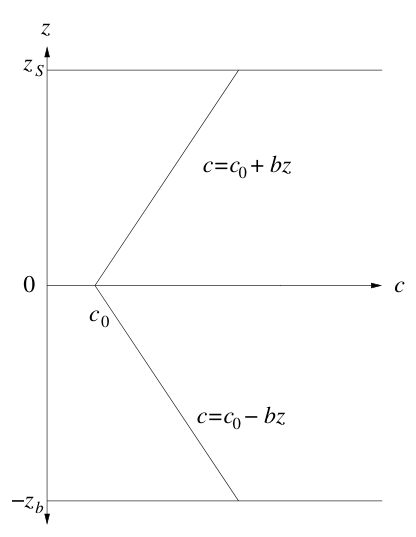
Figure 1 (a)
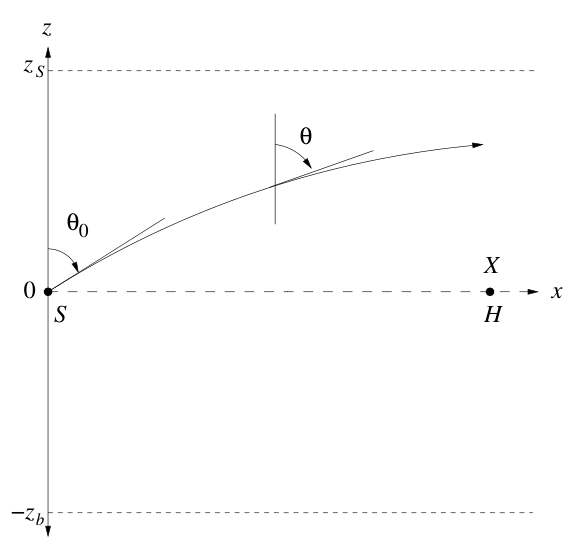
Figure 1 (b)
Figure 1(b) shows a section of the \(z\)–\(x\) plane through the ocean, where \(x\) is a horizontal direction. The variation of \(c\) with respect to \(z\) is shown in figure 1(a). At the position \(z=0\), \(x=0\), a sound source \(S\) is located. A ‘sound ray’ is emitted from \(S\) at an angle \(\theta_0\) as shown. Because of the variation of \(c\) with \(z\), the ray will be refracted.
(a) (6 marks)
Show that the trajectory of the ray, leaving the source \(S\) and constrained to the \(z\)–\(x\) plane forms an arc of a circle with radius \(R\) where
\[ R=\frac{c_0}{b\sin\theta_0} \quad\text{for}\quad 0\leq\theta_0<\frac{\pi}{2}\;. \]
(b) (3 marks)
Derive an expression involving \(z_S\), \(c_0\) and \(b\) to give the smallest value of the angle \(\theta_0\) for upwardly directed rays which can be transmitted without the sound wave reflecting from the sea surface.
(c) (4 marks)
Figure 1(b) shows the position of a sound receiver \(H\) which is located at the position \(z=0\), \(x=X\). Derive an expression involving \(b\), \(X\) and \(c_0\) to give the series of angles \(\theta_0\) required for the sound ray emerging from \(S\) to reach the receiver \(H\). Assume that \(z_S\) and \(z_b\) are sufficiently large to remove the possibility of reflection from sea surface or sea bed.
(d) (2 marks)
Calculate the smallest four values of \(\theta_0\) for refracted rays from \(S\) to reach \(H\) when
- \(X=10000\ \mathrm{m}\)
- \(c_0=1500\ \mathrm{m\,s^{-1}}\)
- \(b=0.02000\ \mathrm{s^{-1}}\)
(e) (5 marks)
Derive an expression to give the time taken for sound to travel from \(S\) to \(H\) following the ray path associated with the smallest value of angle \(\theta_0\), as determined in part (c). Calculate the value of this transit time for the conditions given in part (d). The following result may be of assistance:
\[ \int\frac{dx}{\sin x}=\ln\tan\left(\frac{x}{2}\right) \]
Calculate the time taken for the direct ray to travel from \(S\) to \(H\) along \(z=0\). Which of the two rys will arrive first, the ray for which \(\theta_0=\pi/2\), or the ray with the smallest value of \(\theta_0\) as calculated for part (d)?
Official English text of the problem.
Problem 3: Cylindrical Buoy
(a) (3 marks)
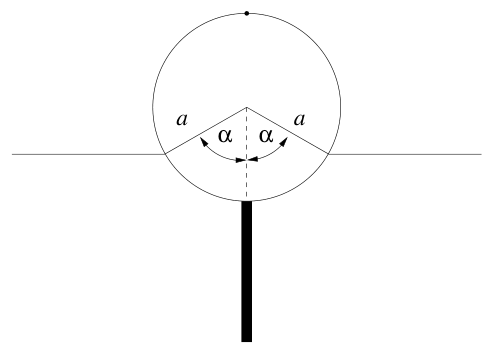
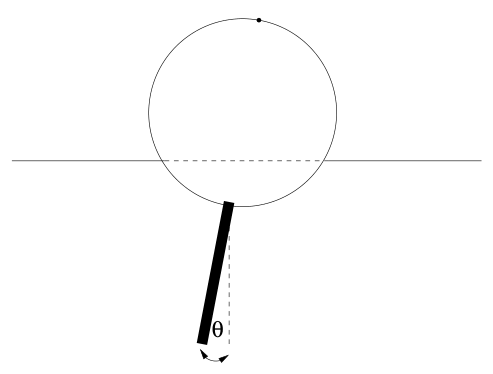
A buoy consists of a solid cylinder, radius \(a\), length \(l\), made of lightweight material of uniform density \(d\) with a uniform rigid rod protruding directly outwards from the bottom halfway along the length. The mass of the rod is equal to that of the cylinder, its length is the same as the diameter of the cylinder and the density of the rod is greater than that of seawater. This buoy is floating in sea-water of density \(\rho\).
In equilibrium derive an expression relating the floating angle \(\alpha\), as drawn, to \(d/\rho\). Neglect the volume of the rod.
(b) (4 marks)
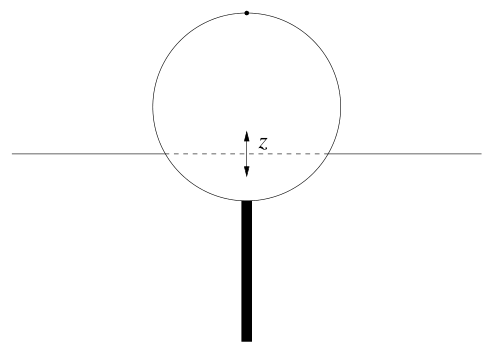
If the buoy, due to some perturbation, is depressed vertically by a small amount \(z\), it will experience a nett force, which will cause it to begin oscillating vertically about the equilibrium floating position. Determine the frequency of this vertical mode of vibration in terms of \(\alpha\), \(g\) and \(a\), where \(g\) is the acceleration due to gravity. Assume the influence of water motion on the dynamics of the buoy is such as to increase the effective mass of the buoy by a factor of one third. You may assume that \(\alpha\) is not small.
(c) (8 marks)
In the approximation that the cylinder swings about its horizontal central axis, determine the frequency of swing again in terms of \(g\) and \(a\). Neglect the dynamics and viscosity of the water in this case. The angle of swing is assumed to be small.
(d) (5 marks)
The buoy contains sensitive accelerometers which can measure the vertical and swinging motions and can relay this information by radio to shore. In relatively calm waters it is recorded that the vertical oscillation period is about 1 second and the swinging oscillation period is about 1.5 seconds. From this information, show that the floating angle \(\alpha\) is about \(90^\circ\) and thereby estimate the radius of the buoy and its total mass, given that the cylinder length \(l\) equals \(a\).
[You may take it that \(\rho\simeq1000\ \mathrm{kg\,m^{-3}}\) and \(g\simeq9.8\ \mathrm{m\,s^{-2}}\).]
Official English text of the problem.
Internationale Physik-Olympiade
IPhO 1995
Canberra, Australien · 3 Theorieaufgaben mit vollständigen Lösungen
Aufgabe 1: Gravitative Rotverschiebung und die Messung der Sternmasse
(a) (3 Punkte)
Ein Photon der Frequenz \(f\) besitzt eine effektive träge Masse \(m\), die durch seine Energie bestimmt ist. Nehmen Sie an, dass seine schwere Masse gleich dieser trägen Masse ist. Demnach verliert ein an der Oberfläche eines Sterns emittiertes Photon Energie, wenn es dem Gravitationsfeld des Sterns entkommt. Zeigen Sie, dass die Frequenzverschiebung \(\Delta f\) des Photons beim Weg von der Sternoberfläche ins Unendliche durch
\[ \frac{\Delta f}{f}\simeq-\frac{GM}{Rc^2} \]
für \(\Delta f\ll f\) gegeben ist, wobei:
- \(G=\) Gravitationskonstante
- \(R=\) Radius des Sterns
- \(c=\) Lichtgeschwindigkeit
- \(M=\) Masse des Sterns.
Somit kann die in großer Entfernung vom Stern gemessene Rotverschiebung einer bekannten Spektrallinie zur Bestimmung des Verhältnisses \(M/R\) verwendet werden. Ist \(R\) bekannt, lässt sich die Masse des Sterns bestimmen.
(b) (12 Punkte)
Im Rahmen eines Experiments zur Messung sowohl der Masse \(M\) als auch des Radius \(R\) eines Sterns in unserer Galaxie wird eine unbemannte Raumsonde gestartet. An der Oberfläche des Sterns werden Photonen von \(\mathrm{He}^{+}\)-Ionen emittiert. Diese Photonen können durch Resonanzabsorption an \(\mathrm{He}^{+}\)-Ionen in einer Messkammer der Raumsonde nachgewiesen werden. Resonanzabsorption tritt nur auf, wenn den \(\mathrm{He}^{+}\)-Ionen eine Geschwindigkeit in Richtung des Sterns verliehen wird, die die Rotverschiebungen genau ausgleicht.
Während sich die Raumsonde dem Stern radial nähert, wird die Geschwindigkeit relativ zum Stern \((v=\beta c)\) der \(\mathrm{He}^{+}\)-Ionen in der Messkammer bei Absorptionsresonanz als Funktion des Abstands \(d\) von der (nächstgelegenen) Sternoberfläche gemessen. Die Messdaten sind in der folgenden Tabelle dargestellt.
Nutzen Sie die Daten vollständig aus, um die Masse \(M\) und den Radius \(R\) des Sterns grafisch zu bestimmen. Eine Abschätzung der Unsicherheiten Ihres Ergebnisses ist nicht erforderlich.
Daten zur Resonanzbedingung
Geschwindigkeitsparameter \(\beta=v/c\quad(\times10^{-5})\) 3.352 3.279 3.195 3.077 2.955 Abstand von der Sternoberfläche \(d\quad(\times10^8\mathrm{m})\) 38.90 19.98 13.32 8.99 6.67 (c) (5 Punkte)
Bei der Bestimmung von \(R\) und \(M\) in einem solchen Experiment wird üblicherweise die Frequenzkorrektur aufgrund des Rückstoßes des emittierenden Atoms berücksichtigt. [Die thermische Bewegung führt zu einer Verbreiterung der Emissionslinien, ohne die Emissionsmaxima zu verschieben. Daher dürfen wir annehmen, dass alle thermischen Effekte berücksichtigt worden sind.]
(i) (4 Punkte)
Nehmen Sie an, dass das Atom aus der Ruhe zerfällt, wobei ein Photon und ein rückstoßendes Atom entstehen. Leiten Sie den relativistischen Ausdruck für die Energie \(hf\) eines emittierten Photons in Abhängigkeit von \(\Delta E\) (der Differenz der Ruheenergien der beiden atomaren Niveaus) und der anfänglichen Ruhemasse \(m_0\) des Atoms her.
(ii) (1 Punkt)
Schätzen Sie daraus die relativistische Frequenzverschiebung \(\left(\dfrac{\Delta f}{f}\right)_{\mathrm{recoil}}\) für \(\mathrm{He}^{+}\)-Ionen numerisch ab.
Ihr Ergebnis sollte wesentlich kleiner sein als die in Teil (b) erhaltene gravitative Rotverschiebung.
Daten:
Lichtgeschwindigkeit \(c\) \(=\) \(3.0\times10^8\mathrm{m\,s^{-1}}\) Ruheenergie von He \(m_0c^2\) \(=\) \(4\times938(\mathrm{MeV})\) Bohrsche Energie \(E_n\) \(=\) \(-\dfrac{13.6Z^2}{n^2}(\mathrm{eV})\) Gravitationskonstante \(G\) \(=\) \(6.7\times10^{-11}\mathrm{N\,m^2\,kg^{-2}}\) Aufgabentext aus dem offiziellen englischen Text übersetzt.
Aufgabe 2: Schallausbreitung
Einleitung
Die Ausbreitungsgeschwindigkeit von Schall im Ozean hängt von der Tiefe, der Temperatur und dem Salzgehalt ab. Abbildung 1(a) unten zeigt den Verlauf der Schallgeschwindigkeit \(c\) mit der Tiefe \(z\) für einen Fall, in dem der minimale Geschwindigkeitswert \(c_0\) auf halber Strecke zwischen der Meeresoberfläche und dem Meeresboden auftritt. Beachten Sie, dass der Einfachheit halber \(z=0\) in der Tiefe dieses Schallgeschwindigkeitsminimums, \(z=z_S\) an der Oberfläche und \(z=-z_b\) am Meeresboden gewählt ist. Oberhalb von \(z=0\) ist \(c\) gegeben durch
\[ c=c_0+bz\;. \]
Unterhalb von \(z=0\) ist \(c\) gegeben durch
\[ c=c_0-bz\;. \]
In beiden Fällen gilt \(b=\left|\dfrac{dc}{dz}\right|\), das heißt, \(b\) ist der Betrag des Schallgeschwindigkeitsgradienten bezüglich der Tiefe; \(b\) wird als konstant angenommen.
Abbildung 1 (a)
Abbildung 1 (b)
Abbildung 1(b) zeigt einen Schnitt durch den Ozean in der \(z\)–\(x\)-Ebene, wobei \(x\) eine horizontale Richtung bezeichnet. Die Abhängigkeit von \(c\) von \(z\) ist in Abbildung 1(a) dargestellt. An der Position \(z=0\), \(x=0\) befindet sich eine Schallquelle \(S\). Von \(S\) geht ein „Schallstrahl“ unter einem Winkel \(\theta_0\) aus, wie in der Abbildung gezeigt. Aufgrund der Abhängigkeit von \(c\) von \(z\) wird der Strahl gebrochen.
(a) (6 Punkte)
Zeigen Sie, dass die Bahn des Strahls, der von der Quelle \(S\) ausgeht und auf die \(z\)–\(x\)-Ebene beschränkt ist, einen Kreisbogen mit dem Radius \(R\) bildet, wobei
\[ R=\frac{c_0}{b\sin\theta_0} \quad\text{für}\quad 0\leq\theta_0<\frac{\pi}{2}\;. \]
(b) (3 Punkte)
Leiten Sie einen Ausdruck mit \(z_S\), \(c_0\) und \(b\) her, der den kleinsten Wert des Winkels \(\theta_0\) für nach oben gerichtete Strahlen angibt, die sich ausbreiten können, ohne dass die Schallwelle an der Meeresoberfläche reflektiert wird.
(c) (4 Punkte)
Abbildung 1(b) zeigt die Lage eines Schallempfängers \(H\), der sich an der Position \(z=0\), \(x=X\) befindet. Leiten Sie einen Ausdruck mit \(b\), \(X\) und \(c_0\) her, der die Folge der Winkel \(\theta_0\) angibt, unter denen der Schallstrahl von \(S\) ausgehen muss, um den Empfänger \(H\) zu erreichen. Nehmen Sie an, dass \(z_S\) und \(z_b\) hinreichend groß sind, sodass eine Reflexion an der Meeresoberfläche oder am Meeresboden ausgeschlossen ist.
(d) (2 Punkte)
Berechnen Sie die vier kleinsten Werte von \(\theta_0\), für die gebrochene Strahlen von \(S\) aus \(H\) erreichen, wenn
- \(X=10000\ \mathrm{m}\)
- \(c_0=1500\ \mathrm{m\,s^{-1}}\)
- \(b=0.02000\ \mathrm{s^{-1}}\)
(e) (5 Punkte)
Leiten Sie einen Ausdruck für die Zeit her, die der Schall benötigt, um von \(S\) nach \(H\) entlang der Strahlbahn zu gelangen, die dem kleinsten Wert des Winkels \(\theta_0\) aus Teil (c) entspricht. Berechnen Sie diese Laufzeit für die in Teil (d) angegebenen Bedingungen. Das folgende Ergebnis kann hilfreich sein:
\[ \int\frac{dx}{\sin x}=\ln\tan\left(\frac{x}{2}\right) \]
Berechnen Sie die Zeit, die der direkte Strahl benötigt, um von \(S\) nach \(H\) entlang von \(z=0\) zu gelangen. Welcher der beiden Strahlen kommt zuerst an: der Strahl mit \(\theta_0=\pi/2\) oder der Strahl mit dem kleinsten Wert von \(\theta_0\), der in Teil (d) berechnet wurde?
Aufgabentext aus dem offiziellen englischen Text übersetzt.
Aufgabe 3: Zylindrische Boje
(a) (3 Punkte)
Eine Boje besteht aus einem Vollzylinder mit Radius \(a\) und Länge \(l\), der aus einem leichten Material mit einheitlicher Dichte \(d\) gefertigt ist. An seiner Unterseite ragt auf halber Länge ein homogener, starrer Stab radial nach außen. Die Masse des Stabes ist gleich der Masse des Zylinders, seine Länge entspricht dem Durchmesser des Zylinders, und seine Dichte ist größer als die von Meerwasser. Diese Boje schwimmt in Meerwasser der Dichte \(\rho\).
Leiten Sie für den Gleichgewichtszustand einen Ausdruck her, der den eingezeichneten Schwimmwinkel \(\alpha\) mit \(d/\rho\) verknüpft. Vernachlässigen Sie das Volumen des Stabes.
(b) (4 Punkte)
Wird die Boje durch eine Störung vertikal um eine kleine Strecke \(z\) nach unten gedrückt, so wirkt auf sie eine resultierende Kraft, durch die sie beginnt, vertikal um ihre Gleichgewichtslage zu schwingen. Bestimmen Sie die Frequenz dieser vertikalen Schwingungsform in Abhängigkeit von \(\alpha\), \(g\) und \(a\), wobei \(g\) die Fallbeschleunigung ist. Nehmen Sie an, dass der Einfluss der Wasserbewegung auf die Dynamik der Boje deren effektive Masse um ein Drittel erhöht. Sie dürfen annehmen, dass \(\alpha\) nicht klein ist.
(c) (8 Punkte)
Bestimmen Sie in der Näherung, dass der Zylinder um seine horizontale Mittelachse pendelt, die Frequenz dieser Pendelschwingung, wiederum in Abhängigkeit von \(g\) und \(a\). Vernachlässigen Sie in diesem Fall die Dynamik und die Viskosität des Wassers. Der Auslenkwinkel sei klein.
(d) (5 Punkte)
Die Boje enthält empfindliche Beschleunigungsmesser, die die vertikalen Bewegungen und die Pendelbewegungen messen und diese Informationen per Funk an die Küste übermitteln können. In relativ ruhigem Wasser wird für die vertikale Schwingung eine Periodendauer von etwa 1 Sekunde und für die Pendelschwingung eine Periodendauer von etwa 1.5 Sekunden gemessen. Zeigen Sie anhand dieser Angaben, dass der Schwimmwinkel \(\alpha\) etwa \(90^\circ\) beträgt, und schätzen Sie damit den Radius der Boje und ihre Gesamtmasse ab, wenn die Zylinderlänge \(l\) gleich \(a\) ist.
[Sie dürfen \(\rho\simeq1000\ \mathrm{kg\,m^{-3}}\) und \(g\simeq9.8\ \mathrm{m\,s^{-2}}\) annehmen.]
Aufgabentext aus dem offiziellen englischen Text übersetzt.
Uluslararası Fizik Olimpiyatı
IPhO 1995
Canberra, Avustralya · 3 teori sorusu, tam çözümleriyle
Soru 1: Kütleçekimsel Kırmızıya Kayma ve Yıldız Kütlesinin Ölçülmesi
(a) (3 puan)
Frekansı \(f\) olan bir foton, enerjisiyle belirlenen bir etkin eylemsizlik kütlesine \(m\) sahiptir. Fotonun kütleçekim kütlesinin bu eylemsizlik kütlesine eşit olduğunu varsayın. Buna göre, bir yıldızın yüzeyinden yayılan bir foton, yıldızın kütleçekim alanından kaçarken enerji kaybeder. Fotonun yıldızın yüzeyinden sonsuza giderken frekansında meydana gelen \(\Delta f\) kaymasının
\[ \frac{\Delta f}{f}\simeq-\frac{GM}{Rc^2} \]
ile verildiğini \(\Delta f\ll f\) için gösterin. Burada:
- \(G=\) kütleçekim sabiti
- \(R=\) yıldızın yarıçapı
- \(c=\) ışık hızı
- \(M=\) yıldızın kütlesidir.
Böylece, bilinen bir tayf çizgisinin yıldızdan çok uzakta ölçülen kırmızıya kayması, \(M/R\) oranını ölçmek için kullanılabilir. \(R\)'nin bilinmesi, yıldızın kütlesinin belirlenmesini sağlar.
(b) (12 puan)
Galaksimizdeki bir yıldızın hem kütlesini \(M\) hem de yarıçapını \(R\) ölçmek üzere yapılan bir deneyde insansız bir uzay aracı fırlatılır. Yıldızın yüzeyindeki \(\mathrm{He}^{+}\) iyonlarından fotonlar yayılır. Bu fotonlar, uzay aracındaki bir deney odasında bulunan \(\mathrm{He}^{+}\) iyonlarının rezonans soğurması yoluyla izlenebilir. Rezonans soğurması, yalnızca kırmızıya kaymaları tam olarak telafi etmek üzere \(\mathrm{He}^{+}\) iyonlarına yıldıza doğru bir hız verildiğinde gerçekleşir.
Uzay aracı yıldıza radyal doğrultuda yaklaşırken, deney odasındaki \(\mathrm{He}^{+}\) iyonlarının soğurma rezonansı sırasındaki yıldıza göre hızı \((v=\beta c)\), yıldızın (en yakın) yüzeyine olan \(d\) uzaklığının bir fonksiyonu olarak ölçülür. Deneysel veriler aşağıdaki tabloda verilmiştir.
Verilerin tamamından yararlanarak yıldızın kütlesini \(M\) ve yarıçapını \(R\) grafik yöntemiyle belirleyin. Cevabınızdaki belirsizlikleri tahmin etmeniz gerekmez.
Rezonans Koşuluna İlişkin Veriler
Hız parametresi \(\beta=v/c\quad(\times10^{-5})\) 3.352 3.279 3.195 3.077 2.955 Yıldızın yüzeyinden uzaklık \(d\quad(\times10^8\mathrm{m})\) 38.90 19.98 13.32 8.99 6.67 (c) (5 puan)
Böyle bir deneyde \(R\) ve \(M\)'yi belirlemek için, fotonu yayan atomun geri tepmesinden kaynaklanan frekans düzeltmesi genellikle dikkate alınır. [Isıl hareket, yayım çizgilerinin maksimumlarının yerini değiştirmeden çizgileri genişletir; dolayısıyla tüm ısıl etkilerin hesaba katıldığını varsayabiliriz.]
(i) (4 puan)
Atomun başlangıçta durgun olduğunu ve bozunarak bir foton ile geri tepen bir atom oluşturduğunu varsayın. Yayılan fotonun enerjisi \(hf\) için, \(\Delta E\) (iki atomik düzey arasındaki durgunluk enerjisi farkı) ve atomun başlangıçtaki durgunluk kütlesi \(m_0\) cinsinden göreli ifadeyi elde edin.
(ii) (1 puan)
Buradan hareketle, \(\mathrm{He}^{+}\) iyonları için göreli frekans kaymasını \(\left(\dfrac{\Delta f}{f}\right)_{\mathrm{recoil}}\) sayısal olarak tahmin edin.
Cevabınızın, (b) kısmında elde edilen kütleçekimsel kırmızıya kaymadan çok daha küçük çıkması gerekir.
Veriler:
Işık hızı \(c\) \(=\) \(3.0\times10^8\mathrm{m\,s^{-1}}\) He'nin durgunluk enerjisi \(m_0c^2\) \(=\) \(4\times938(\mathrm{MeV})\) Bohr enerjisi \(E_n\) \(=\) \(-\dfrac{13.6Z^2}{n^2}(\mathrm{eV})\) Kütleçekim sabiti \(G\) \(=\) \(6.7\times10^{-11}\mathrm{N\,m^2\,kg^{-2}}\) Soru metni resmi İngilizce metinden çevrilmiştir.
Soru 2: Sesin Yayılması
Giriş
Sesin okyanustaki yayılma hızı derinliğe, sıcaklığa ve tuzluluğa bağlı olarak değişir. Aşağıdaki Şekil 1(a), ses hızının en küçük değeri olan \(c_0\)'a okyanus yüzeyi ile deniz tabanının ortasında ulaşıldığı bir durum için ses hızı \(c\)'nin derinlik \(z\) ile değişimini göstermektedir. Kolaylık olması açısından, ses hızının en küçük olduğu derinlikte \(z=0\), yüzeyde \(z=z_S\) ve deniz tabanında \(z=-z_b\) alındığına dikkat ediniz. \(z=0\)'ın üstünde \(c\),
\[ c=c_0+bz\;. \]
ile verilir. \(z=0\)'ın altında ise \(c\),
\[ c=c_0-bz\;. \]
ile verilir. Her iki durumda da \(b=\left|\dfrac{dc}{dz}\right|\), yani \(b\), ses hızının derinliğe göre gradyanının büyüklüğüdür; \(b\)'nin sabit olduğu varsayılmaktadır.
Şekil 1 (a)
Şekil 1 (b)
Şekil 1(b), okyanusun \(z\)–\(x\) düzlemindeki bir kesitini göstermektedir; burada \(x\) yatay bir doğrultudur. \(c\)'nin \(z\)'ye göre değişimi Şekil 1(a)'da gösterilmiştir. \(z=0\), \(x=0\) konumunda bir \(S\) ses kaynağı bulunmaktadır. \(S\)'den, şekilde gösterildiği gibi \(\theta_0\) açısıyla bir ‘ses ışını’ yayılır. \(c\)'nin \(z\) ile değişmesi nedeniyle ışın kırılacaktır.
(a) (6 puan)
\(S\) kaynağından çıkan ve \(z\)–\(x\) düzleminde kalan ışının yörüngesinin, yarıçapı \(R\) olan bir çember yayı oluşturduğunu ve bu yarıçapın
\[ R=\frac{c_0}{b\sin\theta_0} \quad\text{için}\quad 0\leq\theta_0<\frac{\pi}{2}\;. \]
ile verildiğini gösteriniz.
(b) (3 puan)
Yukarıya yönelen ışınların, ses dalgası deniz yüzeyinden yansımadan ilerleyebilmesi için \(\theta_0\) açısının alabileceği en küçük değeri veren, \(z_S\), \(c_0\) ve \(b\)'yi içeren bir ifade türetiniz.
(c) (4 puan)
Şekil 1(b), \(z=0\), \(x=X\) konumunda bulunan bir \(H\) ses alıcısının yerini göstermektedir. \(S\)'den çıkan ses ışınının \(H\) alıcısına ulaşması için gerekli \(\theta_0\) açılarının dizisini veren, \(b\), \(X\) ve \(c_0\)'ı içeren bir ifade türetiniz. \(z_S\) ve \(z_b\)'nin, deniz yüzeyinden veya deniz tabanından yansıma olasılığını ortadan kaldıracak kadar büyük olduğunu varsayınız.
(d) (2 puan)
Aşağıdaki değerler için, \(S\)'den çıkan kırılan ışınların \(H\)'ye ulaşmasını sağlayan en küçük dört \(\theta_0\) değerini hesaplayınız:
- \(X=10000\ \mathrm{m}\)
- \(c_0=1500\ \mathrm{m\,s^{-1}}\)
- \(b=0.02000\ \mathrm{s^{-1}}\)
(e) (5 puan)
Sesin, (c) bölümünde belirlenen en küçük \(\theta_0\) açısına karşılık gelen ışın yolunu izleyerek \(S\)'den \(H\)'ye ulaşması için geçen süreyi veren bir ifade türetiniz. Bu geçiş süresinin değerini (d) bölümünde verilen koşullar için hesaplayınız. Aşağıdaki sonuç yardımcı olabilir:
\[ \int\frac{dx}{\sin x}=\ln\tan\left(\frac{x}{2}\right) \]
Doğrudan giden ışının \(z=0\) boyunca \(S\)'den \(H\)'ye ulaşması için geçen süreyi hesaplayınız. İki ışından hangisi önce ulaşır: \(\theta_0=\pi/2\) olan ışın mı, yoksa (d) bölümü için hesaplanan en küçük \(\theta_0\) değerine sahip ışın mı?
Soru metni resmi İngilizce metinden çevrilmiştir.
Soru 3: Silindirik Şamandıra
(a) (3 puan)
Bir şamandıra, yarıçapı \(a\), uzunluğu \(l\) olan, düzgün \(d\) yoğunluğuna sahip hafif bir malzemeden yapılmış dolu bir silindirden ve silindirin uzunluğunun orta noktasında alt yüzeyinden doğrudan dışarıya doğru uzanan düzgün, rijit bir çubuktan oluşmaktadır. Çubuğun kütlesi silindirinkine eşittir, uzunluğu silindirin çapıyla aynıdır ve yoğunluğu deniz suyunun yoğunluğundan büyüktür. Bu şamandıra, yoğunluğu \(\rho\) olan deniz suyunda yüzmektedir.
Denge durumunda, şekilde gösterilen yüzme açısı \(\alpha\) ile \(d/\rho\) arasında ilişki kuran bir ifade türetiniz. Çubuğun hacmini ihmal ediniz.
(b) (4 puan)
Şamandıra, bir bozucu etki nedeniyle düşey doğrultuda küçük bir \(z\) miktarı kadar aşağı bastırılırsa, üzerine etki eden net kuvvet, denge yüzme konumu çevresinde düşey salınımlara başlamasına neden olur. Bu düşey titreşim modunun frekansını \(\alpha\), \(g\) ve \(a\) cinsinden belirleyiniz; burada \(g\) yerçekimi ivmesidir. Su hareketinin şamandıranın dinamiği üzerindeki etkisinin, şamandıranın etkin kütlesini üçte biri kadar artırdığını varsayınız. \(\alpha\) açısının küçük olmadığını varsayabilirsiniz.
(c) (8 puan)
Silindirin, merkezinden geçen yatay eksen etrafında salındığı yaklaşımı altında, açısal salınım frekansını yine \(g\) ve \(a\) cinsinden belirleyiniz. Bu durumda suyun dinamiğini ve viskozitesini ihmal ediniz. Salınım açısının küçük olduğu varsayılmaktadır.
(d) (5 puan)
Şamandıra, düşey hareketleri ve açısal salınımları ölçebilen ve bu bilgileri radyo yoluyla kıyıya iletebilen hassas ivmeölçerler içermektedir. Nispeten sakin sularda, düşey salınım periyodunun yaklaşık 1 saniye ve açısal salınım periyodunun yaklaşık 1.5 saniye olduğu kaydedilmiştir. Bu bilgilerden yararlanarak, yüzme açısı \(\alpha\)'nın yaklaşık \(90^\circ\) olduğunu gösteriniz ve buradan, silindirin uzunluğu \(l\)'nin \(a\)'ya eşit olduğu verildiğine göre, şamandıranın yarıçapını ve toplam kütlesini tahmin ediniz.
[\(\rho\simeq1000\ \mathrm{kg\,m^{-3}}\) ve \(g\simeq9.8\ \mathrm{m\,s^{-2}}\) alabilirsiniz.]
Soru metni resmi İngilizce metinden çevrilmiştir.
Olimpiada Internacional de Física
IPhO 1995
Canberra, Australia · 3 problemas teóricos con soluciones completas
Problema 1: Corrimiento gravitatorio al rojo y medición de la masa estelar
(a) (3 puntos)
Un fotón de frecuencia \(f\) posee una masa inercial efectiva \(m\) determinada por su energía. Suponga que tiene una masa gravitatoria igual a esta masa inercial. Por consiguiente, un fotón emitido en la superficie de una estrella perderá energía al escapar del campo gravitatorio de la estrella. Demuestre que la variación de frecuencia \(\Delta f\) del fotón al escapar desde la superficie de la estrella hasta el infinito viene dada por
\[ \frac{\Delta f}{f}\simeq-\frac{GM}{Rc^2} \]
para \(\Delta f\ll f\), donde:
- \(G=\) constante gravitatoria
- \(R=\) radio de la estrella
- \(c=\) velocidad de la luz
- \(M=\) masa de la estrella.
Así, el corrimiento al rojo de una línea espectral conocida, medido a gran distancia de la estrella, puede utilizarse para medir la razón \(M/R\). El conocimiento de \(R\) permitirá determinar la masa de la estrella.
(b) (12 puntos)
Se lanza una nave espacial no tripulada en un experimento para medir tanto la masa \(M\) como el radio \(R\) de una estrella de nuestra galaxia. Los iones \(\mathrm{He}^{+}\) de la superficie de la estrella emiten fotones. Estos fotones pueden detectarse mediante absorción resonante por iones \(\mathrm{He}^{+}\) contenidos en una cámara de ensayo de la nave espacial. La absorción resonante solo se produce si se comunica a los iones \(\mathrm{He}^{+}\) una velocidad hacia la estrella que compense exactamente los corrimientos al rojo.
A medida que la nave espacial se aproxima radialmente a la estrella, se mide la velocidad respecto a la estrella \((v=\beta c)\) de los iones \(\mathrm{He}^{+}\) de la cámara de ensayo en la condición de resonancia de absorción, en función de la distancia \(d\) a la superficie (más cercana) de la estrella. Los datos experimentales se muestran en la tabla adjunta.
Utilice todos los datos para determinar gráficamente la masa \(M\) y el radio \(R\) de la estrella. No es necesario estimar las incertidumbres de su respuesta.
Datos para la condición de resonancia
Parámetro de velocidad \(\beta=v/c\quad(\times10^{-5})\) 3.352 3.279 3.195 3.077 2.955 Distancia a la superficie de la estrella \(d\quad(\times10^8\mathrm{m})\) 38.90 19.98 13.32 8.99 6.67 (c) (5 puntos)
Para determinar \(R\) y \(M\) en un experimento de este tipo, es habitual considerar la corrección de frecuencia debida al retroceso del átomo emisor. [El movimiento térmico provoca un ensanchamiento de las líneas de emisión sin desplazar los máximos de emisión y, por tanto, podemos suponer que se han tenido en cuenta todos los efectos térmicos.]
(i) (4 puntos)
Suponga que el átomo se desexcita estando en reposo, produciendo un fotón y un átomo que retrocede. Obtenga la expresión relativista de la energía \(hf\) de un fotón emitido en función de \(\Delta E\) (la diferencia de energía en reposo entre los dos niveles atómicos) y de la masa en reposo inicial \(m_0\) del átomo.
(ii) (1 punto)
A partir de este resultado, realice una estimación numérica del corrimiento relativista de frecuencia \(\left(\dfrac{\Delta f}{f}\right)_{\mathrm{recoil}}\) para el caso de los iones \(\mathrm{He}^{+}\).
Su respuesta debería resultar mucho menor que el corrimiento gravitatorio al rojo obtenido en el apartado (b).
Datos:
Velocidad de la luz \(c\) \(=\) \(3.0\times10^8\mathrm{m\,s^{-1}}\) Energía en reposo del He \(m_0c^2\) \(=\) \(4\times938(\mathrm{MeV})\) Energía de Bohr \(E_n\) \(=\) \(-\dfrac{13.6Z^2}{n^2}(\mathrm{eV})\) Constante gravitatoria \(G\) \(=\) \(6.7\times10^{-11}\mathrm{N\,m^2\,kg^{-2}}\) Enunciado traducido del texto oficial en inglés.
Problema 2: Propagación del sonido
Introducción
La velocidad de propagación del sonido en el océano varía con la profundidad, la temperatura y la salinidad. La figura 1(a) muestra la variación de la velocidad del sonido \(c\) con la profundidad \(z\) para un caso en el que el valor mínimo de la velocidad \(c_0\) se alcanza a mitad de camino entre la superficie del océano y el fondo marino. Obsérvese que, por conveniencia, \(z=0\) a la profundidad de este mínimo de la velocidad del sonido, \(z=z_S\) en la superficie y \(z=-z_b\) en el fondo marino. Por encima de \(z=0\), \(c\) viene dada por
\[ c=c_0+bz\;. \]
Por debajo de \(z=0\), \(c\) viene dada por
\[ c=c_0-bz\;. \]
En ambos casos, \(b=\left|\dfrac{dc}{dz}\right|\), es decir, \(b\) es el módulo del gradiente de la velocidad del sonido con la profundidad; se supone que \(b\) es constante.
Figura 1 (a)
Figura 1 (b)
La figura 1(b) muestra una sección del océano en el plano \(z\)–\(x\), donde \(x\) es una dirección horizontal. La variación de \(c\) con respecto a \(z\) se muestra en la figura 1(a). En la posición \(z=0\), \(x=0\), se encuentra una fuente sonora \(S\). Desde \(S\) se emite un «rayo sonoro» con un ángulo \(\theta_0\), como se muestra. Debido a la variación de \(c\) con \(z\), el rayo se refractará.
(a) (6 puntos)
Demuestre que la trayectoria del rayo que sale de la fuente \(S\) y está confinado al plano \(z\)–\(x\) forma un arco de circunferencia de radio \(R\), donde
\[ R=\frac{c_0}{b\sin\theta_0} \quad\text{para}\quad 0\leq\theta_0<\frac{\pi}{2}\;. \]
(b) (3 puntos)
Obtenga una expresión en función de \(z_S\), \(c_0\) y \(b\) para el menor valor del ángulo \(\theta_0\) de los rayos dirigidos hacia arriba que pueden transmitirse sin que la onda sonora se refleje en la superficie del mar.
(c) (4 puntos)
La figura 1(b) muestra la posición de un receptor de sonido \(H\), situado en \(z=0\), \(x=X\). Obtenga una expresión en función de \(b\), \(X\) y \(c_0\) para la serie de ángulos \(\theta_0\) necesarios para que el rayo sonoro que sale de \(S\) alcance el receptor \(H\). Suponga que \(z_S\) y \(z_b\) son suficientemente grandes para descartar la posibilidad de reflexión en la superficie del mar o en el fondo marino.
(d) (2 puntos)
Calcule los cuatro valores más pequeños de \(\theta_0\) para que los rayos refractados procedentes de \(S\) alcancen \(H\) cuando
- \(X=10000\ \mathrm{m}\)
- \(c_0=1500\ \mathrm{m\,s^{-1}}\)
- \(b=0.02000\ \mathrm{s^{-1}}\)
(e) (5 puntos)
Obtenga una expresión para el tiempo que tarda el sonido en viajar de \(S\) a \(H\) siguiendo la trayectoria del rayo asociada al menor valor del ángulo \(\theta_0\), determinado en el apartado (c). Calcule este tiempo de tránsito para las condiciones dadas en el apartado (d). El siguiente resultado puede ser útil:
\[ \int\frac{dx}{\sin x}=\ln\tan\left(\frac{x}{2}\right) \]
Calcule el tiempo que tarda el rayo directo en viajar de \(S\) a \(H\) a lo largo de \(z=0\). ¿Cuál de los dos rayos llegará primero, el rayo para el que \(\theta_0=\pi/2\) o el rayo con el menor valor de \(\theta_0\) calculado en el apartado (d)?
Enunciado traducido del texto oficial en inglés.
Problema 3: Boya cilíndrica
(a) (3 puntos)
Una boya consiste en un cilindro macizo de radio \(a\) y longitud \(l\), hecho de un material ligero de densidad uniforme \(d\), con una varilla rígida y uniforme que sobresale radialmente hacia fuera desde su parte inferior, a la mitad de su longitud. La masa de la varilla es igual a la del cilindro, su longitud es igual al diámetro del cilindro y su densidad es mayor que la del agua de mar. Esta boya flota en agua de mar de densidad \(\rho\).
En equilibrio, deduzca una expresión que relacione el ángulo de flotación \(\alpha\), tal como se muestra en la figura, con \(d/\rho\). Desprecie el volumen de la varilla.
(b) (4 puntos)
Si, debido a alguna perturbación, la boya se desplaza verticalmente hacia abajo una pequeña distancia \(z\), experimentará una fuerza neta que hará que comience a oscilar verticalmente en torno a su posición de flotación de equilibrio. Determine la frecuencia de este modo de vibración vertical en función de \(\alpha\), \(g\) y \(a\), donde \(g\) es la aceleración de la gravedad. Suponga que la influencia del movimiento del agua sobre la dinámica de la boya hace que su masa efectiva aumente en un tercio. Puede suponer que \(\alpha\) no es pequeño.
(c) (8 puntos)
En la aproximación de que el cilindro oscila alrededor de su eje central horizontal, determine la frecuencia de oscilación angular, de nuevo en función de \(g\) y \(a\). Desprecie en este caso la dinámica y la viscosidad del agua. Se supone que el ángulo de oscilación es pequeño.
(d) (5 puntos)
La boya contiene acelerómetros sensibles que pueden medir los movimientos verticales y angulares y transmitir esta información por radio a la costa. En aguas relativamente tranquilas, se registra que el período de oscilación vertical es de aproximadamente 1 segundo y el período de oscilación angular es de aproximadamente 1.5 segundos. A partir de esta información, demuestre que el ángulo de flotación \(\alpha\) es de aproximadamente \(90^\circ\) y estime así el radio de la boya y su masa total, sabiendo que la longitud del cilindro \(l\) es igual a \(a\).
[Puede tomar \(\rho\simeq1000\ \mathrm{kg\,m^{-3}}\) y \(g\simeq9.8\ \mathrm{m\,s^{-2}}\).]
Enunciado traducido del texto oficial en inglés.
国际物理奥林匹克
IPhO 1995
澳大利亚堪培拉 · 3 道理论题及完整解答
题目 1:引力红移与恒星质量的测量
(a) (3 分)
频率为 \(f\) 的光子具有由其能量决定的有效惯性质量 \(m\)。假设其引力质量等于这一惯性质量。因此,从恒星表面发射的光子在逃离恒星引力场时会损失能量。证明:光子从恒星表面逃逸至无穷远处的频率变化 \(\Delta f\) 满足
\[ \frac{\Delta f}{f}\simeq-\frac{GM}{Rc^2} \]
此式适用于 \(\Delta f\ll f\),其中:
- \(G=\) 引力常量
- \(R=\) 恒星半径
- \(c=\) 光速
- \(M=\) 恒星质量。
因此,在远离恒星处测得一条已知谱线的红移,即可用来测量比值 \(M/R\)。若已知 \(R\),便可确定恒星的质量。
(b) (12 分)
在一项实验中,发射一艘无人航天器,以同时测量银河系内一颗恒星的质量 \(M\) 和半径 \(R\)。恒星表面的 \(\mathrm{He}^{+}\) 离子发射光子。利用航天器内实验舱中 \(\mathrm{He}^{+}\) 离子的共振吸收,可以监测这些光子。只有使 \(\mathrm{He}^{+}\) 离子具有朝向恒星的速度,恰好补偿红移,才会发生共振吸收。
当航天器沿径向接近恒星时,测量实验舱中 \(\mathrm{He}^{+}\) 离子在吸收共振时相对于恒星的速度 \((v=\beta c)\),得到该速度随其到恒星(最近)表面的距离 \(d\) 的变化关系。实验数据列于下表。
充分利用这些数据,用作图法确定恒星的质量 \(M\) 和半径 \(R\)。无须估计答案的不确定度。
共振条件下的数据
速度参数 \(\beta=v/c\quad(\times10^{-5})\) 3.352 3.279 3.195 3.077 2.955 到恒星表面的距离 \(d\quad(\times10^8\mathrm{m})\) 38.90 19.98 13.32 8.99 6.67 (c) (5 分)
在这样的实验中,为了确定 \(R\) 和 \(M\),通常需要考虑发射光子的原子反冲所引起的频率修正。[热运动使发射谱线展宽,但不改变发射峰的位置,因此可以假定所有热效应均已考虑在内。]
(i) (4 分)
假设原子从静止状态发生衰变,产生一个光子和一个反冲原子。用 \(\Delta E\)(两个原子能级之间的静能差)和原子的初始静质量 \(m_0\),求出所发射光子能量 \(hf\) 的相对论表达式。
(ii) (1 分)
由此,对 \(\mathrm{He}^{+}\) 离子的相对论频率偏移 \(\left(\dfrac{\Delta f}{f}\right)_{\mathrm{recoil}}\) 作数值估计。
你的结果应远小于 (b) 部分得到的引力红移。
数据:
光速 \(c\) \(=\) \(3.0\times10^8\mathrm{m\,s^{-1}}\) He 的静能 \(m_0c^2\) \(=\) \(4\times938(\mathrm{MeV})\) 玻尔能量 \(E_n\) \(=\) \(-\dfrac{13.6Z^2}{n^2}(\mathrm{eV})\) 引力常量 \(G\) \(=\) \(6.7\times10^{-11}\mathrm{N\,m^2\,kg^{-2}}\) 题目译自官方英文原文。
题目 2:声的传播
引言
海洋中的声速随深度、温度和盐度而变化。下方图 1(a) 给出了声速 \(c\) 随深度 \(z\) 的变化,其中声速的最小值 \(c_0\) 出现在海面与海底之间的中间位置。注意,为方便起见,将声速最小处的深度取为 \(z=0\),海面处取为 \(z=z_S\),海底处取为 \(z=-z_b\)。在 \(z=0\) 上方,\(c\) 为
\[ c=c_0+bz\;. \]
在 \(z=0\) 下方,\(c\) 为
\[ c=c_0-bz\;. \]
在上述两种情况下均有 \(b=\left|\dfrac{dc}{dz}\right|\),即 \(b\) 是声速随深度变化的梯度的大小;假定 \(b\) 为常量。
图 1 (a)
图 1 (b)
图 1(b) 给出了海洋在 \(z\)–\(x\) 平面内的剖面,其中 \(x\) 为水平方向。\(c\) 随 \(z\) 的变化如图 1(a) 所示。在 \(z=0\)、\(x=0\) 处有一个声源 \(S\)。一条“声线”从 \(S\) 发出,其角度为图示的 \(\theta_0\)。由于 \(c\) 随 \(z\) 变化,声线将发生折射。
(a) (6 分)
证明:从声源 \(S\) 发出且限制在 \(z\)–\(x\) 平面内的声线,其轨迹为半径为 \(R\) 的圆弧,其中
\[ R=\frac{c_0}{b\sin\theta_0} \quad\text{当}\quad 0\leq\theta_0<\frac{\pi}{2}\;. \]
(b) (3 分)
推导一个含有 \(z_S\)、\(c_0\) 和 \(b\) 的表达式,给出向上发出的声线在传播过程中声波不被海面反射时,角度 \(\theta_0\) 的最小值。
(c) (4 分)
图 1(b) 标出了声接收器 \(H\) 的位置,它位于 \(z=0\)、\(x=X\) 处。推导一个含有 \(b\)、\(X\) 和 \(c_0\) 的表达式,给出从 \(S\) 发出的声线能够到达接收器 \(H\) 所需的一系列角度 \(\theta_0\)。假定 \(z_S\) 和 \(z_b\) 足够大,从而排除声线被海面或海底反射的可能性。
(d) (2 分)
在下列条件下,计算从 \(S\) 发出并经折射到达 \(H\) 的声线所对应的四个最小的 \(\theta_0\) 值:
- \(X=10000\ \mathrm{m}\)
- \(c_0=1500\ \mathrm{m\,s^{-1}}\)
- \(b=0.02000\ \mathrm{s^{-1}}\)
(e) (5 分)
推导一个表达式,给出声音沿 (c) 中确定的最小角度 \(\theta_0\) 所对应的声线路径从 \(S\) 传播到 \(H\) 所需的时间。计算在 (d) 给定条件下这一传播时间的值。以下结果可能有所帮助:
\[ \int\frac{dx}{\sin x}=\ln\tan\left(\frac{x}{2}\right) \]
计算直达声线沿 \(z=0\) 从 \(S\) 传播到 \(H\) 所需的时间。这两条声线中,哪一条先到达:\(\theta_0=\pi/2\) 的声线,还是 (d) 中计算得到的 \(\theta_0\) 最小的声线?
题目译自官方英文原文。
题目 3:圆柱形浮标
(a)(3 分)
一个浮标由一个半径为 \(a\)、长度为 \(l\) 的实心圆柱体组成,圆柱体由密度均匀、密度为 \(d\) 的轻质材料制成。一根均匀的刚性杆从圆柱体长度中点处的底部沿径向向外伸出。杆的质量等于圆柱体的质量,长度等于圆柱体的直径,密度大于海水的密度。该浮标漂浮在密度为 \(\rho\) 的海水中。
推导平衡时图示的漂浮角 \(\alpha\) 与 \(d/\rho\) 之间的关系式。忽略杆的体积。
(b)(4 分)
如果浮标因某种扰动而竖直向下移动一小段距离 \(z\),它将受到一个合力,从而开始在平衡漂浮位置附近沿竖直方向振动。用 \(\alpha\)、\(g\) 和 \(a\) 表示这一竖直振动模式的频率,其中 \(g\) 为重力加速度。假设水的运动对浮标动力学的影响相当于使浮标的有效质量增加三分之一。可以认为 \(\alpha\) 不是小角度。
(c)(8 分)
近似认为圆柱体绕其水平中心轴摆动,仍用 \(g\) 和 \(a\) 表示摆动频率。在此情况下,忽略水的动力学效应和黏性。假设摆角很小。
(d)(5 分)
浮标内装有灵敏的加速度计,能够测量竖直运动和摆动,并通过无线电将这些信息传送到岸上。在较为平静的水域中,记录到竖直振动周期约为 1 秒,摆动周期约为 1.5 秒。根据这些信息,证明漂浮角 \(\alpha\) 约为 \(90^\circ\),并据此估算浮标的半径及其总质量,已知圆柱体的长度 \(l\) 等于 \(a\)。
[可取 \(\rho\simeq1000\ \mathrm{kg\,m^{-3}}\) 和 \(g\simeq9.8\ \mathrm{m\,s^{-2}}\)。]
题目译自官方英文原文。
Международная физическая олимпиада
IPhO 1995
Канберра, Австралия · 3 теоретические задачи с полными решениями
Задача 1: Гравитационное красное смещение и измерение массы звезды
(a) (3 балла)
Фотон с частотой \(f\) обладает эффективной инертной массой \(m\), определяемой его энергией. Предположим, что его гравитационная масса равна этой инертной массе. Тогда фотон, испущенный с поверхности звезды, будет терять энергию при выходе из её гравитационного поля. Покажите, что изменение частоты \(\Delta f\) фотона при его движении от поверхности звезды до бесконечности определяется выражением
\[ \frac{\Delta f}{f}\simeq-\frac{GM}{Rc^2} \]
при \(\Delta f\ll f\), где:
- \(G=\) гравитационная постоянная
- \(R=\) радиус звезды
- \(c=\) скорость света
- \(M=\) масса звезды.
Таким образом, красное смещение известной спектральной линии, измеренное на большом расстоянии от звезды, позволяет определить отношение \(M/R\). Зная \(R\), можно определить массу звезды.
(b) (12 баллов)
Для проведения эксперимента по измерению массы \(M\) и радиуса \(R\) звезды в нашей Галактике запускается беспилотный космический аппарат. Ионы \(\mathrm{He}^{+}\) на поверхности звезды испускают фотоны. Эти фотоны можно регистрировать благодаря резонансному поглощению ионами \(\mathrm{He}^{+}\), находящимися в экспериментальной камере на борту космического аппарата. Резонансное поглощение происходит лишь в том случае, если ионам \(\mathrm{He}^{+}\) сообщить скорость, направленную к звезде, чтобы точно скомпенсировать красное смещение.
При приближении космического аппарата к звезде по радиальному направлению измеряется скорость ионов \(\mathrm{He}^{+}\) в экспериментальной камере относительно звезды \((v=\beta c)\), при которой наблюдается резонансное поглощение, как функция расстояния \(d\) до ближайшей точки поверхности звезды. Экспериментальные данные приведены в таблице.
Используя все данные, определите графически массу \(M\) и радиус \(R\) звезды. Оценивать погрешности полученных результатов не требуется.
Данные для условия резонанса
Параметр скорости \(\beta=v/c\quad(\times10^{-5})\) 3.352 3.279 3.195 3.077 2.955 Расстояние от поверхности звезды \(d\quad(\times10^8\mathrm{m})\) 38.90 19.98 13.32 8.99 6.67 (c) (5 баллов)
При определении \(R\) и \(M\) в таком эксперименте обычно учитывают поправку к частоте, обусловленную отдачей излучающего атома. [Тепловое движение приводит к уширению линий излучения без смещения их максимумов, поэтому можно считать, что все тепловые эффекты уже учтены.]
(i) (4 балла)
Предположим, что первоначально покоящийся атом испытывает распад, в результате которого образуются фотон и атом, получивший импульс отдачи. Получите релятивистское выражение для энергии \(hf\) испущенного фотона через \(\Delta E\) (разность энергий покоя двух атомных уровней) и начальную массу покоя \(m_0\) атома.
(ii) (1 балл)
Используя полученный результат, численно оцените релятивистское относительное изменение частоты \(\left(\dfrac{\Delta f}{f}\right)_{\mathrm{recoil}}\) для ионов \(\mathrm{He}^{+}\).
Полученный результат должен быть значительно меньше гравитационного красного смещения, найденного в пункте (b).
Данные:
Скорость света \(c\) \(=\) \(3.0\times10^8\mathrm{m\,s^{-1}}\) Энергия покоя He \(m_0c^2\) \(=\) \(4\times938(\mathrm{MeV})\) Энергия по модели Бора \(E_n\) \(=\) \(-\dfrac{13.6Z^2}{n^2}(\mathrm{eV})\) Гравитационная постоянная \(G\) \(=\) \(6.7\times10^{-11}\mathrm{N\,m^2\,kg^{-2}}\) Условие переведено с официального английского текста.
Задача 2: Распространение звука
Введение
Скорость распространения звука в океане зависит от глубины, температуры и солёности. На рисунке 1(a) ниже показана зависимость скорости звука \(c\) от глубины \(z\) для случая, когда минимальное значение скорости \(c_0\) достигается посередине между поверхностью океана и морским дном. Обратите внимание, что для удобства принято \(z=0\) на глубине этого минимума скорости звука, \(z=z_S\) на поверхности и \(z=-z_b\) на морском дне. Выше уровня \(z=0\) скорость \(c\) задаётся выражением
\[ c=c_0+bz\;. \]
Ниже уровня \(z=0\) скорость \(c\) задаётся выражением
\[ c=c_0-bz\;. \]
В обоих случаях \(b=\left|\dfrac{dc}{dz}\right|\), то есть \(b\) — модуль градиента скорости звука по глубине; величина \(b\) считается постоянной.
Рисунок 1 (a)
Рисунок 1 (b)
На рисунке 1(b) показано сечение океана плоскостью \(z\)–\(x\), где ось \(x\) направлена горизонтально. Зависимость \(c\) от \(z\) показана на рисунке 1(a). В точке \(z=0\), \(x=0\) расположен источник звука \(S\). Из \(S\) выходит «звуковой луч» под углом \(\theta_0\), как показано на рисунке. Из-за зависимости \(c\) от \(z\) луч будет преломляться.
(a) (6 баллов)
Покажите, что траектория луча, выходящего из источника \(S\) и лежащего в плоскости \(z\)–\(x\), представляет собой дугу окружности радиуса \(R\), где
\[ R=\frac{c_0}{b\sin\theta_0} \quad\text{при}\quad 0\leq\theta_0<\frac{\pi}{2}\;. \]
(b) (3 балла)
Выведите выражение через \(z_S\), \(c_0\) и \(b\) для наименьшего значения угла \(\theta_0\) для направленных вверх лучей, которые могут распространяться без отражения звуковой волны от поверхности моря.
(c) (4 балла)
На рисунке 1(b) показан приёмник звука \(H\), расположенный в точке \(z=0\), \(x=X\). Выведите выражение через \(b\), \(X\) и \(c_0\), задающее последовательность углов \(\theta_0\), при которых звуковой луч, выходящий из \(S\), достигает приёмника \(H\). Считайте, что \(z_S\) и \(z_b\) достаточно велики, чтобы исключить возможность отражения от поверхности моря или морского дна.
(d) (2 балла)
Вычислите четыре наименьших значения \(\theta_0\) для преломлённых лучей, достигающих \(H\) из \(S\), если
- \(X=10000\ \mathrm{m}\)
- \(c_0=1500\ \mathrm{m\,s^{-1}}\)
- \(b=0.02000\ \mathrm{s^{-1}}\)
(e) (5 баллов)
Выведите выражение для времени распространения звука от \(S\) до \(H\) вдоль траектории луча, соответствующей наименьшему значению угла \(\theta_0\), найденному в пункте (c). Вычислите это время для условий, заданных в пункте (d). Может оказаться полезной следующая формула:
\[ \int\frac{dx}{\sin x}=\ln\tan\left(\frac{x}{2}\right) \]
Вычислите время распространения прямого луча от \(S\) до \(H\) вдоль \(z=0\). Какой из двух лучей придёт первым: луч с \(\theta_0=\pi/2\) или луч с наименьшим значением \(\theta_0\), вычисленным в пункте (d)?
Условие переведено с официального английского текста.
Задача 3: Цилиндрический буй
(a) (3 балла)
Буй состоит из сплошного цилиндра радиуса \(a\) и длины \(l\), изготовленного из лёгкого материала с однородной плотностью \(d\), и однородного жёсткого стержня, выступающего радиально наружу из нижней части цилиндра посередине его длины. Масса стержня равна массе цилиндра, его длина равна диаметру цилиндра, а плотность стержня больше плотности морской воды. Этот буй плавает в морской воде плотностью \(\rho\).
Для положения равновесия выведите выражение, связывающее угол \(\alpha\), показанный на рисунке и характеризующий погружение буя, с отношением \(d/\rho\). Объёмом стержня пренебрегите.
(b) (4 балла)
Если вследствие некоторого возмущения буй сместится вертикально вниз на малую величину \(z\), на него будет действовать результирующая сила, под действием которой он начнёт совершать вертикальные колебания около положения равновесия. Определите частоту этих вертикальных колебаний через \(\alpha\), \(g\) и \(a\), где \(g\) — ускорение свободного падения. Считайте, что влияние движения воды на динамику буя приводит к увеличению его эффективной массы на одну треть. Можно считать, что угол \(\alpha\) не мал.
(c) (8 баллов)
В приближении, в котором цилиндр совершает угловые колебания вокруг своей горизонтальной центральной оси, определите частоту этих колебаний, также выразив её через \(g\) и \(a\). В этом случае пренебрегите динамикой и вязкостью воды. Угол отклонения при колебаниях считается малым.
(d) (5 баллов)
Внутри буя установлены чувствительные акселерометры, которые позволяют измерять вертикальные и угловые колебания и передавать эту информацию по радио на берег. В относительно спокойной воде зарегистрировано, что период вертикальных колебаний составляет около 1 секунды, а период угловых колебаний — около 1.5 секунды. На основании этих данных покажите, что угол \(\alpha\), характеризующий погружение буя, составляет около \(90^\circ\), и затем оцените радиус буя и его полную массу, если длина цилиндра \(l\) равна \(a\).
[Можно принять, что \(\rho\simeq1000\ \mathrm{kg\,m^{-3}}\) и \(g\simeq9.8\ \mathrm{m\,s^{-2}}\).]
Условие переведено с официального английского текста.
الأولمبياد الدولي للفيزياء
IPhO 1995
كانبرا، أستراليا · 3 مسائل نظرية مع حلول كاملة
المسألة 1: الانزياح الأحمر الثقالي وقياس كتلة نجم
(a) (3 درجات)
يمتلك الفوتون ذو التردد \(f\) كتلة قصورية فعالة \(m\) تحددها طاقته. افترض أن له كتلة ثقالية تساوي هذه الكتلة القصورية. وبناءً على ذلك، يفقد الفوتون المنبعث من سطح نجم طاقةً عندما يفلت من مجال جاذبية النجم. بيّن أن انزياح تردد الفوتون \(\Delta f\) عندما يفلت من سطح النجم إلى اللانهاية يُعطى بالعلاقة
\[ \frac{\Delta f}{f}\simeq-\frac{GM}{Rc^2} \]
عندما يكون \(\Delta f\ll f\)، حيث:
- \(G=\) ثابت الجذب العام
- \(R=\) نصف قطر النجم
- \(c=\) سرعة الضوء
- \(M=\) كتلة النجم.
إذن يمكن استخدام الانزياح الأحمر لخط طيفي معلوم، المقاس على مسافة بعيدة من النجم، لقياس النسبة \(M/R\). وتتيح معرفة \(R\) تحديد كتلة النجم.
(b) (12 درجة)
تُطلَق مركبة فضائية غير مأهولة في تجربة لقياس كلٍّ من كتلة نجم \(M\) ونصف قطره \(R\) في مجرتنا. تنبعث فوتونات من أيونات \(\mathrm{He}^{+}\) على سطح النجم. ويمكن رصد هذه الفوتونات عن طريق الامتصاص الرنيني بواسطة أيونات \(\mathrm{He}^{+}\) الموجودة في حجرة اختبار داخل المركبة الفضائية. ولا يحدث الامتصاص الرنيني إلا إذا أُكسِبت أيونات \(\mathrm{He}^{+}\) سرعةً باتجاه النجم لتعويض الانزياحات الحمراء تعويضًا تامًّا.
أثناء اقتراب المركبة الفضائية من النجم في اتجاه شعاعي، تُقاس سرعة أيونات \(\mathrm{He}^{+}\) في حجرة الاختبار بالنسبة إلى النجم \((v=\beta c)\) عند رنين الامتصاص، بوصفها دالةً في المسافة \(d\) من سطح النجم (الأقرب). وتُعرض البيانات التجريبية في الجدول المرفق.
استفد من البيانات كاملةً لتحديد كتلة النجم \(M\) ونصف قطره \(R\) بيانيًّا. لا حاجة إلى تقدير الارتيابات في إجابتك.
بيانات شرط الرنين
معامل السرعة \(\beta=v/c\quad(\times10^{-5})\) 3.352 3.279 3.195 3.077 2.955 المسافة من سطح النجم \(d\quad(\times10^8\mathrm{m})\) 38.90 19.98 13.32 8.99 6.67 (c) (5 درجات)
لتحديد \(R\) و\(M\) في تجربة كهذه، يُؤخذ عادةً في الحسبان تصحيح التردد الناتج عن ارتداد الذرة الباعثة. [تؤدي الحركة الحرارية إلى اتساع خطوط الانبعاث دون إزاحة قمم الانبعاث، ولذلك يمكننا افتراض أن جميع التأثيرات الحرارية قد أُخذت في الحسبان.]
(i) (4 درجات)
افترض أن الذرة تتحلل وهي ساكنة، منتجةً فوتونًا وذرةً مرتدة. أوجد التعبير النسبي لطاقة الفوتون المنبعث \(hf\) بدلالة \(\Delta E\) (فرق طاقة السكون بين المستويين الذريين) وكتلة السكون الابتدائية للذرة \(m_0\).
(ii) (درجة واحدة)
ومن ثم أجرِ تقديرًا عدديًّا لانزياح التردد النسبي \(\left(\dfrac{\Delta f}{f}\right)_{\mathrm{recoil}}\) في حالة أيونات \(\mathrm{He}^{+}\).
ينبغي أن تكون إجابتك أصغر بكثير من الانزياح الأحمر الثقالي الذي حصلت عليه في الجزء (b).
المعطيات:
سرعة الضوء \(c\) \(=\) \(3.0\times10^8\mathrm{m\,s^{-1}}\) طاقة سكون He \(m_0c^2\) \(=\) \(4\times938(\mathrm{MeV})\) طاقة بور \(E_n\) \(=\) \(-\dfrac{13.6Z^2}{n^2}(\mathrm{eV})\) ثابت الجذب العام \(G\) \(=\) \(6.7\times10^{-11}\mathrm{N\,m^2\,kg^{-2}}\) نص المسألة مترجم عن النص الإنجليزي الرسمي.
المسألة 2: انتشار الصوت
مقدمة
تتغير سرعة انتشار الصوت في المحيط بتغير العمق ودرجة الحرارة والملوحة. يوضح الشكل 1(a) أدناه تغير سرعة الصوت \(c\) مع العمق \(z\) في حالة تبلغ فيها السرعة قيمة صغرى \(c_0\) في منتصف المسافة بين سطح المحيط وقاع البحر. لاحظ أنه، تيسيرًا، اختير \(z=0\) عند العمق الذي تبلغ فيه سرعة الصوت قيمتها الصغرى، و\(z=z_S\) عند السطح، و\(z=-z_b\) عند قاع البحر. فوق \(z=0\)، تُعطى \(c\) بالعلاقة
\[ c=c_0+bz\;. \]
وتحت \(z=0\)، تُعطى \(c\) بالعلاقة
\[ c=c_0-bz\;. \]
في كلتا الحالتين، \(b=\left|\dfrac{dc}{dz}\right|\)، أي إن \(b\) هو مقدار تدرج سرعة الصوت مع العمق؛ ويُفترض أن \(b\) ثابت.
الشكل 1 (a)
الشكل 1 (b)
يوضح الشكل 1(b) مقطعًا في المحيط ضمن المستوى \(z\)–\(x\)، حيث يمثل \(x\) اتجاهًا أفقيًا. ويبين الشكل 1(a) تغير \(c\) بدلالة \(z\). يوجد مصدر صوت \(S\) عند الموضع \(z=0\)، \(x=0\). ينبعث من \(S\) «شعاع صوتي» بزاوية \(\theta_0\) كما هو موضح. وبسبب تغير \(c\) مع \(z\)، سينكسر الشعاع.
(a) (6 درجات)
أثبت أن مسار الشعاع المنطلق من المصدر \(S\) والمحصور في المستوى \(z\)–\(x\) يشكل قوس دائرة نصف قطرها \(R\)، حيث
\[ R=\frac{c_0}{b\sin\theta_0} \quad\text{عندما}\quad 0\leq\theta_0<\frac{\pi}{2}\;. \]
(b) (3 درجات)
اشتق تعبيرًا يتضمن \(z_S\) و\(c_0\) و\(b\) ويعطي أصغر قيمة للزاوية \(\theta_0\) للأشعة المتجهة إلى أعلى التي يمكن أن تنتقل دون أن تنعكس الموجة الصوتية عن سطح البحر.
(c) (4 درجات)
يبين الشكل 1(b) موضع مستقبل صوت \(H\) يقع عند \(z=0\)، \(x=X\). اشتق تعبيرًا يتضمن \(b\) و\(X\) و\(c_0\) ويعطي متتالية الزوايا \(\theta_0\) اللازمة لوصول الشعاع الصوتي المنطلق من \(S\) إلى المستقبل \(H\). افترض أن \(z_S\) و\(z_b\) كبيران بما يكفي لاستبعاد احتمال الانعكاس عن سطح البحر أو قاعه.
(d) (درجتان)
احسب أصغر أربع قيم للزاوية \(\theta_0\) التي تصل عندها الأشعة المنكسرة من \(S\) إلى \(H\)، عندما
- \(X=10000\ \mathrm{m}\)
- \(c_0=1500\ \mathrm{m\,s^{-1}}\)
- \(b=0.02000\ \mathrm{s^{-1}}\)
(e) (5 درجات)
اشتق تعبيرًا يعطي الزمن الذي يستغرقه الصوت للانتقال من \(S\) إلى \(H\) متبعًا مسار الشعاع الموافق لأصغر قيمة للزاوية \(\theta_0\)، كما حُددت في الجزء (c). احسب قيمة زمن الانتقال هذا للشروط المعطاة في الجزء (d). قد تفيدك النتيجة الآتية:
\[ \int\frac{dx}{\sin x}=\ln\tan\left(\frac{x}{2}\right) \]
احسب الزمن الذي يستغرقه الشعاع المباشر للانتقال من \(S\) إلى \(H\) على طول \(z=0\). أي الشعاعين يصل أولًا: الشعاع الذي تكون له \(\theta_0=\pi/2\)، أم الشعاع ذو أصغر قيمة للزاوية \(\theta_0\) كما حُسبت في الجزء (d)؟
نص المسألة مترجم عن النص الإنجليزي الرسمي.
المسألة 3: عوامة أسطوانية
(a) (3 درجات)
تتكون عوامة من أسطوانة مصمتة نصف قطرها \(a\) وطولها \(l\)، مصنوعة من مادة خفيفة ذات كثافة منتظمة \(d\)، ويبرز من أسفلها، عند منتصف طولها، قضيب صلب منتظم متجه مباشرة إلى الخارج. تساوي كتلة القضيب كتلة الأسطوانة، ويساوي طوله قطر الأسطوانة، وكثافته أكبر من كثافة ماء البحر. تطفو هذه العوامة في ماء بحر كثافته \(\rho\).
اشتق في حالة الاتزان علاقة تربط زاوية الطفو \(\alpha\)، كما هي مبينة في الرسم، بالنسبة \(d/\rho\). أهمل حجم القضيب.
(b) (4 درجات)
إذا أُزيحت العوامة رأسياً إلى أسفل بمقدار صغير \(z\) نتيجة اضطراب ما، فإنها تتعرض لقوة محصلة تجعلها تبدأ بالاهتزاز رأسياً حول موضع اتزانها أثناء الطفو. حدد تردد هذا النمط الرأسي من الاهتزاز بدلالة \(\alpha\) و\(g\) و\(a\)، حيث \(g\) هو تسارع الجاذبية. افترض أن تأثير حركة الماء في ديناميكا العوامة يزيد كتلتها الفعالة بمقدار ثلث كتلتها. يمكنك افتراض أن \(\alpha\) ليست صغيرة.
(c) (8 درجات)
باستخدام التقريب الذي تتأرجح فيه الأسطوانة حول محورها المركزي الأفقي، حدد تردد التأرجح، أيضاً بدلالة \(g\) و\(a\). أهمل ديناميكا الماء ولزوجته في هذه الحالة. يُفترض أن زاوية التأرجح صغيرة.
(d) (5 درجات)
تحتوي العوامة على مقاييس تسارع حساسة تستطيع قياس الحركتين الرأسية والتأرجحية وإرسال هذه المعلومات لاسلكياً إلى الشاطئ. في مياه هادئة نسبياً، سُجِّل أن الزمن الدوري للاهتزاز الرأسي يساوي نحو ثانية واحدة، وأن الزمن الدوري للاهتزاز التأرجحي يساوي نحو 1.5 ثانية. انطلاقاً من هذه المعلومات، بيّن أن زاوية الطفو \(\alpha\) تساوي نحو \(90^\circ\)، ثم قدّر نصف قطر العوامة وكتلتها الكلية، علماً بأن طول الأسطوانة \(l\) يساوي \(a\).
[يمكنك اعتبار أن \(\rho\simeq1000\ \mathrm{kg\,m^{-3}}\) وأن \(g\simeq9.8\ \mathrm{m\,s^{-2}}\).]
نص المسألة مترجم عن النص الإنجليزي الرسمي.