IPhO 1995 · Theory problem 3
Cylindrical Buoy
(a) (3 marks)
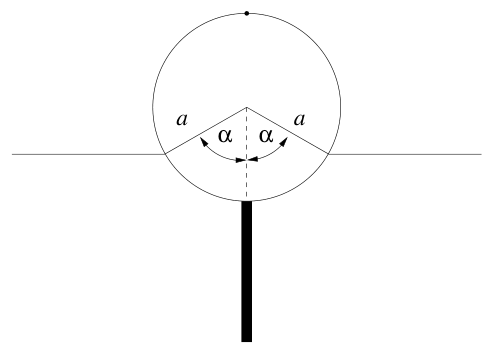
A buoy consists of a solid cylinder, radius \(a\), length \(l\), made of lightweight material of uniform density \(d\) with a uniform rigid rod protruding directly outwards from the bottom halfway along the length. The mass of the rod is equal to that of the cylinder, its length is the same as the diameter of the cylinder and the density of the rod is greater than that of seawater. This buoy is floating in sea-water of density \(\rho\).
In equilibrium derive an expression relating the floating angle \(\alpha\), as drawn, to \(d/\rho\). Neglect the volume of the rod.
(b) (4 marks)
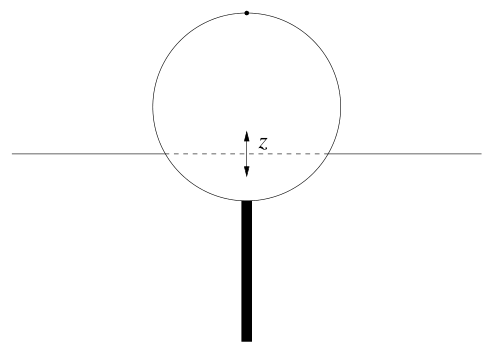
If the buoy, due to some perturbation, is depressed vertically by a small amount \(z\), it will experience a nett force, which will cause it to begin oscillating vertically about the equilibrium floating position. Determine the frequency of this vertical mode of vibration in terms of \(\alpha\), \(g\) and \(a\), where \(g\) is the acceleration due to gravity. Assume the influence of water motion on the dynamics of the buoy is such as to increase the effective mass of the buoy by a factor of one third. You may assume that \(\alpha\) is not small.
(c) (8 marks)
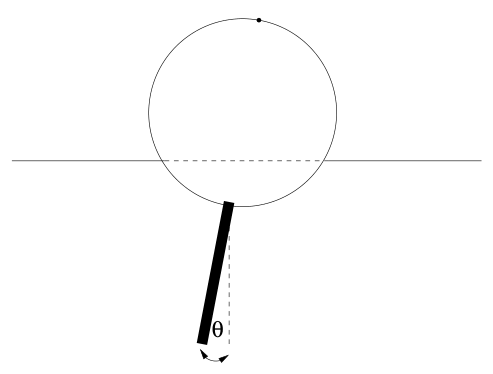
In the approximation that the cylinder swings about its horizontal central axis, determine the frequency of swing again in terms of \(g\) and \(a\). Neglect the dynamics and viscosity of the water in this case. The angle of swing is assumed to be small.
(d) (5 marks)
The buoy contains sensitive accelerometers which can measure the vertical and swinging motions and can relay this information by radio to shore. In relatively calm waters it is recorded that the vertical oscillation period is about 1 second and the swinging oscillation period is about 1.5 seconds. From this information, show that the floating angle \(\alpha\) is about \(90^\circ\) and thereby estimate the radius of the buoy and its total mass, given that the cylinder length \(l\) equals \(a\).
[You may take it that \(\rho\simeq1000\ \mathrm{kg\,m^{-3}}\) and \(g\simeq9.8\ \mathrm{m\,s^{-2}}\).]
Official English text of the problem.
Answers
-
(a) With \(\alpha\) in radians, \[ \boxed{\frac d\rho=\frac{\alpha-\sin\alpha\cos\alpha}{2\pi}}. \]
-
(b) The vertical oscillation frequency is \[ \boxed{f_z=\frac{1}{2\pi} \sqrt{\frac{3g\sin\alpha}{2a(\alpha-\sin\alpha\cos\alpha)}}}. \]
-
(c) The swinging frequency is \[ \boxed{f_\theta=\frac{1}{2\pi}\sqrt{\frac{12g}{29a}}}. \]
-
(d) \[ \boxed{\alpha\simeq90^\circ,\qquad a\simeq0.23\ \mathrm m,\qquad M\simeq20\ \mathrm{kg}}. \] Using the nominal periods exactly gives \(\alpha\simeq91.1^\circ\).
Solution
(a)
Let the mass of the cylinder be \(m\). The rod has the same mass, so \[ m=d\pi a^2l,\qquad M=2m. \]
The submerged cross-section is a circular segment subtending an angle \(2\alpha\) at the cylinder’s centre. Its area is the sector area minus the triangle area: \[ A_{\rm sub} =\frac12a^2(2\alpha)-\frac12a^2\sin2\alpha =a^2(\alpha-\sin\alpha\cos\alpha). \] Here and below, angles in these expressions are in radians.
Define \[ S(\alpha)=\alpha-\sin\alpha\cos\alpha. \] Neglecting the rod’s volume, the displaced volume is \(a^2lS(\alpha)\). By Archimedes’ principle, equilibrium requires \[ \rho g a^2lS(\alpha)=2d\pi a^2lg. \] Consequently, \[ \boxed{\frac d\rho=\frac{S(\alpha)}{2\pi} =\frac{2\alpha-\sin2\alpha}{4\pi}}. \]
(b)
At equilibrium, the width of the cylinder’s cross-section at the water surface is \[ w=2a\sin\alpha. \] Thus the horizontal area cut by the water surface is \(wl=2al\sin\alpha\).
Take the displacement \(z\) as positive downwards. To first order in \(z\), the increase in displaced volume is \[ \Delta V=2al\sin\alpha\,z. \] The equilibrium buoyancy already balances the weight. The additional buoyancy therefore gives the restoring force \[ F_z=-\rho g\Delta V=-2\rho gal\sin\alpha\,z. \]
The stated one-third increase in effective mass gives \[ M_{\rm eff}=M+\frac13M=\frac43M. \] From part (a), the actual mass satisfies \[ M=\rho a^2lS(\alpha). \] Hence the equation of motion is \[ \frac43\rho a^2lS(\alpha)\,\ddot z +2\rho gal\sin\alpha\,z=0. \]
This is simple harmonic motion, with \[ \omega_z^2=\frac{3g\sin\alpha}{2aS(\alpha)}. \] The frequency in cycles per second is therefore \[ \boxed{f_z=\frac{1}{2\pi} \sqrt{\frac{3g\sin\alpha} {2a(\alpha-\sin\alpha\cos\alpha)}}}. \]
Only the vertical displacement has been linearized; no small-\(\alpha\) approximation has been made.
(c)
Use the prescribed approximation that the cylinder rotates about its fixed horizontal central axis.
Because the cylinder has a circular cross-section, rotation about this axis leaves the submerged geometry unchanged. The buoyancy force acts vertically through the central axis and produces no torque about it. The cylinder’s own weight also acts through this axis. The restoring torque therefore comes entirely from the rod’s weight.
The rod extends from a distance \(a\) to a distance \(3a\) from the axis. Its centre of mass is consequently at distance \(2a\). For a displacement \(\theta\) from the downward vertical, \[ \tau=-2mga\sin\theta\simeq-2mga\,\theta, \] where the last approximation uses \(|\theta|\ll1\).
The cylinder’s moment of inertia about its central axis is \[ I_{\rm cyl}=\frac12ma^2. \] For the thin uniform rod, the parallel-axis theorem gives \[ I_{\rm rod} =\frac{1}{12}m(2a)^2+m(2a)^2 =\frac{13}{3}ma^2. \] Thus \[ I=I_{\rm cyl}+I_{\rm rod} =\frac{29}{6}ma^2. \]
Neglecting water dynamics and viscosity as instructed, \[ I\ddot\theta=-2mga\,\theta, \] or \[ \ddot\theta+\frac{12g}{29a}\theta=0. \] Therefore, \[ \boxed{\omega_\theta=\sqrt{\frac{12g}{29a}}, \qquad f_\theta=\frac{1}{2\pi}\sqrt{\frac{12g}{29a}}}. \]
(d)
Let the vertical and swinging periods be \(T_z\) and \(T_\theta\). Taking the ratio of the squared frequencies eliminates \(a\) and \(g\): \[ \left(\frac{T_\theta}{T_z}\right)^2 =\frac{\omega_z^2}{\omega_\theta^2} =\frac{29\sin\alpha}{8S(\alpha)}. \]
Using \(T_z\simeq1\ \mathrm s\) and \(T_\theta\simeq1.5\ \mathrm s\), \[ \frac{S(\alpha)}{\sin\alpha} \simeq\frac{29}{8(1.5)^2} =\frac{29}{18} \simeq1.611. \] At \(\alpha=90^\circ=\pi/2\), \[ \frac{S(\alpha)}{\sin\alpha}=\frac{\pi}{2}\simeq1.571, \] and the predicted period ratio is \[ \frac{T_\theta}{T_z} =\sqrt{\frac{29}{4\pi}} \simeq1.519, \] consistent with the approximate measured ratio \(1.5\). Solving with the nominal periods gives \(\alpha\simeq91.15^\circ\). Thus \[ \boxed{\alpha\simeq90^\circ}, \] so approximately half the cylinder is submerged.
The swinging period gives the radius directly: \[ T_\theta=2\pi\sqrt{\frac{29a}{12g}}, \] hence \[ a=\frac{3gT_\theta^2}{29\pi^2} =\frac{3(9.8)(1.5)^2}{29\pi^2}\ \mathrm m \simeq0.231\ \mathrm m. \] Therefore, \[ \boxed{a\simeq0.23\ \mathrm m}. \]
Since \(l=a\), equilibrium gives the total mass as \[ M=\rho a^3S(\alpha). \] For \(\alpha\simeq\pi/2\), \[ M\simeq\frac{\pi}{2}\rho a^3 \simeq\frac{\pi}{2}(1000)(0.231)^3\ \mathrm{kg} \simeq19.4\ \mathrm{kg}. \] Using the nominal-period value \(\alpha\simeq91.15^\circ\) gives \(M\simeq19.9\ \mathrm{kg}\). At the accuracy warranted by the stated periods, \[ \boxed{M\simeq20\ \mathrm{kg}}. \]
The solution was checked against the official solution.
IPhO 1995 · Theorieaufgabe 3
Zylindrische Boje
(a) (3 Punkte)
Eine Boje besteht aus einem Vollzylinder mit Radius \(a\) und Länge \(l\), der aus einem leichten Material mit einheitlicher Dichte \(d\) gefertigt ist. An seiner Unterseite ragt auf halber Länge ein homogener, starrer Stab radial nach außen. Die Masse des Stabes ist gleich der Masse des Zylinders, seine Länge entspricht dem Durchmesser des Zylinders, und seine Dichte ist größer als die von Meerwasser. Diese Boje schwimmt in Meerwasser der Dichte \(\rho\).
Leiten Sie für den Gleichgewichtszustand einen Ausdruck her, der den eingezeichneten Schwimmwinkel \(\alpha\) mit \(d/\rho\) verknüpft. Vernachlässigen Sie das Volumen des Stabes.
(b) (4 Punkte)
Wird die Boje durch eine Störung vertikal um eine kleine Strecke \(z\) nach unten gedrückt, so wirkt auf sie eine resultierende Kraft, durch die sie beginnt, vertikal um ihre Gleichgewichtslage zu schwingen. Bestimmen Sie die Frequenz dieser vertikalen Schwingungsform in Abhängigkeit von \(\alpha\), \(g\) und \(a\), wobei \(g\) die Fallbeschleunigung ist. Nehmen Sie an, dass der Einfluss der Wasserbewegung auf die Dynamik der Boje deren effektive Masse um ein Drittel erhöht. Sie dürfen annehmen, dass \(\alpha\) nicht klein ist.
(c) (8 Punkte)
Bestimmen Sie in der Näherung, dass der Zylinder um seine horizontale Mittelachse pendelt, die Frequenz dieser Pendelschwingung, wiederum in Abhängigkeit von \(g\) und \(a\). Vernachlässigen Sie in diesem Fall die Dynamik und die Viskosität des Wassers. Der Auslenkwinkel sei klein.
(d) (5 Punkte)
Die Boje enthält empfindliche Beschleunigungsmesser, die die vertikalen Bewegungen und die Pendelbewegungen messen und diese Informationen per Funk an die Küste übermitteln können. In relativ ruhigem Wasser wird für die vertikale Schwingung eine Periodendauer von etwa 1 Sekunde und für die Pendelschwingung eine Periodendauer von etwa 1.5 Sekunden gemessen. Zeigen Sie anhand dieser Angaben, dass der Schwimmwinkel \(\alpha\) etwa \(90^\circ\) beträgt, und schätzen Sie damit den Radius der Boje und ihre Gesamtmasse ab, wenn die Zylinderlänge \(l\) gleich \(a\) ist.
[Sie dürfen \(\rho\simeq1000\ \mathrm{kg\,m^{-3}}\) und \(g\simeq9.8\ \mathrm{m\,s^{-2}}\) annehmen.]
Aufgabentext aus dem offiziellen englischen Text übersetzt.
Antworten
-
(a) Mit \(\alpha\) im Bogenmaß gilt \[ \boxed{\frac d\rho=\frac{\alpha-\sin\alpha\cos\alpha}{2\pi}}. \]
-
(b) Die Frequenz der vertikalen Schwingung beträgt \[ \boxed{f_z=\frac{1}{2\pi} \sqrt{\frac{3g\sin\alpha}{2a(\alpha-\sin\alpha\cos\alpha)}}}. \]
-
(c) Die Frequenz der Pendelschwingung beträgt \[ \boxed{f_\theta=\frac{1}{2\pi}\sqrt{\frac{12g}{29a}}}. \]
-
(d) \[ \boxed{\alpha\simeq90^\circ,\qquad a\simeq0.23\ \mathrm m,\qquad M\simeq20\ \mathrm{kg}}. \] Werden die angegebenen Periodendauern als exakte Werte verwendet, ergibt sich \(\alpha\simeq91.1^\circ\).
Lösung
(a)
Die Masse des Zylinders sei \(m\). Der Stab hat dieselbe Masse, also gilt \[ m=d\pi a^2l,\qquad M=2m. \]
Der eingetauchte Querschnitt ist ein Kreissegment, das am Mittelpunkt des Zylinders einen Winkel \(2\alpha\) einschließt. Seine Fläche ist die Sektorfläche abzüglich der Dreiecksfläche: \[ A_{\rm sub} =\frac12a^2(2\alpha)-\frac12a^2\sin2\alpha =a^2(\alpha-\sin\alpha\cos\alpha). \] Hier und im Folgenden sind die Winkel in diesen Ausdrücken im Bogenmaß angegeben.
Wir definieren \[ S(\alpha)=\alpha-\sin\alpha\cos\alpha. \] Bei Vernachlässigung des Stabvolumens beträgt das verdrängte Volumen \(a^2lS(\alpha)\). Nach dem archimedischen Prinzip erfordert das Gleichgewicht \[ \rho g a^2lS(\alpha)=2d\pi a^2lg. \] Folglich gilt \[ \boxed{\frac d\rho=\frac{S(\alpha)}{2\pi} =\frac{2\alpha-\sin2\alpha}{4\pi}}. \]
(b)
Im Gleichgewicht beträgt die Breite des Zylinderquerschnitts an der Wasseroberfläche \[ w=2a\sin\alpha. \] Die horizontale Schnittfläche mit der Wasseroberfläche beträgt daher \(wl=2al\sin\alpha\).
Wir wählen die Auslenkung \(z\) nach unten positiv. In erster Ordnung in \(z\) beträgt die Zunahme des verdrängten Volumens \[ \Delta V=2al\sin\alpha\,z. \] Der Auftrieb im Gleichgewicht gleicht bereits die Gewichtskraft aus. Der zusätzliche Auftrieb liefert daher die Rückstellkraft \[ F_z=-\rho g\Delta V=-2\rho gal\sin\alpha\,z. \]
Die angegebene Erhöhung der effektiven Masse um ein Drittel ergibt \[ M_{\rm eff}=M+\frac13M=\frac43M. \] Nach Teil (a) gilt für die tatsächliche Masse \[ M=\rho a^2lS(\alpha). \] Damit lautet die Bewegungsgleichung \[ \frac43\rho a^2lS(\alpha)\,\ddot z +2\rho gal\sin\alpha\,z=0. \]
Dies ist eine harmonische Schwingung mit \[ \omega_z^2=\frac{3g\sin\alpha}{2aS(\alpha)}. \] Die Frequenz in Schwingungen pro Sekunde beträgt daher \[ \boxed{f_z=\frac{1}{2\pi} \sqrt{\frac{3g\sin\alpha} {2a(\alpha-\sin\alpha\cos\alpha)}}}. \]
Es wurde nur bezüglich der vertikalen Auslenkung linearisiert; eine Näherung für kleine \(\alpha\) wurde nicht verwendet.
(c)
Wir verwenden die vorgegebene Näherung, dass sich der Zylinder um seine feste horizontale Mittelachse dreht.
Da der Zylinder einen kreisförmigen Querschnitt hat, bleibt die Geometrie des eingetauchten Bereichs bei einer Drehung um diese Achse unverändert. Die Auftriebskraft wirkt vertikal durch die Mittelachse und erzeugt bezüglich dieser kein Drehmoment. Auch die Gewichtskraft des Zylinders wirkt durch diese Achse. Das rückstellende Drehmoment stammt daher ausschließlich von der Gewichtskraft des Stabes.
Der Stab erstreckt sich von einem Abstand \(a\) bis zu einem Abstand \(3a\) von der Achse. Sein Schwerpunkt liegt folglich im Abstand \(2a\). Für eine Auslenkung \(\theta\) gegenüber der nach unten gerichteten Vertikalen gilt \[ \tau=-2mga\sin\theta\simeq-2mga\,\theta, \] wobei die letzte Näherung \(|\theta|\ll1\) voraussetzt.
Das Trägheitsmoment des Zylinders bezüglich seiner Mittelachse beträgt \[ I_{\rm cyl}=\frac12ma^2. \] Für den dünnen homogenen Stab liefert der Satz von Steiner \[ I_{\rm rod} =\frac{1}{12}m(2a)^2+m(2a)^2 =\frac{13}{3}ma^2. \] Somit gilt \[ I=I_{\rm cyl}+I_{\rm rod} =\frac{29}{6}ma^2. \]
Bei der geforderten Vernachlässigung der Dynamik und der Viskosität des Wassers gilt \[ I\ddot\theta=-2mga\,\theta, \] oder \[ \ddot\theta+\frac{12g}{29a}\theta=0. \] Daher gilt \[ \boxed{\omega_\theta=\sqrt{\frac{12g}{29a}}, \qquad f_\theta=\frac{1}{2\pi}\sqrt{\frac{12g}{29a}}}. \]
(d)
Die Periodendauern der vertikalen Schwingung und der Pendelschwingung seien \(T_z\) bzw. \(T_\theta\). Durch Bildung des Verhältnisses der quadrierten Frequenzen werden \(a\) und \(g\) eliminiert: \[ \left(\frac{T_\theta}{T_z}\right)^2 =\frac{\omega_z^2}{\omega_\theta^2} =\frac{29\sin\alpha}{8S(\alpha)}. \]
Mit \(T_z\simeq1\ \mathrm s\) und \(T_\theta\simeq1.5\ \mathrm s\) ergibt sich \[ \frac{S(\alpha)}{\sin\alpha} \simeq\frac{29}{8(1.5)^2} =\frac{29}{18} \simeq1.611. \] Für \(\alpha=90^\circ=\pi/2\) gilt \[ \frac{S(\alpha)}{\sin\alpha}=\frac{\pi}{2}\simeq1.571, \] und das vorhergesagte Verhältnis der Periodendauern beträgt \[ \frac{T_\theta}{T_z} =\sqrt{\frac{29}{4\pi}} \simeq1.519, \] was mit dem näherungsweise gemessenen Verhältnis \(1.5\) vereinbar ist. Löst man die Gleichung mit den angegebenen Periodendauern, ergibt sich \(\alpha\simeq91.15^\circ\). Somit gilt \[ \boxed{\alpha\simeq90^\circ}, \] sodass der Zylinder ungefähr zur Hälfte eingetaucht ist.
Die Periodendauer der Pendelschwingung liefert unmittelbar den Radius: \[ T_\theta=2\pi\sqrt{\frac{29a}{12g}}, \] also \[ a=\frac{3gT_\theta^2}{29\pi^2} =\frac{3(9.8)(1.5)^2}{29\pi^2}\ \mathrm m \simeq0.231\ \mathrm m. \] Daher gilt \[ \boxed{a\simeq0.23\ \mathrm m}. \]
Da \(l=a\), ergibt sich aus der Gleichgewichtsbedingung für die Gesamtmasse \[ M=\rho a^3S(\alpha). \] Für \(\alpha\simeq\pi/2\) gilt \[ M\simeq\frac{\pi}{2}\rho a^3 \simeq\frac{\pi}{2}(1000)(0.231)^3\ \mathrm{kg} \simeq19.4\ \mathrm{kg}. \] Mit dem aus den angegebenen Periodendauern ermittelten Wert \(\alpha\simeq91.15^\circ\) ergibt sich \(M\simeq19.9\ \mathrm{kg}\). Bei der durch die angegebenen Periodendauern gerechtfertigten Genauigkeit gilt \[ \boxed{M\simeq20\ \mathrm{kg}}. \]
Die Lösung wurde mit der offiziellen Lösung abgeglichen.
IPhO 1995 · Teori sorusu 3
Silindirik Şamandıra
(a) (3 puan)
Bir şamandıra, yarıçapı \(a\), uzunluğu \(l\) olan, düzgün \(d\) yoğunluğuna sahip hafif bir malzemeden yapılmış dolu bir silindirden ve silindirin uzunluğunun orta noktasında alt yüzeyinden doğrudan dışarıya doğru uzanan düzgün, rijit bir çubuktan oluşmaktadır. Çubuğun kütlesi silindirinkine eşittir, uzunluğu silindirin çapıyla aynıdır ve yoğunluğu deniz suyunun yoğunluğundan büyüktür. Bu şamandıra, yoğunluğu \(\rho\) olan deniz suyunda yüzmektedir.
Denge durumunda, şekilde gösterilen yüzme açısı \(\alpha\) ile \(d/\rho\) arasında ilişki kuran bir ifade türetiniz. Çubuğun hacmini ihmal ediniz.
(b) (4 puan)
Şamandıra, bir bozucu etki nedeniyle düşey doğrultuda küçük bir \(z\) miktarı kadar aşağı bastırılırsa, üzerine etki eden net kuvvet, denge yüzme konumu çevresinde düşey salınımlara başlamasına neden olur. Bu düşey titreşim modunun frekansını \(\alpha\), \(g\) ve \(a\) cinsinden belirleyiniz; burada \(g\) yerçekimi ivmesidir. Su hareketinin şamandıranın dinamiği üzerindeki etkisinin, şamandıranın etkin kütlesini üçte biri kadar artırdığını varsayınız. \(\alpha\) açısının küçük olmadığını varsayabilirsiniz.
(c) (8 puan)
Silindirin, merkezinden geçen yatay eksen etrafında salındığı yaklaşımı altında, açısal salınım frekansını yine \(g\) ve \(a\) cinsinden belirleyiniz. Bu durumda suyun dinamiğini ve viskozitesini ihmal ediniz. Salınım açısının küçük olduğu varsayılmaktadır.
(d) (5 puan)
Şamandıra, düşey hareketleri ve açısal salınımları ölçebilen ve bu bilgileri radyo yoluyla kıyıya iletebilen hassas ivmeölçerler içermektedir. Nispeten sakin sularda, düşey salınım periyodunun yaklaşık 1 saniye ve açısal salınım periyodunun yaklaşık 1.5 saniye olduğu kaydedilmiştir. Bu bilgilerden yararlanarak, yüzme açısı \(\alpha\)'nın yaklaşık \(90^\circ\) olduğunu gösteriniz ve buradan, silindirin uzunluğu \(l\)'nin \(a\)'ya eşit olduğu verildiğine göre, şamandıranın yarıçapını ve toplam kütlesini tahmin ediniz.
[\(\rho\simeq1000\ \mathrm{kg\,m^{-3}}\) ve \(g\simeq9.8\ \mathrm{m\,s^{-2}}\) alabilirsiniz.]
Soru metni resmi İngilizce metinden çevrilmiştir.
Cevaplar
-
(a) \(\alpha\) radyan cinsinden olmak üzere, \[ \boxed{\frac d\rho=\frac{\alpha-\sin\alpha\cos\alpha}{2\pi}}. \]
-
(b) Düşey salınım frekansı \[ \boxed{f_z=\frac{1}{2\pi} \sqrt{\frac{3g\sin\alpha}{2a(\alpha-\sin\alpha\cos\alpha)}}}. \]
-
(c) Açısal salınım frekansı \[ \boxed{f_\theta=\frac{1}{2\pi}\sqrt{\frac{12g}{29a}}}. \]
-
(d) \[ \boxed{\alpha\simeq90^\circ,\qquad a\simeq0.23\ \mathrm m,\qquad M\simeq20\ \mathrm{kg}}. \] Verilen periyot değerleri tam olarak kullanıldığında \(\alpha\simeq91.1^\circ\) elde edilir.
Çözüm
(a)
Silindirin kütlesi \(m\) olsun. Çubuğun kütlesi de aynı olduğundan \[ m=d\pi a^2l,\qquad M=2m. \]
Suya batmış kesit, silindirin merkezinde \(2\alpha\) açısını gören bir daire parçasıdır. Alanı, daire diliminin alanından üçgenin alanının çıkarılmasıyla bulunur: \[ A_{\rm sub} =\frac12a^2(2\alpha)-\frac12a^2\sin2\alpha =a^2(\alpha-\sin\alpha\cos\alpha). \] Burada ve aşağıda, bu ifadelerdeki açılar radyan cinsindendir.
Şu tanımı yapalım: \[ S(\alpha)=\alpha-\sin\alpha\cos\alpha. \] Çubuğun hacmi ihmal edildiğinde, yer değiştiren suyun hacmi \(a^2lS(\alpha)\) olur. Arşimet ilkesine göre denge için \[ \rho g a^2lS(\alpha)=2d\pi a^2lg. \] Dolayısıyla, \[ \boxed{\frac d\rho=\frac{S(\alpha)}{2\pi} =\frac{2\alpha-\sin2\alpha}{4\pi}}. \]
(b)
Denge durumunda, silindirin kesitinin su yüzeyindeki genişliği \[ w=2a\sin\alpha. \] Böylece su yüzeyinin silindirden kestiği yatay alan \(wl=2al\sin\alpha\) olur.
Yer değiştirme \(z\)'yi aşağı yönde pozitif alalım. \(z\)'ye göre birinci mertebede, yer değiştiren su hacmindeki artış \[ \Delta V=2al\sin\alpha\,z. \] Denge durumundaki kaldırma kuvveti zaten ağırlığı dengelemektedir. Bu nedenle ek kaldırma kuvveti, geri çağırıcı kuvveti verir: \[ F_z=-\rho g\Delta V=-2\rho gal\sin\alpha\,z. \]
Etkin kütlede belirtilen üçte birlik artış sonucunda \[ M_{\rm eff}=M+\frac13M=\frac43M. \] (a) kısmından, gerçek kütle şu bağıntıyı sağlar: \[ M=\rho a^2lS(\alpha). \] Dolayısıyla hareket denklemi \[ \frac43\rho a^2lS(\alpha)\,\ddot z +2\rho gal\sin\alpha\,z=0. \]
Bu, basit harmonik harekettir ve \[ \omega_z^2=\frac{3g\sin\alpha}{2aS(\alpha)}. \] Bu nedenle saniyedeki çevrim sayısı cinsinden frekans \[ \boxed{f_z=\frac{1}{2\pi} \sqrt{\frac{3g\sin\alpha} {2a(\alpha-\sin\alpha\cos\alpha)}}}. \]
Yalnızca düşey yer değiştirme doğrusallaştırılmıştır; \(\alpha\) için küçük açı yaklaşımı yapılmamıştır.
(c)
Silindirin, merkezinden geçen sabit yatay eksen etrafında döndüğüne ilişkin belirtilen yaklaşımı kullanalım.
Silindirin kesiti dairesel olduğundan, bu eksen etrafındaki dönme, suya batmış kısmın geometrisini değiştirmez. Kaldırma kuvveti merkez ekseninden geçerek düşey yönde etki eder ve bu eksene göre tork oluşturmaz. Silindirin kendi ağırlığı da bu eksenden geçerek etki eder. Bu nedenle geri çağırıcı torkun tamamı çubuğun ağırlığından kaynaklanır.
Çubuk, eksenden \(a\) uzaklıktan \(3a\) uzaklığa kadar uzanır. Dolayısıyla kütle merkezi eksenden \(2a\) uzaklıktadır. Aşağı yönlü düşey doğrultudan \(\theta\) kadar açısal yer değiştirme için, \[ \tau=-2mga\sin\theta\simeq-2mga\,\theta, \] burada son yaklaşımda \(|\theta|\ll1\) kullanılmıştır.
Silindirin merkez eksenine göre eylemsizlik momenti \[ I_{\rm cyl}=\frac12ma^2. \] İnce, düzgün çubuk için paralel eksen teoremi \[ I_{\rm rod} =\frac{1}{12}m(2a)^2+m(2a)^2 =\frac{13}{3}ma^2. \] Böylece \[ I=I_{\rm cyl}+I_{\rm rod} =\frac{29}{6}ma^2. \]
İstendiği gibi suyun dinamiğini ve viskozitesini ihmal ederek, \[ I\ddot\theta=-2mga\,\theta, \] ya da \[ \ddot\theta+\frac{12g}{29a}\theta=0. \] Dolayısıyla, \[ \boxed{\omega_\theta=\sqrt{\frac{12g}{29a}}, \qquad f_\theta=\frac{1}{2\pi}\sqrt{\frac{12g}{29a}}}. \]
(d)
Düşey ve açısal salınım periyotları sırasıyla \(T_z\) ve \(T_\theta\) olsun. Frekansların karelerinin oranı alındığında \(a\) ve \(g\) elenir: \[ \left(\frac{T_\theta}{T_z}\right)^2 =\frac{\omega_z^2}{\omega_\theta^2} =\frac{29\sin\alpha}{8S(\alpha)}. \]
\(T_z\simeq1\ \mathrm s\) ve \(T_\theta\simeq1.5\ \mathrm s\) kullanıldığında, \[ \frac{S(\alpha)}{\sin\alpha} \simeq\frac{29}{8(1.5)^2} =\frac{29}{18} \simeq1.611. \] \(\alpha=90^\circ=\pi/2\) için, \[ \frac{S(\alpha)}{\sin\alpha}=\frac{\pi}{2}\simeq1.571, \] ve öngörülen periyot oranı \[ \frac{T_\theta}{T_z} =\sqrt{\frac{29}{4\pi}} \simeq1.519, \] olup ölçülen yaklaşık \(1.5\) oranıyla tutarlıdır. Verilen periyot değerleriyle çözüm yapıldığında \(\alpha\simeq91.15^\circ\) elde edilir. Böylece \[ \boxed{\alpha\simeq90^\circ}, \] yani silindirin yaklaşık yarısı suya batmıştır.
Açısal salınım periyodu yarıçapı doğrudan verir: \[ T_\theta=2\pi\sqrt{\frac{29a}{12g}}, \] dolayısıyla \[ a=\frac{3gT_\theta^2}{29\pi^2} =\frac{3(9.8)(1.5)^2}{29\pi^2}\ \mathrm m \simeq0.231\ \mathrm m. \] Böylece, \[ \boxed{a\simeq0.23\ \mathrm m}. \]
\(l=a\) olduğundan, denge koşulu toplam kütleyi şöyle verir: \[ M=\rho a^3S(\alpha). \] \(\alpha\simeq\pi/2\) için, \[ M\simeq\frac{\pi}{2}\rho a^3 \simeq\frac{\pi}{2}(1000)(0.231)^3\ \mathrm{kg} \simeq19.4\ \mathrm{kg}. \] Verilen periyotlardan elde edilen \(\alpha\simeq91.15^\circ\) değeri kullanıldığında \(M\simeq19.9\ \mathrm{kg}\) bulunur. Belirtilen periyotların izin verdiği hassasiyet düzeyinde, \[ \boxed{M\simeq20\ \mathrm{kg}}. \]
Çözüm, resmi çözümle karşılaştırılarak kontrol edildi.
IPhO 1995 · Problema teórico 3
Boya cilíndrica
(a) (3 puntos)
Una boya consiste en un cilindro macizo de radio \(a\) y longitud \(l\), hecho de un material ligero de densidad uniforme \(d\), con una varilla rígida y uniforme que sobresale radialmente hacia fuera desde su parte inferior, a la mitad de su longitud. La masa de la varilla es igual a la del cilindro, su longitud es igual al diámetro del cilindro y su densidad es mayor que la del agua de mar. Esta boya flota en agua de mar de densidad \(\rho\).
En equilibrio, deduzca una expresión que relacione el ángulo de flotación \(\alpha\), tal como se muestra en la figura, con \(d/\rho\). Desprecie el volumen de la varilla.
(b) (4 puntos)
Si, debido a alguna perturbación, la boya se desplaza verticalmente hacia abajo una pequeña distancia \(z\), experimentará una fuerza neta que hará que comience a oscilar verticalmente en torno a su posición de flotación de equilibrio. Determine la frecuencia de este modo de vibración vertical en función de \(\alpha\), \(g\) y \(a\), donde \(g\) es la aceleración de la gravedad. Suponga que la influencia del movimiento del agua sobre la dinámica de la boya hace que su masa efectiva aumente en un tercio. Puede suponer que \(\alpha\) no es pequeño.
(c) (8 puntos)
En la aproximación de que el cilindro oscila alrededor de su eje central horizontal, determine la frecuencia de oscilación angular, de nuevo en función de \(g\) y \(a\). Desprecie en este caso la dinámica y la viscosidad del agua. Se supone que el ángulo de oscilación es pequeño.
(d) (5 puntos)
La boya contiene acelerómetros sensibles que pueden medir los movimientos verticales y angulares y transmitir esta información por radio a la costa. En aguas relativamente tranquilas, se registra que el período de oscilación vertical es de aproximadamente 1 segundo y el período de oscilación angular es de aproximadamente 1.5 segundos. A partir de esta información, demuestre que el ángulo de flotación \(\alpha\) es de aproximadamente \(90^\circ\) y estime así el radio de la boya y su masa total, sabiendo que la longitud del cilindro \(l\) es igual a \(a\).
[Puede tomar \(\rho\simeq1000\ \mathrm{kg\,m^{-3}}\) y \(g\simeq9.8\ \mathrm{m\,s^{-2}}\).]
Enunciado traducido del texto oficial en inglés.
Respuestas
-
(a) Con \(\alpha\) en radianes, \[ \boxed{\frac d\rho=\frac{\alpha-\sin\alpha\cos\alpha}{2\pi}}. \]
-
(b) La frecuencia de oscilación vertical es \[ \boxed{f_z=\frac{1}{2\pi} \sqrt{\frac{3g\sin\alpha}{2a(\alpha-\sin\alpha\cos\alpha)}}}. \]
-
(c) La frecuencia de oscilación angular es \[ \boxed{f_\theta=\frac{1}{2\pi}\sqrt{\frac{12g}{29a}}}. \]
-
(d) \[ \boxed{\alpha\simeq90^\circ,\qquad a\simeq0.23\ \mathrm m,\qquad M\simeq20\ \mathrm{kg}}. \] Al utilizar exactamente los períodos nominales se obtiene \(\alpha\simeq91.1^\circ\).
Solución
(a)
Sea \(m\) la masa del cilindro. La varilla tiene la misma masa, de modo que \[ m=d\pi a^2l,\qquad M=2m. \]
La sección transversal sumergida es un segmento circular que subtiende un ángulo \(2\alpha\) en el centro del cilindro. Su área es el área del sector menos el área del triángulo: \[ A_{\rm sub} =\frac12a^2(2\alpha)-\frac12a^2\sin2\alpha =a^2(\alpha-\sin\alpha\cos\alpha). \] Aquí y en lo que sigue, los ángulos de estas expresiones se miden en radianes.
Definimos \[ S(\alpha)=\alpha-\sin\alpha\cos\alpha. \] Despreciando el volumen de la varilla, el volumen desplazado es \(a^2lS(\alpha)\). Según el principio de Arquímedes, el equilibrio exige \[ \rho g a^2lS(\alpha)=2d\pi a^2lg. \] Por consiguiente, \[ \boxed{\frac d\rho=\frac{S(\alpha)}{2\pi} =\frac{2\alpha-\sin2\alpha}{4\pi}}. \]
(b)
En equilibrio, la anchura de la sección transversal del cilindro a la altura de la superficie del agua es \[ w=2a\sin\alpha. \] Por tanto, el área horizontal de la sección cortada por la superficie del agua es \(wl=2al\sin\alpha\).
Tomemos el desplazamiento \(z\) como positivo hacia abajo. A primer orden en \(z\), el aumento del volumen desplazado es \[ \Delta V=2al\sin\alpha\,z. \] El empuje en equilibrio ya compensa el peso. Por tanto, el empuje adicional proporciona la fuerza restauradora \[ F_z=-\rho g\Delta V=-2\rho gal\sin\alpha\,z. \]
El aumento de un tercio de la masa efectiva indicado en el enunciado da \[ M_{\rm eff}=M+\frac13M=\frac43M. \] Según el apartado (a), la masa real satisface \[ M=\rho a^2lS(\alpha). \] Así pues, la ecuación de movimiento es \[ \frac43\rho a^2lS(\alpha)\,\ddot z +2\rho gal\sin\alpha\,z=0. \]
Este es un movimiento armónico simple, con \[ \omega_z^2=\frac{3g\sin\alpha}{2aS(\alpha)}. \] Por tanto, la frecuencia en ciclos por segundo es \[ \boxed{f_z=\frac{1}{2\pi} \sqrt{\frac{3g\sin\alpha} {2a(\alpha-\sin\alpha\cos\alpha)}}}. \]
Solo se ha linealizado el desplazamiento vertical; no se ha utilizado ninguna aproximación de \(\alpha\) pequeño.
(c)
Utilizamos la aproximación indicada de que el cilindro gira alrededor de su eje central horizontal fijo.
Como el cilindro tiene una sección transversal circular, la rotación alrededor de este eje no modifica la geometría sumergida. El empuje actúa verticalmente a través del eje central y no produce ningún momento de fuerza respecto a él. El peso del propio cilindro también actúa a través de este eje. Por tanto, el momento restaurador se debe enteramente al peso de la varilla.
La varilla se extiende desde una distancia \(a\) hasta una distancia \(3a\) del eje. Por consiguiente, su centro de masas se encuentra a una distancia \(2a\). Para un desplazamiento \(\theta\) respecto a la vertical hacia abajo, \[ \tau=-2mga\sin\theta\simeq-2mga\,\theta, \] donde la última aproximación utiliza \(|\theta|\ll1\).
El momento de inercia del cilindro respecto a su eje central es \[ I_{\rm cyl}=\frac12ma^2. \] Para la varilla delgada y uniforme, el teorema de los ejes paralelos da \[ I_{\rm rod} =\frac{1}{12}m(2a)^2+m(2a)^2 =\frac{13}{3}ma^2. \] Así, \[ I=I_{\rm cyl}+I_{\rm rod} =\frac{29}{6}ma^2. \]
Despreciando la dinámica y la viscosidad del agua, tal como se indica, \[ I\ddot\theta=-2mga\,\theta, \] o bien \[ \ddot\theta+\frac{12g}{29a}\theta=0. \] Por tanto, \[ \boxed{\omega_\theta=\sqrt{\frac{12g}{29a}}, \qquad f_\theta=\frac{1}{2\pi}\sqrt{\frac{12g}{29a}}}. \]
(d)
Sean \(T_z\) y \(T_\theta\) los períodos de oscilación vertical y angular. Al tomar el cociente de los cuadrados de las frecuencias se eliminan \(a\) y \(g\): \[ \left(\frac{T_\theta}{T_z}\right)^2 =\frac{\omega_z^2}{\omega_\theta^2} =\frac{29\sin\alpha}{8S(\alpha)}. \]
Utilizando \(T_z\simeq1\ \mathrm s\) y \(T_\theta\simeq1.5\ \mathrm s\), \[ \frac{S(\alpha)}{\sin\alpha} \simeq\frac{29}{8(1.5)^2} =\frac{29}{18} \simeq1.611. \] Para \(\alpha=90^\circ=\pi/2\), \[ \frac{S(\alpha)}{\sin\alpha}=\frac{\pi}{2}\simeq1.571, \] y el cociente de períodos predicho es \[ \frac{T_\theta}{T_z} =\sqrt{\frac{29}{4\pi}} \simeq1.519, \] lo cual es compatible con el cociente medido aproximado de \(1.5\). Al resolver con los períodos nominales se obtiene \(\alpha\simeq91.15^\circ\). Así, \[ \boxed{\alpha\simeq90^\circ}, \] por lo que aproximadamente la mitad del cilindro está sumergida.
El período de oscilación angular proporciona directamente el radio: \[ T_\theta=2\pi\sqrt{\frac{29a}{12g}}, \] de donde \[ a=\frac{3gT_\theta^2}{29\pi^2} =\frac{3(9.8)(1.5)^2}{29\pi^2}\ \mathrm m \simeq0.231\ \mathrm m. \] Por tanto, \[ \boxed{a\simeq0.23\ \mathrm m}. \]
Como \(l=a\), el equilibrio da la masa total como \[ M=\rho a^3S(\alpha). \] Para \(\alpha\simeq\pi/2\), \[ M\simeq\frac{\pi}{2}\rho a^3 \simeq\frac{\pi}{2}(1000)(0.231)^3\ \mathrm{kg} \simeq19.4\ \mathrm{kg}. \] Al utilizar el valor \(\alpha\simeq91.15^\circ\) obtenido con los períodos nominales se obtiene \(M\simeq19.9\ \mathrm{kg}\). Con la precisión que permiten los períodos indicados, \[ \boxed{M\simeq20\ \mathrm{kg}}. \]
La solución se comprobó con la solución oficial.
IPhO 1995 · 理论题 3
圆柱形浮标
(a)(3 分)
一个浮标由一个半径为 \(a\)、长度为 \(l\) 的实心圆柱体组成,圆柱体由密度均匀、密度为 \(d\) 的轻质材料制成。一根均匀的刚性杆从圆柱体长度中点处的底部沿径向向外伸出。杆的质量等于圆柱体的质量,长度等于圆柱体的直径,密度大于海水的密度。该浮标漂浮在密度为 \(\rho\) 的海水中。
推导平衡时图示的漂浮角 \(\alpha\) 与 \(d/\rho\) 之间的关系式。忽略杆的体积。
(b)(4 分)
如果浮标因某种扰动而竖直向下移动一小段距离 \(z\),它将受到一个合力,从而开始在平衡漂浮位置附近沿竖直方向振动。用 \(\alpha\)、\(g\) 和 \(a\) 表示这一竖直振动模式的频率,其中 \(g\) 为重力加速度。假设水的运动对浮标动力学的影响相当于使浮标的有效质量增加三分之一。可以认为 \(\alpha\) 不是小角度。
(c)(8 分)
近似认为圆柱体绕其水平中心轴摆动,仍用 \(g\) 和 \(a\) 表示摆动频率。在此情况下,忽略水的动力学效应和黏性。假设摆角很小。
(d)(5 分)
浮标内装有灵敏的加速度计,能够测量竖直运动和摆动,并通过无线电将这些信息传送到岸上。在较为平静的水域中,记录到竖直振动周期约为 1 秒,摆动周期约为 1.5 秒。根据这些信息,证明漂浮角 \(\alpha\) 约为 \(90^\circ\),并据此估算浮标的半径及其总质量,已知圆柱体的长度 \(l\) 等于 \(a\)。
[可取 \(\rho\simeq1000\ \mathrm{kg\,m^{-3}}\) 和 \(g\simeq9.8\ \mathrm{m\,s^{-2}}\)。]
题目译自官方英文原文。
答案
-
(a) 当 \(\alpha\) 以弧度为单位时, \[ \boxed{\frac d\rho=\frac{\alpha-\sin\alpha\cos\alpha}{2\pi}}. \]
-
(b) 竖直振动频率为 \[ \boxed{f_z=\frac{1}{2\pi} \sqrt{\frac{3g\sin\alpha}{2a(\alpha-\sin\alpha\cos\alpha)}}}. \]
-
(c) 摆动频率为 \[ \boxed{f_\theta=\frac{1}{2\pi}\sqrt{\frac{12g}{29a}}}. \]
-
(d) \[ \boxed{\alpha\simeq90^\circ,\qquad a\simeq0.23\ \mathrm m,\qquad M\simeq20\ \mathrm{kg}}. \] 将给定的周期数值作为精确值计算,可得 \(\alpha\simeq91.1^\circ\)。
解答
(a)
设圆柱体的质量为 \(m\)。杆的质量与之相同,因此 \[ m=d\pi a^2l,\qquad M=2m. \]
浸没部分的横截面是一个弓形,其所对应的圆心角为 \(2\alpha\)。它的面积等于扇形面积减去三角形面积: \[ A_{\rm sub} =\frac12a^2(2\alpha)-\frac12a^2\sin2\alpha =a^2(\alpha-\sin\alpha\cos\alpha). \] 此处及下文这些表达式中的角度均以弧度为单位。
定义 \[ S(\alpha)=\alpha-\sin\alpha\cos\alpha. \] 忽略杆的体积,排开海水的体积为 \(a^2lS(\alpha)\)。根据阿基米德原理,平衡条件为 \[ \rho g a^2lS(\alpha)=2d\pi a^2lg. \] 因此, \[ \boxed{\frac d\rho=\frac{S(\alpha)}{2\pi} =\frac{2\alpha-\sin2\alpha}{4\pi}}. \]
(b)
平衡时,圆柱体横截面在水面处的宽度为 \[ w=2a\sin\alpha. \] 因此,水面截得的水平截面积为 \(wl=2al\sin\alpha\)。
取位移 \(z\) 向下为正。保留 \(z\) 的一阶项,排水体积的增加量为 \[ \Delta V=2al\sin\alpha\,z. \] 平衡时的浮力已经与重力平衡。因此,增加的浮力提供回复力 \[ F_z=-\rho g\Delta V=-2\rho gal\sin\alpha\,z. \]
根据题设,有效质量增加三分之一,故 \[ M_{\rm eff}=M+\frac13M=\frac43M. \] 由 (a) 部分可知,实际质量满足 \[ M=\rho a^2lS(\alpha). \] 因此,运动方程为 \[ \frac43\rho a^2lS(\alpha)\,\ddot z +2\rho gal\sin\alpha\,z=0. \]
这是简谐运动,且 \[ \omega_z^2=\frac{3g\sin\alpha}{2aS(\alpha)}. \] 因此,以每秒振动次数表示的频率为 \[ \boxed{f_z=\frac{1}{2\pi} \sqrt{\frac{3g\sin\alpha} {2a(\alpha-\sin\alpha\cos\alpha)}}}. \]
这里只对竖直位移作了线性化处理,并未对 \(\alpha\) 作小角度近似。
(c)
采用题目指定的近似,认为圆柱体绕其固定的水平中心轴转动。
由于圆柱体的横截面为圆形,绕此轴转动不会改变浸没部分的几何形状。浮力沿竖直方向作用,其作用线通过中心轴,因此对该轴不产生力矩。圆柱体自身的重力作用线也通过此轴。因此,回复力矩完全来自杆的重力。
杆从距轴 \(a\) 处延伸至距轴 \(3a\) 处。因此,其质心距轴 \(2a\)。当杆偏离竖直向下方向的角位移为 \(\theta\) 时, \[ \tau=-2mga\sin\theta\simeq-2mga\,\theta, \] 其中最后一步近似利用了 \(|\theta|\ll1\)。
圆柱体绕其中心轴的转动惯量为 \[ I_{\rm cyl}=\frac12ma^2. \] 对于均匀细杆,由平行轴定理可得 \[ I_{\rm rod} =\frac{1}{12}m(2a)^2+m(2a)^2 =\frac{13}{3}ma^2. \] 因此 \[ I=I_{\rm cyl}+I_{\rm rod} =\frac{29}{6}ma^2. \]
按题目要求忽略水的动力学效应和黏性, \[ I\ddot\theta=-2mga\,\theta, \] 即 \[ \ddot\theta+\frac{12g}{29a}\theta=0. \] 所以, \[ \boxed{\omega_\theta=\sqrt{\frac{12g}{29a}}, \qquad f_\theta=\frac{1}{2\pi}\sqrt{\frac{12g}{29a}}}. \]
(d)
设竖直振动周期和摆动周期分别为 \(T_z\) 和 \(T_\theta\)。取角频率平方之比,可消去 \(a\) 和 \(g\): \[ \left(\frac{T_\theta}{T_z}\right)^2 =\frac{\omega_z^2}{\omega_\theta^2} =\frac{29\sin\alpha}{8S(\alpha)}. \]
代入 \(T_z\simeq1\ \mathrm s\) 和 \(T_\theta\simeq1.5\ \mathrm s\), \[ \frac{S(\alpha)}{\sin\alpha} \simeq\frac{29}{8(1.5)^2} =\frac{29}{18} \simeq1.611. \] 当 \(\alpha=90^\circ=\pi/2\) 时, \[ \frac{S(\alpha)}{\sin\alpha}=\frac{\pi}{2}\simeq1.571, \] 预测的周期比为 \[ \frac{T_\theta}{T_z} =\sqrt{\frac{29}{4\pi}} \simeq1.519, \] 与测得的近似比值 \(1.5\) 一致。用给定的周期数值求解,得到 \(\alpha\simeq91.15^\circ\)。因此 \[ \boxed{\alpha\simeq90^\circ}, \] 即圆柱体大约有一半浸没在水中。
由摆动周期可直接求出半径: \[ T_\theta=2\pi\sqrt{\frac{29a}{12g}}, \] 于是 \[ a=\frac{3gT_\theta^2}{29\pi^2} =\frac{3(9.8)(1.5)^2}{29\pi^2}\ \mathrm m \simeq0.231\ \mathrm m. \] 因此, \[ \boxed{a\simeq0.23\ \mathrm m}. \]
由于 \(l=a\),由平衡条件可得总质量为 \[ M=\rho a^3S(\alpha). \] 当 \(\alpha\simeq\pi/2\) 时, \[ M\simeq\frac{\pi}{2}\rho a^3 \simeq\frac{\pi}{2}(1000)(0.231)^3\ \mathrm{kg} \simeq19.4\ \mathrm{kg}. \] 使用由给定周期数值求得的 \(\alpha\simeq91.15^\circ\),可得 \(M\simeq19.9\ \mathrm{kg}\)。按题中所给周期允许的精度, \[ \boxed{M\simeq20\ \mathrm{kg}}. \]
解答已与官方解答核对。
IPhO 1995 · Теоретическая задача 3
Цилиндрический буй
(a) (3 балла)
Буй состоит из сплошного цилиндра радиуса \(a\) и длины \(l\), изготовленного из лёгкого материала с однородной плотностью \(d\), и однородного жёсткого стержня, выступающего радиально наружу из нижней части цилиндра посередине его длины. Масса стержня равна массе цилиндра, его длина равна диаметру цилиндра, а плотность стержня больше плотности морской воды. Этот буй плавает в морской воде плотностью \(\rho\).
Для положения равновесия выведите выражение, связывающее угол \(\alpha\), показанный на рисунке и характеризующий погружение буя, с отношением \(d/\rho\). Объёмом стержня пренебрегите.
(b) (4 балла)
Если вследствие некоторого возмущения буй сместится вертикально вниз на малую величину \(z\), на него будет действовать результирующая сила, под действием которой он начнёт совершать вертикальные колебания около положения равновесия. Определите частоту этих вертикальных колебаний через \(\alpha\), \(g\) и \(a\), где \(g\) — ускорение свободного падения. Считайте, что влияние движения воды на динамику буя приводит к увеличению его эффективной массы на одну треть. Можно считать, что угол \(\alpha\) не мал.
(c) (8 баллов)
В приближении, в котором цилиндр совершает угловые колебания вокруг своей горизонтальной центральной оси, определите частоту этих колебаний, также выразив её через \(g\) и \(a\). В этом случае пренебрегите динамикой и вязкостью воды. Угол отклонения при колебаниях считается малым.
(d) (5 баллов)
Внутри буя установлены чувствительные акселерометры, которые позволяют измерять вертикальные и угловые колебания и передавать эту информацию по радио на берег. В относительно спокойной воде зарегистрировано, что период вертикальных колебаний составляет около 1 секунды, а период угловых колебаний — около 1.5 секунды. На основании этих данных покажите, что угол \(\alpha\), характеризующий погружение буя, составляет около \(90^\circ\), и затем оцените радиус буя и его полную массу, если длина цилиндра \(l\) равна \(a\).
[Можно принять, что \(\rho\simeq1000\ \mathrm{kg\,m^{-3}}\) и \(g\simeq9.8\ \mathrm{m\,s^{-2}}\).]
Условие переведено с официального английского текста.
Ответы
-
(a) Если \(\alpha\) выражен в радианах, \[ \boxed{\frac d\rho=\frac{\alpha-\sin\alpha\cos\alpha}{2\pi}}. \]
-
(b) Частота вертикальных колебаний равна \[ \boxed{f_z=\frac{1}{2\pi} \sqrt{\frac{3g\sin\alpha}{2a(\alpha-\sin\alpha\cos\alpha)}}}. \]
-
(c) Частота угловых колебаний равна \[ \boxed{f_\theta=\frac{1}{2\pi}\sqrt{\frac{12g}{29a}}}. \]
-
(d) \[ \boxed{\alpha\simeq90^\circ,\qquad a\simeq0.23\ \mathrm m,\qquad M\simeq20\ \mathrm{kg}}. \] Если использовать указанные значения периодов как точные, получим \(\alpha\simeq91.1^\circ\).
Решение
(a)
Обозначим массу цилиндра через \(m\). Стержень имеет такую же массу, поэтому \[ m=d\pi a^2l,\qquad M=2m. \]
Погружённая часть поперечного сечения представляет собой круговой сегмент, которому соответствует угол \(2\alpha\) при центре цилиндра. Его площадь равна разности площадей сектора и треугольника: \[ A_{\rm sub} =\frac12a^2(2\alpha)-\frac12a^2\sin2\alpha =a^2(\alpha-\sin\alpha\cos\alpha). \] Здесь и далее углы в этих выражениях заданы в радианах.
Введём обозначение \[ S(\alpha)=\alpha-\sin\alpha\cos\alpha. \] Если пренебречь объёмом стержня, объём вытесненной воды равен \(a^2lS(\alpha)\). По закону Архимеда условие равновесия имеет вид \[ \rho g a^2lS(\alpha)=2d\pi a^2lg. \] Следовательно, \[ \boxed{\frac d\rho=\frac{S(\alpha)}{2\pi} =\frac{2\alpha-\sin2\alpha}{4\pi}}. \]
(b)
В положении равновесия ширина поперечного сечения цилиндра на уровне поверхности воды равна \[ w=2a\sin\alpha. \] Следовательно, площадь горизонтального сечения цилиндра плоскостью поверхности воды равна \(wl=2al\sin\alpha\).
Будем считать смещение \(z\) положительным при движении вниз. В первом порядке по \(z\) увеличение объёма вытесненной воды равно \[ \Delta V=2al\sin\alpha\,z. \] В положении равновесия выталкивающая сила уже уравновешивает силу тяжести. Поэтому дополнительная выталкивающая сила создаёт возвращающую силу \[ F_z=-\rho g\Delta V=-2\rho gal\sin\alpha\,z. \]
Указанное в условии увеличение эффективной массы на одну треть даёт \[ M_{\rm eff}=M+\frac13M=\frac43M. \] Согласно пункту (a), фактическая масса удовлетворяет соотношению \[ M=\rho a^2lS(\alpha). \] Таким образом, уравнение движения имеет вид \[ \frac43\rho a^2lS(\alpha)\,\ddot z +2\rho gal\sin\alpha\,z=0. \]
Это уравнение гармонических колебаний, для которых \[ \omega_z^2=\frac{3g\sin\alpha}{2aS(\alpha)}. \] Следовательно, частота, выраженная числом колебаний в секунду, равна \[ \boxed{f_z=\frac{1}{2\pi} \sqrt{\frac{3g\sin\alpha} {2a(\alpha-\sin\alpha\cos\alpha)}}}. \]
Линеаризация проведена только по вертикальному смещению; приближение малого угла \(\alpha\) не использовалось.
(c)
Воспользуемся заданным приближением, согласно которому цилиндр вращается вокруг своей неподвижной горизонтальной центральной оси.
Поскольку поперечное сечение цилиндра является кругом, вращение вокруг этой оси не меняет геометрию погружённой части. Выталкивающая сила направлена вертикально, её линия действия проходит через центральную ось, поэтому она не создаёт момента относительно этой оси. Линия действия силы тяжести самого цилиндра также проходит через эту ось. Таким образом, возвращающий момент целиком обусловлен силой тяжести стержня.
Стержень занимает участок от расстояния \(a\) до расстояния \(3a\) от оси. Следовательно, его центр масс находится на расстоянии \(2a\). При отклонении на угол \(\theta\) от вертикали, направленной вниз, \[ \tau=-2mga\sin\theta\simeq-2mga\,\theta, \] где в последнем приближении использовано условие \(|\theta|\ll1\).
Момент инерции цилиндра относительно его центральной оси равен \[ I_{\rm cyl}=\frac12ma^2. \] Для тонкого однородного стержня по теореме Штейнера получаем \[ I_{\rm rod} =\frac{1}{12}m(2a)^2+m(2a)^2 =\frac{13}{3}ma^2. \] Таким образом, \[ I=I_{\rm cyl}+I_{\rm rod} =\frac{29}{6}ma^2. \]
Пренебрегая динамикой и вязкостью воды, как указано в условии, получаем \[ I\ddot\theta=-2mga\,\theta, \] или \[ \ddot\theta+\frac{12g}{29a}\theta=0. \] Следовательно, \[ \boxed{\omega_\theta=\sqrt{\frac{12g}{29a}}, \qquad f_\theta=\frac{1}{2\pi}\sqrt{\frac{12g}{29a}}}. \]
(d)
Обозначим периоды вертикальных и угловых колебаний через \(T_z\) и \(T_\theta\). Взяв отношение квадратов частот, исключим \(a\) и \(g\): \[ \left(\frac{T_\theta}{T_z}\right)^2 =\frac{\omega_z^2}{\omega_\theta^2} =\frac{29\sin\alpha}{8S(\alpha)}. \]
Подставляя \(T_z\simeq1\ \mathrm s\) и \(T_\theta\simeq1.5\ \mathrm s\), получаем \[ \frac{S(\alpha)}{\sin\alpha} \simeq\frac{29}{8(1.5)^2} =\frac{29}{18} \simeq1.611. \] При \(\alpha=90^\circ=\pi/2\) \[ \frac{S(\alpha)}{\sin\alpha}=\frac{\pi}{2}\simeq1.571, \] а расчётное отношение периодов равно \[ \frac{T_\theta}{T_z} =\sqrt{\frac{29}{4\pi}} \simeq1.519, \] что согласуется с приближённым измеренным отношением \(1.5\). Решение с указанными значениями периодов даёт \(\alpha\simeq91.15^\circ\). Таким образом, \[ \boxed{\alpha\simeq90^\circ}, \] то есть цилиндр погружён приблизительно наполовину.
Период угловых колебаний позволяет непосредственно определить радиус: \[ T_\theta=2\pi\sqrt{\frac{29a}{12g}}, \] откуда \[ a=\frac{3gT_\theta^2}{29\pi^2} =\frac{3(9.8)(1.5)^2}{29\pi^2}\ \mathrm m \simeq0.231\ \mathrm m. \] Следовательно, \[ \boxed{a\simeq0.23\ \mathrm m}. \]
Поскольку \(l=a\), из условия равновесия получаем полную массу \[ M=\rho a^3S(\alpha). \] При \(\alpha\simeq\pi/2\) \[ M\simeq\frac{\pi}{2}\rho a^3 \simeq\frac{\pi}{2}(1000)(0.231)^3\ \mathrm{kg} \simeq19.4\ \mathrm{kg}. \] Использование значения \(\alpha\simeq91.15^\circ\), полученного из указанных периодов, даёт \(M\simeq19.9\ \mathrm{kg}\). С точностью, соответствующей заданным периодам, \[ \boxed{M\simeq20\ \mathrm{kg}}. \]
Решение проверено по официальному решению.
IPhO 1995 · مسألة نظرية 3
عوامة أسطوانية
(a) (3 درجات)
تتكون عوامة من أسطوانة مصمتة نصف قطرها \(a\) وطولها \(l\)، مصنوعة من مادة خفيفة ذات كثافة منتظمة \(d\)، ويبرز من أسفلها، عند منتصف طولها، قضيب صلب منتظم متجه مباشرة إلى الخارج. تساوي كتلة القضيب كتلة الأسطوانة، ويساوي طوله قطر الأسطوانة، وكثافته أكبر من كثافة ماء البحر. تطفو هذه العوامة في ماء بحر كثافته \(\rho\).
اشتق في حالة الاتزان علاقة تربط زاوية الطفو \(\alpha\)، كما هي مبينة في الرسم، بالنسبة \(d/\rho\). أهمل حجم القضيب.
(b) (4 درجات)
إذا أُزيحت العوامة رأسياً إلى أسفل بمقدار صغير \(z\) نتيجة اضطراب ما، فإنها تتعرض لقوة محصلة تجعلها تبدأ بالاهتزاز رأسياً حول موضع اتزانها أثناء الطفو. حدد تردد هذا النمط الرأسي من الاهتزاز بدلالة \(\alpha\) و\(g\) و\(a\)، حيث \(g\) هو تسارع الجاذبية. افترض أن تأثير حركة الماء في ديناميكا العوامة يزيد كتلتها الفعالة بمقدار ثلث كتلتها. يمكنك افتراض أن \(\alpha\) ليست صغيرة.
(c) (8 درجات)
باستخدام التقريب الذي تتأرجح فيه الأسطوانة حول محورها المركزي الأفقي، حدد تردد التأرجح، أيضاً بدلالة \(g\) و\(a\). أهمل ديناميكا الماء ولزوجته في هذه الحالة. يُفترض أن زاوية التأرجح صغيرة.
(d) (5 درجات)
تحتوي العوامة على مقاييس تسارع حساسة تستطيع قياس الحركتين الرأسية والتأرجحية وإرسال هذه المعلومات لاسلكياً إلى الشاطئ. في مياه هادئة نسبياً، سُجِّل أن الزمن الدوري للاهتزاز الرأسي يساوي نحو ثانية واحدة، وأن الزمن الدوري للاهتزاز التأرجحي يساوي نحو 1.5 ثانية. انطلاقاً من هذه المعلومات، بيّن أن زاوية الطفو \(\alpha\) تساوي نحو \(90^\circ\)، ثم قدّر نصف قطر العوامة وكتلتها الكلية، علماً بأن طول الأسطوانة \(l\) يساوي \(a\).
[يمكنك اعتبار أن \(\rho\simeq1000\ \mathrm{kg\,m^{-3}}\) وأن \(g\simeq9.8\ \mathrm{m\,s^{-2}}\).]
نص المسألة مترجم عن النص الإنجليزي الرسمي.
الإجابات
-
(a) عندما تكون \(\alpha\) مقيسة بالراديان، \[ \boxed{\frac d\rho=\frac{\alpha-\sin\alpha\cos\alpha}{2\pi}}. \]
-
(b) تردد الاهتزاز الرأسي هو \[ \boxed{f_z=\frac{1}{2\pi} \sqrt{\frac{3g\sin\alpha}{2a(\alpha-\sin\alpha\cos\alpha)}}}. \]
-
(c) تردد التأرجح هو \[ \boxed{f_\theta=\frac{1}{2\pi}\sqrt{\frac{12g}{29a}}}. \]
-
(d) \[ \boxed{\alpha\simeq90^\circ,\qquad a\simeq0.23\ \mathrm m,\qquad M\simeq20\ \mathrm{kg}}. \] باستخدام القيم الاسمية للزمنين الدوريين على وجه الدقة نحصل على \(\alpha\simeq91.1^\circ\).
الحل
(a)
لتكن كتلة الأسطوانة \(m\). للقضيب الكتلة نفسها، لذا \[ m=d\pi a^2l,\qquad M=2m. \]
المقطع العرضي المغمور قطعة دائرية تقابل زاوية \(2\alpha\) عند مركز الأسطوانة. وتساوي مساحتها مساحة القطاع الدائري مطروحاً منها مساحة المثلث: \[ A_{\rm sub} =\frac12a^2(2\alpha)-\frac12a^2\sin2\alpha =a^2(\alpha-\sin\alpha\cos\alpha). \] هنا وفيما يلي، تُقاس الزوايا في هذه العبارات بالراديان.
نعرّف \[ S(\alpha)=\alpha-\sin\alpha\cos\alpha. \] بإهمال حجم القضيب، يكون حجم الماء المزاح \(a^2lS(\alpha)\). ووفقاً لمبدأ أرخميدس، يتطلب الاتزان أن \[ \rho g a^2lS(\alpha)=2d\pi a^2lg. \] ومن ثم، \[ \boxed{\frac d\rho=\frac{S(\alpha)}{2\pi} =\frac{2\alpha-\sin2\alpha}{4\pi}}. \]
(b)
عند الاتزان، يكون عرض المقطع العرضي للأسطوانة عند سطح الماء \[ w=2a\sin\alpha. \] ومن ثم فإن مساحة المقطع الأفقي الذي يحدده سطح الماء هي \(wl=2al\sin\alpha\).
نعتبر الإزاحة \(z\) موجبة نحو الأسفل. إلى الرتبة الأولى في \(z\)، تكون الزيادة في حجم الماء المزاح \[ \Delta V=2al\sin\alpha\,z. \] توازن قوة الطفو عند الاتزان الوزن بالفعل. لذلك تعطي قوة الطفو الإضافية قوة الإرجاع \[ F_z=-\rho g\Delta V=-2\rho gal\sin\alpha\,z. \]
الزيادة المذكورة في الكتلة الفعالة بمقدار الثلث تعطي \[ M_{\rm eff}=M+\frac13M=\frac43M. \] من الجزء (a)، تحقق الكتلة الفعلية العلاقة \[ M=\rho a^2lS(\alpha). \] وعليه تكون معادلة الحركة \[ \frac43\rho a^2lS(\alpha)\,\ddot z +2\rho gal\sin\alpha\,z=0. \]
هذه حركة توافقية بسيطة، حيث \[ \omega_z^2=\frac{3g\sin\alpha}{2aS(\alpha)}. \] لذلك يكون التردد، مقيساً بعدد الدورات في الثانية، \[ \boxed{f_z=\frac{1}{2\pi} \sqrt{\frac{3g\sin\alpha} {2a(\alpha-\sin\alpha\cos\alpha)}}}. \]
اقتصر التقريب الخطي على الإزاحة الرأسية؛ ولم يُستخدم أي تقريب يفترض صِغَر \(\alpha\).
(c)
نستخدم التقريب المطلوب، وهو أن الأسطوانة تدور حول محورها المركزي الأفقي الثابت.
لأن المقطع العرضي للأسطوانة دائري، فإن الدوران حول هذا المحور لا يغيّر هندسة الجزء المغمور. تؤثر قوة الطفو رأسياً مارّة بالمحور المركزي، فلا تولّد عزماً حوله. كما يؤثر وزن الأسطوانة نفسها مارّاً بهذا المحور. لذلك ينشأ عزم الإرجاع بالكامل من وزن القضيب.
يمتد القضيب من مسافة \(a\) إلى مسافة \(3a\) من المحور. ولذلك يقع مركز كتلته على مسافة \(2a\). عند إزاحة زاوية مقدارها \(\theta\) عن الاتجاه الرأسي نحو الأسفل، \[ \tau=-2mga\sin\theta\simeq-2mga\,\theta, \] حيث يستند التقريب الأخير إلى \(|\theta|\ll1\).
عزم القصور الذاتي للأسطوانة حول محورها المركزي هو \[ I_{\rm cyl}=\frac12ma^2. \] وبالنسبة إلى القضيب الرفيع المنتظم، تعطي نظرية المحاور المتوازية \[ I_{\rm rod} =\frac{1}{12}m(2a)^2+m(2a)^2 =\frac{13}{3}ma^2. \] إذن \[ I=I_{\rm cyl}+I_{\rm rod} =\frac{29}{6}ma^2. \]
بإهمال ديناميكا الماء ولزوجته وفقاً للمطلوب، \[ I\ddot\theta=-2mga\,\theta, \] أو \[ \ddot\theta+\frac{12g}{29a}\theta=0. \] ومن ثم، \[ \boxed{\omega_\theta=\sqrt{\frac{12g}{29a}}, \qquad f_\theta=\frac{1}{2\pi}\sqrt{\frac{12g}{29a}}}. \]
(d)
ليكن الزمنان الدوريان للاهتزاز الرأسي والتأرجحي هما \(T_z\) و\(T_\theta\). بأخذ نسبة مربعي الترددين تُحذف \(a\) و\(g\): \[ \left(\frac{T_\theta}{T_z}\right)^2 =\frac{\omega_z^2}{\omega_\theta^2} =\frac{29\sin\alpha}{8S(\alpha)}. \]
باستخدام \(T_z\simeq1\ \mathrm s\) و\(T_\theta\simeq1.5\ \mathrm s\)، \[ \frac{S(\alpha)}{\sin\alpha} \simeq\frac{29}{8(1.5)^2} =\frac{29}{18} \simeq1.611. \] عند \(\alpha=90^\circ=\pi/2\)، \[ \frac{S(\alpha)}{\sin\alpha}=\frac{\pi}{2}\simeq1.571, \] وتكون النسبة المتوقعة للزمنين الدوريين \[ \frac{T_\theta}{T_z} =\sqrt{\frac{29}{4\pi}} \simeq1.519, \] وهي متوافقة مع النسبة المقيسة التقريبية \(1.5\). ويعطي الحل باستخدام القيم الاسمية للزمنين الدوريين \(\alpha\simeq91.15^\circ\). إذن \[ \boxed{\alpha\simeq90^\circ}, \] فيكون نحو نصف الأسطوانة مغموراً.
يعطي الزمن الدوري للتأرجح نصف القطر مباشرة: \[ T_\theta=2\pi\sqrt{\frac{29a}{12g}}, \] ومن ثم \[ a=\frac{3gT_\theta^2}{29\pi^2} =\frac{3(9.8)(1.5)^2}{29\pi^2}\ \mathrm m \simeq0.231\ \mathrm m. \] وعليه، \[ \boxed{a\simeq0.23\ \mathrm m}. \]
بما أن \(l=a\)، فإن شرط الاتزان يعطي الكتلة الكلية على الصورة \[ M=\rho a^3S(\alpha). \] عندما تكون \(\alpha\simeq\pi/2\)، \[ M\simeq\frac{\pi}{2}\rho a^3 \simeq\frac{\pi}{2}(1000)(0.231)^3\ \mathrm{kg} \simeq19.4\ \mathrm{kg}. \] باستخدام القيمة \(\alpha\simeq91.15^\circ\) المستنتجة من القيم الاسمية للزمنين الدوريين نحصل على \(M\simeq19.9\ \mathrm{kg}\). وضمن الدقة التي تسمح بها قيمتا الزمن الدوري المعطاتان، \[ \boxed{M\simeq20\ \mathrm{kg}}. \]
تمت مراجعة الحل بمقارنته بالحل الرسمي.