IPhO 1995 · Theory problem 2
Sound Propagation
Introduction
The speed of propagation of sound in the ocean varies with depth, temperature and salinity. Figure 1(a) below shows the variation of sound speed \(c\) with depth \(z\) for a case where a minimum speed value \(c_0\) occurs midway betweeen the ocean surface and the sea bed. Note that for convenience \(z=0\) at the depth of this sound speed minimum, \(z=z_S\) at the surface and \(z=-z_b\) at the sea bed. Above \(z=0\), \(c\) is given by
\[ c=c_0+bz\;. \]
Below \(z=0\), \(c\) is given by
\[ c=c_0-bz\;. \]
In each case \(b=\left|\dfrac{dc}{dz}\right|\), that is, \(b\) is the magnitude of the sound speed gradient with depth; \(b\) is assumed constant.
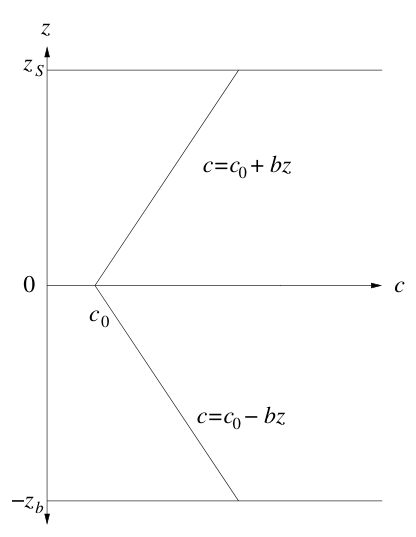
Figure 1 (a)
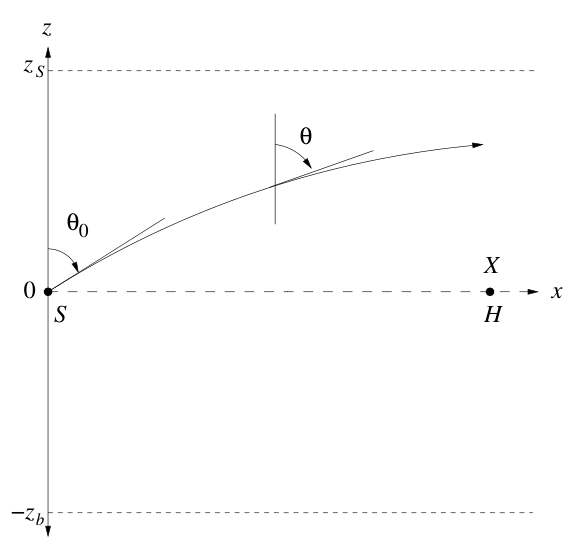
Figure 1 (b)
Figure 1(b) shows a section of the \(z\)–\(x\) plane through the ocean, where \(x\) is a horizontal direction. The variation of \(c\) with respect to \(z\) is shown in figure 1(a). At the position \(z=0\), \(x=0\), a sound source \(S\) is located. A ‘sound ray’ is emitted from \(S\) at an angle \(\theta_0\) as shown. Because of the variation of \(c\) with \(z\), the ray will be refracted.
(a) (6 marks)
Show that the trajectory of the ray, leaving the source \(S\) and constrained to the \(z\)–\(x\) plane forms an arc of a circle with radius \(R\) where
\[ R=\frac{c_0}{b\sin\theta_0} \quad\text{for}\quad 0\leq\theta_0<\frac{\pi}{2}\;. \]
(b) (3 marks)
Derive an expression involving \(z_S\), \(c_0\) and \(b\) to give the smallest value of the angle \(\theta_0\) for upwardly directed rays which can be transmitted without the sound wave reflecting from the sea surface.
(c) (4 marks)
Figure 1(b) shows the position of a sound receiver \(H\) which is located at the position \(z=0\), \(x=X\). Derive an expression involving \(b\), \(X\) and \(c_0\) to give the series of angles \(\theta_0\) required for the sound ray emerging from \(S\) to reach the receiver \(H\). Assume that \(z_S\) and \(z_b\) are sufficiently large to remove the possibility of reflection from sea surface or sea bed.
(d) (2 marks)
Calculate the smallest four values of \(\theta_0\) for refracted rays from \(S\) to reach \(H\) when
- \(X=10000\ \mathrm{m}\)
- \(c_0=1500\ \mathrm{m\,s^{-1}}\)
- \(b=0.02000\ \mathrm{s^{-1}}\)
(e) (5 marks)
Derive an expression to give the time taken for sound to travel from \(S\) to \(H\) following the ray path associated with the smallest value of angle \(\theta_0\), as determined in part (c). Calculate the value of this transit time for the conditions given in part (d). The following result may be of assistance:
\[ \int\frac{dx}{\sin x}=\ln\tan\left(\frac{x}{2}\right) \]
Calculate the time taken for the direct ray to travel from \(S\) to \(H\) along \(z=0\). Which of the two rys will arrive first, the ray for which \(\theta_0=\pi/2\), or the ray with the smallest value of \(\theta_0\) as calculated for part (d)?
Official English text of the problem.
Answers
-
(a) Each segment lying entirely above or below \(z=0\) is a circular arc with \[ \boxed{R=\frac{c_0}{b\sin\theta_0}}. \] The case \(\theta_0=0\) is the straight vertical ray, corresponding to \(R\to\infty\).
-
(b) The limiting angle is \[ \boxed{\theta_{0,\min}=\sin^{-1}\!\left(\frac{c_0}{c_0+bz_S}\right)}. \] Equality gives a ray tangent to the surface; larger angles turn below it.
-
(c) For initially upward, refracted rays, \[ \boxed{\theta_{0,n}=\tan^{-1}\!\left(\frac{2nc_0}{bX}\right)}, \qquad n=1,2,3,\ldots, \] where \(n\) counts the circular arcs between source and receiver. The direct ray has \(\theta_0=\pi/2\).
-
(d) The four smallest angles are \[ \boxed{86.19^\circ,\quad88.09^\circ,\quad88.73^\circ,\quad89.05^\circ}. \]
-
(e) For the smallest angle, \(n=1\), \[ \boxed{ t_1=\frac{2}{b}\ln\!\left[ \sqrt{1+\left(\frac{bX}{2c_0}\right)^2} +\frac{bX}{2c_0}\right] \approx6.662\ \mathrm{s} }. \] The direct-ray time is \[ \boxed{t_{\mathrm{direct}}=\frac{X}{c_0}\approx6.667\ \mathrm{s}}. \] The refracted ray arrives first, by approximately \(\boxed{4.93\ \mathrm{ms}}\).
Solution
We use geometrical acoustics: the wavelength is sufficiently short for propagation to be described by rays in a stationary, locally isotropic medium. The sound speed depends only on \(z\).
(a)
Consider the medium as a succession of thin horizontal layers. Snell’s law, with the angle measured from the vertical normal to these layers, gives
\[ \frac{\sin\theta}{c(z)} =\frac{\sin\theta_0}{c_0} \equiv p, \]
where \(p\) is constant along the ray.
Let \(s\) be distance along the ray. For a ray travelling toward increasing \(x\),
\[ \frac{dx}{ds}=\sin\theta, \qquad \frac{dz}{ds}=\cos\theta. \]
In the upper region, \(c=c_0+bz\). Differentiating \(\sin\theta=pc\) along the ray gives
\[ \cos\theta\,\frac{d\theta}{ds} =pb\,\frac{dz}{ds} =pb\cos\theta. \]
Thus, with the value at the horizontal turning point obtained by continuity,
\[ \frac{d\theta}{ds}=pb =\frac{b\sin\theta_0}{c_0}. \]
The rate of change of the tangent direction with arc length is the curvature. Since it is constant, the trajectory is circular, with
\[ \boxed{R=\frac{1}{pb}=\frac{c_0}{b\sin\theta_0}}. \]
The circle can also be found explicitly. Using \(ds=R\,d\theta\) and the initial position \(x=z=0\),
\[ x=R(\cos\theta_0-\cos\theta), \qquad z=R(\sin\theta-\sin\theta_0). \]
Since \(R\sin\theta_0=c_0/b\), these equations imply
\[ \boxed{ \left(x-R\cos\theta_0\right)^2 +\left(z+\frac{c_0}{b}\right)^2=R^2 }. \]
The upper arc therefore has its centre at
\[ \left(R\cos\theta_0,-\frac{c_0}{b}\right). \]
Below \(z=0\), the gradient changes sign, so \(d\theta/ds=-pb\). The curvature reverses, while its magnitude remains \(1/R\). A ray crossing \(z=0\) consequently follows successive circular arcs of equal radius.
For \(\theta_0=0\), Snell’s law gives a vertical ray with zero curvature. The stated radius formula is understood in the limiting sense \(R\to\infty\).
(b)
At the highest point of an upward arc, the ray is horizontal, so \(\theta=\pi/2\). Snell’s law then gives
\[ \frac{1}{c_0+bz_{\max}} =\frac{\sin\theta_0}{c_0}, \]
and hence
\[ z_{\max} =\frac{c_0}{b}\left(\frac{1}{\sin\theta_0}-1\right). \]
The limiting ray that avoids crossing the sea surface satisfies \(z_{\max}=z_S\). Therefore,
\[ \sin\theta_{0,\min} =\frac{c_0}{c_0+bz_S}, \]
so
\[ \boxed{ \theta_{0,\min} =\sin^{-1}\!\left(\frac{c_0}{c_0+bz_S}\right) }. \]
Because increasing \(\theta_0\) decreases \(z_{\max}\), angles above this threshold turn below the surface. Equality is the grazing case; strict separation from the surface requires \(\theta_0>\theta_{0,\min}\).
(c)
During the first upper arc, the ray returns to \(z=0\) when
\[ \sin\theta=\sin\theta_0, \qquad \theta=\pi-\theta_0. \]
Its horizontal displacement at that crossing is
\[ D =R\left[\cos\theta_0-\cos(\pi-\theta_0)\right] =2R\cos\theta_0. \]
Using the radius from part (a),
\[ \boxed{D=\frac{2c_0}{b}\cot\theta_0}. \]
The speed is continuous at \(z=0\), so the direction of the ray is continuous there. The equal gradient magnitudes above and below \(z=0\) produce alternating upper and lower arcs, each spanning the same horizontal distance \(D\).
The receiver is reached after an integer number \(n\) of these arcs:
\[ X=nD=\frac{2nc_0}{b}\cot\theta_0, \qquad n=1,2,3,\ldots. \]
Therefore,
\[ \boxed{ \theta_{0,n} =\tan^{-1}\!\left(\frac{2nc_0}{bX}\right) }. \]
These angles increase with \(n\), so the smallest angle corresponds to a single upper arc:
\[ \boxed{\theta_{0,1}=\tan^{-1}\!\left(\frac{2c_0}{bX}\right)}. \]
Symmetry also gives corresponding paths launched downward. The horizontal direct ray, \(\theta_0=\pi/2\), is an additional path.
(d)
The numerical factor in the angle formula is
\[ \frac{2c_0}{bX} =\frac{2(1500)}{(0.02000)(10000)} =15. \]
Thus \(\theta_{0,n}=\tan^{-1}(15n)\), giving
| \(n\) | \(\tan\theta_{0,n}\) | \(\theta_{0,n}\) |
|---|---|---|
| 1 | 15 | \(86.19^\circ\) |
| 2 | 30 | \(88.09^\circ\) |
| 3 | 45 | \(88.73^\circ\) |
| 4 | 60 | \(89.05^\circ\) |
(e)
Write the smallest launch angle as \(\theta_1=\theta_{0,1}\). This ray travels along one upper arc, with \(\theta\) increasing from \(\theta_1\) to \(\pi-\theta_1\).
The travel time is
\[ t_1=\int\frac{ds}{c}. \]
Along this arc,
\[ ds=R\,d\theta, \qquad c=\frac{c_0}{\sin\theta_1}\sin\theta =bR\sin\theta. \]
Consequently,
\[ t_1 =\frac{1}{b}\int_{\theta_1}^{\pi-\theta_1} \frac{d\theta}{\sin\theta} =\frac{1}{b} \left[\ln\tan\left(\frac{\theta}{2}\right)\right]_{\theta_1}^{\pi-\theta_1}. \]
Using \(\tan[(\pi-\theta_1)/2]=\cot(\theta_1/2)\),
\[ \boxed{t_1=\frac{2}{b}\ln\cot\left(\frac{\theta_1}{2}\right)}. \]
To express this in terms of the given quantities, define
\[ u=\frac{bX}{2c_0}=\cot\theta_1. \]
The half-angle identity gives
\[ \cot\left(\frac{\theta_1}{2}\right) =\frac{1+\cos\theta_1}{\sin\theta_1} =\csc\theta_1+\cot\theta_1 =\sqrt{1+u^2}+u. \]
Hence,
\[ \boxed{ t_1=\frac{2}{b} \ln\!\left[ \sqrt{1+\left(\frac{bX}{2c_0}\right)^2} +\frac{bX}{2c_0} \right] }. \]
For the numerical data,
\[ u=\frac{(0.02000)(10000)}{2(1500)}=\frac{1}{15}, \]
so
\[ t_1 =\frac{2}{0.02000} \ln\!\left[\sqrt{1+\frac{1}{225}}+\frac{1}{15}\right] \mathrm{s} =\boxed{6.662\ \mathrm{s}}. \]
The direct ray remains at \(z=0\), where its speed is \(c_0\). Its time is therefore
\[ t_{\mathrm{direct}} =\frac{X}{c_0} =\frac{10000}{1500}\ \mathrm{s} =\boxed{6.667\ \mathrm{s}}. \]
Using unrounded values, the difference is
\[ t_{\mathrm{direct}}-t_1 =0.00492842\ldots\ \mathrm{s} \approx\boxed{4.93\ \mathrm{ms}}. \]
Thus the refracted ray with the smallest launch angle arrives first. The increased sound speed away from \(z=0\) more than compensates for its extra path length.
This comparison also follows generally from
\[ t_1=\frac{2}{b}\operatorname{arsinh}u, \qquad t_{\mathrm{direct}}=\frac{2u}{b}, \]
because, for \(u>0\),
\[ \operatorname{arsinh}u =\int_0^u\frac{dv}{\sqrt{1+v^2}}<u. \]
The solution was checked against the official solution.
IPhO 1995 · Theorieaufgabe 2
Schallausbreitung
Einleitung
Die Ausbreitungsgeschwindigkeit von Schall im Ozean hängt von der Tiefe, der Temperatur und dem Salzgehalt ab. Abbildung 1(a) unten zeigt den Verlauf der Schallgeschwindigkeit \(c\) mit der Tiefe \(z\) für einen Fall, in dem der minimale Geschwindigkeitswert \(c_0\) auf halber Strecke zwischen der Meeresoberfläche und dem Meeresboden auftritt. Beachten Sie, dass der Einfachheit halber \(z=0\) in der Tiefe dieses Schallgeschwindigkeitsminimums, \(z=z_S\) an der Oberfläche und \(z=-z_b\) am Meeresboden gewählt ist. Oberhalb von \(z=0\) ist \(c\) gegeben durch
\[ c=c_0+bz\;. \]
Unterhalb von \(z=0\) ist \(c\) gegeben durch
\[ c=c_0-bz\;. \]
In beiden Fällen gilt \(b=\left|\dfrac{dc}{dz}\right|\), das heißt, \(b\) ist der Betrag des Schallgeschwindigkeitsgradienten bezüglich der Tiefe; \(b\) wird als konstant angenommen.
Abbildung 1 (a)
Abbildung 1 (b)
Abbildung 1(b) zeigt einen Schnitt durch den Ozean in der \(z\)–\(x\)-Ebene, wobei \(x\) eine horizontale Richtung bezeichnet. Die Abhängigkeit von \(c\) von \(z\) ist in Abbildung 1(a) dargestellt. An der Position \(z=0\), \(x=0\) befindet sich eine Schallquelle \(S\). Von \(S\) geht ein „Schallstrahl“ unter einem Winkel \(\theta_0\) aus, wie in der Abbildung gezeigt. Aufgrund der Abhängigkeit von \(c\) von \(z\) wird der Strahl gebrochen.
(a) (6 Punkte)
Zeigen Sie, dass die Bahn des Strahls, der von der Quelle \(S\) ausgeht und auf die \(z\)–\(x\)-Ebene beschränkt ist, einen Kreisbogen mit dem Radius \(R\) bildet, wobei
\[ R=\frac{c_0}{b\sin\theta_0} \quad\text{für}\quad 0\leq\theta_0<\frac{\pi}{2}\;. \]
(b) (3 Punkte)
Leiten Sie einen Ausdruck mit \(z_S\), \(c_0\) und \(b\) her, der den kleinsten Wert des Winkels \(\theta_0\) für nach oben gerichtete Strahlen angibt, die sich ausbreiten können, ohne dass die Schallwelle an der Meeresoberfläche reflektiert wird.
(c) (4 Punkte)
Abbildung 1(b) zeigt die Lage eines Schallempfängers \(H\), der sich an der Position \(z=0\), \(x=X\) befindet. Leiten Sie einen Ausdruck mit \(b\), \(X\) und \(c_0\) her, der die Folge der Winkel \(\theta_0\) angibt, unter denen der Schallstrahl von \(S\) ausgehen muss, um den Empfänger \(H\) zu erreichen. Nehmen Sie an, dass \(z_S\) und \(z_b\) hinreichend groß sind, sodass eine Reflexion an der Meeresoberfläche oder am Meeresboden ausgeschlossen ist.
(d) (2 Punkte)
Berechnen Sie die vier kleinsten Werte von \(\theta_0\), für die gebrochene Strahlen von \(S\) aus \(H\) erreichen, wenn
- \(X=10000\ \mathrm{m}\)
- \(c_0=1500\ \mathrm{m\,s^{-1}}\)
- \(b=0.02000\ \mathrm{s^{-1}}\)
(e) (5 Punkte)
Leiten Sie einen Ausdruck für die Zeit her, die der Schall benötigt, um von \(S\) nach \(H\) entlang der Strahlbahn zu gelangen, die dem kleinsten Wert des Winkels \(\theta_0\) aus Teil (c) entspricht. Berechnen Sie diese Laufzeit für die in Teil (d) angegebenen Bedingungen. Das folgende Ergebnis kann hilfreich sein:
\[ \int\frac{dx}{\sin x}=\ln\tan\left(\frac{x}{2}\right) \]
Berechnen Sie die Zeit, die der direkte Strahl benötigt, um von \(S\) nach \(H\) entlang von \(z=0\) zu gelangen. Welcher der beiden Strahlen kommt zuerst an: der Strahl mit \(\theta_0=\pi/2\) oder der Strahl mit dem kleinsten Wert von \(\theta_0\), der in Teil (d) berechnet wurde?
Aufgabentext aus dem offiziellen englischen Text übersetzt.
Antworten
-
(a) Jeder Abschnitt, der vollständig oberhalb oder unterhalb von \(z=0\) liegt, ist ein Kreisbogen mit \[ \boxed{R=\frac{c_0}{b\sin\theta_0}}. \] Der Fall \(\theta_0=0\) ist der gerade, vertikale Strahl und entspricht \(R\to\infty\).
-
(b) Der Grenzwinkel ist \[ \boxed{\theta_{0,\min}=\sin^{-1}\!\left(\frac{c_0}{c_0+bz_S}\right)}. \] Bei Gleichheit berührt der Strahl die Oberfläche tangential; bei größeren Winkeln kehrt er unterhalb der Oberfläche um.
-
(c) Für anfänglich nach oben gerichtete, gebrochene Strahlen gilt \[ \boxed{\theta_{0,n}=\tan^{-1}\!\left(\frac{2nc_0}{bX}\right)}, \qquad n=1,2,3,\ldots, \] wobei \(n\) die Anzahl der Kreisbögen zwischen Quelle und Empfänger angibt. Für den direkten Strahl gilt \(\theta_0=\pi/2\).
-
(d) Die vier kleinsten Winkel sind \[ \boxed{86.19^\circ,\quad88.09^\circ,\quad88.73^\circ,\quad89.05^\circ}. \]
-
(e) Für den kleinsten Winkel, \(n=1\), gilt \[ \boxed{ t_1=\frac{2}{b}\ln\!\left[ \sqrt{1+\left(\frac{bX}{2c_0}\right)^2} +\frac{bX}{2c_0}\right] \approx6.662\ \mathrm{s} }. \] Die Laufzeit des direkten Strahls beträgt \[ \boxed{t_{\mathrm{direct}}=\frac{X}{c_0}\approx6.667\ \mathrm{s}}. \] Der gebrochene Strahl kommt zuerst an, und zwar um etwa \(\boxed{4.93\ \mathrm{ms}}\) früher.
Lösung
Wir verwenden die geometrische Akustik: Die Wellenlänge ist hinreichend kurz, sodass sich die Ausbreitung durch Strahlen in einem stationären, lokal isotropen Medium beschreiben lässt. Die Schallgeschwindigkeit hängt nur von \(z\) ab.
(a)
Wir betrachten das Medium als eine Abfolge dünner horizontaler Schichten. Das Snelliussche Brechungsgesetz liefert, wenn der Winkel zur vertikalen Normalen dieser Schichten gemessen wird,
\[ \frac{\sin\theta}{c(z)} =\frac{\sin\theta_0}{c_0} \equiv p, \]
wobei \(p\) entlang des Strahls konstant ist.
Es sei \(s\) die Weglänge entlang des Strahls. Für einen Strahl, der sich in Richtung zunehmender \(x\)-Werte ausbreitet, gilt
\[ \frac{dx}{ds}=\sin\theta, \qquad \frac{dz}{ds}=\cos\theta. \]
Im oberen Bereich gilt \(c=c_0+bz\). Differenzieren von \(\sin\theta=pc\) entlang des Strahls ergibt
\[ \cos\theta\,\frac{d\theta}{ds} =pb\,\frac{dz}{ds} =pb\cos\theta. \]
Damit gilt, wobei sich der Wert am horizontalen Umkehrpunkt durch stetige Fortsetzung ergibt,
\[ \frac{d\theta}{ds}=pb =\frac{b\sin\theta_0}{c_0}. \]
Die Änderungsrate der Tangentenrichtung bezüglich der Bogenlänge ist die Krümmung. Da sie konstant ist, verläuft die Bahn kreisförmig, mit
\[ \boxed{R=\frac{1}{pb}=\frac{c_0}{b\sin\theta_0}}. \]
Der Kreis lässt sich auch explizit bestimmen. Mit \(ds=R\,d\theta\) und der Anfangsposition \(x=z=0\) erhält man
\[ x=R(\cos\theta_0-\cos\theta), \qquad z=R(\sin\theta-\sin\theta_0). \]
Da \(R\sin\theta_0=c_0/b\) gilt, folgt aus diesen Gleichungen
\[ \boxed{ \left(x-R\cos\theta_0\right)^2 +\left(z+\frac{c_0}{b}\right)^2=R^2 }. \]
Der Mittelpunkt des oberen Kreisbogens liegt somit bei
\[ \left(R\cos\theta_0,-\frac{c_0}{b}\right). \]
Unterhalb von \(z=0\) wechselt der Gradient sein Vorzeichen, sodass \(d\theta/ds=-pb\) gilt. Die Krümmung wechselt ihr Vorzeichen, während ihr Betrag \(1/R\) bleibt. Ein Strahl, der \(z=0\) durchquert, folgt daher aufeinanderfolgenden Kreisbögen gleichen Radius.
Für \(\theta_0=0\) ergibt das Snelliussche Brechungsgesetz einen vertikalen Strahl mit der Krümmung null. Die angegebene Radiusformel ist im Sinne des Grenzfalls \(R\to\infty\) zu verstehen.
(b)
Am höchsten Punkt eines nach oben verlaufenden Bogens ist der Strahl horizontal, sodass \(\theta=\pi/2\) gilt. Das Snelliussche Brechungsgesetz ergibt dann
\[ \frac{1}{c_0+bz_{\max}} =\frac{\sin\theta_0}{c_0}, \]
und somit
\[ z_{\max} =\frac{c_0}{b}\left(\frac{1}{\sin\theta_0}-1\right). \]
Für den Grenzstrahl, der die Meeresoberfläche gerade nicht durchquert, gilt \(z_{\max}=z_S\). Daher ist
\[ \sin\theta_{0,\min} =\frac{c_0}{c_0+bz_S}, \]
also
\[ \boxed{ \theta_{0,\min} =\sin^{-1}\!\left(\frac{c_0}{c_0+bz_S}\right) }. \]
Da \(z_{\max}\) mit zunehmendem \(\theta_0\) abnimmt, kehren Strahlen mit Winkeln oberhalb dieses Grenzwerts unterhalb der Oberfläche um. Gleichheit entspricht dem Fall einer streifenden Berührung; ein strikt positiver Abstand zur Oberfläche erfordert \(\theta_0>\theta_{0,\min}\).
(c)
Auf dem ersten oberen Kreisbogen kehrt der Strahl zu \(z=0\) zurück, wenn
\[ \sin\theta=\sin\theta_0, \qquad \theta=\pi-\theta_0. \]
Seine horizontale Verschiebung an diesem Durchgangspunkt beträgt
\[ D =R\left[\cos\theta_0-\cos(\pi-\theta_0)\right] =2R\cos\theta_0. \]
Mit dem Radius aus Teil (a) ergibt sich
\[ \boxed{D=\frac{2c_0}{b}\cot\theta_0}. \]
Die Geschwindigkeit ist bei \(z=0\) stetig, sodass dort auch die Richtung des Strahls stetig ist. Die gleichen Beträge des Gradienten oberhalb und unterhalb von \(z=0\) führen zu abwechselnd oberen und unteren Kreisbögen, die jeweils dieselbe horizontale Entfernung \(D\) überspannen.
Der Empfänger wird nach einer ganzzahligen Anzahl \(n\) dieser Bögen erreicht:
\[ X=nD=\frac{2nc_0}{b}\cot\theta_0, \qquad n=1,2,3,\ldots. \]
Daher gilt
\[ \boxed{ \theta_{0,n} =\tan^{-1}\!\left(\frac{2nc_0}{bX}\right) }. \]
Diese Winkel nehmen mit \(n\) zu, sodass der kleinste Winkel einem einzigen oberen Kreisbogen entspricht:
\[ \boxed{\theta_{0,1}=\tan^{-1}\!\left(\frac{2c_0}{bX}\right)}. \]
Aus der Symmetrie ergeben sich auch entsprechende Bahnen für anfänglich nach unten gerichtete Strahlen. Der horizontale direkte Strahl, \(\theta_0=\pi/2\), stellt eine zusätzliche Bahn dar.
(d)
Der Zahlenfaktor in der Winkelformel beträgt
\[ \frac{2c_0}{bX} =\frac{2(1500)}{(0.02000)(10000)} =15. \]
Damit gilt \(\theta_{0,n}=\tan^{-1}(15n)\), woraus sich ergibt:
| \(n\) | \(\tan\theta_{0,n}\) | \(\theta_{0,n}\) |
|---|---|---|
| 1 | 15 | \(86.19^\circ\) |
| 2 | 30 | \(88.09^\circ\) |
| 3 | 45 | \(88.73^\circ\) |
| 4 | 60 | \(89.05^\circ\) |
(e)
Wir bezeichnen den kleinsten Abstrahlwinkel mit \(\theta_1=\theta_{0,1}\). Dieser Strahl verläuft entlang eines einzigen oberen Kreisbogens, wobei \(\theta\) von \(\theta_1\) auf \(\pi-\theta_1\) zunimmt.
Die Laufzeit ist
\[ t_1=\int\frac{ds}{c}. \]
Entlang dieses Bogens gilt
\[ ds=R\,d\theta, \qquad c=\frac{c_0}{\sin\theta_1}\sin\theta =bR\sin\theta. \]
Folglich ist
\[ t_1 =\frac{1}{b}\int_{\theta_1}^{\pi-\theta_1} \frac{d\theta}{\sin\theta} =\frac{1}{b} \left[\ln\tan\left(\frac{\theta}{2}\right)\right]_{\theta_1}^{\pi-\theta_1}. \]
Mit \(\tan[(\pi-\theta_1)/2]=\cot(\theta_1/2)\) erhält man
\[ \boxed{t_1=\frac{2}{b}\ln\cot\left(\frac{\theta_1}{2}\right)}. \]
Um dies durch die gegebenen Größen auszudrücken, definieren wir
\[ u=\frac{bX}{2c_0}=\cot\theta_1. \]
Die Halbwinkelformel ergibt
\[ \cot\left(\frac{\theta_1}{2}\right) =\frac{1+\cos\theta_1}{\sin\theta_1} =\csc\theta_1+\cot\theta_1 =\sqrt{1+u^2}+u. \]
Somit gilt
\[ \boxed{ t_1=\frac{2}{b} \ln\!\left[ \sqrt{1+\left(\frac{bX}{2c_0}\right)^2} +\frac{bX}{2c_0} \right] }. \]
Für die angegebenen Zahlenwerte ist
\[ u=\frac{(0.02000)(10000)}{2(1500)}=\frac{1}{15}, \]
also
\[ t_1 =\frac{2}{0.02000} \ln\!\left[\sqrt{1+\frac{1}{225}}+\frac{1}{15}\right] \mathrm{s} =\boxed{6.662\ \mathrm{s}}. \]
Der direkte Strahl bleibt bei \(z=0\), wo seine Geschwindigkeit \(c_0\) beträgt. Seine Laufzeit ist daher
\[ t_{\mathrm{direct}} =\frac{X}{c_0} =\frac{10000}{1500}\ \mathrm{s} =\boxed{6.667\ \mathrm{s}}. \]
Mit ungerundeten Werten ergibt sich die Differenz
\[ t_{\mathrm{direct}}-t_1 =0.00492842\ldots\ \mathrm{s} \approx\boxed{4.93\ \mathrm{ms}}. \]
Somit kommt der gebrochene Strahl mit dem kleinsten Abstrahlwinkel zuerst an. Die erhöhte Schallgeschwindigkeit abseits von \(z=0\) gleicht seine längere Wegstrecke mehr als aus.
Dieser Vergleich folgt auch allgemein aus
\[ t_1=\frac{2}{b}\operatorname{arsinh}u, \qquad t_{\mathrm{direct}}=\frac{2u}{b}, \]
denn für \(u>0\) gilt
\[ \operatorname{arsinh}u =\int_0^u\frac{dv}{\sqrt{1+v^2}}<u. \]
Die Lösung wurde mit der offiziellen Lösung abgeglichen.
IPhO 1995 · Teori sorusu 2
Sesin Yayılması
Giriş
Sesin okyanustaki yayılma hızı derinliğe, sıcaklığa ve tuzluluğa bağlı olarak değişir. Aşağıdaki Şekil 1(a), ses hızının en küçük değeri olan \(c_0\)'a okyanus yüzeyi ile deniz tabanının ortasında ulaşıldığı bir durum için ses hızı \(c\)'nin derinlik \(z\) ile değişimini göstermektedir. Kolaylık olması açısından, ses hızının en küçük olduğu derinlikte \(z=0\), yüzeyde \(z=z_S\) ve deniz tabanında \(z=-z_b\) alındığına dikkat ediniz. \(z=0\)'ın üstünde \(c\),
\[ c=c_0+bz\;. \]
ile verilir. \(z=0\)'ın altında ise \(c\),
\[ c=c_0-bz\;. \]
ile verilir. Her iki durumda da \(b=\left|\dfrac{dc}{dz}\right|\), yani \(b\), ses hızının derinliğe göre gradyanının büyüklüğüdür; \(b\)'nin sabit olduğu varsayılmaktadır.
Şekil 1 (a)
Şekil 1 (b)
Şekil 1(b), okyanusun \(z\)–\(x\) düzlemindeki bir kesitini göstermektedir; burada \(x\) yatay bir doğrultudur. \(c\)'nin \(z\)'ye göre değişimi Şekil 1(a)'da gösterilmiştir. \(z=0\), \(x=0\) konumunda bir \(S\) ses kaynağı bulunmaktadır. \(S\)'den, şekilde gösterildiği gibi \(\theta_0\) açısıyla bir ‘ses ışını’ yayılır. \(c\)'nin \(z\) ile değişmesi nedeniyle ışın kırılacaktır.
(a) (6 puan)
\(S\) kaynağından çıkan ve \(z\)–\(x\) düzleminde kalan ışının yörüngesinin, yarıçapı \(R\) olan bir çember yayı oluşturduğunu ve bu yarıçapın
\[ R=\frac{c_0}{b\sin\theta_0} \quad\text{için}\quad 0\leq\theta_0<\frac{\pi}{2}\;. \]
ile verildiğini gösteriniz.
(b) (3 puan)
Yukarıya yönelen ışınların, ses dalgası deniz yüzeyinden yansımadan ilerleyebilmesi için \(\theta_0\) açısının alabileceği en küçük değeri veren, \(z_S\), \(c_0\) ve \(b\)'yi içeren bir ifade türetiniz.
(c) (4 puan)
Şekil 1(b), \(z=0\), \(x=X\) konumunda bulunan bir \(H\) ses alıcısının yerini göstermektedir. \(S\)'den çıkan ses ışınının \(H\) alıcısına ulaşması için gerekli \(\theta_0\) açılarının dizisini veren, \(b\), \(X\) ve \(c_0\)'ı içeren bir ifade türetiniz. \(z_S\) ve \(z_b\)'nin, deniz yüzeyinden veya deniz tabanından yansıma olasılığını ortadan kaldıracak kadar büyük olduğunu varsayınız.
(d) (2 puan)
Aşağıdaki değerler için, \(S\)'den çıkan kırılan ışınların \(H\)'ye ulaşmasını sağlayan en küçük dört \(\theta_0\) değerini hesaplayınız:
- \(X=10000\ \mathrm{m}\)
- \(c_0=1500\ \mathrm{m\,s^{-1}}\)
- \(b=0.02000\ \mathrm{s^{-1}}\)
(e) (5 puan)
Sesin, (c) bölümünde belirlenen en küçük \(\theta_0\) açısına karşılık gelen ışın yolunu izleyerek \(S\)'den \(H\)'ye ulaşması için geçen süreyi veren bir ifade türetiniz. Bu geçiş süresinin değerini (d) bölümünde verilen koşullar için hesaplayınız. Aşağıdaki sonuç yardımcı olabilir:
\[ \int\frac{dx}{\sin x}=\ln\tan\left(\frac{x}{2}\right) \]
Doğrudan giden ışının \(z=0\) boyunca \(S\)'den \(H\)'ye ulaşması için geçen süreyi hesaplayınız. İki ışından hangisi önce ulaşır: \(\theta_0=\pi/2\) olan ışın mı, yoksa (d) bölümü için hesaplanan en küçük \(\theta_0\) değerine sahip ışın mı?
Soru metni resmi İngilizce metinden çevrilmiştir.
Cevaplar
-
(a) Tamamen \(z=0\)'ın üstünde veya altında kalan her parça, yarıçapı \[ \boxed{R=\frac{c_0}{b\sin\theta_0}}. \] olan bir çember yayıdır. \(\theta_0=0\) durumu, \(R\to\infty\)'ye karşılık gelen doğrusal düşey ışındır.
-
(b) Sınır açı \[ \boxed{\theta_{0,\min}=\sin^{-1}\!\left(\frac{c_0}{c_0+bz_S}\right)}. \] ile verilir. Eşitlik durumunda ışın yüzeye teğettir; daha büyük açılarda ışınlar yüzeyin altında geri döner.
-
(c) Başlangıçta yukarıya yönelen, kırılan ışınlar için \[ \boxed{\theta_{0,n}=\tan^{-1}\!\left(\frac{2nc_0}{bX}\right)}, \qquad n=1,2,3,\ldots, \] burada \(n\), kaynak ile alıcı arasındaki çember yaylarının sayısıdır. Doğrudan giden ışın için \(\theta_0=\pi/2\)'dir.
-
(d) En küçük dört açı \[ \boxed{86.19^\circ,\quad88.09^\circ,\quad88.73^\circ,\quad89.05^\circ}. \] şeklindedir.
-
(e) En küçük açı için, \(n=1\), \[ \boxed{ t_1=\frac{2}{b}\ln\!\left[ \sqrt{1+\left(\frac{bX}{2c_0}\right)^2} +\frac{bX}{2c_0}\right] \approx6.662\ \mathrm{s} }. \] Doğrudan giden ışının ulaşma süresi \[ \boxed{t_{\mathrm{direct}}=\frac{X}{c_0}\approx6.667\ \mathrm{s}}. \] ile verilir. Kırılan ışın yaklaşık \(\boxed{4.93\ \mathrm{ms}}\) önce ulaşır.
Çözüm
Geometrik akustik kullanıyoruz: dalga boyu, durgun ve yerel olarak izotrop bir ortamda yayılmanın ışınlarla betimlenebilmesine yetecek kadar kısadır. Ses hızı yalnızca \(z\)'ye bağlıdır.
(a)
Ortamı art arda gelen ince yatay tabakalar olarak ele alalım. Açı, bu tabakaların düşey normalinden ölçüldüğünde Snell yasası
\[ \frac{\sin\theta}{c(z)} =\frac{\sin\theta_0}{c_0} \equiv p, \]
bağıntısını verir; burada \(p\), ışın boyunca sabittir.
\(s\), ışın boyunca alınan yol olsun. Artan \(x\) yönünde ilerleyen bir ışın için
\[ \frac{dx}{ds}=\sin\theta, \qquad \frac{dz}{ds}=\cos\theta. \]
Üst bölgede \(c=c_0+bz\)'dir. \(\sin\theta=pc\)'nin ışın boyunca türevi alındığında
\[ \cos\theta\,\frac{d\theta}{ds} =pb\,\frac{dz}{ds} =pb\cos\theta. \]
elde edilir. Böylece, ışının yatay olduğu dönüş noktasındaki değer süreklilikten elde edilmek üzere,
\[ \frac{d\theta}{ds}=pb =\frac{b\sin\theta_0}{c_0}. \]
Teğet doğrultusunun yay uzunluğuna göre değişim hızı eğriliktir. Bu sabit olduğundan yörünge çemberseldir ve yarıçapı
\[ \boxed{R=\frac{1}{pb}=\frac{c_0}{b\sin\theta_0}}. \]
ile verilir. Çember açık biçimde de bulunabilir. \(ds=R\,d\theta\) ve başlangıç konumu \(x=z=0\) kullanılarak,
\[ x=R(\cos\theta_0-\cos\theta), \qquad z=R(\sin\theta-\sin\theta_0). \]
elde edilir. \(R\sin\theta_0=c_0/b\) olduğundan bu denklemler
\[ \boxed{ \left(x-R\cos\theta_0\right)^2 +\left(z+\frac{c_0}{b}\right)^2=R^2 }. \]
sonucunu verir. Dolayısıyla üst yayın merkezi
\[ \left(R\cos\theta_0,-\frac{c_0}{b}\right). \]
noktasındadır. \(z=0\)'ın altında gradyan işaret değiştirir; dolayısıyla \(d\theta/ds=-pb\)'dir. Eğriliğin işareti tersine dönerken büyüklüğü \(1/R\) olarak kalır. Bunun sonucunda \(z=0\)'dan geçen bir ışın, eşit yarıçaplı ardışık çember yaylarını izler.
\(\theta_0=0\) için Snell yasası, eğriliği sıfır olan düşey bir ışın verir. Belirtilen yarıçap formülü, \(R\to\infty\) limiti anlamında yorumlanır.
(b)
Yukarıya yönelen bir yayın en yüksek noktasında ışın yataydır; dolayısıyla \(\theta=\pi/2\)'dir. Bu durumda Snell yasası
\[ \frac{1}{c_0+bz_{\max}} =\frac{\sin\theta_0}{c_0}, \]
ve buradan
\[ z_{\max} =\frac{c_0}{b}\left(\frac{1}{\sin\theta_0}-1\right). \]
bağıntısını verir. Deniz yüzeyini geçmeyen sınır ışını \(z_{\max}=z_S\) koşulunu sağlar. Bu nedenle,
\[ \sin\theta_{0,\min} =\frac{c_0}{c_0+bz_S}, \]
dolayısıyla
\[ \boxed{ \theta_{0,\min} =\sin^{-1}\!\left(\frac{c_0}{c_0+bz_S}\right) }. \]
\(\theta_0\)'ın artması \(z_{\max}\)'ı azalttığından, bu eşiğin üzerindeki açılarda ışınlar yüzeyin altında geri döner. Eşitlik, yüzeye teğet olma durumudur; yüzeye hiç temas edilmemesi için \(\theta_0>\theta_{0,\min}\) gerekir.
(c)
İlk üst yay boyunca ışın,
\[ \sin\theta=\sin\theta_0, \qquad \theta=\pi-\theta_0. \]
olduğunda \(z=0\)'a döner. Bu geçişteki yatay yer değiştirmesi
\[ D =R\left[\cos\theta_0-\cos(\pi-\theta_0)\right] =2R\cos\theta_0. \]
ile verilir. (a) bölümündeki yarıçap kullanılarak,
\[ \boxed{D=\frac{2c_0}{b}\cot\theta_0}. \]
elde edilir. Hız \(z=0\)'da süreklidir, dolayısıyla ışının yönü de burada süreklidir. \(z=0\)'ın üstünde ve altında gradyan büyüklüklerinin eşit olması, her biri aynı yatay \(D\) mesafesini kapsayan, dönüşümlü üst ve alt yaylar oluşturur.
Bu yayların tam sayı \(n\) adedi kat edildikten sonra alıcıya ulaşılır:
\[ X=nD=\frac{2nc_0}{b}\cot\theta_0, \qquad n=1,2,3,\ldots. \]
Bu nedenle,
\[ \boxed{ \theta_{0,n} =\tan^{-1}\!\left(\frac{2nc_0}{bX}\right) }. \]
Bu açılar \(n\) ile artar; dolayısıyla en küçük açı tek bir üst yaya karşılık gelir:
\[ \boxed{\theta_{0,1}=\tan^{-1}\!\left(\frac{2c_0}{bX}\right)}. \]
Simetri, başlangıçta aşağıya yönelen karşılık gelen yolları da verir. Yatay doğrultuda doğrudan giden ışın, \(\theta_0=\pi/2\), ek bir yoldur.
(d)
Açı formülündeki sayısal çarpan
\[ \frac{2c_0}{bX} =\frac{2(1500)}{(0.02000)(10000)} =15. \]
olarak bulunur. Böylece \(\theta_{0,n}=\tan^{-1}(15n)\) olur ve şu değerler elde edilir:
| \(n\) | \(\tan\theta_{0,n}\) | \(\theta_{0,n}\) |
|---|---|---|
| 1 | 15 | \(86.19^\circ\) |
| 2 | 30 | \(88.09^\circ\) |
| 3 | 45 | \(88.73^\circ\) |
| 4 | 60 | \(89.05^\circ\) |
(e)
En küçük çıkış açısını \(\theta_1=\theta_{0,1}\) olarak yazalım. Bu ışın, \(\theta\) açısı \(\theta_1\)'den \(\pi-\theta_1\)'e artarken tek bir üst yay boyunca ilerler.
Ulaşma süresi
\[ t_1=\int\frac{ds}{c}. \]
ile verilir. Bu yay boyunca,
\[ ds=R\,d\theta, \qquad c=\frac{c_0}{\sin\theta_1}\sin\theta =bR\sin\theta. \]
Dolayısıyla,
\[ t_1 =\frac{1}{b}\int_{\theta_1}^{\pi-\theta_1} \frac{d\theta}{\sin\theta} =\frac{1}{b} \left[\ln\tan\left(\frac{\theta}{2}\right)\right]_{\theta_1}^{\pi-\theta_1}. \]
\(\tan[(\pi-\theta_1)/2]=\cot(\theta_1/2)\) bağıntısı kullanılarak,
\[ \boxed{t_1=\frac{2}{b}\ln\cot\left(\frac{\theta_1}{2}\right)}. \]
elde edilir. Bunu verilen nicelikler cinsinden ifade etmek için
\[ u=\frac{bX}{2c_0}=\cot\theta_1. \]
tanımını yapalım. Yarım açı özdeşliği
\[ \cot\left(\frac{\theta_1}{2}\right) =\frac{1+\cos\theta_1}{\sin\theta_1} =\csc\theta_1+\cot\theta_1 =\sqrt{1+u^2}+u. \]
sonucunu verir. Böylece,
\[ \boxed{ t_1=\frac{2}{b} \ln\!\left[ \sqrt{1+\left(\frac{bX}{2c_0}\right)^2} +\frac{bX}{2c_0} \right] }. \]
Sayısal veriler için,
\[ u=\frac{(0.02000)(10000)}{2(1500)}=\frac{1}{15}, \]
dolayısıyla
\[ t_1 =\frac{2}{0.02000} \ln\!\left[\sqrt{1+\frac{1}{225}}+\frac{1}{15}\right] \mathrm{s} =\boxed{6.662\ \mathrm{s}}. \]
Doğrudan giden ışın, hızının \(c_0\) olduğu \(z=0\)'da kalır. Bu nedenle ulaşma süresi
\[ t_{\mathrm{direct}} =\frac{X}{c_0} =\frac{10000}{1500}\ \mathrm{s} =\boxed{6.667\ \mathrm{s}}. \]
ile verilir. Yuvarlanmamış değerler kullanıldığında fark
\[ t_{\mathrm{direct}}-t_1 =0.00492842\ldots\ \mathrm{s} \approx\boxed{4.93\ \mathrm{ms}}. \]
olarak bulunur. Dolayısıyla en küçük çıkış açısına sahip kırılan ışın önce ulaşır. \(z=0\)'dan uzaklaşıldığında ses hızındaki artış, yol uzunluğundaki artışı fazlasıyla telafi eder.
Bu karşılaştırma, genel olarak
\[ t_1=\frac{2}{b}\operatorname{arsinh}u, \qquad t_{\mathrm{direct}}=\frac{2u}{b}, \]
bağıntılarından da çıkar; çünkü \(u>0\) için,
\[ \operatorname{arsinh}u =\int_0^u\frac{dv}{\sqrt{1+v^2}}<u. \]
Çözüm, resmi çözümle karşılaştırılarak kontrol edildi.
IPhO 1995 · Problema teórico 2
Propagación del sonido
Introducción
La velocidad de propagación del sonido en el océano varía con la profundidad, la temperatura y la salinidad. La figura 1(a) muestra la variación de la velocidad del sonido \(c\) con la profundidad \(z\) para un caso en el que el valor mínimo de la velocidad \(c_0\) se alcanza a mitad de camino entre la superficie del océano y el fondo marino. Obsérvese que, por conveniencia, \(z=0\) a la profundidad de este mínimo de la velocidad del sonido, \(z=z_S\) en la superficie y \(z=-z_b\) en el fondo marino. Por encima de \(z=0\), \(c\) viene dada por
\[ c=c_0+bz\;. \]
Por debajo de \(z=0\), \(c\) viene dada por
\[ c=c_0-bz\;. \]
En ambos casos, \(b=\left|\dfrac{dc}{dz}\right|\), es decir, \(b\) es el módulo del gradiente de la velocidad del sonido con la profundidad; se supone que \(b\) es constante.
Figura 1 (a)
Figura 1 (b)
La figura 1(b) muestra una sección del océano en el plano \(z\)–\(x\), donde \(x\) es una dirección horizontal. La variación de \(c\) con respecto a \(z\) se muestra en la figura 1(a). En la posición \(z=0\), \(x=0\), se encuentra una fuente sonora \(S\). Desde \(S\) se emite un «rayo sonoro» con un ángulo \(\theta_0\), como se muestra. Debido a la variación de \(c\) con \(z\), el rayo se refractará.
(a) (6 puntos)
Demuestre que la trayectoria del rayo que sale de la fuente \(S\) y está confinado al plano \(z\)–\(x\) forma un arco de circunferencia de radio \(R\), donde
\[ R=\frac{c_0}{b\sin\theta_0} \quad\text{para}\quad 0\leq\theta_0<\frac{\pi}{2}\;. \]
(b) (3 puntos)
Obtenga una expresión en función de \(z_S\), \(c_0\) y \(b\) para el menor valor del ángulo \(\theta_0\) de los rayos dirigidos hacia arriba que pueden transmitirse sin que la onda sonora se refleje en la superficie del mar.
(c) (4 puntos)
La figura 1(b) muestra la posición de un receptor de sonido \(H\), situado en \(z=0\), \(x=X\). Obtenga una expresión en función de \(b\), \(X\) y \(c_0\) para la serie de ángulos \(\theta_0\) necesarios para que el rayo sonoro que sale de \(S\) alcance el receptor \(H\). Suponga que \(z_S\) y \(z_b\) son suficientemente grandes para descartar la posibilidad de reflexión en la superficie del mar o en el fondo marino.
(d) (2 puntos)
Calcule los cuatro valores más pequeños de \(\theta_0\) para que los rayos refractados procedentes de \(S\) alcancen \(H\) cuando
- \(X=10000\ \mathrm{m}\)
- \(c_0=1500\ \mathrm{m\,s^{-1}}\)
- \(b=0.02000\ \mathrm{s^{-1}}\)
(e) (5 puntos)
Obtenga una expresión para el tiempo que tarda el sonido en viajar de \(S\) a \(H\) siguiendo la trayectoria del rayo asociada al menor valor del ángulo \(\theta_0\), determinado en el apartado (c). Calcule este tiempo de tránsito para las condiciones dadas en el apartado (d). El siguiente resultado puede ser útil:
\[ \int\frac{dx}{\sin x}=\ln\tan\left(\frac{x}{2}\right) \]
Calcule el tiempo que tarda el rayo directo en viajar de \(S\) a \(H\) a lo largo de \(z=0\). ¿Cuál de los dos rayos llegará primero, el rayo para el que \(\theta_0=\pi/2\) o el rayo con el menor valor de \(\theta_0\) calculado en el apartado (d)?
Enunciado traducido del texto oficial en inglés.
Respuestas
-
(a) Cada tramo situado enteramente por encima o por debajo de \(z=0\) es un arco de circunferencia con \[ \boxed{R=\frac{c_0}{b\sin\theta_0}}. \] El caso \(\theta_0=0\) es el rayo vertical rectilíneo, que corresponde a \(R\to\infty\).
-
(b) El ángulo límite es \[ \boxed{\theta_{0,\min}=\sin^{-1}\!\left(\frac{c_0}{c_0+bz_S}\right)}. \] La igualdad corresponde a un rayo tangente a la superficie; los rayos con ángulos mayores invierten su sentido vertical por debajo de ella.
-
(c) Para los rayos refractados dirigidos inicialmente hacia arriba, \[ \boxed{\theta_{0,n}=\tan^{-1}\!\left(\frac{2nc_0}{bX}\right)}, \qquad n=1,2,3,\ldots, \] donde \(n\) cuenta los arcos de circunferencia entre la fuente y el receptor. El rayo directo tiene \(\theta_0=\pi/2\).
-
(d) Los cuatro ángulos más pequeños son \[ \boxed{86.19^\circ,\quad88.09^\circ,\quad88.73^\circ,\quad89.05^\circ}. \]
-
(e) Para el ángulo más pequeño, \(n=1\), \[ \boxed{ t_1=\frac{2}{b}\ln\!\left[ \sqrt{1+\left(\frac{bX}{2c_0}\right)^2} +\frac{bX}{2c_0}\right] \approx6.662\ \mathrm{s} }. \] El tiempo del rayo directo es \[ \boxed{t_{\mathrm{direct}}=\frac{X}{c_0}\approx6.667\ \mathrm{s}}. \] El rayo refractado llega primero, con una ventaja de aproximadamente \(\boxed{4.93\ \mathrm{ms}}\).
Solución
Utilizamos la acústica geométrica: la longitud de onda es suficientemente corta para que la propagación pueda describirse mediante rayos en un medio estacionario y localmente isótropo. La velocidad del sonido depende únicamente de \(z\).
(a)
Consideremos el medio como una sucesión de capas horizontales delgadas. La ley de Snell, con el ángulo medido respecto a la normal vertical a estas capas, da
\[ \frac{\sin\theta}{c(z)} =\frac{\sin\theta_0}{c_0} \equiv p, \]
donde \(p\) es constante a lo largo del rayo.
Sea \(s\) la distancia recorrida a lo largo del rayo. Para un rayo que se propaga en el sentido de \(x\) creciente,
\[ \frac{dx}{ds}=\sin\theta, \qquad \frac{dz}{ds}=\cos\theta. \]
En la región superior, \(c=c_0+bz\). Derivando \(\sin\theta=pc\) a lo largo del rayo, se obtiene
\[ \cos\theta\,\frac{d\theta}{ds} =pb\,\frac{dz}{ds} =pb\cos\theta. \]
Por tanto, obteniendo por continuidad el valor en el punto de retorno, donde el rayo es horizontal,
\[ \frac{d\theta}{ds}=pb =\frac{b\sin\theta_0}{c_0}. \]
La tasa de variación de la dirección de la tangente con la longitud de arco es la curvatura. Puesto que es constante, la trayectoria es circular, con
\[ \boxed{R=\frac{1}{pb}=\frac{c_0}{b\sin\theta_0}}. \]
La circunferencia también puede determinarse explícitamente. Utilizando \(ds=R\,d\theta\) y la posición inicial \(x=z=0\),
\[ x=R(\cos\theta_0-\cos\theta), \qquad z=R(\sin\theta-\sin\theta_0). \]
Como \(R\sin\theta_0=c_0/b\), estas ecuaciones implican
\[ \boxed{ \left(x-R\cos\theta_0\right)^2 +\left(z+\frac{c_0}{b}\right)^2=R^2 }. \]
Por tanto, el arco superior tiene su centro en
\[ \left(R\cos\theta_0,-\frac{c_0}{b}\right). \]
Por debajo de \(z=0\), el gradiente cambia de signo, de modo que \(d\theta/ds=-pb\). La curvatura cambia de signo, mientras que su módulo sigue siendo \(1/R\). En consecuencia, un rayo que cruza \(z=0\) sigue sucesivos arcos de circunferencia de igual radio.
Para \(\theta_0=0\), la ley de Snell da un rayo vertical con curvatura nula. La fórmula indicada para el radio se entiende en el sentido del límite \(R\to\infty\).
(b)
En el punto más alto de un arco ascendente, el rayo es horizontal, por lo que \(\theta=\pi/2\). La ley de Snell da entonces
\[ \frac{1}{c_0+bz_{\max}} =\frac{\sin\theta_0}{c_0}, \]
y, por tanto,
\[ z_{\max} =\frac{c_0}{b}\left(\frac{1}{\sin\theta_0}-1\right). \]
El rayo límite que evita atravesar la superficie del mar satisface \(z_{\max}=z_S\). Por tanto,
\[ \sin\theta_{0,\min} =\frac{c_0}{c_0+bz_S}, \]
de modo que
\[ \boxed{ \theta_{0,\min} =\sin^{-1}\!\left(\frac{c_0}{c_0+bz_S}\right) }. \]
Como al aumentar \(\theta_0\) disminuye \(z_{\max}\), los rayos con ángulos superiores a este umbral invierten su sentido vertical por debajo de la superficie. La igualdad corresponde al caso de incidencia rasante; para que el rayo se mantenga estrictamente separado de la superficie se requiere \(\theta_0>\theta_{0,\min}\).
(c)
Durante el primer arco superior, el rayo vuelve a \(z=0\) cuando
\[ \sin\theta=\sin\theta_0, \qquad \theta=\pi-\theta_0. \]
Su desplazamiento horizontal en ese cruce es
\[ D =R\left[\cos\theta_0-\cos(\pi-\theta_0)\right] =2R\cos\theta_0. \]
Utilizando el radio del apartado (a),
\[ \boxed{D=\frac{2c_0}{b}\cot\theta_0}. \]
La velocidad es continua en \(z=0\), por lo que la dirección del rayo también es continua allí. Los módulos iguales del gradiente por encima y por debajo de \(z=0\) producen arcos superiores e inferiores alternados, cada uno de los cuales abarca la misma distancia horizontal \(D\).
El receptor se alcanza tras un número entero \(n\) de estos arcos:
\[ X=nD=\frac{2nc_0}{b}\cot\theta_0, \qquad n=1,2,3,\ldots. \]
Por tanto,
\[ \boxed{ \theta_{0,n} =\tan^{-1}\!\left(\frac{2nc_0}{bX}\right) }. \]
Estos ángulos aumentan con \(n\), por lo que el ángulo más pequeño corresponde a un único arco superior:
\[ \boxed{\theta_{0,1}=\tan^{-1}\!\left(\frac{2c_0}{bX}\right)}. \]
Por simetría, también existen las trayectorias correspondientes para los rayos emitidos hacia abajo. El rayo directo horizontal, \(\theta_0=\pi/2\), constituye una trayectoria adicional.
(d)
El factor numérico en la fórmula del ángulo es
\[ \frac{2c_0}{bX} =\frac{2(1500)}{(0.02000)(10000)} =15. \]
Así, \(\theta_{0,n}=\tan^{-1}(15n)\), lo que da
| \(n\) | \(\tan\theta_{0,n}\) | \(\theta_{0,n}\) |
|---|---|---|
| 1 | 15 | \(86.19^\circ\) |
| 2 | 30 | \(88.09^\circ\) |
| 3 | 45 | \(88.73^\circ\) |
| 4 | 60 | \(89.05^\circ\) |
(e)
Denotemos el menor ángulo de emisión por \(\theta_1=\theta_{0,1}\). Este rayo recorre un único arco superior, con \(\theta\) aumentando de \(\theta_1\) a \(\pi-\theta_1\).
El tiempo de recorrido es
\[ t_1=\int\frac{ds}{c}. \]
A lo largo de este arco,
\[ ds=R\,d\theta, \qquad c=\frac{c_0}{\sin\theta_1}\sin\theta =bR\sin\theta. \]
En consecuencia,
\[ t_1 =\frac{1}{b}\int_{\theta_1}^{\pi-\theta_1} \frac{d\theta}{\sin\theta} =\frac{1}{b} \left[\ln\tan\left(\frac{\theta}{2}\right)\right]_{\theta_1}^{\pi-\theta_1}. \]
Utilizando \(\tan[(\pi-\theta_1)/2]=\cot(\theta_1/2)\),
\[ \boxed{t_1=\frac{2}{b}\ln\cot\left(\frac{\theta_1}{2}\right)}. \]
Para expresar este resultado en función de las magnitudes dadas, definimos
\[ u=\frac{bX}{2c_0}=\cot\theta_1. \]
La identidad del ángulo mitad da
\[ \cot\left(\frac{\theta_1}{2}\right) =\frac{1+\cos\theta_1}{\sin\theta_1} =\csc\theta_1+\cot\theta_1 =\sqrt{1+u^2}+u. \]
Por tanto,
\[ \boxed{ t_1=\frac{2}{b} \ln\!\left[ \sqrt{1+\left(\frac{bX}{2c_0}\right)^2} +\frac{bX}{2c_0} \right] }. \]
Para los datos numéricos,
\[ u=\frac{(0.02000)(10000)}{2(1500)}=\frac{1}{15}, \]
de modo que
\[ t_1 =\frac{2}{0.02000} \ln\!\left[\sqrt{1+\frac{1}{225}}+\frac{1}{15}\right] \mathrm{s} =\boxed{6.662\ \mathrm{s}}. \]
El rayo directo permanece en \(z=0\), donde su velocidad es \(c_0\). Por tanto, su tiempo de recorrido es
\[ t_{\mathrm{direct}} =\frac{X}{c_0} =\frac{10000}{1500}\ \mathrm{s} =\boxed{6.667\ \mathrm{s}}. \]
Utilizando valores sin redondear, la diferencia es
\[ t_{\mathrm{direct}}-t_1 =0.00492842\ldots\ \mathrm{s} \approx\boxed{4.93\ \mathrm{ms}}. \]
Por tanto, el rayo refractado con el menor ángulo de emisión llega primero. El aumento de la velocidad del sonido al alejarse de \(z=0\) compensa con creces la mayor longitud de su trayectoria.
Esta comparación también se deduce, en general, de
\[ t_1=\frac{2}{b}\operatorname{arsinh}u, \qquad t_{\mathrm{direct}}=\frac{2u}{b}, \]
porque, para \(u>0\),
\[ \operatorname{arsinh}u =\int_0^u\frac{dv}{\sqrt{1+v^2}}<u. \]
La solución se comprobó con la solución oficial.
IPhO 1995 · 理论题 2
声的传播
引言
海洋中的声速随深度、温度和盐度而变化。下方图 1(a) 给出了声速 \(c\) 随深度 \(z\) 的变化,其中声速的最小值 \(c_0\) 出现在海面与海底之间的中间位置。注意,为方便起见,将声速最小处的深度取为 \(z=0\),海面处取为 \(z=z_S\),海底处取为 \(z=-z_b\)。在 \(z=0\) 上方,\(c\) 为
\[ c=c_0+bz\;. \]
在 \(z=0\) 下方,\(c\) 为
\[ c=c_0-bz\;. \]
在上述两种情况下均有 \(b=\left|\dfrac{dc}{dz}\right|\),即 \(b\) 是声速随深度变化的梯度的大小;假定 \(b\) 为常量。
图 1 (a)
图 1 (b)
图 1(b) 给出了海洋在 \(z\)–\(x\) 平面内的剖面,其中 \(x\) 为水平方向。\(c\) 随 \(z\) 的变化如图 1(a) 所示。在 \(z=0\)、\(x=0\) 处有一个声源 \(S\)。一条“声线”从 \(S\) 发出,其角度为图示的 \(\theta_0\)。由于 \(c\) 随 \(z\) 变化,声线将发生折射。
(a) (6 分)
证明:从声源 \(S\) 发出且限制在 \(z\)–\(x\) 平面内的声线,其轨迹为半径为 \(R\) 的圆弧,其中
\[ R=\frac{c_0}{b\sin\theta_0} \quad\text{当}\quad 0\leq\theta_0<\frac{\pi}{2}\;. \]
(b) (3 分)
推导一个含有 \(z_S\)、\(c_0\) 和 \(b\) 的表达式,给出向上发出的声线在传播过程中声波不被海面反射时,角度 \(\theta_0\) 的最小值。
(c) (4 分)
图 1(b) 标出了声接收器 \(H\) 的位置,它位于 \(z=0\)、\(x=X\) 处。推导一个含有 \(b\)、\(X\) 和 \(c_0\) 的表达式,给出从 \(S\) 发出的声线能够到达接收器 \(H\) 所需的一系列角度 \(\theta_0\)。假定 \(z_S\) 和 \(z_b\) 足够大,从而排除声线被海面或海底反射的可能性。
(d) (2 分)
在下列条件下,计算从 \(S\) 发出并经折射到达 \(H\) 的声线所对应的四个最小的 \(\theta_0\) 值:
- \(X=10000\ \mathrm{m}\)
- \(c_0=1500\ \mathrm{m\,s^{-1}}\)
- \(b=0.02000\ \mathrm{s^{-1}}\)
(e) (5 分)
推导一个表达式,给出声音沿 (c) 中确定的最小角度 \(\theta_0\) 所对应的声线路径从 \(S\) 传播到 \(H\) 所需的时间。计算在 (d) 给定条件下这一传播时间的值。以下结果可能有所帮助:
\[ \int\frac{dx}{\sin x}=\ln\tan\left(\frac{x}{2}\right) \]
计算直达声线沿 \(z=0\) 从 \(S\) 传播到 \(H\) 所需的时间。这两条声线中,哪一条先到达:\(\theta_0=\pi/2\) 的声线,还是 (d) 中计算得到的 \(\theta_0\) 最小的声线?
题目译自官方英文原文。
答案
-
(a) 完全位于 \(z=0\) 上方或下方的每一段轨迹都是圆弧,其半径为 \[ \boxed{R=\frac{c_0}{b\sin\theta_0}}. \] \(\theta_0=0\) 的情形对应竖直的直线声线,此时 \(R\to\infty\)。
-
(b) 极限角为 \[ \boxed{\theta_{0,\min}=\sin^{-1}\!\left(\frac{c_0}{c_0+bz_S}\right)}. \] 取等号时,声线与海面相切;角度更大时,声线在海面下方转向。
-
(c) 对于初始方向向上的折射声线, \[ \boxed{\theta_{0,n}=\tan^{-1}\!\left(\frac{2nc_0}{bX}\right)}, \qquad n=1,2,3,\ldots, \] 其中 \(n\) 表示声源与接收器之间的圆弧段数。直达声线的角度为 \(\theta_0=\pi/2\)。
-
(d) 四个最小的角度为 \[ \boxed{86.19^\circ,\quad88.09^\circ,\quad88.73^\circ,\quad89.05^\circ}. \]
-
(e) 对于最小角度,\(n=1\), \[ \boxed{ t_1=\frac{2}{b}\ln\!\left[ \sqrt{1+\left(\frac{bX}{2c_0}\right)^2} +\frac{bX}{2c_0}\right] \approx6.662\ \mathrm{s} }. \] 直达声线的传播时间为 \[ \boxed{t_{\mathrm{direct}}=\frac{X}{c_0}\approx6.667\ \mathrm{s}}. \] 折射声线先到达,约提前 \(\boxed{4.93\ \mathrm{ms}}\)。
解答
我们采用几何声学:波长足够短,因此可以用声线描述声音在静止、局部各向同性介质中的传播。声速仅取决于 \(z\)。
(a)
将介质视为一系列薄的水平层。角度从这些层的竖直法线量起,由斯涅尔定律可得
\[ \frac{\sin\theta}{c(z)} =\frac{\sin\theta_0}{c_0} \equiv p, \]
其中 \(p\) 沿声线保持不变。
设 \(s\) 为沿声线的路程。对于朝 \(x\) 增大方向传播的声线,
\[ \frac{dx}{ds}=\sin\theta, \qquad \frac{dz}{ds}=\cos\theta. \]
在上方区域,\(c=c_0+bz\)。沿声线对 \(\sin\theta=pc\) 求导,得
\[ \cos\theta\,\frac{d\theta}{ds} =pb\,\frac{dz}{ds} =pb\cos\theta. \]
因此,利用连续性确定声线呈水平方向的转向点处的值,有
\[ \frac{d\theta}{ds}=pb =\frac{b\sin\theta_0}{c_0}. \]
切线方向随弧长的变化率就是曲率。由于它为常量,轨迹为圆弧,且
\[ \boxed{R=\frac{1}{pb}=\frac{c_0}{b\sin\theta_0}}. \]
也可以显式求出该圆的方程。利用 \(ds=R\,d\theta\) 和初始位置 \(x=z=0\),得
\[ x=R(\cos\theta_0-\cos\theta), \qquad z=R(\sin\theta-\sin\theta_0). \]
由于 \(R\sin\theta_0=c_0/b\),由这些方程可得
\[ \boxed{ \left(x-R\cos\theta_0\right)^2 +\left(z+\frac{c_0}{b}\right)^2=R^2 }. \]
因此,上方圆弧的圆心为
\[ \left(R\cos\theta_0,-\frac{c_0}{b}\right). \]
在 \(z=0\) 下方,梯度改变符号,因此 \(d\theta/ds=-pb\)。曲率的符号反转,而其大小仍为 \(1/R\)。因此,穿过 \(z=0\) 的声线会依次沿半径相等的圆弧传播。
当 \(\theta_0=0\) 时,斯涅尔定律给出一条曲率为零的竖直声线。此时,所给的半径公式应理解为极限意义下的 \(R\to\infty\)。
(b)
在向上弯曲的圆弧的最高点,声线呈水平方向,因此 \(\theta=\pi/2\)。由斯涅尔定律得
\[ \frac{1}{c_0+bz_{\max}} =\frac{\sin\theta_0}{c_0}, \]
从而
\[ z_{\max} =\frac{c_0}{b}\left(\frac{1}{\sin\theta_0}-1\right). \]
不穿过海面的极限声线满足 \(z_{\max}=z_S\)。因此,
\[ \sin\theta_{0,\min} =\frac{c_0}{c_0+bz_S}, \]
所以
\[ \boxed{ \theta_{0,\min} =\sin^{-1}\!\left(\frac{c_0}{c_0+bz_S}\right) }. \]
由于增大 \(\theta_0\) 会减小 \(z_{\max}\),大于这一阈值的角度对应的声线会在海面下方转向。取等号时为掠射情形;若要求声线与海面严格分离,则需 \(\theta_0>\theta_{0,\min}\)。
(c)
沿第一段上方圆弧传播时,声线在满足以下条件时返回 \(z=0\):
\[ \sin\theta=\sin\theta_0, \qquad \theta=\pi-\theta_0. \]
在此次穿过该平面时,其水平位移为
\[ D =R\left[\cos\theta_0-\cos(\pi-\theta_0)\right] =2R\cos\theta_0. \]
利用 (a) 中的半径,得
\[ \boxed{D=\frac{2c_0}{b}\cot\theta_0}. \]
声速在 \(z=0\) 处连续,因此声线的方向在该处也连续。\(z=0\) 上下两侧的梯度大小相等,使声线交替沿上方和下方的圆弧传播,每段圆弧跨越的水平距离均为 \(D\)。
声线经过 \(n\) 段这样的圆弧后到达接收器,其中 \(n\) 为整数:
\[ X=nD=\frac{2nc_0}{b}\cot\theta_0, \qquad n=1,2,3,\ldots. \]
因此,
\[ \boxed{ \theta_{0,n} =\tan^{-1}\!\left(\frac{2nc_0}{bX}\right) }. \]
这些角度随 \(n\) 增大而增大,因此最小角度对应单独一段上方圆弧:
\[ \boxed{\theta_{0,1}=\tan^{-1}\!\left(\frac{2c_0}{bX}\right)}. \]
由对称性,还可得到向下发出的相应路径。水平直达声线 \(\theta_0=\pi/2\) 是另一条路径。
(d)
角度公式中的数值因子为
\[ \frac{2c_0}{bX} =\frac{2(1500)}{(0.02000)(10000)} =15. \]
因此 \(\theta_{0,n}=\tan^{-1}(15n)\),得到
| \(n\) | \(\tan\theta_{0,n}\) | \(\theta_{0,n}\) |
|---|---|---|
| 1 | 15 | \(86.19^\circ\) |
| 2 | 30 | \(88.09^\circ\) |
| 3 | 45 | \(88.73^\circ\) |
| 4 | 60 | \(89.05^\circ\) |
(e)
将最小发射角记为 \(\theta_1=\theta_{0,1}\)。这条声线沿一段上方圆弧传播,\(\theta\) 从 \(\theta_1\) 增大到 \(\pi-\theta_1\)。
传播时间为
\[ t_1=\int\frac{ds}{c}. \]
沿这段圆弧,有
\[ ds=R\,d\theta, \qquad c=\frac{c_0}{\sin\theta_1}\sin\theta =bR\sin\theta. \]
因此,
\[ t_1 =\frac{1}{b}\int_{\theta_1}^{\pi-\theta_1} \frac{d\theta}{\sin\theta} =\frac{1}{b} \left[\ln\tan\left(\frac{\theta}{2}\right)\right]_{\theta_1}^{\pi-\theta_1}. \]
利用 \(\tan[(\pi-\theta_1)/2]=\cot(\theta_1/2)\),
\[ \boxed{t_1=\frac{2}{b}\ln\cot\left(\frac{\theta_1}{2}\right)}. \]
为用给定的量表示此结果,定义
\[ u=\frac{bX}{2c_0}=\cot\theta_1. \]
由半角恒等式得
\[ \cot\left(\frac{\theta_1}{2}\right) =\frac{1+\cos\theta_1}{\sin\theta_1} =\csc\theta_1+\cot\theta_1 =\sqrt{1+u^2}+u. \]
于是,
\[ \boxed{ t_1=\frac{2}{b} \ln\!\left[ \sqrt{1+\left(\frac{bX}{2c_0}\right)^2} +\frac{bX}{2c_0} \right] }. \]
代入给定数值,
\[ u=\frac{(0.02000)(10000)}{2(1500)}=\frac{1}{15}, \]
所以
\[ t_1 =\frac{2}{0.02000} \ln\!\left[\sqrt{1+\frac{1}{225}}+\frac{1}{15}\right] \mathrm{s} =\boxed{6.662\ \mathrm{s}}. \]
直达声线始终位于 \(z=0\),该处声速为 \(c_0\)。因此,其传播时间为
\[ t_{\mathrm{direct}} =\frac{X}{c_0} =\frac{10000}{1500}\ \mathrm{s} =\boxed{6.667\ \mathrm{s}}. \]
使用未经舍入的数值,时间差为
\[ t_{\mathrm{direct}}-t_1 =0.00492842\ldots\ \mathrm{s} \approx\boxed{4.93\ \mathrm{ms}}. \]
因此,发射角最小的折射声线先到达。远离 \(z=0\) 处声速的增大足以抵消路径加长带来的影响,并使传播时间更短。
这一比较也可由下式得到一般性的结论:
\[ t_1=\frac{2}{b}\operatorname{arsinh}u, \qquad t_{\mathrm{direct}}=\frac{2u}{b}, \]
因为当 \(u>0\) 时,
\[ \operatorname{arsinh}u =\int_0^u\frac{dv}{\sqrt{1+v^2}}<u. \]
解答已与官方解答核对。
IPhO 1995 · Теоретическая задача 2
Распространение звука
Введение
Скорость распространения звука в океане зависит от глубины, температуры и солёности. На рисунке 1(a) ниже показана зависимость скорости звука \(c\) от глубины \(z\) для случая, когда минимальное значение скорости \(c_0\) достигается посередине между поверхностью океана и морским дном. Обратите внимание, что для удобства принято \(z=0\) на глубине этого минимума скорости звука, \(z=z_S\) на поверхности и \(z=-z_b\) на морском дне. Выше уровня \(z=0\) скорость \(c\) задаётся выражением
\[ c=c_0+bz\;. \]
Ниже уровня \(z=0\) скорость \(c\) задаётся выражением
\[ c=c_0-bz\;. \]
В обоих случаях \(b=\left|\dfrac{dc}{dz}\right|\), то есть \(b\) — модуль градиента скорости звука по глубине; величина \(b\) считается постоянной.
Рисунок 1 (a)
Рисунок 1 (b)
На рисунке 1(b) показано сечение океана плоскостью \(z\)–\(x\), где ось \(x\) направлена горизонтально. Зависимость \(c\) от \(z\) показана на рисунке 1(a). В точке \(z=0\), \(x=0\) расположен источник звука \(S\). Из \(S\) выходит «звуковой луч» под углом \(\theta_0\), как показано на рисунке. Из-за зависимости \(c\) от \(z\) луч будет преломляться.
(a) (6 баллов)
Покажите, что траектория луча, выходящего из источника \(S\) и лежащего в плоскости \(z\)–\(x\), представляет собой дугу окружности радиуса \(R\), где
\[ R=\frac{c_0}{b\sin\theta_0} \quad\text{при}\quad 0\leq\theta_0<\frac{\pi}{2}\;. \]
(b) (3 балла)
Выведите выражение через \(z_S\), \(c_0\) и \(b\) для наименьшего значения угла \(\theta_0\) для направленных вверх лучей, которые могут распространяться без отражения звуковой волны от поверхности моря.
(c) (4 балла)
На рисунке 1(b) показан приёмник звука \(H\), расположенный в точке \(z=0\), \(x=X\). Выведите выражение через \(b\), \(X\) и \(c_0\), задающее последовательность углов \(\theta_0\), при которых звуковой луч, выходящий из \(S\), достигает приёмника \(H\). Считайте, что \(z_S\) и \(z_b\) достаточно велики, чтобы исключить возможность отражения от поверхности моря или морского дна.
(d) (2 балла)
Вычислите четыре наименьших значения \(\theta_0\) для преломлённых лучей, достигающих \(H\) из \(S\), если
- \(X=10000\ \mathrm{m}\)
- \(c_0=1500\ \mathrm{m\,s^{-1}}\)
- \(b=0.02000\ \mathrm{s^{-1}}\)
(e) (5 баллов)
Выведите выражение для времени распространения звука от \(S\) до \(H\) вдоль траектории луча, соответствующей наименьшему значению угла \(\theta_0\), найденному в пункте (c). Вычислите это время для условий, заданных в пункте (d). Может оказаться полезной следующая формула:
\[ \int\frac{dx}{\sin x}=\ln\tan\left(\frac{x}{2}\right) \]
Вычислите время распространения прямого луча от \(S\) до \(H\) вдоль \(z=0\). Какой из двух лучей придёт первым: луч с \(\theta_0=\pi/2\) или луч с наименьшим значением \(\theta_0\), вычисленным в пункте (d)?
Условие переведено с официального английского текста.
Ответы
-
(a) Каждый участок, целиком лежащий выше или ниже \(z=0\), представляет собой дугу окружности радиуса \[ \boxed{R=\frac{c_0}{b\sin\theta_0}}. \] Случай \(\theta_0=0\) соответствует прямому вертикальному лучу, для которого \(R\to\infty\).
-
(b) Предельный угол равен \[ \boxed{\theta_{0,\min}=\sin^{-1}\!\left(\frac{c_0}{c_0+bz_S}\right)}. \] При равенстве этому значению луч касается поверхности; при больших углах луч поворачивает ниже неё.
-
(c) Для преломлённых лучей, первоначально направленных вверх, \[ \boxed{\theta_{0,n}=\tan^{-1}\!\left(\frac{2nc_0}{bX}\right)}, \qquad n=1,2,3,\ldots, \] где \(n\) — число дуг окружностей между источником и приёмником. Для прямого луча \(\theta_0=\pi/2\).
-
(d) Четыре наименьших угла равны \[ \boxed{86.19^\circ,\quad88.09^\circ,\quad88.73^\circ,\quad89.05^\circ}. \]
-
(e) Для наименьшего угла, \(n=1\), \[ \boxed{ t_1=\frac{2}{b}\ln\!\left[ \sqrt{1+\left(\frac{bX}{2c_0}\right)^2} +\frac{bX}{2c_0}\right] \approx6.662\ \mathrm{s} }. \] Время распространения прямого луча равно \[ \boxed{t_{\mathrm{direct}}=\frac{X}{c_0}\approx6.667\ \mathrm{s}}. \] Преломлённый луч приходит первым, опережая прямой приблизительно на \(\boxed{4.93\ \mathrm{ms}}\).
Решение
Используем геометрическую акустику: длина волны достаточно мала, чтобы распространение можно было описывать лучами в стационарной, локально изотропной среде. Скорость звука зависит только от \(z\).
(a)
Представим среду как последовательность тонких горизонтальных слоёв. Закон Снеллиуса, в котором угол отсчитывается от вертикальной нормали к этим слоям, даёт
\[ \frac{\sin\theta}{c(z)} =\frac{\sin\theta_0}{c_0} \equiv p, \]
где \(p\) постоянно вдоль луча.
Пусть \(s\) — длина пути вдоль луча. Для луча, распространяющегося в сторону увеличения \(x\),
\[ \frac{dx}{ds}=\sin\theta, \qquad \frac{dz}{ds}=\cos\theta. \]
В верхней области \(c=c_0+bz\). Дифференцируя \(\sin\theta=pc\) вдоль луча, получаем
\[ \cos\theta\,\frac{d\theta}{ds} =pb\,\frac{dz}{ds} =pb\cos\theta. \]
Таким образом, определяя значение в точке поворота, где луч горизонтален, по непрерывности, получаем
\[ \frac{d\theta}{ds}=pb =\frac{b\sin\theta_0}{c_0}. \]
Скорость изменения направления касательной по длине дуги равна кривизне. Поскольку она постоянна, траектория представляет собой дугу окружности радиуса
\[ \boxed{R=\frac{1}{pb}=\frac{c_0}{b\sin\theta_0}}. \]
Уравнение окружности можно также найти в явном виде. Используя \(ds=R\,d\theta\) и начальное положение \(x=z=0\), получаем
\[ x=R(\cos\theta_0-\cos\theta), \qquad z=R(\sin\theta-\sin\theta_0). \]
Поскольку \(R\sin\theta_0=c_0/b\), из этих уравнений следует
\[ \boxed{ \left(x-R\cos\theta_0\right)^2 +\left(z+\frac{c_0}{b}\right)^2=R^2 }. \]
Следовательно, центр окружности, которой принадлежит верхняя дуга, находится в точке
\[ \left(R\cos\theta_0,-\frac{c_0}{b}\right). \]
Ниже \(z=0\) градиент меняет знак, поэтому \(d\theta/ds=-pb\). Кривизна меняет знак, а её модуль остаётся равным \(1/R\). Поэтому луч, пересекающий \(z=0\), последовательно проходит по дугам окружностей одинакового радиуса.
При \(\theta_0=0\) закон Снеллиуса даёт вертикальный луч с нулевой кривизной. Приведённая формула радиуса понимается в предельном смысле: \(R\to\infty\).
(b)
В высшей точке верхней дуги луч горизонтален, поэтому \(\theta=\pi/2\). Тогда закон Снеллиуса даёт
\[ \frac{1}{c_0+bz_{\max}} =\frac{\sin\theta_0}{c_0}, \]
откуда
\[ z_{\max} =\frac{c_0}{b}\left(\frac{1}{\sin\theta_0}-1\right). \]
Для предельного луча, не пересекающего поверхность моря, выполняется \(z_{\max}=z_S\). Следовательно,
\[ \sin\theta_{0,\min} =\frac{c_0}{c_0+bz_S}, \]
так что
\[ \boxed{ \theta_{0,\min} =\sin^{-1}\!\left(\frac{c_0}{c_0+bz_S}\right) }. \]
Поскольку с увеличением \(\theta_0\) величина \(z_{\max}\) уменьшается, при углах выше этого порога луч поворачивает ниже поверхности. Равенство соответствует касанию поверхности; чтобы луч оставался строго ниже поверхности, требуется \(\theta_0>\theta_{0,\min}\).
(c)
Проходя первую верхнюю дугу, луч возвращается на уровень \(z=0\), когда
\[ \sin\theta=\sin\theta_0, \qquad \theta=\pi-\theta_0. \]
Его горизонтальное перемещение к моменту этого пересечения равно
\[ D =R\left[\cos\theta_0-\cos(\pi-\theta_0)\right] =2R\cos\theta_0. \]
Используя радиус из пункта (a), получаем
\[ \boxed{D=\frac{2c_0}{b}\cot\theta_0}. \]
Скорость непрерывна при \(z=0\), поэтому направление луча там также непрерывно. Одинаковые модули градиента выше и ниже \(z=0\) приводят к чередованию верхних и нижних дуг, каждой из которых соответствует одно и то же горизонтальное перемещение \(D\).
Луч достигает приёмника, пройдя целое число \(n\) таких дуг:
\[ X=nD=\frac{2nc_0}{b}\cot\theta_0, \qquad n=1,2,3,\ldots. \]
Следовательно,
\[ \boxed{ \theta_{0,n} =\tan^{-1}\!\left(\frac{2nc_0}{bX}\right) }. \]
Эти углы возрастают с \(n\), поэтому наименьший угол соответствует одной верхней дуге:
\[ \boxed{\theta_{0,1}=\tan^{-1}\!\left(\frac{2c_0}{bX}\right)}. \]
В силу симметрии существуют также соответствующие траектории лучей, первоначально направленных вниз. Горизонтальный прямой луч, \(\theta_0=\pi/2\), представляет собой ещё одну траекторию.
(d)
Числовой коэффициент в формуле для угла равен
\[ \frac{2c_0}{bX} =\frac{2(1500)}{(0.02000)(10000)} =15. \]
Таким образом, \(\theta_{0,n}=\tan^{-1}(15n)\), что даёт
| \(n\) | \(\tan\theta_{0,n}\) | \(\theta_{0,n}\) |
|---|---|---|
| 1 | 15 | \(86.19^\circ\) |
| 2 | 30 | \(88.09^\circ\) |
| 3 | 45 | \(88.73^\circ\) |
| 4 | 60 | \(89.05^\circ\) |
(e)
Обозначим наименьший начальный угол через \(\theta_1=\theta_{0,1}\). Этот луч проходит по одной верхней дуге, причём \(\theta\) возрастает от \(\theta_1\) до \(\pi-\theta_1\).
Время распространения равно
\[ t_1=\int\frac{ds}{c}. \]
Вдоль этой дуги
\[ ds=R\,d\theta, \qquad c=\frac{c_0}{\sin\theta_1}\sin\theta =bR\sin\theta. \]
Следовательно,
\[ t_1 =\frac{1}{b}\int_{\theta_1}^{\pi-\theta_1} \frac{d\theta}{\sin\theta} =\frac{1}{b} \left[\ln\tan\left(\frac{\theta}{2}\right)\right]_{\theta_1}^{\pi-\theta_1}. \]
Используя \(\tan[(\pi-\theta_1)/2]=\cot(\theta_1/2)\), получаем
\[ \boxed{t_1=\frac{2}{b}\ln\cot\left(\frac{\theta_1}{2}\right)}. \]
Чтобы выразить это время через заданные величины, введём обозначение
\[ u=\frac{bX}{2c_0}=\cot\theta_1. \]
Формула половинного угла даёт
\[ \cot\left(\frac{\theta_1}{2}\right) =\frac{1+\cos\theta_1}{\sin\theta_1} =\csc\theta_1+\cot\theta_1 =\sqrt{1+u^2}+u. \]
Отсюда
\[ \boxed{ t_1=\frac{2}{b} \ln\!\left[ \sqrt{1+\left(\frac{bX}{2c_0}\right)^2} +\frac{bX}{2c_0} \right] }. \]
Для заданных числовых данных
\[ u=\frac{(0.02000)(10000)}{2(1500)}=\frac{1}{15}, \]
так что
\[ t_1 =\frac{2}{0.02000} \ln\!\left[\sqrt{1+\frac{1}{225}}+\frac{1}{15}\right] \mathrm{s} =\boxed{6.662\ \mathrm{s}}. \]
Прямой луч остаётся на уровне \(z=0\), где его скорость равна \(c_0\). Поэтому время его распространения равно
\[ t_{\mathrm{direct}} =\frac{X}{c_0} =\frac{10000}{1500}\ \mathrm{s} =\boxed{6.667\ \mathrm{s}}. \]
При использовании неокруглённых значений разность равна
\[ t_{\mathrm{direct}}-t_1 =0.00492842\ldots\ \mathrm{s} \approx\boxed{4.93\ \mathrm{ms}}. \]
Таким образом, преломлённый луч с наименьшим начальным углом приходит первым. Увеличение скорости звука при удалении от \(z=0\) с избытком компенсирует увеличение длины его пути.
Этот результат сравнения также следует в общем случае из соотношений
\[ t_1=\frac{2}{b}\operatorname{arsinh}u, \qquad t_{\mathrm{direct}}=\frac{2u}{b}, \]
поскольку при \(u>0\)
\[ \operatorname{arsinh}u =\int_0^u\frac{dv}{\sqrt{1+v^2}}<u. \]
Решение проверено по официальному решению.
IPhO 1995 · مسألة نظرية 2
انتشار الصوت
مقدمة
تتغير سرعة انتشار الصوت في المحيط بتغير العمق ودرجة الحرارة والملوحة. يوضح الشكل 1(a) أدناه تغير سرعة الصوت \(c\) مع العمق \(z\) في حالة تبلغ فيها السرعة قيمة صغرى \(c_0\) في منتصف المسافة بين سطح المحيط وقاع البحر. لاحظ أنه، تيسيرًا، اختير \(z=0\) عند العمق الذي تبلغ فيه سرعة الصوت قيمتها الصغرى، و\(z=z_S\) عند السطح، و\(z=-z_b\) عند قاع البحر. فوق \(z=0\)، تُعطى \(c\) بالعلاقة
\[ c=c_0+bz\;. \]
وتحت \(z=0\)، تُعطى \(c\) بالعلاقة
\[ c=c_0-bz\;. \]
في كلتا الحالتين، \(b=\left|\dfrac{dc}{dz}\right|\)، أي إن \(b\) هو مقدار تدرج سرعة الصوت مع العمق؛ ويُفترض أن \(b\) ثابت.
الشكل 1 (a)
الشكل 1 (b)
يوضح الشكل 1(b) مقطعًا في المحيط ضمن المستوى \(z\)–\(x\)، حيث يمثل \(x\) اتجاهًا أفقيًا. ويبين الشكل 1(a) تغير \(c\) بدلالة \(z\). يوجد مصدر صوت \(S\) عند الموضع \(z=0\)، \(x=0\). ينبعث من \(S\) «شعاع صوتي» بزاوية \(\theta_0\) كما هو موضح. وبسبب تغير \(c\) مع \(z\)، سينكسر الشعاع.
(a) (6 درجات)
أثبت أن مسار الشعاع المنطلق من المصدر \(S\) والمحصور في المستوى \(z\)–\(x\) يشكل قوس دائرة نصف قطرها \(R\)، حيث
\[ R=\frac{c_0}{b\sin\theta_0} \quad\text{عندما}\quad 0\leq\theta_0<\frac{\pi}{2}\;. \]
(b) (3 درجات)
اشتق تعبيرًا يتضمن \(z_S\) و\(c_0\) و\(b\) ويعطي أصغر قيمة للزاوية \(\theta_0\) للأشعة المتجهة إلى أعلى التي يمكن أن تنتقل دون أن تنعكس الموجة الصوتية عن سطح البحر.
(c) (4 درجات)
يبين الشكل 1(b) موضع مستقبل صوت \(H\) يقع عند \(z=0\)، \(x=X\). اشتق تعبيرًا يتضمن \(b\) و\(X\) و\(c_0\) ويعطي متتالية الزوايا \(\theta_0\) اللازمة لوصول الشعاع الصوتي المنطلق من \(S\) إلى المستقبل \(H\). افترض أن \(z_S\) و\(z_b\) كبيران بما يكفي لاستبعاد احتمال الانعكاس عن سطح البحر أو قاعه.
(d) (درجتان)
احسب أصغر أربع قيم للزاوية \(\theta_0\) التي تصل عندها الأشعة المنكسرة من \(S\) إلى \(H\)، عندما
- \(X=10000\ \mathrm{m}\)
- \(c_0=1500\ \mathrm{m\,s^{-1}}\)
- \(b=0.02000\ \mathrm{s^{-1}}\)
(e) (5 درجات)
اشتق تعبيرًا يعطي الزمن الذي يستغرقه الصوت للانتقال من \(S\) إلى \(H\) متبعًا مسار الشعاع الموافق لأصغر قيمة للزاوية \(\theta_0\)، كما حُددت في الجزء (c). احسب قيمة زمن الانتقال هذا للشروط المعطاة في الجزء (d). قد تفيدك النتيجة الآتية:
\[ \int\frac{dx}{\sin x}=\ln\tan\left(\frac{x}{2}\right) \]
احسب الزمن الذي يستغرقه الشعاع المباشر للانتقال من \(S\) إلى \(H\) على طول \(z=0\). أي الشعاعين يصل أولًا: الشعاع الذي تكون له \(\theta_0=\pi/2\)، أم الشعاع ذو أصغر قيمة للزاوية \(\theta_0\) كما حُسبت في الجزء (d)؟
نص المسألة مترجم عن النص الإنجليزي الرسمي.
الإجابات
-
(a) كل مقطع يقع بأكمله فوق \(z=0\) أو تحته هو قوس دائري نصف قطره \[ \boxed{R=\frac{c_0}{b\sin\theta_0}}. \] تمثل الحالة \(\theta_0=0\) الشعاع الرأسي المستقيم، الموافق لـ \(R\to\infty\).
-
(b) الزاوية الحدية هي \[ \boxed{\theta_{0,\min}=\sin^{-1}\!\left(\frac{c_0}{c_0+bz_S}\right)}. \] تعطي المساواة شعاعًا مماسًا للسطح؛ أما الزوايا الأكبر فتجعل الشعاع ينعطف تحت السطح.
-
(c) للأشعة المنكسرة المتجهة في البداية إلى أعلى، \[ \boxed{\theta_{0,n}=\tan^{-1}\!\left(\frac{2nc_0}{bX}\right)}, \qquad n=1,2,3,\ldots, \] حيث يعدّ \(n\) الأقواس الدائرية بين المصدر والمستقبل. أما الشعاع المباشر فزاويته \(\theta_0=\pi/2\).
-
(d) أصغر أربع زوايا هي \[ \boxed{86.19^\circ,\quad88.09^\circ,\quad88.73^\circ,\quad89.05^\circ}. \]
-
(e) لأصغر زاوية، \(n=1\)، \[ \boxed{ t_1=\frac{2}{b}\ln\!\left[ \sqrt{1+\left(\frac{bX}{2c_0}\right)^2} +\frac{bX}{2c_0}\right] \approx6.662\ \mathrm{s} }. \] زمن انتقال الشعاع المباشر هو \[ \boxed{t_{\mathrm{direct}}=\frac{X}{c_0}\approx6.667\ \mathrm{s}}. \] يصل الشعاع المنكسر أولًا، بفارق زمني يقارب \(\boxed{4.93\ \mathrm{ms}}\).
الحل
نستخدم الصوتيات الهندسية: فالطول الموجي قصير بما يكفي لوصف الانتشار بأشعة في وسط ساكن ومتساوي الخواص محليًا. وتعتمد سرعة الصوت على \(z\) وحده.
(a)
نعتبر الوسط تتابعًا من طبقات أفقية رقيقة. يعطي قانون سنيل، مع قياس الزاوية من العمود الرأسي على هذه الطبقات،
\[ \frac{\sin\theta}{c(z)} =\frac{\sin\theta_0}{c_0} \equiv p, \]
حيث \(p\) ثابت على طول الشعاع.
لتكن \(s\) المسافة على طول الشعاع. لشعاع ينتقل في اتجاه تزايد \(x\)،
\[ \frac{dx}{ds}=\sin\theta, \qquad \frac{dz}{ds}=\cos\theta. \]
في المنطقة العلوية، \(c=c_0+bz\). وباشتقاق \(\sin\theta=pc\) على طول الشعاع نحصل على
\[ \cos\theta\,\frac{d\theta}{ds} =pb\,\frac{dz}{ds} =pb\cos\theta. \]
ومن ثم، مع الحصول على القيمة عند نقطة الانعطاف التي يكون فيها الشعاع أفقيًا بالاستمرارية،
\[ \frac{d\theta}{ds}=pb =\frac{b\sin\theta_0}{c_0}. \]
معدل تغير اتجاه المماس مع طول القوس هو الانحناء. ولأنه ثابت، فإن المسار دائري، حيث
\[ \boxed{R=\frac{1}{pb}=\frac{c_0}{b\sin\theta_0}}. \]
يمكن أيضًا إيجاد الدائرة صراحةً. باستخدام \(ds=R\,d\theta\) والموضع الابتدائي \(x=z=0\)،
\[ x=R(\cos\theta_0-\cos\theta), \qquad z=R(\sin\theta-\sin\theta_0). \]
بما أن \(R\sin\theta_0=c_0/b\)، فإن هاتين المعادلتين تقتضيان
\[ \boxed{ \left(x-R\cos\theta_0\right)^2 +\left(z+\frac{c_0}{b}\right)^2=R^2 }. \]
ولذلك يقع مركز القوس العلوي عند
\[ \left(R\cos\theta_0,-\frac{c_0}{b}\right). \]
تحت \(z=0\)، تتغير إشارة التدرج، ومن ثم \(d\theta/ds=-pb\). وينعكس اتجاه الانحناء، بينما يبقى مقداره \(1/R\). لذلك يتبع الشعاع الذي يعبر \(z=0\) أقواسًا دائرية متعاقبة متساوية أنصاف الأقطار.
عندما تكون \(\theta_0=0\)، يعطي قانون سنيل شعاعًا رأسيًا انحناؤه معدوم. وتُفهم صيغة نصف القطر المذكورة بمعناها الحدي \(R\to\infty\).
(b)
عند أعلى نقطة من قوس متجه إلى أعلى، يكون الشعاع أفقيًا، ومن ثم \(\theta=\pi/2\). عندئذ يعطي قانون سنيل
\[ \frac{1}{c_0+bz_{\max}} =\frac{\sin\theta_0}{c_0}, \]
وبالتالي
\[ z_{\max} =\frac{c_0}{b}\left(\frac{1}{\sin\theta_0}-1\right). \]
يحقق الشعاع الحدي الذي يتجنب عبور سطح البحر الشرط \(z_{\max}=z_S\). ولذلك،
\[ \sin\theta_{0,\min} =\frac{c_0}{c_0+bz_S}, \]
ومن ثم
\[ \boxed{ \theta_{0,\min} =\sin^{-1}\!\left(\frac{c_0}{c_0+bz_S}\right) }. \]
لأن زيادة \(\theta_0\) تقلل \(z_{\max}\)، فإن الزوايا الأكبر من هذه العتبة تجعل الشعاع ينعطف تحت السطح. وتمثل المساواة حالة ملامسة السطح؛ أما البقاء منفصلًا تمامًا عن السطح فيتطلب \(\theta_0>\theta_{0,\min}\).
(c)
خلال القوس العلوي الأول، يعود الشعاع إلى \(z=0\) عندما
\[ \sin\theta=\sin\theta_0, \qquad \theta=\pi-\theta_0. \]
تكون إزاحته الأفقية عند ذلك العبور
\[ D =R\left[\cos\theta_0-\cos(\pi-\theta_0)\right] =2R\cos\theta_0. \]
وباستخدام نصف القطر من الجزء (a)،
\[ \boxed{D=\frac{2c_0}{b}\cot\theta_0}. \]
السرعة متصلة عند \(z=0\)، ولذلك يكون اتجاه الشعاع متصلًا هناك. وينتج عن تساوي مقداري التدرج فوق \(z=0\) وتحته أقواس علوية وسفلية متناوبة، يمتد كل منها على المسافة الأفقية نفسها \(D\).
يصل الشعاع إلى المستقبل بعد عدد صحيح \(n\) من هذه الأقواس:
\[ X=nD=\frac{2nc_0}{b}\cot\theta_0, \qquad n=1,2,3,\ldots. \]
ولذلك،
\[ \boxed{ \theta_{0,n} =\tan^{-1}\!\left(\frac{2nc_0}{bX}\right) }. \]
تزداد هذه الزوايا بزيادة \(n\)، ولذلك توافق أصغر زاوية قوسًا علويًا واحدًا:
\[ \boxed{\theta_{0,1}=\tan^{-1}\!\left(\frac{2c_0}{bX}\right)}. \]
يعطي التناظر أيضًا مسارات مقابلة تنطلق إلى أسفل. ويمثل الشعاع الأفقي المباشر، \(\theta_0=\pi/2\)، مسارًا إضافيًا.
(d)
العامل العددي في صيغة الزاوية هو
\[ \frac{2c_0}{bX} =\frac{2(1500)}{(0.02000)(10000)} =15. \]
إذن \(\theta_{0,n}=\tan^{-1}(15n)\)، فنحصل على
| \(n\) | \(\tan\theta_{0,n}\) | \(\theta_{0,n}\) |
|---|---|---|
| 1 | 15 | \(86.19^\circ\) |
| 2 | 30 | \(88.09^\circ\) |
| 3 | 45 | \(88.73^\circ\) |
| 4 | 60 | \(89.05^\circ\) |
(e)
لنكتب أصغر زاوية انطلاق على الصورة \(\theta_1=\theta_{0,1}\). ينتقل هذا الشعاع على طول قوس علوي واحد، مع ازدياد \(\theta\) من \(\theta_1\) إلى \(\pi-\theta_1\).
زمن الانتقال هو
\[ t_1=\int\frac{ds}{c}. \]
على طول هذا القوس،
\[ ds=R\,d\theta, \qquad c=\frac{c_0}{\sin\theta_1}\sin\theta =bR\sin\theta. \]
وبناءً على ذلك،
\[ t_1 =\frac{1}{b}\int_{\theta_1}^{\pi-\theta_1} \frac{d\theta}{\sin\theta} =\frac{1}{b} \left[\ln\tan\left(\frac{\theta}{2}\right)\right]_{\theta_1}^{\pi-\theta_1}. \]
وباستخدام \(\tan[(\pi-\theta_1)/2]=\cot(\theta_1/2)\)،
\[ \boxed{t_1=\frac{2}{b}\ln\cot\left(\frac{\theta_1}{2}\right)}. \]
للتعبير عن ذلك بدلالة الكميات المعطاة، نعرّف
\[ u=\frac{bX}{2c_0}=\cot\theta_1. \]
تعطي متطابقة نصف الزاوية
\[ \cot\left(\frac{\theta_1}{2}\right) =\frac{1+\cos\theta_1}{\sin\theta_1} =\csc\theta_1+\cot\theta_1 =\sqrt{1+u^2}+u. \]
ومن ثم،
\[ \boxed{ t_1=\frac{2}{b} \ln\!\left[ \sqrt{1+\left(\frac{bX}{2c_0}\right)^2} +\frac{bX}{2c_0} \right] }. \]
بالنسبة إلى المعطيات العددية،
\[ u=\frac{(0.02000)(10000)}{2(1500)}=\frac{1}{15}, \]
ومن ثم
\[ t_1 =\frac{2}{0.02000} \ln\!\left[\sqrt{1+\frac{1}{225}}+\frac{1}{15}\right] \mathrm{s} =\boxed{6.662\ \mathrm{s}}. \]
يبقى الشعاع المباشر عند \(z=0\)، حيث سرعته \(c_0\). ولذلك فإن زمن انتقاله هو
\[ t_{\mathrm{direct}} =\frac{X}{c_0} =\frac{10000}{1500}\ \mathrm{s} =\boxed{6.667\ \mathrm{s}}. \]
وباستخدام القيم غير المقربة، يكون الفرق
\[ t_{\mathrm{direct}}-t_1 =0.00492842\ldots\ \mathrm{s} \approx\boxed{4.93\ \mathrm{ms}}. \]
إذن يصل الشعاع المنكسر ذو أصغر زاوية انطلاق أولًا. فزيادة سرعة الصوت بعيدًا عن \(z=0\) تعوض، بل تتجاوز، أثر الزيادة في طول مساره.
وتنتج هذه المقارنة أيضًا بصورة عامة من
\[ t_1=\frac{2}{b}\operatorname{arsinh}u, \qquad t_{\mathrm{direct}}=\frac{2u}{b}, \]
لأنه، عندما يكون \(u>0\)،
\[ \operatorname{arsinh}u =\int_0^u\frac{dv}{\sqrt{1+v^2}}<u. \]
تمت مراجعة الحل بمقارنته بالحل الرسمي.