International Physics Olympiad
IPhO 1994
Beijing, China · 3 theory problems with complete solutions
Problem 1: Relativistic Particle
In the theory of special relativity the relation between energy \(E\) and momentum \(P\) or a free particle with rest mass \(m_0\) is
\[ E=\sqrt{p^2c^2+m_0^2c^4}=mc^2 \]
When such a particle is subject to a conservative force, the total energy of the particle, which is the sum of \(\sqrt{p^2c^2+m_0^2c^4}\) and the potential energy, is conserved. If the energy of the particle is very high, the rest energy of the particle can be ignored (such a particle is called an ultra relativistic particle).
1) consider the one dimensional motion of a very high energy particle (in which rest energy can be neglected) subject to an attractive central force of constant magnitude \(f\). Suppose the particle is located at the centre of force with initial momentum \(p_0\) at time \(t=0\). Describe the motion of the particle by separately plotting, for at least one period of the motion: \(x\) against time \(t\), and momentum \(p\) against space coordinate \(x\). Specify the coordinates of the “turning points” in terms of given parameters \(p_0\) and \(f\). Indicate, with arrows, the direction of the progress of the mothon in the \((p,x)\) diagram. There may be short intervals of time during which the particle is not ultrarelativistic. However, these should be neglected.
Use Answer Sheet 1.
2) A meson is a particle made up of two quarks. The rest mass \(M\) of the meson is equal to the total energy of the two-quark system divided by \(c^2\).
Consider a one--dimensional model for a meson at rest, in which the two quarks are assumed to move along the \(x\)-axis and attract each other with a force of constant magnitude \(f\) It is assumed they can pass through each other freely. For analysis of the high energy motion of the quarks the rest mass of the quarks can be neglected. At time \(t=0\) the two quarks are both at \(x=0\). Show separately the motion of the two quarks graphically by a \((x,t)\) diagram and a \((p,x)\) diagram, specify the coordinates of the “turning points” in terms of \(M\) and \(f\), indicate the direction of the process in your \((p,x)\) diagram, and determine the maximum distance between the two quarks.
Use Answer Sheet 2.
3) The reference frame used in part 2 will be referred to as frame \(S\), the Lab frame, referred to as \(S\), moves in the negative \(x\)-direction with a constant velocity \(v=0.6c\). the coordinates in the two reference frames are so chosen that the point \(x=0\) in \(S\) coincides with the point \(x'=0\) in \(S''\) at time \(t=t'=0\). Plot the motion of the two quarks graphically in a \((x',t')\) diagram. Specify the coordinates of the turning points in terms of \(M\), \(f\) and \(c\), and determine the maximum distance between the two quarks observed in Lab frame \(S'\).
Use Answer Sheet 3.
The coordinates of particle observed in reference frames \(S\) and \(S''\) are related by the Lorentz transformation
\[ \begin{cases} x'=\gamma(x+\beta ct),\\[2pt] t'=\gamma\left(t+\beta\dfrac{x}{c}\right) \end{cases} \]
where \(\beta=v/c\), \(\gamma=1/\sqrt{1-\beta^2}\) and \(v\) is the velocity of frame \(S\) moving relative to the frame \(S''\).
4) For a meson with rest energy \(Mc^2=140\ \mathrm{MeV}\) and velocity \(0.60c\) relative to the Lab frame \(S''\), determine its energy \(E'\) in the Lab Frame \(S''\).
Official English text of the problem.
Problem 2: Superconducting Magnet
Super conducting magnets are widely used in laboratories. The most common form of super conducting magnets is a solenoid made of super conducting wire. The wonderful thing about a superconducting magnet is that it produces high magnetic fields without any energy dissipation due to Joule heating, since the electrical resistance of the superconducting wire becomes zero when the magnet is immersed in liquid helium at a temperature of 4.2 K. Usually, the magnet is provided with a specially designed superconducting switch, as shown in Fig. 1. The resistance \(r\) of the switch can be controlled: either \(r=0\) in the superconducting state, or \(r=r_n\) in the normal state. When the persistent mode, with a current circulating through the magnet and superconducting switch indefinitely. The persistent mode allows a steady magnetic field to be maintained for long periods with the external source cut off.
The details of the superconducting switch are not given in Fig. 1. It is usually a small length of superconducting wire wrapped with a heater wire and suitably thermally insulated from the liquid helium bath. On being heated, the temperature of the superconducting wire increases and it reverts to the resistive normal state. The typical value of \(r_n\) is a few ohms. Here we assume it to be \(5\,\Omega\). The inductance of a superconducting magnet depends on its size; assume it be \(10\,\mathrm H\) for the magnet in Fig. 1. The total current \(I\) can be changed by adjusting the resistance \(R\).
This problem will be graded by the plots only!
The arrows denote the positive direction of \(I\), \(I_1\) and \(I_2\).
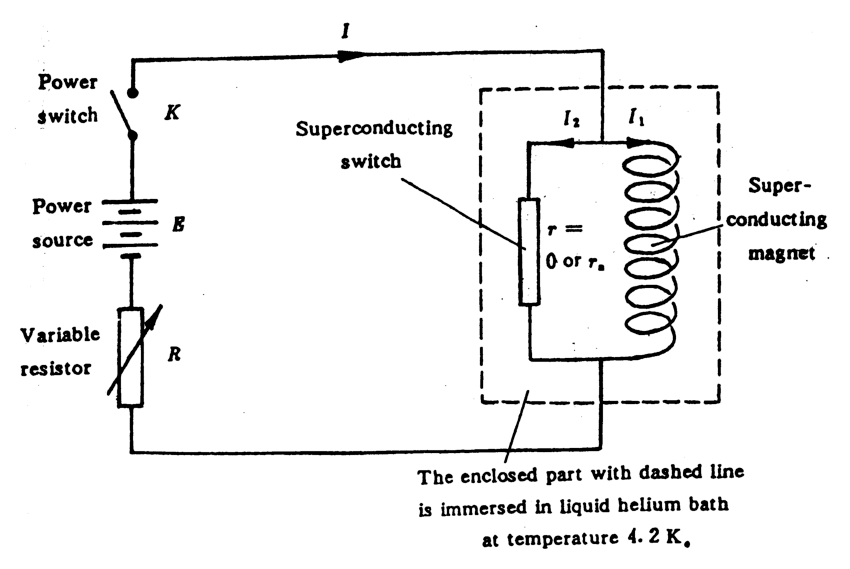
Fig. 1
1) If the total current \(I\) and the resistance \(r\) of the superconducting switch are controlled to vary with time in the way shown in Figs, 2a and 2b respectively, and assuming the currents \(I_1\) and \(I_2\) flowing through the magnet and the switch respectively are equal at the beginning (Fig. 2c and Fig. 2d), how do they vary with time from \(t_1\) to \(t_4\)? Plot your answer in Fig. 2c and Fig. 2d
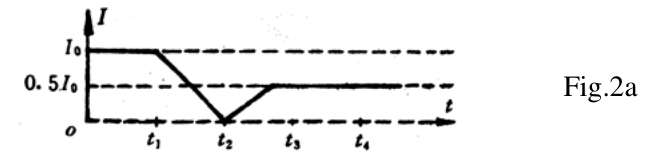
Fig.2a
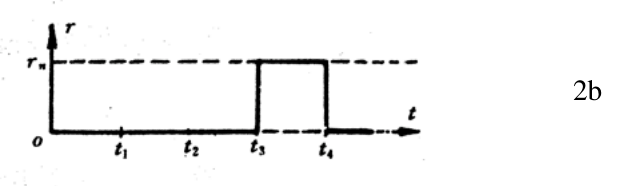
2b
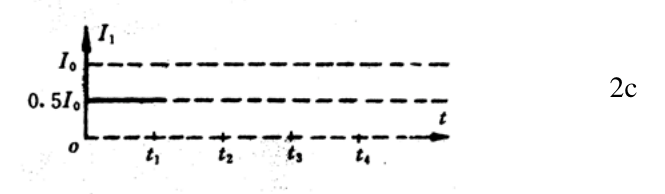
2c
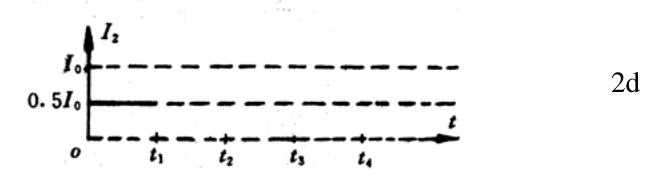
2d
2) Suppose the power switch \(K\) is turned on at time \(t=0\) when \(r=0\), \(I_1=0\) and \(R=7.5\,\Omega\), and the total current \(I\) is \(0.5\,\mathrm A\). With \(K\) kept closed, the resistance \(r\) of the superconducting switch is varied in he way shown in Fig. 3b. Plot the corresponding time dependences of \(I\), \(I_1\) and \(I_2\) in Figs. 3a, 3c and 3d respectively.
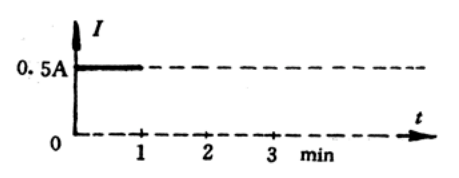
Fig. 3a
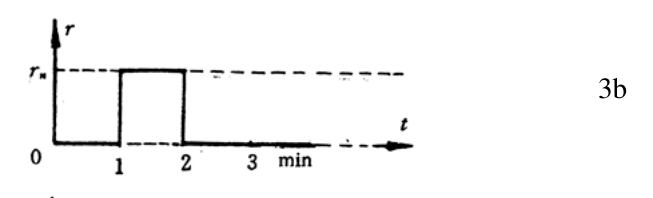
3b
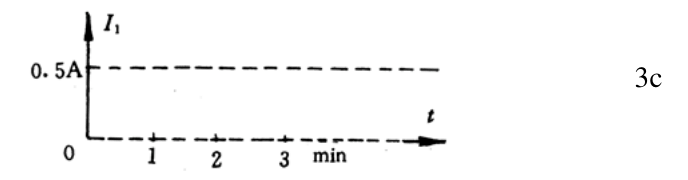
3c
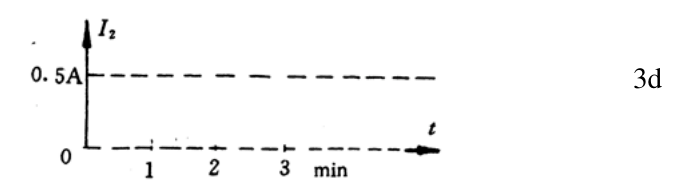
3d
3) Only small currents, less than \(0.5\,\mathrm A\), are allowed to flow through the superconducting switch when it is in the normal state, with larger currents the switch will be burnt out. Suppose the superconducting magnet is operated in a persistent mode, i. e. \(I=0\), and \(I_1=i_1\)(e. g. \(20\,\mathrm A\)), \(I_2=-i_1\), as shown in Fig. 4, from \(t=0\) to \(t=3\mathrm{min}\). If the experiment is to be stopped by reducing the current through the magnet to zero, how would you do it? This has to be done in several operation steps. Plot the corresponding changes of \(I\), \(r\), \(I_1\) and \(I_2\) in Fig. 4
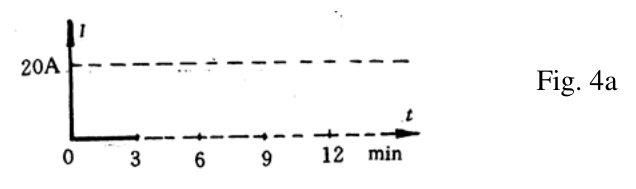
Fig. 4a
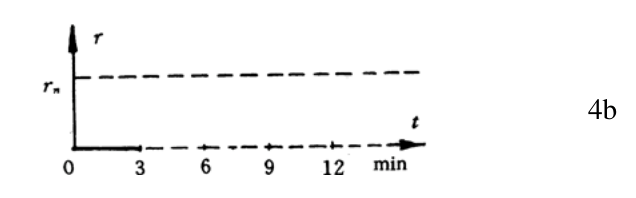
4b
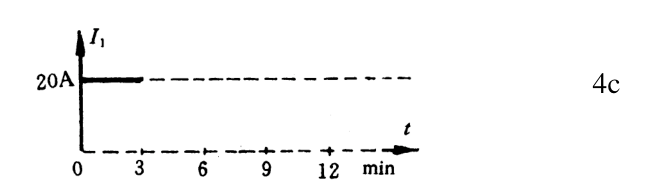
4c
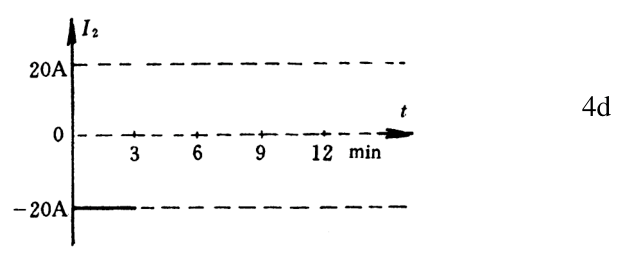
4d
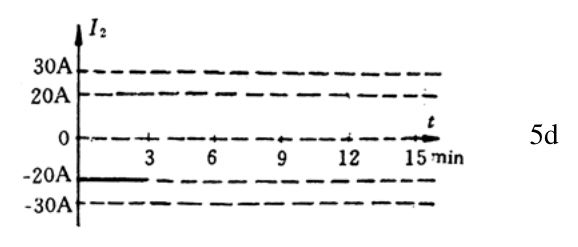
4) Suppose the magnet is operated in a persistent mode with a persistent current of \(20\,\mathrm A\) (\(t=0\) to \(t=3\mathrm{min}\). See Fig. 5). How would you change it to a persistent mode with a current of 30a? plot your answer in Fig. 5.
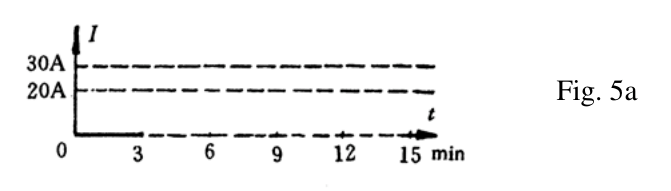
Fig. 5a
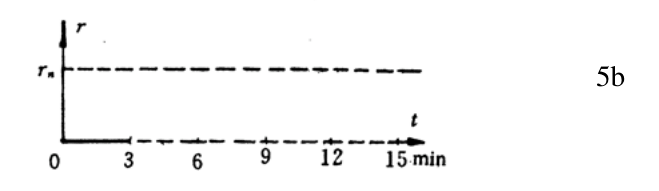
5b
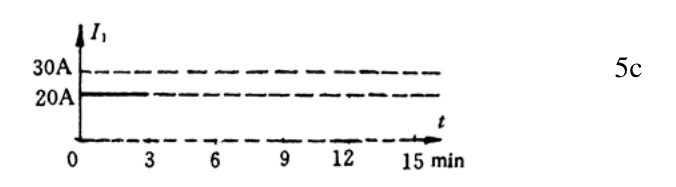
5c
5d
Official English text of the problem.
Problem 3: Collision of Discs with Surface Friction
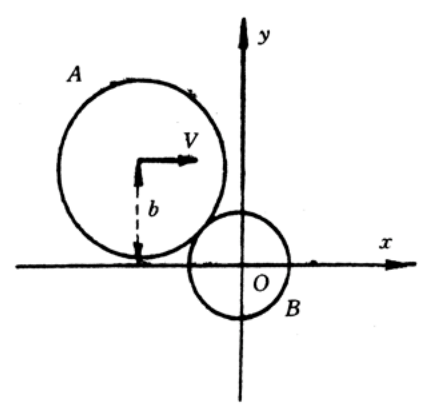
A homogeneous disc A of mass \(m\) and radius \(R_A\) moves translationally on a smooth horizontal \(x\)-\(y\) plane in the \(x\) direction with a velocity \(V\) (see the figure on the next page). The center of the disk is at a distance \(b\) from the x-axis. It collides with a stationary homogeneous disc B whose center is initially located at the origin of the coordinate system. The disc B has the same mass and the same thickness as A, but its radius is \(R_B\). It is assumed that the velocities of the discs at their point of contact, in the direction perpendicular to the line joining their centers, are equal after the collision. It is also assumed that the magnitudes of the relative velocities of the discs along the line joining their centers are the same before and after the collision.
1) For such a collision determine the X and Y components of the velocities of the two discs after the collision, i. e. \(V'_{AX}\), \(V'_{AY}\), \(V'_{BX}\) and \(V'_{BY}\) in terms of \(m\), \(R_A\), \(R_B\), \(V\) and \(b\).
2) Determine the kinetic energies \(E'_A\) for disc A and \(E'_B\) for disc B after the collision in terms of \(m\), \(R_A\), \(R_B\), \(V\) and \(b\).
Official English text of the problem.
Internationale Physik-Olympiade
IPhO 1994
Peking, China · 3 Theorieaufgaben mit vollständigen Lösungen
Aufgabe 1: Relativistisches Teilchen
In der speziellen Relativitätstheorie lautet die Beziehung zwischen Energie \(E\) und Impuls \(P\) eines freien Teilchens mit der Ruhemasse \(m_0\)
\[ E=\sqrt{p^2c^2+m_0^2c^4}=mc^2 \]
Wirkt auf ein solches Teilchen eine konservative Kraft, so bleibt seine Gesamtenergie, also die Summe aus \(\sqrt{p^2c^2+m_0^2c^4}\) und der potenziellen Energie, erhalten. Ist die Energie des Teilchens sehr hoch, kann seine Ruheenergie vernachlässigt werden (ein solches Teilchen nennt man ultrarelativistisch).
1) Betrachten Sie die eindimensionale Bewegung eines Teilchens sehr hoher Energie (dessen Ruheenergie vernachlässigt werden kann) unter dem Einfluss einer anziehenden Zentralkraft mit konstantem Betrag \(f\). Das Teilchen befinde sich zum Zeitpunkt \(t=0\) mit dem Anfangsimpuls \(p_0\) im Kraftzentrum. Beschreiben Sie die Bewegung des Teilchens, indem Sie für mindestens eine Bewegungsperiode getrennt folgende Diagramme zeichnen: \(x\) in Abhängigkeit von der Zeit \(t\) und den Impuls \(p\) in Abhängigkeit von der Ortskoordinate \(x\). Geben Sie die Koordinaten der „Umkehrpunkte“ durch die gegebenen Parameter \(p_0\) und \(f\) an. Kennzeichnen Sie im \((p,x)\)-Diagramm durch Pfeile die Richtung, in der die Bewegung abläuft. Es kann kurze Zeitintervalle geben, in denen das Teilchen nicht ultrarelativistisch ist. Diese sollen jedoch vernachlässigt werden.
Verwenden Sie Antwortblatt 1.
2) Ein Meson ist ein Teilchen, das aus zwei Quarks besteht. Die Ruhemasse \(M\) des Mesons ist gleich der Gesamtenergie des Zwei-Quark-Systems geteilt durch \(c^2\).
Betrachten Sie ein eindimensionales Modell eines ruhenden Mesons, in dem angenommen wird, dass sich die beiden Quarks entlang der \(x\)-Achse bewegen und sich gegenseitig mit einer Kraft konstanten Betrags \(f\) anziehen. Es wird angenommen, dass sie ungehindert durcheinander hindurchtreten können. Bei der Untersuchung der Bewegung der Quarks bei hoher Energie kann deren Ruhemasse vernachlässigt werden. Zum Zeitpunkt \(t=0\) befinden sich beide Quarks bei \(x=0\). Stellen Sie die Bewegung der beiden Quarks jeweils getrennt in einem \((x,t)\)-Diagramm und einem \((p,x)\)-Diagramm grafisch dar, geben Sie die Koordinaten der „Umkehrpunkte“ durch \(M\) und \(f\) an, kennzeichnen Sie die Bewegungsrichtung in Ihrem \((p,x)\)-Diagramm und bestimmen Sie den maximalen Abstand zwischen den beiden Quarks.
Verwenden Sie Antwortblatt 2.
3) Das in Teil 2 verwendete Bezugssystem wird als System \(S\) bezeichnet. Das Laborsystem, das als \(S\) bezeichnet wird, bewegt sich mit einer konstanten Geschwindigkeit \(v=0.6c\) in negativer \(x\)-Richtung. Die Koordinaten in den beiden Bezugssystemen sind so gewählt, dass der Punkt \(x=0\) in \(S\) zum Zeitpunkt \(t=t'=0\) mit dem Punkt \(x'=0\) in \(S''\) zusammenfällt. Stellen Sie die Bewegung der beiden Quarks in einem \((x',t')\)-Diagramm grafisch dar. Geben Sie die Koordinaten der Umkehrpunkte durch \(M\), \(f\) und \(c\) an und bestimmen Sie den maximalen Abstand zwischen den beiden Quarks, der im Laborsystem \(S'\) beobachtet wird.
Verwenden Sie Antwortblatt 3.
Die in den Bezugssystemen \(S\) und \(S''\) beobachteten Koordinaten eines Teilchens sind durch die Lorentz-Transformation miteinander verknüpft:
\[ \begin{cases} x'=\gamma(x+\beta ct),\\[2pt] t'=\gamma\left(t+\beta\dfrac{x}{c}\right) \end{cases} \]
Dabei sind \(\beta=v/c\), \(\gamma=1/\sqrt{1-\beta^2}\), und \(v\) ist die Geschwindigkeit des Systems \(S\) relativ zum System \(S''\).
4) Bestimmen Sie für ein Meson mit der Ruheenergie \(Mc^2=140\ \mathrm{MeV}\) und der Geschwindigkeit \(0.60c\) relativ zum Laborsystem \(S''\) seine Energie \(E'\) im Laborsystem \(S''\).
Aufgabentext aus dem offiziellen englischen Text übersetzt.
Aufgabe 2: Supraleitender Magnet
Supraleitende Magnete werden in Laboratorien häufig eingesetzt. Die gebräuchlichste Bauform eines supraleitenden Magneten ist eine Zylinderspule aus supraleitendem Draht. Das Bemerkenswerte an einem supraleitenden Magneten ist, dass er starke Magnetfelder ohne Energieverluste durch Joulesche Wärme erzeugt, da der elektrische Widerstand des supraleitenden Drahtes null wird, wenn der Magnet in flüssiges Helium bei einer Temperatur von 4.2 K eingetaucht wird. Üblicherweise ist der Magnet mit einem speziell konstruierten supraleitenden Schalter ausgestattet, wie in Abb. 1 dargestellt. Der Widerstand \(r\) des Schalters lässt sich steuern: entweder gilt \(r=0\) im supraleitenden Zustand oder \(r=r_n\) im normalleitenden Zustand. Im Dauerstrombetrieb zirkuliert ein Strom unbegrenzt durch den Magneten und den supraleitenden Schalter. Der Dauerstrombetrieb ermöglicht es, bei abgetrennter externer Stromquelle über lange Zeit ein konstantes Magnetfeld aufrechtzuerhalten.
Die Einzelheiten des supraleitenden Schalters sind in Abb. 1 nicht dargestellt. Üblicherweise besteht er aus einem kurzen Stück supraleitenden Drahtes, das mit einem Heizdraht umwickelt und gegenüber dem Bad aus flüssigem Helium ausreichend wärmeisoliert ist. Beim Heizen steigt die Temperatur des supraleitenden Drahtes, und er geht wieder in den normalleitenden Zustand mit endlichem Widerstand über. Der typische Wert von \(r_n\) beträgt einige Ohm. Hier nehmen wir dafür \(5\,\Omega\) an. Die Induktivität eines supraleitenden Magneten hängt von seiner Größe ab; für den Magneten in Abb. 1 sei sie \(10\,\mathrm H\). Der Gesamtstrom \(I\) lässt sich durch Einstellen des Widerstands \(R\) verändern.
Diese Aufgabe wird ausschließlich anhand der Diagramme bewertet!
Die Pfeile kennzeichnen die positiven Richtungen von \(I\), \(I_1\) und \(I_2\).
Abb. 1
1) Der Gesamtstrom \(I\) und der Widerstand \(r\) des supraleitenden Schalters werden so gesteuert, dass sie sich zeitlich wie in Abb. 2a bzw. 2b dargestellt ändern. Unter der Annahme, dass die durch den Magneten bzw. den Schalter fließenden Ströme \(I_1\) und \(I_2\) zu Beginn gleich sind (Abb. 2c und Abb. 2d), wie ändern sie sich mit der Zeit von \(t_1\) bis \(t_4\)? Zeichnen Sie Ihre Antwort in Abb. 2c und Abb. 2d ein.
Abb. 2a
2b
2c
2d
2) Der Schalter \(K\) werde zum Zeitpunkt \(t=0\) geschlossen, wobei \(r=0\), \(I_1=0\) und \(R=7.5\,\Omega\) gelten und der Gesamtstrom \(I\) gleich \(0.5\,\mathrm A\) ist. Während \(K\) geschlossen bleibt, wird der Widerstand \(r\) des supraleitenden Schalters wie in Abb. 3b dargestellt verändert. Zeichnen Sie die entsprechenden zeitlichen Verläufe von \(I\), \(I_1\) und \(I_2\) in Abb. 3a, 3c bzw. 3d ein.
Abb. 3a
3b
3c
3d
3) Durch den supraleitenden Schalter dürfen im normalleitenden Zustand nur kleine Ströme von weniger als \(0.5\,\mathrm A\) fließen; bei größeren Strömen brennt der Schalter durch. Der supraleitende Magnet werde von \(t=0\) bis \(t=3\mathrm{min}\) im Dauerstrombetrieb betrieben, d. h. mit \(I=0\), \(I_1=i_1\) (z. B. \(20\,\mathrm A\)) und \(I_2=-i_1\), wie in Abb. 4 dargestellt. Wie würden Sie vorgehen, wenn das Experiment beendet werden soll, indem der Strom durch den Magneten auf null verringert wird? Dazu sind mehrere Bedienungsschritte erforderlich. Zeichnen Sie die entsprechenden Änderungen von \(I\), \(r\), \(I_1\) und \(I_2\) in Abb. 4 ein.
Abb. 4a
4b
4c
4d
4) Der Magnet werde im Dauerstrombetrieb mit einem Dauerstrom von \(20\,\mathrm A\) betrieben (von \(t=0\) bis \(t=3\mathrm{min}\), siehe Abb. 5). Wie würden Sie ihn in einen Dauerstrombetrieb mit einem Strom von 30 A überführen? Zeichnen Sie Ihre Antwort in Abb. 5 ein.
Abb. 5a
5b
5c
5d
Aufgabentext aus dem offiziellen englischen Text übersetzt.
Aufgabe 3: Stoß von Scheiben mit Oberflächenreibung
Eine homogene Scheibe A mit der Masse \(m\) und dem Radius \(R_A\) bewegt sich auf einer glatten horizontalen \(x\)-\(y\)-Ebene translatorisch mit der Geschwindigkeit \(V\) in \(x\)-Richtung (siehe die Abbildung auf der nächsten Seite). Der Mittelpunkt der Scheibe befindet sich im Abstand \(b\) von der x-Achse. Sie stößt mit einer ruhenden homogenen Scheibe B zusammen, deren Mittelpunkt sich anfangs im Ursprung des Koordinatensystems befindet. Die Scheibe B hat dieselbe Masse und dieselbe Dicke wie A, ihr Radius ist jedoch \(R_B\). Es wird angenommen, dass die Geschwindigkeiten der Scheiben an ihrem Berührungspunkt in der Richtung senkrecht zur Verbindungslinie ihrer Mittelpunkte nach dem Stoß gleich sind. Außerdem wird angenommen, dass die Beträge der Relativgeschwindigkeiten der Scheiben entlang der Verbindungslinie ihrer Mittelpunkte vor und nach dem Stoß gleich sind.
1) Bestimmen Sie für einen solchen Stoß die X- und Y-Komponenten der Geschwindigkeiten beider Scheiben nach dem Stoß, d. h. \(V'_{AX}\), \(V'_{AY}\), \(V'_{BX}\) und \(V'_{BY}\), in Abhängigkeit von \(m\), \(R_A\), \(R_B\), \(V\) und \(b\).
2) Bestimmen Sie die kinetischen Energien \(E'_A\) der Scheibe A und \(E'_B\) der Scheibe B nach dem Stoß in Abhängigkeit von \(m\), \(R_A\), \(R_B\), \(V\) und \(b\).
Aufgabentext aus dem offiziellen englischen Text übersetzt.
Uluslararası Fizik Olimpiyatı
IPhO 1994
Pekin, Çin · 3 teori sorusu, tam çözümleriyle
Soru 1: Göreli Parçacık
Özel görelilik kuramında, durgun kütlesi \(m_0\) olan serbest bir parçacığın enerjisi \(E\) ile momentumu \(P\) arasındaki ilişki şöyledir:
\[ E=\sqrt{p^2c^2+m_0^2c^4}=mc^2 \]
Böyle bir parçacık korunumlu bir kuvvetin etkisindeyken, \(\sqrt{p^2c^2+m_0^2c^4}\) ile potansiyel enerjinin toplamından oluşan toplam enerjisi korunur. Parçacığın enerjisi çok yüksekse durgun enerjisi ihmal edilebilir (böyle bir parçacığa ultra göreli parçacık denir).
1) Büyüklüğü sabit \(f\) olan çekici bir merkezî kuvvetin etkisindeki çok yüksek enerjili bir parçacığın (durgun enerjisinin ihmal edilebildiği) bir boyutlu hareketini ele alınız. Parçacığın \(t=0\) anında, \(p_0\) başlangıç momentumuyla kuvvet merkezinde bulunduğunu varsayınız. Hareketin en az bir periyodu boyunca, \(x\)'in \(t\) zamanına ve \(p\) momentumunun \(x\) konum koordinatına göre grafiklerini ayrı ayrı çizerek parçacığın hareketini betimleyiniz. “Dönüş noktalarının” koordinatlarını verilen \(p_0\) ve \(f\) parametreleri cinsinden belirtiniz. \((p,x)\) diyagramında hareketin ilerleme yönünü oklarla gösteriniz. Parçacığın ultra göreli olmadığı kısa zaman aralıkları olabilir. Ancak bunlar ihmal edilmelidir.
Cevap Kâğıdı 1'i kullanınız.
2) Mezon, iki kuarktan oluşan bir parçacıktır. Mezonun durgun kütlesi \(M\), iki kuarklı sistemin toplam enerjisinin \(c^2\)'ye bölünmesine eşittir.
Durgun bir mezon için, iki kuarkın \(x\) ekseni boyunca hareket ettiğinin ve birbirlerini büyüklüğü sabit \(f\) olan bir kuvvetle çektiğinin varsayıldığı bir boyutlu bir model ele alınız. Kuarkların birbirlerinin içinden serbestçe geçebildiği varsayılmaktadır. Kuarkların yüksek enerjili hareketinin incelenmesinde, kuarkların durgun kütlesi ihmal edilebilir. \(t=0\) anında her iki kuark da \(x=0\) konumundadır. İki kuarkın hareketini bir \((x,t)\) diyagramı ve bir \((p,x)\) diyagramıyla ayrı ayrı grafiksel olarak gösteriniz, “dönüş noktalarının” koordinatlarını \(M\) ve \(f\) cinsinden belirtiniz, \((p,x)\) diyagramınızda hareketin ilerleme yönünü gösteriniz ve iki kuark arasındaki en büyük uzaklığı belirleyiniz.
Cevap Kâğıdı 2'yi kullanınız.
3) 2. kısımda kullanılan referans çerçevesi \(S\) çerçevesi olarak adlandırılacaktır; \(S\) olarak adlandırılan laboratuvar çerçevesi, negatif \(x\) yönünde sabit \(v=0.6c\) hızıyla hareket etmektedir. İki referans çerçevesindeki koordinatlar, \(t=t'=0\) anında \(S\)'deki \(x=0\) noktası \(S''\)'deki \(x'=0\) noktasıyla çakışacak şekilde seçilmiştir. İki kuarkın hareketini bir \((x',t')\) diyagramında grafiksel olarak çiziniz. Dönüş noktalarının koordinatlarını \(M\), \(f\) ve \(c\) cinsinden belirtiniz ve \(S'\) laboratuvar çerçevesinde gözlenen iki kuark arasındaki en büyük uzaklığı belirleyiniz.
Cevap Kâğıdı 3'ü kullanınız.
\(S\) ve \(S''\) referans çerçevelerinde gözlenen parçacığın koordinatları, Lorentz dönüşümüyle birbirine bağlıdır:
\[ \begin{cases} x'=\gamma(x+\beta ct),\\[2pt] t'=\gamma\left(t+\beta\dfrac{x}{c}\right) \end{cases} \]
Burada \(\beta=v/c\), \(\gamma=1/\sqrt{1-\beta^2}\) ve \(v\), \(S\) çerçevesinin \(S''\) çerçevesine göre hareket hızıdır.
4) Durgun enerjisi \(Mc^2=140\ \mathrm{MeV}\) ve \(S''\) laboratuvar çerçevesine göre hızı \(0.60c\) olan bir mezonun, \(S''\) laboratuvar çerçevesindeki \(E'\) enerjisini belirleyiniz.
Soru metni resmi İngilizce metinden çevrilmiştir.
Soru 2: Süperiletken Mıknatıs
Süperiletken mıknatıslar laboratuvarlarda yaygın olarak kullanılır. Süperiletken mıknatısların en yaygın biçimi, süperiletken telden yapılmış bir solenoiddir. Süperiletken bir mıknatısın dikkat çekici özelliği, Joule ısınması nedeniyle herhangi bir enerji kaybı olmadan yüksek manyetik alanlar üretmesidir; çünkü mıknatıs 4.2 K sıcaklığındaki sıvı helyuma daldırıldığında süperiletken telin elektriksel direnci sıfır olur. Mıknatıs genellikle Şekil 1'de gösterildiği gibi özel olarak tasarlanmış bir süperiletken anahtarla donatılır. Anahtarın \(r\) direnci kontrol edilebilir: süperiletken durumda \(r=0\), normal durumda ise \(r=r_n\) olur. Kalıcı akım modunda, mıknatıs ve süperiletken anahtar üzerinden süresiz olarak akım dolaşır. Kalıcı akım modu, dış kaynağın bağlantısı kesilmişken uzun süreler boyunca sabit bir manyetik alanın korunmasını sağlar.
Süperiletken anahtarın ayrıntıları Şekil 1'de verilmemiştir. Anahtar genellikle üzerine bir ısıtıcı tel sarılmış ve sıvı helyum banyosundan uygun biçimde ısıl olarak yalıtılmış kısa bir süperiletken tel parçasıdır. Isıtıldığında süperiletken telin sıcaklığı artar ve tel, direnç gösterdiği normal duruma geri döner. \(r_n\)'nin tipik değeri birkaç ohmdur. Burada bu değerin \(5\,\Omega\) olduğunu varsayıyoruz. Süperiletken bir mıknatısın indüktansı boyutlarına bağlıdır; Şekil 1'deki mıknatıs için bunun \(10\,\mathrm H\) olduğunu varsayın. Toplam \(I\) akımı, \(R\) direnci ayarlanarak değiştirilebilir.
Bu soru yalnızca grafiklere göre puanlandırılacaktır!
Oklar, \(I\), \(I_1\) ve \(I_2\)'nin pozitif yönlerini göstermektedir.
Şekil 1
1) Toplam \(I\) akımı ve süperiletken anahtarın \(r\) direnci, zamanla sırasıyla Şekil 2a ve 2b'de gösterilen biçimde değişecek şekilde kontrol edilirse ve sırasıyla mıknatıstan ve anahtardan geçen \(I_1\) ve \(I_2\) akımlarının başlangıçta eşit olduğu varsayılırsa (Şekil 2c ve Şekil 2d), bu akımlar \(t_1\)'den \(t_4\)'e kadar zamanla nasıl değişir? Cevabınızı Şekil 2c ve Şekil 2d'de grafikle gösterin.
Şekil 2a
2b
2c
2d
2) \(r=0\), \(I_1=0\) ve \(R=7.5\,\Omega\) iken güç anahtarı \(K\)'nın \(t=0\) anında kapatıldığını ve toplam \(I\) akımının \(0.5\,\mathrm A\) olduğunu varsayın. \(K\) kapalı tutulurken, süperiletken anahtarın \(r\) direnci Şekil 3b'de gösterilen biçimde değiştiriliyor. \(I\), \(I_1\) ve \(I_2\)'nin buna karşılık gelen zamana bağlı değişimlerini sırasıyla Şekil 3a, 3c ve 3d'de çizin.
Şekil 3a
3b
3c
3d
3) Süperiletken anahtar normal durumdayken üzerinden yalnızca \(0.5\,\mathrm A\)'den küçük akımların geçmesine izin verilir; daha büyük akımlarda anahtar yanar. Süperiletken mıknatısın, Şekil 4'te gösterildiği gibi \(t=0\)'dan \(t=3\mathrm{min}\)'e kadar kalıcı akım modunda, yani \(I=0\), \(I_1=i_1\) (örneğin \(20\,\mathrm A\)) ve \(I_2=-i_1\) olacak şekilde çalıştırıldığını varsayın. Mıknatıstan geçen akım sıfıra indirilerek deney sonlandırılacaksa, bunu nasıl yaparsınız? Bunun birkaç işlem adımında yapılması gerekir. \(I\), \(r\), \(I_1\) ve \(I_2\)'nin buna karşılık gelen değişimlerini Şekil 4'te çizin.
Şekil 4a
4b
4c
4d
4) Mıknatısın \(20\,\mathrm A\)'lik kalıcı akımla kalıcı akım modunda çalıştırıldığını varsayın (\(t=0\)'dan \(t=3\mathrm{min}\)'e kadar. Şekil 5'e bakın). Bunu 30 A akımlı bir kalıcı akım moduna nasıl geçirirsiniz? Cevabınızı Şekil 5'te grafikle gösterin.
Şekil 5a
5b
5c
5d
Soru metni resmi İngilizce metinden çevrilmiştir.
Soru 3: Yüzey Sürtünmesi Olan Disklerin Çarpışması
Kütlesi \(m\) ve yarıçapı \(R_A\) olan homojen bir A diski, sürtünmesiz yatay bir \(x\)-\(y\) düzleminde \(x\) doğrultusunda \(V\) hızıyla öteleme hareketi yapmaktadır (bir sonraki sayfadaki şekle bakınız). Diskin merkezi x ekseninden \(b\) uzaklıktadır. Bu disk, merkezi başlangıçta koordinat sisteminin başlangıç noktasında bulunan, durgun ve homojen bir B diskiyle çarpışır. B diskinin kütlesi ve kalınlığı A'nınkiyle aynıdır, ancak yarıçapı \(R_B\)'dir. Çarpışmadan sonra disklerin temas noktalarındaki hızlarının, merkezlerini birleştiren doğruya dik doğrultudaki bileşenlerinin eşit olduğu varsayılmaktadır. Ayrıca disklerin merkezlerini birleştiren doğru boyunca bağıl hızlarının büyüklüklerinin çarpışmadan önce ve sonra aynı olduğu varsayılmaktadır.
1) Böyle bir çarpışma için iki diskin çarpışmadan sonraki hızlarının X ve Y bileşenlerini, yani \(V'_{AX}\), \(V'_{AY}\), \(V'_{BX}\) ve \(V'_{BY}\) değerlerini \(m\), \(R_A\), \(R_B\), \(V\) ve \(b\) cinsinden bulunuz.
2) Çarpışmadan sonra A diskinin \(E'_A\) ve B diskinin \(E'_B\) kinetik enerjilerini \(m\), \(R_A\), \(R_B\), \(V\) ve \(b\) cinsinden bulunuz.
Soru metni resmi İngilizce metinden çevrilmiştir.
Olimpiada Internacional de Física
IPhO 1994
Pekín, China · 3 problemas teóricos con soluciones completas
Problema 1: Partícula relativista
En la teoría de la relatividad especial, la relación entre la energía \(E\) y el momento lineal \(P\) de una partícula libre de masa en reposo \(m_0\) es
\[ E=\sqrt{p^2c^2+m_0^2c^4}=mc^2 \]
Cuando una partícula de este tipo está sometida a una fuerza conservativa, se conserva su energía total, que es la suma de \(\sqrt{p^2c^2+m_0^2c^4}\) y la energía potencial. Si la energía de la partícula es muy elevada, puede despreciarse su energía en reposo (una partícula de este tipo se denomina partícula ultrarrelativista).
1) Considere el movimiento unidimensional de una partícula de energía muy elevada (cuya energía en reposo puede despreciarse) sometida a una fuerza central atractiva de módulo constante \(f\). Suponga que la partícula se encuentra en el centro de fuerzas con un momento lineal inicial \(p_0\) en el instante \(t=0\). Describa el movimiento de la partícula representando por separado, durante al menos un período del movimiento: \(x\) en función del tiempo \(t\), y el momento lineal \(p\) en función de la coordenada espacial \(x\). Especifique las coordenadas de los «puntos de retorno» en función de los parámetros dados \(p_0\) y \(f\). Indique mediante flechas el sentido en que transcurre el movimiento en el diagrama \((p,x)\). Puede haber intervalos breves de tiempo durante los cuales la partícula no sea ultrarrelativista. Sin embargo, deben despreciarse.
Utilice la hoja de respuestas 1.
2) Un mesón es una partícula formada por dos quarks. La masa en reposo \(M\) del mesón es igual a la energía total del sistema de dos quarks dividida por \(c^2\).
Considere un modelo unidimensional de un mesón en reposo, en el que se supone que los dos quarks se mueven a lo largo del eje \(x\) y se atraen con una fuerza de módulo constante \(f\). Se supone que pueden atravesarse libremente. Para analizar el movimiento de alta energía de los quarks, puede despreciarse su masa en reposo. En el instante \(t=0\), ambos quarks se encuentran en \(x=0\). Represente gráficamente por separado el movimiento de los dos quarks mediante un diagrama \((x,t)\) y un diagrama \((p,x)\), especifique las coordenadas de los «puntos de retorno» en función de \(M\) y \(f\), indique el sentido en que transcurre el movimiento en su diagrama \((p,x)\) y determine la distancia máxima entre los dos quarks.
Utilice la hoja de respuestas 2.
3) El sistema de referencia utilizado en la parte 2 se denominará sistema \(S\); el sistema de laboratorio, denominado \(S\), se mueve en el sentido negativo del eje \(x\) con una velocidad constante \(v=0.6c\). Las coordenadas de los dos sistemas de referencia se eligen de modo que el punto \(x=0\) de \(S\) coincida con el punto \(x'=0\) de \(S''\) en el instante \(t=t'=0\). Represente gráficamente el movimiento de los dos quarks en un diagrama \((x',t')\). Especifique las coordenadas de los puntos de retorno en función de \(M\), \(f\) y \(c\), y determine la distancia máxima entre los dos quarks observada en el sistema de laboratorio \(S'\).
Utilice la hoja de respuestas 3.
Las coordenadas de una partícula observada en los sistemas de referencia \(S\) y \(S''\) están relacionadas por la transformación de Lorentz
\[ \begin{cases} x'=\gamma(x+\beta ct),\\[2pt] t'=\gamma\left(t+\beta\dfrac{x}{c}\right) \end{cases} \]
donde \(\beta=v/c\), \(\gamma=1/\sqrt{1-\beta^2}\) y \(v\) es la velocidad con la que se mueve el sistema \(S\) respecto al sistema \(S''\).
4) Para un mesón con energía en reposo \(Mc^2=140\ \mathrm{MeV}\) y velocidad \(0.60c\) respecto al sistema de laboratorio \(S''\), determine su energía \(E'\) en el sistema de laboratorio \(S''\).
Enunciado traducido del texto oficial en inglés.
Problema 2: Imán superconductor
Los imanes superconductores se utilizan ampliamente en los laboratorios. La forma más común de imán superconductor es un solenoide hecho de hilo superconductor. Lo extraordinario de un imán superconductor es que produce campos magnéticos intensos sin disipación de energía por efecto Joule, ya que la resistencia eléctrica del hilo superconductor se hace nula cuando el imán se sumerge en helio líquido a una temperatura de 4.2 K. Habitualmente, el imán está provisto de un interruptor superconductor especialmente diseñado, como se muestra en la Fig. 1. La resistencia \(r\) del interruptor puede controlarse: puede ser \(r=0\) en el estado superconductor, o \(r=r_n\) en el estado normal. En el modo persistente, una corriente circula indefinidamente por el imán y el interruptor superconductor. El modo persistente permite mantener un campo magnético constante durante largos períodos con la fuente externa desconectada.
Los detalles del interruptor superconductor no se muestran en la Fig. 1. Por lo general, consiste en un pequeño tramo de hilo superconductor rodeado por un hilo calefactor y debidamente aislado térmicamente del baño de helio líquido. Al calentarlo, la temperatura del hilo superconductor aumenta y este vuelve al estado normal resistivo. El valor típico de \(r_n\) es de unos pocos ohmios. Aquí supondremos que es de \(5\,\Omega\). La inductancia de un imán superconductor depende de su tamaño; supóngase que es de \(10\,\mathrm H\) para el imán de la Fig. 1. La corriente total \(I\) puede modificarse ajustando la resistencia \(R\).
¡Este problema se calificará únicamente a partir de las gráficas!
Las flechas indican el sentido positivo de \(I\), \(I_1\) e \(I_2\).
Fig. 1
1) Si la corriente total \(I\) y la resistencia \(r\) del interruptor superconductor se controlan de modo que varíen con el tiempo como se muestra en las Figs. 2a y 2b, respectivamente, y suponiendo que las corrientes \(I_1\) e \(I_2\) que circulan por el imán y el interruptor, respectivamente, son iguales al principio (Fig. 2c y Fig. 2d), ¿cómo varían con el tiempo desde \(t_1\) hasta \(t_4\)? Represente gráficamente su respuesta en la Fig. 2c y la Fig. 2d
Fig. 2a
2b
2c
2d
2) Suponga que el interruptor de alimentación \(K\) se cierra en el instante \(t=0\), cuando \(r=0\), \(I_1=0\) y \(R=7.5\,\Omega\), y la corriente total \(I\) es de \(0.5\,\mathrm A\). Manteniendo \(K\) cerrado, la resistencia \(r\) del interruptor superconductor se hace variar como se muestra en la Fig. 3b. Represente las correspondientes dependencias temporales de \(I\), \(I_1\) e \(I_2\) en las Figs. 3a, 3c y 3d, respectivamente.
Fig. 3a
3b
3c
3d
3) Por el interruptor superconductor solo se permite que circulen corrientes pequeñas, inferiores a \(0.5\,\mathrm A\), cuando se encuentra en el estado normal; con corrientes mayores, el interruptor se quemará. Suponga que el imán superconductor funciona en modo persistente, es decir, \(I=0\), e \(I_1=i_1\) (por ejemplo, \(20\,\mathrm A\)), \(I_2=-i_1\), como se muestra en la Fig. 4, desde \(t=0\) hasta \(t=3\mathrm{min}\). Si se desea detener el experimento reduciendo a cero la corriente que circula por el imán, ¿cómo lo haría? Esto debe hacerse en varias etapas de operación. Represente gráficamente los cambios correspondientes de \(I\), \(r\), \(I_1\) e \(I_2\) en la Fig. 4
Fig. 4a
4b
4c
4d
4) Suponga que el imán funciona en modo persistente con una corriente persistente de \(20\,\mathrm A\) (de \(t=0\) a \(t=3\mathrm{min}\). Véase la Fig. 5). ¿Cómo lo cambiaría a un modo persistente con una corriente de 30 A? Represente gráficamente su respuesta en la Fig. 5.
Fig. 5a
5b
5c
5d
Enunciado traducido del texto oficial en inglés.
Problema 3: Colisión de discos con rozamiento superficial
Un disco homogéneo A de masa \(m\) y radio \(R_A\) se mueve por traslación sobre un plano horizontal \(x\)-\(y\) sin rozamiento, en la dirección \(x\), con una velocidad \(V\) (véase la figura de la página siguiente). El centro del disco se encuentra a una distancia \(b\) del eje x. Choca con un disco homogéneo B en reposo, cuyo centro se encuentra inicialmente en el origen del sistema de coordenadas. El disco B tiene la misma masa y el mismo espesor que A, pero su radio es \(R_B\). Se supone que, después de la colisión, las velocidades de los discos en su punto de contacto, en la dirección perpendicular a la recta que une sus centros, son iguales. También se supone que los módulos de las velocidades relativas de los discos a lo largo de la recta que une sus centros son iguales antes y después de la colisión.
1) Para esta colisión, determine las componentes X e Y de las velocidades de los dos discos después de la colisión, es decir, \(V'_{AX}\), \(V'_{AY}\), \(V'_{BX}\) y \(V'_{BY}\), en función de \(m\), \(R_A\), \(R_B\), \(V\) y \(b\).
2) Determine las energías cinéticas \(E'_A\) del disco A y \(E'_B\) del disco B después de la colisión en función de \(m\), \(R_A\), \(R_B\), \(V\) y \(b\).
Enunciado traducido del texto oficial en inglés.
国际物理奥林匹克
IPhO 1994
中国北京 · 3 道理论题及完整解答
题目 1:相对论粒子
在狭义相对论中,静止质量为 \(m_0\) 的自由粒子的能量 \(E\) 与动量 \(P\) 之间的关系为
\[ E=\sqrt{p^2c^2+m_0^2c^4}=mc^2 \]
当这样的粒子受到保守力作用时,粒子的总能量,即 \(\sqrt{p^2c^2+m_0^2c^4}\) 与势能之和,保持不变。如果粒子的能量非常高,就可以忽略其静止能量(这样的粒子称为超相对论粒子)。
1) 考虑一个能量非常高的粒子(其静止能量可以忽略)在大小恒为 \(f\) 的吸引性有心力作用下的一维运动。设在 \(t=0\) 时,粒子位于力心,初始动量为 \(p_0\)。分别绘制至少一个运动周期内的位置 \(x\) 随时间 \(t\) 变化的图像,以及动量 \(p\) 随空间坐标 \(x\) 变化的图像,以描述粒子的运动。用给定参数 \(p_0\) 和 \(f\) 表示“转向点”的坐标。在 \((p,x)\) 图中用箭头标出运动的进行方向。粒子可能在某些短暂的时间间隔内不满足超相对论条件,但应忽略这些时间间隔。
请使用答题纸 1。
2) 介子是由两个夸克组成的粒子。介子的静止质量 \(M\) 等于这两个夸克组成的系统的总能量除以 \(c^2\)。
考虑一个静止介子的一维模型,假设其中的两个夸克沿 \(x\) 轴运动,并以大小恒为 \(f\) 的力相互吸引。假设它们可以自由地穿过彼此。在分析夸克的高能运动时,可以忽略夸克的静止质量。在 \(t=0\) 时,两个夸克都位于 \(x=0\)。分别用 \((x,t)\) 图和 \((p,x)\) 图表示两个夸克的运动,用 \(M\) 和 \(f\) 表示“转向点”的坐标,在 \((p,x)\) 图中标出运动的进行方向,并求出两个夸克之间的最大距离。
请使用答题纸 2。
3) 将第 2 部分所用的参考系称为 \(S\) 系,实验室参考系称为 \(S\),它以恒定速度 \(v=0.6c\) 沿 \(x\) 轴负方向运动。两个参考系的坐标选取为:在 \(t=t'=0\) 时,\(S\) 系中 \(x=0\) 的点与 \(S''\) 系中 \(x'=0\) 的点重合。在 \((x',t')\) 图中绘出两个夸克的运动。用 \(M\)、\(f\) 和 \(c\) 表示转向点的坐标,并求出在实验室参考系 \(S'\) 中观测到的两个夸克之间的最大距离。
请使用答题纸 3。
在参考系 \(S\) 和 \(S''\) 中观测到的粒子坐标由洛伦兹变换联系起来:
\[ \begin{cases} x'=\gamma(x+\beta ct),\\[2pt] t'=\gamma\left(t+\beta\dfrac{x}{c}\right) \end{cases} \]
其中,\(\beta=v/c\),\(\gamma=1/\sqrt{1-\beta^2}\),\(v\) 是参考系 \(S\) 相对于参考系 \(S''\) 的运动速度。
4) 一个介子的静止能量为 \(Mc^2=140\ \mathrm{MeV}\),相对于实验室参考系 \(S''\) 的速度为 \(0.60c\),求它在实验室参考系 \(S''\) 中的能量 \(E'\)。
题目译自官方英文原文。
题目 2:超导磁体
超导磁体广泛应用于实验室。最常见的超导磁体是由超导线绕制的螺线管。超导磁体的奇妙之处在于,它能够产生强磁场而不会因焦耳热而耗散能量,这是因为当磁体浸没在温度为 4.2 K 的液氦中时,超导线的电阻变为零。通常,磁体配有一个专门设计的超导开关,如图 1 所示。开关的电阻 \(r\) 可以控制:在超导态下为 \(r=0\),在正常态下为 \(r=r_n\)。在持续电流模式下,电流通过磁体和超导开关无限期地循环流动。持续电流模式允许在切断外部电源后,仍长时间维持稳定的磁场。
图 1 未给出超导开关的具体结构。它通常是一小段超导线,外面缠绕着加热丝,并与液氦浴适当地热绝缘。加热时,超导线的温度升高,恢复到具有电阻的正常态。\(r_n\) 的典型值为几欧姆。这里假设它为 \(5\,\Omega\)。超导磁体的电感取决于其尺寸;假设图 1 中磁体的电感为 \(10\,\mathrm H\)。通过调节电阻 \(R\),可以改变总电流 \(I\)。
本题仅根据所绘图线评分!
箭头表示 \(I\)、\(I_1\) 和 \(I_2\) 的正方向。
图 1
1) 如果控制总电流 \(I\) 和超导开关的电阻 \(r\),使它们分别按照图 2a 和图 2b 所示的方式随时间变化,并假设最初流过磁体和开关的电流 \(I_1\) 和 \(I_2\) 相等(图 2c 和图 2d),那么它们在 \(t_1\) 到 \(t_4\) 之间如何随时间变化?请在图 2c 和图 2d 中画出你的答案。
图 2a
2b
2c
2d
2) 假设在 \(t=0\) 时闭合电源开关 \(K\),此时 \(r=0\)、\(I_1=0\)、\(R=7.5\,\Omega\),总电流 \(I\) 为 \(0.5\,\mathrm A\)。保持 \(K\) 闭合,使超导开关的电阻 \(r\) 按图 3b 所示的方式变化。请分别在图 3a、图 3c 和图 3d 中画出相应的 \(I\)、\(I_1\) 和 \(I_2\) 随时间的变化。
图 3a
3b
3c
3d
3) 超导开关处于正常态时,只允许小于 \(0.5\,\mathrm A\) 的小电流通过;电流较大时,开关会烧毁。假设从 \(t=0\) 到 \(t=3\mathrm{min}\),超导磁体工作在持续电流模式,即 \(I=0\),且 \(I_1=i_1\)(例如 \(20\,\mathrm A\))、\(I_2=-i_1\),如图 4 所示。如果要将通过磁体的电流减小到零以停止实验,你会如何操作?这需要分几个操作步骤完成。请在图 4 中画出 \(I\)、\(r\)、\(I_1\) 和 \(I_2\) 的相应变化。
图 4a
4b
4c
4d
4) 假设磁体工作在持续电流模式,持续电流为 \(20\,\mathrm A\)(\(t=0\) 到 \(t=3\mathrm{min}\),见图 5)。你会如何将其改变为电流为 30a 的持续电流模式?请在图 5 中画出你的答案。
图 5a
5b
5c
5d
题目译自官方英文原文。
题目 3:有表面摩擦的圆盘碰撞
一个质量为 \(m\)、半径为 \(R_A\) 的均匀圆盘 A,在光滑的水平 \(x\)-\(y\) 平面内以速度 \(V\) 沿 \(x\) 方向平动(见下一页的图)。圆盘中心到 x 轴的距离为 \(b\)。它与一个静止的均匀圆盘 B 发生碰撞,B 的中心最初位于坐标系原点。圆盘 B 的质量和厚度均与 A 相同,但其半径为 \(R_B\)。假设碰撞后,两圆盘接触点处的速度在垂直于两圆心连线方向上的分量相等。还假设碰撞前后,两圆盘沿圆心连线方向的相对速度大小相同。
1) 对于这样的碰撞,用 \(m\)、\(R_A\)、\(R_B\)、\(V\) 和 \(b\) 表示碰撞后两圆盘速度的 X 和 Y 分量,即 \(V'_{AX}\)、\(V'_{AY}\)、\(V'_{BX}\) 和 \(V'_{BY}\)。
2) 用 \(m\)、\(R_A\)、\(R_B\)、\(V\) 和 \(b\) 表示碰撞后圆盘 A 的动能 \(E'_A\) 和圆盘 B 的动能 \(E'_B\)。
题目译自官方英文原文。
Международная физическая олимпиада
IPhO 1994
Пекин, Китай · 3 теоретические задачи с полными решениями
Задача 1: Релятивистская частица
В специальной теории относительности связь между энергией \(E\) и импульсом \(P\) свободной частицы с массой покоя \(m_0\) имеет вид
\[ E=\sqrt{p^2c^2+m_0^2c^4}=mc^2 \]
Когда на такую частицу действует консервативная сила, полная энергия частицы, равная сумме \(\sqrt{p^2c^2+m_0^2c^4}\) и потенциальной энергии, сохраняется. Если энергия частицы очень велика, энергией покоя частицы можно пренебречь (такую частицу называют ультрарелятивистской).
1) Рассмотрите одномерное движение частицы очень высокой энергии (энергией покоя которой можно пренебречь) под действием центральной силы притяжения постоянного модуля \(f\). Пусть в момент времени \(t=0\) частица находится в силовом центре и имеет начальный импульс \(p_0\). Опишите движение частицы, построив отдельно графики зависимости \(x\) от времени \(t\) и импульса \(p\) от пространственной координаты \(x\) как минимум за один период движения. Укажите координаты «точек поворота» через заданные параметры \(p_0\) и \(f\). Стрелками укажите направление движения на диаграмме \((p,x)\). Возможны короткие промежутки времени, в течение которых частица не является ультрарелятивистской. Однако ими следует пренебречь.
Используйте лист ответов 1.
2) Мезон — это частица, состоящая из двух кварков. Масса покоя \(M\) мезона равна полной энергии системы из двух кварков, делённой на \(c^2\).
Рассмотрите одномерную модель покоящегося мезона, в которой предполагается, что два кварка движутся вдоль оси \(x\) и притягиваются друг к другу с силой постоянного модуля \(f\). Предполагается, что они могут свободно проходить друг сквозь друга. При анализе движения кварков высокой энергии их массой покоя можно пренебречь. В момент времени \(t=0\) оба кварка находятся в точке \(x=0\). Изобразите движение каждого из двух кварков отдельно на диаграммах \((x,t)\) и \((p,x)\), укажите координаты «точек поворота» через \(M\) и \(f\), укажите направление движения на диаграмме \((p,x)\) и определите максимальное расстояние между двумя кварками.
Используйте лист ответов 2.
3) Систему отсчёта, использованную в части 2, будем обозначать \(S\); лабораторная система отсчёта, обозначаемая \(S\), движется в отрицательном направлении оси \(x\) с постоянной скоростью \(v=0.6c\). Координаты в двух системах отсчёта выбраны так, что точка \(x=0\) в \(S\) совпадает с точкой \(x'=0\) в \(S''\) в момент времени \(t=t'=0\). Изобразите движение двух кварков на диаграмме \((x',t')\). Укажите координаты точек поворота через \(M\), \(f\) и \(c\) и определите максимальное расстояние между двумя кварками, наблюдаемое в лабораторной системе отсчёта \(S'\).
Используйте лист ответов 3.
Координаты частицы, наблюдаемой в системах отсчёта \(S\) и \(S''\), связаны преобразованием Лоренца
\[ \begin{cases} x'=\gamma(x+\beta ct),\\[2pt] t'=\gamma\left(t+\beta\dfrac{x}{c}\right) \end{cases} \]
где \(\beta=v/c\), \(\gamma=1/\sqrt{1-\beta^2}\), а \(v\) — скорость движения системы отсчёта \(S\) относительно системы отсчёта \(S''\).
4) Для мезона с энергией покоя \(Mc^2=140\ \mathrm{MeV}\) и скоростью \(0.60c\) относительно лабораторной системы отсчёта \(S''\) определите его энергию \(E'\) в лабораторной системе отсчёта \(S''\).
Условие переведено с официального английского текста.
Задача 2: Сверхпроводящий магнит
Сверхпроводящие магниты широко используются в лабораториях. Наиболее распространённый тип сверхпроводящего магнита — соленоид из сверхпроводящего провода. Замечательное свойство сверхпроводящего магнита состоит в том, что он создаёт сильные магнитные поля без потерь энергии на джоулево нагревание, поскольку электрическое сопротивление сверхпроводящего провода обращается в нуль при погружении магнита в жидкий гелий с температурой 4.2 K. Обычно магнит снабжён специально сконструированным сверхпроводящим переключателем, как показано на рис. 1. Сопротивлением \(r\) переключателя можно управлять: либо \(r=0\) в сверхпроводящем состоянии, либо \(r=r_n\) в нормальном состоянии. В режиме незатухающего тока ток циркулирует через магнит и сверхпроводящий переключатель неограниченно долго. Режим незатухающего тока позволяет длительное время поддерживать постоянное магнитное поле при отключённом внешнем источнике.
Подробности устройства сверхпроводящего переключателя на рис. 1 не показаны. Обычно он представляет собой небольшой отрезок сверхпроводящего провода, обмотанный нагревательной проволокой и надлежащим образом теплоизолированный от ванны с жидким гелием. При нагревании температура сверхпроводящего провода повышается, и он возвращается в нормальное состояние с ненулевым сопротивлением. Типичное значение \(r_n\) составляет несколько ом. Здесь будем считать его равным \(5\,\Omega\). Индуктивность сверхпроводящего магнита зависит от его размеров; примем её равной \(10\,\mathrm H\) для магнита на рис. 1. Полный ток \(I\) можно изменять, регулируя сопротивление \(R\).
Решение этой задачи будет оцениваться только по графикам!
Стрелки указывают положительные направления токов \(I\), \(I_1\) и \(I_2\).
Рис. 1
1) Если полный ток \(I\) и сопротивление \(r\) сверхпроводящего переключателя изменяются со временем так, как показано соответственно на рис. 2a и 2b, и если вначале токи \(I_1\) и \(I_2\), протекающие соответственно через магнит и переключатель, равны (рис. 2c и рис. 2d), то как они изменяются со временем от \(t_1\) до \(t_4\)? Изобразите ответ графически на рис. 2c и рис. 2d.
Рис. 2a
2b
2c
2d
2) Предположим, что ключ питания \(K\) замыкают в момент \(t=0\), когда \(r=0\), \(I_1=0\) и \(R=7.5\,\Omega\), а полный ток \(I\) равен \(0.5\,\mathrm A\). При замкнутом ключе \(K\) сопротивление \(r\) сверхпроводящего переключателя изменяют так, как показано на рис. 3b. Постройте соответствующие зависимости \(I\), \(I_1\) и \(I_2\) от времени на рис. 3a, 3c и 3d соответственно.
Рис. 3a
3b
3c
3d
3) Через сверхпроводящий переключатель в нормальном состоянии допускается пропускать только малые токи, менее \(0.5\,\mathrm A\); при больших токах переключатель перегорит. Предположим, что сверхпроводящий магнит работает в режиме незатухающего тока, то есть \(I=0\), а \(I_1=i_1\) (например, \(20\,\mathrm A\)), \(I_2=-i_1\), как показано на рис. 4, от \(t=0\) до \(t=3\mathrm{min}\). Если эксперимент нужно завершить, уменьшив ток через магнит до нуля, как вы это сделаете? Это необходимо выполнить в несколько этапов. Постройте соответствующие изменения \(I\), \(r\), \(I_1\) и \(I_2\) на рис. 4.
Рис. 4a
4b
4c
4d
4) Предположим, что магнит работает в режиме незатухающего тока с током \(20\,\mathrm A\) (от \(t=0\) до \(t=3\mathrm{min}\), см. рис. 5). Как перевести его в режим незатухающего тока с током 30 А? Изобразите ответ графически на рис. 5.
Рис. 5a
5b
5c
5d
Условие переведено с официального английского текста.
Задача 3: Столкновение дисков с трением между их поверхностями
Однородный диск A массой \(m\) и радиусом \(R_A\) движется поступательно по гладкой горизонтальной плоскости \(x\)-\(y\) в направлении \(x\) со скоростью \(V\) (см. рисунок на следующей странице). Центр диска находится на расстоянии \(b\) от оси x. Он сталкивается с неподвижным однородным диском B, центр которого первоначально расположен в начале координат. Диск B имеет такую же массу и такую же толщину, как A, но его радиус равен \(R_B\). Предполагается, что после столкновения скорости дисков в точке их соприкосновения в направлении, перпендикулярном линии, соединяющей их центры, равны. Также предполагается, что модули относительных скоростей дисков вдоль линии, соединяющей их центры, одинаковы до и после столкновения.
1) Для такого столкновения определите компоненты X и Y скоростей обоих дисков после столкновения, т. е. \(V'_{AX}\), \(V'_{AY}\), \(V'_{BX}\) и \(V'_{BY}\), через \(m\), \(R_A\), \(R_B\), \(V\) и \(b\).
2) Определите кинетические энергии \(E'_A\) диска A и \(E'_B\) диска B после столкновения через \(m\), \(R_A\), \(R_B\), \(V\) и \(b\).
Условие переведено с официального английского текста.
الأولمبياد الدولي للفيزياء
IPhO 1994
بكين، الصين · 3 مسائل نظرية مع حلول كاملة
المسألة 1: جسيم نسبي
في نظرية النسبية الخاصة، تُعطى العلاقة بين الطاقة \(E\) والزخم \(P\) لجسيم حر كتلته السكونية \(m_0\) بالعلاقة
\[ E=\sqrt{p^2c^2+m_0^2c^4}=mc^2 \]
عندما يخضع مثل هذا الجسيم لقوة محافظة، تكون طاقته الكلية، وهي مجموع \(\sqrt{p^2c^2+m_0^2c^4}\) وطاقة الوضع، محفوظة. وإذا كانت طاقة الجسيم عالية جدًا، أمكن إهمال طاقة سكونه (ويُسمّى مثل هذا الجسيم جسيمًا فائق النسبية).
1) انظر في الحركة أحادية البعد لجسيم ذي طاقة عالية جدًا (بحيث يمكن إهمال طاقة سكونه) يخضع لقوة مركزية تجاذبية ثابتة المقدار \(f\). افترض أن الجسيم يوجد عند مركز القوة بزخم ابتدائي \(p_0\) عند الزمن \(t=0\). صِف حركة الجسيم برسم كلٍّ مما يأتي على حدة، لمدة لا تقل عن دورة واحدة من الحركة: \(x\) بدلالة الزمن \(t\)، والزخم \(p\) بدلالة الإحداثي المكاني \(x\). حدّد إحداثيات «نقاط الانعطاف» بدلالة المعطيين \(p_0\) و\(f\). وضّح بالأسهم اتجاه سير الحركة في مخطط \((p,x)\). قد توجد فترات زمنية قصيرة لا يكون فيها الجسيم فائق النسبية، ولكن ينبغي إهمالها.
استخدم ورقة الإجابة 1.
2) الميزون جسيم مكوّن من كواركين. تساوي الكتلة السكونية \(M\) للميزون الطاقة الكلية لمنظومة الكواركين مقسومة على \(c^2\).
انظر في نموذج أحادي البعد لميزون ساكن، يُفترض فيه أن الكواركين يتحركان على محور \(x\) ويتجاذبان بقوة ثابتة المقدار \(f\). ويُفترض أنهما يستطيعان المرور أحدهما عبر الآخر بحرية. ولتحليل حركة الكواركين عند الطاقات العالية، يمكن إهمال كتلتيهما السكونيتين. عند الزمن \(t=0\)، يكون الكواركان كلاهما عند \(x=0\). مثّل حركة كلٍّ من الكواركين على حدة بيانيًا بمخطط \((x,t)\) ومخطط \((p,x)\)، وحدّد إحداثيات «نقاط الانعطاف» بدلالة \(M\) و\(f\)، ووضّح اتجاه سير الحركة في مخطط \((p,x)\)، وأوجد المسافة القصوى بين الكواركين.
استخدم ورقة الإجابة 2.
3) سنشير إلى الإطار المرجعي المستخدم في الجزء 2 بالإطار \(S\)، ويتحرك إطار المختبر، المشار إليه بالرمز \(S\)، في اتجاه \(x\) السالب بسرعة ثابتة \(v=0.6c\). وقد اختيرت الإحداثيات في الإطارين المرجعيين بحيث تتطابق النقطة \(x=0\) في \(S\) مع النقطة \(x'=0\) في \(S''\) عند الزمن \(t=t'=0\). مثّل حركة الكواركين بيانيًا في مخطط \((x',t')\). حدّد إحداثيات نقاط الانعطاف بدلالة \(M\) و\(f\) و\(c\)، وأوجد المسافة القصوى بين الكواركين كما تُرصد في إطار المختبر \(S'\).
استخدم ورقة الإجابة 3.
ترتبط إحداثيات الجسيم المرصود في الإطارين المرجعيين \(S\) و\(S''\) بتحويل لورنتز
\[ \begin{cases} x'=\gamma(x+\beta ct),\\[2pt] t'=\gamma\left(t+\beta\dfrac{x}{c}\right) \end{cases} \]
حيث \(\beta=v/c\)، و\(\gamma=1/\sqrt{1-\beta^2}\)، و\(v\) هي سرعة الإطار \(S\) المتحرك بالنسبة إلى الإطار \(S''\).
4) لميزون طاقة سكونه \(Mc^2=140\ \mathrm{MeV}\) وسرعته \(0.60c\) بالنسبة إلى إطار المختبر \(S''\)، أوجد طاقته \(E'\) في إطار المختبر \(S''\).
نص المسألة مترجم عن النص الإنجليزي الرسمي.
المسألة 2: مغناطيس فائق التوصيل
تُستخدم المغانط فائقة التوصيل على نطاق واسع في المختبرات. وأكثر أشكالها شيوعًا ملف لولبي مصنوع من سلك فائق التوصيل. وما يميز المغناطيس فائق التوصيل أنه يولّد مجالات مغناطيسية شديدة من دون أي تبديد للطاقة بفعل التسخين الجولي، إذ تصبح المقاومة الكهربائية للسلك فائق التوصيل صفرًا عندما يُغمر المغناطيس في الهيليوم السائل عند درجة حرارة 4.2 K. ويُزوَّد المغناطيس عادةً بمفتاح فائق التوصيل مصمم خصيصًا لهذا الغرض، كما هو موضح في الشكل 1. ويمكن التحكم في مقاومة المفتاح \(r\): فإما أن تكون \(r=0\) في حالة التوصيل الفائق، وإما أن تكون \(r=r_n\) في الحالة العادية. وفي نمط التيار المستديم، يدور تيار عبر المغناطيس والمفتاح فائق التوصيل إلى أجل غير مسمى. ويتيح نمط التيار المستديم الحفاظ على مجال مغناطيسي ثابت لفترات طويلة مع فصل المصدر الخارجي.
لا يوضح الشكل 1 تفاصيل المفتاح فائق التوصيل. وهو عادةً قطعة قصيرة من سلك فائق التوصيل ملفوفة بسلك تسخين ومعزولة حراريًا على نحو مناسب عن حمام الهيليوم السائل. وعند تسخينه، ترتفع درجة حرارة السلك فائق التوصيل ويعود إلى الحالة العادية ذات المقاومة. وتبلغ القيمة النموذجية لـ \(r_n\) بضعة أومات. وسنفترض هنا أنها \(5\,\Omega\). وتعتمد محاثة المغناطيس فائق التوصيل على حجمه؛ افترض أنها \(10\,\mathrm H\) للمغناطيس في الشكل 1. ويمكن تغيير التيار الكلي \(I\) بضبط المقاومة \(R\).
ستُقيَّم هذه المسألة على أساس الرسوم البيانية فقط!
تشير الأسهم إلى الاتجاه الموجب لكل من \(I\) و\(I_1\) و\(I_2\).
الشكل 1
1) إذا جرى التحكم في التيار الكلي \(I\) ومقاومة المفتاح فائق التوصيل \(r\) بحيث يتغيران مع الزمن على النحو الموضح في الشكلين 2a و2b على الترتيب، وبافتراض أن التيارين \(I_1\) و\(I_2\) المارين عبر المغناطيس والمفتاح على الترتيب متساويان في البداية (الشكل 2c والشكل 2d)، فكيف يتغيران مع الزمن من \(t_1\) إلى \(t_4\)؟ مثّل إجابتك بيانيًا في الشكلين 2c و2d.
الشكل 2a
2b
2c
2d
2) افترض أن مفتاح التغذية \(K\) أُغلق عند الزمن \(t=0\)، حين كانت \(r=0\) و\(I_1=0\) و\(R=7.5\,\Omega\)، وكان التيار الكلي \(I\) يساوي \(0.5\,\mathrm A\). مع إبقاء \(K\) مغلقًا، تُغيَّر مقاومة المفتاح فائق التوصيل \(r\) على النحو الموضح في الشكل 3b. ارسم التغيرات الزمنية المقابلة لكل من \(I\) و\(I_1\) و\(I_2\) في الأشكال 3a و3c و3d على الترتيب.
الشكل 3a
3b
3c
3d
3) لا يُسمح بمرور تيارات عبر المفتاح فائق التوصيل حين يكون في الحالة العادية إلا إذا كانت صغيرة، وأقل من \(0.5\,\mathrm A\)؛ إذ تحرق التيارات الأكبر المفتاح. افترض أن المغناطيس فائق التوصيل يعمل في نمط التيار المستديم، أي إن \(I=0\)، و\(I_1=i_1\) (مثلًا \(20\,\mathrm A\))، و\(I_2=-i_1\)، كما هو موضح في الشكل 4، من \(t=0\) إلى \(t=3\mathrm{min}\). إذا أُريد إيقاف التجربة بخفض التيار المار عبر المغناطيس إلى الصفر، فكيف تفعل ذلك؟ يجب تنفيذ ذلك في عدة خطوات تشغيلية. ارسم التغيرات المقابلة في \(I\) و\(r\) و\(I_1\) و\(I_2\) في الشكل 4.
الشكل 4a
4b
4c
4d
4) افترض أن المغناطيس يعمل في نمط التيار المستديم بتيار مستديم مقداره \(20\,\mathrm A\) (من \(t=0\) إلى \(t=3\mathrm{min}\). انظر الشكل 5). كيف تحوّله إلى نمط تيار مستديم بتيار مقداره 30 أمبير؟ مثّل إجابتك بيانيًا في الشكل 5.
الشكل 5a
5b
5c
5d
نص المسألة مترجم عن النص الإنجليزي الرسمي.
المسألة 3: تصادم قرصين مع احتكاك سطحي
يتحرك قرص متجانس A كتلته \(m\) ونصف قطره \(R_A\) حركة انتقالية على مستوى أفقي أملس \(x\)-\(y\) في اتجاه \(x\) بسرعة \(V\) (انظر الشكل في الصفحة التالية). يقع مركز القرص على مسافة \(b\) من المحور x. ويصطدم بقرص متجانس ساكن B يقع مركزه في البداية عند مبدأ نظام الإحداثيات. للقرص B الكتلة نفسها والسمك نفسه اللذان للقرص A، لكن نصف قطره هو \(R_B\). يُفترض أن سرعتي القرصين عند نقطة تلامسهما، في الاتجاه العمودي على الخط الواصل بين مركزيهما، متساويتان بعد التصادم. ويُفترض أيضًا أن مقدار السرعة النسبية للقرصين على امتداد الخط الواصل بين مركزيهما متساوٍ قبل التصادم وبعده.
1) في مثل هذا التصادم، أوجد المركبتين X وY لسرعتي القرصين بعد التصادم، أي \(V'_{AX}\) و\(V'_{AY}\) و\(V'_{BX}\) و\(V'_{BY}\)، بدلالة \(m\) و\(R_A\) و\(R_B\) و\(V\) و\(b\).
2) أوجد الطاقة الحركية \(E'_A\) للقرص A والطاقة الحركية \(E'_B\) للقرص B بعد التصادم بدلالة \(m\) و\(R_A\) و\(R_B\) و\(V\) و\(b\).
نص المسألة مترجم عن النص الإنجليزي الرسمي.