International Physics Olympiad
IPhO 1993
Williamsburg, Virginia, USA · 3 theory problems with complete solutions
Problem 1: Atmospheric Electricity
General Tabulated Information
Quantity Symbol Value Earth’s mean radius \(R_E\) \(6.4\times10^6\ \mathrm{m}\). acceleration due to gravity \(g\) \(9.8\ \mathrm{m\,s^{-2}}\). Newtonian gravitational constant \(G\) \(6.67\times10^{-11}\ \mathrm{N\,m^2\,kg^{-2}}\). permittivity of vacuum \(\varepsilon_0\) \(8.85\times10^{-12}\ \mathrm{C^2\,N^{-1}\,m^{-2}}\). permeability of vacuum \(\mu_0\) \(8.85\times10^{-7}\ \mathrm{N\,A^{-2}}\) [sic; correct value \(4\pi\times10^{-7}\ \mathrm{N\,A^{-2}}\)]. speed of light in vacuum (or air) \(c\) \(3.00\times10^8\ \mathrm{m\,s^{-1}}\). elementary charge \(e\) \(1.60\times10^{-19}\ \mathrm{C}\). mass of electron \(m_e\) \(9.11\times10^{-31}\ \mathrm{kg}\). mass of proton \(m_p\) \(1.67\times10^{-27}\ \mathrm{kg}\) Planck constant \(h\) \(6.63\times10^{-34}\ \mathrm{J\,s}\). Avogadro constant \(N_A\) \(6{,}02\times10^{23}\ \mathrm{mol^{-1}}\). Boltzmann constant \(k\) \(1.38\times10^{-23}\ \mathrm{J\,K^{-1}}\). molar gas constant \(R\) \(8.31\ \mathrm{J\,mol^{-1}\,K^{-1}}\). Theoretical Problem 1
ATMOSPHERIC ELECTRICITY
From the standpoint of electrostatics, the surface of the Earth can be considered to be a good conductor. It carries a certain total charge \(Q_0\) and an average surface charge density \(\sigma_0\).
1) Under fair-weather conditions, there is a downward electric field, \(E_0\), at the Earth’s surface equal to about \(150\ \mathrm{V/m}\). Deduce the magnitude of the Earth’s surface charge density and the total charge carried on the Earth’s surface.
2) The magnitude of the downward electric field decreases with height, and is about \(100\ \mathrm{V/m}\) at a height of \(100\ \mathrm{m}\). Calculate the average amount of net charge per \(\mathrm{m^3}\) of the atmosphere between the Earth’s surface and \(100\ \mathrm{m}\) altitude.
3) The net charge density you have calculated in (2) is actually the result of having almost equal numbers of positive and negative singly-charged ions per unit volume (\(n_+\) and \(n_-\)). Near the Earth’s surface, under fair-weather conditions, \(n_+\approx n_-\approx6\times10^8\ \mathrm{m^{-3}}\). These ions move under the action of the vertical electric field. Their speed is proportional to the field strength:
\[ v\approx1.5\times10^{-4}\cdot E, \]
where \(v\) is in \(\mathrm{m/s}\) and \(E\) in \(\mathrm{V/m}\). How long would it take for the motion of the atmospheric ions to neutralize half of the Earth’s surface charge, if no other processes (e.g. lightning) occurred to maintain it?
4) One way of measuring the atmospheric electric field, and hence \(\sigma_0\), is with the system shown in the diagram. A pair of metal quadrants, insulated from ground but connected to each other, are mounted just underneath a grounded uniformly rotating disk with two quadrant-shaped holes cut in it. (In the diagram, the spacing has been exaggerated in order to show the arrangement.) Twice in each revolution the insulated quadrants are completely exposed to the field, and then (\(1/4\) of a period later) are completely shielded from it. Let \(T\) be the period of revolution, and let the inner and outer radii of the insulated quadrants be \(r_1\) and \(r_2\) as shown.
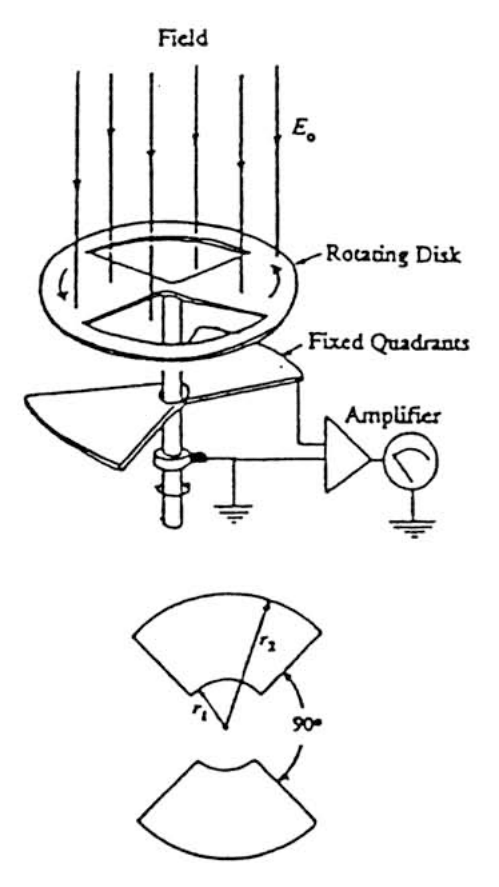
Take \(t=0\) to be an instant when the insulated quadrants are completely shielded.
Obtain expressions that give the total charge \(q(t)\) induced on the upper surface of the insulated quadrants as a function of time between \(t=0\) and \(t=T/2\), and sketch a graph of this variation.
[The effects of the atmospheric ion current can be ignored in this situation.]
(5) The system described in (4) is connected to an amplifier whose input circuit is equivalent to a capacitor \(C\) and a resistor \(R\) in parallel. (You can assume that the capacitance of the quadrant system is negligible compared to \(C\).) Sketch graphs of the form of the voltage difference \(V\) between the points \(M\) and \(N\) as a function of \(t\) during one revolution of the disk, just after it has been set into rotation with period of revolution \(T\), if:
a) \(T=T_a\ll CR\);
b) \(T=T_b\gg CR\).
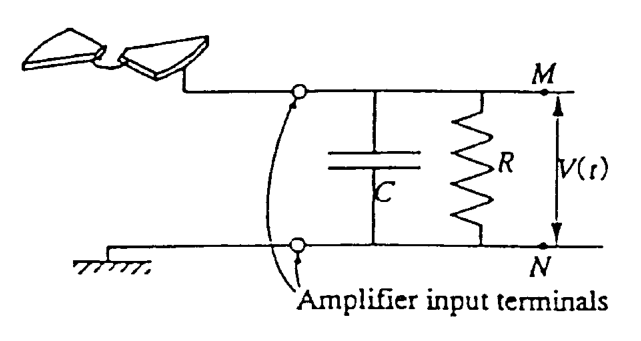
[Assume that \(C\) and \(R\) have fixed values; only \(T\) changes between situations (a) and (b).]
Obtain an expression for the approximate ratio, \(V_a/V_b\), of the largest values of \(V(t)\) in cases (a) and (b).
6) Assume that \(E_0=150\ \mathrm{V/m}\), \(r_1=1\ \mathrm{cm}\), \(r_2=7\ \mathrm{cm}\), \(C=0.01\ \mathrm{\mu F}\), \(R=20\ \mathrm{M\Omega}\), and suppose the disk is set into rotation at \(50\) revolutions per second.
Approximately, what is the largest value of \(V\) during one revolution in this case?
Official English text of the problem.
Problem 2: Laser Forces on a Transparent Prism
General Tabulated Information
Quantity Symbol Value Earth’s mean radius \(R_E\) \(6.4\times10^6\ \mathrm{m}\) acceleration due to gravity \(g\) \(9.8\ \mathrm{m\,s^{-2}}\) Newtonian gravitational constant \(G\) \(6.67\times10^{-11}\ \mathrm{N\,m^2\,kg^{-2}}\) permittivity of vacuum \(\varepsilon_0\) \(8.85\times10^{-12}\ \mathrm{C^2\,N^{-1}\,m^{-2}}\) permeability of vacuum \(\mu_0\) \(8.85\times10^{-7}\ \mathrm{N\,A^{-2}}\) [sic; correct value \(4\pi\times10^{-7}\ \mathrm{N\,A^{-2}}\)] speed of light in vacuum (or air) \(c\) \(3.00\times10^8\ \mathrm{m\,s^{-1}}\) elementary charge \(e\) \(1.60\times10^{-19}\ \mathrm{C}\) mass of electron \(m_e\) \(9.11\times10^{-31}\ \mathrm{kg}\) mass of proton \(m_p\) \(1.67\times10^{-27}\ \mathrm{kg}\) Planck constant \(h\) \(6.63\times10^{-34}\ \mathrm{J\,s}\) Avogadro constant \(N_A\) \(6{,}02\times10^{23}\ \mathrm{mol^{-1}}\) Boltzmann constant \(k\) \(1.38\times10^{-23}\ \mathrm{J\,K^{-1}}\) molar gas constant \(R\) \(8.31\ \mathrm{J\,mol^{-1}\,K^{-1}}\) LASER FORCES ON A TRANSPARENT PRISM
By means of refraction a strong laser beam can exert appreciable forces on small transparent objects. To see that this is so, consider a small glass triangular prism with an apex angle \(A=\pi-2\alpha\), a base of length \(2h\) and a width \(w\). The prism has an index of refraction \(n\) and a mass density \(\rho\).
Suppose that this prism is placed in a laser beam travelling horizontally in the \(x\) direction. (Throughout this problem assume that the prism does not rotate, i.e., its apex always points opposite to the direction of the laser beam, its triangular faces are parallel to the \(xy\) plane, and its base is parallel to the \(yz\) plane, as shown in Fig. 1.) Take the index of refraction of the surrounding air to be \(n_{\mathrm{air}}=1\). Assume that the faces of the prism are coated with an anti-reflection coating so that no reflection occurs.
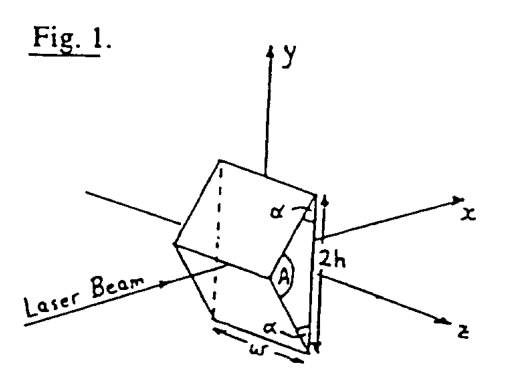
Fig. 1.
The laser beam has an intensity that is uniform across its width in the \(z\) direction but falls off linearly with distance \(y\) from the \(x\) axis such that it has a maximum value of \(I_0\) at \(y=0\) and falls to zero at \(y=\pm4h\) (Fig. 2). [Intensity is power per unit area, e.g. expressed in \(\mathrm{W\,m^{-2}}\).]
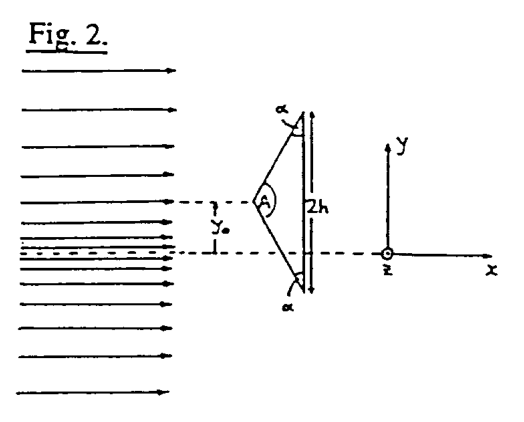
Fig. 2.
1) Write equations from which the angle \(\theta\) (see Fig. 3) may be determined (in terms of \(\alpha\) and \(n\)) in the case when laser light strikes the upper face of the prism.
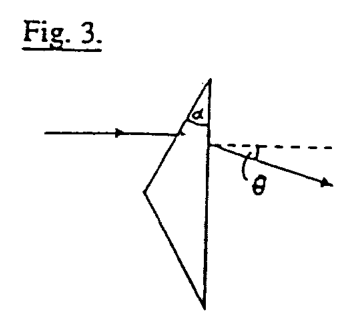
Fig. 3.
2) Express, in terms of \(I_0\), \(\theta\), \(h\), \(w\) and \(y_0\), the \(x\) and \(y\) components of the net force exerted on the prism by the laser light when the apex of the prism is displaced a distance \(y_0\) from the \(x\) axis where \(|y_0|\leq3h\).
Plot graphs of the values of the horizontal and vertical components of force as functions of vertical displacement \(y_0\).
3) Suppose that the laser beam is 1 mm wide in the \(z\) direction and \(80\,\mu\mathrm{m}\) thick (in the \(y\) direction). The prism has \(\alpha=30^\circ\), \(h=10\,\mu\mathrm{m}\), \(n=1.5\), \(w=1\,\mathrm{mm}\) and \(\rho=2.5\,\mathrm{g\,cm^{-3}}\).
How many watts of laser power would be required to balance this prism against the pull of gravity (in the \(-y\) direction) when the apex of the prism is at a distance \(y_0=-h/2\) (\(=-5\,\mu\mathrm{m}\)) below the axis of the laser beam?
4) Suppose this experiment is done in the absence of gravity with the same prism and a laser beam with the same dimensions as in (3), but with \(I_0=10^8\ \mathrm{W\,m^{-2}}\).
What would be the period of the oscillations that occur when the prism is displaced and released a distance \(y=h/20\) from the center line of the laser beam?
Official English text of the problem.
Problem 3: Electron Beam
General Tabulated Information
Quantity Symbol Value Earth’s mean radius \(R_E\) \(6.4\times10^6\ \mathrm{m}\). acceleration due to gravity \(g\) \(9.8\ \mathrm{m\,s^{-2}}\). Newtonian gravitational constant \(G\) \(6.67\times10^{-11}\ \mathrm{N\,m^2\,kg^{-2}}\). permittivity of vacuum \(\varepsilon_0\) \(8.85\times10^{-12}\ \mathrm{C^2\,N^{-1}\,m^{-2}}\). permeability of vacuum \(\mu_0\) \(8.85\times10^{-7}\ \mathrm{N\,A^{-2}}\) [sic; correct value \(4\pi\times10^{-7}\ \mathrm{N\,A^{-2}}\)]. speed of light in vacuum (or air) \(c\) \(3.00\times10^8\ \mathrm{m\,s^{-1}}\). elementary charge \(e\) \(1.60\times10^{-19}\ \mathrm{C}\). mass of electron \(m_e\) \(9.11\times10^{-31}\ \mathrm{kg}\). mass of proton \(m_p\) \(1.67\times10^{-27}\ \mathrm{kg}\) Planck constant \(h\) \(6.63\times10^{-34}\ \mathrm{J\,s}\). Avogadro constant \(N_A\) \(6{,}02\times10^{23}\ \mathrm{mol^{-1}}\). Boltzmann constant \(k\) \(1.38\times10^{-23}\ \mathrm{J\,K^{-1}}\). molar gas constant \(R\) \(8.31\ \mathrm{J\,mol^{-1}\,K^{-1}}\). Theoretical Problem 3
ELECTRON BEAM
An accelerating voltage \(V_0\) produces a uniform, parallel beam of energetic electrons. The electrons pass a thin, long, positively charged copper wire stretched at right angles to the original direction of the beam, as shown in the figure. The symbol \(b\) denotes the distance at which an electron would pass the wire if the wire were uncharged. The electrons then proceed to a screen (viewing surface) a distance \(L\) (\(\gg b\)) beyond the wire, as shown. The beam initially extends to distances \(\pm b_{\max}\) with respect to the axis of the wire. Both the width of the beam and the length of the wire may be considered infinite in the direction perpendicular to the paper.
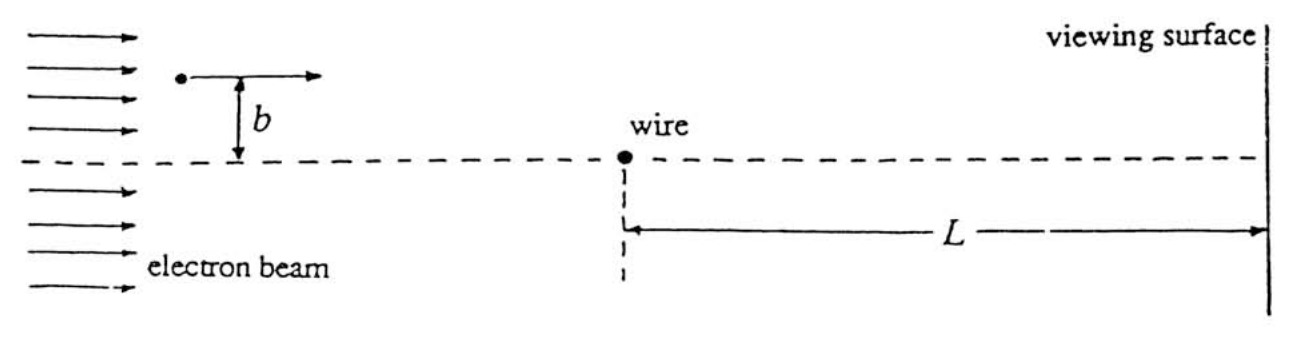
The charged wire extends perpendicularly to the plane of the paper. The sketch is not to scale.
Some numerical data are provided here; you will find other numerical data in the table at the front of the examination:
radius of wire \(=r_0=\) \(10^{-6}\ \mathrm{m}\) maximum value of \(b\) \(=b_{\max}=\) \(10^{-4}\ \mathrm{m}\) electric charge per unit length of wire \(=q_{\mathrm{linear}}=\) \(4.4\times10^{-11}\ \mathrm{C\,m^{-1}}\) accelerating voltage \(=V_0=\) \(2\times10^4\ \mathrm{V}\) length from wire to observing screen \(=L=\) \(0.3\ \mathrm{m}\). Note: For parts 2 - 4, make reasonable approximations that lead to analytical and numerical solutions.
1) Calculate the electric field \(\mathbf E\) produced by the wire. Sketch the magnitude of \(\mathbf E\) as a function of distance from the axis of the wire.
2) Use classical physics to calculate the angular deflection of an electron. Do this for values of the parameter \(b\) such that the electron does not strike the wire. Let \(\theta_{\mathrm{final}}\) denote the (small) angle between the initial velocity of the electron and the velocity when the electron reaches the viewing surface. Hence, calculate \(\theta_{\mathrm{final}}\).
3) Calculate and sketch the pattern of impacts (i.e. the intensity distribution) on the viewing screen that classical physics predicts.
4) Quantum physics predicts a major difference in the intensity distribution (relative to what classical physics predicts). Sketch the pattern for the quantum prediction and provide quantitative detail.
Official English text of the problem.
Internationale Physik-Olympiade
IPhO 1993
Williamsburg, Virginia, USA · 3 Theorieaufgaben mit vollständigen Lösungen
Aufgabe 1: Atmosphärische Elektrizität
Allgemeine tabellarische Angaben
Größe Symbol Wert Mittlerer Erdradius \(R_E\) \(6.4\times10^6\ \mathrm{m}\). Erdbeschleunigung \(g\) \(9.8\ \mathrm{m\,s^{-2}}\). Newtonsche Gravitationskonstante \(G\) \(6.67\times10^{-11}\ \mathrm{N\,m^2\,kg^{-2}}\). Permittivität des Vakuums \(\varepsilon_0\) \(8.85\times10^{-12}\ \mathrm{C^2\,N^{-1}\,m^{-2}}\). Permeabilität des Vakuums \(\mu_0\) \(8.85\times10^{-7}\ \mathrm{N\,A^{-2}}\) [sic; korrekter Wert \(4\pi\times10^{-7}\ \mathrm{N\,A^{-2}}\)]. Lichtgeschwindigkeit im Vakuum (oder in Luft) \(c\) \(3.00\times10^8\ \mathrm{m\,s^{-1}}\). Elementarladung \(e\) \(1.60\times10^{-19}\ \mathrm{C}\). Elektronenmasse \(m_e\) \(9.11\times10^{-31}\ \mathrm{kg}\). Protonenmasse \(m_p\) \(1.67\times10^{-27}\ \mathrm{kg}\) Plancksches Wirkungsquantum \(h\) \(6.63\times10^{-34}\ \mathrm{J\,s}\). Avogadro-Konstante \(N_A\) \(6{,}02\times10^{23}\ \mathrm{mol^{-1}}\). Boltzmann-Konstante \(k\) \(1.38\times10^{-23}\ \mathrm{J\,K^{-1}}\). Molare Gaskonstante \(R\) \(8.31\ \mathrm{J\,mol^{-1}\,K^{-1}}\). Theoretische Aufgabe 1
ATMOSPHÄRISCHE ELEKTRIZITÄT
Aus elektrostatischer Sicht kann die Erdoberfläche als guter Leiter betrachtet werden. Sie trägt eine bestimmte Gesamtladung \(Q_0\) und besitzt eine mittlere Flächenladungsdichte \(\sigma_0\).
1) Bei schönem Wetter herrscht an der Erdoberfläche ein nach unten gerichtetes elektrisches Feld \(E_0\) mit einer Stärke von etwa \(150\ \mathrm{V/m}\). Bestimmen Sie den Betrag der Flächenladungsdichte der Erde und den Betrag der auf der Erdoberfläche befindlichen Gesamtladung.
2) Der Betrag des nach unten gerichteten elektrischen Feldes nimmt mit der Höhe ab und beträgt in einer Höhe von \(100\ \mathrm{m}\) etwa \(100\ \mathrm{V/m}\). Berechnen Sie die mittlere Nettoladung pro \(\mathrm{m^3}\) der Atmosphäre zwischen der Erdoberfläche und einer Höhe von \(100\ \mathrm{m}\).
3) Die in (2) berechnete Nettoladungsdichte ergibt sich tatsächlich daraus, dass pro Volumeneinheit nahezu gleich viele einfach positiv und einfach negativ geladene Ionen vorhanden sind (\(n_+\) und \(n_-\)). In der Nähe der Erdoberfläche gilt bei schönem Wetter \(n_+\approx n_-\approx6\times10^8\ \mathrm{m^{-3}}\). Diese Ionen bewegen sich unter dem Einfluss des vertikalen elektrischen Feldes. Ihre Geschwindigkeit ist proportional zur Feldstärke:
\[ v\approx1.5\times10^{-4}\cdot E, \]
wobei \(v\) in \(\mathrm{m/s}\) und \(E\) in \(\mathrm{V/m}\) angegeben wird. Wie lange würde es dauern, bis die Bewegung der atmosphärischen Ionen die Hälfte der Ladung auf der Erdoberfläche neutralisiert hätte, wenn keine anderen Prozesse (z. B. Blitze) diese Ladung aufrechterhielten?
4) Eine Möglichkeit, das atmosphärische elektrische Feld und damit \(\sigma_0\) zu messen, bietet die in der Abbildung dargestellte Anordnung. Zwei von der Erde isolierte, aber miteinander verbundene Metallquadranten sind unmittelbar unter einer geerdeten, gleichförmig rotierenden Scheibe angebracht, in die zwei quadrantenförmige Öffnungen geschnitten sind. (In der Abbildung ist der Abstand übertrieben groß dargestellt, um die Anordnung zu verdeutlichen.) Zweimal pro Umdrehung sind die isolierten Quadranten dem Feld vollständig ausgesetzt und anschließend (\(1/4\) einer Umlaufzeit später) vollständig dagegen abgeschirmt. Es sei \(T\) die Umlaufzeit, und \(r_1\) und \(r_2\) seien wie dargestellt der Innen- und der Außenradius der isolierten Quadranten.
Wählen Sie als \(t=0\) einen Zeitpunkt, zu dem die isolierten Quadranten vollständig abgeschirmt sind.
Leiten Sie Ausdrücke her, die die auf der Oberseite der isolierten Quadranten induzierte Gesamtladung \(q(t)\) als Funktion der Zeit zwischen \(t=0\) und \(t=T/2\) angeben, und skizzieren Sie diesen Verlauf.
[Die Auswirkungen des atmosphärischen Ionenstroms können in dieser Situation vernachlässigt werden.]
(5) Die in (4) beschriebene Anordnung wird an einen Verstärker angeschlossen, dessen Eingangsschaltung einer Parallelschaltung aus einem Kondensator \(C\) und einem Widerstand \(R\) entspricht. (Sie können annehmen, dass die Kapazität der Quadrantenanordnung gegenüber \(C\) vernachlässigbar ist.) Skizzieren Sie den Verlauf der Spannungsdifferenz \(V\) zwischen den Punkten \(M\) und \(N\) als Funktion von \(t\) während einer Umdrehung der Scheibe, unmittelbar nachdem diese mit der Umlaufzeit \(T\) in Rotation versetzt wurde, falls:
a) \(T=T_a\ll CR\);
b) \(T=T_b\gg CR\).
[Nehmen Sie an, dass \(C\) und \(R\) feste Werte haben; nur \(T\) ändert sich zwischen den Fällen (a) und (b).]
Leiten Sie einen Ausdruck für das näherungsweise Verhältnis \(V_a/V_b\) der größten Werte von \(V(t)\) in den Fällen (a) und (b) her.
6) Nehmen Sie an, dass \(E_0=150\ \mathrm{V/m}\), \(r_1=1\ \mathrm{cm}\), \(r_2=7\ \mathrm{cm}\), \(C=0.01\ \mathrm{\mu F}\), \(R=20\ \mathrm{M\Omega}\) gilt und die Scheibe mit \(50\) Umdrehungen pro Sekunde in Rotation versetzt wird.
Wie groß ist in diesem Fall näherungsweise der größte Wert von \(V\) während einer Umdrehung?
Aufgabentext aus dem offiziellen englischen Text übersetzt.
Aufgabe 2: Laserkräfte auf ein transparentes Prisma
Allgemeine tabellarische Angaben
Größe Symbol Wert Mittlerer Erdradius \(R_E\) \(6.4\times10^6\ \mathrm{m}\) Fallbeschleunigung \(g\) \(9.8\ \mathrm{m\,s^{-2}}\) Newtonsche Gravitationskonstante \(G\) \(6.67\times10^{-11}\ \mathrm{N\,m^2\,kg^{-2}}\) Permittivität des Vakuums \(\varepsilon_0\) \(8.85\times10^{-12}\ \mathrm{C^2\,N^{-1}\,m^{-2}}\) Permeabilität des Vakuums \(\mu_0\) \(8.85\times10^{-7}\ \mathrm{N\,A^{-2}}\) [sic; korrekter Wert \(4\pi\times10^{-7}\ \mathrm{N\,A^{-2}}\)] Lichtgeschwindigkeit im Vakuum (oder in Luft) \(c\) \(3.00\times10^8\ \mathrm{m\,s^{-1}}\) Elementarladung \(e\) \(1.60\times10^{-19}\ \mathrm{C}\) Elektronenmasse \(m_e\) \(9.11\times10^{-31}\ \mathrm{kg}\) Protonenmasse \(m_p\) \(1.67\times10^{-27}\ \mathrm{kg}\) Planck-Konstante \(h\) \(6.63\times10^{-34}\ \mathrm{J\,s}\) Avogadro-Konstante \(N_A\) \(6{,}02\times10^{23}\ \mathrm{mol^{-1}}\) Boltzmann-Konstante \(k\) \(1.38\times10^{-23}\ \mathrm{J\,K^{-1}}\) Molare Gaskonstante \(R\) \(8.31\ \mathrm{J\,mol^{-1}\,K^{-1}}\) LASERKRÄFTE AUF EIN TRANSPARENTES PRISMA
Durch Brechung kann ein intensiver Laserstrahl beträchtliche Kräfte auf kleine transparente Körper ausüben. Um dies zu verstehen, betrachten wir ein kleines dreieckiges Glasprisma mit einem Scheitelwinkel \(A=\pi-2\alpha\), einer Basis der Länge \(2h\) und einer Breite \(w\). Das Prisma hat den Brechungsindex \(n\) und die Massendichte \(\rho\).
Dieses Prisma werde in einen Laserstrahl gebracht, der sich horizontal in \(x\)-Richtung ausbreitet. (Nehmen Sie in der gesamten Aufgabe an, dass sich das Prisma nicht dreht, d. h., seine Spitze zeigt stets entgegen der Ausbreitungsrichtung des Laserstrahls, seine dreieckigen Flächen sind parallel zur \(xy\)-Ebene und seine Basisfläche ist parallel zur \(yz\)-Ebene, wie in Abb. 1 gezeigt.) Setzen Sie den Brechungsindex der umgebenden Luft gleich \(n_{\mathrm{air}}=1\). Nehmen Sie an, dass die Flächen des Prismas mit einer Antireflexbeschichtung versehen sind, sodass keine Reflexion auftritt.
Abb. 1.
Die Intensität des Laserstrahls ist über seine Breite in \(z\)-Richtung konstant, nimmt jedoch mit dem Abstand \(y\) von der \(x\)-Achse linear ab: Sie hat bei \(y=0\) ihren Maximalwert \(I_0\) und fällt bei \(y=\pm4h\) auf null ab (Abb. 2). [Die Intensität ist die Leistung pro Flächeneinheit, beispielsweise ausgedrückt in \(\mathrm{W\,m^{-2}}\).]
Abb. 2.
1) Stellen Sie Gleichungen auf, aus denen sich der Winkel \(\theta\) (siehe Abb. 3) in Abhängigkeit von \(\alpha\) und \(n\) bestimmen lässt, wenn das Laserlicht auf die obere Fläche des Prismas trifft.
Abb. 3.
2) Drücken Sie die \(x\)- und \(y\)-Komponenten der resultierenden Kraft, die das Laserlicht auf das Prisma ausübt, durch \(I_0\), \(\theta\), \(h\), \(w\) und \(y_0\) aus, wenn die Spitze des Prismas um \(y_0\) gegenüber der \(x\)-Achse verschoben ist, wobei \(|y_0|\leq3h\) gilt.
Zeichnen Sie die Graphen der horizontalen und vertikalen Kraftkomponente als Funktionen der vertikalen Verschiebung \(y_0\).
3) Der Laserstrahl sei in \(z\)-Richtung 1 mm breit und \(80\,\mu\mathrm{m}\) dick (in \(y\)-Richtung). Für das Prisma gelten \(\alpha=30^\circ\), \(h=10\,\mu\mathrm{m}\), \(n=1.5\), \(w=1\,\mathrm{mm}\) und \(\rho=2.5\,\mathrm{g\,cm^{-3}}\).
Wie viel Watt Laserleistung wären erforderlich, um die auf dieses Prisma wirkende Gewichtskraft (in \(-y\)-Richtung) auszugleichen, wenn sich seine Spitze bei \(y_0=-h/2\) (\(=-5\,\mu\mathrm{m}\)) unterhalb der Achse des Laserstrahls befindet?
4) Dieses Experiment werde ohne Schwerkraft mit demselben Prisma und einem Laserstrahl mit denselben Abmessungen wie in (3), jedoch mit \(I_0=10^8\ \mathrm{W\,m^{-2}}\), durchgeführt.
Welche Periodendauer hätten die Schwingungen, die entstehen, wenn das Prisma um \(y=h/20\) aus der Mittellinie des Laserstrahls ausgelenkt und losgelassen wird?
Aufgabentext aus dem offiziellen englischen Text übersetzt.
Aufgabe 3: Elektronenstrahl
Allgemeine Wertetabelle
Größe Symbol Wert Mittlerer Erdradius \(R_E\) \(6.4\times10^6\ \mathrm{m}\). Erdbeschleunigung \(g\) \(9.8\ \mathrm{m\,s^{-2}}\). Newtonsche Gravitationskonstante \(G\) \(6.67\times10^{-11}\ \mathrm{N\,m^2\,kg^{-2}}\). Elektrische Feldkonstante \(\varepsilon_0\) \(8.85\times10^{-12}\ \mathrm{C^2\,N^{-1}\,m^{-2}}\). Magnetische Feldkonstante \(\mu_0\) \(8.85\times10^{-7}\ \mathrm{N\,A^{-2}}\) [sic; korrekter Wert \(4\pi\times10^{-7}\ \mathrm{N\,A^{-2}}\)]. Lichtgeschwindigkeit im Vakuum (oder in Luft) \(c\) \(3.00\times10^8\ \mathrm{m\,s^{-1}}\). Elementarladung \(e\) \(1.60\times10^{-19}\ \mathrm{C}\). Elektronenmasse \(m_e\) \(9.11\times10^{-31}\ \mathrm{kg}\). Protonenmasse \(m_p\) \(1.67\times10^{-27}\ \mathrm{kg}\) Plancksche Konstante \(h\) \(6.63\times10^{-34}\ \mathrm{J\,s}\). Avogadro-Konstante \(N_A\) \(6{,}02\times10^{23}\ \mathrm{mol^{-1}}\). Boltzmann-Konstante \(k\) \(1.38\times10^{-23}\ \mathrm{J\,K^{-1}}\). Universelle Gaskonstante \(R\) \(8.31\ \mathrm{J\,mol^{-1}\,K^{-1}}\). Theoretische Aufgabe 3
ELEKTRONENSTRAHL
Eine Beschleunigungsspannung \(V_0\) erzeugt einen homogenen, parallelen Strahl energiereicher Elektronen. Die Elektronen passieren einen dünnen, langen, positiv geladenen Kupferdraht, der senkrecht zur ursprünglichen Strahlrichtung gespannt ist, wie in der Abbildung gezeigt. Das Symbol \(b\) bezeichnet den Abstand, in dem ein Elektron den Draht passieren würde, wenn dieser ungeladen wäre. Anschließend bewegen sich die Elektronen zu einem Schirm (Beobachtungsfläche), der sich, wie dargestellt, im Abstand \(L\) (\(\gg b\)) hinter dem Draht befindet. Der Strahl erstreckt sich anfangs bis zu den Abständen \(\pm b_{\max}\) relativ zur Drahtachse. Sowohl die Breite des Strahls als auch die Länge des Drahtes können in der Richtung senkrecht zur Papierebene als unendlich angesehen werden.
Der geladene Draht verläuft senkrecht zur Papierebene. Die Skizze ist nicht maßstabsgetreu.
Einige Zahlenwerte sind hier angegeben; weitere Zahlenwerte finden Sie in der Tabelle am Anfang der Prüfungsunterlagen:
Drahtradius \(=r_0=\) \(10^{-6}\ \mathrm{m}\) Maximalwert von \(b\) \(=b_{\max}=\) \(10^{-4}\ \mathrm{m}\) Elektrische Ladung pro Längeneinheit des Drahtes \(=q_{\mathrm{linear}}=\) \(4.4\times10^{-11}\ \mathrm{C\,m^{-1}}\) Beschleunigungsspannung \(=V_0=\) \(2\times10^4\ \mathrm{V}\) Abstand vom Draht zum Beobachtungsschirm \(=L=\) \(0.3\ \mathrm{m}\). Hinweis: Verwenden Sie für die Teile 2 - 4 sinnvolle Näherungen, die zu analytischen und numerischen Lösungen führen.
1) Berechnen Sie das vom Draht erzeugte elektrische Feld \(\mathbf E\). Skizzieren Sie den Betrag von \(\mathbf E\) als Funktion des Abstands von der Drahtachse.
2) Berechnen Sie mithilfe der klassischen Physik den Ablenkwinkel eines Elektrons. Führen Sie dies für Werte des Parameters \(b\) durch, bei denen das Elektron nicht auf den Draht trifft. Mit \(\theta_{\mathrm{final}}\) sei der (kleine) Winkel zwischen der Anfangsgeschwindigkeit des Elektrons und seiner Geschwindigkeit beim Erreichen der Beobachtungsfläche bezeichnet. Berechnen Sie damit \(\theta_{\mathrm{final}}\).
3) Berechnen und skizzieren Sie das von der klassischen Physik vorhergesagte Auftreffmuster (d. h. die Intensitätsverteilung) auf dem Beobachtungsschirm.
4) Die Quantenphysik sagt einen wesentlichen Unterschied in der Intensitätsverteilung gegenüber der Vorhersage der klassischen Physik voraus. Skizzieren Sie das quantenphysikalisch vorhergesagte Muster und machen Sie quantitative Angaben dazu.
Aufgabentext aus dem offiziellen englischen Text übersetzt.
Uluslararası Fizik Olimpiyatı
IPhO 1993
Williamsburg, Virginia, ABD · 3 teori sorusu, tam çözümleriyle
Soru 1: Atmosfer Elektriği
Genel Bilgiler Tablosu
Büyüklük Sembol Değer Dünya’nın ortalama yarıçapı \(R_E\) \(6.4\times10^6\ \mathrm{m}\). yerçekimi ivmesi \(g\) \(9.8\ \mathrm{m\,s^{-2}}\). Newton kütleçekim sabiti \(G\) \(6.67\times10^{-11}\ \mathrm{N\,m^2\,kg^{-2}}\). boşluğun elektriksel geçirgenliği \(\varepsilon_0\) \(8.85\times10^{-12}\ \mathrm{C^2\,N^{-1}\,m^{-2}}\). boşluğun manyetik geçirgenliği \(\mu_0\) \(8.85\times10^{-7}\ \mathrm{N\,A^{-2}}\) [sic; doğru değer \(4\pi\times10^{-7}\ \mathrm{N\,A^{-2}}\)]. ışığın boşluktaki (veya havadaki) hızı \(c\) \(3.00\times10^8\ \mathrm{m\,s^{-1}}\). temel yük \(e\) \(1.60\times10^{-19}\ \mathrm{C}\). elektronun kütlesi \(m_e\) \(9.11\times10^{-31}\ \mathrm{kg}\). protonun kütlesi \(m_p\) \(1.67\times10^{-27}\ \mathrm{kg}\) Planck sabiti \(h\) \(6.63\times10^{-34}\ \mathrm{J\,s}\). Avogadro sabiti \(N_A\) \(6{,}02\times10^{23}\ \mathrm{mol^{-1}}\). Boltzmann sabiti \(k\) \(1.38\times10^{-23}\ \mathrm{J\,K^{-1}}\). molar gaz sabiti \(R\) \(8.31\ \mathrm{J\,mol^{-1}\,K^{-1}}\). Teorik Soru 1
ATMOSFER ELEKTRİĞİ
Elektrostatik açısından Dünya’nın yüzeyi iyi bir iletken olarak kabul edilebilir. Bu yüzey, belirli bir toplam \(Q_0\) yükü taşır ve ortalama yüzey yük yoğunluğu \(\sigma_0\)’dır.
1) Açık hava koşullarında, Dünya’nın yüzeyinde aşağı yönlü, yaklaşık \(150\ \mathrm{V/m}\) büyüklüğünde bir \(E_0\) elektrik alanı vardır. Dünya’nın yüzey yük yoğunluğunun ve yüzeyinde taşınan toplam yükün büyüklüklerini bulunuz.
2) Aşağı yönlü elektrik alanın büyüklüğü yükseklikle azalır ve \(100\ \mathrm{m}\) yükseklikte yaklaşık \(100\ \mathrm{V/m}\) olur. Dünya’nın yüzeyi ile \(100\ \mathrm{m}\) yükseklik arasında atmosferin her \(\mathrm{m^3}\)’ündeki ortalama net yük miktarını hesaplayınız.
3) (2)’de hesapladığınız net yük yoğunluğu, aslında birim hacimdeki tek yüklü pozitif ve negatif iyon sayılarının (\(n_+\) ve \(n_-\)) neredeyse eşit olmasının sonucudur. Dünya’nın yüzeyine yakın bölgede, açık hava koşullarında, \(n_+\approx n_-\approx6\times10^8\ \mathrm{m^{-3}}\)’tür. Bu iyonlar düşey elektrik alanın etkisiyle hareket eder. Süratleri alan şiddetiyle orantılıdır:
\[ v\approx1.5\times10^{-4}\cdot E, \]
burada \(v\), \(\mathrm{m/s}\), \(E\) ise \(\mathrm{V/m}\) cinsindendir. Dünya’nın yüzey yükünü koruyan başka hiçbir süreç (örneğin yıldırım) gerçekleşmeseydi, atmosferdeki iyonların hareketiyle bu yükün yarısının nötrlenmesi ne kadar sürerdi?
4) Atmosferdeki elektrik alanı ve dolayısıyla \(\sigma_0\)’ı ölçmenin bir yolu, şekilde gösterilen sistemi kullanmaktır. Topraktan yalıtılmış, ancak birbirine bağlı iki metal çeyrek daire parçası, üzerinde çeyrek daire biçiminde iki delik bulunan, topraklanmış ve sabit hızla dönen bir diskin hemen altına yerleştirilmiştir. (Şekilde, düzeni göstermek amacıyla aralık abartılmıştır.) Her turda iki kez, yalıtılmış çeyrek daire parçaları alana tamamen açık hâle gelir, ardından (bir periyodun \(1/4\)’ü kadar süre sonra) alandan tamamen perdelenir. Dönme periyodu \(T\), yalıtılmış çeyrek daire parçalarının iç ve dış yarıçapları ise şekilde gösterildiği gibi \(r_1\) ve \(r_2\) olsun.
\(t=0\) anını, yalıtılmış çeyrek daire parçalarının tamamen perdelendiği bir an olarak alınız.
Yalıtılmış çeyrek daire parçalarının üst yüzeyinde indüklenen toplam \(q(t)\) yükünü, \(t=0\) ile \(t=T/2\) arasında zamanın fonksiyonu olarak veren ifadeleri elde ediniz ve bu değişimin grafiğini çiziniz.
[Bu durumda atmosferdeki iyon akımının etkileri ihmal edilebilir.]
(5) (4)’te açıklanan sistem, giriş devresi paralel bağlı bir \(C\) kondansatörü ile bir \(R\) direncine eşdeğer olan bir yükseltece bağlanmıştır. (Çeyrek daire sisteminin sığasının \(C\)’ye göre ihmal edilebilir olduğunu varsayabilirsiniz.) Disk, \(T\) dönme periyoduyla dönmeye başlatıldıktan hemen sonra, bir tur boyunca \(M\) ve \(N\) noktaları arasındaki \(V\) gerilim farkının \(t\)’ye bağlı grafiklerinin biçimini aşağıdaki durumlar için çiziniz:
a) \(T=T_a\ll CR\);
b) \(T=T_b\gg CR\).
[\(C\) ve \(R\)’nin sabit değerlere sahip olduğunu; (a) ve (b) durumları arasında yalnızca \(T\)’nin değiştiğini varsayınız.]
(a) ve (b) durumlarında \(V(t)\)’nin en büyük değerlerinin yaklaşık oranı \(V_a/V_b\) için bir ifade elde ediniz.
6) \(E_0=150\ \mathrm{V/m}\), \(r_1=1\ \mathrm{cm}\), \(r_2=7\ \mathrm{cm}\), \(C=0.01\ \mathrm{\mu F}\), \(R=20\ \mathrm{M\Omega}\) olduğunu kabul ediniz ve diskin saniyede \(50\) tur atacak şekilde dönmeye başlatıldığını varsayınız.
Bu durumda bir tur boyunca \(V\)’nin en büyük değeri yaklaşık olarak nedir?
Soru metni resmi İngilizce metinden çevrilmiştir.
Soru 2: Saydam Bir Prizma Üzerindeki Lazer Kuvvetleri
Genel Bilgiler Tablosu
Nicelik Sembol Değer Dünya’nın ortalama yarıçapı \(R_E\) \(6.4\times10^6\ \mathrm{m}\) yerçekimi ivmesi \(g\) \(9.8\ \mathrm{m\,s^{-2}}\) Newton’un evrensel kütleçekim sabiti \(G\) \(6.67\times10^{-11}\ \mathrm{N\,m^2\,kg^{-2}}\) boşluğun elektriksel geçirgenliği \(\varepsilon_0\) \(8.85\times10^{-12}\ \mathrm{C^2\,N^{-1}\,m^{-2}}\) boşluğun manyetik geçirgenliği \(\mu_0\) \(8.85\times10^{-7}\ \mathrm{N\,A^{-2}}\) [sic; doğru değer \(4\pi\times10^{-7}\ \mathrm{N\,A^{-2}}\)] ışığın boşluktaki (veya havadaki) hızı \(c\) \(3.00\times10^8\ \mathrm{m\,s^{-1}}\) temel yük \(e\) \(1.60\times10^{-19}\ \mathrm{C}\) elektronun kütlesi \(m_e\) \(9.11\times10^{-31}\ \mathrm{kg}\) protonun kütlesi \(m_p\) \(1.67\times10^{-27}\ \mathrm{kg}\) Planck sabiti \(h\) \(6.63\times10^{-34}\ \mathrm{J\,s}\) Avogadro sabiti \(N_A\) \(6{,}02\times10^{23}\ \mathrm{mol^{-1}}\) Boltzmann sabiti \(k\) \(1.38\times10^{-23}\ \mathrm{J\,K^{-1}}\) molar gaz sabiti \(R\) \(8.31\ \mathrm{J\,mol^{-1}\,K^{-1}}\) SAYDAM BİR PRİZMA ÜZERİNDEKİ LAZER KUVVETLERİ
Güçlü bir lazer demeti, kırılma yoluyla küçük saydam cisimlere kayda değer kuvvetler uygulayabilir. Bunun nasıl gerçekleştiğini görmek için tepe açısı \(A=\pi-2\alpha\), taban uzunluğu \(2h\) ve genişliği \(w\) olan küçük, cam bir üçgen prizmayı ele alalım. Prizmanın kırılma indisi \(n\), kütle yoğunluğu ise \(\rho\)’dur.
Bu prizmanın, yatay olarak \(x\) yönünde ilerleyen bir lazer demetinin içine yerleştirildiğini varsayalım. (Bu soru boyunca prizmanın dönmediğini, yani Şekil 1’de gösterildiği gibi tepesinin daima lazer demetinin yönünün tersine baktığını, üçgen yüzlerinin \(xy\) düzlemine paralel ve tabanının \(yz\) düzlemine paralel olduğunu varsayın.) Çevredeki havanın kırılma indisini \(n_{\mathrm{air}}=1\) alın. Prizmanın yüzlerinin, yansıma oluşmayacak şekilde yansıma önleyici bir kaplamayla kaplandığını varsayın.
Şekil 1.
Lazer demetinin şiddeti, \(z\) yönündeki genişliği boyunca düzgün olmakla birlikte, \(x\) ekseninden olan \(y\) uzaklığıyla doğrusal olarak azalır; \(y=0\)’da en büyük değeri \(I_0\)’a ulaşır ve \(y=\pm4h\)’de sıfıra düşer (Şekil 2). [Şiddet, birim alan başına güçtür; örneğin \(\mathrm{W\,m^{-2}}\) birimiyle ifade edilir.]
Şekil 2.
1) Lazer ışığının prizmanın üst yüzüne geldiği durumda, \(\theta\) açısının (bkz. Şekil 3) belirlenmesini sağlayan denklemleri (\(\alpha\) ve \(n\) cinsinden) yazın.
Şekil 3.
2) Prizmanın tepesi \(x\) ekseninden \(y_0\) kadar yer değiştirdiğinde, \(|y_0|\leq3h\) olmak üzere, lazer ışığının prizmaya uyguladığı net kuvvetin \(x\) ve \(y\) bileşenlerini \(I_0\), \(\theta\), \(h\), \(w\) ve \(y_0\) cinsinden ifade edin.
Kuvvetin yatay ve düşey bileşenlerinin değerlerini, düşey yer değiştirme \(y_0\)’ın fonksiyonu olarak gösteren grafikleri çizin.
3) Lazer demetinin \(z\) yönünde 1 mm genişliğinde ve (\(y\) yönünde) \(80\,\mu\mathrm{m}\) kalınlığında olduğunu varsayalım. Prizmanın özellikleri \(\alpha=30^\circ\), \(h=10\,\mu\mathrm{m}\), \(n=1.5\), \(w=1\,\mathrm{mm}\) ve \(\rho=2.5\,\mathrm{g\,cm^{-3}}\)’tür.
Prizmanın tepesi lazer demetinin ekseninin \(y_0=-h/2\) (\(=-5\,\mu\mathrm{m}\)) kadar altında olduğunda, bu prizmayı (\(-y\) yönündeki) yerçekimi kuvvetine karşı dengelemek için kaç watt lazer gücü gerekir?
4) Bu deneyin yerçekimi yokken, aynı prizma ve (3)’tekiyle aynı boyutlarda, ancak \(I_0=10^8\ \mathrm{W\,m^{-2}}\) olan bir lazer demetiyle yapıldığını varsayalım.
Prizma, lazer demetinin merkez çizgisinden \(y=h/20\) kadar uzaklaştırılıp serbest bırakıldığında oluşan salınımların periyodu ne olur?
Soru metni resmi İngilizce metinden çevrilmiştir.
Soru 3: Elektron Demeti
Genel Bilgi Tablosu
Büyüklük Sembol Değer Dünya'nın ortalama yarıçapı \(R_E\) \(6.4\times10^6\ \mathrm{m}\). yerçekimi ivmesi \(g\) \(9.8\ \mathrm{m\,s^{-2}}\). Newton kütleçekim sabiti \(G\) \(6.67\times10^{-11}\ \mathrm{N\,m^2\,kg^{-2}}\). boşluğun elektriksel geçirgenliği \(\varepsilon_0\) \(8.85\times10^{-12}\ \mathrm{C^2\,N^{-1}\,m^{-2}}\). boşluğun manyetik geçirgenliği \(\mu_0\) \(8.85\times10^{-7}\ \mathrm{N\,A^{-2}}\) [sic; doğru değer \(4\pi\times10^{-7}\ \mathrm{N\,A^{-2}}\)]. ışığın boşluktaki (veya havadaki) hızı \(c\) \(3.00\times10^8\ \mathrm{m\,s^{-1}}\). temel yük \(e\) \(1.60\times10^{-19}\ \mathrm{C}\). elektronun kütlesi \(m_e\) \(9.11\times10^{-31}\ \mathrm{kg}\). protonun kütlesi \(m_p\) \(1.67\times10^{-27}\ \mathrm{kg}\) Planck sabiti \(h\) \(6.63\times10^{-34}\ \mathrm{J\,s}\). Avogadro sabiti \(N_A\) \(6{,}02\times10^{23}\ \mathrm{mol^{-1}}\). Boltzmann sabiti \(k\) \(1.38\times10^{-23}\ \mathrm{J\,K^{-1}}\). molar gaz sabiti \(R\) \(8.31\ \mathrm{J\,mol^{-1}\,K^{-1}}\). Teorik Soru 3
ELEKTRON DEMETİ
Bir \(V_0\) hızlandırma gerilimi, enerjik elektronlardan oluşan düzgün, paralel bir demet üretir. Elektronlar, şekilde gösterildiği gibi demetin başlangıç doğrultusuna dik olarak gerilmiş, ince, uzun ve pozitif yüklü bir bakır telin yanından geçer. \(b\) sembolü, tel yüksüz olsaydı bir elektronun tele hangi uzaklıktan geçeceğini belirtir. Elektronlar daha sonra, şekilde gösterildiği gibi telin \(L\) (\(\gg b\)) kadar ötesindeki bir ekrana (gözlem yüzeyine) ilerler. Demet başlangıçta telin eksenine göre \(\pm b_{\max}\) uzaklıklarına kadar uzanır. Kâğıda dik doğrultuda hem demetin genişliği hem de telin uzunluğu sonsuz kabul edilebilir.
Yüklü tel, kâğıt düzlemine dik olarak uzanır. Çizim ölçekli değildir.
Bazı sayısal veriler burada verilmiştir; diğer sayısal verileri sınavın başındaki tabloda bulabilirsiniz:
telin yarıçapı \(=r_0=\) \(10^{-6}\ \mathrm{m}\) \(b\)'nin en büyük değeri \(=b_{\max}=\) \(10^{-4}\ \mathrm{m}\) telin birim uzunluğu başına elektrik yükü \(=q_{\mathrm{linear}}=\) \(4.4\times10^{-11}\ \mathrm{C\,m^{-1}}\) hızlandırma gerilimi \(=V_0=\) \(2\times10^4\ \mathrm{V}\) tel ile gözlem ekranı arasındaki uzaklık \(=L=\) \(0.3\ \mathrm{m}\). Not: 2 - 4. kısımlar için analitik ve sayısal çözümler elde etmeyi sağlayan makul yaklaşımlar yapınız.
1) Telin oluşturduğu \(\mathbf E\) elektrik alanını hesaplayınız. \(\mathbf E\)'nin büyüklüğünü telin ekseninden uzaklığın fonksiyonu olarak çiziniz.
2) Bir elektronun açısal sapmasını klasik fiziği kullanarak hesaplayınız. Bunu, \(b\) parametresinin elektronun tele çarpmadığı değerleri için yapınız. \(\theta_{\mathrm{final}}\), elektronun başlangıç hızı ile gözlem yüzeyine ulaştığındaki hızı arasındaki (küçük) açıyı göstersin. Buradan \(\theta_{\mathrm{final}}\)'i hesaplayınız.
3) Klasik fiziğin gözlem ekranı üzerinde öngördüğü çarpma desenini (yani şiddet dağılımını) hesaplayınız ve çiziniz.
4) Kuantum fiziği, şiddet dağılımında (klasik fiziğin öngördüğüne göre) önemli bir fark öngörür. Kuantum fiziğinin öngördüğü deseni çiziniz ve nicel ayrıntıları veriniz.
Soru metni resmi İngilizce metinden çevrilmiştir.
Olimpiada Internacional de Física
IPhO 1993
Williamsburg, Virginia, EE. UU. · 3 problemas teóricos con soluciones completas
Problema 1: Electricidad atmosférica
Información general tabulada
Magnitud Símbolo Valor Radio medio de la Tierra \(R_E\) \(6.4\times10^6\ \mathrm{m}\). aceleración de la gravedad \(g\) \(9.8\ \mathrm{m\,s^{-2}}\). constante de gravitación universal de Newton \(G\) \(6.67\times10^{-11}\ \mathrm{N\,m^2\,kg^{-2}}\). permitividad del vacío \(\varepsilon_0\) \(8.85\times10^{-12}\ \mathrm{C^2\,N^{-1}\,m^{-2}}\). permeabilidad del vacío \(\mu_0\) \(8.85\times10^{-7}\ \mathrm{N\,A^{-2}}\) [sic; valor correcto \(4\pi\times10^{-7}\ \mathrm{N\,A^{-2}}\)]. velocidad de la luz en el vacío (o en el aire) \(c\) \(3.00\times10^8\ \mathrm{m\,s^{-1}}\). carga elemental \(e\) \(1.60\times10^{-19}\ \mathrm{C}\). masa del electrón \(m_e\) \(9.11\times10^{-31}\ \mathrm{kg}\). masa del protón \(m_p\) \(1.67\times10^{-27}\ \mathrm{kg}\) constante de Planck \(h\) \(6.63\times10^{-34}\ \mathrm{J\,s}\). constante de Avogadro \(N_A\) \(6{,}02\times10^{23}\ \mathrm{mol^{-1}}\). constante de Boltzmann \(k\) \(1.38\times10^{-23}\ \mathrm{J\,K^{-1}}\). constante molar de los gases \(R\) \(8.31\ \mathrm{J\,mol^{-1}\,K^{-1}}\). Problema teórico 1
ELECTRICIDAD ATMOSFÉRICA
Desde el punto de vista de la electrostática, la superficie de la Tierra puede considerarse un buen conductor. Posee una cierta carga total \(Q_0\) y una densidad superficial de carga media \(\sigma_0\).
1) En condiciones de buen tiempo, en la superficie terrestre existe un campo eléctrico dirigido hacia abajo, \(E_0\), de aproximadamente \(150\ \mathrm{V/m}\). Deduzca el módulo de la densidad superficial de carga de la Tierra y de la carga total que posee su superficie.
2) El módulo del campo eléctrico dirigido hacia abajo disminuye con la altura y es de aproximadamente \(100\ \mathrm{V/m}\) a una altura de \(100\ \mathrm{m}\). Calcule la cantidad media de carga neta por \(\mathrm{m^3}\) de atmósfera entre la superficie terrestre y los \(100\ \mathrm{m}\) de altitud.
3) La densidad de carga neta que ha calculado en (2) se debe en realidad a la presencia de cantidades casi iguales de iones positivos y negativos con una sola carga elemental por unidad de volumen (\(n_+\) y \(n_-\)). Cerca de la superficie terrestre, en condiciones de buen tiempo, \(n_+\approx n_-\approx6\times10^8\ \mathrm{m^{-3}}\). Estos iones se mueven bajo la acción del campo eléctrico vertical. Su rapidez es proporcional a la intensidad del campo:
\[ v\approx1.5\times10^{-4}\cdot E, \]
donde \(v\) se expresa en \(\mathrm{m/s}\) y \(E\) en \(\mathrm{V/m}\). ¿Cuánto tiempo tardaría el movimiento de los iones atmosféricos en neutralizar la mitad de la carga de la superficie terrestre, si no se produjeran otros procesos (por ejemplo, rayos) que la mantuvieran?
4) Una forma de medir el campo eléctrico atmosférico y, por tanto, \(\sigma_0\), consiste en utilizar el sistema mostrado en el diagrama. Un par de cuadrantes metálicos, aislados de tierra pero conectados entre sí, están montados justo debajo de un disco conectado a tierra que gira uniformemente y en el que se han recortado dos aberturas en forma de cuadrante. (En el diagrama se ha exagerado la separación para mostrar la disposición.) Dos veces en cada vuelta, los cuadrantes aislados quedan completamente expuestos al campo y, después (\(1/4\) de período más tarde), quedan completamente apantallados frente a él. Sea \(T\) el período de rotación y sean \(r_1\) y \(r_2\) los radios interior y exterior de los cuadrantes aislados, como se muestra.
Tome \(t=0\) en un instante en que los cuadrantes aislados estén completamente apantallados.
Obtenga expresiones para la carga total \(q(t)\) inducida en la superficie superior de los cuadrantes aislados en función del tiempo entre \(t=0\) y \(t=T/2\), y trace una gráfica de esta variación.
[En esta situación pueden despreciarse los efectos de la corriente de iones atmosféricos.]
(5) El sistema descrito en (4) se conecta a un amplificador cuyo circuito de entrada equivale a un condensador \(C\) y una resistencia \(R\) en paralelo. (Puede suponer que la capacidad del sistema de cuadrantes es despreciable frente a \(C\).) Trace gráficas que muestren la forma de la diferencia de potencial \(V\) entre los puntos \(M\) y \(N\) en función de \(t\) durante una vuelta del disco, justo después de ponerlo en rotación con un período \(T\), si:
a) \(T=T_a\ll CR\);
b) \(T=T_b\gg CR\).
[Suponga que \(C\) y \(R\) tienen valores fijos; solo cambia \(T\) entre las situaciones (a) y (b).]
Obtenga una expresión para el cociente aproximado, \(V_a/V_b\), entre los valores máximos de \(V(t)\) en los casos (a) y (b).
6) Suponga que \(E_0=150\ \mathrm{V/m}\), \(r_1=1\ \mathrm{cm}\), \(r_2=7\ \mathrm{cm}\), \(C=0.01\ \mathrm{\mu F}\), \(R=20\ \mathrm{M\Omega}\), y que el disco se pone en rotación a \(50\) vueltas por segundo.
¿Cuál es, aproximadamente, el valor máximo de \(V\) durante una vuelta en este caso?
Enunciado traducido del texto oficial en inglés.
Problema 2: Fuerzas de un láser sobre un prisma transparente
Tabla de datos generales
Magnitud Símbolo Valor Radio medio de la Tierra \(R_E\) \(6.4\times10^6\ \mathrm{m}\) aceleración de la gravedad \(g\) \(9.8\ \mathrm{m\,s^{-2}}\) constante de gravitación universal de Newton \(G\) \(6.67\times10^{-11}\ \mathrm{N\,m^2\,kg^{-2}}\) permitividad del vacío \(\varepsilon_0\) \(8.85\times10^{-12}\ \mathrm{C^2\,N^{-1}\,m^{-2}}\) permeabilidad del vacío \(\mu_0\) \(8.85\times10^{-7}\ \mathrm{N\,A^{-2}}\) [sic; valor correcto \(4\pi\times10^{-7}\ \mathrm{N\,A^{-2}}\)] velocidad de la luz en el vacío (o en el aire) \(c\) \(3.00\times10^8\ \mathrm{m\,s^{-1}}\) carga elemental \(e\) \(1.60\times10^{-19}\ \mathrm{C}\) masa del electrón \(m_e\) \(9.11\times10^{-31}\ \mathrm{kg}\) masa del protón \(m_p\) \(1.67\times10^{-27}\ \mathrm{kg}\) constante de Planck \(h\) \(6.63\times10^{-34}\ \mathrm{J\,s}\) constante de Avogadro \(N_A\) \(6{,}02\times10^{23}\ \mathrm{mol^{-1}}\) constante de Boltzmann \(k\) \(1.38\times10^{-23}\ \mathrm{J\,K^{-1}}\) constante molar de los gases \(R\) \(8.31\ \mathrm{J\,mol^{-1}\,K^{-1}}\) FUERZAS DE UN LÁSER SOBRE UN PRISMA TRANSPARENTE
Mediante la refracción, un haz láser intenso puede ejercer fuerzas apreciables sobre objetos transparentes pequeños. Para comprobarlo, considérese un pequeño prisma triangular de vidrio con un ángulo en el vértice \(A=\pi-2\alpha\), una base de longitud \(2h\) y una anchura \(w\). El prisma tiene un índice de refracción \(n\) y una densidad de masa \(\rho\).
Supóngase que este prisma se coloca en un haz láser que se propaga horizontalmente en la dirección \(x\). (En todo este problema, supóngase que el prisma no gira, es decir, que su vértice apunta siempre en sentido opuesto al de propagación del haz láser, sus caras triangulares son paralelas al plano \(xy\) y su base es paralela al plano \(yz\), como se muestra en la Fig. 1.) Tómese el índice de refracción del aire circundante como \(n_{\mathrm{air}}=1\). Supóngase que las caras del prisma están recubiertas con una capa antirreflectante, de modo que no se produce reflexión.
Fig. 1.
El haz láser tiene una intensidad uniforme a lo largo de su anchura en la dirección \(z\), pero que disminuye linealmente con la distancia \(y\) al eje \(x\), de modo que alcanza un valor máximo de \(I_0\) en \(y=0\) y se anula en \(y=\pm4h\) (Fig. 2). [La intensidad es la potencia por unidad de área, expresada, por ejemplo, en \(\mathrm{W\,m^{-2}}\).]
Fig. 2.
1) Escriba las ecuaciones que permiten determinar el ángulo \(\theta\) (véase la Fig. 3) (en función de \(\alpha\) y \(n\)) cuando la luz láser incide sobre la cara superior del prisma.
Fig. 3.
2) Exprese, en función de \(I_0\), \(\theta\), \(h\), \(w\) e \(y_0\), las componentes \(x\) e \(y\) de la fuerza neta que la luz láser ejerce sobre el prisma cuando su vértice está desplazado una distancia \(y_0\) respecto del eje \(x\), donde \(|y_0|\leq3h\).
Represente gráficamente los valores de las componentes horizontal y vertical de la fuerza en función del desplazamiento vertical \(y_0\).
3) Supóngase que el haz láser tiene una anchura de 1 mm en la dirección \(z\) y un espesor de \(80\,\mu\mathrm{m}\) (en la dirección \(y\)). El prisma tiene \(\alpha=30^\circ\), \(h=10\,\mu\mathrm{m}\), \(n=1.5\), \(w=1\,\mathrm{mm}\) y \(\rho=2.5\,\mathrm{g\,cm^{-3}}\).
¿Cuántos vatios de potencia láser se necesitarían para equilibrar la fuerza de la gravedad sobre este prisma (en la dirección \(-y\)) cuando su vértice se encuentra a una distancia \(y_0=-h/2\) (\(=-5\,\mu\mathrm{m}\)) por debajo del eje del haz láser?
4) Supóngase que este experimento se realiza en ausencia de gravedad, con el mismo prisma y un haz láser de las mismas dimensiones que en (3), pero con \(I_0=10^8\ \mathrm{W\,m^{-2}}\).
¿Cuál sería el período de las oscilaciones que se producen cuando se desplaza el prisma y se suelta a una distancia \(y=h/20\) del eje central del haz láser?
Enunciado traducido del texto oficial en inglés.
Problema 3: Haz de electrones
Información general tabulada
Magnitud Símbolo Valor Radio medio de la Tierra \(R_E\) \(6.4\times10^6\ \mathrm{m}\). aceleración de la gravedad \(g\) \(9.8\ \mathrm{m\,s^{-2}}\). constante de gravitación universal de Newton \(G\) \(6.67\times10^{-11}\ \mathrm{N\,m^2\,kg^{-2}}\). permitividad del vacío \(\varepsilon_0\) \(8.85\times10^{-12}\ \mathrm{C^2\,N^{-1}\,m^{-2}}\). permeabilidad del vacío \(\mu_0\) \(8.85\times10^{-7}\ \mathrm{N\,A^{-2}}\) [sic; valor correcto \(4\pi\times10^{-7}\ \mathrm{N\,A^{-2}}\)]. velocidad de la luz en el vacío (o en el aire) \(c\) \(3.00\times10^8\ \mathrm{m\,s^{-1}}\). carga elemental \(e\) \(1.60\times10^{-19}\ \mathrm{C}\). masa del electrón \(m_e\) \(9.11\times10^{-31}\ \mathrm{kg}\). masa del protón \(m_p\) \(1.67\times10^{-27}\ \mathrm{kg}\) constante de Planck \(h\) \(6.63\times10^{-34}\ \mathrm{J\,s}\). constante de Avogadro \(N_A\) \(6{,}02\times10^{23}\ \mathrm{mol^{-1}}\). constante de Boltzmann \(k\) \(1.38\times10^{-23}\ \mathrm{J\,K^{-1}}\). constante molar de los gases \(R\) \(8.31\ \mathrm{J\,mol^{-1}\,K^{-1}}\). Problema teórico 3
HAZ DE ELECTRONES
Una tensión de aceleración \(V_0\) produce un haz uniforme y paralelo de electrones de alta energía. Los electrones pasan junto a un alambre de cobre delgado, largo y cargado positivamente, tensado perpendicularmente a la dirección original del haz, como se muestra en la figura. El símbolo \(b\) denota la distancia a la que un electrón pasaría del alambre si este no estuviera cargado. A continuación, los electrones se dirigen hacia una pantalla (superficie de observación) situada a una distancia \(L\) (\(\gg b\)) más allá del alambre, como se muestra. Inicialmente, el haz se extiende hasta distancias \(\pm b_{\max}\) con respecto al eje del alambre. Tanto la anchura del haz como la longitud del alambre pueden considerarse infinitas en la dirección perpendicular al papel.
El alambre cargado se extiende perpendicularmente al plano del papel. El esquema no está a escala.
A continuación se proporcionan algunos datos numéricos; encontrará otros datos numéricos en la tabla al principio del examen:
radio del alambre \(=r_0=\) \(10^{-6}\ \mathrm{m}\) valor máximo de \(b\) \(=b_{\max}=\) \(10^{-4}\ \mathrm{m}\) carga eléctrica por unidad de longitud del alambre \(=q_{\mathrm{linear}}=\) \(4.4\times10^{-11}\ \mathrm{C\,m^{-1}}\) tensión de aceleración \(=V_0=\) \(2\times10^4\ \mathrm{V}\) distancia del alambre a la pantalla de observación \(=L=\) \(0.3\ \mathrm{m}\). Nota: Para los apartados 2 - 4, utilice aproximaciones razonables que permitan obtener soluciones analíticas y numéricas.
1) Calcule el campo eléctrico \(\mathbf E\) producido por el alambre. Represente esquemáticamente el módulo de \(\mathbf E\) en función de la distancia al eje del alambre.
2) Utilice la física clásica para calcular la desviación angular de un electrón. Hágalo para valores del parámetro \(b\) tales que el electrón no choque con el alambre. Sea \(\theta_{\mathrm{final}}\) el ángulo (pequeño) entre la velocidad inicial del electrón y su velocidad cuando alcanza la superficie de observación. Calcule, por tanto, \(\theta_{\mathrm{final}}\).
3) Calcule y represente esquemáticamente el patrón de impactos (es decir, la distribución de intensidad) sobre la pantalla de observación que predice la física clásica.
4) La física cuántica predice una diferencia importante en la distribución de intensidad (con respecto a lo que predice la física clásica). Represente esquemáticamente el patrón de la predicción cuántica y proporcione detalles cuantitativos.
Enunciado traducido del texto oficial en inglés.
国际物理奥林匹克
IPhO 1993
美国弗吉尼亚州威廉斯堡 · 3 道理论题及完整解答
题目 1:大气电学
常用数据表
物理量 符号 数值 地球平均半径 \(R_E\) \(6.4\times10^6\ \mathrm{m}\)。 重力加速度 \(g\) \(9.8\ \mathrm{m\,s^{-2}}\)。 牛顿引力常量 \(G\) \(6.67\times10^{-11}\ \mathrm{N\,m^2\,kg^{-2}}\)。 真空介电常数 \(\varepsilon_0\) \(8.85\times10^{-12}\ \mathrm{C^2\,N^{-1}\,m^{-2}}\)。 真空磁导率 \(\mu_0\) \(8.85\times10^{-7}\ \mathrm{N\,A^{-2}}\)[原文如此;正确值为 \(4\pi\times10^{-7}\ \mathrm{N\,A^{-2}}\)]。 真空(或空气)中的光速 \(c\) \(3.00\times10^8\ \mathrm{m\,s^{-1}}\)。 元电荷 \(e\) \(1.60\times10^{-19}\ \mathrm{C}\)。 电子质量 \(m_e\) \(9.11\times10^{-31}\ \mathrm{kg}\)。 质子质量 \(m_p\) \(1.67\times10^{-27}\ \mathrm{kg}\) 普朗克常量 \(h\) \(6.63\times10^{-34}\ \mathrm{J\,s}\)。 阿伏伽德罗常量 \(N_A\) \(6{,}02\times10^{23}\ \mathrm{mol^{-1}}\)。 玻尔兹曼常量 \(k\) \(1.38\times10^{-23}\ \mathrm{J\,K^{-1}}\)。 摩尔气体常量 \(R\) \(8.31\ \mathrm{J\,mol^{-1}\,K^{-1}}\)。 理论题 1
大气电学
从静电学的角度来看,地球表面可以视为良导体。它带有一定的总电荷 \(Q_0\),平均面电荷密度为 \(\sigma_0\)。
1) 在晴好天气条件下,地球表面存在竖直向下的电场 \(E_0\),其大小约为 \(150\ \mathrm{V/m}\)。求地球表面的面电荷密度大小及地球表面所带的总电荷量大小。
2) 竖直向下的电场大小随高度增加而减小,在 \(100\ \mathrm{m}\) 高处约为 \(100\ \mathrm{V/m}\)。计算地球表面至 \(100\ \mathrm{m}\) 高度之间的大气中,每 \(\mathrm{m^3}\) 的平均净电荷量。
3) 你在 (2) 中算出的净电荷密度,实际上是单位体积内数量几乎相等的单价正离子和负离子(\(n_+\) 和 \(n_-\))共同作用的结果。在地球表面附近,晴好天气条件下,\(n_+\approx n_-\approx6\times10^8\ \mathrm{m^{-3}}\)。这些离子在竖直电场的作用下运动,其速率与电场强度成正比:
\[ v\approx1.5\times10^{-4}\cdot E, \]
其中,\(v\) 的单位为 \(\mathrm{m/s}\),\(E\) 的单位为 \(\mathrm{V/m}\)。如果没有其他过程(例如闪电)来维持地球表面的电荷,大气离子的运动需要多长时间才能中和地球表面一半的电荷?
4) 测量大气电场并由此确定 \(\sigma_0\) 的一种方法,是使用图示装置。一对与地绝缘但彼此相连的金属象限板,安装在一个接地且匀速旋转的圆盘正下方,圆盘上开有两个象限形孔。(图中为清楚表示装置的结构,夸大了两者之间的间距。)每转一周,绝缘象限板会两次完全暴露于电场中,随后(经过 \(1/4\) 个周期)又被完全屏蔽。设旋转周期为 \(T\),绝缘象限板的内、外半径分别为图示的 \(r_1\) 和 \(r_2\)。
取绝缘象限板被完全屏蔽的某一时刻为 \(t=0\)。
求出从 \(t=0\) 到 \(t=T/2\) 这段时间内,绝缘象限板上表面的感应总电荷 \(q(t)\) 随时间变化的表达式,并画出该变化的示意图。
[在此情形下,可以忽略大气离子电流的影响。]
(5) 将 (4) 中所述装置接到一个放大器上,其输入电路等效于电容 \(C\) 和电阻 \(R\) 的并联电路。(可假设象限板系统的电容与 \(C\) 相比可以忽略。)圆盘刚开始以周期 \(T\) 旋转时,分别在下列情况下,画出一个旋转周期内 \(M\)、\(N\) 两点间电势差 \(V\) 随 \(t\) 变化的示意图:
a) \(T=T_a\ll CR\);
b) \(T=T_b\gg CR\)。
[假设 \(C\) 和 \(R\) 的值固定;情形 (a) 和 (b) 之间只有 \(T\) 发生变化。]
求出情形 (a) 和 (b) 中 \(V(t)\) 最大值的近似比值 \(V_a/V_b\) 的表达式。
6) 假设 \(E_0=150\ \mathrm{V/m}\)、\(r_1=1\ \mathrm{cm}\)、\(r_2=7\ \mathrm{cm}\)、\(C=0.01\ \mathrm{\mu F}\)、\(R=20\ \mathrm{M\Omega}\),并设圆盘开始以每秒 \(50\) 转的转速旋转。
在这种情况下,一个旋转周期内 \(V\) 的最大值约为多少?
题目译自官方英文原文。
题目 2:激光对透明棱镜的作用力
常用数据表
物理量 符号 数值 地球平均半径 \(R_E\) \(6.4\times10^6\ \mathrm{m}\) 重力加速度 \(g\) \(9.8\ \mathrm{m\,s^{-2}}\) 牛顿引力常量 \(G\) \(6.67\times10^{-11}\ \mathrm{N\,m^2\,kg^{-2}}\) 真空介电常数 \(\varepsilon_0\) \(8.85\times10^{-12}\ \mathrm{C^2\,N^{-1}\,m^{-2}}\) 真空磁导率 \(\mu_0\) \(8.85\times10^{-7}\ \mathrm{N\,A^{-2}}\)[原文如此;正确值为 \(4\pi\times10^{-7}\ \mathrm{N\,A^{-2}}\)] 真空(或空气)中的光速 \(c\) \(3.00\times10^8\ \mathrm{m\,s^{-1}}\) 元电荷 \(e\) \(1.60\times10^{-19}\ \mathrm{C}\) 电子质量 \(m_e\) \(9.11\times10^{-31}\ \mathrm{kg}\) 质子质量 \(m_p\) \(1.67\times10^{-27}\ \mathrm{kg}\) 普朗克常量 \(h\) \(6.63\times10^{-34}\ \mathrm{J\,s}\) 阿伏伽德罗常量 \(N_A\) \(6{,}02\times10^{23}\ \mathrm{mol^{-1}}\) 玻尔兹曼常量 \(k\) \(1.38\times10^{-23}\ \mathrm{J\,K^{-1}}\) 摩尔气体常量 \(R\) \(8.31\ \mathrm{J\,mol^{-1}\,K^{-1}}\) 激光对透明棱镜的作用力
强激光束可以通过折射对微小的透明物体施加可观的力。为说明这一点,考虑一个小玻璃三棱镜,其顶角为 \(A=\pi-2\alpha\),底边长为 \(2h\),宽度为 \(w\)。棱镜的折射率为 \(n\),质量密度为 \(\rho\)。
设将该棱镜置于沿 \(x\) 方向水平传播的激光束中。(在本题中,始终假设棱镜不发生转动,即其顶角始终朝向激光束传播方向的反方向,三角形端面平行于 \(xy\) 平面,底面平行于 \(yz\) 平面,如图 1 所示。)取周围空气的折射率为 \(n_{\mathrm{air}}=1\)。假设棱镜各表面均镀有增透膜,因此不发生反射。
图 1。
激光束的光强沿 \(z\) 方向在整个宽度上均匀分布,但随到 \(x\) 轴的距离 \(y\) 线性减小:在 \(y=0\) 处取最大值 \(I_0\),在 \(y=\pm4h\) 处降为零(图 2)。[光强是单位面积上的功率,例如可用 \(\mathrm{W\,m^{-2}}\) 表示。]
图 2。
1) 对于激光照射到棱镜上表面的情形,写出可用于确定角度 \(\theta\)(见图 3)的方程(用 \(\alpha\) 和 \(n\) 表示)。
图 3。
2) 当棱镜顶角相对于 \(x\) 轴的位移为 \(y_0\),且 \(|y_0|\leq3h\) 时,用 \(I_0\)、\(\theta\)、\(h\)、\(w\) 和 \(y_0\) 表示激光对棱镜所施加合力的 \(x\) 分量和 \(y\) 分量。
画出力的水平分量和竖直分量随竖直位移 \(y_0\) 变化的图像。
3) 设激光束沿 \(z\) 方向的宽度为 1 mm,厚度(沿 \(y\) 方向)为 \(80\,\mu\mathrm{m}\)。棱镜的参数为 \(\alpha=30^\circ\)、\(h=10\,\mu\mathrm{m}\)、\(n=1.5\)、\(w=1\,\mathrm{mm}\) 和 \(\rho=2.5\,\mathrm{g\,cm^{-3}}\)。
当棱镜顶角位于激光束轴线下方,位移为 \(y_0=-h/2\)(\(=-5\,\mu\mathrm{m}\))时,要使棱镜所受的激光作用力与重力(沿 \(-y\) 方向)平衡,需要多少瓦的激光功率?
4) 设在无重力条件下进行该实验,使用同一个棱镜,激光束的尺寸与 (3) 中相同,但 \(I_0=10^8\ \mathrm{W\,m^{-2}}\)。
将棱镜移至距激光束中心线 \(y=h/20\) 处并释放,所产生振动的周期是多少?
题目译自官方英文原文。
题目 3:电子束
通用数据表
物理量 符号 数值 地球平均半径 \(R_E\) \(6.4\times10^6\ \mathrm{m}\). 重力加速度 \(g\) \(9.8\ \mathrm{m\,s^{-2}}\). 牛顿引力常量 \(G\) \(6.67\times10^{-11}\ \mathrm{N\,m^2\,kg^{-2}}\). 真空介电常数 \(\varepsilon_0\) \(8.85\times10^{-12}\ \mathrm{C^2\,N^{-1}\,m^{-2}}\). 真空磁导率 \(\mu_0\) \(8.85\times10^{-7}\ \mathrm{N\,A^{-2}}\)[原文如此;正确值为 \(4\pi\times10^{-7}\ \mathrm{N\,A^{-2}}\)]. 真空(或空气)中的光速 \(c\) \(3.00\times10^8\ \mathrm{m\,s^{-1}}\). 元电荷 \(e\) \(1.60\times10^{-19}\ \mathrm{C}\). 电子质量 \(m_e\) \(9.11\times10^{-31}\ \mathrm{kg}\). 质子质量 \(m_p\) \(1.67\times10^{-27}\ \mathrm{kg}\) 普朗克常量 \(h\) \(6.63\times10^{-34}\ \mathrm{J\,s}\). 阿伏伽德罗常量 \(N_A\) \(6{,}02\times10^{23}\ \mathrm{mol^{-1}}\). 玻尔兹曼常量 \(k\) \(1.38\times10^{-23}\ \mathrm{J\,K^{-1}}\). 摩尔气体常量 \(R\) \(8.31\ \mathrm{J\,mol^{-1}\,K^{-1}}\). 理论题 3
电子束
加速电压 \(V_0\) 产生一束均匀、平行的高能电子束。如图所示,电子经过一根细长的带正电铜丝,铜丝沿垂直于电子束初始方向的方向拉直。符号 \(b\) 表示若铜丝不带电,电子经过铜丝时与铜丝的距离。随后,电子继续前进,到达位于铜丝后方距离为 \(L\)(\(\gg b\))处的屏幕(观察面),如图所示。电子束最初相对于铜丝轴线延伸至 \(\pm b_{\max}\) 处。在垂直于纸面的方向上,电子束的宽度和铜丝的长度均可视为无限大。
带电铜丝沿垂直于纸面的方向延伸。示意图未按比例绘制。
这里给出了一些数值数据;其他数值数据可在试卷前面的表格中找到:
铜丝半径 \(=r_0=\) \(10^{-6}\ \mathrm{m}\) \(b\) 的最大值 \(=b_{\max}=\) \(10^{-4}\ \mathrm{m}\) 铜丝单位长度所带电荷量 \(=q_{\mathrm{linear}}=\) \(4.4\times10^{-11}\ \mathrm{C\,m^{-1}}\) 加速电压 \(=V_0=\) \(2\times10^4\ \mathrm{V}\) 铜丝到观察屏的距离 \(=L=\) \(0.3\ \mathrm{m}\). 注意: 对于第 2 - 4 部分,请作出合理近似,以求得解析解和数值解。
1) 计算铜丝产生的电场 \(\mathbf E\)。画出 \(\mathbf E\) 的大小随到铜丝轴线距离变化的示意图。
2) 运用经典物理计算电子的偏转角。计算时,参数 \(b\) 的取值应使电子不撞上铜丝。用 \(\theta_{\mathrm{final}}\) 表示电子初速度与电子到达观察面时的速度之间的(小)夹角。由此计算 \(\theta_{\mathrm{final}}\)。
3) 计算并画出经典物理预言的观察屏上电子落点图样(即强度分布)。
4) 量子物理预言的强度分布与经典物理预言的分布有重大差异。画出量子物理所预言图样的示意图,并给出定量细节。
题目译自官方英文原文。
Международная физическая олимпиада
IPhO 1993
Уильямсберг, Виргиния, США · 3 теоретические задачи с полными решениями
Задача 1: Атмосферное электричество
Общие справочные данные
Величина Обозначение Значение Средний радиус Земли \(R_E\) \(6.4\times10^6\ \mathrm{m}\). ускорение свободного падения \(g\) \(9.8\ \mathrm{m\,s^{-2}}\). гравитационная постоянная Ньютона \(G\) \(6.67\times10^{-11}\ \mathrm{N\,m^2\,kg^{-2}}\). электрическая постоянная \(\varepsilon_0\) \(8.85\times10^{-12}\ \mathrm{C^2\,N^{-1}\,m^{-2}}\). магнитная постоянная \(\mu_0\) \(8.85\times10^{-7}\ \mathrm{N\,A^{-2}}\) [так в оригинале; правильное значение \(4\pi\times10^{-7}\ \mathrm{N\,A^{-2}}\)]. скорость света в вакууме (или воздухе) \(c\) \(3.00\times10^8\ \mathrm{m\,s^{-1}}\). элементарный заряд \(e\) \(1.60\times10^{-19}\ \mathrm{C}\). масса электрона \(m_e\) \(9.11\times10^{-31}\ \mathrm{kg}\). масса протона \(m_p\) \(1.67\times10^{-27}\ \mathrm{kg}\) постоянная Планка \(h\) \(6.63\times10^{-34}\ \mathrm{J\,s}\). постоянная Авогадро \(N_A\) \(6{,}02\times10^{23}\ \mathrm{mol^{-1}}\). постоянная Больцмана \(k\) \(1.38\times10^{-23}\ \mathrm{J\,K^{-1}}\). универсальная газовая постоянная \(R\) \(8.31\ \mathrm{J\,mol^{-1}\,K^{-1}}\). Теоретическая задача 1
АТМОСФЕРНОЕ ЭЛЕКТРИЧЕСТВО
С точки зрения электростатики поверхность Земли можно считать хорошим проводником. Она несёт некоторый суммарный заряд \(Q_0\) со средней поверхностной плотностью заряда \(\sigma_0\).
1) В условиях хорошей погоды у поверхности Земли существует направленное вниз электрическое поле \(E_0\), напряжённость которого составляет около \(150\ \mathrm{V/m}\). Определите модуль поверхностной плотности заряда Земли и модуль суммарного заряда на её поверхности.
2) Модуль напряжённости направленного вниз электрического поля уменьшается с высотой и на высоте \(100\ \mathrm{m}\) составляет около \(100\ \mathrm{V/m}\). Вычислите средний нескомпенсированный заряд на \(\mathrm{m^3}\) атмосферы между поверхностью Земли и высотой \(100\ \mathrm{m}\).
3) Найденная вами в (2) плотность нескомпенсированного заряда в действительности обусловлена наличием почти одинакового числа положительных и отрицательных однозарядных ионов в единице объёма (\(n_+\) и \(n_-\)). Вблизи поверхности Земли в условиях хорошей погоды \(n_+\approx n_-\approx6\times10^8\ \mathrm{m^{-3}}\). Эти ионы движутся под действием вертикального электрического поля. Их скорость пропорциональна напряжённости поля:
\[ v\approx1.5\times10^{-4}\cdot E, \]
где \(v\) выражена в \(\mathrm{m/s}\), а \(E\) — в \(\mathrm{V/m}\). За какое время движение атмосферных ионов нейтрализовало бы половину заряда на поверхности Земли, если бы не происходило никаких других процессов (например, разрядов молнии), поддерживающих этот заряд?
4) Один из способов измерения атмосферного электрического поля, а следовательно, и \(\sigma_0\), основан на использовании системы, изображённой на рисунке. Два металлических квадранта, изолированных от земли, но соединённых друг с другом, расположены непосредственно под заземлённым равномерно вращающимся диском, в котором вырезаны два отверстия в форме квадрантов. (На рисунке расстояние между ними увеличено, чтобы показать устройство системы.) Дважды за каждый оборот изолированные квадранты полностью открываются действию поля, а затем (через \(1/4\) периода) полностью экранируются от него. Пусть \(T\) — период вращения, а \(r_1\) и \(r_2\) — внутренний и внешний радиусы изолированных квадрантов, как показано на рисунке.
Примите за \(t=0\) момент, когда изолированные квадранты полностью экранированы.
Получите выражения для суммарного заряда \(q(t)\), индуцированного на верхней поверхности изолированных квадрантов, как функции времени в промежутке от \(t=0\) до \(t=T/2\), и схематически изобразите график этой зависимости.
[В данной ситуации влиянием тока атмосферных ионов можно пренебречь.]
(5) Система, описанная в (4), подключена к усилителю, входная цепь которого эквивалентна параллельно соединённым конденсатору \(C\) и резистору \(R\). (Можно считать, что ёмкость системы квадрантов пренебрежимо мала по сравнению с \(C\).) Схематически изобразите графики зависимости разности потенциалов \(V\) между точками \(M\) и \(N\) от \(t\) в течение одного оборота диска сразу после начала его вращения с периодом \(T\), если:
a) \(T=T_a\ll CR\);
b) \(T=T_b\gg CR\).
[Считайте, что \(C\) и \(R\) имеют фиксированные значения; в ситуациях (a) и (b) различается только \(T\).]
Получите выражение для приближённого отношения \(V_a/V_b\) наибольших значений \(V(t)\) в случаях (a) и (b).
6) Пусть \(E_0=150\ \mathrm{V/m}\), \(r_1=1\ \mathrm{cm}\), \(r_2=7\ \mathrm{cm}\), \(C=0.01\ \mathrm{\mu F}\), \(R=20\ \mathrm{M\Omega}\), и предположим, что диск приводят во вращение с частотой \(50\) оборотов в секунду.
Чему приблизительно равно наибольшее значение \(V\) в течение одного оборота в этом случае?
Условие переведено с официального английского текста.
Задача 2: Силы, действующие на прозрачную призму со стороны лазерного излучения
Общие справочные данные
Величина Обозначение Значение Средний радиус Земли \(R_E\) \(6.4\times10^6\ \mathrm{m}\) Ускорение свободного падения \(g\) \(9.8\ \mathrm{m\,s^{-2}}\) Гравитационная постоянная Ньютона \(G\) \(6.67\times10^{-11}\ \mathrm{N\,m^2\,kg^{-2}}\) Электрическая постоянная \(\varepsilon_0\) \(8.85\times10^{-12}\ \mathrm{C^2\,N^{-1}\,m^{-2}}\) Магнитная постоянная \(\mu_0\) \(8.85\times10^{-7}\ \mathrm{N\,A^{-2}}\) [так в оригинале; правильное значение \(4\pi\times10^{-7}\ \mathrm{N\,A^{-2}}\)] Скорость света в вакууме (или воздухе) \(c\) \(3.00\times10^8\ \mathrm{m\,s^{-1}}\) Элементарный заряд \(e\) \(1.60\times10^{-19}\ \mathrm{C}\) Масса электрона \(m_e\) \(9.11\times10^{-31}\ \mathrm{kg}\) Масса протона \(m_p\) \(1.67\times10^{-27}\ \mathrm{kg}\) Постоянная Планка \(h\) \(6.63\times10^{-34}\ \mathrm{J\,s}\) Постоянная Авогадро \(N_A\) \(6{,}02\times10^{23}\ \mathrm{mol^{-1}}\) Постоянная Больцмана \(k\) \(1.38\times10^{-23}\ \mathrm{J\,K^{-1}}\) Универсальная газовая постоянная \(R\) \(8.31\ \mathrm{J\,mol^{-1}\,K^{-1}}\) СИЛЫ, ДЕЙСТВУЮЩИЕ НА ПРОЗРАЧНУЮ ПРИЗМУ СО СТОРОНЫ ЛАЗЕРНОГО ИЗЛУЧЕНИЯ
За счёт преломления мощный лазерный пучок может оказывать заметное силовое воздействие на небольшие прозрачные тела. Чтобы убедиться в этом, рассмотрим небольшую стеклянную треугольную призму с углом при вершине \(A=\pi-2\alpha\), основанием длиной \(2h\) и шириной \(w\). Показатель преломления призмы равен \(n\), а плотность её материала — \(\rho\).
Пусть эта призма помещена в лазерный пучок, распространяющийся горизонтально в направлении \(x\). (Во всей задаче считайте, что призма не вращается, то есть её вершина всегда направлена противоположно направлению распространения лазерного пучка, её треугольные грани параллельны плоскости \(xy\), а основание параллельно плоскости \(yz\), как показано на рис. 1.) Считайте показатель преломления окружающего воздуха равным \(n_{\mathrm{air}}=1\). Предположите, что грани призмы имеют просветляющее покрытие, так что отражение отсутствует.
Рис. 1.
Интенсивность лазерного пучка постоянна по его ширине в направлении \(z\), но линейно убывает с расстоянием \(y\) от оси \(x\): она имеет максимальное значение \(I_0\) при \(y=0\) и обращается в нуль при \(y=\pm4h\) (рис. 2). [Интенсивность — это мощность, приходящаяся на единицу площади; она выражается, например, в \(\mathrm{W\,m^{-2}}\).]
Рис. 2.
1) Запишите уравнения, из которых можно определить угол \(\theta\) (см. рис. 3) через \(\alpha\) и \(n\) в случае, когда лазерный свет падает на верхнюю грань призмы.
Рис. 3.
2) Выразите через \(I_0\), \(\theta\), \(h\), \(w\) и \(y_0\) компоненты по осям \(x\) и \(y\) результирующей силы, действующей на призму со стороны лазерного света, когда вершина призмы смещена от оси \(x\) на \(y_0\), где \(|y_0|\leq3h\).
Постройте графики зависимости горизонтальной и вертикальной компонент силы от вертикального смещения \(y_0\).
3) Пусть лазерный пучок имеет ширину 1 мм в направлении \(z\) и толщину \(80\,\mu\mathrm{m}\) (в направлении \(y\)). Параметры призмы: \(\alpha=30^\circ\), \(h=10\,\mu\mathrm{m}\), \(n=1.5\), \(w=1\,\mathrm{mm}\) и \(\rho=2.5\,\mathrm{g\,cm^{-3}}\).
Какая мощность лазера в ваттах потребуется, чтобы уравновесить действующую на призму силу тяжести (направленную вдоль \(-y\)), если вершина призмы находится на расстоянии \(y_0=-h/2\) (\(=-5\,\mu\mathrm{m}\)) ниже оси лазерного пучка?
4) Пусть этот эксперимент проводится в отсутствие силы тяжести с той же призмой и лазерным пучком тех же размеров, что и в (3), но с \(I_0=10^8\ \mathrm{W\,m^{-2}}\).
Каков будет период колебаний, возникающих, если призму сместить на расстояние \(y=h/20\) от центральной линии лазерного пучка и отпустить?
Условие переведено с официального английского текста.
Задача 3: Электронный пучок
Общие справочные данные
Величина Обозначение Значение Средний радиус Земли \(R_E\) \(6.4\times10^6\ \mathrm{m}\). ускорение свободного падения \(g\) \(9.8\ \mathrm{m\,s^{-2}}\). гравитационная постоянная Ньютона \(G\) \(6.67\times10^{-11}\ \mathrm{N\,m^2\,kg^{-2}}\). электрическая постоянная \(\varepsilon_0\) \(8.85\times10^{-12}\ \mathrm{C^2\,N^{-1}\,m^{-2}}\). магнитная постоянная \(\mu_0\) \(8.85\times10^{-7}\ \mathrm{N\,A^{-2}}\) [так в оригинале; правильное значение \(4\pi\times10^{-7}\ \mathrm{N\,A^{-2}}\)]. скорость света в вакууме (или воздухе) \(c\) \(3.00\times10^8\ \mathrm{m\,s^{-1}}\). элементарный заряд \(e\) \(1.60\times10^{-19}\ \mathrm{C}\). масса электрона \(m_e\) \(9.11\times10^{-31}\ \mathrm{kg}\). масса протона \(m_p\) \(1.67\times10^{-27}\ \mathrm{kg}\) постоянная Планка \(h\) \(6.63\times10^{-34}\ \mathrm{J\,s}\). постоянная Авогадро \(N_A\) \(6{,}02\times10^{23}\ \mathrm{mol^{-1}}\). постоянная Больцмана \(k\) \(1.38\times10^{-23}\ \mathrm{J\,K^{-1}}\). универсальная газовая постоянная \(R\) \(8.31\ \mathrm{J\,mol^{-1}\,K^{-1}}\). Теоретическая задача 3
ЭЛЕКТРОННЫЙ ПУЧОК
Ускоряющее напряжение \(V_0\) создаёт однородный параллельный пучок электронов высокой энергии. Электроны пролетают мимо тонкой длинной положительно заряженной медной проволоки, натянутой под прямым углом к первоначальному направлению пучка, как показано на рисунке. Символом \(b\) обозначено расстояние, на котором электрон пролетел бы мимо проволоки, если бы она не была заряжена. Затем электроны попадают на экран (поверхность наблюдения), расположенный на расстоянии \(L\) (\(\gg b\)) за проволокой, как показано на рисунке. Первоначально пучок простирается до расстояний \(\pm b_{\max}\) относительно оси проволоки. Как ширину пучка, так и длину проволоки в направлении, перпендикулярном плоскости рисунка, можно считать бесконечными.
Заряженная проволока расположена перпендикулярно плоскости рисунка. Масштаб на рисунке не соблюдён.
Некоторые численные данные приведены ниже; остальные численные данные вы найдёте в таблице в начале комплекта заданий:
радиус проволоки \(=r_0=\) \(10^{-6}\ \mathrm{m}\) максимальное значение \(b\) \(=b_{\max}=\) \(10^{-4}\ \mathrm{m}\) электрический заряд на единицу длины проволоки \(=q_{\mathrm{linear}}=\) \(4.4\times10^{-11}\ \mathrm{C\,m^{-1}}\) ускоряющее напряжение \(=V_0=\) \(2\times10^4\ \mathrm{V}\) расстояние от проволоки до экрана наблюдения \(=L=\) \(0.3\ \mathrm{m}\). Примечание: В пунктах 2 - 4 используйте разумные приближения, позволяющие получить аналитические и численные решения.
1) Рассчитайте электрическое поле \(\mathbf E\), создаваемое проволокой. Постройте эскиз графика модуля \(\mathbf E\) в зависимости от расстояния до оси проволоки.
2) Используя классическую физику, рассчитайте угол отклонения электрона. Сделайте это для таких значений параметра \(b\), при которых электрон не сталкивается с проволокой. Обозначим через \(\theta_{\mathrm{final}}\) (малый) угол между начальной скоростью электрона и его скоростью в момент достижения поверхности наблюдения. Найдите \(\theta_{\mathrm{final}}\).
3) Рассчитайте и изобразите схематически картину попаданий электронов (то есть распределение интенсивности) на экране наблюдения, предсказываемую классической физикой.
4) Квантовая физика предсказывает существенное отличие в распределении интенсивности (по сравнению с предсказанием классической физики). Схематически изобразите картину, предсказываемую квантовой физикой, и приведите её количественные характеристики.
Условие переведено с официального английского текста.
الأولمبياد الدولي للفيزياء
IPhO 1993
ويليامزبرغ، فيرجينيا، الولايات المتحدة · 3 مسائل نظرية مع حلول كاملة
المسألة 1: كهرباء الغلاف الجوي
معلومات عامة مجدولة
الكمية الرمز القيمة متوسط نصف قطر الأرض \(R_E\) \(6.4\times10^6\ \mathrm{m}\) تسارع الجاذبية \(g\) \(9.8\ \mathrm{m\,s^{-2}}\) ثابت الجذب العام لنيوتن \(G\) \(6.67\times10^{-11}\ \mathrm{N\,m^2\,kg^{-2}}\) سماحية الفراغ \(\varepsilon_0\) \(8.85\times10^{-12}\ \mathrm{C^2\,N^{-1}\,m^{-2}}\) نفاذية الفراغ \(\mu_0\) \(8.85\times10^{-7}\ \mathrm{N\,A^{-2}}\) [كذا في الأصل؛ القيمة الصحيحة \(4\pi\times10^{-7}\ \mathrm{N\,A^{-2}}\)] سرعة الضوء في الفراغ (أو الهواء) \(c\) \(3.00\times10^8\ \mathrm{m\,s^{-1}}\) الشحنة الأولية \(e\) \(1.60\times10^{-19}\ \mathrm{C}\) كتلة الإلكترون \(m_e\) \(9.11\times10^{-31}\ \mathrm{kg}\) كتلة البروتون \(m_p\) \(1.67\times10^{-27}\ \mathrm{kg}\) ثابت بلانك \(h\) \(6.63\times10^{-34}\ \mathrm{J\,s}\) ثابت أفوغادرو \(N_A\) \(6{,}02\times10^{23}\ \mathrm{mol^{-1}}\) ثابت بولتزمان \(k\) \(1.38\times10^{-23}\ \mathrm{J\,K^{-1}}\) ثابت الغاز المولي \(R\) \(8.31\ \mathrm{J\,mol^{-1}\,K^{-1}}\) المسألة النظرية 1
كهرباء الغلاف الجوي
من منظور الكهروستاتيكا، يمكن اعتبار سطح الأرض موصلًا جيدًا. وهو يحمل شحنة كلية معينة \(Q_0\)، ومتوسط كثافة شحنته السطحية هو \(\sigma_0\).
1) في ظروف الطقس الصحو، يوجد عند سطح الأرض مجال كهربائي متجه إلى أسفل، \(E_0\)، تساوي شدته نحو \(150\ \mathrm{V/m}\). استنتج مقدار كثافة الشحنة السطحية للأرض ومقدار الشحنة الكلية التي يحملها سطح الأرض.
2) تتناقص شدة المجال الكهربائي المتجه إلى أسفل مع الارتفاع، وتبلغ نحو \(100\ \mathrm{V/m}\) عند ارتفاع \(100\ \mathrm{m}\). احسب متوسط كمية الشحنة الصافية لكل \(\mathrm{m^3}\) من الغلاف الجوي بين سطح الأرض وارتفاع \(100\ \mathrm{m}\).
3) إن كثافة الشحنة الصافية التي حسبتها في (2) تنتج في الواقع عن وجود عددين متساويين تقريبًا من الأيونات الموجبة والسالبة أحادية الشحنة في وحدة الحجم (\(n_+\) و\(n_-\)). بالقرب من سطح الأرض، وفي ظروف الطقس الصحو، \(n_+\approx n_-\approx6\times10^8\ \mathrm{m^{-3}}\). تتحرك هذه الأيونات تحت تأثير المجال الكهربائي الرأسي. وتتناسب سرعتها طرديًا مع شدة المجال:
\[ v\approx1.5\times10^{-4}\cdot E, \]
حيث تُقاس \(v\) بوحدة \(\mathrm{m/s}\)، و\(E\) بوحدة \(\mathrm{V/m}\). ما الزمن الذي تستغرقه حركة أيونات الغلاف الجوي لمعادلة نصف شحنة سطح الأرض، إذا لم تحدث أي عمليات أخرى (مثل البرق) تُبقي هذه الشحنة؟
4) إحدى طرق قياس المجال الكهربائي للغلاف الجوي، ومن ثم \(\sigma_0\)، هي استخدام المنظومة الموضحة في الرسم. يُركَّب زوج من القطاعات المعدنية الربعية، المعزولة عن الأرض ولكن الموصولة بعضها ببعض، مباشرةً أسفل قرص مؤرَّض يدور بانتظام، قُطعت فيه فتحتان على شكل قطاعين ربعيين. (بُولغ في التباعد في الرسم لإظهار ترتيب الأجزاء.) ينكشف القطاعان المعزولان بالكامل للمجال مرتين في كل دورة، ثم يُحجبان عنه بالكامل (بعد مرور \(1/4\) دورة). لتكن \(T\) زمن الدورة، وليكن نصفا القطر الداخلي والخارجي للقطاعين المعزولين \(r_1\) و\(r_2\) كما هو موضح.
اعتبر \(t=0\) لحظة يكون فيها القطاعان المعزولان محجوبين بالكامل.
أوجد تعبيرات تعطي الشحنة الكلية \(q(t)\) المستحثة على السطح العلوي للقطاعين المعزولين بدلالة الزمن بين \(t=0\) و\(t=T/2\)، وارسم مخططًا بيانيًا لهذا التغير.
[يمكن إهمال تأثيرات تيار أيونات الغلاف الجوي في هذه الحالة.]
(5) تُوصَل المنظومة الموصوفة في (4) بمضخِّم تكافئ دائرة دخله مكثفًا سعته \(C\) ومقاومةً قيمتها \(R\) موصولين على التوازي. (يمكنك افتراض أن سعة منظومة القطاعين مهملة بالمقارنة مع \(C\).) ارسم مخططات بيانية لشكل فرق الجهد \(V\) بين النقطتين \(M\) و\(N\) بدلالة \(t\) خلال دورة واحدة للقرص، مباشرةً بعد بدء دورانه بزمن دورة \(T\)، إذا كان:
a) \(T=T_a\ll CR\)؛
b) \(T=T_b\gg CR\).
[افترض أن قيمتي \(C\) و\(R\) ثابتتان؛ وأن \(T\) وحده يتغير بين الحالتين (a) و(b).]
أوجد تعبيرًا للنسبة التقريبية، \(V_a/V_b\)، بين أكبر قيمتي \(V(t)\) في الحالتين (a) و(b).
6) افترض أن \(E_0=150\ \mathrm{V/m}\)، و\(r_1=1\ \mathrm{cm}\)، و\(r_2=7\ \mathrm{cm}\)، و\(C=0.01\ \mathrm{\mu F}\)، و\(R=20\ \mathrm{M\Omega}\)، وافترض أن القرص يبدأ بالدوران بمعدل \(50\) دورة في الثانية.
ما أكبر قيمة تقريبية لـ\(V\) خلال دورة واحدة في هذه الحالة؟
نص المسألة مترجم عن النص الإنجليزي الرسمي.
المسألة 2: قوى الليزر المؤثرة على منشور شفاف
جدول المعلومات العامة
الكمية الرمز القيمة متوسط نصف قطر الأرض \(R_E\) \(6.4\times10^6\ \mathrm{m}\) تسارع الجاذبية \(g\) \(9.8\ \mathrm{m\,s^{-2}}\) ثابت الجذب العام لنيوتن \(G\) \(6.67\times10^{-11}\ \mathrm{N\,m^2\,kg^{-2}}\) سماحية الفراغ \(\varepsilon_0\) \(8.85\times10^{-12}\ \mathrm{C^2\,N^{-1}\,m^{-2}}\) نفاذية الفراغ \(\mu_0\) \(8.85\times10^{-7}\ \mathrm{N\,A^{-2}}\) [كذا في الأصل؛ القيمة الصحيحة \(4\pi\times10^{-7}\ \mathrm{N\,A^{-2}}\)] سرعة الضوء في الفراغ (أو الهواء) \(c\) \(3.00\times10^8\ \mathrm{m\,s^{-1}}\) الشحنة الأولية \(e\) \(1.60\times10^{-19}\ \mathrm{C}\) كتلة الإلكترون \(m_e\) \(9.11\times10^{-31}\ \mathrm{kg}\) كتلة البروتون \(m_p\) \(1.67\times10^{-27}\ \mathrm{kg}\) ثابت بلانك \(h\) \(6.63\times10^{-34}\ \mathrm{J\,s}\) ثابت أفوغادرو \(N_A\) \(6{,}02\times10^{23}\ \mathrm{mol^{-1}}\) ثابت بولتزمان \(k\) \(1.38\times10^{-23}\ \mathrm{J\,K^{-1}}\) ثابت الغازات المولي \(R\) \(8.31\ \mathrm{J\,mol^{-1}\,K^{-1}}\) قوى الليزر المؤثرة على منشور شفاف
يمكن لحزمة ليزر قوية أن تؤثر، عن طريق الانكسار، بقوى ملحوظة على أجسام شفافة صغيرة. ولتبيّن ذلك، اعتبر منشورًا زجاجيًا مثلثيًا صغيرًا زاوية رأسه \(A=\pi-2\alpha\)، وطول قاعدته \(2h\)، وعرضه \(w\). معامل انكسار المنشور هو \(n\)، وكثافته الكتلية هي \(\rho\).
افترض أن هذا المنشور موضوع في حزمة ليزر تنتشر أفقيًا في اتجاه \(x\). (افترض طوال هذه المسألة أن المنشور لا يدور، أي إن رأسه يشير دائمًا عكس اتجاه حزمة الليزر، ووجهيه المثلثين موازيان للمستوى \(xy\)، وقاعدته موازية للمستوى \(yz\)، كما هو موضح في الشكل 1.) اعتبر معامل انكسار الهواء المحيط \(n_{\mathrm{air}}=1\). وافترض أن أوجه المنشور مطلية بطبقة مضادة للانعكاس بحيث لا يحدث أي انعكاس.
الشكل 1.
شدة حزمة الليزر منتظمة عبر عرضها في اتجاه \(z\)، لكنها تتناقص خطيًا مع المسافة \(y\) عن المحور \(x\)، بحيث تبلغ قيمتها العظمى \(I_0\) عند \(y=0\)، وتنخفض إلى الصفر عند \(y=\pm4h\) (الشكل 2). [الشدة هي القدرة لكل وحدة مساحة، ويُعبّر عنها مثلًا بوحدة \(\mathrm{W\,m^{-2}}\).]
الشكل 2.
1) اكتب معادلات يمكن منها تحديد الزاوية \(\theta\) (انظر الشكل 3) (بدلالة \(\alpha\) و\(n\)) عندما يسقط ضوء الليزر على الوجه العلوي للمنشور.
الشكل 3.
2) عبّر، بدلالة \(I_0\) و\(\theta\) و\(h\) و\(w\) و\(y_0\)، عن مركبتي القوة المحصلة التي يؤثر بها ضوء الليزر على المنشور في اتجاهي \(x\) و\(y\)، عندما يُزاح رأس المنشور مسافة \(y_0\) عن المحور \(x\)، حيث \(|y_0|\leq3h\).
ارسم منحنيين لقيمتي المركبتين الأفقية والرأسية للقوة بدلالة الإزاحة الرأسية \(y_0\).
3) افترض أن عرض حزمة الليزر في اتجاه \(z\) يساوي 1 mm، وأن سمكها (في اتجاه \(y\)) يساوي \(80\,\mu\mathrm{m}\). وللمنشور القيم \(\alpha=30^\circ\)، و\(h=10\,\mu\mathrm{m}\)، و\(n=1.5\)، و\(w=1\,\mathrm{mm}\)، و\(\rho=2.5\,\mathrm{g\,cm^{-3}}\).
ما قدرة الليزر، بالواط، اللازمة لموازنة قوة الجاذبية المؤثرة على هذا المنشور (في اتجاه \(-y\)) عندما يكون رأس المنشور على مسافة \(y_0=-h/2\) (\(=-5\,\mu\mathrm{m}\)) أسفل محور حزمة الليزر؟
4) افترض إجراء هذه التجربة في غياب الجاذبية، باستخدام المنشور نفسه وحزمة ليزر لها الأبعاد نفسها كما في (3)، ولكن بشدة عظمى \(I_0=10^8\ \mathrm{W\,m^{-2}}\).
ما الزمن الدوري للاهتزازات التي تحدث عندما يُزاح المنشور ثم يُترك على مسافة \(y=h/20\) من الخط المركزي لحزمة الليزر؟
نص المسألة مترجم عن النص الإنجليزي الرسمي.
المسألة 3: حزمة إلكترونات
جدول المعلومات العامة
الكمية الرمز القيمة متوسط نصف قطر الأرض \(R_E\) \(6.4\times10^6\ \mathrm{m}\). تسارع الجاذبية \(g\) \(9.8\ \mathrm{m\,s^{-2}}\). ثابت الجذب العام لنيوتن \(G\) \(6.67\times10^{-11}\ \mathrm{N\,m^2\,kg^{-2}}\). سماحية الفراغ \(\varepsilon_0\) \(8.85\times10^{-12}\ \mathrm{C^2\,N^{-1}\,m^{-2}}\). نفاذية الفراغ \(\mu_0\) \(8.85\times10^{-7}\ \mathrm{N\,A^{-2}}\) [كذا في الأصل؛ القيمة الصحيحة \(4\pi\times10^{-7}\ \mathrm{N\,A^{-2}}\)]. سرعة الضوء في الفراغ (أو الهواء) \(c\) \(3.00\times10^8\ \mathrm{m\,s^{-1}}\). الشحنة الأولية \(e\) \(1.60\times10^{-19}\ \mathrm{C}\). كتلة الإلكترون \(m_e\) \(9.11\times10^{-31}\ \mathrm{kg}\). كتلة البروتون \(m_p\) \(1.67\times10^{-27}\ \mathrm{kg}\) ثابت بلانك \(h\) \(6.63\times10^{-34}\ \mathrm{J\,s}\). ثابت أفوغادرو \(N_A\) \(6{,}02\times10^{23}\ \mathrm{mol^{-1}}\). ثابت بولتزمان \(k\) \(1.38\times10^{-23}\ \mathrm{J\,K^{-1}}\). ثابت الغازات المولي \(R\) \(8.31\ \mathrm{J\,mol^{-1}\,K^{-1}}\). المسألة النظرية 3
حزمة إلكترونات
يُنتج جهد تسريع \(V_0\) حزمة منتظمة ومتوازية من الإلكترونات عالية الطاقة. تمر الإلكترونات بجوار سلك نحاسي رفيع وطويل وموجب الشحنة، مشدود عموديًا على الاتجاه الأصلي للحزمة، كما هو موضح في الشكل. يرمز \(b\) إلى المسافة التي كان الإلكترون سيمر عندها بجوار السلك لو كان السلك غير مشحون. ثم تواصل الإلكترونات حركتها نحو شاشة (سطح مشاهدة) تقع على مسافة \(L\) (\(\gg b\)) بعد السلك، كما هو موضح. تمتد الحزمة في البداية إلى المسافتين \(\pm b_{\max}\) بالنسبة إلى محور السلك. ويمكن اعتبار كل من عرض الحزمة وطول السلك لا نهائيًا في الاتجاه العمودي على الورقة.
يمتد السلك المشحون عموديًا على مستوى الورقة. الرسم التخطيطي ليس بمقياس رسم.
ترد هنا بعض المعطيات العددية؛ وستجد معطيات عددية أخرى في الجدول في مقدمة ورقة الامتحان:
نصف قطر السلك \(=r_0=\) \(10^{-6}\ \mathrm{m}\) القيمة العظمى لـ \(b\) \(=b_{\max}=\) \(10^{-4}\ \mathrm{m}\) الشحنة الكهربائية لكل وحدة طول من السلك \(=q_{\mathrm{linear}}=\) \(4.4\times10^{-11}\ \mathrm{C\,m^{-1}}\) جهد التسريع \(=V_0=\) \(2\times10^4\ \mathrm{V}\) المسافة من السلك إلى شاشة الرصد \(=L=\) \(0.3\ \mathrm{m}\). ملاحظة: في الأجزاء 2 - 4، استخدم تقريبات معقولة تؤدي إلى حلول تحليلية وعددية.
1) احسب المجال الكهربائي \(\mathbf E\) الذي يولده السلك. ارسم مخططًا لمقدار \(\mathbf E\) بدلالة المسافة من محور السلك.
2) استخدم الفيزياء الكلاسيكية لحساب الانحراف الزاوي لإلكترون. أجرِ ذلك لقيم المعامل \(b\) التي لا يصطدم عندها الإلكترون بالسلك. لتكن \(\theta_{\mathrm{final}}\) الزاوية (الصغيرة) بين السرعة الابتدائية للإلكترون وسرعته عند وصوله إلى سطح المشاهدة. ومن ثم احسب \(\theta_{\mathrm{final}}\).
3) احسب وارسم نمط مواضع اصطدام الإلكترونات (أي توزيع الشدة) على شاشة المشاهدة وفق تنبؤ الفيزياء الكلاسيكية.
4) تتنبأ فيزياء الكم باختلاف كبير في توزيع الشدة (مقارنة بما تتنبأ به الفيزياء الكلاسيكية). ارسم النمط الذي يتنبأ به الوصف الكمي، وقدّم تفاصيل كمية.
نص المسألة مترجم عن النص الإنجليزي الرسمي.