IPhO 1993 · Theory problem 2
Laser Forces on a Transparent Prism
General Tabulated Information
| Quantity | Symbol | Value |
|---|---|---|
| Earth’s mean radius | \(R_E\) | \(6.4\times10^6\ \mathrm{m}\) |
| acceleration due to gravity | \(g\) | \(9.8\ \mathrm{m\,s^{-2}}\) |
| Newtonian gravitational constant | \(G\) | \(6.67\times10^{-11}\ \mathrm{N\,m^2\,kg^{-2}}\) |
| permittivity of vacuum | \(\varepsilon_0\) | \(8.85\times10^{-12}\ \mathrm{C^2\,N^{-1}\,m^{-2}}\) |
| permeability of vacuum | \(\mu_0\) | \(8.85\times10^{-7}\ \mathrm{N\,A^{-2}}\) [sic; correct value \(4\pi\times10^{-7}\ \mathrm{N\,A^{-2}}\)] |
| speed of light in vacuum (or air) | \(c\) | \(3.00\times10^8\ \mathrm{m\,s^{-1}}\) |
| elementary charge | \(e\) | \(1.60\times10^{-19}\ \mathrm{C}\) |
| mass of electron | \(m_e\) | \(9.11\times10^{-31}\ \mathrm{kg}\) |
| mass of proton | \(m_p\) | \(1.67\times10^{-27}\ \mathrm{kg}\) |
| Planck constant | \(h\) | \(6.63\times10^{-34}\ \mathrm{J\,s}\) |
| Avogadro constant | \(N_A\) | \(6{,}02\times10^{23}\ \mathrm{mol^{-1}}\) |
| Boltzmann constant | \(k\) | \(1.38\times10^{-23}\ \mathrm{J\,K^{-1}}\) |
| molar gas constant | \(R\) | \(8.31\ \mathrm{J\,mol^{-1}\,K^{-1}}\) |
LASER FORCES ON A TRANSPARENT PRISM
By means of refraction a strong laser beam can exert appreciable forces on small transparent objects. To see that this is so, consider a small glass triangular prism with an apex angle \(A=\pi-2\alpha\), a base of length \(2h\) and a width \(w\). The prism has an index of refraction \(n\) and a mass density \(\rho\).
Suppose that this prism is placed in a laser beam travelling horizontally in the \(x\) direction. (Throughout this problem assume that the prism does not rotate, i.e., its apex always points opposite to the direction of the laser beam, its triangular faces are parallel to the \(xy\) plane, and its base is parallel to the \(yz\) plane, as shown in Fig. 1.) Take the index of refraction of the surrounding air to be \(n_{\mathrm{air}}=1\). Assume that the faces of the prism are coated with an anti-reflection coating so that no reflection occurs.
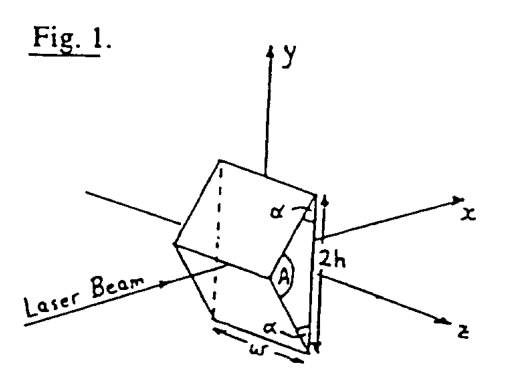
Fig. 1.
The laser beam has an intensity that is uniform across its width in the \(z\) direction but falls off linearly with distance \(y\) from the \(x\) axis such that it has a maximum value of \(I_0\) at \(y=0\) and falls to zero at \(y=\pm4h\) (Fig. 2). [Intensity is power per unit area, e.g. expressed in \(\mathrm{W\,m^{-2}}\).]
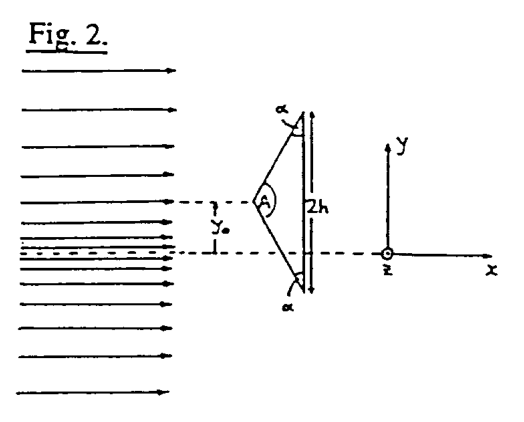
Fig. 2.
1) Write equations from which the angle \(\theta\) (see Fig. 3) may be determined (in terms of \(\alpha\) and \(n\)) in the case when laser light strikes the upper face of the prism.
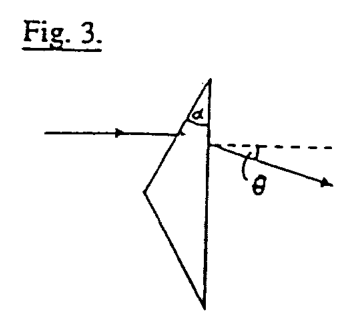
Fig. 3.
2) Express, in terms of \(I_0\), \(\theta\), \(h\), \(w\) and \(y_0\), the \(x\) and \(y\) components of the net force exerted on the prism by the laser light when the apex of the prism is displaced a distance \(y_0\) from the \(x\) axis where \(|y_0|\leq3h\).
Plot graphs of the values of the horizontal and vertical components of force as functions of vertical displacement \(y_0\).
3) Suppose that the laser beam is 1 mm wide in the \(z\) direction and \(80\,\mu\mathrm{m}\) thick (in the \(y\) direction). The prism has \(\alpha=30^\circ\), \(h=10\,\mu\mathrm{m}\), \(n=1.5\), \(w=1\,\mathrm{mm}\) and \(\rho=2.5\,\mathrm{g\,cm^{-3}}\).
How many watts of laser power would be required to balance this prism against the pull of gravity (in the \(-y\) direction) when the apex of the prism is at a distance \(y_0=-h/2\) (\(=-5\,\mu\mathrm{m}\)) below the axis of the laser beam?
4) Suppose this experiment is done in the absence of gravity with the same prism and a laser beam with the same dimensions as in (3), but with \(I_0=10^8\ \mathrm{W\,m^{-2}}\).
What would be the period of the oscillations that occur when the prism is displaced and released a distance \(y=h/20\) from the center line of the laser beam?
Official English text of the problem.
Answers
-
If \(\beta\) is the angle of refraction at the upper face and \(\gamma\) is the incidence angle at the base, \[ \boxed{\sin\alpha=n\sin\beta,\qquad \gamma=\alpha-\beta,\qquad \sin\theta=n\sin\gamma.} \] Equivalently, \[ \boxed{\theta=\arcsin\!\left[ \sin\alpha\left(\sqrt{n^2-\sin^2\alpha}-\cos\alpha\right) \right].} \]
-
Define \[ u=\frac{y_0}{h},\qquad C_x=\frac{I_0wh}{4c}(1-\cos\theta),\qquad C_y=\frac{I_0wh}{4c}\sin\theta. \] Then \[ \boxed{ F_x=C_x \begin{cases} 7-u^2,& |u|\leq1,\\ 8-2|u|,&1\leq|u|\leq3, \end{cases}} \] \[ \boxed{ F_y=-C_y \begin{cases} u(2-|u|),&|u|\leq1,\\ \operatorname{sgn}(u),&1\leq|u|\leq3. \end{cases}} \] The horizontal-force graph is even, with a central parabolic maximum and straight outer segments. The vertical-force graph is odd and restoring, with central quadratic segments and constant outer segments.
-
The required total laser power is \[ \boxed{P\simeq33\ \mathrm{W}.} \] The corresponding peak intensity is \(I_0\simeq8.3\times10^8\ \mathrm{W\,m^{-2}}\).
-
The small-oscillation approximation gives \[ \boxed{T_0=2\pi\sqrt{\frac{2\rho c h^2\tan\alpha}{I_0\sin\theta}} \simeq1.12\times10^{-2}\ \mathrm{s}.} \] Retaining the weak nonlinearity at the specified amplitude \(h/20\) gives \[ \boxed{T\simeq1.13\times10^{-2}\ \mathrm{s},} \] about \(1.08\%\) longer.
Solution
We use geometrical optics, neglect absorption as appropriate for the transparent prism, and apply the stipulated absence of reflection. Forces are calculated to leading order in the prism’s speed divided by \(c\).
1) Refraction and the outgoing angle
The upper face makes an angle \(\alpha\) with the vertical base. Its inward normal therefore points at an angle \(\alpha\) below the horizontal. The horizontal incident ray has incidence angle \(\alpha\).
Let \(\beta\) be the refracted angle measured from this normal. Snell’s law gives \[ \sin\alpha=n\sin\beta. \] The ray inside the prism consequently travels at an angle \[ \gamma=\alpha-\beta \] below the horizontal.
The normal to the exit face is horizontal, so \(\gamma\) is also the incidence angle there. Applying Snell’s law again, \[ n\sin\gamma=\sin\theta. \] Thus \[ \theta=\arcsin\!\left[ n\sin\left(\alpha-\arcsin\frac{\sin\alpha}{n}\right) \right]. \]
An equivalent expression follows by expanding the sine: \[ \begin{aligned} \sin\theta &=n(\sin\alpha\cos\beta-\cos\alpha\sin\beta)\\ &=\sin\alpha\sqrt{n^2-\sin^2\alpha} -\sin\alpha\cos\alpha. \end{aligned} \] Hence \[ \boxed{\sin\theta= \sin\alpha\left(\sqrt{n^2-\sin^2\alpha}-\cos\alpha\right).} \]
The transmitted path shown in Fig. 3 requires \(n\sin\gamma\leq1\), which is satisfied by the numerical data in the problem. By symmetry, light entering the lower face exits at angle \(\theta\) above the horizontal.
2) Force components and graphs
The intensity profile is \[ I(y)=I_0\left(1-\frac{|y|}{4h}\right), \qquad |y|\leq4h. \]
Let \(P_+\) and \(P_-\) be the powers entering the upper and lower faces. When the apex is at \(y_0\), their projected intervals perpendicular to the incident beam are respectively \[ [y_0,y_0+h],\qquad [y_0-h,y_0]. \] Therefore \[ P_+=w\int_{y_0}^{y_0+h}I(y)\,dy,\qquad P_-=w\int_{y_0-h}^{y_0}I(y)\,dy. \] The area element here is \(w\,dy\), the area projected perpendicular to the incident light. No additional incidence-angle factor is needed.
Light of power \(P\) in air carries momentum at a rate \(P/c\). For light entering the upper face, the incident and outgoing directions are \[ (1,0),\qquad(\cos\theta,-\sin\theta). \] The force on the prism equals the incoming momentum flux minus the outgoing momentum flux: \[ \mathbf F_+=\frac{P_+}{c} (1-\cos\theta,\ \sin\theta). \] Likewise, \[ \mathbf F_-=\frac{P_-}{c} (1-\cos\theta,\ -\sin\theta). \] Adding, \[ \boxed{ F_x=\frac{1-\cos\theta}{c}(P_++P_-),\qquad F_y=\frac{\sin\theta}{c}(P_+-P_-). } \]
To evaluate the powers, put \(u=y_0/h\). An antiderivative of the dimensionless intensity profile is \[ J(v)=v-\frac{v|v|}{8}, \qquad J'(v)=1-\frac{|v|}{4}. \] Consequently, \[ \frac{P_+}{I_0wh}=J(u+1)-J(u),\qquad \frac{P_-}{I_0wh}=J(u)-J(u-1). \]
For \(|u|\leq1\), the prism straddles the beam axis. Evaluating these expressions gives \[ P_++P_-=\frac{I_0wh}{4}(7-u^2), \] \[ P_+-P_-=-\frac{I_0wh}{4}u(2-|u|). \]
For \(1\leq|u|\leq3\), the entire prism lies on one side of the axis, where intensity varies linearly: \[ P_++P_-=\frac{I_0wh}{4}(8-2|u|), \] \[ P_+-P_-=-\frac{I_0wh}{4}\operatorname{sgn}(u). \]
Thus, with \[ C_x=\frac{I_0wh}{4c}(1-\cos\theta),\qquad C_y=\frac{I_0wh}{4c}\sin\theta, \] the requested forces are \[ \boxed{ F_x=C_x \begin{cases} 7-u^2,&|u|\leq1,\\ 8-2|u|,&1\leq|u|\leq3, \end{cases} \qquad F_y=-C_y \begin{cases} u(2-|u|),&|u|\leq1,\\ \operatorname{sgn}(u),&1\leq|u|\leq3. \end{cases}} \]
The graph values are:
| \(u=y_0/h\) | \(F_x/C_x\) | \(F_y/C_y\) |
|---|---|---|
| \(-3\) | \(2\) | \(1\) |
| \(-2\) | \(4\) | \(1\) |
| \(-1\) | \(6\) | \(1\) |
| \(-1/2\) | \(6.75\) | \(0.75\) |
| \(0\) | \(7\) | \(0\) |
| \(1/2\) | \(6.75\) | \(-0.75\) |
| \(1\) | \(6\) | \(-1\) |
| \(2\) | \(4\) | \(-1\) |
| \(3\) | \(2\) | \(-1\) |
For the horizontal-force graph, draw a downward-opening parabola between \(u=-1\) and \(u=1\), with maximum \(7C_x\) at the origin. Continue with straight segments to \(2C_x\) at \(u=\pm3\). The force remains positive throughout the specified interval.
For the vertical-force graph, draw the constant value \(+C_y\) from \(u=-3\) to \(-1\), then the quadratic segment decreasing to zero at \(u=0\). Reflect this segment through the origin to reach \(-C_y\) at \(u=1\), then continue horizontally to \(u=3\). Its slope at the origin is \(-2C_y/h\). Both force graphs join with continuous slopes at \(u=\pm1\).
The vertical force is restoring: a prism below the axis receives more light on its upper face and is pushed upward; above the axis it is pushed downward.
3) Laser power required to balance gravity
The distance from the apex to the base is \[ d=h\tan\alpha. \] The volume and mass are therefore \[ V=\frac12(2h)d\,w=h^2w\tan\alpha, \qquad m=\rho h^2w\tan\alpha. \] Using SI units, \[ h=10^{-5}\ \mathrm m,\qquad w=10^{-3}\ \mathrm m,\qquad \rho=2.5\times10^3\ \mathrm{kg\,m^{-3}}, \] so \[ m=1.4434\times10^{-10}\ \mathrm{kg}, \qquad mg=1.4145\times10^{-9}\ \mathrm N. \]
For \(\alpha=30^\circ\) and \(n=1.5\), \[ \beta=\arcsin\left(\frac{\sin30^\circ}{1.5}\right) =19.471^\circ, \] \[ \gamma=10.529^\circ,\qquad \theta=15.908^\circ,\qquad \sin\theta=0.274094. \]
At \(y_0=-h/2\), we have \(u=-1/2\), giving \[ F_y=\frac34C_y =\frac{3I_0wh\sin\theta}{16c}. \] Vertical balance requires \[ \frac{3I_0wh\sin\theta}{16c} =\rho h^2w\tan\alpha\,g. \] Hence \[ I_0=\frac{16\rho ghc\tan\alpha}{3\sin\theta} =8.2571\times10^8\ \mathrm{W\,m^{-2}}. \]
The required power is the power of the whole beam. Its thickness \(80\,\mu\mathrm m\) equals \(8h\), and the area under its triangular intensity profile is \(4hI_0\). Thus \[ P=w\int_{-4h}^{4h}I(y)\,dy=4hwI_0. \] Substitution gives \[ P=4(10^{-5})(10^{-3})(8.2571\times10^8) =33.03\ \mathrm W. \] Therefore \[ \boxed{P\simeq33\ \mathrm W.} \]
This balances gravity in the \(y\) direction, as requested. The horizontal optical force remains positive.
4) Oscillation period without gravity
Throughout the stated oscillation, \(|y_0|\leq h/20<h\). The central force expression can be written \[ F_y=-\frac{I_0w\sin\theta}{2c}\, y_0\left(1-\frac{|y_0|}{2h}\right). \] Define \[ K=\frac{I_0w\sin\theta}{2c}. \] At amplitude \(a=h/20\), the nonlinear factor differs from unity by at most \[ \frac{a}{2h}=\frac1{40}=2.5\%. \] The leading approximation is therefore simple harmonic motion: \[ m\ddot y_0=-Ky_0,\qquad \omega_0^2=\frac Km. \] Using the mass found above, \[ \omega_0^2 =\frac{I_0\sin\theta}{2\rho c h^2\tan\alpha}, \] and \[ \boxed{ T_0=2\pi\sqrt{\frac{2\rho c h^2\tan\alpha}{I_0\sin\theta}}. } \]
For \(I_0=10^8\ \mathrm{W\,m^{-2}}\), \[ K=4.5682\times10^{-5}\ \mathrm{N\,m^{-1}}, \qquad \omega_0=562.58\ \mathrm{s^{-1}}, \] so \[ \boxed{T_0=0.0111685\ \mathrm s\approx11.2\ \mathrm{ms}.} \]
The finite-amplitude correction can also be evaluated from the exact force. Taking the potential energy to vanish at the origin, \[ U(y_0)=\frac K2y_0^2-\frac{K}{6h}|y_0|^3. \] Release from rest at \(y_0=a\) gives \[ \frac12m\dot y_0^2=U(a)-U(y_0). \] By symmetry, the period is four times the travel time from \(0\) to \(a\): \[ T=4\sqrt{\frac mK} \int_0^a \frac{dy}{\sqrt{a^2-y^2-(a^3-y^3)/(3h)}}. \] Setting \(s=y/a\), \[ T=\frac4{\omega_0} \int_0^1 \frac{ds}{\sqrt{1-s^2-\dfrac{a}{3h}(1-s^3)}}. \] For \(a/h=1/20\), numerical evaluation yields \[ \frac{T}{T_0}=1.01079, \] and hence \[ \boxed{T=0.0112890\ \mathrm s\approx11.3\ \mathrm{ms}.} \] The period is therefore about \(0.011\ \mathrm s\); the small-oscillation approximation is accurate to approximately \(1.1\%\) at the specified amplitude.
The solution was checked against the official solution.
IPhO 1993 · Theorieaufgabe 2
Laserkräfte auf ein transparentes Prisma
Allgemeine tabellarische Angaben
| Größe | Symbol | Wert |
|---|---|---|
| Mittlerer Erdradius | \(R_E\) | \(6.4\times10^6\ \mathrm{m}\) |
| Fallbeschleunigung | \(g\) | \(9.8\ \mathrm{m\,s^{-2}}\) |
| Newtonsche Gravitationskonstante | \(G\) | \(6.67\times10^{-11}\ \mathrm{N\,m^2\,kg^{-2}}\) |
| Permittivität des Vakuums | \(\varepsilon_0\) | \(8.85\times10^{-12}\ \mathrm{C^2\,N^{-1}\,m^{-2}}\) |
| Permeabilität des Vakuums | \(\mu_0\) | \(8.85\times10^{-7}\ \mathrm{N\,A^{-2}}\) [sic; korrekter Wert \(4\pi\times10^{-7}\ \mathrm{N\,A^{-2}}\)] |
| Lichtgeschwindigkeit im Vakuum (oder in Luft) | \(c\) | \(3.00\times10^8\ \mathrm{m\,s^{-1}}\) |
| Elementarladung | \(e\) | \(1.60\times10^{-19}\ \mathrm{C}\) |
| Elektronenmasse | \(m_e\) | \(9.11\times10^{-31}\ \mathrm{kg}\) |
| Protonenmasse | \(m_p\) | \(1.67\times10^{-27}\ \mathrm{kg}\) |
| Planck-Konstante | \(h\) | \(6.63\times10^{-34}\ \mathrm{J\,s}\) |
| Avogadro-Konstante | \(N_A\) | \(6{,}02\times10^{23}\ \mathrm{mol^{-1}}\) |
| Boltzmann-Konstante | \(k\) | \(1.38\times10^{-23}\ \mathrm{J\,K^{-1}}\) |
| Molare Gaskonstante | \(R\) | \(8.31\ \mathrm{J\,mol^{-1}\,K^{-1}}\) |
LASERKRÄFTE AUF EIN TRANSPARENTES PRISMA
Durch Brechung kann ein intensiver Laserstrahl beträchtliche Kräfte auf kleine transparente Körper ausüben. Um dies zu verstehen, betrachten wir ein kleines dreieckiges Glasprisma mit einem Scheitelwinkel \(A=\pi-2\alpha\), einer Basis der Länge \(2h\) und einer Breite \(w\). Das Prisma hat den Brechungsindex \(n\) und die Massendichte \(\rho\).
Dieses Prisma werde in einen Laserstrahl gebracht, der sich horizontal in \(x\)-Richtung ausbreitet. (Nehmen Sie in der gesamten Aufgabe an, dass sich das Prisma nicht dreht, d. h., seine Spitze zeigt stets entgegen der Ausbreitungsrichtung des Laserstrahls, seine dreieckigen Flächen sind parallel zur \(xy\)-Ebene und seine Basisfläche ist parallel zur \(yz\)-Ebene, wie in Abb. 1 gezeigt.) Setzen Sie den Brechungsindex der umgebenden Luft gleich \(n_{\mathrm{air}}=1\). Nehmen Sie an, dass die Flächen des Prismas mit einer Antireflexbeschichtung versehen sind, sodass keine Reflexion auftritt.
Abb. 1.
Die Intensität des Laserstrahls ist über seine Breite in \(z\)-Richtung konstant, nimmt jedoch mit dem Abstand \(y\) von der \(x\)-Achse linear ab: Sie hat bei \(y=0\) ihren Maximalwert \(I_0\) und fällt bei \(y=\pm4h\) auf null ab (Abb. 2). [Die Intensität ist die Leistung pro Flächeneinheit, beispielsweise ausgedrückt in \(\mathrm{W\,m^{-2}}\).]
Abb. 2.
1) Stellen Sie Gleichungen auf, aus denen sich der Winkel \(\theta\) (siehe Abb. 3) in Abhängigkeit von \(\alpha\) und \(n\) bestimmen lässt, wenn das Laserlicht auf die obere Fläche des Prismas trifft.
Abb. 3.
2) Drücken Sie die \(x\)- und \(y\)-Komponenten der resultierenden Kraft, die das Laserlicht auf das Prisma ausübt, durch \(I_0\), \(\theta\), \(h\), \(w\) und \(y_0\) aus, wenn die Spitze des Prismas um \(y_0\) gegenüber der \(x\)-Achse verschoben ist, wobei \(|y_0|\leq3h\) gilt.
Zeichnen Sie die Graphen der horizontalen und vertikalen Kraftkomponente als Funktionen der vertikalen Verschiebung \(y_0\).
3) Der Laserstrahl sei in \(z\)-Richtung 1 mm breit und \(80\,\mu\mathrm{m}\) dick (in \(y\)-Richtung). Für das Prisma gelten \(\alpha=30^\circ\), \(h=10\,\mu\mathrm{m}\), \(n=1.5\), \(w=1\,\mathrm{mm}\) und \(\rho=2.5\,\mathrm{g\,cm^{-3}}\).
Wie viel Watt Laserleistung wären erforderlich, um die auf dieses Prisma wirkende Gewichtskraft (in \(-y\)-Richtung) auszugleichen, wenn sich seine Spitze bei \(y_0=-h/2\) (\(=-5\,\mu\mathrm{m}\)) unterhalb der Achse des Laserstrahls befindet?
4) Dieses Experiment werde ohne Schwerkraft mit demselben Prisma und einem Laserstrahl mit denselben Abmessungen wie in (3), jedoch mit \(I_0=10^8\ \mathrm{W\,m^{-2}}\), durchgeführt.
Welche Periodendauer hätten die Schwingungen, die entstehen, wenn das Prisma um \(y=h/20\) aus der Mittellinie des Laserstrahls ausgelenkt und losgelassen wird?
Aufgabentext aus dem offiziellen englischen Text übersetzt.
Antworten
-
Ist \(\beta\) der Brechungswinkel an der oberen Fläche und \(\gamma\) der Einfallswinkel an der Basisfläche, so gilt \[ \boxed{\sin\alpha=n\sin\beta,\qquad \gamma=\alpha-\beta,\qquad \sin\theta=n\sin\gamma.} \] Gleichwertig dazu ist \[ \boxed{\theta=\arcsin\!\left[ \sin\alpha\left(\sqrt{n^2-\sin^2\alpha}-\cos\alpha\right) \right].} \]
-
Wir definieren \[ u=\frac{y_0}{h},\qquad C_x=\frac{I_0wh}{4c}(1-\cos\theta),\qquad C_y=\frac{I_0wh}{4c}\sin\theta. \] Dann gilt \[ \boxed{ F_x=C_x \begin{cases} 7-u^2,& |u|\leq1,\\ 8-2|u|,&1\leq|u|\leq3, \end{cases}} \] \[ \boxed{ F_y=-C_y \begin{cases} u(2-|u|),&|u|\leq1,\\ \operatorname{sgn}(u),&1\leq|u|\leq3. \end{cases}} \] Der Graph der horizontalen Kraft ist gerade, mit einem parabelförmigen Maximum im mittleren Bereich und geraden äußeren Abschnitten. Der Graph der vertikalen Kraft ist ungerade und beschreibt eine rücktreibende Kraft; er hat quadratische Abschnitte im mittleren Bereich und konstante äußere Abschnitte.
-
Die erforderliche gesamte Laserleistung beträgt \[ \boxed{P\simeq33\ \mathrm{W}.} \] Die zugehörige maximale Intensität ist \(I_0\simeq8.3\times10^8\ \mathrm{W\,m^{-2}}\).
-
Die Näherung für kleine Schwingungen ergibt \[ \boxed{T_0=2\pi\sqrt{\frac{2\rho c h^2\tan\alpha}{I_0\sin\theta}} \simeq1.12\times10^{-2}\ \mathrm{s}.} \] Berücksichtigt man die schwache Nichtlinearität bei der vorgegebenen Amplitude \(h/20\), erhält man \[ \boxed{T\simeq1.13\times10^{-2}\ \mathrm{s},} \] also eine um etwa \(1.08\%\) längere Periodendauer.
Lösung
Wir verwenden die geometrische Optik, vernachlässigen die Absorption, wie es für das transparente Prisma angemessen ist, und berücksichtigen die vorausgesetzte Reflexionsfreiheit. Die Kräfte werden in führender Ordnung bezüglich des Verhältnisses der Prismengeschwindigkeit zu \(c\) berechnet.
1) Brechung und Austrittswinkel
Die obere Fläche bildet mit der vertikalen Basisfläche den Winkel \(\alpha\). Ihre nach innen gerichtete Normale weist daher unter einem Winkel \(\alpha\) unter die Horizontale. Der horizontal einfallende Strahl hat den Einfallswinkel \(\alpha\).
Der von dieser Normalen aus gemessene Brechungswinkel sei \(\beta\). Das Snelliussche Brechungsgesetz ergibt \[ \sin\alpha=n\sin\beta. \] Der Strahl verläuft im Prisma folglich unter einem Winkel \[ \gamma=\alpha-\beta \] unterhalb der Horizontalen.
Die Normale der Austrittsfläche ist horizontal, sodass \(\gamma\) dort auch der Einfallswinkel ist. Eine erneute Anwendung des Snelliusschen Brechungsgesetzes ergibt \[ n\sin\gamma=\sin\theta. \] Somit gilt \[ \theta=\arcsin\!\left[ n\sin\left(\alpha-\arcsin\frac{\sin\alpha}{n}\right) \right]. \]
Ein gleichwertiger Ausdruck folgt durch Anwendung des Additionstheorems für den Sinus: \[ \begin{aligned} \sin\theta &=n(\sin\alpha\cos\beta-\cos\alpha\sin\beta)\\ &=\sin\alpha\sqrt{n^2-\sin^2\alpha} -\sin\alpha\cos\alpha. \end{aligned} \] Damit ist \[ \boxed{\sin\theta= \sin\alpha\left(\sqrt{n^2-\sin^2\alpha}-\cos\alpha\right).} \]
Der in Abb. 3 gezeigte durchgehende Strahlengang setzt \(n\sin\gamma\leq1\) voraus, was für die Zahlenwerte der Aufgabe erfüllt ist. Aufgrund der Symmetrie tritt Licht, das durch die untere Fläche eintritt, unter dem Winkel \(\theta\) oberhalb der Horizontalen aus.
2) Kraftkomponenten und Graphen
Das Intensitätsprofil lautet \[ I(y)=I_0\left(1-\frac{|y|}{4h}\right), \qquad |y|\leq4h. \]
Die durch die obere bzw. untere Fläche eintretenden Leistungen seien \(P_+\) und \(P_-\). Befindet sich die Spitze bei \(y_0\), so sind die zugehörigen, senkrecht zum einfallenden Strahl projizierten Intervalle \[ [y_0,y_0+h],\qquad [y_0-h,y_0]. \] Daher gilt \[ P_+=w\int_{y_0}^{y_0+h}I(y)\,dy,\qquad P_-=w\int_{y_0-h}^{y_0}I(y)\,dy. \] Das Flächenelement ist hier \(w\,dy\), also die senkrecht zum einfallenden Licht projizierte Fläche. Ein zusätzlicher Faktor für den Einfallswinkel ist nicht erforderlich.
Licht mit der Leistung \(P\) transportiert in Luft pro Zeiteinheit den Impuls \(P/c\). Für Licht, das durch die obere Fläche eintritt, lauten die Einfalls- und Austrittsrichtungen \[ (1,0),\qquad(\cos\theta,-\sin\theta). \] Die Kraft auf das Prisma ist gleich dem einfallenden Impulsstrom abzüglich des austretenden Impulsstroms: \[ \mathbf F_+=\frac{P_+}{c} (1-\cos\theta,\ \sin\theta). \] Entsprechend gilt \[ \mathbf F_-=\frac{P_-}{c} (1-\cos\theta,\ -\sin\theta). \] Durch Addition folgt \[ \boxed{ F_x=\frac{1-\cos\theta}{c}(P_++P_-),\qquad F_y=\frac{\sin\theta}{c}(P_+-P_-). } \]
Zur Berechnung der Leistungen setzen wir \(u=y_0/h\). Eine Stammfunktion des dimensionslosen Intensitätsprofils ist \[ J(v)=v-\frac{v|v|}{8}, \qquad J'(v)=1-\frac{|v|}{4}. \] Folglich gilt \[ \frac{P_+}{I_0wh}=J(u+1)-J(u),\qquad \frac{P_-}{I_0wh}=J(u)-J(u-1). \]
Für \(|u|\leq1\) erstreckt sich das Prisma über beide Seiten der Strahlachse. Die Auswertung dieser Ausdrücke ergibt \[ P_++P_-=\frac{I_0wh}{4}(7-u^2), \] \[ P_+-P_-=-\frac{I_0wh}{4}u(2-|u|). \]
Für \(1\leq|u|\leq3\) liegt das gesamte Prisma auf einer Seite der Achse, wo die Intensität linear variiert: \[ P_++P_-=\frac{I_0wh}{4}(8-2|u|), \] \[ P_+-P_-=-\frac{I_0wh}{4}\operatorname{sgn}(u). \]
Mit \[ C_x=\frac{I_0wh}{4c}(1-\cos\theta),\qquad C_y=\frac{I_0wh}{4c}\sin\theta, \] lauten die gesuchten Kräfte somit \[ \boxed{ F_x=C_x \begin{cases} 7-u^2,&|u|\leq1,\\ 8-2|u|,&1\leq|u|\leq3, \end{cases} \qquad F_y=-C_y \begin{cases} u(2-|u|),&|u|\leq1,\\ \operatorname{sgn}(u),&1\leq|u|\leq3. \end{cases}} \]
Die Werte für die Graphen sind:
| \(u=y_0/h\) | \(F_x/C_x\) | \(F_y/C_y\) |
|---|---|---|
| \(-3\) | \(2\) | \(1\) |
| \(-2\) | \(4\) | \(1\) |
| \(-1\) | \(6\) | \(1\) |
| \(-1/2\) | \(6.75\) | \(0.75\) |
| \(0\) | \(7\) | \(0\) |
| \(1/2\) | \(6.75\) | \(-0.75\) |
| \(1\) | \(6\) | \(-1\) |
| \(2\) | \(4\) | \(-1\) |
| \(3\) | \(2\) | \(-1\) |
Zeichnen Sie für den Graphen der horizontalen Kraft zwischen \(u=-1\) und \(u=1\) eine nach unten geöffnete Parabel mit dem Maximum \(7C_x\) bei der Auslenkung null. Setzen Sie den Graphen mit geraden Abschnitten bis zum Wert \(2C_x\) bei \(u=\pm3\) fort. Die Kraft bleibt im gesamten vorgegebenen Intervall positiv.
Zeichnen Sie für den Graphen der vertikalen Kraft von \(u=-3\) bis \(-1\) den konstanten Wert \(+C_y\), anschließend den quadratischen Abschnitt, der bis auf null bei \(u=0\) abfällt. Spiegeln Sie diesen Abschnitt am Ursprung, um bei \(u=1\) den Wert \(-C_y\) zu erreichen, und setzen Sie den Graphen dann horizontal bis \(u=3\) fort. Seine Steigung im Ursprung beträgt \(-2C_y/h\). Bei beiden Kraftgraphen gehen die Abschnitte bei \(u=\pm1\) mit stetiger Steigung ineinander über.
Die vertikale Kraft ist rücktreibend: Ein Prisma unterhalb der Achse empfängt auf seiner oberen Fläche mehr Licht und wird nach oben gedrückt; oberhalb der Achse wird es nach unten gedrückt.
3) Zum Ausgleich der Gewichtskraft erforderliche Laserleistung
Der Abstand von der Spitze zur Basisfläche beträgt \[ d=h\tan\alpha. \] Volumen und Masse sind daher \[ V=\frac12(2h)d\,w=h^2w\tan\alpha, \qquad m=\rho h^2w\tan\alpha. \] In SI-Einheiten gilt \[ h=10^{-5}\ \mathrm m,\qquad w=10^{-3}\ \mathrm m,\qquad \rho=2.5\times10^3\ \mathrm{kg\,m^{-3}}, \] also \[ m=1.4434\times10^{-10}\ \mathrm{kg}, \qquad mg=1.4145\times10^{-9}\ \mathrm N. \]
Für \(\alpha=30^\circ\) und \(n=1.5\) gilt \[ \beta=\arcsin\left(\frac{\sin30^\circ}{1.5}\right) =19.471^\circ, \] \[ \gamma=10.529^\circ,\qquad \theta=15.908^\circ,\qquad \sin\theta=0.274094. \]
Bei \(y_0=-h/2\) ist \(u=-1/2\), woraus folgt \[ F_y=\frac34C_y =\frac{3I_0wh\sin\theta}{16c}. \] Das vertikale Kräftegleichgewicht erfordert \[ \frac{3I_0wh\sin\theta}{16c} =\rho h^2w\tan\alpha\,g. \] Daher ist \[ I_0=\frac{16\rho ghc\tan\alpha}{3\sin\theta} =8.2571\times10^8\ \mathrm{W\,m^{-2}}. \]
Die gesuchte Leistung ist die Leistung des gesamten Strahls. Seine Dicke \(80\,\mu\mathrm m\) entspricht \(8h\), und die Fläche unter seinem dreieckigen Intensitätsprofil beträgt \(4hI_0\). Somit gilt \[ P=w\int_{-4h}^{4h}I(y)\,dy=4hwI_0. \] Einsetzen ergibt \[ P=4(10^{-5})(10^{-3})(8.2571\times10^8) =33.03\ \mathrm W. \] Damit folgt \[ \boxed{P\simeq33\ \mathrm W.} \]
Dies gleicht wie gefordert die Gewichtskraft in \(y\)-Richtung aus. Die horizontale optische Kraft bleibt positiv.
4) Schwingungsdauer ohne Schwerkraft
Während der gesamten betrachteten Schwingung gilt \(|y_0|\leq h/20<h\). Der Kraftausdruck für den mittleren Bereich lässt sich schreiben als \[ F_y=-\frac{I_0w\sin\theta}{2c}\, y_0\left(1-\frac{|y_0|}{2h}\right). \] Wir definieren \[ K=\frac{I_0w\sin\theta}{2c}. \] Bei der Amplitude \(a=h/20\) weicht der nichtlineare Faktor höchstens um \[ \frac{a}{2h}=\frac1{40}=2.5\% \] von eins ab. In führender Näherung liegt daher eine harmonische Schwingung vor: \[ m\ddot y_0=-Ky_0,\qquad \omega_0^2=\frac Km. \] Mit der oben bestimmten Masse erhält man \[ \omega_0^2 =\frac{I_0\sin\theta}{2\rho c h^2\tan\alpha}, \] und \[ \boxed{ T_0=2\pi\sqrt{\frac{2\rho c h^2\tan\alpha}{I_0\sin\theta}}. } \]
Für \(I_0=10^8\ \mathrm{W\,m^{-2}}\) gilt \[ K=4.5682\times10^{-5}\ \mathrm{N\,m^{-1}}, \qquad \omega_0=562.58\ \mathrm{s^{-1}}, \] also \[ \boxed{T_0=0.0111685\ \mathrm s\approx11.2\ \mathrm{ms}.} \]
Die Korrektur aufgrund der endlichen Amplitude lässt sich auch aus der exakten Kraft berechnen. Wählen wir die potenzielle Energie im Ursprung gleich null, so gilt \[ U(y_0)=\frac K2y_0^2-\frac{K}{6h}|y_0|^3. \] Wird das Prisma bei \(y_0=a\) aus der Ruhe losgelassen, ergibt sich \[ \frac12m\dot y_0^2=U(a)-U(y_0). \] Aufgrund der Symmetrie ist die Periodendauer das Vierfache der Zeit für die Bewegung von \(0\) nach \(a\): \[ T=4\sqrt{\frac mK} \int_0^a \frac{dy}{\sqrt{a^2-y^2-(a^3-y^3)/(3h)}}. \] Mit \(s=y/a\) folgt \[ T=\frac4{\omega_0} \int_0^1 \frac{ds}{\sqrt{1-s^2-\dfrac{a}{3h}(1-s^3)}}. \] Für \(a/h=1/20\) ergibt die numerische Auswertung \[ \frac{T}{T_0}=1.01079, \] und damit \[ \boxed{T=0.0112890\ \mathrm s\approx11.3\ \mathrm{ms}.} \] Die Periodendauer beträgt somit etwa \(0.011\ \mathrm s\); die Näherung für kleine Schwingungen ist bei der vorgegebenen Amplitude auf etwa \(1.1\%\) genau.
Die Lösung wurde mit der offiziellen Lösung abgeglichen.
IPhO 1993 · Teori sorusu 2
Saydam Bir Prizma Üzerindeki Lazer Kuvvetleri
Genel Bilgiler Tablosu
| Nicelik | Sembol | Değer |
|---|---|---|
| Dünya’nın ortalama yarıçapı | \(R_E\) | \(6.4\times10^6\ \mathrm{m}\) |
| yerçekimi ivmesi | \(g\) | \(9.8\ \mathrm{m\,s^{-2}}\) |
| Newton’un evrensel kütleçekim sabiti | \(G\) | \(6.67\times10^{-11}\ \mathrm{N\,m^2\,kg^{-2}}\) |
| boşluğun elektriksel geçirgenliği | \(\varepsilon_0\) | \(8.85\times10^{-12}\ \mathrm{C^2\,N^{-1}\,m^{-2}}\) |
| boşluğun manyetik geçirgenliği | \(\mu_0\) | \(8.85\times10^{-7}\ \mathrm{N\,A^{-2}}\) [sic; doğru değer \(4\pi\times10^{-7}\ \mathrm{N\,A^{-2}}\)] |
| ışığın boşluktaki (veya havadaki) hızı | \(c\) | \(3.00\times10^8\ \mathrm{m\,s^{-1}}\) |
| temel yük | \(e\) | \(1.60\times10^{-19}\ \mathrm{C}\) |
| elektronun kütlesi | \(m_e\) | \(9.11\times10^{-31}\ \mathrm{kg}\) |
| protonun kütlesi | \(m_p\) | \(1.67\times10^{-27}\ \mathrm{kg}\) |
| Planck sabiti | \(h\) | \(6.63\times10^{-34}\ \mathrm{J\,s}\) |
| Avogadro sabiti | \(N_A\) | \(6{,}02\times10^{23}\ \mathrm{mol^{-1}}\) |
| Boltzmann sabiti | \(k\) | \(1.38\times10^{-23}\ \mathrm{J\,K^{-1}}\) |
| molar gaz sabiti | \(R\) | \(8.31\ \mathrm{J\,mol^{-1}\,K^{-1}}\) |
SAYDAM BİR PRİZMA ÜZERİNDEKİ LAZER KUVVETLERİ
Güçlü bir lazer demeti, kırılma yoluyla küçük saydam cisimlere kayda değer kuvvetler uygulayabilir. Bunun nasıl gerçekleştiğini görmek için tepe açısı \(A=\pi-2\alpha\), taban uzunluğu \(2h\) ve genişliği \(w\) olan küçük, cam bir üçgen prizmayı ele alalım. Prizmanın kırılma indisi \(n\), kütle yoğunluğu ise \(\rho\)’dur.
Bu prizmanın, yatay olarak \(x\) yönünde ilerleyen bir lazer demetinin içine yerleştirildiğini varsayalım. (Bu soru boyunca prizmanın dönmediğini, yani Şekil 1’de gösterildiği gibi tepesinin daima lazer demetinin yönünün tersine baktığını, üçgen yüzlerinin \(xy\) düzlemine paralel ve tabanının \(yz\) düzlemine paralel olduğunu varsayın.) Çevredeki havanın kırılma indisini \(n_{\mathrm{air}}=1\) alın. Prizmanın yüzlerinin, yansıma oluşmayacak şekilde yansıma önleyici bir kaplamayla kaplandığını varsayın.
Şekil 1.
Lazer demetinin şiddeti, \(z\) yönündeki genişliği boyunca düzgün olmakla birlikte, \(x\) ekseninden olan \(y\) uzaklığıyla doğrusal olarak azalır; \(y=0\)’da en büyük değeri \(I_0\)’a ulaşır ve \(y=\pm4h\)’de sıfıra düşer (Şekil 2). [Şiddet, birim alan başına güçtür; örneğin \(\mathrm{W\,m^{-2}}\) birimiyle ifade edilir.]
Şekil 2.
1) Lazer ışığının prizmanın üst yüzüne geldiği durumda, \(\theta\) açısının (bkz. Şekil 3) belirlenmesini sağlayan denklemleri (\(\alpha\) ve \(n\) cinsinden) yazın.
Şekil 3.
2) Prizmanın tepesi \(x\) ekseninden \(y_0\) kadar yer değiştirdiğinde, \(|y_0|\leq3h\) olmak üzere, lazer ışığının prizmaya uyguladığı net kuvvetin \(x\) ve \(y\) bileşenlerini \(I_0\), \(\theta\), \(h\), \(w\) ve \(y_0\) cinsinden ifade edin.
Kuvvetin yatay ve düşey bileşenlerinin değerlerini, düşey yer değiştirme \(y_0\)’ın fonksiyonu olarak gösteren grafikleri çizin.
3) Lazer demetinin \(z\) yönünde 1 mm genişliğinde ve (\(y\) yönünde) \(80\,\mu\mathrm{m}\) kalınlığında olduğunu varsayalım. Prizmanın özellikleri \(\alpha=30^\circ\), \(h=10\,\mu\mathrm{m}\), \(n=1.5\), \(w=1\,\mathrm{mm}\) ve \(\rho=2.5\,\mathrm{g\,cm^{-3}}\)’tür.
Prizmanın tepesi lazer demetinin ekseninin \(y_0=-h/2\) (\(=-5\,\mu\mathrm{m}\)) kadar altında olduğunda, bu prizmayı (\(-y\) yönündeki) yerçekimi kuvvetine karşı dengelemek için kaç watt lazer gücü gerekir?
4) Bu deneyin yerçekimi yokken, aynı prizma ve (3)’tekiyle aynı boyutlarda, ancak \(I_0=10^8\ \mathrm{W\,m^{-2}}\) olan bir lazer demetiyle yapıldığını varsayalım.
Prizma, lazer demetinin merkez çizgisinden \(y=h/20\) kadar uzaklaştırılıp serbest bırakıldığında oluşan salınımların periyodu ne olur?
Soru metni resmi İngilizce metinden çevrilmiştir.
Cevaplar
-
\(\beta\) üst yüzdeki kırılma açısı ve \(\gamma\) tabandaki gelme açısı ise, \[ \boxed{\sin\alpha=n\sin\beta,\qquad \gamma=\alpha-\beta,\qquad \sin\theta=n\sin\gamma.} \] Eşdeğer olarak, \[ \boxed{\theta=\arcsin\!\left[ \sin\alpha\left(\sqrt{n^2-\sin^2\alpha}-\cos\alpha\right) \right].} \]
-
Şu tanımları yapalım: \[ u=\frac{y_0}{h},\qquad C_x=\frac{I_0wh}{4c}(1-\cos\theta),\qquad C_y=\frac{I_0wh}{4c}\sin\theta. \] O hâlde \[ \boxed{ F_x=C_x \begin{cases} 7-u^2,& |u|\leq1,\\ 8-2|u|,&1\leq|u|\leq3, \end{cases}} \] \[ \boxed{ F_y=-C_y \begin{cases} u(2-|u|),&|u|\leq1,\\ \operatorname{sgn}(u),&1\leq|u|\leq3. \end{cases}} \] Yatay kuvvet grafiği bir çift fonksiyon grafiğidir; merkezde parabolik bir maksimumu ve dış bölgelerde doğru parçaları vardır. Düşey kuvvet grafiği bir tek fonksiyon grafiğidir ve kuvvet geri çağırıcıdır; merkezde ikinci dereceden eğri parçaları, dış bölgelerde ise sabit parçalar bulunur.
-
Gerekli toplam lazer gücü \[ \boxed{P\simeq33\ \mathrm{W}.} \] olur. Buna karşılık gelen tepe şiddeti \(I_0\simeq8.3\times10^8\ \mathrm{W\,m^{-2}}\)’dir.
-
Küçük salınım yaklaşımı \[ \boxed{T_0=2\pi\sqrt{\frac{2\rho c h^2\tan\alpha}{I_0\sin\theta}} \simeq1.12\times10^{-2}\ \mathrm{s}.} \] sonucunu verir. Belirtilen \(h/20\) genliğinde zayıf doğrusal olmayan etki de hesaba katılırsa, \[ \boxed{T\simeq1.13\times10^{-2}\ \mathrm{s},} \] yani yaklaşık \(1.08\%\) daha uzun bir periyot elde edilir.
Çözüm
Geometrik optiği kullanıyor, saydam prizmaya uygun olarak soğurmayı ihmal ediyor ve soruda belirtilen yansıma olmaması koşulunu uyguluyoruz. Kuvvetler, prizmanın hızının \(c\)’ye oranında en düşük mertebeden hesaplanmaktadır.
1) Kırılma ve çıkış açısı
Üst yüz, düşey tabanla \(\alpha\) açısı yapar. Dolayısıyla bu yüzün içeriye yönelen normali, yatayın altında \(\alpha\) açısıyla yönelir. Yatay gelen ışının gelme açısı \(\alpha\)’dır.
Bu normalden ölçülen kırılma açısı \(\beta\) olsun. Snell yasası \[ \sin\alpha=n\sin\beta. \] bağıntısını verir. Buna göre prizmanın içindeki ışın, yatayın altında \[ \gamma=\alpha-\beta \] açısıyla ilerler.
Çıkış yüzünün normali yatay olduğundan, \(\gamma\) aynı zamanda bu yüzdeki gelme açısıdır. Snell yasasını yeniden uygularsak, \[ n\sin\gamma=\sin\theta. \] Böylece \[ \theta=\arcsin\!\left[ n\sin\left(\alpha-\arcsin\frac{\sin\alpha}{n}\right) \right]. \]
Sinüsü açarak eşdeğer bir ifade elde edilir: \[ \begin{aligned} \sin\theta &=n(\sin\alpha\cos\beta-\cos\alpha\sin\beta)\\ &=\sin\alpha\sqrt{n^2-\sin^2\alpha} -\sin\alpha\cos\alpha. \end{aligned} \] Dolayısıyla \[ \boxed{\sin\theta= \sin\alpha\left(\sqrt{n^2-\sin^2\alpha}-\cos\alpha\right).} \]
Şekil 3’te gösterilen, ışığın prizmadan geçerek izlediği yol için \(n\sin\gamma\leq1\) olması gerekir; sorudaki sayısal veriler bu koşulu sağlar. Simetri gereği, alt yüzden giren ışık yatayın üstünde \(\theta\) açısıyla çıkar.
2) Kuvvet bileşenleri ve grafikler
Şiddet profili \[ I(y)=I_0\left(1-\frac{|y|}{4h}\right), \qquad |y|\leq4h. \] şeklindedir.
Üst ve alt yüzlerden giren güçler sırasıyla \(P_+\) ve \(P_-\) olsun. Tepe \(y_0\)’dayken, bu yüzlerin gelen demete dik izdüşümlerinin kapladığı aralıklar sırasıyla \[ [y_0,y_0+h],\qquad [y_0-h,y_0]. \] olur. Bu nedenle \[ P_+=w\int_{y_0}^{y_0+h}I(y)\,dy,\qquad P_-=w\int_{y_0-h}^{y_0}I(y)\,dy. \] Buradaki alan elemanı \(w\,dy\), gelen ışığa dik izdüşüm alanıdır. Gelme açısına bağlı ek bir çarpan gerekmez.
Havada \(P\) gücündeki ışık, birim zamanda \(P/c\) kadar momentum taşır. Üst yüzden giren ışığın geliş ve çıkış yönleri \[ (1,0),\qquad(\cos\theta,-\sin\theta). \] şeklindedir. Prizmaya etkiyen kuvvet, gelen momentum akısından çıkan momentum akısının çıkarılmasına eşittir: \[ \mathbf F_+=\frac{P_+}{c} (1-\cos\theta,\ \sin\theta). \] Benzer şekilde, \[ \mathbf F_-=\frac{P_-}{c} (1-\cos\theta,\ -\sin\theta). \] Toplarsak, \[ \boxed{ F_x=\frac{1-\cos\theta}{c}(P_++P_-),\qquad F_y=\frac{\sin\theta}{c}(P_+-P_-). } \]
Güçleri hesaplamak için \(u=y_0/h\) alalım. Boyutsuz şiddet profilinin bir ilkel fonksiyonu \[ J(v)=v-\frac{v|v|}{8}, \qquad J'(v)=1-\frac{|v|}{4}. \] şeklindedir. Buna göre, \[ \frac{P_+}{I_0wh}=J(u+1)-J(u),\qquad \frac{P_-}{I_0wh}=J(u)-J(u-1). \]
\(|u|\leq1\) için prizma, demet ekseninin her iki tarafına uzanır. Bu ifadeler hesaplandığında \[ P_++P_-=\frac{I_0wh}{4}(7-u^2), \] \[ P_+-P_-=-\frac{I_0wh}{4}u(2-|u|). \] elde edilir.
\(1\leq|u|\leq3\) için prizmanın tamamı eksenin bir tarafında, şiddetin doğrusal olarak değiştiği bölgede bulunur: \[ P_++P_-=\frac{I_0wh}{4}(8-2|u|), \] \[ P_+-P_-=-\frac{I_0wh}{4}\operatorname{sgn}(u). \]
Böylece, \[ C_x=\frac{I_0wh}{4c}(1-\cos\theta),\qquad C_y=\frac{I_0wh}{4c}\sin\theta, \] tanımlarıyla, istenen kuvvetler \[ \boxed{ F_x=C_x \begin{cases} 7-u^2,&|u|\leq1,\\ 8-2|u|,&1\leq|u|\leq3, \end{cases} \qquad F_y=-C_y \begin{cases} u(2-|u|),&|u|\leq1,\\ \operatorname{sgn}(u),&1\leq|u|\leq3. \end{cases}} \] olarak bulunur.
Grafik değerleri şöyledir:
| \(u=y_0/h\) | \(F_x/C_x\) | \(F_y/C_y\) |
|---|---|---|
| \(-3\) | \(2\) | \(1\) |
| \(-2\) | \(4\) | \(1\) |
| \(-1\) | \(6\) | \(1\) |
| \(-1/2\) | \(6.75\) | \(0.75\) |
| \(0\) | \(7\) | \(0\) |
| \(1/2\) | \(6.75\) | \(-0.75\) |
| \(1\) | \(6\) | \(-1\) |
| \(2\) | \(4\) | \(-1\) |
| \(3\) | \(2\) | \(-1\) |
Yatay kuvvet grafiği için \(u=-1\) ile \(u=1\) arasında, başlangıç noktasında maksimum değeri \(7C_x\) olan, aşağı doğru açılan bir parabol çizin. \(u=\pm3\)’te \(2C_x\) değerine ulaşacak şekilde doğru parçalarıyla devam edin. Kuvvet, belirtilen aralığın tamamında pozitif kalır.
Düşey kuvvet grafiği için \(u=-3\)’ten \(-1\)’e kadar \(+C_y\) sabit değerini, ardından \(u=0\)’da sıfıra düşen ikinci dereceden eğri parçasını çizin. Bu parçanın başlangıç noktasına göre simetriğini alarak \(u=1\)’de \(-C_y\)’ye ulaşın, ardından \(u=3\)’e kadar yatay olarak devam edin. Başlangıç noktasındaki eğimi \(-2C_y/h\)’dir. Her iki kuvvet grafiğinin parçaları da \(u=\pm1\)’de eğimleri sürekli olacak şekilde birleşir.
Düşey kuvvet geri çağırıcıdır: eksenin altındaki bir prizmanın üst yüzüne daha fazla ışık gelir ve prizma yukarı itilir; eksenin üstündeyken ise aşağı itilir.
3) Yerçekimini dengelemek için gereken lazer gücü
Tepeden tabana olan uzaklık \[ d=h\tan\alpha. \] olur. Dolayısıyla hacim ve kütle \[ V=\frac12(2h)d\,w=h^2w\tan\alpha, \qquad m=\rho h^2w\tan\alpha. \] şeklindedir. SI birimlerini kullanırsak, \[ h=10^{-5}\ \mathrm m,\qquad w=10^{-3}\ \mathrm m,\qquad \rho=2.5\times10^3\ \mathrm{kg\,m^{-3}}, \] böylece \[ m=1.4434\times10^{-10}\ \mathrm{kg}, \qquad mg=1.4145\times10^{-9}\ \mathrm N. \]
\(\alpha=30^\circ\) ve \(n=1.5\) için, \[ \beta=\arcsin\left(\frac{\sin30^\circ}{1.5}\right) =19.471^\circ, \] \[ \gamma=10.529^\circ,\qquad \theta=15.908^\circ,\qquad \sin\theta=0.274094. \]
\(y_0=-h/2\)’de \(u=-1/2\) olur ve \[ F_y=\frac34C_y =\frac{3I_0wh\sin\theta}{16c}. \] elde edilir. Düşey denge için \[ \frac{3I_0wh\sin\theta}{16c} =\rho h^2w\tan\alpha\,g. \] olmalıdır. Dolayısıyla \[ I_0=\frac{16\rho ghc\tan\alpha}{3\sin\theta} =8.2571\times10^8\ \mathrm{W\,m^{-2}}. \]
İstenen güç, demetin tamamının gücüdür. Demetin \(80\,\mu\mathrm m\) kalınlığı \(8h\)’ye eşittir ve üçgen biçimli şiddet profilinin altında kalan alan \(4hI_0\)’dır. Böylece \[ P=w\int_{-4h}^{4h}I(y)\,dy=4hwI_0. \] Değerler yerine konduğunda \[ P=4(10^{-5})(10^{-3})(8.2571\times10^8) =33.03\ \mathrm W. \] elde edilir. Dolayısıyla \[ \boxed{P\simeq33\ \mathrm W.} \]
Bu, istendiği gibi \(y\) yönünde yerçekimini dengeler. Yatay optik kuvvet pozitif kalır.
4) Yerçekimi yokken salınım periyodu
Belirtilen salınım boyunca \(|y_0|\leq h/20<h\) olur. Merkez bölgedeki kuvvet ifadesi \[ F_y=-\frac{I_0w\sin\theta}{2c}\, y_0\left(1-\frac{|y_0|}{2h}\right). \] şeklinde yazılabilir. Şu tanımı yapalım: \[ K=\frac{I_0w\sin\theta}{2c}. \] \(a=h/20\) genliğinde, doğrusal olmayan çarpanın birden farkı en fazla \[ \frac{a}{2h}=\frac1{40}=2.5\%. \] olur. Bu nedenle en düşük mertebedeki yaklaşım basit harmonik harekettir: \[ m\ddot y_0=-Ky_0,\qquad \omega_0^2=\frac Km. \] Yukarıda bulunan kütleyi kullanarak, \[ \omega_0^2 =\frac{I_0\sin\theta}{2\rho c h^2\tan\alpha}, \] ve \[ \boxed{ T_0=2\pi\sqrt{\frac{2\rho c h^2\tan\alpha}{I_0\sin\theta}}. } \] elde ederiz.
\(I_0=10^8\ \mathrm{W\,m^{-2}}\) için, \[ K=4.5682\times10^{-5}\ \mathrm{N\,m^{-1}}, \qquad \omega_0=562.58\ \mathrm{s^{-1}}, \] böylece \[ \boxed{T_0=0.0111685\ \mathrm s\approx11.2\ \mathrm{ms}.} \]
Sonlu genlik düzeltmesi de tam kuvvet ifadesinden hesaplanabilir. Potansiyel enerjiyi başlangıç noktasında sıfır alırsak, \[ U(y_0)=\frac K2y_0^2-\frac{K}{6h}|y_0|^3. \] Prizmanın \(y_0=a\)’da durgun hâlden serbest bırakılmasıyla \[ \frac12m\dot y_0^2=U(a)-U(y_0). \] elde edilir. Simetri gereği periyot, \(0\)’dan \(a\)’ya gitme süresinin dört katıdır: \[ T=4\sqrt{\frac mK} \int_0^a \frac{dy}{\sqrt{a^2-y^2-(a^3-y^3)/(3h)}}. \] \(s=y/a\) alırsak, \[ T=\frac4{\omega_0} \int_0^1 \frac{ds}{\sqrt{1-s^2-\dfrac{a}{3h}(1-s^3)}}. \] \(a/h=1/20\) için sayısal hesaplama \[ \frac{T}{T_0}=1.01079, \] ve dolayısıyla \[ \boxed{T=0.0112890\ \mathrm s\approx11.3\ \mathrm{ms}.} \] sonucunu verir. Buna göre periyot yaklaşık \(0.011\ \mathrm s\)’dir; küçük salınım yaklaşımı, belirtilen genlikte yaklaşık \(1.1\%\) doğruluktadır.
Çözüm, resmi çözümle karşılaştırılarak kontrol edildi.
IPhO 1993 · Problema teórico 2
Fuerzas de un láser sobre un prisma transparente
Tabla de datos generales
| Magnitud | Símbolo | Valor |
|---|---|---|
| Radio medio de la Tierra | \(R_E\) | \(6.4\times10^6\ \mathrm{m}\) |
| aceleración de la gravedad | \(g\) | \(9.8\ \mathrm{m\,s^{-2}}\) |
| constante de gravitación universal de Newton | \(G\) | \(6.67\times10^{-11}\ \mathrm{N\,m^2\,kg^{-2}}\) |
| permitividad del vacío | \(\varepsilon_0\) | \(8.85\times10^{-12}\ \mathrm{C^2\,N^{-1}\,m^{-2}}\) |
| permeabilidad del vacío | \(\mu_0\) | \(8.85\times10^{-7}\ \mathrm{N\,A^{-2}}\) [sic; valor correcto \(4\pi\times10^{-7}\ \mathrm{N\,A^{-2}}\)] |
| velocidad de la luz en el vacío (o en el aire) | \(c\) | \(3.00\times10^8\ \mathrm{m\,s^{-1}}\) |
| carga elemental | \(e\) | \(1.60\times10^{-19}\ \mathrm{C}\) |
| masa del electrón | \(m_e\) | \(9.11\times10^{-31}\ \mathrm{kg}\) |
| masa del protón | \(m_p\) | \(1.67\times10^{-27}\ \mathrm{kg}\) |
| constante de Planck | \(h\) | \(6.63\times10^{-34}\ \mathrm{J\,s}\) |
| constante de Avogadro | \(N_A\) | \(6{,}02\times10^{23}\ \mathrm{mol^{-1}}\) |
| constante de Boltzmann | \(k\) | \(1.38\times10^{-23}\ \mathrm{J\,K^{-1}}\) |
| constante molar de los gases | \(R\) | \(8.31\ \mathrm{J\,mol^{-1}\,K^{-1}}\) |
FUERZAS DE UN LÁSER SOBRE UN PRISMA TRANSPARENTE
Mediante la refracción, un haz láser intenso puede ejercer fuerzas apreciables sobre objetos transparentes pequeños. Para comprobarlo, considérese un pequeño prisma triangular de vidrio con un ángulo en el vértice \(A=\pi-2\alpha\), una base de longitud \(2h\) y una anchura \(w\). El prisma tiene un índice de refracción \(n\) y una densidad de masa \(\rho\).
Supóngase que este prisma se coloca en un haz láser que se propaga horizontalmente en la dirección \(x\). (En todo este problema, supóngase que el prisma no gira, es decir, que su vértice apunta siempre en sentido opuesto al de propagación del haz láser, sus caras triangulares son paralelas al plano \(xy\) y su base es paralela al plano \(yz\), como se muestra en la Fig. 1.) Tómese el índice de refracción del aire circundante como \(n_{\mathrm{air}}=1\). Supóngase que las caras del prisma están recubiertas con una capa antirreflectante, de modo que no se produce reflexión.
Fig. 1.
El haz láser tiene una intensidad uniforme a lo largo de su anchura en la dirección \(z\), pero que disminuye linealmente con la distancia \(y\) al eje \(x\), de modo que alcanza un valor máximo de \(I_0\) en \(y=0\) y se anula en \(y=\pm4h\) (Fig. 2). [La intensidad es la potencia por unidad de área, expresada, por ejemplo, en \(\mathrm{W\,m^{-2}}\).]
Fig. 2.
1) Escriba las ecuaciones que permiten determinar el ángulo \(\theta\) (véase la Fig. 3) (en función de \(\alpha\) y \(n\)) cuando la luz láser incide sobre la cara superior del prisma.
Fig. 3.
2) Exprese, en función de \(I_0\), \(\theta\), \(h\), \(w\) e \(y_0\), las componentes \(x\) e \(y\) de la fuerza neta que la luz láser ejerce sobre el prisma cuando su vértice está desplazado una distancia \(y_0\) respecto del eje \(x\), donde \(|y_0|\leq3h\).
Represente gráficamente los valores de las componentes horizontal y vertical de la fuerza en función del desplazamiento vertical \(y_0\).
3) Supóngase que el haz láser tiene una anchura de 1 mm en la dirección \(z\) y un espesor de \(80\,\mu\mathrm{m}\) (en la dirección \(y\)). El prisma tiene \(\alpha=30^\circ\), \(h=10\,\mu\mathrm{m}\), \(n=1.5\), \(w=1\,\mathrm{mm}\) y \(\rho=2.5\,\mathrm{g\,cm^{-3}}\).
¿Cuántos vatios de potencia láser se necesitarían para equilibrar la fuerza de la gravedad sobre este prisma (en la dirección \(-y\)) cuando su vértice se encuentra a una distancia \(y_0=-h/2\) (\(=-5\,\mu\mathrm{m}\)) por debajo del eje del haz láser?
4) Supóngase que este experimento se realiza en ausencia de gravedad, con el mismo prisma y un haz láser de las mismas dimensiones que en (3), pero con \(I_0=10^8\ \mathrm{W\,m^{-2}}\).
¿Cuál sería el período de las oscilaciones que se producen cuando se desplaza el prisma y se suelta a una distancia \(y=h/20\) del eje central del haz láser?
Enunciado traducido del texto oficial en inglés.
Respuestas
-
Si \(\beta\) es el ángulo de refracción en la cara superior y \(\gamma\) es el ángulo de incidencia en la base, \[ \boxed{\sin\alpha=n\sin\beta,\qquad \gamma=\alpha-\beta,\qquad \sin\theta=n\sin\gamma.} \] De forma equivalente, \[ \boxed{\theta=\arcsin\!\left[ \sin\alpha\left(\sqrt{n^2-\sin^2\alpha}-\cos\alpha\right) \right].} \]
-
Definamos \[ u=\frac{y_0}{h},\qquad C_x=\frac{I_0wh}{4c}(1-\cos\theta),\qquad C_y=\frac{I_0wh}{4c}\sin\theta. \] Entonces \[ \boxed{ F_x=C_x \begin{cases} 7-u^2,& |u|\leq1,\\ 8-2|u|,&1\leq|u|\leq3, \end{cases}} \] \[ \boxed{ F_y=-C_y \begin{cases} u(2-|u|),&|u|\leq1,\\ \operatorname{sgn}(u),&1\leq|u|\leq3. \end{cases}} \] La gráfica de la fuerza horizontal es par, con un máximo parabólico central y tramos rectos exteriores. La gráfica de la fuerza vertical es impar y corresponde a una fuerza restauradora, con tramos cuadráticos centrales y tramos constantes exteriores.
-
La potencia láser total necesaria es \[ \boxed{P\simeq33\ \mathrm{W}.} \] La intensidad máxima correspondiente es \(I_0\simeq8.3\times10^8\ \mathrm{W\,m^{-2}}\).
-
La aproximación de pequeñas oscilaciones da \[ \boxed{T_0=2\pi\sqrt{\frac{2\rho c h^2\tan\alpha}{I_0\sin\theta}} \simeq1.12\times10^{-2}\ \mathrm{s}.} \] Si se conserva la débil no linealidad a la amplitud especificada \(h/20\), se obtiene \[ \boxed{T\simeq1.13\times10^{-2}\ \mathrm{s},} \] aproximadamente un \(1.08\%\) mayor.
Solución
Utilizamos la óptica geométrica, despreciamos la absorción, como corresponde a un prisma transparente, y aplicamos la ausencia de reflexión estipulada. Las fuerzas se calculan al orden dominante en el cociente entre la rapidez del prisma y \(c\).
1) Refracción y ángulo de salida
La cara superior forma un ángulo \(\alpha\) con la base vertical. Por tanto, su normal dirigida hacia el interior apunta con un ángulo \(\alpha\) por debajo de la horizontal. El rayo incidente horizontal tiene un ángulo de incidencia \(\alpha\).
Sea \(\beta\) el ángulo de refracción medido desde esta normal. La ley de Snell da \[ \sin\alpha=n\sin\beta. \] En consecuencia, el rayo dentro del prisma se propaga con un ángulo \[ \gamma=\alpha-\beta \] por debajo de la horizontal.
La normal a la cara de salida es horizontal, de modo que \(\gamma\) también es el ángulo de incidencia en ella. Aplicando de nuevo la ley de Snell, \[ n\sin\gamma=\sin\theta. \] Así, \[ \theta=\arcsin\!\left[ n\sin\left(\alpha-\arcsin\frac{\sin\alpha}{n}\right) \right]. \]
Se obtiene una expresión equivalente desarrollando el seno: \[ \begin{aligned} \sin\theta &=n(\sin\alpha\cos\beta-\cos\alpha\sin\beta)\\ &=\sin\alpha\sqrt{n^2-\sin^2\alpha} -\sin\alpha\cos\alpha. \end{aligned} \] Por tanto, \[ \boxed{\sin\theta= \sin\alpha\left(\sqrt{n^2-\sin^2\alpha}-\cos\alpha\right).} \]
La trayectoria transmitida que se muestra en la Fig. 3 requiere \(n\sin\gamma\leq1\), condición que se cumple con los datos numéricos del problema. Por simetría, la luz que entra por la cara inferior sale con un ángulo \(\theta\) por encima de la horizontal.
2) Componentes de la fuerza y gráficas
El perfil de intensidad es \[ I(y)=I_0\left(1-\frac{|y|}{4h}\right), \qquad |y|\leq4h. \]
Sean \(P_+\) y \(P_-\) las potencias que entran por las caras superior e inferior. Cuando el vértice está en \(y_0\), sus intervalos proyectados perpendicularmente al haz incidente son, respectivamente, \[ [y_0,y_0+h],\qquad [y_0-h,y_0]. \] Por tanto, \[ P_+=w\int_{y_0}^{y_0+h}I(y)\,dy,\qquad P_-=w\int_{y_0-h}^{y_0}I(y)\,dy. \] El elemento de área aquí es \(w\,dy\), el área proyectada perpendicularmente a la luz incidente. No hace falta ningún factor adicional asociado al ángulo de incidencia.
La luz de potencia \(P\) en el aire transporta cantidad de movimiento a razón de \(P/c\). Para la luz que entra por la cara superior, las direcciones incidente y de salida son \[ (1,0),\qquad(\cos\theta,-\sin\theta). \] La fuerza sobre el prisma es igual al flujo entrante de cantidad de movimiento menos el flujo saliente de cantidad de movimiento: \[ \mathbf F_+=\frac{P_+}{c} (1-\cos\theta,\ \sin\theta). \] Análogamente, \[ \mathbf F_-=\frac{P_-}{c} (1-\cos\theta,\ -\sin\theta). \] Sumando, \[ \boxed{ F_x=\frac{1-\cos\theta}{c}(P_++P_-),\qquad F_y=\frac{\sin\theta}{c}(P_+-P_-). } \]
Para calcular las potencias, tomemos \(u=y_0/h\). Una primitiva del perfil de intensidad adimensional es \[ J(v)=v-\frac{v|v|}{8}, \qquad J'(v)=1-\frac{|v|}{4}. \] En consecuencia, \[ \frac{P_+}{I_0wh}=J(u+1)-J(u),\qquad \frac{P_-}{I_0wh}=J(u)-J(u-1). \]
Para \(|u|\leq1\), el prisma se extiende a ambos lados del eje del haz. Al evaluar estas expresiones se obtiene \[ P_++P_-=\frac{I_0wh}{4}(7-u^2), \] \[ P_+-P_-=-\frac{I_0wh}{4}u(2-|u|). \]
Para \(1\leq|u|\leq3\), todo el prisma queda a un lado del eje, donde la intensidad varía linealmente: \[ P_++P_-=\frac{I_0wh}{4}(8-2|u|), \] \[ P_+-P_-=-\frac{I_0wh}{4}\operatorname{sgn}(u). \]
Así, con \[ C_x=\frac{I_0wh}{4c}(1-\cos\theta),\qquad C_y=\frac{I_0wh}{4c}\sin\theta, \] las fuerzas solicitadas son \[ \boxed{ F_x=C_x \begin{cases} 7-u^2,&|u|\leq1,\\ 8-2|u|,&1\leq|u|\leq3, \end{cases} \qquad F_y=-C_y \begin{cases} u(2-|u|),&|u|\leq1,\\ \operatorname{sgn}(u),&1\leq|u|\leq3. \end{cases}} \]
Los valores de las gráficas son:
| \(u=y_0/h\) | \(F_x/C_x\) | \(F_y/C_y\) |
|---|---|---|
| \(-3\) | \(2\) | \(1\) |
| \(-2\) | \(4\) | \(1\) |
| \(-1\) | \(6\) | \(1\) |
| \(-1/2\) | \(6.75\) | \(0.75\) |
| \(0\) | \(7\) | \(0\) |
| \(1/2\) | \(6.75\) | \(-0.75\) |
| \(1\) | \(6\) | \(-1\) |
| \(2\) | \(4\) | \(-1\) |
| \(3\) | \(2\) | \(-1\) |
Para la gráfica de la fuerza horizontal, trace una parábola cóncava hacia abajo entre \(u=-1\) y \(u=1\), con un máximo de \(7C_x\) en el origen. Continúe con segmentos rectos hasta \(2C_x\) en \(u=\pm3\). La fuerza se mantiene positiva en todo el intervalo especificado.
Para la gráfica de la fuerza vertical, trace el valor constante \(+C_y\) desde \(u=-3\) hasta \(-1\), y después el tramo cuadrático que decrece hasta cero en \(u=0\). Refleje este tramo respecto del origen para llegar a \(-C_y\) en \(u=1\), y continúe luego horizontalmente hasta \(u=3\). Su pendiente en el origen es \(-2C_y/h\). En ambas gráficas de fuerza, los tramos se unen con pendientes continuas en \(u=\pm1\).
La fuerza vertical es restauradora: un prisma situado por debajo del eje recibe más luz en su cara superior y es empujado hacia arriba; por encima del eje, es empujado hacia abajo.
3) Potencia láser necesaria para equilibrar la gravedad
La distancia del vértice a la base es \[ d=h\tan\alpha. \] El volumen y la masa son, por tanto, \[ V=\frac12(2h)d\,w=h^2w\tan\alpha, \qquad m=\rho h^2w\tan\alpha. \] Utilizando unidades del SI, \[ h=10^{-5}\ \mathrm m,\qquad w=10^{-3}\ \mathrm m,\qquad \rho=2.5\times10^3\ \mathrm{kg\,m^{-3}}, \] de modo que \[ m=1.4434\times10^{-10}\ \mathrm{kg}, \qquad mg=1.4145\times10^{-9}\ \mathrm N. \]
Para \(\alpha=30^\circ\) y \(n=1.5\), \[ \beta=\arcsin\left(\frac{\sin30^\circ}{1.5}\right) =19.471^\circ, \] \[ \gamma=10.529^\circ,\qquad \theta=15.908^\circ,\qquad \sin\theta=0.274094. \]
En \(y_0=-h/2\), tenemos \(u=-1/2\), lo que da \[ F_y=\frac34C_y =\frac{3I_0wh\sin\theta}{16c}. \] El equilibrio vertical requiere \[ \frac{3I_0wh\sin\theta}{16c} =\rho h^2w\tan\alpha\,g. \] Por tanto, \[ I_0=\frac{16\rho ghc\tan\alpha}{3\sin\theta} =8.2571\times10^8\ \mathrm{W\,m^{-2}}. \]
La potencia necesaria es la potencia de todo el haz. Su espesor \(80\,\mu\mathrm m\) es igual a \(8h\), y el área bajo su perfil triangular de intensidad es \(4hI_0\). Así, \[ P=w\int_{-4h}^{4h}I(y)\,dy=4hwI_0. \] Al sustituir se obtiene \[ P=4(10^{-5})(10^{-3})(8.2571\times10^8) =33.03\ \mathrm W. \] Por tanto, \[ \boxed{P\simeq33\ \mathrm W.} \]
Esto equilibra la gravedad en la dirección \(y\), como se pide. La fuerza óptica horizontal sigue siendo positiva.
4) Período de oscilación sin gravedad
Durante toda la oscilación indicada, \(|y_0|\leq h/20<h\). La expresión de la fuerza en la región central puede escribirse como \[ F_y=-\frac{I_0w\sin\theta}{2c}\, y_0\left(1-\frac{|y_0|}{2h}\right). \] Definamos \[ K=\frac{I_0w\sin\theta}{2c}. \] Para una amplitud \(a=h/20\), el factor no lineal difiere de la unidad, como máximo, en \[ \frac{a}{2h}=\frac1{40}=2.5\%. \] Por tanto, la aproximación de orden dominante es un movimiento armónico simple: \[ m\ddot y_0=-Ky_0,\qquad \omega_0^2=\frac Km. \] Utilizando la masa obtenida anteriormente, \[ \omega_0^2 =\frac{I_0\sin\theta}{2\rho c h^2\tan\alpha}, \] y \[ \boxed{ T_0=2\pi\sqrt{\frac{2\rho c h^2\tan\alpha}{I_0\sin\theta}}. } \]
Para \(I_0=10^8\ \mathrm{W\,m^{-2}}\), \[ K=4.5682\times10^{-5}\ \mathrm{N\,m^{-1}}, \qquad \omega_0=562.58\ \mathrm{s^{-1}}, \] de modo que \[ \boxed{T_0=0.0111685\ \mathrm s\approx11.2\ \mathrm{ms}.} \]
La corrección por amplitud finita también puede calcularse a partir de la fuerza exacta. Tomando la energía potencial nula en el origen, \[ U(y_0)=\frac K2y_0^2-\frac{K}{6h}|y_0|^3. \] Al soltar el prisma desde el reposo en \(y_0=a\), se obtiene \[ \frac12m\dot y_0^2=U(a)-U(y_0). \] Por simetría, el período es cuatro veces el tiempo de recorrido desde \(0\) hasta \(a\): \[ T=4\sqrt{\frac mK} \int_0^a \frac{dy}{\sqrt{a^2-y^2-(a^3-y^3)/(3h)}}. \] Haciendo \(s=y/a\), \[ T=\frac4{\omega_0} \int_0^1 \frac{ds}{\sqrt{1-s^2-\dfrac{a}{3h}(1-s^3)}}. \] Para \(a/h=1/20\), la evaluación numérica da \[ \frac{T}{T_0}=1.01079, \] y, por tanto, \[ \boxed{T=0.0112890\ \mathrm s\approx11.3\ \mathrm{ms}.} \] El período es, por tanto, de unos \(0.011\ \mathrm s\); la aproximación de pequeñas oscilaciones tiene una precisión de aproximadamente el \(1.1\%\) a la amplitud especificada.
La solución se comprobó con la solución oficial.
IPhO 1993 · 理论题 2
激光对透明棱镜的作用力
常用数据表
| 物理量 | 符号 | 数值 |
|---|---|---|
| 地球平均半径 | \(R_E\) | \(6.4\times10^6\ \mathrm{m}\) |
| 重力加速度 | \(g\) | \(9.8\ \mathrm{m\,s^{-2}}\) |
| 牛顿引力常量 | \(G\) | \(6.67\times10^{-11}\ \mathrm{N\,m^2\,kg^{-2}}\) |
| 真空介电常数 | \(\varepsilon_0\) | \(8.85\times10^{-12}\ \mathrm{C^2\,N^{-1}\,m^{-2}}\) |
| 真空磁导率 | \(\mu_0\) | \(8.85\times10^{-7}\ \mathrm{N\,A^{-2}}\)[原文如此;正确值为 \(4\pi\times10^{-7}\ \mathrm{N\,A^{-2}}\)] |
| 真空(或空气)中的光速 | \(c\) | \(3.00\times10^8\ \mathrm{m\,s^{-1}}\) |
| 元电荷 | \(e\) | \(1.60\times10^{-19}\ \mathrm{C}\) |
| 电子质量 | \(m_e\) | \(9.11\times10^{-31}\ \mathrm{kg}\) |
| 质子质量 | \(m_p\) | \(1.67\times10^{-27}\ \mathrm{kg}\) |
| 普朗克常量 | \(h\) | \(6.63\times10^{-34}\ \mathrm{J\,s}\) |
| 阿伏伽德罗常量 | \(N_A\) | \(6{,}02\times10^{23}\ \mathrm{mol^{-1}}\) |
| 玻尔兹曼常量 | \(k\) | \(1.38\times10^{-23}\ \mathrm{J\,K^{-1}}\) |
| 摩尔气体常量 | \(R\) | \(8.31\ \mathrm{J\,mol^{-1}\,K^{-1}}\) |
激光对透明棱镜的作用力
强激光束可以通过折射对微小的透明物体施加可观的力。为说明这一点,考虑一个小玻璃三棱镜,其顶角为 \(A=\pi-2\alpha\),底边长为 \(2h\),宽度为 \(w\)。棱镜的折射率为 \(n\),质量密度为 \(\rho\)。
设将该棱镜置于沿 \(x\) 方向水平传播的激光束中。(在本题中,始终假设棱镜不发生转动,即其顶角始终朝向激光束传播方向的反方向,三角形端面平行于 \(xy\) 平面,底面平行于 \(yz\) 平面,如图 1 所示。)取周围空气的折射率为 \(n_{\mathrm{air}}=1\)。假设棱镜各表面均镀有增透膜,因此不发生反射。
图 1。
激光束的光强沿 \(z\) 方向在整个宽度上均匀分布,但随到 \(x\) 轴的距离 \(y\) 线性减小:在 \(y=0\) 处取最大值 \(I_0\),在 \(y=\pm4h\) 处降为零(图 2)。[光强是单位面积上的功率,例如可用 \(\mathrm{W\,m^{-2}}\) 表示。]
图 2。
1) 对于激光照射到棱镜上表面的情形,写出可用于确定角度 \(\theta\)(见图 3)的方程(用 \(\alpha\) 和 \(n\) 表示)。
图 3。
2) 当棱镜顶角相对于 \(x\) 轴的位移为 \(y_0\),且 \(|y_0|\leq3h\) 时,用 \(I_0\)、\(\theta\)、\(h\)、\(w\) 和 \(y_0\) 表示激光对棱镜所施加合力的 \(x\) 分量和 \(y\) 分量。
画出力的水平分量和竖直分量随竖直位移 \(y_0\) 变化的图像。
3) 设激光束沿 \(z\) 方向的宽度为 1 mm,厚度(沿 \(y\) 方向)为 \(80\,\mu\mathrm{m}\)。棱镜的参数为 \(\alpha=30^\circ\)、\(h=10\,\mu\mathrm{m}\)、\(n=1.5\)、\(w=1\,\mathrm{mm}\) 和 \(\rho=2.5\,\mathrm{g\,cm^{-3}}\)。
当棱镜顶角位于激光束轴线下方,位移为 \(y_0=-h/2\)(\(=-5\,\mu\mathrm{m}\))时,要使棱镜所受的激光作用力与重力(沿 \(-y\) 方向)平衡,需要多少瓦的激光功率?
4) 设在无重力条件下进行该实验,使用同一个棱镜,激光束的尺寸与 (3) 中相同,但 \(I_0=10^8\ \mathrm{W\,m^{-2}}\)。
将棱镜移至距激光束中心线 \(y=h/20\) 处并释放,所产生振动的周期是多少?
题目译自官方英文原文。
答案
-
若 \(\beta\) 为上表面处的折射角,\(\gamma\) 为底面处的入射角,则 \[ \boxed{\sin\alpha=n\sin\beta,\qquad \gamma=\alpha-\beta,\qquad \sin\theta=n\sin\gamma.} \] 等价地, \[ \boxed{\theta=\arcsin\!\left[ \sin\alpha\left(\sqrt{n^2-\sin^2\alpha}-\cos\alpha\right) \right].} \]
-
定义 \[ u=\frac{y_0}{h},\qquad C_x=\frac{I_0wh}{4c}(1-\cos\theta),\qquad C_y=\frac{I_0wh}{4c}\sin\theta. \] 则 \[ \boxed{ F_x=C_x \begin{cases} 7-u^2,& |u|\leq1,\\ 8-2|u|,&1\leq|u|\leq3, \end{cases}} \] \[ \boxed{ F_y=-C_y \begin{cases} u(2-|u|),&|u|\leq1,\\ \operatorname{sgn}(u),&1\leq|u|\leq3. \end{cases}} \] 水平力的图像关于纵轴对称,中间为具有最大值的抛物线段,两侧为直线段。竖直力的图像关于原点对称,且力为回复力;中间为二次曲线段,两侧为常值线段。
-
所需的激光总功率为 \[ \boxed{P\simeq33\ \mathrm{W}.} \] 对应的峰值光强为 \(I_0\simeq8.3\times10^8\ \mathrm{W\,m^{-2}}\)。
-
小振动近似给出 \[ \boxed{T_0=2\pi\sqrt{\frac{2\rho c h^2\tan\alpha}{I_0\sin\theta}} \simeq1.12\times10^{-2}\ \mathrm{s}.} \] 在给定振幅 \(h/20\) 下保留弱非线性项,得到 \[ \boxed{T\simeq1.13\times10^{-2}\ \mathrm{s},} \] 周期约增加 \(1.08\%\)。
解答
我们采用几何光学,对透明棱镜忽略吸收,并使用题设的无反射条件。力的计算仅保留棱镜速度与 \(c\) 之比的最低阶项。
1) 折射与出射角
上表面与竖直底面的夹角为 \(\alpha\)。因此,其内法线指向水平线下方,与水平线的夹角为 \(\alpha\)。水平入射光线的入射角为 \(\alpha\)。
设 \(\beta\) 为相对于该法线测量的折射角。由斯涅尔定律得 \[ \sin\alpha=n\sin\beta. \] 因此,棱镜内的光线在水平线下方传播,与水平线的夹角为 \[ \gamma=\alpha-\beta \]
出射面的法线沿水平方向,因此 \(\gamma\) 也是该面处的入射角。再次应用斯涅尔定律,得 \[ n\sin\gamma=\sin\theta. \] 于是 \[ \theta=\arcsin\!\left[ n\sin\left(\alpha-\arcsin\frac{\sin\alpha}{n}\right) \right]. \]
展开正弦函数可得一个等价表达式: \[ \begin{aligned} \sin\theta &=n(\sin\alpha\cos\beta-\cos\alpha\sin\beta)\\ &=\sin\alpha\sqrt{n^2-\sin^2\alpha} -\sin\alpha\cos\alpha. \end{aligned} \] 因此 \[ \boxed{\sin\theta= \sin\alpha\left(\sqrt{n^2-\sin^2\alpha}-\cos\alpha\right).} \]
图 3 所示的透射光路要求 \(n\sin\gamma\leq1\),题目给出的数值满足此条件。由对称性,从下表面入射的光线出射时位于水平线上方,与水平线的夹角为 \(\theta\)。
2) 力的分量及其图像
光强分布为 \[ I(y)=I_0\left(1-\frac{|y|}{4h}\right), \qquad |y|\leq4h. \]
设 \(P_+\) 和 \(P_-\) 分别为入射到上表面和下表面的光功率。当顶角位于 \(y_0\) 处时,两表面在垂直于入射光束的平面上的投影区间分别为 \[ [y_0,y_0+h],\qquad [y_0-h,y_0]. \] 因此 \[ P_+=w\int_{y_0}^{y_0+h}I(y)\,dy,\qquad P_-=w\int_{y_0-h}^{y_0}I(y)\,dy. \] 这里的面积元为 \(w\,dy\),即在垂直于入射光方向的平面上的投影面积。无需额外引入入射角因子。
空气中功率为 \(P\) 的光束每单位时间携带的动量为 \(P/c\)。对于从上表面入射的光,入射方向和出射方向分别为 \[ (1,0),\qquad(\cos\theta,-\sin\theta). \] 棱镜所受的力等于入射动量流率减去出射动量流率: \[ \mathbf F_+=\frac{P_+}{c} (1-\cos\theta,\ \sin\theta). \] 类似地, \[ \mathbf F_-=\frac{P_-}{c} (1-\cos\theta,\ -\sin\theta). \] 相加得 \[ \boxed{ F_x=\frac{1-\cos\theta}{c}(P_++P_-),\qquad F_y=\frac{\sin\theta}{c}(P_+-P_-). } \]
为计算这些功率,令 \(u=y_0/h\)。无量纲光强分布的一个原函数为 \[ J(v)=v-\frac{v|v|}{8}, \qquad J'(v)=1-\frac{|v|}{4}. \] 因此, \[ \frac{P_+}{I_0wh}=J(u+1)-J(u),\qquad \frac{P_-}{I_0wh}=J(u)-J(u-1). \]
当 \(|u|\leq1\) 时,棱镜跨在光束轴线两侧。计算上述表达式可得 \[ P_++P_-=\frac{I_0wh}{4}(7-u^2), \] \[ P_+-P_-=-\frac{I_0wh}{4}u(2-|u|). \]
当 \(1\leq|u|\leq3\) 时,整个棱镜位于轴线的一侧,该处光强随位置线性变化: \[ P_++P_-=\frac{I_0wh}{4}(8-2|u|), \] \[ P_+-P_-=-\frac{I_0wh}{4}\operatorname{sgn}(u). \]
因此,令 \[ C_x=\frac{I_0wh}{4c}(1-\cos\theta),\qquad C_y=\frac{I_0wh}{4c}\sin\theta, \] 所求的力为 \[ \boxed{ F_x=C_x \begin{cases} 7-u^2,&|u|\leq1,\\ 8-2|u|,&1\leq|u|\leq3, \end{cases} \qquad F_y=-C_y \begin{cases} u(2-|u|),&|u|\leq1,\\ \operatorname{sgn}(u),&1\leq|u|\leq3. \end{cases}} \]
绘图所用的数值如下:
| \(u=y_0/h\) | \(F_x/C_x\) | \(F_y/C_y\) |
|---|---|---|
| \(-3\) | \(2\) | \(1\) |
| \(-2\) | \(4\) | \(1\) |
| \(-1\) | \(6\) | \(1\) |
| \(-1/2\) | \(6.75\) | \(0.75\) |
| \(0\) | \(7\) | \(0\) |
| \(1/2\) | \(6.75\) | \(-0.75\) |
| \(1\) | \(6\) | \(-1\) |
| \(2\) | \(4\) | \(-1\) |
| \(3\) | \(2\) | \(-1\) |
对于水平力的图像,在 \(u=-1\) 与 \(u=1\) 之间画一条开口向下的抛物线,在原点处取最大值 \(7C_x\)。再向两侧用直线段延伸至 \(u=\pm3\) 处的 \(2C_x\)。在整个给定区间内,该力始终为正。
对于竖直力的图像,从 \(u=-3\) 到 \(-1\) 画出常值 \(+C_y\),然后接一段二次曲线,使其在 \(u=0\) 处减小到零。将该曲线段关于原点作中心对称,得到到达 \(u=1\) 处 \(-C_y\) 的曲线段,再水平延伸至 \(u=3\)。其在原点处的斜率为 \(-2C_y/h\)。两条力的图像在 \(u=\pm1\) 处连接时,斜率均连续。
竖直力是回复力:位于轴线下方的棱镜,其上表面接收到的光更多,因而被向上推;位于轴线上方时,则被向下推。
3) 平衡重力所需的激光功率
顶角到底面的距离为 \[ d=h\tan\alpha. \] 因此,体积和质量分别为 \[ V=\frac12(2h)d\,w=h^2w\tan\alpha, \qquad m=\rho h^2w\tan\alpha. \] 采用国际单位制, \[ h=10^{-5}\ \mathrm m,\qquad w=10^{-3}\ \mathrm m,\qquad \rho=2.5\times10^3\ \mathrm{kg\,m^{-3}}, \] 于是 \[ m=1.4434\times10^{-10}\ \mathrm{kg}, \qquad mg=1.4145\times10^{-9}\ \mathrm N. \]
对于 \(\alpha=30^\circ\) 和 \(n=1.5\), \[ \beta=\arcsin\left(\frac{\sin30^\circ}{1.5}\right) =19.471^\circ, \] \[ \gamma=10.529^\circ,\qquad \theta=15.908^\circ,\qquad \sin\theta=0.274094. \]
在 \(y_0=-h/2\) 处,有 \(u=-1/2\),因此 \[ F_y=\frac34C_y =\frac{3I_0wh\sin\theta}{16c}. \] 竖直方向平衡要求 \[ \frac{3I_0wh\sin\theta}{16c} =\rho h^2w\tan\alpha\,g. \] 因此 \[ I_0=\frac{16\rho ghc\tan\alpha}{3\sin\theta} =8.2571\times10^8\ \mathrm{W\,m^{-2}}. \]
所需功率是整个光束的功率。光束的厚度 \(80\,\mu\mathrm m\) 等于 \(8h\),其三角形光强分布曲线下的面积为 \(4hI_0\)。于是 \[ P=w\int_{-4h}^{4h}I(y)\,dy=4hwI_0. \] 代入得 \[ P=4(10^{-5})(10^{-3})(8.2571\times10^8) =33.03\ \mathrm W. \] 因此 \[ \boxed{P\simeq33\ \mathrm W.} \]
这按题目要求平衡了 \(y\) 方向的重力。水平方向的光学作用力仍为正。
4) 无重力时的振动周期
在题设的整个振动过程中,\(|y_0|\leq h/20<h\)。中心区域的力表达式可写为 \[ F_y=-\frac{I_0w\sin\theta}{2c}\, y_0\left(1-\frac{|y_0|}{2h}\right). \] 定义 \[ K=\frac{I_0w\sin\theta}{2c}. \] 在振幅 \(a=h/20\) 下,非线性因子与 1 的差最多为 \[ \frac{a}{2h}=\frac1{40}=2.5\%. \] 因此,最低阶近似为简谐运动: \[ m\ddot y_0=-Ky_0,\qquad \omega_0^2=\frac Km. \] 利用上面求得的质量, \[ \omega_0^2 =\frac{I_0\sin\theta}{2\rho c h^2\tan\alpha}, \] 并且 \[ \boxed{ T_0=2\pi\sqrt{\frac{2\rho c h^2\tan\alpha}{I_0\sin\theta}}. } \]
对于 \(I_0=10^8\ \mathrm{W\,m^{-2}}\), \[ K=4.5682\times10^{-5}\ \mathrm{N\,m^{-1}}, \qquad \omega_0=562.58\ \mathrm{s^{-1}}, \] 于是 \[ \boxed{T_0=0.0111685\ \mathrm s\approx11.2\ \mathrm{ms}.} \]
也可以利用力的精确表达式计算有限振幅修正。取原点处的势能为零, \[ U(y_0)=\frac K2y_0^2-\frac{K}{6h}|y_0|^3. \] 从 \(y_0=a\) 处由静止释放,得 \[ \frac12m\dot y_0^2=U(a)-U(y_0). \] 由对称性,周期为从 \(0\) 运动到 \(a\) 所需时间的四倍: \[ T=4\sqrt{\frac mK} \int_0^a \frac{dy}{\sqrt{a^2-y^2-(a^3-y^3)/(3h)}}. \] 令 \(s=y/a\), \[ T=\frac4{\omega_0} \int_0^1 \frac{ds}{\sqrt{1-s^2-\dfrac{a}{3h}(1-s^3)}}. \] 当 \(a/h=1/20\) 时,数值计算得到 \[ \frac{T}{T_0}=1.01079, \] 因此 \[ \boxed{T=0.0112890\ \mathrm s\approx11.3\ \mathrm{ms}.} \] 因此,周期约为 \(0.011\ \mathrm s\);在给定振幅下,小振动近似的误差约为 \(1.1\%\)。
解答已与官方解答核对。
IPhO 1993 · Теоретическая задача 2
Силы, действующие на прозрачную призму со стороны лазерного излучения
Общие справочные данные
| Величина | Обозначение | Значение |
|---|---|---|
| Средний радиус Земли | \(R_E\) | \(6.4\times10^6\ \mathrm{m}\) |
| Ускорение свободного падения | \(g\) | \(9.8\ \mathrm{m\,s^{-2}}\) |
| Гравитационная постоянная Ньютона | \(G\) | \(6.67\times10^{-11}\ \mathrm{N\,m^2\,kg^{-2}}\) |
| Электрическая постоянная | \(\varepsilon_0\) | \(8.85\times10^{-12}\ \mathrm{C^2\,N^{-1}\,m^{-2}}\) |
| Магнитная постоянная | \(\mu_0\) | \(8.85\times10^{-7}\ \mathrm{N\,A^{-2}}\) [так в оригинале; правильное значение \(4\pi\times10^{-7}\ \mathrm{N\,A^{-2}}\)] |
| Скорость света в вакууме (или воздухе) | \(c\) | \(3.00\times10^8\ \mathrm{m\,s^{-1}}\) |
| Элементарный заряд | \(e\) | \(1.60\times10^{-19}\ \mathrm{C}\) |
| Масса электрона | \(m_e\) | \(9.11\times10^{-31}\ \mathrm{kg}\) |
| Масса протона | \(m_p\) | \(1.67\times10^{-27}\ \mathrm{kg}\) |
| Постоянная Планка | \(h\) | \(6.63\times10^{-34}\ \mathrm{J\,s}\) |
| Постоянная Авогадро | \(N_A\) | \(6{,}02\times10^{23}\ \mathrm{mol^{-1}}\) |
| Постоянная Больцмана | \(k\) | \(1.38\times10^{-23}\ \mathrm{J\,K^{-1}}\) |
| Универсальная газовая постоянная | \(R\) | \(8.31\ \mathrm{J\,mol^{-1}\,K^{-1}}\) |
СИЛЫ, ДЕЙСТВУЮЩИЕ НА ПРОЗРАЧНУЮ ПРИЗМУ СО СТОРОНЫ ЛАЗЕРНОГО ИЗЛУЧЕНИЯ
За счёт преломления мощный лазерный пучок может оказывать заметное силовое воздействие на небольшие прозрачные тела. Чтобы убедиться в этом, рассмотрим небольшую стеклянную треугольную призму с углом при вершине \(A=\pi-2\alpha\), основанием длиной \(2h\) и шириной \(w\). Показатель преломления призмы равен \(n\), а плотность её материала — \(\rho\).
Пусть эта призма помещена в лазерный пучок, распространяющийся горизонтально в направлении \(x\). (Во всей задаче считайте, что призма не вращается, то есть её вершина всегда направлена противоположно направлению распространения лазерного пучка, её треугольные грани параллельны плоскости \(xy\), а основание параллельно плоскости \(yz\), как показано на рис. 1.) Считайте показатель преломления окружающего воздуха равным \(n_{\mathrm{air}}=1\). Предположите, что грани призмы имеют просветляющее покрытие, так что отражение отсутствует.
Рис. 1.
Интенсивность лазерного пучка постоянна по его ширине в направлении \(z\), но линейно убывает с расстоянием \(y\) от оси \(x\): она имеет максимальное значение \(I_0\) при \(y=0\) и обращается в нуль при \(y=\pm4h\) (рис. 2). [Интенсивность — это мощность, приходящаяся на единицу площади; она выражается, например, в \(\mathrm{W\,m^{-2}}\).]
Рис. 2.
1) Запишите уравнения, из которых можно определить угол \(\theta\) (см. рис. 3) через \(\alpha\) и \(n\) в случае, когда лазерный свет падает на верхнюю грань призмы.
Рис. 3.
2) Выразите через \(I_0\), \(\theta\), \(h\), \(w\) и \(y_0\) компоненты по осям \(x\) и \(y\) результирующей силы, действующей на призму со стороны лазерного света, когда вершина призмы смещена от оси \(x\) на \(y_0\), где \(|y_0|\leq3h\).
Постройте графики зависимости горизонтальной и вертикальной компонент силы от вертикального смещения \(y_0\).
3) Пусть лазерный пучок имеет ширину 1 мм в направлении \(z\) и толщину \(80\,\mu\mathrm{m}\) (в направлении \(y\)). Параметры призмы: \(\alpha=30^\circ\), \(h=10\,\mu\mathrm{m}\), \(n=1.5\), \(w=1\,\mathrm{mm}\) и \(\rho=2.5\,\mathrm{g\,cm^{-3}}\).
Какая мощность лазера в ваттах потребуется, чтобы уравновесить действующую на призму силу тяжести (направленную вдоль \(-y\)), если вершина призмы находится на расстоянии \(y_0=-h/2\) (\(=-5\,\mu\mathrm{m}\)) ниже оси лазерного пучка?
4) Пусть этот эксперимент проводится в отсутствие силы тяжести с той же призмой и лазерным пучком тех же размеров, что и в (3), но с \(I_0=10^8\ \mathrm{W\,m^{-2}}\).
Каков будет период колебаний, возникающих, если призму сместить на расстояние \(y=h/20\) от центральной линии лазерного пучка и отпустить?
Условие переведено с официального английского текста.
Ответы
-
Если \(\beta\) — угол преломления на верхней грани, а \(\gamma\) — угол падения на основание, то \[ \boxed{\sin\alpha=n\sin\beta,\qquad \gamma=\alpha-\beta,\qquad \sin\theta=n\sin\gamma.} \] Эквивалентная запись: \[ \boxed{\theta=\arcsin\!\left[ \sin\alpha\left(\sqrt{n^2-\sin^2\alpha}-\cos\alpha\right) \right].} \]
-
Введём обозначения \[ u=\frac{y_0}{h},\qquad C_x=\frac{I_0wh}{4c}(1-\cos\theta),\qquad C_y=\frac{I_0wh}{4c}\sin\theta. \] Тогда \[ \boxed{ F_x=C_x \begin{cases} 7-u^2,& |u|\leq1,\\ 8-2|u|,&1\leq|u|\leq3, \end{cases}} \] \[ \boxed{ F_y=-C_y \begin{cases} u(2-|u|),&|u|\leq1,\\ \operatorname{sgn}(u),&1\leq|u|\leq3. \end{cases}} \] График горизонтальной компоненты силы чётный, с параболическим максимумом в центре и прямолинейными внешними участками. График вертикальной компоненты силы нечётный и соответствует возвращающей силе; центральные участки квадратичные, а внешние — постоянные.
-
Требуемая полная мощность лазерного пучка равна \[ \boxed{P\simeq33\ \mathrm{W}.} \] Соответствующая максимальная интенсивность равна \(I_0\simeq8.3\times10^8\ \mathrm{W\,m^{-2}}\).
-
Приближение малых колебаний даёт \[ \boxed{T_0=2\pi\sqrt{\frac{2\rho c h^2\tan\alpha}{I_0\sin\theta}} \simeq1.12\times10^{-2}\ \mathrm{s}.} \] Учёт слабой нелинейности при заданной амплитуде \(h/20\) даёт \[ \boxed{T\simeq1.13\times10^{-2}\ \mathrm{s},} \] что примерно на \(1.08\%\) больше.
Решение
Используем геометрическую оптику, пренебрежём поглощением, как и следует для прозрачной призмы, и учтём заданное отсутствие отражения. Силы вычисляются в главном порядке по отношению скорости призмы к \(c\).
1) Преломление и угол выхода луча
Верхняя грань образует угол \(\alpha\) с вертикальным основанием. Поэтому направленная внутрь нормаль к ней составляет угол \(\alpha\) с горизонталью и направлена ниже неё. Угол падения горизонтального падающего луча равен \(\alpha\).
Пусть \(\beta\) — угол преломления, отсчитываемый от этой нормали. Закон Снеллиуса даёт \[ \sin\alpha=n\sin\beta. \] Следовательно, внутри призмы луч распространяется под углом \[ \gamma=\alpha-\beta \] ниже горизонтали.
Нормаль к выходной грани горизонтальна, поэтому \(\gamma\) также является углом падения на эту грань. Ещё раз применяя закон Снеллиуса, получаем \[ n\sin\gamma=\sin\theta. \] Таким образом, \[ \theta=\arcsin\!\left[ n\sin\left(\alpha-\arcsin\frac{\sin\alpha}{n}\right) \right]. \]
Эквивалентное выражение получается при раскрытии синуса разности: \[ \begin{aligned} \sin\theta &=n(\sin\alpha\cos\beta-\cos\alpha\sin\beta)\\ &=\sin\alpha\sqrt{n^2-\sin^2\alpha} -\sin\alpha\cos\alpha. \end{aligned} \] Отсюда \[ \boxed{\sin\theta= \sin\alpha\left(\sqrt{n^2-\sin^2\alpha}-\cos\alpha\right).} \]
Для показанного на рис. 3 хода прошедшего луча требуется выполнение условия \(n\sin\gamma\leq1\), которое удовлетворяется при численных данных задачи. В силу симметрии свет, входящий через нижнюю грань, выходит под углом \(\theta\) выше горизонтали.
2) Компоненты силы и графики
Распределение интенсивности имеет вид \[ I(y)=I_0\left(1-\frac{|y|}{4h}\right), \qquad |y|\leq4h. \]
Обозначим через \(P_+\) и \(P_-\) мощности света, входящего через верхнюю и нижнюю грани. Когда вершина находится в точке \(y_0\), проекции этих граней на плоскость, перпендикулярную падающему пучку, занимают соответственно интервалы \[ [y_0,y_0+h],\qquad [y_0-h,y_0]. \] Поэтому \[ P_+=w\int_{y_0}^{y_0+h}I(y)\,dy,\qquad P_-=w\int_{y_0-h}^{y_0}I(y)\,dy. \] Элемент площади здесь равен \(w\,dy\): это площадь проекции на плоскость, перпендикулярную падающему свету. Дополнительный множитель, учитывающий угол падения, не требуется.
Свет мощностью \(P\) в воздухе переносит за единицу времени импульс \(P/c\). Для света, входящего через верхнюю грань, направления падающего и выходящего лучей задаются векторами \[ (1,0),\qquad(\cos\theta,-\sin\theta). \] Сила, действующая на призму, равна разности входящего и выходящего потоков импульса: \[ \mathbf F_+=\frac{P_+}{c} (1-\cos\theta,\ \sin\theta). \] Аналогично, \[ \mathbf F_-=\frac{P_-}{c} (1-\cos\theta,\ -\sin\theta). \] Складывая, получаем \[ \boxed{ F_x=\frac{1-\cos\theta}{c}(P_++P_-),\qquad F_y=\frac{\sin\theta}{c}(P_+-P_-). } \]
Для вычисления мощностей положим \(u=y_0/h\). Первообразная безразмерного распределения интенсивности имеет вид \[ J(v)=v-\frac{v|v|}{8}, \qquad J'(v)=1-\frac{|v|}{4}. \] Следовательно, \[ \frac{P_+}{I_0wh}=J(u+1)-J(u),\qquad \frac{P_-}{I_0wh}=J(u)-J(u-1). \]
При \(|u|\leq1\) призма располагается по обе стороны от оси пучка. Вычисление этих выражений даёт \[ P_++P_-=\frac{I_0wh}{4}(7-u^2), \] \[ P_+-P_-=-\frac{I_0wh}{4}u(2-|u|). \]
При \(1\leq|u|\leq3\) вся призма находится по одну сторону от оси, где интенсивность изменяется линейно: \[ P_++P_-=\frac{I_0wh}{4}(8-2|u|), \] \[ P_+-P_-=-\frac{I_0wh}{4}\operatorname{sgn}(u). \]
Таким образом, при обозначениях \[ C_x=\frac{I_0wh}{4c}(1-\cos\theta),\qquad C_y=\frac{I_0wh}{4c}\sin\theta, \] искомые силы равны \[ \boxed{ F_x=C_x \begin{cases} 7-u^2,&|u|\leq1,\\ 8-2|u|,&1\leq|u|\leq3, \end{cases} \qquad F_y=-C_y \begin{cases} u(2-|u|),&|u|\leq1,\\ \operatorname{sgn}(u),&1\leq|u|\leq3. \end{cases}} \]
Значения для построения графиков:
| \(u=y_0/h\) | \(F_x/C_x\) | \(F_y/C_y\) |
|---|---|---|
| \(-3\) | \(2\) | \(1\) |
| \(-2\) | \(4\) | \(1\) |
| \(-1\) | \(6\) | \(1\) |
| \(-1/2\) | \(6.75\) | \(0.75\) |
| \(0\) | \(7\) | \(0\) |
| \(1/2\) | \(6.75\) | \(-0.75\) |
| \(1\) | \(6\) | \(-1\) |
| \(2\) | \(4\) | \(-1\) |
| \(3\) | \(2\) | \(-1\) |
Для графика горизонтальной компоненты силы проведите между \(u=-1\) и \(u=1\) параболу с ветвями, направленными вниз, и максимумом \(7C_x\) при нулевом смещении. Продолжите её прямолинейными отрезками до значения \(2C_x\) при \(u=\pm3\). На всём заданном интервале сила остаётся положительной.
Для графика вертикальной компоненты силы проведите горизонтальный отрезок со значением \(+C_y\) от \(u=-3\) до \(-1\), затем квадратичный участок, убывающий до нуля при \(u=0\). Отразите этот участок относительно начала координат, чтобы получить значение \(-C_y\) при \(u=1\), затем продолжите график горизонтально до \(u=3\). Его наклон в начале координат равен \(-2C_y/h\). Оба графика силы сопрягаются с непрерывным наклоном при \(u=\pm1\).
Вертикальная сила является возвращающей: на верхнюю грань призмы, расположенной ниже оси, попадает больше света, и призма выталкивается вверх; выше оси она выталкивается вниз.
3) Мощность лазера, необходимая для уравновешивания силы тяжести
Расстояние от вершины до основания равно \[ d=h\tan\alpha. \] Поэтому объём и масса равны \[ V=\frac12(2h)d\,w=h^2w\tan\alpha, \qquad m=\rho h^2w\tan\alpha. \] В единицах СИ \[ h=10^{-5}\ \mathrm m,\qquad w=10^{-3}\ \mathrm m,\qquad \rho=2.5\times10^3\ \mathrm{kg\,m^{-3}}, \] так что \[ m=1.4434\times10^{-10}\ \mathrm{kg}, \qquad mg=1.4145\times10^{-9}\ \mathrm N. \]
При \(\alpha=30^\circ\) и \(n=1.5\) \[ \beta=\arcsin\left(\frac{\sin30^\circ}{1.5}\right) =19.471^\circ, \] \[ \gamma=10.529^\circ,\qquad \theta=15.908^\circ,\qquad \sin\theta=0.274094. \]
При \(y_0=-h/2\) имеем \(u=-1/2\), откуда \[ F_y=\frac34C_y =\frac{3I_0wh\sin\theta}{16c}. \] Для равновесия по вертикали требуется \[ \frac{3I_0wh\sin\theta}{16c} =\rho h^2w\tan\alpha\,g. \] Отсюда \[ I_0=\frac{16\rho ghc\tan\alpha}{3\sin\theta} =8.2571\times10^8\ \mathrm{W\,m^{-2}}. \]
Искомая мощность — это мощность всего пучка. Его толщина \(80\,\mu\mathrm m\) равна \(8h\), а площадь под графиком его треугольного распределения интенсивности равна \(4hI_0\). Таким образом, \[ P=w\int_{-4h}^{4h}I(y)\,dy=4hwI_0. \] Подстановка даёт \[ P=4(10^{-5})(10^{-3})(8.2571\times10^8) =33.03\ \mathrm W. \] Следовательно, \[ \boxed{P\simeq33\ \mathrm W.} \]
Это уравновешивает силу тяжести в направлении \(y\), как и требуется. Горизонтальная сила со стороны света остаётся положительной.
4) Период колебаний в отсутствие силы тяжести
На протяжении заданных колебаний \(|y_0|\leq h/20<h\). Выражение для силы на центральном участке можно записать в виде \[ F_y=-\frac{I_0w\sin\theta}{2c}\, y_0\left(1-\frac{|y_0|}{2h}\right). \] Введём обозначение \[ K=\frac{I_0w\sin\theta}{2c}. \] При амплитуде \(a=h/20\) нелинейный множитель отличается от единицы не более чем на \[ \frac{a}{2h}=\frac1{40}=2.5\%. \] Поэтому в главном приближении движение представляет собой гармонические колебания: \[ m\ddot y_0=-Ky_0,\qquad \omega_0^2=\frac Km. \] Используя найденную выше массу, получаем \[ \omega_0^2 =\frac{I_0\sin\theta}{2\rho c h^2\tan\alpha}, \] и \[ \boxed{ T_0=2\pi\sqrt{\frac{2\rho c h^2\tan\alpha}{I_0\sin\theta}}. } \]
При \(I_0=10^8\ \mathrm{W\,m^{-2}}\) \[ K=4.5682\times10^{-5}\ \mathrm{N\,m^{-1}}, \qquad \omega_0=562.58\ \mathrm{s^{-1}}, \] так что \[ \boxed{T_0=0.0111685\ \mathrm s\approx11.2\ \mathrm{ms}.} \]
Поправку на конечную амплитуду можно также вычислить из точного выражения для силы. Полагая потенциальную энергию равной нулю в начале координат, получаем \[ U(y_0)=\frac K2y_0^2-\frac{K}{6h}|y_0|^3. \] Если призму отпустить без начальной скорости из положения \(y_0=a\), то \[ \frac12m\dot y_0^2=U(a)-U(y_0). \] В силу симметрии период в четыре раза больше времени движения от \(0\) до \(a\): \[ T=4\sqrt{\frac mK} \int_0^a \frac{dy}{\sqrt{a^2-y^2-(a^3-y^3)/(3h)}}. \] Полагая \(s=y/a\), получаем \[ T=\frac4{\omega_0} \int_0^1 \frac{ds}{\sqrt{1-s^2-\dfrac{a}{3h}(1-s^3)}}. \] При \(a/h=1/20\) численное вычисление даёт \[ \frac{T}{T_0}=1.01079, \] и, следовательно, \[ \boxed{T=0.0112890\ \mathrm s\approx11.3\ \mathrm{ms}.} \] Таким образом, период составляет около \(0.011\ \mathrm s\); при заданной амплитуде приближение малых колебаний даёт точность примерно \(1.1\%\).
Решение проверено по официальному решению.
IPhO 1993 · مسألة نظرية 2
قوى الليزر المؤثرة على منشور شفاف
جدول المعلومات العامة
| الكمية | الرمز | القيمة |
|---|---|---|
| متوسط نصف قطر الأرض | \(R_E\) | \(6.4\times10^6\ \mathrm{m}\) |
| تسارع الجاذبية | \(g\) | \(9.8\ \mathrm{m\,s^{-2}}\) |
| ثابت الجذب العام لنيوتن | \(G\) | \(6.67\times10^{-11}\ \mathrm{N\,m^2\,kg^{-2}}\) |
| سماحية الفراغ | \(\varepsilon_0\) | \(8.85\times10^{-12}\ \mathrm{C^2\,N^{-1}\,m^{-2}}\) |
| نفاذية الفراغ | \(\mu_0\) | \(8.85\times10^{-7}\ \mathrm{N\,A^{-2}}\) [كذا في الأصل؛ القيمة الصحيحة \(4\pi\times10^{-7}\ \mathrm{N\,A^{-2}}\)] |
| سرعة الضوء في الفراغ (أو الهواء) | \(c\) | \(3.00\times10^8\ \mathrm{m\,s^{-1}}\) |
| الشحنة الأولية | \(e\) | \(1.60\times10^{-19}\ \mathrm{C}\) |
| كتلة الإلكترون | \(m_e\) | \(9.11\times10^{-31}\ \mathrm{kg}\) |
| كتلة البروتون | \(m_p\) | \(1.67\times10^{-27}\ \mathrm{kg}\) |
| ثابت بلانك | \(h\) | \(6.63\times10^{-34}\ \mathrm{J\,s}\) |
| ثابت أفوغادرو | \(N_A\) | \(6{,}02\times10^{23}\ \mathrm{mol^{-1}}\) |
| ثابت بولتزمان | \(k\) | \(1.38\times10^{-23}\ \mathrm{J\,K^{-1}}\) |
| ثابت الغازات المولي | \(R\) | \(8.31\ \mathrm{J\,mol^{-1}\,K^{-1}}\) |
قوى الليزر المؤثرة على منشور شفاف
يمكن لحزمة ليزر قوية أن تؤثر، عن طريق الانكسار، بقوى ملحوظة على أجسام شفافة صغيرة. ولتبيّن ذلك، اعتبر منشورًا زجاجيًا مثلثيًا صغيرًا زاوية رأسه \(A=\pi-2\alpha\)، وطول قاعدته \(2h\)، وعرضه \(w\). معامل انكسار المنشور هو \(n\)، وكثافته الكتلية هي \(\rho\).
افترض أن هذا المنشور موضوع في حزمة ليزر تنتشر أفقيًا في اتجاه \(x\). (افترض طوال هذه المسألة أن المنشور لا يدور، أي إن رأسه يشير دائمًا عكس اتجاه حزمة الليزر، ووجهيه المثلثين موازيان للمستوى \(xy\)، وقاعدته موازية للمستوى \(yz\)، كما هو موضح في الشكل 1.) اعتبر معامل انكسار الهواء المحيط \(n_{\mathrm{air}}=1\). وافترض أن أوجه المنشور مطلية بطبقة مضادة للانعكاس بحيث لا يحدث أي انعكاس.
الشكل 1.
شدة حزمة الليزر منتظمة عبر عرضها في اتجاه \(z\)، لكنها تتناقص خطيًا مع المسافة \(y\) عن المحور \(x\)، بحيث تبلغ قيمتها العظمى \(I_0\) عند \(y=0\)، وتنخفض إلى الصفر عند \(y=\pm4h\) (الشكل 2). [الشدة هي القدرة لكل وحدة مساحة، ويُعبّر عنها مثلًا بوحدة \(\mathrm{W\,m^{-2}}\).]
الشكل 2.
1) اكتب معادلات يمكن منها تحديد الزاوية \(\theta\) (انظر الشكل 3) (بدلالة \(\alpha\) و\(n\)) عندما يسقط ضوء الليزر على الوجه العلوي للمنشور.
الشكل 3.
2) عبّر، بدلالة \(I_0\) و\(\theta\) و\(h\) و\(w\) و\(y_0\)، عن مركبتي القوة المحصلة التي يؤثر بها ضوء الليزر على المنشور في اتجاهي \(x\) و\(y\)، عندما يُزاح رأس المنشور مسافة \(y_0\) عن المحور \(x\)، حيث \(|y_0|\leq3h\).
ارسم منحنيين لقيمتي المركبتين الأفقية والرأسية للقوة بدلالة الإزاحة الرأسية \(y_0\).
3) افترض أن عرض حزمة الليزر في اتجاه \(z\) يساوي 1 mm، وأن سمكها (في اتجاه \(y\)) يساوي \(80\,\mu\mathrm{m}\). وللمنشور القيم \(\alpha=30^\circ\)، و\(h=10\,\mu\mathrm{m}\)، و\(n=1.5\)، و\(w=1\,\mathrm{mm}\)، و\(\rho=2.5\,\mathrm{g\,cm^{-3}}\).
ما قدرة الليزر، بالواط، اللازمة لموازنة قوة الجاذبية المؤثرة على هذا المنشور (في اتجاه \(-y\)) عندما يكون رأس المنشور على مسافة \(y_0=-h/2\) (\(=-5\,\mu\mathrm{m}\)) أسفل محور حزمة الليزر؟
4) افترض إجراء هذه التجربة في غياب الجاذبية، باستخدام المنشور نفسه وحزمة ليزر لها الأبعاد نفسها كما في (3)، ولكن بشدة عظمى \(I_0=10^8\ \mathrm{W\,m^{-2}}\).
ما الزمن الدوري للاهتزازات التي تحدث عندما يُزاح المنشور ثم يُترك على مسافة \(y=h/20\) من الخط المركزي لحزمة الليزر؟
نص المسألة مترجم عن النص الإنجليزي الرسمي.
الإجابات
-
إذا كانت \(\beta\) زاوية الانكسار عند الوجه العلوي، وكانت \(\gamma\) زاوية السقوط عند القاعدة، فإن \[ \boxed{\sin\alpha=n\sin\beta,\qquad \gamma=\alpha-\beta,\qquad \sin\theta=n\sin\gamma.} \] وبصورة مكافئة، \[ \boxed{\theta=\arcsin\!\left[ \sin\alpha\left(\sqrt{n^2-\sin^2\alpha}-\cos\alpha\right) \right].} \]
-
نعرّف \[ u=\frac{y_0}{h},\qquad C_x=\frac{I_0wh}{4c}(1-\cos\theta),\qquad C_y=\frac{I_0wh}{4c}\sin\theta. \] عندئذٍ \[ \boxed{ F_x=C_x \begin{cases} 7-u^2,& |u|\leq1,\\ 8-2|u|,&1\leq|u|\leq3, \end{cases}} \] \[ \boxed{ F_y=-C_y \begin{cases} u(2-|u|),&|u|\leq1,\\ \operatorname{sgn}(u),&1\leq|u|\leq3. \end{cases}} \] منحنى القوة الأفقية زوجي، وله قمة مركزية على هيئة قطع مكافئ ومقاطع خارجية مستقيمة. ومنحنى القوة الرأسية فردي ويمثل قوة إرجاع، وله مقاطع مركزية تربيعية ومقاطع خارجية ثابتة.
-
القدرة الكلية لليزر المطلوبة هي \[ \boxed{P\simeq33\ \mathrm{W}.} \] والشدة العظمى المقابلة هي \(I_0\simeq8.3\times10^8\ \mathrm{W\,m^{-2}}\).
-
يعطي تقريب الاهتزازات الصغيرة \[ \boxed{T_0=2\pi\sqrt{\frac{2\rho c h^2\tan\alpha}{I_0\sin\theta}} \simeq1.12\times10^{-2}\ \mathrm{s}.} \] وبالإبقاء على اللاخطية الضعيفة عند السعة المحددة \(h/20\)، نحصل على \[ \boxed{T\simeq1.13\times10^{-2}\ \mathrm{s},} \] أي أطول بنحو \(1.08\%\).
الحل
نستخدم البصريات الهندسية، ونهمل الامتصاص بما يلائم المنشور الشفاف، ونطبّق شرط انعدام الانعكاس المنصوص عليه. ونحسب القوى إلى الرتبة الرائدة في نسبة سرعة المنشور إلى \(c\).
1) الانكسار وزاوية الخروج
يصنع الوجه العلوي زاوية \(\alpha\) مع القاعدة الرأسية. ولذلك يتجه العمودي عليه نحو الداخل بزاوية \(\alpha\) أسفل الأفقي. وتكون زاوية سقوط الشعاع الأفقي الوارد هي \(\alpha\).
لتكن \(\beta\) زاوية الانكسار المقيسة من هذا العمودي. يعطي قانون سنيل \[ \sin\alpha=n\sin\beta. \] ومن ثم ينتشر الشعاع داخل المنشور بزاوية \[ \gamma=\alpha-\beta \] أسفل الأفقي.
العمودي على وجه الخروج أفقي، لذا فإن \(\gamma\) هي أيضًا زاوية السقوط هناك. وبتطبيق قانون سنيل مرة أخرى، \[ n\sin\gamma=\sin\theta. \] إذن \[ \theta=\arcsin\!\left[ n\sin\left(\alpha-\arcsin\frac{\sin\alpha}{n}\right) \right]. \]
نحصل على تعبير مكافئ بتوسيع دالة الجيب: \[ \begin{aligned} \sin\theta &=n(\sin\alpha\cos\beta-\cos\alpha\sin\beta)\\ &=\sin\alpha\sqrt{n^2-\sin^2\alpha} -\sin\alpha\cos\alpha. \end{aligned} \] ومن ثم \[ \boxed{\sin\theta= \sin\alpha\left(\sqrt{n^2-\sin^2\alpha}-\cos\alpha\right).} \]
يتطلب مسار الشعاع النافذ الموضح في الشكل 3 تحقق الشرط \(n\sin\gamma\leq1\)، وهو متحقق للقيم العددية المعطاة في المسألة. وبالتناظر، يخرج الضوء الذي يدخل من الوجه السفلي بزاوية \(\theta\) أعلى الأفقي.
2) مركبتا القوة والمنحنيان البيانيان
توزيع الشدة هو \[ I(y)=I_0\left(1-\frac{|y|}{4h}\right), \qquad |y|\leq4h. \]
لتكن \(P_+\) و\(P_-\) قدرتي الضوء الداخل من الوجهين العلوي والسفلي. عندما يكون الرأس عند \(y_0\)، تكون الفترتان الناتجتان عن إسقاط هذين الوجهين عموديًا على الحزمة الواردة، على الترتيب، \[ [y_0,y_0+h],\qquad [y_0-h,y_0]. \] وبالتالي \[ P_+=w\int_{y_0}^{y_0+h}I(y)\,dy,\qquad P_-=w\int_{y_0-h}^{y_0}I(y)\,dy. \] عنصر المساحة هنا هو \(w\,dy\)، أي المساحة المسقطة عموديًا على الضوء الوارد. ولا حاجة إلى عامل إضافي يتعلق بزاوية السقوط.
يحمل الضوء ذو القدرة \(P\) في الهواء زخمًا بمعدل \(P/c\). وبالنسبة إلى الضوء الداخل من الوجه العلوي، يكون اتجاها الورود والخروج \[ (1,0),\qquad(\cos\theta,-\sin\theta). \] تساوي القوة المؤثرة على المنشور تدفق الزخم الوارد مطروحًا منه تدفق الزخم الخارج: \[ \mathbf F_+=\frac{P_+}{c} (1-\cos\theta,\ \sin\theta). \] وبالمثل، \[ \mathbf F_-=\frac{P_-}{c} (1-\cos\theta,\ -\sin\theta). \] وبالجمع، \[ \boxed{ F_x=\frac{1-\cos\theta}{c}(P_++P_-),\qquad F_y=\frac{\sin\theta}{c}(P_+-P_-). } \]
لحساب القدرتين، نضع \(u=y_0/h\). إحدى الدوال الأصلية لتوزيع الشدة اللابُعدي هي \[ J(v)=v-\frac{v|v|}{8}, \qquad J'(v)=1-\frac{|v|}{4}. \] وعليه، \[ \frac{P_+}{I_0wh}=J(u+1)-J(u),\qquad \frac{P_-}{I_0wh}=J(u)-J(u-1). \]
عندما يكون \(|u|\leq1\)، يمتد المنشور على جانبي محور الحزمة. وبحساب هذين التعبيرين نحصل على \[ P_++P_-=\frac{I_0wh}{4}(7-u^2), \] \[ P_+-P_-=-\frac{I_0wh}{4}u(2-|u|). \]
عندما يكون \(1\leq|u|\leq3\)، يقع المنشور بأكمله على أحد جانبي المحور، حيث تتغير الشدة خطيًا: \[ P_++P_-=\frac{I_0wh}{4}(8-2|u|), \] \[ P_+-P_-=-\frac{I_0wh}{4}\operatorname{sgn}(u). \]
إذن، بوضع \[ C_x=\frac{I_0wh}{4c}(1-\cos\theta),\qquad C_y=\frac{I_0wh}{4c}\sin\theta, \] تكون القوتان المطلوبتان \[ \boxed{ F_x=C_x \begin{cases} 7-u^2,&|u|\leq1,\\ 8-2|u|,&1\leq|u|\leq3, \end{cases} \qquad F_y=-C_y \begin{cases} u(2-|u|),&|u|\leq1,\\ \operatorname{sgn}(u),&1\leq|u|\leq3. \end{cases}} \]
قيم المنحنيين البيانيين هي:
| \(u=y_0/h\) | \(F_x/C_x\) | \(F_y/C_y\) |
|---|---|---|
| \(-3\) | \(2\) | \(1\) |
| \(-2\) | \(4\) | \(1\) |
| \(-1\) | \(6\) | \(1\) |
| \(-1/2\) | \(6.75\) | \(0.75\) |
| \(0\) | \(7\) | \(0\) |
| \(1/2\) | \(6.75\) | \(-0.75\) |
| \(1\) | \(6\) | \(-1\) |
| \(2\) | \(4\) | \(-1\) |
| \(3\) | \(2\) | \(-1\) |
لرسم منحنى القوة الأفقية، ارسم قطعًا مكافئًا مفتوحًا إلى الأسفل بين \(u=-1\) و\(u=1\)، تبلغ قيمته العظمى \(7C_x\) عند الأصل. ثم أكمل بمقطعين مستقيمين يصلان إلى \(2C_x\) عند \(u=\pm3\). وتبقى القوة موجبة في كامل الفترة المحددة.
لرسم منحنى القوة الرأسية، ارسم القيمة الثابتة \(+C_y\) من \(u=-3\) إلى \(-1\)، ثم المقطع التربيعي المتناقص إلى الصفر عند \(u=0\). اعكس هذا المقطع بالنسبة إلى الأصل ليصل إلى \(-C_y\) عند \(u=1\)، ثم واصل أفقيًا إلى \(u=3\). وميله عند الأصل هو \(-2C_y/h\). وتتصل مقاطع كل من منحنيي القوة بميل متصل عند \(u=\pm1\).
القوة الرأسية قوة إرجاع: فالمنشور الواقع أسفل المحور يتلقى ضوءًا أكثر على وجهه العلوي فيُدفع إلى الأعلى؛ أما فوق المحور فيُدفع إلى الأسفل.
3) قدرة الليزر اللازمة لموازنة الجاذبية
المسافة من الرأس إلى القاعدة هي \[ d=h\tan\alpha. \] ومن ثم فإن الحجم والكتلة هما \[ V=\frac12(2h)d\,w=h^2w\tan\alpha, \qquad m=\rho h^2w\tan\alpha. \] باستخدام وحدات النظام الدولي، \[ h=10^{-5}\ \mathrm m,\qquad w=10^{-3}\ \mathrm m,\qquad \rho=2.5\times10^3\ \mathrm{kg\,m^{-3}}, \] فنحصل على \[ m=1.4434\times10^{-10}\ \mathrm{kg}, \qquad mg=1.4145\times10^{-9}\ \mathrm N. \]
عند \(\alpha=30^\circ\) و\(n=1.5\)، \[ \beta=\arcsin\left(\frac{\sin30^\circ}{1.5}\right) =19.471^\circ, \] \[ \gamma=10.529^\circ,\qquad \theta=15.908^\circ,\qquad \sin\theta=0.274094. \]
عند \(y_0=-h/2\)، يكون لدينا \(u=-1/2\)، مما يعطي \[ F_y=\frac34C_y =\frac{3I_0wh\sin\theta}{16c}. \] يتطلب الاتزان الرأسي \[ \frac{3I_0wh\sin\theta}{16c} =\rho h^2w\tan\alpha\,g. \] ومن ثم \[ I_0=\frac{16\rho ghc\tan\alpha}{3\sin\theta} =8.2571\times10^8\ \mathrm{W\,m^{-2}}. \]
القدرة المطلوبة هي قدرة الحزمة بأكملها. فسمكها \(80\,\mu\mathrm m\) يساوي \(8h\)، والمساحة تحت منحنى توزيع شدتها المثلثي تساوي \(4hI_0\). إذن \[ P=w\int_{-4h}^{4h}I(y)\,dy=4hwI_0. \] بالتعويض نحصل على \[ P=4(10^{-5})(10^{-3})(8.2571\times10^8) =33.03\ \mathrm W. \] وبالتالي \[ \boxed{P\simeq33\ \mathrm W.} \]
يوازن ذلك قوة الجاذبية في اتجاه \(y\)، كما هو مطلوب. وتبقى القوة الضوئية الأفقية موجبة.
4) الزمن الدوري للاهتزاز في غياب الجاذبية
طوال الاهتزاز المذكور، يكون \(|y_0|\leq h/20<h\). ويمكن كتابة تعبير القوة في المنطقة المركزية على الصورة \[ F_y=-\frac{I_0w\sin\theta}{2c}\, y_0\left(1-\frac{|y_0|}{2h}\right). \] نعرّف \[ K=\frac{I_0w\sin\theta}{2c}. \] عند السعة \(a=h/20\)، يختلف العامل اللاخطي عن الواحد بمقدار لا يتجاوز \[ \frac{a}{2h}=\frac1{40}=2.5\%. \] لذلك يكون التقريب الرائد حركة توافقية بسيطة: \[ m\ddot y_0=-Ky_0,\qquad \omega_0^2=\frac Km. \] باستخدام الكتلة المحسوبة أعلاه، \[ \omega_0^2 =\frac{I_0\sin\theta}{2\rho c h^2\tan\alpha}, \] و \[ \boxed{ T_0=2\pi\sqrt{\frac{2\rho c h^2\tan\alpha}{I_0\sin\theta}}. } \]
عند \(I_0=10^8\ \mathrm{W\,m^{-2}}\)، \[ K=4.5682\times10^{-5}\ \mathrm{N\,m^{-1}}, \qquad \omega_0=562.58\ \mathrm{s^{-1}}, \] وبالتالي \[ \boxed{T_0=0.0111685\ \mathrm s\approx11.2\ \mathrm{ms}.} \]
يمكن أيضًا حساب التصحيح الناتج عن السعة المحدودة باستخدام التعبير الدقيق للقوة. وباختيار طاقة الوضع مساوية للصفر عند الأصل، \[ U(y_0)=\frac K2y_0^2-\frac{K}{6h}|y_0|^3. \] إذا تُرك المنشور من السكون عند \(y_0=a\)، نحصل على \[ \frac12m\dot y_0^2=U(a)-U(y_0). \] بالتناظر، يساوي الزمن الدوري أربعة أمثال زمن الانتقال من \(0\) إلى \(a\): \[ T=4\sqrt{\frac mK} \int_0^a \frac{dy}{\sqrt{a^2-y^2-(a^3-y^3)/(3h)}}. \] بوضع \(s=y/a\)، \[ T=\frac4{\omega_0} \int_0^1 \frac{ds}{\sqrt{1-s^2-\dfrac{a}{3h}(1-s^3)}}. \] عند \(a/h=1/20\)، يعطي الحساب العددي \[ \frac{T}{T_0}=1.01079, \] ومن ثم \[ \boxed{T=0.0112890\ \mathrm s\approx11.3\ \mathrm{ms}.} \] إذن يبلغ الزمن الدوري نحو \(0.011\ \mathrm s\)؛ ويكون تقريب الاهتزازات الصغيرة دقيقًا في حدود نحو \(1.1\%\) عند السعة المحددة.
تمت مراجعة الحل بمقارنته بالحل الرسمي.